• Genre
  • About
  • Submissions
  • Donate
  • Search
Menu

Speakola

All Speeches Great and Small
  • Genre
  • About
  • Submissions
  • Donate
  • Search

Eulogies

Some of the most moving and brilliant speeches ever made occur at funerals. Please upload the eulogy for your loved one using the form below.

For Anne Bravos: 'They say that only the good die young', by brother David Bravos - 2023

April 22, 2026

16 June 2023, Williamstown, Victoria, Australia

Firstly, on behalf of the family, I’d like to thank every one of you for coming today. It is no surprise to know that Anne was able to touch so many lives in the course of her own but it is heartwarming nonetheless to see what that looks like, also knowing that there are many more people who send their love and well wishes even if they can’t be here with us today.

Before I talk more about Anne and our experience with her, I’d like to touch a little bit on her illness. Seven weeks ago, Anne was outwardly fine. Even when she first had symptoms, she thought little of it… so little of it in fact that she didn’t seek medical help. She had other things to do and didn’t want to cause a fuss. Her housemate Gemma eventually spoke up, reaching out to the family because she was worried about Anne. We took the choice out of Anne’s hands but even then we didn’t seem to have much to worry about. That was just over six weeks ago. None of us knew at the time, but Anne had already spent her last night out of hospital. 

I want to share a few lessons we’ve learnt from Anne’s life today, and that is the first. Speaking up for those you care about can be such an important thing. Anne’s reluctance to cause a fuss was one of many things we loved about her however in this case, by someone speaking up, by starting treatment, futile as it may have been from the beginning, we were bought invaluable time with her. We owe Gemma a tremendous debt of gratitude. 

They say that only the good die young, and I suppose Anne very much showed that. She was so good, to so many people in so many ways, and she was far too young to bring us together like this. It seems so deeply unfair, and I’ve spent a lot of the last week wanting to take all of my sadness and frustration and hurt and anger and yell it into the void, as if it might ascribe some blame to some power that be. However, I know Anne would never be one for that sort of futile action. EVen at the last, she was very particular with the things and the people she used energy on, and she would choose to seek the good. 

She wasn’t always like that though, and the simple fact is I can’t stand here and say what a wonderful sister she’s always been because she wasn’t always. Louis recalls his first day of school when Anne told him his socks were on the wrong feet. He dutifully took his shoes and socks off- a slow task for a five year old- and switched the socks. Once he had his shoes back on, Anne once again insisted they were on the wrong feet, so he took them off and switched them again. Anne walked on. Louis was nearly late for his first day of pre-primary. I’m somewhat impressed by the depth of calculation that shows. Anne herself was only seven at the time and executed that with skill far beyond her years. I remember similar experiences growing up. Anne was never violent, however she was very clever when it came to teasing her two younger brothers (she was generally quite good with the youngest, Peter). Indeed, her method was generally to do something or say something that would stay with you. She chose torment over actually torture, calculation over callousness. She made it so I would doubt everything I did. If I did it poorly, it was because of my own faults, yet if I did something too well she’d remind me that I’d put in too much effort and that would never win me respect. Eventually- mercifully- she moved away, and when she returned, by which point myself and Louis were into adult life, we found that she seemed to have forgotten all about the 18 years prior, reaching out to us to spend time together when our paths crossed and being open to chatting whenever we felt like it. We pushed on, cautiously optimistic at first, wondering what ulterior motive she had, but in no time at all she had gone from the older sister everyone imagines to the older sister everyone wants. Having lived so far for so long I know Anne was always keen to catch up whenever one of us flew cross country, and we’d often message about all sorts of things. A few years back when I was on a game show, Anne drew a design, and organised tshirts to be printed so everyone who attended the filming could show their support. She did that all herself with no prompt or push from anyone; it’s just something she wanted to do for her brother. Whenever one of us had a new tattoo, we’d excitedly share it, and knowing Anne’s appreciation of tattoos you can imagine that meant we chatted reasonably frequently. That being said, and as much as Anne would never be one to brag, I doubt I was the only one excitedly contacted when the official Mad As Hell instagram reposted a tattoo that Anne had got of the kraken from that show. Ever Anne, she mused a few weeks ago how great a loss it was that no one would be able to appreciate her tattoos much longer. Having a love of theatre, I was always immensely proud of Anne whenever a set she worked on made it to Perth, perhaps none moreso than the production of Matilda. Anne had made a very small error when painting with a stencil, nearly impossible to spot unless she told you about it beforehand, but seeing that gave me tremendous pride that it was her work making its way around the country. 

In terms of family, Anne’s greatest impact was on her three nieces. Sophia, Eleanor and Lucy all had a terrific role model, the magnitude of which I’m sure anyone with a wonderful aunt or uncle can appreciate. Sophia and Eleanor spent a great deal of time with Anne doing all sorts of activities and learning a great deal. When my daughter Lucy was born, with the WA borders at the time impenetrable, we would frequently get postcards and pictures she’d drawn of us, generally out of the blue. The one time- and how we rue now that it was only one time- Anne spent time with Lucy, we expected that she’d have the same experiences as anyone else new, and Lucy would be troublesome. We were impressed but not surprised to find that was not at all the case; Lucy had a great time, and settled down when she needed to. I feel the three nieces owe some of the tremendous fortitude they’ve shown throughout this whole experience to Anne’s influence. I believe it is Anne’s three beloved nieces who have lost the most. 

Last August, Anne, Louis and myself travelled to the US for a family reunion, and since I travelled separately I arrived slightly later. Anne and Louis hired a car and drove from LA to San Francisco, and I recall a pang of envy seeing their adventures, not at what they were doing, but the time they were having. I suppose that sums up the sort of older sister Anne had become. Her and I travelled on together to New York from there, we spent the first day driving to a theme park, and whether out of thriftiness or just wanting me to be happy, we ran around the quiet park getting all the rides done as quickly as we could. I was immensely frustrated with her the next day, as we were right there in the Big Apple, and yet Anne elected to sleep in. She had had let me have the main bed and she took the couch in the living room so I didn’t want to wake her. I was then amazed, and again frustrated, that when I went into the city to try to fit as much adventure in as I could, Anne stayed in and took advantage of access to Netflix. Reflecting on this now, I see that as frustrating as it was, it was simply Anne being Anne. She’d identified that our accommodation had all the tools to keep her happy and comfortable, so why would one leave a cool, air conditioned space where she could do something she knew she’d enjoy, to go out in the heat and humidity for something you might not enjoy at all. As I said, Anne was always very particular about what she put her effort towards.

There’s so much than can give one pause when a loved one is facing a health battle. Partially because there is a lot of waiting to be done, but also how unusual it is to see so much of a hospital. What struck us all throughout Anne’s journey was how she was unwavering in the parts of her that made her, her. She was surprisingly philosophical throughout. Early on, when she was advised that treatment would have to begin as soon as possible, she quoted MacBeth; “'If it were done when 'tis done, then 'twere well / It were done quickly.”

Anne was always pragmatic, and whilst she was talking about treatment at the time, I feel that she would have applied it to the bigger picture.

What was particularly noteworthy, though perhaps not at all surprising, was how kind Anne was to those she dealt with. Anne slept in 12 different hospital rooms in her journey. Plans and ideas changed daily. The only thing consistent with the news she received was the fact that it kept getting worse. If ever there was a time for someone to be forgiven for letting a negative emotion slip, this was it. Yet Anne always listened and said thanks. It was truly amazing to see Anne calmly and kindly deal with the very worst news one can get, the very worst conversation one can have with a doctor, and ensure she said thankyou as the doctor left. Indeed, even as energy failed her and the mere task of speaking became unduly tiresome, she still made very sure to be thankful. Thanking her doctors and nurses was something she just did. Anne thanking her doctors and nurses were the last words I ever heard her speak.

People may imagine that with the benefit of foresight one might contribute to this sort of thing before they pass. I did try to discuss it with Anne, but as I said, she was unwavering in being herself. She made a joke then changed the subject and carried on as if I’d never mentioned it. I suppose that in life, as with her bullying at a young age, Anne left us to think about our lessons rather than teaching us directly.  

She taught us that people like her don’t exist in a vacuum. If she had all the tools needed to be a kind, caring person, I’ll bet the rest of us do too.

She taught us that who we are at our worst is who we truly are. For Anne, those two personas were one and the same. We can only strive to ensure we can say the same for ourselves.

She taught us that success and money aren’t the same thing. In terms of possession and money, I can’t think of anyone I know who had less than Anne. But if we define success as spending your time doing what you enjoy, then I know no one more successful.

And she taught me that you’re very unlikely to regret hugging someone you care about, and telling them how important they are. However, she also taught me that you might well regret waiting too long to start doing that. 

Enjoyed this speech? Speakola is a labour of love and I’d be very grateful if you would share, tweet or like it. Thank you.

Facebook Twitter Facebook
In SUBMITTED 4 Tags ANNE BRAVOS, DAVID BRAVOS, BROTHER, SISTER, EULOGY, CANCER, GALL BLADDER
Comment
Joanne Lisa Murray & Michael Xmas 2014.jpg

For Lisa Murray: 'There will never be another Lisa', by Michael Catley - 2016

May 25, 2021


Is it possible to sum up Lisa’s life in just a few short words? No, it is not. So what should I say about my beautiful little sister? Should I speak of her constant smile and sunny disposition? She kept her spirits high even in the darkest of times and hardest tribulations that she experienced. The death of her beloved baby daughter Madison something she always held close in her heart. Should I speak of her strength of character? The way she took charge in most situations, even as a small child, and led everyone forward towards better times or new places, earning her the nickname “The Captain.”

Maybe I should mention her wicked sense of humour or her great sense of adventure or her everyday joy at the interaction with her customers at work. Perhaps I should talk about her love for everyone she knew, her husband, her boys, her mum and dad, her sister and brother, a genuine, warm, radiant love that we all basked in. The way she ended every call to me with a sincere, “I love you Mike.”

All of these aspects of Lisa and many more combined to make her a unique and wonderful human being. Lisa was caring, kind, energetic and vivacious, filled with life and love and an unselfish need to care for everyone she knew, earning her the love and respect of her peers, her numerous friends and her family as is evidenced here today by all who are present. Although Lisa is now lost to us, she has left behind an everlasting legacy for all of us who she has touched and loved, guaranteeing that she will live forever in our hearts and minds.

There will never be another Lisa and we are all a little poorer now that she has left us. So let us now all try our best to be a bit kinder, a bit more sincere, a bit stronger and a bit more loving just like my beautiful little sister Lisa.

Thank you.

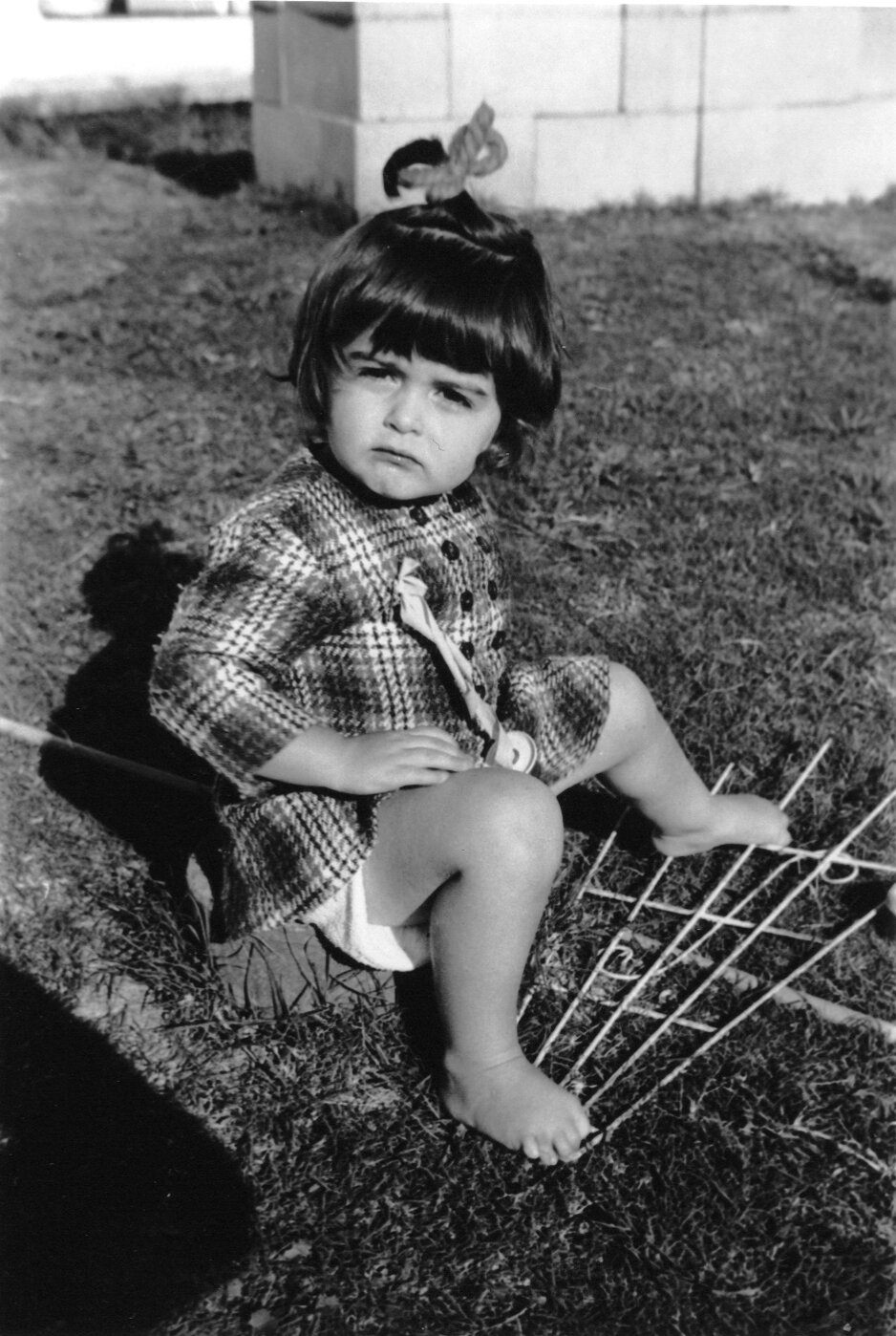
Lisa Murray, 1973

Lisa Murray, 1973

Enjoyed this speech? Speakola is a labour of love and I’d be very grateful if you would share, tweet or like it. Thank you.

Facebook Twitter Facebook
In SUBMITTED 4 Tags LISA ANNE MURRAY, MICHAEL CATLEY, BROTHER, SISTER, TRANSCRIPT, SHORT EULOGY, LOVE, SIBILING
Comment

For Michael Gordon: 'Mikey was a role model for humanity', by Sally and Johnny Gordon - 2018

February 27, 2018

15 February 2018, MCG, Melbourne, Australia

Sally and Johnny were Michael's sister and brother. Johnny's speech is a great example of an ad-libbed eulogy. He's allowed us to include his handwritten notes to illustrate.

Sally:

I’ll be quick as this is very much not my forte. Harry, Mikey and Johnny always have this bit covered. I’m the cheer squad and always just so proud.

We’re all here out of love and respect for Mikey.
He leaves a tremendous hole in our lives.
However, the overwhelming number of emotional and profound tributes has left me with two big hopes.

The first is that all of you who can pick up his baton, will do so.

I hope that many of you will be inspired by him, and then that you will inspire others, to do the stories often regarded as not very sexy. 

Give voices to those who otherwise wouldn’t have one as Mikey did.

As Fergus Hunter said the world desperately needs more Michael Gordons.

Now more than ever.

Take his torch and keep it burning

My second wish is that those of you who are in a position to affect change will work together, and work really, really hard together, to right the wrongs that have so unbelievably become the norm.

Only a few weeks ago Mikey so proudly, so humbly and so beautifully accepted his Walkley award in the company of his colleagues.

He later told me he wished he’d thought to finish with this gesture of support for his friends, the men still on Manus. 

That’s the essence of our brother. 
And we loved him like crazy.

Go well darling Mikey.
 

Johnny:

G'day everyone, I'm Mikey's brother. And how lucky can one guy be to have Michael Gordon as your big brother? It's like one of those [lucky] things you look back at from when you were a kid, "Like crikey, I saw Bob Marley when I was 12 years old!"

But anyway, I'm going to throw these things on [reading glasses] and try and not howl like a mutt. Alright, welcome all, that's what I write down to start with, and what a tidal wave of goodwill. 

Thanks every one of ya, hey Mark if you was looking through my eyes and just go, "giddy up" and thanks so much, so give yourselves a round of applause.

Okay here we go.

Mikey was a role model for humanity, but he was my role model as a kid. He taught me to surf, he was a top bloke, and he was much quieter than me, believe it or not. But you know what I always brought out that other side, a lot of people go, "Well, Michael, he's running on all twelve cylinders!".

Okay I've got two little things written down here. It says, "Police Rounds, Philip Island'

So when I was a kid, I'm learning to surf, I was just a youngster, right, and as you know Mikey was the journo and as a kid, he did it all [whole paper], but he used to do the police rounds. So I think it was something like a 2-11pm shift. So I'd get dropped in at flippin' Russell St., I don't know I'm like twelve or something, right? And Mikey goes, "You know, we can't split till eleven, so he's constantly on the beam, we got the police radios hummin' in the background and he was telling me, "Alright, it's a really big spoil - straight across the road there's the watch house. If you don't act like a kook, we can go over and use the coke machine." It was like ooooooh!

So anyways, when you're a kid right, nine o'clock, you feel like it's three in the morning right, so it's like 11 o'clock we finally get in the car, ready to go, and he goes, 'You know what, I'm tired, I've been working, we can't start the car right?" We had this little red Escort, right? So, I'm sitting next to him ... and the music would be pumpin' and then as you know he was a bit of a ... he loved his music so we had the killer music pumpin' down, but as a grommet I'm half on the nod, right? And he's trying to drive thinking 'if big man shuts up we gonna hit a tree' so it's a safety device to keep me awake.

So, I've just got a pair of shorts on, and Mikey would just go, "Bang!" and just give you the biggest slap on the flippin' thigh... and he goes, "how are the ham steaks now?" 

We had some incredible surfs together and the thing is too big brothers normally bar you if you're like two weeks older ... he was six years older than me, but I was in the posse and that's why I'm mates with all this mob too.

Johnny gordon notes 1.JPG

Okay, the next story, [reads note] we gotta here, it says table tennis right? And Michael, he was like the most competitive fruitcake, right? So we had the table tennis at my joint and as he'd get more focused, because he might be like two points ahead, it's like 'don't get mad, get even.' But he sounded like flippin' Jackie Chan or something on flippin: "whaaaa, woo oo, kneyah," So even weeks after Michael had left, Harris and I'd look at each other as we walked through the corridor and just go, "kneyah!" -  and we knew that was Michael's backspin right?

Okay, there's my two casual stories, okay [applause] No no, you're not out of jail yet! [laughter] Okay, back to the notes, here we go.

Birds of the same feather flock together and that's why his family are absolute legends and you know what? His mates - all flippin' legends. Everyone here, you're flippin' legends because you're part of our flippin' mob, right?

And even on that day where we lost Mikey, he was surrounded by legends. You know, these people were black belts of their field and I just wanna give them an ocean of thanks. There's one guy called Nathaniel, I've got him in my phone as "The Man," so let's just give him a round of applause for doing what he did.

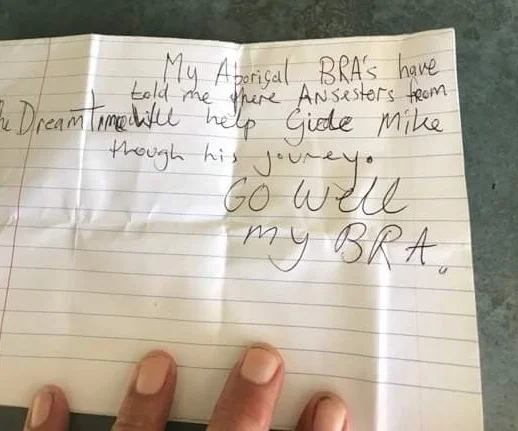
I turn the page.

My aboriginal bras have told me their ancestors from The Dreamtime will guide Mike through his journey. Go well, my bra.

johnny gordon notes 2.JPG
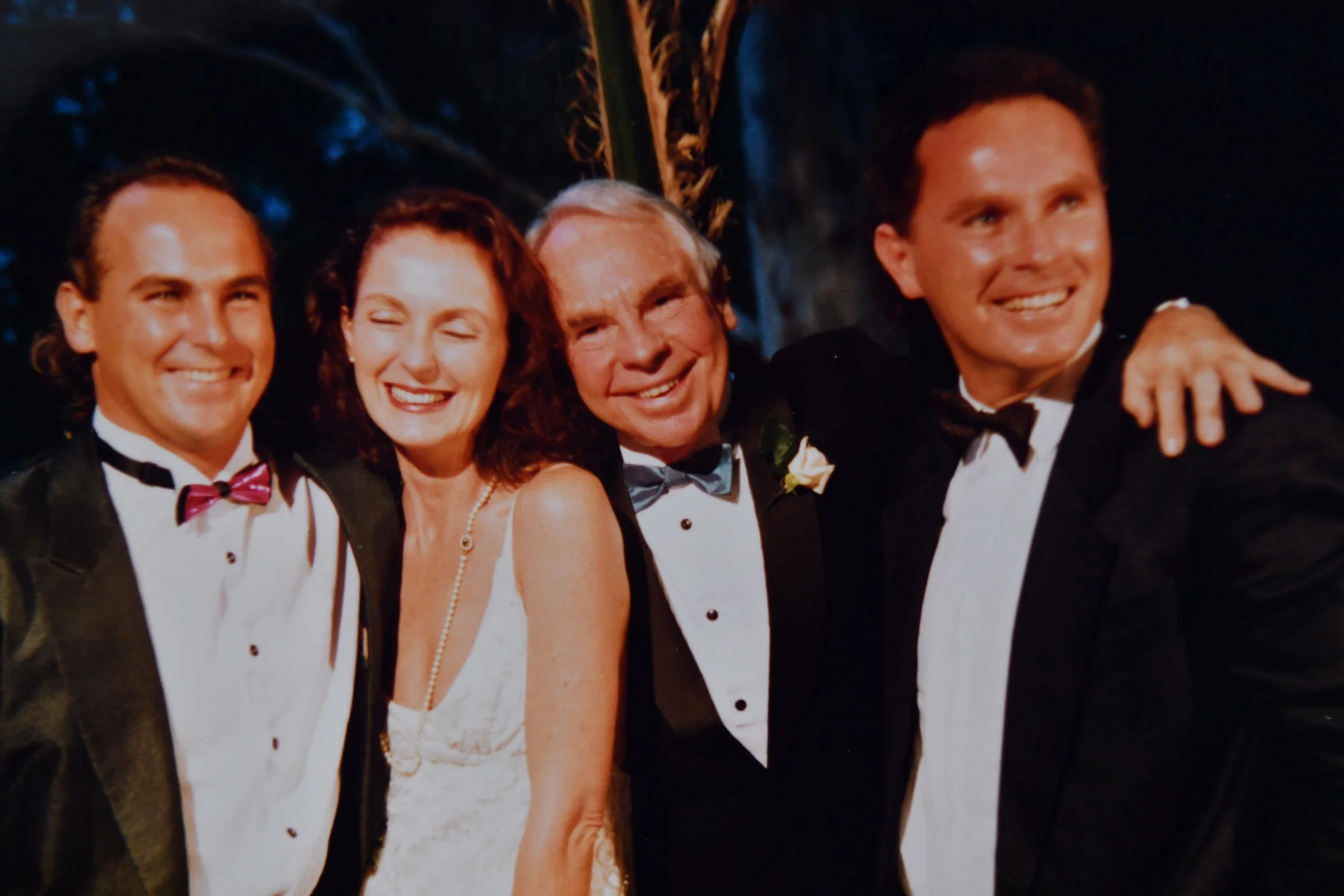
Johnny, Sally, Harry, Michael Gordon

Johnny, Sally, Harry, Michael Gordon

Enjoyed this speech? Speakola is a labour of love and I’d be very grateful if you would share, tweet or like it. Thank you.

Facebook Twitter Facebook
In SUBMITTED 3 Tags SALLY GORDON, JOHNNY GORDON, MICHAEL GORDON, TRANSCRIPT, AD LIB, ASYLUM SEEKERS, BROTHER, SISTER
Comment

For Steve Jobs: 'Steve always aspired to make beautiful later', by sister Mona Simpson - 2011

April 16, 2016

16 October 2011, Memorial Church of Stanford University, San Francisco, USA

There is no audio or video of this speech

I grew up as an only child, with a single mother. Because we were poor and because I knew my father had emigrated from Syria, I imagined he looked like Omar Sharif. I hoped he would be rich and kind and would come into our lives (and our not yet furnished apartment) and help us. Later, after I’d met my father, I tried to believe he’d changed his number and left no forwarding address because he was an idealistic revolutionary, plotting a new world for the Arab people.

Even as a feminist, my whole life I’d been waiting for a man to love, who could love me. For decades, I’d thought that man would be my father. When I was 25, I met that man and he was my brother.

By then, I lived in New York, where I was trying to write my first novel. I had a job at a small magazine in an office the size of a closet, with three other aspiring writers. When one day a lawyer called me – me, the middle-class girl from California who hassled the boss to buy us health insurance – and said his client was rich and famous and was my long-lost brother, the young editors went wild. This was 1985 and we worked at a cutting-edge literary magazine, but I’d fallen into the plot of a Dickens novel and really, we all loved those best. The lawyer refused to tell me my brother’s name and my colleagues started a betting pool. The leading candidate: John Travolta. I secretly hoped for a literary descendant of Henry James – someone more talented than I, someone brilliant without even trying.

When I met Steve, he was a guy my age in jeans, Arab- or Jewish-looking and handsomer than Omar Sharif.

We took a long walk – something, it happened, that we both liked to do. I don’t remember much of what we said that first day, only that he felt like someone I’d pick to be a friend. He explained that he worked in computers.

I didn’t know much about computers. I still worked on a manual Olivetti typewriter.
I told Steve I’d recently considered my first purchase of a computer: something called the Cromemco.

Steve told me it was a good thing I’d waited. He said he was making something that was going to be insanely beautiful.

I want to tell you a few things I learned from Steve, during three distinct periods, over the 27 years I knew him. They’re not periods of years, but of states of being. His full life. His illness. His dying.

Steve worked at what he loved. He worked really hard. Every day.

That’s incredibly simple, but true.

He was the opposite of absent-minded.

He was never embarrassed about working hard, even if the results were failures. If someone as smart as Steve wasn’t ashamed to admit trying, maybe I didn’t have to be.

When he got kicked out of Apple, things were painful. He told me about a dinner at which 500 Silicon Valley leaders met the then-sitting president. Steve hadn’t been invited.

He was hurt but he still went to work at Next. Every single day.

Novelty was not Steve’s highest value. Beauty was.

For an innovator, Steve was remarkably loyal. If he loved a shirt, he’d order 10 or 100 of them. In the Palo Alto house, there are probably enough black cotton turtlenecks for everyone in this church.

He didn’t favor trends or gimmicks. He liked people his own age.

His philosophy of aesthetics reminds me of a quote that went something like this: “Fashion is what seems beautiful now but looks ugly later; art can be ugly at first but it becomes beautiful later.”

Steve always aspired to make beautiful later.

He was willing to be misunderstood.

Uninvited to the ball, he drove the third or fourth iteration of his same black sports car to Next, where he and his team were quietly inventing the platform on which Tim Berners-Lee would write the program for the World Wide Web.

Steve was like a girl in the amount of time he spent talking about love. Love was his supreme virtue, his god of gods. He tracked and worried about the romantic lives of the people working with him.

Whenever he saw a man he thought a woman might find dashing, he called out, “Hey are you single? Do you wanna come to dinner with my sister?”

I remember when he phoned the day he met Laurene. “There’s this beautiful woman and she’s really smart and she has this dog and I’m going to marry her.”

When Reed was born, he began gushing and never stopped. He was a physical dad, with each of his children. He fretted over Lisa’s boyfriends and Erin’s travel and skirt lengths and Eve’s safety around the horses she adored.

None of us who attended Reed’s graduation party will ever forget the scene of Reed and Steve slow dancing.

His abiding love for Laurene sustained him. He believed that love happened all the time, everywhere. In that most important way, Steve was never ironic, never cynical, never pessimistic. I try to learn from that, still.

Steve had been successful at a young age, and he felt that had isolated him. Most of the choices he made from the time I knew him were designed to dissolve the walls around him. A middle-class boy from Los Altos, he fell in love with a middle-class girl from New Jersey. It was important to both of them to raise Lisa, Reed, Erin and Eve as grounded, normal children. Their house didn’t intimidate with art or polish; in fact, for many of the first years I knew Steve and Lo together, dinner was served on the grass, and sometimes consisted of just one vegetable. Lots of that one vegetable. But one. Broccoli. In season. Simply prepared. With just the right, recently snipped, herb.

Even as a young millionaire, Steve always picked me up at the airport. He’d be standing there in his jeans. When a family member called him at work, his secretary Linetta answered, “Your dad’s in a meeting. Would you like me to interrupt him?”

When Reed insisted on dressing up as a witch every Halloween, Steve, Laurene, Erin and Eve all went wiccan.

They once embarked on a kitchen remodel; it took years. They cooked on a hotplate in the garage. The Pixar building, under construction during the same period, finished in half the time. And that was it for the Palo Alto house. The bathrooms stayed old. But – and this was a crucial distinction – it had been a great house to start with; Steve saw to that.

This is not to say that he didn’t enjoy his success: he enjoyed his success a lot, just minus a few zeros. He told me how much he loved going to the Palo Alto bike store and gleefully realizing he could afford to buy the best bike there.

And he did.

Steve was humble. Steve liked to keep learning.

Once, he told me if he’d grown up differently, he might have become a mathematician. He spoke reverently about colleges and loved walking around the Stanford campus. In the last year of his life, he studied a book of paintings by Mark Rothko, an artist he hadn’t known about before, thinking of what could inspire people on the walls of a future Apple campus.

Steve cultivated whimsy. What other C.E.O. knows the history of English and Chinese tea roses and has a favorite David Austin rose?

He had surprises tucked in all his pockets. I’ll venture that Laurene will discover treats – songs he loved, a poem he cut out and put in a drawer – even after 20 years of an exceptionally close marriage. I spoke to him every other day or so, but when I opened The New York Times and saw a feature on the company’s patents, I was still surprised and delighted to see a sketch for a perfect staircase.

With his four children, with his wife, with all of us, Steve had a lot of fun.

He treasured happiness.

Then, Steve became ill and we watched his life compress into a smaller circle. Once, he’d loved walking through Paris. He’d discovered a small handmade soba shop in Kyoto. He downhill skied gracefully. He cross-country skied clumsily. No more.

Eventually, even ordinary pleasures, like a good peach, no longer appealed to him.

Yet, what amazed me, and what I learned from his illness, was how much was still left after so much had been taken away.

I remember my brother learning to walk again, with a chair. After his liver transplant, once a day he would get up on legs that seemed too thin to bear him, arms pitched to the chair back. He’d push that chair down the Memphis hospital corridor towards the nursing station and then he’d sit down on the chair, rest, turn around and walk back again. He counted his steps and, each day, pressed a little farther.

Laurene got down on her knees and looked into his eyes.

“You can do this, Steve,” she said. His eyes widened. His lips pressed into each other.
He tried. He always, always tried, and always with love at the core of that effort. He was an intensely emotional man.

I realized during that terrifying time that Steve was not enduring the pain for himself. He set destinations: his son Reed’s graduation from high school, his daughter Erin’s trip to Kyoto, the launching of a boat he was building on which he planned to take his family around the world and where he hoped he and Laurene would someday retire.

Even ill, his taste, his discrimination and his judgment held. He went through 67 nurses before finding kindred spirits and then he completely trusted the three who stayed with him to the end. Tracy. Arturo. Elham.

One time when Steve had contracted a tenacious pneumonia his doctor forbid everything – even ice. We were in a standard I.C.U. unit. Steve, who generally disliked cutting in line or dropping his own name, confessed that this once, he’d like to be treated a little specially.

I told him: Steve, this is special treatment.

He leaned over to me, and said: “I want it to be a little more special.”

Intubated, when he couldn’t talk, he asked for a notepad. He sketched devices to hold an iPad in a hospital bed. He designed new fluid monitors and x-ray equipment. He redrew that not-quite-special-enough hospital unit. And every time his wife walked into the room, I watched his smile remake itself on his face.
For the really big, big things, you have to trust me, he wrote on his sketchpad. He looked up. You have to.

By that, he meant that we should disobey the doctors and give him a piece of ice.

None of us knows for certain how long we’ll be here. On Steve’s better days, even in the last year, he embarked upon projects and elicited promises from his friends at Apple to finish them. Some boat builders in the Netherlands have a gorgeous stainless steel hull ready to be covered with the finishing wood. His three daughters remain unmarried, his two youngest still girls, and he’d wanted to walk them down the aisle as he’d walked me the day of my wedding.

We all – in the end – die in medias res. In the middle of a story. Of many stories.

I suppose it’s not quite accurate to call the death of someone who lived with cancer for years unexpected, but Steve’s death was unexpected for us.

What I learned from my brother’s death was that character is essential: What he was, was how he died. Tuesday morning, he called me to ask me to hurry up to Palo Alto. His tone was affectionate, dear, loving, but like someone whose luggage was already strapped onto the vehicle, who was already on the beginning of his journey, even as he was sorry, truly deeply sorry, to be leaving us.

He started his farewell and I stopped him. I said, “Wait. I’m coming. I’m in a taxi to the airport. I’ll be there.”

“I’m telling you now because I’m afraid you won’t make it on time, honey.”

When I arrived, he and his Laurene were joking together like partners who’d lived and worked together every day of their lives. He looked into his children’s eyes as if he couldn’t unlock his gaze.

Until about 2 in the afternoon, his wife could rouse him, to talk to his friends from Apple.

Then, after awhile, it was clear that he would no longer wake to us.

His breathing changed. It became severe, deliberate, purposeful. I could feel him counting his steps again, pushing farther than before.

This is what I learned: he was working at this, too. Death didn’t happen to Steve, he achieved it.

He told me, when he was saying goodbye and telling me he was sorry, so sorry we wouldn’t be able to be old together as we’d always planned, that he was going to a better place.

Dr. Fischer gave him a 50/50 chance of making it through the night.

He made it through the night, Laurene next to him on the bed sometimes jerked up when there was a longer pause between his breaths. She and I looked at each other, then he would heave a deep breath and begin again.

This had to be done. Even now, he had a stern, still handsome profile, the profile of an absolutist, a romantic. His breath indicated an arduous journey, some steep path, altitude.

He seemed to be climbing.

But with that will, that work ethic, that strength, there was also sweet Steve’s capacity for wonderment, the artist’s belief in the ideal, the still more beautiful later.

Steve’s final words, hours earlier, were monosyllables, repeated three times.

Before embarking, he’d looked at his sister Patty, then for a long time at his children, then at his life’s partner, Laurene, and then over their shoulders past them.

Steve’s final words were:
OH WOW. OH WOW. OH WOW.

Source: http://www.nytimes.com/2011/10/30/opinion/...

Enjoyed this speech? Speakola is a labour of love and I’d be very grateful if you would share, tweet or like it. Thank you.

Facebook Twitter Facebook
In EDITORS CHOICE Tags STEVE JOBS, MONA SIMPSON, SISTER, APPLE, CANCER, LAST WORDS, TRANSCRIPT
Comment

See my film!

Limited Australian Season

March 2025

Details and ticket bookings at

angeandtheboss.com

Support Speakola

Hi speech lovers,
With costs of hosting website and podcast, this labour of love has become a difficult financial proposition in recent times. If you can afford a donation, it will help Speakola survive and prosper.

Best wishes,
Tony Wilson.

Become a Patron!

Learn more about supporting Speakola.

Featured political

Featured
Jon Stewart: "They responded in five seconds", 9-11 first responders, Address to Congress - 2019
Jacinda Ardern: 'They were New Zealanders. They are us', Address to Parliament following Christchurch massacre - 2019
Dolores Ibárruri: "¡No Pasarán!, They shall not pass!', Defense of 2nd Spanish Republic - 1936
Jimmy Reid: 'A rat race is for rats. We're not rats', Rectorial address, Glasgow University - 1972

Featured eulogies

Featured
For Geoffrey Tozer: 'I have to say we all let him down', by Paul Keating - 2009
for James Baldwin: 'Jimmy. You crowned us', by Toni Morrison - 1988
for Michael Gordon: '13 days ago my Dad’s big, beautiful, generous heart suddenly stopped beating', by Scott and Sarah Gordon - 2018

Featured commencement

Featured
Tara Westover: 'Your avatar isn't real, it isn't terribly far from a lie', The Un-Instagrammable Self, Northeastern University - 2019
Tim Minchin: 'Being an artist requires massive reserves of self-belief', WAAPA - 2019
Atul Gawande: 'Curiosity and What Equality Really Means', UCLA Medical School - 2018
Abby Wambach: 'We are the wolves', Barnard College - 2018
Eric Idle: 'America is 300 million people all walking in the same direction, singing 'I Did It My Way'', Whitman College - 2013
Shirley Chisholm: ;America has gone to sleep', Greenfield High School - 1983

Featured sport

Featured
Joe Marler: 'Get back on the horse', Harlequins v Bath pre game interview - 2019
Ray Lewis : 'The greatest pain of my life is the reason I'm standing here today', 52 Cards -
Mel Jones: 'If she was Bradman on the field, she was definitely Keith Miller off the field', Betty Wilson's induction into Australian Cricket Hall of Fame - 2017
Jeff Thomson: 'It’s all those people that help you as kids', Hall of Fame - 2016

Fresh Tweets


Featured weddings

Featured
Dan Angelucci: 'The Best (Best Man) Speech of all time', for Don and Katherine - 2019
Hallerman Sisters: 'Oh sister now we have to let you gooooo!' for Caitlin & Johnny - 2015
Korey Soderman (via Kyle): 'All our lives I have used my voice to help Korey express his thoughts, so today, like always, I will be my brother’s voice' for Kyle and Jess - 2014

Featured Arts

Featured
Bruce Springsteen: 'They're keepers of some of the most beautiful sonic architecture in rock and roll', Induction U2 into Rock Hall of Fame - 2005
Olivia Colman: 'Done that bit. I think I have done that bit', BAFTA acceptance, Leading Actress - 2019
Axel Scheffler: 'The book wasn't called 'No Room on the Broom!', Illustrator of the Year, British Book Awards - 2018
Tina Fey: 'Only in comedy is an obedient white girl from the suburbs a diversity candidate', Kennedy Center Mark Twain Award -  2010
Tina Fey: 'Only in comedy is an obedient white girl from the suburbs a diversity candidate', Kennedy Center Mark Twain Award - 2010

Featured Debates

Featured
Sacha Baron Cohen: 'Just think what Goebbels might have done with Facebook', Anti Defamation League Leadership Award - 2019
Greta Thunberg: 'How dare you', UN Climate Action Summit - 2019
Charlie Munger: 'The Psychology of Human Misjudgment', Harvard University - 1995
Lawrence O'Donnell: 'The original sin of this country is that we invaders shot and murdered our way across the land killing every Native American that we could', The Last Word, 'Dakota' - 2016