
• Genre
  • About
  • Submissions
  • Donate
  • Search
Menu

Speakola

All Speeches Great and Small
  • Genre
  • About
  • Submissions
  • Donate
  • Search

Commencement and Graduation

Inspiring, humorous, wisdom imparting. Some of the best speeches are delivered in the educational context. Upload your commencement or graduation speech here.

Arianna Huffington: 'What I urge you to do is to lead the third women’s revolution', Smith College - 2013

November 18, 2015

19 May 2013, Smith College,  Northampton, Massachusetts, USA

Thank you so much, President Christ, the Board of Trustees, distinguished alumnae, members of the faculty, devoted parents and friends, and especially the fabulous Smith College class of 2013. Congratulations. You have reached the light at the end of the tunnel. And I’m sure that when you first arrived at Smith four years ago you never would have imagined that at the other end of that tunnel would be a lady behind a podium talking to you in a funny accent. This accent, incidentally, was the bane of my existence — until, that is, I moved to New York in 1980 and met Henry Kissinger, who told me not to worry about my accent, because you can never, in American public life, underestimate the advantages of complete and total incomprehensibility.

I’m so grateful to be with you at this special moment in your lives, and I want to start by taking a moment to honor President Christ, your magnificent, viola-playing, Victorian poetry-quoting president, who is retiring after 11 years of service, leadership and inspiration.

You don’t know it but I have spent the last several weeks stalking you — on your various Smith websites, on your Twitter feeds, on Facebook, on Instagram, on Tumblr — so I could get to know you better.

And here’s what I’ve found: you’re fascinating and curious and quirky and asking the big questions and worrying about the little things, and solving the cosmic riddles and agonizing about what shoes to wear at Commencement, and what happens if you trip and become a YouTube sensation.

I’ve learned about Smithies writing honors theses on subjects that I not only don’t understand but can’t even pronounce. Like Lisa Stephanie Cunden’s thesis on entropy and enthalpy contributions to the chelate effect — I wanted to give you the gift of hearing that said in a Greek accent. I’ve learned about the three seniors who were part of the basketball team, which made the Division III NCAA tournament for the first time — a historic accomplishment to add to your already historic status as the birthplace of women’s basketball. I’ve learned about the many Smithies who will be the first in their families to graduate from college, like Massiel De los Santos, who began her journey in the Dominican Republic.

But before I go any further, because I’ve been so impressed, I feel compelled to extend to you a lifelong invitation to blog on The Huffington Post — about your graduation, and about all your adventures on the next stage of the journey you’re starting today.

Getting to know you has made me feel very protective of you, especially since I have two college-aged daughters myself. But I know you don’t need protecting. You are prepared and ready to take on the world — and if you have attended the Wurtele Center for Work and Life, you even have a Passport to Life After Smith, with the opportunity to learn things like job interviewing skills, how to balance a budget, cook a healthy meal and even change a tire.

So you can consider my speech today a continuation of the Passport to Life After Smith, though in the interest of full disclosure, I can’t cook and definitely cannot change a tire. But part of life after Smith will be deciding what things you want to put your energy into and what things you don’t. It was a big revelation for me I realized that I didn't have to complete everything I thought I wanted to do, like learning German or becoming a good skier or learning to cook. Indeed I realized that you can complete a project by dropping it.

Commencement speakers are traditionally expected to tell graduates how to go out there and climb the ladder of success, but I want to ask you, instead, to redefine success. Because the world you are headed into desperately needs it. And because you are up to it. Your education at Smith has made it unequivocally clear that you are entitled to take your place in the world on equal footing, in every field, and at the top of every field. But what I urge you to do is not just take your place at the top of the world, but to change the world.

What I urge you to do is to lead the third women’s revolution.

The first was led by the suffragists over a hundred years ago, when brave women like Susan B. Anthony and Elizabeth Cady Stanton fought, among other things, to give women the right to vote. The second women’s revolution was powerfully led by Smith alumnae, Betty Friedan and Gloria Steinem. They fought — and Gloria continues to fight — to expand the role of women in our society, to give us full access to the rooms of power where decisions are being made.

And while the second revolution is still in progress, we simply can’t wait any longer for the third revolution to begin. And I can’t imagine a place where I would be more likely to find the leaders of that revolution than right here at Smith.

At the moment, our society’s notion of success is largely composed of two parts: money and power. In fact, success, money and power have practically become synonymous.

But it’s time for a third metric, beyond money and power — one founded on well-being, wisdom, our ability to wonder, and to give back. Money and power by themselves are a two legged stool — you can balance on them for a while, but eventually you’re going to topple over. And more and more people, very successful people, are toppling over every day. Basically, success the way we’ve defined it is no longer sustainable. It’s not sustainable for human beings; it’s not sustainable for the planet. To live the lives we want, and not just the ones we settle for, the lives society defines as successful, we need to include the third metric.

In 2004, President Christ gave a speech that was really ahead of its time. It was titled “Inside the Clockwork of Women’s Careers.” To me, it’s very much a third women’s revolution call to arms. She spoke of the need to dispel myths about ambition and success, chief among them the myth that success and ambition look like a straight line. Now I guess it’s no big surprise that the image of success created by men would be, yes, a long, phallic-shaped straight line.

But if we don’t redefine success, the personal price we pay will get higher and higher. And as the data shows, that price is even higher for women than it is for men. Already, women in stressful jobs have a nearly 40 percent increased risk of heart disease, and a 60 percent greater risk of diabetes. And in the last 30 years, as women have made strides and gains in the workplace, self-reported levels of stress have gone up 18 percent.

Another Smith graduation speaker, Alistair Cooke, notoriously told the class of 1954 that their way to the top would be determined by the men they married.

I want to do old Alistair one better, and tell you that you don’t get to the top by marrying someone. A much simpler way is to sleep your way to the top. Right now I imagine President Christ is thinking she probably should have vetted this speech.

But no, I’m talking about sleep in the literal sense. Because right now, the workplace is absolutely fueled by sleep deprivation and burnout. I know of what I speak: In 2007, sleep deprived and exhausted, I fainted, hit my head on my desk, broke my cheekbone and got four stitches on my right eye. And that was the beginning of my reaquainting myself with sleep, and with the need to redefine success to include our own well-being. Even if sleep deprivation is not affecting your health, it’s affecting your creativity, your productivity, and your decision-making. The Exxon Valdez wreck, the explosion of the Challenger space shuttle, and the nuclear accidents at Chernobyl and Three Mile Island — all were at least partially the result of decisions made on too little sleep.

According to researchers at Walter Reed hospital, the only thing that gets better with sleep deprivation is “magical thinking” and reliance on superstition. So for those of you majoring in fortune telling, go ahead and burn the midnight oil. The rest of you: not so much.

As you can tell by now, I’m a major sleep evangelist. The Huffington Post’s office in New York sports two nap rooms. At the beginning our reporters, editors and engineers were reluctant to use them, afraid that people might think they’re shirking their duties. I’m happy to say, our nap rooms are now always booked. Although the other day I was walking by and I saw two people walking out of one of the nap rooms. But, hey, whatever it takes to recharge. Just don’t tell HR, okay?

What adding well-being to our definition of success means is that, in addition to looking after our financial capital, we need to look after our human capital. My mother was an expert at that. I still remember, when I was 12 years old, a very successful Greek businessman came for dinner. He looked rundown and exhausted. But when we sat down to dinner, he told us how well things were going for him. My mother was not impressed. “I don’t care how well your business is doing,” she told him bluntly, “you’re not taking care of you. Your business might have a great bottom line, but you are your most important capital. There are only so many withdrawals you can make from your health bank account, but you just keep on withdrawing. You could go bankrupt if you don’t make some deposits soon.” And indeed, not long after that, the man had to be admitted for an angioplasty.

When we include well-being in our definition of success, another thing that will change is our relationship with time. Researchers have come up with a term for our stressed out feeling that there’s never enough time for what we want to do — they call it “Time Famine.” Every time we look at our watch it seems to be later than we think. I personally have long had a very strained relationship with time — more in line with a certain Ph.D. from Oxford, in English Lit, actually — Dr. Seuss.

“How did it get so late so soon?” he wrote. “It’s night before it’s afternoon. December is here before it’s June. My goodness how the time has flown. How did it get so late so soon?”

Does that feel familiar to anyone? Or, more likely, to everyone? The problem is that as long as success is defined by just money and power, climbing and burnout, we are never going to be able to enjoy that other aspect of the third metric: wonder.

I was blessed with a mother who was in a constant state of wonder. Whether she was washing dishes or feeding seagulls at the beach or reprimanding overworking businessmen, she maintained her sense of wonder, delighted at both the mysteries of the universe and the everyday little things that fill our lives. And whenever I’d complain or be upset about something, she would say to me: “Darling, change the channel. You are in control of the clicker. Don’t replay the bad, scary movie.”

One of the gifts this attitude to life gave her was the ability to cut through hierarchies. One night, when I was in my 20s and still living in London, a Tory member of Parliament I was dating at the time (it might have been one of those decisions brought on by sleep deprivation) had brought the Prime Minister Edward Heath to dinner. My mother was in the kitchen, where she could be found most of the time, talking to the plumber, who had come to fix a last-minute problem. She asked the plumber what he thought of the prime minister. “Not much,” the plumber said, “he hasn’t been good for working people.” “Let me go bring him here so you can tell him directly,” my mother replied. And that’s how the prime minister ended up in the kitchen talking to the plumber.

Well-being, wonder, and now I’d like to talk about another indispensable W — wisdom.

Wherever we look around the world, we see leaders in positions of power — in politics, in media, in business, all of them with high IQs and great degrees — making terrible decisions. What is missing is not IQ, but wisdom. And today, it's getting harder and harder to tap into our own wisdom. Because we are all so hyper-connected to our devices, our gadgets, our screens, our social media, we're having a hard time disconnecting from technology and reconnecting with ourselves. Your very own, very wise Smith sophomore, Erin McDaniel, wrote in the Sophian about her decision to disconnect from all her social media. “We have eschewed real social connections in favor of superficial, technology-bridged ones...We have become, in many cases, nearly as (socially) robotic as our computers.”

Don’t worry — you don’t have the head of a digital company telling you to completely disconnect from technology. What I’m telling you is to regularly disconnect from technology, to regularly unplug and recharge in order to reconnect with ourselves and our own deepest wisdom. I’m convinced that there are two fundamental truths about human beings. The first truth is that we all have within us a centered place of wisdom, harmony, and strength. This is a truth that all the world’s religions — whether Christianity, Islam, Judaism, or Buddhism — and many of its philosophies, hold true in one form or another: “The Kingdom of God is Within.”

The second truth is that we’re all going to veer away from that place again and again and again. That’s the nature of life. In fact, we may be off-course more often than we are on-course. At the Huffington Post, we even came up with an app, called GPS for the Soul, that helps us get back to that place. I know there is something paradoxical about using technology to disconnect from technology, but the snake in our digital garden of Eden has been hyper-connectivity with technology. And we have to be more wily than the snake, hence using technology to help us disconnect from technology.

When we’re in that centered place of wisdom, harmony and strength, life is transformed, from struggle to grace, and we are suddenly filled with trust, no matter the obstacles, challenges and disappointments. Because there is a purpose to our lives, even if it is often hidden from us, and even if the biggest turning points and heartbreaks only make sense as we look back, not as we are experiencing them. So we might as well live life as if — as the poet Rumi put it — “Everything is rigged in our favor.”

We’ve talked about well-being, wisdom, and wonder. And now, the last element of the third metric of success: empathy, compassion, the willingness to give back.

The founding fathers wrote about the pursuit of happiness, and if you go back to the original documents — as I’m sure all of you have done— happiness did not mean the pursuit of more ways to be entertained. It was the happiness that comes from feeling good by doing good.

Of course many of you already know that. Smithies have given back in countless ways, near and far: working with Chinese schools and NGOs through the Smith China Project, spending time in the community with people with disabilities through the Best Buddies program, tutoring children in Holyoke, and using digital storytelling to start conversations about health issues in Springfield.

So as you leave this beautiful campus today to follow your dreams and scale great heights in whatever profession you choose, I beg you: don’t buy society’s definition of success. Because it’s not working for anyone. It’s not working for women, it's not working for men, it's not working for polar bears, it's not working for the cicadas that are apparently about to emerge and swarm us. It’s only truly working for those who make pharmaceuticals for stress, sleeplessness and high blood pressure.

So please don’t settle for just breaking through glass ceilings in a broken corporate system or in a broken political system, where so many leaders are so disconnected from their own wisdom that we are careening from one self-inflicted crisis to another. Change much more than the M to a W at the top of the corporate flow chart. Change it by going to the root of what’s wrong and redefining what we value and what we consider success.

And remember that while there will be plenty of signposts along your path directing you to make money and climb up the ladder, there will be very few signposts reminding you to stay connected to the essence of who you are, to take care of yourself along the way, to reach out to others, to pause to wonder, and to connect to that place from which everything is possible. “Give me a place to stand,” my Greek compatriot Archimedes said, “and I will move the world.”

So find your place to stand — your place of wisdom and peace and strength. And from that place, lead the third women’s revolution and remake the world in your own image, according to your own definition of success, so that all of us — women and men — can live our lives with more grace, more joy, more empathy, more gratitude, and yes, more love. And now, Smith College class of 2013, congratulations, onward, upward and inward!
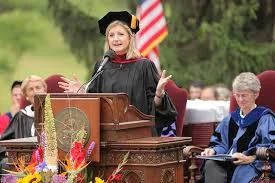
Source: http://www.smith.edu/events/commencement_s...

Enjoyed this speech? Speakola is a labour of love and I’d be very grateful if you would share, tweet or like it. Thank you.

Facebook Twitter Facebook
In GUEST SPEAKER A Tags ARIANNA HUFFINGTON, WOMEN'S RIGHTS, SUCCESS, CAREERS, PATRIARCHY, GENDER EQUALITY, SLEEP
Comment

Arianna Huffington: 'Don't be so connected to everybody that you're not truly connected to anybody', Vassar College - 2015

November 18, 2015

Video embedded here

1 June 2015, Vassar College, Hudson Valley, New York, USA

Thank you so much, President Hill, Members of the Board of Trustees, distinguished alumni, members of the faculty, devoted parents and friends, and especially the fabulous Vassar College Class of 2015. I am deeply grateful to have been invited to be part of such a special moment in your lives. Commencement is one of my favorite rituals -- coming together for one last time, dressed alike before you head off into your singular and unique lives. When I was deciding what to wear under my gown, I asked Siri what the weather was in Poughkeepsie. And Siri responded with a list of mixed drinks with whiskey. I think I'm going to wait until Siri comes up with an update for Greek accents.

Today is the culmination of your time at Vassar. And it's also a mini-culmination for me. Because I've spent a lot of time in recent weeks getting to know you -- following you and your activities on social media, on Vassar's website, in The Miscellany News, and in other ways I'm not prepared to disclose that will remain between me and the folks at the NSA. It feels a little like I've been checking out your online dating profile, and now we're finally meeting. And when I saw you walk in, all 611 of you, I breathed a huge sigh of relief. Because let's face it, you look fantastic. If we were on Tinder, I would definitely be ready to swipe right. Or is it left? Actually, at my age, it doesn't matter, as long as you're swiping.

One of the things I learned from my cyber-stalking is that the Vassar College seal shows the goddess Athena in front of the Parthenon, which I love. Though it occurs to me that I'm probably here because Athena couldn't be booked, so you settled for another Greek lady from Athens. And to really sell it, I'll be delivering my speech in a thick, sometimes- hard-to-understand Greek accent, instead of the crystal clear, accentless voice I use at all other times. In my private detective work, I also learned that your former motto "purity and wisdom" was abandoned in 1930, which was probably a good idea given that when The Miscellany News -- or the Misc as I understand you call it -- sent out an email to seniors asking what was on their bucket list, most of the answers had to do with sex. One replied, "Have sex under the sex tree!" Another said, "Have sex in the circle couches near the Art Library." A third wrote back, "Sex in the meditation room or the roof of the library." Aren't you glad I'm not disclosing your names in front of your parents? You owe me!

What was clear from all my private detective work is that you belong to a community. And for the rest of your lives, you'll essentially have a language you speak that no one else understands...sort of a more fun version of how I've been feeling my whole life. Chili Wednesdays at The Retreat. The Bell Ringing. Founder's Day. Mug Nights. A Quidditch team, The Butterbeer Brooers. The Deece. Running naked through the library the night before final exams. The Vassar Devil, which I understand to be some sort of ice cream sensation I'm definitely planning to sample before I leave. The a cappella groups -- all 3,475 of them.

And what a treasure trove of stories you're leaving Vassar with. Not just from your years here but from Vassar's incredibly colorful past: Way back in the 1880s, you invented fudge -- maybe. Some of you actually believe that the squirrels around campus are the slightly deranged reincarnations of English majors who couldn't get jobs after graduation. But, hey, at least the squirrels aren't living at home, right mom and dad? And here is my favorite: before your time, Vassar students were given the emblem of an acorn to display on their doors when they did not wish to be disturbed. The custom was apparently discontinued, but I want to urge you to revive it as something to use physically and spiritually for the rest of your lives. It's actually central to the three relationships I want to talk to you about today. And those are: your relationship with technology, your relationship with yourself, and your relationship with the world.

Let's start with your relationship with technology. No generation has been as liberated and as connected by technology as yours. But also, no generation has been as enslaved and as distracted by technology. So bring on that acorn because as the writer Eric Barker said, "Those who can sit in a chair, undistracted for hours, mastering subjects and creating things will rule the world -- while the rest of us frantically and futilely try to keep up with texts, tweets and other incessant interruptions." Sadly, we have become not just distracted by our devices, our texts, emails, constant notifications, and social media, but addicted to them. And when it comes to social media, let me break it to you: our addiction is not a bug, but a feature. This isn't some unforeseen side effect, it was always the intention, that social media would consume as much of our time and attention -- as much of our lives -- as possible.

To your credit, many of you have already recognized this and have taken steps to curb this addiction. As senior Justin Mitchell told the Misc, "I was mindlessly going through people's profiles and being an idiot. So I cut it out. There's just not enough time to do that with school." And having graduated just a few years before you, I can tell you there is even less time to do that with life.

But the addiction is so powerful that, according to a recent survey, 20 percent of millennials actually use their smartphones during sex. Maybe I should have read the instructions on my phone more carefully, but I'm not even sure what that means. Indeed, a recent study shows that more than half of women would rather go a month with no sex than a month with no smartphone -- although I am sure this survey did not include any women with access to the Vassar Sex Tree.

Contrary to what many of you may think, not only is multitasking not very efficient, it doesn't actually exist. It's actually rapid task switching -- instead of doing two things at once, we simply switch between doing two things badly. It's one of the most stressful ways we can use our time, and it robs us of our capacity to notice and appreciate every moment of our lives. I live in New York, and you hardly ever see anybody simply walking down the street who's not also staring at a screen, talking on the phone, or, even worse, texting while walking. It's like being in a really boring zombie movie. I used to be exactly like that myself. I remember one day, I left my apartment with a friend. I looked up and said, "What a gorgeous building! I wonder when that went up?" "1890" my friend said. I'd never noticed it. As Vassar alum Mary Oliver put it, "Instructions for living a life: Pay attention. Be Astonished. Tell about it." And by the way, when you do, please tell about it on The Huffington Post. I'm going to make it super easy for you by giving you my email so you can bypass the growing HuffPost blogging bureaucracy: arianna@huffingtonpost.com.

As someone who runs a 24/7 digital media company and who uses every form of social media ever invented, I hope I have some street cred when I urge you to build boundaries, introduce digital detoxes into your life, and learn to regularly disconnect from the jumble and the cacophony and make time to reconnect with yourself. There will be many profound and fulfilling relationships ahead of you, but the relationship with yourself is the most important relationship you'll ever have. And, like any relationship, it can't be taken for granted -- without care and attention, it will atrophy and, ultimately, break down.

If there is one thing I wish I knew when I was sitting where you are today -- and by the way, there are many -- it's that the Delphic admonition "Know Thyself" and Socrates' admonition that "the unexamined life is not worth living" are not ancient philosophical platitudes, but in fact the most relevant and important guiding truths for our lives. In the well-earned rush and excitement of your new life that's about to begin, it's remarkably easy to forget that most important relationship. That's because the ever-increasing creep of technology -- into our bedrooms, our brains, and our lives -- makes it much harder to connect with ourselves.

Indeed, for so many of us, connecting with ourselves has been so neglected that we will do anything to avoid it. Researchers from Harvard and the University of Virginia did an experiment in which they gave people a choice to be alone in a room, without anything -- no devices, no papers, no phones -- or get an electric shock. A whopping 67 percent of men chose the electric shock. I'm very happy to say that only 25 percent of women chose the shock. Seriously guys -- and a quarter of women -- what is wrong with you? It's not like you have to go shopping with your own thoughts or move in with them and pick out drapes, just be alone with them for fifteen minutes. Is it that bad?

In fact most of us actually know more about the state of our smartphones than we do about the state of ourselves. I bet pretty much everyone here knows approximately how much battery remains in your smartphone right now. And when it gets below 20%, giving us the dreaded red low power alert, we begin to get anxious and desperately look around for one of the little recharging shrines we meticulously maintain everywhere around us, lest anything should happen to our precious phone. But how much do you know, how aware are you, how mindful are you, of the state of your own being? Of your own energy and alertness and reserves? How quickly do you spring into action when you go into the low power zone?

I was fascinated to read about Vassar's Maria Mitchell, America's first female astronomer, and to see the gorgeous building that used to house her observatory. And while I completely understand the sense of wonder that has led men and women through the ages to explore outer space, I'm personally much more fascinated with exploring inner space. As Thomas Merton put it, "What can we gain by sailing to the moon if we are not able to cross the abyss that separates us from ourselves? This is the most important of all voyages of discovery, and without it all the rest are not only useless but disastrous." In other words, it's the quality of our inner journeys that allows us to make sense of our outer journeys.

There is now a collective longing to stop living in the shallows and recognize that life is actually shaped from the inside out -- a truth that has been celebrated by spiritual teachers, poets and philosophers throughout the ages and has now been unambiguously validated by modern science. And you, Vassar graduates, can lead the way, and chart a new path forward. You're the first generation born into the digital world. And you can be the first generation to master it, to make it serve you, instead of the other way around. And when you do, you'll find that you have the wind at your back because that's what the times are calling for.

One of the things that's so special about Vassar is that at the heart of your education is a deep and profound sense of responsibility for the world and those around us. You've been taught to use your considerable talents, and your drive and your dedication to make a difference in the world. I was moved and inspired by all the projects you've started and been involved in: The Vassar Prison Initiative, The Vassar Haiti Project, The College Committee on Sustainability, Operation Donation, etc., etc. You've already made a difference in the world you're about to enter.

And it's no accident that Vassar has recognized the crisis of growing inequality in our country. In fact, congratulations for being the number one college to enroll high-performing, low-income students and support them through successful graduation. The concern about growing inequality has become almost universal -- transcending political parties and ideologies. The statistics are staggering: Student loan debt is at 1.2 trillion dollars, the number of Americans in poverty has grown by 15 million since 2000, the number of high-poverty neighborhoods has tripled since 1970, while America is now home to more prisoners than any other country in the world, with more than 2 million people behind bars.

As we see this happening, I keep being reminded of my visit to Pompeii, whose people were wiped out in the first century by a violent volcanic eruption. There had been many warning signs, including a severe earthquake, tremors, springs and wells that dried up, dogs that ran away, and birds that no longer sang. And then the most obvious warning sign: columns of smoke belching out of Mount Vesuvius before the volcano blew its top, burying the city and its inhabitants under sixty feet of ash and volcanic rock. But the warning signs had been dismissed as "not particularly alarming." The warning signs are all around us today, too, pointing out the gulf between what we know we should be doing and what we're choosing to do instead.

It's not that we don't have enough data -- in fact, we're drowning in data. What we're lacking is wisdom. Indeed ninety percent of the data now available to us has been created in the last two years. But how much of our collective wisdom has been made available in that time? That's what's missing from our leaders and from our public discourse. Could our political debate, dominated as it is by meaningless head-to-head polls, manufactured controversies, horse-race sound-bites, and news of Hillary Clinton asking for extra guacamole at Chipotle and Ted Cruz suddenly liking country music after 9/11 -- be any more trivialized?

In fact, at The Huffington Post we've started a "Who Cares?" section to cover all these non-issues and hopefully leave more room for the real ones. And for those of you going into journalism, our goal at HuffPost is to reimagine the craft. There's an old saying in the news business, one that's guided editorial thinking for decades: "If it bleeds, it leads." But it turns out this is just lousy journalism. As journalists, our job is to provide an accurate picture -- and that means the full picture -- of what's going on in the world. Just showing tragedy, violence, and mayhem -- just focusing on what's broken and what's not working -- misses too much of what is really happening all around us. What about how people are responding to these challenges, how they're coming together, even in the midst of violence, poverty and loss? And what about all the stories of innovation, creativity, ingenuity, compassion and grace? By shining a light on these stories, we can scale up these solutions and create a positive contagion that can expand and broaden their reach. Instead of just producing copycat crimes, we can start to produce copycat solutions.

And you can be a part of those solutions. There is an invisible but very real and inescapable connection between our relationship with ourselves and our relationship with the world. As Alexander Solzhenitsyn put it, "If you wanted to put the world to rights, who should you begin with: yourself or others?" I know everyone here wants to help put the world to rights. But please remember, it begins with yourself... as they say on airplanes, secure your own oxygen mask first.

So regularly hang that virtual acorn on your door because while the world will provide plenty of insistent, pleading, flashing, high-volume signals directing you to distract yourself, to not be in the moment, to burn out in order to climb higher up the ladder of what the world defines as success, there will be almost no worldly signals reminding you to stay connected to the essence of who you are, to pause to wonder, and to connect to that place of wisdom in you -- that place from which everything is possible. The world will keep coming at you with its incessant demands, beeps, blinking lights, and alerts. "Every day," Iain Thomas wrote, "the world will drag you by the hand, yelling, 'This is important! And this is important! And this is important! You need to worry about this! And This! And This!' And each day, it's up to you to yank your hand back, put it on your heart and say, 'No. This is what's important.'"

It's from this sacred place that life is transformed from struggle to grace, from information to wisdom. We have, if we're lucky, about 30,000 days to play the game of life. And trust me, that's not morbid. In fact, it's wisdom that will put all the inevitable failures and rejections and disappointments and heartbreaks into perspective. Because as the great Onion headline summed it up, "Death Rate Holding Steady at 100%" So let's stop sweeping it under the rug. That's a modern impulse. Ancient Romans would carve "MM," Memento Mori, Remember Death, on statues and trees -- to put every victory and every defeat into its proper perspective. I'm not sure if you want to carve it on the sex tree, though, because things could get weird.

And if you've been to a memorial service recently, you'll have noticed that our eulogies have very little to do with our resumes and our LinkedIn profiles. For instance, here's the sort of thing you don't hear in a eulogy: "George was amazing, he increased market share by one-third." Or, "her PowerPoint slides were always meticulously prepared." Or, "she ate lunch at her desk every single day." Our eulogies are always about the other stuff: what we gave, how we connected, how much we meant to our family and friends, small kindnesses, lifelong passions, and the things that made us laugh. So why do we spend so much of our lives chasing things we don't value and that don't ultimately matter?

As you leave this magical campus, don't let technology wrap you up in a perpetually harried existence. Don't be so connected to everybody that you're not truly connected to anybody. Or to yourself. And don't get so caught up in your busy life that life's mystery passes you by. Bring joy and gratitude into every moment -- even the tough ones -- and start displaying that acorn on your door. Thank you so much.


Source: http://www.huffingtonpost.com/arianna-huff...

Enjoyed this speech? Speakola is a labour of love and I’d be very grateful if you would share, tweet or like it. Thank you.

Facebook Twitter Facebook
In GUEST SPEAKER B Tags ARIANNA HUFFINGTON, HUFFINGTON POST, SOCIAL MEDIA
Comment

See my film!

Limited Australian Season

March 2025

Details and ticket bookings at

angeandtheboss.com

Support Speakola

Hi speech lovers,
With costs of hosting website and podcast, this labour of love has become a difficult financial proposition in recent times. If you can afford a donation, it will help Speakola survive and prosper.

Best wishes,
Tony Wilson.

Become a Patron!

Learn more about supporting Speakola.

Featured political

Featured
Jon Stewart: "They responded in five seconds", 9-11 first responders, Address to Congress - 2019
Jacinda Ardern: 'They were New Zealanders. They are us', Address to Parliament following Christchurch massacre - 2019
Dolores Ibárruri: "¡No Pasarán!, They shall not pass!', Defense of 2nd Spanish Republic - 1936
Jimmy Reid: 'A rat race is for rats. We're not rats', Rectorial address, Glasgow University - 1972

Featured eulogies

Featured
For Geoffrey Tozer: 'I have to say we all let him down', by Paul Keating - 2009
for James Baldwin: 'Jimmy. You crowned us', by Toni Morrison - 1988
for Michael Gordon: '13 days ago my Dad’s big, beautiful, generous heart suddenly stopped beating', by Scott and Sarah Gordon - 2018

Featured commencement

Featured
Tara Westover: 'Your avatar isn't real, it isn't terribly far from a lie', The Un-Instagrammable Self, Northeastern University - 2019
Tim Minchin: 'Being an artist requires massive reserves of self-belief', WAAPA - 2019
Atul Gawande: 'Curiosity and What Equality Really Means', UCLA Medical School - 2018
Abby Wambach: 'We are the wolves', Barnard College - 2018
Eric Idle: 'America is 300 million people all walking in the same direction, singing 'I Did It My Way'', Whitman College - 2013
Shirley Chisholm: ;America has gone to sleep', Greenfield High School - 1983

Featured sport

Featured
Joe Marler: 'Get back on the horse', Harlequins v Bath pre game interview - 2019
Ray Lewis : 'The greatest pain of my life is the reason I'm standing here today', 52 Cards -
Mel Jones: 'If she was Bradman on the field, she was definitely Keith Miller off the field', Betty Wilson's induction into Australian Cricket Hall of Fame - 2017
Jeff Thomson: 'It’s all those people that help you as kids', Hall of Fame - 2016

Fresh Tweets


Featured weddings

Featured
Dan Angelucci: 'The Best (Best Man) Speech of all time', for Don and Katherine - 2019
Hallerman Sisters: 'Oh sister now we have to let you gooooo!' for Caitlin & Johnny - 2015
Korey Soderman (via Kyle): 'All our lives I have used my voice to help Korey express his thoughts, so today, like always, I will be my brother’s voice' for Kyle and Jess - 2014

Featured Arts

Featured
Bruce Springsteen: 'They're keepers of some of the most beautiful sonic architecture in rock and roll', Induction U2 into Rock Hall of Fame - 2005
Olivia Colman: 'Done that bit. I think I have done that bit', BAFTA acceptance, Leading Actress - 2019
Axel Scheffler: 'The book wasn't called 'No Room on the Broom!', Illustrator of the Year, British Book Awards - 2018
Tina Fey: 'Only in comedy is an obedient white girl from the suburbs a diversity candidate', Kennedy Center Mark Twain Award -  2010
Tina Fey: 'Only in comedy is an obedient white girl from the suburbs a diversity candidate', Kennedy Center Mark Twain Award - 2010

Featured Debates

Featured
Sacha Baron Cohen: 'Just think what Goebbels might have done with Facebook', Anti Defamation League Leadership Award - 2019
Greta Thunberg: 'How dare you', UN Climate Action Summit - 2019
Charlie Munger: 'The Psychology of Human Misjudgment', Harvard University - 1995
Lawrence O'Donnell: 'The original sin of this country is that we invaders shot and murdered our way across the land killing every Native American that we could', The Last Word, 'Dakota' - 2016