• Genre
  • About
  • Submissions
  • Donate
  • Search
Menu

Speakola

All Speeches Great and Small
  • Genre
  • About
  • Submissions
  • Donate
  • Search

Elizabeth Taylor: 'The world needs you to live!', Freddie Mercury Tribute Concert - 1992

March 18, 2022

20 April 1992, Wembley, London, United Kingdom

Don't worry. I'm not gonna sing.

We are here to celebrate the life of Freddie mercury, an extraordinary rock star who rushed across our cultural landscape like a comic shooting up across the sky. We are are here also to tell the whole world that he like others we have lost to AIDS died before his time.

The bright light of his talent still exhilarates us even now, that his life has been so cruelly, extinguished. It needn't have happened. It shouldn't have happened. Please. Let's not it happen again.

Each day around the world, 5,000 people are infected with HIV, the virus that causes AIDS. Just last week, it was reported in the United States alone that there are 9,000 actual cases of AIDS among teenage and young adults with thousands more that probably don't even know they're infected.

I'll get off in a minute. I'll get off. I have something to Say!

There's 70,000 people in this stadium tonight. Look at yourselves, look at how many you are! In just two short weeks there be as many new infections as there are people here tonight.

Please don't let it happen to you. You are the future of our world. You are the best and the brightest. You are the shining light that will illuminate a better world tomorrow.

Protect yourselves. If you have sex, every time you have sex, use a condom. Every single time, straight sex, gay sex, bisexual sex, use a condom, whoever you are. And if you share drugs, don't share a needle.

Tonight we are here to raise money, to help those living with AIDS. Tonight, we're here to send them a message that we care,

But I'm also here with a message for each and every one of you. Protect yourselves. Love yourselves, respect yourselves, because I will keep on telling you until you do. And I won't give in. And I won't give up! Because the world needs you to live!

You see, we really love you. We really care. God bless.

Source: https://www.gaystarnews.com/article/new-ps...

Enjoyed this speech? Speakola is a labour of love and I’d be very grateful if you would share, tweet or like it. Thank you.

Facebook Twitter Facebook
In HEALTH Tags ELIZABETH TAYLOR, AIDS, FREDDIE MERCURY, QUEEN, TRANSCRIPT, TRIBUTE, PUBLIC HEALTH, SAFE SEX, STDS, MUSIC CONCERT, WEMBLEY, LONDON, 1990s, 1992
Comment
Nerlande Lahens - Cange declaration.jpg

Nerlande Lahens: 'Yes, all human beings are people', Cange Declaration - 2001

December 8, 2017

24 August 2001, Cange, Haiti

This declaration was read by Nerlande Lahens on behalf of patients in Cange, Haiti who had benefited from Partners in Health providing free treatment. It's a plea on behalf of poor people around the globe. It's featured in the Partner's in Health documentary, Bending the Arc. 

We, the patients of Zanmi Lasante (Partners in Health) in Cange, have a declaration we would like to put before all of you. It is we who are sick; it is therefore we who take the responsibility to declare our suffering, our misery, and our pain, as well as our hope. We hear many poignant statements about our circumstances, but we feel compelled to say something more categorical and more resounding than what we have heard.

We, the patients of Partners in Health, are fortunate to receive medication and health care even if we do not have money. Many of our health problems have been resolved with the medications. Given how bad off we used to be, we have greatly benefited. But while we feel fortunate to receive the medications, we feel sad for others who don't receive the same treatment we do.

In addition to our health problems, we have other tribulations. Even while preoccupied with being sick, we still have the problem of paying for housing. We have trouble finding employment. We remain concerned about sending our children to school, and every day we face the distressful reality that we cannot find the means to support them. Not being able to feed our children is the greatest challenge faced by mothers and fathers all over the nation of Haiti. We have learned that such calamities occur in other countries as well. As we reflect on all these tragedies we must ask: is not every human being a person?

Yes, all human beings are people. It is we, the afflicted, who are speaking. We have come together in Cange to expose the difficulties facing the sick. We also have some ideas in our knapsacks that we would like to share with you who are in authority, to see what you can do to resolve the health problems of the poor.

We have a message for all those who are concerned about us and who care about our health: we would like to thank you for the heavy load you carry with us.

When we the sick, who are living with AIDS, speak on the subject of "Health and Human Rights," we are aware of two rights that ought to be indivisible, inalienable. Those who are sick should have the right to health care. We who are already infected believe in prevention too. But prevention will not cure those who are already sick. We need treatment when we are sick, but for the poor there are no clinics, no doctors, no nurses, no health care. Furthermore, the medications that are available are too expensive. For HIV treatment, for example, we see in the newspaper that it should cost less than $600 per year. Although that is what is quoted in the press statements, here in a poor, small country like Haiti, it costs twice as much.

The right to health is the right to life. Everyone has a right to live. That means if we were not living in misery but in poverty, we would not be in this predicament today. Having no resources is a great problem for poor people, especially for women and those with small children. This is what in our abject Haitian reality is recognized as "the very struggle for life which inherently destroys life"; that is, as we scrape for life, we encounter death.

If everyone had a right to food, education, health—the way it ought to be—we would not be in such dire straits today. It is imperative that we resolve the problems of poor or no roads, water, and electricity so that everyone may live like a human being.

Why are they destroying us so? Is it because we are the poorest that they do not take our survival into consideration? Is it because we are the poorest that we are marginalized, that they do not care about us?

We have a message for the people who are here and for those who are able to hear our plea. We are seeking your solidarity. The battle we are engaged in—to find adequate care for those with AIDS, tuberculosis, and other illnesses—is the same as the combat that has been waged by other victimized people over time so everyone can live as a human being.

For those who are listening today, we have another message: this message is for those who manufacture medications. We would like to encourage you to develop and generate medications and to continue doing research. But if you do not lower the prices, we, the abject poor, will not be able to buy the medicines essential to our survival and, inevitably, we will get even sicker. We will continue to die before your very eyes, fully aware that our already insufferable situation grows worse every day.

We are making an appeal to you, Mrs. Titide (Haiti's then first lady, Mildred Aristide, who was in attendance). We, the patients of Cange, take our hats off to you for your pronouncements on our behalf at the United Nations meeting. We know you have the conviction and the will; we know you are fighting for US. Nonetheless, we ask that the government make more of an effort to rally around those of us who are sick by helping to provide us with good doctors, good nurses, good medications. We dispatch this same request to the minister of Health. It would be wise for you who are in authority to do this work quickly, before more of us who are poor die.

We have a message for all those who are concerned about us and who care about our health: we would like to thank you for the heavy load you carry with us. We who are sick love you very much, and we ask you to hang in there, to persevere with us. We recognize that it is not easy to find dedicated people like you. We are speaking specifically about the "accompagnateurs," auxiliaries, nurses, doctors, administrators and everyone all around who attends to us, including all those who cook, wash, and iron for us.

We have a message for you who suffer from the same sickness as we do. We would like to tell you not to get discouraged because you do not have medications. We pledge to remain steadfast in this fight and never to tire of fighting for the right of everyone to have necessary medications and adequate treatment.

We also have a message for the big shots—for those from other countries as well as from Haiti, and from big organizations like the World Bank and USAID. We ask you to take consciousness of all that we continually endure. We too are human beings, we too are people. We entreat you to put aside your egotism and selfishness, and to stop wasting critical funds by buying big cars, constructing big buildings, and amassing huge salaries.

Please also stop lying about the poor. It has been alleged that we don't know how to tell time and that is the reason we are ineligible or unworthy of medications that have to be taken at scheduled intervals. Stop accusing us unjustly and propagating erroneous assumptions about our right to health and our unconditional right to life. We are indeed poor, but just because we are poor does not automatically mean we are also stupid!

It is our ardent wish that this message not be put aside or relegated to the files as just another paper document. As Haitian popular wisdom asserts, "As long as the head is not cut off, the hope of wearing a hat remains."

Source: https://www.pih.org/article/cange-declarat...

Enjoyed this speech? Speakola is a labour of love and I’d be very grateful if you would share, tweet or like it. Thank you.

Facebook Twitter Facebook
In HEALTH Tags NERLANDE LAHENS, PARTNERS IN HEALTH, TRANSCRIPT, CANGE DECLARATION, HAITI, MEDICINE, AIDS, TREATMENT, AFFORDABLE CARE, HUMAN RIGHTS, BENDING THE ARC, PAUL FARMER, JIM YONG KIM
Comment

Edwin Cameron: 'The biggest problem is stigma. Stigma, stigma, stigma, stigma!'21st Annual AIDS Conference - 2016

November 9, 2017

17 July 2016, Durban, South Africa

I'm really very, very pleased to be here today and I'm very, very pleased that this has taken place. This is an issue which should have a greater prominence in this conference.

We know that the central issue in this epidemic- we know medically and socially, what to do. We know what to do. We know that HIV can be medically managed. I've been on antiretrovirals for almost 19 years. I'm fitter and healthier than I was in 1997. We've got the world's biggest antiretroviral treatment program publicly provided in South Africa. We know that if we can get to enough people, the algorithm showed, if we can get everyone tested and everyone treated, in South Africa, we've committed from September to two important things: Which is to treat everyone with HIV and secondly, as importantly, to give sex workers pre-exposure prophylaxis. Are there any sex workers here?

Audience member: Yes!

Well done, ma'am!

I'm so proud of you. And I'm proud of our country. I'm proud of our country, that we're going to be providing people whose work is one of the most difficult and dangerous, and despised occupations, and one that deserves our support and our respect and our love with pre-exposure prophylaxis.

All of that we know. We even know how we can try to persuade people. Prevention is more difficult. We don't know what to do about prevention, ladies and gentlemen. I always refer to the fact that by 196 1- 10 year after Sir Richard Doll published his ground breaking articles inThe Lancet and the British Journal of Medicine about the link between cancer and cardiopulmonary disease and smoking - by the end of that decade, the governments of North America and Western Europe had accepted that smoking causes cancer. Smoking in the United States - 44%. Where is smoking in the United States now, anyone tell me?

Eighteen percent

So don't tell me ... Don't come to Africa and say, "Why don't those girls in the townships just use condoms? 'Cause we're talking about health seeking behaviour, we're talking about health seeking choices. So, I accept prevention from the broad mind that we know how to manage it, but medically and otherwise, physiologically, virologically, we know exactly what to do.

The biggest problem is stigma. Stigma, stigma, stigma, stigma. Stigma remains a barrier to prevention, it remains a barrier to behaviour change, it remains a barrier to people accessing treatment. Stigma is causing deaths, we know that. Because people are too scared to test. We, in this country, still have between 150,000 and 180,000 deaths from HIV every year, linked often with TB, also an intractably hard disease, much more medically difficult to deal with than HIV. But the cause of the undiagnosed cases of HIV, the cause of the untreated cases of AIDS is stigma.

Beyond Blame has offered today a rare and a crucial opportunity to build the movement that tackles that stigma frontally. Back in 2008, on the final day of the International AIDS Conference in Mexico, I called for a sustained and vocal campaign against HIV criminaliation. Along with many other activists, I hoped that that conference eight years ago would result in a major international resistance movement to misguided criminallaws and prosecution. And I want to credit Edwin J. Bernard, have you got credit today, Edwin? Come and stand in the front. Have you got credit?

Edwin Bernard:

Thank you.

The difference between me and activists like Edwin is that they don't get the judicial salary and the free car. So you take all the credit, Edwin. I really, really honestly mean that. And you working with us, you, ladies and gentlemen, are working with us 24 hours a day, 7 days a week. I bring honour and credit to you for doing that in difficult circumstances.

The work of HIV Justice Worldwide, who put together this conference, shows how far we've come. The fact that you had such a successful meeting is itself, a signal of our success.

The movement against these laws and prosecutions, which started a decade ago, is really gaining strength and some heartening outcomes. As you've heard today, laws are being repealed, they've be enmodernised, they've been struck down. From Kenya to Switzerland, from the state of Victoria in Australia, to the state of Colorado in the United States.

I've been living with HIV for over 30 years, ladies and gentlemen. It is especially fitting for me to be able to note that much of the necessary advocacy for this, has been undertaken by civil society. Can I ask, how many government officials are there in the room today? Put up your hands. There, we've outed you, sir!

We're very proud of you. One government official; we pay honour to you. Thank you for coming. And you too, ma'am. Three. Yep, three government officials. The fact is, ladies and gentlemen, you are civil society activists ... every single major breakthrough for treatment, for governmental action against criminal laws, against stigma, has been driven by civil society activists.

Since the beginning of the HIV epidemic 35 long years ago, policy makers and politicians had been under sore temptation to punish us for the fact that we have HIV. Sometimes they have been propelled by public opinion. Sometimes they themselves have not justly propelled public opinion. But they've tried to find, in punitive approaches, a quick solution.

There's no quick solution, ladies and gentlemen. And one way has been this particularly hyper stigmatising way of HIV criminalisation: criminal laws against people living with HIV who don't declare that they have HIV, or to make potential or perceived exposure or transmission that occurs, when it is not deliberate, criminal offences.

Most of these laws are appallingly broad. I've been working this week with Section 79 of the Zimbabwe Criminal Code. Where are our Zimbabwean brothers and sisters?

Is there anyone here who was involved in the case of Pitty Mpofu? I'll come to it in a moment. But appallingly broad. If you do anything that puts anyone at risk of HIV exposure, you are guilty of deliberate transmission of HIV. We've heard today on the panel, I believe, very moving accounts, deeply moving accounts about people who have survived the hyper stigmatsing assault of these laws. We also know a very helpful fact, ladies and gentlemen, that scientific evidence about how HIV is transmitted and how low the risk of transmitting the virus is, is the key way.

People come to South Africa and they speak about President Mbeki, who disregarded evidence, who would not accept the overwhelming scientific proof that HIV caused AIDS, and much more importantly, that if AIDS was virally caused, if its aetiology was viral, that you could treat it. And they look condescendingly at President Mbeki - but Western governments all over, Australia, North America and the rest of Africa, African governments, in equal measure to President Mbeki, are ignoring scientific evidence.

The last 20 years has seen a massive shift in the management of HIV. It is now completely medically manageable, as I've said. I was dying of AIDS 19 years ago in November 1997. I had access to antiretroviral treatment.

Nineteen years later, as I've said, I'm stronger than I was as a younger man then. Despite thisprogress, despite the progress in prevention, treatment, and care, that overwhelming issue remains, which is stigma. And I want to mention a difficult issue and an important issue, which is the internalised form of stigma.

I'm glad that there is going to be quite a lot of attention here. Ladies and gentlemen, internalised stigma is when we as people with HIV or at risk of it, take deeply within,to the recesses of our own consciousness and subconsciousness, the hatred, the ostracism, the fear, the rejection, the prejudice, the discrimination of the external world, and that often is a causative effect when people don't get treatment, when they don't get testing. It's a hard phenomenon to describe. It's hard to act against but its powerful effect on our epidemic must be recognised.

The enactment and enforcement of laws that criminalise HIV, even the threat of their enforcement, fuels the fires of stigma. It fuels the fires of internalised stigma. It reinforces the idea, both externally and internally of those with HIV and at risk of it,that HIV is shameful, that it is a contamination, that it is disgraceful, that thosewho have it are criminals, that they're vectors for passing on the disease. And by reinforcing stigma, HIV criminalisation makes it much more difficult for those at risk of HIV to access testing and prevention. It makes it more difficult for them to talk openly about living with the virus and to be tested and to be treated and to be counselled to behavioural change. I know that I'm preaching to the converted here, but HIV criminalisation is profoundly bad policy. There is no evidence that it works. Instead, it sends out misleading and stigmatising messages. It undermines the remarkable scientific advances and proven public health strategies that we know are effective in dealing with this epidemic.

In 1997, the Chair of the Justice Portfolio Committee in South Africa's Parliament, Mr. Johnny de Lange , called for laws to criminalise HIV. Our epidemic was burgeoning. Treatment was not yet available except to the privileged few like me, who fell severely ill at the end of that year. And of course, you take the easy fix. You pass a law. You pass a law that targets those with HIV. Mr. De Lange was a powerful man. He steered a lot of laws through Parliament at that time, including our version of minimum sentencing laws, which are now being reconsidered in America but not yet reconsidered here. He steered unbailable offences laws through Parliament. He did a lot of legislative steering.

But very fortunately, the matter was referred to a committee of the South African Law Reform Commission, which was chaired at the time by Justice Ismail Mahomed. He asked me to chair the committee, and one of our projects was a project on the criminalisation of HIV. It's worth getting the report, ladies and gentlemen. I don't say this in vanity, because most of the work was done by a superb lawyer and researcher at the Law Reform Commission called Anna-Marie Havenga, so I claim no credit for the report. I claim credit for editing it and for steering it. But that report is worth downloading. It's a 200 - page report that exhaustively looks at all the options. It's 20 years old now, 18 years old, but we decided against criminalisation.

You know what was the pivotal breakthrough? We had a two-day conference where we called all the civil society organisations together in Pretoria to debate this issue. We called especially the organisations dealing with women and with children's rights. We called those who sought protection for women, who sought the prevention of paediatric HIV, and we realised by the end of the second day, we had a unanimous consensus that these laws were bad for women. They were bad for children. That those targeted by these laws are the women themselves, and it's been borne out. Many of the first prosecutions in Africa had been prosecutions of women. The first prosecution under Section 79 of the Zimbabwe Criminal Law Amendment Act, which I've mentioned before, was of a woman, when her partner went and laid a charge against her.

So we decided against it Ladies and gentlemen, I just want to be rude about Canada. Let me summarise. Where's Richard? It's so nice to be rude about Canada. Even though Richard [Elliot, Executive Director of the Canadian HIV/AIDS Legal Network] tried to make Canada sensible,

There's been a decision recently of the Zimbabwe Constitutional Court, a full panel of seven judges where they refused to declare this appalling law .... It's an appallingly broad and vague law. They said they're not going to rule it unconstitutional. And the premise is that everyone with HIV has got to disclose. I want to give you the quote. Paragraph 12 of the judgement:

“Public policy requires of a person with HIV that he make full disclosure to his intended partner, in order to afford that partner the opportunity to make an informed decision." Ladiesand gentleman, I ask why? Why? Why does someone with HIV, either who's on treatment or who's going to take appropriate prevention measures, have to disclose? That's the premise. And that - Richard Elliott, I won't make you stand - is the premise of[the] Mabior [decision].

Obviously it's shameful. Did I say shameful? A bad, bad, bad, bad, bad unanimous decision of the Canadian Supreme Court, which I equate with the judgement andthe reasoning in State vs Pitty Mpofu. Pitty Mpofu's challenge failed. And Mabior ... Mr. Mabior did not transmit HIV. He was on successful antiretroviral therapy. He did not disclose his HIV. He was found, in effect, guilty of rape, because he didn't disclose.

Richard, you argued the case; I honour you and the Canadian HIV/AIDS Legal Network for your valiant attempts. I was in Canada just before the case was argued. Was it 2012? And you were full of hope. You werefull of hope. We now know there's been a study released last week, which shows that 58,000 instances of serodiscordant intercourse have not led to a single transmission of HIV. That was known to the nine justices of the Supreme Court of Canada at the time, but the evidence has been mounting up even more incontrovertibly, since then.

Ladies and gentlemen, let me wrap up. I want to congratulate you for being at this conference today. I want you to feel energised. I want you to feel informed and empowered and energised to take out into this conference today the message of today's meeting. And when Edwin and I were debating what I should say, I wanted to add something to his suggestions for my speech. And what I wanted to add was the fact that we must not let our administrators and officials and politicians arrive at this conference. They arrive, ladies and gentleman, with cars. And they arrive with delegations. And they go back to their countries, 30 of them in Africa, with criminal laws that target us irrationally, unscientifically, stigma enhancingly, stigma magnifyingly.

We must not allow them that peace and comfort. We must challenge them.

We must take the message of this conference out of your meeting today into the halls, into the podiums, and into the individual meetings with those people. Find the ministers and the officials from the African countries that target. We have suffered no harm in this country, because we didn't stigmatise. We did the right thing.

Those countries must do the right thing. They must repeal those laws. And your energy today, your vision, andyour activism, will make sure that that happens. Thank you

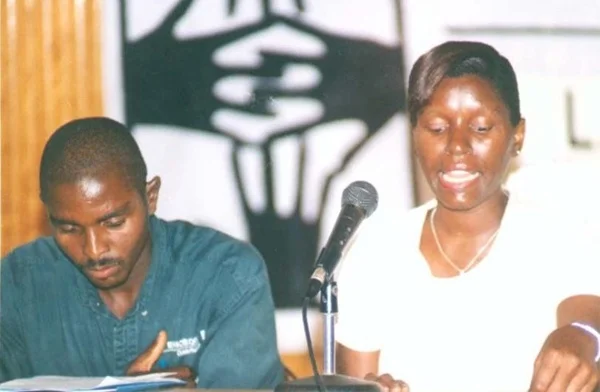
Source: https://slidelegend.com/challenging-hiv-cr...

Enjoyed this speech? Speakola is a labour of love and I’d be very grateful if you would share, tweet or like it. Thank you.

Facebook Twitter Facebook
In HEALTH Tags EDWIN CAMERON, AIDS, STIGMA, CRIMINALISATION, LAW REFORM, JUDGE, JUSTICE CAMERON, TRANSCRIPT
1 Comment

See my film!

Limited Australian Season

March 2025

Details and ticket bookings at

angeandtheboss.com

Support Speakola

Hi speech lovers,
With costs of hosting website and podcast, this labour of love has become a difficult financial proposition in recent times. If you can afford a donation, it will help Speakola survive and prosper.

Best wishes,
Tony Wilson.

Become a Patron!

Learn more about supporting Speakola.

Featured political

Featured
Jon Stewart: "They responded in five seconds", 9-11 first responders, Address to Congress - 2019
Jacinda Ardern: 'They were New Zealanders. They are us', Address to Parliament following Christchurch massacre - 2019
Dolores Ibárruri: "¡No Pasarán!, They shall not pass!', Defense of 2nd Spanish Republic - 1936
Jimmy Reid: 'A rat race is for rats. We're not rats', Rectorial address, Glasgow University - 1972

Featured eulogies

Featured
For Geoffrey Tozer: 'I have to say we all let him down', by Paul Keating - 2009
for James Baldwin: 'Jimmy. You crowned us', by Toni Morrison - 1988
for Michael Gordon: '13 days ago my Dad’s big, beautiful, generous heart suddenly stopped beating', by Scott and Sarah Gordon - 2018

Featured commencement

Featured
Tara Westover: 'Your avatar isn't real, it isn't terribly far from a lie', The Un-Instagrammable Self, Northeastern University - 2019
Tim Minchin: 'Being an artist requires massive reserves of self-belief', WAAPA - 2019
Atul Gawande: 'Curiosity and What Equality Really Means', UCLA Medical School - 2018
Abby Wambach: 'We are the wolves', Barnard College - 2018
Eric Idle: 'America is 300 million people all walking in the same direction, singing 'I Did It My Way'', Whitman College - 2013
Shirley Chisholm: ;America has gone to sleep', Greenfield High School - 1983

Featured sport

Featured
Joe Marler: 'Get back on the horse', Harlequins v Bath pre game interview - 2019
Ray Lewis : 'The greatest pain of my life is the reason I'm standing here today', 52 Cards -
Mel Jones: 'If she was Bradman on the field, she was definitely Keith Miller off the field', Betty Wilson's induction into Australian Cricket Hall of Fame - 2017
Jeff Thomson: 'It’s all those people that help you as kids', Hall of Fame - 2016

Fresh Tweets


Featured weddings

Featured
Dan Angelucci: 'The Best (Best Man) Speech of all time', for Don and Katherine - 2019
Hallerman Sisters: 'Oh sister now we have to let you gooooo!' for Caitlin & Johnny - 2015
Korey Soderman (via Kyle): 'All our lives I have used my voice to help Korey express his thoughts, so today, like always, I will be my brother’s voice' for Kyle and Jess - 2014

Featured Arts

Featured
Bruce Springsteen: 'They're keepers of some of the most beautiful sonic architecture in rock and roll', Induction U2 into Rock Hall of Fame - 2005
Olivia Colman: 'Done that bit. I think I have done that bit', BAFTA acceptance, Leading Actress - 2019
Axel Scheffler: 'The book wasn't called 'No Room on the Broom!', Illustrator of the Year, British Book Awards - 2018
Tina Fey: 'Only in comedy is an obedient white girl from the suburbs a diversity candidate', Kennedy Center Mark Twain Award -  2010
Tina Fey: 'Only in comedy is an obedient white girl from the suburbs a diversity candidate', Kennedy Center Mark Twain Award - 2010

Featured Debates

Featured
Sacha Baron Cohen: 'Just think what Goebbels might have done with Facebook', Anti Defamation League Leadership Award - 2019
Greta Thunberg: 'How dare you', UN Climate Action Summit - 2019
Charlie Munger: 'The Psychology of Human Misjudgment', Harvard University - 1995
Lawrence O'Donnell: 'The original sin of this country is that we invaders shot and murdered our way across the land killing every Native American that we could', The Last Word, 'Dakota' - 2016