• Genre
  • About
  • Submissions
  • Donate
  • Search
Menu

Speakola

All Speeches Great and Small
  • Genre
  • About
  • Submissions
  • Donate
  • Search
Share a political speech

Joe Biden: 'To lose a child is like having a piece of your soul ripped away?', response to Uvalde school shooting - 2022

May 26, 2022

25 May 2022, Washington DC, USA

Good evening, fellow Americans.

I had hoped, when I became President, I would not have to do this again.

Another massacre. Uvalde, Texas. An elementary school. Beautiful, innocent second, third, fourth graders. And how many scores of little children who witnessed what happened see their friends die as if they’re on a battlefield, for God’s sake. They’ll live with it the rest of their lives.

There’s a lot we don’t know yet, but there’s a lot we do know.

There are parents who will never see their child again, never have them jump in bed and cuddle with them. Parents who will never be the same.

To lose a child is like having a piece of your soul ripped away. There’s a hollowness in your chest, and you feel like you’re being sucked into it and never going to be able to get out. It’s suffocating. And it’s never quite the same.

And it’s a feeling shared by the siblings, and the grandparents, and their family members, and the community that’s left behind.

Scripture says — Jill and I have talked about this in different contexts, in other contexts: “The Lord is near to the brokenhearted and saves the crushed in spirit.” So many crushed spirits.

So, tonight, I ask the nation to pray for them, to give the parents and siblings the strength in the darkness they feel right now.

As a nation, we have to ask: When in God’s name are we going to stand up to the gun lobby? When in God’s name will we do what we all know in our gut needs to be done?

It’s been 340- — 3,448 days — 10 years since I stood up at a high school in Connecticut — a grade school in Connecticut, where another gunman massacred 26 people, including 20 first graders, at Sandy Hook Elementary School.

Since then, there have been over 900 incidents of gunfires reported on school grounds.

Marjorie Stoneman Douglas High School in Parkland, Florida. Santa Fe High School in Texas. Oxford High School in Michigan. The list goes on and on.

And the list grows when it includes mass shootings at places like movie theaters, houses of worship, and, as we saw just 10 days ago, at a grocery store in Buffalo, New York.

I am sick and tired of it. We have to act. And don’t tell me we can’t have an impact on this carnage.

I spent my career as a senator and as Vice President working to pass commonsense gun laws. We can’t and won’t prevent every tragedy. But we know they work and have a positive impact. When we passed the assault weapons ban, mass shootings went down. When the law expired, mass shootings tripled.

The idea that an 18-year-old kid can walk into a gun store and buy two assault weapons is just wrong.

What in God’s name do you need an assault weapon for except to kill someone?

Deer aren’t running through the forest with Kevlar vests on, for God’s sake. It’s just sick.

And the gun manufacturers have spent two decades aggressively marketing assault weapons which make them the most and largest profit.

For God’s sake, we have to have the courage to stand up to the industry.

Here’s what else I know: Most Americans support commonsense laws — commonsense gun laws.

I just got off my trip from Asia, meeting with Asian leaders, and I learned of this while I was on the aircraft. And what struck me on that 17-hour flight — what struck me was these kinds of mass shootings rarely happen anywhere else in the world.

Why? They have mental health problems. They have domestic disputes in other countries. They have people who are lost. But these kinds of mass shootings never happen with the kind of frequency that they happen in America. Why?

Why are we willing to live with this carnage? Why do we keep letting this happen? Where in God’s name is our backbone to have the courage to deal with it and stand up to the lobbies?

It’s time to turn this pain into action.

For every parent, for every citizen in this country, we have to make it clear to every elected official in this country: It’s time to act.

It’s time — for those who obstruct or delay or block the commonsense gun laws, we need to let you know that we will not forget.

We can do so much more. We have to do more.

Our prayer tonight is for those parents, lying in bed and trying to figure out, “Will I be able to sleep again? What do I say to my other children? What happens tomorrow?”

May God bless the loss of innocent life on this sad day. And may the Lord be near the brokenhearted and save those crushed in spirit, because they’re going to need a lot of help and a lot of our prayers.

God love you.

Source: https://www.whitehouse.gov/briefing-room/s...

Enjoyed this speech? Speakola is a labour of love and I’d be very grateful if you would share, tweet or like it. Thank you.

Facebook Twitter Facebook
In 2020-29 B Tags PRESIDENT BIDEN, JOE BIDEN, PRESIDENT JOE BIDEN, TRANSCRIPT, UVALDE, MASS SHOOTING, SCHOOL SHOOTING, TEXAS SCHOOL SHOOTING, GUNS, SECOND AMENDMENT, GUN OWNERSHIP, GUN VIOLENCE, SANDY HOOK, GUN CONTROL, LAW REFORM, CONDOLENCES, 2022
Comment
John Howard guns speech.png

John Howard: 'The intention is to pay fair compensation for weapons', Gun rally, Sale - 1996

July 29, 2021

16 June 1996, Sale, Victoria, Australia

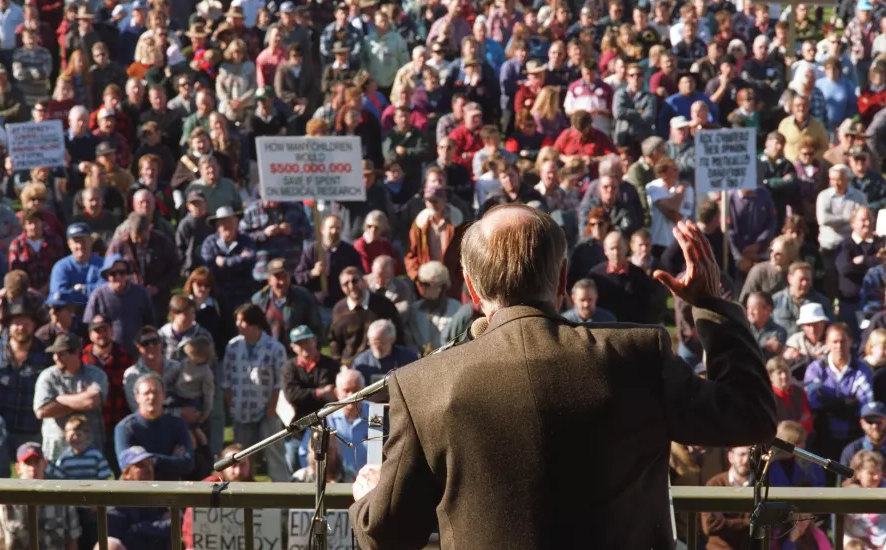
The Port Arthur massacre of 28–29 April 1996 was a mass shooting in which 35 people were killed and 23 others were wounded in Port Arthur,. It horrified the nation and led to a gun buyback and gun control reforms. John Howard led that effort. he wore a flak jacket under his suit for this speech, to angry gun owners in Sale.

Well thank you very much Peter McGauran, to Mr Howard, to my other Parliamentary colleagues, to my fellow Australians.

Last night I saw on national television Mr Ted Drane, the National President of the Shooters' Organisations in Australia- And he said something with which I totally agree. He said that he and his fellow shooters were not criminals, they were Australians. And I want to Start my address to you today by saying at no stage in the weeks that have gone by since the decision taken by the Federal Government and the Police Ministers in that decision, at no stage have I sought to describe or categorise the attitude of people who enjoy shooting or people who are shooters as being in anyway criminal or un-Australian. I have not used language which has thought to label or smear you or other tens of thousands of law abiding citizens.

I acknowledge and I have acknowledged in the very beginning and I do so again today, that the decisions that have been taken by all the Governments in Australia, decisions that were confirmed last Friday at the Premiers' Conference meeting, they are decisions that will inconvenience, they will influence the activities of people who hitherto have engaged in law-abiding pursuits. And at no stage is it the basis of the decision taken by the Federal Government and at no stage is it part of my own personal attitude that in any way any of you or any people who have been involved in what are, up until now, the lawful possession of firearms, in no way have you people been involved in criminal behaviour at no stage. And that is not the basis of the decision. But the basis of the decision ladies and gentlemen is that we believe that it is in the national interest that there be a dramatic reduction in the number of automatic and semi-automatic weapons in the Australian community.

In taking that decision I recognise and my colleagues recognise that many people who previously have been carrying on a lawful pursuit are going to be inconvenienced. I know that, I regret that, I apologise for that but that is the basis of our decision. And it has been taken, ladies and gentlemen because we believe not just because of those tragic events at Port Arthur, they were the culmination of a long series of events in this country which have demonstrated as has been demonstrated in other parts of the world, that there is a clear link between the volume of powerful weapons in the community and the extent to which they are used in an indiscriminate manner.

If you look at these statistics out of countries such as the United States, if you compare them with statistics in other parts of the world there is a clear and irrefutable link. And in taking the decisions that we have taken we are mindful that they will impact unevenly on sections of the community,

I am mindful that people who have never owned a weapon, have never had any desire to own a weapon are not going to be affected in the way in which people such as you are being affected. I know that, I regret that and that is a matter of concern and apology to me but it cannot alter the responsibility of a national Government to take a decision that it believes serves the greater good of the entire Australian community. And that my fellow Australians is the basis of the decision that we have taken. We have not sought in taking this decision to brand any of you people as being anti-social. We have not sought in taking this decision to brand people who enjoy shooting as being engaged in any kind of criminal activity and you will find nothing that I have said and you will find nothing that I will say in the future that will in any way take that attitude.

But there come occasions for any Government to take decisions which can only be effectively implemented in the interests of the overall national good if they involve some disproportionate inconvenience and some disproportionate deprivation for one section of the community. I'm sorry about that but there is no other way that we can achieve the objectives. And it is always, my friends it is always the responsibility of a national Government to weigh up the gains and to set them against the losses. And the gains to the Australian community of there being fewer weapons of great destruction in the community are, in my view and in the view of all governments throughout Australia very, very significant indeed and that is why we have taken the decision.

Now I don't pretend for a moment ladies and gentlemen that the decision that we have taken is going to guarantee that in the future there won't be other mass murders. I don't pretend that for a moment. What I do argue to you my friends is that it Will significantly reduce the likelihood of those occurring in the future. I wouldn't be so foolish as to say that it is going to completely eliminate them. And I know that in the wake of what happened at Port Arthur I know ladies and gentlemen in the wake of what happened at Port Arthur that people have argued that one of the great weaknesses in the present system and one of the causes of mass murder is that we have an approach to mental health laws that are too permissive.

I certainly agree with that and one of things that I said after the decisions had been taken in relation to automatic and semi-automatic weapons was that we are going to investigate whether the practice of governments throughout Australia over the last years in pushing too many people too soon out of mental health institutions unsupervised into the community, whether in fact those practices ought to change. And that is one of the things that we are going to examine.

And I've also expressed the personal view that is shared by many people throughout Australia that one of the causes of the inculcation of violence in our community is the mind-numbing, repetitive violence that is seen on some of our television screens. And I think that along with the approach to mental health issues, they are other issues that must be seriously examined by society.

I don't pretend that it is simply a matter of imposing a stricter regime regarding the possession of automatic or semi-automatic weapons. But that is an element of turning around tho culture in this country and that is the reason why the Government has taken the decision that it has taken.

And I've come here today ladies and gentlemen as I will go to other rural areas of Australia and other provincial areas of Australia to explain directly to people who I know are unhappy with the Government's decision, to go to explain directly to those people the general basis of that decision, to rem-ind you that the effect of the Government's decision is not to take all weapons out of the community.

The effect of the Government's decision has been very, very carefully designed to ensure that, for example, the legitimate use of farmers, of weapons, the entitlement of farmers if they can demonstrate a need to the possession of the low-powered semiautomatic weapons will be retained and the whole purpose of the firearm regulations that have been devised by all the Governments of Australia is to ensure that we achieve our overall objectives of a dramatic withdrawal of the number of potential weapons of destruction from the Australian community.

That is our goal, that is the objective and it is a responsible objective. But in the process we have sought to make reasonable provisions in areas such as primary production. We have also, as you know, decided to introduce an effective, fair compensation scheme for weapons based upon the value of weapons as at March 1996. The goal of the compensation scheme which will be fully met by the Federal Government out of the proceeds of one-oft; special increase in the Medicare levy, which is predicted to raise something like $ 500 million and if there is any surplus, that surplus will be returned through the health insurance levy system so that there will be no money kept out of that other than the money that is used for the compensation scheme.

But ladies and gentlemen the intention is to pay fair compensation for weapons. That is the intention and that is the commitment and there will be a 12 month amnesty during which any of the weapons that are prohibited as a consequence of the decisions taken by the Government can be handed in and proper, fair compensation will be paid. And I give you that undertaking. I acknowledge that we are asking you to give up, we are taking away property you have previously lawfully owned and in those circumstances you are entitled as Australians under the Constitution of this country to have proper compensation based on fair value as at the time of the decision taken by the Government in March of 1996.

I have read during the past few weeks some reactions to the decision taken by the Government. I acknowledge that many of those reactions, although very strong and very vigorous and very determined have been absolutely measured and the sort of reaction that you would expect in a strong, robust, democratic country such as Australia. But I have also heard suggestions, for example, that the whole idea of this is to bring about the complete disarming of the Australian population. I've heard people make suggestions that this is the first step in some kind of march along a road to the deprivation of peoples' individual liberties. I want to say to you ladies and gentlemen that that is a totally unreasonable, it is a totally inaccurate and it is a totally discredited response to the decision that has been taken by the Government. The decision taken by the Government is not part and parcel of some plan to deprive Australians of their liberty. The decision taken by the Government is taken because we are committed to generating a safer Australian community and that is an aspiration. That is an aspiration that hundreds of thousands, indeed millions of Australians support the decision taken.

So ladies and gentlemen, they support it not only in the urban areas of Australia but they support it throughout the rural and provincial areas of Australia as well. I understand why, I understand why many of you feel angry. I understand why many of you are here today to protest against the decision. I fully understand that and I can sympathise with people who have spent a life in a particular sporting pursuit and they find that life is no longer available to them and that is something that I deeply regret and I do deeply regret it but it does not alter the commitment of the Government in the aggregate national good to take decisions which we believe and all governments around Australia believe will bring about a safer Australian community, and that my friends is a proper objective of Government. It is a democratic objective of Government and in taking that decision and implementing that here what we had sought to do my friends is to frame the regulations and to frame the laws in such a way, ladies and gentlemen that people who have legitimate primary industry needs that the retention of weapons that aren't in the automatic or semi-automatic category will be allowed. We are not touching those, we are introducing a regime for registration that will be nation-wide. It's a registration regime that will bring about a significant reduction of weapons, dangerous weapons in the Australian community. And we have based it upon an approach that will give people fair compensation based upon values as at March 1996.

So ladies and gentlemen, I've come here today to explain to you as directly and as simply as I can the basis of the decision, the reason why we have taken it, the reason why, however reluctant you may be to do so to accept that it has been taken in good faith by the Government in the belief that it will add to the overall safety and good of the Australian community.

And that is the greatest and ultimate responsibility of any Government of any Prime Minister of this country, whatever his political stripe, is to take decisions that if he believes or she believes will benefit the overall national good and that is the reason behind this decision.

Ladies and gentlemen I thank you for coming, I thank you for giving me the opportunity, however much many of you will disagree with me, to explain the basis of the Government's decision I would be very happy to answer questions that you might like to ask and I've agreed to meet after the meeting with some representatives of the shooter organisation here in Victoria.

Ladies and gentlemen thank you for coming and I would be very happy to answer any of your questions.

Picture: Colin Murty, Fairfax

Picture: Colin Murty, Fairfax

Source: https://pmtranscripts.pmc.gov.au/release/t...

Enjoyed this speech? Speakola is a labour of love and I’d be very grateful if you would share, tweet or like it. Thank you.

Facebook Twitter Facebook
In 1980-99 B Tags JOHN HOWARD, PRIME MINISTER, TRANSCRIPT, PORT ARTHUR MASSACRE, GUN CONTROL, GUN VIOLENCE, GUN BUY BACK, FIREARMS, SALE, COURAGE, FLAK JACKET
Comment

Hasan Minhaj: "There are 294 sitting members of Congress that have accepted contributions from the NRA", RTCA Dinner - 2015

March 16, 2017

Hasan Minhaj is a Daily Show correspondent. This was delivered in the aftermath of the horrific mass shotting at a gay nightclub in Orlando. The full speech is above and very funny. The excerpted text relates to gun violence.

What we saw in Orlando was one of the ugliest cocktails of the problems that we still see here in America. A cocktail of homophobia, xenophobia, lack of access to mental healthcare, and sheer lack of political will. And all of us satirists, we’ve all been yelling out, crying out, for change. But the sad reality is that we are all complicit in what happened. Every day in our workplaces, in our homes, in our religious institutions, there is covert or overt discrimination or phobia towards people of different religious, racial, or sexual walks of life. And we just sit there and we let it happen because it doesn’t affect our bottom line.

“I didn’t say it Hasan. I don’t think it that’s way. They said it, okay. It’s not that simple Hasan.”

And we just go on with our lives because it did not affect our status quo. And the sad reality is that stuff like this is going to continue to happen unless we recognise that civil liberties are an all or nothing game. A rising tide lifts all boats, it’s not pick or choose. So whether you like it or not we all have to step up and fight for each other, otherwise the whole thing is a sham. And until we do that, hijabis are going to get harassed in the streets, members from the trans community are going to be demonised for using the bathroom. And my brothers and sisters in the African American community, their spines are going to continue to get shattered in the backs of paddy wagons until we stand up and say something.

And the thing that hurts me the most is I wished I would have done more. To my brothers and sisters in the LGBTQ community and every marginalised community, I am sorry I did not do more. And the same goes for Congress. We look to you guys as our leaders. You make almost $200,000 a year to write rules, to make our society better. Not tweet, not tell us about your thoughts and prayers. To write rules to make our society better. And ultimately it comes down to money and influence. And right now, since 1998 the NRA has given $3.7 million to Congress. There are 294 sitting members of Congress that have accepted contributions from the NRA, and that doesn’t even include the millions of dollars from outside lobbying.

So before I get up here in my liberal bubble and I ask for gun control and universal background checks and banning assault rifles, we’ve got to be able to have the conversation, and right now, specifically Congress, has blocked legislation for the CDC to study gun-related violence. We can’t even talk about the issue with real statistics and facts. So I don’t know if this is, like, a Kickstarter thing, but if $3.7 million can buy political influence to take lives, if we raise $4 million would you guys take that to save lives? I don’t know.

Ultimately, I just gotta ask you this. Look, when I got into comedy, and when you guys got into media, and when you guys got into politics, we wanted to do the best work we could possibly do. Is this what you want your legacy to be? That you were a could-have-done-something Congress, but you didn’t because of outside lobbying? That you were complicit in the deaths of thousands of Americans?

And look, I know being a member of Congress is hard — you’ve got to placate your base, you’ve got to look out for re-election, you’ve got to answer to lobbyists. But please persevere, because our thoughts and prayers are with you. Good night.

Source: https://blogofthebeardedone.wordpress.com/...

Enjoyed this speech? Speakola is a labour of love and I’d be very grateful if you would share, tweet or like it. Thank you.

Facebook Twitter Facebook
In 2010s MORE 3 Tags HASAN MINHAJ, GUN VIOLENCE, THE DAILY SHOW, RADIO AND TELEVISION CORRESPONDENTS DINNER, ORLANDO SHOOTINGS, LGBTI, LGBT, TRANSCRIPT
Comment

Barack Obama: 'In this room right here, there are a lot of stories. There’s a lot of heartache.' Executive action on guns - 2016

January 7, 2016

5 January 2016, White House, Washington D.C., 2016

President Obama announces executive actions on gun control flanked by vicitms of gun violence.

THE PRESIDENT: Mark, I want to thank you for your introduction. I still remember the first time we met, the time we spent together, and the conversation we had about Daniel. And that changed me that day. And my hope, earnestly, has been that it would change the country.

Five years ago this week, a sitting member of Congress and 18 others were shot at, at a supermarket in Tucson, Arizona. It wasn’t the first time I had to talk to the nation in response to a mass shooting, nor would it be the last. Fort Hood. Binghamton. Aurora. Oak Creek. Newtown. The Navy Yard. Santa Barbara. Charleston. San Bernardino. Too many.

AUDIENCE MEMBER: Too many.

AUDIENCE MEMBER: Too many.

AUDIENCE MEMBER: Too many.

THE PRESIDENT: Thanks to a great medical team and the love of her husband, Mark, my dear friend and colleague, Gabby Giffords, survived. She’s here with us today, with her wonderful mom. (Applause.) Thanks to a great medical team, her wonderful husband, Mark — who, by the way, the last time I met with Mark — this is just a small aside — you may know Mark’s twin brother is in outer space. (Laughter.) He came to the office, and I said, how often are you talking to him? And he says, well, I usually talk to him every day, but the call was coming in right before the meeting so I think I may have not answered his call — (laughter) — which made me feel kind of bad. (Laughter.) That’s a long-distance call. (Laughter.) So I told him if his brother, Scott, is calling today, that he should take it. (Laughter.) Turn the ringer on. (Laughter.)

I was there with Gabby when she was still in the hospital, and we didn’t think necessarily at that point that she was going to survive. And that visit right before a memorial — about an hour later Gabby first opened her eyes. And I remember talking to mom about that. But I know the pain that she and her family have endured these past five years, and the rehabilitation and the work and the effort to recover from shattering injuries.

And then I think of all the Americans who aren’t as fortunate. Every single year, more than 30,000 Americans have their lives cut short by guns — 30,000. Suicides. Domestic violence. Gang shootouts. Accidents. Hundreds of thousands of Americans have lost brothers and sisters, or buried their own children. Many have had to learn to live with a disability, or learned to live without the love of their life.

A number of those people are here today. They can tell you some stories. In this room right here, there are a lot of stories. There’s a lot of heartache. There’s a lot of resilience, there’s a lot of strength, but there’s also a lot of pain. And this is just a small sample.

The United States of America is not the only country on Earth with violent or dangerous people. We are not inherently more prone to violence. But we are the only advanced country on Earth that sees this kind of mass violence erupt with this kind of frequency. It doesn’t happen in other advanced countries. It’s not even close. And as I’ve said before, somehow we’ve become numb to it and we start thinking that this is normal.

And instead of thinking about how to solve the problem, this has become one of our most polarized, partisan debates — despite the fact that there’s a general consensus in America about what needs to be done. That’s part of the reason why, on Thursday, I’m going to hold a town hall meeting in Virginia on gun violence. Because my goal here is to bring good people on both sides of this issue together for an open discussion.

I’m not on the ballot again. I’m not looking to score some points. I think we can disagree without impugning other people’s motives or without being disagreeable. We don’t need to be talking past one another. But we do have to feel a sense of urgency about it. In Dr. King’s words, we need to feel the “fierce urgency of now.” Because people are dying. And the constant excuses for inaction no longer do, no longer suffice.

That’s why we’re here today. Not to debate the last mass shooting, but to do something to try to prevent the next one. (Applause.) To prove that the vast majority of Americans, even if our voices aren’t always the loudest or most extreme, care enough about a little boy like Daniel to come together and take common-sense steps to save lives and protect more of our children.

Now, I want to be absolutely clear at the start — and I’ve said this over and over again, this also becomes routine, there is a ritual about this whole thing that I have to do — I believe in the Second Amendment. It’s there written on the paper. It guarantees a right to bear arms. No matter how many times people try to twist my words around — I taught constitutional law, I know a little about this — (applause) — I get it. But I also believe that we can find ways to reduce gun violence consistent with the Second Amendment.

I mean, think about it. We all believe in the First Amendment, the guarantee of free speech, but we accept that you can’t yell “fire” in a theater. We understand there are some constraints on our freedom in order to protect innocent people. We cherish our right to privacy, but we accept that you have to go through metal detectors before being allowed to board a plane. It’s not because people like doing that, but we understand that that’s part of the price of living in a civilized society.

And what’s often ignored in this debate is that a majority of gun owners actually agree. A majority of gun owners agree that we can respect the Second Amendment while keeping an irresponsible, law-breaking feud from inflicting harm on a massive scale.

Today, background checks are required at gun stores. If a father wants to teach his daughter how to hunt, he can walk into a gun store, get a background check, purchase his weapon safely and responsibly. This is not seen as an infringement on the Second Amendment. Contrary to the claims of what some gun rights proponents have suggested, this hasn’t been the first step in some slippery slope to mass confiscation. Contrary to claims of some presidential candidates, apparently, before this meeting, this is not a plot to take away everybody’s guns. You pass a background check; you purchase a firearm.

The problem is some gun sellers have been operating under a different set of rules. A violent felon can buy the exact same weapon over the Internet with no background check, no questions asked. A recent study found that about one in 30 people looking to buy guns on one website had criminal records — one out of 30 had a criminal record. We’re talking about individuals convicted of serious crimes — aggravated assault, domestic violence, robbery, illegal gun possession. People with lengthy criminal histories buying deadly weapons all too easily. And this was just one website within the span of a few months.

So we’ve created a system in which dangerous people are allowed to play by a different set of rules than a responsible gun owner who buys his or her gun the right way and subjects themselves to a background check. That doesn’t make sense. Everybody should have to abide by the same rules. Most Americans and gun owners agree. And that’s what we tried to change three years ago, after 26 Americans -– including 20 children -– were murdered at Sandy Hook Elementary.

Two United States Senators -– Joe Manchin, a Democrat from West Virginia, and Pat Toomey, a Republican from Pennsylvania, both gun owners, both strong defenders of our Second Amendment rights, both with “A” grades from the NRA –- that’s hard to get — worked together in good faith, consulting with folks like our Vice President, who has been a champion on this for a long time, to write a common-sense compromise bill that would have required virtually everyone who buys a gun to get a background check. That was it. Pretty common-sense stuff. Ninety percent of Americans supported that idea. Ninety percent of Democrats in the Senate voted for that idea. But it failed because 90 percent of Republicans in the Senate voted against that idea.

How did this become such a partisan issue? Republican President George W. Bush once said, “I believe in background checks at gun shows or anywhere to make sure that guns don’t get into the hands of people that shouldn’t have them.” Senator John McCain introduced a bipartisan measure to address the gun show loophole, saying, “We need this amendment because criminals and terrorists have exploited and are exploiting this very obvious loophole in our gun safety laws.” Even the NRA used to support expanded background checks. And by the way, most of its members still do. Most Republican voters still do.

How did we get here? How did we get to the place where people think requiring a comprehensive background check means taking away people’s guns?

Each time this comes up, we are fed the excuse that common-sense reforms like background checks might not have stopped the last massacre, or the one before that, or the one before that, so why bother trying. I reject that thinking. (Applause.) We know we can’t stop every act of violence, every act of evil in the world. But maybe we could try to stop one act of evil, one act of violence.

Some of you may recall, at the same time that Sandy Hook happened, a disturbed person in China took a knife and tried to kill — with a knife — a bunch of children in China. But most of them survived because he didn’t have access to a powerful weapon. We maybe can’t save everybody, but we could save some. Just as we don’t prevent all traffic accidents but we take steps to try to reduce traffic accidents.

As Ronald Reagan once said, if mandatory background checks could save more lives, “it would be well worth making it the law of the land.” The bill before Congress three years ago met that test. Unfortunately, too many senators failed theirs. (Applause.)

In fact, we know that background checks make a difference. After Connecticut passed a law requiring background checks and gun safety courses, gun deaths decreased by 40 percent — 40 percent. (Applause.) Meanwhile, since Missouri repealed a law requiring comprehensive background checks and purchase permits, gun deaths have increased to almost 50 percent higher than the national average. One study found, unsurprisingly, that criminals in Missouri now have easier access to guns.

And the evidence tells us that in states that require background checks, law-abiding Americans don’t find it any harder to purchase guns whatsoever. Their guns have not been confiscated. Their rights have not been infringed.

And that’s just the information we have access to. With more research, we could further improve gun safety. Just as with more research, we’ve reduced traffic fatalities enormously over the last 30 years. We do research when cars, food, medicine, even toys harm people so that we make them safer. And you know what — research, science — those are good things. They work. (Laughter and applause.) They do.

But think about this. When it comes to an inherently deadly weapon — nobody argues that guns are potentially deadly — weapons that kill tens of thousands of Americans every year, Congress actually voted to make it harder for public health experts to conduct research into gun violence; made it harder to collect data and facts and develop strategies to reduce gun violence. Even after San Bernardino, they’ve refused to make it harder for terror suspects who can’t get on a plane to buy semi-automatic weapons. That’s not right. That can’t be right.

So the gun lobby may be holding Congress hostage right now, but they cannot hold America hostage. (Applause.) We do not have to accept this carnage as the price of freedom. (Applause.)

Now, I want to be clear. Congress still needs to act. The folks in this room will not rest until Congress does. (Applause.) Because once Congress gets on board with common-sense gun safety measures we can reduce gun violence a whole lot more. But we also can’t wait. Until we have a Congress that’s in line with the majority of Americans, there are actions within my legal authority that we can take to help reduce gun violence and save more lives -– actions that protect our rights and our kids.

After Sandy Hook, Joe and I worked together with our teams and we put forward a whole series of executive actions to try to tighten up the existing rules and systems that we had in place. But today, we want to take it a step further. So let me outline what we’re going to be doing.

Number one, anybody in the business of selling firearms must get a license and conduct background checks, or be subject to criminal prosecutions. (Applause.) It doesn’t matter whether you’re doing it over the Internet or at a gun show. It’s not where you do it, but what you do.

We’re also expanding background checks to cover violent criminals who try to buy some of the most dangerous firearms by hiding behind trusts and corporations and various cutouts.

We’re also taking steps to make the background check system more efficient. Under the guidance of Jim Comey and the FBI, our Deputy Director Tom Brandon at ATF, we’re going to hire more folks to process applications faster, and we’re going to bring an outdated background check system into the 21st century. (Applause.)

And these steps will actually lead to a smoother process for law-abiding gun owners, a smoother process for responsible gun dealers, a stronger process for protecting the people from — the public from dangerous people. So that’s number one.

Number two, we’re going to do everything we can to ensure the smart and effective enforcement of gun safety laws that are already on the books, which means we’re going to add 200 more ATF agents and investigators. We’re going to require firearms dealers to report more lost or stolen guns on a timely basis. We’re working with advocates to protect victims of domestic abuse from gun violence, where too often — (applause) — where too often, people are not getting the protection that they need.

Number three, we’re going to do more to help those suffering from mental illness get the help that they need. (Applause.) High-profile mass shootings tend to shine a light on those few mentally unstable people who inflict harm on others. But the truth is, is that nearly two in three gun deaths are from suicides. So a lot of our work is to prevent people from hurting themselves.

That’s why we made sure that the Affordable Care Act — also known as Obamacare — (laughter and applause) — that law made sure that treatment for mental health was covered the same as treatment for any other illness. And that’s why we’re going to invest $500 million to expand access to treatment across the country. (Applause.)

It’s also why we’re going to ensure that federal mental health records are submitted to the background check system, and remove barriers that prevent states from reporting relevant information. If we can continue to de-stigmatize mental health issues, get folks proper care, and fill gaps in the background check system, then we can spare more families the pain of losing a loved one to suicide.

And for those in Congress who so often rush to blame mental illness for mass shootings as a way of avoiding action on guns, here’s your chance to support these efforts. Put your money where your mouth is. (Applause.)

Number four, we’re going to boost gun safety technology. Today, many gun injuries and deaths are the result of legal guns that were stolen or misused or discharged accidentally. In 2013 alone, more than 500 people lost their lives to gun accidents –- and that includes 30 children younger than five years old. In the greatest, most technologically advanced nation on Earth, there is no reason for this. We need to develop new technologies that make guns safer. If we can set it up so you can’t unlock your phone unless you’ve got the right fingerprint, why can’t we do the same thing for our guns? (Applause.) If there’s an app that can help us find a missing tablet — which happens to me often the older I get — (laughter) — if we can do it for your iPad, there’s no reason we can’t do it with a stolen gun. If a child can’t open a bottle of aspirin, we should make sure that they can’t pull a trigger on a gun. (Applause.) Right?

So we’re going to advance research. We’re going to work with the private sector to update firearms technology.

And some gun retailers are already stepping up by refusing to finalize a purchase without a complete background check, or by refraining from selling semi-automatic weapons or high-capacity magazines. And I hope that more retailers and more manufacturers join them — because they should care as much as anybody about a product that now kills almost as many Americans as car accidents.

I make this point because none of us can do this alone. I think Mark made that point earlier. All of us should be able to work together to find a balance that declares the rest of our rights are also important — Second Amendment rights are important, but there are other rights that we care about as well. And we have to be able to balance them. Because our right to worship freely and safely –- that right was denied to Christians in Charleston, South Carolina. (Applause.) And that was denied Jews in Kansas City. And that was denied Muslims in Chapel Hill, and Sikhs in Oak Creek. (Applause.) They had rights, too. (Applause.)

Our right to peaceful assembly -– that right was robbed from moviegoers in Aurora and Lafayette. Our unalienable right to life, and liberty, and the pursuit of happiness -– those rights were stripped from college students in Blacksburg and Santa Barbara, and from high schoolers at Columbine, and from first-graders in Newtown. First-graders. And from every family who never imagined that their loved one would be taken from our lives by a bullet from a gun.

Every time I think about those kids it gets me mad. And by the way, it happens on the streets of Chicago every day. (Applause.)

So all of us need to demand a Congress brave enough to stand up to the gun lobby’s lies. All of us need to stand up and protect its citizens. All of us need to demand governors and legislatures and businesses do their part to make our communities safer. We need the wide majority of responsible gun owners who grieve with us every time this happens and feel like your views are not being properly represented to join with us to demand something better. (Applause.)

And we need voters who want safer gun laws, and who are disappointed in leaders who stand in their way, to remember come election time. (Applause.)

I mean, some of this is just simple math. Yes, the gun lobby is loud and it is organized in defense of making it effortless for guns to be available for anybody, any time. Well, you know what, the rest of us, we all have to be just as passionate. We have to be just as organized in defense of our kids. This is not that complicated. The reason Congress blocks laws is because they want to win elections. And if you make it hard for them to win an election if they block those laws, they’ll change course, I promise you. (Applause.)

And, yes, it will be hard, and it won’t happen overnight. It won’t happen during this Congress. It won’t happen during my presidency. But a lot of things don’t happen overnight. A woman’s right to vote didn’t happen overnight. The liberation of African Americans didn’t happen overnight. LGBT rights — that was decades’ worth of work. So just because it’s hard, that’s no excuse not to try.

And if you have any doubt as to why you should feel that “fierce urgency of now,” think about what happened three weeks ago. Zaevion Dobson was a sophomore at Fulton High School in Knoxville, Tennessee. He played football; beloved by his classmates and his teachers. His own mayor called him one of their city’s success stories. The week before Christmas, he headed to a friend’s house to play video games. He wasn’t in the wrong place at the wrong time. He hadn’t made a bad decision. He was exactly where any other kid would be. Your kid. My kids. And then gunmen started firing. And Zaevion — who was in high school, hadn’t even gotten started in life — dove on top of three girls to shield them from the bullets. And he was shot in the head. And the girls were spared. He gave his life to save theirs –- an act of heroism a lot bigger than anything we should ever expect from a 15-year-old. “Greater love hath no man than this that a man lay down his life for his friends.”

We are not asked to do what Zaevion Dobson did. We’re not asked to have shoulders that big; a heart that strong; reactions that quick. I’m not asking people to have that same level of courage, or sacrifice, or love. But if we love our kids and care about their prospects, and if we love this country and care about its future, then we can find the courage to vote. We can find the courage to get mobilized and organized. We can find the courage to cut through all the noise and do what a sensible country would do.

That’s what we’re doing today. And tomorrow, we should do more. And we should do more the day after that. And if we do, we’ll leave behind a nation that’s stronger than the one we inherited and worthy of the sacrifice of a young man like Zaevion. (Applause.)

Thank you very much, everybody. God bless you. Thank you. God bless America. (Applause.)

Source: http://time.com/4168056/obama-gun-control-...

Enjoyed this speech? Speakola is a labour of love and I’d be very grateful if you would share, tweet or like it. Thank you.

Facebook Twitter Facebook
In 2010s MORE Tags BARACK OBAMA, GUN VIOLENCE, EXECUTIVE ACTION, GUN CONTROL, 2ND AMENDMENT, TRANSCRIPT
Comment

See my film!

Limited Australian Season

March 2025

Details and ticket bookings at

angeandtheboss.com

Support Speakola

Hi speech lovers,
With costs of hosting website and podcast, this labour of love has become a difficult financial proposition in recent times. If you can afford a donation, it will help Speakola survive and prosper.

Best wishes,
Tony Wilson.

Become a Patron!

Learn more about supporting Speakola.

Featured political

Featured
Jon Stewart: "They responded in five seconds", 9-11 first responders, Address to Congress - 2019
Jacinda Ardern: 'They were New Zealanders. They are us', Address to Parliament following Christchurch massacre - 2019
Dolores Ibárruri: "¡No Pasarán!, They shall not pass!', Defense of 2nd Spanish Republic - 1936
Jimmy Reid: 'A rat race is for rats. We're not rats', Rectorial address, Glasgow University - 1972

Featured eulogies

Featured
For Geoffrey Tozer: 'I have to say we all let him down', by Paul Keating - 2009
for James Baldwin: 'Jimmy. You crowned us', by Toni Morrison - 1988
for Michael Gordon: '13 days ago my Dad’s big, beautiful, generous heart suddenly stopped beating', by Scott and Sarah Gordon - 2018

Featured commencement

Featured
Tara Westover: 'Your avatar isn't real, it isn't terribly far from a lie', The Un-Instagrammable Self, Northeastern University - 2019
Tim Minchin: 'Being an artist requires massive reserves of self-belief', WAAPA - 2019
Atul Gawande: 'Curiosity and What Equality Really Means', UCLA Medical School - 2018
Abby Wambach: 'We are the wolves', Barnard College - 2018
Eric Idle: 'America is 300 million people all walking in the same direction, singing 'I Did It My Way'', Whitman College - 2013
Shirley Chisholm: ;America has gone to sleep', Greenfield High School - 1983

Featured sport

Featured
Joe Marler: 'Get back on the horse', Harlequins v Bath pre game interview - 2019
Ray Lewis : 'The greatest pain of my life is the reason I'm standing here today', 52 Cards -
Mel Jones: 'If she was Bradman on the field, she was definitely Keith Miller off the field', Betty Wilson's induction into Australian Cricket Hall of Fame - 2017
Jeff Thomson: 'It’s all those people that help you as kids', Hall of Fame - 2016

Fresh Tweets


Featured weddings

Featured
Dan Angelucci: 'The Best (Best Man) Speech of all time', for Don and Katherine - 2019
Hallerman Sisters: 'Oh sister now we have to let you gooooo!' for Caitlin & Johnny - 2015
Korey Soderman (via Kyle): 'All our lives I have used my voice to help Korey express his thoughts, so today, like always, I will be my brother’s voice' for Kyle and Jess - 2014

Featured Arts

Featured
Bruce Springsteen: 'They're keepers of some of the most beautiful sonic architecture in rock and roll', Induction U2 into Rock Hall of Fame - 2005
Olivia Colman: 'Done that bit. I think I have done that bit', BAFTA acceptance, Leading Actress - 2019
Axel Scheffler: 'The book wasn't called 'No Room on the Broom!', Illustrator of the Year, British Book Awards - 2018
Tina Fey: 'Only in comedy is an obedient white girl from the suburbs a diversity candidate', Kennedy Center Mark Twain Award -  2010
Tina Fey: 'Only in comedy is an obedient white girl from the suburbs a diversity candidate', Kennedy Center Mark Twain Award - 2010

Featured Debates

Featured
Sacha Baron Cohen: 'Just think what Goebbels might have done with Facebook', Anti Defamation League Leadership Award - 2019
Greta Thunberg: 'How dare you', UN Climate Action Summit - 2019
Charlie Munger: 'The Psychology of Human Misjudgment', Harvard University - 1995
Lawrence O'Donnell: 'The original sin of this country is that we invaders shot and murdered our way across the land killing every Native American that we could', The Last Word, 'Dakota' - 2016