• Genre
  • About
  • Submissions
  • Donate
  • Search
Menu

Speakola

All Speeches Great and Small
  • Genre
  • About
  • Submissions
  • Donate
  • Search

Richie Benaud: 'One of the worst things I have ever seen done on a cricket field', Underarm - 1981

November 6, 2015

1 February, 1981, Melbourne Cricket Ground, Melbourne, Australia

Benaud is responding to an infamous incident in which Australian captain Greg Chappell instructed his bowler (and brother) Trevor Chappell to bowl underarm along the pitch, so the last ball could not be elevated and hit for the required six runs by the New Zealand batsman.

Now everyone around Australia will have their own ideas on that, and we always get letters and phone calls about different things that happen, so I don't expect anybody to agree with me, I don't expect you'll get more than fifty percent agreement on anything. Let me just tell you what I think about it. I think it was a disgraceful performance from a captain who got his sums wrong today and I think it should never be permitted to happen again. We keep reading, and hearing that the players are under a lot of pressure, and that they're tired and jaded, and perhaps their judgment and their skill is blunted, well perhaps they might advance that as an excuse for what happened out there today. Not with me they don't. I think it was a very poor performance. One of the worst things I have ever seen done on a cricket field.

Good night.


Source: https://www.youtube.com/watch?v=mIL6KZox6A...

Enjoyed this speech? Speakola is a labour of love and I’d be very grateful if you would share, tweet or like it. Thank you.

Facebook Twitter Facebook
In BROADCASTER Tags RICHIE BENAUD, TELEVISION BROADCAST, UNDERARM, AUSTRALIA, NEW ZEALAND, SPORTSMANSHIP, CRICKET, TREVOR CHAPPELL, GREG CHAPPELL
Comment

Stuart Scott: 'So, live. Live! Fight like hell!', Jimmy V Perseverance Award, ESPYs - 2014

October 28, 2015

16 July, 2014, Nokia Theatre, Los Angeles, CA, USA

You know tomorrow, all my boys are gonna be like "yo man, I saw you at the ESPYs with Peyton Manning, Money Mayweather and KD" and I'm gonna be like "yeah, whatever". Jack Bauer saved the world and he introduced me...

24 is my favourite TV show of all time so Kiefer Sutherland, thank you very much, I am very honored.

Every day I am reminded that our life's journey is really about the people who touch us. When I first heard that I was gonna be honoured with this reward, the very first thing that I did was - I was speechless, briefly. I've presented this award before. I mean, I've watched in awe as Kay Yow and Eric LeGrand and all these other great people have graced this stage. And although intellectually, I get it. I'm a public figure, I have a public job, I'm battling cancer, hopefully I'm inspiring - at my gut level, I really didn't think that I belonged with those great people. But I listened to what Jim Valvano said 21 years ago. The most poignant seven words ever uttered in any speech anywhere. "Don't give up, don't ever give up". Those great people didn't. Coach Valvano didn't. So, to be honoured with this, I now have a responsibility to also not ever give up. I'm not special. I just listened to what the man said. I listened to all that he said, everything that he asked of us. And that's the build for the foundation. And let me tell you, man, it works. I'm talking tangible benefits. You saw me in that clinical trial. Now, here's the thing about that. Coach Valvano's words 21 years ago helping me and thousands of people like me, right now. Direct benefits. That's why all of this, why we're here tonight, that's why it's so important. I also realized something else recently. You heard me kinda allude to it in the piece. I said "I'm not losing. I'm still here, I'm fighting. I'm not losing." But I've gotta amend that. When you die, that does not mean that you lose to cancer. You beat cancer by how you live, why you live and in the manner in which you live.

So, live. Live. Fight like hell. And when you get too tired to fight then lay down and rest and let somebody else fight for you. That's also very, very important. I can't do this "don't give up" thing all by myself. I've got thousands of people on Twitter and on the streets who encourage me. I've got these amazingly wonderful people at ESPN. I've got corporate executives - my bosses, this is true - who would text message me. They said "hey, I heard you had chemotherapy today, you want me to stop by on the way home from work and pick you up something to eat and bring it to you?" Seriously? Who does that? Whose boss does that? My bosses do that.

But even with all that the fight is still much more difficult than I even realized. What you didn't see in the piece is what's gone on probably the last ten days. I just got out of the hospital this past Friday. Seven day stay. Man, I crashed. I had liver complications. I had kidney failure. I had four surgeries in a span of seven days. I had tubes and wires running in and out of every part of my body. Guys, when I say every part of my body: every part of my body. As of Sunday, I didn't even know if I'd make it here. I couldn't fight. But doctors and nurses could. The people that I love and my friends and family - they could fight. My girlfriend, who slept on a very uncomfortable hospital cot by my side every night, she could fight. The people that I love did last week what they always do. They visited, they talked to me, they listened to me, they sat silent sometimes, they loved me. And that's another one of the components of the BeFoundation. This whole fight, this journey thing, is not a solo venture. This is something that requires support.

I called my big sister Susan a few days ago. Why? I needed to cry. It was that simple. And I know that I can call her, I can call my other sister Synthia, my brother Stephen, my mom and dad, and I can just cry. And those things are very important.

I have one more necessity. Eh, it's really two. Two very vibrant, intelligent, beautiful young ladies. The best thing I have ever done, the best thing I will ever do, is be a dad to Taelor and Sydni. It's true. I can't ever give up because I can't leave my daughters. Yes, sometimes I embarrass them. Sometimes, they think I'm a tyrant. That's a direct quote. There is an adjective that describes tyrant too, but I'm not gonna go there. But Taelor and Sydni, I love you guys more than I will ever be able to express. You two are my heartbeat. I am standing on this stage here tonight because of you.

My oldest daughter, Taelor, I wanted her to be here, but college sophomore, summer school, second semester's starting this week. Baby girl, I love you, but you go do you. You go do that. My littlest angel is here. My fourteen year old. Sydni, come up here and give dad a hug, because I need one.

I want to say thank you ESPN, thank you ESPYs, thank all of you. Have a great rest of your night and have a great rest of your life.

Source: http://genius.com/Stuart-scott-2014-espys-...

Enjoyed this speech? Speakola is a labour of love and I’d be very grateful if you would share, tweet or like it. Thank you.

Facebook Twitter Facebook
In BROADCASTER Tags STUART SCOTT, SPORTSCENTER ANCHOR, ESPN, BROADCASTER, HOST, CANCER, INSPIRATION
Comment

Titus O'Reilly: 'But when a bunch of racists are doing it too, maybe that’s a sign you should stop', Sydney Swans supporter group, Rnd 16 - 2015

October 20, 2015

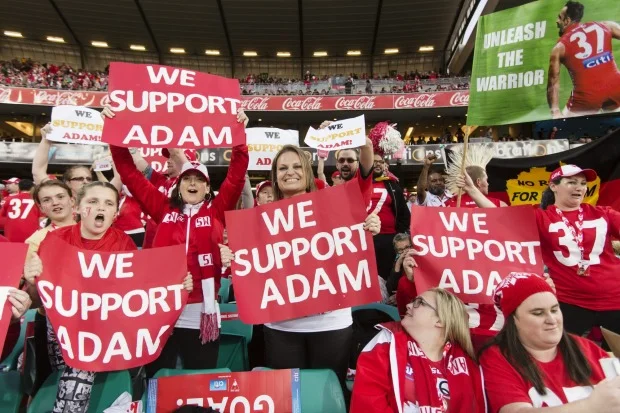
AFL satirist Titus O'Reilly gave this speech ahead of the Round 18 Sydney v Adelaide game at the SCG. It was at a pre game function and it was the week Adam Goodes didn’t play because of the booing. The emotion up there was one of white hot anger.

It’s terrific to be with you all here in Sydney today and in a fairly eventful week.

I’m also very happy this game is at the SCG but I do miss the rustic charm of the exposed metal bolts of ANZ Stadium.

I came up from Melbourne yesterday where there is obviously a lot of talk about Sydney at the moment.

I’ve always found the Sydney/Melbourne rivalry thing a bit strange.

After all they both have their attractions.

For example, you have the harbour bridge, an engineering and architectural triumph, we have a graffiti filled alley with a dumpster.

You have the Opera House, one of the great landmarks on the world, we have another graffiti filled alley but this one has a hard to find bar that seats just four people.

Being from Victoria and a consumer of only Melbourne media, I often have to be reminded that there are teams outside of Victoria.

The whole Victorian thing of supporting any Victorian club over an interstate one has always concerned me.

I feel pretty uncomfortable with any policy that requires you to be on Collingwood or Essendon’s side.

I was honoured to come speak to Sydney’s top supporter group and I’m told this group provides a lot of money to the Swans.

It must be nice to see your money going to a successful organisation that puts it to good use.

I’m a Melbourne supporter and that’s a bit like putting your money into an alpine fireplace.

There’s an immediate feeling of warmth, but it’s quickly over and suddenly you realise it’s all gone up in smoke.

So when I was asked to speak here, I thought I should brush up on my knowledge of the Swans.

I wanted someone who’d spent time here and had flourished in this great city.

Someone who had an affinity with Sydney and the Swans.

So I caught up with Eddie McGuire.

Now I wasn’t sure if he’d have an opinion or be willing to share his thoughts.

You may not know this but he’s a guy who usually likes to work quietly behind the scenes.

Speaking publicly is not usually his style but I thought it was worth a try.

So I sat down with him and said ‘what do you think of the Sydney Swans?’

So Eddie carefully explained to me how you northern clubs had secret underground laboratories.

These laboratories use the DNA of great AFL players to create ‘super footballers’ who are then trained in your unfair academies.

Really, Eddie thinks anything North of the Murray is basically North Korea.

Poor Collingwood, with their massive membership, financial clout and wall-to-wall media coverage.

It must be tough.

It’s always been a bit strange to me the controversies surrounding the Swans.

I’ve said this long before I was asked to speak here, so it’s not playing to the crowd, although I’m never above that.

For instance, the Cost of Living Allowance.

Basically, the argument has been; ‘how dare Sydney do something they’re legally allowed to do.’

In fact, it was what you were told to do.

And that’s the worst type of cheating! When you’re not cheating at all.

As if the other clubs would have said no to any advantage they can get their hands on.

What really upsets people though is the Swans have been successful in managing their club.

You’re doing all those things we said they could do and being smart about it.

How dare you!

Don’t you know that good administration in an AFL club just highlights how bad it is in others?

No wonder they’re upset.

Why couldn’t you have just recruited Karmichael Hunt?

No one would be angry with you then.

Hasn’t the Gold Coast Suns been a wonderful experiment?

It’s like a bad reality TV show.

Let’s get a bunch of eighteen year olds, stick them on the Gold Coast and then put an NRL player in with them.

How could that possibly go wrong?

Putting a sport team on the Gold Coast is like invading Russia in the winter, it never works.

I mean even Clive Palmer couldn’t get it to work.

Anyway, Sydney’s real mistake was stealing Buddy from GWS.

That basically ruined the AFL’s entire marketing strategy for the next five years.

The AFL had learnt the hard way that NRL players can’t play AFL, which is not surprising to anyone that has say, seen both games before.

So they needed Buddy at the Giants. They were desperate.

And you all ruined it by obeying the rules and putting together a better offer.

The pain lingers for them as Buddy has been a massive success at the Swans, especially once he realised what side of the road you drive on up here.

It’s why the AFL absolutely had to stop you trading last year for no real reason.

The AFL had no choice but to send a very clear message that following their rules is no protection from arbitrary decisions.

You have to remember, not long ago the AFL fined Melbourne for being found NOT GUILTY of tanking.

Now everyone knows they did it, although subsequent years have shown that might just be their resting state.

The AFL could have found Melbourne guilty, but it was more fun to say they were not guilty and then fine them anyway.

So the AFL can punish you whether you did something wrong or if you are completely innocent.

So basically, being in the AFL is like being in a marriage.

Anyway, I thought I should address the big issue at the moment, which has dominated the media this week.

Every one can see the big impact it is having on your club;

That issue of course is the large amount of stupid people in Australia.

We seem to have as much stupidity as we have iron ore.

If only China needed idiots; we could be richer and solve this problem.

You may have noticed that I’m a middle-aged white man and that makes me the perfect person to talk to you about racism.

If there’s one voice missing from the discussion surrounding Adam Goodes and the experience of being indigenous in Australia; it’s that of white men.

To be honest, white men are always a bit intimidated by any man who can dance.

Have you seen a white Australian male dance?

It usually involves both feet being rooted to the spot and a clear lack of understanding of what to do with their hands.

Spilling a drink while doing it is often a key feature.

What would be funny about this, if it wasn’t all so very sad, is grown adults saying they were intimidated by this dance.

Although that’s easy for me to say.

I wasn’t in the crowd and can only imagine how sharp that spear was.

What has been great this week, is having some of Australia’s great public intellectuals weighing in on the debate.

There’s been ex-footy players, AFL journalists, Shane Warne, Jason Akermanis and Sam Newman to name a few.

It’s just a shame no one asked Dawn Fraser for her opinion.

That would have meant we’d collected the entire set of ill informed sports people.

Obviously, these are the public intellectuals you want leading a debate on the complex and sensitive issue of race.

They all bring a deep personal understanding of what it’s like growing up indigenous in Australia.

What I do love about this debate is the arguments you get from those who want to keep booing.

Like this is what this is all about, not that it’s having a profound effect on a real person.

They honestly talk about their ‘right to boo’.

That must be in the Bill of Rights Australia doesn't have.

I actually had someone on Twitter tell me their right to boo Adam Goodes is protected by the First Amendment.

The first amendment! Where do I start with that?

We’re dealing with really stupid people here.

I mean who’s going around booing people all the time anyway?

Do these people ever boo people when they’re not in the safety of a crowd?

Just walk up to people and start booing?

I don’t know, maybe at their Reclaim Australia rallies they do.

That said, there have been a lot of times I’ve been stuck in a meeting and just wanted to start booing.

Any of you whose been in a board meeting would know that feeling.

Perhaps corporate Australia would be better off if you could boo the next consultant who suggesting something ridiculous and expensive.

I'm not saying everyone who boos Adam Goodes has been doing it for racist reasons.

Who truly knows?

But when a bunch of racists are doing it too, maybe that’s a sign you should stop.

It’s like if you have a long held opinion on a topic and then suddenly Brian Taylor starts saying the same thing.

You would immediately start questioning your own thinking on the topic and would definitely stop expressing it publicly.

If this was just about football and not racism, you would see others being booed.

I mean how does Adam Goodes get booed and James Hird doesn’t?

I guess racists have always had a soft spot for the blonde hair and blue eyes.

I like to focus on the fact that despite this horrible situation emerging, there are a lot of powerful and very good people on the right side of this debate.

We will win this.

We have what’s right on our side and the tide of history is flowing our way.

It’s just a shame that a great Australian has to go through this for Australia to wake up to itself.

I’m truly hopeful Adam is strong enough to handle all this but we need good people being vocal and lending him support.

Now moving on, if you listen to the media at the moment, you’d think Australian Rules football is about to fall off a cliff.

I just want to go on the record and say I actually quite like footy and I don't believe it's on the verge of imminent collapse.

I’m told saying that can lose me the media gigs I have.

But congestion is not going to end the game and we’re not going to be overrun by ‘soccer’ as the media breathlessly predict.

There’s actually a lot of good going on in footy at the moment.

Just this week, I watched a wonderful documentary on some Essendon players who travelled to India to spread the code over there.

Did anyone else see it?

For those that didn’t it was mostly just them clearing customs before they got on the return flight but still very powerful.

Basically it was like watching an episode of border security.

Still, a great initiative.

AFL is just so big in India at the moment so sending about five players for a clinic should push it over the top there.

Last night, we also had a great game with Richmond defeating Hawthorn in a game that has huge ramifications for the finals.

It means the Hawks can be beaten and I think that Sydney, Richmond, West Coast and Fremantle are all still chances.

Your guys have to step up. We need the Swans firing.

We can’t have Hawthorn win three in a row. It’s a world I don’t want to live in.

I can’t stand the idea of there being any more happy Hawks fans.

Then we have today’s game.

This should be a good one.

Today’s opponent, the Crows, are a team that we all have a fair bit of sympathy for at the moment.

It must be terrible to be living with the threat of Mick Malthouse coaching you.

They have a lot of good players Adelaide and we’ll soon know if Patrick Dangerfield is going to stay.

What a lucky guy, choosing between living in Geelong or Adelaide.

That’s the glamour of AFL for you.

So good luck today.

A Swans victory would be a wonderful end to a frankly horrible week.

Let’s hope your boys get it done.


Titus O'Reilly writes footy and sport articles, including his hilarious 'The Weekly Knee-Jerk Reaction' that are a must for sport lovers.

Enjoyed this speech? Speakola is a labour of love and I’d be very grateful if you would share, tweet or like it. Thank you.

Facebook Twitter Facebook
In BROADCASTER Tags TITUS O'REILLY, FOOTY, AFL, ADAM GOODES, AUSTRALIAN RULES, SYDNEY SWANS
4 Comments
Photo: Jodie Hutchinson

Photo: Jodie Hutchinson

Tony Wilson: 'Art vee Sport. And yet another away fixture for us here at the gallery', Ian Potter debate - 2014

October 19, 2015

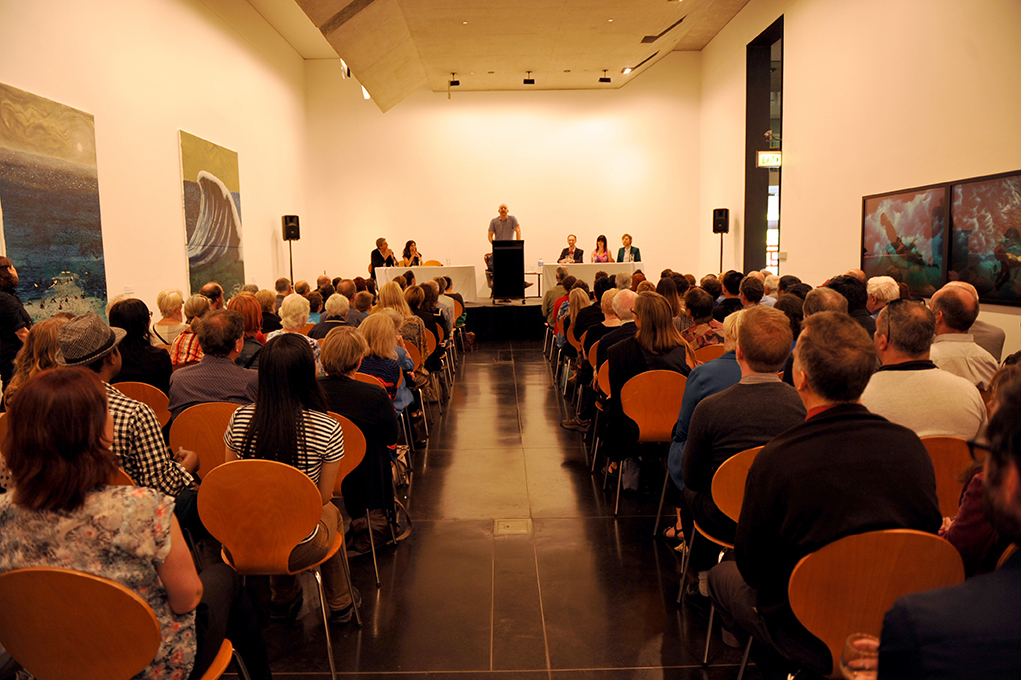
12 November, 2014, Ian Potter Gallery, University of Melbourne, Australia

The path to enlightenment, is it sport or is it art?

What we on the sport side like about the topic is that it’s either /or. Art versus sport. Art vee Sport. And yet another away fixture for us here at the gallery. Nevertheless we love that enlightenment is a fixture that either art or sport will win, and you only have to look at the history books to know sport has had the wood on art, especially since George W Bush started painting dogs.

In the last Enlightentest, you’ll remember we proved before tea on the second day that seeing Sam Newman flash his geriatric balls on national television did exactly the same job as Lucien Fried does, but with broader brushstrokes.

That’s the problem for art.

Yes it had a dominant era, back when Graeco-Roman wrestling and discus were pretty much the only sports, and, yes, some clever marketing people on the arts side thought to call their dominant period, ‘The Enlightenment’, but honestly, since Michaelangelo hung up his scaffold, it’s been sport, sport, sport.

On this side of the debate, we accept that popularity does not equal enlightenment. Just because a GWS game in June packs a bigger crowd than an entire season of Giselle, doesn’t mean we win. Just because Opera Australia is about to learn that ‘the Don’ in the popular imagination is not Don freaking Pasquale. Just because the masses clearly choose the high mark over the book mark — doesn’t mean that’s an enlightened choice.

But as it turns out, it is.

One of the problems for art is that it can’t really do anything that sport cannot.

Take literature. For sure, literature gives us stories, but I’m going to argue that sport gives us the same stories, except quicker and with fewer Russian famines. Insight into the human condition? Who has time to wade through A S Friggin Byatt and her world of impenetrable grey to find out who you are, when you can look up Shane Warne’s Wikipedia entry? Success, failure, love, infidelity, triumph, defeat, addiction, deceit, slight-of-hand. It’s all there. And as for the power of words, I hope our opponents don’t lecture us about the power of words. Literature has had its day on that front. From the day Ron Barassi wrote his famous ten by two letter word manifesto, ‘If It Is to be, it is up to me’, sport has been leading the way with respect to the power of words. Sports stars and coaches now set the language agenda, and I have little doubt that if Charles Dickens were penning A Tale of Two Cities today, he wouldn’t be opening with ‘It was the Best of the Times, it was the worst of times’. He’d be opening with ‘Yeah … nah …’

Sport now does the job of covering all the plotlines that used to be left to film, literature and theatre. To name just a few:

Life Of Pi – why slog through 300 odd pages of boy and tiger on boat when the Brisbane Lions are planning to have a real lion on the sidelines next year.

White Teeth – Zadie Smith wrote about a Pakistani girl coming of age in South London, when it really should have been about Shane Warne’s teeth bleaching if she was serious about engaging the subcontinent.

And what’s funnier? Shakespeare’s lame cross dressing comedies like The Twelfth Night or As you Like It – where everybody pretends that the nice couplets make up for the unrealistic storyline and the hammy acting, or a young Ricky Ponting actually getting into a fight at the Bourborn and Beefsteak because he’s been dancing with a woman who turns out to be a man?

That’s the sort of enlightenment sport offers.

Sport pretty much does all the cultural heavy lifting you need.

Why did Ian Mckewan even bother writing Atonement, when the whole issue of accidental swearing has been dealt with so effortlessly by Ian Chappell.

We don’t need Irvine Welsh for drug dramas when we’ve got James Hird and Essendon.

We don’t need The Theban plays and tales of Greek hubris when we’ve got James Hird and Essendon.

We don’t need Samuel Beckett and weird shit where everyone sits on stage in rubbish bins while we’ve got curling.

And we don’t need slow moving, turgid, Booker Prize winning literature while we’ve got golf.

And these sporting plotlines are churned out with effortless regularity. To quote Woody Allen, who reluctantly turned to comedy and film because he was too short to become a champion basketballer – ‘sport is the only drama where even the actors don’t know how it ends.’ It’s endlessly fascinating, whether matches follow a traditional Robert McKee endorsed three act structure, or whether it’s an improvisational masterpiece in anti-structure – a sort of athletic Schoenberg if you will. I realize that I’m using artistic metaphor here, and am doing so not because art is enlightening — we all know it isn’t — it’s just because we’re at The Ian Potter, and if I don’t crap on like this the other team won’t let me sit with them afterwards when they’re sipping Pinot Grigio and rabbiting on about structuralism and its place in the modern novel or some such bullshit — which I really need to do if I’m ever going to get this writing career happening.

In terms of language and the beauty of words, I understand that plays and literature still have their diehards. But the sad fact for book lovers is that a lot of what is said by the great masters, is now said more efficiently by 19-year-olds who have just received their media training at draft camp.

Again let’s turn to Steinbeck: this is how he tried to describe the immigration experience in The Grapes of Wrath:

"Two hundred and fifty thousand people over the road. Fifty thousand old cars – wounded, steaming. Wrecks along the road abandoned. Well, what happened to them? What happened to the folks in that car? Did they walk? Where are they? Where does the courage come from? Where does this terrible faith come from?
And here is a story you can hardly believe, but it’s true and it’s funny and it’s beautiful. There was a family of twelve and they were forced off the land. They had no car. They built a trailer out of junk and they loaded it with their possession.  They pulled it to the side of 66 and waited. And pretty soon a sedan picked them up. Five of them rode in the sedan and seven in the trailer, and a dog on the trailer. They got to California in two jumps. The man who pulled them fed them. And that’s true. But how can such courage be, and such faith in their own species? Very few things would teach such faith.
The people in flight from the terror behind – strange things happen to them, some bitterly cruel and some so beautiful that the faith is refired forever."

I mean, I quite like this passage, I think it packs a substantial descriptive punch. I think it says something about the failings of modern Australia, and the last line almost makes me cry. But didn’t Ross Lyon say pretty much the same thing in a whole lot fewer words when he said, ‘yeah, nah, we had a few passengers out there today.’

And so it’s over art. Pack up your paintbrushes and go seek employment designing away strips for football clubs. You were meant to teach us stuff about ourselves, but you didn’t. You got fixated on things that didn’t connect, starting with that freaking Duchamps urinal in 1917. And so sport came in and filled the void. Gave life meaning. Fed us stories. Constructed the narrative of our society. And so, in 500 years, will people really still be quoting Huxley and Orwell, Lennon and Brecht? I don’t think so.  Instead, we’ll be living in a world when the great philosophers are Sheedy, Lombardi, Maninga. And for wisdom, we will all make do with the words the late great Tom Hafey had printed on the back of his business card, and which I would advise the Ian Potter to take up as its artistic manifesto:

“Every morning in Africa, a gazelle wakes up. It knows it must run faster than the fastest lion or it’ll be killed. Every morning a lion wakes up. It knows it must outrun the slowest gazelle or it will starve to death. It doesn’t matter whether you’re a lion or a gazelle, when the sun comes up, you’d better be runnin’.”

And yes even in print, Tommy dropped the ‘g’.

Source: http://tonywilson.com.au/the-path-to-enlig...

Enjoyed this speech? Speakola is a labour of love and I’d be very grateful if you would share, tweet or like it. Thank you.

Facebook Twitter Facebook
In BROADCASTER Tags TONY WILSON, DEBATE, SPORT V ART, IAN POTTER
Comment
Angela Pippos, proving she hasn't broken out into a rash on entering gallery.Photo: Jodie Hutchinson

Angela Pippos, proving she hasn't broken out into a rash on entering gallery.

Photo: Jodie Hutchinson

Angela Pippos: 'Being bad at sport doesn’t give you license to belittle it', Ian Potter Debate - 2014

October 19, 2015

November 2014, Ian Potter Gallery, University of Melbourne, Australia

Angela Pippos was arguing for sport on the topic: 'The path to enlightenment, sport or art?' Tony Wilson's speech in the same debate appears here.

I remember walking through the Sistine Chapel – my thighs squeaking (I had been in Italy for two months and my “diet” of red wine – large glass thanks, and pasta, yes I will have seconds – was beginning to re-shape my once slender frame).

So there I was squeaking along, my neck bent backwards – eyes on the ceiling – a look of marvel fixed on my face.

The Creation of Adam, The Last Judgement – now here was a man touched by God. It moved me. Take me hostage and let me stand in awe forever (and bring me a pizza with the lot and a family-size bottle of Chianti. And don’t skimp on the garlic bread).

Michelangelo, sculptor-turned-painter – years on his back, lying on his own scaffolding. I wondered about the pain and suffering he endured, the epic scale of his achievements, his controversial lost fresco.

What were his inspirations? What did he do during his lunch break? All these questions …

You see, not all sports journalists fall into a deep sleep at the mention of the word ‘art’.

Not all sports journalists drag their knuckles and dribble at meal times. Not all of us faint at the sight of tofu, and not all of us break out in a rash when we go to into a museum.

Some of us even read books – books with small print and no pictures – not for a bet, or at gunpoint, but for actual pleasure.

Some of us love architecture, some of us even listen to, shock horror, classical music – and not while waiting to place a bet on the market mover for the last at Moonee Valley. No, some of us actually listen purely for joy.

It’s true that some sports journalists exhibit all the artistic finesse of a baboon, and it’s fair to say the closest some sports journos come to culture is eating a tub of yoghurt.

But it’s also true that some lovers of the arts have their heads so firmly wedged up their buttocks they’ve learnt to walk in the dark.

Being bad at sport doesn’t give you license to belittle it.

I have an appreciation of the arts. Of course I do. But sport has provided me with my own path – my own yellow brick road.

And what a journey it’s been.

The highs, what searing, searing highs. Tony Modra reaching to the heavens, back-to-back premierships in ’97 and ’98, both as underdogs; a serendipitous night out with the late, great Ayrton Senna (… it was a balmy Adelaide evening, the sweet smell of jasmine filled the air, the smile on his moist lips as I approached …); Cathy Freeman in full flight; Cadel Evans, glass of champagne in hand, yellow jersey his for the keeping.

So many glorious sporting moments, moments of inspiration, nail-biting tension, adversity and euphoria.

As a nation we bat above our average when it comes to sport. Unless, of course, you’re an Australian batsman.

Then there are the life lessons – learnt from such a tender age.

Sport was my first love.

I was rarely without a netball, football or cricket bat in my hand. I lived for Saturdays.

I believed I had the natural talent and flair to represent Australia on the netball court. Many a restless night was spent waiting for the growth spurt. If only Joyce Brown’s Netball The Australian Way, which I slept with under my pillow for two years, included a chapter on the realities of genetic disposition.

Sport has helped me make sense of the human soul – to understand what it’s like to be human – and learn how to grow (sadly not vertically), and learn how to love.

Sport has taken me gently by the hand and shown me the way; it’s taught me about friendship, teamwork and boundless human endeavour.

It’s taught me how to be gracious in defeat, like Kevin Muscat, and humble in victory, like Shane Warne.

It’s taught me about honesty – Adam Gilchrist.

Innovation – the Winged Keel.

Transparency – the Essendon Football Club.

Sport has led the way with its groundbreaking equality towards women – respect, recognition, equal pay, equal opportunities …  cough cough (sorry I seem to have something stuck in my throat).

Where was I? Ah yes, there is beauty in all things – golfing outfits, footballers’ haircuts, former AFL players squeezed into pastel shirts.

The rhythmic grace of the 23-stone darts marvel Phil ‘The Power’ Taylor; sumo wrestling, middle-aged men in lycra on Saturday mornings, curling, arm-wrestling, the world’s strongest man and Celebrity Splash.

So much diversity. So much beauty.

I have sport to thank for my spiritual balance and this brings me back to Michelangelo.

I did manage to find out what he did on his lunch break – and I was amazed to discover he actually played five-a-side football with his plasterers.

Did sport provide Michelangelo with some kind of inspiration?

And what about his controversial lost fresco? Well it’s recently been unearthed in Rome by the great art historian Umberto Lombardo – and it depicts, quite beautifully, a very dramatic penalty shootout between Jesus and his Apostles.

Jesus is in goal. He was, of course, a brilliant goalkeeper.

The painting shows Christ at full stretch tipping one over the bar from Simon Peter – who, legend has it, was a bad sport.

Matthew in the Corinthians quotes Judas: “Simon Peter assured me he never put his full weight behind the shot because he didn’t want to embarrass our Lord, but me and the lads knew he was just a sore loser.”

The truth is no one ever scored against Jesus.

So it could be argued that the inspiration behind Michelangelo’s great monument to what man is capable of achieving came from sport.

Ladies and gentlemen, the path to enlightenment is off the boot of Michelangelo – not his paintbrush.

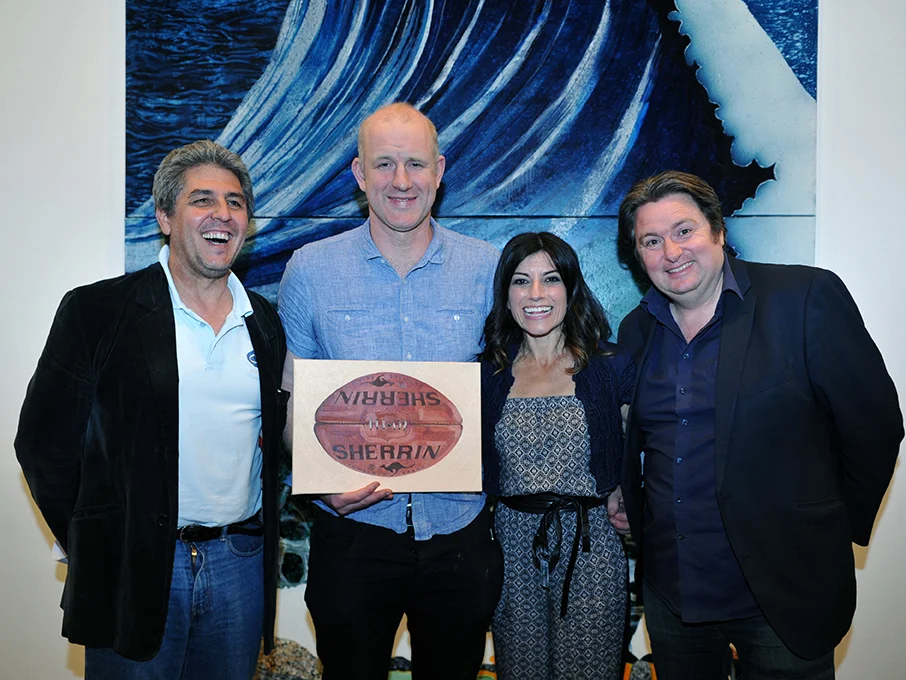
The sport team: John Harms, Tony Wilson.& Angela Pippos. With MC Dave O'Neill.

The sport team: John Harms, Tony Wilson.& Angela Pippos. With MC Dave O'Neill.

Source: http://thenewdaily.com.au/sport/2014/11/12...

Enjoyed this speech? Speakola is a labour of love and I’d be very grateful if you would share, tweet or like it. Thank you.

Facebook Twitter Facebook
In BROADCASTER Tags DEBATE, SPORT V ART, ANGELA PIPPOS
Comment

Anson Cameron - 'It’s written for losers, dweebs, fools, halfwits and toolshiners', launch The Footy Almanac - 2009

October 19, 2015

November 29, 2009, Clyde Hotel, Carlton, Melbourne, Australia

Anson Cameron is a novellist, speaker and Cats fan who was experiencing the giddy bliss of a Geelong's premiership when he launched The Footy Almanac.

Ladies and gentlemen

When John Harms rang me and asked me to launch the Footy Almanac I said, “I’m a congenial sort of guy, I’d love to, John. But I’m also a cultured kind of guy; a devotee of Tolstoy and Cervantes and Shakespeare. So tell me something about this Footy Almanac. I’m unfamiliar with it.’

He said, ‘Anson, It’s a chronicle of every game played through the AFL season.’

I said, ‘Who’s it written for?’

He said, ‘It’s the very lowest form of literature. It’s written for losers, dweebs, fools, halfwits and toolshiners.’

I said, ‘John... it’ll sell its arse off, a book like that. You’ve just mentioned everyone I know. Not only are you writing for fools, in the time-honoured tradition of Bryce Courtney and Dan Brown... but you’re writing for an audience already addicted to the product you’re pushing.’ I said, ‘John, it seems to me you and Paul have the modus operandi and the morals of a street-corner crack dealer.’

He said, ‘Shit, Anson, they told me you were good. But I didn’t know you were this good. You’ve seen through us at a glance.’

And I saw through him at a glance, ladies and gentlemen, because when my father was on his deathbed he said to me, “Don’t waste your time writing about love, Anson. Don’t waste your time pissing around trying to crack the case on the human condition. Write about football. Football is the new Love. Football explains the human condition. If the Elizabethan poets were alive now they’d be wracking their brains and banging their bewigged scones on a wall trying to come up with a word to rhyme with Selwood.  If you want to be Shakespeare in the age of Rudd, then football is your form, Anson. Tell stories that reek of liniment.”

I was, as usual, too stupid to take that advice.

But he was right.  It’s true. As there’s less drama and struggle in everyday life football rises up with all of its colour and movement and tragedy and comedy to fill the void.

There was a time when other things were more important than footy... but that time was long ago in an ignorant age when we lived hand to mouth and grovelled at the feet of Kings and tyrants. We are free now. We are educated. We have money. We have time. We have all the beer we can drink. We have designated drivers. Nothing is more important than footy now... especially with the Cats  winning flags at last.  Forget the love of a good woman. Forget the Miles fucking Franklin Award. It’s when we see Ablett appear spinning out of a pack with the Sherrin in his mitts heading goalward we know life is worthwhile.

They say that Long John Holmes (that was Long John Holmes, not Harms, I haven’t done the stats on the co-editors) they say Long John Holmes might have launched as many as ten thousand orgasms with his prodigious and highly obedient member.  And on first telling that might seem an impressive contribution to the sum of human happiness. But it seems a paltry achievement to me, when I remember that this September I saw Matthew Scarlett launch immeasurably more ecstasy than that with his big toe. Imagine that... his big toe. He made a whole city rise to its feet, palpitating at every orifice and screaming in ecstasy... with his big toe.

I talk of the toe-poke, ladies and gentlemen, I’ve watched it many times since. Call me sick. But for me, the beauty of that toe-poke will never fade.

And I’ve begun to wonder, since that glorious September day, how Johnny Turk would have reacted if our lads had arrived at Gallipoli in 1915 schooled at and skilled in the toe-poke. He would have retreated from the heights bewildered and befuddled in the face of this new dark art is my guess. Much as the St Kilda boys did. I doubt we’d be celebrating glorious defeat at Gallipoli, if we’d arrived as adepts of the toe-poke. I doubt it’s something the Ottoman could have countered.

Of all the five-hundred-page books I’ve ever read I think I’m safe in saying this is the only one that has ever climaxed in a toe-poke. And I’m glad it does. Because, though it might sound like pornography, the toe-poke, something that should be committed in a back room rather than at the MCG, we now know it as one of humanity’s grandest and noblest and most self-sacrificial achievements. And I move on from it reluctantly, for I could talk on the toe-poke all night.

And I move on to talk on my wannabe-slut sister, an otherwise intelligent and moral girl, who declares she would lie down in the sand and rut furiously with Cameron Ling on the main beach at Lorne while the Pier to Pub was being swum and feel no shame whatsoever. Isn’t that disgusting? It’s not the sort of tale I’d normally tell in public.  And I apologise for it.

But I tell it just to show the depth of her delusion. She finds Lingy beautiful. She’s smitten. And the people who have written this book are similarly smitten, each in their own way, similarly deluded, similarly committed, similarly passionate, about some player or some team. And that’s the thing. That’s the thing, ladies and gentlemen.

All the Holy books were written by propagandists. By partisans. By zealots. They are histories of tribes and they tell joyfully of the destruction and scattering of their enemies. Count The Footy Almanac among their number. For if you read this book you will know that in the year of Our Lord 2009 the righteous hooped demigods from across the bay have scattered their foes as chaff before the storm.

Yes the deadening hand of objectivity might be sufficient to write about unimportant things like politics or love or war ladies and gentlemen... but it just doesn’t cut it when it comes to telling of football. If you want pallid objectivity, try the media. They write about footy as if it were a science, or a business... they pretend it isn’t romance.

What you’ve got here is the tribal scream of a hundred zealots wearing their hearts on their sleeves and putting their balls or equivalent anatomy on the line.

The great rule in writing is to Care about what you write about. In effect... to barrack for something. And the people who wrote this book do. Which is what enables them to write with such boundless passion.

And in launching the Footy Almanac I feel like I’m throwing the gates of an asylum open and releasing a throng of beautiful, horny, lunatic preachers all ready to bark their own species of madness and love from the street corners of our town.

And it makes me feel good to do so. Because football is a beautiful madness and it needs its preachers.

So Congratulations to John and Paul on the cacophony of fevered voices they have collected here. They tell of Australian Rules Football like nobody else does.

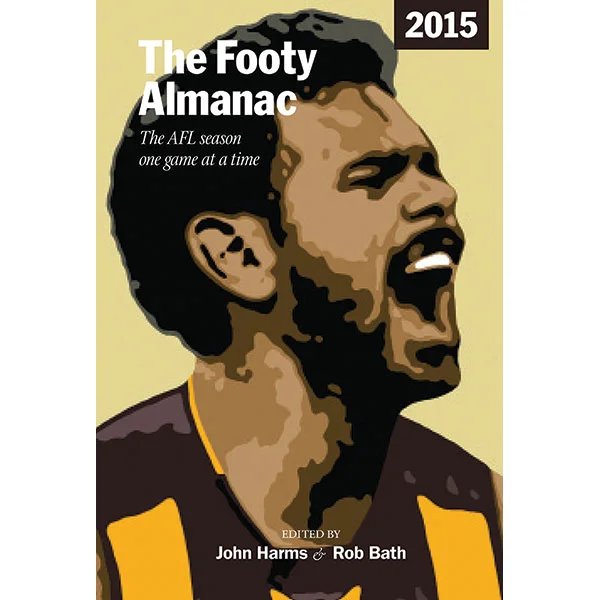
This speech, and many other superb examples of 'toolshiners' covering sport, exist on The Footy Almanac website. You can buy the 2015 Almanac here. Or click on Cyril!


Anson Cameron is a brilliant speaker who is featured more than once on Speakola. You can book him here.


Source: http://www.footyalmanac.com.au/footy-alman...

Enjoyed this speech? Speakola is a labour of love and I’d be very grateful if you would share, tweet or like it. Thank you.

Facebook Twitter Facebook
In BROADCASTER Tags SPORTS WRITING, SPORTS LITERATURE, THE FOOTY ALMANAC, JOHN HARMS[, ANSON CAMERON, BOOKS, AFL, AUSTRALIAN RULES, GEELONG
Comment

John Harms: 'No, my father could not pass a cricket match' Australian Cricket Society - 2012

August 11, 2015

3 May, 2012, Australian Cricket Society, toast to cricket

Thanks to you Ken and the Cricket Society for the invitation to give this toast to a game we love. It’s a pleasure to be here.

Cricket is a brilliant game.

I can’t touch my toes, I have a gnarley finger that won’t bend in the cold, a liver which was enlarged by lingering in sticky-carpeted clubhouses throughout the 80s - and has never settled down – and, despite the therapy, I still wake screaming in the night as I re-live the dropping of the steepler which cost us a grand final…. yet I still believe that this great game has served me well. That grand final was just 26 years ago now, and, besides, it was the keeper’s catch.

No, cricket has served me well.

And it was always going to. Because of the many, many fine things my father did for me and for my three brothers, teaching us to love the game of cricket was one of the finest. He really loved it, and he helped us to really love it.

After I left home to go to university, I looked back on my childhood and I started to realise that my father had cricket in him. He had been an opening bowler with a classic Lindwall action and was sent in to bat at No 3. “to knock the shine off the ball”.

He played with us in the backyard, as did my mother, who had a wicked arm from hoicking spuds. She’d grown up on a potato farm in the Lockyer Valley.

Dad took time to teach us: to use our feet, to play the late cut “out of the keepers gloves”, to bowl leggies.

But I really knew Dad had cricket in him when I looked back at those Saturday afternoons when we would be driving around Toowoomba. We’d pass a cricket match at Newtown No. 1, or Godsall Street. Dad was one of those blokes who felt compelled to stop the car and watch for a while. “We’ll just get out and see what the opening bowler’s doing,” he’d say.  

So he’d bundle us out of the car and we’d walk to one end and watch for a few overs, and having worked out the batsman’s style he’d take us to that spot where the cricket ball was most likely to cross the boundary. And there we’d stand. I can remember as a tiny boy the rock-hard ball coming towards us, and we’d collect it, an under arm it back to the fieldsman whose heavy boots thundered across the ground towards us. He’d turn and throw a massive throw, over the moon. And jog back as the batting side continued to applause and yell things like “Shot, Macca.”

How would we ever hit the ball so hard? Or throw it so far?

No, my father could not pass a cricket match.

Nor could he pass on the opportunity to watch great batsmen. He was a clergyman; a pastor in the Lutheran church. So on Saturday afternoons he’d be busy preparing his sermon in his study with the radio on, Alan McGilvray describing the Test Match. Often it would get the better of him and he’d wander in to the lounge room to “see how the Australian batsmen were getting on”. Sometimes he’d stay.

I remember vividly Boxing Day of 1981 – it was a Saturday. He stayed all of that afternoon, to watch one of the great Test innings – the famous century from Kim Hughes (who will follow me to the lectern).

I should also mention that I rang my cousin Chris Harms today, who played for South Australia. Chris also has a therapist - from bowling at K.J. Hughes – whom he describes as “the scariest batsman he ever bowled at”.

Dad thought that was one of the great innings.

My father is no longer with us. He was a loving man; yet, for all of his capacity for love, and his pleasure in the aesthetic of sport and in fair play, he hated the Collingwood Football Club. He didn’t handle the loss to the Pies in the 2010 preliminary final too well – he died just after midnight.

But he left us with many memories. And he has left his children and his children’s children with a love of the game, and a respect for the game.

Our Theo, named after my father, is the oldest of our three. When I stand before him saying, “Watch the ball. Watch the ball,” I hear my father’s voice.

I only hope I can instil in my children the same depth of appreciation of this wonderful game: the game of cricket.

To cricket.

Source: http://

Enjoyed this speech? Speakola is a labour of love and I’d be very grateful if you would share, tweet or like it. Thank you.

Facebook Twitter Facebook
In BROADCASTER Tags CRICKET, AUTHOR, JOHN HARMS, COMMENTATOR, TOAST
3 Comments

Gideon Haigh: 'Yet even now, amateurism endures, and mightily,' Bradman Oration - 2012

August 10, 2015

24 October, 2012, Bradman Oration, Melbourne, Australia

I need hardly say what an honour it is to deliver the tenth Bradman Oration. I won't say it's daunting. That would be unfaithful to the spirit of perhaps the most dauntless cricketer who ever lived. But it is a privilege and an onerous one.

Last year, Rahul Dravid delivered perhaps the best and certainly the most-watched of all Bradman Orations, a superbly crafted double-century of a speech on which, I remember thinking at time, it would be hard to improve.

Now I find myself coming in after Rahul, a job so huge that India has traditionally left it to Sachin Tendulkar. By that marker, I can really only disappoint. All I have in common with the Little Master is that we are both grimly staving off retirement - although, of course, the potential end of Tendulkar's career is a matter of moment to 1.2 billion Indians, while the potential end of mine concerns only my wife who would then need to find something for me to do around the house at weekends.

I'm a cricketer. The game is the longest continuous extrafamilial thread in my life, and I'm attached to it as tightly as ever. I started pre-season training in April. I own a cat called Trumper. And while it's hardly uncommon to have a cricket bat in the house, not everyone can claim to have one in the kitchen, one in the living room, one in the bedroom and one in the outside dunny.

I represented my first club, the St James Presbyterian under-12Bs in Geelong, when I was 9; I played my first game at the mighty Yarras in 1993, and I'll play my next one this weekend. The rest of my life has been contoured accordingly. I married my wife during a Christmas break; we became parents during the next Christmas break; on neither occasion did I miss a training [session], let alone a game. We delayed our honeymoon until it was a bit more convenient. Until an Ashes series in England, anyway. I certainly thought it was convenient.

They do say that the first step to dealing with addiction is admitting you have a problem. Okay, here's my problem. I'm no bloody good. Oh, I'm not terrible. But, I mean, you can be terrible in a hilarious and companionable kind of way. Me, I'm just mediocre in a hanging-on-for-dear-life-oh-God-let-it-end-soon kind of way, one of those park cricketers who answers to the designation 'allrounder' because I basically do nothing very well, everything equally badly.

The ineptitude, moreover, is now exacerbated by physical decrepitude. I don't even need to playing now to be reminded of my age. This was brought home to me a few years ago when the Yarras were joined by a gangling youth, [by the] name of James Harris. Following my time-honoured philosophy that the lamest and most obvious nickname usually has the best chance of sticking, I naturally dubbed him Rolf - which I quickly regretted, as a look of incomprehension crossed his face.

Anyway, I'm hanging in there. Sir Donald's contemporary Ernie McCormick once said that the moment to retire came when you took off one boot, then the other 15 minutes later. I'm stable at around about 10 minutes.

And, you know, lack of ability can add something to one's cricket experience. When Michael Clarke hits one through the covers, he's simply doing what he and everyone else expects; me, I'm getting a pleasant surprise. The top level player inhabits a world of pitiless absolutes; for me, and the likes of me - for we are legion - we're in the realm of the relative, where 'not-so-bad' is good enough.

That's particularly so because of what I might call the compensatory pleasures. A few seasons ago, I broke the Yarras' games record - a triumph of availability over ability if ever there was. On doing so, I was forwarded a spreadsheet of all the guys I'd played with in that time: about 400 of them. A few brought back no memories at all - that's another function of getting older. But so, so many brought back happy memories, of shared struggles, shared gags, moments of joy, of disappointment, of relief, of redemption. There were a couple of d**kheads in there too - no club is without them, I dare say. But the proportion I've encountered at the Yarras has been vanishingly small.

And, well, as we also know, that a club d**khead might be a d**khead, but he's your d**khead. I've always liked a remark by Freddie Jakeman, who played for Nottinghamshire in the 1950s. He said: "Out of every hundred cricketers there's probably two sh*ts. And if the 98 of us can't look after those two, we're a poor bunch."

I'm sure you understand what I mean. The club. We all have one. We might not see it much any more. But it's like a first love - never forgotten.

As a junior cricketer, I always took for granted that there would always be a game for me. As a senior, the most rewarding parts of cricket have been keeping the show going at a club that's mainly had moths in its trophy cabinet and IOUs in its till.

For grassroots cricket in the twenteens, I can tell you, is as precarious as it ever was. It's not so long since we had a $3500 utilities bill turn up when we had $50 in the bank. Could we, wondered the president, become the first club to operate without electricity? Really, added the treasurer, the most profitable option would be to play no games at all, and simply to hold barbecues. The secretary rather liked the sound of this, having himself been unanimously elected at the annual meeting while on his honeymoon in Bali, and still to evolve an exit strategy. Alas for him anyway, we dug deep and found a way, which you tend to over time.

Clubs are dependent on the goodwill of sponsors, who ask for little, offer much, and deserve whatever exposure you can give them. And I think everyone gains from knowing that the friendly staff at the Windsor Community Bank can assist with all your financial needs, that the calamari at the Union Hotel is delicious, that Lachlan Fisher at Fisher Cricket Bat and Willow is a prince among men … and that FlosFlorum is not only tops for flowers but lent us their van so we could retrieve our new bowling mats. Of course I may be wrong about that, but when you're personally in charge of your club's sponsorships you have to be a bit shameless, don't you think?

Clubs are likewise dependent on the good offices of their local council. Sometimes these remind me of an old gag. How many council recreation officers does it take to change a lightbulb? Answer: none because it's no longer their job to change lightbulbs; there's an independent contractor for that, but his tender was so low that you'll get a candle only if you ask nicely. Actually that's not an old gag - I made it up. But it sounds like it resonates with a few people.

Mainly, of course, they're dependent on people, and it's often where you find those people at their best, because they are putting others' interests first, and giving the gift of time, in which we generally these days feel so poor.

I find the generosity of people towards their fellow man and woman through the medium of cricket deeply moving, and motivating. Behind the apparently ordinary individuals who volunteer their aid to the cause of sport, furthermore, unsuspected gifts can also lie.

I like that story that Tony Greig tells about arriving in Adelaide for the Rest of the World tour in 1971, and being met at the airport by this dowdy, bespectacled old chap whom he took as some local association gofer there to carry his bag. When they had a bit of a chat, the old codger seemed to know a thing or two about the game. (South African accent) 'Play some cricket, did you, old man?' Greigy asked. (Reedy voice) "Oh, y'know, a bit," said the old bloke. Just then Garry Sobers arrived and headed straight towards Greigy's companion. "Hello Sir Donald," he said.

Sir Donald's epic career, in fact, was bookended by administrative roles. Some of you will know that his first job at Bowral Cricket Club was as the first team scorer; I dare say that his books added up too. He was picked for his first game as a 12-year-old, in the time-honoured tradition, when the XI was a man short.

When Sir Donald's playing day was done, the master of the game became its foremost servant. While everyone revels in 6996 and 99.94 - and we were never going to get through the evening without an invocation of those totemic numbers - a stat I love is that he also attended, for nothing, 1713 meetings of the South Australian Cricket Association. I also love the fact that someone bothered to make that into a stat.

We inhabit a modern world in which vast and minute attention falls on a very thin layer of highly paid, wildly promoted and hugely glamourised elite athletes who regard the attribute of 'professionalism' as the highest praise. I mean, everyone wants to be a professional nowadays: to do a professional job, to obtain professional standards, to produce work of professional quality, to exhibit professional pride. The porn star Randy Spears has explained that he manages to work up some lust for 30% of the women he has sex with in X-rated movies; the rest of the time, he is "just being a professional".

Yet even now, amateurism endures, and mightily. About a quarter of Australians participate in a sport organised by a club, association or other organisation each year. What proportion are paid for it, do you think? Probably closer to 0.1% than 1%.

Club cricket remains our game's biggest participation sector, with 3820 clubs in 570 associations enumerated at the most recent cricket census. And I suspect there's something about battling through and totally ar*eing everything, just scraping teams together and barely making books balance, that becomes part of the pageant. You're aiming to keep petrol in the roller, beer in the fridge and change in the till. But you're maintaining a preparedness to laugh when, due to a breakdown in communication, it ends up that there's change in the fridge, the till's full of petrol and the roller's full of beer.

We like our clubs to be successful, of course, but maybe not so successful that they become big, rich, complex, impersonal. That might become a little too much like everyday life - from which, when we take the cricket field on the weekend, we are usually seeking some distance. There's an interesting contrast, I fancy, between those groups we form ourselves, for our own enjoyment and beneficiation, and those formed for us, for maximum economic efficiency. The modern corporate world has developed to a fine art the act of building empires of strangers. For our own parts, we seem to prefer environments where it remains possible to know everyone's name, where we're connected by the intangibles of friendship and mutual reciprocity rather than by the formality of titles, ranks, reporting lines and organisational matrices.

I'd go further. This is something Australians have historically been good at. The theory and practice of forming cricket clubs is in our blood and in our history. Within two years of this city's settlement, citizens had founded the Melbourne Cricket Club, dedicated by one of its founders to 'men of all classes, the plebian mingling with the peer, in respectful feeling and good fellowship' - a character which it's arguable it has maintained … assuming you can wait 20 years to find out.

Melbourne's first significant rival was Brighton Cricket Club, still prospering, 170 years young. Tasmania's oldest surviving clubs date from round the same time, South Australia's oldest surviving clubs from about a century and a half ago. They are older, therefore, than a majority of Australia's legislatures, an overwhelming number of our municipalities, and all but a tiny handful of our commercial enterprises.

This is something Australians have historically been good at. The theory and practice of forming cricket clubs is in our blood and in our history

The overwhelming proportion of clubs, of course, do not endure anywhere near so long. They rise and fall because of geography, demography, availability of participants, accessibility of organisers, facilities and funds. But the habits they instil are those that build communities: of giving and sharing, of volunteering and responding, of balancing interests, nurturing culture, respecting history and generally joining in common purpose. Grassroots cricket can even, I fancy, claim an influence on the foundation of the Australian commonwealth.

Cricket has always taken a certain pride in having provided an inspiriting example to the inchoate nation, the idea of a unified Australian team pre-empting that of a unified Australia. But there's more to this. When you focus on the political actors in the period around federation, it is striking how varied and how deep were their cricket connections.

Four key figures in federation, George Reid, Edmund Barton, Charles Kingston and Thomas Playford, also served as at least vice-presidents of the cricket associations in their respective states. Whilst a 22-year-old assistant accountant in the colonial treasury, Reid was elected delegate to the New South Wales Cricket Association by the Warwick Cricket Club - the same club, incidentally, as Dave Gregory, Australia's first captain.

After nine years, Reid became association treasurer, and he continued serving as association president whilst he was the premier of New South Wales, resigning only in the year before he became prime minister. Reid was not himself a noted player although he might have made a handy sight screen, being roughly as wide as he was tall, and he certainly sledged like an Australian cricketer. Once while addressing an audience from a hotel balcony in Newcastle, he nonchalantly propped his belly on the balustrade. "What'll you name it, George?" called a heckler. Reid replied: "If it's all p**s and wind as I expect, I'll name it after you, young feller."

Consult the NSW Cricket Association annual reports in Reid's time, furthermore, and you'll find three future premiers, James McGowen, Joseph Carruthers and John Storey, acting as delegates for their clubs, Redfern, University and Balmain respectively. Carruthers and Storey, interestingly, were born rivals: Carruthers a hot-shot lawyer and dyed-in-the-wool conservative, Storey a state-school-educated boilermaker and a self-described 'evolutionary socialist'. What made them unlikely lifelong friends was representing the same parliamentary XI. As Carruthers wrote in his memoirs: 'There were other men of different shades of political belief in the cricket team, and I can say of them as I say of Storey and myself, that the bitterness of party strife disappeared during contact with one another in the cricket field."

In this city, around the turn of the century, the presidents of the St Kilda, East Melbourne, Richmond and Prahran Cricket Clubs were respectively also Australia's first treasurer (Sir George Turner), Melbourne's first federal member (Sir Malcolm McEachern), and the local members for their suburbs (George Bennett and Donald Mackinnon). Again, cricket exerted a surprisingly broad appeal: Turner was a stolid bookkeeper, McEachern a bold entrepreneur, Bennett a radical Catholic from Banffshire who championed the eight-hour-day, Mackinnon a silver-haired Presbyterian educated in classics at Oxford, later to become both president of the Victorian Cricket Association and Australia's wartime director-general of recruiting.

Admittedly, the era's foremost political figure, Alfred Deakin, professed no great love for cricket. But when he wanted to describe Australian politics in the era of its split between Labour, free traders and protectionists, Deakin deployed a famous cricket metaphor: it was, he said, like a cricket match featuring three XIs - an idea so outlandish that it has not even occurred to Mike McKenna yet.

In Deakin's ministry, meanwhile, was a Queenslander rejoicing in the name Colonel Justin Fox Greenlaw Foxton, who in cricket rose highest of all: he was simultaneously chairman of the Australian Board of Control and Grand Registrar of the United Grand Lodge of Queensland after nearly 30 years in local and federal politics.

While researching this oration, I dug out press reports of the Athenian Cricket Club which Foxton helped to found in Ipswich in the 1860s when he was a teenaged articled clerk. There obviously wasn't much happening in Queensland a hundred and fifty years ago, because Brisbane's Courier gave extensive coverage to the Athenians' inaugural annual meeting, held in Ipswich's Church of England schoolroom in March 1867, where Foxton, then just 17, presented the treasurer's report, which was deemed 'most satisfactory'.

The report continued: 'There has been a decided improvement in the play in the last 12 months both on account of the accession of new members and the natural result of practice. It is to be regretted that practice is not more numerously attended; the ground has not been in good order and this has rendered play unsteady.' Colonel Justin Fox Greenlaw Foxton would not have recognised what cricket has become today, but he would have been right at home at the Yarras committee meeting I attended last week. Ground's a bit rough - tick. Attendance at training a bit spotty - tick. Unsteady play - big tick. Otherwise, ticking over well.

Cricket and politics have never interpenetrated in this country as deeply as in others - thankfully so. But there is something significant, I think, about club cricket having loomed so large in the lives of so many involved in the early fashioning of this nation. As I observed previously, in order that everyone bats, bowls and fields in club cricket, some must get organised, elect officials, hold meetings, weigh interests, manage finances, and delegate responsibilities - skills readily transferable to wider fields.

We can couch this more generally too. For numberless millions of Australians since, a sports club has been their original and most tangible experience of day-to-day democracy, and their greatest means of investment in civic amenity. The historian John Hirst has called Australia's a 'democracy of manners'. Australia, he observes, is short on inspirational rhetoric where democracy is concerned: our constitution is silent on citizenship; our curricula have no great tradition of civic education. What we have instead, says Hirst, is a way that 'Australians blot out differences when people meet face to face' and 'talk to each other as if they are equals'. In no environment has this tended to happen more spontaneously than when individuals band together in pursuit of a sporting goal. Club sport remains, I would argue, the most inclusive, evolved and constructive means by which Australians express their instinct to associate.

Better yet, our clubs are distinguished to this day by actually working. In our daily lives we are regularly beset by institutions that leave us feeling powerless, voiceless, helpless. Government institutions. Commercial institutions. Financial institutions. Religious institutions. Media institutions. It's easy to think: What does it matter what I do? What influence can I possibly have? At the little sporting institutions we make for ourselves, we aren't powerless; we can and do make a difference; we can put a shoulder to the wheel and feel the thing move.

It's a sorry reflection on the times that so few, outside an immediate circle, seem to grasp that. As if the thrall of the television remote and the atomisation of the working week were not enough, community sport has suffered gravely from the climate of financial stringency and sterile users-pays philosophies.

'But we subsidise sporting clubs in our community,' complain local governments, oblivious to the way sporting clubs subsidise local governments by mobilising free labour and local expertise, contributing to social cohesion and civic texture. In fact, the minuscule funding support local sport receives has colossal multiplier effects. And if this can't readily be ascertained by economic models, then the answer is new models, because the old ones aren't working any more.

But I can't hold local governments wholly responsible. I also fear that from time to time a sort of mechanistic view of grassroots cricket prevails within cricket itself. It is regarded simply as kind of squeaky and unpainted front gate to one of those glorious 'pathways' one hears so much of - ah, the pathway, paved with gold, strewn with primrose petals. 'New markets' is the clarion call; but what of the old? All we've got to recommend us is that we love the game - and we wonder, from time to time, whether the game still loves us.

Some of you would have seen the figures of the recent Australian cricket census, which were touted as showing cricket to be the country's biggest participation sport at the same time as it disclosed a 3.5% decline in the club cricket population.

We don't have the advantage of exist interviews, of course, but I wonder how many of those individuals passed out of the game because they don't like the way it is run, and promoted, and headed. I don't wish to spread alarm, but this would not wish to be remembered as the cricket generation that grew so obsessed with flogging KFC and accumulating Facebook likes that it let its core constituencies fade away.

Tomorrow, an annual meeting of Cricket Australia will finally phase out the system by which it has been governed since 1905, under which its board has been composed of the nominees of state associations drawn from the delegates of their premier, district and grade clubs. It's a system that has had a lot of critics, me among them, and I'm not about to mourn its passing. But it has always exhibited one particular virtue - that of recognising the integral role of the club in the cricket of this country, and the value of the volunteer in a sporting economy that could not otherwise function. And it would be remiss of cricket if it simply marched into its corporatist future without a backward glance, or a sideways acknowledgement of cricket's hardiest faithful.

In that spirit, I'd like to close this speech the old-fashioned way, by proposing a toast. To the club. It's the beginning of us all. To your club. For all that it has done for you; to all that you have done, and might yet do, for it.

Ladies and gentlemen: to the club.

Source: http://www.espncricinfo.com/australia/cont...

Enjoyed this speech? Speakola is a labour of love and I’d be very grateful if you would share, tweet or like it. Thank you.

Facebook Twitter Facebook
In BROADCASTER Tags CRICKET, BRADMAN ORATION, TRANSCRIPT
Comment

Michael Parkinson: 'Sir Donald Bradman was one of two men I most wanted to interview but never did', Bradman Oration - 2003

August 10, 2015

18 December, 2003, Bradman Oration, Brisbane, Australia

There is a certain irony in me being invited to give a speech in the name of Sir Donald Bradman in that he was one of two men I most wanted to interview but never did.

Never got close. Never even met him.

The other one who got away was Frank Sinatra but at least I was introduced to that great man.

I was taken to a party hosted by Sinatra with a great friend of mine, the songwriter Sammy Cahn. Sammy said "I'll introduce you and once Frank has met you then I'm sure one day he'll do the interview." So I met Sinatra. "Frank this is Mike" said Sammy. "Hi Mike" said Frank. I circulated for a while. I was the only person in the room I didn't recognise. Time to go and I went up to Frank "Goodbye Frank" I said. "Goodbye David" said Frank. The Don even more elusive than that.

But why was he top of my list. Because he dominated a game more than any player before or since. Because he gave a nation pride and status. Because he was one of the first great superstars of sport and because for all his celebrity, remained a private and elusive figure. What more does an interviewer want? No player embodied the principles of the game more than Sir Donald Bradman. There has been no more ardent custodian of the games traditions.

So anyone making a speech bearing his name needs to be aware of the standards he set and to investigate if they are being tampered with. And that is what we will attempt to do tonight.

First of all I should present my credentials. The problem with television fame is it distorts everything including the real sense of who and what you are.

What I am is a frustrated cricketer. I would have given anything to have played professionally. My father, an even more ardent Yorkshiremen than his son, went to his grave believing me to be a failure. Just before he died he said to me "You've done alright haven't you lad?" I said I had. "Made a bit of money, interviewed all those Hollywood stars, hob-nobbed with the rich and famous" he said. "It's been good" I said. He thought a bit, then he said "but think on lad, it's not like playing cricket for Yorkshire is it?" What he was defining was the difference between fame and immortality.

He saw everything in cricketing terms. If he stepped outside and it was a lovely day he wouldn't say "nice day" or whatever. He'd feel the sun on his face and say "we'll bat".

In a restaurant he would ask the bemused waiter for the scorecard instead of the menu. He wanted to call me Melbourne because I was born shortly after we had won a Test match in that city. When my first son was born we had just won in Pakistan. He rang me up. "What are you calling the lad?" he said. "Andrew" I replied. "Thought about Karachi" he said.

He was a coal miner, a fast bowler with an action modelled on his hero Harold Larwood and a humorist and he taught me not just how to love the game but how to respect it.

He was not a neurotic man but he was obsessed by what he considered to be the greatest mystery of them all - how could Don Bradman's batting average be double that of Len Hutton. In other words how could anyone be twice as good as Hutton?

He took me to Headingley in 1948 to find out. Now to say that Don Bradman liked batting at Headingley is like saying Romeo fancied Juliet. It misses the point. Bradman loved batting in Yorkshire and the Yorkshire crowd adored him. His Test average at Headingley is 192. He made 33 when we watched him. Made up for it in the second innings with 170 odd.

There is an affinity between Yorkshire and Australia. It was a Yorkshireman, Captain Cook born in Whitby, who had the good sense to bump into this island.

A Yorkshire firm, Dorman Long, built the Sydney Harbour Bridge. Fred Truman told me that. We were gazing from the Opera House to the Harbour Bridge and Fred said "Yorkshire firm built that you know Parky". Then he said "this lot still haven't paid us for it".

So I grew up feeling a kinship with Australia and when I first came here in the late 70's I was not disappointed. Mind you I had a fine guide and mentor in Keith Miller.

Keith was my boyhood hero. He was probably the cricketer who inspired me more than any other. As soon as I saw him on that 48 tour of England I was smitten, a severe case of hero worship which, I am glad to say, has lasted to the present time.

It was Neville Cardus who described him as `the Australian in excelsis'. John Arlott said that if he had to choose one cricketer to hit a six, get a wicket or a blinding catch to save his life it would be Keith Ross Miller.

To my young eye he was the most glamorous man I had ever seen. Not only was he a swashbuckling athlete but he flew fighter bombers during the war and once, returning from a mission took a detour to fly over the birthplace of Beethoven, his favourite composer.

In modern parlance, how cool was that?

The war affected him greatly. I once asked him why he played in such a carefree manner and he replied that anyone who'd ever had a Messerschmidt up his arse would thereafter greatly enjoy the prospect of playing cricket for a living.

I played in the same team as him. In the 60's we both worked for the Daily Express in London and we had an annual fixture against the Daily Mail.

Keith had an interest in a race meeting at Ascot that afternoon and had arranged for a friend to stand by the sightscreen signalling the results as they came in. He was at first slip and I was at second. He was looking at his friend who was about to announce the winner of the opening race when the batsmen flashed at our quick bowler and the ball flew to my right hand.

It was too quick for me. I never moved. I gave it up.

At that moment miller took off, dived across me, made the catch, rolled over, gave me the ball and still gazing at his friend said "I wonder what won the 2.30".

What he didn't say, but he was thinking, was "we catch those in Australia".

I have always thought that the perfect medal to be struck to celebrate all that is meant by Australian cricket, would have Don Bradman on one side and Keith Miller on the other.

What they symbolize is the Australian character at its very best.

Bradman was of course, a genius. He also epitomised the Aussie battler, the man of few words but great deeds. Miller was the handsome, sunkissed playboy who laughed at life and didn't give a stuff.

Bradman was the outback and the fight against nature, Miller was Bondi Beach and a celebration of the good life.

Any country capable of producing two such singular men has reason to be optimistic as well as proud.

It was Miller and Jack Fingleton who introduced me to Australia. Jack was a great personal friend of mine, a man I admired as a fine writer of the game - one of the very best - and a man who I enjoyed for his droll Aussie wit.

I interviewed him three times on my talk show. Each occasion he wound himself up into a terrible state of nerves. On the first time he rang me up saying he couldn't sleep because he was worried his false teeth didn't fit properly. I said I couldn't advise him on the issue as it seemed to be a unique problem. He turned up to do the show on the ABC and I noticed he was speaking funny, that his top lip wasn't moving. He explained that in order to make sure his teeth stayed in place he had added a fixative to his morning toilet and had overdone it to the extent his top set were now firmly glued to his top lip. Using industrial solvents we managed to unglue him before the show.

The last time I interviewed him he rang me from his hotel room to talk about the show. We talked about how nervous he was and how he wished he could think of something original to say or do. Then he said: "Tell me Mike, has anyone ever croaked on your show"?

Dear Jack, he stayed with us in England and bought us a rose. "It's called a Geoffrey Boycott," he said. "Why" I asked. "It takes a long time to bloom," he said. It is still there, a reminder of a dear man. I think of him as much as I miss him, which is a lot.

He and Miller decided to hold a lunch in Sydney where I might meet one or two of their friends. At the lunch were Ray Lindwall, (Peg) Bill O'Reilly, Alan Davidson, Harold Larwood, Arthur Morris and Neil Harvey. I thought I had died and gone to heaven.

In fact when I do die and if I do go to heaven I want the same dining arrangements.

So all this by way of explaining why I have always felt at home in Australia and why I have had a long and abiding admiration for Australian cricket and the men who play it. Since I started watching and playing the game more than fifty years ago much has changed. Significantly the most important and fundamental changes have occurred in Australia . World Series Cricket changed the face of the game, Kerry Packer and his acolytes, condemned at first as the anti-Christ and his followers, are now seen as the architects of the modern game. It wasn't simply they marketed and promoted the one day game as the fact that the very nature of the new game demanded different skills and, as important, level of fitness from players. It was the death of the old pro and the start of a time when only the fittest could expect to compete.

What one-day cricket did was expand the market, involve a new audience to the extent that in terms of commercial potential it has made Test cricket a sideshow. The traditional game, that which separates it from the rest - because it is the ultimate test - is not about to disappear - yet.

Cricket - Test cricket - is an awkward game to slot into the ultra competitive TV market of the third millennium and the trick in the future will be for TV companies and cricket executives to meet the challenge while not sacrificing either the unique quality of the game nor its integrity.

And if we really are mindful of the game's integrity, and if we believe that the duty of succeeding generations of people involved with cricket is to protect its reputation, then we must be concerned about what I perceive to be a growing problem in the modern game.

Bowling with an illegal action: chucking. This a particular bee in my bonnet.

It would be wrong to say there is an epidemic but I believe there are enough dodgy actions in the game to create a suspicion the problem might be a growing one. Even more worrying is the nagging thought that no one administrators, umpires, commentators seems able or willing to confront the problem.

They will tell you one thing privately yet are reluctant to go public with their doubts. The argument that certain players have been investigated in the past and cleared of chucking doesn't mean to say they don't chuck. Because a man takes a drug test and is clear doesn't mean he need never be tested in future.

I think there is enough disquiet on the issue to warrant the authorities taking a fresh look at the problem. There can be no leeway, no excuses medical or otherwise. Now I don't wish to embarrass my hosts and their guests by raising this contentious subject. On the other hand it seems to me to be particularly relevant to an occasion honouring a man who made his views on throwing very clear during a time in Australia when three or four bowlers were suspected of having illegal actions.

The world's a much more complicated place nowadays. Sporting decisions become political issues. There is the relatively new mine field of political correctness to negotiate. Nonetheless it would be wrong to compromise on this matter and I sincerely hope that those charged with the future of the game don't let it down.

It is no good administrators and the media criticising the conduct and attitudes of players and spectators when they themselves could be accused of sidestepping controversial issues. It is important cricket sticks to its principles. That it does not choose the convenience of political expediency.

If you want to know the consequences of negligence on such issues then I will ask you to consider what has happened to football in England . There you have a game awash with money and bereft of any principle. The culprits are some players, ill-educated and witless who behave without concern for the world around them.

They are helped in their misdemeanours by greedy managers, unscrupulous agents, inert chairmen and a palsied governing body. Much of it sanctioned, by a media dominated by former players, who are more intent preserving some misplaced sense of loyalty instead of doing what they ought to be doing which is exposing and condemning corruption - and I use the word in its widest sense - of any kind.

Cricket is not to be compared with soccer, except as an example of what can happen to a game when money distorts values and those who are paid as watchdogs act as lapdogs.

That said let me congratulate cricket Australia on the way it is promoting what it calls `the spirit of cricket', and it will be interesting to see how cricketers the world over react to the vexed question of behaviour on the field.

From what we saw in Adelaide there are signs the players are taking heed. A truly epic encounter in burning heat was made even more memorable because of the spirit in which it was played. So well behaved were the Aussies the umpires were pleasantly concerned and asked the management if everything was alright.

Sledging is not new. Fifty years ago, playing cricket in Yorkshire, I grew up on it. One of the great joys of cricket is the verbal banter between players. It's a long day not to have a word or two.

That's alright. There's a humour in it. But no-one expects to go to work to hear crude sexual allegations about their wives or mothers, or to be insulted by a fellow international cricketer using the vocabulary of the yob, nor, worst of all, to be the victim of racial abuse.

No one wants to neuter a player or a team's competitive instinct. On the other hand to win gracefully and with style is the most important lesson of all because it shows the athlete has not lost his sense of perspective, that he understands what he is engaged in is a game, a pastime, an entertainment and that set against the important things in life - like family, birth, loss, famine, cruelty, war - it doesn't matter. If a game has any purpose in the grand design it is because it doesn't matter except as an antidote to things that do.

This Australian cricket team is one of the best of all time.

But they have been described as `ugly Australians'. The social researcher, Hugh McKay has suggested the Australian public loves to see them winning but finds it hard to love them.

I am tempted to say here that if you don't want them we do, and that if manners are all you have to worry about we devoutly wish we had your problems. Moreover judging by the impeccable standards seen at Adelaide this week both Aussies and Indians can be proud of their contribution to a magnificent occasion.

It is good to see `cricket Australia' addressing the situation at grass roots by working on leadership training with young cricketers. It is this attention to every aspect of producing young cricketers that has given Australian cricket a clear lead on the rest of the world. We - the rest - must be careful the gap does not become unbridgeable.

Having a great Australian team like Steve Waugh's, is a joy to savour but the rest of the world must learn how to match a system which started under Allan Border, and reached its peak under Mark Taylor and Steve Waugh.

The contrast in producing test cricketers between your country and mine is as extreme as can be imagined. Steve Waugh suggested the other day it might take England 50 years to catch up. There is a rumour he was joking. I don't think so. If I spoke for a day or so I would only scratch the surface of the difference and when you think of the problems of West Indian cricket and its decline you begin to understand that while this Australian team gives us reason to rejoice there is also a genuine concern about the future of the international game.

I would like to use this occasion honouring one great Australian cricketer and captain to pay tribute to another. Steve Waugh bows out of cricket at Sydney in a few days time. He can do so in the knowledge of a job well done.

If Test cricket is a different and better and more exciting game now it is because he made it so. No man born ever wanted to win more than Steve Waugh and yet he wasn't afraid of losing. What he hated was a boring draw.

As a player his record tells us he was one of the greats. But statistics tell you nothing of his remorseless and sometimes ruthless approach to his chosen occupation. He has made a significant contribution to the world of cricket and the highest compliment I can pay is to observe that had he been born in Yorkshire he would have been perfect.

And finally I take it as a sign from the gods that a speech in the name of the greatest Test batsmen of them all should have taken place in a week when we witnessed one of the great test matches. India won and deservedly so but cricket was the real winner.

What we saw demonstrated why test cricket is the ultimate examination of technique, temperament, nerve, sinew and intellect. Why, at its best, its rhythms build to an irresistible climax like a great symphony.

At such times I realise why cricket engages this spectator like no other game. Why it gives this cynical observer hope for the future. Why it deserves the title `Sovereign King of Games'.

Source: http://www.espncricinfo.com/ci/content/sto...

Enjoyed this speech? Speakola is a labour of love and I’d be very grateful if you would share, tweet or like it. Thank you.

Facebook Twitter Facebook
In BROADCASTER Tags CRICKET, BRADMAN ORATION, COMMENTATOR, TRANSCRIPT
Comment

Jack Buck: 'We have been challenged by a cowardly foe', 9-11 poem - 2001

August 10, 2015

17 September, 2001, Cardinals v Brewers, St Louis, USA

I would like to read a poem which I have written for this occasion, after which there will be a special 21-gun fireworks salute.

Since this nation was founded ... under God
More than 200 years ago
We have been the bastion of freedom
The light that keeps the free world aglow
We do not covet the possessions of others
We are blessed with the bounty we share.

We have rushed to help other nations
... anything ... anytime ... anywhere.

War is just not our nature
We won't start ... but we will end the fight
If we are involved we shall be resolved
To protect what we know is right.

We have been challenged by a cowardly foe
Who strikes and then hides from our view.

With one voice we say, "There is no choice today,
There is only one thing to do.

Everyone is saying -- the same thing -- and praying
That we end these senseless moments we are living.

As our fathers did before ... we shall win this unwanted war
And our children ... will enjoy the future ... we'll be giving.

[21 gun salute]

Source: http://nesn.com/2011/05/jack-bucks-post-91...

Enjoyed this speech? Speakola is a labour of love and I’d be very grateful if you would share, tweet or like it. Thank you.

Facebook Twitter Facebook
In BROADCASTER Tags JACK BUCK, 9-11, BASEBALL, SPORT AND POLITICS
Comment
← Newer Posts

See my film!

Limited Australian Season

March 2025

Details and ticket bookings at

angeandtheboss.com

Support Speakola

Hi speech lovers,
With costs of hosting website and podcast, this labour of love has become a difficult financial proposition in recent times. If you can afford a donation, it will help Speakola survive and prosper.

Best wishes,
Tony Wilson.

Become a Patron!

Learn more about supporting Speakola.

Featured political

Featured
Jon Stewart: "They responded in five seconds", 9-11 first responders, Address to Congress - 2019
Jacinda Ardern: 'They were New Zealanders. They are us', Address to Parliament following Christchurch massacre - 2019
Dolores Ibárruri: "¡No Pasarán!, They shall not pass!', Defense of 2nd Spanish Republic - 1936
Jimmy Reid: 'A rat race is for rats. We're not rats', Rectorial address, Glasgow University - 1972

Featured eulogies

Featured
For Geoffrey Tozer: 'I have to say we all let him down', by Paul Keating - 2009
for James Baldwin: 'Jimmy. You crowned us', by Toni Morrison - 1988
for Michael Gordon: '13 days ago my Dad’s big, beautiful, generous heart suddenly stopped beating', by Scott and Sarah Gordon - 2018

Featured commencement

Featured
Tara Westover: 'Your avatar isn't real, it isn't terribly far from a lie', The Un-Instagrammable Self, Northeastern University - 2019
Tim Minchin: 'Being an artist requires massive reserves of self-belief', WAAPA - 2019
Atul Gawande: 'Curiosity and What Equality Really Means', UCLA Medical School - 2018
Abby Wambach: 'We are the wolves', Barnard College - 2018
Eric Idle: 'America is 300 million people all walking in the same direction, singing 'I Did It My Way'', Whitman College - 2013
Shirley Chisholm: ;America has gone to sleep', Greenfield High School - 1983

Featured sport

Featured
Joe Marler: 'Get back on the horse', Harlequins v Bath pre game interview - 2019
Ray Lewis : 'The greatest pain of my life is the reason I'm standing here today', 52 Cards -
Mel Jones: 'If she was Bradman on the field, she was definitely Keith Miller off the field', Betty Wilson's induction into Australian Cricket Hall of Fame - 2017
Jeff Thomson: 'It’s all those people that help you as kids', Hall of Fame - 2016

Fresh Tweets


Featured weddings

Featured
Dan Angelucci: 'The Best (Best Man) Speech of all time', for Don and Katherine - 2019
Hallerman Sisters: 'Oh sister now we have to let you gooooo!' for Caitlin & Johnny - 2015
Korey Soderman (via Kyle): 'All our lives I have used my voice to help Korey express his thoughts, so today, like always, I will be my brother’s voice' for Kyle and Jess - 2014

Featured Arts

Featured
Bruce Springsteen: 'They're keepers of some of the most beautiful sonic architecture in rock and roll', Induction U2 into Rock Hall of Fame - 2005
Olivia Colman: 'Done that bit. I think I have done that bit', BAFTA acceptance, Leading Actress - 2019
Axel Scheffler: 'The book wasn't called 'No Room on the Broom!', Illustrator of the Year, British Book Awards - 2018
Tina Fey: 'Only in comedy is an obedient white girl from the suburbs a diversity candidate', Kennedy Center Mark Twain Award -  2010
Tina Fey: 'Only in comedy is an obedient white girl from the suburbs a diversity candidate', Kennedy Center Mark Twain Award - 2010

Featured Debates

Featured
Sacha Baron Cohen: 'Just think what Goebbels might have done with Facebook', Anti Defamation League Leadership Award - 2019
Greta Thunberg: 'How dare you', UN Climate Action Summit - 2019
Charlie Munger: 'The Psychology of Human Misjudgment', Harvard University - 1995
Lawrence O'Donnell: 'The original sin of this country is that we invaders shot and murdered our way across the land killing every Native American that we could', The Last Word, 'Dakota' - 2016