14 October 2016, Melbourne Town Hall, Melbourne, Australia
Opening oration at Sports Writers Festival. Tim Cahill features at Melbourne Town Hall tonight (18 October, 8pm) Tickets.
SPORT & POLITICS: THE ADAM GOODES CASE RE-CONSIDERED, ONE YEAR ON.
for Doug Vickers
1.
In the 19th century, Karl Marx famously declared that religion was the opiate of the people.
In the 21st century, it seems fair to ask - is sport the opiate of the people? Is sport the Great Distraction?
The poet TS Eliot said “humankind cannot bear too much reality”. I happen to believe that’s true. Is sport now the principal means by which many of us insulate ourselves from reality? I think the answer to that is probably yes.
Someone once said that sport is the most important thing in the world that doesn’t matter. At one level, I agree - but at the same time I never forget Nelson Mandela saying that sport has more power than governments to change social attitudes. That is true also.
Furthermore, sport has the power to illuminate aspects of our society and our social past that otherwise remain hidden.
My point is that sport - by which I mean popular sports that attract mass audiences - swing or pivoton a series of paradoxes so that often, in public arguments arising from sport, when others are absolute in their opinions, I find myself thinking. “Yes, but….”
2.
People have suggested thetheme I should address today is “Should sport ever be political?” I am tempted to reply – is sport ever not political? It’s the story behind the creation of the modern Olympics. It’s the story behind the 1936 Olympics in Hitler’s Berlin. It’s the story behind the State-sanctioned systematic doping instituted by Vladimir Putin’s regime in Russia and the turmoil since that was discovered, both the banning of Russian Olympians and Paralympians from the Rio Games and the subsequent hacking and release of the medical records of athletes who did compete. These are dark disturbing stories but the special magic of sport is that it also throws up bright, uplifting stories, too.
One of the best sports stories of my adult lifetime was the 1995 Rugby Union World Cup final between South Africa and New Zealand played in South Africa just at the time when people on the political extremes in that country were on the verge of initiating a full-on civil war. That story is expertly told in “Playing the Enemy” by John Carlin, one of my half dozen favourite books on sport. It was in John Carlin’s book that I found Mandela’s quote that sport has more power than governments to change social attitudes. Who am I – who is any one among us? – to argue with Nelson Mandela on that score?
But just as the theme of politics and sport is universal, it also has to be understood locally. Right now in Melbourne, as Eddie McGuire found out to his cost, you’d be a fool if you thought the views of women don’t matter in footy debates. Personally, in seeking to balance the views of the two sexes, I like the Aboriginal idea of men’s law and women’s law. That is, there are two ways of seeing the world, two separate codes. They are not identical, but they have certain assumptions in common and need to co-exist. In Australian football, this gets complicated since when I say I’m talking about football I usually mean men’s football. There is now also women’s football. And men’s football, throughout the length and breadth of the land, is hugely dependent upon the women working as volunteers around the clubs and not merely selling pies and cordial - as presidents, board members, commission members, secretaries, treasurers….. It’s a political fact that Australian football has to listen to the voices of women if it wants to have a future.
In 2000, a Dutch journalist writing a book on the great sporting events of the world attended the AFL grand final and tracked me down to ask two questions. This was one of them: “The average percentage of women at premier league soccer matches in Europe is 13 per cent. With your game, it is 48 per cent. Why?” My answer is that women always seem to have been a big part of the game. The reason for this, I think, is that during the game’s adolescence, the period between 1858 and 1880, Australian football was basically free entertainment in the parks. Among the crowd which circled these games, there was neither a Members’ pavilion nor a ladies Pavilion. No-one could be prevented from attending since there no fences, everyone mixed as one.
The best account of an early match was provided by an English journalist who merely signed himself as the Vagabond. He saw Carlton play Melbourne at the Carlton ground in 1879. He describes the women he sees in the crowd, the lack of distinction between men and women, and between people of different religions and class. The Vagabond judged the game to be unruly and violent. He ultimately asked if it was to the detriment of civilized values and concluded that it was, thereby giving expression to an idea which has never really gone away and regularly re-surfaces, particularly during controversies about player behaviour.
Social and political debates conducted through the medium of sport are like historical stews. Sport is like a mask that people can hide behind and sound off so that many of the views that are expressed contain prejudices against women, prejudices against men, class prejudices, racial prejudices and prejudices against sport itself. One of the most radical and refreshing changes of our time has been young women flooding into sports that were previously regarded by some as the embodiment of male aggression and violence. If anyone wants further evidence of continued change in the culture of Australian football, it was surely Jobe Watson returning to Essendon after a year of exile and introspection in a cap with theword FEMINIST written on it.
Because sport is in everyone’s face all the time in this culture, everyone thinks they know about it. Often, people who don’t like sport have opinions on sport which, when boiled down, come back to the fact that they don’t like Sam Newman or Shane Warne or some other cartoon character from the world of tabloid media, or they don’t like the fact that the endless shows on radio and television given to analysing sport serve to prevent people considering everything else that’s happening in the world. Well, yes, it’s hard to argue with that. But, as I said before, it is also true that sport can be socially illuminating. An example of this can be seen right now on the walls of the Ian Potter Gallery in Carlton. Put together by Melbourne artist Grant Hobson, the exhibition is about the Koonibba Football Club, the oldest surviving Aboriginal football club in Australia.
Central to the exhibition are 11 black-and-white portraits taken in 1939 at Koonibba, on South Australia’s Eyre Peninsula, as part of an investigation mounted by the Adelaide and Harvard universities. During the 1930s, there were intense discussions among academics, politicians and civil servants about what to do with Aboriginal people of mixed race or what was then called the "half-caste problem". Proposed solutions included eugenics or what was then termed "breeding out the colour". The 1939 photographs taken at Koonibba were like mugshots, the subjects being photographed from the front and side-on. The notes with the portraits, which artist Grant Hobson and a Koonibba elder found in the archives of the Adelaide museum, contained skull and facial measurements plus descriptions of skin and eye colours. If you track the history of the ideas of racial superiority underlying the 1939 expedition back into the 19th century, you’ll find they mutated with Darwin’s theory of evolution to produce the notion that there was a missing link between apes and human beings. Aboriginal people were portrayed as “the missing link”. The strength and durability of this idea was displayed this year when a young woman, a Port Adelaide supporter, threw a banana at Eddie Betts.
However, what the self-styled “scientists” from Harvard and Adelaide universities didn’t appear to note when they visited Koonibba was that, beneath their threadbare clothing, nine of the 11 men they photographed were wearing Koonibba football guernseys. These were members of one of Koonibba’s most successful teams ever, remembered to this day as the Koonibba Invincibles. Famous AFL names associated with the Koonibba Football Club are Burgoyne, Betts and Wanganeen. Aaron Davey (Melbourne) and Alwyn Davey (Essendon) are grandsons of Koonibba’s Dick Davey. Daniel Wells (North Melbourne & Collingwood) and Graeme Johncock (Adelaide) are connected to Koonibba. Put simply, I would not have learned the Koonibba story, if it were not for sport. There is so much about my country I wouldn’t know, if it were not for sport. There is so much about the world I would not know, were it not for sport.
3.
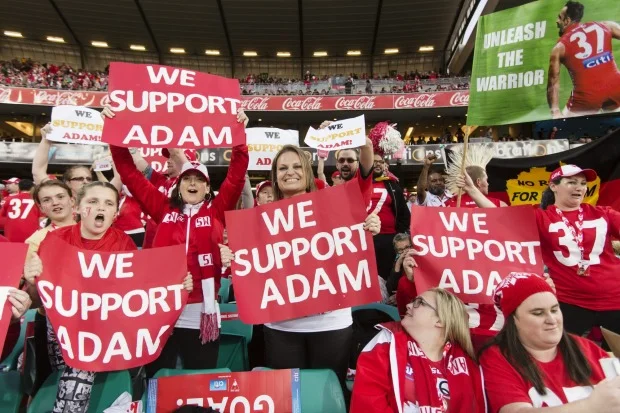
I now want to move to the biggest political issue in Australian football in recent times – the Adam Goodes affair of 2015. Before I do so, however, I want to make a few observations about contemporary politics. This is an age in which people are losing faith in democratic politics. This happened before, in the 1930s, most disastrously in Germany. Our belief in democracy being able to produce suitable social ends is being questioned by people on both the left and right. Into this state of political paralysis walks sport with its ready-made mass audience and its central place in to the entertainment industry.
Sport ideally is not about politics but in this culture sport provides one of the simplest and quickest ways of making a political point. What this gives rise to are debates about sport which are not really about sport, or are about sport and so much more. Outside football, non-Aboriginal Australians – and by that I specifically mean non-Aboriginal Australians of all races, colours and creeds - display little active interest in Aboriginal Australia. We all know this to be true – it’s our secret shame. It’s in this atmosphere that Adam Goodes gets called a monkey. It’s in this atmosphere that he points to a 13-year-old girl – by his own account, reacting to the voice, not knowing she is 13 – and she is marched from the stadium. After weeks of being booed, Goodes does a war dance and throws an imaginary spear into the crowd…. .
The main article I wrote about the Adam Goodes affair was actually about Chris Lewis, the last Aboriginal player to be booed as vehemently – in fact, far more vehemently – than Goodes was. In 1991, as West Coast built to its first ever premiership, Lewis established himself as one of the most promising young players in the competition. The following season, he copped full-on old-style racism and fought back – literally. He got the reputation of being a “dirty” player but his side of the case, his defence, wasn’t being put. He became the game’s outlaw. Its black outlaw. I defended him – the only journalist, as I recall, to do so – and we have maintained a relationship ever since. Chris Lewis has a warrior spirit but he told me when he was 21 that he’d “meet anyone half-way” and his life shows that he has been true to this belief. He has plenty of reasons to be racist, but isn’t. That, I thought, was the point of the article but you wouldn’t have known it from the responses I got. In fact, I don’t remember a single response – and there were a lot - which dealt with what I thought the article was about.
I was sent racist abuse about Chris Lewis which was unchanged from what was said about him in the early 1990s. I had expected that. It was the other responses I hadn’t expected. For example, an Indian gentleman contacted me, demanding Adam Goodes’ mobile number. I had written a story on the Indian gentleman’s guru when she visited Australia some years earlier; he had been deeply impressed by the fact that I had accurately reported what she was saying about how to control our lives with positive thinking. He now advised me that, if he had Goodes’ number and the number of a senior figure in the Swans’ administration, he would advise them how to cure the problem with positive thinking.
I didn’t have Adam Goodes’ number and I would not have handed it out without his permission. Under the circumstances, my chances of getting that permission would have been nil. In the wake of my failure to provide him with Adam Goodes’ number, the Indian gentleman contacted me again saying that I should look deep into my heart and examine the racist feelings I harboured towards Aboriginal people. Why did the Indian gentleman deduce that I possessed racist feelings towards Aboriginal people? Because I had failed to give him Adam Goodes’ number so that he could solve the problem – or so he thought - with positive thinking.
Another reader – an articulate young man who was an avid Swans and Adam Goodes fan - wrote in accusing me of trying to create a historical scenario in which Michael Long was “the good guy” and Adam Goodes was “the bad guy”. I had tried to make the point that Adam Goodes represented something different, something new, at least to non-Aboriginal Australians. I’d just spent 13 years trying to writing a book with Michael Long, trying to see his story as he did and not as whitefellas do. In race politics, things are always changing. I said Michael Long was like Martin Luther King, Adam Goodes was like Malcolm X. I didn’t say Malcolm X was a bad guy, I didn’t say Michael Long was a good guy. But between Martin Luther King and Malcolm X there is, or was, a difference.
And Adam Goodes was different. I’d first noticed it reading his essay in the AFL’s official history published in 2008. Adam Goodes said things Aboriginal people don’t normally say to a non-Aboriginal audience. He called himself a half-caste. Aboriginal people, as a rule, never use the term “half-caste” - the Koori singer Archie Roach told me it made him feel like people were talking about cattle. In his 2008 essay, Goodes also wrote about his formative years. If I learnt one thing from my 13 years trying to write a book with Michael Long, it was how big the Stolen Generation, and the vast cultural divide it made for, is in the families descended from the stolen. Goodes’ father is a white man. His mother is Stolen Generation who grew up with minimal knowledge of her culture. At school, he copped it from white kids for being black and from black kids for being white.
I know of no other famous Australian story which starts at that point – the narrator being someone who’s an outsider in both worlds, Aboriginal and non-Aboriginal! As I understand the story of his life, his understanding of his Aboriginality starts after he gets to the Swans and falls under the influence of Michael O’Loughlin.
During 2015, I didn’t write about Adam Goodes as if I knew him because I didn’t. We met once but I came away with the feeling that I hadn’t really met him. I think he’d say that too. We were polite with one another. I certainly don’t believe I would have won Adam Goodes’ respect then or now by writing an article that implied I know him better than I do. That’s why the article I wrote about the Goodes affair was actually about Chris Lewis. I know Chris Lewis. I could discuss the matter with him. I read the article to him before I filed it. He struggled with it but agreed to let me send out his message another time. Chris Lewis, Aboriginal warrior, will meet anyone half-way. Isn’t that what it’s all about? Meeting others half-way?
By now the Indian gentleman was texting me daily saying, “You must denounce racism! You must denounce racism”. I thought he was seriously misreading the cultural politics at play. The Adam Goodes affair was my first confrontation with I call Trumpism. A lot of people were making pious calls for the AFL to act. A characteristic of Trumpism is that the old sources of cultural authority are suddenly without authority. Limp, ineffective. To the people who became intent on booing Adam Goodes no matter what, Gillon McLachlan, or what he is perceived as representing, was one of the reasons they were booing. To those same people, I was irrelevant, if in fact they had any idea who I was. I wrote that the only people who could stop the booing were the players. The Indian gentlemen went nuts. “They are only boys!” he cried. No, the players are young men who make adult choices about risk and injury for all to see on the football field and, commensurate with the skill and bravery they show in doing so, they win the broad respect of their audience.
Bulldogs CaptainBob Murphy led the way, writing an article in The Age in which he called the boos being directed at Goodes “blows to the soul”. I still wonder why more indigenous players didn’t stand up at the time. If Cyril Rioli, Sean Burgoyne and Bradley Hill had fronted a TV news camera and said to Hawthorn fans, “We represent you, you represent us. Each time you boo Adam Goodes, you’re booing us too”; if that had happened – and if, as a bonus, some of their whitefeller team-mates stood with them like the Melbourne players stood with their indigenous team-mates at that time – then, I reckon, there would have been a different conversation in the crowd between those doing the booing and the many non-Aboriginal people of all races and backgrounds who were opposed to it.
I had some sympathy with those who said booing has always been part of the game. It has. The football codes go back to medieval street games and street theatre. They’re about heroes and villains. They’re about booing and cheering. A football stadium is not a church. Proceedings are not conducted in an attitude of reverence. So, yes, I believe booing has always been part of the game. But I mean those words literally – booing is part of the game but there are moments when games cease to be games.
In the 2000 Grand Final, Michael Long hit Melbourne player Troy Simmons with a hip and shoulder to the head and upper body which knocked Simmons senseless. I had spent quite a bit of time that year helping a young man who had broken his spine in a skiing accident adjust to life in a wheelchair. When Michael Long collected Troy Simmons, I saw how that same accident could occur on the football field and, for a long moment, feared that it had. The game ceased to be a game to me. I didn’t watch any more, I didn’t care who won. Michael Long is someone I have deep respect and affection for, but this was something I had to discuss with him in the course of doing our book together.
Well, booing is part of the game but the game can cease to be a game and for me the booing of Adam Goodes did cease to be a game. It wasn’t just Adam Goodes who believed there was a racist element to the booing, virtually the whole of Aboriginal Australia did and lots of other people besides. Each week, more people felt the hurt being caused but still the booing went on. The beautiful Australian game became the ugly Australian game.
Essentially, what happened was that a debate or discussion we should be having as a nation but never do – the relationship between Aboriginal and non-Aboriginal Australia – had surfaced through the medium of the national game. Did Goodes being Australian of the Year have anything to do with it? In my opinion, without doubt, as became clear when figures like Alan Jones and News Limited columnist Miranda Devine entered the fray arguing (1) that the booing had nothing to do with Goodes being Aboriginal, that (2) they didn’t like the way he played but, (3) they didn’t like things he said as Australian of the Year - when he spoke as an Aboriginal Australian.
I found the debate around the Goodes affair confused and confusing. A traffic jam of a debate. For example, the issue of war dances. A war dance is a war dance. As Goodes said after he threw his imaginary spear, it’s a challenge. The New Zealand haka is the great war dance of world sport. But there are very clear rules about the performances of the haka, as there was nearly an all-in brawl after the Irish rugby team decided to counter it by moving forward and standing inches from the faces of the All Blacks as they were delivering it. And the challenge of the haka is never issued to the crowd – always to the other team. When I wrote this during the Goodes debate, a reader wrote in saying that I was therefore anti-Goodes. I would like to have asked the reader - have you ever seen serious crowd misbehaviour at a sporting event close-up? I have, both attending soccer matches in Scotland and England in the late 1970s when there was a spirit of barely controlled violence all around you, and on my first visit to the MCG in 1971 to see a one-day match, when the place was awash with alcohol and police lost control of whole sections of the crowd.
The journalist I thought who wrote best about the Goodes affair – by which I mean with the greatest penetration and insight – was Stan Grant. When I met Stan Grant earlier this year at the Sydney Writers’ Festival, I said to him that the Goodes affair was both simple and complex. He agreed. Grant’s book, “Talking to my Country” - an extremely important Australian book, in my view – explains the complexity of Grant’s own journey as a man with both Aboriginal and non-Aboriginal heritage and how the tensions this has created in his life all came into focus for him during the Adam Goodes saga. One of the things Stan Grant’s book caused me to realise is that the Adam Goodes affair wasn’t merely about how non-Aboriginal Australians see Aboriginal Australians - it was also about how non-Aboriginal Australians were being called upon to see Aboriginal Australians as they’d never seen them before!
Would I like to talk to Adam Goodes? Of course. Have I got lots of questions to ask him? Maybe too many for a man walking a difficult and intensely personal path. But at this year’s Sydney Writers’ Festival I heard that he had withdrawn permission for his biography, written by sportswriter Malcolm Knox, to appear. My understanding is that he wants to retire from the public gaze, as is his right. I am sorry about what happened to Adam Goodes but I am in no doubt he will be vindicated by history. In 25 years, probably less, he will be a huge figure in the history of the game.
The AFL is routinely abused for having failed to eliminate racism. Two years ago, at the launch of the Long Walk, I sat with Michael Long on a panel while a television journalist said to him that the Adam Goodes affair was proof that he, Michael Long, had failed. You haven’t abolished racism, he cried. This is a culture which provides huge public platforms for the likes of Donald Trump, Pauline Hanson and Andrew Bolt. Does anyone seriously believe that half a dozen sports stadiums around Australia are somehow going to be rendered immune from their combined effect? The AFL can no more eliminate racism than it can end war. What the AFL can do is legislate for events which occur in its domain. have laws and enforce those laws, and thereby serve as a social model. Michael Long single-handedly revolutionised the cultural values of the game in 1993; that consensus held until the Goodes affair. We are now, historically speaking, entering new socio-political territory.
Recently, San Francisco 49ers quarterback Colin Kaepernick chose to sit rather than stand during the US National Anthem at a preseason game in protest against the treatment of black people and people of colour in his country. While I was preparing this speech I was asked, “Could that happen here?” Yes. And if it doesn’t happen here, something like it will happen in some other country around the world. I don’t believe the human frailties and weaknesses on display in the Goodes case are peculiar to any particular race or nationality. I take my faith from a dedication the great Aboriginal leader Patrick Dodson wrote for The Call, my book on Tom Wills: “The struggle never ends. The reward is the people you meet along the way”.
I have tried to talk today about what happens when matters of national import arise through the medium of sport. I’ve also tried to frame the Goodes saga in a different way and untangle some of the knots that were drawn so tightly at the time. Another aspect of the relationship between politics and sport is the way people seize upon sport as a means of acquiring money and power. This happens in dictatorships, and by different means and to a lesser degree it happens in democracies. A famous Australian comedy was written about it called Strictly Ballroom. But there is little amusing about world bodies like FIFA and the IOC in which the most corrupt bodies and individuals have a history of flourishing shamelessly at the expense of the rest. I won’t talk about that in detail because you have another journalist speaking at this conference who is eminently more qualified to do so – David Walsh, the man who pursued cyclist Lance Armstrong for doping. These are serious subjects which deserve the serious discussions a forum such as this can provide.
But, whatever scepticism I have about the IOC, I still believe in the Olympic ideal. I still support the idea of young athletes from all over the world meeting every four years. I am in awe of the Paralympics. Ultimately, for better or worse, sport reflects human nature. One of my favourite sports stories happened one hundred years ago when the great armies in World War 1 ceased fighting on Christmas Day, met in no-man’s land, began kicking a can – maybe someone had a ball – and, in the mist of unprecedented human carnage, soldiers from both armies began playing with one another. One of those who disapproved intensely was Adolf Hitler. Why? Because he was a homicidal maniac and he understood intuitively that men who played together were less likely to kill one another. And, so, we are confronted with a struggle that never ends – sport is endlessly corruptible and there is a battle that has to be fought on that count. But sport, like hope, is constantly born anew and it is a fact that good things grow from it. And so I conclude today by saying: Play on.
See Tim Cahill tonight. (18/10/16, 8pm)