
• Genre
  • About
  • Submissions
  • Donate
  • Search
Menu

Speakola

All Speeches Great and Small
  • Genre
  • About
  • Submissions
  • Donate
  • Search

Anson Cameron: 'If a woman announced herself as a potter and bought a potter’s-wheel she was a trouble-maker', SheppARTon Festival keynote - 2015

December 23, 2015

6 March 2015, Shepparton Festival, Shepparton, Victoria

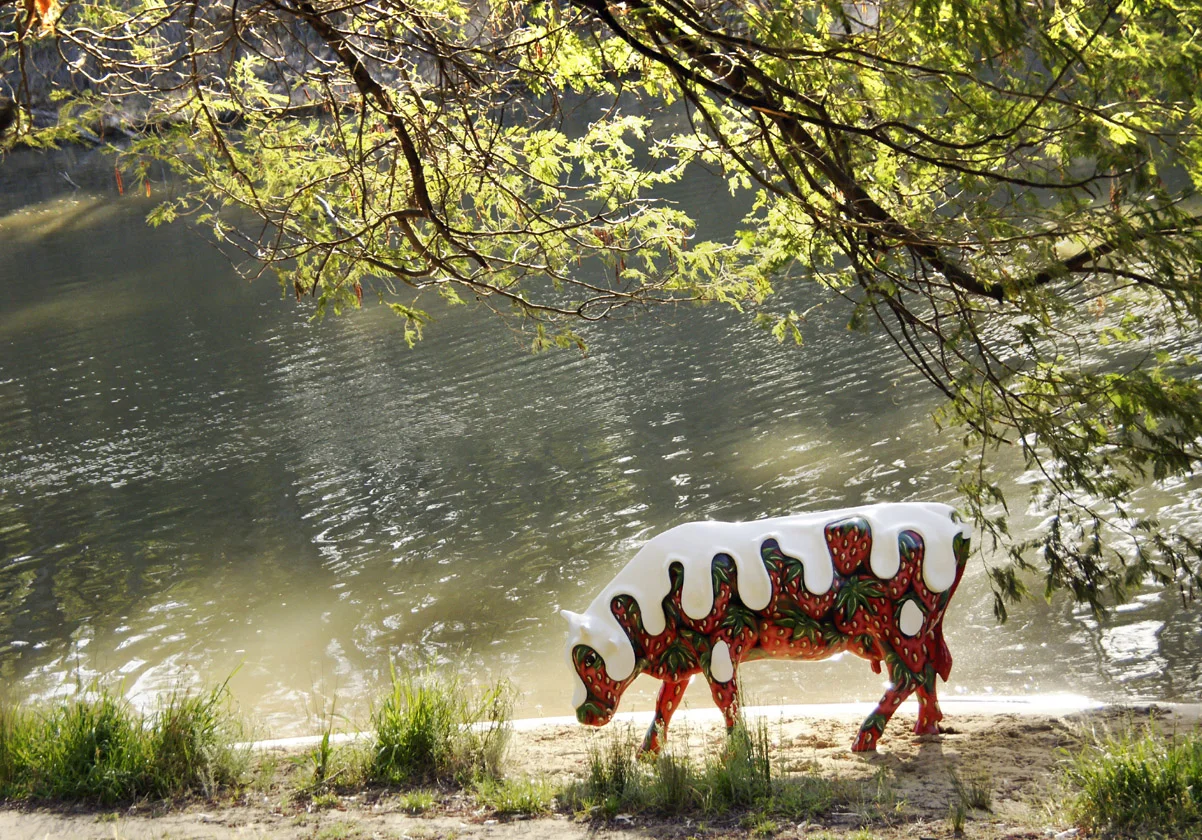
To the average person in Melbourne I am a sage on the subject of Shepparton. I often diagnose and pontificate on her ailments to enthralled audiences… “Shepparton has sold its soul for a few fibre-glass friesians.” “The people who knocked down her old red-brick post-office should still be in jail.” “The dairy farmers have shot themselves in the gumboot.” “The SPC has made a pact with the devil.”

Of course, when I get back to Shepparton I find I’m the most ignorant man in town on the topic of Shepparton – and I should be talking about almost any other town or topic than Shepparton. Still… ignorance on any topic rarely gives a man who’s asked to speak on it pause, or you’d be able to hear a gnat belch in parliament.

I’ve been writing my memoirs lately – I know, I know, I can hear the murmur go through the crowd. “No, Anson. You’re too young, You’re too young.” But Random House is paying me to do it, so I suspect they think I’m on my last legs.

Anyway, I find when I’m writing about Shepparton I’m writing about a place that might have once existed… but then, given that memory is a type of story, a type of fiction, and maybe even an art itself… then perhaps the Shepparton I’ve been writing about and the Shepparton I’ll be talking about only ever existed once, for one person. And if so this talk of mine is just another landscape painted by a hopeful artist

SHOCKIN AWFUL

Speaking of hopeful artists… This festival has come a long way. If I remember correctly, it started with a much narrower base than it has now. These days it’s a broad-based community arts festival spread across forty venues and three weeks. It encompasses sculpture, musical misadventures, musical masterclasses, opera, theatre, film, quilting, woodwork, a boat regatta and, amazingly, a series of geoglyphs that make one wonder if its not routine these days for the Tallises to getripped off their tits on LSD before ploughing their paddocks. The festival even has one event, a piece of performance art, at which the much-loved favorite son of the town comes home to a hero’s welcome, and after he addresses his people the town’s menfolk stuff his pockets with cash and the ladies pelt the stage with their underthings. “Not now, honey. Stay there. Don’t jump the gun.”

But many years ago this Festival was nothing but an exhibition of paintings. It was situated at what was then called The Civic Centre. Now known as SAM, I believe. We called it the Civic Centre because it was a… Civic Centre.  We despised acronyms in those days.

There was a long verandah outside hung with the canvases of all the aspiring artists within cooee. Hundreds of the things. Paintings of smithys and Smiths and stamen and laymen and ponies and phoneys, and  Furphys and Murphys, and Lady Godivas and shady connivers and Monaros and Camaros and shady Mayors and Lady Mayors and other local dignitaries… with which nothing rhymes.

I think Mooroopna artists may have been ineligible to enter, because Mooroopna, with her usual little-sister’s hubris, had set up a paltry exhibition of her own in competition to the Shepparton one. Still, excepting Mooroopna, all the cracks had gathered to the fray, as it were. And as a boy I used to parade up and down the verandah along the front of the Civic Centre, not looking at the paintings, but eavesdropping on what people were saying about the paintings.

I was gobsmacked, and delighted, by the shit people felt free to pile on other people’s artworks. Shepparton, when the art show rolled around, seemed to be a bubbling cauldron of critical thinking, free expression and undiluted bile.

On the verandah of the Civic Centre I once watched an old lady proudly standing alongside a still-life she’d painted. A man, who I suspect was an orchardist, stepped up to it and said, ‘Huckin pears. What type of idiot paints huckin pears?’ The old lady’s face sagged and a tear came to her eye. Now it’s not uncommon for an artist to go through years of struggle before they meet with success. Everyone can expect a few rugged reviews. But this old woman took up the brush when she was about eighty-five. And by the look on her face I suspect her artistic aspirations died right there, crushed at the hands of that pear-despising orchardist. Exhibitions and Festivals are full of little tragedies.

Another year I remember eavesdropping on two large women as they stood in front of a painting and talked it down. I can’t remember the subject of the actual painting in question, but if I say it was of a rusty watertank I’ll have a fifty percent chance of being right. A lot of budding artists painted rusty tanks back then. There was an hysteria about the things. It wasn’t uncommon to see a rusty tank out in a paddock surrounded by five or six easels and a Mister Whippy van, with the owner of the paddock trying to shoo everyone away.

Anyway, these two hefty women were getting stuck into this painting of the rusty tank, “Oh, it lacks all perspective.” “What even is it?” “My Blue Heeler has more brush-skill than this bloke.”

I was only about six, but even then, I had an unappeasable appetite to embarrass adults. So I stepped between them and the canvas they were belittling, as if I was protecting it and said, “Excuse me… my Dad painted this.” Now, my Dad never painted anything but his sheds… always Mission Brown, for those of you who like detail. But the truth wasn’t then and isn’t now my métier.

One of the women, a particularly big woman, puffed herself up in her sunfrock, which had gravy stains and sauce daubings down the front of it, and I was only little, so to me she looked like a Winnebago that had been decorated by Jackson Pollock, and she eyeballed me and said, “Sonny, I don’t care who painted it… I think it’s shockin awful.”

“Shockin Awful” That phrase has resonated with me down the years. It’s the sort of no-favors, no-nonsense critical honesty an arts festival needs. I have, in later life, come to revere that fearless critic. And I hanker to hear her views on fibreglass Friesians.

So, I come here tonight to honor that lady’s memory and unleash some fearless critical theorem of my own on this town and its Festival. Just think of me as a chubby Sheila in a stained sunfrock, not necessarily blessed with any knowledge or aesthetic sense, but bristling with opinions.

THE COLOURED BOY.

But it wasn’t the Shepparton Art Exhibition that gave me my first experience of real, profound art in this town. My first meeting with art was at Gowrie Street state school when I was disgracing that educational facility with my sporadic attendance.

I was very fond of my Grade One teacher Miss Scott. She drew the most magical scenes on the blackboard in rainbow colored chalks before class. I suppose it’s a comment on the easy wonder the world holds for a child that no visual art I’ve seen since has ever filled me with such mind-boggling awe as Miss Scott’s pictures.

Every morning we’d race each other to be first to class to see what new vista, what fresh masterpiece, this chalk-wielding Da Vinci had conjured. It might be an erupting volcano with lashings of red and orange lava, and white-eyed Indonesians fleeing down its slopes in fear. It might be a blue and yellow seaside scene with dolphins cavorting the way dolphins presumably did. They were, to us, the most astonishing pictures. We did our lessons in our own little Louvre.

Sadly, by the end of each day I would have committed some crime and my punishment would be to clean the blackboard. I felt like a Nazi looting one of the great galleries of Europe. After erasing the picture I’d have to take the wadded felt blackboard duster outside and beat it with a ruler until all the chalk was out of it. As I beat the blackboard duster a cloud of colored chalkdust would rise around me and slowly engulf me.

If Miss Scott had drawn a red hippo eating yellow grass on the blackboard alongside a song about hippos, I would put my hand up and ask her loudly if it was a picture of Deidre Lowe. Deidre Lowe would burst out crying to be compared to a crimson hippo and I would be punished by having to erase the blackboard and then take the duster outside and clean it by beating it with a ruler, thereby raising an orange fog made of red hippo and yellow grass. As my skin became wet and sweaty I would march back and forth through the orange fog and it would settle brightly on me and I would cycle home the color of an Oompa Loompa.

If Miss Scott thought I found this embarrassing - if she thought it might shut me up - she was wrong. I enjoyed leaving school as vividly painted as a rodeo clown. I was a particular wonder to one old couple that used to lean on their wire fence in Cottrell Street as I rode past on my way home. Her eyesight was going, so her husband would narrate my passing for her. ‘Look, Doris. It’s the colored boy. He’s orange today. Orange as orange can be.’ I imagined they thought me some sort of hallucination who’d leapt from the flagon of sweet sherry that was always pugged into the horse manure between them. Most pensioners were drunk in those days.

‘Why is a boy riding around orange?’ he’d ask her. She just shook her head. She didn’t know.

One day Miss Scott was teaching us a song from The Sound of Music. She had drawn an alpine scene on the blackboard, luring us to sing of a lonely goatherd. But I had substituted “old turd” for “goatherd” and sung too loudly, “High on a hill lived a lonely old turd.”

My punishment was to erase those mountains and then go outside and beat the duster clean. Once outside I wanged at the duster and writhed in the green fog made of that obliterated mountainscape upon which the Von Trapp’s lonely goatherd had fed his mangy flock.

As I rode home I saw the old couple in Cottrell Street standing drunkenly holding onto their fence watching their piece of streetscape. I rode along on the footpath slowly, right up close to them to hear what they said. ‘Well… jingoes, Doris… He’s green today. Green as clover.’

‘Who? The Boy?’

‘Yeees. The colored boy.’

‘Sing out to him and ask him why he’s green,’ she said.

So the old fellow yelled out at me, ‘Why are you green?’

‘Cos Goatherd rhymes with Old Turd,’ I shouted back.

I think that probably cleared the matter up for them.

Of all the many wonders and delights you people will be treated with at this Festival over the coming weeks… Dethridge wheels made into flowers, the otherworldly warblings of David Hobson, the many contemporary art installations… I truly doubt you will see anything as avant garde as that old couple were treated to… a rainbow colored boy with an underlying patina of ringworm, wobbling grandly along on a cherry red Malvern Star.

In my multi-colored phase I was, in some ways, the prototype of the plastic cows that graze your streets, I think. A sort of pointless alien who left people blinking, shaking their heads and asking, “What the hell was that…?”

THE URGE TO MAKE ART.

Art appears to be non-negotiable, doesn’t it. No sooner do man and woman fill their bellies and warm themselves by the fire than they begin to look about the cave walls and wonder if a bison or kangaroo might look good daubed here or there in ochre or charcoal. Or perhaps if a man has recently been granted the favors of woman he’ll paint her naked on a cave wall as a way of boasting to his mates, in this pre-literate world, that he has met with some success. 

Whatever the impulse - the urge to make art seems innate, fierce, universal. There has never been a society or culture that didn’t, as soon as it had a moment of leisure, or a shekel of disposable income, begin to throw light on the world through the many media we know as art.

Except… around here, we didn’t… as far as I remember.

SOUP CAN.

There was, I recall, to the East of town, a massive Campbell’s Tomato Soup Can atop a tower. And for the five or six people in the district who knew of and rated Andy Warhol’s art, this monument was a thing of pride. For the rest of us it was a tricky way of getting the kids to hassle their mothers for tomato soup for dinner.

But other than that I don’t recall the landscape dotted with public art.

FIELDS OF INDUSTRIALS.

So we took art where we could find it. And for me the most wondrous art in the district were those fields of junk that a certain type of man collected. Here and there the valley was dotted with great collections of what appeared from distance… and quite often from close-up, as yesterday’s crap. But there is no truer museum than a field of accumulated junk. These days I suspect by-laws and officious officials have cleansed the landscape of them and psychologists have diagnosed their curators as suffering some syndrome… Rusty Metal Psychosis, or some such thing.

But there were dozens of these junkfields in the district when I was a kid. And as a child I used to creep among rusty tin, walk swivel-necked through these rearing fields of obsolete critters; car bodies and stock troughs and coils of wire and engine blocks and truck chassis and ploughs and grader blades and sheets of corrugated iron and Ferguson tractors and horse-drawn buggies and Sunshine harvesters and Furphy carts and swingle trees and drums marked with skull-and-bones, and dog kennels and mangles and the silver innards of dead dairies or the contents of some burnt-out hardware store… this was a walk through a gallery… a museum… an adventure park. There were dead contraptions in these fields of junk that were as mysterious to me as a UFO, a dinosaur or a Gregorian Chant.

They echoed of rural history, of industrial progress, of good times and bad, of bankruptcies and booms, of folly and war, of brilliant ideas and crackpot inventions. This is what I had for public art when I was a boy here.

And best of all you could go to these places alone and puzzle over what this or that geriatric contraption might have done. There’s a lot to be said for letting children discover things by themselves… give em a bike and let em piss off… within twenty pushes of the pedals they are in Kansas… a world of their own. And if these fields of junk weren’t art… then it was at least curatorship, it was memory rendered in rust. They were the maverick museums of our valley.

Even today a bullock dray slumped over on shattered grey wooden wheels still speaks to me as coherently and profoundly as any sculpture. There is, I know, a statue of Joe Furphy in Welsford Street. Strangely, for a statue of a storyteller, it doesn’t tell a story as well as one of his brother’s carts.

This is why I love Tank’s sculptures out on the old tip road. Go out and see them. Those mighty flowers made of Dethridge Wheel’s.  There would be men in this room who devised any number of ways to cheat those wheels and fool the water bailiff and pinch a few litres for their pears. And now after years of ushering water to other plants they’ve finally bloomed themselves. Quite poetic, in its way.

NOT MUCH PUBLIC ART

I suppose there wasn’t much public art in Shepparton when I was a kid because we Anglo/Celts were such an ascetic, unadorned people, suspicious of decoration and distrustful of people bunging on side. We were wary of showiness or affectation. If a man wore a cravat he was “Bunging on side”. If a woman announced herself as a potter and bought a potter’s-wheel she was a trouble-maker, probably with a vast palette of mental problems associated with lesbianism.

I remember many conversations between the men of my father’s generation that went like this:

“I hear Evonne Smith’s bought a potter’s wheel.”

‘Jesus. Ceramics.”

“Yeah, pots. Probly vases too.”

“Shit. That’s it then.”

“Yeah. I hope the kids ‘ll be okay.”

You could take the potter’s wheel out of that convo and insert the word “easel” and it would go the same. An easel was thought a dangerous weapon to a marriage.

If artists grew up here, by and large, they went elsewhere to make their art. Flashiness or affectation of any kind was frowned on. We had a lot in common with the Taliban except we drank a heap more grog.

CEMETERY.

You’d see our austere ethos at its most chronic when you’d go out to the cemetery and look at the graves of the immigrants from the British Isles. Unadorned basalt, with names and dates and family connections and every now and then someone rose into the melodramatic heights to mention the deceased had been DEARLY BELOVED. They are the monumental incarnations of a puritan aesthetic.  These days you’ll see grander graves in a pet cemetery.

GREEKS ITALIANS CEMETERY

But wander into the newer areas of the cemetery and you’d find the Italians and Greeks were shouting at God through megaphones - their family crypts made of shiny black marble and decorated with cherubim and seraphim and Saints and alabaster Jesuses and busty Virgins Mary in legion, and they were decorated in gold, and some had photos of the deceased on them, fading beneath beautiful bubbles of glass. They were awe-inspiring to an Anglo/Celt kid. Each grave, each mausoleum, was a work of art and a thundering demand on God’s time and attention.

Sometimes Dad would take us out there, to those lovely sandhills with their peppercorn trees where, a boy who knew his stuff could collect the valuable eggs of the Rainbow Bea-eater, and I’d look at the graves of Furphys who’d been gathered in by their creator, and I’d wonder “How on Earth are my people going to get heard by God while surrounded by this Mediterranean crescendo of architectural splendor? The buggers must all be still queuing in purgatory like Mexicans trying to get into America.

JEALOUS. SUNDAY DRIVES.

I think as kids we were jealous of the ostentation, the freedom of expression of these people, their crypts were the granite equivalent of crying in public… of showing emotion… which we were forbidden to do.

And the easiest way to make sense of art you don’t understand is to despise it. So when I was a kid that’s what we did. Actively and with passion. On Sundays we’d load into our Galaxy 500 and drive out beyond the edge of town, to the orchards where the eagles and lions waited. Out there, in acres of fruit trees Mediterranean immigrants had surrounded their houses with cement critters; vultures, stallions, lions atop gateposts, eagles perched on pillars…

Inside every Italian, there was, it seemed, a Medici who, freed by pear money, became a patron to a Michelangelo working in cement and cliché. Thus each Italian was soon keeper of his own stone menagerie, a job-lot of noble beasts frozen in the act of defending a small orchard.

For us the payoff of an otherwise boring Sunday Drive was ogling and guffawing at this cut-rate renaissance. We’d motor from one palace to the next as Dad pointed out fresh affronts. As with Picasso, this art brought as much pleasure to its delighted detractors than its defenders.

We Cameron children were an amalgam of unpretentious peoples. Scot, Paddy and Pom, a cocktail of dour bloods ran in our veins and nothing in our world and nothing in our knowledge of the wider world and nothing in our imaginations was as racially hubristic, civically antagonistic, tastelessly ostentatious, or just plain un-Australian as a cement eagle with its wings unfurled and given a lick of gold paint. These Italians, these Greeks, these Albanians… what type of crazy people were they? We would roll about on the Galaxy’s back seat in stitches, laughter flipping us like carp on a pier.

WRONG

Of course, as with so many other things, you grow up and realize you’re wrong. I visited Europe and saw the gods and gargoyles ushered from marble by crazily gifted sculptors and realized that centuries and a hemisphere later people around Shepparton were honoring the most vibrant explosion of art humanity has ever known.

And I realized that even if the lions and eagles and cherubim of Shepparton weren’t Michelangelos, the attempt made was exactly the same as the attempt made by Michelangelo… each artist began with a vision as limitless as Michelangelo’s vision. Each local artist and each local patron began with exactly the same impulse in his or her heart as a Michelangelo and his Medici… and that’s enough really, to give them dignity, and worth. And so right here in Shepparton I’d been looking at a faint and worthy echo of The Renaissance, all along. An honoring of ancestors and a promise to continue trying to enrich our brief existence.

END.

For every piece of art knocked up by some dreamer in a shed borrowing her old man’s welding kit, there will be a critic who stands before it and denounces it as “shockin awful”.

BUT I TRIED THOUGH.

For me, the perfect answer to that is a quote from RP McMurphy in One Flew Over The Cuckoos Nest. He’d just tried to lift a massive block of marble to throw it through the bars and let all the inmates escape the asylum. All the guys had bet him he couldn’t lift it. And he huffed and puffed and finally when he collapsed exhausted and they realized he was beaten they began to whoop and holler and celebrate their winnings. And he looked at them and said: “But I tried though. Goddammit, I sure as hell did that much, now, didn't I?”

The silence, shame and awe, when they realized he was the only one who’d ever tried to get out was, of course, the embryonic sound of freedom.

Similarly, every attempt at art, carries an embryonic value.

BELIEF

And what no critic of any sense can denounce is the thing that really matters… the innate, unkillable belief in the artist that they have something to say that matters, something worth hearing, seeing, feeling… that the thing they’re currently hammering, grinding and chipping away at is of value… it’s Michaelangelo’s David, it’s a Frida Kahlo self-portrait. And it’s that belief that’s critical - because it’s a self-fulfilling prophecy. If a community believes it can make good art… one way or another, eventually, it will. You only need to allow that belief. Give it space and license and sustenance. And today one of the ways you do that is through a festival like this.

Of course belief flows both ways. An artist’s belief that they can make something to delight or enlighten a community is a show of love and faith in a community. It’s a way of saying, ‘You guys are worthy… so I’m going to lay my best thing on you.’ No poet reads his  newest best poem to a cat. He reads it to someone he loves.

And if the feast laid out at this festival proves anything it proves that the faith of artists in the people of this district has grown strong. They don’t move away anymore. Shepparton, like Oz, is no longer known for its expats. The urge for Art is now fully rampant in a place that, I can attest, it once wasn’t.

So, whoever’s responsible for that… and I think it might be all of you… congratulations on propagating that urge to make art… that confidence to trust one another with the best thing you’re capable of.       

Have a good Festival. Thank You.

Anson Cameron is a funny and experienced speaker. You can book him for your event here.

His memoir about growing up, terrorising the people of Shepparton, is Boyhoodlum (Penguin Random House, 2015)
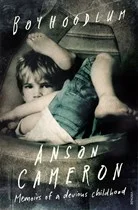
BOYHOODLUM.jpg
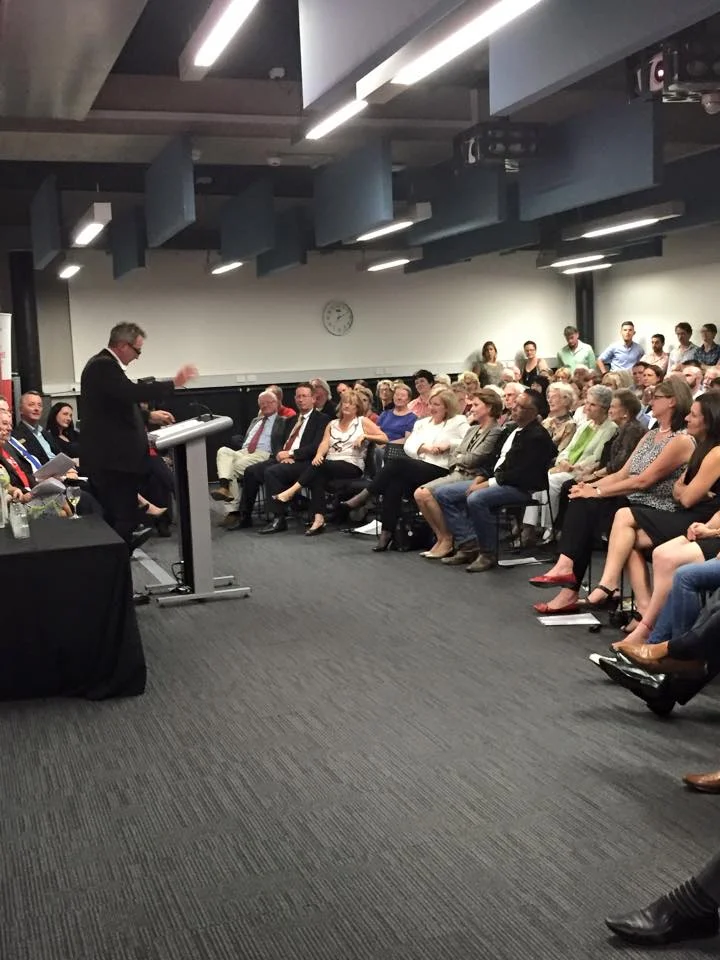
Anson Cameron speaking at Opening Night

Anson Cameron speaking at Opening Night


Enjoyed this speech? Speakola is a labour of love and I’d be very grateful if you would share, tweet or like it. Thank you.

Facebook Twitter Facebook
In BOOKS Tags ANSON CAMERON, SHEPPARTON, AUTHOR, HOME TOWN, VICTORIA, AUSTRALIA, BOYHOODLUM
1 Comment

Anson Cameron & John Harms: 'I'd hoped it wouldn't have it's father's nose, but oh dear', Book Launch for 'The Last Pulse' - 2014

September 15, 2015

27 November, 2014, Fox Hotel, South Melbourne, Australia

[at 6.02] John Harms

[not all scripted - here is the opening]

I watched the 2011 Grand Final with Anson Cameron which makes us brothers.

That means I can say what I like: So let me say this:

Anson Cameron is a bastard.

The Last Pulse is a brilliant book, but in it Anson Cameron has offended-   actually, that’s not right-  he has had his narrator offend the following:

  • Most Queensland women –  whom he describes as dugongs
  • Queenslanders generally
  • Queensland – which he describes as some sort of plantation remnant of a frontier colony
  • He offends Hell by likening it to Queensland
  • Queensland culture
  • Queensland developers and entrepreneurs
  • Queensland’s notion of progress
  • Country music – paranoid yodel against city folk and fast women
  • Politicians of all jurisdictions and sensibilities – some of whom he absolutely nails
  • Political parties
  • The political process
  • National myth-makers
  • parochialists
  • Federalists
  • Romantics
  • Farmers, fucked farmers, and pre-fucked farmers
  • Indigenous sensibilities
  • The Church
  • Mysticism generally
  • Those who give children names which included unnecessary use of the letter ‘x’ – like Jaxon, and Sophoenix
  • And the media – the description of the scrum at the court house is brief but spot on
  • Police officers -
  • Lawyers
  • Judges

And that’s just from memory

But, by crikey he does it well. Because this is a study of the human stupidity and greed which drives the economic system. And he does it in a way that will make you laugh right the way through what is a classic tale. And in a way which shines a light on the reality that when most people have power they will use it for their own advance. And that we therefore wind up with a crazy, mixed up, unjust world which could and should be a whole lot better.

“The world belongs to the most gifted thieves,” Anson’s narrator says.

And the worst of them, in this yarn, are Queenslanders. It is Queensland and Queenslanders who have ruined the rivers of the south – by damning the northern tributaries for their own  purposes.

This allows Anson to pour as much scorn on Queenslanders as he can possibly muster.

My mother, a Queenslander, from Tent Hill from the upper Lockyer Valley where the men (my forebears) make Cliffy Young look like David Marr, was unable to make it tonight.

But as for me, a boy born in Chinchilla, near which the Condamine River flows, who grew up in Oakey, on the Darling Downs   -    I am delighted to have been invited to launch this book even though I know that my sole purpose is to make the bastard feel less guilty.

Yes, I am a Queenslander. I lived there for more than 30 years. I like XXXX beer, and Bundy rum. In fact I know some of the old Bundy songs:

From the hills of far-off Townsville
To the shores of Maroochydore
We have come from every corner
To sit and drink some more
Admiration of all drinking folk
We’re the finest ever heard
And we glory in the title
Of the famous Bundaberg.
Our challenge rings out on the breeze
To each and everyone
We have sat in every pub we’ve found
Where they serve bundy rum
When those southern pricks come to steal our booze
And stand on Queensland green
They’ll fine the border guarded by four chaps, pissed and mean.

I eat prawn sandwiches and Weis’s fruit bars.

I genuinely hope the Maroons win the state of origin series each year. I know that Wally Lewis is the finest human being to ever draw breath.

I love the Gabba, especially when it has a dog track, and the brekky Creek.

I love the beach and the Currumbin surf club.

And I subscribe to the idea that Australia is not a single nation at all, but six nations. Queensland and the idea of Queensland-ness is the most elusive. Full of paradoxes and contradictions. Full of exploitative self-serving develop-at-all cost proselytisers who peddle an unsophisticated belief in progress - as they define it up there.

But is it more than that?

In 2005 I went looking. Christian Ryan editor at The Monthly sent me on a three-week lap of Queensland where I asked everyone from archbishops to academics, to journalists and writers and teachers, to graziers and farmers, to newsagents to railway gangers, to drinkers, to military personnel, to lawyers and other ratbags the same question: “What is Queensland?”

I got some classic responses and from them I concluded that most Queenslanders haven’t thought about it too much. We don’t take ourselves too seriously. We don’t stress too much. We don’t work too hard because it’s too bloody hot and what’s the point a big cyclone is going to come along one day and blow everything away, anyway. We’re suspicious of anything from anywhere south. So Townsvilleans are suspicious of Brissos who are suspicious of New South Welshmen and as for Canberra or Melbourne – forget it.

But the idea of Queensland-ness was best defined by a lawn-mowing contractor at Longreach.

STORY

“A Queenslander is a Queenslander.”

I also have form at the other end of the river. When I was at Uni in Qld my parents moved to South Australia.

Eudunda

The Murray is an important part of SA life, of how South Australians imagine themselves.

Through many visits to SA and especially the Barossa I have become good friends with Robert O’Callaghan who established Rockford Wines – Basket Press and all that. Robert’s forebears were soldier settlers in the Riverland – at Monash. Robert has the river in him. So earlier this year while writing a story for him we spent three days on the river at North Bend near the old wool port of Morgan – which is in the middle of the desert.

So I could relate very strongly to the characters in this yarn at both ends of the rivers.

The story starts with a terrible sadness in the South Australian river town of Bartel. Merv Rossiter’s wife Jana broken by the rural despair created by the drought and the dying of the river, commits suicide.

Merv has had enough. He can see that the damming of the major rivers in Queensland in the interests of the huge agribusinesses is killing the river in the south. The Darling and the Murray are crook, and the life of those on it is disappearing. Jana is one of many to have taken their own lives.

Merv is going to act.

He steals a 9m aluminium party punt called The Party Animal, puts it on a truck, and with his 8 year old daughter Emma, drives to the town of Dillandbundy and then Karoo Station which boasts the biggest dam in southern Queensland.

Bridget Wray, very much a product of new Queensland, is a minister in the Queensland govt. She’s visiting to announce further water grants to her constituents.

She is the personification of self-interest. P50-51

When the dam is blown up the water is released and the great flood starts to consume everything in its path.

Bridget winds up on the punt. And so the journey begins. They are taken south by the huge flood.

And so we meet some wonderful characters along the way.

...

They are wonderful characters.

Merv is a classic. A modern day Ned Kelly. Interestingly he made me think of Bob Katter but only in the sense that he was not going to stand back and let the swell of global capitalism create torment in his life. He was not a passive acceptor of a lot over which he had zero control. Nor was he going to sell out, take the cash of a secure job in the machine.

He wanted to do things on his terms.

Was Merv an activist or water terrorist?

Merv: hero or villain?

Merv: father, doing something wonderful for his daughter or an unhinged firebrand?


This book comments on life:

On ambition?

On self-interest and community? How can one people grow wealthy at the expense of others? How can they show such an absence of compassion?

On the arbitrariness of state borders on the Australian continent?

On the very notion of Australia. The conclusion regarding the notion of the Australian nation has my sympathy.

Don’t be distracted by the fact this book is so enjoyable to read. It is, at the same time, a work of considerable literary merit. It’s Noah meets the Odyssey meets Ned Kelly meets Jesus Christ meets Bob Katter meets A.D. Hope.

It’s written in a style that I love: at once, horribly sad, hilariously funny, and head-noddingly insightful.

It is my pleasure, as a card-carrying Queenslander, to launch The Last Pulse written by our man, Anson Cameron - the bastard

[at 18.36] Anson Cameron

[this is not a trascript - based on Anson's notes]

Thank you, John. I can’t say this about many men, but John and I have been whipped by the same sadists. John and I used to go to the same primary school, Gowrie Street in Shepparton and we were both frequently whipped and beaten by a couple of German teachers named Engstromm and Spinks. I remember going home and watching Hogan’s Heroes where Schultz and Klink ran a POW camp and they were such smiling jovial dolts. Next day I’d go back to school and try out a few of Colonel Hogan’s witticisms on mister Engstromm and Mister Spinks and have the skin flayed off me again. It was a confusing time, wasn’t it, John. Our Germans were so much nastier than the Nazis.

Subsequently, and not long ago, John ran a pinko think-tank in Canberra called The Manning Clarke Institute at Manning Clarke’s old home. He flew me up there to talk at a function one night.

Imagine my horror as, slowly but surely the marquee filled with octogenarian socialists, many of whom were wearing Karl Marx badges and IT’S TIME buttons. And most of whom had known Manning Clarke personally. There was a hum in the air before I began to speak… it wasn’t the hum of expectation, it was the hum of public-health hearing aids.

So I knew I was buggered from the getgo, but about half way through my talk one of Manning Clarke’s sons, who was rotten as a chop on the sort of head-frying Cab Sauv commos are prone to scoff, got up to take a leak in the garden, and he staggered out of the marquee and immediately became entangled in rose bushes.

In his alcoholic delirium he seemed to think he was being attacked by Packers and Murdochs and his language became foul in the extreme. Either that or he’d twigged that I’d been smuggled into Manning Clarke House under false pretenses… because the things he was shouting about Geelong Grammar boys rather put me off my game, and my talk was a complete fizzer. That night I swore I’d get my revenge on John Harms, hence his presence here tonight.

So thank you John for your kind words. You made a lot better fist of this talk than I did of the talk to the prehistoric comrades in Canberra.

A few months ago I said to Tracey, the publican here, “Tracey, I was wondering what you’d think of the idea of me having a book launch in this establishment?’

She said, “What… invite a whole heap of bookish types along here to praise literature and talk books?’

I said, “Yeah, that sort of thing.”

She said, “Anson, I don’t like the idea at all. In my experience as a publican the literate and the educated are a waste of space. They drink slowly, and thoughtfully, they’re argumentative, and they steal the beer coasters to write haiku on. Of all the literary people who’ve drunk at my pubs the only one who’s spent more than half his take-home pay on grog is Jason Steger.”

She said, “Anson I’ve made my fortune serving grog to ill-educated dimwits, common or garden-variety pisspots. They’re my clientele and I have a soft spot for them.”

I said, “So you’d prefer if I filled the joint exclusively with subhuman rednecks?”

She said, “Can you do it?”

I said, “Twice over. I’ll have em spilling out into the street.”

She said, “Well you can launch your book here then, but let me warn you, if any cultural discussion breaks out, any high-minded discourse among the clientele, I’m closing early.”

I said, “Have no fear of that with the gang I’ve got in mind. I’ll have people here who’ll take longer to read the restroom signs than you or I would to read War and Peace.”

So Tracey and I came to a kind of agreement about a kind of launch. And if any of you have been looking around and wondering at the strangely primitive nature of the crowd here tonight, I want each and every one of you to know you are the sole exception to her rule that an alcoholic dullard is the ideal guest at a book launch.

This is a wonderful moment in the life of a book… because the only people who have read it are on the team. My beautiful Sarah, who took a vow to love me and love whatever books I write unconditionally and forever, read it first, and then kissed me and told me what a lovely book it was.

My gorgeous agent Fiona Inglis, who has flown down from Sydney to be with us tonight, and who, admittedly, gets a commission, read it and liked it, and she sent it to... My stunning publisher Nikki Christer, who is also here down from Sydney. Nikki’s a publisher who’s prepared to do what ever it takes for her authors. So, thank you, Nikki.

And Harmsy has also read the book. But Harmsy, as well as feeling indebted to me for ambushing me with senile Marxists, has a rare happy capacity for liking more things than he dislikes, which, to be quite frank, is why I asked him to launch the book.

So I think I can stand before you here tonight and say this book, The Last Pulse, is uniformly, universally admired. A flawless work of literature. Among the four or five people with vested interests who’ve read it… It has no detractors. Like a new and perfect baby that has come into a family.

Sadly tonight is the high-water mark of the love for this new baby.  From tonight visitors will be allowed into the hospital to meet it. Later this evening, or early tomorrow, people like yourselves will begin to read it. People who aren’t related. People with axes to grind and grudges to bear…. Nitpickers and self-abusers and god-botherers and humorless crass types beset by insomnia and prolapsed disks and toothache, cotton-farmers with erectile dysfunction, if that’s not a tautology. Malcontents who imagine they will one day write a novel of their own will read it. Schadenfreudists will paw over its every page guffawing at its shortcomings. People haunted by crimes and immoral deeds in their own pasts, mentally deficient people, beset by psychological ailments wanting vengeance on the world. These are my readership.

All these people will, from tomorrow, be allowed in to see the new baby.

“Good God,” they will say, “Did you see the ears on the littlebeast? Was it’s father an elephant?”

“Oh, Jesus, I was praying it wouldn’t have its father’s nose. But what a hooter.”

“It’s limbs are bent.”

‘”It’s impossibly fat. It reads like it was sired by Clive Palmer.”

‘The child gives off an odor like a Snowtown bank vault.’

‘It’s the ugliest baby I ever saw. I could barely look at it.”

The sort of crass defamations people usually make about other people’s babies behind their backs will be made of this one.

So I find myself here tonight in the rare comforting moment knowing my baby is universally loved, but tensed for an avalanche of crass defamations from the world at large.

With this in mind the publishers, Random House, and I have plagiarized a contract to be signed by any prospective purchaser of the book. It is the exact same contract that Brad and Angelina sign when they hustle off to darkest Africa to adopt another brown angel from an international shithole. It is a pledge to care for the adoptive baby in a humane manner and give it all the love possible to let it grow up to become a classic of Australian Literature, and not let the thing become a washed up literary crack-whore propping up a wonky table.

So, as you buy your nine or ten copies of The Last Pulse tonight don’t forget to sign the Brangelina Adoption Pledge.

Having said all that, I’d just like to thank you all for coming. I’m buggered if I know why I have to write a book to get you people to come out for a drink on a Thursday night, but I’m deeply appreciative that you have. Thank you.

Anson's father-daughter breakfast speech is another Speakola favourite. He does this speaking thing for a living, when he's not writing. Book him here.

To purchase click on cover

To purchase click on cover

Source: https://www.youtube.com/watch?v=NnJdSQcwGz...

Enjoyed this speech? Speakola is a labour of love and I’d be very grateful if you would share, tweet or like it. Thank you.

Facebook Twitter Facebook
In BOOKS Tags ANSON CAMERON, AUTHOR, THE LAST PULSE, FICTION, JOHN HARMS
Comment

See my film!

Limited Australian Season

March 2025

Details and ticket bookings at

angeandtheboss.com

Support Speakola

Hi speech lovers,
With costs of hosting website and podcast, this labour of love has become a difficult financial proposition in recent times. If you can afford a donation, it will help Speakola survive and prosper.

Best wishes,
Tony Wilson.

Become a Patron!

Learn more about supporting Speakola.

Featured political

Featured
Jon Stewart: "They responded in five seconds", 9-11 first responders, Address to Congress - 2019
Jacinda Ardern: 'They were New Zealanders. They are us', Address to Parliament following Christchurch massacre - 2019
Dolores Ibárruri: "¡No Pasarán!, They shall not pass!', Defense of 2nd Spanish Republic - 1936
Jimmy Reid: 'A rat race is for rats. We're not rats', Rectorial address, Glasgow University - 1972

Featured eulogies

Featured
For Geoffrey Tozer: 'I have to say we all let him down', by Paul Keating - 2009
for James Baldwin: 'Jimmy. You crowned us', by Toni Morrison - 1988
for Michael Gordon: '13 days ago my Dad’s big, beautiful, generous heart suddenly stopped beating', by Scott and Sarah Gordon - 2018

Featured commencement

Featured
Tara Westover: 'Your avatar isn't real, it isn't terribly far from a lie', The Un-Instagrammable Self, Northeastern University - 2019
Tim Minchin: 'Being an artist requires massive reserves of self-belief', WAAPA - 2019
Atul Gawande: 'Curiosity and What Equality Really Means', UCLA Medical School - 2018
Abby Wambach: 'We are the wolves', Barnard College - 2018
Eric Idle: 'America is 300 million people all walking in the same direction, singing 'I Did It My Way'', Whitman College - 2013
Shirley Chisholm: ;America has gone to sleep', Greenfield High School - 1983

Featured sport

Featured
Joe Marler: 'Get back on the horse', Harlequins v Bath pre game interview - 2019
Ray Lewis : 'The greatest pain of my life is the reason I'm standing here today', 52 Cards -
Mel Jones: 'If she was Bradman on the field, she was definitely Keith Miller off the field', Betty Wilson's induction into Australian Cricket Hall of Fame - 2017
Jeff Thomson: 'It’s all those people that help you as kids', Hall of Fame - 2016

Fresh Tweets


Featured weddings

Featured
Dan Angelucci: 'The Best (Best Man) Speech of all time', for Don and Katherine - 2019
Hallerman Sisters: 'Oh sister now we have to let you gooooo!' for Caitlin & Johnny - 2015
Korey Soderman (via Kyle): 'All our lives I have used my voice to help Korey express his thoughts, so today, like always, I will be my brother’s voice' for Kyle and Jess - 2014

Featured Arts

Featured
Bruce Springsteen: 'They're keepers of some of the most beautiful sonic architecture in rock and roll', Induction U2 into Rock Hall of Fame - 2005
Olivia Colman: 'Done that bit. I think I have done that bit', BAFTA acceptance, Leading Actress - 2019
Axel Scheffler: 'The book wasn't called 'No Room on the Broom!', Illustrator of the Year, British Book Awards - 2018
Tina Fey: 'Only in comedy is an obedient white girl from the suburbs a diversity candidate', Kennedy Center Mark Twain Award -  2010
Tina Fey: 'Only in comedy is an obedient white girl from the suburbs a diversity candidate', Kennedy Center Mark Twain Award - 2010

Featured Debates

Featured
Sacha Baron Cohen: 'Just think what Goebbels might have done with Facebook', Anti Defamation League Leadership Award - 2019
Greta Thunberg: 'How dare you', UN Climate Action Summit - 2019
Charlie Munger: 'The Psychology of Human Misjudgment', Harvard University - 1995
Lawrence O'Donnell: 'The original sin of this country is that we invaders shot and murdered our way across the land killing every Native American that we could', The Last Word, 'Dakota' - 2016