• Genre
  • About
  • Submissions
  • Donate
  • Search
Menu

Speakola

All Speeches Great and Small
  • Genre
  • About
  • Submissions
  • Donate
  • Search

Sofie Laguna: 'Your book, just as you describe the Lyrebird itself, is a keeper of history', When the Lyrebird Calls launch - 2016

March 6, 2017

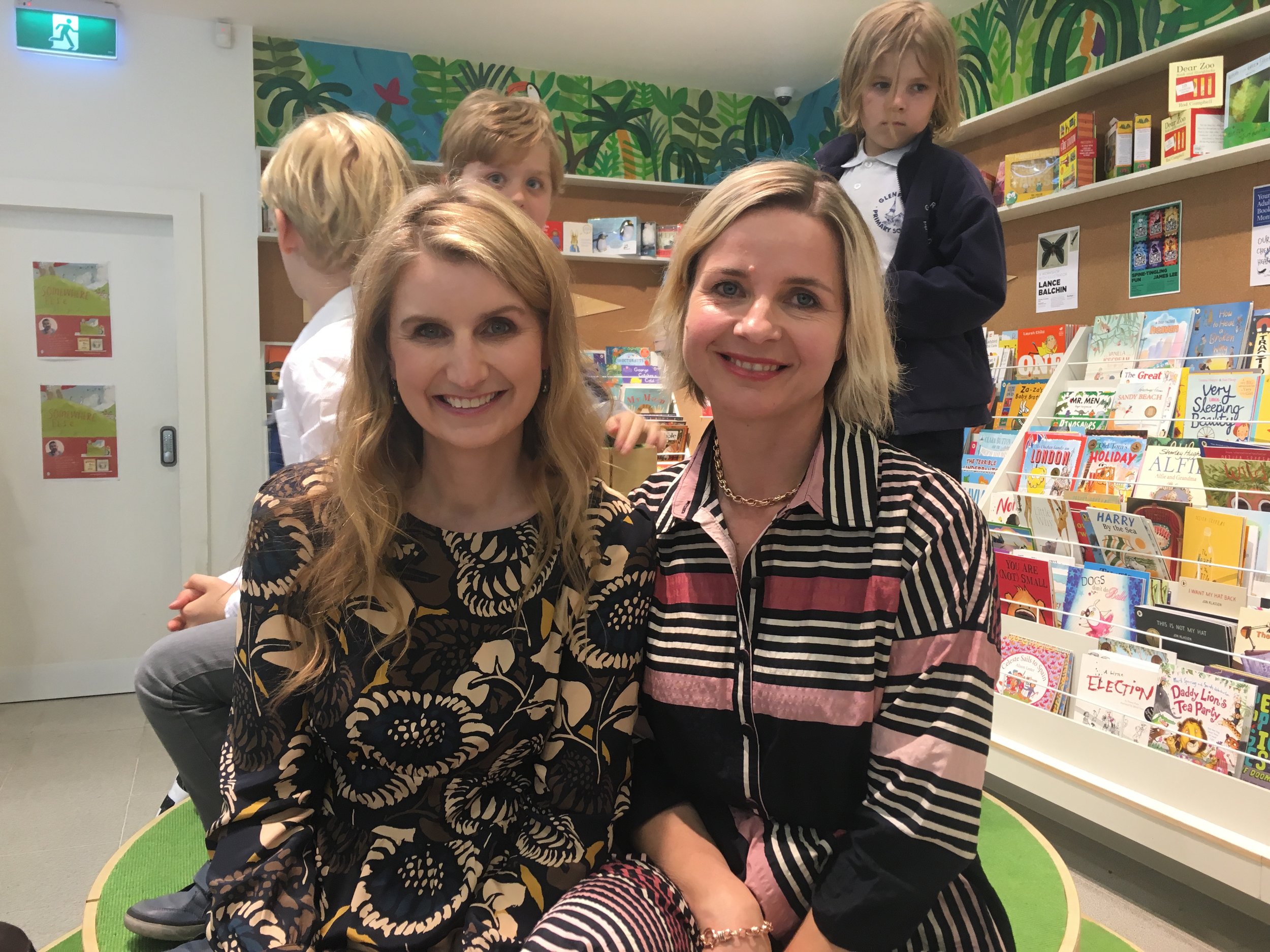
27 October 2016, Readings Kids, Carlton, Melbourne, Australia

Sofie Laguna is an award winning author for children and adults. She won the 2016 Miles Franklin Award for 'The Eye of the Sheep'.

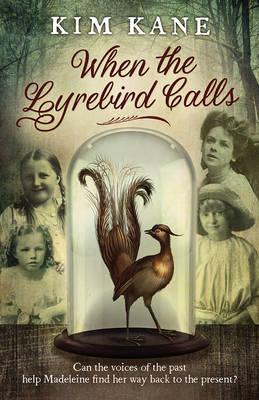
First of all, Kim I want to say how beautiful the book looks and feels. Lovely sepia tones and like the story it takes me back to another time. I love the lyrebird in the centre, as you must, as the books central image – a keeper of the past, a symbol from the natural world, an enchanting, elusive and clever bird.

Like somebody else I know.

That was cheeky. I promised myself I would focus entirely on Kim’s book and not tell stories of how I first met Kim and things like that because its not a wedding it’s a launch. I do want to say that when I first met Kim it was through Tony Wilson and it was all about books and writing and it was another launch and Kim was wearing long striped socks – and I was impressed. With heels mind you! That was years ago and I have been impressed many times since then, and not more than I am impressed by this latest addition to her ever-growing body of work for children.

Kim this book, ‘When the Lyrebird Calls’, is wonderful.

I think a book is a kind of transaction between writer and reader. The writer plays her part in the transaction first; she travels with her character, establishing a world, developing relationships, suffering the pain of change alongside her characters. It is the writer who does the imagining first, she must pioneer the territory, chart the waters. Then it’s the reader’s turn, to imagine and travel and experience change and if the writer does her job well, imagines fully enough, goes to the places that the story requires with authenticity, with heart, and with skill, then the transaction is enriching and meaningful and the reader is expanded by it. That’s what happened to me when I read When the Lyrebird Calls; I travelled with the novel’s gutsy heroine, Madeleine, back through time, and I experienced what life was like in a very vivid and sensual way. And I felt expanded by it. This happened to me, because of Kim’s writing.

Kim describes pale yellow dresses as hayseed light, fish swim in a braid of silver, their scales shiny as coins and a lake is as muddy as caramel. Kim draws my attention to these ordinary things – dresses and fish and lakes – so that I consider them in unexpected ways. I see the world through a new lens. She draws my attention to them with elegance, and originality. The strength is in the detail, and Kim’s details are beautiful and they give life to the writing and the story. And they seem effortless, they are cleanly drawn, without a line out of place. Kim uses language, relishes language, its musicality and its playfulness and its possibilities, and that’s what I responded to in ‘When the Lyrebird Calls’.

But it wasn’t only the language, nor was it the playful and compelling young voice of its narrator. Kim’s book made me think. It’s good when a book does that, isn’t it? We take it for granted, but the artist suffers for her story, works the words to within an inch of their lives (and her own!) and because of this work, all this powerful imagining, the reader is given a new awareness. The reader thinks, and asks questions.

I think I have gotten away with taking a great deal for granted, so many years caught up in imaginary worlds, with made up characters – I had the right to vote so what did the past mean to me? When the Lyrebird calls didn’t let me get away with it. It made me think about being a girl, about education, about girls in sport, the media, and body image. It made me ask why is it like this? How has it changed? Why must it take so long? What is it like to be a girl now? What made it happen this way in the first place, why this inequality? This unfair representation? And it made me ask is there some way I can hurry up the change? How can I contribute to something more positive? It’s good when a book can do all this, don’t you think? It’s magic.

All this sounds serious, and it’s true that the questions are serious, but Kim’ writing is funny. Warm and funny. Madeleine’s grandmother watches renovating programs on telly and rushes out to stock up on tools, and Madeleine can’t stay at her best friend, Nandi’s house, because Nandi Mum just had a make-up baby with Nandi’s dad so the timing isn‘t right. And she couldn’t stay with her dad because he is on a cycling trip and nothing ever gets between dad and a bike except his bike pants. Humour, clever comical moments are everywhere in the story and I appreciated every one of them.

Humour brings the story to life, endears me to its characters and their struggles. When there is humour, there is life. It helps me to tackle the story’s more serious questions, it gives the story its humanity. Because life, and human beings attempting to live it, is funny.

Kim, your book, just as you describe the Lyrebird itself, is a keeper of history. Congratulations to you, I am thrilled for you, and I can’t wait for the world to read it.

It is now my great pleasure to declare this book launched.


To purchase 'When the Lyrebird Calls' click here

Kristen Hilton's launch speech

Enjoyed this speech? Speakola is a labour of love and I’d be very grateful if you would share, tweet or like it. Thank you.

Facebook Twitter Facebook
In BOOKS Tags KIM KANE, SOFIE LAGUNA, WHEN THE LYREBIRD CALLS, MIDDLE GRADE, KIDS BOOKS, TRANSCRIPT, TIME SLIP, FEMINISM[, BOOKS
Comment

John Lewis: 'Read my child, read!', National Book Awards - 2016

November 29, 2016

16 November 2016, New York City, New York, USA

Thank you, thank you.

This is unreal.

This is unbelievable … some of you know I grew up in rural Alabama, very poor, very few books in our home. I remember in 1956, when I was 16 years old, with some of my brothers and sisters and cousins, going down to the public library, trying to get a library card, and we were told the library was for whites only and not for coloureds.

And to come here and receive this award .. this honor, it’s too much.

Thank you.

But I had a wonderful teacher in elementary school, and she told me 'read my child, read!' and I tried to read everything.

I loved books.

Thank you Andrew, thank you Nate, and thanks to each and every one of you, and thanks to all of the judges. Thank you National Book Foundation.

Thank you so much.


Enjoyed this speech? Speakola is a labour of love and I’d be very grateful if you would share, tweet or like it. Thank you.

Facebook Twitter Facebook
In BOOKS Tags JOHN LEWIS, REP. JOHN LEWIS, NATIONAL BOOK AWARDS, NATIONAL BOOK FOUNDATION, TRANSCRIPT, READ, READ MY CHILD, SPEAKOLIES 2016
Comment

Andy Griffiths: 'I want the freshness of dreams to be again revealed to me', 'Stella Spark' for Carmel Bird - 2016

November 29, 2016

9 February 2016, Melba Spiegeltent, Collingwood, Melbourne, Australia

Carmel Bird was awarded Australian literature's prestigious Patrick White Award at Readings bookshop on 11 November 2016.

Thanks so much for the invitation to speak tonight. I’m happy to be at an event celebrating literary woman as I’ve spent my entire writing career surrounded, helped and inspired by many women, one of the most important being my wife Jill who was the editor of my first children’s book, Just Tricking, back in 1997 and who has edited—and increasingly collaborated on the books with me ever since.

I’ve often wondered whether part of the success we’ve enjoyed with the books is due to this blending of our male and female sensibilities. Despite the perception amongst some that our books have special appeal to boys, our audience has always been made up of both boys AND girls … and many of these girls are just as enthusiastic and amused by the taboo & disgusting elements of the stories as the boys.

I’m wary of subscribing to gender stereotypes but I will say that—over the years—I think I have helped Jill to appreciate the humour of the physical slapstick of The Three Stooges (and not just sit there feeling sorry and upset for Curly because Moe is being mean to him) and—in return—she has brought me to a fuller appreciation for the verbal gymnastics of The Marx Brothers.

But before I met Jill I was fortunate enough to read, meet and then be taught by Carmel Bird, a Tasmanian writer then living in Melbourne.

I was aware of her fiction from a book called The Woodpecker Toy Fact, a collection of highly original and darkly humorous stories that were playful, self-aware, personal, honest and utterly unlike anything I’d read to that point. She could take the most ordinary incidents or objects and through sustained attention and exploration transform them into little tableaus of wonder, sadness and delight.

So I was thrilled to find her writing instruction book, Dear Writer, a practical, inspirational, common-sense examination of all aspects of the writers’ life written in the form of a series of letters from a fictional writer to an imaginary beginning student.

In 1990 I attended a two-day summer school writing course run by Carmel at the then newly established Victorian Writers Centre. She waltzed into the room with an ethereal air—looking not unlike a character you might expect to find in a fairy tale—though whether good, evil or simply mischievous was difficult to tell. She gave us each a piece of white tablecloth and invited us to use it as the starting point for a piece of fiction. I can’t remember exactly what I wrote but I remember it made her smile.

I showed her a collection of writing fragments I’d been working on– and asked her what I’d need to do in order to get it published. She suggested I organize it in some way. I argued it was better to keep it random. “I know that,” she said, conspiratorially, ‘and you know that, but publishers won’t know that.” And so I began the long slow process of organizing—and rewriting—what was to become my first officially published book—a creative writing textbook for use in high school classrooms.

A few months later she invited me to be part of a poetry/short story reading night with her and some other established writers at a hotel in Fitzroy. It was both an amazing show of confidence on her part and a terrifying prospect, but it was reassuring to know that I was doing something right—though I wasn’t quite sure what.

But I kept practising, and two years later, as luck would have it, I discovered Carmel was teaching a year-long graduate diploma of fiction writing at Rusden College in Toorak.

So in 1991 I took leave without pay from my high-school teaching job and enrolled in Carmel’s Monday evening class and spent the rest of my time writing.

During this year she taught me three hugely valuable things.

Firstly, the importance of considering your reader. This was achieved through the often gruelling practice of having to have our stories critiqued by the other students in the class. Carmel would preside sagely over this process, stepping in when things got too brutal.

Secondly she taught me the value of reading widely and introduced me to many important writers including Helen Garner, Henry Handel Richardson, Elizabeth Harrower, Ruth Park, Katherine Mansfield and Barbara Baynton.

And thirdly, by point blank refusing to tell me the magic secret of how to get published—which I was sure all published writers knew—she gently forced me to learn to trust my own idiosyncratic voice and ignore the nagging feeling that because it was my own idiosyncratic voice it must somehow be wrong … which was of course the magic secret all along.

Because of my fondness for writing humour she nudged me in the direction of writing for children – we both agreed that what seemed to be missing from Australian children’s writing at the time was the sort of rambunctious fantasy that we had both enjoyed in the work of Enid Blyton. (She once wrote—or told me—I can’t remember which that she thought the thing with Enid Blyton was not that her stories and characters were unbelievable, but the opposite—they were TOO believable.)

As a fiction writer Carmel has experimented with many different genres and styles. But I always come back to The Woodpecker Toy Fact, especially the passage at the beginning of ‘A Taste of Earth’, which—in retrospect—I think I took to be a sort of mission statement.

“When I read fiction I want the words to take my spirit into the places beneath the surface of the everyday world. I want the freshness of dreams to be again revealed to me. I want to know the loveliness and terror of what lies beyond the last star … to feel the anguish and exhilaration of the fiction writer’s power to create and destroy.”

From reading Carmel’s fiction I have no doubt about her power to create and destroy, and from being a student in her class I can personally attest to her ability to inspire—a true Stella Spark.

Enjoyed this speech? Speakola is a labour of love and I’d be very grateful if you would share, tweet or like it. Thank you.

Facebook Twitter Facebook
In BOOKS Tags CARMEL BIRD, STELLA PRIZE, STELLA SPARK, TRANSCRIPT, ANDY GRIFFITHS, CHILDREN'S LITERATURE, WRITING, WRITING TIPS
Comment

Jane Clifton: 'Here in our very own city of Melbourne, it is the best of times for books', SLV's books and bogans debate - 2009

October 19, 2016

“It was the best of times, it was the worst of times, it was the age of wisdom, it was the age of foolishness ……it was the season of Light, it was the season of Darkness, it was the spring of hope, it was the winter of despair, we were all going direct to Heaven, we were all going direct the other way…”

Charles Dickens opening words of A Tale of Two Cities.

I thought I’d open with a book….

Here in our very own city of Melbourne, it is the best of times for books.

The 2009 Melbourne Writers Festival broke all previous box office records with attendances in excess of 50,000, over the entire 10 day event – which to put it in a context we can all understand, is about the sort of figures you get at the MCG when the Demons play Freo. And it’s not raining.

In fact the MWF had become so popular McDonalds has applied for a permit to set up an outlet in the atrium at Fed Square.

Book clubs are sweeping through Avon and Amway territory out in the suburbs. Middle-aged women - and strange men in cardigans - are signing up in their thousands for yet another excuse to gather around a crate of cleanskins and get pissed.

Monday nights: poledancing

Tuesday: book club.

Libraries are reportedly doing a roaring trade.

People come for the cookery classes and ‘move-it-or-lose-it’ yoga-lattes, but they leave clutching a swag of books.

Librarians have become so sexy they’ve even got their own tv show!

Written and produced in Melbourne.

The productivity commission brouhaha has been on page 3 of The Age so often even the Herald Sun has started to take an interest.  

Ladies and Gentlemen, we are indeed enjoying‘the season of Light and the spring of Hope’ for books in Melbourne – and recently it got a whole lot better, when, from a short list of possibly 2, Melbourne became the UNESCO City of Literature.

The Cit of Lit !!!

And, whatever that means, it doesn’t get any better than that.

But Ladies and gentlemen, in this glorious and clever-clever city of literature of ours it is also the best of times for bogans.

Crown Casino is cramming in extra tables and widening car-parks.

DFO is apparently opening a 20-acre site linking Sydney Road with Brunswick St. Fitzroy. Site developers have pledged to preserve the original façade of Henry Maas’s Black Cat Café and not allow a Mrs Fields or Gloria Jean within a 50 metre range of Marios.

The Spring Racing Carnival has cancelled all actual horse races in order to cram more punters onto the track.

An arcade of plasma screens will be installed across the old finish line, where you can watch, bet on or, indeed, ride a motorised horse in front of, footage of vintage races – if you still hanker after a horsey-sort of experience with your Jaeger-bomb and goon.

All over this city of ours muffin-topped babes and low-pants’ed, underwear and plumbers’ crack flaunting drongos are taking photos of each other with their phones and texting, texting, texting. ….

On trams and buses, they sit, staring into space, white wires dangling from their lugholes and glum expressions on their faces.

On the Book of the Face, bald-headed men with grey pigtails and pissed housewives are whiling away the hours – posting stuff like

‘Fuck, I’m bored’.

People are bubble writing their names on walls without actually creating anything worth signing.

Newspapers have started putting ads for what’s coming up next in the paper at the top of the page you’re already reading – striving for us all to have the attention span of a gnat and make us throw away the paper altogether and head straight for the website.

Attention spans, considered thoughts, are being Twittered out of existence.

And Hey Hey It’s Saturday is back on television.

It was the season of Darkness, it was the winter of despair..”

And yet….

A miracle seems to have occurred.

Just as Charles Dickens in his opening chapter of that book set around the French revolution hinted that:

“rooted in the woods of France and Norway, there were growing trees…already marked by the Woodman, Fate, to come down and be sawn into boards, to make a certain movable framework with a sack and a knife in it, terrible in history.”

So too rainforests in Indonesia and Tasmania have been systematically pulped with a purpose which could not have been foreseen.

Despite dire predictions to the contrary and the onslaught of technology, book sales in Melbourne seem to be going through the roof.

People are still buying books - and quite a lot of them are reading them too.

But…how many people came to the MWF? Over 50,000?

Population of Melbourne? Nudging 4 million?

There can be only one explanation for these phenomenal book sales.

Bogans are buying books.

Not the kind of books, shortlisted or long, for the Booker prize.

Popular books.

Books about vampires and boy wizards and angels and demons and extra virgin oil. Books about cleaning products and cooking.

Big fat books for big fat bogans.

Government sanctioned weight-loss programme books.

Cheap books.

Bought in bulk at book barns.

Bought by the kilo.

Bogan book clubs are burgeoning from Broady to Bentleigh.

Bogans are reading books.

Publishers have begun begging their serious authors to get on board this juggernaut.

Surely JM Coetzee could whip up a volume of Disgraceful Recipes?

And what about On Chervil Beach – a new herb compendium from Ian McEwan. Come on Christos Tsiolkas! What about The Slap and Tickle Guide to Toddler Taming? Is it too much to ask Salman to ghost as Salmon Rushdie and dash off some Satanic Sauces?

Ladies and gentlemen, in this bi-polar city of ours – a city of books AND bogans – a line has been crossed.

The Secret is out.

Babes with poker-straight hair and yellow platform shoes, home-made sushi-toting men with man-bags, have declared that reading a book is noice, different and unusual.

That reading a book is a far, far better thing that they do now than watching Big Brother or Baywatch or Backyard Blitz had ever been before.

Melbourne is, without doubt, a City of Books.

(This speech brought to you by the letter ‘B’).


Enjoyed this speech? Speakola is a labour of love and I’d be very grateful if you would share, tweet or like it. Thank you.

Facebook Twitter Facebook
In BOOKS Tags JANE CLIFTON, BOGANS, BOOKS, DEBATE, COMEDY DEBATE, TRANSCRIPT
Comment
state library.jpg

Tony Wilson: 'Brendan Fevola has recently become an author', SLV books v bogans debate - 2009

October 18, 2016

17 October 2009, State Library of Victoria, Melbourne, Australia

Topic: 'That Melbourne is a city of bogans not books'. Tony and Jane Clifton argued for books. Tony Martin and Catherine Deveney for bogans.

This really is a no-brainer. Melbourne is a town of bookaphiles, of bibliogeeks, of readers and readings, of writers and of writer’s festivals …

I mean a show of hands, how many out there, like me, read this topic and thought to themselves, oh this is a debate between a team that’s going to argue for books, and a team that’s going to argue that we’re a city of devotees to the American poet Louise Bogan, who wowed us all with her modernist poetry between 1920 and 1970, as a sort of sparse, strictly metered female equivalent to TS Eliot?

I thought it was going to be a pretty easy win for us. Even Louise Bogan herself would say that there is room in the city for books other than her own best books, Dark Summer or Sleeping Fury … unless there's another Bogan favourite you'd like to throw in there ... anyone, anyone?

It’s only been over the course of the debate, that I’ve understood how bogan was going to be defined - moccasins, ciggies under the collar, holidays at Rosebud caravan park, ex ACDC groupies who may have slept with Bon Scott.

I still think we’ll win the debate … I mean another show of hands … you’re here at the State Library. How many of you have read more than five books this year … and how many of you have slept with Bon Scott …?

Jane, we really do have to have a look at ourselves if we can’t win this.

The great risk of our position is that Jane and I will leave this theatre looking like great sneering snobs. There is implicit in the wording of the proposition that it’s an either or thing … it’s either books or bogans … which seems to be implying that someone doesn’t reckon bogans read that much.

I disagree …

If bogans don’t read … who bought Allan M Nixon’s seminal Beaut Utes 4? Who bought Beaut Utes 3?

If bogans don’t read … who bought Eddie McGuire’s moving tribute to that great Magpie… Pants the Darren Millane Story …

If bogans don’t read … who bought Pig, Dog, and Knife by Mark Holgenest, which is the definitive pig slaughtering text written in Australia for feral pig hunters who prefer not to hunt with rifles …

See already I’m sounding snobby … as though the books I read are better than the books other people of lesser intelligence read … gee I might have just done it again …

Look, we on the book side are not trying to pump ourselves up. I mean, as Louise Bogan herself said;

“The intellectual is a middle-class product; if he is not born into the class he must soon insert himself into it, in order to exist. He is the fine nervous flower of the bourgeoisie.”

I’m trying to be a nervous flower …  I don’t want to put down bogans, because I suspect that had I enjoyed just eighteen more months in the AFL system I might have been swaggering through Federation Square on Mad Monday, Fevola like, a pink dildo hanging out of my fly …


And yet even Fev, who fits the mould of the typical Melbourne bogan, doesn’t cut down our argument …

Because as I’m sure all you bibliophiles are aware, Brendan Fevola has recently become an author. And it’s with great delight and no gritted teeth at all that I can announce that the Fevola penned My Footy Book outsold my own 2009 children’s release The Princess and the Packet of Frozen Peas by a factor of ten to one. Fuck you Fev.

Our opponents have missed the mark tonight ..

Cath Deveney … rebuttal

Tony Martin … rebuttal

By contrast … what Jane Clifton said was eloquent and true, and we understood what she was saying because we understand A Tale of Two Cities: If we haven’t read it, we are all very adept at pretending we have, and absolutely all of us know the ‘it was the best of times, it was the worst of times’ opening sentence. For bogans in the audience, the few who put their hands up before when I asked whether you’d slept with Bon Scott, that opening sentence roughly translates into one of your ‘yeah … nahs …’

But as my Fevola experience demonstrates, bogans do read and bogans do write, and they're as up to their ears in this whole city of literature fiasco as we are. And indeed, traditional literature needs to keep up, needs to 'boganify' if you will. And it's with this in mind that I have launched my most recent publishing venture, Bogan Publications, which seeks to bogan translate major literary works into bogan.

Our first title is John Banville’s The Sea – we've repackage that as 'The Fucking C Mate'

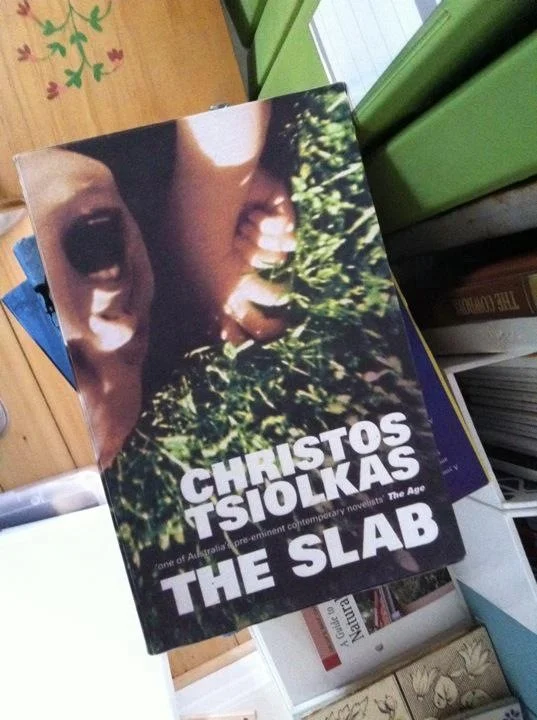
Christos Tsiolkas’s The Slap – a quick tweak of the cover and you can see it's now called ‘The Slab’, and is the harrowing story of a bloke who brings local beer to a barbecue and then spends the whole night hitting an imported slab that isn't his own.

Zadie Smith’s award winning first novel - we're releasing that with the Coolongatta friendly title of ‘White Pants’.

This one from Lionel Shriver will be re-badged by Bogan Publications into the slightly cricketish ‘We need to talk about Kevin Pieterson’

And finally, … what bogan wouldn’t have his interest piqued by a copy of Jan Martel’s The Life of Pie-Warmers

It's about embracing books in the broadest possible sense, about accepting that the whole country is in on this great literary adventure … so walk the walk ... pronounce the word 'fugue' as 'fugue mate' … and sell the idea of yourselves as books ambassadors.

We’ve done so much but we can do still more …

My final words come from Louise Bogan. I know you all know them, so if you like, mouth them along with me …

Now that I know
How passion warms little
Of flesh in the mould,
And treasure is brittle,--
 
I'll lie here and learn
How, over their ground
Trees make a long shadow
And a light sound.

What a bogan.

Enjoyed this speech? Speakola is a labour of love and I’d be very grateful if you would share, tweet or like it. Thank you.

Facebook Twitter Facebook
In BOOKS Tags TONY WILSON, COMEDY DEBATE, DEBATE, BOOKS, BOGANS, TONY MARTIN, STATE LIBRARY OF VICTORIA
Comment
image.jpg

Andy Griffiths: 'If you order a quantity of 300 you’ll qualify for these two attractive milk carton dumpbins', Opening of Readings' Kids - 2016

October 12, 2016

5 October 2016, Readings' Kids, Carlton, Melbourne, Australia

Welcome to Readings’ new dedicated children’s bookshop. This is the second children’s bookshop I’ve had the honour of being involved in the launching of this year—back in February Little Sun in Yarraville had to move to a larger shop to accommodate demand—which really highlights what a healthy state the children’s book industry is in.

Readings Bookshop, as we all know, occupies a very special place in the heart of Melbourne’s literary scene—it’s the sort of bookshop that welcomes readers and encourages browsing and makes it impossible to leave without finding an essential book you didn’t even know you needed (which is my test of a really good bookshop).

And, apart from ensuring a wide range of brilliantly selected books across all genres, the icing on the cake is that Readings donates 10 percent of its overall profit to The Readings Foundation each year—which assists a variety of charities and philanthropic organisations. And crucial funds are also raised from donations by Readings customers.

Earlier this year Readings was the winner of the Independent Book Retailer of the Year in the Australian Book Industry Awards, as well as winner of the International Bookstore of the Year in the London Book Fair’s International Excellence Awards.

But here at Readings they don’t just sell books, look after readers, win awards and fund worthy causes, they also realise how important writers are to the whole literary process (something that we are all hoping the liberal Government and productivity commission will also realise before too long and before it’s too late).

Readings’ busy events calendar actively provides dozens of opportunities every month for writers to meet their readers up close. They also play an important role in assisting writers to develop their craft by hosting a variety of literary awards: The Readings Prize for New Australian Fiction, The Readings Children’s Book Prizeand the brand-new Readings Young Adult Book Prize. (And they have started a Readings podcast as well, which, really, is just showing off.)

Obviously the staff are a key part of what makes Readings so special. Not to single anybody out, but

Danni’s passion for children’s books just shines through—

and of course, Christine, who has been event organiser for Readings forever, and has the lovely quality of being able to supply the equivalent of at least three hundred-excited-kids’ worth of energy for any event.

All of which reflects well on the managing director of Readings, Mark Rubbo, who I’m here to introduce to you.

Mark is a past president of the Australian Booksellers Association, founding chair of the Melbourne Writers Festival, and on the board of the Wheeler Centre and the Indigenous Literacy Foundation. After an event at the Melbourne Atheneum last week, featuring journalist Stan Grant in conversation with author Richard Flanagan, Readings raised over 21 thousand dollars for theILF. (At this point Mark interjected: ‘$21,680 and 76 cents, actually’.)

Mark was awarded a Medal of the Order of Australia in 2006‘For service to the community through fostering an awareness of Australian literature as a bookseller, literary critic, and promoter and supporter of Australian writers.’

But Mark wasn’t always a bookseller—he began his career as a record seller at Professor Longhair’s Music Shop until the owners of Readings offered him the opportunity to take over their shop.

Which is interesting, because there was another bookselling ‘Professor’ who played a very significant part in Melbourne’s early literary history—Professor E.W. Cole, who created Coles Book Arcade. With around two million books on its shelves, it was reputedly the largest bookstore in the worldand was spacious enough to includea menagerie (featuring a monkey house), a fernery,a toyland, a stationery department, a second-hand book department, a glass and china department, a refreshment roomand a confectionery department.

And, as if all that wasn’t enough, customers of all ages were also enticed with a string band, a symphonion(whatever that is) and a mechanical hen that clucked and laid tin eggs. (Although, to my knowledge he didn’t have a multi-tiered reading hill to play on, or the remarkable wall painting by Marc Martin which you see all around us.)

There were also comfortable chairs to sit in and read books, which customers were encouraged to do so by a sign that read:Read As Long As You Like – Nobody Asked To Buy.

All this novelty was not just for novelty’s sake, however—E. W. Cole was an idealist and his book arcade was designed to entice both adults and children to be lifelong readers; he had the revolutionary idea that the most important thing for turning people onto books—and especially young people—was to help them to associate readingwith pleasure—to which end he self-published Coles Funny Picture Book, one of the most successful children’s books ever published in Australia.

Fast forward to 2016 and the idealist Professor Mark Rubbo is carrying on a fine tradition—not by self-publishing a book—well, not yet, anyway, but by expanding the operations of Readings, his own version of Coles Book Arcade, by opening a dedicated children’s bookshop.

And, speaking of self-publishing, that brings me back to my first encounter with Mark in 1992 when I was as an emerging young writer and self-publisher and he was already a successful bookseller.

Inspired by a poet–bookseller Noodle Egg Rope String—a Brunswick street poet who used to write out his poems on the backs of soymilk containers by day and sell them on Brunswick street by night—I produced a range of pocket books, small 12-page booklets (each with their own ISBN!) which I could produce for 5 cents a copy and sell for 50.

Which is how I met Mark. He agreed to stock them, against his better judgement I might add—he was worried people might steal them (obviously not as much of an idealist as E.W. Cole).

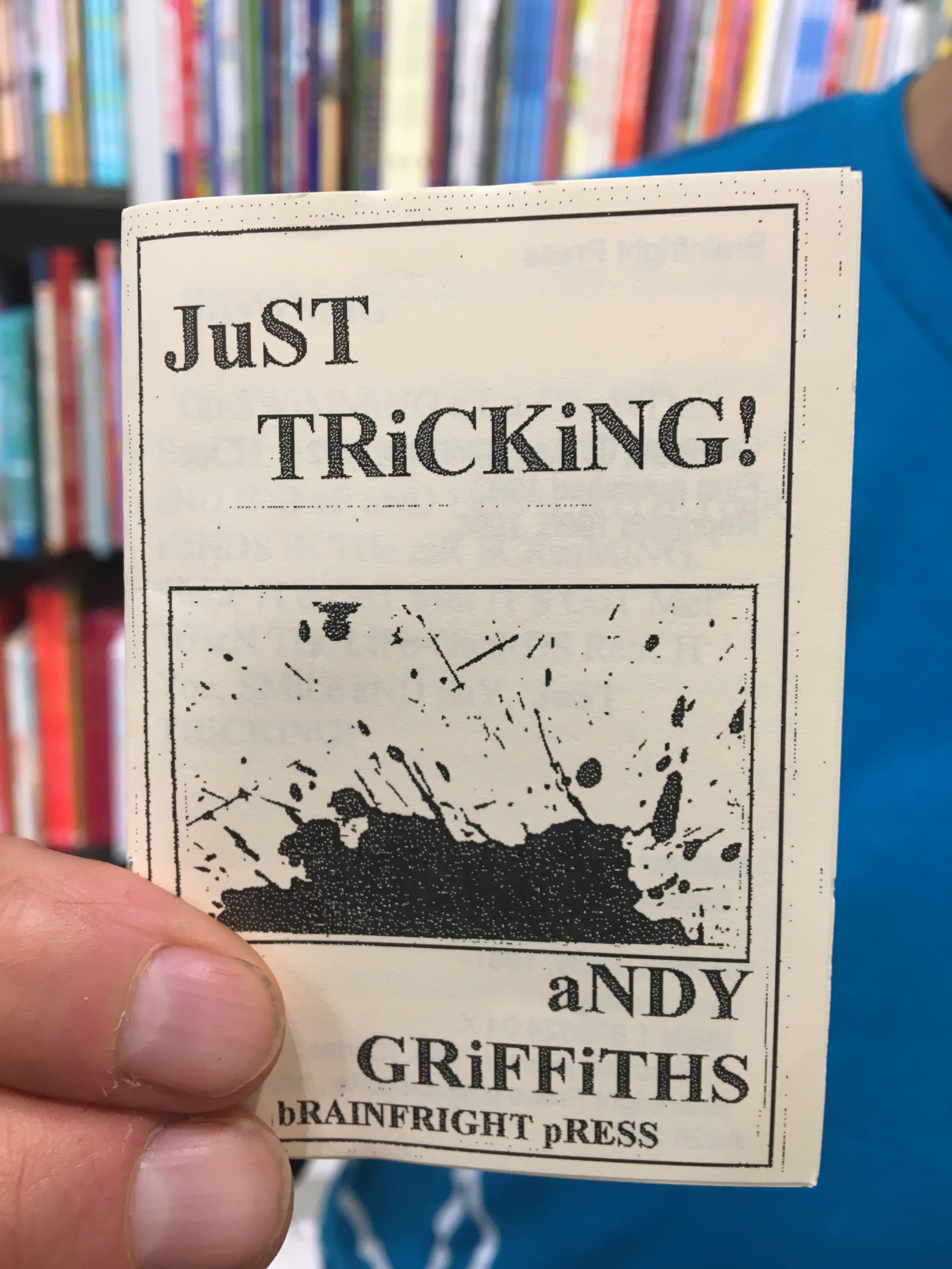
Anyway—once a self-publisher always a self-publisher, I guess—so I thought, what better way to commemorate the launch of Readings first dedicated children’s bookshop than with this specially printed, limited facsimile edition of my first self-published pocket book … Just Tricking.

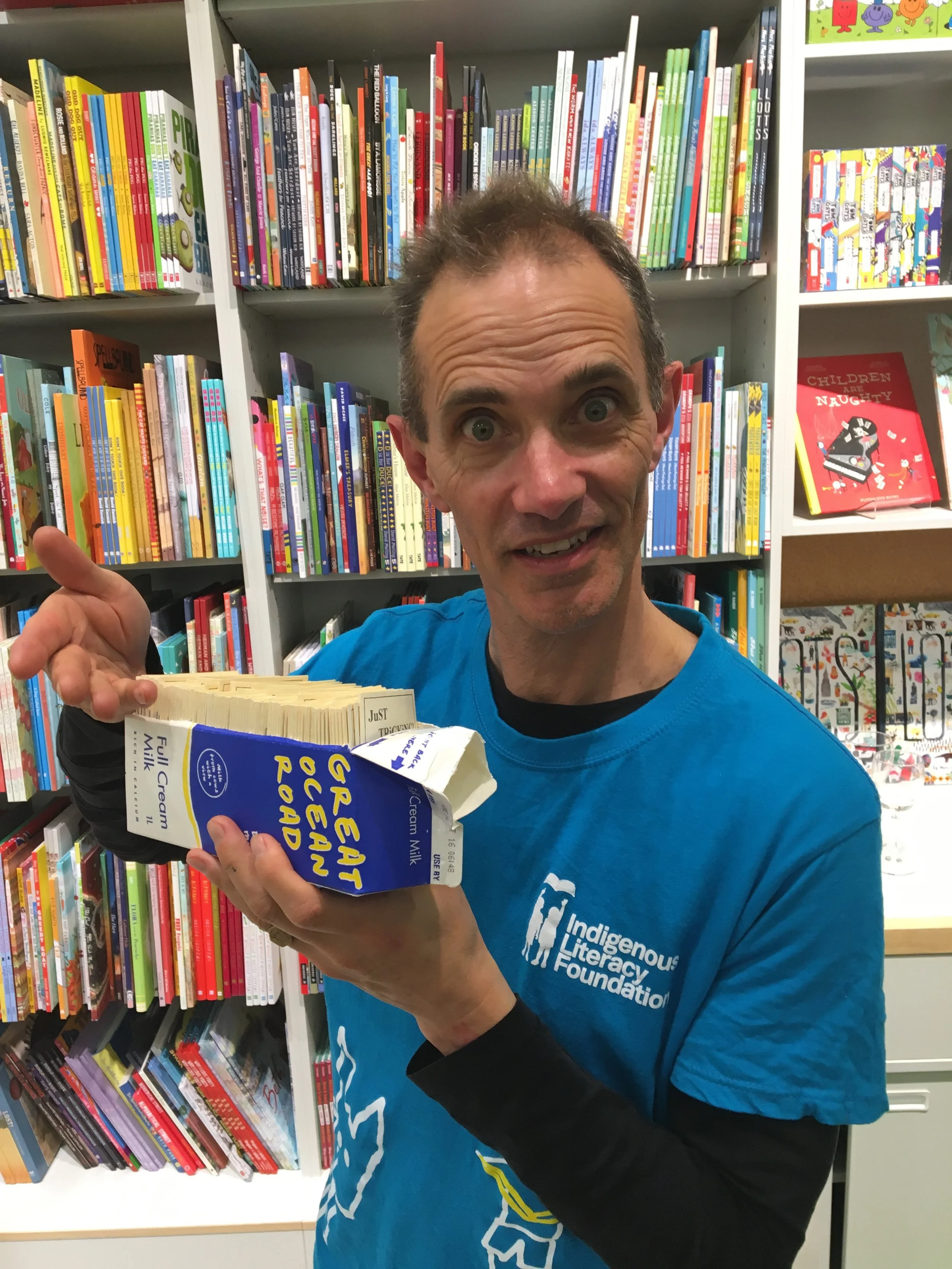
And, Mark, if you order a quantity of 300 you’ll qualify for these two attractive milk carton dumpbins at no extra cost. They are 100 percent recycled. And look! The spout opens up and people can just put their money in the front, and I guarantee I won’t be coming back to get my money or any unsold books.

Because tonight, as a special offer, to allay your concerns about potential shoplifting, they are all absolutely free.

But I do promise I will be coming back on a regular basis—like everybody here—to purchase some quality children’s books at crazy—but fair—prices.


image.jpg
image.jpg

Enjoyed this speech? Speakola is a labour of love and I’d be very grateful if you would share, tweet or like it. Thank you.

Facebook Twitter Facebook
In BOOKS Tags READINGS KIDS, BOOKSHOP, SELF PUBLISHING, READINGS, KIDS BOOKS, MELBOURNE, ANDY GRIFFITHS
Comment

Lionel Shriver: 'You’re not supposed to try on other people’s hats', Brisbane Writers Festival keynote - 2016

September 25, 2016

8 September 2016, Brisbane, Australia

I hate to disappoint you folks, but unless we stretch the topic to breaking point this address will not be about “community and belonging.” In fact, you have to hand it to this festival’s organisers: inviting a renowned iconoclast to speak about “community and belonging” is like expecting a great white shark to balance a beach ball on its nose.

The topic I had submitted instead was “fiction and identity politics,” which may sound on its face equally dreary.

But I’m afraid the bramble of thorny issues that cluster around “identity politics” has got all too interesting, particularly for people pursuing the occupation I share with many gathered in this hall: fiction writing. Taken to their logical conclusion, ideologies recently come into vogue challenge our right to write fiction at all. Meanwhile, the kind of fiction we are “allowed” to write is in danger of becoming so hedged, so circumscribed, so tippy-toe, that we’d indeed be better off not writing the anodyne drivel to begin with.

Let’s start with a tempest-in-a-teacup at Bowdoin College in Brunswick, Maine. Earlier this year, two students, both members of student government, threw a tequila-themed birthday party for a friend. The hosts provided attendees with miniature sombreros, which—the horror— numerous partygoers wore.

When photos of the party circulated on social media, campus-wide outrage ensued. Administrators sent multiple emails to the “culprits” threatening an investigation into an “act of ethnic stereotyping.” Partygoers were placed on “social probation,” while the two hosts were ejected from their dorm and later impeached. Bowdoin’s student newspaper decried the attendees’ lack of “basic empathy.”

The student government issued a “statement of solidarity” with “all the students who were injured and affected by the incident,” and demanded that administrators “create a safe space for those students who have been or feel specifically targeted.” The tequila party, the statement specified, was just the sort of occasion that “creates an environment where students of colour, particularly Latino, and especially Mexican, feel unsafe.” In sum, the party-favour hats constituted – wait for it – “cultural appropriation.”

Curiously, across my country Mexican restaurants, often owned and run by Mexicans, are festooned with sombreros – if perhaps not for long. At the UK’s University of East Anglia, the student union has banned a Mexican restaurant from giving out sombreros, deemed once more an act of “cultural appropriation” that was also racist.

Now, I am a little at a loss to explain what’s so insulting about a sombrero – a practical piece of headgear for a hot climate that keeps out the sun with a wide brim. My parents went to Mexico when I was small, and brought a sombrero back from their travels, the better for my brothers and I to unashamedly appropriate the souvenir to play dress-up. For my part, as a German-American on both sides, I’m more than happy for anyone who doesn’t share my genetic pedigree to don a Tyrolean hat, pull on some leiderhosen, pour themselves a weisbier, and belt out the Hoffbrauhaus Song.

But what does this have to do with writing fiction? The moral of the sombrero scandals is clear: you’re not supposed to try on other people’s hats. Yet that’s what we’re paid to do, isn’t it? Step into other people’s shoes, and try on their hats.

In the latest ethos, which has spun well beyond college campuses in short order, any tradition, any experience, any costume, any way of doing and saying things, that is associated with a minority or disadvantaged group is ring-fenced: look-but-don’t-touch. Those who embrace a vast range of “identities” – ethnicities, nationalities, races, sexual and gender categories, classes of economic under-privilege and disability – are now encouraged to be possessive of their experience and to regard other peoples’ attempts to participate in their lives and traditions, either actively or imaginatively, as a form of theft.

Yet were their authors honouring the new rules against helping yourself to what doesn’t belong to you, we would not have Malcolm Lowry’s Under the Volcano. We wouldn’t have most of Graham Greene’s novels, many of which are set in what for the author were foreign countries, and which therefore have Real Foreigners in them, who speak and act like foreigners, too.

In his masterwork English Passengers, Matthew Kneale would have restrained himself from including chapters written in an Aboriginal’s voice – though these are some of the richest, most compelling passages in that novel. If Dalton Trumbo had been scared off of describing being trapped in a body with no arms, legs, or face because he was not personally disabled – because he had not been through a World War I maiming himself and therefore had no right to “appropriate” the isolation of a paraplegic – we wouldn’t have the haunting 1938 classic, Johnny Got His Gun.

We wouldn’t have Maria McCann’s erotic masterpiece, As Meat Loves Salt – in which a straight woman writes about gay men in the English Civil War. Though the book is nonfiction, it’s worth noting that we also wouldn’t have 1961’s Black Like Me, for which John Howard Griffin committed the now unpardonable sin of “blackface.” Having his skin darkened – Michael Jackson in reverse – Griffin found out what it was like to live as a black man in the segregated American South. He’d be excoriated today, yet that book made a powerful social impact at the time.

The author of Who Owns Culture? Appropriation and Authenticity in American Law, Susan Scafidi, a law professor at Fordham University who for the record is white, defines cultural appropriation as “taking intellectual property, traditional knowledge, cultural expressions, or artifacts from someone else’s culture without permission. This can include unauthorised use of another culture’s dance, dress, music, language, folklore, cuisine, traditional medicine, religious symbols, etc.”

What strikes me about that definition is that “without permission” bit. However are we fiction writers to seek “permission” to use a character from another race or culture, or to employ the vernacular of a group to which we don’t belong? Do we set up a stand on the corner and approach passers-by with a clipboard, getting signatures that grant limited rights to employ an Indonesian character in Chapter Twelve, the way political volunteers get a candidate on the ballot?

I am hopeful that the concept of “cultural appropriation” is a passing fad: people with different backgrounds rubbing up against each other and exchanging ideas and practices is self-evidently one of the most productive, fascinating aspects of modern urban life.

But this latest and little absurd no-no is part of a larger climate of super-sensitivity, giving rise to proliferating prohibitions supposedly in the interest of social justice that constrain fiction writers and prospectively makes our work impossible.

So far, the majority of these farcical cases of “appropriation” have concentrated on fashion, dance, and music: At the American Music Awards 2013, Katy Perry got it in the neck for dressing like a geisha. According to the Arab-American writer Randa Jarrar, for someone like me to practice belly dancing is “white appropriation of Eastern dance,” while according to the Daily Beast Iggy Azalea committed “cultural crimes” by imitating African rap and speaking in a “blaccent.”

The felony of cultural sticky fingers even extends to exercise: at the University of Ottawa in Canada, a yoga teacher was shamed into suspending her class, “because yoga originally comes from India.” She offered to re-title the course, “Mindful Stretching.” And get this: the purism has also reached the world of food. Supported by no less than Lena Dunham, students at Oberlin College in Ohio have protested “culturally appropriated food” like sushi in their dining hall (lucky cusses— in my day, we never had sushi in our dining hall), whose inauthenticity is “insensitive” to the Japanese.

Seriously, we have people questioning whether it’s appropriate for white people to eat pad Thai. Turnabout, then: I guess that means that as a native of North Carolina, I can ban the Thais from eating barbecue. (I bet they’d swap.)

This same sensibility is coming to a bookstore near you. Because who is the appropriator par excellence, really? Who assumes other people’s voices, accents, patois, and distinctive idioms? Who literally puts words into the mouths of people different from themselves? Who dares to get inside the very heads of strangers, who has the chutzpah to project thoughts and feelings into the minds of others, who steals their very souls? Who is a professional kidnapper? Who swipes every sight, smell, sensation, or overheard conversation like a kid in a candy store, and sometimes take notes the better to purloin whole worlds? Who is the premier pickpocket of the arts?

The fiction writer, that’s who.

This is a disrespectful vocation by its nature – prying, voyeuristic, kleptomaniacal, and presumptuous. And that is fiction writing at its best. When Truman Capote wrote from the perspective of condemned murderers from a lower economic class than his own, he had some gall. But writing fiction takes gall.

As for the culture police’s obsession with “authenticity,” fiction is inherently inauthentic. It’s fake. It’s self-confessedly fake; that is the nature of the form, which is about people who don’t exist and events that didn’t happen. The name of the game is not whether your novel honours reality; it’s all about what you can get away with.

In his 2009 novel Little Bee, Chris Cleave, who as it happens is participating in this festival, dared to write from the point of view of a 14-year-old Nigerian girl, though he is male, white, and British. I’ll remain neutral on whether he “got away with it” in literary terms, because I haven’t read the book yet.

But in principle, I admire his courage – if only because he invited this kind of ethical forensics in a review out of San Francisco: “When a white male author writes as a young Nigerian girl, is it an act of empathy, or identity theft?” the reviewer asked. “When an author pretends to be someone he is not, he does it to tell a story outside of his own experiential range. But he has to in turn be careful that he is representing his characters, not using them for his plot.”

Hold it. OK, he’s necessarily “representing” his characters, by portraying them on the page. But of course he’s using them for his plot! How could he not? They are his characters, to be manipulated at his whim, to fulfill whatever purpose he cares to put them to.

This same reviewer recapitulated Cleave’s obligation “to show that he’s representing [the girl], rather than exploiting her.” Again, a false dichotomy.

Of course he’s exploiting her. It’s his book, and he made her up. The character is his creature, to be exploited up a storm. Yet the reviewer chides that “special care should be taken with a story that’s not implicitly yours to tell” and worries that “Cleave pushes his own boundaries maybe further than they were meant to go.”

What stories are “implicitly ours to tell,” and what boundaries around our own lives are we mandated to remain within? I would argue that any story you can make yours is yours to tell, and trying to push the boundaries of the author’s personal experience is part of a fiction writer’s job.

I’m hoping that crime writers, for example, don’t all have personal experience of committing murder. Me, I’ve depicted a high school killing spree, and I hate to break it to you: I’ve never shot fatal arrows through seven kids, a teacher, and a cafeteria worker, either. We make things up, we chance our arms, sometimes we do a little research, but in the end it’s still about what we can get away with – what we can put over on our readers.

Because the ultimate endpoint of keeping out mitts off experience that doesn’t belong to us is that there is no fiction. Someone like me only permits herself to write from the perspective of a straight white female born in North Carolina, closing on sixty, able-bodied but with bad knees, skint for years but finally able to buy the odd new shirt. All that’s left is memoir.

And here’s the bugbear, here’s where we really can’t win. At the same time that we’re to write about only the few toys that landed in our playpen, we’re also upbraided for failing to portray in our fiction a population that is sufficiently various.

My most recent novel The Mandibles was taken to task by one reviewer for addressing an America that is “straight and white”. It happens that this is a multigenerational family saga – about a white family. I wasn’t instinctively inclined to insert a transvestite or bisexual, with issues that might distract from my central subject matter of apocalyptic economics. Yet the implication of this criticism is that we novelists need to plug in representatives of a variety of groups in our cast of characters, as if filling out the entering class of freshmen at a university with strict diversity requirements.

You do indeed see just this brand of tokenism in television. There was a point in the latter 1990s at which suddenly every sitcom and drama in sight had to have a gay or lesbian character or couple. That was good news as a voucher of the success of the gay rights movement, but it still grew a bit tiresome: look at us, our show is so hip, one of the characters is homosexual!

We’re now going through the same fashionable exercise in relation to the transgender characters in series like Transparent and Orange is the New Black.

Fine. But I still would like to reserve the right as a novelist to use only the characters that pertain to my story.

Besides: which is it to be? We have to tend our own gardens, and only write about ourselves or people just like us because we mustn’t pilfer others’ experience, or we have to people our cast like an I’d like to teach the world to sing Coca-Cola advert?

For it can be dangerous these days to go the diversity route. Especially since there seems to be a consensus on the notion that San Francisco reviewer put forward that “special care should be taken with a story that’s not implicitly yours to tell.”

In The Mandibles, I have one secondary character, Luella, who’s black. She’s married to a more central character, Douglas, the Mandible family’s 97-year-old patriarch. I reasoned that Douglas, a liberal New Yorker, would credibly have left his wife for a beautiful, stately African American because arm candy of color would reflect well on him in his circle, and keep his progressive kids’ objections to a minimum. But in the end the joke is on Douglas, because Luella suffers from early onset dementia, while his ex-wife, staunchly of sound mind, ends up running a charity for dementia research. As the novel reaches its climax and the family is reduced to the street, they’re obliged to put the addled, disoriented Luella on a leash, to keep her from wandering off.

Behold, the reviewer in the Washington Post, who groundlessly accused this book of being “racist” because it doesn’t toe a strict Democratic Party line in its political outlook, described the scene thus: “The Mandibles are white. Luella, the single African American in the family, arrives in Brooklyn incontinent and demented. She needs to be physically restrained. As their fortunes become ever more dire and the family assembles for a perilous trek through the streets of lawless New York, she’s held at the end of a leash. If The Mandibles is ever made into a film, my suggestion is that this image not be employed for the movie poster.”

Your author, by implication, yearns to bring back slavery.

Thus in the world of identity politics, fiction writers better be careful. If we do choose to import representatives of protected groups, special rules apply. If a character happens to be black, they have to be treated with kid gloves, and never be placed in scenes that, taken out of context, might seem disrespectful. But that’s no way to write. The burden is too great, the self-examination paralysing. The natural result of that kind of criticism in the Post is that next time I don’t use any black characters, lest they do or say anything that is short of perfectly admirable and lovely.

In fact, I’m reminded of a letter I received in relation to my seventh novel from an Armenian-American who objected – why did I have to make the narrator of We Need to Talk About Kevin Armenian? He didn’t like my narrator, and felt that her ethnicity disparaged his community. I took pains to explain that I knew something about Armenian heritage, because my best friend in the States was Armenian, and I also thought there was something dark and aggrieved in the culture of the Armenian diaspora that was atmospherically germane to that book. Besides, I despaired, everyone in the US has an ethnic background of some sort, and she had to be something!

Especially for writers from traditionally privileged demographics, the message seems to be that it’s a whole lot safer just to make all your characters from that same demographic, so you can be as hard on them as you care to be, and do with them what you like. Availing yourself of a diverse cast, you are not free; you have inadvertently invited a host of regulations upon your head, as if just having joined the EU. Use different races, ethnicities, and minority gender identities, and you are being watched.

I confess that this climate of scrutiny has got under my skin. When I was first starting out as a novelist, I didn’t hesitate to write black characters, for example, or to avail myself of black dialects, for which, having grown up in the American South, I had a pretty good ear. I am now much more anxious about depicting characters of different races, and accents make me nervous.

In describing a second-generation Mexican American who’s married to one of my main characters in The Mandibles, I took care to write his dialogue in standard American English, to specify that he spoke without an accent, and to explain that he only dropped Spanish expressions tongue-in-cheek. I would certainly think twice – more than twice – about ever writing a whole novel, or even a goodly chunk of one, from the perspective of a character whose race is different from my own – because I may sell myself as an iconoclast, but I’m as anxious as the next person about attracting vitriol. But I think that’s a loss. I think that indicates a contraction of my fictional universe that is not good for the books, and not good for my soul.

Writing under the pseudonym Edward Schlosser on Vox, the author of the essay “I’m a Liberal Professor, and My Liberal Students Scare Me” describes higher education’s “current climate of fear” and its “heavily policed discourse of semantic sensitivity” – and I am concerned that this touchy ethos, in which offendedness is used as a weapon, has spread far beyond academia, in part thanks to social media.

Why, it’s largely in order to keep from losing my fictional mojo that I stay off Facebook and Twitter, which could surely install an instinctive self-censorship out of fear of attack. Ten years ago, I gave the opening address of this same festival, in which I maintained that fiction writers have a vested interest in protecting everyone’s right to offend others – because if hurting someone else’s feelings even inadvertently is sufficient justification for muzzling, there will always be someone out there who is miffed by what you say, and freedom of speech is dead. With the rise of identity politics, which privileges a subjective sense of injury as actionable basis for prosecution, that is a battle that in the decade since I last spoke in Brisbane we’ve been losing.

Worse: the left’s embrace of gotcha hypersensitivity inevitably invites backlash. Donald Trump appeals to people who have had it up to their eyeballs with being told what they can and cannot say. Pushing back against a mainstream culture of speak-no-evil suppression, they lash out in defiance, and then what they say is pretty appalling.

Regarding identity politics, what’s especially saddened me in my recent career is a trend toward rejecting the advocacy of anyone who does not belong to the group. In 2013, I published Big Brother, a novel that grew out of my loss of my own older brother, who in 2009 died from the complications of morbid obesity. I was moved to write the book not only from grief, but also sympathy: in the years before his death, as my brother grew heavier, I saw how dreadfully other people treated him – how he would be seated off in a corner of a restaurant, how the staff would roll their eyes at each other after he’d ordered, though he hadn’t requested more food than anyone else.

I was wildly impatient with the way we assess people’s characters these days in accordance with their weight, and tried to get on the page my dismay at how much energy people waste on this matter, sometimes anguishing for years over a few excess pounds. Both author and book were on the side of the angels, or so you would think.

But in my events to promote Big Brother, I started to notice a pattern. Most of the people buying the book in the signing queue were thin. Especially in the US, fat is now one of those issues where you either have to be one of us, or you’re the enemy. I verified this when I had a long email correspondence with a “Healthy at Any Size” activist, who was incensed by the novel, which she hadn’t even read. Which she refused to read. No amount of explaining that the novel was on her side, that it was a book that was terribly pained by the way heavy people are treated and how unfairly they are judged, could overcome the scrawny author’s photo on the flap.

She and her colleagues in the fat rights movement did not want my advocacy. I could not weigh in on this material because I did not belong to the club. I found this an artistic, political, and even commercial disappointment – because in the US and the UK, if only skinny-minnies will buy your book, you’ve evaporated the pool of prospective consumers to a puddle.

I worry that the clamorous world of identity politics is also undermining the very causes its activists claim to back. As a fiction writer, yeah, I do sometimes deem my narrator an Armenian. But that’s only by way of a start. Merely being Armenian is not to have a character as I understand the word.

Membership of a larger group is not an identity. Being Asian is not an identity. Being gay is not an identity. Being deaf, blind, or wheelchair-bound is not an identity, nor is being economically deprived. I reviewed a novel recently that I had regretfully to give a thumbs-down, though it was terribly well intended; its heart was in the right place. But in relating the Chinese immigrant experience in America, the author put forward characters that were mostly Chinese. That is, that’s sort of all they were: Chinese. Which isn’t enough.

I made this same point in relation to gender in Melbourne last week: both as writers and as people, we should be seeking to push beyond the constraining categories into which we have been arbitrarily dropped by birth. If we embrace narrow group-based identities too fiercely, we cling to the very cages in which others would seek to trap us. We pigeonhole ourselves. We limit our own notion of who we are, and in presenting ourselves as one of a membership, a representative of our type, an ambassador of an amalgam, we ask not to be seen.

The reading and writing of fiction is obviously driven in part by a desire to look inward, to be self-examining, reflective. But the form is also born of a desperation to break free of the claustrophobia of our own experience.

The spirit of good fiction is one of exploration, generosity, curiosity, audacity, and compassion. Writing during the day and reading when I go to bed at night, I find it an enormous relief to escape the confines of my own head. Even if novels and short stories only do so by creating an illusion, fiction helps to fell the exasperating barriers between us, and for a short while allows us to behold the astonishing reality of other people.

The last thing we fiction writers need is restrictions on what belongs to us. In a recent interview, our colleague Chris Cleave conceded, “Do I as an Englishman have any right to write a story of a Nigerian woman? … I completely sympathise with the people who say I have no right to do this. My only excuse is that I do it well.”

Which brings us to my final point. We do not all do it well. So it’s more than possible that we write from the perspective of a one-legged lesbian from Afghanistan and fall flat on our arses. We don’t get the dialogue right, and for insertions of expressions in Pashto we depend on Google Translate.

Halfway through the novel, suddenly the protagonist has lost the right leg instead of the left one. Our idea of lesbian sex is drawn from wooden internet porn. Efforts to persuasively enter the lives of others very different from us may fail: that’s a given. But maybe rather than having our heads taken off, we should get a few points for trying. After all, most fiction sucks. Most writing sucks. Most things that people make of any sort suck. But that doesn’t mean we shouldn’t make anything.

The answer is that modern cliché: to keep trying to fail better. Anything but be obliged to designate my every character an ageing five-foot-two smartass, and having to set every novel in North Carolina.

We fiction writers have to preserve the right to wear many hats – including sombreros.

Source: https://www.theguardian.com/commentisfree/...

Enjoyed this speech? Speakola is a labour of love and I’d be very grateful if you would share, tweet or like it. Thank you.

Facebook Twitter Facebook
In BOOKS Tags LIONEL SHRIVER, TH3E MANDIBLES, BRISBANE WRITERS FESTIVAL, OPENING NIGHT, IDENTITY POLITICS, CULTURAL APPROPRIATION, NOVELIST, NOVEL, ART, TRANSCRIPT, CONTROVERSY, SPEAKOLIES 2016
Comment

Richard Flanagan: "Because writing matters", Inaugural Boisbouvier Lecture, Melbourne Writers Festival - 2016

September 5, 2016

1 September 2016, Athenaeum Theatre, Melbourne, Australia

Every day we hear grim and grimmer news that suggests we are passing through the winter of the world. Everywhere man is tormented, the globe reels from multitudes of suffering and horror, and, worst, we no longer know with confidence what our answer might be. And yet we understand that the time approaches when an answer must be made or a terrible reckoning will be ours.

Perhaps this is what BuzzFeed meant when it featured an article with the title ‘Ten Shitty Alternatives to Drinking Yourself to Death’.

And in our age of clickbait – where our supposedly best newspapers feature articles such as ‘Six Hot Mini Skirts Not To Wear to Your Father’s Funeral’, ‘22 Photos To Restore Your Faith In Humanity Without You Actually Having To Do Anything To Help Improve It.’, ‘Top Five Crimes Favoured By Bilbies That Look Like Bilbies’, or the almost as endearing ‘Ten Ozzie Heroes Who Should Get A Fucking Medal’.

The last, I must admit, gives rise to a nagging question. Are the featured ten to be gonged for heroism or for copulation? There are enough holes in this for a One Nation senator to sense a NASA conspiracy.

In any case, in such an age my first thought was that I should get with the program, using vapid cliches like “get with the program”, and share with you my top ten Tasmanian novels.

Why?

Because these books were the ones in which I first discovered my world and myself. In them I discovered why writing matters.

Why, you may wonder, Tasmanian and not Australian?

And the seemingly sacrilegious answer is that I don’t believe in national literature per se. I do believe in Australian writing, conceived mostly in obscurity, frequently in poverty, almost always in adversity. I believe in that writing as important, as central, and as necessary.

But that’s a different matter from a national literature. Nations and nationalisms may use literature, but writing of itself has nothing to do with national anythings – national traditions, national organisations, national prizes – all these and more are irrelevant. National anythings imply responsibilities, morals, ethics, politics.

And writing, at its best, exists beyond morality and politics. It is at its most enduring when, like a bird, or a beach, or a criminal bilby, it is completely irresponsible, committing the top five crimes favoured by writers that look like writing.

Meat may be murder but so too for a thousand years were books – one sheep or goat for every eight pages of vellum made from their skin. Gutenberg’s revolution wasn’t simply one of swapping a scribe’s calligraphy for machine-pressed type. It was also swapping this highly expensive vellum for cheaper paper made out of rags; and within half a century – most importantly, most revolutionary of all – of swapping the Latin of the rulers for the vernacular of the ruled.

That had many consequences, not least for the impetus it gave to the Reformation, the growth of science, of the Enlightenment, of democracy. It also fed powerfully into a new idea of a people bound by a language which evolved into the profoundly modern idea of a nation-state bound together not by religion and monarch but by the common speech.

And the signet ring common speech needed was literature. With the rise of the nation-state we witness as its necessary corollary those new figures, the national poet and, later, the national novelist, and the national literature they purportedly embody. A language is not, as is often claimed, a dialect with a navy. A nation though is a dialect with a literature.

And yet, that same literature is not a nation. It is not reducible to kitsch ideas like national spirit, nor is it bound by borders. A writer belongs both to the homeland of the people they love and to the universe of books, and can never renounce either.

This leads to the great paradox of national letters – writers who seem rooted in the particular but whose works are deemed universal. Arguably the greatest German writer of the 20th century was Franz Kafka, who was, of course, Czech. His tales of alienation, of guilt, of not being what you seem, could perhaps only have been written by a German-speaking Jew who grew up in a Catholic Slavic city like Prague. But what that makes Kafka – German, Jewish, Czech, Slavic – is perhaps not the point. He is a writer being true to the multitudes within himself that are one and many.

“Germany? But where is it?” asked Goethe and Schiller in a book of poems they co-authored in 1796. “I don’t know how to find my country.”

Who of us does?

Goethe, the greatest of German writers – the writer who, it has been said, invents not just German literature but Germany – finally found the realisation of his dream of Germany and with it his inspiration to break with the stifling dead hand of French literature on German writing in the work of an English playwright, William Shakespeare.

I say English, because until the ascension of James I to the throne in 1603, Shakespeare himself wrote for only one of the four countries that then comprised the British Isles, England, and was deeply concerned with Englishness. But after 1603, and the consequent union of Scotland and England to form the nation of Britain, Shakespeare consciously became a British writer.

In Shakespeare’s Elizabethan plays the word England appears 224 times, while the word Britain is used only twice. After 1603, the word England only appears 21 times in his Jacobean plays while the word Britain now appears 29 times. The word English, used 132 times under Elizabeth, is only used 18 times under James. The word “British” was never used by Shakespeare at all until James came to the throne.

Shakespeare, like language itself, could be both things, neither thing and anything. His writings, in turn, were heavily influenced by Italian writers such as Petrarch and Boccaccio, and the French essayist Montaigne. In some ways their poetry and essays were more a fixed lodestone for him than the territory claimed by his monarch, a movable feast that prior to his birth had included much of France, and by his death incorporated the distant country of Scotland.

The history of letters is then a history of transnational ideas, styles and revolutions, which when they achieve fashion become celebrated and misrepresented as the reactionary virtues and stagnant spirit of nations.

It is ironic, then, that at the moment Australian writing began to announce itself as a force in the world, that at the moment it became perhaps our dominant indigenous cultural form, there ceased to be very much about it that might fit the thin idea of a national literature.

And that, to my mind, is no bad thing.

The corrupting notion of the great American novel is just one example of the end result of such empty thinking – books so huge that, like large plastic bags, they ought to be issued with warnings of death by asphyxiation if you take them to bed to read.

For over a century Australia wanted a national culture like those that had come to define European nations in the 19th century. The result was a mostly dreary colonial monoculture writ small in the image of the Melbourne and Sydney middle class. Caught between an imperial publishing culture that saw Australia as a consumer of English books but not a producer of writing on the one hand; and, on the other, the earnest nationalist expectations that there be some distinctly singular Australian voice led to a mostly moribund culture of thin confusions – Jindyworobaks on the one hand, a cringe towards Anglo modernists on the other.

And then, from the late 1960s, at the very moment globalism takes off, so too does Australian writing. This paradox – which you may have thought would lead to the death of any Australian writing – instead finally liberated it from the old nationalist arguments. Though the dead hand of the old intelligentsia lingered on in academia and literary journals, it was finished. Australian writing began to flourish, and at its best it wasn’t a recognisably national literature in the European mould.

There isn’t and there doesn’t have to be a single united national project linking Benjamin Law to Tim Winton, that seeks resonances between Helen Garner and Omar Musa, that demands continuities between JM Coetzee and Alexis Wright. What matters is that we have these writers and their works in all their diversity, and so much more besides. And if we are freed of having to make a case for national worth or national failure in our books, so much the better. Writers are, after all, not the Australian swimming team and we don’t need missives from John Bertrand to make us feel better in the eyes of the nation.

Were, though, we to take the measure of whether Australian writing matters by what our political leaders think, we may feel a little like a Rio garage owner after Ryan Lochte visited. One simple piece of maths illustrates this point.

In 2014–15, our government spent $1.2 billion to keep innocent people in a state of torment and suffering so extreme it has been compared to torture. This destruction of human beings is deemed a major priority by our country, and is supported by both major parties. In the same year, the same government spent a little less than $2.4 million on direct subsidy to Australian writers, the sum of whose work it may be argued, whatever its defects and shortcomings, adds up to a collective good.

These figures are worth pondering. What Australia is willing to spend in one year to create a state-sponsored hell on earth for the innocent is what Australia would spend in 500 years supporting its writers. It may be worth considering as a cure for the chronic poverty of Australian writers, that in order to be 500 times more valuable to the nation than they presently are, that writers practise – instead of word processing – offshore processing, by aiding, abetting, participating in and covering up acts of rape, murder, sexual abuse, beatings, child prostitution and suicide. Writers then would have a wholly admirable case to put to government for state sponsorship and political protection.

Who knows? Our prime minister might even turn up at a writers’ festival in a hi-vis jacket, a foie gras smear in jaffa icing. Would he be so moved by what he hears and sees as to put $5 in our begging bowl?

But I am not in begging mood. A writer may be fated to failure, poverty, slander, incomprehension and critical columns by Andrew Bolt. But a writer lives standing up, and they die kneeling. I am not arguing a case for more state support of writing. Heaven forbid that writers – who create wealth for others, jobs, and the only good news Australia seems to get these days internationally – should have any claim on the public purse – unlike, say, a failing, unprofitable and rigged entertainment like the Olympics.

But it is worth us pondering – if only for a moment – the question as to why our political class has such hostility towards writing. It may be that there is, buried in here, an inverse compliment: that Australian writing matters enough to power for power to want Australian writing to vanish for serving an economic purpose that doesn’t accord with an economic ideology.

Bill Henson recently said the cultural cringe was back in Australia. I fear the situation may be worse than that. After all, the term cultural cringe denotes respect if not for our own culture then at least for culture from other countries. But what if the end consequence of neoliberalism is a contempt for anything that can’t be measured by money and status? What if there is no interest in any culture no matter what country it comes from? When art and words exist solely as power’s ornament, compliment and cover?

For in our post-fact, post-truth, post-reason world, words seem to ever less correspond with the world as we experience it – as if the world itself is not what we experience but what power tells us we must accept as reality.

As Karl Rove put it, about the Bush imperium in 2004, laying out the case for a new way of perceiving the universe, “when we act, we create our own reality. And while you’re studying that reality – judiciously, as you will – we’ll act again, creating other new realities, which you can study too, and that’s how things will sort out.”

In this view, reality is expressly the realm of power, and the rest of us become asylum seekers camped on its borders, reduced to wordless observers. Rove’s prescient words could have been an instruction manual for Donald Trump, for Boris Johnson, for Pauline Hanson, for every Twitter troll and transnational marketing executive.

And in the face of this coming wave, it matters more than ever that we have ways of reconciling the experience of our lives with that of the larger world – a world in which we find false words are routinely used by power to deceive, dissemble and disempower. It matters that there might be a society where some are allowed the possibility of questioning, of not agreeing, of saying no, of proposing other worlds, of showing other lives.

It matters that there be voices in society speaking of what exists outside ideologies, that acknowledge both the beauty and the pain of this life, that celebrate the full complexity of what it is to be human without judgement, that aspire, finally, to give our lives meaning.

It is not that literature should prosecute a case or carry a message. It is that at its best it does neither. At its best it escapes the conventional categories of ideology, convention, taste and power, it subverts and questions and dares to rebel.

And though I didn’t know it at the time, all this was implicit in the first Tasmanian novel I ever read, and the first of my top ten Tasmanian novels. I discovered it at the age of 12 in a book spinner at my high school.

The high school I was at had been built for a large housing commission suburb. It was violent, and the violence was unpredictable. One boy put a pair of scissors through another’s hand. Another boy rammed a chisel up another’s anus. A boy and his mate would take pot shots at kids walking home from school with an air rifle. Gang beatings were commonplace. It had a name as the worst school in Tasmania. I am not sure if it was, but it wasn’t a pleasant place.

On my third day at the school, in first year, I was sitting with two newly made friends on a bench seat hung off a brick wall, and we were eating our lunch. Some older boys walked by, including their gang leader, a stocky, powerful youth already sprouting sideburns. He halted, turned to us, and asked one of my new friends what he’d just said.

My friend had said nothing and said so. The stocky boy came over, leant in, and with a movement I now understand must have been learnt, gently cupped the boy’s chin with his palm, almost a caress, before slamming the boy’s head back, as hard as he could, into the brick wall three times. As the stocky boy turned and went to walk away, my other friend cried out, “Why?” The stocky boy turned, smiled, and said, “Because I can.”

My world was never quite the same. It was far from the worst violence I would witness, but being the first it left its mark. Violence, I saw, didn’t need a reason. And nor in that school where bullying and violence were endemic was it accountable. The teachers sought to maintain a rough order, not mete out justice. And over my four years at that school I came to see that, much as I hated it, this violence was also both a protest and an assertion of something deeply human; that the violence, sickening, despicable and damaging as it was, was also a strange assertion of freedom by people who had very little free agency.

I am not sure why I picked that book out that day. I remember the book was very thin, and that this made it seem an attractive prospect. I had been an avid reader until that time, but all that I read avidly were comics seasoned with some science fiction and a box of old penny Westerns. In contrast, the novel I had picked up was very strange to read. It was the first adult novel I ever read and it had an indelible impact. If I didn’t understand much of what it was about, that was also the way of much of the adult world that stood before me in all its enchantment. Rather than its impenetrable mystery making the book less compelling for me, it made it more so.

Reading Wuthering Heights, Dante Gabriel Rossetti observed, “The action takes place in Hell, but the places, I don’t know why, have English names.”

My experience with Albert Camus’ The Outsider was not dissimilar: the characters have French names and the places an Algerian geography, but the action and spirit, were, it was clear to me, entirely Tasmanian.

If I didn’t understand much of Camus’ The Outsider, Meursault’s killing someone because of the heat made perfect sense to me because it made sense of the world I lived in. I understood the lack of judgement at the book’s heart. I sensed the emotional damage that existed beyond what for a 12-year-old was the novel’s incomprehensible philosophy, because many of my friends at that school were odd and missing in ways that felt akin to Meursault. And I understood – only too well – the danger of telling the truth, which leads to the execution of Meursault. For I had learnt the imperative of lies.

I understood a man who lives through his senses in a sensual world, who lives for the beach and the sea and is undone by the heat of the sun, because my world – a child’s world – had been a similar world, of beaches, of light, of heat, and also, in my case, of rainforested wild lands and rivers where I had spent my childhood.

Above all, I intimated one thing that excited me like nothing else: strange and alien as only a book like that could be to a 12-year-old, it also felt true to something fundamental. To life. And to my life. And that was a truth I had never before experienced in books.

None of these ideas, it is fair to say, were to the fore in my copies of The Phantom, or Sun Sinking, Apaches Dawning.

Later I would discover much more about Camus that made him even more the quintessential Tasmanian writer I had sensed him to be from the beginning but had not fully known. Camus was not a Parisian intellectual. Coming from Algeria he was himself the outsider, a man from what was viewed as a colony, who nevertheless did not view his world and his origins as less. He celebrated the beach, the sun, the world of the body and its pleasures.

Camus entered the European tradition of the novel at the moment when a 19th-century idea was at its most powerful, the idea of history as destiny. But it was an idea in which he saw implicit the dangers of totalitarianism. To that idea he opposed the idea of the natural world. “In the midst of winter,” he wrote, “I found there was, within me, an invincible summer.”

In Camus’ writings I found my experience of Tasmania’s rivers and forests, its great coasts and beaches, made sense of. They were what I had felt them to be: something inseparable; a world that lived in me and was indivisible from me unless I allowed it to be taken. Camus would later write that “brought up surrounded by beauty which was my only wealth, I had begun in plenty”. And that beauty and plenty I had known in my life, and the name of it was freedom.

“The misery and greatness of this world: it offers no truths, but only objects for love,” Camus wrote in his journal. “Absurdity is king, but love saves us from it.”

I was going to continue to list my other top Tasmanian novels, to show how I discovered other aspects of my Tasmania in each one, and how through their words I saw why writing matters. I was going to say how their worlds were already mine, and everything I read was everything I had already lived; that I passed through the writing of their books to the other side where there was some understanding and some reconciliation that was also a form of love for what my world was and for what all our worlds are. How it was as if, reading those books, I passed through the mystery to the truth, only to discover behind the truth an ever greater mystery.

I was going to tell you about so many Tasmanian writers – Cortázar, Márquez, Baldwin, Carver, Lispector, Rosa, Bolaño, and Chekhov. I wrote pages on the wonderful talk of Bohumil Hrabal’s great novels; on the incomparable Faulkner and the shock of visiting his hometown in Mississippi, which until I smelt the dust and felt the heat and saw the kudzu I had not realised was also American. I was going to talk of Borges and his joyous pride in books being reality and a dream, and that dream the only reality worth living for, and how those games with time and chance were the same games played in the stories I grew up with. I was going to talk of Kafka and Conrad and Tolstoy and Hašek. I was going to talk, I came to realise, for several days and still not be done for it was, in the end, not a talk I was writing but a memoir in books.

And then I stumbled upon an extraordinary trove of anonymous Australian short stories. It was the most moving Australian writing I had read for some long time.

All around us we see words debased, misused and become the vehicles for grand lies. Words are mostly used to keep us asleep, not to wake us. Sometimes, though, writing can panic us in the same way we are sometimes panicked at the moment of waking: here is the day and here is the world and we can sleep no longer, we must rise and live within it.

This writing has woken me from a slumber too long. It has panicked me. The stories are very short, what might be called in another context “flash fiction”. Except they are true stories.

I suspect they will continue to be read in coming decades and even centuries when the works of myself and my colleagues are long forgotten. And when people read these stories, so admirable in their brevity, so controlled in their emotion, so artful in their artlessness – their use, for example, of the term NAME REDACTED instead of a character’s actual name to better show what is happening to a stranger is not an individual act but a universal crime – then, I suspect, their minds will be filled with so many questions about what sort of people Australians of our time were. Let me read a handful to you. If you want to read them yourself, go to the Guardian website where these are published, along with 2000 others.


28 April 2015

At about 2129hrs … [NAME REDACTED] approached staff in RPC3 area [NUMBER REDACTED]. She began to vomit. A strong smell of bleach was detected. A code blue was called. IHMS medical staff attended and [NAME REDACTED] was transported by ambulance to RPCL for further treatment … At 2220hrs IHMS informed control that as a result of their assessment it appears that [NAME REDACTED] has ingested Milton baby bottle sterilizing tablets.


28 Sept 2014

I was asked on Friday (26-9-2014) by a fellow teacher [NAME REDACTED] if I would sit with an asylum seeker [NAME REDACTED] who was sobbing. She is a classroom helper for the children … She reported that she has been asking for a 4 minute shower as opposed to 2 minutes. Her request has been accepted on condition of sexual favours. It is a male security person. She did not state if this has or hasn’t occurred. The security officer wants to view a boy or girl having a shower.


12 June 2015

I [NAME REDACTED] met with [NAME REDACTED] in [REDACTED] at RPC 1 … During the course of the conversation [NAME REDACTED] disclosed that she had sex while in the community and that it had not been consensual.

CW asked [NAME REDACTED] if she had told anyone about this, [NAME REDACTED] stated that she had not told anyone other than CW that it was not consensual including IHMS. She stated that she did not tell IHMS that it was “rape” as she did not want “lots of questions” and if she said it was rape there would be “lots of questions’. [NAME REDACTED] stated that she told the man “no, no, no” and that the only man she wanted to have sexual relations with was her husband … the incident occurred during Open Centre and the man was Nauruan.


3 Sept 2015

[NAME REDACTED] was crying and was observed to be very shaken … [NAME REDACTED] reported that a Wilsons Security guard had just hit him. [NAME REDACTED] explained to [NAME REDACTED] that he was in tent [REDACTED] with [NAME REDACTED], [NAME REDACTED] and [NAME REDACTED] when a security guard entered and yelled at them, “hey are you in here?”. [NAME REDACTED] then reported that the security guard grabbed him around the throat and hit his head against the ground twice. [NAME REDACTED] also said that the security guard threw a chair on him … [NAME REDACTED] asked [NAME REDACTED] to show her who the security guard was. The children lead CW to area 10 and pointed at a male security guard … [NAME REDACTED] said “he hit me”. [NAME REDACTED] then asked [NAME REDACTED] “why did you hit me?”. [NAME REDACTED] then moved towards [NAME REDACTED] and in a raised voice responded “did you come in here, you are not allowed in here, get out of here”. [NAME REDACTED] then lead the children out of area 10.


2 December 2014

At approximately 1125 hours I was performing my duties as Whiskey 3.3 on a high watch in Tent [REDACTED] was alerted by an Asylum Seeker that female Asylum Seeker [NAME REDACTED] was trying to hang herself in Tent [NAME REDACTED]. I immediately responded. On arrival I saw [NAME REDACTED] holding [NAME REDACTED] up. [NAME REDACTED] appeared to have a noose around her neck. I called for a Code Blue straight away. I then assisted [NAME REDACTED] by untying the rope while [NAME REDACTED] held her and we took [NAME REDACTED] and placed her in the recovery position.


29 May 2015

[NUMBER REDACTED] yo male was on a whiskey high watch from a previous incident … [NAME REDACTED] grabbed an insect replant [sic] bottle and started drinking a small amount of its contents. CSO grabbed [NAME REDACTED] by the shoulders while his PSS offsider removed the bottle from [NAME REDACTED]’s hands. [NAME REDACTED] sat down and began sobbing over the incident.


15 January 2015

I CSPW [REDACTED 1] was speaking with [REDACTED 2] on the grass above the security entrance of Area 9. [REDACTED 2] informed me that her husband [REDACTED 3] had reported 4 months ago to her that he had been in a car with his [NUMBER REDACTED] year old son with 2 Nauruan Wilsons Security officers, [REDACTED 2] stated that according to [REDACTED 3], [REDACTED 4] was sitting in-between himself and the security officer. [REDACTED 2] stated that this car was taking the two from Area 9 to IHMS RPC3. [REDACTED 2] alleged that [REDACTED 3] informed her that their son [REDACTED 4] had said to [REDACTED 3] that one Nauruan officer had put his hand up [REDACTED 4’s] shorts and was playing with his bottom. [REDACTED 3] … removed [REDACTED 4] from the middle of the car and placed [REDACTED 4] on his lap but did not say anything as he feared the two Nauruan officers in the car with him … [REDACTED 2] informed me that approximately five months ago a [REDACTED 5] Officer had ran his hand down the back of her head and her head scarf and said to her “if there is anything you want on the outside let me know. I can get you anything.”


26 June 2014

[REDACTED 1] informed SCA caseworker that his partner [REDACTED 2] tried to commit suicide by overdosing on medication pills. [REDACTED 1] stated that the couple changed rooms without permission – there were some family pictures on wall of old room and [REDACTED 2] was trying to rip them off the plastic wall. Wilsons guard came into room and tried to stop [REDACTED 2] from damaging property. [REDACTED 1] stated Wilsons officer then stepped on her son’s picture, kicked them and told them to shut up. It was following this that she got upset, went to her room and took the pills.


5 May 2015

On morning bus run [NAME REDACTED] showed me a heart he had sewn into his hand using a needle and thread. I asked why and he said “I don’t know” … [NAME REDACTED] is [NUMBER REDACTED] yrs of age.


27 Sept 2014

Witnesses informed CM that a young person had sewn her lips together, one of the officers [REDACTED 1] had gone to the young person’s room to see her. The officer then went to his station with other officers and they all began laughing. Witnesses approached the officer asking what they were laughing about, the officers informed witnesses that they had told a joke and were laughing about it. Witnesses then stated that the young person’s father had approached officers the next evening seeking an apology from officer [REDACTED 1] for laughing at his daughter. The young person’s father at this time was informed that the officer [REDACTED 1] was at the airport, allegedly this is the reason the father then went and significantly self-harmed.


There is a connection between me standing here before you and a child sewing her lips together – an act of horror to make public on her body the truth of her condition. Because her act and the act of writing share the same human aspiration.

Everything has been done to dehumanise asylum seekers. Their names and their stories are kept from us. They live in a zoo of cruelty. Their lives are stripped of meaning. And they confront this tyranny – our Australian tyranny – with the only thing not taken from them, their bodies. In their meaningless world, in acts seemingly futile and doomed, they assert the fact that their lives still have meaning.

And is this not the very same aspiration as writing?

In the past year, what Australian writer has written as eloquently of what Australia has become as asylum seekers have with petrol and flame, with needle and thread? What Australian writer has so clearly exposed the truth of who we are? And what Australian writer has expressed more powerfully the desire for freedom – that freedom which is also Australia?

That is why Australian writing is the smell of the charring flesh of 23-year-old Omid Masoumali’s body burning himself in protest. The screams of 21-year-old Hodan Yasin as she too set herself alight. Australian writing is the ignored begging of a woman being raped. Australian writing is a girl who sews her lips together. Australian writing is a child who sews a heart into their hand and doesn’t know why.

We are compelled to listen, to read. But more: to see. The ancient Assyrians thought the footprints left by birds in the delta mud were the words of God to which there was a key. If the key could be found God could be seen. We need to use words to once more see each other for what we are: fellow human beings, no more, no less. To find the divine in each other, which is another way of saying all that we share that is greater than our individual souls.

I say “see”, but of course there are no images. There are only leaked reports, which contradict so much of what the government claims. If there was an image of a woman just raped, of the back of murdered Reza Berati’s bloody head – if there was just one image – just one – we would face a national crisis of honour, of meaning, of identity.

And though I wish I could, I cannot tonight speak for Omid Masoumali. I cannot speak for Hodan Yasin. I cannot speak for the unnamed who have tried to kill themselves swallowing razor blades, hanging themselves with sheets, swallowing insecticides, cleaning agents and pills, and then were punished for doing so. I cannot speak for that girl with sewn lips. I can only speak for myself.

And I will say this: Australia has lost its way.

All I can think is, this is not my Australia.

But it is.

It is too easy to ascribe the horror of what I have just read to a politician, to a party or even to our toxic politics. These things, though, have happened because of a more general cowardice and inertia, because of conformity. Because it is easier to be blind than to see, to be deaf than to hear, to say things don’t matter when they do. Whether we wish it or not, these things belong to us, are us, and we are diminished because of them.

We have to accept that no Australian is innocent, that these crimes are committed in Australia’s name, which is our name, and Australia has to answer to them, and so we must answer for them to the world, to the future, to our own souls.

We meekly accept what are not only affronts but also threats to our freedom of speech, such as the draconian Clause 42 D of the Australian Border Force Act, which allows for the jailing for two years of any doctors or social workers who bear public witness to children beaten or sexually abused, to acts of rape or cruelty. The new crime is not crime, but the reporting of state-sanctioned violence. And only fools or tyrants argue that national security resides in national silence.

A nation-sized spit hood is being pulled over us. We can hear the guards’ laughter; the laughter of the powerful at the powerless. We can hear the answer made all those years ago in a schoolyard as to why one human could hurt another being made again, the real explanation of why the Australian government does what it does.

Because it can.

“All I can say,” Camus wrote in his great novel, The Plague, “is that on this earth there are pestilences and there are victims – and as far as possible one must refuse to be on the side of the pestilence.”

For our country’s vainglorious boasts of having a world-leading economy, of punching above its weight, of having the most liveable cities and so on are as nothing unless it can bear this truth. We can be a good nation or a trivial, fearful prison. But we cannot be both.

There is such a thing as a people’s honour. And when it is lost, the people are lost. That is Australia today. If only out of self-respect, we should never have allowed to happen what has.

Every day that the asylum seekers of Nauru and Manus live in the torment of punishment without end, guilty of no crime, we too become a little less free. In their liberation lies our hope. The hope of a people that can once more claim honour in the affairs of this world.

For Camus, resistance was the heroism of goodness and kindness. “It may seem a ridiculous idea,” he writes, “but the only way to fight the plague is with decency.”

Camus understood moments such as Australia is now passing through with asylum seekers not as wars that might be won, but aspects of human nature that we forget or ignore at our peril.

“The plague bacillus,” Camus writes, “never dies or vanishes entirely … it waits patiently in bedrooms, cellars, trunks, handkerchiefs and old papers, and … the day will come when, for the instruction or misfortune of mankind, the plague will rouse its rats and send them to die in some well-contented city.”

We in Australia were well-contented. But now the rats are among us; the plague is upon us; and each of us must choose whether we are with the plague, or against it.

A solidarity of the silenced, a resistance of the shaken, starts by weighing our words, by calling things by their proper names, and knowing that not doing so leads to the death and suffering of many.

It is by naming cruelty as cruelty, evil as evil, the plague as the plague.

The role of the writer in one sense is the very real struggle to keep words alive, to restore to them their proper meaning and necessary dignity as the means by which we divine truth. In this battle the writer is doomed to fail, but the battle is no less important. The war is only lost when language ceases to serve its most fundamental purpose, and that only happens when we are persuaded that writing no longer matters.

In all these questions I don’t say that writing and writers are an answer or a panacea. That would be a nonsense. But even when we are silenced we must continue to write. To assert freedom. To find meaning.

With ink, with keyboard. With thread, with flame, with our very bodies.

Because writing matters. More than ever, it matters.

Thank you.

Source: https://www.themonthly.com.au/blog/richard...

Enjoyed this speech? Speakola is a labour of love and I’d be very grateful if you would share, tweet or like it. Thank you.

Facebook Twitter Facebook
In BOOKS Tags RICHARD FLANAGAN, THE NAURU FILES, OFFSHORE DETENTION, WRITING, JOURNALISM, SPEAKOLIES 2016
Comment

Neil Gaiman: 'I don't think there is such a thing as a bad book for children', The Reading Agency - 2013

August 4, 2016

14 October 2013, Barbican Centre, London, United Kingdom

It's important for people to tell you what side they are on and why, and whether they might be biased. A declaration of member's interests, of a sort. So, I am going to be talking to you about reading. I'm going to tell you that libraries are important. I'm going to suggest that reading fiction, that reading for pleasure, is one of the most important things one can do. I'm going to make an impassioned plea for people to understand what libraries and librarians are, and to preserve both of these things.

And I am biased, obviously and enormously: I'm an author, often an author of fiction. I write for children and for adults. For about thirty years I have been earning my living though my words, mostly by making things up and writing them down. It is obviously in my interest for people to read, for them to read fiction, for libraries and librarians to exist and help foster a love of reading and places in which reading can occur.

So I'm biased as a writer.

But I am much, much more biased as a reader. And I am even more biased as a British Citizen.

And I'm here giving this talk tonight, under the auspices of the Reading Agency: a charity whose mission is to give everyone an equal chance in life by helping people become confident and enthusiastic readers. Which supports literacy programs, and libraries and individuals and nakedly and wantonly encourages the act of reading. Because, they tell us, everything changes when we read.

And it's that change, and that act of reading that I'm here to talk about tonight. I want to talk about what reading does. What it's good for.

I was once in New York, and I listened to a talk about the building of private prisons - a huge growth industry in America. The prison industry needs to plan its future growth - how many cells are they going to need? How many prisoners are there going to be, 15 years from now? And they found they could predict it very easily, using a pretty simple algorithm, based about asking what percentage of ten and eleven year olds couldn't read. And certainly couldn't read for pleasure.

It's not one to one: you can't say that a literate society has no criminality. But there are very real correlations.

And I think some of those correlations, the simplest, come from something very simple. Literate people read fiction.

Fiction has two uses. Firstly, it's a gateway drug to reading. The drive to know what happens next, to want to turn the page, the need to keep going, even if it's hard, because someone's in trouble and you have to know how it's all going to end...

...that's a very real drive. And it forces you to learn new words, to think new thoughts, to keep going. To discover that reading per se is pleasurable. Once you learn that, you're on the road to reading everything. And reading is key. There were noises made briefly, a few years ago, about the idea that we were living in a postliterate world, in which the ability to make sense out of written words was somehow redundant, but those days are gone: words are more important than they ever were: we navigate the world with words, and as the world slips onto the web, we need to follow, to communicate and to comprehend what we are reading.

People who cannot understand each other cannot exchange ideas, cannot communicate, and translation programs only go so far.

The simplest way to make sure that we raise literate children is to teach them to read, and to show them that reading is a pleasurable activity. And that means, at its simplest, finding books that they enjoy giving them access to those books and letting them read them.

I don't think there is such a thing as a bad book for children. Every now and again it becomes fashionable among some adults to point at a subset of children's books, a genre, perhaps, or an author, and to declare them bad books, books that children should be stopped from reading. I've seen it happen over and over; Enid Blyton was declared a bad author, so was R. L Stine, so were dozens of others. Comics have been decried as fostering illiteracy.

It's tosh. It's snobbery and it's foolishness.

There are no bad authors for children, that children like and want to read and seek out, because every child is different. They can find the stories they need to, and they bring themselves to stories. A hackneyed, worn-out idea isn't hackneyed and worn out to them. This is the first time the child has encountered it. Do not discourage children from reading because you feel they are reading the wrong thing. Fiction you do not like is the gateway drug to other books you may prefer. And not everyone has the same taste as you.

Well-meaning adults can easily destroy a child's love of reading: stop them reading what they enjoy, or give them worthy-but-dull books that you like, the 21st century equivalents of Victorian "improving" literature. You'll wind up with a generation convinced that reading is uncool and worse, unpleasant.

We need our children to get onto the reading ladder: anything that they enjoy reading will move them up, rung by rung, into literacy.

(Also do not do what this author did when his eleven year old daughter was into R. L. Stine, which is to go and get a copy of Stephen King's CARRIE, saying if you liked those you'll love this! Holly read nothing but safe stories of settlers on prairies for the rest of her teenage years, and still glares at me when Stephen King's name is mentioned.)

And the second thing fiction does is to build empathy. When you watch TV or see a film, you are looking at things happening to other people. Prose fiction is something you build up from 26 letters and a handful of punctuation marks, and you, and you alone, using your imagination, create a world, and people it and look out through other eyes. You get to feel things, visit places and worlds you would never otherwise know. You learn that everyone else out there is a me, as well. You're being someone else, and when you return to your own world, you're going to be slightly changed.

Empathy is a tool for building people into groups, for allowing us to function as more than self-obsessed individuals.

You're also finding out something as you read vitally important for making your way in the world. And it's this:

THE WORLD DOESN'T HAVE TO BE LIKE THIS. THINGS CAN BE DIFFERENT.

I was in China in 2007, at the first party-approved of Science Fiction & Fantasy Convention in Chinese history. And at one point I took a top official aside and asked him Why? SF had been disapproved of for a long time. What had changed?

It's simple, he told me. The Chinese were brilliant at making things if other people brought them the plans. But they did not innovate and they did not invent. They did not imagine. So they sent a delegation to the US, to Apple, to Microsoft, to Google, and they asked the people there who were inventing the future about themselves. And they found that all of them had read science fiction when they were boys or girls.

Fiction can show you a different world. It can take you somewhere you've never been. Once you've visited other worlds, like those who ate fairy fruit, you can never be entirely content with the world that you grew up in. Discontent is a good thing: people can modify and improve their worlds, leave them better, leave them different.

And while we're on the subject, I'd like to say a few words about escapism. I hear the term bandied about as if it's a bad thing. As if "escapist" fiction is a cheap opiate used by the muddled and the foolish and the deluded, and the only fiction that is worthy, for adults or for children, is mimetic fiction, mirroring the worst of the world the reader finds herself in.

If you were trapped in an impossible situation, in an unpleasant place, with people who meant you ill, and someone offered you a temporary escape, why wouldn't you take it? And escapist fiction is just that: fiction that opens a door, shows the sunlight outside, gives you a place to go where you are in control, are with people you want to be with(and books are real places, make no mistake about that); and more importantly, during your escape, books can also give you knowledge about the world and your predicament, give you weapons, give you armour: real things you can take back into your prison. Skills and knowledge and tools you can use to escape for real.

As J. R. R. Tolkien reminded us, the only people who inveigh against escape are jailers.

Another way to destroy a child's love of reading, of course, is to make sure there are no books of any kind around. And to give them nowhere to read those books.

I was lucky. I had an excellent local library growing up. I had the kind of parents who could be persuaded to drop me off in the library on their way to work in summer holidays, and the kind of librarians who did not mind a small, unaccompanied boy heading back into the children's library every morning and working his way through the card catalogue, looking for books with ghosts or magic or rockets in them, looking for vampires or detectives or witches or wonders. And when I had finished reading the children's' library I began on the adult books.

They were good librarians. They liked books and they liked the books being read. They taught me how to order books from other libraries on inter-library loans. They had no snobbery about anything I read. They just seemed to like that there was this wide-eyed little boy who loved to read, and would talk to me about the books I was reading, they would find me other books in a series, they would help. They treated me as another reader - nothing less and more - which meant they treated me with respect. I was not used to being treated with respect as an eight year old. But

Libraries are about Freedom. Freedom to read, freedom of ideas, freedom of communication. They are about education (which is not a process that finishes the day we leave school or university), about entertainment, about making safe spaces, and about access to information.

I worry that here in the 21st Century people misunderstand what libraries are and the purpose of them. If you perceive a library as a shelf of books, it may seem antiquated or outdated in a word in which most, but not all, books in print exist digitally. But that is to fundamentally miss the point.

I think it has to do with nature of information.

Information has value, and the right information has enormous value. For all of human history, we have lived in a time of information scarcity, and having the needed information was always important, and always worth something: when to plant crops, where to find things, maps and histories and stories - they were always good for a meal and company. Information was a valuable thing, and those who had it or could obtain it could charge for that service.

In the last few years, we've moved from an information scarce economy to one driven by an information glut. According to Eric Schmidt of Google, every two days now the human race creates as much information as we did from the dawn of civilisation until 2003. That's about five exobytes of data a day, for those of you keeping score. The challenge becomes, not finding that scarce plant growing in the desert, but finding a specific plant growing in a jungle. We are going to need help navigating that information to find the thing we actually need.

Libraries are places that people go for information. Books are only the tip of the information iceberg: they are there, and libraries can provide you freely and legally with books. More children are borrowing books from libraries than ever before - books of all kinds: paper and digital and audio. But libraries are also, for example, a place that people, who may not have computers, who may not have internet connections, can go online without paying anything: hugely important when the way you find out about jobs, apply for jobs or apply for benefits is increasingly migrating exclusively online. Librarians can help these people navigate that world.

I do not believe that all books will or should migrate onto screens: as Douglas Adams once pointed out to me, over twenty years before the kindle turned up, a physical book is like a shark. Sharks are old: there were sharks in the ocean before the dinosaurs. And the reason there are still sharks around is that sharks are better at being sharks than anything else is. Physical books are tough, hard to destroy, bath-resistant, solar operated, feel good in your hand: they are good at being books, and there will always be a place for them. They belong in libraries, just as libraries have already become places you can go to get access to ebooks, and audiobooks and DVDs and webcontent.

A library is a place that is a repository of, and gives every citizen equal access to, information. That includes health information. And mental health information. It's a community space. It's a place of safety, a haven from the world. It's a place with librarians in it. What the libraries of the future will be like is something we should be imagining now.

Literacy is more important than ever it was, in this world of text and email, a world of written information. We need to read and write, we need global citizens who can read comfortably, comprehend what they are reading, understand nuance, and make themselves understood.

Libraries really are the gates to the future. So it is unfortunate that, round the world, we observe local authorities seizing the opportunity to close libraries as an easy way to save money, without realising that they are, quite literally, stealing from the future to pay for today. They are closing the gates that should be open.

According to a recent study by the Organisation for Economic Cooperation and Development, England is the "only country where the oldest age group has higher proficiency in both literacy and numeracy than the youngest group, after other factors, such as gender, socio-economic backgrounds and type of occupations are taken into account".

Or to put it another way, our children and our grandchildren are less literate and less numerate than we are. They are less able to navigate the world, to understand it to solve problems. They can be more easily lied to and misled, will be less able to change the world in which they find themselves, be less employable. All of these things. And as a country, England will fall behind other developed nations because it will lack a skilled workforce. And while politicians blame the other party for these results, the truth is, we need to teach our children to read and to enjoy reading.

We need libraries. We need books. We need literate citizens.

I do not care - I do not believe it matters - whether these books are paper, or digital, whether you are reading on a scroll or scrolling on a screen. The content is the important thing.

But a book is also the content, and that's important.

Books are the way that we communicate with the dead. The way that we learn lessons from those who are no longer with us, that humanity has built on itself, progressed, made knowledge incremental rather than something that has to be relearned, over and over. There are tales that are older than most countries, tales that have long outlasted the cultures and the buildings in which they were first told.

I think we have responsibilities to the future. Responsibilities and obligations to children, to the adults those children will become, to the world they will find themselves inhabiting. All of us - as readers, as writers, as citizens: we have obligations. I thought I'd try and spell out some of these obligations here.

I believe we have an obligation to read for pleasure, in private and in public places. If we read for pleasure, if others see us reading, then we learn, we exercise our imaginations. We show others that reading is a good thing.

We have an obligation to support libraries. To use libraries, to encourage others to use libraries, to protest the closure of libraries. If you do not value libraries then you do not value information or culture or wisdom. You are silencing the voices of the past and you are damaging the future.

We have an obligation to read aloud to our children. To read them things they enjoy. To read to them stories we are already tired of. To do the voices, to make it interesting, and not to stop reading to them just because they learn to read to themselves. Use reading aloud time as bonding time, as time when no phones are being checked, when the distractions of the world are put aside.

We have an obligation to use the language. To push ourselves: to find out what words mean and how to deploy them, to communicate clearly, to say what we mean. We must not to attempt to freeze language, or to pretend it is a dead thing that must be revered, but we should use it as a living thing, that flows, that borrows words, that allows meanings and pronunciations to change with time.

We writers - and especially writers for children, but all writers - have an obligation to our readers: it's the obligation to write true things, especially important when we are creating tales of people who do not exist in places that never were - to understand that truth is not in what happens but what it tells us about who we are. Fiction is the lie that tells the truth, after all. We have an obligation not to bore our readers, but to make them need to turn the pages. One of the best cures for a reluctant reader, after all, is a tale they cannot stop themselves from reading. And while we must tell our readers true things and give them weapons and give them armour and pass on whatever wisdom we have gleaned from our short stay on this green world, we have an obligation not to preach, not to lecture, not to force predigested morals and messages down our readers' throats like adult birds feeding their babies pre-masticated maggots; and we have an obligation never, ever, under any circumstances, to write anything for children to read that we would not want to read ourselves.

We have an obligation to understand and to acknowledge that as writers for children we are doing important work, because if we mess it up and write dull books that turn children away from reading and from books, we've lessened our own future and diminished theirs.

We all - adults and children, writers and readers - have an obligation to daydream. We have an obligation to imagine. It is easy to pretend that nobody can change anything, that we are in a world in which society is huge and the individual is less than nothing: an atom in a wall, a grain of rice in a rice field. But the truth is, individuals change their world over and over, individuals make the future, and they do it by imagining that things can be different.

Look around you: I mean it. Pause, for a moment and look around the room that you are in. I'm going to point out something so obvious that it tends to be forgotten. It's this: that everything you can see, including the walls, was, at some point, imagined. Someone decided it was easier to sit on a chair than on the ground and imagined the chair. Someone had to imagine a way that I could talk to you in London right now without us all getting rained on.This room and the things in it, and all the other things in this building, this city exist because, over and over and over, people imagined things. They daydreamed, they pondered, they made things that didn't quite work, they described things that didn't yet exist to people who laughed at them.

And then, in time, they succeeded. Political movements, personal movements, all began with people imagining another way of existing.

We have an obligation to make things beautiful. Don't leave the world uglier than we found it, not to empty the oceans, not to leave our problems for the next generation. We have an obligation to clean up after ourselves, and not leave our children with a world we've shortsightedly messed up, shortchanged, and crippled.

We have an obligation to tell our politicians what we want, to vote against politicians of whatever party who do not understand the value of reading in creating worthwhile citizens, who do not want to act to preserve and protect knowledge and encourage literacy. This is not a matter of party politics. This is a matter of common humanity.

Albert Einstein was asked once how we could make our children intelligent. His reply was both simple and wise. "If you want your children to be intelligent," he said, "read them fairy tales. If you want them to be more intelligent, read them more fairy tales."

He understood the value of reading, and of imagining. I hope we can give our children a world in which they will read, and be read to, and imagine, and understand.

Thank you for listening.

Source: https://readingagency.org.uk/news/blog/nei...

Enjoyed this speech? Speakola is a labour of love and I’d be very grateful if you would share, tweet or like it. Thank you.

Facebook Twitter Facebook
In BOOKS Tags NEIL GAIMAN, THE READING AGENCY, LITERACY, LIBRARIES, CRIMINALITY AND READING, FICTION, IMAGINATION, CREATIVITY, CHILDREN'S LITERATURE
1 Comment

Annabel Crabb: 'I resolved that I would launch this book by reading aloud my own letter to Christopher’s children', launch Christopher Pyne's 'A Letter to My Children' - 2015

August 4, 2016

2 August 2015, Adelaide, Australia

Annabel Crabb launched Christopher Pyne’s book, “A letter to my children” with her own letter to his children. Annabel letter was as follows:

We are all gathered here today because we have something in common. Either we love Christopher, or we are irreversibly related to him, or we are a little bit frightened of him. Or we are here for the sport. I won’t – being an irreproachable paragon of ABC independence – vouchsafe exactly where I am located on that spectrum, though I’m sure if you give it about 10 minutes Chris Kenny will write the definitive account.

I have known Christopher Pyne for many years. I knew him when he was no one. And the strange thing about Christopher is that even when he was a no one, he really did give the strongest possible impression of being a Someone. This peerless long-range optimism has paid off so richly that – a mere 25 years or so since I met him at the University of Adelaide, where he was a charmingly merciless campus Liberal trying to rebuild the Student’s Association in his own glorious image – he is now the charmingly merciless Federal Minister for Education, trying to rebuild the entire university sector in his own glorious image.

And now he has written a book. And – in one of the most rewarding tactical blunders of his political career – he has given me what I understand is a speaking slot of unlimited duration to hold forth on the subject of it and him tonight.

This book is audacious – let us not pretend otherwise. It was written during a truly punishing year as Education Minister, during which its author additionally foxtrotted with characteristic nimbleness through what must have been a rather delicate period of party leadership tension in February and March. Christopher – I should in fairness point out – insists that he wrote the book during his holidays, and while on planes, and helicopters, and on his way to Sophie Mirabella’s wedding, and so on.


The book itself is part Profiles In Courage, part Nancy Mitford and part Dreams Of My Father. In the modern Liberal Party, surely Christopher Pyne is the only person who could cheerfully borrow from two American Democratic presidents – one dead, one Kenyan – and live to tell the tale. I can only assume that George Brandis’s new arts funding organisation is hastening plans to finance the book’s inevitable production as a musical, and that is something I deeply commend. Efforts will need to be made, of course, to dissuade the Education Minister from playing himself.


In fact, I commend this book to you on many counts. I commend to you page 65, which has a very entertaining account of the young Christopher’s pivotal charming of local matriarch Lorna Luff in his quest for preselection in the seat of Sturt. I commend to you page 197, which gives us the long-awaited blow by blow account of what was said that night in 1995 between Christopher and the aspiring triple-bypass recipient John Howard – a conversation that of course, sadly, bought our hero a decade on the back bench. I also commend to you the book’s first chapter, which is a moving, honest, and insightful account of Remington Pyne’s death, and that event’s effect on his younger son.

I have known Christopher for a long time and had always assumed that his personal characteristics were – like Sleeping Beauty’s – the result of inconsistent degrees of attendance from good and bad witches at his christening. But when I read that chapter, in all seriousness, I understood a lot more about the man and the public figure that Christopher is – his urgency and his steeliness, and his utter indefatigability. Over the course of the rest of the book, with its sporadic and entertaining tales of growing up in a family where Christopher was reputed to be the shy one, I learned where his matchless sense of humour and fun comes from.

The life and exploits of Remington Pyne and a joy and inspiration to read, and I think it is a great public good to have them so lovingly recorded.

I do have one niggling concern. I would never suggest, of course, that Christopher M. Pyne is ever driven by ulterior motives, either in his political or private lives. But this letter to his children seems terribly convenient. A 240-page paean from a well-behaved, successful and industrious child to a Godlike, charming, respected father? Just what is Christopher trying to say to his children? Do I detect some subliminal expectation that the book’s addressees will respond – at some point, preferably as their matriculation project – with an answering published work of adulation for their own father? A heroic sculpture, perhaps, for North Terrace? Moving and informative as this book is, is it possible that it is also the most outrageous passive-aggressive parenting manoeuvre ever?

With that possibility in mind, I resolved that I would launch this book by reading aloud my own letter to Christopher’s children.

Dear Eleanor, Barnaby, Felix and Aurelia,

Don’t worry. I’ve read your father’s book, so you don’t have to. I am happy – in my responsible journalistic way – to summarise and provide you with the York notes. But I’m also going to pop in a few things Dad left out when itemising the key values indispensable to a successful life of public service.

Patience, courage, determination – yes, yes yes. You’ll need all those, fine. But there are other important principles you can learn from your father.

First: When Circumstances Change, Change Your Mind.

When I approached your Dad a few years back to be one of the guinea pigs for a new series called Kitchen Cabinet, he was at first hugely enthusiastic. We agreed that he would cook with Amanda Vanstone in her kitchen. We discussed serving Roquefort, as Roquefort is a cheese only available in Australia due to an especially commanding executive decision announced by your father on the 23rd of September 2005, when he was feeling his oats as the Parliamentary Secretary for Health, John Howard having cracked the freezer door slightly open. (That’s another tip, children: Always say ‘Yes’ to cheese.)

But as the filming date drew nearer, his mood grew darker and darker. ‘I’m not doing it,’ he’d ring up and wail. ‘It’s going to be a disaster. Amanda and I are going to be sitting there eating expensive cheese and drinking wine and looking like elites. Plus, she’ll tease me. Australians aren’t ready for a politician who talks with his hands. I’m not doing it!’

Children: On the day, I was obliged to be brutal. I told him he had no option of pulling out, and that the ABC had already flown four camera crew to Adelaide. And we know how strongly your father feels about prudence with ABC production resources in Adelaide. I got Mark Textor to call him pretending he had focus group polling suggesting that his participation would resonate particularly well in Klemzig. He turned up. We cooked lunch. All of your father’s worst fears were realised. As he left – to collect you from piano practice, Eleanor, I believe – I said to him ‘See – that wasn’t too bad, was it, Christopher?’ Through a frozen smile, he muttered: ‘Career-ending.’

Later, when the episode went to air, it spawned an unprecedented national wave of Pyne-love, first encountered by your father the morning after the broadcast, when someone approached him at, I believe, Hobart airport and declared: ‘You know, you’re not as much of a knob as I thought you were!’

I had a phone call soon after from your ebullient father, convinced that the show was the best idea he’d ever had. So remember, children: A bad idea is only a bad idea until it turns out to be a good idea.

Point Two: Negotiation.

I would have written more about this, but I know you are across it already. I’ve heard the stories about you four. When Christopher declared that he would move out if you children got one more pet, you bought a rabbit immediately. That’s smart. Always bluff in these situations. It’s what he’d do. And has he moved out? No. He hasn’t. Lesson learned. In short, kids: You’ve fixed it. That’s because you’re fixers. Good work.

Point Three: Loyalty.

Now this is an important one, tiny Pynies. Loyalty enhances the giver and the receiver. And loyalty is a significant part of your father’s credo in federal politics. Fifteen years or so into his political career, your father learned an additional, valuable lesson about loyalty: It works even better if you’re loyal to the actual person in charge, rather than the person you hope will one day be in charge. He’s never looked back, and neither will you.

Now, my dear little Pyne saplings – don’t worry. I’m not going to lecture you for page upon page upon page. I know perfectly well that you can get that at home.

But I want to mention two more things. The first is an unshakeable and central tenet in public life that is well recognised by your father, and acknowledged in his book, but nevertheless bears repetition.

And that is: Marry well. Your grandfather did, in the spectacular Margaret, as the book makes very clear. And so did your father. Really, that can make all the difference. And for the heavy price you pay, the four of you, for your father’s lifelong contribution to public service – the constant absences, the embarrassing Internet memes, photo shoots in The Australian, the inconvenience of studying in an education system over which your father has nominal control, the alarming ‘win at any price’ approach he adopts to games of ‘May I?’ or Monopoly – always remember, he made at least one truly brilliant decision in his life – to marry Carolyn, of whose wit, originality, decency and great good sense you will always be the beneficiaries.

The second is that – and I don’t mean to ease up on teasing your father for very long, because Lord knows there is no one on this good Earth who is more fun to tease than Christopher Pyne – there is a grandeur to public service, and he is right about that. Not grandeur in the ‘having your own helicopter’ sense. Grandeur in the untold possibilities of public service, where an inquiring mind and a stout heart can make anything possible, can change any injustice or idiocy or root out any corruption or stop any wastage of public resources. Grandeur in the sense of having a series of beliefs and having the courage and the intrepidity to prosecute them at lengths, and persist even when things are hard, rather than just reclining with a beverage to whine about the situation. (That, children, is the job of journalists, in case you were wondering).

So never cease to feel proud of your father for that, and for the fact that he brought Roquefort to Australia, and for the fact that he, and his father before him, worked hard and were adventurous and outrageous and not very good with pets and always had the capacity to laugh. Remember that your father – in an age where politics has become about caution and covering your behind and striving to say nothing at all that is memorable – has become not only one of the most powerful politicians of his time, but also one of the great characters. That’s not an easy thing to do nor is it an easy life to lead. It’s what I most admire in him.

Also remember that for all that you might have missed your father over the long years when he was absent for weeks at a time – imagine how much worse it would have been to have him at home.

Yours sincerely,

Annabel Crabb


Purchase book here.

Source: http://mupublishing.tumblr.com/post/125895...

Enjoyed this speech? Speakola is a labour of love and I’d be very grateful if you would share, tweet or like it. Thank you.

Facebook Twitter Facebook
In BOOKS Tags ANNABEL CRABB, CHRISTOPHER PYNE, AUTOBIOGRAPHY, BOOK LAUNCH, TRANSCRIPT, POLITICAL BIOGRAPHY, BOOKS
1 Comment
Here is Fiona Capp with subsequent novel Gotland.

Here is Fiona Capp with subsequent novel Gotland.

Clare Wright: 'Jemma Musk is a fully embodied character', launch of Fiona Capp's Musk and Byrne - 2008

August 4, 2016

9 May 2008, North Fitzroy Arms, Melbourne, Australia

In his 1899 Reminiscences of the Ballarat Goldfield, J. Graham Smith tells the story of Algyron Ratcliff, the ill-fated second son of Irish nobility.  Algyron fell in love with and secretly married Mathilde Rolleston, the daughter of a Protestant minister.  Algyron was promptly disowned, and like many a second son, immigrated to the gold fields of Victoria with his new bride and her sister Gwendoline.  At Ballarat, ‘Algy’ couldn’t find a digging mate to suit his patrician standards, so ‘Gwenny’ volunteered to become a miner.  At first Algy refused her outrageous offer, but they soon ratified their new partnership over a cup of tea.  Gwenny worked the windlass and went down the mine shaft, while Algy, who was of delicate health, kept his feet above the ground.  Gwenny wore men’s clothing to disguise her identity; not, as she tells it, because she was ashamed of her new calling, but for the sake of her brother-in-law, whose manliness might be called into question by fellow miners.

 “In one way I liked it”, she told her chronicler Graham Smith.  “There is a subtle fascination in searching for the precious metal.  I was not frightened to come in contact with the diggers, as I was of being overhauled by the licence hunters.”

 Gwenny boasted to her sister Mathilde of her new-found skills and talents.  “See what an amount of knowledge my digging apprenticeship has given me.  I can talk of alluvial stratas, of sandstone, pipe-clay, and slate bottoms, of alluvial and quartz deposits.”

“My dear Gwenny”, interrupted Mrs Ratcliff, who kept house for her husband and subversive sister, “I believe you will be less contented and joyous when you resume your proper situation in the old country than you have been in Australia with all its discomforts”.

This alternative women’s liberation narrative — the story of freedoms found by women on the gold rush frontier — is repeated by Harriet, another cross-dressing Irish girl who accompanied her brother to the diggings in 1854, the year of the Eureka uprising. Harriet was performing a quiet rebellion of her own.  “I purchased a broad felt hat, a sort of tunic or smock of coarse blue cloth, trousers to conform, boots of a miner, and thus parting with my sex for a season (I hoped a better one), behold me an accomplished candidate for mining operations, and all the perils and inconveniences they might be supposed to bring”.  Writing home to Ireland she confided, “Wild the life is, certainly, but full of excitement and hope; and, strange as it is, I almost fear to tell you, that I do not wish it to end”.  Could Harriet’s season of transgression possibly be made to last a lifetime?

These are the words of Mathilde, Gwendoline and Harriet, culled from the archives of mid-nineteenth century Victoria.  But they could be the voice of Jemma Musk, the heroine in Fiona Capp’s new novel, Musk and Byrne, which I have the great pleasure of launching here tonight. I couldn’t help but recall these tales of feminine transmutation and defiance of the gender order, hewn from my own current research into the role of women at the Eureka Stockade, when reading Fiona’s wonderful book. Both tell tales of outlaws, those who live without society’s moral and ideological sanction. There is, of course, one major difference.  As an historian, I trade in the factual.  As a novelist, Fiona has wrought a magnificent fiction.

I know that in inviting me to launch her book, Fiona has been extremely anxious about the accuracy of the historical detail she employs to craft the story of the artist Jemma, her hard-working Swiss immigrant husband Gotardo, and the dashing, seductive geologist Nathanial Byrne.  It strikes me that it takes a lot of courage to write historical fiction in the post-Secret River era.  Perhaps Fiona was worried I would take Inga-esque exception to her method or her conclusions. 

In her widely read 2006 Quarterly Essay, “The History Question: Who Owns the Past?”, Inga Clendinnen lined up historians and novelists on opposite sides of a gaping chasmthat she calls ‘the moral contract’.  Novelists, she tells us, are at liberty to ‘kick loose, inventing things which might have happened but we don’t know did, because they are the kind of things that records always miss’.  Novelists, Clendinnen argues, ‘enjoy their space for invention because their only binding contract is with their readers, and that is ultimately not to instruct or to reform, but to delight’.  Historians, on the other hand, must endure ‘the burden of dealing with the real’.  Clendinnen disclosed — in the most public of forums — that the novelist’s ‘practiced slither between “this is a serious work of history” and “judge me only on my literary art” has always annoyed me’.  Kate Grenville obviously copped the rough end of Inga’s exasperation.

I am very pleased, for Fiona’s sake and for my own, to be able to say that Musk and Byrne did not, in any way, irritate, aggravate, infuriate, denigrate or humiliate my historian’s sensibility.  To my mind, Fiona has upheld the moral contract to her readers to delight and captivate, while also holding true to the spirit of the times and the people she has so meticulously portrayed.  To answer your doubts, Fiona, I don’t honestly know whether all the details are correct.  In fact, your insecurity proved infectious.  Reading the book, I got to worrying about my grasp of the historical minutiae.  Did goldfields’ buildings have bluestone foundations in 1868?  Were the streets macadamised?  Did babies sleep in cots big enough to fit a curled-up man?  I really don’t know.  And — may Inga be my judge — I don’t much care.  To my mind, this book gets it right.

And this is why.  I believed in Jemma Musk.  I believed in Jemma Musk in a way that, I must admit, I did not believe in Kate Grenville’s William Thornton, whose inner life was invested with too much of a contemporary sensibility for my comfort.  Nor did I believe so thoroughly in Lucy Strange, the heroine in Gail Jones’s acclaimed Sixty Lights, who, like Jemma Musk, is a woman at odds with her era, pushing the boundaries of conventional wisdoms and orthodoxies. Yet, for me, Lucy Strange never quite inhabited her temporal landscape in a way that was convincing to someone who has spent over a decade investigating the lives of women — especially challenging, nonconformist women — in the nineteenth century.

But Jemma Musk is a fully embodied character, largely because — and I know this doesn’t sound very academic — largely because Fiona has given her a subjectivity that feels right.  In Musk and Byrne,  Fiona takes her readers deep into the emotional landscape of her historical protagonists.  Apart from the beautiful writing and gripping plot, this is the aspect of the book that most stirred my imagination — historical and modern.  These are the details that I feasted upon, the very ‘kind of things that records always miss’. 

How did women experience the loss of a child?  Just because it was as common as mud, did they grieve the loss any less bitterly than women in our medically advanced times?  To what ends did their suffering drive them?  And how did women who were not content to keep within the circumscribed borders of a settled domestic life create an identity that was outside the fold?  How did it feel to know that neighbours, employers, husbands could daily occupy subterranean spaces yet could not fathom the mysterious depths of a woman’s heart?  At what price freedom?

These, to me, are the sort of historical questions that have no concrete, empirical answer.  This is the unmistakable terrain of the novelist.  There is a pivotal scene in the book where the earth suddenly collapses under Jemma and Gotardo’s property, rupturing along invisible fault lines created by the honeycomb of mining tunnels that run under their land.

Jemma is at the kitchen trough washing the dishes and looking out over the yard while Gotardo drives the bullock dray over the soil of the vegetable patch in preparation for planting.  The bullock plods backwards and forwards across her field of vision and she barely registers its presence until Gotardo suddenly cries out and lurches drunkenly from his seat.  He is still holding the reins as the bullock dives headlong into the earth, as if summoned by a call from the underworld, the dray following the bullock’s descent into the gaping ground.  As the cave-in tears across the field like a sizzling fuse, Gotardo manages to jump clear of the dray just in time, his fall cushioned by the freshly turned earth.  When Jemma reaches her husband, he is on his knees staring with disbelief at the deep cavity into which his bullock and dray have plunged.  (111)

It’s an arresting image, I think, and one that becomes a thematic signpost for other human and fateful betrayals to follow, where all that’s solid melts into air, where seismic shifts can happen in an instant and one is left to contend with the rubble of existence.  This book is not so much about centres and margins — as you might expect in a tale of outlaws and immigrants.  Rather, it’s all about layers and surfaces, external appearances and interior realities.

But in the hands of a novelist so technically capable, so historically empathetic and so psychologically attuned as Fiona, you can trust that in Musk and Byrne we are taken on an exhilarating ride across a literary topography that is mercifully free of chasms, rifts and other insufferable holes.  Despite Fiona’s recent article in the Age, where she espoused the need to re-position women symbolically in outlaw mythologies, there are no hidden agendas in this book. It’s not a period piece disguising a progressive plot.  It’s neither contrived nor disingenuous.  Again, this is why I believed in Jemma Musk.

There is one more passage I’d like to read, perhaps my favourite in the book.  Jemma has abandoned her home and family.  She’s changed her identity, not by donning male clothing, but, conversely, by playing the role of a dutiful wife and devoted maternal figure.  It is during the night that Jemma’s own emotional ruptures appear, groaning under the tension between her inner and her outer life.  Jemma and Nathanial are making love.

And now without warning, without even a word, she turns to him and suddenly ignites.  As soon as he touches her, she is molten, imploring him to go on.  There are no rules for this kind of lovemaking; them must make them up as they go.  He has the sensation of them falling into darkness, into a vast space without gravity … Jemma tears at his shoulders with her fingernails, fighting him off and drawing him close, wrestling to fill the emptiness that can’t be filled.  She claws and bites him, as if inciting him to return the pain.  It is clear to him what she is seeking.  Annihilation.  For nothing else to exist.  To be consumed by the fire of their bodies … And so they toil through the night until Jemma finds the oblivion she seeks. (224)

Whether Mathilde, Gwendoline or Harriet ever experienced such agony and ecstasy I will never know.  On the surface, these real women and the fictional Jemma Musk share much in common, conjoined by their defiance of expected roles and pathways, their transgressive acts and their pleasure in the wild possibilities of frontier living.  But I have Fiona to thank for leaving me with the remarkable impression of what it might really have been like to be a woman on the edge.

It is with great admiration and respect that I declare Musk and Byrne officially launched.


Enjoyed this speech? Speakola is a labour of love and I’d be very grateful if you would share, tweet or like it. Thank you.

Facebook Twitter Facebook
In BOOKS Tags CLARE WRIGHT, BOOK LAUNCH, MUSK AND BYRNE, FIONA CAPP, NOVEL, HISTORICAL FICTION, TRANSCRIPT
Comment

Steve Hely: 'I wanted to see wonders', Laguna Beach Festival of the Arts - 2016

August 4, 2016

24 July 2016, Laguna Beach, California, USA

Delivered for 'Books and Brunch' event at Laguna Beach Festival of the Arts. Steve Hely has written for The Office, 30 Rock, American Dad and Veep. His first novel won the Thurber Prize for American Humour. His current book is The Wonder Trail.

Guys, I have to tell you that although I’m really happy to be here, and delighted you invited me, I’m living out one of my biggest fears. 

I’m not afraid of public speaking, I’ve done it quite a few times, I even enjoy it.  But all the talks or speeches I’ve ever given have been inside.  I’ve never given one outside. 

It’s really hard to give a speech outside.  Inside, you’re kinda boxed in.  You’re a captive audience.  There’s nothing to stop you from wandering off into the hills or down to the beach.  Plus, I’m competing for your attention with nature.  Which, in a place as beautiful as Laguna is just not a good idea. 

Now, there have been a bunch of great speeches given outside.  Lincoln’s Gettysburg Address was given outside.  JFK’s inauguration speech.  Ronald Reagan’s Mr. Gorbachev, tear down this wall, that was an outdoor speech.  But guys, I have to confess to you: as a speaker I am not at a level with Abraham Lincoln, John F. Kennedy and Ronald Reagan. 

But I will promise you I will do my best. 

Laguna Beach is such a special place.  Let me tell you a story about Laguna Beach, because it has a place in my own family history. 

My grandfather was a doctor in the Navy during World War II.  Some of you probably know this but the Navy supplies the doctors for the Marine Corps., and my grandfather was assigned to the Marine Corps.  Sometime in 1944 they sent him to Camp Pendleton to train for amphibious landings.  He was engaged, and he sent for my grandmother.  She took a train across the country from Philadelphia by herself, probably her first trip away from home, and they got married in June. 

A lot of the doctors got married that summer, because they knew they were going to ship out.  And when they shipped out, they believed they weren’t coming back until they’d invaded Japan.  And they knew how hard that was going to be. 

But before they left all the doctors and their new wives got a one month honeymoon here in Laguna Beach. 

I think about that every time I come down here, and how intense that month must of felt, wonderful and terrifying at the same time, because when they shipped out they didn’t know when they’d come back or how they’d come back or if they’d come back. 

My grandfather did come back, though.  Which is lucky for me.  So I get to be here today with you on this beautiful Sunday. 

Life is wild, is I guess the point of my story.  It’s full of chances and miracles and disasters and ups and downs and things that are completely out of our control.  Who can say what we’re put here for?  We all have to look around and search ourselves and search the world and come up with answers to that for ourselves. 

One answer I’ve come up with for myself is that we’re put here to explore.  To experience the Earth and the places on it, to travel, to have adventures, to learn about other people, to share what we learn with other people, to learn what they have to share with us, and to communicate with each other. 

That’s what I wanted to do, I want to live life and explore and see as much of the world as I can.  I’m curious, I want to have a look, and if I find something that gets me excited, that fires up my interest, then I want to share that with you. 

One question I had that was bugging me was what’s the world south of us like.  If you go south, from here, not very far as all of you know, you come to the border with Mexico.  Well, what’s Mexico like?  How did it get that way?  And what’s beyond that?  South of Mexico there’s Central America.  I knew Central America had waterfalls and ruins and jungles and sloths and coffee plantations and coastlines that pirates had sailed along, and fruits I’d never tried, and volcanoes, and the Panama Canal, and hidden surf spots, and a million other things worth seeing.  I also knew they’ve had all kinds of problems there, civil wars and guerrilla movements and dictators and disasters. 

What’s it like there?  How’d it get that way? 

And beyond that there’s all of South America!  What’s going on down there?

Well that’s what I wanted to find out. 

I work as a TV writer on comedy shows, and by a fluke of luck I ended up with three months off, between two jobs.  And I thought ok, well great.  I’m gonna go south, and see as many places as I possibly can, and come back and tell you about them. 

So that’s what I did, I traveled south from here, and I went through Mexico, Guatemala, El Salvador, Nicaragua, Costa Rica, Panama, Colombia, Ecuador, Peru, Bolivia, and Chile, down to Tierra del Fuego at the bottom of South America. 

Then I came back, and I devoured a shelf full of books about these places, and I put what I learned into this book. 

Let me tell you three things about this trip, and what I learned, things that amazed me and still fascinate me. 

What’s now Mexico City was once called Tenochtitlan, and in the year 1519 it might have been the biggest city in the world.  It was for sure the biggest city in the Western Hemisphere.  The city sat on an island in the middle of a lake that was fifty miles long. 

Bernal Diaz was a Spaniard who saw this city in that year.  He says that men who’d seen Rome and Constantinople and every city in Spain were stunned by how enormous it was. 

He says there were weavers and seamstresses, and craftsmen who worked with gold and silver, and garment makers who made robes out of feathers.  There were painters and carvers and whole neighborhoods of clowns and acrobats and stilt-walkers.  There were gardens and ponds and “tanks of fresh water into which a stream flowed at one end and out of the other… [and] baths and walks and closets and rooms like summerhouses where they danced and sang.”  And there were people who sold human feces for use in tanning hides. 

Diaz was taken to the top of an enormous temple, and he could see out agross the city and the lake, he could see aqueducts and canoes coming and going and other cities and towns that you reached by drawbridge, and shrines that had gleaming white towers and castles and fortresses.

Well about a year later almost everyone in the city was dead, and the place had been destroyed. 

On the very site where there’d stood the biggest temple in Tenochtitlan, the Spanish started building a church.  And they kept building and building and working on it for over five hundred years.  Sometimes it would get knocked down in an earthquake or destroyed in a fire but that’s the spot, to this day, where you can see the cathedral of Mexico City. 

Greater Mexico City, all the land that was once that enormous lake, now has something like twenty million people in it.  In the book I try to describe the tiny fraction of it that I could see and experience. 

How about Costa Rica?  I bet there’re people here who’ve been to Costa Rica.  Costa Rica is a paradise!  There are rainforests and hot springs and beaches, and the people have a national philosophy of being chill.  In Costa Rica they don’t have an army.  They dissolved their army in the 1940s.  Now, Costa Rica is not perfect, but it’s neighbored by countries - Honduras, El Salvador, Nicaragua - that’re some of the most violent places in the world.  In El Salvador the murder rate is seventeen times the world average. 

Why do things work out so much better for one country than for another?  That’s something that interests me when I travel, and in the book I try and tell you what I found when I went looking for answers. 

But most of all when I set out on this adventure, I wanted to see wonders.  I wanted to drink the best cup of coffee.  I wanted to see the Amazon jungle.  I wanted to see Macchu Piccu, I wanted to see the Galapagos, I wanted to see the Andes mountains and the Atacama desert.  I know I’m not alone, I know there are people out there who want to see these too.  And some of you have seen them, and some of you will some day.  And some of you can’t really be bothered, and that’s ok, too.  For all of you, I wanted to share what I saw, and what I experienced, what excited my curiosity, and I hope it’ll excite yours too. 

So thanks so much for having me, it’s a real honor to be a part of this event.  You’re the best looking audience I’ve ever spoken to and I’m not just saying that. 


Purchase 'The Wonder Trail' here. Steve Hely is also a guest of the Melbourne Writers Festival in September 2016. Purchase tickets here. 

Enjoyed this speech? Speakola is a labour of love and I’d be very grateful if you would share, tweet or like it. Thank you.

Facebook Twitter Facebook
In BOOKS Tags STEVE HELY, WRITERS FESTIVAL, BOOKS, COMEDY, FUNNY=, TRAVEL BOOK, TRANSCRIPT, THE WONDER TRAIL, SOUTH AMERICA, CENTRAL AMERICA, HUMOUR, TV WRITER
Comment
Photo Connor Tomas 
Normal
0


false
false
false

EN-AU
X-NONE
X-NONE


MicrosoftInternetExplorer4


connortomas.com<w:LatentStyles DefLockedState="false" DefUnhideWhenUsed="true"
DefSemiHidden="true" Def…

Photo Connor Tomas connortomas.com

Charlotte Wood: 'In the midst of this gloom we need art more than ever', Stella Prize acceptance - 2016

April 27, 2016

19 April 2016, Sydney Opera House, Sydney, Australia

The Stella Prize is a major literary award celebrating Australian women’s writing, and championing diversity and cultural change. Charlotte Wood won the award for her novel, 'The Natural Way of Things'. Announced here.

I am so honoured, and grateful beyond words, to receive the Stella Prize tonight.

I would like first to thank my fellow writers on the shortlist tonight – Mireille, Elizabeth, Fiona, Peggy and my dear friend Tegan – for the quality and integrity of their work. The World Without Us, A Few Days in the Country and Other Stories, Small Acts of Disappearance, Hope Farm and Six Bedrooms all speak to the highest literary ambition, and all of them ring with truth and beauty. I am proud to stand alongside these writers tonight.

Prize nights are a somewhat conflicted space for me for, after twenty years of writing, I know that the measure of a book’s quality, and the measure of one’s worth as an artist, can never be decided by awards. Nor can it be defined by sales, nor even the response of our beloved readers. If there is a measure – and I’m not sure there is – it can only be time. But all this measuring and grading, in any case, is not an artist’s job. Our energies must be dedicated, purely and simply, to the work itself – returning again and again to the writing room and the blank page, defying the cold logic that says you are only worth what you earn, or what others think of you. Showing up to that blank space with curiosity and courage is an exercise in the greatest freedom we can know – intellectual freedom, to explore your obsession with something nobody but you cares about, to pursue your own strange thoughts and dreams, to climb right inside your own dark wormhole of fascination and stay there.

On one very bad day while writing this novel, I thought again about giving it up, and I sent this email to a couple of my writing friends.

Not going so well this week, after all. Somehow swamped again with the futility of this work, trying to find the point of writing a dark, bleak book about girls imprisoned and trapped and reviled. Yesterday I couldn't see how I was not just adding yet more ugliness to the world. But I have just bucked myself up a little bit, by writing a list of reasons to keep going. Here’s what I came up with. Reasons to write: 
1.     To make something beautiful. Beauty does not have to mean prettiness, but can emerge from the scope of one’s imagination, the precision of one’s words, the steadiness and honesty of one’s gaze. 
2.     To make something truthful. ‘Beauty is truth, truth beauty.’
3.     To make use of what you have and who you are. Even a limited talent brings an obligation to explore it, develop it, exercise it, be grateful for it.
4.     To make, at all. To create is to defy emptiness. It is generous, it affirms. To make is to add to the world, not subtract from it. It enlarges, does not diminish. 
5.     Because as Iris Murdoch said, paying attention is a moral act. To write truthfully is to honour the luck and the intricate detail of being alive. 

I returned to that email for comfort often through the writing of my novel, but it came back to me again this week because I think perhaps those are also reasons to read, and I want to say something about literature as a force for good in this embattled world of ours.

It often feels to me that we have entered a new dark age – an age in which science is rejected in favour of greed and superstition, in which our planet is in desperate need of rescue; an age in which bigotry and religion are inseparable, and presidential candidates promise to punish women for controlling their own bodies.

I feel that in the midst of this gloom we need art more than ever. Art is a candle flame in the darkness: it urges us to imagine and inhabit lives other than our own, to be more thoughtful, to feel more deeply, to challenge what we think we already know. Art declares that we contain multitudes, that more than one thing can be true at once. And it gives us a breathing space – a space in which we can listen more than talk, where we can attentively question our own beliefs, a place to find stillness in a chaotic world. I hope that my novel has provided some of those things: provocation, yes, but also beauty and stillness.

I thank the Stella judges so very much for choosing my book. To have this recognition means more than I can express.

Thank you to my stalwart friend and publisher Jane Palfreyman, who has stuck by me when a fainter-hearted woman would have fled. To my superb agent, Jenny Darling, who is indefatigable in guiding her clients’ books into readers’ hands.

I thank my beloved writing friends Vicki Hastrich, Tegan Daylight, Eileen Naseby, Lucinda Holdforth and Ailsa Piper, who heard way too much wailing about my struggles with this book, but who never stopped encouraging me. I thank my darling husband Sean McElvogue – the greatest of steadfast supporters, a talented and sensitive man, the best I have ever known.

Last, of course, I thank the long list of Stella organisers and benefactors, who have given their expertise and time, their goodwill and their money to this cause of literature, created by women. They overcame enormous obstacles to set up this prize, and its success in seizing the public imagination so powerfully in such a short time has been utterly extraordinary.

As many of you know, it has never been more difficult to survive as a writer. A 2015 study showed the average income from literary fiction royalties was $4100 per year. Just five per cent of all authors earn more than the average wage from our creative practice. I promise I cite these figures not to complain, because as I said earlier, we writers are privileged to have a life of absolute intellectual freedom, and that is always worth more than money. But I say it so that each private citizen who has made this award possible truly understand the magnitude of their gift, and how much it means to me and all winners of this prize. It means everything.

As you also know, some recent winners of various literary prizes have also shown extraordinary individual generosity, in publicly donating portions of their prize money to crucially important social causes – a move I admire and absolutely respect. But tonight I will not be following in those footsteps. I’m going to keep this prize money. Not just because it will afford me the only thing every writer really wants, time and mental space to work, but because I want to stake a claim for literature as an essential social benefit, in and of itself. I would like all writers – especially those here tonight and most especially women, who so often put their need to make art behind the needs of others – to remember what I rediscovered on that bleak day I mentioned earlier: that to create art is itself an act of enlargement, of enrichment and affirmation. To write well is to light that candle in the darkness, offering solace, illumination – and maybe even the possibility of transformation – not just for the writer but for the reader, and for our society itself.

Thank you so much for this honour.

You can purchase 'The Natural Way of Things' here.


Source: http://thestellaprize.com.au/the-stella-pr...

Enjoyed this speech? Speakola is a labour of love and I’d be very grateful if you would share, tweet or like it. Thank you.

Facebook Twitter Facebook
In BOOKS Tags CHARLOTTE WOOD, TRANSCRIPT, ACCEPTANCE SPEECH, STELLA PRIZE, ART, BEAUTY, SPEAKOLIES 2016
Comment
Helen and Archie Flanagan, Martin's parents, Lindisfarne, Tasmania

Helen and Archie Flanagan, Martin's parents, Lindisfarne, Tasmania

Martin Flanagan: 'My father told me that God’s all the good people that’s ever been', The Reason I Write As I Do - 2012

February 10, 2016

2012, back bar, Burke's Hotel, Yarrawonga, Victoria, Australia

This speech is dedicated to Ursula Gilbert, who invited Martin to make it

Why am I a writer? The simplest answer, I think, is because I’ve got no choice. It’s my way of understanding the world and my place in it; without writing, I’d be more lost than I already am. If I were to single out one occasion which marked my evolution as a writer I would probably say the first day I went to school in Rosebery, on the west coast of Tasmania. The year was 1964, I was eight years old and I was walking alongside my father, the town’s new headmaster. Before then, we had lived in a country town called Longford in Tasmania’s north. Longford was flat and rural and quiet. Rosebery was a mining town surrounded by mountains, not far from the World Heritage area.  I didn’t feel at home in the dense bush that ringed the town. Periodically I heard sounds I’d never heard before – sirens followed by the dull thump of a blast deep underground. And I was the headmaster’s son. In Longford, where our family was well known, that hadn’t mattered. In Rosebery, it was central to my identity. 

That day, walking beside my father I sensed his stiffness – he must have been conscious that all eyes were upon him as the new headmaster. Whatever, I felt a great loneliness which now, fifty years later, I would describe as existential. I seemed to know I had all sorts of questions about life my father wouldn’tanswer, so much so, there was almost no point asking. My father had endured a war crime. He had witnessed the death of 100,000 men laying 400 kms of railway track as slaves of the Imperial Japanese Army during World War 2. Among those who died were men he was close to. There was so much he couldn’t say, wouldn’t say. I count that as the day my childhood ended and “the big loneliness”, as Truganini called it, began.

There was at that time no television in Rosebery and only weak, occasional radio reception. There was an enormous amount of rainfall – more than 140 inches in our first year. I sat inside and read books. When I was ten or so, I had a go at a small hard-backed collection of Australian short stories and read The Drover’s Wife. It marked me indelibly. I couldn’t have articulated what it was at the time but now, looking back fifty years later, I would say I felt the emptiness in the story, the stoicism of the woman in the face of that emptiness, and got the story at some level because I had felt a similar emptiness that first day I walked to school at Rosebery withmy father beneath the dark towering curve of Mount Black.

I always wanted to be a writer; I never wanted to be anything else. I never thought I would become a writer because I didn’t know anyone who put words together as I did. I read my first novel, Lord of the Flies, when I was 14. Being in a Catholic boarding school at the time and seeing first-hand the terrifying lengths to which adolescent politics can go, I had no trouble whatsoever believing the plot. The following year I read The Great Gatsby. I couldn’t see Gatsby – his character didn’t make a picture in my head. He was a silly smile and not much else. The character who captivated me was the narrator, Nick Carraway. He was like a journalist – he stood like a rock in the fast-flowing river of his time describing the human debris as it swept past him. I read some Romantic poets and got a taste for what they did. I discovered Welshman Wilfred Owen, the great poet of World War 1, and was smitten. I tried to write a poem in the manner of Wilfred Owen, but it wasn’t me. There was something grand about his writing, a high seriousness based on classical European culture, which I could only imitate.

The truth is that, after The Drover’s Wife, I don’t think I saw or read another Australian work of art until I was 18 and I went and saw Jim McNeil‘s prison play, The Chocolate Frog. In that gap where Australian culture might have been was Australian sport to the extent that I have been known to say that, for a long time in this country for a lot of people, sport was culture. I always say sport is where I first encountered mythology, where I first encountered dance; it’s the first passion play I saw. I immersed myself in it totally. This was the era of Australia boxing champions Lionel Rose and Johnny Famechon. Australia cricket was resurrecting itself around the figure of Ian Chappell. I barracked for the Cats and was so smitten with nerves I listened to the first bounce of the 1967 grand final sitting on the toilet.

I was good at theatre and went to university to do law but with the intention of joining the theatre society. I didn’t enjoy the theatre society. I was out of my element somehow. I wasn’t very good at football but I joined the Tasmanian University Football Club and soon felt right at home. Within a year or so, I was writing match reports of Uni games which people seemed to like. Even more importantly, I noticed that one of my brothers kept a copy of everything I wrote, storing them away like they’d be worth having at a future date. It was a serious act of respect which made me think that maybe, after all, I did have something as a writer.

I did a law degree, worked for a couple of years with parolees and kids on probation, frequently visiting Hobart prison, then went overseas for two years, wandering the world, often alone. A whole lot of things happened to me in those two years which I tried toencapsulate in my book Going Away, but in terms of becoming a writer what was most significant was that Dad wrote me a couple of letters. He’d never written me a letter before. We’d never actually talked that much – and we’d certainly never shared a creative space which you do when you write a letter, or write them like Dad did. In Mum’s letters, she always told you the news. Dad created an atmosphere of feeling. I remember telling him I was thinking of coming home overland through Africa. He replied with a quote from Tennyson’s “Ulysses”:

All experience is an arch wherethro’
Gleams that untravelled world
Whose margin fades forever and forever when I move.

I always said Dad was the best story-teller in the family because he used the least words. That’s something I learnt from him. Say it as simply as you can. And reading his letters gave me access to the flow that was his understanding of our family history – or what in Aboriginal culture might be termed his dreaming. It was like I suddenly inherited a memory older than my own. As a writer, you periodically get asked which writer most influenced you, which books? I say Dad’s letters. Last year, Dad died a few months from his 99th birthday. At his funeral, I said that if we were a family of jazz musicians and not a family of writers I’d be saying that Dad didn’t put out many records, didn’t make many CDs, but he did hit some notes better than anyone I ever heard.

If ever I speak like this publicly someone always comes up to me later and says - what about your mother? In so far as I have a gift for colour, it comes from Mum. She’s from some of the most picturesque country in Tasmania - the hills up behind Devonport. From the farm where she grew up, on a fine day you could see an astonishing amount of Tasmania’s northern coastline and the glittering waters of Bass Strait while being surrounded by grass as green as any grown in Australia and chocolate red soil. Mum had a spirit of adventure – in a word, she had spirit. She had six kids and a sick husband – it took him 15 years to get over the war. She drove like Gelignite Jack. She taught me to kick the footy. She and I fought over religion. Without knowing it, I had absorbed Dad’s religion which was the religion of the Burma Railway where nothing mattered, nothing at all, but whether you had what Dad called humanity. Mum’s 95 now, she’s had four strokes and she’s still fun to be around. It’s not correct to say her religion has gone but she holds it gently now and, more to the point, it doesn’t hold her. We don’t disagree on anything. Mum’s an optimist. I get energy from Mum and, as a writer, the older you get, the more desperately important energy becomes.

A couple of things happened at boarding school that contributed to my development as a writer. When I was 13,  I was bullied and, in a moment of frailty, I joined the bullies and was an accessory to the breaking of someone. The following year, when I read Lord of the Flies, I saw all too clearly the events described in the book – that is, what happens to a group of schoolboys when they are ship-wrecked on an island during a time of war. The long-term effect of my action was that it taught me that if I cross certain lines of behaviour, I will have to answer to myself. No-one can save me from that judgment. What that meant when I became a journalist was that I had certain lines of behaviour which no-one could push me across. From one of the worst and most traumatic moments of my life came the strength I have since relied on.

The other thing that happened occurred when I was 14. It was end of term. You were meant to go home by public transport, wearing school uniform which included a hat. The punishment for breaking such rules was severe but the brave boys wore their own clothes and hitchhiked. One bright spring day, I wore my own clothes and hitch-hiked the 400 ks from Burnie to Hobart. The previous night we’d been allowed out and I’d met a girl, slightly older. Her charms were an undeniable part of the following day’s adventure. It was Tassie at its best, a cool spring day alive with  brilliant sun and a blue sky that bounced off my eyeballs and directed my dazed attention to colours and sights I’d never really looked at before, like late sunshine in a yellow paddock.  And every car I got in someone told me a story. Who was I? Just a kid. None of the people driving the various vehicles thought they’d ever see me again. And so they told me stories, real stories, the ones you ordinarily don’t tell people you know because it might change their regard for you, the stories that keep you thinking in the night. By the time I got to Hobart, my life had changed. I had learned about the importance of listening, of giving people the space to find the words which can carry the meaning stored up in a lump inside them. I also knew that, for me, the richness of this world lies in its stories.

My business is collecting and telling stories. In old Irish culture, I would be a shanachie – a story teller.  The great Patrick Kavanagh wrote that in the old days in Ireland – before television, radio or indeed electricity – news of the big football matches was carried from one district to the next by poets who sang of the games in verse. I would have been one of them. In the culture of our time I’m called a journalist and I identify with that term also. To me a journalist is someone who understands that his or her imagining of the world is rarely, if ever, correct, and that the act of journalism involves going out into the world and taking it as you find it so that the story invariably begins at precisely the point where the pre-conception ends. That means as a journalist you are not entitled to censor reality – you have to be open to the lot – to the Holocaust, to Pol Pot, to the plight of indigenous people in Australia, the plight of indigenous people in America, the munitions industry, global climate change, the global financial crisis, the drought in New South Wales, the list is endless. It’s also the case that a percentage of journalists make careers by telling stories which attract our attention by manipulating our fears and superficial concerns. Neitzschesaid against human stupidity even the gods contend in vain, and there’s a lot that’s stupid in this culture. But as a journalist with a background in law and a regard for evidence I am here to report that so often when I go out into the world as a journalist, far from being daunted by what I find, I am moved and invigorated. There is a lot of ordinary goodness in the world and, precisely because it is ordinary, it doesn’t make its way into the evening news bulletins.

I have spent much of my career as a journalist trying to tell stories which, in the words of the English poet DJ Enright, “convey such wisdom and courage as the race has painfully acquired”. I do not deny the negative side of the world we find ourselves in but nor will I deny the positive. I reckon my father had a pretty keen view of reality. He told me not long before he died that God’s all the good people that’s ever been. I do sometimes wonder what might have happened if he had told me that when I was eight. What would I have written about?

Thank you for inviting me to speak today.

Enjoyed this speech? Speakola is a labour of love and I’d be very grateful if you would share, tweet or like it. Thank you.

Facebook Twitter Facebook
In BOOKS Tags MARTIN FLANAGAN, FATHER, INFLUENCES, TASMANIA, JOUNRALISM
1 Comment

Richard Flanagan: 'Words, my father told me, were the first beautiful things he ever knew', Prime Minister's Award for fiction - 2014

January 28, 2016

8 December 2014, Australia

Richard Flanagan's novel 'The Narrow Road to the Deep North' was joint winner of the fiction prize with Steven Carroll's 'A World of Other People'.

I thank the judges and the Prime Minister for this award.
I commend the Prime Minister for continuing with these prizes at a time of austerity. And I commend the Prime Minister for lending the event here tonight the authority of his office simply by being here. These are not small things, but large symbols of what a civilised society should be—one in which culture is not understood as an economic utility, or a political embarrassment, but as the necessary nub of who we are.

As the ideas of our country grow vaporous, as some young Australians find more in common with murderous fantasies in far off lands than the society in which they live, we need that culture more than ever to remind us of all that we share, for our security ever lies not in our capacity to exclude some, but to include all.

It is often said that politics shouldn't be about symbols, but acts. But in the end acts are symbols, and symbols are powerful acts. We find in symbols our meaning to live, and that meaning can be wicked, or it can be a source of hope. We choose what we wish to celebrate for reasons bad or good: a beheading—or a book.

This book would not be what it is without my publishing company, Random House, nor my publisher of near twenty years, an editor of genius, Ms Nikki Christer, and I thank her from the bottom of my heart.

For penurious writers—who in Australia on average earn according to the Australia Council less than $11,000 a year—a prize such as this—one of the world's richest— means one very simple thing: that they can continue to write for a few more years without fear of poverty. In any past year I would have welcomed this money to help me in the struggle to write, and in any future year—were I ever again to know such honour as this, I will, with delight, use the money for a few celebratory drinks and the rest to keep writing.

This year though I have been—as you may have heard—unexpectedly lucky. For all that, I am not a wealthy man, and though I could put this prize money into my mortgage, I intend to use it differently.

And there are two reasons for this. Let me explain them.

The origins of this novel lie in my late father's experience as a Japanese POW. The lesson that my father took from the POW camps and imparted to me was that the measure of any civilised society was its willingness to look after its weakest. In the camps the officers were levied, their money used to buy food and medicines for the sick.

Money is like shit, my father used say. Pile it up and it stinks. Spread it around and you can grow things.

My book only exists because in that hellish place long ago the strong helped the weak. These were concrete acts that became for me, growing up, symbols of what a good society might be.

Of what our Australia is.

My other reason is this: if me standing here tonight means anything it is the power of literacy to change lives. The difference between my illiterate grandparents and me is two generations of free state education and literacy.

Words, my father told me, were the first beautiful things he ever knew.

I intend to donate this $40,000 to the Indigenous Literacy Foundation for its work with indigenous children, helping them to read. I hope it might perhaps grow a few things.

My mortgage will go on as mortgages do, but if one of those books helps a few children to advance beyond the most basic literacy to one that is liberating, then I will consider the money better spent. 

And if just one of those children in turn becomes a writer, if just one brings to Australia and to the world an idea of the universe that arises out of that glorious lineage of sixty thousand years of Australian civilisation, then I will think this prize has rewarded not just me, but us all. And for that we will all owe this prize an immense debt of gratitude.

Thank you.

Flanagan's book also won the Man Booker Prize. Buy it here.

Source: http://www.randomhouse.com.au/blog/richard...

Enjoyed this speech? Speakola is a labour of love and I’d be very grateful if you would share, tweet or like it. Thank you.

Facebook Twitter Facebook
In BOOKS Tags RICHARD FLANAGAN, PRIME MINISTER'S LITERARY AWARD, FICTION, NARROW ROAD TO THE DEEP NORTH, BURMA RAILWAY, INDIGENOUS LITERACY, LITERACY, LITERATURE
Comment

Elizabeth Gilbert: '‘Ole!’ to you, nonetheless, just for having the sheer human love and stubbornness to keep showing up', Your Elusive Creative Genius TED - 2009

January 20, 2016

February 2009, TED Talk, USA

I am a writer. Writing books is my profession but it's more than that, of course. It is also my great lifelong love and fascination. And I don't expect that that's ever going to change. But, that said, something kind of peculiar has happened recently in my life and in my career, which has caused me to have to recalibrate my whole relationship with this work. And the peculiar thing is that I recently wrote this book, this memoir called "Eat, Pray, Love" which, decidedly unlike any of my previous books, went out in the world for some reason, and became this big, mega-sensation, international bestseller thing. The result of which is that everywhere I go now, people treat me like I'm doomed. Seriously -- doomed, doomed! Like, they come up to me now, all worried, and they say, "Aren't you afraid you're never going to be able to top that? Aren't you afraid you're going to keep writing for your whole life and you're never again going to create a book that anybody in the world cares about at all, ever again?"

So that's reassuring, you know. But it would be worse, except for that I happen to remember that over 20 years ago, when I was a teenager, when I first started telling people that I wanted to be a writer, I was met with this same sort of fear-based reaction. And people would say, "Aren't you afraid you're never going to have any success? Aren't you afraid the humiliation of rejection will kill you? Aren't you afraid that you're going to work your whole life at this craft and nothing's ever going to come of it and you're going to die on a scrap heap of broken dreams with your mouth filled with bitter ash of failure?"

Like that, you know.

The answer -- the short answer to all those questions is, "Yes." Yes, I'm afraid of all those things. And I always have been. And I'm afraid of many, many more things besides that people can't even guess at, like seaweed and other things that are scary. But, when it comes to writing, the thing that I've been sort of thinking about lately, and wondering about lately, is why? You know, is it rational? Is it logical that anybody should be expected to be afraid of the work that they feel they were put on this Earth to do. And what is it specifically about creative ventures that seems to make us really nervous about each other's mental health in a way that other careers kind of don't do, you know? Like my dad, for example, was a chemical engineer and I don't recall once in his 40 years of chemical engineering anybody asking him if he was afraid to be a chemical engineer, you know? "That chemical-engineering block, John, how's it going?" It just didn't come up like that, you know? But to be fair, chemical engineers as a group haven't really earned a reputation over the centuries for being alcoholic manic-depressives.

We writers, we kind of do have that reputation, and not just writers, but creative people across all genres, it seems, have this reputation for being enormously mentally unstable. And all you have to do is look at the very grim death count in the 20th century alone, of really magnificent creative minds who died young and often at their own hands, you know? And even the ones who didn't literally commit suicide seem to be really undone by their gifts, you know. Norman Mailer, just before he died, last interview, he said, "Every one of my books has killed me a little more." An extraordinary statement to make about your life's work. But we don't even blink when we hear somebody say this, because we've heard that kind of stuff for so long and somehow we've completely internalized and accepted collectively this notion that creativity and suffering are somehow inherently linked and that artistry, in the end, will always ultimately lead to anguish.

And the question that I want to ask everybody here today is are you guys all cool with that idea? Are you comfortable with that? Because you look at it even from an inch away and, you know -- I'm not at all comfortable with that assumption. I think it's odious. And I also think it's dangerous, and I don't want to see it perpetuated into the next century. I think it's better if we encourage our great creative minds to live.

And I definitely know that, in my case -- in my situation -- it would be very dangerous for me to start sort of leaking down that dark path of assumption, particularly given the circumstance that I'm in right now in my career. Which is -- you know, like check it out, I'm pretty young, I'm only about 40 years old. I still have maybe another four decades of work left in me. And it's exceedingly likely that anything I write from this point forward is going to be judged by the world as the work that came after the freakish success of my last book, right? I should just put it bluntly, because we're all sort of friends here now -- it's exceedingly likely that my greatest success is behind me. So Jesus, what a thought! That's the kind of thought that could lead a person to start drinking gin at nine o'clock in the morning, and I don't want to go there.

I would prefer to keep doing this work that I love.

And so, the question becomes, how? And so, it seems to me, upon a lot of reflection, that the way that I have to work now, in order to continue writing, is that I have to create some sort of protective psychological construct, right? I have to sort of find some way to have a safe distance between me, as I am writing, and my very natural anxiety about what the reaction to that writing is going to be, from now on. And, as I've been looking, over the last year, for models for how to do that, I've been sort of looking across time, and I've been trying to find other societies to see if they might have had better and saner ideas than we have about how to help creative people sort of manage the inherent emotional risks of creativity.

And that search has led me to ancient Greece and ancient Rome. So stay with me, because it does circle around and back. But, ancient Greece and ancient Rome -- people did not happen to believe that creativity came from human beings back then, OK? People believed that creativity was this divine attendant spirit that came to human beings from some distant and unknowable source, for distant and unknowable reasons. The Greeks famously called these divine attendant spirits of creativity "daemons." Socrates, famously, believed that he had a daemon who spoke wisdom to him from afar.

The Romans had the same idea, but they called that sort of disembodied creative spirit a genius. Which is great, because the Romans did not actually think that a genius was a particularly clever individual. They believed that a genius was this, sort of magical divine entity, who was believed to literally live in the walls of an artist's studio, kind of like Dobby the house elf, and who would come out and sort of invisibly assist the artist with their work and would shape the outcome of that work.

So brilliant -- there it is, right there, that distance that I'm talking about -- that psychological construct to protect you from the results of your work. And everyone knew that this is how it functioned, right? So the ancient artist was protected from certain things, like, for example, too much narcissism, right? If your work was brilliant, you couldn't take all the credit for it, everybody knew that you had this disembodied genius who had helped you. If your work bombed, not entirely your fault, you know? Everyone knew your genius was kind of lame.

And this is how people thought about creativity in the West for a really long time. And then the Renaissance came and everything changed, and we had this big idea, and the big idea was, let's put the individual human being at the center of the universe above all gods and mysteries, and there's no more room for mystical creatures who take dictation from the divine. And it's the beginning of rational humanism, and people started to believe that creativity came completely from the self of the individual. And for the first time in history, you start to hear people referring to this or that artist as being a genius, rather than having a genius.

And I got to tell you, I think that was a huge error. You know, I think that allowing somebody, one mere person to believe that he or she is like, the vessel, you know, like the font and the essence and the source of all divine, creative, unknowable, eternal mystery is just a smidge too much responsibility to put on one fragile, human psyche. It's like asking somebody to swallow the sun. It just completely warps and distorts egos, and it creates all these unmanageable expectations about performance. And I think the pressure of that has been killing off our artists for the last 500 years.

And, if this is true, and I think it is true, the question becomes, what now? Can we do this differently? Maybe go back to some more ancient understanding about the relationship between humans and the creative mystery. Maybe not. Maybe we can't just erase 500 years of rational humanistic thought in one 18 minute speech. And there's probably people in this audience who would raise really legitimate scientific suspicions about the notion of, basically, fairies who follow people around rubbing fairy juice on their projects and stuff. I'm not, probably, going to bring you all along with me on this.

But the question that I kind of want to pose is -- you know, why not? Why not think about it this way? Because it makes as much sense as anything else I have ever heard in terms of explaining the utter maddening capriciousness of the creative process. A process which, as anybody who has ever tried to make something -- which is to say basically everyone here --- knows does not always behave rationally. And, in fact, can sometimes feel downright paranormal.

I had this encounter recently where I met the extraordinary American poet Ruth Stone, who's now in her 90s, but she's been a poet her entire life and she told me that when she was growing up in rural Virginia, she would be out working in the fields, and she said she would feel and hear a poem coming at her from over the landscape. And she said it was like a thunderous train of air. And it would come barreling down at her over the landscape. And she felt it coming, because it would shake the earth under her feet. She knew that she had only one thing to do at that point, and that was to, in her words, "run like hell." And she would run like hell to the house and she would be getting chased by this poem, and the whole deal was that she had to get to a piece of paper and a pencil fast enough so that when it thundered through her, she could collect it and grab it on the page. And other times she wouldn't be fast enough, so she'd be running and running, and she wouldn't get to the house and the poem would barrel through her and she would miss it and she said it would continue on across the landscape, looking, as she put it "for another poet." And then there were these times -- this is the piece I never forgot -- she said that there were moments where she would almost miss it, right? So, she's running to the house and she's looking for the paper and the poem passes through her, and she grabs a pencil just as it's going through her, and then she said, it was like she would reach out with her other hand and she would catch it. She would catch the poem by its tail, and she would pull it backwards into her body as she was transcribing on the page. And in these instances, the poem would come up on the page perfect and intact but backwards, from the last word to the first.

So when I heard that I was like -- that's uncanny, that's exactly what my creative process is like.

That's not at all what my creative process is -- I'm not the pipeline! I'm a mule, and the way that I have to work is I have to get up at the same time every day, and sweat and labor and barrel through it really awkwardly. But even I, in my mulishness, even I have brushed up against that thing, at times. And I would imagine that a lot of you have too. You know, even I have had work or ideas come through me from a source that I honestly cannot identify. And what is that thing? And how are we to relate to it in a way that will not make us lose our minds, but, in fact, might actually keep us sane?

And for me, the best contemporary example that I have of how to do that is the musician Tom Waits, who I got to interview several years ago on a magazine assignment. And we were talking about this, and you know, Tom, for most of his life, he was pretty much the embodiment of the tormented contemporary modern artist, trying to control and manage and dominate these sort of uncontrollable creative impulses that were totally internalized.

But then he got older, he got calmer, and one day he was driving down the freeway in Los Angeles, and this is when it all changed for him. And he's speeding along, and all of a sudden he hears this little fragment of melody, that comes into his head as inspiration often comes, elusive and tantalizing, and he wants it, it's gorgeous, and he longs for it, but he has no way to get it. He doesn't have a piece of paper, or a pencil, or a tape recorder.

So he starts to feel all of that old anxiety start to rise in him like, "I'm going to lose this thing, and I'll be be haunted by this song forever. I'm not good enough, and I can't do it." And instead of panicking, he just stopped. He just stopped that whole mental process and he did something completely novel. He just looked up at the sky, and he said, "Excuse me, can you not see that I'm driving?"

"Do I look like I can write down a song right now? If you really want to exist, come back at a more opportune moment when I can take care of you. Otherwise, go bother somebody else today. Go bother Leonard Cohen."

And his whole work process changed after that. Not the work, the work was still oftentimes as dark as ever. But the process, and the heavy anxiety around it was released when he took the genie, the genius out of him where it was causing nothing but trouble, and released it back where it came from, and realized that this didn't have to be this internalized, tormented thing. It could be this peculiar, wondrous, bizarre collaboration, kind of conversation between Tom and the strange, external thing that was not quite Tom.

When I heard that story, it started to shift a little bit the way that I worked too, and this idea already saved me once. It saved me when I was in the middle of writing "Eat, Pray, Love," and I fell into one of those sort of pits of despair that we all fall into when we're working on something and it's not coming and you start to think this is going to be a disaster, the worst book ever written. Not just bad, but the worst book ever written. And I started to think I should just dump this project. But then I remembered Tom talking to the open air and I tried it. So I just lifted my face up from the manuscript and I directed my comments to an empty corner of the room. And I said aloud, "Listen you, thing, you and I both know that if this book isn't brilliant that is not entirely my fault, right? Because you can see that I am putting everything I have into this, I don't have any more than this. If you want it to be better, you've got to show up and do your part of the deal. But if you don't do that, you know what, the hell with it. I'm going to keep writing anyway because that's my job. And I would please like the record to reflect today that I showed up for my part of the job."

Because --

Because in the end it's like this, OK -- centuries ago in the deserts of North Africa, people used to gather for these moonlight dances of sacred dance and music that would go on for hours and hours, until dawn. They were always magnificent, because the dancers were professionals and they were terrific, right? But every once in a while, very rarely, something would happen, and one of these performers would actually become transcendent. And I know you know what I'm talking about, because I know you've all seen, at some point in your life, a performance like this. It was like time would stop, and the dancer would sort of step through some kind of portal and he wasn't doing anything different than he had ever done, 1,000 nights before, but everything would align. And all of a sudden, he would no longer appear to be merely human. He would be lit from within, and lit from below and all lit up on fire with divinity.

And when this happened, back then, people knew it for what it was, you know, they called it by its name. They would put their hands together and they would start to chant, "Allah, Allah, Allah, God, God, God." That's God, you know. Curious historical footnote: when the Moors invaded southern Spain, they took this custom with them and the pronunciation changed over the centuries from "Allah, Allah, Allah," to "Olé, olé, olé," which you still hear in bullfights and in flamenco dances. In Spain, when a performer has done something impossible and magic, "Allah, olé, olé, Allah, magnificent, bravo," incomprehensible, there it is -- a glimpse of God. Which is great, because we need that.

But, the tricky bit comes the next morning, for the dancer himself, when he wakes up and discovers that it's Tuesday at 11 a.m., and he's no longer a glimpse of God. He's just an aging mortal with really bad knees, and maybe he's never going to ascend to that height again. And maybe nobody will ever chant God's name again as he spins, and what is he then to do with the rest of his life? This is hard. This is one of the most painful reconciliations to make in a creative life. But maybe it doesn't have to be quite so full of anguish if you never happened to believe, in the first place, that the most extraordinary aspects of your being came from you. But maybe if you just believed that they were on loan to you from some unimaginable source for some exquisite portion of your life to be passed along when you're finished, with somebody else. And, you know, if we think about it this way, it starts to change everything.

This is how I've started to think, and this is certainly how I've been thinking in the last few months as I've been working on the book that will soon be published, as the dangerously, frighteningly over-anticipated follow up to my freakish success.

And what I have to sort of keep telling myself when I get really psyched out about that is don't be afraid. Don't be daunted. Just do your job. Continue to show up for your piece of it, whatever that might be. If your job is to dance, do your dance. If the divine, cockeyed genius assigned to your case decides to let some sort of wonderment be glimpsed, for just one moment through your efforts, then "Olé!" And if not, do your dance anyhow. And "Olé!" to you, nonetheless. I believe this and I feel that we must teach it. "Olé!" to you, nonetheless, just for having the sheer human love and stubbornness to keep showing up.

Thank you

Thank you.


Source: http://www.ted.com/talks/elizabeth_gilbert...

Enjoyed this speech? Speakola is a labour of love and I’d be very grateful if you would share, tweet or like it. Thank you.

Facebook Twitter Facebook
In BOOKS Tags ELIZABETH GILBERT, TED, TEDTALK, EAT PRAY LOVE, AUTHOR, CREATIVITY, WRITING
Comment

Virginia Woolf: 'But words do not live in dictionaries; they live in the mind', On Craftsmanship - 1937

January 20, 2016

20 April 1937, BBC radio broadcast, United Kingdom

The title of this series is “Words Fail Me,” and this particular talk is called “Craftsmanship.” We must suppose, therefore, that the talker is meant to discuss the craft of words — the craftsmanship of the writer. But there is something incongruous, unfitting, about the term “craftsmanship” when applied to words. The English dictionary, to which we always turn in moments of dilemma, confirms us in our doubts. It says that the word “craft” has two meanings; it means in the first place making useful objects out of solid matter — for example, a pot, a chair, a table. In the second place, the word “craft” means cajolery, cunning, deceit. Now we know little that is certain about words, but this we do know — words never make anything that is useful; and words are the only things that tell the truth and nothing but the truth. Therefore, to talk of craft in connection with words is to bring together two incongruous ideas, which if they mate can only give birth to some monster fit for a glass case in a museum. Instantly, therefore, the title of the talk must be changed, and for it substituted another — A Ramble round Words, perhaps. For when you cut off the head of a talk it behaves like a hen that has been decapitated. It runs round in a circle till it drops dead — so people say who have killed hens. And that must be the course, or circle, of this decapitated talk. Let us then take for our starting point the statement that words are not useful. This happily needs little proving, for we are all aware of it. When we travel on the Tube, for example, when we wait on the platform for a train, there, hung up in front of us, on an illuminated signboard, are the words “Passing Russell Square.” We look at those words; we repeat them; we try to impress that useful fact upon our minds; the next train will pass Russell Square. We say over and over again as we pace, “Passing Russell Square, passing Russell Square.” And then as we say them, the words shuffle and change, and we find ourselves saying, “Passing away saith the world, passing away. . . . The leaves decay and fall, the vapours weep their burthen to the ground. Man comes. . . . ” And then we wake up and find ourselves at King’s Cross.

Take another example. Written up opposite us in the railway carriage are the words: “Do not lean out of the window.” At the first reading the useful meaning, the surface meaning, is conveyed; but soon, as we sit looking at the words, they shuffle, they change; and we begin saying, “Windows, yes windows — casements opening on the foam of perilous seas in faery lands forlorn.” And before we know what we are doing, we have leant out of the window; we are looking for Ruth in tears amid the alien corn. The penalty for that is twenty pounds or a broken neck.

This proves, if it needs proving, how very little natural gift words have for being useful. If we insist on forcing them against their nature to be useful, we see to our cost how they mislead us, how they fool us, how they land us a crack on the head. We have been so often fooled in this way by words, they have so often proved that they hate being useful, that it is their nature not to express one simple statement but a thousand possibilities — they have done this so often that at last, happily, we are beginning to face the fact. We are beginning to invent another language — a language perfectly and beautifully adapted to express useful statements, a language of signs. There is one great living master of this language to whom we are all indebted, that anonymous writer — whether man, woman or disembodied spirit nobody knows — who describes hotels in the Michelin Guide. He wants to tell us that one hotel is moderate, another good, and a third the best in the place. How does he do it? Not with words; words would at once bring into being shrubberies and billiard tables, men and women, the moon rising and the long splash of the summer sea — all good things, but all here beside the point. He sticks to signs; one gable; two gables; three gables. That is all he says and all he needs to say. Baedeker carries the sign language still further into the sublime realms of art. When he wishes to say that a picture is good, he uses one star; if very good, two stars; when, in his opinion, it is a work of transcendent genius, three black stars shine on the page, and that is all. So with a handful of stars and daggers the whole of art criticism, the whole of literary criticism could be reduced to the size of a sixpenny bit — there are moments when one could wish it. But this suggests that in time to come writers will have two languages at their service; one for fact, one for fiction. When the biographer has to convey a useful and necessary fact, as, for example, that Oliver Smith went to college and took a third in the year 1892, he will say so with a hollow 0 on top of the figure five. When the novelist is forced to inform us that John rang the bell after a pause the door was opened by a parlourmaid who said, “Mrs. Jones is not at home,” he will to our great gain and his own comfort convey that repulsive statement not in words, but in signs — say, a capital H on top of the figure three. Thus we may look forward to the day when our biographies and novels will be slim and muscular; and a railway company that says: “Do not lean out of the window” in words will be fined a penalty not exceeding five pounds for the improper use of language.

Words, then, are not useful. Let us now enquire into their other quality, their positive quality, that is, their power to tell the truth. According once more to the dictionary there are at least three kinds of truth God’s or gospel truth; literary truth; and home truth (generally. unflattering). But to consider each separately would take too long. Let us then simplify and assert that since the only test of truth is length of life, and since words survive the chops and changes of time longer than any other substance, therefore they are the truest. Buildings fall; even the earth perishes. What was yesterday a cornfield is to-day a bungalow. But words, if properly used, seem able to live for ever. What, then, we may ask next, is the proper use of words? Not, so we have said, to make a useful statement; for a useful statement is a statement that can mean only one thing. And it is the nature of words to mean many things. Take the simple sentence “Passing Russell Square.” That proved useless because besides the surface meaning it contained so many sunken meanings. The word “passing” suggested the transiency of things, the passing of time and the changes of human life. Then the word “Russell” suggested the rustling of leaves and the skirt on a polished floor also the ducal house of Bedford and half the history of England. Finally the word “Square” brings in the sight, the shape of an actual square combined with some visual suggestion of the stark angularity of stucco. Thus one sentence of the simplest kind rouses the imagination, the memory, the eye and the ear — all combine in reading it.

But they combine — they combine unconsciously together. The moment we single out and emphasize the suggestions as we have done here they become unreal; and we, too, become unreal — specialists, word mongers, phrase finders, not readers. In reading we have to allow the sunken meanings to remain sunken, suggested, not stated; lapsing and flowing into each other like reeds on the bed of a river. But the words in that sentence Passing Russell Square-are of course very rudimentary words. They show no trace of the strange, of the diabolical power which words possess when they are not tapped out by a typewriter but come fresh from a human brain — the power that is to suggest the writer; his character, his appearance, his wife, his family, his house — even the cat on the hearthrug. Why words do this, how they do it, how to prevent them from doing it nobody knows. They do it without the writer’s will; often against his will. No writer presumably wishes to impose his own miserable character, his own private secrets and vices upon the reader. But has any writer, who is not a typewriter, succeeded in being wholly impersonal? Always, inevitably, we know them as well as their books. Such is the suggestive power of words that they will often make a bad book into a very lovable human being, and a good book into a man whom we can hardly tolerate in the room. Even words that are hundreds of years old have this power; when they are new they have it so strongly that they deafen us to the writer’s meaning — it is them we see, them we hear. That is one reason why our judgments of living writers are so wildly erratic. Only after the writer is dead do his words to some extent become disinfected, purified of the accidents of the living body.

Now, this power of suggestion is one of the most mysterious properties of words. Everyone who has ever written a sentence must be conscious or half-conscious of it. Words, English words, are full of echoes, of memories, of associations — naturally. They have been out and about, on people’s lips, in their houses, in the streets, in the fields, for so many centuries. And that is one of the chief difficulties in writing them today — that they are so stored with meanings, with memories, that they have contracted so many famous marriages. The splendid word “incarnadine,” for example — who can use it without remembering also “multitudinous seas”? In the old days, of course, when English was a new language, writers could invent new words and use them. Nowadays it is easy enough to invent new words — they spring to the lips whenever we see a new sight or feel a new sensation — but we cannot use them because the language is old. You cannot use a brand new word in an old language because of the very obvious yet mysterious fact that a word is not a single and separate entity, but part of other words. It is not a word indeed until it is part of a sentence. Words belong to each other, although, of course, only a great writer knows that the word “incarnadine” belongs to “multitudinous seas.” To combine new words with old words is fatal to the constitution of the sentence. In order to use new words properly you would have to invent a new language; and that, though no doubt we shall come to it, is not at the moment our business. Our business is to see what we can do with the English language as it is. How can we combine the old words in new orders so that they survive, so that they create beauty, so that they tell the truth? That is the question.

And the person who could answer that question would deserve whatever crown of glory the world has to offer. Think what it would mean if you could teach, if you could learn, the art of writing. Why, every book, every newspaper would tell the truth, would create beauty. But there is, it would appear, some obstacle in the way, some hindrance to the teaching of words. For though at this moment at least a hundred professors are lecturing upon the literature of the past, at least a thousand critics are reviewing the literature of the present, and hundreds upon hundreds of young men and women are passing examinations in English literature with the utmost credit, still — do we write better, do we read better than we read and wrote four hundred years ago when we were unlectured, uncriticized, untaught? Is our Georgian literature a patch on the Elizabethan? Where then are we to lay the blame? Not on our professors; not on our reviewers; not on our writers; but on words. It is words that are to blame. They are the wildest, freest, most irresponsible, most unteachable of all things. Of course, you can catch them and sort them and place them in alphabetical order in dictionaries. But words do not live in dictionaries; they live in the mind. If you want proof of this, consider how often in moments of emotion when we most need words we find none. Yet there is the dictionary; there at our disposal are some half-a-million words all in alphabetical order. But can we use them? No, because words do not live in dictionaries, they live in the mind. Look again at the dictionary. There beyond a doubt lie plays more splendid than Antony and Cleopatra; poems more lovely than the Ode to A Nightingale; novels beside which Pride and Prejudice or David Copperfield are the crude bunglings of amateurs. It is only a question of finding the right words and putting them in the right order. But we cannot do it because they do not live in dictionaries; they live in the mind. And how do they live in the mind? Variously and strangely, much as human beings live, by ranging hither and thither, by falling in love, and mating together. It is true that they are much less bound by ceremony and convention than we are. Royal words mate with commoners. English words marry French words, German words, Indian words, Negro words, if they have a fancy. Indeed, the less we enquire into the past of our dear Mother English the better it will be for that lady’s reputation. For she has gone a-roving, a-roving fair maid.

Thus to lay down any laws for such irreclaimable vagabonds is worse than useless. A few trifling rules of grammar and spelling are all the constraint we can put on them. All we can say about them, as we peer at them over the edge of that deep, dark and only fitfully illuminated cavern in which they live — the mind — all we can say about them is that they seem to like people to think and to feel before they use them, but to think and to feel not about them, but about something different. They are highly sensitive, easily made self-conscious. They do not like to have their purity or their impurity discussed. If you start a Society for Pure English, they will show their resentment by starting another for impure English — hence the unnatural violence of much modern speech; it is a protest against the puritans. They are highly democratic, too; they believe that one word is as good as another; uneducated words are as good as educated words, uncultivated words as cultivated words, there are no ranks or titles in their society. Nor do they like being lifted out on the point of a pen and examined separately. They hang together, in sentences, in paragraphs, sometimes for whole pages at a time. They hate being useful; they hate making money; they hate being lectured about in public. In short, they hate anything that stamps them with one meaning or confines them to one attitude, for it is their nature to change.

Perhaps that is their most striking peculiarity — their need of change. It is because the truth they try to catch is many-sided, and they convey it by being themselves many-sided, flashing this way, then that. Thus they mean one thing to one person, another thing to another person; they are unintelligible to one generation, plain as a pikestaff to the next. And it is because of this complexity that they survive. Perhaps then one reason why we have no great poet, novelist or critic writing to-day is that we refuse words their liberty. We pin them down to one meaning, their useful meaning, the meaning which makes us catch the train, the meaning which makes us pass the examination. And when words are pinned down they fold their wings and die. Finally, and most emphatically, words, like ourselves, in order to live at their ease, need privacy. Undoubtedly they like us to think, and they like us to feel, before we use them; but they also like us to pause; to become unconscious. Our unconsciousness is their privacy; our darkness is their light. . . . That pause was made, that veil of darkness was dropped, to tempt words to come together in one of those swift marriages which are perfect images and create everlasting beauty. But no — nothing of that sort is going to happen to-night. The little wretches are out of temper; disobliging; disobedient; dumb. What is it that they are muttering? “Time’s up! Silence!”

Source: https://ebooks.adelaide.edu.au/w/woolf/vir...

Enjoyed this speech? Speakola is a labour of love and I’d be very grateful if you would share, tweet or like it. Thank you.

Facebook Twitter Facebook
In BOOKS Tags VIRGINIA WOOLF, LANGUAGE, WORDS, BEAUTY, LITERATURE, RADIO BROADCAST
Comment

William Lyon Phelps: 'Literature is the immortal part of history', The Pleasure of Books - 1933

January 19, 2016

6 April 1933, radio broadcast

The habit of reading is one of the greatest resources of mankind; and we enjoy reading books that belong to us much more than if they are borrowed. A borrowed book is like a guest in the house; it must be treated with punctiliousness, with a certain considerate formality. You must see that it sustains no damage; it must not suffer while under your roof. You cannot leave it carelessly, you cannot mark it, you cannot turn down the pages, you cannot use it familiarly. And then, some day, although this is seldom done, you really ought to return it.

But your own books belong to you; you treat them with that affectionate intimacy that annihilates formality. Books are for use, not for show; you should own no book that you are afraid to mark up, or afraid to place on the table, wide open and face down. A good reason for marking favorite passages in books is that this practice enables you to remember more easily the significant sayings, to refer to them quickly, and then in later years, it is like visiting a forest where you once blazed a trail. You have the pleasure of going over the old ground, and recalling both the intellectual scenery and your own earlier self.

Everyone should begin collecting a private library in youth; the instinct of private property, which is fundamental in human beings, can here be cultivated with every advantage and no evils. One should have one's own bookshelves, which should not have doors, glass windows, or keys; they should be free and accessible to the hand as well as to the eye. The best of mural decorations is books; they are more varied in color and appearance than any wallpaper, they are more attractive in design, and they have the prime advantage of being separate personalities, so that if you sit alone in the room in the firelight, you are surrounded with intimate friends. The knowledge that they are there in plain view is both stimulating and refreshing. You do not have to read them all. Most of my indoor life is spent in a room containing six thousand books; and I have a stock answer to the invariable question that comes from strangers. "Have you read all of these books?"
"Some of them twice." This reply is both true and unexpected.

There are of course no friends like living, breathing, corporeal men and women; my devotion to reading has never made me a recluse. How could it? Books are of the people, by the people, for the people. Literature is the immortal part of history; it is the best and most enduring part of personality. But book-friends have this advantage over living friends; you can enjoy the most truly aristocratic society in the world whenever you want it. The great dead are beyond our physical reach, and the great living are usually almost as inaccessible; as for our personal friends and acquaintances, we cannot always see them. Perchance they are asleep, or away on a journey. But in a private library, you can at any moment converse with Socrates or Shakespeare or Carlyle or Dumas or Dickens or Shaw or Barrie or Galsworthy. And there is no doubt that in these books you see these men at their best. They wrote for you. They "laid themselves out," they did their ultimate best to entertain you, to make a favorable impression. You are necessary to them as an audience is to an actor; only instead of seeing them masked, you look into their innermost heart of heart.

Source: http://www.historyplace.com/speeches/phelp...

Enjoyed this speech? Speakola is a labour of love and I’d be very grateful if you would share, tweet or like it. Thank you.

Facebook Twitter Facebook
In BOOKS Tags LIBRARIES, BOOKS, WILLIAM LYON PHELPS, READING, PLEASURE OF BOOKS
Comment

Saul Bellow: 'We do not, we writers, represent mankind adequately', Nobel acceptance - 1976

January 1, 2016

12 December 1976, Stockholm, Sweden

Video excerpt of Saul Bellow's speech here

I was a very contrary undergraduate more than 40 years ago. It was my habit to register for a course and then to do most of my reading in another field of study. So that when I should have been grinding away at "Money and Banking" I was reading the novels of Joseph Conrad. I have never had reason to regret this. Perhaps Conrad appealed to me because he was like an American - he was an uprooted Pole sailing exotic seas, speaking French and writing English with extraordinary power and beauty. Nothing could be more natural to me, the child of immigrants who grew up in one of Chicago's immigrant neighborhoods of course! - a Slav who was a British sea captain and knew his way around Marseilles and wrote an Oriental sort of English. But Conrad's real life had little oddity in it. His themes were straightforward - fidelity, command, the traditions of the sea, hierarchy, the fragile rules sailors follow when they are struck by a typhoon. He believed in the strength of these fragile-seeming rules, and in his art. His views on art were simply stated in the preface to The Nigger of the Narcissus. There he said that art was an attempt to render the highest justice to the visible universe: that it tried to find in that universe, in matter as well as in the facts of life, what was fundamental, enduring, essential. The writer's method of attaining the essential was different from that of the thinker or the scientist. These, said Conrad, knew the world by systematic examination. To begin with the artist had only himself; he descended within himself and in the lonely regions to which he descended, he found "the terms of his appeal". He appealed, said Conrad, "to that part of our being which is a gift, not an acquisition, to the capacity for delight and wonder... our sense of pity and pain, to the latent feeling of fellowship with all creation - and to the subtle but invincible conviction of solidarity that knits together the loneliness of innumerable hearts... which binds together all humanity - the dead to the living and the living to the unborn."

This fervent statement was written some 80 years ago and we may want to take it with a few grains of contemporary salt. I belong to a generation of readers that knew the long list of noble or noble-sounding words, words like "invincible conviction" or "humanity" rejected by writers like Ernest Hemingway. Hemingway spoke for the soldiers who fought in the First World War under the inspiration of Woodrow Wilson and other rotund statesmen whose big words had to be measured against the frozen corpses of young men paving the trenches. Hemingway's youthful readers were convinced that the horrors of the 20th Century had sickened and killed humanistic beliefs with their deadly radiations. I told myself, therefore, that Conrad's rhetoric must be resisted. But I never thought him mistaken. He spoke directly to me. The feeling individual appeared weak - he felt nothing but his own weakness. But if he accepted his weakness and his separateness and descended into himself intensifying his loneliness, he discovered his solidarity with other isolated creatures.

I feel no need now to sprinkle Conrad's sentences with skeptical salt. But there are writers for whom the Conradian novel - all novels of that sort - are gone forever. Finished. There is, for instance, M. Alain Robbe-Grillet, one of the leaders of French literature, a spokesman for "thingism" - choseisme. He writes that in great contemporary works, Sartre's Nausea, Camus' The Stranger, or Kafka's The Castle, there are no characters; you find in such books not individuals but - well, entities. "The novel of characters," he says, "belongs entirely in the past. It describes a period: that which marked the apogee of the individual." This is not necessarily an improvement; that Robbe-Grillet admits. But it is the truth. Individuals have been wiped out. "The present period is rather one of administrative numbers. The world's destiny has ceased, for us, to be identified with the rise and fall of certain men of certain families." He goes on to say that in the days of Balzac's bourgeoisie it was important to have a name and a character; character was a weapon in the struggle for survival and success. In that time, "It was something to have a face in a universe where personality represented both the means and the end of all exploration." But our world, he concludes, is more modest. It has renounced the omnipotence of the person. But it is more ambitious as well, "since it looks beyond. The exclusive cult of the 'human' has given way to a larger consciousness, one that is less anthropocentric." However, he comforts us, a new course and the promise of new discoveries lie before us.

On an occasion like this I have no appetite for polemics. We all know what it is to be tired of "characters". Human types have become false and boring. D.H. Lawrence put it early in this century that we human beings, our instincts damaged by Puritanism, no longer care for, were physically repulsive to one another. "The sympathetic heart is broken," he said. He went further, "We stink in each other's nostrils." Besides, in Europe the power of the classics has for centuries been so great that every country has its "identifiable personalities" derived from Molière, Racine, Dickens or Balzac. An awful phenomenon. Perhaps this is connected with the wonderful French saying. "Sil y a un caractère, il est mauvais." It leads one to think that the unoriginal human race tends to borrow what it needs from convenient sources, much as new cities have often been made out of the rubble of old ones. Then, too, the psychoanalytic conception of character is that it is an ugly rigid formation - something we must resign ourselves to, not a thing we can embrace with joy. Totalitarian ideologies, too, have attacked bourgeois individualism, sometimes identifying character with property. There is a hint of this in M. Robbe-Grillet's argument. Dislike of personality, bad masks, false being have had political results.

But I am interested here in the question of the artist's priorities. Is it necessary, or good, that he should begin with historical analysis, with ideas or systems? Proust speaks in Time Regained of a growing preference among young and intelligent readers for works of an elevated analytical, moral or sociological tendency. He says that they prefer to Bergotte (the novelist in Remembrance of Things Past) writers who seem to them more profound. "But," says Proust, "from the moment that works of art are judged by reasoning, nothing is stable or certain, one can prove anything one likes."

The message of Robbe-Grillet is not new. It tells us that we must purge ourselves of bourgeois anthropocentricism and do the classy things that our advanced culture requires. Character? "Fifty years of disease, the death notice signed many times over by the serious essayists," says Robbe-Grillet, "yet nothing has managed to knock it off the pedestal on which the 19th century had placed it. It is a mummy now, but one still enthroned with the same phony majesty, among the values revered by traditional criticism."

The title of Robbe-Grillet's essay is On Several Obsolete Notions. I myself am tired of obsolete notions and of mummies of all kinds but I never tire of reading the master novelists. And what is one to do about the characters in their books? Is it necessary to discontinue the investigation of character? Can anything so vivid in them now be utterly dead? Can it be that human beings are at a dead end? Is individuality really so dependent on historical and cultural conditions? Can we accept the account of those conditions we are so "authoritatively" given? I suggest that it is not in the intrinsic interest of human beings but in these ideas and accounts that the problem lies. The staleness, the inadequacy of these repels us. To find the source of trouble we must look into our own heads.

The fact that the death notice of character "has been signed by the most serious essayists" means only that another group of mummies, the most respectable leaders of the intellectual community, has laid down the law. It amuses me that these serious essayists should be allowed to sign the death notices of literary forms. Should art follow culture? Something has gone wrong.

There is no reason why a novelist should not drop "character" if the strategy stimulates him. But it is nonsense to do it on the theoretical ground that the period which marked the apogee of the individual, and so on, has ended. We must not make bosses of our intellectuals. And we do them no good by letting them run the arts. Should they, when they read novels, find nothing in them but the endorsement of their own opinions? Are we here on earth to play such games?

Characters, Elizabeth Bowen once said, are not created by writers. They pre-exist and they have to be found. If we do not find them, if we fail to represent them, the fault is ours. It must be admitted, however, that finding them is not easy. The condition of human beings has perhaps never been more difficult to define. Those who tell us that we are in an early stage of universal history must be right. We are being lavishly poured together and seem to be experiencing the anguish of new states of consciousness. In America many millions of people have in the last forty years received a "higher education" - in many cases a dubious blessing. In the upheavals of the Sixties we felt for the first time the effects of up-to-date teachings, concepts, sensitivities, the pervasiveness of psychological, pedagogical, political ideas.

Every year we see scores of books and articles which tell the Americans what a state they are in - which make intelligent or simpleminded or extravagant or lurid or demented statements. All reflect the crises we are in while telling us what we must do about them; these analysts are produced by the very disorder and confusion they prescribe for. It is as a writer that I am considering their extreme moral sensitivity, their desire for perfection, their intolerance of the defects of society, the touching, the comical boundlessness of their demands, their anxiety, their irritability, their sensitivity, their tendermindedness, their goodness, their convulsiveness, the recklessness with which they experiment with drugs and touch-therapies and bombs. The ex-Jesuit Malachi Martin in his book on the Church compares the modern American to Michelangelo's sculpture, The Captive. He sees "an unfinished struggle to emerge whole" from a block of matter. The American "captive" is beset in his struggle by "interpretations, admonitions, forewarnings and descriptions of himself by the self-appointed prophets, priests, judges and prefabricators of his travail," says Martin.

Let me take a little time to look more closely at this travail. In private life, disorder or near-panic. In families - for husbands, wives, parents, children - confusion; in civic behavior, in personal loyalities, in sexual practices (I will not recite the whole list; we are tired of hearing it) - further confusion. And with this private disorder goes public bewilderment. In the papers we read what used to amuse us in science fiction - The New York Times speaks of death rays and of Russian and American satellites at war in space. In the November Encounter so sober and responsible an economist as my colleague, Milton Friedman, declares that Great Britain by its public spending will soon go the way of poor countries like Chile. He is appalled by his own forecast. What - the source of that noble tradition of freedom and democratic rights that began with Magna Carta ending in dictatorship? "It is almost impossible for anyone brought up in that tradition to utter the word that Britain is in danger of losing freedom and democracy; and yet it is a fact!"

It is with these facts that knock us to the ground that we try to live. If I were debating with Professor Friedman I might ask him to take into account the resistance of institutions, the cultural differences between Great Britain and Chile, differences in national character and traditions, but my purpose is not to get into debates I can't win but to direct your attention to the terrible predictions we have to live with, the background of disorder, the visions of ruin.

You would think that one such article would be enough for a single number of a magazine but on another page of Encounter Professor Hugh Seton-Watson discusses George Kennan's recent survey of American degeneracy and its dire meaning for the world. Describing America's failure, Kennan speaks of crime, urban decay, drug-addiction, pornography, frivolity, deteriorated educational standards and concludes that our immense power counts for nothing. We cannot lead the world and, undermined by sinfulness, we may not be able to defend ourselves. Professor Seton-Watson writes, "Nothing can defend a society if its upper 100,000 men and women, both the decision-makers and those who help to mould the thinking of the decision-makers, are resolved to capitulate."

So much for the capitalist superpower. Now what about its ideological adversaries? I turn the pages of Encounter to a short study by Mr. George Watson, Lecturer in English at Cambridge, on the racialism of the Left. He tells us that Hyndman, the founder of the Social Democratic Federation, called the South African war the Jews' war; that the Webbs at times expressed racialist views (as did Ruskin, Carlyle and T. H. Huxley before them); he relates that Engels denounced the smaller Slav peoples of Eastern Europe as counter-revolutionary ethnic trash; and Mr. Watson in conclusion cites a public statement by Ulrike Meinhof of the West German "Red Army Faction" made at a judicial hearing in 1972 approving of "revolutionary extermination". For her, German anti-semitism of the Hitler period was essentially anticapitalist. "Auschwitz," she is quoted as saying, "meant that six million Jews were killed and thrown on the waste heap of Europe for what they were: money Jews (Geldjuden)."

I mention these racialists of the Left to show that for us there is no simple choice between the children of light and the children of darkness. Good and evil are not symmetrically distributed along political lines. But I have made my point; we stand open to all anxieties. The decline and fall of everything is our daily dread, we are agitated in private life and tormented by public questions.

And art and literature - what of them? Well, there is a violent uproar but we are not absolutely dominated by it. We are still able to think, to discriminate, and to feel. The purer, subtler, higher activities have not succumbed to fury or to nonsense. Not yet. Books continue to be written and read. It may be more difficult to reach the whirling mind of a modern reader but it is possible to cut through the noise and reach the quiet zone. In the quiet zone we may find that he is devoutly waiting for us. When complications increase, the desire for essentials increases too. The unending cycle of crises that began with the First World War has formed a kind of person, one who has lived through terrible, strange things, and in whom there is an observable shrinkage of prejudices, a casting off of disappointing ideologies, an ability to live with many kinds of madness, an immense desire for certain durable human goods - truth, for instance, or freedom, or wisdom. I don't think I am exaggerating; there is plenty of evidence for this. Disintegration? Well, yes. Much is disintegrating but we are experiencing also an odd kind of refining process. And this has been going on for a long time. Looking into Proust's Time Regained I find that he was clearly aware of it. His novel, describing French society during the Great War, tests the strength of his art. Without art, he insists, shirking no personal or collective horrors, we do not know ourselves or anyone else. Only art penetrates what pride, passion, intelligence and habit erect on all sides - the seeming realities of this world. There is another reality, the genuine one, which we lose sight of. This other reality is always sending us hints, which, without art, we can't receive. Proust calls these hints our "true impressions." The true impressions, our persistent intuitions, will, without art, be hidden from us and we will be left with nothing but a "terminology for practical ends which we falsely call life." Tolstoy put the matter in much the same way. A book like his Ivan Ilyitch also describes these same "practical ends" which conceal both life and death from us. In his final sufferings Ivan Ilyitch becomes an individual, a "character", by tearing down the concealments, by seeing through the "practical ends."

Proust was still able to keep a balance between art and destruction, insisting that art was a necessity of life, a great independent reality, a magical power. But for a long time art has not been connected, as it was in the past, with the main enterprise. The historian Edgar Wind tells us in Art and Anarchy that Hegel long ago observed that art no longer engaged the central energies of man. These energies were now engaged by science - a "relentless spirit of rational inquiry." Art had moved to the margins. There it formed "a wide and splendidly varied horizon." In an age of science people still painted and wrote poetry but, said Hegel, however splendid the gods looked in modern works of art and whatever dignity and perfection we might find "in the images of God the Father and the Virgin Mary" it was of no use: we no longer bent our knees. It is a long time since the knees were bent in piety. Ingenuity, daring exploration, freshness of invention replaced the art of "direct relevance." The most significant achievement of this pure art, in Hegel's view, was that, freed from its former responsibilities, it was no longer "serious." Instead it raised the soul through the "serenity of form above any painful involvement in the limitations of reality." I don't know who would make such a claim today for an art that raises the soul above painful involvements with reality. Nor am I sure that at this moment, it is the spirit of rational inquiry in pure science that engages the central energies of man. The center seems (temporarily perhaps) to be filled up with the crises I have been describing.

There were European writers in the 19th Century who would not give up the connection of literature with the main human enterprise. The very suggestion would have shocked Tolstoy and Dostoevski. But in the West a separation between great artists and the general public took place. They developed a marked contempt for the average reader and the bourgeois mass. The best of them saw clearly enough what sort of civilization Europe had produced, brilliant but unstable, vulnerable, fated to be overtaken by catastrophe, the historian Erich Auerbach tells us. Some of these writers, he says, produced "strange and vaguely terrifying works, or shocked the public by paradoxical and extreme opinions. Many of them took no trouble to facilitate the understanding of what they wrote - whether out of contempt for the public, the cult of their own inspiration, or a certain tragic weakness which prevented them from being at once simple and true."

In the 20th Century, theirs is still the main influence, for despite a show of radicalism and innovation our contemporaries are really very conservative. They follow their l9th-Century leaders and hold to the old standard, interpreting history and society much as they were interpreted in the last century. What would writers do today if it would occur to them that literature might once again engage those "central energies", if they were to recognize that an immense desire had arisen for a return from the periphery, for what was simple and true?

Of course we can't come back to the center simply because we want to; but the fact that we are wanted might matter to us and the force of the crisis is so great that it may summon us back to such a center. But prescriptions are futile. One can't tell writers what to do. The imagination must find its own path. But one can fervently wish that they - that we - would come back from the periphery. We do not, we writers, represent mankind adequately. What account do Americans give of themselves, what accounts of them are given by psychologists, sociologists, historians, journalists, and writers? In a kind of contractual daylight they see themselves in the ways with which we are so desperately familiar. These images of contractual daylight, so boring to Robbe-Grillet and to me, originate in the contemporary world view: We put into our books the consumer, civil servant, football fan, lover, television viewer. And in the contractual daylight version their life is a kind of death. There is another life coming from an insistent sense of what we are which denies these daylight formulations and the false life - the death in life - they make for us. For it is false, and we know it, and our secret and incoherent resistance to it cannot stop, for that resistance arises from persistent intuitions. Perhaps humankind cannot bear too much reality, but neither can it bear too much unreality, too much abuse of the truth.

We do not think well of ourselves; we do not think amply about what we are. Our collective achievements have so greatly "exceeded" us that we "justify" ourselves by pointing to them. It is the jet plane in which we commonplace human beings have crossed the Atlantic in four hours that embodies such value as we can claim. Then we hear that this is closing time in the gardens of the West, that the end of our capitalist civilization is at hand. Some years ago Cyril Connolly wrote that we were about to undergo "a complete mutation, not merely to be defined as the collapse of the capitalist system, but such a sea-change in the nature of reality as could not have been envisaged by Karl Marx or Sigmund Freud." This means that we are not yet sufficiently shrunken; we must prepare to be smaller still. I am not sure whether this should be called intellectual analysis or analysis by an intellectual. The disasters are disasters. It would be worse than stupid to call them victories as some statesmen have tried to do. But I am drawing attention to the fact that there is in the intellectual community a sizeable inventory of attitudes that have become respectable - notions about society, human nature, class, politics, sex, about mind, about the physical universe, the evolution of life. Few writers, even among the best, have taken the trouble to re-examine these attitudes or orthodoxies. Such attitudes only glow more powerfully in Joyce or D.H. Lawrence than in the books of lesser men; they are everywhere and no one challenges them seriously. Since the Twenties, how many novelists have taken a second look at D.H. Lawrence, or argued a different view of sexual potency or the effects of industrial civilization on the instincts? Literature has for nearly a century used the same stock of ideas, myths, strategies. "The most serious essayists of the last fifty years," says Robbe-Grillet. Yes, indeed. Essay after essay, book after book, confirm the most serious thoughts - Baudelairian, Nietzschean, Marxian, Psychoanalytic, etcetera, etcetera - of these most serious essayists. What Robbe-Grillet says about character can be said also about these ideas, maintaining all the usual things about mass society, dehumanization and the rest. How weary we are of them. How poorly they represent us. The pictures they offer no more resemble us than we resemble the reconstructed reptiles and other monsters in a museum of paleontology. We are much more limber, versatile, better articulated, there is much more to us, we all feel it.

What is at the center now? At the moment, neither art nor science but mankind determining, in confusion and obscurity, whether it will endure or go under. The whole species - everybody - has gotten into the act. At such a time it is essential to lighten ourselves, to dump encumbrances, including the encumbrances of education and all organized platitudes, to make judgments of our own, to perform acts of our own. Conrad was right to appeal to that part of our being which is a gift. We must hunt for that under the wreckage of many systems. The failure of those systems may bring a blessed and necessary release from formulations, from an over-defined and misleading consciousness. With increasing frequency I dismiss as merely respectable opinions I have long held - or thought I held - and try to discern what I have really lived by, and what others live by. As for Hegel's art freed from "seriousness" and glowing on the margins, raising the soul above painful involvement in the limitations of reality through the serenity of form, that can exist nowhere now, during this struggle for survival. However, it is not as though the people who engaged in this struggle had only a rudimentary humanity, without culture, and knew nothing of art. Our very vices, our mutilations, show how rich we are in thought and culture. How much we know. How much we even feel. The struggle that convulses us makes us want to simplify, to reconsider, to eliminate the tragic weakness which prevented writers - and readers - from being at once simple and true.

Writers are greatly respected. The intelligent public is wonderfully patient with them, continues to read them and endures disappointment after disappointment, waiting to hear from art what it does not hear from theology, philosophy, social theory, and what it cannot hear from pure science. Out of the struggle at the center has come an immense, painful longing for a broader, more flexible, fuller, more coherent, more comprehensive account of what we human beings are, who we are, and what this life is for. At the center humankind struggles with collective powers for its freedom, the individual struggles with dehumanization for the possession of his soul. If writers do not come again into the center it will not be because the center is pre-empted. It is not. They are free to enter. If they so wish.

The essence of our real condition, the complexity, the confusion, the pain of it is shown to us in glimpses, in what Proust and Tolstoy thought of as "true impressions". This essence reveals, and then conceals itself. When it goes away it leaves us again in doubt. But we never seem to lose our connection with the depths from which these glimpses come. The sense of our real powers, powers we seem to derive from the universe itself, also comes and goes. We are reluctant to talk about this because there is nothing we can prove, because our language is inadequate and because few people are willing to risk talking about it. They would have to say, "There is a spirit" and that is taboo. So almost everyone keeps quiet about it, although almost everyone is aware of it.

The value of literature lies in these intermittent "true impressions". A novel moves back and forth between the world of objects, of actions, of appearances, and that other world from which these "true impressions" come and which moves us to believe that the good we hang onto so tenaciously - in the face of evil, so obstinately - is no illusion.

No one who has spent years in the writing of novels can be unaware of this. The novel can't be compared to the epic, or to the monuments of poetic drama. But it is the best we can do just now. It is a sort of latter-day lean-to, a hovel in which the spirit takes shelter. A novel is balanced between a few true impressions and the multitude of false ones that make up most of what we call life. It tells us that for every human being there is a diversity of existences, that the single existence is itself an illusion in part, that these many existences signify something, tend to something, fulfill something; it promises us meaning, harmony and even justice. What Conrad said was true, art attempts to find in the universe, in matter as well as in the facts of life, what is fundamental, enduring, essential.

From Nobel Lectures, Literature 1968-1980, Editor-in-Charge Tore Frängsmyr, Editor Sture Allén, World Scientific Publishing Co., Singapore, 1993

Source: http://www.nobelprize.org/nobel_prizes/lit...

Enjoyed this speech? Speakola is a labour of love and I’d be very grateful if you would share, tweet or like it. Thank you.

Facebook Twitter Facebook
In BOOKS Tags SAUL BELLOW, NOVELIST, NOBEL PRIZE
Comment

Bertrand Russell: 'All human activity is prompted by desire', Nobel acceptance - 1950

January 1, 2016

Audio of opening paragraph is here

11 December 1950,  receiving Nobel Prize for Literature, Stockholm, Sweden

Your Royal Highness, ladies and gentleman,

I have chosen this subject for my lecture tonight because I think that most current discussions of politics and political theory take insufficient account of psychology. Economic facts, population statistics, constitutional organization, and so on, are set forth minutely. There is no difficulty in finding out how many South Koreans and how many North Koreans there were when the Korean War began. If you will look into the right books you will be able to ascertain what was their average income per head, and what were the sizes of their respective armies. But if you want to know what sort of person a Korean is, and whether there is any appreciable difference between a North Korean and a South Korean; if you wish to know what they respectively want out of life, what are their discontents, what their hopes and what their fears; in a word, what it is that, as they say, «makes them tick», you will look through the reference books in vain. And so you cannot tell whether the South Koreans are enthusiastic about UNO, or would prefer union with their cousins in the North. Nor can you guess whether they are willing to forgo land reform for the privilege of voting for some politician they have never heard of. It is neglect of such questions by the eminent men who sit in remote capitals, that so frequently causes disappointment. If politics is to become scientific, and if the event is not to be constantly surprising, it is imperative that our political thinking should penetrate more deeply into the springs of human action. What is the influence of hunger upon slogans? How does their effectiveness fluctuate with the number of calories in your diet? If one man offers you democracy and another offers you a bag of grain, at what stage of starvation will you prefer the grain to the vote? Such questions are far too little considered. However, let us, for the present, forget the Koreans, and consider the human race.

All human activity is prompted by desire. There is a wholly fallacious theory advanced by some earnest moralists to the effect that it is possible to resist desire in the interests of duty and moral principle. I say this is fallacious, not because no man ever acts from a sense of duty, but because duty has no hold on him unless he desires to be dutiful. If you wish to know what men will do, you must know not only, or principally, their material circumstances, but rather the whole system of their desires with their relative strengths.

There are some desires which, though very powerful, have not, as a rule, any great political importance. Most men at some period of their lives desire to marry, but as a rule they can satisfy this desire without having to take any political action. There are, of course, exceptions; the rape of the Sabine women is a case in point. And the development of northern Australia is seriously impeded by the fact that the vigorous young men who ought to do the work dislike being wholly deprived of female society. But such cases are unusual, and in general the interest that men and women take in each other has little influence upon politics.

The desires that are politically important may be divided into a primary and a secondary group. In the primary group come the necessities of life: food and shelter and clothing. When these things become very scarce, there is no limit to the efforts that men will make, or to the violence that they will display, in the hope of securing them. It is said by students of the earliest history that, on four separate occasions, drought in Arabia caused the population of that country to overflow into surrounding regions, with immense effects, political, cultural, and religious. The last of these four occasions was the rise of Islam. The gradual spread of Germanic tribes from southern Russia to England, and thence to San Francisco, had similar motives. Undoubtedly the desire for food has been, and still is, one of the main causes of great political events.

But man differs from other animals in one very important respect, and that is that he has some desires which are, so to speak, infinite, which can never be fully gratified, and which would keep him restless even in Paradise. The boa constrictor, when he has had an adequate meal, goes to sleep, and does not wake until he needs another meal. Human beings, for the most part, are not like this. When the Arabs, who had been used to living sparingly on a few dates, acquired the riches of the Eastern Roman Empire, and dwelt in palaces of almost unbelievable luxury, they did not, on that account, become inactive. Hunger could no longer be a motive, for Greek slaves supplied them with exquisite viands at the slightest nod. But other desires kept them active: four in particular, which we can label acquisitiveness, rivalry, vanity, and love of power.

Acquisitiveness - the wish to possess as much as possible of goods, or the title to goods - is a motive which, I suppose, has its origin in a combination of fear with the desire for necessaries. I once befriended two little girls from Estonia, who had narrowly escaped death from starvation in a famine. They lived in my family, and of course had plenty to eat. But they spent all their leisure visiting neighbouring farms and stealing potatoes, which they hoarded. Rockefeller, who in his infancy had experienced great poverty, spent his adult life in a similar manner. Similarly the Arab chieftains on their silken Byzantine divans could not forget the desert, and hoarded riches far beyond any possible physical need. But whatever may be the psychoanalysis of acquisitiveness, no one can deny that it is one of the great motives - especially among the more powerful, for, as I said before, it is one of the infinite motives. However much you may acquire, you will always wish to acquire more; satiety is a dream which will always elude you.

But acquisitiveness, although it is the mainspring of the capitalist system, is by no means the most powerful of the motives that survive the conquest of hunger. Rivalry is a much stronger motive. Over and over again in Mohammedan history, dynasties have come to grief because the sons of a sultan by different mothers could not agree, and in the resulting civil war universal ruin resulted. The same sort of thing happens in modern Europe. When the British Government very unwisely allowed the Kaiser to be present at a naval review at Spithead, the thought which arose in his mind was not the one which we had intended. What he thought was, «I must have a Navy as good as Grandmamma's». And from this thought have sprung all our subsequent troubles. The world would be a happier place than it is if acquisitiveness were always stronger than rivalry. But in fact, a great many men will cheerfully face impoverishment if they can thereby secure complete ruin for their rivals. Hence the present level of taxation.

Vanity is a motive of immense potency. Anyone who has much to do with children knows how they are constantly performing some antic, and saying «Look at me». «Look at me» is one of the most fundamental desires of the human heart. It can take innumerable forms, from buffoonery to the pursuit of posthumous fame. There was a Renaissance Italian princeling who was asked by the priest on his deathbed if he had anything to repent of. «Yes», he said, «there is one thing. On one occasion I had a visit from the Emperor and the Pope simultaneously. I took them to the top of my tower to see the view, and I neglected the opportunity to throw them both down, which would have given me immortal fame». History does not relate whether the priest gave him absolution. One of the troubles about vanity is that it grows with what it feeds on. The more you are talked about, the more you will wish to be talked about. The condemned murderer who is allowed to see the account of his trial in the press is indignant if he finds a newspaper which has reported it inadequately. And the more he finds about himself in other newspapers, the more indignant he will be with the one whose reports are meagre. Politicians and literary men are in the same case. And the more famous they become, the more difficult the press-cutting agency finds it to satisfy them. It is scarcely possible to exaggerate the influence of vanity throughout the range of human life, from the child of three to the potentate at whose frown the world trembles. Mankind have even committed the impiety of attributing similar desires to the Deity, whom they imagine avid for continual praise.

But great as is the influence of the motives we have been considering, there is one which outweighs them all. I mean the love of power. Love of power is closely akin to vanity, but it is not by any means the same thing. What vanity needs for its satisfaction is glory, and it is easy to have glory without power. The people who enjoy the greatest glory in the United States are film stars, but they can be put in their place by the Committee for Un-American Activities, which enjoys no glory whatever. In England, the King has more glory than the Prime Minister, but the Prime Minister has more power than the King. Many people prefer glory to power, but on the whole these people have less effect upon the course of events than those who prefer power to glory. When Blücher, in 1814, saw Napoleon's palaces, he said, «Wasn't he a fool to have all this and to go running after Moscow.» Napoleon, who certainly was not destitute of vanity, preferred power when he had to choose. To Blücher, this choice seemed foolish. Power, like vanity, is insatiable. Nothing short of omnipotence could satisfy it completely. And as it is especially the vice of energetic men, the causal efficacy of love of power is out of all proportion to its frequency. It is, indeed, by far the strongest motive in the lives of important men.

Love of power is greatly increased by the experience of power, and this applies to petty power as well as to that of potentates. In the happy days before 1914, when well-to-do ladies could acquire a host of servants, their pleasure in exercising power over the domestics steadily increased with age. Similarly, in any autocratic regime, the holders of power become increasingly tyrannical with experience of the delights that power can afford. Since power over human beings is shown in making them do what they would rather not do, the man who is actuated by love of power is more apt to inflict pain than to permit pleasure. If you ask your boss for leave of absence from the office on some legitimate occasion, his love of power will derive more satisfaction from a refusal than from a consent. If you require a building permit, the petty official concerned will obviously get more pleasure from saying «No» than from saying «Yes». It is this sort of thing which makes the love of power such a dangerous motive.

But it has other sides which are more desirable. The pursuit of knowledge is, I think, mainly actuated by love of power. And so are all advances in scientific technique. In politics, also, a reformer may have just as strong a love of power as a despot. It would be a complete mistake to decry love of power altogether as a motive. Whether you will be led by this motive to actions which are useful, or to actions which are pernicious, depends upon the social system, and upon your capacities. If your capacities are theoretical or technical, you will contribute to knowledge or technique, and, as a rule, your activity will be useful. If you are a politician you may be actuated by love of power, but as a rule this motive will join itself on to the desire to see some state of affairs realized which, for some reason, you prefer to the status quo. A great general may, like Alcibiades, be quite indifferent as to which side he fights on, but most generals have preferred to fight for their own country, and have, therefore, had other motives besides love of power. The politician may change sides so frequently as to find himself always in the majority, but most politicians have a preference for one party to the other, and subordinate their love of power to this preference. Love of power as nearly pure as possible is to be seen in various different types of men. One type is the soldier of fortune, of whom Napoleon is the supreme example. Napoleon had, I think, no ideological preference for France over Corsica, but if he had become Emperor of Corsica he would not have been so great a man as he became by pretending to be a Frenchman. Such men, however, are not quite pure examples, since they also derive immense satisfaction from vanity. The purest type is that of the eminence grise - the power behind the throne that never appears in public, and merely hugs itself with the secret thought: «How little these puppets know who is pulling the strings.» Baron Holstein, who controlled the foreign policy of the German Empire from 1890 to 1906, illustrates this type to perfection. He lived in a slum; he never appeared in society; he avoided meeting the Emperor, except on one single occasion when the Emperor's importunity could not be resisted; he refused all invitations to Court functions, on the ground that he possessed no court dress. He had acquired secrets which enabled him to blackmail the Chancellor and many of the Kaiser's intimates. He used the power of blackmail, not to acquire wealth, or fame, or any other obvious advantage, but merely to compel the adoption of the foreign policy he preferred. In the East, similar characters were not very uncommon among eunuchs.

I come now to other motives which, though in a sense less fundamental than those we have been considering, are still of considerable importance. The first of these is love of excitement. Human beings show their superiority to the brutes by their capacity for boredom, though I have sometimes thought, in examining the apes at the zoo, that they, perhaps, have the rudiments of this tiresome emotion. However that may be, experience shows that escape from boredom is one of the really powerful desires of almost all human beings. When white men first effect contact with some unspoilt race of savages, they offer them all kinds of benefits, from the light of the gospel to pumpkin pie. These, however, much as we may regret it, most savages receive with indifference. What they really value among the gifts that we bring to them is intoxicating liquor which enables them, for the first time in their lives, to have the illusion for a few brief moments that it is better to be alive than dead. Red Indians, while they were still unaffected by white men, would smoke their pipes, not calmly as we do, but orgiastically, inhaling so deeply that they sank into a faint. And when excitement by means of nicotine failed, a patriotic orator would stir them up to attack a neighbouring tribe, which would give them all the enjoyment that we (according to our temperament) derive from a horse race or a General Election. The pleasure of gambling consists almost entirely in excitement. Monsieur Huc describes Chinese traders at the Great Wall in winter, gambling until they have lost all their cash, then proceeding to lose all their merchandise, and at last gambling away their clothes and going out naked to die of cold. With civilized men, as with primitive Red Indian tribes, it is, I think, chiefly love of excitement which makes the populace applaud when war breaks out; the emotion is exactly the same as at a football match, although the results are sometimes somewhat more serious.

It is not altogether easy to decide what is the root cause of the love of excitement. I incline to think that our mental make-up is adapted to the stage when men lived by hunting. When a man spent a long day with very primitive weapons in stalking a deer with the hope of dinner, and when, at the end of the day, he dragged the carcass triumphantly to his cave, he sank down in contented weariness, while his wife dressed and cooked the meat. He was sleepy, and his bones ached, and the smell of cooking filled every nook and cranny of his consciousness. At last, after eating, he sank into deep sleep. In such a life there was neither time nor energy for boredom. But when he took to agriculture, and made his wife do all the heavy work in the fields, he had time to reflect upon the vanity of human life, to invent mythologies and systems of philosophy, and to dream of the life hereafter in which he would perpetually hunt the wild boar of Valhalla. Our mental make-up is suited to a life of very severe physical labor. I used, when I was younger, to take my holidays walking. I would cover twenty-five miles a day, and when the evening came I had no need of anything to keep me from boredom, since the delight of sitting amply sufficed. But modern life cannot be conducted on these physically strenuous principles. A great deal of work is sedentary, and most manual work exercises only a few specialized muscles. When crowds assemble in Trafalgar Square to cheer to the echo an announcement that the government has decided to have them killed, they would not do so if they had all walked twenty-five miles that day. This cure for bellicosity is, however, impracticable, and if the human race is to survive - a thing which is, perhaps, undesirable - other means must be found for securing an innocent outlet for the unused physical energy that produces love of excitement. This is a matter which has been too little considered, both by moralists and by social reformers. The social reformers are of the opinion that they have more serious things to consider. The moralists, on the other hand, are immensely impressed with the seriousness of all the permitted outlets of the love of excitement; the seriousness, however, in their minds, is that of Sin. Dance halls, cinemas, this age of jazz, are all, if we may believe our ears, gateways to Hell, and we should be better employed sitting at home contemplating our sins. I find myself unable to be in entire agreement with the grave men who utter these warnings. The devil has many forms, some designed to deceive the young, some designed to deceive the old and serious. If it is the devil that tempts the young to enjoy themselves, is it not, perhaps, the same personage that persuades the old to condemn their enjoyment? And is not condemnation perhaps merely a form of excitement appropriate to old age? And is it not, perhaps, a drug which - like opium - has to be taken in continually stronger doses to produce the desired effect? Is it not to be feared that, beginning with the wickedness of the cinema, we should be led step by step to condemn the opposite political party, dagoes, wops, Asiatics, and, in short, everybody except the fellow members of our club? And it is from just such condemnations, when widespread, that wars proceed. I have never heard of a war that proceeded from dance halls.

What is serious about excitement is that so many of its forms are destructive. It is destructive in those who cannot resist excess in alcohol or gambling. It is destructive when it takes the form of mob violence. And above all it is destructive when it leads to war. It is so deep a need that it will find harmful outlets of this kind unless innocent outlets are at hand. There are such innocent outlets at present in sport, and in politics so long as it is kept within constitutional bounds. But these are not sufficient, especially as the kind of politics that is most exciting is also the kind that does most harm. Civilized life has grown altogether too tame, and, if it is to be stable, it must provide harmless outlets for the impulses which our remote ancestors satisfied in hunting. In Australia, where people are few and rabbits are many, I watched a whole populace satisfying the primitive impulse in the primitive manner by the skillful slaughter of many thousands of rabbits. But in London or New York some other means must be found to gratify primitive impulse. I think every big town should contain artificial waterfalls that people could descend in very fragile canoes, and they should contain bathing pools full of mechanical sharks. Any person found advocating a preventive war should be condemned to two hours a day with these ingenious monsters. More seriously, pains should be taken to provide constructive outlets for the love of excitement. Nothing in the world is more exciting than a moment of sudden discovery or invention, and many more people are capable of experiencing such moments than is sometimes thought.

Interwoven with many other political motives are two closely related passions to which human beings are regrettably prone: I mean fear and hate. It is normal to hate what we fear, and it happens frequently, though not always, that we fear what we hate. I think it may be taken as the rule among primitive men, that they both fear and hate whatever is unfamiliar. They have their own herd, originally a very small one. And within one herd, all are friends, unless there is some special ground of enmity. Other herds are potential or actual enemies; a single member of one of them who strays by accident will be killed. An alien herd as a whole will be avoided or fought according to circumstances. It is this primitive mechanism which still controls our instinctive reaction to foreign nations. The completely untravelled person will view all foreigners as the savage regards a member of another herd. But the man who has travelled, or who has studied international politics, will have discovered that, if his herd is to prosper, it must, to some degree, become amalgamated with other herds. If you are English and someone says to you, «The French are your brothers», your first instinctive feeling will be, «Nonsense. They shrug their shoulders, and talk French. And I am even told that they eat frogs.» If he explains to you that we may have to fight the Russians, that, if so, it will be desirable to defend the line of the Rhine, and that, if the line of the Rhine is to be defended, the help of the French is essential, you will begin to see what he means when he says that the French are your brothers. But if some fellow-traveller were to go on to say that the Russians also are your brothers, he would be unable to persuade you, unless he could show that we are in danger from the Martians. We love those who hate our enemies, and if we had no enemies there would be very few people whom we should love.

All this, however, is only true so long as we are concerned solely with attitudes towards other human beings. You might regard the soil as your enemy because it yields reluctantly a niggardly subsistence. You might regard Mother Nature in general as your enemy, and envisage human life as a struggle to get the better of Mother Nature. If men viewed life in this way, cooperation of the whole human race would become easy. And men could easily be brought to view life in this way if schools, newspapers, and politicians devoted themselves to this end. But schools are out to teach patriotism; newspapers are out to stir up excitement; and politicians are out to get re-elected. None of the three, therefore, can do anything towards saving the human race from reciprocal suicide.

There are two ways of coping with fear: one is to diminish the external danger, and the other is to cultivate Stoic endurance. The latter can be reinforced, except where immediate action is necessary, by turning our thoughts away from the cause of fear. The conquest of fear is of very great importance. Fear is in itself degrading; it easily becomes an obsession; it produces hate of that which is feared, and it leads headlong to excesses of cruelty. Nothing has so beneficent an effect on human beings as security. If an international system could be established which would remove the fear of war, the improvement in everyday mentality of everyday people would be enormous and very rapid. Fear, at present, overshadows the world. The atom bomb and the bacterial bomb, wielded by the wicked communist or the wicked capitalist as the case may be, make Washington and the Kremlin tremble, and drive men further along the road toward the abyss. If matters are to improve, the first and essential step is to find a way of diminishing fear. The world at present is obsessed by the conflict of rival ideologies, and one of the apparent causes of conflict is the desire for the victory of our own ideology and the defeat of the other. I do not think that the fundamental motive here has much to do with ideologies. I think the ideologies are merely a way of grouping people, and that the passions involved are merely those which always arise between rival groups. There are, of course, various reasons for hating communists. First and foremost, we believe that they wish to take away our property. But so do burglars, and although we disapprove of burglars our attitude towards them is very different indeed from our attitude towards communists - chiefly because they do not inspire the same degree of fear. Secondly, we hate the communists because they are irreligious. But the Chinese have been irreligious since the eleventh century, and we only began to hate them when they turned out Chiang Kai-shek. Thirdly, we hate the communists because they do not believe in democracy, but we consider this no reason for hating Franco. Fourthly, we hate them because they do not allow liberty; this we feel so strongly that we have decided to imitate them. It is obvious that none of these is the real ground for our hatred. We hate them because we fear them and they threaten us. If the Russians still adhered to the Greek Orthodox religion, if they had instituted parliamentary government, and if they had a completely free press which daily vituperated us, then - provided they still had armed forces as powerful as they have now - we should still hate them if they gave us ground for thinking them hostile. There is, of course, the odium theologicum, and it can be a cause of enmity. But I think that this is an offshoot of herd feeling: the man who has a different theology feels strange, and whatever is strange must be dangerous. Ideologies, in fact, are one of the methods by which herds are created, and the psychology is much the same however the herd may have been generated.

You may have been feeling that I have allowed only for bad motives, or, at best, such as are ethically neutral. I am afraid they are, as a rule, more powerful than more altruistic motives, but I do not deny that altruistic motives exist, and may, on occasion, be effective. The agitation against slavery in England in the early nineteenth century was indubitably altruistic, and was thoroughly effective. Its altruism was proved by the fact that in 1833 British taxpayers paid many millions in compensation to Jamaican landowners for the liberation of their slaves, and also by the fact that at the Congress of Vienna the British Government was prepared to make important concessions with a view to inducing other nations to abandon the slave trade. This is an instance from the past, but present-day America has afforded instances equally remarkable. I will not, however, go into these, as I do not wish to become embarked in current controversies.

I do not think it can be questioned that sympathy is a genuine motive, and that some people at some times are made somewhat uncomfortable by the sufferings of some other people. It is sympathy that has produced the many humanitarian advances of the last hundred years. We are shocked when we hear stories of the ill-treatment of lunatics, and there are now quite a number of asylums in which they are not ill-treated. Prisoners in Western countries are not supposed to be tortured, and when they are, there is an outcry if the facts are discovered. We do not approve of treating orphans as they are treated in Oliver Twist. Protestant countries disapprove of cruelty to animals. In all these ways sympathy has been politically effective. If the fear of war were removed, its effectiveness would become much greater. Perhaps the best hope for the future of mankind is that ways will be found of increasing the scope and intensity of sympathy.

The time has come to sum up our discussion. Politics is concerned with herds rather than with individuals, and the passions which are important in politics are, therefore, those in which the various members of a given herd can feel alike. The broad instinctive mechanism upon which political edifices have to be built is one of cooperation within the herd and hostility towards other herds. The co-operation within the herd is never perfect. There are members who do not conform, who are, in the etymological sense, «egregious», that is to say, outside the flock. These members are those who have fallen below, or risen above, the ordinary level. They are: idiots, criminals, prophets, and discoverers. A wise herd will learn to tolerate the eccentricity of those who rise above the average, and to treat with a minimum of ferocity those who fall below it.

As regards relations to other herds, modern technique has produced a conflict between self-interest and instinct. In old days, when two tribes went to war, one of them exterminated the other, and annexed its territory. From the point of view of the victor, the whole operation was thoroughly satisfactory. The killing was not at all expensive, and the excitement was agreeable. It is not to be wondered at that, in such circumstances, war persisted. Unfortunately, we still have the emotions appropriate to such primitive warfare, while the actual operations of war have changed completely. Killing an enemy in a modern war is a very expensive operation. If you consider how many Germans were killed in the late war, and how much the victors are paying in income tax, you can, by a sum in long division, discover the cost of a dead German, and you will find it considerable. In the East, it is true, the enemies of the Germans have secured the ancient advantages of turning out the defeated population and occupying their lands. The Western victors, however, have secured no such advantages. It is obvious that modern war is not good business from a financial point of view. Although we won both the world wars, we should now be much richer if they had not occured. If men were actuated by self-interest, which they are not - except in the case of a few saints - the whole human race would cooperate. There would be no more wars, no more armies, no more navies, no more atom bombs. There would not be armies of propagandists employed in poisoning the minds of Nation A against Nation B, and reciprocally of Nation B against Nation A. There would not be armies of officials at frontiers to prevent the entry of foreign books and foreign ideas, however excellent in themselves. There would not be customs barriers to ensure the existence of many small enterprises where one big enterprise would be more economic. All this would happen very quickly if men desired their own happiness as ardently as they desired the misery of their neighbours. But, you will tell me, what is the use of these utopian dreams ? Moralists will see to it that we do not become wholly selfish, and until we do the millennium will be impossible.

I do not wish to seem to end upon a note of cynicism. I do not deny that there are better things than selfishness, and that some people achieve these things. I maintain, however, on the one hand, that there are few occasions upon which large bodies of men, such as politics is concerned with, can rise above selfishness, while, on the other hand, there are a very great many circumstances in which populations will fall below selfishness, if selfishness is interpreted as enlightened self-interest.

And among those occasions on which people fall below self-interest are most of the occasions on which they are convinced that they are acting from idealistic motives. Much that passes as idealism is disguised hatred or disguised love of power. When you see large masses of men swayed by what appear to be noble motives, it is as well to look below the surface and ask yourself what it is that makes these motives effective. It is partly because it is so easy to be taken in by a facade of nobility that a psychological inquiry, such as I have been attempting, is worth making. I would say, in conclusion, that if what I have said is right, the main thing needed to make the world happy is intelligence. And this, after all, is an optimistic conclusion, because intelligence is a thing that can be fostered by known methods of education.

Source: http://www.nobelprize.org/nobel_prizes/lit...

Enjoyed this speech? Speakola is a labour of love and I’d be very grateful if you would share, tweet or like it. Thank you.

Facebook Twitter Facebook
In BOOKS Tags BERTRAND RUSSELL, MORAL PHILOSOPHY, AUTHOR, NOBEL PRIZE, LOGICIAN
Comment
Older Posts →

See my film!

Limited Australian Season

March 2025

Details and ticket bookings at

angeandtheboss.com

Support Speakola

Hi speech lovers,
With costs of hosting website and podcast, this labour of love has become a difficult financial proposition in recent times. If you can afford a donation, it will help Speakola survive and prosper.

Best wishes,
Tony Wilson.

Become a Patron!

Learn more about supporting Speakola.

Featured political

Featured
Jon Stewart: "They responded in five seconds", 9-11 first responders, Address to Congress - 2019
Jacinda Ardern: 'They were New Zealanders. They are us', Address to Parliament following Christchurch massacre - 2019
Dolores Ibárruri: "¡No Pasarán!, They shall not pass!', Defense of 2nd Spanish Republic - 1936
Jimmy Reid: 'A rat race is for rats. We're not rats', Rectorial address, Glasgow University - 1972

Featured eulogies

Featured
For Geoffrey Tozer: 'I have to say we all let him down', by Paul Keating - 2009
for James Baldwin: 'Jimmy. You crowned us', by Toni Morrison - 1988
for Michael Gordon: '13 days ago my Dad’s big, beautiful, generous heart suddenly stopped beating', by Scott and Sarah Gordon - 2018

Featured commencement

Featured
Tara Westover: 'Your avatar isn't real, it isn't terribly far from a lie', The Un-Instagrammable Self, Northeastern University - 2019
Tim Minchin: 'Being an artist requires massive reserves of self-belief', WAAPA - 2019
Atul Gawande: 'Curiosity and What Equality Really Means', UCLA Medical School - 2018
Abby Wambach: 'We are the wolves', Barnard College - 2018
Eric Idle: 'America is 300 million people all walking in the same direction, singing 'I Did It My Way'', Whitman College - 2013
Shirley Chisholm: ;America has gone to sleep', Greenfield High School - 1983

Featured sport

Featured
Joe Marler: 'Get back on the horse', Harlequins v Bath pre game interview - 2019
Ray Lewis : 'The greatest pain of my life is the reason I'm standing here today', 52 Cards -
Mel Jones: 'If she was Bradman on the field, she was definitely Keith Miller off the field', Betty Wilson's induction into Australian Cricket Hall of Fame - 2017
Jeff Thomson: 'It’s all those people that help you as kids', Hall of Fame - 2016

Fresh Tweets


Featured weddings

Featured
Dan Angelucci: 'The Best (Best Man) Speech of all time', for Don and Katherine - 2019
Hallerman Sisters: 'Oh sister now we have to let you gooooo!' for Caitlin &amp; Johnny - 2015
Hallerman Sisters: 'Oh sister now we have to let you gooooo!' for Caitlin & Johnny - 2015
Korey Soderman (via Kyle): 'All our lives I have used my voice to help Korey express his thoughts, so today, like always, I will be my brother’s voice' for Kyle and Jess - 2014

Featured Arts

Featured
Bruce Springsteen: 'They're keepers of some of the most beautiful sonic architecture in rock and roll', Induction U2 into Rock Hall of Fame - 2005
Olivia Colman: 'Done that bit. I think I have done that bit', BAFTA acceptance, Leading Actress - 2019
Axel Scheffler: 'The book wasn't called 'No Room on the Broom!', Illustrator of the Year, British Book Awards - 2018
Tina Fey: 'Only in comedy is an obedient white girl from the suburbs a diversity candidate', Kennedy Center Mark Twain Award -  2010
Tina Fey: 'Only in comedy is an obedient white girl from the suburbs a diversity candidate', Kennedy Center Mark Twain Award - 2010

Featured Debates

Featured
Sacha Baron Cohen: 'Just think what Goebbels might have done with Facebook', Anti Defamation League Leadership Award - 2019
Greta Thunberg: 'How dare you', UN Climate Action Summit - 2019
Charlie Munger: 'The Psychology of Human Misjudgment', Harvard University - 1995
Lawrence O'Donnell: 'The original sin of this country is that we invaders shot and murdered our way across the land killing every Native American that we could', The Last Word, 'Dakota' - 2016