

29 September 2026, Lathlain Park, Perth, Australia
It feels appropriate for us to gather at this place, at Lathlain Park, to reflect upon and celebrate Dad’s life.
As Otis has just done, I too would like to acknowledge the Whadjuk (wodJUK) people of the Noongar nation as the traditional owners of the unceded and sovereign country on which we stand. There are wisdoms, stories and dreaming connected to this country spanning back millennia. The stories we are sharing today and the connection to place that I want to describe now, should be understood in that context, as generational, but as a mere fragment of deep time.
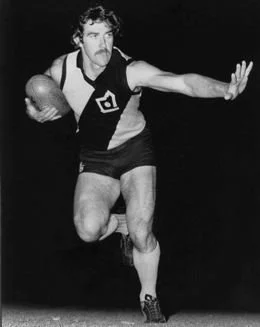
Dad’s senior playing career started on the oval below us in 1967 at age 17 years. But his connection with this place started well before that.
Shortly after the Perth Football Club moved its home from the WACA to Lathlain Park in 1959, Dad’s father Bob was appointed league coach.
On the oval below us, a 10-year-old Ian kicked a ball on the periphery of the men training, observed the way in which they came together, and felt the physicality and camaraderie of it.
At this place he absorbed disciplines, routines and protocols.
He watched his father leading these men.
At this place as a child, Dad also experienced the communal good spirits of men, women and families at post-match functions in a smoky Perth social club – the same place we will convene to share company and reflect upon his life at the conclusion of this Service.
Like Bob, Dad also coached the Perth League team at this place.
As a child, I also kicked a ball here on the periphery of the men, observed the way in which they came together, and felt the physicality and camaraderie of it.
I also watched my father leading men.
And, as children we also experienced the communal good spirits of post-match functions in a smoky Perth social club.
Mum has shared some stories of the fun that was had later in the evenings when the kids had been shipped off home to bed with the grandparents.
Fi, recalls the disappointment of match days when the creche below the grandstand, run by a kindly Perth matriarch, was open. On these days, instead of free roaming the outer, Fi would be bundled to the creche along with toddler Jen and cousin Emma. A memory of an effervescent Luke Webster being locked in a cupboard by the Perth matriarch, now stands as either a frightening fact, or a fond and amusing anecdote of the match day creche. I think Luke turned out ok regardless.
For me, accompanying Dad to Sunday morning training sessions at this place was treasured time.
“Dad, can I come to training?”
Sunday morning training was a time when he was more available. On game days and during the week it was business. On Sundays, more liberated and relaxed.
But not all Sunday morning sessions were relaxed.
The Demons didn’t experience a whole lot of success in the period that Dad was coaching here and on one Sunday morning, following what must have been a decent flogging, Dad told me to take one of the waterlogged Burley footballs and go out onto the oval for a kick. He needed to speak to the team – “come back in 20 minutes”.
I left the rooms but didn’t go far. While loitering I heard a man’s stern raised voice. Is that Dad? I was shocked, I had never heard his voice raised or this tone from him. I slunk back into the doorway of the rooms and watched from a corner. It was a bit exciting. The team was sitting on the change room bench or on the floor. A couple were standing. All had lowered heads.
The crescendo to the dressing down was something along the lines of:
“There is no Clark Kent who is going to jump into a telephone box. There is no superman who is going to do this. You need to do this.”
This Sunday parable on responsibility and accountability is seared into my memory.
Also seared into my 6-year-old memory of Sunday morning training, is a physical altercation with a 4-year-old Ben Cousins which left me in tears. Cuz, I know that you are watching this on a livestream. Its ok mate, I am over it!
Liz was in the womb in Dad’s last year as coach of Perth in 1984 – literally absorbing the atmosphere of the smoky social club in different ways. Those were the days!
Fast forwarding some decades, Liz’ husband Phil would play with Perth at this place, and in recent years attend Perth Football Club alumni events with Dad here at Lathlain.
Chubby showed us around the Perth rooms last week when we were sorting arrangements for today, a nostalgia and feeling of connection emerged, through memory, from Bob and Dad’s names scribed on the number 3 locker and the many photos of Dad and his friends on the walls of the club.
While Dad had been present and worked in this Eagles building for a few years, and some of our kids had been here with their Poppy, none of Fi, Jen, Liz or I had yet been to this building.
Our experience of the place of the West Coast Eagles was at Subiaco Oval.
The glass and steel here was unfamiliar, but the embrace, warmth and tears of Dad’s extended family of colleagues in the foyer below was the continuation of a story that has built over decades.
While my family have been here away from our home in Trentham in country Victoria, the Eagles have generously provided us with adjacent accommodation for the last couple of weeks.
This has given me a chance to again spend some time on that oval, more than 40 years since Sunday morning training. This time with my sons and a Burley.
I prepared this eulogy with a view across to this building, and to the imperial training centre that bears the name of Dad’s great friend.
Connections to place, new, old and through generations.
___
The respect and kindness and love that has been written of, spoken of and felt for Dad since his death has been beautiful, and even a bit overwhelming.
For about a week, in WA at least, I think he was the most famous person being feted for the unfamous things that he did.
It felt a bit like the sentiment that was shared when actor Sam Neil died recently. The tributes to Sam Neil were more about his personhood than his movies.
Similarly with Dad, the football achievements, although many, secondary to the way he made people feel and going the extra mile in private.
At first instance, these things do not seem remarkable, but perhaps they are.
Warmth and care, having a bit of time for everyone, no matter who.
___
Ian was a wonderful father to Fi, Jen, Liz and I.
He made us feel safe.
He supported and was proud of each of us, whatever life decisions we made.
Finding words to do justice to the feelings that arise with the death of a parent is a difficult task. Probably one of the reasons they invented poetry.
He was also a wonderful husband to Robin. Their partnership was one of mutual respect and love.
Together, they cultivated for us a home and upbringing of warmth and comfort.
One of the enduring strengths of their relationship was that they each gave the other space.
Mum knew that Dad needed space for football. It was part of him.
Dad knew that Mum needed space for her family and her passions of creativity.
Mum had a special bond with her identical twin sister Alison. A type of bond that may be peculiar to identical twins. They shared much. They were each themselves, but at the same time each other.
Ali died a few months ago, so this is an immense period of loss for Mum.
So special and consuming the relationship of identical twins, Dad may have been heard to utter a phrase in periodic frustration once or twice over the years:
“Well, I only married one of them!”
But their frustrations with each other were not large in the scheme of things, and Robin and Ian have been a spectacularly winning combination.
Mum and Dad both went to Applecross High School. Dad was a year older. They knew of each other, but that was it. 6 years passed since Dad finished at Applecross with no contact. Then there was a whirlwind.
Dad had been back and forth between Perth and Melbourne during 1973 after Perth didn’t give him a clearance to play in the VFL. Chubby will provide some more colour on the football politics, but all we need to know for this love story is that by fortune of a football administrator’s decision, Dad was back in Perth in late 1973.
In Dad’s words from a 2002 interview for the Sandover Club this is what happened;
“So I came back, finished ’73, met my wife, got married, went back in January, and spent 4 great years in Melbourne.”
The slightly elongated version of that story is that after a very short period of courting, Ian proposed to Robin in a car park, both in pyjamas following a pyjama party, got married 6 weeks later and flew to Melbourne a week after that to start their new life as husband and wife.
Amazingly, the house they lived in less than 1 kilometre from the family home of my wife who I met in Edinburgh 26 years later – connection.
Mum and Dad were a hip thing when they arrived in Melbourne. Even gracing the front page of the Herald Sun with a marvellously staged photo of Mum kicking a footy and Dad feigning a tackle. 70s gold.
While in Melbourne Mum would write to her sister Ali. Here is an extract from one of those letters:
12 April 1976
Well Fitzroy did it again – lost. They certainly had their chances kicking 7 points in the last quarter. George Young kicked 8 goals for St Kilda! He’s a pretty cool character. Had tea with Peta + George after the game. Ian played well and has regained his confidence. He had a couple of heavy knocks – one in which he went down and heard all of the bones in his neck crack. Was relieved when he could move it. On Sunday morning he was aching all over – from his neck to the top of the leg on his buttock where he had also had a kick. Takes all week to recover from the previous game.
Ian carried his football protocols into marriage. One of these was that a good night’s sleep was imperative for preparation. So separate beds on a Friday night.
Relatedly, giving birth during the season would be inconvenient.
I was born in May 1976 in Melbourne – on a Friday – clearly a disturbance as the stat sheet for the Fitzroy v Collingwood game the next day reveals that Dad only had 2 disposals. Fi was an improvement, born in Perth in July 1978 – on a Sunday. Itis clear that Dad played in the Royals v Falcons game the day before, although no stat sheet is available.
None of this was optimal. From here on they eased the pressure, got their rhythm right and had summer babies. Jen born in January 1982, and Liz born in January 1985 – day of week not applicable.
And Mum also played a very direct role in football over the years, hosting young men, cooking them meals and chatting at our kitchen table.
A balance of give and take.
A life of love, to Dad’s final moments.
__
In 2008, Dad became Poppy.
Over the next 18 years he welcomed his nine cherished grandchildren: Joe, Freya, Harper, Otis, Sam, Isla, Jade, Will and Tess.
He embraced this final family role with love, generosity and the extra softness that grandparenting invites.
Dad also welcomed Gav, Rachel, Phil and Ash into the family with the same warmth, generosity and love.
__
Dad’s life was full of many friendships and accompanying these friendships was laughter.
Chubby and Bill have the most unmistakable, thunderous and long laughs and it was not possible to find a way to sleep as a kid when either of them or, worse, both of them, were around having dinner or a drink.
I didn’t mind. I would find myself smiling under the covers or hovering to be in on the conversation and the joke.
For all the time I can remember at Thelma St, Dad would have a Sunday night telephone call with Bryan Cousins.
As the phone was connected to the wall, the conversation was a shared experience. First topic family. Second topic Cuz’ dog. Third topic Cuz’ horses. Fourth topic football. The humour and enthusiasm for life and family that Cuz and Dad shared was infectious.
I have lived away from Perth now for half of my life. So a lot of phone calls. If I called Dad and asked him what he had been up to, whenever he told me about an evening out with friends, he would always just describe it as:
“A bit of humour.”
__
Dad grew up in Como with parents Bob and Dolly and brother Peter.
They lived on Thelma Street.
A happy and free time, cricket and footy on the streets, open doors, friends and family.
Around the block was Aunty Mary and Uncle Bill’s house with cousins Paul and Tren.
Cousins Gavin and Glenn were just on the other side of the Canning bridge.
Dad went to Como Primary School. Fi, Jen, Liz and I would also go to Como Primary. It was a background connection that we all enjoyed and felt. School motto “Only our best”.
Things were not all roses for our man Ian at Como however. Dad’s schoolmate and Best Man, and fellow Thelma St resident, Barry Cribb shared with me a story of a terrible indiscretion.
As customary in any School of the era, the boys would be kicking a football at the lunch break. The rule was no kicking after the bell had gone to return to class. On the day in question, Ian took the last kick. Both after the bell and off the side of the boot straight into the back of Mr Morris’s head!
For this act, a sheepish Ian was hauled to the Principal’s office where he received “the cuts” as the appropriate corporal punishment of the day.
Barry says that, rather than harbouring bitterness toward his superiors as most young lads might do, Dad was accepting and respectful about the whole business.
“Well, I deserved it, I broke the rules.”
After finishing High School at Applecross, Dad went to Secondary Teachers College in Nedlands to study Phys Ed.
Friend Rod Rate was a lecturer at the Teachers College.
On Fridays, Rod took the gymnastics classes, core to any phys ed curricula.
Rod also happened to be the South Fremantle Football Club Fitness Coach. The opening round fixture in 1970 was Perth v South Fremantle.
There was opportunity here.
A conspiracy was hatched at Fremantle Oval to make use Rod’s Friday access to Dad. It was agreed that Rod would make Dad work extra hard at gym class to take an edge off him. On the eve of the season opener, Rod proceeded to direct Dad to do headspring after headspring after headspring. The compliant student followed the instruction of the teacher.
The next day Dad lined up at centre half forward. His neck was sore as hell and his agility clearly hindered. Dad was doing so little in the match that Mal Atwell moved him out of the key position and onto the half forward flank. The plan was working and the conspirators gave each other nods with silent smiles. That is until the last kick of the day when a cock necked Ian was forced to move in the non-preferred direction and kicked the winning goal.
South Fremantle would go on to play Perth in the 1970 Grand Final. Rod and Dad had a friendly wager. If South won, Dad would pay Rod his losing player’s match payment. Perth lost and Dad, true to his word, gave Rod his full $6 Grand Final match payment.
Dad’s first teaching job was at Cannington Senior High. The other PE teacher at Cannington was Richard Aggiss. At the time, Richard was a member of the Australian hockey team. Richard went on to be coach of the Kookaburras and an international coaching legend. Not a bad PE teacher combo for the kids at Cannington!
Dad also taught Phys Ed at Como High before taking a job at De La Salle College in Melbourne.
The Christian Brothers overlooking the fact that Dad had not taken the catechism to allow a VFL star onto staff.
Ian was not a religious man, even after his stint teaching with the Catholics.
We knew this. Even so, it was still a very big surprise to learn from Adrian Barich’s column in the Sunday Times Magazine last week that he had actually rejected God when he left an up-and-coming Gary Ablett out of the 1982 Perth squad.
Dad enjoyed teaching and had a great rapport with his students. A mix of mentoring and guiding young people a recurring theme.
A bit of the teacher never left him.
When I was at Aquinas, Dad came down to take a year 10 training session. While he was addressing the group, a couple of my school peers were talking and not paying attention. Dad singled them out immediately.
“If you boys would rather be somewhere else then it is no skin off my nose if you go.”
I was mercilessly reminded of “no skin off my nose” for the remainder of my schooling.
During their 4 years in Melbourne, Mum and Dad made some enduring friendships.
One of those was with Fitzroy Lions captain John Murphy and wife Judy.
I thanked John last week for arranging the Lions black armband tribute to Dad in the preliminary final against Hawthorn. In our family, we had named this the ‘Poppy match’. We were ecstatic with the result and felt it fitting that the Poppy Match was the best game of the season. At least it was for a week until the Grand Final.
I know that it may be too soon for some in the room, but given the occasion, I feel obliged to be truthful here today. Something never quite gelled with Dad and the Dockers. Something ingrained in the psyche, he was never able to shake a misgiving for the Fremantle interloper. So, in his heart of hearts, and with his grandkids wearing his Lions jersey’s here today, I know that Dad would have wanted the season to end this way.
Just like grand final merch, I had another version prepared and ready for today which ran along the lines of Dad timing his departure without having to witness a Dockers Premiership.
Another of the great Melbourne friendships was with Peter and Gwen Crimmins.
Dad started his friendship with Crimmo when they were part of the Australian All Stars team which played exhibition matches against Carlton in London, Athens and Singapore at the end of the 1972 season.
Crimmo was captain of Hawthorn.
At the time, Crimmo had the Puma Agency for Australia. To buy gear for your sports shop you needed to go through the agent.
The story then goes that Dad was the first player in Australia to be sponsored and paid by Puma to wear their boots and gear.
Crimmo died of testicular cancer at the age of 28, 3 days after Hawthorn won the 1976 premiership and 4 months after I was born. They named it the Crimmo Cup.
Crimmo is my godfather and Mum and Dad continued their great friendship with Gwen over the rest of Dad’s life and Gwen remains one of Mum’s closest friends.
While he was in Melbourne Dad was noticing that specialist sports shops were becoming more of a thing.
When he returned to Perth at the end of 1977, he brought back this cutting edge Eastern States intelligence.
A family meeting was held with Peter, Bob and Dolly, and it was decided that Millers Sports and Hardware in Vic Park, a shop Bob and Dolly had been running since the early 1950s, would become Millers Sports with Peter and Ian taking the lead roles and Bob and Dolly continuing in the business in a more supportive fashion.
The transition seemed pre-destined in any event. The family was good at sport and had zero handy trade skills. I never saw Dad even hammer a single nail. The remaining hardware from the shop that was distributed amongst the family rusted in sheds through lack of use.
When Mum and Dad moved back to Perth from Melbourne, we lived in a house in Bullcreek for a couple of years before they bought Bob and Dolly’s house in Thelma St - Dad moving back to his childhood home with his young family.
This was special for us. We ran, rode, played and skated in the same street, hit and kicked balls over the same fences, sometimes retrieving with permission, sometimes not, in the same way Dad did. The half-court tennis court that Mum and Dad put in on the quarter acre block the scene of epic barefoot tennis, basketball, first pedals on bikes and more.
In that backyard I so often heard Dad say to me:
“two hands for beginners”
“eye on the ball”
“get your body behind it”
and on chest marks, embarrassingly “hug it like your girlfriend.”
Whenever I had a kick with Bob it was the same backyard repertoire. Having your Grandad say “hug it like your girlfriend” even more embarrassing than your Dad saying it.
In the early 1980s Millers Sports moved to Garden City Shopping Centre.
In time the business moved to also include surf wear.
It was a family business in the best sense.
Dad, Peter, Nanna and Pop were a seamless organic unit. There was no friction. Each complimented the other and played their role and it was a rare and special gift to be able to spend so much time with family at the shop.
According to industry peers, during the 80’s and 90’s, Millers Sports was the leading sports store destination in the State.
Dad was instrumental in forming WA’s first buying group in the sports trade. 6 stores which grew and went from strength to strength prior to the arrival of large national franchises and online shopping.
The mantra provided by Dad and Peter to staff was “the customer is always right. If you can’t sort it out on that basis send them to me.” We knew that they didn’t really believe the first bit! But if the customer did require Dad or Peter to step in, a diplomatic resolution would be found with little fuss.
In those days, before the arrival of professional football, Dad would work at the shop and then go to training. Peter worked Saturdays during the season.
In the 90’s, if you were working during late night shopping on a Thursday you could pop along a couple of shops down the Garden City mall and ask Woosha, the pharmacist, to fill a script and wish him luck for the game on the weekend.
Through the 90s Dad was a West Coast Eagles volunteer. The Match Committee members did not receive any payment between 1990 and 95. Between 95 and 99
they received a nominal honorarium for their very significant time commitment. Still for all intents a volunteer.
Dad would not have exchanged that experience for any sum of money.
Over the years, hundreds of young people worked in the shop in casual roles. Again, Dad mentoring, developing and guiding young people a theme.
Good friends of each of Fi, Jen and Liz and I were employed in casual roles, creating another great link.
Our friends all loved Dad. He loved us having parties in the backyard. He would engage in just the right way, never overstaying a welcome.
In 1994, Mum and Dad left their children to travel to the Grand Final – delegating to 18-year-old me guardianship responsibilities for their younger children. Of course, I took this very seriously and arranged for 20 or so mates to watch the game in the backyard. The TV was perched outside, antenna adjusted and keg primed. Every time the coach’s box was shown on the channel 7 coverage there would be a unified chorus of:
“Serge, Big Serge”
and then a compulsory scull of beer.
In the 90’s the Millers Surf T-shirt became a coveted item. it was not for sale to the general public. Scarcity created the buzz. In an act of promotional genius or subtle coercion, Dad would issue some of these t-shirts to the Eagles playing group. The aim was to have players seen on tv interviews or in pre-season training wearing the branded t-shirts. This actually happened quite a lot. However, it is not clear whether the t-shirts were worn so often because they were cool, or if there was a sense that Dad was keeping score and that those who did not wear one were less likely to be selected.
Sadly, the 50-year-old family business did not survive. This was a very difficult time for the extended family, for our family and for Dad.
A loss of financial security, loss of identity, publicly and personally.
The family home was lost.
Friends chipped in to buy a second-hand car and pay the school fees.
The support and generosity of Dad’s community of friends best described as acts of love.
It was an adversity Dad faced with dignity. With humility. Without grudge. With head up.
This, at any time, and above all achievements, is when I was most proud of Dad. His character was exposed and it stood tall.
Each life has its turns.
An opportunity arose, and his final career chapter commenced.
Dad was always cognisant of the opportunity the Eagles granted him. He remained quietly grateful. He never took the role or the club for granted. For him, it was a vocation, not a job.
____
In his final years, Dad endured a series of health challenges. In 2025, he was diagnosed with Progressive Supranuclear Palsy, or PSP, a rare and little-known life-limiting neurological condition. He faced his deteriorating condition – losing the ability to walk and to care for himself, a slowing down of his speech, and finally the need to leave home for an aged care facility, with the same dignity, head held high and humility that he had faced any other adversity in life. He even took his final breaths with little fuss, quietly, peacefully, and surrounded by loved ones.
____
Ian’s recipe:
Look someone in the eye when you speak to them.
Remember something about the person and ask them about it.
If you don’t know anything, ask a question or say something affirming anyway.
Make a person feel seen.
Say hi to absolutely everyone on your morning walk.
Remember all names.
Use some humour.
Listen.
Don’t dominate.
Listen again.
Get to the airport early.
Keep the lawn mown, service your car and don’t forget to order the security door.
The tools of his trade were a pen and a calendar notebook and phone numbers. The birthdays and ages of everyone he knew neatly written in the yearly diary.
This was all he needed until the discovery of text messages. Dad in time becoming magisterial in his utilisation of the short, well-timed check in text.
how are you going
well done
happy birthday
good luck
bad luck
have a good break……
Not long messages. But contact. People appreciate it.
I am not sure exactly when his discovery of the text occurred, but he was not at the vanguard. If we say that mass use of the text on a Nokia brick started to occur around the year 2000, it may have been as late as 2005 that Dad began to really dedicate himself to text craft.
In 2005, Mum and Dad came to visit Rach and I in London and we then spent some time on a holiday in France and Spain. Dad was incessantly texting. And he seemed to be loving it. We teased that he was worse than Warnie.
__
Football was one of the great settings in which Dad’s character found expression. It was where he formed friendships, mentored young people, contributed to a community and found opportunities to serve.
But those qualities were not confined to football. They were present in our family, in all of his friendships, in the way he conducted himself in business, and in the care he showed to the people who worked with him and for him.
Helen Garner writes in her personal novel The Season that football can reveal deeper things about people. Family love. Belonging. Joy and disappointment. Beauty and violence. The ways we care for one another.
Football was very important to Dad. But people were always more important.
Wherever I went, there always seemed to be someone who knew him.
At a house-warming barbeque in Footscray, our friend and Brendan Gale’s sister was telling me that it really gave her the shits that everyone kept telling her what a nice guy Brendan was, and that he was the nicest guy in football. At the barbeque, she introduced me to Brendan, and the first thing he said was:
“Oh Serge, yes I know Serge. He is the nicest guy in football.”
A few months ago, at the charity where I work in Melbourne, we invited Matt Finnis, the former head of the AFL Players Association, to speak about leadership. Before the session, knowing his history in football, I mentioned Dad’s name. Matt’s reaction was immediately positive. He told me about how important Dad had been in creating the template for player welfare across the AFL.
We then moved into the session, where Matt and I had an exchange about Plato’s philosophy and leadership. I have been thinking about that conversation ever since.
Plato believed that leadership begins with character. Not power. Not status. Not recognition.
Looking back, that feels less like philosophy and more like a description of Dad.
In football, in business, among his friends and, most importantly, within his family, he led without fanfare. He listened. He encouraged. He gave his time freely. He made people feel seen.
That is why people remember him.
That is why people loved him.
You have left a wonderful legacy.
Thank you, Dad.
Reflection by daughter in law Rachel Coghlan
One of my very early experiences of meeting and getting to know Ian was on a trip to the Basque region of France and Spain with Robin and Simon. Simon and I were living in London at the time, with frequent trips to the continent inhaling all the food, culture, art, literature, philosophy and languages on offer.
Ian, then my future father-in-law, showed mild interest (at best) in the soaring light-filled atrium and modern art of Frank Gehry’s Guggenheim Museum Bilbao, or the Belle Epoque architectural elegance of Biarritz, including the grand historic hotel in which we stayed. But it was in San Sebastian, eating pintxos and drinking table wine along the tapas alleys of the Old Town, where I first enjoyed his signature spirit and heart. He learned four essential Spanish words - gambas a la plancha (grilled prawns), shouted them repeatedly through the tapas crawls, and never forgot them. When we both bought t-shirts from and screen printed with the name of a local San Sebastian clothing company – Callate la Boca (shut your mouth) - his Latin language vocabulary peaked gloriously. Ian’s joy was deliciously simple: the company and connection of people, lots of stories about people, good food, immense pride in his family, and a bit of silliness.
In the spirit of melding the highbrow and language with simplicity, this is a poem by French philosopher Simone Weil, one of Simon’s current favourites. It is a poem about simple giving and enduring warmth. Ian’s legacy was a billion little acts uncomplicated and easy, that added up to something completely extraordinary.
Il restera de toi - What Will Remain of You
Il restera de toi ce que tu as donné,
Au lieu de le garder dans des coffres rouillés.
What will remain of you is what you gave,
instead of keeping it in rusting chests.
What will remain of you, from your secret garden,
a forgotten flower that did not wither.
What you have given will bloom in others,
whoever loses their life will one day find it.
What will remain of you is what you offered,
between open arms one morning in the sun.
What will remain of you is what you lost,
what you waited for beyond the alarm clocks.
What you suffered will live again in others,
whoever loses their life will one day find it.
What will remain of you: a fallen tear,
a smile that sprouted in the eyes of your heart.
What will remain of you is what you sowed,
what you shared with the beggars of happiness.
What you sowed will germinate in others,
whoever loses their life will one day find it.