• Genre
  • About
  • Submissions
  • Donate
  • Search
Menu

Speakola

All Speeches Great and Small
  • Genre
  • About
  • Submissions
  • Donate
  • Search

Eulogies

Some of the most moving and brilliant speeches ever made occur at funerals. Please upload the eulogy for your loved one using the form below.

For Norman Harris: 'I’m either out dancing, playing golf or chasing rainbows', by daughter Michelle Sammann - 2024

October 8, 2024

“Hi, you’ve reached Norm. I’m not home at the moment. I’m either out dancing, playing golf or chasing rainbows. So please leave a message and I’ll get back to you soon.”

This was Dad’s answering machine message for many years. Chances are that if you rang him at home, you would get this message. He was really difficult to contact because he was never home. Even if you did leave a message, he never listened to it anyway. He made the most out of every day. There was always somewhere to go or someone to visit. His interests were many and varied. His life was like a jigsaw puzzle with many pieces, but few of us knew the entire picture. And that’s just the way he liked it.

Born into a working- class family, he and his younger sister Margaret grew up in inner city Melbourne. His early life was influenced by two defining events. His mother contracted tuberculosis and had to leave the family for an extended length of time. He was also sent a Catholic boys boarding school called St Patricks College in Ballarat. He later described this as an all-male concentration camp that he survived by thinking on his feet and excelling at sport. His sporting skills saved him from expulsion when he was caught shredding the leather straps used for punishment with a razor blade. No doubt this was where his lifelong quality of resilience originated from.

After surviving boarding school, he left early and worked as a trainee Industrial Chemist in the tanning industry. This was followed by Fairfield Infectious Diseases Hospital, and then The Department of Microbiology at Melbourne University. It was here where things started getting interesting. He excelled at the extracurricular activities of University life including running BBQ’s, organising Christmas parties, tapping beer barrels and running Melbourne Cup sweeps. He mixed with students, academics and professors, enjoyed long lunches in Lygon Street and frequented Jimmy Watson’s wine bar. During his time there he assisted two Nobel Prize winners. As a side hustle, he was the projectionist at an Italian cinema in Carlton. Looking towards his future career, he completed a part time diploma at RMIT where he studied Medical Laboratory Technology.

RMIT was also where he spend the majority of his career and worked as the Laboratory Manager in the Department of Applied Biology for over 25 years. He made lifelong friends at RMIT and once again enjoyed extended lunches, social gatherings, weekend outings and trips away. Many great times were spent at the pubs around Carlton drinking Guinness with his work friends. He attended several National and International scientific conferences and sometimes he hosted visiting academics. At these times, he revelled in his job as chief tour guide and self-appointed Australian ambassador.

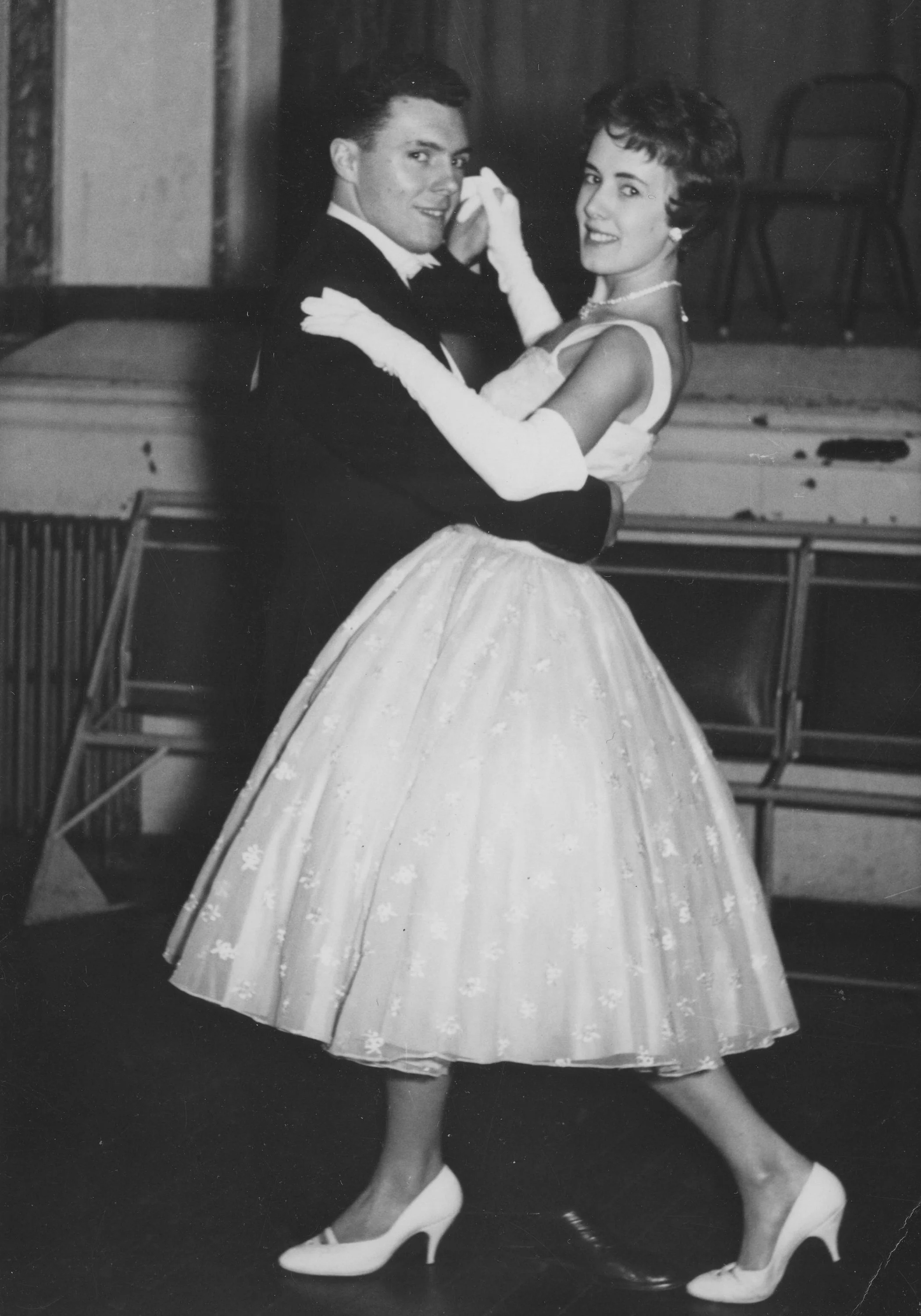
Saturdays were spent playing football for Alphington followed by dancing at the Heidelberg town Hall where he met his future wife Beryl. Always competitive, he and Beryl entered dance competitions and in 1961, won at the Moomba Dancing Championships at Melbourne Town Hall. They married in 1962 and set about building a life together, a new home in Lower Templestowe and starting a family.

Tragedy struck our family twice is a short space of time. Dad was left a widower at age 33 when his wife Beryl suddenly died leaving him with 3 young children including a newborn baby. He made the heartbreaking decision to give up his youngest son Trevor to his sister Margaret and her first husband Ron to raise. He became a single Dad doing his best. Home life was pretty messy. He was working full time and raising two small children. He was flying by the seat of his pants. There was no guidebook to follow. He wrote it as he went along. He couldn’t have done it without the help of the extended family and neighbours. Once he hired a live in housekeeper, only to return home from work one day with various items stolen, the housekeeper gone and my brother and I home alone. He excelled at cooking burnt lamb chops under the grill with Deb packet mashed potato and Surprise peas. He gourmet meal go to was apricot chicken in the Crock Pot.

Several year later his oldest son Stephen tragically died of an asthma attack at home when he was just 13 years old. Dad put the trauma and emotions of these two tragedies in a sealed box in his heart and labelled it Never to be Opened Again. But, with much support from family, friends and neighbours, he prevailed, and life went on. His indomitable spirit, resilience and optimistic attitude allowed him to overcome unimaginable adversity.

He played football, cricket, volleyball and squash. He tried his hand at rat breeding and chicken farming. He build three gardens from scratch. Country drives got exciting when he would stop to pick up road-kill. Koalas, foxes and possums were stuffed and mounted at his work and later found their way to show and tell at my Primary school. He joined a group called Parents without Partners. Together they build a raft and rowed it down the Yarra River in Templestowe in what was The Great Raft Race of 1979. Later he became the only Dad at my Calisthenics competitions; but he did have to outsource the costume making. He supported my teenage horse obsession and learnt how to tow a horse float, construct a jump and was elected as district commissioner of the Eltham Pony Club.

He had a habit of bending the rules to suit his needs. This consisted of what we termed “Doing a Norm” which entailed gaining free or discount entry somewhere, or talking his way into somewhere he shouldn’t be. Often it was the full VIP package. As a child I remember being highly embarrassed when he insisted I was years younger than my actual age in order to get into the movies at a cheaper price. He would talk to anyone and everyone. Most embarrassingly he would often introduce us to his new-found friend which might include a waiter at a restaurant, a nurse in hospital or any other random person he met when out and about.

He was King of the big day out and often headed off somewhere for the day, destination unknown, with little planning, no food or water and not enough petrol. I have many memories as a child of us running out of petrol or him losing his car keys. We would return home after dark, hungry, dirty, exhausted but happy. When his grandchildren were young, he took them to the MCG one day and lost the car in the carpark. The kids ran around for hours after the match trying to find his car, which was finally located as darkness set in. Meanwhile I waited at home anxiously hoping they would eventually arrive back before bedtime. History was repeating itself.

Our family would often return home from being out to find a present from him at the front door. These gems included animal skulls and bones, old books, newspaper articles, opp shop curios or hard rubbish junk. Anything he thought we might be remotely interested in.

Sometimes this was a whole dead fish in a plastic bag hanging on the front doorknob. This was from the Buxton Trout farm which he has bought after a visit to his sister Margaret. We never knew how long it had been there. Should we be grateful for a free dinner or risk a bout of family food poisoning? Our decision often depended on the daytime temperature. Sometimes it was lamb shanks. For a man who rarely cooked, he certainly had lots of recipe ideas.

Sometimes I would be at home and hear whistling near the side gate. This was quickly followed by the pattering of the dog’s feet down the side path and I knew that Dad was out there pushing a dog bone through the bars in the side gate. The dog would return to the backyard with a juicy bone and shortly thereafter the doorbell would ring. Dad had a habit of dropping in unannounced which usually happened around either lunch or dinnertime. I’m sure he had a well-worn route amongst family and friends in the Easters Suburbs. If the doorbell rang around a meal- time, we instantly knew who it was. He always tried to secretly feed our dog under the dinner table, but we all knew about it.

He loved to travel. He has ridden a mule down into the Grand Canyon, a camel in Egypt, hot air ballooned over the Serengeti in Tanzania, attended The Japan Cup with race caller Bill Collins and hiked from coast to coast across Britain. On this last trip, a search party was called out when he took a wrong turn. On a trip to Morocco he lost his watch, lost track of time and missed his flight to Austria where we were waiting to catch up with him. Two days later he resurfaced and surprised us at a Bavarian castle in Germany. On a trip through India, he befriended the tour guide and soon declared himself the assistant guide for the rest of the trip. Before a trip to Ireland, he wrote to Guinness and told them he was president of The Australian Guinness Club which earned him a VIP tour of the factory. He once sailed around Australia on the Queen Mary 2, where he gained a free passage in exchange for being a “distinguished gentleman”, dancing every night with the unaccompanied ladies. And recently, I found a photo of Dad in Indonesia posing with a couple of orang utangs. On the back he had written ‘My family’.

Retirement gave him time to focus on playing golf (where his maths let him down), Genealogy (where he proudly traced his family back to the 1850’s in London) and Bushwalking (where he enjoyed leading walks at The Maroondah Bushwalking Club). The Dandenong Ranges was like a second home to him. He loved walking the many trails, visiting cafes and enjoying the scenery. For fun one year, he worked in one of the cattle pavilions at The Royal Melbourne Show. There he organised a competition to see which one of the bulls had the biggest testicles.

He was a member of the Melbourne Racing Club for over 30 years. He also became a co-owner of several syndicate racehorses, and a few times enjoyed going into the owners’ room after his horse won where he enjoyed a free feed and a drink. He was always good for a tip on Cup Day.

He faced Prostate Cancer head on and beat it, without much fuss.

Later in life, he went back to ballroom dancing at The Mitcham Dance group where he made many new friends, organised social outings and enjoyed running The Monte Carlo. I have heard that this has now been renamed the Normie Carlo in his honour.

He fancied himself as a bit of a writer. He wrote and published an article about a walking safari he did in Kenya. And who can forget his historical piece he wrote about the history of Olinda. For months and months all we heard about was the history of Olinda. He loved going to the cinema and was always quick with a review of the latest movie. He was a life-long Carlton supporter and his eyes would fill with tears when his beloved Carlton hit the front.

I can’t remember the number of times that he lost his wallet.

Dad was many things;

• Stubborn

• Haphazard

• Messy

• Unreliable

• Frustrating

• NOT a style icon

• Tardy

• Secretive

• An enigma

He was also;

• Thoughtful

• Optimistic

• Irrepressible

• Unique

• Cheeky

• A teller of jokes

• A happy crier

• An excellent grandfather

• He had a heart of gold.

He was always coy about his age and loved people thinking he was 10 years younger than he was. For the record he would have turned 88 next Thursday. He lived his later life in complete denial of his age, his medical conditions or need for any support. In recent years he had home help and a nurse checking on him every morning to help him with his daily medications. He hated it. He would often get impatient waiting for the nurse and abscond to his local café before they arrived. This would trigger frantic calls to me at work or in one instance, a call to police for a welfare check. He refused to use a Webster Pack for his medications. This resulted in Baptcare putting his medications into a steel box with a combination lock so they could keep track of them. He went on strike over this, refusing to take any medication until they told him the combination, which of course defeated the purpose of the whole system. He won. The weekly cleaner was lucky to make it through the front door. Recently during a lengthy stay at The Austin Hospital, when a nurse asked “Do you know where are you Norm?” His reply was “Alcatraz!”

He never dwelt on the negatives. He rarely talked about the adversity that he had faced in life. He overcame great tragedy and always saw the glass as half full. He marched to the beat of his own drum. He lived life his way. On his terms. And that’s just the way he liked it.

The answering machine has now fallen silent. The doorbell will no longer ring around dinner time. The car has stopped driving and has no need for petrol. His passport is gathering dust. The dancing music has stopped. His hiking boots are packed away.

But I encourage you to follow in his footstep. One day go on a day trip and drive up into The Dandenongs. Walk one of the many lovely trails. Enjoy the trees and the birdlife. Stop and chat to random people you pass. Afterwards go to Olinda and get a coffee. Read the newspaper at the café and secretly tear out an interesting article. Pass it onto a family member or friend. Think of Norm and smile.

If the aim of life is to make the most out of every day, Dad, you get a gold star.

Congratulations Dad, for yours was a life well lived.


Enjoyed this speech? Speakola is a labour of love and I’d be very grateful if you would share, tweet or like it. Thank you.

Facebook Twitter Facebook
In SUBMITTED 4 Tags NORM HARRIS, NORMAN HARRIS, FATHER, DAUGHTER, MICHELLE SAMMANN
Comment

For Bill Maher: 'Man of the Mallee', by daughter Louise Schaap - 2021

November 23, 2023

16 July 2021, Swan Hill Catholic Church, Victoria, Australia

The title is a play on words to honour the family ancestry of Thomas Francis Meagher’s speech ‘Meagher of the Sword’ (Dublin, 1846) and my father’s one true love, the Mallee. The speech was to be delivered to a full church of 200 people. However the evening prior saw a Victorian lockdown announced. Only ten people were able to attend in person.

We are here to honour Bill Maher, born 3rd May 1941 in Swan Hill, The second child to Thomas Francis Maher and his wife Theresa, brother to Bernie, Garry, Peter and Jimmy,  The husband of Lesley, The father to Myself, Michelle, Phillip and Hayden, father in law for  David, Greg, Kelly and Amanda. Grandfather to Michael, Bridie, Archer, Percy, Elroy, Barnaby, Ruby, Cleo and Matilda.

This is an opportunity to pay tribute to Bill. We are joined together for this one time to share what we know about Bill, and it is a privilege to be able to lean on each other for a single day, being supported in the common thread of knowing this man.

Bill was a Man of the Mallee. We all know one. They don’t talk much, in between hard work, they stand around in the shade, contemplate conservative politics, whistle at a dog, lean on some machinery, swish away the flies and observe the horizon. A man not out for extensive conversations yet he was willing to toil, hammer, weld, thread, drive, tinker, lift, push, pull, dig, lug, wait, fix, wrench, sort, move = many vital farm tasks that generate content. Nothing is wasted in the Mallee, the resourcefulness is ingrained.

He was a man that was born into the love of his life, the Mallee. A life long relationship with a land, that offers more than the occasional dust storm. It began for Bill with a pioneering spirit, clearing Mallee scrub by hand, bare back horse rides to the dirt floor Pira Primary School, where at lunch times he fed the horse before himself and killed snakes at the classroom door.  He earned his stripes with learning the Mallee landscape, a country that does not produce “easy” whereby you couldn’t shy away from enduring all the challenges, a land that looked impossible to farm to anyone who doesn’t understand how to calculate its seasons and soil. He took it from teams of Clydesdales pulling stump jump ploughs to GPS tractors and headers.

This Man of the Mallee was resourceful. To the point of being an unqualified mechanical engineer. He knew how to make things for his beloved country. No CAD drawings, just a plan inside his head of what was needed, some tools and materials and away he would go.

Amongst his curated objects were trailers, field bins, incinerator, sheds, ploughs, gates, fences, tanks

Any Man of the Mallee welcomes rain. They watch the sky daily for it. A network of channels and dams drip fed what rain could be collected. And Bill’s leadership, as with so many key community initiatives, paved the way for the Mallee pipeline. Those tanks and taps networked across the Mallee we see today are just part of his legacy.  Strangely as a Man of the Mallee who yearned for and  thrived when water was abundant, he was not big on swimming, which meant he had only one pair of togs for his whole life. Once he outgrew them, his swimming days were over.

Farming lived with him 24/7 and a comfy chair for a nap, a black tea and a bit of cake gave him the occasional spell from it. The ultimate treat would be a steaming plate of well cooked tripe. His love for the Mallee gave him the greatest return on his sweat, time and energy. This meant he always seemed to be doing something, somewhere.

Up the shed

On the tractor

In the Ute

Down the paddock

Working on the truck

Rounding up the sheep

On the header

Driving the truck

Loading up the truck

Getting a load to the Saleyards

At the silo

Fixing a plough

Bogging the tractor

Out the back paddock

Digging a hole

Fixing the driveway

Welding up a new idea

At the dam

Near the gate

Sorting out a vehicle

Marking lambs

Transporting grain

Spraying crops

Baling wool

Dipping the sheep

Sewing a crop

Checking the rain gauge

Fixing a fence

For a farmer, he had his ways of talking. He would do any Aussie proud with

“Wig Whom for a Gooses Bridle”

“Same age as my tongue, a little older than my teeth”

“3 on the tree”

“4 on the floor”

“out whoop whoop”

“pull the wool over your eyes”

“burn a hole in your pocket”

“hit the frog and toad”

“don’t know him from a bar of soap”

“put a sock in it”

“ya got buckleys”

“wrap your laughing gear around that”

“flat out like a lizard drinking water”

“that’s the way the cookie crumbles”

“carrying on like a pork chop”

“fair crack of the whip”

“hold ya horses”

“not the sharpest tool in the shed”

“See you later alligator”

“fitter than a Mallee Bull"

"go easy"

“call me whatever you like, just dont call me late for dinner”

For a Dad he also nailed the obligatory Dad jokes on cue.

●        "I'm so good at sleeping, I can do it with my eyes closed!"

●        "How do you make a tissue dance? You put a little boogie in it."

●        What time did the man go to the dentist? Tooth hurt-y.

●        "Why did Johnny get fired from the banana factory? He kept throwing away the bent ones."

●        "What did the zero say to the eight?" "That belt looks good on you.

●        Kid: I'm hungry. Dad: Hi hungry, I'm Dad!

When he did venture beyond the farm gate he would drive some style of Holden (or perhaps a mustard Ute) to go play footy, or perhaps tennis in his younger days, fight fires (where every time I witnessed him silently gather himself at the call of someone else’s emergency, take the esky of water and go without any resistance or complaining towards an unknown danger so as to help others in need and return covered in soot and dust without a word to say), fly planes, put kids on a bus, check the mail in Nyah West, go to a meeting, usually as Chair, anywhere or any time.

Also beyond the farm gate, this Man of the Mallee took action with kindness and effort to show the world what he cared about. For his community and the Mallee he sought ways to make it better, so others could benefit. He gained personal fulfilment by being prepared to be a leader who aimed to have the best for what he cared about the most. There are many here who know these benefits, and I encourage you to share these rich achievements, on this day, so they are not lost. Let me share some examples

The highest leadership you could have is to be a leader of your Mallee. As Mayor, he represented the Mallee in China, France and Japan. He heavily invested time, energy and money to take any opportunity to promote the Mallee as Councillor and Mayor. His ambitions went beyond the Mallee boundaries, where he stretched his leadership up to a state political level, as a national party and independent candidate for the region and studying at Churchill University, Gippsland.

Dad knew how important rail transport was to the Mallee. He had significant conversations to save the swan hill train line from closure. By going to Melbourne to meet with the then Labor Transport Minister, whom he referred to as Snappy Tom, @ 1987, whereby he overturned plans to close the Swan Hill line. You know the train lines weren’t just transport to Bill. Dad loved flying, his pilot’s licence and involvement at the Mid Murray Flying Club took him over the Mallee and interstate, he used the trainline to navigate, moreso than a map, which was fine until flood waters covered the tracks. The saved vline service still runs in and out of the Mallee.

So lets celebrate this Man of the Mallee. He shaped his life around it and for it.  I encourage you to share your own stories of what you know of this Man from the Mallee. Talk about the Mallee’s hidden blueprint on it’s men, express the care for this place in the world, muster as much kindness as you can so as to show off your love for where you belong.

So Dad as a Man of the Mallee, who mastered this world with passion and strength, it is fitting you will be returned to its soil where The Mallee will have the man.

Enjoyed this speech? Speakola is a labour of love and I’d be very grateful if you would share, tweet or like it. Thank you.

Facebook Twitter Facebook
In SUBMITTED 4 Tags BILL MAHER, MALLEE, MAN OF THE MALLEE, FATHER, DAUGHTER, 2021, LOCKDOWN, TRANSCRIPT, 2020s
Comment

For John Cordner: 'My father was a VERY good man', by Geoff Cordner - 2017

November 23, 2023

January 2017, Rowville Golf Club, Melbourne, Australia

If I was to tell you today that my father was a great man I suspect – in fact I’m certain – he would be uncomfortable with that. Apart from his natural humility, I think he would suggest greatness is a term that ought be reserved for those who’ve saved thousands of lives, or changed the course of history in some important field of human endeavour.

So today, of all days, I guess I should defer to my father's view. I hope Dad that makes up, at least to some extent, for all of those many occasions in the past when I didn’t.

But if the next best thing to being a great man is being a good man, and if the measure of a good man is his ability to positively influence the overwhelming majority of the people he comes into contact with throughout the course of his life, then I feel very confident in saying that my father was a VERY good man.

How do we do that? How do we have a positive influence on those we come into contact with? What was it that Dad did to qualify him so clearly in my mind as a very good man.

One of the most significant things was his ability to make the people around him feel that they were important; that their lives and their opinions mattered.

You’ve already heard from my sister Diedre about how Dad was able to do this with his own family. I’d just add one further recollection to what has been said to you so far on that subject. My father was a very gifted storyteller. And what a difference it makes as a child to have stories told to you that don’t come from a book, that have never been told to anyone else before, and that are therefore accompanied by the pictures we create in our own imaginations. My father's most popular stories, told to his children and grandchildren over many decades, centred around the characters of Woggie the Snoggie, Wiggy the baby Snoggie, their faithful off‑sider Flip Flap, and the unspeakably evil Gremlin Goblin. Not only were these characters vivid, and wonderfully conceived, but whenever a "Woggie the Snoggie" story was told, the listener would himself or herself be a character in it, and that story would be custom-tailored to their age and interests.

What better way for a sports-mad young boy to fall asleep than with visions of having been selected from obscurity to represent Australia at the SCG, only to hit the winning runs in the deciding Ashes Test match, or to be plucked from the crowd during the ¾ time huddle to kick the match-winning goal for the Melbourne Demons at the MCG in the Grand Final.

Nothing was improbable, let alone impossible, when Dad was telling bedtime stories.

And my father's ability to make people feel important wasn’t confined to members of his own family. So many of you here wrote and spoke to us of this very quality in the days following his death, and about how good he was at giving you his undivided attention, and taking a genuine interest in your lives.

At the peak of his powers my father knew a lot about a lot of things. And if you were prepared to listen, he was more than willing to give you an extract from that vast library of accumulated knowledge and wisdom.

That said, conversation with Dad was never a one-way street.

Unless of course you were a teenager who'd drunk considerably more than was good for him. But more about that later

Dad was always interested to hear what the other person had to say, and to find out what was important in their life.

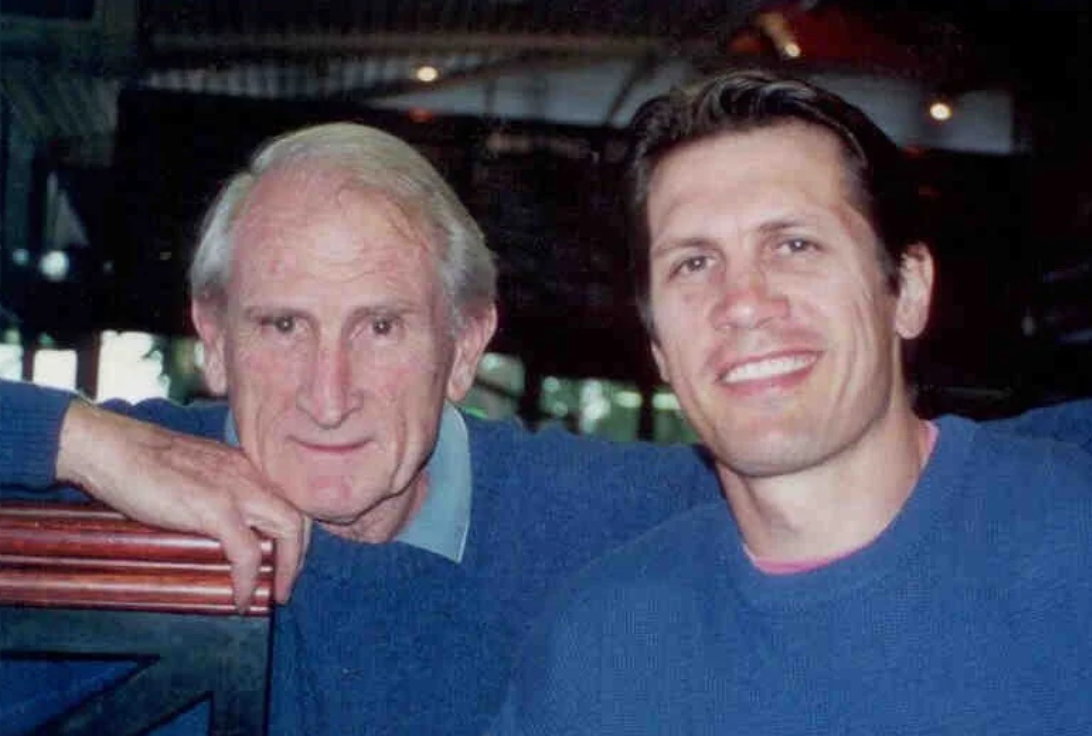
The photo you see here emphasises this point. Dad worked for many years in an office building in Walker St, North Sydney. As my brother Ian has told you, he was the Managing Director of an international company whose Australian management team were based in those offices. The man with the moustache, whose name was Arthur, was the car parking attendant in the building where my father worked. When Arthur got married he invited my Dad, and my Mum, to attend his wedding. Was the wedding full of business people who worked in that office building? Almost certainly not. Did Arthur invite Dad out of some sense of gratitude towards his biggest tipper? Definitely not. Arthur asked Dad to share one of the most important events in his life because Dad had made a real and genuine connection with a man with whom, looking from the outside, you might think he had absolutely nothing in common.

But Dad didn’t care who you were, how much money you had, what school you went to, or what you did for a living. He didn’t care whether you were male or female, Australian or foreign-born, straight or gay, sporty, arty or neither.

He would listen to you, and treat you with the respect you deserved, regardless of any of those things.

This is a photo of the attendees at a Senior Management course conducted at The Australian Administrative Staff College just outside of Melbourne in the latter part of 1968. Most of the 55 participants were Australians, but there were some overseas delegates. Towards the end of the course Dad invited one of those international visitors to our house to meet our family, and for a day’s outing to the Healesville Sanctuary, a couple of hours drive out of Melbourne. That man’s name was Frank Nkhoma. Frank worked for the Zambian Government, and you can see him in the 2nd row from the front, 5th from the left.

I was 5½ years old at the time, and Frank looked different to anyone I’d ever seen. Indeed I suspect most of the attendees at that Management Course had never met an African man before. Even though Frank and Dad were not in the same group at the Staff College they became friends. Looking back, it is not hard to see why. Frank radiated an extraordinarily warm and generous spirit. When he smiled, and said to me in that deep charismatic voice of his “You are a very good reader Geoffrey” I felt ten feet tall. I still occasionally try to emulate that voice of Frank’s today when praising my own boys. I have never forgotten him, and I hope I never will. Dad extending the hand of friendship to Frank, and Frank extending the hand of friendship to me: I now realise these were life–defining events for that 5-year old boy.

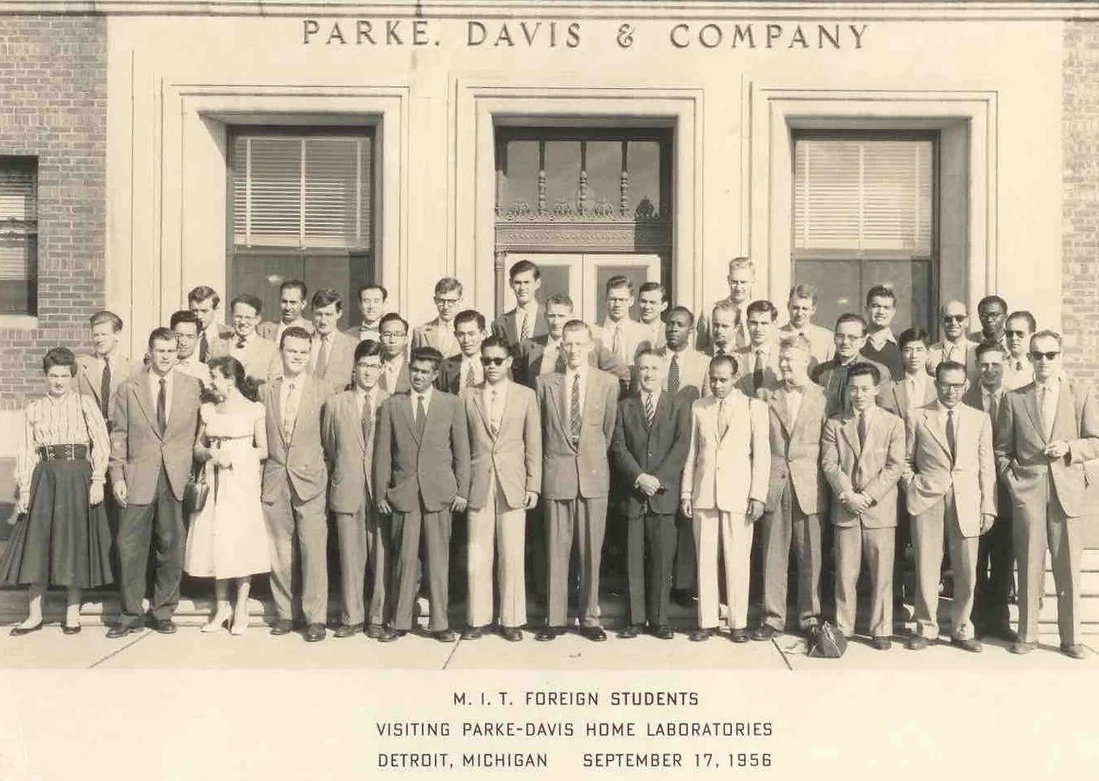
Not too many years ago I asked my father about Frank. He confessed that they had not kept in contact after Frank returned to Zambia, although Dad had written a letter to him which went unanswered. We didn’t have Facebook or email back then of course, and I suspect the mail system in Zambia may have been less than ideal at that time. But as we talked about Frank, and I asked Dad, through an adult’s eyes, about their friendship, he confessed to me that part of the reason he was so determined to make Frank feel welcome in this country, and into his home, was an experience my father had had some years before when he attended MIT in the United States as part of the Foreign Student Summer Project he had been accepted into after receiving the Fulbright Scholarship Ian mentioned earlier.


The Official Report from that Summer Project confirms there were 67 participants from 35 different countries – countries that, remarkably, included India and Pakistan, Iran and Iraq, Israel and Egypt, South Africa and Kenya, Greece and Turkey, as well as Japan, Germany, Italy, France, the UK, and many others.

And this was in 1956, when the state of diplomatic relations between many of these nations was tenuous to say the least.

During the course of the Project the delegates, all of whom were engineers and/or scientists, were taken on visits to factories and laboratories in various parts of the US. On such visits they would travel by bus. On one such occasion the buses transporting the group stopped at a roadside diner to have lunch. However the staff at the diner refused to serve the Asian and African delegates. They didn’t ask the group to leave, they just told those in charge that they would not be serving those members of the group who were not Caucasian.

There was nothing preventing the majority of white-skinned delegates from eating, or getting something to drink. But they chose not to be fed, or watered. Instead, in what was an extraordinary show of solidarity amongst people from all corners of the globe, people of different colours, different cultures, different religions and backgrounds, the entire group rose from their seats and they left the diner together.

Just think for a second about seeing that moment as a scene in a movie – what an incredibly powerful image that would make. And what an inspiring message that group sent that day to those who had allowed prejudice to overshadow their humanity.

Now I don’t want to suggest for a second that my father was solely, or even principally responsible for orchestrating that walk-out all those years ago. But what I do know with certainty is that he wouldn’t have hesitated for a second to be a part of it. Because that’s the kind of man he was.

Which leads me to the second significant way that a good man can positively influence those around him – and that is through the example he sets.

You’ve seen lots of photos today, and you’re going to see plenty more. In many of those photos you’ll see my father holding a drink of some kind, often a glass of wine. He loved his wine – indeed he bottled wine purchased in bulk direct from the vineyard many, many times throughout the second half of his life. He also brewed his own beer, somewhat less successfully, on a number of occasions. So alcohol was always a part of our lives as a family. And yet in the 50 years that I am able to recall I don’t believe I ever saw my father adversely affected by drink.

Not once.

Which is why the conversation I am going to tell you about now resonated so strongly with me at the time.

It's a Sunday morning. I am 17 years of age, and I have awoken at about 7.30am to discover that my bed has not just been slept in, but it has been vomited in. Upon surveying the scene I ascertain there is a conspicuous absence of other likely perpetrators. Albeit gingerly, I determine to accept responsibility. I gather the remnants of my last meal in a bundle of bed linen, and head for the washing machine, confident that I will be able to dispose of the unsavoury evidence before my parents appear.

Unfortunately my mother has chosen this Sunday, of all Sundays, to rise earlier than usual to collect and read the newspaper. She asks me, as I pass her en route to the laundry, what is in my knapsack; which I now notice is dripping ever so slightly onto the kitchen floor. I confess my sins. Mum offers to clean the sheets for me. As a parent of a son in his late teens I now understand why she did that. I wonder however, as she takes my parcel from me, whether she will feel inclined keep this little secret between us.

She does not.

Later that day Dad comes a calling to my room, where I am feigning studious dedication whilst in truth simply nursing a ferocious hangover.

His first serve is moderately paced, but it has some spin on it.

“I hear you had a bit of a problem last night” he says.

I return the serve gently into mid-court.

“Yes” I reply.

Dad places his approach shot deep into my backhand corner.

“Is this the first time this has happened?” he asks.

I am unsure whether he means “Is this the first time you have vomited from drinking too much?”, or “Is this the first time you have vomited in your bed from drinking too much?”

I choose to answer the second question.

“Yes” I say truthfully.

Dad is now at the net, ready to put away the easy volley.

“Right” he says. “Well – the first time it happens that’s an experience. The second time it happens you’re a fool. And the third time – well, if it happens a third time you’ve got a problem”.

It is now clear to me that I have answered the second question, but that Dad was asking the first one. I do some quick calculations in my head. They lead me to the inescapable conclusion that I am a full-fledged alcoholic.

It is game, set and match for me it seems.

Thankfully the passage of time, and a relatively small number of subsequent indiscretions, have allowed me to re-calibrate that initial assessment. But the point is that what Dad said had such an impact upon me because he practiced what he preached. Whatever the issue, he never asked more of us in our lives than he demonstrated in his own.

And although I didn’t appreciate it at the time, what I now realise he was doing was giving me a road map to follow if I wanted to be a good man too.


Now it’s safe to say there have been many times I left that road map in the glovebox. But at the times in my life when I’ve been forced to admit that I am well and truly lost, Dad’s road map has been there for me to refer to. And I’m sure I will refer to it many more times in the years ahead.

There are a couple of other stories I’d like to briefly share that will hopefully reinforce what I have said about the kind of man my father was.

When I was 10 years old Dad put his hand up to coach my team at the Lindfield Cricket Club. We were a rag-tag bunch, without much idea, at least half of us a year too young to be playing in the Under 12 competition. But by season’s end, as much to our own amazement as anyone else’s, we found ourselves semi-finalists. Dad was a big part of that. In his team no-one was more important than anyone else. Everyone was entitled to an opportunity. Those of you who are my age or older will remember that was not the way things were back then. In those days the talented kids did all the batting and bowling, and the rest made up the numbers. But Dad was ahead of his time.

We had a wonderful season. I remember still Dad piling the entire team - yes, the whole 11 of us - into his Ford Fairlane at the end of the last game before Christmas, and taking us down to the local milk bar so he could buy us all an ice cream. If we'd have played the All Blacks that afternoon we'd have had a fair crack at winning back the Bledisloe I reckon. Dad knew full well that if you don't have a team of champions, you're gonna need to build a champion team.

But of course talking the talk is just one part of the equation isn't it?

When I was 17 my father and I played cricket together with the Mosman Vets. Our team sometimes included four players with first-class cricket experience - Dad being one of them, albeit more than 50 years of age by then – along with Allan Border’s future father-in-law. One of my fondest memories from that time is a match in which Dad bowled the final over to the Nawab of Pataudi – a former captain of India with six Test centuries to his credit – with the batting side needing a run a ball to win. As wicketkeeper I had the best seat in the house, watching the two aging champions going toe to toe, with the game coming down to the last ball, and ending in bizarre circumstances. Although on the losing side, Dad shared a beer and a laugh with his opponent afterwards. Like the Nawab, I came away with even greater respect for Dad as a cricketer, and as a man, that afternoon.

When I was about 19 I suffered my first flat tyre. Now I know many of you may find this hard to believe, but I was not always as handy as I am today. When I called Dad at about 1.45am that particular night to ask him for help, there was not a moment of hesitation. I wonder now if he realised when he took the call what a fantastic bonding experience that episode would prove to be – the two of us tripping over one another in the dark on Lane Cove Road, roughly where it now joins the M2. As we sat on the kerb, about 3am by this stage, with the spare tyre securely in place, I remember finally expressing sincere gratitude to my father ‑ for probably the first time during my teenage years, which by then were nearly over.

Dad and I had quite a few things in common. We were both the youngest of four children. In each case our oldest sibling was born in England, 10 years and 2 months before we were born in Melbourne. The siblings closest to us in age – Denis in Dad’s case, Diedre for me ‑ were roughly 5½ years older than us. At his full height Dad was 6 feet 1½ inches, virtually identical to my 187 cm. Dad’s playing weight of 14 stone, which equates to about 89 kilograms, was almost exactly the same as my own. Those happy coincidences have allowed me to wear one of Dad’s suits today, which I am very proud to do. I think it’s also fair to say we were both accident-prone, which goes some way to explaining how I managed to split a substantial hole in the seam of Dad's suit pants just minutes before entering this room today.

Dad and I both married strong, beautiful women who would prove to be our life-long partners and best friends. We both became a father for the final time at the age of 34 years and 3 months. We both appeared on TV quiz shows – twice each. We both saved our very worst golf for those occasions when we played together. We both loved cricket, so much so that we played it into our 50s. And we both had the good fortune to play that wonderful game with our sons – something that has given us immense pleasure.

Over the years, and especially the last three years, Dad and I spoke long and often about each others’ lives. I told him many times in different ways what he meant to me and, right up to the last time I saw him, his pleasure at having me visit him was wholehearted and unreserved. The knowledge that there was nothing left unsaid between us is, as you can imagine, of enormous importance to me now.


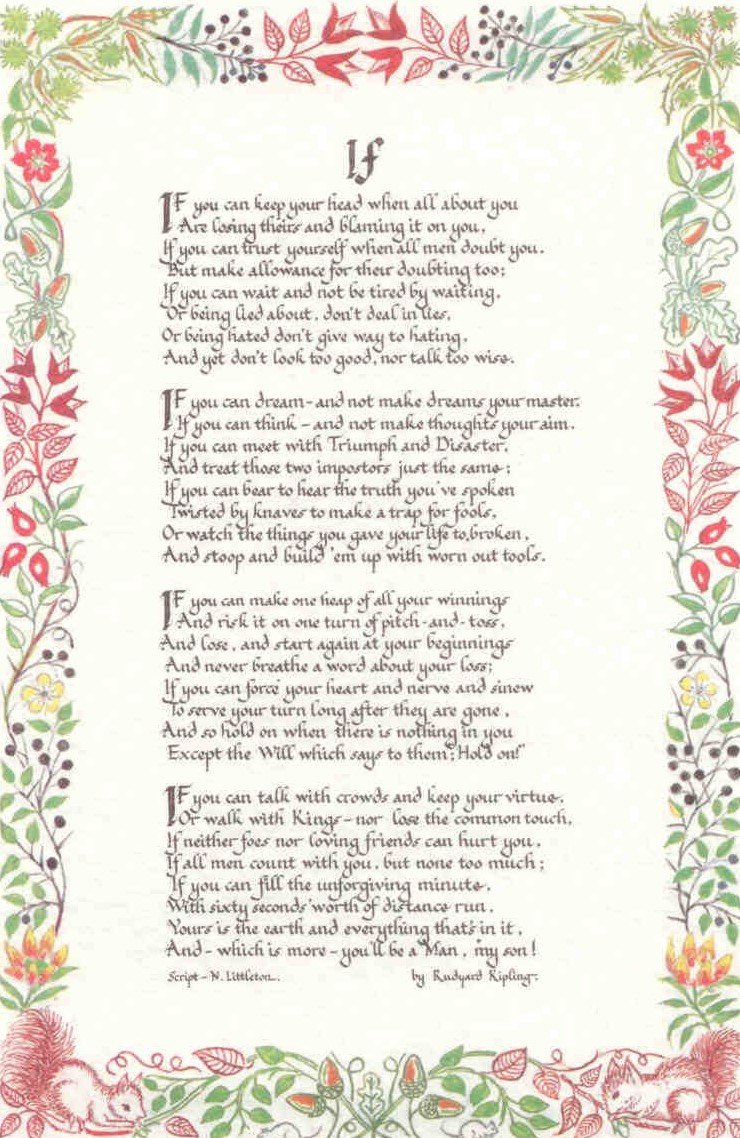
One of my father's favourite pieces of verse is a poem called If, by Rudyard Kipling. Having re‑read the poem recently, I understand why Dad rated it so highly. It is all about what it takes to be a good man.

Much as I like Kipling's version, it was not written for my father, or about him. So today, as a final tribute to you Dad, I would like to read an amended version of If; a version composed especially for you.

If you can keep your hair when all about you are losing theirs, and blaming it on stress;

If you can justify your Scrabble word when all men doubt you, and so achieve a triple letter score for your X;

If you can keep off weight without the need for dieting, and confess your age without the need for lies;

If you can just be envied without ever being hated, despite always looking good, and always talking wise;

If you can paint your dreams – and paint them like a master ‑ and still, with all your gifts, avoid the vanities of fame;

If you can meet with a Nawab, or with a Collingwood supporter, and treat those two extremes of humankind one and the same;

If you can bear to see the well-placed, kicking serve that you’ve delivered returned between the tramlines past your partner at the net;

Or watch the two-foot putt you need to end the match all square slide past the hole without a sign of petulant regret;

If you can, with either bat or ball in hand, with equal sureness, make a yorker of what seemed to all and sundry a full toss;

And if indeed, in any game, no matter what the stakes are, you can lose with grace and never make excuses for your loss;

If of the ones you love you ask no more than you bestow, and in their times of need provide a sympathetic ear;

If loyalty and integrity mean more to you than wealth, and compassion and encouragement are words that hold no fear;

If you have lived a life that’s both constructive and creative; if all this has been your oyster, and if you have glimpsed its pearl;

If when you speak your mind you know that those who hear you listen, you can be sure your time has left its impact on this world;

For more than four score years Dad you led us by example, your guidance and your love has made us stronger, every one;

And if I can be half the man you were while you were with us, then I hope you’ll be as proud a Dad as I am proud a son.

Enjoyed this speech? Speakola is a labour of love and I’d be very grateful if you would share, tweet or like it. Thank you.

Facebook Twitter Facebook
In SUBMITTED 4 Tags GEOFF CORDNER, FATHER, SON, MELBOURNE, 2010s, 2017, TRANSCRIPT
Comment

For Bernie Langtry: 'Well done, Trinner. Best on Ground', by son Gary Langtry and daughter Jenny Dean - 2013

November 23, 2023

26 August 2013, St Michael’s, Wagga Wagga, NSW, Australia

Dad, Pop, Trinna, Bernie. However you knew him we hope you enjoy the story of Bernard John Langtry.

It will come as no surprise to most here today that Dad’s story will have a strong football influence and so it is that we start with pre-season training.

Bernie’s preseason training started on 8th October 1926 when he arrived at Gurwood St hospital in Wagga as the youngest son of Phil and Mary. Before him Mary, Tom. Kath, Frank and Doughy, so the birth of Bernie made a full household.

Bernie completed his schooling at the ripe old age of 13 in Marrar & Coolamon. He then worked on various jobs including time with his father in the family Stock and Station business.

Later in his early 20’s Bernie, along with his brother Frank, purchased property around Marrar. Eventually, as things evolve, part of that purchase, “Currawong” became the building blocks for Dad’s future.

1st Quarter         We won the toss, siren sounds, the ball is bounced.

Around this time, Bernie was given the nickname Trinner.

No one seems to know how it came about, and there were many variations. Dad had his favourite version but whatever the true one is, it doesn’t matter. The important thing is that the name stuck.

During this quarter, one Trinner Langtry was eying Norreen McKelvie. Nor was oblivious to all this but Trinner “used to hang around” to ensure that he collected the mail when Nor was working at the Post Office. Their first encounter was at the Wichendon Vale hall dance. They went as single’s and came home as a potential couple in Trin’s car. This was despite the very best effort of Nor’s older brother Squeak, who followed them all the way home to ensure Nor’s safety.

The love affair continued and was sealed by marriage at Coolamon in November 1957. Incidentally the wedding was on a Wednesday morning as the parish priest at the time was far too busy on the weekend with other matters.

This marriage was to last more than 55 years and produced six wonderful children, Terry, Gary Jenny, Mark, Anne-Maree and Helen.

This established a very happy family time in the Langtry household. There were special times. There were challenging times.

There were regular visits from Kath and Mick to collect mushrooms and just be around the farm. Trin worked with Frank and Elitha on the farm and there was much involvement with Tom and Doughy and his older sister Mary who many will know as Sr Benedicta. They were all regular visitors.

2nd Quarter        Marrar 2 points ahead. Trinner’s worried. Kicking to the silos.

Trinner was now establishing himself as a more than handy footballer. Trinner played for Marrar over a period of 13 years, mostly on the wing. He believed his big achievements were being Captain Coach of the 1953 premiership team and a South West League representative player.

However, his football career was much much more than that.

Over his lifetime he was a player for 13 years, Captain Coach for two years, President for three. He was a selector at both club and league level for “who knows how long”, strapper for ten years, gatekeeper and life member of the Marrar Football Club.

Such was his service, he was recognised by the AFL as one of the elite, for having given more than 50 years continuous service to one club. His medallion was presented to him at a special function sponsored by the AFL.

His passion for football was legendary and even more so when you consider that Nor had ABSOLUTELY no interest in the game whatsoever!

However, Nor was at the premiership win of 1965. After the game Trin was EXTREMELY excited after a long drought of near premiership wins. On packing the children into the station wagon after the game, a head count revealed that Trin had 3-month-old Anne-Maree still folded up in the pram and packed into the boot. True story.

Another thing that may not be well known is that Trin took a year off football to assist Nor in her training for the Catholic Church prior to their marriage.

And after football, then there were bowls. And that is a whole new story.

His interests extended naturally to the Marrar Pub.

A number of years ago it was believed that there was a strong likelihood that the historic cricket and football trophies, which reside in the Marrar Hotel may be sold for profit. Pub patrons decided it was time to take matters into their own hands.

The trophies “somehow” were hidden on the farm. For the trouble caused Trin received a visit from the Junee Police. A brief explanation guaranteed the preservation of the trophies and Trinner’s good name.

Bring out the oranges. Its half time.

3rd Quarter         Trinner gets the loose ball from the pack and kicks it forward.

Trin was also a dedicated farmer. He was among the first to grow Canola in the area, which was a forerunner to the many yellow paddocks that we commonly see at this time of the year.

Wherever possible, Trinner was loyal in business. As an example, he maintained each year the buying of stock from the Armstrong stud. A tradition over three generations that has continued for more than 75 years.

Lamb marking was a farming job. It was shared with Trin and his brother Frank. The job would always start off easy enough but would quickly progress to discussions about sport or politics. Then move on to opinions about politics or sport then quickly deteriorate to arguments about anything in general, leading to many unmarked lambs and a complete meltdown of the system.

Long before weather apps, Trin had his own built-in radar. Every morning, regardless of where he was living, he would walk out the front door, assess the situation then walk to the back door, again assess the situation. Then come in to tap the barometer. This ritual happened every day.

Trinner was awarded a long service badge for 50 years continuous service to the Marrar Fire Brigade. Trin loved a good fire and particularly the “clean up” afterwards.

Dad’s lack of mechanical knowledge was well known. Like his good friend Tom Pattison, he was of the belief that a hammer and a shifter could fix most things and what couldn’t be fixed could be sent off to Cliff at the Marrar Garage. Cliff got a lot of work!

There have been many books written on the study of body language. They need not have bothered. All they had to do was turn up and watch Trinner as a spectator at the footy. He must have been exhausted at the end of every game where he was a spectator. He would kick, ride every bump, grimace at every tackle and he would comment about the very doubtful parentage of every umpire.

He tried…. but only with limited success at being a balanced supporter.

All of us kids knew that the timing to get money for lollies and drinks out of Trin at a footy game was crucial.  Ask during the quarter time and half-time breaks, not a chance. Ask while the ball was in play and money to get rid of the kids was guaranteed.

We can’t close the premiership quarter without mentioning some football facts according to Trinner.

·       You can’t trust paid players

·       Football is a wet weather game

·       I doubt the footy club can financially survive

·       Can’t STAND Cootamundra

·       Merger with Coolamon? Not going to happen

4th Quarter         Trins agility on the wing is showing. He’s gotta be a chance for the three votes today!

It was never going to be easy to move trin off the farm and to leave his beloved Marrar. Time goes on and a move to Wagga was inevitable. The move turned out to be a winner.

There have been many fulfilling relationships formed at Settlers village and within the Probus group since their time in Wagga. These relationships for both Trin and Nor have lead to travel, walking groups, coffee mornings and craft, but most importantly incredible support.

Retirement as well was a time for Trin to share quality time with his much-loved Grandchildren.

Time on in the last quarter was not easy.

The challenges in the last few months were eased by the wonderful care at RSL Remembrance Village. And for those very special people who were regular visitors to Dad, we thank you.

The recognition of Trin’s work, family and community involvement is shown by your presence here today.

Well done, Trinner. Best on Ground.

Gary Langtry


Enjoyed this speech? Speakola is a labour of love and I’d be very grateful if you would share, tweet or like it. Thank you.

Facebook Twitter Facebook
Tags BERNARD LANGTRY, GARY LANGTRY, JENNY DEAN, FATHER, SON, DAUGHTER, SPORTING LIFE, SPORTS, FOOTY
Comment

For Abigail and Lara Hoy: 'We want to nurture our little babies', by father Aidan Hoy - 2021

November 23, 2023

29 August 2021, Singapore

Thank you all for joining us in-person or online to celebrate the lives of our daughters, Abigail and Lara. If it was not for the pandemic, we would love to have everyone here with us today.

About two weeks ago, Mandy and I both mentioned to each other that the moment we had been preparing for over the past 8 months was starting to feel… real. That feeling was tinged with some anxiety, but overwhelmingly, it was excitement. Excitement about the two new lives who were about to enter our family.

However, just under seven days ago our lives were turned upside down. The excitement was replaced by shock and grief. The anxiety now threatened to overwhelm us.

We prepared for an unplanned labour 48 hours after our babies’ hearts stopped beating. We were also having to arrange their funerals.

Normally, the beginning of life and its end are separated by decades. And the significance of these events evokes different emotions. Yet Mandy, myself and everyone here, are trying to understand how life and death can overlap so closely, and what it all means.

I have delivered eulogies in the past, but for people much older than Abigail and Lara. I find it a great honour to be asked to reflect on someone’s life, distil down their character and understand the impact they made. But we do not have decades of memories for Abigail and Lara. Fate did not give them a chance to enter the world. Instead, we, everyone here, are left with unfulfilled hopes and dreams for Abigail and Lara.

We are only able to contemplate what kind of people they would be, by sewing together tiny insights into their character. Abigail was cheeky, always restless in the womb. Lara, the more relaxed one of the pair.

And their names. Abigail, which means a father’s joy. Lara, which means protector.

Originally I thought it was a complete, wholesale tragedy that Abigail and Lara would not be able to receive the hopes and dreams of Mandy, myself, our family and our friends. The dreams Mandy had for them to become gold medal athletes, as we watched the Tokyo Olympics. The excitement our families felt about two new granddaughters, in families dominated by grandsons. Likewise, our niece, Ellie, looking forward to playing with girl cousins when she’s currently surrounded by boys.

And all the thought, both practical and emotional, Mandy and I put into preparing for Abigail and Lara’s arrival.

Although this week has been utterly heartbreaking, I can also acknowledge there is another angle to the passing of our little girls. It is incredible that Abigail and Lara were the cause of so much happiness in their short lives.

The outpouring of love and support from our family and friends over the past 7 days, because of Abigail and Lara, is humbling. This is the love and support that Mandy and I receive on behalf of Abigail and Lara.

Make no mistake, Mandy and I are hurting deeply. Even when we seem composed on the surface.

We feel robbed.

This is not fair for our daughters.

We want to nurture our little babies.

But alongside my grief of losing what could have been, I can also cherish what we had, thanks to Abigail and Lara.

A few weeks ago, I said to Mandy that we would look back, and see the time we spent preparing for our daughters’ arrival as one of the happiest of our lives. This remains absolutely true, despite the past seven days.

My little girls, we miss you so much.

We love you so much.

For what you have done, and what you could have been.

We’re so happy we got to hold you.

And be with you for a short time.

We're so happy you got to visit home once.

But we now need to let you rest.

You'll always be our daughters.

You'll never be forgotten.

Enjoyed this speech? Speakola is a labour of love and I’d be very grateful if you would share, tweet or like it. Thank you.

Facebook Twitter Facebook
In SUBMITTED 4 Tags ABIGAIL HOY, LARA HOY, TWINS, FATHER, DAUGHTER, STILLBORN, SINGAPORE, 2021, LOCKDOWN, 2020s, AIDAN HOY
Comment

For James Hoy: 'I still expect to see Dad walk through the front door again', by son Aidan Hoy - 2016

November 23, 2023

16 May 2016, Pinnaroo Valley Memorial Park, Perth, Western Australia

When a loved one passes away, it’s inevitable that you may never have had the opportunity to tell them some things. This must be particularly so, between father and son.

Over the past week, many people have told me about how proud my father was of me. But what Dad doesn’t know, is how proud I was of him.

I’m proud that Dad was Chinese in Australia during a time when Australia was not necessarily so welcoming. He was born in 1946, around the same time his parents received a letter from the government requesting that they depart. But Dad’s birth meant his parents could stay, and he would laugh and boast that he was the saviour of the family’s future in Australia.

These early years are mostly a mystery to me. However, as a child, Dad remembered sitting around warehouses watching his father and other Chinese men while they smoked opium. And up until a few years ago, a Northbridge history website had pictures from the late 1940s of young Jimmy, and his sister, outside of the Chinese furniture factory where their father worked.

But I’m also proud that Dad was staunchly Australian. His first car was an FJ Holden. Someone once said he was one of only a few Chinese playing football and cricket in Perth in the 1960s.

When I accompanied him to the East Perth Football Club rooms after a grand final victory in 2002, one-by-one several gentlemen, of similar vintage to Dad, came over to shake his hand and reminisce about East Perth’s good old days.

I asked him who these blokes were. He laughed and said, “I have no idea”. I can only conclude that the Chinese fellow that frequented the Inglewood and East Perth football scene in the 1960s was probably a novelty at the time.

Dad also cared about Australia in a more sophisticated sense. His grasp of politics was impressive. He read the newspaper every day from cover to cover and watched hours of TV news and current affairs every night. His vintage tight fit t-shirt celebrating Bob Hawke’s 1983 election victory would be the envy of many hip political advisors today. And I’m not sure many brickies bought a copy of former prime minister Paul Keating’s book on Australia’s international relations in the 1990s. But Dad did.

I’m proud that Dad was resilient. For decades he was up at 5am and off to the building site, and rarely did I see him visit a doctor. I once had to pick him up from work Christmas drinks at a bar. After Dad had bought all of his colleagues a round of shots, a young apprentice bricklayer turned to me and said: “I don’t know how your Dad has been doing this every day for 30 years; I’m already over it after 12 months”.

The ultimate test of his resilience was his battle with cancer. Yet he never let it affect his outlook on life, and he calmly shrugged off any concern from others. He was determined to not let his illness get in the way of so many things he wanted to do.

Never did I hear him complain about the medical treatment he received over the years.

Yet, for all of Dad’s strength, he wouldn’t have gotten through the final chapter without the love and support of Linda. And she helped to soften his tough exterior, just a little bit, for which I am very grateful.

I still expect to see Dad walk through the front door again at any moment.


Enjoyed this speech? Speakola is a labour of love and I’d be very grateful if you would share, tweet or like it. Thank you.

Facebook Twitter Facebook
In SUBMITTED 4 Tags JAMES HOY, AIDAN HOY, 2010s, 2016, CHINA, IMMIGRATION, CHINESE AUSTRALIAN, FATHER, SON, AUSTRALIA, AUSTRALIAN, CANCER
Comment

For Ben Cordner: 'I will miss your uncontainable zest for life', by Geoff Cordner - 2019

October 25, 2023

11 February 2019, Macquarie Park, Sydney, Australia

I remember vividly at Ben’s 21st birthday party just a few short months ago, as the speeches concluded, and Linda, Ben, Tim and I, were standing arm in arm facing the crowd, I felt a wave of happiness wash over me that was like something I had never ever felt before.  At that moment I truly believed our life as a family was perfect.  We literally had all that we could ever reasonably have asked for.

Then just over two weeks ago our world changed forever.

But it has changed in ways we could never have predicted.  If you read or watch the news, which we haven’t for more than a fortnight, it is tempting to think the world is going to hell in a handcart.  But our experience over this past couple of weeks has been completely the opposite; there is so much goodness in the world it is impossible not to still have hope.  The support we have received from all of you, and from the wider community around us, has made us realise we are not alone in this – we are all in it together.  And there is enormous comfort in that knowledge, and strength too.

The second very important thing we have learned is that, no matter how much we might have loved and admired Ben while he was here - and we loved him with all our hearts – we never actually gave him all the credit he deserved for the person he had become.

The stories we have been told this past fortnight by so many people about aspects of Ben’s life that we didn’t already know about have swelled our hearts even further with pride, and helped us to more fully understand that the pain we are feeling is shared by so many others.  Because Ben touched so many lives while he was here.

It seemed to me that Ben was as happy this year as I have ever seen him.  All aspects of his life seemed to be giving him so much pleasure.  His relationship with Laura, his relationships with us, with his friends, his University course, his work, his sport.  He was saving money, he was planning for the future, he was looking at the entire world around him with that captivating, infectious smile on his face, and it was smiling back at him from all sides.

I am indescribably sad that Ben has died.  But if we had to lose him, then I am so glad I can carry forward with me the knowledge that he was truly truly happy when that happened, and that his life, cruelly short as it was, really meant something to him, and to all of us.

A few memories that I will always treasure:

The way Ben’s tongue, when he was small, seemed too big for his mouth, so that every word spoken was accompanied by a healthy spray of saliva.

Ben’s laugh as a young boy: now I know I might be accused of bias, but I would argue this was the most joyful sound in the history of the world.

Standing in the kitchen at our house about six years ago in tears after something on the TV had triggered a memory of my nephew Daniel, and having Ben come and hug me long and hard until the tears finally ended, and then a bit longer again, without either of us needing to say anything.

The many wonderful hours Ben and I spent putting together the slideshow for my Dad’s Celebration of Life.

The night we spent at the Big Bash just four days before Ben died.  Tim was away on his bus trip, and Ben and I decided at the last minute to go out to Spotless Stadium to watch the Sydney Thunder play.  I remember sitting with Ben that night at the game and feeling like we were just a couple of mates on a night out; like it was the most natural and comfortable thing in the world to be hanging out with your 21-year old son, completely relaxed in each other’s company. 

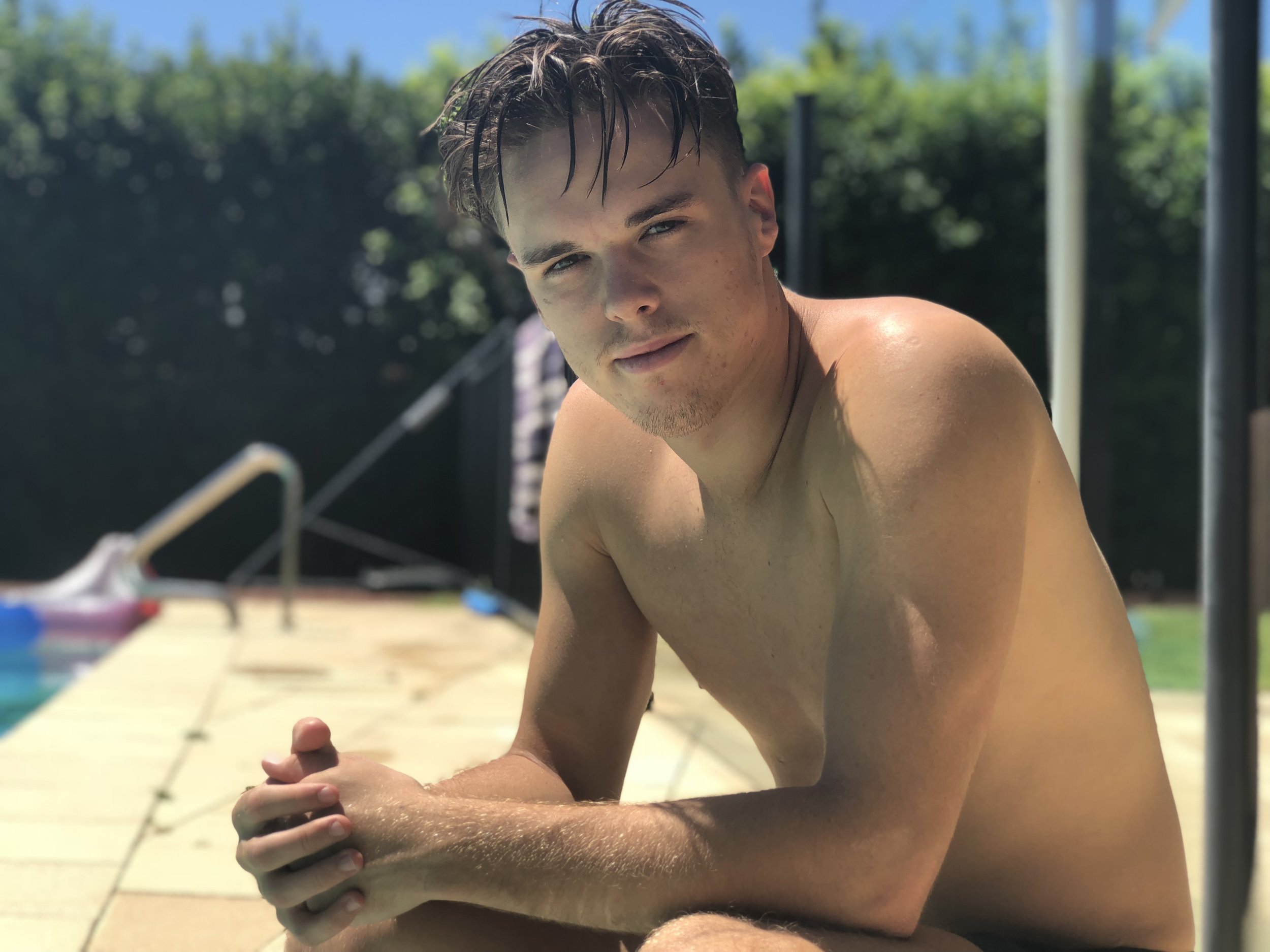
Ben I am so glad you got your hair cut very short recently, because I will never ever forget the feeling of stroking it as you lay on that hospital bed during the final hours of your extraordinary life, and the love I felt for you as I did that will never leave me.

Ben I will miss you so much.

I already miss seeing you walk out through the kitchen to the bathroom in the morning, one hand on your phone, and the other hand on your junk

I miss the way you called me Papa Bear

I miss the way you filled in the missing answers for me in the cryptic crossword

I miss your razor-sharp wit, and the cut and thrust of our regular repartee

I miss the way when I used a word you hadn’t heard before – like repartee for example – you would repeat the word, and say “Who says that?”

I will miss standing at first slip while you kept wicket, and having you calm me down when some poor unfortunate misfielded, or dropped a catch

I will miss calming you down when you misfielded or dropped a catch

I will miss hearing you say “How Good’s Cricket”

I will miss the fact that we can never play Fambrose again

I will even miss that permanently messy bedroom

I will miss your uncontainable zest for life

And most of all I will miss that beautiful beautiful smile

I love you Ben, and I always will


Geoff also spoke at Ben’s Celebration of Life event, as did Ben’s mother Linda Cordner. Both speeches are on Speakola.

Geoff writes regularly about his son at his blog The Beniverse, You can check out a post like ‘Batting with Ben’


Enjoyed this speech? Speakola is a labour of love and I’d be very grateful if you would share, tweet or like it. Thank you.

Facebook Twitter Facebook
In SUBMITTED 4 Tags BEN CORDNER, GEOFF CORDNER, EULOGY, FATHER, SON
Comment

For Ben Cordner: 'I remain in awe of all his wonderful qualities', by Geoff Cordner, Celebration of Life ceremony - 2019

October 25, 2023

13 February 2019, Epping Boys High School, Sydney, Australia

First of all could I ask you please to express your thanks to Tim O’Brien, to Nic McInerney, and to everyone here at Epping Boys High School who have made today possible.  The support the School has given us over the past two and a half weeks has been nothing short of extraordinary, and that support has been crucial in getting us through that very difficult period.

This place was such an influential part of Ben’s life that there could be, other than perhaps our home, no more appropriate place to hold this Celebration.  And as I look around at the number of people that have gathered today I feel safe in saying we made a wise choice to come here.

When you become a parent, particular as a father of boys, there is more than a little apprehension that comes with that about the responsibility of setting the right example for them.  What I didn’t anticipate, and what has become one of the great joys of my life, is that as our boys transitioned to young men it was them who would be teaching me lessons.
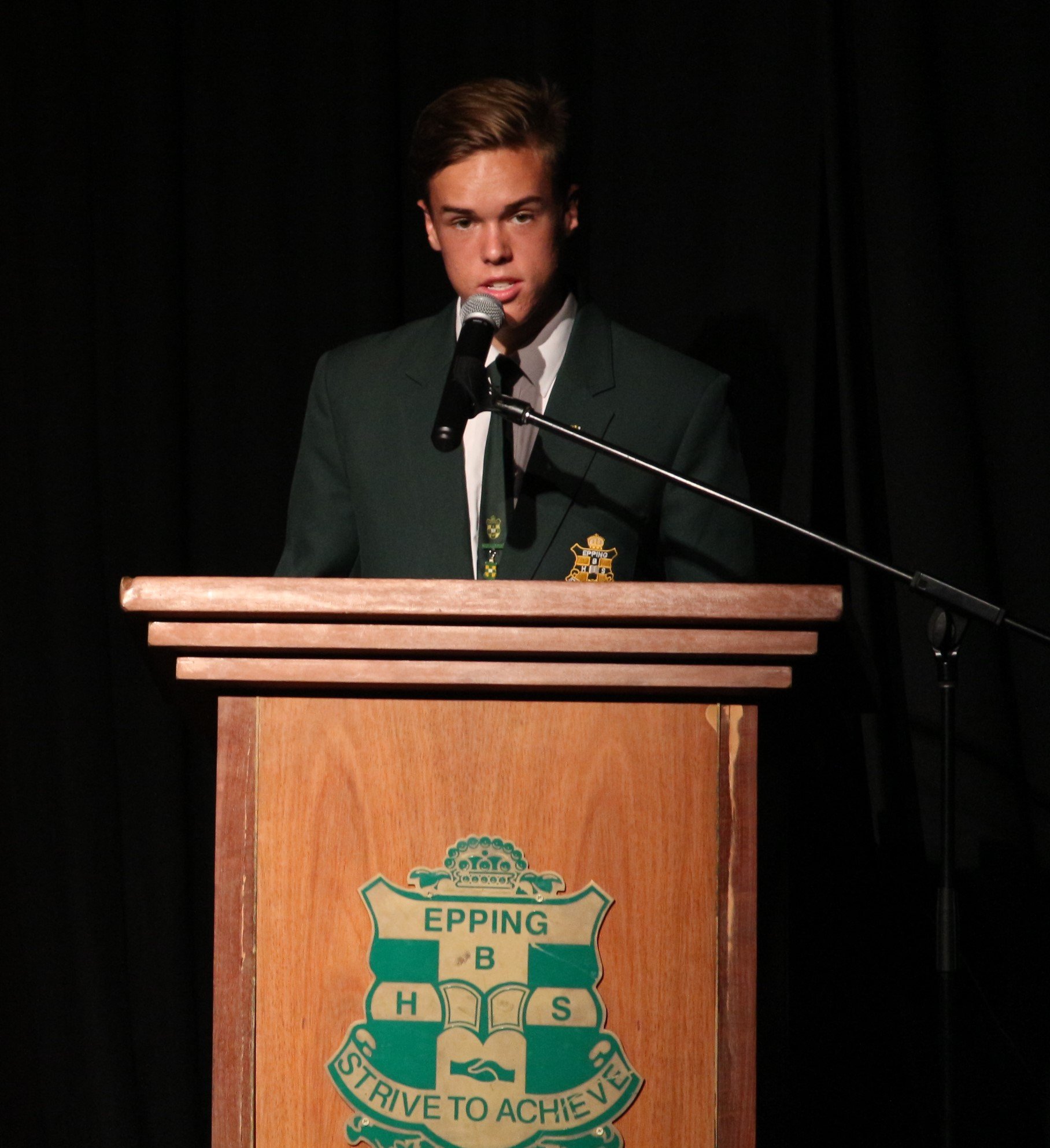
And on that subject, before I go on to talk about Ben, I would like to take a few moments to mention the tall, very handsome young man who spoke just before me.  From a young age Tim has set a wonderful example to his family, his peers, and the world around him about what it means to be a good person.  I have been, and I remain in awe of all his wonderful qualities – his humility, his empathy, his inner strength, that quiet confidence he carries that not once in his entire life, notwithstanding his many talents, have I ever seen descend into arrogance.  More importantly perhaps than any of those things, Tim has demonstrated to me that it is possible to go through your life without ever making an enemy.  Tim, we are so lucky to have you.

And so to Ben.

Back at Christmas time in 2015, which was the year Ben concluded his time here at Epping Boys, I wrote Linda, Tim and Ben a letter trying to explain, as best I could, how grateful I was to have the three of them in my life, and why.  I’m so grateful to Laura and Tim, who were going through Ben’s room a week or so ago, for their discovery that Ben had kept the letter I gave him back then throughout those three intervening years.  In that letter, amongst other things, I listed, for each of the three of them, the qualities I most loved about them.  For Ben, it was these.

I love your passion for the things that are important to you

If Ben decided he was going to do something, then he was all in.  There were no half measures with Ben.  Although this might sometimes have meant that he was a bit like a bull at a gate, most of the time the result of his efforts were outstanding – whether that was organising the Year 10 formal, or putting together and managing a new soccer team, or arranging a special night out with Laura, he was totally committed to the task at hand.

I love the fact that you see the power of knowledge, and that you genuinely love to learn

I truly believe that Ben was one of the smartest people I’ve ever known.  And not because he could remember stuff and regurgitate it when required.  But because once he learnt something he really knew and understood it.  And that’s such a significant distinction in my book – the difference between remembering something, and really understanding it.  Ben’s results at Macquarie University in the Advanced Science course that he was undertaking I think support what I’m saying.  His Academic Transcript indicates that of 20 completed subjects in which merit grades were awarded he recorded 15 High Distinctions and 5 Distinctions – no Passes, no Credits – leaving him with a Grade Point Average of 4.0, which is the highest GPA possible. I think this also reinforces my first point; if Ben had a passion for something, as he so obviously did for his University studies, then he would perform at a level that most of us can only aspire to.  And if I might digress for just a moment, I’d like to pay tribute to the staff at Macquarie University, and in particular the Department of Molecular Sciences, for the inspiration they provided to Ben these past three years as he sought to make his mark on the world around him, for the compassion and support they’ve shown to us this past fortnight, and for the extraordinary honour they are affording Ben, of which I believe you will be hearing more shortly.


I love your loyalty to your friends

I don’t think I need to tell you guys and girls here who Ben called “friend” – and there are a lot of you – what you meant to Ben.  I know I don’t need to tell you because you’ve shared with us the way Ben approached his friendships with you.  If you called him in the middle of the night needing a lift home he would be there; if no one else would dance with you, he would be there; if you had just broken up with your girlfriend, he would be there; if you were feeling depressed, or worse, Ben would sense that, and he would be there.  There are so many of you out there who know who and what Ben was, and it seems clear from what you have told us that you are so much the better for it.

I love that I can see some of me in you

Ben was the youngest son of a youngest son of a youngest son.  As a young man I think it’s fair to say he was a little self absorbed, and that trouble and disaster were his close companions.  He was cheeky, and he was more than happy to be the centre of attention – in fact at times he insisted on it.  I suspect some, indeed possibly all of these qualities may have been inherited.

Which leads me to the next item

I love that you are far more accomplished and successful in so many areas than I was at your age

Although Ben did indeed present challenges to his teachers and parents alike for many years, the fact is that the last Ben we will ever know was the sort of young man any girlfriend would be happy to bring home to Mum and Dad, any grandparent would be delighted to introduce to their friends, any sibling would be honoured to call brother, and any parent would be proud to call their son.  Ben learnt lessons so fast, much faster than I ever did, about what it takes to be a good man.  And if we feel the need to explain how he did that, we need look no further than the place in which we find ourselves today.  This School has changed the lives of many thousands of boys for more than 50 years now; but nothing I say today can come close to expressing how grateful we are for the young man you delivered back to us after we entrusted him into your care all those years ago.
Don’t get me wrong, that cheekiness, and the tear-arse nature, that were such an integral part of Ben’s personality as a young man, never left him.  But the humanity, the sense of responsibility, and the leadership that made Ben the person we will remember forever with such love and admiration were forged here, I have no doubt about that.

I love that you are willing to give honest answers to difficult questions

You would have gathered from Linda’s story earlier that Ben demanded honesty from those around him, especially us.  If he asked a direct question you better believe he expected a direct answer; as a result of which Santa Claus, the Easter Bunny and the Tooth Fairy, to name just a few, were on borrowed time at our house.  But to his credit he didn’t ask anything of us that he wasn’t prepared to deliver himself.  Ben was a straight-shooter all his life.  There were no hidden agendas with him, no airs or pretences.  In a world where a lot of people are so image-conscious that they sometimes lose track of what is genuine, Ben was, as far as I am concerned, the real deal.  What you saw was what you got; sometimes warts and all of course, but no less lovable for that.

I love that you have been able to form such a deep and genuine relationship with Laura


I have given the School here plenty of credit for forming the man that Ben had become, and rightly so.  But there are aspects to Ben’s personality as we now know it – in particular his ability to look at the world from outside his own bubble – which may never have developed, and certainly not as quickly, or as strongly, without Laura’s influence.
These two were, to my mind, as close as a couple can get.  And Ben was so much a better person because of it.  Unconditional love is a wonderful thing.  Laura loved Ben, loves Ben, for everything that he was, and he felt exactly the same about her.  I don’t believe that he could have become the friend, brother, son that he was without you Laura – and how can we ever thank you for that. Hopefully by telling you and showing you every day from now until forever how much you mean to us, and how lucky we feel to have you in our lives.  And to Laura’s parents, Tim and Maxine, and to Nick and Rachel, and Cam, thank you for making Ben feel so much a part of your family over such a long period of time; so much so that I suspect there were times Ben would gladly have made a full time swap.

And so to the last item that I wrote about Ben those three years ago

I love that your future is so bright

What do I say about that one now?

What I say is that the way Ben met the challenges of life as an adult from 2015 up to now confirms 100% what I sensed about him back then.  That he was going to continue to set an example for all of us to follow.  As far as I’m concerned the fact that Ben’s life has been cut tragically short won’t change that one bit.  Ben packed more into his 21 years, and left more indelible memories for the rest of us, than many people who have lived much longer lives than he.  

I said at Ben’s funeral service on Monday, and I say it again to all of you today; I have never seen Ben happier with all aspects of his life collectively than he was in 2019.  So if we had to lose him, I am so glad I can carry forward the knowledge that his life was an extraordinary gift – to him, and to all of us.

I started off talking about the life lessons my two wonderful sons have given me.  If I look for the biggest lesson that Ben has left me, and there have been many, it’s to make every day count, to make our lives count, because we none of us know how much time we have left ahead of us.

Thank you everyone, from the bottom of our hearts, for joining us here today to honour Ben, and for the incredible support that so many of you have provided to us these past 18 days.  We will never forget it.

And we will never forget you Ben.  I love you with all my heart, and I always will.


Geoff also spoke at Ben’s funeral, and Ben’s mother Linda Cordner also spoke at the Celebration of Life. Both speeches are on Speakola.

Geoff writes regularly about his son at his blog The Beniverse, You can check out a post like ‘Batting with Ben’


Enjoyed this speech? Speakola is a labour of love and I’d be very grateful if you would share, tweet or like it. Thank you.

Facebook Twitter Facebook
In SUBMITTED 4 Tags BEN CORDNER, GEOFF CORDNER, FATHER, SON, CELEBRATION OF LIFE, LESSONS, MELBOURNE, 2010s, 2019
Comment
Frederick  Sidney Lines 1921-2016

For Frederick Sidney Lines: 'Your father will be late to his own funeral!' by son Graham Lines - 2016

November 4, 2022

30 September 2016, Richmond, England, UK

Memory, memories.

 It is a weekend morning in the 1960s. We are expected at our cousins, the Peberdys, in Tulse Hill.

 Mum's task is, not only to prepare herself for the day, but to also ensure that we boys at least leave home looking 'presentable'.

 We three are assembled in the hall - Dad is upstairs, somewhere.

Having applied and checked her lipstick etc, Mum turns her attention to Colin and I. Shoes are inspected, hair brushed, and ties straightened.

 We pass muster, Mum checks her watch. Then she calls up the stairs "Fred, are you ready?" It appears not. He might have been answering a 'call of nature'. On the other hand it was quite possible that he was smoking a cigarette while reading a book.

 "Fred, what are you doing up there? We'll be late!"

 Mum's frustrated and concerned face turns to us; she declares angrily, "Your father will be late for his own funeral!"

 Having reached almost 95 years of age, you could say that she was right!

 Well done Dad.

 Well done Mum.

Frederick Sidney Lines 1921-2016

Enjoyed this speech? Speakola is a labour of love and I’d be very grateful if you would share, tweet or like it. Thank you.

Facebook Twitter Facebook
In SUBMITTED 4 Tags FREDERICK LINES, FREDERICK SIDNEY LINES, TRANSCRIPT, FUNNY STORY, LONG LIFE, GRAHAM LINES, FATHER, SON, UNITED KINGDOM, 2010s, 2016
Comment

For Gerald Day: 'Dad had all his spring ducklings in a row', by Kristy Day & Alina Warnock - 2022

October 4, 2022


September 9, 2022, Mid North Funerals, Clare, South Australia, Australia
(In above video, Kristy’s eulogy begins at 16.22)


My beautiful father, was a truly unique man.
He was one of those inspirational souls, I am sure was sent, or chose to come into our lives for profound reasons.

I am proud to say, that I had the blessing and honour of helping to support Dad through his last breaths on this Earth, along with his Love, Julie.

And what a privilege – it’s something we don’t want to think about and may be reluctant to talk about, but what I was able to pull from the experience, has informed the theme for this eulogy.

I often reflect and honour both my mother and my father, along with my ancestors while I am grateful for the gifts passed down from these people. Gifts that make us unique and sometimes extraordinary.

These people, like Dad left their footprints for us; and they also left the love running through our spirits.

Like threads, the unseen connection continues.

The body has its purpose and then it’s honourably left behind, as something, somehow tangible that we need to let go of.

Dad’s life was so finely tuned, wound tight like a guitar string, tuned to sing him along.

As Dad’s threads “unravelled” as his love, Julie explained to me when the lingering last breaths became selfishly hard for me to bear; I became profoundly aware of the honour before me.

Gerald Mart Day
Born in Gladstone on June 10, 1939
hit the ground running on his way into this life of his.

He grew up on Barinia Farm just north of Clare

He was one of six Day kids; and nick-named for every day of the week by the local swaggy.
I reckon Dad made up for day seven for the work he had ahead of him.

He was the fourth born.
After Jean, Maureen, and Roger
Then a little before Bev and Yvonne

Memories shared at various milestone events
stick with me well; although forgive me if I still get the stories wrong.

Dad hated milking cows so he was never going to be a farmer.
Grandpa put off buying a mechanical milker just to spite Dad.

Bev was his favourite sister.
Sorry you other girls.
She reminded me of some tall stories the other day.

She laughs as she tells me what a clever fella her bother was.
He stuck by his little sister’s side.

He started building houses as a young bloke.
Cubbies of all shapes and forms.

Up trees and on the ground.
I am sure they were all strong.
Maybe one did actually collapse
Pretty sure I was told.

He was obviously a pilot right from the start.
His flying machine was built early,
even before his teens.
Yeah, he learnt from his own lessons when that plan failed!
He needed to wait for that one.

But he was starting to put his ducks in a row.
That’s my theme going forward here.
Reflecting on this epic journey I am barely touching on.

The fifties were soon upon him
which was good for him I know.

His dance moves were something I did my best as a kid to imitate.
Likely, to no justice because Dad was the one those moves belonged too.

Apparently, he built a record player, somehow from scratch.
So that he, Roger and his sisters could get that twist down pat.

He knew he had more to do than be a farmer and work the land.

He soon chose to get the mechanical fitting and turning trade on the go.
He was a teen now and well onto making his own choices.

He needed some wheels, so he thought he’d give a motorbike a try.
His apprenticeship wages came in handy for that.

Bev recalls that choice caused the first and only family argument she witnessed in her youth.
Grandma and Grandpa obviously had grave concerns.

Rightfully so, as motors on wheels later caused some crisis.

But building fast things that slid sideways with grace and grunt
Were high on Dad and Roger’s agendas.

Go Karts and midgets were built on their production lines.
Projects for racing fast.
Dad’s life was also quickly picking up speed.

Inventions of a super spreader was his last farm boy hurrah.

Speed boats were the first real craftsmanship.
They needed to be, because at best they should stay afloat.
Most of us know the story when Roger’s Jenny couldn’t swim.
When one boat went under.
Lucky there was plenty of booze on board that day
with flotation in the eskies.

So, Dad is still in his teens building boats mind you!

A house was close to follow.

Yes, the house he was to house his family
before the fact he said.
It was the right thing for a man to do.

He was still barely 18!
He bought a block across from the Golden Fleece on Main North Road.
And built it brick by brick as he learnt on the go.

Going to a back story–to imaginary places Julie and I told Dad to go the other night.
To help settle him into his groove
on his track into new adventures.
Julie said she’s convinced he must have ancient ties
to building Machu Picchu
or even the pyramids perhaps.

Anyway, the family home was good and ready.
His journey with Lynnette was right ahead of him.

Like two creative souls
fusing their energy,
those two were on their way.

There’s many days ahead on the River and Porters Lagoon.
Or any water deep enough–even far northern lakes.
Lake Ayer to name a few. He’d drag a boat behind a grader
if he needed a way through.

There’s Yvonne and Trevor; and Fury to add to the mix.
With Hootin Annie and her V8 motor as loud as it could go.

There’s Bev and Gary and many more.
Bowker’s Linbar and other egg-beaters
on Earls and McKendrick’s boats.
Likely I’ll get corrected on that later.

There’s the need for more speed and grace
so there’s water skiing to master.

He could ski on anything.
I remember fence posts,
if somehow there was no ski
Or maybe he wanted to show off.
Nah, he never did that!

Malcolm Heinrich has memories of railway sleepers
as a makeshift ski
How the hell you’d steer one of those!
On a skin full of beer, or a port or two!

All the way from a river pub back to wherever.
There’d be a fire to stoke, and wood needed to burn.
So, on that sleeper would go.

Not too much further on his way, there were little eyes to look into.
Three little ones: Robyn, Me and Timothy.

We had no choice
but to take on those ancestral lines.
We were little shits
and so practical jokes were on tap.

Go figure, when Tim pissed on Uncle Jeff’s leg.
He thought it was funny.

But, till recently, I liked to remind Dad
of what, I am told he was like as a kid.
He was the one, with some likely accomplices,
who pissed over the top of the haystack
onto the head of the swaggy,
poppa Day let sleep in the shed.

Grandma told mum at their wedding:
‘Well, I hope you can do something with him
because I never could!’

The family home project still had things to embellish it.
One day he came home with his first backhoe.
He said he’d go out and practice.

Out the back he went,
and soon there was a hole
big enough for a swimming pool.
I never knew it was one of the first in Clare.

I had no idea at that stage how much my father could do.
And that he was any different to other Dads.

It’s no wonder I build things now,
and can apparently never keep it simple.
Hey Gordon!

Growing up; I could mostly observe Dad from afar;
the pride for my father built slowly like a fire.

It was hard to get his attention.
I dealt with that quite personally.

Dad was leading by example,
of what work and dedication could achieve.

Others had a hard time getting Dad to stop
so they could get his attention
Because when he did, “boozy happenings” could follow.

He had some good mates,
Although these are my memories
so please forgive me for leaving some out.
I know you have many more memories as his friend.

There’s Percy Pearce, Peter Hall, Don Morrison, the Paines, Pigot and all the Heinrichs.
John Fidge was the quieter one! Old Betty made up for that!
Pool parties at 44 main north road were very well known.

There’s one particular “Getting Gerald’s attention” situation.
We tried to get him to come up from the shed one night.

Peter Hall called from out the front of the big house,
a few times I am sure.

‘Gerald, your Tea’s ready’,
Mum never failed to provide a hot meal
Bless her generous heart.

‘Gerald, come up for your tea,
it’s getting cold.’

Still no sign…

‘Gerald, the house is on fire!’

Well, after ole Chum Braddock heard that
from the other side of the valley
far away through the trees,
the fire truck quickly turned up;
with Dad coming up from behind.

That’ll learn him, I said.

All the while, it wasn’t just backhoes, excavators and trucks Dad worked with.
He wasn’t that keen on the cold weather
So northern safaris were the answer.

A V8 should go into a new Toyota landcruiser
That’ll make her go.

‘I am going up north’, he’d say
with Rex Elis’ punters in tow.
Mum would get to go on some earlier ones.
And a few times us kids got to go too.
We learnt all about messy races
and being shuttled reluctantly to our swags
out the back of the Birdsville hospital
or somewhere, maybe safe.

Gratefully, I got my first inspiration to do what I do to this day.
Connecting to red sand country and the first nations people too.
This was something I was blessed with,
on these incredible experiences up north.

So now I’m still drawing spinifex mice
and many other illustrations too.
Telling people how they may feel this country in their bones
Just like Dad and Mum knew how to do.

Bedfords and Oka trucks,
camel strings would be the go.
Up over many sandhills
of many relentless shapes and forms.

The Simpson and the Canning Stock Route
were only just a few.

In amongst the very full aspects of Dad’s life
he continued to pull off spectacular projects.
Just because these were the plans
he dreamed upon until the end.

He pulled down many historic homes
and old wineries in this Valley.
He would pile his loot from those demolitions
in amongst the place of many trees.
Toolangatta was that place.
This is where he and mum
chose to build the next family home.

He hardly slept between the hours up on his machines.
Let alone on that incredible place He and Mum co-created.

Stone by stone, masonry master,
Helmet Zora got him on his way.
Over 7 years it took.
Many other hands came in to help.
It was Mum’s dream to make it big enough
for a bed and breakfast.
It would have been Clare’s first.

We got to move into the bottom storey.
While the top story had its bones in place.

It was a space I never ceased to behold.
Nothing was done by halves.

Many parts of Clare’s architectural bones live there.
And doors from spaces
with many more stories to tell.
Many reused materials make up that place
A place we will treasure for ever.

As a young teenager, I was in awe of my father.

In amongst those trees,
life started to move on
to an end of a chapter.

When Dad threw his swag
in his hotted up old 4x4 ute
I knew that chapter was closing.

Dad had seen a new light
shine over a sand hill up on the Simpson.
That was a major adjustment for all of us.
Lovely Lesley came into our lives
From way over the ditch.

She quickly took the him to the city
But she was not able to take
the country out of him.

I have so far failed to fit in,
the times up on the River
50 years ago, at Roonka Station near Blanchetown,
we pulled up our houseboat
It still had paddles on the back.

Nanna and Grandpa Boyd wanted a retirement plan.
So an old River Queen they acquired
along with Mum and Dad.

Soon the paddles were off
And a jet engine was installed.
They called it Boydy’s Lazy Days.

Ironic, Dad was not really ever lazy!
Not long after Grandpa’s life was cut short.
He never got to retire on his beloved houseboat.

Life on the houseboat was our timeout;
and a time for connection.
Not only as a family but
further with nature.

Speed boats and fast Monaros
wasn’t so much Dad’s thing by then.
But he did know how to stop
to appreciate the river.

Water skiing did continue though.
Juda II and many others
dragged Dad gracefully through the water.
On marathons and relays, and many other gatherings.

Dry starts off the side of the houseboat
when the Schmidt’s or Bayliss’ turned up.
The sandbar was our favourite place
Just up from Roonka we’d go.

Easters and Christmas’s and birthday parties.
The river was our second home.

So anyway, on the horizon
there was another sparkly gem
that did catch Dad’s eye.
Julie was the one.
She was to be the most learned love of his life.

He got better at negotiating relationships
I say thanks to lovely Lesley.

So, Julie was Dad’s rock, and roll.
And roll up and down that river they did
In the loved houseboat they then called Days Off.

Julie was the perfect fix for Dad up to this day.

Dad felt such love for Julie.

We’ve all seen his tender side.
He’d cry for his gratitude
Dare he’d say
‘what he would do without his love for Julie’

It was a true love through and through.

They spent a wonderful 27 plus years together.

Julie was particularly good at “family”
With her Simon and his brood with Marissa in Holland–Lisa and Sven.

So Dad’s grandchildren were also hers.

There’s was my Adam first,
and then Robyn’s Coen next.
And then Tim was the later starter.

Tim’s Evan was next.
All the way from the US or the UK,
he was blessed to spend many days with his Pop and Julie.

Well Tim chose a less quieter life.
Maybe he should have bought another TV.
But he and Sarah brought Dad more apples
to fall not so far from his tree and carry the name.

There’s Harvey and Maddie, and now Ella too.

And while all that’s going on
Adam brings in the great grands
In Marley and Layla Lyn.

Just to remind Dad he’s an aged man
despite his consternation.

So, while all this breeding is going on,
Pop still has many projects on his agenda.

There’s continuing the home build in Blanchetown
he’s co-created with Julie
close enough to the river.

Sadly, Dad’s more recent years,
as most of you know, weren’t the best.

I could see there was an urgency
To retrace some steps.

We did the family run
back to York Peninsula.
Where the Days established pastoralism
And even the local government.

We did another important trip.
We had some stone arrangements to find.
Dad seen them on the Stony Desert
back in the 70s.
Long ago on some Coongie Lakes reconnaissance.

Young Russ flew him up to the Simpson
and over the Great Stony desert.
Dropped down in front of the Birdsville Pub
where we drove in to meet them.

We picked up a local man, Don.
The traditional Keeper of the stones.
We flew around and then drove around
Over the border, despite the covid cops.

And yes we found some stones.
They were laid down in formation,
likely thousands of years ago.

Before the return trip home
Russell came banging on the Birdsville pub room door.
He reckoned if they got in the plane really quick
they could ride the front of a storm
without getting wet.

So they flew home with their tail in the air
over sand storms below.
The must have broken the Cessna air speed record back to Clare
They didn’t even need to stop at the creek for fuel.

That trip carried the last little spring in Dad’s step.
The red sand country remembered him.

It got his attention.

So, Dad was indeed a good pilot back in his day.
He did love to fly.
Even aerobatics
I found out just recently.

Very soon after
his body was letting him down.
Despite losing all his physical functioning
and even his beautiful voice.
Unlike most, whom may have curled up and given in,
he just kept on going,
stoking the fire in his belly.

Dad continued on his way,
however, he could.
Extra innovations kept him at their home
with his beautiful mallee views and
with his Love by his side.

‘This is my last project’,
he told my Gordon, last Christmas
He started the gazebo.

He said it was always planned
for their Blanchetown home.

This was in amongst all sorts of other tasks
and written orders
for this and that.

Part way through building his gazebo,
While I cared for him, he wrote to me:

‘Kristy, get me up at 7 in the morning!’

This was in the middle of the night
in amongst his medication runs,
as I cycled the pain out of his arms and legs.

Sorry Julie
but you need to know,
how well you trained me
to look after Dad on my own.
For those few treasured days,
you and Sarah had the most well deserved break.

Thank you!

Although he looked like he was ready to die;
he had to be up at 7,
dressed, fed,
and craned into in his wheelchair!

That motorised wheelchair
sped him across to the shed.
And at top speed so he didn’t get bogged!
He had to be there for Mark and Leanne
when they yet again turned up so faithfully
to help build his gazebo.

He’d draw shakey little drawings
and write to communicate.
To make sure every part of his gazebo
was built exactly to his spec.

Partly along the building process
I showed Mark photos of Dad’s past building projects.
Mark looked at me with awe and terror in his eyes.
He reckons he would have run a mile
If I’d have shown him those photos before
when Dad asked for their assistance.

Red wine vat oak timber cladding
over steel posts form the structure.
A bluestone pizza oven
which some of us
had a part in learning to build somehow.

Tim McBride and Angie were the perfect match
for the houseboat’s next chapter.
That was one of the harder things Dad had to let go of.

All the while.
Dad is progressively incapacitated by the day.

In June for his last birthday,
The last project was just about completed.
Dad called in his siblings and other’s closest to him
His chapter was ending and coming to a close.

He completed the cosiest warm hug,
that Gazebo now called LeMark.
And AKA, Gerald’s pizza hut
by his beloved Bev.

But hsng onto your seats
wait these’s more!

Right up till the day,
just over a week ago
when Dad said, that’s enough.

He was now placing his spring ducklings in a row.

On that day, his final project hurdle
was making sure the wacker packer
he could hear start up outside
didn’t crack the edge of his Gazebo’s floor.
King William street footpath slate
he’d rescued from the Wingfield tip

He twitched and made a scene sitting on the loo.
Julie couldn’t get him off there quick enough
and into his chair so he could see.
His helpers had his best interest at heart
just like he did for others all his life.

Including for his community
he helped all the ways he could.

As I wind this one up now
or start to unravel.
I feel you may see
the common thread in this story.

This was Dad’s story
from my perspective.

But it’s plain to see.

Dad had all his ducks in a row,
Right till his ending hours.

Right down to making sure
Roger got on his way
to the Red Dirt Rally in WA,
Leaving this Sunday.

As Roger keeps those Model T wheels
turning in memory of Dad.
Along with Roger’s entourage of sisters,
they will remember him
in the red sand country, he loved.

So there is in fact a moral to this story.
I did get my father’s attention.
Even though he was robbed of his physical abilities.

Like someone said a few days back
What God would do that to a man.

What did endure,
was the goodness of his heart.
He never ever complained.

He had no choice but to find his Truth
In that spirit running through from his heart.

And that, I selfishly claim was my purpose.
Dad and I did get each other’s attention.

I can now say with conviction,

I love you so much Dad.

On his beloved Murray River, his ashes will scatter
At Roonka, hosted by Dad’s beautiful friends, Brian and Ali.

Good neighbour Gavin, you are expected to be there to sing your song for Dad;
Or take the piss till the end as you did
just for Dad’s shits and giggles.

Now at home here in Clare
The place where his spirit never left.

We give thanks to this amazing man.
For all that he leaves behind.
His footprints in the sand.

Go well our beautiful man.
On your next extraordinary adventure.

You will always be so loved
And close to our hearts.
As your spirit continues.
On its ancestral line.

Dad told me last year
when I asked him what his spirit animal will be
to let us know he’s close by.

‘A Kookaburra!’ he said.

So I wrote this short poem for when you’re next contemplating in nature.

It is called…


I am
the Kookaburra

I am the kookaburra
in the redgum beside the river

I am the reflection
laying softly upon the water

I am the kookaburra
laughing at the end of day

I am the sound of silence
as the cross-lighting makes
everything gold

I am the kookaburra
Remember me.


Another eulogist on the program was Alina who delivered the following poetic tribute ‘To Gerald’

On God’s own earth there was a man who knew how to live life to – the - brim

through every action and fibre of his being.

With a twinkle in his eye,

and steadfast determination,

No project too big (Actually the bigger the better)

No stone left unturned.

To see sunsets, magic in campfires, beauty in thunderstorms and

peace in the rain through his eyes was a heartfelt blessing like NO OTHER

Experiencing with him

The Flow. The Love. The Land. The Majesty.

Of Be-ing,

Of Being, truly alive and connected to All.

Thank you Gerald for all your immeasurable, treasured gifts.

Your example of how to live life deeply has

Lodged forever

in our …Hearts

Minds

and

Spirit

And SO TOUCHED,

US,

ALL.

Gerald Mart Day
10/06/1938 – 01/09/2022


Source: https://livestream.com/accounts/8710393/ev...

Enjoyed this speech? Speakola is a labour of love and I’d be very grateful if you would share, tweet or like it. Thank you.

Facebook Twitter Facebook
In SUBMITTED 4 Tags GERARD MART DAY, KIRSTY DAY, FATHER, DAUGHTER, EULOGY, VERSE, CLARE, SOUTH AUSTRALIA
Comment

For Howard Freeman: 'Dad was an irresistible force in our lives', by son Jeremy Freeman - 2022

May 22, 2022

22 May 2022, Temple Beth Israel, St Kilda, Melbourne , Australia

Many of you were at the funeral and will have heard Rabbi Morgan’s eulogy. On behalf of mum and the rest of the family, I want to thank you Rabbi for your words and your compassion.

So, I’m not going to attempt to recount the life and times of Howard Freeman, OAM, or as he would have said, Oliver Sholom. And he would have said it just like that, as though it was two first names, often abbreviated simply to Oliver.

Dad was an irresistible force in our lives. He set the direction. He led by example. When the seas were choppy, he steadied the ship and got on with the job. Apart from that one time when we went sailing for the day and he spent the homeward journey throwing up overboard.

As you know, he was a Collins Street dentist with a reputation for fine crown and bridge work. He might have been a plumber if not for Headmaster Brigadier Langley at Melbourne High School, who saw that he was good at woodwork and recommended dentistry. When we were little kids and went into town to see him, we thought he owned the T&G building, which he told us stood for the tooth and gum building. I remember enjoying going to see him at work because he was so delighted to see us and show us around, and then clean our teeth, after which we were given a sticker. He had a roll of stickers that had a smiley-faced tooth on them and the words ‘my dentist loves me’. You couldn’t give those stickers out these days.
In those days he was very hard working, but we used to eat dinner together every weeknight. We listened to the 7 o’clock news on 3LO in complete silence while we ate, and then we talked, or mostly he did. And then after dinner if there wasn’t homework then there was TV which we watched together. Four Corners, Fawlty Towers, a movie with adult themes, the children trying to feign indifference during the racy scenes.
We went on pretty good holidays, sometimes to Queensland and often to Mount Buffalo for a week in the summer, where we went on bush walks and rock-climbing adventures with other families, most notably the Cohens and the Mushins. Dad loved Mount Buffalo and the Chalet, including the 3-course meals served on Victorian Railways crockery with proper silverware, and having smoked cod for breakfast. Later, mum and dad would go on many overseas trips including walking tours in Europe and Japan.

Dad and mum loved to entertain, and dad was a gregarious host. He and mum were part of a book group for over 40 years, and I remember book group dinner parties in Prospect Hill Road and later at Cleeve Court as being particularly raucous. Dad was a big fan of cheese fondue when that was a thing, and I think he was disappointed when it wasn’t any more.

Dad was keen on cars and fancied himself as a good driver. After his Rover 3500 fell apart on the way to Mount Buffalo one year, and after the battle with Rover over the cost of repairs, he only ever drove Mercedes Benz cars, and they seemed to get sportier over the years. He also had a knack of parking illegally without getting booked and would prefer to park illegally rather than somewhere legal a little farther away. If he could, he would leave one of us kids in the car with strict instructions not to let the parking inspector give him a ticket. You couldn’t do that these days either.

Dad was a huge fan of classical music and had a large record collection which he would whistle along to in perfect tune. He would play classical music and whistle in the car when driving, and always when our friends were in the car. He and mum would go to the MSO red series concerts and later, when they moved to the Melburnian, the Arts Centre and precinct was on their doorstep.

And as you know, dad was fascinated by history and Australian Jewish History in particular. He would often tell us about the latest aspect he was reading for or from the journal, about the life or achievements of a famous Jewish Australian, or some scandalous thing that had happened at a synagogue. And then there were the excursions that he led us on, around the city of Melbourne, holding a microphone and hauling a portable loudspeaker. Nowadays you can download a tour from the app store and explore by yourself, but it was more fun with dad and his boundless enthusiasm for teaching the history that he loved.

He was honoured to receive the Medal of the Order of Australia in 2007 for service to the Jewish community, particularly through the preservation of historical documents. And yet my memory is also of the effort he put into nominating his Historical Society colleagues and others in the Jewish community for an award, and the thrill he got when one of his nominees received one. He would sometimes hint that someone we knew might be up for a ‘gong’ in the week leading up to Australia day or the Queen’s Birthday.

I don’t recall him ever not being the President of the Australian Jewish Historical Society Victoria Inc., but I do recall him quipping that the 3 nicest words in the English language were ‘immediate past president.’ So, after 38 years that’s what he became.

Dad had a very strong Jewish identity and sense of belonging to an important community. He felt the weight of Jewish history and heritage. He fostered the same feeling in us kids, sending us to Jewish day schools and encouraging our involvement with Jewish youth movements, just as he was involved in Habonim and made many lifelong friends there.

Of course, I’m skirting around something that had a profound influence on his life and that of us all, the sudden unexpected death of Karen, an unspeakable tragedy that cast a long shadow over the life of a young family. And because he couldn’t bear to speak of it, it wasn’t discussed.

So, he threw himself into his work and filled his days with caring for others through dentistry, and with his interests and passion for music, history, art, theatre, literature, dining, travel, family, and friends.
And then years later, another setback, this time with mum developing a life-threatening illness, the treatment for which lasted years and had terrible side effects. And again, he soldiered on, trying not to think about the likely outcome, getting us to school and protecting us from his worst fears. He must have been scraping the bottom of the barrel when he made us a breakfast jaffle filled with baked beans and cottage cheese. Needless to say, there was a mutiny.

Thankfully, disaster was averted, and mum and dad were able to see their children get married and have children of their own.

It’s safe to say that dad’s greatest delights were his grandchildren. Firstly Ella, who arrived as a 61st birthday present, then Oscar, Zara and Yasmin, Alex and then Lucas. He was at first ridiculously silly with them, pulling faces, using rude words, and telling jokes. As they got slightly older, he and mum took them on excursions to the National Gallery of Victoria, walks through the Botanic Gardens, and sometimes to foreign films with subtitles they couldn’t read.

Later, he would tell them about various goings on in the community or in his historical work, with varied success. I’m pretty sure that Ella and Oscar could tell you all about the history of the Queen Victoria Market and the issue of unmarked Jewish graves at the Old Melbourne Cemetery which predated it.

In later years, dad appreciated the help of all those who cared for him just as he had done for others. He spoke highly of his doctors, and they were very fond of him. I don’t think he gave much thought to death or dying, he was too busy living.

Enjoyed this speech? Speakola is a labour of love and I’d be very grateful if you would share, tweet or like it. Thank you.

Facebook Twitter Facebook
In SUBMITTED 4 Tags HOWARD FREEMAN, JEREMY FREEMAN, DENTIST, DENTISTRY, FATHER, SON, TRANSCRIPT, AUSTRALIAN JEWISH HISTORICAL SOCIETY, JEWISH, JUDAISM, 2022, 2020s
Comment
John Delaney.png

for John Delaney: "I know you are very proud of the adults we have become", by Anne Delaney - 2020

September 28, 2021

22 September 2020, Corpus Christi Catholic Church, St Ives, Sydney, Australia

Hello - Anne here, John & Joan’s 4th child.

Thank you for coming to Dads, (John Delaney’s) funeral mass – I really appreciate your thoughts and prayers today. I am sorry that I cannot be with you all to formally say farewell to dad but pleased to let you know we are viewing from Melbourne, where we are in our second lockdown to beat this horrible COVID-19 virus. "

2020 will be a year that will be remembered for many reasons – but one, The year we lost our “Big John”.
I did explore all options of what I could do, to be in Sydney, but our health, everyone’s health is most important, and I am at peace with my decision to bury Dad at the earliest time available since he passed, so he can finally be reunited with mum.

As most of you know, my relationship with Dad was a bittersweet one... I can honestly say, it was sweeter more often than not, around 97% sweet. Dad loved us all so much, he lived for the family, “his family”, and that is what he installed in all of us kids. ‘Family is key’. He may have had his favourites, just like we have a favourite footy team we barrack for, or a favourite meal we choose for our birthday dinner, or a favourite season in the year... but his love for the six of us kids was equal. Dad was a homebody, he worked hard in his Insurance job Monday to Friday, and then on the weekends... he loved spending time in his home, and in his garden. He had a good sense of humour, he liked a joke or two, but his faith was very important to him – never missing a Sunday or an All Saints Day mass. When we left home, he would test us by asking, Did we go to Church on the weekend?, and if we said “yes”, he would ask us, what was said in the sermon? or what Saints day was during the week?!

Dad was a proud and private man, with sound work ethics and very strong in his beliefs and thoughts. He thought he knew best.... We as adults always thought it was funny, when he would try to give us advice on “how to sell a home?”, “or buying a home?”, so funny, as the only house he ever bought was 30 Apps Avenue, North Turramurra. This was his castle, and he was happy there.... so happy that he did not want to contemplate leaving.

Dad was a strict and protective dad, he did it in a very caring way, we were the neighbourhood kids, that never received bikes as gifts growing up, as he was concerned about us falling off, or getting hit by a car .... which to his credit, he was right! As I was hit riding a friend’s bike when I was 9 years old and ended up in Hornsby Hospital with broken bones.

Dad was a great provider, he cared for all of us well, allowing us to grow up in a loving, safe family home, in a leafy neighbourhood with a pool in the backyard, and attending nice schools. An area, where we have made lifelong friendships, still to this day. Dad what you did provide us all with, was many hugs, too many that I lost count in my younger years.... but that is why I cannot be with you today, as I am a “people person”, and love a kiss and cuddle, and me not being able to hug my brothers or sisters, or my nieces and nephews, and friends, would be too hard... so best I keep my distance. A 900-kilometer distance.
Thank you for the many great years we had you on this earth, as eighty one years of the 84.5 years you lived, you were in perfect health... just the last couple of years we had a few health scares, but you always remained independent and resilient. There were some testing times, where you really pushed my buttons, but I look back and I believe it was me pushing your buttons, to live your life differently or try something new, like join a friendship group, or go to the theatre, thinking I knew what was best for you, maybe a little bossy at times. I know you are very proud of the adults we have become, just like – we are proud of you. How you managed, after losing Joan, our mum at such a young age, being a widower at 53 years young... you coped well, really well.

As mentioned, Dad, loved time with the family, that was when he was happiest.... I will come to Sydney when we are able to travel across borders and without restrictions, and we as a family can have a celebration of dad’s life.

Rest in peace Dad – I love you - love Anne

Enjoyed this speech? Speakola is a labour of love and I’d be very grateful if you would share, tweet or like it. Thank you.

Facebook Twitter Facebook
In SUBMITTED 4 Tags ANNE DELANEY, JOHN DELANEY, EULOGY, FATHER, DAUGHTER, ZOOM, RECORDING, COVID-19, TRANSCRIPT, CATHOLIC, CATHOLICISM, SYDNEY, AUSTRALIA
Comment
Emily and Cam McKie.jpg

For Robert McKie: 'Sample some of the sausage rolls and scones', by son Cameron McKie - 2021

July 21, 2021

13 July 2021, Heidelberg Golf Club, Melbourne, Australia

Dad would always come to your rescue. I was a skinny kid who felt the cold. One frigid cold day’s skiing on Mt Buffalo I must’ve become hypothermic and shuffled off the side of the slope to lay down in the snow for a little sleep. It was Dad who found me (I’m sure he’d purchased my bright red Spicer spray jacket for this exact scenario). Ditching his poles he scooped me up and skied down to the car, handed me over to Mum who stripped me down then wrapped me in blankets, rubbing me furiously to thaw me out while Dad turned the ignition and cranked the heater. Crisis averted. Years later, as a 16-17 year-old, stranded on the other side of town after a party, possibly following a few too many drinks… all I had to do was find a phone box and call home. Anywhere, anytime of the night or early morning. In next to no time Dad would arrive in his dressing gown. He’d drive my friends and I home to safety with no questions asked. No repercussions.

A solution for every problem. When I rolled the HR wagon a couple of months after it was gifted to me, Dad was the first person I rang. He arrived at Blairgowrie within two hours. I fully expected him to tear strips off me, but his only concern was that Nick & I were OK and that no-one else had been hurt or worse. He immediately identified the problem: my over-confidence behind the wheel clearly didn’t match my complete lack of driving skill and duly paid the $300 for me to undertake an advanced driving course (problem – solution). He’s done the same for every grandchild on their 18th birthday ever since.

Dad was adaptable. In the words of Clint Eastwood, “He improvised, he overcame”. Sometime in the 1960’s, realizing that there were too many Rob’s at Brownbuilt for him to make his mark, he promptly changed his name to Bob and set himself apart. Another fun fact: In the late 60’s he developed what sounded like a repetitive strain injury from all the note-taking during lectures at RMIT so he switched from right to left handed 6/52 out from a major exam for which he was granted a half-hour time extension. He passed the exam and wrote with that characteristic backwards-leaning, left-handed scrawl ever since.

Ratio & percentages. Up until late last year it’s been Mum’s health that was always the issue. I’d ring Dad asking after her and he’d say, “She’s 5% better today. If I can keep the food up to her and keep her hydrated, I reckon she’ll be 90% by the end of the week”. If one of the kids was unwell and had a couple of days off school he’d ring for daily updates and always ask for a wellness percentage. Just recently after he’d had a shower from his favorite Home Care worker (Tory – he was pretty fond of Tory) he said he felt a million dollars before quickly revising that figure down to $100,000 given his palliative situation.

Dad sat me down recently to discuss his funeral. He said the difference between a memorable funeral and a so-so one wasn’t so much in the eulogy or the song choices but in the food on offer afterwards. He said you had to encourage as many people as possible to stick around and mingle – and the food was the key. There needed to be plenty of it but more importantly you had to get the ratio right. Dad said he’d been to enough funerals by now to have worked out the perfect formula: 70% sausage rolls: 20% scones with jam & cream: 10% sandwiches. I had a sense I was on Candid Camera, but I duly scribbled down those percentages all the same.

Dad couldn’t always read a room. In his term as president at Watsonia Probus, he fixated on the dwindling numbers of blokes in the club. When the male-to-female ratio hit 30:70 Dad decided he’d propose a motion that only male applicants be accepted into the club until the ratio returned to 40:60. He was convinced he had the numbers but when it came to the vote at the AGM his so-called backers kept their hands firmly in their pockets, leaving Mum swinging in the breeze beside Dad, her hand held tentatively aloft. The motion was roundly rejected. It’s a good thing he never went into politics.

Dad had no interest in football but recognised that a basic knowledge of the game was an essential social networking skill, whether it be chatting with work colleagues, down at the tennis club over a round of golf. When Richmond made the 1980 GF he made sure he secured two tickets. Standing Room, Bay 13. The Tigers won easily but we didn’t hang around for the post-game celebrations. On jumping for joy at the final siren, I’d landed ankle deep in a Collingwood supporter’s Esky. Recognizing the imminent danger, Dad scooped me up and headed for the exit.

He was at the picture framer’s a few years ago helping Mum pick out a frame for one of her lovely paintings when he spotted a commemorative print of the 2017 Premiers. Mum always took care of the Christmas and Birthday shopping, and she wasn’t keen, but occasionally Dad would see something and insist they buy it: “Dood, it’s beautifully framed, has a great picture of Dusty with all the players’ signatures. Duncan will love it”. He was right – it’s hanging in pride of place over Dunc’s mantlepiece.

Dad made mistakes – rarely. The night before my final HSC exam – physics, Dad wandered into my bedroom and asked how my exam prep was going. I told him I’d essentially written off physics as my 5th subject because it was my weakest and would only carry a 10% weighting anyway. Dad refused to accept that this was a wise strategy and proceeded to teach me the entire course over the next 8 hours or so. I passed the exam on next-to-no sleep. A couple of months later Dad and I were down at the Monty Tennis Club loading up his trailer with several stacks of chairs for my 18th Birthday party. Vaguely recalling some of the basic physics he’d taught me, I threw a rope over a pile of chairs when Dad told me not to worry. He assured me they wouldn’t move on the short trip home. I wasn’t convinced but said nothing. Sure enough, as soon as he turned right out of Dobson Street 64 chairs fell out onto Para Road causing traffic chaos. The pair of us never moved so fast, scrambling to throw those chairs back into the trailer.

Measure twice. Cut once Dad was hands-on. He loved to get involved. Always turned up with a boot full of his own tools, screws, extension cords, etc. He loved passing on his knowledge. It was only really in the last couple of years that he became more of an adviser, less hands-on; but he’d still tackle smaller projects at his workbench in his garage. I’d always text him photos of any home improvements I’d made. Even at 50 I still craved his affirmation. Looking through old slides this week, I realized the scale of my projects paled into insignificance next to his. When he completed his impressive rear deck at Astley Street the building inspector told him it would still be standing long after the house had been reduced to rubble. In the week before he died, I drove him out to see Rohan & Jess’s new house under construction. It made his day, to feel involved in the building of something.

Dad wasn’t really an animal person although we must’ve worn him down at some point in the mid 70’s because he agreed to a family cat, Whiskers. Whiks was supposed to be an outside cat, but Mum and I had a pretty loose interpretation of outside, particularly in winter. So, our evening routine would be: dinner on the stove, the pair of us seated on the couch with Whiskers asleep on our laps, Dr Who on the telly. At the sound of the key in the front door I’d leap up, race to the sliding doors and toss the cat out then act like nothing happened. Whiskers would still be airborne when Dad put his keys down on the Laminex bench. He was always onto us though – maybe it was the fresh claw marks in my forearms. Dad never said anything, although he would level an occasional frown of disappointment at us both. (Mum and I tended gang up on Dad). It was a good thing when Em finally came along – she tended to take his side which evened the ledger.

Still on the subject of animals. There’s a well-known sketch of a frog and a pelican. The frog’s in trouble. His head and torso are deep inside the beak of the pelican. His legs are dangling limply outside, but his hands remain tightly gripped around the pelican’s throat. It’s titled, “Never Give Up!” This was Dad’s Mum Jean’s motto - she kept a photocopy on her fridge. Dad fought his disease tooth and nail. Like the frog he knew he was up against it from the outset, but he fought valiantly. We didn’t waste an opportunity over the past 6 months to tell Dad we loved him or to give him a hug. He accepted this affection more and more freely as the disease took its toll. It wasn’t until very late in the piece that he came to accept his fate and, in true Dad fashion, only once he was satisfied that he’d given it his all.

Thank-you all for attending today. Dad/Bob would be truly humbled by this turn-out for his send-off. But I’m sure you all see it as a fitting testament to the quality of the man. So please, if you can, make sure you stick around. Sample some of the sausage rolls and scones. Have a drink and start up a conversation with someone that also knew Dad/Bob, because friends, family and ensuring people stayed connected were what sustained him his whole life.

Robert (Bob) Roy McKie
30/11/37 - 5/7/21

Enjoyed this speech? Speakola is a labour of love and I’d be very grateful if you would share, tweet or like it. Thank you.

Facebook Twitter Facebook
In SUBMITTED 4 Tags ROBERT MCKIE, BOB MCKIE, CAMERON MCKIE, FATHER, 'SON, FUNNY, STORIES, AUSTRALIA, TRANSCRIPT
1 Comment

For Alexander Wilson: 'A great man died Monday', by son Ken Wilson - 2002

July 13, 2021

7 July 2002, St Michael’s Catholic Chuch, Ashburton, Melbourne, Australia

A great man died on Monday. He wasn’t a world leader, a famous doctor, a war hero or a sports star. He was no business tycoon and you would never see his name in the financial pages. But he was one of the greatest men who ever lived.

He was my father.

I guess you might say he was a person who was never interested in getting credit or receiving honours. He did things like pay his bills on time, go to church on Sunday and got involved in YCW and footy clubs and fund raising for schools. He helped his kids with their homework, drove his wife to the Vic market on his Tuesday off work. He got a great kick out of hauling his kids and their friends to & from footy games when he could.

He had high values and led by example. He treated all people he came across with equal courtesy and I can never remember him passing a person anywhere without greeting them – usually displaying that sharp wit that was his hallmark.

Dad enjoyed simple pastimes like BBQ picnics at Maroondah dam, a round of golf, mowing the lawn, camping at Lakes Entrance and the Grampians, a game a draughts and a good political argument. He spent his life working and sometimes he just didn’t seem to be around, yet he was always there. He was always there, doing what a man had to do. In retirement he was just a little bit partial towards the Richmond Football Club.

This great man died not some much with a smile on his face, as with fulfilment in his heart. He knew he was a great success as a husband, a father, a brother, a son and most of all as a friend.

There is a saying that when an old person dies a library burns down. There are many stories that go with his death, but there are many that we could relate. A brief tale of his life now follows.

He was born on 14th August, 1914 in Balmain St Richmond. He was the sixth of ten children (the 4th died at 10 months). When Dad was around the age of 8-9 he used to sell sliced oranges to the football crowds attending the games at the Punt Road ground. He was a pretty enterprising young fella and soon found he could double his money. He was meant to sell a slice for a penny but sold two for threepence!

In October 1924, the young wilson family moved from the ghetto of Richmond to the new ghetto of Oakleigh, in Queens Ave. Life was pretty tough in the years leading up to the depression and matters became worse when their father committed suicide in November 1928.

That event had a monumental effect on the young Alex. He commenced work as a full time caddy at Metropolitan Golf Club a short time after, but supplemented this by selling flowers on a street corner in South Yarra. He used to walk from Oakleigh to Burwood to collect two pales full of flowers, tram it to South Yarra and sell them. He again turned a handsome profit by selling them at a marked up price and pocketing the difference. He then trudged home to Oakleigh via Burwood to save the tram and bus fares.

This was the physical effects of his father’s death. The mental effects were much greater. He swore himself off alcohol for life and set forth to be the best the best person he could possibly be.

In September 1934, when barely 20 years old, Alex commenced work as a steward at the golf club. Two years later as circumstances would have it, he was appointed head steward, a position he held, except for the war years, until his retirement in 1979. In a 51 year association with the golf club he never took a sicky!

There was a wee slip of a girl that started work in the dining room at the golf club, whom Alex took a bit of a shine too. He started to walk her home from benediction of a Sunday night and one thing lead to another and in March 1942 they were married at Sacred Heart Church in Oakleigh. Moya & Alex celebrated 60 years of marriage this year.

They lived in Ashburton for 53 years, produced 6 children, 17 grandchildren and 4 great grandchildren. There are many stories that could be related of Alex life in the Ashburton
community where he has been active parishioner and fundraiser, from the very beginning, until only 3 years ago.

My brother Ray described Dad’s life as one of SERVICE, and I believe that sums it up – service to his childhood family, then to his own family, the golf club patrons, his church & parish and his God.

It is what he leaves behind that is important, for it is his spirit, kindness, generosity and love which he engendered into his children, and they in turn into theirs.

For us it has been the most wonderful journey, which not so much ends today as sprouts a few new shoots on the tree of life, as we are the living legacy of Alex Wilson.

So from us all, it’s goodbye husband, father and very special friend. We love you and thank you. God bless.


Enjoyed this speech? Speakola is a labour of love and I’d be very grateful if you would share, tweet or like it. Thank you.

Facebook Twitter Facebook
In SUBMITTED 4 Tags ALEXANDER WILSON, KEN WILSON, FATHER, SON, TRANSCRIPT, MELBOURNE
Comment

For Peter Heerey: 'Dad, you’ve had a good life. You’ve had a great life', by Ed Heerey - 2021

May 26, 2021

14 May 2021, St Patrick’s Cathedral, Melbourne, Australia

Speech starts at 8.00

I speak today on behalf of our family: our mother Sally, my brother Tom who joins us by web-stream from Dublin with his wife Jen and their children Emma and Conor, my brother Charlie and his wife Anna and their son Nick, and my wife Mim and our children Sass, Gus and Nevie.

I must admit this is a very difficult task. I have a short time to sum up a long and eventful life.

How do I sum up the life of a man who achieved so much in the law, who loved literature, history and Louis Armstrong, and who only last Christmas was learning new Tik Tok dance routines from his grandchildren?

Dad’s many achievements as a barrister and judge are well-known and well documented, so I won’t focus on them now.

Rather, I want to focus on his greater achievement in life. That achievement was building a rich web of attachments to a wide range of family, friends and colleagues, who I am very glad to see here today.

This achievement became very clear over the last few months, as Dad received a steady stream of visits, phone calls, emails and letters from so many different people from so many parts of his life.

And it occurred to all of us, that this was truly Dad’s greatest passion: cultivating strong connections with the people around him, and nurturing them throughout his life.

As you all know, Dad’s story begins in Hobart, where he grew up with his younger sister Sue. Sue lives in New Zealand and we are very glad to have her and my cousins James and Sarah joining us on the web-stream from Auckland and Hong Kong.

There is no doubt that Dad’s father Francis Xavier Heerey loomed large in his life. Frank Heerey was a veteran of World War One, where he served in Egypt, France and Belgium. After the war, he ran a string of successful pubs around Tasmania, and was elected to the Tasmanian Parliament as a member of the Labor Party.

Dad learned early from his father that true friendship can and should accommodate any difference in opinion. Some of Frank Heerey’s closest friends were his political opponents Leo Doyle and Bill Hodgman, whose sons Brian and Michael became Dad’s own lifelong friends. That provides a lesson for all of us: we must focus on the many things that unite us, rather than the few things that divide us.

Dad was only 25 years old when his father died in 1964. Any time is too soon to lose a father, but aged 25 is sooner than most. There is no doubt that Dad missed his father greatly, and deeply wished that Frank could have known our Mum, and us, his grandsons.

But while Dad carried that regret through his life, he also carried an absolute confidence of his father’s love and support.

Dad only told me a few weeks ago that he was by his father’s side when he died. His father told him “I am proud of you.”

Dad never had reason to doubt his father’s pride and approval.

In our lives, he also made sure that his own sons had no reason to doubt their father’s pride and approval.

Dad moved to Melbourne in 1967 and has lived here ever since. However, he always remained a Tasmanian at heart. Many of his old friends from St Virgil’s College and the University of Tasmania have told us recently how Dad was instrumental in orchestrating regular catch-ups which preserved their friendships over the decades.

And many, many times Dad provided mainlanders with enthusiastic Tasmanian holiday advice, entirely unremunerated by the Tasmanian Tourism Commission.

On moving to Melbourne, Dad gravitated to Hawthorn, where his mother Jean Eileen Brady had grown up near the Church of the Immaculate Conception. In fact, his parents Jean and Frank were married at that Church. Dad used to take us to Mass there when we were young.

He often told the tale that, back in the early 70s, the church once put up a sign which challenged locals to consider “What would you do if Jesus came to Hawthorn?”

One local character wrote the answer: “Move Peter Hudson to centre-half-forward”.

As it turned out, Jesus did not move to Hawthorn in the 1970s, but Dad’s mother Jean did, and she lived not far from us until she passed away in 1976. I remember fondly how she used to add an extra sugar cube to each glass of lemonade when she looked after my brothers and me. We were bouncing off the walls!

Dad threw himself into community life in Hawthorn. Somehow, as a busy barrister with three small children, he found the time to get elected and serve on the Hawthorn City Council, where he made more friends who are here today.

Charlie, Tom and I attended Auburn South Primary School, where our family met a fantastic bunch of local families who became life-long friends, and are also here today.

During that time, Dad was also forging deep ties with his colleagues at the Bar. Many of his contemporaries who started at the Bar with him became his solid friends for life. Very early on, a group of those young barrister friends, and their much better halves, had a Christmas dinner together. They enjoyed it so much they have kept doing it for over 50 years.

As a barrister, Dad was more of a quiet achiever than a loud attention-seeker. However, he was prepared to make a rare exception. Once he was part of a delegation of Australian barristers who travelled to Dublin to meet their counterparts at the Irish Bar.

At their black-tie dinner, it turned out that one of the Irish barristers was a famous tenor who proceeded to entertain the crowd with song after song. The Australians were completely at a loss at how to respond, until Dad jumped up, stood on a chair and recited from memory the whole of Banjo Patterson’s “The Man from Snowy River”. By all accounts, he brought the house down.

The Bar has a strong tradition of formal and informal mentoring. Dad forever appreciated the guidance and assistance provided to him by his mentor Jim Gobbo, and other leading barristers with whom he worked as junior counsel, like Jeff Sher and Tom Hughes.

As he progressed up the ranks, it became his turn to mentor junior barristers. Dad had a string of readers who started out with him and went on to illustrious careers of their own. He took immense pride as each of them took silk and four of them became judges. Again, we are delighted to have them here today.

Dad’s focus on mentoring junior lawyers continued when he was appointed to the Federal Court. Over 19 years he had a string of associates working with him. Each new associate joined an expanding club of former associates which enjoyed an annual Christmas lunch and other ongoing contact with Dad so that he could keep up with progress in their professional and family lives. Many of them now live in other states or countries, but we are delighted to see so many of them here today.

A new chapter opened up for Dad after he retired from the Federal Court at the mandatory age of 70. He returned to the Bar to work as a mediator and arbitrator, and spent 11 years with a group of younger barristers in Dawson Chambers, and later Castan Chambers, named after his old mate Ron Castan. Throughout that time, Dad was the convenor of a regular Friday morning coffee catch-up, and took great interest in how his younger colleagues were getting on.

Those friends at Castan Chambers kindly hosted a farewell function for him in February this year. As it turned out, it was the last public event he attended. All that week, he was quite unwell and it was touch and go whether he would make it at all. In the end, he tapped into some hidden reservoir of energy so that he would not miss the opportunity to spend some quality time with a range of friends from so many different chapters of his life.

His old friend Alex Chernov gave a great speech about their decades together as colleagues and friends at the Bar. Then it was Dad’s turn, and he delivered the last speech of his life. I can’t do justice to it now, but we have a video of the speech skillfully recorded by my brother Charlie on his iPhone – if any of you are interested to see it, please send me an email and I will send you a link.

By that time, Dad had been fighting various types of cancer for several years. He did not want to draw attention to it. On the contrary, he was determined to carry on business as usual, enjoying his regular contacts with old and new friends and colleagues. Somehow, numerous bouts of chemotherapy made no dent at all on his thick head of hair, and he was able to keep doing most of the things he loved right up to late last year.

There is no avoiding the fact that the last four months were difficult for Dad, and for all of us, as his health steadily deteriorated.

But Dad was repaid in spades for all the efforts he made throughout his life, nurturing his wide range of friendships. Day after day, he received visits from friends old and new, travelling from near and far to come and spend time with him. He also received countless calls and emails from those who were unable to travel to Melbourne.

And, thankfully, despite all the challenges of the pandemic and various hotel quarantine debacles, our brother Tom was able to visit from Ireland and spend some significant quality time with Dad and all of us in February and March.

And I would like to pay a special tribute to my mother’s younger sister Jane. We call her Cool Aunt Jane. Back in the day, Jane was a registered nurse. For the best part of three months this year, she put her life in Brisbane on hold and came down here to live with Mum and Dad. She provided priceless care, company and a cheeky sense of humour. Jane: we can never thank you enough.

Only a few weeks ago, I had a brief discussion with Dad which took a sudden profound turn. Indeed, I was running late for a meeting when he decided to raise the biggest question of all: is there a life after this one?

I said to Dad, well, that’s why we make the best of this life. And I held Dad’s hand and said to him: if someone offered me a contract, and that contract guaranteed that I would live 82 years, that I would have children and grandchildren who love me and love each other, and that I would spend the last four months of my life receiving a constant stream of visitors wishing me well – I would sign that contract.

He nodded. And he said: “I’ve had a good life.”

Dad, you’ve had a good life. You’ve had a great life, and you touched the lives of so many others.

On behalf of our family, I thank all of you for the parts that each of you have played in making Dad’s life the life that it was.

A long life, well lived.

Enjoyed this speech? Speakola is a labour of love and I’d be very grateful if you would share, tweet or like it. Thank you.

Facebook Twitter Facebook
In SUBMITTED 4 Tags PETER HEEREY, ED HEEREY, BARRISTER, FATHER, SON, TRANSCRIPT, ST PATRICK'S CATHEDRAL, LAWYER, LEGAL PROFESSION
Comment

for George H.W. Bush: 'Your decency, sincerity, and kind soul will stay with us forever', by son George W. Bush - 2018

February 3, 2021

6 December 2018, National Cathedral, Washington DC, USA

Distinguished Guests, including our Presidents and First Ladies, government officials, foreign dignitaries, and friends: Jeb, Neil, Marvin, Doro, and I, and our families, thank you all for being here.

I once heard it said of man that “The idea is to die young as late as possible.” (Laughter.)

At age 85, a favorite pastime of George H. W. Bush was firing up his boat, the Fidelity, and opening up the three-300 horsepower engines to fly – joyfully fly – across the Atlantic, with Secret Service boats straining to keep up.

At 90, George H. W. Bush parachuted out of an aircraft and landed on the grounds of St. Ann’s by the Sea in Kennebunkport, Maine – the church where his mom was married and where he’d worshipped often. Mother liked to say he chose the location just in case the chute didn’t open. (Laughter.)

In his 90’s, he took great delight when his closest pal, James A. Baker, smuggled a bottle of Grey Goose vodka into his hospital room. Apparently, it paired well with the steak Baker had delivered from Morton’s. (Laughter.)

To his very last days, Dad’s life was instructive. As he aged, he taught us how to grow old with dignity, humor, and kindness – and, when the Good Lord finally called, how to meet Him with courage and with joy in the promise of what lies ahead.
Advertisement

One reason Dad knew how to die young is that he almost did it – twice. When he was a teenager, a staph infection nearly took his life. A few years later he was alone in the Pacific on a life raft, praying that his rescuers would find him before the enemy did.

God answered those prayers. It turned out He had other plans for George H.W. Bush. For Dad’s part, I think those brushes with death made him cherish the gift of life. And he vowed to live every day to the fullest.

Dad was always busy – a man in constant motion – but never too busy to share his love of life with those around him. He taught us to love the outdoors. He loved watching dogs flush a covey. He loved landing the elusive striper. And once confined to a wheelchair, he seemed happiest sitting in his favorite perch on the back porch at Walker’s Point contemplating the majesty of the Atlantic. The horizons he saw were bright and hopeful. He was a genuinely optimistic man. And that optimism guided his children and made each of us believe that anything was possible.

He continually broadened his horizons with daring decisions. He was a patriot. After high school, he put college on hold and became a Navy fighter pilot as World War II broke out. Like many of his generation, he never talked about his service until his time as a public figure forced his hand. We learned of the attack on Chichi Jima, the mission completed, the shoot-down. We learned of the death of his crewmates, whom he thought about throughout his entire life. And we learned of his rescue.

And then, another audacious decision; he moved his young family from the comforts of the East Coast to Odessa, Texas. He and mom adjusted to their arid surroundings quickly. He was a tolerant man. After all, he was kind and neighborly to the women with whom he, mom and I shared a bathroom in our small duplex – even after he learned their profession – ladies of the night. (Laughter.)

Dad could relate to people from all walks of life. He was an empathetic man. He valued character over pedigree. And he was no cynic. He looked for the good in each person – and usually found it.

Dad taught us that public service is noble and necessary; that one can serve with integrity and hold true to the important values, like faith and family. He strongly believed that it was important to give back to the community and country in which one lived. He recognized that serving others enriched the giver’s soul. To us, his was the brightest of a thousand points of light.

In victory, he shared credit. When he lost, he shouldered the blame. He accepted that failure is part of living a full life, but taught us never to be defined by failure. He showed us how setbacks can strengthen.

None of his disappointments could compare with one of life’s greatest tragedies, the loss of a young child. Jeb and I were too young to remember the pain and agony he and mom felt when our three-year-old sister died. We only learned later that Dad, a man of quiet faith, prayed for her daily. He was sustained by the love of the Almighty and the real and enduring love of our mom. Dad always believed that one day he would hug his precious Robin again.

He loved to laugh, especially at himself. He could tease and needle, but never out of malice. He placed great value on a good joke. That’s why he chose Simpson to speak. (Laughter.) On email, he had a circle of friends with whom he shared or received the latest jokes. His grading system for the quality of the joke was classic George Bush. The rare 7s and 8s were considered huge winners – most of them off-color. (Laughter.)

George Bush knew how to be a true and loyal friend. He honored and nurtured his many friendships with his generous and giving soul. There exist thousands of handwritten notes encouraging, or sympathizing, or thanking his friends and acquaintances.

He had an enormous capacity to give of himself. Many a person would tell you that dad became a mentor and a father figure in their life. He listened and he consoled. He was their friend. I think of Don Rhodes, Taylor Blanton, Jim Nantz, Arnold Schwarzenegger, and perhaps the unlikeliest of all, the man who defeated him, Bill Clinton. My siblings and I refer to the guys in this group as “brothers from other mothers.” (Laughter.)

He taught us that a day was not meant to be wasted. He played golf at a legendary pace. I always wondered why he insisted on speed golf. He was a good golfer.

Well, here’s my conclusion: he played fast so that he could move on to the next event, to enjoy the rest of the day, to expend his enormous energy, to live it all. He was born with just two settings: full throttle, then sleep. (Laughter)

He taught us what it means to be a wonderful father, grandfather, and great grand-father. He was firm in his principles and supportive as we began to seek our own ways. He encouraged and comforted, but never steered. We tested his patience – I know I did (laughter) – but he always responded with the great gift of unconditional love.

Last Friday, when I was told he had minutes to live, I called him. The guy who answered the phone said, “I think he can hear you, but hasn’t say anything most of the day. I said, “Dad, I love you, and you’ve been a wonderful father.” And the last words he would ever say on earth were, “I love you, too.”

To us, he was close to perfect. But, not totally perfect. His short game was lousy. (Laughter.) He wasn’t exactly Fred Astaire on the dance floor. (Laughter.) The man couldn’t stomach vegetables, especially broccoli. (Laughter.) And by the way, he passed these genetic defects along to us. (Laughter.)

Finally, every day of his 73 years of marriage, Dad taught us all what it means to be a great husband. He married his sweetheart. He adored her. He laughed and cried with her. He was dedicated to her totally.

In his old age, dad enjoyed watching police show reruns, volume on high (laughter), all the while holding mom’s hand. After mom died, Dad was strong, but all he really wanted to do was to hold mom’s hand, again.

Of course, Dad taught me another special lesson. He showed me what it means to be a President who serves with integrity, leads with courage, and acts with love in his heart for the citizens of our country. When the history books are written, they will say that George H.W. Bush was a great President of the United States – a diplomat of unmatched skill, a Commander in Chief of formidable accomplishment, and a gentleman who executed the duties of his office with dignity and honor.

In his Inaugural Address, the 41st President of the United States said this: “We cannot hope only to leave our children a bigger car, a bigger bank account. We must hope to give them a sense of what it means to be a loyal friend, a loving parent, a citizen who leaves his home, his neighborhood and town better than he found it. What do we want the men and women who work with us to say when we are no longer there? That we were more driven to succeed than anyone around us? Or that we stopped to ask if a sick child had gotten better, and stayed a moment there to trade a word of friendship?”

Well, Dad – we’re going remember you for exactly that and so much more.

And we’re going to miss you. Your decency, sincerity, and kind soul will stay with us forever. So, through our tears, let us see the blessings of knowing and loving you – a great and noble man, and the best father a son or daughter could have.

And in our grief, let us smile knowing that Dad is hugging Robin and holding mom’s hand again.”

Source: https://www.theguardian.com/us-news/2018/d...

Enjoyed this speech? Speakola is a labour of love and I’d be very grateful if you would share, tweet or like it. Thank you.

Facebook Twitter Facebook
In PUBLIC FIGURE D Tags GEORGE H.W. BUSH, GEORGE W. BUSH, TRANSCRIPT, PRESIDENT, FATHER, SON
Comment
Gruen – nice pic of the Funfzig.jpg

For Fred Gruen: ' My father’s life is a story of bad luck and bad fortune turned to good', by son Nicholas Gruen -1997

December 12, 2020

2 November 1997, University House, Australian National University, Canberra, Australia

‘Tis the gift to be simple,
‘Tis the gift to be free
‘Tis the gift to come down where you ought to be
But when we find ourselves in the place just right
‘Twill be in the valley of love and delight

When true simplicity is gained,
To bow and to bend we shan’t be ashamed
To turn, turn will be our delight
Till by turning, turning we come round right.

I hope that everyone here can appreciate the relevance of these words from the well-known Shaker song to my father’s life. Their relevance in death can only be a matter of speculation.

My father’s life is a story of bad luck and bad fortune turned to good.

In early 1946, no one would have predicted the success and the happiness that was to come. As Dad put it in his autobiographical sketch, his childhood was a rather lonely and unhappy one.

Who can say when he felt loneliest? Was it when he arrived at Dover in 1936, an adolescent refugee, or was it as he suggested to me, about a year later when he was summoned to his headmaster’s office and told that his father Willi had died of cancer?

The other great horror was the fate of his mother’s Mariana. Lily, her elder sister, commented to an oral historian in 1978 "I was rebellious against the way I was treated as a child. . . . Mariana was very charming and cheerful and the other way around. My sister was a very beautiful girl. Once her example was put up before me; I was told, ‘Look how friendly she is, look how everybody likes her,’ and so on." Mariana was taken to Theresienstadt concentration camp and survived there for several years. She was moved elsewhere in the dying days of the war. We believe - though we do not know - that she perished in Auschwitz.

If one wanted to be rhetorical one might say that Dad’s luck changed one day in 1940 on his journey between the old and new worlds. He was locked in the hold of the Dunera. It was hit by a German torpedo. But it didn’t go off.

It was in Australia that, so it seems, he came down where he ought to be. Again and again he found himself in the place just right. In his eventual choice of country, in his choice of spouse and his choice of the discipline he would pursue - his life’s work.

Internment was difficult. While, looking back, he would have none of the idea that the Dunera was a scandal - or stronger still, some kind of atrocity - he did quote from George Rapp’s despairing poem which was penned in the camp.

Have you heard my story most brave
of the thousand dead men without grave
in that wonderful town
with the moon upside down
and the wires in need of a shave?

Each man is a corpse, as he sits
decaying and doubting his wits
whilst far, far away,
where the night is the day
his world is breaking to bits. . . .

In retrospect Dad always regarded himself as lucky to be gazing at the upside down sky over Hay rather than in the front line in Europe.

Dad had the great good fortune to meet my mother. He had the looks and charm to successfully court her, and she had the guts to marry him. I think it is probably hard to overestimate what strength of character it took. A Jewish refugee was not quite what my mothers parents - particularly her father - had in mind for her.

Indeed when my parents’ engagement was announced, my mother was staying with her aunt in Melbourne and was asked to leave.

But notwithstanding Dad’s exotic and lowly social status, Granny - mum’s mother - made up her own mind. After a little time with Dad she said to my mother, "I think you’ve picked a winner dear."

And so she had. And so had Dad. To borrow one of Manning Clark’s expressions, my mother worked a great miracle inside him.

Dad cultivated an interest in higher education at Hay. And he was always grateful to Miss Margaret Holmes who helped him and many others study while in the army.

Like so many others of the same generation who are feted today, my father was part of the long post war boom in higher education. He was part of a generation which was confident about its role in rebuilding and modernising society after the devastation of the greatest war in history, which, if it had not consumed their life, had certainly consumed their youth.

Dad liked the idea of economics because he was an idealist. After the depair of the depression and the horror of the war to which it contributed, Dad believed – like many of the time – that social science could help build a better world. I think it seemed to Dad that economics was the social science which could most directly and most obviously be capable of making a contribution to peoples lives. But I think he thought that it suited his talents. It had some of the rigour of science, but it dealt directly with political and social questions about how our lives together should be organised.

Dad had a great spread of talents and, as Keynes observed, it is this breadth of talent, rather than genius at any one skill which is the key to good economics.

The study of economics does not seem to require any specialised gifts of an unusually high order. Is it not, intellectually regarded, a very easy subject compared with the higher branches of philosophy and pure science? Yet good, or even competent, economists are the rarest of birds. An easy subject at which very few excel! The paradox finds its explanation, perhaps, in that the master-economists must poses a rare combination of gifts. He must reach a high standard in several different directions and must combine talents not often found together. He must be a mathematician, historian, statesman, philosopher - in some degree. He must use symbols and speak in words. He must contemplate the particular in terms of the general, and touch abstract and concrete in the same flight of thought. He must study the present in the light of the past for the purposes of the future. No part of man’s nature or his institutions must lie outside his ken. He must be purposeful and disinterested in a simultaneous mood; as aloof and incorruptible as an artist, yet sometimes as near the earth as a politician. (In Moggeridge, p. 424).

There was another quality which Dad had which was essential to many of his best contributions to economics and public policy. As so many of those who dealt with him rapidly came to appreciate, he was a very nice man.

About ten years ago when I was reading a book on the lives of the composers. I came upon this passage.

[H]e must have been a very nice man to know. A person of singularly sweet, kind disposition, he made virtually no enemies. . . . He was even-tempered, industrious, generous, had a good sense of humour . . . enjoyed good health except for some eye trouble and rheumatism . . .. He [had] good common sense. He had integrity and intellectual honesty - the kind of honesty that could allow him to say, when Mozart’s name came up "My friends often flatter me about my talent, but he was far above me". He liked to dress well.

The description was of the composer Hayden. It could equally be of Dad. People liked him easily and quickly and this meant that Dad was a good leader. People respected him for his knowledge, and his intelligence, and also for his essential modesty. Dad was not pompous. Like the composer Hayden, he didn’t have tickets on himself. But peoples instinctive liking for him, and respect for his talents and good judgement meant that he could be extremely persuasive. As I understand it, it was he who first proposed the 25 per cent tariff cut and he was instrumental in persuading a range of agonisers – or in arranging for others to persuade agonisers – of the merits of his proposal. Even more impressively, Dad was able to lead an extremely heterogeneous group of people to unanimously support the inclusion of the family home in Assets testing for welfare benefits.

Dad’s good judgement and good leadership extended also to his professional colleagues. He was fond of saying that there were a lot of people who were extremely clever but had no bloody sense. (It has to be said that he was in a profession in which it is hard not to notice this phenomenon.) And his greatest contribution to economics and public policy might well be a roll call of the people in his Department who he either hired himself, or who were hired by those he hired. I need only mention some of their names. Bob Gregory, Bruce Chapman, John Quiggin, Adrian Pagan and Steve Dowrick to name just a few.

The 25 per cent tariff cut was a good illustration of Dad’s qualities. Some such as Alf Rattigan agonised about whether or not it fitted a particular institutional model of tariff reform towards which he had striven for nearly a decade. Others who might have been expected to support the move - like senior Treasury officials - opposed the idea, again because it was unusual. It was not their idea. My father was prepared to improvise because he knew that the tariff cut offered an unusually good combination of short and long term benefits, and, at the time it was proposed, comparatively few costs. He was a man of broad talents who understood the issues, and had the courage and the imagination to seize the day - as he put it later, to whisper into the ear of the prince!

Coming down in the discipline of economics Dad came down where he ought to be. And where he ought to be became - by chance of history - a more and more important place to be.

Ironically, as the inadequacies of the discipline of economics were exposed, economics became more and more influential! As politicians, bureaucrats and the populace at large became progressively more anxious about how to restore their lost prosperity, economics became the premier social science - an increasingly indispensible gateway to policy influence.

History - and happenstance - treated my father well after the war in other ways as well. In being what Phillip Adams once called our ‘Dunera Boy extraordinaire’, my father participated in an event which was the ‘Gallipoli’ of early post-war multiculturalism - a defining and mythic event in Australia’s history.

The Dunera’s inmates could never have known as they lived through their voyage and their detention in Australia, the significance which would be made of it looking back. Yet in the days after my father’s death, all of those who contacted me to help them writing his obituary asked "he was on that boat - the Dunera - wasn’t he"? A gardener who read his obituary in The Age said to me that he didn’t know I was the son of a Dunera boy.

A collection of middle European refugees (with a disproportionate representation of egg heads) sitting behind barbed wire in the middle of the Hay plain, entertaining themselves with sports, study, music making, theatre and concerts.

Of course there were plenty of similar camps and there were plenty of migrant experiences, just as there were plenty of Australian battles in World War One other than Gallipoli. But as time passed, the Dunera internees worked their way into the popular Australian imagination.

These were some of the changes in circumstances which changed Dad’s life. But there was also some alchemy at work inside him. I don’t think anyone can really say quite what it was - not even him. Perhaps particularly not him. I think the main thing he did was really quite old fashioned - indeed unfashionable by today’s standards.

I think my father achieved the happiness and success he did because he did not try to ‘work through’ or to make sense of his worst experiences. Indeed much greater minds and spirits than my father have tried to make sense of the Holocaust. But it cannot be done.

So my father did something else. He tried to forget about the worst of the past. He never tried to deny or conceal it. But he tried to focus on more productive things. Perhaps that is where he got some of his great enthusiasm for so many of the things going on in the world, from architecture, to philosophy to politics, world history and world affairs.

He was gregarious in his interests in others also. But, for someone with his early experiences, he was blessed by not being an introspective man and his bridge to others was often through common public events.

When I visited him in his last days of consciousness in John James Hospital, he was engaging several nurses who had either returned from, or were soon to depart for, far flung locations.

One nurse was soon to go to Kenya. Dad filled her in on the state of civil unrest there as it unfolded. He continued to engage another who had recently returned from the Middle East on what life was really like in Bahrain and what sort of constitution they had. Dad took considerable care to pronounce Bahrain in a way which served to indicate its exotic location outside of Australia, although I must admit it left me wondering that Bahrain was so near Vienna.

Dad combined a civility which, one might speculate, he brought with him from Austria, with an Australian unpretentiousness and straightforwardness. I think when I was young I thought that the expression ‘g’day’ was particularly my father’s. He certainly took to it with great gusto.

A episode which illustrates these things and his great sense of humour occurred one day in 1967. We were being entertained for lunch by a rather straight laced American economist in the Mid-West of America. He introduced lunch in a way which he thought appropriate but which we found intensely embarrassing.

He said that although we might not have voted for Harold Holt, he wanted us to know that he was extending the hand of American friendship and condolence to us in our national grief. My father showed the depth of his assimilation into Australian culture by defusing the situation. "Yes Ken. It is sad. But that’s the good thing about living in Australia. Its a small country. And when something like that happens, we all just move up one!"

But Dad’s sense of humour was at its greatest as an appreciator. He had an infectious and hearty laugh. So much so that, if I intended to watch "Yes Minister" or "Faulty Towers", I would make the trek out to the farm so that I could increase my enjoyment many-fold by watching the program with one eye, and Dad with the other. There were times when I honestly thought he might do himself an injury.

My father was a great charmer. His charm came from his natural extroversion, and uncomplicated buoyancy of mood, his sense of fun, enjoyment of teasing, his modesty and appreciative sense of humour.

I remember skiing holidays with Dad. In the space of a week an entire chalet full of the most unlikely people (of a range of backgrounds, temperaments and ideological dispositions sometimes sympathetic but often odious) would all succumb to his charm. They would want to sit at his table and enjoy the high of talking with him, being teased by him, flirting with him and debating him.

He was a man who inspired admiration and indeed devotion from many. Bruce Chapman lectured me for about an our one night at a party on what a marvelous man Dad was.

I remember one surreal moment about six months later when Bruce and I met quite by chance each refueling our cars in the wee hours after Saturday night - like two strangers in an Edward Hopper painting under the anonymous glare of the fluorescent lights at the Shell garage in Manuka. As Bruce got back into his car, he yelled at me over the roofs of our respective cars - and a propos of absolutely nothing - "I still envy you your father".

Dad was affectionately famous - perhaps more within his family than anywhere else - for his vagueness at certain times. When engaged in routine social interactions Dad sometimes allowed himself the luxury of thinking of things other than what he was talking about. This could generate comic effects - with occasional lapses into complete anarchy.

One of the gravest of these occasions was in 1967 in Raleigh North Carolina when family friends Fred and June Schönbach were visiting us for lunch, having traveled down from Washington. The night before, Dad had fought one of his many fights with David and I about when we would get undressed and go to bed. This must have drifted into his consciousness during a lull in the conversation when, in the presence of Mum, David, myself and Fred Schönbach, Dad listlessly turned to June Schönbach and said "Let’s get undressed".

I presume that, like us, June imagined that she had misheard him. Indeed, not an eyelid was batted. But subsequent family post-mortem revealed that we had all heard the same thing. And the moment passed - fairly or otherwise - into family mythology.

Since then Dad has suggested to at least one other unsuspecting person that they get undressed - apparently seeking to induce them to open a gate in front of the car. Dad has also on at least one occasion left workmen wondering quite what they were being taken for when he said something about them getting into their pajamas.

I mention Dad’s occasional vagueness, not just because it formed part of a family mythology which was too much fun for his two sons not to inflict on an occasionally protesting but generally accepting father.

I mention it also because of the contrast it made with situations where his interest was aroused particularly as a professional and an academic. When he was in a seminar, he was not on automatic pilot. He was intensely engaged probing for weaknesses and searching for insights. In debate and discussion in a professional context, Dad was the model of the scholar he aspired to be. At the same time aggressive, scrupulous and gracious.

About a week before Dad lost consciousness, I managed to get him a program enabling him to play bridge against a computer. I had keeping my eye open for this for literally years. I brought it to him in the hospital. He was weak from the cancer, from malnutrition and analgesics. He was also unfamiliar with my portable computer. Accordingly I sat next to him on the bed and operated the game for him.

Dad’s demeanor took on an intensity not seen for some time. He became quite agitated and indignant if I made foolish moves which he would have avoided. "Take that trick back" he ordered me.

But I was yet to learn how to take tricks back on the new program. So he scoffed "Well if you play a trick like that you can’t call it my hand".

Like Dad, I hadn’t played bridge for at least one decade - possibly two. So when I saw a hand with at least three cards in each suit and 17 points in high cards, I suggested an opening bid of one no trump. Dad despaired. "Darling, you can’t bid one no-trump with no club-cover."

He was equally sharp, and funny as well when mum remarked about one of his impossible relatives - no longer with us - "She’s her own worst enemy". Dad responded "Not while I’m around".

It would be quite wrong, and self indulgent to paint Dad as ‘haunted’ by his past. But of course it was always there. I remember sometime, probably about a decade ago when I visited Dad in his corner office just before his retirement. Asked how he was he said something like "Oh . . . a bit depressed". Not a remarkable comment but it upset me quite a lot.

When I reflected on it, I realised that, in all the time I had known my father, I could not remember him saying he was depressed or sad. His focus on the positive was not false or forced. And no doubt he felt the demands of parental obligation. One does not want to project sadness towards one’s children. It was also because he was part of a whole generation which lacked the obsessive introspection of later generations.

But I think there is more to it than that.

I think Dad largely trained himself out of the luxury of being depressed and of being sad. There is a literature growing up in Australia - and I imagine elsewhere - of children of Holocaust survivors. Mark Raphael Baker and Romona Koval have each published books on this subject and the story is the same.

None of the holocaust survivors have ‘come to terms’ with what happened. They have found ways of living on after the experience, but they do so mostly by trying to forget, by focusing on other things. In today’s psycho-babble, Holocaust survivors have been unable to grieve adequately for their past losses. But their grief cannot really be confronted, because if acknowledged it would have no limit. It would be bottomless.

Dad was not a Holocaust survivor in the literal sense, but he was touched by the infinite malevolence of the Holocaust in the most direct way.

Certainly in my family, my mother has shed many more tears over the holocaust than my father. Her sympathy for him was perhaps a luxury he felt unable to allow himself. I don’t know how often it broke through into Dad’s consciousness: I suspect, with the possible exception of the last year or so, not all that often.

But sometimes it did. I remember just once when I was about eight or nine, watching a documentary on World War II with David, Mum and Dad in the rumpus room in Harkaway. I doubt if I said anything, but my recollection is that I was mesmerised by the audacity of Hitler and the Germans in just the same way I was attracted to the swashbuckling of Hannibal and Alexander when I learned of them. But as the credits of the program rolled up the screen, my vague musings were torn asunder by my father’s uncontrollable sobbing.

And then three nights after Dad’s huge abdominal operation, I was with him until well into the morning hours. He was hooked up to a vast array of life support systems and was clearly fretting in his drug induced slumber. When he awoke, I asked him what his nightmares were about and he shook his head lightly and said "Ghastly, ghastly". For some reason I wanted to know and I pressed him. He said "Shindler’s List".

But most of the time his focus on the positive and the outward did not fail him.

Mark Raphael Baker writes about his parents (both Holocaust survivors) quoting a Yiddish lullaby his parents sing to their numerous grandchildren as they ruminate upon what their lives might have been had the holocaust not intervened to diminish them:

Sleep now child, my pretty one,
Close your dark eyes.
A little boy who has all his teeth
Still needs his mother to sing him to sleep? . . .

A little boy who will become a great scholar
And a successful businessman as well.
A little boy who’ll grow to be a bridegroom
Has soaked his bed as if he’s in a pool.

So hush-a-bye my clever little bridegroom
Meanwhile you lie wet in your cradle
Your mother will shed many a tear
Before you grow up to be a man.

And their son sings to them:

Sleep my dear parents but do not dream.
Tomorrow your children will shed your tears
Tuck in your memories in bed and say good night.

It is so sad that Dad has gone: That we’ll never be able to speak to him again. That we’ll never be able to tell him things we know he’ll find funny and be rewarded with his laughter. I’ll never be able to enjoy an episode of "Faulty Towers" or "Yes Minister" in quite the way I did when I made the trek out to Hall.

Dad leaves a gaping and incomprehensible hole in the lives of those who loved him. Like any person who has made the journey of life successfully, there is, nor will there ever be anyone quite like him. He was singularly himself. To invoke a cliche, we will not look upon his like again. And so we are filled with grief.

One last story which sums up a lot. After Dad had gone through two harrowing months of chemotherapy, he gave up Taxol and Carboplatin and was due to start on Methotrexate in a few weeks time. Mum had briefly been in bad health herself and so her friends Margie and Juddy were staying with us on the farm. I had come up from Melbourne. The house being over full, I was sleeping in the study. Dad was enjoying a stint of good health which had stretched for a month or so, and so he was showing some of his natural buoyancy.

The atmosphere had some of the crowded, festive atmosphere of an extended family turn at a holiday beach house as we crowded around the kitchen table. And it reminded me of the skiing holidays. At lunch time Hillary Webster arrived, ebullient as usual, like a benign whirlwind. She greeted each one of us heartily and gave us all hugs before turning to Dad who was sitting looking rather frail in his chair. She gave him a very special hug, and said with great emphasis. "And how are you, you lovely man." For the next twenty minutes or so, everyone, including Dad joined in the hilarity of various people, including him, modelling the truly ridiculous wig he had reluctantly agreed to purchase as a result of losing his hair.

So let me close this service by saying thanks Dad. Thanks for everything. Thanks for your fun, your laughter, your affection. Thanks for believing in what you did and living the way you did. Thanks for keeping despair at bay, and living with the cancer that came stalking you for as long as you could bear it.

And thank you to those who have come today.

To end this service I thought the best music to celebrate his life was music which he himself loved, and which captures his ebullient civility. The Blue Danube.

Farewell to a lovely man.

Postcript: A great deal of effort was expended to ensure that the song ‘Tis the gift to be simple’ could be played over the University House public address system - so much effort in fact, that no backup means of playing the recording was brought to the service. The rendition was the title track of Yvonne Kenny’s ‘Simple Gifts’ which I had given Dad as a birthday present a few years before. Dad loved it so much that it almost displaced Strauss waltzes on his car cassette on his many trips between the office and the farm in his car.

As might have been predicted, there was a technical problem and the track could not be played. Having quoted some hundreds of dollars to do the service, the sound engineer, got word to me of the complete failure of the system some three minutes before his services were required! To my extreme chagrin, the best I could do was read the text of the song to the audience. The next morning an uncanny re-run of the scene I sketched at the end of my speech was played out before my eyes. Mum, Margie and Juddy were all there along with others around a crowded kitchen table. And then Hilary Webster arrived. Quite agitated, she exclaimed "Were you listening to ABC FM". None of us had. But that morning they had played Yvonne Kenny’s rendition of ‘Tis the gift to be simple’. NG

portrait by Erwin Fabian, 1941. Speech at unveiling of this portrait by Nicholas Gruen also on Speakola.

portrait by Erwin Fabian, 1941. Speech at unveiling of this portrait by Nicholas Gruen also on Speakola.

Nicholas Gruen

Nicholas Gruen

Source: http://www.gruen.com.au/FHG.htm

Enjoyed this speech? Speakola is a labour of love and I’d be very grateful if you would share, tweet or like it. Thank you.

Facebook Twitter Facebook
In PUBLIC FIGURE D Tags NICHOLAS GRUEN, FRED GRUEN, FATHER, SON, TRANSCRIPT, DUNERA BOYS, HOLOCAUST, JEWISH DIASPORA, POST WAR IMMIGRATION, AUSTRALIA, ECONOMICS, ECONOMIST
1 Comment
Pete Gillies (right) with younger brother Basil

Pete Gillies (right) with younger brother Basil

For Pete Gillies: 'We give God thanks and glory for Pete’s wonderful and productive life', by Andrew Gillies - 2005

August 28, 2020

July 2005, Aspley, Queensland, Australia

Pete William Gillies 23/1/1928 - 28/5/2004

For reasons now obscure, Pete Gillies was registered as Pete (and not Peter) William Gillies when he was born on the 23rd of January 1928 in Toowoomba to Olive and William Gillies. Olive & William were graziers on the family station “Plainview”. This station was near Dalby and was a large and highly successful enterprise.

Pete did not really get to know much of his father Bill, as Bill died when Pete was only six, and Pete’s only other sibling - Basil was only an infant. Bill had only sisters and Basil & Pete were too young to take over the farm, so the property was split up and sold. Olive and the boys moved to Brisbane’s north east suburbs to be near Olive's family, living first at Sandgate and then at Northgate.

During this time the boys both grew into young men. Pete did his high schooling at BBC graduating in 1945 Eventually Olive and Basil moved to Zillmere and established a poultry farm with some market gardening. By this time however Pete had heard and followed the call to ministry in the Presbyterian church. He first served as a Home Missionary, in numerous areas during breaks in study. Placements included Holland Park, Tambourine Mountain, and Maleny.

During this time he was pursuing his Arts degree and also theological studies. He was ordained in 1953 and accepted his first call to ministry in Innisfail where he remained for 5 years until 1957 when he accepted a call to the inner city Brisbane suburb of Hawthorne.

It was not here but on a church based holiday tour to Tasmania that Pete met a young teacher, Glenda Gillingham, a Methodist from the Sandgate area. A romance flourished and the two were married on the 9th of January 1960. Before long there were two additions to the family. Ian William born in 1961 and Keith Raymond in 1962.

During this period there was a shortage of Presbyterian Ministers in Victoria, and at the General Assembly in Melbourne Pete was headhunted to help fill this shortage. In 1962 he accepted a call to Morwell in Gippsland. Here in 1967, Andrew Peter was born. Just 12 months later Pete accepted a call to Merbein near Mildura in Victoria’s west and then in 1971 to North Altona- Newport in Melbourne’s western suburbs.

Both Glenda and Pete missed their extended family in Queensland, especially after the death of Pete’s beloved mother Olive in 1971. So in 1974 Pete accepted a call back to Queensland and North Ipswich. From Morwell on, all these parishes except for the first year or so in North Ipswich were co-operative Methodist/ Presbyterian and sometimes Congregational. During his time at North Ipswich, Pete’s Brother Basil came to live with the family due to his failing eye-sight.

In 1981, now part of the Uniting Church, the family moved to Camp Hill where Pete had accepted a call to the Coorparoo parish. They were minus one member because Keith had become a cadet announcer with radio 4MB in Maryborough. In 1982 Keith married Helen Carney, which meant that Glenda was no longer the only girl in the family. In 1986 after over thirty-five years in ministry, Pete was unwillingly forced to retire on health grounds.

The family moved to the old farm house at Zillmere which Basil owned. The farm had been subdivided in the 1970s. Pete remained active in ministry in retirement. He did supply at Aspley Parish in the year of his retirement. He also did supply as Chaplain to Prince Charles Hospital in quite recent years. He was never able to become an associate minister despite his strong desire to be one, but this did not stop him. Pete got himself elected as an elder, and was a very faithful visitor.

He loved taking his turn at prayers and readings. At one stage, until the presbytery disallowed it, he got himself elected as a lay representative to Presbytery. Whenever he was asked he would take a service. For almost all of the 18 years he lived at Zillmere Pete organised the Christians in Dialogue ecumenical studies in the Aspley, Geebung, Zillmere area - and this last Sunday was probably the first time he had missed the Week of Prayer for Christian Unity service in all that time. In recent years he did not often get the chance to preach until he was invited to preach monthly for the Crossroads service at New Farm. Despite being largely incapacitated, he managed to do his last service at New Farm on April the sixth, having to catch a number busses there and back.

On Monday the 24th of May Pete was admitted to Prince Charles, for rehabilitation, to get him more mobile. Shortly after admission, Pete had a raised temperature and was placed on an antibiotic drip. On Thursday night he suffered sudden and unexpected breathlessness and heart failure and died the early hours of Friday morning in the cardiac unit of the hospital. These are the bare facts of Pete’s life.

There was however much more to his character. Pete had real determination. You’ve already heard how Pete when determined to do something, like being involved in ministry, could not be stopped. If he couldn’t do it the normal way, he’d find some way around it. In Innisfail, the bathroom was under the verandah & the verandah floor had holes in it. The Session Clerk told him there were no builders available to patch the holes. Pete himself was never a handyman, so he found a builder, got him to do the repairs, and presented the bill to the committee of management.

In these last days when he was confined to a wheel chair or a walking frame, he insisted on paying the paper bill himself. It took him half an hour to get from the car to the counter and back, but he did it. The greatest sign of his determination was the way he never let his many illnesses stop him from doing anything he really wanted to do. From teenage years he suffered from a permanent bronchitis like condition, which hospitalised him at least once. From the time he was a young man he suffered from uneven pigmentation in his skin and had skin cancers removed on a regular basis. In Innisfail he got tropical ulcers in his ears, which probably contributed to his later deafness. From the 1970s on he suffered from high blood pressure. From the 80’s on he suffered from a heart condition and in the mid 80’s he developed bi-polar disorder or manic depression. He also had major bowel cancer surgery and surgery on an enlarged prostate. In the 90s he was diagnosed as borderline diabetic and then with Parkinson’s disease. In the 2000’s it was discovered he had a blocked artery to the brain which prevented him driving, but not getting around - it’s amazing where busses and trains will take you if you’re prepared to use them. In the last twelve months of his life he developed sciatica, which made it very painful to walk.

None of this stopped him, not any of it, apart from the sciatica and only really in this last five weeks. Despite the pain, it didn’t stop him at the start of this year travelling by himself by train to Andrew’s recent induction into the Clermont and Capella congregations. His illnesses did not stop him from being a Rotarian, serving as a board member on multiple occasions, and also as President of the Chermside club, with a perfect attendance record for over 30 years until he reached exemption age. It did not stop him from being an A grade doubles pennant winning champion in church union tennis, in the glory days of the 50s, as well as being the association secretary. He was a keen cricketer, and cricket follower - being a member of the cricketers club and attending countless shield, test and one day games. He was a member of the Geographic Society, the English Association, a Friend of the Ipswich Art Gallery, and loved to attend public lectures on diverse subjects as well as musical and theatrical performances. Most recently he especially enjoyed the BMAC concerts.

On any occasion he could he would go out and also eat out. he loved to be with people. Nothing could stop him. And this list is far from complete.

Not only did he have incredible determination, Pete had a thirst and passion for knowledge. Many people who never met Pete will know his voice and face. That’s because he appeared on numerous television and radio quiz shows. In the early days he appeared on “Information Please” and “Bob Dyer’s Pick-a-box.” He was on “Money Makers,” in all three of its incarnations, the Coles Quiz, Great Temptation, won the major prize on Casino 10, and appeared on three series of Mastermind making it to the quarter finals twice and the semi-finals once. Most contestants did best on their special subjects and less well at their general knowledge - Pete excelled at general knowledge. When trivia nights came into vogue Pete attended every one he could get to and only the most severe of illnesses would stop him. A recent highlight was his appearance on Who Wants to be a Millionaire - he didn’t make it to the hot seat - his reactions were too slow but he got all three questions right.

He was also a keen debater, representing University of Queensland at the national titles, with the team winning that title at least one year. In addition to his BA Pete completed a Grad Dip in Religious Education and qualified for his MA although the thesis never quite got finished. He never tired of learning new things and not just facts and dates, he remembered names and people and all about them for years, often after only the briefest of meetings. He was determined, he had a passion for knowledge and Pete had a passion for justice.

In the mid to late 60’s when Pete was in Country Victoria he joined forces with his Methodist colleague - the Rev. Brian Howe (later to be deputy Prime Minister), to protest against the Viet Nam war. In Queensland he frequently took part in various justice related activities. For the Synod he was Chairperson of the Social responsibility committee for a number of years. For ten years (1971-1980) he was a member of the Labor party. His interest in these areas never flagged, he attended protests, wrote letters, tried to organise English classes for oppressed migrant workers, volunteered as an industrial chaplain, went to information nights and gave donations.

In most houses religion and politics are banned from the dinner table - in our house they were the main themes of most conversations. In our household while salvation was most definitely by grace through faith in Christ, that salvation was to lead to the life of good works for which we were created. Pete held his convictions strongly but he was always open to argument, and could be persuaded to a different point of view if the case was strong and just.

He was determined, committed to justice, had a passion for knowledge and Pete loved his family.

Like most Dads of his era, Pete was sometimes emotionally distant from his children, but he took a real pride in their achievements. Although not a fan of quizzes, Ian takes after his Father in his ability to store and recall knowledge. Pete was very proud of Ian’s success in It’s Academic and Who What and Where, and also in his matriculating and gaining entry to University in more recent years.

He was also proud of Keith’s success in the world of radio and in nabbing a wife. He never stopped encouraging Andrew & Ian in this regard. He was really pleased to be able to conduct Keith & Helen’s wedding. If one of the boys was on the phone he always wanted to speak to us- often at great length. He was very happy that Andrew followed in his footsteps into ministry and liked to show him off when he got the chance.

One of the proudest days of his life was when Glenda graduated with a BTh from the BCT and he went in to bat for her when she was not accepted as a candidate for the deaconate. He always made sure that the boys had all they needed, sacrificing financially to enable Keith to go to a private school and help Andrew to get through Uni.

He loved his family, he was committed to justice, he had a passion for knowledge he had real determination, and Pete also had a passion for the Gospel. In the 50s and 60s Pete was a supporter of and involved in the Billy Graham crusades. As we heard earlier he had a passion for preaching and leading worship. He never really enjoyed RE but taught it willingly. His greatest strength in ministry was visiting. He could talk to and when in pastoral mode, he could listen to anyone. He could gently proclaim the promises of God and was always willing to pray with those he visited. His brief ministry at Prince Charles was deeply appreciated by staff and patients alike. For may years he was a board member and also secretary of CTAQ - because he could see the importance of TV as a medium for presenting the Gospel.

Two incidents relate both his passion for the Gospel, and the central place it took in his life. In what was supposed to have been his final service at Camp Hill, the children’s address was not a moralising sermon, but a simple statement by Pete to the children, that he hoped that they would come to know Jesus Christ as their Lord and Saviour.

The other incident is recalled by Andrew. “I’d gone with Dad to give him some company when he preached at Bald Hills. He began by saying that today was Social Justice Sunday. The old man in front of me groaned. But then he said, but while I’ll be using the prayers for social justice Sunday I won’t be preaching on that today, because it’s St Andrew’s Day. When he said this I groaned - because Dad was always going on about our Scottish heritage, kilts, shortbread, highland dancing, Rabbie Burns, and Dad has a great collection of bagpipe records. But when it came to the sermon, instead of Scottish kitsch, he spoke about Andrew in the Gospels and how he introduced other people to Jesus- his brother Peter, the young boy with the loaves and fish and the text for that day which was the Greeks wanting to see Jesus. He encouraged the congregation to do what St Andrew had done- introduce others to Jesus. ”

Pete William Gillies had real determination, he had a thirst for knowledge, he loved his family, he had a passion for Justice and also a passion for the Gospel. In his retirement speech to Synod, he called on us to be prophetic. Through his life he practiced and so calls us to acts of compassion, and in the sermon at Bald Hills he calls on us to proclaim the Good News of Jesus. The same Jesus who by his love and grace, gives us the foundation for our good works of compassion and Justice. The same Jesus who was the foundation for Pete’s life, faith and ministry.

Like all of us Pete was far from perfect, but we loved him and love him still. We will keenly miss him until in time we will meet him in heaven, where the pain and frustration of these last few months will be healed, and where the life time burden of illness will be lifted. Minister, pastor, prophet, teacher, friend, team member, husband, and Dad, his mark on us will never fade.

And so we give God thanks and glory for Pete’s wonderful and productive life.

Enjoyed this speech? Speakola is a labour of love and I’d be very grateful if you would share, tweet or like it. Thank you.

Facebook Twitter Facebook
In SUBMITTED 4 Tags PETE GILLIES, ANDREW GILLIES, FATHER, SON, PRESYTERIAN, CHURCH, MINISTRY, QUEENSLAND, TRANSCRIPT, FAMILY, QUIZ SHOWS, TRIVIA, LABOR PARTY
Comment
bill pattinson 1.jpeg

For Bill Pattinson: 'He loved us all, and we loved him back', by Brett Pattinson - 2020

June 15, 2020

May 2020, Port Macquarie, Australia

Good afternoon everyone.

On the way here today i was pulled over by the police, i wound down my window and the officer said “blow into this bag” i said “what for” he said “because me chips are too hot”.....

When i was asked to do the eulogy, I thought why me? Craig or Dad are usually the ones that do the speeches in the family ... .so i agreed under some degree of fear and loathing....

So, that being said, I asked some friends about how to go about writing a eulogy.... And it seemed to me that everyone is a bloody expert and has an opinion!!! One of my mates said ... you have start with a joke..... So here we go …

I knew I was the brightest in the family because dad always called me sun!!!!!

Ok, so i see that didn’t quite hit the mark. Then my brother Craig sent me a “how to write a eulogy” document.... Here it is (hold up document and then throw it over shoulder) .......

Another friend told me i need to get everyone’s attention and in the moment (a woo woo hippy friend of course) so......

Did anyone ever notice that dad used to pick his nose??? He was a master nose picker. He could be in a room full of people and he could pick his nose and no one ever seemed to notice. And it was even better that he had his stubby index finger (from a magic accident) he could pick his nose and it looked like half his finger was up his nose. i was in awe of this when I was a kid, I have practiced this art but without the half index finger it doesn’t have the same effect.

Sorry, I have digressed from the job at hand anyway.

The definition of eulogy is a speech or piece of writing that praises someone or something highly, especially a tribute to someone who has just died. Dad would have liked this idea, he never shyed away from a bit of attention …

William Earnest Pattinson –born 14th November 1931 in Sydney to Frank Edward Pattinson and Edith Ivy Taylor (Nan & Pop Patto)and brother to Frank, Marian, Evelyn & Elaine the youngest....thank you to Frank, Marion, Evelyn and Elaine we are all very grateful they could come all this way today under the current restrictions we are faced with, and thank you to Peter, Brad and Dean for making that happen.

Dad was known as Bill , Billy, Pop, Poppy or simply Patto to most people.
Dad grew up in ....Bellfield and Sutherland south of Sydney, and lived in Oxford St Sutherland in the family home. He attended Belomre Primary School and then Hurstville High where he left at the age of 14 or 15 (I couldn’t get a straight answer on that one). He either left or got kicked out ....we aren’t sure....

Dad had a habit of wagging school, in fact, as Aunty Elaine told me, he was so bad that each day in the morning he had to report to the headmasters office and get a stamp on his hand so his mother and father could confirm he’d been at school.....

Unfortunately,they found out much later that he had actually stolen the stamp from the headmasters office and was stamping himself and nicking off to god knows where.

Apparently he ended up suspended for 3 months....i don’t think that bothered him.

Let’s talk about dad’s early days ... So the story goes dad and Frank were both rascals and mischief wasn’t far from them at any one time..... When uncle Frank left school his first job was as an apprentice electrician. Anyway tax time came around and uncle Frank got a call from the ATO and they said uncle Frank hadn’t paid enough tax.... Frank was a bit perplexed because he was sure he had......

As it turns out Dad had also either left school or wasn’t attending anymore and he had gone and got a job as a bus conductior, but he was under aged so he lied about his age and had given them Franks name and date of birth and never paid any tax........

Can you put two and two together????? Yep that’s right Dad had failed his first test in accounting!!!!! And now i bloody well know why dad was so hung up about the tax department.

Another little bit of trivia –uncle Frank was married to Aunty Dulcie –but apparently a little birdy told me that dad dated Dulcie before Frank. However, uncle Frank took a fancy to her and wooed her away and they were married and lived happily ever after ....so all of us have to thank you uncle Frank …. otherwise we might not be here today and this story could have been very different.

After leaving school he got a job at a dry cleaners where he worked until he met mum, Jean Margaret Montgue and they fell in love....


Bill Pattinson swim.jpeg


So the story goes (this is Mums version) they met at a dance in Oatly where Dad pursued mum and then stalked her to Oatly train station where he chased her up and down the aisles of the train until she agreed to go out with him..... Dad was a handsome rooster, and persistant!

It’s probably where the curse began...... (insert quick summary of the curse)

I guess the deal was sealed and “the curse” had worked and Dad and Mum were married in February 1952, two years after they were married, on February 17th 1954 my brother Craig was born....i assume that in the following years Dad was on the road a lot because it wasn’t until the 8th of March (International Womens Day) that the looker of the family... me!! …was born.

I think things turned pair shaped at that point...... For some reason they saw me as a bit of a handful (go figure) because Dad went straight back on the road......this time for a very long time, until on the 27th March 1971, Ness was born.

Things changed again around that time and dad slowed down on the touring etc... I think he actually really liked ness....she was his little princess.

Over the years we lived in quite a few places, from when Craig was born until we all left home, I think we moved 9 times. Cootamundra –olive st Heathcote –Coopernook ave Gymea Bay –Parthenia St Dolans bay –Plover St Grays Point –Carrington Ave Katoomba – Cliff drive Katoomba and then finally retiring Tojobling St port Macquarie ..... Hopefully i didn’t miss any ????

Dad was always on the go, from my earliest memory of dad he was always busy, he worked
Hard...really hard...often 2 or 3 jobs at once and every one of them he was proud of. From his days as a sales rep with various companies to national sales manager of Treet Packers then onto a senior management role at Dairy Farmers.

Dad also had many side hustles going on....the one I remember the most was the trophy engraving business he would come home from his day job and go downstairs at our house at Dolans Bay and work till all hours engraving trophies......he did this so that we all had everything we ever needed.

We never wanted for anything but his true passion was always entertainment.... Dad loved people and people loved Dad. He loved to entertain, or show off if you like. He was incredibly skilled at what he did and had many strings to his bow.

His main passion was magic..... From what I can gather dad learnt his magic skills from Mum’s dad (my grandfather) Chica’s brother and I seem to remember dad telling me he first learnt the Chinese rings...you know those big rings .....his signature tricks were amazing and any of you that were lucky enough to see him in action will agree he was pretty bloody talented.

He used to do what they call paper cutting, which for those of you that don’t know what that is, he would spend hours the night before a show preparing these intricate designs that were pre-cut with a very sharp razor.... It really was something special to see. You know how I mentioned his amazing talent for nose picking....and you may have noticed how his index finger on his left hand was only half an index finger....well he did that whilst doing the paper cutting, I can only imagine the audiences reaction that night.

Dad could sing, dad could tell a joke, he compared but most of all he was a magician ......he really loved it and I loved watching it..... For a young boy it was amazing... And I still get a thrill from seeing any good magic. Growing up dad would tell me how all the great magicians did their tricks, all the tricks except the ones he did...he wouldn’t tell me those ones!! I know my cousin Dean badgered him about learn the tricks because dean thought it would help him pull the birds. He travelled the country doing shows and he performed with some very famous people from all round the world. Did I say how good he was? He was great.

I think dad thought he could teach Craig and I how to do magic and especially how to be clowns. And in my case it worked!!!Dad loved dad jokes .... how do you know when a clown has farted?? Something smells funny !!Which brings me to one of his proudest rolls..... Ronald McDonald!!

Bill Pattinson Ronald.jpeg


Dad embraced being Ronald like nothing else and as you can see McDonalds is still a part of our family.... He was super proud right on through his life. I was talking to Craig the other day about this and neither of us can work out why this role was so important to dad..... Was it the money? Was it the notoriety???Or was it simply that he loved to entertain kids? He never really told me and I wished he had...I do remember being very clear with dad that I didn’t want any of my friends to know that he was a clown, which he sort of agreed to, until, one day he turned up at my high school to pick me up in the Ronald McDonald van... Blasting the horn....insert noises.... From that day forward I was known by the whole of Caringbah High as Ronnie!!!!!I could go on telling you all stories and some bloody funny ones all night but we simply can’t.

A couple of quick stories that are precious to me:

Dad and I had a pact...actually not a pact more of a code and it was just a few words... ‘don’t tell your mother” this especially applied whenever I was with dad ....after footy training, on the way home from bagpipe practice, after swimming , after golf..... We would always stop at the pub for a few quick ones.... When I was small I would sit in the car and he would bring out a schooner of pink lady and a packet of smiths chips and I would savour those in the car while listening to 2SM on the radio...... This, I think , was where my love for music came from..... I can still taste those things .... these days he probably would have been arrested for abandonment. I guess they were different times. Anyway after a few schooners dad would jump in the car, chuck down a few pieces of PK chewing gum and say “don’t tell your mother” this went on right through my life with dad.

I remember when I temporarily got expelled for pushing the lockers over and nearly killing the vice principal....dad got me off the hook and on the way home....guess what he said???? Yes that’s right “don’t tell your mother “

Dad had one really annoying habit that drove me crazy.... He was a little OCD ... Well actually a lot OCD .... He handed that down to both myself and Craig.... thank god Craig is much worse ...... Sorry bro, anyway, he used to write post it notes and put them everywhere..... E.g.: don’t forget to turn the power off, don’t drive too fast there are lots of coppers on the road, wash the car, turn the iron off, close the fridge and the list goes on ..... So, if you have a look on the coffin ......... I’ts payback time !!!!!

Dad loved many things in life.... He loved beer, he loved football, he loved fish and chips and baked dinners.... He loved sardines on toast, and he loved cups of tea, he loved salt and sugar ......he loved salt and sugar.... Dads plate always resembled the snow fall on Mt Kosciuszko .......

He loved magic, he loved dad jokes... He taught me some cracking jokes, once he secretly came to one of my shows and afterwards he gave me a dressing down because there was a heckler in the audience and I told the guy to fuck off....dad didn’t think that was professional and proceeded to give me comebacks for hecklers 101 ...... E.g. “why don’t you put an egg in your shoe and beat it” “i remember when I had my first drink too” “why don’t you go and stand next to the wall it’s plastered too” and my favourite “don’t worry mate that haircut will come back in to fashion one day”......I learnt everything I know from dad.... I learnt how to be nice to people, I learnt how to be kind to people. I learnt how to tell a joke and I learnt how to take a joke.

A few things dad hated. He hated the tax man, he hated coppers, he hated Manly Sea Eagles (don’t we all??) But you know what, he didn’t hate too much. He preferred to be a good, decent, and honest bloke. That is how I will remember dad. He was loved by most people. I have rarely ever heard anyone say a bad word about dad. And isn’t that how we would all liked to be remembered???

I think dad believed his crowning achievement was us! All of us in the room: his brother and sisters, his wife, his kids, grandkids and great grandkids....he loved us all and we loved him back.

Dad’s fabric is sewn into all of us and we will carry that forward until our time comes to hand it on in our memories. I loved this quote that someone sent me: “active memories in the lives and minds of others reflects the true greatness of a worthy soul”

Dad wasn’t just a good man ,he was a great man, a gentle-man......our hearts will ache without him and we will miss him dreadfully....
Rest in peace Dad I love you


Enjoyed this speech? Speakola is a labour of love and I’d be very grateful if you would share, tweet or like it. Thank you.

Facebook Twitter Facebook
In SUBMITTED 4 Tags WILLIAM PATTINSON, BRETT PATTINSON, FATHER, SON, FUNNY, JOKES, MAGIC, CLOWN, RONALD MCDONALD, TRANSCRIPT
Comment
Matt and Alister.  Photo taken in the morning before we went out on the boat.

Matt and Alister. Photo taken in the morning before we went out on the boat.

For Neil Alister Turner: 'He always hated that name. Neil', by Matt Turner - 2018

May 8, 2020

10 September 2018, Perth, Western Australia

Speaker’s note: I am the eldest son of six siblings. My father had invited me to go on his annual fishing trip. He died of a heart attack on the small boat 30kms offshore. It was Fathers' day.

Neil Alister Turner,
He always hated that name. Neil.
Just last week at the Airport, when we were checking in the lady wanted to know who this Neil Turner was?
Dad had to bring out his drivers license and explain the whole story to prove who he was.
He turned to me and said “stupid name - every time I go to the Airport , this is always a fucked up show”

Alister Turner
That was the name of my Dad.
I was proud of my Dad.
Not because he was a brilliant surgeon who changed so many lives.
Not because he was a loving father who brought up a horde of kids in difficult circumstances.
… but because he was good man.

He wasn’t one to show too much emotion.
He hated big dramas and fuss.
He never got angry … well maybe a little bit when his racehorse ran badly.
But he was always there to help no matter what. He just wanted to fix things up and then get on with life.

Growing up he showed me what it was to work hard.
He would get up early, 6 days a week and work all day in a job that not many of us could do.
He never complained and always had time to help us with a costume or a some school project that was always due the next day.

My Dad loved books. He was always reading some crappy crime thriller. He always tried to palm them off to me; I must have 3 boxes of them in my shed.
He even wrote a few of books himself. I think one may be coming out pretty soon.
Seriously … Licorice Lunch. It is autobiographical.
Go out and buy it.
You are probably in it.

I reckon it will probably need one more last chapter added.

My Dad had a swagger about him, like he was almost arrogant.
He thought he was a great dancer. He was actually pretty good.
He thought all the women loved him. Maybe they did.
He said to me one day “I have been working out at the gym Matt. I am feeling really strong. But no matter how hard I train my muscles won’t get any bigger”
If you ever saw my Dad in shorts you would know he had legs like a crayfish.
He complained “My calf muscles just won’t grow”
I told him “ You are nearly 80 years old … what do want with huge calf muscles?”

I was lucky enough to get invited along on my Dad's annual fishing trip last couple of years.
The Happy Hookers.
These guys have been going up north for decades. During the day they go out on the boats fishing and at night the play cards and …. have a couple drinks.
Tits Turner, as they called him, was always amongst the winners of best fish at the end of the trip.
He seemed to be able to be pulling up Red Emperors when everyone else was getting catfish.

Recently he has not been as strong as he use to be and struggled to pull fish up from a great depth.
He would turn to me and say “Dan , here you better pull this one up”
As I hauled in a large Coral trout , I would be like ” Geez Dad my name is Matt, Dan is you other son ….the one who would be spewing over the side of the gunnel.”
Sorry Dan.

This year Dad was worried the fishing trip was going to be no good. That nobody would enjoy it.
He thought the accommodation would be crap. The boat would be too small. The weather would be bad and the fish wouldn't bite.
It didn't turn out like that.
The cabin was fantastic, the boat was best ever. The ocean glassed off at high tide each day and the fish were varied and abundant.
Pulling up fish and putting down cans of export with his mates out on the ocean.
I am only speaking for myself but I think that was a perfect way for my Dad to go out.
Dad if you listening “Your journey was a success, it was not a fucked up show…. you nailed it perfectly”

Enjoyed this speech? Speakola is a labour of love and I’d be very grateful if you would share, tweet or like it. Thank you.

Facebook Twitter Facebook
In SUBMITTED 4 Tags NEIL ALISTER TURNER, MATT TURNER, TRANSCRIPT, EULOGY, DAD, SON, FATHER, FISHING, FUNNY, FAMILY
Comment
Older Posts →

See my film!

Limited Australian Season

March 2025

Details and ticket bookings at

angeandtheboss.com

Support Speakola

Hi speech lovers,
With costs of hosting website and podcast, this labour of love has become a difficult financial proposition in recent times. If you can afford a donation, it will help Speakola survive and prosper.

Best wishes,
Tony Wilson.

Become a Patron!

Learn more about supporting Speakola.

Featured political

Featured
Jon Stewart: "They responded in five seconds", 9-11 first responders, Address to Congress - 2019
Jacinda Ardern: 'They were New Zealanders. They are us', Address to Parliament following Christchurch massacre - 2019
Dolores Ibárruri: "¡No Pasarán!, They shall not pass!', Defense of 2nd Spanish Republic - 1936
Jimmy Reid: 'A rat race is for rats. We're not rats', Rectorial address, Glasgow University - 1972

Featured eulogies

Featured
For Geoffrey Tozer: 'I have to say we all let him down', by Paul Keating - 2009
for James Baldwin: 'Jimmy. You crowned us', by Toni Morrison - 1988
for Michael Gordon: '13 days ago my Dad’s big, beautiful, generous heart suddenly stopped beating', by Scott and Sarah Gordon - 2018

Featured commencement

Featured
Tara Westover: 'Your avatar isn't real, it isn't terribly far from a lie', The Un-Instagrammable Self, Northeastern University - 2019
Tim Minchin: 'Being an artist requires massive reserves of self-belief', WAAPA - 2019
Atul Gawande: 'Curiosity and What Equality Really Means', UCLA Medical School - 2018
Abby Wambach: 'We are the wolves', Barnard College - 2018
Eric Idle: 'America is 300 million people all walking in the same direction, singing 'I Did It My Way'', Whitman College - 2013
Shirley Chisholm: ;America has gone to sleep', Greenfield High School - 1983

Featured sport

Featured
Joe Marler: 'Get back on the horse', Harlequins v Bath pre game interview - 2019
Ray Lewis : 'The greatest pain of my life is the reason I'm standing here today', 52 Cards -
Mel Jones: 'If she was Bradman on the field, she was definitely Keith Miller off the field', Betty Wilson's induction into Australian Cricket Hall of Fame - 2017
Jeff Thomson: 'It’s all those people that help you as kids', Hall of Fame - 2016

Fresh Tweets


Featured weddings

Featured
Dan Angelucci: 'The Best (Best Man) Speech of all time', for Don and Katherine - 2019
Hallerman Sisters: 'Oh sister now we have to let you gooooo!' for Caitlin & Johnny - 2015
Korey Soderman (via Kyle): 'All our lives I have used my voice to help Korey express his thoughts, so today, like always, I will be my brother’s voice' for Kyle and Jess - 2014

Featured Arts

Featured
Bruce Springsteen: 'They're keepers of some of the most beautiful sonic architecture in rock and roll', Induction U2 into Rock Hall of Fame - 2005
Olivia Colman: 'Done that bit. I think I have done that bit', BAFTA acceptance, Leading Actress - 2019
Axel Scheffler: 'The book wasn't called 'No Room on the Broom!', Illustrator of the Year, British Book Awards - 2018
Tina Fey: 'Only in comedy is an obedient white girl from the suburbs a diversity candidate', Kennedy Center Mark Twain Award -  2010
Tina Fey: 'Only in comedy is an obedient white girl from the suburbs a diversity candidate', Kennedy Center Mark Twain Award - 2010

Featured Debates

Featured
Sacha Baron Cohen: 'Just think what Goebbels might have done with Facebook', Anti Defamation League Leadership Award - 2019
Greta Thunberg: 'How dare you', UN Climate Action Summit - 2019
Charlie Munger: 'The Psychology of Human Misjudgment', Harvard University - 1995
Lawrence O'Donnell: 'The original sin of this country is that we invaders shot and murdered our way across the land killing every Native American that we could', The Last Word, 'Dakota' - 2016