
• Genre
  • About
  • Submissions
  • Donate
  • Search
Menu

Speakola

All Speeches Great and Small
  • Genre
  • About
  • Submissions
  • Donate
  • Search

Eulogies

Some of the most moving and brilliant speeches ever made occur at funerals. Please upload the eulogy for your loved one using the form below.

For Jimmy Carter: 'I’m looking forward to our reunion', by Steve Ford (written by President Gerard Ford) - 2025

September 10, 2025

9 January 2025, Washington National Cathedral, Washington DC, USA

Now, Dad was thrilled to agree. After that call, as you can imagine, both of them got off the phone, had a pretty good chuckle, considering which one of them would return in person to deliver that second eulogy. As you know, Dad died in 2006 and President Carter’s eulogy continues to bring comfort, smile, laughter, joy, pride to our family. And thus, on behalf of my dad, it’s an honor to share Dad’s eulogy to his old friend.

I can just see my dad getting his yellow legal pad out with his pen and writing this for his beloved friend. — Steve Ford

By fate of a brief season, Jimmy Carter and I were rivals. But for the many wonderful years that followed, friendship bonded us as no two presidents since John Adams and Thomas Jefferson. It is said that President Adams’ last words were “Thomas Jefferson still survives.” Now since Jimmy has a good decade on me, I’m hedging my bets by entrusting my remembrances of Jimmy to my son Steve.

According to a map, it’s a long way between Grand Rapids, Michigan, and Plains, Georgia. But distances have a way of vanishing when measured in values, rather than miles, and it was because of our shared values that Jimmy and I respected each other as adversaries, even before we cherished one another as dear friends.

Now this is not to say that Jimmy never got under my skin — but has there ever been a group of politicians that didn’t do that to one another? During our 1976 contest, Jimmy knew my political vulnerabilities, and he successfully pointed them out. Now I didn’t like it, but little could I know that the outcome of that 1976 election would bring about one of my deepest and most enduring friendships.

In the summer of 1981, the two of us found ourselves together again, this time aboard Air Force One, bound for the funeral of the great peacemaker Anwar Sadat. There’s an old line to the effect that two presidents in a room is one too many. Frankly, I wondered how awkward that long flight might be to Cairo — and it was a long flight, but the return trip was not nearly long enough. For it was somewhere over the Atlantic that Jimmy and I forged a friendship that transcends politics.

We immediately decided to exercise one of the privileges of a former president, forgetting that either one of us had ever said any harsh words about the other one in the heat of battle. Then we got on to much more enjoyable subjects, discussing our families, our faith, and sharing our experiences and discovering that there is, indeed, life after the White House.

We commiserated over the high cost of building presidential libraries — and the even more regrettable fact that most of that fundraising for these otherwise admirable institutions fell to us personally. On the spot, we agreed to participate in programs at each other’s library, beginning with a series of conferences on arms control. And if that wasn’t newsworthy enough, we told reporters on the plane that a lasting Middle East peace would require the United States to make tough decisions, like confronting the Palestinian issue directly, thereby building on the work to which President Sadat had literally given his life. It was the first time, but by no means the last time, that our unlikely partnership ruffled feathers in the Washington establishment.

Jimmy Carter and Gerald Ford on Air Force One in 1981. Dirck Halstead / Getty Images

Now, honesty and truth-telling were synonymous with the name Jimmy Carter. Those traits were instilled in him by his loving parents, Lillian and Earl Carter, and the strength of his honesty was reinforced by his upbringing in the rural South, poised on the brink of social transformation. He displayed that honesty throughout his life as a naval officer, state legislator, governor, president and world leader.

For Jimmy Carter, honesty was not an aspirational goal; it was part of his very soul. Now I think Jimmy wrote more books than any former president. Once asked if he really enjoyed writing, he replied with that familiar twinkle in his eye: “It beats picking cotton.” But I think he enjoyed writing for another reason: As an author, he was under no pressure to tailor his opinions to some political constituency or potential contributor.

Now both of us had experienced the harsh reality that defeat at the polls can be painful. But we also came to know a more important consequence: Political defeat and writing can also be liberating, if it frees you to discuss topics that aren’t necessarily consistent with short-term political popularity.

Now Jimmy learned early on that it was not enough merely to bear witness in a pew on a Sunday morning. Inspired by his faith, he pursued brotherhood across boundaries of nationhood, across boundaries of tradition, across boundaries of caste. In America’s urban neighborhoods and in rural villages around the world, he reminded us that Christ had been a carpenter. And in Third World villages, he successfully campaigned — not for votes, but for the eradication of diseases that shamed the developed world as they ravaged the undeveloped one.

Now, of course, not all of Jimmy’s time was spent building houses, eradicating disease, brokering ceasefires, monitoring elections. While Jimmy is probably the only former president to conduct a weekly Bible class, I know for certain he is the only former president to perform a duet of “On the Road Again” with Willie Nelson. Georgia wasn’t just on Jimmy’s mind — it was in his blood. However far he traveled, he never forgot where he came home to or where, now, in the end, he would finally come home to.

Of the many things Jimmy and I had in common, the most important is this: We both married way above ourselves — way above. With Jimmy every step of the way was his first lady from Plains. In a life rich with blessings, none was greater for Jimmy than the love he shared with Rosalynn and the love the two of them shared with their children, grandchildren and great-grandchildren.

Like Jimmy, Rosalynn was — and is — a symbol of American compassion. Like no other first lady in our history, Rosalynn Carter is indeed a true citizen of the world. And she became a beloved friend to my wife, Betty, and me and to all the Ford family. While the Carter and Ford men were a decidedly mixed record when it came to lobbying Congress, Rosalynn and Betty were unbeatable in their advocacy for millions of people whom they brought out of the shadows of despair and shame.

Now is the time to say goodbye — our grief comforted with the joy and the thanksgiving of knowing this man, this beloved man, this very special man. He was given the gift of years, and the American people and the people of the world will be forever blessed by his decades of good works.

Jimmy Carter’s legacy of peace and compassion will remain unique as it is timeless. The entire Ford family, we extend our love to you, and we add our prayers to the prayers of tens of millions of people around the world. May God bless and watch over this good man. May he grant peace to the Carter family as they say goodbye to a man whose life was lived to the fullest, with a faith demonstrated in countless good works, with a mission richly fulfilled, and a soul rewarded with everlasting life.

As for myself, Jimmy, I’m looking forward to our reunion. We have much to catch up on.

Thank you, Mr. President. Welcome home, old friend.
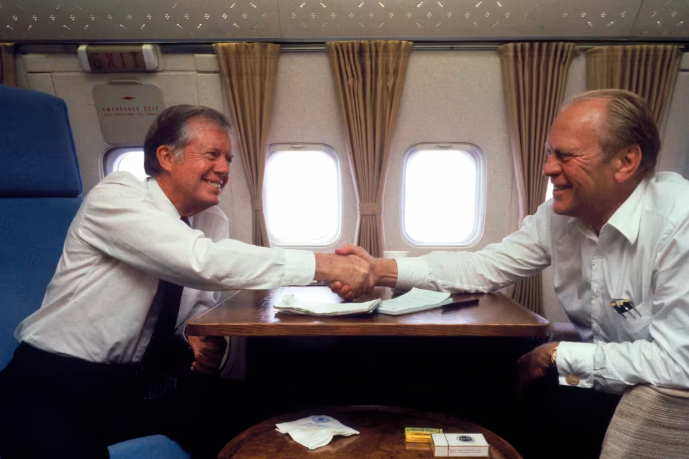
Jimmy Carter and Gerald Ford on Air Force One in 1981. Dirck Halstead / Getty Images

Source: https://www.msnbc.com/top-stories/latest/r...

Enjoyed this speech? Speakola is a labour of love and I’d be very grateful if you would share, tweet or like it. Thank you.

Facebook Twitter Facebook
In PUBLIC FIGURE D Tags JIMMY CARTER, STEVE FORD, GERARD FORD, PRESIDENT, PRESIDENTS
Comment

for Richard Nixon: 'He never gave up being part of the action and passion of his times' by Bill Clinton -

July 26, 2017

27 April 1994, Nixon Library, Washington DC, USA

President Nixon opened his memoirs with a simple sentence: "I was born in a house my father built." Today we can look back at this little house and still imagine a young boy sitting by the window of the attic he shared with his three brothers, looking out to a world he could then himself only imagine. From those humble roots, as from so many humble beginnings in this country, grew the force of a driving dream. A dream that led to the remarkable journey that ends here today, where it all began beside the same tiny home, mail-ordered from back East, near this towering pepper tree, which back then was a mere seedling.

President Nixon's journey across the American landscapes mirrored that of his entire nation in this remarkable century. His life was bound up with the striving of our whole people, with our crises and our triumphs.

When he became President, he took on challenges here at home on matters from cancer research to environmental protection, putting the power of the Federal Government where Republicans and Democrats had neglected to put it in the past, and in foreign policy. He came to the Presidency at a time in our history when Americans were tempted to say we had had enough of the world. Instead, he knew we had to reach out to old friends and old enemies alike. He would not allow America to quit the world.

Remarkably, he wrote nine of his ten books after he left the Presidency, working his way back into the arena he so loved by writing and thinking and engaging us in his dialogue. For the past year, even in the final weeks of his life, he gave me his wise counsel, especially with regard to Russia. One thing in particular left a profound impression on me. Though this man was in his ninth decade, he had an incredibly sharp and vigorous and rigorous mind. As a public man, he always seemed to believe the greatest sin was remaining passive in the face of challenges, and he never stopped living by that creed. He gave of himself with intelligence and energy and devotion to duty, and his entire country owes him a debt of gratitude for that service.

Oh, yes, he knew great controversy amid defeat as well as victory. He made mistakes, and they, like his accomplishments, are a part of his life and record. But the enduring lesson of Richard Nixon is that he never gave up being part of the action and passion of his times. He said many times that unless a person has a goal, a new mountain to climb, his spirit will die. Well, based on our last phone conversation and the letter he wrote me just a month ago, I can say that his spirit was very much alive to the very end.

That is a great tribute to him, to his wonderful wife, Pat, to his children and to his grandchildren, whose love he so depended on and whose love he returned in full measure. Today is a day for his family, his friends, and his nation to remember President Nixon's life in totality. To them, let us say: may the day of judging President Nixon on anything less than his entire life and career come to a close.

May we heed his call to maintain the will and the wisdom to build on America's greatest gift, its freedom, and to lead a world full of difficulty to the just and lasting peace he dreamed of.

As it is written in the words of a hymn I heard in my church last Sunday, "Grant that I may realize that the trifling of life creates differences, but that in the higher things we are all one." In the twilight of his life, President Nixon knew that lesson well. It is, I feel, certainly a fate he would want us all to keep.

And so, on behalf of all four former Presidents who are here - President Ford, President Carter, President Reagan, President Bush - and on behalf of a grateful nation, we bid farewell to Richard Milhous Nixon.

Source: http://www.eulogyspeech.net/famous-eulogie...

Enjoyed this speech? Speakola is a labour of love and I’d be very grateful if you would share, tweet or like it. Thank you.

Facebook Twitter Facebook
In PUBLIC FIGURE B Tags BILL CLINTON, RICHARD NIXON, TRANSCRIPT, PRESIDENTS, USA
Comment

for Martin McGuinness: 'He risked the rejection of his comrades and the wrath of his adversaries', by Bill Clinton - 2017

March 25, 2017

23 March 2017, St Columba's Church, Derry, Northern Ireland

Bernie, Grainne, Fionnuala, Fiachra, Emmett: members of the McGuinness family, honoured clergy, President Higgins, Taoiseach, Gerry, former Prime Minister Ahern, former President McAleese, First Minister Foster, thank you for being here, to John Hume, Peter Robinson, and all who were part of the amazing unfolding of Martin McGuinness's life.

I was thinking about it: after all the breath he expended cursing the British over the years, he worked with two Prime Ministers and shook hands with the Queen, four Taoiseachs, navigating the complex politics of the North.

As an American, I have to say a special word of appreciation to the sitting Taoiseach for what he said in the United States on St Patrick Day on behalf of the Irish immigrants.

As someone who spent sleepless nights in the beginning of the ceasefires and dealing with the aftermath of them and the Good Friday accord, I want to say a special word of appreciation to First Minister Foster for being here, because I know, and most people in this church know, that your life has been marked in painful ways by the Troubles. And I believe the only way a lasting peace can take hold and endure is if those who have legitimate griefs on both sides embrace the future together.

I learned this from Nelson Mandela who was a great friend of mine, who called me one day complaining as the president of South Africa that he was getting so much criticism. I said, "from the Afrikaners?". He said "no, from my people. They think I've sold them out." After all, he won 63% of the vote, it's inconceivable in a western democracy to do such a thing now. And I said, "what did you tell them?" and he said "I spent 27 years in jail, and they took all my best years away and i didn't see my children grow up and it ruined my marriage, and a lot of my friends were killed and if i can get over it, you can too. We've got to build a future."

Now, I want to say something about Martin McGuinness. I came to treasure every encounter. I liked him. They asked me to speak for three minutes, he could do this in 30 seconds. I can just hear him now: "Here's my eulogy: I fought, I made peace, I made politics, I had a fabulous family that somehow stayed with me and endured it all. I had friends (I was married to Gerry almost as long as I was married to Bernie). It turned out I was pretty good at all this and we got a lot done - but we didn't finish, and if you really want to honour my legacy, go make your own, and finish the work of peace so we can all have a future together."

He was only four years younger than me. He grew up at a time of rage and resentment; not only in Ireland, but across the world. And it was pronounced here: one of seven children in a Bogside family without an indoor toilet. (That's a great political story, I'm the last American president to ever live in a house without an indoor toilet and it's very much overrated except for its political value.) He was part of the rage of his time, he hated the discrimination and he decided to oppose it by whatever means available to the passionate young, including violence.

Somewhere along the way, for whatever reason, he decided to give peace a chance. Some of the reasons were principled, some were practical, but he decided. He was good about sticking at something he decided to do, and he succeeded because his word was good, his listening skills were good, he was not afraid to make a compromise, and he was strong enough to keep it if he made it.

And finally, he realised that he could have an Ireland that was free, independent and self governing, and still inclusive. That the dreams of little children were no more or less legitimate, just because of their faith background, or their families' history, or the sins of their parents. In American law, there is a phrase that comes from the 18th century, called "corruption of the blood", that the sins of the parents used to be visited on their children, and their grandchildren, and their great grandchildren, and we specifically prohibited that; easy to say, hard to do. He was trying to do it.

Most of the publicity Martin got as a politician was the very absurd notion that he actually got along with Ian Paisley. I thought it great that he got a word in edgeways, I never could! But the thing I think he was proudest of that I loved to listen to him talk about, and we talked about it again three years ago this month when we walked across the bridge here with John Hume, was when he became education minister in the transitional government. His first budget recommended a more than generous allocation in aid to the poorest schools in the protestant neighbourhoods, because he thought those children would be just as a crippled by ignorance as catholic children would, and that the only way out of poverty, and the only way to give people the emotional space to live together, work together, and share the future together, is if they could have the dignity of a decent job, and the empowerment of knowing they can take care of their families and give something more to their children. I could tell he was proud as punch with himself. Normally it's not a good thing to be proud of yourself but I think if there's a secret category of things you can be proud of, taking care of the children of people with whom you had been at odds is surely on that small list."

So that's what he did, he persevered, and he prevailed. He risked the rejection of his comrades and the wrath of his adversaries. He made honourable compromises and was strong enough to keep them, and came to be trusted because his word was good. And he never stopped being who he was; a good husband, a good father, a faithful follower of the faith of his father and mother, and a passionate believer in a free, secure, self-governing Ireland. The only thing that happened was: he expanded the definition of "us" and shrank the definition of "them".

The world in every period of insecurity faces a new wave of tribalism. If you really came here to celebrate his life, and to honour the contribution of the last chapter of it, you have to finish his work, a great son of Derry. Our friend Seamus Heaney in his Nobel prize speech, said that the secret of his success was "deciding to walk on air against your better judgement". Believe me; when the people who made this peace did it, every single one of them decided to take a flying leap into the unknown against their better judgement. It's about the only thing aside from your faith and your love which makes life worth living.

Our friend earned this vast crowd today. Even more; he earned the right to ask us to honour his legacy by our living. To finish the work that is there to be done.

God bless you.

Source: https://www.reddit.com/r/northernireland/c...

Enjoyed this speech? Speakola is a labour of love and I’d be very grateful if you would share, tweet or like it. Thank you.

Facebook Twitter Facebook
In PUBLIC FIGURE B Tags MARTIN MCGUINNESS, DERRY, EULOGY, BILL CLINTON, PRESIDENTS, NORTHERN IRELAND, IRELAND, THE TROUBLES
Comment

Roosevelt Presidential Library

For Franklin D Roosevelt: 'He had brought his country through the worst of its perils', by Winston Churchill - 1945

October 12, 2015

17 April, 1945, House of Commons, Westminster, United Kingdom

I beg to move:

That an humble Address be presented to His Majesty to convey to His Majesty the deep sorrow with which this House has learned of the death of the President of the United States of America and to pray His Majesty that in communicating his own sentiments of grief to the United States Government, he will also be graciously pleased to express on the part of this House their sense of the loss which the British Commonwealth and Empire and the cause of the Allied Nations have sustained, and their profound sympathy with Mrs. Roosevelt and the late President's family and with the Government and people of the United States of America.

My friendship with the great man to whose work and fame we pay our tribute to-day began and ripened during this war. I had met him, but only for a few minutes, after the close of the last war and as soon as I went to the Admiralty in September, 1939, he telegraphed, inviting me to correspond with him direct on naval or other matters if at any time I felt inclined. Having obtained the permission of the Prime Minister, I did so. Knowing President Roosevelt's keen interest in sea warfare, I furnished him with a stream of information about our naval affairs and about the various actions, including especially the action of the Plate River, which lighted the first gloomy winter of the war.

When I became Prime Minister, and the war broke out in all its hideous fury, when our own life and survival hung in the balance, I was already in a position to telegraph to the President on terms of an association which had become most intimate and, to me, most agreeable. This continued through all the ups and downs of the world struggle until Thursday last, when I received my last messages from him. These messages showed no falling off in his accustomed clear vision and vigour upon perplexing and complicated matters. I may mention that this correspondence which, of course, was greatly increased after the United States entry into the war, comprises, to and fro between us, over 1,700 messages. Many of these were lengthy messages and the majority dealt with those more difficult points which come to be discussed upon the level of heads of Governments only after official solutions had not been reached at other stages. To this correspondence there must be added our nine meetings at Argentia, three in Washington, at Casablanca, at Teheran, two at Quebec and, last of all, at Yalta, comprising in all about 120 days of close personal contact, during a great part of which I stayed with him at the White House or at his home at Hyde Park or in his retreat in the Blue Mountains, which he called Shangri-La.

I conceived an admiration for him as a statesman, a man of affairs, and a war leader. I felt the utmost confidence in his upright, inspiring character and outlook and a personal regard-affection I must say-for him beyond my power to express to-day. His love of his own country, his respect for its constitution, his power of gauging the tides and currents of its mobile public opinion, were always evident, but, added to these, were the beatings of that generous heart which was always stirred to anger and to action by spectacles of aggression and oppression by the strong against the weak. It is, indeed, a loss, a bitter loss to humanity that those heart-beats are stilled for ever. President Roosevelt's physical affliction lay heavily upon him. It was a marvel that he bore up against it through all the many years of tumult-and storm. Not one man in ten millions, stricken and crippled as he was, would have attempted to plunge into a life of physical and mental exertion and of hard, ceaseless political controversy. Not one in ten millions would have tried, not one in a generation would have succeeded, not only in entering this sphere, not only in acting vehemently in it, but in becoming indisputable master of the scene. In this extraordinary effort of the spirit over the flesh, the will-power over physical infirmity, he was inspired and sustained by that noble woman his devoted wife, whose high ideals marched with his own, and to whom the deep and respectful sympathy of the House of Commons flows out to-day in all fullness. There is no doubt that the President foresaw the great dangers closing in upon the pre-war world with far more prescience than most well-informed people on either side of the Atlantic, and that he urged forward with all his power such precautionary military preparations as peace-time opinion in the United States could be brought to accept. There never was a moment's doubt, as the quarrel opened, upon which side his sympathies lay.

The fall of France, and what seemed to most people outside this Island, the impending destruction of Great Britain, were to him an agony, although he never lost faith in us. They were an agony to him not only on account of Europe, but because of the serious perils to which the United States herself would have been exposed had we been overwhelmed or the survivors cast down under the German yoke. The bearing of the British nation at that time of stress, when we were all alone, filled him and vast numbers of his countrymen with the warmest sentiments towards our people. He and they felt the blitz of the stern winter of 1940~1, when Hitler set himself to rub out the cities of our country, as much as any of us did, and perhaps more indeed, for imagination is often more torturing than reality. There is no doubt that the bearing of the British and, above all, of the Londoners kindled fires in American bosoms far harder to quench than the conflagrations from which we were suffering. There was also at that time, in spite of General Wavell's victories-all the more, indeed, because of the reinforcements which were sent from this country to him-the apprehension widespread in the United States that we should be invaded by Germany after the fullest preparation in the spring of 1941. It was in February that the President sent to England the late Mr. Wendell Willkie, who, although a political rival and an opposing candidate, felt, as he did on many important points. Mr. Willkie brought a letter from Mr. Roosevelt, which the President had written in his own hand, and this letter contained the famous lines of Longfellow:

". . . Sail on, O ship of State!
Sail on O Union, strong and great!
Humanity with all its fears,
With all the hopes of future years,
Is hanging breathless on thy fate!"

At about that same time he devised the extraordinary measure of assistance called Lend-Lease, which will stand forth as the most unselfish and unsordid financial act of any country in all history. The effect of this was greatly to increase British fighting power and for all the purposes of the war effort to make us, as it were, a much more numerous community. In that autumn I met the President for the first time during the war at Argentia in Newfoundland and together we drew up the Declaration which has since been called the Atlantic Charter and which will, I trust, long remain a guide for both our peoples and for other peoples of the world.

All this time, in deep and dark and deadly secrecy, the Japanese were preparing their act of treachery and greed. When next we met in Washington Japan, Germany and Italy had declared war upon the United States and both our countries were in arms, shoulder to shoulder. Since then we have advanced over the land and over the sea through many difficulties and disappointments, but always with a broadening measure of success. I need not dwell upon the series of great operations which have taken place in the Western Hemisphere, to say nothing of that other immense war proceeding at the other side of the world. Nor need I speak of the plans which we made with our great Ally, Russia, at Teheran, for these have now been carried out for all the world to see.

But at Yalta I noticed that the President was ailing. His captivating smile, his gay and charming manner, had not deserted him but his face had a transparency, an air of purification, and often there was a faraway look in his eyes. When I took my leave of him in Alexandria harbour I must confess that I had an indefinable sense of fear that his health and his strength were on the ebb. But nothing altered his inflexible sense of duty. To the end he faced his innumerable tasks unflinching. One of the tasks of the President is to sign maybe a hundred or two hundred State papers with his own hand every day, commissions and so forth. All this he continued to carry out with the utmost strictness. When death came suddenly upon him "he had finished his mail." That portion of his day's work was done. As the saying goes, he died in harness and we may well say in battle harness, like his soldiers, sailors and airmen, who side by side with ours, are carrying on their task to the end all over the world. What an enviable death was his. He had brought his country through the worst of its perils and the heaviest of its toils. Victory had cast its sure and steady beam upon him. He had broadened and stabilised in the days of peace the foundations of American life and union.

In war he had raised the strength, might and glory of the great Republic to a height never attained by any nation in history. With her left hand she was leading the advance of the conquering Allied Armies into the heart of Germany and with her right, on the other side of the globe, she was irresistibly and swiftly breaking up the power of Japan. And all the time ships, munitions, supplies, and food of every kind were aiding on a gigantic scale her Allies, great and small, in the course of the long struggle.

But all this was no more than worldly power and grandeur, had it not been that the causes of human freedom and of social justice to which so much of his life had been given, added a lustre to all this power and pomp and warlike might, a lustre which will long be discernible among men. He has left behind him a band of resolute and able men handling the numerous interrelated parts of the vast American war machine. He has left a successor who comes forward with firm step and sure conviction to carry on the task to its appointed end. For us. it remains only to say that in Franklin Roosevelt there died the greatest American friend we have ever known and the greatest champion of freedom who has ever brought help and comfort from the new world to the old.

Question put, and agreed to, nemine contradicente.

Resolved:That an humble Address be presented to His Majesty to convey to His Majesty the deep sorrow with which this House has learned of the death of the President of the United States of America and to pray His Majesty that in communicating his own sentiments of grief to the United States Government, he will also be graciously pleased to express on the part of this House their sense of the loss which the British Commonwealth and Empire and the cause of the Allied Nations have sustained, and their profound sympathy with Mrs. Roosevelt and the late President's family and with the Government and people of the United States of America.

Source: http://www.ibiblio.org/pha/policy/1945/194...

Enjoyed this speech? Speakola is a labour of love and I’d be very grateful if you would share, tweet or like it. Thank you.

Facebook Twitter Facebook
In EDITORS CHOICE Tags FDR, FRANKLIN ROOSEVELT, PRESIDENTS, USA, WINSTON CHURCHILL, PARLIAMENT
Comment

Space Shuttle Challenger Crew: 'We've never had a tragedy like this', Ronald Reagan - 1986

July 2, 2015

28 January, 1986, Oval Office, Washington DC

Ladies and gentlemen, I'd planned to speak to you tonight to report on the state of the Union, but the events of earlier today have led me to change those plans. Today is a day for mourning and remembering.

Nancy and I are pained to the core by the tragedy of the shuttle Challenger. We know we share this pain with all of the people of our country. This is truly a national loss.

Nineteen years ago, almost to the day, we lost three astronauts in a terrible accident on the ground. But we've never lost an astronaut in flight; we've never had a tragedy like this. And perhaps we've forgotten the courage it took for the crew of the shuttle; but they, the Challenger Seven, were aware of the dangers, but overcame them and did their jobs brilliantly. We mourn seven heroes: Michael Smith, Dick Scobee, Judith Resnik, Ronald McNair, Ellison Onizuka, Gregory Jarvis, and Christa McAuliffe. We mourn their loss as a nation together.

For the families of the seven, we cannot bear, as you do, the full impact of this tragedy. But we feel the loss, and we're thinking about you so very much. Your loved ones were daring and brave, and they had that special grace, that special spirit that says, "Give me a challenge and I'll meet it with joy." They had a hunger to explore the universe and discover its truths. They wished to serve, and they did. They served all of us.

We've grown used to wonders in this century. It's hard to dazzle us. But for 25 years the United States space program has been doing just that. We've grown used to the idea of space, and perhaps we forget that we've only just begun. We're still pioneers. They, the members of the Challenger crew, were pioneers.

And I want to say something to the schoolchildren of America who were watching the live coverage of the shuttle's takeoff. I know it is hard to understand, but sometimes painful things like this happen. It's all part of the process of exploration and discovery. It's all part of taking a chance and expanding man's horizons. The future doesn't belong to the fainthearted; it belongs to the brave. The Challenger crew was pulling us into the future, and we'll continue to follow them.

I've always had great faith in and respect for our space program, and what happened today does nothing to diminish it. We don't hide our space program. We don't keep secrets and cover things up. We do it all up front and in public. That's the way freedom is, and we wouldn't change it for a minute.

We'll continue our quest in space. There will be more shuttle flights and more shuttle crews and, yes, more volunteers, more civilians, more teachers in space. Nothing ends here; our hopes and our journeys continue.

I want to add that I wish I could talk to every man and woman who works for NASA or who worked on this mission and tell them: "Your dedication and professionalism have moved and impressed us for decades. And we know of your anguish. We share it."

There's a coincidence today. On this day 390 years ago, the great explorer Sir Francis Drake died aboard ship off the coast of Panama. In his lifetime the great frontiers were the oceans, and an historian later said, "He lived by the sea, died on it, and was buried in it." Well, today we can say of the Challenger crew: Their dedication was, like Drake's, complete.

The crew of the space shuttle Challenger honored us by the manner in which they lived their lives. We will never forget them, nor the last time we saw them, this morning, as they prepared for their journey and waved goodbye and "slipped the surly bonds of earth" to "touch the face of God.

Source: http://history.nasa.gov/reagan12886.html

Enjoyed this speech? Speakola is a labour of love and I’d be very grateful if you would share, tweet or like it. Thank you.

Facebook Twitter Facebook
In EDITORS CHOICE Tags PRESIDENTS, RONALD REAGAN, SPACE SHUTTLE, USA, CHALLENGER, NASA
Comment

Olklahoma Bombing Memorial: 'Our words seem small beside the loss you have endured', Bill Clinton - 1995

June 30, 2015

23 April, 1995, Olklahoma City, OK, USA

Thank you very much, Governor Keating and Mrs. Keating, Reverend Graham, to the families of those who have been lost and wounded, to the people of Oklahoma City, who have endured so much, and the people of this wonderful state, to all of you who are here as our fellow Americans.

I am honored to be here today to represent the American people. But I have to tell you that Hillary and I also come as parents, as husband and wife, as people who were your neighbors for some of the best years of our lives.

Today our nation joins with you in grief. We mourn with you. We share your hope against hope that some may still survive. We thank all those who have worked so heroically to save lives and to solve this crime -- those here in Oklahoma and those who are all across this great land, and many who left their own lives to come here to work hand in hand with you. We pledge to do all we can to help you heal the injured, to rebuild this city, and to bring to justice those who did this evil.

This terrible sin took the lives of our American family, innocent children in that building, only because their parents were trying to be good parents as well as good workers; citizens in the building going about their daily business; and many there who served the rest of us -- who worked to help the elderly and the disabled, who worked to support our farmers and our veterans, who worked to enforce our laws and to protect us. Let us say clearly, they served us well, and we are grateful.

But for so many of you they were also neighbors and friends. You saw them at church or the PTA meetings, at the civic clubs, at the ball park. You know them in ways that all the rest of America could not. And to all the members of the families here present who have suffered loss, though we share your grief, your pain is unimaginable, and we know that. We cannot undo it. That is God's work.

Our words seem small beside the loss you have endured. But I found a few I wanted to share today. I've received a lot of letters in these last terrible days. One stood out because it came from a young widow and a mother of three whose own husband was murdered with over 200 other Americans when Pan Am 103 was shot down. Here is what that woman said I should say to you today:

The anger you feel is valid, but you must not allow yourselves to be consumed by it. The hurt you feel must not be allowed to turn into hate, but instead into the search for justice. The loss you feel must not paralyze your own lives. Instead, you must try to pay tribute to your loved ones by continuing to do all the things they left undone, thus ensuring they did not die in vain.

Wise words from one who also knows.

You have lost too much, but you have not lost everything. And you have certainly not lost America, for we will stand with you for as many tomorrows as it takes.

If ever we needed evidence of that, I could only recall the words of Governor and Mrs. Keating:

If anybody thinks that Americans are mostly mean and selfish, they ought to come to Oklahoma. If anybody thinks Americans have lost the capacity for love and caring and courage, they ought to come to Oklahoma.

To all my fellow Americans beyond this hall, I say, one thing we owe those who have sacrificed is the duty to purge ourselves of the dark forces which gave rise to this evil. They are forces that threaten our common peace, our freedom, our way of life. Let us teach our children that the God of comfort is also the God of righteousness: Those who trouble their own house will inherit the wind.1 Justice will prevail.

Let us let our own children know that we will stand against the forces of fear. When there is talk of hatred, let us stand up and talk against it. When there is talk of violence, let us stand up and talk against it. In the face of death, let us honor life. As St. Paul admonished us, Let us "not be overcome by evil, but overcome evil with good."2

Yesterday, Hillary and I had the privilege of speaking with some children of other federal employees -- children like those who were lost here. And one little girl said something we will never forget. She said, "We should all plant a tree in memory of the children." So this morning before we got on the plane to come here, at the White House, we planted that tree in honor of the children of Oklahoma. It was a dogwood with its wonderful spring flower and its deep, enduring roots. It embodies the lesson of the Psalms -- that the life of a good person is like a tree whose leaf does not wither.³

My fellow Americans, a tree takes a long time to grow, and wounds take a long time to heal. But we must begin. Those who are lost now belong to God. Some day we will be with them. But until that happens, their legacy must be our lives.

Thank you all, and God bless you.

Source: http://www.americanrhetoric.com/speeches/w...

Enjoyed this speech? Speakola is a labour of love and I’d be very grateful if you would share, tweet or like it. Thank you.

Facebook Twitter Facebook
In EDITORS CHOICE Tags PRESIDENTS, MEMORIAL, TERRORISM
Comment

For Ronald Reagan: 'We have lost a great president, a great American, and a great man', Margaret Thatcher - 2004

May 13, 2015

11 June 2004, Washington National Cathedral, Washington DC, USA

By video link

We have lost a great president, a great American, and a great man. And I have lost a dear friend.

In his lifetime Ronald Reagan was such a cheerful and invigorating presence that it was easy to forget what daunting historic tasks he set himself. He sought to mend America's wounded spirit, to restore the strength of the free world, and to free the slaves of communism.

These were causes hard to accomplish and heavy with risk.

Yet they were pursued with almost a lightness of spirit. For Ronald Reagan also embodied another great cause - what Arnold Bennett once called 'the great cause of cheering us all up'.

His politics had a freshness and optimism that won converts from every class and every nation - and ultimately from the very heart of the evil empire.

Yet his humour often had a purpose beyond humour. In the terrible hours after the attempt on his life, his easy jokes gave reassurance to an anxious world.

They were evidence that in the aftermath of terror and in the midst of hysteria, one great heart at least remained sane and jocular. They were truly grace under pressure.

And perhaps they signified grace of a deeper kind. Ronnie himself certainly believed that he had been given back his life for a purpose.

As he told a priest after his recovery 'Whatever time I've got left now belongs to the Big Fella Upstairs'.

And surely it is hard to deny that Ronald Reagan's life was providential, when we look at what he achieved in the eight years that followed.

Others prophesied the decline of the West; he inspired America and its allies with renewed faith in their mission of freedom.

Others saw only limits to growth; he transformed a stagnant economy into an engine of opportunity.

Others hoped, at best, for an uneasy cohabitation with the Soviet Union; he won the Cold War - not only without firing a shot, but also by inviting enemies out of their fortress and turning them into friends.

When his enemies tested American resolve, they soon discovered that his resolve was firm and unyielding

I cannot imagine how any diplomat, or any dramatist, could improve on his words to Mikhail Gorbachev at the Geneva summit: 'Let me tell you why it is we distrust you.'

Those words are candid and tough and they cannot have been easy to hear. But they are also a clear invitation to a new beginning and a new relationship that would be rooted in trust.

We live today in the world that Ronald Reagan began to reshape with those words. It is a very different world with different challenges and new dangers.

All in all, however, it is one of greater freedom and prosperity, one more hopeful than the world he inherited on becoming president.

As prime minister, I worked closely with Ronald Reagan for eight of the most important years of all our lives. We talked regularly both before and after his presidency. And I have had time and cause to reflect on what made him a great president.

Ronald Reagan knew his own mind. He had firm principles - and, I believe, right ones. He expounded them clearly, he acted upon them decisively.

When the world threw problems at the White House, he was not baffled, or disorientated, or overwhelmed. He knew almost instinctively what to do.

When his aides were preparing option papers for his decision, they were able to cut out entire rafts of proposals that they knew 'the Old Man' would never wear.

When his allies came under Soviet or domestic pressure, they could look confidently to Washington for firm leadership.

And when his enemies tested American resolve, they soon discovered that his resolve was firm and unyielding.

Yet his ideas, though clear, were never simplistic. He saw the many sides of truth.

Yes, he warned that the Soviet Union had an insatiable drive for military power and territorial expansion; but he also sensed it was being eaten away by systemic failures impossible to reform.

Yes, he did not shrink from denouncing Moscow's 'evil empire'. But he realised that a man of goodwill might nonetheless emerge from within its dark corridors.

So the President resisted Soviet expansion and pressed down on Soviet weakness at every point until the day came when communism began to collapse beneath the combined weight of these pressures and its own failures.

And when a man of goodwill did emerge from the ruins, President Reagan stepped forward to shake his hand and to offer sincere cooperation.

Nothing was more typical of Ronald Reagan than that large-hearted magnanimity - and nothing was more American.

Therein lies perhaps the final explanation of his achievements.

Ronald Reagan carried the American people with him in his great endeavours because there was perfect sympathy between them. He and they loved America and what it stands for - freedom and opportunity for ordinary people.

As an actor in Hollywood's golden age, he helped to make the American dream live for millions all over the globe. His own life was a fulfilment of that dream.

He never succumbed to the embarrassment some people feel about an honest expression of love of country.

He was able to say 'God Bless America' with equal fervour in public and in private. And so he was able to call confidently upon his fellow-countrymen to make sacrifices for America - and to make sacrifices for those who looked to America for hope and rescue.

With the lever of American patriotism, he lifted up the world.

And so today the world - in Prague, in Budapest, in Warsaw, in Sofia, in Bucharest, in Kiev and in Moscow itself - the world mourns the passing of the Great Liberator and echoes his prayer 'God Bless America'.

Ronald Reagan's life was rich not only in public achievement, but also in private happiness.

Indeed, his public achievements were rooted in his private happiness. The great turning point of his life was his meeting and marriage with Nancy.

On that we have the plain testimony of a loving and grateful husband: 'Nancy came along and saved my soul.' We share her grief today. But we also share her pride - and the grief and pride of Ronnie's children.

For the final years of his life, Ronnie's mind was clouded by illness. That cloud has now lifted.

He is himself again - more himself than at any time on this earth. For we may be sure that the Big Fella Upstairs never forgets those who remember Him.

And as the last journey of this faithful pilgrim took him beyond the sunset, and as heaven's morning broke, I like to think - in the words of Bunyan - that 'all the trumpets sounded on the other side'.

We here still move in twilight. But we have one beacon to guide us that Ronald Reagan never had.

We have his example. Let us give thanks today for a life that achieved so much for all of God's children.

Enjoyed this speech? Speakola is a labour of love and I’d be very grateful if you would share, tweet or like it. Thank you.

Facebook Twitter Facebook
In PUBLIC FIGURE A Tags PRESIDENTS, USA, POLITICIAN
Comment

See my film!

Limited Australian Season

March 2025

Details and ticket bookings at

angeandtheboss.com

Support Speakola

Hi speech lovers,
With costs of hosting website and podcast, this labour of love has become a difficult financial proposition in recent times. If you can afford a donation, it will help Speakola survive and prosper.

Best wishes,
Tony Wilson.

Become a Patron!

Learn more about supporting Speakola.

Featured political

Featured
Jon Stewart: "They responded in five seconds", 9-11 first responders, Address to Congress - 2019
Jacinda Ardern: 'They were New Zealanders. They are us', Address to Parliament following Christchurch massacre - 2019
Dolores Ibárruri: "¡No Pasarán!, They shall not pass!', Defense of 2nd Spanish Republic - 1936
Jimmy Reid: 'A rat race is for rats. We're not rats', Rectorial address, Glasgow University - 1972

Featured eulogies

Featured
For Geoffrey Tozer: 'I have to say we all let him down', by Paul Keating - 2009
for James Baldwin: 'Jimmy. You crowned us', by Toni Morrison - 1988
for Michael Gordon: '13 days ago my Dad’s big, beautiful, generous heart suddenly stopped beating', by Scott and Sarah Gordon - 2018

Featured commencement

Featured
Tara Westover: 'Your avatar isn't real, it isn't terribly far from a lie', The Un-Instagrammable Self, Northeastern University - 2019
Tim Minchin: 'Being an artist requires massive reserves of self-belief', WAAPA - 2019
Atul Gawande: 'Curiosity and What Equality Really Means', UCLA Medical School - 2018
Abby Wambach: 'We are the wolves', Barnard College - 2018
Eric Idle: 'America is 300 million people all walking in the same direction, singing 'I Did It My Way'', Whitman College - 2013
Shirley Chisholm: ;America has gone to sleep', Greenfield High School - 1983

Featured sport

Featured
Joe Marler: 'Get back on the horse', Harlequins v Bath pre game interview - 2019
Ray Lewis : 'The greatest pain of my life is the reason I'm standing here today', 52 Cards -
Mel Jones: 'If she was Bradman on the field, she was definitely Keith Miller off the field', Betty Wilson's induction into Australian Cricket Hall of Fame - 2017
Jeff Thomson: 'It’s all those people that help you as kids', Hall of Fame - 2016

Fresh Tweets


Featured weddings

Featured
Dan Angelucci: 'The Best (Best Man) Speech of all time', for Don and Katherine - 2019
Hallerman Sisters: 'Oh sister now we have to let you gooooo!' for Caitlin & Johnny - 2015
Korey Soderman (via Kyle): 'All our lives I have used my voice to help Korey express his thoughts, so today, like always, I will be my brother’s voice' for Kyle and Jess - 2014

Featured Arts

Featured
Bruce Springsteen: 'They're keepers of some of the most beautiful sonic architecture in rock and roll', Induction U2 into Rock Hall of Fame - 2005
Olivia Colman: 'Done that bit. I think I have done that bit', BAFTA acceptance, Leading Actress - 2019
Axel Scheffler: 'The book wasn't called 'No Room on the Broom!', Illustrator of the Year, British Book Awards - 2018
Tina Fey: 'Only in comedy is an obedient white girl from the suburbs a diversity candidate', Kennedy Center Mark Twain Award -  2010
Tina Fey: 'Only in comedy is an obedient white girl from the suburbs a diversity candidate', Kennedy Center Mark Twain Award - 2010

Featured Debates

Featured
Sacha Baron Cohen: 'Just think what Goebbels might have done with Facebook', Anti Defamation League Leadership Award - 2019
Greta Thunberg: 'How dare you', UN Climate Action Summit - 2019
Charlie Munger: 'The Psychology of Human Misjudgment', Harvard University - 1995
Lawrence O'Donnell: 'The original sin of this country is that we invaders shot and murdered our way across the land killing every Native American that we could', The Last Word, 'Dakota' - 2016