
• Genre
  • About
  • Submissions
  • Donate
  • Search
Menu

Speakola

All Speeches Great and Small
  • Genre
  • About
  • Submissions
  • Donate
  • Search

Eulogies

Some of the most moving and brilliant speeches ever made occur at funerals. Please upload the eulogy for your loved one using the form below.

For Jimmy Carter: 'I’m looking forward to our reunion', by Steve Ford (written by President Gerard Ford) - 2025

September 10, 2025

9 January 2025, Washington National Cathedral, Washington DC, USA

Now, Dad was thrilled to agree. After that call, as you can imagine, both of them got off the phone, had a pretty good chuckle, considering which one of them would return in person to deliver that second eulogy. As you know, Dad died in 2006 and President Carter’s eulogy continues to bring comfort, smile, laughter, joy, pride to our family. And thus, on behalf of my dad, it’s an honor to share Dad’s eulogy to his old friend.

I can just see my dad getting his yellow legal pad out with his pen and writing this for his beloved friend. — Steve Ford

By fate of a brief season, Jimmy Carter and I were rivals. But for the many wonderful years that followed, friendship bonded us as no two presidents since John Adams and Thomas Jefferson. It is said that President Adams’ last words were “Thomas Jefferson still survives.” Now since Jimmy has a good decade on me, I’m hedging my bets by entrusting my remembrances of Jimmy to my son Steve.

According to a map, it’s a long way between Grand Rapids, Michigan, and Plains, Georgia. But distances have a way of vanishing when measured in values, rather than miles, and it was because of our shared values that Jimmy and I respected each other as adversaries, even before we cherished one another as dear friends.

Now this is not to say that Jimmy never got under my skin — but has there ever been a group of politicians that didn’t do that to one another? During our 1976 contest, Jimmy knew my political vulnerabilities, and he successfully pointed them out. Now I didn’t like it, but little could I know that the outcome of that 1976 election would bring about one of my deepest and most enduring friendships.

In the summer of 1981, the two of us found ourselves together again, this time aboard Air Force One, bound for the funeral of the great peacemaker Anwar Sadat. There’s an old line to the effect that two presidents in a room is one too many. Frankly, I wondered how awkward that long flight might be to Cairo — and it was a long flight, but the return trip was not nearly long enough. For it was somewhere over the Atlantic that Jimmy and I forged a friendship that transcends politics.

We immediately decided to exercise one of the privileges of a former president, forgetting that either one of us had ever said any harsh words about the other one in the heat of battle. Then we got on to much more enjoyable subjects, discussing our families, our faith, and sharing our experiences and discovering that there is, indeed, life after the White House.

We commiserated over the high cost of building presidential libraries — and the even more regrettable fact that most of that fundraising for these otherwise admirable institutions fell to us personally. On the spot, we agreed to participate in programs at each other’s library, beginning with a series of conferences on arms control. And if that wasn’t newsworthy enough, we told reporters on the plane that a lasting Middle East peace would require the United States to make tough decisions, like confronting the Palestinian issue directly, thereby building on the work to which President Sadat had literally given his life. It was the first time, but by no means the last time, that our unlikely partnership ruffled feathers in the Washington establishment.

Jimmy Carter and Gerald Ford on Air Force One in 1981. Dirck Halstead / Getty Images

Now, honesty and truth-telling were synonymous with the name Jimmy Carter. Those traits were instilled in him by his loving parents, Lillian and Earl Carter, and the strength of his honesty was reinforced by his upbringing in the rural South, poised on the brink of social transformation. He displayed that honesty throughout his life as a naval officer, state legislator, governor, president and world leader.

For Jimmy Carter, honesty was not an aspirational goal; it was part of his very soul. Now I think Jimmy wrote more books than any former president. Once asked if he really enjoyed writing, he replied with that familiar twinkle in his eye: “It beats picking cotton.” But I think he enjoyed writing for another reason: As an author, he was under no pressure to tailor his opinions to some political constituency or potential contributor.

Now both of us had experienced the harsh reality that defeat at the polls can be painful. But we also came to know a more important consequence: Political defeat and writing can also be liberating, if it frees you to discuss topics that aren’t necessarily consistent with short-term political popularity.

Now Jimmy learned early on that it was not enough merely to bear witness in a pew on a Sunday morning. Inspired by his faith, he pursued brotherhood across boundaries of nationhood, across boundaries of tradition, across boundaries of caste. In America’s urban neighborhoods and in rural villages around the world, he reminded us that Christ had been a carpenter. And in Third World villages, he successfully campaigned — not for votes, but for the eradication of diseases that shamed the developed world as they ravaged the undeveloped one.

Now, of course, not all of Jimmy’s time was spent building houses, eradicating disease, brokering ceasefires, monitoring elections. While Jimmy is probably the only former president to conduct a weekly Bible class, I know for certain he is the only former president to perform a duet of “On the Road Again” with Willie Nelson. Georgia wasn’t just on Jimmy’s mind — it was in his blood. However far he traveled, he never forgot where he came home to or where, now, in the end, he would finally come home to.

Of the many things Jimmy and I had in common, the most important is this: We both married way above ourselves — way above. With Jimmy every step of the way was his first lady from Plains. In a life rich with blessings, none was greater for Jimmy than the love he shared with Rosalynn and the love the two of them shared with their children, grandchildren and great-grandchildren.

Like Jimmy, Rosalynn was — and is — a symbol of American compassion. Like no other first lady in our history, Rosalynn Carter is indeed a true citizen of the world. And she became a beloved friend to my wife, Betty, and me and to all the Ford family. While the Carter and Ford men were a decidedly mixed record when it came to lobbying Congress, Rosalynn and Betty were unbeatable in their advocacy for millions of people whom they brought out of the shadows of despair and shame.

Now is the time to say goodbye — our grief comforted with the joy and the thanksgiving of knowing this man, this beloved man, this very special man. He was given the gift of years, and the American people and the people of the world will be forever blessed by his decades of good works.

Jimmy Carter’s legacy of peace and compassion will remain unique as it is timeless. The entire Ford family, we extend our love to you, and we add our prayers to the prayers of tens of millions of people around the world. May God bless and watch over this good man. May he grant peace to the Carter family as they say goodbye to a man whose life was lived to the fullest, with a faith demonstrated in countless good works, with a mission richly fulfilled, and a soul rewarded with everlasting life.

As for myself, Jimmy, I’m looking forward to our reunion. We have much to catch up on.

Thank you, Mr. President. Welcome home, old friend.
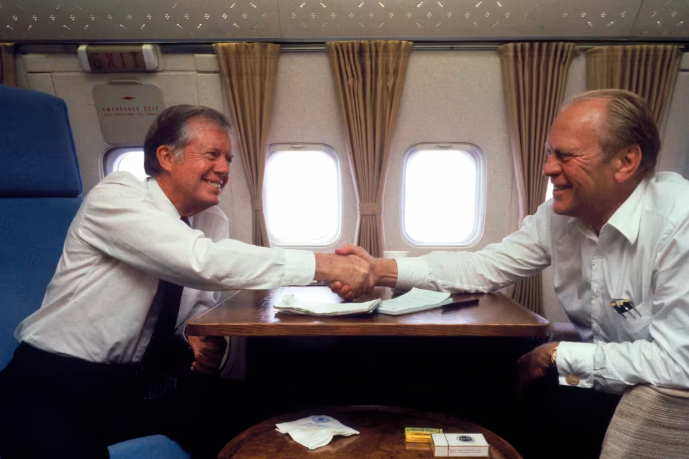
Jimmy Carter and Gerald Ford on Air Force One in 1981. Dirck Halstead / Getty Images
Source: https://www.msnbc.com/top-stories/latest/r...

Enjoyed this speech? Speakola is a labour of love and I’d be very grateful if you would share, tweet or like it. Thank you.

Facebook Twitter Facebook
In PUBLIC FIGURE D Tags JIMMY CARTER, STEVE FORD, GERARD FORD, PRESIDENT, PRESIDENTS
Comment

For John F Kennedy: 'He was vigorous and healthy and smiling and friendly', Senate memorial service, by Jacob Javits - 1963

January 30, 2023

November 1963, Washington DC, USA

Mr. President, hundreds of thousands of words have been published, and hundreds of thousands more have been spoken into the microphones of the world since John F. Kennedy was struck down in Dallas, but none of them were really adequate. Words never are in the face of senseless tragedy.

Words cannot describe how the American people felt when they lost their president. Not until the vacuum of disbelief was filled with the horror of comprehension did any of us realize how much we identified ourselves, even apart from personal friendship, with the president — this intellectual, vigorous young man — and he would have been that if he were eighty — expressing the very essence of the youthfulness of our nation. It seems of little consequence now that there were political differences, or objections to this or that legislative product, though as far as I am concerned there was a very large measure of agreement. What matters is that feeling of loss — that personal sense of emptiness — that all Americans feel because their president was cut off in the prime of life. As a nation, we have lost a president who understood the institution of the presidency, gloried in its overwhelming responsibilities, and discharged his duties with dash and joy, which were an inspiration to the youth of our nation.

But John F. Kennedy was more than that. He was a man filled with the joy of living. He was a husband, a father — and my friend.

For myself, I remember coming to Congress the dame day he did. We were sworn in together on the same January day in 1947. A photograph on my office wall shows that we two, returning veterans, looked a little uncomfortable at the moment in our civilian clothes. It shows us looking at the Taft-Ellender-Wagner housing bill, and it recalls the first job we did together when we called on the National Veterans Housing Conference of 1947, which we had organized, to back this bill. It was the beginning of an association which extended throughout our careers in the House and Senate. We collaborated in many bipartisan matters, as is not unusual in the Congress. Indeed, in our service together in the Senate Committee on Labor and Public Welfare, we worked closely — as did Senator Morse and others — on the minimum wage bill, the Labor-Management Disclosure Act, and other similar measures which were major aspects of Senator Kennedy’s legislative career.

I am a personal witness to the fact that he was resourceful, optimistic, and creative. He became and was my friend, and this is a deep source of gratification to me and to Mrs. Javits and our family.

Mrs. Javits, too, knew President Kennedy well and admired him greatly. She will, I know, always think of the president’s graciousness and the warmth of personal friendship which he exuded.

Only a week before his tragic passing, I saw him in the Oval Room at the White House when he accepted the report of the Advisory Committee on Medical Care for the Aged, in which Senator Anderson and I joined, and issued a statement offering encouragement and help.

He was vigorous and healthy and smiling and friendly — a complete human being, concerned about other human beings who were no longer as vigorous and not quite as healthy as they used to be.

This concern for the unfortunate by a many with all of the social graces and all the social status and as much power as America allows one man was what made him so much the symbol of the youth of our country. His wife, Jacqueline, who has given Americans so much reason to be very proud of her and of all American womanhood as she reflected in it, in these last mournful weeks, in the way she carried herself, has said the most beautiful tribute — that John F. Kennedy had the “hero idea of history,” and that she did not want people to forget John F. Kennedy — the man — and replace him with some shadowy figure in the history books.

She need not fear that. There are already thousands upon thousands of people in the world working to keep his memory alive. I have been privileged to join with many others in this body in cosponsoring a bill to rename the National Cultural Center and make it a living, vibrant memorial to this vibrant man who loved the arts. And with Senator Humphrey, I have joined in a bill establishing a commission to ensure that only the most appropriate memorials be created in his honor.

These are well-meaning, deeply sincere tokens — necessary, but still tokens. In reality it will be John F. Kennedy’s youthful freshness in his aspirations for our country that will keep his memory fresh.

In a real sense we, his former colleagues in the Congress, are the only ones with the power to write words which can transform these aspirations into memorials with meaning. We can write legislative acts, like a meaningful civil rights law, which would consecrate and perpetuate John F. Kennedy’s love for personal and national dignity. We can exorcise from our country — and the American people are doing that even now — those extremes of hatred and disbelief in public affairs which create a climate in which terrible acts become much more likely.

Acts such as these will be his final memorials. It is within our power to establish them. Perhaps his noblest memorial is that he would have wanted such memorials almost as no others.

So, in common with my colleagues in this solemn service — and that is what this is today — I bespeak for Mrs. Javits and my children — and I would place their names in the Record, so that as they read this Record when they grow up, I hope they will read their names in it and see that their father spoke with deep sympathy — Joy, Joshua, and Carla, to Mrs. Kennedy and the children, and to the president’s father and mother and his brothers and sisters and their families our deepest sympathy on this terrible bereavement, for our nation and for all mankind, and in the deep expectation that flowers will grow from his grave for the benefit of man.”

Source JFK Presidential Library


Source: https://www.funeralwise.com/plan/eulogy/JF...

Enjoyed this speech? Speakola is a labour of love and I’d be very grateful if you would share, tweet or like it. Thank you.

Facebook Twitter Facebook
In PUBLIC FIGURE D Tags JOHN F KENNEDY, PRESIDENT, ASSASSINATION, SENATE MEMORIAL, JACOB JAVITS, SENATOR JAVITS, TRANSCRIPT
Comment

for George H.W. Bush: 'Your decency, sincerity, and kind soul will stay with us forever', by son George W. Bush - 2018

February 3, 2021

6 December 2018, National Cathedral, Washington DC, USA

Distinguished Guests, including our Presidents and First Ladies, government officials, foreign dignitaries, and friends: Jeb, Neil, Marvin, Doro, and I, and our families, thank you all for being here.

I once heard it said of man that “The idea is to die young as late as possible.” (Laughter.)

At age 85, a favorite pastime of George H. W. Bush was firing up his boat, the Fidelity, and opening up the three-300 horsepower engines to fly – joyfully fly – across the Atlantic, with Secret Service boats straining to keep up.

At 90, George H. W. Bush parachuted out of an aircraft and landed on the grounds of St. Ann’s by the Sea in Kennebunkport, Maine – the church where his mom was married and where he’d worshipped often. Mother liked to say he chose the location just in case the chute didn’t open. (Laughter.)

In his 90’s, he took great delight when his closest pal, James A. Baker, smuggled a bottle of Grey Goose vodka into his hospital room. Apparently, it paired well with the steak Baker had delivered from Morton’s. (Laughter.)

To his very last days, Dad’s life was instructive. As he aged, he taught us how to grow old with dignity, humor, and kindness – and, when the Good Lord finally called, how to meet Him with courage and with joy in the promise of what lies ahead.
Advertisement

One reason Dad knew how to die young is that he almost did it – twice. When he was a teenager, a staph infection nearly took his life. A few years later he was alone in the Pacific on a life raft, praying that his rescuers would find him before the enemy did.

God answered those prayers. It turned out He had other plans for George H.W. Bush. For Dad’s part, I think those brushes with death made him cherish the gift of life. And he vowed to live every day to the fullest.

Dad was always busy – a man in constant motion – but never too busy to share his love of life with those around him. He taught us to love the outdoors. He loved watching dogs flush a covey. He loved landing the elusive striper. And once confined to a wheelchair, he seemed happiest sitting in his favorite perch on the back porch at Walker’s Point contemplating the majesty of the Atlantic. The horizons he saw were bright and hopeful. He was a genuinely optimistic man. And that optimism guided his children and made each of us believe that anything was possible.

He continually broadened his horizons with daring decisions. He was a patriot. After high school, he put college on hold and became a Navy fighter pilot as World War II broke out. Like many of his generation, he never talked about his service until his time as a public figure forced his hand. We learned of the attack on Chichi Jima, the mission completed, the shoot-down. We learned of the death of his crewmates, whom he thought about throughout his entire life. And we learned of his rescue.

And then, another audacious decision; he moved his young family from the comforts of the East Coast to Odessa, Texas. He and mom adjusted to their arid surroundings quickly. He was a tolerant man. After all, he was kind and neighborly to the women with whom he, mom and I shared a bathroom in our small duplex – even after he learned their profession – ladies of the night. (Laughter.)

Dad could relate to people from all walks of life. He was an empathetic man. He valued character over pedigree. And he was no cynic. He looked for the good in each person – and usually found it.

Dad taught us that public service is noble and necessary; that one can serve with integrity and hold true to the important values, like faith and family. He strongly believed that it was important to give back to the community and country in which one lived. He recognized that serving others enriched the giver’s soul. To us, his was the brightest of a thousand points of light.

In victory, he shared credit. When he lost, he shouldered the blame. He accepted that failure is part of living a full life, but taught us never to be defined by failure. He showed us how setbacks can strengthen.

None of his disappointments could compare with one of life’s greatest tragedies, the loss of a young child. Jeb and I were too young to remember the pain and agony he and mom felt when our three-year-old sister died. We only learned later that Dad, a man of quiet faith, prayed for her daily. He was sustained by the love of the Almighty and the real and enduring love of our mom. Dad always believed that one day he would hug his precious Robin again.

He loved to laugh, especially at himself. He could tease and needle, but never out of malice. He placed great value on a good joke. That’s why he chose Simpson to speak. (Laughter.) On email, he had a circle of friends with whom he shared or received the latest jokes. His grading system for the quality of the joke was classic George Bush. The rare 7s and 8s were considered huge winners – most of them off-color. (Laughter.)

George Bush knew how to be a true and loyal friend. He honored and nurtured his many friendships with his generous and giving soul. There exist thousands of handwritten notes encouraging, or sympathizing, or thanking his friends and acquaintances.

He had an enormous capacity to give of himself. Many a person would tell you that dad became a mentor and a father figure in their life. He listened and he consoled. He was their friend. I think of Don Rhodes, Taylor Blanton, Jim Nantz, Arnold Schwarzenegger, and perhaps the unlikeliest of all, the man who defeated him, Bill Clinton. My siblings and I refer to the guys in this group as “brothers from other mothers.” (Laughter.)

He taught us that a day was not meant to be wasted. He played golf at a legendary pace. I always wondered why he insisted on speed golf. He was a good golfer.

Well, here’s my conclusion: he played fast so that he could move on to the next event, to enjoy the rest of the day, to expend his enormous energy, to live it all. He was born with just two settings: full throttle, then sleep. (Laughter)

He taught us what it means to be a wonderful father, grandfather, and great grand-father. He was firm in his principles and supportive as we began to seek our own ways. He encouraged and comforted, but never steered. We tested his patience – I know I did (laughter) – but he always responded with the great gift of unconditional love.

Last Friday, when I was told he had minutes to live, I called him. The guy who answered the phone said, “I think he can hear you, but hasn’t say anything most of the day. I said, “Dad, I love you, and you’ve been a wonderful father.” And the last words he would ever say on earth were, “I love you, too.”

To us, he was close to perfect. But, not totally perfect. His short game was lousy. (Laughter.) He wasn’t exactly Fred Astaire on the dance floor. (Laughter.) The man couldn’t stomach vegetables, especially broccoli. (Laughter.) And by the way, he passed these genetic defects along to us. (Laughter.)

Finally, every day of his 73 years of marriage, Dad taught us all what it means to be a great husband. He married his sweetheart. He adored her. He laughed and cried with her. He was dedicated to her totally.

In his old age, dad enjoyed watching police show reruns, volume on high (laughter), all the while holding mom’s hand. After mom died, Dad was strong, but all he really wanted to do was to hold mom’s hand, again.

Of course, Dad taught me another special lesson. He showed me what it means to be a President who serves with integrity, leads with courage, and acts with love in his heart for the citizens of our country. When the history books are written, they will say that George H.W. Bush was a great President of the United States – a diplomat of unmatched skill, a Commander in Chief of formidable accomplishment, and a gentleman who executed the duties of his office with dignity and honor.

In his Inaugural Address, the 41st President of the United States said this: “We cannot hope only to leave our children a bigger car, a bigger bank account. We must hope to give them a sense of what it means to be a loyal friend, a loving parent, a citizen who leaves his home, his neighborhood and town better than he found it. What do we want the men and women who work with us to say when we are no longer there? That we were more driven to succeed than anyone around us? Or that we stopped to ask if a sick child had gotten better, and stayed a moment there to trade a word of friendship?”

Well, Dad – we’re going remember you for exactly that and so much more.

And we’re going to miss you. Your decency, sincerity, and kind soul will stay with us forever. So, through our tears, let us see the blessings of knowing and loving you – a great and noble man, and the best father a son or daughter could have.

And in our grief, let us smile knowing that Dad is hugging Robin and holding mom’s hand again.”

Source: https://www.theguardian.com/us-news/2018/d...

Enjoyed this speech? Speakola is a labour of love and I’d be very grateful if you would share, tweet or like it. Thank you.

Facebook Twitter Facebook
In PUBLIC FIGURE D Tags GEORGE H.W. BUSH, GEORGE W. BUSH, TRANSCRIPT, PRESIDENT, FATHER, SON
Comment

For Robert Byrd: 'There are no perfect people. There are certainly no perfect politicians', by Bill Clinton -

December 12, 2018

2 July 2010, Charleston, West Virginia, USA

Thank you very much. Governor, all the members of Senator Byrd's family, Mr. President, Mr. Vice President, Madam Speaker, Congressman Rahall, and all the House members here, Senator Reid, Senator McConnell, the senators; thank you, Senator Rockefeller and thank you, Vicki Kennedy.

I'd also like to thank all the people here who at the time of his passing or ever worked for Robert Byrd who helped him to succeed for the people of West Virginia. I thank them.

And, I want to thank the Martin Luther King [Jr.] Male Chorus. They gave us a needed break from all these politicians talking up here.

I want to say first that I come here to speak for two members my family. Hillary wanted to be here today and she paid her respects to Senator Byrd as he lay in state in the United States Senate before making a trip on behalf of our country to Central and Eastern Europe.

I am grateful to Bob Byrd for many things, but one thing that no one has given enough attention to in my opinion today is that while he always wanted to be the best senator, and he always wanted to be the longest-serving senator, he wanted every other senator to be the best senator that he or she could be. And he helped Hillary a lot when she came to represent the people of New York. I am forever grateful for that.

Now I know this, everybody else has canonizing Senator Byrd. I'd like to humanize him a little bit, 'cause I think it makes it more interesting and makes his service all the more important. First of all, most people had to go all the way to Washington to become awed by -- you might even say intimidated by -- Robert Byrd.

Not me. I had advance experience before I got elected President.

'Cause the first time I ever ran for office, at the opening of campaign season in Arkansas, just below the Waccamaw and Ozark mountains, which once were connected to the Appalachians, we had this big rally. And the year that I started, don't you know, Robert Byrd was the speaker. 1974, April, I'll never forget it. It was a beautiful spring night. And he gave one of those stem-winding speeches. And then he got up and he played the fiddle, and the crowd went crazy. And you know, in 1974, in a place like Arkansas or West Virginia, playing the fiddle was a whole lot better for your politics than playing a saxophone.

So I am completely intimidated. And then all the candidates get to speak. They're all limited to four or five minutes. Some went over. All the candidates for governor and every state officer. And then the members of the -- people running for the House of Representatives, there were five of us. We were dead last. And I drew the short straw. I was dead last among them.

By the time I got up to speak, it had been so long since Robert Byrd spoke, he was hungry again. And I realized, in my awed state, I couldn't do that well. So I decided the only chance I had to be remembered was to give the shortest speech. I spoke for 80 seconds. And I won the primary. And I owed it to Robert Byrd.

Now, when I was elected President, I knew that one of the things I needed to do before I took the oath of office was go to the Senate and pay my respects to Senator Byrd. In 1974, when I first met him, he had already been the leading authority on the institutional history of the Senate and the Senate rules for some years, and he certainly was by the time I was about to become President. So I did that. And I got a copy of his history of the Senate, and his history of the Roman Senate. And I read them. And they're, I'm proud to say, still on my bookshelves in my office in Harlem in New York City today because I was so profoundly impressed.

Now, Robert Byrd was not without a sense of humor. For example, I was once ragging him I -- about all the federal money he was hauling down to West Virginia. And it was bad for -- I mean, I was from Arkansas. We weren't much better off than you. We weren't any better off than you. And every friend I had in Arkansas said, he's just a senator. You're sitting in the White House. We don't get squat compared to what they get. What is the matter with you? I was getting the living daylights beat out of me about once a week.

So I said to him, early in my first term, I say, "You know, senator, if you pave every single inch of West Virginia, it's going to be much harder to mine coal." And he smiled, and he said, "The Constitution does not prohibit humble servants from delivering whatever they can to their constituents."

And -- but let me say something seriously. He knew people who were elected to represent states and regions and political philosophies. We're flesh and blood people, which means they would never be perfect. He knew they were subject to passion and anger. And when you make a decision, that's important when you're mad, there's about an 80 percent chance you'll make a mistake. And that's why he thought the rules and the institution and the Constitution were so important. And he put them before everything, even what he wanted.

I'll never forget when we were trying to pass health care reform in 1993 and '94, Senator Byrd was a passionate supporter of the efforts we were making, just as he was of the efforts that President Obama has made. But we only had 55 votes, and we could not defeat a filibuster. And so I said, "Well, Senator, won't you just let me stick this on the budget -- 'cause it's the only thing you can't filibuster." That violated something called the "Byrd Rule."

They knew he was running the Senate. They just go ahead and named the rule for him. So the -- and -- and I said, "You know, you really ought to suspend this, because the budget is going to be bankrupt if we don't quit spending so much money on health care, and we can't do it if we offer health care to everybody." And he looked at me and he said, "That argument might have worked when you were a professor in law school. But you know as well as I do, it is substantively wrong." He wouldn't do it.

Then in his defense, he turned right around and he worked his heart out to break that filibuster, and he was trying till the very end not to get me to give up the fight, because he thought if we just tried, we could find some errant Republican who would make a mistake and vote with us. He would never give it up. The point I want to make is, he made a decision against his own interests, his own conviction, his own fight. And that's one reason I thank God that he could go in his wheelchair in his most significant vote at the end of his service in the Senate and vote for health care reform and make it a real law.

Now, I will say this. If you want to get along with Senator Byrd, and you were having one of these constitutional differences, it was better for your long-term health if you lost the battle. I won the battle over the line-item veto. Oh, he hated the line-item veto. He hated the line-item veto with a passion that most people in West Virginia reserve for blood feuds, like the Hatfields and the McCoys.

That's -- you would have thought the line-item veto had been killing members of the Byrd family for 100 years. It made his blood boil. You've never been lectured by anybody -- Nick Rahall said that. Till Bob Byrd has lectured you, you have never known a lecture. I regret that every new President and every new member of Congress will never have the experience of being dressed down by Senator Robert Byrd. And I'll be darned if he wasn't right about that too -- the Supreme Court rule for him instead of me on the climb -- on the line-item veto. All right?

The point I want to make here is a serious one. Yeah, he did as good a job for you as he could. As he -- far as he was concerned, there was no such thing as too much for West Virginia. But the one thing he would not do, even for you, is violate his sense of what was required to maintain the integrity of the Constitution and the integrity of the United States' Senate so that America could go on when we were wrong, as well as right. So we would never be dependent on always being right.

Let me just say, finally, it is common place to say that he was a self-made man, that he set an example of lifetime learning. He was the first, and as far as I know, maybe the only member of Congress to get a law degree while serving in the Congress. But he did more learning than that. And all you've got to do is look around this crowd today and listen to that music to remember.

There are a lot of people who wrote these eulogies for Senator Byrd in the newspapers -- and I read a bunch of them -- and they mentioned that he once had a fleeting association with the Ku Klux Klan. And what does that mean? I'll tell what you it means. He was a country boy from the hills and hollers of West Virginia. He was trying to get elected. And maybe he did something he shouldn't have done, and he spent the rest of his life making it up. And that's what a good person does.

There are no perfect people. There are certainly no perfect politicians. And so, yeah, I'm glad he got a law degree. But by the time he got a law degree, he already knew more than 99 percent of the lawyers in America, anyway. The degree he got in human nature and human wisdom, the understanding that came to him by serving you and serving in the Senate, that the people from the hills and hollers of West Virginia, in their patriotism, they provided a disproportionate newspaper of the soldiers who fought for our independence from England. And they have provided a disproportionate number of the soldiers in every single solitary conflict since that time, whether they agreed or disagreed with the policy.

The family feeling, the clan loyalty, the fanatic independence,. the desire for a hand up, not a hand out, the willingness to fight when put into a corner -- that has often got the people from whom Senator Byrd and I sprang in trouble, because we didn't keep learning and growing and understanding that all the African-Americans who have been left out and left down and lived for going to church and lived to see their kids get a better deal, and have their children sign up for the military when they're needed -- they're just like we are.

That all the Irish Catholics, the Scotch Irish used to fight -- everybody -- the Italian immigrants, the people from Latin America who have come to our shores, the people from all over the world; everybody who's ever been let down and left out and ignored and abused, or who's got a terrible family story -- we're all alike. That is the real education Robert Byrd got, and he lived it every day of his life in the United States Senate to make America a better, stronger place.

So not long after, maybe right before Senator Byrd lost Erma, I said in a fleeting world of instant food and attention deficit disorder, he had proved and so had she that some people really do love each other till death do them part. I've been thinking about that today, thinking maybe we ought to amend the marriage vows and say that till death to us part and till death do bring us back together.

I -- I admired Senator Byrd. I liked him. I was grateful to him. I loved our arguments. And I loved our common causes. But most of all, I loved it that he had had the wisdom to believe that America was more important than any one individual, any one President, any one senator -- that the rules, the institutions, the system had to enable us to keep forming "a more perfect union" through ups and downs and good times and bad.

He has left us a precious gift. He fought a good fight. He kept the faith. He has finished his course, but not ours. If we really would honor him today and every day, we must remember his lessons, and live by them.

Thank you.

Source: https://www.americanrhetoric.com/speeches/...

Enjoyed this speech? Speakola is a labour of love and I’d be very grateful if you would share, tweet or like it. Thank you.

Facebook Twitter Facebook
In PUBLIC FIGURE C Tags BILL CONTON, EULOGY, ROBERT BYURD, ROBERT BYRD, SENATOR, SENATE, LEADER, DEMOCRATIC PARTY, PRESIDENT
Comment

See my film!

Limited Australian Season

March 2025

Details and ticket bookings at

angeandtheboss.com

Support Speakola

Hi speech lovers,
With costs of hosting website and podcast, this labour of love has become a difficult financial proposition in recent times. If you can afford a donation, it will help Speakola survive and prosper.

Best wishes,
Tony Wilson.

Become a Patron!

Learn more about supporting Speakola.

Featured political

Featured
Jon Stewart: "They responded in five seconds", 9-11 first responders, Address to Congress - 2019
Jacinda Ardern: 'They were New Zealanders. They are us', Address to Parliament following Christchurch massacre - 2019
Dolores Ibárruri: "¡No Pasarán!, They shall not pass!', Defense of 2nd Spanish Republic - 1936
Jimmy Reid: 'A rat race is for rats. We're not rats', Rectorial address, Glasgow University - 1972

Featured eulogies

Featured
For Geoffrey Tozer: 'I have to say we all let him down', by Paul Keating - 2009
for James Baldwin: 'Jimmy. You crowned us', by Toni Morrison - 1988
for Michael Gordon: '13 days ago my Dad’s big, beautiful, generous heart suddenly stopped beating', by Scott and Sarah Gordon - 2018

Featured commencement

Featured
Tara Westover: 'Your avatar isn't real, it isn't terribly far from a lie', The Un-Instagrammable Self, Northeastern University - 2019
Tim Minchin: 'Being an artist requires massive reserves of self-belief', WAAPA - 2019
Atul Gawande: 'Curiosity and What Equality Really Means', UCLA Medical School - 2018
Abby Wambach: 'We are the wolves', Barnard College - 2018
Eric Idle: 'America is 300 million people all walking in the same direction, singing 'I Did It My Way'', Whitman College - 2013
Shirley Chisholm: ;America has gone to sleep', Greenfield High School - 1983

Featured sport

Featured
Joe Marler: 'Get back on the horse', Harlequins v Bath pre game interview - 2019
Ray Lewis : 'The greatest pain of my life is the reason I'm standing here today', 52 Cards -
Mel Jones: 'If she was Bradman on the field, she was definitely Keith Miller off the field', Betty Wilson's induction into Australian Cricket Hall of Fame - 2017
Jeff Thomson: 'It’s all those people that help you as kids', Hall of Fame - 2016

Fresh Tweets


Featured weddings

Featured
Dan Angelucci: 'The Best (Best Man) Speech of all time', for Don and Katherine - 2019
Hallerman Sisters: 'Oh sister now we have to let you gooooo!' for Caitlin & Johnny - 2015
Korey Soderman (via Kyle): 'All our lives I have used my voice to help Korey express his thoughts, so today, like always, I will be my brother’s voice' for Kyle and Jess - 2014

Featured Arts

Featured
Bruce Springsteen: 'They're keepers of some of the most beautiful sonic architecture in rock and roll', Induction U2 into Rock Hall of Fame - 2005
Olivia Colman: 'Done that bit. I think I have done that bit', BAFTA acceptance, Leading Actress - 2019
Axel Scheffler: 'The book wasn't called 'No Room on the Broom!', Illustrator of the Year, British Book Awards - 2018
Tina Fey: 'Only in comedy is an obedient white girl from the suburbs a diversity candidate', Kennedy Center Mark Twain Award -  2010
Tina Fey: 'Only in comedy is an obedient white girl from the suburbs a diversity candidate', Kennedy Center Mark Twain Award - 2010

Featured Debates

Featured
Sacha Baron Cohen: 'Just think what Goebbels might have done with Facebook', Anti Defamation League Leadership Award - 2019
Greta Thunberg: 'How dare you', UN Climate Action Summit - 2019
Charlie Munger: 'The Psychology of Human Misjudgment', Harvard University - 1995
Lawrence O'Donnell: 'The original sin of this country is that we invaders shot and murdered our way across the land killing every Native American that we could', The Last Word, 'Dakota' - 2016