
• Genre
  • About
  • Submissions
  • Donate
  • Search
Menu

Speakola

All Speeches Great and Small
  • Genre
  • About
  • Submissions
  • Donate
  • Search

Commencement and Graduation

Inspiring, humorous, wisdom imparting. Some of the best speeches are delivered in the educational context. Upload your commencement or graduation speech here.

Kurt Vonnegut: 'Cigars are made of trail mix!', Agnes Scott College - 1999

May 14, 2016

To view video of speech, click here.

15 May 1999, Agnes Scott College, Decatur, Georgia, USA

We must be very close to a powerful transmitter for CNN, right? Anybody know where it is? Anybody know where that transmitter is? Can't point it out?Anybody know where Jane Fonda is? And in the early days of radio, I remember, people living too close to the transmitter of Station KDKA in Pittsburgh used to hear soap operas in their bridge work and their mattress springs. And now CNN plays such a big part in the lives of so many Americans, including my own, that we might as well be hearing Wolf Blitzer and Christiane Amanpour in our bridge work and mattress springs.

And I won't lie to you today. The news from CNN can be really bad. But I also give you my word of honour that you before me, the class of 1999 at Agnes Scott College are near the very top of the very best news I can ever hear. By working as hard at becoming wise and reasonable and well-informed, you have made our little planet a saner place than it was before you got here. So thank you for that.

God bless you and the faculty of this college and those who made it possible for you to go from strength to strength here. Thanks to all of you, the forces of ignorance and brutality have lost again. Not that there hasn't been a lot of good news along with the bad long before you got here. I'm talking about the birth of works of art, music, paintings, statues, buildings, poems, stories, plays, essays and movies. You bet. And humane ideas, which make us feel honoured to be members of the human race.

What can you yourselves contribute? Well, you've come this far anyway, and it wasn't easy. And I now recite a famous line by the poet Robert Browning with one small change. I have replaced his word 'man', which in his time was taken to mean 'human being' with the word, with the word 'woman'. May I say too that his wife, Elizabeth Barrett, was as great a poet as he was, 'how do I love thee? Let me count the ways' and so on.

While I'm at it. Get a load of this. The atomic bomb, which we dropped on the people of Hiroshima, was first envisioned by a woman, not a man. She was of course, Mary Woltstonecraft Shelly. She didn't call it an atomic bomb. She called it the monster of Frankenstein.

But back to Robert Browning and what he said about anyone who hopes to make world better. Again, I've changed the word man to woman for this occasion. 'A woman's reach should exceed her grasp or what's a heaven for?' And of course, the original, 'a man's grasp should exceed his reach or what's a heaven for?'

Now, speaking of women, Pollyanna is not your graduation speaker here today, Pollyanna is bound to be speaking somewhere, irrepressibly optimistic, seeing good in everything. So I will comment as briefly and efficiently as possible on the perfectly horrible news CNN has been giving us about the Balkans and that high school in Colorado. I won't go on and on about it. We're here for a good time and we are darn well going to have one. Others with axes to grind are playing the blame game, blaming the National Rifle Association, the movies, tv, pop music, video games, no prayers in the school.

I myself have an axe, which I have ground as sharp as a razor. What would I like to do with it if I could? I would like to plant it in the forehead of the Babylonian King Hammurabi who lived almost 4,000 years ago now.

Hammurabi gave us a code, which is honoured to this very day by many nations, including our own, and by all heroes in cowboy and gangster films, and by far too many people who feel that they have been insulted or injured, however, slightly, however, accidentally. An eye for an eye, a tooth for a tooth. Revenge is not only sweet, revenge is a must. What antidote can there be for an idea that popular and poisonous? Revenge provokes revenge, which is sure to provoke revenge, forming an endless chain of human misery.

Here's the antidote. Forgive us our trespasses as we forgive those who trespass against us. Amen. Now, some of you may know that I'm a humanist, not a Christian, but I say of Jesus as all humanists do. If what he said was good and so much of it was absolutely beautiful, what can it matter if he was God or not? If Christ hadn't delivered the Sermon on the Mount with its message of mercy and pity, I wouldn't want to be a human being. I'd rather be a rattlesnake.

Okay, now let's have some fun. Let's talk about sex. Let's talk about women. Freud said he didn't know what women wanted. Well, I know what women want. They want a whole lot of people to talk to. What do they want to talk about? They want to talk about everything. What do men want. Well, they want a lot of pals, and they wish people wouldn't get so mad at 'em all the time.

Now, why are so many people getting divorced today? It's because most of us don't have extended families anymore. It used to be that when a man and a woman got married, the bride got a whole lot more people to talk to about everything. The groom got a whole lot more pals to tell dumb jokes to. Now a few Americans, but very few, still have extended families — the Navajos, the Kennedys. But most of us, if we got married today, are just one person for the other person. The groom gets one more pal, but it's a woman. A woman gets one more person to talk to about everything, but it's a man. When a couple has an argument nowadays, they may think it's about money or sex or power or how to raise the kids or whatever. What they're really saying to each other though is you're not enough people!

I met a man in Nigeria one time, an Igbo who had 600 relatives he knew quite well. His wife had just had a baby, the best possible news in any extended family. They were going to take that kid to meet all its relatives, Igbos of all ages and sizes and shapes. It would even meet other babies, cousins, not much older than it was. Everybody who was big enough and steady enough was going to get to hold it, to cuddle it, to gurgle to it and say how pretty it was or how handsome — wouldn't you have loved to be that baby?

Now, I sure wish I could wave a wand and give every one of you an extended family, make you an Igbo or a Navajo or a Kennedy. Least I can do is give you health tips. I've already mentioned sunscreen and don't smoke cigarettes, which are as evil as Slobidan Milosovic. But cigars are good for you! They're so healthfiul that there is a magazine devoted to their enjoyment, with cigar smoking role models on the cover — athletes movie stars, rich guys, why not the Surgeon General?

Cigars, of course, are made of trail mix, a blend, raisins, cashews, and granola, which has been soaked for a week in maple syrup. So to celebrate the end of your graduation day, why don't you eat a cigar at bedtime? No cholesterol.

Guns are also good for people. No nicotine and no cholesterol. Ask your congressperson if that isn't true.

Incidentally, if somebody asks you whether you are a liberal or a conservative, tell 'em this. 'Listen buster, I'm a graduate of Agnes State College in Decatur GA, zip code 30030. They taught me to think for myself there. You want to know if I'm a liberal or a conservative? I'm both of those and neither one. Go jump in the lake, go climb a tree. I have so far quoted Robert and Elizabeth Barrett Browning and Hammurabi and Jesus Christ. I now give you Sir William Gilbert of the team of Gilbert and Sullivan. 'I often think it's comical, how nature always does contrive, that every boy and every gal that's born into the world alive, is either a little liberal or a little conservat-tive'.

And while I'm at it, why don't I give you Eugene Victor Debs, the great labour leader who ran for president three times on the socialist ticket, and who died in 1926 when I was four years old. 'As long as there is a lower class, I'm in it. As long as there is a criminal element, I am of it. As long as there is a soul in prison, I am not free.' Now, that's worth repeating. 'As long as there's a lower class, I'm in it. As long as there is a criminal element, I am of it. As long as there is a soul in prison, I am not free.' Wouldn't you like to say that when you get out of bed every morning with the roosters crowing? 'As long as there is a lower class, I'm in it. As long as there's a criminal element, I'm of it. As long as there's a soul in prison, I am not free.'

[Plane overhead]

Excuse me, I beg your pardon. I'm receiving signals from CNN and my bridge work. Wolf Blitzer and Christiane Amanpour.say CNN's military consultants are unanimous in feeling that our revenge on the Serbs for their revenge on the Kosovars has gone about as well as could be expected. The code of Hammurabi — revenge, an eye for an eye, a tooth for a tooth always works that way. About as well as can be expected.

Wait a minute, somebody else is speaking. No, it's not Wolf, it's not Christiane. Whoever it is, and I bet she's blonde. She's saying, I can lose 30 pounds in 30 days ! And never once feel hungry! Okay, she's gone now. Thank goodness. My bridge work has fallen silent of its own accord. I thought for a minute there I was going to have to ask somebody for dental floss, high tech. How would that have been for high tech tuning out CNN with dental floss?

How I love high tech! Forbes magazine asked a bunch of us a while back to name our favourite technologies. I said The Encyclopaedia Britannica on a shelf because it's alphabetical. My address book also alphabetical and the mailbox on the corner. Putting a letter in the mailbox is like feeding a great big bullfrog painted blue. You know what its lid says to me when I close it? 'Ribbit,' it says.

Don't give up on books. They feel so good. Their friendly heft and sweet reluctance of their pages when you turn them with your sensitive fingertips. A large part of our brains is devoted to deciding whether what our hands are touching is good or bad for us. Any brain worth a nickel knows books are good for us. Computers are insincere. Books are sincere, and don't try and make yourself an extended family out of the spooks on the internet. Get yourself a Harley and join Hell's Angels instead.

Alright, let's stop kidding around and get down to the nitty gritty. You know what you are class of 1999? You are a bunch of Eves, and now that you've eaten the apple of knowledge, you're getting kicked out of here. Many of you intend to become teachers, which is the noblest of all professions in a democracy. Teachers can be so good for this country, but only if their classes can be cut to 18. Teaching is friendship and nobody can deal intelligently with more than 18 friends at any given time. And only well-informed warm-hearted. people can teach others things they'll always remember and love .

Computers and TVs can never do that. A computer teaches a child what a computer can become. An educated human being teaches a child what a child can become.

Now, some of you'll become mothers. These things happen. If you should find yourself sidelined in this fashion, remind yourself of these lines by the 19th century white male poet William Ross Wallace. 'The hand that rocks the cradle rules the world.' That being the case, you might teach the kid a couple of things that should say every day. 'Forgive us our trespasses as we forgive those who trespass against us. 'And 'as long as there's a soul in prison, I'm not free'. Ideals too attainable? Class of 1999. Let me impress on you that ideals by their very definition, can never be too high, for children or anyone. A child's reach should exceed its grasp or what's a heaven for?

Now, this wonderful speech is almost nearly twice as long as the most efficient, effective oration in American history, which is Abraham Lincoln's Gettysburg Address. Lincoln incidentally was killed by a two bit actor, exercising his right to bear arms.

Up till now, most of what I've said has been a custom job for this Dixieland rite of passage. But every graduation pep talk I've given has ended with words about my father's brother, Alex Vonnegut, a Harvard educated insurance agent in Indianapolis who was well read and wise. The first graduation at which I spoke incidentally was also at what was then a woman's college, Bennington in Vermont. The Vietnam War was going on and the graduates wore no makeup to show how ashamed and sad they were. But about my uncle Alex, who's up in heaven now, one of the things he found objectionable about human beings was that they so rarely noticed when they were happy! He himself did his best to acknowledge that when times were sweet. We could be drinking lemonade in the shade of an apple tree in the summertime, and Uncle Alex would interrupt the conversation to say, 'if this isn't nice, what is?' So I hope that you adorable women before me will do the same for the rest of your lives. When things are going well — sweetly and peacefully, please pause a moment and then say out loud, if this isn't nice, what is?

Let that be the motto of the Agnes Scott College class of 1999. 'If this isn't nice, what is'? Now that's one favour I've asked of you. Now I ask for another one. I ask it not only of the graduates, but for everyone here, including President Mary Brown Bullock, where are you?

I want a show of hands after I ask this question, and keep your eyes on Dr. Bullock. How many of you have had a teacher at any level of your education who made you more excited to be alive, prouder to be alive than you had previously believed possible? Hold up your hands please. What's she doing? Okay. Alright. Now, take down your hands and say the name of that teacher to someone sitting or standing near you. All done. If this isn't nice what is

There we are.

Good luck and I thank you for your attention.
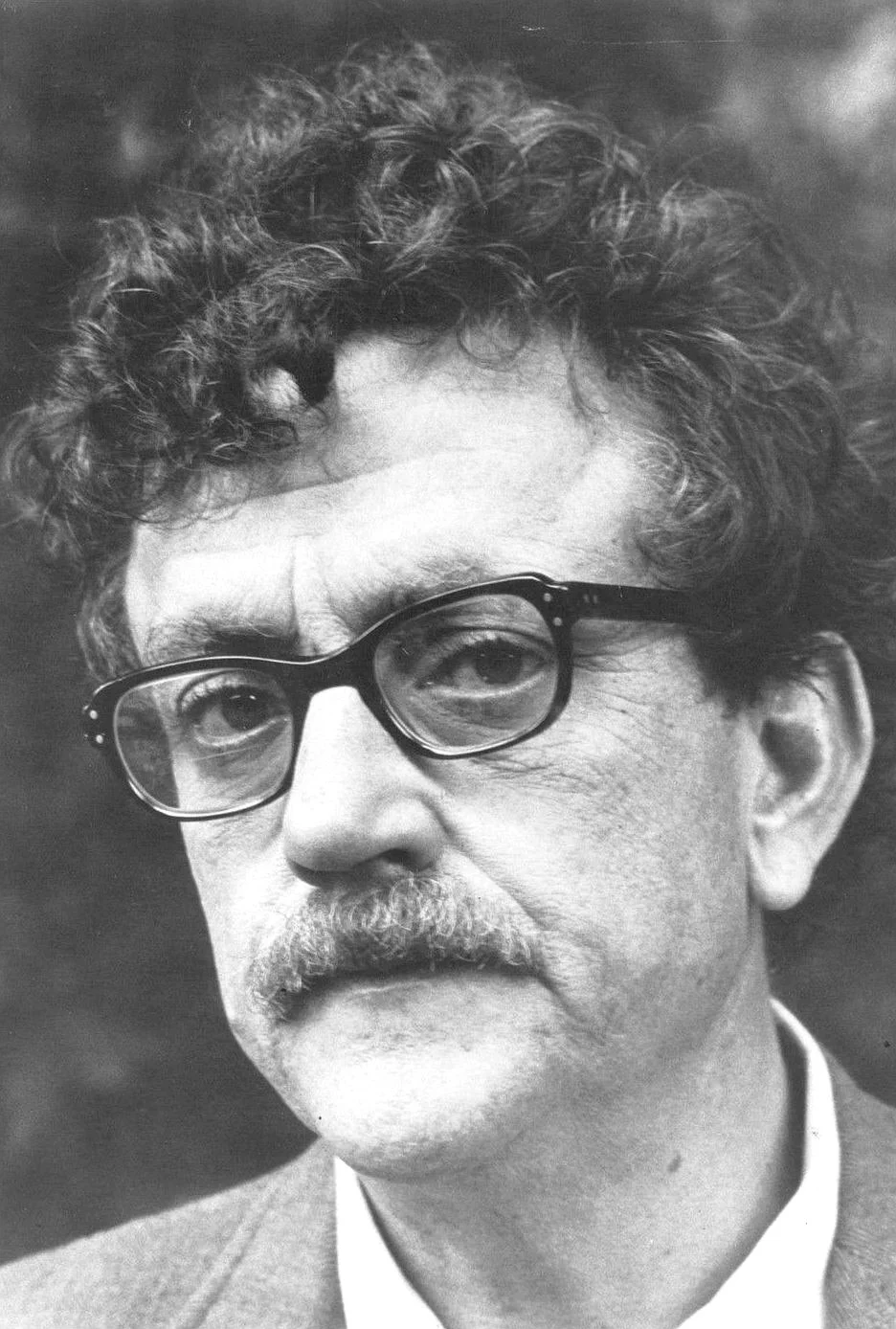
Source: https://www.brainpickings.org/index.php/20...

Enjoyed this speech? Speakola is a labour of love and I’d be very grateful if you would share, tweet or like it. Thank you.

Facebook Twitter Facebook
In GUEST SPEAKER B Tags KURT VONNEGUT, TEACHING, KINDNESS, GOD, RELIGION, HUMANISIM, COMPUTERS, TRANSCRIPT, AGNES SCOTT COLLEGE
Comment

Kurt Vonnegut: 'I would like to see America try socialism', Bennington College -1970

November 19, 2015

1970, Bennington College, Vermont, USA

I hope you will all be very happy as members of the educated class in America. I myself have been rejected again and again.

As I said on Earth Day in New York City not long ago: It isn't often that a total pessimist is invited to speak in the springtime. I predicted that everything would become worse, and everything has become worse.

One trouble, it seems to me, is that the majority of the people who rule us, who have our money and power, are lawyers or military men. The lawyers want to talk our problems out of existence. The military men want us to find the bad guys and put bullets through their brains. These are not always the best solutions—particularly in the fields of sewage disposal and birth control.

I demand that the administration of Bennington College establish an R.O.T.C. unit here. It is imperative that we learn more about military men, since they have so much of our money and power now. It is a great mistake to drive military men from college campuses and into ghettos like Fort Benning and Fort Bragg. Make them do what they do so proudly in the midst of men and women who are educated.

When I was at Cornell University, the experiences that most stimulated my thinking were in the R.O.T.C.—the manual of arms and close-order drill, and the way the officers spoke to me. Because of the military training I received at Cornell, I became a corporal at the end of World War Two. After the war, as you know, I made a fortune as a pacifist.

You should not only have military men here, but their weapons, too—especially crowd-control weapons such as machine guns and tanks. There is a tendency among young people these days to form crowds. Young people owe it to themselves to understand how easily machine guns and tanks can control crowds.

There is a basic rule about tanks, and you should know it: The only man who ever beat a tank was John Wayne. And he was in another tank.

Now then—about machine guns: They work sort of like a garden hose, execpt they spray death. They should be approached with caution.

There is a lesson for all of us in machine guns and tanks: Work within the system.

How pessimistic am I, really? I was a teacher at the University of Iowa three years ago. I had hundreds of students. As nearly as I am able to determine, not one of my ex-students has seen fit to reproduce. The only other demonstration of such a widespread disinclination to reproduce took place in Tasmania in about 1800. Native Tasmanians gave up on babies and the love thing and all that when white colonists, who were criminals from England, hunted them for sport.

I used to be an optimist. This was during my boyhood in Indianapolis. Those of you who have seen Indianapolis will understand that it was no easy thing to be an optimist there. It was the 500-mile Speedway Race, and then 364 days of miniature golf, and then the 500-mile Speedway Race again.

My brother Bernard, who was nine years older, was on his way to becoming an important scientist. He would later discover that silver iodide particles could precipitate certain kinds of clouds as snow or rain. He made me very enthusiastic about science for a while. I thought scientists were going to find out exactly how everything worked, and then make it work better. I fully expected that by the time I was twenty-one, some scientist, maybe my brother, would have taken a color photograph of God Almighty—and sold it to Popular Mechanics magazine.

Scientific truth was going to make us so happy and comfortable.

What actually happened when I was twenty-one was that we dropped scientific truth on Hiroshima. We killed everybody there. And I had just come home from being a prisoner of war in Dresden, which I'd seen burned to the ground. And the world was just then learning how ghastly the German extermination camps had been. So I had a heart-to-heart talk with myself.

"Hey, Corporal Vonnegut," I said to myself, "maybe you were wrong to be an optimist. Maybe pessimism is the thing."

I have been a consistent pessimist ever since, with a few exceptions. In order to persuade my wife to marry me, of course, I had to promise her that the future would be heavenly. And then I had to lie about the future again every time I thought she should have a baby. And then I had to lie to her again every time she threatened to leave me because I was too pessimistic.

I saved our marriage many times by exclaiming, "Wait! Wait! I see light at the end of the tunnel at last!" And I wish I could bring light to your tunnels today. My wife begged me to bring you light, but there is no light. Everything is going to become imaginably worse, and never get better again. If I lied to you about that, you would sense that I'd lied to you, and that would be another cause for gloom. We have enough causes for gloom.

I should like to give a motto to your class, a motto to your entire generation. It comes from my favorite Shakespearean play, which is King Henry VI, Part Three. In the first scene of Act Two, you will remember, Edward, Earl of March, who will later become King Edward IV, enters with Richard, who will later become Duke of Gloucester. They are the Duke of York's sons. They arrive at the head of their troops on a plain near Mortimer's Cross in Herefordshire and immediately receive news that their father has had his head cut off. Richard says this, among other things, and this is the motto I give you: "To weep is to make less the depth of grief."

Again: "To weep is to make less the depth of grief."

It is from the same play, which has been such a comfort to me, that we find the line, "The smallest worm will turn being trodden on." I don't have to tell you that the line is spoken by Lord Clifford in Scene One of Act Two. This is meant to be optimistic, I think, but I have to tell you that a worm can be stepped on in such a way that it can't possibly turn after you remove your foot.

I have performed this experiment for my children countless times. They are grown-ups now. They can step on worms now with no help from their Daddy. But let us pretend for a moment that worms can turn, do turn. And let us ask ourselves, "What would be a good, new direction for the worm of civilization to take?"

Well—it should go upward, if possible. Up is certainly better than down, or is widely believed to be. And we would be a lot safer if the Government would take its money out of science and put it into astrology and the reading of palms. I used to think that science would save us, and science certainly tried. But we can't stand any more tremendous explosions, either for or against democracy. Only in superstition is there hope. If you want to become a friend of civilization, then become an enemy of truth and a fanatic for harmless balderdash.

I know that millions of dollars have been spent to produce this splendid graduating class, and that the main hope of your teachers was, once they got through with you, that you would no longer be superstitious. I'm sorry—I have to undo that now. I beg you to believe in the most ridiculous superstition of all: that humanity is at the center of the universe, the fulfiller or the frustrator of the grandest dreams of God Almighty.

If you can believe that, and make others believe it, then there might be hope for us. Human beings might stop treating each other like garbage, might begin to treasure and protect each other instead. Then it might be all right to have babies again.

Many of you will have babies anyway, if you're anything like me. To quote the poet Schiller: "Against stupidity the very gods themselves contend in vain."

About astrology and palmistry: They are good because they make people feel vivid and full of possibilities. They are communism at its best. Everybody has a birthday and almost everybody has a palm. Take a seemingly drab person born on August 3, for instance. He's a Leo. He is proud, generous, trusting, energetic, domineering, and authoritative! All Leos are! He is ruled by the Sun! His gems are the ruby and the diamond! His color is orange! His metal is gold! This is a nobody?

His harmonius signs for business, marriage, or companionship are Sagittarius and Aries. Anybody here a Sagittarius or an Aries? Watch out! Here comes destiny!

Is this lonely-looking human being really alone? Far from it! He shares the sign of Leo with T. E. Lawrence, Herbert Hoover, Alfred Hitchcock, Dorothy Parker, Jacqueline Onassis, Henry Ford, Princess Margaret, and George Bernard Shaw! You've heard of them.

Look at him blush with happiness! Ask him to show you his amazing palms. What a fantastic heart line he has! Be on your guard, girls. Have you ever seen a Hill of the Moon like his? Wow! This is some human being!

Which brings us to the arts, whose purpose, in common with astrology, is to use frauds in order to make human beings seem more wonderful than they really are. Dancers show us human beings who move much more gracefully than human beings really move. Films and books and plays show us people talking much more entertainingly than people really talk, make paltry human enterprises seem important. Singers and musicians show us human beings making sounds far more lovely than human beings really make. Architects give us temples in which something marvelous is obviously going on. Actually, practically nothing is going on inside. And on and on.

The arts put man at the center of the universe, whether he belongs there or not. Military science, on the other hand, treats man as garbage—and his children, and his cities, too. Military science is probably right about the comtemptibility of man in the vastness of the universe. Still—I deny that contemptibililty, and I beg you to deny it, through the creation of appreciation of art.

A friend of mine, who is also a critic, decided to do a paper on things I'd written. He reread all my stuff, which took him about two hours and fifteen minutes, and he was exasperated when he got through. "You know what you do?" he said. "No," I said. "What do I do?" And he said, "You put bitter coatings on very sweet pills."

I would like to do that now, to have the bitterness of my pessimism melt away, leaving you with mouthfuls of a sort of vanilla fudge goo. But I find it harder and harder to prepare confections of this sort—particularly since our military scientists have taken to firing at crowds of their own people. Also—I took a trip to Biafra last January, which was a million laughs. And this hideous war in Indochina goes on and on.

Still—I will give you what goo I have left.

It has been said many times that man's knowledge of himself has been left far behind by his understanding of technology, and that we can have peace and plenty and justice only when man's knowledge of himself catches up. This is not true. Some people hope for great discoveries in the social sciences, social equivalents of F=ma and E=mc^2, and so on. Others think we have to evolve, to become better monkeys with bigger brains. We don't need more information. We don't need bigger brains. All that is required is that we become less selfish than we are.

We already have plenty of sound suggestions as to how we are to act if things are to become better on earth. For instance: Do unto others as you would have them do unto you. About seven hundred years ago, Thomas Aquinas had some other recommendations as to what people might do with their lives, and I do not find these made ridiculous by computers and trips to the moon and television sets. He praises the Seven Spiritual Works of Mercy, which are these:

To teach the ignorant, to counsel the doubtful, to console the sad, to reprove the sinner, to forgive the offender, to bear with the oppressive and troublesome, and to pray for us all.

He also admires the Seven Corporal Works of Mercy, which are these:

To feed the hungry, to give drink to the thirsty, to clothe the naked, to shelter the homeless, to visit the sick and prisoners, to ransom captives, and to bury the dead.

A great swindle of our time is the assumption that science has made religion obsolete. All science has damaged is the story of Adam and Eve and the story of Jonah and the Whale. Everything else holds up pretty well, particularly the lessons about fairness and gentleness. People who find those lessons irrelevant in the twentieth century are simply using science as an excuse for greed and harshness.

Science has nothing to do with it, friends.

Another great swindle is that people your age are supposed to save the world. I was a graduation speaker at a little preparatory school for girls on Cape Cod, where I live. I told the girls that they were much too young to save the world and that, after they got their diplomas, they should go swimming and sailing and walking, and just fool around.

I often hear parents say to their idealistic children, "All right, you see so much that is wrong with the world—go out and do something about it. We're all for you! Go out and save the world."

You are four years older than those prep school girls but still very young. You, too, have been swindled, if people have persuaded you that it is now up to you to save the world. It isn't up to you. You don't have the money and the power. You don't have the appearance of grave maturity—even though you may be gravely mature. You don't even know how to handle dynamite. It is up to older people to save the world. You can help them.

Do not take the entire world on your shoulders. Do a certain amount of skylarking, as befits people of your age. "Skylarking," incidentally, used to be a minor offense under Navel Regulations. What a charming crime. It means intolerable lack of seriousness. I would love to have a dishonorable discharge from the United States Navy—for skylarking not just once, but again and again and again.

Many of you will undertake exceedingly serious work this summer—campaigning for humane Senators and Congressmen, helping the poor and the ignorant and the awfully old. Good. But skylark, too.

When it really is time for you to save the world, when you have some power and know your way around, when people can't mock you for looking so young, I suggest that you work for a socialist form of government. Free Enterprise is much too hard on the old and the sick and the shy and the poor and the stupid, and on people nobody likes. The just can't cut the mustard under Free Enterprise. They lack that certain something that Nelson Rockefeller, for instance, so abundantly has.

So let's divide up the wealth more fairly than we have divided it up so far. Let's make sure that everybody has enough to eat, and a decent place to live, and medical help when he needs it. Let's stop spending money on weapons, which don't work anyway, thank God, and spend money on each other. It isn't moonbeams to talk of modest plenty for all. They have it in Sweden. We can have it here. Dwight David Eisenhower once pointed out that Sweden, with its many utopian programs, had a high rate of alcoholism and suicide and youthful unrest. Even so, I would like to see America try socialism. If we start drinking heavily and killing ourselves, and if our children start acting crazy, we can go back to good old Free Enterprise again.

Source: http://jsomers.net/vonnegut-1970-commencem...

Enjoyed this speech? Speakola is a labour of love and I’d be very grateful if you would share, tweet or like it. Thank you.

Facebook Twitter Facebook
In GUEST SPEAKER A Tags KURT VONNEGUT, BENNINGTON, SOCIALISM, EQUALITY, MILITARY, POLITICS, PESSIMISM
Comment

Not Kurt Vonnegut (Mary Schmish): 'Wear sunscreen' - 1997

November 18, 2015

1997, uploaded at MIT

The Washington Post states in this article that Vonnegut never delivered this speech. It was a a column written by Mary Schmich for the Chicago Tribune about a speech she would have liked to give to a graduating class, which was later posted online and attributed by a third party to Vonnegut. But it is so much a part of commencement lore Speakola has included it.

Ladies and gentlemen of the class of ’97:

Wear sunscreen.

If I could offer you only one tip for the future, sunscreen would be it. The long-term benefits of sunscreen have been proved by scientists, whereas the rest of my advice has no basis more reliable than my own meandering experience. I will dispense this advice now.

Enjoy the power and beauty of your youth. Oh, never mind. You will not understand the power and beauty of your youth until they’ve faded. But trust me, in 20 years, you’ll look back at photos of yourself and recall in a way you can’t grasp now how much possibility lay before you and how fabulous you really looked. You are not as fat as you imagine.

Don’t worry about the future. Or worry, but know that worrying is as effective as trying to solve an algebra equation by chewing bubble gum. The real troubles in your life are apt to be things that never crossed your worried mind, the kind that blindside you at 4 pm on some idle Tuesday.

Do one thing every day that scares you.

Sing.

Don’t be reckless with other people’s hearts. Don’t put up with people who are reckless with yours.

Floss.

Don’t waste your time on jealousy. Sometimes you’re ahead, sometimes you’re behind. The race is long and, in the end, it’s only with yourself.

Remember compliments you receive. Forget the insults. If you succeed in doing this, tell me how.

Keep your old love letters. Throw away your old bank statements.

Stretch.

Don’t feel guilty if you don’t know what you want to do with your life. The most interesting people I know didn’t know at 22 what they wanted to do with their lives. Some of the most interesting 40-year-olds I know still don’t.

Get plenty of calcium. Be kind to your knees. You’ll miss them when they’re gone.

Maybe you’ll marry, maybe you won’t. Maybe you’ll have children, maybe you won’t. Maybe you’ll divorce at 40, maybe you’ll dance the funky chicken on your 75th wedding anniversary. Whatever you do, don’t congratulate yourself too much, or berate yourself either. Your choices are half chance. So are everybody else’s.

Enjoy your body. Use it every way you can. Don’t be afraid of it or of what other people think of it. It’s the greatest instrument you’ll ever own.

Dance, even if you have nowhere to do it but your living room.

Read the directions, even if you don’t follow them.

Do not read beauty magazines. They will only make you feel ugly.

Get to know your parents. You never know when they’ll be gone for good. Be nice to your siblings. They’re your best link to your past and the people most likely to stick with you in the future.

Understand that friends come and go, but with a precious few you should hold on. Work hard to bridge the gaps in geography and lifestyle, because the older you get, the more you need the people who knew you when you were young.

Live in New York City once, but leave before it makes you hard. Live in Northern California once, but leave before it makes you soft. Travel.

Accept certain inalienable truths: Prices will rise. Politicians will philander. You, too, will get old. And when you do, you’ll fantasize that when you were young, prices were reasonable, politicians were noble, and children respected their elders.

Respect your elders.

Don’t expect anyone else to support you. Maybe you have a trust fund. Maybe you’ll have a wealthy spouse. But you never know when either one might run out.

Don’t mess too much with your hair or by the time you’re 40 it will look 85.

Be careful whose advice you buy, but be patient with those who supply it. Advice is a form of nostalgia. Dispensing it is a way of fishing the past from the disposal, wiping it off, painting over the ugly parts and recycling it for more than it’s worth.

But trust me on the sunscreen.


Australian writer and comedian John Safran made a parody of the speech.

Source: http://scripting.com/specials/commencement...

Enjoyed this speech? Speakola is a labour of love and I’d be very grateful if you would share, tweet or like it. Thank you.

Facebook Twitter Facebook
In GUEST SPEAKER B Tags JOHN SAFRAN, URBAN LEGEND, KURT VONNEGUT, MARY SCHMICH, CHICAGO TIMES, WEAR SUNSCREEN
Comment

See my film!

Limited Australian Season

March 2025

Details and ticket bookings at

angeandtheboss.com

Support Speakola

Hi speech lovers,
With costs of hosting website and podcast, this labour of love has become a difficult financial proposition in recent times. If you can afford a donation, it will help Speakola survive and prosper.

Best wishes,
Tony Wilson.

Become a Patron!

Learn more about supporting Speakola.

Featured political

Featured
Jon Stewart: "They responded in five seconds", 9-11 first responders, Address to Congress - 2019
Jacinda Ardern: 'They were New Zealanders. They are us', Address to Parliament following Christchurch massacre - 2019
Dolores Ibárruri: "¡No Pasarán!, They shall not pass!', Defense of 2nd Spanish Republic - 1936
Jimmy Reid: 'A rat race is for rats. We're not rats', Rectorial address, Glasgow University - 1972

Featured eulogies

Featured
For Geoffrey Tozer: 'I have to say we all let him down', by Paul Keating - 2009
for James Baldwin: 'Jimmy. You crowned us', by Toni Morrison - 1988
for Michael Gordon: '13 days ago my Dad’s big, beautiful, generous heart suddenly stopped beating', by Scott and Sarah Gordon - 2018

Featured commencement

Featured
Tara Westover: 'Your avatar isn't real, it isn't terribly far from a lie', The Un-Instagrammable Self, Northeastern University - 2019
Tim Minchin: 'Being an artist requires massive reserves of self-belief', WAAPA - 2019
Atul Gawande: 'Curiosity and What Equality Really Means', UCLA Medical School - 2018
Abby Wambach: 'We are the wolves', Barnard College - 2018
Eric Idle: 'America is 300 million people all walking in the same direction, singing 'I Did It My Way'', Whitman College - 2013
Shirley Chisholm: ;America has gone to sleep', Greenfield High School - 1983

Featured sport

Featured
Joe Marler: 'Get back on the horse', Harlequins v Bath pre game interview - 2019
Ray Lewis : 'The greatest pain of my life is the reason I'm standing here today', 52 Cards -
Mel Jones: 'If she was Bradman on the field, she was definitely Keith Miller off the field', Betty Wilson's induction into Australian Cricket Hall of Fame - 2017
Jeff Thomson: 'It’s all those people that help you as kids', Hall of Fame - 2016

Fresh Tweets


Featured weddings

Featured
Dan Angelucci: 'The Best (Best Man) Speech of all time', for Don and Katherine - 2019
Hallerman Sisters: 'Oh sister now we have to let you gooooo!' for Caitlin & Johnny - 2015
Korey Soderman (via Kyle): 'All our lives I have used my voice to help Korey express his thoughts, so today, like always, I will be my brother’s voice' for Kyle and Jess - 2014

Featured Arts

Featured
Bruce Springsteen: 'They're keepers of some of the most beautiful sonic architecture in rock and roll', Induction U2 into Rock Hall of Fame - 2005
Olivia Colman: 'Done that bit. I think I have done that bit', BAFTA acceptance, Leading Actress - 2019
Axel Scheffler: 'The book wasn't called 'No Room on the Broom!', Illustrator of the Year, British Book Awards - 2018
Tina Fey: 'Only in comedy is an obedient white girl from the suburbs a diversity candidate', Kennedy Center Mark Twain Award -  2010
Tina Fey: 'Only in comedy is an obedient white girl from the suburbs a diversity candidate', Kennedy Center Mark Twain Award - 2010

Featured Debates

Featured
Sacha Baron Cohen: 'Just think what Goebbels might have done with Facebook', Anti Defamation League Leadership Award - 2019
Greta Thunberg: 'How dare you', UN Climate Action Summit - 2019
Charlie Munger: 'The Psychology of Human Misjudgment', Harvard University - 1995
Lawrence O'Donnell: 'The original sin of this country is that we invaders shot and murdered our way across the land killing every Native American that we could', The Last Word, 'Dakota' - 2016