
• Genre
  • About
  • Submissions
  • Donate
  • Search
Menu

Speakola

All Speeches Great and Small
  • Genre
  • About
  • Submissions
  • Donate
  • Search

Commencement and Graduation

Inspiring, humorous, wisdom imparting. Some of the best speeches are delivered in the educational context. Upload your commencement or graduation speech here.

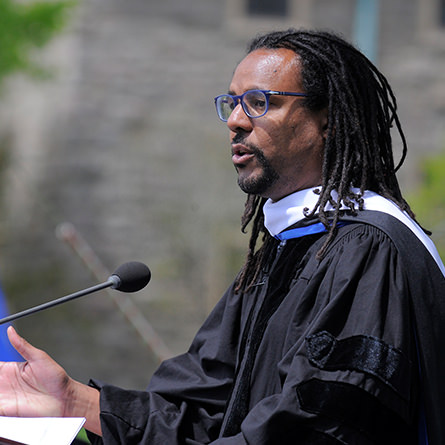
Colson Whitehead: 'Welcome to the complications'. Connecticut College - 2017

June 7, 2017

21 May 2017, Connecticut College, New London, Connecticut

Somehow you did it. You made it through the meat grinder of elementary school, your teenage years, and now college, with most if not all of your limbs intact. That’s quite a feat. I salute you. There’s a great big world out there waiting for you, and all sorts of possibilities. Time for you to follow your star. Find a soulmate. Find yourself, finally.

Or so they say.

Any good story has three parts. Act I, where we meet the protagonist and establish the rules of the world. How do things work? What kind of person is our heroine, and what sort of world has she been born into? What does she want, how does she see herself? The all-important foundation of the narrative.

Then comes Act II – where the complications appear that set our heroine on her journey. These are the unexpected and unforeseen events that upend the rules of Act I. The meteor is on a collision course with Earth - what do we do? There’s an accident, an attack that destroys the peaceful order of everything has come before. A demented con man takes control of the country. That foundation of Act I is undermined, the assumptions of our heroine are tested.

Then we get to Act III, the synthesis of Act I and Act II. All the chaos of the middle section is brought to some kind of resolution. A new heroine is born out of her struggle. The meteor collides, or it doesn’t. Out of the rubble of the attack, a new city rises. The con man is exposed for his swindles and gets his just desserts, or doesn’t.

Thesis – antithesis – synthesis. I guess in college I might have used the analogy of Saturday evening – Saturday night – Sunday morning. Saturday evening is, “I’m sure looking forward to this party tonight!” Act I. Saturday night is the complication of Act II– all sorts of crazy stuff is happening at the party – clowns, chocolate pudding. And Sunday morning, in Act III, a new self awakes and says, “After that whole chocolate pudding thing last night, I’m going to have to reconsider some long-held beliefs about myself.”

The narrative arc of a story, a night. A life.

Like I said, you’ve just finished Act I. You know some things about the world. Have developed a few theories about how things work. Sure, that freshman year seminar on Marx added a wrinkle, and that social justice course really threw you for a loop – who knew all that was going on? — but you recovered splendidly. With the end of Act I, you’re ready to head out into the world, follow your star, find a soulmate. Find yourself. Believe in yourself, you can do anything.

Here come the complications.

“Find a soulmate.” Find the person who really gets you, understands what makes you tick like no other. The one person in the universe who can look past that front you present to the world and see the real you behind it. I’m not the first one to point this out, but in all probability, your soulmate is dead. It’s simple numbers, I’m not trying to be a negative Nelly. Scientists say that 107 billion people have lived on Earth up to this moment, and there are 7 billion people alive on the planet right now. The odds speak for themselves. Perhaps your soulmate was a humble servant in ancient Egypt, washing primitive textiles in the waters of the Nile, or a Christian soldier during the Crusades, trying to wipe out his Muslim brother on the other side of the battlefield. Or, less mundane, someone famous, a maker of history, like Napoleon or Harriet Tubman. Which would have sucked, because Napoleon and Harriet Tubman had to travel a lot for work and you wouldn’t see them that much, between the world conquest thing and Underground Railroad thing, and I don’t even think they had Skype back then.

Maybe your soulmate is not one of the 107 billion who have come before, but one of the 7 billion on Earth right now. And they’re an antique dealer in New Zealand, or a cook in food market in Thailand. Are you going to New Zealand any time soon, or Thailand? What are the chances that you’d run into each other even if you were going – meet eyes over an antique bust of Abraham Lincoln, or visit the kitchen to compliment the cook on the excellent beef larb? Maybe they’re sick that day. You can’t meet everyone. In fact some of you soon-to-be graduates are looking around right now going, “That guy was in my class? I’ve literally never seen him before!” It’s big world, and it conspires against you through numbers.

Maybe they’re 95 years old, and it’s some May – December soulmate situation, but sadly they won't live long enough for you to decide to go to New Zealand. It’s a tragedy. Or they’re not even born yet. You are one of their “107 billion people” who lived on Earth before they showed up. And you’ll never get to have a romantic dinner on that Martian colony where we’ve fled to because of global warming, never get a chance to say, “I’m lucky to have found you, and can you pass the Soylent Green.”

Complications.

“Follow your star.” At least here, you have it better than ancient peoples, and the fact that you live in the 20th century isn’t held against you. Back then, you had to squint at the night sky to find your star. Maybe it was in Ursa Minor, and you had to get up at 4 am to see it - taking into consideration the rotation of the earth - and you couldn’t even set an alarm on your iPhone to wake them up. Sure, nowadays we have light pollution from the cities and you have to go to the desert for a really unspoiled view, but we have telescopes. We have the Hubble telescope, a magnificent scientific achievement, that allows us to see stars as far away as 13 billion light years. And one them, one of those twinkling beauties in the eternal void is the one that speaks to you, guiding your life’s path through the darkness. Your odds have just shot up. Certainly in 10 trillion galaxies, each of which contains a 100 million stars, one of them shines just for you. All you have to do is look.

I hate to burst your Hubble bubble, but there are complications. Given how long it takes for light to travel through the vast and indifferent interstellar cold of the universe, the star you see tonight, beckoning, may have died millions of years ago. It’s light is only just reaching us, but it’s long, long dead, and we only think it is real. I’m sure it’s not the first time something in your life has turned out to be other than what it first seemed. Your freshman year roommate, for example. Maybe that perfect thing in the sky twinkling with promise and meaning has collapsed on itself long ago and become a supermassive black hole, the most deadly force in the universe, sucking up everything that strays into its gravitational field and obliterating it, rending it into atoms. An entity of pure destruction. Like your freshman year roommate.

And speaking of the failure of language and the troublesome problem of relativity, we come to “Find yourself.” By now you know the self is an ever-changing creature, a nebula of spinning gasses, swirling and reforming, seeking a coherent shape. There’s the you of your elementary school years, making your first tentative guesses at how people operate, how you operate. The teenage you, taking a stab at an identity apart from your family and friends, and making some really stupid clothing choices. And then college, finally set free from the home life that has defined, confined, and confounded you for so long. The mutable self. The complications of Act II, which will tip all you have been before into chaos, have been set up and abetted by really clever foreshadowing in Act I, by all those slippery you’s over the years. In some ways, you've always been a creature of chaos.

Complications, complications.

Which brings us to Act III. Synthesis. If you read about Hollywood, they’ll often complain about a script’s “Third Act problems.” The setup is great – Jennifer Lawrence is the spinster schoolteacher who comes back for her high school reunion. Channing Tatum is her long lost childhood sweetheart, he’s a…let's see…a marine biologist Navy Seal, just back from Afghanistan. Ice Cube plays the principal – he’s a riot. The reunion is full of shenanigans -- clowns, chocolate pudding -- but now we have figure out the Third Act. Do these two star-crossed lovers get together? What is this story saying about the world, saying about Love and Possibility? Do we have an uplifting story of triumph on our hands, or a tragedy? We didn’t bother to figure out the ending before we started rolling the cameras.

Act III is everything. No matter the strength of the foundation, the assorted catastrophes of the Second Act, if we don’t have ACT III, we’re really in trouble. Will the heroine pull it out in the end, or does she falter? Justice prevail, or the dull villainy of the world triumph? Here’s the problem of every storyteller – to make sense of the chaos, to gather all the plot strands into dramatic unity. To figure out the ending, no matter what the plot throws at you.

I've talked a lot about numbers, and the indifference of the universe. But maybe here, in Act III, the numbers are on your side, in the Walt Whitman-esque multitude of you. You add up to a lot, over the years -- the 4 year old you apprehending the otherness of other people for the first time, the 14 year old you recognizing yourself in a line of Shakespeare, the you sitting here right now, wondering what comes next. And those future selves, at 25 and 45 and 65, adapting, pratfalling, and picking themselves up. All those shifting, jostling you’s, and all their lessons. The universe may seem like a lonely place sometimes, but there are as many you’s as there are stars in the sky. Maybe one of them will step up at the right time and tell you what to make of it all.

Congratulations again on finishing Act I. Welcome to the complications.

Source: http://time.com/4788071/colson-whitehead-t...

Enjoyed this speech? Speakola is a labour of love and I’d be very grateful if you would share, tweet or like it. Thank you.

Facebook Twitter Facebook
In GUEST SPEAKER D Tags COLSON WHITEHEAD, PULITZER PRIZE, TRANSCRIPT, CONNECTICUT COLLEGE, COMMENCEMENT, WRITING AS METAPHOR, THREE ACTS
Comment

Natasha Trethewey: - 'In the words of Atlanta rapper T.I "Unhappy with the riches because you're piss poor morally"', Emory University - 2017

May 18, 2017

8 May 2017, Atlanta, Georgia

Good morning, members of the Knox College Community, President Amott, trustees, faculty, parents, and the graduating Class of 2014.  It's a great pleasure and honor to address you today in the birthplace of Carl Sandburg, a great poet of the people whose democratic vistas have compelled us to see the possibility of justice in the world.

I have visited this lovely place once before, but it is, more importantly, the history of Knox College, the commitment to abolition, to social justice, woven into its founding that makes my return today feel like a kind of homecoming. For that, I am grateful and, also, because I did not attend my own college graduation, I am grateful to share this day with you. I know that I missed out on something important, something I might have carried with me as a memory of a momentous day, a sense of triumph over difficult odds and a way to mark an important milestone that, at some moments, seemed I might never reach. Some of you have faced difficult odds thus far in your lives. Perhaps having to work while pursuing your studies, or dealing with an illness or disability, or serving as a caregiver for a family member. Many of you will have not, and, for that blessing, I am thankful and wish for you that it always be so. For all of you graduating today, I wish a smooth and lucky passage. 

This is a time of year I love, perhaps second only to the beginning of a new academic year; that first inkling of autumn in the air, the way the sharp pages of a newly acquired book or even the musty scent of an old one, suggests to me the endless possibilities for learning, for pursuing knowledge not only for my work as a poet, but also for the sheer pleasure of it. I love this time of year differently. I anticipate some time to rest, the brief respite of a few days vacation in the warmer months, so that I can begin again with renewed enthusiasm my life's work. But I also anticipate the reckoning again with my difficult past. You are perhaps feeling something quite different, perhaps relief to have completed this part of your education or melancholy at moving on from this stage in your life, excitement about the opportunities before you, or anxiety in these difficult times about the uncertain future. No doubt you've given this some serious thought.  Although my own passage was not smooth, I can still see in it a measure of luck. 

When I was a graduating senior, I had already experienced the most traumatic event of my life and had to overcome that hardship. In my freshman year, my mother was killed, gunned down in a parking lot by her second husband, her then ex-husband, a troubled Vietnam veteran with a history of mental illness. For the rest of my time in college, I was grieving. When I wasn't grieving, I was trying to carry on with my extracurricular activities, holding down a part time job and socializing with my friends. I was not doing much studying and only showing up in my classes enough to earn a gentlewoman's C average. I couldn't focus on school work, and I didn't know enough to forgive myself that fact and seek some kind of counseling that would have perhaps helped me contend with my grief and perform better at my studies.

I'd been an English major from the time I arrived at the university, but during those school years, I shopped around taking all sorts of classes and thinking I might change my major. I never did, though, not only because I liked literature in high school but also because I think I'd become complacent and not as invested in my education as I needed to be. It was my default choice. I can see now that I was lucky to be getting a liberal arts education that allowed me to explore a lot of different types of courses, as well as being offered a more concentrated education in a particular subject.

So many of my classmates seemed to know exactly what they were doing and why. And I envy that. I still do. I often wonder now what would be different about my life and career had I decided to become a history major. But I was without direction, a sampler, and fortunate that many of those courses I studied, I tried out if only for a semester, sustained my scattered attention in ways that I could not have anticipated.

Two of them stand out to me now. Perhaps you can already look back and recognize what course, academic experience, or faculty member has made what will be a lasting impact on your life. Back then, I could not see how what I was learning would give shape and purpose to my life, let alone a kind of redemption.

In the spring of my freshman year, the spring I lost my mother, I was taking an American History course. On the first day of class, the professor asked us to write down on note cards the names of our hometowns. Now, this was in the 1980s, before the ease of research on the Internet, so what the professor did is even more impressive to me as I look back on it now. We, too, were on the quarter system, and the next day when we came back to class, he introduced each of us by describing some significant historical events that had taken place at our hometowns.

Because my hometown was out of state, I sat there waiting for him to get to me, certain he couldn't have much to say about where I'd come from, a little town on the Mississippi Gulf Coast. But he did know something. And as I listened, I began to see myself as part of a larger history. Not just my personal history, but also geographical, cultural, social, political, and economic history that connected me to other people and that had already helped to shape me, to make me who I was.

From that one class, I took away a seed that grew in me the first real inklings of myself as a historical being. Not someone outside of history or adrift in it, but someone with a past that was older and more significant than my 19 years on Earth. I did not know then what that would mean to me years later when I finally had found my calling as a poet, deeply interested in writing about the intersections and contentions between personal and public history and about justice. Nor did I consider the ways in which I was on my way to being part of an educated and informed citizenry, who could fully participate in the ongoing shaping of my nation.

Within a few months of that second day of class, my mother would be dead, and I would find myself asking the question, more profoundly than I ever had before: How has this world as it now exists come to be what it is? At the moment, the question was no longer what we ask in our studies in general, not the usual way we ask how and why are things, but now a life and death matter. It had an immediacy that was bound to the fact of my being and whether I would survive and flourish or merely survive in the world I'd been given.

The other class was a food science course I took in my senior year. It was only a two credit course, but it was one of the most memorable of my college experience. We studied everything from the FDA and the USDA guidelines about the various grades of meat, food processing, labeling, and safety, to food-borne illnesses. In one assignment, in order to learn how to recognize which bacteria in food preparation had caused a particular illness, we had to solve cases in which we were like detectives, following the clues as the sleuth does in a mystery novel.

Until then, I had not known how much I could be drawn to a kind of scientific research, to investigation, to puzzling out using primary evidence the answer to some practical question affecting our lives. Nor did I realize that there were connections between a course like this one and my shock and disgust and pleasure upon reading in high school Upton Sinclair's 1906 novel, The Jungle, that details some of the early horrors of the meat packing industry in Chicago and the regulations that it spurred. Nor could I see that taken altogether, these courses and my English major were preparing me for the moment that I'd recognize what it was I had been meant to do, that it involved literature, not only reading it, but writing it and that the writing of it would involve an engagement with history, society, and culture, a curiosity that fostered a desire to do research, to go beyond disciplinary boundaries, to make my way in the world, not just in spite of certain setbacks, but building upon them. Those lessons that hardships and limitations, no matter what they are, can teach us.

Without realizing it, I'd been given the tools and the opportunity to think critically, to grapple with difficult knowledge, and to question assumptions and perceived notions about things. I had begun to ask more pointedly than ever before: How the world as it is now exists come to be what it is and what is my place in it? Questions that formed the scaffolding of a life built upon being consciously historical.  

Most of my other courses those years are a blur to me, now part of what seems like intuitive knowledge but is, as the best intuition is, the result of prolonged tuition. And in many ways, this is perhaps the best part of a liberal arts education. I was not studying to be a writer, but everything I studied has helped me become one, to answer my calling.

Today marks the day that you too have done that preliminary work, whether you are yet fully aware of it or not, and it is to be celebrated now and in the years to come as you continue to build upon the sound foundation of your excellent education. But this is not a time for complacency. In her essay "Resisting Amnesia," poet Adrienne Rich reminds us that one does indeed have a choice to become consciously historical. That is, a person who tries from memory and connectedness against amnesia and nostalgia. One who tries to describe her or his journeys. "Historical amnesia," she wrote, "is starvation of the imagination that no ongoing pursuit of knowledge can survive."

It was in that pursuit of knowledge that I was lucky enough to ensure my survival through what would not be a smooth passage. When I think back on those years, I have a momentary sense of terror that I might not have made it to where I am now, might not have survived personal tragedy and found a calling, a way to live in the world that continues to challenge and reward me beyond the necessary and pleasurable material comforts. And I can say without a doubt that my education, seemingly haphazard, and often blindly gained, saved me. It gave me a means of understanding my place in the world, a way to contend with history, law, and society, my role and rights as a citizen. A way to grapple with the political, societal, and socioeconomic context of the historical moment in which my mother was murdered.

Even now, it is hard to say that word. But I am a writer, and therefore, I am in the business of saying things precisely and of choosing to be consciously historical. Some people go blindly about their lives letting others decide the kind of world we're going to live in. Your education is a privilege that not everyone is able to attain and therefore, you have a greater responsibility as the educated citizenry to enter as the poet Robert Penn Warren put it, the world of action and liability. That is the necessity now, more than ever for historical awareness, civic duty, and social responsibility. To be truly educated is to resist the easy certainties of deeply ingrained and unexamined ideologies of soundbites and cliches in favor of an ongoing pursuit of knowledge, of truth, no matter how uncomfortable it makes you.

There are countless ways to enter that world of action and liability, to answer your own calling, in a way that will benefit not only yourselves and your loved ones, but can also serve the greater good. One of the things I love most about my calling, poetry, is that across time and space, it shows us not that we are different, but how we are alike. It connects us through the intimacy of a single voice speaking across the distances and through empathy to the lives of others, showing us a way to know ourselves in the mirror of someone else's experience. And, it allows us to say exactly, precisely, what we mean and to mean something else, perhaps even more important, at the same time.        

So, in closing, I'd like to read you a lovely poem by Richard Wilbur. It offers a fitting metaphor for this occasion, as you embark on writing the next chapter of your life's story. It's called "The Writer."

In her room at the prow of the house
Where light breaks, and the windows are tossed with linden,
My daughter is writing a story.

I pause in the stairwell, hearing
From her shut door a commotion of typewriter-keys
Like a chain hauled over a gunwale.

Young as she is, the stuff
Of her life is a great cargo, and some of it heavy:
I wish her a lucky passage.

But now it is she who pauses,
As if to reject my thought and its easy figure.
A stillness greatens, in which

The whole house seems to be thinking,
And then she is at it again with a bunched clamor
Of strokes, and again is silent.

I remember the dazed starling
Which was trapped in that very room, two years ago;
How we stole in, lifted a sash

And retreated, not to affright it;
And how for a helpless hour, through the crack of the door,
We watched the sleek, wild, dark

And iridescent creature
Batter against the brilliance, drop like a glove
To the hard floor, or the desktop,

And wait then, humped and bloody,
For the wits to try it again; and how our spirits
Rose when, suddenly sure,

It lifted off from a chair-back,
Beating a smooth course for the right window
And clearing the sill of the world.

It is always a matter, my darling,
Of life or death, as I had forgotten. I wish
What I wished you before, but harder.

How true, the sentiments of the poem, the stuff of our lives a great cargo, some of it heavy. The work, often difficult at times to clear the sill of the world in our pursuits. The way our lives are always a matter of life or death. Out of the stuff of my life and the gifts of a liberal arts education, I've found a way to live in the world that could nurture my soul, and, I like to think, the souls of others. There are myriad ways to do that. What will yours be? How lucky you are today to be poised before the sill of the world on the cusp of so much to come. I wish what I wished you before, but harder. Congratulations.

Source: http://www.ajc.com/local/pulitzer-prize-wi...

Enjoyed this speech? Speakola is a labour of love and I’d be very grateful if you would share, tweet or like it. Thank you.

Facebook Twitter Facebook
In GUEST SPEAKER D Tags NATASHA TRETHEWEY, POET, US POET LAUREATE, PULITZER PRIZE, WRITER, ACADEMIC, T.I., ATLANTA, EMORY, TRANSCRIPT
Comment

See my film!

Limited Australian Season

March 2025

Details and ticket bookings at

angeandtheboss.com

Support Speakola

Hi speech lovers,
With costs of hosting website and podcast, this labour of love has become a difficult financial proposition in recent times. If you can afford a donation, it will help Speakola survive and prosper.

Best wishes,
Tony Wilson.

Become a Patron!

Learn more about supporting Speakola.

Featured political

Featured
Jon Stewart: "They responded in five seconds", 9-11 first responders, Address to Congress - 2019
Jacinda Ardern: 'They were New Zealanders. They are us', Address to Parliament following Christchurch massacre - 2019
Dolores Ibárruri: "¡No Pasarán!, They shall not pass!', Defense of 2nd Spanish Republic - 1936
Jimmy Reid: 'A rat race is for rats. We're not rats', Rectorial address, Glasgow University - 1972

Featured eulogies

Featured
For Geoffrey Tozer: 'I have to say we all let him down', by Paul Keating - 2009
for James Baldwin: 'Jimmy. You crowned us', by Toni Morrison - 1988
for Michael Gordon: '13 days ago my Dad’s big, beautiful, generous heart suddenly stopped beating', by Scott and Sarah Gordon - 2018

Featured commencement

Featured
Tara Westover: 'Your avatar isn't real, it isn't terribly far from a lie', The Un-Instagrammable Self, Northeastern University - 2019
Tim Minchin: 'Being an artist requires massive reserves of self-belief', WAAPA - 2019
Atul Gawande: 'Curiosity and What Equality Really Means', UCLA Medical School - 2018
Abby Wambach: 'We are the wolves', Barnard College - 2018
Eric Idle: 'America is 300 million people all walking in the same direction, singing 'I Did It My Way'', Whitman College - 2013
Shirley Chisholm: ;America has gone to sleep', Greenfield High School - 1983

Featured sport

Featured
Joe Marler: 'Get back on the horse', Harlequins v Bath pre game interview - 2019
Ray Lewis : 'The greatest pain of my life is the reason I'm standing here today', 52 Cards -
Mel Jones: 'If she was Bradman on the field, she was definitely Keith Miller off the field', Betty Wilson's induction into Australian Cricket Hall of Fame - 2017
Jeff Thomson: 'It’s all those people that help you as kids', Hall of Fame - 2016

Fresh Tweets


Featured weddings

Featured
Dan Angelucci: 'The Best (Best Man) Speech of all time', for Don and Katherine - 2019
Hallerman Sisters: 'Oh sister now we have to let you gooooo!' for Caitlin & Johnny - 2015
Korey Soderman (via Kyle): 'All our lives I have used my voice to help Korey express his thoughts, so today, like always, I will be my brother’s voice' for Kyle and Jess - 2014

Featured Arts

Featured
Bruce Springsteen: 'They're keepers of some of the most beautiful sonic architecture in rock and roll', Induction U2 into Rock Hall of Fame - 2005
Olivia Colman: 'Done that bit. I think I have done that bit', BAFTA acceptance, Leading Actress - 2019
Axel Scheffler: 'The book wasn't called 'No Room on the Broom!', Illustrator of the Year, British Book Awards - 2018
Tina Fey: 'Only in comedy is an obedient white girl from the suburbs a diversity candidate', Kennedy Center Mark Twain Award -  2010
Tina Fey: 'Only in comedy is an obedient white girl from the suburbs a diversity candidate', Kennedy Center Mark Twain Award - 2010

Featured Debates

Featured
Sacha Baron Cohen: 'Just think what Goebbels might have done with Facebook', Anti Defamation League Leadership Award - 2019
Greta Thunberg: 'How dare you', UN Climate Action Summit - 2019
Charlie Munger: 'The Psychology of Human Misjudgment', Harvard University - 1995
Lawrence O'Donnell: 'The original sin of this country is that we invaders shot and murdered our way across the land killing every Native American that we could', The Last Word, 'Dakota' - 2016