
• Genre
  • About
  • Submissions
  • Donate
  • Search
Menu

Speakola

All Speeches Great and Small
  • Genre
  • About
  • Submissions
  • Donate
  • Search

Mehdi Hasan: ' I urge you all not to fuel the arguments of the phobes and bigots', Oxford Union debate - 2013

June 23, 2022

4 July 2013, Oxford Union, Oxford, United Kingdom
The debate topic was ‘That Islam is a religion of peace’. Mehdi was arguing for the affirmative.

Thank you very much, Mr. President. Ladies and gentlemen, good evening. As-salaam 'alykum. Lovely to see you all here tonight. We are having a very entertaining night, are we not, with some very interesting things being said from the other side of the House tonight.

Let me begin by saying as a Muslim, as a representative of Islam, I would consider myself an ambassador for Islam, a believer in Islam, a follower of Islam and its prophet. So in that capacity, let me begin by apologising to Anne-Marie for the Bali bombings. I apologise for the role of my religion, and me, and my people for the killing of Theo van Gogh, for 7/7... Yes. That was all of us. That was Islam. That was Muslims. That was the Quran. I mean, astonishing astonishing claims to make in the very first speech tonight - on a day like today - where the conservative prime minister of the United Kingdom is having to come out and point out that these kind of views are anathema. And I believe you're trying to stand for the Labour Party to become an MP in Brighton. If you do, and you make these comments, I'm guessing you'll have the whip withdrawn from you. But then again, UKIP's on the rise. They'll take you. The BNP, they might have something to say about your views.
Anne-Marie:
This is what Mehdi Hasan always does. It's what you always do. It's what you always do.

By the way, just on a factual point, since we heard a lot about the second speaker about how backward we Muslims all are. On a factual point, you said that Islam was born in Saudi Arabia. Islam was born in 610 AD. Saudi Arabia was born in 1932 AD. So you're only 1,322 years off. Not bad, not bad start there.

Talking of maths, by the way, a man named al-Khwarizmi was one of the greatest mathematicians of all time, a Muslim, worked in the golden age of Islam. He's the guy who came up with not just algebra, but algorithms. Without algorithms, you wouldn't have laptops. Without laptops, Daniel Johnson tonight wouldn't have been able to print out his speech in which he came to berate us Muslims for holding back the advance and intellectual achievements of the West, which all happened without any contribution from anyone else other than the Judeo-Christian people of Europe. In fact, Daniel David Levering, the Pulitzer Prize-winning historian and author of The Golden Crucible points out that there would be no Renaissance. There would be no reformation in Europe without the role played by Ibn Sina and Ibn Rushd and some of the great Muslim theologians, philosophers, scientists, in bringing Greek texts to Europe.

As for this being "our university," I will leave that to the imagination as to who is "our" and who is "their." I studied here too.

An astonishing, astonishing set of speeches so far making this case tonight. A mixture of, just, cherry-picked quotes, facts and figures, self-serving selective, a farrago of distortions, misrepresentations, misinterpretations, misquotations. Daniel talked about my article in the New Statesman, which got me a lot of flack where talked about the antisemitism that is prevalent in some parts of the Muslim community, which indeed it is. Of course, I didn't say in that piece, that it was caused by the religion of Islam. In fact, modern antisemitism in the Middle East was imported from - finish the sentence - Christian-Judeo, Christian Europe, where I believe some certain bad things happened to the Jewish people. In fact, Tom Friedman, Jewish-American columnist of New York Times told me in this very chamber last week that he believed, had Muslims been running Europe in the 1940's, six million extra Jews would still be alive today. So I'm not going to take lessons in antisemitism from someone who's here to defend the Judeo-Christian values of a continent that murdered six million Jews. Moving swiftly on. Moving swiftly on. Yes?

Speaker 3:
Aren't you doing exactly what the opposition [inaudible 00:03:58] .
Anne-Marie:
Absolutely.

Well, I'm about to make that point. No, no, no. I'm about to make the point. You're right. I agree with you. I agree with you. I agree with you 110%. That is my point. I don't think Europe is evil or bad. I'm a very proud European. I don't want to judge Europe on that basis, but if we're going to play this gutter game where we pull out the Bali bombing and we pull out examples of antisemitism in the Islamic community, then of course I'm going to come back and say, well, hold on. I mean, look, let's be very clear. Daniel here was a last-minute replacement for Douglas Murray who had to pull out, and Douglas and I have our well-documented differences, but to be fair to Douglas - as to be fair to Anne-Marie and to Peter - atheists!

Atheists, see all religions as evil, violent, threatening. What the problem I have with Daniel's speech is that Daniel comes here to rant this robust defence of Christianity forgetting that his fellow Christians, people who said they were acting in the name of Jesus, gave us The Crusades, the Spanish Inquisition, the anti-Jewish pogroms, European colonialism in Africa and Asia, the Lord's Resistance Army in Uganda, not to mention countless arson and bomb attacks on abortion clinics in the United States of America to this very day. I would like a little bit of humility from Daniel first, before he begins lecturing other communities and other faiths on violence, terror, and intolerance.

But I would say this: to address the gentleman's very valid point here, I'm not going to play that game. I don't actually believe that Christianity is a religion of violence and hate because of what the LRA does in Uganda, or what Crusaders did to Jews and Muslims in Jerusalem when they took back the city in the 12th or 13th, whatever century it was. I believe that Christianity, like Islam, like pretty much every mainstream religion, is based on love and compassion and faith. I do follow a religion in which 113 out of the 114 chapters of the Quran begins by introducing the God of Islam as a God of mercy and compassion. I would not have it any other way. I don't follow a religion which introduces my God to me as a God of war, as some kind of Greek god of wrath, as a God of hate and injustice.

Not at all. As Adam pointed out, you go through the Quran and you see the mercy and the love and the justice. And yes, you have verses that refer to warfare and violence. Of course it does. This is a motion about passivism. I'm not here to argue that Islam is a pacifistic faith. It is not. Islam allows military action, violence, in certain limited context. And yes, a minority of Muslims do take it out of that context. But is it religious? We've talked about Willich, Daniel and Anne-Marie have suggested that it's definitely religion that's behind all of this.

Well, actually what I find so amusing tonight, is we're having a debate about Islam and the opposition tonight have come forward - we have a graduate in law, a graduate in modern history, a graduate in chemistry. And you know, I admire all of their intellects and their abilities, but we don't have anyone who's actually an expert on Islam, a scholar of Islam, a historian of Islam, a speaker of Arabic, even a terrorism expert or a security expert, or a pollster let alone to talk about what Muslims believe or think. Instead, we have people coming here putting forward these views, putting forward these sweeping opinions.

Listen to Professor Robert Pape of the University of Chicago, one of America's leading terrorism experts who, unlike our esteemed opposition tonight, studied every single case of suicide terrorism between 1980 and 2005. 315 cases in total. And he concluded, and I quote, "There is little connection between suicide terrorism and Islamic fundamentalism or any of the world's religions. Rather, what nearly all suicide terrorist attacks have in common is a specific secular and strategic goal to compel modern democracies to withdraw military forces from territory that the terrorists considered to be their homeland." And the irony is, when we talk about terrorism, the irony is that the opposition and the Muslim terrorist, the Al-Qaeda types, actually have one thing in common because they both believe that Islam is a warlike, violent religion. They both agree on that. They have everything in common. Osama Bin Laden would be nodding along to everything he's heard tonight from the opposition side, he agrees with them!

The problem is that mainstream Muslims don't. The majority of Muslims around the world don't. In fact, a gentleman here has started quoting all sorts of polls. Gallup carried out the biggest poll of Muslims around the world of 50,000 Muslims in 35 countries. 93% of Muslims rejected 9/11 and suicide attacks. And of the 7% who didn't, they all - when polled and focus grouped - cited political reasons for their support for violence, not religious reasons.

And as for Islamic scholars and what they say, well, Daniel talks about our University of Oxford. We'll go down to Oxford Centre for Islamic Studies, get ahold of a man named Shaykh Afifi al-Akiti who is a massively well-credentialed and well-respected Islamic scholar who has studied across the world, who in the days after 7/7, published a fatwa denouncing terrorism in the name of Islam, calling for the protection of all non-combatants at all times, and describing suicide bombings as an innovation with no basis in Islamic law. Go and listen to Sheikh Tahir ul-Qadri, one of Pakistan's most famous Islamic scholars who published a 600-page fatwa condemning the killing of all innocents and also suicide bombings unconditionally without any ifs or buts.

There's nothing new here. This is mainstream Islam, mainstream scholarship, which has said this for years - you don't go out and kill people willy-nilly in the High Street or anywhere else, on a bus or a mall based on verses of the Quran that you cherry-picked without any context, any understanding, any interpretation or any commentary.

Point of information
Mehdi Hasan:
Please.

What about the stoning of women, for example in [crosstalk 00:09:31]
Anne-Marie:
It doesn't happen, apparently.
Mehdi Hasan:
I didn't say it doesn't happen at all. I never said it didn't happen. I don't blame Islam. Yes. It's a very good point. And a lot of us, a lot of us are campaigning against that and we're campaigning against it in the name of Islam. We're campaigning against it in the name of various interpretations of Islam. Anne-Marie comes and scares us with her talk of Sharia Law. I would like to see the book of Sharia Law. It doesn't exist. People argue over what Sharia Law is. And you empower the extremists by saying there is only one version. You empower them all. I don't believe you took any interruptions, Anne-Marie -

Anne-Marie:Several countries. Several countries -

Mehdi Hasan:
- so I think you should stay there for a moment.
Anne-Marie:
Several countries, not a tiny minority. Several countries.

Here's what we're dealing with. We are dealing with - I took your point. I took your point. Here we are dealing with a fourteen-hundred-year-old global religion followed by 1.6 billion people in every corner of the world. A quarter of humanity of all backgrounds, cultures, ethnicities, and yet the opposition tonight wants to generalise, stereotype, smear, in order to desperately win this debate. And here's my question, if we're going to generalise and smear: if, okay, people say yesterday's bombers and we've got to be careful, there's a trial going on. Were yesterday's attackers, sorry, motivated by Islam. Big debate. I don't believe they were. Let's say they were. Let's say Faisal Shahzad, the Times Square bomber was motivated by Islam. Let's assume for sake of argument that Richard Reid, the "Shoe Bomber," was motivated by Islam. If Islam is responsible for these killers, if Islam is what is motivating these people and Islam is therefore not a religion of peace but a religion of war, then ask yourself this question: why aren't the rest of us doing it?

Why is it such a tiny minority of Muslims are interpreting their religion in the way that the opposition claim they are? Let's assume there are 16,000 suicide bombers in the world. There aren't. Let's assume there are for the sake of argument. That's 0.001% of the Muslim population globally. What about the other 99.99% of Muslims who the opposition tonight, either ignore or smear? The reality is that the rest of us aren't blowing ourselves up tonight. The reality is that the opposition came here tonight, not worried about the fact that me and Adam might pull open our jackets and blow ourselves up tonight because we're followers of a warlike, warrior religion, which wants to take over Europe and Daniel's university. The issue is this. The issue is this.

Unless the opposition can tell us tonight - and Peter Atkins is here, one of our great atheist intellectuals, can tell us tonight - can they answer this question tonight? Why don't the vast majority of Muslims around the world behave as violently and aggressively as a tiny minority of politically motivated extremists. Then they might as well give up and stop pretending they have anything relevant to say about Islam or Muslims as a whole. Ladies and gentlemen, let me just say this to you. Think about what the opposite of this motion is. If you vote no tonight, think about what you're saying the opposites motion is. That Islam isn't a religion of peace. It's a religion of war, of violence, of terror, of aggression. That the people who follow Islam - me, my wife, my retired parents, my six year old child, that 1.8 million of your fellow British residents and citizens, and 1.6 billion people across the world, your fellow human beings - are all followers, promoters, believers in a religion of violence.

Do you really think that? Do you really believe that to be the case? They say that in the Oxford Union the most famous debate was in 1933 when Adolf Hitler looked out for the result of the King and Country motion where they voted against fighting for king and country and Hitler was listening out for the result. Well, tonight, 80 years on, there are two groups of people around the world who I would argue are waiting for the result of tonight's vote. There are the millions of peaceful, nonviolent, law-abiding Muslims both in the UK, Europe, Asia, Africa, and beyond who see Islam as the source of their identity, as a source of spiritual fulfilment, of hope, of solace. And there are the phobes, the haters, the bigots out there who want to push the clash of civilizations. Who want to divide all of us into "them" and "us" and "ours" and "their."

Ladies and gentleman, I urge you all not to fuel the arguments of the phobes and bigots. Don't legitimise their divisions, don't legitimise their hate. Trust those Muslims who you know, who you've met, who you hear, who don't believe in violence, who do want you to hear the peaceful message of the Quran as they believe it to be taught to the majority of Muslims. The Islam of peace and compassion and mercy, the Islam of the Quran, not of Al-Qaeda. Ladies and gentlemen, I begged to propose this motion to the House. I urge you to vote "Yes" tonight. Thank you very much for your time.

Enjoyed this speech? Speakola is a labour of love and I’d be very grateful if you would share, tweet or like it. Thank you.

Facebook Twitter Facebook
In RELIGION Tags MEHDI HASAN, HUFFINGTON POST, ISLAM, DEBATE, RELIGION, RELIGIOUS EXTEMISM, PEACE, AL QAEDA, ISIS, QARAN, ISLAMOPHOBIA, 2013, 2010S
Comment
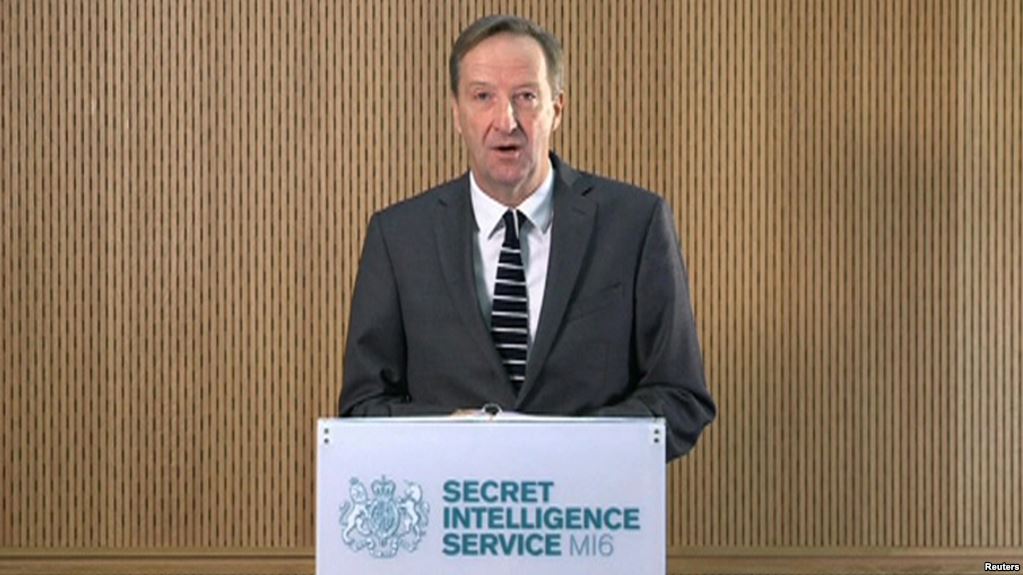
Alex Younger MI6.jpg

Alex Younger: 'You can tell a lot about the soul of a country from its intelligence services' speech from "C", Head of MI6' - 2018 ,

December 6, 2018

3 December 2018, St Andrews, Scotland, UK

Ladies and Gentlemen, it is a pleasure to be back at St Andrews. I had no idea that I would return one day as Chief of the Secret Intelligence Service, SIS – as we call ourselves – or MI6, as we are known to the world. After I graduated, I joined a Scottish Regiment. But within 4 years I found myself sitting in MI6 Headquarters, staring at a blank piece of paper. I imagine some of you might be familiar with that situation.

I had been given, as my first job, the task of penetrating an organisation intent on genocide in the Western Balkans in the mid-1990s.

Starting from that blank piece of paper, I had to find my way to the heart of that organisation and obtain secret information for the British government.

It took me to places I never thought I would visit, often travelling under a false identity. It involved many nights drinking obscure homemade alcohol, piecing together the intentions of the parties to that conflict, and allowing me to create the secret relationships necessary to provide the intelligence our country urgently needed.

I had the satisfaction of knowing that my work, along with that of many others, helped to pave the way for the eventual arrest and prosecution of war criminals implicated in the murder or displacement of hundreds of thousands of people.

Intelligence work on its own can’t stop every attack or prevent every evil. But it can shorten wars, and it can and does save lives.

That sense of pride at being part of an effort and cause greater than myself has never left me for a single day of nearly 30 years serving my country as an intelligence officer. I believe this to be true of every member of our organisation.

When I look back on those early days of my work with MI6 and ask myself how I was able to do it, I realise that it owes a great deal to this university. More than I knew at the time, St Andrews shaped me as a person.

The – how shall I put it – lack of distraction in this corner of Fife lends itself to deeper human relationships than are typical of university life.

St Andrews taught me to think in an open-minded way about the world. It taught me the value of the human curiosity and curiosity about humans that has propelled my career, and the career of the surprisingly large number of St Andrews graduates in the ranks of SIS.

For if you strip away the mystique that envelops our organisation, that is our fundamental role: we provide human intelligence.

Our task is to create human relationships that bridge forbidding cultural and linguistic boundaries, in some of the most challenging environments on earth and online. We do this for a specific reason: in order to obtain information and take actions required by the British government to keep this country safe.

Our skill lies in our ability to create relationships of trust between our officers and people inside the organisations we need to understand. We call these brave people agents, and they put their livelihoods, and sometimes even their lives, at risk on behalf of the United Kingdom. That is why our people, our methods and our operations must always remain secret.

While I’m going to speak today about how the world is changing and SIS is changing with it, I do not expect our human intelligence role will ever change fundamentally. We will always need to understand the motivations, intentions and aspirations of people in other countries. Even in an era of artificial intelligence you need human intelligence, in fact it will become even more important in a more complex world.

The degree of interconnectedness between nations, peoples and systems today, the ubiquitous nature of information, and the exponential pace of technological change, are making the world dramatically more complicated.

This complexity has eroded the boundaries we have traditionally relied upon for our security: the boundaries between virtual and real, the domestic and the international, between states and non-state actors and between war and peace. The result is a world of far greater ambiguity.

I want to be clear: our adversaries did not create this ambiguity and they did not create the things that divide us.

But they have shown a keen willingness to exploit ambiguity in an opportunistic way, taking advantage of blurred lines to probe our institutions and defences in ways that fall short of traditional warfare.

We refer to these as hybrid threats. They include the cyber attacks, misinformation and disguised use of military force seen in Ukraine and elsewhere, combined with political obfuscation, or what you might call implausible deniability.

The good news is that we are far from powerless when confronted by these challenges.

We are better placed than most countries to cope with a world of hybrid threats, because of the strength of our alliances, our values, and our institutions. This includes the UK intelligence community. After all, ambiguity is the state SIS is constituted to dispel, but it is also the context in which we operate. We are at home with ambiguity. It is a new environment, but it is our traditional business.

We are one of the few truly global intelligence agencies, capable of going to the source of problems anywhere in the world to recruit and run secret agents, penetrate terrorist organisations, provide our government with the intelligence it needs to safeguard the national interest, give UK authorities information they need to disrupt terrorist attacks at home and against our allies, and detect and counter efforts by state and non-state actors to traffic drugs or proliferate nuclear and chemical weapons.

So SIS’s mission is a crucial aspect of our strength as a democracy, and as a member of the Western Alliance in the 21st century.

As Chief I rarely speak in public. I am a spy. And less is more. This is only my second public speech in 4 years; and you might have to wait quite a long time for another one.

But I am speaking today because it is vital that people hear enough about SIS to know what we really do – as opposed to the myths about what we do – and because we want talented young people across our country to join us.

While I am delighted to say that we recruit the very brightest talent, and have extraordinary young people working in our organisation, this is not something I will ever take for granted. We are going to need the most diverse and skilled officers possible in the years ahead. Because the reality of the world is going to become more ambiguous, and more complicated.

While I was St Andrews I also studied computer science. The radical thought in those days was that computers would soon be able to talk to each other. Now, billions of people and devices are connected worldwide.

We are in the early stages of a fourth industrial revolution that will further blur the lines between the physical, the digital and biological realms. Lawfully used, technology such as bulk data, modern analytics and machine learning is a golden opportunity for society at large, including for MI6 as an organisation.

But I have also witnessed the damage new technologies can do in the hands of a skilled opponent unrestrained by any notion of law or morality, as well as the potentially existential challenge the data age poses to the traditional operating methods of a secret intelligence agency. We and our allies face a battle to make sure technology works to our advantage, not to that of our opponents. Liberal democracies should approach this with confidence, as the originators of this technology.

But the twin drivers of technological change and international complexity mean that we have to keep adapting if we are to be as effective at spying in the future as we are today. There will be a dividing line between those Intelligence Services that grasp this, as the UK agencies have, and those services that don’t.

The era of the fourth industrial revolution calls for a fourth generation espionage: fusing our traditional human skills with accelerated innovation, new partnerships and a mindset that mobilises diversity and empowers the young.

Across the century of SIS’s existence, we have evolved continuously to confront each generation of threat: from the World Wars to the Cold War to the rise of transnational threats including international terrorism. Now, we are evolving again to meet the threats of the hybrid age – the fourth generation I am speaking of.

This evolution takes 3 forms, that I want to describe to you:

First, when your defences as a country are being probed on multiple fronts at the same time, it can be difficult to see the totality of what your opponent is trying to do. Security in the hybrid world is therefore all about who can partner to the greatest effect.

In the UK, we call this the Fusion Doctrine, and it involves drawing together all our national capabilities to detect, deter and counter hybrid attacks and other threats to the United Kingdom.

When I joined SIS, operations were largely conducted by individuals, as the story of my blank sheet of paper on my first mission suggests.

We now operate dynamic teams that draw on skills and knowledge across the whole of SIS: bringing together the formidable talents of our agent recruiters and runners, our analysts, our subject matter experts, our linguists, our data scientists and our technical and engineering officers – known to the public as Q branch.

We work more closely than ever before with our sister agencies M15 and GCHQ. We each have a distinct mission and culture, but we have found that everything we do is interdependent, and we have made a virtue of this. We are among the most closely integrated intelligence communities in the world.

The spirit of partnership extends further, to the police and other domestic agencies, the Foreign and Commonwealth Office and the Ministry of Defence, and the UK Armed Forces we often serve alongside.

We also draw on unparalleled partnerships overseas, including our Five Eyes allies the United States, Canada, New Zealand and Australia, and our close and historic security relationships across Europe.

The implications of the Brexit debate have been set out by Ministers. For our part as SIS, we will always work with our sister agencies to strengthen our indispensable security ties in Europe.

We also work with other partners across the world, to disrupt terrorist activity and counter other serious threats – but always on our terms, and based on our laws and our values as the United Kingdom.

When you consider these concentric circles of partnership, and the breadth of skill, experience and trust that they encompass, it is not surprising that adversaries seek to offset their relative disadvantage through hybrid means. Indeed, when they can they will take steps to undermine these partnerships, and we must take action of our own kind in response.

So second, alongside our core mission of revealing the intentions of adversaries and giving the UK government strategic advantage overseas, our task now is to master covert action in the data age.

When I joined SIS, our principal task was finding out secrets. In a world of hybrid threats it is not enough to know what your adversary is doing. You must be able to take steps to change their behaviour.

This is primarily driven by the threat from terrorism – the ultimate manifestation of the eroded boundaries of the 21st century. SIS is the arm of government that has the ability to go overseas to the source of terrorist threats, and to disrupt them lawfully through our partnerships.

And I can tell you today, that since my last speech, we and our sister agencies have disrupted multiple serious Daesh attack plans originating overseas that, if successful, would have caused significant loss of life.

This includes an important contribution to helping European countries, particularly our French and German allies, prevent terrorist attacks in their countries or against their citizens.

This has involved exceptionally difficult and dangerous work. We have asked our agents – the people who agree to work in secret for MI6 – to do extraordinary things and run great risks. And I will not hide from you that some have paid the ultimate price. Our country and our allies owe them a debt they can never truly know and never fully repay.

We are proud of the contribution we have made to the coalition action in Syria which has now come close to destroying the so-called Caliphate. This has had a welcome effect on the direct threat to Europe. But to be clear, if the tragic events of 2017 in the UK are not sufficient of a reminder, we face a persistent and evolving threat from terrorism, one that demands that we evolve in turn.

You might think that countering terrorism was challenging enough. But now we face the additional complexity of the threats posed by nation states operating in the grey spaces of the hybrid era, which is a wholly separate problem.

Article 5 of the North Atlantic Treaty, which states that an armed attack against one or more of the NATO allies will be considered an attack on all, is the cornerstone of our defence and security. But it presupposes a clear distinction between a condition of war and a condition of peace – precisely the distinction that our opponents are seeking to obscure.

As allies we are determined to uphold and deepen our Article 5 commitment to each other’s security. But it is significant that we face adversaries who now regard themselves as being in a state of perpetual confrontation with us.

One of the most egregious examples of this was the attack in Salisbury, in which the Russian state used a military-grade chemical weapon on UK soil.

We did not respond to this flagrant hostile act by emulating Russian tactics. Instead, we operationalised our values, our legal system, and our alliances. We exposed the perpetrators and coordinated the largest ever collective expulsion of Russian intelligence officers from NATO and partner states, significantly degrading Russian intelligence capability.

When faced by these kinds of attacks, our approach with our allies is to seek to attach a cost to the behaviour. Our intention is for the Russian state to conclude that, whatever benefits it thinks it is accruing from this activity, they are not worth the risk.

We will do this in our way, according to our laws, and our values. We will be successful nonetheless, and I urge Russia or any other state intent on subverting our way of life not to underestimate our determination and our capabilities, or those of our allies. We can do this to any opponent at any time.

But I should emphasise that even as the Russian state seeks to destabilise us, we do not seek to destabilise Russia. We do not seek an escalation. If we see a change in Russian behaviour, we will respond positively. But we will be implacable in defence of our people and our vital interests.

We will continue to defend the rule of law and the international rules-based system robustly.

Our allies trusted in our intelligence in the aftermath of the Salisbury attack. We felt this as an act of solidarity and it meant a huge amount to us. But we have been clear to our allies that it was an act of self-interest on their part as much as one of solidarity. Whatever an adversary can do to us they can and have done to others.

Our approach to attaching a cost to malign activity also applies to cyber attacks, as in February this year when the UK attributed responsibility for the NotPetya attack against Ukraine, which also affected the United Kingdom, to the Russian government.

Much of the evolving state threat is about our opponents’ increasingly innovative exploitation of modern technology. So simply put, we’ve got to innovate faster than they can. Indeed, future generations would not forgive us if it were otherwise.

This brings me to the third driver for change in SIS: the need to ensure that technology is on our side, not that of our opponents.

The digital era has profoundly changed our operating environment. Bulk data combined with modern analytics make the modern world transparent, a fact which contributed to GRU embarrassment after the Salisbury attack. But it is also a serious challenge if used against us.

So we are evolving rapidly. Cyber is now our fastest-growing directorate. We are shifting our focus to the nexus between humans and technology. And for the first time, through the National Security Strategic Investment Fund, we are pursuing a completely different type of partnership with the tech-innovation community, giving the private and academic community the role we need and they deserve.

Ironically, the most profound consequence of the technological challenge is a human one. We are determined, of course, to attract people with an even higher level of technical skill to join our ranks, in the best traditions of Q. But my organisation will need to adapt even faster if it is to thrive in the future. And that will require people with new perspectives, capable of harnessing their creativity in ways that we can’t yet even imagine.

It is why we are determined to attract people from the widest range of backgrounds to join SIS. This will enable us to bring the widest range of approaches to bear on solving complex problems and so make our missions even more effective.

People sometimes ask what causes me to lose most sleep at night. The answer might surprise you. The biggest risk that I see is a failure to make full use of the amazing talent in our organisation and in our country at large. As the leadership of MI6 we are determined not to let that happen.

I believe in empowering those closest to the problem with the skills and authority they need to solve it. We delegate assertively. In the cyber age, newcomers will often be better equipped to solve problems than those, like me, steeped in experience can be. If you join us, you will be trusted to use your talents.

I have spoken of how SIS is pioneering a fourth generation of espionage – deepening our partnerships to counter hybrid threats, mastering covert action in the data age, attaching a cost to malign activity by adversaries and innovating to ensure that technology works to our advantage.

But while all these things change, there is one thing that will not alter, and about which there is no ambiguity, and that is our commitment to the values and laws of the United Kingdom.

We understand that what we do we do in the public’s name, and that public confidence in what we do is fundamental to our success. Above all, we know that if we undermined our values even in the process of defending them, then we would have failed.

SIS operates in secret, but secret does not mean unaccountable. Our actions are tasked and authorised by ministers and carried out only in support of government policies. And we are answerable to independent scrutiny by the Investigatory Powers Commissioners and oversight by Parliament’s Intelligence and Security Committee.

Alongside this duty to be accountable we of course have a duty to learn the lessons of the past.

I am one of the many SIS officers who have served in Afghanistan. After the 9/11 attacks I witnessed at every level in SIS a profound impulse to step forward into the line of danger. We felt that our organisation was one of the few that could make a difference, faced with a wholly new, and open-ended, threat from international terrorism.

I am proud of the courage and reflex to do the right thing that SIS demonstrated. But the government has acknowledged in its response to the Intelligence and Security Committee’s recent report, that we were not fully prepared for the challenges that we faced in those fraught times. Some of our officers were sent into a situation for which they were not fully prepared, and it took SIS too long to rectify that.

The report made hard reading for those of us who want our service to be the best it can be. But be in no doubt that we will learn the lessons.

So fifteen years later, we have improved our operational policy and practice, strengthened our training and guidance, and we now operate within an enhanced oversight and operational framework. And I’m proud that the Committee also concluded that SIS has the values and resilience to meet the current counter-terrorism challenge.

Above all, I have unshakeable faith in the quality, humanity and decency of the men and women who choose to join SIS. When faced with some of the very worst behaviour and dangers that humanity can devise, their instinct is to put themselves forward in the service of their country, and their fellow men and women.

We want people from across our country who feel a similar call to service to consider applying to join our ranks.

I have spoken at St Andrews today because of the deep affection I have for this university, and because you are one of the best in the world for the study of terrorism, international relations and artificial intelligence. But my message is to students in every school, college and university across our country. In particular, I want to speak to young people who have never seen themselves in MI6.

The stereotype is that we only want a certain “type” to join MI6. This is false. If you think you can spot an MI6 officer, you are mistaken. It doesn’t matter where you are from. If you want to make a difference and you think you might have what it takes, then the chances are that you do have what it takes, and we hope you will step forward.

It is the greatest honour of my career to lead the women and men of MI6. I believe the more you knew about what they were doing the prouder you would be.

You can tell a lot about the soul of a country from its intelligence services. In SIS, we have a service rooted in and inspired by the values of liberal democracy, determined to defend our country and the international rule of law, and carrying out remarkable and highly effective work in the face of potent threats, with creativity and courage and integrity.

These are the qualities that allow us to be the secret front line, to stand between this country and danger, and to help create an international environment in which our country and our people can prosper and thrive.

Thank you very much.

Source: https://www.gov.uk/government/speeches/mi6...

Enjoyed this speech? Speakola is a labour of love and I’d be very grateful if you would share, tweet or like it. Thank you.

Facebook Twitter Facebook
In WAR & CONFLICT Tags ALEX YOUNGER, HEAD OF MI6, INTELLIGENCE SERVICES, TERRORISM, COUNTER TERRORISM, UNITED KINGDOM, ISIS, CYBER TERRORISM, RECRUITMENT, AGENTS, SECRET AGENTS, INTELLIGENCE COMMUINITY, GLOBAL SECURITY
Comment

Amal Clooney: 'Don't let this be another Rwanda', regarding ISIS genocide to UN - 2017

June 21, 2017

9 March 2017, UN, New York, USA

Excellencies, Ladies and Gentlemen,

I thank the sponsors of this event for inviting me to address you once again at the United Nations. Six months ago, I came here to discuss the need for accountability for crimes committed by ISIS. I spoke to you as the lawyer for a group of victims of ISIS’ crimes, including Nadia Murad, who as a 21-year old girl was enslaved and raped by ISIS militants in Iraq. My message to you was that ISIS is a global threat, which requires a global response. And that the response should not be limited to the battlefield: the UN should also investigate ISIS’ crimes and make sure that those responsible are brought to justice.

Since my last address I have supported the United Kingdom’s initiative to have the Security Council set up an investigation into ISIS’ crimes in Iraq. This would allow the UN to work alongside Iraqis to collect evidence of crimes on the ground and identify specific individuals who are responsible for them. Over the last few months, I have met with Iraqi, EU and UN officials and members of the Security Council, including the Russian and US Ambassadors, to discuss this initiative. All of them expressed support for the idea of a UN investigation to be established by the Security Council with Iraq’s cooperation. So the UK took an admirable leadership role, and drafted a short resolution to make this a reality. This draft was presented to Iraq many months ago and Iraq has since repeatedly and publicly expressed its support for the initiative. As recently as October Foreign Minister Jaafari confirmed Iraq’s commitment to “a Campaign… led by the UN… [that would] include action to gather and preserve evidence of [ISIS’] crimes”. The Iraqi government is aware that a one-page letter to the Security Council requesting the investigation would be sufficient to trigger a vote on the resolution.

But months have passed, deadlines set by the UK have come and gone, and the Iraqi government has declined to send the letter. So there has been no vote, no resolution, no investigation. The Council could of course act without this letter. It could establish the investigation without Iraq’s consent, acting under Chapter VII of the UN Charter. It could refer the case to the International Criminal Court. The General Assembly could establish an accountability mechanism, as it did for Syria in December. Or the Secretary-General could launch an investigation. But none of this has happened yet. Instead, mass graves in Iraq still lie unprotected and un-exhumed.

Witnesses are fleeing. And there is still not one ISIS militant who has faced trial for international crimes anywhere in the world. So I am speaking to you, the Iraqi government, and to you, UN member states, when I ask: Why? Why has nothing been done? Could it be that these crimes are not serious enough to warrant an international investigation? NO – ISIS is today the most brutal terror group in the world, representing what the Security Council has called an “unprecedented threat” to international peace and security.

ISIS has carried out or inspired attacks in more than 31 countries that have killed over 2,000 people outside Syria and Iraq in the last 3 years alone. Inside Iraq, ISIS has attacked victims from every community including Shia Muslims, Sunni Muslims and Christians. And ISIS has made clear that it intends to destroy Yazidis, like Nadia, completely: through killings, forced conversions, and rape. The UN has concluded that ISIS is committing genocide against this group, and there can be no more serious crime. The UN was created as the world’s way of saying ‘never again’ to the genocide perpetrated by the Nazis. And yet here we are, 70 years later, discussing the UN’s inaction in the face of a genocide that we all know about, and that is ongoing. So is it that the political interests of powerful states stand in the way of accountability? Is that why, over two years after the genocide began, not one ISIS member has been brought to trial for it? No – this is not it either. As a human rights lawyer I am often told that my cause, while commendable, cannot succeed because of political realities. We have seen the Security Council paralysed over Syria, or the road to the International Criminal Court obstructed when powerful states block Council action. But here, ladies and gentlemen, we are dealing with ISIS. No one claims to respect or protect them. No veto-wielding member of the Council is on their side. And yet we are no closer to justice than when I addressed you last year.

Could it be, then, that crimes of this nature will be too difficult to prove? No — this is not a reason for inaction either. ISIS is a bureaucracy of evil leaving a trail of evidence behind it that no one is picking up. It has kicked bodies into uncovered mass graves. It set up a ‘Committee for the Buying and Selling of Slaves’ and courts to ‘legalise’ the purchase of women as property. It has kept detailed forms about its recruits, including their name, phone number, address and previous terror experience. ISIS militants have even sent messages to Nadia from their phones, taunting her that they still have her family members in captivity… They don’t bother to hide their phone number when they do so: they know no one is looking for it.

Excellencies, ladies and gentlemen: what is shocking here is not just the brutality of ISIS but how long those who know about it can remain passive. If we do not change course, history will judge us, and there will be no excuse for our failure to act. We cannot say that ISIS’ crimes were not serious enough; we cannot say that the interests of powerful states stood in the way; or that these crimes are too hard to prove. That’s why I am asking you today: to stand up for justice. Every conflict reminds us that there can be no lasting peace without justice. A lack of accountability simply leads to continuing cycles of vengeful violence. So killing ISIS on the battlefield is not enough: we must also kill the idea behind ISIS by exposing its brutality and bringing individual criminals to justice. Justice is also what the victims want – ask the families of the American hostages Jim Foley and Steven Sotloff who were beheaded by the ISIS militant known as Jihadi John. When Jihadi John was reportedly killed by a drone strike in Syria, the hostages’ families said they would have preferred it if he had been arrested instead. Steven’s family said they wanted to “sit in a courtroom, watch him sentenced and see him sent to … prison”. Yazidi women like Nadia say the same: they want the chance to face their abusers in court; they want legal judgments to be published, to prevent their genocide later being denied. And they deserve nothing less. But justice will forever be out of reach if we allow the evidence to disappear: if mass graves are not protected, if medical evidence is lost, if witnesses can no longer be traced.

Excellencies, it is not too late to turn things around. I believe there is a common will among those in this room, among leaders in Baghdad and capitals around the world that ISIS should be held accountable in a court of law for its crimes. What is needed now is moral leadership to make it happen. Last week’s US State Department report on Iraq reminds us that the vast majority of serious human rights abuses being committed today in Iraq are committed by ISIS, and that all Iraqis – Sunni, Shia, Christian, Yazidi, and others - are its victims. So today, I wish to speak directly to Prime Minister Abadi: on behalf of all of ISIS’ victims, I call on you to send the letter to the Security Council requesting an investigation into ISIS crimes. Getting the UN involved was initially Iraq’s idea, and finally taking action to make it a reality would silence those who doubt your commitment to bring Daesh to justice.

And finally, to all UN member states: if this road to accountability through the Security Council is blocked, you must take the initiative to secure accountability in other ways available to you under the UN Charter. Don’t let this be another Rwanda, where you regret doing too little, too late. Don’t let ISIS get away with genocide.

Enjoyed this speech? Speakola is a labour of love and I’d be very grateful if you would share, tweet or like it. Thank you.

Facebook Twitter Facebook
In WAR & CONFLICT Tags GENOCIDE, ISIS, UN, TRANSCRIPT, AMAL CLOONEY
Comment

See my film!

Limited Australian Season

March 2025

Details and ticket bookings at

angeandtheboss.com

Support Speakola

Hi speech lovers,
With costs of hosting website and podcast, this labour of love has become a difficult financial proposition in recent times. If you can afford a donation, it will help Speakola survive and prosper.

Best wishes,
Tony Wilson.

Become a Patron!

Learn more about supporting Speakola.

Featured political

Featured
Jon Stewart: "They responded in five seconds", 9-11 first responders, Address to Congress - 2019
Jacinda Ardern: 'They were New Zealanders. They are us', Address to Parliament following Christchurch massacre - 2019
Dolores Ibárruri: "¡No Pasarán!, They shall not pass!', Defense of 2nd Spanish Republic - 1936
Jimmy Reid: 'A rat race is for rats. We're not rats', Rectorial address, Glasgow University - 1972

Featured eulogies

Featured
For Geoffrey Tozer: 'I have to say we all let him down', by Paul Keating - 2009
for James Baldwin: 'Jimmy. You crowned us', by Toni Morrison - 1988
for Michael Gordon: '13 days ago my Dad’s big, beautiful, generous heart suddenly stopped beating', by Scott and Sarah Gordon - 2018

Featured commencement

Featured
Tara Westover: 'Your avatar isn't real, it isn't terribly far from a lie', The Un-Instagrammable Self, Northeastern University - 2019
Tim Minchin: 'Being an artist requires massive reserves of self-belief', WAAPA - 2019
Atul Gawande: 'Curiosity and What Equality Really Means', UCLA Medical School - 2018
Abby Wambach: 'We are the wolves', Barnard College - 2018
Eric Idle: 'America is 300 million people all walking in the same direction, singing 'I Did It My Way'', Whitman College - 2013
Shirley Chisholm: ;America has gone to sleep', Greenfield High School - 1983

Featured sport

Featured
Joe Marler: 'Get back on the horse', Harlequins v Bath pre game interview - 2019
Ray Lewis : 'The greatest pain of my life is the reason I'm standing here today', 52 Cards -
Mel Jones: 'If she was Bradman on the field, she was definitely Keith Miller off the field', Betty Wilson's induction into Australian Cricket Hall of Fame - 2017
Jeff Thomson: 'It’s all those people that help you as kids', Hall of Fame - 2016

Fresh Tweets


Featured weddings

Featured
Dan Angelucci: 'The Best (Best Man) Speech of all time', for Don and Katherine - 2019
Hallerman Sisters: 'Oh sister now we have to let you gooooo!' for Caitlin & Johnny - 2015
Korey Soderman (via Kyle): 'All our lives I have used my voice to help Korey express his thoughts, so today, like always, I will be my brother’s voice' for Kyle and Jess - 2014

Featured Arts

Featured
Bruce Springsteen: 'They're keepers of some of the most beautiful sonic architecture in rock and roll', Induction U2 into Rock Hall of Fame - 2005
Olivia Colman: 'Done that bit. I think I have done that bit', BAFTA acceptance, Leading Actress - 2019
Axel Scheffler: 'The book wasn't called 'No Room on the Broom!', Illustrator of the Year, British Book Awards - 2018
Tina Fey: 'Only in comedy is an obedient white girl from the suburbs a diversity candidate', Kennedy Center Mark Twain Award -  2010
Tina Fey: 'Only in comedy is an obedient white girl from the suburbs a diversity candidate', Kennedy Center Mark Twain Award - 2010

Featured Debates

Featured
Sacha Baron Cohen: 'Just think what Goebbels might have done with Facebook', Anti Defamation League Leadership Award - 2019
Greta Thunberg: 'How dare you', UN Climate Action Summit - 2019
Charlie Munger: 'The Psychology of Human Misjudgment', Harvard University - 1995
Lawrence O'Donnell: 'The original sin of this country is that we invaders shot and murdered our way across the land killing every Native American that we could', The Last Word, 'Dakota' - 2016