
• Genre
  • About
  • Submissions
  • Donate
  • Search
Menu

Speakola

All Speeches Great and Small
  • Genre
  • About
  • Submissions
  • Donate
  • Search

Bruce Pascoe: 'Maybe the term "hunter-gathering" is just very convenient for people that wanted to take the land', NAIDOC Week - 2009

April 6, 2017

8 July 2009, Art Gallery of NSW, Sydney, Australia

Bruce Pascoe is a writer, editor and anthropologist of books such as Convincing Ground, Dark Emu and Fog a Dox. He is from theBunurong clan, of the Kulin nation.

Mr. Kirby was walking along the Murray River in 1839, and he came across a fisherman who was sitting on a weir that he had constructed into the river, and had made it in such a fashion that all the water was channelled through the weir and any fish that wanted to move up the river had to do so through a small net that had been placed in the river. Mr. Kirby sat down under a tree and watched this operation for some time, and noticed that there was a stick arrangement anchored into the ground, very fine, narrow stick and being tied down, so it had a lot of tension on the string, and the tie disappeared into the water.

He wasn't sure what was going on, whether it was a fishing rod or what the arrangement was, but then he noticed that a fish ... The stick released, and a fish flung over the fisherman's shoulder and landed behind him. Mr. Kirby noticed that the man was aware that he was being observed, and casually reached behind him, picked up the fish, and tossed into a basket and then leant back on his elbow and waited. This went on, Mr. Kirby's observation, for an hour or more, and every few minutes, another fish would be flung back over the fisherman's shoulder, and he would, with great insouciance, toss it into the basket.

Aboriginal people sometimes get a bit nervous when other aboriginal people use big words, but I'm a bookish sort of a person and I grew up with words and I loved them. Aboriginal people traditionally spoke seven or eight languages. We were the great wordsmith of the world, and one day, we'll recover that pride in the words. I'm happy to use insouciance because that's exactly what Mr. Kirby observed.

This man aware of being observed was proud of his achievement, and a bit disdainful of this other man watching him. He didn't even speak to the man, but he did observe how the tie from the springing stick was tied on to a noose. Every time a fish swam through the noose, it triggered the peg that was holding the noose down, and it flung the fish out of the water. This was engineering, and the man was very proud of his achievement.

 A man called Mitchell, on the Narran River on the Queensland-New South Wales border, right about the same time, rode through grasslands up to the withers of his horse, rode through those grasslands for nine miles. Throughout the nine miles, grass was stooped like the old English stoops that was set in piles, and he rode through this for nine miles.

Leichhardt was another man who visited that country and disappeared. Another man called Gregory came and followed in Leichhardt footsteps and hoof prints. They camped because they were tired and felt they were lost when they saw aboriginal people on these grasslands, and they witnessed them for three days while they repaired their carts, while they fixed up their horse's saddlery, they recovered their spirits and their health.

For three to four days, Gregory's people witnessed people harvesting grain. Then he saw a phenomenal thing. He saw people sowing grain, and the next day, saw people irrigating that grain. Later on, the harvested grain from the last season were sorted into stores, and some of it was put in pouches and worn around the neck, and was destined to be traded to neighbouring peoples. This was a trade in grain.

Mr. Smith from the Northern Territories, part aboriginal man, came across a number of people building what looked to him like a dam. He watched very carefully and very circumspectly, because these weren't his people. He stood back a mile off from this project and just watched. Eventually, the old men motioned him into the camp. He asked them about what they were doing. They said, "Oh, we're going to do another one tomorrow. You can watch that too if you like." The next day, another dam was built. That dam had an exit from it into some channels, which ran through flat ground, and those people were irrigating a crop.

Ernest Giles' brother, a bit earlier than this, was travelling through the Northern Territory, and came across huge stores of what he discovered was grain stored up in platforms three metres off the ground. Each of those stores weighted a tonne. He had never seen anything like it before, but it didn't stop him stealing it, because, once again, he was an explorer. He was lost, and he was angry. He took the grain that had been stored for the harvesters.

There was a woman of Cape Otway, and it was me who discovered her secrets, because near my home, near the Cape Otway log house at that time, I came across a midden that had been exposed by a great storm. Cape Otway is pretty good at having great storms. The face of the midden had sheared away and exposed a whole lot of tools, and they were the normal tools that you would find, axes, scythes, hammers, augers, bone spear points for sewing clothes.

There was one little stone, about that big, like a size of a top or a matchbox, and I couldn't work it out. It had various holes drilled in it of different dimensions, had notches on the side, and it has straight lines, and I couldn't work out what this was. I worried about it for days, and days, and days, and eventually, my mother came down. She was living at Apollo Bay not far away. My mother is blind, deaf, and epileptic but quite well. I gave it to my mother. I said, "What do you reckon this is?" She felt it, and she said, "Oh, this is a sewing kit."

She felt the holes, and she felt the lines. She said, "I used to have on like this when I was a kid made out of tin," and it was for sharpening needle points, bone needle points, getting an edge on the fine side of the needle, and notches for cutting twine. It was a very, very intimate thing, and I was more or less ashamed to be handling it. I did so in ignorance, but it wasn't really my business. I returned all those things to the site, and they're still there. I go back every now and then and see them.

Another man called Todd in 1835 was one of the very first white people to visit Victoria. He was supposed to be guarding the land for John Batman. John Batman had gone back to Tasmania because his nose was falling off. John Batman, the great discoverer of Victoria, had syphilis and his nose was falling off. He went back to Tasmania. There was a reason why he had syphilis. There was a reason why a lot of aboriginal people and aboriginal women in Tasmania had syphilis too.

Todd was told to wait there and not upset the aboriginal people. Todd wasn't a bad sort of a man. Now, if he was look after your milk bar or your pub or your hardware store, you could rely on his abilities, because he does seem like a decent sort of a bloke. He talked to the aboriginal people as much as he could, learned some words, seemed to be kind, gave people the things that they seemed to be interested in, accepted what he was given in return. It was a nice warm weather. Everything seem to be going pretty well.

Todd, in his spare time, because he seemed to have a lot of it, was happy to fish with the people, but also to make drawings of them as they fished or as they participated in other cultural activities. One of these drawings is a line of women and girls bending over with sticks about that long, and it's a transformative piece of Australian art. Not very good, but it's transformative because the women were digging up a yam pasture field, that if you look at the scale, is probably six, seven acres wide. It's a big paddock. It's full of yam daisy, and that's what those women were doing. They were digging up the yam daisy, selecting the mature tubers, and pressing them down. When they had selected their tubers, they'd press down the remaining tubers to regenerate the crop.

You can see all this in Todd's drawing. We're very, very fortunate to have it, because the next year, there was no yam daisy in Victoria. Wherever a sheep had roamed, they came across the yam pastures. They gravitated to them because they were such good eating. Sheep, because of their dentition, are able to crop the basal leaves of yam daisies right down to the ground. A kangaroo can't do it. A wombat can't do it. A bandicoot can't do it, but a sheep can. They wiped out the yam daisy in one season. You hardly can find a yam daisy in Victoria now. Some people are growing them commercially, but if you go along the railway tracks around Werribee and places like that, you'll see plenty of them.

What do you call what all these people saw? What I saw, what Mr. Kirby saw, what Mr. Mitchell, what Mr. Gregory, what Mr. Smith, what Mr. Giles, what Mr. Todd, what were they looking at? I'm having a battle at the moment with senior academics in Australia, which I'm losing profoundly because I'm not an academic. I'm just a bloke who lives in the bush, but I can read. These are the things I've read. I'm saying to people, as I'm saying to you, I'm proselytising, I'm using you, it looks to me as if these are not the habits of hunter-gatherers.

Aboriginal people are called hunter-gatherers. What's all this business of irrigating crops, harvesting crops, having granaries of over a tonne and several parcels, trading grain, cultivating yam pastures, having 3,000 kilometres of eel races around the town of Koroit in Victoria? What is going on? This isn't hunter-gathering. I'm asking you what you think. If we can't use words like horticulturist, because I've had the ruler over my knuckles for suggesting such a thing, we can't say tilling, I was admonished for that, we can't say, apparently, farming, we can't say cultivation, what is going on?

I know it's not hunter-gathering. Aboriginal people in that era knew it wasn't hunter-gathering. Maybe the term hunter-gathering is just very convenient for people that wanted to take the land, because if you're hunting and gathering, your possession of the soil is itinerant.
Source: https://www.youtube.com/watch?v=KMZ9cnP2vs...

Enjoyed this speech? Speakola is a labour of love and I’d be very grateful if you would share, tweet or like it. Thank you.

Facebook Twitter Facebook
In EQUALITY 2 Tags BRUCE PASCOE, ART GALLERY OF NSW, NAIDOC, NOT HUNTER GATHERERS, LINGUISTICS, ANTHROPOLOGIST, ANTHROPOLOGY, LANGUAGES, ENGINEERING[, ABORIGINAL AUSTRALIA, INDIGENOUS RIGHTS, FIRST PEOPLE
Comment

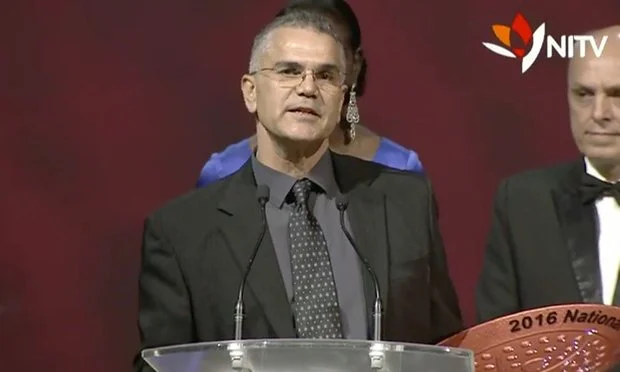
Chris Sarra: 'We are stronger than we believe and smarter than we know', NAIDOC Person of the Year - 2016

July 18, 2016

8 July 2016, NAIDOC awards, Darwin, Australia

To watch video of this speech, see NITV facebook page

It’s my wedding anniversary tonight. So thank you to my wife, Grace. Sixteen years. I think last year we were at State of Origin, watching Queensland win. Greatest game of all.

I acknowledge the traditional custodians of the land, the Larrakia people. I’m so honoured to be here on your country.

Thank you to my wife and children, my family, for your ongoing support.

Thank you to my friends and colleagues, who are part of the stronger smarter revolution.

And that’s a real revolution.

A revolution with an authentic belief in the humanity of Aboriginal Australia and Torres Strait Islander Australia. And of all Australians, and our capacity to be exceptional together .

Some years ago, I was pretty down and I thank those who stood by me during this time ... a time when I had never felt so culturally, spiritually or professionally disempowered but you continued to believe in me, and gave me licence to keep believing in myself.

This honour in some ways belongs to our ghost children.

Those Aboriginal girls and boys, who chose to die by their own hand, who no longer believed that the future could be better, or that they had a place in it.

It belongs to Indigenous students rotting in classrooms that no minister or millionaire would send their children to ... to those kids I say this: in more than 500 Stronger Smarter schools nationwide, students just like you, are coming to school, staying in school and succeeding.

And you are not forgotten … and we will come for you.

This honour in some way belongs to Indigenous parents and communities, across Australia, who are working with schools to deliver on the life-giving promise of a stronger smarter future.

It also belongs to more than 2,000 school and community leaders in this education revolution for our children. They’ve worked their guts out to deliver what most thought was impossible.

This is an emotional moment for me. We're closing the gap in Indigenous education

Your work honours Aboriginal Australia and Torres Strait Islander Australia and the teaching profession. And I salute you for this.

For as long as I can remember, thanks to my mum and my dad, I’ve always known that being Aboriginal was awesome. That I was no better or worse than any other. And that hard work, service and compassion was my obligation.

That even in the face of inhumanity, I should treat people as I wanted to be treated.

Those values and beliefs strengthen my core and kept safe my soul.

Armed with this truth, even when victimised, no one could make me their victim ... not the government, whose laws stole the land that my grandfather Broome was promised in return for his hard work.

Not the drunk neighbour who called us little black bastards, even when we mowed his lawn for him.

Not the teachers who had limited beliefs in who I was and what I could achieve.

Not even the university, which used my black face to attract money for projects, but then couldn’t trust me to execute its delivery.

None of your racism, none of your hurt, none of your lies that others said about me or my culture rang true. None broke through to that precious place where my self-belief resides.

Aboriginal people are exceptional. When we can all acknowledge that, the gap will close

The battle to create equal futures has a frustratingly long way to go. Plenty of people must play a part.

To those of us who feel broken or insufficient, who feel anything but powerful, remember this: of all the billions ever born, it is we, Australia’s first people ... we alone share the blood of the world’s oldest civilisation on the planet.

And to this end, this note, I have a message for Jack Dempsey, mayor of Bundaberg, to Annastacia Palaszczuk, premier of Queensland, and to Malcolm Turnbull, who will probably be the prime minister of Australia.

I am a descendant of the Gurang Gurang and Taribilang Bunda people.

And when you are ready, and when you have the courage and you are bold enough, I am ready on behalf of my people and my people are ready to speak with you about a treaty.

For tens of thousands of years, our sovereign nations shared borders, trade and travel. Our laws were strong. Our faith was deep. And our songs enchanted. Culture enlightened our souls, and dreamings lit the way.

The past 200 years, by contrast, were everything the past 50,000 years were not.

In the blink of an historical eye, we were banished to the edges of the worlds we’d governed for eons.

There was a disruption to our excellence. Our parents and theirs were stripped of all they loved – their kids, homes, land and culture. Our people weren’t called slaves, but laboured as such – shackled, starved, never paid wages. Black diggers fought and died for a nation that denied them the right to vote.

The damage and privations continue for many today.

And I acknowledge those complexities and stand with you in acknowledging that all Australians have a part to play in resolving them – that is a truth.

But other truths are also at play. Those challenges, as complex as they are, do not define us.

Those who despise or pity us or think we are less, their blindness, that is their affliction and loss. And it doesn’t matter how many blackfellas they can line up to help them believe that.

We are more than victims and mere survivors. The scars we carry aren’t who we are. They aren’t signs of guilt or capability. They are the not the truth about our potential or capacity.

They are a part of ourselves that still need healing. And healing cannot happen while ever we believe the lies that we are a weak, desperate people, devoid of humanity and incapable of helping ourselves.

Council should be sacked for not flying Aboriginal flag in Naidoc week, says MP

The truth is this: we are stronger than we believe and smarter than we know.

For 50,000 history-making years, our old people lived like kings in lands where camels die of thirst.

They stood as ironbark – upright, strong, tall, standing and unbreakable.

Their lessons, their songlines, their legacy and their dreamings. They are our true north.

They are the truth not only of who we were, but who we can be again.

My brothers and sisters, believe me when I say this.

We are stronger than we believe. And smarter than we know.

Solidly anchored by an honourable past, more than any other human beings on the planet, we can take our place in an honourable future. We have survived – and now we must thrive.

Source: https://www.theguardian.com/australia-news...

Enjoyed this speech? Speakola is a labour of love and I’d be very grateful if you would share, tweet or like it. Thank you.

Facebook Twitter Facebook
In EQUALITY Tags CHRIS SARRA, TREATY, NAIDOC, PERSON OF THE YEAR, TRANSCRIPT, SPEAKOLIES 2016
Comment

See my film!

Limited Australian Season

March 2025

Details and ticket bookings at

angeandtheboss.com

Support Speakola

Hi speech lovers,
With costs of hosting website and podcast, this labour of love has become a difficult financial proposition in recent times. If you can afford a donation, it will help Speakola survive and prosper.

Best wishes,
Tony Wilson.

Become a Patron!

Learn more about supporting Speakola.

Featured political

Featured
Jon Stewart: "They responded in five seconds", 9-11 first responders, Address to Congress - 2019
Jacinda Ardern: 'They were New Zealanders. They are us', Address to Parliament following Christchurch massacre - 2019
Dolores Ibárruri: "¡No Pasarán!, They shall not pass!', Defense of 2nd Spanish Republic - 1936
Jimmy Reid: 'A rat race is for rats. We're not rats', Rectorial address, Glasgow University - 1972

Featured eulogies

Featured
For Geoffrey Tozer: 'I have to say we all let him down', by Paul Keating - 2009
for James Baldwin: 'Jimmy. You crowned us', by Toni Morrison - 1988
for Michael Gordon: '13 days ago my Dad’s big, beautiful, generous heart suddenly stopped beating', by Scott and Sarah Gordon - 2018

Featured commencement

Featured
Tara Westover: 'Your avatar isn't real, it isn't terribly far from a lie', The Un-Instagrammable Self, Northeastern University - 2019
Tim Minchin: 'Being an artist requires massive reserves of self-belief', WAAPA - 2019
Atul Gawande: 'Curiosity and What Equality Really Means', UCLA Medical School - 2018
Abby Wambach: 'We are the wolves', Barnard College - 2018
Eric Idle: 'America is 300 million people all walking in the same direction, singing 'I Did It My Way'', Whitman College - 2013
Shirley Chisholm: ;America has gone to sleep', Greenfield High School - 1983

Featured sport

Featured
Joe Marler: 'Get back on the horse', Harlequins v Bath pre game interview - 2019
Ray Lewis : 'The greatest pain of my life is the reason I'm standing here today', 52 Cards -
Mel Jones: 'If she was Bradman on the field, she was definitely Keith Miller off the field', Betty Wilson's induction into Australian Cricket Hall of Fame - 2017
Jeff Thomson: 'It’s all those people that help you as kids', Hall of Fame - 2016

Fresh Tweets


Featured weddings

Featured
Dan Angelucci: 'The Best (Best Man) Speech of all time', for Don and Katherine - 2019
Hallerman Sisters: 'Oh sister now we have to let you gooooo!' for Caitlin & Johnny - 2015
Korey Soderman (via Kyle): 'All our lives I have used my voice to help Korey express his thoughts, so today, like always, I will be my brother’s voice' for Kyle and Jess - 2014

Featured Arts

Featured
Bruce Springsteen: 'They're keepers of some of the most beautiful sonic architecture in rock and roll', Induction U2 into Rock Hall of Fame - 2005
Olivia Colman: 'Done that bit. I think I have done that bit', BAFTA acceptance, Leading Actress - 2019
Axel Scheffler: 'The book wasn't called 'No Room on the Broom!', Illustrator of the Year, British Book Awards - 2018
Tina Fey: 'Only in comedy is an obedient white girl from the suburbs a diversity candidate', Kennedy Center Mark Twain Award -  2010
Tina Fey: 'Only in comedy is an obedient white girl from the suburbs a diversity candidate', Kennedy Center Mark Twain Award - 2010

Featured Debates

Featured
Sacha Baron Cohen: 'Just think what Goebbels might have done with Facebook', Anti Defamation League Leadership Award - 2019
Greta Thunberg: 'How dare you', UN Climate Action Summit - 2019
Charlie Munger: 'The Psychology of Human Misjudgment', Harvard University - 1995
Lawrence O'Donnell: 'The original sin of this country is that we invaders shot and murdered our way across the land killing every Native American that we could', The Last Word, 'Dakota' - 2016