
• Genre
  • About
  • Submissions
  • Donate
  • Search
Menu

Speakola

All Speeches Great and Small
  • Genre
  • About
  • Submissions
  • Donate
  • Search

Richard Feynman: 'Seeking New Laws', The Character of Physical Laws, Cornell University - 1964

December 3, 2018

19 November 1964, Cornell University, Ithaca, New York, USA

What I want to talk to you about tonight is strictly speaking not on the character of physical laws. Because one might imagine at least that one's talking about nature, when one's talking about the character of physical laws. But I don't want to talk about nature, but rather how we stand relative to nature now. I want to tell you what we think we know and what there is to guess and how one goes about guessing it.

Someone suggested that it would be ideal if, as I went along, I would slowly explain how to guess the laws and then create a new law for you right as I went along.

I don't know whether I'll be able to do that. But first, I want to tell about what the present situation is, what it is that we know about the physics. You think that I've told you everything already, because in all the lectures, I told you all the great principles that are known.

But the principles must be principles about something. The principles that I just spoke of, the conservation of energy– the energy of something– and quantum mechanical laws are quantum mechanical principles about something. And all these principles added together still doesn't tell us what the content is of the nature, that is, what we're talking about. So I will tell you a little bit about the stuff, on which all these principles are supposed to have been working.

First of all is matter, and remarkably enough, all matter is the same. The matter of which the stars are made is known to be the same as the matter on the earth, by the character of the light that's emitted by those stars– they give a kind of fingerprint, by which you can tell that it's the same kind of atoms in the stars. As on the earth, the same kind of atoms appear to be in living creatures as in non-living creatures. Frogs are made out of the same goop– in different arrangement– than rocks.

So that makes our problem simpler. We have nothing but atoms, all the same, everywhere. And the atoms all seem to be made from the same general constitution. They have a nucleus, and around the nucleus there are electrons.

So I begin to list the parts of the world that we think we know about. One of them is electrons, which are the particles on the outside the atoms. Then there are the nuclei. But those are understood today as being themselves made up of two other things, which are called neutrons and protons. They're two particles.

Incidentally, we have to see the stars and see the atoms and they emit light. And the light is described by particles, themselves, which are called photons. And at the beginning, we spoke about gravitation. And if the quantum theory is right, then the gravitation should have some kind of waves, which behave like particles too. And they call those gravitons. If you don't believe in that, just read gravity here, it's the same.

Now finally, I did mention that in what's called beta decay, in which a neutron can disintegrate into a proton and an electron and a neutrino– or alien anti-neutrino– there's another particle, here, a neutrino. In addition to all the particles that I'm listing, there are of course all the anti-particles. But that's just a quick statement and takes care of doubling the number of particles immediately. But there's no complications.

Now with the particles that I've listed here, all of the low energy phenomena, all of in fact ordinary phenomena that happen everywhere in the universe as far as we know, with the exception of here and there some very high energy particle does something, or in a laboratory we've been able to do some peculiar things. But if we leave out those special cases, all ordinary phenomena are presumably explained by the action and emotions of these kinds of things.

For example, life itself is supposedly made, if understood– I mean understandable in principle– from the action of movements of atoms. And those atoms are made out of neutrons, protons, and electrons. I must immediately say that when we say, we understand it in principle, I only mean that we think we would, if we could figure everything out, find that there's nothing new in physics to be discovered, in order to understand the phenomena of light. Or, for instance, for the fact that the stars emit energy– solar energy or stellar energy– is presumably also understood in terms of nuclear reactions among these particles and so on.

And all kinds of details of the way atoms behave are accurately described with this kind of model, at least as far as we know at present. In fact, I can say that in this range of phenomena today, as far as I know there are no phenomena that we are sure cannot be explained this way, or even that there's deep mystery about.

This wasn't always possible. There was, for instance, for a while a phenomenon called super conductivity– there still is the phenomenon– which is that metals conduct electricity without resistance at low temperatures. And it was not at first obvious that this was a consequence of the known laws with these particles. But it turns out that it has been thought through carefully enough. And it's seen, in fact, to be a consequence of known laws.

There are other phenomena, such as extrasensory perception, which cannot be explained by this known knowledge of physics here. And it is interesting, however, that that phenomena had not been well-established, and that we cannot guarantee that it's there. So if it could be demonstrated, of course that would prove that the physics is incomplete. And therefore, it's extremely interesting to physicists, whether it's right or wrong. And many, many experiments exist which show it doesn't work.

The same goes for astrological influences. If it were true that the stars could affect the day that it was good to go to the dentist, then– because in America we have that kind of astrology– then it would be wrong. The physics theory would be wrong, because there's no mechanism understandable in principle from these things that would make it go. And that's the reason that there's some skepticism among scientists, with regard to those ideas.

On the other hand, in the case of hypnotism, at first it looked like that also would be impossible, when it was described incompletely. But now that it's known better, it is realized that it is not absolutely impossible that hypnosis could occur through normal physiological but unknown processes. It doesn't require some special, new kind of course.

Now, today although the knowledge or the theory of what goes on outside the nucleus of the atom seems precise and complete enough, in the sense that given enough time, we can calculate anything as accurately as it can be measured, it turns out that the forces between neutrons and protons, which constitute the nucleus, are not so completely known and are not understood at all well. And that's what I mean by– that is, that we cannot today, we do not today understand the forces between neutrons and protons to the extent that if you wanted me to, and give me enough time and computers, I could calculate exactly the energy levels of carbon or something like that. Because we don't know enough about that. Although we can do the corresponding thing for the energy levels of the outside electrons of the atom, we cannot for the nuclei. So the nuclear forces are still not understood very well.

Now in order to find out more about that, experimenters have gone on. And they have to study phenomena at very high energy, where they hit neutrons and protons together at very high energy and produced peculiar things. And by studying those peculiar things, we hope to understand better the forces between neutrons and protons.

Well, a Pandora's box has been opened by these experiments, although all we really wanted was to get a better idea of the forces between neutrons and protons. When we hit these things together hard, we discover that there are more particles in the world. And as a matter of fact, in this column there was plus over four dozen other particles have been dredged up in an attempt to understand these. And these four dozen other are put in this column, because they've very relevant to the neutron proton problem. They interact very much with neutrons and protons. And they've got something to do with the force between neutrons and protons. So we've got a little bit too much.

In addition to that, while the dredge was digging up all this mud over here, it picked up a couple of pieces that are not wanted and are irrelevant to the problem of nuclear forces. And one of them is called a mu meson, or a muon. And the other was a neutrino, which goes with it.

There are two kinds of neutrinos, one which goes with the electron, and one which goes with the mu meson. Incidentally, most amazingly, all the laws of the muon and its neutrino are now known. As far as we can tell experimentally, the law is they behave precisely the same as the electron and its neutrino, except that the mass of the mu meson is 207 times heavier than the electron.

And that's the only difference known between those objects. But it's rather curious. But I can't say anymore, because nobody knows anymore.

Now four dozen other particles is a frightening array– plus the anti-particles– is a frightening array of things. But it turns out, they have various names, mesons, pions, kaons, lambda, sigma– four dozen particles, there are going to be a lot of names.

But it turns out that these particles come in families, so it helps us a little bit. Actually, some of these so-called particles last such a short time that there are debates whether it's in fact possible to define their very existence and whether it's a particle or not. But I won't enter into that debate.

In order to illustrate the family idea, I take the two-part cases of a neutron and a proton. The neutron and proton have the same mass, within 0.10% or so. One is 1836, the other is 1839 times as heavy as an electron roughly, if I remember the numbers.

But the thing that's very remarkable is this. That for the nuclear forces, which are the strong forces inside the nucleus, the force between a pair of protons– two protons– is the same as between a proton and a neutron and is the same again between a neutron and a neutron. In other words, for the strong nuclear forces, you can't tell a proton from a neutron.

Or a symmetry law– neutrons may be substituted for protons, without changing anything, provided you're only talking about the strong forces. If you're talking about electrical forces, oh no. If you change a neutron for a proton, you have a terrible difference. Because the proton carries electrical charge, and a neutron doesn't. So by electric measurement, immediately you can see the difference between a proton and a neutron.

So this symmetry, that you can replace neutrons by protons, is what we call an approximate symmetry. It's right for the strong interactions in nuclear forces. But it's not right in some deep sense of nature, because it doesn't work for the electricity. It's just called a partial symmetry. And we have to struggle with these partial symmetries.

Now the families have been extended. It turns out that the substitution neutron proton can be extended to substitution over a wider range of particles. But the accuracy is still lower. You see, that neutrons can always be substituted for protons is only approximate. It's not true for electricity. And that the wider substitutions that have been discovered are legitimate is still more poor, a very poor symmetry, not very accurate. But they have helped to gather the particles into families, and thus to locate places where particles are missing and to help to discover the new ones.

This kind of game, of roughly guessing at family relations and so on, is illustrative of a kind of preliminary sparring which one does with nature, before really discovering some deep and fundamental law. Before you get the deeper discoveries, examples are very important in the previous history of science. For instance, Mendeleev's discovery of the periodic table for the elements is analogous to this game. It is the first step, but the complete description of the reason for the periodic table came much later, with atomic theory.

In the same way, organization of the knowledge of nuclear levels and characteristics was made by Maria Mayer and Jensen, in what they call the shell model of nuclei some years ago. And it's an analogous game, in which a reduction of a complexity is made by some approximate guesses. And that's the way it stands today.

In addition to these things, then we have all these principles that we were talking about before. Principle of relativity, that the things must behave quantum mechanically. And combining that with the relativity that all conservation laws must be local. And so when we put all these principles together, we discover there are too many. They are inconsistent with each other.

It seems as if, if we add quantum mechanics plus relativity plus the proposition that everything has to be local plus a number of tacit assumptions– which we can't really find out, because we are prejudiced, we don't see what they are, and it's hard to say what they are. Adding it all together we get inconsistency, because we really get infinity for various things when we calculate them. Well, if we get infinity, how will we ever agree that this agrees with nature?

It turns out that it's possible to sweep the infinities under the rug by a certain crude skill. And temporarily, we're able to keep on calculating. But the fact of the matter is that all the principles that I told you up till now, if put together, plus some tacit assumptions that we don't know, it gives trouble. They cannot mutually consistent, nice problem.

An example of the tacit assumptions that we don't know what the significance is, such propositions are the following. If you calculate the chance for every possibility– there is 50% probably this will happen, 25% that'll happen– it should add up to one. If you add all the alternatives, you should get 100% probability. That seems reasonable, but reasonable things are where the trouble always is.

Another proposition is that the energy of something must always be positive, it can't be negative. Another proposition that is probably added in, in order before we get inconsistency, is what's called causality, which is something like the idea that effects cannot proceed their causes. Actually, no one has made a model, in which you disregard the proposition about the probability, or you disregard the causality, which is also consistent with quantum mechanics, relativity, locality, and so on. So we really do not know exactly what it is we're assuming that gives us the difficulty producing infinities.

OK, now that's the present situation. Now I'm going to discuss how we would look for a new law. In general, we look for a new law by the following process. First, we guess it.

Then, we compute– well, don't laugh, that's really true. Then we compute the consequences of the guess, to see what, if this is right, if this law that we guessed is right, we see what it would imply. And then we compare those computation results to nature. Or we say, compare to experiment or experience. Compare it directly with observation, to see if it works.

If it disagrees with experiment, it's wrong. And that simple statement is the key to science. It doesn't make any difference how beautiful your guess is, it doesn't make any difference how smart you are, who made the guess, or what his name is. If it disagrees with experiment, it's wrong. That's all there is to it.

It's true, however, that one has to check a little bit, to make sure that it's wrong. Because someone who did the experiment may have reported incorrectly. Or there may have been some feature in the experiment that wasn't noticed, like some kind of dirt and so on. You have to obviously check.

Furthermore, the man who computed the consequences may have been the same one that made the guesses, may have made some mistake in the analysis. Those are obvious remarks. So when I say, if it disagrees with experiment, it's wrong, I mean after the experiment has been checked, the calculations have been checked, and the thing has been rubbed back and forth a few times to make sure that the consequences are logical consequences from the guess, and that, in fact, it disagrees with our very carefully checked experiment.

This will give you somewhat the wrong impression of science. It means that we keep on guessing possibilities and comparing to experiments. And this is– to put an experiment on a little bit weak position. It turns out that the experimenters have a certain individual character. They like to do experiments, even if nobody's guessed yet.

So it's very often true that experiments in a region in which people know the theorist doesn't know anything, nobody has guessed yet– for instance, we may have guessed all these laws, but we don't know whether they really work at very high energy because it's just a good guess that they work at high energy. So experimenters say, let's try higher energy. And therefore experiment produces trouble every once in a while. That is it produces a discovery that one of things that we thought of is wrong, so an experiment can produce unexpected results. And that starts us guessing again.

For instance, an unexpected result is the mu meson and its neutrino, which was not guessed at by anybody, whatever, before it was discovered. And still nobody has any method of guessing, by which this is a natural thing.

Now you see, of course, that with this method, we can disprove any definite theory. If you have a definite theory and a real guess, from which you can really compute consequences, which could be compared to experiment, then in principle, we can get rid of any theory. We can always prove any definite theory wrong.

Notice, however, we never prove it right. Suppose that you invent a good guess, calculate the consequences, and discover that every consequence that you calculate agrees with experiment. Your theory is then right?

No, it is simply not proved wrong. Because in the future, there could be a wider range of experiments, you can compute a wider range of consequences. And you may discover, then, that the thing is wrong.

That's why laws like Newton's Laws for the Motion of Planets lasts such a long time. He guessed the law of gravitation, tackling all the kinds of consequences for the solar system and so on, compared them to experiment, and it took several years before the slight error of the motion of Mercury was developed. During all that time, the theory had been failed to be proved wrong and could be taken to be temporarily right.

But it can never be proved right, because tomorrow's experiment may succeed in proving what you thought was right, wrong. So we never are right. We can only be sure we're wrong.

However, it's rather remarkable that we can last so long, I mean to have some idea which will last so long.

Incidentally, some people, one of the ways of stopping the science would be to only do experiments in the region where you know the laws. But the experimenters search most diligently and with the greatest effort in exactly those places where it seems most likely that we can prove their theories wrong. In other words, we're trying to prove ourselves wrong as quickly as possible. Because only in that way do we find workers progress.

For example, today among ordinary low energy phenomena, we don't know where to look for trouble. We think everything's all right. And so there isn't any particular big program looking for trouble in nuclear reactions or in superconductivity.

I must say, I'm concentrating on discovering fundamental laws. There's a whole range of physics, which is interesting and understanding at another level these phenomena like super conductivity in nuclear reactions. But I'm talking about discovering trouble, something wrong with the fundamental law. So nobody knows where to look there, therefore all the experiments today– in this field, of finding out a new law– are in high energy.

I must also point out to you that you cannot prove a vague theory wrong. If the guess that you make is poorly expressed and rather vague, and the method that you used for figuring out the consequences is rather vague, you're not sure, and you just say I think everything is because it's all due to moogles, and moogles do this and that, more or less. So I can sort of explain how this works. Then you say that that theory is good, because it can't be proved wrong.

If the process of computing the consequences is indefinite, then with a little skill, any experimental result can be made to look like an expected consequence. You're probably familiar with that in other fields. For example, a hates his mother. The reason is, of course, because she didn't caress him or love him enough when he was a child.

Actually, if you investigate, you find out that as a matter of fact, she did love him very much. And everything was all right. Well, then, it's because she was overindulgent when he was young.

So by having a vague theory, it's possible to get either result.

Now wait, the cure for this one is the following. It would be possible to say if it were possible to state ahead of time how much love is not enough, and how much love is overindulgent exactly, then there would be a perfectly legitimate theory, against which you could make tests. It is usually said when this is pointed out, how much love and so on, oh, you're dealing with psychological matters, and things can't be defined so precisely. Yes, but then you can't claim to know anything about it.

Now, we have examples, you'll be are horrified to hear, in physics of exactly the same kind. We have these approximate symmetries. It works something like this. You have approximate symmetry, you suppose it's perfect. Calculate the consequences, it's easy if you suppose it's perfect.

You compare with experiment, of course it doesn't agree. The symmetry you're supposed to expect is approximate. So if the agreement is pretty good, you say, nice. If the agreement is very poor, you say, well this particular thing must be especially sensitive to the failure of the symmetry.

Now you laugh, but we have to make progress in that way. In the beginning, when our subject is first new, and these particles are new to us, this jockeying around, this is a feeling way of guessing at the result. And this is the beginning of any science.

And the same thing is true of psychology as it is of the symmetry propositions in physics. So don't laugh too hard, it's necessary in the very beginning to be very careful. It's easy to fall over the deep end by this kind of a vague theory. It's hard to prove it wrong. It takes a certain skill and experience to not walk off the plank on the game.

In this process of guessing, computing consequences, and comparing to experiment, we can get stuck at various stages. For example, we may in the guess stage get stuck. We have no ideas, we can't guess an idea.

Or we may get in the computing stage stuck. For example, Yukawa guessed an idea for the nuclear forces in 1934. Nobody could compute the consequences, because the mathematics was too difficult.

So therefore, they couldn't compare it with experiments successfully. And the theory remained– for a long time, until we discovered all this junk. And this junk was not contemplated by Yukawa, and therefore, it's undoubtedly not as simple, as least, as the way Yukawa did it.

Another place you can get stuck is at the experimental end. For example, the quantum theory of gravitation is going very slowly, if at all, because there's no use. All the experiments that you can do never involve quantum mechanics and gravitation at the same time, because the gravity force is so weak, compared to electrical forces.

Now I want to concentrate from now on– because I'm a theoretical physicist, I'm more delighted with this end of the problem– as to how do you make the guesses. Now it's strictly, as I said before, not of any importance where the guess comes from. It's only important that it should agree with experiment and that it should be as definite as possible.

But you say that is very simple. We've set up a machine, a great computing machine, which has a random wheel in it, that makes a succession of guesses. And each time it guesses a hypothesis about how nature should work, it computes immediately the consequences and makes a comparison to a list of experimental results it has at the other end.

In other words, guessing is a dumb man's job. Actually, it's quite the opposite. And I will try to explain why.

The first problem is how to start. You say, I'll start with all the known principles. But the principles that are all known are inconsistent with each other. So something has to be removed.

So we get a lot of letters from people. We're always getting letters from people who are insisting that we ought to make holes in our guesses. You make a hole to make room for a new guess.

Somebody says, do you know, you people always say space is continuous. But how do you know when you get to a small enough dimension that there really are enough points in between, it isn't just a lot of dots separated by little distances? Or they say, you know, those quantum mechanical amplitudes you just told me about, they're so complicated and absurd. What makes you think those are right? Maybe they aren't right.

I get a lot of letters with such content. But I must say that such remarks are perfectly obvious and are perfectly clear to anybody who's working on this problem. And it doesn't do any good to point this out. The problem is not what might be wrong, but what might be substituted precisely in place of it.

If you say anything precise, for example in the case of a continuous space, suppose the precise proposition is that space really consists of a series of dots only. And the space between them doesn't mean anything. And the dots are in a cubic array. Then we can prove that immediately is wrong, that doesn't work.

You see, the problem is not to change or to say something might be wrong but to replace it by something. And that is not so easy. As soon as any real, definite idea is substituted, it becomes almost immediately apparent that it doesn't work.

Secondly, there's an infinite number of possibilities of these the simple types. It's something like this. You're sitting, working very hard. You work for a long time, trying to open a safe.

And some Joe comes along, who doesn't know anything about what you're doing or anything, except that you're trying to open a safe. He says, you know, why don't you try the combination 10-20-30? Because you're busy, you're trying a lot of things.

Maybe you already tried 10-20-30. Maybe you know that the middle number is already 32 and not 20. Maybe you know that as a matter of fact this is a five digit combination.

So these letters don't do any good. And so please don't send me any letters, trying to tell me how the thing is going to work. I read them to make sure that I haven't already thought of that. But it takes too long to answer them, because they're usually in the class try 10-20-30.

And as usual, nature's imagination far surpasses our own. As we've seen from the other theories, they are really quite subtle and deep. And to get such a subtle and deep guess is not so easy. One must be really clever to guess. And it's not possible to do it blindly, by machine.

So I wanted to discuss the art of guessing nature's laws. It's an art. How is it done?

One way, you might think, well, look at history. How did the other guys do it? So we look at history.

Let's first start out with Newton. He has in a situation where he had incomplete knowledge. And he was able to get the laws, by putting together ideas, which all were relatively close to experiment. There wasn't a great distance between the observations on the test. That's the first, but now it doesn't work so good.

Now the next guy who did something– well, another man who did something great was Maxwell, who obtained the laws of electricity and magnetism. But what he did was this. He put together all the laws of electricity, due to Faraday and other people who came before him. And he looked at them, and he realized that they were mutually inconsistent. They were mathematically inconsistent.

In order to straighten it out, he had to add one term to an equation. By the way, he did this by inventing a model for himself of idle wheels and gears and so on in space. And then he found that what the new law was.

And nobody paid much attention, because they didn't believe in the idle wheels. We don't believe in the idle wheels today. But the equations that he obtained were correct.

So the logic may be wrong, but the answer is all right. In the case of relativity, the discovery of relativity was completely different. There was an accumulation of paradoxes. The known laws gave inconsistent results. And it was a new kind of thinking, a thinking in terms of discussing the possible symmetries of laws.

And it was especially difficult, because it was the first time realized how long something like Newton's laws could be right and still, ultimately, be wrong. And second, that ordinary ideas of time and space that seems so instinctive could be wrong.

Quantum mechanics was discovered in two independent ways, which is a lesson. There, again, and even more so, an enormous number of paradoxes were discovered experimentally. Things that absolutely couldn't be explained in any way by what was known. Not that the knowledge was incomplete, but the knowledge was too complete. Your prediction was this should happen, it didn't.

The two different roots were one by Schrodinger, who guessed the equations. Another by Heisenberg, who argued that you must analyze what's measurable. So it's two different philosophical methods reduced to the same discovery in the end.

More recently, the discovery of the laws of this interaction, which are still only partly known, had quite a somewhat different situation. Again, there was a– this time, it was a case of incomplete knowledge. And only the equation was guessed. The special difficulty this time was that the experiments were all wrong.

All the experiments were wrong. How can you guess the right answer? When you calculate the results it disagrees with the experiment, and you have the courage to say, the experiments must be wrong. I'll explain where the courage comes from in a minute.

Today, we haven't any paradoxes, maybe. We have this infinity that comes if we put all the laws together. But the rug-sweeping people are so clever that one sometimes thinks that's not a serious paradox.

The fact that there are all these particles doesn't tell us anything, except that our knowledge is incomplete. I'm sure that history does not repeat itself in physics, as you see from this list. And the reason is this.

Any scheme– like think of symmetry laws, or put the equations in mathematical form, or any of these schemes, guess equations, and so on– are known to everybody now. And they're tried all the time. So if the place where you get stuck is not that, you try that right away. We try looking for symmetries, we try all the things that have been tried before. But we're stuck.

So it must be another way next time. So each time that we get in this log jam of too many problems, it's because the methods that we're using are just like the ones we used before. We try all that right away. But the new scheme, the new discovery is going to be made in a completely different way. So history doesn't help us very much.

I'd like to talk a little bit about this Heisenberg's idea. But you shouldn't talk about what you can't measure, because a lot of people talk about that without understanding it very well. They say in physics you shouldn't talk about what you can't measure.

If what you mean by this, if you interpret this in this sense, that the constructs are inventions that you make that you talk about, it must be such a kind that the consequences that you compute must be comparable to experiment. That is, that you don't compute a consequence like a moo must be three goos. When nobody knows what a moo and a goo is, that's no good.

If the consequences can be compared to experiment, then that's all that's necessary. It is not necessary that moos and goos can't appear in the guess. That's perfectly all right. You can have as much junk in the guess as you want, provided that you can compare it to experiment.

That's not fully appreciated, because it's usually said, for example, people usually complain of the unwarranted extension of the ideas of particles and paths and so forth, into the atomic realm. Not so at all. There's nothing unwarranted about the extension.

We must, and we should, and we always do extend as far as we can beyond what we already know, those things, those ideas that we've already obtained. We extend the ideas beyond their range. Dangerous, yes, uncertain, yes. But the only way to make progress.

It's necessary to make science useful, although it's uncertain. It's only useful if it makes predictions. It's only useful if it tells you about some experiment that hasn't been done. It's no good if it just tells you what just went on. So it's necessary to extend the ideas beyond where they've been tested.

For example, in the law of gravitation, which was developed to understand the motion of the planets, if Newton simply said, I now understand the planet, and didn't try to compare it to the earth's pull, we can't, if we're not allowed to say, maybe what holds the galaxies together is gravitation. We must try that. It's no good to say, well, when you get to the size of galaxies, since you don't know anything about anything, it could happen.

Yes, I know. But there's no science here, there's no understanding, ultimately, of the galaxies. If on the other hand you assume that the entire behavior is due to only known laws, this assumption is very limited and very definite and easily broken by experiment. All we're looking for is just such hypotheses. Very definite, easy to compare to experiment.

And the fact is that the way the galaxies behaved so far doesn't seem to be against the proposition. It would be easily disproved, if it were false. But it's very useful to make hypotheses.

I give another example, even more interesting and important. Probably the most powerful assumption in all of biology, the single assumption that makes the progress of biology the greatest is the assumption that everything the animals do, the atoms can do. That the things that are seen in the biological world are the results of the behavior of physical and chemical phenomena, with no extra something.

You could always say, when we come to living things, anything can happen. If you do that, you never understand the living thing. It's very hard to believe that the wiggling of the temple of the octopus is nothing but some fooling around of atoms, according to the known physical laws.

But if investigated with this hypothesis, one is able to make guesses quite accurately as to how it works. And one makes great progress in understanding the thing. So far, the tentacle hasn't been cut off. What I mean is it hasn't been found that this idea is wrong.

It's therefore not unscientific to take a guess, although many people who are not in science think it is. For instance, I had a conversation about flying saucers some years ago with laymen.

Because I'm scientific, I know all about flying saucers. So I said, I don't think there are flying saucers. So my antagonist said, is it impossible that there are flying saucers? Can you prove that it's impossible? I said, no, I can't prove it's impossible, it's just very unlikely.

That, they say, you are very unscientific. If you can't prove it impossible, then how could you say it's likely that it's unlikely? Well, that's the way that it is scientific. It is scientific only to say what's more likely and less likely, and not to be proving all the time, possible and impossible.

To define what I mean, I finally said to him, listen. I mean that from my knowledge of the world that I see around me, I think that it is much more likely that the reports of flying saucers are the results of the known irrational characteristics of terrestrial intelligence, rather than the unknown, rational efforts of extraterrestrial intelligence.

It's just more likely, that's all. And it's a good guess. And we always try to guess the most likely explanation, keeping in the back of the mind the fact that if it doesn't work, then we must discuss the other possibilities.

Now, how to guess at what to keep and what to throw away. You see, we have all these nice principles and known facts and so on. But we're in some kind of trouble– that we get the inifinities or we don't get enough of a description, we're missing some parts. And sometimes that means that we have, probably, to throw away some idea. At least in the past it's always turned out that some deeply held idea has to be thrown away.

And the question is what to throw away and what to keep. If you throw it all away, it's going a little far, and you don't got much to work with. After all, the conservation of energy looks good, it's nice. I don't want to throw it away, and so on.

To guess what to keep and what to throw away takes considerable skill. Actually, it probably is merely a matter of luck. But it looks like it takes considerable skill.

For instance, probability amplitudes, they're very strange. And the first thing you'd think is that the strange new ideas are clearly cockeyed. And yet everything that can be deduced from the idea of probability– the existence of quantum mechanical probability amplitude, strange though they are, all the things that depend on that work throughout all these strange particles, work 100%. Everything that depends on that seems to work.

So I don't believe that that idea is wrong, and that when we find out what the inner guts of this stuff is we'll find that idea is wrong. I think that part's right. I'm only guessing. I'm telling you how I guess.

For instance, that space is continuous is, I believe, wrong. Because we get these infinities in other difficulties, and we have some questions as to what determines the sizes of all these particles, I rather suspect that the simple ideas of geometry extended down into infinitely small space is wrong. I don't believe that space– I mean, I'm making a hole. I'm only making a guess, I'm not telling you what to substitute. If I did, I would finish this lecture with a known law.

Some people have used the inconsistency of all the principles to say that there's only one possible consistent world. That if we put all the principles together and calculate it very exactly, we will not only be able to reuse the principle, but discover that these are the only things that can exist and have the [INAUDIBLE]. And that seems to me like a big order.

I don't believe– that's not like wagging the tail by the dog. That's right. Wagging the dog by the tail.

I believe that you have to be given that certain things exist, a few of them– not all the 48 particles or the 50 some odd particles. A few little principles, a few little things exist, like electrons, and something, something is given. And then with all the principles, the great complexities that come out could probably be a definite consequence. But I don't think you can get the whole thing from just arguments about consistency.

Finally, we have another problem, which is the question of the meaning of the partial symmetries. I think I better leave that one go, because of a shortage of time. Well, I'll say it quickly. These symmetries– like the neutron and proton are nearly the same, but they're not, for electricity, or that the law of reflection symmetry is perfect, except for one kind of a reaction– are very annoying. The thing is almost symmetrical, but not.

Now, two schools of thought exist. One who say it's really simple, they're really symmetrical. But there's a little complication, which knocks it a little bit cockeyed.

Then there's another school, which has only one representative, myself.

Which says, no, the thing may be complicated and become simple only through the complication. Like this. The Greeks believed that the orbits of the planets were circles. And the orbits of the planets are nearly circles. Actually, they're ellipses.

The next question is, well, they're not quite symmetrical. But they're almost circles, they're very close to circles. Why are they very close to circles? Why are they nearly symmetrical? Because of the long complicated effects of tidal friction, a very complicated idea.

So it is possible that nature, in her heart, is completely as unsymmetrical for these things. But in the complexities of reality, it gets approximately looking as if it's symmetrical. Ellipses look almost like circles, it's another possibly. Nobody knows, it's just guess work.

Now another thing that people often say is that for guessing, two identical theories– two theories. Suppose you have two theories, a and b, which look completely different psychologically. They have different ideas in them and so on. But that all the consequences that are computed, all the consequences that are computed are exactly the same. You may even say they even agree with experiment.

The point is thought that the two theories, although they sound different at the beginning, have all consequences the same. It's easy, usually, to prove that mathematically, by doing a little mathematics ahead of time, to show that the logic from this one and this one will always give corresponding consequences.

Suppose we have two such theories. How are we going to decide which one is right? No way, not by science. Because they both agree with experiment to the same extent, there's no way to distinguish one from the other.

So two theories, although they may have deeply different ideas behind them, may be mathematically identical. And usually people say, then, in science one doesn't know how to distinguish them. And that's right.

However, for psychological reasons, in order to guess new theories, these two things are very far from equivalent. Because one gives a man different ideas than the other. By putting the theory in a certain kind of framework, you get an idea of what to change, which would be something, for instance, in theory A that talks about something. But you say I'll change that idea in here.

But to find out what the corresponding thing you're going to change in here may be very complicated. It may not be a simple idea. In other words, a simple change here, may be a very different theory than a simple change there.

In other words, although they are identical before they are changed, there are certain ways of changing one which look natural, which don't look natural in the other. Therefore, psychologically, we must keep all the theories in our head.

And every theoretical physicist that's any good knows six or seven different theoretical representations for exactly the same physics, and knows that they're all equivalent, and that nobody's ever going to be able to decide which one is right at that level. But he keeps them in his head, hoping that they'll give him different ideas for guessing.

Incidentally, that reminds me of another thing. And that is that the philosophy, or the ideas around the theory– a lot of ideas, you say, I believe there is a space time, or something like that, in order to discuss your analyses– that these ideas change enormously when there are very tiny changes in the theory.

In other words, for instance, Newton's idea about space and time agreed with experiment very well. But in order to get the correct motion of the orbit of Mercury, which was a tiny, tiny difference, the difference in the character of the theory with which you started was enormous. The reason is these are so simple and so perfect. They produce definite results.

In order to get something that produced a little different result, it has to be completely different. You can't make imperfections on a perfect thing. You have to have another perfect thing.

So the philosophical ideas between Newton's theory of gravitation and Einstein's theory of gravitation are enormous. Their difference is rather enormous. What are these philosophies? These philosophies are really tricky ways to compute consequences quickly. A philosophy, which is sometimes called an understanding of the law, is simply a way that a person holds the laws in his mind, so as to guess quickly at consequences.

Some people have said, and it's true, for instance, in the case of Maxwell's equations and other equations, never mind the philosophy, never mind anything of this kind. Just guess the equations.

The problem is only to compute the answers so they agree with experiment, and is not necessarily to have a philosophy or words about the equation. That's true, in a sense, yes and no. It's good in the sense you may be, if you only guess the equation, you're not prejudicing yourself, and you'll guess better. On the other hand, maybe the philosophy helped you to guess. It's very hard to say.

For those people who insist, however, that the only thing that's important is that the theory agrees with experiment, I would like to make an imaginary discussion between a Mayan astronomer and his student. The Mayans were able to calculate with great precision the predictions, for example, for eclipses and the position of the moon in the sky, the position of Venus, and so on.

However, it was all done by arithmetic. You count certain numbers, you subtract some numbers, and so on. There was no discussion of what the moon was. There wasn't even a discussion of the idea that it went around. It was only calculate the time when there would be an eclipse, or the time when it would rise– their full moon– and when it would rise, half moon, and so on, just calculating, only.

Suppose that a young man went to the astronomer and said, I have an idea. Maybe those things are going around, and there are balls of rocks out there. We could calculate how they move in a completely different way than just calculate what time they appear in the sky and so on.

So of course the Mayan astronomer would say, yes, how accurate can you predict eclipses? He said, I haven't developed the thing very far.

But we can calculate eclipses more accurately than you can with your model. And so you must not pay attention to this, because the mathematical scheme is better. And it's a very strong tendency of people to say against some idea, if someone comes up with an idea, and says let's suppose the world is this way.

And you say to him, well, what would you get for the answer for such and such a problem? And he says, I haven't developed it far enough. And you say, well, we have already developed it much further. We can get the answers very accurately. So it is a problem, as to whether or not to worry about philosophies behind ideas.

Another thing, of course, I wanted you to guess is to guess new principles. For instance, in Einstein's gravitation, he guessed, on top of all the other principles, the principle that correspondent to the idea that the forces are always proportional to the masses. He guessed the principle that if you are in an accelerating car, you couldn't tell that from being in a gravitational field. And by adding that principle to all the other principles was able to deduce correct laws of gravitation.

Well, that outlines a number of possible ways of guessing. I would now like to come to some other points about the final result. First of all, when we're all finished, and we have a mathematical theory by which we can compute consequences, it really is an amazing thing. What do we do?

In order to figure out what an atom is going to do in a given situation, we make up a whole lot of rules with marks on paper, carry them into a machine, which opens and closes switches in some complicated way. And the result will tell us what the atom is going to do.

Now if the way that these switches open and close, with some kind of a model of the atom– in other words, if we thought the atom had such switches in it– then I would say, I understand more or less what's going on. But I find it quite amazing that it is possible to predict what will happen by what we call mathematics. We're just simply following a whole lot of rules, which have nothing to do, really, with what's going on in the original thing. In other words, the closing and opening of switches in a computer is quite different, I think, than what's happening in nature. And that is, to me, very surprising.

Now finally, I would like to say one of the most important things in his guess compute consequences compare experiment business is to know when you're right, that it's possible to know when you're right way ahead of computing all a consequences– I mean of checking all the consequences. You can recognize truth by beauty and simplicity. It's always easy when you've got the right guess and make two or three little calculations to make sure it isn't obviously wrong to know that it's right. When you get it right, it's obvious that it's right. At least if you have any experience.

Because most of what happens is that more comes out than goes in, that your guess is, in fact, that something is very simple. And at the moment you guess that it's simpler than you thought, then it turns out that it's right, if it can't be immediately disproved. Doesn't sound silly. I mean, if you can't see immediately that it's wrong, and it's simpler than it was before, then it's right.

The inexperienced and crackpots and people like that will make guesses that are simple, all right, but you can immediately see that they're wrong. That doesn't count. And others, the inexperienced students, make guesses that are very complicated. And it sort of looks like it's all right. But I know that's not true, because the truth always turns out to be simpler than you thought.

What we need is imagination. But imagination is a terrible straitjacket. We have to find a new view of the world that has to agree with everything that's known, but disagree in its predictions, some way. Otherwise it's not interesting. And in that disagreement, agree with nature.

If you can find any other view of the world which agrees over the entire range where things have already been observed, but disagrees somewhere else, you've made a great discovery. Even if it doesn't agree with nature. It's darn hard, it's almost impossible, but not quite impossible, to find another theory, which agrees with experiments over the entire range in which the old theories have been checked and yet gives different consequences in some other range. In other words, a new idea that is extremely difficult, takes a fantastic imagination.

And what of the future of this adventure? What will happen ultimately? We are going along, guessing the laws. How many laws are we going to have to guess?

I don't know. Some of my– let's say, some of my colleagues say, science will go on. But certainly, there will not be perpetual novelty, say for 1,000 years. This thing can't keep on going on, we're always going to discover new laws, new laws, new laws. If we do, it will get boring that there are so many levels, one underneath the other.

So the only way that it seems to me that it can happen– that what can happen in the future first– either that everything becomes known, that all the laws become known. That would mean that after you had enough laws, you could compute consequences. And they would always agree with experiment, which would be the end of the line.

Or it might happen that the experiments get harder and harder to make, more and more expensive, that you get 99.9% of the phenomena. But there's always some phenomenon which has just been discovered that's very hard to measure, which disagrees and gets harder and harder to measure. As you discover the explanation of that one, there's always another one. And it gets slower and slower and more and more uninteresting. That's another way that it could end.

But I think it has to end in one way or another. And I think that we are very lucky to live in the age in which we're still making the discoveries. It's an age which will never come again. It's like the discoveries of America. You only discover it once. It was an exciting day, when there was investigations of America.

But the age that we live in is the age in which we are discovering the fundamental laws of nature. And that day will never come again. I don't mean we're finished. I mean, we're right in the process of making such discoveries. It's very exciting and marvelous, but this excitement will have to go.

Of course, in the future there will be other interests. There will be interests on the connection of one level of phenomena to another, phenomena in biology and so on, all kinds of things. Or if you're talking about explorations, exploring planets and other things. But there will not still be the same thing as we're doing now. It will be just different interests.

Another thing that will happen is that if all is known– ultimately, if it turns out all is known, it gets very dull– the biggest philosophy and the careful attention to all these things that I've been talking about will have gradually disappeared. The philosophers, who are always on the outside, making stupid remarks, will be able to close in. Because we can't push them away by saying, well, if you were right, you'd be able to guess all the rest of the laws. Because when they're all there, they'll have an explanation for it.

For instance, there are always explanations as to why the world is three dimensional. Well, there's only one world. And it's hard to tell if that explanation is right or not. So if everything were known, there will be some explanation about why those are the right laws.

But that explanation will be in a frame that we can't criticize by arguing that that type of reasoning will not permit us to go further. So there will be a degeneration of ideas, just like the degeneration that great explorers feel occurs when tourists begin moving in on their territory.

I must say that in this age, people are experiencing a delight, a tremendous delight. The delight that you get when you guess how nature will work in a new situation, never seen before. From experiments and information in a certain range, you can guess what's going to happen in the region where no one has ever explored before.

It's a little different than regular exploration. That is, there's enough clues on the land discovered to guess what the land is going to look like that hasn't been discovered. And these guesses, incidentally, are often very different than what you've already seen. It takes a lot of thought.

What is it about nature that lets this happen, that it's possible to guess from one part what the rest is going to do? That's an unscientific question, what is it about nature. I don't know how to answer.

And I'm going to give therefore an unscientific answer. I think it is because nature has a simplicity and therefore a great beauty. Thank you very much.

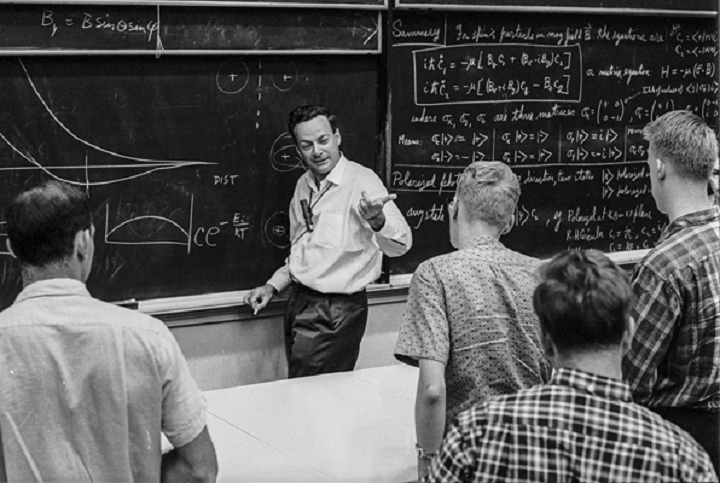
There are seven outstanding lectures in this series, recorded by the BBC at Cornell in 1964.
Source: http://www.cornell.edu/video/playlist/rich...

Enjoyed this speech? Speakola is a labour of love and I’d be very grateful if you would share, tweet or like it. Thank you.

Facebook Twitter Facebook
In SCIENCE AND TECHNOLOGY Tags RICHARD FEYNMAN, SEEKING NEW LAWS, SCIENCE, PHYSICS, PHYSICIST, TRANSCRIPT, EVOLUTION OF SCIENCE, NATURE, KNOWLEDGE, SCIENTIFIC PRINCIPLE, MATTER, ASTRONOMY
Comment

J. Robert Oppenheimer: 'We are not only scientists; we are men, too', Speech to Association of Los Alamos Scientists - 1945

June 28, 2017

2 November 1945, Los Alamos, New Mexico, USA

I am grateful to the Executive Committee for this chance to talk to you. I should like to talk tonight -- if some of you have long memories perhaps you will regard it as justified -- as a fellow scientist, and at least as a fellow worrier about the fix we are in. I do not have anything very radical to say, or anything that will strike most of you with a great flash of enlightenment. I don't have anything to say that will be of an immense encouragement. In some ways I would have liked to talk to you at an earlier date -- but I couldn't talk to you as a Director. I could not talk, and will not tonight talk, too much about the practical political problems which are involved. There is one good reason for that -- I don't know very much about practical politics. And there is another reason, which has to some extent restrained me in the past. As you know, some of us have been asked to be technical advisors to the Secretary of War, and through him to the President. In the course of this we have naturally discussed things that were on our minds and have been made, often very willingly, the recipient of confidences; it is not possible to speak in detail about what Mr. A thinks and Mr. B doesn't think, or what is going to happen next week, without violating these confidences. I don't think that's important. I think there are issues which are quite simple and quite deep, and which involve us as a group of scientists -- involve us more, perhaps than any other group in the world. I think that it can only help to look a little at what our situation is -- at what has happened to us -- and that this must give us some honesty, some insight, which will be a source of strength in what may be the not-too-easy days ahead. I would like to take it as deep and serious as I know how, and then perhaps come to more immediate questions in the course of the discussion later. I want anyone who feels like it to ask me a question and if I can't answer it, as will often be the case, I will just have to say so.

What has happened to us -- it is really rather major, it is so major that I think in some ways one returns to the greatest developments of the twentieth century, to the discovery of relativity, and to the whole development of atomic theory and its interpretation in terms of complementarity, for analogy. These things, as you know, forced us to re-consider the relations between science and common sense. They forced on us the recognition that the fact that we were in the habit of talking a certain language and using certain concepts did not necessarily imply that there was anything in the real world to correspond to these. They forced us to be prepared for the inadequacy of the ways in which human beings attempted to deal with reality, for that reality. In some ways I think these virtues, which scientists quite reluctantly were forced to learn by the nature of the world they were studying, may be useful even today in preparing us for somewhat more radical views of what the issues are than would be natural or easy for people who had not been through this experience.

But the real impact of the creation of the atomic bomb and atomic weapons -- to understand that one has to look further back, look, I think, to the times when physical science was growing in the days of the renaissance, and when the threat that science offered was felt so deeply throughout the Christian world. The analogy is, of course, not perfect. You may even wish to think of the days in the last century when the theories of evolution seemed a threat to the values by which men lived. The analogy is not perfect because there is nothing in atomic weapons -- there is certainly nothing that we have done here or in the physics or chemistry that immediately preceded our work here -- in which any revolutionary ideas were involved. I don't think that the conceptions of nuclear fission have strained any man's attempts to understand them, and I don't feel that any of us have really learned in a deep sense very much from following this up. It is in a quite different way. It is not an idea -- it is a development and a reality -- but it has in common with the early days of physical science the fact that the very existence of science is threatened, and its value is threatened. This is the point that I would like to speak a little about.

I think that it hardly needs to be said why the impact is so strong. There are three reasons: one is the extraordinary speed with which things which were right on the frontier of science were translated into terms where they affected many living people, and potentially all people. Another is the fact, quite accidental in many ways, and connected with the speed, that scientists themselves played such a large part, not merely in providing the foundation for atomic weapons, but in actually making them. In this we are certainly closer to it than any other group. The third is that the thing we made -- partly because of the technical nature of the problem, partly because we worked hard, partly because we had good breaks -- really arrived in the world with such a shattering reality and suddenness that there was no opportunity for the edges to be worn off.

In considering what the situation of science is, it may be helpful to think a little of what people said and felt of their motives in coming into this job. One always has to worry that what people say of their motives is not adequate. Many people said different things, and most of them, I think, had some validity. There was in the first place the great concern that our enemy might develop these weapons before we did, and the feeling -- at least, in the early days, the very strong feeling -- that without atomic weapons it might be very difficult, it might be an impossible, it might be an incredibly long thing to win the war. These things wore off a little as it became clear that the war would be won in any case. Some people, I think, were motivated by curiosity, and rightly so; and some by a sense of adventure, and rightly so. Others had more political arguments and said, "Well, we know that atomic weapons are in principle possible, and it is not right that the threat of their unrealized possibility should hang over the world. It is right that the world should know what can be done in their field and deal with it." And the people added to that that it was a time when all over the world men would be particularly ripe and open for dealing with this problem because of the immediacy of the evils of war, because of the universal cry from everyone that one could not go through this thing again, even a war without atomic bombs. And there was finally, and I think rightly, the feeling that there was probably no place in the world where the development of atomic weapons would have a better chance of leading to a reasonable solution, and a smaller chance of leading to disaster, than within the United States. I believe all these things that people said are true, and I think I said them all myself at one time or another.

But when you come right down to it the reason that we did this job is because it was an organic necessity. If you are a scientist you cannot stop such a thing. If you are a scientist you believe that it is good to find out how the world works; that it is good to find out what the realities are; that it is good to turn over to mankind at large the greatest possible power to control the world and to deal with it according to its lights and its values.

There has been a lot of talk about the evil of secrecy, of concealment, of control, of security. Some of that talk has been on a rather low plane, limited really to saying that it is difficult or inconvenient to work in a world where you are not free to do what you want. I think that the talk has been justified, and that the almost unanimous resistance of scientists to the imposition of control and secrecy is a justified position, but I think that the reason for it may lie a little deeper. I think that it comes from the fact that secrecy strikes at the very root of what science is, and what it is for. It is not possible to be a scientist unless you believe that it is good to learn. It is not good to be a scientist, and it is not possible, unless you think that it is of the highest value to share your knowledge, to share it with anyone who is interested. It is not possible to be a scientist unless you believe that the knowledge of the world, and the power which this gives, is a thing which is of intrinsic value to humanity, and that you are using it to help in the spread of knowledge, and are willing to take the consequences. And, therefore, I think that this resistance which we feel and see all around us to anything which is an attempt to treat science of the future as though it were rather a dangerous thing, a thing that must be watched and managed, is resisted not because of its inconvenience -- I think we are in a position where we must be willing to take any inconvenience -- but resisted because it is based on a philosophy incompatible with that by which we live, and have learned to live in the past.

There are many people who try to wiggle out of this. They say the real importance of atomic energy does not lie in the weapons that have been made; the real importance lies in all the great benefits which atomic energy, which the various radiations, will bring to mankind. There may be some truth in this. I am sure that there is truth in it, because there has never in the past been a new field opened up where the real fruits of it have not been invisible at the beginning. I have a very high confidence that the fruits -- the so-called peacetime applications -- of atomic energy will have in them all that we think, and more. There are others who try to escape the immediacy of this situation by saying that, after all, war has always been very terrible; after all, weapons have always gotten worse and worse; that this is just another weapon and it doesn't create a great change; that they are not so bad; bombings have been bad in this war and this is not a change in that -- it just adds a little to the effectiveness of bombing; that some sort of protection will be found. I think that these efforts to diffuse and weaken the nature of the crisis make it only more dangerous. I think it is for us to accept it as a very grave crisis, to realize that these atomic weapons which we have started to make are very terrible, that they involve a change, that they are not just a slight modification: to accept this, and to accept with it the necessity for those transformations in the world which will make it possible to integrate these developments into human life. As scientists I think we have perhaps a little greater ability to accept change, and accept radical change, because of our experiences in the pursuit of science. And that may help us -- that, and the fact that we have lived with it -- to be of some use in understanding these problems.

It is clear to me that wars have changed. It is clear to me that if these first bombs -- the bomb that was dropped on Nagasaki -- that if these can destroy ten square miles, then that is really quite something. It is clear to me that they are going to be very cheap if anyone wants to make them; it is clear to me that this is a situation where a quantitative change, and a change in which the advantage of aggression compared to defense -- of attack compared to defense -- is shifted, where this quantitative change has all the character of a change in quality, of a change in the nature of the world. I know that whereas wars have become intolerable, and the question would have been raised and would have been pursued after this war, more ardently than after the last, of whether there was not some method by which they could be averted. But I think the advent of the atomic bomb and the facts which will get around that they are not too hard to make -- that they will be universal if people wish to make them universal, that they will not constitute a real drain on the economy of any strong nation, and that their power of destruction will grow and is already incomparably greater than that of any other weapon -- I think these things create a new situation, so new that there is some danger, even some danger in believing, that what we have is a new argument for arrangements, for hopes, that existed before this development took place. By that I mean that much as I like to hear advocates of a world federation, or advocates of a United Nations organization, who have been talking of these things for years -- much as I like to hear them say that here is a new argument, I think that they are in part missing the point, because the point is not that atomic weapons constitute a new argument. There have always been good arguments. The point is that atomic weapons constitute also a field, a new field, and a new opportunity for realizing preconditions. I think when people talk of the fact that this is not only a great peril, but a great hope, this is what they should mean. I do not think they should mean the unknown, though sure, value of industrial and scientific virtues of atomic energy, but rather the simple fact that in this field, because it is a threat, because it is a peril, and because it has certain special characteristics, to which I will return, there exists a possibility of realizing, of beginning to realize, those changes which are needed if there is to be any peace.

Those are very far-reaching changes. They are changes in the relations between nations, not only in spirit, not only in law, but also in conception and feeling. I don't know which of these is prior; they must all work together, and only the gradual interaction of one on the other can make a reality. I don't agree with those who say the first step is to have a structure of international law. I don't agree with those who say the only thing is to have friendly feelings. All of these things will be involved. I think it is true to say that atomic weapons are a peril which affect everyone in the world, and in that sense a completely common problem, as common a problem as it was for the Allies to defeat the Nazis. I think that in order to handle this common problem there must be a complete sense of community responsibility. I do not think that one may expect that people will contribute to the solution of the problem until they are aware of their ability to take part in the solution. I think that it is a field in which the implementation of such a common responsibility has certain decisive advantages. It is a new field, in which the position of vested interests in various parts of the world is very much less serious than in others. It is serious in this country, and that is one of our problems. It is a new field, in which the role of science has been so great that it is to my mind hardly thinkable that the international traditions of science, and the fraternity of scientists, should not play a constructive part. It is a new field, in which just the novelty and the special characteristics of the technical operations should enable one to establish a community of interest which might almost be regarded as a pilot plant for a new type of international collaboration. I speak of it as a pilot plant because it is quite clear that the control of atomic weapons cannot be in itself the unique end of such operation. The only unique end can be a world that is united, and a world in which war will not occur. But those things don't happen overnight, and in this field it would seem that one could get started, and get started without meeting those insuperable obstacles which history has so often placed in the way of any effort of cooperation. Now, this is not an easy thing, and the point I want to make, the one point I want to hammer home, is what an enormous change in spirit is involved. There are things which we hold very dear, and I think rightly hold very dear; I would say that the word democracy perhaps stood for some of them as well as any other word. There are many parts of the world in which there is no democracy. There are other things which we hold dear, and which we rightly should. And when I speak of a new spirit in international affairs I mean that even to these deepest of things which we cherish, and for which Americans have been willing to die -- and certainly most of us would be willing to die -- even in these deepest things, we realize that there is something more profound than that; namely, the common bond with other men everywhere. It is only if you do that that this makes sense; because if you approach the problem and say, "We know what is right and we would like to use the atomic bomb to persuade you to agree with us," then you are in a very weak position and you will not succeed, because under those conditions you will not succeed in delegating responsibility for the survival of men. It is a purely unilateral statement; you will find yourselves attempting by force of arms to prevent a disaster.

I want to express the utmost sympathy with the people who have to grapple with this problem and in the strongest terms to urge you not to underestimate its difficulty. I can think of an analogy, and I hope it is not a completely good analogy: in the days in the first half of the nineteenth century there were many people, mostly in the North, but some in the South, who thought that there was no evil on earth more degrading than human slavery, and nothing that they would more willingly devote their lives to than its eradication. Always when I was young I wondered why it was that when Lincoln was President he did not declare that the war against the South, when it broke out, was a war that slavery should be abolished, that this was the central point, the rallying point, of that war. Lincoln was severely criticized by many of the Abolitionists as you know, by many then called radicals, because he seemed to be waging a war which did not hit the thing that was most important. But Lincoln realized, and I have only in the last months come to appreciate the depth and wisdom of it, that beyond the issue of slavery was the issue of the community of the people of the country, and the issue of the Union. I hope that today this will not be an issue calling for war; but I wanted to remind you that in order to preserve the Union Lincoln had to subordinate the immediate problem of the eradication of slavery, and trust -- and I think if he had had his way it would have gone so -- to the conflict of these ideas in a united people to eradicate it.

These are somewhat general remarks and it may be appropriate to say one or two things that are a little more programmatic, that are not quite so hard to get one's hands on. That is, what sort of agreement between nations would be a reasonable start. I don't know the answer to this, and I am very sure that no a priori answer should be given, that it is something that is going to take constant working out. But I think it is a thing where it will not hurt to have some reasonably concrete proposal. And I would go a step further and say of even such questions as the great question of secrecy -- which perplexes scientists and other people -- that even this was not a suitable subject for unilateral action. If atomic energy is to be treated as an international problem, as I think it must be, if it is to be treated on the basis of an international responsibility and an international common concern, the problems of secrecy are also international problems. I don't mean by that that our present classifications and our present, in many cases inevitably ridiculous, procedures should be maintained. I mean that the fundamental problem of how to treat this peril ought not to be treated unilaterally by the United States, or by the United States in conjunction with Great Britain.

The first thing I would say about any proposals is that they ought to be regarded as interim proposals, and that whenever they are made it be understood and agreed that within a year or two years -- whatever seems a reasonable time -- they will be reconsidered and the problems which have arisen, and the new developments which have occurred, will cause a rewriting. I think the only point is that there should be a few things in these proposals which will work in the right direction, and that the things should be accepted without forcing all of the changes, which we know must ultimately occur, upon people who will not be ready for them. This is anyone's guess, but it would seem to me that if you took these four points, it might work: first, that we are dealing with an interim solution, so recognized. Second, that the nations participating in the arrangement would have a joint atomic energy commission, operating under the most broad directives from the different states, but with a power which only they had, and which was not subject to review by the heads of State, to go ahead with those constructive applications of atomic energy which we would all like to see developed -- energy sources, and the innumerable research tools which are immediate possibilities. Third, that there would be not merely the possibility of exchange of scientists and students; that very, very concrete machinery more or less forcing such exchange should be established, so that we would be quite sure that the fraternity of scientists would be strengthened and that the bonds on which so much of the future depends would have some reinforcement and some scope. And fourth, I would say that no bombs be made. I don't know whether these proposals are good ones, and I think that anyone in this group would have his own proposals. But I mention them as very simple things, which I don't believe solve the problem, and which I want to make clear are not the ultimate or even a touch of the ultimate, but which I think ought to be started right away; which I believe -- though I know very little of this -- may very well be acceptable to any of the nations that wish to become partners with us in this great undertaking.

One of the questions which you will want to hear more about, and which I can only partly hope to succeed in answering, is to what extent such views -- essentially the view that the life of science is threatened, the life of the world is threatened, and that only [by] a profound revision of what it is that constitutes a thing worth fighting for and a thing worth living for can this crisis be met -- to what extent these views are held by other men. They are certainly not held universally by scientists; but I think they are in agreement with all of the expressed opinions of this group, and I know that many of my friends here see pretty much eye to eye. I would speak especially of Bohr, who was here so much during the difficult days, who had many discussions with us, and who helped us reach the conclusion that [it was] not only a desirable solution, but that it was the unique solution, that there were no other alternatives.

I would say that among scientists there are certain centrifugal tendencies which seem to me a little dangerous, but not very. One of them is the attempt to try, in this imperilled world, in which the very function of science is threatened, to make convenient arrangements for the continuance of science, and to pay very little attention to the preconditions which give sense to it. Another is the tendency to say we must have a free science and a strong science, because this will make us a strong nation and enable us to fight better wars. It seems to me that this is a profound mistake, and I don't like to hear it. The third is even odder, and it is to say, "Oh give the bombs to the United Nations for police purposes, and let us get back to physics and chemistry." I think none of these are really held very widely, but they show that there are people who are desperately trying to avoid what I think is the most difficult problem. One must expect these false solutions, and overeasy solutions, and these are three which pop up from time to time.

As far as I can tell in the world outside there are many people just as quick to see the gravity of the situation, and to understand it in terms not so different from those I have tried to outline. It is not only among scientists that there are wise people and foolish people. I have had occasion in the last few months to meet people who had to do with the Government -- the legislative branches, the administrative branches, and even the judicial branches, and I have found many in whom an understanding of what this problem is, and of the general lines along which it can be solved, is very clear. I would especially mention the former Secretary of War, Mr. Stimson, who, perhaps as much as any man, seemed to appreciate how hopeless and how impractical it was to attack this problem on a superficial level, and whose devotion to the development of atomic weapons was in large measure governed by his understanding of the hope that lay in it that there would be a new world. I know this is a surprise, because most people think that the War Department has as its unique function the making of war. The Secretary of War has other functions.

I think this is another question of importance: that is, what views will be held on these matters in other countries. I think it is important to realize that even those who are well informed in this country have been slow to understand, slow to believe that the bombs would work, and then slow to understand that their working would present such profound problems. We have certain interests in playing up the bomb, not only we here locally, but all over the country, because we made them, and our pride is involved. I think that in other lands it may be even more difficult for an appreciation of the magnitude of the thing to take hold. For this reason, I'm not sure that the greatest opportunities for progress do not lie somewhat further in the future than I had for a long time thought.

There have been two or three official statements by the President which defined, as nearly as their in some measure inevitable contradictions made possible, the official policy of the Government. And I think that one must not be entirely discouraged by the fact that there are contradictions, because the contradictions show that the problem is being understood as a difficult one, is temporarily being regarded as an insoluble one. Certainly you will notice, especially in the message to Congress, many indications of a sympathy with, and an understanding of, the views which this group holds, and which I have discussed briefly tonight. I think all of us were encouraged at the phrase "too revolutionary to consider in the framework of old ideas." That's about what we all think. I think all of us were encouraged by the sense of urgency that was frequently and emphatically stressed. I think all of us must be encouraged by the recognition, the official recognition by the Government of the importance -- of the overriding importance -- of the free exchange of scientific ideas and scientific information between all countries of the world. It would certainly be ridiculous to regard this as a final end, but I think that it would also be a very dangerous thing not to realize that it as a precondition. I am myself somewhat discouraged by the limitation of the objective to the elimination of atomic weapons, and I have seen many articles -- probably you have, too -- in which this is interpreted as follows: "Let us get international agreement to outlaw atomic weapons and then let us go back to having a good, clean war." This is certainly not a very good way of looking at it. I think, to say it again, that if one solves the problems presented by the atomic bomb, one will have made a pilot plant for solution of the problem of ending war.

But what is surely the thing which must have troubled you, and which troubled me, in the official statements was the insistent note of unilateral responsibility for the handling of atomic weapons. However good the motives of this country are -- I am not going to argue with the President's description of what the motives and the aims are -- we are 140 million people, and there are two billion people living on earth. We must understand that whatever our commitments to our own views and ideas, and however confident we are that in the course of time they will tend to prevail, our absolute -- our completely absolute -- commitment to them, in denial of the views and ideas of other people, cannot be the basis of any kind of agreement.

As I have said, I had for a long time the feeling of the most extreme urgency, and I think maybe there was something right about that. There was a period immediately after the first use of the bomb when it seemed most natural that a clear statement of policy, and the initial steps of implementing it, should have been made; and it would be wrong for me not to admit that something may have been lost, and that there may be tragedy in that loss. But I think the plain fact is that in the actual world, and with the actual people in it, it has taken time, and it may take longer, to understand what this is all about. And I am not sure, as I have said before, that in other lands it won't take longer than it does in this country. As it is now, our only course is to see what we can do to bring about an understanding on a level deep enough to make a solution practicable, and to do that without undue delay.

One may think that the views suggested in the President's Navy Day speech are not entirely encouraging, that many men who are more versed than we in the practical art of statesmanship have seen more hope in a radical view, which may at first sight seem visionary, than in an approach on a more conventional level.

I don't have very much more to say. There are a few things which scientists perhaps should remember, that I don't think I need to remind us of; but I will, anyway. One is that they are very often called upon to give technical information in one way or another, and I think one cannot be too careful to be honest. And it is very difficult, not because one tells lies, but because so often questions are put in a form which makes it very hard to give an answer which is not misleading. I think we will be in a very weak position unless we maintain at its highest the scrupulousness which is traditional for us in sticking to the truth, and in distinguishing between what we know to be true from what we hope may be true.

The second thing I think it right to speak of is this: it is everywhere felt that the fraternity between us and scientists in other countries may be one of the most helpful things for the future; yet it is apparent that even in this country not all of us who are scientists are in agreement. There is no harm in that; such disagreement is healthy. But we must not lose the sense of fraternity because of it; we must not lose our fundamental confidence in our fellow scientists.

I think that we have no hope at all if we yield in our belief in the value of science, in the good that it can be to the world to know about reality, about nature, to attain a gradually greater and greater control of nature, to learn, to teach, to understand. I think that if we lose our faith in this we stop being scientists, we sell out our heritage, we lose what we have most of value for this time of crisis.

But there is another thing: we are not only scientists; we are men, too. We cannot forget our dependence on our fellow men. I mean not only our material dependence, without which no science would be possible, and without which we could not work; I mean also our deep moral dependence, in that the value of science must lie in the world of men, that all our roots lie there. These are the strongest bonds in the world, stronger than those even that bind us to one another, these are the deepest bonds -- that bind us to our fellow men.

Source: http://www.atomicarchive.com/Docs/Manhatta...

Enjoyed this speech? Speakola is a labour of love and I’d be very grateful if you would share, tweet or like it. Thank you.

Facebook Twitter Facebook
In WAR & CONFLICT Tags J. ROBERT OPPENHEIMER, SCIENTIST, ATOMIC BOMB, NUCLEAR WEAPONS, PHYSICIST, WW2, COLD WAR, MORAL, ETHICS, TRANSCRIPT
Comment

Richard Feynman: There's plenty of room at the bottom', Nanotechnology lecture - 1959

March 2, 2016

29 December 1959, Pasadena, California, USA

Richard Feymann was a Nobel Prize winning physicist and the father's of nanotechnology. In this after dinner speech, delivered at a time when computers filled rooms, he imagines present day scenarios where wires are only a few atoms thick.

I imagine experimental physicists must often look with envy at men like Kamerlingh Onnes, who discovered a field like low temperature superconductivity, which seems to be bottomless and in which one can go down and down. Such a man is then a leader and has some temporary monopoly in a scientific adventure. Percy Bridgman, in designing a way to obtain higher pressures, opened up another new field and was able to move into it and to lead us all along. The development of ever higher vacuum was a continuing development of the same kind.
I would like to describe a field, in which little has been done, but in which an enormous amount can be done in principle. This field is not quite the same as the others in that it will not tell us much of fundamental physics (in the sense of, “What are the strange particles?”) but it is more like solid-state physics in the sense that it might tell us much of great interest about the strange phenomena that occur in complex situations. Furthermore, a point that is most important is that it would have an enormous number of technical applications.
What I want to talk about is the problem of manipulating and controlling things on a small scale.


As soon as I mention this, people tell me about miniaturization, and how far it has progressed today. They tell me about electric motors that are the size of the nail on your small finger. And there is a device on the market, they tell me, by which you can write the Lord's Prayer on the head of a pin. But that's nothing; that's the most primitive, halting step in the direction I intend to discuss. It is a staggeringly small world that is below. In the year 2000, when they look back at this age, they will wonder why it was not until the year 1960 that anybody began seriously to move in this direction.


Why cannot we write the entire 24 volumes of the Encyclopedia Brittanica on the head of a pin?


Let's see what would be involved. The head of a pin is a sixteenth of an inch across. If you magnify it by 25,000 diameters, the area of the head of the pin is then equal to the area of all the pages of the Encyclopedia Brittanica. Therefore, all it is necessary to do is to reduce in size all the writing in the Encyclopaedia by 25,000 times. Is that possible? The resolving power of the eye is about 1/120 of an inch---that is roughly the diameter of one of the little dots on the fine half-tone reproductions in the Encyclopedia. This, when you demagnify it by 25,000 times, is still 80 angstroms in diameter---32 atoms across, in an ordinary metal. In other words, one of those dots still would contain in its area 1,000 atoms. So, each dot can easily be adjusted in size as required by the photoengraving, and there is no question that there is enough room on the head of a pin to put all of the Encyclopedia Brittanica.


Furthermore, it can be read if it is so written. Let's imagine that it is written in raised letters of metal; that is, where the black is in the Encyclopedia, we have raised letters of metal that are actually 1/25,000 of their ordinary size. How would we read it?


If we had something written in such a way, we could read it using techniques in common use today. (They will undoubtedly find a better way when we do actually have it written, but to make my point conservatively I shall just take techniques we know today.) We would press the metal into a plastic material and make a mold of it, then peel the plastic off very carefully, evaporate silica into the plastic to get a very thin film, then shadow it by evaporating gold at an angle against the silica so that all the little letters will appear clearly, dissolve the plastic away from the silica film, and then look through it with an electron microscope!


There is no question that if the thing were reduced by 25,000 times in the form of raised letters on the pin, it would be easy for us to read it today. Furthermore; there is no question that we would find it easy to make copies of the master; we would just need to press the same metal plate again into plastic and we would have another copy.

How do we write small?
The next question is: How do we write it? We have no standard technique to do this now. But let me argue that it is not as difficult as it first appears to be. We can reverse the lenses of the electron microscope in order to demagnify as well as magnify. A source of ions, sent through the microscope lenses in reverse, could be focused to a very small spot. We could write with that spot like we write in a TV cathode ray oscilloscope, by going across in lines, and having an adjustment which determines the amount of material which is going to be deposited as we scan in lines.


This method might be very slow because of space charge limitations. There will be more rapid methods. We could first make, perhaps by some photo process, a screen which has holes in it in the form of the letters. Then we would strike an arc behind the holes and draw metallic ions through the holes; then we could again use our system of lenses and make a small image in the form of ions, which would deposit the metal on the pin.


A simpler way might be this (though I am not sure it would work): We take light and, through an optical microscope running backwards, we focus it onto a very small photoelectric screen. Then electrons come away from the screen where the light is shining. These electrons are focused down in size by the electron microscope lenses to impinge directly upon the surface of the metal. Will such a beam etch away the metal if it is run long enough? I don't know. If it doesn't work for a metal surface, it must be possible to find some surface with which to coat the original pin so that, where the electrons bombard, a change is made which we could recognize later.


There is no intensity problem in these devices---not what you are used to in magnification, where you have to take a few electrons and spread them over a bigger and bigger screen; it is just the opposite. The light which we get from a page is concentrated onto a very small area so it is very intense. The few electrons which come from the photoelectric screen are demagnified down to a very tiny area so that, again, they are very intense. I don't know why this hasn't been done yet!


That's the Encyclopedia Brittanica on the head of a pin, but let's consider all the books in the world. The Library of Congress has approximately 9 million volumes; the British Museum Library has 5 million volumes; there are also 5 million volumes in the National Library in France. Undoubtedly there are duplications, so let us say that there are some 24 million volumes of interest in the world.


What would happen if I print all this down at the scale we have been discussing? How much space would it take? It would take, of course, the area of about a million pinheads because, instead of there being just the 24 volumes of the Encyclopaedia, there are 24 million volumes. The million pinheads can be put in a square of a thousand pins on a side, or an area of about 3 square yards. That is to say, the silica replica with the paper-thin backing of plastic, with which we have made the copies, with all this information, is on an area of approximately the size of 35 pages of the Encyclopaedia. That is about half as many pages as there are in this magazine. All of the information which all of mankind has every recorded in books can be carried around in a pamphlet in your hand---and not written in code, but a simple reproduction of the original pictures, engravings, and everything else on a small scale without loss of resolution.


What would our librarian at Caltech say, as she runs all over from one building to another, if I tell her that, ten years from now, all of the information that she is struggling to keep track of--- 120,000 volumes, stacked from the floor to the ceiling, drawers full of cards, storage rooms full of the older books---can be kept on just one library card! When the University of Brazil, for example, finds that their library is burned, we can send them a copy of every book in our library by striking off a copy from the master plate in a few hours and mailing it in an envelope no bigger or heavier than any other ordinary air mail letter.


Now, the name of this talk is “There is Plenty of Room at the Bottom”---not just “There is Room at the Bottom.” What I have demonstrated is that there is room---that you can decrease the size of things in a practical way. I now want to show that there is plenty of room. I will not now discuss how we are going to do it, but only what is possible in principle---in other words, what is possible according to the laws of physics. I am not inventing anti-gravity, which is possible someday only if the laws are not what we think. I am telling you what could be done if the laws are what we think; we are not doing it simply because we haven't yet gotten around to it.

Information on a small scale

Suppose that, instead of trying to reproduce the pictures and all the information directly in its present form, we write only the information content in a code of dots and dashes, or something like that, to represent the various letters. Each letter represents six or seven ``bits'' of information; that is, you need only about six or seven dots or dashes for each letter. Now, instead of writing everything, as I did before, on the surface of the head of a pin, I am going to use the interior of the material as well.


Let us represent a dot by a small spot of one metal, the next dash, by an adjacent spot of another metal, and so on. Suppose, to be conservative, that a bit of information is going to require a little cube of atoms 5 times 5 times 5---that is 125 atoms. Perhaps we need a hundred and some odd atoms to make sure that the information is not lost through diffusion, or through some other process.


I have estimated how many letters there are in the Encyclopaedia, and I have assumed that each of my 24 million books is as big as an Encyclopaedia volume, and have calculated, then, how many bits of information there are (10^15). For each bit I allow 100 atoms. And it turns out that all of the information that man has carefully accumulated in all the books in the world can be written in this form in a cube of material one two-hundredth of an inch wide--- which is the barest piece of dust that can be made out by the human eye. So there is plenty of room at the bottom! Don't tell me about microfilm!


This fact---that enormous amounts of information can be carried in an exceedingly small space---is, of course, well known to the biologists, and resolves the mystery which existed before we understood all this clearly, of how it could be that, in the tiniest cell, all of the information for the organization of a complex creature such as ourselves can be stored. All this information---whether we have brown eyes, or whether we think at all, or that in the embryo the jawbone should first develop with a little hole in the side so that later a nerve can grow through it---all this information is contained in a very tiny fraction of the cell in the form of long-chain DNA molecules in which approximately 50 atoms are used for one bit of information about the cell.

Better electron microscopes
If I have written in a code, with 5 times 5 times 5 atoms to a bit, the question is: How could I read it today? The electron microscope is not quite good enough, with the greatest care and effort, it can only resolve about 10 angstroms. I would like to try and impress upon you while I am talking about all of these things on a small scale, the importance of improving the electron microscope by a hundred times. It is not impossible; it is not against the laws of diffraction of the electron. The wave length of the electron in such a microscope is only 1/20 of an angstrom. So it should be possible to see the individual atoms. What good would it be to see individual atoms distinctly?


We have friends in other fields---in biology, for instance. We physicists often look at them and say, “You know the reason you fellows are making so little progress?'” (Actually I don't know any field where they are making more rapid progress than they are in biology today.) ``You should use more mathematics, like we do.'' They could answer us---but they're polite, so I'll answer for them: “What you should do in order for us to make more rapid progress is to make the electron microscope 100 times better.'”


What are the most central and fundamental problems of biology today? They are questions like: What is the sequence of bases in the DNA? What happens when you have a mutation? How is the base order in the DNA connected to the order of amino acids in the protein? What is the structure of the RNA; is it single-chain or double-chain, and how is it related in its order of bases to the DNA? What is the organization of the microsomes? How are proteins synthesized? Where does the RNA go? How does it sit? Where do the proteins sit? Where do the amino acids go in? In photosynthesis, where is the chlorophyll; how is it arranged; where are the carotenoids involved in this thing? What is the system of the conversion of light into chemical energy?


It is very easy to answer many of these fundamental biological questions; you just look at the thing! You will see the order of bases in the chain; you will see the structure of the microsome. Unfortunately, the present microscope sees at a scale which is just a bit too crude. Make the microscope one hundred times more powerful, and many problems of biology would be made very much easier. I exaggerate, of course, but the biologists would surely be very thankful to you---and they would prefer that to the criticism that they should use more mathematics.
The theory of chemical processes today is based on theoretical physics. In this sense, physics supplies the foundation of chemistry. But chemistry also has analysis. If you have a strange substance and you want to know what it is, you go through a long and complicated process of chemical analysis. You can analyze almost anything today, so I am a little late with my idea. But if the physicists wanted to, they could also dig under the chemists in the problem of chemical analysis. It would be very easy to make an analysis of any complicated chemical substance; all one would have to do would be to look at it and see where the atoms are. The only trouble is that the electron microscope is one hundred times too poor. (Later, I would like to ask the question: Can the physicists do something about the third problem of chemistry---namely, synthesis? Is there a physical way to synthesize any chemical substance?


The reason the electron microscope is so poor is that the f- value of the lenses is only 1 part to 1,000; you don't have a big enough numerical aperture. And I know that there are theorems which prove that it is impossible, with axially symmetrical stationary field lenses, to produce an f-value any bigger than so and so; and therefore the resolving power at the present time is at its theoretical maximum. But in every theorem there are assumptions. Why must the field be symmetrical? I put this out as a challenge: Is there no way to make the electron microscope more powerful?

The marvellous biological system


The biological example of writing information on a small scale has inspired me to think of something that should be possible. Biology is not simply writing information; it is doing something about it. A biological system can be exceedingly small. Many of the cells are very tiny, but they are very active; they manufacture various substances; they walk around; they wiggle; and they do all kinds of marvellous things---all on a very small scale. Also, they store information. Consider the possibility that we too can make a thing very small which does what we want---that we can manufacture an object that manoeuvres at that level!
There may even be an economic point to this business of making things very small. Let me remind you of some of the problems of computing machines. In computers we have to store an enormous amount of information. The kind of writing that I was mentioning before, in which I had everything down as a distribution of metal, is permanent. Much more interesting to a computer is a way of writing, erasing, and writing something else. (This is usually because we don't want to waste the material on which we have just written. Yet if we could write it in a very small space, it wouldn't make any difference; it could just be thrown away after it was read. It doesn't cost very much for the material).

Miniaturizing the computer

I don't know how to do this on a small scale in a practical way, but I do know that computing machines are very large; they fill rooms. Why can't we make them very small, make them of little wires, little elements---and by little, I mean little. For instance, the wires should be 10 or 100 atoms in diameter, and the circuits should be a few thousand angstroms across. Everybody who has analyzed the logical theory of computers has come to the conclusion that the possibilities of computers are very interesting---if they could be made to be more complicated by several orders of magnitude. If they had millions of times as many elements, they could make judgments. They would have time to calculate what is the best way to make the calculation that they are about to make. They could select the method of analysis which, from their experience, is better than the one that we would give to them. And in many other ways, they would have new qualitative features.


If I look at your face I immediately recognize that I have seen it before. (Actually, my friends will say I have chosen an unfortunate example here for the subject of this illustration. At least I recognize that it is a man and not an apple.) Yet there is no machine which, with that speed, can take a picture of a face and say even that it is a man; and much less that it is the same man that you showed it before---unless it is exactly the same picture. If the face is changed; if I am closer to the face; if I am further from the face; if the light changes---I recognize it anyway. Now, this little computer I carry in my head is easily able to do that. The computers that we build are not able to do that. The number of elements in this bone box of mine are enormously greater than the number of elements in our “wonderful'” computers. But our mechanical computers are too big; the elements in this box are microscopic. I want to make some that are submicroscopic.


If we wanted to make a computer that had all these marvellous extra qualitative abilities, we would have to make it, perhaps, the size of the Pentagon. This has several disadvantages. First, it requires too much material; there may not be enough germanium in the world for all the transistors which would have to be put into this enormous thing. There is also the problem of heat generation and power consumption; TVA would be needed to run the computer. But an even more practical difficulty is that the computer would be limited to a certain speed. Because of its large size, there is finite time required to get the information from one place to another. The information cannot go any faster than the speed of light---so, ultimately, when our computers get faster and faster and more and more elaborate, we will have to make them smaller and smaller.


But there is plenty of room to make them smaller. There is nothing that I can see in the physical laws that says the computer elements cannot be made enormously smaller than they are now. In fact, there may be certain advantages.

Miniaturization by evaporation


How can we make such a device? What kind of manufacturing processes would we use? One possibility we might consider, since we have talked about writing by putting atoms down in a certain arrangement, would be to evaporate the material, then evaporate the insulator next to it. Then, for the next layer, evaporate another position of a wire, another insulator, and so on. So, you simply evaporate until you have a block of stuff which has the elements--- coils and condensers, transistors and so on---of exceedingly fine dimensions.


But I would like to discuss, just for amusement, that there are other possibilities. Why can't we manufacture these small computers somewhat like we manufacture the big ones? Why can't we drill holes, cut things, solder things, stamp things out, mold different shapes all at an infinitesimal level? What are the limitations as to how small a thing has to be before you can no longer mold it? How many times when you are working on something frustratingly tiny like your wife's wrist watch, have you said to yourself, ``If I could only train an ant to do this!'' What I would like to suggest is the possibility of training an ant to train a mite to do this. What are the possibilities of small but movable machines? They may or may not be useful, but they surely would be fun to make.


Consider any machine---for example, an automobile---and ask about the problems of making an infinitesimal machine like it. Suppose, in the particular design of the automobile, we need a certain precision of the parts; we need an accuracy, let's suppose, of 4/10,000 of an inch. If things are more inaccurate than that in the shape of the cylinder and so on, it isn't going to work very well. If I make the thing too small, I have to worry about the size of the atoms; I can't make a circle of ``balls'' so to speak, if the circle is too small. So, if I make the error, corresponding to 4/10,000 of an inch, correspond to an error of 10 atoms, it turns out that I can reduce the dimensions of an automobile 4,000 times, approximately---so that it is 1 mm. across. Obviously, if you redesign the car so that it would work with a much larger tolerance, which is not at all impossible, then you could make a much smaller device.


It is interesting to consider what the problems are in such small machines. Firstly, with parts stressed to the same degree, the forces go as the area you are reducing, so that things like weight and inertia are of relatively no importance. The strength of material, in other words, is very much greater in proportion. The stresses and expansion of the flywheel from centrifugal force, for example, would be the same proportion only if the rotational speed is increased in the same proportion as we decrease the size. On the other hand, the metals that we use have a grain structure, and this would be very annoying at small scale because the material is not homogeneous. Plastics and glass and things of this amorphous nature are very much more homogeneous, and so we would have to make our machines out of such materials.


There are problems associated with the electrical part of the system---with the copper wires and the magnetic parts. The magnetic properties on a very small scale are not the same as on a large scale; there is the ``domain'' problem involved. A big magnet made of millions of domains can only be made on a small scale with one domain. The electrical equipment won't simply be scaled down; it has to be redesigned. But I can see no reason why it can't be redesigned to work again.

Problems of lubrication


Lubrication involves some interesting points. The effective viscosity of oil would be higher and higher in proportion as we went down (and if we increase the speed as much as we can). If we don't increase the speed so much, and change from oil to kerosene or some other fluid, the problem is not so bad. But actually we may not have to lubricate at all! We have a lot of extra force. Let the bearings run dry; they won't run hot because the heat escapes away from such a small device very, very rapidly.


This rapid heat loss would prevent the gasoline from exploding, so an internal combustion engine is impossible. Other chemical reactions, liberating energy when cold, can be used. Probably an external supply of electrical power would be most convenient for such small machines.


What would be the utility of such machines? Who knows? Of course, a small automobile would only be useful for the mites to drive around in, and I suppose our Christian interests don't go that far. However, we did note the possibility of the manufacture of small elements for computers in completely automatic factories, containing lathes and other machine tools at the very small level. The small lathe would not have to be exactly like our big lathe. I leave to your imagination the improvement of the design to take full advantage of the properties of things on a small scale, and in such a way that the fully automatic aspect would be easiest to manage.
A friend of mine (Albert R. Hibbs) suggests a very interesting possibility for relatively small machines. He says that, although it is a very wild idea, it would be interesting in surgery if you could swallow the surgeon. You put the mechanical surgeon inside the blood vessel and it goes into the heart and ``looks'' around. (Of course the information has to be fed out.) It finds out which valve is the faulty one and takes a little knife and slices it out. Other small machines might be permanently incorporated in the body to assist some inadequately-functioning organ.


Now comes the interesting question: How do we make such a tiny mechanism? I leave that to you. However, let me suggest one weird possibility. You know, in the atomic energy plants they have materials and machines that they can't handle directly because they have become radioactive. To unscrew nuts and put on bolts and so on, they have a set of master and slave hands, so that by operating a set of levers here, you control the ``hands'' there, and can turn them this way and that so you can handle things quite nicely.


Most of these devices are actually made rather simply, in that there is a particular cable, like a marionette string, that goes directly from the controls to the ``hands.'' But, of course, things also have been made using servo motors, so that the connection between the one thing and the other is electrical rather than mechanical. When you turn the levers, they turn a servo motor, and it changes the electrical currents in the wires, which repositions a motor at the other end.


Now, I want to build much the same device---a master-slave system which operates electrically. But I want the slaves to be made especially carefully by modern large-scale machinists so that they are one-fourth the scale of the ``hands'' that you ordinarily manoeuvre. So you have a scheme by which you can do things at one- quarter scale anyway---the little servo motors with little hands play with little nuts and bolts; they drill little holes; they are four times smaller. Aha! So I manufacture a quarter-size lathe; I manufacture quarter-size tools; and I make, at the one-quarter scale, still another set of hands again relatively one-quarter size! This is one-sixteenth size, from my point of view. And after I finish doing this I wire directly from my large-scale system, through transformers perhaps, to the one-sixteenth-size servo motors. Thus I can now manipulate the one-sixteenth size hands.


Well, you get the principle from there on. It is rather a difficult program, but it is a possibility. You might say that one can go much farther in one step than from one to four. Of course, this has all to be designed very carefully and it is not necessary simply to make it like hands. If you thought of it very carefully, you could probably arrive at a much better system for doing such things.


If you work through a pantograph, even today, you can get much more than a factor of four in even one step. But you can't work directly through a pantograph which makes a smaller pantograph which then makes a smaller pantograph---because of the looseness of the holes and the irregularities of construction. The end of the pantograph wiggles with a relatively greater irregularity than the irregularity with which you move your hands. In going down this scale, I would find the end of the pantograph on the end of the pantograph on the end of the pantograph shaking so badly that it wasn't doing anything sensible at all.


At each stage, it is necessary to improve the precision of the apparatus. If, for instance, having made a small lathe with a pantograph, we find its lead screw irregular---more irregular than the large-scale one---we could lap the lead screw against breakable nuts that you can reverse in the usual way back and forth until this lead screw is, at its scale, as accurate as our original lead screws, at our scale.


We can make flats by rubbing unflat surfaces in triplicates together---in three pairs---and the flats then become flatter than the thing you started with. Thus, it is not impossible to improve precision on a small scale by the correct operations. So, when we build this stuff, it is necessary at each step to improve the accuracy of the equipment by working for awhile down there, making accurate lead screws, Johansen blocks, and all the other materials which we use in accurate machine work at the higher level. We have to stop at each level and manufacture all the stuff to go to the next level---a very long and very difficult program. Perhaps you can figure a better way than that to get down to small scale more rapidly.


Yet, after all this, you have just got one little baby lathe four thousand times smaller than usual. But we were thinking of making an enormous computer, which we were going to build by drilling holes on this lathe to make little washers for the computer. How many washers can you manufacture on this one lathe?

A hundred tiny hands

When I make my first set of slave ``hands'' at one-fourth scale, I am going to make ten sets. I make ten sets of ``hands,'' and I wire them to my original levers so they each do exactly the same thing at the same time in parallel. Now, when I am making my new devices one-quarter again as small, I let each one manufacture ten copies, so that I would have a hundred ``hands'' at the 1/16th size.


Where am I going to put the million lathes that I am going to have? Why, there is nothing to it; the volume is much less than that of even one full-scale lathe. For instance, if I made a billion little lathes, each 1/4000 of the scale of a regular lathe, there are plenty of materials and space available because in the billion little ones there is less than 2 percent of the materials in one big lathe.


It doesn't cost anything for materials, you see. So I want to build a billion tiny factories, models of each other, which are manufacturing simultaneously, drilling holes, stamping parts, and so on.


As we go down in size, there are a number of interesting problems that arise. All things do not simply scale down in proportion. There is the problem that materials stick together by the molecular (Van der Waals) attractions. It would be like this: After you have made a part and you unscrew the nut from a bolt, it isn't going to fall down because the gravity isn't appreciable; it would even be hard to get it off the bolt. It would be like those old movies of a man with his hands full of molasses, trying to get rid of a glass of water. There will be several problems of this nature that we will have to be ready to design for.

Rearranging the atoms

But I am not afraid to consider the final question as to whether, ultimately---in the great future---we can arrange the atoms the way we want; the very atoms, all the way down! What would happen if we could arrange the atoms one by one the way we want them (within reason, of course; you can't put them so that they are chemically unstable, for example).


Up to now, we have been content to dig in the ground to find minerals. We heat them and we do things on a large scale with them, and we hope to get a pure substance with just so much impurity, and so on. But we must always accept some atomic arrangement that nature gives us. We haven't got anything, say, with a “checkerboard'” arrangement, with the impurity atoms exactly arranged 1,000 angstroms apart, or in some other particular pattern.


What could we do with layered structures with just the right layers? What would the properties of materials be if we could really arrange the atoms the way we want them? They would be very interesting to investigate theoretically. I can't see exactly what would happen, but I can hardly doubt that when we have some control of the arrangement of things on a small scale we will get an enormously greater range of possible properties that substances can have, and of different things that we can do.


Consider, for example, a piece of material in which we make little coils and condensers (or their solid state analogs) 1,000 or 10,000 angstroms in a circuit, one right next to the other, over a large area, with little antennas sticking out at the other end---a whole series of circuits. Is it possible, for example, to emit light from a whole set of antennas, like we emit radio waves from an organized set of antennas to beam the radio programs to Europe? The same thing would be to beam the light out in a definite direction with very high intensity. (Perhaps such a beam is not very useful technically or economically.)


I have thought about some of the problems of building electric circuits on a small scale, and the problem of resistance is serious. If you build a corresponding circuit on a small scale, its natural frequency goes up, since the wave length goes down as the scale; but the skin depth only decreases with the square root of the scale ratio, and so resistive problems are of increasing difficulty. Possibly we can beat resistance through the use of superconductivity if the frequency is not too high, or by other tricks.

Atoms in a small world

When we get to the very, very small world---say circuits of seven atoms---we have a lot of new things that would happen that represent completely new opportunities for design. Atoms on a small scale behave like nothingon a large scale, for they satisfy the laws of quantum mechanics. So, as we go down and fiddle around with the atoms down there, we are working with different laws, and we can expect to do different things. We can manufacture in different ways. We can use, not just circuits, but some system involving the quantized energy levels, or the interactions of quantized spins, etc.


Another thing we will notice is that, if we go down far enough, all of our devices can be mass produced so that they are absolutely perfect copies of one another. We cannot build two large machines so that the dimensions are exactly the same. But if your machine is only 100 atoms high, you only have to get it correct to one-half of one percent to make sure the other machine is exactly the same size---namely, 100 atoms high!


At the atomic level, we have new kinds of forces and new kinds of possibilities, new kinds of effects. The problems of manufacture and reproduction of materials will be quite different. I am, as I said, inspired by the biological phenomena in which chemical forces are used in repetitious fashion to produce all kinds of weird effects (one of which is the author).
The principles of physics, as far as I can see, do not speak against the possibility of manoeuvring things atom by atom. It is not an attempt to violate any laws; it is something, in principle, that can be done; but in practice, it has not been done because we are too big.
Ultimately, we can do chemical synthesis. A chemist comes to us and says, ``Look, I want a molecule that has the atoms arranged thus and so; make me that molecule.'' The chemist does a mysterious thing when he wants to make a molecule. He sees that it has got that ring, so he mixes this and that, and he shakes it, and he fiddles around. And, at the end of a difficult process, he usually does succeed in synthesizing what he wants. By the time I get my devices working, so that we can do it by physics, he will have figured out how to synthesize absolutely anything, so that this will really be useless.


But it is interesting that it would be, in principle, possible (I think) for a physicist to synthesize any chemical substance that the chemist writes down. Give the orders and the physicist synthesizes it. How? Put the atoms down where the chemist says, and so you make the substance. The problems of chemistry and biology can be greatly helped if our ability to see what we are doing, and to do things on an atomic level, is ultimately developed---a development which I think cannot be avoided.


Now, you might say, “Who should do this and why should they do it?” Well, I pointed out a few of the economic applications, but I know that the reason that you would do it might be just for fun. But have some fun! Let's have a competition between laboratories. Let one laboratory make a tiny motor which it sends to another lab which sends it back with a thing that fits inside the shaft of the first motor.

High school competition

Just for the fun of it, and in order to get kids interested in this field, I would propose that someone who has some contact with the high schools think of making some kind of high school competition. After all, we haven't even started in this field, and even the kids can write smaller than has ever been written before. They could have competition in high schools. The Los Angeles high school could send a pin to the Venice high school on which it says, ``How's this?'' They get the pin back, and in the dot of the ``i'' it says, ``Not so hot.''


Perhaps this doesn't excite you to do it, and only economics will do so. Then I want to do something; but I can't do it at the present moment, because I haven't prepared the ground. It is my intention to offer a prize of $1,000 to the first guy who can take the information on the page of a book and put it on an area 1/25,000 smaller in linear scale in such manner that it can be read by an electron microscope.


And I want to offer another prize---if I can figure out how to phrase it so that I don't get into a mess of arguments about definitions---of another $1,000 to the first guy who makes an operating electric motor---a rotating electric motor which can be controlled from the outside and, not counting the lead-in wires, is only 1/64 inch cube.


I do not expect that such prizes will have to wait very long for claimants.


This is an updated version of the lecture from 1984


Source: http://muonray.blogspot.com.au/2012/12/ric...

Enjoyed this speech? Speakola is a labour of love and I’d be very grateful if you would share, tweet or like it. Thank you.

Facebook Twitter Facebook
In SCIENCE AND TECHNOLOGY Tags RICHARD FEYNMAN, NANOTECHNOLOGY, SCIENCE, TECHNOLOGY, MINIATURISATION, PHYSICS, PHYSICIST, TRANSCRIPT
Comment

See my film!

Limited Australian Season

March 2025

Details and ticket bookings at

angeandtheboss.com

Support Speakola

Hi speech lovers,
With costs of hosting website and podcast, this labour of love has become a difficult financial proposition in recent times. If you can afford a donation, it will help Speakola survive and prosper.

Best wishes,
Tony Wilson.

Become a Patron!

Learn more about supporting Speakola.

Featured political

Featured
Jon Stewart: "They responded in five seconds", 9-11 first responders, Address to Congress - 2019
Jacinda Ardern: 'They were New Zealanders. They are us', Address to Parliament following Christchurch massacre - 2019
Dolores Ibárruri: "¡No Pasarán!, They shall not pass!', Defense of 2nd Spanish Republic - 1936
Jimmy Reid: 'A rat race is for rats. We're not rats', Rectorial address, Glasgow University - 1972

Featured eulogies

Featured
For Geoffrey Tozer: 'I have to say we all let him down', by Paul Keating - 2009
for James Baldwin: 'Jimmy. You crowned us', by Toni Morrison - 1988
for Michael Gordon: '13 days ago my Dad’s big, beautiful, generous heart suddenly stopped beating', by Scott and Sarah Gordon - 2018

Featured commencement

Featured
Tara Westover: 'Your avatar isn't real, it isn't terribly far from a lie', The Un-Instagrammable Self, Northeastern University - 2019
Tim Minchin: 'Being an artist requires massive reserves of self-belief', WAAPA - 2019
Atul Gawande: 'Curiosity and What Equality Really Means', UCLA Medical School - 2018
Abby Wambach: 'We are the wolves', Barnard College - 2018
Eric Idle: 'America is 300 million people all walking in the same direction, singing 'I Did It My Way'', Whitman College - 2013
Shirley Chisholm: ;America has gone to sleep', Greenfield High School - 1983

Featured sport

Featured
Joe Marler: 'Get back on the horse', Harlequins v Bath pre game interview - 2019
Ray Lewis : 'The greatest pain of my life is the reason I'm standing here today', 52 Cards -
Mel Jones: 'If she was Bradman on the field, she was definitely Keith Miller off the field', Betty Wilson's induction into Australian Cricket Hall of Fame - 2017
Jeff Thomson: 'It’s all those people that help you as kids', Hall of Fame - 2016

Fresh Tweets


Featured weddings

Featured
Dan Angelucci: 'The Best (Best Man) Speech of all time', for Don and Katherine - 2019
Hallerman Sisters: 'Oh sister now we have to let you gooooo!' for Caitlin & Johnny - 2015
Korey Soderman (via Kyle): 'All our lives I have used my voice to help Korey express his thoughts, so today, like always, I will be my brother’s voice' for Kyle and Jess - 2014

Featured Arts

Featured
Bruce Springsteen: 'They're keepers of some of the most beautiful sonic architecture in rock and roll', Induction U2 into Rock Hall of Fame - 2005
Olivia Colman: 'Done that bit. I think I have done that bit', BAFTA acceptance, Leading Actress - 2019
Axel Scheffler: 'The book wasn't called 'No Room on the Broom!', Illustrator of the Year, British Book Awards - 2018
Tina Fey: 'Only in comedy is an obedient white girl from the suburbs a diversity candidate', Kennedy Center Mark Twain Award -  2010
Tina Fey: 'Only in comedy is an obedient white girl from the suburbs a diversity candidate', Kennedy Center Mark Twain Award - 2010

Featured Debates

Featured
Sacha Baron Cohen: 'Just think what Goebbels might have done with Facebook', Anti Defamation League Leadership Award - 2019
Greta Thunberg: 'How dare you', UN Climate Action Summit - 2019
Charlie Munger: 'The Psychology of Human Misjudgment', Harvard University - 1995
Lawrence O'Donnell: 'The original sin of this country is that we invaders shot and murdered our way across the land killing every Native American that we could', The Last Word, 'Dakota' - 2016