• Genre
  • About
  • Submissions
  • Donate
  • Search
Menu

Speakola

All Speeches Great and Small
  • Genre
  • About
  • Submissions
  • Donate
  • Search

Queen Elizabeth II: 'Without preserve of human life or weaalth', Unveiling plaque to Australia-US Memorial in Pacific - 1954

February 18, 2022

February 1954, Canberra, Australia

It is with a sense of deep gratitude that I unveil this monument, that has been set up by the Australian people, in acknowledgement of America’s part in the Second World War.

The help was given, without preserve of human life or wealth, and to the magnitude of the sacrifice, and the spirt which prompted it, this soaring memorial shaft plays silent but eloquent tribute.

Source: https://www.youtube.com/watch?v=_H3P_NCkQ6...

Enjoyed this speech? Speakola is a labour of love and I’d be very grateful if you would share, tweet or like it. Thank you.

Facebook Twitter Facebook
In WAR & CONFLICT Tags QUEEN ELIZABETH II, AUSTRALIAN WAR MEMORIAL, TRANSCRIPT, 1954 ROYAL TOUR, AUSTRALIA, 1950s, MONUMENT, WW2, AMERICAN SERVICEMEN, VETERANS, PACIFIC WAR
Comment
George Bell.jpg

George Bell: 'Obliteration is not a justifiable act of war', House of Lords, On bombing of German cities - 1944

October 14, 2019

9 February 1944, House of Lords, London, United Kingdom

My Lords, the question which I have to ask is beset with difficulties. It deals with an issue which must have [its] own anxieties for the Government, and certainly causes great searchings of heart amongst large numbers of people who are as resolute champions of the Allied cause as any member of your Lordships' House. If long-sustained and public opposition to Hitler and the Nazis since 1933 is any credential, I would humbly claim to be one of the most convinced and consistent Anti-Nazis in Great Britain. But I desire to challenge the Government on the policy which directs the bombing of enemy towns on the present scale, especially with reference to civilians, non-combatants, and non-military and non-industrial objectives. I also desire to make it plain that, in anything I say on this issue of policy, no criticism is intended of the pilots, the gunners, and the air crews who, in circumstances of tremendous danger, with supreme courage and skill, carry out the simple duty of obeying their superiors' orders.

Few will deny that there is a distinction in principle between attacks on military and industrial objectives and attacks on objectives which do not possess that character. At the outbreak of the war, in response to an appeal by President Roosevelt, the Governments of the United Kingdom and France issued a joint declaration of their intention to conduct hostilities with a firm desire to spare the civilian population and to preserve in every way possible those monuments of human achievement which are treasured in all civilized countries. At the same time explicit instructions were issued to the Commanders of the Armed Forces prohibiting the bombardment, whether from the air or from the sea or by artillery on land, of any except strictly military objectives in the narrowest sense of the word. Both sides accepted this agreement. It is true that the Government added that, ‘In the event of the enemy not observing any of the restrictions which the Governments of the United Kingdom and France have thus imposed on the operation of their Armed Forces, these Governments reserve the right to take all such action as they may consider appropriate.’ It is true that on May 10, 1940, the Government publicly proclaimed their intention to exercise this right in the event of bombing by the enemy of civilian populations. But the point which I wish to establish at this moment is that in entering the war there was no doubt in the Government's mind that the distinction between military and non-military objectives was real.

Further, that this distinction is based on fundamental principles accepted by civilized nations is clear from the authorities in International Law. I give one instance the weight of which will hardly be denied. The Washington Conference on Limitation of Armaments in 1922 appointed a Commission of Jurists to draw up a code of rules about aerial warfare. It did not become an international convention, yet great weight should be attached to that code on account of its authors. Article 22 reads: ‘Aerial bombardment for the purpose of terrorizing the civilian population, of destroying or damaging private property not of military character, or of injuring non-combatants is prohibited.’ Article 24 says: ‘ Aerial bombardment is legitimate only when directed at a military objective—that is to say, an objective of which the destruction or injury would constitute a distinct military advantage to the belligerent.’ Professor A. L. Goodhart, of Oxford, states: ‘Both these Articles are based on the fundamental assumption that direct attack on non-combatants is an unjustifiable act of war.’

The noble Viscount, Lord Halifax, at the beginning of this war, in reference to this very thing, described war as bloody and brutal. It is idle to suppose that it can be carried on without fearful injury and violence from which non-combatants as well as combatants suffer. It is still true, nevertheless, that there are recognized limits to what is permissible. The Hague Regulations of 1907 are explicit. "The right of belligerents to adopt means of injuring the enemy is not unlimited." M. Bonfils, a famous French jurist, says: ‘If it is permissible to drive inhabitants to desire peace by making them suffer, why not admit pillage, burning, torture, murder, violation? ’ I have recalled the joint declaration and these pronouncements because it is so easy in the process of a long and exhausting war to forget what they were once held without question to imply, and because it is a common experience in the history of warfare that not only war but actions taken in war as military necessities are often supported at the time by a class of arguments which, after the war is over, people find are arguments to which they never should have listened.

I turn to the situation in February, 1944, and the terrific devastation by Bomber Command of German towns. I do not forget the Luftwaffe, or its tremendous bombing of Belgrade, Warsaw, Rotterdam, London, Portsmouth, Coventry, Canterbury and many other places of military, industrial and cultural importance. Hitler is a barbarian. There is no decent person on the Allied side who is likely to suggest that we should make him our pattern or attempt to be competitors in that market. It is clear enough that large-scale bombing of enemy towns was begun by the Nazis. I am not arguing that point at all. The question with which I am concerned is this. Do the Government understand the full force of what area bombardment is doing and is destroying now? Are they alive not only to the vastness of the material damage, much of which is irreparable, but also to the harvest they are laying up for the future relationships of the peoples of Europe as well as to its moral implications? The aim of Allied bombing from the air, said the Secretary of State for Air at Plymouth on January 22, is to paralyze German war industry and transport. I recognize the legitimacy of concentrated attack on industrial and military objectives, on airfields and air bases, in view especially of the coming of the Second Front. I fully realize that in attacks on centres of war industry and transport the killing of civilians when it is the result of bona-fide military activity is inevitable. But there must be a fair balance between the means employed and the purpose achieved. To obliterate a whole town because certain portions contain military and industrial establishments is to reject the balance.

Let me take two crucial instances, Hamburg and Berlin. Hamburg has a population of between one and two million people. It contains targets of immense military and industrial importance. It also happens to be the most democratic town in Germany where the Anti-Nazi opposition was strongest. Injuries to civilians resulting from bona-fide attacks on particular objectives are legitimate according to International Law. But owing to the methods used the whole town is now a ruin. Unutterable destruction and devastation were wrought last autumn. On a very conservative estimate, according to the early German statistics, 28,000 persons were killed. Never before in the history of air warfare was an attack of such weight and persistence carried out against a single industrial concentration. Practically all the buildings, cultural, military, residential, industrial, religious—including the famous University Library with its 800,000 volumes, of which three-quarters have perished—were razed to the ground.

Berlin, the capital of the Reich, is four times the size of Hamburg. The offices of the Government, the military, industrial, war-making establishments in Berlin are a fair target. Injuries to civilians are inevitable. But up to date half Berlin has been destroyed, area by area, the residential and the industrial portions alike. Through the dropping of thousands of tons of bombs, including fire-phosphorus bombs, of extraordinary power, men and women have been lost, overwhelmed in the colossal tornado of smoke, blast and flame. It is said that 74,000 persons have been killed and that 3,000,000 are already homeless. The policy is obliteration, openly acknowledged. That is not a justifiable act of war. Again, Berlin is one of the great centres of art collections in the world. It has a large collection of Oriental and classical sculpture. It has one of the best picture galleries in Europe, comparable to the National Gallery. It has a gallery of modern art better than the Tate, a museum of ethnology without parallel in this country, one of the biggest and best organized libraries—State and university, containing two and a half million books—in the world. Almost all these non-industrial, non-military buildings are grouped together near the old Palace and in the Street of the Linden. The whole of that street, which has been constantly mentioned in the accounts of the raids, has been demolished. It is possible to replace flat houses by mass production. It is not possible so quickly to rebuild libraries or galleries or churches or museums. It is not very easy to rehouse those works of art which have been spared. Those works of art and those libraries will be wanted for the re-education of the Germans after the war. I wonder whether your Lordships realize the loss involved in that.

How is it, then, that this wholesale destruction has come about? The answer is that it is the method used, the method of area bombing. The first outstanding raid of area bombing was, I believe, in the spring of 1942, directed against Lubeck, then against Rostock, followed by the thousand-bomber raid against Cologne at the end of May, 1942. The point I want to bring home, because I doubt whether it is sufficiently realized, is that it is no longer definite military and industrial objectives which are the aim of the bombers, but the whole town, area by area, is plotted carefully out. This area is singled out and plastered on one night; that area is singled out and plastered on another night; a third, a fourth, a fifth area is similarly singled out and plastered night after night, till, to use the language of the Chief of Bomber Command with regard to Berlin, the heart of Nazi Germany ceases to beat. How can there be discrimination in such matters when civilians, monuments, military objectives and industrial objectives all together form the target? How can the bombers aim at anything more than a great space when they see nothing and the bombing is blind?

When the Nazis bombed France and Britain in 1940 it was denounced as "indiscriminate bombing." I recall this passage from a leader in The Times after the bombing of Paris on June 4, 1940: ‘No doubt in the case of raids on large cities the targets are always avowedly military or industrial establishments; but, when delivered from the great height which the raiders seem to have been forced to keep by the anti-aircraft defences, the bombing in fact is bound to be indiscriminate.’ And I recall two other more recent articles in The Times on our own policy. On January 10, 1944, the following was published: ‘It is the proclaimed intention of Bomber Command to proceed with the systematic obliteration one by one of the centres of German war production until the enemy's capacity to continue the fight is broken down.’ On January 31 the Aeronautical Correspondent wrote: ‘Some of the most successful attacks of recent times have been made when every inch of the target area was obscured by unbroken cloud, thousands of feet thick, and when the crews have hardly seen the ground from which they took off until they were back at their bases again.’ If your Lordships will weigh the implication, and observe not only the destruction of the war-production factories but the obliteration of the places in which they are and the complete invisibility of the target area, it must surely be admitted that the bombing is comprehensive and what would ordinarily be called indiscriminate.

The Government have announced their determination to continue this policy city by city. I give quotations. The Prime Minister, after the thousand-bomber raid on Cologne in 1942, said: ‘Proof of the growing power of the British bomber force is also the herald of what Germany will receive city by city from now on.’ Air Marshal Sir Arthur Harris, on July 28, 1942, said: ‘We are going to scourge the Third Reich from end to end. We are bombing Germany city by city and ever more terribly in order to make it impossible for her to go on with the war. That is our object; we shall pursue it relentlessly.’ A few days ago, as reported in the Sunday Express of January 23, an Air Marshal said: "One by one we shall pull out every town in Germany like teeth."

I shall offer reasons for questioning this policy as a whole, but what I wish immediately to urge is this. There are old German towns, away from the great centres, which may be subjected—which almost certainly will be subjected—to the raids of Bomber Command. Almost certainly they are on the long list. Dresden, Augsburg, Munich are among the larger towns, Regensburg, Hildesheim and Marburg are a few among the smaller beautiful cities. In all these towns the old centres, the historic and beautiful things, are well preserved, and the industrial establishments are on the outskirts. After the destruction of the ancient town centres of Cologne, with its unique Romanesque churches, and Lubeck, with its brick cathedral, and Mainz, with one of the most famous German cathedrals, and of the old Gothic towns, the inner towns, Nuremburg, Hamburg and others, it would seem to be indicated that an effort, a great effort should be made to try to save the remaining inner towns. In the fifth year of the war it must surely be apparent to any but the most complacent and reckless how far the destruction of European culture has already gone. We ought to think once, twice, and three times before destroying the rest. Something can still be saved if it is realized by the authorities that the industrial centres, generally speaking, lie outside the old inner parts where are the historical monuments.

I would especially stress the danger—outside Germany—to Rome. The principle is the same, but the destruction of the main Roman monuments would create such hatred that the misery would survive when all the military and political advantages that may have accrued may have long worn off. The history of Rome is our own history. Rome taught us, through the example of Christ, to abolish human sacrifice and taught us the Christian faith. The destruction would rankle in the memory of every good European as Rome's destruction by the Goths or the sack of Rome rankled. The blame simply must not fall on those who are professing to create a better world. The resentment which would, inevitably, follow would be too deep-seated to be forgotten. It would be the sort of crime which one day, even in the political field, would turn against the perpetrators.

I wish to offer a few concluding remarks on the policy as a whole. It will be said that this area bombing—for it is this area bombing which is the issue to-day—is definitely designed to diminish the sacrifice of British lives and to shorten the war. We all wish with all our hearts that these two objects could be achieved, but to justify methods inhumane in themselves by arguments of expediency smacks of the Nazi philosophy that Might is Right. In any case the idea that it will reduce the sacrifice is speculation. The Prime Minister, as far back as August, 1940, before either Russia or America entered the war, justified the continued bombardment of German industries and communications as one of the surest, if not the shortest, of all the roads to victory. We are still fighting. It is generally admitted that German aircraft and military production, though it has slowed down, is going forward; and your Lordships may have noticed signs in certain military quarters of a tendency to question the value of this area bombing policy on military grounds. The cost in sacrifice of human life when the Second Front begins has never been disguised either from the American or from the British public by our leaders.

It is also urged that area bombing will break down morale and the will to fight. On November 5, in a speech at Cheltenham, the Secretary of State for Air said that bombing in this way would continue until we had paralysed German war industries, disrupted their transport system and broken their will to war. Again leaving the ethical issue aside, it is pure speculation. Up to now the evidence received from neutral countries is to the opposite effect. It is said that the Berliners are taking it well. Let me quote from two Swedish papers. On November 30 last, the Svenska Dagbladet—this was during the first stage of our raids on Berlin—said: ‘Through their gigantic air raids the British have achieved what Hitler failed to achieve by means of decrees and regulations; they have put the majority of the German people on a war footing.’ On January 9 of this year, the Sydsvenska Dagbladet said: ‘The relative German strength on the home front is undoubtedly based on desperation, which increases and gets worse the longer the mass bombing lasts. It is understandable that the fewer the survivors and the more they lose the more the idea spreads 'We have everything to gain and nothing to lose, and we can only regain what is ours if Germany wins the final victory, so let us do everything in our power.'’ If there is one thing absolutely sure, it is that a combination of the policy of obliteration with a policy of complete negation as to the future of a Germany which has got free from Hitler is bound to prolong the war and make the period after the war more miserable.

I am not extenuating the crimes of the Nazis or the responsibility of Germany as a whole in tolerating them for so long, but I should like to add this. I do not believe that His Majesty's Government desire the annihilation of Germany. They have accepted the distinction between Germany and the Hitlerite State.

[Bell is interrupted here by shouts of "no" from several members.]

On March 10 of last year the Lord Chancellor, speaking officially for the Government, accepted that distinction quite clearly and precisely. Is it a matter for wonder that Anti-Nazis who long for help to overthrow Hitler are driven to despair? I have here a telegram, which I have communicated to the Foreign Office, sent to me on December 27 last by a well-known Anti-Nazi Christian leader who had to flee from Germany for his life long before the war. It was sent from Zurich, and puts what millions inside Germany must feel. He says: ‘Is it understood that present situation gives us no sincere opportunity for appeal to people because one cannot but suspect effect of promising words on practically powerless population convinced by bombs and phosphor that their annihilation is resolved?’ If we wish to shorten the war, as we must, then let the Government speak a word of hope and encouragement both to the tortured millions of Europe and to those enemies of Hitler to whom in 1939 Mr. Churchill referred as "millions who stand aloof from the seething mass of criminality and corruption constituted by the Nazi Party machine."

Why is there this blindness to the psychological side? Why is there this inability to reckon with the moral and spiritual facts? Why is there this forget-fulness of the ideals by which our cause is inspired? How can the War Cabinet fail to see that this progressive devastation of cities is threatening the roots of civilization? How can they be blind to the harvest of even fiercer warring and desolation, even in this country, to which the present destruction will inevitably lead when the members of the War Cabinet have long passed to their rest? How can they fail to realize that this is not the way to curb military aggression and end war? This is an extraordinarily solemn moment. What we do in war—which, after all, lasts a comparatively short time—affects the whole character of peace, which covers a much longer period. The sufferings of Europe, brought about by the demoniac cruelty of Hitler and his Nazis, and hardly imaginable to those in this country who for the last five years have not been out of this island or had intimate association with Hitler's victims, are not to be healed by the use of power only, power exclusive and unlimited. The Allies stand for something greater than power. The chief name inscribed on our banner is "Law." It is of supreme importance that we who, with our Allies, are the liberators of Europe should so use power that it is always under the control of law. It is because the bombing of enemy towns—this area bombing—raises this issue of power unlimited and exclusive that such immense importance is bound to attach to the policy and action of His Majesty's Government. I beg to move.

[Three more speakers, including Cosmo Lang, former Archbishop of Canterbury, and Robert Gascoyne-Cecil, Secretary of State for Dominion Affairs, intervene before Bell, exercising his right of reply, makes a concluding statement.]

My Lords, I should like to express my gratitude for the courtesy of the noble Viscount's reply.[2] I will not disguise the fact that the end of his speech was not exactly unexpected but was nevertheless a disappointment. I, of course, wish—no one more—for the liberation of the unfortunate peoples of Europe, and I know it is only by the conquest of Hitler and his associates that that can be achieved. I would very strongly press the noble Viscount to take great pains about the definition of legitimate objectives of a military and industrial kind and to avoid to the utmost extent possible any confusion of them with non-military and non-industrial objectives. I do not wish to trouble your Lordships further, but we have to think of the future as well as the present. I beg leave to withdraw my Motion. [1] [3]

Source: https://en.wikisource.org/wiki/Speech_Oppo...

Enjoyed this speech? Speakola is a labour of love and I’d be very grateful if you would share, tweet or like it. Thank you.

Facebook Twitter Facebook
In WAR & CONFLICT Tags BISHOP GEORGE BELL, CARPET BOMBING, CIVILIAN TARGETS, AERIAL BOMBARDMENT, BATTLE OF BRITAIN, WW2, AIRFORCE, TRANSCRIPT, HOUSE OF LORDS, BISHOP OF CANTERBURY
Comment

General George Patton: 'Men, you are the first Negro tankers ever to fight in the American army', Welcome to 761st Black Panther Tank Bettalion - 1944

October 14, 2019

1944, England (exact date unknown)

I am not supposed to be commanding this Army – I am not even supposed to be in England. Let the first bastards to find out be the goddam Germans. Some day I want them to rise on their hind legs & howl: ‘Jesus Christ, it’s that goddam Third Army & that son of a bitch Patton again’...There’s one great thing that you men can say when it’s all over & you’re at home once more. You can thank God that twenty years from now when you’re sitting by the fireside with your grandson on your knee, & he asks you when you did in the war, you won’t have to shift him to the other knee, cough & say, ‘I shoveled crap in Louisiana,

Now, gentlemen, doubtless from time to time there will be some complaints that we are pushing people too hard. I don’t give a good Goddamn about such complaints. I believe in the old and sound rule that an ounce of sweat is worth a gallon of blood. The harder we push, the more Germans we’ll kill, and gentlemen, the more Germans we kill, the fewer of our men will be killed. Pushing means fewer casualties. I want you to remember that.

There’s another thing I want you to remember. Forget this Goddamn business of worrying about our flanks. We must guard our flanks, but not to the extent that we don’t do anything else. Some Goddamned fool once said that flanks must be secured and since then sons of bitches all over the world have been going crazy guarding their flanks. We don’t want any of that in the Third Army. Flanks are something for the enemy to worry about, not us.

Also, I don’t want to get any messages saying. ‘I’m holding my position.’ We’re not holding anything! Let the Hun do that. We are advancing constantly and are not interested in holding anything, except the enemy. We’re going to hold on to him and kick the hell out of him all the time.

Our basic plan of operation is to advance & to keep on advancing regardless of whether we have to go over, under, or through the enemy. We have one motto, ‘L’audace, I’audace, toujours I’audace!’ Remember that, gentlemen. From here on out, until we win or die in the attempt, we willalways be audacious.

Men, you are the first Negro tankers ever to fight in the American army. I would never have asked for you if you were not good. I have nothing but the best in my army. I don’t care what color you are as long as you go up there and kill those Kraut sons-of-bitches. Everyone has their eyes on you and are expecting great things from you. Most of all, your race is looking forward to your success. Don’t let them down, &, damn you, don’t let me down! If you want me you can always fine min the lead tank.

Patton was killed in a road accident while commanding the US Fifth Army in occupied Germany in December 1945.

Source: https://www.losal.org/cms/lib/CA01000497/C...

Enjoyed this speech? Speakola is a labour of love and I’d be very grateful if you would share, tweet or like it. Thank you.

Facebook Twitter Facebook
In WAR & CONFLICT Tags GENERAL GEORGE PATTON, PATTON, ADDRESS TO 761ST BLACK PANTHER TANK BETALLION, TRANSCRIPT, SPEECH, WAR, WW2, AFRICAN AMERICAN, BLACK PANTHERS
Comment

General Bernard Montgomery - Message to troops of 21st Army, D-Day landings - 1944

October 14, 2019

5 June 1944, Allied High Command, Southern UK

The time has come to deal the enemy a terrific blow in Western Europe.

The blow will be struck by the combined sea, land and air forces of the Allies together constituting one great Allied team, under the supreme command of General Eisenhower

On the eve of this great adventure, I send my best wishes to ever soldier in the Allied team. To us is given the honour of striking a blow for freedom, which will live in history. And in the bitter days that lie ahead, men will speak with pride of our doings. WE have a great and a righteous cause.

Let us pray that "The Lord Mighty in Battle " will go forth with our armies, and that His special providence will aid us in the struggle.

I want every soldier to know that I have complete confidence in the successful outcome of the operations that we are now about to begin.

With stout hearts, and with enthusiasm for the contest, let us go forward to victory.

And, as we enter the battle, let us recall the words of a famous soldier spoken many years ago :

"He either fears his fate too much,
Or his deserts are small,
Who dare not put it to the touch,
To win or lose it all. "


Good luck to each one of you. And good hunting on the mainland of Europe.


…

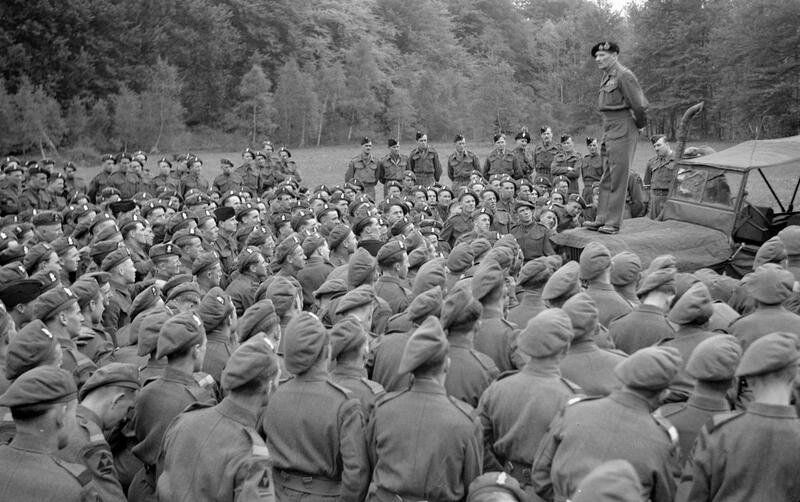
In the weeks approaching D-Day, General Montgomery also went on a speaking tour of the Briritsh Isles, inspecting and addressing troops. His goal was to speak to, and motivate as many soldiers as possible in this crucial pre D-Day period. Here is an account from journalist Alan Moorehead:

And then Montgomery’s speech would go like this: ‘I wanted to come here today so that we could get to know one another: so that I could have a look at you and you could have a look at me – if you think that’s worth doing.

We have got to go off and do a job together very soon now, you and I, and we must have confidence in one another. And now that I have seen you I have complete confidence… complete confidence… absolutely complete confidence. And you must have confidence in me.’

That was the beginning. For a hundred yards all round him row after row of young upturned faces, an atmosphere of adolescent innocence and simplicity. They sat on the grass keeping utterly still lest they should lose a word.

…

‘We have been fighting the Germans a long time now,’ Montgomery went on. ‘A very long time… a good deal too long. I expect like me you are beginning to get a bit tired of it… beginning to feel it’s about time we finished the thing off.

And we can do it. We can do it. No doubt about that. No doubt about that whatever. The well-trained British soldier will beat the German every time. We saw it in Africa. We chased him into the sea in Tunisia… then we went over to Sicily and chased him into the sea again… I don’t know if there are any more seas…’

This was the point where the soldiers relaxed and laughed. Well, it was true, wasn’t it? The Germans had been beaten in Africa. They weren’t so wonderful.

‘The newspapers keep calling it the Second Front,’ Montgomery continued. ‘I don’t know why they call it the Second Front. I myself have been fighting the Germans on a nunber of fronts, and I expect a good few of you have too.

They should call it Front Number Six or Front Number Seven. As long as they don’t want us to fight on Front Number Thirteen…’

Most of the tenseness had gone out of the soldiers now. Monty was all right. He didn’t talk a lot of cock about courage and liberty. He knew what it was like. And perhaps one had been taking the whole thing a bit too seriously. It wouldn’t be so bad.

Then – ‘We don’t want to forget the German is a good soldier… a very good soldier indeed. But when I look around this morning and see the magnificent soldiers here… some of the best soldiers I have seen in my lifetime… I have no doubt in my mind about the outcome… no doubt whatever. No doubt at all that you and I will see this thing through, together.’

Finally – ‘Now I can’t stay any longer. I expect some of you have come a long way to get here this morning and you want to get back.’ (Some of them had been travelling since 4 am.) ‘I just want to say good-bye and very good luck to each one of you.’

That was the speech, followed by three cheers for the general. I listened to it four and sometimes five times a day for nearly a week. We went from camp to camp over southern England, sometimes standing on wet hill-tops, sometimes surrounded by civilians in city parks, sometimes on a football field or under the shelter of a wood.

Always the same rush to the jeep, the same tense attention. It fascinated me every time. Long after one knew the words by heart and had ceased to listen to them one was swept into the contagious and breathless interest of each new audience.

I suppose I have heard fifty generals addressing their soldiers, most of them with much better speeches than this. Indeed I suppose this speech in print is just about as bad as one could hope to read, outside the hearty naiveté of the kindergarten. Spoken by Montgomery to the soldiers who were about to run into the Atlantic Wall it had magic.

Montgomery-1944.jpg
Source: https://en.wikiquote.org/wiki/Bernard_Mont...

Enjoyed this speech? Speakola is a labour of love and I’d be very grateful if you would share, tweet or like it. Thank you.

Facebook Twitter Facebook
In WAR & CONFLICT Tags GENERAL BERNARD MONTGOMERY, D-DAY, SPEECH TO 21ST ARMY, SPEAKING TOUR AROUND BRITAIN, ADDRESS TO TROOPS, INSPECTION OF TROOPS, MOTIVATIONAL, WW2, FIELD MARSHALL, TRANSCRIPT
Comment
Jack Bell 2017.jpg

Jack Bell: 'I was shot down, south of Musus, Libya, on the 23rd January 1942 at approximately 9.30 a.m. in a Bristol Bombay', Premier of Victoria ANZAC Day Luncheon - 2019

July 16, 2019

Distinguished guests, Ladies and Gentlemen, All Veterans.

I was shot down, south of Musus, Libya, on the 23rd January 1942 at approximately 9.30 a.m. in a Bristol Bombay. I can assure you this aircraft was travelling. It’s a big aircraft, ninety-four foot wing span and sixty-six feet long. But when a shell of that magnitude hits it, believe me it just knocks out everything.

Prior to the shell, we were struck with machine guns and point five Bofors guns. The plane was on fire as we came down through a cloud bank 1,000 feet above the ground – just like a shooting star. By the time we had dropped about 800 or 600 feet the plane was alight and the shell landed to the immediate right of me, behind the first pilot and to the left of the second pilot. This shell was built by the German armament company, Krupp.

The burst of the shrapnel caused havoc in the forward compartment plus also some parts of that shrapnel entered into the back area of the plane and into a pilot, the replacement pilot that we were flying with. In fact, it took an arm off. My friend the navigator, Tony Carter, was killed instantly. The first pilot was injured in the right leg badly and had it amputated later that day.

I myself was partially protected by the transformer and receiver, being the wireless operator. And I was only lacerated on the right leg, the abdomen and the right shoulder. But unfortunately, I was badly burned on getting out of the aircraft.

I didn’t realise how badly hurt I was until the second pilot asked me would I assist him in getting the first pilot out through the escape hatch in the forward cabin. Well he dropped on me. I then realised that I was ill. I was haemorrhaging, and I just completely passed out.

Being wounded and in the hands of the enemy you would expect that there would be very little notice taken of me by the enemy, but I was carefully rolled onto a stretcher and placed onto the back of a truck together with the other wounded.

We were transported for two and half hours to a little place called Antelat, right in the south of the Gulf of Sirte, where there was a fifth field hospital of the German Panzer Division, the 15th Panzer Division – the tank division.

In the selection of the wounded which were possibly twenty-five or thirty, they went not by nationality or whether they were enemy or their own people, but on the difficulty of the wound that they had to operate on. I was number three.

The first two were German pilots who had been shot down by Hurricanes, and they had abdominal wounds the same as myself. Unfortunately for them they died on the operating table.

The German doctor operated on me and saved me. I had fourteen stitches in my abdomen. There was no such thing as x-rays or waiting for later surgery. They just do it and get it over with. And he cared for me for the next six or seven days in that field hospital, daily coming in to dress that wound. He was a young man, in about I’d say his late thirties.

He was actually a German doctor who went to England after the First World War on the advice of is father to get proper instruction in operating. He was an abdominal surgeon in Harley Street. He used to go regularly back to Germany to do consultations on the Nazi big wigs. In August ’39 they wouldn’t let him out. And he said to me “Jack, they don’t’ trust me. I’m only second in charge, I’ll never be in charge”.

But we became, not friends, but very, very close and on the eighth, no the seventh day he came and said “We don’t take wounded back to Germany. Only the fit. We’ll be passing you over to the Italians”.

He wrapped my abdomen in a bandage, a wide bandage and inserted two overriding stitches to hold the wound together. “Cos”, he said, “you’ll be going by truck, on the back of a truck four hundred miles to Tripoli”. It took us four days and he gave me eight ampules of morphine. The morning we left, he injected an ampule into me and said “Jack, at night time inject yourself and in the morning inject yourself”. He forgot to tell me to do it before we got off the truck or onto the truck.

The first night we arrived at this little field station and I was rolled off the stretcher onto another stretcher in this little field hospital. I can assure you it hurt. And unbeknown to me of course – I was partially unconscious and drugging myself from then on. It took us four days.

There was only one road from Antelat to Tripoli and of course that was filled with military traffic. So, we used to run off into the desert. Unbeknownst to me, and during that trip, I must have suffered badly. I don’t know, because I was unconscious most of the time.

When we arrived at Tripoli, I was taken to a field hospital – it was a POW hospital – and put in a private room. I was too sick and too silly to understand what that meant. An Italian nurse came and looked after me and she said – she spoke perfect English – “I’m here. I’ll have to undress you and attend to your wound”. Well not only wounds, I had shrapnel in my leg. She said “We won’t worry about that. It will probably work itself out”.

Every stitch broke on that journey. Fourteen on the abdomen, plus the two over-riding stitches. So you can imagine I’d bled out. This had dried in the sun and was caked hard on my abdomen. She said “I’ll have to give you a drug”, and I had one ampule left and she shot me into the leg. I don’t remember it, but I do remember looking up one time and she was just lifting her head up like that and I could see tears coming down her eyes. I didn’t know how bad the wound was. I never saw it. But I can assure you that it was very severe. I was five months in Italian hospitals.

And I must tell you what I feel.

The word is compassion.

That German doctor could have quite easily snuffed me out. Hard to say it, but he saved my life and he had two German pilots die before me. The compassion he showed made me realise that he was an ordinary individual, exactly the same as you people here. He didn’t want to go to the war but necessity forced him, the same as we didn’t have to go to war either but we volunteered to go, to protect the Empire. He was so kind to me. For years I’ve been trying to trace that German doctor without success. I would like at least to speak to his family.

An Italian nurse spent every day for four more days when I was there, nursing and feeding me only. She bought a bowl of food and said “The intravenous injections are now stopping. You have to eat, otherwise you’ll die”. She bought in a bowl of pasta. I used to enjoy pasta at an Italian restaurant in Brisbane before the War. I tried to eat it but I couldn’t. I brought it up. She went out into the garden and there was a quince tree. She picked one or two quinces, I’m not sure. But she boiled those up for me and laced them with sugar and said you have to eat. And I ate it.

That girl – she was older than I was, much older, she was in her fifties I would imagine – showed me compassion that she didn’t have to show. But she did. It made me realise that they’re just nice people. Just like any of us.

Then I was shipped to Italy, to a place called Caserta, which is a suburb of Naples, on a vessel that used to come to Australia, the Aquila. It was then a hospital ship. The matron in charge was Countess Ciano, Mussolini’s daughter. We were in the bowels of the ship with all the prisoners and I couldn’t walk. I had to be virtually carried if I wished to go to the toilet. She individually came around and spoke to all of those prisoners in that horrible area, the bilge area. She spoke to every one of the prisoners. She didn’t have to do that either but she did it. So, I must say that I didn’t realise until probably seven or eight years later just how marvellous it was. How well I was treated by them. The compassion I was shown – by the enemy.

Billy Rudd was taken at Alamein and came into the prison camp in P.G. 57 in Grupignano, near Udine on the Trieste border. We never knew each other in that camp, but he was the same age. We met after the war and we’ve become very, very good friends.

In the prison camp when I was shuttled off to Germany, in September 1943, the train was cattle trucks with fifty to sixty prisoners of war in each truck. There was only one window letting air in. The sick and the wounded stood beneath it so they could get fresh air. We took it in turns to walk ‘round the ropeway inside, on the inside of the actual truck to get a breath of fresh air, because it did become rather fetid when we were stationary. It wasn’t so bad when we were moving because the wind came through the cracks in the floor.

Now our prison camp Stalag IVB in a little place called Mühlberg, south of Berlin, east of Leipzig and north of Dresden. There were thirty-three different nationalities. At times there were thirty-five thousand prisoners in that camp. At times, down to twenty-two thousand. There were approximately eight thousand British prisoners of war. Two thousand Air Force in our compound, of whom there was only one hundred and fifty-five Australians. Norm Ginn and I are the last survivors.

Please consider that the ordinary people in Germany were hungry also. Just as we were hungry. For instance, this meal that you’re going to eat or finish today, contained more calorie value than the Japanese prisoners of war were given in a week.

I’d like you to think about that.

How we’ve lasted so long I don’t’ know. There’s fifty-three Japanese boys still alive in Australia and fifty European. There’s forty odd in our membership in our ex POW Association in Melbourne. Lovely to have Billy here today.

Tolerance.

We had to get on because of the lack of food. Everybody was hungry. The rations that we got in Germany were slightly larger than the Japanese POWs, but unfortunately the potatoes were four years old. Spud farmers would recognise it. If you bury potatoes for four years, they’re not much good when they’re dug up. These were shipped to the prisoners. We’d see truck-loads of these potatoes come into the camp. They’d hose them, boil them, and most of them, about 80 percent of them, would be black. More likely, 90 percent of them. But we ate the little bits of white on them that was left, and threw the rest away.

Our daily soup ration was millet or sugar beet or pickled vegetables, which was three hundred mils a day. I did not know of any case at all when those thirty-three nationalities in prison, did not get on with each other. Some certainly played football. They had football teams, the round ball style. But they took their venom out on the football field. There was no sort of international fighting amongst them, each nationality. It was surprising, but it taught me the lesson of tolerance. Be tolerant. It’s amazing what it does.

Respect.

I only know one case of an Australian prisoner of war stealing in the three years, three months in which I was held captive. He was punished, and sent to Coventry for a month by Australian fellow prisoners. I don’t know of any other cases that occurred. But respect that was shown to us in that camp, all one hundred and fifty-five of us. We had responsible positions throughout.

During this time, of course I couldn’t lift anything because of the ruptures in my abdomen. I had a lump of protruding flesh and weeping wound about the size of a chicken egg. Roughly a small egg, which, when I came back to Australia had to be removed and I had to be resewn. They fixed the five ruptures plus two hernias which I had developed also whilst I was there.

Now the respect that we showed each other and the respect that was shown to us by our fellow prisoners was fantastic.

When you look at the world today and you can think of compassion and tolerance and respect. We’ve dropped a long way mate in the Articles of War, and of living in this world. I only wish that those three words would become part and parcel of our beliefs today.

I don’t know whether you are aware, buty I’m wearing a tie today which was presented to me by the Rats of Tobruk two months ago. The Rats of Tobruk were a funny mob. They were taken prisoner, no sorry, they were surrounded about a week ago from today. That’s seventy-nine years ago. There’s still some five active members in the Rats of Tobruk Club down in South Melbourne. I thank them very much for giving me this tie. It’s very special.

Thank you, ladies and gentlemen.

---oOo---

Delivered without notes and greeted with a sustained standing ovation

Enjoyed this speech? Speakola is a labour of love and I’d be very grateful if you would share, tweet or like it. Thank you.

Facebook Twitter Facebook
In WAR & CONFLICT Tags JACK BELL, AIRMAN, AIR FORCE, WORLD WAR 2, WW2, WWII, PRISONER OF WAR, WAR, RATS OF TOBRUK, LYBIA
Comment

Peter MacDonald: 'Without Navajo, Marines would never have taken the island of Iwo Jima' Oval Office reception for Navajo Code Talkers - 2017

November 29, 2017

27 November 2017, White House Oval Office, Washington DC, USA

Today, we have with us three of the thirteen surviving Navajo Code Talkers of World War II. First, we have Fleming Begaye. Fleming Begaye is 97 years old, the oldest veteran of World War II. He survived the Battle of Tarawa. His landing craft was blown up and he literally had to swim to the beach to survive. Also, on Saipan, he also landed on Tinian where he got shot up real badly, survived one year in naval hospital.

We have Thomas Begay, also one of the Code Talkers who were on Iwo Jima, a tough battle, where Three Marine Division landed on Iwo; 5th Marine Division -- he was part of the Code Talkers within the 5th Marine Division.

Also, as if Marine Corps was not enough, he enlisted to be United States Army, and served in the Korean War. Survived that awful battle at Chosin.

My name is Peter MacDonald. I'm the president of the 13 surviving Navajo Code Talkers. I went in -- I'm 90 years old -- I went in when I was 15 years old in 1944. I was with the 1st Marine Brigade on Guam, and then went on to North China with 6th Marine Division to get those Japanese in Northern China to surrender. They didn’t want to surrender, but it took 1st Marine Division, 6th Marine Division to get them to surrender eventually. We had a separate treaty ceremony in Tsingtao, China, October 25th, 1945

Navajo Code Talkers, in the early part of World War II, the enemy was breaking every military code that was being used in the Pacific. This created a huge problem for strategizing against the enemy. Eventually, a suggestion was made in early 1942 -- February '42, essentially -- to use Navajo language as a code.

The Marine Corps recruited 29 young Navajos, not telling them what they are being recruited for, because this was a top-secret operation. They were just asked, "Do you want to join the Marines? You want to fight the enemy? Come join the Marines." So they volunteered.

Twenty-nine young Navajos joined the Marines in 1942, after going through boot camp, passed boot camp with flying colors; combat training -- the same thing. Then entered the Marine Corps Communication School -- passed that. Then they were separated from all the rest of the Marines, took them to a top-secret location just east of San Diego -- Camp Elliott. That's where they created a military code to be used in the Pacific.

After creating 260 code words, the 29 young Marines -- half of them were sent overseas to join the 1st Marine Division. The 1st Marine Division was getting ready to go on to the first offensive movement in the Pacific, Guadalcanal.

On August 7, 1942 -- 75 years ago -- 1st Marine Division hit the beaches of Guadalcanal with 15 Navajo Code Talkers. This was the first battle where the Navajo code was to be tested in actual battle to test to see how our memory would be under heavy enemy fire. Well, three weeks after the landing, General Van De Griff, Commander of the 1st Marine Division, sent word back to United States saying, this Navajo code is terrific. The enemy never understood it; he said, we don't understand it either, but it works. Send us some more Navajos.

So that opened up the gate for United States Marine Corps, San Diego to start recruiting more and more Navajos, using the same tactics: "You want to fight? You want to join the Marines? You want to wear this beautiful blue uniform? Come join the Marines." So we all volunteered. That's how he went in, that's how he went in, that's how I went in.

Boot camp, combat training, communication schools. Then we all get separated, go to that special top-secret Navajo code school to learn to code. Initially, 260 code words, all subject to memory only. Eventually, by the time the war ended, 1945, there were 400 of us that went to war. And also, our code words grew to 600 code words, subject to memory only. In every battle two communication networks were established: Navajo communication network for all top-secret, confidential messages; the second network, English network, for all other messages.

In every battle -- from the frontline, beach command post, command ship, all other ships -- Code Talkers were used. On the island of Iwo, Major Connor said, the first 48 hours of battle, over 800 messages were sent by the 5th Marine Division, only. The first 48 hours, over 800 messages. Major Connor also said: Without Navajo, Marines would never have taken the island of Iwo Jima. (Applause.)

So thank you very much. The 13 of us, we still have one mission -- that mission is to build national Navajo Code Talker Museum. We want to preserve this unique World War II history for our children, grandchildren, your children, your grandchildren to go through that museum.

Why? Because what we did truly represents who we are as Americans. America, we know, is composed of diverse community. We have different languages, different skills, different talents, and different religion. But when our way of life is threatened, like the freedom and liberty that we all cherish, we come together as one. And when we come together as one, we are invincible. We cannot be defeated. That's why we need this national Navajo Code Talker Museum so that our children, the future generation, can go through that museum and learn why America is so strong.

Thank you very much for listening. (Applause.)


President Trump responded and earned criticism for his condescending tone , and Pocahontas jibe at rival Elizabeth Warren.

That's fantastic, thank you. That's fantastic. Thank you very much. Beautiful.

That was so incredible, and now I don't have to make my speech. I had the most beautiful speech written out. I was so proud of it. Look. And I thought you would leave out Iwo Jima, but you got that in the end, too. (Laughter.)

And I want to tell you -- you said you're 90 years old? That's great, because you have good genes. That means the press has got me to kick around for a long time. (Laughter.)

That was beautiful. I loved that and I loved your delivery. And the Code Talkers are amazing. And seriously, it is what I said. So what I'm going to do is give you my speech, and I want you to hold that. And I know you like me, so you'll save it. But that was so well delivered, from the heart. That was from the heart.

So I want to give you this speech because I don't want to bore them with saying the same thing you just said. And you said it better, believe me, because you said it from here. And I mean it from there too.

And you have a lot of great friends. Tom Cole is here, and you know Tom. And you know Jeff. So I want to thank you both, Jeff Denham. I want to thank you both for being here, and you too for being here.

Also, General Dunford, head of the Joint Chiefs of Staff, and General Kelly. And I have to say, I said to General Kelly --- I said, General, how good -- here he is right there, the Chief; he's the General and the Chief. I said, how good were these Code Talkers? What was it? He said, sir, you have no idea. You have no idea how great they were -- what they've done for this country, and the strength and the bravery and the love that they had for the country and that you have for the country.

So that was the ultimate statement from General Kelly, the importance. And I just want to thank you because you're very, very special people. You were here long before any of us were here, although we have a representative in Congress who, they say, was here a long time ago. They call her "Pocahontas."

But you know what, I like you because you are special. You are special people. You are really incredible people. And from the heart, from the absolute heart, we appreciate what you've done, how you've done it, the bravery that you displayed, and the love that you have for your country.

Tom, I would say that's as good as it gets, wouldn't you say? That's as good as you get.

General Kelly, just come up for one second. I want to just have you say what you told me, a little bit about the Code Talkers. Because it really has been -- learning about you and learning about what you've done has been something that I'd like General Kelly to say to the press.

Go ahead, General.

Source: https://www.c-span.org/video/?437799-1/pre...

Enjoyed this speech? Speakola is a labour of love and I’d be very grateful if you would share, tweet or like it. Thank you.

Facebook Twitter Facebook
In WAR & CONFLICT Tags PETER MACDONALD, NAVAJO, NATIVE AMERICAN, CODE TALKERS, WW2, COMMUNICATIONS, NAVAJO LANGUAGE, ENCRYPTION, TRANSCRIPT, DONALD TRUMP, PRESIDENT TRUMP, POCAHONTAS SLUR, ELIZABETH WARREN
Comment

Sergei Eisentstein: 'The time has come to fight', Jewish Anti Fascist Committee - 1941

June 30, 2017

1941, USSR

Working as I do in the sphere of Russian cinematography and Russian art, the very principle of racial hatred is foreign and loathsome to me.

The great tradition of the Russian intelligentsia, which has found its highest form of development in the Soviet intelligentsia, has always been remarkable for its broad international
viewpoint.

This with us was inseparable from ardent love for our native land, and powerful national feelings, and had, nothing in common with cosmopolitanism which takes no account of kith and kin or Fatherland. The traditional tendencies of our international viewpoint have culminated in the creation of our multi-national, state, in the free self-determination of its
peoples, and the flourishing of their national culture and art.


Basing itself on the principles of equal fraternal rights, of spiritual and material values for each nation, for each people, our country regards with undisguised indignation any form of
national oppression. The deeds of violence being committed in 'an historically unprecedented measure against Jewry by the Fascist criminals, cannot but evoke the fiercest hatred, the
most burning indignation.


But the time for calls to indignation and condemnation has passed. The-time has come to fight. The champions of brute ideology, the Fascists, and the champions of the ideals of humanism, the Soviet Union, and our great partners in the struggle, Great Britain and America, have met in mortal combat.


"Give me a fulcrum and I'll overturn the earth," said Archimedes. " Give us a fulcrum "-from the gloom comes the cry of the peoples oppressed by Fascism--" And we will deal'
with our enslavers."

There is such a fulcrum. In this sacred struggle the Soviet Union.i's uniting all peoples who with sword in hand are ready to rise for the right to call themselves Czechs, Poles, Dutchmen, Belgians, Russians or Jews. The Slavs have risen and there should not be one Jew on the face of the earth who has not also sworn, by all possible means and with all his power to participate in this sacred struggle, and to carry out that oath to the letter. Because it is not only a matter of saving a nation that has given humanity great poets, thinkers and artists; because it is not only a matter of saving a people numbering many millions of human lives, but because it is a matter of the triumph of humanism over brutality, barbarism, infamy and violence. Because it is a matter of the bright future of all humanity, irrespective of nationality.

" What have you done in this struggle ?" history will ask of everyone of us living in these times and he or she will be disgraced for ever who cannot say with proudly lifted head-

"All that was in my power."

Enjoyed this speech? Speakola is a labour of love and I’d be very grateful if you would share, tweet or like it. Thank you.

Facebook Twitter Facebook
In WAR & CONFLICT Tags SERGEI EISENSTEIN, CINEMATOGRAPHY, TRANSCRIPT, WW2, JEWS
Comment

J. Robert Oppenheimer: 'We are not only scientists; we are men, too', Speech to Association of Los Alamos Scientists - 1945

June 28, 2017

2 November 1945, Los Alamos, New Mexico, USA

I am grateful to the Executive Committee for this chance to talk to you. I should like to talk tonight -- if some of you have long memories perhaps you will regard it as justified -- as a fellow scientist, and at least as a fellow worrier about the fix we are in. I do not have anything very radical to say, or anything that will strike most of you with a great flash of enlightenment. I don't have anything to say that will be of an immense encouragement. In some ways I would have liked to talk to you at an earlier date -- but I couldn't talk to you as a Director. I could not talk, and will not tonight talk, too much about the practical political problems which are involved. There is one good reason for that -- I don't know very much about practical politics. And there is another reason, which has to some extent restrained me in the past. As you know, some of us have been asked to be technical advisors to the Secretary of War, and through him to the President. In the course of this we have naturally discussed things that were on our minds and have been made, often very willingly, the recipient of confidences; it is not possible to speak in detail about what Mr. A thinks and Mr. B doesn't think, or what is going to happen next week, without violating these confidences. I don't think that's important. I think there are issues which are quite simple and quite deep, and which involve us as a group of scientists -- involve us more, perhaps than any other group in the world. I think that it can only help to look a little at what our situation is -- at what has happened to us -- and that this must give us some honesty, some insight, which will be a source of strength in what may be the not-too-easy days ahead. I would like to take it as deep and serious as I know how, and then perhaps come to more immediate questions in the course of the discussion later. I want anyone who feels like it to ask me a question and if I can't answer it, as will often be the case, I will just have to say so.

What has happened to us -- it is really rather major, it is so major that I think in some ways one returns to the greatest developments of the twentieth century, to the discovery of relativity, and to the whole development of atomic theory and its interpretation in terms of complementarity, for analogy. These things, as you know, forced us to re-consider the relations between science and common sense. They forced on us the recognition that the fact that we were in the habit of talking a certain language and using certain concepts did not necessarily imply that there was anything in the real world to correspond to these. They forced us to be prepared for the inadequacy of the ways in which human beings attempted to deal with reality, for that reality. In some ways I think these virtues, which scientists quite reluctantly were forced to learn by the nature of the world they were studying, may be useful even today in preparing us for somewhat more radical views of what the issues are than would be natural or easy for people who had not been through this experience.

But the real impact of the creation of the atomic bomb and atomic weapons -- to understand that one has to look further back, look, I think, to the times when physical science was growing in the days of the renaissance, and when the threat that science offered was felt so deeply throughout the Christian world. The analogy is, of course, not perfect. You may even wish to think of the days in the last century when the theories of evolution seemed a threat to the values by which men lived. The analogy is not perfect because there is nothing in atomic weapons -- there is certainly nothing that we have done here or in the physics or chemistry that immediately preceded our work here -- in which any revolutionary ideas were involved. I don't think that the conceptions of nuclear fission have strained any man's attempts to understand them, and I don't feel that any of us have really learned in a deep sense very much from following this up. It is in a quite different way. It is not an idea -- it is a development and a reality -- but it has in common with the early days of physical science the fact that the very existence of science is threatened, and its value is threatened. This is the point that I would like to speak a little about.

I think that it hardly needs to be said why the impact is so strong. There are three reasons: one is the extraordinary speed with which things which were right on the frontier of science were translated into terms where they affected many living people, and potentially all people. Another is the fact, quite accidental in many ways, and connected with the speed, that scientists themselves played such a large part, not merely in providing the foundation for atomic weapons, but in actually making them. In this we are certainly closer to it than any other group. The third is that the thing we made -- partly because of the technical nature of the problem, partly because we worked hard, partly because we had good breaks -- really arrived in the world with such a shattering reality and suddenness that there was no opportunity for the edges to be worn off.

In considering what the situation of science is, it may be helpful to think a little of what people said and felt of their motives in coming into this job. One always has to worry that what people say of their motives is not adequate. Many people said different things, and most of them, I think, had some validity. There was in the first place the great concern that our enemy might develop these weapons before we did, and the feeling -- at least, in the early days, the very strong feeling -- that without atomic weapons it might be very difficult, it might be an impossible, it might be an incredibly long thing to win the war. These things wore off a little as it became clear that the war would be won in any case. Some people, I think, were motivated by curiosity, and rightly so; and some by a sense of adventure, and rightly so. Others had more political arguments and said, "Well, we know that atomic weapons are in principle possible, and it is not right that the threat of their unrealized possibility should hang over the world. It is right that the world should know what can be done in their field and deal with it." And the people added to that that it was a time when all over the world men would be particularly ripe and open for dealing with this problem because of the immediacy of the evils of war, because of the universal cry from everyone that one could not go through this thing again, even a war without atomic bombs. And there was finally, and I think rightly, the feeling that there was probably no place in the world where the development of atomic weapons would have a better chance of leading to a reasonable solution, and a smaller chance of leading to disaster, than within the United States. I believe all these things that people said are true, and I think I said them all myself at one time or another.

But when you come right down to it the reason that we did this job is because it was an organic necessity. If you are a scientist you cannot stop such a thing. If you are a scientist you believe that it is good to find out how the world works; that it is good to find out what the realities are; that it is good to turn over to mankind at large the greatest possible power to control the world and to deal with it according to its lights and its values.

There has been a lot of talk about the evil of secrecy, of concealment, of control, of security. Some of that talk has been on a rather low plane, limited really to saying that it is difficult or inconvenient to work in a world where you are not free to do what you want. I think that the talk has been justified, and that the almost unanimous resistance of scientists to the imposition of control and secrecy is a justified position, but I think that the reason for it may lie a little deeper. I think that it comes from the fact that secrecy strikes at the very root of what science is, and what it is for. It is not possible to be a scientist unless you believe that it is good to learn. It is not good to be a scientist, and it is not possible, unless you think that it is of the highest value to share your knowledge, to share it with anyone who is interested. It is not possible to be a scientist unless you believe that the knowledge of the world, and the power which this gives, is a thing which is of intrinsic value to humanity, and that you are using it to help in the spread of knowledge, and are willing to take the consequences. And, therefore, I think that this resistance which we feel and see all around us to anything which is an attempt to treat science of the future as though it were rather a dangerous thing, a thing that must be watched and managed, is resisted not because of its inconvenience -- I think we are in a position where we must be willing to take any inconvenience -- but resisted because it is based on a philosophy incompatible with that by which we live, and have learned to live in the past.

There are many people who try to wiggle out of this. They say the real importance of atomic energy does not lie in the weapons that have been made; the real importance lies in all the great benefits which atomic energy, which the various radiations, will bring to mankind. There may be some truth in this. I am sure that there is truth in it, because there has never in the past been a new field opened up where the real fruits of it have not been invisible at the beginning. I have a very high confidence that the fruits -- the so-called peacetime applications -- of atomic energy will have in them all that we think, and more. There are others who try to escape the immediacy of this situation by saying that, after all, war has always been very terrible; after all, weapons have always gotten worse and worse; that this is just another weapon and it doesn't create a great change; that they are not so bad; bombings have been bad in this war and this is not a change in that -- it just adds a little to the effectiveness of bombing; that some sort of protection will be found. I think that these efforts to diffuse and weaken the nature of the crisis make it only more dangerous. I think it is for us to accept it as a very grave crisis, to realize that these atomic weapons which we have started to make are very terrible, that they involve a change, that they are not just a slight modification: to accept this, and to accept with it the necessity for those transformations in the world which will make it possible to integrate these developments into human life. As scientists I think we have perhaps a little greater ability to accept change, and accept radical change, because of our experiences in the pursuit of science. And that may help us -- that, and the fact that we have lived with it -- to be of some use in understanding these problems.

It is clear to me that wars have changed. It is clear to me that if these first bombs -- the bomb that was dropped on Nagasaki -- that if these can destroy ten square miles, then that is really quite something. It is clear to me that they are going to be very cheap if anyone wants to make them; it is clear to me that this is a situation where a quantitative change, and a change in which the advantage of aggression compared to defense -- of attack compared to defense -- is shifted, where this quantitative change has all the character of a change in quality, of a change in the nature of the world. I know that whereas wars have become intolerable, and the question would have been raised and would have been pursued after this war, more ardently than after the last, of whether there was not some method by which they could be averted. But I think the advent of the atomic bomb and the facts which will get around that they are not too hard to make -- that they will be universal if people wish to make them universal, that they will not constitute a real drain on the economy of any strong nation, and that their power of destruction will grow and is already incomparably greater than that of any other weapon -- I think these things create a new situation, so new that there is some danger, even some danger in believing, that what we have is a new argument for arrangements, for hopes, that existed before this development took place. By that I mean that much as I like to hear advocates of a world federation, or advocates of a United Nations organization, who have been talking of these things for years -- much as I like to hear them say that here is a new argument, I think that they are in part missing the point, because the point is not that atomic weapons constitute a new argument. There have always been good arguments. The point is that atomic weapons constitute also a field, a new field, and a new opportunity for realizing preconditions. I think when people talk of the fact that this is not only a great peril, but a great hope, this is what they should mean. I do not think they should mean the unknown, though sure, value of industrial and scientific virtues of atomic energy, but rather the simple fact that in this field, because it is a threat, because it is a peril, and because it has certain special characteristics, to which I will return, there exists a possibility of realizing, of beginning to realize, those changes which are needed if there is to be any peace.

Those are very far-reaching changes. They are changes in the relations between nations, not only in spirit, not only in law, but also in conception and feeling. I don't know which of these is prior; they must all work together, and only the gradual interaction of one on the other can make a reality. I don't agree with those who say the first step is to have a structure of international law. I don't agree with those who say the only thing is to have friendly feelings. All of these things will be involved. I think it is true to say that atomic weapons are a peril which affect everyone in the world, and in that sense a completely common problem, as common a problem as it was for the Allies to defeat the Nazis. I think that in order to handle this common problem there must be a complete sense of community responsibility. I do not think that one may expect that people will contribute to the solution of the problem until they are aware of their ability to take part in the solution. I think that it is a field in which the implementation of such a common responsibility has certain decisive advantages. It is a new field, in which the position of vested interests in various parts of the world is very much less serious than in others. It is serious in this country, and that is one of our problems. It is a new field, in which the role of science has been so great that it is to my mind hardly thinkable that the international traditions of science, and the fraternity of scientists, should not play a constructive part. It is a new field, in which just the novelty and the special characteristics of the technical operations should enable one to establish a community of interest which might almost be regarded as a pilot plant for a new type of international collaboration. I speak of it as a pilot plant because it is quite clear that the control of atomic weapons cannot be in itself the unique end of such operation. The only unique end can be a world that is united, and a world in which war will not occur. But those things don't happen overnight, and in this field it would seem that one could get started, and get started without meeting those insuperable obstacles which history has so often placed in the way of any effort of cooperation. Now, this is not an easy thing, and the point I want to make, the one point I want to hammer home, is what an enormous change in spirit is involved. There are things which we hold very dear, and I think rightly hold very dear; I would say that the word democracy perhaps stood for some of them as well as any other word. There are many parts of the world in which there is no democracy. There are other things which we hold dear, and which we rightly should. And when I speak of a new spirit in international affairs I mean that even to these deepest of things which we cherish, and for which Americans have been willing to die -- and certainly most of us would be willing to die -- even in these deepest things, we realize that there is something more profound than that; namely, the common bond with other men everywhere. It is only if you do that that this makes sense; because if you approach the problem and say, "We know what is right and we would like to use the atomic bomb to persuade you to agree with us," then you are in a very weak position and you will not succeed, because under those conditions you will not succeed in delegating responsibility for the survival of men. It is a purely unilateral statement; you will find yourselves attempting by force of arms to prevent a disaster.

I want to express the utmost sympathy with the people who have to grapple with this problem and in the strongest terms to urge you not to underestimate its difficulty. I can think of an analogy, and I hope it is not a completely good analogy: in the days in the first half of the nineteenth century there were many people, mostly in the North, but some in the South, who thought that there was no evil on earth more degrading than human slavery, and nothing that they would more willingly devote their lives to than its eradication. Always when I was young I wondered why it was that when Lincoln was President he did not declare that the war against the South, when it broke out, was a war that slavery should be abolished, that this was the central point, the rallying point, of that war. Lincoln was severely criticized by many of the Abolitionists as you know, by many then called radicals, because he seemed to be waging a war which did not hit the thing that was most important. But Lincoln realized, and I have only in the last months come to appreciate the depth and wisdom of it, that beyond the issue of slavery was the issue of the community of the people of the country, and the issue of the Union. I hope that today this will not be an issue calling for war; but I wanted to remind you that in order to preserve the Union Lincoln had to subordinate the immediate problem of the eradication of slavery, and trust -- and I think if he had had his way it would have gone so -- to the conflict of these ideas in a united people to eradicate it.

These are somewhat general remarks and it may be appropriate to say one or two things that are a little more programmatic, that are not quite so hard to get one's hands on. That is, what sort of agreement between nations would be a reasonable start. I don't know the answer to this, and I am very sure that no a priori answer should be given, that it is something that is going to take constant working out. But I think it is a thing where it will not hurt to have some reasonably concrete proposal. And I would go a step further and say of even such questions as the great question of secrecy -- which perplexes scientists and other people -- that even this was not a suitable subject for unilateral action. If atomic energy is to be treated as an international problem, as I think it must be, if it is to be treated on the basis of an international responsibility and an international common concern, the problems of secrecy are also international problems. I don't mean by that that our present classifications and our present, in many cases inevitably ridiculous, procedures should be maintained. I mean that the fundamental problem of how to treat this peril ought not to be treated unilaterally by the United States, or by the United States in conjunction with Great Britain.

The first thing I would say about any proposals is that they ought to be regarded as interim proposals, and that whenever they are made it be understood and agreed that within a year or two years -- whatever seems a reasonable time -- they will be reconsidered and the problems which have arisen, and the new developments which have occurred, will cause a rewriting. I think the only point is that there should be a few things in these proposals which will work in the right direction, and that the things should be accepted without forcing all of the changes, which we know must ultimately occur, upon people who will not be ready for them. This is anyone's guess, but it would seem to me that if you took these four points, it might work: first, that we are dealing with an interim solution, so recognized. Second, that the nations participating in the arrangement would have a joint atomic energy commission, operating under the most broad directives from the different states, but with a power which only they had, and which was not subject to review by the heads of State, to go ahead with those constructive applications of atomic energy which we would all like to see developed -- energy sources, and the innumerable research tools which are immediate possibilities. Third, that there would be not merely the possibility of exchange of scientists and students; that very, very concrete machinery more or less forcing such exchange should be established, so that we would be quite sure that the fraternity of scientists would be strengthened and that the bonds on which so much of the future depends would have some reinforcement and some scope. And fourth, I would say that no bombs be made. I don't know whether these proposals are good ones, and I think that anyone in this group would have his own proposals. But I mention them as very simple things, which I don't believe solve the problem, and which I want to make clear are not the ultimate or even a touch of the ultimate, but which I think ought to be started right away; which I believe -- though I know very little of this -- may very well be acceptable to any of the nations that wish to become partners with us in this great undertaking.

One of the questions which you will want to hear more about, and which I can only partly hope to succeed in answering, is to what extent such views -- essentially the view that the life of science is threatened, the life of the world is threatened, and that only [by] a profound revision of what it is that constitutes a thing worth fighting for and a thing worth living for can this crisis be met -- to what extent these views are held by other men. They are certainly not held universally by scientists; but I think they are in agreement with all of the expressed opinions of this group, and I know that many of my friends here see pretty much eye to eye. I would speak especially of Bohr, who was here so much during the difficult days, who had many discussions with us, and who helped us reach the conclusion that [it was] not only a desirable solution, but that it was the unique solution, that there were no other alternatives.

I would say that among scientists there are certain centrifugal tendencies which seem to me a little dangerous, but not very. One of them is the attempt to try, in this imperilled world, in which the very function of science is threatened, to make convenient arrangements for the continuance of science, and to pay very little attention to the preconditions which give sense to it. Another is the tendency to say we must have a free science and a strong science, because this will make us a strong nation and enable us to fight better wars. It seems to me that this is a profound mistake, and I don't like to hear it. The third is even odder, and it is to say, "Oh give the bombs to the United Nations for police purposes, and let us get back to physics and chemistry." I think none of these are really held very widely, but they show that there are people who are desperately trying to avoid what I think is the most difficult problem. One must expect these false solutions, and overeasy solutions, and these are three which pop up from time to time.

As far as I can tell in the world outside there are many people just as quick to see the gravity of the situation, and to understand it in terms not so different from those I have tried to outline. It is not only among scientists that there are wise people and foolish people. I have had occasion in the last few months to meet people who had to do with the Government -- the legislative branches, the administrative branches, and even the judicial branches, and I have found many in whom an understanding of what this problem is, and of the general lines along which it can be solved, is very clear. I would especially mention the former Secretary of War, Mr. Stimson, who, perhaps as much as any man, seemed to appreciate how hopeless and how impractical it was to attack this problem on a superficial level, and whose devotion to the development of atomic weapons was in large measure governed by his understanding of the hope that lay in it that there would be a new world. I know this is a surprise, because most people think that the War Department has as its unique function the making of war. The Secretary of War has other functions.

I think this is another question of importance: that is, what views will be held on these matters in other countries. I think it is important to realize that even those who are well informed in this country have been slow to understand, slow to believe that the bombs would work, and then slow to understand that their working would present such profound problems. We have certain interests in playing up the bomb, not only we here locally, but all over the country, because we made them, and our pride is involved. I think that in other lands it may be even more difficult for an appreciation of the magnitude of the thing to take hold. For this reason, I'm not sure that the greatest opportunities for progress do not lie somewhat further in the future than I had for a long time thought.

There have been two or three official statements by the President which defined, as nearly as their in some measure inevitable contradictions made possible, the official policy of the Government. And I think that one must not be entirely discouraged by the fact that there are contradictions, because the contradictions show that the problem is being understood as a difficult one, is temporarily being regarded as an insoluble one. Certainly you will notice, especially in the message to Congress, many indications of a sympathy with, and an understanding of, the views which this group holds, and which I have discussed briefly tonight. I think all of us were encouraged at the phrase "too revolutionary to consider in the framework of old ideas." That's about what we all think. I think all of us were encouraged by the sense of urgency that was frequently and emphatically stressed. I think all of us must be encouraged by the recognition, the official recognition by the Government of the importance -- of the overriding importance -- of the free exchange of scientific ideas and scientific information between all countries of the world. It would certainly be ridiculous to regard this as a final end, but I think that it would also be a very dangerous thing not to realize that it as a precondition. I am myself somewhat discouraged by the limitation of the objective to the elimination of atomic weapons, and I have seen many articles -- probably you have, too -- in which this is interpreted as follows: "Let us get international agreement to outlaw atomic weapons and then let us go back to having a good, clean war." This is certainly not a very good way of looking at it. I think, to say it again, that if one solves the problems presented by the atomic bomb, one will have made a pilot plant for solution of the problem of ending war.

But what is surely the thing which must have troubled you, and which troubled me, in the official statements was the insistent note of unilateral responsibility for the handling of atomic weapons. However good the motives of this country are -- I am not going to argue with the President's description of what the motives and the aims are -- we are 140 million people, and there are two billion people living on earth. We must understand that whatever our commitments to our own views and ideas, and however confident we are that in the course of time they will tend to prevail, our absolute -- our completely absolute -- commitment to them, in denial of the views and ideas of other people, cannot be the basis of any kind of agreement.

As I have said, I had for a long time the feeling of the most extreme urgency, and I think maybe there was something right about that. There was a period immediately after the first use of the bomb when it seemed most natural that a clear statement of policy, and the initial steps of implementing it, should have been made; and it would be wrong for me not to admit that something may have been lost, and that there may be tragedy in that loss. But I think the plain fact is that in the actual world, and with the actual people in it, it has taken time, and it may take longer, to understand what this is all about. And I am not sure, as I have said before, that in other lands it won't take longer than it does in this country. As it is now, our only course is to see what we can do to bring about an understanding on a level deep enough to make a solution practicable, and to do that without undue delay.

One may think that the views suggested in the President's Navy Day speech are not entirely encouraging, that many men who are more versed than we in the practical art of statesmanship have seen more hope in a radical view, which may at first sight seem visionary, than in an approach on a more conventional level.

I don't have very much more to say. There are a few things which scientists perhaps should remember, that I don't think I need to remind us of; but I will, anyway. One is that they are very often called upon to give technical information in one way or another, and I think one cannot be too careful to be honest. And it is very difficult, not because one tells lies, but because so often questions are put in a form which makes it very hard to give an answer which is not misleading. I think we will be in a very weak position unless we maintain at its highest the scrupulousness which is traditional for us in sticking to the truth, and in distinguishing between what we know to be true from what we hope may be true.

The second thing I think it right to speak of is this: it is everywhere felt that the fraternity between us and scientists in other countries may be one of the most helpful things for the future; yet it is apparent that even in this country not all of us who are scientists are in agreement. There is no harm in that; such disagreement is healthy. But we must not lose the sense of fraternity because of it; we must not lose our fundamental confidence in our fellow scientists.

I think that we have no hope at all if we yield in our belief in the value of science, in the good that it can be to the world to know about reality, about nature, to attain a gradually greater and greater control of nature, to learn, to teach, to understand. I think that if we lose our faith in this we stop being scientists, we sell out our heritage, we lose what we have most of value for this time of crisis.

But there is another thing: we are not only scientists; we are men, too. We cannot forget our dependence on our fellow men. I mean not only our material dependence, without which no science would be possible, and without which we could not work; I mean also our deep moral dependence, in that the value of science must lie in the world of men, that all our roots lie there. These are the strongest bonds in the world, stronger than those even that bind us to one another, these are the deepest bonds -- that bind us to our fellow men.

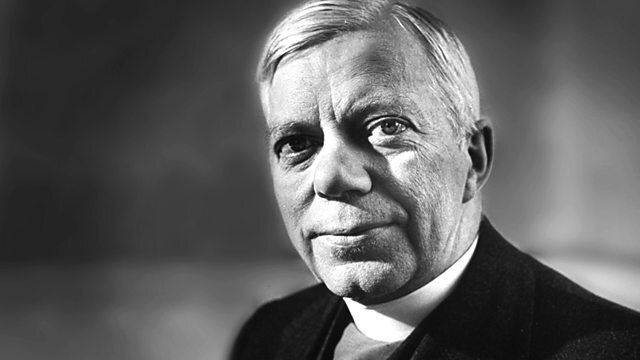
Source: http://www.atomicarchive.com/Docs/Manhatta...

Enjoyed this speech? Speakola is a labour of love and I’d be very grateful if you would share, tweet or like it. Thank you.

Facebook Twitter Facebook
In WAR & CONFLICT Tags J. ROBERT OPPENHEIMER, SCIENTIST, ATOMIC BOMB, NUCLEAR WEAPONS, PHYSICIST, WW2, COLD WAR, MORAL, ETHICS, TRANSCRIPT
Comment
David Harris, in front of the memorial commemorating his grandfather Athol Nagle, the first Australian killed in Malaya.

David Harris, in front of the memorial commemorating his grandfather Athol Nagle, the first Australian killed in Malaya.

David Harris: 'My grandfather was the first soldier in Malaya to fall for Australia', Harvard Business School ANZAC Day Address - 2013

February 11, 2016

25 April 2013, Harvard Business School, Boston, Massachusetts, USA


Anzac Day 2010 was and today, Anzac Day 2013, will be, very important days in my life.  I would like to briefly share with you why.

A few days before Anzac Day 2010 I made a pilgrimage with my mother.  The two of us flew to Singapore, then drove about a third of the way up the Malaysian peninsula, inland from Malacca.

There, just north of the town of Gemas, is a road bridge over the Gemencheh river.  The road and bridge are surrounded on both sides by thick jungle.  As you approach the bridge from the south, to the left is a rubber tree plantation.  And, about 200 metres before the bridge, there is a left hand bend in the road with an embankment that slopes down to meet the road.

It was at that very spot at about 5.00 pm on 14 January 1942 that my grandfather, Sergeant Athol Nagle from the 2nd/30th battalion of the Australian Imperial Force, was killed by japanese troops.

My grandfather was the first soldier in Malaya to fall for Australia.

My mother never knew her father.  She was born a little over three months after his death.

April 2010 was the first time that my mother had visited the site where her father was killed.  We spent several hours walking, under and over the bridge, up and down the road.  We took many photos of the area although we did not need to take any for ourselves –- the site will be forever a very clear picture in the minds of each of us.

Afterwards, we returned to Singapore where we attended the Anzac Day dawn service at the Kranji war cemetery.  I have not yet been to a dawn service at Gallipoli, but to all of the Australians, New Zealanders and British here today, i can tell you that the Kranji dawn service is also an incredibly moving experience that you will never forget.

With the other Australians who were there to honour members of their own families, we laid a wreath on the memorial to soldiers from Australia, New Zealand and Great Britain who died in the service of their country, either on the Malaya peninsula or in Singapore.

Of special note to me was that, as part of the official service that day, a wreath was also laid on the memorial by a senior military officer from Japan.  That was a very poignant moment indeed.

So, Anzac Day 2010 was, obviously and naturally, a very emotional day for my mother and for me.

That brings me to today’s Anzac Day service.

All of us here today are at the Harvard Business School because we are students on the Advanced Management Programme.  All of us, too, are part of a living group team.

In the last four weeks all nine members of my living group team have bonded incredibly well.  I believe it when previous students and our lecturers tell us that we will be friends for life – I can see already that all of us will in the future build on the strong friendship we have already forged.

Today I am honoured, deeply honoured, to have two in particular of my living group attend this dawn service with me – Sirzat Balin from Turkey and Tetsuya Yamamoto from japan.  To me it is both an incredibly important and positive statement and a symbol that I, an Australian, am here on this most sacred of days for my country standing side by side with a true friend from each of Turkey and Japan.

The AMP course is designed to prepare us all to be global leaders.  In my opinion, an important dimension to being a global leader is having an appreciation for, understanding of and respect for cultures other than our own.

Each of us has an unrivaled opportunity while at Harvard Business School to not just learn about financial management, marketing, operations and corporate strategy, but to also learn about and develop a sensitivity to and understanding of the cultures of your fellow students from around the world. 

Befriend one another, and come to respect the culture of one another.

I have absolutely no doubt that all of us gathered here today are united in the hope and desire that in the future we, as global leaders, never have to confront the circumstances and decisions that the leaders of our countries had to face prior to each of the world wars and the other regional wars in which Australian and New Zealand troops have served.

But if we do, it is my hope and my expectation that, equipped with the understanding and respect that we have for one another, each of us will exercise leadership in a way such that none of us or our progeny will suffer the same fate as so many of our country men and women before us.

It is those men and women whom we remember and honour here today.

Normal
0


false
false
false

EN-AU
X-NONE
X-NONE


MicrosoftInternetExplorer4


 <w:LatentStyles DefLockedState="false" DefUnhideWhenUsed="true"
DefSemiHidden="true" DefQFormat="false" DefPriority="…

Gemencheh Bridge connecting Tampin and Gemas, the original of which the Australians blew up as the Japanese were cycling over it.  This was the Australians first encounter with the Japanese.

Athol Nagle, the first Australian killed in Malaya in 1942.

Athol Nagle, the first Australian killed in Malaya in 1942.


Enjoyed this speech? Speakola is a labour of love and I’d be very grateful if you would share, tweet or like it. Thank you.

Facebook Twitter Facebook
In WAR & CONFLICT Tags DAVID HARRIS, GRANDFATHER, ANZAC DAY, MALAYA, CASUALTY, SOLDIER, WW2, RECONCILIATION, HARVARD, AIF
Comment

See my film!

Limited Australian Season

March 2025

Details and ticket bookings at

angeandtheboss.com

Support Speakola

Hi speech lovers,
With costs of hosting website and podcast, this labour of love has become a difficult financial proposition in recent times. If you can afford a donation, it will help Speakola survive and prosper.

Best wishes,
Tony Wilson.

Become a Patron!

Learn more about supporting Speakola.

Featured political

Featured
Jon Stewart: "They responded in five seconds", 9-11 first responders, Address to Congress - 2019
Jacinda Ardern: 'They were New Zealanders. They are us', Address to Parliament following Christchurch massacre - 2019
Dolores Ibárruri: "¡No Pasarán!, They shall not pass!', Defense of 2nd Spanish Republic - 1936
Jimmy Reid: 'A rat race is for rats. We're not rats', Rectorial address, Glasgow University - 1972

Featured eulogies

Featured
For Geoffrey Tozer: 'I have to say we all let him down', by Paul Keating - 2009
for James Baldwin: 'Jimmy. You crowned us', by Toni Morrison - 1988
for Michael Gordon: '13 days ago my Dad’s big, beautiful, generous heart suddenly stopped beating', by Scott and Sarah Gordon - 2018

Featured commencement

Featured
Tara Westover: 'Your avatar isn't real, it isn't terribly far from a lie', The Un-Instagrammable Self, Northeastern University - 2019
Tim Minchin: 'Being an artist requires massive reserves of self-belief', WAAPA - 2019
Atul Gawande: 'Curiosity and What Equality Really Means', UCLA Medical School - 2018
Abby Wambach: 'We are the wolves', Barnard College - 2018
Eric Idle: 'America is 300 million people all walking in the same direction, singing 'I Did It My Way'', Whitman College - 2013
Shirley Chisholm: ;America has gone to sleep', Greenfield High School - 1983

Featured sport

Featured
Joe Marler: 'Get back on the horse', Harlequins v Bath pre game interview - 2019
Ray Lewis : 'The greatest pain of my life is the reason I'm standing here today', 52 Cards -
Mel Jones: 'If she was Bradman on the field, she was definitely Keith Miller off the field', Betty Wilson's induction into Australian Cricket Hall of Fame - 2017
Jeff Thomson: 'It’s all those people that help you as kids', Hall of Fame - 2016

Fresh Tweets


Featured weddings

Featured
Dan Angelucci: 'The Best (Best Man) Speech of all time', for Don and Katherine - 2019
Hallerman Sisters: 'Oh sister now we have to let you gooooo!' for Caitlin &amp; Johnny - 2015
Hallerman Sisters: 'Oh sister now we have to let you gooooo!' for Caitlin & Johnny - 2015
Korey Soderman (via Kyle): 'All our lives I have used my voice to help Korey express his thoughts, so today, like always, I will be my brother’s voice' for Kyle and Jess - 2014

Featured Arts

Featured
Bruce Springsteen: 'They're keepers of some of the most beautiful sonic architecture in rock and roll', Induction U2 into Rock Hall of Fame - 2005
Olivia Colman: 'Done that bit. I think I have done that bit', BAFTA acceptance, Leading Actress - 2019
Axel Scheffler: 'The book wasn't called 'No Room on the Broom!', Illustrator of the Year, British Book Awards - 2018
Tina Fey: 'Only in comedy is an obedient white girl from the suburbs a diversity candidate', Kennedy Center Mark Twain Award -  2010
Tina Fey: 'Only in comedy is an obedient white girl from the suburbs a diversity candidate', Kennedy Center Mark Twain Award - 2010

Featured Debates

Featured
Sacha Baron Cohen: 'Just think what Goebbels might have done with Facebook', Anti Defamation League Leadership Award - 2019
Greta Thunberg: 'How dare you', UN Climate Action Summit - 2019
Charlie Munger: 'The Psychology of Human Misjudgment', Harvard University - 1995
Lawrence O'Donnell: 'The original sin of this country is that we invaders shot and murdered our way across the land killing every Native American that we could', The Last Word, 'Dakota' - 2016