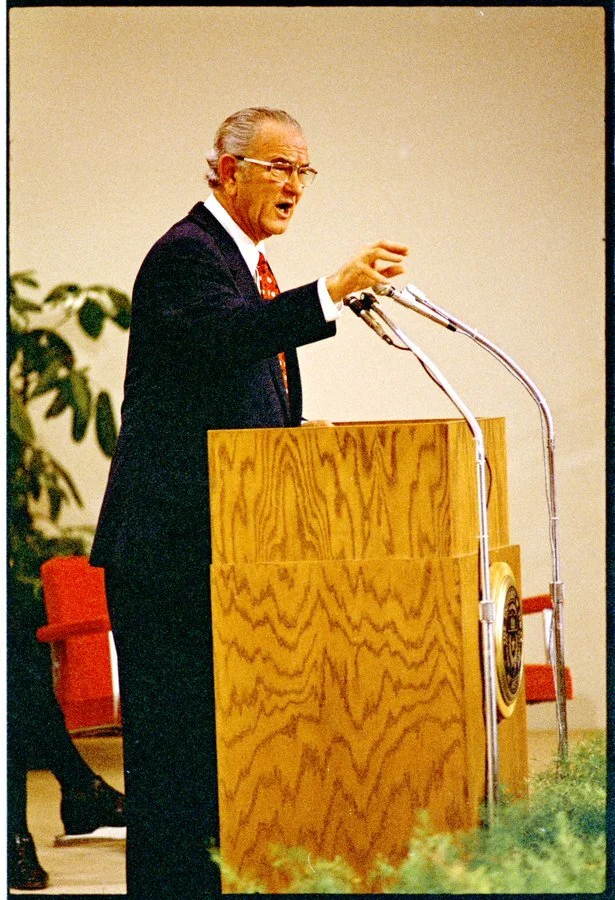
12 December 1972, LBJ Library, Austin Texas, USA
Mr. Middleton, esteemed former Chief Justice, and Miss Warren, and all of you wonderful people who have come here to try to make life better for your fellowmen:
I sat in the adjoining room and watched the panel this morning and got great satisfaction and compensation in my own way in feeling that all is not lost, all has not been in vain. All we have to do is kind of reorganize, reevaluate; and Rome wasn’t built in a day and we can’t overcome all the injustices or make this a perfect world overnight. But we are on our way in. We are going to do just that before it is over.
I don't speak very often or very long. My doctor admonished me not to speak at all this morning, but I’m going to do that because I have some things I want to say to you. I have a touch of sentimentality about me which has cost me a great deal in my 40 years in public life.
I say to all of you women, [uncertain at 2:05], Barbara Jordan, Yvonne Burke, and [uncertain at 2:09] and so many of you that I can’t list them all, that it’s natural for me to get a certain amount of glory by seeing the advances you are making and I guess it’s just human for us to admire and be fond of the other sex, but when I listened in the adjoining room to Burke Marshall and Henry Gonzalez, Clarence Mitchell and Julian Bond whom I don't know so well but admire a great deal, I said to myself that I love these men more than a man ought to love another man, and that's my way of saying to you what great honor you do me by your presence and participation in these proceedings.
Of all the records that are housed in this library, 31 million papers over a 40-year period of public life, it is the record of this work that we have been discussing the last two days which had brought us here, that holds the most of myself within it and hold for me the most intimate meanings. In our system of government, honorable men honestly differ in their perceptions of government and what it’s really all about, and today, I can speak only of my own perception, and I’m so proud I live in a government where I can do that.
I believe that the essence of government lies with unceasing concern for the welfare and dignity and decency and innate integrity of life for every individual. I don't like to say this and I wish I didn't have to add these words to make it clear, but I will: Regardless of color, creed, ancestry, sex, or age.
Before I go any further, I want to interject, I’m so happy Miss Whitney Young is here. Her husband gave me great inspiration and leadership, and along with some of his colleagues, advanced these nation centuries in a decade. He is somewhere doing his good work today and it’s in behalf of this fellow man, wherever he is.
I do not want to say that I’ve always seen this matter in terms of the special plight of the Black man as clearly as I came to see it in the course of my life and experience and responsibility. Now, let me make it plain that when I say black, as I do a good many times in this little statement, I also mean brown and yellow and red, and all other people who suffer discrimination because of their color or their heritage. Every group meets its own special problems, of course, but in a very broad sense, the problem of equal justice applies to us all.
Up on the second floor of this library in a special exhibit designed especially for this occasion, you will see the original Emancipation Proclamation by which our great President Abraham Lincoln ordered that the slaves should be freed of their bondage. A decade ago, in year 1963, we observed the 100th anniversary of that proclamation signing. On Memorial Day of that fateful year, I was called upon as the last President to speak at Gettysburg Cemetery where a century before, words had been spoken which all of us have long remembered, and on that occasion, I said this, until justice is blind to color, until education is unaware of race, until opportunity is unconcerned with the color of men's skin, emancipation will be a proclamation but not a fact. To the extent that the proclamation of emancipation is not fulfilled in fact, to that extent, we have fallen short of assuring freedom to the freed.
When I spoke those words as Vice President, I could not know that the future would present me shortly with the opportunity and the responsibility to contribute more toward fulfilling the fact of emancipation. Even if I could have known what lay ahead, I’m not sure now that I could have believed at that time that the progress, which has been won in these past 10 years, is a fact.
Black Americans are voting now, where they were not voting at all 10 years ago, but let me say quickly that not enough are voting. Little more than half of all eligible Americans voted in the last national election. I don't know how many of those that didn't vote were Black, but I do know this, we have to come up with some kind of plan or incentive to perfect our democracy by seeing that more of our people do vote and I certainly mean to include more of our Black people.
Now, I don't know how to do it. I don't want to get into it from the hip, with compulsory voting, but we ask our young men, we require them by law to all go and register for the draft. We require all of our children to go to school. We require our people, under the great laws of privilege, to have a Social Security Number. I have no doubt but what this would be a better country and a purer democracy if 95% of our people voted and the 5% that didn't had an exemption because of illness or whatever it might be, but when the hand of government reached out to them, if they had to reach in their purse or pocket book and show a stamp that they had voted, for the party of their choice and the individual of their choice, this would be a better land.
Black Americans are working now where they were not working 10 years ago. Black Americans, Brown Americans, Americans of every color and every condition are eating now and shopping now, going to the bathroom now and riding now, and spending nights now and obtaining credit now, and giving now, and attending classes now, going and coming in dignity were and as they were never able to do in years before.
I walked out of this room yesterday and looked at the sea of faces and I thought how proud Thurgood Marshall must be. I first met him when he came here on behalf of Herman Sweatt so a Black boy could come to the University of Texas and to look at this audience in this beautiful university auditorium, and see the groups that are participating today must make him feel and must make the groups that supported him feel that all has not been in vain.
But now that I’ve said that, I want to say this, I don't want this symposium to come here and spend two days talking about what we have done, the progress had been much too small. We haven't done nearly enough. I'm kind of ashamed of myself that I had six years and couldn't do more than I did. I'm sure all of you feel the same way about it.
I often tell the story about, that was reported and a fact about Churchill and the women's lib movement, maybe prohibition movement, a little ahead of our women over here, went into him after the war and said they were shocked to hear that if all the alcohol he consumed during the war, the brandy that he had drunk were emptied in the room, it would come up to about here. And Churchill looked on with a certain amount of satisfaction and amusement, instead of letting his feathers ride up. And he purported to have replied, "My dear little ladies, so little have I done, so much yet I have to do."
So, let no one delude themselves that our work is done. By unconcern, by neglect, by complacent beliefs that our labors in the field of human rights are completed, we of today can seed our future with storms that would rage over the lives of our children and our children's children. Yesterday, it was commonly said the Black problem was a southern problem. Today, it is commonly said that the Black problem is an urban problem – a problem of the inner city. But as I see it, the truth is that the Black problem today, as it was yesterday and yesteryear, is not a problem of regions or states or cities or neighborhoods. It is a problem, a concern, and responsibility of this whole nation.
Moreover, and we cannot obscure this one fact, the black problem remains what it has always been: the simple problem of being Black in a White society. And that is a problem, which our efforts have not yet been addressed. To be Black, I believe to one who is Black or Brown or what not is to be proud, is to be worthy, is to be honorable. But to be Black in a White society is not to stand on level and equal ground. While the races may stand side-by-side, Whites stand on history's mountain and Blacks stand in history's hollow. And until we overcome unequal history, we cannot overcome unequal opportunity.
That is not, nor will it ever be, a very easy goal for us to achieve. Individuals and groups who have struggled along to gain advantages for themselves do not readily yield the gains of their struggles or their achievements so that others may have advantages or opportunities, but that is just the point now and always. There is no surrender, there is no loss involved, no advantage is safe, and no gain is secure in this society unless those advantages and those gains are opened up to all alike.
Where we have been concerned in the past for groups as groups, now we must become more concerned with individuals as individuals. As we have lifted the groups, the burdens of unequal law and custom, the next thrust of our effort must be to lift from individuals those burdens of unequal history. Not a White American in all this land would fail to be outraged if an opposing team tried to insert a 12th man in their football lineup to stop a Black fullback on the football field. Yet off the field, away from the stadium, outside of the reach of the television cameras, and the watching eyes of millions of their fellow men, every Black American in this land, man or woman, plays out life running against the 12th man of a history, that they did not make and a fate they did not choose.
In this challenge, our churches, our schools, our unions, our professions, our trades, our military, our private employers, and our government have a great duty from which they cannot turn. It is the duty of sustaining the momentum of this society's effort to equalize the history of some of our people so that we may open opportunity equally for all of our people.
Some may respond to these suggestions with exclamations of shock and dismay. Such proposals, they will say ask that special consideration be given to Black Americans rather than giving equal consideration to all Americans. I can only hear such protest through ears that are tuned by a lifetime to listening to the language of evasion. All that I hear now, I have heard before for 40 long years, in many forms and many forums. Give them the vote!
I saw a murder almost committed because I said that in 1937. Most people said, "unthinkable." Give them the right to sit wherever they wish on the bus. Impossible. Give them privilege of sitting at the same hotel, using the same restaurant, eating in the same counter, joining the same club, attending the same classroom. Never, never. Well, this crowd never I’ve heard since I was a little boy all my life. And what we commemorate on this great day is some of the work which has helped in some of the areas to make never now.
And I do not speak fulsomely. Most of that never would have been done without Burke Marshall, Roy Wilkins, Whitney Young, Chief Justice Warren, Julian Bond, all of those that are here today, Vernon Jordan. This never would have been done.
Now, here is what I want to say, what I have said is precisely the work which we must continue and this is a whole important part of this meeting – not all we have done, what we can do. So much, so little have we done. It oughtn't to take much place what we must do. So I think it’s time to leave aside the legalisms and euphemisms and eloquent evasions. It’s time we get down to business of trying to stand black and white on level ground.
For myself, I believe it’s time for all of us in government and out to face up to the challenge. We must review and reevaluate what we have done and what we are doing. In specific areas, we must set new goals, new objectives, and new standards; not merely what we can do to try to keep things quiet, but what we must do to make things better. How much time will be given to that in this meeting? How much time we are going to give in the days ahead? How are we going to employ that? Who is going to bring our groups together? Who is going to select that leadership? What type of leadership are you going to do?
Specifically, I believe that we must direct our thought and efforts to many, many fields; and I don't have a great staff and little I can contribute in the way of leadership, but if I can leave the thought with those of you who do make up a great staff and who serve as my staff, I want to suggest a few little relatively unimportant thoughts as just some of the things to be put on your agenda. Are the federal government, the state government, the foundation and the churches, the university is doing what they can and all that they should to assure enough Black scholarships for young Blacks in every field? The answer is no. Very little.
It gets back to the same thing. Herman Sweatt can come to this university now, but as someone said on the panel this morning, Henry Gonzalez, I think, "What good is he doing sitting at the counter to get a cup of coffee if he doesn't have 50 cents to get it?" And most of them just don't have it. That’s why they are not here. It's not their mother or their father who didn’t want them here. It's not that they don't have an ambition to be here. They just can’t do it and we’ve got to level out that ground son.
Or are professions such as law and medicine, accounting and engineering, and dentistry and architecture taking the initiative? Sounding the call to make certain that their educational programs are so planned and so conducted that Blacks are being prepared for the leadership courses and are being given the support that they must have if they are to complete the courses and to have genuine opportunities to establish themselves in positions of leadership, professional careers, and things of that matter after their college days.
Or are trade unions and all those concerned with vocational occupation doing the same to open up apprenticeships and training programs so that the Blacks, the group I spoke of, have a fair chance of entering and a fair chance of succeeding in these fields that are so vital to the future of our nation and to our country at this very moment?
Are our employers who have already made a start toward opening jobs to the Blacks doing what they can and should in order to make certain that Blacks qualify for advancement on the promotion ladder, and that the promotion ladder itself reaches out for the Blacks as it does for the others in our society?
What I’m saying is that we cannot take care of the goals to which we have committed ourselves simply by adopting a Black "star system." It is good and it is heartening and it is satisfying to see individual Blacks succeeding as stars in the field of politics, athletics, entertainment, and other activities where they have high visibility such as Clarence Mitchell referred to in his family. I felt almost as good in my own election -- not quite as good -- when Barbara and Yvonne were elected this year because I thought that we were moving forward and I enjoyed knowing of those elections about as much as I did in my own.
But we must not allow the visibility of a few to diminish the efforts to satisfy what is our real responsibility to the still unseen millions who are faced with that basic problem of being Black in a White society. So our objective must be to assure that all Americans play by the same rules and all Americans play against the same odds. Who among us would claim that that is true today? I feel this is the first work of any society which aspires to greatness, so let's be on with it. We know there is injustice. We know there is intolerance. We know there is discrimination and hate and suspicion, and we know there is division among us. But there is a larger truth. We have proved that great progress is possible. We know how much still remains to be done.
And if our efforts continue, and if our will is strong, and if our hearts are right, and if courage remains our constant companion, then, my fellow Americans, I am confident we shall overcome.
After his speech, LBJ returned to the podium to offer advice to the leaders and activists in the room.
"Until every boy and girl born into this land, whatever state, whatever color, can stand on the same level ground, our job will not be done!"