
• Genre
  • About
  • Submissions
  • Donate
  • Search
Menu

Speakola

All Speeches Great and Small
  • Genre
  • About
  • Submissions
  • Donate
  • Search
Share a political speech
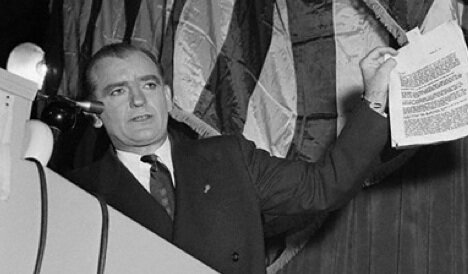
Joe McCarthy.jpg

Joseph McCarthy: 'I have in my hand fifty seven cases ... ' Enemies from Within speech - 1950

October 14, 2019

20 February 1950, McClare Hotel, Wheeling, West Virginia, USA

Tonight as we celebrate the 141st birthday of one of the great men in American history, I would like to be able to talk about what a glorious day today is in the history of the world. As we celebrate the birth of this man, who with his whole heart and soul hated war, I would like to be able to speak of peace in our time, of war being outlawed, and of worldwide disarmament. These would be truly appropriate things to be able to mention as we celebrate the birthday of Abraham Lincoln

.Five years after a world war has been won, men's hearts should anticipate a long peace, and men's minds should be free from the heavy weight that comes with war. But this is not such a period --for this is not a period of peace. This is a time of the Cold War. This is a time when all the world is split into two vast, increasingly hostile armed camps --a time of a great armaments race. Today we can almost physically hear the mutterings and rumblings of an invigorated god of war. You can see it, feel it, and hear it all the way from the hills of Indochina, from the shores of Formosa right over into the very heart of Europe itself.

...Today we are engaged in a final, all-out battle between communistic atheism and Christianity. The modern champions of communism have selected this as the time. And, ladies and gentlemen, the chips are down --they are truly down.Lest there be any doubt that the time has been chosen, let us go directly to the leader of communism today --Joseph Stalin. Here is what he said --not back in 1928, not before the war, not during the war --but two years after the last war was ended: "To think that the communist revolution can be carried out peacefully, within the framework of a Christian democracy, means one has either gone out of one's mind and lost all normal understanding, or has grossly and openly repudiated the communist revolution."

And this is what was said by Lenin in 1919, which was also quoted with approval by Stalin in 1947: "We are living," said Lenin, "not merely in a state but in a system of states, and the existence of the Soviet Republic side by side with Christian states for a long time is unthinkable. One or the other must triumph in the end. And before that end supervenes, a series of frightful collisions between the Soviet Republic and the bourgeois states will be inevitable."Ladies and gentlemen, can there be anyone here tonight who is so blind as to say that the war is not on? Can there be anyone who fails to realize that the communist world has said, "The time is now" --that this is the time for the showdown between the democratic Christian world and the communist atheistic world?

Unless we face this fact, we shall pay the price that must be paid by those who wait too long.

Six years ago, at the time of the first conference to map outpeace --Dumbarton Oaks --there was within the Soviet orbit 180 million people. Lined up on the anti-totalitarian side there were in the world at that time roughly 1.625 billion people. Today, only six years later, there are 800 million people under the absolute domination of Soviet Russia --an increase of over 400 percent. On our side, the figure has shrunk to around 500 million. In other words, in less than six years the odds have changed from 9 to 1 in our favor to 8 to 5 against us. This indicates the swiftness of the tempo of communist victories and American defeats in the Cold War. As one of our outstanding historical figures once said, "When a great democracy is destroyed, it will not be because of enemies from without but rather because of enemies from within."

The truth of this statement is becoming terrifyingly clear as we see this country each day losing on every front.

At war's end we were physically the strongest nation on Earth and, at least potentially, the most powerful intellectually and morally. Ours could have been the honor of being a beacon in the desert of destruction, a shining, living proof that civilization was not yet ready to destroy itself. Unfortunately, we have failed miserably and tragically to arise to the opportunity.

The reason why we find ourselves in a position of impotency is not because our only powerful, potential enemy has sent men to invade our shores, but rather because of the traitorous actions of those who have been treated so well by this nation. It has not been the less fortunate or members of minority groups who have been selling this nation out, but rather those who have had all the benefits that the wealthiest nation on earth has had to offer --the finest homes, the finest college education, and the finest jobs in government we can give.

This is glaringly true in the State Department. There the bright young men who are born with silver spoons in their mouths are the ones who have been worst.

Now I know it is very easy for anyone to condemn a particular bureau or department in general terms. Therefore, I would like to cite one rather unusual case --the case of a man who has done much to shape our foreign policy.When Chiang Kai-shek was fighting our war, the State Department had in China a young man named John S. Service. His task, obviously, was not to work for the communization of China.
Strangely, however, he sent official reports back to the State Department urging that we torpedo our ally Chiang Kai-shek and stating, in effect, that communism was the best hope of China.Later, this man --John Service --was picked up by the Federal Bureau of Investigation for turning over to the communists secret State Department information. Strangely, however, he was never prosecuted. However, Joseph Grew, the undersecretary of state, who insisted on his prosecution, was forced to resign. Two days after, Grew's successor, Dean Acheson, took over as undersecretary of state, this man --John Service --who had been picked up by the FBI and who had previously urged that communism was the best hope of China, was not only reinstated in the State Department but promoted; and finally, under Acheson, placed in charge of all placements and promotions. Today, ladies and gentlemen, this man Service is on his way to represent the State Department and Acheson in Calcutta --by far and away the most important listening post in the Far East.Now, let's see what happens when individuals with communist connections are forced out of the State Department.

Gustave Duran, who was labeled as, I quote, "a notorious international communist," was made assistant secretary of state in charge of Latin American affairs. He was taken into the State Department from his job as a lieutenant colonel in the Communist International Brigade. Finally, after intense congressional pressure and criticism, he resigned in 1946 from the State Department --and, ladies and gentlemen, where do you think he is now? He took over a high-salaried job as chief of Cultural Activities Section in the office of the assistant secretary-general of the United Nations. ...

This, ladies and gentlemen, gives you somewhat of a picture of the type of individuals who have been helping to shape our foreign policy. In my opinion the State Department, which is one of the most important government departments, is thoroughly infested with communists.

I have in my hand 57 cases of individuals who would appear to be either card-carrying members or certainly loyal to the Communist Party, but who nevertheless are still helping to shape our foreign policy.
One thing to remember in discussing the communists in our government is that we are not dealing with spies who get 30 pieces of silver to steal the blueprints of new weapons. We are dealing with a far more sinister type of activity because it permits the enemy to guide and shape our policy.This brings us down to the case of one Alger Hiss, who is important not as an individual anymore but rather because he is so representative of a group in the State Department. It is unnecessary to go over the sordid events showing how he sold out the nation which had given him so much. Those are rather fresh in all of our minds. However, it should be remembered that the facts in regard to his connection with this international communist spy ring were made known to the then-Undersecretary of State Berle three days after Hitler and Stalin signed the Russo-German Alliance Pact. At that time one Whittaker Chambers --who was also part of the spy ring --apparently decided that with Russia on Hitler's side, he could no longer betray our nation to Russia. He gave Undersecretary of State Berle --and this is all a matter of record --practically all, if not more, of the facts upon which Hiss' conviction was based.Undersecretary Berle promptly contacted Dean Acheson and received word in return that Acheson, and I quote, "could vouch for Hiss absolutely" --at which time the matter was dropped. And this, you understand, was at a time when Russia was an ally of Germany. This condition existed while Russia and Germany were invading and dismembering Poland, and while the communist groups here were screaming "warmonger" at the United States for their support of the Allied nations.Again in 1943, the FBI had occasion to investigate the facts surrounding Hiss' contacts with the Russian spy ring. But even after that FBI report was submitted, nothing was done.

Then, late in 1948 --on August 5 --when the Un-American Activities Committee called Alger Hiss to give an accounting, President Truman at once issued a presidential directive ordering all government agencies to refuse to turn over any information whatsoever in regard to the communist activities of any government employee to a congressional committee.Incidentally, even after Hiss was convicted, it is interesting to note that the president still labeled the expose of Hiss as a "red herring."If time permitted, it might be well to go into detail about the fact that Hiss was Roosevelt's chief adviser at Yalta when Roosevelt was admittedly in ill health and tired physically and mentally ... and when, according to the secretary of state, Hiss and Gromyko drafted the report on the conference.

According to the then-Secretary of State Stettinius, here are some of the things that Hiss helped to decide at Yalta: (1) the establishment of a European High Commission; (2) the treatment of Germany --this you will recall was the conference at which it was decided that we would occupy Berlin with Russia occupying an area completely encircling the city, which as you know, resulted in the Berlin airlift which cost 31 American lives; (3) the Polish question; (4) the relationship between UNRRA and the Soviet; (5) the rights of Americans on control commissions of Rumania, Bulgaria and Hungary; (6) Iran; (7) China --here's where we gave away Manchuria; (8) Turkish Straits question; (9) international trusteeships; (10) Korea.Of the results of this conference, Arthur Bliss Lane of the State Department had this to say: "As I glanced over the document, I could not believe my eyes. To me, almost every line spoke of a surrender to Stalin.

"As you hear this story of high treason, I know that you are saying to yourself, "Well, why doesn't the Congress do something about it?" Actually, ladies and gentlemen, one of the important reasons for the graft, the corruption, the dishonesty, the disloyalty, the treason in high government positions --one of the most important reasons why this continues --is a lack of moral uprising on the part of the 140 million American people. In the light of history, however, this is not hard to explain.

It is the result of an emotional hangover and a temporary moral lapse which follows every war. It is the apathy to evil which people who have been subjected to the tremendous evils of war feel. As the people of the world see mass murder, the destruction of defenseless and innocent people, and all of the crime and lack of morals which go with war, they become numb and apathetic. It has always been thus after war.

However, the morals of our people have not been destroyed. They still exist. This cloak of numbness and apathy has only needed a spark to rekindle them. Happily, this spark has finally been supplied.
As you know, very recently the secretary of state proclaimed his loyalty to a man guilty of what has always been considered as the most abominable of all crimes --of being a traitor to the people who gave him a position of great trust. The secretary of state, in attempting to justify his continued devotion to the man who sold out the Christian world to the atheistic world, referred to Christ's Sermon on the Mount as a justification and reason therefore, and the reaction of the American people to this would have made the heart of Abraham Lincoln happy.

When this pompous diplomat in striped pants, with a phony British accent, proclaimed to the American people that Christ on the Mount endorsed communism, high treason, and betrayal of a sacred trust, the blasphemy was so great that it awakened the dormant indignation of the American people.

He has lighted the spark which is resulting in a moral uprising and will end only when the whole sorry mess of twisted warped thinkers are swept from the national scene so that we may have a new birth of national honesty and decency in government.

Source: https://liberalarts.utexas.edu/coretexts/_...

Enjoyed this speech? Speakola is a labour of love and I’d be very grateful if you would share, tweet or like it. Thank you.

Facebook Twitter Facebook
In 1940-59 B Tags JOSEPH MCCARTHY, I HAVE IN MY HAND, STATE DEPARTMENT, TRANSCRIPT, ENEMIES FROM WITHIN SPEECH, UNAMERICAN ACTIVITES, COLD WAR, BLACKLIST, COMMUNISM, COMMUNIST PARTY, STALIN, LENIN
Comment

Jimmy Reid: 'A rat race is for rats. We're not rats', Rectorial address, Glasgow University - 1972

January 2, 2016

short excerpt of speech at 4.27, a longer excerpt is on Education Scotland website

When this speech was reprinted in the New York Times, it was described as 'the greatest speech since President Lincoln's Gettysburg Address'. It was delivered upon his election as Rector of Glasgow University.

28 April 1972, Glasgow University, Scotland

Alienation is the precise and correctly applied word for describing the major social problem in Britain today. People feel alienated by society. In some intellectual circles it is treated almost as a new phenomenon. It has, however, been with us for years. What I believe is true is that today it is more widespread, more pervasive than ever before. Let me right at the outset define what I mean by alienation. It is the cry of men who feel themselves the victims of blind economic forces beyond their control. It's the frustration of ordinary people excluded from the processes of decision-making. The feeling of despair and hopelessness that pervades people who feel with justification that they have no real say in shaping or determining their own destinies.

Many may not have rationalised it. May not even understand, may not be able to articulate it. But they feel it. It therefore conditions and colours their social attitudes. Alienation expresses itself in different ways in different people. It is to be found in what our courts often describe as the criminal antisocial behaviour of a section of the community. It is expressed by those young people who want to opt out of society, by drop-outs, the so-called maladjusted, those who seek to escape permanently from the reality of society through intoxicants and narcotics. Of course, it would be wrong to say it was the sole reason for these things. But it is a much greater factor in all of them than is generally recognised.

Society and its prevailing sense of values leads to another form of alienation. It alienates some from humanity. It partially de-humanises some people, makes them insensitive, ruthless in their handling of fellow human beings, self-centred and grasping. The irony is, they are often considered normal and well-adjusted. It is my sincere contention that anyone who can be totally adjusted to our society is in greater need of psychiatric analysis and treatment than anyone else. They remind me of the character in the novel, Catch 22, the father of Major Major. He was a farmer in the American Mid-West. He hated suggestions for things like medi-care, social services, unemployment benefits or civil rights. He was, however, an enthusiast for the agricultural policies that paid farmers for not bringing their fields under cultivation. From the money he got for not growing alfalfa he bought more land in order not to grow alfalfa. He became rich. Pilgrims came from all over the state to sit at his feet and learn how to be a successful non-grower of alfalfa. His philosophy was simple. The poor didn't work hard enough and so they were poor. He believed that the good Lord gave him two strong hands to grab as much as he could for himself. He is a comic figure. But think – have you not met his like here in Britain? Here in Scotland? I have.

It is easy and tempting to hate such people. However, it is wrong. They are as much products of society, and of a consequence of that society, human alienation, as the poor drop-out. They are losers. They have lost the essential elements of our common humanity. Man is a social being. Real fulfilment for any person lies in service to his fellow men and women. The big challenge to our civilisation is not Oz, a magazine I haven't seen, let alone read. Nor is it permissiveness, although I agree our society is too permissive. Any society which, for example, permits over one million people to be unemployed is far too permissive for my liking. Nor is it moral laxity in the narrow sense that this word is generally employed – although in a sense here we come nearer to the problem. It does involve morality, ethics, and our concept of human values. The challenge we face is that of rooting out anything and everything that distorts and devalues human relations.

Let me give two examples from contemporary experience to illustrate the point.

Recently on television I saw an advert. The scene is a banquet. A gentleman is on his feet proposing a toast. His speech is full of phrases like "this full-bodied specimen". Sitting beside him is a young, buxom woman. The image she projects is not pompous but foolish. She is visibly preening herself, believing that she is the object of the bloke's eulogy. Then he concludes – "and now I give...", then a brand name of what used to be described as Empire sherry. Then the laughter. Derisive and cruel laughter. The real point, of course, is this. In this charade, the viewers were obviously expected to identify not with the victim but with her tormentors.

The other illustration is the widespread, implicit acceptance of the concept and term "the rat race". The picture it conjures up is one where we are scurrying around scrambling for position, trampling on others, back-stabbing, all in pursuit of personal success. Even genuinely intended, friendly advice can sometimes take the form of someone saying to you, "Listen, you look after number one." Or as they say in London, "Bang the bell, Jack, I'm on the bus."

To the students [of Glasgow University] I address this appeal. Reject these attitudes. Reject the values and false morality that underlie these attitudes. A rat race is for rats. We're not rats. We're human beings. Reject the insidious pressures in society that would blunt your critical faculties to all that is happening around you, that would caution silence in the face of injustice lest you jeopardise your chances of promotion and self-advancement. This is how it starts, and before you know where you are, you're a fully paid-up member of the rat-pack. The price is too high. It entails the loss of your dignity and human spirit. Or as Christ put it, "What doth it profit a man if he gain the whole world and suffer the loss of his soul?"

Profit is the sole criterion used by the establishment to evaluate economic activity. From the rat race to lame ducks. The vocabulary in vogue is a give-away. It's more reminiscent of a human menagerie than human society. The power structures that have inevitably emerged from this approach threaten and undermine our hard-won democratic rights. The whole process is towards the centralisation and concentration of power in fewer and fewer hands. The facts are there for all who want to see. Giant monopoly companies and consortia dominate almost every branch of our economy. The men who wield effective control within these giants exercise a power over their fellow men which is frightening and is a negation of democracy.

Government by the people for the people becomes meaningless unless it includes major economic decision-making by the people for the people. This is not simply an economic matter. In essence it is an ethical and moral question, for whoever takes the important economic decisions in society ipso facto determines the social priorities of that society.

From the Olympian heights of an executive suite, in an atmosphere where your success is judged by the extent to which you can maximise profits, the overwhelming tendency must be to see people as units of production, as indices in your accountants' books. To appreciate fully the inhumanity of this situation, you have to see the hurt and despair in the eyes of a man suddenly told he is redundant, without provision made for suitable alternative employment, with the prospect in the West of Scotland, if he is in his late forties or fifties, of spending the rest of his life in the Labour Exchange. Someone, somewhere has decided he is unwanted, unneeded, and is to be thrown on the industrial scrap heap. From the very depth of my being, I challenge the right of any man or any group of men, in business or in government, to tell a fellow human being that he or she is expendable.

The concentration of power in the economic field is matched by the centralisation of decision-making in the political institutions of society. The power of Parliament has undoubtedly been eroded over past decades, with more and more authority being invested in the Executive. The power of local authorities has been and is being systematically undermined. The only justification I can see for local government is as a counter- balance to the centralised character of national government.

Local government is to be restructured. What an opportunity, one would think, for de-centralising as much power as possible back to the local communities. Instead, the proposals are for centralising local government. It's once again a blue-print for bureaucracy, not democracy. If these proposals are implemented, in a few years when asked "Where do you come from?" I can reply: "The Western Region." It even sounds like a hospital board.

It stretches from Oban to Girvan and eastwards to include most of the Glasgow conurbation. As in other matters, I must ask the politicians who favour these proposals – where and how in your calculations did you quantify the value of a community? Of community life? Of a sense of belonging? Of the feeling of identification? These are rhetorical questions. I know the answer. Such human considerations do not feature in their thought processes.

Everything that is proposed from the establishment seems almost calculated to minimise the role of the people, to miniaturise man. I can understand how attractive this prospect must be to those at the top. Those of us who refuse to be pawns in their power game can be picked up by their bureaucratic tweezers and dropped in a filing cabinet under "M" for malcontent or maladjusted. When you think of some of the high flats around us, it can hardly be an accident that they are as near as one could get to an architectural representation of a filing cabinet.

If modern technology requires greater and larger productive units, let's make our wealth-producing resources and potential subject to public control and to social accountability. Let's gear our society to social need, not personal greed. Given such creative re-orientation of society, there is no doubt in my mind that in a few years we could eradicate in our country the scourge of poverty, the underprivileged, slums, and insecurity.

Even this is not enough. To measure social progress purely by material advance is not enough. Our aim must be the enrichment of the whole quality of life. It requires a social and cultural, or if you wish, a spiritual transformation of our country. A necessary part of this must be the restructuring of the institutions of government and, where necessary, the evolution of additional structures so as to involve the people in the decision-making processes of our society. The so-called experts will tell you that this would be cumbersome or marginally inefficient. I am prepared to sacrifice a margin of efficiency for the value of the people's participation. Anyway, in the longer term, I reject this argument.

To unleash the latent potential of our people requires that we give them responsibility. The untapped resources of the North Sea are as nothing compared to the untapped resources of our people. I am convinced that the great mass of our people go through life without even a glimmer of what they could have contributed to their fellow human beings. This is a personal tragedy. It's a social crime. The flowering of each individual's personality and talents is the pre-condition for everyone's development.

In this context education has a vital role to play. If automation and technology is accompanied as it must be with a full employment, then the leisure time available to man will be enormously increased. If that is so, then our whole concept of education must change. The whole object must be to equip and educate people for life, not solely for work or a profession. The creative use of leisure, in communion with and in service to our fellow human beings, can and must become an important element in self-fulfilment.

Universities must be in the forefront of development, must meet social needs and not lag behind them. It is my earnest desire that this great University of Glasgow should be in the vanguard, initiating changes and setting the example for others to follow. Part of our educational process must be the involvement of all sections of the university on the governing bodies. The case for student representation is unanswerable. It is inevitable.

My conclusion is to re-affirm what I hope and certainly intend to be the spirit permeating this address. It's an affirmation of faith in humanity. All that is good in man's heritage involves recognition of our common humanity, an unashamed acknowledgement that man is good by nature. Burns expressed it in a poem that technically was not his best, yet captured the spirit. In "Why should we idly waste our prime...":

"The golden age, we'll then revive, each man shall be a brother,

In harmony we all shall live and till the earth together,

In virtue trained, enlightened youth shall move each fellow creature,

And time shall surely prove the truth that man is good by nature."

It's my belief that all the factors to make a practical reality of such a world are maturing now. I would like to think that our generation took mankind some way along the road towards this goal. It's a goal worth fighting for.


This is a documentary on the life of Jimmy Reid

MP Kenny MacAskill was the guest on the 35th episode of the podcast, discussing this speech.


Source: http://www.independent.co.uk/news/uk/polit...

Enjoyed this speech? Speakola is a labour of love and I’d be very grateful if you would share, tweet or like it. Thank you.

Facebook Twitter Facebook
In 1960-79 Tags JIMMY REID, SCOTLAND, ROBBIE BURNS, GLASGOW UNIVERSITY, TRADE UNIONIST, COMMUNIST PARTY, TRANSCRIPT
3 Comments

See my film!

Limited Australian Season

March 2025

Details and ticket bookings at

angeandtheboss.com

Support Speakola

Hi speech lovers,
With costs of hosting website and podcast, this labour of love has become a difficult financial proposition in recent times. If you can afford a donation, it will help Speakola survive and prosper.

Best wishes,
Tony Wilson.

Become a Patron!

Learn more about supporting Speakola.

Featured political

Featured
Jon Stewart: "They responded in five seconds", 9-11 first responders, Address to Congress - 2019
Jacinda Ardern: 'They were New Zealanders. They are us', Address to Parliament following Christchurch massacre - 2019
Dolores Ibárruri: "¡No Pasarán!, They shall not pass!', Defense of 2nd Spanish Republic - 1936
Jimmy Reid: 'A rat race is for rats. We're not rats', Rectorial address, Glasgow University - 1972

Featured eulogies

Featured
For Geoffrey Tozer: 'I have to say we all let him down', by Paul Keating - 2009
for James Baldwin: 'Jimmy. You crowned us', by Toni Morrison - 1988
for Michael Gordon: '13 days ago my Dad’s big, beautiful, generous heart suddenly stopped beating', by Scott and Sarah Gordon - 2018

Featured commencement

Featured
Tara Westover: 'Your avatar isn't real, it isn't terribly far from a lie', The Un-Instagrammable Self, Northeastern University - 2019
Tim Minchin: 'Being an artist requires massive reserves of self-belief', WAAPA - 2019
Atul Gawande: 'Curiosity and What Equality Really Means', UCLA Medical School - 2018
Abby Wambach: 'We are the wolves', Barnard College - 2018
Eric Idle: 'America is 300 million people all walking in the same direction, singing 'I Did It My Way'', Whitman College - 2013
Shirley Chisholm: ;America has gone to sleep', Greenfield High School - 1983

Featured sport

Featured
Joe Marler: 'Get back on the horse', Harlequins v Bath pre game interview - 2019
Ray Lewis : 'The greatest pain of my life is the reason I'm standing here today', 52 Cards -
Mel Jones: 'If she was Bradman on the field, she was definitely Keith Miller off the field', Betty Wilson's induction into Australian Cricket Hall of Fame - 2017
Jeff Thomson: 'It’s all those people that help you as kids', Hall of Fame - 2016

Fresh Tweets


Featured weddings

Featured
Dan Angelucci: 'The Best (Best Man) Speech of all time', for Don and Katherine - 2019
Hallerman Sisters: 'Oh sister now we have to let you gooooo!' for Caitlin & Johnny - 2015
Korey Soderman (via Kyle): 'All our lives I have used my voice to help Korey express his thoughts, so today, like always, I will be my brother’s voice' for Kyle and Jess - 2014

Featured Arts

Featured
Bruce Springsteen: 'They're keepers of some of the most beautiful sonic architecture in rock and roll', Induction U2 into Rock Hall of Fame - 2005
Olivia Colman: 'Done that bit. I think I have done that bit', BAFTA acceptance, Leading Actress - 2019
Axel Scheffler: 'The book wasn't called 'No Room on the Broom!', Illustrator of the Year, British Book Awards - 2018
Tina Fey: 'Only in comedy is an obedient white girl from the suburbs a diversity candidate', Kennedy Center Mark Twain Award -  2010
Tina Fey: 'Only in comedy is an obedient white girl from the suburbs a diversity candidate', Kennedy Center Mark Twain Award - 2010

Featured Debates

Featured
Sacha Baron Cohen: 'Just think what Goebbels might have done with Facebook', Anti Defamation League Leadership Award - 2019
Greta Thunberg: 'How dare you', UN Climate Action Summit - 2019
Charlie Munger: 'The Psychology of Human Misjudgment', Harvard University - 1995
Lawrence O'Donnell: 'The original sin of this country is that we invaders shot and murdered our way across the land killing every Native American that we could', The Last Word, 'Dakota' - 2016