
• Genre
  • About
  • Submissions
  • Donate
  • Search
Menu

Speakola

All Speeches Great and Small
  • Genre
  • About
  • Submissions
  • Donate
  • Search
Share a political speech

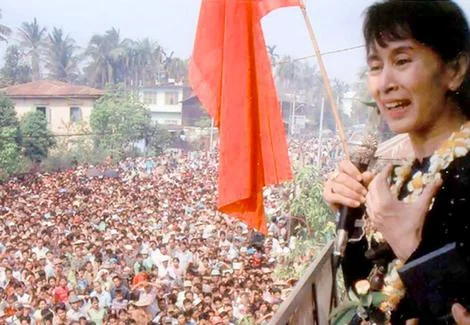
Aung San Suu Kyi: 'It is not power that corrupts but fear', Freedom from Fear -1990

January 20, 2016

October 1990, European Parliament, Strasbourg, Germany

This speech was written on the occasion of Aung San Suu Kyi, then under house arrest, being awarded the Sakharov Prize For Freedom of Thought, in absentia in 1990.

Fear of losing power corrupts those who wield it and fear of the scourge of power corrupts those who are subject to it. Most Burmese are familiar with the four a-gati, the four kinds of corruption.

Chanda-gati, corruption induced by desire, is deviation from the right path in pursuit of bribes or for the sake of those one loves. Dosa-gati is taking the wrong path to spite those against whom one bears ill will, and moga-gati is aberration due to ignorance. But perhaps the worst of the four is bhaya-gati, for not only does bhaya, fear, stifle and slowly destroy all sense of right and wrong, it so often lies at the root of the other three kinds of corruption. Just as chanda-gati, when not the result of sheer avarice, can be caused by fear of want or fear of losing the goodwill of those one loves, so fear of being surpassed, humiliated or injured in some way can provide the impetus for ill will. And it would be difficult to dispel ignorance unless there is freedom to pursue the truth unfettered by fear. With so close a relationship between fear and corruption it is little wonder that in any society where fear is rife corruption in all forms becomes deeply entrenched.


Public dissatisfaction with economic hardships has been seen as the chief cause of the movement for democracy in Burma, sparked off by the student demonstrations 1988. It is true that years of incoherent policies, inept official measures, burgeoning inflation and falling real income had turned the country into an economic shambles. But it was more than the difficulties of eking out a barely acceptable standard of living that had eroded the patience of a traditionally good-natured, quiescent people - it was also the humiliation of a way of life disfigured by corruption and fear.


The students were protesting not just against the death of their comrades but against the denial of their right to life by a totalitarian regime which deprived the present of meaningfulness and held out no hope for the future. And because the students' protests articulated the frustrations of the people at large, the demonstrations quickly grew into a nationwide movement. Some of its keenest supporters were businessmen who had developed the skills and the contacts necessary not only to survive but to prosper within the system. But their affluence offered them no genuine sense of security or fulfilment, and they could not but see that if they and their fellow citizens, regardless of economic status, were to achieve a worthwhile existence, an accountable administration was at least a necessary if not a sufficient condition. The people of Burma had wearied of a precarious state of passive apprehension where they were 'as water in the cupped hands' of the powers that be.


Emerald cool we may be

As water in cupped hands

But oh that we might be

As splinters of glass

In cupped hands.


Glass splinters, the smallest with its sharp, glinting power to defend itself against hands that try to crush, could be seen as a vivid symbol of the spark of courage that is an essential attribute of those who would free themselves from the grip of oppression. Bogyoke Aung San regarded himself as a revolutionary and searched tirelessly for answers to the problems that beset Burma during her times of trial. He exhorted the people to develop courage: 'Don't just depend on the courage and intrepidity of others. Each and every one of you must make sacrifices to become a hero possessed of courage and intrepidity. Then only shall we all be able to enjoy true freedom.'


The effort necessary to remain uncorrupted in an environment where fear is an integral part of everyday existence is not immediately apparent to those fortunate enough to live in states governed by the rule of law. Just laws do not merely prevent corruption by meting out impartial punishment to offenders. They also help to create a society in which people can fulfil the basic requirements necessary for the preservation of human dignity without recourse to corrupt practices. Where there are no such laws, the burden of upholding the principles of justice and common decency falls on the ordinary people. It is the cumulative effect on their sustained effort and steady endurance which will change a nation where reason and conscience are warped by fear into one where legal rules exist to promote man's desire for harmony and justice while restraining the less desirable destructive traits in his nature.
In an age when immense technological advances have created lethal weapons which could be, and are, used by the powerful and the unprincipled to dominate the weak and the helpless, there is a compelling need for a closer relationship between politics and ethics at both the national and international levels.

The Universal Declaration of Human Rights of the United Nations proclaims that 'every individual and every organ of society' should strive to promote the basic rights and freedoms to which all human beings regardless of race, nationality or religion are entitled. But as long as there are governments whose authority is founded on coercion rather than on the mandate of the people, and interest groups which place short-term profits above long-term peace and prosperity, concerted international action to protect and promote human rights will remain at best a partially realized struggle. There will continue to be arenas of struggle where victims of oppression have to draw on their own inner resources to defend their inalienable rights as members of the human family.


The quintessential revolution is that of the spirit, born of an intellectual conviction of the need for change in those mental attitudes and values which shape the course of a nation's development. A revolution which aims merely at changing official policies and institutions with a view to an improvement in material conditions has little chance of genuine success. Without a revolution of the spirit, the forces which produced the iniquities of the old order would continue to be operative, posing a constant threat to the process of reform and regeneration. It is not enough merely to call for freedom, democracy and human rights. There has to be a united determination to persevere in the struggle, to make sacrifices in the name of enduring truths, to resist the corrupting influences of desire, ill will, ignorance and fear.


Saints, it has been said, are the sinners who go on trying. So free men are the oppressed who go on trying and who in the process make themselves fit to bear the responsibilities and to uphold the disciplines which will maintain a free society. Among the basic freedoms to which men aspire that their lives might be full and uncramped, freedom from fear stands out as both a means and an end. A people who would build a nation in which strong, democratic institutions are firmly established as a guarantee against state-induced power must first learn to liberate their own minds from apathy and fear.


Always one to practise what he preached, Aung San himself constantly demonstrated courage - not just the physical sort but the kind that enabled him to speak the truth, to stand by his word, to accept criticism, to admit his faults, to correct his mistakes, to respect the opposition, to parley with the enemy and to let people be the judge of his worthiness as a leader. It is for such moral courage that he will always be loved and respected in Burma - not merely as a warrior hero but as the inspiration and conscience of the nation. The words used by Jawaharlal Nehru to describe Mahatma Gandhi could well be applied to Aung San:


'The essence of his teaching was fearlessness and truth, and action allied to these, always keeping the welfare of the masses in view.'


Gandhi, that great apostle of non-violence, and Aung San, the founder of a national army, were very different personalities, but as there is an inevitable sameness about the challenges of authoritarian rule anywhere at any time, so there is a similarity in the intrinsic qualities of those who rise up to meet the challenge. Nehru, who considered the instillation of courage in the people of India one of Gandhi's greatest achievements, was a political modernist, but as he assessed the needs for a twentieth-century movement for independence, he found himself looking back to the philosophy of ancient India: 'The greatest gift for an individual or a nation . .. was abhaya, fearlessness, not merely bodily courage but absence of fear from the mind.'
Fearlessness may be a gift but perhaps more precious is the courage acquired through endeavour, courage that comes from cultivating the habit of refusing to let fear dictate one's actions, courage that could be described as 'grace under pressure' - grace which is renewed repeatedly in the face of harsh, unremitting pressure.


Within a system which denies the existence of basic human rights, fear tends to be the order of the day. Fear of imprisonment, fear of torture, fear of death, fear of losing friends, family, property or means of livelihood, fear of poverty, fear of isolation, fear of failure. A most insidious form of fear is that which masquerades as common sense or even wisdom, condemning as foolish, reckless, insignificant or futile the small, daily acts of courage which help to preserve man's self-respect and inherent human dignity. It is not easy for a people conditioned by fear under the iron rule of the principle that might is right to free themselves from the enervating miasma of fear. Yet even under the most crushing state machinery courage rises up again and again, for fear is not the natural state of civilized man.


The wellspring of courage and endurance in the face of unbridled power is generally a firm belief in the sanctity of ethical principles combined with a historical sense that despite all setbacks the condition of man is set on an ultimate course for both spiritual and material advancement. It is his capacity for self-improvement and self-redemption which most distinguishes man from the mere brute. At the root of human responsibility is the concept of perfection, the urge to achieve it, the intelligence to find a path towards it, and the will to follow that path if not to the end at least the distance needed to rise above individual limitations and environmental impediments. It is man's vision of a world fit for rational, civilized humanity which leads him to dare and to suffer to build societies free from want and fear. Concepts such as truth, justice and compassion cannot be dismissed as trite when these are often the only bulwarks which stand against ruthless power.


Source: http://www.thirdworldtraveler.com/Burma/Fr...

Enjoyed this speech? Speakola is a labour of love and I’d be very grateful if you would share, tweet or like it. Thank you.

Facebook Twitter Facebook
In 1980-99 Tags AUNG SAN SUU KYI, BURMA, MYANMAR, HOUSE ARREST, SAKHAROV PRIZE, HUMAN RIGHTS, TRANSCRIPT
Comment

Hillary Clinton: 'Women's Rights are Human Rights', 4th World Congress on Women - 1995

October 26, 2015

5 September, 1995, 4th World Congress on Woemn, Beijing, China

Thank you very much, Gertrude Mongella, for your dedicated work that has brought us to this point, distinguished delegates, and guests:

I would like to thank the Secretary General for inviting me to be part of this important United Nations Fourth World Conference on Women. This is truly a celebration, a celebration of the contributions women make in every aspect of life: in the home, on the job, in the community, as mothers, wives, sisters, daughters, learners, workers, citizens, and leaders.

It is also a coming together, much the way women come together every day in every country. We come together in fields and factories, in village markets and supermarkets, in living rooms and board rooms. Whether it is while playing with our children in the park, or washing clothes in a river, or taking a break at the office water cooler, we come together and talk about our aspirations and concern. And time and again, our talk turns to our children and our families. However different we may appear, there is far more that unites us than divides us. We share a common future, and we are here to find common ground so that we may help bring new dignity and respect to women and girls all over the world, and in so doing bring new strength and stability to families as well.

By gathering in Beijing, we are focusing world attention on issues that matter most in our lives -- the lives of women and their families: access to education, health care, jobs and credit, the chance to enjoy basic legal and human rights and to participate fully in the political life of our countries.

There are some who question the reason for this conference. Let them listen to the voices of women in their homes, neighborhoods, and workplaces. There are some who wonder whether the lives of women and girls matter to economic and political progress around the globe. Let them look at the women gathered here and at Huairou -- the homemakers and nurses, the teachers and lawyers, the policymakers and women who run their own businesses. It is conferences like this that compel governments and peoples everywhere to listen, look, and face the world’s most pressing problems. Wasn’t it after all -- after the women’s conference in Nairobi ten years ago that the world focused for the first time on the crisis of domestic violence?

Earlier today, I participated in a World Health Organization forum. In that forum, we talked about ways that government officials, NGOs, and individual citizens are working to address the health problems of women and girls. Tomorrow, I will attend a gathering of the United Nations Development Fund for Women. There, the discussion will focus on local -- and highly successful -- programs that give hard-working women access to credit so they can improve their own lives and the lives of their families.

What we are learning around the world is that if women are healthy and educated, their families will flourish. If women are free from violence, their families will flourish. If women have a chance to work and earn as full and equal partners in society, their families will flourish. And when families flourish, communities and nations do as well. That is why every woman, every man, every child, every family, and every nation on this planet does have a stake in the discussion that takes place here.

Over the past 25 years, I have worked persistently on issues relating to women, children, and families. Over the past two and a half years, I've had the opportunity to learn more about the challenges facing women in my own country and around the world.

I have met new mothers in Indonesia, who come together regularly in their village to discuss nutrition, family planning, and baby care. I have met working parents in Denmark who talk about the comfort they feel in knowing that their children can be cared for in safe, and nurturing after-school centers. I have met women in South Africa who helped lead the struggle to end apartheid and are now helping to build a new democracy. I have met with the leading women of my own hemisphere who are working every day to promote literacy and better health care for children in their countries. I have met women in India and Bangladesh who are taking out small loans to buy milk cows, or rickshaws, or thread in order to create a livelihood for themselves and their families. I have met the doctors and nurses in Belarus and Ukraine who are trying to keep children alive in the aftermath of Chernobyl.

The great challenge of this conference is to give voice to women everywhere whose experiences go unnoticed, whose words go unheard. Women comprise more than half the world’s population, 70% of the world’s poor, and two-thirds of those who are not taught to read and write. We are the primary caretakers for most of the world’s children and elderly. Yet much of the work we do is not valued -- not by economists, not by historians, not by popular culture, not by government leaders.

At this very moment, as we sit here, women around the world are giving birth, raising children, cooking meals, washing clothes, cleaning houses, planting crops, working on assembly lines, running companies, and running countries. Women also are dying from diseases that should have been prevented or treated. They are watching their children succumb to malnutrition caused by poverty and economic deprivation. They are being denied the right to go to school by their own fathers and brothers. They are being forced into prostitution, and they are being barred from the bank lending offices and banned from the ballot box.

Those of us who have the opportunity to be here have the responsibility to speak for those who could not. As an American, I want to speak for those women in my own country, women who are raising children on the minimum wage, women who can’t afford health care or child care, women whose lives are threatened by violence, including violence in their own homes.

I want to speak up for mothers who are fighting for good schools, safe neighborhoods, clean air, and clean airwaves; for older women, some of them widows, who find that, after raising their families, their skills and life experiences are not valued in the marketplace; for women who are working all night as nurses, hotel clerks, or fast food chefs so that they can be at home during the day with their children; and for women everywhere who simply don’t have time to do everything they are called upon to do each and every day.

Speaking to you today, I speak for them, just as each of us speaks for women around the world who are denied the chance to go to school, or see a doctor, or own property, or have a say about the direction of their lives, simply because they are women. The truth is that most women around the world work both inside and outside the home, usually by necessity.

We need to understand there is no one formula for how women should lead our lives. That is why we must respect the choices that each woman makes for herself and her family. Every woman deserves the chance to realize her own God-given potential. But we must recognize that women will never gain full dignity until their human rights are respected and protected.

Our goals for this conference, to strengthen families and societies by empowering women to take greater control over their own destinies, cannot be fully achieved unless all governments -- here and around the world -- accept their responsibility to protect and promote internationally recognized human rights. The -- The international community has long acknowledged and recently reaffirmed at Vienna that both women and men are entitled to a range of protections and personal freedoms, from the right of personal security to the right to determine freely the number and spacing of the children they bear. No one -- No one should be forced to remain silent for fear of religious or political persecution, arrest, abuse, or torture.

Tragically, women are most often the ones whose human rights are violated. Even now, in the late 20th century, the rape of women continues to be used as an instrument of armed conflict. Women and children make up a large majority of the world’s refugees. And when women are excluded from the political process, they become even more vulnerable to abuse. I believe that now, on the eve of a new millennium, it is time to break the silence. It is time for us to say here in Beijing, and for the world to hear, that it is no longer acceptable to discuss women’s rights as separate from human rights.

These abuses have continued because, for too long, the history of women has been a history of silence. Even today, there are those who are trying to silence our words. But the voices of this conference and of the women at Huairou must be heard loudly and clearly:

It is a violation of human rights when babies are denied food, or drowned, or suffocated, or their spines broken, simply because they are born girls.

It is a violation of human rights when women and girls are sold into the slavery of prostitution for human greed -- and the kinds of reasons that are used to justify this practice should no longer be tolerated.

It is a violation of human rights when women are doused with gasoline, set on fire, and burned to death because their marriage dowries are deemed too small.

It is a violation of human rights when individual women are raped in their own communities and when thousands of women are subjected to rape as a tactic or prize of war.

It is a violation of human rights when a leading cause of death worldwide among women ages 14 to 44 is the violence they are subjected to in their own homes by their own relatives.

It is a violation of human rights when young girls are brutalized by the painful and degrading practice of genital mutilation.

It is a violation of human rights when women are denied the right to plan their own families, and that includes being forced to have abortions or being sterilized against their will.

If there is one message that echoes forth from this conference, let it be that human rights are women’s rights and women’s rights are human rights once and for all. Let us not forget that among those rights are the right to speak freely -- and the right to be heard.

Women must enjoy the rights to participate fully in the social and political lives of their countries, if we want freedom and democracy to thrive and endure. It is indefensible that many women in nongovernmental organizations who wished to participate in this conference have not been able to attend -- or have been prohibited from fully taking part.

Let me be clear. Freedom means the right of people to assemble, organize, and debate openly. It means respecting the views of those who may disagree with the views of their governments. It means not taking citizens away from their loved ones and jailing them, mistreating them, or denying them their freedom or dignity because of the peaceful expression of their ideas and opinions.

In my country, we recently celebrated the 75th anniversary of Women’s Suffrage. It took 150 years after the signing of our Declaration of Independence for women to win the right to vote. It took 72 years of organized struggle, before that happened, on the part of many courageous women and men. It was one of America’s most divisive philosophical wars. But it was a bloodless war. Suffrage was achieved without a shot being fired.

But we have also been reminded, in V-J Day observances last weekend, of the good that comes when men and women join together to combat the forces of tyranny and to build a better world. We have seen peace prevail in most places for a half century. We have avoided another world war. But we have not solved older, deeply-rooted problems that continue to diminish the potential of half the world’s population.

Now it is the time to act on behalf of women everywhere. If we take bold steps to better the lives of women, we will be taking bold steps to better the lives of children and families too. Families rely on mothers and wives for emotional support and care. Families rely on women for labor in the home. And increasingly, everywhere, families rely on women for income needed to raise healthy children and care for other relatives.

As long as discrimination and inequities remain so commonplace everywhere in the world, as long as girls and women are valued less, fed less, fed last, overworked, underpaid, not schooled, subjected to violence in and outside their homes -- the potential of the human family to create a peaceful, prosperous world will not be realized.

Let -- Let this conference be our -- and the world’s -- call to action. Let us heed that call so we can create a world in which every woman is treated with respect and dignity, every boy and girl is loved and cared for equally, and every family has the hope of a strong and stable future. That is the work before you. That is the work before all of us who have a vision of the world we want to see -- for our children and our grandchildren.

The time is now. We must move beyond rhetoric. We must move beyond recognition of problems to working together, to have the comment efforts to build that common ground we hope to see.

God's blessing on you, your work, and all who will benefit from it.

Godspeed and thank you very much.

Source: http://www.americanrhetoric.com/speeches/h...

Enjoyed this speech? Speakola is a labour of love and I’d be very grateful if you would share, tweet or like it. Thank you.

Facebook Twitter Facebook
In 1980-99 Tags HILLARY CLINTON, WORLD CONGRESS ON WOMEN, HUMAN RIGHTS, GENDER EQUALITY, TRANSCRIPT
Comment

See my film!

Limited Australian Season

March 2025

Details and ticket bookings at

angeandtheboss.com

Support Speakola

Hi speech lovers,
With costs of hosting website and podcast, this labour of love has become a difficult financial proposition in recent times. If you can afford a donation, it will help Speakola survive and prosper.

Best wishes,
Tony Wilson.

Become a Patron!

Learn more about supporting Speakola.

Featured political

Featured
Jon Stewart: "They responded in five seconds", 9-11 first responders, Address to Congress - 2019
Jacinda Ardern: 'They were New Zealanders. They are us', Address to Parliament following Christchurch massacre - 2019
Dolores Ibárruri: "¡No Pasarán!, They shall not pass!', Defense of 2nd Spanish Republic - 1936
Jimmy Reid: 'A rat race is for rats. We're not rats', Rectorial address, Glasgow University - 1972

Featured eulogies

Featured
For Geoffrey Tozer: 'I have to say we all let him down', by Paul Keating - 2009
for James Baldwin: 'Jimmy. You crowned us', by Toni Morrison - 1988
for Michael Gordon: '13 days ago my Dad’s big, beautiful, generous heart suddenly stopped beating', by Scott and Sarah Gordon - 2018

Featured commencement

Featured
Tara Westover: 'Your avatar isn't real, it isn't terribly far from a lie', The Un-Instagrammable Self, Northeastern University - 2019
Tim Minchin: 'Being an artist requires massive reserves of self-belief', WAAPA - 2019
Atul Gawande: 'Curiosity and What Equality Really Means', UCLA Medical School - 2018
Abby Wambach: 'We are the wolves', Barnard College - 2018
Eric Idle: 'America is 300 million people all walking in the same direction, singing 'I Did It My Way'', Whitman College - 2013
Shirley Chisholm: ;America has gone to sleep', Greenfield High School - 1983

Featured sport

Featured
Joe Marler: 'Get back on the horse', Harlequins v Bath pre game interview - 2019
Ray Lewis : 'The greatest pain of my life is the reason I'm standing here today', 52 Cards -
Mel Jones: 'If she was Bradman on the field, she was definitely Keith Miller off the field', Betty Wilson's induction into Australian Cricket Hall of Fame - 2017
Jeff Thomson: 'It’s all those people that help you as kids', Hall of Fame - 2016

Fresh Tweets


Featured weddings

Featured
Dan Angelucci: 'The Best (Best Man) Speech of all time', for Don and Katherine - 2019
Hallerman Sisters: 'Oh sister now we have to let you gooooo!' for Caitlin & Johnny - 2015
Korey Soderman (via Kyle): 'All our lives I have used my voice to help Korey express his thoughts, so today, like always, I will be my brother’s voice' for Kyle and Jess - 2014

Featured Arts

Featured
Bruce Springsteen: 'They're keepers of some of the most beautiful sonic architecture in rock and roll', Induction U2 into Rock Hall of Fame - 2005
Olivia Colman: 'Done that bit. I think I have done that bit', BAFTA acceptance, Leading Actress - 2019
Axel Scheffler: 'The book wasn't called 'No Room on the Broom!', Illustrator of the Year, British Book Awards - 2018
Tina Fey: 'Only in comedy is an obedient white girl from the suburbs a diversity candidate', Kennedy Center Mark Twain Award -  2010
Tina Fey: 'Only in comedy is an obedient white girl from the suburbs a diversity candidate', Kennedy Center Mark Twain Award - 2010

Featured Debates

Featured
Sacha Baron Cohen: 'Just think what Goebbels might have done with Facebook', Anti Defamation League Leadership Award - 2019
Greta Thunberg: 'How dare you', UN Climate Action Summit - 2019
Charlie Munger: 'The Psychology of Human Misjudgment', Harvard University - 1995
Lawrence O'Donnell: 'The original sin of this country is that we invaders shot and murdered our way across the land killing every Native American that we could', The Last Word, 'Dakota' - 2016