• Genre
  • About
  • Submissions
  • Donate
  • Search
Menu

Speakola

All Speeches Great and Small
  • Genre
  • About
  • Submissions
  • Donate
  • Search

Eulogies

Some of the most moving and brilliant speeches ever made occur at funerals. Please upload the eulogy for your loved one using the form below.

For Diana Spencer: 'A girl given the name of the ancient goddess of hunting was, in the end, the most hunted person of the modern age' by Charles Spencer - 1997

July 2, 2015

6 September 1997, Westminster Abbey, London, UK

I stand before you today the representative of a family in grief, in a country in mourning before a world in shock.

We are all united not only in our desire to pay our respects to Diana but rather in our need to do so. For such was her extraordinary appeal that the tens of millions of people taking part in this service all over the world via television and radio who never actually met her, feel that they too lost someone close to them in the early hours of Sunday morning. It is a more remarkable tribute to Diana than I can ever hope to offer her today.

Diana was the very essence of compassion, of duty, of style, of beauty. All over the world she was a symbol of selfless humanity. All over the world, a standard bearer for the rights of the truly downtrodden, a very British girl who transcended nationality. Someone with a natural nobility who was classless and who proved in the last year that she needed no royal title to continue to generate her particular brand of magic.

Today is our chance to say thank you for the way you brightened our lives, even though God granted you but half a life. We will all feel cheated always that you were taken from us so young and yet we must learn to be grateful that you came along at all. Only now that you are gone do we truly appreciate what we are now without and we want you to know that life without you is very, very difficult.

We have all despaired at our loss over the past week and only the strength of the message you gave us through your years of giving has afforded us the strength to move forward.

There is a temptation to rush to canonise your memory, there is no need to do so. You stand tall enough as a human being of unique qualities not to need to be seen as a saint. Indeed to sanctify your memory would be to miss out on the very core of your being, your wonderfully mischievous sense of humour with a laugh that bent you double.

Your joy for life transmitted where ever you took your smile and the sparkle in those unforgettable eyes. Your boundless energy which you could barely contain.

But your greatest gift was your intuition and it was a gift you used wisely. This is what underpinned all your other wonderful attributes and if we look to analyse what it was about you that had such a wide appeal we find it in your instinctive feel for what was really important in all our lives.

Without your God-given sensitivity we would be immersed in greater ignorance at the anguish of Aids and HIV sufferers, the plight of the homeless, the isolation of lepers, the random destruction of landmines.

Diana explained to me once that it was her innermost feelings of suffering that made it possible for her to connect with her constituency of the rejected.

And here we come to another truth about her. For all the status, the glamour, the applause, Diana remained throughout a very insecure person at heart, almost childlike in her desire to do good for others so she could release herself from deep feelings of unworthiness of which her eating disorders were merely a symptom.

The world sensed this part of her character and cherished her for her vulnerability whilst admiring her for her honesty.

The last time I saw Diana was on July 1, her birthday in London, when typically she was not taking time to celebrate her special day with friends but was guest of honour at a special charity fundraising evening. She sparkled of course, but I would rather cherish the days I spent with her in March when she came to visit me and my children in our home in South Africa. I am proud of the fact apart from when she was on display meeting President Mandela we managed to contrive to stop the ever-present paparazzi from getting a single picture of her - that meant a lot to her.

These were days I will always treasure. It was as if we had been transported back to our childhood when we spent such an enormous amount of time together - the two youngest in the family.

Fundamentally she had not changed at all from the big sister who mothered me as a baby, fought with me at school and endured those long train journeys between our parents' homes with me at weekends.

It is a tribute to her level-headedness and strength that despite the most bizarre-like life imaginable after her childhood, she remained intact, true to herself.

There is no doubt that she was looking for a new direction in her life at this time. She talked endlessly of getting away from England, mainly because of the treatment that she received at the hands of the newspapers. I don't think she ever understood why her genuinely good intentions were sneered at by the media, why there appeared to be a permanent quest on their behalf to bring her down. It is baffling.

My own and only explanation is that genuine goodness is threatening to those at the opposite end of the moral spectrum. It is a point to remember that of all the ironies about Diana, perhaps the greatest was this - a girl given the name of the ancient goddess of hunting was, in the end, the most hunted person of the modern age.

She would want us today to pledge ourselves to protecting her beloved boys William and Harry from a similar fate and I do this here Diana on your behalf. We will not allow them to suffer the anguish that used regularly to drive you to tearful despair.

And beyond that, on behalf of your mother and sisters, I pledge that we, your blood family, will do all we can to continue the imaginative way in which you were steering these two exceptional young men so that their souls are not simply immersed by duty and tradition but can sing openly as you planned.

We fully respect the heritage into which they have both been born and will always respect and encourage them in their royal role but we, like you, recognise the need for them to experience as many different aspects of life as possible to arm them spiritually and emotionally for the years ahead. I know you would have expected nothing less from us.

William and Harry, we all cared desperately for you today. We are all chewed up with the sadness at the loss of a woman who was not even our mother. How great your suffering is, we cannot even imagine.

I would like to end by thanking God for the small mercies he has shown us at this dreadful time. For taking Diana at her most beautiful and radiant and when she had joy in her private life. Above all we give thanks for the life of a woman I am so proud to be able to call my sister, the unique, the complex, the extraordinary and irreplaceable Diana whose beauty, both internal and external, will never be extinguished from our minds.

Source: http://www.bbc.co.uk/news/special/politics...

Enjoyed this speech? Speakola is a labour of love and I’d be very grateful if you would share, tweet or like it. Thank you.

Facebook Twitter Facebook
In EDITORS CHOICE Tags PRINCESS DIANA, ROYALTY, UK, 1990S
Comment

for Clementa Pinckney: 'May grace now lead them home', Barack Obama (Charleston Shootings) -2015

July 2, 2015

26 June, 2015, TD Arena, Charleston, SC, USA

The Bible calls us to hope. To persevere, and have faith in things not seen.

"They were still living by faith when they died," Scripture tells us. "They did not receive the things promised; they only saw them and welcomed them from a distance, admitting that they were foreigners and strangers on Earth."

We are here today to remember a man of God who lived by faith. A man who believed in things not seen. A man who believed there were better days ahead, off in the distance. A man of service who persevered, knowing full well he would not receive all those things he was promised, because he believed his efforts would deliver a better life for those who followed.

To Jennifer, his beloved wife; to Eliana and Malana, his beautiful, wonderful daughters; to the Mother Emanuel family and the people of Charleston, the people of South Carolina.

I cannot claim to have the good fortune to know Reverend Pinckney well. But I did have the pleasure of knowing him and meeting him here in South Carolina, back when we were both a little bit younger. (Laughter.) Back when I didn't have visible grey hair. (Laughter.) The first thing I noticed was his graciousness, his smile, his reassuring baritone, his deceptive sense of humor -- all qualities that helped him wear so effortlessly a heavy burden of expectation.

Friends of his remarked this week that when Clementa Pinckney entered a room, it was like the future arrived; that even from a young age, folks knew he was special. Anointed. He was the progeny of a long line of the faithful -- a family of preachers who spread God's word, a family of protesters who sowed change to expand voting rights and desegregate the South. Clem heard their instruction, and he did not forsake their teaching.

He was in the pulpit by 13, pastor by 18, public servant by 23. He did not exhibit any of the cockiness of youth, nor youth's insecurities; instead, he set an example worthy of his position, wise beyond his years, in his speech, in his conduct, in his love, faith, and purity.

As a senator, he represented a sprawling swath of the Lowcountry, a place that has long been one of the most neglected in America. A place still wracked by poverty and inadequate schools; a place where children can still go hungry and the sick can go without treatment. A place that needed somebody like Clem. (Applause.)

His position in the minority party meant the odds of winning more resources for his constituents were often long. His calls for greater equity were too often unheeded, the votes he cast were sometimes lonely. But he never gave up. He stayed true to his convictions. He would not grow discouraged. After a full day at the capitol, he'd climb into his car and head to the church to draw sustenance from his family, from his ministry, from the community that loved and needed him. There he would fortify his faith, and imagine what might be.

Reverend Pinckney embodied a politics that was neither mean, nor small. He conducted himself quietly, and kindly, and diligently. He encouraged progress not by pushing his ideas alone, but by seeking out your ideas, partnering with you to make things happen. He was full of empathy and fellow feeling, able to walk in somebody else's shoes and see through their eyes. No wonder one of his senate colleagues remembered Senator Pinckney as "the most gentle of the 46 of us -- the best of the 46 of us."

Clem was often asked why he chose to be a pastor and a public servant. But the person who asked probably didn't know the history of the AME church. (Applause.) As our brothers and sisters in the AME church know, we don't make those distinctions. "Our calling," Clem once said, "is not just within the walls of the congregation, but...the life and community in which our congregation resides." (Applause.)

He embodied the idea that our Christian faith demands deeds and not just words; that the "sweet hour of prayer" actually lasts the whole week long -- (applause) -- that to put our faith in action is more than individual salvation, it's about our collective salvation; that to feed the hungry and clothe the naked and house the homeless is not just a call for isolated charity but the imperative of a just society.

What a good man. Sometimes I think that's the best thing to hope for when you're eulogized -- after all the words and recitations and resumes are read, to just say someone was a good man. (Applause.)

You don't have to be of high station to be a good man. Preacher by 13. Pastor by 18. Public servant by 23. What a life Clementa Pinckney lived. What an example he set. What a model for his faith. And then to lose him at 41 -- slain in his sanctuary with eight wonderful members of his flock, each at different stages in life but bound together by a common commitment to God.

Cynthia Hurd. Susie Jackson. Ethel Lance. DePayne Middleton-Doctor. Tywanza Sanders. Daniel L. Simmons. Sharonda Coleman-Singleton. Myra Thompson. Good people. Decent people. God-fearing people. (Applause.) People so full of life and so full of kindness. People who ran the race, who persevered. People of great faith.

To the families of the fallen, the nation shares in your grief. Our pain cuts that much deeper because it happened in a church. The church is and always has been the center of African-American life -- (applause) -- a place to call our own in a too often hostile world, a sanctuary from so many hardships.

Over the course of centuries, black churches served as "hush harbors" where slaves could worship in safety; praise houses where their free descendants could gather and shout hallelujah -- (applause) -- rest stops for the weary along the Underground Railroad; bunkers for the foot soldiers of the Civil Rights Movement. They have been, and continue to be, community centers where we organize for jobs and justice; places of scholarship and network; places where children are loved and fed and kept out of harm's way, and told that they are beautiful and smart -- (applause) -- and taught that they matter. (Applause.) That's what happens in church.

That's what the black church means. Our beating heart. The place where our dignity as a people is inviolate. When there's no better example of this tradition than Mother Emanuel -- (applause) -- a church built by blacks seeking liberty, burned to the ground because its founder sought to end slavery, only to rise up again, a Phoenix from these ashes. (Applause.)

When there were laws banning all-black church gatherings, services happened here anyway, in defiance of unjust laws. When there was a righteous movement to dismantle Jim Crow, Dr. Martin Luther King, Jr. preached from its pulpit, and marches began from its steps. A sacred place, this church. Not just for blacks, not just for Christians, but for every American who cares about the steady expansion -- (applause) -- of human rights and human dignity in this country; a foundation stone for liberty and justice for all. That's what the church meant. (Applause.)

We do not know whether the killer of Reverend Pinckney and eight others knew all of this history. But he surely sensed the meaning of his violent act. It was an act that drew on a long history of bombs and arson and shots fired at churches, not random, but as a means of control, a way to terrorize and oppress. (Applause.) An act that he imagined would incite fear and recrimination; violence and suspicion. An act that he presumed would deepen divisions that trace back to our nation's original sin.

Oh, but God works in mysterious ways. (Applause.) God has different ideas. (Applause.)

He didn't know he was being used by God. (Applause.) Blinded by hatred, the alleged killer could not see the grace surrounding Reverend Pinckney and that Bible study group -- the light of love that shone as they opened the church doors and invited a stranger to join in their prayer circle. The alleged killer could have never anticipated the way the families of the fallen would respond when they saw him in court -- in the midst of unspeakable grief, with words of forgiveness. He couldn't imagine that. (Applause.)

The alleged killer could not imagine how the city of Charleston, under the good and wise leadership of Mayor Riley -- (applause) -- how the state of South Carolina, how the United States of America would respond -- not merely with revulsion at his evil act, but with big-hearted generosity and, more importantly, with a thoughtful introspection and self-examination that we so rarely see in public life.

Blinded by hatred, he failed to comprehend what Reverend Pinckney so well understood -- the power of God's grace. (Applause.)

This whole week, I've been reflecting on this idea of grace. (Applause.) The grace of the families who lost loved ones. The grace that Reverend Pinckney would preach about in his sermons. The grace described in one of my favorite hymnals -- the one we all know: Amazing grace, how sweet the sound that saved a wretch like me. (Applause.) I once was lost, but now I'm found; was blind but now I see. (Applause.)

According to the Christian tradition, grace is not earned. Grace is not merited. It's not something we deserve. Rather, grace is the free and benevolent favor of God -- (applause) -- as manifested in the salvation of sinners and the bestowal of blessings. Grace.

As a nation, out of this terrible tragedy, God has visited grace upon us, for he has allowed us to see where we've been blind. (Applause.) He has given us the chance, where we've been lost, to find our best selves. (Applause.) We may not have earned it, this grace, with our rancor and complacency, and short-sightedness and fear of each other -- but we got it all the same. He gave it to us anyway. He's once more given us grace. But it is up to us now to make the most of it, to receive it with gratitude, and to prove ourselves worthy of this gift.

For too long, we were blind to the pain that the Confederate flag stirred in too many of our citizens. (Applause.) It's true, a flag did not cause these murders. But as people from all walks of life, Republicans and Democrats, now acknowledge -- including Governor Haley, whose recent eloquence on the subject is worthy of praise -- (applause) -- as we all have to acknowledge, the flag has always represented more than just ancestral pride. (Applause.) For many, black and white, that flag was a reminder of systemic oppression and racial subjugation. We see that now.

Removing the flag from this state's capitol would not be an act of political correctness; it would not be an insult to the valor of Confederate soldiers. It would simply be an acknowledgment that the cause for which they fought -- the cause of slavery -- was wrong -- (applause) -- the imposition of Jim Crow after the Civil War, the resistance to civil rights for all people was wrong. (Applause.) It would be one step in an honest accounting of America's history; a modest but meaningful balm for so many unhealed wounds. It would be an expression of the amazing changes that have transformed this state and this country for the better, because of the work of so many people of goodwill, people of all races striving to form a more perfect union. By taking down that flag, we express God's grace. (Applause.)

But I don't think God wants us to stop there. (Applause.) For too long, we've been blind to the way past injustices continue to shape the present. Perhaps we see that now. Perhaps this tragedy causes us to ask some tough questions about how we can permit so many of our children to languish in poverty, or attend dilapidated schools, or grow up without prospects for a job or for a career. (Applause.)

Perhaps it causes us to examine what we're doing to cause some of our children to hate. (Applause.) Perhaps it softens hearts towards those lost young men, tens and tens of thousands caught up in the criminal justice system -- (applause) -- and leads us to make sure that that system is not infected with bias; that we embrace changes in how we train and equip our police so that the bonds of trust between law enforcement and the communities they serve make us all safer and more secure. (Applause.)

Maybe we now realize the way racial bias can infect us even when we don't realize it, so that we're guarding against not just racial slurs, but we're also guarding against the subtle impulse to call Johnny back for a job interview but not Jamal. (Applause.) So that we search our hearts when we consider laws to make it harder for some of our fellow citizens to vote. (Applause.) By recognizing our common humanity by treating every child as important, regardless of the color of their skin or the station into which they were born, and to do what's necessary to make opportunity real for every American -- by doing that, we express God's grace. (Applause.)

For too long --

AUDIENCE: For too long!

For too long, we've been blind to the unique mayhem that gun violence inflicts upon this nation. (Applause.) Sporadically, our eyes are open: When eight of our brothers and sisters are cut down in a church basement, 12 in a movie theater, 26 in an elementary school. But I hope we also see the 30 precious lives cut short by gun violence in this country every single day; the countless more whose lives are forever changed -- the survivors crippled, the children traumatized and fearful every day as they walk to school, the husband who will never feel his wife's warm touch, the entire communities whose grief overflows every time they have to watch what happened to them happen to some other place.

The vast majority of Americans -- the majority of gun owners -- want to do something about this. We see that now. (Applause.) And I'm convinced that by acknowledging the pain and loss of others, even as we respect the traditions and ways of life that make up this beloved country -- by making the moral choice to change, we express God's grace. (Applause.)

We don't earn grace. We're all sinners. We don't deserve it. (Applause.) But God gives it to us anyway. (Applause.) And we choose how to receive it. It's our decision how to honor it.

None of us can or should expect a transformation in race relations overnight. Every time something like this happens, somebody says we have to have a conversation about race. We talk a lot about race. There's no shortcut. And we don't need more talk. (Applause.) None of us should believe that a handful of gun safety measures will prevent every tragedy. It will not. People of goodwill will continue to debate the merits of various policies, as our democracy requires -- this is a big, raucous place, America is. And there are good people on both sides of these debates. Whatever solutions we find will necessarily be incomplete.

But it would be a betrayal of everything Reverend Pinckney stood for, I believe, if we allowed ourselves to slip into a comfortable silence again. (Applause.) Once the eulogies have been delivered, once the TV cameras move on, to go back to business as usual -- that's what we so often do to avoid uncomfortable truths about the prejudice that still infects our society. (Applause.) To settle for symbolic gestures without following up with the hard work of more lasting change -- that's how we lose our way again.

It would be a refutation of the forgiveness expressed by those families if we merely slipped into old habits, whereby those who disagree with us are not merely wrong but bad; where we shout instead of listen; where we barricade ourselves behind preconceived notions or well-practiced cynicism.

Reverend Pinckney once said, "Across the South, we have a deep appreciation of history -- we haven't always had a deep appreciation of each other's history." (Applause.) What is true in the South is true for America. Clem understood that justice grows out of recognition of ourselves in each other. That my liberty depends on you being free, too. (Applause.) That history can't be a sword to justify injustice, or a shield against progress, but must be a manual for how to avoid repeating the mistakes of the past -- how to break the cycle. A roadway toward a better world. He knew that the path of grace involves an open mind -- but, more importantly, an open heart.

That's what I've felt this week -- an open heart. That, more than any particular policy or analysis, is what's called upon right now, I think -- what a friend of mine, the writer Marilyn Robinson, calls "that reservoir of goodness, beyond, and of another kind, that we are able to do each other in the ordinary cause of things."

That reservoir of goodness. If we can find that grace, anything is possible. (Applause.) If we can tap that grace, everything can change. (Applause.)

Amazing grace. Amazing grace.

(Begins to sing) -- Amazing grace -- (applause) -- how sweet the sound, that saved a wretch like me; I once was lost, but now I'm found; was blind but now I see. (Applause.)

Clementa Pinckney found that grace.

Cynthia Hurd found that grace.

Susie Jackson found that grace.

Ethel Lance found that grace.

DePayne Middleton-Doctor found that grace.

Tywanza Sanders found that grace.

Daniel L. Simmons, Sr. found that grace.

Sharonda Coleman-Singleton found that grace.

Myra Thompson found that grace.

Through the example of their lives, they've now passed it on to us. May we find ourselves worthy of that precious and extraordinary gift, as long as our lives endure. May grace now lead them home. May God continue to shed His grace on the United States of America. (Applause.)

full transcript

Source: http://www.vox.com/2015/6/26/8854855/read-...

Enjoyed this speech? Speakola is a labour of love and I’d be very grateful if you would share, tweet or like it. Thank you.

Facebook Twitter Facebook
In EDITORS CHOICE Tags CHARLESTON, MEMORIAL, OBAMA, TRANSCRIPT
Comment

For George Harrison: by Eric Idle, 'He paid for the movie The Life of Brian, because he wanted to see it' - 2002

July 2, 2015

3 July, 2002, Hollywood Bowl, LA, USA

When they told me they were going to induct my friend George Harrison into the Hollywood Bowl Hall of Fame posthumously: my first thought was – I bet he won’t show up.

Because, unlike some others one might mention – but won’t – he really wasn’t in to honors.

He was one of those odd people who believe that life is somehow more important than show business.

Which I know is a heresy here in Hollywood, and I’m sorry to bring it up here in the very Bowel of Hollywood but I can hear his voice saying “oh very nice, very useful, a posthumous award – where am I supposed to put it? What’s next for me then? A posthumous Grammy? An ex-Knighthood? An After-Lifetime Achievement Award?

He’s going to need a whole new shelf up there.

So: posthumously inducted – sounds rather unpleasant: sounds like some kind of after-life enema.

But Induct – in case you are wondering – comes from the word induce – meaning to bring on labor by the use of drugs.

And Posthumous is actually from the Latin post meaning after and hummus meaning Greek food.

So I like to think that George is still out there somewhere – pregnant and breaking plates at a Greek restaurant.

I think he would prefer to be inducted posthumorously because he loved comedians – poor sick sad deranged lovable puppies that we are – because they – like him – had the ability to say the wrong thing at the right time – which is what we call humor.

He put Monty Python on here at The Hollywood Bowl, and he paid for the movie The Life of Brian, because he wanted to see it.

Still the most anybody has ever paid for a Cinema ticket.

His life was filled with laughter and even his death was filled with laughter… In the hospital he asked the nurses to put fish and chips in his IV.

The doctor – thinking he was delusional – said to his son “don’t worry, we have a medical name for this condition.”

Yes said Dhani “humor.”

And I’m particularly sorry Dhani isn’t here tonight – because I wanted to introduce him by saying “Here comes the son” – but sadly that opportunity for a truly bad joke has gone, as has Dhani’s Christmas present from me.

George once said to me “if we’d known we were going to be The Beatles we’d have tried harder.”

What made George special – apart from his being the best guitarist in the Beatles – was what he did with his life after they achieved everything.

He realized that this fame business was – and I’ll use the technical philosophical term here – complete bullshit.

And he turned to find beauty and truth and meaning in life – and more extraordinarily – found it.

This is from his book I Me Mine:

“The things that most people are struggling for is fame or fortune or wealth or position – and really none of that is important because in the end death will take it all away. So you spend your life struggling for something, which is in effect a waste of time… I mean I don’t want to be lying there as I’m dying thinking ‘oh shit I forgot to put the cat out.'”

And he wasn’t. He passed away – here in LA – with beauty and dignity surrounded by people he loved.

Because he had an extraordinary capacity for friendship.

People loved him all over the planet.

George was in fact a moral philosopher: his life was all about a search for truth, and preparing himself for death.

Which is a bit weird for someone in rock and roll. They’re not supposed to be that smart. They’re supposed to be out there looking for Sharon. Not the meaning of life.

Michael Palin said George’s passing was really sad but it does make the afterlife seem much more attractive.

He was a gardener – he grew beauty in everything he did – in his life, in his music, in his marriage and as a father.

I was on an island somewhere when a man came up to him and said “George Harrison, oh my god, what are you doing here?” – and he said “Well everyone’s got to be somewhere.”

Well alas he isn’t here. But we are. And that’s the point. This isn’t for him. This is for us, because we want to honor him. We want to remember him, we want to say Thanks George for being. And we really miss you. So lets take a look at some of the places he got to in his life.

Video montage is shown of George Harrison’s life, from youthful Beatle to mature solo artist.

Well he’s still not here. But we do have someone very special who was very dear to him – who is here. The first man to perform with the Beatles. The one and only Billy Preston.

Billy Preston and a chorus of vocalists sing Harrison’s “My Sweet Lord.”

Thank you Billy Preston.

So this is the big drag about posthumous awards: there’s no one to give ’em to.

So I’m gonna keep this and put it next to the one I got last year. No, I’m going to give it to the love of his life, his dark sweet lady, dear wonderful Olivia Harrison, who is with us here tonight. Liv, you truly know what it is to be without him.

Thank you Hollywood Bowl you do good to honor him. Goodnight.

We would like to thank Eric Idle for generously promoting this speech.

Similar to this on Speakola:

John Cleese's eulogy for Graham Chapman

Visit our homepage.

Source: http://www.goodfuneralguide.co.uk/2011/11/...

Enjoyed this speech? Speakola is a labour of love and I’d be very grateful if you would share, tweet or like it. Thank you.

Facebook Twitter Facebook
In EDITORS CHOICE Tags GEORGE HARRISON, MUSICIAN, FUNNY[, ERIC IDLE, GOLD SPEAKOLIE
1 Comment

Space Shuttle Challenger Crew: 'We've never had a tragedy like this', Ronald Reagan - 1986

July 2, 2015

28 January, 1986, Oval Office, Washington DC

Ladies and gentlemen, I'd planned to speak to you tonight to report on the state of the Union, but the events of earlier today have led me to change those plans. Today is a day for mourning and remembering.

Nancy and I are pained to the core by the tragedy of the shuttle Challenger. We know we share this pain with all of the people of our country. This is truly a national loss.

Nineteen years ago, almost to the day, we lost three astronauts in a terrible accident on the ground. But we've never lost an astronaut in flight; we've never had a tragedy like this. And perhaps we've forgotten the courage it took for the crew of the shuttle; but they, the Challenger Seven, were aware of the dangers, but overcame them and did their jobs brilliantly. We mourn seven heroes: Michael Smith, Dick Scobee, Judith Resnik, Ronald McNair, Ellison Onizuka, Gregory Jarvis, and Christa McAuliffe. We mourn their loss as a nation together.

For the families of the seven, we cannot bear, as you do, the full impact of this tragedy. But we feel the loss, and we're thinking about you so very much. Your loved ones were daring and brave, and they had that special grace, that special spirit that says, "Give me a challenge and I'll meet it with joy." They had a hunger to explore the universe and discover its truths. They wished to serve, and they did. They served all of us.

We've grown used to wonders in this century. It's hard to dazzle us. But for 25 years the United States space program has been doing just that. We've grown used to the idea of space, and perhaps we forget that we've only just begun. We're still pioneers. They, the members of the Challenger crew, were pioneers.

And I want to say something to the schoolchildren of America who were watching the live coverage of the shuttle's takeoff. I know it is hard to understand, but sometimes painful things like this happen. It's all part of the process of exploration and discovery. It's all part of taking a chance and expanding man's horizons. The future doesn't belong to the fainthearted; it belongs to the brave. The Challenger crew was pulling us into the future, and we'll continue to follow them.

I've always had great faith in and respect for our space program, and what happened today does nothing to diminish it. We don't hide our space program. We don't keep secrets and cover things up. We do it all up front and in public. That's the way freedom is, and we wouldn't change it for a minute.

We'll continue our quest in space. There will be more shuttle flights and more shuttle crews and, yes, more volunteers, more civilians, more teachers in space. Nothing ends here; our hopes and our journeys continue.

I want to add that I wish I could talk to every man and woman who works for NASA or who worked on this mission and tell them: "Your dedication and professionalism have moved and impressed us for decades. And we know of your anguish. We share it."

There's a coincidence today. On this day 390 years ago, the great explorer Sir Francis Drake died aboard ship off the coast of Panama. In his lifetime the great frontiers were the oceans, and an historian later said, "He lived by the sea, died on it, and was buried in it." Well, today we can say of the Challenger crew: Their dedication was, like Drake's, complete.

The crew of the space shuttle Challenger honored us by the manner in which they lived their lives. We will never forget them, nor the last time we saw them, this morning, as they prepared for their journey and waved goodbye and "slipped the surly bonds of earth" to "touch the face of God.

Source: http://history.nasa.gov/reagan12886.html

Enjoyed this speech? Speakola is a labour of love and I’d be very grateful if you would share, tweet or like it. Thank you.

Facebook Twitter Facebook
In EDITORS CHOICE Tags PRESIDENTS, RONALD REAGAN, SPACE SHUTTLE, USA, CHALLENGER, NASA
Comment

For Marilyn Monroe: 'I cannot say goodbye. Marilyn never liked goodbyes', Lee Strasberg - 1962

July 2, 2015

8 August, 1962, Westwood Memorial Cemetery, Los Angeles, California

Marilyn Monroe was a legend. In her own lifetime she created a myth of what a poor girl from a deprived background could attain. For the entire world she became a symbol of the eternal feminine.

But I have no words to describe the myth and the legend, nor would she want us to do so. I did not know this Marilyn Monroe, nor did she.

We gathered here today, knew only Marilyn – a warm human being, impulsive and shy, and lonely, sensitive and in fear of rejection, yet ever avid for life and reaching out for fulfillment.

I will not insult the privacy of your memory of her – a privacy she sought and treasured – by trying to describe her whom you know, to you, who knew her. In our memories of her, she remains alive and not only a shadow on the screen or a glamorous personality.

For us Marilyn was a devoted and loyal friend, a colleague constantly reaching for perfection. We shared her pain and difficulties and some of her joys. She was a member of our family. It is difficult to accept the fact that her zest for life has been ended by this dreadful accident.

Despite the heights and brilliance she had attained on the screen, she was planning for the future; she was looking forward to participating in the many exciting things which she planned. In her eyes, and in mine, her career was just beginning. The dream of her talent, which she had nurtured as a child, was not a mirage.

When she first came to me I was amazed at the startling sensitivity which she possessed and which had remained fresh and undimmed, struggling to express itself despite the life to which she had been subjected. Others were as physically beautiful as she was, but there was obviously something more in her, something that people saw and recognized in her performances, and with which they identified.

She had a luminous quality – a combination of wistfulness, radiance, yearning – that set her apart and yet make everyone wish to be a part of it, to share in the childish naivete which was at once so shy and yet so vibrant.

This quality was even more evident when she was in the stage. I am truly sorry that you andthe public who loved her did not have the opportunity to see her as we did, in many of the roles that foreshadowed what she would have become. Without a doubt she would have been one of the really great actresses of the stage.

Now it is all at an end. I hope her death will stir sympathy and understanding for a sensitive artist and a woman who brought joy and pleasure to the world.

I cannot say goodbye. Marilyn never liked goodbyes, but in the peculiar way she had of turning things around so that they faced reality – I will say au revoir.

For the country to which she has gone, we must all someday visit.


Source: https://www.funeralwise.com/plan/eulogy/mo...

Enjoyed this speech? Speakola is a labour of love and I’d be very grateful if you would share, tweet or like it. Thank you.

Facebook Twitter Facebook
In PUBLIC FIGURE B Tags MARILYN MONROE, LEE STRASBERG, OVERDOSE, ACTOR
Comment

Olklahoma Bombing Memorial: 'Our words seem small beside the loss you have endured', Bill Clinton - 1995

June 30, 2015

23 April, 1995, Olklahoma City, OK, USA

Thank you very much, Governor Keating and Mrs. Keating, Reverend Graham, to the families of those who have been lost and wounded, to the people of Oklahoma City, who have endured so much, and the people of this wonderful state, to all of you who are here as our fellow Americans.

I am honored to be here today to represent the American people. But I have to tell you that Hillary and I also come as parents, as husband and wife, as people who were your neighbors for some of the best years of our lives.

Today our nation joins with you in grief. We mourn with you. We share your hope against hope that some may still survive. We thank all those who have worked so heroically to save lives and to solve this crime -- those here in Oklahoma and those who are all across this great land, and many who left their own lives to come here to work hand in hand with you. We pledge to do all we can to help you heal the injured, to rebuild this city, and to bring to justice those who did this evil.

This terrible sin took the lives of our American family, innocent children in that building, only because their parents were trying to be good parents as well as good workers; citizens in the building going about their daily business; and many there who served the rest of us -- who worked to help the elderly and the disabled, who worked to support our farmers and our veterans, who worked to enforce our laws and to protect us. Let us say clearly, they served us well, and we are grateful.

But for so many of you they were also neighbors and friends. You saw them at church or the PTA meetings, at the civic clubs, at the ball park. You know them in ways that all the rest of America could not. And to all the members of the families here present who have suffered loss, though we share your grief, your pain is unimaginable, and we know that. We cannot undo it. That is God's work.

Our words seem small beside the loss you have endured. But I found a few I wanted to share today. I've received a lot of letters in these last terrible days. One stood out because it came from a young widow and a mother of three whose own husband was murdered with over 200 other Americans when Pan Am 103 was shot down. Here is what that woman said I should say to you today:

The anger you feel is valid, but you must not allow yourselves to be consumed by it. The hurt you feel must not be allowed to turn into hate, but instead into the search for justice. The loss you feel must not paralyze your own lives. Instead, you must try to pay tribute to your loved ones by continuing to do all the things they left undone, thus ensuring they did not die in vain.

Wise words from one who also knows.

You have lost too much, but you have not lost everything. And you have certainly not lost America, for we will stand with you for as many tomorrows as it takes.

If ever we needed evidence of that, I could only recall the words of Governor and Mrs. Keating:

If anybody thinks that Americans are mostly mean and selfish, they ought to come to Oklahoma. If anybody thinks Americans have lost the capacity for love and caring and courage, they ought to come to Oklahoma.

To all my fellow Americans beyond this hall, I say, one thing we owe those who have sacrificed is the duty to purge ourselves of the dark forces which gave rise to this evil. They are forces that threaten our common peace, our freedom, our way of life. Let us teach our children that the God of comfort is also the God of righteousness: Those who trouble their own house will inherit the wind.1 Justice will prevail.

Let us let our own children know that we will stand against the forces of fear. When there is talk of hatred, let us stand up and talk against it. When there is talk of violence, let us stand up and talk against it. In the face of death, let us honor life. As St. Paul admonished us, Let us "not be overcome by evil, but overcome evil with good."2

Yesterday, Hillary and I had the privilege of speaking with some children of other federal employees -- children like those who were lost here. And one little girl said something we will never forget. She said, "We should all plant a tree in memory of the children." So this morning before we got on the plane to come here, at the White House, we planted that tree in honor of the children of Oklahoma. It was a dogwood with its wonderful spring flower and its deep, enduring roots. It embodies the lesson of the Psalms -- that the life of a good person is like a tree whose leaf does not wither.³

My fellow Americans, a tree takes a long time to grow, and wounds take a long time to heal. But we must begin. Those who are lost now belong to God. Some day we will be with them. But until that happens, their legacy must be our lives.

Thank you all, and God bless you.

Source: http://www.americanrhetoric.com/speeches/w...

Enjoyed this speech? Speakola is a labour of love and I’d be very grateful if you would share, tweet or like it. Thank you.

Facebook Twitter Facebook
In EDITORS CHOICE Tags PRESIDENTS, MEMORIAL, TERRORISM
Comment

For Frances Thompson: 'Thank you, God, for doing that. That way, and that quick', by daughter Sara Thompson

May 13, 2015

2008, Uploaded to YouTube, partial transcript, clip was replayed at Sara's own funeral when she died of breast cancer

That reminds me of a story, when my grandmother died we were all at my mothers house, and my mother had managed to get these three little children, four I guess, 'cos Zacher was there, and they ranged from age of about, I don't know there age range, I would on any other day but today I can't remember. But I think they were small children, maybe six, seven, eight, nine, ten. Something like that, and they were playing hand and foot. And f you've ever played that you'd know, it's, you've got to really think, and I was so impressed, that I said, 'Oh Mother, you know I think that's so great that you've taught 'em this skill, you know their going to learn so much from all the things' and she said, 'I don't wanna play candyland'. So that's how she handled that.

Being one of five children with a mother who is very busy and very hurried, it's not unusual for her to go through the whole list of the children, and some of the dogs, and some of the neighbourhood kids, before she figured out who was standing right in front of her. Bu you know it's a completely other thing to miss-spell your baby daughter's name. And one time, she came out to be with me

when I had cancer surgery and we went to a little party for one of my goddaughters and she wrote her a little birthday card and she said, 'from Sarah's mother', and she spelled it S A R A... and then she stuck an H on it. I don't have an H on the end of my name. So I looked at her like she was an alien, and said 'Who are you, and why can't you spell my name right?'. And I found out later that is what she had intended the spelling to be, now I'm in my late 30's when I hear this story, so there's a little screw up in the nursery and, well that's it. So what I realised, is that out of all the years, and all the times she'd written my name, that was the only time, she'd put an H on it. And when I found out that that's what she had intended to name me, I thought she went some place so that she went some place deep, some place far back, some place that's the most primitive mother feeling so that she could take care of me when I went through the surgery. So I got over it.

My mother and I over the last couple of decades have talked on the phone every week. And when you talk that much, and you're different, and you're far away, you say things that don't come out quite right. And so for an awful long time, ten minutes after we'd get off the phone, someone would be calling the other one back, and saying 'ok, I said this, but this is what I meant.' or 'I didn't mean to hurt your feelings', and sometimes it was Mother calling me, and sometimes it was me calling Mother, and this gets a little old after a while. Because, it's costly. And excruciating. So finally, one day, she said 'don't think another thing about it', and from that day on, we've said that many times. Because the fact is I knew what she meant, and she knew what I meant, 'don't think another thing about it'.

You know my mother was very smart. Very, very smart. But, she did have a trouble. She had some trouble with technology. She really didn't get answering machines. She really didn't get portable phones. And I don't know if you ever got a message from my mother on the answering machine, but it's like she's talking into a well or something.

She starts out,

            'This is your mother, ... Frances',

Well good, 'cos I thought it was my other mother.

            'Well, we just called to see how you were, and um...', and you could almost see her trying to, you know, kinda crawl in there '.er... ahh ...and we'll call you back', and she did this I think to my sister in law, '...we love you very much, Amen.'

But you know, she didn't get that you have to push the button now, to get the phone to go off, so if you listened a little longer you'd hear Daddy say, 'Did you talk to 'em?',

            'No, they weren't there.'

            'Well, who were you talkin' to?'

            'No, they weren't there. I left a message. But, I think I said "Amen".'

Next message,

            'This is your mother, ...Frances. I think I said "Amen". I don't know what in the world's wrong with me? Well we love you very much. Amen.'

But, I just have to tell you that, like everyone before, I'm so happy you're here and I'm so blessed.

My mother and I tried to take real good care of each other over the years, and when she died, I thought, well, I know she'll be all right now. But I don't know about me. Who's gonna take care of me? 'Cause I know God's taking care of her.

And it occurred to me yesterday, that she didn't need me any more, but she left behind people that do. And she couldn't take care of me any more, but she left behind people that could. And so, I know I'll be alright.

My friend Karen said, 'You know, Death came for your mother several times, and she ignored it. And then finally God said, 'No, I'm serious, and Ima take you right here, right now, where you can't get away.'

Thank you, God, for doing that. That way, and that quick, and in this place, which is filled with people who love her much.

Source: https://www.youtube.com/watch?v=SMXMau6KIF...

Enjoyed this speech? Speakola is a labour of love and I’d be very grateful if you would share, tweet or like it. Thank you.

Facebook Twitter Facebook
In SUBMITTED Tags DAUGHTER, GOD, MOTHER, RELIGIOUS, HEAVEN
Comment

For Michael Jackson: 'Wasn’t nothing strange about your Daddy. It was strange what your Daddy had to deal with', Rev Al Sharpton - 2009

May 13, 2015

7 July 2009, Staples Center, Los Angeles, California, USA

All over the world today, people are gathered in love vigils to celebrate the life of a man that taught the world how to love.

People may be wondering why there’s such an emotional outburst. But you would have to understand the journey of Michael to understand what he meant to all of us. For these that sit here as the Jackson family -- a mother and father with nine children that rose from a working class family in Gary, Indiana -- they had nothing but a dream. No one believed in those days that these kind of dreams could come true. But they kept on believing and Michael never let the world turn him around from his dreams.

I first met Michael around 1970 -- Black Expo, Chicago, Illinois -- Reverend Jesse Jackson, who stood by this family till now, and from that day as a cute kid to this moment, he never gave up dreaming. It was that dream that changed culture all over the world. When Michael started, it was a different world. But because Michael kept going, because he didn’t accept limitations, because he refused to let people decide his boundaries, he opened up the whole world.

In the music world, he put on one glove, pulled his pants up and broke down the color curtain where now our videos are shown and magazines put us on the cover. It was Michael Jackson that brought Blacks and Whites and Asians and Latinos together. It was Michael Jackson that made us sing, "We are the World" and feed the hungry long before Live Aid.

Because Michael Jackson kept going, he created a comfort level where people that felt they were separate became interconnected with his music. And it was that comfort level that kids from Japan and Ghana and France and Iowa and Pennsylvania got comfortable enough with each other till later it wasn’t strange to us to watch Oprah on television. It wasn’t strange to watch Tiger Woods golf. Those young kids grew up from being teenage, comfortable fans of Michael to being 40 years old and being comfortable to vote for a person of color to be the President of the United States of America.

Michael did that. Michael made us love each other. Michael taught us to stand with each other. There are those that like to dig around mess. But millions around the world -- we’re going to uphold his message. It’s not about mess. It’s about his love message. As you climb up steep mountains, sometime[s] you scar your knee. Sometime[s] you break your skin. But don’t focus on the scars; focus on the journey. Michael beat ‘em. Michael rose to the top. He out-sang his cynics. He out-danced his doubters. He out-performed the pessimists. Every time he got knocked down, he got back up. Every time you counted him out, he came back in. Michael never stopped Michael never stopped. Michael never stopped.

I want to [s]ay to Mrs. Jackson and Joe Jackson, his sisters and brothers: We thank you for giving us someone that taught us love, someone that taught us hope. We want to thank you because we know it was your dream too.

We know that your heart is broken. I know you have some comfort from the letter from the President of the United States and Nelson Mandela. But this was your child. This was your brother. This was your cousin. Nothing will fill your hearts’ loss. But I hope the love that people are showing will make you know he didn’t live in vain. And I want his three children to know: Wasn’t nothing strange about your Daddy. It was strange what your Daddy had to deal with. But he dealt with it --

He dealt with it anyway.

He dealt with it for us.

So some came today, Mrs. Jackson, to say goodbye to Michael.

I came to say, thank you.

Thank you -- because you never stopped.

Thank you -- because you never gave up.

Thank you -- 'cause you never gave out.

Thank you -- 'cause you tore down our divisions.

Thank you -- because you eradicated barriers.

Thank you 'cause you gave us hope.

Thank you Michael. Thank you Michael. Thank you Michael.

Enjoyed this speech? Speakola is a labour of love and I’d be very grateful if you would share, tweet or like it. Thank you.

Facebook Twitter Facebook
In EDITORS CHOICE Tags SINGER, FAMOUS
1 Comment

For Ronald Reagan: 'We have lost a great president, a great American, and a great man', Margaret Thatcher - 2004

May 13, 2015

11 June 2004, Washington National Cathedral, Washington DC, USA

By video link

We have lost a great president, a great American, and a great man. And I have lost a dear friend.

In his lifetime Ronald Reagan was such a cheerful and invigorating presence that it was easy to forget what daunting historic tasks he set himself. He sought to mend America's wounded spirit, to restore the strength of the free world, and to free the slaves of communism.

These were causes hard to accomplish and heavy with risk.

Yet they were pursued with almost a lightness of spirit. For Ronald Reagan also embodied another great cause - what Arnold Bennett once called 'the great cause of cheering us all up'.

His politics had a freshness and optimism that won converts from every class and every nation - and ultimately from the very heart of the evil empire.

Yet his humour often had a purpose beyond humour. In the terrible hours after the attempt on his life, his easy jokes gave reassurance to an anxious world.

They were evidence that in the aftermath of terror and in the midst of hysteria, one great heart at least remained sane and jocular. They were truly grace under pressure.

And perhaps they signified grace of a deeper kind. Ronnie himself certainly believed that he had been given back his life for a purpose.

As he told a priest after his recovery 'Whatever time I've got left now belongs to the Big Fella Upstairs'.

And surely it is hard to deny that Ronald Reagan's life was providential, when we look at what he achieved in the eight years that followed.

Others prophesied the decline of the West; he inspired America and its allies with renewed faith in their mission of freedom.

Others saw only limits to growth; he transformed a stagnant economy into an engine of opportunity.

Others hoped, at best, for an uneasy cohabitation with the Soviet Union; he won the Cold War - not only without firing a shot, but also by inviting enemies out of their fortress and turning them into friends.

When his enemies tested American resolve, they soon discovered that his resolve was firm and unyielding

I cannot imagine how any diplomat, or any dramatist, could improve on his words to Mikhail Gorbachev at the Geneva summit: 'Let me tell you why it is we distrust you.'

Those words are candid and tough and they cannot have been easy to hear. But they are also a clear invitation to a new beginning and a new relationship that would be rooted in trust.

We live today in the world that Ronald Reagan began to reshape with those words. It is a very different world with different challenges and new dangers.

All in all, however, it is one of greater freedom and prosperity, one more hopeful than the world he inherited on becoming president.

As prime minister, I worked closely with Ronald Reagan for eight of the most important years of all our lives. We talked regularly both before and after his presidency. And I have had time and cause to reflect on what made him a great president.

Ronald Reagan knew his own mind. He had firm principles - and, I believe, right ones. He expounded them clearly, he acted upon them decisively.

When the world threw problems at the White House, he was not baffled, or disorientated, or overwhelmed. He knew almost instinctively what to do.

When his aides were preparing option papers for his decision, they were able to cut out entire rafts of proposals that they knew 'the Old Man' would never wear.

When his allies came under Soviet or domestic pressure, they could look confidently to Washington for firm leadership.

And when his enemies tested American resolve, they soon discovered that his resolve was firm and unyielding.

Yet his ideas, though clear, were never simplistic. He saw the many sides of truth.

Yes, he warned that the Soviet Union had an insatiable drive for military power and territorial expansion; but he also sensed it was being eaten away by systemic failures impossible to reform.

Yes, he did not shrink from denouncing Moscow's 'evil empire'. But he realised that a man of goodwill might nonetheless emerge from within its dark corridors.

So the President resisted Soviet expansion and pressed down on Soviet weakness at every point until the day came when communism began to collapse beneath the combined weight of these pressures and its own failures.

And when a man of goodwill did emerge from the ruins, President Reagan stepped forward to shake his hand and to offer sincere cooperation.

Nothing was more typical of Ronald Reagan than that large-hearted magnanimity - and nothing was more American.

Therein lies perhaps the final explanation of his achievements.

Ronald Reagan carried the American people with him in his great endeavours because there was perfect sympathy between them. He and they loved America and what it stands for - freedom and opportunity for ordinary people.

As an actor in Hollywood's golden age, he helped to make the American dream live for millions all over the globe. His own life was a fulfilment of that dream.

He never succumbed to the embarrassment some people feel about an honest expression of love of country.

He was able to say 'God Bless America' with equal fervour in public and in private. And so he was able to call confidently upon his fellow-countrymen to make sacrifices for America - and to make sacrifices for those who looked to America for hope and rescue.

With the lever of American patriotism, he lifted up the world.

And so today the world - in Prague, in Budapest, in Warsaw, in Sofia, in Bucharest, in Kiev and in Moscow itself - the world mourns the passing of the Great Liberator and echoes his prayer 'God Bless America'.

Ronald Reagan's life was rich not only in public achievement, but also in private happiness.

Indeed, his public achievements were rooted in his private happiness. The great turning point of his life was his meeting and marriage with Nancy.

On that we have the plain testimony of a loving and grateful husband: 'Nancy came along and saved my soul.' We share her grief today. But we also share her pride - and the grief and pride of Ronnie's children.

For the final years of his life, Ronnie's mind was clouded by illness. That cloud has now lifted.

He is himself again - more himself than at any time on this earth. For we may be sure that the Big Fella Upstairs never forgets those who remember Him.

And as the last journey of this faithful pilgrim took him beyond the sunset, and as heaven's morning broke, I like to think - in the words of Bunyan - that 'all the trumpets sounded on the other side'.

We here still move in twilight. But we have one beacon to guide us that Ronald Reagan never had.

We have his example. Let us give thanks today for a life that achieved so much for all of God's children.

Enjoyed this speech? Speakola is a labour of love and I’d be very grateful if you would share, tweet or like it. Thank you.

Facebook Twitter Facebook
In PUBLIC FIGURE A Tags PRESIDENTS, USA, POLITICIAN
Comment

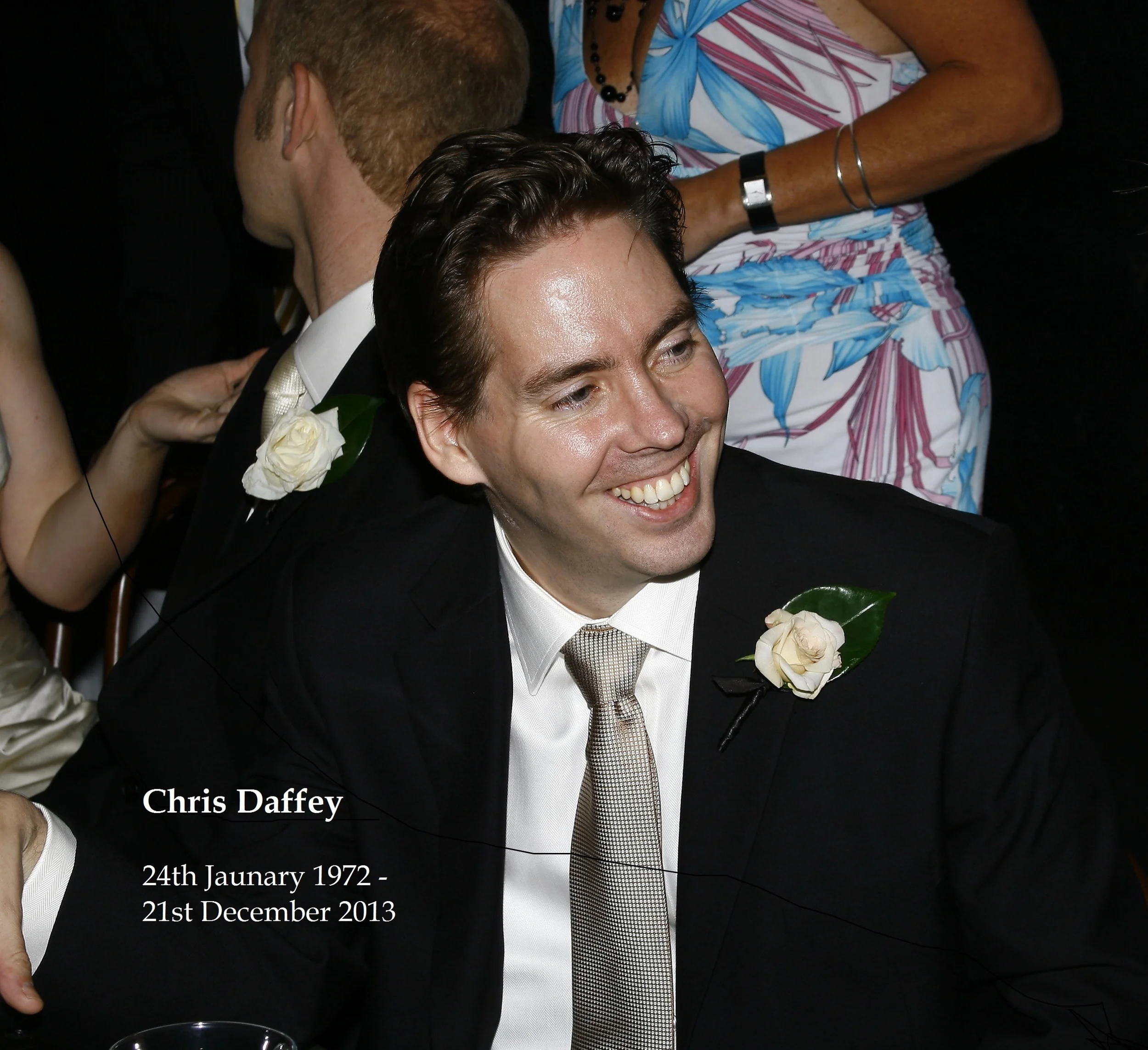
For Chris Daffey: 'I’m not ready for goodbyes when the jokes have run out', by Tony Wilson - 2014

May 13, 2015

2 January, 2014, Templestowe, Melbourne, Australia

I first met Daff in the Minter Ellison boardroom at Market Street on a hot February day in 1996. We had what I remember as a brief, hilarious chat before the event took a turn when Daff fainted unconscious right in the middle of the party. When his eyes flicked open, there were about fifty people huddled around him and he had about two seconds to think before throwing a hand out from his position lying flat on his back. ‘Chris Daffey,’ he said, without missing a beat.

I knew he was something amazing then and there. I didn’t get to speak to him any more at that function because, in Daff’s words, ‘HR had me in the lifts and out of the building before you could say “public liability insurance”. I later found out that Daff wasn’t as immediately sure about me. Like me, he kept this document with mugshots and profiles of his fellow articled clerks. Unlike me, he pencilled a first impression against each name. ‘R-sole’ [spelled capital R sole] was the designation for future friend James Edwards. I was granted slightly more wiggle room, assessed merely as ‘Possible R-Sole’.

Articles began and so did our friendship. We’d meet at the level one billiards table every day, and spend hours drinking Coke, eating sandwiches and attempting to roll pool balls down the table in such a way that the number would ‘hang’ perfectly still on the side. ‘Ugly’ we’d say when the axis scrambled. ‘Ooooooooh,’ we’d say if we got a perfect release. Whoever got more ‘Ooooohs’ over the lunchtime won. There was always a game with Daff. And always a winner.

It was the early days of email, and god knows how many billable units were wasted as Daff corresponded, not just with me, but with a growing number of Minters colleagues caught in the beam of his charisma. Minters called its email system the ‘Minternet’, and Daff quickly worked out that the template had one important flaw. An unscrupulous sender could just spacebar his own name out of the ‘from’ window, and write the name of any other person he might want to pretend to be.

The result was sheer mayhem. I spent three hours flirting with a girl, thinking I was some chance for a date, without knowing Daff was emailing in falsetto from his cubical on level 8. I then attempted to get Daff back, and indeed had a notable success posing as his then girlfriend Kerry, but I was a man out of my depth. ‘The only thing that mitigates my joy is the knowledge you will get me back,’ I wrote in my moment of triumph, which was exactly the same thing he wrote when the inevitable occurred. Yep, a phone message from my awfulest client wasn’t actually from him. Suspecting nothing, I hastily rang the awfulest client, pleading with him not to take the stupidest course of imaginable. ‘What are you talking about?’ he said to me. ‘What the f*ck are you talking about?’ Yep, Not for the first time, Daff had gone too far.

Amidst all the drudgery of that articles year, we had so much fun. There had been mid-year articled clerk revues before, but Daff turned ours into an extravaganza. In one sketch, he used artfully positioned pot-plants, photocopier lids, chair backs and assorted paraphernalia to film every articled clerk getting about his or her lawyerly tasks, naked. I’ll never forget Ben Liu on his tummy in centrefold pose, his dignity protected by the ‘Hot Stocks’ edition of the BRW. There was the bit in which Daff and I stormed the front foyer of Blakes in chicken suits. There was a sign in the copy room that said ‘Don’t Abuse the Photocopiers’ so Daff thought it would be funny if we found an old one, and filmed ourselves smashing it up with sledge-hammers in the middle of a field, to the Carmina Burana. ‘Twelve Angry Articled Clerks’ we called it. It was such a good time. I sometimes think it was the experience making that mid-year production together that encouraged both of us to pursue creative careers.

Today, I have such conflicted feelings about Daff’s decision to write his novel. It was an agony to watch its progress, not because the output wasn’t terrific, it almost always was, but because the words flowed like treacle. In true Daff style, he kept spreadsheets documenting his daily word count, and the numbers were sometimes in two figures. He’d ring me up, asking for a preference between two words. ‘It doesn’t matter, Daff’ I’d say. ‘Nobody will notice. Just move on.’ But he couldn’t. It had to be perfect. One year became two years, which became three years. He spent one of those at my parents’ holiday place at Red Hill, calling me every night at 5pm when he went outside to watch the rabbits. Daff loved animals. The one member of our family who still doesn’t know he’s gone is his beloved Charley Dog.

The novel, when it finally came out in 2004, was brilliant. The working title was ‘ImpressingJenny’ but it was eventually called A Girl, A Smock, and a Simple Plan. After all those years writing, the publisher assigned a woman who mainly edited gardening titles to whipper snipper Daff’s prose. He fought a lot of battles in the edit, won enough for him to be justly proud of the novel, but perhaps lost the war. He said in his letter that this awful disease has been with him eight years. Like I said, I have really conflicted feelings about this book.

A Girl, A Smock was part-memoir, part-fiction and truly hilarious. Daff’s recall of the primary school universe was phenomenal, and those painstakingly sculpted, comedy maximised-sentences were indeed very nearly perfect. One of my many favourite bits is this:

“You see the way I looked at it, the hardest part about primary school for Lucas must have been his lack of preparation for it. When he first strolled through the gates on his way to Mrs MacCauley’s Prep Grade M, he would have had no idea whatsoever that he’d been handed a business card that said, ‘Lucas Tordby – Dropkick’. In fact, like almost all of us, he would have had quite the opposite idea. Years of being smothered by parental affection and encouragement leaves the average pre-schooler thinking he is the smartest, best-looking, most advanced ‘little bundle of joy’ in the world ever. Parents rarely opt for honesty in assessing their children. No mother ever turns to her six year old daughter and says, ‘Marcy, you’re as dumb as you are hideous, but I Iove you anyway.’ It’s just praise praise and more praise until every little trooper turning up for their first day of school thinks they’re God’s gift to humanity. If only parents fessed up to the lies they’ve told before they packed their kids off to school. If only fathers grabbed their sons by the shoulders before they sailed out the door and said:

“You know all that stuff your mother and I told you about being cute and clever and adorable? Well it’s a bunch of cobblers. You’re actually a bit of a bonehead, Son, and you might cop a little stick out there because of it.’

Daff was so naturally funny, so natural at everything. Writing probably wasn’t even his top talent – his aptitude for maths was frightening, and he could sort and evaluate arguments like no person I’ve ever met. He often said he should have done law-science. These last couple of years I’ve been telling him to become a politician, or a political adviser, or a speech writer, or a barrister, or a public speaking coach or a management consultant or a stock market analyst. His beloved Pop trained in Daff an ear for injustice, and so many of my political views were nurtured by his eloquence for a cause. He could also go completely off tap. Daff had literally hundreds of yahoo email addresses, all of which have been blocked by Andrew Bolt’s blog moderators. Not many people know this, but he was also on Twitter, trading blows with right wing trolls on #auspol. The reason you might not be following him is also quintessentially Daff. When Charmaine joined Twitter and racked up more followers than the then barely-tweeting @chrisdaffey, Daff said that part of her success could be credited to being a woman with a nice looking profile pic. To prove himself right, he took to Twitter as an unbelievably hot looking New Zealand woman named Libby, who just happened to love footy. Dreamteam and politics. Within months, he had a thousand followers. He also received a remarkable number of coffee or dinner requests from left leaning, footy loving males, some of whom were prominent media figures. Libby always declined. She wasn’t that sort of girl.

Some of Libby’s most popular tweets:

“If you watch the Die Hard series backwards, an old bald guy slowly learns how to act.”

“Gina Rinehart launches ‘Seven Step Success In Business’ course. Step 1: Inherit billion dollar mining empire. Steps 2-7: Enjoy.”

“Nick Riewoldt claims ‘outside forces’ destabilising club: “All we want to do is train hard, play footy & take pics of each others nads” #afl”

“Q: What does @AndrewBolt say when he sees himself naked in the mirror? A: God damn it, it’s leaning left again!”

Our friendship was often quite competitive. In our Dreamteam head to head, his team, the Hindsight Mayors leads 10-1 against my team, the Maribynong Mustangs. It is now a small comfort to know that in a time of desperation, this score-line brought untold joy.  He once asked, ‘how much better a footballer do you think you are than me,’ and I said, ‘Put it this way Daff, if I toss this ball in the air for the rest of time, it will be up to me to decide whether you ever get to touch it again.’ We played the game for the next five minutes. It ended with him round-arming me across the back of the head. We went through a phase of entering 25 words or less competitions, and for New Year’s Eve in the Year 2000, Daff won a seven course dinner for ten on the balcony at Southbank overlooking the Yarra and the fireworks. I came second and won a slab of Crown Lager and a bottle opener. When he rang to tell me, I was incredulous, moaning to him that his entry was the worst example of corporate toadying, and that mine was clearly superior. He eventually shut me up by saying, ‘Willo. I’m inviting you! For eff’s sake! If anyone should be complaining it’s me. I’ve beaten you into a long second and you’re a slab and a bottle opener up.’ What a night that ended up being.

Like Dods, Daff would occasionally let me know I was still a ‘new friend’ who still had work to do to get to that Ben, Lawson and Al A-level. Through sheer weight of time together, I got there. During Dreamteam season, we spoke literally every day. In the off season we cooled it off to two or three times a week. Daff was quite possibly better at being a friend than he was at all the other things combined. There are at least five of us who call Daff our best friend. We each only had one Daff. I told him everything. He prided himself on being ‘the vault’. Nothing any of us confided ever went further than Daff.

In 2004 Daff and I travelled overseas together. It was an amazing few weeks full of stories that have peppered the years since. They include:

  • Walking the streets of Paris playing a game Daff invented called ‘Bonsoir or Bonsnub’. You pick a Parisian, and with full eye contact and beaming smile, hit them with an enthusiastic ‘Bonsoir’. If you get a bonsoir back, it is a ‘bonsoir’. If not, it is a ‘bonsnub’. Player with most ‘bonsoirs’ wins. There was always a game and there was always a winner.

  • Sprinting drunkenly through the cobblestoned streets of Barcelona at midnight, with Daff shouting ‘you have no cartilages, you have no cartilages’ and me shouting back ‘I will chase you down like a dog’. I did chase him down too. Like a dog.

  • Daff walking into a hotel bathroom to discover me asleep on the toilet. ‘Oh god, Willo, he said as he woke me up. ‘It’s our Elvis moment.’

  • Getting shot at by a Barcelona street kid with a toy bow and arrow. Daff found the kid in the same place the next day and bought his bow and arrow to give to me as a Christmas present. I gave him DVD copies of ‘El Graduado’ and ‘Adios Mr Chips’.

Daff was the most generous friend I’ve ever known. The presents were always spectacular – a carefully curated assortment of chocolates, a calendar of George W Bushisms, a Playstation 3 for Tam’s and my wedding that I now can hardly look at without crying. He was a big kid who loved kid stuff to the end. Swap cards, figurines, light sabres, Junior mints, endless endless Macdonalds. He spent nearly $1000 on footy cards in the year … 2012.  The last time he went to Red Hill he took the skin off his face attempting the steepest part of the hill on a billy cart. No wonder the kids loved him. He played chasey with them like he wanted to, because he actually did. He chased with intent. He chased for hours and hours and hours. It was only the last time he visited that I thought, ‘he’s having to work hard at this today’. I remember telling the kids to give Daff a bit of a rest.

The gift I mentioned on facebook this week is probably the one that means the most to us. When Tam was pregnant with our first, Daff barracked so hard for Polly to be born on his birthday, and when she was, he went around the streets of Melbourne, taking photos to give her so she could know what her city looked like that day. He also gave her newspaper front pages. They were the 24th of January twins, separated 35 years to the day. He even photoshopped his own head on to a baby’s body to put it in his ‘Daff box’. When’s going to be the right day to give her that box, Daff? I can’t believe this is happening.

We all loved you so much, Daff. Polly is wearing the blue butterfly necklace you gave her. She hasn’t said a word to me about it. She just started wearing it as a quiet tribute. Tam is bursting into tears as she plays Wordament, the speed boggle app you got her addicted to. The big Wordament face-off never happened, and now it isn’t going to. Harry, the one you called ‘the circus strongman’ keeps asking ‘is Daff going to come over?’ and I keep having to say that you won’t be coming over now. Jack got to meet you, but now won’t really know you like the others. But I know you were so pleased when he said your name during the last visit. One day I’ll tell him about the sort of person you were. That when he was born in 2011, it was you who read books on cerebral palsy so you could talk to me about it. That it was you who went to this special effort for me. Because you worried how low I was going. And I didn’t do the same for you. Because you didn’t want me to. Because you didn’t want the dynamic of this friendship, this perfect friendship, to change. Because you were the fun one. Well for me, Daff, it has changed, now. I don’t want to be angry, and mostly I’m not, and one day I won’t be at all. How could you have been in so much pain and told so few of us. How could I not have seen it? You say we couldn’t have done anything and I have to believe that we couldn’t. But we’ll never really know if enough was done. How can we?

You once wrote a goodbye for me, Daff. It was for when I was leaving Minters, and it was short and funny — typically brilliant. I’ve kept it along with all your emails from that time. You called it ‘Goodbye Mr Slips’. You dubbed me ‘the William the Conquerer of personal space invasion’. You noted ‘Tony’s tendency to get up close and personal during conversations introduced many lunch companions to the concept of “passive eating”’. You said, ‘Only a fool would sit through a meal with Tony in a suit colour that didn’t match his order.’

They’re the sort of goodbyes we’re supposed to be doing, Daff. Funny, shit-stirring goodbyes. I’m not ready for proper goodbyes. I’m not ready for goodbyes when the jokes have run out. I’m not ready for today. One of the few images I had of old age, was of calling you from a retirement home to complain about Dreamteam. How can we be stuck at 10:1? How can it be forever 10:1?

I’ll miss you so much Daff. My best man and my best friend. I’ll miss you and treasure you for the rest of my life.

I made an episdoe of the podcast dedicated to this speech, our friendship, and an interview I did on Richard Fidler’s Conversations.

Source: http://tonywilson.com.au/my-best-man-my-be...

Enjoyed this speech? Speakola is a labour of love and I’d be very grateful if you would share, tweet or like it. Thank you.

Facebook Twitter Facebook
In SUBMITTED Tags BEST FRIEND, TONY WILSON, LAWYER
1 Comment

For Unknown Soldier: 'He is all of them. And he is one of us', by Paul Keating - 1993

May 13, 2015

 11 November 1993, Australian War Memorial, Canberra, Australia

We do not know this Australian's name and we never will. We do not know his rank or his battalion. We do not know where he was born, nor precisely how and when he died. We do not know where in Australia he had made his home or when he left it for the battlefields of Europe. We do not know his age or his circumstances – whether he was from the city or the bush; what occupation he left to become a soldier; what religion, if he had a religion; if he was married or single. We do not know who loved him or whom he loved. If he had children we do not know who they are. His family is lost to us as he was lost to them. We will never know who this Australian was.

Yet he has always been among those whom we have honoured. We know that he was one of the 45,000 Australians who died on the Western Front. One of the 416,000 Australians who volunteered for service in the First World War. One of the 324,000 Australians who served overseas in that war and one of the 60,000 Australians who died on foreign soil. One of the 100,000 Australians who have died in wars this century.

He is all of them. And he is one of us.

This Australia and the Australia he knew are like foreign countries. The tide of events since he died has been so dramatic, so vast and all-consuming, a world has been created beyond the reach of his imagination.

He may have been one of those who believed that the Great War would be an adventure too grand to miss. He may have felt that he would never live down the shame of not going. But the chances are he went for no other reason than that he believed it was his duty - the duty he owed his country and his King.

Because the Great War was a mad, brutal, awful struggle, distinguished more often than not by military and political incompetence; because the waste of human life was so terrible that some said victory was scarcely discernible from defeat; and because the war which was supposed to end all wars in fact sowed the seeds of a second, even more terrible, war -  we might think this Unknown Soldier died in vain.

But, in honouring our war dead, as we always have and as we do today, we declare that this is not true.

For out of the war came a lesson which transcended the horror and tragedy and the inexcusable folly.

It was a lesson about ordinary people – and the lesson was that they were not ordinary.

On all sides they were the heroes of that war; not the generals and the politicians but the soldiers and sailors and nurses – those who taught us to endure hardship, to show courage, to be bold as well as resilient, to believe in ourselves, to stick together.

The Unknown Australian Soldier we inter today was one of those who by his deeds proved that real nobility and grandeur belong not to empires and nations but to the people on whom they, in the last resort, always depend.

That is surely at the heart of the ANZAC story, the Australian legend which emerged from the war. It is a legend not of sweeping military victories so much as triumphs against the odds, of courage and ingenuity in adversity. It is a legend of free and independent spirits whose discipline derived less from military formalities and customs than from the bonds of mateship and the demands of necessity.

It is a democratic tradition, the tradition in which Australians have gone to war ever since.

This Unknown Australian is not interred here to glorify war over peace; or to assert a soldier's character above a civilian's; or one race or one nation or one religion above another; or men above women; or the war in which he fought and died above any other war; or of one generation above any that has or will come later.

The Unknown Soldier honours the memory of all those men and women who laid down their lives for Australia.

His tomb is a reminder of what we have lost in war and what we have gained.

We have lost more than 100,000 lives, and with them all their love of this country and all their hope and energy.

We have gained a legend: a story of bravery and sacrifice and, with it, a deeper faith in ourselves and our democracy, and a deeper understanding of what it means to be Australian.

It is not too much to hope, therefore, that this Unknown Australian Soldier might continue to serve his country - he might enshrine a nation's love of peace and remind us that in the sacrifice of the men and women whose names are recorded here there is faith enough for all of us.

The Hon. P.J. Keating MP
Prime Minister of Australia

Enjoyed this speech? Speakola is a labour of love and I’d be very grateful if you would share, tweet or like it. Thank you.

Facebook Twitter Facebook
In EDITORS CHOICE Tags AUSTRALIA, FAMOUS, UNKNOWN SOLDIER
Comment

For Gough Whitlam: 'This old man', by Noel Pearson - 2014

November 5, 2014

We salute this old man for his great love and dedication to his country and to the Australian people.. When he breathed he truly was Australia's greatest white elder and friend without peer of the original Australians.

Read More

Enjoyed this speech? Speakola is a labour of love and I’d be very grateful if you would share, tweet or like it. Thank you.

Facebook Twitter Facebook
In PUBLIC FIGURE C Tags PRIME MINISTER, AUSTRALIA, STATE FUNERAL, GOUGH WHITLAM, NOEL PEARSON
Comment

For Rosa Parks: 'In that moment you reclaimed your humanity ', by Oprah Winfrey - 2005

November 3, 2005

31 October 2005, Metropolitan AME Church, Washington DC, USA

Reverend Braxton, family, friends, admirers, and this amazing choir:

I feel it an honor to be here to come and say a final goodbye.

I grew up in the South, and Rosa Parks was a hero to me long before I recognized and understood the power and impact that her life embodied. I remember my father telling me about this coloured woman who had refused to give up her seat. And in my child's mind, I thought, 'She must be really big.'I thought she must be at least a hundred feet tall. I imagined her being stalwart and strong and carrying a shield to hold back the white folks.

And then I grew up and had the esteemed honor of meeting her. And wasn't that a surprise. Here was this petite, almost delicate lady who was the personification of grace and goodness. And I thanked her then. I said, 'Thank you,' for myself and for every coloured girl, every coloured boy, who didn't have heroes who were celebrated.

I thanked her then.

And after our first meeting I realized that God uses good people to do great things. And I'm here today to say a final thank you, Sister Rosa, for being a great woman who used your life to serve, to serve us all. That day that you refused to give up your seat on the bus, you, Sister Rosa, changed the trajectory of my life and the lives of so many other people in the world. I would not be standing here today nor standing where I stand every day had she not chosen to sit down. I know that. I know that. I know that. I know that, and I honor that. Had she not chosen to say we shall not - we shall not be moved.

So I thank you again, Sister Rosa, for not only confronting the one white man whose seat you took, not only confronting the bus driver, not only for confronting the law, but for confronting history, a history that for 400 years said that you were not even worthy of a glance, certainly no consideration. I thank you for not moving.

And in that moment when you resolved to stay in that seat, you reclaimed your humanity and you gave us all back a piece of our own. I thank you for that. I thank you for acting without concern. I often thought about what that took, knowing the climate of the times and what could have happened to you, what it took to stay seated. You acted without concern for yourself and made life better for us all. We shall not be moved.

I marvel at your will.

I celebrate your strength to this day.

And I am forever grateful, Sister Rosa, for your courage, your conviction.

I owe you -- to succeed.

I will not be moved.

Source: http://www.americanrhetoric.com/speeches/o...

Enjoyed this speech? Speakola is a labour of love and I’d be very grateful if you would share, tweet or like it. Thank you.

Facebook Twitter Facebook
In PUBLIC FIGURE A Tags FAMOUS, ACTIVIST
Comment
← Newer Posts

See my film!

Limited Australian Season

March 2025

Details and ticket bookings at

angeandtheboss.com

Support Speakola

Hi speech lovers,
With costs of hosting website and podcast, this labour of love has become a difficult financial proposition in recent times. If you can afford a donation, it will help Speakola survive and prosper.

Best wishes,
Tony Wilson.

Become a Patron!

Learn more about supporting Speakola.

Featured political

Featured
Jon Stewart: "They responded in five seconds", 9-11 first responders, Address to Congress - 2019
Jacinda Ardern: 'They were New Zealanders. They are us', Address to Parliament following Christchurch massacre - 2019
Dolores Ibárruri: "¡No Pasarán!, They shall not pass!', Defense of 2nd Spanish Republic - 1936
Jimmy Reid: 'A rat race is for rats. We're not rats', Rectorial address, Glasgow University - 1972

Featured eulogies

Featured
For Geoffrey Tozer: 'I have to say we all let him down', by Paul Keating - 2009
for James Baldwin: 'Jimmy. You crowned us', by Toni Morrison - 1988
for Michael Gordon: '13 days ago my Dad’s big, beautiful, generous heart suddenly stopped beating', by Scott and Sarah Gordon - 2018

Featured commencement

Featured
Tara Westover: 'Your avatar isn't real, it isn't terribly far from a lie', The Un-Instagrammable Self, Northeastern University - 2019
Tim Minchin: 'Being an artist requires massive reserves of self-belief', WAAPA - 2019
Atul Gawande: 'Curiosity and What Equality Really Means', UCLA Medical School - 2018
Abby Wambach: 'We are the wolves', Barnard College - 2018
Eric Idle: 'America is 300 million people all walking in the same direction, singing 'I Did It My Way'', Whitman College - 2013
Shirley Chisholm: ;America has gone to sleep', Greenfield High School - 1983

Featured sport

Featured
Joe Marler: 'Get back on the horse', Harlequins v Bath pre game interview - 2019
Ray Lewis : 'The greatest pain of my life is the reason I'm standing here today', 52 Cards -
Mel Jones: 'If she was Bradman on the field, she was definitely Keith Miller off the field', Betty Wilson's induction into Australian Cricket Hall of Fame - 2017
Jeff Thomson: 'It’s all those people that help you as kids', Hall of Fame - 2016

Fresh Tweets


Featured weddings

Featured
Dan Angelucci: 'The Best (Best Man) Speech of all time', for Don and Katherine - 2019
Hallerman Sisters: 'Oh sister now we have to let you gooooo!' for Caitlin & Johnny - 2015
Korey Soderman (via Kyle): 'All our lives I have used my voice to help Korey express his thoughts, so today, like always, I will be my brother’s voice' for Kyle and Jess - 2014

Featured Arts

Featured
Bruce Springsteen: 'They're keepers of some of the most beautiful sonic architecture in rock and roll', Induction U2 into Rock Hall of Fame - 2005
Olivia Colman: 'Done that bit. I think I have done that bit', BAFTA acceptance, Leading Actress - 2019
Axel Scheffler: 'The book wasn't called 'No Room on the Broom!', Illustrator of the Year, British Book Awards - 2018
Tina Fey: 'Only in comedy is an obedient white girl from the suburbs a diversity candidate', Kennedy Center Mark Twain Award -  2010
Tina Fey: 'Only in comedy is an obedient white girl from the suburbs a diversity candidate', Kennedy Center Mark Twain Award - 2010

Featured Debates

Featured
Sacha Baron Cohen: 'Just think what Goebbels might have done with Facebook', Anti Defamation League Leadership Award - 2019
Greta Thunberg: 'How dare you', UN Climate Action Summit - 2019
Charlie Munger: 'The Psychology of Human Misjudgment', Harvard University - 1995
Lawrence O'Donnell: 'The original sin of this country is that we invaders shot and murdered our way across the land killing every Native American that we could', The Last Word, 'Dakota' - 2016