
• Genre
  • About
  • Submissions
  • Donate
  • Search
Menu

Speakola

All Speeches Great and Small
  • Genre
  • About
  • Submissions
  • Donate
  • Search

Commencement and Graduation

Inspiring, humorous, wisdom imparting. Some of the best speeches are delivered in the educational context. Upload your commencement or graduation speech here.

Ken Burns: 'Listen, listen,' Brandeis University commencement - 2024

June 16, 2024

31 May 2024, Brandeis University, Waltham, Massachusetts, USA

Brandeisian, love it.

President Liebowitz, Ron, Chair Lisa Kranc, and other members of the board of trustees, Provost Carol Fierke, fellow honorees, distinguished faculty and staff, proud and relieved parents, calm and serene grandparents, distracted but secretly pleased siblings, ladies and gentlemen, graduating students of the class of 2024, good morning.

I am deeply honored and privileged that you have asked me here to say a few words at such a momentous occasion that you might find what I have to say worthy of your attention on so important a day in all of your lives. Thank you for this honor.

Listen, I am in the business of history. It is not always a happy subject on college campuses these days, particularly when forces seem determined to eliminate or water down difficult parts of our past, particularly when the subject may seem to sum an anachronistic and irrelevant pursuit, and particularly with the ferocious urgency this moment seems to exert on us. It is my job, however, to remind people of the power our past also exerts, to help us better understand what's going on now with compelling story, memory, and anecdote. It is my job to try to discern patterns and themes from history to enable us to interpret our dizzying and sometimes dismaying present.

For nearly 50 years now, I have diligently practiced and rigorously tried to maintain a conscious neutrality in my work, avoiding advocacy if I could, trying to speak to all of my fellow citizens. Over those many decades I've come to understand a significant fact, that we are not condemned to repeat, as the saying goes, what we don't remember. That is a beautiful, even poetic phrase, but not true. Nor are there cycles of history as the academic community periodically promotes. The Old Testament, Ecclesiastes to be specific, got it right, I think. What has been will be again, what has been done will be done again. There is nothing new under the sun. What those lines suggest is that human nature never changes or almost never changes. We continually superimpose that complex and contradictory human nature over the seemingly random chaos of events, all of our inherent strengths and weaknesses, our greed and generosity, our puritanism and our prurience, our virtue, and our venality parade before our eyes, generation after generation after generation. This often gives us the impression that history repeats itself. It does not. "No event has ever happened twice, it just rhymes," Mark Twain is supposed to have said. I have spent all of my professional life on the lookout for those rhymes, drawn inexorably to that power of history. I am interested in listening to the many varied voices of a true, honest, complicated past that is unafraid of controversy and tragedy, but equally drawn to those stories and moments that suggest an abiding faith in the human spirit, and particularly the unique role this remarkable and sometimes also dysfunctional republic seems to play in the positive progress of mankind.

During the course of my work, I have become acquainted with hundreds if not thousands of those voices. They have inspired, haunted, and followed me over the years. Some of them may be helpful to you as you try to imagine and make sense of the trajectory of your lives today.

Listen, listen. In January of 1838, shortly before his 29th birthday, a tall, thin lawyer prone to bouts of debilitating depression addressed the young men's lyceum in Springfield, Illinois. "At what point shall we expect the approach of danger?" He asked his audience, "Shall we expect some trans-Atlantic military giant to step the earth and crush us at a blow?" Then he answered his own question. "Never. All the armies of Europe, Asia, and Africa could not by force take a drink from the Ohio River or make a track on the Blue Ridge in a trial of a thousand years. If destruction be our lot, we must ourselves be its author and finisher. As a nation of free men, we must live through all time or die by suicide." It is a stunning, remarkable statement, one that has animated my own understanding of the American experience since I first read it more than 40 years ago. That young man was of course Abraham Lincoln, and he would go on to preside over the closest this country has ever come to near national suicide, our civil war, and yet embedded in his extraordinary, disturbing, and prescient words is also a fundamental optimism that implicitly acknowledges the geographical forcefield two mighty oceans east and west and two relatively benign neighbors north and south have provided for us since the British burned the White House in the War of 1812 and inspired Francis Scott Key.

Lincoln's words that day suggest what is so great and so good about the people who happen to inhabit this lucky and exquisite country of ours. That's the world you now inherit: our work ethic and our restlessness, our innovation and our improvisation, our communities and our institutions of higher learning, our suspicion of power. The fact that we seem resolutely dedicated to parsing the meaning between individual and collective freedom; What I want versus what we need. That we are all so dedicated to understanding what Thomas Jefferson really meant when he wrote that mysterious phrase, "The pursuit of happiness". Hint, it happens right here in the lifelong learning and perpetual improvement this university is committed to.

But the isolation of those two oceans has also helped to incubate habits and patterns less beneficial to us: our devotion to money and guns and conspiracies, our certainty about everything, our stubborn insistence on our own exceptionalism blinding us to that which needs repair, especially with regard to race and ethnicity. Our preoccupation with always making the other wrong at an individual as well as a global level. I am reminded of what the journalist I.F. Stone once said to a young acolyte who was profoundly disappointed in his mentor's admiration for Thomas Jefferson. "It's because history is tragedy," Stone admonished him, "Not melodrama." It's the perfect response. In melodrama all villains are perfectly villainous and all heroes are perfectly virtuous, but life is not like that. You know that in your guts and nor is our history like that. The novelist, Richard Powers recently wrote that, "The best arguments in the world," — and ladies and gentlemen, that's all we do is argue — "the best arguments in the world," he said, "Won't change a single person's point of view. The only thing that can do that is a good story." I've been struggling for most of my life to do that, to try to tell good, complex, sometimes contradictory stories, appreciating nuance and subtlety and undertow, sharing the confusion and consternation of unreconciled opposites.

But it's clear as individuals and as a nation we are dialectically preoccupied. Everything is either right or wrong, red state or blue state, young or old, gay or straight, rich or poor, Palestinian or Israeli, my way or the highway. Everywhere we are trapped by these old, tired, binary reactions, assumptions, and certainties. For filmmakers and faculty, students and citizens, that preoccupation is imprisoning. Still, we know and we hear and we express only arguments, and by so doing, we forget the inconvenient complexities of history and of human nature. That, for example, three great religions, their believers, all children of Abraham, each professing at the heart of their teaching, a respect for all human life, each with a central connection to and legitimate claim to the same holy ground, violate their own dictates of conduct and make this perpetually contested land a shameful graveyard. God does not distinguish between the dead. "Could you?"

[Audience applauding]

"Could you?" A very wise person I know with years of experience with the Middle East recently challenged me, "Could you hold the idea that there could be two wrongs and two rights?"

Listen, listen. In a filmed interview I conducted with the writer James Baldwin, more than 40 years ago, he said, "No one was ever born who agreed to be a slave, who accepted it. That is, slavery is a condition imposed from without. Of course, the moment I say that," Baldwin continued, "I realize that multitudes and multitudes of people for various reasons of their own enslave themselves every hour of every day to this or that doctrine, this or that delusion of safety, this or that lie. Anti-Semites, for example," he went on, "are slaves to a delusion. People who hate Negroes are slaves. People who love money are slaves. We are living in a universe really of willing slaves, which makes the concept of liberty and the concept of freedom so dangerous," he finished. Baldwin is making a profoundly psychological and even spiritual statement, not just a political or racial or social one. He knew, just as Lincoln knew, that the enemy is often us. We continue to shackle ourselves with chains we mistakenly think is freedom.

Another voice, Mercy Otis Warren, a philosopher and historian during our revolution put it this way, "The study of the human character at once opens a beautiful and a deformed picture of the soul. We there find a noble principle implanted in the nature of people, but when the checks of conscience are thrown aside, humanity is obscured." I have had the privilege for nearly half a century of making films about the US, but I have also made films about us. That is to say the two letter, lowercase, plural pronoun. All of the intimacy of "us" and also "we" and "our" and all of the majesty, complexity, contradiction, and even controversy of the US. And if I have learned anything over those years, it's that there's only us. There is no them. And whenever someone suggests to you, whomever it may be in your life that there's a them, run away. Othering is the simplistic binary way to make and identify enemies, but it is also the surest way to your own self imprisonment, which brings me to a moment I've dreaded and forces me to suspend my longstanding attempt at neutrality.

There is no real choice this November. There is only the perpetuation, however flawed and feeble you might perceive it, of our fragile 249-year-old experiment or the entropy that will engulf and destroy us if we take the other route. When, as Mercy Otis Warren would say, "The checks of conscience are thrown aside and a deformed picture of the soul is revealed." The presumptive Republican nominee is the opioid of all opioids, an easy cure for what some believe is the solution to our myriad pains and problems. When in fact with him, you end up re-enslaved with an even bigger problem, a worse affliction and addiction, "a bigger delusion", James Baldwin would say, the author and finisher of our national existence, our national suicide as Mr. Lincoln prophesies. Do not be seduced by easy equalization. There is nothing equal about this equation. We are at an existential crossroads in our political and civic lives. This is a choice that could not be clearer.

[Audience applauding]

Listen, listen. 33 years ago, the world lost a towering literary figure. The novelist and storyteller, not arguer, Isaac Bashevis Singer. For decades he wrote about God and myth and punishment, fate and sexuality, family and history. He wrote in Yiddish a marvelously expressive language, sad and happy all at the same time. Sometimes maddeningly all knowing, yet resigned to God's seemingly capricious will. It is also a language without a country, a dying language in a world more interested in the extermination or isolation of its long suffering speakers. Singer, writing in the pages of the Jewish Daily Forward help to keep Yiddish alive. Now our own wonderfully mongrel American language is punctuated with dozens of Yiddish words and phrases, parables and wise sayings, and so many of those words are perfect onomatopoeias of disgust and despair, hubris and humor. If you've ever met a schmuck, you know what I'm talking about. [audience laughs] Toward the end of his long and prolific life, Singer expressed wonder at why so many of his books written in this obscure and some said useless language would be so widely translated, something like 56 countries all around the world. "Why," he would wonder with his characteristic playfulness, "Why would the Japanese care about his simple stories of life in the shtetls of Eastern Europe 1,000 years ago?" "Unless," Singer paused, twinkle in his eye, "Unless the story spoke of the kinship of the soul." I think what Singer was talking about was that indefinable something that connects all of us together, that which we all share as part of organic life on this planet, the kinship of the soul. I love that.

Okay, let me speak directly to the graduating class. Watch out, here comes the advice. Listen. Be curious, not cool. Insecurity makes liars of us all. Remember, none of us get out of here alive. The inevitable vicissitudes of life, no matter how well gated our communities, will visit us all. Grief is a part of life, and if you explore its painful precincts, it will make you stronger. Do good things, help others. Leadership is humility and generosity squared. Remember the opposite of faith is not doubt. Doubt is central to faith. The opposite of faith is certainty. The kinship of the soul begins with your own at times withering self-examination. Try to change that unchangeable human nature of Ecclesiastes, but start with you. "Nothing so needs reforming," Mark Twain once chided us, "As other people's habits." [audience laughs]

Don't confuse success with excellence. Do not descend too deeply into specialism. Educate all of your parts, you will be healthier. Do not get stuck in one place. "Travel is fatal to prejudice," Twain also said. Be in nature, which is always perfect and where nothing is binary. Its sheer majesty may remind you of your own atomic insignificance, as one observer put it, but in the inscrutable and paradoxical ways of wild places, you will feel larger, inspirited, just as the egotist in our midst is diminished by his or her self regard.

At some point, make babies, one of the greatest things that will happen to you, I mean it, one of the greatest things that will happen to you is that you will have to worry, I mean really worry, about someone other than yourself. It is liberating and exhilarating, I promise. Ask your parents.

[Audience laughs]

Choose honor over hypocrisy, virtue over vulgarity, discipline over dissipation, character over cleverness, sacrifice over self-indulgence. Do not lose your enthusiasm, in its Greek etymology the word enthusiasm means simply, "god in us". Serve your country. Insist that we fight the right wars. Denounce oppression everywhere.

[Audience applauding]

Convince your government, as Lincoln understood that the real threat always and still comes from within this favored land. Insist that we support science and the arts, especially the arts.

[Audience cheering]

They have nothing to do with the actual defense of our country; They just make our country worth defending.

[Audience applauding]

Remember what Louis Brandeis said, "The most important political office is that of the private citizen." Vote. You indelibly... [audience applauding] Please, vote. You indelibly underscore your citizenship, and most important, our kinship with each other when you do. Good luck and godspeed.

[Audience applauding]
Source: https://www.brandeis.edu/commencement/2024...

Enjoyed this speech? Speakola is a labour of love and I’d be very grateful if you would share, tweet or like it. Thank you.

Facebook Twitter Facebook
In GUEST SPEAKER F Tags KEN BURNS, TRANSCRIPT, HISTORY, COMMECEMENT SPEECH, ABRAHAM LINCOLN
Comment

Dan Carlin: 'You cannot predict how you will use your education", University of Colorado - 2020

March 3, 2021

May 2021, Boulder, Colorado, USA

Hi everyone. While I, like all of you, I imagine, feel somewhat cheated out of a chance to congregate together on Folsom Field under a beautiful Colorado sky in the one of a kind city of Boulder. It seems somewhat apropos that a guy who delivers talks via the internet should be the inaugural speaker at the first virtual CU commencement.

I want to thank the students who thought of including me, Chancellor DiStefano, the faculty, and anyone else who had a hand in this. It is an unbelievable honor for me to be able to do this. Thanks to all of you.

As some of you know, I'm a podcaster and have been since 2005. It probably won't surprise you to know that I didn't study podcasting at Colorado. Back when I was in college, personal computers were still a really new thing and I actually remember going down to the CU Bookstore to see one. This was in 1986 I think, and if you had told me back then that I would someday be doing some sort of a show from my house, delivered to millions of people through computers and then on their phones? Well, I wouldn't have had a framework in which to process that.

I started college as a theater major at a school in Los Angeles before transferring to CU and changing majors to History. Both of those majors, by the way, as many of you know, fall into that dreaded category where people wonder what you will ever do in life to earn a living with it. When I was at CU, the History Department had this wonderful little pamphlet, I think it was green if I recall, called something like what to tell your parents about choosing History as a major. It was designed to give students some counterpoints when their parents said something like, what are you going to do with a History major? Be a high school history teacher? Which, first of all, is a great thing to be and I might not be here today except for some of those people. And yet, I can't help but notice that I use both my theater education, which I had thought for a long time was wasted class credit and hours, and my history education every day in my current work, every single day.

You couldn't have foreseen or sketched out plans for this in 1989, yet here we are. You can't predict how you will use your education. The world in which you will need it very well may not exist yet, but when it arrives you are going to be so much better off for having it than if you didn't have it. When I was here at CU, my advisor, History professor, and all around good guy Robert Pois told me about the German General, Helmuth Von Moltke The Elder who once reportedly said, in German of course, that no battle plan survives contact with the enemy. Boxer Mike Tyson made a similar point once saying that everybody has a plan until they get punched in the mouth. But folks, life is gonna throw some punches your way. You don't need me to tell you that. You've already likely taken a few. Life is all about the unexpected, right? You can have a plan for your future all laid out. Take the requisite steps towards your goal, do everything right, be on your way there, and then have some unexpected event like billiard balls caroming off one another on a pool table that sends you careening towards a completely different goal on a totally different life path.

My dad once told me, “If you could look back on your life from the end of your life and try to connect the dots that led you from where you began to where you finally ended up, you couldn't do it.” There are way too many strange detours and sharp, unexpected twists and turns that everybody encounters along their way. The way this current pandemic has completely changed everything we were doing before it happened is a wonderful life lesson in how quickly reality can turn on a dime. This will be one of those dots in your life trajectory someday that would have been tough to plan for. But the fact that you can't count on a fixed plan to be flexible enough to deal with all the unexpected things life will throw at you doesn't mean you shouldn't be prepared.

I'm reminded of a line spoken by General and later President Dwight D. Eisenhower. “In preparing for battle, I've always found that plans are useless, but planning is indispensable.” What you've been doing here with your time at CU is planning. Planning and preparing for a future that you can't anticipate. Mike Tyson may be right that your specific plans may go out the window after that first punch, but if you've trained well, learned your craft, become more aware, more seasoned, and more knowledgeable, you will have options you otherwise wouldn't have. You will have a better chance to roll with life's punches and maybe even land a few of your own because if you want to get to where you want to go, I'm here to tell you, you can't just play defense here.

You're going to have to take some chances in this life. In the Broadway musical Hamilton, the lead character sings or raps that he's not throwing away his shot. Too many people in life don't take theirs. Often it's because the important opportunities in your life aren't apparent until you've seized them. You can only tell how pivotal they were after the fact. I've often looked back on my life – the things I did that ended up altering the entire trajectory of my existence – and marveled at how close I came to not doing them. At the time, it wasn't clear that he was such a big deal. You just don't know until you try. I got my first job as a television reporter after sending an audition tape to a news director who told me explicitly not to send him one. The man said they had no turnover at their station and that there was no job to give me. The quality of the tape itself didn't matter at all. My stepfather, however, told me to send him one anyway. I was loath to do this because those tapes were expensive and I didn't have many of them, but I sent out the tape anyway and the news director called me a week later, said he had an unexpected rash of people quitting and how soon could I start? What if I hadn't sent that tape? I mean, I nearly didn't. My bemoaning the cost and effort involved almost cost me a heck of a lot more than a $20 videotape and some time. While I was a reporter, I did a news story one day at a radio station and I was struck with a random thought that maybe I should just drop the program director that I just met a little note thanking him. It didn't seem like a big deal either way; I could take it or leave it. I vacillated about it. I almost didn't do it, but at the last minute I just said, “What the hell,” and dropped the note in the mail. He called that week and said, have you ever thought about going to talk radio? Again, my life changed course completely in a positive way by something I couldn't have foreseen or planned for in advance and that I nearly didn't do.

While I was in the radio business I worked with a fabulous person who became my friend, but then a person who was going to leave and move to a bigger town. I thought about writing her a note and telling her I'd like to ask her out, but it seemed like something that might backfire, you know, workplace romance and all that. I remember almost chickening out. I was going to put the note under her windshield wiper and I went back and forth. Do I? Don’t I? I finally just left the note on the car windshield, walked away, and left it in fate's hands as I recall, thinking. Well, she read the note and decided to stay and she's been my wife for 20 years now and we have two wonderful kids. But what if I hadn't left that note? I mean, I almost didn't.

But in the connect the dots story of my life, the tape that that news director led me to sending a letter to a radio boss, which led me to meeting the person who would give him my whole current life. Oh yeah, it was my wife's mother who also first suggested I do a podcast about history. So if I don't send that tape to the news director who told me not to, I'm probably not talking with you here today. It is absolutely terrifying to me to think how thin a reed my whole life today rests upon. The worst part was that I had no clue that those things I almost didn't do were in effect: my shots. But getting your shot is only half the battle.

Once you get it, then you have to make good on the opportunity. This is where your years of planning and hard work comes into play. Getting, for example, a transformative job means nothing if you get fired soon afterwards for not being able to do it well, and most jobs require some basic foundation in skills and knowledge and then the ability to learn more. CU gave me both the skills to put myself in a position to be offered these gigs and the knowledge – not the specific knowledge of how to do those jobs. After all, I didn't study journalism, broadcasting or podcasting in school – but the lifelong ability to know how to keep learning. This is one of the most important skills you've gained through your planning. You were prepared to learn more. This skill will be your salvation. We live in an era where the ability to be a lifelong self-educator is absolutely indispensable, so regardless of whatever specific degree you've earned or what subject you majored in, what we're really celebrating here today is the culmination of this stage of your life's work in making you better able to deal with whatever comes your way – positive and negative.

You're going to be blindsided by events, both joyous and not, your entire life. What you've done by completing this chapter in your personal story is hedge against the future. You don't know what's coming. Who can? But because of the work you've put in, you have become a more formidable individual. A more formidable version of you will be better able to roll with whatever punches await, while also putting you in a better position to take advantage of the opportunities that come your way in life. Think about who you were when you started here at CU and think about yourself now that you've finished. You've done the equivalent of leveling up in this role playing game or computer simulation called “Life.” This impacts everything for the rest of your days in ways that will be both obvious and not. A more formidable you will be a better employee, boss, parent, and maybe even person.

You may not be able to count on your specific plans for the future. They may get derailed or you may fall in love with another path, but because of your efforts and hard work, you're going to be more prepared for all of it. And remember to take your shots along the way because you never know which ones are going to pay off until you're in a position later on to connect the dots of your own past.

With one exception, I can guarantee you that the shot you took when you applied to this institution is one you will never regret. I don't have to wait until the end of your life to tell you that. I speak from experience. Congratulations Buffaloes on radically improving your chances in life. Go make the world a better place. I am so proud of you all. Go Buffs.

Source: https://www.colorado.edu/commencement/2020...

Enjoyed this speech? Speakola is a labour of love and I’d be very grateful if you would share, tweet or like it. Thank you.

Facebook Twitter Facebook
In GUEST SPEAKER F Tags DAN CARLIN, HARDCORE HISTORY, TRANSCRIPT, UNIVERSITY OF COLORADO, HISTORY, HISTORY MAJOR
Comment

Viola Davis: 'Living life for something bigger than yourself is a hero’s journey', Barnard College - 2019

May 28, 2019

20 May 2019, Barnard College, New York City, New York, USA

[Someone shouts, "I love you!"]

Thank you. I love you, too. And I’m going to show you how much I love you. This speech, these pages have all of my breakfast items on it. Avocado toast, jelly, everything. [Laughs]

President Beilock, distinguished faculty, alumnae, family, friends, the 657 or so sisters in the audience, graduating class. I’m going to make it plain: “History is not the past. It is the present. We carry history with us. We are our history.”

In other words: You’re a product of your environment. Now that term is usually relegated to people from low-income, crime-infested areas…but why? We all are a product of our environment.

Your existence is an amalgamation of every triumph, every hard-won battle, every woman who had an idea and massaged it, and had the courage to use it to change the world. Every person who survived slavery, Jim Crow and the black codes, to the Trail of Tears, wars…and passed their dreams on to you—of love, of hate. Yup, you are also the product of the other: Of silence, of apathy, a school built on stolen ground. Of women, a parent, grandparent, ancestor who suppressed dreams and ideas, who died with lost potential and horrific memories of sexual assault, mental illness, who didn’t feel good enough, or pretty enough or ENOUGH. Even your anxiety is part of your history…and yet here you are. Privileged, blessed…to do…what?

There are two roads that I see that people usually take: The choice to think that your path is all about you and your success, how high you can climb in your career and your status. Or, the so-called “save the world” approach, where you have a vision for the world and, by God, you will change it because you’re different. The first road requires you to mistake your presence for the event, to be in complete denial; and, the second requires you only to deny the really bad stuff. It requires you to forget racism, not see color, intersectionality, poverty… “but maybe I’ll take the sexism because it pertains to me.” Forget any evidence in my family of mental illness, of violence. Forget anything in me that will get in the way. Forget my fear, my pain. BOTH dead end. Both result in well-intentioned, very bright, enthusiastic people doing NOTHING.

How about this as a novel idea: How about owning it? Owning ALL of it—the good and the bad. Own the fact that the 39 delegates who wrote the greatest document, with the greatest mission statement, wrote it when slavery was an institution, Native Americans were being slaughtered and women were fighting for their lives. Own the 100 years of Jim Crow that were implemented after the 13th Amendment, restricting the rights of people who were a quarter black, an eighth black, black-black, Native Americans, Malays, Hispanics, Jews. Own every gun-toting, violent, hate-filled shooter. And own the fact that THAT is America. Own every heroic deed, great idea. Own the mission statement of THIS school. Own all of your memories and experiences, even if they were traumatic. Own it! Own IT! The world is broken because we’re broken. There are too many of us who want to forget. Who said that all of who you are has to be good? All of who you are is who you are. It hurts, you rage, battle it out, ask, “Why?” Then you forgive, reconcile and use your heart, your courage and vision to fix, to heal and then, ultimately, to connect, to empathize. And that empathy creates a passion for people and it all is the fuel of the warrior—a brave, experienced soldier or fighter.

It’s like Thomas Merton said, “If you want to study the social and political history of modern times, study hell.” Power concedes nothing without a demand. Know what that means? Women are under siege: suicide rates have skyrocketed, our reproductive rights are seriously in jeopardy, as is our pay, our healthcare, our safety, our worth. Sex trafficking has risen by 846 percent in the last five years and three-quarters of the victims are women of color. And in the greatest country in the world, we’ve seen a 26.6 percent increase in women dying during childbirth, and a 243 percent increase amongst black women.

You are graduating from a school whose mission it is to not just hand you a diploma, but a sword. You either start wielding it or you put it away as a conversation piece. Because there is a cap to success. Now everybody tells you that’s what you got to hit, that’s the best of the best that you can have in life. And then you hit it and then comes disillusionment, exhaustion, isolation, the imposter syndrome and a loss of passion. Because no one talks about the real final cap, the real ceiling—and that’s significance.

That living life for something bigger than yourself is a hero’s journey. That answer to your call, to adventure and journeying forth with mentors and allies, and facing your greatest fears, where you either die or your life as you know it will never be the same. And then you seize the sword, the insight, the treasure. The hero at that stage must put all celebrations aside to prepare for the final battle. The road back. The road back is the moment where the hero goes back to the ordinary world, where she must choose between her own personal objective and that of a higher cause. The reward? Your gift to the ordinary world? [sighs] That is the Holy Grail, the elixir.

What’s your elixir?

You know, my testimony is one of poverty. You know, you heard I grew up in Central Falls, Rhode Island. And let me tell you something about poverty: You’re invisible. Nobody sees the poor. You have access to nothing. You’re no one’s demographic. You know what my “a-ha” moment was? I had a memory when I was nine years old, and I remember my parents fighting in the middle of the night. It was so bad that I started screaming at the top of my lungs, and I couldn’t stop. My older sister Dianne told me to go in the house or people would hear me. I ran in the house. I ran to the bathroom, screaming still, just couldn’t stop. And got down on my knees, and closed my eyes, I put my hands together and said, “GOD! If you exist, if you love me, you’ll take me away from this life! Now I’m going to count to 10 and when I open my eyes, I want to be gone! You hear me?!” And I put my hands together and I was really believing it. “One!” And then I got to eight. “Nine! 10!” And I opened my eyes … and I was still there. But, He did take my life. He left me right there so when I gained vision, and strength, and forgiveness, I could remember what it means to be a child who was hungry. I could remember what it means to be in trauma. I could remember poverty, alcoholism. I could remember what it means to be a child who dreams and sees no physical manifestation of it. I could remember because I lived it! I was there! And that has been my biggest gift in serving.

“You can only understand people if you feel them in yourself.”

And you know what? In the words of Joseph Campbell, you have not even to risk the adventure alone, because the heroes of all time have gone before you. The labyrinth is fully known; you have only to follow the thread of the hero-path. And where you had thought to find an abomination, you shall find a god. And where you had thought to slay another, you shall slay yourself. And where you had thought to journey outward, you shall come to the center of your own existence. And where you had thought to be alone, you shall come to be with all the world.

Now, you know, I jumped out of a plane recently—lost my mind for half an hour. But, you know, when you’re flying up in the plane, you’re anticipating the jump, your heart is beating, you’re praying, you’re doing everything possible and then your instructor says, “It’s time.” And this is usually my Wakanda salute to my sisters, okay? [Puts both hands up in front of her and keeps them up for the remainder of the speech.] So, this is how I’m going to end it: when you put your legs outside of that plane, he tells you to “put your hands up, put your head back, and then you fall.” So with my hands up, what I’m saying is that on this day of your genesis, your leap, your commencement, your mark in your history, perhaps your elixir is simply this: that you can either leave something for people or you can leave something in people. Thank you.

Source: https://www.barnard.edu/node/102896

Enjoyed this speech? Speakola is a labour of love and I’d be very grateful if you would share, tweet or like it. Thank you.

Facebook Twitter Facebook
In GUEST SPEAKER E Tags VIOLA DAVIS, BARNARD COLLEGE, BARNARD, TRANSCRIPT, HISTORY, OWN YOUR PAST, WOMEN'S RIGHTS, REPRODUCTIVE RIGHTS
Comment

Ken Burns: "You must do everything you can to defeat the retrograde forces that have invaded our democratic process", Stanford University - 2016

June 20, 2016

12 June 2016, Stanford University, Stanford, California, USA

President Hennessy, members of the Board of Trustees, distinguished faculty and staff, proud and relieved parents, calm and serene grandparents, distracted but secretly pleased siblings, ladies and gentlemen, graduating students of the Class of 2016, good morning. I am deeply honored and privileged that you have asked me here to say a few words at so momentous an occasion, that you might find what I have to say worthy of your attention on so important a day, especially one with such historical significance. One hundred and twenty-five years. Wow.

Thank you, too, for that generous introduction, President Hennessy. I always feel compelled, though, to inoculate myself against such praise by remembering that I have on my refrigerator at home an old and now faded cartoon, which shows two men standing in hell, the flames licking up around them. One guy says to the other, “Apparently my over 200 screen credits didn’t mean a damn thing.” They don’t, of course; there is much more meaning in your accomplishments, which we memorialize today.

I am in the business of memorializing – of history. It is not always a popular subject on college campuses today, particularly when, at times, it may seem to some an anachronistic and irrelevant pursuit, particularly with the ferocious urgency this moment seems to exert on us. It is my job, however, to remind people – with story, memory, anecdote and feeling – of the power our past also exerts, to help us better understand what’s going on now. It is my job to try to discern patterns and themes from history to enable us to interpret our dizzying, and sometimes dismaying, present. For nearly 40 years now, I have diligently practiced and rigorously maintained a conscious neutrality in my work, avoiding the advocacy of many of my colleagues, trying to speak to all of my fellow citizens.

Over those decades of historical documentary filmmaking, I have also come to the realization that history is not a fixed thing, a collection of precise dates, facts and events that add up to a quantifiable, certain, confidently known truth. History is a mysterious and malleable thing, constantly changing, not just as new information emerges, but as our own interests, emotions and inclinations change. Each generation rediscovers and reexamines that part of its past that gives its present new meaning, new possibility and new power. The question becomes for us now – for you especially – what will we choose as our inspiration? Which distant events and long dead figures will provide us with the greatest help, the most coherent context and the wisdom to go forward?

This is in part an existential question. None of us gets out of here alive. An exception will not be made in your case and you’ll live forever. You can’t actually design your life. (If you want to make God laugh, the saying goes, tell her your plans.) The hard times and vicissitudes of life will ultimately visit everyone. You will also come to realize that you are less defined by the good things that happen to you, your moments of happiness and apparent control, than you are by those misfortunes and unexpected challenges that, in fact, shape you more definitively, and help to solidify your true character – the measure of any human value. You, especially, know that the conversation that comes out of tragedy and injustice needs to be encouraged, emphasis on courage. It is through those conversations that we make progress.

A mentor of mine, the journalist Tom Brokaw, recently said to me, “What we learn is more important than what we set out to do.” It’s tough out there, but so beautiful, too. And history – memory – can prepare you.

I have a searing memory of the summer of 1962, when I was almost 9, joining our family dinner on a hot, sweltering day in a tract house in a development in Newark, Delaware, and seeing my mother crying. She had just learned, and my brother and I had just been told, that she would be dead of cancer within six months. But that’s not what was causing her tears. Our inadequate health insurance had practically bankrupted us, and our neighbors – equally struggling working people – had taken up a collection and presented my parents with six crisp $20 bills – $120 in total – enough to keep us solvent for more than a month. In that moment, I understood something about community and courage, about constant struggle and little victories. That hot June evening was a victory. And I have spent my entire professional life trying to resurrect small moments within the larger sweep of American history, trying to find our better angels in the most difficult of circumstances, trying to wake the dead, to hear their stories.

But how do we keep that realization of our own inevitable mortality from paralyzing us with fear? And how do we also keep our usual denial of this fact from depriving our lives and our actions of real meaning, of real purpose? This is our great human challenge, your challenge. This is where history can help. The past often offers an illuminating and clear-headed perspective from which to observe and reconcile the passions of the present moment, just when they threaten to overwhelm us. The history we know, the stories we tell ourselves, relieve that existential anxiety, allow us to live beyond our fleeting lifespans, and permit us to value and love and distinguish what is important. And the practice of history, both personal and professional, becomes a kind of conscience for us.

As a filmmaker, as a historian, as an American, I have been drawn continually to the life and example and words of Abraham Lincoln. He seems to get us better than we get ourselves. One hundred and fifty-eight years ago, in mid-June of 1858, Abraham Lincoln, running in what would be a failed bid for the United States Senate, at a time of bitter partisanship in our national politics, almost entirely over the issue of slavery, spoke to the Republican State Convention in the Illinois Statehouse in Springfield. His political party was brand new, born barely four years before with one single purpose in mind: to end the intolerable hypocrisy of chattel slavery that still existed in a country promoting certain unalienable rights to itself and the world.

He said, “A house divided against itself cannot stand.”

Four and half years later, he was president, presiding over a country in the midst of the worst crisis in American history, our Civil War, giving his Annual Message to Congress, what we now call the State of the Union. The state of the Union was not good. His house was divided. But he also saw the larger picture. “The dogmas of the quiet past are inadequate to the stormy present. The occasion is piled high with difficulty, and we must rise – with the occasion. As our case is new, so we must think anew, and act anew. We must disenthrall ourselves, and then we shall save our country.”

And then he went on: “Fellow citizens, we cannot escape history. … The fiery trial through which we pass will light us down, in honor or dishonor, to the latest generation. We say we are for Union. The world will not forget that we say this. We know how to save the Union. … In giving freedom to the slave, we assure freedom to the free – honorable alike in what we give, and what we preserve. We shall nobly save, or meanly lose, the last best hope of earth.”

You are the latest generation he was metaphorically speaking about, and you are, whether you are yet aware of it or not, charged with saving our Union. The stakes are slightly different than the ones Lincoln faced – there is not yet armed rebellion – but they are just as high. And before you go out and try to live and shape the rest of your life, you are required now to rise, as Lincoln implored us, with the occasion.

You know, it is terribly fashionable these days to criticize the United States government, the institution Lincoln was trying to save, to blame it for all the ills known to humankind, and, my goodness, ladies and gentlemen, it has made more than its fair share of catastrophic mistakes. But you would be hard pressed to find – in all of human history – a greater force for good. From our Declaration of Independence to our Constitution and Bill of Rights; from Lincoln’s Emancipation Proclamation and the Thirteenth, Fourteenth, Fifteenth and Nineteenth Amendments to the Land Grant College and Homestead Acts; from the transcontinental railroad and our national parks to child labor laws, Social Security and the National Labor Relations Act; from the GI Bill and the interstate highway system to putting a man on the moon and the Affordable Care Act, the United States government has been the author of many of the best aspects of our public and personal lives. But if you tune in to politics, if you listen to the rhetoric of this election cycle, you are made painfully aware that everything is going to hell in a handbasket and the chief culprit is our evil government.

Part of the reason this kind of criticism sticks is because we live in an age of social media where we are constantly assured that we are all independent free agents. But that free agency is essentially unconnected to real community, divorced from civic engagement, duped into believing in our own lonely primacy by a sophisticated media culture that requires you – no, desperately needs you – to live in an all-consuming disposable present, wearing the right blue jeans, driving the right car, carrying the right handbag, eating at all the right places, blissfully unaware of the historical tides that have brought us to this moment, blissfully uninterested in where those tides might take us.

Our spurious sovereignty is reinforced and perpetually underscored to our obvious and great comfort, but this kind of existence actually ingrains in us a stultifying sameness that rewards conformity (not courage), ignorance and anti-intellectualism (not critical thinking). This wouldn’t be so bad if we were just wasting our own lives, but this year our political future depends on it. And there comes a time when I – and you – can no longer remain neutral, silent. We must speak up – and speak out.

For 216 years, our elections, though bitterly contested, have featured the philosophies and character of candidates who were clearly qualified. That is not the case this year. One is glaringly not qualified. So before you do anything with your well-earned degree, you must do everything you can to defeat the retrograde forces that have invaded our democratic process, divided our house, to fight against, no matter your political persuasion, the dictatorial tendencies of the candidate with zero experience in the much maligned but subtle art of governance; who is against lots of things, but doesn’t seem to be for anything, offering only bombastic and contradictory promises, and terrifying Orwellian statements; a person who easily lies, creating an environment where the truth doesn’t seem to matter; who has never demonstrated any interest in anyone or anything but himself and his own enrichment; who insults veterans, threatens a free press, mocks the handicapped, denigrates women, immigrants and all Muslims; a man who took more than a day to remember to disavow a supporter who advocates white supremacy and the Ku Klux Klan; an infantile, bullying man who, depending on his mood, is willing to discard old and established alliances, treaties and long-standing relationships. I feel genuine sorrow for the understandably scared and – they feel – powerless people who have flocked to his campaign in the mistaken belief that – as often happens on TV – a wand can be waved and every complicated problem can be solved with the simplest of solutions. They can’t. It is a political Ponzi scheme. And asking this man to assume the highest office in the land would be like asking a newly minted car driver to fly a 747.

As a student of history, I recognize this type. He emerges everywhere and in all eras. We see nurtured in his campaign an incipient proto-fascism, a nativist anti-immigrant Know Nothing-ism, a disrespect for the judiciary, the prospect of women losing authority over their own bodies, African Americans again asked to go to the back of the line, voter suppression gleefully promoted, jingoistic saber rattling, a total lack of historical awareness, a political paranoia that, predictably, points fingers, always making the other wrong. These are all virulent strains that have at times infected us in the past. But they now loom in front of us again – all happening at once. We know from our history books that these are the diseases of ancient and now fallen empires. The sense of commonwealth, of shared sacrifice, of trust, so much a part of American life, is eroding fast, spurred along and amplified by an amoral Internet that permits a lie to circle the globe three times before the truth can get started.

We no longer have the luxury of neutrality or “balance,” or even of bemused disdain. Many of our media institutions have largely failed to expose this charlatan, torn between a nagging responsibility to good journalism and the big ratings a media circus always delivers. In fact, they have given him the abundant airtime he so desperately craves, so much so that it has actually worn down our natural human revulsion to this kind of behavior. Hey, he’s rich; he must be doing something right. He is not. Edward R. Murrow would have exposed this naked emperor months ago. He is an insult to our history. Do not be deceived by his momentary “good behavior.” It is only a spoiled, misbehaving child hoping somehow to still have dessert.

And do not think that the tragedy in Orlando underscores his points. It does not. We must “disenthrall ourselves,” as Abraham Lincoln said, from the culture of violence and guns. And then “we shall save our country.”

This is not a liberal or conservative issue, a red state, blue state divide. This is an American issue. Many honorable people, including the last two Republican presidents, members of the party of Abraham Lincoln, have declined to support him. And I implore those “Vichy Republicans” who have endorsed him to please, please reconsider. We must remain committed to the kindness and community that are the hallmarks of civilization and reject the troubling, unfiltered Tourette’s of his tribalism.

The next few months of your “commencement,” that is to say, your future, will be critical to the survival of our Republic. “The occasion is piled high with difficulty.” Let us pledge here today that we will not let this happen to the exquisite, yet deeply flawed, land we all love and cherish – and hope to leave intact to our posterity. Let us “nobly save,” not “meanly lose, the last best hope of earth.”

Let me speak directly to the graduating class. Watch out. Here comes the advice.

Look. I am the father of four daughters. If someone tells you they’ve been sexually assaulted, take it effing seriously. And listen to them! Maybe, some day, we will make the survivor’s eloquent statement as important as Dr. King’s Letter from a Birmingham Jail.

Try not to make the other wrong, as I just did with that “presumptive” nominee. Be for something.

Be curious, not cool. Feed your soul, too. Every day.

Remember, insecurity makes liars of us all. Not just presidential candidates.

Don’t confuse success with excellence. The poet Robert Penn Warren once told me that “careerism is death.”

Do not descend too deeply into specialism either. Educate all of your parts. You will be healthier.

Free yourselves from the limitations of the binary world. It is just a tool. A means, not an end.

Seek out – and have – mentors. Listen to them. The late theatrical director Tyrone Guthrie once said, “We are looking for ideas large enough to be afraid of again.” Embrace those new ideas. Bite off more than you can chew.

Travel. Do not get stuck in one place. Visit our national parks. Their sheer majesty may remind you of your own “atomic insignificance,” as one observer noted, but in the inscrutable ways of Nature, you will feel larger, inspirited, just as the egotist in our midst is diminished by his or her self-regard.

Insist on heroes. And be one.

Read. The book is still the greatest manmade machine of all – not the car, not the TV, not the smartphone.

Make babies. One of the greatest things that will happen to you is that you will have to worry – I mean really worry – about someone other than yourself. It is liberating and exhilarating. I promise. Ask your parents.

Do not lose your enthusiasm. In its Greek etymology, the word enthusiasm means simply, “God in us.”

Serve your country. Insist that we fight the right wars. Convince your government, as Lincoln knew, that the real threat always and still comes from within this favored land. Governments always forget that.

Insist that we support science and the arts, especially the arts. They have nothing to do with the actual defense of our country – they just make our country worth defending.

Believe, as Arthur Miller told me in an interview for my very first film on the Brooklyn Bridge, “believe, that maybe you too could add something that would last and be beautiful.”

And vote. You indelibly underscore your citizenship – and our connection with each other – when you do.

Good luck. And Godspeed.

Source: http://news.stanford.edu/2016/06/12/prepar...

Enjoyed this speech? Speakola is a labour of love and I’d be very grateful if you would share, tweet or like it. Thank you.

Facebook Twitter Facebook
In GUEST SPEAKER C Tags KEN BURNS, STANFORD, HISTORY, DEMOCRACY, DONALD TRUMP, SPEAKOLIES 2016
Comment

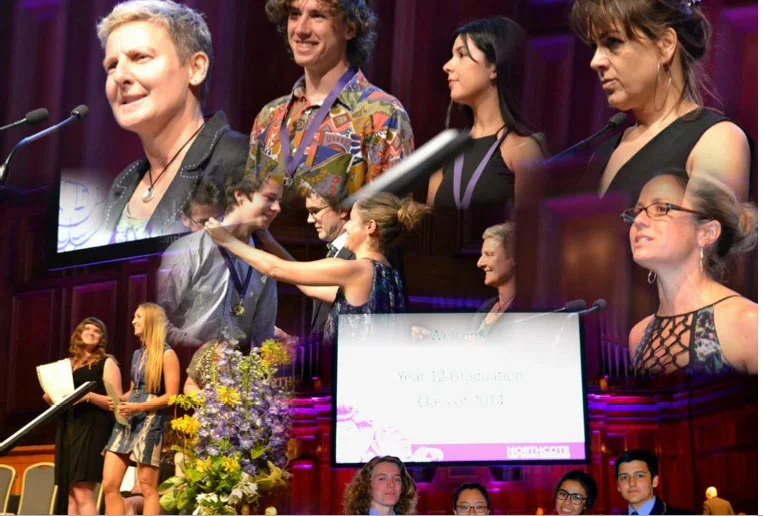
Clare Wright: 'Be ambitious, be creative, take risks', Northcote High School - 2014

November 5, 2015

26 October, 2014, Northcote High School, Melbourne, Australia

In keeping with the spirit of reconciliation, I’d acknowledge the traditional owners of the lands on which we gather today, the Wurrundjeri people, and pay my respects to their Elders, past, present and emerging. I recognize that this has always been a place of teaching, learning and celebrating rites of passage.

I’d also like to thank Kate Morris for inviting me to give the valedictory speech tonight. It’s a great honour and a great pleasure to have the chance to join you all in this special milestone event.

I reckon I’m well placed in several respects to stand behind the microphone.

For one, I was myself a Year 12 students once, back when dinosaurs roamed the earth, and I well remember my own Graduation Night in this very room.  I thought it was boring and unnecessary and bloated to bursting by long-winded speeches delivered by pompous, self-satisfied adults giving well-meaning advice that I was sure we’d all forgot by the time we spilled out onto Swanston Street and tried to find an underage drink.

I’m also the parent of two kids at Northcote High, one who will be doing his Year 12 next year.   So I have some idea of the anxieties and pressures that beset today’s high school students, particularly at the pointy end of your secondary education.  I know from the inside what those uncertainties and misgivings about the next step look like.

And, because I work at a university, I’m actually on the front line of what does happen next in that great leap forward.  Not all of you will go on to a tertiary education, but most of you will experience not only the sense of elation in finally achieving some hard-won freedom and autonomy but also the disappointment and frustration of life’s inevitable crash landings.  I watch those first year students wave and flail around and bob up and down in the heaving tide of new experiences and expectations, but I’ve yet to see one drown.

So now that I’ve convinced you that I’m the right woman for the job tonight, or perhaps that I’m one of those smug windbags I abhorred when I was 17, let me begin.  I want to tell you a bit about me, a bit about you, and a bit about the country we live in.

First to me: my favourite topic.  I did my Year 12, or HSC as it was known then, at MacRobertson Girls High School in 1986.  (The Maths Methods students have just figured out I’m 45.)  I got straight A’s for my final exams, with a perfect 100% in English.  It was the last perfect thing I ever did, though it would take me until I was about 40 to realize that perfection wasn’t the goal.  I took a Gap Year, worked and lived in Canada, travelled in Europe on the money I made waitressing in Toronto.  I lied on my job application.  Told the restaurant manager I was 18 and knew how to make a good coffee.  (I was from Melbourne wasn’t I?)  I snogged boys and ate a lot of junk food.  From those experiences I learnt that it’s hard to make a good coffee, that it’s much easier to get boys to kiss you than to take you seriously, and that eating fast food was about as satisfying as being a fast girl. 

I came back to Australia and started an Arts/Law Degree at Melbourne Uni.  I did Law because that’s what you were expected to do if you got straight A’s in your Year 12 exams.  I spent a lot of the first semester of Uni crying.  I felt homesick in my own home and I hated Law.  (Well, I actually loved the intellectual rigour of Law as a discipline, but I could see that Law as a profession was going to right for me.)

But in the midst of that confusing, lonely year, I was very lucky.  I fell in love twice.  I fell in love with the boy who is now my husband and the father of my three children.  We’ve been together for 26 years, enjoying a relationship of true companionship, respect, conversation and humour.  I also fell in love with History, the Uni subject I most adored, despite the fact that I had no idea what I could possible do with it.  And I was fortunate for another reason: when I told my parents I wanted to drop Law and just study History, they told me to do whatever made me happy.  They told me to do what I must do, and do it well.  (I later discovered that’s a line out of a Bob Dylan song, but it was well chosen for the occasion.)

And so, that is what I have done.  I did an Honours degree in History, a Masters degree in History, a PhD and postdoctoral research in history.  I’ve published two history books and made two history documentaries for tv.  I’ve won awards and received numerous grants and scholarships.  But I also need you to know that my path to professional success and personal fulfillment hasn’t been all straight and narrow.  I’ve suffered periods of depression and anxiety, moments of profound despair, and run myself ragged in the attempt to be 100% in control and on top of my game.  I learnt the hard way that it’s ok to fail every once and a while.

I tell you all this because I’m sick to death of watching successful women either undermine their own achievements or blame themselves for every blemish. 

Girls, be proud of your accomplishments, don’t apologise for your strengths and talents, don’t be afraid to take up too much space, don’t be silent about your dreams and your grievances.  There is enough in our public culture to demean and trivialize you, and enough in even our own homes to threaten and belittle you, that you do not need to contribute to your own denigration.   And boys, trust the women around you.  They will be your friends, your workmates, your bosses, your lovers and your staunchest allies.  Give them credit where credit is due, and give yourself some credit too: credit for having the courage to swim against the tide of prejudice and discrimination that can so easily carry us away.

Since the death of Gough Whitlam earlier this week, there has been a lot of reflection about the legacy of this larger-than-life former Prime Minister.  Whitlam came to power at a time in Australia’s history when there was a great wave of restless energy and ambition, largely on the part of young people, to change the world that they had no choice but to live in.  The era was not unlike the gold rush period that my latest book is about: a youthful population who were angry about the fact that they had no right to participate in the institutions or systems of making the very laws that governed them.  Later, once men had secured democratic voting entitlements, women also began to fight for their rights to be heard, to be recognized, to be treated as full and equal citizens.  And in the 1960s white men and women came together to support indigenous Australians to also be included in the democratic process.  At this same time, young men were being sent off to fight a war that most Australians didn’t support – imagine that: instead of leaving school and going to uni or learning a trade or starting your own business, you are being shipped off to Vietnam whether you like it or not — and non-European people could still be excluded from entering the country under the legal framework of the White Australia Policy.  Successive conservative governments had turned a blind eye to the changes in the Australian population and the global movement towards social justice.

And then along came Gough – with the election campaign slogan IT’S TIME.  Time for a better, stronger, fairer Australia.  Time to use power to make a difference.  You will have heard a lot this week about his reforms: indigenous land rights, single mother’s pensions, free tertiary education.  But I want to read you some lines from one of my favourite of Whitlam’s speeches.  He said these words in Ballarat on 3 December 1973, while unveiling a newly restored Eureka Flag.

He said: “the kind of nationalism that every country needs … is a benign and constructive nationalism [that] has to do with self-confidence, with maturity, with originality, with independence of mind.  If Australia is to remain in the forefront of nations … if it is determined to be a true source of power and ideas in the world, a generous and tolerant nation respected for its generosity and tolerance, then I believe that something like ‘the new nationalism’ must play a part in our government and in the lives of us all”.

With his deeds in the parliament, and his carefully chosen words at moments like these, Whitlam created a vision of the sort of country Australia could be.  He wanted this country to be the BEST country it could be.  He didn’t try to instill fear and anxiety among the Australian people.  He didn’t say that it was okay to be a bigot or a racist or a homophobe or a sexist pig because what harm was there in a little fun right?  He didn’t try to set neighbor against neighbor; community against community, in the hope that a scared and vulnerable population would cling to the familiar terrain of what they already knew of the world and its ways.  “Better the devil you know”, goes the saying (or the Kylie Minogue song if you’d prefer), but that is such a monumentally unadventurous and conformist position from which to face life that no self-respecting teenager could ever agree.  “Workers of the world: you’ve got nothing to lose but your chains” is the aphorism I prefer.  If you don’t try to change the world, who will?

So what does all this have to do with you.  Gough Whitlam was the Prime Minister in 1972, long before you were born.  Ancient history.  And I’m certainly not trying to turn you all into Marxists.

But listen closely to Whitlam’s language: self-confidence, maturity, originality, independence of mind, generosity, tolerance.  These were all values and attributes that Whitlam wanted for Australia.  And as you make this tentative but inevitable leap from high school to the world of work and higher education, they are exactly the skills and outcomes I wish for each and every one of you.

Some, but not all, of you will be high flyers.  Few of you, I sincerely trust, will be low hanging fruit. You have been given far too good an education to resort to that.  Most of you will live quietly productive lives, making objects, making homes, making children, making money, making grand designs.  I hope more of you are producers than consumers.  You will be happier, believe me.  But all of you will have to make choices about what sort of person you want to be and what sort of a country you want to live in.

And here I have only one piece of advice: do what you must do, and do it well.

Be ambitious, be creative, take risks with your ideas, your philosophies, your opinions. Make mistakes, learn from them, reach out when you are flailing and throw others a line when you can see that they are not waving but drowning too.

In other words, be your best self.  It’s all — and everything — you can be.

Enjoyed this speech? Speakola is a labour of love and I’d be very grateful if you would share, tweet or like it. Thank you.

Facebook Twitter Facebook
In STUDENT HIGH SCHOOL Tags CLARE WRIGHT, NORTHCOTE HIGH SCHOOL, WOMEN, WHITLAM, INDIGEONOUS AUSTRALIANS, HISTORY, HISTORIAN, YEAR 12, HIGH SCHOOL
Comment

See my film!

Limited Australian Season

March 2025

Details and ticket bookings at

angeandtheboss.com

Support Speakola

Hi speech lovers,
With costs of hosting website and podcast, this labour of love has become a difficult financial proposition in recent times. If you can afford a donation, it will help Speakola survive and prosper.

Best wishes,
Tony Wilson.

Become a Patron!

Learn more about supporting Speakola.

Featured political

Featured
Jon Stewart: "They responded in five seconds", 9-11 first responders, Address to Congress - 2019
Jacinda Ardern: 'They were New Zealanders. They are us', Address to Parliament following Christchurch massacre - 2019
Dolores Ibárruri: "¡No Pasarán!, They shall not pass!', Defense of 2nd Spanish Republic - 1936
Jimmy Reid: 'A rat race is for rats. We're not rats', Rectorial address, Glasgow University - 1972

Featured eulogies

Featured
For Geoffrey Tozer: 'I have to say we all let him down', by Paul Keating - 2009
for James Baldwin: 'Jimmy. You crowned us', by Toni Morrison - 1988
for Michael Gordon: '13 days ago my Dad’s big, beautiful, generous heart suddenly stopped beating', by Scott and Sarah Gordon - 2018

Featured commencement

Featured
Tara Westover: 'Your avatar isn't real, it isn't terribly far from a lie', The Un-Instagrammable Self, Northeastern University - 2019
Tim Minchin: 'Being an artist requires massive reserves of self-belief', WAAPA - 2019
Atul Gawande: 'Curiosity and What Equality Really Means', UCLA Medical School - 2018
Abby Wambach: 'We are the wolves', Barnard College - 2018
Eric Idle: 'America is 300 million people all walking in the same direction, singing 'I Did It My Way'', Whitman College - 2013
Shirley Chisholm: ;America has gone to sleep', Greenfield High School - 1983

Featured sport

Featured
Joe Marler: 'Get back on the horse', Harlequins v Bath pre game interview - 2019
Ray Lewis : 'The greatest pain of my life is the reason I'm standing here today', 52 Cards -
Mel Jones: 'If she was Bradman on the field, she was definitely Keith Miller off the field', Betty Wilson's induction into Australian Cricket Hall of Fame - 2017
Jeff Thomson: 'It’s all those people that help you as kids', Hall of Fame - 2016

Fresh Tweets


Featured weddings

Featured
Dan Angelucci: 'The Best (Best Man) Speech of all time', for Don and Katherine - 2019
Hallerman Sisters: 'Oh sister now we have to let you gooooo!' for Caitlin & Johnny - 2015
Korey Soderman (via Kyle): 'All our lives I have used my voice to help Korey express his thoughts, so today, like always, I will be my brother’s voice' for Kyle and Jess - 2014

Featured Arts

Featured
Bruce Springsteen: 'They're keepers of some of the most beautiful sonic architecture in rock and roll', Induction U2 into Rock Hall of Fame - 2005
Olivia Colman: 'Done that bit. I think I have done that bit', BAFTA acceptance, Leading Actress - 2019
Axel Scheffler: 'The book wasn't called 'No Room on the Broom!', Illustrator of the Year, British Book Awards - 2018
Tina Fey: 'Only in comedy is an obedient white girl from the suburbs a diversity candidate', Kennedy Center Mark Twain Award -  2010
Tina Fey: 'Only in comedy is an obedient white girl from the suburbs a diversity candidate', Kennedy Center Mark Twain Award - 2010

Featured Debates

Featured
Sacha Baron Cohen: 'Just think what Goebbels might have done with Facebook', Anti Defamation League Leadership Award - 2019
Greta Thunberg: 'How dare you', UN Climate Action Summit - 2019
Charlie Munger: 'The Psychology of Human Misjudgment', Harvard University - 1995
Lawrence O'Donnell: 'The original sin of this country is that we invaders shot and murdered our way across the land killing every Native American that we could', The Last Word, 'Dakota' - 2016