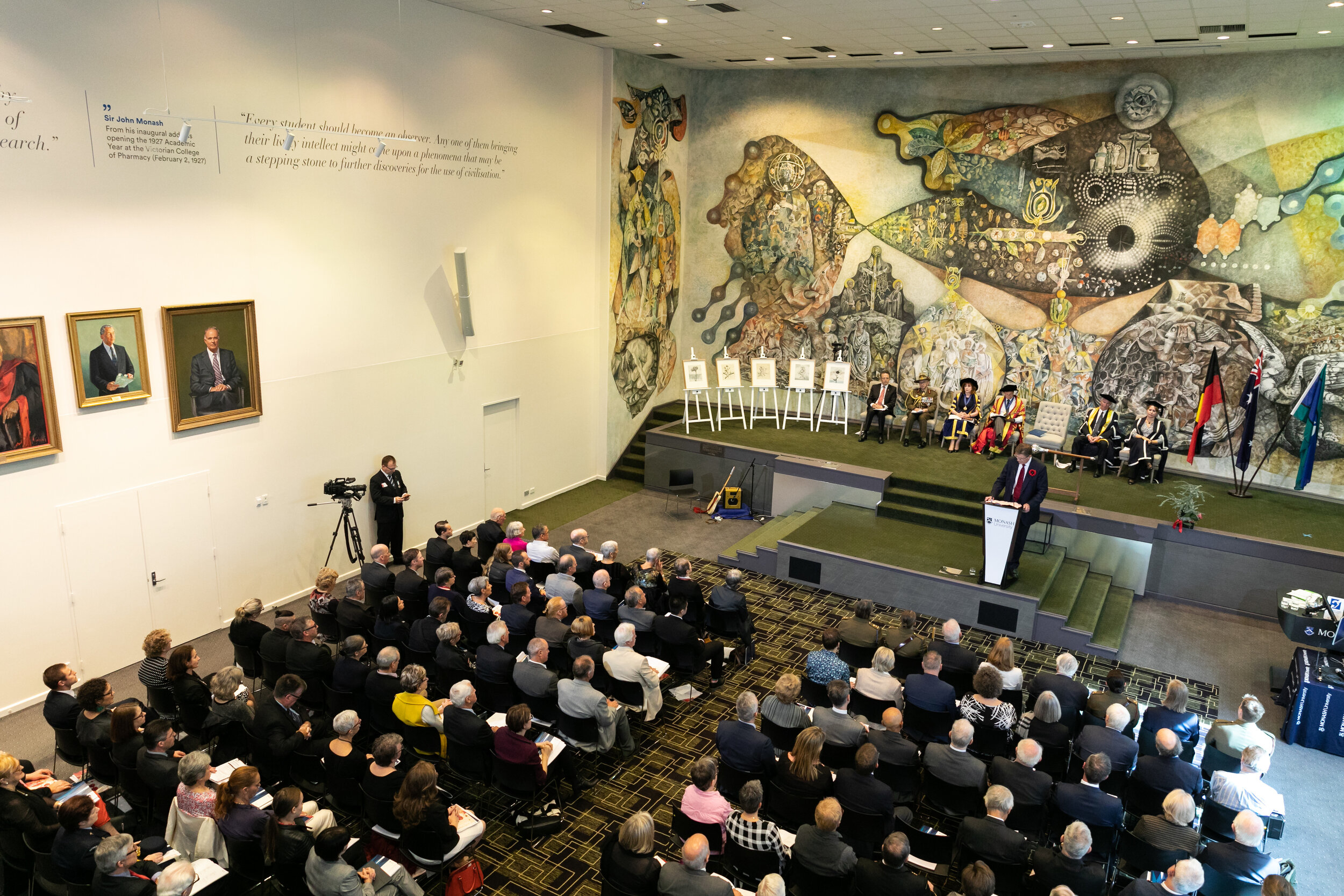
13 May 2023, Hillsdale, Michigan, USA
Congratulations to the Hillsdale College Class of 2023. It is a thrill to be here at Hillsdale, which I have heard about for a long time. Last night I had a wonderful tour of campus, and the evening culminated in a concert in your beautiful chapel. The concert included Mahler’s First Symphony played by the student orchestra and was just marvelous.
When I was a theology professor, I taught a course on the Reformation for many years, taking seriously the works of Luther and Calvin and other reformers. I believe the questions the reformers raise, questions that still divide the churches, are important. But right now, all of us who believe in God and are disciples of the Lord Jesus Christ have a common enemy in the agnosticism, atheism, and nihilism that are deeply affecting our culture and especially the minds of young people. I believe it is important for us to join together in common cause against this common enemy. And it is in that spirit that I come before you today.
It is to the permanent honor of this college that it was founded, almost 180 years ago, by Free Will Baptists who were committed to the abolition of slavery. Hillsdale’s founders were on the right side of the most compelling moral debate of the nineteenth century—and it is worth remarking that the leadership of this college today finds itself on the right side of the most pressing ethical argument of our time—namely, the protection of the unborn.
Frederick Douglass, a former slave who became one of the most eloquent advocates for abolition in the nineteenth century, spoke here in 1863, just after the issuance of the Emancipation Proclamation. In the course of his lecture, “Popular Error and Unpopular Truth,” he remarked, “There is no such thing as new truth; error might be old or new, but truth is as old as the universe.” At the heart of the Hillsdale College curriculum is a presentation of these truths—epistemic, moral, and aesthetic—that are indeed as old as the universe, permanent things that participate in the eternity of God.
What I should like to do briefly in this commencement address is examine just one of these truths, which is articulated over and again in the great Western intellectual tradition. It is typically accessed by means of a question—not the question of what we are to do, as important as that is, but rather what kind of person we ought to be. Do we hunger and thirst for righteousness? Or do we seek our own advantage? In a way, there is no question in the moral and spiritual order more fundamental than that.
A locus classicus for studying this question is found in Plato’s Gorgias. In this dialogue, the character Gorgias is a sophist—which is to say, an expert in teaching the art of persuasive speech. Polus and Callicles are his students. Their concern is not being truthful or just but rather speaking in such a way that they appear truthful or just and hence become convincing to others. Such sophists were, obviously enough, enormously useful to prospective lawyers and politicians in ancient Greece, and it should be equally obvious that their intellectual descendants are rather thick on the ground today.
Socrates counters Gorgias and his students along these lines: if a rhetorician teaches a politician to do what is unjust, he does that man and his city far more harm than good. To this, Polus answers by means of a taunt: wouldn’t Socrates leap at the opportunity of having the power of life and death over others? No, Socrates says in response, for to put someone to death unjustly is in fact no power at all. And it is at this point that Socrates enunciates one of his most enduring teachings, a teaching that represents a watershed in the moral consciousness of the West: it is better, he says, to suffer wrongdoing than to do wrong oneself.
At this point, Callicles can no longer restrain himself. Giving clear voice to a position that endures to the present day, he says that what Socrates is calling “justice” is nothing but the constraints placed on the few strong by the many weak. It is a sort of guilt-trip imposed by the powerless to limit the capacity of the powerful to get what they want. If you notice a tight connection between this point of view and the philosophy of Friedrich Nietzsche, you are not wrong. Socrates’ argument for his position is simple: surely suffering injustice is terrible, but what is worse is the corrosion of soul that takes place when one commits injustice. In other words, being unjust is far more damaging to the moral structure of a person’s character than enduring the slings and arrows of injustice.
So there’s the question, young graduates. What kind of soul will you have? What kind of person will you be? Will you do whatever it takes to get what you want? Or will you accept even great suffering in order to do what is right? Everything else in your life will flow from your answer to that question.
I know that Hillsdale College is committed to the study of the Greco-Roman intellectual tradition, and it is for this reason that I commenced with Plato. But Hillsdale is also, and above all, committed to the Scriptures. The Bible gets at this very same issue, not so much through philosophical argumentation, but through the prophetic language of idolatry and right worship.
For the biblical authors, it is never a question of “religion” vs. “secularism.” First of all, they were not trading in what we call religion, and secondly, they knew that there really is no pure secularism. Rather, they understood that the world is basically divided between those who worship the one true God and those who indulge in idolatry or false worship. Even in our supposedly secular society, we can appreciate the appropriateness of the biblical terminology, for everyone, even the most un-churched, operates under the aegis of something he or she considers supreme, a summum bonum or highest good. No one would get out of bed in the morning unless he believed in some value that is ultimately motivating his actions and decisions. This might be bodily pleasure or fame or material goods, or it might be one’s country or family, but if it is functioning as the prime mover of a person’s activity, it is playing the role of a god and it is being, in effect, worshiped.
So the biblical form of the question we have been considering is: whom or what do you worship? Again, everything in your life will flow from your answer.
There are numberless biblical texts that are relevant to this question, but I should like to look at a particularly clarifying and dramatic one—namely, the scene described in the First Book of Kings regarding Elijah and the priests of Baal.
We recall the setting. Elijah had called out King Ahab for his worship of the false gods proposed by his wife Jezebel. He subsequently challenged the avatars of these deities to a kind of duel on Mount Carmel. Standing alone against the 450 devotees of Baal, Elijah proposed that he and they should erect altars to their respective deities and see who would respond. All morning long, the priests cried out, “Oh Baal, answer us!” But, the Bible says, “there was no voice, and no answer.”
At this point, Elijah mocked them: “Cry aloud! Surely he is a god; either he is meditating, or he has wandered away, or he is on a journey, or perhaps he is asleep and must be awakened.” In their frenzy and frustration, the priests of Baal proceeded to “cut themselves with swords and lances until the blood gushed out over them,” but it was to no avail. Then, of course, Elijah calls out to the Lord and the fire falls, consuming the sacrifice and vindicating the prophet.
What I would like to emphasize is that this is much more than a jingoistic story of “My God is bigger than your god.” In point of fact, it is an incomparably rich presentation of the dynamics of true and false worship. The altar erected to Baal should be taken as standing for all the ways in which we order the infinite longing of our hearts to something less than God. When we do this, the fire never falls, because merely worldly things cannot, even in principle, satisfy our hungry souls. And when we persist in worshiping falsely, we find ourselves, in short order, caught in an addictive pattern, hopping obsessively, as it were, around the altar of pleasure, power, or fame, desperately seeking a satisfaction that will never come.
The self-harm inflicted by the hapless priests of Baal speaks eloquently to the self-destructive quality to which any addict can attest. Only when the fondest desire of our soul is directed to the infinite God will the fire fall and addiction be avoided. So once again, young graduates, the question is simple: at which altar will you worship? Your whole life will unfold, for weal or for woe, from that decision.
If we would like to see the place where Plato and Elijah come together, we need look no further than the cross of Jesus, which St. Paul described as a divine weakness stronger than human strength and a divine folly wiser than human wisdom. Where could we find a clearer instantiation of the principle that it is better to suffer injustice than to commit it than in Jesus crucified? Sinless, blameless, he nevertheless took upon himself all the sin of the world: hatred, cruelty, stupidity, violence, institutional corruption, betrayal, denial—all of it. But rather than lashing out in answering violence, he said, “Father, forgive them; for they do not know what they are doing.” Laboring under the full weight of human wickedness, his soul remained inviolate. And this is why, to the consternation of all of the advocates of “might makes right,” from Callicles to Nietzsche, we hold up the cross and say, “Ecce homo,” behold the true man.
My intellectual hero, St. Thomas Aquinas, said that if we want to live a happy life, we should love what Jesus loved on the cross and despise what he despised on the cross. What did he despise but all of those objects of false worship to which we tend to erect altars. Many of us worship wealth, but on the cross he was utterly poor, stripped naked; many of us worship pleasure, but on the cross he was at the limit of suffering, both physical and psychological; many of us worship power, but on the cross he was nailed in place, unable even to move; and many of us worship honor, but on that terrible cross he was the object of scorn and ridicule. In short, the crucified Lord said no as radically as possible to the idols. But what did he love on the cross? He loved doing the will of his Father. The cross itself functioned as the altar on which the sacrifice of his life to the Father took place, and this is why the fire fell.
The 1966 film A Man for All Seasons, based on Robert Bolt’s play of the same name, tells the story of St. Thomas More, a man well-acquainted with the philosophies of classical antiquity and a man in love with the Lord Jesus. One of the last scenes of the film depicts the dramatic trial of More, under accusation for high treason. Richard Rich, who as a young man had been Thomas More’s friend and protégé, falsely testifies against him, perjuring himself and practically guaranteeing that More will receive the death penalty. As Rich is leaving the courtroom, More notices that the younger man is wearing a chain of office. Inquiring of the judges what the symbol at the end of the chain means, More receives the answer: “Sir Richard is appointed Attorney General for Wales.” More grasps the pendant and with a look more pitying than indignant, comments, “Why Richard, it profits a man nothing to give his soul for the whole world—but for Wales?” More was not so much blaming Rich, as noticing, with infinite sadness, the kind of person he had become: a man with a corroded soul.
It might have been otherwise. In a lesser-known scene from earlier in the film, More suggests Rich pursue a job as a humble teacher, but Rich, ambitious for glory at the king’s court, balks. The wise More says, “You’d be a fine teacher, perhaps a great one.” His protégé retorts angrily, “If I was, who would know it?” More patiently responds, “you, your pupils, your friends, God. Not a bad public, that.” This exchange provides us a third way of asking our question: to which audience, finally, are you playing? A lost soul plays to the endlessly fickle audience of the world, hoping thereby to acquire the fleeting goods that the world can provide. The uncorroded soul plays to God and to the friends of God, seeking to please them alone.
St. John Paul II, in his writings on the moral life, observed that in every particular ethical choice a person makes, he is doing two things simultaneously. He is performing a moral act with definite consequences, and he is making his character—crafting, little by little, the person he is becoming. I have the confident hope that your years at Hillsdale College have prepared you, above all, to shape your characters, to become the kind of men and women who would endure injustice rather than commit injustice, who would never dream of worshiping at the altar of an idol, and who wouldn’t surrender the integrity of your souls for the whole world.
And if you become the persons God intends you to be, you will succeed in lighting a fire upon the earth.