
• Genre
  • About
  • Submissions
  • Donate
  • Search
Menu

Speakola

All Speeches Great and Small
  • Genre
  • About
  • Submissions
  • Donate
  • Search

Commencement and Graduation

Inspiring, humorous, wisdom imparting. Some of the best speeches are delivered in the educational context. Upload your commencement or graduation speech here.

Chimamanda Ngozi Adichie: 'Above all else, do not lie', Harvard University Class Day - 2018

November 29, 2018

23 May 2018, Boston, Massachusetts, USA

Good afternoon.
Harvard class of 2018, hello.
Thank you so much for asking me to be here today, it meant a lot to me, to know that you the students select the class day speaker. Thank you.
Congratulations to you and to all your loved ones who are here.

I spent a wonderful year at the Radcliffe Institute here at Harvard, doing a fellowship in 2011 and I fell in love with Cambridge and so it’s very good to be back.
My name is Chimamanda, in Igbo it means my personal spirit will never be broken. I’m not sure why but some people find it difficult to pronounce, a few years ago I spoke at an event in London,the English woman who was to introduce me had written my name phonetically on the piece of paper, and backstage she held on tightly to this paper while repeating the pronunciation over and over. I could tell, she was very eager toget it right.
And then she went on to the stage and gave a lovely introduction and ended with the words ‘ladies and gentlemen please welcome chimichanga.’

I told this story at a dinner party shortly afterwards and one of the guests seemed very annoyed that I was laughing about it, ‘that was so insulting’ he said ‘that English woman could have tried harder.’ But the truth is she did try very hard, in fact she ended up calling me a fried burrito because she had tried very hard and then ended up with an utterly human mistake. That was the result of anxiety.
So, the point of this story is not to say that you can call me chimichanga.The point is that intent matters, that context matters. Somebody might very well call me chimichanga out of a malicious desire to mock my name and that I would certainly not laugh about, for there is a difference between malice mistake and a mistake.
We now live in a culture of calling out, a culture of outrage, and you should call people out, you should be outraged, but always remember context and never disregard intent.

If I were asked the title of my address today, I would say Above all else do not lie or don’t lie too often,which is really to say tell the truth. But lying, the word, the idea, the act has such political potency in America today, but it somehow feels more apt. Above all else do not lie.

I grew up in Nigeria through military dictatorship and through incipient democracies and America always felt aspirational when yet another absurd thing happened politically we would say, this can never happen in America. But today the political discourse in America includes questions that are straight from the land of the absurd. Questions such as should we call a lie a lie? When is a lie a lie?
And so, class of 2018 at no time has it felt as agent as now that we must protect and value the truth.
Before I tell you about lying, I must first admit to lying. I routinely lie about my height even at the doctor’s office. In Lagos when I am meeting friends for lunch, I lie about being stuck in traffic when I’m really still at home only just getting dressed.
Now there are other lies, sadly however, I cannot tell you without having to kill you afterwards. But what I know is that I have always felt my best and done my best when I fear toward the truth when I don’t lie and my biggest regrets of my life are those times when I did not have the courage to embrace the truth.
Now telling the truth does not mean that everything will work out, actually it sometimes doesn’t. I’m not telling you to tell the truth because it will always work out, but because you will sleep well at night. And there’s nothing more beautiful than to wake up every day holding in your hand the full measure of your integrity.


Many years ago, before my first novel was published, I attended a writer’s conference here in the US. It was a gathering of many aspiring writers and a few established writers. Now the former, the aspiring writers sucking up to the latter, the established writers – was a revered ritual of the conference and so during one of the breaks I walked up to a man, an established writer whose name I knew well but whose work had not read. I shook his hand and told him what a fan I was, ‘I love your work’ I said. His wife was sitting next to him, ‘Which of his books have you read?’ she asked and I froze. ‘which have you read?’ she asked again.


Everyone at the table was quiet, watching, waiting. I smiled a mad smile, and I mumbled ‘the one about the man discovering himself’ which of course was complete bullshit.


But I thought it might be convincing because that kind of describes half of all the novels written by men. And the I fled but before I fled, I heard the writer say to his wife ‘honey you shouldn’t have done that.’ But the truth is that I shouldn’t have done that.

To read a novel is to give honor to art, why lie about giving honor to something to which you have not?
I was of course absolutely mortified that day but I have come to respect what that writer’s wife had, a fantastic bullshit detector and now that I have the good fortune of being an established writer, one who does not like to miss an opportunity to wallow in praise by the way, I can sense when a person is saying empty words and it feels much worse than they had said nothing at all, so have a good bullshit detector. If you don’t have it now, work on it. But having that detector means that you must also use it on yourself. And sometimes the hardest truths are those we have to tell ourselves.
When I started sending out my early writing to agents and publishers and started getting rejections, I convinced myself that my work had simply not found the right home, which might have been true. But there was another truth that took me much longer to consider, that the manuscript was not good. And in fact, the first novel I wrote or what I thought was a novel, eventually needed to be put away in a drawer and I’m so grateful that it was never published.


It is hard to tell ourselves the ruth about our failures, our fragilities, our uncertainties, it is hard to tell ourselves that maybe we haven’t done the best that we can. It is hard to tell ourselves the truth of our emotions that maybe what we feel is hurt rather than anger, that maybe it’s time to close the chapter of a relationship and walk away. And yet when we do, we are the better off for it.


I understand that the Harvard College mission calls on you to be citizen leaders, I don’t even know what citizen leader means. It sort of sounds like a Harvard Graduate saying I went to college in Boston, which by the way has to be the most immodest form of modesty. Please class of 2018 when you are asked where you went to college just say Harvard.


By the way I went to Yale for graduate school, not New Haven which has other universities, but we also know that in the grand snobbery sweepstakes of prestigious American colleges, grad school doesn’t really count, it’s undergrad that counts. So it’s entirely possible I don’t even know how this works.


So you’re charged to be citizen leaders which I suppose it means you’re charged to be leaders. I often wonder who will be led if everyone is supposed to be a leader. But whether you are the leader or whether you’re the led I urge you to always bend towards the truth, to err on the side of the truth.


And to help you do this, make literature your religion, which is to say read widely, read fiction and poetry and narrative nonfiction. Make the human story the center of your understanding of the world. Think of people as people, not as abstractions who have to conform to bloodless logic but as people, fragile, imperfect, with pride that can be wounded and hearts that can be touched.


Literature is my religion. I have learned from literature that we humans are flawed, all of us are flawed. But even while flawed, we are capable of enduring goodness, we do not need first to be perfect before we can do what is right and just.


And you Harvard class of 2018 are not unfamiliar with speaking the truth. When you stood alongside dinning-hall walkers during the strike, when you protested the end of daca when, when you supported the Black Lives Matter movement, you were speaking the truth about the dignity that every single human being deserves. I applaud you. I urge you to continue.
But remember outside the cocoon of Harvard, the consequences will be greater, the stakes will be higher, please don’t let that stop you from telling the truth. Sometimes especially in politicized spaces, telling the truth will be an act of courage, be courageous.


Never set out to provoke for thesake of provoking, but never silence yourself out of fear that the truth youspeak might provoke, be courageous.
People can be remarkably resistant to the fact that they do not like, but don’t let that silence you from speaking the truth, be courageous.
Be courageous enough to acknowledge that even if there is no value in the position of the other side, there is value in knowing what that position is. Listen to the other side at least the reasonable other side.


Be courageous enough to acknowledge that democracy is always fragile and justice has nothing to do with the political left or the political right.


Be courageous enough to recognize those things that get in the way of telling the truth, the empty cleverness, the morally bankrupt irony, the desire to desire to please, the deliberate of fuchsia, the tendency to confuse cynicism for sophistication.


Be courageous enough to accept that life is messy. Your life will not always perfectly match your ideology, sometimes even your choices will not align with your ideology. Don’t justify and rationalize it, acknowledge it. Because it is in trying to justify that we get into that twisting dark unending tunnel of lies from which it is sometimes impossible to re-emerge whole.
Be courageous enough to say I don’t know. This might be harder to do with everyone calling you ‘Harvard’. But ignorance accepted is an opportunity, ignorance denied is a closed door, and it takes courage to admit to the truth of what you do not know.

Some people think that Harvard is the best school in the world, personally I’m not sure I need to know what my people at Yale think about that. But I do know that for many people all over the world, Harvard has become much more than just a school. Harvard is a metaphor for untouchable intellectual achievement


Now that you are Harvard graduates the world will make assumptions about you, many of them will be to your benefit, such as the assumption of competence and intelligence, employers will pay attention to your resume when they see Harvard on it. But there will be other assumptions, people who don’t know anything about you except that you went to Harvard will assume that you feel superior, that you think you’re all that. They will roll their eyes when you make a normal human mistake.


So you will inspire resentment and hopefully that will help you keep in mind the humanity of every one including the privileged.


But these assumptions that people will make about you are minuscule compared to the enormous privilege that comes with a Harvard degree. You now have a certain kind of access, a certain kind of power. And I know it is terribly cliché to say that you must now use this power to change the world but really, you must now use this power to change theworld.


Change a slice of the world, nomatter how small. If you fell a sense of dissatisfaction with the status quo,nurture that dissatisfaction, be propelled by your dissatisfaction, act, get into the system and change the system. Challenge the still assumptions that undergrad, so many of America’s cultural institutions tell new stories, champion new storytellers because the truth is that the universal does not belong to anyone group but people, everybody’s story is potentially universal, it just needs to be told well.


Change the media in America, make it about truth, not entertainment, not about profit making but truth. And while you’re doing it, be astute about when you need balance and when you don’t. Because sometimes seeking balance gets in the way of telling the truth. If you’re reporting about the sun rising in the east, you do not need to hear the other side because there’s no real other side.


A Harvard degree will give you access and opportunities, but sadly I have to inform you that it will not make you invincible, you still have that fragile human core at the center of all of us. There will be times when petrified of failing, when fear of failure holds you back, in those moments here is the truth that is easy to forget, you don’t actually know that you will fail.


I was lucky to be given a great gift by the universe, knowing from childhood what I loved most. I was lucky to have wonderful supportive parents. Writing is what I love, had I not had the good fortune of being published I would be somewhere right now completely unknown, possibly broke but I would be writing.


Some of you here today know what you love, and some of you don’t. if you don’t know, you will. If not something that you love, then something that you like or something that you don’t hate – or something. You will find it. But to find it you must try. The wonderful Shonda Rhimes said very wisely that you have to do something until you can do something else. Try. If doesn’t work out, try something else.

I knew from spending a year in medical school that it was not for me, actually that’s not true I knew even before medical school but going to medical school clarified it for me and it’s not wasted time it’s experience and experience will serve you in ways you do not expect.

I cannot tell you how many times in the course of writing my second novel Half of a Yellow Sun which was a deeply emotional book for me, I felt chocked with uncertainty. I would climb into bed and eat chocolate. But I knew that with all the chocolate eating, after all the sinking into a dark place, that I would get up and keep writing.

I cannot tell you how often I would sit down to write and instead I would find myself going online to look at shoes and to put different shoes in various online carts and then remove some and put some back and order some and not order some.

I’m actually thinking of starting a society of esteemed procrastinators and I suspect many of you would probably sign up. Procrastination is a form of fear and it is difficult to acknowledge fear. but the truth is that you cannot create anything of value without both self doubt and self belief. Without self doubt you become complacent, without self belief you cannot succeed, you need both.

And there is also the fear of measuring up – of keeping up, which for you might be heightened by the heavy weight of all those Harvard expectations. I want to share a line from a lovely poem by Mary Oliver, whoever you are, no matter how lonely, the world offers itself to your imagination.

When you fall into the funk of competition, when you compare yourself with other Harvard graduates, when you worry that you didn’t get that job at Goldman or McKenzie or in Sillicon Valley right after graduation or didnt win a Pulitzer at 30 or didn’t become a managing director or partner of something at 35, think of literature. Think of the early bloomers and the late bloomers. Think of the many experimental novels that do not follow the traditional form. Your story does not have to have a traditional arc. There is an Igbo saying which translates literary to whenever you wake up, that is your morning. What matters is that you wake up.

The world is calling you. America is calling you. There is work to be done, there are tarnished things that needs to shine again. There are broken things that need to be made whole again. You are in the position to do this. You can do it. Be courageous. Tell the truth. I wish you courage and I wish you well.
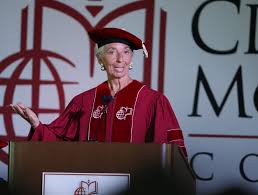
Source: https://tanzlyt.com/author-chimamanda-ngoz...

Enjoyed this speech? Speakola is a labour of love and I’d be very grateful if you would share, tweet or like it. Thank you.

Facebook Twitter Facebook
In GUEST SPEAKER F Tags CHIMAMANDA NGOZI ADICHIE, AUTHOR, TRANSCRIPT, HARVARD, HARVARD CLASS DAY
2 Comments

Michael Blomberg: 'To be honourabe, you must be honest', Rice University - 2018

November 29, 2018

12 May 2018, Rice University,. Houston, Texas, USA

David thank you for those kind words.

Good morning, everyone and Members of the Board, faculty, staff, parents and family – it really is an honor to be with you to celebrate the great Class of 2018. How about a nice round of applause for them again?

Today, you’re ready to go ‘beyond the hedges’ -- and who knows what the future holds for you.

Rice alumni have been Nobel Prize winners, cabinet members, astronauts, titans of industry, award-winning artists, and everything in between -- including the two scientists who discovered Bucky balls.

And I’m glad to say that one member of the Class of 2018 has already begun working for my company, bringing the total number of Owls at Bloomberg LP to 13, so I’m doing my part, and many of you have similar exciting plans lined up I’m sure, and that's great.

But if you don't yet know what you're going to do for the rest of your life, don't spend a lot of time worrying about it. Leave that to your parents! As excited as they are today, they'll be even more excited if you don't move back home into their basement.

So let's give a big round of applause to all the parents and families who supported you and made this day possible!

Now for the serious stuff. When I was deciding what I really wanted to say today, I kept thinking about a Rice tradition that's an incredibly important part of student life here. No, I'm not talking about Willy Week. I'm talking about the honor code.

When you first arrived on campus for O-week, you attended a presentation on the Honor Code. Your very first quiz tested your knowledge of the code, you had to say what it was about, and so today, I thought it would be fitting for you as graduates to end your time here the same way you began it: by hearing a few words about the meaning of honor.

Don't worry: There’s no quiz involved. But there will be a test when you leave this campus -- one that will last for the rest of your life. And that's what I want to explain today -- and it actually starts with the opposite of honor.

As a New Yorker, I was surprised to learn that an act of dishonor in my hometown almost blocked Rice from coming into existence. William Marsh Rice was murdered at his home in Manhattan, just a few blocks from my company's headquarters, by two schemers who tried to re-write his will.

They were caught, his money went where he wanted it to go, the university was built, and fittingly, an honor code was created that has been central to student life here from the beginning.

And ever since you arrived here on campus, on nearly every test and paper you submitted, you signed a statement that began, ‘On my honor.’ But have you ever stopped to think about what that phrase really means?

The concept of honor has taken on different meanings through the ages: chivalry, chastity, courage, strength. And when divorced from morality, or attached to prejudice, honor has been used to justify murder, and repression, and deceit. But the essence of honor has always been found in the word itself.

As those of you who majored in Linguistics probably know, the words ‘honor’ and ‘honest’ are two sides of the same coin. In fact, the Latin word ‘honestus’ can mean both ‘honest’ and ‘honorable.’

To be honorable, you must be honest. And that means speaking honestly, and acting honestly, even when it requires you to admit wrongdoing -- and suffer the consequences. The commitment to honesty is a responsibility that you accepted as an Owl. It is also, I believe, a patriotic responsibility.

As young children, one of the first things we learn about American history is the story of George Washington and the fallen cherry tree. ‘I cannot tell a lie,’ young George tells his father. ‘I cut it down.’ That story is a legend, of course. But legends are passed down from generation to generation because they carry some larger truth.

The cherry tree legend has endured because it's not really about George Washington. It's about us, as a nation. It's about what we want for our children -- and what we value in our leaders: honesty.

We’ve always lionized our two greatest presidents -- Washington and Lincoln -- not only for their accomplishments, but also for their honesty. We see their integrity and morals as a reflection of our honor as a nation.

However, today when we look at the city that bears Washington's name, it's hard not to wonder: What the hell happened?

In 2016, the Oxford English Dictionary's word of the year was ‘post-truth.’ And last year brought us the phrase, ‘alternative facts.’ In essence, they both mean: Up can be down. Black can be white. True can be false. Feelings can be facts.

A New York Senator known for working across the aisle, my old friend Pat Moynihan, once said: ‘People are entitled to their own opinions, but not their own facts.’ That didn’t used to be a controversial statement.

Today, those in politics routinely dismiss any inconvenient information, no matter how factual, as fake -- and they routinely say things that are demonstrably false. When authoritarian regimes around the world did this, we scoffed at them. We thought the American people would never stand for that!

For my generation, the plain truth about America -- the freedom, opportunity, and prosperity we enjoyed -- was our most powerful advantage in the Cold War. The more communists had access to real news, the more they would demand freedom. We believed that -- and we were right.

Today, though, many of those at the highest levels of power see the plain truth as a threat. They fear it. They deny it. And they attack it -- just as the communists once did. And so here we are, in the midst of an epidemic of dishonesty, and an endless barrage of lies.

The trend toward elected officials propagating alternate realities -- or winking at those who do -- is one of the most serious dangers facing democracies. Free societies depend on citizens who recognize that deceit in government isn’t something to shrug your shoulders at.

When elected officials speak as though they are above the truth, they will act as though they are above the law. And when we tolerate dishonesty, we get criminality.

Sometimes, it's in the form of corruption. Sometimes, it's abuse of power. And sometimes, it's both. If left unchecked, these abuses can erode the institutions that preserve and protect our rights and freedoms -- and open the door to tyranny and fascism.

Now, you might say: There’s always been deceitful politicians and dishonest politicians -- in both parties. And that's true. But there is now more tolerance for dishonesty in politics than I have seen in my lifetime. And I've been alive for one-third of the time the United States has existed! I know, you find that hard to believe. So do I, but if you do the math, that’s what it is.

My generation can tell you: The only thing more dangerous than dishonest politicians who have no respect for the law, is a chorus of enablers who defend their every lie.

Remember: The Honor Code here at Rice just doesn’t require you to be honest. It requires you to say something if you saw others acting dishonestly. Now that might be the most difficult part of an honor code, but it may also be the most important, because violations affect the whole community.

And the same is true in our country. If we want elected officials to be honest, we have to hold them accountable when they are not -- or else suffer the consequences.

Now, don't get me wrong: honest people can disagree. That's what democracy is all about! But productive debate requires an acceptance of basic reality.

Take science for example: If 99 percent of scientists whose research has been peer-reviewed reach the same general conclusion about a theory, then we ought to accept it as the best available information -- even if it's not a 100 percent certainty.

Yes, climate change is only a theory -- just like gravity is only a theory. And the fact that Newton's theory of motion didn’t take into account Maxwell’s observations on the speed of electromagnetic waves as a constant and that Einstein’s special theory of relativity better described motion when things move very fast -- doesn’t mean that if I let go of this pen it won’t fall to the ground.

That, graduates, is not a Chinese hoax. It's called science -- and we should demand that politicians have the honesty to respect it.

Hard though it is to believe, some federal agencies have actually banned their employees from using the phrase ‘climate change.’ If censorship solved problems, today we’d all be part of the old USSR, and the Soviets would have us speaking Russian.

Of course, it's always good to be skeptical and ask questions. But we must be willing to place a certain amount of trust in the integrity of scientists. If you aren’t willing to do that, don't get on an airplane, don't use a cell phone or microwave, don't get treated in a hospital, and don’t even think about binge-watching Netflix.

Scientific discovery permeates practically every aspect of our lives -- except, too often, our political debates.

The dishonesty in Washington isn't just about science, of course. We weren’t tackling so many of the biggest problems that affect your future – from the lack of good jobs in many communities, to the prevalence of gun violence, to the threats to the economy and threats to the environment -- because too many political leaders are being dishonest about facts and data, and too many people are letting them get away with it.

So how did we get here? How did we go from a president who could not tell a lie to politicians who can not tell the truth? From a George Washington who embodied honesty, to a Washington, D.C. defined by deceit?

It’s popular to blame social media for spreading false information. I for one am totally convinced that Selena Gomez and Justin Bieber are still dating, but the problem isn't just unreliable stories. It's also the public's willingness -- even eagerness -- to believe anything that paints the other side in a bad light. That's extreme partisanship -- and that is what's fueling and excusing all this dishonesty.

Extreme partisanship is like an infectious disease. But instead of crippling the body, it cripples the mind. It blocks us from understanding the other side. It blinds us from seeing the strengths in their ideas -- and the weaknesses of our own. And it leads us to defend or excuse lies and unethical actions when our own side commits them.

For example: In the 1990s, leading Democrats spent the decade defending the occupant of the Oval Office against charges of lying and personal immorality, and attempting to silence and discredit the women who spoke out. At the same time, leading Republicans spent that decade attacking the lack of ethics and honesty in the White House.

Today, the roles are exactly reversed -- not because the parties have changed their beliefs -- but because the party occupying the Oval Office has changed.

When someone's judgment about an action depends on the party affiliation of the person who committed it, they're being dishonest with themselves and with the public. And yet, those kinds of judgments have become so second nature that many people -- in both parties -- don't even realize that they are making them.

Now, I know it's natural to root for your own side -- especially when the other side is the Houston Cougars. But governing is not a game.

When people see the world as a battle between left and right, they become more loyal to their tribe than to our country. When power -- not progress -- becomes the object of the battle, truth and honesty become the first casualties.

You learned here at Rice that honesty leads to trust and trust leads to freedom -- like the freedom to take tests outside the classroom. In democracy, it's no different. If we aren't honest with one another, we don't trust one another, then we place limits on what we ourselves can do, and what we can do together as a country.

It's a formula for gridlock and national decline -- but graduates, here's the thing: It doesn't have to be that way.

When I was in city government, I didn't care which party proposed an idea -- and I never once asked someone his or her party affiliation during a job interview, or who they voted for. As a result, we had a dream team of Democrats, Republicans, and independents. That diversity made our debates sharper, our policies smarter, and our government better.

Arguments were won and lost on facts and data -- not parties and polls. That was why we had success. And it's been great to see other mayors around the country taking that same kind of approach. But at the national level, in Washington today, partisanship is everything. And I think the dishonesty that it produces is one of the greatest challenges that your generation will have to confront.

Of course, partisanship is not a new problem. George Washington warned against it in his Farewell Address. He referred to the ‘dangers of parties,’ and called the passion that people have for our parties, quote, ‘worst enemy’ of democracy -- a precursor to tyranny. Washington urged Americans to, quote, ‘discourage and restrain’ partisanship. Sadly, in recent years, the opposite has happened.

There is now unrestrained, rabid partisanship everywhere we look. It’s not just on social media and cable news. It's in the communities where we live, which are becoming more deeply red or more deeply blue. It’s in the groups and associations and churches we join, which increasingly attract like-minded people. It’s even in the people we marry.

Fifty years ago, most parents didn't care whether their children married a member of another political party, but they didn't want them marrying outside their race or religion, or inside their gender.

Today, thankfully, polls show a strong majority support for inter-racial, inter-religious, and same-sex marriage and that is progress. But unfortunately, the percentage of parents who don't want their children marrying outside of their political party has doubled and the more people segregate themselves by party, the harder it becomes to understand the other side, and the more extreme each party grows.

Studies show that people become more extreme in their views when they are grouped together with like-minded people. And that’s now happening in both parties. And as a result, I think it's fair to say the country is more divided by party than it has ever been since the Civil War.

Last month, legislators in South Carolina -- which was the first state in the Union to secede back in 1860 -- introduced a resolution that contemplated a debate on secession. Now it's easy to dismiss that as a fringe idea -- and let’s hope it never happens. But in like-minded groups, fringe ideas can gather momentum with dangerous speed – just remember Germany in the late 1930s.

If that continues to happen here, America will become even more divided, and our national anthem may as well become the Taylor Swift song: ‘We are never, ever, ever, getting back together.’

So why do I bring this up as you finish your time at this great university?

Well, I'm hoping you graduates will draw more inspiration from a song by a different artist: Zedd, Maren Morris, and Grey: ‘Why don't you just meet me in the middle? I'm losing my mind just a little.’

Bringing the country back together I know won't be easy. But I believe it can be done -- and if we are to continue as a true democracy, it must be done, and it will be up to your generation to help lead it.

Graduates, you're ready for this challenge. Because bringing the country back together starts with the first lesson you learned here at Rice: Honesty matters. And everyone must be held accountable for being honest. So as you go out into the world, I urge you to do what honesty requires.

Recognize that no one, nor either party, has a monopoly on good ideas. Judge events based on what happened, not who did it. Hold yourself and our leaders to the highest standards of ethics and morality. Respect the knowledge of scientists. Follow the data, wherever it leads. Listen to people you disagree with -- without trying to censor them or shout over them. And have the courage to say things that your own side does not want to hear.

I just came yesterday from visiting an old friend in Arizona, who has displayed that kind of courage throughout his life: Senator John McCain, who is currently fighting brain cancer.

Now, John and I often don’t see eye to eye on issues. But I have always admired his willingness to reach across the aisle, when others wouldn't dare.

He bucked party leaders when his conscience demanded it. He defended the honor of his opponents, even if it cost him votes. And he owned up to his mistakes -- just like that young kid with the cherry tree.

Imagine what our country would be like if more of our elected officials had the courage to serve with the honor that John has always shown on the battlefield, in Washington and in his personal life.

Graduates, after today, you will no longer be bound by the Rice honor code. It will be up to you to decide how to live your life -- and to follow your own honor code.

This university has given you a special opportunity to learn the true meaning of honor to base that code on. And now, I believe, you have a special obligation to carry it forward -- into your work places, your communities, your political discussions, and yes, into the voting booth because the greatest threat to American democracy isn't communism or jihadism, or any other external force or foreign power. It's our own willingness to tolerate dishonesty in service of party, and in pursuit of power.

So let me leave you with one final thought: We can all recite the inspiring words that begin the Declaration of Independence: We hold these truths to be self-evident --

But remember that the Founding Fathers were able to bring those truths to life only because of the Declaration's final words: ‘We mutually pledge to each other, our Lives, our Fortunes, and our sacred Honor.’

That pledge of honor and that commitment to truth is why we are here today. And in order to preserve those truths, and the rights they guarantee us, every generation must take that same pledge, and it's now your turn.

Earlier today, I told President Leebron that I'd like to make a donation to Rice. His eyes lit up! But I said, ‘No, not a financial donation.’ I told him I'd like to donate a cherry tree to be planted here on campus with a plaque that reads: ‘In Honor of the Class of 2018.’

And when you come back to campus as alumni, if you pass by the tree, I hope you'll remember why it's there -- and what it represents to our great country. And throughout your life, when you chop down a cherry tree, as we all do from time to time, admit it -- and demand nothing less from those who represent us.

Graduates, you have earned this great celebration. So tonight, have one last Honey Butter Chicken Biscuit. And tomorrow, carry the values of this great university with you, wherever you go.

You will never regret it. I make that pledge to you on my honor.

Congratulations -- and go Owls!”

Source: https://www.mikebloomberg.com/news/mike-bl...

Enjoyed this speech? Speakola is a labour of love and I’d be very grateful if you would share, tweet or like it. Thank you.

Facebook Twitter Facebook
In GUEST SPEAKER F Tags MICHAEL BLOOMBERG, RICE UNIVERSITY, TRANSCRIPT, TRUTH, PARTISAN POLITICS, HONESTY, TRUMP
Comment

Oprah Winfrey: 'In life you're either principled, or you're not', USC Annenberg - 2018

November 29, 2018

11 May 2018, USC Anneneberg, Los Angeles, California, USA

Thank you Annenberg and a special thank you to Dean Willow Bay for inviting me here today and to the parents again I say and faculty, family, friends, graduates: Good morning. I want to give a special shout out because I was happy that Dean Bay invited me, but I was going to be here anyway. Because one of my lovely daughter girls attends the Annenberg School of Journalism and is getting her master's today. So I was coming in whether I was speaking or not. So a special shout out to a young woman who I met when she was in the seventh grade and it was the first year that I was looking for smart, bright, giving, resilient, kind, openhearted girls who had 'it' that factor that means that you keep going no matter what. This was the year that I chose everybody individually and I remember her walking into the office in a little township where we were doing interviews all over South Africa and she came in and recited a poem about her teacher. And when she walked out the door I go "that's an 'it' girl. Thando Dlomo, I am here to say I am so proud of you! Long way from the township in South Africa and her aunt has flown 30 hours to be here for this celebration today. Thank you so much.

So today I come bearing some good news and some bad news for anybody who intends to build the life around your ability to communicate. So I want to get the bad news out first so you can be clear. I always like to get the bad stuff up front. So here it is. Everything around us including and in particular the internet and social media is now being used to erode trust in our institutions. Interfere in our elections and wreak havoc on our infrastructure. It hands advertisers a map to our deepest desires. It enables misinformation to run rampant. Attention spans to run short and false stories from phony sites to run circles around major news outlets. We have literally walked into traffic while staring at our phones.

Now the good news. Many of your parents are probably taking you somewhere really special for dinner tonight. I heard. I heard. I heard. I can do a little better than that. Now that I've presented some of the bad news, the good news is that there really is a solution and the solution is each and every one of you because you will become the new editorial gatekeepers, an ambitious army of truth-seekers who will arm yourselves with the intelligence, with the insight and the facts necessary to strike down deceit. You are in a position to keep all of those who now disparage real news. You all are the ones who are going to keep those people in check. Why? Because you can push back and you can answer false narratives with real information and you can set the record straight. And you also have the ability and the power to give a voice as Dean Bay was saying to people who desperately now need to tell their stories and have their stories told. And this is what I do know for sure because I've been doing it a long time. If you can capture the humanity of people... if you can just capture the humanity of the people, of the stories that you are telling, you then get that much closer to your own humanity. And you could confront your bias and you can build your credibility, hone your instincts and compound your compassion. You could use your gifts. That's what you're really here to do to illuminate the darkness in our world. So this is what I also know that this moment in time this is your time to rise. It is.

Even though you can't go anywhere. You can't stand in line at Starbucks. You can go to a party. You can't go to any place without everywhere you turn, people are talking about how bad things are, how terrible it is. This is what I know. The problem is everybody is meeting hysteria with more hysteria and then we just are all becoming hysterical and it's getting worse. What I've learned all these years is that we're not supposed to match it or even get locked into resisting or pushing against it. We're supposed to see this moment in time for what it is, we're supposed to see through it and then transcend it. That is how you overcome hysteria. That is how you overcome the sniping at one another, the trolling, the mean-spirited partisanship on both sides of the aisle, the divisiveness, the injustices and the out-and-out hatred. You use it. Use this moment to encourage you to embolden you and to literally push you into the rising of your life. And to borrow a phrase from my beloved mentor Maya Angelou. 'Just like moons and like suns with the certainty of tides just like the hopes springing high you will rise.'

So your job now, let me tell you, is to take everything you've learned here and use what you've learned to challenge the left, to challenge the right and the center. When you see something, you say something and you say it with the facts and the reporting to back it up. Here's what you have to do. You make the choice every day, every single day to exemplify honesty because the truth, let me tell you something about the truth, the truth exonerates and it convicts. It disinfects and it galvanizes. The truth has always been and will always be our shield against corruption, our shield against greed and despair. The truth is our saving grace. And not only are you here USC Annenberg to tell it, to write it, to proclaim it, to speak it, but to be it. Be the truth! Be the truth!

So I want to get down to the real reason we're here today and about an hour and a half you're going to be catapulted into a world that appears to have gone off its rocker. And I can tell you I've hosted on the Oprah Show for 25 years, the number one show, never missed a day never missed a day. 25 years, 4561 shows. So I know how to talk, I can tell you that. But I was a little intimidated coming here because graduations... it's tough. It's hard trying to come up with something to share with you that you haven't already heard. What can I possibly say because I know this any inspiration or guidance I can offer is nothing that your parents or your deans or professors or Siri haven't already provided. So I'm here to really tell you I don't have any new lessons. I don't have any new lessons but I often think that it's not the new lessons, but so much as it is really learning the old ones again and again. So here are variations on a few grand themes beginning with this pick a problem, any problem. The list is long here just a few that are at the top of my list. There's gun violence and there's climate change and systemic racism, economic inequality, media bias. The homeless need opportunity, the addicted need treatment, the Dreamers need protection, the prison system needs reforming, the LGBTQ community needs acceptance, the social safety net needs saving and the misogyny needs to stop. But you can't fix everything and you can't save every soul. But what can you do? Here now I believe you have to declare war on one of our most dangerous enemies. And that is cynicism because when that little creature sinks in its hooks into you it'll cloud your clarity. It will compromise your integrity, it will lower your standards, it'll choke your empathy. And sooner or later, cynicism shatters your faith. When you hear yourself saying it doesn't matter what one person says oh well so work, it's not going to make any difference what I do. Who cares? When you hear yourself saying that know that you're on a collision course for our culture. And I understand how it's so easy to become disillusioned, so tempting to allow apathy to set in.

Because anxiety is being broadcast on 157 channels, 24 hours a day, all night long. And everybody I know is feeling it. But these times, these times are here to let us know that we need to take a stand for our right to have hope and we need to take a stand with every ounce of wit and courage we can muster. The question is what are you willing to stand for? That question is going to follow you throughout your life. And here's how you answer it. You put your honor where your mouth is. Put your honor where your mouth is. When you give your word, keep it, show up, do the work, get your hands dirty and then you will begin to draw strength from the understanding the true knowing that history is still being written. You're writing it every day. The wheels still in spin and what you do or what you don't do will be a part of it.

You build a legacy not from one thing, but from everything. I remember when I just opened my school in 2007 I came back and I had the great joy of sitting at Maya Angelou's table. She hadn't been able to attend the opening in South Africa and I said to her 'Oh Maya, the Oprah Winfrey Leadership Academy that's going to be my greatest legacy.' I remember she was standing at the counter making biscuits and she turned, she put the dough down and she looked at me and she said 'you have no idea what your legacy will be.' I said 'excuse me? I just opened the school and these girls and it's going to be...' And she said 'you have no idea what your legacy will be because your legacy is every life you touch, every life you touch.' That changed me. And it's true you can't personally stop anybody from walking into a school with an assault rifle, nor can you singlehandedly ensure that the rights that your mothers and your grandmothers fought so hard for will be preserved for the daughters that you may someday have. It Will take more than you alone to pull 40 million Americans out of poverty, but who will you be if you don't care enough to try. And what mountains could we move I think, what gridlock could we eradicate if we were to join forces and work together in service of something greater than ourselves? You know my deepest satisfaction and my biggest rewards have come from exactly that. Pick a problem, any problem and do something about it because to somebody who's hurting, something is everything. So I hesitate to say this because there are rumors from my last big speech have finally died down, but here it is. Vote! Vote! Vote! Pay attention to what the people who claim to represent you are doing and saying in your name and on your behalf. They represent you and if they've not done right by you, if their policies are at odds with your core beliefs, then you have a responsibility to send them packing. If they go low, thank you Michelle Obama, if they go low, we go to the polls. People died for that right. They died for that right. I think about it every time I cast a vote. So don't let their sacrifice be in vain.

A couple of other thoughts. Eat a good breakfast. It really pays off. Pay your bills on time. Recycle. Make your bed. Aim high. Say thank you to people and actually really mean it. Ask for help when you need it and put your phone away at the dinner table. Just sit on it really and know that what you tweet and post, and Instagram today might be asked about in a job interview tomorrow or 20 years from tomorrow. Be nice to little kids. Be nice to your elders. Be nice to animals and know that it's better to be interested than interesting. Invest in a quality mattress. I'm telling you, your back will thank you later. And don't cheap out on your shoes and if you're fighting with someone you really love, for God's sakes, find your way back to them because life is short even on our longest days. And another thing you already know that definitely bears repeating, don't ever confuse what is legal with what is moral because they are entirely different animals. You see in a court of law there are loopholes and technicalities and bargains to be struck, but in life you're either principled or you're not. So do the right thing especially when nobody's looking. And while I'm at it, do not equate money and fame with accomplishment and character because I can assure you based on the thousands of people I've interviewed one does not automatically follow the other. Something else, you need to know this: your job is not always going to fulfill you.

There will be some days that you just might be bored. Other days you may not feel like going to work it all, go anyway. And remember that your job is not who you are, it's just what you're doing on the way to who you will become. Every remedial chore, every boss who takes credit for your ideas, that is going to happen. Look for the lessons because the lessons are always there and the number one lesson I could offer you where your work is concerned has this become so skilled, so vigilant, so flat out fantastic at what you do that your talent cannot be dismissed. And finally this will save you. Stop comparing yourself to other people.

Source: https://real923la.iheart.com/featured/nina...

Enjoyed this speech? Speakola is a labour of love and I’d be very grateful if you would share, tweet or like it. Thank you.

Facebook Twitter Facebook
In GUEST SPEAKER F Tags ORPAH WINFREY, TRANSCRIPT, USC ANNENBERG, BE THE TRUTH, COMMENCEMENT
Comment

Arnold Schwarzenegger: 'The first rule is 'Trust Yourself', USC - 2009

October 16, 2018

15 May 2009, University of Southern California, USA

Well, thank you very much. (Applause) Hello, everybody. What a great introduction, what a wonderful thing. What a great, great welcome I'm getting here, so thank you very much. I mean, I haven't heard applause like that since I announced that I was going to stop acting. (Applause)

But anyway, it is really terrific to see here so many graduate students and undergraduate students graduating here today. I heard that there are 4,500 graduating here today, undergraduate students, so this is fantastic. There are 2,200 men, 2,300 women and five have listed yourselves as undecided. (Applause)

So this is really a great, great bunch of people here, I love it. But seriously, President Sample, trustees, faculty, family, friends and graduates, it is a tremendous privilege to stand before you this morning. There's nothing that I enjoy more than celebrating great achievements. And I don't just mean your parents celebrating never having to pay another tuition bill, that's not what I'm talking about.

I'm talking about just celebrating the great accomplishment. So let me congratulate the Trojan class of 2009 on your graduation from one of the finest universities in the world. Let's give our graduates a tremendous round of applause. What a special day, what a great accomplishment. (Applause)

Now, this an equally special day, of course, for the parents, for the grandparents, siblings and other family members whose support made all of this today possible. And let's not forget, of course, the professors, those dedicated individuals who taught you, who came up with exciting ways to share their vast wisdom, knowledge and experience with you.

And I must also say thank you to President Sample for honoring me with this fantastic degree. Thank you very much. Wow, Arnold Schwarzenegger, Doctor of Humane Letters. I love it. (Applause) But, of course, I noticed that it wasn't a doctorate in film or in cinema or in acting. I wonder why?

But anyway, that's OK. I take whatever I can get. But maybe now since I'm the doctor, I can go back up to Sacramento and maybe now the Legislature will finally listen to me. (Applause) But anyway, I stand before you today not just as Dr. Schwarzenegger or as Governor Schwarzenegger, or as The Terminator, or as Conan the Barbarian, but also as a proud new member of this Trojan family.

Now, some of you may know that my daughter just completed her freshman year right here. One of the most exciting things for me has been to learn about the great traditions that make this university so wonderful and so special.

My daughter told me all about, for instance, the Victory Bell. She sat me down and she told me it weighs 295 pounds and how the winner of the annual football game between USC and UCLA takes this bell and gets to paint it in the school colors. And I stopped her in the middle of talking, I said, "Wait a minute, Katherine, back up a little bit. UCLA has a football team?" (Applause)

Now, of course, my daughter's journey here at USC is just beginning, and yours is ending. I know that you're a little bit stressed out right now as you start this exciting new chapter in your lives. Some people say it is scary to leave the comfort of the university and to go out into the cold, hard world.

But I have to tell you something; I think this is a bunch of nonsense because after all, this is America. This is the greatest country on earth, with the greatest opportunities. (Applause) It is one thing if you were born in Afghanistan or in Swat Valley in Pakistan where you'd be forced to join the Taliban or be killed. Now, then I would say yes, that is a little bit scary.

But this, this is going to be a piece of cake for you, trust me. You live in America and you're prepared for the future with this tremendous education you have gotten here at one of the greatest universities in the world. This is going to be exciting, it's a great adventure and this is a new phase in your life. This is going to be awesome. (Applause)

Now, of course, this journey is not going to be without any setbacks, failures or disappointments. That's just the way life is. But you're ready and you are able, and you would not be here today with your degrees and with your honors if you wouldn't be ready.

So now, of course, to help you along the way, I thought that the best Schwarzenegger gift I could give you today is to give you a few of my own personal ideas on how to be successful. And parents, I just want you to know, maybe you should close your ears, you should plug your ears, because maybe there a few things that you maybe won't like in what I have to say.

But anyway, I can explain how I became successful and who I am today by going through what I call Dr. Schwarzenegger's Six Rules of Success. (Applause)

Now, of course, people ask me all the time, they say to me, "What is the secret to success?" And I give them always the short version. I say, "Number one, come to America. Number two, work your butt off. And number three, marry a Kennedy." (Applause)

But anyway, those are the short rules. Now today, I'm going to give you the six rules of success. But before I start, I just wanted to say these are my rules. I think that they can apply to anyone, but that is for you to decide, because not everyone is the same. There are some people that just like to kick back and coast through life and others want to be very intense and want to be number one and want to be successful. And that's like me.

I always wanted to be very intense, I always wanted to be number one. I took it very seriously, my career. So this was the same when I started with bodybuilding. I didn't want to just be a bodybuilding champion, I wanted to be the best bodybuilder of all time. The same was in the movies. I didn't want to just be a movie star; I wanted to be a great movie star that is the highest paid movie star and have above-the-title billing.

And so this intensity always paid off for me, this commitment always paid off for me. So here are some of the rules.

The first rule is: Trust yourself

And what I mean by that is, so many young people are getting so much advice from their parents and from their teachers and from everyone. But what is most important is that you have to dig deep down, dig deep down and ask yourselves, who do you want to be? Not what, but who.

And I'm talking about not what your parents and teachers want you to be, but you. I’m talking about figuring out for yourselves what makes you happy, no matter how crazy it may sound to other people.

I was lucky growing up because I did not have television or didn't have telephones, I didn't have the computers and the iPods. And, of course, Twitter was then something that birds did outside the window. I didn't have all these distractions and all this.

I spent a lot of time by myself, so I could figure out and listen to what is inside my heart and inside my head.

And I recognized very quickly that inside my head and heart were a burning desire to leave my small village in Austria -- not that there was something wrong with Austria, it's a beautiful country. But I wanted to leave that little place and I wanted to be part of something big, the United States of America, a powerful nation, the place where dreams can come true.

I knew when I came over here I could realize my dreams. And I decided that the best way for me to come to America was to become a bodybuilding champion, because I knew that was ticket the instant that I saw a magazine cover of my idol, Reg Park. He was Mr. Universe, he was starring in Hercules movies, he looked strong and powerful, he was so confident.

So when I found out how he got that way I became obsessed, and I went home and I said to my family, "I want to be a bodybuilding champion."

Now, you can imagine how that went over in my home in Austria. My parents, they couldn't believe it. They would have been just happy if I would have become a police officer like my father, or married someone like Heidi, had a bunch of kids and ran around like the von Trapp family in Sound of Music.

That's what my family had in mind for me, but something else burned inside me. Something burned inside me. I wanted to be different; I was determined to be unique. I was driven to think big and to dream big. Everyone else thought that I was crazy. My friends said, "If you want to be a champion in a sport, why don't you go and become a bicycle champion or a skiing champion or a soccer champion? Those are the Austrian sports."

But I didn't care. I wanted to be a bodybuilding champion and use that to come to America, and use that to go into the movies and make millions of dollars. So, of course, for extra motivation I read books on strongmen and on bodybuilding and looked at magazines. And one of the things I did was, I decorated my bedroom wall.

Right next to my bed there was this big wall that I decorated all with pictures. I hung up pictures of strongmen and bodybuilders and wrestlers and boxers and so on. And I was so excited about this great decoration that I took my mother to the bedroom and I showed her. And she shook her head. She was absolutely in shock and tears started running down her eyes.

And she called the doctor, she called our house doctor and she brought him in and she explained to him, "There's something wrong here." She looked at the wall with the doctor and she said, "Where did I go wrong? I mean, all of Arnold's friends have pictures on the wall of girls, and Arnold has all these men.

But it's not just men, they're half naked and they're oiled up with baby oil. What is going on here? Where did I go wrong?" So you can imagine, the doctor shook his head and he said, "There's nothing wrong. At this age you have idols and you go and have those -- this is just quite normal."

So this is rule number one. I wanted to become a champion; I was on a mission. So rule number one is, of course, trust yourself, no matter how and what anyone else thinks.

Rule number two is: Break the rules

. We have so many rules in life about everything. I say break the rules. Not the law, but break the rules. My wife has a t-shirt that says, "Well-behaved women rarely make history." Well, you know, I don't want to burst her bubble, but the same is true with men.

It is impossible to be a maverick or a true original if you're too well behaved and don't want to break the rules. You have to think outside the box. That's what I believe. After all, what is the point of being on this earth if all you want to do is be liked by everyone and avoid trouble?

The only way that I ever got anyplace was by breaking some of the rules. After all, I remember that after I was finished with my bodybuilding career I wanted to get into acting and I wanted to be a star in films. You can imagine what the agents said when I went to meet all those agents. Everyone had the same line, that it can't be done, the rules are different here. They said, "Look at your body. You have this huge monstrous body, overly developed. That doesn't fit into the movies. You don't understand.

This was 20 years ago, the Hercules movies. Now the little guys are in, Dustin Hoffman, Woody Allen, Jack Nicholson." Before he gained weight, of course, that is. But anyway, those are the guys that were in. And the agents also complained about my accent. They said, "No one ever became a star with an accent like that, especially not with a German accent.

And yes, I can imagine with your name, Arnold Schwartzenschnitzel, or whatever the name, is, on a billboard. Yeah, that's going to draw a lot of tickets and sell a lot of tickets. Yeah, right." So this is the kind of negative attitude they had.

But I didn't listen to those rules, even though they were very nice and they said, "Look, we can get you some bit parts. We can get you to be playing a wrestler or a bouncer. Oh, maybe with your German accent we can get you to be a Nazi officer in Hogan's Heroes or something like that."

But I didn't listen to all this. Those were their rules, not my rules. I was convinced I could do it if I worked as hard as I did in bodybuilding, five hours a day. And I started getting to work, I started taking acting classes. I took English classes, took speech classes, dialogue classes. Accent removal classes I even took.

I remember running around saying, "A fine wine grows on the vine." You see, because Germans have difficulties with the F and the W and V, so, "A fine wine grows on the vine." I know what some of you are now saying, is I hope that Arnold got his money back.

But let me tell you something, I had a good time doing those things and it really helped me. And finally I broke through. I broke through and I started getting the first parts in TV; Streets of San Francisco, Lucille Ball hired me, I made Pumping Iron, Stay Hungry. And then I got the big break in Conan the Barbarian. (Applause)

And there the director said, "If we wouldn't have Schwarzenegger, we would have to build one." Now, think about that. And then, when I did Terminator, "I'll be back," became one of the most famous lines in movie history, all because of my crazy accent.

Now, think about it. The things that the agents said would be totally a detriment and would make it impossible for me to get a job, all of a sudden became an asset for me, all of those things, my accent, my body and everything.

So it just shows to you, never listen to that you can't do something. And, "You have to work your way up, of course, run for something else first." I mean, it was the same when I ran for governor, the same lines, that you have to work your way up, it can't be done. And then, of course, I ran for governor and the rest, of course, is history.

They said you have to start with a small job as mayor and then as assemblyman and then as lieutenant governor and then as governor. And they said that's the way it works in a political career. I said, "I'm not interested in a political career. I want to be a public servant. I want to fix California's problems and bring people together and bring the parties together.

So, like I said, I decided to run, I didn't pay attention to the rules. And I made it and the rest is history. Which, of course, brings me to

Rule number three: Don't be afraid to fail.

Anything I've ever attempted, I was always willing to fail. In the movie business, I remember, that you pick scripts. Many times you think this is a wining script, but then, of course, you find out later on, when you do the movie, that it didn't work and the movie goes in the toilet.

Now, we have seen my movies; I mean, Red Sonja, Hercules in New York, Last Action Hero. Those movies went in the toilet. But that's OK, because at the same time I made movies like Terminator and Conan and True Lies and Predator and Twins that went through the roof.

So you can't always win, but don't afraid of making decisions.

You can't be paralyzed by fear of failure or you will never push yourself. You keep pushing because you believe in yourself and in your vision and you know that it is the right thing to do, and success will come. So don't be afraid to fail.

Rule number four: Don’t listen to the naysayers.

How many times have you heard that you can't do this and you can't do that and it's never been done before? Just imagine if Bill Gates had quit when people said it can't be done.

I hear this all the time. As a matter of fact, I love it when someone says that no one has ever done this before, because then when I do it that means that I'm the first one that has done it. So pay no attention to the people that say it can't be done.

I remember my mother-in-law, Eunice Kennedy Shriver, when she started Special Olympics in 1968 people said that it would not work. The experts, the doctors that specialized in mental disabilities and mental retardation said, "It can't be done. You can't bring people out of their institutions. You can't make them participate in sports, in jumping and swimming and in running. They will hurt themselves, they will hurt each other, they will drown in the pool."

Well, let me tell you something. Now, 40 years later, Special Olympics is one of the greatest organizations, in 164 countries, dedicated to people with mental disabilities and that are intellectually challenged. (Applause)

And she did not take no for an answer. And the same is when you look at Barack Obama. I mean, imagine, if he would have listened. (Applause) If he would have listened to the naysayers he would have never run for president. People said it couldn't be done, that he couldn't get elected, that he couldn’t beat Hillary Clinton, that he would never win the general election.

But he followed his own heart, he didn’t listen to the "You can't," and he changed the course of American history.

So over and over you see that. If I would have listened to the naysayers I would still be in the Austrian Alps yodeling. (Laughter) I would never have come to America. I would have never met my wonderful wife Maria Shriver, I would have never had the wonderful four kids, I would have never done Terminator, and I wouldn't be standing here in front of you today as governor of the greatest state of the greatest country in the world.

So I never listen that, "You can't." (Applause) I always listen to myself and say, "Yes, you can."

And that brings me to rule number five, which is the most important rule of all: Work your butt off. You never want to fail because you didn't work hard enough. I never wanted to lose a competition or lose an election because I didn't work hard enough. I always believed leaving no stone unturned.

Mohammed Ali, one of my great heroes, had a great line in the '70s when he was asked, "How many sit-ups do you do?" He said, "I don't count my sit-ups. I only start counting when it starts hurting. When I feel pain, that's when I start counting, because that's when it really counts."

That's what makes you a champion. Arnold Scvhwarzenegger in Kindergarten CopAnd that's the way it is with everything. No pain, no gain. So many of those lessons that I apply in life I have learned from sports, let me tell you, and especially that one. And let me tell you, it is important to have fun in life, of course.

But when you're out there partying, horsing around, someone out there at the same time is working hard.

Someone is getting smarter and someone is winning. Just remember that. Now, if you want to coast through life, don't pay attention to any of those rules.

But if you want to win, there is absolutely no way around hard, hard work.

None of my rules, by the way, of success, will work unless you do. I've always figured out that there 24 hours a day. You sleep six hours and have 18 hours left. Now, I know there are some of you out there that say well, wait a minute, I sleep eight hours or nine hours. Well, then, just sleep faster, I would recommend. (Laughter)

Because you only need to sleep six hours and then you have 18 hours left, and there are a lot of things you can accomplish. As a matter of fact, Ed Turner used to say always, "Early to bed, early to rise, work like hell and advertise."

And, of course, all of you know already those things, because otherwise you wouldn't be sitting here today. Just remember, you can't climb the ladder of success with your hands in your pockets.

And that takes me to rule number six, which is a very important rule: it's about giving back. Whatever path that you take in your lives, you must always find time to give something back, something back to your community, give something back to your state or to your country.

My father-in-law, Sargent Shriver -- who is a great American, a truly great American who started the Peace Corps, the Job Corps, Legal Aid to the Poor -- he said at Yale University to the students at a commencement speech, "Tear down that mirror. Tear down that mirror that makes you always look at yourself, and you will be able to look beyond that mirror and you will see the millions of people that need your help."

And let me tell you something, reaching out and helping people will bring you more satisfaction than anything else you have ever done. As a matter of fact today, after having worked for Special Olympics and having started After School Programs, I've promoted fitness, and now with my job as governor, I can tell you, playing a game of chess with an eight-year-old kid in an inner city school is far more exciting for me than walking down another red carpet or a movie premiere.

So let me tell you, as you prepare to go off into the world, remember those six rules:

Trust yourself, Break some rules, Don't be afraid to fail, Ignore the naysayers, Work like hell, and Give something back.

And now let me leave you with one final thought, and I will be brief, I promise. This university was conceived in 1880, back when Los Angeles was just a small frontier town. One hundred and twenty-five classes of Trojans have gone before you. They have sat there, exactly where you sit today, in good times and in bad, in times of war and in times of peace, in times of great promise and in times of great uncertainty.

Through it all, this great country, this great state, this great university, have stood tall and persevered. We are in tough times now and there's a lot of uncertainty in the world. But there is one thing certain; we'll be back. (Applause)

And we will back stronger and more prosperous than ever before, because that is what California and America have always done. The ancient Trojans were known for their fighting spirit, their refusal to give up, their ability to overcome great odds.

So as you graduate today, never lose that optimism and that fighting spirit. Never lose the spirit of Troy. Because remember, this is America and you are USC Trojans, proud, strong and ready to soar. Congratulations and God bless all of you. Thank you very much. Thank you. (Applause)

Six Rules on How to Be Successful

1. Trust yourself
2. Break some rules
3. Don't be afraid to fail
4. Ignore the naysayers
5. Work like hell
6. Give something back.


Source: http://www.graduationwisdom.com/speeches/0...

Enjoyed this speech? Speakola is a labour of love and I’d be very grateful if you would share, tweet or like it. Thank you.

Facebook Twitter Facebook
In GUEST SPEAKER F Tags ARNOLD SCHWARZENEGGER, TRANSCRIPT, USC, UNIVERSITY OF SOUTHERN CALIFORNIA, SIX RULES ON HOW TO BE SUCCESSFUL
Comment

Barack Obama: 'This was a school where only about half the kids made it to graduation', Booker T Washington High School - 2011

July 25, 2018

16 May 2011, Booker T Washington High School, Memphis, Tennessee, USA

The school was the winner of the 2011 Commencement Challenge contest.

Thank you very much, everybody. (Applause.) Everybody, please have a seat. Thank you, Chris. Hello, Memphis! (Applause.) Congratulations to the class of 2011! (Applause.)

Now, I will admit being President is a great job. (Laughter.) I have a very nice plane. (Laughter.) I have a theme song. (Laughter.) But what I enjoy most is having a chance to come to a school like Booker T. Washington High School and share this day with its graduates. (Applause.) So I could not be more pleased to be here.

We’ve got some wonderful guests who are here as well, and I just want to make mention of them very quickly. First of all, the Governor of Tennessee, Bill Haslam, is here. Please give him a big round of applause. (Applause.) Three outstanding members of the Tennessee congressional delegation, all of whom care deeply about education — Senator Bob Corker, Senator Lamar Alexander, and Congressman Steve Cohen is here. (Applause.) You’ve got one of Memphis’s own, former Congressman Harold Ford, Jr. is in the house. (Applause.) And the Mayor of Memphis, A.C. Wharton is here. Please give him a big round of applause. (Applause.)

I am so proud of each and every one of you.

STUDENT: Thank you!

THE PRESIDENT: You’re welcome. You made it — and not just through high school. You made it past Principal Kiner. (Laughter and applause.) I’ve spent a little bit of time with her now, and you can tell she is not messing around. (Laughter.) I’ve only been in Memphis a couple of hours, but I’m pretty sure that if she told me to do something I’d do it. (Laughter.)

Then I had the chance to meet her mom and her daughter, Amber, a little while back, and we took a picture. It turns out Amber actually goes to another high school. She was worried that the boys would be afraid to talk to her if her mom was lurking in the hallways — (laughter) — which is why my next job will be principal at Sasha and Malia’s high school. (Laughter and applause.) And then I’ll be president of their college. (Laughter.)

Let me also say to Alexis and Vashti — I heard that you were a little nervous about speaking today, but now I’m a little nervous speaking after you, because you both did terrific jobs. (Applause.) We’ve had some great performances by Shalonda and Tecia and Paula, and the jazz band. Give them a big round of applause. (Applause.)

Last but not least, I want to recognize all the people who helped you to reach this milestone: the parents, the grandparents, the aunts, the uncles, the sisters, the brothers, the friends, the neighbors — (applause) — who have loved you and stood behind you every step of the way. Congratulations, family.

And I want to acknowledge the devoted teachers and administrators at Booker T. Washington, who believed in you — (applause) — who kept the heat on you, and have never treated teaching as a job, but rather as a calling.

Every commencement is a day of celebration. I was just telling somebody backstage, I just love commencements. I get all choked up at commencements. So I can tell you already right now, I will cry at my children’s commencement. I cry at other people’s commencements. (Laughter.) But this one is especially hopeful. This one is especially hopeful because some people say that schools like BTW just aren’t supposed to succeed in America. You’ll hear them say, “The streets are too rough in those neighborhoods.” “The schools are too broken.” “The kids don’t stand a chance.”

We are here today because every single one of you stood tall and said, “Yes, we can.” (Applause.) Yes, we can learn. Yes, we can succeed. You decided you would not be defined by where you come from but by where you want to go, by what you want to achieve, by the dreams you hope to fulfill.

Just a couple of years ago, this was a school where only about half the students made it to graduation. For a long time, just a handful headed to college each year. But at Booker T. Washington, you changed all that.

You created special academies for ninth graders to start students off on the right track. You made it possible for kids to take AP classes and earn college credits. You even had a team take part in robotics competition so students can learn with their hands by building and creating. And you didn’t just create a new curriculum, you created a new culture — a culture that prizes hard work and discipline; a culture that shows every student here that they matter and that their teachers believe in them. As Principal Kiner says, the kids have to know that you care, before they care what you know. (Applause.)

And because you created this culture of caring and learning, today we’re standing with a very different Booker T. Washington High School. Today, this is a place where more than four out of five students are earning a diploma; a place where 70 percent of the graduates will continue their education; where many will be the very first in their families to go to college. (Applause.)

Today, Booker T. Washington is a place that has proven why we can’t accept excuses — any excuses — when it comes to education. In the United States of America, we should never accept anything less than the best that our children have to offer.

As your teacher Steve McKinney — where’s Steve at? There he is. (Applause.) AKA Big Mac. (Laughter.) And I see why they call you Big Mac. (Laughter.) As Mr. McKinney said in the local paper, “We need everyone to broaden their ideas about what is possible. We need parents, politicians, and the media to see how success is possible, how success is happening every day.”

So that’s why I came here today. Because if success can happen here at Booker T. Washington, it can happen anywhere in Memphis. (Applause.) And if it can happen in Memphis, it can happen anywhere in Tennessee. And it can happen anywhere in Tennessee, it can happen all across America. (Applause.)

So ever since I became President, my administration has been working hard to make sure that we build on the progress that’s taking place in schools like this. We’ve got to encourage the kind of change that’s led not by politicians, not by Washington, D.C., but by teachers and principals and parents, and entire communities; by ordinary people standing up and demanding a better future for their children.

We have more work to do so that every child can fulfill his or her God-given potential. And here in Tennessee we’ve been seeing great progress. Tennessee has been a leader, one of the first winners of the nationwide “Race to the Top” that we’ve launched to reward the kind of results you’re getting here at Booker T. Washington.

And understand, this isn’t just an issue for me. I’m standing here as President because of the education that I received. As Chris said, my father left my family when I was two years old. And I was raised by a single mom, and sometimes she struggled to provide for me and my sister. But my mother, my grandparents, they pushed me to excel. They refused to let me make excuses. And they kept pushing me, especially on those rare occasions where I’d slack off or get into trouble. They weren’t that rare, actually. (Laughter.) I’m sure nobody here has done anything like that. (Laughter.)

I’m so blessed that they kept pushing; I’m so lucky that my teachers kept pushing — because education made all the difference in my life. The same is true for Michelle. Education made such a difference in her life. Michelle’s dad was a city worker, had multiple sclerosis, had to wake up every day and it took him a couple hours just to get ready for work. But he went to work every day. Her mom was a secretary, went to work every day, and kept on pushing her just like my folks pushed me.

That’s what’s made a difference in our lives. And it’s going to make an even greater difference in your lives — not just for your own success but for the success of the United States of America. Because we live in a new world now. Used to be that you didn’t have to have an education. If you were willing to work hard, you could go to a factory somewhere and get a job. Those times are passed. Believe it or not, when you go out there looking for a job, you’re not just competing against people in Nashville or Atlanta. You’re competing against young people in Beijing and Mumbai. That’s some tough competition. Those kids are hungry. They’re working hard. And you’ll need to be prepared for it.

And as a country, we need all of our young people to be ready. We can’t just have some young people successful. We’ve got to have every young person contributing; earning those high school diplomas and then earning those college diplomas, or getting certified in a trade or profession. We can’t succeed without it.

Through education, you can also better yourselves in other ways. You learn how to learn — how to think critically and find solutions to unexpected challenges. I remember we used to ask our teachers, “Why am I going to need algebra?” Well, you may not have to solve for x to get a good job or to be a good parent. But you will need to think through tough problems. You’ll need to think on your feet. You’ll need to know how to gather facts and evaluate information. So, math teachers, you can tell your students that the President says they need algebra. (Laughter.)

Education also teaches you the value of discipline — that the greatest rewards come not from instant gratification but from sustained effort and from hard work. This is a lesson that’s especially true today, in a culture that prizes flash over substance, that tells us that the goal in life is to be entertained, that says you can be famous just for being famous. You get on a reality show — don’t know what you’ve done — suddenly you’re famous. But that’s not going to lead to lasting, sustained achievement.

And finally, with the right education, both at home and at school, you can learn how to be a better human being. For when you read a great story or you learn about an important moment in history, it helps you imagine what it would be like to walk in somebody else’s shoes, to know their struggles. The success of our economy will depend on your skills, but the success of our community will depend on your ability to follow the Golden Rule — to treat others as you would like to be treated.

We’ve seen how important this is even in the past few weeks, as communities here in Memphis and all across the South have come together to deal with floodwaters, and to help each other in the aftermath of terrible tornadoes.

All of these qualities — empathy, discipline, the capacity to solve problems, the capacity to think critically — these skills don’t just change how the world sees us. They change how we see ourselves. They allow each of us to seek out new horizons and new opportunities with confidence — with the knowledge that we’re ready; that we can face obstacles and challenges and unexpected setbacks. That’s the power of your education. That’s the power of the diploma that you receive today.

And this is something that Booker T. Washington himself understood. Think about it. He entered this world a slave on a Southern plantation. But he would leave this world as the leader of a growing civil rights movement and the president of the world-famous Tuskegee Institute.

Booker T. Washington believed that change and equality would be won in the classroom. So he convinced folks to help him buy farmland. Once he had the land, he needed a school. So he assigned his first students to actually build the chairs and the desks and even a couple of the classrooms. You thought your teachers were tough.

Booker T. Washington ran a tight ship. He’d ride the train to Tuskegee and scare some of the new students. This is before YouTube and TMZ, so the kids didn’t recognize him. (Laughter.) He’d walk up to them and say, “Oh, you’re heading to Tuskegee. I heard the work there is hard. I heard they give the students too much to do. I hear the food is terrible. You probably won’t last three months.” But the students would reply they weren’t afraid of hard work. They were going to complete their studies no matter what Booker T. Washington threw at them. And in that way, he prepared them — because life will throw some things at you.

The truth is, not a single one of the graduates here today has had it easy. Not a single one of you had anything handed to you on a silver platter. You had to work for it. You had to earn it. Most of all, you had to believe in yourselves.

I think of Chris’s stories, and what he’s faced in his life: Lost his father to violence at the age of four. Had a childhood illness that could have been debilitating. But somehow he knew in his heart that he could take a different path.

I think of all the graduates here who had to leave their homes when their apartments were torn down, but who took two buses each morning to come back to Booker T. Washington. (Applause.)

I think of Eron Jackon. Where is Eron? Eron has known a lot of setbacks in her young life. There was a period when she lashed out and she got into trouble and she made mistakes. And when she first came to Booker T. Washington, she struggled. Is that right? There are plenty of people out there who would have counted Eron out; a lot of people who would have thought of her as another statistic. But that’s not how the teachers here at Booker T. Washington saw her. And that’s not how Eron came to see herself. So she kept coming back to school, and she didn’t give up and she didn’t quit. And in time, she became a great student.

And she remembered what Principal Kiner told her: “You can’t let the past get you down. You have to let it motivate you.” And so now here Eron is, graduating. (Applause.) She’s going to keep studying to get her barber’s certificate so she can cut hair and save for college. She’s working toward her dream to becoming a lawyer. She’s got a bright future.

Everybody here has got a unique story like that to tell. Each of you knows what it took for you to get here. But in reaching this milestone, there is a common lesson shared by every graduate in this hall. And Chris said it himself in a recent interview: “It’s not where you are or what you are. It’s who you are.”

Yes, you’re from South Memphis. Yes, you’ve always been underdogs. Nobody has handed you a thing. But that also means that whatever you accomplish in your life, you will have earned it. Whatever rewards and joys you reap, you’ll appreciate them that much more because they will have come through your own sweat and tears, products of your own effort and your own talents. You’ve shown more grit and determination in your childhoods than a lot of adults ever will. That’s who you are. (Applause.)

So, class of 2011, the hard road does not end here. Your journey has just begun. Your diploma is not a free pass. It won’t protect you against every setback or challenge or mistake. You’ll make some, I promise. You’re going to have to keep working hard. You’re going to have to keep pushing yourselves. And you’ll find yourselves sometime in situations where folks have had an easier time, they’re a little bit ahead of you, and you’re going to have to work harder than they are. And you may be frustrated by that.

But if you do push yourselves, if you build on what you’ve already accomplished here, then I couldn’t be more confident about your futures. I’m hopeful and I’m excited about what all of you can achieve. And I know that armed with the skills and experience and the love that you’ve gained at Booker T. Washington High School, you’re ready to make your mark on the world.

So thank you. Thanks for inspiring me. God bless you. God bless the United States. (Applause.)

Source: http://time.com/4340922/obama-commencement...

Enjoyed this speech? Speakola is a labour of love and I’d be very grateful if you would share, tweet or like it. Thank you.

Facebook Twitter Facebook
In GUEST SPEAKER E Tags BARACK OBAMA, BOOKER T WASHINGTON HIGH SCHOOL, HIGH SCHOOL, GRADUATION, COM, COMMENCEMENT COMPETITION
Comment

Abby Wambach: 'We are the wolves', Barnard College - 2018

July 9, 2018

16 May 2018, Barnard College, New York City, New York, USA

Greetings to President Beilock, Barnard faculty, trustees, and honorees: Katherine Johnson, Anna Quindlen, and Rhea Suh.

And to each of the 619 bad-ass women of the Barnard graduating class of 2018: Congratulations!

Doesn’t it feel like the second you figure anything out in life, it ends and you’re forced to start all over again?

Experts call these times of life “transitions.” I call them terrifying.

I went through a terrifying transition recently when I retired from soccer.

The world tries to distract us from our fear during these transitions by creating fancy ceremonies for us. This graduation is your fancy ceremony. Mine was the ESPYs, a nationally televised sports award show. I had to get dressed up for that just like you got dressed up for this, but they sent me a really expensive fancy stylist. It doesn’t look like you all got one. Sorry about that.

So it went like this: ESPN called and told me they were going to honor me with their inaugural icon award. I was humbled, of course, to be regarded as an icon. Did I mention that I’m an icon?

I received my award along with two other incredible athletes: basketball’s Kobe Bryant and football’s Peyton Manning. We all stood on stage together and watched highlights of our careers with the cameras rolling and the fans cheering—and I looked around and had a moment of awe. I felt so grateful to be there—included in the company of Kobe and Peyton. I had a momentary feeling of having arrived: like we women had finally made it.

Then the applause ended and it was time for the three of us to exit stage left. And as I watched those men walk off the stage, it dawned on me that the three of us were stepping away into very different futures.

Each of us, Kobe, Peyton and I—we made the same sacrifices, we shed the same amount of blood sweat and tears, we’d left it all on the field for decades with the same ferocity, talent and commitment—but our retirements wouldn’t be the same at all. Because Kobe and Peyton walked away from their careers with something I didn’t have: enormous bank accounts. Because of that they had something else I didn’t have: freedom. Their hustling days were over; mine were just beginning.

Later that night, back in my hotel room, I laid in bed and thought: this isn’t just about me, and this isn’t just about soccer.

We talk a lot about the pay gap. We talk about how we U.S. women overall still earn only 80 cents on the dollar compared to men, and black women make only 63 cents, while Latinas make 54 cents. What we need to talk about more is the aggregate and compounding effects of the pay gap on women’s lives. Over time, the pay gap means women are able to invest less and save less so they have to work longer. When we talk about what the pay gap costs us, let's be clear. It costs us our very lives.

And it hit me that I’d spent most of my time during my career the same way I'd spent my time on that ESPYs stage. Just feeling grateful. Grateful to be one of the only women to have a seat at the table. I was so grateful to receive any respect at all for myself that I often missed opportunities to demand equality for all of us.

But as you know, women of Barnard—CHANGE. IS. HERE.

Women have learned that we can be grateful for what we have while also demanding what we deserve.

Like all little girls, I was taught to be grateful. I was taught to keep my head down, stay on the path, and get my job done. I was freaking Little Red Riding Hood.

You know the fairy tale: It’s just one iteration of the warning stories girls are told the world over. Little Red Riding Hood heads off through the woods and is given strict instructions: Stay on the path. Don’t talk to anybody. Keep your head down hidden underneath your Handmaid’s Tale cape.

And she does… at first. But then she dares to get a little curious and she ventures off the path. That’s of course when she encounters the Big Bad Wolf and all hell breaks loose. The message is clear: Don’t be curious, don’t make trouble, don’t say too much or BAD THINGS WILL HAPPEN.

I stayed on the path out of fear, not of being eaten by a wolf, but of being cut, being benched, losing my paycheck.

If I could go back and tell my younger self one thing it would be this:

“Abby, you were never Little Red Riding Hood; you were always the wolf.”

So when I was entrusted with the honor of speaking here today, I decided that the most important thing for me to say to you is this:

BARNARD WOMEN—CLASS OF 2018—WE. ARE. THE. WOLVES.

In 1995, around the year of your birth, wolves were re-introduced into Yellowstone National Park after being absent for seventy years.

In those years, the number of deer had skyrocketed because they were unchallenged, alone at the top of the food chain. They grazed away and reduced the vegetation, so much that the river banks were eroding.

Once the wolves arrived, they thinned out the deer through hunting. But more significantly, their presence changed the behavior of the deer. Wisely, the deer started avoiding the valleys, and the vegetation in those places regenerated. Trees quintupled in just six years. Birds and beavers started moving in. The river dams the beavers built provided habitats for otters and ducks and fish. The animal ecosystem regenerated. But that wasn’t all. The rivers actually changed as well. The plant regeneration stabilized the river banks so they stopped collapsing. The rivers steadied—all because of the wolves’ presence.

See what happened here?

The wolves, who were feared as a threat to the system, turned out to be its salvation.

Barnard women, are you picking up what I’m laying down here?

Women are feared as a threat to our system—and we will also be our society’s salvation.

Our landscape is overrun with archaic ways of thinking about women, about people of color, about the “other,” about the rich and the poor, about the the powerful and the powerless—and these ways of thinking are destroying us.

We are the ones we’ve been waiting for.

We will not Little Red Riding Hood our way through life. We will unite our pack, storm the valley together and change the whole bloody system.

Throughout my life, my pack has been my team.

Teams need a unifying structure, and the best way to create one collective heartbeat is to establish rules for your team to live by. It doesn’t matter what specific page you’re all on, just as long as you’re all on the same one.

Here are four rules I’ve used to unite my pack and lead them to gold.

Rule One: MAKE FAILURE YOUR FUEL

Here’s something the best athletes understand, but seems like a hard concept for non-athletes to grasp. Non-athletes don’t know what to do with the gift of failure. So they hide it, pretend it never happened, reject it outright—and they end up wasting it.

Listen: Failure is not something to be ashamed of, it's something to be POWERED by. Failure is the highest octane fuel your life can run on. You gotta learn to make failure your fuel.

When I was on the Youth National Team, only dreaming of playing alongside Mia Hamm. You know her? Good. I had the opportunity to visit the National Team’s locker room. The thing that struck me most wasn’t my heroes' grass-stained cleats or their names and numbers hanging above their lockers—it was a picture. It was a picture that someone had taped next to the door so that It would be the last thing every player saw before she headed out to the training pitch.

You might guess it was a picture of their last big win, of them standing on a podium accepting gold medals—but it wasn’t. It was a picture of their longtime rival—the Norwegian national team—celebrating after having just beaten the USA in the 1995 World Cup.

In that locker room, I learned that in order to become my very best—on the pitch and off—I’d need to spend my life letting the feelings and lessons of failure transform into my power. Failure is fuel. Fuel is power.

Women, listen to me. We must embrace failure as our fuel instead of accepting it as our destruction.

As Michelle Obama recently said: "I wish that girls could fail as well as men do and be okay. Because let me tell you watching men fail up—it’s frustrating. It’s frustrating to see men blow it and win. And we hold ourselves to these crazy, crazy standards."

Wolf Pack: Fail up. Blow it, and win. 

Rule Two: LEAD FROM THE BENCH

Imagine this: You’ve scored more goals than any human being on the planet—female or male. You’ve co-captained and led Team USA in almost every category for the past decade. And you and your coach sit down and decide together that you won’t be a starter in your last World Cup for Team USA.

So… that sucked.

You’ll feel benched sometimes, too. You’ll be passed over for the promotion, taken off the project—you might even find yourself holding a baby instead of a briefcase—watching your colleagues “get ahead.”

Here’s what’s important. You are allowed to be disappointed when it feels like life’s benched you. What you aren’t allowed to do is miss your opportunity to lead from the bench.

During that last World Cup, my teammates told me that my presence, my support, my vocal and relentless belief in them from the bench is what gave them the confidence they needed to win us that championship.

If you’re not a leader on the bench, don’t call yourself a leader on the field. You’re either a leader everywhere or nowhere.

And by the way: the fiercest leading I’ve ever seen has been done between mother and child. Parenting is no bench. It just might be the big game.

Wolf Pack: Wherever you’re put, lead from there.

Rule Three: CHAMPION EACH OTHER

During every 90-minute soccer match there are a few magical moments when the ball actually hits the back of the net and a goal is scored. When this happens, it means that everything has come together perfectly—the perfect pass, the perfectly timed run, every player in the right place at exactly the right time: all of this culminating in a moment in which one player scores that goal.

What happens next on the field is what transforms a bunch of individual women into a team. Teammates from all over the field rush toward the goal scorer. It appears that we’re celebrating her: but what we’re REALLY celebrating is every player, every coach, every practice, every sprint, every doubt, and every failure that this one single goal represents.

You will not always be the goal scorer. And when you are not—you better be rushing toward her.

Women must champion each other. This can be difficult for us. Women have been pitted against each other since the beginning of time for that one seat at the table. Scarcity has been planted inside of us and among us. This scarcity is not our fault. But it is our problem. And it is within our power to create abundance for women where scarcity used to live.

As you go out into the world: Amplify each others’ voices. Demand seats for women, people of color and all marginalized people at every table where decisions are made. Call out each other’s wins and just like we do on the field: claim the success of one woman, as a collective success for all women.

Joy. Success. Power. These are not pies where a bigger slice for her means a smaller slice for you. These are infinite. In any revolution, the way to make something true starts with believing it is. Let’s claim infinite joy, success, and power—together.

Wolf Pack: Her Victory is your Victory. Celebrate it.

Rule Four: DEMAND THE BALL

When I was a teenager, I was lucky enough to play with one of my heroes, Michelle Akers. She needed a place to train since there was not yet a women’s professional league. Michelle was tall like I am, built like I’d be built, and the most courageous soccer player I’d ever seen play. She personified every one of my dreams.

We were playing a small sided scrimmage—5 against 5. We were eighteen-year-olds and she was—Michelle Akers—a chiseled, thirty-year-old powerhouse. For the first three quarters of the game, she was taking it easy on us, coaching us, teaching us about spacing, timing and the tactics of the game.

By the fourth quarter, she realized that because of all of this coaching, her team was losing by three goals. In that moment, a light switched on inside of her.

She ran back to her own goalkeeper, stood one yard away from her, and screamed:

GIVE. ME. THE. EFFING. BALL.

And the goalkeeper gave her the effing ball.

And she took that ball and she dribbled through our entire effing team and she scored.

Now this game was winner’s keepers, so if you scored you got the ball back. So, as soon as Michelle scored, she ran back to her goalie, stood a yard away from her and screamed:

GIVE ME THE BALL.

The keeper did. And again she dribbled though us and scored. And then she did it again. And she took her team to victory.

Michelle Akers knew what her team needed from her at every moment of that game.

Don't forget that until the fourth quarter, leadership had required Michelle to help, support, and teach, but eventually leadership called her to demand the ball.

Women. At this moment in history leadership is calling us to say:

GIVE ME THE EFFING BALL.

GIVE ME THE EFFING JOB.

GIVE ME THE SAME PAY THAT THE GUY NEXT TO ME GETS.

GIVE ME THE PROMOTION.

GIVE ME THE MICROPHONE.

GIVE ME THE OVAL OFFICE.

GIVE ME THE RESPECT I’VE EARNED AND GIVE IT TO MY WOLF PACK TOO.

In closing, I want to leave you with the most important thing I’ve learned since leaving soccer.

When I retired, my sponsor Gatorade surprised me at a meeting with the plan for my send-off commercial. The message was this: Forget Me.

They’d nailed it. They knew I wanted my legacy to be ensuring the future success of the sport I’d dedicated my life to. If my name were forgotten, that would mean that the women who came behind me were breaking records, winning championships and pushing the game to new heights. When I shot that commercial I cried.

A year later, I found myself coaching my ten-year old daughter’s soccer team. I’d coached them all the way to the championship. (#Humblebrag.) One day I was warming the team up, doing a little shooting drill. I was telling them a story about when I retired. And one of those little girls looked up at me and said: “So what did you retire from?” And I looked down at her and I said, “SOCCER.” And she said, “Oh. Who did you play for?” And I said, “THE. UNITED. STATES. OF. AMERICA.” And she said, “Oh. Does that mean you know Alex Morgan?”

Be careful what you wish for, Barnard. They forgot me.

But that’s okay. Being forgotten in my retirement didn’t scare me. What scared me was losing the identity the game gave me. I defined myself as Abby Wambach, soccer player—the one who showed up and gave 100 percent to my team and fought alongside my wolf pack to make a better future for the next generation.

Without soccer who would I be?

A few months after retirement, I began creating my new life. I met Glennon and our three children and I became a wife, a mother, a business owner and an activist.

And you know who I am now? I’m still the same Abby. I still show up and give 100 percent—now to my new pack—and I still fight every day to make a better future for the next generation.

You see, soccer didn’t make me who I was. I brought who I was to soccer, and I get to bring who I am wherever I go. And guess what? So do you.

As you leave here today and everyday going forward: Don’t just ask yourself, “What do I want to do?” Ask yourself: “WHO do I want to be?” Because the most important thing I've learned is that what you do will never define you. Who you are always will.

And who you are—Barnard women—are the wolves.

Surrounding you today is your wolf pack. Look around.

Don’t lose each other.

Leave these sacred grounds united, storm the valleys together, and be our salvation.

Source: https://barnard.edu/commencement/archives/...

Enjoyed this speech? Speakola is a labour of love and I’d be very grateful if you would share, tweet or like it. Thank you.

Facebook Twitter Facebook
In GUEST SPEAKER C Tags ABBY WAMBACH, WE ARE THE WOLVES, BARNARD COLLEGE, TRANSCRIPT, FOOTBALL, SOCCER, WOMEN'S SOCCER, LGBTQ, EQUALITY, EQUAL PAY
1 Comment

Jimmy Fallon: 'Thank you for showing me and the whole world that there is hope', Marjory Stoneman Douglas High School - 2018

July 9, 2018

3 june 2018, Marjory Stoneman Douglas High School,  Parkland, Florida, USA

Thank you very much. Thank you, Principal Thompson, the parents and staff, family and friends. And most of all, thank you to Marjory Stoneman Douglas High School Class of 2018.

When you think of commencement speakers, you think of people who are inspirational, people who are eloquent, people who have changed the world. When you think of high school students, you think of people who are a little immature and slightly awkward and still learning to be an adult. Welcome to opposite day.

Today you’re graduating from high school. You should feel incredibly proud of yourselves. That doesn’t mean you should rest on your laurels — or your yannys. Some of you will grow up to hear yanny, some of you will grow up to hear laurel. But the most important thing to know is that neither of these things will matter by the end of the summer. Here’s what will matter: You, the Class of 2018, will have graduated, and you won’t be classmates anymore. You’ll be adults who Facebook search each other at 2 in the morning for the next 10 years.

But more important than that, you’ll be out in the real world. So before you go, I wanted to share a few thoughts with you. Not advice necessarily, just a few things I’ve learned that helped me along the way. The first thing is this: When something feels hard, remember that it gets better. Choose to move forward, and don’t let anything stop you. I met many of you earlier this year at the March for Our Lives in Washington, D.C. It was an amazing day. Thank you for your courage and your bravery and for giving amazing speeches I could never possibly live up to. My wife and I brought our two little girls because we wanted them to see what hope and light looks like. And as I was standing there watching you guys, in awe, I was lucky enough to stand with a lot of your teachers. And let me tell you something: Your teachers are so proud of you. Really, they were like, “I taught him! I taught her! I taught them history!” And now you’re making history. It’s pretty cool. And that’s just a few of you I was able to meet. I can only imagine what the rest of this class is accomplishing and will be able to accomplish. And your teachers, everyone, they’re all so proud of you.

My teachers weren’t really proud of me like that. I wasn’t really the best student. I wouldn’t say I was dumb; I just had “other strengths.” I didn’t always feel like studying, so I had to go to summer school. My Mom and Dad were like, “Look at you, Mr. Smart Guy, huh? Now you’re going to go to summer school. How does that make you feel? Ruin your whole summer now?” It made me feel awful. I went to my bedroom. I cried. But here’s the thing, I got up and went to summer school, and I met 15 versions of myself. Everyone was funny and slightly dumb, and I loved it. I loved summer school. It was fantastic. I met my people.

So my point is — a lot of you already know this — every bad experience can have something good that comes out of. Sometimes things that seem like setbacks can take our lives in totally new directions and can change us in ways we don’t expect and they make us better and stronger. You guys have already proved that to everyone. You took something horrific, and instead of letting it stop you, you started a movement — not just here in Florida, not just in America, but throughout the whole world. The whole world has heard your voice, and that was you making a choice. That was you choosing to take something awful and using it to create change. That was you choosing hope over fear.

Another thing I want to say is: Keep making good choices. I’m not saying it because I think you need to learn it. I’m saying it because you already taught it to all of us. I can’t promise you that life will be easy, but if you make good choices and keep moving forward, I can promise you that it will get better in ways that we haven’t even thought of yet

That brings me to another thing I want to tell you guys, which is: We have no idea what the future holds, and that’s OK. Don’t get too hung up on it. My advice to you is don’t think about what you want to do. Think about why you want to do it, and the rest will figure itself out. I love what I do. I get to tell jokes and make people laugh and it’s awesome. People always ask me, “What’s the best part of your job?” And I say, “I get to make people happy.” You know, it’s great. I’ll give you an example. About six or seven months ago, I ran into this girl on the street. She came up to me and she said, “Oh I just want to let you know that I was going through a tough time. I was very depressed, and you got me through my depression. And I’ve watched all your clips on YouTube, and I just want to thank you so much for getting me through such a tough time.” And then we talked for about 20 minutes. And then she goes, “Can I get a selfie?” I go, “Yeah, of course.” So we take a selfie, and then she goes, “Can we get one more for Snapchat?” And I go, “Yeah, yeah of course.” So we take another one, and then I said goodbye to her, and as she’s leaving, she said out loud, “Oh my God, I just met Jimmy Kimmel.” The point is: I love my job, and I know I could make her laugh if she knew who I was.

A question people ask me a lot is, “What would you tell your younger self?” And there’s so many things I’d say, but the first one would be: Lay off the carbs. The second, I would say, is listen. Listen to everyone around you. Hear other voices. There are so many different voices in the world, and we’re all different voices, different flavors, different colors. But we’re all on the same rainbow. And we need red just as much as we need yellow and purple and orange and blue and green and burgundy. There’s good in everyone, so find what’s good in people. If we listen to each other, we can find it. Another thing I’d tell my younger self is: Work hard for everything. Put one foot in front of the other, and keep going — day by day, moment by moment. You always have the chance to be building something, working on something, pushing something up the hill, practicing every day — rain or shine, in the mood or not. It’s not easy, but you have to keep trying and keep failing and having goals and pushing them ahead every day.

I’d also say, take good care of yourself. Check in with yourself every day. Put your phone down, and be silent for a moment or two. And be kind, and think ahead, and have courage. Try new things. Remember the past, but don’t stay there. Honor your fellow humans. Keep laughing. Celebrate anything you can as often as you can — because it’s fun. Write letters and send them with a stamp in the mailbox. Try that. Say hello to people. Smile more often. Be kind to people who wait on your table, bag your groceries, move your furniture. And when you dance, dance from the inside.

If I could give you one last piece of advice, it would be this: Don’t ever get off your parents’ wireless plan. Ride that train as long as possible because you don’t know how expensive data is.

On our show, we write out thank you notes every Friday. For the most part, they’re funny or at least they try to be. But today, I want to say a real thank you. I want to thank you guys, personally, for showing us what it looks like to have integrity and courage and bravery in the face of terrible tragedy. Thank you for showing me and the whole world that there is hope. Most commencement speakers, they’ll get up here and they’ll talk in the future tense. “You will succeed. You will make us proud. You will change the world.” Most commencement speakers, they say, “You are the future.” But I’m not going to say that because you’re not the future. You’re the present. You are the present. You are succeeding. You are making us proud. You are changing the world. So keep changing the world, and keep making us proud. Thank you so much for having me, and congratulations to the Marjory Stoneman Douglas Class of 2018.

Source: http://time.com/5300396/jimmy-fallon-speec...

Enjoyed this speech? Speakola is a labour of love and I’d be very grateful if you would share, tweet or like it. Thank you.

Facebook Twitter Facebook
In GUEST SPEAKER C Tags JIMMY FALLON, TRANSCRIPT, PARKLAND, MARJORIE STONEMAN DOUGLAS, HIGH SCHOOL, MARJORY STONEMAN DOUGLAS
Comment

Eric Idle: 'America is 300 million people all walking in the same direction, singing 'I Did It My Way'', Whitman College - 2013

June 7, 2018

19 May 2014, Whitman College, Washington, USA

President Bridges, faculty, graduating class, parents, yes, students, and the man in the back who's wondered into the wrong place by mistake. Good morning. My task is a pleasant one. I'm here today because I'm a proud parent of one of the graduating class of 2013, my daughter Lily, congratulations.

And like the other proud parents, I'm kinda anxious to hear what on earth I'm gonna to say. I have been especially asked not to be rude or inappropriate. Which is a bit like inviting a boxer to fight and not asking him to hit anyone. But, I have reassured your president, whose job is at stake, that today's address is rated MBL, NV, and NN. No bad language, no violence, and definitely no nudity.

I've also been asked not to be too long, as I'm sure you're bursting for a pee. And, to be funny, I do hope I will be funny. But do feel free to laugh sycophantically at anything that sounds even remotely amusing. I hope I can say something that you can take away with you today, as you commence your life. Or as the rest of us know, go down hill from here. This is not so much a commencement as the end of the good bit. After college, it's a bit like being cast out of paradise. From now on, it's all debts and taxes, and death and jobs, marriages and divorces, and money problems. It's a mess out there. And then you have to watch yourself turning into your parents.

Well I'm not gonna say any of that. Obviously, because I think we need today to hear something encouraging. Something, you remember, when other people say, "Oh, we had Steve Jobs." Or, "We had Oprah." "We had Obama." "We had the Pope." So you don't feel you have to say, "Oh, we had that twit from Monty Python."

 So I really do want to say something touching and real, but don't hold your breath. Okay? Because my track record on the touchy-feely stuff is not good. Not just because I'm a professional idiot, but because, as you might have spotted, I'm British. And as you know, we Brits have no emotions. Instead, we have royalty. And they have emotions for us.

We are always very happy for them. Getting married, getting pregnant, getting buried. It's nice and it stops us having to worry about our own feelings. We stand out in the rain for hours and wave little flags and cheer as they celebrate themselves.

"Hooray. Shall we go inside now?"

"No, no. Let's stay outside. It's still raining."

So the Queen's 'rain' is actually literal in England. And so we do love royalty in England. Now. When I do this. It means I'm being ironic. Now, I'm being genuine. Now I'm being ironic. Sincere. Ironic. Okay. Got it? And I've been forced to invent this sign recently as I find that nowadays, nobody gets irony, because we are now living in the post-ironic age. Once George Bush gets a library, irony is dead.

But I don't want to be controversial today, because I know you Americans are very sensitive. Plus, you have a lot of guns.

And a quick word, on the Second Amendment, which I understand, but I think I can promise you we Brits are not coming back. So you don't need that many muskets.

Okay. That's the irony sign. I think you're gonna find that really helpful in your future life. Now, President Bridges, I'm so sorry. President Bridges kindly blackmailed me into coming today. And showed his perfect understanding of the British by offering me no money, but a chance to dress up in a silly costume. That, for Brits, is irresistible. So thank you President Bridges for the great honor you do me today. My wife is absolutely thrilled she's finally married to a doctor. And of course, I am thrilled, because I can now prescribe my own medical marijuana.

Actually, I can't imagine why you asked me. I presume the Kardashians were busy. Now, I've called this address, "There's No Time Like the Pleasant." And here's a little poem I wrote to help remind you what I'm trying to say.

Life has a very simple plot.
First you're here and then you're not.

So remember life is very short. And life can be very pleasant. So do enjoy it. Just remember, that throughout all of history, and all of the people who ever lived, there's not one single person, not Shakespeare, not Mozart, not Chaucer, not Einstein, not Hubble, not Jeff who feeds the donkeys, who wouldn't give up everything they ever achieved in their lifetimes to stand here in your place and be alive here today, right now.

Not one. Well there is one, yes. But a part from Jeff who feeds the donkeys, there's nobody who wouldn't gladly change with you today being young and here and alive. I would give all of my money to be you. I'm not going to, because my wife has it. I'm allowed one wife joke, and that's it. And I agreed because I am a married liberal. I believe in a woman's right to choose for me.

So, your life is precious. You've only got one. Don't waste it on bad relationships, on bad marriages, on bad jobs, on bad people. Waste it wisely, on what you want to do. But if you're still playing beer pong in five years from now, you may be on the wrong track.

You are alive at the finest point in mankind's history, where we now know more about our origins and our planet and our universe, than any preceding generations. Life took over 4 billion years to evolve into year. And you've about 70 more years to enjoy it. Billions of years ago, right here, mollusks frolicked. In the grand age of the mollusk, when mollusks ruled the world, as seen on PBS. That was of course in the great period that scientists call the flirtatious. I mean, can you imagine, one mollusk saying to another, "Ooh, love, swim around a bit, you know? In only a few billion years, we'll all've evolved into a graduating class at Whitman."

No, you can't imagine that because mollusks can't speak. Nor are they qualified for Whitman degrees, though they'd probably have more chance of getting a Whitman degree than the Kardashians.

Now there aren't that many days in life that you can pretty much guarantee you won't forget. Your first arrest, prison, obviously, first sex, it's hard to forget that, no matter how hard you try. And graduation day is on of those days that you will remember until you the day forget. So what else are you going to remember about Whitman, apart from beer bong and beer pong.

Well you'll probably remember the first time you got drunk. Who knew the room would go round and round and around. They don't say that on the bottle, do they? Warning: the room will go round and round and round. The wineries here in Walla Walla don't say 'come to a room going round and round and round' party. So be careful of that. When a room's spinning, you've pretty much had enough. It's the same with marriage.

Some bit of advice, never apologise, never explain. That's what I hear a lot of people say, and I think it's bollocks. Okay? "Never apologise, never explain," was said by Henry Ford the Second, when he was caught drunk driving in a car, in California, with a young lady not his wife. She was chorus girl and he was a millionaire. There are still some things money can buy. But under those terms, he never apologised and never explained, is good advice. But I think apologising every now and again is a very good thing to do. It puts you in very high moral position with people you've hurt. I'm not suggesting you become like the English and say sorry all the time. Because they don't mean it. You know? They push you down and go, "Oops, sorry!" And they elbow you aside in shops, but they don't mean it, the British do not mean sorry-

Her Majesty the Queen was hosting the Nigerian President in London, and they were in a horse and carriage in a parade on their way to a public banquet. Now one of the horses loudly farted. "I'm terribly sorry," said the Queen. "That's all right," said the President, "I thought it was the horse."

Winston Churchill addressing the kids at his old school, said, "Never, never, never, never, never give up." And I think that's really important, don't give up and don't be afraid to not know what you're doing. Uncertainty is the atomic principle on which we are all organised. So why try and beat your own chemistry? It's okay to uncertain, okay.

The other thing I'd say is begin to learn to trust yourselves. That's very vital. You know, don't say, "Oh, I'm sure they're right, I probably shouldn't go and invent Apple." Just stand with yourself. Remember in his lifetime Van Gogh sold only two paintings. I've personally sold even fewer. So persevere. And excuse me one second. Argh ... This is a very wonderful moment for me, I have to say this:

Someone once said, "America is 300 million people all walking in the same direction, singing 'I did it my way' ", actually it was me, I said that. But remember to persevere. Your life is very precious, you're travelling round a galaxy, you're not in Walla Walla, you're on the surface of a planet. Pull back, it helps to put everything in perspective. Okay? Remember you're a tiny little speck of consciousness in an incredibly expanding and immense and virtually eternal universe, a 190 billion light years across. And that's just the bit we can see.

So don't just pursue happiness, catch it. And they may even have a cure for it by then. All right, so other bits of advice. Do see some of the planets, get a little further adrift than Walmart. And don't stop reading, your brain doesn't know it's graduated. Feed it, okay. We proud parents are here to salute you and to give thanks that we no longer have to pay Whitman fees.

But most of us old farts are sadly sentimental to see our little kids all grown up and about to make their way into the world, that's you Lily. Thank you son Carey for being here. My wife of 36 years Tania. Make us proud Whitmanese, get out there Class of 2013, go and kick some ass.

Later, Eric Idle finished with the greatest of finishing songs.

Source: https://www.whitman.edu/newsroom/archive/2...

Enjoyed this speech? Speakola is a labour of love and I’d be very grateful if you would share, tweet or like it. Thank you.

Facebook Twitter Facebook
In GUEST SPEAKER E Tags ERIC IDLE, TRANSCRIPT, WHITMAN COLLEGE, DAUGHTER, MONTY PYTHON, HILARIOUS, FUNNY, WISDOM, SONG, QUEEN, FART JOKE, ALWAYS LOOK ON THE BRIGHT SIDE OF LIFE
2 Comments

Ira Glass: 'Don’t wait. Make the stuff you want to make now!', Columbia University School of Journalism - 2018

May 31, 2018

17 May 2018, Columbia University, New York City, USA

Ira Glass starts around 17 minutes into the video.

Dean, faculty, parents and hello my new colleagues. Look at you.

Welcome to the next phase of your life. It’s gonna be amazing. There’s a war in this country over facts and truth – and it’s not clear how it’s gonna play out and congratulations – you’re heading to the front lines.

I know those are words every parent wants to hear.

Speaking for everyone else who’s been slogging away in the trenches: glad to have you! We need the reinforcements. Couldn’t be a better time to become a journalist.

I’m honored to be here. To be offered an award that’s also gone to so many journalists I’ve admired.

It’s funny to me that you had Maggie Haberman here yesterday as your other graduation speaker, since she and I represent such radically different approaches to this job. I like imagining a version of the world where this ceremony today were a little more like the Grammys and she and I would hate each other’s guts … snipe at each other on Twitter … snatch each others’ awards like dueling, nerdy Kanyes.

I am very aware that in my twenties I got interested in the idea of doing stories about regular people and their lives precisely because I had no idea how to do what she does and what normal reporters do. I didn’t know how to cultivate sources or cover the news or unearth important things the public needs to know.

I am very aware that Maggie Haberman shows us all, day after day, a rigorous demonstration of how you use the traditional tools of journalism to get inside information from suspicious sources and break news and answer the biggest questions in the most important ongoing story out there right now.

And as for me … there’s this thing the drummer for the Who once said that I relate to a lot. His name was Keith Moon. And when he tried to explain what he did for a living, he once said: “I … am the greatest … Keith-Moon-type drummer in the world.”

I am very aware that I make my living with a weird grab bag of skills that probably shouldn’t add up to anything. My primary skill is that I’m a good editor. That’s the main thing I do all week. From the start it was the one thing in journalism I had a natural talent for … an easy command of. I also have a bunch of showbizzy skills that go into packaging material into a program – pacing and flow and humor and emotional arcs. Stuff I learned basically in high school musicals and as a teenaged magician at children’s birthday parties.

In my 20s there was a feeling I got in a certain kind of recorded interview that I became transfixed with. And loved. And tried to make happen again and again. There’s a feeling I got when music hits underneath a radio story that just got to me. And still does. And I cultivated that.

I’m also good at running and promoting a business. I like spreadsheets and budgets and dealing with member stations and all the machinery of making a radio show. I enjoy selling, which is fortunate because a certain amount of my job is selling. On the pledge drive. In promos. During the radio show … when I’m saying things to try to bait people to “stay with us.”

I guess the lesson of this for you guys … is that there are lots of ways to be a journalist. Maggie’s way. My way. Which is good news for you as each of you discovers your way.

Before I go further, I want to acknowledge my co-workers. In particular Julie Snyder who ran This American Life with me as my partner in making the show for two decades. And who left that job to create the podcasts Serial and S-Town, which – I think I can be braggy on her behalf – made the world rethink what podcasting can be.

The kind of journalism we do at our shows is a team sport. To be totally honest, most weeks I spend most of my hours at work not working on my own stories but in a scrum of people who are puzzling out how to make somebody else’s work the very best it can be. We edit each story over and over and over, each time dragging in some new person who hasn’t heard the thing yet to bring fresh ears. Our show is made as a collaboration – to serve our pleasure and curiosity as a group. It’s best when one or more of us gets obsessed and excited about something and then pulls the rest along. To figure out something original to say about Afro-futurism or police violence or Iraq or post-Katrina New Orleans or whatever.

Together we all set the editorial agenda. Together we chew over which stories to pursue and what the angles should be. And in the interest of factual accuracy I will say that the majority of the stories on the program that’ve gotten the most attention – Harper High School, the Giant Pool of Money, convicted murderers putting up a production of Hamlet in prison, Nikole Hannah Jones stories on our show and Sarah Koenig’s and Chana Jaffe Walt’s – they were not my idea or my doing. In fact, there are not one but two stories that I was totally completely against us taking on … that went on to win Peabody Awards.

With all that in mind, I accept this fancy honor on behalf of everyone I work with in making the product you’re honoring.

A brief digression now about editing. Brief but urgent. Editing does not get the respect it should. There are so many awards for reporters. Where are the awards for editors? There are so many famous reporters. So few famous editors. I believe that gifted editors are rarer than talented reporters. If you have the knack for it, I just wanna say: go for it. I really want to give you a nudge of encouragement in that direction. It’s a wonderful job and journalism needs you.

Editing is crucial because in my experience anything you try to make - what YOU want is for the story to be AMAZING. But what the story wants to be is MEDIOCRE OR WORSE. And the entire process of making the story is convincing the story to not be what it wants to be, which is BAD.

And turning it from the bad thing it’s trying to be, where the sources are inarticulate, and you don’t know how to structure it, and the structure you make doesn’t work, into the shining gleaming jewel that you have in your heart … that is editing!

Everyone else … Love your editors. Choose them with the care you’d choose someone to have sex with.

Do not have sex with them!

Let me go back. Choose them with the care you’d choose a good friend.

Choose your jobs with a careful eye on who your editor will be. Good news is very few editors, in my experience, are awful. The overwhelming majority are solid, decent, helpful. And then if you’re lucky you get somebody like the people I work with, like Julie Snyder, people who make everything they touch, so much better.

I’m guessing some of you are focused and directed and you know exactly what you want to do. But I bet many of you are like I was all through my 20s, when I really struggled to figure out how to do work that was meaningful to me. The work I do now really came from that long experience of being lost and trying to invent something that made sense to me. And seemed special to me. Something I was actually good at.

So if in the coming months and years … you feel lost and you’re stuck in some job that isn’t what you want … I just wanna say to you and to your parents … that’s normal. You’re not crazy. Happens to lots of us. You just have to get in there and make stuff and try things and push yourself hard and that’s the only way to find your way.

For those of you who feel like your work still isn’t at the level of skill that you want it to be, I can offer this: I started at NPR when I was 19 … and was not a decent writer or reporter until a decade into it. Editing I could always do. But those other skills were hard fought and didn’t come easily. I was 36 when I started This American Life, 17 years into doing this.

I realized this thing recently …

We’ve always had a paid internship at This American Life. It’s so competitive that eventually we had to stop calling it an internship and we now call it a fellowship. Like one intern came to us from a reporting job at NBC News, another from the digital staff of the New York Times. We were like “we can’t call these grown-ass people ‘interns.’”

And at some point … I looked at the skills of the candidates applying and I realized, “oh … if at any point in my 20s I’d applied for the internship at This American Life … I wouldn’t have gotten it!” Like … I couldn’t have been an intern on my own show! I wouldn’t make the cut.

It can take a long time to be as good as you want to be.

And be kind to yourself, during that period. And work hard.

You all are entering journalism at a fascinating and intense time.

For starters, I don’t know if you’ve heard … everyone in the country hates everyone else all the time.

Doing fact-based stories in that environment has some challenges.

Two weeks ago we were lucky to work with a great reporter, Steve Kolowich of the Chronicle of Higher Education … about something that happened at the University of Nebraska between a sophomore who put out a table to try to start a chapter of Turning Point USA — a right-wing group — on campus … and a left-wing teacher-slash-grad student in her 40s who started yelling at this girl and calling her names till the sophomore was in tears. Video of this, of course, went online … and things sort of exploded … the legislature got involved. Everyone assumed the worst of everyone else at pretty much every single moment.

Steve and his producer Dana Chivvis did a careful and sympathetic and evenhanded job parsing out everyone’s motives and what we should make of all of it.

But the fact that we talked to the right wing student, to hear her side of it, as one part of that story … one listener wrote:

I don’t even want to listen to this bullshit. I’m so sick of TAL highlighting the right. You don’t have to give equal airtime to stupidity just because stupidity took the office.

Here’s another:

Thanks for giving voice to a fascist organization. I’m out.

Or another:

So many pieces about how we “elite” liberals just don’t understand conservatives.

That was not what the story was about in any way by the way. The fact that someone took it that way is so … dispiriting.

I understand them just fine. They’re usually racist, don’t “believe” in science or facts. I’ve had enough of these kinds of “but what about the poor conservatives?” pieces.

Another:

Honestly, I’m getting a little tired of This American Life’s fixation on conservatives. I really have no interest in them or their feelings.

This intolerance to even listen to someone else … that’s new among our audience. Three or four years ago, we never got this reaction.

Often, reading the comments, one of my co-workers says it freaks him out because he feels like people don’t understand what journalism is. Sending some of our stories into this environment is like throwing baby bunnies into a cage of hungry snakes.

Like, we really expect them not to lick their lips and eat the bunnies?

I will say … the good news … is that most listeners were not like the ones I’m quoting here. That was a tiny percentage of the comments we got. Lots of people seem to be okay with the way we’re doing this coverage.

I did a fundraiser for a public radio station last night in someone’s very nice home in the suburbs, and the woman who hosted it told me she heard the episode we did a couple months ago on Republican Senator Jeff Flake. Producer Zoe Chace followed him for four months as he tried to get DACA legislation passed.

This woman told me she had that this feeling listening, which was she described like; “No. Don’t make me LIKE him!” She was like, “I didn’t want it to happen but you humanized him.”

And I was like “we didn’t humanize him! He is a human!”

You know? We were simply documenting who he is like we document anyone else. Zoe presented his stubborn idealism and also his flaws – argued with his premises – challenged him point by point throughout the hour. The same way we do with anyone who comes on the show.

This listener seemed cautiously okay with the fact that she was seeing him as a human being. Seeing a Republican senator as a person. To be sure, a person she did not agree with. But a person with principles and decency … and not a monster.

The fact that journalism can do that ... I think that’s one of the things journalism can accomplish in this present moment. Like, I don’t think anyone is going to change their minds about DACA. Or about any other issue facing the country because of some story they hear on the radio. That’s just not how people work. Like you would never change your minds about abortion or guns or who to vote for based on a story you heard on the radio. Nobody would.

But I do think it’s possible – in this utterly divided moment in our country – to get listeners to understand the reality and complexity of people who are not in their particular group — whatever that group might be.

We do a lot of stories on refugees and immigrants. We’ve done stories on kids who live in neighorhoods where their friends have been shot, and they fear getting shot. We did an hour of women in an office talking about – among other things – how it messed them up – like messed with their minds and feelings – to have a sexually harassing boss.

And I don’t think we changed anyone’s mind on any of those issues.

But I do think those kinds of stories made clear the stakes of what those experiences are. In some crude dumb way, those stories do the most old-fashioned thing a story is supposed to do. Which is: they make it possible to imagine, if this happened to you, this is what it might feel like.

I want to be clear about what I’m saying. Empathy is not enough, in reporting. There are lots of people I do not empathize with. After Charlottesville there was real disagreement on our staff about putting certain white nationalists on the air. About whether it promoted their ideas, no matter how we framed it.

With respect to people who feel differently, I believe that you can put someone like that on the air and interrogate them the way we interrogate anyone and anything else. In that case, to talk to the organizer of that rally about what he was trying to do and how he felt about the results. Did the fact that someone died, was he glad about that? Sorry? Guilty? That seemed worth knowing. Some stories are not about empathy, but about investigating a phenonenon to try to understand what we’re really dealing with.

Another thing I think about all the time lately is that there are all sorts of stories that nobody wants to hear anything about any more ever … refugee coverage is a perfect example ... because it has the two key ingredients of any story you don’t want to hear anything else about: 1) it’s depressing and 2) ... YOU ALREADY KNOW THE STORY. Like, it’s not complicated! 60 million displaced people, the largest refugee crisis since World War II ... nice middle class people from Syria and elsewhere whose homes were bombed out of existence ... they have no place to go ... Europe and America don’t want them ... dying on boats ... living in camps.

People are like, “We’ve got it. What else would I ever need to know?”

There are so many other stories in this category: climate change … I’d argue almost anything about the environment for most people is like that … This is awful to say, but so many human rights stories - it’s so hard to get people interested no matter how important they are to document … so many social justice stories, so many criminal justice stories, so many of these issues that we cover and I think are so important to cover. It is very hard to get anybody to listen to. We still do those stories, and they require cunning. They require cunning. To get people to listen. And when you guys do them, that should be part of what you think about. I really believe that the more idealistic your mission, the more cunning you have to employ to get people to engage with what you have to say.

On our show, we did two hours from the refugee camps in Greece, and we were very aware that if we said at the top of the show “Okay, great! America! Two hours from refugee camps in Greece!” I think any reasonable person would turn off the radio. Like that’s just too sad.

But being cunning means, for starters, you have to get really hardcore about how you begin those stories. How you’re going to pull people in and get them listening.

And again, this is kind of terrible thing to say … but our goal is to get them pulled in and listening before they actually understand what the story’s about.

And before we went to Greece, a bunch of us sat around a table and brainstormed about what we could possibly do at the beginning of those shows.

And we thought, okay maybe a couple falling in love.

Maybe something with kids, and we brainstormed what that would be. Or basically any little narrative with someone fun to listen to. We could get the characters going ... let plot kick in ... so the audience is invested in these people and would want to see how the plot would play out.

I have to say, this is one of the great strengths of narrative for a journalist, is that you can get audiences to listen to material they might think they’re not interested in, simply by getting them caught up in the people and wondering what will happen next, like, what’s the next beat of the plot. That’s enormously powerful.

The thing we actually started those shows with ... I remember I was reporting in this camp called Ritsona and this thing happened and I was like, “Oh, this is the opening of the show!”

And what it was, they were showing me around the camp, and every now and then someone would mention, “Oh yeah, and then there’s the wild boars that come out at night.”

I was like, “The wild boars that come out at night?”

They were these giant wild pigs. The camp was in the forest. And at night, these wild boars would roam between the tents. So if you had a little kid who wanted to pee or whatever, it was actually pretty dangerous to leave your tent. You’d have to time it around the wild pigs.

And everybody had pictures of the pigs, and stories about the pigs. And one of the older guys had set up this trap in the woods that was not gonna work at all. Like, I made him take me out there and show me the trap.

And I was like, okay, this is so surprising. This can open the show.

You gotta be tricky.

Something came up in a story we did on our show that I’ve been thinking for months since we broadcast it. Our senior producer Brian Reed was the reporter. He’s also the host of the podcast S-Town.

The story started with this political fight in Homer, Alaska, about immigration. This was right after the presidential election. Liberals on the city council proposed a resolution that would welcome immigrants to Homer, including undocumented immigrants and Muslims.

Trump supporters on the city council rightly recognized it as a slap against their guy.

And as Brian reported, it became the most bitter political fight anyone in the town could remember. Truly turned people against each other in a very ugly way. Led to a recall election. They had their own email scandal.

Everyone in town seemed to take a side.

Except apparently, this one guy ... Ben Tyrer. 27 years old. Who is not into the news. Never followed immigration as an issue – it just never interested him – but now that everyone he knew was fighting over this resolution, he thought he should have an opinion.

And so he went on the internet and started doing something new for him. He started visiting news sites, to figure out for himself: Would it be okay to welcome immigrants into Homer?

Brian did a story about what happened.

As Ben told Brian, when it came to news he was basically a baby learning to walk. Brian said in the story: “His understanding was that publications like The New York Times and The Washington Post had a bad rap, so he didn't really spend too much time there. He would go to a site like the BBC, but worried maybe they were giving him a liberal bent. So then he'd go to a site like this conservative Canadian one he found, The Rebel. But he knew he couldn't fully trust that either.”

So … this is a really good test case for journalism today, right? Here’s this guy who doesn’t really follow the news. Going out among the work of people like us. Looking for an answer to a question he has.

And he discovers in today’s journalism environment, he really didn’t know who to turn to. The whole experience was kind of headspinning.

Ben read about Muslim extremists setting fire to Germany’s oldest church — there’s a video of them celebrating. He read about “no go” zones in France — neighborhoods where Muslims don’t allow non-Muslims.

He read about crime waves sweeping Germany and France thanks to Muslim refugees there. One Breitbart article quoted a German government report that said 402,000 crimes were committed by Muslim refugees in Germany in 2015.

And after a week of this … Ben came to his conclusion.

He was convinced that it would not be safe to welcome immigrants to Homer. Immigrants, especially Muslims, seemed dangerous.

In fact he was so alarmed at what he’d learned that he decided to testify at this big city council meeting they had, where anyone could speak. He brought his news clippings with him.

And then the story took a surprising turn. As Brian was leaving one of his interviews with Ben, Ben said to him, “I’d love for you to tell me that I'm wrong. If you can read this stuff and tell me that I'm wrong, I would love that. Because, I don't like thinking this way about people.”

So Brian found an expert to fact-check the stories that’d alarmed Ben so much ... a BBC correspondent in Berlin ... who’d been reporting on all this for years.

And yes, the BBC was a source Ben wasn't sure he could trust, but he was game to listen.

And the reporter ran down all the stories that Ben had found so convincing.

And Brian set up a time for the two of them to talk.

Turns out … perhaps you anticipated this plot turn ... a couple of the alarming stories were true … but MOST of the stories Ben had read were exaggerated or totally false.

No-go zones in France don’t exist. There was no increase in crime by immigrants in Germany in 2015, other than the crime of crossing the border or overstaying a visa.

The video Ben saw on Breitbart … of Muslim men supposedly celebrating after setting Germany’s oldest church on fire.

Turns out: The church was not Germany's oldest. And it had not been set on fire!

And the men celebrating in the video? They were Syrian refugees celebrating a ceasefire in the war back home.

Ben was flabbergasted. He felt deceived. He concluded that he’d be wrong. About the whole thing. Immigrants no longer seemed dangerous.

And I bring up all this up to say … one of the things that struck me as we were working on that story, is that NONE of the news stories Ben had found so convincing were things I’d heard of.

It had never hit me so starkly. I mean we all know there’s a massive machine churning out non-factual stories that the fact-based media where I work doesn’t even bother to counter. Because there are just so many of them.

And so they just stand. Uncorrected.

And even if they WERE corrected, the people who trust those right-wing media sources don’t trust the mainstream sources who’d correct them anyway.

I am alarmed at how much non-factual material is out there, how gleefully it’s generated, and how exciting it is to read and pass around. And I know everyone in this room is very familiar with all this but I just wanna say: I’m disturbed by how often when I’m out reporting, I find myself in conversations with people I like a lot. Lovely people, good people, who say things that are just not close to being true.

That’s what I find most alarming about this moment we’re living through.

President Trump, like President Obama, will be out of the White House someday. As a non-partisan journalist I have no position on that.

But this information ecosystem …. this will be around for the rest of our lives. That’s the most frightening thing to me right now.

Non-factual information is whipping up people’s feelings and pushing the policy debate … to very strange places like … Homer, Alaska. All of Homer, Alaska, is up in arms debating whether to welcome immigrants to their town.

But immigrants do not want to go to Homer, Alaska!

The police chief told us - quote - "Homer is not a destination for immigrants, illegal or legal, and it never has been.”

Okay imagine. You’re a person who wants to cross into the United States and be undocumented in the United States. Let’s say you’re coming from Central America. Okay. Pass through Mexico. Cross into California or Texas. Cross through the entire length of the United States. Go to the northern border of the United States. Cross into Canada. Cross through Canada. Cross BACK into the United States at Alaska. It’s like you have to cross over to the very tip, the end of the Peninsula. It is the furthest point in the road.

Or! You’re a member of ISIS. You’re fleeing Syria. Where you gonna go next? I know! The United States! Wreak some havoc there. New York City? Nah! Chicago? No! You know where I'm gonna go? Homer, Alaska! Fly to Homer, Alaska. You will not be conspicuous in any way! You will hate the food.

And … the people pushing untruths see this is a war. They talk about this as a war. They fund it like a war. On the theory that – as Andrew Breitbart famously declared – “Politics is downstream from culture.” To change our country’s politics you have to first change our culture.

And I think most of the fact-based news media – our people – we don’t see treat it like a war.

And I think we need to do that. To flood the zone with money and new ideas about how to reach people and what to reach them with.

I think this is a moment that requires a strategy that has yet to be invented by people who have yet to take up arms.

Because when you have one side fighting a war against an opponent who isn’t fighting a war, guess who loses a lot of territory?

And we have lost a lot of territory. We have lots of the country that does not trust us, and a President who calls what we do “fake news.”

We need your ideas and energy to fight this war.

And we need great reporting.

One hopeful thing about this moment is watching so many organizations rise to the occasion with inspiringly great reporting, excellent reporting.

But there’s plenty of room for more. All of us in this room are living through a moment of seismic, historic change in this country. You bring fresh eyes to this. And a perspective those of us who are older do not have.

It’s traditional in this sort of speech to give advice. I will not do that.

Except this: amuse yourself.

I don’t think enough gets said about that when we’re training journalists. Everything will be better if you’re out for your own pleasure. Noticing what you’re actually truly interested in ... and curious about ... and making your work about that.

Like I said earlier, our radio show is run on the principle that among other things, it’s there for our pleasure. For our fun and curiosity as a staff. And the show is at its very best when one of us gets obsessed.

But even when I was a baby freelancer and taking any story NPR threw my way, I had a rule. In every story there had to be something in there for me. Some little thing I observed that amused me, some funny line I could get in there, some interesting back-and-forth in a quote.

And by the way, any of you doing broadcast or podcast: be in the tape! Cajoling, hondling, joking with, arguing with, interacting with your interviewees. It’s the single easiest way to make your stories better. Be in the tape. An interview properly done is a drama with two characters and not being in there as one of the characters is giving up one of your greatest powers. Don’t leave that power unused. Be in the tape. Don’t settle for less. Don’t do less than you can. Be in the tape.

If you’re funny in real life … be funny in your stories. It makes them better. And it doesn’t mean you aren’t a serious person dealing with serious subjects in a serious way.

If you’re not funny in real life … for god’s sake don’t try to be funny. Be yourself!

Don’t wait. Make the stuff you want to make now. No excuses. Don’t wait for the perfect job or whatever. Don’t wait. Don’t wait. Don’t wait. One of the advantages of being a journalist is you don’t need permission. You can go and run down the story now and then find a home for it. Pay someone you respect - pay a friend - a little money to be your editor and the person you talk to about your next steps. Don’t wait. You have everything you need. Don’t wait.

Commencement addresses are a ridiculous form. It’s a kind of speech that’s doomed to failure. Precisely because nothing can be said that’s up to the task at hand. You are being launched from the training phase of your life into the vast exciting unknown of everything that’s to come. What words could possibly make that better? Seriously. What poncy little speech makes the liftoff of a rocket any better? Your ambition and your hopes for your coming lives … those are enough to fill this day with feeling. The wishes of your parents and loved ones for you … that’s enough.

To those I add my wishes for you. Which are big. I want you to be bold. I want you to change things. Although I am what came before you, I want you to tear up what came before you.

I really truly, no kidding, envy you. Starting as journalists today. To be starting at this moment when journalism itself is changing so much. To be part of remaking it into something new. To be reporting on these difficult times.

To be battling untruth with truth.

Best to you all, my new colleagues.

Source: https://www.thisamericanlife.org/about/ann...

Enjoyed this speech? Speakola is a labour of love and I’d be very grateful if you would share, tweet or like it. Thank you.

Facebook Twitter Facebook
In GUEST SPEAKER F Tags IRA GLASS, NPR, COLUMBIA UNIVERSITY, TRUTH, JOURNALISM, FACTS, THIS AMERICAN LIFE, SCHOOL OF JOURNALISM, COLUMBIA JOURNALIST OF THE YEAR, TRANSCRIPT
Comment

Christine Lagarde: 'Today, I thought I would take a page from Homer', A New Odyssey, .Claremont McKenna College - 2018

May 31, 2018

12 May 2018, Claremont McKenna College, Claremont, California, USA

Introduction

Good afternoon! Daniel, let me thank you for that very kind introduction. 

In my career I have spoken after Presidents, Prime Ministers, and even some celebrities. But I do not believe I have ever followed a Jeopardy! contestant — so this is a true honor for me!  

To President Chodosh, to the trustees, to the faculty and administration, thank you for inviting me. 

To the class of 2018 — congratulations! Each of you has completed a remarkable journey to get here. No one goes on that journey alone, however. So, to your parents, your entire family, your teachers and your professors, congratulations as well. Your sacrifice, support, engagement, and passion have made this day possible.  

And if I may, since tomorrow is Mother’s Day, can we take a moment to give special recognition to all our mothers and thank them for the love they have given us?  

A few years ago, I watched my own son graduate from college — so I know the pride and joy you feel this morning. 

Part I: A New Odyssey

Now, there is one more group I would like to acknowledge — your very own national champion women’s volleyball team: The Athenas. 

As a daughter of classics teachers, I was intrigued to learn of your team name. And I was even more fascinated when I read that in order to motivate the team, your coach developed an “Athena inspired journey” for the season. Borrowing from the Parthenon, the team created “pillars” that represented your values: focus, passion, and resilience. 

I am a bit jealous. When I was your age I was on the French national synchronized swimming team, but no coach ever proposed something so clever. 

When I read about this plan, I immediately thought of another famous journey involving Athena: The Odyssey. In Homer’s epic poem, Odysseus, guided by the goddess of wisdom Athena, spends ten years trying to find his way home. Ten years! This is after Odysseus had already spent a decade fighting in the Trojan war. Clearly ten years seems to be a time period of some significance.  

Today, I thought I would take a page from Homer, and borrow his idea of “ten years.” Ten years backward, ten years forward: 

So let us take a look back at the impact of the 2008 global financial crisis on the students who sat in your chairs ten years ago. And then, let us take a look forward. What will the world be like in 2028, when today’s middle schoolers graduate from college? And, most importantly, how will each of you make a difference in shaping that future? 

Part II: The Class of 2008

In May 2008, what was happening in the world? The global economy was rattled. Bear Stearns had just folded and Lehman Brothers was about to go under.

As the French Finance Minister, I was in constant contact with European and US leaders. There was a very real sense that the entire financial system could collapse. The global economy turned negative, international trade came to a halt, unemployment skyrocketed and people lost their homes. 

During this turmoil the institution I now lead, the International Monetary Fund (IMF), sprang into action. The IMF deployed its firepower and supported its member countries, committing hundreds of billions of dollars to help secure the global financial system, to make sure that people would not lose their deposits in the bank, and to kickstart the global economy. 

Through international cooperation, we avoided a global depression. But the consequences of the recession were felt by hundreds of millions all over the world, including right here in California. 

In May 2008, what was happening at Claremont? The class of 2008 prepared to graduate and faced a job market in crisis. Research shows that students who graduated in the US in 2008 and 2009 faced higher rates of unemployment and lower salaries than their peers who graduated before and after. 

By 2013, the average college graduate who finished school during the recession earned 36 percent less than peers who graduated a few years earlier.[1] To put it in Homer’s terms, the class of 2008, possibly distracted by the voices of the financial sirens, faced a near shipwreck. 

Many of you have studied the economic consequences of the great recession. How do I know? I looked at your thesis topics! One of you wrote about quantitative easing in the US and the UK. Another wrote about the large infrastructure gaps remaining in advanced economies. One of the most impressive topics was covered by Tim De Silva. Where is Tim? Can I read the title of your thesis? 

Ok, here it is: 

“Are volatility expectations in different countries interdependent? A data-driven solution to structural VAR identification for implied equity volatility indices.” 

Wow, Tim, this is quite a relevant topic, and I understand an award-winning one too.  Congratulations.  This is the kind of work anyone who has been tracking the recent ups and downs in the stock market might want to read. 

Now, like Odysseus, the class of 2008 turned adversity into an advantage. Homer tells us that Odysseus used the narrow escape from the Cyclops to convince his crew that they could survive any future test on their journey. Soon after, when Poseidon sends a tempest, Odysseus’ men remain confident that they will find a way through. 

In the midst of an economic storm, the class of 2008 also found new paths they may not have imagined during their years in college. In fact, a few Claremont students who lost their finance jobs in New York moved to Silicon Valley and developed start-ups that turned into successful businesses. 

Others embarked on careers in law, public service, and education. 

These young men and women were part of rebuilding the American economy. The international students who returned home were part of rebuilding their respective economies. The IMF was part of rebuilding the global economy —  we all cooperated in the same endeavor: Rescue the system. 

That system was severely tested at the beginning of 2008.  And that system was rescued and improved thanks to international cooperation, thanks to the belief that we could be stronger together. 

A lot was done over the past decade. A great depression was prevented. More resilient economies and safer financial systems were built. And because of this work, you, the class of 2018, have more freedom to chart your own course. 

To graduate at this moment, in this time of prosperity and technological revolution, is an extraordinary gift. But it does come with strings attached. 

To quote from a modern-day writer of epic stories, J.K. Rowling, “You have a moral responsibility when you’ve been given far more than you need, to do wise things with it and give intelligently.” 

This is your challenge. What kind of country, what kind of world, will you help build? What values will you respect? What will drive your life and the lives of others? Ten years from now, when the class of 2028 stands here and prepares to graduate, what will you have done to help them? 

Part III: The Class of 2028

Right now, the class of 2028 is about twelve years old. So they are not looking for a job just yet. 

But imagine the nature of the global economy when they finish college. 

You might walk into a meeting and sit next to someone who looks a lot like you, makes a joke, and then offers to help you with a project. An hour later, that same “someone” — who in reality is a robot — will walk outside to recharge its solar battery. 

When you buy a cup of coffee a quick retinal scan may automatically deduct money from your bank account — or maybe even your crypto-currency account. Cash may seem quaint. 

Here at Claremont, think of the experience future students will have: 

The Athenaeum could become a digital speaker’s forum — where playwrights and poets interact with students via a hologram. 

Your professors will be available around the clock. Office hours may only happen twice a week, but through artificial intelligence you could soon debate Aristotle with your philosophy teacher anytime day or night. 

Some things will not change of course. It will still be impossible to get into Econ 50. You think they would make an exception for the head of the IMF but apparently not. 

So yes, our lives will be more efficient, but there will be a cost. We may be increasingly connected to each other or possibly disconnected from one another at the very same time as many of us need to find new jobs and learn new skills. The fourth industrial revolution may well have morphed into the fifth industrial revolution that will owe much to services and data. 

How this all happens — who benefits from these changes and who is left behind —  is a story that you will help write. 

You arrive on the scene at an inflection point. The decisions you help make, through careers in government, finance, the tech sector and academia, will change the course of this narrative. 

Will the technology companies become regulated like public utilities? Will they be expected to respect your privacy and seek your consent prior to sharing your data? 

What will happen to those who lose jobs due to automation? 

Will excessive inequality continue to fracture our society? 

Shall we control our carbon emissions and find a way to tackle climate change? 

Will we invest in our human capital more than in tangible assets? 

These questions cannot wait for the class of 2028. We need your help in finding answers today. As of now, you become the writers of your own epic poem.

… 

The truth is that every class, every student, faces a unique set of challenges. History judges whether they meet the moment. 

For me, one of those challenges has been gender empowerment. 

I finished high school in France in 1973 and came to America as an American Field Service Scholar. I worked on the Hill, just as some of you will do next year. Later, in France, I went to law school and initially had trouble finding a job as a lawyer. Why? When I interviewed it was clear that a few firms would not treat me the same way they treated the male associates. As a young working mother, I raced from meetings to get back home and take care of my two sons. 

My generation confronted unequal pay for equal work, and gender discriminations that would prevent women from finding jobs and rising to the top of their fields.

The reality is that we have not fully resolved these issues.  

Progress has been made, yes, but not enough. Today, women in the United States make 80 cents for every dollar a man makes. The percentage of women in the workforce in the US has stagnated — it is at the same level it was in the mid-1980s.[2] Less than seven percent of Fortune 500 CEOs are women.  In fact, a recent report showed that there are more Fortune 500 CEOs named James than Fortune 500 CEOs who are women. And around the world millions of women face legal barriers that prevent them from working at all. Think of places where women cannot hold title to property, control their own bank accounts, let alone travel by themselves. 

The job is not finished. 

I am committed to helping solve these problems and today I am reenergized. Why? Because of you, the new wave of young leaders, sitting right here, who I know will take on this challenge along with the others facing your generation. 

My hope is that when the Claremont McKenna Commencement speaker addresses the class of 2028 she will be able to say with confidence, “Thanks to the class of 2018, the world is a better place. One where there are better choices than just between Charybdis and Scylla.”

Conclusion

Now, I started with Athena, goddess of wisdom, so let me end with her. 

At the conclusion of Homer’s story, when Odysseus finally comes home, he discovers all is not well. 

His island, Ithaca, is consumed by conflict. His wife, Penelope, is harassed by suitors and his son, Telemachus, is suffering. He has found his way home, only to confront new questions and hurdles. You might think he would be dejected. Instead he is determined. He is determined because he receives help and love. Athena comes to him, in disguise, and gives him the encouragement he needs to face the next challenge. He also encounters his wet nurse, Eurycleia, who recognizes him, embraces him, and gives him all the love he needs. 

You too will face setbacks and unanswered questions in your life and your career. 

But remember you also have a goddess of wisdom in your corner. 

It is your education, your experience, and the incredible lessons you have learned right here at Claremont McKenna. 

And there will always be someone to give you the love that generates confidence that will help you move on and face the next hurdle. 

Thank you and congratulations class of 2018!

Source: http://www.imf.org/en/News/Articles/2018/0...

Enjoyed this speech? Speakola is a labour of love and I’d be very grateful if you would share, tweet or like it. Thank you.

Facebook Twitter Facebook
In GUEST SPEAKER F Tags CHRISTINE LAGARDE, CLAREMONT MCKENNA, TRANSCRIPT, IMF, INTERNATIONAL MONETARY FUND, HOMER, THE ODYSSEY, TEN YEARS FORWARD, TEN YEARS BACK
Comment
TED BAILLIEU.jpg

Ted Baillieu: 'Speak up, speak up for architecture' Architecture Faculty, University of Melbourne - 2013

May 11, 2018

18 December 2013, Royal Exhibition Buildings, Melbourne, Australia

 I am absolutely delighted to be here but I’m also deeply, deeply envious. I’m delighted to be at this graduation ceremony for this faculty, the best university in Australia, in the best city in Australia, in the best state in Australia, in arguably – unarguably – the best country in the world. But I am jealous. I’m jealous because I never got around to attending a graduation ceremony myself. In fact, this is my very first Harry Potter moment. My certificate arrived in a tube courtesy of Australia Post. I’m also jealous because those who are graduating here today are predominantly young. The world is yours, the future is yours – and what we on stage wouldn’t give to swap places with you and do it all again. You are fortunate indeed. It’s my view you’ve had the greatest education you can possibly have.

In saying that, I want to acknowledge the Deputy Chancellor Ross McPherson, Pro Vice-Chancellor Professor Simon Evans, Dean Tom Kvan, the two legends here of my life, Daryl Jackson and Hugh O’Neill, the staff, students, parents and friends – and particularly those graduating. I also acknowledge all of those past and present, including our Indigenous communities, whose love of our land, whose care of our country, whose connection to our State, our city, to this place and to this university have left us with a legacy we should cherish and seek to nurture at every opportunity. What a legacy it is.

You only have to reflect back 160 years ago, when gold was first found, and reflect on those who subsequently came to Melbourne and Victoria from all over the world, every part of the world.

They came with ambition and they came with aspiration. They came with dreams of building businesses and raising families, and thoughts of the future. They had one predominantly, often forgotten, characteristic. They were so invariably young.

For this graduation it’s pertinent to reflect on 160 years ago, when the likes of young Joseph Reed arrived here as a young man. We sit today in part of his extraordinary legacy to our community, the Royal Exhibition Building, now World Heritage listed after just 125 years. A tribute in itself to Joseph Reed, responsible for so much of the great civic legacy of Victoria - Ormond College, parts of the Library, Government House, the Town Hall and so much more.

I think of young Alfred Dunn, who died as an architect in his late 20s in Melbourne, but before then had achieved so much. Such extraordinary buildings as the Auburn Uniting Church Tower and the church buildings around it, and many others. And J J Clark, John James Clark, who arrived here in the 1850s with his parents. He was just 13 years old and he went to work immediately at the Public Works Department as an architect. Just six years later, John James Clark designed the Treasury Building, at the age of 19 – the building at the top of Collins Street.

This is the legacy of our young ancestors and they are the inspiration for you into the future. It’s also the legacy of our multicultural origins. Our multicultural city and our State is something we should treasure as well, and we do. It’s the legacy of the great dreamers, those who came here with that ambition and aspiration, and it’s the legacy of a State that is fundamentally free and outward-looking, growing, clever and a place to dream. Unlike other states it’s a special legacy in Victoria.

You are blessed with having been at this university and having succeeded and graduated from your courses. In particular for me the architecture course at the University of Melbourne has been a life-giving discipline and a course for all.

An architectural education, a built environment education, is a life changing experience. An education in the built environment will equip you for life no matter what you do. Part science, part geology, part history, part art, part philosophy, part theatre, part planning, part law, part sociology, humanity, part wellbeing and dare I say, part politics. I loved and cherished the education I had at the University of Melbourne. I’m ever grateful. Seldom a day goes past without me thinking about it and I treasure that learning.

For you, you face an emergence into the wider world and if can dare offer some advice. I exhort you to find through your studies in the built environment, and architecture in particular, to find your balance, find your love and take the chance to always see the big picture. You will discover, I believe over time, that you have been given a seemingly secret gift. A simple gift. It’s a wisdom of life, the wisdom of the built environment and architecture. It is a gift that few others possess and from time to time you will be surprised, and you will be surprised that others – surprise, surprise – don’t have that same understanding. They are moments of true revelation.

In your life you will accumulate moments of true revelation because in the end, it’s your mission to take those others with you. That gift is simply the ability to orient yourself, orient yourself to the north, to the sun, to the weather, to the seasons, to the light, to the colours, to the patterns, to the land, to the materials, to the clock, to the future, to the people, and to the joy of the built environment. It’s the ability to place yourself in the great game of life. The ability in particular to consciously, knowingly, deliberately and sometimes mischievously, disturb that orientation. That’s the magic of architecture.

Remember, the basics never change. If you don’t use it, you may lose it, but you will never lose it if you keep thinking. When you do have those moments, make sure you stand in the shoes of those others who at the end of the day may not share that understanding, but desperately want to dream too.

If I can make one other observation. Architecture is the quiet art. Its practitioners tend to the quiet and thoughtful, but in this day and age when architecture has become too often just the science of accommodation, the built environment and architecture and the benefits of good design need you to yell. They need you to make a noise. Over the last 20 years in particular the built environment has been shaped, impacted and led more by the cost of construction, accountants and realtors than by planning or design, and that is of no good to anyone in the long term.

So I urge you, speak up, speak up for architecture, speak up for the built environment, speak up for yourselves and aim high, dream. Aim high.

If I can just finish with one small angle. A developer told me last week, when discussing a development and some of its finer points, that they benchmark their properties. They benchmark their projects. They benchmark those projects against other projects which don’t aim high. We had a long discussion about that.

I’d simply say to you don’t aim down, aim up. That is your responsibility as custodians of the built environment and architecture of tomorrow. Aim up, just as those young ancestors of ours aimed up 160 years ago. There’s nothing you can’t do. You’ve been blessed with the opportunity to have the greatest high of all – dreaming, drafting and shaping the living environment of others. Never, ever stop being young at heart. Never let go of the gift. Don’t waste a single moment. Have a ball – and above all congratulations.

Enjoyed this speech? Speakola is a labour of love and I’d be very grateful if you would share, tweet or like it. Thank you.

Facebook Twitter Facebook
In GUEST SPEAKER F Tags TED BAILLIEU, PREMIER, ACHITECTURE, BUILT ENVIRONMENT, PROPERTY DEVELOPERS, BEAUTY, ART, UNIVERSITY OF MELBOURNE, LIBERAL PARTY, TRANSCRIPT
Comment

Ronan Farrow: "I knew I’d never be able to live with myself if I didn’t honor the risks those women had taken to expose this", Loyola Marymount College - 2018

May 6, 2018

5 May 2018, Loyola Marymount, LA, California, USA

Hello Class of 2018! Faculty, Administrators, Students… congratulations! Parents, you’re done! Tear down those childhood bedrooms and reclaim the extra closet space you’ve always yearned for.

Thank you President Snyder, Provost Poon and Chair Viviano, for that lavish introduction.

As you may have concluded from said introduction, a whole lot happened in my life this past year. And I am very, very… tired. I’ve been up so long President Trump called Chuck Todd a “sleeping son of a bitch” and I just felt jealous.

I’ve been up so long I feel like a side effect in one of those uncomfortable medication ads with scenes of old people dancing.

It was an honor, this grueling past year, to crack into a series of stories that—thanks to the brave sources who risked so much to talk to me, and thanks to the brave activists who continue to turn those stories into social change—seem to be having an impact. Due not just to me but to a whole group of reporters banging their heads against the wall, cracking the tough stories… we are hearing the voices of sexual assault and harassment survivors who were for so long silent. We are grappling, as a culture, with our collective failure to create spaces that treat men and women equally and that treat everyone with respect and dignity. And we are learning a lot about how powerful men, who did despicable things, were protected for so long.

I know that hearing a generous introduction like the one I just got…Hearing about people the way they’re introduced as commencement speakers…The way the media talks about them, after the work is done… it’s easy for it to all seem kind of fancy. Like it was always so neat and packaged, tied up with a ribbon.

I’m still tackling tough stories, involving unsavory characters, and fielding a fair amount of threats and incoming fire in the process—so I’m grateful for any kind introduction, any award, any shred of support.

But I wanted to take a moment to talk about what it’s like trying to do work you believe in *before* the moment of impact.

I’ve talked a little about challenges I faced reporting my stories on sexual violence. How the systems commanded by those powerful men I mentioned earlier came crashing down on me too. And how people I trusted turned on me. And powerful forces in the media world became instruments of suppression.

I get asked about that story a lot. And fair enough—those vast systems that conspired to keep reporting on sexual assault quiet for so long are important to understand. But there’ll be time for that later. That’s not the story I want to tell you today.

I want to tell you about a simpler and more personal side of the story. One that, without a doubt, each and every one of you will experience your own version of in the coming years. A story that could have happened not just to a journalist but to an engineer or a foreman or a teacher or a doctor or a professor or a miner.

The reality is, I was not celebrated when I set about breaking the stories I broke this past year. I was a guy doing a job at a time when few people thought I was a success story. And I don’t say that for any sympathy. I’d had incredible career opportunities. I’d done work I was proud of, which I don’t take for granted.

But the reality is my career was on the rocks. And as a result of my tackling this story as doggedly as it did, it fell apart almost completely.

There was a moment about a year ago when I didn’t have the institutional support of my news organization. My contract was ending. And after I refused to stop work on the story, I did not have a new one. My book publisher dropped me, refusing to look at a single page of a manuscript I’d labored over for years. I found out another news outlet was racing to scoop me on the Weinstein story, and I knew I was falling behind. I did not know if I’d ever be able to report that story, or if a year of work would amount to anything. I did not know if I would let down woman after brave woman who had put their trust in me.

I had moved out of my home because I was being followed and threatened. I was facing personal legal threats from a powerful and wealthy man who said he would use the best lawyers in the country to wipe me out and destroy my future.

And, if against all odds I got through that and found a way to publish this story, I did not know whether anyone would care. Because I had spent a year in rooms with executives telling me it wasn’t a story. Because this was before the extraordinary months of conversation and analysis and acknowledgment that the suffering of these women mattered.

I’m not being falsely humble. I was sincerely at a moment when I did not know if I would have a job in journalism a month or two months after, or ever again.

And I wish I could tell you I was confident. That I was sure of myself. That I didn’t care, or I said “to hell with it.” And if there’s ever a movie I’m sure there’ll be a moment where some actor smirks and lowers his shades and says “over my dead body I’ll stop reporting” and swaggers out of the room.

But the real version of this was that I was heartbroken, and I was scared, and I had no idea if I was doing the right thing.

There were so many people in my ear at that time making such good arguments that what I was doing was a mistake. Not because they were evil, but because they looked at the world as it was a year ago and concluded, “This isn’t worth it. You’ll tell one story at the expense of so many others.” They were being rational about what our culture would accept and what it would care about, based on the existing evidence. And these were people I trusted. My bosses saying “you have got to stop, let it go.” My agent saying “it’s causing too many speed bumps for your career, you have got to let it go.” Even loved ones, saying “is this really worth it?” Pointing out that I would risk my whole career for a story that might not even make a dent.

And I seriously considered those perspectives because I felt, “Well, what do I know?” I remember a low point last fall where I hadn’t slept, and I had lost a lot of weight, and I was on the phone with my poor, long-suffering partner who dealt with a lot of really annoying calls from me during this period… and I was in a cab going from one meeting with a source to another and I had just learned I might get scooped entirely and I just fell apart. I was sobbing, and trying not to sob (which made it worse), and I’m pretty sure there was some snot happening and it was not pretty. And I remember saying “I swung too wide, I gambled too much, I lost everything and no one will even know.” And my partner said “okay, we are going to talk about all of this but also you are going to tip that cab driver really well.”

(The driver’s name was Omar and he was very supportive. Thanks, Omar.)

I didn’t stop. Because I knew I’d never be able to live with myself if I didn’t honor the risks those women had taken to expose this. But also, less nobly, because I really had gambled too much and there was no way out but through.

But I did start to think I might have made the wrong call.

In hindsight, it’s always clear whether or not your choices were the right ones. In hindsight, you know whether it was right to stick to your guns, or right to turn the other cheek. Whether it was right to not give up on a story, or right to give a little to get along, and move on—not because you’re cowardly, but because there are other stories and there’s only so much you can do.

But, in the moment, you don’t know how important a story is going to be. In the moment, you don’t know if you’re fighting because you’re right, or if you’re fighting because your ego, and your desire to win, and your notion of yourself as the hero in your own story are clouding your judgment.

You can have a feeling. You can have an instinct. You can have a gut reaction: a little inner voice that tells you what to do.

But you can’t be sure.

I am so grateful for every story of every person who stared down that uncertainty and listened to that voice telling them to do the right thing, even if it wasn’t clear it was the smart or strategic thing.

A group of juniors here, including Vandalena Mahoney, got behind the hashtag #BlackatLMU this past September, sharing the kind of stories of everyday prejudice that sometimes make us uncomfortable but are important to hear, and meeting with school administrators about race on campus.

In October, when the DACA legislation allowing people brought to this country illegally as kids to stay here longer was rescinded, Hayden Tanabe, class of 2018, organized around-the-clock lobbying and rallied the 28 Jesuit Student Body Presidents to sign a statement on the importance of supporting undocumented students.

Michael Peters, who would have graduated today, died last year awaiting an organ transplant. Friends said he was shy and quiet, but he found it in himself to write a searing op-ed in the Loyolan, highlighting the good we can all do if we become organ donors. He taught me something, even in death.

“Pay close attention to yourself and to your teaching; persevere in these things, for as you do this you will ensure salvation both for yourself and for those who hear you.” That’s 1 Timothy 4:16.

The lessons of those students who stood up, and let their own strong senses of principle guide them, and tackled tough topics are important. Because this isn’t going to get easier as you go through life.

Right now, we are surrounded by a culture that tells us to take the easy way out. That tries to tip the scales in favor of getting paid rather than protesting. That tells us to kill the story instead of poking the bear.

A culture that tells us not to trust that voice that says to fight.

And the reason the culture sends us that message is that we look around and we see people taking the easy way out—doing the immoral thing, or the selfish thing—and being rewarded. And it’s easy to conclude that’s just the way the world works.

So here’s what I would say to you. No matter what you choose to do; no matter what direction you go; whether you’re a doctor treating refugees or a financier making money off of foreclosures…

And I genuinely hope you don’t do that.

…You will face a moment in your career where you have *absolutely no idea* what to do. Where it will be totally unclear to you what the right thing is for you, for your family, for your community.

And I hope that in that moment you’ll be generous with yourself, but trust that inner voice. Because more than ever we need people to be guided by their own senses of principle—and not the whims of a culture that prizes ambition, and sensationalism, and celebrity, and vulgarity, and doing whatever it takes to win.

Because if enough of you listen to that voice—if enough of you prove that this generation isn’t going to make the same mistakes as the one before—then doing the right thing won’t seem as rare, or as hard, or as special.

No pressure or anything.

Congratulations, class of 2018.

Source: http://time.com/5266989/ronan-farrow-loyol...

Enjoyed this speech? Speakola is a labour of love and I’d be very grateful if you would share, tweet or like it. Thank you.

Facebook Twitter Facebook
In GUEST SPEAKER F Tags RONAN FARROW, METOO, WEINSTEIN, TRANSCRIPT, JOUNRALIST, JOURNALISM
Comment
Jack Heath SANE.JPG

Jack Heath: 'Be Good. Be Grateful. Be Kind. Be Still', University of Melbourne - 2018

May 1, 2018

11 April, University of Melbourne, Melbourne, Australia

Jack Heath is the CEO of SANE Australia. SANE helps the more than 700,000 Australians living with mental illness, including bipolar, schizophrenia, borderline personality disorders, eating disorders, PTSD, complex forms of anxiety, and depression.

Chancellor, Vice-Chancellor, distinguished guests, teachers, GRADUATES

Thirty-two years ago, I graduated from this fine University with degrees in Law and Arts. It took me seven years to get there and I dealt with some mental health challenges along the way. In fact, just a few months before I was to sit my final law exams I was going to throw it all in. It was only thanks to a very kind Sub-dean of the Law School that I was convinced to stick it out and complete my degree – thank you Sally Walker. So, for those of you graduating today who have faced similar challenges, I have a sense of what it’s like and I salute your simply being here today.

Coming back to this building brings up mixed emotions. Over the years, I think I must have sat more than 30 exams here – the nerves haven’t gone away. But the main emotion I feel today is relief – no more exams! And for all of you graduating here today I suspect the feeling might be mutual.

I am deeply honoured to address you today and do so on behalf of the many members of my family who graduated from the University of Melbourne in arts, law, medicine, commerce, science, veterinary science and agricultural science. Apologies to the architects, engineers and others! My wife Catherine and I started dating at the University – 34 years later she is still beautiful, still fiercely intelligent. And while our daughter is set to graduate from two Sydney Universities to follow in the footsteps of her great grandmother, our son Jamie will head this way after his gap year.

Today as we celebrate your graduation, I ask you to consider FOUR invitations.

My first invitation is to BE GOOD. It was always the last thing my father would say to me whenever we parted company be it heading off to boarding school or back to Uni – BE GOOD. My father graduated in Ag Science in 1958 two years before I was born. He was a cricket tragic. Dad prided himself on ensuring his children had the best education possible even if that meant the only holiday we had each year was when we would drive down from Mooroopna for the Boxing Day Test. The last time I saw Dad alive was just over fifteen years ago – not too far from here. We had spent the day at the MCG watching the cricket. We left the members pavilion. I veered left towards the city and Dad veered to the right to his car. BE GOOD he said.

There are some events in public life where you can remember exactly where you were – like the time Princess Diana died. More recently, I was one of the many Australians outraged at the Australian cricket team’s ball tampering in South Africa. I was dismayed when I read it on my iPhone as I was getting of bed. I was bewildered when I watched the first media conference Steve Smith gave. How could he possibly not realise the enormity of what had happened – as if you could just say you were sorry, that everyone would move on and you would remain as captain. He failed to appreciate that whenever we do the wrong thing there are consequences. And so, my invitation is to be BE GOOD. Doing the right thing is always the right thing to do. And as you pursue your careers, I beseech you – if something doesn’t feel right, don’t do it.

At the same time, I was very moved at Steve Smith’s second media conference when he showed deep and genuine remorse. I suspect Dad might have forgiven him as well.

My second invitation for you to consider is BE GRATEFUL. My family made big sacrifices to send me to boarding school and I’m sure many of you are graduating today thanks to the generosity of your families both here in Australia and overseas.

Our family tradition of giving your children the best education, whatever the financial cost, stretched back to my paternal grandmother Nellie Frances Carrick whom we knew as “Gran”. In April 1920 – 98 years ago this month – Gran graduated with a BA from the University of Melbourne. She then went teaching in Horsham before returning to the University to complete a Masters of Arts which was conferred in April 1922. She was one of only two women to complete her MA that year. Gran was an extraordinary woman. She had a consistency, depth, stoicism and grace that reminded me of the Renaissance sculptures she studied. At Christmas time, the only presents she ever gave her grandchildren were books – and we loved that.

It was only after she died that I came to understand how much Gran gave and how much she endured. When Gran was in her thirties my grandfather died unexpectedly leaving her with seven children, the eldest sixteen, the youngest nine months. Gran moved her family from Casterton to Melbourne. She would later teach History at Camberwell Girls High. She would see five of her seven children graduate from this University with the sixth becoming a priest and graduating from Maynooth University in Ireland and the seventh became a wonderful nurse. And whenever we went to visit Gran in Camberwell she would usually be outside … gently, wistfully but thoroughly sweeping up the leaves as though she was raking up all our sins and making things right again. Whenever I think of Gran, I feel incredibly grateful and proud.

My third invitation for you to consider is to BE KIND. My inspiration here is my mother who never went to University but rejoiced that I did. Mum is now in an aged care home in Pascoe Vale. Like my grandmother, Mum endured extraordinary hardship and tragedy that led to her spend some time in a psych hospital here in Melbourne. At home, she always sought to be the peacemaker, often to her detriment.

A few years back Mum developed dementia and last year when our family felt we could no longer give her the round-the-clock care she needed we put her into Edith Bendall Lodge – a

great home full of kindness. Many of you here will already have a family member who has suffered with dementia. Many of us here will end up with dementia ourselves.

Prior to Mum moving into care, my brothers and sister would rotate taking care of Mum often bringing her down from Tatura to spend the weekend in Melbourne while one brother and his family cared for her up in Tatura.

Dementia is so debilitating. I remember a weekend that I was looking after Mum and she could no longer manage going to the toilet. It was not an easy thing the first time I wiped my mother’s bum. In fact, it took me a quite a few times before it suddenly clicked into my self-obsessed brain that Mum had spent many, many months, if not years, wiping my bum and this was the least I could do to repay her kindness. BE KIND.

My final invitation for you to consider is BE STILL – not something I’m very good at. Many of us graduate from this University with great energy and ambition. We sometimes rush to change the world because that’s a far less daunting task than changing ourselves. It was the French philosopher Pascal who said “All man’s problems are caused by his inability to sit quietly in a room with himself.” My ambition drove me to become a Senior Adviser to Prime Minister Keating at the ripe age of 34. I thought I had arrived but I was struggling to stay well and keep it together. It was only a ten-day meditation retreat that led me to realise that I needed to stop, I needed to slow down. I’m still learning that lesson today. But what I do try to do every morning and night is to make time to be still. Even if I can’t still my mind, I try to still my body.

What I’ve come to learn is that without a sense of stillness and calm, it’s virtually impossible to be truly kind or truly grateful. When we’re rushing we often lose perspective and it can result in poor choices. So, I would strongly encourage you to find time to be still each day – make it part of your daily routine.

As you head out into this next chapter in your life – be it as a graduate or post-grad – I truly hope that each and every one of you makes the most of the incredible opportunity this University and its teachers have given you. I wish you every success.

Wouldn’t it be wonderful if each one of us could see the benefits that will flow and the gratitude that will be expressed by your children and grandchildren 96, 98, or 100 years from now.

Be Good. Be Grateful. Be Kind. Be Still

Thank you.

Enjoyed this speech? Speakola is a labour of love and I’d be very grateful if you would share, tweet or like it. Thank you.

Facebook Twitter Facebook
In GUEST SPEAKER F Tags JACK HEATH, UNIVERSITY OF MELBOURNE, MENTAL HEALTH, SANE AUSTRALIA, CEO
Comment

Barbara Bush & Raisa Gorbachev: 'You must read to your children, hug your children, and you must love your children', Wellesley College - 1990

April 24, 2018

1 June 1990, Wellesley College, Massachusetts, USA

Thank you President Keohane, Mrs. Gorbachev, Trustees, Faculty, Parents, Julia Porter, and certainly my new best friend, Christine Bicknell, and, of course, the Class of 1990. I am really thrilled to be here today, and very excited, as I know you all must be, that Mrs. Gorbachev could join us.

These are exciting times. They are exciting in Washington, and I have really looked forward to coming to Wellesley. I thought it was going to be fun -- I never dreamed it would be this much fun.

More than ten years ago when I was invited here to talk about our experiences in the People's Republic of China, I was struck by both the natural beauty of your campus ... and the spirit of this place.

Wellesley, you see, is not just a place ... but an idea ... an experiment in excellence in which diversity is not just tolerated, but is embraced.

The essence of this spirit was captured in a moving speech about tolerance given last year by a student body president of one of your sister colleges. She related the story by Robert Fulghum about a young pastor, finding himself in charge of some very energetic children, hits upon a game called "Giants, Wizards, and Dwarfs." "You have to decide now," the pastor instructed the children, "which you are ... a giant, a wizard or a dwarf?" At that, a small girl tugging at his pants leg, asked, "But where do the mermaids stand?"

The pastor tells her there are no mermaids. "Oh yes there are," she said. "I am a mermaid."

Now this little girl knew what she was and she was not about to give up on either her identity or the game. She intended to take her place wherever mermaids fit into the scheme of things. Where do mermaids fit into the scheme of things. Where do mermaids stand ... all of those who are different, those who do not fit the boxes and the pigeonholes?" "Answer that question," wrote Fulghum, "and you can build a school, a nation, or a whole world."

As that very wise young woman said. "Diversity ... like anything worth having ... requires effort." Effort to learn about and respect difference, to be compassionate with one another, to cherish our own identity ... and to accept unconditionally the same in others.

You should all be very proud that this is the Wellesley spirit. Now I know your first choice for today was Alice Walker (guess how I know!), known for The Color Purple. Instead you got me -- known for the color of my hair! Alice Walker's book has a special resonance here. At Wellesley, each class is known by a special color ... and for four years the Class of 1990 has worn the color purple. Today you meet on Severance Green to say goodbye to all of that ... to begin a new and very personal journey ... a search for your own true colors.

In the world that awaits you beyond the shores of Lake Waban, no one can say what your true colors will be. But this I do know: You have a first-class education from a first-class school. And so you need not, probably cannot, live a "paint-by-numbers" life. Decisions are not irrevocable. Choices do come back. And as you set off from Wellesley, I hope that many of you will consider making three very special choices.

The first is to believe in something larger than yourself ... to get involved in some of the big ideas of our time. I chose literacy because I honestly believe that if more people could read, write and comprehend, we would be that much closer to solving so many of the problems that plague our nation and our society.

Early on I made another choice which I hope you will make as well. Whether you are talking about education, career or service, you are talking about life ... and life really must have joy. It's supposed to be fun!

One of the reasons I made the most important decision of my life ... to marry George Bush ... is because he made me laugh. It's true, sometimes we've laughed through our tears ... but that shared laughter has been one of our strongest bonds. Find the joy in life, because as Ferris Bueller said on his day off ... "Life moves pretty fast. Ya don't stop and look around once in a while, ya gonna miss it!" (I am not going to tell George you clapped more for Ferris than you did for George.)

The third choice that must not be missed is to cherish your human connections: your relationships with family and friends. For several years, you've had impressed upon you the importance to your career of dedication and hard work, and, of course, that's true. But as important as your obligations as a doctor, lawyer or business leader will be, you are a human being first and those human connections --- with spouses, with children, with friends -- are the most important investments you will ever make.

At the end of your life, you will never regret not having passed one more test, not winning one more verdict or not closing one more deal. You will regret time not spent with a husband, a child, a friend or a parent.

We are in a transitional period right now ... fascinating and exhilarating times ... learning to adjust to the changes and the choices we ... men and women ... are facing. As an example, I remember what a friend said, on hearing her husband complain to his buddies that he had to babysit. Quickly setting him straight, my friend told her husband that when it's your own kids, it's not called babysitting!

Maybe we should adjust faster, maybe we should adjust slower. But whatever the era, whatever the times, one thing will never change: Fathers and mothers, if you have children --- they must come first.

You must read to your children, hug your children, and you must love your children. Your success as a family ... our success as a society depends not on what happens in the White House, but on what happens inside your house.

For over 50 years, it was said that the winner of Wellesley's annual hoop race would be the first to get married. Now they say the winner will be the first to become a C.E.O. Both of those stereotypes show too little tolerance for those who want to know where the mermaids stand. So I want to offer you today a new legend: The winner of the hoop race will be the first to realize her dream ... not society's dreams ... her own personal dream. And who knows? Somewhere out in this audience may even be someone who will one day follow in my footsteps, and preside over the White House as the President's spouse.

I wish him well!

Well, the controversy ends here. But our conversation is only beginning. And a worthwhile conversation it has been. So as you leave Wellesley today, take with you deep thanks for the courtesy and the honor you have shared with Mrs. Gorbachev and with me. Thank you. God bless you. And may your future be worthy of your dreams.


In a bill speaking lineup that was very much reflecting of the Cold War thaw, Mrs Bush was followed by Mrs Raisa Gorbachev.

Dear Friends,

I am pleased to be with you at this momentous and exciting day when you are leaving your college and entering a new life. I congratulate you on this important occasion. I am grateful to Mrs. Barbara Bush and to the college administration for this chance of coming to Wellesley during our stay in America. I thank college officials professors, and all of you for your kinds words and warm feelings.

I distinctly remember a similar summer day in Moscow. The years of my studies at Moscow University were over. We were then full of plans and hopes just like you are today. Being young is a marvelous time, a time of actions and expectations, of being confident of one's abilities and sure that everything is still ahead. I wish that all your dreams of the future come true.

The President of the Soviet Union asked me to convey to you his warm regards. He also wishes you happy roads in your life. We know that people in America show great interest in what is happening in the Soviet Union, the land of perestroika. This word nowadays sounds the same in all the languages of the world. We associate with perestroika the future of our country, whose millions of people speak over 120 languages. Perestroika was conceived and is being implemented for the sake of the people, their dignity, and quality. Its goal is to make humane ideals and values a reality. This vast and difficult task is a top challenge, but we are confident that perestroika will succeed. The guarantee of that is the patriotism and talent of our people, their tenacity, their strength, and their desire to overcome obstacles on the way, on the road they chose.

In renewing our country we want to make it open to the world. The Soviet people know the value of peaceful life. We wish to have good relations with the Americans and other peoples. Of course, all of us, daughters and sons of our own countries and peoples are different. The Soviet Union and the United States have different histories, traditions, and cultures. That, however, is not the reason for mutual estrangement and suspicion. People on both sides of the great ocean realize more and more clearly there are values that bring us closer. Such values are love for one's own native country, love for one's relatives, children, the belief in what is good, belief in solidarity to combat wars, violence, hunger, catastrophes, and other threats to mankind. These values are now more important than anything else. Hamlet's question, "To be or not to be," today confronts not only individuals or nations, but the entire humanity. So what will our society be like? Not only the leaders of states, but the world community as a whole, share this responsibility.

We women have our special mission. Always, even in the most cruel and troubled times, women have had the mission of peacemaking, humanism. mercy, and kindness. And if people in the world today are more confident of a peaceful future, we have to give a great deal of credit for that to women, who are active in advocating friendship, cooperation, and mutual understanding among nations.

You are entering a complex and multifaceted world. Your generation will soon assume The responsibility for everything that takes place on our planet. May good luck and happiness be with you. I wish you many good accomplishments.

Enjoyed this speech? Speakola is a labour of love and I’d be very grateful if you would share, tweet or like it. Thank you.

Facebook Twitter Facebook
In GUEST SPEAKER F Tags BARBARA BUSH, TRANSCRIPT, WELLESLEY, LITERACY, WOMEN, WOMEN'S RIGHTS, RAISA GORBACHEV
Comment

Rahul Bose: 'I have a dream ... that 100 million Indian children will not go to bed hungry', BITS Pilani OASIS - 2009

March 2, 2018

I have a Dream. That the 26/11 attack on Mumbai will spur civil society to unite and present a force that government will never again ignore. That in time we will have the maturity to reflect on the mistakes India might have made to incite such hatred. That our new generation of political leaders will truly look beyond party lines and do what astonishingly few leaders in post-independent India have done – their duty. That Hemant Karkare’s work on the Malegaon case will not lose momentum or integrity.

I have a dream. That one day, the next time women are thrashed anywhere in a pub in India, the entire country’s women will march half to Bangalore, stopping the entire city for months, the other half to the Prime Minister’s – stopping the government for months. That 100 million Indian Children will not go to bed hungry every night. 100 million is two United Kingdoms. That pregnant women will never again have their wombs slit, their living fetuses torn out and dashed to death while they were set on fire – Gujarat 2002. That there will not be a rape every 23 minutes in this country. Or a dowry death every 33 minutes.

I have a dream. That small farmers will never again have to apologise to their children and then commit suicide. That Article 377 making homosexuality a crime will be abolished. That when a girl goes to her mother and says her uncle or her father has molested her, she will not be asked – Are you sure? And she will not be told – Don’t be silly – you’re imagining things. That Muslims who fled Bombay in 1992, will return to their homes and M F Husain will return to his.

I have a dream. Of a time when we will cheer a Younis Khan sixer as we cheer a Yuvraj Singh one. Of a time when no girl child will ever have to walk the 3 KM average to fetch water everyday - instead she will spend that time in a school. That we will allow people with AIDS to work with us, eat with us, live with us – with dignity. Where God is not a Setu, a pandal blocking the street or the reason for jihad, but is linked with our hopes, our hearts, our homes.

I have a dream.  That one day I will be six inches taller. Have a full head of hair. Look nineteen forever. And always have the right, witty answer when face to face with  a beautiful woman.

But I also have dream. That I will never ever be scared to speak the truth. That one day I will have the means, the time, the heart to gather all the street children in this country, put them on a train and take them to a land where they can heal. Where they can play, laugh, eat, do nothing. That we realize that – slum dwellers – are not the cockroaches of the world. They are fathers forced out of their villages through poverty, now struggling to make money pushed and abused by the police. They are mothers working as Kaamwalis in three houses a day so that their children can do what they didn’t – go to school. They are children, who have like all children an equal dose of delight and tears in them, not dirty, lice – ridden creatures shivering in the rain holding today’s papers in a plastic bag.

I have a dream. Where every Indian plays a sport, any game, for at least an hour a day. Where no hockey player will ever again have to sell his medals to feed himself. Where we win twenty Olympic gold medals in London 2012 – if we do things right, its possible. Where the Indian Rugby team wins the World Cup – We are ranked 83 rd now – I will cheer from my wheelchair.

I have dream. That one day we will all stop what we’re doing – working on laptops, tending to hundreds of patients, sweating it out at cricket practice, running our homeopathy clinic, trying to balance the books at your non-profit organization, begging our child to have bas one more bite, commuting in a local train, closing that complex merger .… we will stop what we’re doing and suddenly realize, all of us together, at the same, precise moment, that we are all Indians and that there is no one like us on this planet – we are unique. Because we fight with words all the time, with fists sometimes, we talk loudly on our phones, laugh loudest at our own jokes, we are sexist, smelly, love sweets, swear we will exercise tomorrow and don’t believe in queues. But that we are also moved by tears by a sad film song, we fight to pay the bill in a restaurant, you cannot leave our home without at least a cup of tea (and thepla and vadai and shingada and matthi ….), we feel guilty when we don’t stand up if someone elderly walks into the room, we don’t shake hands – we hug, we are all first cricket selectors, then bankers, lawyers, bad actors …., we stand up and cheer during the climax of Chak De, we all watch terrible soaps on television and swear we don’t and we all love Sachin Tendulkar.

And at that moment, that moment when we realize we are all the same, the choice will be ours – to turn to the foreigner on our side and say – we are 1.2 Billion – 1.2 Billion. The world is six billion. That’s one Indian for every four non-Indians. Sounds Good - Let’s do it.

Source: https://www.prlog.org/10393754-have-dream-...

Enjoyed this speech? Speakola is a labour of love and I’d be very grateful if you would share, tweet or like it. Thank you.

Facebook Twitter Facebook
In GUEST SPEAKER F Tags RAHUL BOSE, I HAVE A DREAM, TRANSCRIPT, BITS PILANI, ENGINEERING SCHOOL, INDIA, INDIAN POLITICS, ACTOR, ACTIVIST
Comment

Oprah Winfrey: 'We are more alike than we are different', Smith University - 2017

February 27, 2018

20 May 2017, Smith University, Northampton, Massachusetts, USA

For many years, I was in television. I've been in television since I was 19 years old. I started anchoring the news in Nashville at 19. And in the beginning, when you're 19, you're just happy to have a job. I was happy to be on TV. And I would run into people in the grocery store, and they would say, "Oh, you're that lady. You're on TV?"

"Yeah, I'm on TV."

It wasn't until I was about 30 years old, coming to Chicago, that I realised that I no longer wanted to just be on TV. I was actually interviewing members of the Ku Klux Klan one day, skinheads, from the Ku Klux Klan. You can learn from everything. No opportunity is wasted. And in the middle of the interview, I saw them signalling each other. And I recognised that I thought I was having a conversation, exposing how crazy their ideals were. And watching them signal each other, I could see that they were also having a private conversation. I thought I was using them to expose hatred and vitriol. But they were using me as their recruitment platform.

So I made a decision that I would no longer be used by television, that I would figure out a way to let television be used by me, to turn it into a platform that could be of service to the viewers. And in the moment of that decision, my life changed, because I no longer was just doing a show. I was no longer just being on a show. I made the clear intention to use every show to inform, to encourage, to inspire, to uplift, and entertain at the same time. And I decided that the notion of intention, knowing why you want to do something, not just doing it, but understanding the why behind the doing, could also change the paradigm for every show.

So I said to my producers, I will only do shows that are in alignment with my truth. I will not allow myself to be put in a chair, talking to somebody, who I am not aligned to in some way, that I can present myself in truth. I will not fake it.

I will not fake it.

This understanding that there is an alignment between who you are and what you do is what real authentic, what authentic empowerment is. It's what Gary Zukav calls in his book, Seat of the Soul, the real, true empowerment. The only empowerment is when your personality, when you use who you are, what you've been given, the gifts you hold, to serve the calling that you have been brought to earth to serve.

So when I figured that out, the show took off. The secret is, how do you use yourself? How do you use your whole self, your being, your full expression, as an offering really, as a full, open prayer to life?

That's what I've learned to do. My entire life is an open prayer to that which is the greatest, highest calling for myself.

So you actually do what Smith has been encouraging you to do since you entered the gates. You shift the paradigm to service. Service, you say. You save a life. You ask this question. Everybody who is still exploring where to go next, you ask the question, "How can I be used? Life, use me. Use me. Show me, through my talents and my gifts. Show me through what I know, what I need to know, what I have yet to learn, how to be used in the greater service to life."

You ask that question, and I guarantee you, Smithies, the answer will be returned and rewarded to you with fulfillment, which is really the major definition of success for me. If you ask the question, "How can I be used," and then get still enough for the answer. Because what I've discovered in all of my years of conversations and interviews with people, anytime you have to go and ask everybody else what is the answer to a question, it means you haven't gotten still enough yourself to quiet out the noise of the world, to listen to your inner GPS, your inner guidance that always knows, that knows right now what is the best next right thing for you to do.

It's your calling to serve because you are a woman of the world. And whatever your chosen field, I know this, that when you shift the paradigm to how can I be used? How can I use my art, my painting, my music, my medical skills? How can I use my listening, my caring, in service to that which is greater than myself? You shift the paradigm to service and the reward comes.

What I love about what has happened with all of the Smithy girls here is that you've learned to see the other. Don't think I didn't notice all the Black Lives Matter signs on all the houses, which I'm told you all, each house through discussions and discernment, came to the conclusion that that would be the banner that would be carried throughout all of the houses, that you all understood that social justice for all really matters.

I appreciate that. I appreciate that. You see the other, notice the other, and recognise that our differences make us whole, that our differences make us a whole nation. Differences make us a whole wide world.

You know, the reason why I could talk to over 37,858 people, but who's counting, in individual conversations from every place and station in life, is that I figured out early on what Maya Angelou had taught me, and that is we are more alike than we are different.

And the most important thing I learned, I want to share with you. I learned it through thousands and thousands and thousands and thousands of conversations, every day, where I tried to be so fully present with every person, to see them, to hear them. And I started to notice early in my career, that after every interview, no matter who I was talking to, the person would say, when I finished the interview, "Was that okay? Was that okay? How was that? How'd that go? Did I do all right?"

So I started to think about, what is that? Why does everybody, including Beyonce, with all her Beyonceness, at the end of dancing on stage, hand me the mic and say, "Was that okay?" It's because every person, every argument you've ever been in, every confrontation or conversation, every person just wants to know they were heard. Every argument you have with your friends is not about whatever it is you're arguing about. It's ultimately about, "Do you hear me?" And many of you have even said, when you don't feel you're being heard, "Can you just hear me? Can you hear me? Can you see me? And could you understand that what I'm saying to you actually matters?"

And I have found that no matter what the conversation, or the confrontation, or the experience, if you can mirror back to that person, "Yes, I hear you, and this is what you're saying." Whether you choose to do it or not, just being heard makes all the difference, being validated, because everybody wants to be heard.

And what I've learned is, when you can do that, and create your work and your life based on an intention to serve with purpose, make it your intention to serve through your life with purpose, you will have a blessed life.

Source: https://www.smith.edu/news/oprah-winfrey-a...

Enjoyed this speech? Speakola is a labour of love and I’d be very grateful if you would share, tweet or like it. Thank you.

Facebook Twitter Facebook
In GUEST SPEAKER D Tags OPRAH WINFREY, SMITH COLLEGE, AUTHENITICITY, KU KLUX KLAN, TRANSCRIPT, BEYONCE, TELEVISION, TELEIVISION HOST, OPRAH
Comment

Rashema Melson: 'Beat the odds and let the sun shine', Anacostia High School - 2014

February 20, 2018

11 June 2014, Washington DC, USA

Rashema lost her father before she was one year old, and in her last two years of school, achieved a 4.0 grade point average while living in a homeless shelter with her mother and two siblings. She was top of her class, and graduated to Georgetown University.

Family and friends. Welcome to Anacostia’s class of 2014 Commencement exercises. The two years I have spent at Anacostia have been wonderful and I have could not have asked for a better experience. I have been taken care of by the best principal, teachers, and coaches in the city. These educators actually care about our wellbeing, it is not just a paycheck to them. I feel as if I have grown into the arms of a second family. They are a security blanket that covers us wherever we are.

During my journey, I have made wonderful friends. Sweating, crying, succeeding on the court, track and the classroom. I have to shout out my family for always supporting me and being by my side. I have to shout out my school for always being available and helping me when I was in a jam. Also for pushing me when I felt as if I was about to give up.

My amazing track coach Ms. Perry was like a mother, sister and best friend to me at the same time. She is always been someone who I could come to for whatever and whenever, no matter the time of day. And when I needed an ear for my problems and advise as well. I love her so much, she is definitely a life changer.

Mrs. Shumerman, our wonderful counsellor, who not only told me to follow my heart, but helped me to as well. I adore her.

Mr Smith, Anacostias excellent DC CAP advisor who helped me get through the tough, frustrating college process without a problem. Without him I probably would not have even applied and made it through. Especially the financial aid portion.

I would also love to thank Mr Wong, Coach June, Coach Cross, Ms Friesen, Coach Strafford, Coach Thomas, Mr Billner, and Mrs Witherspoon for supporting me every step of the way. And I will be remiss if I didn't thank all of community partners and [inaudible 00:01:45] supporters I have gained the past month.

Throughout my journey here, I have learned that time doesn't wait, pity, or adjust for or to anyone. And life does not fail, life is not fair. But despite that harsh reality you must keep striving for success, through the pain, tears and fissures of loves devote.

People say life is short, live it up. I say life is endless, turn up, earn it up, but don't burn it up. Your life decisions lead you to where you end up. For the longest darkness of the struggle I tried my best, but I started to think it would never be over. I started to give up, but then God gave me a sign that He wasn't putting me through this to punish me but to show up the side of me that's resilient, that persistence is a goal of life.

I see a promising future ahead and I didn't do it all alone. I had gracious help for which I will be forever grateful. Before I received my diploma and head off to Georgetown, I just want to leave you all with a piece of advice Class of 2014. Always be who you truly are on the inside. Never be afraid to go out after your dreams. And regardless of the forecast that has been predicted upon us, beat the odds and let the sun shine. The future lies within the reach of our hands and if we keep striving and don't let anyone knock us off our path or deter us from our goals we can do anything we put our minds to no matter what. Resilience, perseverance, discipline, determination, and dedication is the key to your success. Each step we take is paved with possibilities now go unlock the doors to your future.

Source: https://www.today.com/news/homeless-d-c-va...

Enjoyed this speech? Speakola is a labour of love and I’d be very grateful if you would share, tweet or like it. Thank you.

Facebook Twitter Facebook
In STUDENT HIGH SCHOOL Tags RASHEMA MELSON, ANACOSTIA HIGH SCHOOL, HOMELESS, TRANSCRIPT
Comment

Shaan Patel: Valedictorian dumps girlfriend on stage, Ed W. Clark High School - 2015

February 20, 2018

2015, Clark High School, Las Vegas, Nevada, USA

So, I was gonna stand up here today and talk about my biggest accomplishment during high school, which most of you may already know....how I brought sexy back.

Unfortunately, that idea didn't make it past administration, so instead, I want to tell you a story about this girl I met. I've known her for four years now and she's become my best friend. Although we've had some ups and downs in our relationship, she will always be in my heart and I will never forget her.

When I first met this girl, I was unsure about how close we would eventually get. Many of my friends told me to stay away from her and instead, pursue this other girl who seemed more attractive and lived closer to home. Plus, the first few times I hung out with her, it didn't seem like she paid much attention to me because she already had so many other friends.

Nevertheless, I stuck it out through though and am glad I did, because as it turns out, I discovered that this girl is absolutely perfect for me. She has introduced me to some of my best friends. I've spent most of my life for the past four years with this girl; I've had so much fun with her. We ran joggers together, dissected cats together, had a senior barbecue, and she was even with me the night of homecoming. Sometimes, I would be with her from the early morning to late at night - four, five, even six days a week. But I've cherished every minute with this girl and I love hear with all my heart.

I could not have been happier with any other girl. However, the relationship I once had with this girl will never be the same because one week ago, she died of my life(?). This girl's name is Clark High School.

I hope my mom's blood pressure is back to normal now and so, we all share this one common best friend, Clark. She has always been there for us, unconditionally, during our times of joy, pain and excitement. Although she departed from our lives, her memory will live on. As we continue our journey through life, she shall never forget this friend, whom all of us have come to know so intimately. Remember all that she has given us, what she has taught us, the friends she introduced us to, the laughter and the happiness she has brought us.. And most important, the exceptional character she has brought out in each and every one of us.

Although I will be spending the next four years of my life with another girl, this one will always stay in my heart. And so finally, I'd like to thank God, my parents, my family, and my friends, for helping me make the decision four years ago to take the road less traveled and meet this girl. Because for me, it has made all the difference.

Source: https://www.youtube.com/watch?v=0PDKwCmwHe...

Enjoyed this speech? Speakola is a labour of love and I’d be very grateful if you would share, tweet or like it. Thank you.

Facebook Twitter Facebook
In STUDENT HIGH SCHOOL Tags SHAAN PATEL, VALEDICTORIAN, HIGH SCHOOL, CLARK HIGH SCHOOL, TRANSCRIPT, GIRLFRIEND
Comment

Shirley Chisholm: ;America has gone to sleep', Greenfield High School - 1983

February 19, 2018

3 October 1983, Greenfield, Massachusetts, USA

Shirley Chisholm was the first African American woman elected to Congress. She ran for president in 1971 and died in 2004.

Thank you very much. I am very glad to be here this evening. I think it is important that as we look around ourselves in the world today, there are so many complex, complicated problems, and the time has come that somehow we must be able to utilize our creative energies in a positive manner and work together for the amelioration of the human condition. It matters not whether you are white or black, whether you are male or female, but that if you have special talents and aptitudes and abilities, that these collective talents and abilities should be utilized by all of us in order to try and help make this world a better place in which to live. I am here tonight to speak specifically about women and blacks: a coalition.

I want to begin by reading to you the words of another famous woman of Massachusetts: Abigail Adams, the wife of the second president of the United States of America. In a letter to her husband at the Continental Congress back in the 18th century, she counseled the future president of the United States, and this is what she said thusly. She said:

"Remember the ladies and be more generous and favorable to them than your ancestors. Do not put such unlimited power into the hands of husbands. Remember that all men would be tyrants if they could."

Remember this is not a modern-day feminist talking, ladies and gentleman. This is dear old Abigail from the 18th century.

"If particular care and attention is not paid to the ladies, we are determined to foment a rebellion, and we will not hold ourselves bound by any laws in which we have no voice or representation."

More than 200 years after her quill pen scratched those words on the paper, this land, this society, and this economy are still dominated by husbands and by some tyrants who are determined to rule consistently and persistently.

And not only are women still struggling under the weight of some of this tyranny, but blacks and other minorities in this nation also still know that true equality only as an ideal and a concept, not as an everyday reality. We women, we blacks have rebelled. We have struggled and we have made progress towards realizing the egalitarian promises proclaimed in our country's founding documents, and even earlier than the Civil Rights movement and even before the feminist movement, blacks and women in this country had been marching and boycotting and lobbying and pamphleting for the basic rights of citizenship.

We must remember that when the Constitution was written, that women were regarded as property and that blacks were only regarded as 3/5 of a person. So one could understand how it is that blacks and women are still struggling to gain equitability of opportunity across the board in jobs, in education, and in training. There is no particular test as yet that indicates that men has a superiority of gray cranial matter over women. There are stupid men and there are stupid women. There are brilliant men and there are brilliant women. And our country needs the collective talents of the genus Homo sapiens who have talent, of whom some are men and some are women, in order to be able to better the conditions for all of us.

We blacks and we women, we did, over time, bring some important concessions from the males in power. Through the years we have risen from the horizontal closer to the vertical, but we women and we blacks did it separately. We did it as blacks or we did it as women. We each fought our own battles because we did not see or we could not see or we would not see that it was all the same battle for freedom and equality of opportunities. We have been marching down different sides of the same street that are not to recognize it, but maybe finally we are coming together and we are marching down, hopefully, the middle of the street.

On Saturday August 27, we walked together down an important street. That street was Constitution Avenue in Washington D.C. We marched together as a new coalition of conscience not only to remember the historic gatherings of 20 years ago but also, and more importantly, to unite behind the causes key to our future as a nation and our future as a planet peopled in peace by a diversity of human beings.

The United States of America is a multifaceted, variegated nation. People, your ancestors, came to these shores from other countries across the Atlantic years ago fleeing from economic, political, and/or religious persecution because they heard of a place called America, the land of the free and the home of the brave. So they came because the words at the foot of the Statue of Liberty beckoned to them and gave them the feeling and idea that you have come to a haven.

But black people also came, but black people came for predestined roles in America. The words at the foot of the Statue of Liberty did not have the same meanings for black people because they came to perform certain backbreaking slave labor on the cotton fields, on the tobacco fields of Georgia, Alabama, South Carolina, Arkansas in order to help develop this country in such a way that their labor, their sweat, their blood helped to make this country the great mercantile and financial center that it is today.

So the blood and the sweat and the tears of black citizens also lie rooted deeply in the stream of America, but because of our high visibility, the amount of melanin in our skin, even though we are all alike beneath. You remove that outer covering, my friends, and do you know that we really have the same kind of blood coursing through our veins? The same pair of lungs. The same circulatory system. That if I could help you to live, my blood or something that belongs to me might help you to live, it would not be a question of race.

It is important for us to recognize in this country that we must move away from the phrase of, "What do you people want now?" Black people, my friends, want no more nor no less than every other group that has come to the shores of America hardly able to speak the English language but came in order to hopefully realize the fruition and the aspirations that they dreamt about as they were persecuted in Europe. The blood, sweat, and the tears of black Americans also lie rooted deeply in the soil of America.

And this past August 27, when we were in Washington and we saw, when we saw America marching together, when we recognized that, indeed, at that point in time America was not anybody's melting pot. America is a side bowl: different pieces, different persons making up this multifaceted nation. We better understand that although many of us may have come to this country or our ancestors may have come to this country in different ships, we better understand that we are all in the same boat right now.

Yes, my friends, this is called a coalition of conscience, but what it really is and what it really needs to be is a coalition of confrontation but we are not speaking about confrontation in the streets. Our confrontation is against the policies and the philosophies and the personalities of the Reagan Administration.

Persons in this audience might very well say, "What do you expect from Shirley Chisholm? She's a Democrat, so what do you expect?" I challenge you in terms of saying to you, I repeat the words of Al Smith regardless of your political persuasion: "Let the record speak for itself."

Not since 50 years ago in the United States of America have we found a situation in America in which so many segments simultaneously are suffering from the most deleterious impact on their quality of life. Senior citizens wondering whether or not the Social Security system is going to hold up, and yet, during their productive years they were told that if they paid into a system called the Social Security system then in the twilight of their lives they would not have to worry. They could be assured of food, shelter, and clothing. Look at what we did to so many elderly people in this country when we had begun to move in the direction of eliminating the $122 a month minimum Social Security of which 81% collecting that minimum were females in America. The only reason that did not come about was because of the outcry in this nation. Even during that time doctors told me that the circulatory ailments and the heart conditions of so many senior citizens escalated because of the disquietude, the anxiety, the insecurity. These people who had been productive for years and had been on the tax rolls of America and had paid into a system and deserved this in return now wondering what was going to happen to them.

Then the dutiful young people of this country, the young people who must get a technological, business, or academic education in order to have the requisite step necessary to compete in a very highly automated and technological society. Now they don't know for sure whether or not they will be able to complete their college educations.

I just came back from Dallas, Texas, and Kansas meeting and seeing hundreds of farmers who have lost their family farms—farms that have been in their families for generations—because they do not have the money to make the loans. They can't get the money to pay off some of the mortgages so they are in a certain kind of predicament.

The women and the blacks of this country—the women as the results of the women's rights movement and the blacks as a result of the civil rights movement—were the recent two segments in America who adhered to the adage that God helps those who help themselves. These groups went out for about 15 years dramatically bringing their problems to the attention of America as a whole and progress has been made, but during the past two to two and a half years the actions not the rhetoric is not consistent in terms of the gains that we have made. As Al Smith said, "The record speaks for itself." Farmers, women, blacks, youth—everybody is suffering in some way from something that is called Reaganomics.

Our confrontation must be against an all-time vision of America. Our confrontation must be against blacks in the cotton and tobacco fields. Our confrontation must be against women in the kitchen. Our confrontation must be against blacks at the back door and women at the bedroom door. Those bad, old days are dead.

But, my friends, the conservatives desire to pry the lid off the coffin and so our confrontation then must be against the grave robbers. Our coalition has got to keep the lid nailed down tight and the wheels of progress turning and rolling once again. Our coalition still has miles to go. The bad, old days may be dead, my friends, but there are still plenty of ghosts roaming around.

As I have said to you, true equality is still not an everyday reality for the blacks and for the women of America. To this slippery, uphill climb to equality many of us right now have lost our grip, and we are sliding back down. It is poor women, it is poor backs who fill the tenements of this nation and the housing projects of urban poverty. It is poor women and poor blacks trying to get by in the old houses and the shacks and the trailers of rural poverty right across the Appalachian hinterlands. If you go to Appalachia, you wouldn't believe that you are in a place called the United States of America, the richest country on the face of this earth.

It is poor women and poor blacks and their families that are now reeling from two and a half years of President Reagan's regulatory and fiscal karate chops. The nonpartisan Congressional Budget Office—so that you understand this isn't Shirley Chisholm because she's a Democrat—the nonpartisan Congressional Budget Office has just completed a study of the impact of domestic spending cuts enacted since our president took office. In a close examination, this nonpartisan body looked at 26 human resource categories and they calculated that there will be a reduction of $110 billion for the people's programs in the next year and a half. Of that alarming total, $26 billion is in retirement programs. I hope many of you recognize that someday you are going to get old and where are you going to be? $18.5 billion is in the health programs of this nation, and $25 billion is in the employment and training programs.

Nobody is saying that we must continue to spend ad infinitum. You hear about inflation. You've got to do something to bring inflation down. You thought the Democrats were the big spenders. All of these shibboleths and all of these things you hear, there is no question about that the president of the United States has a responsibility to make sure that we don't constantly spend, spend, spend, spend so that our children's children's children will be bequeathed the legacy of having to pay off this fantastic debt. We recognize this, but we do not seem to realize that it doesn't make sense that in the period of nine weeks our beloved president can come across the television and say to us that we will have to spend approximately $1 trillion by the end of 1985 for the military and the defense of this nation in a peacetime economy. God help us if we go to war next week or next month and we may be very well be going into war in Central America. Maybe in a sense the American people will begin to wake up because in this century Americans have not been able to know what it really means. The wars have been fought thousands of miles away from our shores.

The President said he is acting thusly because he has a mandate. What kind of mandate does one speak of when only 27% of the 52% of American people who went to polls in November of 1980 voted for our president?

I don't blame our president at all. I really don't. The reason I don't blame our president is because America has gone to sleep. We are a bunch of Rip Van Winkles, quiescent. Everybody is quiet, only wringing their hands and wondering what is going to happen to us in the future. Where is our energy? Where is our spirit? In the 60s and the 70s in this country, the people rallied, the people moved. This country is the only country on the face of the planet called Earth where people can redress their grievances without any real fear of repercussions. We have instrumentalities and mechanisms for us to act thusly. And when the people in Washington D.C. didn't seem to be able to put an end to the Vietnam War where we had already lost 55,000 of the cream of the crop of this nation. You marched. The people in this country came to Washington D.C. by the thousands. They said to us in Washington, enough is enough. Within a few weeks, we heard you. That war was brought to a close.

And the civil rights movement. If we did not have the marches and the sit-ins and the meetings, and people, just American people, moving together and marching, do you think we would have gotten the legislation pertaining to the Voting Rights Act and all of the civil rights legislation that has helped to give blacks the feeling and the idea that perhaps they, too, will be a part of this American Dream that everybody talks about trippingly off the tongue?

People, we have it within our grasp. We have it within our grip. We have it. We can turn things around in this country, but we've got to get out of our quiescence. We've got to become reenergized, revitalized, rejuvenated. We've got to once again move in the direction of saying that this, indeed, is a government of the people, all of us in this room, and a government by the people, and a government for the people, but it is certainly not going to be a government of and by and for the people in reality unless we the citizens of this realm become angry enough to rise up enough in righteous indignation and say we have to move in another kind of direction. The millions of dollars that I have witnessed since I was in the Congress for 14 years spent on weaponry systems that were obsolescent before they came off the belt. Money that could be used for education of our children in this country. Money that can be used to give those poor white kids in the hinterlands at least two glasses of milk a day.

What madness are we on? Why are we so quiet? That is the rhetorical question that I leave with thee. Congressional Budget nonpartisan group also found that 3 million school children were dropped from the school lunch program. 700,000 fewer students obtained guaranteed student loans. Let the record speak for itself.

But also at a time when conservative forces oppress us, with their outdated and their repressive views, women and blacks are becoming a political annex capable in 1984, if we desire to do so, of blasting the conservative minority back where they belong to the fringes of our political system. Women already outnumber men going to the polls by as many as 6 million voters. Blacks riding a crest of inspiring political muscle-flexing are registering to vote in record numbers, and they can begin to control the political balance of power in many states, cities, and within the Democratic Party.

We blacks and we women, we have the makings and even have the takings of a coalition of confrontation and a coalition of conscience. It makes no difference whether if you love me or I love you. That is not the issue at all because every one of us in this room, I dare say, have people that love us. You're not in this for love. We are in this in order to make sure that this society does not consider continuing to give us a lot of rhetoric that is meaningless. That this society recognizes that we as women have much to offer. There is no other society in this world that has as many college-educated or college-trained women as in the United States of America. When I go to the United Nations and see my beautiful sisters from Asia and Europe in high-level positions running things and they say, "Shirley, we don't understand. America women are ahead of us. Your country is more advanced and yet what do you all do? You all just—you don't do anything." That is the challenge.

Women have got to understand also that regardless of whether you are a Republican, a Democrat, or an Independent or whatever, that we as the natural instructors of the young have a legacy to bequeath to these beautiful children in this audience this evening.

Traveling through this country and going to the black deltas of Mississippi and Georgia and seeing little black children with distended stomachs hardly able to stand up, dying from malnutrition. Then going through the hinterlands of West Virginia and Kentucky, white folk living in shacks and trailers, dirt floors, outhouses for bathroom. No modern plumbing facilities. If you see these tiny little white children running towards you hardly able to stand up on knobby knees, pale, sallow beyond their years. They don't even look as though they are human beings living on this planet called Earth, and they are talking about care packages? America look at our own children. Look and see what is happening. You could never be the same person you are if you travel this country with me and come back here and sit in this auditorium in Greenfield tonight and not feel a stirring of some kind in your soul.

These children are our future. It is important for women to move out in the political area of this country, on the city level, the statewide level, and on the national level not because we hate men, as people sometimes want to say. It's not a question of hating men at all. It is a question of recognizing them in a turn of human events in the course of circumstances in this nation. That unless the natural instructors of the young have the opportunity to sit in these legislative bodies and speak of the child care centers, speak of the importance of a child having three glasses of milk a day, speak about the fact that it is necessary for children in Appalachia in the south to get that hot lunch because it is perhaps the only meal that they can get. Speak of the fact that there is a need for daycare centers not because of some socialistic concept as some of these Neanderthal gentleman talk about when they stand in the well of the House of Representatives. The fact that 60% of American women today are working, women who have children between the ages of 5 and 15, and they are not working in order to acquire some kind of luxuries. They are working because many of them are the sole parent in the household. They are working because in so many instances the husbands and the fathers are not earning enough money in order to take care of the basic necessities of life: food, shelter, and clothing. In order to do this, they need to have places where the children can be cared for intellectually, psychologically, physically, and educationally. That is what child care centers are about.

The gentlemen are fine, but you see advocates for children, advocates for the daycare centers, flexi-time. Thank God, we finally got that in: flexi-time. Now we can really get to the point where a woman can work for five hours a day if her husband has an evening job. The woman can go out in the morning and she can work for four hours because hubby will be there to take care of the kids, and by the time she gets back he can go to work and they can have more income and yet the kids can be cared for. You should have heard the debate on the floor when we talked about flexi-time. Some of these gentlemen—really, they are worse than Attila the Hun. It's amazing where they are coming from.

I believe that we are going to be able to get some basic changes in America. After 25 years in the political arena, I never thought I would say this but I am now convinced, nobody can change me, I'm convinced that we're not going to have some of the changes that are necessary in America, the changes that have to do with the conservation and preservation of the most important resources a nation ever has, and that is its children, that we are not going to be able to have that until women are in positions of decision-making and administering power in the political counsels of this great nation. I truly believe that. I don't want the gentlemen who are here this evening to feel uncomfortable. I think if you are broadminded enough you will understand where I'm coming from.

Finally, my friends, I do want to say to you: look—together, together we can march down the center of America's avenue. We don't have to have the blacks on that side and the women way on that side. We are walking down the different sides of the avenue, eyeing each other, suspicious, mistrustful, distrustful because there are some commonalities in spite of the fact that there are reasons why both groups distrust each other. There are some commonalities pertaining to these two segments as contrasted to white males. We have been the underdogs in a sense. We have never really gotten the full ability in terms of carrying out the espousal of equalitarian principles in this life. If we are mature enough, and I'm not talking about chronological age at all, but if we are mature enough psychologically and socially, we can form the most formidable coalition in this country, blacks and women. Believe me, we can. We will change things, believe me. I know it.

But because of the inherent racism in the bloodstream in America, that gets in the way so we will both have to continue to suffer. Blacks can't do it alone in this country. And women, believe it or not, can't do it alone in this country. The power structure knows it, but the power structure also knows that blacks and women probably will not get together for historical reasons, prejudicial reasons or what have you and so we are out there each doing our own little thing never realizing that the power structure is afraid of the day might come in America when these two segments get together. Once these segments ever get together in America, halleluiah, a kind of freedom will be emanating in this country in a way that you wouldn't recognize it.

But that is the challenge to you, not to me. All I'm going to say in conclusion is this. Too late now for us to go back to the cotton fields and back to the kitchens. We've come too far. I remember when I got started about some 21 years ago in the women's movement, a lot of women in this country, black and white, thought I was crazy. Particularly a lot of black and minority women couldn't understand Shirley Chisholm linking up with white women for the women's movement. Change doesn't come about by masses. Change comes about by capitalists who dare. Change comes about by those who put their necks on the chopping block and hopefully are able to withstand the insults, the giggles, the snickers, the laughter.

I know I have met so many women, very conservative white women who do not understand me nor do I expect them to understand me, who can't understand, what are you bellyaching about in a sense. I've had to tell them in no uncertain terms, let me tell you something, you don't have to be a part of the women's movement or any movement. You're now making $35,000 a year as a vice president of a corporation. I've seen some very conservative women executives in this country that I addressed recently. More of them in that room were making $30,000 to $80,000 a year, smug as they could be and just didn't understand what women are, you know, are fighting, what have you. I said to them, "You may not understand what some of us have been fighting about, but I want to tell you here and now, you would not be making that $35,000 to $80,000 a year if it wasn't for women like myself and others who dared to challenge the traditional system that kept you back and now you're enjoying the fruits of what we did."

My sisters, black and white, I want to say this in conclusion. We have really come too far to, again, be danced backwards into what others consider to be our place. Our place here and now is in America's mainstream, and the upper swifter currents of the mainstream where we can assume greater responsibilities and collect the greater rewards that we are due. Don't let anybody tell you that you're out on a limb. The time has come in America when all of us can no longer be the passive, complacent armchair recipients of whatever the morals or the politics of our nation may bequeath for us. But if we have the courage of our convictions, we will stand up and be counted. Nobody talks about you if you are not doing anything so don't worry about anyone talking about you. Forget conventionalisms. Forget what the world will say, whether you're in your place or out of your place. You do your thing looking only to God, whoever your God is, and to your conscience for approval. Together we will march. And you know something? If we are able to do that together we will overcome.

Source: https://awpc.cattcenter.iastate.edu/2017/0...

Enjoyed this speech? Speakola is a labour of love and I’d be very grateful if you would share, tweet or like it. Thank you.

Facebook Twitter Facebook
In GUEST SPEAKER F Tags SHIRLEY CHISHOLM, GREENFIELD HIGH SCHOOL, POLITICIAN, FIRST AFRICAN AMERICAN WOMAN ELECTED, TRANSCRIPT, RONALD REAGAN
1 Comment

Jeremy Ludowyke: 'I think we need to talk about men', MHS Speech night, Principal address - 2017

February 12, 2018

28 November 2017, Melbourne, Australia

I think we need to talk about men.

It seems the world has finally had a gut full of the damage violent, abusive men do. Each day that goes by there is a new revelation in the media of their damage, particularly to women and girls.

It has been less than three months since the New York Times published allegations of sexual harassment and assault perpetrated by Hollywood mogul Harvey Weinstein and in this time mostly women have come forward with reports of predatory sexual behaviour that run the gamut from unsolicited lewd texts to sexual assault by over 60 men in the movie industry.

There have also been allegations of sexual misconduct perpetrated by 3 of America’s past 5 Presidents. In the case of Bill Clinton and Donald Trump, these allegations were widely canvassed prior to and during their election campaigns yet both were elected regardless.

Public figures who until then had been universally admired such as Rolf Harris, Bill Cosby and Jimmy Saville have been charged with systematically preying on young women and girls over decades. Their predatory behaviour was no secret to many of their colleagues yet these colleagues remained silent and allowed the abuse to continue.

This wave of disclosure and exposure exemplified by the #MeToo movement has also reached these shores, as inevitably it would and should. In the past month, 500 Australian women have come forward naming 65 men as abusers in the media industry alone. The first high profile case of Don Burke was broadly in December. No doubt here will be many more.

I have no doubt that a culture of systemic and pervasive misogynistic abuse of women is not confined to the media industry alone. Let’s consider a uniquely Victorian industry.

In the past decade, the Police have instigated investigations into sexual misconduct perpetrated by over 30 AFL footballers. Most recently this has included a Richmond player distributing an explicit image of his girlfriend to his mates immediately after the Grand Final after assuring her he had deleted it.

Earlier this year, two of the AFL’s most senior executives were sacked following revelations of predatory sexual behaviour towards young women in their workplace. This is the same workplace where a list of the Top ten hottest female staff members had been circulated amongst most of the male staff.

There are three very hard truths we must confront about this as men.

First, we can no longer dismiss this as the behaviour of a few bad apples. There is a false comfort in confining and defining this problem as the despicable acts of an evil few. If this were true we just pluck out the bad apples and the problem goes away but unfortunately the core of this evil lies much deeper.

The second hard truth is that these abuses were enabled and perpetuated by the systems of power surrounding these men. The senior managers of Children’s hospitals in the UK welcomed Jimmy Saville’s charity visits to their wards in full knowledge that he would use those visits to sexually assault the young children in their care. 

When a woman made a police report of sexual assault by an AFL footballer, senior officers intervened saying they needed to make the complaint disappear.  A young actress’s publicist sent her to Harvey Weinstein’s hotel room in full knowledge of what she would encounter, alone.

It’s not just the apples that are rotten. There is something very rotten in the systems that overtly and inadvertently protects these men and moves to marginalise and silence those who speak out. In the words of one Hollywood insider who had heard ‘stories’ about Weinstein’s predatory behaviour:

Since this story broke last week, I have been struggling with my shame. It shouldn’t matter what my place was, my level of success, my degree of power. It should only matter that I knew this was happening and I stayed silent.

We all stayed silent.

The final hard truth is that there is something rotten about the way we men think and act towards woman and the way we think and about ourselves as men.  You only have to look at the raw statistics to understand the magnitude of violence and abuse towards women in Australia.

Every week at least one Australian woman is killed by her current or former male partner. One in every 3 Australian women over the age of 15 has been physically or sexually assaulted by a man they know. Almost every Australian woman has been subjected to some form of sexual abuse or harassment.

These women are our sisters, our daughters and our mothers. But they are not defined their relations to men. They are every woman.

But there is another way of looking at these statistics.

Every week at least one Australian man kills his current or former partner. One in every 3 Australian men will physically or sexually assault a woman they know. And almost every Australian man will subject a woman to some form of sexual abuse or harassment or at least be complicit in this.

These men are our brothers, our sons and our fathers. These men are us.

To all of the men out there who want to say back that is not me, I have never done any of these things, I sincerely hope that it true. But let me ask you this.

Were you ever in a group of men when someone made a disparagingly sexist or misogynistic remark or joke about a woman?  Did you do anything about it? Did you snicker uncomfortably about it but otherwise let it pass?

Have you ever witnessed a woman being wolf whistled or leered at in public? Did you do anything about it or did you decide it wasn’t your business? Well it is your business.

I want to light upon street harassment for a minute to illustrate why it is your business and I do so deliberately because I am guessing and hoping that there are not too many wolf whistlers in this audience.

A 2015 US study found that 85% of women had experienced sexual harassment in the street by the age of 18. I wonder how many men have been subject to sexual harassment in the street by the age of 18?

What is the motive, the message and the impact of street harassment? 

This is how one woman has described it.

The words of street harassment fall on a spectrum of disrespect. They are not just words, they are a threat. The threat of implied violence lies behind every word. The words are nothing compared with what they could be and they are intended that way, as a smirking warning to all women.

It is our responsibility as men to face this uncomfortable truth about our own culture, about masculinity.  Men are not inherently violent or abusive but we make ourselves so by our silence and inaction and permit others to be so.

Not all men will abuse or assault women but it is the responsibility of every man to call out both friends and strangers when they perpetuate the sexist and misogynistic attitudes and behaviours that allow abusers to go unchallenged. Unless you speak out, your silence will be taken as complicit support by perpetrators.

The research clearly shows that allowing everyday low-level sexism and sexual harassment to continue feeds the climate and attitudes that perpetuate sexual violence. It is the seed from which the rot grows. The research also suggests that if a man is called out for using abusive language by their peers the risks of them progressing to more serious forms of abuse drops by 80%.

It will take a critical mass of good men to turn around the male culture that allows the rotten seeds of sexual violence to propagate.

It will take a critical mass of good men to change the way their peers think about and treat women. It will take a critical mass of good men to root out the rottenness in the hearts of men that engenders violence and harassment of women.

Every year this school will send out into the world 330 good men to add to that critical mass.

 I hope sooner rather than later, the tide will turn.

As Edmund Burke said, The only thing necessary for the triumph of evil is for good men to do nothing.

Enjoyed this speech? Speakola is a labour of love and I’d be very grateful if you would share, tweet or like it. Thank you.

Facebook Twitter Facebook
In STUDENT HIGH SCHOOL Tags MHS, GRADUATION, METOO, TRANSCRIPT, MELBOURNE HIGH SCHOOL, SPEECH NIGHT, HIGH SCHOOL, JEREMY LUDOWYKE
1 Comment
← Newer Posts Older Posts →

See my film!

Limited Australian Season

March 2025

Details and ticket bookings at

angeandtheboss.com

Support Speakola

Hi speech lovers,
With costs of hosting website and podcast, this labour of love has become a difficult financial proposition in recent times. If you can afford a donation, it will help Speakola survive and prosper.

Best wishes,
Tony Wilson.

Become a Patron!

Learn more about supporting Speakola.

Featured political

Featured
Jon Stewart: "They responded in five seconds", 9-11 first responders, Address to Congress - 2019
Jacinda Ardern: 'They were New Zealanders. They are us', Address to Parliament following Christchurch massacre - 2019
Dolores Ibárruri: "¡No Pasarán!, They shall not pass!', Defense of 2nd Spanish Republic - 1936
Jimmy Reid: 'A rat race is for rats. We're not rats', Rectorial address, Glasgow University - 1972

Featured eulogies

Featured
For Geoffrey Tozer: 'I have to say we all let him down', by Paul Keating - 2009
for James Baldwin: 'Jimmy. You crowned us', by Toni Morrison - 1988
for Michael Gordon: '13 days ago my Dad’s big, beautiful, generous heart suddenly stopped beating', by Scott and Sarah Gordon - 2018

Featured commencement

Featured
Tara Westover: 'Your avatar isn't real, it isn't terribly far from a lie', The Un-Instagrammable Self, Northeastern University - 2019
Tim Minchin: 'Being an artist requires massive reserves of self-belief', WAAPA - 2019
Atul Gawande: 'Curiosity and What Equality Really Means', UCLA Medical School - 2018
Abby Wambach: 'We are the wolves', Barnard College - 2018
Eric Idle: 'America is 300 million people all walking in the same direction, singing 'I Did It My Way'', Whitman College - 2013
Shirley Chisholm: ;America has gone to sleep', Greenfield High School - 1983

Featured sport

Featured
Joe Marler: 'Get back on the horse', Harlequins v Bath pre game interview - 2019
Ray Lewis : 'The greatest pain of my life is the reason I'm standing here today', 52 Cards -
Mel Jones: 'If she was Bradman on the field, she was definitely Keith Miller off the field', Betty Wilson's induction into Australian Cricket Hall of Fame - 2017
Jeff Thomson: 'It’s all those people that help you as kids', Hall of Fame - 2016

Fresh Tweets


Featured weddings

Featured
Dan Angelucci: 'The Best (Best Man) Speech of all time', for Don and Katherine - 2019
Hallerman Sisters: 'Oh sister now we have to let you gooooo!' for Caitlin & Johnny - 2015
Korey Soderman (via Kyle): 'All our lives I have used my voice to help Korey express his thoughts, so today, like always, I will be my brother’s voice' for Kyle and Jess - 2014

Featured Arts

Featured
Bruce Springsteen: 'They're keepers of some of the most beautiful sonic architecture in rock and roll', Induction U2 into Rock Hall of Fame - 2005
Olivia Colman: 'Done that bit. I think I have done that bit', BAFTA acceptance, Leading Actress - 2019
Axel Scheffler: 'The book wasn't called 'No Room on the Broom!', Illustrator of the Year, British Book Awards - 2018
Tina Fey: 'Only in comedy is an obedient white girl from the suburbs a diversity candidate', Kennedy Center Mark Twain Award -  2010
Tina Fey: 'Only in comedy is an obedient white girl from the suburbs a diversity candidate', Kennedy Center Mark Twain Award - 2010

Featured Debates

Featured
Sacha Baron Cohen: 'Just think what Goebbels might have done with Facebook', Anti Defamation League Leadership Award - 2019
Greta Thunberg: 'How dare you', UN Climate Action Summit - 2019
Charlie Munger: 'The Psychology of Human Misjudgment', Harvard University - 1995
Lawrence O'Donnell: 'The original sin of this country is that we invaders shot and murdered our way across the land killing every Native American that we could', The Last Word, 'Dakota' - 2016