
• Genre
  • About
  • Submissions
  • Donate
  • Search
Menu

Speakola

All Speeches Great and Small
  • Genre
  • About
  • Submissions
  • Donate
  • Search

Barack Obama: 'It was not a clash of armies, but a clash of wills', 50 year anniversary of Selma march - 2015

January 18, 2017

7 March 2015, Edmund Pettus Bridge, Selma, Alabama, USA

It is a rare honor in this life to follow one of your heroes.  And John Lewis is one of my heroes.

Now, I have to imagine that when a younger John Lewis woke up that morning 50 years ago and made his way to Brown Chapel, heroics were not on his mind.  A day like this was not on his mind.  Young folks with bedrolls and backpacks were milling about.  Veterans of the movement trained newcomers in the tactics of non-violence -- the right way to protect yourself when attacked.  A doctor described what tear gas does to the body, while marchers scribbled down instructions for contacting their loved ones.  The air was thick with doubt, anticipation and fear.  And they comforted themselves with the final verse of the final hymn they sung:

No matter what may be the test, God will take care of you;
lean, weary one, upon His breast, God will take care of you.

And then, his knapsack stocked with an apple, a toothbrush, and a book on government -- all you need for a night behind bars -- John Lewis led them out of the church on a mission to change America.

President and Mrs. Bush, Governor Bentley, Mayor Evans, Sewell, Reverend Strong, members of Congress, elected officials, foot soldiers, friends, fellow Americans:

As John noted, there are places and moments in America where this nation’s destiny has been decided.  Many are sites of war -- Concord and Lexington, Appomattox, Gettysburg.  Others are sites that symbolize the daring of America’s character -- Independence Hall and Seneca Falls, Kitty Hawk and Cape Canaveral.

Selma is such a place.  In one afternoon 50 years ago, so much of our turbulent history -- the stain of slavery and anguish of civil war; the yoke of segregation and tyranny of Jim Crow; the death of four little girls in Birmingham; and the dream of a Baptist preacher -- all that history met on this bridge.2

It was not a clash of armies, but a clash of wills; a contest to determine the true meaning of America.  And because of men and women like John Lewis, Joseph Lowery, Hosea Williams, Amelia Boynton, Diane Nash, Ralph Abernathy, C.T. Vivian, Andrew Young, Fred Shuttlesworth, Dr. Martin Luther King, Jr., and so many others, the idea of a just America and a fair America, an inclusive America, and a generous America -- that idea ultimately triumphed.

As is true across the landscape of American history, we cannot examine this moment in isolation.  The march on Selma was part of a broader campaign that spanned generations; the leaders that day part of a long line of heroes.

We gather here to celebrate them.  We gather here to honor the courage of ordinary Americans willing to endure billy clubs and the chastening rod; tear gas and the trampling hoof; men and women who despite the gush of blood and splintered bone would stay true to their North Star and keep marching towards justice.

They did as Scripture instructed:  “Rejoice in hope, be patient in tribulation, be constant in prayer.”  And in the days to come, they went back again and again.  When the trumpet call sounded for more to join, the people came -- black and white, young and old, Christian and Jew, waving the American flag and singing the same anthems full of faith and hope.  A white newsman, Bill Plante, who covered the marches then and who is with us here today, quipped that the growing number of white people lowered the quality of the singing.  To those who marched, though, those old gospel songs must have never sounded so sweet.

In time, their chorus would well up and reach President Johnson.  And he would send them protection, and speak to the nation, echoing their call for America and the world to hear:  “We shall overcome.”  What enormous faith these men and women had.  Faith in God, but also faith in America. 

The Americans who crossed this bridge, they were not physically imposing.  But they gave courage to millions.  They held no elected office.  But they led a nation.  They marched as Americans who had endured hundreds of years of brutal violence, countless daily indignities -- but they didn’t seek special treatment, just the equal treatment promised to them almost a century before.

What they did here will reverberate through the ages.  Not because the change they won was preordained; not because their victory was complete; but because they proved that nonviolent change is possible, that love and hope can conquer hate.

As we commemorate their achievement, we are well-served to remember that at the time of the marches, many in power condemned rather than praised them.  Back then, they were called Communists, or half-breeds, or outside agitators, sexual and moral degenerates, and worse -- they were called everything but the name their parents gave them.  Their faith was questioned; their lives were threatened; their patriotism challenged.

And yet, what could be more American than what happened in this place?  What could more profoundly vindicate the idea of America than plain and humble people -- unsung, the downtrodden, the dreamers not of high station, not born to wealth or privilege, not of one religious tradition but many, coming together to shape their country’s course? 

What greater expression of faith in the American experiment than this, what greater form of patriotism is there than the belief that America is not yet finished, that we are strong enough to be self-critical, that each successive generation can look upon our imperfections and decide that it is in our power to remake this nation to more closely align with our highest ideals?

That’s why Selma is not some outlier in the American experience.  That’s why it’s not a museum or a static monument to behold from a distance.  It is instead the manifestation of a creed written into our founding documents:  “We the People…in order to form a more perfect union.”  “We hold these truths to be self-evident, that all men are created equal.”

These are not just words.  They’re a living thing, a call to action, a roadmap for citizenship and an insistence in the capacity of free men and women to shape our own destiny.  For founders like Franklin and Jefferson, for leaders like Lincoln and FDR, the success of our experiment in self-government rested on engaging all of our citizens in this work.  And that’s what we celebrate here in Selma.  That’s what this movement was all about, one leg in our long journey toward freedom.

The American instinct that led these young men and women to pick up the torch and cross this bridge, that’s the same instinct that moved patriots to choose revolution over tyranny.  It’s the same instinct that drew immigrants from across oceans and the Rio Grande; the same instinct that led women to reach for the ballot, workers to organize against an unjust status quo; the same instinct that led us to plant a flag at Iwo Jima and on the surface of the Moon.

It’s the idea held by generations of citizens who believed that America is a constant work in progress; who believed that loving this country requires more than singing its praises or avoiding uncomfortable truths.  It requires the occasional disruption, the willingness to speak out for what is right, to shake up the status quo.  That’s America.

That’s what makes us unique.  That’s what cements our reputation as a beacon of opportunity.  Young people behind the Iron Curtain would see Selma and eventually tear down that wall.  Young people in Soweto would hear Bobby Kennedy talk about ripples of hope and eventually banish the scourge of apartheid.  Young people in Burma went to prison rather than submit to military rule.  They saw what John Lewis had done.  From the streets of Tunis to the Maidan in Ukraine, this generation of young people can draw strength from this place, where the powerless could change the world’s greatest power and push their leaders to expand the boundaries of freedom. 

They saw that idea made real right here in Selma, Alabama.  They saw that idea manifest itself here in America.

Because of campaigns like this, a Voting Rights Act was passed.  Political and economic and social barriers came down.  And the change these men and women wrought is visible here today in the presence of African Americans who run boardrooms, who sit on the bench, who serve in elected office from small towns to big cities; from the Congressional Black Caucus all the way to the Oval Office.

Because of what they did, the doors of opportunity swung open not just for black folks, but for every American.  Women marched through those doors.  Latinos marched through those doors.  Asian Americans, gay Americans, Americans with disabilities -- they all came through those doors.  Their endeavors gave the entire South the chance to rise again, not by reasserting the past, but by transcending the past. 

What a glorious thing, Dr. King might say.  And what a solemn debt we owe.  Which leads us to ask, just how might we repay that debt?

First and foremost, we have to recognize that one day’s commemoration, no matter how special, is not enough.  If Selma taught us anything, it’s that our work is never done.  The American experiment in self-government gives work and purpose to each generation.

Selma teaches us, as well, that action requires that we shed our cynicism.  For when it comes to the pursuit of justice, we can afford neither complacency nor despair.

Just this week, I was asked whether I thought the Department of Justice’s Ferguson report3 shows that, with respect to race, little has changed in this country.  And I understood the question; the report’s narrative was sadly familiar.  It evoked the kind of abuse and disregard for citizens that spawned the Civil Rights Movement.  But I rejected the notion that nothing’s changed.  What happened in Ferguson may not be unique, but it’s no longer endemic.  It’s no longer sanctioned by law or by custom.  And before the Civil Rights Movement, it most surely was.

We do a disservice to the cause of justice by intimating that bias and discrimination are immutable, that racial division is inherent to America.  If you think nothing’s changed in the past 50 years, ask somebody who lived through the Selma or Chicago or Los Angeles of the 1950s.  Ask the female CEO who once might have been assigned to the secretarial pool if nothing’s changed.  Ask your gay friend if it’s easier to be out and proud in America now than it was thirty years ago.  To deny this progress, this hard-won progress -- our progress -- would be to rob us of our own agency, our own capacity, our responsibility to do what we can to make America better. 

Of course, a more common mistake is to suggest that Ferguson is an isolated incident; that racism is banished; that the work that drew men and women to Selma is now complete, and that whatever racial tensions remain are a consequence of those seeking to play the “race card” for their own purposes.  We don’t need the Ferguson report to know that’s not true.  We just need to open our eyes, and our ears, and our hearts to know that this nation’s racial history still casts its long shadow upon us. 

We know the march is not yet over.  We know the race is not yet won.  We know that reaching that blessed destination where we are judged, all of us, by the content of our character requires admitting as much, facing up to the truth.  “We are capable of bearing a great burden,” James Baldwin once wrote, “once we discover that the burden is reality and arrive where reality is.” 

There’s nothing America can’t handle if we actually look squarely at the problem.  And this is work for all Americans, not just some.  Not just whites.  Not just blacks.  If we want to honor the courage of those who marched that day, then all of us are called to possess their moral imagination.  All of us will need to feel as they did the fierce urgency of now.  All of us need to recognize as they did that change depends on our actions, on our attitudes, the things we teach our children.  And if we make such an effort, no matter how hard it may sometimes seem, laws can be passed, and consciences can be stirred, and consensus can be built.

With such an effort, we can make sure our criminal justice system serves all and not just some.  Together, we can raise the level of mutual trust that policing is built on -- the idea that police officers are members of the community they risk their lives to protect, and citizens in Ferguson and New York and Cleveland, they just want the same thing young people here marched for 50 years ago -– the protection of the law.  Together, we can address unfair sentencing and overcrowded prisons, and the stunted circumstances that rob too many boys of the chance to become men, and rob the nation of too many men who could be good dads, and good workers, and good neighbors.

With effort, we can roll back poverty and the roadblocks to opportunity.  Americans don’t accept a free ride for anybody, nor do we believe in equality of outcomes.  But we do expect equal opportunity.  And if we really mean it, if we’re not just giving lip service to it, but if we really mean it and are willing to sacrifice for it, then, yes, we can make sure every child gets an education suitable to this new century, one that expands imaginations and lifts sights and gives those children the skills they need.  We can make sure every person willing to work has the dignity of a job, and a fair wage, and a real voice, and sturdier rungs on that ladder into the middle class.

And with effort, we can protect the foundation stone of our democracy for which so many marched across this bridge -- and that is the right to vote.  Right now, in 2015, 50 years after Selma, there are laws across this country designed to make it harder for people to vote.  As we speak, more of such laws are being proposed.  Meanwhile, the Voting Rights Act, the culmination of so much blood, so much sweat and tears, the product of so much sacrifice in the face of wanton violence, the Voting Rights Act stands weakened, its future subject to political rancor.

How can that be?  The Voting Rights Act was one of the crowning achievements of our democracy, the result of Republican and Democratic efforts. President Reagan signed its renewal when he was in office.  President George W. Bush signed its renewal when he was in office. One hundred members of Congress have come here today to honor people who were willing to die for the right to protect it.  If we want to honor this day, let that hundred go back to Washington and gather four hundred more, and together, pledge to make it their mission to restore that law this year.  That’s how we honor those on this bridge.

Of course, our democracy is not the task of Congress alone, or the courts alone, or even the President alone.  If every new voter-suppression law was struck down today, we would still have, here in America, one of the lowest voting rates among free peoples.  Fifty years ago, registering to vote here in Selma and much of the South meant guessing the number of jellybeans in a jar, the number of bubbles on a bar of soap.  It meant risking your dignity, and sometimes, your life. 

What’s our excuse today for not voting?  How do we so casually discard the right for which so many fought?  How do we so fully give away our power, our voice, in shaping America’s future?  Why are we pointing to somebody else when we could take the time just to go to the polling places?  We give away our power.   

Fellow marchers, so much has changed in 50 years.  We have endured war and we’ve fashioned peace.  We’ve seen technological wonders that touch every aspect of our lives.  We take for granted conveniences that our parents could have scarcely imagined.  But what has not changed is the imperative of citizenship; that willingness of a 26-year-old deacon, or a Unitarian minister, or a young mother of five to decide they loved this country so much that they’d risk everything to realize its promise.

That’s what it means to love America.  That’s what it means to believe in America.  That’s what it means when we say America is exceptional. 

For we were born of change.  We broke the old aristocracies, declaring ourselves entitled not by bloodline, but endowed by our Creator with certain inalienable rights.  We secure our rights and responsibilities through a system of self-government, of and by and for the people.  That’s why we argue and fight with so much passion and conviction -- because we know our efforts matter.  We know America is what we make of it.

Look at our history:

We are Lewis and Clark and Sacajawea, pioneers who braved the unfamiliar, followed by a stampede of farmers and miners, and entrepreneurs and hucksters.  That’s our spirit.  That’s who we are.

We are Sojourner Truth and Fannie Lou Hamer, women who could do as much as any man and then some.  And we’re Susan B. Anthony, who shook the system until the law reflected that truth.  That is our character.

We’re the immigrants who stowed away on ships to reach these shores, the huddled masses yearning to breathe free -- Holocaust survivors, Soviet defectors, the Lost Boys of Sudan.  We’re the hopeful strivers who cross the Rio Grande because we want our kids to know a better life.  That’s how we came to be.

We’re the slaves who built the White House and the economy of the South.  We’re the ranch hands and cowboys who opened up the West, and countless laborers who laid rail, and raised skyscrapers, and organized for workers’ rights.

We’re the fresh-faced GIs who fought to liberate a continent.  And we’re the Tuskeegee Airmen, and the Navajo code-talkers, and the Japanese Americans who fought for this country even as their own liberty had been denied. 

We’re the firefighters who rushed into those buildings on 9/11, the volunteers who signed up to fight in Afghanistan and Iraq.  We’re the gay Americans whose blood ran in the streets of San Francisco and New York, just as blood ran down this bridge.

We are storytellers, writers, poets, artists who abhor unfairness, and despise hypocrisy, and give voice to the voiceless, and tell truths that need to be told.

We’re the inventors of gospel and jazz and blues, bluegrass and country, and hip-hop and rock and roll, and our very own sound with all the sweet sorrow and reckless joy of freedom.

We are Jackie Robinson, enduring scorn and spiked cleats and pitches coming straight to his head, and stealing home in the World Series anyway.

We are the people Langston Hughes wrote of who “build our temples for tomorrow, strong as we know how.”  We are the people Emerson wrote of, “who for truth and honor’s sake stand fast and suffer long;” who are “never tired, so long as we can see far enough.”

That’s what America is.  Not stock photos or airbrushed history, or feeble attempts to define some of us as more American than others.  We respect the past, but we don’t pine for the past.  We don’t fear the future; we grab for it.  America is not some fragile thing.  We are large, in the words of Whitman, containing multitudes.  We are boisterous and diverse and full of energy, perpetually young in spirit.  That’s why someone like John Lewis at the ripe old age of 25 could lead a mighty march. 

And that’s what the young people here today and listening all across the country must take away from this day.  You are America.  Unconstrained by habit and convention.  Unencumbered by what is, because you’re ready to seize what ought to be. 

For everywhere in this country, there are first steps to be taken, there’s new ground to cover, there are more bridges to be crossed.  And it is you, the young and fearless at heart, the most diverse and educated generation in our history, who the nation is waiting to follow.

Because Selma shows us that America is not the project of any one person.  Because the single-most powerful word in our democracy is the word “We.”  “We The People.”  “We Shall Overcome.”  “Yes We Can.”  That word is owned by no one.  It belongs to everyone.  Oh, what a glorious task we are given, to continually try to improve this great nation of ours.

Fifty years from Bloody Sunday, our march is not yet finished, but we’re getting closer.  Two hundred and thirty-nine years after this nation’s founding our union is not yet perfect, but we are getting closer.  Our job’s easier because somebody already got us through that first mile.  Somebody already got us over that bridge.  When it feels the road is too hard, when the torch we’ve been passed feels too heavy, we will remember these early travelers, and draw strength from their example, and hold firmly the words of the prophet Isaiah: 

Those who hope in the Lord will renew their strength.  They will soar on wings like eagles.  They will run and not grow weary.  They will walk and not be faint.4

We honor those who walked so we could run.  We must run so our children soar.  And we will not grow weary.  For we believe in the power of an awesome God, and we believe in this country’s sacred promise.

May He bless those warriors of justice no longer with us, and bless the United States of America.

Thank you, everybody.
Source: http://www.americanrhetoric.com/speeches/b...

Enjoyed this speech? Speakola is a labour of love and I’d be very grateful if you would share, tweet or like it. Thank you.

Facebook Twitter Facebook
In EQUALITY Tags SELMA MARCH, BARACK OBAMA, TRANSCRIPT, CIVIL RIGHTS, AFRICAN AMERICAN RIGHTS, EQUALITY, VOTING RIGHTS ACT, DESEGREGATION, JOHN LEWIS
Comment

Martin Luther King Jr: 'Only when it's dark enough can you see the stars', I've Been to the Mountaintop speech - 1968

February 16, 2016

3 April 1968, Memphis, Tennessee, USA

This was Dr King's final speech before his assassination.

Thank you very kindly, my friends. As I listened to Ralph Abernathy and his eloquent and generous introduction and then thought about myself, I wondered who he was talking about. It's always good to have your closest friend and associate to say something good about you. And Ralph Abernathy is the best friend that I have in the world. I'm delighted to see each of you here tonight in spite of a storm warning. You reveal that you are determined to go on anyhow.

Something is happening in Memphis; something is happening in our world. And you know, if I were standing at the beginning of time, with the possibility of taking a kind of general and panoramic view of the whole of human history up to now, and the Almighty said to me, "Martin Luther King, which age would you like to live in?" I would take my mental flight by Egypt and I would watch God's children in their magnificent trek from the dark dungeons of Egypt through, or rather across the Red Sea, through the wilderness on toward the promised land.

And in spite of its magnificence, I wouldn't stop there.


I would move on by Greece and take my mind to Mount Olympus. And I would see Plato, Aristotle, Socrates, Euripides and Aristophanes assembled around the Parthenon. And I would watch them around the Parthenon as they discussed the great and eternal issues of reality.

But I wouldn't stop there.

I would go on, even to the great heyday of the Roman Empire. And I would see developments around there, through various emperors and leaders.

But I wouldn't stop there.


I would even come up to the day of the Renaissance, and get a quick picture of all that the Renaissance did for the cultural and aesthetic life of man. But I wouldn't stop there.
I would even go by the way that the man for whom I am named had his habitat. And I would watch Martin Luther as he tacked his ninety-five theses on the door at the church of Wittenberg.

But I wouldn't stop there.


I would come on up even to 1863, and watch a vacillating President by the name of Abraham Lincoln finally come to the conclusion that he had to sign the Emancipation Proclamation.

But I wouldn't stop there.

I would even come up to the early thirties, and see a man grappling with the problems of the bankruptcy of his nation. And come with an eloquent cry that we have nothing to fear but "fear itself."

But I wouldn't stop there.


Strangely enough, I would turn to the Almighty, and say, "If you allow me to live just a few years in the second half of the 20th century, I will be happy."


Now that's a strange statement to make, because the world is all messed up. The nation is sick. Trouble is in the land; confusion all around. That's a strange statement. But I know, somehow, that only when it is dark enough can you see the stars. And I see God working in this period of the twentieth century in a way that men, in some strange way, are responding.


Something is happening in our world. The masses of people are rising up. And wherever they are assembled today, whether they are in Johannesburg, South Africa; Nairobi, Kenya; Accra, Ghana; New York City; Atlanta, Georgia; Jackson, Mississippi; or Memphis, Tennessee -- the cry is always the same: "We want to be free."


And another reason that I'm happy to live in this period is that we have been forced to a point where we are going to have to grapple with the problems that men have been trying to grapple with through history, but the demands didn't force them to do it. Survival demands that we grapple with them. Men, for years now, have been talking about war and peace. But now, no longer can they just talk about it. It is no longer a choice between violence and nonviolence in this world; it's nonviolence or nonexistence. That is where we are today.

And also in the human rights revolution, if something isn't done, and done in a hurry, to bring the colored peoples of the world out of their long years of poverty, their long years of hurt and neglect, the whole world is doomed. Now, I'm just happy that God has allowed me to live in this period to see what is unfolding. And I'm happy that He's allowed me to be in Memphis.
I can remember -- I can remember when Negroes were just going around as Ralph has said, so often, scratching where they didn't itch, and laughing when they were not tickled. But that day is all over. We mean business now, and we are determined to gain our rightful place in God's world.

And that's all this whole thing is about. We aren't engaged in any negative protest and in any negative arguments with anybody. We are saying that we are determined to be men. We are determined to be people. We are saying -- We are saying that we are God's children. And that we are God's children, we don't have to live like we are forced to live.

Now, what does all of this mean in this great period of history? It means that we've got to stay together. We've got to stay together and maintain unity. You know, whenever Pharaoh wanted to prolong the period of slavery in Egypt, he had a favorite, favorite formula for doing it. What was that? He kept the slaves fighting among themselves. But whenever the slaves get together, something happens in Pharaoh's court, and he cannot hold the slaves in slavery. When the slaves get together, that's the beginning of getting out of slavery. Now let us maintain unity.

Secondly, let us keep the issues where they are. The issue is injustice. The issue is the refusal of Memphis to be fair and honest in its dealings with its public servants, who happen to be sanitation workers. Now, we've got to keep attention on that. That's always the problem with a little violence. You know what happened the other day, and the press dealt only with the window-breaking. I read the articles. They very seldom got around to mentioning the fact that one thousand, three hundred sanitation workers are on strike, and that Memphis is not being fair to them, and that Mayor Loeb is in dire need of a doctor. They didn't get around to that.

Now we're going to march again, and we've got to march again, in order to put the issue where it is supposed to be -- and force everybody to see that there are thirteen hundred of God's children here suffering, sometimes going hungry, going through dark and dreary nights wondering how this thing is going to come out. That's the issue. And we've got to say to the nation: We know how it's coming out. For when people get caught up with that which is right and they are willing to sacrifice for it, there is no stopping point short of victory.
We aren't going to let any mace stop us. We are masters in our nonviolent movement in disarming police forces; they don't know what to do. I've seen them so often. I remember in Birmingham, Alabama, when we were in that majestic struggle there, we would move out of the 16th Street Baptist Church day after day; by the hundreds we would move out. And Bull Connor would tell them to send the dogs forth, and they did come; but we just went before the dogs singing, "Ain't gonna let nobody turn me around."


Bull Connor next would say, "Turn the fire hoses on." And as I said to you the other night, Bull Connor didn't know history. He knew a kind of physics that somehow didn't relate to the transphysics that we knew about. And that was the fact that there was a certain kind of fire that no water could put out. And we went before the fire hoses; we had known water. If we were Baptist or some other denominations, we had been immersed. If we were Methodist, and some others, we had been sprinkled, but we knew water. That couldn't stop us.


And we just went on before the dogs and we would look at them; and we'd go on before the water hoses and we would look at it, and we'd just go on singing "Over my head I see freedom in the air." And then we would be thrown in the paddy wagons, and sometimes we were stacked in there like sardines in a can. And they would throw us in, and old Bull would say, "Take 'em off," and they did; and we would just go in the paddy wagon singing, "We Shall Overcome." And every now and then we'd get in jail, and we'd see the jailers looking through the windows being moved by our prayers, and being moved by our words and our songs. And there was a power there which Bull Connor couldn't adjust to; and so we ended up transforming Bull into a steer, and we won our struggle in Birmingham. Now we've got to go on in Memphis just like that. I call upon you to be with us when we go out Monday.
Now about injunctions: We have an injunction and we're going into court tomorrow morning to fight this illegal, unconstitutional injunction. All we say to America is, "Be true to what you said on paper." If I lived in China or even Russia, or any totalitarian country, maybe I could understand some of these illegal injunctions. Maybe I could understand the denial of certain basic First Amendment privileges, because they hadn't committed themselves to that over there. But somewhere I read of the freedom of assembly. Somewhere I read of the freedom of speech. Somewhere I read of the freedom of press. Somewhere I read that the greatness of America is the right to protest for right. And so just as I say, we aren't going to let dogs or water hoses turn us around, we aren't going to let any injunction turn us around. We are going on.

We need all of you. And you know what's beautiful to me is to see all of these ministers of the Gospel. It's a marvelous picture. Who is it that is supposed to articulate the longings and aspirations of the people more than the preacher? Somehow the preacher must have a kind of fire shut up in his bones. And whenever injustice is around he tell it. Somehow the preacher must be an Amos, and saith, "When God speaks who can but prophesy?" Again with Amos, "Let justice roll down like waters and righteousness like a mighty stream." Somehow the preacher must say with Jesus, "The Spirit of the Lord is upon me, because he hath anointed me," and he's anointed me to deal with the problems of the poor."

And I want to commend the preachers, under the leadership of these noble men: James Lawson, one who has been in this struggle for many years; he's been to jail for struggling; he's been kicked out of Vanderbilt University for this struggle, but he's still going on, fighting for the rights of his people. Reverend Ralph Jackson, Billy Kiles; I could just go right on down the list, but time will not permit. But I want to thank all of them. And I want you to thank them, because so often, preachers aren't concerned about anything but themselves. And I'm always happy to see a relevant ministry.

It's all right to talk about "long white robes over yonder," in all of its symbolism. But ultimately people want some suits and dresses and shoes to wear down here! It's all right to talk about "streets flowing with milk and honey," but God has commanded us to be concerned about the slums down here, and his children who can't eat three square meals a day. It's all right to talk about the new Jerusalem, but one day, God's preacher must talk about the new New York, the new Atlanta, the new Philadelphia, the new Los Angeles, the new Memphis, Tennessee. This is what we have to do.

Now the other thing we'll have to do is this: Always anchor our external direct action with the power of economic withdrawal. Now, we are poor people. Individually, we are poor when you compare us with white society in America. We are poor. Never stop and forget that collectively -- that means all of us together -- collectively we are richer than all the nations in the world, with the exception of nine. Did you ever think about that? After you leave the United States, Soviet Russia, Great Britain, West Germany, France, and I could name the others, the American Negro collectively is richer than most nations of the world. We have an annual income of more than thirty billion dollars a year, which is more than all of the exports of the United States, and more than the national budget of Canada. Did you know that? That's power right there, if we know how to pool it.

We don't have to argue with anybody. We don't have to curse and go around acting bad with our words. We don't need any bricks and bottles. We don't need any Molotov cocktails. We just need to go around to these stores, and to these massive industries in our country, and say, "God sent us by here, to say to you that you're not treating his children right. And we've come by here to ask you to make the first item on your agenda fair treatment, where God's children are concerned. Now, if you are not prepared to do that, we do have an agenda that we must follow. And our agenda calls for withdrawing economic support from you."

And so, as a result of this, we are asking you tonight, to go out and tell your neighbors not to buy Coca-Cola in Memphis. Go by and tell them not to buy Sealtest milk. Tell them not to buy -- what is the other bread? -- Wonder Bread. And what is the other bread company, Jesse? Tell them not to buy Hart's bread. As Jesse Jackson has said, up to now, only the garbage men have been feeling pain; now we must kind of redistribute the pain. We are choosing these companies because they haven't been fair in their hiring policies; and we are choosing them because they can begin the process of saying they are going to support the needs and the rights of these men who are on strike. And then they can move on town -- downtown and tell Mayor Loeb to do what is right.

But not only that, we've got to strengthen black institutions. I call upon you to take your money out of the banks downtown and deposit your money in Tri-State Bank. We want a "bank-in" movement in Memphis. Go by the savings and loan association. I'm not asking you something that we don't do ourselves at SCLC. Judge Hooks and others will tell you that we have an account here in the savings and loan association from the Southern Christian Leadership Conference. We are telling you to follow what we are doing. Put your money there. You have six or seven black insurance companies here in the city of Memphis. Take out your insurance there. We want to have an "insurance-in."

Now these are some practical things that we can do. We begin the process of building a greater economic base. And at the same time, we are putting pressure where it really hurts. I ask you to follow through here.

Now, let me say as I move to my conclusion that we've got to give ourselves to this struggle until the end. Nothing would be more tragic than to stop at this point in Memphis. We've got to see it through. And when we have our march, you need to be there. If it means leaving work, if it means leaving school -- be there. Be concerned about your brother. You may not be on strike. But either we go up together, or we go down together.

Let us develop a kind of dangerous unselfishness. One day a man came to Jesus, and he wanted to raise some questions about some vital matters of life. At points he wanted to trick Jesus, and show him that he knew a little more than Jesus knew and throw him off base....
Now that question could have easily ended up in a philosophical and theological debate. But Jesus immediately pulled that question from mid-air, and placed it on a dangerous curve between Jerusalem and Jericho. And he talked about a certain man, who fell among thieves. You remember that a Levite and a priest passed by on the other side. They didn't stop to help him. And finally a man of another race came by. He got down from his beast, decided not to be compassionate by proxy. But he got down with him, administered first aid, and helped the man in need. Jesus ended up saying, this was the good man, this was the great man, because he had the capacity to project the "I" into the "thou," and to be concerned about his brother.
Now you know, we use our imagination a great deal to try to determine why the priest and the Levite didn't stop. At times we say they were busy going to a church meeting, an ecclesiastical gathering, and they had to get on down to Jerusalem so they wouldn't be late for their meeting. At other times we would speculate that there was a religious law that "One who was engaged in religious ceremonials was not to touch a human body twenty-four hours before the ceremony." And every now and then we begin to wonder whether maybe they were not going down to Jerusalem -- or down to Jericho, rather to organize a "Jericho Road Improvement Association." That's a possibility. Maybe they felt that it was better to deal with the problem from the causal root, rather than to get bogged down with an individual effect.
But I'm going to tell you what my imagination tells me. It's possible that those men were afraid. You see, the Jericho road is a dangerous road. I remember when Mrs. King and I were first in Jerusalem. We rented a car and drove from Jerusalem down to Jericho. And as soon as we got on that road, I said to my wife, "I can see why Jesus used this as the setting for his parable." It's a winding, meandering road. It's really conducive for ambushing. You start out in Jerusalem, which is about 1200 miles -- or rather 1200 feet above sea level. And by the time you get down to Jericho, fifteen or twenty minutes later, you're about 2200 feet below sea level. That's a dangerous road. In the days of Jesus it came to be known as the "Bloody Pass." And you know, it's possible that the priest and the Levite looked over that man on the ground and wondered if the robbers were still around. Or it's possible that they felt that the man on the ground was merely faking. And he was acting like he had been robbed and hurt, in order to seize them over there, lure them there for quick and easy seizure. And so the first question that the priest asked -- the first question that the Levite asked was, "If I stop to help this man, what will happen to me?" But then the Good Samaritan came by. And he reversed the question: "If I do not stop to help this man, what will happen to him?"
That's the question before you tonight. Not, "If I stop to help the sanitation workers, what will happen to my job. Not, "If I stop to help the sanitation workers what will happen to all of the hours that I usually spend in my office every day and every week as a pastor?" The question is not, "If I stop to help this man in need, what will happen to me?" The question is, "If I do not stop to help the sanitation workers, what will happen to them?" That's the question.

Let us rise up tonight with a greater readiness. Let us stand with a greater determination. And let us move on in these powerful days, these days of challenge to make America what it ought to be. We have an opportunity to make America a better nation. And I want to thank God, once more, for allowing me to be here with you.
You know, several years ago, I was in New York City autographing the first book that I had written. And while sitting there autographing books, a demented black woman came up. The only question I heard from her was, "Are you Martin Luther King?" And I was looking down writing, and I said, "Yes." And the next minute I felt something beating on my chest. Before I knew it I had been stabbed by this demented woman. I was rushed to Harlem Hospital. It was a dark Saturday afternoon. And that blade had gone through, and the X-rays revealed that the tip of the blade was on the edge of my aorta, the main artery. And once that's punctured, your drowned in your own blood -- that's the end of you.

It came out in the New York Times the next morning, that if I had merely sneezed, I would have died. Well, about four days later, they allowed me, after the operation, after my chest had been opened, and the blade had been taken out, to move around in the wheel chair in the hospital. They allowed me to read some of the mail that came in, and from all over the states and the world, kind letters came in. I read a few, but one of them I will never forget. I had received one from the President and the Vice-President. I've forgotten what those telegrams said. I'd received a visit and a letter from the Governor of New York, but I've forgotten what that letter said. But there was another letter that came from a little girl, a young girl who was a student at the White Plains High School. And I looked at that letter, and I'll never forget it. It said simply,

Dear Dr. King,
I am a ninth-grade student at the White Plains High School."

And she said,

While it should not matter, I would like to mention that I'm a white girl. I read in the paper of your misfortune, and of your suffering. And I read that if you had sneezed, you would have died. And I'm simply writing you to say that I'm so happy that you didn't sneeze.

And I want to say tonight -- I want to say tonight that I too am happy that I didn't sneeze. Because if I had sneezed, I wouldn't have been around here in 1960, when students all over the South started sitting-in at lunch counters. And I knew that as they were sitting in, they were really standing up for the best in the American dream, and taking the whole nation back to those great wells of democracy which were dug deep by the Founding Fathers in the Declaration of Independence and the Constitution.


If I had sneezed, I wouldn't have been around here in 1961, when we decided to take a ride for freedom and ended segregation in inter-state travel.


If I had sneezed, I wouldn't have been around here in 1962, when Negroes in Albany, Georgia, decided to straighten their backs up. And whenever men and women straighten their backs up, they are going somewhere, because a man can't ride your back unless it is bent.


If I had sneezed -- If I had sneezed I wouldn't have been here in 1963, when the black people of Birmingham, Alabama, aroused the conscience of this nation, and brought into being the Civil Rights Bill.


If I had sneezed, I wouldn't have had a chance later that year, in August, to try to tell America about a dream that I had had.


If I had sneezed, I wouldn't have been down in Selma, Alabama, to see the great Movement there.


If I had sneezed, I wouldn't have been in Memphis to see a community rally around those brothers and sisters who are suffering.


I'm so happy that I didn't sneeze.


And they were telling me --. Now, it doesn't matter, now. It really doesn't matter what happens now. I left Atlanta this morning, and as we got started on the plane, there were six of us. The pilot said over the public address system, "We are sorry for the delay, but we have Dr. Martin Luther King on the plane. And to be sure that all of the bags were checked, and to be sure that nothing would be wrong with on the plane, we had to check out everything carefully. And we've had the plane protected and guarded all night."

And then I got into Memphis. And some began to say the threats, or talk about the threats that were out. What would happen to me from some of our sick white brothers?

Well, I don't know what will happen now. We've got some difficult days ahead. But it really doesn't matter with me now, because I've been to the mountaintop.


And I don't mind.


Like anybody, I would like to live a long life. Longevity has its place. But I'm not concerned about that now. I just want to do God's will. And He's allowed me to go up to the mountain. And I've looked over. And I've seen the Promised Land. I may not get there with you. But I want you to know tonight, that we, as a people, will get to the promised land!
And so I'm happy, tonight.


I'm not worried about anything.

I'm not fearing any man!

Mine eyes have seen the glory of the coming of the Lord!!

Preeminent MLK historian Dr Clayborne Carson, the man chosen by Coretta Scott King as the founding director of the Dr Martin Luther King Centre for Education and Research, was a guest on the podcast, talking about I Have a Dream and other speeches, including this one.

Source: http://www.americanrhetoric.com/speeches/m...

Enjoyed this speech? Speakola is a labour of love and I’d be very grateful if you would share, tweet or like it. Thank you.

Facebook Twitter Facebook
In EQUALITY Tags MARTIN LUTHER KING, I HAVE BEEN TO THE MOUNTAINTOP, FINAL SPEECH, AFRICAN AMERICAN RIGHTS, RACIAL EQUALITY, CIVIL RIGHTS MOVEMENT
Comment
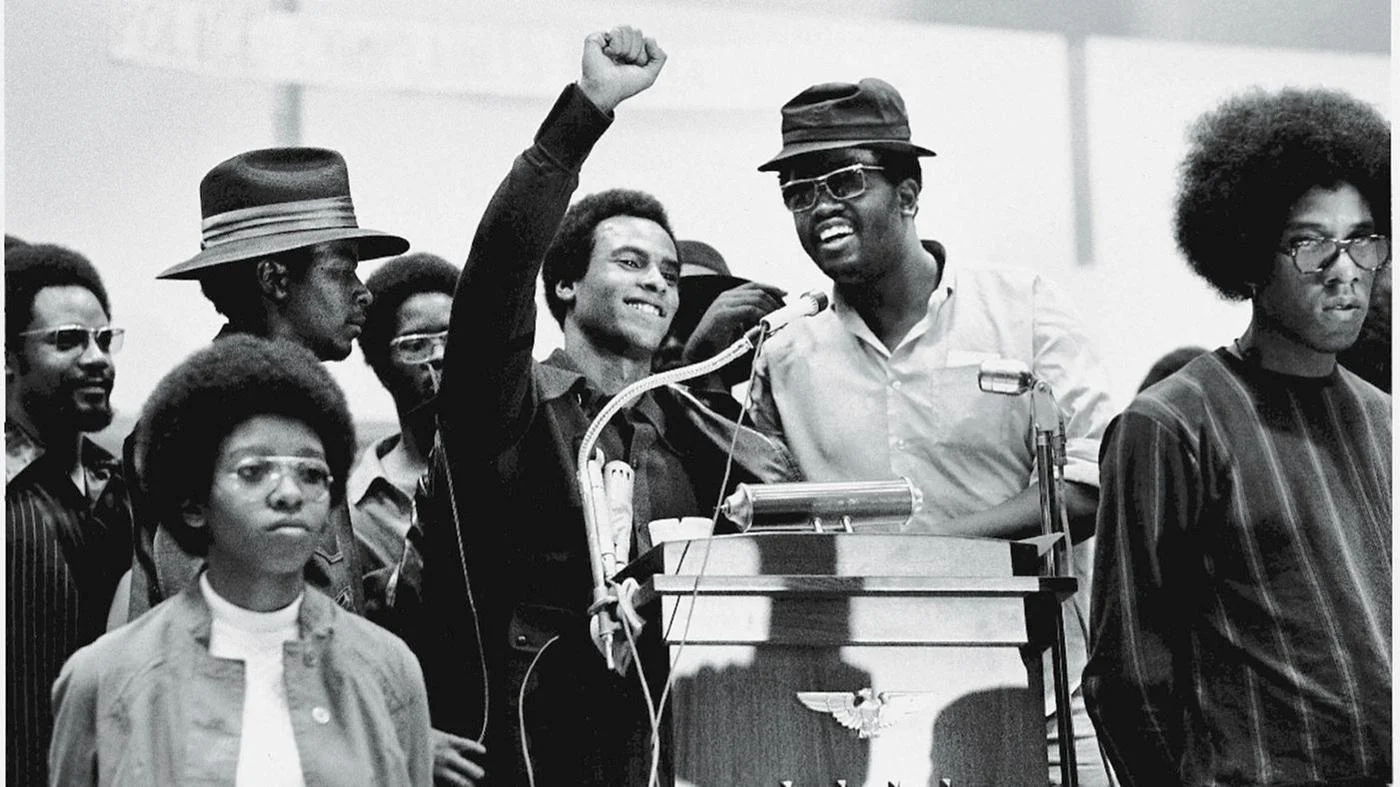
Huey Newton, co-founder of the Black Panther Party, has right arm raised next to speaker at lectern.

Huey Newton, co-founder of the Black Panther Party, has right arm raised next to speaker at lectern.

Huey P Newton: 'The women’s liberation front and gay liberation front are our friends', Black Panther rally - 1970

February 16, 2016

15 August 1970, New York City, New York, USA

During the past few years strong movements have developed among women and among homosexuals seeking their liberation. There has been some uncertainty about how to relate to these movements.

Whatever your personal opinions and your insecurities about homosexuality and the various liberation movements among homosexuals and women (and I speak of the homosexuals and women as oppressed groups), we should try to unite with them in a revolutionary fashion.

I say ”whatever your insecurities are” because as we very well know, sometimes our first instinct is to want to hit a homosexual in the mouth, and want a woman to be quiet. We want to hit a homosexual in the mouth because we are afraid that we might be homosexual; and we want to hit the women or shut her up because we are afraid that she might castrate us, or take the nuts that we might not have to start with.

We must gain security in ourselves and therefore have respect and feelings for all oppressed people. We must not use the racist attitude that the white racists use against our people because they are Black and poor. Many times the poorest white person is the most racist because he is afraid that he might lose something, or discover something that he does not have. So you’re some kind of a threat to him. This kind of psychology is in operation when we view oppressed people and we are angry with them because of their particular kind of behavior, or their particular kind of deviation from the established norm.

Remember, we have not established a revolutionary value system; we are only in the process of establishing it. I do not remember our ever constituting any value that said that a revolutionary must say offensive things towards homosexuals, or that a revolutionary should make sure that women do not speak out about their own particular kind of oppression. As a matter of fact, it is just the opposite: we say that we recognize the women’s right to be free. We have not said much about the homosexual at all, but we must relate to the homosexual movement because it is a real thing. And I know through reading, and through my life experience and observations that homosexuals are not given freedom and liberty by anyone in the society. They might be the most oppressed people in the society.

And what made them homosexual? Perhaps it’s a phenomenon that I don’t understand entirely. Some people say that it is the decadence of capitalism. I don’t know if that is the case; I rather doubt it. But whatever the case is, we know that homosexuality is a fact that exists, and we must understand it in its purest form: that is, a person should have the freedom to use his body in whatever way he wants.

That is not endorsing things in homosexuality that we wouldn’t view as revolutionary. But there is nothing to say that a homosexual cannot also be a revolutionary. And maybe I’m now injecting some of my prejudice by saying that “even a homosexual can be a revolutionary.” Quite the contrary, maybe a homosexual could be the most revolutionary.

When we have revolutionary conferences, rallies, and demonstrations, there should be full participation of the gay liberation movement and the women’s liberation movement. Some groups might be more revolutionary than others. We should not use the actions of a few to say that they are all reactionary or counter-revolutionary, because they are not.

We should deal with the factions just as we deal with any other group or party that claims to be revolutionary. We should try to judge, somehow, whether they are operating in a sincere revolutionary fashion and from a really oppressed situation. (And we will grant that if they are women they are probably oppressed.) If they do things that are unrevolutionary or counter-revolutionary, then criticize that action.

If we feel that the group in spirit means to be revolutionary in practice, but they make mistakes in interpretation of the revolutionary philosophy, or they do not understand the dialectics of the social forces in operation, we should criticize that and not criticize them because they are women trying to be free. And the same is true for homosexuals. We should never say a whole movement is dishonest when in fact they are trying to be honest. They are just making honest mistakes. Friends are allowed to make mistakes. The enemy is not allowed to make mistakes because his whole existence is a mistake, and we suffer from it. But the women’s liberation front and gay liberation front are our friends, they are our potential allies, and we need as many allies as possible.

We should be willing to discuss the insecurities that many people have about homosexuality. When I say “insecurities,” I mean the fear that they are some kind of threat to our manhood. I can understand this fear. Because of the long conditioning process which builds insecurity in the American male, homosexuality might produce certain hang-ups in us. I have hang-ups myself about male homosexuality. But on the other hand, I have no hang-up about female homosexuality. And that is a phenomenon in itself. I think it is probably because male homosexuality is a threat to me and female homosexuality is not.

We should be careful about using those terms that might turn our friends off. The terms “faggot” and “punk” should be deleted from our vocabulary, and especially we should not attach names normally designed for homosexuals to men who are enemies of the people, such as [Richard] Nixon or [John] Mitchell. Homosexuals are not enemies of the people.

We should try to form a working coalition with the gay liberation and women’s liberation groups. We must always handle social forces in the most appropriate manner. And this is really a significant part of the population, both women, and the growing number of homosexuals that we have to deal with.

ALL POWER TO THE PEOPLE!


Source: ...

Enjoyed this speech? Speakola is a labour of love and I’d be very grateful if you would share, tweet or like it. Thank you.

Facebook Twitter Facebook
In EQUALITY Tags HUEY P NEWTON, BLACK PANTHERS, AFRICAN AMERICAN RIGHTS, REVOLUTION, LGBT, WOMENS RIGHTS, TRANSCRIPT, GAY LIBERATION
Comment

James Baldwin: 'I picked the cotton and I carried it to market and I built the railroads under someone else’s whip', debate v William F Buckley - 1965

January 2, 2016

1965, Cambridge University, United Kingdom

This debate was between arch conservative William F Buckley, the editor of the National Review, and James Baldwin, an African American playright, essayist and poet. The topic was, 'That the American dream has come at the expnse of the American Negro'. Baldwin gave this famous speech.

Good evening,

I find myself, not for the first time, in the position of a kind of Jeremiah. For example, I don’t disagree with Mr. Burford that the inequality suffered by the American Negro population of the United States has hindered the American dream. Indeed, it has. I quarrell with some other things he has to say. The other, deeper, element of a certain awkwardness I feel has to do with one’s point of view. I have to put it that way – one’s sense, one’s system of reality. It would seem to me the proposition before the House, and I would put it that way, is the American Dream at the expense of the American Negro, or the American Dream *is* at the expense of the American Negro. Is the question hideously loaded, and then one’s response to that question – one’s reaction to that question – has to depend on effect and, in effect, where you find yourself in the world, what your sense of reality is, what your system of reality is. That is, it depends on assumptions which we hold so deeply so as to be scarcely aware of them.

Are white South African or Mississippi sharecropper, or Mississippi sheriff, or a Frenchman driven out of Algeria, all have, at bottom, a system of reality which compels them to, for example, in the case of the French exile from Algeria, to offend French reasons from having ruled Algeria. The Mississippi or Alabama sheriff, who really does believe, when he’s facing a Negro boy or girl, that this woman, this man, this child must be insane to attack the system to which he owes his entire identity. Of course, to such a person, the proposition which we are trying to discuss here tonight does not exist. And on the other hand, I, have to speak as one of the people who’ve been most attacked by what we now must here call the Western or European system of reality. What white people in the world, what we call white supremacy – I hate to say it here – comes from Europe. It’s how it got to America. Beneath then, whatever one’s reaction to this proposition is, has to be the question of whether or not civilizations can be considered, as such, equal, or whether one’s civilization has the right to overtake and subjugate, and, in fact, to destroy another. Now, what happens when that happens. Leaving aside all the physical facts that one can quote. Leaving aside, rape or murder. Leaving aside the bloody catalog of oppression, which we are in one way too familiar with already, what this does to the subjugated, the most private, the most serious thing this does to the subjugated, is to destroy his sense of reality. It destroys, for example, his father’s authority over him. His father can no longer tell him anything, because the past has disappeared, and his father has no power in the world. This means, in the case of an American Negro, born in that glittering republic, and the moment you are born, since you don’t know any better, every stick and stone and every face is white.

And since you have not yet seen a mirror, you suppose that you are, too. It comes as a great shock around the age of 5, or 6, or 7, to discover that the flag to which you have pledged allegiance, along with everybody else, has not pledged allegiance to you. It comes as a great shock to discover that Gary Cooper killing off the Indians, when you were rooting for Gary Cooper, that the Indians were you. It comes as a great shock to discover that the country which is your birthplace and to which you owe your life and your identity, has not, in its whole system of reality, evovled any place for you. The disaffection, the demoralization, and the gap between one person and another only on the basis of the color of their skin, begins there and accelerates – accelerates throughout a whole lifetime – to the present when you realize you’re thirty and are having a terrible time managing to trust your countrymen. By the time you are thirty, you have been through a certain kind of mill. And the most serious effect of the mill you’ve been through is, again, not the catalog of disaster, the policemen, the taxi drivers, the waiters, the landlady, the landlord, the banks, the insurance companies, the millions of details, twenty four hours of every day, which spell out to you that you are a worthless human being. It is not that. It’s by that time that you’ve begun to see it happening, in your daughter or your son, or your niece or your nephew.

You are thirty by now and nothing you have done has helped to escape the trap. But what is worse than that, is that nothing you have done, and as far as you can tell, nothing you can do, will save your son or your daughter from meeting the same disaster and not impossibly coming to the same end. Now, we’re speaking about expense. I suppose there are several ways to address oneself, to some attempt to find what that word means here. Let me put it this way, that from a very literal point of view, the harbors and the ports, and the railroads of the country–the economy, especially of the Southern states–could not conceivably be what it has become, if they had not had, and do not still have, indeed for so long, for many generations, cheap labor. I am stating very seriously, and this is not an overstatement: *I* picked the cotton, *I* carried it to the market, and *I* built the railroads under someone else’s whip for nothing. For nothing.

The Southern oligarchy, which has still today so very much power in Washington, and therefore some power in the world, was created by my labor and my sweat, and the violation of my women and the murder of my children. This, in the land of the free, and the home of the brave.And no one can challenge that statement. It is a matter of historical record.

In another way, this dream, and we’ll get to the dream in a moment, is at the expense of the American Negro. You watched this in the Deep South in great relief. But not only in the Deep South. In the Deep South, you are dealing with a sheriff or a landlord, or a landlady or a girl of the Western Union desk, and she doesn’t know quite who she’s dealing with, by which I mean, that if you’re not a part of the town, and if you are a Nothern Nigger, it shows in millions of ways. So she simply knows that it’s an unknown quantity, and she wants to have nothing to do with it because she won’t talk to you, you have to wait for a while to get your telegram. OK, we all know this. We’ve all been through it and, by the time you get to be a man, it’s very easy to deal with. But what is happening in the poor woman, the poor man’s mind is this: they’ve been raised to believe, and by now they helplessly believe, that no matter how terrible their lives may be, and their lives have been quite terrible, and no matter how far they fall, no matter what disaster overtakes them, they have one enormous knowledge in consolation, which is like a heavenly revelation: at least, they are not Black.

Now, I suggest that of all the terrible things that can happen to a human being, that is one of the worst. I suggest that what has happened to white Southerners is in some ways, after all, much worse than what has happened to Negroes there because Sheriff Clark in Selma, Alabama, cannot be considered – you know, no one can be dismissed as a total monster. I’m sure he loves his wife, his children. I’m sure, you know, he likes to get drunk. You know, after all, one’s got to assume he is visibly a man like me. But he doesn’t know what drives him to use the club, to menace with the gun and to use the cattle prod. Something awful must have happened to a human being to be able to put a cattle prod against a woman’s breasts, for example. What happens to the woman is ghastly. What happens to the man who does it is in some ways much, much worse. This is being done, after all, not a hundred years ago, but in 1965, in a country which is blessed with what we call prosperity, a word we won’t examine too closely; with a certain kind of social coherence, which calls itself a civilized nation, and which espouses the notion of the freedom of the world. And it is perfectly true from the point of view now simply of an American Negro. Any American Negro watching this, no matter where he is, from the vantage point of Harlem, which is another terrible place, has to say to himself, in spite of what the government says – the government says we can’t do anything about it – but if those were white people being murdered in Mississippi work farms, being carried off to jail, if those were white children running up and down the streets, the government would find some way of doing something about it. We have a civil rights bill now where an amendment, the fifteenth amendment, nearly a hundred years ago – I hate to sound again like an Old Testament prophet – but if the amendment was not honored then, I would have any reason to believe in the civil rights bill will be honored now. And after all one’s been there, since before, you know, a lot of other people got there. If one has got to prove one’s title to the land, isn’t four hundred years enough? Four hundred years? At least three wars? The American soil is full of the corpses of my ancestors. Why is my freedom or my citizenship, or my right to live there, how is it conceivably a question now? And I suggest further, and in the same way, the moral life of Alabama sheriffs and poor Alabama ladies – white ladies – their moral lives have been destroyed by the plague called color, that the American sense of reality has been corrupted by it.

At the risk of sounding excessive, what I always felt, when I finally left the country, and found myself abroad, in other places, and watched the Americans abroad – and these are my countrymen – and I do care about them, and even if I didn’t, there is something between us. We have the same shorthand, I know, if I look at a boy or a girl from Tennessee, where they came from in Tennessee and what that means. No Englishman knows that. No Frenchman, no one in the world knows that, except another Black man who comes from the same place. One watches these lonely people denying the only kin they have. We talk about integration in America as though it was some great new conundrum. The problem in America is that we’ve been integrated for a very long time. Put me next to any African and you will see what I mean. My grandmother was not a rapist. What we are not facing is the result of what we’ve done. What one brings the American people to do for all our sakes is simply to accept our history. I was there not only as a slave, but also as a concubine. One knows the power, after all, which can be used against another person if you’ve got absolute power over that person.

It seemed to me when I watched Americans in Europe what they didn’t know about Europeans was what they didn’t know about me. They weren’t trying, for example, to be nasty to the French girl, or rude to the French waiter. They didn’t know they hurt their feelings. They didn’t have any sense this particular woman, this particular man, though they spoke another language and had different manners and ways, was a human being. And they walked over them, the same kind of bland ignorance, condescension, charming and cheerful with which they’ve always pat me on the head and called me Shine and were upset when I was upset. What is relevant about this is that whereas forty years ago when I was born, the question of having to deal with what is unspoken by the subjugated, what is never said to the master, of ever having to deal with this reality was a very remote possibility. It was in no one’s mind. When I was growing up, I was taught in American history books, that Africa had no history, and neither did I. That I was a savage about whom the less said, the better, who had been saved by Europe and brought to America. And, of course, I believed it. I didn’t have much choice. Those were the only books there were. Everyone else seemed to agree.

If you walk out of Harlem, ride out of Harlem, downtown, the world agrees what you see is much bigger, cleaner, whiter, richer, safer than where you are. They collect the garbage. People obviously can pay their life insurance. Their children look happy, safe. You’re not. And you go back home, and it would seem that, of course, that it’s an act of God that this is true! That you belong where white people have put you.

It is only since the Second World War that there’s been a counter-image in the world. And that image did not come about through any legislation or part of any American government, but through the fact that Africa was suddenly on the stage of the world, and Africans had to be dealt with in a way they’d never been dealt with before. This gave an American Negro for the first time a sense of himself beyond the savage or a clown. It has created and will create a great many conundrums. One of the great things that the white world does not know, but I think I do know, is that Black people are just like everybody else. One has used the myth of Negro and the myth of color to pretend and to assume that you were dealing with, essentially, with something exotic, bizarre, and practically, according to human laws, unknown. Alas, it is not true. We’re also mercenaries, dictators, murderers, liars. We are human too.

What is crucial here is that unless we can manage to accept, establish some kind of dialog between those people whom I pretend have paid for the American dream and those other people who have not achieved it, we will be in terrible trouble. I want to say, at the end, the last, is that is that is what concerns me most. We are sitting in this room, and we are all, at least I’d like to think we are, relatively civilized, and we can talk to each other at least on certain levels so that we could walk out of here assuming that the measure of our enlightenment, or at least, our politeness, has some effect on the world. It may not.

I remember, for example, when the ex Attorney General, Mr. Robert Kennedy, said that it was conceivable that in forty years, in America, we might have a Negro president. That sounded like a very emancipated statement, I suppose, to white people. They were not in Harlem when this statement was first heard. And they’re not here, and possibly will never hear the laughter and the bitterness, and the scorn with which this statement was greeted. From the point of view of the man in the Harlem barber shop, Bobby Kennedy only got here yesterday, and he’s already on his way to the presidency. We’ve been here for four hundred years and now he tells us that maybe in forty years, if you’re good, we may let you become president.

What is dangerous here is the turning away from – the turning away  from – anything any white American says. The reason for the political hesitation, in spite of the Johnson landslide is that one has been betrayed by American politicians for so long. And I am a grown man and perhaps I can be reasoned with. I certainly hope I can be. But I don’t know, and neither does Martin Luther King, none of us know how to deal with those other people whom the white world has so long ignored, who don’t believe anything the white world says and don’t entirely believe anything I or Martin is saying. And one can’t blame them. You watch what has happened to them in less than twenty years.

It seems to me that the City of New York, for example – this is my last point – It’s had Negroes in it for a very long time. If the city of New York were able, as it has indeed been able, in the last fifteen years to reconstruct itself, tear down buildings and raise great new ones, downtown and for money, and has done nothing whatever except build housing projects in the ghetto for the Negroes. And of course, Negroes hate it. Presently the property does indeed deteriorate because the children cannot bear it. They want to get out of the ghetto. If the American pretensions were based on more solid, a more honest assessment of life and of themselves, it would not mean for Negroes when someone says “Urban Renewal” that Negroes can simply are going to be thrown out into the streets. This is just what it does mean now. This is not an act of God. We’re dealing with a society made and ruled by men. Had the American Negro had not been present in America, I am convinced the history of the American labor movement would be much more edifying than it is. It is a terrible thing for an entire people to surrender to the notion that one-ninth of its population is beneath them. And until that moment, until the moment comes when we, the Americans, we, the American people, are able to accept the fact, that I have to accept, for example, that my ancestors are both white and Black. That on that continent we are trying to forge a new identity for which we need each other and that I am not a ward of America. I am not an object of missionary charity. I am one of the people who built the country–until this moment there is scarcely any hope for the American dream, because the people who are denied participation in it, by their very presence, will wreck it. And if that happens it is a very grave moment for the West.

Thank you.

Here is the full debate.


There’s a snippet of James Baldwin’s speech to introduce the Stan Grant ‘racism and the Australian Dream’ episode of the podcast. Listen below.


Source: http://www.ozy.com/performance/buckley-vs-...

Enjoyed this speech? Speakola is a labour of love and I’d be very grateful if you would share, tweet or like it. Thank you.

Facebook Twitter Facebook
In EQUALITY Tags JAMES BALDWIN, WILLIAM F BUCKLEY, AFRICAN AMERICAN RIGHTS, SLAVERY, CIVIL RIGHTS MOVEMENT, DEBATE, TRANSCRIPT
1 Comment

See my film!

Limited Australian Season

March 2025

Details and ticket bookings at

angeandtheboss.com

Support Speakola

Hi speech lovers,
With costs of hosting website and podcast, this labour of love has become a difficult financial proposition in recent times. If you can afford a donation, it will help Speakola survive and prosper.

Best wishes,
Tony Wilson.

Become a Patron!

Learn more about supporting Speakola.

Featured political

Featured
Jon Stewart: "They responded in five seconds", 9-11 first responders, Address to Congress - 2019
Jacinda Ardern: 'They were New Zealanders. They are us', Address to Parliament following Christchurch massacre - 2019
Dolores Ibárruri: "¡No Pasarán!, They shall not pass!', Defense of 2nd Spanish Republic - 1936
Jimmy Reid: 'A rat race is for rats. We're not rats', Rectorial address, Glasgow University - 1972

Featured eulogies

Featured
For Geoffrey Tozer: 'I have to say we all let him down', by Paul Keating - 2009
for James Baldwin: 'Jimmy. You crowned us', by Toni Morrison - 1988
for Michael Gordon: '13 days ago my Dad’s big, beautiful, generous heart suddenly stopped beating', by Scott and Sarah Gordon - 2018

Featured commencement

Featured
Tara Westover: 'Your avatar isn't real, it isn't terribly far from a lie', The Un-Instagrammable Self, Northeastern University - 2019
Tim Minchin: 'Being an artist requires massive reserves of self-belief', WAAPA - 2019
Atul Gawande: 'Curiosity and What Equality Really Means', UCLA Medical School - 2018
Abby Wambach: 'We are the wolves', Barnard College - 2018
Eric Idle: 'America is 300 million people all walking in the same direction, singing 'I Did It My Way'', Whitman College - 2013
Shirley Chisholm: ;America has gone to sleep', Greenfield High School - 1983

Featured sport

Featured
Joe Marler: 'Get back on the horse', Harlequins v Bath pre game interview - 2019
Ray Lewis : 'The greatest pain of my life is the reason I'm standing here today', 52 Cards -
Mel Jones: 'If she was Bradman on the field, she was definitely Keith Miller off the field', Betty Wilson's induction into Australian Cricket Hall of Fame - 2017
Jeff Thomson: 'It’s all those people that help you as kids', Hall of Fame - 2016

Fresh Tweets


Featured weddings

Featured
Dan Angelucci: 'The Best (Best Man) Speech of all time', for Don and Katherine - 2019
Hallerman Sisters: 'Oh sister now we have to let you gooooo!' for Caitlin & Johnny - 2015
Korey Soderman (via Kyle): 'All our lives I have used my voice to help Korey express his thoughts, so today, like always, I will be my brother’s voice' for Kyle and Jess - 2014

Featured Arts

Featured
Bruce Springsteen: 'They're keepers of some of the most beautiful sonic architecture in rock and roll', Induction U2 into Rock Hall of Fame - 2005
Olivia Colman: 'Done that bit. I think I have done that bit', BAFTA acceptance, Leading Actress - 2019
Axel Scheffler: 'The book wasn't called 'No Room on the Broom!', Illustrator of the Year, British Book Awards - 2018
Tina Fey: 'Only in comedy is an obedient white girl from the suburbs a diversity candidate', Kennedy Center Mark Twain Award -  2010
Tina Fey: 'Only in comedy is an obedient white girl from the suburbs a diversity candidate', Kennedy Center Mark Twain Award - 2010

Featured Debates

Featured
Sacha Baron Cohen: 'Just think what Goebbels might have done with Facebook', Anti Defamation League Leadership Award - 2019
Greta Thunberg: 'How dare you', UN Climate Action Summit - 2019
Charlie Munger: 'The Psychology of Human Misjudgment', Harvard University - 1995
Lawrence O'Donnell: 'The original sin of this country is that we invaders shot and murdered our way across the land killing every Native American that we could', The Last Word, 'Dakota' - 2016