
• Genre
  • About
  • Submissions
  • Donate
  • Search
Menu

Speakola

All Speeches Great and Small
  • Genre
  • About
  • Submissions
  • Donate
  • Search

David Suzuki: 'Our comfort is paid for by the suffering of millions', WOMAdelaide Planet Talks - 2016

October 22, 2019

12 March 2016, Adelaide, Australia

Thank you Robyn, thank you for that, it's so great to see you, and still up and running and kicking arse, good for you. It's always such a joy to return to Australia, but especially to Adelaide. I first want to say it's a privilege to stand on the traditional land of the Kaurna people who lived and cared for it over thousands of years. And I'm so overjoyed that Uncle Lewis O'Brien is here to welcome us this day.

Uncle Lewis conferred on me one of the greatest honours I've received which was a name, a Kaurna name, and I have carried it with a tremendous sense of honour but also responsibility to live up to that name, so thank you Lewis O'Brien.

I was also delighted to visit yesterday the Suzuki Forest. Do you know about that, Robyn? It's…I don't know, somewhere up in the hills, I don't know where in the heck we went, but it was degraded land that Mike Rann when he was Premier set aside to be restored and designated as a forest in the future. I was thrilled to see that it's flourishing, and to learn that it is right next to Schwarzenegger Forest, so I'm sure the terminator is going to be looking out after my little trees too.

These days I always begin my talks by saying that I'm not here to speak on behalf of any group or organisation, I don't speak for any political party or corporation, I'm here speaking as a grandfather and as an elder. And I believe this is the most important part of my life. You see, I don't have to play games anymore to get a job, a promotion or a raise, I can speak the truth from my heart. If that offends people, that's their problem, not mine.

Elders have that credibility, I believe, because we are no longer driven by the need for more money or power or celebrity or sex. Well, there are a few elders, they need help, they've got problems. But most elders are like me, those are long past in our lives, so we can speak with a great deal of credibility. And elders have something no other group in society has; we've lived an entire life. We've learned a lot. We've made mistakes, we've suffered failures, we've had a few successes. Those are hard-won life lessons. And I believe it's our job, it's our responsibility now to trawl through that life of experience for those nuggets that are lessons that are worth passing on to the generations to come. So I urge my fellow elders everywhere: Get the hell off the golf course or the couch and get on with the most important part of your life.

Now, before I begin, I must admit that ever since I arrived in Australia last Sunday I've been peppered by the press with questions about nuclear waste. I've only been in Australia for five days, the heavens sakes, I'm supposed to tell you what to do with nuclear waste? My family has only been in Canada for 120 years and Canada as a country has only existed for 150 years. I have lived all my life and my culture has never had to worry about something like sustainability. The only group with any credibility on sustainability over thousands of years are the indigenous people everywhere. So to South Australians, to all Australians, I say if you want to deal seriously with the issue of nuclear waste, let the Kaurna and the other Indigenous groups make the decisions, they are the only ones that provide the viewpoint and the perspective to do it.

You see, we stand at a unique moment in all of the history of life on this planet. That's 4 billion years of life. 99.9999% of all species that have ever existed in the 4 billion years are extinct. Extinction is the norm. But for the first time in those 4 billion years, one species that created the conditions for its own demise (that's us) recognises the possibility of extinction and has the tools to avoid a catastrophic end.

You know what we face. Human activity—burning fossil fuels, machines, agricultural practices, especially raising cattle, warfare—are altering the chemistry of the atmosphere that in turn is trapping heat on the planet. I first realised that we have to take climate change seriously when I came to your country. In 1988 I was a guest in Melbourne of the Commission for the Future, and at that time scientists showed me the evidence that they were gathering in climatology. And I went back to Canada saying this is no longer a slow-motion catastrophe, we've got to get going on it right away. Your leading scientists and the reality of life—drought, massive fires, reef degradation—show that you have a serious problem and that there are also solutions here for clean energy in abundance.

Australia should be leading the world. And I must say I've been so proud of South Australia, that Mike Rann set in motion a path towards a future of clean energy, you're at 40% renewable energy now, on the way to 50% and possibly 60%. South Australians should be boasting to the world about what you are doing here. I certainly intend to when I go home.

The failure of the federal governments of Canada and Australia to act in the face of the evidence and the enormous alternative opportunities to climate change is why many scientists and experts now declare the futility of simply eliminating the use of fossil fuels, and call for megaprojects like geo-engineering and the massive implementation of nuclear energy. It's crazy but we are at a desperate position.

Australia with vast deserts and sunlight Canadians would kill for, and you can't develop alternative solutions? Disgraceful! Japan, the most earthquake prone country on the planet brings nuclear plants to…what? To boil water. And this in a country that has boiling water in over 6,000 hot springs. We boast as a species that we are intelligent.

In Canada, First Nations, environmentalists, climatologists have now been labelled 'the forces of no' and 'eco-terrorists'. Of course climate is just one of the issues, there's a whole suite of ecological issues that are confronting us now. Oceans cover 70% of the planet's surface, and they are a mess. Overfishing, islands of plastic, dead zones from agricultural run-off, sea level rise by warming and expansion of water, and acidification from the dissolving of carbon dioxide in the ocean as carbonic acid.

80% of the forests on the land are gone. Hydrologic cycles are changing. We dread the disappearance of the monsoon reliability. Species are going extinct at a rate unparalleled since the last great extinction episode 65 million years ago. Toxic pollutants now have been poured into air, water and soil. I'm sorry, however well you live, every one of us here carries dozens of toxic chemicals because of what we've done to the rest of the planet.

We are species out of control. We are expanding our ecological footprint. The amount of air, water and land we require to live as we do is simply expanding. Climate change is just the most obviously pressing issue we confront now. But I have to say it has taken a hell of a long time before it's come to the level that it's at now.

The first international conference on climate was held in Toronto in 1988, and at that time the scientists were convinced the evidence was in, and were so alarmed by what they were seeing that they issued a call for a 20% reduction in greenhouse gas emissions in 15 years. That was the call, but we didn't take it seriously. And the record of political and corporate denial and monkeywrenching is why many scientists and experts despair and declare now openly that it's too late to turn things around.

When Sir Martin Rees, one of the eminent astronomers in Britain, was asked, 'What are the chances that there will be any human beings left by the year 2100?' His answer sent a chill up my spine: 50/50. James Lovelock, the inventor of the concept of Gaia, has written a book that declares 90% of humanity will be gone by the end of the century. And you all know Australia's eco-philosopher Clive Hamilton has written a book, Requiem for a Species. And guess what species it's a requiem for? It's for us. And now an American ecologist, Guy McPherson, is declaring human beings will be gone within decades in this century.

My response to all of that is why are you saying that it's too late? There's no point. Surely we're going to struggle and fight right to the end. Yes, it's urgent, and that's the message I get. But to say no, it's too late, that's ridiculous, that's simply too soul-destroying to hear that. But I think that the urgency is what we have to listen to. We have very little time to act. So I would suggest in your country and mine, do not offer your vote to a single candidate at any level of government unless they declare that climate change is an issue that they will devote a great deal of their lives to.

And it mustn't be a political football. It's not just the Green party that will say this, we must demand it of every candidate for political office. The signs are depressing, it's true, but I cling to hope, and that hope is based on more than just a Pollyanna-ish idea; ‘Oh, don't worry, good things will happen.’ My hope is based on the faith, one that love…and please, don't think I have suddenly become a dippy hippy…I believe that love is the driving force of our species, and it is love of our children and grandchildren that must override all of the economic, political and social pressures.

But more than that, we don't know enough to say it's too late. And let me give you an example of why I say that. The most prized species of salmon in the world is called the sockeye salmon. It's the salmon with the bright red flesh and lots of fat in it, it tastes great, especially when it's raw. Sockeye salmon are…the biggest run in the world is in British Columbia in the Fraser River. And ever since pre-contact levels of sockeye salmon, the runs were between 100- and 120 million fish each year, but after contact, when we damned rivers and had landslides that blocked the Fraser, we got a catastrophic decline. But the Fraser River in British Columbia has the largest sockeye run in the world, and we like to get 30–35 million animals coming back.

In 2009 we barely got a million sockeye returning to the Fraser. And I remember looking at Tara my wife and saying, that's it, there just isn't the biomass to get them to their spawning grounds, they're toast, they're gone. One year later in 2010 we got the biggest run of sockeye salmon in 100 years. I use that story not to show how stupid I am. Nobody knows what the hell happened. But nature shocked us with surprise. And I believe nature has got a lot more surprises up her sleeve. We just have to pull back and give her room and she will be far more generous than we deserve. That's my hope.

I was in the United States, I studied there for eight years, getting an education in the 1950s that we couldn't get in Canada at that time. And I was starting the last year in college in Massachusetts in 1957, and on October 4 the Soviet Union shocked the world by announcing they had launched Sputnik. And that was really a frightening time. The Soviet Union was a very powerful force at that time and every hour and a half we could hear the 'beep beep' of Sputnik thumbing its nose at us. The Americans immediately tried to launch their own satellites and every one blew up on the launch pad.

Meanwhile the Russians launched the first animal in space, a dog, Laika. The first man, Yuri Gagarin. The first team of cosmonauts, the first space walk, the first woman, Valentina Tereshkova. Americans didn't flinch. They didn't say, oh my God, they're so far ahead we can't afford to catch up, they said we've got to catch these guys. And it was a glorious time. Here I was, a Canadian living in the States, all you had to do was say 'I like science' and they threw money at us. It was glorious.

And in 1961 President Kennedy announced that Americans would get humans to the Moon and back within a decade. When he announced his plan he didn't have a clue how the hell he was going to do it. He just knew that they had to get to the Moon and beat the Russians. And look what happened. Not only are they the only country to land people on the Moon and get them back, but all of the unexpected benefits that have come out of making that commitment. Even today, 60 years later, when Nobel prizes are announced, believe me, Americans cop a huge number of those science Nobel prizes. Why? Because in 1958 Americans said we've got to beat the Russians in the space program. Every year NASA publishes a magazine called Spinoff. Hundreds of unanticipated spin-offs have come out of the space program, from laptop computers to GPS to cell phones to space blankets and ear thermometers, hundreds of these things have come simply by seizing the moment and the challenge and saying we've got to beat it. And I believe that's the moment we're at here. Climate change represents the ultimate crisis for our species that becomes a huge opportunity if we seize the moment and commit ourselves to beating it.

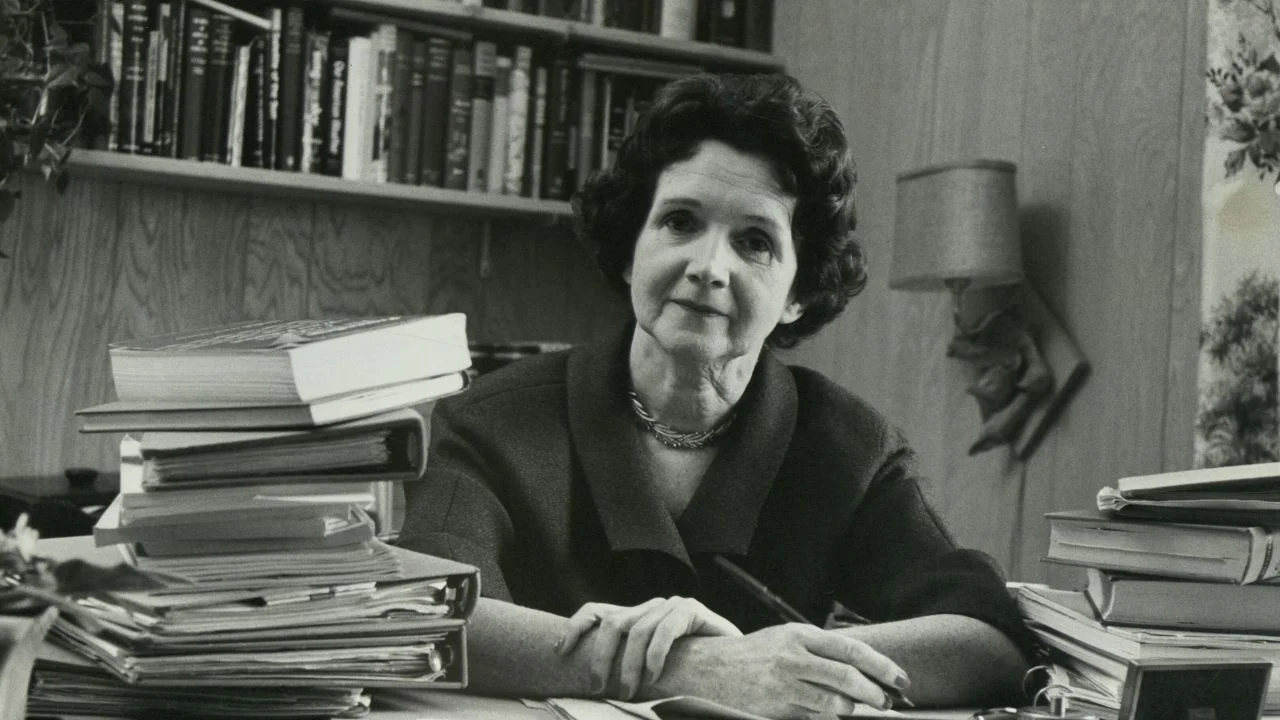
I returned to Canada in 1962 and had I studied for eight years in the States. I was a hotshot geneticist, I was going to make my name as a big scientist, and I got completely side-tracked by a woman. Not Tara, she is too young for that, but this has happened all through my life, usually with disastrous consequences, but in this case I've been ever grateful to her, and the great regret I have is that I never met her. But in 1962 a woman named Rachel Carson published a book called Silent Spring and it changed my life. We have to remember, in 1962 there wasn't a Department of the Environment in any government on Earth. The word 'environment' didn't mean in 1962 what it has come to mean today.

The discovery that DDT kills insects by Paul Müller won a Nobel Prize for him in 1947. We thought DDT pesticides were fantastic until Rachel Carson's book came out. And for me as a scientist what stunned me was the realisation that science can be very powerful, but we don't know enough to anticipate all of the unknown things in nature that we can't expect to be affected. When DDT began to be used on a wide scale, it was only when eagles in the United States began to disappear that scientists tracked it down and discovered a phenomenon called biomagnification. Up the food chain you concentrate DDT hundreds of thousands of times until you get to the shell glands of birds or the breasts of women. How could we have managed DDT properly when we only discovered biomagnification after eagles began to disappear? And that has happened over and over again.

When CFCs began to be used on a wide scale, we had no idea that high up in the atmosphere ultraviolet light would break chlorine free radicals off CFC that would scavenge ozone. When nuclear bombs were dropped over Japan we didn't know there was a phenomenon called radioactive fallout. And now we have such conceit we want to genetically engineer plants and animals for our use. We want to indeed engineer the planet with geo-engineering to deal with the issue of climate change. I believe it's a form of madness to have the hubris to think that we are capable of doing that.

For me, again as a scientist, the most profound message I got from Silent Spring was that in nature everything is connected to everything else. And I realised scientists look at things in bits and pieces, all on the assumption if we look at enough bits and pieces we will fit them back together to get a picture of the whole system. But we spray chemicals on farmers' fields to kill insects and end up discovering that fish and birds and human beings are affected. Everything is connected, and we can't determine all of those interconnections through science.

I just want to tell you a story that one of the programs that the David Suzuki Foundation undertook that I am so proud about was to try to illustrate this issue of inter-connectivity. One of the rarest ecosystems on the planet is called temperate rainforest, and in North America we have the largest temperate rainforest extending from Alaska down to the northern part of California, and it's that thin band pinched between the Pacific Ocean and the coastal mountain range, and it has the highest biomass, the weight of living things, of any ecosystem on Earth. And the reason for that is we've got big trees. But the dilemma for scientists was how can we have such big trees when the soil is nitrogen deficient? It rains a lot, that's why it's a rainforest. That rain washes nutrients, but especially nitrogen, out of the soil. So it was a real paradox for us. You've got these big trees and you've got not enough nitrogen in the soil to raise them. And it turned out the solution was the salmon.

You see, the salmon are born in thousands of rivers and creeks all up and down through the temperate rainforest, and they are born in fresh water. They go out to sea, there are five species of salmon that live, depending on the species, 2 to 5 years at sea, then they come back to spawn in the original rivers and waters where they were born.

Now, it turns out that almost all of the nitrogen you find on land is the normal isotope of nitrogen called nitrogen-14. But in the oceans there is a very large proportion…well, small, but still a very significant proportion of the nitrogen in the oceans is nitrogen-15. It's a slightly heavier atom isotope that we can detect the difference between N-15 and N-14. So the salmon go to sea for 2 to 5 years, they load up in nitrogen-15, and then they return to their spawning rivers and creeks by the tens of millions up and down the coast. So they are loaded with nitrogen now, and everyone celebrates. If you've ever gone to a spawning experience on the coast, you know the birds and the seals and the whales, everybody is making noise because now this mass of creatures is coming back. And they get to the river, and the major predators of the salmon are eagles, bears and wolves. So they will eat the salmon as they are coming up to spawn, and then of course they poop and pee nitrogen-15-loaded urine and faeces throughout the forest. So they are literally fertilising the forest.

Now, the bears are normally solitary animals, but during the salmon season they will fish in the same pool with literally dozens of others. But when they grab a salmon they take off into the forest up to 150 metres on either side of the river because they want to eat it by themselves. I mean, I understand that. They want to eat the best parts which, as you all know, are the brains, the belly and the eggs, and then they will dump the carcasses, lots more, they go back for another one. On average, a bear will take about 600 salmon in a season. So they are spreading the carcasses again through the forest. The carcasses left are eaten by ravens and salamanders and slugs. But the major exploiters of the carcasses are flies. So flies lay their eggs. Within a few days that carcass is a seething mass of maggots loading up with nitrogen-15 from the salmon, dropped to the forest floor over winter, and in the spring flies hatch by the trillions at the very time the birds from South America are coming through on their way to their nesting grounds in the Arctic. So, you see, those birds have been genetically programmed to come through at the very time those salmon, through the flies, are feeding them on their way to the Arctic.

If the salmon are not taken out of the river and sink to the bottom, within a week or so they are covered with a thick mat of fungus and bacteria, and the fungus and bacteria are eaten by copepods and insects and other invertebrates, so when the baby salmon emerge from the gravel four months later, the rivers are filled with nitrogen-15 containing invertebrates, so that the salmon can feast on their way down to the ocean. So in dying, the salmon prepare a feast for their offspring.

And then what we funded was scientists to go in and actually take the cores of trees in salmon bearing areas and non salmon bearing areas, and we showed that when you pull out the core and look at the fat rings, they are loaded with nitrogen-15. And the skinny rings when they've hardly grown, you find very little nitrogen-15. So the salmon are literally feeding the forest with their carcasses. So it's a magnificent story of the interconnection of the north and southern hemisphere and the oceans and land and the air.

Modern humans come along: oh, those indigenous people, they don't know anything, we're going to manage these resources. And so we say, well, we've got all these salmon there, that's the Minister of Fisheries and Oceans, for the commercial fishery. Oh, but then there are all those indigenous people, that's the Ministry of Indian Affairs. Oh, what about the sports fishermen? Well, that the Department of Tourism.

So we divide the salmon into three areas. The trees, that's the Minister of Forests. And the rivers, well, that's the Minister of Energy and the Minister of Agriculture and the Minister of Urban Affairs. And then we have all the rocks and the mountains, that's the Minister of Mining. And oh yeah, what about the eagles, the wolves and bears? That's the Ministry of the Environment. Now let's manage everything.

I mean, it's absolutely absurd because the way we look at the world has shattered it into pieces that have no connection to each other, and we ensure we will never manage those incredible systems. So that was Rachel Carson's great contribution, to me at least, was that everything is interconnected.

Impelled by Rachel Carson's book, I joined millions of people around the world in what we now see was a modern environmental movement. And the action, activity, was enormous. In only 10 years we got the United Nations forming UNEP, the United Nations Environment Program, calling its first international conference on the environment in Stockholm. And we began to get committees on the environment at every level of governments, from domestic, municipal, to the provincial, to the national level. And we've got laws to protect air, we've got laws to protect water, endangered species, and millions of hectares of land were set aside as parks and reserves.

In British Columbia, Tara and I were part of that huge movement, and we celebrated successes that we'd been involved in as well in our areas. There was a proposal to build a dam at Site C on the Peace River and we stopped it. Another proposal that Tara was very active in raising money to stop a dam to be built at Altamira on the Xingu River in Brazil, and we stopped that. We stopped the American proposal to bring oil supertankers off the north slopes of Alaska through British Columbian waters to be refined in Seattle. We stopped drilling proposals in the Arctic and in Hecate Strait.

And those are great victories. But now 30 to 35 years later, guess what? We are fighting the same battles all over again. What we thought were victories were not victories. And as environmentalists we failed fundamentally to use those battles as a means of informing people and educating people to see our relationship with the world in a different way. We have to shift the paradigm.

Years ago I visited a small village in the Andes Mountains in Brazil, and I learned that children in the village are taught that that mountain is an apu. In their language, apu means God. And as long as that apu casts its shadow on their village, it will determine the destiny of everyone in that village. Now, imagine how those kids when they grow up will treat that mountain, compared to a Canadian kid growing up in the Rockies who is taught all their lives those mountains are full of gold and silver. You see, the way we see the world and our place in it shapes and determines the way we will act towards it. We humans are predators. We have to eat plants and animals in order to live. We alter ecosystems in order to serve our needs, thinking of the burning program that you have with your Indigenous people in Australia. We modify habitats so that we can survive in them. But the way that we do it and the sense of values that we hold determine how we are going to actually behave.

When a forest is a sacred grove, then lumber and pulp will be taken with great reverence. When the river is the circulatory system of the land, we will extract energy, fresh water and fish very carefully. When soil is seen as a complex community of life, we will no longer treat it just as dirt. When another species is our biological kin, sharing with us thousands of genes identical with each other, then it seems to me we treat our kin with greater gratitude and love. When a house is our home, that's very different from a piece of real estate or a starter house or a tear-down. When the planet is our mother, then who would treat our biological mother the way we treat the Earth? The way we see the world shapes and constrains the way that we act towards it.

Three years ago I received a call…you know that the big battle in Canada right now is over the future of the tar sands in Alberta. Three years ago I got a call from the CEO of one of the largest companies in the Alberta tar sands. I was shocked. But he said would it be possible for me to come and talk to you. I said absolutely, I would be thrilled. I said I'm not into fighting, I'm no longer fighting because we can't afford losers. We've all got to be winners.

So he came down to my office the next morning and he came to the door and I thanked him profusely, I told him what an honour it was to have him come to me, and I said, but please do me one favour, before you walk in the door, please leave your identity as a CEO of an oil company outside the door. I want to meet you as a human being to human being, because I don't want to talk about the tar sands or its future, I don't want to talk about the economy until you and I as human beings agree on what the most fundamental needs are for human beings on the planet.

I'll tell you, he was not very happy about leaving his identity. But to his credit, he walked through the door. So I took him to my office, I sat him down, I said, I know how difficult this is for you. But let me tell you where I'm starting from. I said, our world…you and I live in a world that is defined, that is shaped and constrained by laws of nature. Those are laws that we can't do anything about, we have to live within them.

I can see right away I was in danger of losing him. I said, you know, in physics they tell us you can't build a rocket that will travel faster than the speed of light. And nobody denies that or gets mad about it, that's a limit on what we can do. The laws of gravity tell us you can't build an antigravity machine here on Earth, we accept that. And the first and second laws of thermodynamics tell us you can't build a perpetual motion machine. And, except for a few hucksters, most of us agree that that is true and we live with that.

In chemistry it's the same. The atomic properties of the elements, diffusion constants and reaction rates all inform us of the kind of reactions that we can perform in a test tube and the types of molecules that we can or cannot synthesise, and we live with that, those are dictated by what nature, what chemistry tells us. And in biology it's the same. Every species has a maximum number that can live indefinitely that are defined by the carrying capacity of ecosystems or habitats. And you exceed that number, the ability of an ecosystem or habitat to support more, and that population will crash.

Humans, because of our brains, we are not confined to a specific habitat or ecosystem, we can live from the Arctic to the deserts to temperate and tropical rainforest to wetlands to mountains…I mean, we are a very adaptive organism. But our home is still the biosphere, the zone of air, water and land where all life exists, that's our home, and it's finite, it can grow. So guess what? It has a carrying capacity for our species. Of course the number of our species that can be supported is based on two things, that is our numbers but also our consumption per capita. When you add that together, Australia, Canada, the US, Europe are very overpopulated because of our high consumption. But most scientists I talk to agree, we've exceeded the carrying capacity of the biosphere for our species. Man, do people get mad at me when I say that! How dare you say that! Look at the beautiful city of Adelaide, look how we're living, we're healthier, we're happier. Yeah, we're creating the illusion of great success by using up what should be the rightful legacy of our children and grandchildren. Ask any elder.

And biology dictates that you and I are animals. I gave a talk in Austin Texas many years ago, and it was a big audience with lots of children in the front and I said, now kids, if you remember one thing from my lecture, remember we are animals. Man, did their parents get pissed off at me! 'Don't call my daughter an animal, we're human beings.' And my response was, listen madam, if you don't think we're animals…are you a plant? We are animals, and as animals, biology dictates our fundamental needs.

And so I said to Mr CEO, I said what do you think is the most important thing every human being on Earth needs? And I could see he was thinking money, a job. I said, look, if you don't have a breath of air for three minutes, you're dead. If you have to breathe polluted air, you're sick. So can you as a human being agree with me that one of the highest priorities of our species is to protect clean air? And then I said, you and I are 70% water by weight, we're just a big blob of water with enough thickener added we don't dribble away on the floor. But, you know, our bodies leak water, right, it comes out of our skin and our eyes and our mouth and our crotch and we lose water all the time. I said, Mr CEO, if you don't have water for 4 to 6 days, you're dead. If you have to drink contaminated water, you're sick. So can you agree with me that clean water, like clean air, has got to be the highest priority of our species?

And then I said, you and I could go maybe 4 to 6 weeks without food but then we would die. If we have to eat contaminated food we get sick, and most of our food is coming from the Earth. So will you agree with me that clean food and clean soil has got to be up there with clean air and clean water? And then I said, all of the energy in your body is provided to us through photosynthesis. That energy is captured by plants, converted into chemical energy and we get it by eating the plants or the animals that eat the plants, we store that energy in our bodies, and when we need it, when we have to move or whatever, we burn those molecules of energy and liberate the energy of the Sun back into our bodies. So photosynthesis should be up there with clean water, clean air and clean soil.

And finally I said, Mr CEO, the miraculous aspect for me of life on this Earth is that those four things that indigenous people call the four sacred elements—earth, air, fire and water—those things are cleansed, replenished, created by life. It's the web of living things that give us the four sacred elements. Before there were plants in the oceans and on land, the air was absolutely toxic for animals like us. Oxygen is a very reactive element. When you liberate oxygen it immediately oxidises things, it rusts iron, and it disappears. It was plants that converted carbon dioxide into oxygen and over millions of years, until the present time, it's all of the green things in the ocean and on land that are keeping our atmosphere at 19% oxygen.

And in Vancouver we get all of our water from three watersheds surrounded by old-growth rainforest, the tree roots, the other plant roots, soil, fungi and bacteria filter that water so that we can drink it. And it's life that creates the very soil that we grow our food on. All of our food, as you well know, was once alive. But in order to grow our food in soil, as anyone who read The Martian or saw the movie The Martian when Matt Damon gets stranded on Mars and he has to stretch his potatoes out to four years instead of one so he can be rescued, there is lots of sand and gravel and dust on Mars, there is absolutely no soil. And so in order to grow his potatoes he had to dig a hole in the sand, poop in it and then get more life. We need soil and that is created by life itself. And people that talk about terraforming the planet…my god! Anyway, don't let me get into that, it's the nuttiest idea I've ever heard.

Anyway, so those are the things that to me define our most fundamental needs that should be the foundation of the way we create an economy and get our jobs and live. I said, Mr CEO, earth, air, fire and water and other living things that are our relatives, can you agree with me, these are the basis on which we live and flourish? Will you shake hands with me and agree that we both believe that that must be protected before anything else? And I'm sorry to say that he couldn't bring himself to shake my hand. He left and I never heard from him again.

Now, it was an unfair situation, I sprung it on him. He didn't know that's what he was in for, and it was unfair because he had come down as a CEO of a company to negotiate with me. If he were to go back to his shareholders and say, 'Well, I had a discussion with Suzuki, I have to agree, anything that we do must not compromise the air, the water, the soil, photosynthesis or biodiversity,' he'd be fired in a flash. And so the system that we've created can't accept that as the foundation on which it operates.

There are other things I told the CEO. There are other things we call boundaries. We draw borders around our property and, boy, people will kill and die to protect those borders. We draw boundaries around our cities and our provinces, our states and our countries. We go to war and murder and kill to protect those boundaries. Those boundaries are absolutely meaningless to nature. I mean, you just had to see it at the COP meetings in Paris. 196 countries dealing with the atmosphere that belongs to no one through the lenses of 196 political boundaries. It's crazy because you can't do it.

And then there are other things—capitalism, communism, the economy, markets, corporations—these are not forces or laws of nature, we invented them, for Gods sake. But if you listen to the news about the economy every morning, my God, you'd swear they were a thing out there. Oh, the market is not looking too healthy today. And you think of this poor market sitting there with an ice pack on its head going, 'I feel really lousy today.' What the hell! We invented the damn thing! And yet we are constantly trying to shoehorn nature to fit our economic or corporate agenda. It can't work that way. We have to do it the other way and shoehorn our inventions into nature's needs.

So this is a challenge, and I'd like to end it by suggesting something the David Suzuki Foundation did for the Earth Summit meetings in 1992, to provide perhaps a different perspective on our place in nature. We call it a declaration of interdependence.

This we know: We are the Earth, through the plants and animals that nourish us. We are the rains and the oceans that flow through our veins. We are the breath of the forests of the land and the plants of the sea. We are human animals, related to all other life as descendants of that first born cell. We share with these kin a common history, written in our genes. We share a common present, filled with uncertainty. And we share a common future, as yet untold. We humans are but one of 30 million species weaving the thin layer of life enveloping the world. The stability of communities of living things depends upon this diversity. Linked in that web, we are interconnected; using, cleansing, sharing, and replenishing the fundamental elements of life. Our home, planet Earth, is finite, all life shares its resources and the energy from the Sun, and therefore has limits to growth. For the first time we have touched those limits. When we compromise the air, the water, the soil, and the variety of life, we steal from the endless future to serve the fleeting present.

This we believe: Humans have become so numerous and our tools so powerful that we have driven fellow creatures to extinction, dammed the great rivers, torn down ancient forests, poisoned the earth, rain, and wind, and ripped holes in the sky. Our science has brought pain as well as joy; our comfort is paid for by the suffering of millions. We are learning from our mistakes, we are mourning our vanished kin, and we now build a new politics of hope. We respect and uphold the absolute need for clean air, water, and soil. We see that economic activities that benefit the few while shrinking the inheritance of many are wrong. And since environmental degradation erodes biological capital forever, full ecological and social cost must enter all equations of development. We are one brief generation in the long march of time; the future is not ours to erase. So where knowledge is limited, we will remember all those who will walk after us, and err on the side of caution.

This we resolve: All this that we know and believe must now become the foundation of the way we live. At this turning point in our relationship with the Earth, we work for an evolution: from dominance to partnership, from fragmentation to connection, from insecurity to interdependence.

Thank you.
Source: https://www.abc.net.au/radionational/progr...

Enjoyed this speech? Speakola is a labour of love and I’d be very grateful if you would share, tweet or like it. Thank you.

Facebook Twitter Facebook
In ENVIRONMENT Tags DAVID SUZUKI, TRANSCRIPT, WOMADELAIDE, PLANET TALKS, ENVIRONMENT, CLIAMTE CHANGE, CLIMATE CHANGE, CLIMATE EMERGENCY, CLIMATOLOGY
Comment

Greta Thunberg: 'How dare you', UN Climate Action Summit - 2019

September 24, 2019

23 September 2019, New York City, USA

Thunberg responds to a question about the message she has for world leaders.
My message is that we'll be watching you.

This is all wrong. I shouldn't be up here. I should be back in school on the other side of the ocean. Yet you all come to us young people for hope. How dare you!

You have stolen my dreams and my childhood with your empty words. And yet I'm one of the lucky ones. People are suffering. People are dying. Entire ecosystems are collapsing. We are in the beginning of a mass extinction, and all you can talk about is money and fairy tales of eternal economic growth. How dare you!

For more than 30 years, the science has been crystal clear. How dare you continue to look away and come here saying that you're doing enough, when the politics and solutions needed are still nowhere in sight.

You say you hear us and that you understand the urgency. But no matter how sad and angry I am, I do not want to believe that. Because if you really understood the situation and still kept on failing to act, then you would be evil. And that I refuse to believe.

The popular idea of cutting our emissions in half in 10 years only gives us a 50% chance of staying below 1.5 degrees, and the risk of setting off irreversible chain reactions beyond human control.

Fifty percent may be acceptable to you. But those numbers do not include tipping points, most feedback loops, additional warming hidden by toxic air pollution or the aspects of equity and climate justice. They also rely on my generation sucking hundreds of billions of tons of your CO2 out of the air with technologies that barely exist.

So a 50% risk is simply not acceptable to us — we who have to live with the consequences.


To have a 67% chance of staying below a 1.5 degrees global temperature rise – the best odds given by the [Intergovernmental Panel on Climate Change] – the world had 420 gigatons of CO2 left to emit back on Jan. 1st, 2018. Today that figure is already down to less than 350 gigatons.

How dare you pretend that this can be solved with just 'business as usual' and some technical solutions? With today's emissions levels, that remaining CO2 budget will be entirely gone within less than 8 1/2 years.

There will not be any solutions or plans presented in line with these figures here today, because these numbers are too uncomfortable. And you are still not mature enough to tell it like it is.

You are failing us. But the young people are starting to understand your betrayal. The eyes of all future generations are upon you. And if you choose to fail us, I say: We will never forgive you.

We will not let you get away with this. Right here, right now is where we draw the line. The world is waking up. And change is coming, whether you like it or not.

Thank you.

Source: https://www.npr.org/2019/09/23/763452863/t...

Enjoyed this speech? Speakola is a labour of love and I’d be very grateful if you would share, tweet or like it. Thank you.

Facebook Twitter Facebook
In ENVIRONMENT Tags GRETA THUNBERG, CLIMATE ACTION SUMMIT, CLIMATE CHANGE, CLIMATE EMERGENCY, ACTIVIST, GLOBAL WARMING, ENVIRONMENT
2 Comments

Greta Thunberg: 'Our house is falling apart, and we are rapidly running out of time', speech to EU Parliament - 2019

April 24, 2019

16 April 2019 , Strasbourg, Germany

My name is Greta Thunberg. I am 16 years old. I come from Sweden. And I want you to panic. I want you to act as if the house was on fire. I have said those words before, and a lot of people have explained why that is a bad idea. A great number of politicians have told me that panic never leads to anything good, and I agree. To panic unless you have to, is a terrible idea. But when your house is on fire and you want to keep your house from burning to the ground, then that does require some level of panic.

Our civilization is so fragile, it is almost like a castle built in the sand. The facade is so beautiful, but the foundations are far from solid. We have been cutting so many corners.

Yesterday, the world watched with despair and enormous sorrow how the Notre Dame burnt in Paris. Some buildings are more than just buildings. But the Notre Dame will be rebuilt. I hope that its foundations are strong. I hope that our foundations are even stronger, but I fear they are not.

Around the year 2030, 10 years 259 days and 10 hours away from now, we will be in a position where we set off an irreversible chain reaction that will most likely lead to the end of our civilization as we know it. That is, unless in that time, permanent and unprecedented changes in all aspects of society have taken place, including a reduction of our CO2 emissions by at least 50%. And please note that these calculations are depending on inventions that have not yet been invented at scale, inventions that are supposed to clear our atmosphere of astronomical amounts of carbon dioxide.

Furthermore, these calculations do not include unforeseen tipping points and feedback loops like the extremely powerful methane gas escaping from rapidly thawing arctic permafrost. Nor do they include already locked in warming hidden by air pollution. Nor the aspect of equity, or climate justice, clearly stated throughout the Paris Agreement, which is absolutely necessary to make it work on a global scale. We must also bear in mind that these are just calculations, estimations. That means that these "points of no return" may occur a bit sooner or later than that. No one can know for sure. We can, however, be certain that they will occur approximately in these timeframes, because these calculations are not opinions or wild guesses. These projections are backed up by scientific facts, concluded by all nations through the IPCC. Nearly every major national scientific body around the world unreservedly supports the work and findings of the IPCC.

We are in the midst of the sixth mass extinction, and the extinction rate is up to 10,000 times faster than what is considered normal, with up to 200 species becoming extinct every single day. Erosion of fertile topsoil, deforestation of our great forests, toxic air pollution, loss of insects and wildlife, the acidification of our oceans. These are all disastrous trends being accelerated by a way of life that we, here in our financially-fortunate part of the world, see as our right to simply carry on. But hardly anyone knows about these catastrophes or understand how they are just the first few symptoms of climate and ecological breakdown. Because how could they? They have not been told. Or more importantly: they have not been told by the right people and in the right way.

Our house is falling apart, and our leaders need to start acting accordingly, because at the moment they are not. If our house was falling apart, our leaders wouldn't go on like you do today. You would change almost every part of your behaviour, as you do in an emergency. If our house was falling apart, you wouldn't fly around the world in business class chatting about how the market will solve everything with clever small solution to specific isolated problems. You wouldn't talk about buying and building your way out of a crisis that has been created by buying and building things.

If our house was falling apart, you wouldn't hold three emergency Brexit summits and no emergency summit regarding the breakdown of the climate and environment. You wouldn't be arguing about phasing out coal in 15 or 11 years. If our house was falling apart, you wouldn't be celebrating that one single nation like Ireland may soon divest from fossil fuels. You wouldn't celebrate that Norway has decided to stop drilling for oil outside the scenic resort of Lofoten Island, but will continue to drill for oil everywhere else for decades. It's 30 years too late for that kind of celebrations.

If our house was falling apart, the media wouldn't be writing about anything else. The ongoing climate and ecological crisis would make up all the headlines. If our house was falling apart, you wouldn't say that you have the situation under control and place the future living conditions for all species in the hands of inventions that are yet to be invented. And you would not spend all your time as a politician arguing about taxes or Brexit. If the walls of our house truly came tumbling down, surely you would set your differences aside and start cooperating.

Well, our house is falling apart, and we are rapidly running out of time. And yet, basically nothing is happening. Everyone and everything needs to change. So, why waste precious time arguing about what and who needs to change first? Everyone and everything has to change. But the bigger your platform, the bigger your responsibility. The bigger your carbon footprint, the bigger your moral duty.

When I tell politicians to act now, the most common answer is that they can't do anything drastic, because that would be too unpopular among the voters. And they are right of course, since most people are not even aware of why those changes are required. That is why I keep telling you to unite behind the science, make the best available science the heart of politics and democracy.

The EU elections are coming up soon, and many of us who will be affected the most by this crisis, people like me, are not allowed to vote. Nor are we in a position to shape the decisions of business, politics, engineering, media, education, or science. Because the time takes for us to educate ourselves to do that simply does no longer exists, and that is why millions of children are taking it to the streets, school striking for the climate to create attention for the climate crisis.

You need to listen to us, we who cannot vote. You need to vote for us, for your children and grandchildren. What we are doing now can soon no longer be undone. In this election, you vote for the future living conditions of human kind. And though the politics needed do not exist today, some alternatives are certainly less worse than others. And I have read that some parties do not even want me standing here today because they so desperately do not want to talk about climate breakdown.

Our house is falling apart. The future, as well as what we have achieved in the past, is literally in your hands now. But it's still not too late to act. It will take a far-reaching vision. It will take courage. It will take a fierce determination to act now to lay the foundations where we may not know all the details about how to shape the ceiling. In other words, it will take "cathedral thinking."

I ask you to please wake up and make the changes required possible. To do your best is no longer good enough. We must all do the seemingly impossible. And it's okay if you refuse to listen to me. I am, after all, just a 16-year-old schoolgirl from Sweden. But you cannot ignore the scientists, or the science, or the millions of school-striking children who are school-striking for the right to a future. I beg you: please do not fail on this. Thank you.

Source: https://www.youtube.com/watch?v=cJAcuQEVxT...

Enjoyed this speech? Speakola is a labour of love and I’d be very grateful if you would share, tweet or like it. Thank you.

Facebook Twitter Facebook
In ENVIRONMENT Tags CLIMATE CRISIS, CLIMATE CHANGE, GRETA THUNBERG, EU PARLIAMENT, TRANSCRIPT, ENVIRONMENT
2 Comments

Greta Thunberg: 'We have to start treating the crisis like a crisis', Address to UK parliament - 2019

April 24, 2019

23 April 2019, Westminster, London, United Kingdom

My name is Greta Thunberg. I am 16 years old. I come from Sweden. And I speak on behalf of future generations.

I know many of you don’t want to listen to us – you say we are just children. But we’re only repeating the message of the united climate science.

Many of you appear concerned that we are wasting valuable lesson time, but I assure you we will go back to school the moment you start listening to science and give us a future. Is that really too much to ask?

In the year 2030 I will be 26 years old. My little sister Beata will be 23. Just like many of your own children or grandchildren. That is a great age, we have been told. When you have all of your life ahead of you. But I am not so sure it will be that great for us.

I was fortunate to be born in a time and place where everyone told us to dream big; I could become whatever I wanted to. I could live wherever I wanted to. People like me had everything we needed and more. Things our grandparents could not even dream of. We had everything we could ever wish for and yet now we may have nothing.

Now we probably don’t even have a future any more.

Because that future was sold so that a small number of people could make unimaginable amounts of money. It was stolen from us every time you said that the sky was the limit, and that you only live once.

You lied to us. You gave us false hope. You told us that the future was something to look forward to. And the saddest thing is that most children are not even aware of the fate that awaits us. We will not understand it until it’s too late. And yet we are the lucky ones. Those who will be affected the hardest are already suffering the consequences. But their voices are not heard.

Is my microphone on? Can you hear me?

Around the year 2030, 10 years 252 days and 10 hours away from now, we will be in a position where we set off an irreversible chain reaction beyond human control, that will most likely lead to the end of our civilisation as we know it. That is unless in that time, permanent and unprecedented changes in all aspects of society have taken place, including a reduction of CO2 emissions by at least 50%.

And please note that these calculations are depending on inventions that have not yet been invented at scale, inventions that are supposed to clear the atmosphere of astronomical amounts of carbon dioxide.

Furthermore, these calculations do not include unforeseen tipping points and feedback loops like the extremely powerful methane gas escaping from rapidly thawing arctic permafrost.

Nor do these scientific calculations include already locked-in warming hidden by toxic air pollution. Nor the aspect of equity – or climate justice – clearly stated throughout the Paris agreement, which is absolutely necessary to make it work on a global scale.

We must also bear in mind that these are just calculations. Estimations. That means that these “points of no return” may occur a bit sooner or later than 2030. No one can know for sure. We can, however, be certain that they will occur approximately in these timeframes, because these calculations are not opinions or wild guesses.

These projections are backed up by scientific facts, concluded by all nations through the IPCC. Nearly every single major national scientific body around the world unreservedly supports the work and findings of the IPCC.

Did you hear what I just said? Is my English OK? Is the microphone on? Because I’m beginning to wonder.

During the last six months I have travelled around Europe for hundreds of hours in trains, electric cars and buses, repeating these life-changing words over and over again. But no one seems to be talking about it, and nothing has changed. In fact, the emissions are still rising.

When I have been travelling around to speak in different countries, I am always offered help to write about the specific climate policies in specific countries. But that is not really necessary. Because the basic problem is the same everywhere. And the basic problem is that basically nothing is being done to halt – or even slow – climate and ecological breakdown, despite all the beautiful words and promises.

The UK is, however, very special. Not only for its mind-blowing historical carbon debt, but also for its current, very creative, carbon accounting.

Since 1990 the UK has achieved a 37% reduction of its territorial CO2 emissions, according to the Global Carbon Project. And that does sound very impressive. But these numbers do not include emissions from aviation, shipping and those associated with imports and exports. If these numbers are included the reduction is around 10% since 1990 – or an an average of 0.4% a year, according to Tyndall Manchester.

And the main reason for this reduction is not a consequence of climate policies, but rather a 2001 EU directive on air quality that essentially forced the UK to close down its very old and extremely dirty coal power plants and replace them with less dirty gas power stations. And switching from one disastrous energy source to a slightly less disastrous one will of course result in a lowering of emissions.

But perhaps the most dangerous misconception about the climate crisis is that we have to “lower” our emissions. Because that is far from enough. Our emissions have to stop if we are to stay below 1.5-2C of warming. The “lowering of emissions” is of course necessary but it is only the beginning of a fast process that must lead to a stop within a couple of decades, or less. And by “stop” I mean net zero – and then quickly on to negative figures. That rules out most of today’s politics.

The fact that we are speaking of “lowering” instead of “stopping” emissions is perhaps the greatest force behind the continuing business as usual. The UK’s active current support of new exploitation of fossil fuels – for example, the UK shale gas fracking industry, the expansion of its North Sea oil and gas fields, the expansion of airports as well as the planning permission for a brand new coal mine – is beyond absurd.

This ongoing irresponsible behaviour will no doubt be remembered in history as one of the greatest failures of humankind.

People always tell me and the other millions of school strikers that we should be proud of ourselves for what we have accomplished. But the only thing that we need to look at is the emission curve. And I’m sorry, but it’s still rising. That curve is the only thing we should look at.

Every time we make a decision we should ask ourselves; how will this decision affect that curve? We should no longer measure our wealth and success in the graph that shows economic growth, but in the curve that shows the emissions of greenhouse gases. We should no longer only ask: “Have we got enough money to go through with this?” but also: “Have we got enough of the carbon budget to spare to go through with this?” That should and must become the centre of our new currency.

Many people say that we don’t have any solutions to the climate crisis. And they are right. Because how could we? How do you “solve” the greatest crisis that humanity has ever faced? How do you “solve” a war? How do you “solve” going to the moon for the first time? How do you “solve” inventing new inventions?

The climate crisis is both the easiest and the hardest issue we have ever faced. The easiest because we know what we must do. We must stop the emissions of greenhouse gases. The hardest because our current economics are still totally dependent on burning fossil fuels, and thereby destroying ecosystems in order to create everlasting economic growth.

“So, exactly how do we solve that?” you ask us – the schoolchildren striking for the climate.

And we say: “No one knows for sure. But we have to stop burning fossil fuels and restore nature and many other things that we may not have quite figured out yet.”

Then you say: “That’s not an answer!”

So we say: “We have to start treating the crisis like a crisis – and act even if we don’t have all the solutions.”

“That’s still not an answer,” you say.

Then we start talking about circular economy and rewilding nature and the need for a just transition. Then you don’t understand what we are talking about.

We say that all those solutions needed are not known to anyone and therefore we must unite behind the science and find them together along the way. But you do not listen to that. Because those answers are for solving a crisis that most of you don’t even fully understand. Or don’t want to understand.

You don’t listen to the science because you are only interested in solutions that will enable you to carry on like before. Like now. And those answers don’t exist any more. Because you did not act in time.

Avoiding climate breakdown will require cathedral thinking. We must lay the foundation while we may not know exactly how to build the ceiling.

Sometimes we just simply have to find a way. The moment we decide to fulfil something, we can do anything. And I’m sure that the moment we start behaving as if we were in an emergency, we can avoid climate and ecological catastrophe. Humans are very adaptable: we can still fix this. But the opportunity to do so will not last for long. We must start today. We have no more excuses.

We children are not sacrificing our education and our childhood for you to tell us what you consider is politically possible in the society that you have created. We have not taken to the streets for you to take selfies with us, and tell us that you really admire what we do.

We children are doing this to wake the adults up. We children are doing this for you to put your differences aside and start acting as you would in a crisis. We children are doing this because we want our hopes and dreams back.

I hope my microphone was on. I hope you could all hear me.

Source: https://www.theguardian.com/environment/20...

Enjoyed this speech? Speakola is a labour of love and I’d be very grateful if you would share, tweet or like it. Thank you.

Facebook Twitter Facebook
In ENVIRONMENT Tags GRETA THUNBERG, CLIAMTE STRIKE, CRISIS, EMMISSIONS, CARBON CRISIS, CLIMATE CHANGE, ENVIRONMENT, ACTIVIST, CLIMATE ACTIVIST, CLIMATE DENIAL, UK PARLIAMENT
Comment

David Attenborough: 'The garden of Eden is no more', Word Economic Forum, Crystal Award - 2019

February 8, 2019

21 January 2019, Davos, Switzerland

Thank you, Professor Klaus Schwab, Hilde Schwab and the World Economic Forum for this generous award and inviting me to Davos.

I am quite literally from another age.

I was born during the Holocene- the name given to the 12,000-year period of climatic stability that allowed humans to settle, farm and create civilisations.

Those conditions fostered our unique minds, giving rise to international trade in ideas as well as goods making us the globally-connected species we are today.

Much of what will be discussed here is the consequence of that stability.

Global businesses, international co-operation and the striving for higher ideals these are all possible because for millennia, on a global scale, nature has largely been predictable and stable.

Now in the space of one human lifetime - indeed in the space of my lifetime all that has changed.

The Holocene has ended. The Garden of Eden is no more.

We have changed the world so much that scientists say we are now in a new geological age - The Anthropocene - The Age of Humans.

When you think about it, there is perhaps no more unsettling thought. The only conditions modern humans have ever known are changing and changing fast.

It is tempting and understandable to ignore the evidence and carry on as usual or to be filled with doom and gloom.

But there is also a vast potential for what we might do.

We need to move beyond guilt or blame and get on with the practical tasks at hand.

We did not get to this point deliberately – and it has happened astonishingly quickly.

When I made my first television programmes most of audiences had never even seen a pangolin - indeed few pangolin had ever seen a TV camera!

When in 1979 I made a series tracing the history of life on earth, I was aware of environmental problems but I didn’t imagine we were fundamentally changing nature.

In 1999, whilst making the Blue Planet series about marine life, we filmed coral-bleaching, but I still didn’t appreciate the magnitude of the damage that had already started.

Now however we have evidence, knowledge and the ability to share it on a scale unimaginable even just a few years ago.

Movements and ideas can spread at astonishing speed.

The audience for that first series, 60 years ago, was restricted to a few million viewers in southern England.

My next series - Our Planet- which is about to be launched, will go instantly to hundreds of millions of people in almost every country on Earth via Netflix.

And the evidence supporting the series will be free to view by everyone with an internet connection via WWF.

If people can truly understand what is at stake, I believe they will give permission to business and governments to get on with the practical solutions.

And as a species we are expert problem-solvers. But we haven’t yet applied ourselves to this problem with the focus it requires.

We can create a world with clean air and water, unlimited energy, and fish stocks that will sustain us well into the future.

But to do that we need a plan.

Over the next 2 years there will be United Nations decisions on Climate Change, Sustainable Development and a New Deal for Nature. Together these will form our species’ plan for a route through the Anthropocene.

What we do in the next few years will profoundly affect the next few thousand years.

I look forward very much to the discussions and insights this week

Thank you again for this great honour.

Source: https://www.weforum.org/agenda/2019/01/dav...

Enjoyed this speech? Speakola is a labour of love and I’d be very grateful if you would share, tweet or like it. Thank you.

Facebook Twitter Facebook
In ENVIRONMENT Tags DAVID ATTENBOROUGH, CRYSTAL AWARD, WORLD ECONOMIC FORUM, ACCEEPTANCE, ENVIRONMENT, CRISIS, TRANSCRIPT, DAVOS
Comment

Martin Luther King Jr: 'It really boils down to this: that all life is interrelated', Interconnected World sermon - 1964

January 31, 2018

24 December 1967, Ebenezer Baptist Church, Atlanta, USA

Also known as Christmas sermon on peace

This Christmas season finds us a rather bewildered human race. We have neither peace within nor peace without. Everywhere paralyzing fears harrow people by day and haunt them by night. Our world is sick with war; everywhere we turn we see its ominous possibilities. And yet, my friends, the Christmas hope for peace and good will toward all men can no longer be dismissed as a kind of pious dream of some utopian. If we don't have good will toward men in this world, we will destroy ourselves by the misuse of our own instruments and our own power. Wisdom born of experience should tell us that war is obsolete. There may have been a time when war served as a negative good by preventing the spread and growth of an evil force, but the very destructive power of modern weapons of warfare eliminates even the possibility that war may any longer serve as a negative good. And so, if we assume that life is worth living, if we assume that mankind has a right to survive, then we must find an alternative to war and so let us this morning explore the conditions for peace. Let us this morning think anew on the meaning of that Christmas hope: "Peace on Earth, Good Will toward Men." And as we explore these conditions, I would like to suggest that modern man really go all out to study the meaning of nonviolence, its philosophy and its strategy.

We have experimented with the meaning of nonviolence in our struggle for racial justice in the United States, but now the time has come for man to experiment with nonviolence in all areas of human conflict, and that means nonviolence on an international scale.

Now let me suggest first that if we are to have peace on earth, our loyalties must become ecumenical rather than sectional. Our loyalties must transcend our race, our tribe, our class, and our nation; and this means we must develop a world perspective. No individual can live alone; no nation can live alone, and as long as we try, the more we are going to have war in this world. Now the judgment of God is upon us, and we must either learn to live together as brothers or we are all going to perish together as fools.

Yes, as nations and individuals, we are interdependent. I have spoken to you before of our visit to India some years ago. It was a marvelous experience; but I say to you this morning that there were those depressing moments. How can one avoid being depressed when one sees with one's own eyes evidences of millions of people going to bed hungry at night? How can one avoid being depressed when one sees with ones own eyes thousands of people sleeping on the sidewalks at night? More than a million people sleep on the sidewalks of Bombay every night; more than half a million sleep on the sidewalks of Calcutta every night. They have no houses to go into. They have no beds to sleep in. As I beheld these conditions, something within me cried out: "Can we in America stand idly by and not be concerned?" And an answer came: "Oh, no!" And I started thinking about the fact that right here in our country we spend millions of dollars every day to store surplus food; and I said to myself: "I know where we can store that food free of charge? in the wrinkled stomachs of the millions of God's children in Asia, Africa, Latin America, and even in our own nation, who go to bed hungry at night."

It really boils down to this: that all life is interrelated. We are all caught in an inescapable network of mutuality, tied into a single garment of destiny. Whatever affects one directly, affects all indirectly. We are made to live together because of the interrelated structure of reality. Did you ever stop to think that you can't leave for your job in the morning without being dependent on most of the world? You get up in the morning and go to the bathroom and reach over for the sponge, and that's handed to you by a Pacific islander. You reach for a bar of soap, and that's given to you at the hands of a Frenchman. And then you go into the kitchen to drink your coffee for the morning, and that's poured into your cup by a South American. And maybe you want tea: that's poured into your cup by a Chinese. Or maybe you're desirous of having cocoa for breakfast, and that's poured into your cup by a West African. And then you reach over for your toast, and that's given to you at the hands of an English-speaking farmer, not to mention the baker. And before you finish eating breakfast in the morning, you've depended on more than half of the world. This is the way our universe is structured, this is its interrelated quality. We aren't going to have peace on earth until we recognize this basic fact of the interrelated structure of all reality.

Now let me say, secondly, that if we are to have peace in the world, men and nations must embrace the nonviolent affirmation that ends and means must cohere. One of the great philosophical debates of history has been over the whole question of means and ends. And there have always been those who argued that the end justifies the means, that the means really aren't important. The important thing is to get to the end, you see.

So, if you're seeking to develop a just society, they say, the important thing is to get there, and the means are really unimportant; any means will do so long as they get you there? they may be violent, they may be untruthful means; they may even be unjust means to a just end. There have been those who have argued this throughout history. But we will never have peace in the world until men everywhere recognize that ends are not cut off from means, because the means represent the ideal in the making, and the end in process, and ultimately you can't reach good ends through evil means, because the means represent the seed and the end represents the tree.

It's one of the strangest things that all the great military geniuses of the world have talked about peace. The conquerors of old who came killing in pursuit of peace, Alexander, Julius Caesar, Charlemagne, and Napoleon, were akin in seeking a peaceful world order. If you will read Mein Kampf closely enough, you will discover that Hitler contended that everything he did in Germany was for peace. And the leaders of the world today talk eloquently about peace. Every time we drop our bombs in North Vietnam, President Johnson talks eloquently about peace. What is the problem? They are talking about peace as a distant goal, as an end we seek, but one day we must come to see that peace is not merely a distant goal we seek, but that it is a means by which we arrive at that goal. We must pursue peaceful ends through peaceful means. All of this is saying that, in the final analysis, means and ends must cohere because the end is preexistent in the means, and ultimately destructive means cannot bring about constructive ends.

Now let me say that the next thing we must be concerned about if we are to have peace on earth and good will toward men is the nonviolent affirmation of the sacredness of all human life. Every man is somebody because he is a child of God. And so when we say "Thou shalt not kill," we're really saying that human life is too sacred to be taken on the battlefields of the world. Man is more than a tiny vagary of whirling electrons or a wisp of smoke from a limitless smoldering. Man is a child of God, made in His image, and therefore must be respected as such. Until men see this everywhere, until nations see this everywhere, we will be fighting wars. One day somebody should remind us that, even though there may be political and ideological differences between us, the Vietnamese are our brothers, the Russians are our brothers, the Chinese are our brothers; and one day we've got to sit down together at the table of brotherhood. But in Christ there is neither Jew nor Gentile. In Christ there is neither male nor female. In Christ there is neither Communist nor capitalist. In Christ, somehow, there is neither bound nor free. We are all one in Christ Jesus. And when we truly believe in the sacredness of human personality, we won't exploit people, we won't trample over people with the iron feet of oppression, we won't kill anybody.

There are three words for "love" in the Greek New Testament; one is the word "eros." Eros is a sort of esthetic, romantic love. Plato used to talk about it a great deal in his dialogues, the yearning of the soul for the realm of the divine. And there is and can always be something beautiful about eros, even in its expressions of romance. Some of the most beautiful love in all of the world has been expressed this way.

Then the Greek language talks about "philia," which is another word for love, and philia is a kind of intimate love between personal friends. This is the kind of love you have for those people that you get along with well, and those whom you like on this level you love because you are loved.

Then the Greek language has another word for love, and that is the word "agape." Agape is more than romantic love, it is more than friendship. Agape is understanding, creative, redemptive good will toward all men. Agape is an overflowing love which seeks nothing in return. Theologians would say that it is the love of God operating in the human heart. When you rise to love on this level, you love all men not because you like them, not because their ways appeal to you, but you love them because God loves them. This is what Jesus meant when he said, "Love your enemies." And I'm happy that he didn't say, "Like your enemies," because there are some people that I find it pretty difficult to like. Liking is an affectionate emotion, and I can't like anybody who would bomb my home. I can't like anybody who would exploit me. I can't like anybody who would trample over me with injustices. I can't like them. I can't like anybody who threatens to kill me day in and day out. But Jesus reminds us that love is greater than liking. Love is understanding, creative, redemptive good will toward all men. And I think this is where we are, as a people, in our struggle for racial justice. We can't ever give up. We must work passionately and unrelentingly for first-class citizenship. We must never let up in our determination to remove every vestige of segregation and discrimination from our nation, but we shall not in the process relinquish our privilege to love.

I've seen too much hate to want to hate, myself, and I've seen hate on the faces of too many sheriffs, too many white citizens' councilors, and too many Klansmen of the South to want to hate, myself; and every time I see it, I say to myself, hate is too great a burden to bear. Somehow we must be able to stand up before our most bitter opponents and say: "We shall match your capacity to inflict suffering by our capacity to endure suffering. We will meet your physical force with soul force. Do to us what you will and we will still love you. We cannot in all good conscience obey your unjust laws and abide by the unjust system, because non-cooperation with evil is as much a moral obligation as is cooperation with good, and so throw us in jail and we will still love you. Bomb our homes and threaten our children, and, as difficult as it is, we will still love you. Send your hooded perpetrators of violence into our communities at the midnight hour and drag us out on some wayside road and leave us half-dead as you beat us, and we will still love you. Send your propaganda agents around the country, and make it appear that we are not fit, culturally and otherwise, for integration, and we'll still love you. But be assured that we'll wear you down by our capacity to suffer, and one day we will win our freedom. We will not only win freedom for ourselves; we will so appeal to your heart and conscience that we will win you in the process, and our victory will be a double victory."

If there is to be peace on earth and good will toward men, we must finally believe in the ultimate morality of the universe, and believe that all reality hinges on moral foundations. Something must remind us of this as we once again stand in the Christmas season and think of the Easter season simultaneously, for the two somehow go together. Christ came to show us the way. Men love darkness rather than the light, and they crucified him, and there on Good Friday on the cross it was still dark, but then Easter came, and Easter is an eternal reminder of the fact that the truth-crushed earth will rise again. Easter justifies Carlyle in saying, "No lie can live forever." And so this is our faith, as we continue to hope for peace on earth and good will toward men: let us know that in the process we have cosmic companionship.

In 1963, on a sweltering August afternoon, we stood in Washington, D.C., and talked to the nation about many things. Toward the end of that afternoon, I tried to talk to the nation about a dream that I had had, and I must confess to you today that not long after talking about that dream I started seeing it turn into a nightmare. I remember the first time I saw that dream turn into a nightmare, just a few weeks after I had talked about it. It was when four beautiful, unoffending, innocent Negro girls were murdered in a church in Birmingham, Alabama. I watched that dream turn into a nightmare as I moved through the ghettos of the nation and saw my black brothers and sisters perishing on a lonely island of poverty in the midst of a vast ocean of material prosperity, and saw the nation doing nothing to grapple with the Negroes' problem of poverty. I saw that dream turn into a nightmare as I watched my black brothers and sisters in the midst of anger and understandable outrage, in the midst of their hurt, in the midst of their disappointment, turn to misguided riots to try to solve that problem. I saw that dream turn into a nightmare as I watched the war in Vietnam escalating, and as I saw so-called military advisors, sixteen thousand strong, turn into fighting soldiers until today over five hundred thousand American boys are fighting on Asian soil. Yes, I am personally the victim of deferred dreams, of blasted hopes, but in spite of that I close today by saying I still have a dream, because, you know, you can't give up in life. If you lose hope, somehow you lose that vitality that keeps life moving, you lose that courage to be, that quality that helps you go on in spite of all. And so today I still have a dream.

I have a dream that one day men will rise up and come to see that they are made to live together as brothers. I still have a dream this morning that one day every Negro in this country, every colored person in the world, will be judged on the basis of the content of his character rather than the color of his skin, and every man will respect the dignity and worth of human personality. I still have a dream that one day the idle industries of Appalachia will be revitalized, and the empty stomachs of Mississippi will be filled, and brotherhood will be more than a few words at the end of a prayer, but rather the first order of business on every legislative agenda. I still have a dream today that one day justice will roll down like water, and righteousness like a mighty stream. I still have a dream today that in all of our state houses and city halls men will be elected to go there who will do justly and love mercy and walk humbly with their God. I still have a dream today that one day war will come to an end, that men will beat their swords into plowshares and their spears into pruning hooks, that nations will no longer rise up against nations, neither will they study war any more. I still have a dream today that one day the lamb and the lion will lie down together and every man will sit under his own vine and fig tree and none shall be afraid. I still have a dream today that one day every valley shall be exalted and every mountain and hill will be made low, the rough places will be made smooth and the crooked places straight, and the glory of the Lord shall be revealed, and all flesh shall see it together. I still have a dream that with this faith we will be able to adjourn the councils of despair and bring new light into the dark chambers of pessimism. With this faith we will be able to speed up the day when there will be peace on earth and good will toward men. It will be a glorious day, the morning stars will sing together, and the sons of God will shout for joy.

Preeminent MLK historian Dr Clayborne Carson, the man chosen by Coretta Scott King as the founding director of the Dr Martin Luther King Centre for Education and Research, was a guest on the podcast, talking about I Have a Dream and other speeches.

Source: http://www.ecoflourish.com/Primers/educati...

Enjoyed this speech? Speakola is a labour of love and I’d be very grateful if you would share, tweet or like it. Thank you.

Facebook Twitter Facebook
In WAR & CONFLICT Tags MARTIN LUTHER KING, DR KING, MARTIN LUTHER KING JR, TRANSCRIPT, MASSEY LECTURE #5, CHRISTMAS SERMON ON PEACE, WAR, INTERCONNECTED WORLD, ENVIRONMENT
Comment

Al Gore: 'Our children will ask, what were you thinking?', Bali Climate Change Conference - 2007

June 28, 2017

14 December 2007, UN Bali Climate Change Conference, Bali, Indonesia

We, the human species, face a planetary emergency. That phrase still sounds shrill to some ears but it is deadly accurate as a description of the situation that we now confront, and as Dr. Pachauri and his three thousand colleagues in the IPCC have freshly reminded us, the accumulation of greenhouse gases continues to trap more and more heat from the sun in our atmosphere, threatening the stable climate balance that has been an unappreciated by crucial assumption for the development of human civilization.

Just this week new evidence has been presented. I remember years ago listening to the scientists who specialise in the study of ice and snow express concern that some time towards the end of the 21st century we might even face the possibility of losing the entire north polar ice cap. I remember only three years ago when they revised their estimates to say it could happen halfway through the 21st century, by 2050.

I remember at the beginning of this year when I was shocked to hear them say along with others that it could happen in as little as 34 years and now, this week, they tell us it could completely disappear in as little as five to seven years.

One of the victims of the horrors of the Third Reich in Europe during World War II wrote a famous passage about the beginnings of the killings, and he said, "First I came for the Jews, and I was not a Jew, so I said nothing. Then, they came for the Gypsies, and I was not a Gypsy, so I said nothing," and he listed several other groups, and with each one he said nothing. Then, he said, they came for me.

For those who believed that this climate crisis was going to affect their grandchildren, and still said nothing, and were shaken a bit to hear that it would affect their children, and still said and did nothing, it is affecting us in the present generation, and it is up to us in this generation to solve this crisis.

A sense of urgency that is appropriate for this challenge is itself a challenge to our own moral imagination. It is up to us in this generation to see clearly and vividly exactly what is going on. Twenty of the 21 hottest years ever measured in atmospheric record have come in the last 25 years Ð the hottest of all in 2005, this year on track to be the second hottest of all. This is not natural variation. It is far beyond the bounds of natural variation and the scientists have told us so over and over again with increasing alarm.

But because our new relationship to the earth is unprecedented we have been slow to act. And because CO2 is invisible, it is easy for us to put the climate crisis out of sight and out of mind until we see the consequences beginning to unfold.

Despite a growing number of honourable exceptions, too many of the world's leaders are still best described in the words Winston Churchill used in 1938 when he described those who were ignoring the threat posed by Adolf Hitler. He said, and I quote: "They go on in strange paradox, decided only be undecided, resolved only to be irresolute, adamant for drift, solid for fluidity, all powerful to be impotent."

I am not an official of the United States and I am not bound by the diplomatic niceties. So I am going to speak an inconvenient truth. My own country, the United States, is principally responsible for obstructing progress here in Bali. We all know that, but my country is not the only one that can take steps to ensure that we move forward from Bali with progress and with hope.

Those of you who applauded when I spoke openly about the diplomatic truth here have a choice to make. You can do one of two things here. You can feel anger and frustration and direct it at the United States of America, or you can make a second choice. You can decide to move forward and do all of the difficult work that needs to be done and save an open, large, blank space in your document, and put a footnote by it, and when you look at the footnote, write the description of the footnote: This document is incomplete, but we are going to move forward anyway, on the hope, and I'm going to describe for you why I think you can also have the realistic expectation, that that blank will be filled in.

This is the beginning of a process that is designed to culminate in Copenhagen two years from now. Over the next two years the United States is going to be somewhere it is not now. You must anticipate that.

Targets must be part of the treaty that is adopted in Cophenhagen, and the treaty, by the way, should not only be adopted in 2009. I urge you, in this mandate, to move the target for full implementation of this treaty to a point two years sooner than contemplated. Let's have it take effect in 2010 and not 2012. We can't afford to wait another five years to replace the provisions of the Kyoto Protocol.

So, we must leave here with a strong mandate. This is not the time for business as usual. Somehow we have to summon, and each of you must summon a sense of urgency here in Bali...

...I don't know how to tell you how you can find the grace to navigate around this enormous obstacle, this elephant in the room that I've just been undiplomatic enough to name, but I'm asking you to do it...

Just in the last few days, on the eve of this meeting, I have received more than 350,000 emails from Americans asking me to say to you: "We're going to change in the United States of America."

During this upcoming two-year period there will be a national election in the United States. One year and 40 days from today there will be a new inauguration in the United States.

I must tell you candidly that I cannot promise that the person who is elected will have the position I expect they will have. But I can tell you that I believe it is quite likely.

If you decide to continue the progress that has already been made here on all of the items other than the targets and timetables for mandatory reductions; on the hope (and with the expectation) that, before this process is concluded in Copenhagen, you will be able to fill in that blank (with the help of a different position from the United States) then you can make great progress here.

For starters, that means a plan that fully funds an ambitious adaptation fund, to build an adaptive capacity in the most vulnerable countries to confront the climate crisis. It means creating truly innovative means for technology transfer, to allow for mobilising technology and capital throughout the world.

We need a deforestation prevention plan. Deforestation accounts for 20 percent of global carbon emissions - the equivalent to the total emissions of the US or China. It is difficult to forge such an agreement here.

Believe me if I could snap my fingers and change the position of the United States of America, and change the position of some other countries, and make it instantly much easier to move forward with targets and timetables, I would do so in an instant. But if we look realistically at the situation that confronts us, then wisdom would call for moving forward in spite of that obstacle.

I can tell you that there is a growing realisation all over the world - including in my country - beyond these actions that have already been taken that I've described to you. Mothers and fathers, grandparents, community leaders, business leaders, all around the world, are beginning to look much more clearly at what is involved here.

...These are not a political problems. They are moral imperatives, but our capacity to strip away the disguise, and see them for what they really are, and then find the basis to act together, to successfully address them, is what is missing.

The greatest opportunity inherent in this climate crisis is not only to quickly deploy the new technologies that will facilitate sustainable development, and create the new jobs and to lift standards of living. The greatest opportunity is that in rising to meet the climate crisis, we in our generation will find the moral authority and capacity for long term vision to get our act together in this world and to take on these other crises, not political problems, and solve them.

We are one people on one planet. We have one future, one destiny We must pursue it together, and we can.

The great Spanish poet from Sevilla, Antonio Machado, wrote, "Pathwalker, there is no path. You must make the path as you walk." There is no path from Bali to Copenhagen unless you make it. It's impossible given the positions of the powerful countries, including my own, and the instructions from which they are not going to depart, but you can make new path. You can make a path that goes around that blank spot, and you can go forward.

There are two paths you can choose. They lead to two different futures. Not too long from now, when our children assess what you did here in Bali, what we and our generation did here in this world, as they look backward at 2007, they will ask one of two questions. I don't which one they will ask. I know which one I prefer that they ask, but trust me, they will ask one of these two questions.

They'll look back, and either they will ask "What were you thinking? Didn't you hear the IPCC four times unanimously warning the world to act? Didn't you see the glaciers melting? Didn't you see the North Polar ice cap disappearing? Didn't you see the deserts growing, and the droughts deepening, and the crops drying up? Didn't you see the sea level rising? Didn't you see the floods? Didn't you pay attention to what was going on? Didn't you care? What were you thinking?"

Or they will ask a second question, one that I'd much prefer them to ask. I want them to look back on this time, and ask: "How did you find the moral courage to successfully address a crisis that so many said was impossible to address? How were you able to start the process that unleashed the moral imagination of humankind to see ourselves as a single, global civilization?" And when they ask that question, I want you to tell them that you saw it as a privilege to be alive at a moment when a relatively small group of people could control the destiny of all generations to come.

Instead of shaking our heads at the difficulty of this task, and saying "Woe is us. This is impossible. How can we do this? We're so mad at the ones that are making it impossible," we ought to feel a sense of joy that we have work that is worth doing that is so important to the future of all humankind. We ought to feel a sense of exhilaration that we are the people alive at a moment in history when we can make all the difference.

That's who you are. You have everything that you need. We have everything we need, save political will, but political will is a renewable resource.

Source: http://www.irregulartimes.com/gorebalispee...

Enjoyed this speech? Speakola is a labour of love and I’d be very grateful if you would share, tweet or like it. Thank you.

Facebook Twitter Facebook
In ENVIRONMENT Tags AL GORE, TRANSCRIPT, BALI CLIMATE CHANGE CONFERENCE, UNITED NATIONS, AN INCONVENIENT TRUTH, CLIMATE CHANGE, MORAL AUTHORITY, PLANET EMERGENCY, ENVIRONMENT
Comment
Getty Images

Getty Images

Rachel Carson: "When the scientific organization speaks, whose voice do we hear – that of science or of the sustaining industry?", A New Chapter in Silent Spring, Garden Club of America - 1963

June 22, 2017

January 1963, New York City, New York, USA

Rachel Carson was a pioneer, a marine biologist who was one of the first activist scientists in American history. Silent Spring is her most famous book. She died in 1964,. Many regard her as the inspiration for the modern environmental movement.

I am particularly glad to have this opportunity to speak to you. Ever since, ten years ago, you honored me with your Frances Hutchinson medal, I have felt very close to The Garden Club of America. And I should like to pay tribute to you for the quality of your work and for the aims and aspirations of your organization. Through your interest in plant life, your fostering of beauty, your alignment with constructive conservation causes, you promote that onward flow of life that is the essence of our world.

This is a time when forces of a very different nature too often prevail – forces careless of life or deliberately destructive of it and of the essential web of living relationships.

My particular concern, as you know, is with the reckless use of chemicals so unselective in their action that they should more appropriately be called biocides rather than pesticides. Not even their most partisan defenders can claim that their toxic effect is limited to insects or rodents or weeds or whatever the target may be.

The battle for a sane policy for controlling unwanted species will be a long and difficult one. The publication of Silent Spring was neither the beginning nor the end of that struggle. I think, however, that it is moving into a new phase, and I would like to assess with you some of the progress that has been made and take a look at the nature of the struggle that lies before us.

We should be very clear about what our cause is. What do we oppose? What do we stand for? If you read some of my industry-oriented reviewers you will think that I am opposed to any efforts to control insects or other organisms. This, of course, is not my position and I am sure it is not that of The Garden Club of America. We differ from the promoters of biocides chiefly in the means we advocate, rather than the end to be attained.

It is my conviction that if we automatically call in the spray planes or reach for the aerosol bomb when we have an insect problem we are resorting to crude methods of a rather low scientific order. We are being particularly unscientific when we fail to press forward with research that will give us the new kind of weapons we need. Some such weapons now exist – brilliant and imaginative prototypes of what I trust will be the insect control methods of the future. But we need many more, and we need to make better use of those we have. Research men of the Department of Agriculture have told me privately that some of the measures they have developed and tested and turned over to the insect control branch have been quietly put on the shelf.

I criticize the present heavy reliance upon biocides on several grounds: First, on the grounds of their inefficiency. I have here some comparative figures on the toll taken of our crops by insects before and after the DDT era. During the first half of this century, crop loss due to insect attack has been estimated by a leading entomologist at 10 percent a year. It is startling to find, then, that the National Academy of Science last year placed the present crop loss at 25 percent a year. If the percentage of crop loss is increasing at this rate, even as the use of modern insecticides increases, surely something is wrong with the methods used! I would remind you that a non-chemical method gave 100 percent control of the screwworm fly – a degree of success no chemical has ever achieved.

Chemical controls are inefficient also because as now used they promote resistance among insects. The number of insect species resistant to one or more groups of insecticides has risen from about a dozen in pre-DDT days to nearly 150 today. This is a very serious problem, threatening, as it does, greatly impaired control.

Another measure of inefficiency is the fact that chemicals often provoke resurgences of the very insect they seek to control, because they have killed off its natural controls. Or they cause some other organism suddenly to rise to nuisance status: spider mites, once relatively innocuous, have become a worldwide pest since the advent of DDT.

My other reasons for believing we must turn to other methods of controlling insects have been set forth in detail in Silent Spring and I shall not take time to discuss them now. Obviously, it will take time to revolutionize our methods of insect and weed control to the point where dangerous chemicals are minimized. Meanwhile, there is much that can be done to bring about some immediate improvement in the situation through better procedures and controls.

In looking at the pesticide situation today, the most hopeful sign is an awakening of strong public interest and concern. People are beginning to ask questions and to insist upon proper answers instead of meekly acquiescing in whatever spraying programs are proposed. This in itself is a wholesome thing.

There is increasing demand for better legislative control of pesticides. The state of Massachusetts has already set up a Pesticide Board with actual authority. This Board has taken a very necessary step by requiring the licensing of anyone proposing to carry out aerial spraying. Incredible though it may seem, before this was done anyone who had money to hire an airplane could spray where and when he pleased. I am told that the state of Connecticut is now planning an official investigation of spraying practices. And of course on a national scale, the President last summer directed his science advisor to set up a committee of scientists to review the whole matter of the government’s activities in this field.

Citizens groups, too, are becoming active. For example, the Pennsylvania Federation of Women’s Clubs recently set up a program to protect the public from the menace of poisons in the environment – a program based on education and promotion of legislation. The National Audubon Society has advocated a 5-point action program involving both state and federal agencies. The North American Wildlife Conference this year will devote an important part of its program to the problem of pesticides. All these developments will serve to keep public attention focused on the problem.

I was amused recently to read a bit of wishful thinking in one of the trade magazines. Industry “can take heart,” it said, “from the fact that the main impact of the book (i.e., Silent Spring) will occur in the late fall and winter – seasons when consumers are not normally active buyers of insecticides [ … ] it is fairly safe to hope that by March or April Silent Spring no longer will be an interesting conversational subject.”

If the tone of my mail from readers is any guide, and if the movements that have already been launched gain the expected momentum, this is one prediction that will not come true.

This is not to say that we can afford to be complacent. Although the attitude of the public is showing a refreshing change, there is very little evidence of any reform in spraying practices. Very toxic materials are being applied with solemn official assurances that they will harm neither man nor beast. When wildlife losses are later reported, the same officials deny the evidence or declare the animals must have died from “something else.”

Exactly this pattern of events is occurring in a number of areas now. For example, a newspaper in East St. Louis, Illinois, describes the death of several hundred rabbits, quail and songbirds in areas treated with pellets of the insecticide, dieldrin. One area involved was, ironically, a “game preserve.” This was part of a program of Japanese beetle control.

The procedures seem to be the same as those I described in Silent Spring, referring to another Illinois community, Sheldon. At Sheldon the destruction of many birds and small mammals amounted almost to annihilation. Yet an Illinois Agriculture official is now quoted as saying dieldrin has no serious effect on animal life.

A significant case history is shaping up now in Norfolk, Virginia. The chemical is the very toxic dieldrin, the target the white fringed beetle, which attacks some farm crops. This situation has several especially interesting features. One is the evident desire of the state agriculture officials to carry out the program with as little advance discussion as possible. When the Outdoor Edition of the Norfolk Virginian-Pilot “broke” the story, he reported that officials refused comment on their plans. The Norfolk health officer offered reassuring statements to the public on the grounds that the method of application guaranteed safety: The poison would be injected into the ground by a machine that drills holes in the soil. “A child would have to eat the roots of the grass to get the poison” he is quoted as saying.

However, alert reporters soon proved these assurances to be without foundation. The actual method of application was to be by seeders, blowers and helicopters: the same type of procedure that in Illinois wiped out robins, brown thrashers and meadowlarks, killed sheep in the pastures, and contaminated the forage so that cows gave milk containing poison.

Yet at a hearing of sorts concerned Norfolk citizens were told merely that the State’s Department of Agriculture was committed to the program and that it would therefore be carried out.

The fundamental wrong is the authoritarian control that has been vested in the agricultural agencies. There are, after all, many different interests involved: there are problems of water pollution, of soil pollution, of wildlife protection, of public health. Yet the matter is approached as if the agricultural interest were the supreme, or indeed the only one.

It seems to me clear that all such problems should be resolved by a conference of representatives of all the interests involved.

I wonder whether citizens would not do well to be guided by the strong hint given by the Court of Appeals reviewing the so-called DDT case of the Long Island citizens a few years ago.

This group sought an injunction to protect them from a repetition of the gypsy moth spraying. The lower court refused the injunction and the United States Court of Appeals sustained this ruling on the grounds that the spraying had already taken place and could not be enjoined. However, the court made a very significant comment that seems to have been largely overlooked. Regarding the possibility of a repetition of the Long Island spraying, the judges made this significant general comment: “… out would seem well to point out the advisability for a district court, faced with a claim concerning aerial spraying or any other program which may cause inconvenience and damage as widespread as this 1957 spraying appears to have caused, to inquire closely into the methods and safeguards of any proposed procedures so that incidents of the seemingly unnecessary and unfortunate nature here disclosed, may be reduced to a minimum, assuming, of course, that the government will have shown such a program to be required in the public interest.”

Here the United States Court of Appeals spelled out a procedure whereby citizens may seek relief in the courts from unnecessary, unwise or carelessly executed programs. I hope it will be put to the test in as many situations as possible.

If we are ever to find our way out of the present deplorable situation, we must remain vigilant, we must continue to challenge and to question, we must insist that the burden of proof is on those who would use these chemicals to prove the procedures are safe.

Above all, we must not be deceived by the enormous stream of propaganda that is issuing from the pesticide manufacturers and from industry-related – although ostensibly independent – organizations. There is already a large volume of handouts openly sponsored by the manufacturers. There are other packets of material being issued by some of the state agricultural colleges, as well as by certain organizations whose industry connections are concealed behind a scientific front. This material is going to writers, editors, professional people, and other leaders of opinion.

It is characteristic of this material that it deals in generalities, unsupported by documentation. In its claims for safety to human beings, it ignores the fact that we are engaged in a grim experiment never before attempted. We are subjecting whole populations to exposure to chemicals which animal experiments have proved to be extremely poisonous and in many cases cumulative in their effect. These exposures now begin at or before birth. No one knows what the result will be, because we have no previous experience to guide us.

Let us hope it will not take the equivalent of another thalidomide tragedy to shock us into full awareness of the hazard. Indeed, something almost as shocking has already occurred – a few months ago we were all shocked by newspaper accounts of the tragedy of the Turkish children who have developed a horrid disease through use of an agricultural chemical. To be sure, the use was unintended. The poisoning had been continuing over a period of some seven years, unknown to most of us. What made it newsworthy in 1962 was the fact that a scientist gave a public report on it.

A disease known as toxic porphyria has turned some 5,000 Turkish children into hairy, monkey-faced beings. The skin becomes sensitive to light and is blotched and blistered. Thick hair covers much of the face and arms. The victims have also suffered severe liver damage. Several hundred such cases were noticed in 1955. Five years later, when a South African physician visited Turkey to study the disease, he found 5,000 victims. The cause was traced to seed wheat which had been treated with a chemical fungicide called hexachlorobenzene. The seed, intended for planting, had instead been ground into flour for bread by the hungry people. Recovery of the victims is slow, and indeed worse may be in store for them. Dr. W. C. Hueper, a specialist on environmental cancer, tells me there is a strong likelihood these unfortunate children may ultimately develop liver cancer.

“This could not happen here,” you might easily think.

It would surprise you, then, to know that the use of poisoned seed in our own country is a matter of present concern by the Food and Drug Administration. In recent years there has been a sharp increase in the treatment of seed with chemical fungicides and insecticides of a highly poisonous nature. Two years ago an official of the Food and Drug Administration told me of that agency’s fear that treated grain left over at the end of a growing season was finding its way into food channels.

Now, on last October 27, the Food and Drug Administration proposed that all treated food grain seeds be brightly colored so as to be easily distinguishable from untreated seeds or grain intended as food for human beings or livestock. The Food and Drug Administration reported: “FDA has encountered many shipments of wheat, corn, oats, rye, barley, sorghum, and alfalfa seed in which stocks of treated seed left over after the planting seasons have been mixed with grains and sent to market for food or feed use. Injury to livestock is known to have occurred.

“Numerous federal court seizure actions have been taken against lots of such mixed grains on charges they were adulterated with a poisonous substance. Criminal cases have been brought against some of the shipping firms and individuals.

“Most buyers and users of grains do not have the facilities or scientific equipment to detect the presence of small amounts of treated seed grains if the treated seed is not colored. The FDA proposal would require that all treated seed be colored in sharp contrast to the natural color of the seed, and that the color be so applied that it could not readily be removed. The buyer could then easily detect a mixture containing treated seed grain, and reject the lot.”

I understood, however, that objection has been made by some segments of the industry and that this very desirable and necessary requirement may be delayed. This is a specific example of the kind of situation requiring public vigilance and public demand for correction of abuses.

The way is not made easy for those who would defend the public interest. In fact, a new obstacle has recently been created, and a new advantage has been given to those who seek to block remedial legislation. I refer to the income tax bill which becomes effective this year. The bill contains a little known provision which permits certain lobbying expenses to be considered a business expense deduction. It means, to cite a specific example, that the chemical industry may now work at bargain rates to thwart future attempts at regulation.

But what of the nonprofit organizations such as the Garden Clubs, the Audubon Societies and all other such tax-exempt groups? Under existing laws they stand to lose their tax-exempt status if they devote any “substantial” part of their activities to attempts to influence legislation. The word “substantial” needs to be defined. In practice, even an effort involving less than 5 percent of an organization’s activity has been ruled sufficient to cause loss of the tax-exempt status.

What happens, then, when the public interest is pitted against large commercial interests? Those organizations wishing to plead for protection of the public interest do so under the peril of losing the tax-exempt status so necessary to their existence. The industry wishing to pursue its course without legal restraint is now actually subsidized in its efforts.

This is a situation which the Garden Club, and similar organizations, within their legal limitations, might well attempt to remedy.

There are other disturbing factors which I can only suggest. One is the growing interrelations between professional organizations and industry, and between science and industry. For example, the American Medical Association, through its newspaper, has just referred physicians to a pesticide trade association for information to help them answer patients’ questions about the effects of pesticides on man. I would like to see physicians referred to authoritative scientific or medical literature – not to a trade organization whose business it is to promote the sale of pesticides.

We see scientific societies acknowledging as “sustaining associates” a dozen or more giants of a related industry. When the scientific organization speaks, whose voice do we hear – that of science or of the sustaining industry? The public assumes it is hearing the voice of science.

Another cause of concern is the increasing size and number of industry grants to the universities. On first thought, such support of education seems desirable, but on reflection we see that this does not make for unbiased research – it does not promote a truly scientific spirit. To an increasing extent, the man who brings the largest grants to his university becomes an untouchable, with whom even the University president and trustees do not argue.

These are large problems and there is no easy solution. But the problem must be faced.

As you listen to the present controversy about pesticides, I recommend that you ask yourself – Who speaks? – And Why?

Source: http://publicism.info/environment/woods/29...

Enjoyed this speech? Speakola is a labour of love and I’d be very grateful if you would share, tweet or like it. Thank you.

Facebook Twitter Facebook
In ENVIRONMENT Tags RACHEL CARSON, PESTICIDES, SILENT SPRING, TRANSCRIPT, GARDEN CLUB OF AMERICA, INSECTICIDES, SCIENCE, AGRICULTURE, ENVIRONMENT
Comment

Severn Cullis-Suzuki: 'If you don't know how to fix it, please, stop breaking it', UN Earth Summit - 1992

March 10, 2016

1992, United Nations, Rio de Janeiro, Brazil

Ms Suzuki is the daughter of noted environmentalist and academic, David Suzuki.

Hello, I'm Severn Suzuki speaking for E.C.O. - The Environmental Children's organisation.

We are a group of twelve and thirteen-year-olds from Canada trying to make a difference:

Vanessa Suttie, Morgan Geisler, Michelle Quigg and me.

We raised all the money ourselves to come six thousand miles to tell you adults you must change your ways. Coming here today, I have no hidden agenda. I am fighting for my future.

Losing my future is not like losing an election or a few points on the stock market. I am here to speak for all generations to come.

I am here to speak on behalf of the starving children around the world whose cries go unheard.

I am here to speak for the countless animals dying across this planet because they have nowhere left to go. We cannot afford to be not heard.

I am afraid to go out in the sun now because of the holes in the ozone. I am afraid to breathe the air because I don't know what chemicals are in it.

I used to go fishing in Vancouver with my dad until just a few years ago we found the fish full of cancers. And now we hear about animals and plants going exinct every day - vanishing forever.

In my life, I have dreamt of seeing the great herds of wild animals, jungles and rainforests full of birds and butterfilies, but now I wonder if they will even exist for my children to see.

Did you have to worry about these little things when you were my age?

All this is happening before our eyes and yet we act as if we have all the time we want and all the solutions.

I'm only a child and I don't have all the solutions, but I want you to realise, neither do you!

You don't know how to fix the holes in our ozone layer.
You don't know how to bring salmon back up a dead stream.
You don't know how to bring back an animal now extinct.
And you can't bring back forests that once grew where there is now desert.

If you don't know how to fix it, please stop breaking it!

Here, you may be delegates of your governments, business people, organisers, reporters or poiticians - but really you are mothers and fathers, brothers and sister, aunts and uncles - and all of you are somebody's child.

I'm only a child yet I know we are all part of a family, five billion strong, in fact, 30 million species strong and we all share the same air, water and soil - borders and governments will never change that.

I'm only a child yet I know we are all in this together and should act as one single world towards one single goal.

In my anger, I am not blind, and in my fear, I am not afraid to tell the world how I feel.

In my country, we make so much waste, we buy and throw away, buy and htrow away, and yet northern countries will not share with the needy. Even when we have more than enough, we are afraid to lose some of our wealth, afraid to share.

In Canada, we live the privileged life, with plenty of food, water and shelter - we have watches, bicycles, computers and television sets.

Two days ago here in Brazil, we were shocked when we spent some time with some children living on the streets.

And this is what one child told us: "I wish I was rich and if I were, I would give all the street children food, clothes, medicine, shelter and love and affection."

If a child on the street who has nothing, is willing to share, why are we who have everyting still so greedy?

I can't stop thinking that these children are my age, that it makes a tremendous difference where you are born, that I could be one of those children living in the Favellas of Rio; I could be a child starving in Somalia; a victim of war in the Middle East or a beggar in India.

I'm only a child yet I know if all the money spent on war was spent on ending poverty and finding environmental answers, what a wonderful place this earth would be!

At school, even in kindergarten, you teach us to behave in the world. You teach us:

not to fight with others,
to work things out,
to respect others,
to clean up our mess,
not to hurt other creatures
to share - not be greedy

Then why do you go out and do the things you tell us not to do?

Do not forget why you're attending these conferences, who you're doing this for - we are your own children.

You are deciding what kind of world we will grow up in. Parents should be able to comfort their children by saying "everyting's going to be alright', "we're doing the best we can" and "it's not the end of the world".

But I don't think you can say that to us anymore. Are we even on your list of priorities? My father always says "You are what you do, not what you say."

Well, what you do makes me cry at night. you grown ups say you love us. I challenge you, please make your actions reflect your words. Thank you for listening.


Source: https://www.youtube.com/watch?v=EaOJrJ_oqF...

Enjoyed this speech? Speakola is a labour of love and I’d be very grateful if you would share, tweet or like it. Thank you.

Facebook Twitter Facebook
In ENVIRONMENT Tags EARTH SUMMIT, UNITED NATIONS, SEVERN CULLIS-SUZUKI, DAVID SUZUKI, ENVIRONMENT, CHILDREN
Comment

Bill Clinton: 'But the birds of that land decided that if they worked together they could raise the sky', Remarks on the International Coral Reef Initiative - 1996

January 20, 2016

22 November 1996, Port Douglas, Queensland, Australia

Thank you very much. Premier and Mrs. Borbidge, Mayor Berwick, Minister Hill and Mrs. Hill, members of the Great Barrier Reef Marine Park Authority, and to Minister Moore and Mrs. Moore, especially to Alicia Stevens for reminding us what this is all about today.

Hillary and I and our party have had a wonderful visit to Australia. We understand now why it is called the Lucky Country. But we believe that there is more than luck involved here. Today we celebrate the commitment of the people of this country, of the United States, and people all over the world to the proposition that we must preserve the natural resources that God has given us. We are here near the biggest, best managed protected marine and coastal area in the world for a clear reason: Australia has made a national commitment to be good stewards of the land with which God blessed you.

I am especially pleased today, as has already been said, that the Government of Australia is honoring the United States by naming a section of the Great Barrier Reef after Rachel Carson. Rachel Carson was the great American environmentalist; she was a marine biologist. Vice President Gore wrote about Rachel Carson: She brought us back to a fundamental idea lost to an amazing degree in modern civilization, the interconnection of human beings and the natural environment. That interconnection clearly imposes upon all of us a shared responsibility. To preserve a future for our children and grandchildren, we must care for our shared environment. It is a practical and a moral imperative.

We are citizens not only of individual nations but of this small and fragile planet. We know that pollution has contempt for borders, that what comes out of a smokestack in one nation can wind up on the shores of another an ocean away. We know, too, that recovery and preservation also benefits people beyond the borders of the nation in which it occurs. We know that protecting the environment can affect not only our health and our quality of life, it can even affect the peace. In too many places, including those about which we read too often now on the troubled continent of Africa, abuses like deforestation breed scarcity, and scarcity aggravates the turmoil which exists all over the world.

I am very proud of the work our two nations have done to preserve our natural heritage. Just as we have been allies for peace and freedom, we must be allies in the 21st century to protect the Earth's environment. Our work together on the International Coral Reef Initiative is a shining example of what we can achieve. Founded in 1994 by Australia, the United States, and six other governments, this initiative helps nations and regions to conserve, manage, and monitor coral reefs.

Pollution, overfishing, and overuse have put many of our unique reefs at risk. Their disappearance would destroy the habitat of countless species. It would unravel the web of marine life that holds the potential for new chemicals, new medicines, unlocking new mysteries. It would have a devastating effect on the coastal communities from Cairns to Key West, Florida, communities whose livelihood depends upon the reefs.

Steadily we are making progress. In this part of the world, the ICRI has played a crucial role in slowing the use of cyanide to harvest coral reef fish. Around the world, more than 75 nations and scores of organizations have participated in ICRI programs. Today, with your knowledge and leadership, we are seeing to it that the world's reefs make it into the next century safe and secure. And I thank you for that.

Let me say that our effort to save the world's reefs is a model for the work that we can do together in other environmental areas, and there is a lot of work to do. Deforestation is claiming an area the size of South Korea every year. Let us, together with the United Nations, develop a strategy for the sustainable management of all our forests.

Toxic chemicals and pesticides banned here and in the United States can still find their way into our lives, endangering our land, our water, and our children. Rachel Carson, whom we honor here today, helped alert us in the United States to these dangers. Let us now forge a global agreement to stop these toxic substances from being released into the world around us.

Today, thanks to the Montreal Protocol, we are slowing the production and the consumption of chlorofluorocarbons, the chemicals that have been eating a hole in the Earth's ozone layer. We're on our way to closing the ozone hole that threatens Antarctica and Australia. Now we must see to it that this landmark treaty is enforced from one corner of the Earth to another. We need no more new holes in the ozone.

Finally, we must work to reduce harmful greenhouse gas emissions. These gases released by cars and power plants and burning forests affect our health and our climate. They are literally warming our planet. If they continue unabated, the consequences will be nothing short of devastating for the children here in this audience and their children.

New weather patterns, lost species, the spread of infectious diseases, damaged economies, rising sea levels: if present trends continue, there is a real risk that sometime in the next century, parts of this very park we are here in today could disappear, submerged by a rising ocean. That is why today, from this remarkable place, I call upon the community of nations to agree to legally binding commitments to fight climate change.

We must stand together against the threat of global warming. A greenhouse may be a good place to raise plants; it is no place to nurture our children. And we can avoid dangerous global warming if we begin today and if we begin together.

If we meet all these challenges, we can make 1997 a milestone year in protecting the global environment. We can do it in a way that encourages sustainable development. One thing we've learned in recent years is that protecting the environment and promoting human progress are not incompatible goals; they go hand in hand. I am very pleased that the United Nations General Assembly will have a special session in New York next year to review our progress in advancing sustainable development since the Earth summit in Rio.

An Australian folktale has it that in the beginning the sky was so close to the Earth that it blocked out all the light. Everyone was forced to crawl in the darkness, collecting with their hands whatever they could find to eat. But the birds of that land decided that if they worked together they could raise the sky and make more room to move about. Slowly, with long sticks, they lifted the sky. The darkness passed, and everyone stood upright.

If we work together as those birds did, we can preserve our environment for our children, for their children, for generations beyond. Let us lift our sights and ourselves to that great challenge.

Thank you very much.

Source: http://www.presidency.ucsb.edu/ws/?pid=522...

Enjoyed this speech? Speakola is a labour of love and I’d be very grateful if you would share, tweet or like it. Thank you.

Facebook Twitter Facebook
In ENVIRONMENT Tags BILL CLINTON, ENVIRONMENT, GLOBAL WARMING, CARBON EMISSIONS, GREAT BARRIER REEF, CORAL REEF INITIATIVE, TRANSCRIPT
Comment

See my film!

Limited Australian Season

March 2025

Details and ticket bookings at

angeandtheboss.com

Support Speakola

Hi speech lovers,
With costs of hosting website and podcast, this labour of love has become a difficult financial proposition in recent times. If you can afford a donation, it will help Speakola survive and prosper.

Best wishes,
Tony Wilson.

Become a Patron!

Learn more about supporting Speakola.

Featured political

Featured
Jon Stewart: "They responded in five seconds", 9-11 first responders, Address to Congress - 2019
Jacinda Ardern: 'They were New Zealanders. They are us', Address to Parliament following Christchurch massacre - 2019
Dolores Ibárruri: "¡No Pasarán!, They shall not pass!', Defense of 2nd Spanish Republic - 1936
Jimmy Reid: 'A rat race is for rats. We're not rats', Rectorial address, Glasgow University - 1972

Featured eulogies

Featured
For Geoffrey Tozer: 'I have to say we all let him down', by Paul Keating - 2009
for James Baldwin: 'Jimmy. You crowned us', by Toni Morrison - 1988
for Michael Gordon: '13 days ago my Dad’s big, beautiful, generous heart suddenly stopped beating', by Scott and Sarah Gordon - 2018

Featured commencement

Featured
Tara Westover: 'Your avatar isn't real, it isn't terribly far from a lie', The Un-Instagrammable Self, Northeastern University - 2019
Tim Minchin: 'Being an artist requires massive reserves of self-belief', WAAPA - 2019
Atul Gawande: 'Curiosity and What Equality Really Means', UCLA Medical School - 2018
Abby Wambach: 'We are the wolves', Barnard College - 2018
Eric Idle: 'America is 300 million people all walking in the same direction, singing 'I Did It My Way'', Whitman College - 2013
Shirley Chisholm: ;America has gone to sleep', Greenfield High School - 1983

Featured sport

Featured
Joe Marler: 'Get back on the horse', Harlequins v Bath pre game interview - 2019
Ray Lewis : 'The greatest pain of my life is the reason I'm standing here today', 52 Cards -
Mel Jones: 'If she was Bradman on the field, she was definitely Keith Miller off the field', Betty Wilson's induction into Australian Cricket Hall of Fame - 2017
Jeff Thomson: 'It’s all those people that help you as kids', Hall of Fame - 2016

Fresh Tweets


Featured weddings

Featured
Dan Angelucci: 'The Best (Best Man) Speech of all time', for Don and Katherine - 2019
Hallerman Sisters: 'Oh sister now we have to let you gooooo!' for Caitlin & Johnny - 2015
Korey Soderman (via Kyle): 'All our lives I have used my voice to help Korey express his thoughts, so today, like always, I will be my brother’s voice' for Kyle and Jess - 2014

Featured Arts

Featured
Bruce Springsteen: 'They're keepers of some of the most beautiful sonic architecture in rock and roll', Induction U2 into Rock Hall of Fame - 2005
Olivia Colman: 'Done that bit. I think I have done that bit', BAFTA acceptance, Leading Actress - 2019
Axel Scheffler: 'The book wasn't called 'No Room on the Broom!', Illustrator of the Year, British Book Awards - 2018
Tina Fey: 'Only in comedy is an obedient white girl from the suburbs a diversity candidate', Kennedy Center Mark Twain Award -  2010
Tina Fey: 'Only in comedy is an obedient white girl from the suburbs a diversity candidate', Kennedy Center Mark Twain Award - 2010

Featured Debates

Featured
Sacha Baron Cohen: 'Just think what Goebbels might have done with Facebook', Anti Defamation League Leadership Award - 2019
Greta Thunberg: 'How dare you', UN Climate Action Summit - 2019
Charlie Munger: 'The Psychology of Human Misjudgment', Harvard University - 1995
Lawrence O'Donnell: 'The original sin of this country is that we invaders shot and murdered our way across the land killing every Native American that we could', The Last Word, 'Dakota' - 2016