• Genre
  • About
  • Submissions
  • Donate
  • Search
Menu

Speakola

All Speeches Great and Small
  • Genre
  • About
  • Submissions
  • Donate
  • Search

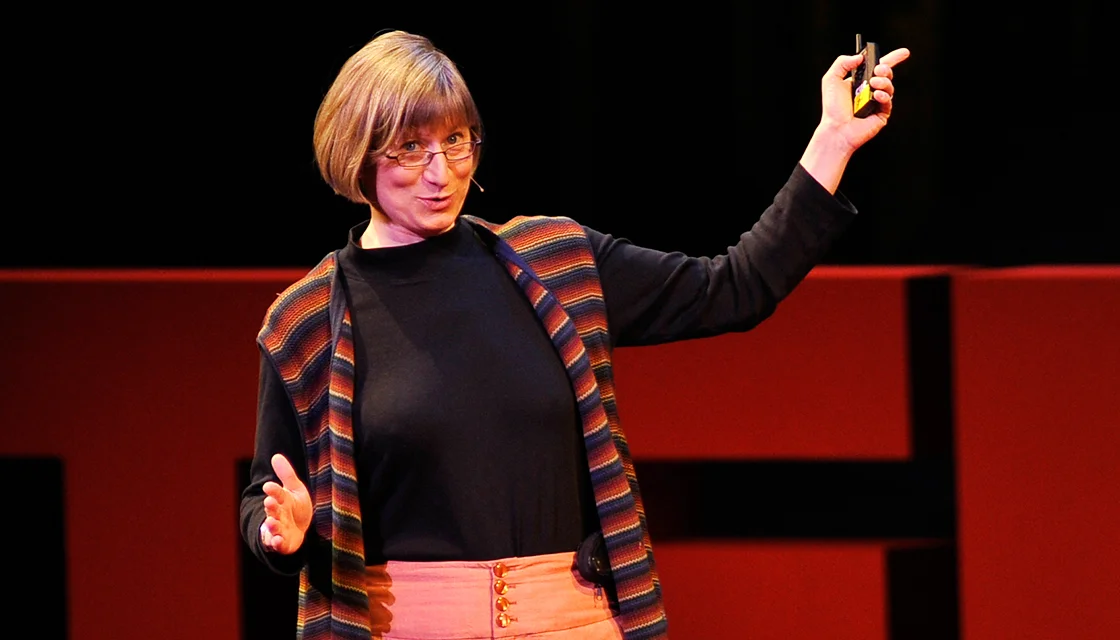
Diane Kelly: "What we don't know about penis anatomy", TEDMED - 2012

June 21, 2017

12 April 2012, TEDMED, Kennedy Center, Washington DC, USA

When I go to parties, it doesn't usually take very long for people to find out that I'm a scientist and I study sex. And then I get asked questions. And the questions usually have a very particular format. They start with the phrase, "A friend told me," and then they end with the phrase, "Is this true?" And most of the time I'm glad to say that I can answer them, but sometimes I have to say, "I'm really sorry, but I don't know because I'm not that kind of a doctor."

 That is, I'm not a clinician, I'm a comparative biologist who studies anatomy. And my job is to look at lots of different species of animals and try to figure out how their tissues and organs work when everything's going right, rather than trying to figure out how to fix things when they go wrong, like so many of you. And what I do is I look for similarities and differences in the solutions that they've evolved for fundamental biological problems.

 So today I'm here to argue that this is not at all an esoteric Ivory Tower activity that we find at our universities, but that broad study across species, tissue types and organ systems can produce insights that have direct implications for human health. And this is true both of my recent project on sex differences in the brain, and my more mature work on the anatomy and function of penises. And now you know why I'm fun at parties.

 (Laughter)

So today I'm going to give you an example drawn from my penis study to show you how knowledge drawn from studies of one organ system provided insights into a very different one. Now I'm sure as everyone in the audience already knows — I did have to explain it to my nine-year-old late last week — penises are structures that transfer sperm from one individual to another. And the slide behind me barely scratches the surface of how widespread they are in animals. There's an enormous amount of anatomical variation. You find muscular tubes, modified legs, modified fins, as well as the mammalian fleshy, inflatable cylinder that we're all familiar with — or at least half of you are.

(Laughter)

And I think we see this tremendous variation because it's a really effective solution to a very basic biological problem, and that is getting sperm in a position to meet up with eggs and form zygotes. Now the penis isn't actually required for internal fertiliztion, but when internal fertilization evolves, penises often follow.

And the question I get when I start talking about this most often is, "What made you interested in this subject?" And the answer is skeletons. You wouldn't think that skeletons and penises have very much to do with one another. And that's because we tend to think of skeletons as stiff lever systems that produce speed or power. And my first forays into biological research, doing dinosaur paleontology as an undergraduate, were really squarely in that realm.

But when I went to graduate school to study biomechanics, I really wanted to find a dissertation project that would expand our knowledge of skeletal function. I tried a bunch of different stuff. A lot of it didn't pan out. But then one day I started thinking about the mammalian penis. And it's really an odd sort of structure. Before it can be used for internal fertilization, its mechanical behavior has to change in a really dramatic fashion. Most of the time it's a flexible organ. It's easy to bend. But before it's brought into use during copulation it has to become rigid, it has to become difficult to bend. And moreover, it has to work. A reproductive system that fails to function produces an individual that has no offspring, and that individual is then kicked out of the gene pool.

And so I thought, "Here's a problem that just cries out for a skeletal system — not one like this one, but one like this one — because, functionally, a skeleton is any system that supports tissue and transmits forces. And I already knew that animals like this earthworm, indeed most animals, don't support their tissues by draping them over bones. Instead they're more like reinforced water balloons. They use a skeleton that we call a hydrostatic skeleton. And a hydrostatic skeleton uses two elements. The skeletal support comes from an interaction between a pressurized fluid and a surrounding wall of tissue that's held in tension and reinforced with fibrous proteins. And the interaction is crucial. Without both elements you have no support. If you have fluid with no wall to surround it and keep pressure up, you have a puddle. And if you have just the wall with no fluid inside of it to put the wall in tension, you've got a little wet rag.

When you look at a penis in cross section, it has a lot of the hallmarks of a hydrostatic skeleton. It has a central space of spongy erectile tissue that fills with fluid — in this case blood — surrounded by a wall of tissue that's rich in a stiff structural protein called collagen.

But at the time when I started this project, the best explanation I could find for penal erection was that the wall surrounded these spongy tissues, and the spongy tissues filled with blood and pressure rose and voila! it became erect.

And that explained to me expansion — made sense: more fluid, you get tissues that expand — but it didn't actually explain erection. Because there was no mechanism in this explanation for making this structure hard to bend. And no one had systematically looked at the wall tissue. So I thought, wall tissue's important in skeletons. It has to be part of the explanation.

And this was the point at which my graduate adviser said, "Whoa! Hold on. Slow down." Because after about six months of me talking about this, I think he finally figured out that I was really serious about the penis thing.

 (Laughter)

 So he sat me down, and he warned me. He was like, "Be careful going down this path. I'm not sure this project's going to pan out." Because he was afraid I was walking into a trap. I was taking on a socially embarrassing question with an answer that he thought might not be particularly interesting. And that was because every hydrostatic skeleton that we had found in nature up to that point had the same basic elements. It had the central fluid, it had the surrounding wall, and the reinforcing fibers in the wall were arranged in crossed helices around the long axis of the skeleton.

So the image behind me shows a piece of tissue in one of these cross helical skeletons cut so that you're looking at the surface of the wall. The arrow shows you the long axis. And you can see two layers of fibers, one in blue and one in yellow, arranged in left-handed and right-handed angles. And if you weren't just looking at a little section of the fibers, those fibers would be going in helices around the long axis of the skeleton — something like a Chinese finger trap, where you stick your fingers in and they get stuck.

And these skeletons have a particular set of behaviors, which I'm going to demonstrate in a film. It's a model skeleton that I made out of a piece of cloth that I wrapped around an inflated balloon. The cloth's cut on the bias. So you can see that the fibers wrap in helices, and those fibers can reorient as the skeleton moves, which means the skeleton's flexible. It lengthens, shortens and bends really easily in response to internal or external forces.

 Now my adviser's concern was what if the penile wall tissue is just the same as any other hydrostatic skeleton. What are you going to contribute? What new thing are you contributing to our knowledge of biology? And I thought, "Yeah, he does have a really good point here." So I spent a long, long time thinking about it. And one thing kept bothering me, and that's, when they're functioning, penises don't wiggle. (Laughter) So something interesting had to be going on.

So I went ahead, collected wall tissue, prepared it so it was erect, sectioned it, put it on slides and then stuck it under the microscope to have a look, fully expecting to see crossed helices of collagen of some variety. But instead I saw this. There's an outer layer and an inner layer. The arrow shows you the long axis of the skeleton.

 I was really surprised at this. Everyone I showed it was really surprised at this. Why was everyone surprised at this? That's because we knew theoretically that there was another way of arranging fibers in a hydrostatic skeleton, and that was with fibers at zero degrees and 90 degrees to the long axis of the structure. The thing is, no one had ever seen it before in nature. And now I was looking at one.

Those fibers in that particular orientation give the skeleton a very, very different behavior. I'm going to show a model made out of exactly the same materials. So it'll be made of the same cotton cloth, same balloon, same internal pressure. But the only difference is that the fibers are arranged differently. And you'll see that, unlike the cross helical model, this model resists extension and contraction and resists bending.

Now what that tells us is that wall tissues are doing so much more than just covering the vascular tissues. They're an integral part of the penile skeleton. If the wall around the erectile tissue wasn't there, if it wasn't reinforced in this way, the shape would change, but the inflated penis would not resist bending, and erection simply wouldn't work.

 It's an observation with obvious medical applications in humans as well, but it's also relevant in a broad sense, I think, to the design of prosthetics, soft robots, basically anything where changes of shape and stiffness are important.

So to sum up: Twenty years ago, I had a college adviser tell me, when I went to the college and said, "I'm kind of interested in anatomy," they said, "Anatomy's a dead science." He couldn't have been more wrong. I really believe that we still have a lot to learn about the normal structure and function of our bodies. Not just about its genetics and molecular biology, but up here in the meat end of the scale. We've got limits on our time. We often focus on one disease, one model, one problem, but my experience suggests that we should take the time to apply ideas broadly between systems and just see where it takes us. After all, if ideas about invertebrate skeletons can give us insights about mammalian reproductive systems, there could be lots of other wild and productive connections lurking out there just waiting to be found.

Thank you.
 

Source: https://www.ted.com/talks/diane_kelly_what...

Enjoyed this speech? Speakola is a labour of love and I’d be very grateful if you would share, tweet or like it. Thank you.

Facebook Twitter Facebook
In SCIENCE AND TECHNOLOGY Tags DIANE KELLY, SCIENCE, PENIS, REPRODUCTION, EVOLUTION, MAMMALS, TRANSCRIPT
Comment

Carl Sagan: 'Man in his arrogance thinks himself a great work', Cosmos: A Personal Voyage (TV) - 1980

September 5, 2016

first aired 28 September 1980, PBS, USA

'See that star?”

"You mean that bright red one?” his daughter asks in return

"Yes, it might not be there anymore. It might be gone by now, exploded or something. Its light is still crossing space, just reaching our eyes now. But we don't see it as it is, we see it as it was.”

Many people experience a stirring sense of wonder when they first confront this simple truth. Why? why should it be so compelling. The immense distances to the stars and the galaxies means we see everything in the past. Some as they were before the earth came to be. Telescopes are time machines.

Long ago, when an early galaxy began to pour light out in to the surrounding darkness no witness could have known that billions of years later. Some remote clumps of rock and metal, ice and organic molecules would fall together to form a place that we call earth. And surely nobody could have imagined that life would arise, and thinking beings evolve who would one day capture a fraction of that light and would try to puzzle out what sent it on its way.

We can recognize here a shortcoming, in some circumstances serious, in our ability to understand the world. Characteristically, willie-nilly we seem compelled to project our own nature onto nature. Man in his arrogance thinks himself a great work worthy of the interposition of a deity. Darwin wrote in his notebook, more humble, and I think truer to consider himself created from animals.

We're johnny-come-latelys; we live in the cosmic boondocks; we emerged from microbes in muck; Apes are our cousins; our thoughts are not entirely our own, and on top of that we're making a mess of our planet and becoming a danger to ourselves.

The trapdoor beneath our feet swings open. We find ourselves in bottomless free fall. We are lost in a great darkness and there is nobody to send out a search party. Given so harsh a reality, of course we are inclined to shut our eyes and pretend that we are safe and snug at home, that the fall is only a bad dream. If it takes a little myth and ritual to get us through a night that seems endless, who among us cannot sympathize and understand?

We long to be here for a purpose. Even though, despite much self-deception, none is evident. The significance of our lives and our fragile planet is then determined by our own wisdom and courage. We are the custodians of life's meaning. We long for parents to care for us, to forgive us of our errors, to save us from our childish mistakes. But knowledge of preferable to ignorance. Better, by far, to embrace the harsh reality than a reassuring fable.

Modern science has been a voyage into the unknown, with a lesson in humility waiting at every stop. Our common sense intuitions can be mistaken. Our preferences don't count. We do not live in a privileged reference frame. If we crave some cosmic purpose, then let us find ourselves a worthy goal.


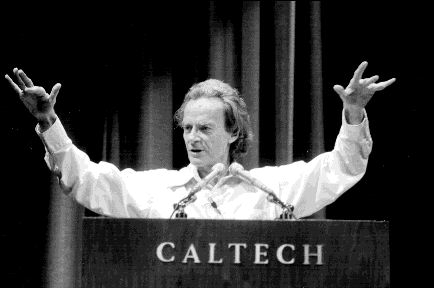
Related content: Richard Feynman, Cargo Cult speech, Caltech, "The first principle is that you must not fool yourself'.

During the Middle Ages there were all kinds of crazy ideas, such as that a piece of rhinoceros horn would increase potency. Then a method was discovered for separating the ideas--which was to try one to see if it worked, and if it didn't work, to eliminate it. This method became organized, of course, into science.

Read speech


Source: https://www.youtube.com/watch?v=cSrL0BXsO4...

Enjoyed this speech? Speakola is a labour of love and I’d be very grateful if you would share, tweet or like it. Thank you.

Facebook Twitter Facebook
In SCIENCE AND TECHNOLOGY Tags CARL SAGAN, MAN IN HIS ARROGANCE, TRANSCRIPT, COSMOS A PERSONAL VOYAGE, RELIGION, SCIENCE & RELIGION, EVOLUTION, MAN IN THE UNIVERSE, UNIVERSE
2 Comments

Dudley Field Malone: 'There is never a duel with the truth', defence of evolution teacher John Scopes 'Monkey Trial' - 1925

August 8, 2016

July 15, 1925, Dayton, Tennessee, USA

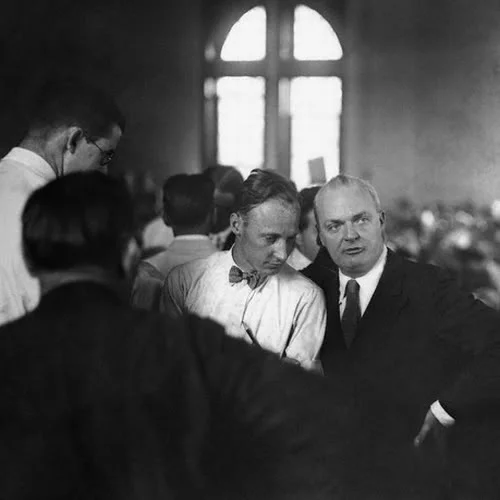
John Thomas Scopes was on trial for teaching evolution in a Tennessee state funded school, in violation of the Butler Act. This was his attorney's spirited defense. Scopes was found guilty and fined $100 which was later overturned on a technicality.

What I don't understand is this, your Honor, the prosectution inside and outside of the court has been ready to try the case and this is the case. What is the issue that has gained the attention, not only of the American people, but people everywhere? Is it a mere technical question as to whether the defendant Scopes taught the paragraph in the book of science? You think, your Honor, that the News Association in London, which sent you that very complimentary telegram you were good enough to me to show me in this case, because the issue is whether John Scopes taught a couple of paragraphs out of his book? Oh, no, the issue is as broad as Mr. Brayn has published it and why the fear? If the issue is as broad as they make it, why the fear of meeting the issue? Why, where issues are drawn by evidence, where the truth and nothing but the truth are scrutinized and where statements can be answered by expert witnesses on the other side -- what is the psychology of fear? I don't understand it. My old chief -- I never saw him back away from a great issue before. I feel that the prosectution here is filled with a needless fear. I believe that if they withdraw their objection and hear the evidence of our experts their minds would not only improve but their souls would be purified.

I believe and we believe that men who are God-fearing, who are giving their lives to study and observation, to the teaching of the young -- are the teachers and scientists of this country in a combination to destroy the morals of the children to whom they have dedicated their lives? Are preachers the only ones in America who care about our youth? Is the church the the only source of morality in this country? And I would like to say something for the children of the country. We have no fears about the young people of America. They are a pretty smart generation. Any teacher who teaches the boys or the girls today an incredible theory -- we need not worry about those children of this generation paying much attention to it. The children of this generation are pretty wise. People, as a matter of fact I feel that the children of this generation are probably much wiser than many of their elders. The least that this generation can do, your Honor, is to give the next generation all the facts, all the available data, all the theories, all the information that learning, that study, that observations has produced -- give it to the children in the hope of heaven that they will make a better world of this than we have been able to make it. We have just had a war with twenty million dead. Civilization is not so proud of the work of the adults. Civilization need not be so proud of what the grown-ups have done. For God's sake let the chidren have their minds kept open -- close no doors to their knowledge; shut no door from them. Make the distinction between theology and science. let them have both. let them both be taught. Let them both live....

We want everything we have to say on religion and on science told and we are ready to submit our theories to the direct and cross-examination of the prosecution. We have come in here ready for a battle. We have come in here for this duel.

I don't know anything about dueling, your Honor. It is against the law of God. It is against the church. It is against the law of Tennessee, but does the opposition mean by duel that our defendant shall be strapped to a board and they alone shall carry the sword? Is our only weapon the witnesses who shall testify to the accuracy of our theory -- is our weapon to be taken from us, so that the duel will be entirely one-sided? That isn't my idea of a duel. Moreover it isn't going to be a duel.

There is never a duel with the truth. The truth always wins and we are not afraid of it. The truth is no coward. The truth does not need the law. The truth does not need the forces of government. The truth does not need Mr. Bryan. the truth is imperishable, eternal, and immortal and needs no human agency to support it. We are ready to tell the truth as we understand it and we do not fear all the truth that they can present as facts. We are ready. We are ready. We feel we stand with progress. We feel we stand with science. we feel we stand with intelligence. We feel we stand with fundamental freedom in America We are not afraid. Where is the fear? We meet it! Where is the fear? We defy it! We ask your honor to admit the evidence as a matter of correct law, as a matter of sound procedure and as a matter of justice to the defense in this case. (Profound and continued applause.)

(The bailiff raps for order.)


Source: http://historicalthinkingmatters.org/scope...

Enjoyed this speech? Speakola is a labour of love and I’d be very grateful if you would share, tweet or like it. Thank you.

Facebook Twitter Facebook
In LAWS AND JUSTICE Tags SCIENCE, EDUCATION, TENNESSEE, TRANSCRIPT, DUDLEY FIELD MALONE, SCOPES TRIAL, JOHN THOMAS SCOPES, EVOLUTION, MONKEY TRIAL
Comment

See my film!

Limited Australian Season

March 2025

Details and ticket bookings at

angeandtheboss.com

Support Speakola

Hi speech lovers,
With costs of hosting website and podcast, this labour of love has become a difficult financial proposition in recent times. If you can afford a donation, it will help Speakola survive and prosper.

Best wishes,
Tony Wilson.

Become a Patron!

Learn more about supporting Speakola.

Featured political

Featured
Jon Stewart: "They responded in five seconds", 9-11 first responders, Address to Congress - 2019
Jacinda Ardern: 'They were New Zealanders. They are us', Address to Parliament following Christchurch massacre - 2019
Dolores Ibárruri: "¡No Pasarán!, They shall not pass!', Defense of 2nd Spanish Republic - 1936
Jimmy Reid: 'A rat race is for rats. We're not rats', Rectorial address, Glasgow University - 1972

Featured eulogies

Featured
For Geoffrey Tozer: 'I have to say we all let him down', by Paul Keating - 2009
for James Baldwin: 'Jimmy. You crowned us', by Toni Morrison - 1988
for Michael Gordon: '13 days ago my Dad’s big, beautiful, generous heart suddenly stopped beating', by Scott and Sarah Gordon - 2018

Featured commencement

Featured
Tara Westover: 'Your avatar isn't real, it isn't terribly far from a lie', The Un-Instagrammable Self, Northeastern University - 2019
Tim Minchin: 'Being an artist requires massive reserves of self-belief', WAAPA - 2019
Atul Gawande: 'Curiosity and What Equality Really Means', UCLA Medical School - 2018
Abby Wambach: 'We are the wolves', Barnard College - 2018
Eric Idle: 'America is 300 million people all walking in the same direction, singing 'I Did It My Way'', Whitman College - 2013
Shirley Chisholm: ;America has gone to sleep', Greenfield High School - 1983

Featured sport

Featured
Joe Marler: 'Get back on the horse', Harlequins v Bath pre game interview - 2019
Ray Lewis : 'The greatest pain of my life is the reason I'm standing here today', 52 Cards -
Mel Jones: 'If she was Bradman on the field, she was definitely Keith Miller off the field', Betty Wilson's induction into Australian Cricket Hall of Fame - 2017
Jeff Thomson: 'It’s all those people that help you as kids', Hall of Fame - 2016

Fresh Tweets


Featured weddings

Featured
Dan Angelucci: 'The Best (Best Man) Speech of all time', for Don and Katherine - 2019
Hallerman Sisters: 'Oh sister now we have to let you gooooo!' for Caitlin & Johnny - 2015
Korey Soderman (via Kyle): 'All our lives I have used my voice to help Korey express his thoughts, so today, like always, I will be my brother’s voice' for Kyle and Jess - 2014

Featured Arts

Featured
Bruce Springsteen: 'They're keepers of some of the most beautiful sonic architecture in rock and roll', Induction U2 into Rock Hall of Fame - 2005
Olivia Colman: 'Done that bit. I think I have done that bit', BAFTA acceptance, Leading Actress - 2019
Axel Scheffler: 'The book wasn't called 'No Room on the Broom!', Illustrator of the Year, British Book Awards - 2018
Tina Fey: 'Only in comedy is an obedient white girl from the suburbs a diversity candidate', Kennedy Center Mark Twain Award -  2010
Tina Fey: 'Only in comedy is an obedient white girl from the suburbs a diversity candidate', Kennedy Center Mark Twain Award - 2010

Featured Debates

Featured
Sacha Baron Cohen: 'Just think what Goebbels might have done with Facebook', Anti Defamation League Leadership Award - 2019
Greta Thunberg: 'How dare you', UN Climate Action Summit - 2019
Charlie Munger: 'The Psychology of Human Misjudgment', Harvard University - 1995
Lawrence O'Donnell: 'The original sin of this country is that we invaders shot and murdered our way across the land killing every Native American that we could', The Last Word, 'Dakota' - 2016