• Genre
  • About
  • Submissions
  • Donate
  • Search
Menu

Speakola

All Speeches Great and Small
  • Genre
  • About
  • Submissions
  • Donate
  • Search

Michael Holding: 'History is written by the conqueror, not those that are conquered', pre Test match comments on race - 2020

July 9, 2020

9 July 2020, Southampton, United Kingdom

When I say education, I mean going back in history. What people need to understand is that this thing stems from a long time ago, hundreds of years ago. The dehumanisation of the black race is where it started. People will tell you, 'that's a long time ago, get over it'. No. You don't get over things like that. Society has not gotten over something like that.

Think about religion. The image of Jesus Christ is pale skin, blond hair, blue eyes. Where Jesus came from, who in that part of the world looks that way? That is brainwashing, to show you 'this is what the image of perfection is'. If you look at plays from those days, Judas, who betrayed Jesus, is a black man. Brainwashing people to think, 'he is a black man, he is the bad man'.

Go through history. Thomas Edison invented the light bulb, everybody knows that, but he invented the light bulb with a paper filament that burned out in no time at all. Can you tell me who invented the filament that makes these lights shine? Nobody knows, because he was a black man and it was not taught in schools. Lewis Howard Latimer invented the carbon filament to allow lights to continue to shine, yet who knows that?

Everything should be taught. In my school days, I was never taught anything good about black people and you cannot have a society that is brought up like that where you only teach what is convenient to the teacher. History is written by the conqueror, not those that are conquered. History is written by the people who do the harm, not by the people who are harmed. We need to go back and teach both sides of history.

Until we do that and educate the entire human race, this thing will not stop. We need to teach and re-educate, as a lot of black people in this world are growing up believing that they are lesser than other people and that cannot be right.

People tell me there is nothing called white privilege. Give me a break. I don't see white people going into a store in Oxford Street and being followed. A black man walks in and someone is following him everywhere he goes. That is basic white privilege.

I don't want people to think I think all white people are racist and walk around thinking racist things. It's not, 'I'm black, I don't like white people', or 'I am white, I don't like black people'.

There was a study done at Yale University in 2016, where they got 130 pre-school teachers to go into a room and watch a video and look out for bad behaviour. There were black boys, white boys, black girls, white girls.

There was no bad behaviour in the video but they had a tracker of the teachers' eyes and at the end, they got the results and their eyes had constantly looked at the black kids, black boys the majority.

One person didn't want the results released, but 129 of the teachers were embarrassed. They did not even know, they were unconscious. The society in which we grow, it is almost osmosis; it seeps into you, and subconsciously affects your mind.

There was a 2014 study, also at Yale, with police officers. They were shown pictures of black kids and white kids - kids meaning early teens. Each police officer was asked at the end how old he thought the black kids and white kids were. On average, the police officers gave the black kids' age four and a half years older than the white kids, guessing the age of the white kids easily.

If you are a police officer confronting a 14-year-old and you think in your mind he is 18, 19 years old, your attitude is going to be different. He is no longer an innocent 14-year-old, he is a senior, approaching adulthood and your approach is going to be different. That is something that has to be tackled.

We know there has been abuse of black people by police officers, not just in England or the US, all over the place. Unless society is cleansed and sorted, we will continue to have this problem.

Source: https://www.skysports.com/transfer/news/12...

Enjoyed this speech? Speakola is a labour of love and I’d be very grateful if you would share, tweet or like it. Thank you.

Facebook Twitter Facebook
In EQUALITY 3 Tags MICHAEL HOLDING, SKY SPORTS CRICKET, EDUCATION, TEST MATCH, WEST INDIES, BLACK LIVES MATTER, DEHUMANISATION, HISTORY, AMY COOPER, TRANSCRIPT, WHITE PRIVILEGE, RACISM, POLICE BRUTALITY
Comment

Tania Major: 'Four of my classmates have already committed suicide and I'm 22 years old', 'Here I am', Address to PM - 2003

June 15, 2020

6 August 2003, Cape York, Queensland, Australia

Video extract of speech from 2:17min. mark to 3:29min

Here I am: a young Cape York woman addressing the Prime Minister of Australia directly. The fact that you are here today, Mr Howard, is largely due to the hard work and vision of our leaders.
We are proud of their efforts. Especially I want to mention Noel Pearson. He has been my mentor and contributed to paying for my education. We are also proud of the efforts of our elders who have struggled to keep our culture alive.

I thank you for coming here today and acknowledge that your visit might signify the start of a new era in Cape York Peninsulas Aboriginal governance. I say 'might' because there is a huge job in front of us and if we are going to succeed we need your commitment as well as our own. I hope this is truly the start of a new relationship between Government and Cape York Peninsula people.

In less than 60 years the people of my tribe have gone from being an independent nation to cultural prisoners to welfare recipients. Is it any wonder that there are so many problems facing Indigenous Australians today? Prime Minister, I want you to gain a brief picture of the life of young people in our communities.

When I was growing up in Kowanyama there were 15 people in my class. Today I am the only one that has gone to University, let alone finished secondary education. I'm also the only girl in my class who did not have a child at 15. Of the boys in my class seven have been incarcerated, two for murder, rape and assault. Of the 15 there are only three of us who are not alcoholics. And, Prime Minister, one of the saddest things I must report to you is that four of my class mates have already committed suicide. I am 22 years old.
Now if this paints a grim picture of community life for you, it should. Life as a young Aboriginal person is not easy, in any setting. Life for a young Aboriginal woman is even harder. We have to fight for respect from everyone.

The story of my fellow students is a lesson in the magnitude of the problems that young Indigenous people in Cape York face. The two issues that, in my opinion, are central to changing this story are education and health. And your Government's policies affect these things.

Two months ago I told the Queensland Principals conference that the levels of literacy and numeracy are very low in Aboriginal communities. I told them that when I went to school in Brisbane it was as if I had missed out on my primary education.

There is a huge gap between what we get in communities and what other kids get in cities. I got straight As at Kowanyama but when I got to Brisbane I was getting Cs and Ds. It really goes to show that there was something seriously wrong with the education system in our communities.

One of the problems facing education in remote Indigenous schools is that teachers tend to be just out of training and generally stay for only a year or two. There was not one teacher who stayed for the whole of my nine years at school, even the principals. On top of the racism that Aboriginal people face every day of our lives this seeming lack of commitment by teachers makes you feel they don't care.

Prime Minister we need to review the curriculum in these communities because it's pitched at a very low level. I have had to draw the conclusion that Governments and educationalists see us as less than white people.

It was really sad to go to school in my community because the attitude in the whole community was that white kids are much smarter than me. How can the education being offered to our young people be justified?

Education should be uplifting not serve to reinforce lack of self-esteem and the heart wrenching low expectations that my mob suffer from. If we cannot get education right then we are doomed.
We need a massive re-assessment of education policies and an equally massive investment in education. Government let down most of my classmates. Noel Pearson helped me to an education, but most young people won't be assisted by a sponsor.

I got a chance in my life, worked hard with support from family and friends and today I stand before you as a qualified criminologist. All across Cape York I see and meet young Murris; smart, brave, compassionate, talented and beautiful. What is missing from their lives is an education that promotes self-confidence and drive.

With these qualities, hundreds of Cape York Peninsula Murris could be the next group of doctors, lawyers, painters, mechanics, criminologists or engineers. We have spent so long listening to some whitefellas telling us we are stupid, lazy no-hopers that the majority of my people actually believe it.

The relationship between poor education and poor health is clear. People whose self-esteem and pride have been decimated by a sub-standard education system and a social system that creates an addiction to passive welfare have little reason to live healthy lives.

Prime Minister, our health is getting worse not better. The policies that determine the delivery of health services are deeply flawed by a bureaucracy that does not want to let go and hear our voices. Health services are too often confined to the clinic. It's a patch ‘em up and spit ‘em out kind of health regime.
In Kowanyama we had the only doctor based in a Cape York Aboriginal community. She left two weeks ago because the Queensland Health bureaucracy did not support her. Her practice epitomised the sort of health system we need. She understood the relationship between physical, mental and spiritual health. She took health out of the clinic and into the lives and homes of community people. She took her responsibilities to serve the community seriously and now she's gone. Another blow to my community's already low morale.

Prime Minister, it's problems and challenges such as the ones I've described to you already that led me to stand in last October's ATSIC election. I decided to run because I believe ATSIC provides a great opportunity to advocate for my people; to have a say in distributing funding throughout Cape York Peninsula and influence State and Federal Government policy decisions that affect me and my people.
It is great privilege for me to represent my community and I hope that with experience I will be an effective ATSIC Councillor.

I know that in the coming months your Government will decide the future of ATSIC and I hope that you will understand that ATSIC is more than the Board of Commissioners and the Canberra bureaucracy. ATSIC is also people like myself and my Chairperson Eddie Woodley. People who are from community and work hard for community.

Prime Minister, we recognise that Governments cannot solve our problems for us. As young people we are trying to take responsibility for our future. We are working with our Elders to address the terrible problems of grog, illicit drugs and violence. We are working hard to create economic, training and employment opportunities for ourselves. We are supporting our fellow young people to achieve their potential.

Mr Howard, I ask not that you fix these problems for us but that you and your Government see us as equal partners in the huge task of rebuilding our families, communities and Cape York Peninsula.

You have demonstrated your commitment by engaging your government at the recent family and domestic violence summit and, for what it's worth Prime Minister, my own view is that the level of domestic violence and child abuse sums up all that has been wrong with Aboriginal Affairs policy.

We need a new relationship to address this frightening reality in our lives. Aboriginal people are reluctant to admit that young girls and women are being raped by their own people because of the blanket of shame. I am asking you to help lift that blanket.

The fact that you are here today is a good start in the process of change and I urge you, as a fair-minded man, not just as Prime Minister, to become part of the solution. I stand up here as a proud Aboriginal woman, a Kokoberra woman as well as a criminologist and I thank you for your time and attention.

Source: https://www.smh.com.au/opinion/here-i-am-2...

Enjoyed this speech? Speakola is a labour of love and I’d be very grateful if you would share, tweet or like it. Thank you.

Facebook Twitter Facebook
In EQUALITY 3 Tags TANIA MAJOR, YOUNG AUSTRALIAN OF THE YEAR, JOHN HOWARD, HERE I AM, INDIGENOUS WOMAN, INDIGENOUS DISADVANTAGE, INCARCERATION, EDUCATION, INSTITUTIONAL RACISM, DISADVANTAGE
Comment

Ken Robinson: 'Creativity is as important in education as literacy', Do Schools Kill Creativity, TED - 2016

December 3, 2018

February 2006. TED 2006, Monterey, California, USA

Appears in full on TED

Good morning. How are you?

It's been great, hasn't it? I've been blown away by the whole thing. In fact, I'm leaving.

There have been three themes running through the conference which are relevant to what I want to talk about. One is the extraordinary evidence of human creativity in all of the presentations that we've had and in all of the people here. Just the variety of it and the range of it. The second is that it's put us in a place where we have no idea what's going to happen, in terms of the future. No idea how this may play out.

I have an interest in education. Actually, what I find is everybody has an interest in education. Don't you? I find this very interesting. If you're at a dinner party, and you say you work in education — Actually, you're not often at dinner parties, frankly.

If you work in education, you're not asked.

And you're never asked back, curiously. That's strange to me. But if you are, and you say to somebody, you know, they say, “What do you do?” and you say you work in education, you can see the blood run from their face. They're like, “Oh my God,” you know,

“Why me?”

“My one night out all week.”

But if you ask about their education, they pin you to the wall. Because it's one of those things that goes deep with people, am I right? Like religion, and money and other things. So I have a big interest in education, and I think we all do. We have a huge vested interest in it, partly because it's education that's meant to take us into this future that we can't grasp. If you think of it, children starting school this year will be retiring in 2065. Nobody has a clue, despite all the expertise that's been on parade for the past four days, what the world will look like in five years' time. And yet we're meant to be educating them for it. So the unpredictability, I think, is extraordinary.

And the third part of this is that we've all agreed, nonetheless, on the really extraordinary capacities that children have — their capacities for innovation. I mean, Sirena last night was a marvel, wasn't she? Just seeing what she could do. And she's exceptional, but I think she's not, so to speak, exceptional in the whole of childhood. What you have there is a person of extraordinary dedication who found a talent. And my contention is, all kids have tremendous talents. And we squander them, pretty ruthlessly.

So I want to talk about education and I want to talk about creativity. My contention is that creativity now is as important in education as literacy, and we should treat it with the same status.

(Applause) Thank you.

That was it, by the way. Thank you very much.

So, 15 minutes left.

Well, I was born… no.

I heard a great story recently — I love telling it — of a little girl who was in a drawing lesson. She was six, and she was at the back, drawing, and the teacher said this girl hardly ever paid attention, and in this drawing lesson, she did. The teacher was fascinated. She went over to her, and she said, “What are you drawing?” And the girl said, “I'm drawing a picture of God.” And the teacher said, “But nobody knows what God looks like.” And the girl said, “They will, in a minute.”

When my son was four in England — Actually, he was four everywhere, to be honest.

If we're being strict about it, wherever he went, he was four that year. He was in the Nativity play. Do you remember the story?

No, it was big, it was a big story. Mel Gibson did the sequel, you may have seen it.

“Nativity II.” But James got the part of Joseph, which we were thrilled about. We considered this to be one of the lead parts. We had the place crammed full of agents in T-shirts: “James Robinson IS Joseph!” (Laughter) He didn't have to speak, but you know the bit where the three kings come in? They come in bearing gifts, gold, frankincense and myrrh. This really happened. We were sitting there and I think they just went out of sequence, because we talked to the little boy afterward and we said, “You OK with that?” And he said, “Yeah, why? Was that wrong?” They just switched. The three boys came in, four-year-olds with tea towels on their heads, and they put these boxes down, and the first boy said, “I bring you gold.” And the second boy said, “I bring you myrrh.” And the third boy said, “Frank sent this.”

What these things have in common is that kids will take a chance. If they don't know, they'll have a go. Am I right? They're not frightened of being wrong. I don't mean to say that being wrong is the same thing as being creative. What we do know is, if you're not prepared to be wrong, you'll never come up with anything original — if you're not prepared to be wrong. And by the time they get to be adults, most kids have lost that capacity. They have become frightened of being wrong. And we run our companies like this. We stigmatize mistakes. And we're now running national education systems where mistakes are the worst thing you can make. And the result is that we are educating people out of their creative capacities.

Picasso once said this, he said that all children are born artists. The problem is to remain an artist as we grow up. I believe this passionately, that we don't grow into creativity, we grow out of it. Or rather, we get educated out of it. So why is this?

I lived in Stratford-on-Avon until about five years ago. In fact, we moved from Stratford to Los Angeles. So you can imagine what a seamless transition that was.

Actually, we lived in a place called Snitterfield, just outside Stratford, which is where Shakespeare's father was born. Are you struck by a new thought? I was. You don't think of Shakespeare having a father, do you? Do you? Because you don't think of Shakespeare being a child, do you? Shakespeare being seven? I never thought of it. I mean, he was seven at some point. He was in somebody's English class, wasn't he?

How annoying would that be?

“Must try harder.”

Being sent to bed by his dad, you know, to Shakespeare, “Go to bed, now! And put the pencil down.”

“And stop speaking like that.”

“It's confusing everybody.”

Anyway, we moved from Stratford to Los Angeles, and I just want to say a word about the transition. My son didn't want to come. I've got two kids; he's 21 now, my daughter's 16. He didn't want to come to Los Angeles. He loved it, but he had a girlfriend in England. This was the love of his life, Sarah. He'd known her for a month.

Mind you, they'd had their fourth anniversary, because it's a long time when you're 16. He was really upset on the plane, he said, “I'll never find another girl like Sarah.” And we were rather pleased about that, frankly —

Because she was the main reason we were leaving the country.

But something strikes you when you move to America and travel around the world: Every education system on Earth has the same hierarchy of subjects. Every one. Doesn't matter where you go. You'd think it would be otherwise, but it isn't. At the top are mathematics and languages, then the humanities, and at the bottom are the arts. Everywhere on Earth. And in pretty much every system too, there's a hierarchy within the arts. Art and music are normally given a higher status in schools than drama and dance. There isn't an education system on the planet that teaches dance everyday to children the way we teach them mathematics. Why? Why not? I think this is rather important. I think math is very important, but so is dance. Children dance all the time if they're allowed to, we all do. We all have bodies, don't we? Did I miss a meeting?

Truthfully, what happens is, as children grow up, we start to educate them progressively from the waist up. And then we focus on their heads. And slightly to one side.

If you were to visit education, as an alien, and say “What's it for, public education?” I think you'd have to conclude, if you look at the output, who really succeeds by this, who does everything that they should, who gets all the brownie points, who are the winners — I think you'd have to conclude the whole purpose of public education throughout the world is to produce university professors. Isn't it? They're the people who come out the top. And I used to be one, so there.

And I like university professors, but you know, we shouldn't hold them up as the high-water mark of all human achievement. They're just a form of life, another form of life. But they're rather curious, and I say this out of affection for them. There's something curious about professors in my experience — not all of them, but typically, they live in their heads. They live up there, and slightly to one side. They're disembodied, you know, in a kind of literal way. They look upon their body as a form of transport for their heads.

Don't they? It's a way of getting their head to meetings.

If you want real evidence of out-of-body experiences, get yourself along to a residential conference of senior academics, and pop into the discotheque on the final night.

And there, you will see it. Grown men and women writhing uncontrollably, off the beat.

Waiting until it ends so they can go home and write a paper about it.

Our education system is predicated on the idea of academic ability. And there's a reason. Around the world, there were no public systems of education, really, before the 19th century. They all came into being to meet the needs of industrialism. So the hierarchy is rooted on two ideas.

Number one, that the most useful subjects for work are at the top. So you were probably steered benignly away from things at school when you were a kid, things you liked, on the grounds that you would never get a job doing that. Is that right? Don't do music, you're not going to be a musician; don't do art, you won't be an artist. Benign advice — now, profoundly mistaken. The whole world is engulfed in a revolution.

And the second is academic ability, which has really come to dominate our view of intelligence, because the universities designed the system in their image. If you think of it, the whole system of public education around the world is a protracted process of university entrance. And the consequence is that many highly-talented, brilliant, creative people think they're not, because the thing they were good at at school wasn't valued, or was actually stigmatized. And I think we can't afford to go on that way.

In the next 30 years, according to UNESCO, more people worldwide will be graduating through education than since the beginning of history. More people, and it's the combination of all the things we've talked about — technology and its transformation effect on work, and demography and the huge explosion in population.

Suddenly, degrees aren't worth anything. Isn't that true? When I was a student, if you had a degree, you had a job. If you didn't have a job, it's because you didn't want one. And I didn't want one, frankly. (Laughter) But now kids with degrees are often heading home to carry on playing video games, because you need an MA where the previous job required a BA, and now you need a PhD for the other. It's a process of academic inflation. And it indicates the whole structure of education is shifting beneath our feet. We need to radically rethink our view of intelligence.

We know three things about intelligence. One, it's diverse. We think about the world in all the ways that we experience it. We think visually, we think in sound, we think kinesthetically. We think in abstract terms, we think in movement. Secondly, intelligence is dynamic. If you look at the interactions of a human brain, as we heard yesterday from a number of presentations, intelligence is wonderfully interactive. The brain isn't divided into compartments. In fact, creativity — which I define as the process of having original ideas that have value — more often than not comes about through the interaction of different disciplinary ways of seeing things.

By the way, there's a shaft of nerves that joins the two halves of the brain called the corpus callosum. It's thicker in women. Following off from Helen yesterday, this is probably why women are better at multi-tasking. Because you are, aren't you? There's a raft of research, but I know it from my personal life. If my wife is cooking a meal at home — which is not often, thankfully.

No, she's good at some things, but if she's cooking, she's dealing with people on the phone, she's talking to the kids, she's painting the ceiling, she's doing open-heart surgery over here. If I'm cooking, the door is shut, the kids are out, the phone's on the hook, if she comes in I get annoyed. I say, “Terry, please, I'm trying to fry an egg in here.”

“Give me a break.”

Actually, do you know that old philosophical thing, if a tree falls in a forest and nobody hears it, did it happen? Remember that old chestnut? I saw a great t-shirt recently, which said, “If a man speaks his mind in a forest, and no woman hears him, is he still wrong?”

And the third thing about intelligence is, it's distinct. I'm doing a new book at the moment called “Epiphany,” which is based on a series of interviews with people about how they discovered their talent. I'm fascinated by how people got to be there. It's really prompted by a conversation I had with a wonderful woman who maybe most people have never heard of, Gillian Lynne. Have you heard of her? Some have. She's a choreographer, and everybody knows her work. She did “Cats” and “Phantom of the Opera.” She's wonderful. I used to be on the board of The Royal Ballet, as you can see. Anyway, Gillian and I had lunch one day and I said, “How did you get to be a dancer?” It was interesting. When she was at school, she was really hopeless. And the school, in the '30s, wrote to her parents and said, “We think Gillian has a learning disorder.” She couldn't concentrate; she was fidgeting. I think now they'd say she had ADHD. Wouldn't you? But this was the 1930s, and ADHD hadn't been invented at this point. It wasn't an available condition.

People weren't aware they could have that.

Anyway, she went to see this specialist. So, this oak-paneled room, and she was there with her mother, and she was led and sat on this chair at the end, and she sat on her hands for 20 minutes while this man talked to her mother about the problems Gillian was having at school. Because she was disturbing people; her homework was always late; and so on, little kid of eight. In the end, the doctor went and sat next to Gillian, and said, “I've listened to all these things your mother's told me, I need to speak to her privately. Wait here. We'll be back; we won't be very long,” and they went and left her.

But as they went out of the room, he turned on the radio that was sitting on his desk. And when they got out, he said to her mother, “Just stand and watch her.” And the minute they left the room, she was on her feet, moving to the music. And they watched for a few minutes and he turned to her mother and said, “Mrs. Lynne, Gillian isn't sick; she's a dancer. Take her to a dance school.”

I said, “What happened?” She said, “She did. I can't tell you how wonderful it was. We walked in this room and it was full of people like me. People who couldn't sit still. People who had to move to think.” Who had to move to think. They did ballet, they did tap, jazz; they did modern; they did contemporary. She was eventually auditioned for the Royal Ballet School; she became a soloist; she had a wonderful career at the Royal Ballet. She eventually graduated from the Royal Ballet School, founded the Gillian Lynne Dance Company, met Andrew Lloyd Webber. She's been responsible for some of the most successful musical theater productions in history, she's given pleasure to millions, and she's a multi-millionaire. Somebody else might have put her on medication and told her to calm down.

What I think it comes to is this: Al Gore spoke the other night about ecology and the revolution that was triggered by Rachel Carson. I believe our only hope for the future is to adopt a new conception of human ecology, one in which we start to reconstitute our conception of the richness of human capacity. Our education system has mined our minds in the way that we strip-mine the earth: for a particular commodity. And for the future, it won't serve us. We have to rethink the fundamental principles on which we're educating our children.

There was a wonderful quote by Jonas Salk, who said, “If all the insects were to disappear from the Earth, within 50 years all life on Earth would end. If all human beings disappeared from the Earth, within 50 years all forms of life would flourish.” And he's right.

What TED celebrates is the gift of the human imagination. We have to be careful now that we use this gift wisely and that we avert some of the scenarios that we've talked about. And the only way we'll do it is by seeing our creative capacities for the richness they are and seeing our children for the hope that they are. And our task is to educate their whole being, so they can face this future. By the way — we may not see this future, but they will. And our job is to help them make something of it.

Thank you very much.

Source: https://www.ted.com/talks/ken_robinson_say...

Enjoyed this speech? Speakola is a labour of love and I’d be very grateful if you would share, tweet or like it. Thank you.

Facebook Twitter Facebook
In EDUCATION Tags KEN ROBINSON, SIR KEN ROBINSON, DO SCHOOLS KILL CREATIVITY, TRANSCRIPT, TED TALKS, TED2006, EDUCATION, CREATIVITY
Comment

Sheila E Widnall: 'Digits of Pi: Barriers and Enablers for Women in Engineering', National Academy of Engineering - 2000

June 22, 2017

Sheila Widnall was the first woman to head a branch of the American military (air force). She is a professor in aeronautics and astronautics and first woman to serve as chair of the MIT faculty. The video above is not the famous speech below.

2000, National Academy of Engineering, USA

In a recent seminar with faculty colleagues, we were discussing the information content of a string of numbers. The assertion was made that the quantity of information equaled the number of bits in the string, unless you were told that, for example, the string was the digits of Pi. Then the information quantity became essentially one. The additional assertion was made that of course all MIT freshmen knew Pi out to some outrageously large number of digits. I remarked that this seemed to me like a "guy" sort of thing, and I doubted that the women at MIT knew Pi out to some large number of digits.

This got me thinking whether there are other "guy" sort of things which are totally irrelevant to the contributions that engineers make to our society but that nevertheless operate to keep women out of engineering. These "guy" things may also be real barriers in the minds of some male faculty members who may unconsciously, or even consciously, tell women that women don't belong in engineering. I have recently visited university campuses where that is still going on.

Let me make a strong statement: If women don't belong in engineering, then engineering as a profession is irrelevant to the needs of our society. If engineering doesn't make welcome space for them and embrace them for their wonderful qualities, then engineering will become marginalized as other fields expand their turf to seek out and make a place for women.

So let me give you Sheila Widnall's top 10 reasons why women are important to the profession of engineering:

10. Women are a major force in our society. They are self-conscious about their role and determined to be heard.

9. Women are 50 percent of the consumers of products in our society and make over 50 percent of the purchasing decisions.

8. To both men and women today, a profession that does not have a significant percentage of women is not an attractive career choice.

7. Women are integrators. They are experts at parallel processing, at handling many things at once.

6. Women are comfortable in fuzzy situations.

5. Women are team builders. They inherently practice what is now understood as an effective management style.

4. Engineering should be and could be the twenty-first century foundation for all of the professions.

3. Women are a major force in the professions of law, medicine, media, politics, and business.

2. Women are active in technology. Often they have simply bypassed engineering on their way to successful careers in technology.

1. Women are committed to the important values of our times, such as protecting the environment, product safety, and education, and have the political skill to be effective in resolving these issues. They will do this with or without engineering. They are going to be a huge force in the solution of human problems.

Trends in our society indicate that we are moving to a service economy. We are moving from the production of hardware to the provisions of total customer solutions. That is, we are merging technology and information and increasing the value of both. What role will the engineering profession play in this? One future vision for engineering is to create the linkage of hardware, information, and management. It seems to me that women are an essential part of this new imperative for the engineering profession, if the profession is to be central to the solution of human problems. Another possible future for engineering is to be restricted to the design of hardware. If we do this, we will be less central to the emerging economy and the needs of our society.

The top 10 reasons why women don't go into engineering:

10. The image of that guy in high school who all of the teachers encouraged to study engineering.

9. Poorly taught freshman physics.

8. Concerns that a female with the highest math score won't get a date to the prom.

7. Lack of encouragement from parents and high school teachers.

6. Guys who worked on cars and computers, or faculty members who think they did.

5. Lack of encouragement from faculty and a survival-of-the-fittest mentality (e.g., "I treat everyone badly" attitude or constant use of masculine pronouns describing engineers).

4. Lack of women faculty or obvious mistreatment of women faculty by colleagues and departments.

3. Bias in the math SATs.

2. Lack of visible role models and other women students in engineering.

1. Lack of connection between engineering and the problems of our society. Lack of understanding what engineers do.

These issues of language, expectations, behavior, and self-esteem are still with us. Until we face them squarely, I doubt that women students will feel comfortable in engineering classrooms. No, I'm not talking about off-color stories, although I'm sure that goes on. I'm talking about jokes and innuendo that convey a message to women that they're not wanted, that they're even invisible. It may be unconscious, and it may come from the least secure of their male classmates or teachers—people whose own self-esteem is so low and who lack such self-confidence that they grasp for comments that put them at least in the top 50 percent by putting all of the women in second place. Also, many men express discomfort at having women "invade" their "space"; they literally don't know how to behave. When I was a freshman advisor I told my women students that the greatest challenge to their presence at MIT would come from their classmates who want to see themselves in at least the upper 50 percent of the class.

These attitudes are so fundamental that, unless they are questioned, people just go about the business of treating women as if they're invisible. I remember one incredible incident that happened to me when I was a young assistant professor. I was teaching the graduate course in aerodynamics with a senior colleague, and I was to give the first lecture. So I walked into class and proceeded to organize the course, outline the syllabus, and give the first introductory lecture. Two new graduate students from Princeton were in the class. One of them knew who I was. The other thought I was the senior professor's secretary and was very impressed at my ability to give the first lecture. I think you can all see the intellectual disconnect in this example. It never occurred to this student that I might be a professor, although I'm sure I put my name and phone number on the blackboard. So he thought there were two professors and one secretary. I did in fact eventually become a Secretary—but that is another story.

I once got a call from a female faculty colleague at another university. She was having trouble teaching her class in statistics. All of the football players who were taking it were sitting in the back row and generally misbehaving. If she asked me for advice on that today I don't know what I'd say. But what I did say—that worked—was that she should call them in one by one and get to know them as individuals. This evidently worked and she sailed on. Today she is an outstanding success. I doubt if many male faculty members have had such an experience. But this clearly was a challenge to her or she wouldn't have called me. I believe that all women faculty members have such challenges to their authority in ways that would never happen to a man. Students will call a female professor "Mrs." and a male professor "Professor." I told one student that if he ever addressed Sen. Feinstein as Mrs. Feinstein, he would find himself in the hall. If it is happening to women faculty members, I'm sure it is happening to women students, this constant challenge to who they are.

Attitudes That Impact Effectiveness

We all have unconscious attitudes that impact our effectiveness as educators and cause us to negatively impact our women students. I remember one incident when I was advising two students on an independent project—a guy and a gal (the gal was the better student). We were meeting to discuss what needed to be done and I found myself directing my comments to the guy whenever there was discussion about building, welding, or cutting. I caught myself short and consciously began to direct my comments evenly. I went to my departmental colleagues and said: "This is what happened to me. If I'm doing it, you surely are." Do male faculty members welcome the appearance of female students in the classroom? Do some resent having to teach women and feel that their departments are diminished somehow when women are a significant fraction of their students? You might think so when you notice the low percentages of women among the engineering graduate students, when the selection of candidates is more clearly controlled by such biased male faculty members.

And then there is the issue of evaluation and standards. I don't think that we as a profession can just sit by and evaluate women to see if they measure up to our current criteria. We have to reexamine the criteria. As an example, one of my faculty colleagues, whose daughter was applying to MIT—thank God for daughters—did a study of whether admissions performance measures, and primarily the math SAT, actually predicted the academic performance of students, not just as freshmen but throughout their undergraduate careers. He did this differentially for men and women and got some surprising and very important results. He found that women outperform their predictions. That is, women perform better as students than their math SAT scores would predict. The effective predictive gap is about 30 points.

Thus the conditions were set to change admissions criteria for women in a major way. The criteria for the math SAT for women were changed to reflect the results of the study. In one year, the proportion of women students in the entering class went from 26 to 38 percent.

And it worked! We have been doing this for close to 20 years now and the women have performed as we expected. Women are now about 50 percent of the freshman class.

"Critical-Mass" Effects

Along the way, we have identified some very important "critical-mass" effects for women. Once the percentage of women students in a department rises above about 15, the academic performance of the women improves. This suggests a link between acceptance and self-esteem and performance. These items are under our control. I am convinced that 50 percent of performance comes from motivation. An environment that truly welcomes women will see women excel as students and as professional engineers.

At this point, all of MIT's departments have reached this critical mass. Women now comprise 41 percent of the MIT undergraduate population and outnumber men in 3 of the 5 schools and 15 of the 22 undergraduate majors. The women are still outperforming the men.

At MIT, women are the majority in four of the eight engineering courses: chemical engineering, materials science and engineering, civil and environmental engineering, and nuclear engineering. With the possible exception of Smith College, which is starting an engineering program, I have not heard of another engineering department anywhere in which women are a majority of the undergraduate students. Women are 34 percent of the undergraduates in the entire MIT School of Engineering.

Anyone who has taught in this environment would report that it has improved the educational climate for everyone. We in aeronautics see it in our ability to teach complex system courses dealing with problems that have no firm boundaries.

The top 10 reasons why women are not welcome in engineering:

10. We had a woman student/faculty member/engineer once and it didn't work out.

9. Women will get married and leave.

8. If we hire a woman, the government will take over and restrict our options.

7. If you criticize a woman, she will cry.

6. Women can't take a joke.

5. Women can't go to offsite locations.

4. If we admit more women, they will suffer discrimination in the workplace and will not be able to contribute financially as alumni. (I kid you not; that is an actual quote.)

3. There are no women interested in engineering.

2. Women make me feel uncomfortable.

1. I want to mentor, support, advise, and evaluate people who look like me.

So how do we increase the number of women students and make our profession a leader in tackling tough societal problems? What do we need?

Let me give you my list of the top 10 effectors:

10. Effective TV and print material for high school and junior high girls about career choices.

9. Engineering courses designed to evoke and reward different learning styles.

8. Faculty members who realize that having women in a class improves the education for everyone.

7. Mentors who seek out women for encouragement.

6. Role models—examples of successful women in a variety of fields who are treated with dignity and respect.

5. Appreciation and rewards for diverse problem-solving skills.

4. Visibility for the accomplishments of engineering that are seen as central to important problems facing our society.

3. Internships and other industrial opportunities.

2. Reexamination of admissions and evaluation criteria.

1. Effective and committed leadership from faculty and senior administration.

Technology is becoming increasingly important to our society. There may be an opportunity to engage media opinion makers in communicating opportunities and societal needs to young girls. I don't believe that the engineering profession alone can effectively communicate these messages, but in partnership we can be effective. These issues are important for our society as a whole, not just for engineering as a profession.

However, we do have a good bit of housecleaning to do. We must recognize that women are differentially affected by a hostile climate. Treat a male student badly and he will think you're a jerk. Treat a female student badly and she will think you have finally discovered that she doesn't belong in engineering. It's not easy being a pioneer. It's not easy having to prove every day that you belong. It's not easy being invisible or having your ideas credited to someone else.

What I want to see are engineering classrooms full of bright, young, enthusiastic students, male and female in roughly equal proportions, who are excited about the challenge of applying scientific and engineering principles to the technical problems facing our society. These women want it all. They want full lives. They want important work. They want satisfying careers. And in demanding this, they will make it better for their male colleagues as well. They will connect with the important issues facing our society. Then I will know that the engineering profession has a future contribution to make to our society.

Source: https://www.infoplease.com/us/womens-histo...

Enjoyed this speech? Speakola is a labour of love and I’d be very grateful if you would share, tweet or like it. Thank you.

Facebook Twitter Facebook
In EQUALITY 2 Tags SHEILA WIDNALL, AERONAUTICS, ASTRONAUTICS, PHYSICS, ENGINEERING, WOMEN, SEXISM, GENDER EQUALITY, EDUCATION, EDUCATION OF WOMEN, TRANSCRIPT
Comment

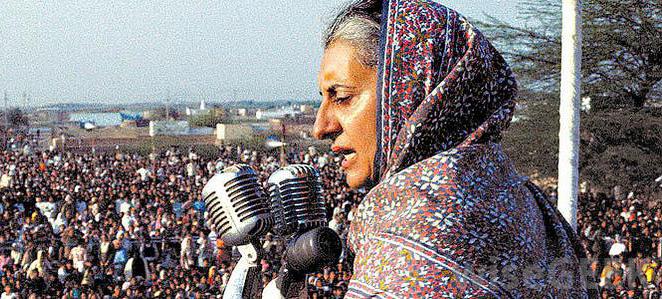
Indira Gandhi: 'The special respnsibility of the women of India', Indraprastha College For Women - 1974

December 28, 2016

23 November 1974, Indraprastha College For Women, New Dehli, India

An ancient Sanskrit saying says, woman is the home and the home is the basis of society. It is as we build our homes that we can build our country. If the home is inadequate -- either inadequate in material goods and necessities or inadequate in the sort of friendly, loving atmosphere that every child needs to grow and develop -- then that country cannot have harm ony and no country which does not have harmony can grow in any direction at all.

That is why women's education is almost more important than the education of boys and men. We -- and by "we" I do not mean only we in India but all the world -- have neglected women education. It is fairly rece nt. Of course, not to you but when I was a child, the story of early days of women's education in England, for instance, was very current. Everybody remembered what had happened in the early days.

I remember what used to happen here. I still remember the days when living in old Delhi even as a small child of seven or eight. I had to go ou t in a doli if I left the house. We just did not walk. Girls did not walk in the streets. First, you had your sari with which you covered your head, then you had another shawl or something with which you covered your hand and all the body, then you had a white shawl, with which every thing was covered again although your face was open fortunately. Then you were i n the doli, which again was covered by another cloth. And this was in a family or community which did not observe purdah of any kind at all. In fact, all our social functions always were mixed functions but this was the atmosphere of the city and of the country.

Now, we have got education and there is a debate all over the country whether this education is adequate to the needs of society or the needs of our young people. I am one of those who always believe that education needs a thorough overhauling. But at the same time, I think that everything in our education is not bad, that even the present education has produced very fine men and women, specially scientists and experts in different fields, who are in great demand all over the world and even in the most affluent countries. Many of our young people leave us and go abroad because they get higher salaries, they get better conditions of work.

But it is not all a one-sided business because there are many who are persuaded and cajoled to go even when they are reluctant. We know of first class students, especially in medicine or nuclear energy for instance, they are approached long before they have passed out and offered all kinds of inducements to go out. Now, that shows that people do consider that they have a standard of knowledge and capability which will be useful any where in the world.

So, that is why I say that there is something worthwhile. It also shows that our own ancient philosophy has taught us that nothing in life is entirely bad or entirely good. Everything is somewhat of a mixture and it depends on us and our capability how we can extract the good, how we can make use of what is around us. There are people who through observation can learn from anything that is around them. There are others who can be surrounded by the most fascinating people, the most wonderful books, and other things and who yet remain quite closed in and they are unable to take anything from this wealth around them.

Our country is a very rich country. It is rich in culture, it is rich in many old traditions -- old and even modern tradition. Of course, it has a lot of bad things too and some of the bad things are in the society -- superstition, which has grown over the years and which sometimes clouds over the shining brightness of ancient thought and values, eternal values. Then, of course, there is the physical poverty of large numbers of our people. That is something which is ugly and that hampers the growth of millions of young boys and girls. Now, all these bad things we have to fight against and that is what we are doing since Independence.

But, we must not allow this dark side of the picture which, by the way, exists in every country in the world. Even the most rich country in the world has its dark side, but usually other people hide their dark sides and they try to project the shining side or the side of achievement. Here in India, we seem to want to project the worst side of society. Before anybody does anything, he has to have, of course, knowledge and capability, but along with it he has to have a certain amount of pride in what he or she is doing. He has to have self-confidence in his own ability. If your teacher tells, "You cannot do this," even if you are a very bright student I think every time you will find, it will be more and more difficult for you to do it. But if your teacher encourages saying, "Go along you have done very good work, now try a little harder," then you will try a little harder and you will be able to do it. And it is the same with societies and with countries.

This country, India, has had remarkable achievements to its credit, of course in ancient times, but even in modern times, I think there are a few modern stories, success stories, which are as fascinating as the success story of our country. It is true that we have not banished poverty, we have not banished many of our social ills, but if you compare us to what we were just about 27 years ago, I think that you will not find a single other country that has been able to achieve so much under the most difficult circumstances.

Today, we are passing through specially dark days. But these are not dark days for India alone. Except for the countries which call themselves socialist and about which we do not really know very much, every other country has the same sort of economic problems, which we have. Only a few countries, which have very small populations, have no unemployment. Otherwise, the rich countries also today have unemployment. They have shortages of essential articles. They have shortages even of food.

I do not know how many of you know that the countries of Western Europe and Japan import 41 per cent of their food needs, whereas India imports just under two per cent. Yet, somehow we ourselves project an image that India is out with the begging bowl. And naturally when we ourselves say it, other people will say it much louder and much stronger. It is true, of course, that our two per cent is pretty big because we are a very big country and we have a far bigger population than almost any country in the world with the exception of China. We have to see and you, the educated women, because it is great privilege for you to have higher education, you have to try and see our problems in the perspective of what has happened here in this country and what is happening all over the world.

There is today great admiration for certain things that have happened in other countries where the society is quite differently formed, where no dissent is allowed. The same people who admire that system or the achievements of that system are the ones who say there is dictatorship here even though, I think, nobody has yet been able to point out to me which country has more freedom of expression or action. So, something is said and a lot of people without thinking keep on repeating it with additions until an entirely distorted picture of the country and of our people is presented.

As I said, we do have many shortcomings, whether it is the government, whether it is the society. Some are due to our traditions because, as I said, not all tradition is good. And one of the biggest responsibilities of the educated women today is how to synthesise what has been valuable and timeless in our ancient traditions with what is good and valuable in modern thought. All that is modern is not good just as all that is old is neither all good nor all bad. We have to decide, not once and for all but almost every week, every month what is coming out that is good and useful to our country and what of the old we can keep and enshrine in our society. To be modern, most people think that it is something of a manner of dress or a manner of speaking or certain habits and customs, but that is not really being modern. It is a very superficial part of modernity.

For instance, when I cut my hair, it was because of the sort of life that I was leading. We were all in the movement. You simply could not have long hair and go in the villages and wash it every day. So, when you lead a life, a particular kind of life, your clothes, your everything has to fit into that life if you are to be efficient. If you have to go in the villages and you have to bother whether your clothes are going to be dirty, then you cannot be a good worker. You have to forget everything of that kind. That is why, gradually, clothes and so on have changed in some countries because of the changes in the life-style. Does it suit our life-style or what we want to do or not? If it does, maybe we have to adopt some of these things not merely because it is done in another country and perhaps for another purpose. But what clothes we wear is really quite unimportant. What is important is how we are thinking.

Sometimes, I am very sad that even people who do science are quite unscientific in their thinking and in their other actions -- not what they are doing in the laboratories but how they live at home or their attitudes towards other people. Now, for India to become what we want it to become with a modern, rational society and firmly based on what is good in our ancient tradition and in our soil, for this we have to have a thinking public, thinking young women who are not content to accept what comes from any part of the world but are willing to listen to it, to analyse it and to decide whether it is to be accepted or whether it is to be thrown out and this is the sort of education which we want, which enables our young people to adjust to this changing world and to be able to contribute to it.

Some people think that only by taking up very high jobs, you are doing something important or you are doing national service. But we all know that the most complex machinery will be ineffective if one small screw is not working as it should and that screw is just as important as any big part. It is the same in national life. There is no job that is too small; there is no person who is too small. Everybody has something to do. And if he or she does it well, then the country will run well.

In our superstition, we have thought that some work is dirty work. For instance, sweeping has been regarded as dirty. Only some people can do it; others should not do it. Now we find that manure is the most valuable thing that the world has today and many of the world's economies are shaking because there is not enough fertilizer -- and not just the chemical fertilizer but the ordinary manure, night-soil and all that sort of thing, things which were considered dirty.

Now it shows how beautifully balanced the world was with everything fitted in with something else. Everything, whether dirty or small, had a purpose. We, with our science and technology, have tried to -- not purposely, but somehow, we have created an imbalance and that is what is troubling, on a big scale, the economies of the world and also people and individuals. They are feeling alienated from their societies, not only in India but almost in every country in the world, except in places where the whole purpose of education and government has to be to make the people conform to just one idea. We are told that people there are very happy in whatever they are doing. If they are told to clean the streets, well, if he is a professor he has to clean the streets, if he is a scientist he has to do it, and we were told that they are happy doing it. Well, if they are happy, it is alright.

But I do not think in India we can have that kind of society where people are forced to do things because we think that they can be forced maybe for 25 years, maybe for 50 years, but sometime or the other there will be an explosion. In our society, we allow lots of smaller explosions because we think that that will guard the basic stability and progress of society and prevent it from having the kind of chaotic explosion which can retard our progress and harmony in the country.

So, I hope that all of you who have this great advantage of education will not only do whatever work you are doing keeping the national interests in view, but you will make your own contribution to creating peace and harmony, to bringing beauty in the lives of our people and our country. I think this is the special responsibility of the women of India. We want to do a great deal for our country, but we have never regarded India as isolated from the rest of the world. What we want to do is to make a better world. So, we have to see India's problems in the perspective of the larger world problems.

It has given me great pleasure to be with you here. I give my warm congratulations to those who are doing well and my very good wishes to all the others that they will also do much better. This college has had a high reputation but we must always see that we do better than those who were there before us. So, good luck and good wishes to you.


Source: http://www.edchange.org/multicultural/spee...

Enjoyed this speech? Speakola is a labour of love and I’d be very grateful if you would share, tweet or like it. Thank you.

Facebook Twitter Facebook
In EDUCATION Tags INDIRA GANDHI, GANDHI, INDIA, INDIAN POLITICS, WOMEN, EDUCATION OF WOMEN, EDUCATION, TRANSCRIPT, UNIVERSITY, INDRAPRASTHA UNIVERSITY
Comment

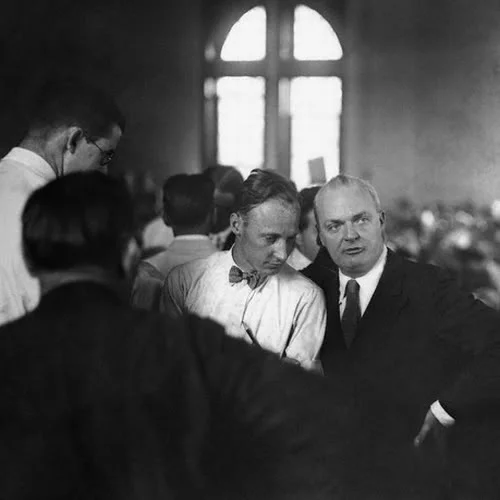
Dudley Field Malone: 'There is never a duel with the truth', defence of evolution teacher John Scopes 'Monkey Trial' - 1925

August 8, 2016

July 15, 1925, Dayton, Tennessee, USA

John Thomas Scopes was on trial for teaching evolution in a Tennessee state funded school, in violation of the Butler Act. This was his attorney's spirited defense. Scopes was found guilty and fined $100 which was later overturned on a technicality.

What I don't understand is this, your Honor, the prosectution inside and outside of the court has been ready to try the case and this is the case. What is the issue that has gained the attention, not only of the American people, but people everywhere? Is it a mere technical question as to whether the defendant Scopes taught the paragraph in the book of science? You think, your Honor, that the News Association in London, which sent you that very complimentary telegram you were good enough to me to show me in this case, because the issue is whether John Scopes taught a couple of paragraphs out of his book? Oh, no, the issue is as broad as Mr. Brayn has published it and why the fear? If the issue is as broad as they make it, why the fear of meeting the issue? Why, where issues are drawn by evidence, where the truth and nothing but the truth are scrutinized and where statements can be answered by expert witnesses on the other side -- what is the psychology of fear? I don't understand it. My old chief -- I never saw him back away from a great issue before. I feel that the prosectution here is filled with a needless fear. I believe that if they withdraw their objection and hear the evidence of our experts their minds would not only improve but their souls would be purified.

I believe and we believe that men who are God-fearing, who are giving their lives to study and observation, to the teaching of the young -- are the teachers and scientists of this country in a combination to destroy the morals of the children to whom they have dedicated their lives? Are preachers the only ones in America who care about our youth? Is the church the the only source of morality in this country? And I would like to say something for the children of the country. We have no fears about the young people of America. They are a pretty smart generation. Any teacher who teaches the boys or the girls today an incredible theory -- we need not worry about those children of this generation paying much attention to it. The children of this generation are pretty wise. People, as a matter of fact I feel that the children of this generation are probably much wiser than many of their elders. The least that this generation can do, your Honor, is to give the next generation all the facts, all the available data, all the theories, all the information that learning, that study, that observations has produced -- give it to the children in the hope of heaven that they will make a better world of this than we have been able to make it. We have just had a war with twenty million dead. Civilization is not so proud of the work of the adults. Civilization need not be so proud of what the grown-ups have done. For God's sake let the chidren have their minds kept open -- close no doors to their knowledge; shut no door from them. Make the distinction between theology and science. let them have both. let them both be taught. Let them both live....

We want everything we have to say on religion and on science told and we are ready to submit our theories to the direct and cross-examination of the prosecution. We have come in here ready for a battle. We have come in here for this duel.

I don't know anything about dueling, your Honor. It is against the law of God. It is against the church. It is against the law of Tennessee, but does the opposition mean by duel that our defendant shall be strapped to a board and they alone shall carry the sword? Is our only weapon the witnesses who shall testify to the accuracy of our theory -- is our weapon to be taken from us, so that the duel will be entirely one-sided? That isn't my idea of a duel. Moreover it isn't going to be a duel.

There is never a duel with the truth. The truth always wins and we are not afraid of it. The truth is no coward. The truth does not need the law. The truth does not need the forces of government. The truth does not need Mr. Bryan. the truth is imperishable, eternal, and immortal and needs no human agency to support it. We are ready to tell the truth as we understand it and we do not fear all the truth that they can present as facts. We are ready. We are ready. We feel we stand with progress. We feel we stand with science. we feel we stand with intelligence. We feel we stand with fundamental freedom in America We are not afraid. Where is the fear? We meet it! Where is the fear? We defy it! We ask your honor to admit the evidence as a matter of correct law, as a matter of sound procedure and as a matter of justice to the defense in this case. (Profound and continued applause.)

(The bailiff raps for order.)


Source: http://historicalthinkingmatters.org/scope...

Enjoyed this speech? Speakola is a labour of love and I’d be very grateful if you would share, tweet or like it. Thank you.

Facebook Twitter Facebook
In LAWS AND JUSTICE Tags SCIENCE, EDUCATION, TENNESSEE, TRANSCRIPT, DUDLEY FIELD MALONE, SCOPES TRIAL, JOHN THOMAS SCOPES, EVOLUTION, MONKEY TRIAL
Comment

See my film!

Limited Australian Season

March 2025

Details and ticket bookings at

angeandtheboss.com

Support Speakola

Hi speech lovers,
With costs of hosting website and podcast, this labour of love has become a difficult financial proposition in recent times. If you can afford a donation, it will help Speakola survive and prosper.

Best wishes,
Tony Wilson.

Become a Patron!

Learn more about supporting Speakola.

Featured political

Featured
Jon Stewart: "They responded in five seconds", 9-11 first responders, Address to Congress - 2019
Jacinda Ardern: 'They were New Zealanders. They are us', Address to Parliament following Christchurch massacre - 2019
Dolores Ibárruri: "¡No Pasarán!, They shall not pass!', Defense of 2nd Spanish Republic - 1936
Jimmy Reid: 'A rat race is for rats. We're not rats', Rectorial address, Glasgow University - 1972

Featured eulogies

Featured
For Geoffrey Tozer: 'I have to say we all let him down', by Paul Keating - 2009
for James Baldwin: 'Jimmy. You crowned us', by Toni Morrison - 1988
for Michael Gordon: '13 days ago my Dad’s big, beautiful, generous heart suddenly stopped beating', by Scott and Sarah Gordon - 2018

Featured commencement

Featured
Tara Westover: 'Your avatar isn't real, it isn't terribly far from a lie', The Un-Instagrammable Self, Northeastern University - 2019
Tim Minchin: 'Being an artist requires massive reserves of self-belief', WAAPA - 2019
Atul Gawande: 'Curiosity and What Equality Really Means', UCLA Medical School - 2018
Abby Wambach: 'We are the wolves', Barnard College - 2018
Eric Idle: 'America is 300 million people all walking in the same direction, singing 'I Did It My Way'', Whitman College - 2013
Shirley Chisholm: ;America has gone to sleep', Greenfield High School - 1983

Featured sport

Featured
Joe Marler: 'Get back on the horse', Harlequins v Bath pre game interview - 2019
Ray Lewis : 'The greatest pain of my life is the reason I'm standing here today', 52 Cards -
Mel Jones: 'If she was Bradman on the field, she was definitely Keith Miller off the field', Betty Wilson's induction into Australian Cricket Hall of Fame - 2017
Jeff Thomson: 'It’s all those people that help you as kids', Hall of Fame - 2016

Fresh Tweets


Featured weddings

Featured
Dan Angelucci: 'The Best (Best Man) Speech of all time', for Don and Katherine - 2019
Hallerman Sisters: 'Oh sister now we have to let you gooooo!' for Caitlin & Johnny - 2015
Korey Soderman (via Kyle): 'All our lives I have used my voice to help Korey express his thoughts, so today, like always, I will be my brother’s voice' for Kyle and Jess - 2014

Featured Arts

Featured
Bruce Springsteen: 'They're keepers of some of the most beautiful sonic architecture in rock and roll', Induction U2 into Rock Hall of Fame - 2005
Olivia Colman: 'Done that bit. I think I have done that bit', BAFTA acceptance, Leading Actress - 2019
Axel Scheffler: 'The book wasn't called 'No Room on the Broom!', Illustrator of the Year, British Book Awards - 2018
Tina Fey: 'Only in comedy is an obedient white girl from the suburbs a diversity candidate', Kennedy Center Mark Twain Award -  2010
Tina Fey: 'Only in comedy is an obedient white girl from the suburbs a diversity candidate', Kennedy Center Mark Twain Award - 2010

Featured Debates

Featured
Sacha Baron Cohen: 'Just think what Goebbels might have done with Facebook', Anti Defamation League Leadership Award - 2019
Greta Thunberg: 'How dare you', UN Climate Action Summit - 2019
Charlie Munger: 'The Psychology of Human Misjudgment', Harvard University - 1995
Lawrence O'Donnell: 'The original sin of this country is that we invaders shot and murdered our way across the land killing every Native American that we could', The Last Word, 'Dakota' - 2016