• Genre
  • About
  • Submissions
  • Donate
  • Search
Menu

Speakola

All Speeches Great and Small
  • Genre
  • About
  • Submissions
  • Donate
  • Search

Paramahansa Yogananda: 'Remember the best shelter is In the silence of your soul, The Purpose of Life - circa 1920-25

May 26, 2021

Paramahansa Yogananda arrived in Boston in 1920, he embarked on a successful transcontinental speaking tour before settling in Los Angeles in 1925.

When you look at your body, when you look at the world, it seems that you are engaged with everything, but you have no time for God, but every night it dissolves your body in the subconscious fear and makes you realise that you are not a man, not a woman, but a piece of consciousness, A reflection of His Consciousness, sleeping in space. Enjoy. The drama of sleep gave me the greatest faith in God. When anybody told me I am made in the image of God I laughed, because I couldn't see in this frail body the image of God, but Master said, in this subconscious mirror of sleep you find that you are infninite. That every night you become the infinitive. You are not man or woman, you are joyous and happy and consicous. For when you wake up you have always know that you were never unconscious in sleep. You exactly know how you sleep, only you are not conscious of your body, but you are conscious of your real self and the nest of your troubles starts with the body.

So all the gifts and kindness that you have given to me, I want to give this gift to you. Remember these two natures in you. The nature as a man, as a human being during the day and the nature as God at night. And I often say we are all gods at night, but we become devils during the day. And if we can be gods during the day, we are gods all the time. And this purpose of life must not be drowned in the various engagements. But matter. We must remember if God says 'I have no time for you and stop sticking in your heart.' All your engagements have to be cancelled immediately. For one of the great sayings in India is — he's the cleverest who finds God. He's the cleverest who gives time to find God. He's the cleverest who finds that Supreme happiness within. And he can who can stand unshaken amidst the crash of breaking worlds.

He whose peace, the riches of peace cannot be taken away by all the robbers of circumstances and trials. For in this spiritual family, you all remind me by your actions of one who millions forget, and that's why they suffer.

I remember one day I was in the movies. Movies have one fascination because I see the whole world as movies. I was in the booth and I saw the operator was reading a novel. And I saw this automatic machine was going on and the beam was causing on the screen a terrible horror picture. And I said, 'Lord, how is it?' I have the whole show of the universe in front of me. You are this operator who is thinking of new plays and your nature is throwing this beam in this sky. And I see the hero and the villain are nothing but pictures. Nobody is killed. Many are being killed and shot in this picture but I saw from the booth, it was the light that had created the villain and the light had created the hero. And the voice said, remember, the villain is created so that you don't become the villain, but that you love the hero. If you become the villain, your throat has to be cut.

And now you see that there is no villain, no hero. They are both pictures of my beam. After getting away from the villain and evil or tasting poison honey, taste the honey of goodness and then come into the beam and you'll realise that all this world that you see of terrible wars and troubles, is nothing but a picture show, cosmic motion picture show in the sky, you'll be surprised. You never analysed that as soon as you sleep and dream, you can create a world like this, with people suffering from cancer and disease and wars, and some smiling babies born, old men dying —then when you wake up, you see that all those things were made of your dream consciousness. So remember this is the same, nothing different. And until you find that out, this world is a terrible show. I said to God, as he was talking to me, 'But Lord, look at the audience. They are howling and screeching downstairs at this horror show. I see that it's nothing but pictures and light. Cause I see the invisible beam. There are no murderers in the beam, no heroes, nor villains in the beam, but Lord, what about the audience? They don't know it.

Then the voice said, 'Tell them all to look at my beam within. And they will realise that this show was given to entertain them, not to get mixed up with it.' That's why remember, every night he makes you a God, every night he withdraws you from this movie, cosmic movies, and makes you realise you are the son of God You are made in his image. You cannot be violated or hurt by stones. Nor bombs, nor machine guns, nor atomic bombs. Remember the best shelter is In the silence of your soul.

And if you can develop that silence, nothing in the world, nothing in the world can touch you. And you can say [Hindi] ... 'having which no other gain becomes greater, then you can stand unshaken amidst the crash of breaking worlds. Then you are not in any way touched by cold and heat, pleasure and pain. But as soon you are touched by these you are with the movies. So I realise this world with terrible wars and troubles, when I see the injustices, I cannot, I cannot uphold the fire. But when I see that light dancing around me, the picture show, then I take glory into the fire. So remember, on one little piece of thought is the whole universe resting and when we rub up that thought at night, the whole universe stumbles away, You do not realise that the ocean is present in every doubt and that great power of God is present in every heart. And I do hope that in your kindness to me, you remember this that I told you, 'Do not get mixed up with this movie, this terrible movies of God. There's one purpose, to get to the beam. Get away from the villain and villainess action and poison honey of evil. Drink with the hero, the good honey of virtue, then get to the bees. Then you will suddenly realise it was only a show. History has no meaning for me. Where God can divide the past and the present and the present and the future, there is no time, nor space. Everything is happening In your own thought.

If you realise that, you'll realise the infiniteness of God and the love of God.


Source: http://yogananda.com.au/gurus/yogananda_qu...

Enjoyed this speech? Speakola is a labour of love and I’d be very grateful if you would share, tweet or like it. Thank you.

Facebook Twitter Facebook
In RELIGION Tags PARAMAHANSA YOGANANDA, THE PURPOSE OF LIFE, SLEEP, CONSCIOUSNESS, GOD, DREAM, INUSTICE, MEDITATION, UNIVERSE, TRANSCRIPT, SPIRITUALITY, METAPHOR, MOVIES, CONNECTION TO GOD, DREAMS
Comment
cooma cenotaph.jpg

Edith Mayhew: "God, help us...God, help us...God, help us”, 100th anniversary of Armistice Day - 2018

June 2, 2020

11 November 2018, St Paul’s Anglican Church, Cooma, NSW, Australia

In 1914 there had been no war between the major powers since 1871, what was then a long period of 43 years. Generals knew war as involving horses, sabres and rifles, not machine guns, gas, massive artillery, trenches, aircraft, tanks and submarines. Statesman and politicians were no wiser.

WW1 began in confusion, miscalculation and stupid mistakes, pretty much by accident. 4 years later it finished in much the same way, on this day 100 years ago.

For 4 years, while statesman and generals blundered, the massed armies of Europe and its dominions writhed in a gruesome festival of mud and blood.

What effect did that essentially European conflict have on Australia? Let me put the figures into terms that would apply to today’s Australian population.

2 million people enlisted

310,000 were killed, and 780,000 wounded, gassed or taken prisoner, a total of around 1.1 million directly affected.

And let’s relate it to our town. In Cooma, of a total population of around 3200, at least 53 were killed, and about twice that number were injured or gassed. There are 22 names on the pillars of the Uniting church alone, one of 4 major churches in the town at that time. Brass plates on the walls of this church show the effect on those who worshipped here.

Imagine with today’s population of about 7000, if 112 mostly young men were killed, and 250 wounded, just from Cooma township.

Any wonder there are more than 3000 war memorials in NSW alone.

It changed Australia probably more than it changed Europe.

Australian troops were the highest paid of all the forces. Australians were sent home for bad behaviour in greater numbers than other forces. Gallipoli was a disaster. Even had it been successful, Churchill’s campaign would almost certainly not have shortened the war at all.

Soldiers were not always straight of limb and true of eye. They didn’t always die with their face to the foe. One cook at Gallipoli was blown limb from limb when trying to unload food for breakfast. Many died of infections. Often it was not heroic or at all romantic.

But some great things came out of this most appalling of wars.

Australia became a nation. In theory it had been so since 1901, but for the first time Australians fought as the Australian Infantry Forces, along with the Kiwis. In that way the defeat at Gallipoli was the real birth of this country. We grew up, and in a war involving our “mother country”, we cut the apron strings from it.
There were numerous examples of bravery and courage. In extraordinary circumstances, ordinary people can doextraordinary things.

And there was mateship. In adversity the bonds between the soldiers grew strong. Soldiers fought for each other.

The first stirrings of respect for first Australians started in WW1. Indigenous Australians were valued members of the forces, and fought alongside Australians of European descent...although they had to enlist as “half caste”.

Australia produced a General head and shoulders above the field in WW1 for intelligence and ability, John Monash. As a part time soldier and a Jew, he had to be much smarter and capable to achieve command... and he was.

Soldiers learnt that the propaganda was wrong...the enemy were human, not monsters. Respect grew for other cultures. An enemy General, Attaturk, taught us a great lesson when he said

“There is no difference between the Johnnies and the Mehmets to us where they lay side by side here in this country of ours. You, the mothers who sent their sons from faraway countries, wipe away your tears; your sons are now lying in our bosom, and are in peace...after having lost their lives on this land they have become our sons as well”


Those words are now on an Australian memorial at Gallipoli.

Some wars are fought for freedom and democracy, and for the best of reasons. Remembering those who died in those wars is something most of us are comfortable with.

It is hard to make a case that WW1 was a just war.

But regard for those who risked and gave their lives should never be lessened by what we think of the righteousness of the cause.

It is simple really. We are a democracy. It is we who send troops to war, every one of us. If it is not we who go, then we owe a debt to those who do. It is right to honour them.

Remembering those who died, who were injured or who suffered from involvement with war should not , and must not depend on how we feel about that war.

It is right to honour and remember them. We do so today.

Sacrifice for others can be a reflection of the sacrifice of Jesus for us. John wrote “The greatest way to show love for friends is to die for them”. If that is true for humans, how much greater it is for God, our creator, to treat us as friends and sacrifice himself...that is what John was writing about.

There are wonderful ideas in many religions and philosophies, but surely none as impressive as a God who is always with us, always cares for us, and comes down to our level to sacrifice himself for us.

In a moment we will pray.

We will rejoice and celebrate the end of the madness that was WW1. We will thank God for the peace that most of us have lived our whole lives in.

But the three word prayer of the soldier, scared and fearing for his life in a trench on the hideous Western front in WW1 is perfect on its own. All of us can use this prayer. Every day.

He said “God HELP us ”...there may just have been an expletive in there too...then he realized what he was saying and said ”God, help us.”

It became his daily prayer, said three times...”God, help us...God, help us...God, help us”.

You see he acknowledged God was with him even in the worst situation.

He acknowledged God cared for him.

He asked for help, for himself and for others.

He wasn’t in a position to overthink it, or say a long prayer. He didn’t even say what help he wanted. He left that to God.

But his prayer was just right as it was.

When things are tough in our own lives, let us turn to God. Let that be our simple prayer too.
Please God, help us.

Amen

Enjoyed this speech? Speakola is a labour of love and I’d be very grateful if you would share, tweet or like it. Thank you.

Facebook Twitter Facebook
In WAR & CONFLICT Tags EDITH MAYHEW, TRANSCRIPT, ARMISTICE DAY, 100TH ANNIVERSARY, 1918, WW1, ST PAUL'S ANGLICAN CHURCH, PRAYER, GOD, WAR
Comment

Mahatma Gandhi: 'There is an indefinable mysterious power that pervades everything', Spiritual statement, Kingsley Hall - 1931

October 16, 2019

Kingsley Hall, Oxford, United Kingdom

There is an indefinable mysterious power that pervades everything, I feel it though I do not see it. It is this unseen power which makes itself felt and yet defies all proof, because it is so unlike all that I perceive through my senses. It transcends the senses. But it is possible to reason out the existence of God to a limited extent. Even in ordinary affairs we know that people do not know who rules or why and how He rules and yet they know that there is a power that certainly rules.


In my tour last year in Mysore I met many poor villagers and I found upon inquiry that they did not know who ruled Mysore. They simply said some God ruled it. If the knowledge of these poor people was so limited about their ruler I who am infinitely lesser in respect to God than they to their ruler need not be surprised if I do not realize the presence of God - the King of Kings.

Nevertheless, I do feel, as the poor villagers felt about Mysore, that there is orderliness in the universe, there is an unalterable law governing everything and every being that exists or lives. It is not a blind law, for no blind law can govern the conduct of living being and thanks to the marvelous researches of Sir J. C. Bose it can now be proved that even matter is life. That law then which governs all life is God. Law and the law-giver are one. I may not deny the law or the law-giver because I know so little about it or Him.

Just as my denial or ignorance of the existence of an earthly power will avail me nothing even so my denial of God and His law will not liberate me from its operation, whereas humble and mute acceptance of divine authority makes life's journey easier even as the acceptance of earthly rule makes life under it easier. I do dimly perceive that whilst everything around me is ever changing, ever dying there is underlying all that change a living power that is changeless, that holds all together, that creates, dissolves and recreates. That informing power of spirit is God, and since nothing else that I see merely through the senses can or will persist, He alone is. And is this power benevolent or malevolent ? I see it as purely benevolent, for I can see that in the midst of death life persists, in the midst of untruth truth persists, in the midst of darkness light persists. Hence I gather that God is life, truth, light. He is love. He is the supreme Good. But He is no God who merely satisfies the intellect, if He ever does. God to be God must rule the heart and transform it. He must express himself in every smallest act of His votary. This can only be done through a definite realization, more real than the five senses can ever produce.

Sense perceptions can be and often are false and deceptive, however real they may appear to us. Where there is realization outside the senses it is infallible. It is proved not by extraneous evidence but in the transformed conduct and character of those who have felt the real presence of God within. Such testimony is to be found in the experiences of an unbroken line of prophets and sages in all countries and climes. To reject this evidence is to deny oneself. This realization is preceded by an immovable faith. He who would in his own person test the fact of God's presence can do so by a living faith and since faith itself cannot be proved by extraneous evidence the safest course is to believe in the moral government of the world and therefore in the supremacy of the moral law, the law of truth and love. Exercise of faith will be the safest where there is a clear determination summarily to reject all that is contrary to truth and love. I confess that I have no argument to convince through reason. Faith transcends reason. All that I can advise is not to attempt the impossible.

Source: https://www.ndtv.com/india-news/mahatma-ga...

Enjoyed this speech? Speakola is a labour of love and I’d be very grateful if you would share, tweet or like it. Thank you.

Facebook Twitter Facebook
In RELIGION Tags MAHATMA GANDHI, RELIGIOUS STATEMENT, OXFORD STATEMENT, BBC RECORDING, TRANSCRIPT, GOD, HIGHER POWER, GOD IS LIFE, HE IS THE SUPREME GOOD
Comment

Billy Graham: 'A Christian is a person who has made a personal connection with Jesus Christ', The Full Christian Life, Madison Sqaure Garden - 1957

February 22, 2018

August 1957, Madison Square Garden, New York City, New York, USA

This transcript is similar in many respects but does not match famous footage above. It was delivered as part of the same series of sermons on 21 October 1958 in Charlotte.

Tonight I want to talk on "How To Live The Christian Life." I want you to turn with me to Acts, the 11th chapter, and the 26th verse, the latter part of it: "And the disciples were called Christians first in Antioch."

The word "Christians" was given to the early disciples as a name in derision, which was "Christ's ones," "Christ-followers," "Christ-ites." I remember when Dr. Ham was here in Charlotte a few years ago, about twenty-some years ago, they called the people who went to his meetings "Ham-ites." I do not know what they will call the people who come to our meetings; maybe they will be "Graham crackers." But that was the type of title that was given to the early church.

Dr. Kenneth Goodman[?], pastor of the Methodist church, is with us. He has been in Chicago, and he will tell you that the word "Methodist" was given as a name in derision to the early people two hundred years ago who were meeting in England during and after the ministry of John and Charles Wesley and George Whitefield. They were called Methodists; that is, they had a special method in Bible study and in prayer and in meeting together. Little groups all over England began to meet together, and that was the beginning of the great Methodist church.

So the early disciples also had a name. They had a tag, and their tag was "Christian." They were Christ's followers, followers of Christ. Tonight I think most of us here know how to become a Christian. You know that to become a Christian, an encounter with Christ must take place, but so many do not know how to live the Christian life.

There was a girl who heard one of Beethoven's sonatas. She had a strong desire to learn to play. She had real latent musical talent, but she didn't practice her piano. She never struggled with the five-finger exercises and scales, and years later her neighbors had to listen to her murder Beethoven. Now she wanted to play Beethoven, she wanted to be a musician; but she was not willing to practice.

Now just to want to live the Christian life is not enough. You must learn how to live the Christian life. Attention must be given to the methods, the techniques, and the practice. We have been urged to live the Christian life, but sometimes we have not been told how to live the Christian life. We have not been told the means, the methods, and the words.

Now, first of all, what is a Christian? What does it mean to be a Christian? Is it a person who is born in a Christian home? No. I could be born in a garage, but that does not make me an automobile. You can be born in a Christian home and have fine Christian parents, but that does not make you a Christian. You cannot inherit Christianity.

You say, "Well, Billy, a person who lives by the Golden Rule--isn't that a Christian?" Not necessarily. A Christian is a person in whom Christ dwells. Now I know people in the Buddhist religion who live just as high an ethical life as the average Christian. In fact, Buddha had a very high system of ethics. A Christian is more than a person who is living up to a system of ethics. A Christian is a person more than living a good moral life. A Christian is a person in whom Christ dwells. A Christian is a person who has had an encounter with the living Christ.

Three things must have taken place for you to become a Christian. First, you have made a choice. You have chosen to give your life to Christ rather than to self. You are serving Christ rather than self. Self no longer controls your life, but Christ controls your life. That is a choice which you deliberately made. It was a volitional choice. You were convicted by the Holy Spirit of sin. You recognized that you were a sinner. You came to Christ and said, "I am going to trust the Christ who died on the cross for my sins. I am going to trust Him for my salvation." You made a deliberate choice. You chose Christ instead of the world. You chose light instead of darkness. You chose righteousness instead of sin. You chose Christ instead of self. And Christ, by the Holy Spirit, now lives in your life.

Now that was a choice you made. It might have been an unconscious choice, or it might have been a dramatic choice such as the apostle Paul made on the road to Damascus [see Acts 9:1-18]. Perhaps it was a moment when you woke up in a cold sweat, you recognized that you were a sinner, you got on your knees and called upon God in your room to have mercy upon you. It might have been at a meeting like this that you came to Christ. It might have been when you were reading a book sometime; and you stopped and said, "I need to give my life to Christ." Whenever and under whatever conditions it came, be sure that it has come, because to be a Christian means that you make a choice.

Secondly, a change must take place in the way you live. "Old things . . . [pass] away; behold, all things . . . become new" [2 Corinthians 5:17]. When you give your life to Christ, you change your way of living. You cannot live the same old life. You cannot go on being controlled by the lusts and desires of this life. You cannot go on living for the flesh. You cannot go on living for the world. You cannot go on letting materialism and secularism control your thinking and your way of living. You now live for Christ. You now live in the fellowship of the church.

Christ is uppermost in your thinking. You are spending time in prayer. You are reading your Bible faithfully. You are witnessing for Christ in every way you know. You are gracious and courteous and kind and, above all, you love your neighbor as yourself. That is the fulfillment of the whole law--to love God with all our hearts, and our neighbors as ourselves. [See Matthew 22:36-40 and Romans 13:9,10.]

Thirdly, you have accepted Christ's challenge. Christ said, "If any man will come after me, let him deny himself, . . . take up his cross, and follow me" [Matthew 16:24]. Christ said, "If you are going to follow me, you have to go back to your business, back to your office, back to the high school campus, back to your home, and take your stand with me no matter what it costs." They may laugh, they may sneer, they may not understand. You may stand out like a sore thumb. But you absolutely refuse to cheat, to lie, to be immoral, even if it costs you your life.

I talked to a man in San Francisco a few weeks ago. And he said, "Billy, I'm an outstanding businessman in this city. If I give my life to Christ, I'll have to go to the penitentiary. Because," he said, "I'll have to confess the things which I have done wrong. I'll have to make restitution." I said, "All right, you've got to choose. You've got to accept the challenge of Christ, no matter what it costs." It costs something. You have to turn loose from those things that are wrong in your life. He will help you tomorrow morning when you go to face the old gang. Yes, a choice must be made. And I want to ask you tonight, have you made that choice? Has a change taken place in your life? Have you accepted Christ's challenge to follow Him, no matter what it costs?

Well, how do we live the Christian life? Paderewski one day said, "If I am inactive in my practicing one day, I notice it. If I am inactive two days, my family notices it. And if I am inactive three days, the public notices it."

Now the Christian life is just not being saved from hell. It is just not redemption and forgiveness--that certainly is essential, and that is a part of it--but the Christian life is a way of life. It is a way of living here and now. It is a new way, a revolutionary way, a dynamic way; life with a new dimension, life with a thrill and a joy.

Your conscience is free, your sins are forgiven. There is the assurance that if you die you will go to heaven. But there is also a challenge, a flag to follow, a master, a controller, a way of life that is brand-new. That is the Christian life, but the average Christian I know today is making a miserable failure of the Christian life. You are up one day, down the next. One day you are on top of the world; the next day you are down in the dumps. The devil has got you down, and some of you are down all the time. You have failed so miserably in your Christian life that you now think it is the normal Christian experience. Don't you?

You get up on a Sunday morning, and you have so little spiritual strength that you can hardly make it to church. Now if it were a movie, you would be right there. If it were a football game, I don't care how it rains or snows, you would be right there. But let a little bad weather come up, and you can hardly make it to church. The devil has you defeated, discouraged, and despondent. And you think that is the Christian life. You have an idea that you are living the normal Christian life, if that is the way you are living.

The Christian life is a life of fruit-bearing [see John 15:8]. The Holy Spirit gives us supernatural power to bear supernatural fruit. "The fruit of the Spirit is love, joy, peace, longsuffering," etc. [see Galatians 5:22,23]. The Christian should be bearing fruit. Jesus said, "By their fruits ye shall know them" [Matthew 7:20].

If I see a man who cannot forgive his brother, who resents something against him, and holds grudges and malice, I know that man is not bearing the fruit of the Spirit. Because with the fruit of the Spirit we are to forgive, we are to love.

If I see a man who has prejudice, I know that he is not bearing the fruit of the Spirit. If I see a man who does not have peace in his soul, who is tense and nervous, who cannot trust God for anything, worried all the time, that man is not bearing the fruit of the Spirit. If I see a man who has no joy, with nothing of the joy of the Lord springing up in his soul, I know that he is not bearing fruit. He is not living the Christian life, because the Christian life is to be one of fruit-bearing. And the fruit is love and peace and joy and patience, longsuffering.

We are to be patient. Maybe your wife does come down in the morning with her hair up in those pins, or whatever they are; and you get impatient. I don't blame you, but you are to be patient. Abe Lincoln once said, "I have learned to accept the faults of my friends." We are to be patient with the frailties and weakness of others because we ourselves are so imperfect.

The first thing in living the Christian life is to learn the secret of prayer. I am going to spend the whole evening on this subject tomorrow evening. The disciples came to Christ and said what? "Teach us to"--what?--"pray!" "Teach us to pray" [see Luke 11:1].

Now you have to learn to pray. Did you know that? You have to learn how to walk. We learn how to ride a bicycle. You have to learn to pray. We learn from Christ and from the Holy Spirit within us. Romans 8:26, "Likewise the Spirit also helpeth our infirmities: for we know not what we should pray for as we ought: but the Spirit itself maketh intercession[s] for us with groanings which cannot be uttered."

I do not believe that anyone can live the Christian life without first and foremost spending time every day in prayer. If you don't spend some time each day in prayer, the rest of the day will be wrong. The decisions of the day will be wrong, business will go wrong, everything will go wrong.

I wonder how long it has been since you have spent half an hour in prayer. You say, "Well, Billy, I wouldn't know what to say to the Lord for a half hour." All right, you pray for fifteen minutes, and then listen to God for fifteen minutes. Spend time in prayer. And, listen, you will never have a successful prayer life unless you have a definite time and place.

Some people say, "Well, I only pray when I feel like it." When you say that you don't feel like praying, that is when you need to pray the most, and no praying is a matter of the will. Even if you don't feel like it, it is good to close your door and then you pray to God. You can pray all day long. As the Bible says, "Praying without ceasing" [see 1 Thessalonians 5:17]. As Frank Laubach said, "Send little dart prayers to the Lord."

You say you don't know how to pray, especially to avoid vain repetition. You can begin to read the Scripture and you will come to a part that speaks to you; and you say, "O Lord," and you find yourself praying. You can use the Psalms. You can read five Psalms a day, and that will take you through the book of Psalms every month. You can read one chapter of Proverbs a day, and that will take you through Proverbs once a month. Proverbs teaches you how to get along with your fellowman, and the book of Psalms teaches you how to get along with God. The book of Psalms teaches you how to worship God. Read five Psalms, one chapter of Proverbs. You read them through every month and after awhile they begin to saturate you and fill you, and it becomes exciting and thrilling. You find yourself praying.

I take a Psalm, like the 37th Psalm, and get on my knees and pray it out loud. Just read it out loud. That will help you to pray. Then you can take a hymnbook. Take some of the great hymns and read them as prayers, because many of them were actually prayers. Or take a book of prayer where prayers are written out. It will help you to pray. It will express the inward needs of your heart. There are many ways of prayer. You have praise, thanksgiving, confession, intercession, and petition.

Suppose tonight you give your life to Christ. All right, at first you will not know how to pray. You might be like my little baby. My little baby is now seven months old, and he is just beginning to say "Mama." And he says "Mama" more than he does "Dada," and I don't like it. I tried to teach him all morning how to say "Dada." He can't say it. He doesn't see enough of me to know that he has a daddy, I guess. But we are so thrilled that he can say "Mama." But if, twenty years from now, he were looking at his mother and saying "Mama," we would take him to a doctor. There are a lot of you that are twenty years old in the Lord. You have been a Christian for twenty years, and you are still saying "Dada." You go to a prayer meeting, and the minister asks everyone to say a verse around. And they come to John 3:16 and somebody says it, and the next person says, "Oh, they have got my verse." That is all you have learned. You are still a child. You are still a baby. You haven't learned to pray.

Like the little boy. He prayed to the Lord and then he said, "That's all for tonight, Lord. Here are the headlines again." And he gave a little brief summary of what he had said.

Then the second thing is reading the Bible. Read the Scriptures every day. Now we don't worship the Bible. We don't take the Bible as a fetish and worship it. We worship the God of the Bible, the Christ of the Bible. The Bible is God's inspired holy Word. God has spoken through His Word, so we read it. And Job said, "I have esteemed the words of his mouth more than [any] necessary food" [23:12]. Do you esteem the words of God more than your necessary food? I do not believe that anybody can be a successful Christian who is not daily reading and studying the Bible. Start, maybe, with the gospel of John. Read it four or five times through. Then when you come to a part of the Bible that you especially like, take your pen or your red pencil and mark under it. Then if you have a question, put a question mark there and read that over and over and try to understand. Get a little Bible commentary to help. Go ask your minister what it means, until you know the book of John, until you know every chapter in it. Why, you lawyers, if you didn't know a case any better than you know the Bible, you would flop every time you went in the courtroom. If you doctors sitting here tonight didn't know any more about medicine and surgery than you know about the Bible, what would happen? Suppose a doctor would go in to perform an operation on me; and he would say, "Now, let's see. Well, I don't know which one of these tools here to use." Well, I would jump off the operating table.

I suggest you get a modern translation. There is a very good one you can get down at the bookstore now, a brand-new one. It's called The Amplified New Testament. I like it better than any. Because, you see, the New Testament was written originally in Greek; and what we have in the King James is a 300-year-old translation in a language we no longer speak. Get a modern translation. You can get Phillips now in a whole book. Study the Scriptures. Read the Scriptures.

"Thy word have I hid in [my] heart, that I might not sin against thee" [Psalm 119:11]. Memorize the passages in the Bible. Take one verse, and here is all you can remember. You can only memorize--even the smartest people that I have ever met--not more than two or three verses a week. Because, you see, anyone can memorize a chapter and say it, but then they forget it a month later. To be truly memorizing, you must memorize it so you can remember it ten years from now.

With everyone who comes forward to receive Christ, we start them on a little Scripture memory program. Because we believe that if we can get a few Scriptures hidden in our hearts, it helps us in living the Christian life. You cannot live it without studying and reading the Bible. Make the Bible central. You should have family devotions in your home where you read a passage of Scripture. You ought to look forward to your Bible reading just like you do the television, or just like you do the newspaper.

Thirdly, have a disciplined life. Jesus taught that to live the Christian life takes discipline, renunciation, and sometimes hardship. There are a number of verbs in the Bible that are used to describe the Christian life. We are told that we are to "fight" [1 Timothy 6:12], "wrestle" [Ephesians 6:12]. We are to "run" [Hebrews 12:1], we are to "work" [Philippians 2:12], we are to "suffer" [1 Timothy 4:10], we are to "resist" [James 4:7], we are to agonize, we are to "put to death" [Galatians 5:24, TEV]. All of these are verbs regarding the Christian life, and we must work at it.

When you got married, you courted your wife awhile and then you one day popped the question to her, "Will you marry me?" She said, "Yes." But you are still not married, are you? The marriage ceremony must take place. Some of you have decided here tonight that you want to be a Christian, that you want to live the Christian life. You have decided that. You have been proposed to by Christ. He is the heavenly Bridegroom; you are the bride-to-be. He says, "Will you be mine?" You say, "Well, I would like to be. I think I will." Then comes the day when you get married. That is done publicly before some witnesses. And when you stand there together to get married, the minister asks, "Will you have this man to be your husband?" You don't stand there and say, "Well, I like him. He's a fine man." You can say, "Well, I love him." That's not enough. You've got to say, "I do," publicly. After you say, "I do," why, listen, that's just the beginning.

I have an uncle here tonight, Uncle Tom Black. I remember three days before I was to get married he came over to my house and said, "Billy, have you really thought about this business of getting married?" I had. "Yes, sir, Uncle Tom, I have." He said, "Well, you know, it is going to make a lot of changes in your life." By the time he finished, I was not so sure whether I wanted to get married or not. I began to realize for the first time that after I said, "I do," that was only the beginning.

Those of you who come forward to give your life to Christ--that is only the beginning. It is a lifetime of problems, troubles, and difficulties. But you are meeting them with the help of Christ and the Holy Spirit who lives in your heart. It takes discipline. Any marriage that is successful takes much. It takes give-and-take. You have to work at it. You have to face your problems realistically.

And so it is in the Christian life. You have to discipline yourself. We are to discipline our minds so that we keep our minds on Christ, and Christ is first in our thinking. "Thou [will] keep him in perfect peace, whose mind [has] stayed on thee" [Isaiah 26:3]. "Whatsoever things are true, honest, just, pure, of good report, think on these things" [see Philippians 4:8]. Our mind is not to be wandering around and thinking about something else. Our mind, our subconsciousness, is to be on Christ. That takes discipline.

Then our tongue--this little bit of muscle in our mouth that causes so much trouble, that splits churches, and divides homes, and ruins lives, and damns characters, and slanders people--these tongues now are to be disciplined. We speak only that which blesses. We never talk about our friends behind their backs. The Bible says that "every idle word that [they] shall speak, they shall give [an] account thereof in the day of judgment" [Matthew 12:36]. "Set a watch, O Lord, before my mouth" [Psalm 141:3]. Our tongues are now to be under the control of the Holy Spirit.

Then we are to redeem the time, the Bible says [see Ephesians 5:16]. In other words, plan each day; because, you see, these little minutes that God gives you are actually little diamonds. They are little jewels. Suppose tonight you had a carat diamond. Would you pay as little attention to a full carat diamond as you pay to the minutes that are passing in your life that can never be recalled? Now you take this day, this October day, 1958. You have lived it, and you can never repeat it. If I were you, when you get up in the morning, I would plan this day very carefully because every day and every moment will be called into account. I would budget my time. I would discipline my time. I would certainly put down time for Bible reading and prayer, and witnessing for Christ and church work.

Then our bodies. The Bible says the body is the temple of the Holy Spirit which is in you [see 1 Corinthians 3:16]. Our Lord said, "Blessed are the meek: for they shall inherit the earth" [Matthew 5:5]. What does a "meek" man mean? A meek man is not a little, dried-up effeminate fellow talking in a high-pitched voice with soft hands. Here is a meek man: The word "meek" carries with it the idea of a wild horse; and those who break a wild horse. In other words, here is a man filled with tremendous potential abilities which are in the wrong direction. I take him and train him and discipline him, and he takes all of his energy and all of his power and uses it for the glory of God.

That is especially true of young people in the realm of strength. Let me say to you, young people, that if you are not willing to live a clean, wholesome, Christian life in the realm of sex, then everything else I tell you might as well be forgotten. As Dr. Stanley Jones said, if you lose the sex battle, you've lost the battle of life. Because, you see, sex is a tremendous energy that God gives to every man and woman. And when that is dedicated to Jesus Christ, it becomes a mighty power and a mighty dynamo within you to live the Christian life.

I am convinced that a dynamic Christian life cannot be lived unless there is self-control within and without marriage at this point. If you are unfaithful--and I want to tell you something. I have received more letters in the city of Charlotte about this sin than any city that I've ever been to, except New York City. I believe that this is one of the greatest sins that is seething underneath this city. Unless you are willing to come out from among that sort of thing and live a clean life under God, it is doubtful if you can be a Christian, much less try to live the Christian life. He will help you and give you strength and power when you face the temptations of everyday life.

Discipline your body. Don't take narcotics into your body unless by a doctor's prescription for illness. Don't take alcohol into your body. That damns your body, ruins your testimony. If, on a business occasion, you go to a cocktail party, go, take tomato juice, orange juice. They will respect you.

I know a man in New York City that has become president of one of the biggest corporations in this country. He has got an office right here in Charlotte. And he got his job because the board of that company chose him since, when he went to a cocktail party, he always drank orange juice. They said, "We drink, but that is the kind of man we want as president of our company."

Live a clean life. Even your business associates secretly will admire you and wish they had the strength and ability to do what you are doing. And you can't do it with your own strength, but Christ can do it through you, and in you, through the Holy Spirit that lives within.

Fifth, get into the church. I do not believe in Robinson Crusoe Christian fellowship. And Christian fellowship is not optional; Christian fellowship is essential. Christ said that He was the vine and that we are the branches [see John 15:5]. He said that we are living stones built together [see 1 Peter 2:5], members of the body of Christ knit together [see 1 Corinthians 12:12]. The Bible says all of us are important in the church.

You may think that you are totally unimportant, but the Bible likens us as to members of the body. Some of us are an eye, some a toe, some a finger, some a hand, some are noses, some are ears. Why, even my fingernails are essential. I bite them off sometimes, but they are essential. That is the reason the Scripture teaches that when even the least member of the body of Christ is hurt, it hurts the whole body. Christ is the head; we are the body. [See 1 Corinthians 12:14-27.]

Do you know one of the great problems here in Charlotte? We have thousands of people who have moved here from other sections of the country, and they are not affiliated with a church yet. You have left your church membership somewhere else, and you have little or no church responsibility. That is the reason our homes are breaking up, and that is the reason we have so much trouble. Get into the church! Center your life in the church.

You say, "Well, Billy, I look around at the church and there are so many hypocrites in the church. The church is this, the church is that. And I don't like this church, and I don't like that church." Listen, you will never find a perfect church. I have seen one group come out from another group and say, "We have the perfect church." It is not long before they are split up, and they are going over there to form another "perfect" church.

Many preachers have quit preaching the Gospel altogether and have become theological bloodhounds, going around sniffing the trail of other Christians to see if they can detect any error here, there, or anywhere. That's not God's way. Get into the church and witness for Christ within and through the church. Express yourself in the church. And, oh, how wonderful it is to come together on that glorious morning when communion is taken--the most precious, meaningful hour of the week when Christians gather at the table of the Lord--and tell the Lord once again, "We love you." There is the peak of Christian worship. The peak of expression is not an evangelistic campaign like this; it is the moment of communion when we gather round the table of the Lord and express our love to Him. We take of the juice, or the wine, and we remember His blood that was shed for us on the cross. We partake of the bread, and we remember the body that was broken for us, and we worship Him. That is the moment when He is closest.

I want to ask you tonight: Are you living the Christian life? Are you living a victorious, happy Christian life? You can't do it by yourself. You can't do it with your own strength. You can only do it as the Holy Spirit fills you. And that is the reason why the apostle Paul said, "Be ye filled of the Holy Spirit" [see Ephesians 5:18]. Are you filled with the Spirit tonight? Are you filled to overflowing?

We need to remember that we cannot live the Christian life without His power and presence within us. We must give Him His rightful place, and He must fill us and control us to overflowing. Are you living the Christian life?

I want to ask you, however, are you sure that you have really met Christ? There are thousands of people in the church who, in my opinion, have never really encountered Christ. You have never really started living the Christian life. I am going to ask you to begin tonight. Start following Him and serving Him, and witnessing for Him. I am going to ask you to do that by getting up out of your seats and coming and standing here quietly. And this is the moment you come to Christ and say, "I do."

Source: http://www2.wheaton.edu/bgc/archives/docs/...

Enjoyed this speech? Speakola is a labour of love and I’d be very grateful if you would share, tweet or like it. Thank you.

Facebook Twitter Facebook
In RELIGION Tags BILLY GRAHAM, REV BILLY GRAHAM, EVANGELICAL, THE CHRISTIAN LIFE, TRANSCRIPT, MADISON SQUARE GARDEN, GOD, CHRISTIANITY
Comment

Francis Collins: 'I had imagined faith and reason were at opposite poles', Veritas Forum, Berkeley - 2008

September 6, 2016

4 February 2008, The University of California, Berkeley, USA

Thank you very much Christopher (for) that kind introduction and Good evening to all of you. Good heavens this place is really filled up with people, which is wonderful to see. And the students who have worked so hard to put this effort together, together with the Veritas organization must be very happy to see this turnout on a rainy evening out here in Pasadena.

We are here to talk about big questions. Maybe the biggest question of all – does God exist? I won’t give you a proof tonight but I hope I will give you some things to think about – things that have led me from being an atheist to becoming a believer and a follower of Jesus. And I will try to explain to you that pathway in a fairly abbreviated form and also explain to you how I see no conflict between that perspective and that of a scientist who is rigorous in his views of data and won’t allow you to put one over on me when it comes to views of nature. But who also sees that the study of nature is not all there is.

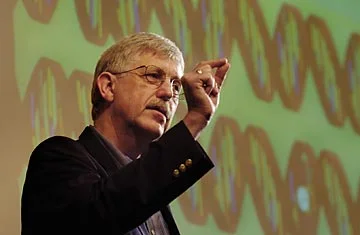
So come let us reason together here this evening and see what we might learn and as Socrates said let us follow the truth whither soever it leads. And, of course, Veritas means truth and I think that is very much what this forum stands for. I would like to start perhaps by telling you a little bit about the science that I have had the privilege of being involved in, which is the study of our human DNA instruction book, the human genome. When the popular press reports on this, as they increasingly have been doing since the study of the human genome has gotten pretty far along, they invariably have covers such as this one of Time magazine that use double-helix as the motif because that is after all the wonderful structure of this wonderful molecule – the instruction molecule of all living things. They also, in this instance, seem to be depicting Adam and Eve, which is interesting as a question mark perhaps about whether these things are connected and I will certainly argue that the faith and the science perspectives are appropriate to consider together. But I have a sneaking suspicion that they have another motivation because I also notice in other magazines that have covers about DNA they always feature not only double helixes but naked people (laughter from the audience).

And you can draw your own conclusion about what editors have decided about how to sell magazines. So we are gonna talk about this molecule. This amazing double helix shown here spilling out of the nucleus of the cell carrying the information that needs to be passed from parent to child, generation after generation by the series of these chemical bases here abbreviated A, C, G and T. And it is the order of those letters that basically must be there in order to provide the instructions to take each organism from its original rather simple beginnings as a single cell to a rather fancy organism like a human being. The genome of an organism is its entire set of DNA instructions. The human genome adds up to 3.1 billion of those letters. And that is a phenomenal thing to think about. If we decided we were going to read the human genome tonight because it would be a useful thing to admire, we would probably regret it after we got started if we had made a real commitment to do that because we would be here, reading at an average pace of A, C, G, T, T and so on – 7 days a week, 24 hours a day for 31 years (laughter from the audience).

And we have that information now, which is a pretty amazing thing to say. And you have it. Even before we knew its sequence you had it already and it is inside each cell of your body. And every time the cell divides you got to copy the whole thing. And occasionally mistakes get made. And if they get made during your life, well, they may not cause much trouble. But if they happen to get made in a particularly vulnerable place they might start you on a path towards cancer. And if a mistake gets made in passing the DNA from parent to child, well then that child might end up with some kind of a birth defect. But once in a very long time that change might actually be beneficial and that, of course, is how evolution works, with gradual change applied to this DNA sequence over long periods of time, resulting in what Darwin put forward, by the means of natural selection, a gradual evolution and the introduction of new species.

So DNA is, if you are a biologist, kind of the center of the center here – in terms of trying to understand how the whole system works.

Time marker: 00:04:55

The Human Genome project was proposed rather controversially in the late 1980s and most of the scientific community was deeply skeptical about whether this was a good idea or not. It might cost too much money. It might not be feasible. It might just attract mediocre scientists cause it seemed kind of boring. Well, none of those things turned out to be true. It certainly wasn’t boring. And I am happy to report that, in fact, it went better than expected and for me as the person who had the privilege of serving as the project manager of this enterprise, to be able to announce not just a draft which we had in June of 2000 but a finished human genome in April 2003, exactly to the month fifty years after Watson and Crick described the double-helix, and completing all of the goals of the genome project more than 2 years ahead of schedule and more than 400 million dollars under budget, doggone it, which doesn’t happen very often (applause).

And I could give you hours of descriptions of what’s happened since April of 2003 in terms of taking this foundational information and building upon it particularly for medical benefit and for me as a physician that was one of the most exciting aspects of why we did this in the first place. I will spare you the details but I will say that I think the dream is beginning to come true of how this is going to apply for medical benefit because with these tools from the genome project we have been able, increasingly, and especially in the last couple of years to identify specific genetic risk factors for cancer, for heart disease, for diabetes, for asthma, for schizophrenia, for a long list of conditions that previously were very difficult to sort out. And in circumstances where knowing you are at high risk allows you to reduce that risk by changing your diet or your lifestyle or your medical surveillance, this opportunity to practice better prevention on an individualized basis is getting pretty exciting. And this is called personalized medicine and it applies not only to this kind of prevention but if you do get sick it may provide you with a better chance to get the right drug at the right dose instead of something that doesn’t work or perhaps even gives you a toxic side-effect and that’s what pharmacogenomics is about. And perhaps the biggest payoff in the long term, also the longest pipeline, is to take those discoveries of the real fundamentals of what causes these diseases and turn those into insights that will lead us to therapeutics be they gene therapies or drug therapies that are really targeted to the fundamental problem instead of some secondary effect. And we are beginning to see that now especially in the field of cancer. We will see much more of it over the coming decade. And I would predict that in another fifteen years, medicine will be radically different because of all of these developments stimulated by the genome project and with the scientific community plunging in with great energy and creativity to make the most of the opportunity.

So that’s what I have had the chance to do over the last eighteen years involved in the genome project and before that, chasing down genes for disease. And that has been a wonderful experience as a professional working with lots of other skilled people. Making great friends and having the chance to learn new things about biology that were not known before.

But now let me ask you to look at these two images because we are about to talk about the world view question. I think this is a provocative way to begin to think about that because what you see are two images that look somewhat similar to each other. But they stand in for somewhat different worldview perspectives. This being, of course, a beautiful stained glass window, the rose window in Westminster cathedral. And this is an unusual view of DNA – not looking at it from the side but looking down the long axis of DNA so you see that radial pattern. And the question that many people pose, which I pose to you tonight, is – okay, those are two world views, the scientific and the spiritual. Do you have to choose? Do you have to basically throw in your lot with one or the other and neglect the other one or is there a possibility here of being someone who could merge these two, not necessarily building a firewall between them, but actually having both of those perspectives within your own experience.

I think many people today are arguing that these worldviews are at war and that there is no way to reconcile them. That has not been my experience. And that’s what I particularly would like to share this evening and then I hopefully will have some time for questions from those of you who would like to pursue that in one way or another. So I think I owe you at this point a little bit more of a description about my spiritual perspective. I described my scientific pathway. How is it that I stand up here before you this evening in a distinguished university and talk about being a believer in God?

Time marker: 00:09:55

Many of you might have assumed that the only scientists who were those who learned faith in childhood, would have it later on. But that’s not my story. I was raised in a family that was wonderfully unconventional. My father had been a folk song collector in the 1930s in North Carolina. After the war he and my mother did the 60’s thing except that it was still the 40’s. And (laughter from the audience). I don’t think it involved drugs but they did buy a dirt farm and try to live off the land (speaker laughs). And that didn’t go very well. (They) discovered that it was not a credible way to have enough income to serve a growing family. I was born on that farm. By that time my father had gone back to teaching at the local college and my mother had started writing plays and they founded a theater in the grove of oak trees up above our farm house, which I am happy to say is about to have its 54th consecutive summer season. So I got raised in this wonderful mix of ideas of music, of theater, of the arts. My mother taught me at home until the sixth grade which was also very unconventional in the 1950’s and she taught me to love the experience of learning new things. But the one thing I didn’t learn much about was faith. My parents didn’t really denigrate religion. But they didn’t find it very relevant.

And so when I got to college I had those conversations that one has – even though I might have had some spiritual glimmers along the way, they quickly disappeared in those dormitory conversations where there is always an atheist who is determined to put forward that argument about why your faith is actually flawed and mine wasn’t even there at all. So it was pretty easy (laughter from the speaker) for the resident atheist to dismiss my leanings of any sort. I was probably an agnostic at that point although I didn’t know the word and then I went off to graduate school and studied physical chemistry and very much was involved in a theoretical approach to try and understand the behavior of atoms and molecules. And my faith really then rested upon second order differential equations (laughter from the audience) which are pretty cool by the way (speaker and audience laughs). Just the same, I became increasingly of a reductionist mode and materialist mode and I had even less tolerance then for hearing information of a spiritual sort and considered that to be irrelevant. Some cast … appropriately should be cast-off information left over from an earlier time.

But then I had a change of heart as far as what I wanted to do professionally. I loved what I was doing in Chemistry but I discovered that Biology which I had pretty much neglected actually had a lot going for it. Recombinant DNA was being invented. There was some chance here that we might actually begin to understand how life works at a fundamental level. And realizing that that was a real calling for me and also that I wasn’t sure whether I wanted to be a researcher or a practitioner, I went to medical school. That had not been part of my life plan and it’s still rather amazing the medical school let me in with that story. But they did.

I arrived in medical school as an atheist but it didn’t last. Because in that third year of medical school I found myself, as one does, taking care of patients. Wonderful people with terrible illnesses – illnesses that medicine was not going to be able to solve in many instances. People who saw the approach of death, knowing what was coming and, to my surprise, seemed to be at peace about it, because of their faith. That was puzzling. And as I tried to imagine myself in that situation, I knew I would not be at peace. I would be terrified. And that was a bit disturbing but I tried to put it out of my mind until one afternoon when a wonderful elderly woman who was my patient who had very advanced heart disease, that we had run out of options for, and who knew her life was coming to a close, told me in a very simple, sincere way about her faith and how that gave her courage and hope and peace about what was coming. And as she finished that description she looks at me, sort of quizzically, as I sat there silently feeling a little embarrassed and she said, Doctor, I have told you about my faith and we have talked about my family and I thought maybe you might say something (laughter from the audience).

And then she asks me the most simple question, Doctor, what do you believe? Nobody had ever asked me that question before, not like that, not in such a simple, sincere way. And I realized I didn’t know the answer.

Time marker: 00:15:01

I felt uneasy. I could feel my face flushing. I wanted to get out of there. Ice was cracking under my feet. Everything was all of a sudden, a muddle, by this simple question, Doctor, what do you believe? So that troubled me and I thought about it a little bit and realized what the problem was. I was a scientist or at least I thought I was and scientists are supposed to make decisions after they look at the data, after they look at the evidence. I had made a decision that there was no God and I had never really thought about looking at the evidence. That didn’t seem like a good thing. It was the decision that I wanted the answer to be but I had to admit that I didn’t really know whether I had chosen the answer on the basis of reason or whether because it was a convenient form of, perhaps, willful blindness to the evidence. I wasn’t sure there was any evidence but I figured I better go find out because I didn’t want to be in that spot again.

So what did I do? Well, you know, I figured, there are those world religions. What do they believe, I better find out. And I tried to read through some of those sacred texts and I got totally confused and frustrated and there was no Wikipedia to help me either (Laughter from the audience). It’s much easier now (speaker laughs lightly). There’s even a book on the shelf called World religions for Dummies, but they didn’t have that then either. So, at a loss, I knocked on the door of a minister, who lived down the road from me in Chapel Hill, North Carolina. And said, I don’t know what these people are talking about but I figure it’s time for me to learn. So, okay you must be a believer. At least I hope you are, you are a minister (both speaker and audience laugh). Let me ask you some questions. So I asked him a bunch of probably blasphemous questions and he was gracious about that. And, after a while said, you know you are on a journey here trying to figure out what’s true. You are not the first one. And, in fact, I have got a book here written by somebody who went on that same journey from an academic perspective in fact. It was a pretty distinguished Oxford scholar. He found around him there were people who were believers and he was puzzled about that and he set about to try to figure out why people believe and figured that he could shoot them down and. Well, why don’t you read the book and see what happened?

So he pulled this little book off the shelf and I took it home and began to read. And in the first two or three pages I realized that my arguments against faith were really those of a schoolboy. They had no real substance and the thoughtful reflections of this Oxford scholar whose name, of course, is C.S. Lewis, made me realize there was a great depth of thinking and reason that could be applied to the question of God. And that was a surprise. I had imagined faith and reason were at opposite poles. And here was this deep intellectual who is convincing me quickly, page by page, that actually reason and faith go hand in hand – though faith has the added component of revelation. Well, I had to learn more about that.

Over the course of the next year, kicking and screaming most of the way, because I did not want this to turn out the way that it seemed to be turning out, I began to realize that the evidence for the existence of God, while not proof, was actually pretty interesting. And it certainly made me realize that atheism would no longer be for me an acceptable choice. That it was the least rational of the options. I won’t go through the whole chronology as it actually happened but let me summarize for you the kinds of arguments that ultimately brought me around to the position of recognizing that belief in God was an entirely satisfying (intellectual) event but also something that I was increasingly discovering I had a spiritual hunger for.

And interestingly, some of the pointers to God had been in front of me all along, coming from the study of nature. And I hadn’t really thought about them but here they were. Here is one which seems like an obvious statement but maybe it is not so obvious.

* There is something instead of nothing.

No reason that should be.

* [Shown on screen:] “The unreasonable effectiveness of mathematics”.

This phrase of Wigner, the Nobel laureate in Physics, caught my eye – because I had been involved, of course, as a graduate student working with Quantum Mechanics, with Schrodinger’s equation. And one of the things that had appealed to me so much about mathematics and physics and chemistry was, how it was that this particular kind of depiction of matter and energy works. I mean, it really works well.

Time marker: 00:20:00

And a theory that is correct often turns out to be simple and beautiful. And why should that be? Why should mathematics be so unreasonably effective in describing nature?

Hmm.

* [Shown on screen:] The Big Bang

There’s the Big Bang. The fact that the universe had a beginning as virtually all scientists are now coming to the conclusion, about 13.7 billion years ago in an unimaginable singularity where the universe smaller than a golf ball suddenly appeared and then began flying apart and has been flying apart ever since. And we can calculate that singularity by noticing just how far those galaxies are receding from us and things like the background microwave radiation, the echo of that big bang, and of course, that presents a difficulty because our science cannot look back beyond that point and it seems that something came out of nothing. Well, nature isn’t supposed to allow that. So, if nature is not able to create itself, how did the universe get here? You can’t postulate that that was created by some natural force or you haven’t solved the problem because then okay, what created that natural force? So the only plausible, it seemed to me, explanation is that there must be some supernatural force that did the creating and, of course, that force would not need to be limited by space or even by time. Oh! Now we are getting somewhere. So, all right, let us imagine there is a creator, let us call that creator, God, who is supernatural, who is not bounded by space, not bounded by time and is a pretty darn good mathematician. And it is starting to make some sense here.

* [Shown on screen:] The precise tuning of physical constants in the universe.

Well, God must also be an incredible physicist because another thing I began to realize by a little more reading is that there is this phenomenal fine tuning of the universe that makes complexity and therefore life, possible. Those of you who study physics and chemistry will know that there is a whole series of laws that govern the behavior of matter and energy. They are simple beautiful equations but they have constants in them like the gravitational constant or the speed of light. And you cannot derive, at the present time, the value of those constants. They are what they are, they are givens. You have to do the experiment and measure them. Well, suppose they were a little different. Would that matter? Would anything change in our universe if the gravitational constant was a little stronger or a little weaker? Some days I think it is a little stronger but I don’t think it really is.

So that calculation got done. Particularly in the 1970s by Barrow and Tippler and the answer was astounding. That if you take any of these fifteen constants and you tweak them just a tiny little bit, the whole thing doesn’t work anymore. Take gravity, for instance. If gravity was just one part in about 10 billion weaker than it actually is then after the big bang there would be insufficient gravitational pull to result in the coalescence of stars and galaxies and planets and you and me. You would end up therefore with (an) infinitely expanding sterile universe. If gravity was just a tiny bit stronger, well, things would coalesce all right, but a little too soon. And the Big Bang would be followed after a while by a Big Crunch and we would not have the chance to appear because the timing wouldn’t be right. And that’s just one example. You can’t look at that data and not marvel at it. It is astounding to see the knife edge of improbability upon which our existence exists.

So what’s that about? Well, I can think of three possibilities. First of all, maybe theory will someday tell us that these constants have to have the value they have. That there is some a priori reason for that. Most physicists I talk to don’t think that is too likely. There might be relationships between them that have to be maintained – but not the whole thing. A second possibility – perhaps, we are one of an almost infinite series of other universes that have different values of those constants and, of course, we have to be in the one where everything turned out right or we wouldn’t be having this conversation. So that’s the multiverse hypothesis. And it is a defensible one as long as you are willing to accept the fact that you will probably never be able to observe those infinite series of other parallel universes. So that requires quite a leap of faith.

The third possibility is that this is intentional. That these constants have the value they do because that creator, God, who is a good mathematician, also knew that there was an important set of dials to set here, if this universe that was coming into being was going to be interesting. So take those three possibilities and which of them seems most plausible.

Time marker: 00:25:01

Apply Occam’s razor, if you will, which says that the simplest explanation is most likely correct. Well, I come down on number three, especially because I have already kind of gotten there in terms of the other arguments about the idea of a creator. And this is interesting but of course, so far how far have we got? We have gotten to Einstein’s God now. Because Einstein certainly marveled at the way in which mathematics worked. Einstein was not aware, as far as we know, of the fine tuning arguments, at quite this level. But probably would have embraced them in the same way.

But we haven’t really gotten to a theist God yet. We have gotten to a deist God. So how do we get there? Well, now we come back to Lewis in that first chapter of Mere Christianity, which is called, right and wrong as a clue to the meaning of the universe.

* [Shown on screen:] The moral Law.

And here what is being talked about is the moral law. I didn’t take philosophy in college so I didn’t really quite know what this was all about. But as I began to recognize what the argument was, it rang true. It rang true in a really startling way. One of those things where you realize I have known about this all my life but I have never really quite thought about it. So what’s the argument? The argument is that we humans are unique in the animal kingdom by apparently having a law that we are under although we seem free to break it because that happens every day. And the law is that there is something called right and there is something called wrong. And we are supposed to do the right thing and not the wrong thing. Again, we break that law, when we do, what do we do, we make an excuse. Which only means we believe the law must be true and we are trying to be let off the hook.

Now people will quickly object. Now, wait a minute. I can think of human cultures that did terrible things. How can you say they were under the moral law? Well, if you go and study those cultures, you will find out that the things that we consider terrible were, in their column, called right because of various cultural expectations. So clearly the moral law is universal but it is influenced in terms of particular actions and how they size up in the right and wrong assessment. Well, the moral law sometimes calls us to do some pretty dramatic things. Particularly in terms of altruism where you do something sacrificial for somebody else. What about that? People may argue, and they have and they will continue to, that this can all be explained by evolution. And those are useful arguments to look at.

So, for instance, if you are being altruistic to your own family, you can see how that might make sense from an evolutionary perspective because they share your DNA. So if you are helping their DNA survive, well it is yours too. And so that makes sense from a Darwinian argument about reproductive fitness. If you are being nice to somebody in expectation they will be nice to you later, a reciprocal form of altruism, well, okay, you can see also how that might make sense in terms of benefiting your reproductive success. You can even make arguments as Martin Novak has, at Harvard, that if you do computer modeling of things like the Prisoner’s Dilemma you can come up with motivations for entire groups to behave altruistically toward each other. But a consequence of that and all the other models that have been put together is that you still have to be hostile to people who are not in your group. Otherwise the whole thing falls apart as far as the evolutionary drive for successful competition.

Well, does that fit? Is that what we see in our own experience? Where are those circumstances where we think the moral law has been most dramatically at work? I would submit they are not when we are being just nice to our family or just nice to people who are going to be nice to us. Or even just when we are being nice to other people in our own group. The things that strike us, that cause us to marvel and to say that’s what human nobility is all about, are when that radical altruism extends beyond those categories.

When you see Mother Teresa in the streets of Calcutta picking up the dying, when you see Oscar Schindler risking his life to save Jews from the holocaust, when you see the good Samaritan. Or when you see Wesley Autrey. Wesley Autrey, a construction worker, African-American, standing on the subway platform in New York City and next to him, a young man, a graduate student, went into an epileptic seizure, and to the horror of everybody standing there, the student fell onto the tracks in front of an oncoming train.

With only a split second to make a decision, Wesley jumped onto the tracks as well, pulled the student still having the seizure in that small space in between the tracks, covered him with his own body, and the train rolled over both of them.

Time marker: 00:30:03

And miraculously, there was just enough clearance for them both to survive. And here’s a picture of the next day as Wesley describes the situation, standing next to the young man’s father. This was clearly radical altruism. These people were of no acquaintance of each other, had no likelihood of seeing each other in any other circumstance and belong to different groups as we seem to define them here in our society, one being African-American, one being white. And yet, New York went crazy and they should. What an amazing act! What an amazing risky thing to do! Now evolution would say, Wesley you, what were you thinking? Talk about ruining your reproductive fitness opportunities (laughter). This is a scandal, isn’t it? So think about that, again, I am not offering you a proof. But I do think when people try to argue that morality can be fully explained on evolutionary grounds, that’s a little bit too easy. That is a little bit too much of a just-so story. And perhaps it might ought to be thought about as potentially having some other reflected reason for its presence. And I would ask the question because Lewis asked it in his chapter. If you were looking not just for evidence of a God who was a mathematician and a physicist but a God who cared about human beings and who stood for what was good and holy and wanted his people to also be interested in what is good and holy, wouldn’t it be interesting to find written in your own heart this moral law which doesn’t otherwise make sense and which is calling you to do just that? That made a lot of sense to me.

So after going through these arguments over the course of a couple of years and it was that long, fighting them, oftentimes wishing that I had never started down this road cause it was leading me a place I wasn’t sure I wanted to go. I began to realize that I had a certain series of immutable issues that were leading me in the direction of awe, awe of something greater than myself, reflected here by this phrase from Immanuel Kant, the philosopher, “Two things fill me with constantly increasing admiration and awe, the longer and more earnestly I reflect on them: the starry heavens without and the Moral Law within.” My goodness, that’s just where I was.

But I had to figure out then, okay if there is the possibility of this kind of God and a God who cares about humans, what is that God really like? And now it was time to go back to the world’s religions and try to figure out what they tell us about that. And as I read through them, now somewhat better prepared, I could see there were great similarities between the great monotheistic religions and they actually resonated quite well with each other about many of the principles. And I found that quite gratifying, it was a big surprise because I had assumed they were radically different. But there were differences. Now about this time, I had also arrived at a point that was actually not comforting, which was the realization that if the moral law was a pointer to God and if God was good and holy, I was not. And as much as I tried to forgive myself for actions that were not consistent with that moral law they kept popping up. And therefore, just as I was beginning to perceive the person of God, in this sort of blurry way, that image was receding because of my own failures.

And I began to despair of whether this would ever be a relationship that I could claim or hope to have because of my own shortcomings. And into that area of increasing anxiety came the realization that there is a person in one of these faiths who has the solution to that. And that’s the person of Jesus Christ. Who not only claimed to know God but to be God and who in this amazing and incomprehensible at first but ultimately incredibly sensible, uplifting sacrificial act, died on the cross and then rose from the dead to provide this bridge between my imperfections and God’s holiness in a way that made more sense than I ever dreamed it could. I had heard those phrases about Christ died for your sins and I thought that was so much gibberish and suddenly, it wasn’t gibberish at all. And so, two years after I began this journey, on a hiking trip in the Cascade mountains up in Oregon with my mind cleared of those distractions that so often get in the way of realizing what is really true and important, I felt I had reached the point where I no longer had reasons to resist and I didn’t want to resist.

Time marker: 00:35:10

I had a hunger to give in to this. And so that day, I became a Christian. That was thirty one years ago.

And I was scared. And I was afraid I was going to turn into somebody very somber and lose my sense of humor and (laughter) probably be called to Africa the next week or something, but (more laughter) instead I discovered this great sense of peace and a joyfulness about having finally crossed that bridge and also to have done so in a fashion that seemed to live up to my hopes that faith would not be something you had to plunge into blindly but something where there was in fact, reason behind the decision. And I guess I should have known it because as I began to learn a bit more about the Bible, I encountered this verse in Matthew, where Jesus is being questioned about which is the greatest commandment in the law. The Pharisees here trying to trap Jesus into saying something they can point out as being inconsistent with the Old Testament. And Jesus replies Love the Lord your God with all your heart and with all your soul and with all your mind.

Wow! There it was, all your mind. We are supposed to use our minds when it comes to faith. Mark Knowles has written a book called the scandal of the evangelical mind to suggest that perhaps we haven’t done such a good job of that. And here it was, that’s part of the commandment. Love the Lord with all your mind.

Well okay, this was an exciting time. But I was already a scientist and I was already interested in genetics. So as I began to tell all these people that I knew of this good news. They said, doesn’t your head explode? (Laughter). You are in trouble boy, you are headed for a collision. These world views are not going to get along. And especially, isn’t evolution incompatible with faith? What are you going to do about that? So I had a lot of those conversations, in fact I have continued to have those over the course of quite a few years. There was one in particular that left an indelible mark on me and I thought, just for fun, I would share it with you. Because the inquisitor in this case is somebody you might recognize. Somebody with rather quick intellect and a sharp way of trying to convey his point. And if you stay up late at night, you might have actually seen him before. Because he tends to come on – I don’t know what times (over) in here but he comes on pretty late and it is Steven Colbert.

[Video shows a message to see the interview on youtube. Perhaps the interview was shown to the audience but clipped from this video.]

(Applause).

Well, that was a white knuckled experience. I thought when I went to be on Colbert that we would have a chance to talk about the plan before we are suddenly in front of millions of people but that’s not how it goes. I was there in the green room waiting for him to turn up. The clock’s ticking. It is five minutes before show time. He finally pops in and says, Oh! you are Collins. I am going to get you. You are gonna go down. (Laughter).

So that was the pre-interview and (laughter). So okay Steven, what really is your problem here? Let’s talk about this. If evolution is such a stumbling block in this science-faith conversation, we better ask the question whether it is well founded or not. And certainly there are people saying evolution is on its last legs; evolution is known by scientists to have many flaws but nobody wants to admit it. What is (are) the actual facts of the matter? Well, I can tell you from my perspective as somebody who studies DNA that DNA has become probably the strongest window into this question that we could imagine. Darwin could not possibly have imagined a better means of testing his theory except maybe for a time machine. Because along comes DNA with its digital code and it provides us insights that are really quite phenomenal.

And, in fact, the bottom line is that DNA tells us that Darwin’s theory was fundamentally right on target. We have not worked out some of the mathematical details of some of this. But I think it is fair to say that here in 2009, serious biologists almost universally see evolution as so fundamental that you can’t really think about life sciences without it at the core. So what’s some of the evidence to support what I just said? Well, looking at the fossil-record is one thing. I am not going to talk about that. I am going to talk about DNA because I think it gives us more detailed information. But the fossil record is entirely consistent with what I am going to say.

Time marker: 00:40:00

We have after all, compared now the genomes of multiple organisms. [As he speaks the following the screen shows the cover of Nature or Science magazine issues with each, or almost each, of the genomes mentioned being on the cover of a separate Nature/Science issue!] We not only sequenced the human genome, but the mouse, the chimpanzee, the dog, the honeybee, the sea urchin, the macaque. Good heavens the platypus (laughter). And those are just the ones that made the cover of Nature or Science. There is now about thirty more. And when you put the DNA sequences into a computer and ask the computer to make sense out of it, the computer doesn’t know what any of these organisms look like. Nor does it know about the fossil record. And the computer comes up with this diagram which is a tree, an evolutionary tree, consistent entirely with descent from a common ancestor. A tree that includes humans as part of this enterprise. And which agrees in detail with trees that people have previously put together based upon anatomy or the fossil record.

Now, you could argue, and people certainly have, that that doesn’t prove that common ancestry is right. If all those organisms instead were created by God as individual acts of special creation, it’s entirely plausible that God might use some of the same motifs in generating those organisms’ genomes and so the ones that looked most alike would have genomes that were most alike for functional reasons. And I could not refute that on the basis of this particular diagram. But let’s look a little deeper. Let’s look into the details of genes and also something called pseudo-genes and let me explain a particularly interesting feature of one little snippet of DNA as an example of this.

[Screen shows gene snippets of Human, Cow and Mouse.] So first of all we are looking here at three genes that happen to be in the same order in humans, cows, mice and quite a lot of other mammals as well. EPHX2, GULO and CLU are in that same order for these three species. Which in itself is, at least, suggestive of a common ancestor, otherwise why would these genes be clumped together this way. They are totally different in their functions. There doesn’t seem to be any logical reason why they need to be near each other. But they are. But I chose this particular set of genes for a reason because they tell a very interesting story. Because for the cow and the mouse, all three of those genes are functional. For the human, the one in the middle, GULO, when you look at its DNA sequence, it is really messed up. [Screen shows part of GULO gene in human with a RIP image covering it partially] In fact, it is what we would call a pseudo-gene. About half of its coding region has been deleted. It’s just not there. It cannot make a protein. It can’t do much of anything except travel along from generation to generation as a little DNA fossil of what used to be there. Now, is there a consequence of this? BTW this is a downgrade not an upgrade. Most of our genes are not like this but this one tells a particularly interesting story.

So GULO stands for Gulonolactone Oxidase. What in the world is that? Well, that’s the enzyme which is the final step in the synthesis of ascorbic acid or Vitamin C. And so, it is because of that pseudo-gene that deletion of GULO that those sailors got scurvy but the mice on the ship didn’t. Because this is, for us, as humans, one of those things that apparently we got along fine without, except in unusual circumstances. A mutation arose, there was no evolutionary drive to get rid of it, and so it is one we now have, we humans are all together, completely deficient in being able to make Vitamin C, whereas other animals are not.

Now look at that picture and try to contemplate how that could have come about in the absence of a common ancestor. If you are going to argue that these are individual acts of special creation then you would have to say that God intentionally placed a defective gene in the very spot where common ancestry would have predicted it to be. And God would have to do that presumably to test our faith but that sounds like a God that I don’t recognize. That sounds like a God who is involved in deception and not in truth. I could give you many more examples like this. But when you look at the details it seems inescapable that evolution is correct and that we humans are part of that.

[Screen shows: If evolution is true, does that leave any room for God?]

Well, if that’s true, does that leave any room for God? There are certainly those who are using evolution as a club over the head of believers, [screen shows the cover of a book, The God Delusion, Richard Dawkins], Richard Dawkins perhaps being the most visible. This book has sold millions of copies. One of those rare books that does not need a subtitle to tell you what it’s about (laughter). And Dawkins who is an incredibly gifted writer and articulator of evolutionary theory for the general public has shifted by the publication of this book into a very different space where he has become, really in a very antagonistic way, a critic of religion, not only claiming that it is unnecessary and ill-informed, but that it is evil.

Time marker: 00:45:03

And religion is basically responsible for most of the bad things in the world. Dawkins uses science as a core of his argument. Trying to demonstrate that in the absence of scientific proof of God’s existence the default answer should be that there is no God.

But of course, there is a problem here. [Screen shows: Atheism is the most daring of all dogmas, for it is the assertion of a universal negative. — G.K. Chesterton.] One of the problems is as Chesterton points out, the assertion of a universal negative, which is a daring dogma indeed. The other problem is a category error. If God has any significance in most religions, God has to be, at least in part, outside of nature, not bound by nature. Pantheists might be an exception but most other religions would certainly agree that God is not limited therefore by nature itself. Science is. Science really is only legitimately able to comment on things that are part of nature and science is really good at that. But if you are going to try to take the tools of science and disprove God, you are in the wrong territory. Science has to remain silent on the question of anything that falls outside of the natural world.

[Screen shows: TIME magazine cover, God vs. Science.] Dawkins and I had a debate about this in TIME magazine, which is still up on the web, if you want to go and look at it. And basically (we) went back and forth about a number of the issues, but this was an interesting part because I really challenged him about how it was possible from a scientific perspective to rule out categorically the presence of God. And if you read the interview, at the end, he does say, well, he couldn’t on a purely rational basis exclude the possibility of a supernatural being. But it would be so much grander and more complicated and awesome than anything humans could contemplate that it surely must not be the God we were all talking about (laughter). And I wanted to, you know, jump up and shout, Hallelujah, we have a convert, but I didn’t (laughter).

But it does reveal something that I think is important to notice and that is that oftentimes when people are trying to disprove or to throw stones at belief, they caricature belief in a way that makes it very narrow and small minded and the sort of thing that a mature believer wouldn’t recognize is the thing that is being torn apart. And of course, that’s the old trick of the debater, you mischaracterize your opponent’s position and then you dismantle it, and your opponent is left wondering, wait a minute, what happened there. I think that has very much been the case with the books by Hitchens and Harris and Dennet and by Dawkins himself, the four horsemen of the atheist apocalypse (laughter).

So, again, I would submit that if you want to be an atheist you cannot claim that reason completely supports your position. Because if the reason you were basing this upon is of science, it will fall short of being able to comment about God’s existence.

So what then? How can evolution and faith be reconciled? Have I led us into a dilemma here? By talking about my own faith conversion and then telling you that I think evolution is true. Well actually no. Forty percent of scientists are believers in a personal God. Most of them, from my experience, have arrived at the same way of putting this together, a way that is actually pretty simple and almost obvious. But it’s amazing how little it gets talked about. And it goes like this. Almighty God who is not limited in space or time created our universe 13.7 billion years ago with that fine-tuning, the parameters precisely set to allow the development of complexity over long periods of time.

[Screen shows: Almighty God, who is not limited in space or time, created a universe 13.7 billion years ago with its parameters precisely tuned to allow the development of complexity over long periods of time.]

All very intentional.

[Screen shows: God’s plan included the mechanism of evolution to create the marvelous diversity of living things on our planet. Most especially, that creative plan included human beings.]

God’s plan included the mechanism of evolution. That was the way in which the marvelous diversity of living things on our planet was to come to be. And most especially, that plan included us, human beings.

[Screen shows: After evolution, in the fullness of time, had prepared a sufficiently advanced neurological “house” (the brain), God gifted humanity with free will and with a soul. Thus humans received a special status, “made in God’s image”.]

After evolution, in the fullness of time, which is a long time for us but maybe a blink of the eye for God, had prepared a sufficiently advanced neurological house, the brain, which would be pretty necessary for what’s to come here, God then gifted humanity with free will and with a soul. Thus humans, at that point, received (their) special status, which in biblical terms, is made in God’s image. But I don’t think God is a kindly gentleman with a flowing white beard in the sky. I think made in God’s image is about mind and not about body.

[Screen shows: We humans used our free will to disobey God, leading to our realization of being in violation of the Moral Law. Thus we were estranged from God. For Christians, Jesus is the solution to that estrangement.]

We humans, having been given those gifts, and here you will recognize the story of the garden of Eden, used our free will to disobey God, leading to our realization of being in violation of the Moral Law, and thus we were estranged from God.

Time marker: 00:50:02

For Christians, as I learned, as I was trying to figure this all out, Jesus is the solution to that estrangement.

That’s it. A very simple but I think entirely compatible view that does no violence either to faith or to science and puts them in a harmonious position that both explains the way in which origins can be thought about and puts us in a position to be able to further explore the consequences.

Now this is often called “Theistic evolution”. It is not a term that many people are all that comfortable with including me. Evolution is the noun, theistic is the adjective. Sort of sounds like you are tipping the balance there in the favor of the scientific view and a lot of people aren’t quite sure what theistic means anyway. So maybe we need a better term. One possibility is to think about what this means. Well it means Life, Bios by God speaking us into being, the Logos. In the beginning was the word, the first chapter of John. Life through the word, Bios through Logos or just simply BioLogos. That is, perhaps, a useful alternative instead of theistic evolution. And in that regard, as the title of my book indicates, then maybe we could think about this universal code of life, the DNA molecule as the language of God.

Well, you were probably already thinking of objections. And that’s good and I am sure we will hear a few more in a little bit. One of the things that trouble people about the synthesis – is this just a little too easy? Well, some people are troubled about the looong time that evolution seemed to require to do this and why would God be so slow in getting to the point. Well, after all that’s our perspective. Because we are limited by this arrow of time where yesterday had to come before today and that had to come before tomorrow but remember that thing about God having to be outside of time in order to make sense as a creator. Well, that solves this one too. Because if God is outside of time then a process that seems really long to us may be incredibly short to God.

And tied along with that isn’t evolution a purely random process and doesn’t that take God out of it? Well, again it might seem random to us. But if God is outside of time, randomness doesn’t make sense anymore and God could have complete knowledge of the outcome in a process that seemed random to us and I suppose in that way you could say God is inhabiting the process all the way along. I don’t think this is a fundamental problem despite the way it is often portrayed as such.

[Screen shows: Can evolution account for highly complex biomachines like the bacterial flagellum?]

This is the intelligent design question. Can evolution really account for all of those fancy structures that we have inside our cells? The favorite poster child of I.D. being the bacterial flagellum. So what’s the argument here? Well, the bacterial flagellum is this little outboard motor that allows bacteria to zip around in a liquid solution and that flagellum has about thirty-two proteins that must come together in just the right way for the whole thing to work.

And if you inactivate just one of those thirty two proteins, it doesn’t work. So, in a simplistic way, you would really begin to wonder how this could ever come to pass on the basis of evolutionary steps because how could you have just by chance thirty one of those proteins coming along with no positive benefit and only when you got the thirty second one would something be of value in that organism would have a reproductive advantage. That doesn’t seem to be mathematically feasible and it isn’t if you think of it in those terms.

But as we study the bacterial flagellum and other examples like this, it becomes increasingly clear that this did not arise out of nowhere. That the parts of the bacterial flagellar motor have been recruited bit by bit from other structures and brought into this in a way that gradually built up its capacity to serve the function that we now so admire. And in that case that doesn’t sound so different than the standard process of gradual change over time with natural selection acting upon it.

So, I.D. turns out to be, and I am sorry to say this for those who have found this a very appealing perspective, but I think it is the truth that I.D. turns out to be putting God into a gap in scientific knowledge which is now getting rapidly filled. And that God of the gaps approach has not served faith well in the past and I don’t think it serves it well in this instance either. And unfortunately the church has in many ways attached themselves to I.D. theory as a way of resisting what was apparently a materialistic and atheistic assault coming from the evolutionists. But attaching yourself to an alternative theory which itself turns out to be flawed is not going to be a successful strategy and I think it is an unnecessary strategy.

Time marker: 00:54:57

Because if you think about it, I.D. is not only turning out to be science that is hard to defend it’s also sort of an unusual kind of theology cause it implies that God wasn’t quite getting it right at the beginning and had to keep stepping in and helping the process along because it wasn’t capable of generating the kind of complex structures that were needed for life. Wouldn’t it actually be a more awesome God who started the process off right at the beginning and didn’t have to step in that way? I might think so.

And then the one that I think that is most of concern to believers and I am sure there are people in this room who are already in that circumstance and wondering, now wait a minute, how do you really rectify what you just said about evolution was Genesis 1 and 2? And probably resonated a bit with the caricature that Colbert was presenting of that view. Well, all of this comes down to, what does science say and what does the scripture say, and are they really in conflict? And that requires one to get deeply into the question of scriptural interpretation, what is the meaning of a verse, what was the intention of the author, who was it intended to be written to, what is the original language, what do those words mean in that language, does this read like history of an eye witness, does this read like something that is more mythical and lyrical and poetic? I am not an expert in that area of hermeneutics but there are a lot of people who have spent their lives on that. And ultimately when it comes down to that conflict between genesis and science, it does seem that the conflict primarily results from (an) interpretation that insists on a literal reading, and that literal reading is actually a relatively recent arrival on the scene with many deep thinkers in theology down through the centuries, not having the sense at all that that was a required interpretation. Furthermore, if you read Genesis 1 and 2 carefully, and do that tonight if you are interested, you will notice that there are two stories of creation, and they don’t quite agree, in terms of the order of appearance of plants and humans. So they can’t both be literally correct. So maybe that’s supposed to be a suggestion to us, as we read those that there is something more intended here than a scientific treatise.

Given all of that, I think it is entirely possible to take those words in Genesis and fit them together with what science is teaching us about origins. And I was particularly gratified as I was wrestling with that to run across the writings of Saint Augustine. Augustine was mentioned in the introduction in a wonderful quote read from Augustine by Professor Christoph Koch. And Augustine was obsessed about this question of Genesis – wrote no less than four books about it. And tried to figure out what the meaning was. And ultimately concluded that there was no real way to know precisely what was intended by those verses and warned in a very prescient way, 1600 years ago, that people should be very careful therefore not to attach themselves to a particular interpretation that might turn out, when new discoveries were made, to be indefensible.

[Screen shows: In matters that are so obscure and far beyond our vision, we find in Holy Scripture passages which can be interpreted in very different ways without prejudice to the faith we have received. In such cases, we should not rush in headlong and so firmly take our stand on one side that, if further progress in the search for truth justly undermines this position, we too fall with it. Saint Augustine, 400 AD, The Literal Meaning of Genesis.]

Here’s that exhortation, writing about Genesis, In matters that are so obscure and far beyond our vision, we find in Holy Scripture passages which can be interpreted in very different ways without prejudice to the faith we have received. In such cases, we should not rush in headlong and so firmly take our stand on one side that if further progress in the search for truth, which sounds a bit like science, justly undermines this position, we too fall with it.

I wish that exhortation were referred to more often. So I have written about this in more detail in this book, The Language of God. I will give you two other books you might want to look at that refer to these issues in very thoughtful ways. One by my friend Darrel Falk who teaches at Point Loma called Coming to Peace with Science; another by Carl Giberson who teaches at Eastern Nazarene. This book just came out last summer called Saving Darwin. And of those of you who are scientists and are interested in being involved in conversations with other scientists, who are believers, trying to figure out how to fit this all together. Also (I) will give you the website of the American Scientific Affiliation [Screen shows www.asa3.org ] which counts some several thousand members who have this same perspective and have a wonderful journal and annual meetings to talk about these issues in deep ways.

So I am actually encouraged that we are having this conversation here at Caltech. I am encouraged that there seems to be an interest as evidenced by all of those who have turned out this evening in having the conversation. I am troubled by the fact that the stage often seems to be occupied by those at the extremes of the spectrum.

Time marker: 00:59:56

On the one hand, atheists who are arguing that science disproves God, on the other hand, fundamentalists who say that science can’t be trusted because it disagrees with their interpretation of particular scripture verses. But I think there is hope here for having this conversation go somewhere. Another thing that I have had the privilege of doing is to start a foundation called the BioLogos foundation. Coming soon, in about a month, there will be a web site with that url which will provide suggested answers to the thirty three most frequently asked questions that I have received in the last two years about science and faith from more than three thousand emails. And I hope that will turn out to be a useful resource for people who want to dig deeper than we have been able to go to this evening. [Screen shows: Coming soon: www.biologos.org ] And I hope you will also in a follow up to this evening, if you are interested in this topic, take advantage of some of the opportunities that the students have put together and also seek out ways to continue the conversations with students and, if you are interested, in churches around here – there are many of them as well that have this kind of a topic as an open area for discourse.

This is the most important question that we started with. Is there a God? My answer to that is yes. I can’t prove it. But I think the evidence is fairly compelling. If this is a question that interests you and you haven’t necessarily spent a lot of time on it, I would encourage you to. It’s probably not one of those you want to put off to the last minute. After all, you might get a pop quiz along the way (laughter).

But I am delighted that the Veritas forum provides this kind of opportunity for discussion and that Caltech has welcomed this kind of conversation to happen here tonight. And I thank all of you for your kind attention. (Applause).

Time marker: 01:01:48

[Another gentleman comes up the stage and thanks Dr. Collins. Then he starts the Q & A session. The Q & A session has not been transcribed in this document.]


Source: https://iami1.wordpress.com/2012/08/10/fra...

Enjoyed this speech? Speakola is a labour of love and I’d be very grateful if you would share, tweet or like it. Thank you.

Facebook Twitter Facebook
In SCIENCE AND TECHNOLOGY Tags FRANCIS COLLINS, GOD, GENETICS, BIG BANG, RELIGION, SCIENCE & RELIGION, SUPERNATURAL, NATURAL
Comment

Muhammad Ali: 'Your real self is inside you, because your body gets old' - 1977

December 8, 2015

July 1977, Newcastle, UK

Young boy: Muhammad, I'd like to know what you are going to do when you retire from boxing.

Ali, typically hilarious, feigns snoring and says he is going to 'sleeeeeeep'. Then he settles into an amazing answer.

When I retire from boxing, I really don't know. I wanna say something right here, this might make you all think. Life is real short, so you add up all your traveling, all your sleeping, your school, your entertainment, you probably been half your life doing nothing. I am now 35 years old; 30 more years I'll be 65. We don't have no more influence, we can't do nothing much at 65, your wife will tell you that. When you're 65, ain't too much more to do. Did you know I will be 65 in 30 years? In those 30 years, I have to sleep 9 years, I don't have 30 years of daylight, I have to travel back to America which takes 6-7 hours. With all my traveling, that will be probably 4 years of traveling in the next 30 years. About 9 years of sleeping, television, movies, and about 3 years of entertainment. So, out of 30 years I might have about 16 years to be productive; so this is how we can all break down our individual lives. What I am going to do in the next 16 years, what is the best thing I can do?

Get ready to meet God. Going into real estate, going into business, teaching boxers, that won't get me to heaven. Now, let me ask this audience a question. How many believe there is a supreme being? How many believe there's a God? How many believe there's some power that made the sun, the moon, the stars? How many believe that this stuff didn't just come out here? Somebody wiser than us made it. How many believe there's a God? How many believe there's not a God?

Alright, if I told you, you who don't believe in God, if I told you that this glass sprung into existence, would you believe it? That this glass made itself, no man made this glass, would you believe it? Would you believe if I just told you this thing made itself? No, no. You wouldn't believe it, right? If I told you this television station popped into existence, no man made it, you would say that Muhammad Ali is crazy. Alright, well, this glass can't make itself. If I told you that the clothes you have on wove themselves, that nobody created them, those clothes made themselves, you wouldn't believe it. But if your clothes didn't make itself, if that glass couldn't make itself, if this building didn't make itself, then how did the moon get out there? How did the stars and Jupiter, Neptune and Mars, and the Sun get out there? How did all this come here if a wise planner didn't make it?

So what I'm saying is I believe we're going to be judged. Should a man like Hitler kill the Jews and get away with it? Somebody should punish him. Maybe he don't get it now, he get it when he die. In hell for eternity. So what I'm gonna do when I get out of boxing, is to get myself reading to meet God because ……………….it's a scary thing to think that I'm going to hell to burn eternally forever.

So what am I gonna do? The reason why I'm taking such a long time to answer your question is that I'm explaining what you asked in the question. You asked me a question; I can't just answer it like that. When I get out of boxing or when I'm through, I'm gonna do all I can to help people. Here's a poor man come all the way to America. There's a bunch of boys need some money and somebody is calling me to help them. God is watching me. God don't praise me because I beat Joe Frazier. God don't give nothing about Joe Frazier. God don't care nothing about England or America as far as we aware of. He wants to know how do we treat each other, how do we help each other. So I'm going to dedicate my life to using my name and popularity to helping charities, helping people, uniting people…..we need somebody in the world to help us all make peace. So when I die, if there's a heaven, I want to see it.

The odds are everybody in this room, some of you gonna be dead 20 years from now, some of you gonna be dead 50 years from now. Some of you gonna be dead 30, some of you gonna be 60, 70 years from now. We all gonna die soon and if you live to be say 125 years old, which we don't do, we don't have but about 80 years on earth. This is a test to see where we will spend our life, heaven or hell; this is not the life now. Your real self is inside you, because your body gets old. Some of you go to look at the mirror and you don't have teeth, your hair is leaving you, and your bodies are getting tired. But your soul and your spirit never die, that's gonna live forever. So your body is just housing your soul and spirit. So God is testing us on how we treat each other and how we live to see where our real home will be in heaven. So this physical stuff don't last for so long. So my car, this building is gonna be here when the man who built is dead. There have been many kings and queens of England, they all dead. After this one is gone another one comes. So we don't stay here; we're just trustees. We don't own nothing. Even your children are not yours. If you think I'm lying, your wife is not yours. You don't own your children and you don't own your family.

So what am I saying? The most important thing is what's gonna happen when you die. Are you going to heaven or hell? And that's eternity! How long is eternity?? Let's imagine. Take the Sahara Desert. There's a lot of sand on the Sahara Desert, right? Then imagine that one grain of sand represents 1000 years. And when you in hell burning, when you die and go to hell, you gonna burn forever and ever and ever. No end. How long is that? To give you an idea of how long eternity is, take the Sahara Desert and I told you to wait 1000 years and every 1000 years I want you to pick up a grain of sand until the desert is empty. Ok, wait 1000 years--pick up a grain, wait another 1000 years before you get the next grain, keep that up until there's no more sand in the desert. I mean, America is not but 200 years old. We got 800 more years before 1000 so just scares me to think that I'm gonna die one day and go to hell. …………..so what am I gonna do when I'm through fighting? I only have 16 years to be productive and get myself ready to meet God and go to the best place. Does that make sense?

Source: http://www.islamicbulletin.org/newsletters...

Enjoyed this speech? Speakola is a labour of love and I’d be very grateful if you would share, tweet or like it. Thank you.

Facebook Twitter Facebook
In RELIGION Tags MUHAMMAD ALI, BOXING, GOD, LIFE, CREATION, MEANING OF LIFE, TRANSCRIPT
1 Comment

Jane Caro: 'Why hasn't the Dalai Lama been reincarnated as a girl?', IQ2 Debate - 2011

August 31, 2015

10 November, 2011,

Jane was debating in the negative team for the topic 'That Atheists are Wrong' for the Intelligence Squared series on ABC.

Atheists, like the religious, are wrong about many things, but they are not wrong about God. And the prima facie evidence that all current Gods are man made is of course, their treatment of women.

The idea that women are fully human is something that man-made religions seem to struggle with. I love the paradise that is offered to Islamic jihad warriors. Apparently, as martyrs for Allah they will receive their reward in heaven by disporting themselves with innumerable virgins. As one wit put it, imagine all those obedient, god-fearing Muslim women who keep themselves pure behind all encompassing clothing out of their devout worship of their God, only to find, that when they die, their reward for all that virginal vigilance is to end up as a whore for terrorists. My own response when I heard about this extraordinarily male-centric view of the eternal reward was to wonder what appalling sin those poor virgins must have committed to require such punishment. In other words, the terrorist’s heaven was clearly the virgin’s hell.

This fantasy of heaven, by the way, illustrates religion’s use of a classic advertising trick – they create fear of damnation in the powerless; women, slaves and the poor – then offer them hope of salvation – but only after they are dead. Religion has been used this way to keep all sorts of people in their place, but in my 9 minutes, I will concentrate on their effect on women.

Conveniently for the blokes who invented them, Gods of all kinds are entirely happy to see one half of humanity held in subjection to the other half. According to many of their earthly messengers, they have approved of and even commanded that women be beaten, raped – at least in marriage, and sold as property, either to husbands or masters. Gods have stated that a woman’s testimony and word is worth less than a mans, that she is not to be permitted to speak in public, take part in public life, take “headship” over a man, preach religion, or, in extreme cases, even appear in public. It was religious belief that drove what may be the longest and bloodiest pogrom in recorded human history; the persecution and execution of (in the vast majority of cases) vulnerable women accused of witchcraft across Europe between the 14th and 17th centuries.

In some parts of the world, in theocracies, we still watch Gods deny women and girls the right to work, travel, drive, get access to healthcare, or even walk the streets unaccompanied. In 2002, 14 schoolgirls died in a fire in Mecca, after being forced back into a burning building by religious police, because they were not properly covered.

Women’s lives only began to improve in the West when feminism emerged thanks to the secular Enlightenment. Mary Wollstonecraft, author of “Vindication of the Rights of Women”, could not provide a greater contrast to that first Mary, the so-called mother of God. No virgin, she was a vulnerable and suffering human being. Blessed (if you will excuse the term) with a shining intellect and the clear-eyed courage it took to see through millennia of male hypocrisy, she was despised and vilified in her own time – most often by the religious.

But her words took hold, and in the 300 years since she first put pen to paper, the lives of women and girls, at least in the developed world, have changed unarguably for the better. By almost any objective measure, women in the secular west are better off than they ever have been before. In terms of longevity, mental, physical, reproductive and emotional health, economic independence and human rights, today’s woman leaves her female ancestors for dead. Unfortunately, however, at almost every step representatives of God have resisted women’s progress.

The religious have variously opposed higher education for women, higher status employment for women, their right to vote, their right to enter parliament, their right to their own earnings, income and property, their right to their own children after divorce or separation, their right to resist domestic violence, their right to learn about their own bodies, their right to refuse sexual intercourse in marriage, or agree to it outside marriage, and their right to contraception, abortion and sexual information. Less than a century or so ago, if a woman was so badly damaged by successive child-bearing that doctors advised against further pregnancy, churches resisted her right to use (or even know about) contraception and she had to rely on the good will and restraint of her husband to avoid further catastrophic damage or even death. Only last year a nun was excommunicated for allowing the US hospital she ran to give an abortion to a woman who would have died without it.

When chloroform was invented in the 19th century, doctors immediately heralded it as a boon for birthing women. Church leaders condemned it because they believed women’s suffering in labour was ordained by God as punishment for Eve’s original sin. Fortunately for labouring women the then head of the Church of England was herself a birthing mother. Queen Victoria ignored her spiritual advisors as she gave birth to her nine children and grabbed chloroform with both hands, immediately making pain relief in childbirth acceptable.

To be fair, as women have made gains in the secular and developed world, many religious believers and leaders have changed their opinions and been persuaded about the universal benefit of female equality and opportunity. Many religious feminists argue passionately that there is nothing necessarily godly about the oppression of women, but –if as the Bible says – by their fruits shall ye judge them, even today they are on shaky ground.

It is no co-incidence that societies where women enjoy high levels of personal freedom are the richest and most stable in the world. We now understand that when you educate women and girls the benefits accrue to the entire family, rather than simply to the individual. There is even research to indicate that in societies with more women in positions of power and influence men have longer life expectancy. Can it also be a co-incidence that these societies are also among the most secular and, apart from the US, are often cited as those where belief in a God is dying most rapidly? Looked at from that perspective, it is almost as if God and women’s rights are diametrically opposed to one another. As one rises, the other falls. The fact that Gods and women appear to be so firmly in opposite corners is yet another indication to me that God’s are all about men.

It is impossible in 9 minutes to do justice to the fearful price women have paid as a result of man-made religion. I have not time to mention the fearful decimation of women by HIV in Africa, helped along by the wicked and paranoid misinformation about the permeability of condoms promoted by the Catholic Church. Suffice to say, four out of ten girls in Kenya are now HIV positive – many god-fearing virgins infected on their wedding night. For me, however, it is not just the gross history of religion’s treatment of women that informs my atheism. It is the simple fact of the one-eyed nature of all the world’s religions that finally convinces me that all Gods are man-made. Yes, even Buddhism, that last refuge of the fashionable western mystic. After all, why hasn’t the Dalai Lama ever been re-incarnated as a girl?

Source: http://www.abc.net.au/radionational/progra...

Enjoyed this speech? Speakola is a labour of love and I’d be very grateful if you would share, tweet or like it. Thank you.

Facebook Twitter Facebook
In RELIGION Tags ABC DEBATE, IQ2, TELEVISED DEBATE, RELIGION, ATHEISM, GOD, FEMINISM, TRANSCRIPT
1 Comment

See my film!

Limited Australian Season

March 2025

Details and ticket bookings at

angeandtheboss.com

Support Speakola

Hi speech lovers,
With costs of hosting website and podcast, this labour of love has become a difficult financial proposition in recent times. If you can afford a donation, it will help Speakola survive and prosper.

Best wishes,
Tony Wilson.

Become a Patron!

Learn more about supporting Speakola.

Featured political

Featured
Jon Stewart: "They responded in five seconds", 9-11 first responders, Address to Congress - 2019
Jacinda Ardern: 'They were New Zealanders. They are us', Address to Parliament following Christchurch massacre - 2019
Dolores Ibárruri: "¡No Pasarán!, They shall not pass!', Defense of 2nd Spanish Republic - 1936
Jimmy Reid: 'A rat race is for rats. We're not rats', Rectorial address, Glasgow University - 1972

Featured eulogies

Featured
For Geoffrey Tozer: 'I have to say we all let him down', by Paul Keating - 2009
for James Baldwin: 'Jimmy. You crowned us', by Toni Morrison - 1988
for Michael Gordon: '13 days ago my Dad’s big, beautiful, generous heart suddenly stopped beating', by Scott and Sarah Gordon - 2018

Featured commencement

Featured
Tara Westover: 'Your avatar isn't real, it isn't terribly far from a lie', The Un-Instagrammable Self, Northeastern University - 2019
Tim Minchin: 'Being an artist requires massive reserves of self-belief', WAAPA - 2019
Atul Gawande: 'Curiosity and What Equality Really Means', UCLA Medical School - 2018
Abby Wambach: 'We are the wolves', Barnard College - 2018
Eric Idle: 'America is 300 million people all walking in the same direction, singing 'I Did It My Way'', Whitman College - 2013
Shirley Chisholm: ;America has gone to sleep', Greenfield High School - 1983

Featured sport

Featured
Joe Marler: 'Get back on the horse', Harlequins v Bath pre game interview - 2019
Ray Lewis : 'The greatest pain of my life is the reason I'm standing here today', 52 Cards -
Mel Jones: 'If she was Bradman on the field, she was definitely Keith Miller off the field', Betty Wilson's induction into Australian Cricket Hall of Fame - 2017
Jeff Thomson: 'It’s all those people that help you as kids', Hall of Fame - 2016

Fresh Tweets


Featured weddings

Featured
Dan Angelucci: 'The Best (Best Man) Speech of all time', for Don and Katherine - 2019
Hallerman Sisters: 'Oh sister now we have to let you gooooo!' for Caitlin & Johnny - 2015
Korey Soderman (via Kyle): 'All our lives I have used my voice to help Korey express his thoughts, so today, like always, I will be my brother’s voice' for Kyle and Jess - 2014

Featured Arts

Featured
Bruce Springsteen: 'They're keepers of some of the most beautiful sonic architecture in rock and roll', Induction U2 into Rock Hall of Fame - 2005
Olivia Colman: 'Done that bit. I think I have done that bit', BAFTA acceptance, Leading Actress - 2019
Axel Scheffler: 'The book wasn't called 'No Room on the Broom!', Illustrator of the Year, British Book Awards - 2018
Tina Fey: 'Only in comedy is an obedient white girl from the suburbs a diversity candidate', Kennedy Center Mark Twain Award -  2010
Tina Fey: 'Only in comedy is an obedient white girl from the suburbs a diversity candidate', Kennedy Center Mark Twain Award - 2010

Featured Debates

Featured
Sacha Baron Cohen: 'Just think what Goebbels might have done with Facebook', Anti Defamation League Leadership Award - 2019
Greta Thunberg: 'How dare you', UN Climate Action Summit - 2019
Charlie Munger: 'The Psychology of Human Misjudgment', Harvard University - 1995
Lawrence O'Donnell: 'The original sin of this country is that we invaders shot and murdered our way across the land killing every Native American that we could', The Last Word, 'Dakota' - 2016