16 January 1864, Washington DC, USA
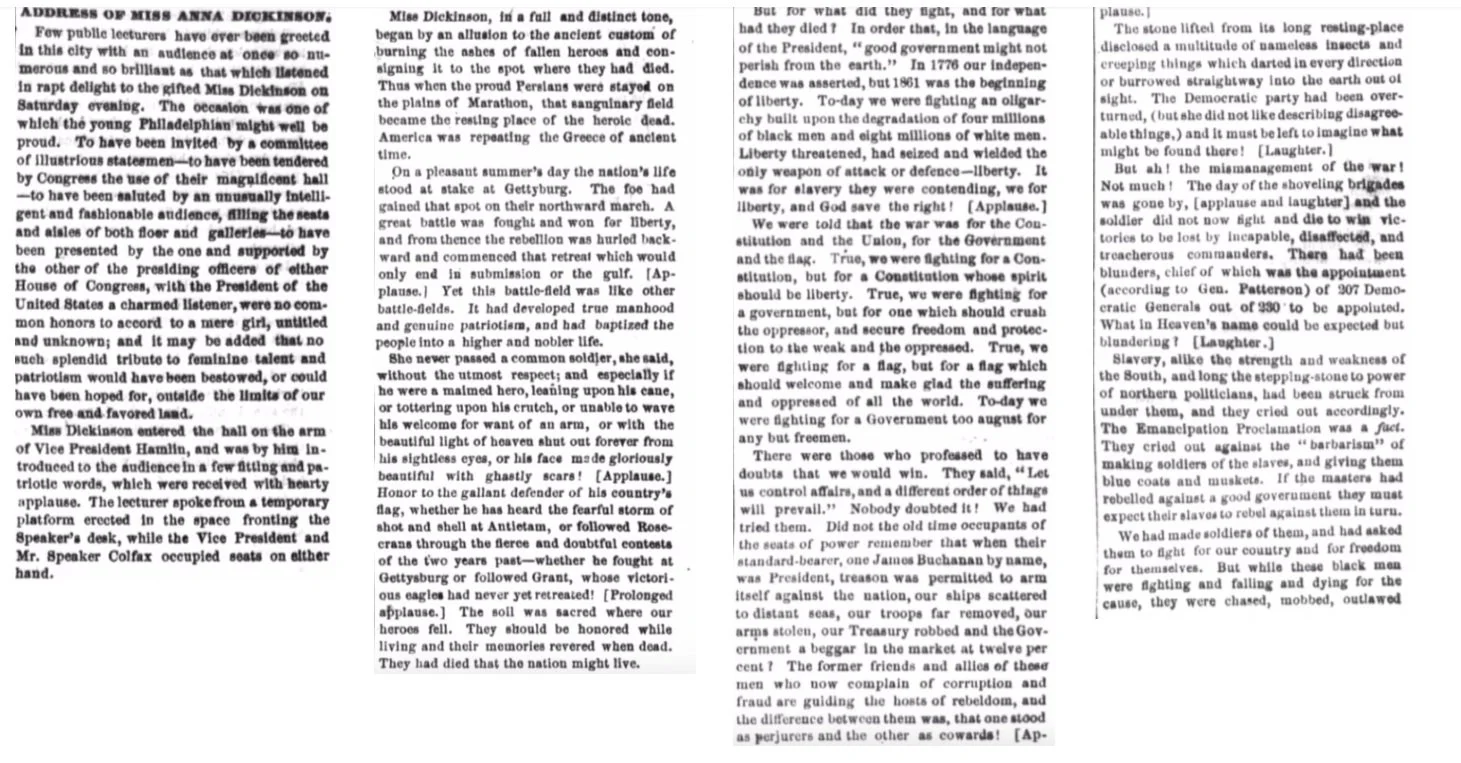
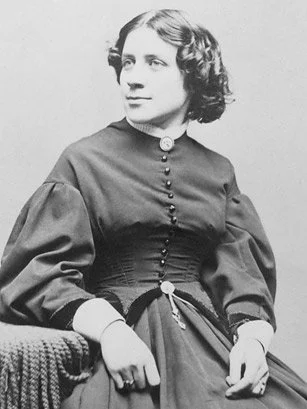
With this speech, abolitionist Anna Dickinson made history as the first woman to address Congress. She was just 21. Her opening is not reported verbatim but she spoke about the ancient custom of the burning the bodies of fallen soldiers where they died, and scattering ashes. Then she continues:
On a pleasant summer’s day the nation’s life stood at stake at Gettysburg. The foe has gained that spot on their northward march. A great battle was fought and won for liberty, and from thence the rebellion was hurled back-ward and commenced that retreat which would only end in submission or the gulf. [Applause.] Yet this battlefield was like other battlefields. It had developed true manhood and genuine patriotism, and had baptized the people into a higher and nobler life.
I never passed a common soldier, without the utmost respect; and especially if he were a maimed hero, leaning upon his cane or tottering upon his crutch, or unable to wave his welcome for want of an arm, or with the beautiful light of heaven shut out forever from his sightless eyes, or his face made gloriously beautiful with ghastly scars! [Applause.] Honor to the gallant defender of his country’s flag, whether he has heard the fearful storm of storm and shell at Antietam, or followed Rose-crans through the fierce and doubtful contests of the two years past – whether he fought at Gettysburg or followed Grant, whose victorious eagles had never yet retreated! [Prolonged applause.] The soil was sacred where our heroes fell. They should be honored while living and their memories revered when dead. They had died that the nation might live.
But for what did they fight and for what had they died? In order that, in the language of the President, “good government might not perish from the earth.” In 1776 our independence was asserted, but 1861 was the beginning of liberty. To-day we were fighting an oligarchy built upon the degradation of four millions of black men and eight millions of white men. Liberty threatened, had seized and wielded the only weapon of attack or defence – liberty. It was for slavery they were contending, we for liberty, and God save the right! [Applause.]
We were told that the war was for the Constitution and the Union, for the Government and the flag. True we were fighting for a Constitution, but for a Constitution whose spirit should be liberty. True we were fighting for a government, but for one which should crush the oppressor and secure freedom and protection to the weak and the oppressed. True, we were fighting for a flag, but for a flag which should welcome and make glad the suffering and oppressed of all the world. To-day we were fighting for a Government too august for any but freemen.
There were those who professed to have doubts that we would win. They said, “Let us control affairs, and a different order of things will prevail.” Nobody doubted it! We had tried them. Did not the old time occupants of the seats of power remember that when their standard-bearer, one James Buchanan by name, was President, treason was permitted to arm itself against the nation, our ships scattered to distant seas, our troops far removed, our arms stolen, our Treasury robbed and the Government a beggar in the market at twelve per cent? The former friends and allies of these men who now complain of corruption and fraud are guiding the hosts of rebeldom, and the different between them was, that one stood as perjurers and the other as cowards! [Applause.]
The stone lifted from its long resting-place disclosed a multitude of nameless insects and creeping things which darted in every direction or burrowed straightaway into the earth out of sight. The Democratic party had been overturned, (but she did not like describing disagreeable things,) and it must be left to imagine what might be found there! [Laughter.]
But ah! The mismanagement of the war! Not much! The day of the shoveling brigades was gone by, [applause and laughter] and the soldier did not now fight and die to win victories to be lost by the incapable, disaffected, and the treacherous commanders. There had been blunders, chief of which was the appointment (according to Gen. Patterson) of 207 Democratic Generals out of 230 to be appointed. What in Heaven’s name could be expected but blundering? [Laughter.]
Slavery alike the strength and weakness of the South, and long the stepping-stone to power of northern politicians, had been struck from under them, and they cried out accordingly. The Emancipation Proclamation was a fact. They cried out against the “barbarism” of making soldiers of the slaves, and giving them blue coats and muskets. If the masters had rebelled against a good government they must expect their slaves to rebel against them in turn.
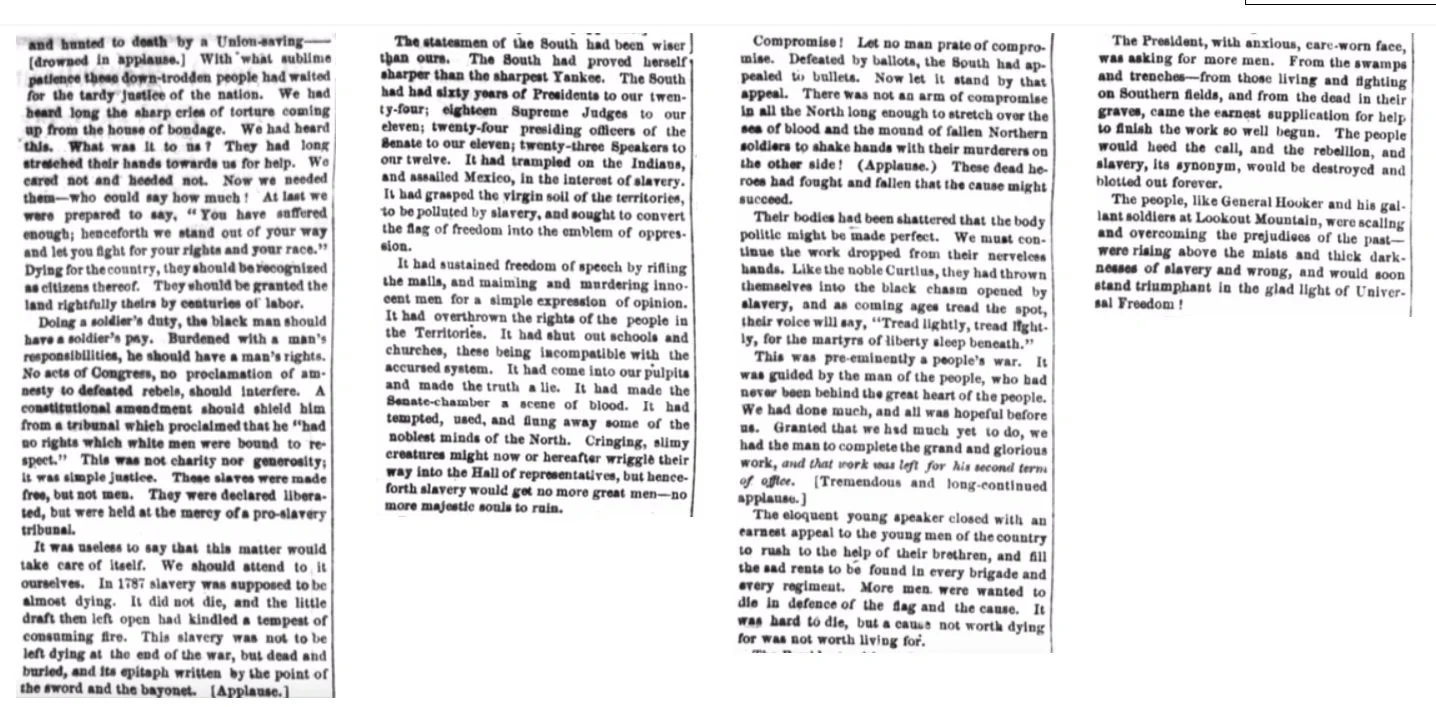
We had made soldiers out of them, and has asked them to fight for our country and for freedom for themselves. But while these black men were fighting and falling and dying for the cause, they were chase, mobbed, outlawed and hunted to death by a Union-saving --- [drowned in applause.] With what sublime patience these down-trodden people had waited for the tardy justice of the nation. We had heard long the sharp cries of torture coming up from the house of bondage. We had heard this. What was it to us? They had long stretched their hands towards us for help. We cared not and heeded not. Now we needed them – who could say how much! At last we were prepared to say, “You have suffered enough; henceforth we stand out of your way and let you fight for your rights and your race.” Dying for the county, they should be recognized as citizens thereof. They should be granted the land rightfully theirs by centuries of labor.
Doing a soldier’s duty, the black man should have a soldier’s pay. Burdened with a man’s responsibilities, he should have a man’s rights. No acts of Congress, no proclamation of amnesty to defeated rebels, should interfere. A constitutional amendment should shield him, from a tribunal which proclaimed that he “had no rights which white men were bound to re-spect.” This was not charity nor generosity; it was simple justice. These slaves were made free, but not men. They were declared libera-ted, but were held at the mercy of pro-slavery tribunal. It was useless to say that this matter would take care of itself. We should attend to it ourselves. In 1787 slavery was supposed to be almost dying. It did not die, and the little draft then let open had kindled a tempest of consuming fire. This slavery was not to be left dying at the end of the war, but dead and buried, its epitaph written by the point of the sward and the bayonet. [Applause.]
The statesmen of the South had been wiser than ours. The South had proved herself sharper than the sharpest Yankee. The South had had sixty years of Presidents to our twenty four; eighteen Supreme Judges to our eleven; twenty-four presiding of the Senate to our eleven; twenty-three Speakers to our twelve. It had trampled on the Indians, and assailed Mexico, in the interest of slavery. It had grasped the virgin soil of the territories, to be polluted by slavery, and sought to convert the flag of freedom into the emblem of oppress-sion.
It had sustained freedom of speech by rifling the mails and maiming and murdering inno-cent men for a simple expression of opinion. It had overthrown the rights of the people in the Territories. It had shut out schools and churched, these being incompatible with the accursed system. It had come into our pulpits and made the truth a lie. It had made the Senate-chamber a scene of blood. It had tempted, used, and flung away some of the noblest minds in the North. Cringing, slimy creatures might now or hereafter wriggle their way into the Hall of representatives, but hence-forth slavery would get no more great men – no more majestic souls to ruin.
Compromise! Let no man prate of compromise. Defeated by ballots, the South had ap-pealed to bullets. Now let it stand by that appeal. There was not an arm of compromise in all the North long enough to stretch over the sea of blood and the mound of fallen Northern soldiers to shake hands with their murderers on the other side! (Applause.) These dead he-roes had fought and fallen that the cause might succeed.
Their bodies had been shattered that the body politic might be made perfect. We must con-tinue the work dropped from their nerveless hands. Like the noble Curtius, they had thrown themselves into the black chasm opened by slavery, and as coming ages thread the spot, their voices will say, “Tread lightly, tread lightly, for the martyrs of liberty sleep beneath.”
This was pre-eminently a people’s war. It was guided by the man of the people, who had never been behind the great heart of the people. We had done much, and all was hopeful before us. Granted that we had much yet to do, we had the man to complete the grand and glorious work, and that work was left for his second term of office. [Tremendous and long-continued applause.]
Men of valour, rush to the help of your brethren and fill the sad rents to be found in every brigade and every regiment. More men are wanted to die in defence of the flag and the cause. It is hard to die, but a cause not worth dying for is not worth living for.
The President, with anxious, care-worn face, is asking for more men. From the swamps and trenches – from those living and fighting on Southern fields, and from the dead in their graves, comes the earnest supplication for help to finish the work so well begun. The people must heed the call, and the rebellion, and slavery, its synonym, must be destroyed and blotted out forever.
The people, like General Hooker and his gallant soldiers at Lookout Mountain, are scaling and overcoming the prejudices of the past – rising above the mists and thick dark-nesses of slavery and wrong, and will soon stand triumphant in the glad light of Universal Freedom!
Primary source: Address of Miss Anna Dickinson,” Daily National Republican, January 18, 1864