• Genre
  • About
  • Submissions
  • Donate
  • Search
Menu

Speakola

All Speeches Great and Small
  • Genre
  • About
  • Submissions
  • Donate
  • Search
Share a political speech

Anna Dickinson: 'Perils of the Hour', Address to Congress - 1864

November 17, 2026

16 January 1864, Washington DC, USA

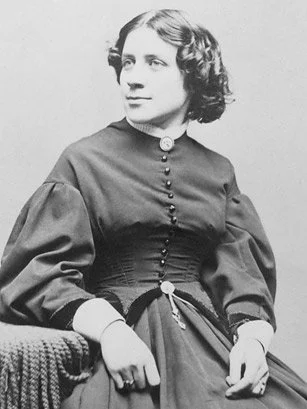
With this speech, abolitionist Anna Dickinson made history as the first woman to address Congress. She was just 21. Her opening is not reported verbatim but she spoke about the ancient custom of the burning the bodies of fallen soldiers where they died, and scattering ashes. Then she continues:

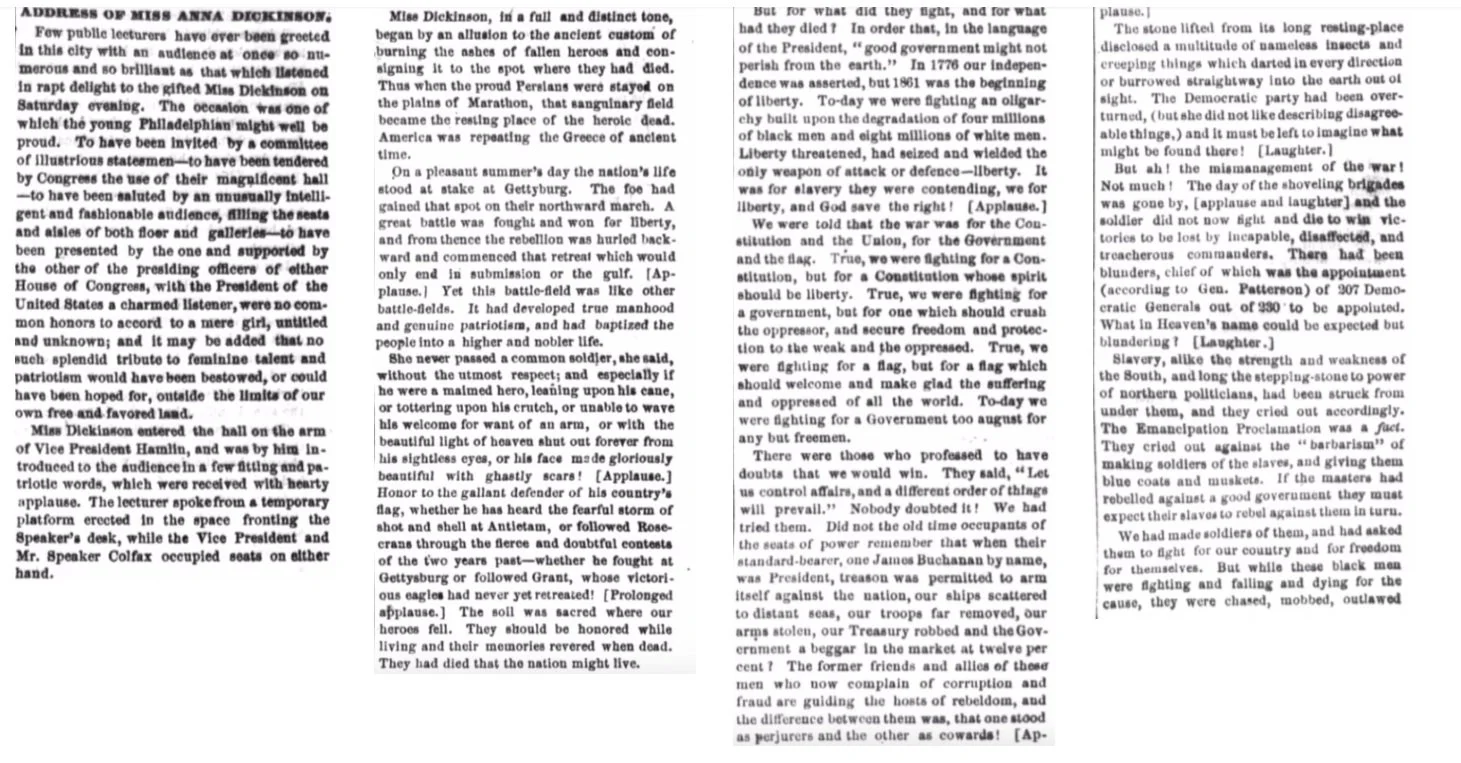
On a pleasant summer’s day the nation’s life stood at stake at Gettysburg. The foe has gained that spot on their northward march. A great battle was fought and won for liberty, and from thence the rebellion was hurled back-ward and commenced that retreat which would only end in submission or the gulf. [Applause.] Yet this battlefield was like other battlefields. It had developed true manhood and genuine patriotism, and had baptized the people into a higher and nobler life. 

I never passed a common soldier, without the utmost respect; and especially if he were a maimed hero, leaning upon his cane or tottering upon his crutch, or unable to wave his welcome for want of an arm, or with the beautiful light of heaven shut out forever from his sightless eyes, or his face made gloriously beautiful with ghastly scars! [Applause.] Honor to the gallant defender of his country’s flag, whether he has heard the fearful storm of storm and shell at Antietam, or followed Rose-crans through the fierce and doubtful contests of the two years past – whether he fought at Gettysburg or followed Grant, whose victorious eagles had never yet retreated! [Prolonged applause.] The soil was sacred where our heroes fell. They should be honored while living and their memories revered when dead. They had died that the nation might live.

But for what did they fight and for what had they died? In order that, in the language of the President, “good government might not perish from the earth.” In 1776 our independence was asserted, but 1861 was the beginning of liberty. To-day we were fighting an oligarchy built upon the degradation of four millions of black men and eight millions of white men. Liberty threatened, had seized and wielded the only weapon of attack or defence – liberty. It was for slavery they were contending, we for liberty, and God save the right! [Applause.]

We were told that the war was for the Constitution and the Union, for the Government and the flag. True we were fighting for a Constitution, but for a Constitution whose spirit should be liberty. True we were fighting for a government, but for one which should crush the oppressor and secure freedom and protection to the weak and the oppressed. True, we were fighting for a flag, but for a flag which should welcome and make glad the suffering and oppressed of all the world. To-day we were fighting for a Government too august for any but freemen.

There were those who professed to have doubts that we would win. They said, “Let us control affairs, and a different order of things will prevail.” Nobody doubted it! We had tried them. Did not the old time occupants of the seats of power remember that when their standard-bearer, one James Buchanan by name, was President, treason was permitted to arm itself against the nation, our ships scattered to distant seas, our troops far removed, our arms stolen, our Treasury robbed and the Government a beggar in the market at twelve per cent? The former friends and allies of these men who now complain of corruption and fraud are guiding the hosts of rebeldom, and the different between them was, that one stood as perjurers and the other as cowards! [Applause.]
           
The stone lifted from its long resting-place disclosed a multitude of nameless insects and creeping things which darted in every direction or burrowed straightaway into the earth out of sight. The Democratic party had been overturned, (but she did not like describing disagreeable things,) and it must be left to imagine what might be found there! [Laughter.]

But ah! The mismanagement of the war! Not much! The day of the shoveling brigades was gone by, [applause and laughter] and the soldier did not now fight and die to win victories to be lost by the incapable, disaffected, and the treacherous commanders. There had been blunders, chief of which was the appointment (according to Gen. Patterson) of 207 Democratic Generals out of 230 to be appointed. What in Heaven’s name could be expected but blundering? [Laughter.]
            
Slavery alike the strength and weakness of the South, and long the stepping-stone to power of northern politicians, had been struck from under them, and they cried out accordingly. The Emancipation Proclamation was a fact. They cried out against the “barbarism” of making soldiers of the slaves, and giving them blue coats and muskets. If the masters had rebelled against a good government they must expect their slaves to rebel against them in turn.

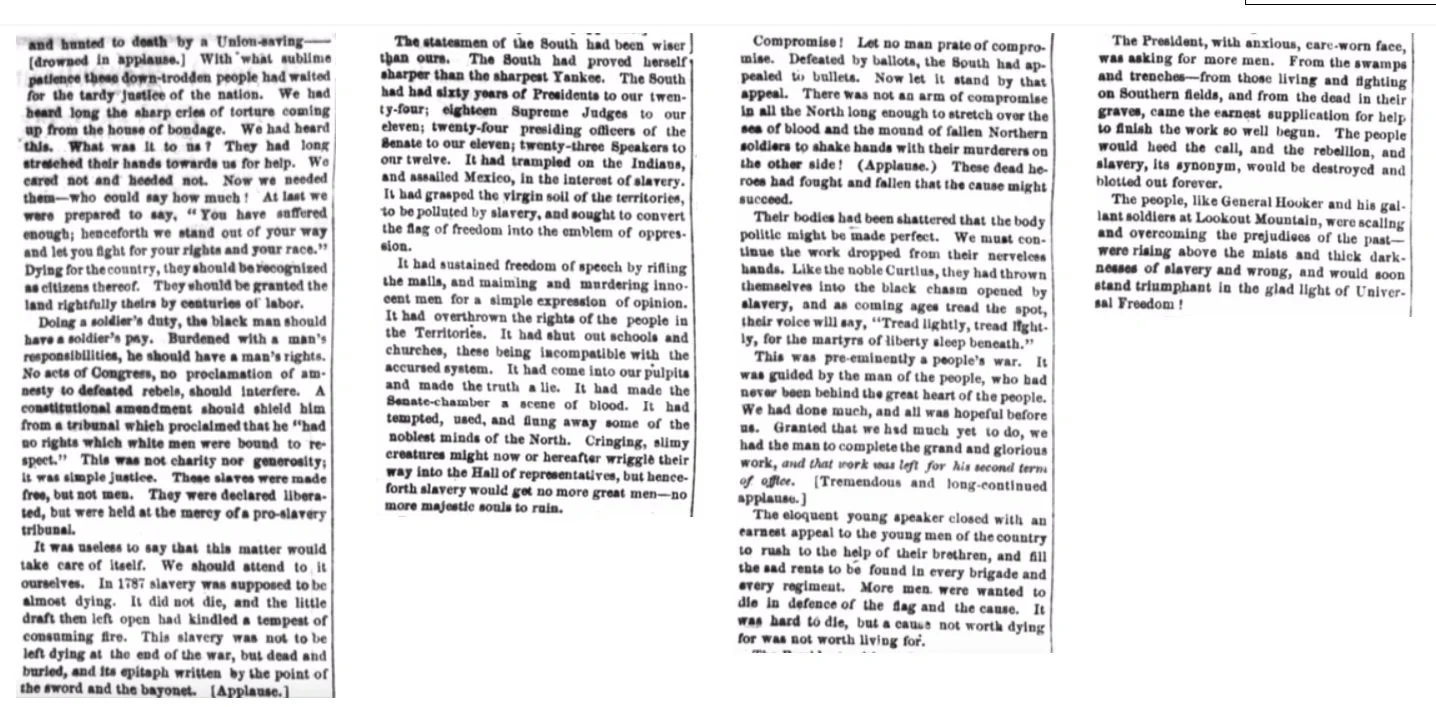
We had made soldiers out of them, and has asked them to fight for our country and for freedom for themselves. But while these black men were fighting and falling and dying for the cause, they were chase, mobbed, outlawed and hunted to death by a Union-saving --- [drowned in applause.] With what sublime patience these down-trodden people had waited for the tardy justice of the nation. We had heard long the sharp cries of torture coming up from the house of bondage. We had heard this. What was it to us? They had long stretched their hands towards us for help. We cared not and heeded not. Now we needed them – who could say how much! At last we were prepared to say, “You have suffered enough; henceforth we stand out of your way and let you fight for your rights and your race.” Dying for the county, they should be recognized as citizens thereof. They should be granted the land rightfully theirs by centuries of labor.
            
Doing a soldier’s duty, the black man should have a soldier’s pay. Burdened with a man’s responsibilities, he should have a man’s rights. No acts of Congress, no proclamation of amnesty to defeated rebels, should interfere. A constitutional amendment should shield him, from a tribunal which proclaimed that he “had no rights which white men were bound to re-spect.” This was not charity nor generosity; it was simple justice. These slaves were made free, but not men. They were declared libera-ted, but were held at the mercy of pro-slavery tribunal. It was useless to say that this matter would take care of itself. We should attend to it ourselves. In 1787 slavery was supposed to be almost dying. It did not die, and the little draft then let open had kindled a tempest of consuming fire. This slavery was not to be left dying at the end of the war, but dead and buried, its epitaph written by the point of the sward and the bayonet. [Applause.]
            
The statesmen of the South had been wiser than ours. The South had proved herself sharper than the sharpest Yankee. The South had had sixty years of Presidents to our twenty four; eighteen Supreme Judges to our eleven; twenty-four presiding of the Senate to our eleven; twenty-three Speakers to our twelve. It had trampled on the Indians, and assailed Mexico, in the interest of slavery. It had grasped the virgin soil of the territories, to be polluted by slavery, and sought to convert the flag of freedom into the emblem of oppress-sion. 
            
It had sustained freedom of speech by rifling the mails and maiming and murdering inno-cent men for a simple expression of opinion. It had overthrown the rights of the people in the Territories. It had shut out schools and churched, these being incompatible with the accursed system. It had come into our pulpits and made the truth a lie. It had made the Senate-chamber a scene of blood. It had tempted, used, and flung away some of the noblest minds in the North. Cringing, slimy creatures might now or hereafter wriggle their way into the Hall of representatives, but hence-forth slavery would get no more great men – no more majestic souls to ruin. 
            
Compromise! Let no man prate of compromise. Defeated by ballots, the South had ap-pealed to bullets. Now let it stand by that appeal. There was not an arm of compromise in all the North long enough to stretch over the sea of blood and the mound of fallen Northern soldiers to shake hands with their murderers on the other side! (Applause.) These dead he-roes had fought and fallen that the cause might succeed.
            
Their bodies had been shattered that the body politic might be made perfect. We must con-tinue the work dropped from their nerveless hands. Like the noble Curtius, they had thrown themselves into the black chasm opened by slavery, and as coming ages thread the spot, their voices will say, “Tread lightly, tread lightly, for the martyrs of liberty sleep beneath.”
            

This was pre-eminently a people’s war. It was guided by the man of the people, who had never been behind the great heart of the people. We had done much, and all was hopeful before us. Granted that we had much yet to do, we had the man to complete the grand and glorious work, and that work was left for his second term of office. [Tremendous and long-continued applause.]
            
Men of valour, rush to the help of your brethren and fill the sad rents to be found in every brigade and every regiment. More men are wanted to die in defence of the flag and the cause. It is hard to die, but a cause not worth dying for is not worth living for.
            
The President, with anxious, care-worn face, is asking for more men. From the swamps and trenches – from those living and fighting on Southern fields, and from the dead in their graves, comes the earnest supplication for help to finish the work so well begun. The people must heed the call, and the rebellion, and slavery, its synonym, must be destroyed and blotted out forever.

The people, like General Hooker and his gallant soldiers at Lookout Mountain, are scaling and overcoming the prejudices of the past – rising above the mists and thick dark-nesses of slavery and wrong, and will soon stand triumphant in the glad light of Universal Freedom!


Primary source: Address of Miss Anna Dickinson,” Daily National Republican, January 18, 1864

Source: https://annaedickinson.weebly.com/january-...

Enjoyed this speech? Speakola is a labour of love and I’d be very grateful if you would share, tweet or like it. Thank you.

Facebook Twitter Facebook
In Pre 1900 2 Tags ANNA DICKINSON, PERILS OF THE HOUR, CIVIL WAR, ABRAHAM LINCOLN, WOMEN, FEMINISM, TRANSCRIPT, THE CIVIL WAR, SLAVERY, EMANCIPATION, CALL TO ARMS, UNION, ADDRESS TO CONGRESS, 19TH CENTURY, 1880s, ABOLITIONIST, 1860s, GREAT SPEECES OF THE 19TH CENUTRY
Comment
frederick douglass.png

Frederick Douglass: 'If there is no struggle, there is no progress', West India Emancipation speech - 1857

March 22, 2021

3 August, 1857, Canandaigua, New York, USA

The general sentiment of mankind is that a man who will not fight for himself, when he has the means of doing so, is not worth being fought for by others, and this sentiment is just. For a man who does not value freedom for himself will never value it for others, or put himself to any inconvenience to gain it for others. Such a man, the world says, may lie down until he has sense enough to stand up. It is useless and cruel to put a man on his legs, if the next moment his head is to be brought against a curbstone.

A man of that type will never lay the world under any obligation to him, but will be a moral pauper, a drag on the wheels of society, and if he too be identified with a peculiar variety of the race he will entail disgrace upon his race as well as upon himself. The world in which we live is very accommodating to all sorts of people. It will cooperate with them in any measure which they propose; it will help those who earnestly help themselves, and will hinder those who hinder themselves. It is very polite, and never offers its services unasked. Its favors to individuals are measured by an unerring principle in this—viz., respect those who respect themselves, and despise those who despise themselves. It is not within the power of unaided human nature to persevere in pitying a people who are insensible to their own wrongs and indifferent to the attainment of their own rights. The poet was as true to common sense as to poetry when he said,

Who would be free, themselves must strike the blow.

When O’Connell, with all Ireland at his back, was supposed to be contending for the just rights and liberties of Ireland, the sympathies of mankind were with him, and even his enemies were compelled to respect his patriotism. Kossuth, fighting for Hungary with his pen long after she had fallen by the sword, commanded the sympathy and support of the liberal world till his own hopes died out. The Turks, while they fought bravely for themselves and scourged and drove back the invading legions of Russia, shared the admiration of mankind. They were standing up for their own rights against an arrogant and powerful enemy; but as soon as they let out their fighting to the Allies, admiration gave way to contempt. These are not the maxims and teachings of a coldhearted world. Christianity itself teaches that man shall provide for his own house. This covers the whole ground of nations as well as individuals. Nations no more than individuals can innocently be improvident. They should provide for all wants—mental, moral and religious—and against all evils to which they are liable as nations. In the great struggle now progressing for the freedom and elevation of our people, we should be found at work with all our might, resolved that no man or set of men shall be more abundant in labors, according to the measure of our ability, than ourselves.

I know, my friends, that in some quarters the efforts of colored people meet with very little encouragement. We may fight, but we must fight like the Sepoys of India, under white officers. This class of Abolitionists don’t like colored celebrations, they don’t like colored conventions, they don’t like colored antislavery fairs for the support of colored newspapers. They don’t like any demonstrations whatever in which colored men take a leading part. They talk of the proud Anglo-Saxon blood as flippantly as those who profess to believe in the natural inferiority of races. Your humble speaker has been branded as an ingrate, because he has ventured to stand up on his own and to plead our common cause as a colored man, rather than as a Garrisonian. I hold it to be no part of gratitude to allow our white friends to do all the work, while we merely hold their coats. Opposition of the sort now referred to is partisan position, and we need not mind it. The white people at large will not largely be influenced by it. They will see and appreciate all honest efforts on our part to improve our condition as a people.

Let me give you a word of the philosophy of reform. The whole history of the progress of human liberty shows that all concessions yet made to her august claims have been born of earnest struggle. The conflict has been exciting, agitating, all-absorbing, and for the time being, putting all other tumults to silence. It must do this or it does nothing. If there is no struggle there is no progress. Those who profess to favor freedom and yet deprecate agitation are men who want crops without plowing up the ground; they want rain without thunder and lightning. They want the ocean without the awful roar of its many waters.

This struggle may be a moral one, or it may be a physical one, and it may be both moral and physical, but it must be a struggle. Power concedes nothing without a demand. It never did and it never will. Find out just what any people will quietly submit to and you have found out the exact measure of injustice and wrong which will be imposed upon them, and these will continue till they are resisted with either words or blows, or with both. The limits of tyrants are prescribed by the endurance of those whom they oppress. In the light of these ideas, Negroes will be hunted at the North and held and flogged at the South so long as they submit to those devilish outrages and make no resistance, either moral or physical. Men may not get all they pay for in this world, but they must certainly pay for all they get. If we ever get free from the oppressions and wrongs heaped upon us, we must pay for their removal. We must do this by labor, by suffering, by sacrifice, and if needs be, by our lives and the lives of others.

Hence, my friends, every mother who, like Margaret Garner, plunges a knife into the bosom of her infant to save it from the hell of our Christian slavery, should be held and honored as a benefactress. Every fugitive from slavery who, like the noble William Thomas at Wilkes Barre, prefers to perish in a river made red by his own blood to submission to the hell hounds who were hunting and shooting him should be esteemed as a glorious martyr, worthy to be held in grateful memory by our people. The fugitive Horace, at Mechanicsburgh, Ohio, the other day, who taught the slave catchers from Kentucky that it was safer to arrest white men than to arrest him, did a most excellent service to our cause. Parker and his noble band of fifteen at Christiana, who defended themselves from the kidnappers with prayers and pistols, are entitled to the honor of making the first successful resistance to the Fugitive Slave Bill. But for that resistance, and the rescue of Jerry and Shadrack, the man hunters would have hunted our hills and valleys here with the same freedom with which they now hunt their own dismal swamps.

There was an important lesson in the conduct of that noble Krooman in New York the other day, who, supposing that the American Christians were about to enslave him, betook himself to the masthead and with knife in hand said he would cut his throat before he would be made a slave. Joseph Cinque, on the deck of the Amistad, did that which should make his name dear to us. He bore nature’s burning protest against slavery. Madison Washington who struck down his oppressor on the deck of the Creole, is more worthy to be remembered than the colored man who shot Pitcairn at Bunker Hill.

My friends, you will observe that I have taken a wide range, and you think it is about time that I should answer the special objection to this celebration. I think so too. This, then, is the truth concerning the inauguration of freedom in the British West Indies. Abolition was the act of the British government. The motive which led the government to act no doubt was mainly a philanthropic one, entitled to our highest admiration and gratitude. The national religion, the justice and humanity cried out in thunderous indignation against the foul abomination, and the government yielded to the storm. Nevertheless a share of the credit of the result falls justly to the slaves themselves. “Though slaves, they were rebellious slaves.” They bore themselves well. They did not hug their chains, but according to their opportunities, swelled the general protest against oppression. What Wilberforce was endeavoring to win from the British senate by his magic eloquence the slaves themselves were endeavoring to gain by outbreaks and violence. The combined action of one and the other wrought out the final result. While one showed that slavery was wrong, the other showed that it was dangerous as well as wrong. Mr. Wilberforce, peace man though he was, and a model of piety, availed himself of this element to strengthen his case before the British Parliament, and warned the British government of the danger of continuing slavery in the West Indies. There is no doubt that the fear of the consequences, acting with a sense of the moral evil of slavery, led to its abolition. The spirit of freedom was abroad in the Islands. Insurrection for freedom kept the planters in a constant state of alarm and trepidation. A standing army was necessary to keep the slaves in their chains. This state of facts could not be without weight in deciding the question of freedom in these countries.

I am aware that the rebellious disposition of the slaves was said to arise out of the discussion which the Abolitionists were carrying on at home, and it is not necessary to refute this alleged explanation. All that I contend for is this: that the slaves of the West Indies did fight for their freedom, and that the fact of their discontent was known in England, and that it assisted in bringing about that state of public opinion which finally resulted in their emancipation. And if this be true, the objection is answered.

Again, I am aware that the insurrectionary movements of the slaves were held by many to be prejudicial to their cause. This is said now of such movements at the South. The answer is that abolition followed close on the heels of insurrection in the West Indies, and Virginia was never nearer emancipation than when General Turner kindled the fires of insurrection at Southampton.

Sir, I have now more than filled up the measure of my time. I thank you for the patient attention given to what I have had to say. I have aimed, as I said at the beginning, to express a few thoughts having some relation to the great interest of freedom both in this country and in the British West Indies, and I have said all that I mean to say, and the time will not permit me to say more.

Source: https://face2faceafrica.com/article/if-the...

Enjoyed this speech? Speakola is a labour of love and I’d be very grateful if you would share, tweet or like it. Thank you.

Facebook Twitter Facebook
In Pre 1900 Tags FREDERICK DOUGLASS, WEST INDIA EMANCIPATION SPEECH, SLAVERY, ABOLITIONIST, BLACK FREEDOM, GREAT SPEECES OF THE 19TH CENUTRY, 1857, ACTIVIST, AFRICAN AMERICAN, USA, TRANSCRIPT
Comment

See my film!

Limited Australian Season

March 2025

Details and ticket bookings at

angeandtheboss.com

Support Speakola

Hi speech lovers,
With costs of hosting website and podcast, this labour of love has become a difficult financial proposition in recent times. If you can afford a donation, it will help Speakola survive and prosper.

Best wishes,
Tony Wilson.

Become a Patron!

Learn more about supporting Speakola.

Featured political

Featured
Jon Stewart: "They responded in five seconds", 9-11 first responders, Address to Congress - 2019
Read more →
Jacinda Ardern: 'They were New Zealanders. They are us', Address to Parliament following Christchurch massacre - 2019
Read more →
Dolores Ibárruri: "¡No Pasarán!, They shall not pass!', Defense of 2nd Spanish Republic - 1936
Read more →
Jimmy Reid: 'A rat race is for rats. We're not rats', Rectorial address, Glasgow University - 1972
Read more →

Featured eulogies

Featured
For Geoffrey Tozer: 'I have to say we all let him down', by Paul Keating - 2009
Read more →
for James Baldwin: 'Jimmy. You crowned us', by Toni Morrison - 1988
Read more →
for Michael Gordon: '13 days ago my Dad’s big, beautiful, generous heart suddenly stopped beating', by Scott and Sarah Gordon - 2018
Read more →

Featured commencement

Featured
Tara Westover: 'Your avatar isn't real, it isn't terribly far from a lie', The Un-Instagrammable Self, Northeastern University - 2019
Read more →
Tim Minchin: 'Being an artist requires massive reserves of self-belief', WAAPA - 2019
Read more →
Atul Gawande: 'Curiosity and What Equality Really Means', UCLA Medical School - 2018
Read more →
Abby Wambach: 'We are the wolves', Barnard College - 2018
Read more →
Eric Idle: 'America is 300 million people all walking in the same direction, singing 'I Did It My Way'', Whitman College - 2013
Read more →
Shirley Chisholm: ;America has gone to sleep', Greenfield High School - 1983
Read more →

Featured sport

Featured
Joe Marler: 'Get back on the horse', Harlequins v Bath pre game interview - 2019
Read more →
Ray Lewis : 'The greatest pain of my life is the reason I'm standing here today', 52 Cards -
Read more →
Mel Jones: 'If she was Bradman on the field, she was definitely Keith Miller off the field', Betty Wilson's induction into Australian Cricket Hall of Fame - 2017
Read more →
Jeff Thomson: 'It’s all those people that help you as kids', Hall of Fame - 2016
Read more →

Fresh Tweets


Featured weddings

Featured
Dan Angelucci: 'The Best (Best Man) Speech of all time', for Don and Katherine - 2019
Read more →
Hallerman Sisters: 'Oh sister now we have to let you gooooo!' for Caitlin & Johnny - 2015
Read more →
Korey Soderman (via Kyle): 'All our lives I have used my voice to help Korey express his thoughts, so today, like always, I will be my brother’s voice' for Kyle and Jess - 2014
Read more →

Featured Arts

Featured
Bruce Springsteen: 'They're keepers of some of the most beautiful sonic architecture in rock and roll', Induction U2 into Rock Hall of Fame - 2005
Read more →
Olivia Colman: 'Done that bit. I think I have done that bit', BAFTA acceptance, Leading Actress - 2019
Read more →
Axel Scheffler: 'The book wasn't called 'No Room on the Broom!', Illustrator of the Year, British Book Awards - 2018
Read more →
Tina Fey: 'Only in comedy is an obedient white girl from the suburbs a diversity candidate', Kennedy Center Mark Twain Award -  2010
Tina Fey: 'Only in comedy is an obedient white girl from the suburbs a diversity candidate', Kennedy Center Mark Twain Award - 2010
Read more →

Featured Debates

Featured
Sacha Baron Cohen: 'Just think what Goebbels might have done with Facebook', Anti Defamation League Leadership Award - 2019
Read more →
Greta Thunberg: 'How dare you', UN Climate Action Summit - 2019
Read more →
Charlie Munger: 'The Psychology of Human Misjudgment', Harvard University - 1995
Read more →
Lawrence O'Donnell: 'The original sin of this country is that we invaders shot and murdered our way across the land killing every Native American that we could', The Last Word, 'Dakota' - 2016
Read more →