
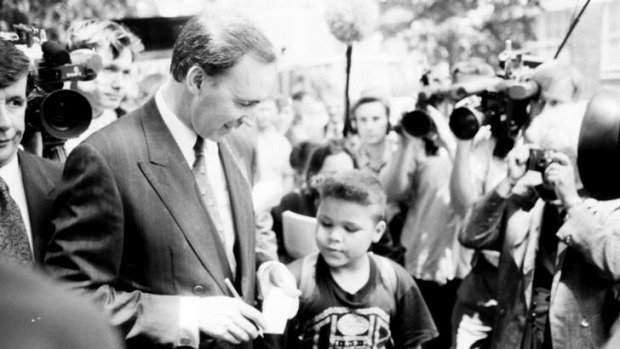
9 December 2015, Australian Museum, Sydney, Australia
Paul Keating was the 24th Prime Minister of Australia. His Redfern speech, acknowledging dispossession and oppression of Aboriginal Australians is a political classic.
My father and I spent a long lonely day at the Bankstown South polling booth in 1967 handing out pamphlets in support of the referendum to grant the Commonwealth an express constitutional power in respect of the Australian Aboriginal community and its welfare.
Two years later, I was a member of the House of Representatives.
This was the election where Gough Whitlam had made his greatest gains and there was hope amongst many of us that he had enough momentum to win. As it turned out, John Gorton was able to hang on, with Bill Wentworth as Australia's first minister for Aboriginal affairs.
Wentworth, who had played a leading role in the 1967 referendum, had his heart in the job and it was the hope of many that he would succeed in moving the Aboriginal agenda forward, employing the Commonwealth's newly found power.
At the heart of these amplified expectations was the hope of finding some real if late basis for a reconciliation between the Aboriginal and Torres Strait Islander community and the nation in the broad.
The debate in those earlier days tended to centre on matters relating to welfare and to land, as much as it did the much deeper notion of reconciliation.
The first positive expression of Commonwealth power turned out to be under Gough Whitlam's government in 1975 with the Northern Territory's Aboriginal land rights act. An act actually promulgated by Malcolm Fraser under his government in 1977.
Seven years after the passage of the referendum, this act was the first real and tangible acknowledgment of the dispossession which had occurred at sovereignty in 1788. In those days, the prevailing legal orthodoxy was that Aboriginal and Islander people possessed no ownership of the land – the land which became the Commonwealth of Australia and flowing from that, that Australia was the land of ‘no one’.
While the 1967 referendum gave the Commonwealth parliament power to make special laws in respect of Aboriginal and Islander people, including land across the States, because of political opposition and the complexity of issues, the Whitlam government confined its land rights initiative to Territories under Commonwealth control. Hence the origins of the Northern Territory land rights act.
And this remained the sole initiative of the Commonwealth in respect of Aboriginal and Islander land until the Native Title Act of the Keating government in 1993 - just on 20 years later.
It was the national policy of the Australian Labor Party and of its parliamentary party, under the 1967 constitutional power, to legislate land rights across all the States and Territories. And the first time that this policy had been formally considered was in 1986 by the Minister for Aboriginal Affairs in the Hawke government, Clyde Holding.
Holding, to his chagrin, discovered almost immediately how difficult implementation of such a policy would be even in a Labor party which philosophically supported it. Holding ran into trenchant opposition from the states, most particularly the State of Western Australia, led by its then Labor premier, Brian Burke. Burke was a leading member of the national right faction, across the country, a faction then spoken for by Graham Richardson a then senator and former party secretary from NSW.
Faced with this broad opposition from Western Australia and from the right faction of the party, Holding was stymied, relying then on Bob Hawke as Prime Minister to break the impasse. It never happened. So uniform land rights for Aboriginal and Islander people fell from the Hawke's government's agenda.
I told Bob Hawke at the time that even if he and I alone were prepared to argue the case for land rights before a national conference of the Labor party we would win, notwithstanding broad opposition from the right faction.
Nevertheless, the whole momentum for land rights dissipated - notwithstanding that the Hawke government had belatedly put together a Council for Reconciliation in September 1991.
And this is where the difficult issue of land rights remained until the High Court handed down its decision in Mabo No 2 on 3 June 1992.
By this time I was Prime Minister and I issued a statement saying, in overturning the concept of terra nullius, the High Court had presented the country with an opportunity to find a new and just way of remedying the original colonial grievance - the dispossession and that this opportunity could bring with it a new and lasting basis for a genuine reconciliation.
As it turned out, the United Nations International Year for the World’s Indigenous People began in December 1992, so I took the opportunity to say something definitive about the general plight of indigenous people around the world and most particularly of our own.
But in deciding to say something definitive I was determined to say something which transcended the kind of lip service which normally informed speeches of this kind. So, notwithstanding I was three months from a national election, I decided to lay waste to the ambiguity and humbug that had forever compromised this topic. I wanted to deal in truths, historical truths, ones that made clear above all else that it was we who did the dispossessing and that it was we who had taken the lands and brutalised the traditional way of life.
I said at Redfern Park on 10 December 1992 that our starting point had to begin with an act of recognition, the very same point President Barack Obama made recently following the Atlanta church massacre where he said ‘recognition precedes justice’.
I said at Redfern we could not sweep injustice aside and that by bringing the dispossessed out of the shadows, we were extending our own idea of social justice and of social democracy. And that our failure to recognise our callous disregard of Aboriginal and Islander people and of the truth of their loss and circumstance had degraded us all.
I have said in other circumstances, that ‘there is in public life no more beautiful a characteristic than truth’. That truth is, of its essence liberating, as it is possessed of no contrivance or conceit - that it provides the only genuine basis for progress and that the future can only be found in truth.
Nowhere was this sentiment more apt than in the vexed issue of Australian society coming to terms with its origins.
And I wanted, as Prime Minister, to lay out the truth unambiguously, once and for all. For once a Prime Minister had spoken the truth, the truth could never become unsaid - no matter how jarring and objectionable these views were likely to be to conservative Australia. And as it eventuated, the views were jarring to many, spawning the black armband brigade which then fought this issue right throughout the 1990s.
But significant as were the articulation of these truths and sentiment and especially in respect of prejudice, of themselves they could not deal in a material way with the dispossession and all that had flowed from it.
Indeed, at Redfern I said we had to give meaning to ‘justice’ and ‘equity’ and that we could only give such meaning when we committed ourselves to achieving concrete things. That when we see improvement, we see a lift in dignity, confidence and happiness. And I instanced the Mabo judgment as one of the opportunities that presented itself as a building block in a more practical partnership towards justice and equity.
I made clear at Redfern that I saw Mabo as an historic opportunity – a potential turning point, one that could provide a new relationship between indigenous and non-Aboriginal Australians.
Remarkably, the High Court of Australia had found that a title of an ancient kind had survived the act of sovereignty in 1788 and to the extent that subsequent grants of interest were consistent with the title, the nature and content of the title could be determined by the character or the connection to or occupation of the land under traditional laws and customs.
The notion that Aboriginal and Islander people had a private property right to their own soil opened up what I thought was an entirely new and opportune pathway to land rights, one superior to land being conferred upon indigenous people by the act of an Australian parliament.
And so, I set about enshrining these principles and modalities in a major piece of cultural and property law which is now known as the Native Title Act 1993.
While the principles laid out in the High Court’s Mabo No 2 decision could never deal with the original dispossession, for much of the land granted since 1788 had had the effect of extinguishing native title, they did have the possibility of making good on the dispossession otherwise across vast tracts of the continent.
So while we could not make reparations, we could make amends. We could reverse the dispossession for those people who still lived on or had a traditional connection with the land.
So the notion of Aboriginality and all that that meant became central to native title and I was determined that it be central.
We have to remember that native title is not a creature of the Australian common law but an ancient title recognised by the common law. A title of ancient antecedents which gives recognition to culture, customary tradition and nature - to the relationship between Aboriginal people and the landscape; the relationship to their songs and dances and to the birds and the animals – to their storytelling.
Is it any wonder then that this culture, the longest with a collective memory of any in continuous existence, with its originality and creativity, is now pointing the way for our own culture – an essentially European one but one under constant renovation, not least at the incidence of indigenous inspiration?
Aboriginal art and culture draws from the land, for Aboriginality and the land are essential to each other and are inseparable.
At its best, Aboriginal art carries sacred messages through its symbols and materials yet manages to hold its secrets while speaking to a broader audience. More than that, it has been effective in translating an entire culture and the understanding of an entire continent.
Indeed, the more we interpret Australia through Aboriginal eyes, through the experience of their long and epic story, the more we allow ourselves to understand the land we share.
So I think there is a lesson in this: we may reach a point where Aboriginal art and culture become so integral and so central to Australian art and culture that each melds into the other.
Whatever our identity is today or has become, it is an identity inseparable from Aboriginal Australia. For their fifty thousand years here has slaked the land with their resonances, their presence and their spirit. Our opportunity is to rejoice in their identity, and without attempting to appropriate or diminish it, fuse it with our own, making the whole richer.
Australia is positioned in the fastest growing, most dynamic part of the world. Indigenous cultures exist all around it. And in the largest countries on earth.
Our two hundred year occupancy of this vast continent, in terms of long history, sits at odds with the settled old societies near us and around us.
But this is not the case with our indigenes.
They were never at odds with what surrounded them nor indeed with their own land. They are entirely at home with it and in it.
But as it turned out, their home is now our home and the more we rejoice in their identity - and their one-ness with the country, the more the country will become ours as we become nearer its spirituality and its meaning.
The more we view the country through the prism of Aboriginality, the more likely we are to get the angle right.
Similar to this: Paul Keating, Redfern Speech, 1992.