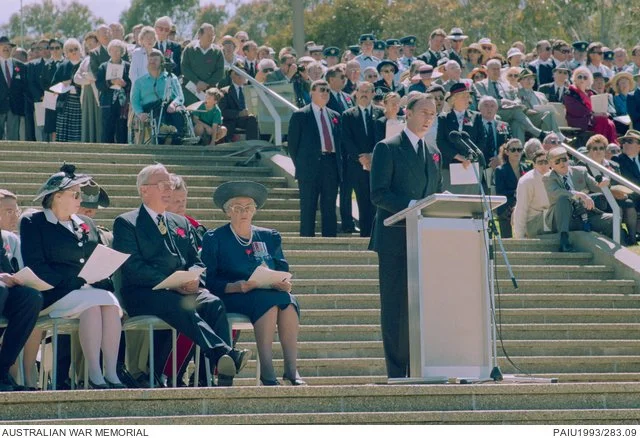
11 November 1996, UNSW, Sydney, Australia
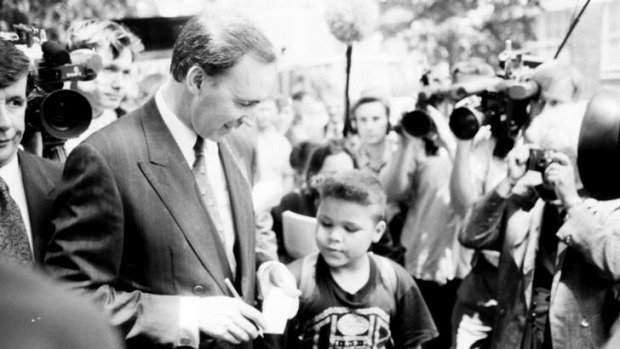
Paul Keating was the 24th Prime Minister of Australia. See his entry at Museum for Australian Democracy. He delivered this after his defeat in 1996. A growth in xenophobic sentiment through the election of Pauline Hanson and One Nation was evident in these months.
When I last spoke in this auditorium in June, I talked about the growing interdependence between our domestic and foreign policy concerns. I said that the old divisions between what we do internally and what we do externally no longer substantially exist.
I also spoke of the need for governments and others involved in foreign policy in Australia to confront growing fears in our society about the future and our engagement with the rest of the world.
I said these fears were linked to a yearning for an Australia which no longer exists.
Tonight I want to reflect on these problems from the other direction, from the inside. And to discuss Australia itself and what being an Australian means in the last decade of the twentieth century. And what perhaps it should mean in the twenty-first century.
Public debate in Australia over the past few months has been heavily concentrated on issues like immigration and Aboriginal affairs, on what the parameters of public debate should be and the issue of so-called political correctness.
It does seem a remarkable thing to me: here we are in the last half-decade of our first century as a nation, eighteen million of us on a continent almost the size of the United States, one of the oldest and most stable democracies in the world, sitting adjacent to the most extraordinary economic revolution in the history of the world, and what appears to concern some of us most is the colour of people’s skins.
It seems an eternity since we were talking about parallels between our own constitutional ambitions and those of Federation’s founding fathers. We who favour a republic drew some inspiration from the achievement of Federation and nationhood. We concerned ourselves with native title, education in civics, a modified multiculturalism, a new relationship with the countries of Asia. Suddenly the strongest parallel with the period in which our nation was created seems to be a preoccupation with racially based immigration.
It has been one of the saddest developments in our recent history. But we can learn from it and it may not be too late to arrest the process.
One result of the debate must surely be an improved understanding on the part of our politicians of this simple reality—there is no escaping the broad view.
Events and policies in different areas are all related. For example, what we say and do about our immigration policy has economic effects far beyond any spurious case that may be made about the effect of migrants on the availability of jobs. It affects the level of investment in Australia, the success of our business abroad—and these things by contrast have consequences for jobs which are anything but spurious. The links are not always direct but, as the business community has been making clear to the government, they exist and they are powerful.
Culture and identity, the structures and symbols of our government and the way we define ourselves as a nation are not distractions from the concerns of ordinary people, their income, their security, their mortgage payments and their children’s education and health. Rather, they are an intrinsic part of the way we secure these things.
Two years ago, some people were calling these matters diversions. They were not then, and they are not now.
In truth I think the pity is that at this mature stage of our national life we are still arguing about the most basic issues of our identity. By rights the argument should have been settled years ago. I would be glad if I never heard the word ‘identity’ again.
That is one of many reasons why I am utterly convinced that we should be a republic. It seems to me that the republic should be and can be the most natural and necessary step. We should be able to take it in our stride. And really we must.
And if Paul Keating saying these things sounds all too familiar or arouses suspicion in some hearts, here is the Australian Financial Review—hardly a republican organ or one easily diverted from the economic main game—in an editorial a month ago. We are going through ‘Throwback’, they said:
Australia cannot retreat behind a white picket fence . . . rather Australians must embrace the future and the Government must take the lead. This means adopting a positive outward-looking attitude to all parts of the world, including Asia, and encouraging an understanding of the benefits of immigration so that fear does not drive discussion of it. It means coming to terms with the various, and sometimes painful, histories of Australians and working towards creating a tolerant and inclusive society.
It means pursuing a republican constitution and a new distinctively Australian flag in time for the centenary of federation and the Sydney 2000 Olympics.
How doubly reassuring it would have been to have had such an expression of interest from the Financial Review during our days in office! Perhaps only now do they feel free to say what has been on their minds.
All this is by way of introduction.
I want to begin by saying something about the creation of the new Australia—and for all the recent signs of regression, I think the term still applies. And I want to talk about the role of government in nurturing that creation.
I feel obliged to make a few remarks about immigration and multiculturalism, including Asian migration and to touch on the issues facing indigenous Australians, their place in the new Australia and the implications of their treatment for the rest of us.
And I want to talk about the consequences of these things for the structures of Australian institutions, including the republic.
One of the strangest myths spread recently has been the one that under the Labor government debate in Australia was somehow strangled and the people cowered under a stupefying pall of ‘political correctness’. I know I have sometimes been held responsible for terrifying into silence those who disagreed with me.
Well, I obviously wasn’t much good at it. Timid little creatures like Bruce Ruxton and Alan Jones and Graeme Campbell seemed to me remarkably undeterred. Newspaper columns, letter pages and talkback radio shows were notably not unforthcoming in their criticism. During the native title debate, Aborigines, graziers and miners did not shirk from saying what they thought. Loggers and greens had their go. The monarchists were not overcome by their natural decorum.
In fact, we have to ask if we are not seeing here a classic case of the oppressors parading as victims.
To my mind, the infelicities and exaggerations of those who are trying to avoid harm and insult, or to make others feel better about their condition, is a relatively trivial sin compared with those whose aim, or effect, is to harm and to affront.
On the other hand, I don’t think I can be accused of being politically correct myself—unless expelling Graeme Campbell was politically correct, which I happen to think it was.
Over-zealousness can be an ugly thing, and I have no doubt it has done some harm here and there, but ‘political correctness’ is not the quasi-totalitarian evil some people are making it out to be.
On the other hand, it has provided a useful smoke-screen for some crude turnings in the national debate. A very ugly, resentful and xenophobic cat has been let out of the bag.
But I think it would be unwise to simply attempt to stuff the beast back and tie it up as best we can without attempting to understand why it escaped in the first place.
Or, more importantly, without developing the sophisticated political responses needed to ensure that a sense of national unity and purpose is restored and strengthened by the experience.
At least the current debate has more sharply focused the choices as we attempt to chart a course into the next century. In The End of Certainty, Paul Kelly wrote that the Australia brought into being through Federation was:
‘founded on faith in government authority; belief in egalitarianism; a method of judicial determination in centralised wage fixation; protection of its industry and its jobs; dependence upon a great power (first Britain, then America), for its security and its finance; and, above all, hostility to its geographical location, exhibited in fear of external domination and internal contamination from the peoples of the Asia/Pacific. Its bedrock ideology was protection; its solution, a Fortress Australia, guaranteed as part of an impregnable Empire spanning the globe.’
Almost a century later, as Kelly says, this introspective, defensive, dependent framework is a crumbling legacy. The major battleground of ideas in Australian politics has become one between what he calls the internationalist rationalists and the sentimentalist traditionalists— between those who know that the Australian Settlement is unsustainable and those who fight to retain it.
I am inclined to agree almost entirely with Kelly. I differ only in that I believe that fundamental philosophical differences between the two major sides of politics, in particular the approach to industrial relations and the role of government in social and economic policy, remain distinct.
But there is no doubt that his analysis is basically correct. And he is just as correct when he writes about the profound and pernicious impact of the White Australia policy—the death throes of which we are apparently still experiencing.
It is worth remembering that it was only 30 years ago that both the major parties abandoned White Australia as official policy; only twenty-odd since Whitlam gave us our first non-discriminatory immigration policy; and only fifteen since the term multiculturalism arrived in the official political lexicon under Malcolm Fraser.
The past fifteen years have been so full of rapid and profound change and, with the change, so much uncertainty, it is not so surprising that the Australia of Deakin and Hughes, Menzies and Calwell—that somewhat mythical place of cultural homogeneity and imperial benevolence— should have become an object of nostalgia.
But I think that beneath the nostalgia lies a deeper malaise which is more universal, more complex in its genesis, and altogether more difficult to grapple with. It is a condition which all modern western democracies are experiencing.
At its core is the loss of identity and spiritual frameworks wrought by the rolling tide of forces we wrap up in convenient catch-alls like ‘globalisation’: the feeling many of us have that our lives are increasingly beyond our individual control, that our cultural signposts are changing without our consent; that old definitions and boundaries are blurring; that the world is becoming an alarmingly small place, but also, paradoxically, moving beyond a human scale.
Essentially, the old certainties are passing. There is a feeling that community and nation-building are not cooperative efforts; that goals are not shared; that there is no guiding light; that modern life is leading to a greater sense of isolation; that, for all their promise, our technologies are often asocial; that modern economies spin wealth to the peripheries and away from the middle; that employment is insecure; that structural change leaves uncompensated losers in its wake; that the absence of widely shared and binding social and national values leaves people feeling disconnected and searching for some greater meaning in their lives.
The greater affluence, choices and mobility which most have is not leading to the fulfilment they had hoped for, and which they believe they had been promised.
Cynicism with the political process is one inevitable consequence of this: television hosts replace the politicians, talkback shows replace the parliaments—just about anything is seen to be more ‘empowering’ than the traditional institutions and processes of democracy.
You will not be surprised to hear me say that I find this a worrying development: nor if I tell you that I think Australian democratic institutions are no less democratic now than they have ever been and that Australian governments in recent times have never been more conscientious.
That is not to say that the traditional institutions and processes represent the limits of democracy, or that the politicians in the parliaments have not sometimes failed to deliver all that the people are entitled to expect.
But I do believe that the source of the present discontent is not the same as the target of its expression.
I think there is equally no question that what we are witnessing reflects in part a natural cycle in public affairs.
The prevailing orthodoxy is discharged for the new—only to find that the new is beginning another familiar cycle.
Writing in 1988, Arthur Schlesinger said:
‘The cycle turns and turns again. Each phase turning its natural course. The season of idealism and reform, where strong governments call for active public interest in national affairs and invoke government as a means of promoting the general welfare, eventually leaves the electorate exhausted by the process and disenchanted by the results.’
People are ready to respond to leaders who tell them they needn’t worry unduly about public affairs, that left to promote action and self-interest in an unregulated market, problems will solve themselves. This mood too, eventually runs its course. Problems neglected become acute, threaten to become unmanageable and demand remedy. People grow increasingly bored with selfish motives and vistas, increasingly weary of materialism and demand some larger meaning beyond themselves.
But what is new about the current cycle is that there is a feeling of frustration and resentment which goes beyond a rejection of the former orthodoxy.
The passing of the old certainties, the social maladies I have just mentioned, tell people that their diminished sense of fulfilment and esteem, and the disconnection they feel, has its cause in the preferences they see meted out by government.
In the effort to make sense of the frustrations they feel, they seek to stigmatise groups whom they see as a cause of their problems. Invariably, they are the weaker groups in society.
The danger, as JK Galbraith has pointed out in another context, is that ‘the tribulations of the margins will sooner or later begin to erode the contentment of the middle’. The growing number of stigmatised and disaffected will before long upset the value system of the many.
For, in the end, a society does exist as a whole and not in parts— something the Hanson devotees are finding out in another context.
If all this is a consequence of this change, we had better ask how and why we got to this point and whether there were really any alternatives.
Our starting point should be to remind ourselves just what a narrow escape from self-imposed marginalisation we have had.
In the immediate postwar decades we floated in the South Pacific as a sort of message in a bottle—a time capsule of what used to be.
We should not forget that up until the Australian Citizenship Act came into effect in 1949—less than 50 years ago—there were no Australian citizens as such. We were all simply British subjects. And it took a long time after that for many of us to stop feeling—or wishing—that we still were.
We felt secure in the assumption that the British and then the Americans stood steadfastly between us and the threat of the yellow peril. Our economy chugged along on the broad shoulders of the miners and farmers whose output more than made up for a sclerotic secondary industry camped behind a wall of protection.
Yet we may well have felt more certain of who we were and where we were headed.
We had built on the Gallipoli legend in both major theatres in the Second World War. We had stopped the Japanese on our doorstep (with a little help from our friends) and in so doing felt that we had finally earned a place in the world.
We enjoyed full employment; the first Holdens rolled off the production line and the world lined up to buy our unprocessed commodities. The 1956 Olympics and the Snowy Mountains Scheme seemed to confirm our assessment that we were finally a nation to be reckoned with.
Our sense of national identity was built on legends born of the struggle to subdue a difficult and alien landscape, on our deeds in war and sports, on a great soprano and a horse.
And, of course, we were white, and determined to stay that way.
What we didn’t realise until it was almost too late was that the paradise we thought we had exclusive possession of—bar the original inhabitants and they didn’t count—was a fool’s one.
The warning signs were all there, but no-one was really looking. So what had happened? To quote Paul Kelly again:
‘In 1870 Australia’s average income was about 40 per cent higher than any other nation. Over the next century Australia’s GDP growth per head was worse than any industrial country. World Bank statistics show that from the late nineteenth century to 1980, Australia fell from first place to fourteenth in terms of GDP per head. During the nineteenth century the Australian economy was relatively open; in the twentieth century it was relatively closed. The transition from success to failure ran parallel to a rise in protection.’
He points out that:
‘Australia’s share of world exports fell from 1.7 per cent in 1960 to 1.1 per cent in 1987, a measure of its closed economy and declining competitiveness. Australia was the only industrialised nation that failed to increase its proportion of exports to GDP over the thirty years from 1960. Australia’s ratio stayed at 13.5 per cent when the expected growth should have taken this ratio to about 19 per cent. In fact, since the mid-1980s Australia’s exports to GDP rose from 14.8 per cent to 19.2 per cent. But up until then, our performance was woeful. The rest of the world was experiencing a massive surge in trade and Australia was just not an effective participant. By the beginning of the 1970s we were well on the way to becoming an economic museum. And most of our political leaders were doing little more than wandering about the place looking uncomprehendingly at the exhibits; the rusty old factories built on tariffs with marketing objectives extending not much further than the surrounding suburbs; a primary industry still doing all right but feeling the pinch from competition in traditional markets; no service industries to speak of.’
The growing trade relationship with Japan apart, our relationship with the region in which we lived was governed mostly by ignorance and not a little fear—by prejudice. The White Australia policy was not the only expression of this, but it was the most striking. And why anybody should pretend otherwise, or suggest that we pretend otherwise to our children, I simply cannot understand.
The difficult economic and social recasting of the past couple of decades was an inevitable legacy of these misguided years and our refusal to recognise the profound changes that were occurring in a world to which our backs were largely turned.
These changes were the foundations of a modern, competitive economy. Labor was the government which made them, but it can be truly said that they were made by all Australians. Unions and business were active participants. And everyone lived with the effects. They did so because it was accepted that these changes were the only means of giving us a chance: a chance of a prosperous future in an unsentimental world which is waiting for no-one and owes no-one a living—at least not a country with our endowments.
If we are now experiencing the ripple effects of these changes, as we are, and if they have brought with them uncertainties, which they have, then it has to be said that the consequences of the alternative—to muddle along in progressive decline—are unthinkable.
And of course layered over the economic changes were others which were just as critical.
Postwar immigration, the demise of the unifying ethos of White Australia, the introduction of a non-discriminatory immigration policy, the influx of new migrants from the region, the transformation of the Asia Pacific from a region of military threat to one of economic dynamism, the belated realisation that self-reliance rather than fading historical allegiances is the key to our security, the irresistible struggle of our indigenous people for recognition and rights—all these things have rendered much of the old Australia—the one established by the Australian Settlement and still deeply embedded in the psyche of many of us—no longer relevant or useful.
Nor is it real. The great tragedy of the shamelessly regressive politics of Pauline Hanson is not so much that it is rooted in ignorance, prejudice and fear, though it is; not so much that it projects the ugly face of racism, though it does; not so much that it is dangerously divisive and deeply hurtful to many of her fellow Australians, though it is; not even that it will cripple our efforts to enmesh ourselves in a region wherein lie the jobs and prosperity of future generations of young Australians, though it will—the great tragedy is that it perpetrates a myth, a fantasy, a lie.
The myth of the monoculture. The lie that we can retreat to it.
The changes are permanent and, while we may be going through a consequent period of general uncertainty and unease, they are, in my view, almost universally for the better.
It is not going to seem this way to everyone of course, but Australia simply is a richer place these days: a far more open, creative, dynamic, diverse and worldly place.
And I’m not just talking about Double Bay and Paddington.
Our integration with the rest of the world has made more than the streets and the arts and the food more interesting: it has created new opportunities in agriculture and horticulture, tourism and hospitality, education, manufacturing, retailing, science, arts and entertainment. It has changed the nature of work and workplaces—and if there is a general hankering to go back to the old ones it can only be because a lot of people have forgotten what they were like.
This is to say nothing more than that we have joined the modern world but we could not have joined it without the changes.
Now, we can embrace this new Australia or we can reject it. That, fundamentally, is the choice I mentioned at the beginning. We can engage with it, recognise its potential and accept the fact that nothing in this world comes easy. We can work to sustain the momentum and expand the opportunities for our kids.
Or we can regress. We can retreat. We can stop to have a scratch— amuse ourselves with sectional interests. We can say this is too hard for Australians. It’s not us. They are not us. In the best traditions of the old Australia we can call a national smoko. We can relax—and be comfortable.
The latter is folly, but it is an option. We can retreat to a past that never was, and create a future that never can be anything but third-rate. But if we do, we can be sure that the world will not be in a hurry to forgive us or bail us out. Even if they forgave our prejudice they could never forget our stupidity.
In the last ten years 77 per cent of all export growth has been to East Asia. More than three-quarters of our future is there. And some Australian politicians are talking about a discriminatory immigration policy again.
Pauline Hanson or her sympathisers might say, who cares? But future generations will care—and they won’t readily understand why we were more persuaded by our prejudices or by perceived political advantage than by their needs.
In the current debate it is easy for people who do not share Pauline Hanson’s philosophy to throw up their hands and lament. You hear it around now—what has happened to the Australian people that they will listen to such prejudice and do themselves and their country such an injury?
But I don’t believe the responsibility lies principally with Pauline Hanson’s supporters or even, in the final analysis, with Pauline Hanson. You can find a Pauline Hanson anywhere and anytime. You can find substantial discontent with our immigration policy and multiculturalism anywhere and anytime. Had a referendum been held—or a people’s convention—to consider changing the White Australia policy in, say 1970, I don’t think there’s much doubt it would not have been changed. And had it not been changed, Australia would today be—deservedly—an international pariah, and in every way a much poorer country.
The fact is that it is the responsibility of governments to protect the national interest against the tide of prejudice. In all circumstances, including the present ones, the best protection is to maintain the momentum. We have to educate certainly, and you might recall that in office we were in the process of developing a national curriculum and community education program for just this purpose. But above all it is up to governments to maintain momentum. To keep the national eye on the national interest—not on the polling, at least not on crucial matters like this. If this immigration business has done nothing else, I hope it has persuaded a few more people of what an insidious caper polling can be.
If multicultural Australia, and with it our hard won good name for tolerance and fair play, falls over—the good name our generation has done more than any other to win—if that falls over, it will be because the government has stopped pedalling. And on the government’s head, not the people’s or Pauline Hanson’s, will the responsibility rest.
Australia’s postwar immigration policy was one of the greatest strategic decisions this country has made.
It transformed our country and strengthened our economy.
It has made Australia a culturally richer, more varied and much more interesting place to live. It has given us weight.
For half a century, when asked whether they supported the immigration program, most Australians would tell the pollsters, no.
But these responses—and we still see them—reflect in my view a shallow dissatisfaction, a feeling of apprehension about future competition for jobs, rather than a commentary on what has already been done.
Throughout these five decades successive governments persisted with the immigration program because it was in the national interest.
The level of the program rose and fell in reaction to economic activity.
And its composition changed too, in response to different national needs and to developments in the world.
It is important to be clear about the figures.
Forty two per cent of Australia’s population was born outside this country or have one parent who was born overseas.
The immigration program this year, including the refugee component, is about 83,000. Around one quarter are the spouses and fiancés of Australian residents. This means not just recently arrived immigrants, but young Australians who work or study overseas and want to marry—as I did—someone from another country.
The size of the program is hardly unreasonable in a population of 18 million. It is certainly not the cause of the unemployment problems in Australia.
The reasons we favour or oppose migration have more to do with the sort of country we want this to be than with any concern about migration’s impact on unemployment, or any expectation that it will provide an immediate boost to economic growth.
There is a perfectly reasonable debate to be had about immigration numbers in Australia. But that debate has hardly been absent from Australian politics over the years.
Some very sensible people worry on environmental grounds about whether Australia can sustain a much larger population.
I say that the environmental problems facing Australia, especially the quality of our soils and water, are indeed serious issues for us. And they need to be addressed. But the way to address them is not to slam down the shutters and put up a ‘house full’ sign at our borders.
My view on immigration is shaped by a belief that this country has extraordinary potential and that we will be better able to survive and prosper in the world if we have a young and growing population.
But this recent debate is not really about immigration per se— it is about Asian immigration, as most of the best known participants know full well.
The same codewords and subtext are seen in the debate about multiculturalism. It is a multiculturalism of the dark imagination which is on trial here, not the reality.
Multiculturalism is an inelegant word which has almost as many meanings as it has users. And I would be as happy as anyone to drop it from my vocabulary as soon as something better turns up.
But I wholeheartedly support its meaning and purpose.
In his book The Culture of Complaint, the critic Robert Hughes describes multiculturalism like this:
‘Multiculturalism asserts that people with different roots can co-exist, that they can learn to read the image-banks of others, that they can and should look across the frontiers of race, language, gender and age without prejudice or illusion.’
Like everything else in our society, multicultural policy reflects a balance of rights and responsibilities. It proclaims the right to express and share our individual cultural heritage, and the right of every Australian to equality of treatment and opportunity.
But it imposes responsibilities too. These are that the first loyalty of all Australians must be to Australia, that all must accept the basic principles of Australian society. These include the Constitution and the rule of law, parliamentary democracy, freedom of speech and religion, English as the national language, equality of the sexes, tolerance.
These descriptions of multicultural policy are not new. They are part and parcel of what multiculturalism in Australia has always been about, and few Australians would disagree with them.
In any case it is difficult to imagine the monocultural alternative in the late twentieth century. How could there be one model of Australianness with which we could all identify? Who would decide it? Would it ever change? How? Would it be an urban, suburban or rural Australianness? Male or female?
From the earliest times of European settlement, Australia has been a work in progress, redefining itself, shifting its image of what it means to be Australian in response to the changing world.
Yet these recent events have done considerable and utterly unnecessary harm to Australia’s reputation and to the principle of tolerance which had become a definitive part of the new Australia—and which made this country something of a model for others.
I have seen how the manifestations of the debate have played out in the region around us. I have seen the impact it has had on Asian Australians and on others in our community.
Damage has been done to our interests: our economic interests and to our international standing.
And just as important has been the effect on our confidence, and the pride we take in the society we have created here.
Ignorance and fear need to be confronted with knowledge and reassurance: not fanned by those who implicitly agree with the sentiments expressed, or who, even more culpably, seek to attach themselves for reasons of self-interest to whatever they think might be a passing current of public opinion.
There is so much more we need to do than have this futile and damaging exercise. Above all, we need to keep the momentum of our economic and social progress. This debate is a stick in our spokes—an almost incredible self-inflicted stumble.
Almost incredible not because the conditions are not ripe for grievances to be aired, but because there is so little justification for this one and so much for every one of us to lose.
Just as surely, the way we deal with the indigenous Australians will also determine how we are judged abroad and by future generations. It will always be a measure of our success as a country and the esteem in which we hold ourselves.
In 1992 I made a speech to a group of people gathered in Redfern for the launch of the International Year for the World’s Indigenous People. I said then that the way we manage to extend opportunity and care and dignity and hope to the indigenous people of Australia would be a fundamental test of our social goals and our national will: our ability to say to ourselves and the rest of the world that Australia is a first-rate social democracy, that we are what we should be—truly the land of the fair go and the better chance.
I also said, and I think it bears repeating in the current climate, that the process of reconciliation had to start with an act of recognition. Recognition that it was we non-Aboriginal Australians who did the dispossessing; and yet we had always failed to ask ourselves how we would feel if it had been done to us.
When I said these things, it was not my intention to impress guilt upon present generations of Australians for the actions of the past, but rather to acknowledge that we now share a responsibility to put an end to the suffering. I said explicitly that guilt is generally not a useful emotion and, in any case, the recommended treatment is confronting the past, not evading it.
It was the treatment we recommended to Germany and Japan after the Second World War. There are many people in this country who call the study of injustices done to Aboriginal Australians in our own past a ‘black armband’ version of history, or a ‘guilt industry’, yet who are among the first to decry any sign that Japan is hiding the facts of history from young Japanese.
It is not to inflict guilt on this and future generations of Australians that we should face the realities of Aboriginal dispossession, it is to acknowledge our responsibility and their right to know.
In fact, in recent years we have made great progress: through the Native Title legislation, the Indigenous Land Fund, the work of the Council for Aboriginal Reconciliation and various social programs. It has been a more than useful start to solving our most intractable problem.
Along the way we have made the extraordinary, if belated, discovery of an indigenous culture so rich, such a unique and integral part of the fabric of this continent, that its elements have become, over a very short time, the most internationally recognisable symbols of us all. It has become part of the world’s mental image of Australia, just as it has changed the way we see ourselves.
It will be a tragedy if we now squander all this—because there is so much more which has to be done.
Yet our policy in government revolved around one central premise: that this should be the moment in our history when we made a concerted effort to break the cycle of despair and disillusion that had engulfed successive generations of Aborigines and cast them on society’s scrap heap.
We believed that such a process would nevertheless represent a sound national investment. That a real and mutual sense of reconciliation would bring immense national dividends.
Reconciliation will not solve the material problems—the health, housing, education and other problems—but it is an essential part of the process. Goodwill and honesty will be needed on both sides. And I might say that representing the forcible removal of a generation of children from their parents as being little different from sending kids to boarding school is not an expression of goodwill and honesty.
Whatever the bean counters or the paternalists might say, the challenge is psychological and spiritual as well as material. This fact seems to have been lost somewhere along the way.
It seems to me that we will be able to debate these issues and to resolve them as a community much more successfully when the structures of our government and the symbols of our nation reflect better the underlying realities of who we are, where we live, and what we must yet do together.
One of the most important of these structural shifts is the move to a republic.
Last June I set out the then government’s preferred approach to what I continue to regard as one of the most critical steps we must take as a nation.
This is much more than shallow symbolism. Those who still argue that our continuing links with the British monarchy do not handicap our international efforts, and those who think we should go on waiting until every last one of us is in total agreement, simply do not understand the stakes we are playing for.
The overwhelming logic of the argument is not difficult to follow. Australia at the end of the millennium occupies a unique place in the world and makes a unique contribution to it.
An Australian head of state can embody and represent our values and traditions, our experience and contemporary aspirations, our cultural diversity and social complexity in a way that a British monarch who is also head of state of fifteen other member countries of the United Nations can no longer adequately hope to do.
One of the impediments to the nation at large in accepting a design for the shift to a republic is the question of what powers the Head of State might have and how that person ought be appointed. Is he or she to be elected at large or appointed upon election by both Houses of Parliament?
Let me take this opportunity, on November 11, to say a few further things about this.
In the model propounded by me when Prime Minister, I proposed that the so-called reserve powers should remain with the Head of State but that the source of the Head of State’s authority should be the two democratically elected chambers of the Parliament.
Some have argued the Head of State’s power should be defined down to remove the reserve function, making it explicit that such persons may act only upon the authority of ministers via the Executive Council. Such people argue that if the powers are less, and largely ceremonial, it is then safe to have the Head of State popularly elected.
The problem with this argument is that no one will agree as to what explicit powers should remain with the Head of State, how a deadlock between the House of Representatives and the Senate should be resolved, and whether the powers of the Head of State to deal with such a deadlock ought to be removed.
There is no agreement about this—none between the political parties or even within political parties.
Yet even if agreement was likely on the general principles, writing it down explicitly and succinctly for the purposes of a referendum for a change to the Constitution would, in my opinion, be nigh on impossible. The proposals would fall under the arguments about the detail.
Yet to leave the powers as they are with the Head of State, and see that person elected at large, would be to change our system of government absolutely.
In such circumstances, and in a very quick time, the premier person of power in the political system would be the Head of State and not the Prime Minister. The whole notion of power in a Cabinet headed by a Prime Minister would change, and the greater powers in the land would be vested in one popularly elected person—the Head of State.
On November 11 each year we reflect on the events of 1975, and on the powers that Sir John Kerr used and on his use of them.
It is particularly instructive now that we are debating what powers a Head of State ought have under a republican model and now that we are more aware of the power of the Senate to frustrate or block the will of the House of Representatives.
In my view Sir John Kerr did not abuse the reserve powers per se by using them to dissolve the House of Representatives for an election.
His abuse occurred in not taking the elected Prime Minister into his confidence, and appointing as Prime Minister the leader of the party who lost the previous election. And in persisting with this appointment after the House of Representatives expressed no confidence in his appointee.
The other abuse of the powers was his failure to wait within the timeframe governed by the appropriation to see if the Opposition Senate tactic would hold—that the appropriation bills would actually be blocked. To wait for an impasse to actually occur.
But if in fact a full deadlock had occurred, if an impasse had truly been reached and he had advised the elected Prime Minister that he believed advice from the Prime Minister to him recommending an election was the best course of action, it would be difficult to argue that the use of the powers in these circumstances would have been irresponsible or abusive.
These issues are still with us. With the nexus between the House of Representatives and the Senate, the Senate is bound to grow in size as population growth expands the numbers in the House of Representatives.
And as it grows, under its system of proportional election, the quotas for the election at large of a Senator for each State will gradually get smaller. They are small now.
Many more independents and single-issue representatives will be there over time. This will diminish the stabilising influences of the major parties, perhaps leading to more institutionalised instability.
In the event of an impasse or a deadlock, how should the nation secure a resolution of a problem? Does the maintenance of a reserve power in the hands of a Head of State provide a proper device to resolve an impasse or force a resolution of a dispute? Or would it amount to an anachronistic use of a residual and old power in a contemporary political setting?
If the source of the Head of State’s power is not popular election and is the delegated authority of the House of Representatives and the Senate, if the source of the power is diffuse and, in the case of the House of Representatives, fully representative of the community, then the source—as distinct from the instrument—derives from a contemporary and representative political authority. In these terms, the use of the powers would simply allow the country to avail itself of a device that could be useful in certain circumstances.
And given that the power has been used once, and only once, in 96 years and given that its operator subsequently suffered the broad admonition of the country for what was seen as his capricious use of the power—it is unlikely that any incumbent as Head of State would want to visit the same contumely on himself or herself.
And if it was used once and only once in 96 years, and given that the Senate is becoming more inherently unstable yet enjoys a wide panoply of powers given to it under the Constitution, and given that no agreement is likely about a delineation of the reserve powers or the power of the Senate itself—I do not see a grave threat to our polity by leaving the powers with the Head of State provided that the source of his or her power derives from the House and the Senate. Any such constitutional change should also be complemented with appropriate provisions for recall for improper or dubious behaviour by the Head of State.
I believe this approach is preferable to an unpredictable, unsolvable situation between the Houses and where a collection of members in the Senate may bail up the House of Representatives and the political system with it.
And if a collection of anti-migration candidates, a collection of Pauline Hansons, or Greens, or such-like were to bail the system up, in whose hands and judgement are we best left for a measured course of action to resolve an impasse: a Bill Deane sitting above the system? Or Senate independents or a major party behaving opportunistically, given that the likely path through such an impasse would be an election?
Such a system would ensure that whoever was elected was, as far as is humanly possible, ‘above politics.’
It is surely one of the great oddities of this debate that so many people have been both against a politician becoming head of state and yet for a popular election.
It was also extraordinary that while I was advocating the minimalist position—and that to be achieved only by referendum—my opponents succeeded in convincing people that something sinister was afoot—even to the point of claiming that I wanted to be the President of ‘Keating’s Republic’—when I was advocating an approach which guaranteed that it could never be.
On this day also, Remembrance Day, many Australians who fought in war will feel a huge attachment to the ethos and symbols of their period and their youth. But they fought for the right of younger generations to make their own stamp on Australia, to make their own way in the world.
Just as younger generations of Australians have appreciated and recognised the role of those who served in these great conflicts, they must now be afforded their own rights to their time in our history.
There is no better place to argue these issues than here at one of Australia’s great universities.
Because our campuses show us more clearly than almost anywhere else in the nation how far Australia has changed in the past 30 years and, more importantly, what the next 30 years will be like.
And because what I have been talking about tonight is a debate about the future, in which our young people hold the strongest stakes.
I want to end, therefore, by saying to the students here this evening and to those at other universities and schools and workplaces—this is your debate, about your country’s future, and its resolution will be yours.
I tried in my public life to say what I thought and how I felt about these matters, and to set in train processes which would help set Australia up for the twenty-first century.
But it will be for you and your generation to provide the good ideas and see that they don’t just stay that way: good ideas never acted upon. Never made reality.
It will be for you to decide how Australia preserves its place in a globalised world; how we cement our engagement with Asia; how well we are regarded and how well we regard ourselves. You will decide how, in the information age, we construct a society in which the wealth and knowledge and the opportunity and influence flow to the many and not the few. You will decide how much the idea of the fair go—the oldest Australian idea—is a reality of Australian life in the twenty-first century.
You will decide whether we can continue to persuade ourselves and the rest of the world that we are earning our privileges or simply enjoying them; making the most of our advantages or squandering them; facing up to the realities of Australian life—past, present and future—or pretending something else about them.
As you go—if you go wholeheartedly—I can assure you of two things. You will make mistakes—you will go too far in one direction, and not far enough in another; you will bring on consequences unforseen—and you will have to wear the blame.
That’s the first thing, but it’s not the most important.
The most important thing is not to be frightened off. It’s useful to put an ear to the ground, but there’s nothing more debilitating than trying to put both of them there. Think and do. Do even the things that don’t have to be done.
Better to wear some criticism than to never take responsibility for what should be done.
After all, what does a democracy mean if not the right, the privilege, the chance to take responsibility?
And when you’ve got a democracy like we have, why settle for anything less than taking it?
For remember this—if we lose momentum, if we drift or retreat, if we begin to let fear, ignorance or prejudice govern us—it won’t be me or my generation who pays the greatest price. We’ll drop off the back of the cart. It will be young Australians who will have to ride it into the twenty-first century—and just now I reckon they should be seriously planning the means by which they can get hold of the reins.