• Genre
  • About
  • Submissions
  • Donate
  • Search
Menu

Speakola

All Speeches Great and Small
  • Genre
  • About
  • Submissions
  • Donate
  • Search
Share a political speech

Volodymyr Zelensky: 'We gnawed at the invaders every day', Address to nation, Anniversary of invasion - 2023

August 24, 2023

24 February 2023, Ukraine

Great people of great Ukraine!

A year ago on this day, from the same place around seven in the morning, I appealed to you with a brief statement, lasting only 67 seconds. They covered two of the most important things, both then and now. The fact that Russia started a full-scale war against us—and the fact that we are strong. We are ready for anything. We will defeat everyone. Because we are Ukraine!

This is how it began on February 24, 2022. The longest day of our lives. The most difficult day in our recent history. We woke up early and haven’t fallen asleep since that day.

Some were afraid, some were shocked, some didn’t know what to say, but everyone felt what to do. There were traffic jams on the roads, but many people went to get weapons. There were queues. Someone was staying in the line at the borders, but many of them—at the military commissariats and territorial defense offices.

We did not raise the white flag, but began to defend the blue-yellow one. We didn’t get scared, didn’t break down, didn’t give up. The border guards from Snake island and the route along which they sent the “Russian warship” became the symbol of [our resistance].

Our faith was strengthened. Our spirit was strengthened. We survived the first day of a full-scale war. We didn’t know what would happen tomorrow, but we definitely understood: we have to fight for every tomorrow!

And we fought. And we gnawed [at the invaders] every day. And we survived the second day. And then—the third. Three days, which were given to us for life. They threatened that we would cease to exist in 72 hours. But we survived on the fourth day. And then then the fifth. And today we have been standing for exactly one year. And we still know: we have to fight for every tomorrow!

I’m grateful to everyone who keeps our resistance going. These are all our defenders. Armed Forces of Ukraine. Ground troops, our infantry and tankers. Air Force and Navy. Artillery, air defense, paratroopers, scouts, border guards. SSO, SBU, National Guard, police, territorial defense—all of our security and defense forces. Thank you, Ukraine still stands. We endured the fierce February and the fierce beginning of the war.

Spring is coming. New attacks, new wounds, new pain. Everyone saw the real nature of our enemy. Shelling of the maternity hospital, the drama theater in Mariupol, Mykolaiv Regional State Administration, Freedom Square in Kharkiv, and the station in Kramatorsk. We saw Bucha, Irpin, Borodyanka. The whole world clearly understood what “Russian peace” actually means. What is Russia capable of?

At the same time, the world saw what Ukraine is capable of. These are new heroes. Defenders of Kyiv, defenders of Azovstal. New feats performed by entire cities. Kharkiv, Chernihiv, Mariupol, Kherson, Mykolaiv, Hostomel, Volnovakha, Bucha, Irpin, Okhtyrka. Hero cities. The capital of indomitability. New symbols. And with that—new assessments and forecasts for Ukraine.

The first month of the war. And the first turning point in the war. The first changes in the world’s perception of Ukraine. It did not fall for three days. It stopped the second army of the world.

We suffered from new blows every day, we learned about new tragedies every day, but we persevered thanks to those who gave their all every day, for the sake of others.

This is all about our medics who rescue wounded soldiers on the front lines, who perform operations under fire, who give birth in bomb shelters, and stay on duty for days and weeks, like our rescuers and firefighters who pull people out of rubble and fires 24/7. And our railway workers, who without sleep or stop have evacuated hundreds of thousands of Ukrainians since the beginning of the war.

And then there were the first offensives, the first acquisitions, the first liberated territories. The first and not the last Chornobayivka. The expulsion of the occupiers from Kyiv Oblast, Sumy Oblast and Chernihiv Oblast. Our “Stugna”. “Wilha”. Our “Neptune” and the cruiser “Moscow”, which went to the bottom [of the sea]. The first Ramstein, and the second Lend-Lease in all of entire history.

Ukraine surprised the world. Ukraine inspired the world. Ukraine united the world. A thousand words can be said for the proof, but a few are enough. HIMARS, Patriot, Abrams, IRIS-T, Challenger, NASAMS, Leopard.

I’m grateful to all our partners, allies and friends who stand side by side with us this year. I am glad that the international anti-Putin coalition has grown so much that it needs a separate address. I will make it soon. Necessarily.

I also thank our foreign policy army. Divisions of our diplomats, ambassadors, representatives in international organizations and institutions. All those who beat the occupiers with the fire and sword of international law seek new sanctions, the recognition of a terrorist state as a terrorist state.

The war changed the fate of many families. It rewrote the stories of our families. It changed our customs and traditions. Previously, grandfathers told their grandchildren how they beat the Nazis. Now the grandchildren tell their grandfathers how they beat the Russians. Earlier, mothers and grandmothers wove scarves, now they weave camouflage nets. Earlier, children asked Santa for smartphones and gadgets, but now they donate pocket money and collect funds for our soldiers.

In fact, every Ukrainian lost someone during the year. Father, son, brother, mother, daughter, sister. Beloved person. A close friend, colleague, neighbor, acquaintance. My condolences.

Almost everyone has at least one contact in their phone that will never pick up the phone again. Will not respond to SMS “How are you?”. These two simple words acquired a new meaning during the year of the war. Every day, millions of Ukrainians wrote or asked this question of their relatives and friends, millions of times. Every day someone never received a response.

Every day, the occupiers killed relatives and friends.

We will not erase their names either from the telephone or from our own memory. We will never forget them. We will never forgive this. We will never rest until the Russian murderers are punished: Punishment by the international tribunal, God’s judgment, our soldiers. Or all of them together.

The verdict is obvious. Nine years ago, the neighbor became an aggressor. A year ago, the aggressor became an executioner, looter and terrorist. We have no doubt that they will be held accountable. We have no doubt that victory awaits us.

We felt it in the summer. We have passed 100 days of war. We received the status of a candidate for the EU, returned Snake Island, heard the first “cotton” in Crimea, saw fireworks at the warehouses of the occupier and the Antonov bridge.

August was the first month when the invaders did not take any Ukrainian city. Threats and ultimatums about denazification have changed to gestures of goodwill. And we felt then: our victory is inevitable. It is close. It will be soon.

And then it was autumn, and our counterattack. The liberation of Izyum, Balaklia, Kupyansk, Lyman, Kherson Oblast and the city of Kherson. We saw how people met our military there. How they protected the Ukrainian flag. How they waited for Ukraine.

Now I want to address to those who are still waiting for [liberation]. To our citizens who are currently under temporary occupation: Ukraine did not leave you, did not forget about you, did not give up on you. One way or another we will liberate all of our lands. We will do everything to return Ukraine. And to everyone who is currently forced to stay abroad: we will do everything to return you to Ukraine, to make it possible [to return].

We will fight and return each of our captives. And only this all together will be a victory.

We can see it even in the dark, despite constant massive missile strikes and power outages. We see the light of this victory.

In the memories of the first feelings of February 24, 2022, people mention shock, pain, uncertainty. A year after a full-scale invasion, the confidence in victory is 95%. The main emotion we feel when we think about Ukraine is pride.

Pride in every Ukrainian man and woman. Pride in us. We became one big army. We became a team where someone finds, someone packs, someone brings, but everyone contributes.

I’m grateful to our people, to our multi-million army of volunteers and caring citizens who can collect and get everything we need.

We became a single entity. Our journalists and media are fighting against lies and panic as a united front.

We became one family. There are no more strangers among us. Ukrainians today are all their own. Ukrainians sheltered Ukrainians, opened their homes and hearts to those who were forced to escape from the war.

We withstood all threats, shelling, cluster bombs, cruise missiles, kamikaze drones, blackouts, cold. We are stronger than before.

It was a year of resilience. A year of fortitude. A year of courage. A year of pain. A year of hope. A year of aging. A year of unity.

A year of indomitability. The fierce year of indomitability.

It’s main conclusion: we persevered. We were not defeated. And we will do everything to win this year!

Glory to Ukraine!

Source: https://prorhetoric.com/we-see-the-light-o...

Enjoyed this speech? Speakola is a labour of love and I’d be very grateful if you would share, tweet or like it. Thank you.

Facebook Twitter Facebook
In 2020-29 B Tags VOLODYMYR ZELENSKY, PRESIDENT ZELENSKY, ONE YEAR ANNIVERSARY, ANNIVERSARY, UKRAINE, UKRAINE WAR, RUSSIA, INVASION, 2023, 2020s, TELEVISED ADDRESS, ADDRESS TO NATION, ADDRESS TO THE NATION
Comment

George W Bush: 'The world was loud with carnage and sirens, and then quiet with missing voices', 20th anniversary of 9-11 - 2021

September 27, 2021

11 September 2021, Shanksville, Pennsylvania, USA

Thank you all. Thank you very much. Laura and I are honored to be with you, Madam Vice President, Vice President Cheney, Gov. Wolf, Secretary Haaland, and distinguished guests.

Twenty years ago, we all found, in different ways, in different places, but all at the same moment, that our lives would be changed forever.

The world was loud with carnage and sirens, and then quiet with missing voices that would never be heard again. These lives remain precious to our country and infinitely precious to many of you. Today, we remember your loss, we share your sorrow and we honor the men and women that you have loved so long and so well.

For those too young to recall that clear September day, it is hard to describe the mix of feelings we experienced. There was horror at the scale of destruction and awe at the bravery and kindness that rose to meet it. There was shock at the audacity of evil and gratitude for the heroism and decency that opposed it.

In the sacrifice of first responders and the mutual aid of strangers, in the solidarity of grief and grace, the actions of an enemy revealed the spirit of the people. And we were proud of our wounded nation.

In these memories, the passengers and crew of Flight 93 must always have an honored place. Here, the intended targets became the instruments of rescue, and many who are now alive owe a vast, unconscious debt to the defiance displayed in the skies above this field.

It would be a mistake to idealize the experience of those terrible events. All that many people could initially see was the brute randomness of death. All that many could feel was unearned suffering. All that many could hear was God's terrible silence. There are many who still struggle with the lonely pain that cuts deep within.

In those fateful hours, we learned other lessons as well. We saw that Americans were vulnerable, but not fragile. That they possessed a core of strength that survives the worst that life can bring. We learned that bravery is more common than we imagined, emerging with sudden splendor in the face of death. We vividly felt how every hour with our loved ones was a temporary and holy gift. And we found that even the longest days end.

Many of us have tried to make spiritual sense of these events. There is no simple explanation for the mix of providence and human will that sets the direction of our lives. But comfort can come from a different sort of knowledge. After wandering in the dark, many have found they were actually walking step by step toward grace.

As a nation our adjustments have been profound. Many Americans struggled to understand why an enemy would hate us with such zeal. The security measures incorporated into our lives are both sources of comfort and reminders of our vulnerability. And we have seen growing evidence that the dangers to our country can come not only across borders but from violence that gathers within.

There's little cultural overlap between violent extremists abroad and violent extremists at home. But in their disdain for pluralism, in their disregard of human life, in their determination to defile national symbols, they are children of the same foul spirit, and it is our continuing duty to confront them.

After 9/11, millions of brave Americans stepped forward and volunteered to serve in the armed forces. The military measures taken over the last 20 years to pursue dangers at their source have led to debate. But one thing is certain: We owe an assurance to all those who have fought our nation’s most recent battles.

Let me speak directly to veterans and people in uniform. The cause you pursued at the call of duty is the noblest America has to offer. You have shielded your fellow citizens from danger. You have defended the beliefs of your country and advanced the rights of the downtrodden. You have been the face of hope and mercy in dark places. You have been a force for good in the world. Nothing that has followed -- nothing -- can tarnish your honor or diminish your accomplishments. To you and the honored dead, our country is forever grateful.

In the weeks and months following the 9/11 attacks, I was proud to lead an amazing, resilient united people. When it comes to the unity of American people, those days seem distant from our own. Malign force seems at work in our common life that turns every disagreement into an argument and every argument into a clash of cultures. So much of our politics has become a naked appeal to anger, fear and resentment. That leaves us worried about our nation and our future together. I come without explanations or solutions. I can only tell you what I've seen.

On America's day of trial and grief I saw millions of people instinctively grab for a neighbor's hand and rally to the cause of one another. That is the America I know. At a time when religious bigotry might have flowed freely, I saw Americans reject prejudice and embrace people of Muslim faith. That is the nation I know. At a time when nativism could have stirred hatred and violence against people perceived as outsiders, I saw Americans reaffirm their welcome to immigrants and refugees. That is the nation I know. At a time when some viewed the rising generation as individualistic and decadent, I saw young people embrace an ethic of service and rise to selfless action. That is the nation I know.

This is not mere nostalgia, it is the truest version of ourselves. It is what we have been, and what we can be again. Twenty years ago, terrorists chose a random group of Americans on a routine flight to be collateral damage in a spectacular act of terror. The 33 passengers and seven crew of Flight 93 could have been any group of citizens selected by fate. In a sense, they stood in for us all.

The terrorists soon discovered that a random group of Americans is an exceptional group of people, facing an impossible circumstance. They comforted their loved ones by phone, braced each other for action and defeated the designs of evil.

These Americans were brave, strong and united in ways that shocked the terrorists but should not surprise any of us. This is the nation we know. And whenever we need hope and inspiration, we can look to the skies and remember. God bless.

Source: https://abcnews.go.com/US/full-transcript-...

Enjoyed this speech? Speakola is a labour of love and I’d be very grateful if you would share, tweet or like it. Thank you.

Facebook Twitter Facebook
In 2020-29 B Tags GEORGE W BUSH, 9-11, SEPTEMBER 11, ANNIVERSARY, TRANSCRIPT, OSAMA BIN LADEN, TERRORISM
Comment

Anderson Cooper: 'Not racial, not racially charged, racist', response to Trump's Haiti remarks

April 26, 2018

11 January 2018, CNN Studios, New York City, USA

Before we go tonight, I just want to take a moment to talk about Haiti, one of the place the president of United States referred to today as a shithole country. I was taught math in high school by a Haitian immigrant name Yves Volel who work hard, who dedicate themselves to teaching kids of America. He ultimately returned to his country in Haiti and was assassinated while running for president.

I spend a lot of time in Haiti, I first went there in the early 1990s, as a young reporter. In 2010, my team from CNN was the first international team of journalists on the ground after the earthquake struck. I spent more than a month there and have return many times on assignment and on vacation. Like all countries, Haiti is a collection of people, it's rich and poor, well-educated, not good and bad many. But I've never met a Haitian who isn't strong. You have to be to survive in a place where the government has often abandoned this people, where opportunities are few and where mother nature has punished the people far more than anyone should ever be published.

But let me be clear tonight, the people of Haiti have been through more, they've been through more, they've with stood more, they fought back against more injustice than our president ever has.

Tomorrow marks exactly eight years since the earthquake struck Haiti, a 7.1 magnitude earthquake killed between 220,000 and 300,000 people. The actual numbers will never be known, because they were buried in unmarked pits. One and a half million people were displaced. For days and weeks without help from their own government or police, the people of Haiti dug through rubble with their bare and bloodied hands to save complete strangers. Guided only by the cries of the wounded and the dying. I was there when a young girl name Bee (ph) who'd been trapped in rubble for nearly a day was rescued by people who had no heavy equipment, they just had their God given strength and their determination and their courage.

I was there when a 5-year-old boy name Mangly (ph) was rescued after being buried for more than seven days. Do you know what strength it takes to survive on rainwater buried under concrete, a 5-year-old boy buried for seven days. Haitians slap your hand hard when they shake it, they look you in the eye. They don't blink, they stand tall and they have a dignity. It's a dignity many in this White House could learn from. It's a dignity the president with all his money and all his power could learn from as well.

On the anniversary of the earthquake, on this day, when this president has said what he's said about Haitians, we hope the people on Haiti who are listening tonight, and (INAUDIBLE) L.A. and Miami and elsewhere, we hope they know that our thoughts are with them and our love is with them as well.

Source: http://transcripts.cnn.com/TRANSCRIPTS/180...

Enjoyed this speech? Speakola is a labour of love and I’d be very grateful if you would share, tweet or like it. Thank you.

Facebook Twitter Facebook
In 2010s MORE 2 Tags ANDERSON COOPER, HAITI, PRESIDENT TRUMP, DONALD TRUMP, RACIST, SHITHOLE COUNTRIES, TRANSCRIPT, HAITIAN EARTHQUAKE, NATURAL DISASTER, ANNIVERSARY
Comment
This photo is from a sufragettes rally in 1913, not speech below.

This photo is from a sufragettes rally in 1913, not speech below.

Keir Hardie: 'The Sunshine of Socialism", 21st Annioversary of formation of Independent Labour Party - 1914

February 1, 2018

11 April 1914, Bradford, England

I shall not weary you by repeating the tale of how public opinion has changed during those twenty-one years. But, as an example, I may recall the fact that in those days, and for many years thereafter, it was tenaciously upheld by the public authorities, here and elsewhere, that it was an offence against laws of nature and ruinous to the State for public authorities to provide food for starving children, or independent aid for the aged poor. Even safety regulations in mines and factories were taboo. They interfered with the ‘freedom of the individual’. As for such proposals as an eight-hour day, a minimum wage, the right to work, and municipal houses, any serious mention of such classed a man as a fool.

These cruel, heartless dogmas, backed up by quotations from Jeremy Bentham, Malthus, and Herbert Spencer, and by a bogus interpretation of Darwin’s theory of evolution, were accepted as part of the unalterable laws of nature, sacred and inviolable, and were maintained by statesmen, town councillors, ministers of the Gospel, and, strangest of all, by the bulk of Trade Union leaders. That was the political, social and religious element in which our Party saw the light. There was much bitter fighting in those days. Even municipal contests evoked the wildest passions.And if today there is a kindlier social atmosphere it is mainly because of twenty-one years’ work of the ILP.

Scientists are constantly revealing the hidden powers of nature. By the aid of the X-rays we can now see through rocks and stones; the discovery of radium has revealed a great force which is already healing disease and will one day drive machinery; Marconi, with his wireless system of telegraphy and now of telephony, enables us to speak and send messages for thousands of miles through space.

Another discoverer, through means of the same invisible medium, can blow up ships, arsenals, and forts at a distance of eight miles.

But though these powers and forces are only now being revealed, they have existed since before the foundation of the world. The scientists, by sympathetic study and laborious toil, have brought them within our ken. And so, in like manner, our Socialist propaganda is revealing hidden and hitherto undreamed of powers and forces in human nature.

Think of the thousands of men and women who, during the past twenty-one years, have toiled unceasingly for the good of the race. The results are already being seen on every hand, alike in legislation and administration. And who shall estimate or put a limit to the forces and powers which yet lie concealed in human nature?

Frozen and hemmed in by a cold, callous greed, the warming influence of Socialism is beginning to liberate them. We see it in the growing altruism of Trade Unionism. We see it, perhaps, most of all in the awakening of women. Who that has ever known woman as mother or wife has not felt the dormant powers which, under the emotions of life, or at the stern call of duty are even now momentarily revealed? And who is there who can even dimly forecast the powers that lie latent in the patient drudging woman, which a freer life would bring forth? Woman, even more than the working class, is the great unknown quantity of the race.

Already we see how their emergence into politics is affecting the prospects of men. Their agitation has produced a state of affairs in which even Radicals are afraid to give more votes to men, since they cannot do so without also enfranchising women. Henceforward we must march forward as comrades in the great struggle for human freedom.

The Independent Labour Party has pioneered progress in this country, is breaking down sex barriers and class barriers, is giving a lead to the great women’s movement as well as to the great working-class movement. We are here beginning the twenty-second year of our existence. The past twenty-one years have been years of continuous progress, but we are only at the beginning. The emancipation of the worker has still to be achieved and just as the ILP in the past has given a good, straight lead, so shall the ILP in the future, through good report and through ill, pursue the even tenor of its way, until the sunshine of Socialism and human freedom break forth upon our land.

Source: https://labourlist.org/2014/04/keir-hardie...

Enjoyed this speech? Speakola is a labour of love and I’d be very grateful if you would share, tweet or like it. Thank you.

Facebook Twitter Facebook
In 1900-19 Tags KEIR HARDIE, SOCIALISM, WW1, SUNSHINE OF SOCIALISM, LABOUR PARTY, INDEPENDENT LABOUR PARTY, TRANSCRIPT, ANNIVERSARY
Comment

Ronald Reagan: 'Forty years ago, at this moment, the air was dense with smoke and the cries of men', 40th anniversary of D-Day - 1984

January 19, 2016

6 June 1984, Pointe du Hoc, France

We're here to mark that day in history when the Allied armies joined in battle to reclaim this continent to liberty. For 4 long years, much of Europe had been under a terrible shadow. Free nations had fallen, Jews cried out in the camps, millions cried out for liberation. Europe was enslaved, and the world prayed for its rescue. Here in Normandy the rescue began. Here the Allies stood and fought against tyranny in a giant undertaking unparalleled in human history.

We stand on a lonely, windswept point on the northern shore of France. The air is soft, but 40 years ago at this moment, the air was dense with smoke and the cries of men, and the air was filled with the crack of rifle fire and the roar of cannon. At dawn, on the morning of the 6th of June, 1944, 225 Rangers jumped off the British landing craft and ran to the bottom of these cliffs. Their mission was one of the most difficult and daring of the invasion: to climb these sheer and desolate cliffs and take out the enemy guns. The Allies had been told that some of the mightiest of these guns were here and they would be trained on the beaches to stop the Allied advance.

The Rangers looked up and saw the enemy soldiers -- the edge of the cliffs shooting down at them with machineguns and throwing grenades. And the American Rangers began to climb. They shot rope ladders over the face of these cliffs and began to pull themselves up. When one Ranger fell, another would take his place. When one rope was cut, a Ranger would grab another and begin his climb again. They climbed, shot back, and held their footing. Soon, one by one, the Rangers pulled themselves over the top, and in seizing the firm land at the top of these cliffs, they began to seize back the continent of Europe. Two hundred and twenty-five came here. After 2 days of fighting, only 90 could still bear arms.

Behind me is a memorial that symbolizes the Ranger daggers that were thrust into the top of these cliffs. And before me are the men who put them there.

These are the boys of Pointe du Hoc. These are the men who took the cliffs. These are the champions who helped free a continent. These are the heroes who helped end a war.

Gentlemen, I look at you and I think of the words of Stephen Spender's poem. You are men who in your ``lives fought for life . . . and left the vivid air signed with your honor.''

I think I know what you may be thinking right now -- thinking ``we were just part of a bigger effort; everyone was brave that day.'' Well, everyone was. Do you remember the story of Bill Millin of the 51st Highlanders? Forty years ago today, British troops were pinned down near a bridge, waiting desperately for help. Suddenly, they heard the sound of bagpipes, and some thought they were dreaming. Well, they weren't. They looked up and saw Bill Millin with his bagpipes, leading the reinforcements and ignoring the smack of the bullets into the ground around him.

Lord Lovat was with him -- Lord Lovat of Scotland, who calmly announced when he got to the bridge, ``Sorry I'm a few minutes late,'' as if he'd been delayed by a traffic jam, when in truth he'd just come from the bloody fighting on Sword Beach, which he and his men had just taken.

There was the impossible valor of the Poles who threw themselves between the enemy and the rest of Europe as the invasion took hold, and the unsurpassed courage of the Canadians who had already seen the horrors of war on this coast. They knew what awaited them there, but they would not be deterred. And once they hit Juno Beach, they never looked back.

All of these men were part of a rollcall of honor with names that spoke of a pride as bright as the colors they bore: the Royal Winnipeg Rifles, Poland's 24th Lancers, the Royal Scots Fusiliers, the Screaming Eagles, the Yeomen of England's armored divisions, the forces of Free France, the Coast Guard's ``Matchbox Fleet'' and you, the American Rangers.

Forty summers have passed since the battle that you fought here. You were young the day you took these cliffs; some of you were hardly more than boys, with the deepest joys of life before you. Yet, you risked everything here. Why? Why did you do it? What impelled you to put aside the instinct for self-preservation and risk your lives to take these cliffs? What inspired all the men of the armies that met here? We look at you, and somehow we know the answer. It was faith and belief; it was loyalty and love.

The men of Normandy had faith that what they were doing was right, faith that they fought for all humanity, faith that a just God would grant them mercy on this beachhead or on the next. It was the deep knowledge -- and pray God we have not lost it -- that there is a profound, moral difference between the use of force for liberation and the use of force for conquest. You were here to liberate, not to conquer, and so you and those others did not doubt your cause. And you were right not to doubt.

You all knew that some things are worth dying for. One's country is worth dying for, and democracy is worth dying for, because it's the most deeply honorable form of government ever devised by man. All of you loved liberty. All of you were willing to fight tyranny, and you knew the people of your countries were behind you.

The Americans who fought here that morning knew word of the invasion was spreading through the darkness back home. They fought -- or felt in their hearts, though they couldn't know in fact, that in Georgia they were filling the churches at 4 a.m., in Kansas they were kneeling on their porches and praying, and in Philadelphia they were ringing the Liberty Bell.

Something else helped the men of D-day: their rockhard belief that Providence would have a great hand in the events that would unfold here; that God was an ally in this great cause. And so, the night before the invasion, when Colonel Wolverton asked his parachute troops to kneel with him in prayer he told them: Do not bow your heads, but look up so you can see God and ask His blessing in what we're about to do. Also that night, General Matthew Ridgway on his cot, listening in the darkness for the promise God made to Joshua: ``I will not fail thee nor forsake thee.''

These are the things that impelled them; these are the things that shaped the unity of the Allies.

When the war was over, there were lives to be rebuilt and governments to be returned to the people. There were nations to be reborn. Above all, there was a new peace to be assured. These were huge and daunting tasks. But the Allies summoned strength from the faith, belief, loyalty, and love of those who fell here. They rebuilt a new Europe together.

There was first a great reconciliation among those who had been enemies, all of whom had suffered so greatly. The United States did its part, creating the Marshall plan to help rebuild our allies and our former enemies. The Marshall plan led to the Atlantic alliance -- a great alliance that serves to this day as our shield for freedom, for prosperity, and for peace.

In spite of our great efforts and successes, not all that followed the end of the war was happy or planned. Some liberated countries were lost. The great sadness of this loss echoes down to our own time in the streets of Warsaw, Prague, and East Berlin. Soviet troops that came to the center of this continent did not leave when peace came. They're still there, uninvited, unwanted, unyielding, almost 40 years after the war. Because of this, allied forces still stand on this continent. Today, as 40 years ago, our armies are here for only one purpose -- to protect and defend democracy. The only territories we hold are memorials like this one and graveyards where our heroes rest.

We in America have learned bitter lessons from two World Wars: It is better to be here ready to protect the peace, than to take blind shelter across the sea, rushing to respond only after freedom is lost. We've learned that isolationism never was and never will be an acceptable response to tyrannical governments with an expansionist intent.

But we try always to be prepared for peace; prepared to deter aggression; prepared to negotiate the reduction of arms; and, yes, prepared to reach out again in the spirit of reconciliation. In truth, there is no reconciliation we would welcome more than a reconciliation with the Soviet Union, so, together, we can lessen the risks of war, now and forever.

It's fitting to remember here the great losses also suffered by the Russian people during World War II: 20 million perished, a terrible price that testifies to all the world the necessity of ending war. I tell you from my heart that we in the United States do not want war. We want to wipe from the face of the Earth the terrible weapons that man now has in his hands. And I tell you, we are ready to seize that beachhead. We look for some sign from the Soviet Union that they are willing to move forward, that they share our desire and love for peace, and that they will give up the ways of conquest. There must be a changing there that will allow us to turn our hope into action.

We will pray forever that some day that changing will come. But for now, particularly today, it is good and fitting to renew our commitment to each other, to our freedom, and to the alliance that protects it.

We are bound today by what bound us 40 years ago, the same loyalties, traditions, and beliefs. We're bound by reality. The strength of America's allies is vital to the United States, and the American security guarantee is essential to the continued freedom of Europe's democracies. We were with you then; we are with you now. Your hopes are our hopes, and your destiny is our destiny.

Here, in this place where the West held together, let us make a vow to our dead. Let us show them by our actions that we understand what they died for. Let our actions say to them the words for which Matthew Ridgway listened: ``I will not fail thee nor forsake thee.''

Strengthened by their courage, heartened by their value [valor], and borne by their memory, let us continue to stand for the ideals for which they lived and died.

Thank you very much, and God bless you all.


Source: http://www.historyplace.com/speeches/reaga...

Enjoyed this speech? Speakola is a labour of love and I’d be very grateful if you would share, tweet or like it. Thank you.

Facebook Twitter Facebook
In 1980-99 Tags RONALD REAGAN, D-DAY, WW2, ANNIVERSARY, NORMANDY, TRANSCRIPT
Comment
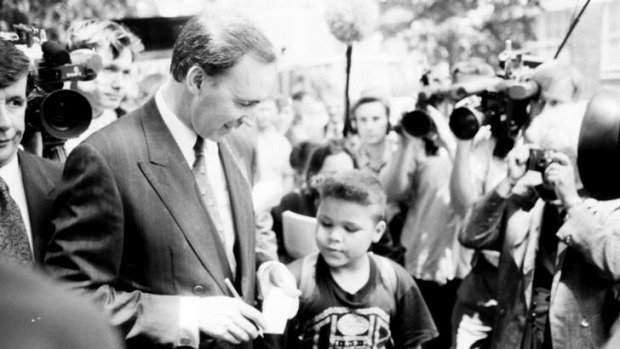
Autograph given after the Redfern address of 1992

Autograph given after the Redfern address of 1992

Paul Keating: "I was determined to say something which transcended the kind of lip service which normally informed speeches of this kind", Redfern Reprise - 2015

December 27, 2015

9 December 2015, Australian Museum, Sydney, Australia

Paul Keating was the 24th Prime Minister of Australia. His Redfern speech, acknowledging dispossession and oppression of Aboriginal Australians is a political classic.

My father and I spent a long lonely day at the Bankstown South polling booth in 1967 handing out pamphlets in support of the referendum to grant the Commonwealth an express constitutional power in respect of the Australian Aboriginal community and its welfare.

Two years later, I was a member of the House of Representatives.

This was the election where Gough Whitlam had made his greatest gains and there was hope amongst many of us that he had enough momentum to win. As it turned out, John Gorton was able to hang on, with Bill Wentworth as Australia's first minister for Aboriginal affairs.

Wentworth, who had played a leading role in the 1967 referendum, had his heart in the job and it was the hope of many that he would succeed in moving the Aboriginal agenda forward, employing the Commonwealth's newly found power.

At the heart of these amplified expectations was the hope of finding some real if late basis for a reconciliation between the Aboriginal and Torres Strait Islander community and the nation in the broad.

The debate in those earlier days tended to centre on matters relating to welfare and to land, as much as it did the much deeper notion of reconciliation.

The first positive expression of Commonwealth power turned out to be under Gough Whitlam's government in 1975 with the Northern Territory's Aboriginal land rights act. An act actually promulgated by Malcolm Fraser under his government in 1977.

Seven years after the passage of the referendum, this act was the first real and tangible acknowledgment of the dispossession which had occurred at sovereignty in 1788. In those days, the prevailing legal orthodoxy was that Aboriginal and Islander people possessed no ownership of the land – the land which became the Commonwealth of Australia and flowing from that, that Australia was the land of ‘no one’.

While the 1967 referendum gave the Commonwealth parliament power to make special laws in respect of Aboriginal and Islander people, including land across the States, because of political opposition and the complexity of issues, the Whitlam government confined its land rights initiative to Territories under Commonwealth control. Hence the origins of the Northern Territory land rights act.

And this remained the sole initiative of the Commonwealth in respect of Aboriginal and Islander land until the Native Title Act of the Keating government in 1993 - just on 20 years later.

It was the national policy of the Australian Labor Party and of its parliamentary party, under the 1967 constitutional power, to legislate land rights across all the States and Territories. And the first time that this policy had been formally considered was in 1986 by the Minister for Aboriginal Affairs in the Hawke government, Clyde Holding.

Holding, to his chagrin, discovered almost immediately how difficult implementation of such a policy would be even in a Labor party which philosophically supported it. Holding ran into trenchant opposition from the states, most particularly the State of Western Australia, led by its then Labor premier, Brian Burke. Burke was a leading member of the national right faction, across the country, a faction then spoken for by Graham Richardson a then senator and former party secretary from NSW.

Faced with this broad opposition from Western Australia and from the right faction of the party, Holding was stymied, relying then on Bob Hawke as Prime Minister to break the impasse. It never happened. So uniform land rights for Aboriginal and Islander people fell from the Hawke's government's agenda.

I told Bob Hawke at the time that even if he and I alone were prepared to argue the case for land rights before a national conference of the Labor party we would win, notwithstanding broad opposition from the right faction.

Nevertheless, the whole momentum for land rights dissipated - notwithstanding that the Hawke government had belatedly put together a Council for Reconciliation in September 1991.

And this is where the difficult issue of land rights remained until the High Court handed down its decision in Mabo No 2 on 3 June 1992.

By this time I was Prime Minister and I issued a statement saying, in overturning the concept of terra nullius, the High Court had presented the country with an opportunity to find a new and just way of remedying the original colonial grievance - the dispossession and that this opportunity could bring with it a new and lasting basis for a genuine reconciliation.

As it turned out, the United Nations International Year for the World’s Indigenous People began in December 1992, so I took the opportunity to say something definitive about the general plight of indigenous people around the world and most particularly of our own.

But in deciding to say something definitive I was determined to say something which transcended the kind of lip service which normally informed speeches of this kind. So, notwithstanding I was three months from a national election, I decided to lay waste to the ambiguity and humbug that had forever compromised this topic. I wanted to deal in truths, historical truths, ones that made clear above all else that it was we who did the dispossessing and that it was we who had taken the lands and brutalised the traditional way of life.

I said at Redfern Park on 10 December 1992 that our starting point had to begin with an act of recognition, the very same point President Barack Obama made recently following the Atlanta church massacre where he said ‘recognition precedes justice’.

I said at Redfern we could not sweep injustice aside and that by bringing the dispossessed out of the shadows, we were extending our own idea of social justice and of social democracy. And that our failure to recognise our callous disregard of Aboriginal and Islander people and of the truth of their loss and circumstance had degraded us all.

I have said in other circumstances, that ‘there is in public life no more beautiful a characteristic than truth’. That truth is, of its essence liberating, as it is possessed of no contrivance or conceit - that it provides the only genuine basis for progress and that the future can only be found in truth.

Nowhere was this sentiment more apt than in the vexed issue of Australian society coming to terms with its origins.

And I wanted, as Prime Minister, to lay out the truth unambiguously, once and for all. For once a Prime Minister had spoken the truth, the truth could never become unsaid - no matter how jarring and objectionable these views were likely to be to conservative Australia. And as it eventuated, the views were jarring to many, spawning the black armband brigade which then fought this issue right throughout the 1990s.

But significant as were the articulation of these truths and sentiment and especially in respect of prejudice, of themselves they could not deal in a material way with the dispossession and all that had flowed from it.

Indeed, at Redfern I said we had to give meaning to ‘justice’ and ‘equity’ and that we could only give such meaning when we committed ourselves to achieving concrete things. That when we see improvement, we see a lift in dignity, confidence and happiness. And I instanced the Mabo judgment as one of the opportunities that presented itself as a building block in a more practical partnership towards justice and equity.

I made clear at Redfern that I saw Mabo as an historic opportunity – a potential turning point, one that could provide a new relationship between indigenous and non-Aboriginal Australians.

Remarkably, the High Court of Australia had found that a title of an ancient kind had survived the act of sovereignty in 1788 and to the extent that subsequent grants of interest were consistent with the title, the nature and content of the title could be determined by the character or the connection to or occupation of the land under traditional laws and customs.

The notion that Aboriginal and Islander people had a private property right to their own soil opened up what I thought was an entirely new and opportune pathway to land rights, one superior to land being conferred upon indigenous people by the act of an Australian parliament.

And so, I set about enshrining these principles and modalities in a major piece of cultural and property law which is now known as the Native Title Act 1993.

While the principles laid out in the High Court’s Mabo No 2 decision could never deal with the original dispossession, for much of the land granted since 1788 had had the effect of extinguishing native title, they did have the possibility of making good on the dispossession otherwise across vast tracts of the continent.

So while we could not make reparations, we could make amends. We could reverse the dispossession for those people who still lived on or had a traditional connection with the land.

So the notion of Aboriginality and all that that meant became central to native title and I was determined that it be central.

We have to remember that native title is not a creature of the Australian common law but an ancient title recognised by the common law. A title of ancient antecedents which gives recognition to culture, customary tradition and nature - to the relationship between Aboriginal people and the landscape; the relationship to their songs and dances and to the birds and the animals – to their storytelling.

Is it any wonder then that this culture, the longest with a collective memory of any in continuous existence, with its originality and creativity, is now pointing the way for our own culture – an essentially European one but one under constant renovation, not least at the incidence of indigenous inspiration?

Aboriginal art and culture draws from the land, for Aboriginality and the land are essential to each other and are inseparable.

At its best, Aboriginal art carries sacred messages through its symbols and materials yet manages to hold its secrets while speaking to a broader audience. More than that, it has been effective in translating an entire culture and the understanding of an entire continent.

Indeed, the more we interpret Australia through Aboriginal eyes, through the experience of their long and epic story, the more we allow ourselves to understand the land we share.

So I think there is a lesson in this: we may reach a point where Aboriginal art and culture become so integral and so central to Australian art and culture that each melds into the other.

Whatever our identity is today or has become, it is an identity inseparable from Aboriginal Australia. For their fifty thousand years here has slaked the land with their resonances, their presence and their spirit. Our opportunity is to rejoice in their identity, and without attempting to appropriate or diminish it, fuse it with our own, making the whole richer.

Australia is positioned in the fastest growing, most dynamic part of the world. Indigenous cultures exist all around it. And in the largest countries on earth.

Our two hundred year occupancy of this vast continent, in terms of long history, sits at odds with the settled old societies near us and around us.

But this is not the case with our indigenes.

They were never at odds with what surrounded them nor indeed with their own land. They are entirely at home with it and in it.

But as it turned out, their home is now our home and the more we rejoice in their identity - and their one-ness with the country, the more the country will become ours as we become nearer its spirituality and its meaning.

The more we view the country through the prism of Aboriginality, the more likely we are to get the angle right.


Similar to this: Paul Keating, Redfern Speech, 1992.

Source: http://www.keating.org.au/shop/item/redfer...

Enjoyed this speech? Speakola is a labour of love and I’d be very grateful if you would share, tweet or like it. Thank you.

Facebook Twitter Facebook
In 2010s Tags PAUL KEATING, REDFERN SPEECH, REDFERN REPRISE, ANNIVERSARY, AUSTRALIA MUSEUM, INDIGENOUS PEOPLE, TRANSCRIPT
Comment

See my film!

Limited Australian Season

March 2025

Details and ticket bookings at

angeandtheboss.com

Support Speakola

Hi speech lovers,
With costs of hosting website and podcast, this labour of love has become a difficult financial proposition in recent times. If you can afford a donation, it will help Speakola survive and prosper.

Best wishes,
Tony Wilson.

Become a Patron!

Learn more about supporting Speakola.

Featured political

Featured
Jon Stewart: "They responded in five seconds", 9-11 first responders, Address to Congress - 2019
Jacinda Ardern: 'They were New Zealanders. They are us', Address to Parliament following Christchurch massacre - 2019
Dolores Ibárruri: "¡No Pasarán!, They shall not pass!', Defense of 2nd Spanish Republic - 1936
Jimmy Reid: 'A rat race is for rats. We're not rats', Rectorial address, Glasgow University - 1972

Featured eulogies

Featured
For Geoffrey Tozer: 'I have to say we all let him down', by Paul Keating - 2009
for James Baldwin: 'Jimmy. You crowned us', by Toni Morrison - 1988
for Michael Gordon: '13 days ago my Dad’s big, beautiful, generous heart suddenly stopped beating', by Scott and Sarah Gordon - 2018

Featured commencement

Featured
Tara Westover: 'Your avatar isn't real, it isn't terribly far from a lie', The Un-Instagrammable Self, Northeastern University - 2019
Tim Minchin: 'Being an artist requires massive reserves of self-belief', WAAPA - 2019
Atul Gawande: 'Curiosity and What Equality Really Means', UCLA Medical School - 2018
Abby Wambach: 'We are the wolves', Barnard College - 2018
Eric Idle: 'America is 300 million people all walking in the same direction, singing 'I Did It My Way'', Whitman College - 2013
Shirley Chisholm: ;America has gone to sleep', Greenfield High School - 1983

Featured sport

Featured
Joe Marler: 'Get back on the horse', Harlequins v Bath pre game interview - 2019
Ray Lewis : 'The greatest pain of my life is the reason I'm standing here today', 52 Cards -
Mel Jones: 'If she was Bradman on the field, she was definitely Keith Miller off the field', Betty Wilson's induction into Australian Cricket Hall of Fame - 2017
Jeff Thomson: 'It’s all those people that help you as kids', Hall of Fame - 2016

Fresh Tweets


Featured weddings

Featured
Dan Angelucci: 'The Best (Best Man) Speech of all time', for Don and Katherine - 2019
Hallerman Sisters: 'Oh sister now we have to let you gooooo!' for Caitlin & Johnny - 2015
Korey Soderman (via Kyle): 'All our lives I have used my voice to help Korey express his thoughts, so today, like always, I will be my brother’s voice' for Kyle and Jess - 2014

Featured Arts

Featured
Bruce Springsteen: 'They're keepers of some of the most beautiful sonic architecture in rock and roll', Induction U2 into Rock Hall of Fame - 2005
Olivia Colman: 'Done that bit. I think I have done that bit', BAFTA acceptance, Leading Actress - 2019
Axel Scheffler: 'The book wasn't called 'No Room on the Broom!', Illustrator of the Year, British Book Awards - 2018
Tina Fey: 'Only in comedy is an obedient white girl from the suburbs a diversity candidate', Kennedy Center Mark Twain Award -  2010
Tina Fey: 'Only in comedy is an obedient white girl from the suburbs a diversity candidate', Kennedy Center Mark Twain Award - 2010

Featured Debates

Featured
Sacha Baron Cohen: 'Just think what Goebbels might have done with Facebook', Anti Defamation League Leadership Award - 2019
Greta Thunberg: 'How dare you', UN Climate Action Summit - 2019
Charlie Munger: 'The Psychology of Human Misjudgment', Harvard University - 1995
Lawrence O'Donnell: 'The original sin of this country is that we invaders shot and murdered our way across the land killing every Native American that we could', The Last Word, 'Dakota' - 2016