
• Genre
  • About
  • Submissions
  • Donate
  • Search
Menu

Speakola

All Speeches Great and Small
  • Genre
  • About
  • Submissions
  • Donate
  • Search
Share a political speech

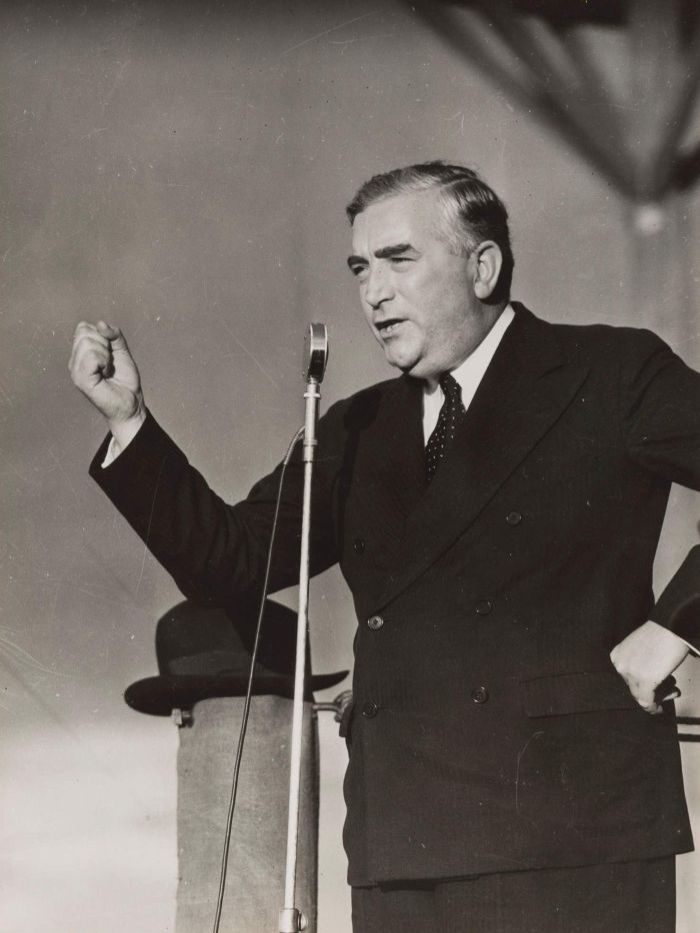
Robert Menzies: 'They are the backbone of the nation', The Forgotten People - 1942

August 6, 2015

22 May, 1942, broadcast on 3AW and 2UE radio, Australia

Quite recently, a bishop wrote a letter to a great daily newspaper. His theme was the importance of doing justice to the workers. His belief, apparently, was that the workers are those who work with their hands. He sought to divide the people of Australia into classes. He was obviously suffering from what has for years seemed to me to be our greatest political disease - the disease of thinking that the community is divided into the relatively rich and the relatively idle, and the laborious poor, and that every social and political controversy can be resolved into the question: What side are you on?

Now, the last thing that I would want to do is to commence or take part in a false war of this kind. In a country like Australia the class war must always be a false war. But if we are to talk of classes, then the time has come to say something of the forgotten class - the middle class - those people who are constantly in danger of being ground between the upper and the nether millstones of the false war; the middle class who, properly regarded represent the backbone of this country.

We do not have classes here as in England, and therefore the terms do not mean the same; so I must define what I mean when I use the expression "middle class."

Let me first define it by exclusion. I exclude at one end of the scale the rich and powerful: those who control great funds and enterprises, and are as a rule able to protect themselves - though it must be said that in a political sense they have as a rule shown neither comprehension nor competence. But I exclude them because, in most material difficulties, the rich can look after themselves.

I exclude at the other end of the scale the mass of unskilled people, almost invariably well-organised, and with their wages and conditions safeguarded by popular law. What I am excluding them from is my definition of the middle class. We cannot exclude them from problems of social progress, for one of the prime objects of modern social and political policy is to give them a proper measure of security, and provide the conditions which will enable them to acquire skill and knowledge and individuality.

These exclusions being made, I include the intervening range - the kind of people I myself represent in Parliament - salary-earners, shopkeepers, skilled artisans, professional men and women, farmers and so on. These are, in the political and economic sense, the middle class. They are for the most part unorganised and unself-conscious. They are envied by those whose benefits are largely obtained by taxing them. They are not rich enough to have individual power. They are taken for granted by each political party in turn. They are not sufficiently lacking in individualism to be organised for what in these days we call "pressure politics." And yet, as I have said, they are the backbone of the nation.

The communist has always hated what he calls the "bourgeoisie", because he sees clearly the existence of one has kept British countries from revolution, while the substantial absence of one in feudal France at the end of the eighteenth century and in Tsarist Russia at the end of the last war made revolution easy and indeed inevitable. You may say to me, "Why bring this matter up at this stage when we are fighting a war, the result of which we are all equally concerned?" My answer is that I am bringing it up because under the pressure of war we may, if we are not careful - if we are not as thoughtful as the times will permit us to be - inflict a fatal injury upon our own backbone.

In point of political, industrial and social theory and practice, there are great delays in time of war. But there are also great accelerations. We must watch each, remembering always that whether we know it or not, and whether we like it or not, the foundations of whatever new order is to come after the war are inevitably being laid down now. We cannot go wrong right up to the peace treaty and expect suddenly thereafter to go right.

Now, what is the value of this middle class, so defined and described?

First, it has a "stake in the country". It has responsibility for homes - homes material, homes human, and homes spiritual.

I do not believe that the real life of this nation is to be found either in great luxury hotels and the petty gossip of so-called fashionable suburbs, or in the officialdom of the organised masses. It is to be found in the homes of people who are nameless and unadvertised, and who, whatever their individual religious conviction or dogma, see in their children their greatest contribution to the immortality of their race. The home is the foundation of sanity and sobriety; it is the indispensable condition of continuity; its health determines the health of society as a whole.

I have mentioned homes material, homes human and homes spiritual. Let me take them in order. What do I mean by "homes material"?

The material home represents the concrete expression of the habits of frugality and saving "for a home of our own." Your advanced socialist may rave against private property even while he acquires it; but one of the best instincts in us is that which induces us to have one little piece of earth with a house and a garden which is ours; to which we can withdraw, in which we can be among our friends, into which no stranger may come against our will. If you consider it, you will see that if, as in the old saying, "the Englishman's home is his castle", it is this very fact that leads on to the conclusion that he who seeks to violate that law by violating the soil of England must be repelled and defeated.

National patriotism, in other words, inevitably springs from the instinct to defend and preserve our own homes.

Then we have homes human. A great house, full of loneliness, is not a home. "Stone walls do not a prison make", nor do they make a house. They may equally make a stable or a piggery. Brick walls, dormer windows and central heating need not make more than a hotel. My home is where my wife and children are. The instinct to be with them is the great instinct of civilised man; the instinct to give them a chance in life - to make them not leaners but lifters - is a noble instinct. If Scotland has made a great contribution to the theory and practice of education, it is because of the tradition of Scottish homes. The Scottish ploughman, walking behind his team, cons ways and means of making his son a farmer, and so he sends him to the village school. The Scottish farmer ponders upon the future of his son, and sees it most assured not by the inheritance of money but by the acquisition of that knowledge which will give him power; and so the sons of many Scottish farmers find their way to Edinburgh and a university degree.

The great question is, "How can I my son to help society?" Not, as we have so frequently thought, "How can I qualify society to help my son?" If human homes are to fulfil their destiny, then we must have frugality and saving for education and progress.

And finally, we have homes spiritual. This is a notion which finds its simplest and most moving expression in "The Cotter's Saturday Night" of Burns. Human nature is at its greatest when it combines dependence upon God with independence of man. We offer no affront - on the contrary we have nothing but the warmest human compassion - toward those whom fate has compelled to live upon the bounty of the State, when we say that the greatest element in a strong people is a fierce independence of spirit. This is the only real freedom, and it has as its corollary a brave acceptance of unclouded individual responsibility. The moment a man seeks moral and intellectual refuge in the emotions of a crowd, he ceases to be a human being and becomes a cipher. The home spiritual so understood is not produced by lassitude or by dependence; it is produced by self-sacrifice, by frugality and saving.

In a war, as indeed at most times, we become the ready victims of phrases. We speak glibly of of many things without pausing to consider what they signify. We speak of "financial power", forgetting that the financial power of 1942 is based upon the savings of generations which have preceded it. We speak of "morale" as if it were a quality induced from without - created by others for our benefit - when in truth there can be no national morale which is not based upon the individual courage of men and women. We speak of "man power" as if it were a mere matter of arithmetic: as if it were made up of a multiplication of men and muscles without spirit.

Second, the middle class, more than any other, provides the intelligent ambition which is the motive power of human progress. The idea entertained by many people that, in a well-constituted world, we shall all live on the State is the quintessence of madness, for what is the State but us? We collectively must provide what we individually receive.

The great vice of democracy - a vice which is exacting a bitter retribution from it at this moment - is that for a generation we have been busy getting ourselves on to the list of beneficiaries and removing ourselves from the list of contributors, as if somewhere there was somebody else's wealth and somebody else's effort on which we could thrive.

To discourage ambition, to envy success, to have achieved superiority, to distrust independent thought, to sneer at and impute false motives to public service - these are the maladies of modern democracy, and of Australian democracy in particular. Yet ambition, effort, thinking, and readiness to serve are not only the design and objectives of self-government but are the essential conditions of its success. If this is not so, then we had better put back the clock, and search for a benevolent autocracy once more.

Where do we find these great elements most commonly? Among the defensive and comfortable rich, among the unthinking and unskilled mass, or among what I have called the "middle class"?

Third, the middle class provides more than any other other the intellectual life which marks us off from the beast; the life which finds room for literature, for the arts, for science, for medicine and the law.

Consider the case of literature and art. Could these survive as a department of State? Are we to publish our poets according to their political colour? Is the State to decree surrealism because surrealism gets a heavy vote in a key electorate? The truth is that no great book was ever written and no great picture ever painted by the clock or according to civil service rules. These are the things done by man, not men. You cannot regiment them. They require opportunity, and sometimes leisure. The artist, if he is to live, must have a buyer; the writer an audience. He find them among frugal people to whom the margin above bare living means a chance to reach out a little towards that heaven which is just beyond our grasp. It has always seemed to me, for example, that an artist is better helped by the man who sacrifices something to buy a picture he loves than by a rich patron who follows the fashion.

Fourth, this middle class maintains and fills the higher schools and universities, and so feeds the lamp of learning.

What are schools for? To train people for examinations, to enable people to comply with the law, or to produce developed men and women?

Are the universities mere technical schools, or have they as one of their functions the preservation of pure learning, bringing in its train not merely riches for the imagination but a comparative sense for the mind, and leading to what we need so badly - the recognition of values which are other than pecuniary?

One of the great blots on our modern living is the cult of false values, a repeated application of the test of money, notoriety, applause. A world in which a comedian or a beautiful half-wit on the screen can be paid fabulous sums, whilst scientific researchers and discoverers can suffer neglect and starvation, is a world which needs to have its sense of values violently set right.

Now, have we realised and recognised these things, or is most of our policy designed to discourage or penalise thrift, to encourage dependence on the State, to bring about a dull equality on a fantastic idea that all men are equal in mind and needs and deserts: to level down by taking the mountains out of the landscape, to weigh men according to their political organisations and power - as votes and not as human beings? These are formidable questions, and we cannot escape from answering them if there is really to be a new order for the world. I have been actively engaged in politics for fourteen years in the State of Victoria and in the Commonwealth of Australia. In that period I cannot readily recall many occasions upon which any policy was pursued which was designed to help the thrifty, to encourage independence, to recognise the divine and valuable variations of men's minds. On the contrary, there have been many instances in which the votes of the thriftless have been used to defeat the thrifty. On occasions of emergency, as in the depression and during the present war, we have hastened to make it clear that the provision made by man for his own retirement and old age is not half as sacrosanct as the provision the State would have made for him if he had never saved at all.

We have talked of income from savings as if it possessed a somewhat discreditable character. We have taxed it more and more heavily. We have spoken slightingly of the earning of interest at the very moment when we have advocated new pensions and social schemes. I have myself heard a minister of power and influence declare that no deprivation is suffered by a man if he still has the means to fill his stomach, clothe his body and keep a roof over his head. And yet the truth is, as I have endeavoured to show, that frugal people who strive for and obtain the margin above these materially necessary things are the whole foundation of a really active and developing national life.

The case for the middle class is the case for a dynamic democracy as against the stagnant one. Stagnant waters are level, and in them the scum rises. Active waters are never level: they toss and tumble and have crests and troughs; but the scientists tell us that they purify themselves in a few hundred yards.

That we are all, as human souls, of like value cannot be denied. That each of us should have his chance is and must be the great objective of political and social policy. But to say that the industrious and intelligent son of self-sacrificing and saving and forward-looking parents has the same social deserts and even material needs as the dull offspring of stupid and improvident parents is absurd.

If the motto is to be "Eat, drink and be merry, for tomorrow you will die, and if it chances you don't die, the State will look after you; but if you don't eat, drink and be merry and save, we shall take your savings from you", then the whole business of life would become foundationless.

Are you looking forward to a breed of men after the war who will have become boneless wonders? Leaners grow flabby; lifters grow muscles. Men without ambition readily become slaves. Indeed, there is much more in slavery in Australia than most people imagine. How many hundreds of thousands of us are slaves to greed, to fear, to newspapers, to public opinion - represented by the accumulated views of our neighbours! Landless men smell the vapours of the street corner. Landed men smell the brown earth, and plant their feet upon it and know that it is good. To all of this many of my friends will retort, "Ah that's all very well, but when this war is over the levellers will have won the day." My answer is that, on the contrary, men will come out of this war as gloriously unequal in many things as when they entered it. Much wealth will have been destroyed; inherited riches will be suspect; a fellowship of suffering, if we really experience it, will have opened many hearts and perhaps closed many mouths. Many great edifices will have fallen, and we shall be able to study foundations as never before, because war will have exposed them.

But I do not believe that we shall come out into the overlordship of an all-powerful State on whose benevolence we shall live, spineless and effortless - a State which will dole out bread and ideas with neatly regulated accuracy; where we shall all have our dividend without subscribing our capital; where the Government, that almost deity, will nurse us and rear us and maintain us and pension us and bury us; where we shall all be civil servants, and all presumably, since we are equal, heads of departments.

If the new world is to be a world of men, we must be not pallid and bloodless ghosts, but a community of people whose motto shall be, "To strive, to seek, to find, and not to yield." Individual enterprise must drive us forward. That does not mean we are to return to the old and selfish notions of laissez-faire. The functions of the State will be much more than merely keeping the ring within which the competitors will fight. Our social and industrial laws will be increased. There will be more law, not less; more control, not less.

But what really happens to us will depend on how many people we have who are of the great and sober and dynamic middle-class - the strivers, the planners, the ambitious ones. We shall destroy them at our peril.

Source: http://www.liberals.net/theforgottenpeople...

Enjoyed this speech? Speakola is a labour of love and I’d be very grateful if you would share, tweet or like it. Thank you.

Facebook Twitter Facebook
In 1940-59 Tags PRIME MINISTERS, AUSTRALIA, MENZIES
Comment

Robert Menzies: 'It is my malencholy duty', Declaration of War - 1939

August 6, 2015

3 September 1939, radio broadcast, Australia

Fellow Australians, it is my melancholy duty to inform you officially that in consequence of a persistence by Germany in her invasion of Poland, Great Britain has declared war upon her and that, as a result, Australia is also at war. No harder task can fall to the lot of a democratic leader than to make such an announcement. Great Britain and France, with the cooperation of the British Dominions, have struggled to avoid this tragedy. They have, as I firmly believe, been patient. They have kept the door of negotiation open. They have given no cause for aggression. But in the result, their efforts have failed and we are therefore, as a great family of nations, involved in a struggle which we must at all costs win and which we believe in our hearts we will win.

What I want to do tonight is just to put before you, honestly, and as clearly as I can, a short account of how this crisis has developed.

The history of recent months in Europe has been an eventful one. It will exhibit to the eyes of the future student some of the most remarkable instances of a ruthlessness and indifference to common humanity which the darkest centuries of European history can scarcely parallel. Moreover, it will, I believe, demonstrate that the leader of Germany has, for a long time, steadily pursued a policy which was deliberately designed to produce either war or a subjugation of one non-German country after another by the threat of war.

We all have vivid recollections of September of last year. Speaking in Berlin on September the 26th 1938, Hitler said, referring to the Sudeten German problem, which was then approaching its acutest stage, ‘And now the last problem which must be solved, and which will be solved, concerns us. It is the last territorial claim which I have to make in Europe.’ Four days later, at Munich, when the problem had been settled on terms which provided for the absorption of the Sudeten country into Germany, and which otherwise professed to respect the integrity of the remainder of the Czechoslovak state, Hitler participated with the Prime Minister of Great Britain in a statement which went out to all the world. It’s most important sentence was this: ‘We are resolved that the method of consultation shall be the method adopted to deal with any other question that may concern our two countries, and we are determined to continue our efforts to remove possible causes of difference, and thus to contribute to assure the peace of Europe.’

What a strange piece of irony that seems today, only 12 months later. In those 12 months, what has happened? In cold-blooded breach of the solemn obligations implied in both the statements I have quoted, Hitler has annexed the whole of the Czechoslovak state. Has, without flickering an eyelid, made a pact with Russia, a country the denouncing and reviling of which has been his chief stock-in-trade ever since he became chancellor. And has now, under circumstances which I will describe to you, invaded with armed force and in defiance of civilised opinion, the independent nation of Poland. Your own comments on this dreadful history will need no reinforcement by me. All I need say is, that whatever the inflamed ambitions of the German Fuhrer may be, he will undoubtedly learn, as other great enemies of freedom have learned before, that no empire, no dominion, can be soundly established upon a basis of broken promises or dishonoured agreements.

Let me now say something about the events of the last few days. The facts are not really in dispute. They are, for the most part, contained in documents which are now a matter of record.

On Friday August the 25th, that is, nine days ago, Hitler asked the British Ambassador to call on him, and had a long interview with him. Hitler said that he wished to make a move towards England, as decisive as his recent Russian move, but that first the problem of Danzig and the Corridor must be solved. He went on to indicate that he was looking forward to a general European settlement and that if this could be achieved, he would be willing to accept a reasonable limitation of armaments. On Saturday August the 26th, the British Ambassador flew to London to give a detailed account of his conversation to the British Government. On Sunday the 27th, the British Cabinet fully considered the whole matter and, incidentally, was apprised by me of the views of the Australian Government. On Monday August the 28th, the British reply, which I may say was entirely in line with our own views, was taken back to Berlin and was delivered to Hitler in the evening. That reply stated that the British Government desired a complete and lasting understanding between the two countries and agreed that a prerequisite to such a state of affairs was a settlement of the German-Polish differences. It emphasised the obligations which Great Britain had to Poland and made it clear that Great Britain could not acquiesce in a settlement which would put in jeopardy the independence of a state to which it had given its guarantee. The government said, however, that it would be prepared to participate in an international guarantee or any settlement reached by direct negotiation between Germany and Poland which did not prejudice Poland’s essential interests. The note pointed out that the Polish Government was ready to enter into discussions and that it was hoped that the German Government would do the same.

On the night of Tuesday August the 29th, Hitler communicated to Sir Neville Henderson his reply to the British note. In it he reiterated his demands, but agreed to accept the British Government’s offer of its good offices in securing the dispatch to Berlin of a Polish emissary. In the meantime, it was stated, the German Government would draw up proposals acceptable to itself and would, if possible, place these at the disposal of the British Government before the arrival of the Polish negotiator. Astonishingly enough, for the German proposals were not then even drafted, the note went on to say that the German Government counted on the arrival of the Polish emissary on Wednesday August the 30th, which was the very next day. Sir Neville Henderson pointed out at once that this was an impossible condition, but Hitler assured him that it was only intended to stress the urgency of the matter. On the Wednesday, Hitler’s communication was received by the British Government and their reply was handed by Sir Neville Henderson to von Ribbentrop, the German Foreign Minister, at midnight. At the same time the British Ambassador asked whether the German proposals which were to be drawn up were ready, and suggested that von Ribbentrop should invite the Polish Ambassador to call and should hand to him the proposals for transmission to his government. I would have thought this was a very sensible suggestion. But von Ribbentrop rejected it in violent terms. Von Ribbentrop then produced a lengthy document containing the German proposals, which you subsequently saw in the newspapers, and read it aloud in German at top speed. Sir Neville Henderson naturally asked for a copy of the document but the reply was that it now was too late as the Polish representative had not arrived in Berlin by midnight.

You see what a travesty the whole thing was. The German Government was treating Poland as in default, because she had not by Wednesday night offered an opinion upon, or discussed with Germany, a set of proposals of which, in fact, she had at that time never heard. Indeed, apart from the hurried reading to which I’ve referred, the British Government had no account of these proposals until they were broadcast in Germany on Thursday August the 31st. On the night of August the 31st, the Polish ambassador at Berlin saw von Ribbentrop and told him that the Polish Government was willing to negotiate with Germany about their disputes on an equal basis. The only reply was that German troops passed the Polish frontier and began war upon the Poles at dawn on the morning of Friday September the 1st.

One further fact should be mentioned and it is this. In the British Government’s communication of August the 30th, it informed the German Chancellor that it recognised the need for speed and that it also recognised the dangers which arose from the fact that two mobilised armies were facing each other on opposite sides of the Polish frontier, and that accordingly, it strongly urged that both Germany and Poland should undertake that during the negotiations no aggressive military movements would take place. That being communicated to Poland, the Polish Government on Thursday August the 31st, categorically stated that it was prepared to give a formal guarantee that during negotiations Polish troops would not violate the frontiers provided a corresponding guarantee was given by Germany. The German Government made no reply whatever.

My comments on these events need not be very long. The matter was admirably stated by the British Prime Minister to the House of Commons in these words: 'It is plain therefore that Germany claims to treat Poland as in the wrong because she had not by Wednesday night entered upon discussions with Germany about a set of proposals of which she had never heard.’

Let me elaborate this a little. You can make an offer of settlement for two entirely different purposes. You may make your offer genuinely and hoping to have it accepted or discussed with a view to avoiding war. On the other hand, you may make it, hoping to use it as window dressing and with no intention or desire to have it accepted. If I were to make an offer to my neighbour about a piece of land in dispute between us, and before he had had the faintest opportunity of dealing with my offer, I’ve violently assaulted him, my offer would stand revealed as a fraud. If Germany had really desired a peaceful settlement of questions relating to Danzig and the Corridor, she would have taken every step to see that her proposals were adequately considered by Poland and that there was proper opportunity for discussion. In other words, if Germany had wanted peace, does anybody believe that there would today be fighting on the Polish frontier, or that Europe would be plunged into war? Who wanted war? Poland? Great Britain? France? A review of all these circumstances makes it clear that the German Chancellor has, throughout this week of tension, been set upon war and that the publication of his proposals for settlement was designed merely as a bid for world opinion before he set his armies on the move.

We have of course been deluged with propaganda from Berlin. We have been told harrowing stories of the oppression of Germans. We have been told that Poland invaded Germany. We have even been told, somewhat contradictorily, that Germany was forced to invade Poland in order to defend herself against aggression. The technique of German propaganda, of carefully fomented agitations in neighbouring countries, the constant talk of persecution and injustice – these are all nauseatingly familiar to us. We made the acquaintance of all of them during the dispute over Czechoslovakia, and we may well ask what has become of the Czech minority and the Slovak minority since the forced absorption of their country into the German state. It is plain, indeed it is brutally plain, that the Hitler ambition has been not, as he once said, to unite the German peoples under one rule but to bring under that rule as many European countries, even of alien race, as can be subdued by force.

If such a policy were allowed to go unchecked there could be no security in Europe and there could be no just peace for the world. A halt has been called. Force has had to be resorted to, to check the march of force. Honest dealing, the peaceful adjustment of differences, the rights of independent peoples to live their own lives, the honouring of international obligations and promises, all these things are at stake. There never was any doubt as to where Great Britain stood in relation to them. There can be no doubt that where Great Britain stands there stand the people of the entire British world.

Bitter as we all feel at this wanton crime, this is not a moment for rhetoric. Prompt as the action of many thousands must be, it is for the rest a moment for quiet thinking, for that calm fortitude that rests not upon the beating of drums but upon the unconquerable spirit of man created by God in his own image. What may be before us we do not know, nor how long the journey. But this we do know: that truth is our companion on that journey; that truth is with us in the battle; and that truth must win.

Before I end, may I say this to you – in the bitter months that have come, calmness, resoluteness, confidence and hard work will be required as never before. This war will involve not only soldiers and sailors and airmen, but supplies, foodstuffs, money. Our staying power, and particularly the staying power of the mother country, will be best assisted by keeping our production going; by continuing our avocations and our business as freely as we can; by maintaining employment and, with it, our strength. I know that in spite of the emotions we are all feeling, you will show that Australia is ready to see it through. May God in his mercy and compassion grant that the world may soon be delivered from this agony.

Source: http://speakingfrog.com/?p=789#.VcK3Yflbz1...

Enjoyed this speech? Speakola is a labour of love and I’d be very grateful if you would share, tweet or like it. Thank you.

Facebook Twitter Facebook
In 1920-39 Tags PRIME MINISTERS, WW2, DECLARATION OF WAR, AUSTRALIA, MENZIES
Comment

See my film!

Limited Australian Season

March 2025

Details and ticket bookings at

angeandtheboss.com

Support Speakola

Hi speech lovers,
With costs of hosting website and podcast, this labour of love has become a difficult financial proposition in recent times. If you can afford a donation, it will help Speakola survive and prosper.

Best wishes,
Tony Wilson.

Become a Patron!

Learn more about supporting Speakola.

Featured political

Featured
Jon Stewart: "They responded in five seconds", 9-11 first responders, Address to Congress - 2019
Jacinda Ardern: 'They were New Zealanders. They are us', Address to Parliament following Christchurch massacre - 2019
Dolores Ibárruri: "¡No Pasarán!, They shall not pass!', Defense of 2nd Spanish Republic - 1936
Jimmy Reid: 'A rat race is for rats. We're not rats', Rectorial address, Glasgow University - 1972

Featured eulogies

Featured
For Geoffrey Tozer: 'I have to say we all let him down', by Paul Keating - 2009
for James Baldwin: 'Jimmy. You crowned us', by Toni Morrison - 1988
for Michael Gordon: '13 days ago my Dad’s big, beautiful, generous heart suddenly stopped beating', by Scott and Sarah Gordon - 2018

Featured commencement

Featured
Tara Westover: 'Your avatar isn't real, it isn't terribly far from a lie', The Un-Instagrammable Self, Northeastern University - 2019
Tim Minchin: 'Being an artist requires massive reserves of self-belief', WAAPA - 2019
Atul Gawande: 'Curiosity and What Equality Really Means', UCLA Medical School - 2018
Abby Wambach: 'We are the wolves', Barnard College - 2018
Eric Idle: 'America is 300 million people all walking in the same direction, singing 'I Did It My Way'', Whitman College - 2013
Shirley Chisholm: ;America has gone to sleep', Greenfield High School - 1983

Featured sport

Featured
Joe Marler: 'Get back on the horse', Harlequins v Bath pre game interview - 2019
Ray Lewis : 'The greatest pain of my life is the reason I'm standing here today', 52 Cards -
Mel Jones: 'If she was Bradman on the field, she was definitely Keith Miller off the field', Betty Wilson's induction into Australian Cricket Hall of Fame - 2017
Jeff Thomson: 'It’s all those people that help you as kids', Hall of Fame - 2016

Fresh Tweets


Featured weddings

Featured
Dan Angelucci: 'The Best (Best Man) Speech of all time', for Don and Katherine - 2019
Hallerman Sisters: 'Oh sister now we have to let you gooooo!' for Caitlin & Johnny - 2015
Korey Soderman (via Kyle): 'All our lives I have used my voice to help Korey express his thoughts, so today, like always, I will be my brother’s voice' for Kyle and Jess - 2014

Featured Arts

Featured
Bruce Springsteen: 'They're keepers of some of the most beautiful sonic architecture in rock and roll', Induction U2 into Rock Hall of Fame - 2005
Olivia Colman: 'Done that bit. I think I have done that bit', BAFTA acceptance, Leading Actress - 2019
Axel Scheffler: 'The book wasn't called 'No Room on the Broom!', Illustrator of the Year, British Book Awards - 2018
Tina Fey: 'Only in comedy is an obedient white girl from the suburbs a diversity candidate', Kennedy Center Mark Twain Award -  2010
Tina Fey: 'Only in comedy is an obedient white girl from the suburbs a diversity candidate', Kennedy Center Mark Twain Award - 2010

Featured Debates

Featured
Sacha Baron Cohen: 'Just think what Goebbels might have done with Facebook', Anti Defamation League Leadership Award - 2019
Greta Thunberg: 'How dare you', UN Climate Action Summit - 2019
Charlie Munger: 'The Psychology of Human Misjudgment', Harvard University - 1995
Lawrence O'Donnell: 'The original sin of this country is that we invaders shot and murdered our way across the land killing every Native American that we could', The Last Word, 'Dakota' - 2016