• Genre
  • About
  • Submissions
  • Donate
  • Search
Menu

Speakola

All Speeches Great and Small
  • Genre
  • About
  • Submissions
  • Donate
  • Search
Share a political speech

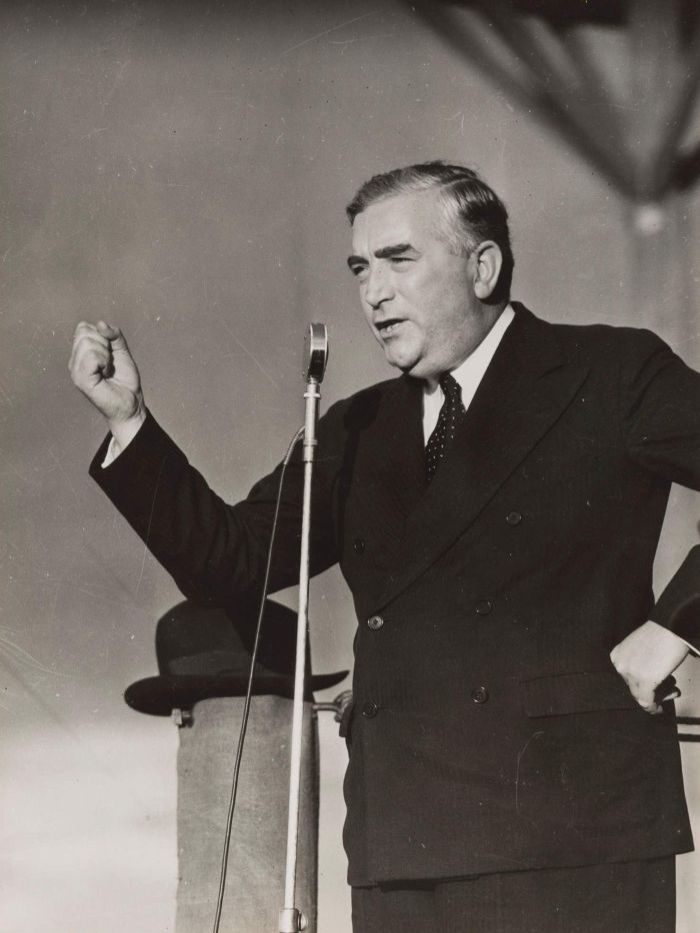
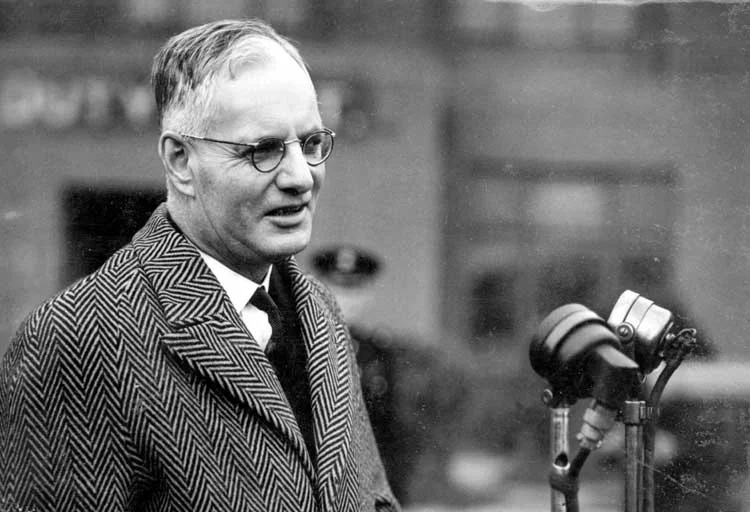
John Curtin: 'it is my solemn duty tonight to sound a tocsin!', announcement of war with Japan - 1941

March 9, 2022

8 December 1941, Canberra, Australia

Men and women of Australia, we are at war with Japan. That has happened because, in the first instance, Japanese naval and air forces launched an unprovoked attack on British and United States territory; because our vital interests are imperilled and because the rights of free people in the whole Pacific are assailed. As a result, the Australian Government this afternoon took the necessary steps which will mean that a state of war exists between Australia and Japan. Tomorrow, in common with the United Kingdom, the United States of America and the Netherlands East Indies Governments, the Australian Government will formally and solemnly declare the state of war it has striven so sincerely and strenuously to avoid.

Throughout the whole affair, and despite discouragement, the Australian Government and its representatives abroad struggled hard to prevent a breakdown of discussions. Australia encouraged the United States to retain the diplomatic initiative on behalf of the democratic powers. We did not want war in the Pacific. The Australian Government has repeatedly made it clear — as have the Governments of the United Kingdom, the United States and the Netherlands East Indies — that if war came to the Pacific it would be of Japan’s making. Japan has now made war.

I point out that the hands of the democracies are clean. The discussions and negotiations which have taken place between Japan and the democracies were not merely empty bandying of words on the democracies’ part. Since last February it has been the constant aim and endeavour of the democracies to keep peace in the Pacific. It has been a problem fraught with grave difficulties but, in the view of the democracies, it was a problem that was capable of being overcome. Accordingly, the best brains of the democracies were brought to bear on the problem. It will stand on record that the President of the United States himself, the American Secretary of State, Mr Cordell Hull, the British and the Dominion Governments, worked untiringly and unceasingly. Yet, when the President of the United States had decided to communicate direct to the Japanese Emperor a personal appeal for Imperial intervention on the side of peace, the War Government of Japan struck. That War Government, set on aggression and lusting for power in the same fashion as its Axis partners, anticipated the undoubted weight of the President’s plea and shattered the century-old friendship between the two countries.

For the first time in the history of the Pacific, armed conflict stalks abroad. No other country but Japan desired war in the Pacific. The guilt for plunging this hemisphere into actual warfare is therefore upon Japan. The recapitulation of events I have given you is necessary so that we in Australia may correctly assess the issues involved. The stern truth is that war has been forced upon us, not because of stubborn resistance on the part of the democracies to every demand that Japan made, but because Japan chose the method of armed might to settle differences which every other country involved was ready and willing to settle by negotiation and arbitration. By so doing, Japan chose the Hitler method. While its diplomatic representatives were actually at the White House, while all the democratic powers regarded the conversations as continuing, Japan ignored the convention of a formal declaration of war and struck like an assassin in the night.

For, as the dawn broke this morning, at places as far apart as Honolulu, Nauru, Ocean Island, Guam, Singapore and British Malaya, guns from Japanese warships, bombs from Japanese aircraft, shots from Japanese military forces, struck death to United States citizens and members of its defence forces; to the peaceful subjects of Great Britain and to her men on ships and on the land. The Pacific Ocean was reddened with the blood of Japanese victims. These wanton killings will be followed by attacks on the Netherlands East Indies, on the Commonwealth of Australia, on the Dominion of New Zealand, if Japan can get its brutal way.

Australia, therefore, being a nation that believes in a way of life which has freedom and liberty as its cornerstones, goes to the battle stations in defence of the free way of living. Our course is clear, our cause is just – as has been the case ever since September 1939, when we stood in the path of Hitlerism and declared that we would stand out to the end against ruthless and wanton aggression. I say, then, to the people of Australia: Give of your best in the service of this nation. There is a place and part for all of us. Each must take his or her place in the service of the nation, for the nation itself is in peril. This is our darkest hour. Let that be fully realised. Our efforts in the past two years must be as nothing compared with the efforts we must now put forward.

I can give you the assurance that the Australian Government is fully prepared. It has been in readiness for whatever eventuality that might arise, and last Friday the initial steps were taken and fully carried out. From early this morning the Service Ministers of the Cabinet and the chiefs of the fighting services have done everything that has to be done by them. The War Cabinet met and put into effect the plan devised for our protection. This afternoon the full Cabinet met, and I am able to announce to you prompt decisions on a wide variety of matters – all of them vital to the new war organisation that confronts us.

All leave for members of the fighting forces has been cancelled. An extension of the present partial mobilisation of navy, army and air forces is being prepared. The Minister for Home Security will tomorrow confer with army authorities on air raid precautions. Regulations will be issued to prohibit the consumption of petrol for purposes of pleasure. A conference will be held by the Minister for Supply with oil companies on the storage of fuel and the security of that storage. Arrangements will be made for all work on services that are essential nationally to be continued on public holidays in future, while, in this connection, all transport services will be concentrated upon necessary purposes. The Minister for Labour will leave for Darwin immediately to organise the labour supply there. An examination will be made to ascertain what retail establishments should continue to trade after 6 pm so that we may conserve light, coal, transport services.

These are some of the things decided upon quickly, but in no atmosphere of panic. There are other things that the government has done. These, by their nature, are secret. But, in total, what has been done today adds up to complete provision for the safety of the nation.

Tomorrow, the War Cabinet will meet again, as will the Australian Advisory War Council, when the Leader of the Opposition and his colleagues will be fully appraised of every phase of the position. The Parliament of the Commonwealth will assemble on Tuesday of next week.

One thing remains, and on it depends our very lives. That thing is the cooperation, the strength, and the willpower of you, the people of the Commonwealth. Without it, we are indeed lost. Men and women of Australia: The call is to you, for your courage; your physical and mental ability; your inflexible determination that we, as a nation of free people, shall survive. My appeal to you is in the name of Australia, for Australia is the stake in this conflict. The thread of peace has snapped – only the valour of our fighting forces, backed by the very uttermost of which we are capable in factory and workshop, can knit that thread again into security. Let there be no idle hand. The road of service is ahead. Let us all tread it firmly, victoriously.

We here, in this spacious land, where, for more than 150 years, peace and security have prevailed, are now called upon to meet the external aggressor. The enemy presses from without. I have said that our forces are at their battle stations. They are not alone. It is true also that Japan is not alone. But, as I speak to you tonight, the United States, Great Britain and her colonies and dominions, which include the Commonwealth of Australia and the Dominion of New Zealand, the great federation of Russian republics, the Netherlands East Indies and China are associated in the common cause of preserving for free men and free women not only their inheritance, but every hope they have of decency and dignity and liberty.

We Australians have imperishable traditions. We shall maintain them. We shall vindicate them. We shall hold this country and keep it as a citadel for the British-speaking race and as a place where civilisation will persist.

Men and women of the Commonwealth of Australia, it is my solemn duty tonight to sound a tocsin! I proclaim a call unto you. I do it in the words of Swinburne:

Come forth, be born and live,
Thou that hast help to give
And light to make man’s day of manhood fair:
With flight outflying the sphered sun,
Hasten thine hour and halt not, till thy work be done.

God bless you all.

Source: https://aso.gov.au/titles/radio/curtin-jap...

Enjoyed this speech? Speakola is a labour of love and I’d be very grateful if you would share, tweet or like it. Thank you.

Facebook Twitter Facebook
In 1940-59 C Tags JOHN CURTIN, PRIME MINISTERS, LABOR PARTY, DELCARATION OF WAR, JAPAN, WW2, PEARL HARBOUR, PEARL HARBOR, TRANSCRIPT
Comment

Mia Motley: 'When will leaders lead?' UN Climate Change Conference - 2021

December 7, 2021

2 November 2021, Glasgow, United Kingdom

The pandemic has taught us that national solutions to global problems do not work.

We come to Glasgow with global ambition to save our people and our planet but now find three gaps:

On mitigation Climate pledges or NDCs Without more we will leave the world on 2.7 degree pathway. Those commitments based on technologies yet to be developed are at best reckless and at worst dangerous.

On finance we are 20 billion dollars short of the 100 and this commitment MIGHT only be met in 2023.

On adaptation- Adaptation finance remains only 25 % – NOT the 50:50 split needed given the warming that is already taking place. Climate finance to frontline SiDs declined by 25% in 2019.

Failure to provide this critical finance and that of loss and damage is measured in lives and livelihoods being lost in our communities. It is immoral and unjust.

If Glasgow is to deliver on the promises of Paris, it must close these three gaps.

So I ask - what must we say to our people living on the frontline in the Caribbean , Africa and the Pacific when both ambition and some of the needed faces are absent?

What excuse should we give for their failure? IN THE WORDS OF EDDY GRANT ‘WILL THEY MOURN US ON THE FRONTLINE?’

When will we as world leaders address the pressing issues that are cause our people to worry – be it climate or vaccines? When will leaders lead?

Our people are watching and taking note. Are we really going to leave Scotland without the resolve and ambition that is sorely needed to save lives and to save our planet?

I have been saying to Barbadians, many hands make light work. Today we need the correct mix of voices and ambition.

Do some leaders believe they can survive and thrive on their own?

Can there be peace and prosperity in one third of the world if two thirds are UNDER siege and facing calamitous threats to their wellbeing?

What the world needs now is less than 200 persons who are willing and prepared to lead!!

Leaders must not fail those who elect them to lead.

There is a sword that can cut down this Gordian knot; it has been wielded before.

The Central Banks of the wealthiest countries engaged in 25 trillion dollars of quantitative easing in 13 years; $9 trillion in 18 months. Had we used the $25trn to purchase bonds that financed the energy transition, we would BE keeping within 1.5 degrees.

An annual increase in SDRs of $500bn for 20 years put in a Trust to finance the transition is the REAL gap we need to close, not the $50bn being proposed FOR adaptation.

If 500bn sounds big to you, it is just 2% of that $25trn. This is the sword we need to wield. OUR excitement one hour into this event is far less than six months ago in the lead up.

The world stands at a fork in the road; one no less significant than when the United Nations was first created in 1945.

Will we act in the interest of our people who are depending on us or will we allow the path of greed and selfishness to sow the seeds of our common destruction?

Leaders today, not leaders in 2030 or 2050, must make this choice.

It is in our hands. Our people and our planet need it

Source: https://www.youtube.com/watch?v=PN6THYZ4ng...

Enjoyed this speech? Speakola is a labour of love and I’d be very grateful if you would share, tweet or like it. Thank you.

Facebook Twitter Facebook
Tags MIA MOTLEY, COP 26, CLIMATE CHANGE, UN CLIMATE CHANGE CONFERENCE, PRIME MINISTERS, PRIME MINISTER, BARBADOS, GLOBAL WARMING, LEADERSHIP, CLIMATE CRISIS
Comment

Paul Keating: 'This is truly a people's memorial' Launch of P40 Kittyhawk Display, Australian War Memorial - 1992

November 11, 2021

26 August 1992, Australian War Memorial, Canberra, Australia

Dame Beryl Beaurepaire and members of the Council of the Australian War Memorial, my Cabinet Colleague Ben Humphreys and other parliamentary colleagues, veterans of the Milne Bay campaign, representatives of the veterans organisations, ladies and gentlemen. Thank you, Dame Beryl, for your warm welcome. I am a great admirer of the Australian War Memorial it is one of the great public institutions of Australia. I'm very pleased that my first official function here should take place on such an important anniversary, and that I should be celebrating with you a marvellous addition to the national collection. There is a great romance attached to the Kittyhawk. World War II invested them with certain almost humancharacteristics. They were sturdy, reliable fighters. Brave planes. They earned that reputation in a number of theatres, Milne Bay among them. The one we are about to inspect is a pedigreed representative of the breed it has a substantial and documented history of service with the RAAF, including service in the Battle of Milne Bay. It was flown at Milne Bay by puster Brow who is with us today. Later it was flown in New Guinea by-Wilf Arthur whose exploits in it-earned him the DFC. Mr Arthur is also here today. This plane will put visitors in touch with one of Australia's most important battles a battle which truly helped to turn the tide against the Japanese advance and secure victory in the battle for Australia. All nations commemorate their war dead. But the Australian War Memorial commemorates them quite uniquely.

Here are recorded the names of all servicemen and women who gave their lives for Australia. To walk in the Memorial's courtyard is a sombre experience yet it is one that I think every Australian should make. It is not an easy thing to comprehend the meaning of war in Australia's history. This Memorial testifies to enormous sacrifice. It also testifies to a great tragedy. It reminds us both of heroism and incredible folly There are 60,00 names on the first World War roll. That is 60,000 young men and women who gave their lives. But we can only begin to comprehend the loss to a young nation when we know that they come from a force of just 300,000 and a population of just over 4 million. The calamity of World War I can never be measured, but I know that from its inception, and the great efforts of its founders, Charles Bean and John Treloar, the Australian War Memorial has helped us get it in perspective. There is more than a list of names here. The Memorial holds records which allow us to see these young men and women in a personal light with the same aspirations and hopes that we all share; with a love of country from which we all can learn; with a hope for the future that was denied to them, but which we have a duty and a reason to maintain. The Memorial contains the story of Australia at war the story of the campaigns themselves, so vividly portrayed in the galleries. There are soldiers' uniforms here still encrusted with the mud of the battlefields of France, still speaking to us of the terrible winters that the first AIF endured. The Museum also contains, I understand, such icons of the national story as the boats used at Gallipoli to ferry Australian troops ashore. I gather that these boats and other large objects will soon be accessible to the public at the storage and display facility at Mitchell, for which, I am pleased to say, funding was provided in the Budget. I intend to see them one day.

This is truly a people's memorial. Yet I think it can be reasonably said that the Australian War Memorial bore the marks of its origins a Memorial to the men and women of 1914-18 and there was not sufficient attention paid to the Second World War and subsequent wars.It was not until 1971 that extensions were completed to allow the Memorial to tell the story of those who served in World War II. I realise that because space had been limited for so long there was not the same urgency in collecting as there had been during and after World War I. Ladies and gentlemen I think you will know that I am keen to see that the story of World War II, and in particular the Pacific War, is told to Australians with the same intensity and understanding that characterised our telling of the legends of Gallipoli, France and Palestine. For this reason I hope that we will be able to find the means of helping the Memorial develop its Pacific War Gallery. The 50th Anniversary of the key battles and campaigns of the Pacific War has given us an opportunity to remind Australians of the risk the nation faced in 1942, and the debt they owe those men and women who defended it and I mean both on the battlefield and off it.

At Darwin and in New Guinea, Australians lost their lives turning back the enemy. The crucial battles of the Coral Sea and Midway, and of Milne Bay and Kokoda made sure that Australia would not be isolated and defenceless, but rather the crucial base from which the Allies would drive back the Japanese. Already this year it has been my privilege to take part in ceremonies commemorating the battles at Darwin, the Coral Sea, Kokoda and other places in New Guinea. I count my visits to the memorials to Australian soldiers in these places among the most moving experiences of my public life. I had hoped to visit Milne Bay but this proved to be impossible it seems I would I have needed a Kittyhawk to get there. Milne Bay is perhaps the most significant battle of all.

Here, a combined operation of the three Australian services resisted and repelled a powerful Japanese force, inflicting on the Japanese army its first defeat on land since Pearl Harbour. The battle played a major part in thwarting Japanese attempts to take Port Moresby. Yet despite its importance in the defence of Australia, despite the bravery and skill and sacrifice of the Australians who fought there, it is a battle of which few Australians have any knowledge. The acquisition of this aircraft and the modest display associated with it along with the dedication of the Memorial's staff led by Brendan Kelson and Michael McKernan will no doubt help to enlarge our understanding of the Battle of Milne Bay, and through it the battle for Australia. It will also reclaim for those who fought there some of the recognition they richly deserve. Those of you who served and are present with us today may not seek this honour, but it is yours. Australia owes you a debt of gratitude. It owes those who fell there a debt that can never be repaid. I think we should all be grateful to the Memorial for having the vision and the will to significantly improve the way the story of Milne Bay will be told. The experience of war lives on to haunt generations of Australians who did not themselves take part. I know this from my own family's experience. By telling the story and paying due tribute, the Australian War Memorial has played an indispensable role in helping those who came after to understand. In its way it makes us all part of the story, and that is an essential comfort to any nation. The Memorial has done Australia a great service. So, Dame Beryl, I congratulate you, the Council and the Staff. This aeroplane will help tell the story of the defence of Australia in 1942. It will remind us of the debt we owe to those who fought and died. And it will ensure that their names will live forever. Thank you all for coming.

Source: https://pmtranscripts.pmc.gov.au/release/t...

Enjoyed this speech? Speakola is a labour of love and I’d be very grateful if you would share, tweet or like it. Thank you.

Facebook Twitter Facebook
In 1980-99 B Tags PAUL KEATING, AUSTRALIAN WAR MEMORIAL, KITTYHAWK DISPLAY, DON WATSON, PRIME MINISTERS, LAUNCH, WAR, COMMEORATION
Comment

Paul Keating: ''A very ugly, resentful and xenophobic cat has been let out of the bag', The Myth of Monoculture, UNSW - 1996

September 30, 2016

11 November 1996, UNSW, Sydney, Australia

Paul Keating was the 24th Prime Minister of Australia. See his entry at Museum for Australian Democracy. He delivered this after his defeat in 1996. A growth in xenophobic sentiment through the election of Pauline Hanson and One Nation was evident in these months. 

When I last spoke in this auditorium in June, I talked about the growing interdependence between our domestic and foreign policy concerns. I said that the old divisions between what we do internally and what we do externally no longer substantially exist. 

I also spoke of the need for governments and others involved in foreign policy in Australia to confront growing fears in our society about the future and our engagement with the rest of the world.

I said these fears were linked to a yearning for an Australia which no longer exists.

Tonight I want to reflect on these problems from the other direction, from the inside. And to discuss Australia itself and what being an Australian means in the last decade of the twentieth century. And what perhaps it should mean in the twenty-first century.

Public debate in Australia over the past few months has been heavily concentrated on issues like immigration and Aboriginal affairs, on what the parameters of public debate should be and the issue of so-called political correctness.

It does seem a remarkable thing to me: here we are in the last half-decade of our first century as a nation, eighteen million of us on a continent almost the size of the United States, one of the oldest and most stable democracies in the world, sitting adjacent to the most extraordinary economic revolution in the history of the world, and what appears to concern some of us most is the colour of people’s skins.

It seems an eternity since we were talking about parallels between our own constitutional ambitions and those of Federation’s founding fathers. We who favour a republic drew some inspiration from the achievement of Federation and nationhood. We concerned ourselves with native title, education in civics, a modified multiculturalism, a new relationship with the countries of Asia. Suddenly the strongest parallel with the period in which our nation was created seems to be a preoccupation with racially based immigration.

It has been one of the saddest developments in our recent history. But we can learn from it and it may not be too late to arrest the process.

One result of the debate must surely be an improved understanding on the part of our politicians of this simple reality—there is no escaping the broad view.

Events and policies in different areas are all related. For example, what we say and do about our immigration policy has economic effects far beyond any spurious case that may be made about the effect of migrants on the availability of jobs. It affects the level of investment in Australia, the success of our business abroad—and these things by contrast have consequences for jobs which are anything but spurious. The links are not always direct but, as the business community has been making clear to the government, they exist and they are powerful.

Culture and identity, the structures and symbols of our government and the way we define ourselves as a nation are not distractions from the concerns of ordinary people, their income, their security, their mortgage payments and their children’s education and health. Rather, they are an intrinsic part of the way we secure these things.

Two years ago, some people were calling these matters diversions. They were not then, and they are not now.

In truth I think the pity is that at this mature stage of our national life we are still arguing about the most basic issues of our identity. By rights the argument should have been settled years ago. I would be glad if I never heard the word ‘identity’ again.

That is one of many reasons why I am utterly convinced that we should be a republic. It seems to me that the republic should be and can be the most natural and necessary step. We should be able to take it in our stride. And really we must.

And if Paul Keating saying these things sounds all too familiar or arouses suspicion in some hearts, here is the Australian Financial Review—hardly a republican organ or one easily diverted from the economic main game—in an editorial a month ago. We are going through ‘Throwback’, they said:

Australia cannot retreat behind a white picket fence . . . rather Australians must embrace the future and the Government must take the lead. This means adopting a positive outward-looking attitude to all parts of the world, including Asia, and encouraging an understanding of the benefits of immigration so that fear does not drive discussion of it. It means coming to terms with the various, and sometimes painful, histories of Australians and working towards creating a tolerant and inclusive society.

It means pursuing a republican constitution and a new distinctively Australian flag in time for the centenary of federation and the Sydney 2000 Olympics.

How doubly reassuring it would have been to have had such an expression of interest from the Financial Review during our days in office! Perhaps only now do they feel free to say what has been on their minds.

All this is by way of introduction.

I want to begin by saying something about the creation of the new Australia—and for all the recent signs of regression, I think the term still applies. And I want to talk about the role of government in nurturing that creation.

I feel obliged to make a few remarks about immigration and multiculturalism, including Asian migration and to touch on the issues facing indigenous Australians, their place in the new Australia and the implications of their treatment for the rest of us.

And I want to talk about the consequences of these things for the structures of Australian institutions, including the republic.

One of the strangest myths spread recently has been the one that under the Labor government debate in Australia was somehow strangled and the people cowered under a stupefying pall of ‘political correctness’. I know I have sometimes been held responsible for terrifying into silence those who disagreed with me.

Well, I obviously wasn’t much good at it. Timid little creatures like Bruce Ruxton and Alan Jones and Graeme Campbell seemed to me remarkably undeterred. Newspaper columns, letter pages and talkback radio shows were notably not unforthcoming in their criticism. During the native title debate, Aborigines, graziers and miners did not shirk from saying what they thought. Loggers and greens had their go. The monarchists were not overcome by their natural decorum.

In fact, we have to ask if we are not seeing here a classic case of the oppressors parading as victims.

To my mind, the infelicities and exaggerations of those who are trying to avoid harm and insult, or to make others feel better about their condition, is a relatively trivial sin compared with those whose aim, or effect, is to harm and to affront.

On the other hand, I don’t think I can be accused of being politically correct myself—unless expelling Graeme Campbell was politically correct, which I happen to think it was.

Over-zealousness can be an ugly thing, and I have no doubt it has done some harm here and there, but ‘political correctness’ is not the quasi-totalitarian evil some people are making it out to be.

On the other hand, it has provided a useful smoke-screen for some crude turnings in the national debate. A very ugly, resentful and xenophobic cat has been let out of the bag.

But I think it would be unwise to simply attempt to stuff the beast back and tie it up as best we can without attempting to understand why it escaped in the first place.

Or, more importantly, without developing the sophisticated political responses needed to ensure that a sense of national unity and purpose is restored and strengthened by the experience.

At least the current debate has more sharply focused the choices as we attempt to chart a course into the next century. In The End of Certainty, Paul Kelly wrote that the Australia brought into being through Federation was:

‘founded on faith in government authority; belief in egalitarianism; a method of judicial determination in centralised wage fixation; protection of its industry and its jobs; dependence upon a great power (first Britain, then America), for its security and its finance; and, above all, hostility to its geographical location, exhibited in fear of external domination and internal contamination from the peoples of the Asia/Pacific. Its bedrock ideology was protection; its solution, a Fortress Australia, guaranteed as part of an impregnable Empire spanning the globe.’

Almost a century later, as Kelly says, this introspective, defensive, dependent framework is a crumbling legacy. The major battleground of ideas in Australian politics has become one between what he calls the internationalist rationalists and the sentimentalist traditionalists— between those who know that the Australian Settlement is unsustainable and those who fight to retain it.

I am inclined to agree almost entirely with Kelly. I differ only in that I believe that fundamental philosophical differences between the two major sides of politics, in particular the approach to industrial relations and the role of government in social and economic policy, remain distinct.

But there is no doubt that his analysis is basically correct. And he is just as correct when he writes about the profound and pernicious impact of the White Australia policy—the death throes of which we are apparently still experiencing.

It is worth remembering that it was only 30 years ago that both the major parties abandoned White Australia as official policy; only twenty-odd since Whitlam gave us our first non-discriminatory immigration policy; and only fifteen since the term multiculturalism arrived in the official political lexicon under Malcolm Fraser.

The past fifteen years have been so full of rapid and profound change and, with the change, so much uncertainty, it is not so surprising that the Australia of Deakin and Hughes, Menzies and Calwell—that somewhat mythical place of cultural homogeneity and imperial benevolence— should have become an object of nostalgia.

But I think that beneath the nostalgia lies a deeper malaise which is more universal, more complex in its genesis, and altogether more difficult to grapple with. It is a condition which all modern western democracies are experiencing.

At its core is the loss of identity and spiritual frameworks wrought by the rolling tide of forces we wrap up in convenient catch-alls like ‘globalisation’: the feeling many of us have that our lives are increasingly beyond our individual control, that our cultural signposts are changing without our consent; that old definitions and boundaries are blurring; that the world is becoming an alarmingly small place, but also, paradoxically, moving beyond a human scale.

Essentially, the old certainties are passing. There is a feeling that community and nation-building are not cooperative efforts; that goals are not shared; that there is no guiding light; that modern life is leading to a greater sense of isolation; that, for all their promise, our technologies are often asocial; that modern economies spin wealth to the peripheries and away from the middle; that employment is insecure; that structural change leaves uncompensated losers in its wake; that the absence of widely shared and binding social and national values leaves people feeling disconnected and searching for some greater meaning in their lives.

The greater affluence, choices and mobility which most have is not leading to the fulfilment they had hoped for, and which they believe they had been promised.

Cynicism with the political process is one inevitable consequence of this: television hosts replace the politicians, talkback shows replace the parliaments—just about anything is seen to be more ‘empowering’ than the traditional institutions and processes of democracy.

You will not be surprised to hear me say that I find this a worrying development: nor if I tell you that I think Australian democratic institutions are no less democratic now than they have ever been and that Australian governments in recent times have never been more conscientious.

That is not to say that the traditional institutions and processes represent the limits of democracy, or that the politicians in the parliaments have not sometimes failed to deliver all that the people are entitled to expect.

But I do believe that the source of the present discontent is not the same as the target of its expression.

I think there is equally no question that what we are witnessing reflects in part a natural cycle in public affairs.

The prevailing orthodoxy is discharged for the new—only to find that the new is beginning another familiar cycle.

Writing in 1988, Arthur Schlesinger said:

‘The cycle turns and turns again. Each phase turning its natural course. The season of idealism and reform, where strong governments call for active public interest in national affairs and invoke government as a means of promoting the general welfare, eventually leaves the electorate exhausted by the process and disenchanted by the results.’

People are ready to respond to leaders who tell them they needn’t worry unduly about public affairs, that left to promote action and self-interest in an unregulated market, problems will solve themselves. This mood too, eventually runs its course. Problems neglected become acute, threaten to become unmanageable and demand remedy. People grow increasingly bored with selfish motives and vistas, increasingly weary of materialism and demand some larger meaning beyond themselves.

But what is new about the current cycle is that there is a feeling of frustration and resentment which goes beyond a rejection of the former orthodoxy.

The passing of the old certainties, the social maladies I have just mentioned, tell people that their diminished sense of fulfilment and esteem, and the disconnection they feel, has its cause in the preferences they see meted out by government.

In the effort to make sense of the frustrations they feel, they seek to stigmatise groups whom they see as a cause of their problems. Invariably, they are the weaker groups in society.

The danger, as JK Galbraith has pointed out in another context, is that ‘the tribulations of the margins will sooner or later begin to erode the contentment of the middle’. The growing number of stigmatised and disaffected will before long upset the value system of the many.

For, in the end, a society does exist as a whole and not in parts— something the Hanson devotees are finding out in another context.

If all this is a consequence of this change, we had better ask how and why we got to this point and whether there were really any alternatives.

Our starting point should be to remind ourselves just what a narrow escape from self-imposed marginalisation we have had.

In the immediate postwar decades we floated in the South Pacific as a sort of message in a bottle—a time capsule of what used to be.

We should not forget that up until the Australian Citizenship Act came into effect in 1949—less than 50 years ago—there were no Australian citizens as such. We were all simply British subjects. And it took a long time after that for many of us to stop feeling—or wishing—that we still were.

We felt secure in the assumption that the British and then the Americans stood steadfastly between us and the threat of the yellow peril. Our economy chugged along on the broad shoulders of the miners and farmers whose output more than made up for a sclerotic secondary industry camped behind a wall of protection.

Yet we may well have felt more certain of who we were and where we were headed.

We had built on the Gallipoli legend in both major theatres in the Second World War. We had stopped the Japanese on our doorstep (with a little help from our friends) and in so doing felt that we had finally earned a place in the world.

We enjoyed full employment; the first Holdens rolled off the production line and the world lined up to buy our unprocessed commodities. The 1956 Olympics and the Snowy Mountains Scheme seemed to confirm our assessment that we were finally a nation to be reckoned with.

Our sense of national identity was built on legends born of the struggle to subdue a difficult and alien landscape, on our deeds in war and sports, on a great soprano and a horse.

And, of course, we were white, and determined to stay that way.

What we didn’t realise until it was almost too late was that the paradise we thought we had exclusive possession of—bar the original inhabitants and they didn’t count—was a fool’s one.

The warning signs were all there, but no-one was really looking. So what had happened? To quote Paul Kelly again:

‘In 1870 Australia’s average income was about 40 per cent higher than any other nation. Over the next century Australia’s GDP growth per head was worse than any industrial country. World Bank statistics show that from the late nineteenth century to 1980, Australia fell from first place to fourteenth in terms of GDP per head. During the nineteenth century the Australian economy was relatively open; in the twentieth century it was relatively closed. The transition from success to failure ran parallel to a rise in protection.’

He points out that:

‘Australia’s share of world exports fell from 1.7 per cent in 1960 to 1.1 per cent in 1987, a measure of its closed economy and declining competitiveness. Australia was the only industrialised nation that failed to increase its proportion of exports to GDP over the thirty years from 1960. Australia’s ratio stayed at 13.5 per cent when the expected growth should have taken this ratio to about 19 per cent. In fact, since the mid-1980s Australia’s exports to GDP rose from 14.8 per cent to 19.2 per cent. But up until then, our performance was woeful. The rest of the world was experiencing a massive surge in trade and Australia was just not an effective participant. By the beginning of the 1970s we were well on the way to becoming an economic museum. And most of our political leaders were doing little more than wandering about the place looking uncomprehendingly at the exhibits; the rusty old factories built on tariffs with marketing objectives extending not much further than the surrounding suburbs; a primary industry still doing all right but feeling the pinch from competition in traditional markets; no service industries to speak of.’

The growing trade relationship with Japan apart, our relationship with the region in which we lived was governed mostly by ignorance and not a little fear—by prejudice. The White Australia policy was not the only expression of this, but it was the most striking. And why anybody should pretend otherwise, or suggest that we pretend otherwise to our children, I simply cannot understand.

The difficult economic and social recasting of the past couple of decades was an inevitable legacy of these misguided years and our refusal to recognise the profound changes that were occurring in a world to which our backs were largely turned.

These changes were the foundations of a modern, competitive economy. Labor was the government which made them, but it can be truly said that they were made by all Australians. Unions and business were active participants. And everyone lived with the effects. They did so because it was accepted that these changes were the only means of giving us a chance: a chance of a prosperous future in an unsentimental world which is waiting for no-one and owes no-one a living—at least not a country with our endowments.

If we are now experiencing the ripple effects of these changes, as we are, and if they have brought with them uncertainties, which they have, then it has to be said that the consequences of the alternative—to muddle along in progressive decline—are unthinkable.

And of course layered over the economic changes were others which were just as critical.

Postwar immigration, the demise of the unifying ethos of White Australia, the introduction of a non-discriminatory immigration policy, the influx of new migrants from the region, the transformation of the Asia Pacific from a region of military threat to one of economic dynamism, the belated realisation that self-reliance rather than fading historical allegiances is the key to our security, the irresistible struggle of our indigenous people for recognition and rights—all these things have rendered much of the old Australia—the one established by the Australian Settlement and still deeply embedded in the psyche of many of us—no longer relevant or useful.

Nor is it real. The great tragedy of the shamelessly regressive politics of Pauline Hanson is not so much that it is rooted in ignorance, prejudice and fear, though it is; not so much that it projects the ugly face of racism, though it does; not so much that it is dangerously divisive and deeply hurtful to many of her fellow Australians, though it is; not even that it will cripple our efforts to enmesh ourselves in a region wherein lie the jobs and prosperity of future generations of young Australians, though it will—the great tragedy is that it perpetrates a myth, a fantasy, a lie.

The myth of the monoculture. The lie that we can retreat to it.

The changes are permanent and, while we may be going through a consequent period of general uncertainty and unease, they are, in my view, almost universally for the better.

It is not going to seem this way to everyone of course, but Australia simply is a richer place these days: a far more open, creative, dynamic, diverse and worldly place.

And I’m not just talking about Double Bay and Paddington.

Our integration with the rest of the world has made more than the streets and the arts and the food more interesting: it has created new opportunities in agriculture and horticulture, tourism and hospitality, education, manufacturing, retailing, science, arts and entertainment. It has changed the nature of work and workplaces—and if there is a general hankering to go back to the old ones it can only be because a lot of people have forgotten what they were like.

This is to say nothing more than that we have joined the modern world but we could not have joined it without the changes.

Now, we can embrace this new Australia or we can reject it. That, fundamentally, is the choice I mentioned at the beginning. We can engage with it, recognise its potential and accept the fact that nothing in this world comes easy. We can work to sustain the momentum and expand the opportunities for our kids.

Or we can regress. We can retreat. We can stop to have a scratch— amuse ourselves with sectional interests. We can say this is too hard for Australians. It’s not us. They are not us. In the best traditions of the old Australia we can call a national smoko. We can relax—and be comfortable.

The latter is folly, but it is an option. We can retreat to a past that never was, and create a future that never can be anything but third-rate. But if we do, we can be sure that the world will not be in a hurry to forgive us or bail us out. Even if they forgave our prejudice they could never forget our stupidity.

In the last ten years 77 per cent of all export growth has been to East Asia. More than three-quarters of our future is there. And some Australian politicians are talking about a discriminatory immigration policy again.

Pauline Hanson or her sympathisers might say, who cares? But future generations will care—and they won’t readily understand why we were more persuaded by our prejudices or by perceived political advantage than by their needs.

In the current debate it is easy for people who do not share Pauline Hanson’s philosophy to throw up their hands and lament. You hear it around now—what has happened to the Australian people that they will listen to such prejudice and do themselves and their country such an injury?

But I don’t believe the responsibility lies principally with Pauline Hanson’s supporters or even, in the final analysis, with Pauline Hanson. You can find a Pauline Hanson anywhere and anytime. You can find substantial discontent with our immigration policy and multiculturalism anywhere and anytime. Had a referendum been held—or a people’s convention—to consider changing the White Australia policy in, say 1970, I don’t think there’s much doubt it would not have been changed. And had it not been changed, Australia would today be—deservedly—an international pariah, and in every way a much poorer country.

The fact is that it is the responsibility of governments to protect the national interest against the tide of prejudice. In all circumstances, including the present ones, the best protection is to maintain the momentum. We have to educate certainly, and you might recall that in office we were in the process of developing a national curriculum and community education program for just this purpose. But above all it is up to governments to maintain momentum. To keep the national eye on the national interest—not on the polling, at least not on crucial matters like this. If this immigration business has done nothing else, I hope it has persuaded a few more people of what an insidious caper polling can be.

If multicultural Australia, and with it our hard won good name for tolerance and fair play, falls over—the good name our generation has done more than any other to win—if that falls over, it will be because the government has stopped pedalling. And on the government’s head, not the people’s or Pauline Hanson’s, will the responsibility rest.

Australia’s postwar immigration policy was one of the greatest strategic decisions this country has made.

It transformed our country and strengthened our economy.

It has made Australia a culturally richer, more varied and much more interesting place to live. It has given us weight.

For half a century, when asked whether they supported the immigration program, most Australians would tell the pollsters, no.

But these responses—and we still see them—reflect in my view a shallow dissatisfaction, a feeling of apprehension about future competition for jobs, rather than a commentary on what has already been done.

Throughout these five decades successive governments persisted with the immigration program because it was in the national interest.

The level of the program rose and fell in reaction to economic activity.

And its composition changed too, in response to different national needs and to developments in the world.

It is important to be clear about the figures.

Forty two per cent of Australia’s population was born outside this country or have one parent who was born overseas.

The immigration program this year, including the refugee component, is about 83,000. Around one quarter are the spouses and fiancés of Australian residents. This means not just recently arrived immigrants, but young Australians who work or study overseas and want to marry—as I did—someone from another country.

The size of the program is hardly unreasonable in a population of 18 million. It is certainly not the cause of the unemployment problems in Australia.

The reasons we favour or oppose migration have more to do with the sort of country we want this to be than with any concern about migration’s impact on unemployment, or any expectation that it will provide an immediate boost to economic growth.

There is a perfectly reasonable debate to be had about immigration numbers in Australia. But that debate has hardly been absent from Australian politics over the years.

Some very sensible people worry on environmental grounds about whether Australia can sustain a much larger population.

I say that the environmental problems facing Australia, especially the quality of our soils and water, are indeed serious issues for us. And they need to be addressed. But the way to address them is not to slam down the shutters and put up a ‘house full’ sign at our borders.

My view on immigration is shaped by a belief that this country has extraordinary potential and that we will be better able to survive and prosper in the world if we have a young and growing population.

But this recent debate is not really about immigration per se— it is about Asian immigration, as most of the best known participants know full well.

The same codewords and subtext are seen in the debate about multiculturalism. It is a multiculturalism of the dark imagination which is on trial here, not the reality.

Multiculturalism is an inelegant word which has almost as many meanings as it has users. And I would be as happy as anyone to drop it from my vocabulary as soon as something better turns up.

But I wholeheartedly support its meaning and purpose.

In his book The Culture of Complaint, the critic Robert Hughes describes multiculturalism like this:

‘Multiculturalism asserts that people with different roots can co-exist, that they can learn to read the image-banks of others, that they can and should look across the frontiers of race, language, gender and age without prejudice or illusion.’

Like everything else in our society, multicultural policy reflects a balance of rights and responsibilities. It proclaims the right to express and share our individual cultural heritage, and the right of every Australian to equality of treatment and opportunity.

But it imposes responsibilities too. These are that the first loyalty of all Australians must be to Australia, that all must accept the basic principles of Australian society. These include the Constitution and the rule of law, parliamentary democracy, freedom of speech and religion, English as the national language, equality of the sexes, tolerance.

These descriptions of multicultural policy are not new. They are part and parcel of what multiculturalism in Australia has always been about, and few Australians would disagree with them.

In any case it is difficult to imagine the monocultural alternative in the late twentieth century. How could there be one model of Australianness with which we could all identify? Who would decide it? Would it ever change? How? Would it be an urban, suburban or rural Australianness? Male or female?

From the earliest times of European settlement, Australia has been a work in progress, redefining itself, shifting its image of what it means to be Australian in response to the changing world.

Yet these recent events have done considerable and utterly unnecessary harm to Australia’s reputation and to the principle of tolerance which had become a definitive part of the new Australia—and which made this country something of a model for others.

I have seen how the manifestations of the debate have played out in the region around us. I have seen the impact it has had on Asian Australians and on others in our community.

Damage has been done to our interests: our economic interests and to our international standing.

And just as important has been the effect on our confidence, and the pride we take in the society we have created here.

Ignorance and fear need to be confronted with knowledge and reassurance: not fanned by those who implicitly agree with the sentiments expressed, or who, even more culpably, seek to attach themselves for reasons of self-interest to whatever they think might be a passing current of public opinion.

There is so much more we need to do than have this futile and damaging exercise. Above all, we need to keep the momentum of our economic and social progress. This debate is a stick in our spokes—an almost incredible self-inflicted stumble.

Almost incredible not because the conditions are not ripe for grievances to be aired, but because there is so little justification for this one and so much for every one of us to lose.

Just as surely, the way we deal with the indigenous Australians will also determine how we are judged abroad and by future generations. It will always be a measure of our success as a country and the esteem in which we hold ourselves.

In 1992 I made a speech to a group of people gathered in Redfern for the launch of the International Year for the World’s Indigenous People. I said then that the way we manage to extend opportunity and care and dignity and hope to the indigenous people of Australia would be a fundamental test of our social goals and our national will: our ability to say to ourselves and the rest of the world that Australia is a first-rate social democracy, that we are what we should be—truly the land of the fair go and the better chance.

I also said, and I think it bears repeating in the current climate, that the process of reconciliation had to start with an act of recognition. Recognition that it was we non-Aboriginal Australians who did the dispossessing; and yet we had always failed to ask ourselves how we would feel if it had been done to us.

When I said these things, it was not my intention to impress guilt upon present generations of Australians for the actions of the past, but rather to acknowledge that we now share a responsibility to put an end to the suffering. I said explicitly that guilt is generally not a useful emotion and, in any case, the recommended treatment is confronting the past, not evading it.

It was the treatment we recommended to Germany and Japan after the Second World War. There are many people in this country who call the study of injustices done to Aboriginal Australians in our own past a ‘black armband’ version of history, or a ‘guilt industry’, yet who are among the first to decry any sign that Japan is hiding the facts of history from young Japanese.

It is not to inflict guilt on this and future generations of Australians that we should face the realities of Aboriginal dispossession, it is to acknowledge our responsibility and their right to know.

In fact, in recent years we have made great progress: through the Native Title legislation, the Indigenous Land Fund, the work of the Council for Aboriginal Reconciliation and various social programs. It has been a more than useful start to solving our most intractable problem.

Along the way we have made the extraordinary, if belated, discovery of an indigenous culture so rich, such a unique and integral part of the fabric of this continent, that its elements have become, over a very short time, the most internationally recognisable symbols of us all. It has become part of the world’s mental image of Australia, just as it has changed the way we see ourselves.

It will be a tragedy if we now squander all this—because there is so much more which has to be done.

Yet our policy in government revolved around one central premise: that this should be the moment in our history when we made a concerted effort to break the cycle of despair and disillusion that had engulfed successive generations of Aborigines and cast them on society’s scrap heap.

We believed that such a process would nevertheless represent a sound national investment. That a real and mutual sense of reconciliation would bring immense national dividends.

Reconciliation will not solve the material problems—the health, housing, education and other problems—but it is an essential part of the process. Goodwill and honesty will be needed on both sides. And I might say that representing the forcible removal of a generation of children from their parents as being little different from sending kids to boarding school is not an expression of goodwill and honesty.

Whatever the bean counters or the paternalists might say, the challenge is psychological and spiritual as well as material. This fact seems to have been lost somewhere along the way.

It seems to me that we will be able to debate these issues and to resolve them as a community much more successfully when the structures of our government and the symbols of our nation reflect better the underlying realities of who we are, where we live, and what we must yet do together.

One of the most important of these structural shifts is the move to a republic.

Last June I set out the then government’s preferred approach to what I continue to regard as one of the most critical steps we must take as a nation.

This is much more than shallow symbolism. Those who still argue that our continuing links with the British monarchy do not handicap our international efforts, and those who think we should go on waiting until every last one of us is in total agreement, simply do not understand the stakes we are playing for.

The overwhelming logic of the argument is not difficult to follow. Australia at the end of the millennium occupies a unique place in the world and makes a unique contribution to it.

An Australian head of state can embody and represent our values and traditions, our experience and contemporary aspirations, our cultural diversity and social complexity in a way that a British monarch who is also head of state of fifteen other member countries of the United Nations can no longer adequately hope to do.

One of the impediments to the nation at large in accepting a design for the shift to a republic is the question of what powers the Head of State might have and how that person ought be appointed. Is he or she to be elected at large or appointed upon election by both Houses of Parliament?

Let me take this opportunity, on November 11, to say a few further things about this.

In the model propounded by me when Prime Minister, I proposed that the so-called reserve powers should remain with the Head of State but that the source of the Head of State’s authority should be the two democratically elected chambers of the Parliament.

Some have argued the Head of State’s power should be defined down to remove the reserve function, making it explicit that such persons may act only upon the authority of ministers via the Executive Council. Such people argue that if the powers are less, and largely ceremonial, it is then safe to have the Head of State popularly elected.

The problem with this argument is that no one will agree as to what explicit powers should remain with the Head of State, how a deadlock between the House of Representatives and the Senate should be resolved, and whether the powers of the Head of State to deal with such a deadlock ought to be removed.

There is no agreement about this—none between the political parties or even within political parties.

Yet even if agreement was likely on the general principles, writing it down explicitly and succinctly for the purposes of a referendum for a change to the Constitution would, in my opinion, be nigh on impossible. The proposals would fall under the arguments about the detail.

Yet to leave the powers as they are with the Head of State, and see that person elected at large, would be to change our system of government absolutely.

In such circumstances, and in a very quick time, the premier person of power in the political system would be the Head of State and not the Prime Minister. The whole notion of power in a Cabinet headed by a Prime Minister would change, and the greater powers in the land would be vested in one popularly elected person—the Head of State.

On November 11 each year we reflect on the events of 1975, and on the powers that Sir John Kerr used and on his use of them.

It is particularly instructive now that we are debating what powers a Head of State ought have under a republican model and now that we are more aware of the power of the Senate to frustrate or block the will of the House of Representatives.

In my view Sir John Kerr did not abuse the reserve powers per se by using them to dissolve the House of Representatives for an election.

His abuse occurred in not taking the elected Prime Minister into his confidence, and appointing as Prime Minister the leader of the party who lost the previous election. And in persisting with this appointment after the House of Representatives expressed no confidence in his appointee.

The other abuse of the powers was his failure to wait within the timeframe governed by the appropriation to see if the Opposition Senate tactic would hold—that the appropriation bills would actually be blocked. To wait for an impasse to actually occur.

But if in fact a full deadlock had occurred, if an impasse had truly been reached and he had advised the elected Prime Minister that he believed advice from the Prime Minister to him recommending an election was the best course of action, it would be difficult to argue that the use of the powers in these circumstances would have been irresponsible or abusive.

These issues are still with us. With the nexus between the House of Representatives and the Senate, the Senate is bound to grow in size as population growth expands the numbers in the House of Representatives.

And as it grows, under its system of proportional election, the quotas for the election at large of a Senator for each State will gradually get smaller. They are small now.

Many more independents and single-issue representatives will be there over time. This will diminish the stabilising influences of the major parties, perhaps leading to more institutionalised instability.

In the event of an impasse or a deadlock, how should the nation secure a resolution of a problem? Does the maintenance of a reserve power in the hands of a Head of State provide a proper device to resolve an impasse or force a resolution of a dispute? Or would it amount to an anachronistic use of a residual and old power in a contemporary political setting?

If the source of the Head of State’s power is not popular election and is the delegated authority of the House of Representatives and the Senate, if the source of the power is diffuse and, in the case of the House of Representatives, fully representative of the community, then the source—as distinct from the instrument—derives from a contemporary and representative political authority. In these terms, the use of the powers would simply allow the country to avail itself of a device that could be useful in certain circumstances.

And given that the power has been used once, and only once, in 96 years and given that its operator subsequently suffered the broad admonition of the country for what was seen as his capricious use of the power—it is unlikely that any incumbent as Head of State would want to visit the same contumely on himself or herself.

And if it was used once and only once in 96 years, and given that the Senate is becoming more inherently unstable yet enjoys a wide panoply of powers given to it under the Constitution, and given that no agreement is likely about a delineation of the reserve powers or the power of the Senate itself—I do not see a grave threat to our polity by leaving the powers with the Head of State provided that the source of his or her power derives from the House and the Senate. Any such constitutional change should also be complemented with appropriate provisions for recall for improper or dubious behaviour by the Head of State.

I believe this approach is preferable to an unpredictable, unsolvable situation between the Houses and where a collection of members in the Senate may bail up the House of Representatives and the political system with it.

And if a collection of anti-migration candidates, a collection of Pauline Hansons, or Greens, or such-like were to bail the system up, in whose hands and judgement are we best left for a measured course of action to resolve an impasse: a Bill Deane sitting above the system? Or Senate independents or a major party behaving opportunistically, given that the likely path through such an impasse would be an election?

Such a system would ensure that whoever was elected was, as far as is humanly possible, ‘above politics.’

It is surely one of the great oddities of this debate that so many people have been both against a politician becoming head of state and yet for a popular election.

It was also extraordinary that while I was advocating the minimalist position—and that to be achieved only by referendum—my opponents succeeded in convincing people that something sinister was afoot—even to the point of claiming that I wanted to be the President of ‘Keating’s Republic’—when I was advocating an approach which guaranteed that it could never be.

On this day also, Remembrance Day, many Australians who fought in war will feel a huge attachment to the ethos and symbols of their period and their youth. But they fought for the right of younger generations to make their own stamp on Australia, to make their own way in the world.

Just as younger generations of Australians have appreciated and recognised the role of those who served in these great conflicts, they must now be afforded their own rights to their time in our history.

There is no better place to argue these issues than here at one of Australia’s great universities.

Because our campuses show us more clearly than almost anywhere else in the nation how far Australia has changed in the past 30 years and, more importantly, what the next 30 years will be like.

And because what I have been talking about tonight is a debate about the future, in which our young people hold the strongest stakes.

I want to end, therefore, by saying to the students here this evening and to those at other universities and schools and workplaces—this is your debate, about your country’s future, and its resolution will be yours.

I tried in my public life to say what I thought and how I felt about these matters, and to set in train processes which would help set Australia up for the twenty-first century.

But it will be for you and your generation to provide the good ideas and see that they don’t just stay that way: good ideas never acted upon. Never made reality.

It will be for you to decide how Australia preserves its place in a globalised world; how we cement our engagement with Asia; how well we are regarded and how well we regard ourselves. You will decide how, in the information age, we construct a society in which the wealth and knowledge and the opportunity and influence flow to the many and not the few. You will decide how much the idea of the fair go—the oldest Australian idea—is a reality of Australian life in the twenty-first century.

You will decide whether we can continue to persuade ourselves and the rest of the world that we are earning our privileges or simply enjoying them; making the most of our advantages or squandering them; facing up to the realities of Australian life—past, present and future—or pretending something else about them.

As you go—if you go wholeheartedly—I can assure you of two things. You will make mistakes—you will go too far in one direction, and not far enough in another; you will bring on consequences unforseen—and you will have to wear the blame.

That’s the first thing, but it’s not the most important.

The most important thing is not to be frightened off. It’s useful to put an ear to the ground, but there’s nothing more debilitating than trying to put both of them there. Think and do. Do even the things that don’t have to be done.

Better to wear some criticism than to never take responsibility for what should be done.

After all, what does a democracy mean if not the right, the privilege, the chance to take responsibility?

And when you’ve got a democracy like we have, why settle for anything less than taking it?

For remember this—if we lose momentum, if we drift or retreat, if we begin to let fear, ignorance or prejudice govern us—it won’t be me or my generation who pays the greatest price. We’ll drop off the back of the cart. It will be young Australians who will have to ride it into the twenty-first century—and just now I reckon they should be seriously planning the means by which they can get hold of the reins.


Source: http://www.keating.org.au/shop/item/for-th...

Enjoyed this speech? Speakola is a labour of love and I’d be very grateful if you would share, tweet or like it. Thank you.

Facebook Twitter Facebook
In 1980-99 Tags PAUL KEATING, PAULINE HANSON, JOHN HOWARD, MONOCULTURE, ABORIGINAL PEOPLE, IMMIGRATION, PRIME MINISTERS, AUSTRALIA, TRANSCRIPT
Comment

Stanley Baldwin: 'The bomber will always get through', thoughts on new warfare - 1932

April 13, 2016

10 November 1932, House of Commons, London, United Kingdom

I find myself at the close of a most interesting debate which has been well worth while -- I myself should not have regretted a second day -- in which there have been a number of most interesting contributions, in profound agreement with one of two of the opening observations of Mr. Lansbury. Disarmament, in my view, will not stop war; it is a matter of the will to peace.

It is often said that two natural instincts make for the preservation of the race -- reproduction of the species and the preservation of the species by fighting for safety. The right hon. gentleman is perfectly right. That fighting instinct, although he did not say it, is the oldest instinct we have in our nature; and that is what we are up against. I agree with him that the highest duty of statesmanship is to work to remove the causes of war. That is the difficult and the constant duty of statesmen, and that is where true statesmanship is shown.

But what you can do by disarmament, and what we all hope to do, is to make war more difficult. It is to make it more difficult to start; it is to make it pay less to continue; and to that I think we ought to direct our minds.

I have studied these matters myself for many years. My duty has made me Chairman for five years of the Committee of Imperial Defence. I have sat continuously for 10 years on that Committee, except during the period when the present Opposition were in power, and there is no subject that interests me more deeply nor which is more fraught with the ultimate well or ill being of the human race.

What the world suffers from is a sense of fear, a want of confidence; and it is a fear held instinctively and without knowledge very often. But my own view -- and I have slowly and deliberately come to this conclusion -- is that there is no one thing that is more responsible for that fear -- and I am speaking of what Mr. Attlee called the common people, of whom I am the chief -- than the fear of the air.

Up to the time of the last War civilians were exempt from the worst perils of war. They suffered sometimes from hunger, sometimes from the loss of sons and relatives serving in the Army. But now, in addition to this, they suffered from the constant fear not only of being killed themselves, but, what is perhaps worse for a man, of seeing his wife and children killed from the air. These feelings exist among the ordinary people throughout the whole of the civilized world, but I doubt if many of those who have that fear realize one or two things with reference to the cause of that fear.

That is the appalling speed which the air has brought into modern warfare; the speed of the attack. The speed of the attack, compared with the attack of an army, is as the speed of a motor-car to that of a four-in-hand. In the next war you will find that any town within reach of an aerodrome can be bombed within the first five minutes of war to an extent inconceivable in the last War, and the question is, Whose moral will be shattered quickest by that preliminary bombing?

I think it is well also for the man in the street to realize that there is no power on earth that can protect him from being bombed, whatever people may tell him. The bomber will always get through, and it is very easy to understand that if you realize the area of space. Take any large town you like on this island or on the Continent within reach of an aerodrome. For the defence of that town and its suburbs you have to split up the air into sectors for defence. Calculate that the bombing aeroplanes will be at least 20,000ft. high in the air, and perhaps higher, and it is a matter of mathematical calculation that you will have sectors of from 10 to hundreds of cubic miles.

Imagine 100 cubic miles covered with cloud and fog, and you can calculate how many aeroplanes you would have to throw into that to have much chance of catching odd aeroplanes as they fly through it. It cannot be done, and there is no expert in Europe who will say that it can. The only defence is in offence, which means that you have got to kill more women and children more quickly than the enemy if you want to save yourselves. I mention that so that people may realize what is waiting for them when the next war comes.

The knowledge of this is probably more widespread on the Continent than in these islands. I am told that in many parts of the Continent open preparations are being made to educate the population how best to seek protection. They are being told by lectures; they have considered, I understand. the evacuation of whole populated areas which may find themselves in the zone of fire; and I think I remember to have seen in some of our English illustrated papers pictures of various experiments in protection that are being made on the Continent. There was the Geneva Gas Protocol, signed by 28 countries in June, 1925, and yet I find that in these experiments on the Continent people are being taught the necessary precautions to take against the use of gas dropped from the air.

I will not pretend that we are not taking our precautions in this country. We have done it. We have made our investigations much more quietly, and hitherto without any publicity, but considering the years that are required to make preparations any Government of this country in the present circumstances of the world would have been guilty of criminal negligence had they neglected to make their preparations. The same is true of other nations. What more potent cause of fear can there be than this kind of thing that is going on on the Continent? And fear is a very dangerous thing. It is quite true that it may act as a deterrent in people's minds against war, but it is much more likely to make them want to increase armaments to protect them against the terrors that they know may be launched against them.

We have to remember that aerial warfare is still in its infancy, and its potentialities are incalculable and inconceivable. How have the nations tried to deal with this terror of the air? I confess that the more I have studied this question the more depressed I have been at the perfectly futile attempts that have been made to deal with this problem. The amount of time that has been wasted at Geneva in discussing questions such as the reduction of the size of aeroplanes, the prohibition of bombardment of the civil population, the prohibition of bombing, has really reduced me to despair. What would be the only object of reducing the size of aeroplanes? So long as we are working at this form of warfare every scientific man in the country will immediately turn to making a high-explosive bomb about the size of a walnut and as powerful as a bomb of big dimensions, and our last fate may be just as bad as the first.

The prohibition of the bombardment of the civil population, the next thing talking about, is impracticable so long as any bombing exists at all. In the last War there were areas where munitions were made. They now play a part in war that they never played in previous wars, and it is essential to an enemy to knock these out, and so long as they can be knocked out by bombing and no other way you will never in the practice of war stop that form of bombing.

The prohibition of bombing aeroplanes or of bombing leads you to two very obvious considerations when you have examined the question. The first difficulty about that is this -- will any form of prohibition, whether by convention, treaty, agreement, or anything you like not to bomb be effective in war? Quite frankly, I doubt it and, in doubting it, I make no reflection on the good faith of either ourselves or any other country. If a man has a potential weapon and has his back to the wall and is going to be killed, he will use that weapon whatever it is and whatever undertaking he has given about it, The experience has shown us that the stern test of war will break down all conventions.

I will remind the House of the instance which I gave a few weeks ago of the preparations that are being made in the case of bombing with gas, a material forbidden by the Geneva Protocol of 1925. To go a little more closely home, let me remind the House of the Declaration of London, which was in existence in 1914, and which was whittled away bit by bit until the last fragment dropped into the sea in the early spring of 1916.

Sir Austen Chamberlain (Foreign Secretary in Baldwin's second government) here interjected to say that 'It was never ratified.'

No, but we regarded it as binding. Let me also remind the House what I reminded them of before -- of two things in the last War. We all remember the cry that was raised when gas was first used, and it was not long before we used it. We remember also the cry that was raised when civilian towns were first bombed. It was not long before we replied, and quite naturally. No one regretted seeing it done more than I did. It was an extraordinary instance of the psychological change that comes over all of us in times of war. So I rule out any prospect of relief from these horrors by any agreement of what I may call local restraint of that kind.

As far as the air is concerned there is, as has been most truly said, no way of complete disarmament except the abolition of flying. We have never known mankind to go back on a new invention. It might be a good thing for this world, as I heard some of the most distinguished men in the air service say, if men had never learned to fly. There is no more important question before every man, woman, and child in Europe than what we are going to do with this power now that we have got it. I make no excuse for bringing before the House to-night this subject, to ventilate it in this first assembly of the world, in the hope that what is said here may be read in other countries and may be considered and pondered, because on the solution of this question not only hangs our civilization, but before that terrible day comes, there hangs a lesser question but a difficult one, and that is the possible rearmament of Germany with an air force.

There have been some paragraphs in the Press which looked as though they were half inspired, by which I mean they look as though somebody had been talking about something he had no right to, to someone who did not quite comprehend it. There have been paragraphs on this subject in which the suggestion was put forward for the abolition of the air forces of the world and the international control of civil aviation. Let me put that in a slightly different way. I am firmly convinced, and have been for some time, that if it is possible the air forces of the world ought to be abolished, but if they are you have got civil aviation, and in civil aviation you have your potential bombers. It is all very well using the phrase "international control," but nobody knows quite what it means, and the subject has never been investigated. That is my answer to Captain Guest.

In my view, it is necessary for the nations of the world concerned to devote the whole of their mind to this question of civil aviation, to see if it is possible so to control civil aviation that such disarmament would be feasible. I say the nations concerned, because this is a subject on which no nation that has no air force or no air sense has any qualification to express a view; and I think that such an investigation should only be made by the nations which have air forces and who possess an air sense.

Undoubtedly, although she has not an air force, Germany should be a participant in any such discussion which might take place. Such an investigation under the most favourable circumstances would be bound to last a long time, for there is no more difficult or more intricate subject, even assuming that all the participants were desirous of coming to a conclusion. So in the meantime there will arise the question of disarmament only, and on that I would only say a word. Captain Guest raised a point there and pointed out quite truly that this country had never even carried out the programme of the Bonar Law Government in 1922-23 as the minimum for the safety of this country. He expressed a fear -- a very natural and proper fear -- lest we, with a comparatively small air force among the large air forces of the world, should disarm from that point, and the vast difference between our strength and that of some other countries would remain relatively as great as it was to-day. That kind of disarmament does not recommend itself to the Government. I assure my right hon. friend that the point which he raised has been very present to our minds, and, in my view, the position is amply safeguarded. I would make only one or two other observations; my desire having been to direct the minds of people to this subject. It has never really been much discussed or thought out, and yet to my mind it is far the most important of all the questions of disarmament, for all disarmament hangs on the air, and as long as the air exists you cannot get rid of that fear of which I spoke and which I believe to be the parent of many troubles.

One cannot help reflecting that during the tens or hundreds of millions of years in which the human race has been on this earth, it is only within our generation that we have secured the mastery of the air, and, I do not know how the youth of the world may feel, but it is no cheerful thought to the older men that having got that mastery of the air we are going to defile the earth from the air as we have defiled the soil for nearly all the years that mankind has been on it.

This is a question for young men far more than it is for us. They are the men who fly in the air, and future generations will fly in the air more and more. Few of my colleagues around me here will see another great war. I do not think that we have seen the last great war, but I do not think that there will be one just yet. At any rate, if it does come we shall be too old to be of use to anyone. But what about the younger men, they who will have to fight out this bloody issue of warfare; it is really for them to decide. They are the majority on the earth. It touches them more closely. The instrument is in their hands.

There are some instruments so terrible that mankind has resolved not to use them. I happen to know myself of at least three inventions deliberately proposed for use in the last War and which were never used. Potent to a degree and, indeed, I wondered at the conscience of the world. If the conscience of the young men will ever come to feel that in regard to this one instrument the thing will be done. But if they do not feel like that ... As I say, the future is in their hands, but when the next war comes and European civilization is wiped out, as it will be and by no force more than by that force, then do not let them lay the blame on the old men, but let them remember that they principally and they alone are responsible for the terrors that have fallen on the earth.

Source: http://airminded.org/2007/11/10/the-bomber...

Enjoyed this speech? Speakola is a labour of love and I’d be very grateful if you would share, tweet or like it. Thank you.

Facebook Twitter Facebook
In 1920-39 Tags STANDLEY BALDWIN, THE BOMBER WILL ALWAYS GET THROGUH, PRIME MINISTERS, WARFARE, WW1, WW2, BOMBING, MODERN WARFARE, TRANSCRIPT
Comment

Winston Chruchill: 'From Stettin in the Baltic to Trieste in the Adriatic, an iron curtain has descended across the Continent' Sinews of Peace speech - 1946

March 17, 2016

5 March 1946,. Westminster College, Fulton, Missouri, USA

I am glad to come to Westminster College this afternoon, and am complimented that you should give me a degree. The name "Westminster" is somehow familiar to me.

I seem to have heard of it before. Indeed, it was at Westminster that I received a very large part of my education in politics, dialectic, rhetoric, and one or two other things. In fact we have both been educated at the same, or similar, or, at any rate, kindred establishments.

It is also an honour, perhaps almost unique, for a private visitor to be introduced to an academic audience by the President of the United States. Amid his heavy burdens, duties, and responsibilities-unsought but not recoiled from-the President has travelled a thousand miles to dignify and magnify our meeting here to-day and to give me an opportunity of addressing this kindred nation, as well as my own countrymen across the ocean, and perhaps some other countries too. The President has told you that it is his wish, as I am sure it is yours, that I should have full liberty to give my true and faithful counsel in these anxious and baffling times. I shall certainly avail myself of this freedom, and feel the more right to do so because any private ambitions I may have cherished in my younger days have been satisfied beyond my wildest dreams. Let me, however, make it clear that I have no official mission or status of any kind, and that I speak only for myself. There is nothing here but what you see.

I can therefore allow my mind, with the experience of a lifetime, to play over the problems which beset us on the morrow of our absolute victory in arms, and to try to make sure with what strength I have that what has been gained with so much sacrifice and suffering shall be preserved for the future glory and safety of mankind.

The United States stands at this time at the pinnacle of world power. It is a solemn moment for the American Democracy. For with primacy in power is also joined an awe inspiring accountability to the future. If you look around you, you must feel not only the sense of duty done but also you must feel anxiety lest you fall below the level of achievement. Opportunity is here now, clear and shining for both our countries. To reject it or ignore it or fritter it away will bring upon us all the long reproaches of the after-time. It is necessary that constancy of mind, persistency of purpose, and the grand simplicity of decision shall guide and rule the conduct of the English-speaking peoples in peace as they did in war. We must, and I believe we shall, prove ourselves equal to this severe requirement.

When American military men approach some serious situation they are wont to write at the head of their directive the words "over-all strategic concept." There is wisdom in this, as it leads to clarity of thought. What then is the over-all strategic concept which we should inscribe today? It is nothing less than the safety and welfare, the freedom and progress, of all the homes and families of all the men and women in all the lands. And here I speak particularly of the myriad cottage or apartment homes where the wage-earner strives amid the accidents and difficulties of life to guard his wife and children from privation and bring the family up in the fear of the Lord, or upon ethical conceptions which often play their potent part.

To give security to these countless homes, they must be shielded from the two giant marauders, war and tyranny. We all know the frightful disturbances in which the ordinary family is plunged when the curse of war swoops down upon the bread-winner and those for whom he works and contrives. The awful ruin of Europe, with all its vanished glories, and of large parts of Asia glares us in the eyes. When the designs of wicked men or the aggressive urge of mighty States dissolve over large areas the frame of civilised society, humble folk are confronted with difficulties with which they cannot cope. For them all is distorted, all is broken, even ground to pulp.

When I stand here this quiet afternoon I shudder to visualise what is actually happening to millions now and what is going to happen in this period when famine stalks the earth. None can compute what has been called "the unestimated sum of human pain." Our supreme task and duty is to guard the homes of the common people from the horrors and miseries of another war. We are all agreed on that.

Our American military colleagues, after having proclaimed their "over-all strategic concept" and computed available resources, always proceed to the next step-namely, the method. Here again there is widespread agreement. A world organisation has already been erected for the prime purpose of preventing war, UNO, the successor of the League of Nations, with the decisive addition of the United States and all that that means, is already at work. We must make sure that its work is fruitful, that it is a reality and not a sham, that it is a force for action, and not merely a frothing of words, that it is a true temple of peace in which the shields of many nations can some day be hung up, and not merely a cockpit in a Tower of Babel. Before we cast away the solid assurances of national armaments for self-preservation we must be certain that our temple is built, not upon shifting sands or quagmires, but upon the rock. Anyone can see with his eyes open that our path will be difficult and also long, but if we persevere together as we did in the two world wars-though not, alas, in the interval between them-I cannot doubt that we shall achieve our common purpose in the end.

I have, however, a definite and practical proposal to make for action. Courts and magistrates may be set up but they cannot function without sheriffs and constables. The United Nations Organisation must immediately begin to be equipped with an international armed force. In such a matter we can only go step by step, but we must begin now. I propose that each of the Powers and States should be invited to delegate a certain number of air squadrons to the service of the world organisation. These squadrons would be trained and prepared in their own countries, but would move around in rotation from one country to another. They would wear the uniform of their own countries but with different badges. They would not be required to act against their own nation, but in other respects they would be directed by the world organisation. This might be started on a modest scale and would grow as confidence grew. I wished to see this done after the First World War, and I devoutly trust it may be done forthwith.

It would nevertheless be wrong and imprudent to entrust the secret knowledge or experience of the atomic bomb, which the United States, Great Britain, and Canada now share, to the world organisation, while it is still in its infancy. It would be criminal madness to cast it adrift in this still agitated and un-united world. No one in any country has slept less well in their beds because this knowledge and the method and the raw materials to apply it, are at present largely retained in American hands. I do not believe we should all have slept so soundly had the positions been reversed and if some Communist or neo-Fascist State monopolised for the time being these dread agencies. The fear of them alone might easily have been used to enforce totalitarian systems upon the free democratic world, with consequences appalling to human imagination. God has willed that this shall not be and we have at least a breathing space to set our house in order before this peril has to be encountered: and even then, if no effort is spared, we should still possess So formidable a superiority as to impose effective deterrents upon its employment, or threat of employment, by others. Ultimately, when the essential brotherhood of man is truly embodied and expressed in a world organisation with all the necessary practical safeguards to make it effective, these powers would naturally be confided to that world organisation.

Now I come to the second danger of these two marauders which threatens the cottage, the home, and the ordinary people-namely, tyranny. We cannot be blind to the fact that the liberties enjoyed by individual citizens throughout the British Empire are not valid in a considerable number of countries, some of which are very powerful. In these States control is enforced upon the common people by various kinds of all-embracing police governments. The power of the State is exercised without restraint, either by dictators or by compact oligarchies operating through a privileged party and a political police. It is not our duty at this time when difficulties are so numerous to interfere forcibly in the internal affairs of countries which we have not conquered in war. But we must never cease to proclaim in fearless tones the great principles of freedom and the rights of man which are the joint inheritance of the English-speaking world and which through Magna Carta, the Bill of Rights, the Habeas Corpus, trial by jury, and the English common law find their most famous expression in the American Declaration of Independence.

All this means that the people of any country have the right, and should have the power by constitutional action, by free unfettered elections, with secret ballot, to choose or change the character or form of government under which they dwell; that freedom of speech and thought should reign; that courts of justice, independent of the executive, unbiased by any party, should administer laws which have received the broad assent of large majorities or are consecrated by time and custom. Here are the title deeds of freedom which should lie in every cottage home. Here is the message of the British and American peoples to mankind. Let us preach what we practise - let us practise what we preach.

I have now stated the two great dangers which menace the homes of the people: War and Tyranny. I have not yet spoken of poverty and privation which are in many cases the prevailing anxiety. But if the dangers of war and tyranny are removed, there is no doubt that science and co-operation can bring in the next few years to the world, certainly in the next few decades newly taught in the sharpening school of war, an expansion of material well-being beyond anything that has yet occurred in human experience. Now, at this sad and breathless moment, we are plunged in the hunger and distress which are the aftermath of our stupendous struggle; but this will pass and may pass quickly, and there is no reason except human folly or sub-human crime which should deny to all the nations the inauguration and enjoyment of an age of plenty. I have often used words which I learned fifty years ago from a great Irish-American orator, a friend of mine, Mr. Bourke Cockran. "There is enough for all. The earth is a generous mother; she will provide in plentiful abundance food for all her children if they will but cultivate her soil in justice and in peace." So far I feel that we are in full agreement.

Now, while still pursuing the method of realising our overall strategic concept, I come to the crux of what I have travelled here to Say. Neither the sure prevention of war, nor the continuous rise of world organisation will be gained without what I have called the fraternal association of the English-speaking peoples. This means a special relationship between the British Commonwealth and Empire and the United States. This is no time for generalities, and I will venture to be precise. Fraternal association requires not only the growing friendship and mutual understanding between our two vast but kindred Systems of society, but the continuance of the intimate relationship between our military advisers, leading to common study of potential dangers, the similarity of weapons and manuals of instructions, and to the interchange of officers and cadets at technical colleges. It should carry with it the continuance of the present facilities for mutual security by the joint use of all Naval and Air Force bases in the possession of either country all over the world. This would perhaps double the mobility of the American Navy and Air Force. It would greatly expand that of the British Empire Forces and it might well lead, if and as the world calms down, to important financial savings. Already we use together a large number of islands; more may well be entrusted to our joint care in the near future.

The United States has already a Permanent Defence Agreement with the Do-minion of Canada, which is so devotedly attached to the British Commonwealth and Empire. This Agreement is more effective than many of those which have often been made under formal alliances. This principle should be extended to all British Commonwealths with full reciprocity. Thus, whatever happens, and thus only, shall we be secure ourselves and able to work together for the high and simple causes that are dear to us and bode no ill to any. Eventually there may come-I feel eventually there will come-the principle of common citizenship, but that we may be content to leave to destiny, whose outstretched arm many of us can already clearly see.

There is however an important question we must ask ourselves. Would a special relationship between the United States and the British Commonwealth be inconsistent with our over-riding loyalties to the World Organisation? I reply that, on the contrary, it is probably the only means by which that organisation will achieve its full stature and strength. There are already the special United States relations with Canada which I have just mentioned, and there are the special relations between the United States and the South American Republics. We British have our twenty years Treaty of Collaboration and Mutual Assistance with Soviet Russia. I agree with Mr. Bevin, the Foreign Secretary of Great Britain, that it might well be a fifty years Treaty so far as we are concerned. We aim at nothing but mutual assistance and collaboration. The British have an alliance with Portugal unbroken since 1384, and which produced fruitful results at critical moments in the late war. None of these clash with the general interest of a world agreement, or a world organisation; on the contrary they help it. "In my father's house are many mansions." Special associations between members of the United Nations which have no aggressive point against any other country, which harbour no design incompatible with the Charter of the United Nations, far from being harmful, are beneficial and, as I believe, indispensable.

I spoke earlier of the Temple of Peace. Workmen from all countries must build that temple. If two of the workmen know each other particularly well and are old friends, if their families are inter-mingled, and if they have "faith in each other's purpose, hope in each other's future and charity towards each other's shortcomings"-to quote some good words I read here the other day-why cannot they work together at the common task as friends and partners? Why cannot they share their tools and thus increase each other's working powers? Indeed they must do so or else the temple may not be built, or, being built, it may collapse, and we shall all be proved again unteachable and have to go and try to learn again for a third time in a school of war, incomparably more rigorous than that from which we have just been released. The dark ages may return, the Stone Age may return on the gleaming wings of science, and what might now shower immeasurable material blessings upon mankind, may even bring about its total destruction. Beware, I say; time may be short. Do not let us take the course of allowing events to drift along until it is too late. If there is to be a fraternal association of the kind I have described, with all the extra strength and security which both our countries can derive from it, let us make sure that that great fact is known to the world, and that it plays its part in steadying and stabilising the foundations of peace. There is the path of wisdom. Prevention is better than cure.

A shadow has fallen upon the scenes so lately lighted by the Allied victory. Nobody knows what Soviet Russia and its Communist international organisation intends to do in the immediate future, or what are the limits, if any, to their expansive and proselytising tendencies. I have a strong admiration and regard for the valiant Russian people and for my wartime comrade, Marshal Stalin. There is deep sympathy and goodwill in Britain-and I doubt not here also-towards the peoples of all the Russias and a resolve to persevere through many differences and rebuffs in establishing lasting friendships. We understand the Russian need to be secure on her western frontiers by the removal of all possibility of German aggression. We welcome Russia to her rightful place among the leading nations of the world. We welcome her flag upon the seas. Above all, we welcome constant, frequent and growing contacts between the Russian people and our own people on both sides of the Atlantic. It is my duty however, for I am sure you would wish me to state the facts as I see them to you, to place before you certain facts about the present position in Europe.

From Stettin in the Baltic to Trieste in the Adriatic, an iron curtain has descended across the Continent. Behind that line lie all the capitals of the ancient states of Central and Eastern Europe. Warsaw, Berlin, Prague, Vienna, Budapest, Belgrade, Bucharest and Sofia, all these famous cities and the populations around them lie in what I must call the Soviet sphere, and all are subject in one form or another, not only to Soviet influence but to a very high and, in many cases, increasing measure of control from Moscow. Athens alone-Greece with its immortal glories-is free to decide its future at an election under British, American and French observation. The Russian-dominated Polish Government has been encouraged to make enormous and wrongful inroads upon Germany, and mass expulsions of millions of Germans on a scale grievous and undreamed-of are now taking place. The Communist parties, which were very small in all these Eastern States of Europe, have been raised to pre-eminence and power far beyond their numbers and are seeking everywhere to obtain totalitarian control. Police governments are prevailing in nearly every case, and so far, except in Czechoslovakia, there is no true democracy.

Turkey and Persia are both profoundly alarmed and disturbed at the claims which are being made upon them and at the pressure being exerted by the Moscow Government. An attempt is being made by the Russians in Berlin to build up a quasi-Communist party in their zone of Occupied Germany by showing special favours to groups of left-wing German leaders. At the end of the fighting last June, the American and British Armies withdrew westwards, in accordance with an earlier agreement, to a depth at some points of 150 miles upon a front of nearly four hundred miles, in order to allow our Russian allies to occupy this vast expanse of territory which the Western Democracies had conquered.

If now the Soviet Government tries, by separate action, to build up a pro-Communist Germany in their areas, this will cause new serious difficulties in the British and American zones, and will give the defeated Germans the power of putting themselves up to auction between the Soviets and the Western Democracies. Whatever conclusions may be drawn from these facts-and facts they are-this is certainly not the Liberated Europe we fought to build up. Nor is it one which contains the essentials of permanent peace.

The safety of the world requires a new unity in Europe, from which no nation should be permanently outcast. It is from the quarrels of the strong parent races in Europe that the world wars we have witnessed, or which occurred in former times, have sprung. Twice in our own lifetime we have seen the United States, against their wishes and their traditions, against arguments, the force of which it is impossible not to comprehend, drawn by irresistible forces, into these wars in time to secure the victory of the good cause, but only after frightful slaughter and devastation had occurred. Twice the United States has had to send several millions of its young men across the Atlantic to find the war; but now war can find any nation, wherever it may dwell between dusk and dawn. Surely we should work with conscious purpose for a grand pacification of Europe, within the structure of the United Nations and in accordance with its Charter. That I feel is an open cause of policy of very great importance.

In front of the iron curtain which lies across Europe are other causes for anxiety. In Italy the Communist Party is seriously hampered by having to Support the Communist-trained Marshal Tito's claims to former Italian territory at the head of the Adriatic. Nevertheless the future of Italy hangs in the balance. Again one cannot imagine a regenerated Europe without a strong France. All my public life I have worked for a Strong France and I never lost faith in her destiny, even in the darkest hours. I will not lose faith now. However, in a great number of countries, far from the Russian frontiers and throughout the world, Communist fifth columns are established and work in complete unity and absolute obedience to the directions they receive from the Communist centre. Except in the British Commonwealth and in the United States where Communism is in its infancy, the Communist parties or fifth columns constitute a growing challenge and peril to Christian civilisation. These are sombre facts for anyone to have to recite on the morrow of a victory gained by so much splendid comradeship in arms and in the cause of freedom and democracy; but we should be most unwise not to face them squarely while time remains.

The outlook is also anxious in the Far East and especially in Manchuria. The Agreement which was made at Yalta, to which I was a party, was extremely favourable to Soviet Russia, but it was made at a time when no one could say that the German war might not extend all through the summer and autumn of 1945 and when the Japanese war was expected to last for a further 18 months from the end of the German war. In this country you are all so well-informed about the Far East, and such devoted friends of China, that I do not need to expatiate on the situation there.

I have felt bound to portray the shadow which, alike in the west and in the east, falls upon the world. I was a high minister at the time of the Versailles Treaty and a close friend of Mr. Lloyd-George, who was the head of the British delegation at Versailles. I did not myself agree with many things that were done, but I have a very Strong impression in my mind of that situation, and I find it painful to contrast it with that which prevails now. In those days there were high hopes and unbounded confidence that the wars were over, and that the League of Nations would become all-powerful. I do not see or feel that same confidence or even the same hopes in the haggard world at the present time.

On the other hand I repulse the idea that a new war is inevitable; still more that it is imminent. It is because I am sure that our fortunes are still in our own hands and that we hold the power to save the future, that I feel the duty to speak out now that I have the occasion and the opportunity to do so. I do not believe that Soviet Russia desires war. What they desire is the fruits of war and the indefinite expansion of their power and doctrines. But what we have to consider here to-day while time remains, is the permanent prevention of war and the establishment of conditions of freedom and democracy as rapidly as possible in all countries. Our difficulties and dangers will not be removed by closing our eyes to them. They will not be removed by mere waiting to see what happens; nor will they be removed by a policy of appeasement. What is needed is a settlement, and the longer this is delayed, the more difficult it will be and the greater our dangers will become.

From what I have seen of our Russian friends and Allies during the war, I am convinced that there is nothing they admire so much as strength, and there is nothing for which they have less respect than for weakness, especially military weakness. For that reason the old doctrine of a balance of power is unsound. We cannot afford, if we can help it, to work on narrow margins, offering temptations to a trial of strength. If the Western Democracies stand together in strict adherence to the principles of the United Nations Charter, their influence for furthering those principles will be immense and no one is likely to molest them. If however they become divided or falter in their duty and if these all-important years are allowed to slip away then indeed catastrophe may overwhelm us all.


Last time I saw it all coming and cried aloud to my own fellow-countrymen and to the world, but no one paid any attention. Up till the year 1933 or even 1935, Germany might have been saved from the awful fate which has overtaken her and we might all have been spared the miseries Hitler let loose upon mankind. There never was a war in all history easier to prevent by timely action than the one which has just desolated such great areas of the globe. It could have been prevented in my belief without the firing of a single shot, and Germany might be powerful, prosperous and honoured to-day; but no one would listen and one by one we were all sucked into the awful whirlpool. We surely must not let that happen again. This can only be achieved by reaching now, in 1946, a good understanding on all points with Russia under the general authority of the United Nations Organisation and by the maintenance of that good understanding through many peaceful years, by the world instrument, supported by the whole strength of the English-speaking world and all its connections. There is the solution which I respectfully offer to you in this Address to which I have given the title "The Sinews of Peace."

Let no man underrate the abiding power of the British Empire and Commonwealth. Because you see the 46 millions in our island harassed about their food supply, of which they only grow one half, even in war-time, or because we have difficulty in restarting our industries and export trade after six years of passionate war effort, do not suppose that we shall not come through these dark years of privation as we have come through the glorious years of agony, or that half a century from now, you will not see 70 or 80 millions of Britons spread about the world and united in defence of our traditions, our way of life, and of the world causes which you and we espouse. If the population of the English-speaking Commonwealths be added to that of the United States with all that such co-operation implies in the air, on the sea, all over the globe and in science and in industry, and in moral force, there will be no quivering, precarious balance of power to offer its temptation to ambition or adventure. On the contrary, there will be an overwhelming assurance of security. If we adhere faithfully to the Charter of the United Nations and walk forward in sedate and sober strength seeking no one's land or treasure, seeking to lay no arbitrary control upon the thoughts of men; if all British moral and material forces and convictions are joined with your own in fraternal association, the high-roads of the future will be clear, not only for us but for all, not only for our time, but for a century to come.

Source: http://www.winstonchurchill.org/resources/...

Enjoyed this speech? Speakola is a labour of love and I’d be very grateful if you would share, tweet or like it. Thank you.

Facebook Twitter Facebook
In 1940-59 Tags WINSTON CHURCHILL, SINEWS OF PEACE, WESTMINSTER COLLEGE, WW2, POST WAR, COLD WAR, TRANSCRIPT, PRIME MINISTERS
1 Comment

Manuel Valls: 'Without its Jews France would not be France', post Charlie Hebdo attack - 2015

January 5, 2016

13 January 2015, National Assembly, Paris, France

Following is a translation of the remarks on antisemitism delivered by French Prime Minister Manuel Valls to the National Assembly on January 13, 2015:

…The first question that has to be clearly dealt with is the struggle against antisemitism. History has taught us that the awakening of antisemitism is the symptom of a crisis for democracy and of a crisis for the Republic. That is why we must respond with force. Since Ilan Halimi in 2006, after the crimes of Toulouse, antisemitic acts in France have grown to an intolerable degree. The words, the insults, the gestures, the shameful attacks, as we saw in Creteil a few weeks ago, which I mentioned here in the Chamber, and which did not not produce the national outrage that our Jewish compatriots expected.

There is a huge level of concern, that fear which we felt at the HyperCacher at Porte de Vincennes and in the synagogue de la Victoire on Sunday night. How can we accept that in France, where the Jews were emancipated two centuries ago, but which was also where they were martyred 70 years ago, how can we accept that cries of“death to the Jews” can be heard on the streets?  How can we accept these acts that I have just mentioned? How can we accept that French people can be murdered for being Jews? How can we accept that compatriots, or a Tunisian citizen whose father sent him to France so that he would be safe, is killed when he goes out to buy his bread for Shabbatbecause he is Jewish? This is not acceptable and I say to the people in general who perhaps have not reacted sufficiently up to now, and to our Jewish compatriots, that this time it cannot be accepted, that we must stand up and say what’s really going on.

There is a historical antisemitism that goes back centuries, but there is also a new antsemitism that is born in our neighborhoods, coming through the internet, satellite dishes, against the backdrop of the loathing of the State of Israel, and which advocates hatred of the Jews and all the Jews. It has to be spelled out, the right words must be used to fight this unacceptable antisemitism.

( …) Without its Jews France would not be France, this is the message we have to communicate loud and clear. We haven’t done so. We haven’t shown enough outrage. How can we accept that in certain schools and colleges the Holocaust can’t be taught? How can we accept that when a child is asked  “Who is your enemy” the response is “the Jew?” When the Jews of France are attacked France is attacked, the conscience of humanity is attacked. Let us never forget it.

And to how to accept the indignity of a serial hater having a full house on Saturday night, when the country was mourning for what happened in Porte de Vincennes? Let us never pass over these matters in silence, and let justice be implacable with those who preach hate. And I say that emphatically here at the National Assembly.

And to finish my remarks, Ladies and Gentleman, when someone, a young man or woman, a citizen, has doubts and approaches me or the Minister of Education with the question: “But I don’t understand, how come you want to silence this comedian, and you put the Charlie Hebdo journalists up on a pedestal?” There is a fundamental difference – and this is the battle that we have to win, educating our young people – there is a fundamental difference between the freedom to be insolent – blasphemy is not a crime and never will be – there is a fundamental difference between that liberty and anti-Semitism, racism, excusing terrorism and Holocaust denial, which are crimes that the courts must punish with ever greater severity.


Source: http://www.algemeiner.com/2015/01/14/we-ha...

Enjoyed this speech? Speakola is a labour of love and I’d be very grateful if you would share, tweet or like it. Thank you.

Facebook Twitter Facebook
In 2010s MORE Tags MANUEL VALIS, PRIME MINISTERS, FRANCE, TERRORISM, TRANSCRIPT, TRANSLATED
Comment

David Cameron: 'The root cause of the threat we face is the extremist ideology itself', Ninestiles School - 2015

January 5, 2016

20 july 2015, Birmingham, United Kingdom

It’s great to be here at this outstanding school, Ninestiles School. Your inspiring teachers and your commitment to British values means you are not just achieving outstanding academic success, but you are building a shared community where children of many faiths and backgrounds learn not just with each other, but from each other too.

And that goes right to the heart of what I want to talk about today.

I said on the steps of Downing Street that this would be a ‘one nation’ government, bringing our country together.

Today, I want to talk about a vital element of that. How together we defeat extremism and at the same time build a stronger, more cohesive society.

My starting point is this.

Over generations, we have built something extraordinary in Britain – a successful multi-racial, multi-faith democracy. It’s open, diverse, welcoming – these characteristics are as British as queuing and talking about the weather. 

It is here in Britain where different people, from different backgrounds, who follow different religions and different customs don’t just rub alongside each other but are relatives and friends; husbands, wives, cousins, neighbours and colleagues.

It is here in Britain where in one or two generations people can come with nothing and rise as high as their talent allows.

It is here in Britain where success is achieved not in spite of our diversity, but because of our diversity.

So as we talk about the threat of extremism and the challenge of integration, we should not do our country down – we are, without a shadow of doubt, a beacon to the world.

And as we debate these issues, neither should we demonise people of particular backgrounds. Every one of the communities that has come to call our country home has made Britain a better place. And because the focus of my remarks today is on tackling Islamist extremism – not Islam the religion – let me say this.

I know what a profound contribution Muslims from all backgrounds and denominations are making in every sphere of our society, proud to be both British and Muslim, without conflict or contradiction.

And I know something else: I know too how much you hate the extremists who are seeking to divide our communities and how you loathe that damage they do.

As Prime Minister, I want to work with you to confront and defeat this poison. Today, I want to set out how. I want to explain what I believe we need to do as a country to defeat this extremism, and help to strengthen our multi-racial, multi-faith democracy.

Jihadi John, or Mohammed Emwazi, is one of the 'Five Brits a week' who travel to fight for Isis

Roots of the problem

It begins – it must begin – by understanding the threat we face and why we face it. What we are fighting, in Islamist extremism, is an ideology. It is an extreme doctrine.

And like any extreme doctrine, it is subversive. At its furthest end it seeks to destroy nation-states to invent its own barbaric realm. And it often backs violence to achieve this aim – mostly violence against fellow Muslims – who don’t subscribe to its sick worldview.

But you don’t have to support violence to subscribe to certain intolerant ideas which create a climate in which extremists can flourish.

Ideas which are hostile to basic liberal values such as democracy, freedom and sexual equality.

Ideas which actively promote discrimination, sectarianism and segregation.

Ideas – like those of the despicable far right – which privilege one identity to the detriment of the rights and freedoms of others.

And ideas also based on conspiracy: that Jews exercise malevolent power; or that Western powers, in concert with Israel, are deliberately humiliating Muslims, because they aim to destroy Islam. In this warped worldview, such conclusions are reached – that 9/11 was actually inspired by Mossad to provoke the invasion of Afghanistan; that British security services knew about 7/7, but didn’t do anything about it because they wanted to provoke an anti-Muslim backlash.

And like so many ideologies that have existed before – whether fascist or communist – many people, especially young people, are being drawn to it. We need to understand why it is proving so attractive.

CCTV still of 15-year-old Amira Abase, left, Kadiza Sultana,16, center, and Shamima Begum, 15, on their way to join Isis in Syria

Some argue it’s because of historic injustices and recent wars, or because of poverty and hardship. This argument, what I call the grievance justification, must be challenged.

So when people say “it’s because of the involvement in the Iraq War that people are attacking the West”, we should remind them: 9/11 – the biggest loss of life of British citizens in a terrorist attack – happened before the Iraq War.

When they say that these are wronged Muslims getting revenge on their Western wrongdoers, let’s remind them: from Kosovo to Somalia, countries like Britain have stepped in to save Muslim people from massacres – it’s groups like ISIL, Al Qaeda and Boko Haram that are the ones murdering Muslims.

Now others might say: it’s because terrorists are driven to their actions by poverty. But that ignores the fact that many of these terrorists have had the full advantages of prosperous families or a Western university education.

Now let me be clear, I am not saying these issues aren’t important. But let’s not delude ourselves. We could deal with all these issues – and some people in our country and elsewhere would still be drawn to Islamist extremism.

No – we must be clear. The root cause of the threat we face is the extremist ideology itself.

And I would argue that young people are drawn to it for 4 main reasons.

One – like any extreme doctrine, it can seem energising, especially to young people. They are watching videos that eulogise ISIL as a pioneering state taking on the world, that makes celebrities of violent murderers. So people today don’t just have a cause in Islamist extremism; iin ISIL, they now have its living and breathing expression.

Isis fighters celebrating in Fallujah, which the militants took in 2014

Two – you don’t have to believe in barbaric violence to be drawn to the ideology. No-one becomes a terrorist from a standing start. It starts with a process of radicalisation. When you look in detail at the backgrounds of those convicted of terrorist offences, it is clear that many of them were first influenced by what some would call non-violent extremists.

It may begin with hearing about the so-called Jewish conspiracy and then develop into hostility to the West and fundamental liberal values, before finally becoming a cultish attachment to death. Put another way, the extremist world view is the gateway, and violence is the ultimate destination.

Three: the adherents of this ideology are overpowering other voices within Muslim debate, especially those trying to challenge it. There are so many strong, positive Muslim voices that are being drowned out.

Ask yourself, how is it possible that when young teenagers leave their London homes to fight for ISIL, the debate all too often focuses on whether the security services are to blame? And how can it be that after the tragic events at Charlie Hebdo in Paris, weeks were spent discussing the limits of free speech and satire, rather than whether terrorists should be executing people full stop?

When we allow the extremists to set the terms of the debate in this way, is it any wonder that people are attracted to this ideology?

Four: there is also the question of identity.

For all our successes as multi-racial, multi-faith democracy, we have to confront a tragic truth that there are people born and raised in this country who don’t really identify with Britain – and who feel little or no attachment to other people here. Indeed, there is a danger in some of our communities that you can go your whole life and have little to do with people from other faiths and backgrounds.

The town of Dewsbury in West Yorkshire, the home of Mohammad Sidique Khan, the ringleader of the four suicide bombers that attacked London on July 7, 2005

So when groups like ISIL seek to rally our young people to their poisonous cause, it can offer them a sense of belonging that they can lack here at home, leaving them more susceptible to radicalisation and even violence against other British people to whom they feel no real allegiance.

So this is what we face – a radical ideology – that is not just subversive, but can seem exciting; one that has often sucked people in from non-violence to violence; one that is overpowering moderate voices within the debate and one which can gain traction because of issues of identity and failures of integration.

So we have to answer each 1 of these 4 points. If we do that, the right approach for defeating this extremism will follow.

In the autumn, we will publish our Counter-Extremism Strategy, setting out in detail what we will do to counter this threat. But today I want to set out the principles that we will adopt.

Counter-ideology

First, any strategy to defeat extremism must confront, head on, the extreme ideology that underpins it. We must take its component parts to pieces - the cultish worldview, the conspiracy theories, and yes, the so-called glamorous parts of it as well.

In doing so, let’s not forget our strongest weapon: our own liberal values. We should expose their extremism for what it is – a belief system that glorifies violence and subjugates its people – not least Muslim people.

We should contrast their bigotry, aggression and theocracy with our values. We have, in our country, a very clear creed and we need to promote it much more confidently. Wherever we are from, whatever our background, whatever our religion, there are things we share together.

We are all British. We respect democracy and the rule of law. We believe in freedom of speech, freedom of the press, freedom of worship, equal rights regardless of race, sex, sexuality or faith.

We believe in respecting different faiths but also expecting those faiths to support the British way of life. These are British values. And are underpinned by distinct British institutions. Our freedom comes from our Parliamentary democracy. The rule of law exists because of our independent judiciary. This is the home that we are building together.

Whether you are Muslim, Hindu, Jewish, Christian or Sikh, whether you were born here or born abroad, we can all feel part of this country – and we must now all come together and stand up for our values with confidence and pride.

And as we do so, we should together challenge the ludicrous conspiracy theories of the extremists. The world is not conspiring against Islam; the security services aren’t behind terrorist attacks; our new Prevent duty for schools is not about criminalising or spying on Muslim children. This is paranoia in the extreme.

In fact that duty will empower parents and teachers to protect children from all forms of extremism – whether Islamist or neo-Nazi.

Mr Cameron also took aim at the far-right

We should challenge together the conspiracy theories about our Muslim communities too and I know how much pain these can cause.

We must stand up to those who try to suggest that there is some kind of secret Muslim conspiracy to take over our government, or that Islam and Britain are somehow incompatible.

People who say these things are trying to undermine our shared values and make Muslims feel like they don’t belong here, and we will not let these conspiracy theorists win.

We must also de-glamourise the extremist cause, especially ISIL. This is a group that throws people off buildings, that burns them alive, and as Channel 4’s documentary last week showed, its men rape underage girls, and stone innocent women to death. This isn’t a pioneering movement – it is vicious, brutal, and a fundamentally abhorrent existence.

And here’s my message to any young person here in Britain thinking of going out there:

You won’t be some valued member of a movement. You are cannon fodder for them. They will use you.

If you are a boy, they will brainwash you, strap bombs to your body and blow you up.

A British man who called himself Abu Musa al-Britani reportedly blew himself up in a suicide bombing operation for Isis

If you are a girl, they will enslave and abuse you.

That is the sick and brutal reality of ISIL.

So when we bring forward our Counter- Extremism Strategy in the autumn, here are the things we will be looking at:

using people who really understand the true nature of what life is like under ISIL to communicate to young and vulnerable people the brutal reality of this ideology

empowering the UK’s Syrian, Iraqi and Kurdish communities, so they can have platforms from which to speak out against the carnage ISIL is conducting in their countries

countering this ideology better on the ground through specific de-radicalisation programmes

I also want to go much further in dealing with this ideology in prison and online. We need to have a total rethink of what we do in our prisons to tackle extremism. And we need our internet companies to go further in helping us identify potential terrorists online.

Many of their commercial models are built around monitoring platforms for personal data, packaging it up and selling it on to third parties. And when it comes to doing what’s right for their business, they are happy to engineer technologies to track our likes and dislikes. But when it comes to doing what’s right in the fight against terrorism, we too often hear that it’s all too difficult.

Well I’m sorry – I just don’t buy that.

They – the internet companies - have shown with the vital work they are doing in clamping down on child abuse images that they can step up when there is a moral imperative to act. And it’s now time for them to do the same to protect their users from the scourge of radicalisation.

And as we do all of this work to counter the Islamist extremist ideology, let’s also recognise that we will have to enter some pretty uncomfortable debates – especially cultural ones. Too often we have lacked the confidence to enforce our values, for fear of causing offence. The failure in the past to confront the horrors of forced marriage I view as a case in point. So is the utter brutality of Female Genital Mutilation (FGM).

It sickens me to think that there were nearly 4,000 cases of FGM reported in our country last year alone. Four thousand cases; think about that. And 11,000 cases of so called honour-based violence over the last 5 years – and that’s just the reported cases.

We need more co-ordinated efforts to drive this out of our society. More prosecutions. No more turning a blind eye on the false basis of cultural sensitivities. Why does this matter so much?

Well, think what passive tolerance says to young British Muslim girls.

We can’t expect them to see the power and liberating force of our values if we don’t stand up for them when they come under attack. So I am glad we have gone further than any government in tackling these appalling crimes. And we are keeping up the pressure on cultural practices that can run directly counter to these vital values.

That’s why the Home Secretary has already announced a review of sharia courts.

It’s why we have said we will toughen the regulations. so schools have to report children who go missing from school rolls mid-year – some of whom, we fear, may be being forced into marriage.

It’s why we legislated for authorities to seize the passports of people they suspect are planning on taking girls abroad for FGM – new protection orders which came into force last Friday and were used immediately by Bedfordshire police to prevent two girls being taken to Africa.

And it’s why today I can also announce we will consult on legislating for lifetime anonymity for victims of forced marriage, so that no-one should ever again feel afraid to come forward and report these horrific crimes.

There are other examples of this passive tolerance of practices running totally contrary to our values. The failure of social services, the police and local authorities, to deal with child sex abuse in places like Rotherham was frankly unforgiveable.

And look what happened in Tower Hamlets, in the heart of our capital city. We had political corruption on an epic scale: with voters intimidated and a court adjudicating on accusations of ‘undue spiritual influence’ for the first time since the 19th century. As the judge said: those in authority were too afraid to ‘confront wrongdoing for fear of allegations of racism’.

Well this has got to stop.

We need everyone – government, local authorities, police, schools, all of us – to enforce our values right across the spectrum.

Non-violent and violent

Second, as we counter this ideology, a key part of our strategy must be to tackle both parts of the creed – the non-violent and violent.

This means confronting groups and organisations that may not advocate violence – but which do promote other parts of the extremist narrative.

We’ve got to show that if you say “yes I condemn terror – but the Kuffar are inferior”, or “violence in London isn’t justified, but suicide bombs in Israel are a different matter” – then you too are part of the problem. Unwittingly or not, and in a lot of cases it’s not unwittingly, you are providing succour to those who want to commit, or get others to commit to, violence.

For example, I find it remarkable that some groups say “We don’t support ISIL” as if that alone proves their anti-extremist credentials. And let’s be clear Al-Qaeda don’t support ISIL. So we can’t let the bar sink to that level. Condemning a mass-murdering, child-raping organisation cannot be enough to prove you’re challenging the extremists.

We must demand that people also condemn the wild conspiracy theories, the anti-Semitism, and the sectarianism too. Being tough on this is entirely keeping with our values. We should challenge every part of the hateful ideology spread by neo-Nazis – so why shouldn’t we here?

Government has a key role to play in this. It’s why we ban hate preachers from our country. It’s why we threw out Abu Hamza and Abu Qatada. And it’s why, since my Munich speech in 2011, we have redirected public funds from bodies that promote non-violent extremism to those that don’t. We also need to do more in education.

We undertook an immediate review when it became apparent that extremists had taken over some of our schools in the so-called Trojan Horse scandal here in Birmingham. But I have to be honest here – one year on, although we are making progress, it is not quick enough. It has taken too long to take action against the governors and teachers involved in the scandal and to support the schools affected to turn themselves around.

So as we develop our Counter-Extremism Strategy, I want us to deal with these issues properly, and we will also bring forward further measures to guard against the radicalisation of children in some so-called supplementary schools or tuition centres.

And there’s something else we will do.

We need to put out of action the key extremist influencers who are careful to operate just inside the law, but who clearly detest British society and everything we stand for. These people aren’t just extremists. There are despicable far right groups too. And what links them all is their aim to groom young people and brainwash their minds.

And again let’s be clear who benefits most from us being tough on these non-violent extremists – it’s Muslim families living in fear that their children could be radicalised and run off to Syria, and communities worried about some poisonous far right extremists who are planning to attack your mosque.

So as part of our Extremism Bill, we are going to introduce new narrowly targeted powers to enable us to deal with these facilitators and cult leaders, and stop them peddling their hatred. And we will also work to strengthen Ofcom’s role to enable us to take action against foreign channels that broadcast hate preachers and extremist content.

But confronting non-violent extremism isn’t just about changing laws, it’s about all of us, changing our approach. Take, for example, some of our universities. Now, of course universities are bastions of free speech and incubators of new and challenging ideas. But sometimes they fail to see the creeping extremism on their campuses.

When David Irving goes to a university to deny the Holocaust – university leaders rightly come out and condemn him. They don’t deny his right to speak but they do challenge what he says. But when an Islamist extremist goes there to promote their poisonous ideology, too often university leaders look the other way through a mixture of misguided liberalism and cultural sensitivity.

As I said, this is not about clamping down on free speech. It’s just about applying our shared values uniformly.

And while I am it, I want to say something to the National Union of Students. When you choose to ally yourselves with an organisation like CAGE, which called Jihadi John a “beautiful young man” and told people to “support the jihad” in Iraq and Afghanistan, it really does, in my opinion, shame your organisation and your noble history of campaigning for justice.

We also need the support of families and communities too. The local environment, their families, their peers, their communities, are among the key influencers in any young person’s life. So if they hear parts of the extremist worldview in their home, or their wider community, it will help legitimise it in their minds.

And government will help where it can. I know how worried some people are that their children might turn to this ideology – and even seek to travel to Syria or Iraq.

So I can announce today we are going to introduce a new scheme to enable parents to apply directly to get their child’s passport cancelled to prevent travel.

Together, in partnership, let us protect our young people.

Islam

Now the third plank of our strategy is to embolden different voices within the Muslim community. Just as we do not engage with extremist groups and individuals, we’re now going to actively encourage the reforming and moderate Muslim voices. This is a significant shift in government approach – and an important one.

In the past, governments have been too quick to dismiss the religious aspect of Islamist extremism. That is totally understandable. It cannot be said clearly enough: this extremist ideology is not true Islam. I have said it myself many, many times, and it’s absolutely right to do so. And I’ll say it again today.

But simply denying any connection between the religion of Islam and the extremists doesn’t work, because these extremists are self-identifying as Muslims. The fact is from Woolwich to Tunisia, from Ottawa to Bali, these murderers all spout the same twisted narrative, one that claims to be based on a particular faith.

Now it is an exercise in futility to deny that. And more than that, it can be dangerous. To deny it has anything to do with Islam means you disempower the critical reforming voices; the voices that are challenging the fusing of religion and politics; the voices that want to challenge the scriptural basis which extremists claim to be acting on; the voices that are crucial in providing an alternative worldview that could stop a teenager’s slide along the spectrum of extremism.

These reforming voices, they have a tough enough time as it is: the extremists are the ones who have the money, the leaders, the iconography and the propaganda machines. We need to turn the tables.

We can’t stand neutral in this battle of ideas. We have to back those who share our values. So here’s my offer.

If you’re interested in reform; if you want to challenge the extremists in our midst; if you want to build an alternative narrative or if you just want to help protect your kids – we are with you and we will back you – with practical help, with funding, with campaigns, with protection and with political representation.

This should form a key part of our Counter-Extremism Strategy.

And let’s remember that it’s only the extremists who divide people into good Muslims and bad Muslims, by forcing their warped doctrine onto fellow Muslims and telling them that it is the only way to believe. Our new approach is about isolating the extremists from everyone else, so that all our Muslim communities can be free from the poison of Islamist extremism.

Now for my part, I am going to set up a new community engagement forum so I can hear directly from those out there who are challenging extremism. And I also want to issue a challenge to the broadcasters in our country. You are, of course, free to put whoever you want on the airwaves.

But there are a huge number of Muslims in our country who have a proper claim to represent liberal values in local communities – people who run credible charities, community organisations, councillors and MPs – including Labour MPs here in Birmingham – so do consider giving them the platform they deserve.

I know other voices may make for more explosive television – but please exercise your judgement, and do recognise the huge power you have in shaping these debates in a positive way.

Isolation and identity

The fourth and final part of our strategy must be to build a more cohesive society, so more people feel a part of it and are therefore less vulnerable to extremism.

And I want to say this directly to all young people growing up in our country.

I understand that it can be hard being young, and that it can be even harder being young and Muslim, or young and Sikh, or young and black in our country. I know that at times you are grappling with huge issues over your identity, neither feeling a part of the British mainstream nor a part of the culture from your parents’ background.

And I know that for as long as injustice remains – be it with racism, discrimination or sickening Islamophobia - you may feel there is no place for you in Britain. But I want you to know: there is a place for you and I will do everything I can to support you.

The speech I was proudest to give in the election campaign was where I outlined my 2020 vision for our black and minority ethnic communities.

20% more jobs; 20% more university places; a 20% increase in apprenticeship take-up and police and armed forces that are much more representative of the people they serve.

And it’s not just about representation – it’s about being in positions of influence, leadership and political power. That also means more magistrates, more school governors, more Members of Parliament, more councillors, and yes, Cabinet Ministers too.

When we discussed childcare at Cabinet last week (political content), the item was introduced by a Black British son of a single parent – Sam Gyimah, who was backed up by the daughter of Gujarati immigrants from East Africa – Priti Patel – and the first speaker was the son of Pakistani immigrants – Sajid Javid – whose father came to Britain to drive the buses.

So we’ve made good progress in recent years, including I am pleased to say – in my own political party. But we need to go further. Because it comes down to this.

We need young people to understand that here in the UK they can shape the future by being an active part of our great democracy.

Achieve this and more people from ethnic minority backgrounds will feel they have a real stake in our society. And at the same time we need to lift the horizons of some of our most isolated and deprived communities. At the moment we have parts of our country where opportunities remain limited; where language remains a real barrier; where too many women from minority communities remain trapped outside the workforce and where educational attainment is low.

So we need specific action here. So I can announce today I have charged Louise Casey to carry out a review of how to boost opportunity and integration in these communities and bring Britain together as one nation. She will look at issues like how we can ensure people learn English; how we boost employment outcomes, especially for women; how state agencies can work with these communities to properly promote integration and opportunity but also learning lessons from past mistakes - when funding was simply handed over to self-appointed ‘community leaders’ who sometimes used the money in a divisive way.

Louise will provide an interim report early next year. And we will use this report to inform our plans for funding a new wider Cohesive Communities Programme next year, focusing resources on improving integration and extending opportunity in those communities that most need it.

But as well as tackling isolation, there is one other area we must look at if we are to build a truly cohesive society – and that is segregation.

It cannot be right, for example, that people can grow up and go to school and hardly ever come into meaningful contact with people from other backgrounds and faiths. That doesn’t foster a sense of shared belonging and understanding – it can drive people apart. Now let’s be clear that these patterns of segregation in schools or housing are not the fault or responsibility of any particular community. This is a complex problem that dates back decades.

But we do need to recognise the scale of the challenge in some communities. Areas of cities and towns like Bradford or Oldham continue to be some of the most segregated parts of our country. And it’s no coincidence that these can be some of the places where community relations have historically been most tense, where poisonous far right and Islamist extremists desperately try to stoke tension and foster division.

Now let me be clear. I’m not talking about uprooting people from their homes or schools and forcing integration. But I am talking about taking a fresh look at the sort of shared future we want for our young people. In terms of housing, for example, there are parts of our country where segregation has actually increased or stayed deeply entrenched for decades.

So the government needs to start asking searching questions about social housing, to promote integration, to avoid segregated social housing estates where people living there are from the same single minority ethnic background.

Similarly in education, while overall segregation in schooling is declining, in our most divided communities, the education that our young people receive is actually even more segregated than the neighbourhoods they live in.

Now, bussing children to different areas is not the right approach for this country. Nor should we try to dismantle faith schools.

Many faith schools achieve excellent results and I’m the first to support the great education they provide. I chose one for my own children. Today I visited King David’s school, a Jewish school here in Birmingham where the majority of children are from faith backgrounds.

But it is right to look again more broadly at how we can move away from segregated schooling in our most divided communities. We have already said that all new faith academies and free schools must allocate half their places without reference to faith.

But now we’ll go further to incentivise schools in our most divided areas to provide a shared future for our children, whether by sharing the same site and facilities; by more integrated teaching across sites; or by supporting the creation of new integrated free schools in the most segregated areas.

At the same time, we will continue to back National Citizen Service, which is bringing together 16 and 17 year olds from every background and every part of our country.

Because when you see how NCS changes the perceptions that young people have of other communities – I’ve seen it myself many, many times – it should give us all the hope and the confidence that our young people can be the key to bringing our country together.

Conclusion

So this is how I believe we can win the struggle of our generation. Countering the extremist ideology by standing up and promoting our shared British values. Taking on extremism in all its forms – both violent and non-violent.

Empowering those moderate and reforming voices who speak for the vast majority of Muslims that want to reclaim their religion. And addressing the identity crisis that some young people feel by bringing our communities together and extending opportunity to all.

And I hope I have given a sense of how we have all got to contribute to this process. This isn’t an issue for just any one community or any one part of our society – it’s for all of us. Of course, Muslim communities have crucial parts to play. You are part of the solution. But we in government have got to deal with failure, like dealing with extremism in schools.

We need the police to step up and not stand by as crimes take place. We need universities to stand up against extremism; broadcasters to give platforms to different voices; and internet service providers to do their bit too. Together, we can do this.

Britain has never been cowed by fear or hatred or terror.

Our Great British resolve faced down Hitler; it defeated Communism; it saw off the IRA’s assaults on our way of life. Time and again we have stood up to aggression and tyranny.

We have refused to compromise on our values or to give up our way of life. And we shall do so again.

Together we will defeat the extremists and build a stronger and more cohesive country, for our children, our grandchildren and for every generation to come.

Source: http://www.independent.co.uk/news/uk/polit...

Enjoyed this speech? Speakola is a labour of love and I’d be very grateful if you would share, tweet or like it. Thank you.

Facebook Twitter Facebook
In 2010s MORE Tags DAVID CAMERON, PRIME MINISTERS, UNITED KINGDOM, RADICALISATION, ISLAM, ISIS, FASCISM, TRANSCRIPT
Comment

Benjamin Disraeli: 'Though I sit down now, the time will come when you will hear me,' maiden speech - 1837

October 30, 2015

7 December, 1837, House of Commons, Westminster, United Kingdom

Future prime minister Disraeli was jeered in his maiden speech for attacking the previous speaker, Daniel O'Connell, a renowned Irish patriot. O'Connell's supporters shouted him down.


Enjoyed this speech? Speakola is a labour of love and I’d be very grateful if you would share, tweet or like it. Thank you.

Facebook Twitter Facebook
In Pre 1900 2 Tags BENJAMIN DISRAELI, MAIDEN SPEECH, PRIME MINISTERS, UNITED KINGDOM, TRANSCRIPT
Comment

Neville Chamberlain: 'May He defend the right. It is the evil things that we shall be fighting against', Declaration of War - 1939

October 26, 2015

3 September, 1939, national BBC broadcast, London, United Kingdom

This morning the British Ambassador in Berlin handed the German Government a
final Note stating that, unless we heard from them by 11 o'clock that they were
prepared at once to withdraw their troops from Poland, a state of war would
exist between us.

I have to tell you now that no such undertaking has been received, and that
consequently this country is at war with Germany.

You can imagine what a bitter blow it is to me that all my long struggle to win
peace has failed. Yet I cannot believe that there is anything more or anything
different that I could have done and that would have been more successful.

Up to the very last it would have been quite possible to have arranged a peaceful
and honourable settlement between Germany and Poland, but Hitler would not have it.
He had evidently made up his mind to attack Poland whatever happened, and
although He now says he put forward reasonable proposals which were rejected by
the Poles, that is not a true statement. The proposals were never shown to the
Poles, nor to us, and, although they were announced in a German broadcast on
Thursday night, Hitler did not wait to hear comments on them, but ordered his
troops to cross the Polish frontier. His action shows convincingly that there is
no chance of expecting that this man will ever give up his practice of using force
to gain his will. He can only be stopped by force.

We and France are today, in fulfilment of our obligations, going to the aid of
Poland, who is so bravely resisting this wicked and unprovoked attack on her
people. We have a clear conscience. We have done all that any country could do to
establish peace. The situation in which no word given by Germany's ruler could be
trusted and no people or country could feel themselves safe has become intolerable.
And now that we have resolved to finish it, I know that you will all play your part
with calmness and courage.

At such a moment as this the assurances of support that we have received from the
Empire are a source of profound encouragement to us.

The Government have made plans under which it will be possible to carry on the
work of the nation in the days of stress and strain that may be ahead. But these
plans need your help. You may be taking your part in the fighting services or as
a volunteer in one of the branches of Civil Defence. If so you will report for
duty in accordance with the instructions you have received. You may be engaged in
work essential to the prosecution of war for the maintenance of the life of the
people - in factories, in transport, in public utility concerns, or in the supply
of other necessaries of life. If so, it is of vital importance that you should
carry on with your jobs.

Now may God bless you all. May He defend the right. It is the evil things that we
shall be fighting against - brute force, bad faith, injustice, oppression and
persecution - and against them I am certain that the right will prevail.

Source: http://www.bbc.co.uk/archive/ww2outbreak/7...

Enjoyed this speech? Speakola is a labour of love and I’d be very grateful if you would share, tweet or like it. Thank you.

Facebook Twitter Facebook
In 1920-39 Tags PRIME MINISTERS, UNITED KINGDOM, UK, DECLARATION OF WAR, WW2, GERMANY, TRANSCRIPT, NEVILLE CHAMBERLAIN
Comment

Paul Keating: 'This is a victory for the true believers', Sweetest Victory speech - 1993

August 6, 2015

13 March, 1993, Bankstown, Sydney, Australia

Paul Keating was the 24th Prime Minister of Australia. See his entry at Museum for Australian Democracy. He was not expected to win the 1993 election. An opposition to a goods and services tax was the cornerstone of his campaign. 

Well, this is the sweetest victory of all – this is the sweetest. This is a victory for the true believers, the people who in difficult times have kept the faith and to the Australian people going through hard times – it makes their act of faith all that much greater.

It will be a long time before an Opposition party tries to divide this country again. It will be a long time before somebody tries to put one group of Australians over here and another over there.

The public of Australia are too decent and they are too conscientious and they are too interested in their country to wear those sorts of things.

This, I think, has been very much a victory of Australian values, because it was Australian Values on the line and the Liberal Party wanted to change Australia from the country it’s become – a cooperative, decent, nice place to live where people have regard for each other.

And could I say to you that I wanted to win again, to be there in the 1990s to see Australia prosper, as it will.

The thing is, I said to the Australian people “we’ve turned the corner”. Can I say now, after the election, let me repeat it: we have turned the corner. The growth is coming through. We will see ourselves as a sophisticated trading country in Asia and we’ve got to do it in a way where everybody’s got a part in it, where everyone’s in it.

[Keating]

There’s always cause for concern but never pessimism and Australia, wherein for the first time in our history, located in a region of the fastest growth in the world, and we’ve been set up now, we are set up now as we’ve never been set up before to be in it, to exploit it, to be part of it.

It offers tremendous opportunities for Australians and now we have to do it, and we have to do it compassionately.

I give an assurance to the people that this victory won’t go to the heads of the Government of the Labor Party. We’ll take it seriously, we’ll take it thankfully, and we’ll do a great deal with it.

The people of Australia have taken us on trust and we’ll return that trust and we’ll care about those people out there, particularly the unemployed – we want to get them back to work.

If we can’t get them back to work immediately, as sure as hell we are going to look after them. We are not going to leave them in the lurch. We are not going to leave them in the lurch and we are going to put our hand out and we are going to pull them up behind us.

And we are going to move along. This country is going to move along together. We have such enormous opportunity. This world recession is now starting to dissipate; we’ve made the break out of it. America’s started to turn – it won’t be that long before the Japanese economy starts to turn, and hopefully we’ll be away and running in the nineties in a low inflationary period of prosperity.

I can assure you the Government will now be redoubling its efforts to be as good a government as you hope and expect we can. To be as conscientious with this Mandate as we possibly can be, to give it our every effort, our every shot, to see that we recover quickly and we get going and we put this recessionary period behind us and we get this country of opportunity off and running.

But keeping the opportunity for everybody – keeping those great nostrums of access and equity. Getting people into the game. The policies of inclusion. The policies of One Nation. And that’s what it’s got to be about.

[Keating] So can I say again, this is a tremendous victory. It’s a tremendous victory for all those who have imagination and faith. The people who believe in things, who are not going to let good beliefs be put aside for essentially miserable ideas to divide the place up.

I mean, I think the Australian people have always had such remarkable sense to spot the value and to cut their way through it.

Now part of this victory is our…part of it is them spotting what they think were the dangers in the Liberal Party’s policies. What I hope is that the next election the victory is 100 per cent due to the good government of Labor.

Now, I’d like to start thanking some people and the first person I’d like to thank is my wife, Annita, who has helped me right through the campaign. Thank you.

And can I also say, can I give an extra special note of thanks to the women of Australia, who voted for us believing in the policies of this Government.

I want to pay particular thanks also to – good on you mate – I want to pay particular thanks to the architects of this victory, my personal staff. Don Russell, Mark Ryan, Don Watson, my press secretaries and the rest.

And most particularly to those people in the Labor Party who have never lost faith, never lost heart, and are there at the polling booths to work and to fight for the good thing. Thank you. The people who never give up but are always there no matter how heavy the travails may be. To you I say thank you very, very much indeed.

Thank you again and thank you for believing.

But could I most particularly, and again finally, thank the Australian people without whose faith and decency and commitment to what’s fair and what’s reasonable and what is decent in this country, without those conscientious judgements this victory could not have been consummated and put together. Thank you.

And I conclude on this note, to say we thank you, we appreciate it, we won’t let you down. Thank you.

Source: http://australianpolitics.com/1993/03/13/k...

Enjoyed this speech? Speakola is a labour of love and I’d be very grateful if you would share, tweet or like it. Thank you.

Facebook Twitter Facebook
In 1980-99 Tags ELECTIONS, KEATING, PRIME MINISTERS, AUSTRALIA, TRANSCRIPT
Comment

Gough Whitlam: 'It’s time for a new government – a Labor Government', Campaign Launch - 1972

August 6, 2015

13 November 1972, ALP Campaign Launch, Blacktown Civic Centre, Sydney, Australia

Gough Whitlam was the 21st Prime Minister of Asutralia. This was his famous 'It's Time' campaign launch in 1972. 

Men and Women of Australia!

The decision we will make for our country on 2 December is a choice between the past and the future, between the habits and fears of the past, and the demands and opportunities of the future. There are moments in history when the whole fate and future of nations can be decided by a single decision. For Australia, this is such a time. It’s time for a new team, a new program, a new drive for equality of opportunities: it’s time to create new opportunities for Australians, time for a new vision of what we can achieve in this generation for our nation and the region in which we live. It’s time for a new government – a Labor Government.

My fellow citizens –

I put these questions to you:

Do you believe that Australia can afford another three years like the last twenty months? Are you prepared to maintain at the head of your affairs a coalition which has lurched into crisis after crisis, embarrassment piled on embarrassment week after week? Will you accept another three years of waiting for next week’s crisis, next week’s blunder? Will you again entrust the nation’s economy to the men who deliberately, but needlessly, created Australia’s worst unemployment for ten years? Or to the same men who have presided over the worst inflation for twenty years? Can you trust the last-minute promises of men who stood against these very same proposals for twenty-three years? Would you trust your international affairs again to the men who gave you Vietnam? Will you trust your defences to the men who haven’t even yet given you the F-111?

We have a new chance for our nation. We can recreate this nation. We have a new chance for our region. We can help recreate this region.

The war of intervention in Vietnam is ending. The great powers are rethinking and remoulding their relationships and their obligations. Australia cannot stand still at such a time. We cannot afford to limp along with men whose attitudes are rooted in the slogans of the 1950s – the slogans of fear and hate. If we made such a mistake, we would make Australia a backwater in our region and a back number in history. The Australian Labor Party – vindicated as we have been on all the great issues of the past – stands ready to take Australia forward to her rightful, proud, secure and independent place in the future of our region.

And we are determined that the Australian people shall be restored to their rightful place in their own country – as participants and partners in government, as the owners and keepers of the national estate and the nation’s resources, as fair and equal sharers in the wealth and opportunities that this nation should offer in abundance to all its people. We will put Australians back into the business of running Australia and owning Australia. We will revive in this nation the spirit of national cooperation and national self-respect, mutual respect between government and people.

In 24 hours Mr McMahon will present to you a series of proposals purporting to be the Liberal Party program. But it is not what he will say in 24 hours that counts; it is what could have been done in the past 23 years, what has happened in the last 20 months on which the Liberals must be judged. It is the Liberal Party which asks you to take a leap in the dark – the Liberal Party which dispossessed the elected Prime Minister in mid-term, the Liberal Party which has produced half-baked, uncosted proposals in its death-bed repentance. It is the Liberal Party whose election proposals are those which it has denounced and derided for 23 years.

By contrast, the Australian Labor Party offers the Australian people the most carefully developed and consistent program ever placed before them. I am proud of our program. I am proud of our team. I am proud to be the leader of this team.

Our program has three great aims. They are:

to promote quality
to involve the people of Australia in the decision-making processes of our land
and to liberate the talents and uplift the horizons of the Australian people.

We want to give a new life and a new meaning in this new nation to the touchstone of modern democracy – to liberty, equality, fraternity.

We propose a new charter for the children of Australia. The real answer to the modern malaise of juvenile crime, drugs and vandalism is not repression and moralising. The answer is to involve the creative energies of our children and our youth in a creative, concerned community.

We will make pre-school education available to every Australian child. We do this not just because we believe that all Australian children should have the opportunities now available only to children in Canberra, but because pre-school education is the most important single weapon in promoting equality and in overcoming social, economic and language inequalities.

Under a Labor Government, Commonwealth spending on schools and teacher training will be the fastest expanding sector of Budget expenditure. This must be done, not just because the basic resource of this nation is the skills of its people, but because education is the key to equality of opportunity. Sure – we can have education on the cheap … but our children will be paying for it for the rest of their lives.

We will abolish fees at universities and colleges of advanced education. We believe that a student’s merit rather than a parent’s wealth should decide who should benefit from the community’s vast financial commitment to tertiary education. And more, it’s time to strike a blow for the ideal that education should be free. Under the Liberals this basic principle has been massively eroded. We will re-assert that principle at the commanding heights of education, at the level of the university itself.

We intend to raise the basic pension rate to 25% of average weekly earnings. Australia did that in the late ’40’s. Does anyone say we cannot afford it now? The important thing is this: the present method of irregular, uneven and politically inspired pension increases has been a source of needless anxiety, insecurity and indignity to those who depend on pensions for their sole income.

We will establish a universal health insurance system – not just because the Liberal system is grossly inadequate and inefficient, but because we reject a system by which the more one earns the less one pays, a system by which a person on $20,000 a year pays only half as much as a person on $5,000 a year.

We will establish a National Compensation Scheme to reduce the hardships imposed by one of the great factors for inequality in society – inequality of luck.

We will make a massive attack on the problem of land and housing costs. The land is the basic property of the Australian people. It is the people’s land, and we will fight for the right of all Australian people to have access to it at fair prices.

We will give local government full access to the Loan Council and Grants Commission – not only because the burdens borne by taxpayers as rate-payers must be reduced, but because the inequalities between regions must be attacked by the national government acting with and through local government. Rates are Australia’s fastest growing form of taxation. Only the national government has the resources to retard the growth of this burden on Australian home-owners.

We will exert our powers against prices. We will establish a Prices Justification Tribunal not only because inflation will be the major economic problem facing Australia over the next three years but because industrial cooperation and good-will is being undermined by the conviction among employees that the price for labour alone is subject to regulation and restraint.

Under Labor, the national government – itself the largest customer – will move directly and solidly into the field of consumer protection.

We will change the emphasis in immigration from government recruiting to family reunion and to retaining the migrants already here. The important thing is to stop the drift away from Australia. We believe that the Australian people rather than governments should have the real say in the composition of the population.

We will issue national development bonds through an expanded Australian Industry Development Corporation – not just because we are determined to reverse the trend towards foreign control of Australian resources, but because we want ordinary Australians to play their part in buying Australia back.

We will abolish conscription forthwith. It must be done not just because a volunteer army means a better army, but because we profoundly believe that it is intolerable that a free nation at peace and under no threat should cull by lottery the best of its youth to provide defence on the cheap.

We will legislate to give aborigines land rights – not just because their case is beyond argument, but because all of us as Australians are diminished while the aborigines are denied their rightful place in this nation.

We will cooperate whole-heartedly with the New Guinea House of Assembly in reaching successfully its timetable for self-government and independence – not just because it is Australia’s obligation to the United Nations, but because we believe it wrong and unnatural that a nation like Australia should continue to run a colony.

All of us as Australians have to insist that we can do so much better as a nation. We ought to be angry, with a deep determined anger, that a country as rich and skilled as ours should be producing so much inequality, so much poverty, so much that is shoddy and sub-standard. We ought to be angry – with an unrelenting anger – that our aborigines have the world’s highest infant mortality rate. We ought to be angry at the way our so-called leaders have kept us in the dark – Parliament itself as much as the people – to hide their own incapacity and ignorance.

OPEN GOVERNMENT

A key channel for communication between the Parliament and the people will be a number of expert commissions making regular reports and recommendations on new spending. We will revive the Inter-State Commission, ordained in the Constitution; we will extend the jurisdiction of the Commonwealth Grants Commission, established by statute in 1933; we will establish a Conservation and Construction Commission, incorporating the Snowy Mountains Engineering Corporation and the River Murray Commission; on the model of the Universities Commission and the Commission on Advanced Education, we will establish a Pre-School Commission, a Schools Commission, a Hospitals Commission and a Fuel and Energy Commission. These bodies will not merely be exercises in more efficient, more expert administration of public affairs. They will be an expression of our determination to keep the public informed and to keep the public involved in the public debate on the great national affairs and the great national decisions.

If Australia is ever to have decent schools and equal opportunities, if we are ever to have decent hospitals where they are needed, if we are ever to have decent cities and public transport, the national government must be directly involved. For too long the federal system has been used as an alibi. Our national government is less involved in the great national matters than the national government of any other federal system, and yet our national government has a greater share of the national finances and resources than that of any other federal government. In Australia the federal government raises 77% of public revenues, in the United States 64% and in Canada and West Germany 50%. My basic proposition is this: that any basic service or function of our community which can be hitched to the star of the Commonwealth grows in quality and affluence. Any function or activity which is financially limited to the States will grow slowly or even decline. Further, a function will be fairly financed to the extent that the Commonwealth finds the money for it. A function will be unfairly and inadequately financed if the whole burden falls upon the States.

We want the Australian people to know the facts, to know the needs, to know the choices before them. We want them always to help us as a government to make the decisions and to make the right decisions. Australia has suffered heavily from the demeaning idea that the government always knows best with the unspoken assumption always in the background that only the government knows or should know anything. Vietnam was only the most tragic result of that belief; the idea that the government must always know best permitted the Liberals to lie their way into that war. They could never have got away with it otherwise. Over the whole range of policy at home and abroad this corrupting notion of a government monopoly of knowledge and wisdom has led to bad decisions and bad government. The Australian Labor Party will build into the administration of the affairs of this nation machinery that will prevent any government, Labor or Liberal, from ever again cloaking your affairs under excessive and needless secrecy. Labor will trust the people.

ECONOMIC PLANNING

We shall give priority in public cooperation to setting up economic planning machinery with industry and employees’ representatives to restore strong and continuing economic growth. Our program, particularly in education, welfare, hospitals and cities, can only work successfully within a framework of strong uninterrupted growth. Conversely the program will itself be the basis of strong growth. The whole period of the McMahon Government has been marked by the lowest rate of growth experienced in Australia since the 1930s and one of the lowest in the developed world – a paltry 3% a year. The result has been the highest unemployment since 1961 and a needless loss of nearly $1,000 million in lost production in the past year. Even the rate of growth aimed at in the last Budget assumes unemployment of between 150,000 and 200,000 next year. Two years of school-leavers have suffered as a result. This year, 100,000 school-leavers will either be unable to find jobs or be forced into jobs well below their skills, qualifications and expectations. What stage has our country reached when it is regarded as a mark of success for government policies that the population of Australia has fallen for the first time since 1916? Labor’s first priority will be to restore genuine full employment – without qualification, without hedging. This requires that the national government must, by consultation and cooperation with all sections of industry, achieve a growth rate of 6% to 7% in each of the next three years. The leaders of industry, employers and employees alike, are now united in their demands that the national government must plan the broad economic goals and targets for the Australian economy. A Labor Government will establish the machinery for continuing consultation and economic planning to restore and maintain strong growth.

This is the real answer to the parrot-cry “Where’s the money coming from?”. Even at the present low rate of growth, Commonwealth income has nearly doubled in the past six years. At existing rates of taxation it would increase by $5,000 million in the next three years. It is because of the automatic and inevitable massive growth in Commonwealth revenues that a whole range of Labor proposals denounced and derided by the Liberals for years and years have suddenly become possible and desirable on this election eve.

TAXATION

The huge and automatic increase in Commonwealth revenue ensures that rates of taxation need not be increased at any level to implement a Labor Government’s program. The rates for which the wealthier sections of the community including companies are liable are already high enough. The loss which the revenue suffers at this level is not because taxes are too low, but because tax avoidance is too easy. One legal tax avoidance scheme alone cost the revenue at least $30 million last year. A Labor Government will close the loopholes. To do this we will set up a permanent expert committee on taxation to expose the loopholes as fast as lawyers and accountants discover them. We will expand the terms of reference of the Asprey committee on Taxation to include State and local government tax methods.

The most pressing need in the tax field is to retard the trend by which inflation has forced lower and middle income earners into the high tax brackets. The Liberals have imposed huge, silent tax increases by the simple expedient of leaving the tax schedules basically unchanged since 1954. Inflation has done the rest, so that modest income earners of, say, $6,000 are being taxed at rates appropriate for very high income earners by 1954 standards. Our first step towards revising the tax burdens at the lower and middle levels will be to require the Treasury to produce and publish forthwith the “comprehensive review” which Mr McMahon as Treasurer said in August 1969 would be “urgently acted upon”.

PRICES

The key to financing Labor’s program must be strong and continuing economic growth based on sound national planning and national cooperation between government, employers and employees. To obtain that cooperation it is necessary to convince all sections of the community that responsibilities, burdens and opportunities are being shared equally by all sections of the community. Employees as consumers must know that their national government requires equal cooperation from all powerful sections of industry. Labor will protect the consumers. We will establish a Prices Justification Tribunal.

We will establish a Parliamentary Standing Committee to review prices in key sectors. We will strengthen the laws against restrictive trade practices. A Labor Government will not hesitate to use its powers as a customer, and through tariffs, subsidies and contracts to prevent unjustified price rises. The greatest consumer and most powerful customer in Australia is the Commonwealth itself. We will expand the activities of the Defence Standards Laboratories, the Commonwealth Analyst, and the CSIRO to provide a national consumer standards laboratory to conduct its own testing of foods and other goods of importance to community welfare and well-being. These reports will be published.

We will allow the Commonwealth Bank to join all other banks in affording hire purchase services.

EDUCATION

It is our basic proposition that the people are entitled to know. It is our basic belief that the people will respond to national needs once they know those needs. It is in education – the needs of our schools – that we will give prime expression to that proposition and that belief.

Schools

The most rapidly growing sector of public spending under a Labor Government will be education. Education should be the great instrument for the promotion of equality. Under the Liberals it has become a weapon for perpetuating inequality and promoting privilege. For example, the pupils of State and Catholic schools have had less than half as good an opportunity as the pupils of non-Catholic independent schools to gain Commonwealth secondary scholarships, and very much less than half the opportunity of completing their secondary education.

The Labor Party is determined that every child who embarks on secondary education in 1973 shall, irrespective of school or location, have as good an opportunity as any other child of completing his secondary education and continuing his education further. The Labor Party believes that the Commonwealth should give most assistance to those schools, primary and secondary, whose pupils need most assistance.

Education is the prime example of a community service which should involve the entire community – not just the Education Departments and the Catholic school authorities and the Headmasters’ Conference, not just parents and teachers, but the taxpayers as a whole. The quality of the community’s response to the needs of the education system will determine the quality of the system. But the community must first know and understand the needs. We reject the proposition that administrative convenience should over-ride the real needs of schools. We reject the argument that well-endowed schools should get as much help from the Commonwealth as the poorest state or parish school, just because it is easier to count heads than to measure needs.

The Australian Labor Party believes that the Commonwealth should adopt the same methods to assist schools as it has adopted to assist universities and colleges of advanced education – through a Commission. We will establish an Australian Schools Commission to examine and determine the needs of students in Government and non-government primary, secondary and technical schools. I propose to prepare for the statutory Schools Commission as Sir Robert Menzies prepared for the Universities Commission. In December 1956 he wrote to Sir Keith Murray and some other leading educationists to advise him on the immediate needs of universities and their future requirements. They reported to Sir Robert within nine months. I shall write before Christmas to a small group of leading educationists, including representatives of the State and Catholic systems. I shall write in precisely the same terms as Sir Robert, requesting for all schools, as he did for universities, recommendations upon “their financial needs and appropriate means of providing for these needs”. It will not be necessary to delay the appointment of the Commission until legislation has been passed by the new Parliament in 1973. Moreover, their report will be promptly published. In this way the Government and non-Government schools will be able to make their long-terms plans right from the very earliest stages of a Labor Government.

A Federal Labor Government will:

Continue all grants under Commonwealth legislation throughout 1973;
Remove the ceiling imposed by Commonwealth legislation on grants in 1974 and subsequent years;
Allocate the increased grants for 1974 and subsequent years on the basis of recommendations prepared and published by the expert Schools Commission which will include persons familiar with and representative of the State departments, the Catholic system and the teaching profession.

Pre-Schools

The area of greatest inequality in education is pre-school. And it is precisely here that inequality is rivetted on a child for a lifetime. The greatest single aid in removing or modifying the inequalities of background, environment, family income or family nationality (in the case of migrant children) or race (in the case of aborigines) will be the provision of pre-school education. In Canberra, where the Commonwealth cannot escape responsibility, every child enjoys a year at properly equipped and properly staffed pre-school centres. In the States, less than 20% of children do. For an annual cost of $40 million, which would take about six years to attain, we could provide every Australian child with the opportunity – a means of equalising and enriching every child’s life for the rest of his life – now enjoyed fully only by children in Canberra. To administer this program of national enrichment and national equality we will establish a Pre-School Commission. The issue is not only education. It is part of the fundamental issue of equality.

Child care

A woman’s choice between making motherhood her sole career and following another career in conjunction with motherhood depends upon the availability of proper child care facilities. The Pre-School Commission will be responsible for developing these facilities in conjunction with pre-school centres, beginning in areas where the need is most acute. So long as public child care facilities remain inadequate, we will allow fees paid to recognised private centres to be tax deductible to a maximum of $260 a year.

Universities

The inequality which begins before school has become entrenched and inescapable by the time a student is ready for tertiary education. Fees represent less than 5% of university income but a very large percentage of parents’ or students’ income. From the 1974 academic year, fees will be abolished at universities, colleges of advanced education and technical colleges.

The Commonwealth will assume full responsibility for financing tertiary education, as all the Labor leaders, Federal and State, agreed five years ago.

Teachers

Teachers are the nucleus of any education system. A Labor Government will make the same full range of Commonwealth assistance available for the buildings and equipment, the staff and students at all teachers’ colleges as at all other tertiary institutions.

HEALTH

The most notorious single instance of unequal sharing of burdens is the Liberals’ health insurance system.

I personally find quite unacceptable a system whereby the man who drives my Commonwealth car in Sydney pays twice as much for the same family cover as I have, not despite the fact that my income is 4 or 5 times higher than his, but precisely because of my higher income.

Health Insurance

A Federal Labor Government will introduce a universal health insurance scheme. It will be administered by a single Health Fund. Contributions will be paid according to taxable income. An estimated 350,000 Australian families will pay nothing. Four out of five will pay less than their contributions to the existing scheme. Hospital care will be paid for completely by the Fund in whatever ward the patient’s doctor advises. The Fund will pay the full cost of medical treatment if doctors choose to bill the Fund directly, or refund 85% of fees if the patient pays those fees himself.

Our health insurance scheme has been carefully developed, analysed and costed over a period of nearly six years. It embraces the chief recommendations of the Nimmo Report and the Senate Select Committee on Medical and Hospital Costs. I note that the latest complaint from the Australian Medical Association is that its details have been revised three times in the last five years. At least that’s two fewer than doctors have raised their fees.

In staffing the Health Insurance Fund, employment preference will be given to the employees of the present private funds, who will enjoy the entitlements, status and conditions and terms of employment accorded to Commonwealth public servants.

Hospitals

Health insurance is only one aspect of our health proposals and in fact is not the most important. Health is a community affair. Communities must look beyond the person who is sick in bed or who needs medical attention. Each of us needs continuing health services beginning with birth and lasting throughout our lives. A Labor Government will set up an Australian Hospitals Commission to promote the modernisation and regionalisation of hospitals. The Commission will be concerned with more than just hospital services. Its concern and financial support will extend to the development of community-based health services and the sponsoring of preventive health programs. We will sponsor public nursing homes. We will develop community health clinics. These services will call for the employment of increasing numbers of salaried doctors. Let me emphasise that far from restricting the choice of doctors or patients our proposals will widen them and will in fact provide a new avenue of employment and community service to the members of the great medical profession.

Dental health

We will introduce a five-year program to provide free dental services to all Australian school children. The basis of the program will be the training of dental therapists to practise under the supervision of qualified dentists. We will provide grants to the States to enable them to build and staff colleges to train the therapists. The Federal Vice-President of the Australian Dental Association, Dr W D Heffron, has hailed this proposal as a “very important first step in preventative dentistry”.

SOCIAL WELFARE

Just as we propose to bring a total community approach to the nation’s health, we will revolutionise the community’s approach to the problems of welfare, particularly the problems of the aged, the sick, the handicapped, the retarded and the migrant. The great weakness in Australian social welfare is that we rely almost wholly on the provision of cash benefits. Australians should no longer tolerate the view that, once governments have decided the level of cash payments, the community has discharged its obligations to those who depend upon the community for their sole or main income and sustenance.

Welfare services

We will establish an Australian Assistance Plan with the emphasis on providing social workers to provide advice, counselling and above all the sheer human contact that the under-privileged in our community so desperately need and all too often so desperately lack.

Australian welfare services are now badly fragmented between different authorities. Australia urgently needs national development and national co-ordination of the services the various agencies provide. It is not only the manifestly poor or handicapped who have welfare needs. Bereavement, temporary incapacity, loss of the bread-winner or the home-maker can strike any family at any time. The Australian Assistance Plan will provide the basis for cost-sharing with local authorities and voluntary agencies over a wide range of welfare services in each locality. The over-riding aim will be to expand and enhance, co-ordinate yet diversify the activities of welfare agencies, both government and voluntary, with the emphasis on the need for human contact, counsel and compassion as an addition to cash payments. Australia needs more social workers, and we will set out to provide them.

Yet Australia also needs an entirely new approach to the question of cash payments themselves. Labor’s approach is three-fold: we will raise the basic pension rates to a fixed level of average weekly earnings; we will abolish the means test; and we will establish national superannuation.

Pension Rate

The basic pension rate will no longer be tied to the financial and political considerations of annual Budgets. All pensions will be immediately raised by $1.50 and thereafter, every Spring and every Autumn, the basic pension rate will be raised by $1.50 until it reaches 25% of average weekly male earnings. It will never be allowed to fall below that level.

National Superannuation

National superannuation will be established after a thorough inquiry into overseas examples and Australian proposals for such a scheme. In the dying hours of the last Parliament, Mr McMahon announced the appointment of a committee headed by Sir Leslie Melville to inquire into the possibility of national superannuation. We will appoint a committee to recommend a scheme of national superannuation. The inquiry will have as one of its terms of reference the protection of the entitlements under all existing superannuation schemes to ensure that no-one who is contributing or has contributed to such schemes is disadvantaged by the introduction of a national scheme.

Means Test

The means test will be abolished within the life of the next Parliament.

Overseas Pensions

All Australian residents who have gained the right to receive any Australian social service will continue to enjoy that right wherever they choose to live. This concerns principally aged, invalid or widowed migrants who choose to return home, but it will apply to all Australians. It will not depend on the negotiation of reciprocal agreements with other countries or a 20 year residence in Australia.

CITIES

Even the most enlightened and equal approach to social welfare can only scratch the surface of the basic problem of equality and well-being of most of our citizens. We can double and treble social benefits, but we can never make up through cash payments for what we take away in mental and physical well-being and social cohesion through the break-down of community life and community identity. Whatever benefits employees may secure through negotiation or arbitration will be immediately eroded by the costs of living in their cities; no amount of wealth redistribution through higher wages or lower taxes can really offset the inequalities imposed by the physical nature of the cities. Increasingly, a citizen’s real standard of living, the health of himself and his family, his children’s opportunities for education and self-improvement, his access to employment opportunities, his ability to enjoy the nation’s resources for recreation or culture, his ability to participate in the decisions and actions of the community are determined not by his income, not by the hours he works, but by where he lives. This is why Labor believes that the national government must involve itself directly in cities. Practically every major national problem relates to cities. A national government which cuts itself off from responsibility for the nation’s cities is cutting itself off from the nation’s real life. A national government which has nothing to say about cities has nothing relevant or enduring to say about the nation or the nation’s future. Labor is not a city-based party. It is a people-based party, and the overwhelming majority of our people live in cities and towns across our nation.

We shall co-operate with the States, local government and semi-government authorities in a major effort to reduce land and housing costs, and to retard rises in rates and local government charges.

Urban Ministry

We will establish a new Ministry of Urban Affairs to analyse, research and co-ordinate plans for each city and region and to advise the Federal Government on grants for urban purposes.

The burdens of home-owners have been increased in four ways – the cost of land, the cost of building, the cost of money and rates. Partly as a result of those growing burdens, under the McMahon Government the percentage of Australians owning their own nomes has declined for the first time since the 1930s.

Land

The land is the nation’s basic resource. A home is usually the largest investment which a family ever makes; it is an investment which most families have to make. A Labor Government will have two over-riding objectives: to give Australian families access to land and housing at fair prices, and to preserve and enhance the quality of the national estate, of which land is the very foundation.

We will set up a Commonwealth-State Land Development Commission in each State to buy substantial tracts of land in new areas being opened up for housing and to lease or sell at cost fully serviced housing blocks, as in Canberra until two years ago.

In Sydney the average cost of land and dwelling at present is between $22,000 and $23,000. While land prices vary from city to city, and State to State, the leap in land prices in Sydney is an indication of what will happen in every Australian city if the national government fails to act. Spiralling land costs are depriving many young people of any opportunity to acquire their own home. There are 90,000 families on Housing Commission waiting lists throughout Australia. Forty thousand families are registered with the New South Wales Housing Commission – 26,000 are in Sydney alone.

The Commonwealth Government in co-operation with State and local governments will acquire land in the new areas of our capitals, centres and country towns. We will diversify the methods of land tenure to cater for the needs and wishes of all sections and income levels of the community. The model for the land tenure system would be the land policy applied by successive governments in Canberra before January 1971. Before then, land prices in Canberra were the most stable in Australia. With the doctrinaire destruction of that system, Canberra land prices have trebled and quadrupled. Newly acquired land will be allocated according to need, by ballot; the only payment would be an annual land rental. A limited number of sub-divisions will be auctioned for leasehold or freehold.

The Land Development Commissions will also acquire land for national parks; land on which historic buildings or buildings specially worthy of preservation are sited; land along the coastline where the people’s access to their beaches is endangered; land in other areas needing special protection, such as the Blue Mountains. When possible, land of national importance would be handed over with proper safeguards to State governments, local authorities, the National Trust, conservation groups and other such bodies whose purposes are consistent with the Land Development Commission. We will vigorously campaign for the planting of more trees, nature’s air-conditioners and the cities’ lungs.

Building costs

Eight years ago Sir Albert Jennings proved that the cost of building the average house could be reduced by 6% if building and lending authority regulations were unified and the cost of developing the average site could be reduced by 20% if requirements for reticulation of services were standardised. In those eight years the Commonwealth and States have still not enacted the uniform codes. Sir Albert’s calculations are still valid. We will delay no longer.

Interest rates

Four methods have been proposed to counter the rising cost of housing loans: to capitalise child endowment; to liberalise home savings grants; to subsidise interest payments; or to make interest tax deductible. The most effective and equitable course in the interests of all those who have suffered from ever rising interest rates is to introduce a graduated form of tax deductions. Loans for War Service Homes, for which the Commonwealth cannot escape responsibility, still carry the pre-Liberal interest rate. Every other institutional lender has, under the Liberals, increased its interest rate by 3% or 3½%. Home-owners now have to pay much more in interest payments than capital repayments. The Liberals have not been willing to act to reduce interest rates when economic conditions would have allowed. Labor will deliberately plan to reduce interest rates wherever practicable. Meantime, we propose that a limited tax deductibility be available for interest payments. This tax concession will be concentrated amongst the groups which bear the greatest burden. All taxpayers whose actual income is $4,000 or below will be entitled to deduct 100% of their interest rate payments. The percentage of total interest payments which is deductible will be reduced by 1% for every $100 of income in excess of $4,000.

State housing

Since the Liberals amended the original Commonwealth-State Housing Agreement, the proportion of total housing built per year by State authorities has halved. Over the last year and a half, as escalating land prices forced more young people onto housing authority waiting lists, there has been an alarming decline in State housing activity. The authorities cannot purchase sufficient land at the new prices, particularly in New South Wales. The inability to provide housing for those who need it most threatens to reach crisis proportions.

A Labor Government will request each State authority to estimate the funds it will require to reduce the waiting period for houses to twelve months.

We will encourage life assurance funds to re-enter the housing field.

War Service Homes

We will enable the Commonwealth Bank and the War Service Homes Division to lend up to 100% of the value of properties against which their advances are made. The War Service Homes Division will establish a revolving fund of housing finance for the use not only of all returned servicemen, but of all servicemen who henceforth earn an honourable discharge. We will remove the Menzies Government’s 1951 and 1961 restrictions on war service homes.

Rates

Australians pay some of the world’s highest rates for some of the world’s worst municipal services. The cause is the Commonwealth’s refusal to assist local government and the States’ failure to speak up for their own creations. The result has been steeply increased rates and charges, growing inequalities between regions and growing indebtedness.

Grants Commission

We will require the Commonwealth Grants Commission to promote equality between regions, as it has traditionally promoted equality between the States. We will amend the Commonwealth Grants Commission Act to authorise the Commission to inquire into and report upon applications for Commonwealth grants by any semi-government or local government authority or group of authorities, preferably on a regional or district basis. The Commission will determine the amount of Commonwealth help found necessary for that authority or group of authorities by reasonable effort to function at a standard not appreciably below that of other authorities or groups of authorities.

Sewerage

A Labor Government will immediately ask the principal water and sewerage authorities what Commonwealth grants in the present financial year would enable them to embark promptly and economically on an uninterrupted program to provide services to all the premises in their areas by 1978. For subsequent financial years, the Commonwealth Grants Commission will investigate and recommend the size of Commonwealth grants required to see the program through.

Loan Council

Let there be no mistake about Labor’s determination to make local government a genuine partner in the federal system. At next year’s Constitutional Convention we will make direct representation of local government a condition of the Commonwealth’s participation. In 1927, when the first Financial Agreement between the Commonwealth and States established the Loan Council, semi- and local government debts were a mere fraction of State debts. Now semi- and local government authorities have to find as large sums as the State governments for the repayment of loans and payment of interest. It would be inconceivable, if the Financial Agreement were being drawn up now, for these authorities to be completely ignored. At present on the Loan Council each State has one vote and the Commonwealth has two votes and a casting vote. We propose that at next year’s Convention the Loan Council be restructured to consist of one representative from each State government, one representative of the aldermen and councillors in each State chosen by them and four representatives of the Commonwealth. It will then be possible for the Commonwealth, on request, to raise approved loans on behalf of semi- and local government, thus giving them the advantage of the longer period and lower interest appertaining to the loans raised by the Commonwealth on behalf of the States.

URBAN TRANSPORT

After land and housing, there is a third basic element of the city – its transport. Australia must overcome the tyranny of the motor car, or face the destruction of its major cities as decent centres of our culture, our community, our civilisation. The national government must now accept a share of responsibility for the public transport systems of Australian cities.

We will accept the offers of the New South Wales and Victorian Premiers for a transfer of their State railways systems and accept such an offer from any other State. In no other federal system in the world are railways conducted by State governments or within State compartments. For many years the Commonwealth has provided funds for new railways between the State capitals – it is now receiving repayments of $10 million a year from these outlays – and for years it has made outright grants for freeways within the capitals. Despite the pleas of all State Transport Ministers and the advice of its own Bureau of Transport Economics, the Commonwealth has refused to spend a cent on railways within the State capitals.

Many of the Sydney and Melbourne suburbs which have grown most rapidly since the war are still serviced by a single track pre-war railway line. The land, earthworks, platforms and stanchions are available to build a second track without delay. The busiest suburban railway lines have to share their tracks with country trains and goods trains. The land is available to lay an additional commuter track to be used by express trains in one direction in the morning peak hour and in the other in the afternoon peak hour. The Commonwealth must now promptly act as the federal governments for years past have acted in the United States, Canada and West Germany to ensure that rolling stock, signals and tracks provide an efficient and economic alternative public transport service in the cities.

Our urban transport systems are a social asset as well as an economic asset. In planning their use we should consider not only the economic return but the social return. The costly vehicles which are needed for peak hour traffic should not stand idle at other times because economic fares are beyond the pockets of potential passengers. A Labor Government will make grants to urban public transport authorities on condition that they provide free off-peak travel. This subsidy will be paid at the rate of $3 per annum per head of population in the six State capitals and the provincial centres which provide public transport. The return on our outlay – an estimated $26 million a year – will be great in terms not only of accelerated modernisation programs but in terms of the human happiness of those it enables for the first time to visit friends, shops, theatres, museums and other urban resources without the petty worry about fares.

Inter-State Transport

The Inter-State Commission was intended to end the centralisation fostered by all the State governments through their railway systems. It should now provide not only for the co-ordination or our six mainland railway systems and our major ports in the period before the Commonwealth, like other federal governments, inevitably takes responsibility for railways and ports; it is also the ideal instrument for co-ordinating our major roads and shipping lines and airlines and pipelines. It is shameful that there is still only a single track railway between Junee and Albury and such a grossly inadequate highway between Canberra and Albury. It is a scandal that Liberal governments have suppressed the reports of the Bureaux of Roads and Transport Economics.

A Federal Labor Government will promptly restore the machinery the Constitution intended and vest it with the Commonwealth’s full constitutional powers to plan and provide modern means of communications between the States.

REGIONAL DEVELOPMENT

We will stand ready to co-operate with the States in supporting the regional development plans they have already announced. Three State Governments – NSW, Victoria and South Australia – have already selected areas for concentrated and accelerated development. Unlike our opponents in Canberra, we acknowledge the foresight and indeed political courage of those governments in naming specific areas and in courting the inevitable disappointment and even resentment of those areas not chosen. We have to face the fact that if all are called, none will be chosen. The greatest enemy of regional development in Australia has been rivalry between the States and jealousy between centres within the States.

Telephone Charges

Our first help for State programs will be to implement, for all States, the recommendation of the Victorian Decentralisation Committee that “centres nominated for accelerated development be recognised for telephone charging purposes as extensions of the metropolitan area whereby rentals would be equated and calls between these places and the capital charged as for local calls”.

In our first term of office, we will concentrate our own initiatives and endeavours on two areas – Albury-Wodonga and Townsville. At Albury-Wodonga the Commonwealth has the constitutional jurisdiction and the administrative options to establish another inland city the size of Canberra. The Commonwealth was responsible for decisions which have determined the growth – and the burdens – of Townsville more than any other Australian city, except Canberra itself.

Before Christmas, the new Minister for Urban Affairs, Mr Tom Uren, and I will seek a meeting with the Premiers of Victoria and NSW at Albury to initiate a program for the development of the two cities. On the banks of the Murray – for too long a symbol to separate rather than link Australia’s two great States – we will initiate a new era of Commonwealth-State and local government co-operation for the building of new cities throughout Australia.

I am convinced that our determination to make a success of building a new inland city in Australia will have a tremendous effect on lifting the morale of all our fellow citizens whose families have lived and whose hopes have lain, often for generations, away form the great coastal capitals. And let it be a symbol of a great fact of our national life – the interdependence between city and country.

PRIMARY INDUSTRIES

The consistent failure of Liberal-Country Party Governments to provide forward thinking and positive leadership has resulted in politically expedient stop-go decisions which have caused financial hardship and a lack of confidence to major sectors of rural industry throughout Australia.

The failure of the Government to tackle the mounting problems caused by changes in international trade policies, unfair freight rates imposed by overseas shipping companies and inflation throughout Australia has resulted in a breakdown in the economic viability of many rural areas.

A Labor Government will ensure the economic viability of primary industry with the emphasis on financial stability, security and confidence in the future.

Rural Finance

Fundamental to Labor’s policies on resource development, reconstruction and rehabilitation of rural industries and the rural work-force is the ready availability of long term low interest finance.

Rural financing will be carried out effectively through the present banking system and by an expansion of the functions of the Development Bank.

Disasters

Labor believes that the crippling effects of natural disasters like droughts, floods, fires and cyclones must be minimized. We shall establish a national disaster organisation to handle these crises with speed and efficiency.

Water

The conservation of water has always been an integral part of Labor’s development policies as they affect primary industry.

Australia’s water needs underline the growing interdependence between city and country. The proper use of the Murray-Darling system is as vital to Adelaide as it is to the Riverina and Sunraysia. The Ross River and Burdekin Projects are as vital to Townsville as to Townsville’s hinterland. They will be prime responsibilities of the Conservation and Construction Authority, which will be financed from the $47 million which Victoria and New South Wales will pay each year for the next 50 years for the Snowy Mountains Scheme and which will discharge the full range of Commonwealth responsibilities recommended by the Senate Committee on Water Pollution in 1970.

Labor’s policy is firmly moulded on the need for a continuing program of soundly based large and small scale water conservation projects.

Our priorities for water conservation in the rural areas will be concentrated in the proven and established areas where the absence of conserved water is a serious limiting factor to stability and growth. This applies particularly in those areas which are highly susceptible to recurring droughts and where millions of acre feet of water flow wastefully to the sea.

Wheat

A Labor Government will authorize a feasibility study for storing the periodic surpluses of wheat in strategically located areas which are periodically devastated by drought.

At the same time these emergency storages would be used to take advantage of periodic shortages of wheat on world markets.

Wool

Labor recognizes the tremendous contribution which wool makes to the national economy. The Wool Corporation will be empowered to acquire and/or market the Australian wool clip.

Labor’s rural policies are founded on orderly marketing, stabilization and progressive reconstruction. A Labor Government will strive to expand economic stability to every primary industry and rural region.

Forests

A Labor Government will accelerate re-afforestation and the development of forest resources with due regard to environmental factors.

Fishing

The great fishing resources of Australian coastal waters have been neglected by the Liberal/Country Party Government. We will initiate major resource surveys of fishing potential and will assist in the provision of fishing vessels and processing facilities.

Wine

The wine excise tax will be abolished.

NORTHERN DEVELOPMENT

Labor’s objective is to develop the vast and valuable resources of Northern Australia for the benefit of the Australian nation and future Australians.

A Labor Government will establish a Ministry of Northern Development. It is in the North that the great sugar and cattle industries have been established and it is in the North that Australians face the greatest challenge to retain the ownership of the nation’s resources and to base new industries on those resources.

Pilbara

We applaud the vision and vigor shown by the Western Australian Labor Government in drawing up plans for the development of the Pilbara region. A Federal Labor Government will co-operate with the Western Australian Government in the project, for it is truly national in scope and significance.

SHIPPING

It shall be an objective of a Labor Government that an equitable share of Australia’s trade shall be carried in Australian-owned and Australian-manned ships. Future development of Australian shipping will be through expansion into the overseas trade, especially bulk cargoes. To enable a smooth transition into overseas shipping, a Labor Government will establish a joint shipping venture between the ANL and the private Australian shipowners. The Liberal experiment of making the ANL a minor partner in foreign conferences has cost this country ear. We will ensure that the ANL fulfils its proper role as Tasmania’s and Darwin’s life line.

To encourage further maritime employment and ship-building activity, a Labor Government will introduce a system of finance for ship construction along the lines of the Japanese Government’s Import-Export Bank operations to enable shipowners to avoid extensive capital outlays before the ship becomes fully earning. To avoid this long-term financing becoming a burden on the Reserve Bank, the private bankers’ own bank, the Australian Resources Development Bank, will be encouraged to fund ship construction under Commonwealth guarantee.

FOREIGN INVESTMENT

Rural industries no longer hold the dominating position in Australia’s export trade that they once did. But they have been traditionally and overwhelmingly the industries which Australians have controlled, industries from which Australians – all Australians – have derived the benefit and profit, and industries for which Australians – all Australians – have shared the burden in times of hardship and difficulty.

Now, the most profitable and significant of Australia’s industries and resources are under foreign control. Sir John McEwen described this process as selling a bit of the farm year by year to pay our way. Mr McMahon, more than any other Liberal, prevented any effort to limit foreign investment in those years. More than any other Australian, Mr McMahon bears the responsibility for Australia “selling the farm”. But in truth, it has not been the “farm” which has been sold – not the industries like wheat or wool or fruit or dairying or gold, the industries which have faced the crisis and hardships of recent years. It is the strongest and richest of our own industries and services which have been bought up from overseas. It’s time to stop the great takeover of Australia. But more important, it’s time to start buying Australia back. A Labor Government will enable Australia and ordinary Australians to take part in the ownership, development and use of Australian industries and resources.

Takeovers

The protection of Australian enterprises against foreign takeover can only be achieved by explicit government policy. We will establish a Secretariat to report to the government on all matters concerning the flow of foreign investment and all substantial takeovers and mergers.

Drugs

We will strike the fetters off the Commonwealth Serum Laboratory which restrict it to about 2% of the Australian market for ethical drugs – while the cost of 90% of drugs sold in Australia is provided by the Australian taxpayer.

AIDC

We will expand the activities of the Australian Industry Development Corporation to enable it to join with Australian and foreign companies in the exploration, development and processing of Australian resources.

Insurance Funds

Australian capital will be effectively mobilised through the issue of national development bonds, and by encouraging Australian insurance companies to invest in approved development projects. We will guarantee the insurance companies – Australia’s largest reservoir of private capital – against diminished returns in following approved investment policies.

A Labor Government will set this fundamental goal for Australian industry: that Australia shall build her basic requirements of rolling stock, pipelines, ships and light and fighter aircraft in Australia.

Australian development – the ownership of Australian resources – must concern us all as Australians. It is not just a matter for businessmen or directors or investors. It is of direct concern for the overwhelming majority of the Australian work-force – that 90% of the work-force who are employees. Unless Australians re-assert a greater measure of control over their own industries and resources, they will find opportunities within their own country closed to them. And salaried executives will be even more adversely affected than industrial workers, because the upper echelons of management and the most attractive and rewarding opportunities in research, development, decision-making, will be closed to them.

Australia’s most profitable, important and fast growing industries are already in foreign hands; the companies which control them are, more and more, multi-national corporations – corporations whose resources are as large as those of many national governments and larger than any of our own State Governments. Yet we have had this year the spectacle of an Australian party leader – the Deputy Prime Minister of Australia himself – calling upon these foreign corporations to use their immense muscle-power to resist the claims of their own Australian employees.

Petrol

The July petrol strike was the first test of this anti-Australian doctrine, when an Australian Government collaborated with the representatives of some of the largest foreign cartels in the world to prolong a strike in the hope of provoking disruption for the political advantage of the Liberals and the economic advantage of the oil cartel. The conspiracy was thwarted not least because an Australian company would not go along.

Bearing this salutary experience in mind, a Labor Government will give a lead to maximising Australian ownership and control of this great industry by ensuring that where price, availability and accessibility are as good, the Commonwealth will make its purchases from Australian-owned and controlled companies. Labor will buy Australian.

INDUSTRIAL RELATIONS

The strength of the multi-national corporations in the Australian economy requires strong unions, as well as strong governments to deal with them. A Labor Government will facilitate the amalgamation of Australian trade unions. The most enlightened Australian employers welcome amalgamation. So would any prudent and patriotic Australian Government. So would any prudent or patriotic Australian.

The great aims of Labor’s industrial policy will be:

to reduce government interference and intervention in industrial matters;
to put conciliation back into arbitration;
to abolish penal clauses which make strikes in Australia, alone in the English-speaking world, a criminal offence.

Retraining

A great and growing cause of industrial unrest is the sense of insecurity arising from the great technological changes – in white collar employment as much as industrial employment. The economic mismanagement of the McMahon interregnum has highlighted the structural imbalance of industry which is creating a hard-core pool of skilled but unwanted employees.

A Labor Government, in consultation with the employer and employee organisations, will pursue schemes of training and retraining (including adult apprenticeships) to equip employees whose skills or age would prevent them from obtaining other suitable employment to occupy other positions within the same industry or, in the cases of redundancy, to obtain employment in some other industry. There should be no limitation on appropriate training and retraining.

We will use our constitutional powers to ensure recognition of overseas trade and professional qualifications.

Negotiated Agreements

Mr McMahon has declared against industrial agreements through conciliation and negotiation. In so doing, he has not only declared for a policy of confrontation; he has turned against the section of employees who most depend upon negotiation for their earnings and their conditions – the white collar, the salaried and professional employees. Eighty per cent of all agreements are reached not through the courts, but through negotiations. The more highly qualified an Australian is, the more likely it is that he enjoys a negotiated agreement. For the Liberals to insist that awards must be made solely by courts is a declaration of war, not just on the industrial unions but on the overwhelming majority of professional and salaried employees.

Commonwealth Public Service

The largest group of such employees are the Commonwealth’s own employees. It is no coincidence that most industrial unrest occurs amongst government services – because Australian governments are among Australia’s worst employers. It is no coincidence that most industrial unrest occurs among government employees in the three eastern mainland States – where the government in Canberra abets the three Liberal-Country Party governments in their policies of antagonism towards their own employees.

Australia’s largest employer – the Post Office – will be severed from the control of the Public Service Board.

For our own employees we will apply the ILO Maternity Protection Conventions going back to 1919 which guarantee women leave with full pay and benefits for 6 weeks before and 6 weeks after confinement.

We will explore employment opportunities for women who wish to work part-time while their children are at school.

We will apply the principle of equal pay to our own employees and fully support the equal pay case before the Conciliation and Arbitration Commission.

All Commonwealth employees will receive four weeks’ annual leave. In the lifetime of the 28th Parliament their week’s working hours will be reduced by 1¼ hours to 35 hours.

THE QUALITY OF LIFE

There is no greater social problem facing Australia than the good use of expanding leisure. It is the problem of all modern and wealthy communities. It is, above all, the problem of urban societies and thus, in Australia, the most urbanised nation on earth, a problem more pressing for us than for any other nation on earth. For such a nation as ours, this may very well be the problem of the 1980’s; so we must prepare now; prepare the generation of the ’80s – the children and youth of the ’70s – to be able to enjoy and enrich their growing hours of leisure.

Community Centres

One of the major concerns for many families today is the well-being, both physical and mental, of young children. The concern is highest in new areas or where both parents are working, leaving children unattended for long periods after school. Figures on the growing increase in juvenile crime, on drug-taking among youth and on physical fitness show there is real ground for concern.

Labor will establish within each community a community centre – a focal point for both the young and the old, for children and parents. Appropriately this focal point will be the school.

We shall make a series of special capital grants for the establishment of large multi-purpose centres at schools. During the day the centres would be used as assembly halls or for other school activities, educational or sporting. In after-school hours the building could be used for adult education or for useful cultural or artistic activities, art, dancing, sport, photography, etc. by all members of the community. Skills which would prove useful in later life could be gained in an atmosphere which was mostly recreational.

The Commonwealth is presently financing the building of science blocks and libraries because industry demands better trained labour to met modern demands. Labor’s plan will be to improve people for their role not just in industry but in society. The scheme will start with secondary schools but in larger areas it hopefully could, in the future, be extended, wherever necessary, to primary schools.

The scheme will operate in conjunction with a youth leadership course – as it does successfully in Canada where people with an empathy with youth are carefully chosen to help develop skills of young people in sporting, recreational or cultural activities which would take place at the school in after-school hours.

Youth leaders, like pre-school teachers, dental therapists and social workers, are scarce. It will take 3 years to commence producing them in sufficient numbers. We will make a start.

The Labor Party will also develop a cost-sharing formula to develop improved sporting facilities at schools.

As with the multi-purpose buildings these would be available for community use in after-school hours. Principally the facilities would be playing fields and swimming pools. At present an enormous amount of capital is poured into these facilities in those schools which have them. The facilities, however, are used for only a very small portion of each day, not at all at weekends and, when they are used, they are used by only a very small proportion of the community, ie by those actually attending the school.

The schools themselves will, of course, have first call on these facilities but the whole community will benefit by their usage outside school hours. The school can become a focal centre for community living. Initially the development of this program will be a joint responsibility of the Department of Urban Affairs, Education and Health and Welfare.

Tourism

The quality, accessibility and cheapness of Australian leisure should be incomparable in the world. The tourist industry is one of Australia’s largest sources of overseas income and regional employment. We will make grants, loans, tax concessions and other inducements, as recommended by the Australian Tourist Commission, to ensure that Australian cities and tourist centres are provided with accommodation and amenities of international standard.

Following the early passage of the Territorial Sea and Continental Shelf Bill, we will declare the Great Barrier Reef a national park. Townsville, the gateway to the Reef, will be made an international airport.

We will set up a national parks service to administer national parks in the ACT, Jervis Bay and the Northern Territory. We would also work in co-operation with the New South Wales and Victorian Governments for a National Park in the Australian Alps, and with the New South Wales and South Australian Governments to develop a Central Australian wilderness area.

We will encourage Australia’s airlines to provide as cheap holidays within Australia as Australia’s overseas airline has been able to do for overseas travel.

We will vest the Australian Tourist Commission with the Commonwealth’s full constitutional powers to engage in business activities appropriate to tourism, such as the licensing of overseas and interstate travel agents.

ARTS AND MEDIA

Our objects for Australian art are:

to promote a standard of excellence in the arts;
to widen access to, and the understanding and application of, the arts in the community generally;
to help establish and express an Australian identity through the arts;
to promote an awareness of Australian culture abroad.

We believe that the existing Commonwealth agencies should be brought within a single council set up by statute. The Council will be based on a number of autonomous boards with authority to deal with their own budget allocation and staff.

The following boards would be established: Theatre arts (opera, ballet, drama); Music; Literary arts; Visual and plastic arts; Crafts; Film and Television; Aboriginal arts. These boards would have substantial independence and authority to make decisions. Indeed, in their own field of responsibility they would be the major sources of initiative in policy and in communication with those involved in the Arts concerned.

We will pass an act for a public lending right.

We will review quotas for Australian television, cinema and book production and encourage a greater participation of Australian creative talent in their production.

Radio and television will be transferred from the Postmaster-General’s Department to a Department for the Media.

LAW AND ORDER

In a modern society, the enhancement of a nation’s leisure and culture is an essential ingredient in that pursuit of happiness which the American Founding Fathers were not ashamed to profess as one of man’s inalienable rights. Life and liberty are the other inalienable rights they enshrined in one of mankind’s noblest expressions of human aspirations – the Declaration of Independence. In Australia for the first time in our history the shadow – mercifully still only a shadow – of political violence looms upon us. “Law and order” is an issue in this election – not, as our opponents would have it, the repression of dissent and enforcement of conformity, but the genuine cause of protecting and enhancing the life and liberty of our fellow citizens.

Many of the fundamental challenges to be met by the new Labor Government lie in the field of law reform. Labor has evolved a practical program to ensure our basic civil rights and freedoms – to reshape our laws to meet the needs and aspirations of the seventies.

An Ombudsman will be appointed to act as the guardian of the people. He will investigate complaints of unjust treatment by Government departments and agencies, and report directly to the Parliament.

Restrictions on public servants will be reduced to the minimum necessary for the conduct of the affairs of government. Excessive secrecy in government is directly related to the fact that the Liberals have been in power too long: they have a lot to hide. A Labor Government will introduce a Freedom of Information Act along the lines of the United States legislation. This Act will make mandatory the publication of certain kinds of information and establish the general principle that everything must be released unless it falls within certain clearly defined exemptions. Every Australian citizen will have a statutory right to take legal action to challenge the withholding of public information by the Government or its agencies.

We will arrange with the British Government for the Judicial Committee of the Privy Council to be constituted by its Australian members sitting in Australia to hear appeals to the Privy Council from State courts. We will proceed with the Commonwealth Superior Court approved by the Menzies government ten years ago; in particular, it will be a court of administrative appeals. We will pass the Death Penalty Abolition Bills which were passed by the Senate in June 1968 and March 1972 but which, in each case, were shelved by the Liberal ministry in the House of Representatives. We will give the vote to men and women at 18 years of age, as is already done in all other federal systems and most English-speaking countries. We will hold referenda to synchronize elections for the House of Representatives and the Senate and to give the Commonwealth Parliament constitutional powers over interest rates and terms and conditions of employment.

The Commonwealth Police Force will be upgraded with better training, pay, and conditions to meet the growing threat of political terrorism and organised crime. Its facilities will be expanded and its role extended to that of the American FBI. The Commonwealth Police Force will become the key link between Australian law enforcement agencies and Interpol. The fight against international crime and the drug traffic must be primarily a national task.

Law enforcement which has been fragmented among various Commonwealth departments will be integrated by the Attorney-General, whose officers will investigate breaches of all Commonwealth laws, and initiate prosecutions, especially in the areas such as consumer protection where such action is beyond the resources of the citizen.

In the area of economic law reform, we will legislate for a nationwide Companies Act; a Securities and Exchange Commission; an effective Restrictive Trade Practices Act and a modern version of the Australian Industries Preservation Act.

ABORIGINES

There is one group of Australians who have been denied their basic rights to the pursuit of happiness, to liberty and indeed to life itself for 180 years – since the very time when Europeans in the New World first proclaimed those rights as inalienable for all mankind. In 1967 we, the people of Australia, by an overwhelming majority imposed upon the Commonwealth the constitutional responsibility for aborigines and Torres Strait Islanders. The Commonwealth Parliament has still not passed a single law which it could not have passed before and without that referendum. Mr McMahon has side-stepped Mr Gorton’s solemn undertaking of 1969 to abolish discriminatory legislation against aborigines and Torres Strait Islanders. A Labor Government will over-ride Queensland’s discriminatory laws. To ensure that aborigines are made equal before the law, the Commonwealth will pay all legal costs for aborigines in all proceedings in all courts. We will establish once and for all aborigines’ rights to land and insist that, whatever the law of George III says, a tribe and a race with an identity of centuries – of millennia – is as much entitled to own land as even a proprietary company. There will be a separate Ministry for Aboriginal Affairs; it will have offices in each State to give the Commonwealth a genuine presence in the States.

Specifically, we will:

Legislate to establish for land in Commonwealth territories which is reserved for aboriginal use and benefit a system of aboriginal tenure based on the traditional rights of clans and other tribal groups and, under this legislation, vest such land in aboriginal communities;
Invite the Governments of Western Australia and South Australia to join with the Commonwealth in establishing a Central Australian Aboriginal Reserve (including Ayers Rock and Mount Olga) under the control of aboriginal trustees;
Establish an Aboriginal Land Fund to purchase or acquire land for significant continuing aboriginal communities and to appropriate $5 million per year to this fund for the next ten years;
Legislate to prohibit discrimination on grounds of race, ratify all the relevant United Nations and ILO Conventions for this purpose, and set up conciliation procedures to promote understanding and co-operation between aboriginal and other Australians;
Legislate to enable aboriginal communities to be incorporated for their own social and economic purposes.

INTERNATIONAL AFFAIRS AND DEFENCE

Let us never forget this: Australia’s real test as far as the rest of the world, and particularly our region, is concerned is the role we create for our own aborigines. In this sense, and it is a very real sense, the aborigines are our true link with our region. More than any foreign aid program, more than any international obligation which we meet or forfeit, more than any part we may play in any treaty or agreement or alliance, Australia’s treatment of her aboriginal people will be the thing upon which the rest of the world will judge Australia and Australians – not just now, but in the greater perspective of history. The world will little note, nor long remember, Australia’s part in the Vietnam intervention. Even the people of the United States will not recall nor care how four successive Australian Prime Ministers from Menzies to McMahon sought to keep their forces bogged down on the mainland of Asia, no matter what the cost of American blood and treasure, no matter how it weakened America abroad and even more at home. The aborigines are a responsibility we cannot escape, cannot share, cannot shuffle off; the world will not let us forget that.

Vietnam

We now enter a new and more hopeful era in our region. Let us not foul it up this time. Australia has been given a second chance. The settlement agreed upon by Washington and Hanoi is the settlement easily obtainable in 1954. The settlement now in reach – the settlement that 30,000 Australian troops were sent to prevent, the settlement which Mr McMahon described in November 1967 as treachery – was obtainable on a dozen occasions since 1954. Behind it all, behind those 18 years of bombing, butchering and global blundering, was the Dulles policy of containing China.

China

Until barely a year ago, to oppose this policy, even to question it, was being described by Mr McMahon – and even some other people – as treason. If President Nixon had not gone to China nine months after I did, Mr McMahon would still be denouncing me, just as he was on the very eve of President Nixon’s announcement that he would go to Peking. This is the man, this is the party, which expects you to trust them with the conduct of your nation’s international affairs for another three years. A Labor Government will transfer Australia’s China Embassy from Taipei to Peking.

Neutralisation

The two Asian mainland nations with which Australia has been most closely associated in defence agreements – Malaysia and Thailand – have both declared for neutralisation of the South-East Asian region. Australia under Labor will support the efforts of those nations and encourage the United States to support them. The Government of Malaysia has noted that “as neutralisation is phased in, the Five-Power arrangements must be phased out”. The Government of Thailand has noted that neutralisation means the effective end of SEATO.

Five-Power Arrangements

The Australian Labor Party supports these propositions. Pending neutralisation, we will honor the full terms of the Five-Power Arrangements, under which Australia agrees to provide Malaysia and Singapore with personnel, facilities and courses for training their forces and assistance in operational and technical matters and the supply of equipment. We will be willing to make similar arrangements with Indonesia, Papua New Guinea, New Zealand and Fiji. The Five-Power Arrangements do not require an Australian garrison in Singapore; the battalion and battery there will not be replaced when they complete their tour of duty.

A nation’s foreign policy depends on striking a wise, proper and prudent balance between commitment and power. Labor will have four commitments commensurate to our power and resources;

First – our own national security;
Secondly – a secure, united and friendly Papua New Guinea;
Thirdly – achieve closer relations with our nearest and largest neighbour, Indonesia;
Fourthly – promote the peace and prosperity of our neighbourhood.

South Pacific

Our relations with our neighbours in the Pacific and across the Pacific are crucial in achieving each of these objectives. We should be the natural leaders of the South Pacific. A Labor Government will give that leadership on two immediate questions.

Nuclear Tests

We will take the question of French nuclear tests to the International Court of Justice to get an injunction against further tests. We shall act in this matter on the same high legal advice which Mr McMahon has received – but failed to act upon.

We will ratify the Treaty on the Non-Proliferation of Nuclear Weapons.

Sporting Teams

We will give no visas to or through Australia to racially selected sporting teams.

ANZUS

Australia’s basic relationships in the Pacific and the Indian Oceans rest upon two great associations – ANZUS and the Commonwealth of Nations. The majority membership of the Commonwealth is around the shores of these oceans. Both associations are too valuable to be permitted to die through indifference.

The Australian Labor Party will foster close and continuing co-operation with the people of the United States and New Zealand and our other Commonwealth partners to make these associations instruments for justice and peace and for political, social and economic advancement throughout our region.

We now have a new opportunity for sane relations with China, the opportunity for a settlement of the war in Vietnam, the opportunity to institute an era of peace and progress in our region. The time is short. Nothing worthwhile can be done unless we have a government that is willing o break out from and beyond its own path, its own inhibitions, its own failures. Above all, it is a time for a government which will base its foreign policy on Australia’s true national interests and on Australia’s true international obligations, not on the shifts and deceptions of domestic political need. The nation’s security requires balanced, mobile, highly professional and highly flexible armed forces. Labor will maintain such forces, and back them with strong defence industries in Australia. More defence orders will be placed in Australia. Conscription is an impediment to achieving the forces Australia needs. It is an alibi for failing to give proper conditions to regular soldiers. We will abolish conscription forthwith. By abolishing it, Australia will achieve a better army, a better paid army – and a better, united society.

Conscription

When a law divides the community and alienates some of its best, as the National Service Act does, the onus of proof for its retention lies entirely with those who support it.

The Liberals have made no attempt to justify the Act, morally, financially or even militarily. I agree with the Governor of New South Wales, Sir Roden Cutler, VC, that it is difficult to justify in logic or in military terms. I agree with the present Minister for the Army, Mr Katter, that even under the Liberals it would be “dormant” within two years. We, however, will act a little more promptly!

After Labor takes office there will be no further call-ups. All men imprisoned under the National Service Act will be released, pending prosecutions discontinued and existing convictions expunged. Our Minister for Defence and Attorney-General will take the earliest steps to amend the regulations and instructions under the Act to permit conscripts to be discharged when they wish. Conscripts who choose to complete their service will have the full benefits which Labor will introduce for the volunteer army and other forces.

We acknowledge wholeheartedly that the abolition of conscription imposes on us a responsibility to redouble the national efforts to raise sufficient volunteers to keep the Army up to strength. The Gates Commission, whose report on ending the American draft next year President Nixon has accepted, pointed out that the Liberals had never really tried. A Labor Government will.

The defence forces must be shown to be as necessary, and their conditions as attractive, as any other pursuit in the community. The way to attract and retain regular soldiers in peace-time is to guarantee that they and their dependants will be, and after discharge will remain, on a par with civilians of the same age. Defence pay and allowances will be automatically adjusted each year to preserve their purchasing power. The report of the Defence Forces Retirement Benefits Committee, on which our shadow Minister for Defence and Treasurer served, will be adopted without equivocation or delay; those who have greater benefits under existing legislation will retain those benefits. We will pay a $1,000 bonus to any serviceman accepted for re-engagement. Members of the services should be given War Service Homes, repatriation health benefits, civilian rehabilitation training, scholarships for their children and generous retirement and resettlement allowances. These are the methods by which other countries have acquired adequate regular armed forces. They are methods which a Labor Government will employ wholeheartedly in improving and expanding still further Australia’s professional army. They are methods which have never been given a trial by the Liberals.

My fellow Australians!

I have tried tonight to give you in the broad and in some detail a program for Australia under a Labor Government, a picture of what I believe Australia can become over the next three years. Will you believe with me that Australia can be changed, should be changed, must be changed, if we are to have for ourselves and our children a better Australia, with a better grip on the realities of living in the modern world, and in our region as it really is? And will you believe with me that a new government, a new program, a new team, is desperately needed to provide that change? I believe it is, and I believe that most Australians in their heart know these things to be true. We just cannot keep going the way we have these past twenty months. We cannot afford the instability of a government which has had sixty ministerial changes in the six years since Sir Robert Menzies.

We are coming into government after 23 years of opposition. This program is ambitious. I acknowledge that. It has to be so; it should be so, because the backlog is so great. And we cannot expect to clear away that backlog in three months or even three years. Nevertheless, the Australian people are entitled to the clearest possible account of our intentions, our hopes for our nation. As I said before, it is not us but the Liberals who are the truly unknown factor in this election. Before this campaign is out, I shall have completed twenty years as a Member of Parliament. The basic foundations of this speech lie in my very first speeches in the Parliament, because I have never wavered from my fundamental belief that until the national government became involved in great matters like schools and cities, this nation would never fulfil its real capabilities.

For thirteen years now I have had the honor to fill the second highest and then the highest place my party can bestow. Throughout that time I have striven to make the policies of the Australian Labor Party, its machinery, its membership, more and more representative of the whole Australian people and more and more responsive to the needs and hopes of the whole Australian people. This at least I have tried to do, and will continue to do; and, supporting me, I have the best of colleagues and the best of friends.

We of the Labor Party have used these crucial last years in Opposition to prepare ourselves for the great business of moving our nation ahead, to uniting our people in a common co-operative endeavour and to making the democratic system work once more. The determination of a few and the dedication of thousands have reconstructed and welded the Australian Labor Party into the most representative political party Australia has yet known. We come to government with malice toward none; we will co-operate wholeheartedly with all sections of this nation in a national endeavour to expand and equalise for all our people.

We shall need the help and seek the help of the best Australians. We shall rely, of course, on Australia’s great public service; but we shall welcome advice and co-operation from beyond the confines of Canberra.

But the best team, the best policies, the best advisers are not enough. I need your help. I need the help of the Australian people; and given that, I do not for a moment believe that we should set limits on what we can achieve, together, for our country, our people, our future.

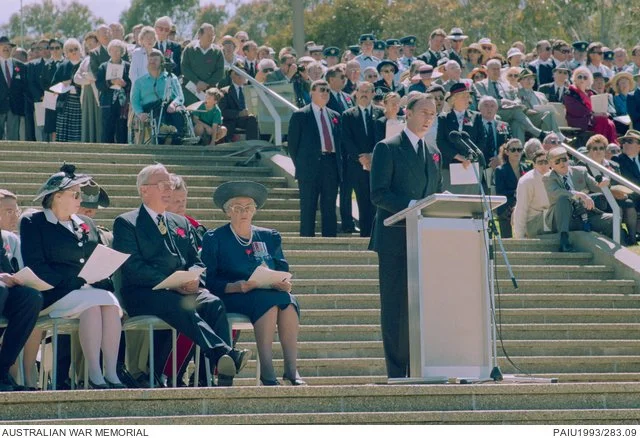
Source: http://whitlamdismissal.com/1972/11/13/whi...

Enjoyed this speech? Speakola is a labour of love and I’d be very grateful if you would share, tweet or like it. Thank you.

Facebook Twitter Facebook
In 1960-79 Tags WHITLAM, PRIME MINISTERS, CAMPAIGN LAUNCH, ELECTIONS, TRANSCRIPT
Comment

Ben Chifley: 'We have a great objective – the light on the hill' - 1949

August 6, 2015

There is no audio or video of the speech. This is the song by Casey Bennetto from the musical 'Keating' that draws inspiration from the famous phrase. Ben Chifley was the 16th Prime Minister of Australia.

12 June 1949, NSW Labor Party Conference, Sydney, Australia

I have had the privilege of leading the Labor Party for nearly four years. They have not been easy times and it has not been an easy job. It is a man-killing job and would be impossible if it were not for the help of my colleagues and members of the movement.

No Labor Minister or leader ever has an easy job. The urgency that rests behind the Labor movement, pushing it on to do things, to create new conditions, to reorganise the economy of the country, always means that the people who work within the Labor movement, people who lead, can never have an easy job. The job of the evangelist is never easy.

Because of the turn of fortune’s wheel your Premier (Mr McGirr) and I have gained some prominence in the Labor movement. But the strength of the movement cannot come from us. We may make plans and pass legislation to help and direct the economy of the country. But the job of getting the things the people of the country want comes from the roots of the Labor movement – the people who support it.

When I sat at a Labor meeting in the country with only ten or fifteen men there, I found a man sitting beside me who had been working in the Labor movement for fifty-four years. I have no doubt that many of you have been doing the same, not hoping for any advantage from the movement, not hoping for any personal gain, but because you believe in a movement that has been built up to bring better conditions to the people. Therefore, the success of the Labor Party at the next elections depends entirely, as it always has done, on the people who work.

I try to think of the Labor movement, not as putting an extra sixpence into somebody’s pocket, or making somebody Prime Minister or Premier, but as a movement bringing something better to the people, better standards of living, greater happiness to the mass of the people. We have a great objective – the light on the hill – which we aim to reach by working the betterment of mankind not only here but anywhere we may give a helping hand. If it were not for that, the Labor movement would not be worth fighting for.

If the movement can make someone more comfortable, give to some father or mother a greater feeling of security for their children, a feeling that if a depression comes there will be work, that the government is striving its hardest to do its best, then the Labor movement will be completely justified.

It does not matter about persons like me who have our limitations. I only hope that the generosity, kindliness and friendliness shown to me by thousands of my colleagues in the Labor movement will continue to be given to the movement and add zest to its work.

Source: http://www.chifley.org.au/the-light-on-the...

Enjoyed this speech? Speakola is a labour of love and I’d be very grateful if you would share, tweet or like it. Thank you.

Facebook Twitter Facebook
In 1940-59 Tags PRIME MINISTERS, LABOUR, AUSTRALIA, TRANSCRIPT
Comment

Robert Menzies: 'They are the backbone of the nation', The Forgotten People - 1942

August 6, 2015

22 May, 1942, broadcast on 3AW and 2UE radio, Australia

Quite recently, a bishop wrote a letter to a great daily newspaper. His theme was the importance of doing justice to the workers. His belief, apparently, was that the workers are those who work with their hands. He sought to divide the people of Australia into classes. He was obviously suffering from what has for years seemed to me to be our greatest political disease - the disease of thinking that the community is divided into the relatively rich and the relatively idle, and the laborious poor, and that every social and political controversy can be resolved into the question: What side are you on?

Now, the last thing that I would want to do is to commence or take part in a false war of this kind. In a country like Australia the class war must always be a false war. But if we are to talk of classes, then the time has come to say something of the forgotten class - the middle class - those people who are constantly in danger of being ground between the upper and the nether millstones of the false war; the middle class who, properly regarded represent the backbone of this country.

We do not have classes here as in England, and therefore the terms do not mean the same; so I must define what I mean when I use the expression "middle class."

Let me first define it by exclusion. I exclude at one end of the scale the rich and powerful: those who control great funds and enterprises, and are as a rule able to protect themselves - though it must be said that in a political sense they have as a rule shown neither comprehension nor competence. But I exclude them because, in most material difficulties, the rich can look after themselves.

I exclude at the other end of the scale the mass of unskilled people, almost invariably well-organised, and with their wages and conditions safeguarded by popular law. What I am excluding them from is my definition of the middle class. We cannot exclude them from problems of social progress, for one of the prime objects of modern social and political policy is to give them a proper measure of security, and provide the conditions which will enable them to acquire skill and knowledge and individuality.

These exclusions being made, I include the intervening range - the kind of people I myself represent in Parliament - salary-earners, shopkeepers, skilled artisans, professional men and women, farmers and so on. These are, in the political and economic sense, the middle class. They are for the most part unorganised and unself-conscious. They are envied by those whose benefits are largely obtained by taxing them. They are not rich enough to have individual power. They are taken for granted by each political party in turn. They are not sufficiently lacking in individualism to be organised for what in these days we call "pressure politics." And yet, as I have said, they are the backbone of the nation.

The communist has always hated what he calls the "bourgeoisie", because he sees clearly the existence of one has kept British countries from revolution, while the substantial absence of one in feudal France at the end of the eighteenth century and in Tsarist Russia at the end of the last war made revolution easy and indeed inevitable. You may say to me, "Why bring this matter up at this stage when we are fighting a war, the result of which we are all equally concerned?" My answer is that I am bringing it up because under the pressure of war we may, if we are not careful - if we are not as thoughtful as the times will permit us to be - inflict a fatal injury upon our own backbone.

In point of political, industrial and social theory and practice, there are great delays in time of war. But there are also great accelerations. We must watch each, remembering always that whether we know it or not, and whether we like it or not, the foundations of whatever new order is to come after the war are inevitably being laid down now. We cannot go wrong right up to the peace treaty and expect suddenly thereafter to go right.

Now, what is the value of this middle class, so defined and described?

First, it has a "stake in the country". It has responsibility for homes - homes material, homes human, and homes spiritual.

I do not believe that the real life of this nation is to be found either in great luxury hotels and the petty gossip of so-called fashionable suburbs, or in the officialdom of the organised masses. It is to be found in the homes of people who are nameless and unadvertised, and who, whatever their individual religious conviction or dogma, see in their children their greatest contribution to the immortality of their race. The home is the foundation of sanity and sobriety; it is the indispensable condition of continuity; its health determines the health of society as a whole.

I have mentioned homes material, homes human and homes spiritual. Let me take them in order. What do I mean by "homes material"?

The material home represents the concrete expression of the habits of frugality and saving "for a home of our own." Your advanced socialist may rave against private property even while he acquires it; but one of the best instincts in us is that which induces us to have one little piece of earth with a house and a garden which is ours; to which we can withdraw, in which we can be among our friends, into which no stranger may come against our will. If you consider it, you will see that if, as in the old saying, "the Englishman's home is his castle", it is this very fact that leads on to the conclusion that he who seeks to violate that law by violating the soil of England must be repelled and defeated.

National patriotism, in other words, inevitably springs from the instinct to defend and preserve our own homes.

Then we have homes human. A great house, full of loneliness, is not a home. "Stone walls do not a prison make", nor do they make a house. They may equally make a stable or a piggery. Brick walls, dormer windows and central heating need not make more than a hotel. My home is where my wife and children are. The instinct to be with them is the great instinct of civilised man; the instinct to give them a chance in life - to make them not leaners but lifters - is a noble instinct. If Scotland has made a great contribution to the theory and practice of education, it is because of the tradition of Scottish homes. The Scottish ploughman, walking behind his team, cons ways and means of making his son a farmer, and so he sends him to the village school. The Scottish farmer ponders upon the future of his son, and sees it most assured not by the inheritance of money but by the acquisition of that knowledge which will give him power; and so the sons of many Scottish farmers find their way to Edinburgh and a university degree.

The great question is, "How can I my son to help society?" Not, as we have so frequently thought, "How can I qualify society to help my son?" If human homes are to fulfil their destiny, then we must have frugality and saving for education and progress.

And finally, we have homes spiritual. This is a notion which finds its simplest and most moving expression in "The Cotter's Saturday Night" of Burns. Human nature is at its greatest when it combines dependence upon God with independence of man. We offer no affront - on the contrary we have nothing but the warmest human compassion - toward those whom fate has compelled to live upon the bounty of the State, when we say that the greatest element in a strong people is a fierce independence of spirit. This is the only real freedom, and it has as its corollary a brave acceptance of unclouded individual responsibility. The moment a man seeks moral and intellectual refuge in the emotions of a crowd, he ceases to be a human being and becomes a cipher. The home spiritual so understood is not produced by lassitude or by dependence; it is produced by self-sacrifice, by frugality and saving.

In a war, as indeed at most times, we become the ready victims of phrases. We speak glibly of of many things without pausing to consider what they signify. We speak of "financial power", forgetting that the financial power of 1942 is based upon the savings of generations which have preceded it. We speak of "morale" as if it were a quality induced from without - created by others for our benefit - when in truth there can be no national morale which is not based upon the individual courage of men and women. We speak of "man power" as if it were a mere matter of arithmetic: as if it were made up of a multiplication of men and muscles without spirit.

Second, the middle class, more than any other, provides the intelligent ambition which is the motive power of human progress. The idea entertained by many people that, in a well-constituted world, we shall all live on the State is the quintessence of madness, for what is the State but us? We collectively must provide what we individually receive.

The great vice of democracy - a vice which is exacting a bitter retribution from it at this moment - is that for a generation we have been busy getting ourselves on to the list of beneficiaries and removing ourselves from the list of contributors, as if somewhere there was somebody else's wealth and somebody else's effort on which we could thrive.

To discourage ambition, to envy success, to have achieved superiority, to distrust independent thought, to sneer at and impute false motives to public service - these are the maladies of modern democracy, and of Australian democracy in particular. Yet ambition, effort, thinking, and readiness to serve are not only the design and objectives of self-government but are the essential conditions of its success. If this is not so, then we had better put back the clock, and search for a benevolent autocracy once more.

Where do we find these great elements most commonly? Among the defensive and comfortable rich, among the unthinking and unskilled mass, or among what I have called the "middle class"?

Third, the middle class provides more than any other other the intellectual life which marks us off from the beast; the life which finds room for literature, for the arts, for science, for medicine and the law.

Consider the case of literature and art. Could these survive as a department of State? Are we to publish our poets according to their political colour? Is the State to decree surrealism because surrealism gets a heavy vote in a key electorate? The truth is that no great book was ever written and no great picture ever painted by the clock or according to civil service rules. These are the things done by man, not men. You cannot regiment them. They require opportunity, and sometimes leisure. The artist, if he is to live, must have a buyer; the writer an audience. He find them among frugal people to whom the margin above bare living means a chance to reach out a little towards that heaven which is just beyond our grasp. It has always seemed to me, for example, that an artist is better helped by the man who sacrifices something to buy a picture he loves than by a rich patron who follows the fashion.

Fourth, this middle class maintains and fills the higher schools and universities, and so feeds the lamp of learning.

What are schools for? To train people for examinations, to enable people to comply with the law, or to produce developed men and women?

Are the universities mere technical schools, or have they as one of their functions the preservation of pure learning, bringing in its train not merely riches for the imagination but a comparative sense for the mind, and leading to what we need so badly - the recognition of values which are other than pecuniary?

One of the great blots on our modern living is the cult of false values, a repeated application of the test of money, notoriety, applause. A world in which a comedian or a beautiful half-wit on the screen can be paid fabulous sums, whilst scientific researchers and discoverers can suffer neglect and starvation, is a world which needs to have its sense of values violently set right.

Now, have we realised and recognised these things, or is most of our policy designed to discourage or penalise thrift, to encourage dependence on the State, to bring about a dull equality on a fantastic idea that all men are equal in mind and needs and deserts: to level down by taking the mountains out of the landscape, to weigh men according to their political organisations and power - as votes and not as human beings? These are formidable questions, and we cannot escape from answering them if there is really to be a new order for the world. I have been actively engaged in politics for fourteen years in the State of Victoria and in the Commonwealth of Australia. In that period I cannot readily recall many occasions upon which any policy was pursued which was designed to help the thrifty, to encourage independence, to recognise the divine and valuable variations of men's minds. On the contrary, there have been many instances in which the votes of the thriftless have been used to defeat the thrifty. On occasions of emergency, as in the depression and during the present war, we have hastened to make it clear that the provision made by man for his own retirement and old age is not half as sacrosanct as the provision the State would have made for him if he had never saved at all.

We have talked of income from savings as if it possessed a somewhat discreditable character. We have taxed it more and more heavily. We have spoken slightingly of the earning of interest at the very moment when we have advocated new pensions and social schemes. I have myself heard a minister of power and influence declare that no deprivation is suffered by a man if he still has the means to fill his stomach, clothe his body and keep a roof over his head. And yet the truth is, as I have endeavoured to show, that frugal people who strive for and obtain the margin above these materially necessary things are the whole foundation of a really active and developing national life.

The case for the middle class is the case for a dynamic democracy as against the stagnant one. Stagnant waters are level, and in them the scum rises. Active waters are never level: they toss and tumble and have crests and troughs; but the scientists tell us that they purify themselves in a few hundred yards.

That we are all, as human souls, of like value cannot be denied. That each of us should have his chance is and must be the great objective of political and social policy. But to say that the industrious and intelligent son of self-sacrificing and saving and forward-looking parents has the same social deserts and even material needs as the dull offspring of stupid and improvident parents is absurd.

If the motto is to be "Eat, drink and be merry, for tomorrow you will die, and if it chances you don't die, the State will look after you; but if you don't eat, drink and be merry and save, we shall take your savings from you", then the whole business of life would become foundationless.

Are you looking forward to a breed of men after the war who will have become boneless wonders? Leaners grow flabby; lifters grow muscles. Men without ambition readily become slaves. Indeed, there is much more in slavery in Australia than most people imagine. How many hundreds of thousands of us are slaves to greed, to fear, to newspapers, to public opinion - represented by the accumulated views of our neighbours! Landless men smell the vapours of the street corner. Landed men smell the brown earth, and plant their feet upon it and know that it is good. To all of this many of my friends will retort, "Ah that's all very well, but when this war is over the levellers will have won the day." My answer is that, on the contrary, men will come out of this war as gloriously unequal in many things as when they entered it. Much wealth will have been destroyed; inherited riches will be suspect; a fellowship of suffering, if we really experience it, will have opened many hearts and perhaps closed many mouths. Many great edifices will have fallen, and we shall be able to study foundations as never before, because war will have exposed them.

But I do not believe that we shall come out into the overlordship of an all-powerful State on whose benevolence we shall live, spineless and effortless - a State which will dole out bread and ideas with neatly regulated accuracy; where we shall all have our dividend without subscribing our capital; where the Government, that almost deity, will nurse us and rear us and maintain us and pension us and bury us; where we shall all be civil servants, and all presumably, since we are equal, heads of departments.

If the new world is to be a world of men, we must be not pallid and bloodless ghosts, but a community of people whose motto shall be, "To strive, to seek, to find, and not to yield." Individual enterprise must drive us forward. That does not mean we are to return to the old and selfish notions of laissez-faire. The functions of the State will be much more than merely keeping the ring within which the competitors will fight. Our social and industrial laws will be increased. There will be more law, not less; more control, not less.

But what really happens to us will depend on how many people we have who are of the great and sober and dynamic middle-class - the strivers, the planners, the ambitious ones. We shall destroy them at our peril.

Source: http://www.liberals.net/theforgottenpeople...

Enjoyed this speech? Speakola is a labour of love and I’d be very grateful if you would share, tweet or like it. Thank you.

Facebook Twitter Facebook
In 1940-59 Tags PRIME MINISTERS, AUSTRALIA, MENZIES
Comment

David Lloyd George: 'The Road Hog of Europe' - 1914

August 6, 2015

19 September 1914, London, United Kingdom

I have come here this afternoon to talk to my fellow countrymen about this great war and the part we ought to take in it. I feel my task is easier after we have been listening to the greatest battle-song in the world.

There is no man in this room who has always regarded the prospects of engaging in a great war with greater reluctance, with greater repugnance, than I have done throughout the whole of my political life. There is no man, either inside or outside of this room, more convinced that we could not have avoided it without national dishonour. I am fully alive to the fact that whenever a nation has been engaged in any war she has always invoked the sacred name of honour. Many a crime has been committed in its name; there are some crimes being committed now. But, all the same, national honour is a reality, and any nation that disregards it is doomed.

Why is our honour as a country involved in this war? Because, in the first place, we are bound in an honourable obligation to defend the independence, the liberty, the integrity of a small neighbour that has lived peaceably, but she could not have compelled us, because she was weak. The man who declines to discharge his debt because his creditor is too poor to enforce it is a blackguard. We entered into this treaty, a solemn treaty, a full treaty, to defend Belgium and her integrity. Our signatures are attached to the document. Our signatures do not stand alone there. This was not the only country to defend the integrity of Belgium. Russia, France, Austria, and Prussia--they are all there. Why did they not perform the obligation? It is suggested that if we quote this treaty it is purely an excuse on our part. It is our low craft and cunning, just to cloak our jealousy of a superior civilization we are attempting to destroy. Our answer is the action we took in 1870. What was that? Mr. Gladstone was then Prime Minister. Lord Granville, I think, was then Foreign Secretary. I have never heard it laid to their charge that they were ever jingo.

What did they do in 1870? That Treaty Bond was this: We called upon the belligerent Powers to respect that treaty. We called upon France; we called upon Germany. At that time, bear in mind, the greatest danger to Belgium came from France and not from Germany. We intervened to protect Belgium against France exactly as we are doing now to protect her against Germany. We are proceeding exactly in the same way. We invited both the belligerent Powers to state that they had no intention of violating Belgian territory. What was the answer given by Bismarck? He said it was superfluous to ask Prussia such a question in view of the treaties in force. France gave a similar answer. We received the thanks at that time from the Belgian people for our intervention in a very remarkable document. This is the document addressed by the municipality of Brussels to Queen Victoria after that intervention:

The great and noble people over whose destinies you preside have just given a further proof of its benevolent sentiments towards this country. The voice of the English nation has been heard above the din of arms. It has asserted the principles of justice and right. Next to the unalterable attachment of the Belgian people to their independence, the strongest sentiment which fills their hearts is that of an imperishable gratitude to the people of Great Britain.

That was in 1870. Mark what follows.

Three or four days after that document of thanks the French Army was wedged up against the Belgian frontier. Every means of escape was shut up by a ring of flame from Prussian cannon. There was one way of escape. What was that? By violating the neutrality of Belgium. What did they do? The French on that occasion preferred ruin, humiliation, to the breaking of their bond. The French Emperor, French Marshals, 100,000 gallant Frenchmen in arms preferred to be carried captive to the strange land of their enemy rather than dishonour the name of their country. It was the last French Army defeat. Had they violated Belgian neutrality the whole history of that war would have been changed. And yet it was the interest of France to break the treaty. She did not do it.

It is now the interest of Prussia to break the treaty, and she has done it. Well, why? She avowed it with cynical contempt for every principle of justice. She says treaties only bind you when it is to your interest to keep them. 'What is a treaty?' says the German Chancellor. 'A scrap of paper.' Have you any L5 notes about you? I am not calling for them. Have you any of those neat little Treasury L1 notes? If you have, burn them; they are only 'scraps of paper'. What are they made of? Rags. What are they worth? The whole credit of the British Empire. 'Scraps of paper.' I have been dealing with scraps of paper within the last month. It is suddenly found the commerce of the world is coming to a standstill. The machine had stopped. Why? I will tell you. We discovered, many of us for the first time--I do not pretend to say that I do not know much more about the machinery of commerce to-day than I did six weeks ago, and there are a good many men like me--we discovered the machinery of commerce was moved by bills of exchange. I have seen some of them--wretched, crinkled, scrawled over, blotched, frowsy, and yet these wretched little scraps of paper moved great ships, laden with thousands of tons of precious cargo, from one end of the world to the other. What was the motive power behind them? The honour of commercial men.

Treaties are the currency of international statesmanship. Let us be fair. German merchants, German traders had the reputation of being as upright and straightforward as any traders in the world. But if the currency of German commerce is to be debased to the level of her statesmanship, no trader from Shanghai to Valparaiso will ever look at a German signature again. This doctrine of the scrap of paper, this doctrine which is superscribed by Bernhardi, that treaties only bind a nation as long as it is to its interest, goes to the root of public law. It is the straight road to barbarism, just as if you removed the magnetic pole whenever it was in the way of a German cruiser, the whole navigation of the seas would become dangerous, difficult, impossible, and the whole machinery of civilization will break down if this doctrine wins in this war.

We are fighting against barbarism. But there is only one way of putting it right. If there are nations that say they will only respect treaties when it is to their interest to do so, we must make it to their interest to do so for the future. What is their defence? Just look at the interview which took place between our Ambassador and great German officials when their attention was called to this treaty to which they were partners. They said: 'We cannot, help that. Rapidity of action was the great German asset. There is a greater asset for a nation than rapidity of action, and that is--honest dealing.

What are her excuses? She said Belgium was plotting against her, that Belgium was engaged in a great conspiracy with Britain and with France to attack her. Not merely is that not true, but Germany knows it is not true. What is her other excuse? France meant to invade Germany through Belgium. Absolutely untrue. France offered Belgium five army corps to defend her if she was attacked. Belgium said: 'I don't require them. I have got the word of the Kaiser. Shall Caesar send a lie?' All these tales about conspiracy have been fanned up since. The great nation ought to be ashamed, ought to be ashamed to behave like a fraudulent bankrupt perjuring its way with its complications. She has deliberately broken this treaty, and we were in honour bound to stand by it.

Belgium has been treated brutally, how brutally we shall not yet know. We know already too much. What has she done? Did she send an ultimatum to Germany? Did she challenge Germany? Was she preparing to make war on Germany? Had she ever inflicted any wrongs upon Germany which the Kaiser was bound to redress? She was one of the most unoffending little countries in Europe. She was peaceable, industrious, thrifty, hard-working, giving offence to no one; and her cornfields have been trampled down, her villages have been burned to the ground, her art treasures have been destroyed, her men have been slaughtered, yea, and her women and children, too. What had she done? Hundreds of thousands of her people have had their quiet, comfortable little homes burned to the dust, and are wandering homeless in their own land. What is their crime? Their crime was that they trusted to the word of a Prussian King. I don't know what the Kaiser hopes to achieve by this war. I have a shrewd idea of what he will get, but one thing is made certain, that no nation in future will ever commit that crime again.

I am not going to enter into these tales. Many of them are untrue; war is a grim, ghastly business at best, and I am not going to say that all that has been said in the way of tales of outrage is true. I will go beyond that, and say that if you turn two millions of men forced, conscripted, and compelled and driven into the field, you will certainly get among them a certain number of men who will do things that the nation itself will be ashamed of. I am not depending on them. It is enough for me to have the story which the Germans themselves avow, admit, defend, proclaim. The burning and massacring, the shooting down of harmless people--why? Because, according to the Germans, they fired on German soldiers. What business had German soldiers there at all? Belgium was acting in pursuance of a most sacred right, the right to defend your own home.

But they were not in uniform when they shot. If a burglar broke into the Kaiser's Palace at Potsdam, destroyed his furniture, shot down his servants, ruined his art treasures, especially those he made himself, burned his precious manuscripts, do you think he would wait until he got into uniform before he shot him down? They were dealing with those who had broken into their households. But their perfidy has already failed. They entered Belgium to save time. The time has gone. They have not gained time, but they have lost their good name.

But Belgium was not the only little nation that has been attacked in this war, and I make no excuse for referring to the case of the other little nation--the case of Servia. The history of Servia is not unblotted. What history in the category of nations is unblotted? The first nation that is without sin, let her cast a stone at Servia. A nation trained in a horrible school, but she won her freedom with her tenacious valour, and she has maintained it by the same courage. If any Servians were mixed up in the assassination of the Grand Duke they ought to be punished. Servia admits that; the Servian Government had nothing to do with it. Not even Austria claimed that. The Servian Prime Minister is one of the most capable and honoured men in Europe.

Servia was willing to punish any one of her subjects who had been proved to have any complicity in that assassination. What more could you expect? What were the Austrian demands? Servia sympathized with her fellow countrymen in Bosnia. That was one of her crimes. She must do so no more. Her newspapers were saying nasty things about Austria. They must do so no longer. That is the Austrian spirit. You had it in Zabern. How dare you criticize a Customs official? And if you laugh it is a capital offence. The colonel threatened to shoot them if they repeated it.

Servian newspapers must not criticize Austria. I wonder what would have happened had we taken the same line about German newspapers. Servia said: 'Very well, we will give orders to the newspapers that they must not criticize Austria in future, neither Austria, nor Hungary, nor anything that is theirs.' Who can doubt the valour of Servia, when she undertook to tackle her newspaper editors? She promised not to sympathize with Bosnia, promised to write no critical articles about Austria. She would have no public meetings at which anything unkind was said about Austria.

That was not enough. She must dismiss from her Army officers whom Austria should subsequently name. But these officers had just emerged from a war where they were adding lustre to the Servian arms--gallant, brave, efficient. I wonder whether it was their guilt or their efficiency that prompted Austria's action. But, mark, the officers were not named. Servia was to undertake in advance to dismiss them from the Army; the names to be sent on subsequently. Can you name a country in the world that would have stood that?

Supposing Austria or Germany had issued an ultimatum of that kind to this country. 'You must dismiss from your Army and from your Navy all those officers whom we shall subsequently name!' Well, I think I could name them now. Lord Kitchener would go; Sir John French would be sent about his business; General Smith-Dorrien would be no more; and I am sure that Sir John Jellicoe would go. And there is another gallant old warrior who would go--Lord Roberts.

It was a difficult situation. Here was a demand made upon her by a great military Power who could put five or six men in the field for every one she could; and that Power supported by the greatest military Power in the world. How did Servia behave? It is not what happens to you in life that matters; it is the way in which you face it. And Servia faced the situation with dignity. She said to Austria. 'If any officers of mine have been guilty and are proved to be guilty, I will dismiss them.' Austria said, 'That is not good enough for me.' It was not guilt she was after, but capacity.

Then came Russia's turn. Russia has a special regard for Servia. She has a special interest in Servia. Russians have shed their blood for Servian independence many a time. Servia is a member of her family, and she cannot see Servia maltreated. Austria knew that. Germany knew that, and Germany turned round to Russia and said: 'Here, I insist that you shall stand by with your arms folded whilst Austria is strangling to death your little brother.' What answer did the Russian Slav give? He gave the only answer that becomes a man. He turned to Austria and said: 'You lay hands on that little fellow and I will tear your ramshackle empire limb from limb.' And he is doing it.

That is the story of the little nations. The world owes much to little nations--and to little men. This theory of bigness--you must have a big empire and a big nation, and a big man--well, long legs have their advantage in a retreat. Frederick the Great chose his warriors for their height, and that tradition has become a policy in Germany. Germany applies that ideal to nations; she will only allow six-feet-two nations to stand in the ranks. But all the world owes much to the little five feet high nations. The greatest art of the world was the work of little nations. The most enduring literature of the world came from little nations. The greatest literature of England came from her when she was a nation of the size of Belgium fighting a great Empire. The heroic deeds that thrill humanity through generations were the deeds of little nations fighting for their freedom. Ah, yes, and the salvation of mankind came through a little nation. God has chosen little nations as the vessels by which He carries the choicest wines to the lips of humanity, to rejoice their hearts, to exalt their vision, to stimulate and to strengthen their faith; and if we had stood by when two little nations were being crushed and broken by the brutal hands of barbarism our shame would have rung down the everlasting ages.

But Germany insists that this is an attack by a low civilization upon a higher. Well, as a matter of fact, the attack was begun by the civilization which calls itself the higher one. Now, I am no apologist for Russia. She has perpetrated deeds of which I have no doubt her best sons are ashamed.

But what Empire has not? And Germany is the last Empire to point the finger of reproach at Russia. But Russia has made sacrifices for freedom--great sacrifices. You remember the cry of Bulgaria when she was torn by the most insensate tyranny that Europe has ever seen. Who listened to the cry? The only answer of the higher civilization was that the liberty of Bulgarian peasants was not worth the life of a single Pomeranian soldier. But the rude barbarians of the North--they sent their sons by the thousands to die for Bulgarian freedom.

What about England? You go to Greece, the Netherlands, Italy, Germany, and France, and all these lands, gentlemen, could point out to you places where the sons of Britain have died for the freedom of these countries. France has made sacrifices for the freedom of other lands than her own. Can you name a single country in the world for the freedom of which the modern Prussian has ever sacrificed a single life? The test of our faith, the highest standard of civilization is the readiness to sacrifice for others.

I would not say a word about the German people to disparage them. They are a great people; they have great qualities of head, of hand, and of heart. I believe, in spite of recent events, there is as great a store of kindness in the German peasant as in any peasant in the world. But he has been drilled into a false idea of civilization,--efficiency, capability. It is a hard civilization; it is a selfish civilization; it is a material civilization. They could not comprehend the action of Britain at the present moment. They say so. 'France', they say, 'we can understand. She is out for vengeance, she is out for territory--Alsace Lorraine. Russia, she is fighting for mastery, she wants Galicia.' They can understand vengeance, they can understand you fighting for mastery, they can understand you fighting for greed of territory; they cannot understand a great Empire pledging its resources, pledging its might, pledging the lives of its children, pledging its very existence, to protect a little nation that seeks for its defence. God made man in His own image--high of purpose, in the region of the spirit. German civilization would re-create him in the image of a Diesler machine--precise, accurate, powerful, with no room for the soul to operate. That is the 'higher' civilization.

What is their demand? Have you read the Kaiser's speeches? If you have not a copy, I advise you to buy it; they will soon be out of print, and you won't have any more of the same sort again. They are full of the clatter and bluster of German militarists--the mailed fist, the shining armour. Poor old mailed fist--its knuckles are getting a little bruised. Poor shining armour--the shine is being knocked out of it. But there is the same swagger and boastfulness running through the whole of the speeches. You saw that remarkable speech which appeared in the _British Weekly_ this week. It is a very remarkable product, as an illustration of the spirit we have got to fight. It is his speech to his soldiers on the way to the front:--

Remember that the German people are the chosen of God. On me, on me as German Emperor, the Spirit of God has descended. I am His weapon, His sword, and His vizard! Woe to the disobedient! Death to cowards and unbelievers!

There has been nothing like it since the days of Mahomet.

Lunacy is always distressing, but sometimes it is dangerous, and when you get it manifested in the head of the State, and it has become the policy of a great Empire, it is about time when that should be ruthlessly put away. I do not believe he meant all these speeches. It was simply the martial straddle which he had acquired; but there were men around him who meant every word of it. This was their religion. Treaties? They tangled the feet of Germany in her advance. Cut them with the sword. Little nations? They hinder the advance of Germany. Trample them in the mire under the German heel. The Russian Slav? He challenges the supremacy of Germany and Europe. Hurl your legions at him and massacre him. Britain? She is a constant menace to the predominancy of Germany in the world. Wrest the trident out of her hands. Ah! more than that. The new philosophy of Germany is to destroy Christianity. Sickly sentimentalism about sacrifice for others--poor pap for German digestion. We will have a new diet. We will force it on the world. It will be made in Germany. A diet of blood and iron. What remains? Treaties have gone; the honour of nations gone; liberty gone. What is left? Germany--Germany is left--Deutschland uber Alles. That is all that is left.

That is what we are fighting, that claim to predominancy of a civilization, a material one, a hard one, a civilization which if once it rules and sways the world, liberty goes, democracy vanishes, and unless Britain comes to the rescue, and her sons, it will be a dark day for humanity. We are not fighting the German people. The German people are just as much under the heel of this Prussian military caste, and more so, thank God, than any other nation in Europe. It will be a day of rejoicing for the German peasant and artisan and trader when the military caste is broken. You know his pretensions. He gives himself the airs of a demi-god. Walking the pavements --civilians and their wives swept into the gutter; they have no right to stand in the way of the great Prussian junker. Men, women, nations --they have all got to go. He thinks all he has got to say is, 'We are in a hurry.' That is the answer he gave to Belgium. 'Rapidity of action is Germany's greatest asset,' which means 'I am in a hurry. Clear out of my way'.

You know the type of motorist, the terror of the roads, with a 60-h.p.car. He thinks the roads are made for him, and anybody who impedes the action of his car by a single mile is knocked down. The Prussian junker is the road-hog of Europe. Small nationalities in his way hurled to the roadside, bleeding and broken; women and children crushed under the wheels of his cruel car. Britain ordered out of his road. All I can say is this: if the old British spirit is alive in British hearts, that bully will be torn from his seat. Were he to win it would be the greatest catastrophe that has befallen democracy since the days of the Holy Alliance and its ascendancy. They think we cannot beat them. It will not be easy. It will be a long job. It will be a terrible war. But in the end we shall march through terror to triumph. We shall need all our qualities, every quality that Britain and its people possess. Prudence in council, daring in action, tenacity in purpose, courage in defeat, moderation in victory, in all things faith, and we shall win.

It has pleased them to believe and to preach the belief that we are a decadent nation. They proclaim it to the world, through their professors, that we are an unheroic nation skulking behind our mahogany counters, whilst we are egging on more gallant races to their destruction. This is a description given to us in Germany--'a timorous, craven nation, trusting to its fleet.' I think they are beginning to find their mistake out already. And there are half a million of young men of Britain who have already registered their vow to their King that they will cross the seas and hurl that insult against British courage against its perpetrators on the battlefields of France and of Germany. And we want half a million more. And we shall get them.

But Wales must continue doing her duty. That was a great telegram that you, my Lord (the Chairman), read from Glamorgan.[2] I should like to see a Welsh army in the field. I should like to see the race who faced the Normans for hundreds of years in their struggle for freedom, the race that helped to win the battle of Crecy, the race that fought for a generation under Glendower, against the greatest captain in Europe--I should like to see that race give a good taste of its quality in this struggle in Europe; and they are going to do it.

I envy you young people your youth. They have put up the age limit for the Army, but I march, I am sorry to say, a good many years even beyond that. But still our turn will come. It is a great opportunity. It only comes once in many centuries to the children of men. For most generations sacrifice comes in drab weariness of spirit to men. It has come to-day to you; it has come to-day to us all, in the form of the glory and thrill of a great movement for liberty, that impels millions throughout Europe to the same end. It is a great war for the emancipation of Europe from the thraldom of a military caste, which has cast its shadow upon two generations of men, and which has now plunged the world into a welter of bloodshed. Some have already given their lives. There are some who have given more than their own lives. They have given the lives of those who are dear to them. I honour their courage, and may God be their comfort and their strength.

But their reward is at hand. Those who have fallen have consecrated deaths. They have taken their part in the making of a new Europe, a new world. I can see signs of its coming in the glare of the battlefield. The people will gain more by this struggle in all lands than they comprehend at the present moment. It is true they will be rid of the menace to their freedom. But that is not all. There is something infinitely greater and more enduring which is emerging already out of this great conflict; a new patriotism, richer, nobler, more exalted than the old. I see a new recognition amongst all classes, high and low, shedding themselves of selfishness; a new recognition that the honour of a country does not depend merely on the maintenance of its glory in the stricken field, but in protecting its homes from distress as well. It is a new patriotism, it is bringing a new outlook for all classes. A great flood of luxury and of sloth which had submerged the land is receding, and a new Britain is appearing. We can see for the first time the fundamental things that matter in life and that have been obscured from our vision by the tropical growth of prosperity.

May I tell you, in a simple parable, what I think this war is doing for us? I know a valley in North Wales, between the mountains and the sea--a beautiful valley, snug, comfortable, sheltered by the mountains from all the bitter blasts. It was very enervating, and I remember how the boys were in the habit of climbing the hills above the village to have a glimpse of the great mountains in the distance, and to be stimulated and freshened by the breezes which, came from the hill-tops, and by the great spectacle of that great valley.

We have been living in a sheltered valley for generations. We have been too comfortable, too indulgent, many, perhaps, too selfish. And the stern hand of fate has scourged us to an elevation where we can see the great everlasting things that matter for a nation; the great peaks of honour we had forgotten--duty and patriotism clad in glittering white: the great pinnacle of sacrifice pointing like a rugged finger to Heaven. We shall descend into the valleys again, but as long as the men and women of this generation last they will carry in their hearts the image of these great mountain peaks, whose foundations are unshaken though Europe rock and sway in the convulsions of a great war.

Source: http://www.gwpda.org/1914/lloydgeorge_hono...

Enjoyed this speech? Speakola is a labour of love and I’d be very grateful if you would share, tweet or like it. Thank you.

Facebook Twitter Facebook
In 1900-19 Tags DAVID LLOYD GEORGE, WW1, PRIME MINISTERS, UNITED KINGDOM, WAR, TRANSCRIPT
Comment

John Curtin: 'We are fighting mad', WW2 radio broadcast - 1942

August 6, 2015

20 March 1942, radio broadcast, Australia

This was a speech to the people of America, re-broadcast on Radio Australia. John Curtin was the 14th Prime Minister of Australia, and held the position for most of WW2.

Men and women of the United States:

I speak to you from Australia. I speak from a united people to a united people, and my speech is aimed to serve all the people of the nations united in the struggle to save mankind.

On the great waters of the Pacific Ocean war now breathes its bloody steam. From the skies of the Pacific pours down a deathly hail. In the countless islands of the Pacific the tide of war flows madly. For you in America; for us in Australia, it is flowing badly. Let me then address you as comrades in this war and tell you a little of Australia and Australians. I am not speaking to your Government. We have long been admirers of Mr Roosevelt and have the greatest confidence that he understands fully the critical situation in the Pacific and that America will go right out to meet it. For all that America has done, both before and after entering the war, we have the greatest admiration and gratitude.

It is to the people of America I am now speaking; to you who are, or will be, fighting; to you who are sweating in factories and workshops to turn out the vital munitions of war; to all of you who are making sacrifices in one way or another to provide the enormous resources required for our great task. I speak to you at a time when the loss of Java and the splendid resistance of the gallant Dutch together give us a feeling of both sadness and pride. Japan has moved one step further in her speedy march south; but the fight of the Dutch and Indonese in Java has shown that a brave, freedom-loving people are more than a match for the yellow aggressor given even a shadow below equality in striking and fighting weapons.

But facts are stern things. We, the allied nations, were unready. Japan, behind her wall of secrecy, had prepared for war on a scale of which neither we nor you had knowledge. We have all made mistakes, we have all been too slow; we have all shown weakness - all the allied nations. This is not the time to wrangle about who has been most to blame. Now our eyes are open.

The Australian Government has fought for its people. We never regarded the Pacific as a segment of the great struggle. We did not insist that it was the primary theatre of war, but we did say, and events have so far, unhappily, proved us right, that the loss of the Pacific can be disastrous. Who among us, contemplating the future on that day in December last when Japan struck like an assassin at Pearl Harbour at Manila, at Wake and Guam, would have hazarded a guess that by March the enemy would be astride all the south-west Pacific except General MacArthur's gallant men, and Australia and New Zealand. But that is the case. And, realising very swiftly that it would be the case, the Australian Government sought a full and proper recognition of the part the Pacific was playing in the general strategic disposition of the world's warring forces. It was, therefore, but natural that, within twenty days after Japan's first treacherous blow, I said on behalf of the Australian Government that we looked to America as the paramount factor on the democracies' side of the Pacific.

There is no belittling of the Old Country in this outlook. Britain has fought and won in the air the tremendous battle of Britain. Britain has fought, and with your strong help, has won, the equally vital battle of the Atlantic. She has a paramount obligation to supply all possible help to Russia. She cannot, at the same time, go all out in the Pacific. We Australians, with New Zealand, represent Great Britain here in the Pacific - we are her sons - and on us the responsibility falls. I pledge to you my word we will not fail. You, as I have said, must be our leader. We will pull knee to knee with you for every ounce of our weight.

We looked to America, among other things, for counsel and advice, and therefore it was our wish that the Pacific War Council should be located at Washington. It is a matter of some regret to us that, even now, after 95 days of Japan's staggering advance south, ever south, we have not obtained first-hand contact with America. Therefore, we propose sending to you our Minister for External Affairs (Dr H.V. Evatt), who is no stranger to your country, so that we may benefit from his discussions with your authorities. Dr Evatt's wife, who will accompany him, was born in the United States. Dr Evatt will not go to you as a mendicant. He will go to you as the representative of a people as firmly determined to hold and hit back at the enemy as courageously as those people from whose loins we spring... those people who withstood the disaster of Dunkirk, the fury of Goering's blitz, the shattering blows of the Battle of the Atlantic. He will go to tell you that we are fighting mad; that our people have a government that is governing with orders and not with weak-kneed suggestions; that we Australians are a people who, while somewhat inexperienced and uncertain as to what war on their own soil may mean, are nevertheless ready for anything, and will trade punches, giving odds if needs be, until we rock the enemy back on his heels.

We are, then, committed, heart and soul, to total warfare. How far, you may ask me, have we progressed along that road? I may answer you this way. Out of every ten men in Australia four are wholly engaged in war as members of the fighting forces or making the munition and equipment to fight with. The other six, besides feeding and clothing the whole ten and their families, have to produce the food and wool and metals which Britain needs for her very existence. We are not, of course, stopping at four out of ten. We had over three when Japan challenged our life and liberty. The proportion is now growing every day. On the one hand we are ruthlessly cutting out unessential expenditure so as to free men and women for war work; and on the other, mobilizing woman-power to the utmost to supplement the men. From four out of ten devoted to war, we shall pass to five and six out of ten. We have no limit.

We have no qualms here. There is no fifth column in this country. We are all the one race - the English speaking race. We will not yield easily a yard of our soil. We have great space here and tree by tree, village by village, and town by town we will fall back if we must. That will occur only if we lack the means of meeting the enemy with parity in materials and machines. For, remember, we are the Anzac breed. Our men stormed Gallipoli; they swept through the Libyan desert; they were the 'rats' of Tobruk; they were the men who fought under 'bitter, sarcastic, pugnacious Gordon Bennett' down Malaya and were still fighting when the surrender of Singapore came. These men gave of their best in Greece and Crete; they will give more than their best on their own soil, when their hearths and homes lie under enemy threat.

Our air force are in the Kingsford-Smith tradition. You have, no doubt, met quite a lot of them in Canada; the Nazis have come to know them over Hamburg and Berlin and in paratroop landings in France. Our naval forces silently do their share on the seven seas.

I am not boasting to you. But were I to say less I would not be paying proper due to a band of men who have been tested in the crucible of world wars and hallmarked as pure metal. Our fighting forces and born attackers; we will hit the enemy wherever we can, as often as we can, and the extent of it will be measured only by the weapons in our hands.

Dr Evatt will tell you that Australia is a nation stripped for war. Our minds are set of attack rather than defense. We believe in fact that attack is the best defense; here in the Pacific it is the only defense. We know it means risks, but 'safety first' is the devil's catchword today. Business interests in Australia and submitting with good grace to iron control to drastic elimination of profits. Our great labour unions are accepting the suspension of rights and privileges which have been sacred for two generations, and are submitting to an equally iron control of the activities of their members. It is now 'work or fight' for every one in Australia. The Australian Government has so shaped its policy that there will be a place for every citizen in the country. There are three means of service - in the fighting forces; in the labour forces; in the essential industries. For the first time in the history of this country a complete call-up, or draft, as you refer to it in America, has been made. I say to you, as a comfort to our friends and a stiff warning to our enemies, that only the infirm remain outside the compass of our war plans.

We fight with what we have and what we have is our all. We fight for the same free institutions that you enjoy. We fight so that, in the words of Lincoln, 'government of the people, for the people, by the people, shall not perish from the earth'. Our legislature is elected the same as is yours; and we will fight for it, and for the right to have it, just as you will fight to keep the Capitol at Washington the meeting place of freely-elected men and women representative of a free people.

But I give you this warning: Australia is the last bastion between the West Coast of America and the Japanese. If Australia goes, the Americas are wide open. It is said that the Japanese will by-pass Australia and that they can be met and routed in India. I say to you that the saving of Australia is the saving of America's west coast. If you believe anything to the contrary then you delude yourselves.

Be assured of the calibre of our national character. This war may see the end of much that we have painfully and slowly built in our 150 years of existence. But even though all of it go, there will still be Australians fighting on Australian soil until the turning point be reached, and we will advance over blackened ruins, through blasted and fire-swepted cities, across scorched plains, until we drive the enemy into the sea. I give you the pledge of my country. There will always be an Australian Government and there will always be an Australian people. We are too strong in our hearts; our spirit is too high; the justice of our cause throbs too deeply in our being for that high purpose to be overcome.

I may be looking down a vista of weary months; of soul-shaking reverses; of grim struggle; of back-breaking work. But as surely as I sit here talking to you across the war-tossed Pacific Ocean I see our flag; I see Old Glory; I see the proud banner of the heroic Chinese; I see the standard of the valiant Dutch.

And I see them flying high in the wind of liberty over a Pacific from which aggression has been wiped out; over peoples restored to freedom; and flying triumphant as the glorified symbols of united nations strong in will and in power to achieve decency and dignity, unyielding to evil in any form.

Source: http://john.curtin.edu.au/audio/00434.html

Enjoyed this speech? Speakola is a labour of love and I’d be very grateful if you would share, tweet or like it. Thank you.

Facebook Twitter Facebook
In 1940-59 Tags PRIME MINISTERS, AUSTRALIA, WW2, AMERICAN ALLIANCE, JOHN CURTIN, WAR, TRANSCRIPT
Comment

Robert Menzies: 'It is my malencholy duty', Declaration of War - 1939

August 6, 2015

3 September 1939, radio broadcast, Australia

Fellow Australians, it is my melancholy duty to inform you officially that in consequence of a persistence by Germany in her invasion of Poland, Great Britain has declared war upon her and that, as a result, Australia is also at war. No harder task can fall to the lot of a democratic leader than to make such an announcement. Great Britain and France, with the cooperation of the British Dominions, have struggled to avoid this tragedy. They have, as I firmly believe, been patient. They have kept the door of negotiation open. They have given no cause for aggression. But in the result, their efforts have failed and we are therefore, as a great family of nations, involved in a struggle which we must at all costs win and which we believe in our hearts we will win.

What I want to do tonight is just to put before you, honestly, and as clearly as I can, a short account of how this crisis has developed.

The history of recent months in Europe has been an eventful one. It will exhibit to the eyes of the future student some of the most remarkable instances of a ruthlessness and indifference to common humanity which the darkest centuries of European history can scarcely parallel. Moreover, it will, I believe, demonstrate that the leader of Germany has, for a long time, steadily pursued a policy which was deliberately designed to produce either war or a subjugation of one non-German country after another by the threat of war.

We all have vivid recollections of September of last year. Speaking in Berlin on September the 26th 1938, Hitler said, referring to the Sudeten German problem, which was then approaching its acutest stage, ‘And now the last problem which must be solved, and which will be solved, concerns us. It is the last territorial claim which I have to make in Europe.’ Four days later, at Munich, when the problem had been settled on terms which provided for the absorption of the Sudeten country into Germany, and which otherwise professed to respect the integrity of the remainder of the Czechoslovak state, Hitler participated with the Prime Minister of Great Britain in a statement which went out to all the world. It’s most important sentence was this: ‘We are resolved that the method of consultation shall be the method adopted to deal with any other question that may concern our two countries, and we are determined to continue our efforts to remove possible causes of difference, and thus to contribute to assure the peace of Europe.’

What a strange piece of irony that seems today, only 12 months later. In those 12 months, what has happened? In cold-blooded breach of the solemn obligations implied in both the statements I have quoted, Hitler has annexed the whole of the Czechoslovak state. Has, without flickering an eyelid, made a pact with Russia, a country the denouncing and reviling of which has been his chief stock-in-trade ever since he became chancellor. And has now, under circumstances which I will describe to you, invaded with armed force and in defiance of civilised opinion, the independent nation of Poland. Your own comments on this dreadful history will need no reinforcement by me. All I need say is, that whatever the inflamed ambitions of the German Fuhrer may be, he will undoubtedly learn, as other great enemies of freedom have learned before, that no empire, no dominion, can be soundly established upon a basis of broken promises or dishonoured agreements.

Let me now say something about the events of the last few days. The facts are not really in dispute. They are, for the most part, contained in documents which are now a matter of record.

On Friday August the 25th, that is, nine days ago, Hitler asked the British Ambassador to call on him, and had a long interview with him. Hitler said that he wished to make a move towards England, as decisive as his recent Russian move, but that first the problem of Danzig and the Corridor must be solved. He went on to indicate that he was looking forward to a general European settlement and that if this could be achieved, he would be willing to accept a reasonable limitation of armaments. On Saturday August the 26th, the British Ambassador flew to London to give a detailed account of his conversation to the British Government. On Sunday the 27th, the British Cabinet fully considered the whole matter and, incidentally, was apprised by me of the views of the Australian Government. On Monday August the 28th, the British reply, which I may say was entirely in line with our own views, was taken back to Berlin and was delivered to Hitler in the evening. That reply stated that the British Government desired a complete and lasting understanding between the two countries and agreed that a prerequisite to such a state of affairs was a settlement of the German-Polish differences. It emphasised the obligations which Great Britain had to Poland and made it clear that Great Britain could not acquiesce in a settlement which would put in jeopardy the independence of a state to which it had given its guarantee. The government said, however, that it would be prepared to participate in an international guarantee or any settlement reached by direct negotiation between Germany and Poland which did not prejudice Poland’s essential interests. The note pointed out that the Polish Government was ready to enter into discussions and that it was hoped that the German Government would do the same.

On the night of Tuesday August the 29th, Hitler communicated to Sir Neville Henderson his reply to the British note. In it he reiterated his demands, but agreed to accept the British Government’s offer of its good offices in securing the dispatch to Berlin of a Polish emissary. In the meantime, it was stated, the German Government would draw up proposals acceptable to itself and would, if possible, place these at the disposal of the British Government before the arrival of the Polish negotiator. Astonishingly enough, for the German proposals were not then even drafted, the note went on to say that the German Government counted on the arrival of the Polish emissary on Wednesday August the 30th, which was the very next day. Sir Neville Henderson pointed out at once that this was an impossible condition, but Hitler assured him that it was only intended to stress the urgency of the matter. On the Wednesday, Hitler’s communication was received by the British Government and their reply was handed by Sir Neville Henderson to von Ribbentrop, the German Foreign Minister, at midnight. At the same time the British Ambassador asked whether the German proposals which were to be drawn up were ready, and suggested that von Ribbentrop should invite the Polish Ambassador to call and should hand to him the proposals for transmission to his government. I would have thought this was a very sensible suggestion. But von Ribbentrop rejected it in violent terms. Von Ribbentrop then produced a lengthy document containing the German proposals, which you subsequently saw in the newspapers, and read it aloud in German at top speed. Sir Neville Henderson naturally asked for a copy of the document but the reply was that it now was too late as the Polish representative had not arrived in Berlin by midnight.

You see what a travesty the whole thing was. The German Government was treating Poland as in default, because she had not by Wednesday night offered an opinion upon, or discussed with Germany, a set of proposals of which, in fact, she had at that time never heard. Indeed, apart from the hurried reading to which I’ve referred, the British Government had no account of these proposals until they were broadcast in Germany on Thursday August the 31st. On the night of August the 31st, the Polish ambassador at Berlin saw von Ribbentrop and told him that the Polish Government was willing to negotiate with Germany about their disputes on an equal basis. The only reply was that German troops passed the Polish frontier and began war upon the Poles at dawn on the morning of Friday September the 1st.

One further fact should be mentioned and it is this. In the British Government’s communication of August the 30th, it informed the German Chancellor that it recognised the need for speed and that it also recognised the dangers which arose from the fact that two mobilised armies were facing each other on opposite sides of the Polish frontier, and that accordingly, it strongly urged that both Germany and Poland should undertake that during the negotiations no aggressive military movements would take place. That being communicated to Poland, the Polish Government on Thursday August the 31st, categorically stated that it was prepared to give a formal guarantee that during negotiations Polish troops would not violate the frontiers provided a corresponding guarantee was given by Germany. The German Government made no reply whatever.

My comments on these events need not be very long. The matter was admirably stated by the British Prime Minister to the House of Commons in these words: 'It is plain therefore that Germany claims to treat Poland as in the wrong because she had not by Wednesday night entered upon discussions with Germany about a set of proposals of which she had never heard.’

Let me elaborate this a little. You can make an offer of settlement for two entirely different purposes. You may make your offer genuinely and hoping to have it accepted or discussed with a view to avoiding war. On the other hand, you may make it, hoping to use it as window dressing and with no intention or desire to have it accepted. If I were to make an offer to my neighbour about a piece of land in dispute between us, and before he had had the faintest opportunity of dealing with my offer, I’ve violently assaulted him, my offer would stand revealed as a fraud. If Germany had really desired a peaceful settlement of questions relating to Danzig and the Corridor, she would have taken every step to see that her proposals were adequately considered by Poland and that there was proper opportunity for discussion. In other words, if Germany had wanted peace, does anybody believe that there would today be fighting on the Polish frontier, or that Europe would be plunged into war? Who wanted war? Poland? Great Britain? France? A review of all these circumstances makes it clear that the German Chancellor has, throughout this week of tension, been set upon war and that the publication of his proposals for settlement was designed merely as a bid for world opinion before he set his armies on the move.

We have of course been deluged with propaganda from Berlin. We have been told harrowing stories of the oppression of Germans. We have been told that Poland invaded Germany. We have even been told, somewhat contradictorily, that Germany was forced to invade Poland in order to defend herself against aggression. The technique of German propaganda, of carefully fomented agitations in neighbouring countries, the constant talk of persecution and injustice – these are all nauseatingly familiar to us. We made the acquaintance of all of them during the dispute over Czechoslovakia, and we may well ask what has become of the Czech minority and the Slovak minority since the forced absorption of their country into the German state. It is plain, indeed it is brutally plain, that the Hitler ambition has been not, as he once said, to unite the German peoples under one rule but to bring under that rule as many European countries, even of alien race, as can be subdued by force.

If such a policy were allowed to go unchecked there could be no security in Europe and there could be no just peace for the world. A halt has been called. Force has had to be resorted to, to check the march of force. Honest dealing, the peaceful adjustment of differences, the rights of independent peoples to live their own lives, the honouring of international obligations and promises, all these things are at stake. There never was any doubt as to where Great Britain stood in relation to them. There can be no doubt that where Great Britain stands there stand the people of the entire British world.

Bitter as we all feel at this wanton crime, this is not a moment for rhetoric. Prompt as the action of many thousands must be, it is for the rest a moment for quiet thinking, for that calm fortitude that rests not upon the beating of drums but upon the unconquerable spirit of man created by God in his own image. What may be before us we do not know, nor how long the journey. But this we do know: that truth is our companion on that journey; that truth is with us in the battle; and that truth must win.

Before I end, may I say this to you – in the bitter months that have come, calmness, resoluteness, confidence and hard work will be required as never before. This war will involve not only soldiers and sailors and airmen, but supplies, foodstuffs, money. Our staying power, and particularly the staying power of the mother country, will be best assisted by keeping our production going; by continuing our avocations and our business as freely as we can; by maintaining employment and, with it, our strength. I know that in spite of the emotions we are all feeling, you will show that Australia is ready to see it through. May God in his mercy and compassion grant that the world may soon be delivered from this agony.

Source: http://speakingfrog.com/?p=789#.VcK3Yflbz1...

Enjoyed this speech? Speakola is a labour of love and I’d be very grateful if you would share, tweet or like it. Thank you.

Facebook Twitter Facebook
In 1920-39 Tags PRIME MINISTERS, WW2, DECLARATION OF WAR, AUSTRALIA, MENZIES
Comment

Andrew Fisher: 'To the last man and the last shilling', WW1 rally - 1914

August 6, 2015

31 July 1914, Colac, Victoria, Australia

Andrew Fisher was Australia's fifth Prime Minister. For more information see Museum of Australian Democracy entry.

...Turn your eyes to the European situation, and give your kindest feelings towards the mother country at this time. I sincerely hope that international arbitration will avail before Europe is convulsed in the greatest war of any time. All, I am sure, will regret the critical position existing at the present time, and pray that a disastrous war may be averted. But should the worst happen after everything has been done that honour will permit, Australians will stand beside our own to help and defend her to our last man and our last shilling ... [loud applause]

This segment of the speech is the only part reported in the first person


Source: http://www.blackincbooks.com/books/well-ma...

Enjoyed this speech? Speakola is a labour of love and I’d be very grateful if you would share, tweet or like it. Thank you.

Facebook Twitter Facebook
In 1900-19 B Tags PRIME MINISTERS, AUSTRALIA, ANDREW FISHER, WW1, WAR, EMPIRE, COLONIAL, TRANSCRIPT
Comment

Paul Keating: 'We took the traditional lands and smashed the traditional way of life', Redfern Speech - 1992

July 1, 2015

10 December, 1992, Redfern Park, Sydney, Australia

Paul Keating was the 24th Prime Minister of Australia. See his entry at Museum for Australian Democracy. This is perhaps his most famous speech, and one of the most famous in Australian history. 

Ladies and gentlemen,

I am very pleased to be here today at the launch of Australia's celebration of the 1993 International Year of the World's Indigenous People.

It will be a year of great significance for Australia.

It comes at a time when we have committed ourselves to succeeding in the test which so far we have always failed.

Because, in truth, we cannot confidently say that we have succeeded as we would like to have succeeded if we have not managed to extend opportunity and care, dignity and hope to the indigenous people of Australia - the Aboriginal and Torres Strait Island people.

This is a fundamental test of our social goals and our national will: our ability to say to ourselves and the rest of the world that Australia is a first rate social democracy, that we are what we should be - truly the land of the fair go and the better chance.

There is no more basic test of how seriously we mean these things.

It is a test of our self-knowledge. Of how well we know the land we live in. How well we know our history. How well we recognise the fact that, complex as our contemporary identity is, it cannot be separated from Aboriginal Australia. How well we know what Aboriginal Australians know about Australia.

Redfern is a good place to contemplate these things.

Just a mile or two from the place where the first European settlers landed, in too many ways it tells us that their failure to bring much more than devastation and demoralisation to Aboriginal Australia continues to be our failure.

More I think than most Australians recognise, the plight of Aboriginal Australians affects us all. In Redfern it might be tempting to think that the reality Aboriginal Australians face is somehow contained here, and that the rest of us are insulated from it. But of course, while all the dilemmas may exist here, they are far from contained. We know the same dilemmas and more are faced all over Australia.

This is perhaps the point of this Year of the World's Indigenous People: to bring the dispossessed out of the shadows, to recognise that they are part of us, and that we cannot give indigenous Australians up without giving up many of our own most deeply held values, much of our own identity - and our own humanity.

Nowhere in the world, I would venture, is the message more stark than in Australia.

We simply cannot sweep injustice aside. Even if our own conscience allowed us to, I am sure, that in due course, the world and the people of our region would not. There should be no mistake about this - our success in resolving these issues will have a significant bearing on our standing in the world.

However intractable the problems may seem, we cannot resign ourselves to failure - any more than we can hide behind the contemporary version of Social Darwinism which says that to reach back for the poor and dispossessed is to risk being dragged down.

That seems to me not only morally indefensible, but bad history.

We non-Aboriginal Australians should perhaps remind ourselves that Australia once reached out for us. Didn't Australia provide opportunity and care for the dispossessed Irish? The poor of Britain? The refugees from war and famine and persecution in the countries of Europe and Asia? Isn't it reasonable to say that if we can build a prosperous and remarkably harmonious multicultural society in Australia, surely we can find just solutions to the problems which beset the first Australians - the people to whom the most injustice has been done.

And, as I say, the starting point might be to recognise that the problem starts with us non-Aboriginal Australians.

It begins, I think, with the act of recognition. Recognition that it was we who did the dispossessing. We took the traditional lands and smashed the traditional way of life. We brought the disasters. The alcohol. We committed the murders. We took the children from their mothers. We practised discrimination and exclusion.

It was our ignorance and our prejudice. And our failure to imagine these things being done to us. With some noble exceptions, we failed to make the most basic human response and enter into their hearts and minds. We failed to ask - how would I feel if this were done to me?

As a consequence, we failed to see that what we were doing degraded all of us.

If we needed a reminder of this, we received it this year. The Report of the Royal Commission into Aboriginal Deaths in Custody showed with devastating clarity that the past lives on in inequality, racism and injustice in the prejudice and ignorance of non-Aboriginal Australians, and in the demoralisation and desperation, the fractured identity, of so many Aborigines and Torres Strait Islanders.

For all this, I do not believe that the Report should fill us with guilt. Down the years, there has been no shortage of guilt, but it has not produced the responses we need. Guilt is not a very constructive emotion.

I think what we need to do is open our hearts a bit.

All of us.

Perhaps when we recognise what we have in common we will see the things which must be done - the practical things.

There is something of this in the creation of the Council for Aboriginal Reconciliation. The council's mission is to forge a new partnership built on justice and equity and an appreciation of the heritage of Australia's indigenous people. In the abstract those terms are meaningless. We have to give meaning to 'justice' and 'equity' - and, as I have said several times this year, we will only give them meaning when we commit ourselves to achieving concrete results.

If we improve the living conditions in one town, they will improve in another. And another. If we raise the standard of health by 20 per cent one year, it will be raised more the next. if we open one door others will follow.

When we see improvement, when we see more dignity, more confidence, more happiness - we will know we are going to win. We need these practical building blocks of change.

The Mabo judgment should be seen as one of these. By doing away with the bizarre conceit that this continent had no owners prior to the settlement of Europeans, Mabo establishes a fundamental truth and lays the basis for justice. It will be much easier to work from that basis than has ever been the case in the past.

For this reason alone we should ignore the isolated outbreaks of hysteria and hostility of the past few months. Mabo is an historic decision - we can make it an historic turning point, the basis of a new relationship between indigenous and non-Aboriginal Australians.

The message should be that there is nothing to fear or to lose in the recognition of historical truth, or the extension of social justice, or the deepening of Australian social democracy to include indigenous Australians.

There is everything to gain.

Even the unhappy past speaks for this. Where Aboriginal Australians have been included in the life of Australia they have made remarkable contributions. Economic contributions, particularly in the pastoral and agricultural industry. They are there in the frontier and exploration history of Australia. They are there in the wars. In sport to an extraordinary degree. In literature and art and music.

In all these things they have shaped our knowledge of this continent and of ourselves. They have shaped our identity. They are there in the Australian legend. We should never forget - they helped build this nation. And if we have a sense of justice, as well as common sense, we will forge a new partnership.

As I said, it might help us if we non-Aboriginal Australians imagined ourselves dispossessed of land we have lived on for 50 000 years - and then imagined ourselves told that it had never been ours.

Imagine if ours was the oldest culture in the world and we were told that it was worthless. Imagine if we had resisted this settlement, suffered and died in the defence of our land, and then were told in history books that we had given up without a fight. Imagine if non-Aboriginal Australians had served their country in peace and war and were then ignored in history books. Imagine if our feats on sporting fields had inspired admiration and patriotism and yet did nothing to diminish prejudice. Imagine if our spiritual life was denied and ridiculed.

Imagine if we had suffered the injustice and then were blamed for it.

It seems to me that if we can imagine the injustice then we can imagine its opposite. And we can have justice.

I say that for two reasons: I say it because I believe that the great things about Australian social democracy reflect a fundamental belief in justice. And I say it because in so many other areas we have proved our capacity over the years to go on extending the realism of participating, opportunity and care.

Just as Australian living in the relatively narrow and insular Australia of the 1960s imagined a culturally diverse, worldly and open Australia, and in a generation turned the idea into reality, so we can turn the goals of reconciliation into reality.

There are very good signs that the process has begun. The creation of the Reconciliation Council is evidence itself. The establishment of the ATSIC - the Aboriginal and Torres Strait Islander Commission - is also evidence. The Council is the product of imagination and goodwill. ATSIC emerges from the vision of indigenous self-determination and self-management. The vision has already become the reality of almost 800 elected Aboriginal Regional Councillors and Commissioners determining priorities and developing their own programs.

All over Australia, Aboriginal and Torres Strait Islander communities are taking charge of their own lives. And assistance with the problems which chronically beset them is at last being made available in ways developed by the communities themselves. If these things offer hope, so does the fact that this generation of Australians is better informed about Aboriginal culture and achievement, and about the injustice that has been done, than any generation before.

We are beginning to more generally appreciate the depth and the diversity of Aboriginal and Torres Strait Islander cultures. From their music and art and dance we are beginning to recognise how much richer our national life and identity will be for the participation of Aboriginals and Torres Strait Islanders. We are beginning to learn what the indigenous people have known for many thousands of years - how to live with our physical environment.

Ever so gradually we are learning how to see Australia through Aboriginal eyes, beginning to recognise the wisdom contained in their epic story.

I think we are beginning to see how much we owe the indigenous Australians and how much we have lost by living so apart.

I said we non-indigenous Australians should try to imagine the Aboriginal view.

It can't be too hard. Someone imagined this event today, and it is now a marvellous reality and a great reason for hope.

There is one thing today we cannot imagine. We cannot imagine that the descendants of people whose genius and resilience maintained a culture here through 50 000 years or more, through cataclysmic changes to the climate and environment, and who then survived two centuries of dispossession and abuse, will be denied their place in the modern Australian nation.

We cannot imagine that.

We cannot imagine that we will fail.

And with the spirit that is here today I am confident that we won't.

I am confident that we will succeed in this decade.

Thank you.

Source: http://treatyrepublic.net/paul-keating-red...

Enjoyed this speech? Speakola is a labour of love and I’d be very grateful if you would share, tweet or like it. Thank you.

Facebook Twitter Facebook
In 1980-99 Tags AUSTRALIA, INDIGENOUS PEOPLE, PRIME MINISTERS, KEATING, TRANSCRIPT
Comment

Kevin Rudd: 'For the indignity and degradation thus inflicted on a proud people and a proud culture, we say sorry' Apology to the Stolen Generations' - 2008

July 1, 2015

13 February, 2008, Parliament House, Canberra, Australia

Kevin Rudd was rthe 26th Prime Minister of Australia. He delivered this famous apology to the Stolen Generations after the long standing Liberal government of John Howard refused to for many years.

Mr Speaker, I move:

That today we honour the Indigenous peoples of this land, the oldest continuing cultures in human history.

We reflect on their past mistreatment.

We reflect in particular on the mistreatment of those who were Stolen Generations - this blemished chapter in our nation's history.

The time has now come for the nation to turn a new page in Australia's history by righting the wrongs of the past and so moving forward with confidence to the future.

We apologise for the laws and policies of successive Parliaments and governments that have inflicted profound grief, suffering and loss on these our fellow Australians.

We apologise especially for the removal of Aboriginal and Torres Strait Islander children from their families, their communities and their country.

For the pain, suffering and hurt of these Stolen Generations, their descendants and for their families left behind, we say sorry.

To the mothers and the fathers, the brothers and the sisters, for the breaking up of families and communities, we say sorry.

And for the indignity and degradation thus inflicted on a proud people and a proud culture, we say sorry.

We the Parliament of Australia respectfully request that this apology be received in the spirit in which it is offered as part of the healing of the nation.

For the future we take heart; resolving that this new page in the history of our great continent can now be written.

We today take this first step by acknowledging the past and laying claim to a future that embraces all Australians.

A future where this Parliament resolves that the injustices of the past must never, never happen again.

A future where we harness the determination of all Australians, Indigenous and non-Indigenous, to close the gap that lies between us in life expectancy, educational achievement and economic opportunity.

A future where we embrace the possibility of new solutions to enduring problems where old approaches have failed.

A future based on mutual respect, mutual resolve and mutual responsibility.

A future where all Australians, whatever their origins, are truly equal partners, with equal opportunities and with an equal stake in shaping the next chapter in the history of this great country, Australia.

Source: http://www.australia.gov.au/about-australi...

Enjoyed this speech? Speakola is a labour of love and I’d be very grateful if you would share, tweet or like it. Thank you.

Facebook Twitter Facebook
In 2000s Tags PRIME MINISTERS, RUDD, AUSTRALIA, INDIGENOUS PEOPLE
Comment
Older Posts →

See my film!

Limited Australian Season

March 2025

Details and ticket bookings at

angeandtheboss.com

Support Speakola

Hi speech lovers,
With costs of hosting website and podcast, this labour of love has become a difficult financial proposition in recent times. If you can afford a donation, it will help Speakola survive and prosper.

Best wishes,
Tony Wilson.

Become a Patron!

Learn more about supporting Speakola.

Featured political

Featured
Jon Stewart: "They responded in five seconds", 9-11 first responders, Address to Congress - 2019
Jacinda Ardern: 'They were New Zealanders. They are us', Address to Parliament following Christchurch massacre - 2019
Dolores Ibárruri: "¡No Pasarán!, They shall not pass!', Defense of 2nd Spanish Republic - 1936
Jimmy Reid: 'A rat race is for rats. We're not rats', Rectorial address, Glasgow University - 1972

Featured eulogies

Featured
For Geoffrey Tozer: 'I have to say we all let him down', by Paul Keating - 2009
for James Baldwin: 'Jimmy. You crowned us', by Toni Morrison - 1988
for Michael Gordon: '13 days ago my Dad’s big, beautiful, generous heart suddenly stopped beating', by Scott and Sarah Gordon - 2018

Featured commencement

Featured
Tara Westover: 'Your avatar isn't real, it isn't terribly far from a lie', The Un-Instagrammable Self, Northeastern University - 2019
Tim Minchin: 'Being an artist requires massive reserves of self-belief', WAAPA - 2019
Atul Gawande: 'Curiosity and What Equality Really Means', UCLA Medical School - 2018
Abby Wambach: 'We are the wolves', Barnard College - 2018
Eric Idle: 'America is 300 million people all walking in the same direction, singing 'I Did It My Way'', Whitman College - 2013
Shirley Chisholm: ;America has gone to sleep', Greenfield High School - 1983

Featured sport

Featured
Joe Marler: 'Get back on the horse', Harlequins v Bath pre game interview - 2019
Ray Lewis : 'The greatest pain of my life is the reason I'm standing here today', 52 Cards -
Mel Jones: 'If she was Bradman on the field, she was definitely Keith Miller off the field', Betty Wilson's induction into Australian Cricket Hall of Fame - 2017
Jeff Thomson: 'It’s all those people that help you as kids', Hall of Fame - 2016

Fresh Tweets


Featured weddings

Featured
Dan Angelucci: 'The Best (Best Man) Speech of all time', for Don and Katherine - 2019
Hallerman Sisters: 'Oh sister now we have to let you gooooo!' for Caitlin & Johnny - 2015
Korey Soderman (via Kyle): 'All our lives I have used my voice to help Korey express his thoughts, so today, like always, I will be my brother’s voice' for Kyle and Jess - 2014

Featured Arts

Featured
Bruce Springsteen: 'They're keepers of some of the most beautiful sonic architecture in rock and roll', Induction U2 into Rock Hall of Fame - 2005
Olivia Colman: 'Done that bit. I think I have done that bit', BAFTA acceptance, Leading Actress - 2019
Axel Scheffler: 'The book wasn't called 'No Room on the Broom!', Illustrator of the Year, British Book Awards - 2018
Tina Fey: 'Only in comedy is an obedient white girl from the suburbs a diversity candidate', Kennedy Center Mark Twain Award -  2010
Tina Fey: 'Only in comedy is an obedient white girl from the suburbs a diversity candidate', Kennedy Center Mark Twain Award - 2010

Featured Debates

Featured
Sacha Baron Cohen: 'Just think what Goebbels might have done with Facebook', Anti Defamation League Leadership Award - 2019
Greta Thunberg: 'How dare you', UN Climate Action Summit - 2019
Charlie Munger: 'The Psychology of Human Misjudgment', Harvard University - 1995
Lawrence O'Donnell: 'The original sin of this country is that we invaders shot and murdered our way across the land killing every Native American that we could', The Last Word, 'Dakota' - 2016