• Genre
  • About
  • Submissions
  • Donate
  • Search
Menu

Speakola

All Speeches Great and Small
  • Genre
  • About
  • Submissions
  • Donate
  • Search
Share a political speech

Robert Menzies: 'Young vigorous, extremely able, full of courage, full of character', .reaction to the death of President Kennedy - 1963

March 28, 2022

23 November 1963, Canberra, Australia

Ladies and gentlemen, we've had terrible news today. The assassination of President Kennedy. This is of course a tremendous tragedy for the United States of America. It's a tremendous tragedy in my opinion for the world. And of course, what it can mean in terms of horror and tragedy for Mrs. Kennedy, we may only imagine.

President Kennedy was a very remarkable man, young vigorous, extremely able, full of courage, full of character. I saw a good deal of him in a limited period of time over the last three years. And I came to admire him tremendously.

And I'm sure you did, because he did give to the western world another source of strength in powerful leadership determination. You look back not so very long ago to the time he confronted the Soviet Union over Cuba and produced from them an agreement to withdraw Soviet arms and troops from Cuba.

This was of tremendous importance for the free world. I believe it was one of the turning points in recent history. What will happen now? I don't know. All I know is that it will take some time for the new president to settle in, so to speak. And it will be some time before we forget how tremendously indebted the free world has been to John Kennedy and the work that he did.

I do hope that the dangers of the world will not be too much increased by this horrible event. That they will be somewhat increased, I'm afraid I have no doubt. We would like all of us, wouldn't we, to send our sympathy to Mrs. Kennedy and her family, and to the American as a whole.

Enjoyed this speech? Speakola is a labour of love and I’d be very grateful if you would share, tweet or like it. Thank you.

Facebook Twitter Facebook
In 1960-79 C Tags ROBERT MENZIES, SIR ROBERT MENZIES, JOHN KENNEDY, JFK, ASSASSINATION, KENNEDY ASSASSINATION, TRANSCRIPT, DEATH, TRIBUTE, TELEVISED ADDRESS, ADDRESS TO NATION, ADDRESS TO THE NATION, AUSTRALIA, CANBERRA, 1960s, 1963, TRAGEDY, LEE HARVEY OSWALD
Comment

Robert Menzies: 'I did but see her passing by", Welcome remarks for Queen Elizabeth II - 1963

February 18, 2022

18 February 1963. Parliament House, Canberra, Australia


Your Majesty, Your Royal Highness

It's my very great privilege as Prime Minister, your Prime Minister, Madam of Australia to offer you and His Royal Highness a very, very warm welcome once more to this country.

I know that we had a little arrangement that speeches should be reduced to the minimum,. a matter of , which I think I might safely say Your Majesty warmly approved, but you can't expect, really, in this place of Parliament which is the house of speeches, and with myself and then the Deputy Prime Minister and then the Leader of your Opposition in this country, to let the occasion pass without saying something.

But I assure you, Ma'am, we will reduce it to a minimum.

The first thing that I want to say is to remind everybody of something you said when you were here last, when you referred to the fact that in the constitutional structure of Australia Parliamentary, executive, judicial you are there.

You are, indeed the Head of this House. " Be it enacted by the Queen's Most Excellent Majesty" and, therefore Madam, you are among your friends, and in one sense, among your colleagues. We, of course, are also delighted to see His Royal Highness, Prince Phillip, who has been here a few times — not enough but a few times — and who has a standing among us which I don't need to describe because he has been conscious of it so many ' times.

Ma’am, there are a lot of interesting people in the world who like to discuss the Monarchy. There are clever people in the world, at least so I understand, who have discovered that all sorts of things ought to be done to the Monarchy, to democratize the Monarchy, to do something to it, to do something to what we all are proud to say is the most democratic Monarchy in the whole wide world. ( Applause)

We pay no attention to that; when we see you, we see you as our Queen, we see you as our Sovereign Lady, we see you as the successor of monarchs who in this very century, have by their own conduct and their own standards and their own genius, helped to preserve our Monarchy in a world in which crowns have been tumbling and disasters have beset mankind.

And we are proud to think that so far from abrogating any of our liberty, because we are your subjects, we know that we add to our liberty because we are your subjects as are scores and scores of millions of people around the world, and out of all our joint allegiance to you comes an addition to our freedom, not a subtraction from it.

Your Majesty, it’s a proud thought for us to have you here, to remind ourselves that in thiis great structure of Government which has evolved and of which this Parliament is one of the fruits, you — if I may use the expression are the living and lovely centre of our enduring allegiance. (Applause)


Ma'am, I say one thing more and one thing only. You today begin your journey around Australia. It is a journey you have made before. You will be seen in the next few weeks by .hundreds of thousands and, I hope, by millions of your Australian subjects. Mothers will hold their children up to have a look at you as you go by, and they themselves, and their husbands will have a look at you as you go by. This must be to you now something that is almost a task. All I ask you to remember, in this country of yours, is that every man, woman and child who even sees you with a passing glimpse as you go by, will remember it remember it with joy, remember it in the words of the old seventeenth-century poet who wrote those famous words " I did but see her passing by. And yet I love her till I die"

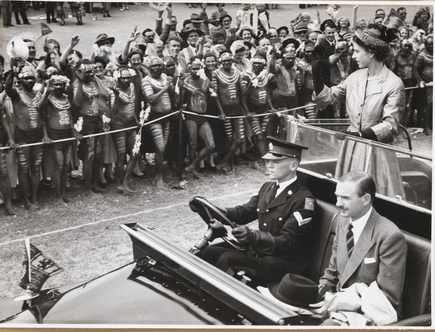
Queen Elizabeth waves to first nations people of the Northern Territory during her 1954 tour. Photo State Library of NSW collection

Source: https://pmtranscripts.pmc.gov.au/release/t...

Enjoyed this speech? Speakola is a labour of love and I’d be very grateful if you would share, tweet or like it. Thank you.

Facebook Twitter Facebook
In 1960-79 C Tags ROBERT MENZIES, QUEEN ELIZABETH II, WELCOME, PARLIAMENT, PARLIAMENTARY WELCOME, FLORID, MONARCHY, FAWNING, TRANSCRIPT, LIBERAL PARTY, LNP, REPULBICANISM, PRINE PHILLIP, ROYAL TOUR, 1963, 1960S
Comment
arthur calwell.jpg

Arthur Calwell: 'We oppose the Government’s decision to send 800 men to fight in Vietnam', Drum Beat speech - 1964

February 18, 2021

4 May 1965, Canberra, Australia

The great speechwriter, Graham Freudenberg, who wrote for Whitlam and Hawke, nominated this speech with Calwell as the best speech of his career.

The Government’s decision to send the First Battalion of the Australian Regular Army to Vietnam is, without question, one of the most significant events in the history of this Commonwealth. Why I believe this will be explained in the course of my speech. Therefore, it is a matter for regret that the Prime Minister’s announcement was made in the atmosphere that prevailed around the precincts of this Parliament last Thursday. When one recalls that even two hours before the Prime Minister rose to make his statement it was being said on his behalf that there was no certainty that any statement would be made at all, it can hardly be said that the Government’s handling of the matter was designed to inspire confidence or trust.

However, I do not wish to dwell on that unhappy episode. The matter before us is far too important to allow anything to obscure or confuse the basic issue before us. The over-riding issue which this Parliament has to deal with at all times is the nation’s security. All our words, all our policies, all our actions, must be judged ultimately by this one crucial test: What best promotes our national security, what best guarantees our national survival? It is this test which the Labor Party has applied to the Government’s decision. We have, of course, asked ourselves other related questions, but basically the issue remains one of Australia’s security. Therefore, on behalf of all my colleagues of Her Majesty’s Opposition, I say that we oppose the Government’s decision to send 800 men to fight in Vietnam. We oppose it firmly and completely.

We regret the necessity that has come about. We regret that as a result of the Government’s action it has come about. It is not our desire, when servicemen are about to be sent to distant battlefields, and when war, cruel, costly and interminable, stares us in the face, that the nation should be divided. But it is the Government which has brought this tragic situation about and we will not shirk our responsibilities in stating the views we think serve Australia best. Our responsibility, like that of the Government, is great but, come what may, we will do our duty as we see it and know it to be towards the people of Australia and our children’s children. Therefore, I say, we oppose this decision firmly and completely.

We do not think it is a wise decision. We do not think it is a timely decision. We do not think it is a right decision. We do not think it will help the fight against Communism. On the contrary, we believe it will harm that fight in the long term. We do not believe it will promote the welfare of the people of Vietnam. On the contrary, we believe it will prolong and deepen the suffering of that unhappy people so that Australia’s very name may become a term of reproach among them. We do not believe that it represents a wise or even intelligent response to the challenge of Chinese power. On the contrary, we believe it mistakes entirely the nature of that power, and that it materially assists China in her subversive aims. Indeed, we cannot conceive a decision by this Government more likely to promote the long term interests of China in Asia and the Pacific. We of the Labor Party do not believe that this decision serves, or is consistent with, the immediate strategic interests of Australia. On the contrary, we believe that, by sending one quarter of our pitifully small effective military strength to distant Vietnam, this Government dangerously denudes Australia and its immediate strategic environs of effective defence power. Thus, for all these and other reasons, we believe we have no choice but to oppose this decision in the name of Australia and of Australia’s security.

I propose to show that the Government’s decision rests on three false assumptions: An erroneous view of the nature of the war in Vietnam; a failure to understand the nature of the Communist challenge; and a false notion as to the interests of America and her allies. No debate on the Government’s decision can proceed, or even begin, unless we make an attempt to understand the nature of the war in Vietnam. Indeed, this is the crux of the matter; for unless we understand the nature of the war, we cannot understand what Australia’s correct role in it should be.

The Government takes the grotesquely over-simplified position that this is a straightforward case of aggression from North Vietnam against an independent South Vietnam. In the Government’s view, such internal subversion as there may be in South Vietnam is directed and operated from the North; that is to say, the Communist insurgents – the Vietcong – are merely the agents of the North, recruited in the North, trained in the North, instructed by the North, supplied from the North and infiltrated from the North.

The Government then takes this theory a little further by cleverly pointing to the undoubted fact that just as Communist North Vietnam lies north of South Vietnam, so Communist China lies north of North Vietnam. Thus, according to this simplified, not to say simple, theory, everything falls into place and the whole operation becomes, in the Prime Minister’s words ”part of a thrust by Communist China between the Indian and Pacific Oceans”. And by this reasoning, the very map of Asia itself becomes a kind of conspiracy of geography against Australia.

But is this picture of Chinese military aggression thrusting down inexorably through Indo China, Malaysia and Indonesia to Australia a true or realistic one? Does it state the true nature of the Chinese threat? Does it speak the truth of the actual situation in Vietnam? Does it tell the truth about the relation between China and North Vietnam? I believe it does not. I propose to show that it does not. If it is not true, then the Government is basing its entire policy on false premises, and I can imagine no greater threat to the security of this nation than that.

Let us first examine the case of South Vietnam itself. It is a gross and misleading over-simplification to depict this war in simple terms of military aggression from the North. That there has long been, and still is, aggression from the North and subversion inspired from the North, I do not for one moment deny. But the war in South Vietnam, the war to which we are sending this one battalion as a beginning in our commitment, is also a civil war and it is a guerrilla war. The great majority of the Vietcong are South Vietnamese. The object of the Vietcong in the war – this guerrilla war – is to avoid as far as possible direct entanglement with massed troops in order that by infiltration, subversion and terrorism, they may control villages, hamlets, outposts and small communities wherever these are most vulnerable. This, like all civil wars and all guerilla wars, has been accompanied by unusual savagery. This war has a savagery and a record of atrocities, with savage inhumanity daily perpetrated by both sides, all of its own. We cannot condemn the atrocities of the one without condemning those of the other. We of the Labor Party abhor and condemn both, as we condemn all atrocities. I repeat: The war in South Vietnam is a civil war, aided and abetted by the North Vietnamese Government, but neither created nor principally maintained by it. To call it simply “foreign aggression” as the Prime Minister does, and as his colleagues do, is to misrepresent the facts and, thereby, confuse the issue with which we must ultimately come to terms.

The people of Vietnam may, therefore, be divided into three kinds: Those who support the present Government and are actively anti-Communist; those who are Communist and of whom the Vietcong are actively and openly engaged in subversion; and those who are indifferent. I have not the slightest doubt that the overwhelming majority of the ordinary people of Vietnam fall into the last category. They watch uncomprehendingly the ebb and flow of this frightful war around them, and as each day threatens some new horror, they become even more uncomprehending. And because this is so, our policy of creating a democatic anti-Communist South Vietnam has failed. That failure can possibly be reversed, but it cannot be reversed by military means alone. Ten years ago, anti-Communism was fairly strong in Vietnam. For some years, the late President Ngo Dinh Diem did represent and organise resistance against Communism. When he had support, he was brought here, feted, and seated in honour on the very floor of this chamber. When his regime, becoming increasingly corrupt and irrelevant to the needs of the people, lost that support, he was murdered. Not a word of regret, of sorrow or sympathy was said by members of the Australian Government in memory of him whom they once hailed as the saviour of his country, though, indeed some of the Government extremist supporters outside this Parliament charged President Kennedy with having approved his murder, and Mr. Henry Cabot Lodge, among others, with actually planning it.

What support has the present Government, the eighth or ninth regime since the murder of Diem 18 months ago? It has no basis of popular support, It presumably has the support of the Army, or the ruling junta of the Army. It will fall and be replaced when it loses the support of the ruling junta, or when that junta itself is replaced by another. That has happened eight or nine times in the past year and a half. The Americans have supported four of the governments of South Vietnam and have opposed the other four. There is not one jot or tittle of evidence to support the belief that is being sedulously fostered in this country that the local population cares one iota whether it happens again eight or nine times in the coming 18 months. The Government of South Vietnam does not base itself on popular support. Yet this is the Government at whose request, and in whose support, we are to commit a battalion of Australian fighting men. And we are told we are doing this in the name of the free and independent Government and people of South Vietnam. I do not believe it, and neither does anybody else who considers the matter with any degree of intelligence.

The Prime Minister points to increasing support from North Vietnam as being a totally new factor in the situation. I agree that the pace of North Vietnamese aggression – and that is the only term for it – has increased, though estimates as to its extent vary considerably. The Prime Minister speaks of 10,000 infiltrators last year. The American White Paper on the subject put the figure at 4,000-odd certain, and 3,000 more estimated – at the outside 7,300. And yet I am bound to say that the evidence of that White Paper does not seem to bear out its own assertions. The thesis of the White Paper was that the war in Vietnam could be fully explained in terms of Northern aggression. Yet the report of the International Control Commission, quoted in the White Paper, listed, as having been captured from the Vietcong between 1962 and 1964, three rifles of Chinese origin, 46 of Russian origin, 40 sub-machine guns and 26 rifles of Czech origin, and 26 weapons of all kinds of North Vietnamese origin. Other weapons are in proportion. All this for a force of some estimated 100,000 men who have waged war successfully for years against 500,000 troops.

Now this does not seem to me to support the theory that in past years the efforts of the Vietcong were mainly dependent on supplies from the North. And even if we accept the view that Northern support has substantially increased in recent months, it cannot lend any credence to the belief that the Vietcong effort will collapse if this new, increased support is cut off. The more the Government relies on the theory of increased Northern support, as a basis for its actions, the more difficulty it must have in explaining away the successes of the Vietcong in the past when, as it maintains, Northern support was comparatively small. If it believes that it is simply a question of aggression from the North, and that all will be solved when that aggression is stopped, then it is deluding itself, and is trying to delude the Australian people as well.

Against the background of these facts, we can judge the true significance of the Australian commitment. The Government will try, indeed it has already tried, to project a picture in which once the aggressive invaders from the North are halted, our men will be engaged in the exercise of picking off the Vietcong, themselves invaders from the North and stranded from their bases and isolated from their supplies. But it will not be like that at all. Our men will be fighting the largely indigenous Vietcong in their own home territory. They will be fighting in the midst of a largely indifferent, if not resentful, and frightened population. They will be fighting at the request of, and in support, and presumably, under the direction of an unstable, inefficient, partially corrupt military regime which lacks even the semblance of being, or becoming, democratically based. But, it will be said, even if this is true, that there are far larger considerations. China must be stopped, the United States must not be humiliated in Asia. I agree wholeheartedly with both those propositions.

But this also I must say: Our present course is playing right into China’s hands, and our present policy will, if not changed, surely and inexorably lead to American humiliation in Asia. Communist China will use every means at her disposal to increase her power and influence. But her existing military machine is not well adapted to that objective. It is not so at this moment and it may not be so for the next ten years. Therefore, she chooses other means. Yet we have preferred to look at China mainly in terms of a military threat and thus have neglected to use other, far more effective weapons at our disposal, or, because of our preoccupation with the military threat, we have used those weapons badly and clumsily. We talk about the lesson of Munich as if we had never learnt a single lesson since 1938.

Preoccupied with the fear of a military Munich, we have suffered a score of moral Dunkirks. Preoccupied with the military threat of Chinese Communism, we have channelled the great bulk of our aid to Asia towards military expenditure. Preoccupied with the idea of monolithic, imperialistic Communism, we have channelled our support to those military regimes which were loudest in their professions of anti-Communism, no matter how reactionary, unpopular or corrupt they may have been. Preoccupied with fear of Communist revolution, we have supported and sought to support those who would prevent any sort of revolution, even when inevitable; and even when most needful. Preoccupied with so-called Western interests, we have never successfully supported nationalism as the mighty force it is against Communism. We have supported nationalism only when it supported the West, and we have thereby pushed nationalism towards Communism. Preoccupied with the universality of our own Christian beliefs, we have never tried to understand the power of the other great world religions against Communism.

Each of those preoccupations has worked for our defeat in Vietnam, and is working for our defeat in Asia, Africa and South America. And herein lies one of the greatest dangers of the Government’s decision on large-scale military commitments. It blinds and obscures the real nature of the problem of Communist expansion. It lends support and encouragement to those who see the problem in purely military terms, and whose policies would, if ever adopted, lead to disaster. Here is the real risk of the world nuclear war feared by the Minister for External Affairs (Mr. Hasluck). In his speech to the South East Asia Treaty Organisation yesterday he said the third world war could break out tomorrow in South Vietnam. If the idea of military containment is unsuccessful, as I believe it will surely prove in the long term, as it has already in the short term, it will contribute to that spirit of defeatism and impotence in the face of Communism. That is the greatest enemy we have to fear.

We are not impotent in the fight against Communism. We are not powerless against China, if we realise that the true nature of the threat from China is not military invasion but political subversion. And that threat, if we believe for one moment in our own professions, and in our own principles, we can fight and beat. But to exhaust our resources in the bottomless pit of jungle warfare, in a war in which we have not even defined our purpose honestly, or explained what we would accept as victory, is the very height of folly and the very depths of despair.

Humiliation for America could come in one of two ways – either by outright defeat, which is unlikely, or by her becoming interminably bogged down in the awful morass of this war, as France was for ten years. That situation would in turn lead to one of two things – withdrawal through despair, or all out war, through despair. Both these would be equally disastrous. What would be the objective of an all out war? It could only be the destruction of the North Vietnamese regime. And what would that create? It would create a vacuum. America can destroy the regime, but it cannot conquer and hold North Vietnam, and into that vacuum China would undoubtedly move. Thus, if that happened, we would have replaced a nationalistic communist regime – in a country with a thousand years history of hostility towards China – with actual Chinese occupation, and either we would have to accept this disaster or face the even greater disaster of all out war with China.

This is the terrible prospect which people like the Prime Minister of Britain, the Secretary General of the United Nations, the Prime Minister of Canada and Pope Paul have seen, and which they are trying to avert. They all are true friends of the United States of America, and they do not want to see America humiliated. That is why they have called for negotiations – negotiations while the United States remains in a position of comparative strength, negotiations while she is in a position to influence terms. Yet at the very time when the great weight of Western opinion calls for a pause, Australia says there must be no pause for reflection, no pause for reconsideration. The role of Australia should have been to support the call for negotiations and help those who were working towards them. Nobody underestimates the difficulties and dangers of negotiation. That is why we understood and sympathised with American efforts to secure a stronger base for negotiations.

By its decision, the Australian Government has withdrawn unilaterally from the ranks of the negotiators, if indeed it was ever concerned about them. Our contribution will be negligible, militarily. But we have reduced ourselves to impotence in the field of diplomacy. We should have been active in the field of diplomacy for a long time. But we have done nothing in that field of affairs. It is true that President Johnson’s cautious call for ” unconditional negotiations ” at Baltimore has been rejected by Hanoi and Peking. But if we accept the Prime Minister’s assurance that the decision to send a battalion to Vietnam was taken “several weeks ago “, then that rejection had nothing to do with the Government’s decision. For on the Prime Minister’s own claim, the decision was made before both the President’s offer and its rejection by the Communists.

This goes far to explain the Prime Minister’s abrupt and brutal denunciation of the principle of negotiations three weeks ago. It explains his elaborate attempts to refute the bishops. Australia’s aim should have been to help end the war, not to extend it. We have now lost all power to help end it. Instead, we have declared our intention to extend it, insofar as lies in our power. We have committed ourselves to the propositions that Communism can be defeated by military means alone and that it is the function of European troops to impose the will of the West upon Asia. These are dangerous, delusive and disastrous propositions. The Prime Minister pays lip service to President Johnson’s call for a massive aid programme, financed by all the industrialised nations, including the Union of Soviet Socialist Republics. But it is clear that the right honorable gentleman’s real thinking, and that of his Government, run only along the narrow groove of a military response.

The dispatch of a battalion of Australian troops to South Vietnam is the outcome of that thinking. By this decision, we set our face towards war as the correct means of opposing Communism, and declare against the social, economic and political revolution that alone can effectively combat Communism. The key to the future of IndoChina is the Mekong River delta and valley. The Communists understand this well. But imagine the thundering reply we could give to Communism if, under the auspices of the United Nations, we were to join in a vastly increased programme for the reclamation and development of the Mekong. The work has started, and it goes on, despite the war. But how much more could be done if we were really determined to turn our resources from war to peace. This surely is the key to the door of hope which President Johnson spoke of in his Baltimore speech. But this Government has closed the door and thrown away the key.

I cannot refrain from making an observation about Australia’s trade with China. It is obvious that the Government’s decision, and particularly the grounds upon which the Government justifies its decision, raise in a particularly acute form the moral issue connected with this trade. The Government justifies its action on the ground of Chinese expansionist aggression. And yet this same Government is willing to continue and expand trade in strategic materials with China. We are selling wheat, wool and steel to China. The wheat is used to feed the armies of China. The wool is used to clothe the armies of China. The steel is used to equip the armies of China. Yet the Government which is willing to encourage this trade is the same Government which now sends Australian troops, in the words of the Prime Minister, to prevent ” the downward thrust of China “. The Government may be able to square its conscience on this matter, but this is logically and morally impossible.

Finally, there is the question of Australia’s immediate strategic concern. It is only a few weeks since both the Prime Minister and the Minister for External Affairs spoke of the need for priorities, and they both made it plain that our first priority was the defence of Malaysia. A short time ago, the Government informed the United Kingdom and the Malaysian Governments that it was not possible to spare another battalion from our already strained resources. Now they have found a battalion for service in Vietnam. Thus, our troops are involved on several fronts. We are the only country in the world fighting on two fronts in South East Asia. America is committed to Vietnam. Britain is committed to Malaysia. Australia, with its limited resources, with its meagre defences, has obligations in Vietnam, Malaya, Borneo and New Guinea. The commitments are apparently without end, in size and in number.

How long will it be before we are drawing upon our conscript youth to service these growing and endless requirements? Does the Government now say that conscripts will not be sent? If so, has it completely forgotten what it said about conscription last year? The basis of that decision was that the new conscripts would be completely integrated in the Regular Army. The voluntary system was brought abruptly to an end. If the Government now says that conscripts will not be sent, this means that the 1st Battalion is never to be reinforced, replaced or replenished. If this is not so, then the Government must have a new policy on the use of conscripts – a policy not yet announced. Or, if it has not changed its policy, the Government means that the 1st Battalion is not to be reinforced, replaced or replenished from the resources of the existing Regular Army. Which is it to be? There is now a commitment of 800. As the war drags on, who is to say that this will not rise to 8,000, and that these will not be drawn from our voteless, conscripted 20 year olds? And where are the troops from America’s other allies? It is plain that Britain, Canada, France, Germany and Japan, for example, do not see things with the clear-cut precision of the Australian Government.

I cannot close without addressing a word directly to our fighting men who are now by this decision, committed to the chances of war: Our hearts and prayers are with you. Our minds and reason cannot support those who have made the decision to send you to this war, and we shall do our best to have that decision reversed. But we shall do our duty to the utmost in supporting you to do your duty. In terms of everything that an army in the field requires, we shall never deny you the aid and support that it is your right to expect in the service of your country. To the members of the Government, I say only this: If, by the process of misrepresentation of our motives, in which you are so expert, you try to further divide this nation for political purposes, yours will be a dreadful responsibility, and you will have taken a course which you will live to regret.

And may I, through you, Mr. Speaker, address this message to the members of my own Party – my colleagues here in this Parliament, and that vast band of Labor men and women outside: The course we have agreed to take today is fraught with difficulty. I cannot promise you that easy popularity can be bought in times like these; nor are we looking for it. We are doing our duty as we see it. When the drums beat and the trumpets sound, the voice of reason and right can be heard in the land only with difficulty. But if we are to have the courage of our convictions, then we must do our best to make that voice heard. I offer you the probability that you will be traduced, that your motives will be misrepresented, that your patriotism will be impugned, that your courage will be called into question. But I also offer you the sure and certain knowledge that we will be vindicated; that generations to come will record with gratitude that when a reckless Government willfully endangered the security of this nation, the voice of the Australian Labor Party was heard, strong and clear, on the side of sanity and in the cause of humanity, and in the interests of Australia’s security.

Let me sum up. We believe that America must not be humiliated and must not be forced to withdraw. But we are convinced that sooner or later the dispute in Vietnam must be settled through the councils of the United Nations. If it is necessary to back with a peace force the authority of the United Nations, we would support Australian participation to the hilt. But we believe that the military involvement in the present form decided on by the Australian Government represents a threat to Australia’s standing in Asia, to our power for good in Asia and above all to the security of this nation.

Source: https://australianpolitics.com/1965/05/04/...

Enjoyed this speech? Speakola is a labour of love and I’d be very grateful if you would share, tweet or like it. Thank you.

Facebook Twitter Facebook
In 1960-79 C Tags ARTHUR CALWELL, TRANSCRIPT, DRUM BEAT SPEECH, VIETNAM WAR, AUSTRALIAN TROOPS, CONSCRIPTION, SOUTH EAST ASIA, CHINA, COMMUNISM, DOMINIO THEORY, ROBERT MENZIES, LABOR PARTY
Comment

Robert Menzies: 'The battle for freedom', Thomas Jefferson Oration - 1963

March 28, 2018

4 July 1963, Monticello, Charlottesville, Virginia, USA

It is a rare privelege for the Prime Minister of a nation of something under eleven millions of people to be invited be invited to speak, in the United States of America, on a day which commemorates the Declaration of Independence and, 50 years later, the death of its draftsman, Thomas Jefferson.

Yet I take comfort from the fact that, when Thomas Jefferson became President of the United States, he presided over the destiny of a nation with only half of the present population of Australia. Yet he is immortal, and his work endures.

There is nothing more stimulating than to recall that the American Colonies, as they moved into independence through blood and revolution and much suffering, and encountered the immense practical problems of fashioning a system of self-government, had in their service a group of men so superbly talented as Washington, Jefferson, Hamilton, Madison, John Marshall, and their great contemporaries. They did not all think the same way, but each was remarkable. These names, after a lapse of time of a century and a half, remain familiar to millions of people with even a superficial knowledge of political and constitutional ' history.
 

But it is important to recall that men of great talent who embark upon the stormy seas of public affairs, and particularly those who achieve posts of leadership and responsibility, will frequently be over-praised by their friends and overattacked by their opponents. For the arts of propaganda are not of modern invention. They were in a flourishing state in the United States of America and elsewhere in the first quarter of the nineteenth century, and -have been practised ever since.
 

The great trouble about all contemporary propaganda is that it tends to create a false dichotomy. The people under discussion are, so we are -asked to believe, all pure and shining, or wicked and worthless. This is, of course, absurd. History, we hope, sorts these things out and finds an immense variety of shades of grey.
 

The art of politics, and the ' history of politicians illustrate this simple truth. For, in spite of people of allegedly superior and independent mind, politics derives its vigour from partisanship and partisans. The only non-party system of government is a dictatorship. But one by-product of the party system is that if we come into a long era of Tory domination, the names of former great
 

Whigs become dimmed. And vice versa. The great name of Thomas Jefferson has experienced these " whirligigs of time." Greatly admired in the formative years of the United States, draftsman of -the Declaration of Independence, George Washington's first Secretary of State, Vice-President, President for two terms, his career as a statesman was a formidable and glittering one.
 

Add to this his astonishing attainments as a scholar, a lawyer, a farmer, an architectural designer and you ' have a man not easily to -be surpassed in any country or at any time. I love the remark attributed to President Kennedy at a ' White House dinner for a notable group of guests. " I think this is the most extraordinary collection of talent, of human knowledge, that has ever been gathered together at the White House-with the possible exception of when Thomas Jefferson dined alone."
 

Yet when his political opponents had achieved their turn of office, a turn which lasted a long time, the name of Jefferson appears to have suffered an eclipse. It was not until the twentieth century that a suitable memorial was erected to him in Washington, and Monticello re-purchased and preserved.

I do not profess to understand with any precision the philosophical differences between your Democrats and Republicans of today. I suspect that your party lines are not so sharply drawn as ours are in Australia, where, as Winston Churchill once said, we " conduct our political battles with a fine eighteenth century vigor." The currents of your history -have buffeted your parties so much that no outsider could hope to trace the ' history of one party and find in it complete consistency or continuity. I am convinced that you have had great leaders of one paty who, generations later, might have proved to be leaders of another.


This is, of course, inevitable in any changing world or progressive society. Yet certain beliefs have an enduring validity. This,. indeed, is the secret of Thomas Jefferson's immortality. He believed in the importance of the persistent search for truth, and therefore in the liberty of the mind. But the liberty of the mind which he sought was something which was to be enjoyed by the well-furnished mind. It has never occurred to me that he believed in the appeal from Philip Sober to Philip Drunk. He had disciplined his own mind by the most amazing intellectual training. He was equipped for freedom. Hewanted others to be so. His founding of the University of Virginia was in reality his testimony to this truth; a democracy, to be effective, must be educated. Looking at the matter in the light of my own extensive experience in my own country, I would be disposed ( if, in this famous place, this. is not a species of blasphemy!) to think that Alexander Hamilton and his " Federalist" colleagues were right in attaching great importance to the creation of a powerful national administration and authority.


I am even imprudent enough -to think that many of today's Democrats have a not dissimilar view. But Mr. Jefferson was strong against tyranny or the means of creating it. To him individual liberty was the vital essence. American history has reconciled both conceptions. For it has been your glorious destiny, notably in the turbulent years of the twentieth century, to evolve a system in which national power has grown on the basis of a passionate and Jeffersonian belief in individual
freedom.
 

The Communist powers, who have created a ruthless imperialism of their own, to the acute discomfort of their neighbours, have, for diversionary reasons of their own, painted a picture of " American imperialism." It is therefore important to recall, and to emphasise, that the interventions of the United States in world affairs have been directed, not to territorial expansion, but to the achievement and preservation of individual liberty in far-away countries where that liberty is threatened.
 

Throughout the whole of my adult life, the great ideological conflict in the world has been -between those who believe that the national power of governments is something granted by free people to their political rulers, and those who believe in the all-powerful State which concedes to its citizens such freedoms as it thinks fit.
 

Well before the Declaration of Independence, Jefferson himself had resolved the matter in classical terms:-' These are our grievances, which we have thus laid before His Majesty, with that freedom of language and sentiment which becomes a free people, claiming their rights as derived from the laws of nature, and not as the gift of their chief magistrate."


This truth is, of course to us " self-evident," so that we find it difficult to realise that so many hundreds of millions of people either reject it or are unaware of it. Yet it is important that we should arrive at a clear realisation of the facts.
 

We are all a little disposed, when interesting ourselves in the emerging independence of some former colony, to think that democracy can be successfully transplanted in a comparatively brief time.
We are so utterly familiar with what I will call " parliamentary self-government" that we somehow forget that it has been a thing of slow and sometimes painful growth; that it has come from below, and not from above. You cannot create a democracy as quickly as you can create independence.
 

There are still too many influential people who forget that the granting of political independence is not an end in itself. It is, indeed, a beginning, just as capable of producing a new tyranny as it is of producing an independent community of free men. Indeed, we all know of more than one case in which independence has been followed by either chaos or something singularly like dictatorship.
 

There are lessons here for all of us. You are Americans. You detest colonialism because, to you, it connotes subordination. Whenever you see some surviving colony, somewhere, you are eager to make it independent. But it is a mistake to underestimate two factors.
 

The first is that a modern and intelligent colonial powerlike Australia in respect of our Papua and New Guinea territory-while aiming at complete independence as the goal,realises that the process of fitting native inhabitants for self rule must be relatively slow if it is to be relatively sure. We
know a good deal about this territory, with its confusion of tribes and languages, its rugged mountains, its towns in which the Papuans are comparatively advanced in civilisation, its remote valleys and jungles in which sheer savagery survives.


When well-meaning people tell us that we should create complete political independence in one blow by the simple process of creating a popular Assembly and arming it with full powers, we marvel that they should think self-government so artificial and so easy.
 

This does not mean that we favour dilatory tactics; freedom is too precious a thing for mankind to be wantonly denied. But the best guarantee of individual freedom is the existence of a community so constructed that freedom is its daily guide. The building of such a structure, starting with the foundations and not with the roof, takes time and conscious effort. I repeat, in a slightly different way, that you cannot endow a country with democracy as simply as you can endow it with money or goods.
 

I am saying these things because I think that we are all in danger of considering our international relations in too limited a way. The great issues of peace or war, of armaments and alliances, remain paramount so long as we live in a world in which aggressors multiply and are strong.
 

The great issues of trade, to which we are all currently directing much attention, have all the complexities which are inevitable when legitimate national interests have to be reconciled with the clear need for growing markets and rising productionin a world whose population is increasing at an almost bewildering rate. But are we yet doing enough to increase our knowledge of other peoples, or their knowledge of us?
 

If, as Mr. Jefferson did, we believe that an informed democracy is the greatest and most humane system of government ever devised; that it elevates and enfranchises the individual citizen; that it reconciles some demagogery with much dignity; are we doing enough to make it understood by other nations and peoples? Are we, perhaps, too negative in our democratic faith, defending it against aggression from outside, but not doing enough -to preach its gospel abroad? What
would Mr. Jefferson do and say if he could revisit us and look out upon this new world? For freedom was his burning faith.

It was not something just for the study or for reflection. It was a faith to be practised, but it was also a faith to be preached. For Mr. Jefferson was a vastly civilised man, with the roots of his learning and philosophy deep in the soil of the old world. Virginia itself was a characteristically English community
 

in many essentials. The colonies themselves felt no sense of quarrel with the people of Britain. Yet, when the need arose, they took up arms and by declaration, severed their ties with their mother country. Here was no war for territory. Here, indeed, was no ideological war in the sense in which we now understand that expression. It was simply a battle for freedom, fought in fact against an unimaginative government in London and British soldiers and mercenaries in America, though in form, ( ironically enough) against -the people of Britain, whose record in the achievement and defence of freedom was and is so long and honourable.
 

This is one of the paradoxes of history, but, in the result, a happy one. For, just as ' the issue of the War of Independence was freedom, so was freedom the result, exalted in the minds of the colonists and destined to give character and direction to their later national history.
You are today doing great honour to an Australian. May I, therefore, say something about my own country and yours? Australia has, I need hardly say, many points of contact and understanding with the United States. It is the fashion among a few cynical observers to treat our friendly attachment to your country as a sort of " cupboard love," based upon self interest in a dangerous world. This is a superficial view, for at least three reasons.

When Britain's colonial adventure in America ended in 1782 with the birth of a new nation, Captain Cook had already explored and reported upon the East Coast of Australia, but there had been no white settlement. It -had been the practise in Britain in the 18th century to transport to -the colonies large numbers of persons convicted of offences (many of them very trivial) against the law. Between 1717 and the War of Independence the historian records that some 50,000 English convicts were received into America. But this had now ceased. Where could such people be sent in future? The choice ultimately fell on Australia, the particular site chosen being Botany Bay, just south of
Sydney. A fler under Captain Phillip arrived at Botany Bay in 1788, and the modern history of Australia began The first settlers were convicts and their custodians. In short, a colony began in my own country just after and because colonialism ended in America.
 

When people in England make jesting remarks to me about these lowly origins of our now thriving and law-abiding Commonwealth, I make the good-natured retort that, though many thousands of convicted persons were sent to America, and many thousands to Australia, -the records show -that the great majority of persons convicted in England during the transportation era remained in England.
 

The whole point I make is that, though nobody could have foreseen it at the rime, your War of Independence created as it turned out, two nations; one your own, the other Australia. When, at the close of the 19th century, the Australian colonies decided to federate and become one nation, it was to -the Constitution of the United States that the draftsmen of the Australian Constitution turned
for light and leading. During the months and years in which some of the best political and legal thinkers in Australia were engaged in the work of drafting, the Constitution of the United States of America was never far away from hand. In the great Convention Debates, the decisions of the United States Supreme Court were extensively cited. True, your Union had grown out of armed conflict; ours came more peacefully, by reason and argument, the gradual persuading of self-governing colonies, each with a well-defined local pride, that a national existence should be achieved. It came about that the Australian distribution of legislative powers between Commonwealth and States is much like your own. The separation of powers, legislative, executive and judicial, though not, perhaps, such a high matter of doctrifle as with you, still makes its impact upon judicial decisions.

Your founders were, of course, much influenced by the great French commentators upon a British C6nstitution which in a real sense had no existence. And so, for example, your Executive does not sir in Congress or, in a direct sense, answer -to it. But we inherited, and bad long practised, responsible Cabinet government, with Ministers sitting in Parliament and answering to it and, from time to time, being put out of office by it. It is this fact which gives a special colour to the Australian Constitution, and provides an underlying difference partly concealed by remarkable similarities of form.
 

In my hey-day at the Bar of -the High Court of Australia in constitutional cases, it was still the practise to make much reference to the currents of American judicial opinion, currents, may I say, in which backeddies have occasionally occurred, but the main stream of which, as in Australia, has moved towards an enlarging interpretation of national powers. We may not always like this if we believe in a federal and not a unitary system of government and see, as Mr. Jefferson did, some guarantee of individual liberty in a division of governmental powers. But there has been, particularly in times of national emergency or strain, a real value in a Constitution which can be applied to new circumstances without crippling rigidity.


But 1 grow tedious. All I really wanted to say was that, if the na-mes of your great founders and brilliant political philosophers are familiar in Australian minds and mouths, it is largely because our constinutional history -has been profoundly influenced by your own. A Jefferson memorial would not be out of place in Canberra.

My third reason has, I believe, a fine Jeffersonian ring. For I feel sure' that Mr. Jefferson, though he worked primarily for the liberty of Americans and felt no call to impose his views on an older world, would, confronted by the -problems of the modern world, have vastly approved the world defence of individual liberty, a defence in which the U. S. A. is playing such a splendid and vital part.
 

Australia has a deep feeling for your country, not just because your friendship contributes so greatly to our national security, but basically because, great or small, we work for the same kind of free world. The freedom of man is not a local perquisite and cannot be defended in isolation. There can be no better place than Monticello in which to remind ourselves of this great, though occasionally forgotten, truth.

 

Source: https://pmtranscripts.pmc.gov.au/release/t...

Enjoyed this speech? Speakola is a labour of love and I’d be very grateful if you would share, tweet or like it. Thank you.

Facebook Twitter Facebook
In 1960-79 B Tags ROBERT MENZIES, PRIME MINISTER, THOMAS JEFFERSON ORATION, TRANSCRIPT
Comment

See my film!

Limited Australian Season

March 2025

Details and ticket bookings at

angeandtheboss.com

Support Speakola

Hi speech lovers,
With costs of hosting website and podcast, this labour of love has become a difficult financial proposition in recent times. If you can afford a donation, it will help Speakola survive and prosper.

Best wishes,
Tony Wilson.

Become a Patron!

Learn more about supporting Speakola.

Featured political

Featured
Jon Stewart: "They responded in five seconds", 9-11 first responders, Address to Congress - 2019
Jacinda Ardern: 'They were New Zealanders. They are us', Address to Parliament following Christchurch massacre - 2019
Dolores Ibárruri: "¡No Pasarán!, They shall not pass!', Defense of 2nd Spanish Republic - 1936
Jimmy Reid: 'A rat race is for rats. We're not rats', Rectorial address, Glasgow University - 1972

Featured eulogies

Featured
For Geoffrey Tozer: 'I have to say we all let him down', by Paul Keating - 2009
for James Baldwin: 'Jimmy. You crowned us', by Toni Morrison - 1988
for Michael Gordon: '13 days ago my Dad’s big, beautiful, generous heart suddenly stopped beating', by Scott and Sarah Gordon - 2018

Featured commencement

Featured
Tara Westover: 'Your avatar isn't real, it isn't terribly far from a lie', The Un-Instagrammable Self, Northeastern University - 2019
Tim Minchin: 'Being an artist requires massive reserves of self-belief', WAAPA - 2019
Atul Gawande: 'Curiosity and What Equality Really Means', UCLA Medical School - 2018
Abby Wambach: 'We are the wolves', Barnard College - 2018
Eric Idle: 'America is 300 million people all walking in the same direction, singing 'I Did It My Way'', Whitman College - 2013
Shirley Chisholm: ;America has gone to sleep', Greenfield High School - 1983

Featured sport

Featured
Joe Marler: 'Get back on the horse', Harlequins v Bath pre game interview - 2019
Ray Lewis : 'The greatest pain of my life is the reason I'm standing here today', 52 Cards -
Mel Jones: 'If she was Bradman on the field, she was definitely Keith Miller off the field', Betty Wilson's induction into Australian Cricket Hall of Fame - 2017
Jeff Thomson: 'It’s all those people that help you as kids', Hall of Fame - 2016

Fresh Tweets


Featured weddings

Featured
Dan Angelucci: 'The Best (Best Man) Speech of all time', for Don and Katherine - 2019
Hallerman Sisters: 'Oh sister now we have to let you gooooo!' for Caitlin & Johnny - 2015
Korey Soderman (via Kyle): 'All our lives I have used my voice to help Korey express his thoughts, so today, like always, I will be my brother’s voice' for Kyle and Jess - 2014

Featured Arts

Featured
Bruce Springsteen: 'They're keepers of some of the most beautiful sonic architecture in rock and roll', Induction U2 into Rock Hall of Fame - 2005
Olivia Colman: 'Done that bit. I think I have done that bit', BAFTA acceptance, Leading Actress - 2019
Axel Scheffler: 'The book wasn't called 'No Room on the Broom!', Illustrator of the Year, British Book Awards - 2018
Tina Fey: 'Only in comedy is an obedient white girl from the suburbs a diversity candidate', Kennedy Center Mark Twain Award -  2010
Tina Fey: 'Only in comedy is an obedient white girl from the suburbs a diversity candidate', Kennedy Center Mark Twain Award - 2010

Featured Debates

Featured
Sacha Baron Cohen: 'Just think what Goebbels might have done with Facebook', Anti Defamation League Leadership Award - 2019
Greta Thunberg: 'How dare you', UN Climate Action Summit - 2019
Charlie Munger: 'The Psychology of Human Misjudgment', Harvard University - 1995
Lawrence O'Donnell: 'The original sin of this country is that we invaders shot and murdered our way across the land killing every Native American that we could', The Last Word, 'Dakota' - 2016