• Genre
  • About
  • Submissions
  • Donate
  • Search
Menu

Speakola

All Speeches Great and Small
  • Genre
  • About
  • Submissions
  • Donate
  • Search
Share a political speech

Bernie Sanders: 'Political violence is political cowardice', Response to murder of Charlie Kirk - 2025

September 12, 2025

11 September 2025, Vermont, USA

I want to say a few words regarding the terrible murder yesterday of Charlie Kirk — someone whom I strongly disagreed with on almost every issue but who was clearly a very smart and effective communicator and organizer — and someone unafraid to get out into the world and engage the public. My condolences go out to his wife and family. 

A free and democratic society, which is what America is supposed to be about, depends upon the basic premise that people can speak out, organize and take part in public life without fear — without worrying that they might be killed, injured or humiliated for expressing their political views. In fact, that is the essence of what freedom is about and what democracy is about. You have a point of view, that’s great. I have a point of view that is different than yours, that’s great. Let’s argue it out. We make our case to the American people at the local, state and federal level, and we hold free elections in which the people decide what they want. That’s called freedom and democracy. And I want as many people as possible to participate in that process without fear. 

Freedom and democracy is not about political violence. It is not about assassinating public officials. It is not about trying to intimidate people who speak out on an issue. Political violence, in fact, is political cowardice. It means that you cannot convince people of the correctness of your ideas, and you have to impose them through force. Every American, no matter what one’s political point of view may be, must condemn all forms of political violence and all forms of intimidation. We must welcome and respect dissenting points of view. That’s what our Constitution is about. That’s what our Bill of Rights is about. That, in fact, is what freedom is about. 

The murder of Charlie Kirk is part of a disturbing rise in political violence that threatens to hollow out public life and make people afraid of participating. From the January 6, 2021, attack on the United States Capitol, to the attempted assassination of Donald Trump, to the attack on Paul Pelosi, to the attempted kidnapping of Michigan Governor Gretchen Whitmer, to the murder of Minnesota Speaker of the House Melissa Hortman and her husband, to the arson attack on Pennsylvania Governor Josh Shapiro, to the shooting of UnitedHealth executive Brian Thompson and the shooting several years ago of Rep. Steve Scalise, this chilling rise in violence has targeted public figures across the political spectrum. 

Sadly, this is not a new phenomenon. We all remember the assassinations of President John F. Kennedy, Dr. Martin Luther King, Jr., Senator Robert F. Kennedy, John Lennon, Medgar Evers and the attempted assassinations of President Ronald Reagan and Alabama Governor George Wallace. 

This is a difficult and contentious moment in American history. Democracy in our country and throughout the world is under attack. And there are a lot of reasons for that, which need serious discussion. But, bottom line: If we honestly believe in democracy, if we believe in freedom, all of us must be loud and clear. Political violence, regardless of ideology, is not the answer and must be condemned.

Source: https://www.sanders.senate.gov/press-relea...

Enjoyed this speech? Speakola is a labour of love and I’d be very grateful if you would share, tweet or like it. Thank you.

Facebook Twitter Facebook
In 2020-29 B Tags BERNIE SANDERS, SENATOR SANDERS, CHARLIE KIRK, ASSASSINATION, JFK, RFK, MLK, VIOLENCE, POLITICAL VIOLENCE, TRANSCRIPT, 2020s, 2025
Comment

Robert Menzies: 'Young vigorous, extremely able, full of courage, full of character', .reaction to the death of President Kennedy - 1963

March 28, 2022

23 November 1963, Canberra, Australia

Ladies and gentlemen, we've had terrible news today. The assassination of President Kennedy. This is of course a tremendous tragedy for the United States of America. It's a tremendous tragedy in my opinion for the world. And of course, what it can mean in terms of horror and tragedy for Mrs. Kennedy, we may only imagine.

President Kennedy was a very remarkable man, young vigorous, extremely able, full of courage, full of character. I saw a good deal of him in a limited period of time over the last three years. And I came to admire him tremendously.

And I'm sure you did, because he did give to the western world another source of strength in powerful leadership determination. You look back not so very long ago to the time he confronted the Soviet Union over Cuba and produced from them an agreement to withdraw Soviet arms and troops from Cuba.

This was of tremendous importance for the free world. I believe it was one of the turning points in recent history. What will happen now? I don't know. All I know is that it will take some time for the new president to settle in, so to speak. And it will be some time before we forget how tremendously indebted the free world has been to John Kennedy and the work that he did.

I do hope that the dangers of the world will not be too much increased by this horrible event. That they will be somewhat increased, I'm afraid I have no doubt. We would like all of us, wouldn't we, to send our sympathy to Mrs. Kennedy and her family, and to the American as a whole.

Enjoyed this speech? Speakola is a labour of love and I’d be very grateful if you would share, tweet or like it. Thank you.

Facebook Twitter Facebook
In 1960-79 C Tags ROBERT MENZIES, SIR ROBERT MENZIES, JOHN KENNEDY, JFK, ASSASSINATION, KENNEDY ASSASSINATION, TRANSCRIPT, DEATH, TRIBUTE, TELEVISED ADDRESS, ADDRESS TO NATION, ADDRESS TO THE NATION, AUSTRALIA, CANBERRA, 1960s, 1963, TRAGEDY, LEE HARVEY OSWALD
Comment

Lyndon B. Johnson: 'We have suffered a loss that cannot be weighed', First speech as President - 1963

November 12, 2019

22 November 1963, USA

This is a sad time for all people.
We have suffered a loss that cannot be weighed.
For me it is a deep personal tragedy.
I know that the world shares the sorrow that Mrs Kennedy and her family bear
I will do my best. That is all I can do.
I ask for your help, and God’s.

Enjoyed this speech? Speakola is a labour of love and I’d be very grateful if you would share, tweet or like it. Thank you.

Facebook Twitter Facebook
In 1960-79 C Tags lbj, LYNDON B JOHNSON, LBJ, TRANSCRIPT, JOHN F KENNEDY, ASSASSINATION, REACTION, VICE PRESIDENT, PRESIDENT
Comment

Lester Pearson: 'It was death on duty', Death of President Kennedy - 1963

October 22, 2019

22 November 1963, Ottawa, Canada

The world can ill afford his loss. That loss through assassination is one of the great tragedies of history. But for us, now, it is something more. It is a great heart-breaking personal tragedy. And there are millions of people tonight who throughout the world will feel that they have lost a friend. President Kennedy was young. He was a man of courage in war and in peace. He devoted himself to public service. He worked unselfishly for the public good as he saw it. He has paid for his public service with his life. For the president it was death on duty. When a free man falls courageously in action, all freedom grieves, but courage is made easier for others...

Source: https://www.youtube.com/watch?v=SeUKJJGoPF...

Enjoyed this speech? Speakola is a labour of love and I’d be very grateful if you would share, tweet or like it. Thank you.

Facebook Twitter Facebook
In 1960-79 C Tags LESTER PEARSON, PRIME MINISTER, LIBERAL PARTY, TRANSCRIPT, DEATH ON DUTY, JFK, ASSASSINATION, JOHN F KENNEDY, KENNEDY ASSASSINATION
Comment
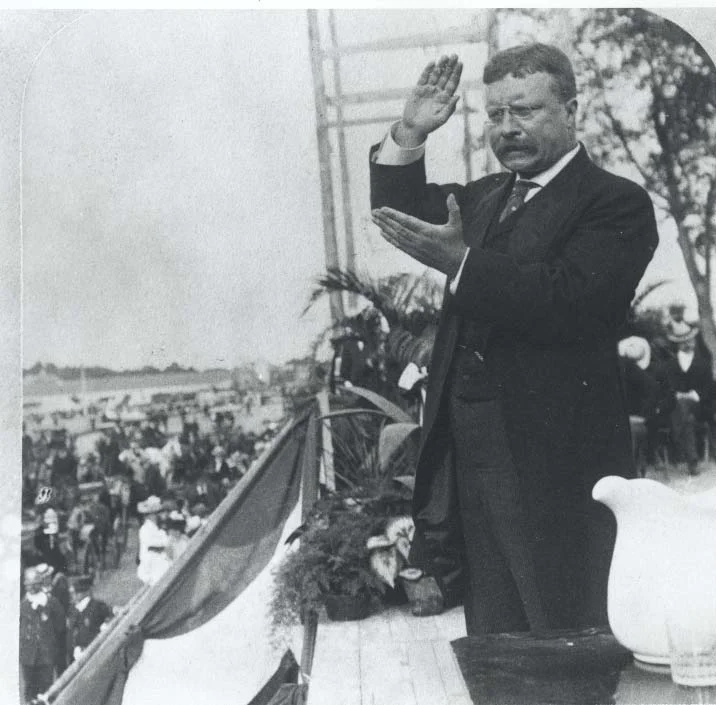
Minnesota state fair 1901.jpg

Theodore Roosevelt: 'Speak softly and carry a big stick', Minnesota State Fair - 1901

February 18, 2019

3 September 1901, Minnesota, USA

Four days after Roosevelt spoke at the fair, President McKinley was shot by an assassin in Buffalo, N.Y. and Vice President Roosevelt became President.


In his admirable series of studies of Twentieth century problems Dr. Lyman Abbott has pointed out that we are a nation of pioneers; that the first colonists to our shores were pioneers, and that pioneers selected out from among the descendants of these early pioneers, mingled with others selected afresh from the old world, pushed westward into the wilderness, and laid the foundations for new commonwealths. They were men of hope and energy; for the men of dull content or more dull despair had no part in the great movement into and across the new world. Our country has been populated by pioneers, and therefore it has in it more energy, more enterprise, more expansive power than any other in the wide world.

You whom I am now addressing stand, for the most part, but one generation removed from these pioneers. You are typical Americans, for you have done the great, the characteristic, the typical work of our American life. In making homes and carving out careers for yourselves, and your children, you have built up this state; throughout our history the success of the homemaker has been but another name for the upbuilding of the nation. The men who with ax in the forest and pick in the mountains and plow on the prairies, pushed to completion the dominion of our people over the American wilderness have given the definite shape to our nation. They have shown the qualities of daring, endurance and far-sightedness, of eager desire for victory and stubborn refusal to accept defeat, which go to make up the essential manliness of the American character. Above all they have recognized the practical form the fundamental law of success in American life – the law of worthy work, the law of high, resolute endeavor. We have but little room among our people for the timid, the irresolute and the idle, and it is no less true that there is scant room in the world at large for the nation with mighty thews that dares not to be great. …

Every father and mother here, if they are wise, will bring up their children not to shirk difficulties, but to meet them and overcome them; not to strive after a life of ignoble ease, but to strive to do their duty, first to themselves and their families and then to the whole state; and this duty must inevitably take the shape of work in some form or other. You, the sons of pioneers, if you are true to your ancestry, must make your lives as worthy as they made theirs. They sought for true success, and therefore they did not seek ease. They knew that success comes only to those who lead the life of endeavor. …

No hard and fast rule can be laid down as to where our legislation shall stop in interfering between man and man, between interest and interest. All that can be said is that it is highly undesirable on the one hand, to weaken individual initiative, and on the other hand, that in a constantly increasing number of cases we shall find it necessary in the future to shackle cunning as in the past we have shackled force.

It is not only highly desirable, but necessary, that there should be legislation which shall carefully shield the interest of wage workers, and which shall discriminate in favor of the hones and human employer by removing the disadvantages under which he stands when compared with unscrupulous competitors who have no conscience, and will do right only under fear of punishment.

Nor can legislation stop only with what are termed labor questions. The vast individual and corporate fortunes, the vast combinations of capital which have marked the development of our industrial system, create new conditions, and necessitate a change from the old attitude of state and the nation toward property. …

Right here let me make as vigorous a plea as I know how in favor of saying nothing that we do not mean, and of acting without hesitation up to whatever we say. A good many of you are probably acquainted with the old proverb, “Speak softly and carry a big stick – you will go far.” If a man continually blusters, if he lacks civility, a big stick will not save him from trouble, and neither will speaking softly avail, if back of the softness there does not lie strength, power. In private life there are few beings more obnoxious than the man who is always loudly boasting, and if the boaster is not prepared to back up his words, his position becomes absolutely contemptible. So it is with the nation. It is both foolish and undignified to indulge in undue self-glorification, and, above all, in loose-tongued denunciation of other peoples. Whenever on any point we come in contact with a foreign power, I hope that we shall always strive to speak courteously and respectfully of that foreign power.

Let us make it evident that we intend to do justice. Then let us make it equally evident that we will not tolerate injustice being done us in return. Let us further make it evident that we use no words which we are not which prepared to back up with deeds, and that while our speech is always moderate, we are ready and willing to make it good. Such an attitude will be the surest possible guarantee of that self-respecting peace, the attainment of which is and must ever be the prime aim of a self-governing people. …

This is the attitude we should take as regards the Monroe doctrine. There is not the least need of blustering about it. Still less should it be used as a pretext for our own aggrandizement at the expense of any other American state. But most emphatically, we must make it evident that we intend on this point ever to maintain the old American position. Indeed, it is hard to understand how any man can take any other position now that we are all looking forward to the building of the Isthmian canal. The Monroe doctrine is not international law, but there is no necessity that it should be. …

Our dealings with Cuba illustrate this, and should be forever a subject of just national pride. We speak in no spirit of arrogance when we state as a simple historic fact that never in recent times has any great nation acted with such disinterestedness as we have shown in Cuba. We freed the island from the Spanish yoke. We then earnestly did our best to help the Cubans in the establishment of free education, of law and order, of material prosperity, of the cleanliness necessary to salutary well-being in their great cities. We did all this at great expense of treasure, at some expense of life, and now we are establishing them in a free and independent commonwealth, and have asked in return nothing whatever save that at no time shall their independence be prostituted to the advantage of some foreign rival of ours, or so as to menace our well-being. To have failed to ask this would have amounted to national stultification on our part.

In the Philippines we have brought peace, and we are at this moment giving them such freedom and self-government as they could never under any conceivable conditions have obtained had we turned them loose to sink into a welter of blood, and confusion, or to become the prey of some strong tyranny without or within. The bare recital of the facts is sufficient to show that we did our duty, and what prouder title to honor can a nation have than to have done its duty? We have done our duty to ourselves, and we have done the higher duty of promoting the civilization of mankind. …

THEODORE ROOSEVELT BIG STICK 2.jpg

Barbarism has and can have no place in a civilized world. It is our duty toward the people living in barbarism to see that they are freed from their chains, and we can only free them by destroying barbarism itself. The missionary, the merchant and the soldier may each have to play a part in this destruction, and in the consequent uplifting of the people. Exactly as it is the duty of a civilized power scrupulously to respect the rights of all weaker civilized powers and gladly to help those who are struggling towards civilization, so it is its duty to put down savagery and barbarism. As in such a work human instruments must be used, and as human instruments are imperfect, this means that at times there will be injustices, that at times, merchant, or soldier, or even missionary may do wrong.

Let us instantly condemn and rectify such wrong when it occurs, and if possible punish the wrong-doer. But, shame, thrice shame to us, if we are so foolish as to make such occasional wrong-doing an excuse for failing to perform a great and righteous task. No only in our own land, but throughout history, the advance of civilization has been of incalculable benefit to mankind, and those through whom it has advanced deserve the higher honor. All honor to the missionary, all honor to the soldier, all honor to the merchant who now in our own day have done so much to bring light into the world’s dark places.

Let me insist again, for fear of possible misconstruction, upon the fact that our duty is two-fold, and that we must raise others while we are benefiting ourselves. In bringing order to the Philippines, our soldiers added a new page to the honor-roll of American history and they incalculably benefited the islanders themselves. Under the wise administration of Gov. Taft the islands now enjoy a peace and liberty of which they have hitherto never even dreamed. But this peace and liberty under the law must be supplemented by material, by industrial development, to the introduction of American industries and products; no merely because this will be a good thing for our people, but infinitely more because it will be of incalculable benefit to the people of the Philippines.

We shall make mistakes; and if we let these mistakes frighten us from work, we shall show ourselves weaklings. Half a century ago Minnesota and the two Dakotas were Indian hunting grounds. We committed plenty of blunders, and now and then worse than blunders, in our dealings with the Indians. But who does not admit at the present day that we were right in wresting from barbarism and adding to civilization the territory out of which we have made these beautiful states? And now we are civilizing the Indian and putting him on a level to which he could never have attained under the old conditions.

In the Philippines let us remember that the spirit and not the mere form of government is the essential matter. The Tagalogs have a hundred-fold the freedom under us that they would have if we had abandoned the islands. We are not trying to subjugate a people; we are trying to develop them, and make them a law-abiding, industrious and educated people, and we hope, ultimately, a self-governing people. In short, in the work we have done, we are but carrying out the true principles of our democracy. We work in a spirit of self-respect for ourselves and of good-will toward others, in a spirit of love for and of infinite faith in mankind. We do not blindly refuse to face the evils that exist; or the shortcomings inherent in humanity; but across blunderings and shirking, across selfishness and meanness of motive, across short-sightedness and cowardice, we gaze steadfastly toward the far horizon of golden triumph.

If you study our past history as a nation you will see we have made many blunders and have been guilty of many shortcomings, and yet that we have always in the end come out victorious because we have refused to be daunted by blunders and defeats—have recognized them, but have preserved in spite of them. So it must be in the future. We gird up our loins as a nation with the stern purpose to play our part manfully in winning the ultimate triumph, and therefore we turn scornfully aside from the paths of mere ease and idleness, and with unfaltering steps tread the rough road of endeavor, smiting down the wrong and battling for the right as Greatheart smote and battled in Bunyan’s immortal story.

Source: http://www.startribune.com/sept-3-1901-roo...

Enjoyed this speech? Speakola is a labour of love and I’d be very grateful if you would share, tweet or like it. Thank you.

Facebook Twitter Facebook
In 1900-19 Tags THEODORE ROOSEVELT, VICE PRESIDENT, SPEAK SOFTLY, BIG STICK, TRANSCRIPT, MINNESOTA, STATE FAIR, PRESIDENT MCKINLEY, ASSASSINATION
Comment

Patrice Lumumba: ‘Africans, let us rise up!’, Congress for the Freedom of Culture - 1959

August 9, 2018

 22 March 1959, University of Ibadan, Ibadan, Nigeria

Patrice Lumumba was an independence leader and the first PM of the independent Democratic Republic of the Congo. He was assassinated after less than 7 months in office. The plot was supported by the governments of USA and Belgium. This was a pre independence speech of great importance, and closed the 1959 conference in Nigeria.

I thank the Congress for Freedom and Culture and the University of Ibadan for the kind invitation they extended me to attend this international conference, where the fate of our beloved Africa being discussed. It has been most gratifying to me to meet here a number of African ministers, men of letters, labor union leaders, journalists, and international figures interested in the problems of Africa.

It is through these person-to-person contacts, through meetings of this sort, that African leaders can get to know each other and draw closer together in order to create that union that is indispensable for the consolidation of African unity. In fact, the African unity so ardently desired by all those who are concerned about the future of this continent will be possible and will be attained only if those engaged in politics and the leaders of our respective countries demonstrate a spirit of solidarity, concord, and fraternal collaboration in the pursuit of the common good of our peoples.

That is why the union of all patriots is indispensable, especially during this period of struggle and liberation. The aspirations of colonized and enslaved peoples are everywhere the same; their lot too is the same. Moreover, the aims pursued by nationalist movements in any African territory are also the same.

The common goal is the liberation of Africa from the colonialist yoke. Since our objectives are the same, we will attain them more easily and more rapidly through union than through division. These divisions, which the colonial powers have always exploited the better to dominate us, have played an important role — and are still playing that role — in the suicide of Africa.

How can we extricate ourselves from this impasse? In my view, there is only one way: bringing all Africans together in popular movements or unified parties. All tendencies can coexist within these parties bringing all nationals together, and each will have its say, both in the discussion of problems facing the country and in the conduct of public affairs.

A genuine democracy will be at work within these parties and each will have the satisfaction of expressing its opinions freely. The more closely united we are, the better we will resist oppression, corruption, and those divisive maneuvers which experts in the policy of “divide and rule” are resorting to.

This wish to have unified parties or movements in our young country must not be interpreted as a tendency toward political monopoly or a certain brand of dictatorship. We ourselves are against despotism and dictatorship. I wish to draw everyone’s attention to the fact that it is the height of wisdom to thwart from the very outset any possible maneuvers on the part of those who would like to profit from our apparent political rivals in order to set us against each other and thus delay our freeing ourselves from the colonialist regime.

Experience proves that in our African territories the opposition that certain people create in the name of democracy is often not inspired by a concern for the common welfare; a thirst for glory and the furthering of personal interests are the principal if not the only, motives for this.It is only when we have won the independence of our countries and when our democratic institutions are stabilized that the existence of a pluralist political system will be justified. The existence of an intelligent, dynamic and constructive opposition is indispensable in order to counterbalance the political and administrative action of the government in power. But this moment does not appear to have arrived yet, and dividing our efforts today would he to render our country a disservice.

All our compatriots must be persuaded that they will not serve the general interest of the country if they are divided or if they foster such divisions, any more than they would serve it by balkanizing our country and partitioning it into weak little states. Once the territory was balkanized, it would be difficult to achieve national unity again. Calling for African unity arid then destroying its very foundations is hardly proof of a genuine desire for such unity. In the struggle that we are peacefully waging today to win our independence, we do not intend to drive Europeans out of this continent or seize their possessions or persecute them.

We are not pirates. On the contrary, we respect individuals and the rights of others to well-being. The one thing we are determined to do — and we would like others to understand us is to root out colonialism and imperialism from Africa. We have long suffered and today we want to breathe the air of freedom. The Creator has given us this share of the earth that goes by the name of the African continent; it belongs to us and we are its only masters.It is our right to make this continent a continent of justice, law, and peace.

All of Africa is irrevocably engaged in a merciless struggle against colonialism and imperialism. We wish to bid farewell to the rule of slavery and bastardization that has so severely wronged us. Any people that oppresses another people is neither civilized nor Christian.

The West must free Africa as soon as possible. The West must examine its conscience today and recognize the right of each colonized territory to freedom and dignity. If the colonialist governments promptly understand our aspirations, we will negotiate with them, but if they stubbornly insist on considering Africa their possession, we will be obliged to consider the colonizers the enemies of our emancipation. Under these circumstances, we will regretfully cease to be friends with them.

I hereby publicly take it upon myself to thank all those Europeans who have spared no effort to help our peoples improve their lot. All humanity will be grateful to them for the magnificent mission of humanization and emancipation they are carrying out in certain parts of Africa. We do not want to cut ourselves off from the West, for we are quite aware that no people in the world can be self-sufficient.

We are altogether in favor of friendship between races, but the West must respond to our appeal. Westerners must understand that friendship is not possible when the relationship between us is one of subjugation and subordination. The disturbances that are occurring at present in certain African territories will continue to occur if the administrative powers do not put an end to the colonial regime.

This is the only possible path to genuine peace and friendship between African and European peoples. We have an imperative need for financial, technical, and scientific aid from the West aimed at rapid economic development and the stabilization of our societies. But the capital our countries need must be invested in the form of mutual aid between nations. National governments will give this foreign capital every sort of guarantee it wishes. The Western technicians to whom we make an urgent appeal will come to Africa not to dominate us but to serve and aid our countries.

Europeans must recognize and come to accept the idea that the liberation movement that we are engaged in throughout Africa is not directed against them, nor against their possessions nor against their persons, but purely and simply against the regime of exploitation and enslavement that we are no longer willing to tolerate.

If the agree to put an immediate end to this regime instituted by their predecessors we will live in friendship and brotherhood with them. A twofold effort must be made to hasten the industrialization of our various regions and the economic development of the country.

To this end, we address an appeal to friendly countries to send us an abundance of capital and many technicians. The lot of black workers must be appreciably improved. The wages they earn at present are clearly insufficient. The dire poverty of the working classes is the source of many of the social conflicts that exist at present in our countries. Labor unions have a great role to play in this regard, the role of protectors and educators.

It is not enough merely to demand a raise in wages; there is also a great need to educate workers in order that they may become conscious of their professional, civic, and social obligations, and also acquire a clear conception of their rights. On the cultural plane, the new African states must make a serious effort to further African culture. We have a culture all our own, unparalleled moral and artistic values, an art of living and patterns of life that are ours alone. All these African splendors must be jealously preserved and developed.

‘We will borrow from Western civilization what is good and beautiful and reject what is not suitable for us. This amalgam of African and European civilization will give Africa a civilization of a new type, an authentic civilization corresponding to African realities. Efforts must also be made to free our peoples psychologically. A certain conformism is noticeable on the part of many intellectuals, and its origins are well known. This conformism stems from the moral pressures and the reprisals to which black intellectuals have often been subjected. The minute they have told the truth, they have been called dangerous revolutionaries, xenophobes, provocateurs, elements that must he closely watched, and so on.

These moves to intimidate us and corrupt our morals must cease. We need genuine literature and a free press that brings the opinion of the people to light, rather than more propaganda leaflets and a muzzled press. I hope that the Congress for Freedom and Culture will aid us along these lines.

We hold out a fraternal hand to the West. Let it today give proof of the principle of equality and friendship between races that its sons have always taught us as we sat at our desks in school, a principle written in capital letters in the Universal Declaration of the Rights of Man.

Africans must be just as free as other citizens of the human family to enjoy the fundamental liberties set forth in this declaration and the rights proclaimed in the United Nations Charter. The period of racial monopolies is now at an end. African solidarity must take concrete form in facts and acts.

We must form a bloc in order to demonstrate our brotherhood to the world. In order to do so, I suggest that governments that have already won their independence give every possible aid and support to countries that are not yet independent. In order to further cultural exchanges and the rapprochement of French-speaking and English-speaking countries, the teaching of both French and English should be made compulsory in all African schools. A knowledge of both these languages will put an end to the difficulties of communication that French-speaking and English- speaking Africans encounter when they meet.

This is an important factor for their interaction. Territorial barriers must also be done away with so that Africans may travel freely between the various African states. Scholarships should also be set up for students in the dependent territories. I want to take advantage of the opportunity here offered me to pay honor publicly to Dr. Kwame N’Krumah and Mr. Sekou Touré for having succeeded in liberating our brothers in Ghana and Guinea.

Africa will not be truly free and independent as long as any part of this continent remains under foreign domination.

I conclude my remarks with this passionate appeal: Africans, let us rise up! Africans, let us unite! Africans, let us walk hand in hand with those who want to help us make this beautiful continent a continent of freedom and justice!

Source: http://www.blackpast.org/1959-patrice-lumu...

Enjoyed this speech? Speakola is a labour of love and I’d be very grateful if you would share, tweet or like it. Thank you.

Facebook Twitter Facebook
In 1940-59 Tags PATRICE LUMUMBA, DRC, CONGO, DEMOCRATIC REPUBLIC OF THE CONGO, ASSASSINATION, IBADAN SPEECH, NIGERIA, TRANSCRIPT
Comment
murtala3.jpg

Murtala Mohammed: ‘Africa has come of age’, Extraordinary meeting of OAU - 1976

August 9, 2018

11 January 1976, Addis Ababa, Ethiopia

This speech was a response to a letter from President Gerald Ford opposing the Soviet backed M.P.L.A. which had assumed power in Angola. The South Africans were fighting with the opposition factions to M.P.LA. General Murtala objected to Ford siding with the South Africans, and against African self determination. Concluding part of speech:

Mr. Chairman, when I contemplate the evils of apartheid, my heart bleeds and I am sure the heart of every true blooded African bleeds. . . Rather than join hands with the forces fighting for self-determination and against racism and apartheid, the United States policy makers clearly decided that it was in the best interests of their country to maintain white supremacy and minority regimes in Africa. . .

Africa has come of age. It’s no longer under the orbit of any extra continental power.
It should no longer take orders from any country, however powerful. The fortunes of Africa are in our hands to make or to mar. For too long have we been kicked around: for too long have we been treated like adolescents who cannot discern their interests and act accordingly.

For too long has it been presumed that the African needs outside ‘experts’ to tell him who are his friends and who are his enemies. The time has come when we should make it clear that we can decide for ourselves; that we know our own interests and how to protect those interests; that we are capable of resolving African problems without presumptuous lessons in ideological dangers which, more often than not, have no relevance for us, nor for the problem at hand.


Murtala Ramat Mohammed was killed 34 days after making this speech, OBJ became Supreme Military Head of State after his death.

Source: https://www.nairaland.com/672198/great-spe...

Enjoyed this speech? Speakola is a labour of love and I’d be very grateful if you would share, tweet or like it. Thank you.

Facebook Twitter Facebook
In 1960-79 B Tags GENERAL MURTALA, MURTALA RAMAT MOHAMMED, NIGERIA, MILITARY COMMMANDER, ASSASSINATION, AFRICA, AFRICAN SELF DETERMINATION, SELF DETERMINATION, GERALD FORD, PRESIDENT, TRANSCRIPT
1 Comment

Indira Gandhi: 'You and your husband both had foreseen that death might come to him violently', Presentation of Nehru Award to Coretta Scott King - 1969

December 29, 2016

24 January 1969, New Dehli, India

This is a poignant moment for all of us. We remember vividly your last visit to our country. We had hoped that on this occasion, Dr. King and you would be standing side by side on this platform. That was not to be. He is not with us but we feel his spirit. We admired Dr. King. We felt his loss as our own. The tragedy rekindled memories of the great martyrs of all time who gave their lives so that men might live and grow. We thought of the great men in your own country who fell to the assassin's bullet and of Mahatma Gandhi's martyrdom here in this city, this very month, twenty-one years ago. Such events remain as wounds in the human consciousness, reminding us of battles, yet to be fought and tasks still to be accomplished. We should not mourn for men of high ideals. Rather we should rejoice that we had the privilege of having had them with us, to inspire us by their radiant personalities. So today we are gathered not to offer you grief, but to salute a man who achieved so much in so short a time. It is befitting, Madam, that you whom he called the "courage by my side", you who gave him strength and encouragement in his historic mission, should be with us to receive this award.

You and your husband both had foreseen that death might come to him violently. It was perhaps inherent in the situation. Dr. King chose death for the theme of a sermon, remarking that he would like to be remembered as a drum major for justice, for peace and for righteousness. When you were once asked what you would do if your husband were assassinated, you were courage personified, replying that you might weep but the work would go on. Your face of sorrow, so beautiful in its dignity coupled with infinite compassion, will forever be engraved in our hearts.

Mahatma Gandhi also had foreseen his end and had prepared himself for it. Just as training for violence included learning to kill, the training for non-violence, he said, included learning how to die. The true badge of the satyagrahi is to be unafraid.

As if he too had envisaged the martyrdoms of Mahatma Gandhi and Martin Luther King, Rabindranath Tagore once sang:

In anger we slew him,

With love let us embrace him now,

For in death he lives again amongst us,

The mighty conqueror of death.

This award, Madam, is the highest tribute our nation can bestow on work for understanding and brotherhood among men. It is named after a man who himself was a peace-maker and who all his life laboured passionately for freedom, justice and peace in India and throughout the world. Dr. Martin Luther King's struggle was for these same values. He paid for his ideals with his blood, forging a new bond among the brave and the conscientious of all races and all nations.

Dr. King's dream embraced the poor and the oppressed of all lands. His work ennobled us. He spoke of the right of man to survive and recognized three threats to the survival of man--racial injustice, poverty and war. He realised that even under the lamp of affluence which was held aloft by science, lay the shadow of poverty, compelling two-thirds of the peoples of the world to exist in hunger and want. He proclaimed that mankind could be saved from war only if we cared enough for peace to sacrifice for it.

Dr. Martin Luther King drew his inspiration from Christ, and his method of action from Mahatma Gandhi. Only through truth can untruth be vanquished. Only through love can hatred be quenched. This is the path of the Buddha and of Christ, and in our own times, that of Mahatma Gandhi and of Martin Luther King.

They believed in the equality of all men. No more false doctrine has been spread than that of the superiority of one race over another. It is ironical that there should still be people in this world who judge men not by their moral worth and intellectual merit but by the pigment of their skin or other physical characteristics.

Some governments still rest on the theory of racist superiority--such as the governments of South Africa and the lawless regime in Rhodesia. Unregenerate groups in other countries consider one colour superior to another. Our own battle is not yet over. Caste and other prejudices still survive, but most of us are ashamed of them and recognise them as evils to be combated. We are trying hard to eradicate them.

While there is bondage anywhere, we ourselves cannot be fully free. While there is oppression anywhere, we ourselves cannot soar high. Martin Luther King was convinced that one day the misguided people who believed in racial superiority would realise the error of their ways. His dream was that white and black, brown and yellow would live and grow together as flowers in a garden with their faces turned towards the sun. As you yourself said, "All of us who believe in what Martin Luther King stood for, must see to it that his spirit never dies". That spirit can never die. There may be setbacks in our fight for the equality of all men. There may be moments of gloom. But victory must and will be ours. Let us not rest until the equality of all races and religions becomes a living fact. That is the most effective and lasting tribute that we can pay to Dr. King.

Source: http://gos.sbc.edu/g/gandhi2.html

Enjoyed this speech? Speakola is a labour of love and I’d be very grateful if you would share, tweet or like it. Thank you.

Facebook Twitter Facebook
In 1960-79 Tags INDIRA GANDHI, CORETTA SCOTT KING, MARTIN LUTHER KING, ASSASSINATION, NEHRU, NEHRU AWARD, MARTYR, TRANSCRIPT, INDIA
Comment

Harvey Milk: 'Without hope the us's give up', Hope Speech - 1977

August 6, 2015

1977, various locations, California, USA

The 'Hope Speech' was the stump speech Milk gave during his campaign in 1977 and 1978. The most famous excerpt is:

'Somewhere in Des Moines or San Antonio there is a young gay person who all of a sudden realizes that he or she is gay; knows that if their parents find out they will be tossed out of the house, their classmates will taunt the child, and the Anita Bryant's and John Briggs' are doing their part on TV.

And that child has several options: staying in the closet, and suicide. And then one day that child might open the paper that says "Homosexual elected in San Francisco" and there are two new options: the option is to go to California, or stay in San Antonio and fight. Two days after I was elected I got a phone call and the voice was quite young. It was from Altoona, Pennsylvania. And the person said "Thanks".

And you've got to elect gay people; so that thousands upon thousands like that child know that there is hope for a better world; there is hope for a better tomorrow. Without hope, not only gays, but those who are blacks, the Asians, the disabled, the seniors, the us's; without hope the us's give up.

I know that you can't live on hope alone, but without it, life is not worth living. And you, and you, and you, and you have got to give them hope.'

Thank you very much


Here is another longer version:

My name is Harvey Milk and I'm here to recruit you.

I've been saying this one for years. It's a political joke. I can't help it--I've got to tell it. I've never been able to talk to this many political people before, so if I tell you nothing else you may be able to go home laughing a bit.

This ocean liner was going across the ocean and it sank. And there was one little piece of wood floating and three people swam to it and they realized only one person could hold on to it. So they had a little debate about which was the person. It so happened that the three people were the Pope, the President, and Mayor Daley. The Pope said he was titular head of one of the greatest religions of the world and he was spiritual adviser to many, many millions and he went on and pontificated and they thought it was a good argument. Then the President said he was leader of the largest and most powerful nation of the world. What takes place in this country affects the whole world and they thought that was a good argument. And Mayor Daley said he was mayor of the backbone of the Untied States and what took place in Chicago affected the world, and what took place in the archdiocese of Chicago affected Catholicism. And they thought that was a good argument. So they did it the democratic way and voted. And Daley won, seven to two.

About six months ago, Anita Bryant in her speaking to God said that the drought in California was because of the gay people. On November 9, the day after I got elected, it started to rain. On the day I got sworn in, we walked to City Hall and it was kinda nice, and as soon as I said the word "I do," it started to rain again. It's been raining since then and the people of San Francisco figure the only way to stop it is to do a recall petition. That's the local joke.

So much for that. Why are we here? Why are gay people here? And what's happening? What's happening to me is the antithesis of what you read about in the papers and what you hear about on the radio. You hear about and read about this movement to the right. That we must band together and fight back this movement to the right. And I'm here to go ahead and say that what you hear and read is what they want you to think because it's not happening. The major media in this country has talked about the movement to the right so the legislators think that there is indeed a movement to the right and that the Congress and the legislators and the city councils will start to move to the right the way the major media want them. So they keep on talking about this move to the right.

So let's look at 1977 and see if there was indeed a move to the right. In 1977, gay people had their rights taken away from them in Miami. But you must remember that in the week before Miami and the week after that, the word homosexual or gay appeared in every single newspaper in this nation in articles both pro and con. In every radio station, in every TV station and every household. For the first time in the history of the world, everybody was talking about it, good or bad. Unless you have dialogue, unless you open the walls of dialogue, you can never reach to change people's opinion. In those two weeks, more good and bad, but more about the word homosexual and gay was written than probably in the history of mankind. Once you have dialogue starting, you know you can break down prejudice. In 1977 we saw a dialogue start. In 1977, we saw a gay person elected in San Francisco. In 1977 we saw the state of Mississippi decriminalize marijuana. In 1977, we saw the convention of conventions in Houston. And I want to know where the movement to the right is happening.

What that is is a record of what happened last year. What we must do is make sure that 1978 continues the movement that is really happening that the media don't want you to know about. That is the movement to the left. It's up to CDC to put the pressures on Sacramento--but to break down the walls and the barriers so the movement to the left continues and progress continues in the nation. We have before us coming up several issues we must speak out on. Probably the most important issue outside the Briggs--which we will come to--but we do know what will take place this June. We know there's an issue on the ballot called Jarvis-Gann. We hear the taxpayers talk about it on both sides. But what you don't hear is that it's probably the most racist issue on the ballot in a long time. In the city and county of San Francisco, if it passes and we indeed have to lay off people, who will they be? The last in, and the first in, and who are the last in but the minorities? Jarvis-Gann is a racist issue. We must address that issue. We must not talk away from it. We must not allow them to talk about the money it's going to save, because look at who's going to save the money and who's going to get hurt.

We also have another issue that we've started in some of the north counties and I hope in some of the south counties it continues. In San Francisco elections we're asking--at least we hope to ask-- that the U.S. government put pressure on the closing of the South African consulate. That must happen. There is a major difference between an embassy in Washington which is a diplomatic bureau. and a consulate in major cities. A consulate is there for one reason only -- to promote business, economic gains, tourism, investment. And every time you have business going to South Africa, you're promoting a regime that's offensive.

In the city of San Francisco, if everyone of 51 percent of that city were to go to South Africa, they would be treated as second-class citizens. That is an offense to the people of San Francisco and I hope all my colleagues up there will take every step we can to close down that consulate and hope that people in other parts of the state follow us in that lead. The battles must be started some place and CDC is the greatest place to start the battles. I know we are pressed for time so I'm going to cover just one more little point. That is to understand why it is important that gay people run for office and that gay people get elected. I know there are many people in this room who are running for central committee who are gay. I encourage you. There's a major reason why. If my non-gay friends and supporters in this room understand it, they'll probably understand why I've run so often before I finally made it. Y'see right now, there's a controversy going on in this convention about the gay governor. Is he speaking out enough? Is he strong enough for gay rights? And there is controversy and for us to say it is not would be foolish. Some people are satisfied and some people are not.

You see there is am major difference--and it remains a vital difference--between a friend and a gay person, a friend in office and a gay person in office. Gay people have been slandered nationwide. We've been tarred and we've been brushed with the picture of pornography. In Dade County, we were accused of child molestation. It's not enough anymore just to have friends represent us. No matter how good that friend may be.

The black community made up its mind to that a long time ago. That the myths against blacks can only be dispelled by electing black leaders, so the black community could be judged by the leaders and not by the myths or black criminals. The Spanish community must not be judged by Latin criminals or myths. The Asian community must not be judged by Asian criminals or myths. The Italian community must not be judged by the mafia, myths. And the time has come when the gay community must not be judged by our criminals and myths.

Like every other group, we must be judged by our leaders and by those who are themselves gay, those who are visible. For invisible, we remain in limbo--a myth, a person with no parents, no brothers, no sisters, no friends who are straight, no important positions in employment. A tenth of the nation supposedly composed of stereotypes and would-be seducers of children--and no offense meant to the stereotypes. But today, the black community is not judged by its friends, but by its black legislators and leaders. And we must give people the chance to judge us by our leaders and legislators. A gay person in office can set a tone, con command respect not only from the larger community, but from the young people in our own community who need both examples and hope.

The first gay people we elect must be strong. They must not be content to sit in the back of the bus. They must not be content to accept pablum. They must be above wheeling and dealing. They must be--for the good of all of us--independent, unbought. The anger and the frustrations that some of us feel is because we are misunderstood, and friends can't feel the anger and frustration. They can sense it in us, but they can't feel it. Because a friend has never gone through what is known as coming out. I will never forget what it was like coming out and having nobody to look up toward. I remember the lack of hope--and our friends can't fulfill it.

I can't forget the looks on faces of people who've lost hope. Be they gay, be they seniors, be they blacks looking for an almost-impossible job, be they Latins trying to explain their problems and aspirations in a tongue that's foreign to them. I personally will never forget that people are more important than buildings. I use the word "I" because I'm proud. I stand here tonight in front of my gay sisters, brothers and friends because I'm proud of you. I think it's time that we have many legislators who are gay and proud of that fact and do not have to remain in the closet. I think that a gay person, up-front, will not walk away from a responsibility and be afraid of being tossed out of office. After Dade County, I walked among the angry and the frustrated night after night and I looked at their faces. And in San Francisco, three days before Gay Pride Day, a person was killed just because he was gay. And that night, I walked among the sad and the frustrated at City Hall in San Francisco and later that night as they lit candles on Castro Street and stood in silence, reaching out for some symbolic thing that would give them hope. These were strong people, whose faces I knew from the shop, the streets, meetings and people who I never saw before but I knew. They were strong, but even they needed hope.

And the young gay people in the Altoona, Pennsylvanias and the Richmond, Minnesotas who are coming out and hear Anita Bryant on television and her story. The only thing they have to look forward to is hope. And you have to give them hope. Hope for a better world, hope for a better tomorrow, hope for a better place to come to if the pressures at home are too great. Hope that all will be all right. Without hope, not only gays, but the blacks, the seniors, the handicapped, the us'es, the us'es will give up. And if you help elect to the central committee and other offices, more gay people, that gives a green light to all who feel disenfranchised, a green light to move forward. It means hope to a nation that has given up, because if a gay person makes it, the doors are open to everyone.

So if there is a message I have to give, it is that I've found one overriding thing about my personal election, it's the fact that if a gay person can be elected, it's a green light. And you and you and you, you have to give people hope. Thank you very much.

Source: http://www.sweetspeeches.com/s/568-harvey-...

Enjoyed this speech? Speakola is a labour of love and I’d be very grateful if you would share, tweet or like it. Thank you.

Facebook Twitter Facebook
In 1960-79 Tags ACTIVIST, LGBT, GAY AND LESBIAN RIGHTS, HARVEY MILK, ASSASSINATION, TRANSCRIPT
Comment

Robert Kennedy: 'What we need in the United States is not division', Death of Martin Luther King' - 1968

June 30, 2015

4 April 1968, Indanapolis, USA

Ladies and Gentlemen,

I'm only going to talk to you just for a minute or so this evening, because I have some -- some very sad news for all of you -- Could you lower those signs, please? -- I have some very sad news for all of you, and, I think, sad news for all of our fellow citizens, and people who love peace all over the world; and that is that Martin Luther King was shot and was killed tonight in Memphis, Tennessee.

Martin Luther King dedicated his life to love and to justice between fellow human beings. He died in the cause of that effort. In this difficult day, in this difficult time for the United States, it's perhaps well to ask what kind of a nation we are and what direction we want to move in. For those of you who are black -- considering the evidence evidently is that there were white people who were responsible -- you can be filled with bitterness, and with hatred, and a desire for revenge.

We can move in that direction as a country, in greater polarization -- black people amongst blacks, and white amongst whites, filled with hatred toward one another. Or we can make an effort, as Martin Luther King did, to understand, and to comprehend, and replace that violence, that stain of bloodshed that has spread across our land, with an effort to understand, compassion, and love.

For those of you who are black and are tempted to fill with -- be filled with hatred and mistrust of the injustice of such an act, against all white people, I would only say that I can also feel in my own heart the same kind of feeling. I had a member of my family killed, but he was killed by a white man.

But we have to make an effort in the United States. We have to make an effort to understand, to get beyond, or go beyond these rather difficult times.

My favorite poem, my -- my favorite poet was Aeschylus. And he once wrote:

Even in our sleep, pain which cannot forget
falls drop by drop upon the heart,
until, in our own despair,
against our will,
comes wisdom
through the awful grace of God.

What we need in the United States is not division; what we need in the United States is not hatred; what we need in the United States is not violence and lawlessness, but is love, and wisdom, and compassion toward one another, and a feeling of justice toward those who still suffer within our country, whether they be white or whether they be black.

So I ask you tonight to return home, to say a prayer for the family of Martin Luther King -- yeah, it's true -- but more importantly to say a prayer for our own country, which all of us love -- a prayer for understanding and that compassion of which I spoke.

We can do well in this country. We will have difficult times. We've had difficult times in the past, but we -- and we will have difficult times in the future. It is not the end of violence; it is not the end of lawlessness; and it's not the end of disorder.

But the vast majority of white people and the vast majority of black people in this country want to live together, want to improve the quality of our life, and want justice for all human beings that abide in our land.

And let's dedicate ourselves to what the Greeks wrote so many years ago: to tame the savageness of man and make gentle the life of this world. Let us dedicate ourselves to that, and say a prayer for our country and for our people.

Thank you very much.

Here is a version without music

Source: http://www.americanrhetoric.com/speeches/r...

Enjoyed this speech? Speakola is a labour of love and I’d be very grateful if you would share, tweet or like it. Thank you.

Facebook Twitter Facebook
In 1960-79 C Tags RFK, MARTIN LUTHER KING, ASSASSINATION, 1960S, TRANSCRIPT
Comment

See my film!

Limited Australian Season

March 2025

Details and ticket bookings at

angeandtheboss.com

Support Speakola

Hi speech lovers,
With costs of hosting website and podcast, this labour of love has become a difficult financial proposition in recent times. If you can afford a donation, it will help Speakola survive and prosper.

Best wishes,
Tony Wilson.

Become a Patron!

Learn more about supporting Speakola.

Featured political

Featured
Jon Stewart: "They responded in five seconds", 9-11 first responders, Address to Congress - 2019
Jacinda Ardern: 'They were New Zealanders. They are us', Address to Parliament following Christchurch massacre - 2019
Dolores Ibárruri: "¡No Pasarán!, They shall not pass!', Defense of 2nd Spanish Republic - 1936
Jimmy Reid: 'A rat race is for rats. We're not rats', Rectorial address, Glasgow University - 1972

Featured eulogies

Featured
For Geoffrey Tozer: 'I have to say we all let him down', by Paul Keating - 2009
for James Baldwin: 'Jimmy. You crowned us', by Toni Morrison - 1988
for Michael Gordon: '13 days ago my Dad’s big, beautiful, generous heart suddenly stopped beating', by Scott and Sarah Gordon - 2018

Featured commencement

Featured
Tara Westover: 'Your avatar isn't real, it isn't terribly far from a lie', The Un-Instagrammable Self, Northeastern University - 2019
Tim Minchin: 'Being an artist requires massive reserves of self-belief', WAAPA - 2019
Atul Gawande: 'Curiosity and What Equality Really Means', UCLA Medical School - 2018
Abby Wambach: 'We are the wolves', Barnard College - 2018
Eric Idle: 'America is 300 million people all walking in the same direction, singing 'I Did It My Way'', Whitman College - 2013
Shirley Chisholm: ;America has gone to sleep', Greenfield High School - 1983

Featured sport

Featured
Joe Marler: 'Get back on the horse', Harlequins v Bath pre game interview - 2019
Ray Lewis : 'The greatest pain of my life is the reason I'm standing here today', 52 Cards -
Mel Jones: 'If she was Bradman on the field, she was definitely Keith Miller off the field', Betty Wilson's induction into Australian Cricket Hall of Fame - 2017
Jeff Thomson: 'It’s all those people that help you as kids', Hall of Fame - 2016

Fresh Tweets


Featured weddings

Featured
Dan Angelucci: 'The Best (Best Man) Speech of all time', for Don and Katherine - 2019
Hallerman Sisters: 'Oh sister now we have to let you gooooo!' for Caitlin & Johnny - 2015
Korey Soderman (via Kyle): 'All our lives I have used my voice to help Korey express his thoughts, so today, like always, I will be my brother’s voice' for Kyle and Jess - 2014

Featured Arts

Featured
Bruce Springsteen: 'They're keepers of some of the most beautiful sonic architecture in rock and roll', Induction U2 into Rock Hall of Fame - 2005
Olivia Colman: 'Done that bit. I think I have done that bit', BAFTA acceptance, Leading Actress - 2019
Axel Scheffler: 'The book wasn't called 'No Room on the Broom!', Illustrator of the Year, British Book Awards - 2018
Tina Fey: 'Only in comedy is an obedient white girl from the suburbs a diversity candidate', Kennedy Center Mark Twain Award -  2010
Tina Fey: 'Only in comedy is an obedient white girl from the suburbs a diversity candidate', Kennedy Center Mark Twain Award - 2010

Featured Debates

Featured
Sacha Baron Cohen: 'Just think what Goebbels might have done with Facebook', Anti Defamation League Leadership Award - 2019
Greta Thunberg: 'How dare you', UN Climate Action Summit - 2019
Charlie Munger: 'The Psychology of Human Misjudgment', Harvard University - 1995
Lawrence O'Donnell: 'The original sin of this country is that we invaders shot and murdered our way across the land killing every Native American that we could', The Last Word, 'Dakota' - 2016