• Genre
  • About
  • Submissions
  • Donate
  • Search
Menu

Speakola

All Speeches Great and Small
  • Genre
  • About
  • Submissions
  • Donate
  • Search
Share a political speech

Stephen Jones: "We’ve been to too many funerals", debating Religious Discrimation Bill - 2022

February 9, 2022

2 February 2022, Canberra, Australia

Thanks Deputy Speaker, well it’s normally my custom to come to this dispatch box and deliver and thunderous, passionate address. There will not be much thunder today, but with no less passion.

There are 10 sitting days remaining in the 46th parliament.

There is a crisis in our aged care system. Hundreds of Australians are dying in understaffed, underfunded homes and yet this government seems powerless or unwilling to do nothing about it.

Two years ago the government promised to introduce a federal anti-corruption commission. The attorney general told us yesterday that no such promise will be delivered.

There are skills shortages and supply shortages which are preventing businesses from opening and the economy recovering.

Interest rates will certainly rise which will make existing cost of living pressures even worse.

These are the matters we should be focusing on in the final weeks of this parliament.

Instead we’ll spend the best part of two days debating a bill which pleases no one.

I support freedom of religion. I understand many in our community who want to see the existing laws strengthened to protect their freedom of religious expression. Although we are a long way from the days when employers could lawfully place ads in newspapers that say Catholics, my faith, need not apply – I understand the desire for a greater recognition and rights for people of faith.

But regrettably, the sometimes toxic debate that has been unleashed by the prime minister has put a spotlight on the fact that no rights are unlimited. Where the exercise of one person’s rights comes crashing up against another person’s freedom, we need to find a solution. It can be done and it is the role of this parliament to do that.

The contest of ideas and the ways of life is usually dealt with by social norms, by civility and human decency – regrettably, sometimes not. Unfortunately, when parliament steps in, the law has a very blunt way of dealing with it.

If we are to do this ... Then we must do it properly, thoughtfully, consultatively, and to date we have not. If we are to believe the reports in today’s paper, the government has failed to bring forward a law which protects children.

For me, this is not an academic issue.


The courage to swim against the tide

Last week my family said farewell to my nephew Ollie. He was just 15 when he took his own life. No mother or father should ahve to endure this sight. No brother should have to clean up afterwards. He was a beautiful, creative, courageous young man. He was loved and accepted by his parents, brothers and friends. His mum and dad are in anguish. We all are. He was gay. He was uncertain about his gender and he struggled with his mental health. Now he is gone and we will no longer be able to love him and support him on his journey throughout life. Clearly the love and acceptance of his family and friends was not enough.

My own son is also a beautiful, creative, intelligent 14-year-old. He designs and makes his own clothes, he is a gifted makeup artist, he moves seamlessly between the wardrobes of men and women. He wears heels that give me vertigo and has more handbags than his sister.

He has more courage than any other boy of his age that I have ever met. He swims against the tide.

I love and support him unconditionally and I brag about his talents to anyone who is willing to stop for two minutes and glance at his Instagram page.

But I worry myself sick every time he leaves the house. I think to myself, ‘you look beautiful, but do you have to go out looking like that?’ Because I know that the love and protection that he enjoys with his mother, with his friends and family is very different to the reception he may receive in the outside world.

Could this be the day when we receive the call = telling us that something has happened? That he has been attacked, for just being who he is?

Yet, this is about my kids, but it’s also not … this is about the families and every child who has the courage to swim against the tide just to be who they are..


What message do we want to send?

Earlier today the prime minister said we should exercise our power in this place with love. Look I know the cynic in all of us could easily giggle at that phrase and dismiss it as a political line … But I don’t. I agree. I’m asking the prime minister to reflect on those words as we consider this bill.

I’d ask the prime minister and every other member in this place to put themselves in the shoes of the parents, or the heels of their kids, as they step out in public.

What message do we want to this parliament to send to these kids. Are they as loved and cherished and respected as every other kid? Surely we aren’t saying to them – it’s OK if you are gay … Just so long as we can’t see it. Surely we can do better than that. At some stage we have to do better than that.

Because the thing that every parent of every gay or trans kid knows is that the love and protection that we provide for them inside our family and inside our homes and is not enough.

It is not enough.

At some stage they have to step out into the world and deal with it as it is.

So we as parliamentarians have the power to shape that world … by what we do and what we say. and how we vote. What message do we want to send to our kids?


Shaping the Australia we want to have

You know there’s a simple ease in which members of this place toss sausages at a charity barbecue, drink a beer, place a cap on our head and smile for a camera, put a footy jumper on and cheer for our favourite team. I do it regularly.

And when we do that we are signalling to Australia that we are just like you … or at least that Australia as we imagine it to be.

But the fact is Australia is a much more diverse place than that which we project from our pulpit in this place.

Being an Aussie is much more than punting on the Melbourne Cup or shouting ‘Go Saints’ or “Go Sharkies”.

It’s much more complex that that.

It’s the responsibility, the high responsibility of all of us called to this place to reflect and shape the sort of Australia that we want to have.

And it’s a bloody diverse place!

It is black. It’s white. It’s brown.. It prays in a church, it prays in a mosque, it prays in a shrine, in a synagogue, in a hall … or on a surfboard just behind the breaks

It’s men and women, it’s straight, it’s gay , it’s trans, it’s intersex … it’s the whole bloody lot.

We are the Australia of Storm Boy, of Breaker Morant, of Puberty Blues and, yes, of Priscilla Queen of the Desert.

It’s not easy crafting a national story that includes us all – but that’s our damn job! That’s our job. And the national story must have a place for all of us and all of our kids – how we imagine them, but more importantly how they are.

If a young kid has the courage to be themselves and own their identity – the least, the very least we can do is say “welcome”, we love you, and we respect you, and you’re okay, just the way you are.

My family are grieving like so many others. There have been too many funerals, too many grieving families. We have in our gift the power to do something, let’s not let the opportunity pass.

I thank my friends who have come to provide me support, I thank the leader of the opposition, my good friend, for sitting through what for me has been a difficult address. And I know there are many people who are listening, or who will read this speech afterwards, who want me to conclude with the words, ‘let’s dump this bill!’’

But I’m not saying that. What I’m saying to the leader of the opposition, and the prime minister if he;’ll listen, is ‘let’s take a step back’. Let’s imagine a national story that talks to all of us. And let’s not do something, in the name of freedom of religion, that does damage or harm to those of us who we love.

We’ve been to too many funerals.

Let’s get this done.

But let’s do it properly. Surely it is not beyond the wit and wisdom and decency of every member in this place, to get this done properly.

I thank you for your time.

Source: https://www.theguardian.com/commentisfree/...

Enjoyed this speech? Speakola is a labour of love and I’d be very grateful if you would share, tweet or like it. Thank you.

Facebook Twitter Facebook
In 2020-29 A Tags STEPHEN JONES, ALP, LABOR, YOUTH SUICIDE, RELIGIOUS DISCRIMINATION BILL, CULTURE WARS, WEDGE POLITICS, TRANSCRIPT, SUICIDE, LGBTQI, GAY, TRANS
Comment
Yukio Mishima.jpg

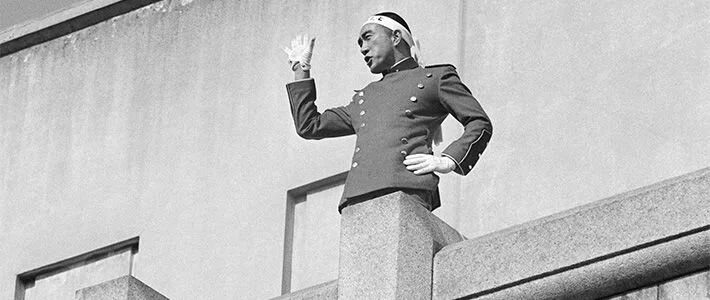
Yukio Mishima: 'It is a wretched affair', coup attempt - 1970

December 10, 2020

25 November 1970, JGSDF Camp Ichigaya, Tokyo, Japan

It is a wretched affair, to have to speak to Jieitai men in circumstances like these. I thought, that the Jieitai was the last hope of Nippon, the last stronghold of the Japanese soul. But..... Japanese people today think of most money, just money. where is our national spirit today? The politicians care nothing for Japan. they are greedy for power. The Jieitai, must be the soul of Nippon. The soldiers! The army! But.... we were betrayed by the Jieitai! Listen! Listen! Hear me out! We thought that the Jieitai was the soul of national honor! The nation has no spiritual foundation. that is why you don't agree with me! You don't understand Japan. The Jieitai must put things right! Listen! Be quiet, will you! Listen! Don't you hear! Listen! Hear me out! Just listen to me! What happened last year? On October 21? There was a demonstration, an anti-war demonstration. On October 21 last year. In Shinjuku. And the police put it down. The police! after that there was, and there will be, no chance to amend the Constitution. So, the Jiminto (the Liberal Democratic Party), the politicians, decided that they could use the police. The police would deal with the demonstrations, Don't you see? Look! The government did not use the Jieitai. The Armed Forces stayed in their barracks. The Constitution is fixed forever. There will be no chance to amend it. Do you understand? All right. Listen! Since last October 21, since that time, it is you who protect the Constitution. The Jieitai defends the Constitution. There will be no chance to amend it. Not for twenty years! The Jieitai waited for that chance, with tears in their eyes. Too late! Why don't you understand? Think about October 21 last year! Since that time I have waited for the Jieitai to act! When would the Jieitai come to its senses? I waited. there will be no further chance to revise the Constitution! The Jieitai will never become an army! It has no foundation, no center! The Jieitai must rise. Why? To protect Japan! You must protect Japan! To protect Japan! Yes, to protect Japan! Japanese tradition! Our history! Our culture! The Emperor! Listen! Listen! Listen! Listen! A man appeals to you! A man! I am staking my life on this! Do you hear? Do you follow me? If you do not rise with, if the Jieitai will not rise, the Constitution will never be amended! You will just be American mercenaries! American troops! I have waited for four years! Yes, four years! I wanted the Jietai to rise! Four years! I have come to the last thirty minutes, Yes the last thirty minutes. I am waiting, i want... Are you bushi? Are you men? You are soldiers! Then why do you not stand by the Constitution? You back the Constitution that denies your very existence! Then you have no future! You will never be saved! It is the end! The Constitution will remain forever. You are finished! You are unconstitutional! Listen! You are unconstitutional! The Jieitai is unconstitutional! You are all unconstitutional! Don't you understand? Don't you see what is happening? Don't you understand that it is you who defend the constitution? Why not? Why don't you understand? I have been waiting for you. Why don't you wake up? There you are in your tiny world. You do nothing for Nippon! Will any of you rise with me? You say that! Have you studied Bu (the warrior ethic)? Do you understand the way of the sword? What does the sword mean to a Japanese?... I ask you. Are you men? Are you bushi? I see that you are not. You will not rise. You will do nothing! The constitution means nothing to you. You are not interested. I have lost my dream of Jieitai! I salute the emperor! Tenno Heika Banzai! Tenno Heika Banzai!It is a wretched affair, to have to speak to Jieitai men in circumstances like these. I thought, that the Jieitai was the last hope of Nippon, the last stronghold of the Japanese soul. But..... Japanese people today think of most money, just money. where is our national spirit today? The politicians care nothing for Japan. they are greedy for power. The Jieitai, must be the soul of Nippon. The soldiers! The army! But.... we were betrayed by the Jieitai! Listen! Listen! Hear me out! We thought that the Jieitai was the soul of national honor! The nation has no spiritual foundation. that is why you don't agree with me! You don't understand Japan. The Jieitai must put things right! Listen! Be quiet, will you! Listen! Don't you hear! Listen! Hear me out! Just listen to me! What happened last year? On October 21? There was a demonstration, an anti-war demonstration. On October 21 last year. In Shinjuku. And the police put it down. The police! after that there was, and there will be, no chance to amend the Constitution. So, the Jiminto (the Liberal Democratic Party), the politicians, decided that they could use the police. The police would deal with the demonstrations, Don't you see? Look! The government did not use the Jieitai. The Armed Forces stayed in their barracks. The Constitution is fixed forever. There will be no chance to amend it. Do you understand? All right. Listen! Since last October 21, since that time, it is you who protect the Constitution. The Jieitai defends the Constitution. There will be no chance to amend it. Not for twenty years! The Jieitai waited for that chance, with tears in their eyes. Too late! Why don't you understand? Think about October 21 last year! Since that time I have waited for the Jieitai to act! When would the Jieitai come to its senses? I waited. there will be no further chance to revise the Constitution! The Jieitai will never become an army! It has no foundation, no center! The Jieitai must rise. Why? To protect Japan! You must protect Japan! To protect Japan! Yes, to protect Japan! Japanese tradition! Our history! Our culture! The Emperor! Listen! Listen! Listen! Listen! A man appeals to you! A man! I am staking my life on this! Do you hear? Do you follow me? If you do not rise with, if the Jieitai will not rise, the Constitution will never be amended! You will just be American mercenaries! American troops! I have waited for four years! Yes, four years! I wanted the Jietai to rise! Four years! I have come to the last thirty minutes, Yes the last thirty minutes. I am waiting, i want... Are you bushi? Are you men? You are soldiers! Then why do you not stand by the Constitution? You back the Constitution that denies your very existence! Then you have no future! You will never be saved! It is the end! The Constitution will remain forever. You are finished! You are unconstitutional! Listen! You are unconstitutional! The Jieitai is unconstitutional! You are all unconstitutional! Don't you understand? Don't you see what is happening? Don't you understand that it is you who defend the constitution? Why not? Why don't you understand? I have been waiting for you. Why don't you wake up? There you are in your tiny world. You do nothing for Nippon! Will any of you rise with me? You say that! Have you studied Bu (the warrior ethic)? Do you understand the way of the sword? What does the sword mean to a Japanese?... I ask you. Are you men? Are you bushi? I see that you are not. You will not rise. You will do nothing! The constitution means nothing to you. You are not interested. I have lost my dream of Jieitai! I salute the emperor! Tenno Heika Banzai! Tenno Heika Banzai!

Source: https://www.youtube.com/watch?v=Ctufj50w9a...

Enjoyed this speech? Speakola is a labour of love and I’d be very grateful if you would share, tweet or like it. Thank you.

Facebook Twitter Facebook
In 1960-79 C Tags COUP ATTEMPT, IT IS A WRETCHED AFFAIR, JIETAI, YUKIO MISHIMA, AUTHOR, EMPORER, ANTI CONSTITUTION, SUICIDE
Comment

Julian Leeser: 'It said simply - "I am sorry Sylvia, I just can't cope, love, John", maiden speech - 2016

September 24, 2016

14 September 2016, Parliament House, Canberra, Australia

As a child the sound of my mother's footsteps coming towards my bedroom to wake me in the morning was a reassuring feature of daily life.

Inevitably I was awake before she made the door; but the rhythm, the sound, and the intensity of her walk were unmistakable.

Each morning the moment would arrive when she'd fling the door open with that effervescent greeting "time to rise and shine".

Twenty years ago this month my mother approached my room to wake me, but it was with a very different sound, pace and tempo.

Seared on my mind from that night was the speed of her approach and her scream as she flung open the door of my bedroom, sobbing, "Dad's gone, Dad's gone."

I got up from my bed to comfort my mum, trying to calm her. I went down the hall to my father's office, where he worked late into the night for his clients.

There I found his pyjamas in a pile and on the glass-topped table in the hall, was a note, like so many of the notes from my father, written in red pen on the back of a used envelope.

It said simply -"I am sorry Sylvia, I just can't cope, love, John".

I felt a great emptiness ripping at my stomach. I went to the garage and saw the car was missing.

We called the Police and later they came round to tell us that they'd found my father's body at the bottom of The Gap at Watsons Bay.

There is a point in life when you are supposed to become a man.

As I stood on the veranda and watched the sun come up that morning, I knew my day had come.

My father loved music.

He played 2CH on the radio from the moment he woke up to the moment he went to bed. Easy listening music was the sound-track of my childhood.

But the day he died the music died with him, and it was years before I could listen to his music again without tearing up.

Over the past twenty years I have gone back over the week leading up to my father's death too many times - and I keep thinking back to the signs he was giving us.

Although we had always been a family that hugged each other, my father had started giving us all very long hugs.

My father prided himself on being a great car parker and yet the week before he died he didn't seem to care how he parked. In hindsight it's clear that something had changed.

I knew it but didn't say anything.

You ask yourself, what could I have done?

What should I have said? Could I have reached out in a way that I didn't? Could I have said, as we say now, "Are you OK?"

I reflect on my own conduct the night before my father died, when he asked if I could help him polish his shoes before he left for a dinner at my brother's school.

I remember as a self-absorbed 20 year old the petulance and rudeness with which I waived away the opportunity to help my father, a man who so often helped me, and not a day goes by that I don't regret it.

Suicide, they used to say, is a victimless crime, but they never count the loved ones left behind.

In the past 20 years we have changed our approach to suicide, depression and mental health.

 And while there has rightly been a focus on the mental health of adolescents and young people, we must remember that people suffering at other stages in their lives are equally important.

And sadly the number of older people taking their own lives is increasing - my own father was fifty five.

In these past 20 years, we have spent millions on mental health and suicide prevention. Every government has tried - but despite all the good will, it is a fight we are losing.

In my own electorate we have had more than 100 people take their own lives in the last eight years. And across Australia eight people die by suicide every day.

All this shows that government money alone will not solve this epidemic. Treating depression as purely a medical issue is not working.

Rather we need to rebuild caring communities where people know and notice the signs and acknowledge the people around them.

Where we ask "Are you OK?", or more directly "Are you contemplating suicide?"

And we need to create the conditions where those who are thinking about suicide feel comfortable enough to ask for help.

Through my work in this place, I want to help empower Australians to build a greater sense of community.

I have seen active engagement in community combat loneliness and enable people to see a world outside themselves.

In a society where people are more pressured and more isolated than ever before, active engagement in community fosters civility, courtesy and understanding, virtues that are too often undervalued and supplanted by anger.

There is a role for government in supporting organisations and individuals that reach out to the socially isolated in our community, even in the face of continued rejection.

And there is a role for government in fostering innovative solutions that address suicide prevention, depression and mental health – enabling communities to learn from what has worked and connecting those efforts across our country.

I want to acknowledge the Prime Minister's personal interest in suicide prevention and the leadership he and the Health Minister took in devising the National Suicide Prevention Strategy.

As a member of this House I want to do what I can to help pierce the loneliness, the desperation and the blackness that people who suffer depression feel.

During my time here I will always be an advocate for better mental health policy.

Dad

When I think of my father, mostly though I think not of the way that he died, but rather of the example set by the way that he lived.

My father John was an only child. His father was a pharmacist.

His mother and her family escaped Nazi Germany in 1936 for the freedom and sanctuary of Australia. My father was an accountant; he had his own practice at Parramatta.

As I child I would go with him to the office or visit clients in their homes, businesses and factories.

He knew their lives, their families and their ups and downs: when they succeeded and when they struggled, when they were failing, and when they were flourishing.

He was a friend they saw once a year to help them get their affairs in order and comply with the law.

But even more than that he was an advisor on how they could get on with and grow their businesses.

To the extent that I become an effective local member for Berowra, it will be because of dad's example of professionalism, trust and care in working for his clients - and the personal touch they loved him for. Dad was a man much involved in his community.

He sat on the board of our local Synagogue. He sat on a theatre board. He was involved in the school my brother and I attended.

Dad was hard working, diligent and prided himself on doing things properly, and by the book. He was quiet, unassuming, patient and slow to anger.

He had a husky voice that made him sound like Louis Armstrong.

He and my mother Sylvia gave me three great gifts: my life, my faith and my education.

My father instilled in my brother Lindsay and me an important set of values:

· Courtesy, civility and fair dealing with everyone with whom he interacted.

· The need to give back to the community and get involved; and

· A deep sense of faith and love of the joys of Judaism.

He gave us a strong sense, shared by all Jews, that our own story is part of a much larger story.

That we should be, in Jonathan Sacks' words, "true to our faith while being a blessing to others regardless of their faith".

While I don't always live up to my father's ideals, his are the fundamental values which have shaped my life.

There is a Jewish idea that one should bring joy or naches to one's parents. I hope that my election to this place would have brought as much naches to him as it does to my mother and the rest of my family.

Mum

It is to my mother Sylvia that I owe the greatest thanks for being here today. Her courage and her unconditional love for my brother Lindsay and me has sustained our family through celebrations and sorrows.

With her unshakable belief that anything was possible for her boys, she created a home filled with love, stability and opportunity.

Nothing has ever been - or will ever be - too much for her.

But of all her gifts to us, the enthusiasm for active citizenship, the patriotism she instilled in my brother and me, the fact that hopefully, we are happy, well rounded and grateful Australians, is her greatest contribution.

My mother Sylvia is a fifth generation Australian.

Her grandfather was a Gallipoli Anzac and rode in the charge of the Light Horse at Be'er Sheva.

Her mother, Barbara, who passed away last week aged 95, served as a nurse in the Australian Army during the Second World War.

Mum's father Sam served in the ill-fated 8th Division, was taken prisoner in Changi and survived the horrors of the Burma Railway.

The war left my grandfather with a stammer and a steely determination.

What kept him alive in those dark days was a dream to come home and start his own hardware business which he did after the war, employing many of his fellow former POWs too.

The prosperity that my grandfather created was due to his hard work and ingenuity in predicting the need for building supplies to meet a post-war building boom.

My mother's Anglo-Jewry gave her a particular take on being an Australian.

Fiercely patriotic about Australia and loyal to the Crown, she realised the historical peculiarity to be both Jewish and free.

And that had such an impact on me.

As I grew up towards the end of the Cold War, with its threat to freedom everywhere, my mother would constantly remind me of the responsibility that comes with the freedom we enjoy in Australia - to be thankful for it, and to preserve it whenever it's threatened here - because, as she would teach me, most people at most times in most places are not free.

As a child my mother read to me about Australia's history and explained how our own family's story fit into the broader Australian story.

A story of explorers, soldiers, farmers, shopkeepers and professionals, people willing to chance their arm, who carved out a nation in this physically isolated but socially tolerant land.

My contribution to this story will be influenced by the combination of my father's quiet virtues, and my mother's perhaps slightly less quiet, but always deeply patriotic, civic, virtues.

Constitution

It was that instilled sense of history and an early interest in politics, that prompted me to want to serve in this place.

And so around the time of my tenth birthday I asked my parents not for a BMX bike or a cricket bat but for a copy of the Australian Constitution.

I think the Latin term for such behaviour is Nerdus Maximus.

Our Constitution is unique and worthy of celebration.

It belongs to everyone. It was written and debated all over the country, led by that great generation of liberal and conservative barrister-parliamentarians.

 Americans and Canadians wrote their constitutions in secret. Modern constitutions tend to be written by legal academics.

But the Australian Constitution was written in the open across Australia, by Australians for Australian conditions: from the School of Arts at Tenterfield, to the Court House at Corowa; from the drawing rooms of Adelaide to the libraries of Hobart; in parliamentary chambers in Sydney, Adelaide and Melbourne; and of special significance for me, on the Hawkesbury River, in the Berowra electorate, on a paddle-steamer called the Lucinda where our first Prime Minister Sir Edmund Barton and our first Chief Justice Sir Samuel Griffith, drafted the judicial power of the Commonwealth.

The Australian Constitution has provided the basis for stable government and economic prosperity for over a century.

At a time when constitutional structures and political systems around the world are breaking down, Australia's constitutional achievement should be a source of enormous pride.

Our Constitution establishes our unique Australian democracy.

The Constitution matters as much for what it doesn't say as for what it does.

Our Constitution contains no symbolic language and no bill of rights. Its sparse legal language is its strength.

It has meant that only the most creative judges have been able to invent implied rights to frustrate the democratic will.

The Constitution has figured prominently in my career and contributions to the public debate.

As the youngest elected delegate at the 1998 Constitutional Convention, I remain a committed constitutional monarchist, like my friend and former employer the Member for Warringah, I see it as the best system of government of all the available alternatives.

In 2009 I worked with a broad cross-section of Australians to ensure the defeat of an Australian Bill of Rights because I believe in the capacity of the political process, to solve problems, and I'm against an American style judiciary which makes political rather than legal decisions because of their Bill of Rights.

In 2013, with the members for Goldstein and Mitchell and some senators from the other place I led a scrappy but successful insurgency against Labor's plans to have the Commonwealth intervene in local government.

In important public debates, in a time of increasing polarization of views we need people who can build consensus and find the middle ground.

And so in more recent times, I have worked with Indigenous leaders and constitutional conservatives to find a constitutional way to make better policy about, and due recognition of Indigenous Australians, while avoiding the downsides of inserting symbolic language into a technical document, which requires interpretation by judges.

Today the Constitution has an important role to play in the next chapter of Australia's unfinished economic reforms.

The next item on the reform agenda must be to address the inefficiencies in our federation.

The States and the Commonwealth should have more clearly delineated responsibilities and the finances to deliver them.

Instead, today we have a system of buck passing, duplication and inefficiency: a lopsided federation that the framers would not recognise.

Canberra should not have a monopoly on finance and policy.

It has become fashionable to think that whenever the states fail, Canberra will do a better job.

Pink bats, school halls and The Mersey Hospital demonstrate that service delivery is not always Canberra's forte.

Canberra collects too much tax, while every year the States come begging because they don't raise enough money to finance their own services.

Addressing this dissonance in our federation should deliver less red tape, less duplication, better roads, better schools and better hospitals designed and run to meet local needs.

It should also lead to greater policy innovation as competition between the States drives excellence.

I have had the privilege of working for two of Australia's great federalists High Court Justice Ian Callinan, who honours me with his presence today, and Professor Greg Craven.

I have 6 also spent several years thinking about federalism as the Vice President of the Samuel Griffith Society.

I am not the first person to seek to propose reform of the federation on a federalist model.

Coalition and Labor Politicians have pursued this option before.

But every time such solutions have been proposed, they have been undermined by short-term politicking.

Previous economic reforms had a greater chance of success when there was a cross-party consensus.

The same approach is needed to reform our federation today. We know the task is to deliver the States more of their own source revenue and to lighten Canberra's footprint in areas of policy for which it has little expertise.

What has been lacking is the political cooperation to make it happen.

I therefore propose to look for reform partners in all parties in this Parliament to establish a group to build consensus for reform of fiscal federalism.

Reform of this scale can be daunting and while we may not complete the task while we are in this place, nor are we free to desist from it.

Berowra

But by far my most important task is to serve the people of Berowra with the full measure of my devotion.

The electorate of Berowra was created in 1969. Running from the banks of the Hawkesbury River to the M2 motorway, the people of Berowra are community minded and self-reliant.

That is why there is a greater number of volunteers, people of faith and small business owners than in many other communities.

Despite its strengths, the Berowra community is one that faces major infrastructure challenges. Pennant Hills Road is one of the worst roads in Australia.

But now Liberal State and Federal governments are working with the private sector to deliver Northconnex, which will remove 5000 trucks from Pennant Hills Rd every day, improving air quality and reducing noise while completing the missing national transport link between the M1 and the M2.

It is not the only infrastructure issue we face. Other roads like New Line Rd need widening to take into account the growing population in the electorate and in surrounding areas.

And the undulating hills and the sparse population in the rural areas make mobile connectivity difficult.

But the Coalition's mobile blackspot program is starting to address this infrastructure challenge.

I wish to thank the people of Berowra for giving me the extraordinary opportunity to serve them. My first duty will always be to them.

I would like to thank the members of the Liberal Party in Berowra, and my friends and supporters beyond that organisation, for all their work to see me come into this place.

Many have travelled vast distances to be here today. The best way I can demonstrate my gratitude to them is through the quality of my service here.

In that, I hope to emulate the style of my three predecessors Philip Ruddock, who throughout his record term helped build an ethnically diverse country with strong secure borders; Harry Edwards, who was a leading economic thinker on microfinancing; and one of Australia's most distinguished lawyers, the first member for Berowra, Tom Hughes QC, who is here today.

I am also honoured that my friend Heather Henderson, the daughter of Sir Robert Menzies, is here today.

For six and a half years I had the privilege of running the Centre named after her father.

I acknowledge Tom Harley my Chairman at the Menzies Research Centre who is also here.

Sir Robert Menzies was a poor country boy from a one horse town, who by dint of his own hard work and intellect rose to lead his profession, his party and his nation.

Our task as Liberals is to create the conditions so the next generation's Sir Robert Menzies can rise and thrive.

I am conscious of the huge responsibility involved in being the Liberal Member for Berowra.

I will seek to carry on Sir Robert Menzies' traditions of policy and principle in all I do in this place.

Finally I wish to thank my wife Joanna.

If my parents gave me the foundations for a good and worthwhile life in years past, it's Joanna who anchors me in the present, and always points me forward with optimism to the future.

She is the reason more than any other than I am here. Joanna introduced me to Berowra. It was her home before it was mine. I could not have embarked on this journey without her.

She is smart, accomplished, beautiful and challenging and she has never lost faith in me.

She is, in fact, perfect in every way, except for that occasion 11 years ago, when her judgment clearly failed her and she decided to marry me. Joanna - I love you with all my heart.

Every new member comes into this place with life experiences from which they can draw strength.

I come here with the certain knowledge that no one lives a perfect life, that we all need help and community in good times and hard times.

But I draw strength from the example of my family.

I draw strength from my faith. I draw strength from Australia's traditions of service.

And I draw strength from our unique Australian story of progress – epitomized by the story of the individuals who persevered and wrote our Constitution.

Reform is never easy but the opportunity to participate in the public debate and be an advocate for the cause I believe in: a strong, free, confident and prosperous Australia is something that fills me with the greatest enthusiasm.

Readers seeking support and information about suicide prevention can contact Lifeline on 13 11 14.

Julian Leeser was a guest on episode 25 of the podcast

Source: http://www.smh.com.au/federal-politics/pol...

Enjoyed this speech? Speakola is a labour of love and I’d be very grateful if you would share, tweet or like it. Thank you.

Facebook Twitter Facebook
In 2010s MORE Tags JULIAN LEESER, SUICIDE, MAIDEN SPEECH, AUSTRALIA, PARLIAMENT, BEROWRA, LIBERAL PARTY
Comment

See my film!

Limited Australian Season

March 2025

Details and ticket bookings at

angeandtheboss.com

Support Speakola

Hi speech lovers,
With costs of hosting website and podcast, this labour of love has become a difficult financial proposition in recent times. If you can afford a donation, it will help Speakola survive and prosper.

Best wishes,
Tony Wilson.

Become a Patron!

Learn more about supporting Speakola.

Featured political

Featured
Jon Stewart: "They responded in five seconds", 9-11 first responders, Address to Congress - 2019
Jacinda Ardern: 'They were New Zealanders. They are us', Address to Parliament following Christchurch massacre - 2019
Dolores Ibárruri: "¡No Pasarán!, They shall not pass!', Defense of 2nd Spanish Republic - 1936
Jimmy Reid: 'A rat race is for rats. We're not rats', Rectorial address, Glasgow University - 1972

Featured eulogies

Featured
For Geoffrey Tozer: 'I have to say we all let him down', by Paul Keating - 2009
for James Baldwin: 'Jimmy. You crowned us', by Toni Morrison - 1988
for Michael Gordon: '13 days ago my Dad’s big, beautiful, generous heart suddenly stopped beating', by Scott and Sarah Gordon - 2018

Featured commencement

Featured
Tara Westover: 'Your avatar isn't real, it isn't terribly far from a lie', The Un-Instagrammable Self, Northeastern University - 2019
Tim Minchin: 'Being an artist requires massive reserves of self-belief', WAAPA - 2019
Atul Gawande: 'Curiosity and What Equality Really Means', UCLA Medical School - 2018
Abby Wambach: 'We are the wolves', Barnard College - 2018
Eric Idle: 'America is 300 million people all walking in the same direction, singing 'I Did It My Way'', Whitman College - 2013
Shirley Chisholm: ;America has gone to sleep', Greenfield High School - 1983

Featured sport

Featured
Joe Marler: 'Get back on the horse', Harlequins v Bath pre game interview - 2019
Ray Lewis : 'The greatest pain of my life is the reason I'm standing here today', 52 Cards -
Mel Jones: 'If she was Bradman on the field, she was definitely Keith Miller off the field', Betty Wilson's induction into Australian Cricket Hall of Fame - 2017
Jeff Thomson: 'It’s all those people that help you as kids', Hall of Fame - 2016

Fresh Tweets


Featured weddings

Featured
Dan Angelucci: 'The Best (Best Man) Speech of all time', for Don and Katherine - 2019
Hallerman Sisters: 'Oh sister now we have to let you gooooo!' for Caitlin & Johnny - 2015
Korey Soderman (via Kyle): 'All our lives I have used my voice to help Korey express his thoughts, so today, like always, I will be my brother’s voice' for Kyle and Jess - 2014

Featured Arts

Featured
Bruce Springsteen: 'They're keepers of some of the most beautiful sonic architecture in rock and roll', Induction U2 into Rock Hall of Fame - 2005
Olivia Colman: 'Done that bit. I think I have done that bit', BAFTA acceptance, Leading Actress - 2019
Axel Scheffler: 'The book wasn't called 'No Room on the Broom!', Illustrator of the Year, British Book Awards - 2018
Tina Fey: 'Only in comedy is an obedient white girl from the suburbs a diversity candidate', Kennedy Center Mark Twain Award -  2010
Tina Fey: 'Only in comedy is an obedient white girl from the suburbs a diversity candidate', Kennedy Center Mark Twain Award - 2010

Featured Debates

Featured
Sacha Baron Cohen: 'Just think what Goebbels might have done with Facebook', Anti Defamation League Leadership Award - 2019
Greta Thunberg: 'How dare you', UN Climate Action Summit - 2019
Charlie Munger: 'The Psychology of Human Misjudgment', Harvard University - 1995
Lawrence O'Donnell: 'The original sin of this country is that we invaders shot and murdered our way across the land killing every Native American that we could', The Last Word, 'Dakota' - 2016