• Genre
  • About
  • Submissions
  • Donate
  • Search
Menu

Speakola

All Speeches Great and Small
  • Genre
  • About
  • Submissions
  • Donate
  • Search

Varun Malavalli: 'Why you should not read books', Toastmasters speech - 2017

February 10, 2020

November 2017, Nokia Office, Manyata Tech Park, Bangalore, India


A study conducted in Stanford University proves that reading is the workout the brain needs in order to stay in its optimal health. A group of people was asked to read Mansfield’s Park by Jane Austen while being monitored by a Magnetic Resonance Imaging (MRI) machine. The MRI mapping showed that the minute they started reading, there was a noticeable rise in the level of blood flowing to the brain. Not only this, blood was also flowing to those parts of the brain, which were currently not in use. In the Instagram era, one of the reasons people do workout is to flaunt their physique. But hey, can you flaunt your brain image on social networks?? Fellow Toastmasters and dear guests - that is precisely one of the many reasons why you should not read books...

It’s story time!! Our hero’s name is Dan Hurley. When he was eight years old, he still couldn’t read. He couldn’t pronounce the word “THE”... Yes, many of us still don’t pronounce it the right way! Dha or Dhi, we wonder. Hmm. During a parent-teacher meeting, Mrs. Browning told his mother: "Daniel is a slow learner." And a year later, he was rescued by none other than... “Spiderman, Spiderman, does whatever a spider can. Look out, here comes the Spiderman” (hum the song)... He started reading comic books. By age 11, he was getting straight As! Later in his teens, he scored the equivalent of 136 on an IQ test. This score signifies that he was way above average. Sean Patrick is the author of “Nikola Tesla – The man who invented the 20th Century”. He writes that IQ and success are related only to a point. Throughout the pages of History, many achievers have overcome their average or even below-average IQ, to reach the pinnacle of success. Henry Ford was flat broke five times before he founded the Ford Motor Company. In his youth, Thomas Edison’s teachers told him he was “too stupid to learn anything”. Beethoven’s teachers believed him hopeless as a composer!! Mark Twain has aptly said, “Thousands of geniuses live and die undiscovered – either by themselves or by others”. So, please don’t read to improve your IQ...

Many people, who read, tend to behave like snobs. An “intellectual snob” can be defined as a person who takes pride in his/her own knowledge and achievements while running down others. Research says that reading “The God Delusion” serves you better than say “Fifty Shades of Grey”. But Saul Bellow, winner of Pulitzer and Nobel Prize for Literature, thinks otherwise. According to him, “a good novel is worth more than the best scientific study”. Ask a voracious reader in your friends circle, and he would say that reading Half-Girlfriend or Fifty Shades of Grey is a waste of time. I had taken a course in Journalism and Feature writing was one of the modules. The facilitator, a noted columnist, asked us the last book we had read. She stressed, “I would not consider Chetan Bhagat’s books”. My question is, “why discriminate?” As Alex, of Modern Family, coolly states, “One person’s gross is another person’s beautiful”... What is the point of knowledge if we do not adorn it with humility? According to Prof. Robert C. Roberts of Ethics Department, Baylor University, a person without vanity will be fearless in asking what might seem to be “stupid” questions. Please don’t read to be an insufferable know-it-all...

I did a survey on Facebook asking people as to why they read books. The responses ranged from growth as a human being, updating of knowledge, solutions to world problems and eventually because everything on the internet is not true... I agree with most of them. According to George R.R. Martin, yes of GOT fame, “A reader lives a thousand lives before he dies. The man who never reads lives only one.” You can become the character. A consulting detective in the 20th Century London, an architect in the US who does not design as per the conventions of society, a kid with an imaginary tiger or a pregnant COO of a social media giant who breaks the glass ceiling - all while you are reading a book!! In conclusion, fellow Toastmasters, I say, read just for the pleasure of it...

Toastmaster of the Day, the book is open for critique...

Source: https://www.youtube.com/watch?v=RgvLg_g5y1...

Enjoyed this speech? Speakola is a labour of love and I’d be very grateful if you would share, tweet or like it. Thank you.

Facebook Twitter Facebook
In BOOKS 2 Tags VARUN MALAVALLI, TOASTMASTERS, READING, BOOKS, HENRY FORD, TRANSCRIPT, NOKIA OFFICE, RESEARCH EXERCISE, GEORGE R R MARTIN, GAME OF THRONES
Comment

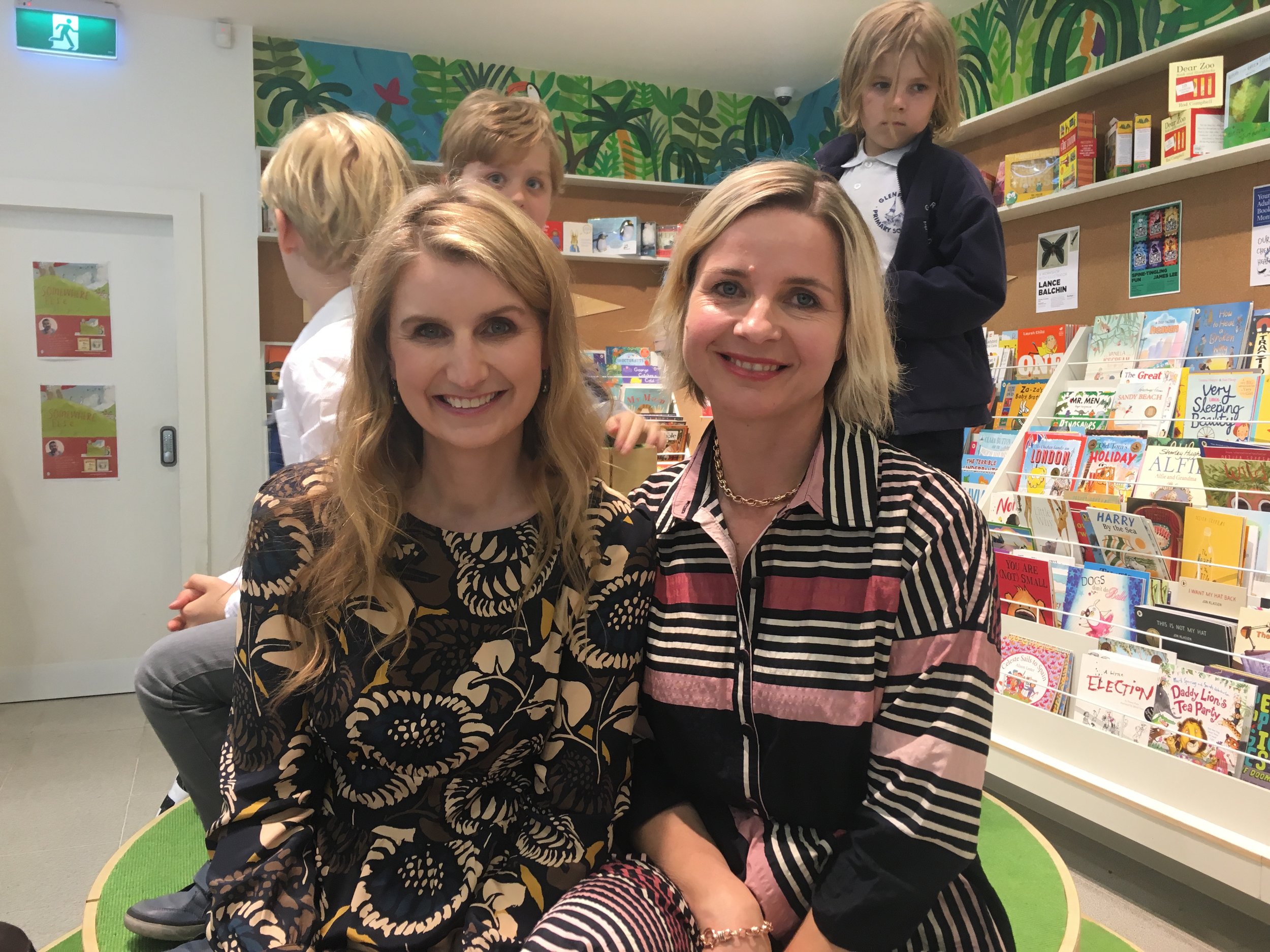
Sofie Laguna: 'Your book, just as you describe the Lyrebird itself, is a keeper of history', When the Lyrebird Calls launch - 2016

March 6, 2017

27 October 2016, Readings Kids, Carlton, Melbourne, Australia

Sofie Laguna is an award winning author for children and adults. She won the 2016 Miles Franklin Award for 'The Eye of the Sheep'.

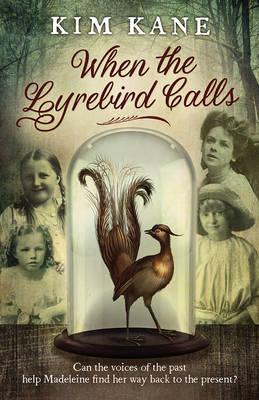
First of all, Kim I want to say how beautiful the book looks and feels. Lovely sepia tones and like the story it takes me back to another time. I love the lyrebird in the centre, as you must, as the books central image – a keeper of the past, a symbol from the natural world, an enchanting, elusive and clever bird.

Like somebody else I know.

That was cheeky. I promised myself I would focus entirely on Kim’s book and not tell stories of how I first met Kim and things like that because its not a wedding it’s a launch. I do want to say that when I first met Kim it was through Tony Wilson and it was all about books and writing and it was another launch and Kim was wearing long striped socks – and I was impressed. With heels mind you! That was years ago and I have been impressed many times since then, and not more than I am impressed by this latest addition to her ever-growing body of work for children.

Kim this book, ‘When the Lyrebird Calls’, is wonderful.

I think a book is a kind of transaction between writer and reader. The writer plays her part in the transaction first; she travels with her character, establishing a world, developing relationships, suffering the pain of change alongside her characters. It is the writer who does the imagining first, she must pioneer the territory, chart the waters. Then it’s the reader’s turn, to imagine and travel and experience change and if the writer does her job well, imagines fully enough, goes to the places that the story requires with authenticity, with heart, and with skill, then the transaction is enriching and meaningful and the reader is expanded by it. That’s what happened to me when I read When the Lyrebird Calls; I travelled with the novel’s gutsy heroine, Madeleine, back through time, and I experienced what life was like in a very vivid and sensual way. And I felt expanded by it. This happened to me, because of Kim’s writing.

Kim describes pale yellow dresses as hayseed light, fish swim in a braid of silver, their scales shiny as coins and a lake is as muddy as caramel. Kim draws my attention to these ordinary things – dresses and fish and lakes – so that I consider them in unexpected ways. I see the world through a new lens. She draws my attention to them with elegance, and originality. The strength is in the detail, and Kim’s details are beautiful and they give life to the writing and the story. And they seem effortless, they are cleanly drawn, without a line out of place. Kim uses language, relishes language, its musicality and its playfulness and its possibilities, and that’s what I responded to in ‘When the Lyrebird Calls’.

But it wasn’t only the language, nor was it the playful and compelling young voice of its narrator. Kim’s book made me think. It’s good when a book does that, isn’t it? We take it for granted, but the artist suffers for her story, works the words to within an inch of their lives (and her own!) and because of this work, all this powerful imagining, the reader is given a new awareness. The reader thinks, and asks questions.

I think I have gotten away with taking a great deal for granted, so many years caught up in imaginary worlds, with made up characters – I had the right to vote so what did the past mean to me? When the Lyrebird calls didn’t let me get away with it. It made me think about being a girl, about education, about girls in sport, the media, and body image. It made me ask why is it like this? How has it changed? Why must it take so long? What is it like to be a girl now? What made it happen this way in the first place, why this inequality? This unfair representation? And it made me ask is there some way I can hurry up the change? How can I contribute to something more positive? It’s good when a book can do all this, don’t you think? It’s magic.

All this sounds serious, and it’s true that the questions are serious, but Kim’ writing is funny. Warm and funny. Madeleine’s grandmother watches renovating programs on telly and rushes out to stock up on tools, and Madeleine can’t stay at her best friend, Nandi’s house, because Nandi Mum just had a make-up baby with Nandi’s dad so the timing isn‘t right. And she couldn’t stay with her dad because he is on a cycling trip and nothing ever gets between dad and a bike except his bike pants. Humour, clever comical moments are everywhere in the story and I appreciated every one of them.

Humour brings the story to life, endears me to its characters and their struggles. When there is humour, there is life. It helps me to tackle the story’s more serious questions, it gives the story its humanity. Because life, and human beings attempting to live it, is funny.

Kim, your book, just as you describe the Lyrebird itself, is a keeper of history. Congratulations to you, I am thrilled for you, and I can’t wait for the world to read it.

It is now my great pleasure to declare this book launched.


To purchase 'When the Lyrebird Calls' click here

Kristen Hilton's launch speech

Enjoyed this speech? Speakola is a labour of love and I’d be very grateful if you would share, tweet or like it. Thank you.

Facebook Twitter Facebook
In BOOKS Tags KIM KANE, SOFIE LAGUNA, WHEN THE LYREBIRD CALLS, MIDDLE GRADE, KIDS BOOKS, TRANSCRIPT, TIME SLIP, FEMINISM[, BOOKS
Comment

Jane Clifton: 'Here in our very own city of Melbourne, it is the best of times for books', SLV's books and bogans debate - 2009

October 19, 2016

“It was the best of times, it was the worst of times, it was the age of wisdom, it was the age of foolishness ……it was the season of Light, it was the season of Darkness, it was the spring of hope, it was the winter of despair, we were all going direct to Heaven, we were all going direct the other way…”

Charles Dickens opening words of A Tale of Two Cities.

I thought I’d open with a book….

Here in our very own city of Melbourne, it is the best of times for books.

The 2009 Melbourne Writers Festival broke all previous box office records with attendances in excess of 50,000, over the entire 10 day event – which to put it in a context we can all understand, is about the sort of figures you get at the MCG when the Demons play Freo. And it’s not raining.

In fact the MWF had become so popular McDonalds has applied for a permit to set up an outlet in the atrium at Fed Square.

Book clubs are sweeping through Avon and Amway territory out in the suburbs. Middle-aged women - and strange men in cardigans - are signing up in their thousands for yet another excuse to gather around a crate of cleanskins and get pissed.

Monday nights: poledancing

Tuesday: book club.

Libraries are reportedly doing a roaring trade.

People come for the cookery classes and ‘move-it-or-lose-it’ yoga-lattes, but they leave clutching a swag of books.

Librarians have become so sexy they’ve even got their own tv show!

Written and produced in Melbourne.

The productivity commission brouhaha has been on page 3 of The Age so often even the Herald Sun has started to take an interest.  

Ladies and Gentlemen, we are indeed enjoying‘the season of Light and the spring of Hope’ for books in Melbourne – and recently it got a whole lot better, when, from a short list of possibly 2, Melbourne became the UNESCO City of Literature.

The Cit of Lit !!!

And, whatever that means, it doesn’t get any better than that.

But Ladies and gentlemen, in this glorious and clever-clever city of literature of ours it is also the best of times for bogans.

Crown Casino is cramming in extra tables and widening car-parks.

DFO is apparently opening a 20-acre site linking Sydney Road with Brunswick St. Fitzroy. Site developers have pledged to preserve the original façade of Henry Maas’s Black Cat Café and not allow a Mrs Fields or Gloria Jean within a 50 metre range of Marios.

The Spring Racing Carnival has cancelled all actual horse races in order to cram more punters onto the track.

An arcade of plasma screens will be installed across the old finish line, where you can watch, bet on or, indeed, ride a motorised horse in front of, footage of vintage races – if you still hanker after a horsey-sort of experience with your Jaeger-bomb and goon.

All over this city of ours muffin-topped babes and low-pants’ed, underwear and plumbers’ crack flaunting drongos are taking photos of each other with their phones and texting, texting, texting. ….

On trams and buses, they sit, staring into space, white wires dangling from their lugholes and glum expressions on their faces.

On the Book of the Face, bald-headed men with grey pigtails and pissed housewives are whiling away the hours – posting stuff like

‘Fuck, I’m bored’.

People are bubble writing their names on walls without actually creating anything worth signing.

Newspapers have started putting ads for what’s coming up next in the paper at the top of the page you’re already reading – striving for us all to have the attention span of a gnat and make us throw away the paper altogether and head straight for the website.

Attention spans, considered thoughts, are being Twittered out of existence.

And Hey Hey It’s Saturday is back on television.

It was the season of Darkness, it was the winter of despair..”

And yet….

A miracle seems to have occurred.

Just as Charles Dickens in his opening chapter of that book set around the French revolution hinted that:

“rooted in the woods of France and Norway, there were growing trees…already marked by the Woodman, Fate, to come down and be sawn into boards, to make a certain movable framework with a sack and a knife in it, terrible in history.”

So too rainforests in Indonesia and Tasmania have been systematically pulped with a purpose which could not have been foreseen.

Despite dire predictions to the contrary and the onslaught of technology, book sales in Melbourne seem to be going through the roof.

People are still buying books - and quite a lot of them are reading them too.

But…how many people came to the MWF? Over 50,000?

Population of Melbourne? Nudging 4 million?

There can be only one explanation for these phenomenal book sales.

Bogans are buying books.

Not the kind of books, shortlisted or long, for the Booker prize.

Popular books.

Books about vampires and boy wizards and angels and demons and extra virgin oil. Books about cleaning products and cooking.

Big fat books for big fat bogans.

Government sanctioned weight-loss programme books.

Cheap books.

Bought in bulk at book barns.

Bought by the kilo.

Bogan book clubs are burgeoning from Broady to Bentleigh.

Bogans are reading books.

Publishers have begun begging their serious authors to get on board this juggernaut.

Surely JM Coetzee could whip up a volume of Disgraceful Recipes?

And what about On Chervil Beach – a new herb compendium from Ian McEwan. Come on Christos Tsiolkas! What about The Slap and Tickle Guide to Toddler Taming? Is it too much to ask Salman to ghost as Salmon Rushdie and dash off some Satanic Sauces?

Ladies and gentlemen, in this bi-polar city of ours – a city of books AND bogans – a line has been crossed.

The Secret is out.

Babes with poker-straight hair and yellow platform shoes, home-made sushi-toting men with man-bags, have declared that reading a book is noice, different and unusual.

That reading a book is a far, far better thing that they do now than watching Big Brother or Baywatch or Backyard Blitz had ever been before.

Melbourne is, without doubt, a City of Books.

(This speech brought to you by the letter ‘B’).


Enjoyed this speech? Speakola is a labour of love and I’d be very grateful if you would share, tweet or like it. Thank you.

Facebook Twitter Facebook
In BOOKS Tags JANE CLIFTON, BOGANS, BOOKS, DEBATE, COMEDY DEBATE, TRANSCRIPT
Comment
state library.jpg

Tony Wilson: 'Brendan Fevola has recently become an author', SLV books v bogans debate - 2009

October 18, 2016

17 October 2009, State Library of Victoria, Melbourne, Australia

Topic: 'That Melbourne is a city of bogans not books'. Tony and Jane Clifton argued for books. Tony Martin and Catherine Deveney for bogans.

This really is a no-brainer. Melbourne is a town of bookaphiles, of bibliogeeks, of readers and readings, of writers and of writer’s festivals …

I mean a show of hands, how many out there, like me, read this topic and thought to themselves, oh this is a debate between a team that’s going to argue for books, and a team that’s going to argue that we’re a city of devotees to the American poet Louise Bogan, who wowed us all with her modernist poetry between 1920 and 1970, as a sort of sparse, strictly metered female equivalent to TS Eliot?

I thought it was going to be a pretty easy win for us. Even Louise Bogan herself would say that there is room in the city for books other than her own best books, Dark Summer or Sleeping Fury … unless there's another Bogan favourite you'd like to throw in there ... anyone, anyone?

It’s only been over the course of the debate, that I’ve understood how bogan was going to be defined - moccasins, ciggies under the collar, holidays at Rosebud caravan park, ex ACDC groupies who may have slept with Bon Scott.

I still think we’ll win the debate … I mean another show of hands … you’re here at the State Library. How many of you have read more than five books this year … and how many of you have slept with Bon Scott …?

Jane, we really do have to have a look at ourselves if we can’t win this.

The great risk of our position is that Jane and I will leave this theatre looking like great sneering snobs. There is implicit in the wording of the proposition that it’s an either or thing … it’s either books or bogans … which seems to be implying that someone doesn’t reckon bogans read that much.

I disagree …

If bogans don’t read … who bought Allan M Nixon’s seminal Beaut Utes 4? Who bought Beaut Utes 3?

If bogans don’t read … who bought Eddie McGuire’s moving tribute to that great Magpie… Pants the Darren Millane Story …

If bogans don’t read … who bought Pig, Dog, and Knife by Mark Holgenest, which is the definitive pig slaughtering text written in Australia for feral pig hunters who prefer not to hunt with rifles …

See already I’m sounding snobby … as though the books I read are better than the books other people of lesser intelligence read … gee I might have just done it again …

Look, we on the book side are not trying to pump ourselves up. I mean, as Louise Bogan herself said;

“The intellectual is a middle-class product; if he is not born into the class he must soon insert himself into it, in order to exist. He is the fine nervous flower of the bourgeoisie.”

I’m trying to be a nervous flower …  I don’t want to put down bogans, because I suspect that had I enjoyed just eighteen more months in the AFL system I might have been swaggering through Federation Square on Mad Monday, Fevola like, a pink dildo hanging out of my fly …


And yet even Fev, who fits the mould of the typical Melbourne bogan, doesn’t cut down our argument …

Because as I’m sure all you bibliophiles are aware, Brendan Fevola has recently become an author. And it’s with great delight and no gritted teeth at all that I can announce that the Fevola penned My Footy Book outsold my own 2009 children’s release The Princess and the Packet of Frozen Peas by a factor of ten to one. Fuck you Fev.

Our opponents have missed the mark tonight ..

Cath Deveney … rebuttal

Tony Martin … rebuttal

By contrast … what Jane Clifton said was eloquent and true, and we understood what she was saying because we understand A Tale of Two Cities: If we haven’t read it, we are all very adept at pretending we have, and absolutely all of us know the ‘it was the best of times, it was the worst of times’ opening sentence. For bogans in the audience, the few who put their hands up before when I asked whether you’d slept with Bon Scott, that opening sentence roughly translates into one of your ‘yeah … nahs …’

But as my Fevola experience demonstrates, bogans do read and bogans do write, and they're as up to their ears in this whole city of literature fiasco as we are. And indeed, traditional literature needs to keep up, needs to 'boganify' if you will. And it's with this in mind that I have launched my most recent publishing venture, Bogan Publications, which seeks to bogan translate major literary works into bogan.

Our first title is John Banville’s The Sea – we've repackage that as 'The Fucking C Mate'

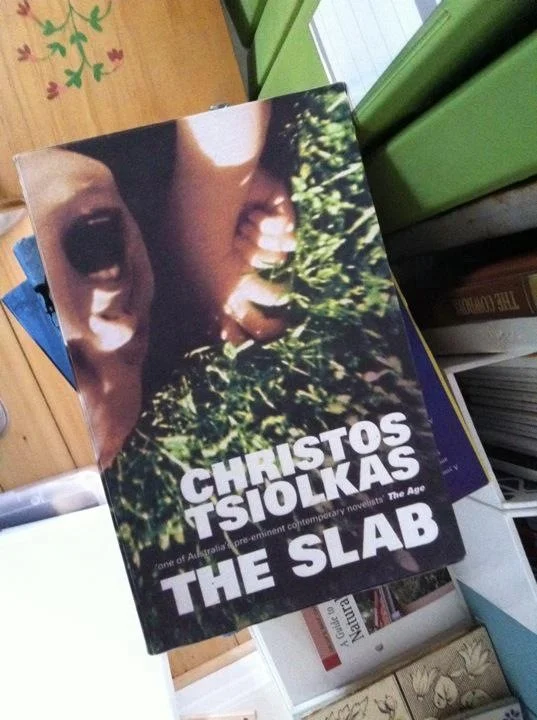
Christos Tsiolkas’s The Slap – a quick tweak of the cover and you can see it's now called ‘The Slab’, and is the harrowing story of a bloke who brings local beer to a barbecue and then spends the whole night hitting an imported slab that isn't his own.

Zadie Smith’s award winning first novel - we're releasing that with the Coolongatta friendly title of ‘White Pants’.

This one from Lionel Shriver will be re-badged by Bogan Publications into the slightly cricketish ‘We need to talk about Kevin Pieterson’

And finally, … what bogan wouldn’t have his interest piqued by a copy of Jan Martel’s The Life of Pie-Warmers

It's about embracing books in the broadest possible sense, about accepting that the whole country is in on this great literary adventure … so walk the walk ... pronounce the word 'fugue' as 'fugue mate' … and sell the idea of yourselves as books ambassadors.

We’ve done so much but we can do still more …

My final words come from Louise Bogan. I know you all know them, so if you like, mouth them along with me …

Now that I know
How passion warms little
Of flesh in the mould,
And treasure is brittle,--
 
I'll lie here and learn
How, over their ground
Trees make a long shadow
And a light sound.

What a bogan.

Enjoyed this speech? Speakola is a labour of love and I’d be very grateful if you would share, tweet or like it. Thank you.

Facebook Twitter Facebook
In BOOKS Tags TONY WILSON, COMEDY DEBATE, DEBATE, BOOKS, BOGANS, TONY MARTIN, STATE LIBRARY OF VICTORIA
Comment

Annabel Crabb: 'I resolved that I would launch this book by reading aloud my own letter to Christopher’s children', launch Christopher Pyne's 'A Letter to My Children' - 2015

August 4, 2016

2 August 2015, Adelaide, Australia

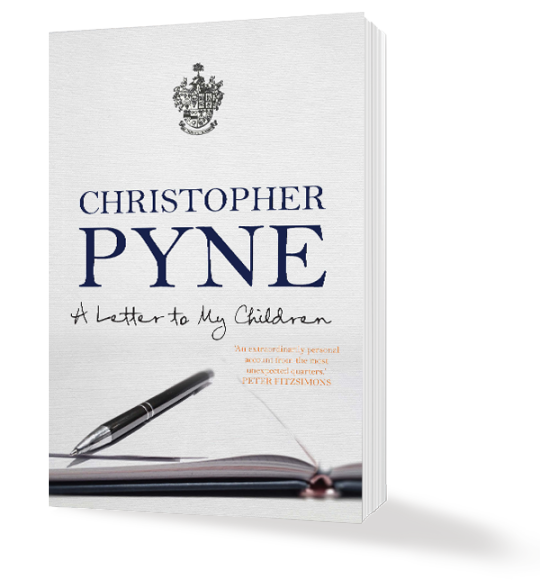
Annabel Crabb launched Christopher Pyne’s book, “A letter to my children” with her own letter to his children. Annabel letter was as follows:

We are all gathered here today because we have something in common. Either we love Christopher, or we are irreversibly related to him, or we are a little bit frightened of him. Or we are here for the sport. I won’t – being an irreproachable paragon of ABC independence – vouchsafe exactly where I am located on that spectrum, though I’m sure if you give it about 10 minutes Chris Kenny will write the definitive account.

I have known Christopher Pyne for many years. I knew him when he was no one. And the strange thing about Christopher is that even when he was a no one, he really did give the strongest possible impression of being a Someone. This peerless long-range optimism has paid off so richly that – a mere 25 years or so since I met him at the University of Adelaide, where he was a charmingly merciless campus Liberal trying to rebuild the Student’s Association in his own glorious image – he is now the charmingly merciless Federal Minister for Education, trying to rebuild the entire university sector in his own glorious image.

And now he has written a book. And – in one of the most rewarding tactical blunders of his political career – he has given me what I understand is a speaking slot of unlimited duration to hold forth on the subject of it and him tonight.

This book is audacious – let us not pretend otherwise. It was written during a truly punishing year as Education Minister, during which its author additionally foxtrotted with characteristic nimbleness through what must have been a rather delicate period of party leadership tension in February and March. Christopher – I should in fairness point out – insists that he wrote the book during his holidays, and while on planes, and helicopters, and on his way to Sophie Mirabella’s wedding, and so on.


The book itself is part Profiles In Courage, part Nancy Mitford and part Dreams Of My Father. In the modern Liberal Party, surely Christopher Pyne is the only person who could cheerfully borrow from two American Democratic presidents – one dead, one Kenyan – and live to tell the tale. I can only assume that George Brandis’s new arts funding organisation is hastening plans to finance the book’s inevitable production as a musical, and that is something I deeply commend. Efforts will need to be made, of course, to dissuade the Education Minister from playing himself.


In fact, I commend this book to you on many counts. I commend to you page 65, which has a very entertaining account of the young Christopher’s pivotal charming of local matriarch Lorna Luff in his quest for preselection in the seat of Sturt. I commend to you page 197, which gives us the long-awaited blow by blow account of what was said that night in 1995 between Christopher and the aspiring triple-bypass recipient John Howard – a conversation that of course, sadly, bought our hero a decade on the back bench. I also commend to you the book’s first chapter, which is a moving, honest, and insightful account of Remington Pyne’s death, and that event’s effect on his younger son.

I have known Christopher for a long time and had always assumed that his personal characteristics were – like Sleeping Beauty’s – the result of inconsistent degrees of attendance from good and bad witches at his christening. But when I read that chapter, in all seriousness, I understood a lot more about the man and the public figure that Christopher is – his urgency and his steeliness, and his utter indefatigability. Over the course of the rest of the book, with its sporadic and entertaining tales of growing up in a family where Christopher was reputed to be the shy one, I learned where his matchless sense of humour and fun comes from.

The life and exploits of Remington Pyne and a joy and inspiration to read, and I think it is a great public good to have them so lovingly recorded.

I do have one niggling concern. I would never suggest, of course, that Christopher M. Pyne is ever driven by ulterior motives, either in his political or private lives. But this letter to his children seems terribly convenient. A 240-page paean from a well-behaved, successful and industrious child to a Godlike, charming, respected father? Just what is Christopher trying to say to his children? Do I detect some subliminal expectation that the book’s addressees will respond – at some point, preferably as their matriculation project – with an answering published work of adulation for their own father? A heroic sculpture, perhaps, for North Terrace? Moving and informative as this book is, is it possible that it is also the most outrageous passive-aggressive parenting manoeuvre ever?

With that possibility in mind, I resolved that I would launch this book by reading aloud my own letter to Christopher’s children.

Dear Eleanor, Barnaby, Felix and Aurelia,

Don’t worry. I’ve read your father’s book, so you don’t have to. I am happy – in my responsible journalistic way – to summarise and provide you with the York notes. But I’m also going to pop in a few things Dad left out when itemising the key values indispensable to a successful life of public service.

Patience, courage, determination – yes, yes yes. You’ll need all those, fine. But there are other important principles you can learn from your father.

First: When Circumstances Change, Change Your Mind.

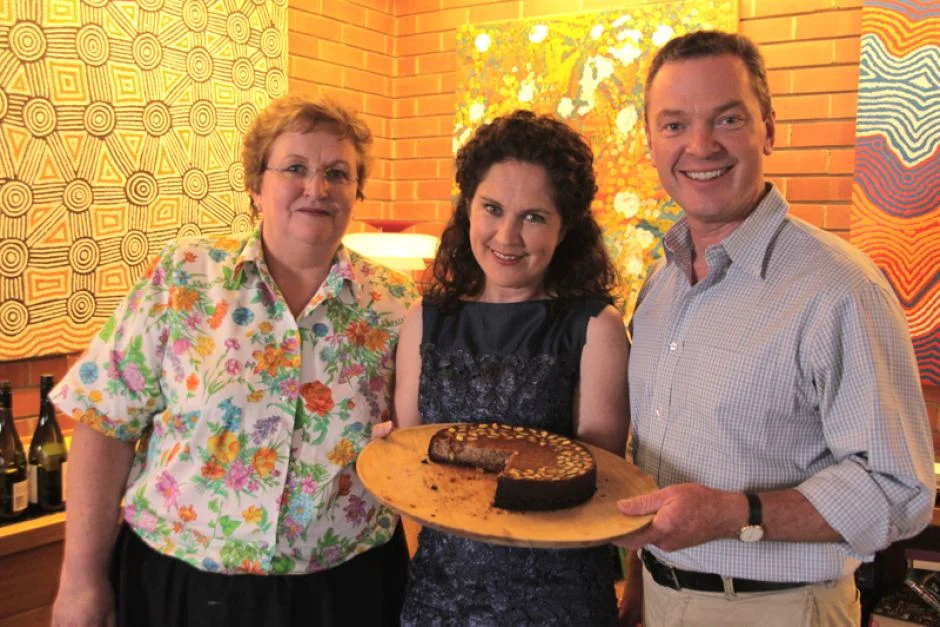
When I approached your Dad a few years back to be one of the guinea pigs for a new series called Kitchen Cabinet, he was at first hugely enthusiastic. We agreed that he would cook with Amanda Vanstone in her kitchen. We discussed serving Roquefort, as Roquefort is a cheese only available in Australia due to an especially commanding executive decision announced by your father on the 23rd of September 2005, when he was feeling his oats as the Parliamentary Secretary for Health, John Howard having cracked the freezer door slightly open. (That’s another tip, children: Always say ‘Yes’ to cheese.)

But as the filming date drew nearer, his mood grew darker and darker. ‘I’m not doing it,’ he’d ring up and wail. ‘It’s going to be a disaster. Amanda and I are going to be sitting there eating expensive cheese and drinking wine and looking like elites. Plus, she’ll tease me. Australians aren’t ready for a politician who talks with his hands. I’m not doing it!’

Children: On the day, I was obliged to be brutal. I told him he had no option of pulling out, and that the ABC had already flown four camera crew to Adelaide. And we know how strongly your father feels about prudence with ABC production resources in Adelaide. I got Mark Textor to call him pretending he had focus group polling suggesting that his participation would resonate particularly well in Klemzig. He turned up. We cooked lunch. All of your father’s worst fears were realised. As he left – to collect you from piano practice, Eleanor, I believe – I said to him ‘See – that wasn’t too bad, was it, Christopher?’ Through a frozen smile, he muttered: ‘Career-ending.’

Later, when the episode went to air, it spawned an unprecedented national wave of Pyne-love, first encountered by your father the morning after the broadcast, when someone approached him at, I believe, Hobart airport and declared: ‘You know, you’re not as much of a knob as I thought you were!’

I had a phone call soon after from your ebullient father, convinced that the show was the best idea he’d ever had. So remember, children: A bad idea is only a bad idea until it turns out to be a good idea.

Point Two: Negotiation.

I would have written more about this, but I know you are across it already. I’ve heard the stories about you four. When Christopher declared that he would move out if you children got one more pet, you bought a rabbit immediately. That’s smart. Always bluff in these situations. It’s what he’d do. And has he moved out? No. He hasn’t. Lesson learned. In short, kids: You’ve fixed it. That’s because you’re fixers. Good work.

Point Three: Loyalty.

Now this is an important one, tiny Pynies. Loyalty enhances the giver and the receiver. And loyalty is a significant part of your father’s credo in federal politics. Fifteen years or so into his political career, your father learned an additional, valuable lesson about loyalty: It works even better if you’re loyal to the actual person in charge, rather than the person you hope will one day be in charge. He’s never looked back, and neither will you.

Now, my dear little Pyne saplings – don’t worry. I’m not going to lecture you for page upon page upon page. I know perfectly well that you can get that at home.

But I want to mention two more things. The first is an unshakeable and central tenet in public life that is well recognised by your father, and acknowledged in his book, but nevertheless bears repetition.

And that is: Marry well. Your grandfather did, in the spectacular Margaret, as the book makes very clear. And so did your father. Really, that can make all the difference. And for the heavy price you pay, the four of you, for your father’s lifelong contribution to public service – the constant absences, the embarrassing Internet memes, photo shoots in The Australian, the inconvenience of studying in an education system over which your father has nominal control, the alarming ‘win at any price’ approach he adopts to games of ‘May I?’ or Monopoly – always remember, he made at least one truly brilliant decision in his life – to marry Carolyn, of whose wit, originality, decency and great good sense you will always be the beneficiaries.

The second is that – and I don’t mean to ease up on teasing your father for very long, because Lord knows there is no one on this good Earth who is more fun to tease than Christopher Pyne – there is a grandeur to public service, and he is right about that. Not grandeur in the ‘having your own helicopter’ sense. Grandeur in the untold possibilities of public service, where an inquiring mind and a stout heart can make anything possible, can change any injustice or idiocy or root out any corruption or stop any wastage of public resources. Grandeur in the sense of having a series of beliefs and having the courage and the intrepidity to prosecute them at lengths, and persist even when things are hard, rather than just reclining with a beverage to whine about the situation. (That, children, is the job of journalists, in case you were wondering).

So never cease to feel proud of your father for that, and for the fact that he brought Roquefort to Australia, and for the fact that he, and his father before him, worked hard and were adventurous and outrageous and not very good with pets and always had the capacity to laugh. Remember that your father – in an age where politics has become about caution and covering your behind and striving to say nothing at all that is memorable – has become not only one of the most powerful politicians of his time, but also one of the great characters. That’s not an easy thing to do nor is it an easy life to lead. It’s what I most admire in him.

Also remember that for all that you might have missed your father over the long years when he was absent for weeks at a time – imagine how much worse it would have been to have him at home.

Yours sincerely,

Annabel Crabb


Purchase book here.

Source: http://mupublishing.tumblr.com/post/125895...

Enjoyed this speech? Speakola is a labour of love and I’d be very grateful if you would share, tweet or like it. Thank you.

Facebook Twitter Facebook
In BOOKS Tags ANNABEL CRABB, CHRISTOPHER PYNE, AUTOBIOGRAPHY, BOOK LAUNCH, TRANSCRIPT, POLITICAL BIOGRAPHY, BOOKS
1 Comment

Steve Hely: 'I wanted to see wonders', Laguna Beach Festival of the Arts - 2016

August 4, 2016

24 July 2016, Laguna Beach, California, USA

Delivered for 'Books and Brunch' event at Laguna Beach Festival of the Arts. Steve Hely has written for The Office, 30 Rock, American Dad and Veep. His first novel won the Thurber Prize for American Humour. His current book is The Wonder Trail.

Guys, I have to tell you that although I’m really happy to be here, and delighted you invited me, I’m living out one of my biggest fears. 

I’m not afraid of public speaking, I’ve done it quite a few times, I even enjoy it.  But all the talks or speeches I’ve ever given have been inside.  I’ve never given one outside. 

It’s really hard to give a speech outside.  Inside, you’re kinda boxed in.  You’re a captive audience.  There’s nothing to stop you from wandering off into the hills or down to the beach.  Plus, I’m competing for your attention with nature.  Which, in a place as beautiful as Laguna is just not a good idea. 

Now, there have been a bunch of great speeches given outside.  Lincoln’s Gettysburg Address was given outside.  JFK’s inauguration speech.  Ronald Reagan’s Mr. Gorbachev, tear down this wall, that was an outdoor speech.  But guys, I have to confess to you: as a speaker I am not at a level with Abraham Lincoln, John F. Kennedy and Ronald Reagan. 

But I will promise you I will do my best. 

Laguna Beach is such a special place.  Let me tell you a story about Laguna Beach, because it has a place in my own family history. 

My grandfather was a doctor in the Navy during World War II.  Some of you probably know this but the Navy supplies the doctors for the Marine Corps., and my grandfather was assigned to the Marine Corps.  Sometime in 1944 they sent him to Camp Pendleton to train for amphibious landings.  He was engaged, and he sent for my grandmother.  She took a train across the country from Philadelphia by herself, probably her first trip away from home, and they got married in June. 

A lot of the doctors got married that summer, because they knew they were going to ship out.  And when they shipped out, they believed they weren’t coming back until they’d invaded Japan.  And they knew how hard that was going to be. 

But before they left all the doctors and their new wives got a one month honeymoon here in Laguna Beach. 

I think about that every time I come down here, and how intense that month must of felt, wonderful and terrifying at the same time, because when they shipped out they didn’t know when they’d come back or how they’d come back or if they’d come back. 

My grandfather did come back, though.  Which is lucky for me.  So I get to be here today with you on this beautiful Sunday. 

Life is wild, is I guess the point of my story.  It’s full of chances and miracles and disasters and ups and downs and things that are completely out of our control.  Who can say what we’re put here for?  We all have to look around and search ourselves and search the world and come up with answers to that for ourselves. 

One answer I’ve come up with for myself is that we’re put here to explore.  To experience the Earth and the places on it, to travel, to have adventures, to learn about other people, to share what we learn with other people, to learn what they have to share with us, and to communicate with each other. 

That’s what I wanted to do, I want to live life and explore and see as much of the world as I can.  I’m curious, I want to have a look, and if I find something that gets me excited, that fires up my interest, then I want to share that with you. 

One question I had that was bugging me was what’s the world south of us like.  If you go south, from here, not very far as all of you know, you come to the border with Mexico.  Well, what’s Mexico like?  How did it get that way?  And what’s beyond that?  South of Mexico there’s Central America.  I knew Central America had waterfalls and ruins and jungles and sloths and coffee plantations and coastlines that pirates had sailed along, and fruits I’d never tried, and volcanoes, and the Panama Canal, and hidden surf spots, and a million other things worth seeing.  I also knew they’ve had all kinds of problems there, civil wars and guerrilla movements and dictators and disasters. 

What’s it like there?  How’d it get that way? 

And beyond that there’s all of South America!  What’s going on down there?

Well that’s what I wanted to find out. 

I work as a TV writer on comedy shows, and by a fluke of luck I ended up with three months off, between two jobs.  And I thought ok, well great.  I’m gonna go south, and see as many places as I possibly can, and come back and tell you about them. 

So that’s what I did, I traveled south from here, and I went through Mexico, Guatemala, El Salvador, Nicaragua, Costa Rica, Panama, Colombia, Ecuador, Peru, Bolivia, and Chile, down to Tierra del Fuego at the bottom of South America. 

Then I came back, and I devoured a shelf full of books about these places, and I put what I learned into this book. 

Let me tell you three things about this trip, and what I learned, things that amazed me and still fascinate me. 

What’s now Mexico City was once called Tenochtitlan, and in the year 1519 it might have been the biggest city in the world.  It was for sure the biggest city in the Western Hemisphere.  The city sat on an island in the middle of a lake that was fifty miles long. 

Bernal Diaz was a Spaniard who saw this city in that year.  He says that men who’d seen Rome and Constantinople and every city in Spain were stunned by how enormous it was. 

He says there were weavers and seamstresses, and craftsmen who worked with gold and silver, and garment makers who made robes out of feathers.  There were painters and carvers and whole neighborhoods of clowns and acrobats and stilt-walkers.  There were gardens and ponds and “tanks of fresh water into which a stream flowed at one end and out of the other… [and] baths and walks and closets and rooms like summerhouses where they danced and sang.”  And there were people who sold human feces for use in tanning hides. 

Diaz was taken to the top of an enormous temple, and he could see out agross the city and the lake, he could see aqueducts and canoes coming and going and other cities and towns that you reached by drawbridge, and shrines that had gleaming white towers and castles and fortresses.

Well about a year later almost everyone in the city was dead, and the place had been destroyed. 

On the very site where there’d stood the biggest temple in Tenochtitlan, the Spanish started building a church.  And they kept building and building and working on it for over five hundred years.  Sometimes it would get knocked down in an earthquake or destroyed in a fire but that’s the spot, to this day, where you can see the cathedral of Mexico City. 

Greater Mexico City, all the land that was once that enormous lake, now has something like twenty million people in it.  In the book I try to describe the tiny fraction of it that I could see and experience. 

How about Costa Rica?  I bet there’re people here who’ve been to Costa Rica.  Costa Rica is a paradise!  There are rainforests and hot springs and beaches, and the people have a national philosophy of being chill.  In Costa Rica they don’t have an army.  They dissolved their army in the 1940s.  Now, Costa Rica is not perfect, but it’s neighbored by countries - Honduras, El Salvador, Nicaragua - that’re some of the most violent places in the world.  In El Salvador the murder rate is seventeen times the world average. 

Why do things work out so much better for one country than for another?  That’s something that interests me when I travel, and in the book I try and tell you what I found when I went looking for answers. 

But most of all when I set out on this adventure, I wanted to see wonders.  I wanted to drink the best cup of coffee.  I wanted to see the Amazon jungle.  I wanted to see Macchu Piccu, I wanted to see the Galapagos, I wanted to see the Andes mountains and the Atacama desert.  I know I’m not alone, I know there are people out there who want to see these too.  And some of you have seen them, and some of you will some day.  And some of you can’t really be bothered, and that’s ok, too.  For all of you, I wanted to share what I saw, and what I experienced, what excited my curiosity, and I hope it’ll excite yours too. 

So thanks so much for having me, it’s a real honor to be a part of this event.  You’re the best looking audience I’ve ever spoken to and I’m not just saying that. 


Purchase 'The Wonder Trail' here. Steve Hely is also a guest of the Melbourne Writers Festival in September 2016. Purchase tickets here. 

Enjoyed this speech? Speakola is a labour of love and I’d be very grateful if you would share, tweet or like it. Thank you.

Facebook Twitter Facebook
In BOOKS Tags STEVE HELY, WRITERS FESTIVAL, BOOKS, COMEDY, FUNNY=, TRAVEL BOOK, TRANSCRIPT, THE WONDER TRAIL, SOUTH AMERICA, CENTRAL AMERICA, HUMOUR, TV WRITER
Comment

William Lyon Phelps: 'Literature is the immortal part of history', The Pleasure of Books - 1933

January 19, 2016

6 April 1933, radio broadcast

The habit of reading is one of the greatest resources of mankind; and we enjoy reading books that belong to us much more than if they are borrowed. A borrowed book is like a guest in the house; it must be treated with punctiliousness, with a certain considerate formality. You must see that it sustains no damage; it must not suffer while under your roof. You cannot leave it carelessly, you cannot mark it, you cannot turn down the pages, you cannot use it familiarly. And then, some day, although this is seldom done, you really ought to return it.

But your own books belong to you; you treat them with that affectionate intimacy that annihilates formality. Books are for use, not for show; you should own no book that you are afraid to mark up, or afraid to place on the table, wide open and face down. A good reason for marking favorite passages in books is that this practice enables you to remember more easily the significant sayings, to refer to them quickly, and then in later years, it is like visiting a forest where you once blazed a trail. You have the pleasure of going over the old ground, and recalling both the intellectual scenery and your own earlier self.

Everyone should begin collecting a private library in youth; the instinct of private property, which is fundamental in human beings, can here be cultivated with every advantage and no evils. One should have one's own bookshelves, which should not have doors, glass windows, or keys; they should be free and accessible to the hand as well as to the eye. The best of mural decorations is books; they are more varied in color and appearance than any wallpaper, they are more attractive in design, and they have the prime advantage of being separate personalities, so that if you sit alone in the room in the firelight, you are surrounded with intimate friends. The knowledge that they are there in plain view is both stimulating and refreshing. You do not have to read them all. Most of my indoor life is spent in a room containing six thousand books; and I have a stock answer to the invariable question that comes from strangers. "Have you read all of these books?"
"Some of them twice." This reply is both true and unexpected.

There are of course no friends like living, breathing, corporeal men and women; my devotion to reading has never made me a recluse. How could it? Books are of the people, by the people, for the people. Literature is the immortal part of history; it is the best and most enduring part of personality. But book-friends have this advantage over living friends; you can enjoy the most truly aristocratic society in the world whenever you want it. The great dead are beyond our physical reach, and the great living are usually almost as inaccessible; as for our personal friends and acquaintances, we cannot always see them. Perchance they are asleep, or away on a journey. But in a private library, you can at any moment converse with Socrates or Shakespeare or Carlyle or Dumas or Dickens or Shaw or Barrie or Galsworthy. And there is no doubt that in these books you see these men at their best. They wrote for you. They "laid themselves out," they did their ultimate best to entertain you, to make a favorable impression. You are necessary to them as an audience is to an actor; only instead of seeing them masked, you look into their innermost heart of heart.

Source: http://www.historyplace.com/speeches/phelp...

Enjoyed this speech? Speakola is a labour of love and I’d be very grateful if you would share, tweet or like it. Thank you.

Facebook Twitter Facebook
In BOOKS Tags LIBRARIES, BOOKS, WILLIAM LYON PHELPS, READING, PLEASURE OF BOOKS
Comment

Tony Martin: 'City of Bongs, and Football, and Scratchy Tickets', State Library of Victoria debate - 2009

August 11, 2015

17 October, 2009, State Library of Victoria, Melbourne

Tony Martin and Catherine Deveney argued for bogans in this ‘comedy debate’. Jane Clifton and Tony Wilson represented the ‘books’.

If you’re anything like me, you’re running a temperature of about 112 and are on so much prescription medication, you’re not really sure where you are. This could be the State Library, or it could be the opening scene of David Cronenberg’s Scanners.

Obviously, if it is the latter, the front three rows might like to move back a tad. Because you will get splattered with cranial matter. On the upside, the debate will be forfeited and you can all piss off early to the pub. Or to Borders, to see if they’ve got the new Jonathan Franzen. Because you’re book nerds, aren’t you? I can feel you, looking up at me, thinking, ‘There is no new Jonathan Franzen, what the hell are you talking about?’

Oh yeah, I know what you people are like. Because, if you are anything like me, you know what it’s like to feel your heart racing as you approach the specials table at Readings and pick up what looks to be a US import hardcover edition of Alice Munro’s Runaway – feel the deckled edges – it’s a Knopf original! – fumble for the imprint page, is it? Yes, it is! It’s a first edition, for $12.95 – that’s half the price of the local paperback!

If you’re like me, you’re buying all three local papers on a Saturday and going straight for the ‘Books’ sections. Noting the new, smaller-format ‘Review’ section in The Weekend Australian, turning to your partner and saying, ‘Is it just me, or are there just twelve pages of book reviews where there used to be sixteen?’

If you’re like me, you’re losing sleep over the imminent arrival of these newfangled Kindle machines. I mean, are they any good? Are they really going to replace books? Are people really going to want to read Nicholas Nickleby off a calculator? I mean, didn’t anybody read that essay by Adam Gopnik in The New Yorker?

If you’re like me, you’re tossing and turning about the selection of extracts in that new Macquarie PEN Anthology of Australian Literature – I mean, have they included enough indigenous writers? What does Clive James think? Has Peter Craven weighed in? Is it really worth getting up and going to work today? Is it too early to call [NAME CENSORED] and was that book really about him and [NAME CENSORED] doing it every which way? I need to know, I have to know, because I live in a City of Literature!

Except I don’t.

Because that person I’ve just described is me, it may be you…and about 2400 other people. Nobody else could give a shit!

Face it, we’re living in Boganville.

Now, I’m not having a latté-fuelled sneer. I myself hail from one of the bogan capitals of New Zealand. In my suburb, we had one of those Video Ezys where all the parking spaces are named after movie stars, but ours – and I swear this is true – had not one, but two spaces labelled ‘Patrick Swayze’. None for Daniel Day-Lewis, two for Patrick Swayze. That’s when you know you’re living in a centre of bogan activity and endeavour.

And that’s where we’re living, here in Melbourne.

Because you could offer the average person in Melbourne all the books in Readings and Borders and Hill of Content – you could say, ‘Right, you can have a look at all of them – or – you can have a look at the new “Stars Without Make-up” issue of New Weekly.’ Which one do you think they’d go for?

Margaret Atwood, fuck off! I want to see Posh Spice getting out of a car, with no pants on.

I remember that when this ‘City of Literature’ nonsense was announced, there was a picture in the paper of a handsome young man with a mane of hair like Michael Chabon’s, and a wayward scarf, sitting atop a knoll in Federation Square, paging thoughtfully through a copy of Patrick White’s Voss.

Now, my guess is, moments after that photo was taken, he had the shit kicked out of him by five bogans, fresh off the Frankston line en route to Hungry Jack’s. That man would have been picking Voss out of his teeth for weeks, and the mobile phone footage would’ve racked up a million hits by the time the ambulance arrived.

Because this is not a City of Books – it’s a City of Bongs, and Football, and Scratchy Tickets, and Internet Porn, and Buying an Illegal Copy of Underbelly Out of Somebody’s Boot in the Car Park of the Dingley Powerhouse.

Oh, sure, it’s a city of some books, but what was the biggest selling book of last year? Was it by Tim Winton? Geraldine Brooks? Peter Carey? No, it was a book about how to remove stains from fabric. How to remove the remnants of a Bacardi Breezer from your best pair of trackypants.

If we were to stage a genuine Melbourne Writers Festival, the big ticket event would be Geoffrey Rush reading mellifluous extracts from the stain-removal book – or the second most popular book of the year – How to Make a Meal Using Only Three Ingredients: VB, hate and Sam Newman’s ballsack.

People in Melbourne don’t want to read books. They want to read about who’s banging Lara Bingle. The only literature they’re really interested in is the literature on the counter at JB Hi-Fi that tells them how much they’ll pay for an even bigger telly, so they can watch Kyle Sandilands making an even bigger cock of himself, just before they slump into unconsciousness, awaking only to buzz in the bloke from Pizza Hut.

If this weren’t the case, that TV show where everyone pretends to have read the new one by Roberto Bolano wouldn’t be hidden away late on Tuesday night on the ABC. It’d be on Channel Nine in prime time, hosted by Daryl Somers and five medical students in blackface.

If this weren’t the case, the ‘literary’ section at your local shopping centre Dymocks wouldn’t be almost entirely filled with books about Mr Darcy, none of which were written by Jane Austen, like Mr Darcy Takes a Wife, The Secret Diaries of Mr Darcy and How To Remove Stains From Mr Darcy’s Incredibly Fulsome Pants.

If this weren’t the case, then A S Byatt would’ve outsold The AFL Diet.

True story: A couple of years ago, I’m in Readings in St Kilda – when it used to be Cosmos – browsing foppishly on a quiet Saturday afternoon – because it’s always quiet in a bookshop – and there’s this couple, swathed in football-related clothing, each with a baby in a pouch on their front, and the woman has suddenly shouted – loudly, shockingly – across the shop to the bloke:

‘Damian, come over here! I have found a book that is better than The Da Vinci Code!’

He’s come shuffling over, going, ‘Bullshit! There is no book – no book – that is better than The Da Vinci Code!’

And she’s said, ‘Well, look at this – The Illustrated Da Vinci Code!’

And he’s looked at it, for five minutes, just turning it over in his hands, going, ‘Fuck me, this is better…cos they’ve done pictures of everything.’

Those are the people who should’ve been in that picture in the paper for ‘Melbourne: City of Literature’.

Melbourne: City of Bogans. Who occasionally read a book – about stains, about diets, about conspiracy theories, about people who were in Underbelly.

They don’t want to read about the dashed hopes of a godless society at the end of an era of greed and excess and moral ambiguity. They want to read about Brendan Fevola, throwing up in an ashtray at Crown Casino.

And you know what? So do I.

This piece and many other hilarious offerings on sale in 'Scarcely Relevant' for just $6 at http://tonymartinthings.com/

Source: http://tonymartinthings.com/

Enjoyed this speech? Speakola is a labour of love and I’d be very grateful if you would share, tweet or like it. Thank you.

Facebook Twitter Facebook
In COMEDY Tags TONY MARTIN, COMEDY DEBATE, BOOKS, LITERATURE, COMEDY, COMEDIANS
Comment

See my film!

Limited Australian Season

March 2025

Details and ticket bookings at

angeandtheboss.com

Support Speakola

Hi speech lovers,
With costs of hosting website and podcast, this labour of love has become a difficult financial proposition in recent times. If you can afford a donation, it will help Speakola survive and prosper.

Best wishes,
Tony Wilson.

Become a Patron!

Learn more about supporting Speakola.

Featured political

Featured
Jon Stewart: "They responded in five seconds", 9-11 first responders, Address to Congress - 2019
Jacinda Ardern: 'They were New Zealanders. They are us', Address to Parliament following Christchurch massacre - 2019
Dolores Ibárruri: "¡No Pasarán!, They shall not pass!', Defense of 2nd Spanish Republic - 1936
Jimmy Reid: 'A rat race is for rats. We're not rats', Rectorial address, Glasgow University - 1972

Featured eulogies

Featured
For Geoffrey Tozer: 'I have to say we all let him down', by Paul Keating - 2009
for James Baldwin: 'Jimmy. You crowned us', by Toni Morrison - 1988
for Michael Gordon: '13 days ago my Dad’s big, beautiful, generous heart suddenly stopped beating', by Scott and Sarah Gordon - 2018

Featured commencement

Featured
Tara Westover: 'Your avatar isn't real, it isn't terribly far from a lie', The Un-Instagrammable Self, Northeastern University - 2019
Tim Minchin: 'Being an artist requires massive reserves of self-belief', WAAPA - 2019
Atul Gawande: 'Curiosity and What Equality Really Means', UCLA Medical School - 2018
Abby Wambach: 'We are the wolves', Barnard College - 2018
Eric Idle: 'America is 300 million people all walking in the same direction, singing 'I Did It My Way'', Whitman College - 2013
Shirley Chisholm: ;America has gone to sleep', Greenfield High School - 1983

Featured sport

Featured
Joe Marler: 'Get back on the horse', Harlequins v Bath pre game interview - 2019
Ray Lewis : 'The greatest pain of my life is the reason I'm standing here today', 52 Cards -
Mel Jones: 'If she was Bradman on the field, she was definitely Keith Miller off the field', Betty Wilson's induction into Australian Cricket Hall of Fame - 2017
Jeff Thomson: 'It’s all those people that help you as kids', Hall of Fame - 2016

Fresh Tweets


Featured weddings

Featured
Dan Angelucci: 'The Best (Best Man) Speech of all time', for Don and Katherine - 2019
Hallerman Sisters: 'Oh sister now we have to let you gooooo!' for Caitlin & Johnny - 2015
Korey Soderman (via Kyle): 'All our lives I have used my voice to help Korey express his thoughts, so today, like always, I will be my brother’s voice' for Kyle and Jess - 2014

Featured Arts

Featured
Bruce Springsteen: 'They're keepers of some of the most beautiful sonic architecture in rock and roll', Induction U2 into Rock Hall of Fame - 2005
Olivia Colman: 'Done that bit. I think I have done that bit', BAFTA acceptance, Leading Actress - 2019
Axel Scheffler: 'The book wasn't called 'No Room on the Broom!', Illustrator of the Year, British Book Awards - 2018
Tina Fey: 'Only in comedy is an obedient white girl from the suburbs a diversity candidate', Kennedy Center Mark Twain Award -  2010
Tina Fey: 'Only in comedy is an obedient white girl from the suburbs a diversity candidate', Kennedy Center Mark Twain Award - 2010

Featured Debates

Featured
Sacha Baron Cohen: 'Just think what Goebbels might have done with Facebook', Anti Defamation League Leadership Award - 2019
Greta Thunberg: 'How dare you', UN Climate Action Summit - 2019
Charlie Munger: 'The Psychology of Human Misjudgment', Harvard University - 1995
Lawrence O'Donnell: 'The original sin of this country is that we invaders shot and murdered our way across the land killing every Native American that we could', The Last Word, 'Dakota' - 2016