• Genre
  • About
  • Submissions
  • Donate
  • Search
Menu

Speakola

All Speeches Great and Small
  • Genre
  • About
  • Submissions
  • Donate
  • Search

Fredrik Backman: 'My brain and I, we are not friends', Simon & Schuster 100 years - 2024

June 18, 2025

8 April 2024, Town Hall, New York City, USA

Good evening. My name is Fredrik Backman.

I’m here tonight because my agent said that this would be good for my career. She said I need to learn how to speak in front of people.

‘It’ll be fun,’ she said.

So I told her that I write books. I spend eight hours every day locked inside a room with people I have made up. If I was comfortable talking to real people, I would have a real job.

But my agent said, ‘Just go up there and talk about the life of a writer.’

And I said, all right. Being a writer is the best way I know how to get paid for being insane.

Don’t applaud. I only have four minutes.

My brain and I, we are not friends. My brain and I, we are classmates doing a group assignment called Life, and it’s not going great.

So my agent, upon hearing this said, ‘Maybe you can talk about how you suffer from creative anxiety, Fredrick.’

And I said, I don’t suffer from creative anxiety.

And my agent said,’ Well, everyone around you suffers.’

So I explained that I don’t have creative anxiety. I just have normal death anxiety. And sometimes I have panic anxiety if I’m in a hurry and need to have a lot of anxiety all at once. But I don’t have creative anxiety. I never get writer’s block. And the secret is easy; it’s procrastination.

I don’t want to brag, but I’m very good at procrastination. I’m going to have writer’s block, I just haven’t gotten around to it yet. I am am so good at procrastination that the only reason that I am here tonight is because I’m supposed to be finishing a book right now.

But my anxiety is not creative. My anxiety is Scandinavian because I am from Sweden. In America, Sweden is often confused with Switzerland, but we are very different. In Switzerland, they have chocolate and watches. In Sweden, we have Ikea and depression.

Swedish depression is just like American depression, but it’s cheaper, and you have to assemble it yourself. Some parts may be missing. So if someone in here is depressed tonight and you don’t know why, then you might be Scandinavian.

Of course, some of you will think that because I am Scandinavian I must write crime novels, but I find murder to be too much work. So instead, I write novels about characters who could murder someone, but they haven’t gotten around to it yet.

I wrote this speech on the airplane from Sweden to America, which was great because of the time difference. Americans call that jet lag. I call it a procrastinator’s dream because Sweden is six hours ahead of New York.

So I left home Sunday evening, and when I arrived here, it was still Sunday evening. The customs official asked me where I was traveling from, and I answered, ‘The future.’

So in conclusion, I am here tonight, with all of my anxiety, because I know that in this room there might be someone who is dreaming about writing a book, dreaming of becoming an author. So I’m here to tell you that I am obviously an idiot. I have no idea what I’m doing, but I have become an author anyway, so you can too.

And I hope that one day I will be able to tell my agent that the reason that my next book is not finished yet is because I was busy reading yours.

Thank you very much.

Source: https://www.mondaymorningmemo.com/fredrick...

Enjoyed this speech? Speakola is a labour of love and I’d be very grateful if you would share, tweet or like it. Thank you.

Facebook Twitter Facebook
In BOOKS 2 Tags FREDRIK BACKMAN, FUNNY, AUTHOR, COMEDY, WRITING, ON WRITING, TRANSCRIPT, SIMON & SCHUSTER, SWEDEN, AUTHOR EVENT, PROCRASTINATION
Comment

Andy Griffiths: 'I want the freshness of dreams to be again revealed to me', 'Stella Spark' for Carmel Bird - 2016

November 29, 2016

9 February 2016, Melba Spiegeltent, Collingwood, Melbourne, Australia

Carmel Bird was awarded Australian literature's prestigious Patrick White Award at Readings bookshop on 11 November 2016.

Thanks so much for the invitation to speak tonight. I’m happy to be at an event celebrating literary woman as I’ve spent my entire writing career surrounded, helped and inspired by many women, one of the most important being my wife Jill who was the editor of my first children’s book, Just Tricking, back in 1997 and who has edited—and increasingly collaborated on the books with me ever since.

I’ve often wondered whether part of the success we’ve enjoyed with the books is due to this blending of our male and female sensibilities. Despite the perception amongst some that our books have special appeal to boys, our audience has always been made up of both boys AND girls … and many of these girls are just as enthusiastic and amused by the taboo & disgusting elements of the stories as the boys.

I’m wary of subscribing to gender stereotypes but I will say that—over the years—I think I have helped Jill to appreciate the humour of the physical slapstick of The Three Stooges (and not just sit there feeling sorry and upset for Curly because Moe is being mean to him) and—in return—she has brought me to a fuller appreciation for the verbal gymnastics of The Marx Brothers.

But before I met Jill I was fortunate enough to read, meet and then be taught by Carmel Bird, a Tasmanian writer then living in Melbourne.

I was aware of her fiction from a book called The Woodpecker Toy Fact, a collection of highly original and darkly humorous stories that were playful, self-aware, personal, honest and utterly unlike anything I’d read to that point. She could take the most ordinary incidents or objects and through sustained attention and exploration transform them into little tableaus of wonder, sadness and delight.

So I was thrilled to find her writing instruction book, Dear Writer, a practical, inspirational, common-sense examination of all aspects of the writers’ life written in the form of a series of letters from a fictional writer to an imaginary beginning student.

In 1990 I attended a two-day summer school writing course run by Carmel at the then newly established Victorian Writers Centre. She waltzed into the room with an ethereal air—looking not unlike a character you might expect to find in a fairy tale—though whether good, evil or simply mischievous was difficult to tell. She gave us each a piece of white tablecloth and invited us to use it as the starting point for a piece of fiction. I can’t remember exactly what I wrote but I remember it made her smile.

I showed her a collection of writing fragments I’d been working on– and asked her what I’d need to do in order to get it published. She suggested I organize it in some way. I argued it was better to keep it random. “I know that,” she said, conspiratorially, ‘and you know that, but publishers won’t know that.” And so I began the long slow process of organizing—and rewriting—what was to become my first officially published book—a creative writing textbook for use in high school classrooms.

A few months later she invited me to be part of a poetry/short story reading night with her and some other established writers at a hotel in Fitzroy. It was both an amazing show of confidence on her part and a terrifying prospect, but it was reassuring to know that I was doing something right—though I wasn’t quite sure what.

But I kept practising, and two years later, as luck would have it, I discovered Carmel was teaching a year-long graduate diploma of fiction writing at Rusden College in Toorak.

So in 1991 I took leave without pay from my high-school teaching job and enrolled in Carmel’s Monday evening class and spent the rest of my time writing.

During this year she taught me three hugely valuable things.

Firstly, the importance of considering your reader. This was achieved through the often gruelling practice of having to have our stories critiqued by the other students in the class. Carmel would preside sagely over this process, stepping in when things got too brutal.

Secondly she taught me the value of reading widely and introduced me to many important writers including Helen Garner, Henry Handel Richardson, Elizabeth Harrower, Ruth Park, Katherine Mansfield and Barbara Baynton.

And thirdly, by point blank refusing to tell me the magic secret of how to get published—which I was sure all published writers knew—she gently forced me to learn to trust my own idiosyncratic voice and ignore the nagging feeling that because it was my own idiosyncratic voice it must somehow be wrong … which was of course the magic secret all along.

Because of my fondness for writing humour she nudged me in the direction of writing for children – we both agreed that what seemed to be missing from Australian children’s writing at the time was the sort of rambunctious fantasy that we had both enjoyed in the work of Enid Blyton. (She once wrote—or told me—I can’t remember which that she thought the thing with Enid Blyton was not that her stories and characters were unbelievable, but the opposite—they were TOO believable.)

As a fiction writer Carmel has experimented with many different genres and styles. But I always come back to The Woodpecker Toy Fact, especially the passage at the beginning of ‘A Taste of Earth’, which—in retrospect—I think I took to be a sort of mission statement.

“When I read fiction I want the words to take my spirit into the places beneath the surface of the everyday world. I want the freshness of dreams to be again revealed to me. I want to know the loveliness and terror of what lies beyond the last star … to feel the anguish and exhilaration of the fiction writer’s power to create and destroy.”

From reading Carmel’s fiction I have no doubt about her power to create and destroy, and from being a student in her class I can personally attest to her ability to inspire—a true Stella Spark.

Enjoyed this speech? Speakola is a labour of love and I’d be very grateful if you would share, tweet or like it. Thank you.

Facebook Twitter Facebook
In BOOKS Tags CARMEL BIRD, STELLA PRIZE, STELLA SPARK, TRANSCRIPT, ANDY GRIFFITHS, CHILDREN'S LITERATURE, WRITING, WRITING TIPS
Comment

Richard Flanagan: "Because writing matters", Inaugural Boisbouvier Lecture, Melbourne Writers Festival - 2016

September 5, 2016

1 September 2016, Athenaeum Theatre, Melbourne, Australia

Every day we hear grim and grimmer news that suggests we are passing through the winter of the world. Everywhere man is tormented, the globe reels from multitudes of suffering and horror, and, worst, we no longer know with confidence what our answer might be. And yet we understand that the time approaches when an answer must be made or a terrible reckoning will be ours.

Perhaps this is what BuzzFeed meant when it featured an article with the title ‘Ten Shitty Alternatives to Drinking Yourself to Death’.

And in our age of clickbait – where our supposedly best newspapers feature articles such as ‘Six Hot Mini Skirts Not To Wear to Your Father’s Funeral’, ‘22 Photos To Restore Your Faith In Humanity Without You Actually Having To Do Anything To Help Improve It.’, ‘Top Five Crimes Favoured By Bilbies That Look Like Bilbies’, or the almost as endearing ‘Ten Ozzie Heroes Who Should Get A Fucking Medal’.

The last, I must admit, gives rise to a nagging question. Are the featured ten to be gonged for heroism or for copulation? There are enough holes in this for a One Nation senator to sense a NASA conspiracy.

In any case, in such an age my first thought was that I should get with the program, using vapid cliches like “get with the program”, and share with you my top ten Tasmanian novels.

Why?

Because these books were the ones in which I first discovered my world and myself. In them I discovered why writing matters.

Why, you may wonder, Tasmanian and not Australian?

And the seemingly sacrilegious answer is that I don’t believe in national literature per se. I do believe in Australian writing, conceived mostly in obscurity, frequently in poverty, almost always in adversity. I believe in that writing as important, as central, and as necessary.

But that’s a different matter from a national literature. Nations and nationalisms may use literature, but writing of itself has nothing to do with national anythings – national traditions, national organisations, national prizes – all these and more are irrelevant. National anythings imply responsibilities, morals, ethics, politics.

And writing, at its best, exists beyond morality and politics. It is at its most enduring when, like a bird, or a beach, or a criminal bilby, it is completely irresponsible, committing the top five crimes favoured by writers that look like writing.

Meat may be murder but so too for a thousand years were books – one sheep or goat for every eight pages of vellum made from their skin. Gutenberg’s revolution wasn’t simply one of swapping a scribe’s calligraphy for machine-pressed type. It was also swapping this highly expensive vellum for cheaper paper made out of rags; and within half a century – most importantly, most revolutionary of all – of swapping the Latin of the rulers for the vernacular of the ruled.

That had many consequences, not least for the impetus it gave to the Reformation, the growth of science, of the Enlightenment, of democracy. It also fed powerfully into a new idea of a people bound by a language which evolved into the profoundly modern idea of a nation-state bound together not by religion and monarch but by the common speech.

And the signet ring common speech needed was literature. With the rise of the nation-state we witness as its necessary corollary those new figures, the national poet and, later, the national novelist, and the national literature they purportedly embody. A language is not, as is often claimed, a dialect with a navy. A nation though is a dialect with a literature.

And yet, that same literature is not a nation. It is not reducible to kitsch ideas like national spirit, nor is it bound by borders. A writer belongs both to the homeland of the people they love and to the universe of books, and can never renounce either.

This leads to the great paradox of national letters – writers who seem rooted in the particular but whose works are deemed universal. Arguably the greatest German writer of the 20th century was Franz Kafka, who was, of course, Czech. His tales of alienation, of guilt, of not being what you seem, could perhaps only have been written by a German-speaking Jew who grew up in a Catholic Slavic city like Prague. But what that makes Kafka – German, Jewish, Czech, Slavic – is perhaps not the point. He is a writer being true to the multitudes within himself that are one and many.

“Germany? But where is it?” asked Goethe and Schiller in a book of poems they co-authored in 1796. “I don’t know how to find my country.”

Who of us does?

Goethe, the greatest of German writers – the writer who, it has been said, invents not just German literature but Germany – finally found the realisation of his dream of Germany and with it his inspiration to break with the stifling dead hand of French literature on German writing in the work of an English playwright, William Shakespeare.

I say English, because until the ascension of James I to the throne in 1603, Shakespeare himself wrote for only one of the four countries that then comprised the British Isles, England, and was deeply concerned with Englishness. But after 1603, and the consequent union of Scotland and England to form the nation of Britain, Shakespeare consciously became a British writer.

In Shakespeare’s Elizabethan plays the word England appears 224 times, while the word Britain is used only twice. After 1603, the word England only appears 21 times in his Jacobean plays while the word Britain now appears 29 times. The word English, used 132 times under Elizabeth, is only used 18 times under James. The word “British” was never used by Shakespeare at all until James came to the throne.

Shakespeare, like language itself, could be both things, neither thing and anything. His writings, in turn, were heavily influenced by Italian writers such as Petrarch and Boccaccio, and the French essayist Montaigne. In some ways their poetry and essays were more a fixed lodestone for him than the territory claimed by his monarch, a movable feast that prior to his birth had included much of France, and by his death incorporated the distant country of Scotland.

The history of letters is then a history of transnational ideas, styles and revolutions, which when they achieve fashion become celebrated and misrepresented as the reactionary virtues and stagnant spirit of nations.

It is ironic, then, that at the moment Australian writing began to announce itself as a force in the world, that at the moment it became perhaps our dominant indigenous cultural form, there ceased to be very much about it that might fit the thin idea of a national literature.

And that, to my mind, is no bad thing.

The corrupting notion of the great American novel is just one example of the end result of such empty thinking – books so huge that, like large plastic bags, they ought to be issued with warnings of death by asphyxiation if you take them to bed to read.

For over a century Australia wanted a national culture like those that had come to define European nations in the 19th century. The result was a mostly dreary colonial monoculture writ small in the image of the Melbourne and Sydney middle class. Caught between an imperial publishing culture that saw Australia as a consumer of English books but not a producer of writing on the one hand; and, on the other, the earnest nationalist expectations that there be some distinctly singular Australian voice led to a mostly moribund culture of thin confusions – Jindyworobaks on the one hand, a cringe towards Anglo modernists on the other.

And then, from the late 1960s, at the very moment globalism takes off, so too does Australian writing. This paradox – which you may have thought would lead to the death of any Australian writing – instead finally liberated it from the old nationalist arguments. Though the dead hand of the old intelligentsia lingered on in academia and literary journals, it was finished. Australian writing began to flourish, and at its best it wasn’t a recognisably national literature in the European mould.

There isn’t and there doesn’t have to be a single united national project linking Benjamin Law to Tim Winton, that seeks resonances between Helen Garner and Omar Musa, that demands continuities between JM Coetzee and Alexis Wright. What matters is that we have these writers and their works in all their diversity, and so much more besides. And if we are freed of having to make a case for national worth or national failure in our books, so much the better. Writers are, after all, not the Australian swimming team and we don’t need missives from John Bertrand to make us feel better in the eyes of the nation.

Were, though, we to take the measure of whether Australian writing matters by what our political leaders think, we may feel a little like a Rio garage owner after Ryan Lochte visited. One simple piece of maths illustrates this point.

In 2014–15, our government spent $1.2 billion to keep innocent people in a state of torment and suffering so extreme it has been compared to torture. This destruction of human beings is deemed a major priority by our country, and is supported by both major parties. In the same year, the same government spent a little less than $2.4 million on direct subsidy to Australian writers, the sum of whose work it may be argued, whatever its defects and shortcomings, adds up to a collective good.

These figures are worth pondering. What Australia is willing to spend in one year to create a state-sponsored hell on earth for the innocent is what Australia would spend in 500 years supporting its writers. It may be worth considering as a cure for the chronic poverty of Australian writers, that in order to be 500 times more valuable to the nation than they presently are, that writers practise – instead of word processing – offshore processing, by aiding, abetting, participating in and covering up acts of rape, murder, sexual abuse, beatings, child prostitution and suicide. Writers then would have a wholly admirable case to put to government for state sponsorship and political protection.

Who knows? Our prime minister might even turn up at a writers’ festival in a hi-vis jacket, a foie gras smear in jaffa icing. Would he be so moved by what he hears and sees as to put $5 in our begging bowl?

But I am not in begging mood. A writer may be fated to failure, poverty, slander, incomprehension and critical columns by Andrew Bolt. But a writer lives standing up, and they die kneeling. I am not arguing a case for more state support of writing. Heaven forbid that writers – who create wealth for others, jobs, and the only good news Australia seems to get these days internationally – should have any claim on the public purse – unlike, say, a failing, unprofitable and rigged entertainment like the Olympics.

But it is worth us pondering – if only for a moment – the question as to why our political class has such hostility towards writing. It may be that there is, buried in here, an inverse compliment: that Australian writing matters enough to power for power to want Australian writing to vanish for serving an economic purpose that doesn’t accord with an economic ideology.

Bill Henson recently said the cultural cringe was back in Australia. I fear the situation may be worse than that. After all, the term cultural cringe denotes respect if not for our own culture then at least for culture from other countries. But what if the end consequence of neoliberalism is a contempt for anything that can’t be measured by money and status? What if there is no interest in any culture no matter what country it comes from? When art and words exist solely as power’s ornament, compliment and cover?

For in our post-fact, post-truth, post-reason world, words seem to ever less correspond with the world as we experience it – as if the world itself is not what we experience but what power tells us we must accept as reality.

As Karl Rove put it, about the Bush imperium in 2004, laying out the case for a new way of perceiving the universe, “when we act, we create our own reality. And while you’re studying that reality – judiciously, as you will – we’ll act again, creating other new realities, which you can study too, and that’s how things will sort out.”

In this view, reality is expressly the realm of power, and the rest of us become asylum seekers camped on its borders, reduced to wordless observers. Rove’s prescient words could have been an instruction manual for Donald Trump, for Boris Johnson, for Pauline Hanson, for every Twitter troll and transnational marketing executive.

And in the face of this coming wave, it matters more than ever that we have ways of reconciling the experience of our lives with that of the larger world – a world in which we find false words are routinely used by power to deceive, dissemble and disempower. It matters that there might be a society where some are allowed the possibility of questioning, of not agreeing, of saying no, of proposing other worlds, of showing other lives.

It matters that there be voices in society speaking of what exists outside ideologies, that acknowledge both the beauty and the pain of this life, that celebrate the full complexity of what it is to be human without judgement, that aspire, finally, to give our lives meaning.

It is not that literature should prosecute a case or carry a message. It is that at its best it does neither. At its best it escapes the conventional categories of ideology, convention, taste and power, it subverts and questions and dares to rebel.

And though I didn’t know it at the time, all this was implicit in the first Tasmanian novel I ever read, and the first of my top ten Tasmanian novels. I discovered it at the age of 12 in a book spinner at my high school.

The high school I was at had been built for a large housing commission suburb. It was violent, and the violence was unpredictable. One boy put a pair of scissors through another’s hand. Another boy rammed a chisel up another’s anus. A boy and his mate would take pot shots at kids walking home from school with an air rifle. Gang beatings were commonplace. It had a name as the worst school in Tasmania. I am not sure if it was, but it wasn’t a pleasant place.

On my third day at the school, in first year, I was sitting with two newly made friends on a bench seat hung off a brick wall, and we were eating our lunch. Some older boys walked by, including their gang leader, a stocky, powerful youth already sprouting sideburns. He halted, turned to us, and asked one of my new friends what he’d just said.

My friend had said nothing and said so. The stocky boy came over, leant in, and with a movement I now understand must have been learnt, gently cupped the boy’s chin with his palm, almost a caress, before slamming the boy’s head back, as hard as he could, into the brick wall three times. As the stocky boy turned and went to walk away, my other friend cried out, “Why?” The stocky boy turned, smiled, and said, “Because I can.”

My world was never quite the same. It was far from the worst violence I would witness, but being the first it left its mark. Violence, I saw, didn’t need a reason. And nor in that school where bullying and violence were endemic was it accountable. The teachers sought to maintain a rough order, not mete out justice. And over my four years at that school I came to see that, much as I hated it, this violence was also both a protest and an assertion of something deeply human; that the violence, sickening, despicable and damaging as it was, was also a strange assertion of freedom by people who had very little free agency.

I am not sure why I picked that book out that day. I remember the book was very thin, and that this made it seem an attractive prospect. I had been an avid reader until that time, but all that I read avidly were comics seasoned with some science fiction and a box of old penny Westerns. In contrast, the novel I had picked up was very strange to read. It was the first adult novel I ever read and it had an indelible impact. If I didn’t understand much of what it was about, that was also the way of much of the adult world that stood before me in all its enchantment. Rather than its impenetrable mystery making the book less compelling for me, it made it more so.

Reading Wuthering Heights, Dante Gabriel Rossetti observed, “The action takes place in Hell, but the places, I don’t know why, have English names.”

My experience with Albert Camus’ The Outsider was not dissimilar: the characters have French names and the places an Algerian geography, but the action and spirit, were, it was clear to me, entirely Tasmanian.

If I didn’t understand much of Camus’ The Outsider, Meursault’s killing someone because of the heat made perfect sense to me because it made sense of the world I lived in. I understood the lack of judgement at the book’s heart. I sensed the emotional damage that existed beyond what for a 12-year-old was the novel’s incomprehensible philosophy, because many of my friends at that school were odd and missing in ways that felt akin to Meursault. And I understood – only too well – the danger of telling the truth, which leads to the execution of Meursault. For I had learnt the imperative of lies.

I understood a man who lives through his senses in a sensual world, who lives for the beach and the sea and is undone by the heat of the sun, because my world – a child’s world – had been a similar world, of beaches, of light, of heat, and also, in my case, of rainforested wild lands and rivers where I had spent my childhood.

Above all, I intimated one thing that excited me like nothing else: strange and alien as only a book like that could be to a 12-year-old, it also felt true to something fundamental. To life. And to my life. And that was a truth I had never before experienced in books.

None of these ideas, it is fair to say, were to the fore in my copies of The Phantom, or Sun Sinking, Apaches Dawning.

Later I would discover much more about Camus that made him even more the quintessential Tasmanian writer I had sensed him to be from the beginning but had not fully known. Camus was not a Parisian intellectual. Coming from Algeria he was himself the outsider, a man from what was viewed as a colony, who nevertheless did not view his world and his origins as less. He celebrated the beach, the sun, the world of the body and its pleasures.

Camus entered the European tradition of the novel at the moment when a 19th-century idea was at its most powerful, the idea of history as destiny. But it was an idea in which he saw implicit the dangers of totalitarianism. To that idea he opposed the idea of the natural world. “In the midst of winter,” he wrote, “I found there was, within me, an invincible summer.”

In Camus’ writings I found my experience of Tasmania’s rivers and forests, its great coasts and beaches, made sense of. They were what I had felt them to be: something inseparable; a world that lived in me and was indivisible from me unless I allowed it to be taken. Camus would later write that “brought up surrounded by beauty which was my only wealth, I had begun in plenty”. And that beauty and plenty I had known in my life, and the name of it was freedom.

“The misery and greatness of this world: it offers no truths, but only objects for love,” Camus wrote in his journal. “Absurdity is king, but love saves us from it.”

I was going to continue to list my other top Tasmanian novels, to show how I discovered other aspects of my Tasmania in each one, and how through their words I saw why writing matters. I was going to say how their worlds were already mine, and everything I read was everything I had already lived; that I passed through the writing of their books to the other side where there was some understanding and some reconciliation that was also a form of love for what my world was and for what all our worlds are. How it was as if, reading those books, I passed through the mystery to the truth, only to discover behind the truth an ever greater mystery.

I was going to tell you about so many Tasmanian writers – Cortázar, Márquez, Baldwin, Carver, Lispector, Rosa, Bolaño, and Chekhov. I wrote pages on the wonderful talk of Bohumil Hrabal’s great novels; on the incomparable Faulkner and the shock of visiting his hometown in Mississippi, which until I smelt the dust and felt the heat and saw the kudzu I had not realised was also American. I was going to talk of Borges and his joyous pride in books being reality and a dream, and that dream the only reality worth living for, and how those games with time and chance were the same games played in the stories I grew up with. I was going to talk of Kafka and Conrad and Tolstoy and Hašek. I was going to talk, I came to realise, for several days and still not be done for it was, in the end, not a talk I was writing but a memoir in books.

And then I stumbled upon an extraordinary trove of anonymous Australian short stories. It was the most moving Australian writing I had read for some long time.

All around us we see words debased, misused and become the vehicles for grand lies. Words are mostly used to keep us asleep, not to wake us. Sometimes, though, writing can panic us in the same way we are sometimes panicked at the moment of waking: here is the day and here is the world and we can sleep no longer, we must rise and live within it.

This writing has woken me from a slumber too long. It has panicked me. The stories are very short, what might be called in another context “flash fiction”. Except they are true stories.

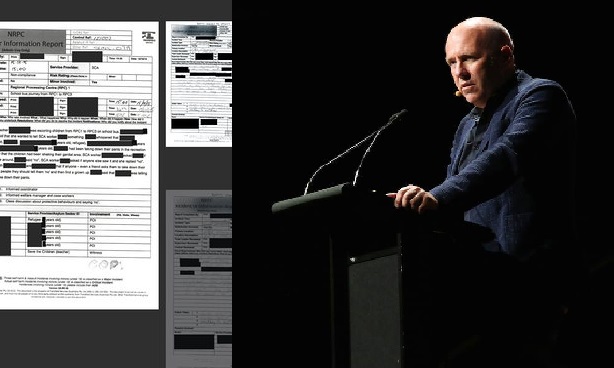
I suspect they will continue to be read in coming decades and even centuries when the works of myself and my colleagues are long forgotten. And when people read these stories, so admirable in their brevity, so controlled in their emotion, so artful in their artlessness – their use, for example, of the term NAME REDACTED instead of a character’s actual name to better show what is happening to a stranger is not an individual act but a universal crime – then, I suspect, their minds will be filled with so many questions about what sort of people Australians of our time were. Let me read a handful to you. If you want to read them yourself, go to the Guardian website where these are published, along with 2000 others.


28 April 2015

At about 2129hrs … [NAME REDACTED] approached staff in RPC3 area [NUMBER REDACTED]. She began to vomit. A strong smell of bleach was detected. A code blue was called. IHMS medical staff attended and [NAME REDACTED] was transported by ambulance to RPCL for further treatment … At 2220hrs IHMS informed control that as a result of their assessment it appears that [NAME REDACTED] has ingested Milton baby bottle sterilizing tablets.


28 Sept 2014

I was asked on Friday (26-9-2014) by a fellow teacher [NAME REDACTED] if I would sit with an asylum seeker [NAME REDACTED] who was sobbing. She is a classroom helper for the children … She reported that she has been asking for a 4 minute shower as opposed to 2 minutes. Her request has been accepted on condition of sexual favours. It is a male security person. She did not state if this has or hasn’t occurred. The security officer wants to view a boy or girl having a shower.


12 June 2015

I [NAME REDACTED] met with [NAME REDACTED] in [REDACTED] at RPC 1 … During the course of the conversation [NAME REDACTED] disclosed that she had sex while in the community and that it had not been consensual.

CW asked [NAME REDACTED] if she had told anyone about this, [NAME REDACTED] stated that she had not told anyone other than CW that it was not consensual including IHMS. She stated that she did not tell IHMS that it was “rape” as she did not want “lots of questions” and if she said it was rape there would be “lots of questions’. [NAME REDACTED] stated that she told the man “no, no, no” and that the only man she wanted to have sexual relations with was her husband … the incident occurred during Open Centre and the man was Nauruan.


3 Sept 2015

[NAME REDACTED] was crying and was observed to be very shaken … [NAME REDACTED] reported that a Wilsons Security guard had just hit him. [NAME REDACTED] explained to [NAME REDACTED] that he was in tent [REDACTED] with [NAME REDACTED], [NAME REDACTED] and [NAME REDACTED] when a security guard entered and yelled at them, “hey are you in here?”. [NAME REDACTED] then reported that the security guard grabbed him around the throat and hit his head against the ground twice. [NAME REDACTED] also said that the security guard threw a chair on him … [NAME REDACTED] asked [NAME REDACTED] to show her who the security guard was. The children lead CW to area 10 and pointed at a male security guard … [NAME REDACTED] said “he hit me”. [NAME REDACTED] then asked [NAME REDACTED] “why did you hit me?”. [NAME REDACTED] then moved towards [NAME REDACTED] and in a raised voice responded “did you come in here, you are not allowed in here, get out of here”. [NAME REDACTED] then lead the children out of area 10.


2 December 2014

At approximately 1125 hours I was performing my duties as Whiskey 3.3 on a high watch in Tent [REDACTED] was alerted by an Asylum Seeker that female Asylum Seeker [NAME REDACTED] was trying to hang herself in Tent [NAME REDACTED]. I immediately responded. On arrival I saw [NAME REDACTED] holding [NAME REDACTED] up. [NAME REDACTED] appeared to have a noose around her neck. I called for a Code Blue straight away. I then assisted [NAME REDACTED] by untying the rope while [NAME REDACTED] held her and we took [NAME REDACTED] and placed her in the recovery position.


29 May 2015

[NUMBER REDACTED] yo male was on a whiskey high watch from a previous incident … [NAME REDACTED] grabbed an insect replant [sic] bottle and started drinking a small amount of its contents. CSO grabbed [NAME REDACTED] by the shoulders while his PSS offsider removed the bottle from [NAME REDACTED]’s hands. [NAME REDACTED] sat down and began sobbing over the incident.


15 January 2015

I CSPW [REDACTED 1] was speaking with [REDACTED 2] on the grass above the security entrance of Area 9. [REDACTED 2] informed me that her husband [REDACTED 3] had reported 4 months ago to her that he had been in a car with his [NUMBER REDACTED] year old son with 2 Nauruan Wilsons Security officers, [REDACTED 2] stated that according to [REDACTED 3], [REDACTED 4] was sitting in-between himself and the security officer. [REDACTED 2] stated that this car was taking the two from Area 9 to IHMS RPC3. [REDACTED 2] alleged that [REDACTED 3] informed her that their son [REDACTED 4] had said to [REDACTED 3] that one Nauruan officer had put his hand up [REDACTED 4’s] shorts and was playing with his bottom. [REDACTED 3] … removed [REDACTED 4] from the middle of the car and placed [REDACTED 4] on his lap but did not say anything as he feared the two Nauruan officers in the car with him … [REDACTED 2] informed me that approximately five months ago a [REDACTED 5] Officer had ran his hand down the back of her head and her head scarf and said to her “if there is anything you want on the outside let me know. I can get you anything.”


26 June 2014

[REDACTED 1] informed SCA caseworker that his partner [REDACTED 2] tried to commit suicide by overdosing on medication pills. [REDACTED 1] stated that the couple changed rooms without permission – there were some family pictures on wall of old room and [REDACTED 2] was trying to rip them off the plastic wall. Wilsons guard came into room and tried to stop [REDACTED 2] from damaging property. [REDACTED 1] stated Wilsons officer then stepped on her son’s picture, kicked them and told them to shut up. It was following this that she got upset, went to her room and took the pills.


5 May 2015

On morning bus run [NAME REDACTED] showed me a heart he had sewn into his hand using a needle and thread. I asked why and he said “I don’t know” … [NAME REDACTED] is [NUMBER REDACTED] yrs of age.


27 Sept 2014

Witnesses informed CM that a young person had sewn her lips together, one of the officers [REDACTED 1] had gone to the young person’s room to see her. The officer then went to his station with other officers and they all began laughing. Witnesses approached the officer asking what they were laughing about, the officers informed witnesses that they had told a joke and were laughing about it. Witnesses then stated that the young person’s father had approached officers the next evening seeking an apology from officer [REDACTED 1] for laughing at his daughter. The young person’s father at this time was informed that the officer [REDACTED 1] was at the airport, allegedly this is the reason the father then went and significantly self-harmed.


There is a connection between me standing here before you and a child sewing her lips together – an act of horror to make public on her body the truth of her condition. Because her act and the act of writing share the same human aspiration.

Everything has been done to dehumanise asylum seekers. Their names and their stories are kept from us. They live in a zoo of cruelty. Their lives are stripped of meaning. And they confront this tyranny – our Australian tyranny – with the only thing not taken from them, their bodies. In their meaningless world, in acts seemingly futile and doomed, they assert the fact that their lives still have meaning.

And is this not the very same aspiration as writing?

In the past year, what Australian writer has written as eloquently of what Australia has become as asylum seekers have with petrol and flame, with needle and thread? What Australian writer has so clearly exposed the truth of who we are? And what Australian writer has expressed more powerfully the desire for freedom – that freedom which is also Australia?

That is why Australian writing is the smell of the charring flesh of 23-year-old Omid Masoumali’s body burning himself in protest. The screams of 21-year-old Hodan Yasin as she too set herself alight. Australian writing is the ignored begging of a woman being raped. Australian writing is a girl who sews her lips together. Australian writing is a child who sews a heart into their hand and doesn’t know why.

We are compelled to listen, to read. But more: to see. The ancient Assyrians thought the footprints left by birds in the delta mud were the words of God to which there was a key. If the key could be found God could be seen. We need to use words to once more see each other for what we are: fellow human beings, no more, no less. To find the divine in each other, which is another way of saying all that we share that is greater than our individual souls.

I say “see”, but of course there are no images. There are only leaked reports, which contradict so much of what the government claims. If there was an image of a woman just raped, of the back of murdered Reza Berati’s bloody head – if there was just one image – just one – we would face a national crisis of honour, of meaning, of identity.

And though I wish I could, I cannot tonight speak for Omid Masoumali. I cannot speak for Hodan Yasin. I cannot speak for the unnamed who have tried to kill themselves swallowing razor blades, hanging themselves with sheets, swallowing insecticides, cleaning agents and pills, and then were punished for doing so. I cannot speak for that girl with sewn lips. I can only speak for myself.

And I will say this: Australia has lost its way.

All I can think is, this is not my Australia.

But it is.

It is too easy to ascribe the horror of what I have just read to a politician, to a party or even to our toxic politics. These things, though, have happened because of a more general cowardice and inertia, because of conformity. Because it is easier to be blind than to see, to be deaf than to hear, to say things don’t matter when they do. Whether we wish it or not, these things belong to us, are us, and we are diminished because of them.

We have to accept that no Australian is innocent, that these crimes are committed in Australia’s name, which is our name, and Australia has to answer to them, and so we must answer for them to the world, to the future, to our own souls.

We meekly accept what are not only affronts but also threats to our freedom of speech, such as the draconian Clause 42 D of the Australian Border Force Act, which allows for the jailing for two years of any doctors or social workers who bear public witness to children beaten or sexually abused, to acts of rape or cruelty. The new crime is not crime, but the reporting of state-sanctioned violence. And only fools or tyrants argue that national security resides in national silence.

A nation-sized spit hood is being pulled over us. We can hear the guards’ laughter; the laughter of the powerful at the powerless. We can hear the answer made all those years ago in a schoolyard as to why one human could hurt another being made again, the real explanation of why the Australian government does what it does.

Because it can.

“All I can say,” Camus wrote in his great novel, The Plague, “is that on this earth there are pestilences and there are victims – and as far as possible one must refuse to be on the side of the pestilence.”

For our country’s vainglorious boasts of having a world-leading economy, of punching above its weight, of having the most liveable cities and so on are as nothing unless it can bear this truth. We can be a good nation or a trivial, fearful prison. But we cannot be both.

There is such a thing as a people’s honour. And when it is lost, the people are lost. That is Australia today. If only out of self-respect, we should never have allowed to happen what has.

Every day that the asylum seekers of Nauru and Manus live in the torment of punishment without end, guilty of no crime, we too become a little less free. In their liberation lies our hope. The hope of a people that can once more claim honour in the affairs of this world.

For Camus, resistance was the heroism of goodness and kindness. “It may seem a ridiculous idea,” he writes, “but the only way to fight the plague is with decency.”

Camus understood moments such as Australia is now passing through with asylum seekers not as wars that might be won, but aspects of human nature that we forget or ignore at our peril.

“The plague bacillus,” Camus writes, “never dies or vanishes entirely … it waits patiently in bedrooms, cellars, trunks, handkerchiefs and old papers, and … the day will come when, for the instruction or misfortune of mankind, the plague will rouse its rats and send them to die in some well-contented city.”

We in Australia were well-contented. But now the rats are among us; the plague is upon us; and each of us must choose whether we are with the plague, or against it.

A solidarity of the silenced, a resistance of the shaken, starts by weighing our words, by calling things by their proper names, and knowing that not doing so leads to the death and suffering of many.

It is by naming cruelty as cruelty, evil as evil, the plague as the plague.

The role of the writer in one sense is the very real struggle to keep words alive, to restore to them their proper meaning and necessary dignity as the means by which we divine truth. In this battle the writer is doomed to fail, but the battle is no less important. The war is only lost when language ceases to serve its most fundamental purpose, and that only happens when we are persuaded that writing no longer matters.

In all these questions I don’t say that writing and writers are an answer or a panacea. That would be a nonsense. But even when we are silenced we must continue to write. To assert freedom. To find meaning.

With ink, with keyboard. With thread, with flame, with our very bodies.

Because writing matters. More than ever, it matters.

Thank you.

Source: https://www.themonthly.com.au/blog/richard...

Enjoyed this speech? Speakola is a labour of love and I’d be very grateful if you would share, tweet or like it. Thank you.

Facebook Twitter Facebook
In BOOKS Tags RICHARD FLANAGAN, THE NAURU FILES, OFFSHORE DETENTION, WRITING, JOURNALISM, SPEAKOLIES 2016
Comment

Elizabeth Gilbert: '‘Ole!’ to you, nonetheless, just for having the sheer human love and stubbornness to keep showing up', Your Elusive Creative Genius TED - 2009

January 20, 2016

February 2009, TED Talk, USA

I am a writer. Writing books is my profession but it's more than that, of course. It is also my great lifelong love and fascination. And I don't expect that that's ever going to change. But, that said, something kind of peculiar has happened recently in my life and in my career, which has caused me to have to recalibrate my whole relationship with this work. And the peculiar thing is that I recently wrote this book, this memoir called "Eat, Pray, Love" which, decidedly unlike any of my previous books, went out in the world for some reason, and became this big, mega-sensation, international bestseller thing. The result of which is that everywhere I go now, people treat me like I'm doomed. Seriously -- doomed, doomed! Like, they come up to me now, all worried, and they say, "Aren't you afraid you're never going to be able to top that? Aren't you afraid you're going to keep writing for your whole life and you're never again going to create a book that anybody in the world cares about at all, ever again?"

So that's reassuring, you know. But it would be worse, except for that I happen to remember that over 20 years ago, when I was a teenager, when I first started telling people that I wanted to be a writer, I was met with this same sort of fear-based reaction. And people would say, "Aren't you afraid you're never going to have any success? Aren't you afraid the humiliation of rejection will kill you? Aren't you afraid that you're going to work your whole life at this craft and nothing's ever going to come of it and you're going to die on a scrap heap of broken dreams with your mouth filled with bitter ash of failure?"

Like that, you know.

The answer -- the short answer to all those questions is, "Yes." Yes, I'm afraid of all those things. And I always have been. And I'm afraid of many, many more things besides that people can't even guess at, like seaweed and other things that are scary. But, when it comes to writing, the thing that I've been sort of thinking about lately, and wondering about lately, is why? You know, is it rational? Is it logical that anybody should be expected to be afraid of the work that they feel they were put on this Earth to do. And what is it specifically about creative ventures that seems to make us really nervous about each other's mental health in a way that other careers kind of don't do, you know? Like my dad, for example, was a chemical engineer and I don't recall once in his 40 years of chemical engineering anybody asking him if he was afraid to be a chemical engineer, you know? "That chemical-engineering block, John, how's it going?" It just didn't come up like that, you know? But to be fair, chemical engineers as a group haven't really earned a reputation over the centuries for being alcoholic manic-depressives.

We writers, we kind of do have that reputation, and not just writers, but creative people across all genres, it seems, have this reputation for being enormously mentally unstable. And all you have to do is look at the very grim death count in the 20th century alone, of really magnificent creative minds who died young and often at their own hands, you know? And even the ones who didn't literally commit suicide seem to be really undone by their gifts, you know. Norman Mailer, just before he died, last interview, he said, "Every one of my books has killed me a little more." An extraordinary statement to make about your life's work. But we don't even blink when we hear somebody say this, because we've heard that kind of stuff for so long and somehow we've completely internalized and accepted collectively this notion that creativity and suffering are somehow inherently linked and that artistry, in the end, will always ultimately lead to anguish.

And the question that I want to ask everybody here today is are you guys all cool with that idea? Are you comfortable with that? Because you look at it even from an inch away and, you know -- I'm not at all comfortable with that assumption. I think it's odious. And I also think it's dangerous, and I don't want to see it perpetuated into the next century. I think it's better if we encourage our great creative minds to live.

And I definitely know that, in my case -- in my situation -- it would be very dangerous for me to start sort of leaking down that dark path of assumption, particularly given the circumstance that I'm in right now in my career. Which is -- you know, like check it out, I'm pretty young, I'm only about 40 years old. I still have maybe another four decades of work left in me. And it's exceedingly likely that anything I write from this point forward is going to be judged by the world as the work that came after the freakish success of my last book, right? I should just put it bluntly, because we're all sort of friends here now -- it's exceedingly likely that my greatest success is behind me. So Jesus, what a thought! That's the kind of thought that could lead a person to start drinking gin at nine o'clock in the morning, and I don't want to go there.

I would prefer to keep doing this work that I love.

And so, the question becomes, how? And so, it seems to me, upon a lot of reflection, that the way that I have to work now, in order to continue writing, is that I have to create some sort of protective psychological construct, right? I have to sort of find some way to have a safe distance between me, as I am writing, and my very natural anxiety about what the reaction to that writing is going to be, from now on. And, as I've been looking, over the last year, for models for how to do that, I've been sort of looking across time, and I've been trying to find other societies to see if they might have had better and saner ideas than we have about how to help creative people sort of manage the inherent emotional risks of creativity.

And that search has led me to ancient Greece and ancient Rome. So stay with me, because it does circle around and back. But, ancient Greece and ancient Rome -- people did not happen to believe that creativity came from human beings back then, OK? People believed that creativity was this divine attendant spirit that came to human beings from some distant and unknowable source, for distant and unknowable reasons. The Greeks famously called these divine attendant spirits of creativity "daemons." Socrates, famously, believed that he had a daemon who spoke wisdom to him from afar.

The Romans had the same idea, but they called that sort of disembodied creative spirit a genius. Which is great, because the Romans did not actually think that a genius was a particularly clever individual. They believed that a genius was this, sort of magical divine entity, who was believed to literally live in the walls of an artist's studio, kind of like Dobby the house elf, and who would come out and sort of invisibly assist the artist with their work and would shape the outcome of that work.

So brilliant -- there it is, right there, that distance that I'm talking about -- that psychological construct to protect you from the results of your work. And everyone knew that this is how it functioned, right? So the ancient artist was protected from certain things, like, for example, too much narcissism, right? If your work was brilliant, you couldn't take all the credit for it, everybody knew that you had this disembodied genius who had helped you. If your work bombed, not entirely your fault, you know? Everyone knew your genius was kind of lame.

And this is how people thought about creativity in the West for a really long time. And then the Renaissance came and everything changed, and we had this big idea, and the big idea was, let's put the individual human being at the center of the universe above all gods and mysteries, and there's no more room for mystical creatures who take dictation from the divine. And it's the beginning of rational humanism, and people started to believe that creativity came completely from the self of the individual. And for the first time in history, you start to hear people referring to this or that artist as being a genius, rather than having a genius.

And I got to tell you, I think that was a huge error. You know, I think that allowing somebody, one mere person to believe that he or she is like, the vessel, you know, like the font and the essence and the source of all divine, creative, unknowable, eternal mystery is just a smidge too much responsibility to put on one fragile, human psyche. It's like asking somebody to swallow the sun. It just completely warps and distorts egos, and it creates all these unmanageable expectations about performance. And I think the pressure of that has been killing off our artists for the last 500 years.

And, if this is true, and I think it is true, the question becomes, what now? Can we do this differently? Maybe go back to some more ancient understanding about the relationship between humans and the creative mystery. Maybe not. Maybe we can't just erase 500 years of rational humanistic thought in one 18 minute speech. And there's probably people in this audience who would raise really legitimate scientific suspicions about the notion of, basically, fairies who follow people around rubbing fairy juice on their projects and stuff. I'm not, probably, going to bring you all along with me on this.

But the question that I kind of want to pose is -- you know, why not? Why not think about it this way? Because it makes as much sense as anything else I have ever heard in terms of explaining the utter maddening capriciousness of the creative process. A process which, as anybody who has ever tried to make something -- which is to say basically everyone here --- knows does not always behave rationally. And, in fact, can sometimes feel downright paranormal.

I had this encounter recently where I met the extraordinary American poet Ruth Stone, who's now in her 90s, but she's been a poet her entire life and she told me that when she was growing up in rural Virginia, she would be out working in the fields, and she said she would feel and hear a poem coming at her from over the landscape. And she said it was like a thunderous train of air. And it would come barreling down at her over the landscape. And she felt it coming, because it would shake the earth under her feet. She knew that she had only one thing to do at that point, and that was to, in her words, "run like hell." And she would run like hell to the house and she would be getting chased by this poem, and the whole deal was that she had to get to a piece of paper and a pencil fast enough so that when it thundered through her, she could collect it and grab it on the page. And other times she wouldn't be fast enough, so she'd be running and running, and she wouldn't get to the house and the poem would barrel through her and she would miss it and she said it would continue on across the landscape, looking, as she put it "for another poet." And then there were these times -- this is the piece I never forgot -- she said that there were moments where she would almost miss it, right? So, she's running to the house and she's looking for the paper and the poem passes through her, and she grabs a pencil just as it's going through her, and then she said, it was like she would reach out with her other hand and she would catch it. She would catch the poem by its tail, and she would pull it backwards into her body as she was transcribing on the page. And in these instances, the poem would come up on the page perfect and intact but backwards, from the last word to the first.

So when I heard that I was like -- that's uncanny, that's exactly what my creative process is like.

That's not at all what my creative process is -- I'm not the pipeline! I'm a mule, and the way that I have to work is I have to get up at the same time every day, and sweat and labor and barrel through it really awkwardly. But even I, in my mulishness, even I have brushed up against that thing, at times. And I would imagine that a lot of you have too. You know, even I have had work or ideas come through me from a source that I honestly cannot identify. And what is that thing? And how are we to relate to it in a way that will not make us lose our minds, but, in fact, might actually keep us sane?

And for me, the best contemporary example that I have of how to do that is the musician Tom Waits, who I got to interview several years ago on a magazine assignment. And we were talking about this, and you know, Tom, for most of his life, he was pretty much the embodiment of the tormented contemporary modern artist, trying to control and manage and dominate these sort of uncontrollable creative impulses that were totally internalized.

But then he got older, he got calmer, and one day he was driving down the freeway in Los Angeles, and this is when it all changed for him. And he's speeding along, and all of a sudden he hears this little fragment of melody, that comes into his head as inspiration often comes, elusive and tantalizing, and he wants it, it's gorgeous, and he longs for it, but he has no way to get it. He doesn't have a piece of paper, or a pencil, or a tape recorder.

So he starts to feel all of that old anxiety start to rise in him like, "I'm going to lose this thing, and I'll be be haunted by this song forever. I'm not good enough, and I can't do it." And instead of panicking, he just stopped. He just stopped that whole mental process and he did something completely novel. He just looked up at the sky, and he said, "Excuse me, can you not see that I'm driving?"

"Do I look like I can write down a song right now? If you really want to exist, come back at a more opportune moment when I can take care of you. Otherwise, go bother somebody else today. Go bother Leonard Cohen."

And his whole work process changed after that. Not the work, the work was still oftentimes as dark as ever. But the process, and the heavy anxiety around it was released when he took the genie, the genius out of him where it was causing nothing but trouble, and released it back where it came from, and realized that this didn't have to be this internalized, tormented thing. It could be this peculiar, wondrous, bizarre collaboration, kind of conversation between Tom and the strange, external thing that was not quite Tom.

When I heard that story, it started to shift a little bit the way that I worked too, and this idea already saved me once. It saved me when I was in the middle of writing "Eat, Pray, Love," and I fell into one of those sort of pits of despair that we all fall into when we're working on something and it's not coming and you start to think this is going to be a disaster, the worst book ever written. Not just bad, but the worst book ever written. And I started to think I should just dump this project. But then I remembered Tom talking to the open air and I tried it. So I just lifted my face up from the manuscript and I directed my comments to an empty corner of the room. And I said aloud, "Listen you, thing, you and I both know that if this book isn't brilliant that is not entirely my fault, right? Because you can see that I am putting everything I have into this, I don't have any more than this. If you want it to be better, you've got to show up and do your part of the deal. But if you don't do that, you know what, the hell with it. I'm going to keep writing anyway because that's my job. And I would please like the record to reflect today that I showed up for my part of the job."

Because --

Because in the end it's like this, OK -- centuries ago in the deserts of North Africa, people used to gather for these moonlight dances of sacred dance and music that would go on for hours and hours, until dawn. They were always magnificent, because the dancers were professionals and they were terrific, right? But every once in a while, very rarely, something would happen, and one of these performers would actually become transcendent. And I know you know what I'm talking about, because I know you've all seen, at some point in your life, a performance like this. It was like time would stop, and the dancer would sort of step through some kind of portal and he wasn't doing anything different than he had ever done, 1,000 nights before, but everything would align. And all of a sudden, he would no longer appear to be merely human. He would be lit from within, and lit from below and all lit up on fire with divinity.

And when this happened, back then, people knew it for what it was, you know, they called it by its name. They would put their hands together and they would start to chant, "Allah, Allah, Allah, God, God, God." That's God, you know. Curious historical footnote: when the Moors invaded southern Spain, they took this custom with them and the pronunciation changed over the centuries from "Allah, Allah, Allah," to "Olé, olé, olé," which you still hear in bullfights and in flamenco dances. In Spain, when a performer has done something impossible and magic, "Allah, olé, olé, Allah, magnificent, bravo," incomprehensible, there it is -- a glimpse of God. Which is great, because we need that.

But, the tricky bit comes the next morning, for the dancer himself, when he wakes up and discovers that it's Tuesday at 11 a.m., and he's no longer a glimpse of God. He's just an aging mortal with really bad knees, and maybe he's never going to ascend to that height again. And maybe nobody will ever chant God's name again as he spins, and what is he then to do with the rest of his life? This is hard. This is one of the most painful reconciliations to make in a creative life. But maybe it doesn't have to be quite so full of anguish if you never happened to believe, in the first place, that the most extraordinary aspects of your being came from you. But maybe if you just believed that they were on loan to you from some unimaginable source for some exquisite portion of your life to be passed along when you're finished, with somebody else. And, you know, if we think about it this way, it starts to change everything.

This is how I've started to think, and this is certainly how I've been thinking in the last few months as I've been working on the book that will soon be published, as the dangerously, frighteningly over-anticipated follow up to my freakish success.

And what I have to sort of keep telling myself when I get really psyched out about that is don't be afraid. Don't be daunted. Just do your job. Continue to show up for your piece of it, whatever that might be. If your job is to dance, do your dance. If the divine, cockeyed genius assigned to your case decides to let some sort of wonderment be glimpsed, for just one moment through your efforts, then "Olé!" And if not, do your dance anyhow. And "Olé!" to you, nonetheless. I believe this and I feel that we must teach it. "Olé!" to you, nonetheless, just for having the sheer human love and stubbornness to keep showing up.

Thank you

Thank you.


Source: http://www.ted.com/talks/elizabeth_gilbert...

Enjoyed this speech? Speakola is a labour of love and I’d be very grateful if you would share, tweet or like it. Thank you.

Facebook Twitter Facebook
In BOOKS Tags ELIZABETH GILBERT, TED, TEDTALK, EAT PRAY LOVE, AUTHOR, CREATIVITY, WRITING
Comment

William Faulkner: "The agony and sweat of the human spirit" Nobel acceptance -1950

August 20, 2015

10 December 1950, Stockholm, Sweden

Ladies and gentlemen, I feel that this award was not made to me as a man, but to my work - a life's work in the agony and sweat of the human spirit, not for glory and least of all for profit, but to create out of the materials of the human spirit something which did not exist before.

So this award is only mine in trust. It will not be difficult to find a dedication for the money part of it commensurate with the purpose and significance of its origin. But I would like to do the same with the acclaim too, by using this moment as a pinnacle from which I might be listened to by the young men and women already dedicated to the same anguish and travail, among whom is already that one who will some day stand here where I am standing.

Our tragedy today is a general and universal physical fear so long sustained by now that we can even bear it. There are no longer problems of the spirit. There is only the question: When will I be blown up? Because of this, the young man or woman writing today has forgotten the problems of the human heart in conflict with itself which alone can make good writing because only that is worth writing about, worth the agony and the sweat. He must learn them again. He must teach himself that the basest of all things is to be afraid; and, teaching himself that, forget it forever, leaving no room in his workshop for anything but the old verities and truths of the heart, the old universal truths lacking which any story is ephemeral and doomed - love and honor and pity and pride and compassion and sacrifice.

Until he does so, he labors under a curse. He writes not of love but of lust, of defeats in which nobody loses anything of value, of victories without hope and, worst of all, without pity or compassion. His griefs grieve on no universal bones, leaving no scars. He writes not of the heart but of the glands. Until he relearns these things, he will write as though he stood among and watched the end of man.

I decline to accept the end of man. It is easy enough to say that man is immortal simply because he will endure: that when the last dingdong of doom has clanged and faded from the last worthless rock hanging tideless in the last red and dying evening, that even then there will still be one more sound: that of his puny inexhaustible voice, still talking.

I refuse to accept this. I believe that man will not merely endure: he will prevail. He is immortal, not because he alone among creatures has an inexhaustible voice, but because he has a soul, a spirit capable of compassion and sacrifice and endurance. The poet's, the writer's, duty is to write about these things. It is his privilege to help man endure by lifting his heart, by reminding him of the courage and honor and hope and pride and compassion and pity and sacrifice which have been the glory of his past. The poet's voice need not merely be the record of man, it can be one of the props, the pillars to help him endure and prevail.

From Nobel Lectures, Literature 1901-1967, Editor Horst Frenz, Elsevier Publishing Company, Amsterdam, 1969

Source: From Nobel Lectures, Literature ...

Enjoyed this speech? Speakola is a labour of love and I’d be very grateful if you would share, tweet or like it. Thank you.

Facebook Twitter Facebook
In BOOKS 2 Tags AUTHOR, NOBEL PRIZE, COLD WAR, WRITING
Comment

See my film!

Limited Australian Season

March 2025

Details and ticket bookings at

angeandtheboss.com

Support Speakola

Hi speech lovers,
With costs of hosting website and podcast, this labour of love has become a difficult financial proposition in recent times. If you can afford a donation, it will help Speakola survive and prosper.

Best wishes,
Tony Wilson.

Become a Patron!

Learn more about supporting Speakola.

Featured political

Featured
Jon Stewart: "They responded in five seconds", 9-11 first responders, Address to Congress - 2019
Jacinda Ardern: 'They were New Zealanders. They are us', Address to Parliament following Christchurch massacre - 2019
Dolores Ibárruri: "¡No Pasarán!, They shall not pass!', Defense of 2nd Spanish Republic - 1936
Jimmy Reid: 'A rat race is for rats. We're not rats', Rectorial address, Glasgow University - 1972

Featured eulogies

Featured
For Geoffrey Tozer: 'I have to say we all let him down', by Paul Keating - 2009
for James Baldwin: 'Jimmy. You crowned us', by Toni Morrison - 1988
for Michael Gordon: '13 days ago my Dad’s big, beautiful, generous heart suddenly stopped beating', by Scott and Sarah Gordon - 2018

Featured commencement

Featured
Tara Westover: 'Your avatar isn't real, it isn't terribly far from a lie', The Un-Instagrammable Self, Northeastern University - 2019
Tim Minchin: 'Being an artist requires massive reserves of self-belief', WAAPA - 2019
Atul Gawande: 'Curiosity and What Equality Really Means', UCLA Medical School - 2018
Abby Wambach: 'We are the wolves', Barnard College - 2018
Eric Idle: 'America is 300 million people all walking in the same direction, singing 'I Did It My Way'', Whitman College - 2013
Shirley Chisholm: ;America has gone to sleep', Greenfield High School - 1983

Featured sport

Featured
Joe Marler: 'Get back on the horse', Harlequins v Bath pre game interview - 2019
Ray Lewis : 'The greatest pain of my life is the reason I'm standing here today', 52 Cards -
Mel Jones: 'If she was Bradman on the field, she was definitely Keith Miller off the field', Betty Wilson's induction into Australian Cricket Hall of Fame - 2017
Jeff Thomson: 'It’s all those people that help you as kids', Hall of Fame - 2016

Fresh Tweets


Featured weddings

Featured
Dan Angelucci: 'The Best (Best Man) Speech of all time', for Don and Katherine - 2019
Hallerman Sisters: 'Oh sister now we have to let you gooooo!' for Caitlin & Johnny - 2015
Korey Soderman (via Kyle): 'All our lives I have used my voice to help Korey express his thoughts, so today, like always, I will be my brother’s voice' for Kyle and Jess - 2014

Featured Arts

Featured
Bruce Springsteen: 'They're keepers of some of the most beautiful sonic architecture in rock and roll', Induction U2 into Rock Hall of Fame - 2005
Olivia Colman: 'Done that bit. I think I have done that bit', BAFTA acceptance, Leading Actress - 2019
Axel Scheffler: 'The book wasn't called 'No Room on the Broom!', Illustrator of the Year, British Book Awards - 2018
Tina Fey: 'Only in comedy is an obedient white girl from the suburbs a diversity candidate', Kennedy Center Mark Twain Award -  2010
Tina Fey: 'Only in comedy is an obedient white girl from the suburbs a diversity candidate', Kennedy Center Mark Twain Award - 2010

Featured Debates

Featured
Sacha Baron Cohen: 'Just think what Goebbels might have done with Facebook', Anti Defamation League Leadership Award - 2019
Greta Thunberg: 'How dare you', UN Climate Action Summit - 2019
Charlie Munger: 'The Psychology of Human Misjudgment', Harvard University - 1995
Lawrence O'Donnell: 'The original sin of this country is that we invaders shot and murdered our way across the land killing every Native American that we could', The Last Word, 'Dakota' - 2016