
• Genre
  • About
  • Submissions
  • Donate
  • Search
Menu

Speakola

All Speeches Great and Small
  • Genre
  • About
  • Submissions
  • Donate
  • Search

Eulogies

Some of the most moving and brilliant speeches ever made occur at funerals. Please upload the eulogy for your loved one using the form below.

for Les Carlyon: 'Won't keep you, Les', by Andrew Rule - 2019

March 22, 2019

12 March 2019, Flemington, Melbourne,Australia

Above clip is whole service. Andrew Rule’s eulogy begins at 43.40.

Dear Les,

Won’t keep you, mate.

A lot of people here have heard you say that.

“Won’t keep you.”

An hour later, there you’d be, still yarning.

‘Won’t keep you, Les’

It’s the password to the Carlyon Club. It had a lot of members.

For a quiet man, you could talk on anything: history; newspapers; literature. And racing, of course. Not just gallopers but trotters and horses in general ... and working dogs and drenching sheep and tips on practical harness maintenance.

When Truman Capote died the best obituary on him wasn’t in The New York Times: it was yours. He was in your head with Larry McMurtry and Hemingway and Lawson and Tolstoy … and other great artists like Harry White and Roy Higgins and Ted Whitten and Manikato.

All equal opportunity subjects in Les World.

In 1980 I was a kid on The Age. Neil Mitchell was sports editor and heard me talking about horse breaking. Might as well have been talking Swahili for all Mitch knew -- but he knew “Les” would be interested. Everyone at The Age talked about you, even though you hadn’t been there for a few years by then.

So Mitch calls you, has the big chat, then gives me the handpiece. And that was that. The start of a 40-year conversation.

Remember how you read the manuscript of my first book in 1988? I took it to the house in Sevenoaks St. It wasn’t hard to spot:

The only house in Balwyn with a tractor in the carport.

(Won’t keep you, Les.)

It’s the hour before dawn as I write this.

Best hour of the day, you always said: “Never miss a sunrise, Andy. If you don’t stay up all night get up before dawn.”

God knows when you actually slept.

Dawn spoke to you. I reckon you sensed racing stables coming alive while the ordinary world slept. You called it Racing’s Closed Society. You loved it and no one described it better …

The thump of the bags of dirty straw and the tap of the farrier’s hammer. Strappers swearing at horses. The blue heeler straining at the chain, trying to eat the new apprentice kid.

You understood them, the horse people who shared your taste for the Jockey’s Breakfast -- a smoke and a good look round. There are plenty of them here today, Les.

There’s Patto over there: Led in forty-six Cup winners and broke in a couple of thousand horses. I asked him once why they rated you and he growled, ‘Because Les gets it right.’

Apart from everything else, you’re the poet laureate of the track.

You didn’t invent Bart Cummings -- he did that himself -- but you were first to catch his likeness, way back in 1974. The eyebrows curling up ‘like a creeper’ are now part of the language. Then there’s the story about Bart and the Pommy health inspector who told him the stable had “too many flies” -- and Bart straightaway asks ‘How many am I allowed to have?”

You made Bart a national figure, bigger than racing. Without you, Les, there’d be no bronze statue of him downstairs.

(Won’t keep you, Les.)

The way that restless mind of yours hummed after midnight. It wasn’t just the stables calling, was it? Your body clock was set in the last Golden Era of newspapers, the 1960s and 1970s. You’d come home still wired from the daily miracle of producing a paper, stay that way until dawn, I suspect. Even after you left that life, it never really left you, did it?

You once said you wondered how you would have gone in America, testing yourself among the best in the land that produced so many of our heroes: Twain and Mencken, Joe Palmer and Joe Liebling, Runyon and Red Smith. You didn’t go, but their words came to you. You absorbed them. We all learn by imitation and repetition but you added other things -- intelligence, that prodigious memory -- and imagination

Under the homespun, hard-bitten exterior you were the most sensitive of men, with an intellect to match that soaring imagination. You showed it again and again, but never more than in the opening chapters of Gallipoli. It was mesmerising. The night I started reading it, I couldn’t stop. And I dreamed about the charge at the Nek.

The year Gallipoli came out, we got a plumber to our place. Seventeen stone of tattoos in a blue singlet. A van full of tools -- and sitting on the dash, next to a meat pie and an empty stubby, was a copy of Gallipoli. Norm the plumber just had to have it to read at lunch time. When I told you, you were delighted -- but not surprised. Your readers were real people, everyday people, you said. “You’ll never sell many books if your readers are only the people who read broadsheet reviews,” you told me.

(Won’t keep you, Les.)

Some of us got to see you lay out a page, write a killer headline and caption and rewrite copy, turning lead into gold. You could do nearly anything in a newspaper except run the presses. The truth is, you were always one thing: a perfectionist about anything that interested you.

I once went up to your study/ library. It was also a smokehouse, you had maybe 1000 books in there and every one was pickled in tobacco smoke. You reached into your storeroom, (where you kept a perfect WW1 officer’s military saddle, as you do) and grabbed a bridle you’d made, stitched to fit just one horse. No buckles. Made to fit like a glove. Perfect.

That was you, Les. You made things perfect. But words were always top of the list.

I saw you get one letter out of place in 40 years. I make more mistakes every day.

As Chopper Read said, ‘Even Beethoven had his critics.’

But you don’t have many. You collected friends and admirers the way a lamp attracts moths.

As Neil says, some of your ‘boys’ were girls -- like Jen Byrne and Corrie Perkin and Virginia Trioli and Jill Baker.

Last week when the sad news broke, a group of your female admirers gathered for a drink and swapped Les stories. One leaned over to Jen Byrne and said, ‘Les wrote like an angel -- but there was always one horse too many’.

Don’t worry, mate. That one’s from Sydney and she wouldn’t know. AS IF you could ever have one horse too many.

Les, you’re a father, grandfather, prose stylist, critic, historian, mentor and mate.

A teacher who never stopped learning.

You turned knowledge into wisdom. Best of all, you were kind as well as clever. A rare quinella in the biggest race of all, the human race.

Pushing words around the page, you said writing was.

You pushed millions of words for nearly 60 years. Every one ground down to a perfect finish. It was the only thing that really mattered, apart from your family.

But you knew that what mattered more than the words left on the page were the ones you left out. Your tribute to Denise in your last book says it all: “I owe her more than words can say.” There it is: a lifetime of love and gratitude in eight words.

Les, we’re all we’re all going to miss you more than words can say.

**************


Andrew Rule also wrote a newspaper obituary for his great friend which appeared in the Herald Sun and is reproduced with permission below.

Les Carlyon, giant of Australian journalism, liked to quote Red Smith, giant of American sports journalism.

“Dying is no big deal,” Smith once told mourners at a friend’s funeral. “The least of us will manage that. Living is the trick.”

Carlyon fetched that line from his prodigious memory in honour of his contemporary Peter McFarline, sports writer and once Washington correspondent for this company.

But the sentiment — about living with purpose, rather than making a grand exit — fits Carlyon himself.

Right up to the final weeks of the illness that ended his life this week Les worked at the craft that made his name. His soaring intellect was anchored by homespun principles.

He was always on the reader’s side. He never joined the authors “club” nor any other, really, except the Australian War Memorial board he was invited to join because of his remarkable military histories, Gallipoli and The Great War. He was welcome at any club in the land, especially of the horse racing variety, but would usually be writing or with his wife Denise and their children and grandchildren.

Les had his weaknesses — cigarettes and black coffee, reading and racing — but never succumbed to the temptation to take himself seriously. But he did take his work seriously. It showed, in sentence after flawless sentence of crisp prose he kept up for nearly 60 years and millions of words.

Les Carlyon was born in that increasingly foreign country – 1940s rural Victoria – and never forgot it. Part of him was always the kid from up Elmore way but some talents need a broader canvas. Like his fellow artist, the late champion jockey Roy Higgins, young Carlyon quit the country to further his career: in his case to work at this newspaper’s forerunner, The Sun News-Pictorial, in 1960.

The Sun was as unpretentious as it was popular. It relied on appealing to ordinary readers. Carlyon the cub reporter quickly learned to make words short and sharp.

By age 21, fitting part-time study around full-time work, the rising star had been lured “across town” to write for the opposition newspaper, where he would cap a rapid rise to become editor at 33 before suffering a bout of the recurring pneumonia that has finally ended his life. He would later return as editor-in-chief at the Herald & Weekly Times but was best known for his precision at the solitary business of writing.

“Hero” and “champion” are so overused as to debase the currency. Carlyon was one of few entitled to be described that way by the many who admired him.

To want to meet a writer because you like their work, a writer once noted, is like wanting to meet the goose because you like pate. It can be a disappointment to meet heroes, but meeting Les was no let down. For a modest man, he was a good talker about shearers or Shakespeare and from Tony Soprano to Tolstoy.

He wasn’t one for pomp and privilege, had a faintly puritanical distrust of the trappings of wealth and power unless maybe it involved an unraced two-year-old. Yet he was on first-name terms with the wealthy and powerful.

When Les was “gonged” with the top award in the Honours list in 2014, it was a great thing and not befoe time. But Leslie Allen Carlyon AC was still “Les” to his friends.

He delighted in the story of the English publishers who decided (wisely) to publish his best-selling Gallipoli, but rejected his lifetime byline by printing “L.A. Carlyon” on the cover.

It seemed to the Londoners no serious author’s name could possibly be contracted to “Les” on a hardback in England. That made Les laugh. All that mattered to him is that readers liked the book.

For him, getting the story right was everything. He did it for decades and helped others do the same.

He was not only talented and tenacious but patient and kind with it. Who knows how many people he called — and how many called him — for “a yarn” late at night.

He shared knowledge without lecturing or hectoring, ego or spite. Few touched by genius are as generous. He treated his extended family of writers, reporters, publishers and broadcasters almost as well as he did his favourites — horses and horse people.

Jennifer Byrne would become a national media identity – in print then television – but nursed lessons learned as a teenage reporter from her first news editor.

Byrne recalls a “lean stripe of a man built like one of the racehorses he loved who took a bunch of know-nothing cadets and showed us how to become journalists.

“He showed by doing, by being the best writer on the paper. He wrote like an angel and produced stories which were also lessons. He was scrupulous about facts, generous in spirit, his stories full of unlikely winners and gallant losers; you could call them Runyonesque except for their depth and elegance.

“As time passed, we became friends, and I saw how much work went into what read so easily. He gave us chances we muffed, and helped us do better. He praised lightly but when it came, it was like a sunburst. To Sir with Love? Well, yes, but I am eternally grateful for the advice he gave and example he set, as are so many others. Les was the best of our business, and unforgettable.”

That testimonial speaks for the many people Les helped. They know who they are; they could staff their own newspaper, radio station or publishing house.

Carlyon influenced his followers deftly, the way the best teachers can. As for his own influences, there were the Americans like Red Smith and Twain and Runyon and Joe Palmer, but there was also Henry Lawson and Tolstoy and more.

He wrote about any subject with flair – but about racing with something like love. His collection of racing stories, True Grit, has barely been out of print in 25 years. No one does it better.

He went to Tasmania after the Port Arthur massacre and wrote what he saw at the scene. He wrote a timeless account of Princess Diana’s funeral. He went to Hiroshima to record the 50thanniversary of the atom bomb. He wrote about heroes from Bradman to Ali to Clive James and about those grand stayers Kingston Town, Tommy Smith and especially Bart Cummings. He wrote about business and politics, sport and war. He never wrote about himself.

Carlyon grew up in the shadows of the Depression and war, before the fashion for self-promotion took hold. He wrote countless words across decades but the “perpendicular pronoun” is as rare in his work as a spelling mistake or a clumsy phrase.

Carlyon did not invent Bart Cummings but was first to capture the likeness that helped turn a horse trainer into a national treasure.

He wrote of Cummings: “He was pragmatic and mystical, likeable and unknowable. Racing might be about desperates. Cummings was too casual to be desperate. He wasn’t like anyone else: he was simply Bart.”

The theme is that by being his own man, ignoring fame and fashion, Cummings accidentally found both, to become a figure comparable only with Bradman – in stand-alone success and bulletproof self-belief.

Les Carlyon spoke all over the world in the last 25 years but never more movingly than at the memorial service for Roy Higgins in 2014.

Everyone liked Roy, he said, “because he was so easy to like. He was the benign presence, he was humble, he was generous, he was courteous, he didn’t carry grudges, he didn’t look back, he wasn’t sour or cynical. He had time for everyone, be they the prime minister or a down-at-heel punter cadging for a tip.

“He was a great human being and that might be the biggest story, because it’s harder to be a great human being.”

All words that fit the man who wrote them.
Enjoyed this speech? Speakola is a labour of love and I’d be very grateful if you would share, tweet or like it. Thank you.

Facebook Twitter Facebook
In SUBMITTED 3 Tags LES CARLYON, ANDREW RULE, GALLIPOLI, HORSE RACING, THE TRACK, WRITER, OBITUARY
Comment

For Keith Rule: 'Solomon in a singlet', Andrew Rule - 1998

July 15, 2015

27 June, 1998, Lake Tyers, Victoria, Australia

The morning after we got the news, I went out to your woodheap. There was that big old axe you used in the bush all those years ago, just as you'd left it, stuck in the chopping block like a signature. I split wood until the memories and the tears came flooding in. Then I dropped the axe back in the block, nose down, handle sticking up, as neat as you please. Just like you would, Dad.

Remember how we used to get around in the old Blitz army truck, the one you'd bought when you were 16 and drove for years before you got a licence? I hadn't started school, but I'd begun my education, sprawled on the petrol tank that doubled as a seat, my head on your lap, lulled by the old side-valve V-8 grumbling away behind its thin tin cowling.

I watched the way you used to pat the old girl into gear, those huge work-stained hands easing the gear stick through the unforgiving crash box while you double-clutched and caught the revs just right.

"Listen to her," you'd say as we labored up a hill with tons of timber or a bulldozer on the back, "slurping petrol fast as you could pour it out of a two-gallon bucket." And you'd laugh and sing King of the Road.

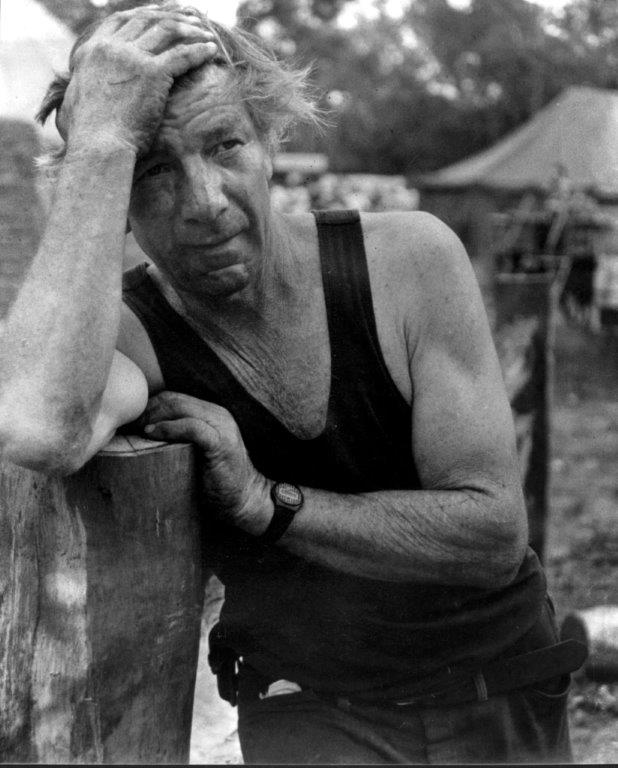
You turned 24 the week I was born, so I remember you as a young bloke, a father of three boys by 27. Fair-haired, under six foot and around 13 stone in the old scale, equal parts bone and muscle, common sense and good humor, wrapped inside a blue singlet with the honest smell of sweat and gum trees. You didn't alter much in 30 years. Later, people sometimes took us for brothers born a dozen years apart.

Like the best dogs, horses and people, you were tough, but never mean. We'd marvel at how you picked up hot coals when they fell from the fire, juggle them casually and toss them back. Your heart was a lot softer than your hands. Once, when a visitor produced sandwiches she'd made specially, you saw the one she offered had been fly-blown on the trip. Rather than hurt her feelings, you took it, thanked her, and ate it.

Chivalry, Mum called it.

Whatever it was about you, we liked it. Little boys in books wanted to be firemen or train drivers, but yours wanted to be sleeper cutters, like you . . .

You'd set up your landing in the shade, preferably to catch a lazy afternoon breeze sneaking up a gully from the lake. You'd fall a tree, measure off nine feet the ancient way, stepping out the log heel to toe, then saw it off and snig it to the landing with the tractor.

You'd belt the bark with the back of the axe to loosen it, then slit it open and lever it off as easily as a slaughterman skins sheep. You'd save sheets of stringy bark and, if it rained, we'd lean them against a tree, shelter under it and drink sweet coffee from your steel Thermos.

You used most tools well, but the axe was your favorite. Your good axe had an oversized head, razor sharp, and a succession of hickory handles worn silky smooth with use.

You could do nearly anything with it, and did.

At lunchtime, you'd put the sandwiches on a fresh-sawn sleeper, which smelt so sharp and sweet and clean, and cut them from corner to corner with the axe, as neatly as if you'd used a kitchen knife. You used it to sharpen the stubby carpenter's pencil for marking the ends of the logs. You used it as delicately as a scalpel to notch the ends of the log - right on the pencil mark - ready for the string line.

And, when you finished with the axe, you'd casually drop it, nose first, into the boards and stick it in perfectly, every time, with the handle rising just right. As neat as you please.
You'd shake the battered tin of blue powder to coat the string, stick it in those tiny cuts at each end, pull it taut, pluck it up and twang it. Presto! A straight blue line on the wet, virgin sapwood. You started the swing-saw and backed it rhythmically down the log, the machine straddling it with skinny legs on tiny tyres, the howling circular blade's cruel shark teeth throwing up a plume of sawdust as graceful as a rooster's tail . . .

And that's when your little boys got a chance to sneak into the bush, dragging the axe. We'd cut a whippy wattle stick, and "borrow" a length of your good cord as a bowstring. But only if you'd notch the ends of the bow with the axe. You always did, and more besides.

Sometimes, with two sure hits and a quick trim, you'd make a cricket bat from a sleeper offcut. You made us a ripper billy cart, the chassis made of hardwood, the front tapered with the axe, the steering a piece of light rope, like reins.

Your own childhood had been spent fishing, riding, shooting and swimming, and you always had a soft spot for childish pastimes. But you had limits. One day we squabbled too much over the swing you'd made with a tyre and a rope, slung from a big roundleaf tree. You vaulted the fence, axe in hand, and cut the rope without a word. Solomon in a singlet.

Later, after we'd reflected on our sins, you put the swing up again. That was you, Dad: slow to anger, quick to forgive and forget, always practical. You were never keen on punishment or revenge, and mostly turned the other cheek. About all that made you angry was injustice to another person or cruelty to animals.

You despised callousness or misplaced sentimentality that let animals suffer. If they were sick or injured, and couldn't be helped, you put them out of their misery.

With a bullet - or a lightning strike with the axe. "Quick and clean," you used to say. You always gave an old dog or an old horse a good feed and a pat before they took the walk from which only you returned.

Not that you liked killing anything. Remember your youngest boy conning you to let a sheep go instead of slaughtering it? You decided we could go without fresh meat rather than upset him. One of the few times I saw you angry in public was when you fronted a youth being rough with sheep in the saleyards. He got the message.

Our world was small, and it seemed to us you could do nearly anything in it that was worth doing. You could swim strongly, box a bit, shoot well and drive anything, and you taught us how. You'd started work at 14, got the truck at 16, had a bulldozer not long after you got the vote, and a pilot's licence. And, later, a couple of boats that gave us golden memories of summers on Lake Tyers.

You knew a thousand practical things, wisdom won from experience as a farmer and bushman.
Like the shine on your axe handle, it came only with time and hard work, but you were always willing to share it. All our lives you've shown people how to do things in that easygoing way, and kept learning yourself. "You can learn one thing from anybody," you always said.

You could sharpen any saw. You were a bush carpenter and mechanic, a handy welder and blacksmith. You grew up around horses, and helped drove cattle as a boy. You could stitch harness, use a stockwhip and a branding iron. You milked 26 Jersey cows and raised pigs. You could tan a kangaroo hide, set a wild dog trap, whistle a fox, rob a beehive, butcher a sheep or shear one. You could mend a chair or chair a meeting.

You cleared land, burning windrows and stumps, and sowed down pasture, but never wasted a stick of useful timber. You could quote Paterson and Gordon by the verse and drop a line of Shakespeare, Steele Rudd, Runyon or the Bible to suit most occasions. You could play tunes on a gumleaf, sing a lullaby in the local Aboriginal dialect, or make a bark humpy - a legacy of growing up on Lake Tyers Aboriginal station, where you were the only white player in the football teams of the early 1950s.

You played on heart and toughness. You had to. You played hurt every week because of what you nonchalantly called your "crook foot", a twisted instep caused by childhood polio that left you with a lifetime limp.

But your foot didn't stop you rucking four quarters without a rest in Nowa Nowa's winning grand final team of 1956. Your mates chaired you off the field, and they gave you a trophy for the most determined player. Mum still laughs about how all the local girls lined up to kiss you after that legendary game.

FOR A man who cut down plenty of trees, you loved them. You knew individual trees among thousands, and could find them in the bush years afterwards. You could look at a piece of sawn timber and say if it was grey or roundleaf box, mahogany or messmate, silvertop or stringybark.

Once, you amazed a neighbor by glancing at his new stockyards and telling him exactly where he'd poached the red box timber from, deep in the state forest two kilometres away.

When you went wheat farming on the open plains near Bendigo in the 1970s, you missed the tall timber and the whisper of wind in the gum leaves at night.

Perhaps that's one reason you were among the first to regrow trees on country where a century of ringbarking and burning had made bleak, bare paddocks. You planted, fenced in and watered hundreds of trees in a belt running a mile across the farm. You planted roadsides, and made plantations in places where salt was rising to blight the soil.

And still you missed the bush.

Your sleeper quota was gone, but you were younger than most sleeper cutters you'd known, and still strong. You'd been one of the last in East Gippsland to start out with a crosscut saw, a broadaxe and splitting wedges, tools that hadn't changed much since medieval times.

You learnt from axemen who'd worked in the bush since the turn of the century, and you spent your teens splitting logs into billets, then squaring them into sleepers with the broadaxe. And you never forgot how, even after chainsaws and swingsaws took over. Which is why, when Victoria's oldest farm, Emu Bottom, at Sunbury, needed authentic mortised posts and split rails to restore it so a television series could be filmed there, you took the contract. The owner, who was to become a friend over the following 20 years, was resigned to buying rare old fences to rebuild, but you told him you could split new posts and rails the traditional way. He was delighted.

And so began your second life as a bushman. You mortised posts and split rails for Emu Bottom, then hewed bush timber with the broadaxe to restore and extend its historic woolshed. People heard of your work and sought you out. You were invited to field days and demonstrations and started building showpiece fences and entrances all over Victoria.

One of your fences is part of a world-class jumping course at Werribee Park equestrian centre. You and an old mate put on an exhibition with the crosscut saw and broadaxe at the Scienceworks museum in Melbourne. You supplied and helped build more than a kilometre of picture-perfect post and rail on a $2 million vineyard and stud in the Yarra Valley.

Along the way you befriended a younger generation of timber men in the mountain ash forests above Healesville, loggers who'd grown up with machinery, but liked the way you could use old hand tools to turn timber into something special.

Like your own little boys long ago, they watched you study each log and niggle it with your hook to set it up just right before you struck a blow. They began saving logs for you that would split easily, helped you load up, shared a beer and a yarn with you after work and became your friends.

You were touched when one of "the young fellas" borrowed your wedges and a little advice to learn how to split rails and shape the ends with an axe. You obliged when a group dedicated to preserving old crafts asked you to give a step-by-step demonstration, which they filmed for posterity. And so, thanks to you, a dying craft has been saved.

But not the craftsman.

It took a while, Dad, but you've finally run up against something you can't fix with the axe. It's cancer, though none of us knew that until it was too late.

As I write this you lie in bed in the next room. I strain to hear you cough and clear your throat, and listen for the murmur of your voice, as you serve out the little time left to us. Those familiar sounds have become precious in a few short weeks.

If courage is grace under pressure, you've got it. As ever, your concerns have been for others, even as that strong body has wasted away, leaving little but strength of character.

I saw you sob for the first time in 40 years when you had to tell your mother you would die before she does. You thanked her for giving you a lovely childhood, and told us later you'd planned a eulogy for her that recalled those happy times. Instead, I'm writing yours, and it's the hardest job I've ever done.

You're sad, too, because you think you've let your grandchildren down. You'd decided to retire from farming and cut back the timber work to spend time with them. Only a few weeks before you became ill, you bought a nine-seat station wagon to drive them around. Instead, we used it just a month ago to take you on a last trip to the bush at Lake Tyers.

Well, Dad, you haven't let anybody down, ever. That's one reason so many people have come from all over to see you, as the news has spread on the bush telegraph. Every day, they stream in off the highway and down the gravel road to the old brick house to say goodbye. We knew you knew a lot of people; we didn't realise how many of them loved you, too.

You've always said that material things don't matter - that people do. "Remember, good friends are like gold," you told me the other day, your voice as strong as your body is frail.

Now, as the clock creeps towards midnight and the end of another precious day, so many memories still echo around my head, as they have these last bitter-sweet weeks.

You always liked the yarn about the stonemasons who were asked what they were doing.
"Cutting stone," one says sourly. "Making a living," says the next, matter of factly.
"I'm building a cathedral!" exclaims the third.

You've always been a cathedral builder. Always believed in what you were doing. Always shown that there can be art and dignity in simple things, in fashioning the functional so it pleases the eye.

Once, when you were burning huge windrows of fallen timber, watching a cascade of sparks shoot up to join the stars, you said that's the way you wanted to go. "I don't want to be buried in the cold, old ground," you said. "A man ought to make his own coffin and be put in a windrow."

Well, Dad, you've left your run a bit late to make your own coffin, but we'll do it for you. One of your friends has offered ironbark and box timber you dressed with a broadaxe for him; another some redgum from an ancient giant you felled, reluctantly, on the Campaspe River flats.

There'll be hand-forged horseshoes for handles, just the way you'd do it, and sprays of gumleaves from trees you planted. Your broadaxe, the one you started with 50 years ago, will be fixed to the lid. We might even get a truck about your own vintage and twitch you down tight with your own chain and twitch "dog".

You'll be gone, but you'll never be dead while we're around. You have nine grandchildren, and when we tell them how to do things, it will really be you that's teaching them.

When they learn to drive, they'll pat their way through the gears gently, like you did. With "just a trickle of throttle," like you always said.

When they cut wood they'll be using one of your axes. We'll show them how you split the tough ones. When they jam the blade, we'll show them how to free it without breaking the handle, the way you showed us.

And when they finish chopping, they'll drop it into the edge of the block, handle up, neat as you please. Just like you.

Life is mostly froth and bubble,
Two things stand like stone,
Kindness in another's trouble,
Courage in your own.

                                      -- Adam Lindsay Gordon

 Andrew Rule was the guest on the 44th episode of the Speakola podcast and recorded the eulogy for me.


Source: The Age, Saturday 27th June 1998, ...

Enjoyed this speech? Speakola is a labour of love and I’d be very grateful if you would share, tweet or like it. Thank you.

Facebook Twitter Facebook
In SUBMITTED Tags FATHER, SON, ANDREW RULE
2 Comments

See my film!

Limited Australian Season

March 2025

Details and ticket bookings at

angeandtheboss.com

Support Speakola

Hi speech lovers,
With costs of hosting website and podcast, this labour of love has become a difficult financial proposition in recent times. If you can afford a donation, it will help Speakola survive and prosper.

Best wishes,
Tony Wilson.

Become a Patron!

Learn more about supporting Speakola.

Featured political

Featured
Jon Stewart: "They responded in five seconds", 9-11 first responders, Address to Congress - 2019
Jacinda Ardern: 'They were New Zealanders. They are us', Address to Parliament following Christchurch massacre - 2019
Dolores Ibárruri: "¡No Pasarán!, They shall not pass!', Defense of 2nd Spanish Republic - 1936
Jimmy Reid: 'A rat race is for rats. We're not rats', Rectorial address, Glasgow University - 1972

Featured eulogies

Featured
For Geoffrey Tozer: 'I have to say we all let him down', by Paul Keating - 2009
for James Baldwin: 'Jimmy. You crowned us', by Toni Morrison - 1988
for Michael Gordon: '13 days ago my Dad’s big, beautiful, generous heart suddenly stopped beating', by Scott and Sarah Gordon - 2018

Featured commencement

Featured
Tara Westover: 'Your avatar isn't real, it isn't terribly far from a lie', The Un-Instagrammable Self, Northeastern University - 2019
Tim Minchin: 'Being an artist requires massive reserves of self-belief', WAAPA - 2019
Atul Gawande: 'Curiosity and What Equality Really Means', UCLA Medical School - 2018
Abby Wambach: 'We are the wolves', Barnard College - 2018
Eric Idle: 'America is 300 million people all walking in the same direction, singing 'I Did It My Way'', Whitman College - 2013
Shirley Chisholm: ;America has gone to sleep', Greenfield High School - 1983

Featured sport

Featured
Joe Marler: 'Get back on the horse', Harlequins v Bath pre game interview - 2019
Ray Lewis : 'The greatest pain of my life is the reason I'm standing here today', 52 Cards -
Mel Jones: 'If she was Bradman on the field, she was definitely Keith Miller off the field', Betty Wilson's induction into Australian Cricket Hall of Fame - 2017
Jeff Thomson: 'It’s all those people that help you as kids', Hall of Fame - 2016

Fresh Tweets


Featured weddings

Featured
Dan Angelucci: 'The Best (Best Man) Speech of all time', for Don and Katherine - 2019
Hallerman Sisters: 'Oh sister now we have to let you gooooo!' for Caitlin & Johnny - 2015
Korey Soderman (via Kyle): 'All our lives I have used my voice to help Korey express his thoughts, so today, like always, I will be my brother’s voice' for Kyle and Jess - 2014

Featured Arts

Featured
Bruce Springsteen: 'They're keepers of some of the most beautiful sonic architecture in rock and roll', Induction U2 into Rock Hall of Fame - 2005
Olivia Colman: 'Done that bit. I think I have done that bit', BAFTA acceptance, Leading Actress - 2019
Axel Scheffler: 'The book wasn't called 'No Room on the Broom!', Illustrator of the Year, British Book Awards - 2018
Tina Fey: 'Only in comedy is an obedient white girl from the suburbs a diversity candidate', Kennedy Center Mark Twain Award -  2010
Tina Fey: 'Only in comedy is an obedient white girl from the suburbs a diversity candidate', Kennedy Center Mark Twain Award - 2010

Featured Debates

Featured
Sacha Baron Cohen: 'Just think what Goebbels might have done with Facebook', Anti Defamation League Leadership Award - 2019
Greta Thunberg: 'How dare you', UN Climate Action Summit - 2019
Charlie Munger: 'The Psychology of Human Misjudgment', Harvard University - 1995
Lawrence O'Donnell: 'The original sin of this country is that we invaders shot and murdered our way across the land killing every Native American that we could', The Last Word, 'Dakota' - 2016