
5 November 2014, Sydney Town Hall, Sydney, Australia

For Allan Jeans: 'What a man', by Cameron Schwab - 2011
20 July 2011, Melbourne Cricket Ground, Melbourne, Victoria, Australia
Allan Jeans was never a dreamer, he was way too pragmatic for that, but clearly understood that he had the capacity to make or break dreams, and that often proved a heavy burden.
It would be rare that a football conversation would pass with Yabby without some reference to a player who he had dropped from a grand final team.
One sensed that the moment was burned into Yabby’s soul as it surely did with the player concerned. These memories for Yab, were as profound as the outcome of the game itself.
In our game dreams become hope. Hope becomes expectation, often without substance or rationale.
For a man like Yab, with a propensity to personalise obligation like no other, he was often required to do some very heavy lifting.
So it was when Yab was appointed Senior Coach of the Richmond Football Club in 1992. Such were the circumstances of his appointment, and whilst he would never be so indulgent to say it himself, he clearly understood that dreams had already become expectation by the time he had donned the yellow and black tracksuit.
Here was a proud football club, Tigerland, dragging itself up by what were very frayed boot laces, its skin recently saved by the shaking of tins, and the passions stirred by the appointment of an icon coach arriving into the dilapidated rooms which seemed to be held together by nothing more than the smell of liniment, ankle tape and the ambitions of young men yearning to be led.
Our game likes to look at the events of history as a predictor for the future as though somehow we can will these events to repeat themselves.
When Allan Jeans was announced as coach of Richmond, immediate reference was made to the appointment of the first non-Richmond person for almost 30 years, in fact the first since Len Smith in the mid-60s, who himself was the first non-Tiger coach that anyone could recall.
The appointment of Len Smith at Richmond would be a catalyst to a great Tiger era, after many years in the doldrums, with the Tom Hafey coached club becoming the team of their generation. Nothing less was expected of Allan Jeans when he became coach of Richmond.
Adding to the colour of this story was Len Smith, the lesser-known brother of coaching legend Norm was also a great mentor of Yab’s.
Len is widely credited for the invention of the modern running game, and his handwritten exercise books on football are the stuff of football folklore.
Len shared these notes with a young Allan Jeans, although Yabby somehow never seemed young, as he prepared his St Kilda team for the 1965 Grand Final.
To say the Saints were inexperienced on the big day would be an understatement. It was only their second Grand Final and their first since 1913.
Yab kept the letters from Len, and I am sure he read them often, particularly in the last months of his life. They gave him context as the coach he was then, and the coach he would become.
History in fact did repeat, as with Len Smith, Yabby’s stint as Senior Coach of the Tigers would be very short – just one season before ill health cut short his time, but in many ways didn’t reduce the impact on those young ambitious men, most of whom would reflect on the time shared as the most significant of their lives.
The reason for this is simple. For Allan Jeans, identity was fundamental, and he educated and coached based on ensuring you had an understanding of where you have come from, where your place is now, and providing a clear understanding of where you were heading.
This was not a compartmentalised thing – it was one continuum – much like the game plan he preached and his famous three phases.
The basis from which he built this was trust, and Yab was the type of person who trusted easily, and trusted freely.
Whilst he had a somewhat intimidating veneer, his warmth and wisdom quickly become apparent, as he did what he could to help you find who you are, what you want to be, and what you want to stand for.
And for many young men finding their way in this most distracted of environments, identity can be elusive.
You quickly learn however, to benefit from the Yabby’s wisened methodology meant leaving your ego at the door, opening yourself up knowing that your confidences were safe, and you would be emboldened by Yab’s preparedness to reciprocate your openness.
Whilst the Yabby voice is legendary, his silences were often more profound.
“I was born with big ears, so I figured I might as well use them”, he would say, and listen he would. He also had a unique way of creating the space required for you to work it out for yourself – surely the best form of coaching.
He was also the master of the metaphor, often used to provide perspective and reality for a player who may be a tad ahead of himself so as to ensure they knew their place in the natural order.
I remember him talking to a young Tiger Tim Powell, who had played a pretty good game off half-back at Victoria Park against the Magpies. After receiving praise, Powelly mentioned his disappointment at not being given a chance to play on Peter Daicos who had kicked a match-winning 7 goals.
“Son, you’re a car salesmen aren’t you?” asks Yab.
“That’ right” says Powelly,
“Well let me put this in a way that you should relate to”.
“Well Son, you’re a Volks Wagon, and Daicos he’s a Mercedes Benz”.
“Now, do you understand?”
“Yes I do.”
“Success needs no explanation, failure accepts no alibis”, he would say, knowing fully that building resilience means you have to learn from your disappointments. That’s how you find out who you are.
Identity based on self-awareness.
And perhaps his best measure of character, “It’s not how you get knocked down, it’s how you get up”.
When Yab arrived at Richmond, he was asked to have a photo taken with the famous tiger skin that adorned the Richmond Board table. He refused. It wasn’t a snub, he would often talk of the club as ‘your club’, rather than ‘our club’, which could be misconstrued by those who didn’t know the man.
In his mind, he had to earn the right to be a part of it. For him it wasn’t a matter of signing a contract, it was about building respect, which he had earn the right – pay the price.
He had a deep respect for the game, the clubs and its people. He understood the Richmond story, the club from ‘struggle town’ that had once been mighty and wanted to be mighty again.
But the weight was heavy, and his health faltered, and so did the dream. He got through the year on pure courage, and his overwhelming sense of duty.
Somewhere from his moments of silent reflections these past months, he realised that he wanted Richmond to be recognised on this day as one of his clubs. “They were good to me” he said, “I want people to know that, please tell them”.
That photo with the Tiger skin was never taken, but the learnings are imprinted in the minds of those who happened to have the good fortune of spending just one very tough season listening to, and being listened by, Allan Jeans.
What a man.
for George H.W. Bush: 'Your decency, sincerity, and kind soul will stay with us forever', by son George W. Bush - 2018
6 December 2018, National Cathedral, Washington DC, USA
Distinguished Guests, including our Presidents and First Ladies, government officials, foreign dignitaries, and friends: Jeb, Neil, Marvin, Doro, and I, and our families, thank you all for being here.
I once heard it said of man that “The idea is to die young as late as possible.” (Laughter.)
At age 85, a favorite pastime of George H. W. Bush was firing up his boat, the Fidelity, and opening up the three-300 horsepower engines to fly – joyfully fly – across the Atlantic, with Secret Service boats straining to keep up.
At 90, George H. W. Bush parachuted out of an aircraft and landed on the grounds of St. Ann’s by the Sea in Kennebunkport, Maine – the church where his mom was married and where he’d worshipped often. Mother liked to say he chose the location just in case the chute didn’t open. (Laughter.)
In his 90’s, he took great delight when his closest pal, James A. Baker, smuggled a bottle of Grey Goose vodka into his hospital room. Apparently, it paired well with the steak Baker had delivered from Morton’s. (Laughter.)
To his very last days, Dad’s life was instructive. As he aged, he taught us how to grow old with dignity, humor, and kindness – and, when the Good Lord finally called, how to meet Him with courage and with joy in the promise of what lies ahead.
Advertisement
One reason Dad knew how to die young is that he almost did it – twice. When he was a teenager, a staph infection nearly took his life. A few years later he was alone in the Pacific on a life raft, praying that his rescuers would find him before the enemy did.
God answered those prayers. It turned out He had other plans for George H.W. Bush. For Dad’s part, I think those brushes with death made him cherish the gift of life. And he vowed to live every day to the fullest.
Dad was always busy – a man in constant motion – but never too busy to share his love of life with those around him. He taught us to love the outdoors. He loved watching dogs flush a covey. He loved landing the elusive striper. And once confined to a wheelchair, he seemed happiest sitting in his favorite perch on the back porch at Walker’s Point contemplating the majesty of the Atlantic. The horizons he saw were bright and hopeful. He was a genuinely optimistic man. And that optimism guided his children and made each of us believe that anything was possible.
He continually broadened his horizons with daring decisions. He was a patriot. After high school, he put college on hold and became a Navy fighter pilot as World War II broke out. Like many of his generation, he never talked about his service until his time as a public figure forced his hand. We learned of the attack on Chichi Jima, the mission completed, the shoot-down. We learned of the death of his crewmates, whom he thought about throughout his entire life. And we learned of his rescue.
And then, another audacious decision; he moved his young family from the comforts of the East Coast to Odessa, Texas. He and mom adjusted to their arid surroundings quickly. He was a tolerant man. After all, he was kind and neighborly to the women with whom he, mom and I shared a bathroom in our small duplex – even after he learned their profession – ladies of the night. (Laughter.)
Dad could relate to people from all walks of life. He was an empathetic man. He valued character over pedigree. And he was no cynic. He looked for the good in each person – and usually found it.
Dad taught us that public service is noble and necessary; that one can serve with integrity and hold true to the important values, like faith and family. He strongly believed that it was important to give back to the community and country in which one lived. He recognized that serving others enriched the giver’s soul. To us, his was the brightest of a thousand points of light.
In victory, he shared credit. When he lost, he shouldered the blame. He accepted that failure is part of living a full life, but taught us never to be defined by failure. He showed us how setbacks can strengthen.
None of his disappointments could compare with one of life’s greatest tragedies, the loss of a young child. Jeb and I were too young to remember the pain and agony he and mom felt when our three-year-old sister died. We only learned later that Dad, a man of quiet faith, prayed for her daily. He was sustained by the love of the Almighty and the real and enduring love of our mom. Dad always believed that one day he would hug his precious Robin again.
He loved to laugh, especially at himself. He could tease and needle, but never out of malice. He placed great value on a good joke. That’s why he chose Simpson to speak. (Laughter.) On email, he had a circle of friends with whom he shared or received the latest jokes. His grading system for the quality of the joke was classic George Bush. The rare 7s and 8s were considered huge winners – most of them off-color. (Laughter.)
George Bush knew how to be a true and loyal friend. He honored and nurtured his many friendships with his generous and giving soul. There exist thousands of handwritten notes encouraging, or sympathizing, or thanking his friends and acquaintances.
He had an enormous capacity to give of himself. Many a person would tell you that dad became a mentor and a father figure in their life. He listened and he consoled. He was their friend. I think of Don Rhodes, Taylor Blanton, Jim Nantz, Arnold Schwarzenegger, and perhaps the unlikeliest of all, the man who defeated him, Bill Clinton. My siblings and I refer to the guys in this group as “brothers from other mothers.” (Laughter.)
He taught us that a day was not meant to be wasted. He played golf at a legendary pace. I always wondered why he insisted on speed golf. He was a good golfer.
Well, here’s my conclusion: he played fast so that he could move on to the next event, to enjoy the rest of the day, to expend his enormous energy, to live it all. He was born with just two settings: full throttle, then sleep. (Laughter)
He taught us what it means to be a wonderful father, grandfather, and great grand-father. He was firm in his principles and supportive as we began to seek our own ways. He encouraged and comforted, but never steered. We tested his patience – I know I did (laughter) – but he always responded with the great gift of unconditional love.
Last Friday, when I was told he had minutes to live, I called him. The guy who answered the phone said, “I think he can hear you, but hasn’t say anything most of the day. I said, “Dad, I love you, and you’ve been a wonderful father.” And the last words he would ever say on earth were, “I love you, too.”
To us, he was close to perfect. But, not totally perfect. His short game was lousy. (Laughter.) He wasn’t exactly Fred Astaire on the dance floor. (Laughter.) The man couldn’t stomach vegetables, especially broccoli. (Laughter.) And by the way, he passed these genetic defects along to us. (Laughter.)
Finally, every day of his 73 years of marriage, Dad taught us all what it means to be a great husband. He married his sweetheart. He adored her. He laughed and cried with her. He was dedicated to her totally.
In his old age, dad enjoyed watching police show reruns, volume on high (laughter), all the while holding mom’s hand. After mom died, Dad was strong, but all he really wanted to do was to hold mom’s hand, again.
Of course, Dad taught me another special lesson. He showed me what it means to be a President who serves with integrity, leads with courage, and acts with love in his heart for the citizens of our country. When the history books are written, they will say that George H.W. Bush was a great President of the United States – a diplomat of unmatched skill, a Commander in Chief of formidable accomplishment, and a gentleman who executed the duties of his office with dignity and honor.
In his Inaugural Address, the 41st President of the United States said this: “We cannot hope only to leave our children a bigger car, a bigger bank account. We must hope to give them a sense of what it means to be a loyal friend, a loving parent, a citizen who leaves his home, his neighborhood and town better than he found it. What do we want the men and women who work with us to say when we are no longer there? That we were more driven to succeed than anyone around us? Or that we stopped to ask if a sick child had gotten better, and stayed a moment there to trade a word of friendship?”
Well, Dad – we’re going remember you for exactly that and so much more.
And we’re going to miss you. Your decency, sincerity, and kind soul will stay with us forever. So, through our tears, let us see the blessings of knowing and loving you – a great and noble man, and the best father a son or daughter could have.
And in our grief, let us smile knowing that Dad is hugging Robin and holding mom’s hand again.”
For Pamela Harriman: 'Today, I am here in no small measure because she was there' by Bill Clinton - 2015
14 February 1997, Washington DC, USA
We gather in tribute to Pamela Harriman, patriot and public servant, American Ambassador and citizen of the world, mother, grandmother, great-grandmother, and sister, and for so many of us here, a cherished friend. She adopted our country with extraordinary devotion. Today her country bids her farewell with profound gratitude.
Hillary and I have often talked about what made Pamela so remarkable. It was more than her elegance, as unforgettable as that was. It was more than the lilt of her voice and her laughter, more even, than the luminous presence that could light up a room, a convention hall, or even the City of Lights itself. It was more than her vibrant sense of history and the wisdom that came to her from the great events she had lived and those she had helped to shape, from the Battle of Britain to the peace accord in Bosnia. I think it was most of all that she was truly indomitable.
One day the train she was on to London was bombed twice, during the Blitz. She simply brushed off the shards of glass, picked herself up, and went to the office to do her work at the Ministry of Supply. She was 21 years old.
More than 40 years later, all of us who knew her saw the same resolve and strength again and again, most tenderly, in the way she gave not only love but dignity and pride to Averell who, as long as he was with her, was at the summit, even to his last days.
In 1991, she put her indomitability to a new test in American politics, forming an organization with a name that made the pundits chuckle because it did seem a laughable oxymoron in those days: Democrats for the Eighties. For members of our party at that low ebb, she became organizer, inspirer, sustainer, a captain of our cause in a long march back to victory. She lifted our spirits and our vision.
I will never forget how she was there for Hillary and for me in 1992: wise counsel, friend, a leader in our ranks who never doubted the outcome, or if she did, covered it so well with her well-known bravado that no one could have suspected. Today I am here in no small measure because she was there.
She was one of the easiest choices I made for any appointment when I became President. As she left to become our Ambassador to France, she told us all with a smile, "Now my home in Paris will be your home. Please come and visit, but not all at once." [Laughter] It seemed she had been having us at her home all at once for too many years. So a lot of us took her up on her invitation to come to Paris. After Hillary and I had been there the first time, I must say I wondered which one of us got the better job. [Laughter]
In many ways her whole life was a preparation for these last 4 years of singular service and achievement. She represented America with wisdom, grace, and dignity, earning the confidence of France's leaders, the respect of its people, the devotion of her staff.
Born a European, an American by choice, as she liked to say, Pamela worked hard to build the very strongest ties between our two countries and continents. She understood that to make yourself heard you had to know how to listen. And with the special appreciation of one not native born, she felt to her bones America's special leadership role in the world.
Today, we see her legacy in the growing promise of a Europe undivided, secure, and free, a legacy that moved President Chirac last week to confer upon Pamela the Grand Cross of the Legion of Honor, France's highest award. He said then that seldom since Benjamin Franklin and Thomas Jefferson had America been so well served in France.
There is one image of Pamela Harriman I will always treasure. I can see her now, standing on the windswept beaches of Normandy on the 50th anniversary of D-Day. She had told many of us of the long, tense night in England half a century before, as they waited for news about the transports plowing toward the shore, filled with young soldiers, American, British, and Free French. Now, 50 years later, history had come full circle, and she was there as an active life force in the greatest continuing alliance for freedom the world has ever known.
I was so glad that Randolph read a few moments ago from the book of Sir Winston Churchill's essays that Pamela loved so well and gave to so many of us who were her friends. The passage he read not only describes her own life, it is her valediction to us, her final instruction about how we should live our lives. And I think she would like this service to be not only grand, as it is, but to be a final instruction from her to us about what we should now do.
Let me quote just a portion of what was said a few moments ago. "Let us reconcile ourselves to the mysterious rhythm of our destinies such as they must be in this time—in this world of time and space. Let us treasure our joys but not bewail our sorrows. The glory of light cannot exist without the shadows. Life is a whole, and the journey has been well worth making."
Throughout her glorious journey, Pamela Harriman lightened the shadows of our lives. Now she is gone. In the mysterious rhythm of her destiny, she left us at the pinnacle of her public service, with the promise of her beloved America burning brighter because of how she lived in her space and time. What a journey it was and well worth making.
May God comfort her family and countless friends, and may He keep her soul indomitable forever.

For Chris Wilson: 'This man of multitudes', by Paul Kelly, Music Victoria Awards - 2020
Paul Kelly speech is at 1:47:11 of video
The past and present wilt,
I have emptied them, filled them, and proceed to fill my next fold of the future.
Do I contradict myself? Very well then, I contradict myself.
I am large. I contain multitudes.
Do these words sound familiar? They are words from the poet, Walt Whitman stolen by Bob Dylan for a song on his most recent album. And, stolen tonight by me to describe a man who contained multitudes.
I have vivid memories of Chris and our first tour of the United States over 30 years ago. We were like kids in a candy store in that country that contains multitudes, that contained so much that fed us.
Those rivers of music from San Francisco Bay to Harlem and Broadway, from the Great Lakes to the Rio Grande, from the Appalachians to the Delta. And, Chris took all these rivers into himself. This is what he did all his life. He lived and breathed music. When you went to visit him, you were always in danger of getting lost among the canyons of his record collection, and never getting out of the house.
There was music, it seemed, from every country in the world. The Africas, the Americas, the Balkans, Europe, Asia, Ireland, Iceland, Arnhem Land, and on and on. Chris absorbed all this, rolled it round in his gut, his heart, blood, bone and brain. Blended it and spat out his own music. A mongrel music, a multitudinous music, a music of contradiction and tension. My favourite kind of music.
He was curious and generous. He loved to discover and share, a mentor to many, a teacher and a preacher, ferocious and tender and all the shades in-between.
Listen to him kick off me and my band at the start of my song, Dumb Things."What sound is that?", many people have asked me. And, listen to his aching suspenseful play out at the end of our cover of Australian Crawl's, Reckless. It's hard to believe that it's one person squeezing out those sounds.
Yes, he was a man of multitudes. I am privileged to have travelled some of this earth working, and playing with his huge hearted man.
This mountain of a man who commanded attention wherever he went on the stage, and on the street. This shy man who listened deeply and talked quietly. This serious man, this funny man, this angry man, this gentle man.
And, I am proud to induct this man of multitudes into Music Victoria's Hall of Fame. So, please welcome to the stage, his family, Sarah, Fenn and George, to accept this award on his behalf.

For Fred Gruen: ' My father’s life is a story of bad luck and bad fortune turned to good', by son Nicholas Gruen -1997
2 November 1997, University House, Australian National University, Canberra, Australia
‘Tis the gift to be simple,
‘Tis the gift to be free
‘Tis the gift to come down where you ought to be
But when we find ourselves in the place just right
‘Twill be in the valley of love and delight
When true simplicity is gained,
To bow and to bend we shan’t be ashamed
To turn, turn will be our delight
Till by turning, turning we come round right.
I hope that everyone here can appreciate the relevance of these words from the well-known Shaker song to my father’s life. Their relevance in death can only be a matter of speculation.
My father’s life is a story of bad luck and bad fortune turned to good.
In early 1946, no one would have predicted the success and the happiness that was to come. As Dad put it in his autobiographical sketch, his childhood was a rather lonely and unhappy one.
Who can say when he felt loneliest? Was it when he arrived at Dover in 1936, an adolescent refugee, or was it as he suggested to me, about a year later when he was summoned to his headmaster’s office and told that his father Willi had died of cancer?
The other great horror was the fate of his mother’s Mariana. Lily, her elder sister, commented to an oral historian in 1978 "I was rebellious against the way I was treated as a child. . . . Mariana was very charming and cheerful and the other way around. My sister was a very beautiful girl. Once her example was put up before me; I was told, ‘Look how friendly she is, look how everybody likes her,’ and so on." Mariana was taken to Theresienstadt concentration camp and survived there for several years. She was moved elsewhere in the dying days of the war. We believe - though we do not know - that she perished in Auschwitz.
If one wanted to be rhetorical one might say that Dad’s luck changed one day in 1940 on his journey between the old and new worlds. He was locked in the hold of the Dunera. It was hit by a German torpedo. But it didn’t go off.
It was in Australia that, so it seems, he came down where he ought to be. Again and again he found himself in the place just right. In his eventual choice of country, in his choice of spouse and his choice of the discipline he would pursue - his life’s work.
Internment was difficult. While, looking back, he would have none of the idea that the Dunera was a scandal - or stronger still, some kind of atrocity - he did quote from George Rapp’s despairing poem which was penned in the camp.
Have you heard my story most brave
of the thousand dead men without grave
in that wonderful town
with the moon upside down
and the wires in need of a shave?
Each man is a corpse, as he sits
decaying and doubting his wits
whilst far, far away,
where the night is the day
his world is breaking to bits. . . .
In retrospect Dad always regarded himself as lucky to be gazing at the upside down sky over Hay rather than in the front line in Europe.
Dad had the great good fortune to meet my mother. He had the looks and charm to successfully court her, and she had the guts to marry him. I think it is probably hard to overestimate what strength of character it took. A Jewish refugee was not quite what my mothers parents - particularly her father - had in mind for her.
Indeed when my parents’ engagement was announced, my mother was staying with her aunt in Melbourne and was asked to leave.
But notwithstanding Dad’s exotic and lowly social status, Granny - mum’s mother - made up her own mind. After a little time with Dad she said to my mother, "I think you’ve picked a winner dear."
And so she had. And so had Dad. To borrow one of Manning Clark’s expressions, my mother worked a great miracle inside him.
Dad cultivated an interest in higher education at Hay. And he was always grateful to Miss Margaret Holmes who helped him and many others study while in the army.
Like so many others of the same generation who are feted today, my father was part of the long post war boom in higher education. He was part of a generation which was confident about its role in rebuilding and modernising society after the devastation of the greatest war in history, which, if it had not consumed their life, had certainly consumed their youth.
Dad liked the idea of economics because he was an idealist. After the depair of the depression and the horror of the war to which it contributed, Dad believed – like many of the time – that social science could help build a better world. I think it seemed to Dad that economics was the social science which could most directly and most obviously be capable of making a contribution to peoples lives. But I think he thought that it suited his talents. It had some of the rigour of science, but it dealt directly with political and social questions about how our lives together should be organised.
Dad had a great spread of talents and, as Keynes observed, it is this breadth of talent, rather than genius at any one skill which is the key to good economics.
The study of economics does not seem to require any specialised gifts of an unusually high order. Is it not, intellectually regarded, a very easy subject compared with the higher branches of philosophy and pure science? Yet good, or even competent, economists are the rarest of birds. An easy subject at which very few excel! The paradox finds its explanation, perhaps, in that the master-economists must poses a rare combination of gifts. He must reach a high standard in several different directions and must combine talents not often found together. He must be a mathematician, historian, statesman, philosopher - in some degree. He must use symbols and speak in words. He must contemplate the particular in terms of the general, and touch abstract and concrete in the same flight of thought. He must study the present in the light of the past for the purposes of the future. No part of man’s nature or his institutions must lie outside his ken. He must be purposeful and disinterested in a simultaneous mood; as aloof and incorruptible as an artist, yet sometimes as near the earth as a politician. (In Moggeridge, p. 424).
There was another quality which Dad had which was essential to many of his best contributions to economics and public policy. As so many of those who dealt with him rapidly came to appreciate, he was a very nice man.
About ten years ago when I was reading a book on the lives of the composers. I came upon this passage.
[H]e must have been a very nice man to know. A person of singularly sweet, kind disposition, he made virtually no enemies. . . . He was even-tempered, industrious, generous, had a good sense of humour . . . enjoyed good health except for some eye trouble and rheumatism . . .. He [had] good common sense. He had integrity and intellectual honesty - the kind of honesty that could allow him to say, when Mozart’s name came up "My friends often flatter me about my talent, but he was far above me". He liked to dress well.
The description was of the composer Hayden. It could equally be of Dad. People liked him easily and quickly and this meant that Dad was a good leader. People respected him for his knowledge, and his intelligence, and also for his essential modesty. Dad was not pompous. Like the composer Hayden, he didn’t have tickets on himself. But peoples instinctive liking for him, and respect for his talents and good judgement meant that he could be extremely persuasive. As I understand it, it was he who first proposed the 25 per cent tariff cut and he was instrumental in persuading a range of agonisers – or in arranging for others to persuade agonisers – of the merits of his proposal. Even more impressively, Dad was able to lead an extremely heterogeneous group of people to unanimously support the inclusion of the family home in Assets testing for welfare benefits.
Dad’s good judgement and good leadership extended also to his professional colleagues. He was fond of saying that there were a lot of people who were extremely clever but had no bloody sense. (It has to be said that he was in a profession in which it is hard not to notice this phenomenon.) And his greatest contribution to economics and public policy might well be a roll call of the people in his Department who he either hired himself, or who were hired by those he hired. I need only mention some of their names. Bob Gregory, Bruce Chapman, John Quiggin, Adrian Pagan and Steve Dowrick to name just a few.
The 25 per cent tariff cut was a good illustration of Dad’s qualities. Some such as Alf Rattigan agonised about whether or not it fitted a particular institutional model of tariff reform towards which he had striven for nearly a decade. Others who might have been expected to support the move - like senior Treasury officials - opposed the idea, again because it was unusual. It was not their idea. My father was prepared to improvise because he knew that the tariff cut offered an unusually good combination of short and long term benefits, and, at the time it was proposed, comparatively few costs. He was a man of broad talents who understood the issues, and had the courage and the imagination to seize the day - as he put it later, to whisper into the ear of the prince!
Coming down in the discipline of economics Dad came down where he ought to be. And where he ought to be became - by chance of history - a more and more important place to be.
Ironically, as the inadequacies of the discipline of economics were exposed, economics became more and more influential! As politicians, bureaucrats and the populace at large became progressively more anxious about how to restore their lost prosperity, economics became the premier social science - an increasingly indispensible gateway to policy influence.
History - and happenstance - treated my father well after the war in other ways as well. In being what Phillip Adams once called our ‘Dunera Boy extraordinaire’, my father participated in an event which was the ‘Gallipoli’ of early post-war multiculturalism - a defining and mythic event in Australia’s history.
The Dunera’s inmates could never have known as they lived through their voyage and their detention in Australia, the significance which would be made of it looking back. Yet in the days after my father’s death, all of those who contacted me to help them writing his obituary asked "he was on that boat - the Dunera - wasn’t he"? A gardener who read his obituary in The Age said to me that he didn’t know I was the son of a Dunera boy.
A collection of middle European refugees (with a disproportionate representation of egg heads) sitting behind barbed wire in the middle of the Hay plain, entertaining themselves with sports, study, music making, theatre and concerts.
Of course there were plenty of similar camps and there were plenty of migrant experiences, just as there were plenty of Australian battles in World War One other than Gallipoli. But as time passed, the Dunera internees worked their way into the popular Australian imagination.
These were some of the changes in circumstances which changed Dad’s life. But there was also some alchemy at work inside him. I don’t think anyone can really say quite what it was - not even him. Perhaps particularly not him. I think the main thing he did was really quite old fashioned - indeed unfashionable by today’s standards.
I think my father achieved the happiness and success he did because he did not try to ‘work through’ or to make sense of his worst experiences. Indeed much greater minds and spirits than my father have tried to make sense of the Holocaust. But it cannot be done.
So my father did something else. He tried to forget about the worst of the past. He never tried to deny or conceal it. But he tried to focus on more productive things. Perhaps that is where he got some of his great enthusiasm for so many of the things going on in the world, from architecture, to philosophy to politics, world history and world affairs.
He was gregarious in his interests in others also. But, for someone with his early experiences, he was blessed by not being an introspective man and his bridge to others was often through common public events.
When I visited him in his last days of consciousness in John James Hospital, he was engaging several nurses who had either returned from, or were soon to depart for, far flung locations.
One nurse was soon to go to Kenya. Dad filled her in on the state of civil unrest there as it unfolded. He continued to engage another who had recently returned from the Middle East on what life was really like in Bahrain and what sort of constitution they had. Dad took considerable care to pronounce Bahrain in a way which served to indicate its exotic location outside of Australia, although I must admit it left me wondering that Bahrain was so near Vienna.
Dad combined a civility which, one might speculate, he brought with him from Austria, with an Australian unpretentiousness and straightforwardness. I think when I was young I thought that the expression ‘g’day’ was particularly my father’s. He certainly took to it with great gusto.
A episode which illustrates these things and his great sense of humour occurred one day in 1967. We were being entertained for lunch by a rather straight laced American economist in the Mid-West of America. He introduced lunch in a way which he thought appropriate but which we found intensely embarrassing.
He said that although we might not have voted for Harold Holt, he wanted us to know that he was extending the hand of American friendship and condolence to us in our national grief. My father showed the depth of his assimilation into Australian culture by defusing the situation. "Yes Ken. It is sad. But that’s the good thing about living in Australia. Its a small country. And when something like that happens, we all just move up one!"
But Dad’s sense of humour was at its greatest as an appreciator. He had an infectious and hearty laugh. So much so that, if I intended to watch "Yes Minister" or "Faulty Towers", I would make the trek out to the farm so that I could increase my enjoyment many-fold by watching the program with one eye, and Dad with the other. There were times when I honestly thought he might do himself an injury.
My father was a great charmer. His charm came from his natural extroversion, and uncomplicated buoyancy of mood, his sense of fun, enjoyment of teasing, his modesty and appreciative sense of humour.
I remember skiing holidays with Dad. In the space of a week an entire chalet full of the most unlikely people (of a range of backgrounds, temperaments and ideological dispositions sometimes sympathetic but often odious) would all succumb to his charm. They would want to sit at his table and enjoy the high of talking with him, being teased by him, flirting with him and debating him.
He was a man who inspired admiration and indeed devotion from many. Bruce Chapman lectured me for about an our one night at a party on what a marvelous man Dad was.
I remember one surreal moment about six months later when Bruce and I met quite by chance each refueling our cars in the wee hours after Saturday night - like two strangers in an Edward Hopper painting under the anonymous glare of the fluorescent lights at the Shell garage in Manuka. As Bruce got back into his car, he yelled at me over the roofs of our respective cars - and a propos of absolutely nothing - "I still envy you your father".
Dad was affectionately famous - perhaps more within his family than anywhere else - for his vagueness at certain times. When engaged in routine social interactions Dad sometimes allowed himself the luxury of thinking of things other than what he was talking about. This could generate comic effects - with occasional lapses into complete anarchy.
One of the gravest of these occasions was in 1967 in Raleigh North Carolina when family friends Fred and June Schönbach were visiting us for lunch, having traveled down from Washington. The night before, Dad had fought one of his many fights with David and I about when we would get undressed and go to bed. This must have drifted into his consciousness during a lull in the conversation when, in the presence of Mum, David, myself and Fred Schönbach, Dad listlessly turned to June Schönbach and said "Let’s get undressed".
I presume that, like us, June imagined that she had misheard him. Indeed, not an eyelid was batted. But subsequent family post-mortem revealed that we had all heard the same thing. And the moment passed - fairly or otherwise - into family mythology.
Since then Dad has suggested to at least one other unsuspecting person that they get undressed - apparently seeking to induce them to open a gate in front of the car. Dad has also on at least one occasion left workmen wondering quite what they were being taken for when he said something about them getting into their pajamas.
I mention Dad’s occasional vagueness, not just because it formed part of a family mythology which was too much fun for his two sons not to inflict on an occasionally protesting but generally accepting father.
I mention it also because of the contrast it made with situations where his interest was aroused particularly as a professional and an academic. When he was in a seminar, he was not on automatic pilot. He was intensely engaged probing for weaknesses and searching for insights. In debate and discussion in a professional context, Dad was the model of the scholar he aspired to be. At the same time aggressive, scrupulous and gracious.
About a week before Dad lost consciousness, I managed to get him a program enabling him to play bridge against a computer. I had keeping my eye open for this for literally years. I brought it to him in the hospital. He was weak from the cancer, from malnutrition and analgesics. He was also unfamiliar with my portable computer. Accordingly I sat next to him on the bed and operated the game for him.
Dad’s demeanor took on an intensity not seen for some time. He became quite agitated and indignant if I made foolish moves which he would have avoided. "Take that trick back" he ordered me.
But I was yet to learn how to take tricks back on the new program. So he scoffed "Well if you play a trick like that you can’t call it my hand".
Like Dad, I hadn’t played bridge for at least one decade - possibly two. So when I saw a hand with at least three cards in each suit and 17 points in high cards, I suggested an opening bid of one no trump. Dad despaired. "Darling, you can’t bid one no-trump with no club-cover."
He was equally sharp, and funny as well when mum remarked about one of his impossible relatives - no longer with us - "She’s her own worst enemy". Dad responded "Not while I’m around".
It would be quite wrong, and self indulgent to paint Dad as ‘haunted’ by his past. But of course it was always there. I remember sometime, probably about a decade ago when I visited Dad in his corner office just before his retirement. Asked how he was he said something like "Oh . . . a bit depressed". Not a remarkable comment but it upset me quite a lot.
When I reflected on it, I realised that, in all the time I had known my father, I could not remember him saying he was depressed or sad. His focus on the positive was not false or forced. And no doubt he felt the demands of parental obligation. One does not want to project sadness towards one’s children. It was also because he was part of a whole generation which lacked the obsessive introspection of later generations.
But I think there is more to it than that.
I think Dad largely trained himself out of the luxury of being depressed and of being sad. There is a literature growing up in Australia - and I imagine elsewhere - of children of Holocaust survivors. Mark Raphael Baker and Romona Koval have each published books on this subject and the story is the same.
None of the holocaust survivors have ‘come to terms’ with what happened. They have found ways of living on after the experience, but they do so mostly by trying to forget, by focusing on other things. In today’s psycho-babble, Holocaust survivors have been unable to grieve adequately for their past losses. But their grief cannot really be confronted, because if acknowledged it would have no limit. It would be bottomless.
Dad was not a Holocaust survivor in the literal sense, but he was touched by the infinite malevolence of the Holocaust in the most direct way.
Certainly in my family, my mother has shed many more tears over the holocaust than my father. Her sympathy for him was perhaps a luxury he felt unable to allow himself. I don’t know how often it broke through into Dad’s consciousness: I suspect, with the possible exception of the last year or so, not all that often.
But sometimes it did. I remember just once when I was about eight or nine, watching a documentary on World War II with David, Mum and Dad in the rumpus room in Harkaway. I doubt if I said anything, but my recollection is that I was mesmerised by the audacity of Hitler and the Germans in just the same way I was attracted to the swashbuckling of Hannibal and Alexander when I learned of them. But as the credits of the program rolled up the screen, my vague musings were torn asunder by my father’s uncontrollable sobbing.
And then three nights after Dad’s huge abdominal operation, I was with him until well into the morning hours. He was hooked up to a vast array of life support systems and was clearly fretting in his drug induced slumber. When he awoke, I asked him what his nightmares were about and he shook his head lightly and said "Ghastly, ghastly". For some reason I wanted to know and I pressed him. He said "Shindler’s List".
But most of the time his focus on the positive and the outward did not fail him.
Mark Raphael Baker writes about his parents (both Holocaust survivors) quoting a Yiddish lullaby his parents sing to their numerous grandchildren as they ruminate upon what their lives might have been had the holocaust not intervened to diminish them:
Sleep now child, my pretty one,
Close your dark eyes.
A little boy who has all his teeth
Still needs his mother to sing him to sleep? . . .
A little boy who will become a great scholar
And a successful businessman as well.
A little boy who’ll grow to be a bridegroom
Has soaked his bed as if he’s in a pool.
So hush-a-bye my clever little bridegroom
Meanwhile you lie wet in your cradle
Your mother will shed many a tear
Before you grow up to be a man.
And their son sings to them:
Sleep my dear parents but do not dream.
Tomorrow your children will shed your tears
Tuck in your memories in bed and say good night.
It is so sad that Dad has gone: That we’ll never be able to speak to him again. That we’ll never be able to tell him things we know he’ll find funny and be rewarded with his laughter. I’ll never be able to enjoy an episode of "Faulty Towers" or "Yes Minister" in quite the way I did when I made the trek out to Hall.
Dad leaves a gaping and incomprehensible hole in the lives of those who loved him. Like any person who has made the journey of life successfully, there is, nor will there ever be anyone quite like him. He was singularly himself. To invoke a cliche, we will not look upon his like again. And so we are filled with grief.
One last story which sums up a lot. After Dad had gone through two harrowing months of chemotherapy, he gave up Taxol and Carboplatin and was due to start on Methotrexate in a few weeks time. Mum had briefly been in bad health herself and so her friends Margie and Juddy were staying with us on the farm. I had come up from Melbourne. The house being over full, I was sleeping in the study. Dad was enjoying a stint of good health which had stretched for a month or so, and so he was showing some of his natural buoyancy.
The atmosphere had some of the crowded, festive atmosphere of an extended family turn at a holiday beach house as we crowded around the kitchen table. And it reminded me of the skiing holidays. At lunch time Hillary Webster arrived, ebullient as usual, like a benign whirlwind. She greeted each one of us heartily and gave us all hugs before turning to Dad who was sitting looking rather frail in his chair. She gave him a very special hug, and said with great emphasis. "And how are you, you lovely man." For the next twenty minutes or so, everyone, including Dad joined in the hilarity of various people, including him, modelling the truly ridiculous wig he had reluctantly agreed to purchase as a result of losing his hair.
So let me close this service by saying thanks Dad. Thanks for everything. Thanks for your fun, your laughter, your affection. Thanks for believing in what you did and living the way you did. Thanks for keeping despair at bay, and living with the cancer that came stalking you for as long as you could bear it.
And thank you to those who have come today.
To end this service I thought the best music to celebrate his life was music which he himself loved, and which captures his ebullient civility. The Blue Danube.
Farewell to a lovely man.
Postcript: A great deal of effort was expended to ensure that the song ‘Tis the gift to be simple’ could be played over the University House public address system - so much effort in fact, that no backup means of playing the recording was brought to the service. The rendition was the title track of Yvonne Kenny’s ‘Simple Gifts’ which I had given Dad as a birthday present a few years before. Dad loved it so much that it almost displaced Strauss waltzes on his car cassette on his many trips between the office and the farm in his car.
As might have been predicted, there was a technical problem and the track could not be played. Having quoted some hundreds of dollars to do the service, the sound engineer, got word to me of the complete failure of the system some three minutes before his services were required! To my extreme chagrin, the best I could do was read the text of the song to the audience. The next morning an uncanny re-run of the scene I sketched at the end of my speech was played out before my eyes. Mum, Margie and Juddy were all there along with others around a crowded kitchen table. And then Hilary Webster arrived. Quite agitated, she exclaimed "Were you listening to ABC FM". None of us had. But that morning they had played Yvonne Kenny’s rendition of ‘Tis the gift to be simple’. NG

portrait by Erwin Fabian, 1941. Speech at unveiling of this portrait by Nicholas Gruen also on Speakola.

Nicholas Gruen
Source: http://www.gruen.com.au/FHG.htm
For John Cain: 'On gender equality, the Cain administration marked out a road for others to follow' by Mary Crooks - 2019
3 February 2019, St Paul’s Cathedral, Melbourne, Victoria, Australia
Speech starts at 29.57. Mary Crooks is the Executive Director of the Victorian Women’s Trust
I first worked with John in 1977, when he was Shadow Minister for Planning, helping with speeches and doing research. We had serious fun together sleuthing some highly dubious land deals, like Mt Ridley.
Working at close quarters gave me an early measure of the man. He had a keen, plainly-wrapped intellect; and an impressive grasp of issues. He was ethical, fair minded, collegial and hard-working. There was no bluff or bluster; no over-sized ego. He had a wry, at times, wicked sense of humour.
But above all, he was deeply respectful, toward his life partner, Nancye, his children, Joanne, John and James, toward others and to me. For a woman in her late twenties, navigating what was then very much a ‘man’s world’, the respect John accorded me was both validating and empowering.
The coverage of John’s legacy over the past weeks has rightly acknowledged high profile achievements – the National Tennis Centre, the TAC, Southbank, shop trading hours. On its own, this account doesn’t do justice to his three terms as Premier. Neither does it capture the broad sweep of his government’s reform agenda.
But especially missing from this narrative so far is John’s personal commitment and political contribution to achieving a fairer world for women.
Women have been hugely under-represented in our national and state parliament over the past century and more but this doesn’t mean they are disinterested observers. Within the same patriarchal culture which has devalued women and sought to control what they should and shouldn’t do, women have agitated and struggled long and hard, across the political spectrum, to secure basic human rights and reforms. Always from a lesser position of power, progress for women has been halting in the face of stiff rear guard action. It is no surprise that the hearts of many women skip a beat when they bear witness to a government intent on addressing gendered inequality.
A perspective on the span of time is crucial here today. So far, we have experienced 165 years of Victorian parliamentary history; and 120 years federally. There have been 48 Victorian Premiers and 30 Australian Prime Ministers. Out of these 78 leaders, only two have been women — Joan Kirner and Julia Gillard.
Wistfully, in my lifetime and that of my mother’s (who is three weeks off turning 100), we can count on just two hands the numbers of male-led Victorian and federal governments that have elevated gender equality as part of their core business; and backed it with policy and action.
Of these handfuls, two governments have a special status – because they broke through on gender equality like none before. The Whitlam Government was one. John Cain’s was the other.
Long before he became Premier, John had a deep and abiding belief in fairness, equity, access and justice. These precepts readily translated into guiding principles of his administration.
As a teenager in the 1940’s, he was discomfited by the sexism, racism and sectarianism he saw around him. Guided by his parents, John and Dorothea, he was determined in his own no-fuss way to help build a society free of this destructiveness.
He recognised the unequal treatment women had received through time. He believed women’s unpaid work in the home and the care of their children made them economically vulnerable. Discrimination on the basis of gender and race was offensive to him. He also knew that equal and full participation could not be achieved when women are unsafe.
As ALP leader, he pledged his government would work for equality of opportunity. His government would seek to enhance women’s status, further their participation in public life and ensure that they received equal benefits from government services.
On this quest, he led from the front
He held the Ministry for Women’s Affairs for the eight years he served as Premier.
This was no hollow, cynical gesture, something women have had to endure in other places at other times.
He meant business.
He challenged, and stared down, the all-male institutions of the Melbourne Cricket Club and the Victoria Racing Club, over their century-plus-more practice of excluding women from their inner sanctums.
Building on Pauline Toner’s effort as Shadow Minister for Women, John made it clear these bodies had no right to exclude half the population from public land. ‘If Nancye can’t accompany me, I’m not going,’ he told them.
A hundred and more years of male privilege, entitlement and gender segregation came crushing down, at least overtly. John later recalled that some of the powers-that-be did it with more grace and goodwill than others.
There were history-making firsts for women
John knew that no matter how many men of merit sit around the table, governments made up almost exclusively of men miss the policy mark when they consciously or sub-consciously exclude women.
Pauline Toner became the first Victorian female to enter Cabinet, joining forces with many talented men.
Caroline Hogg and Joan Kirner joined the Cabinet in the second term; Kay Setches and Maureen Lyster in the third.
This crew of Cabinet women commanded immense experience in education, local government, community service and the union movement. Along with the slowly increasing numbers of Labor women entering parliament, they brought the lived experience of so many people across communities, especially women, to government policy-making.
John wanted groups such as women and young people to be brought under the representative umbrella. Through the Women’s Advisory Council, Aboriginal women, young women, women with disabilities and country women joined others in giving voice to their issues and concerns.
The Women’s Policy Co-ordination Unit, sitting within Premier and Cabinet, carried out first-time consultations on major issues for women, such as the Women in the Home consultation and the Care of School Aged Children.
Caroline Hogg, with the collegial support of Evan Walker as Minister for Agriculture, actively facilitated the creation of the Rural Women’s Network, the first of its kind in Victoria and indeed Australia. Women around the State loved it, thrilled by its Women on Farm Gatherings and the networking support it provided for women going through the tough times that come with working the land.
LandCare also came into being, another first for Victoria and later Australia, emerging as it did from exceptional bipartisan collaboration between two women, Joan Kirner, as Minister for Conservation Forests and Lands and Heather Mitchell, from the Victorian Farmers’ Federation.
For the first time in our State’s history, women were appointed to such diverse bodies as The State Electricity Commission of Victoria; the Workers’ Compensation Board; the Metropolitan Transit Authority; the Victorian Law Foundation; MCG Trustees; the Planning Appeals Board, the Occupational Health and Safety Commission.
Permanent part-time work within the teaching profession provided female teachers with more flexible working conditions.
Affirmative Action Plans were put in place in the Teaching Service to increase the numbers of women in leadership and management. Equal Opportunity Units were established in many agencies.
Twenty-five Technical Schools became co-educational in John’s first term of government.
The Women’s Information Referral and Exchange (WIRE) was also a first-term achievement, remaining a mighty organisation to this day.
The Victorian Women’s Trust was also established in the first term, an organisation unique in Australia and one of the first such agencies globally.
Milestone legislation sought greater protections for women
Among an array of legislation, the Equal Opportunity Act 1977,established under the Hamer Government, was strengthened.
The 1984 Act proscribed sports clubs from discriminating on the basis of sex or marital status.
A definition of sexual harassment was introduced to allow complaints to be made about discrimination on that basis.
Changes were made to The Crimes Act 1987 that expanded options for victims of family violence (who are, let’s be clear, mainly women and children) to seek protection through Intervention Orders.
There were so many defining community initiatives to better support women
Thousands of long-day child care places in centres around the State, as well as family day-care places and preschool and play-centre places were provided.
The Neighbourhood House network was expanded, helping overcome women’s social isolation as well as facilitating community connection; computers arrived in these Neighbourhood Houses and Community Learning Centres to assist women’s access to information on jobs and courses.
Aboriginal Liaison positions were funded to support women at the Mercy and the Royal Childrens’ Hospitals. A Migrant Women’s Resource Centre was established.
There were more women’s refuges. There was support for Women’s publishing initiatives. Young women were actively encouraged to take up apprenticeships. Energy rebates made life a bit easier for low income women.
In breaking through on gender equality in these wide-ranging ways, the Cain administration marked out a road for others to follow
We delude ourselves if we think that equality can be achieved through gradual erosion of the burdensome, inequitable structures and institutions which hold our society back.
Rather, it requires systemic change, positive disruption and challenges to the dominant order. Governments can do only so much. The rest must come from us.
John Cain did his most. As a lawyer, he knew the importance of precedent.
His administration paved the way for further milestone advances in Victoria, including the hard-won affirmative action policy within his own party; the Royal Commission into Family Violence, the achievement of gender parity in the current Andrews Cabinet, where female Ministers hold portfolios such as transport and infrastructure; and the historic, Australian-first Gender Equality Bill now before the Victorian parliament.
Since his resignation from the leadership in 1990, John and I remained in regular contact. He was a great telephoner. Our conversations ranged wide. We laughed a lot and disagreed about some things, respectfully of course.
But there were two issues where we were in sync – one was our increasing disquiet about the decline of public trust in government and the failure to govern for the common good – as evidenced by short-termism, policy capture by vested interests, adversarial politics and corrupt behaviour. The other was our shared belief that inequality is at the core of many of our problems; that ridding our society of sexism and racism will invariably take us all to a better, more enlightened place.
John understood that respect was the bedrock of gender equality.
He acknowledged men have had to adjust to the idea of working alongside women, changes he realised were difficult, even painful but essential to achieving gender fairness and social justice.
In November 2016, at the age of 85, he registered for our own Breakthrough for Gender Equality conference at the Melbourne Town Hall, joining over 1000 women (with an average age of 35), and putting himself very much in the minority.
He sat in on a session conducted by acclaimed humourist, Judith Lucy. Mid-way through her comedy routine, she spied John and seized the opportunity for some mischief. ‘Sir, what’s your name? ‘John’. ’Hi John, what has brought you here? John: ‘I want to see what goes on in these places.’ Judith: ‘You want to see what goes on in these places? ‘There’s going to be a cauldron….aah, you could be sacrificed a little later on…No, we are very happy to have you here John.’
He chuckled.
Here he was – an older man at ease with himself; at ease in the company of women; and largely at peace with the fact that he had given his best over a lifetime to make the world a fairer place for all, and especially for women.
Three days later he wrote to us acknowledging the work that had gone into the event. He was concerned that ‘in many areas around the issue of equality this society of ours is going backwards. You made us aware of the need and urgency for revised approaches’ he wrote. He added, ‘what we learnt in government was that persistence and determination over the long-term is required to effect significant reform around important issues.’
Stay the course, never give up, was his message. He would urge us all today to do the same.

Mary Crooks
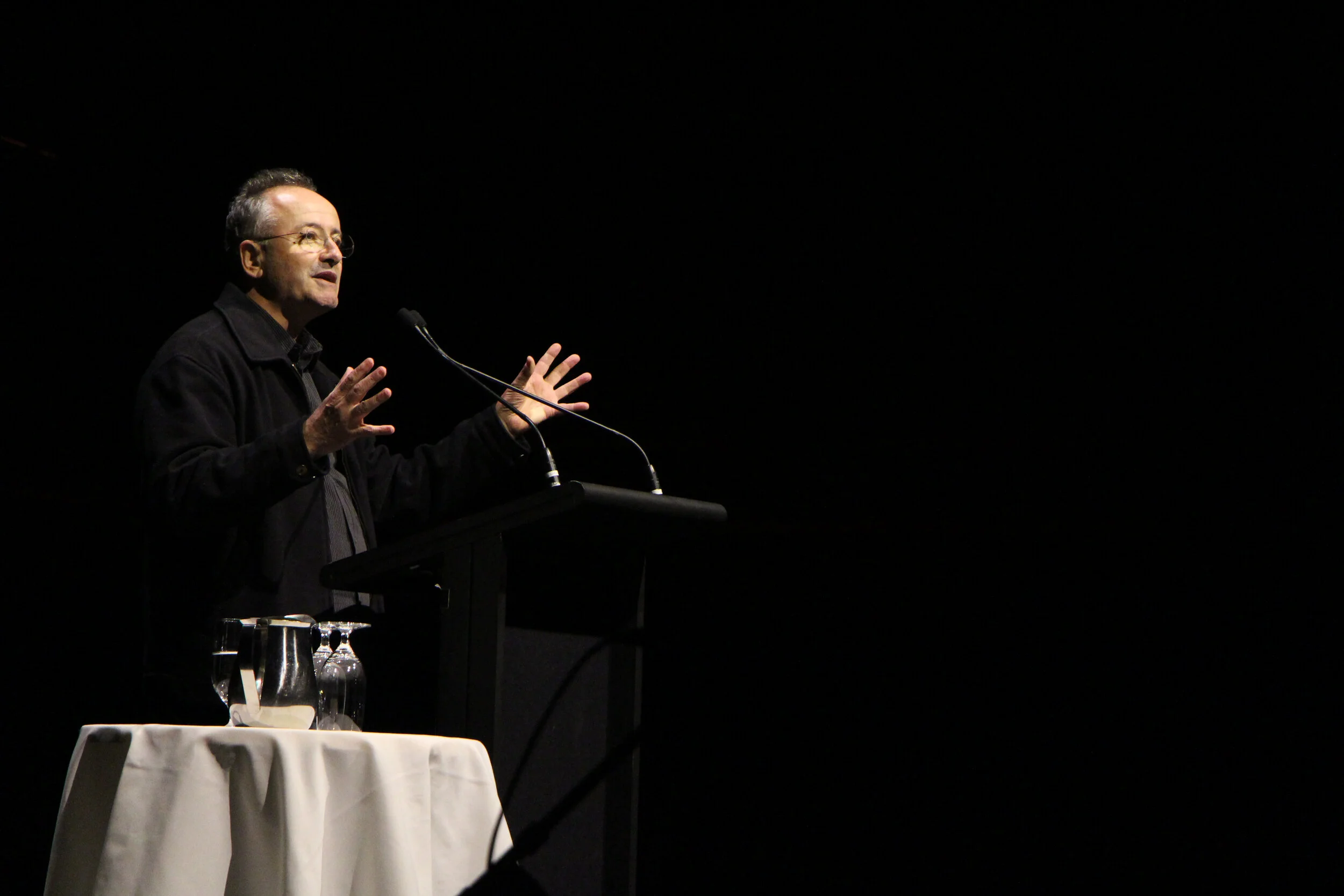
(Photo: Jon Tjhia)
For John Clarke: 'He tried to cast light, not heat', by Andrew Denton - 2017
2 July 2017, Melbourne Town Hall, Melbourne, Australia
This eulogy was part of a 3 hour public celebration of John Clarke’s life, hosted by the Wheeler Centre.
John Clarke was a master of understatement, never better expressed than his description of golf, a game that he loved, and which sometimes loved him in return. And he once said of it, "That's the problem with golf, raise your left eyebrow and the ball's in the Yarra."
John had the keenest of eyes, but also the finest of hearing, and his hearing was finely tuned, not just to the cant of the powerful, but to the nuance of the punter. My favourite story about Australian barracking came from John, who was at a Collingwood-St. Kilda match years ago at the G when Plugger was still playing for St. Kilda and all the action was at the other end. And Plugger was on his own in the goal square, and someone in front of John stood up and called out loudly enough for Plugger to hear, "Tony, I'm going for a pie. Do you want one?" That was John. John would hear the little things that make sense of the big things.
I think it's undisputed that John was the finest satirist of our age, anywhere in the world, in my view. His ability over so many years to be both an X Ray machine and a moral compass was unrivalled, but it was the thinking behind that satire that set it apart. Years ago, I read an interview with John where he talked about satire as failing, unless it had some kind of positive aspect. He said you had to work out what the problem was, and at least try and offer some kind of an answer. And if you look back on John's work, that is there. He tried to cast light, not heat. Yes, there was anger in his work, but never malice. And to me, this was the most remarkable thing, that this man could, for so long, hold so close the red hot kernel of anger that lies at the heart of satire, but not be burned or bent out of shape by it. It was extraordinary.
Plutarch said that he who governs anger governs himself, and it's this I'd like to talk about tonight, about John in tribute to him. It's, of course, appropriate that we mark his brilliance as an artist in so many fields. But to me, his great brilliance was in the art simply of leading a life. I had the enormous pleasure of working with John's writing partner, Andrew Knight, many years ago, and every now and then we'd stop. And sometimes the conversation would turn to John with great affection. And I remember Andrew told me a story about when he was very early in his career, and anxious and was just starting to write with John. Andrew was also working at an advertising agency being run by Phillip Adams and John Singleton. Yes, that is as awful as it sounds.
Anyway, there was a crisis happening and Andrew's in the boardroom. This is in the days before mobile phones. And somebody comes in and says, "Andrew there's a Mr. Clarke on the phone for you." And Andrew says, "Look, I can't, could you tell him I'll call him back?" So the person goes off and comes back in a minute later and says, "Mr. Clarke says it's very important."
So Andrew excuses himself from this crisis meeting, goes to the phone and says, "John, what is it? This is not a good time." And John says, "Look, I'm just downstairs in the car. I need to talk to you. Can you come down?" And Andrew goes, "All right, I'll come down, but I'll have to be quick."
So he goes down in the lift, John's waiting in his car and Andrew leans in and says, "John, what is it?" And John holds up a Frisbee and says, "I reckon now would be a pretty good time to throw a Frisbee, don't you?"
So they go off to the park for an hour and throw a Frisbee. When Andrew gets back to the crisis meeting, it's still in crisis. It made no difference at all whether he was there or not. Of all the brilliant, talented people I've ever known or worked with, John is the only one to whom I would give the word ‘wise’. I can't tell you what I mean when I say wise. He didn't give a list of instructions.
John lived by example, not by declaration, but there was something about John which gave me enormous comfort because he was the person that I knew who seemed to most have worked out how to go about living life. And just to know that somebody had almost got there, was incredibly reassuring. He wasn't perfect. Of course, that was a very good idea. The last perfect person, we nailed to a piece of wood, but he was wise, and I deeply treasured that.
I would have to say that I have not felt the loss of a man so deeply since the passing of my own father. And when my father died, along with the many beautiful messages I got, came one from John. John always had the words, only in this case, they weren't his words. They were someone else's. It was just this poem by one of his favourite poets, A.J. Cronin, signed at the bottom, ‘from John’.
With the exact length and pace of his father’s stride
The son walks,
Echoes and intonations of his father’s speech
Are heard when he talks.
Once when the table was tall and the chair a wood
He absorbed his father’s smile
And carefully copied the way that he stood.
He grew into exile slowly
With pride and remorse,
In some way better than his begetters,
In others worse.
And now having chosen, with strangers,
Half glad of his choice
He smiles with his father’s hesitant smile
And speaks with his voice.
John Clarke knew. John Clarke knew human beings. John Clarke knew how to live a life. We've a bloody privilege to share his and we're privileged still. Cheers, John.
Andrew Denton discusses this speech in this beautiful episode of the podcast.
Joe Biden: 'To all of you who are hurting so badly, I’’m so sorry for your loss', eulogy to 100,000 dead from COVID-19 - 2020
My fellow Americans,
There are moments in our history so grim, so heartrending, that they’re forever fixed in each of our hearts as shared grief. Today is one of those moments. 100,000 lives have now been lost to this virus here in the United States alone, each one leaving behind a family that will never again be whole.
I think I know what you’re feeling. You feel like you’re being sucked into a black hole in the middle of your chest. It’s suffocating, your heart is broken and there’s nothing but a feeling of emptiness right now ..
For most of you, you were unable to be there when you lost your beloved family member, or best friend, for most of you, you were unable to be there when they died, alone. With the pain, the anger and frustration, you’ll wonder if you’ll ever b e able to get anywhere from here.
It’s made all the worse by knowing that this is a fateful milestone that we should have never reached, it could have been avoided. According to a study being done by Columbia University, if the administration had reacted just one week earlier to implement social distancing, and do what it had to do, just one week sooner, as many as 36,000 of these deaths might have been averted.
To all of you who are hurting so badly, I’’m so sorry for your loss.
. I know there’s nothing I or anyone else can do to dull the sharpness of the pain you feel right now, but I can promise you from experience, the day will come when the memory of your loved one will bring a smile to your lips before it brings a tear to your eyes.
My prayer for all of you is that that day will come sooner rather than later, but I promise you it will come. When it does, you can know you can make it.
God bless each and every one of you, and the blessed memory of the one you lost.
This nation grieves with you. Take some solace from the fact, we all grieve with you.
For John Lewis: 'Founding Father Of That Fuller, Fairer, Better America’', by Barack Obama - 2020
31 July 2020, Ebenezer Baptist Church, Atlanta, Georgia, USA
James wrote to the believers, “Consider it pure joy, my brothers and sisters, whenever you face trials of many kinds, because you know that the testing of your faith produces perseverance. Let perseverance finish its work so that you may be mature and complete, lacking nothing.”
It is a great honor to be back in Ebenezer Baptist Church, in the pulpit of its greatest pastor, Dr. Martin Luther King, Jr., to pay my respects to perhaps his finest disciple — an American whose faith was tested again and again to produce a man of pure joy and unbreakable perseverance — John Robert Lewis.
To those who have spoken to Presidents Bush and Clinton, Madam Speaker, Reverend Warnock, Reverend King, John’s family, friends, his beloved staff, Mayor Bottoms — I’ve come here today because I, like so many Americans, owe a great debt to John Lewis and his forceful vision of freedom.
Now, this country is a constant work in progress. We were born with instructions: to form a more perfect union. Explicit in those words is the idea that we are imperfect; that what gives each new generation purpose is to take up the unfinished work of the last and carry it further than anyone might have thought possible.
John Lewis — the first of the Freedom Riders, head of the Student Nonviolent Coordinating Committee, youngest speaker at the March on Washington, leader of the march from Selma to Montgomery, Member of Congress representing the people of this state and this district for 33 years, mentor to young people, including me at the time, until his final day on this Earth — he not only embraced that responsibility, but he made it his life’s work.
Which isn’t bad for a boy from Troy. John was born into modest means — that means he was poor — in the heart of the Jim Crow South to parents who picked somebody else’s cotton. Apparently, he didn’t take to farm work — on days when he was supposed to help his brothers and sisters with their labor, he’d hide under the porch and make a break for the school bus when it showed up. His mother, Willie Mae Lewis, nurtured that curiosity in this shy, serious child. “Once you learn something,” she told her son, “once you get something inside your head, no one can take it away from you.”
As a boy, John listened through the door after bedtime as his father’s friends complained about the Klan. One Sunday as a teenager, he heard Dr. King preach on the radio. As a college student in Tennessee, he signed up for Jim Lawson’s workshops on the tactic of nonviolent civil disobedience. John Lewis was getting something inside his head, an idea he couldn’t shake that took hold of him — that nonviolent resistance and civil disobedience were the means to change laws, but also change hearts, and change minds, and change nations, and change the world.
So he helped organize the Nashville campaign in 1960. He and other young men and women sat at a segregated lunch counter, well-dressed, straight-backed, refusing to let a milkshake poured on their heads, or a cigarette extinguished on their backs, or a foot aimed at their ribs, refused to let that dent their dignity and their sense of purpose. And after a few months, the Nashville campaign achieved the first successful desegregation of public facilities in any major city in the South.
John got a taste of jail for the first, second, third … well, several times. But he also got a taste of victory. And it consumed him with righteous purpose. And he took the battle deeper into the South.
That same year, just weeks after the Supreme Court ruled that segregation of interstate bus facilities was unconstitutional, John and Bernard Lafayette bought two tickets, climbed aboard a Greyhound, sat up front, and refused to move. This was months before the first official Freedom Rides. He was doing a test. The trip was unsanctioned. Few knew what they were up to. And at every stop, through the night, apparently the angry driver stormed out of the bus and into the bus station. And John and Bernard had no idea what he might come back with or who he might come back with. Nobody was there to protect them. There were no camera crews to record events. You know, sometimes, we read about this and kind of take it for granted. Or at least we act as if it was inevitable. Imagine the courage of two people Malia’s age, younger than my oldest daughter, on their own, to challenge an entire infrastructure of oppression.
John was only twenty years old. But he pushed all twenty of those years to the center of the table, betting everything, all of it, that his example could challenge centuries of convention, and generations of brutal violence, and countless daily indignities suffered by African Americans.
Like John the Baptist preparing the way, like those Old Testament prophets speaking truth to kings, John Lewis did not hesitate — he kept on getting on board buses and sitting at lunch counters, got his mug shot taken again and again, marched again and again on a mission to change America.
Spoke to a quarter million people at the March on Washington when he was just 23.
Helped organize the Freedom Summer in Mississippi when he was just 24.
At the ripe old age of 25, John was asked to lead the march from Selma to Montgomery. He was warned that Governor Wallace had ordered troopers to use violence. But he and Hosea Williams and others led them across that bridge anyway. And we’ve all seen the film and the footage and the photographs, and President Clinton mentioned the trench coat, the knapsack, the book to read, the apple to eat, the toothbrush — apparently jails weren’t big on such creature comforts. And you look at those pictures and John looks so young and he’s small in stature. Looking every bit that shy, serious child that his mother had raised and yet, he is full of purpose. God’s put perseverance in him.
And we know what happened to the marchers that day. Their bones were cracked by billy clubs, their eyes and lungs choked with tear gas. As they knelt to pray, which made their heads even easier targets, and John was struck in the skull. And he thought he was going to die, surrounded by the sight of young Americans gagging, and bleeding, and trampled, victims in their own country of state-sponsored violence.
And the thing is, I imagine initially that day, the troopers thought that they had won the battle. You can imagine the conversations they had afterwards. You can imagine them saying, “Yeah, we showed them.” They figured they’d turned the protesters back over the bridge; that they’d kept, that they’d preserved a system that denied the basic humanity of their fellow citizens. Except this time, there were some cameras there. This time, the world saw what happened, bore witness to Black Americans who were asking for nothing more than to be treated like other Americans. Who were not asking for special treatment, just the equal treatment promised to them a century before, and almost another century before that.
When John woke up, and checked himself out of the hospital, he would make sure the world saw a movement that was, in the words of Scripture, “hard pressed on every side, but not crushed; perplexed but not in despair; persecuted, but not abandoned; struck down, but not destroyed.” They returned to Brown Chapel, a battered prophet, bandages around his head, and he said more marchers will come now. And the people came. And the troopers parted. And the marchers reached Montgomery. And their words reached the White House — and Lyndon Johnson, son of the South, said “We shall overcome,” and the Voting Rights Act was signed into law.
The life of John Lewis was, in so many ways, exceptional. It vindicated the faith in our founding, redeemed that faith; that most American of ideas; that idea that any of us ordinary people without rank or wealth or title or fame can somehow point out the imperfections of this nation, and come together, and challenge the status quo, and decide that it is in our power to remake this country that we love until it more closely aligns with our highest ideals. What a radical ideal. What a revolutionary notion. This idea that any of us, ordinary people, a young kid from Troy can stand up to the powers and principalities and say no this isn’t right, this isn’t true, this isn’t just. We can do better. On the battlefield of justice, Americans like John, Americans like the Reverends Lowery and C.T. Vivian, two other patriots that we lost this year, liberated all of us that many Americans came to take for granted.
America was built by people like them. America was built by John Lewises. He as much as anyone in our history brought this country a little bit closer to our highest ideals. And someday, when we do finish that long journey toward freedom; when we do form a more perfect union — whether it’s years from now, or decades, or even if it takes another two centuries — John Lewis will be a founding father of that fuller, fairer, better America.
And yet, as exceptional as John was, here’s the thing: John never believed that what he did was more than any citizen of this country can do. I mentioned in the statement the day John passed, the thing about John was just how gentle and humble he was. And despite this storied, remarkable career, he treated everyone with kindness and respect because it was innate to him — this idea that any of us can do what he did if we are willing to persevere.
He believed that in all of us, there exists the capacity for great courage, that in all of us there is a longing to do what’s right, that in all of us there is a willingness to love all people, and to extend to them their God-given rights to dignity and respect. So many of us lose that sense. It’s taught out of us. We start feeling as if, in fact, that we can’t afford to extend kindness or decency to other people. That we’re better off if we are above other people and looking down on them, and so often that’s encouraged in our culture. But John always saw the best in us. And he never gave up, and never stopped speaking out because he saw the best in us. He believed in us even when we didn’t believe in ourselves. As a Congressman, he didn’t rest; he kept getting himself arrested. As an old man, he didn’t sit out any fight; he sat in, all night long, on the floor of the United States Capitol. I know his staff was stressed.
But the testing of his faith produced perseverance. He knew that the march is not yet over, that the race is not yet won, that we have not yet reached that blessed destination where we are judged by the content of our character. He knew from his own life that progress is fragile; that we have to be vigilant against the darker currents of this country’s history, of our own history, with their whirlpools of violence and hatred and despair that can always rise again.
Bull Connor may be gone. But today we witness with our own eyes police officers kneeling on the necks of Black Americans. George Wallace may be gone. But we can witness our federal government sending agents to use tear gas and batons against peaceful demonstrators. We may no longer have to guess the number of jelly beans in a jar in order to cast a ballot. But even as we sit here, there are those in power are doing their darnedest to discourage people from voting — by closing polling locations, and targeting minorities and students with restrictive ID laws, and attacking our voting rights with surgical precision, even undermining the Postal Service in the run-up to an election that is going to be dependent on mailed-in ballots so people don’t get sick.
Now, I know this is a celebration of John’s life. There are some who might say we shouldn’t dwell on such things. But that’s why I’m talking about it. John Lewis devoted his time on this Earth fighting the very attacks on democracy and what’s best in America that we are seeing circulate right now.
He knew that every single one of us has a God-given power. And that the fate of this democracy depends on how we use it; that democracy isn’t automatic, it has to be nurtured, it has to be tended to, we have to work at it, it’s hard. And so he knew it depends on whether we summon a measure, just a measure, of John’s moral courage to question what’s right and what’s wrong and call things as they are. He said that as long as he had breath in his body, he would do everything he could to preserve this democracy. That as long as we have breath in our bodies, we have to continue his cause. If we want our children to grow up in a democracy — not just with elections, but a true democracy, a representative democracy, a big-hearted, tolerant, vibrant, inclusive America of perpetual self-creation — then we are going to have to be more like John. We don’t have to do all the things he had to do because he did them for us. But we have got to do something. As the Lord instructed Paul, “Do not be afraid, go on speaking; do not be silent, for I am with you, and no one will attack you to harm you, for I have many in this city who are my people.” Just everybody’s just got to come out and vote. We’ve got all those people in the city but we can’t do nothing.
Like John, we have got to keep getting into that good trouble. He knew that nonviolent protest is patriotic; a way to raise public awareness, put a spotlight on injustice, and make the powers that be uncomfortable.
Like John, we don’t have to choose between protest and politics, it is not an either-or situation, it is a both-and situation. We have to engage in protests where that is effective but we also have to translate our passion and our causes into laws and institutional practices. That’s why John ran for Congress thirty-four years ago.
Like John, we have got to fight even harder for the most powerful tool we have, which is the right to vote. The Voting Rights Act is one of the crowning achievements of our democracy. It’s why John crossed that bridge. It’s why he spilled his blood. And by the way, it was the result of Democratic and Republican efforts. President Bush, who spoke here earlier, and his father, both signed its renewal when they were in office. President Clinton didn’t have to because it was the law when he arrived so instead he made a law that made it easier for people to register to vote.
But once the Supreme Court weakened the Voting Rights Act, some state legislatures unleashed a flood of laws designed specifically to make voting harder, especially, by the way, state legislatures where there is a lot of minority turnout and population growth. That’s not necessarily a mystery or an accident. It was an attack on what John fought for. It was an attack on our democratic freedoms. And we should treat it as such.
If politicians want to honor John, and I’m so grateful for the legacy of work of all the Congressional leaders who are here, but there’s a better way than a statement calling him a hero. You want to honor John? Let’s honor him by revitalizing the law that he was willing to die for. And by the way, naming it the John Lewis Voting Rights Act, that is a fine tribute. But John wouldn’t want us to stop there, trying to get back to where we already were. Once we pass the John Lewis Voting Rights Act, we should keep marching to make it even better.
By making sure every American is automatically registered to vote, including former inmates who’ve earned their second chance.
By adding polling places, and expanding early voting, and making Election Day a national holiday, so if you are someone who is working in a factory, or you are a single mom who has got to go to her job and doesn’t get time off, you can still cast your ballot.
By guaranteeing that every American citizen has equal representation in our government, including the American citizens who live in Washington, D.C. and in Puerto Rico. They are Americans.
By ending some of the partisan gerrymandering — so that all voters have the power to choose their politicians, not the other way around.
And if all this takes eliminating the filibuster — another Jim Crow relic — in order to secure the God-given rights of every American, then that’s what we should do.
And yet, even if we do all this — even if every bogus voter suppression law was struck off the books today — we have got to be honest with ourselves that too many of us choose not to exercise the franchise; that too many of our citizens believe their vote won’t make a difference, or they buy into the cynicism that, by the way, is the central strategy of voter suppression, to make you discouraged, to stop believing in your own power.
So we are also going to have to remember what John said: “If you don’t do everything you can to change things, then they will remain the same. You only pass this way once. You have to give it all you have.” As long as young people are protesting in the streets, hoping real change takes hold, I’m hopeful but we cannot casually abandon them at the ballot box. Not when few elections have been as urgent, on so many levels, as this one. We cannot treat voting as an errand to run if we have some time. We have to treat it as the most important action we can take on behalf of democracy.
Like John, we have to give it all we have.
I was proud that John Lewis was a friend of mine. I met him when I was in law school. He came to speak and I went up and I said, “Mr. Lewis, you are one of my heroes. What inspired me more than anything as a young man was to see what you and Reverend Lawson and Bob Moses and Diane Nash and others did.” And he got that kind of — aw shucks, thank you very much.
The next time I saw him, I had been elected to the United States Senate. And I told him, “John, I am here because of you.” On Inauguration Day in 2008, 2009, he was one of the first people that I greeted and hugged on that stand. I told him, “This is your day too.”
He was a good and kind and gentle man. And he believed in us — even when we don’t believe in ourselves. It’s fitting that the last time John and I shared a public forum was on Zoom. I am pretty sure that neither he nor I set up the Zoom call because we didn’t know how to work it. It was a virtual town hall with a gathering of young activists who had been helping to lead this summer’s demonstrations in the wake of George Floyd’s death. And afterwards, I spoke to John privately, and he could not have been prouder to see this new generation of activists standing up for freedom and equality; a new generation that was intent on voting and protecting the right to vote; in some cases, a new generation running for political office.
I told him, all those young people, John — of every race and every religion, from every background and gender and sexual orientation — John, those are your children. They learned from your example, even if they didn’t always know it. They had understood, through him, what American citizenship requires, even if they had only heard about his courage through the history books.
“By the thousands, faceless, anonymous, relentless young people, Black and white … have taken our whole nation back to those great wells of democracy which were dug deep by the founding fathers in the formulation of the Constitution and the Declaration of Independence.”
Dr. King said that in the 1960s. And it came true again this summer.
We see it outside our windows, in big cities and rural towns, in men and women, young and old, straight Americans and LGBTQ Americans, Blacks who long for equal treatment and whites who can no longer accept freedom for themselves while witnessing the subjugation of their fellow Americans. We see it in everybody doing the hard work of overcoming complacency, of overcoming our own fears and our own prejudices, our own hatreds. You see it in people trying to be better, truer versions of ourselves.
And that’s what John Lewis teaches us. That’s where real courage comes from. Not from turning on each other, but by turning towards one another. Not by sowing hatred and division, but by spreading love and truth. Not by avoiding our responsibilities to create a better America and a better world, but by embracing those responsibilities with joy and perseverance and discovering that in our beloved community, we do not walk alone.
What a gift John Lewis was. We are all so lucky to have had him walk with us for a while, and show us the way.
God bless you all. God bless America. God bless this gentle soul who pulled it closer to its promise.
For John Kennedy Snr: 'For being reminded of Kennedy is being reminded also of what Hawthorn is all about', by David Parkin - 2020
2 July 2020, Our Lady of Victories, Camberwell, Melbourne, Australia
David Parkin’s was captain of Hawthorn’s 1971 premiership side under Kennedy. Speech begins at 38.20.
Whilst the past nine days has been a time of great sadness and reflection, today I hope can be remembered as a genuine celebration of a remarkable and, in many ways, unique man’s life.
My association with ‘Kanga’ goes back nearly six decades. I have known him as a coach, father, husband, colleague, critical friend and educationalist. Like hundreds of others, with their parents being the exception, he became the most significant and positive person in their lives. The many conversations I’ve had this past week, would certainly reinforce that.
Two people I know well have sought some solace in John’s passing by visiting Waverley Park to stand in front of his imposing statue, to pay homage and reflect on his legacy.
In many ways, it’s not difficult to understand why this man was held in such high esteem. No, it’s more than that – reverence! This reverence came about not because of his many achievements, numerous as they have been, but because of the respect for the qualities of the man himself. Many, including me, have spoken this week about those attributes, but they bear repeating:
1. His complete objectivity in decision making!
I’ve met no other man in life who could make decisions without fear or favour. What was best for the team or club always prevailed. Personal feelings or relationships never influenced his decision. For example, the sacking of Lance Morton in 1970 mid-season and Kevin Heath in 1975 pre-season; his non-selection of Peter Crimmins in the 1975 Grand Final; his departure to Stawell in 1964; his appointment to North Melbourne in 1985. All are actions of a decisive decision maker. We admired him enormously for that!
2. His absolute single-mindedness
Nothing superficial or extraneous ever interfered with the achievement of the objective. His ability to pass through the pain barrier was a great example for us to follow.
In a pre-season run, using the ‘Walk Against Want’ as his vehicle (25 kms from Glenferrie Oval to Eastland in Ringwood) and John, now in his forties, caught up to Des Meagher, the best endurance runner in the Club, at Antonio Park and suggested a walk. Des said yes, then took off with Kanga in hot pursuit. He was eventually beaten into second place by Des, who took a shortcut. John never forgave him!
3. His exceptional oratory
The players were given plenty in his pre, during and post-match addresses. His “at least DO something? DO, don’t think, don’t hope, DO! has become part of football folklore. But I was always in the front row! He used his knowledge of literature as an exceptional skill, to provide the connection between football and life, using the philosophy of Karl Marx, the beauty of William Shakespeare and the passion of Sir Winston Churchill.
4. His tremendous sense of humour
Whilst his leadership style would have to be termed ‘autocratic’, there are multitude examples of this over the 60-70 years, but I will mention two:
i) On the back of a 103 point turnaround versus Essendon in 1973, (Round 3 to Round 15) there was no post-match team meeting, although I could see that John was seething. The following Tuesday night we copped 30 minutes of his best condemnation for our lack of effort. His closing words I will never forget. “The trouble with this generation is that you have dollars on your backs, fast cars in the carpark, and Brut under your armpits!” He then stormed off to have a shower. No-one followed. He reappeared and then we showered too. As Ian Bremner came out of the bathroom he hesitated near Kanga’s locker and said to Kel Moore “Can you throw me over your Brut mate?” to which Kel replied “Hang on a minute Brem, it’s out in my new Monaro in the carpark”. Even the coach, himself, had to smile.
ii) To put this into context, some years back Ray Wilson rang me to ask whether as a player I had ever had John put his arm around me and say “well done”. I assured him that never happened! “That’s good” said Ray, “I thought I was the only one to miss out”.
On the basis that JK was not one for handing our bouquets to anyone, Don Scott was pleasantly surprised to receive a phone call from Kanga on Grand Final day a few years back. He was ringing to tell Scotty how well he had played in the 1971 Grand Final – some 27 years before! Apparently he couldn’t sleep on Grand Final eve, had turned on the TV to see Channel 7’s Grand Final marathon. Lo and behold, it was the replay of 1971, which apparently he had never watched.
Early the next morning Scotty received the phone call from John reinforcing how well he had played. He was dumbfounded but really excited and rang his three friends to tell them his news. I congratulated him on being the first and only player to receive that reinforcement from our coach.
Immediately I rang Kanga to make sure he understood the significance of his phone call, and asked him if he had my telephone number to give me a similar call? “Sorry Dave”, he said “but you didn’t play all that well, so I won’t be making that call”!
5. His complete and utter humility
John was always embarrassed by the accolades from others. Hawthorn or North Melbourne successes, to him, were due to the outward and visible signs, which were the players. Never was the team’s successes due to his words or deeds, and I mean NEVER!
6. Personal influence
His ability to influence the character and lives of so many young men, gave players purpose and meaning to what they were doing. There is no doubt, for this reason alone, that all who donned the Brown and Gold or Blue and White over those 18 seasons, have become better people as a result of being coached by JK.
In catching up with teammates at Club and AFL functions over the years, I have had that reinforced time and again.
Back in 1977 Hawthorn ran a testimonial dinner for John. In typical Kennedy style, he spoke at length about the people and events which had impacted his life, whilst serving that entity over the previous three decades.
I will repeat my public response then as a reminder to us all, for the years ahead.
I sincerely hope that John Kennedy is never forgotten by players, coaches, administrators and members at Hawthorn, for being reminded of Kennedy is being reminded also of what Hawthorn is all about.
Rest in peace great man!
John Kennedy 20 December 1928 – 24 June 2020
For Robin Williams: 'This guy comes in and we're like a morning dew, he comes in like a hurricane', by David Letterman - 2014
Well, thank you ladies and gentlemen. Thank you.
I guess like a lot of us, most of us, I've been thinking about Robin Williams, I believe we found out a week ago that he had died. Many things come to mind in a situation like this. And of course, more questions are raised than can possibly be answered, but I started reflecting about it.
I knew Robin Williams for 38 years. 38 years, which in and of itself is crazy. How time...
I met him at The Comedy Store. He and I were kids along... It was myself and Jay Leno and Tom Dreesen and Tim Thomason and Johnny Dark and Elayne Boosler and on and on and Jimmy Walker. We were all out there at The Comedy Store and we wanted to make people laugh. We wanted to get on The Tonight Show. We wanted something because we all felt that we're funny. In those days, we were working for free drinks. Some were working for more free drinks than others, but.
So what you would do is you would go on stage and then you do your little skits and then you would come off stage. If there was a new guy coming on, you'd want to stick around and make fun of the new guy.
Paul: Sure.
David Letterman: Because we were all worried that, "Oh, somebody else is coming in who's really funny." And then we'll have to go back, in my case, to Indiana.
Paul: Yes.
David Letterman: I can remember the night my friend, George Miller and I, who was a very funny comic and was on this show many times, we were at The Comedy Store and they introduce Robin Williams. For some reason in the beginning, he was introduced as being from Scotland. They said he was Scottish.
Paul: I see
.
David Letterman: Now we're stumped. We don't know. There's a Scottish guy, really, coming to the United States? So we were feeling pretty smug about our position right away, because it's going to be haggis and that kind of crap. So we're relaxed. We're ready to go. All of a sudden, he comes up on stage and you know what it is. It's like nothing we had ever seen before. Nothing we had ever imagined before. We go home at night and are writing our little jokes about stuff. And this guy comes in and we're like a morning dew, he comes in like a hurricane.
Now, the longer he's onstage, the worse we feel about ourselves because it's not stopping. And then he finishes and I thought, "Oh, that's it. They're going to have to put an end to show business because what can happen after this?" And then we get to see this night after night after night. We didn't approach him because we were afraid of him. Honest to God. You thought, "Holy crap, there goes my chance at show business because of this guy from Scotland."
And then like a shot out of a cannon, he goes and he's on the Happy Days show. And then from the Happy Days show, he gets to be on Mork & Mindy. Now, there's some structure to his life. He's not at The Comedy Store every night because he's got an actual job. So the rest of us can pretend that it never happened. But yet, then he goes from Mork & Mindy and then he starts to making movie after movie after movie. He's nominated four times for an Academy Award. It wasn't really until Paul and I started the NBC version of this show, which by the way, is still running in Mexico.
Paul: It is.
David Letterman: Very popular. But it wasn't until then that I sort of got to really know Robin Williams, because he would come on to promote movies or concerts or whatever he was talking about. He was always so gracious. We would talk about the old times and never did he act like, "Oh, I knew you guys were scared because I was so good." It was just a pleasure to know the guy. He was a gentleman and delightful. Even in the old days, he was kind enough to ask me to appear on his Mork & Mindy show. Now, this is a double edged sword because he did it only because he was trying to help other fledgling, starting out comics.
Paul: Make sense.
David Letterman: Right. The other side of the sword is I had no business being on that show. I have no business being on this show. But he was nice. He gave me a job. So in those days, jobs were hard to come by. And there I was, and I was on Mork & Mindy. I can remember between the dress rehearsal and the actual taping of the show, the director of the program, Howard, Howard, Howard Shore-
Paul: Howard Storm.
David Letterman: Storm. Howard Storm comes up to me and he says, "Well, you've been trying all week." He says, "This is your last chance."
So even to the detriment of the show, Robin was kind enough to invite me to come on because he thought, "Why can't I spread this around and have some of my friends sharing my success," which is exactly what he did. He then was on our show, the show, in the old show, a total of nearly 50 times.
Paul: Total of 50 times?
David Letterman: 50 times. 50 times. Two things would happen because Robin was on the program. One, I didn't have to do anything. All I had to do was sit here and watch the machine. And two, people would watch. If they knew Robin was on the show, the viewership would go up because they wanted to see Robin. Believe me, that wasn't just true of television. I believe that was true of the kind of guy he was. People were drawn to him because of this electricity. This, whatever it was that he radiated that propelled him and powered him.
And then he came on when I came back after my heart surgery, Robin was nice enough to come on that night. And it was very, very funny and very, very appropriate. Here's a picture that I will now cherish even more than I had previously. There are four people right there. Two of which wildly funny, insanely funny, two are not.
The handsome woman there is Mitzi Shore. She owned The Comedy Store. We all, the three of us, worked there. I think Robin and I, it'd be safe to say, we started there. Richard Pryor was already Richard Pryor, but he would work there. The guy in the middle, I trimmed hedges.
Paul: Yeah. Oh, well.
David Letterman: So we would like to... We put together a segment of Robin Williams appearances. Moreover, more than anything, it will make you laugh. Really, that's what we should take from this is he could make you laugh under any circumstances. Here he is on our show.
[Clips]
God bless you, my friend.
Well, what I will add here is beyond being a very talented man and a good friend and a gentlemen, I'm sorry. Like everybody else, I had no idea that the man was in pain, that the man was suffering. But what a guy. Robin Williams. We'll be right back, ladies and gentlemen.
For George Floyd: 'Get your knee off our neck', by Rev Al Sharpton - 2020
4 June 2020, Minneapolis, Minnesota, USA
I want us to not sit here and act like we had a funeral on the schedule. George Floyd should not be among the deceased. He did not die of common health conditions. He died of a common American criminal justice malfunction. He died because of there has not been the corrective behavior that has taught this country that if you commit a crime, it does not matter whether you wear blue jeans or a blue uniform, you must pay for the crime you commit.
So it is not a normal funeral. It is not a normal circumstance but it’s too common and we need to deal with it. Let me ask those of you that in the traditions of eulogies need a scriptural reference, go to Ecclesiastes 3:1 says,
To everything there is a time and a purpose and season under the heavens.
I’m going to leave it there. I saw somebody standing in front of a church the other day that had been bought it up as a result of violence. Held the Bible in his hand. I’ve been preaching since I was a little boy. I’d never seen anyone hold a Bible like that, but I’ll leave that alone. But since he held the Bible, if he’s watching us today, I would like him to open that Bible and I’d like him to read Ecclesiastes 3, to every season there’s a time and a purpose. I think that it is our job to let the world know when we see what is going on in the streets of this country and in Europe, around the world, that you need to know what time it is.
First of all, we cannot use Bibles as a prop and for those that have agendas that are not about justice, this family will not let you use George as a prop. If you want to get your stuff off, don’t use him. Let us stand for what is right because when I got the call from Attorney Crump and usually when he calls me, it’s not to find out how I’m doing. It’s usually because something happened that he wants National Action Network and I to get involved. He explained to me what was happening with this case and I had already heard about it in the media and immediately I said, “Well, let me know what you want me to do.” He said, “Whatever you need to do.”
One of the things Martin that I’ve always had to deal with his critics would say, all Al Sharpton wants is publicity. Well, that’s exactly what I want because nobody calls me to keep a secret. People call me to blow up issues that nobody else would deal with. I’m the blow up, man and I don’t apologize for that because you get away too much with hiding things. Funny. It’s talked about, y’all putting clothes in the oven to have your clothes dried. Well, I didn’t grow in the third world, but I grew up in third ward. I grew up in Brownsville and we had roaches.
Now I know Kevin Hart and some of the rich Hollywood folk here don’t know where the roaches are but we had roaches, ludicrous and one thing I found out about roaches is that if you keep the light off, if you’re in the dark, a roach will pull up to your dinner table and have a five course meal. So I learned that one of the ways to deal with roaches is if you cut the light on, I could run them roaches and track them down and I’ve spent all my life chasing roaches all over this country.
Soon as I talked to the family and got the details and heard that among George’s last words was, “I can’t breathe,” with a knee on his neck, I immediately thought about Eric Gardner. I did the eulogy at his funeral and I called his mother. I said, “I know we’re not going out because of the Coronavirus but this is so much like Eric. If we could arrange some private way to go to Minneapolis, would you go?” And she said, “Reverend Al, I’m already packing. Let me know.” Tyler Perry said, “I’ll give the families, the plane, whatever y’all need, because this is wrong.” Robert Smith said, “Don’t worry about the funeral costs.”
People across economic and racial lines started calling and getting in and we flew out of here, her and I last Thursday, and when I stood at that spot, reason it got to me is George Floyd’s story has been the story of black folks because ever since 401 years ago, the reason we could never be who we wanted and dreamed to being is you kept your knee on our neck. We were smarter then the underfunded schools you…
…you put us in, but you had your knee on our neck. We could run corporations and not hustle in the street, but you had your knee on our neck. We had creative skills, we could do whatever anybody else could do, but we couldn’t get your knee off our neck. What happened to Floyd happens every day in this country, in education, in health services, and in every area of American life, it’s time for us to stand up in George’s name and say get your knee off our necks. That’s the problem no matter who you are. We thought maybe we had [inaudible 00:09:20], maybe it was just us, but even blacks that broke through, you kept your knee on that neck. Michael Jordan won all of these championships, and you kept digging for mess because you got to put a knee on our neck. White housewives would run home to see a black woman on TV named Oprah Winfrey and you messed with her because you just can’t take your knee off our neck. A man comes out of a single parent home, educates himself and rises up and becomes the President of the United States and you ask him for his birth certificate because you can’t take your knee off our neck. The reason why we are marching all over the world is we were like George, we couldn’t breathe, not because there was something wrong with our lungs, but that you wouldn’t take your knee off our neck. We don’t want no favors, just get up off of us and we can be and do whatever we can be. There have been protests all over the world. Some have looted and done other things and none of us in this family condones looting or violence. But the thing I want us to be real cognizant of is there’s a difference between those calling for peace and those calling for quiet. Some of y’all don’t want peace, you just want quiet. You just want us to shut up and suffer in silence. The overwhelming majority of the people marching wasn’t breaking windows, they were trying to break barriers. They weren’t trying to steal nothing, they were trying to get back the justice you stole from us. Those that broke the law should pay for whatever law they broke, but so should the four policemen that caused this funeral today. We don’t have a problem denouncing violence, Mr. Governor, we don’t have a problem, Mr. Mayor, denouncing looting, but it seems like some in the criminal justice system have a problem looking at a tape and knowing there’s probable cause and it takes a long time for you to go and do what you see that you need to do.
As Ben Crump said, they would not have been involved in a lot of these fights we started around criminal justice. I did speeches and eulogies at most of the funerals that we’ve had in this space in the last couple of decades and led the marches and did what we had to do. I look at Martin III, we went to jail together fighting these fights, like his daddy went to jail before. But I’m more hopeful today than ever. Why? Well, let me go back. Reverend Jackson always taught me, stay on your text, go back to my text, Ecclesiastes. There is a time and a season, and when I looked this time, and saw marches where in some cases young whites outnumbered the blacks marching, I know that it’s a different time and a different season. When I look and saw people in Germany marching for George Floyd, it’s a different time and a different season. When they went in front of the Parliament in London, England and said it’s a different time and a different season, I come to tell you America, this is the time of building with accountability in the criminal justice system.
Years ago, I went to march. Now I remember a young white lady looked me right in the face and said, “N*****, go home.” But when I was here last Thursday and Ms. Carr and I was headed back to the airport I stopped near the police station, and as I was talking to a reporter, a young white girl, she didn’t look no older than 11 years old. She tagged my suit jacket and I looked around and I braced myself, and she looked at me and said, “No justice, no peace.” It’s a different time. It’s a different season, and if my Bible carrying guy in front of that boarded up church, if I got him to open up the Bible, I want you to remember something. You know I was late last October to an appointment because the time changed and I was still … My watch was on the wrong time. Once a year time goes forward and if you don’t
Yeah, time goes forward. And if you don’t Congresswoman Omar, move your watch, you going to find yourself a hour late. Not because your watch was wrong, but you had your watch on the wrong time. Well, I come to tell you that their sitting in Washington talking about militarizing the country, thinking that you can sell Wolf tickets to people. Who’s had enough of abuse. I’ve come to tell you, you can get on the TV, but you on the wrong time, time is out for not holding you accountable. Time is out for you making excuses. Time is out for you trying to stall. Time is out for empty words and empty promises. Time is out for you filibustering and trying to stall the arm of justice. This is the time we won’t stop. We going to keep going until we change the whole system of justice.
Our organizations have called this a day of morning, NAACP, National Urban League, Legal Defense Fund, Black Women’s Round Table, Lloyd’s committee, all got together, said we’re going to have a day of mourning. But then we going to come out of this day mourning because as some of our experts, Cheryl and Eiffel and others that know the legal field have outlined a legal process that we must enforce everything from residency to dealing with police backgrounds are not being hidden. Talked to governor Andrew Cuomo today in New York, he says, “We got to change 58, where the backgrounds stop of policemen.” We need to know if they stop you, they find out everything you ever did. Why don’t we know when policemen have a pattern?
We got to go back to consent decrees. Under the Obama administration, they had put certain cities with patterns and practice under consent decrees. Reverend Jamal Brian, to know where he was pastoring in Baltimore, that they put it under consent decree. One of the first thing that happened in the next administration was they stopped the consent decrees. We have specific policies that need to happen. Therefore I’m glad Martin the third is here today because on August 28, the 57th anniversary of the March on Washington, we’re going back to Washington, Martin. That’s where you’re the father stood in the shadows of the Lincoln Memorial and said, “I have a dream.” Well, we’re going back this August 28th to restore and recommit that dream to stand up because just like at one era, we had to fight slavery. Another era we had to fight Jim Crow. Another era we dealt with voting rights. This is the era to deal with policing and criminal justice. We need to go back to Washington and stand up black, white, Latino, Arab in the shadows of Lincoln and tell them, “This is the time to stop this.”
Martin and I talked about this. I’ve asked Reverend Bryant to get the faith leaders together. I talk Randy White about the labor leaders. Oh no, we’re going to organize in the next couple of months in every region, not only for a March, but for a new process. And it’s going to be led by the Floyd family. It’s going to be led by the Gonda family. And it’s going to be led by those families that have suffered this and knows the pain and knows what it is to be neglected. And it’s going to be getting us ready to vote, not just for who’s going to be in the White House, but the state house and the city councils that allow these policing measures to go unquestioned.
We are going to change the time. Let me say this to the family who has shown such great grace and real level and balanced thinking. And that’s why I want them to help lead this. And I want, I think one of the greatest thinkers of our time, Dr. Michael Eric Dyson, I’ve asked, come and speak. We need to break down because you all don’t know what time it is. You all are operating like is yesterday. And the reason you’re late catching up to what these protests means is because you didn’t turn your clock forward, talking about make America great. Great for who and great when? We going to make America great for everybody for the first time.
Never was great for blacks. Never was great for Latinos. Wasn’t never great for others. Wasn’t great for women. Young women had to march to get the right to vote. But lastly is the religious side. I was reading and kept thinking about how I was a little embarrassed because when I heard that George, at this point of suffering, this brutal attack, call for his mama. I said, to attorney Crump I said, “Well, I appreciate talking to his brothers and them on the phone, but I want to talk to his mother.” He said, “His mother passed.” I said, “His mother passed? But he was calling for his mother.” And I thought about it because I was raised by a single mother. And sometimes the only thing between us and our conditions was our mothers. Sometime the only thing that we had that would take danger away was our mothers.
The only ones that would make sure the food was on the table was our mother. I know why George was calling for mama. But then as I had got that all placed in my mind and I realized why I was always calling and my mother died eight years ago, but I still try to talk to her. Sometimes just dial her cell phone to hear the voicemail on her phone that I never cut off. I still want to reach out to mama, but talking to Quincy last night, one of his five children, Quincy said, “I was thinking maybe he was calling his mother. Because at the point that he was dying, his mother was stretching her hands out saying, ‘Come on, George, I’ll welcome you where the wicked will cease from troubling. Where the weary will be at rest. There’s a place where police don’t put knees on you George. There’s a place that prosecutors don’t drag their feet.’ Maybe mama said, ‘Come on, George.-
Bragged that feat. Maybe mama said, “Come on George.”
There’s a God that still sits high, but he looks down low and he’ll make a way out of no way. This God is still on the throne. Grieving, we can fight. I don’t care who’s in the White House. There is another house that said, “If we’ll fight, he’ll fight our battles. If we stand up, he’ll hold us up.”
So as we leave here today, I say to this family, I know that years ago we told them, Reverend Jackson told us, “Keep hope alive.” Then I know that President Obama wrote a book about hope. But I want you to know in my life there’s times that I lost hope. Things can happen like this that will dash your hope, but there is something that is sister to hope called faith. Faith is the substance of things hoped for, the evidence of things unseen. Faith is when you got a pile of bills and no money, but you say he will provide all of my needs. Faith is when you got no medicine in the cabinet and you’re sick in your body, but you say he’s a doctor that never lost a patient. And he’ll dry tears from my eyes. Faith is when your friends walk out, when your loved ones turn their back. But you say, “I don’t believe he brought me this far to leave me now.”
We didn’t come this far by luck. We didn’t come this far by some fate. We come this far by faith, leaning on the Lord, trusting in his Holy word. He never, he never, he never failed me yet. From the outhouse to the White House, we come a long way. God will. God shall. God will. God always has. He’ll make a way for his children. Go on home, George. Get your rest, George. You changed the world, George. We going to keep marching, George. We going to keep fighting, George. We done turned the clock, George. We going forward, George. Time out, time out, time out.
Hezekiah Walker. We asked, gospel great, Hezekiah Walker to sing a song for the family. After which Derrick Johnson of the NAACP asked me, Attorney Crump, we’re going to stand for 8 minutes and 46 seconds. Though that was the time that George was on the ground. And we want you all over the world to stand with us for 8 minutes and 46 seconds and make that commitment for justice in the name of George. I want to thank the members of the Congressional Black Caucus for being with us. Won’t don’t you stand? I want to thank the son and heir and co-convener, Dr. Martin Luther King III for being with us. I want to thank the mayor and the governor and their brides for being with the family. Senator Amy Klobuchar of the state of Minnesota. I want to thank my mentor and one who’s fought this fight for more than a half a century. Reverend Jesse Louis Jackson is with us, and his spokesman for Rainbow PUSH, Jonathon Luther Jackson. I want to thank from the entertainment world, Kevin Hart. He told me don’t mention he’s here. Don’t clap. Stand up, Kevin. We joke each other. Brother beloved, stand up brother. Brother Ludacris. Tyrese Gibson, who’s an extraordinary activist in his own right. Master P. The one and only, the creative genius, Will Packer is with us today. And a brother we’ve marched together and done a lot of things. He does not just put his name on somebody’s petition. He puts his body on the line. Brother T.I. is in the house.
I want… This brother’s one of the greatest gospel singers alive. Is Tiffany here? Oh, wait a minute. Wait a minute. Wait a minute. I didn’t want to announce it and say I’d embarrassed her. Let me tell you something. One of the most popular, outstanding artists that is also committed. I’ve read her interview. She think I’m old and don’t read the stuff, but I do. And she’s been committed and saying the right things and she wanted to be here today. And I was so busy joking with Kevin. I didn’t even look at her. Let us welcome our sister beloved, Sister Tiffany Haddish is in the house. Well, I’m going to announce all the rest. Wait a minute. Y’all don’t start introducing folk. I got them all. Let us hear a selection from Brother Hezekiah Walker.
For Addie, Carol & Cynthia: 'They have something to say', by Martin Luther King Jr - 1963
18 September 1963. Sixteenth Street Baptist Church, Birmingham, Alabama, USA
On Sundey 15 September 1963 four Klansmen bombed the Sixteenth Street Baptist Church in Birmingham. Four young girls died, and this is the eulogy at the service for three of the victims, Addie Mae Collins, Carol Denise McNair, and Cynthia Diane Wesley. A separate service was held for the fourth victim, Carole Robertson. In the film, ‘I Am MLK Jr’, a civil rights leader said this was the only speech where he saw Dr King shed tears.
This afternoon we gather in the quiet of this sanctuary to pay our last tribute of respect to these beautiful children of God. They entered the stage of history just a few years ago, and in the brief years that they were privileged to act on this mortal stage, they played their parts exceedingly well. Now the curtain falls; they move through the exit; the drama of their earthly life comes to a close. They are now committed back to that eternity from which they came.
These children-unoffending, innocent, and beautiful-were the victims of one of the most vicious and tragic crimes ever perpetrated against humanity.
And yet they died nobly. They are the martyred heroines of a holy crusade for freedom and human dignity. And so this afternoon in a real sense they have something to say to each of us in their death. They have something to say to every minister of the gospel who has remained silent behind the safe security of stained-glass windows. They have something to say to every politician [Audience:] (Yeah) who has fed his constituents with the stale bread of hatred and the spoiled meat of racism. They have something to say to a federal government that has compromised with the undemocratic practices of southern Dixiecrats (Yeah) and the blatant hypocrisy of right-wing northern Republicans. (Speak) They have something to say to every Negro (Yeah) who has passively accepted the evil system of segregation and who has stood on the sidelines in a mighty struggle for justice. They say to each of us, black and white alike, that we must substitute courage for caution. They say to us that we must be concerned not merely about who murdered them, but about the system, the way of life, the philosophy which produced the murderers. Their death says to us that we must work passionately and unrelentingly for the realization of the American dream.
And so my friends, they did not die in vain. (Yeah) God still has a way of wringing good out of evil. (Oh yes) And history has proven over and over again that unmerited suffering is redemptive. The innocent blood of these little girls may well serve as a redemptive force (Yeah) that will bring new light to this dark city. (Yeah) The holy Scripture says, “A little child shall lead them.” (Oh yeah) The death of these little children may lead our whole Southland (Yeah) from the low road of man’s inhumanity to man to the high road of peace and brotherhood. (Yeah, Yes) These tragic deaths may lead our nation to substitute an aristocracy of character for an aristocracy of color. The spilled blood of these innocent girls may cause the whole citizenry of Birmingham (Yeah) to transform the negative extremes of a dark past into the positive extremes of a bright future. Indeed this tragic event may cause the white South to come to terms with its conscience. (Yeah)
And so I stand here to say this afternoon to all assembled here, that in spite of the darkness of this hour (Yeah Well), we must not despair. (Yeah, Well) We must not become bitter (Yeah, That’s right), nor must we harbor the desire to retaliate with violence. No, we must not lose faith in our white brothers. (Yeah, Yes) Somehow we must believe that the most misguided among them can learn to respect the dignity and the worth of all human personality.
May I now say a word to you, the members of the bereaved families? It is almost impossible to say anything that can console you at this difficult hour and remove the deep clouds of disappointment which are floating in your mental skies. But I hope you can find a little consolation from the universality of this experience. Death comes to every individual. There is an amazing democracy about death. It is not aristocracy for some of the people, but a democracy for all of the people. Kings die and beggars die; rich men and poor men die; old people die and young people die. Death comes to the innocent and it comes to the guilty. Death is the irreducible common denominator of all men.
I hope you can find some consolation from Christianity’s affirmation that death is not the end. Death is not a period that ends the great sentence of life, but a comma that punctuates it to more lofty significance. Death is not a blind alley that leads the human race into a state of nothingness, but an open door which leads man into life eternal. Let this daring faith, this great invincible surmise, be your sustaining power during these trying days.
Now I say to you in conclusion, life is hard, at times as hard as crucible steel. It has its bleak and difficult moments. Like the ever-flowing waters of the river, life has its moments of drought and its moments of flood. (Yeah, Yes) Like the ever-changing cycle of the seasons, life has the soothing warmth of its summers and the piercing chill of its winters. (Yeah) And if one will hold on, he will discover that God walks with him (Yeah, Well), and that God is able (Yeah, Yes) to lift you from the fatigue of despair to the buoyancy of hope, and transform dark and desolate valleys into sunlit paths of inner peace.
And so today, you do not walk alone. You gave to this world wonderful children. [moans] They didn’t live long lives, but they lived meaningful lives. (Well) Their lives were distressingly small in quantity, but glowingly large in quality. (Yeah) And no greater tribute can be paid to you as parents, and no greater epitaph can come to them as children, than where they died and what they were doing when they died. (Yeah) They did not die in the dives and dens of Birmingham (Yeah, Well), nor did they die discussing and listening to filthy jokes. (Yeah) They died between the sacred walls of the church of God (Yeah, Yes), and they were discussing the eternal meaning (Yes) of love. This stands out as a beautiful, beautiful thing for all generations. (Yes) Shakespeare had Horatio to say some beautiful words as he stood over the dead body of Hamlet. And today, as I stand over the remains of these beautiful, darling girls, I paraphrase the words of Shakespeare: (Yeah, Well): Good night, sweet princesses. Good night, those who symbolize a new day. (Yeah, Yes) And may the flight of angels (That’s right) take thee to thy eternal rest. God bless you.
For George Floyd: 'Keep my brother's name ringing!' by Terrence Floyd - 2020
1 June 2020, Minneapolis, Minnesota, USA
First of all …Hello.
Audience:
Hello, hello.
I understand you all upset, but I can deservedly say, I dealt in y’all’s habits of society.
Audience:
Come on, now. I can’t hear. Speak.
So if I’m not over here wilding out, if I’m not over here blowing up stuff …
… if I’m not over here messing up my community, then what are y’all doing?
Audience:
White nationalists.
What are y’all doing? Y’all doing nothing, because that’s going to bring my brother back at all.
Audience:
It’s not us. It’s Donald Trump’s buddies. Yeah, Donald Trump’s buddies is right.
It may feel good for the moment, just like when you drink, but when it come down, you going to wonder what you did.
My family is a peaceful family. My family is god fearing.
Audience:
Amen.
Yeah, we upset, but we not going to take it, we not going to be repetitious. In every case of police brutality, the same thing has been happening.
Audience:
Yes, sir.
Y’all protest, y’all destroy stuff, and they don’t move. You know why they don’t move? Because it’s not their stuff, it’s our stuff.
Audience:
That’s it.
So they want us to destroy our stuff.
Rev. Kevin McCall:
Come on, guy.
They’re not going to move.
Audience:
Yes, sir. It’s the truth.
So let’s do this another way.
Audience:
That’s right. Come on now, brother.
Let’s do this another way.
Audience:
Yes, let’s fix this city. They’re going to try to take it. Let’s fix this city. Speak. And get our people into office. They’re going to try to come build. Let’s fix this city.
Y’all right. Let’s do this another way. Let’s stop thinking that our voice don’t matter and vote.
Rev. Kevin McCall:
There you go.
Audience:
Vote.
Not just vote for the president, vote for the preliminaries, vote for everybody.
Audience:
Justice
Educate yourself.
Audience:
Educate and agitate.
Educate yourself. Don’t wait for somebody else to tell you who’s who. Educate yourself and know who you’re voting for.
Audience:
That’s right. You’re right.
And that’s how we going to hit them, because it’s a lot of us.
Audience:
Hard.
It’s a lot of us.
Rev. Kevin McCall:
That’s right.
Audience:
Hell yeah.
It’s a lot of us.
And we still going to do this peacefully, because that’s when we going to get them, because we going to fool them. They think we going to do this, they think we’re going to do something, and we’re going to switch it on them.
Audience:
Change it up.
Let’s switch it up, y’all. Let’s switch it up.
Do this peacefully, please.
My brother moved here from Houston, and I used to talk to him on the phone. He loved it here. He started driving a truck. He was good. So I highly doubt … no. I know, he would not want y’all to be doing this. And I’m not saying the people here. Whoever’s doing it, relax.
Audience:
It ain’t us, man. It ain’t us. It ain’t us. Come on, brother. Come on, brother. It’s okay, brother. It’s okay. It’s okay. Take your time, take your time. Take your time. Come on, brother.
And I like Reverend McCall said, “Peace on the left … ”
Rev. Kevin McCall:
Justice on the right.
Did I forgot already?
Audience:
Peace on the left, justice on the right.
Peace on the left.
Audience:
Justice on the right.
Peace on the left.
Audience:
Justice on the right.
Peace on the left.
Audience:
Justice on the right.
Peace on the left.
Audience:
Justice on the right.
I says that. Who says that? Peace on the left.
Audience:
Justice on the right.
Justice on the right.
Audience:
Peace on the right.
Right, that’s what I’m saying. That’s what I want to see. Peace on the left.
Audience:
Justice on the right.
Peace on the left.
Audience:
Justice on the right.
Peace on the left.
Audience:
Justice on the right.
Peace on the left.
Audience:
Justice on the right.
That’s what I’m talking about.
Audience:
We love you, brother.
On behalf of the Floyd family, thank you. Thank you for the love.
Audience:
We love you.
Thank you for the flowers. Thank you for the memorials.
Audience:
That was my family.
Thank you.
Audience:
Don’t mention it. Thank you, brother.
Now before I go, I just want to hear this again. What’s his name?
George Floyd.
What’s his name?
Audience:
George Floyd.
What’s his name?
Audience:
George Floyd.
What’s his name?
Audience:
George Floyd.
George.
Audience:
Floyd.
George.
Audience:
Floyd.
George.
Audience:
Floyd.
George.
Audience:
Floyd
Lert us pray for peace. I thank you.
For John F Kennedy Jr and Carolyn Bessette: 'There was in him a great promise of things to come', by Edward Kennedy - 1999
23 July 1999, Basilica of the National Shrine of the Immaculate Conception, Washington DC, USA
Thank you, President and Mrs. Clinton and Chelsea, for being here today. You’ve shown extraordinary kindness through the course of this week.
Once, when they asked John what he would do if he went into politics and was elected president, he said, “I guess the first thing is call up Uncle Teddy and gloat.” I loved that. It was so like his father.
From the first day of his life, John seemed to belong not only to our family, but to the American family. The whole world knew his name before he did. A famous photograph showed John racing across the lawn as his father landed in the White House helicopter and swept up John in his arms. When my brother saw that photo, he exclaimed, “Every mother in the United States is saying, ‘Isn’t it wonderful to see that love between a son and his father, the way that John races to be with his father.’ Little do they know, that son would have raced right by his father to get to that helicopter.”
But John was so much more than those long ago images emblazoned in our minds. He was a boy who grew into a man with a zest for life and a love of adventure. He was a pied piper who brought us all along. He was blessed with a father and mother who never thought anything mattered more than their children.
When they left the White House, Jackie’s soft and gentle voice and unbreakable strength of spirit guided him surely and securely to the future. He had a legacy, and he learned to treasure it. He was part of a legend, and he learned to live with it. Above all, Jackie gave him a place to be himself, to grow up, to laugh and cry, to dream and strive on his own.
John learned that lesson well. He had amazing grace. He accepted who he was, but he cared more about what he could and should become. He saw things that could be lost in the glare of the spotlight. And he could laugh at the absurdity of too much pomp and circumstance.
He loved to travel across the city by subway, bicycle and roller blade. He lived as if he were unrecognizable, although he was known by everyone he encountered. He always introduced himself, rather than take anything for granted. He drove his own car and flew his own plane, which is how he wanted it. He was the king of his domain.
He thought politics should be an integral part of our popular culture, and that popular culture should be an integral part of politics. He transformed that belief into the creation of “George.” John shaped and honed a fresh, often irreverent journal. His new political magazine attracted a new generation, many of whom had never read about politics before.
John also brought to “George” a wit that was quick and sure. The premier issue of “George” caused a stir with a cover photograph of Cindy Crawford dressed as George Washington with a bare belly button. The “Reliable Source” in The Washington Post printed a mock cover of “George” showing not Cindy Crawford, but me dressed as George Washington, with my belly button exposed. I suggested to John that perhaps I should have been the model for the first cover of his magazine. Without missing a beat, John told me that he stood by his original editorial decision.
John brought this same playful wit to other aspects of his life. He campaigned for me during my 1994 election and always caused a stir when he arrived in Massachusetts. Before one of his trips to Boston, John told the campaign he was bringing along a companion, but would need only one hotel room. Interested, but discreet, a senior campaign worker picked John up at the airport and prepared to handle any media barrage that might accompany John’s arrival with his mystery companion. John landed with the companion all right – an enormous German shepherd dog named Sam he had just rescued from the pound.
He loved to talk about the expression on the campaign worker’s face and the reaction of the clerk at the Charles Hotel when John and Sam checked in. I think now not only of these wonderful adventures, but of the kind of person John was. He was the son who quietly gave extraordinary time and ideas to the Institute of Politics at Harvard that bears his father’s name. He brought to the institute his distinctive insight that politics could have a broader appeal, that it was not just about elections, but about the larger forces that shape our whole society.
John was also the son who was once protected by his mother. He went on to become her pride – and then her protector in her final days. He was the Kennedy who loved us all, but who especially cherished his sister Caroline, celebrated her brilliance, and took strength and joy from their lifelong mutual admiration society.And for a thousand days, he was a husband who adored the wife who became his perfect soul mate. John’s father taught us all to reach for the moon and the stars. John did that in all he did – and he found his shining star when he married Carolyn Bessette.
How often our family will think of the two of them, cuddling affectionately on a boat, surrounded by family – aunts, uncles, Caroline and Ed and their children, Rose, Tatiana, and Jack, Kennedy cousins, Radziwill cousins, Shriver cousins, Smith cousins, Lawford cousins – as we sailed Nantucket Sound. Then we would come home, and before dinner, on the lawn where his father had played, John would lead a spirited game of touch football. And his beautiful young wife, the new pride of the Kennedys, would cheer for John’s team and delight her nieces and nephews with her somersaults.
We loved Carolyn. She and her sister Lauren were young extraordinary women of high accomplishment – and their own limitless possibilities. We mourn their loss and honor their lives. The Bessette and Freeman families will always be part of ours.
John was a serious man who brightened our lives with his smile and his grace. He was a son of privilege who founded a program called Reaching Up to train better caregivers for the mentally disabled. He joined Wall Street executives on the Robin Hood Foundation to help the city’s impoverished children. And he did it all so quietly, without ever calling attention to himself. John was one of Jackie’s two miracles. He was still becoming the person he would be, and doing it by the beat of his own drummer. He had only just begun. There was in him a great promise of things to come.
The Irish ambassador recited a poem to John’s father and mother soon after John was born. I can hear it again now, at this different and difficult moment:
“We wish to the new child,
A heart that can be beguiled,
By a flower,
That the wind lifts,
As it passes.
If the storms break for him,
May the trees shake for him,
Their blossoms down.
In the night that he is troubled,
May a friend wake for him,
So that his time be doubled,
And at the end of all loving and love
May the Man above,
Give him a crown.”
We thank the millions who have rained blossoms down on John’s memory. He and his bride have gone to be with his mother and father, where there will never be an end to love. He was lost on that troubled night, but we will always wake for him, so that his time, which was not doubled, but cut in half, will live forever in our memory, and in our beguiled and broken hearts. We dared to think, in that other Irish phrase, that this John Kennedy would live to comb gray hair, with his beloved Carolyn by his side. But like his father, he had every gift but length of years. We who have loved him from the day he was born, and watched the remarkable man he became, now bid him farewell.
God bless you, John and Carolyn. We love you and we always will.
For Edward Kennedy: 'We weep because we loved this kind and tender hero', by Barack Obama - 2009
29 August 2009, Our Lady of Perpetual Help Basilica, Boston, Massachusetts, USA
Mrs. Kennedy, Kara, Edward, Patrick, Curran, Caroline, members of the Kennedy family, distinguished guests, and fellow citizens:
Today we say goodbye to the youngest child of Rose and Joseph Kennedy. The world will long remember their son Edward as the heir to a weighty legacy; a champion for those who had none; the soul of the Democratic Party; and the lion of the U.S. Senate – a man whose name graces nearly one thousand laws, and who penned more than three hundred himself.
But those of us who loved him, and ache with his passing, know Ted Kennedy by the other titles he held: Father. Brother. Husband. Uncle Teddy, or as he was often known to his younger nieces and nephews, “The Grand Fromage,” or “The Big Cheese.” I, like so many others in the city where he worked for nearly half a century, knew him as a colleague, a mentor, and above all, a friend.
Ted Kennedy was the baby of the family who became its patriarch; the restless dreamer who became its rock. He was the sunny, joyful child, who bore the brunt of his brothers’ teasing, but learned quickly how to brush it off. When they tossed him off a boat because he didn’t know what a jib was, six-year-old Teddy got back in and learned to sail. When a photographer asked the newly elected Bobby to step back at a press conference because he was casting a shadow on his younger brother, Teddy quipped, “It’ll be the same in Washington.”
This spirit of resilience and good humor would see Ted Kennedy through more pain and tragedy than most of us will ever know. He lost two siblings by the age of sixteen. He saw two more taken violently from the country that loved them. He said goodbye to his beloved sister, Eunice, in the final days of his own life. He narrowly survived a plane crash, watched two children struggle with cancer, buried three nephews, and experienced personal failings and setbacks in the most public way possible.
It is a string of events that would have broken a lesser man. And it would have been easy for Teddy to let himself become bitter and hardened; to surrender to self-pity and regret; to retreat from public life and live out his years in peaceful quiet. No one would have blamed him for that.
But that was not Ted Kennedy. As he told us, “(I)individual faults and frailties are no excuse to give in” and no exemption from the common obligation to give of ourselves.” Indeed, Ted was the “Happy Warrior” that the poet William Wordsworth spoke of when he wrote:
As tempted more; more able to endure,
As more exposed to suffering and distress;
Thence, also, more alive to tenderness.
Through his own suffering, Ted Kennedy became more alive to the plight and suffering of others; the sick child who could not see a doctor; the young soldier sent to battle without armor; the citizen denied her rights because of what she looks like or who she loves or where she comes from. The landmark laws that he championed – the Civil Rights Act, the Americans with Disabilities Act, immigration reform, children’s health care, the Family and Medical Leave Act all have a running thread.
Ted Kennedy’s life’s work was not to champion those with wealth or power or special connections. It was to give a voice to those who were not heard; to add a rung to the ladder of opportunity; to make real the dream of our founding. He was given the gift of time that his brothers were not, and he used that gift to touch as many lives and right as many wrongs as the years would allow.
We can still hear his voice bellowing through the Senate chamber, face reddened, fist pounding the podium, a veritable force of nature, in support of health care or workers’ rights or civil rights. And yet, while his causes became deeply personal, his disagreements never did.
While he was seen by his fiercest critics as a partisan lightning rod, that is not the prism through which Ted Kennedy saw the world, nor was it the prism through which his colleagues saw him. He was a product of an age when the joy and nobility of politics prevented differences of party and philosophy from becoming barriers to cooperation and mutual respect at a time when adversaries still saw each other as patriots.
And that’s how Ted Kennedy became the greatest legislator of our time. He did it by hewing to principle, but also by seeking compromise and common cause, not through deal-making and horse-trading alone, but through friendship, and kindness, and humor.
There was the time he courted Orrin Hatch’s support for the Children’s Health Insurance Program by having his chief of staff serenade the senator with a song Orrin had written himself; the time he delivered shamrock cookies on a china plate to sweeten up a crusty Republican colleague; and the famous story of how he won the support of a Texas committee chairman on an immigration bill.
Teddy walked into a meeting with a plain manila envelope, and showed only the chairman that it was filled with the Texan’s favorite cigars. When the negotiations were going well, he would inch the envelope closer to the chairman. When they weren’t, he would pull it back. Before long, the deal was done.
It was only a few years ago, on St. Patrick’s Day, when Teddy buttonholed me on the floor of the Senate for my support on a certain piece of legislation that was coming up for vote. I gave him my pledge, but expressed my skepticism that it would pass. But when the roll call was over, the bill garnered the votes it needed, and then some. I looked at Teddy with astonishment and asked how he had pulled it off. He just patted me on the back, and said “Luck of the Irish!”
Of course, luck had little to do with Ted Kennedy’s legislative success, and he knew that. A few years ago, his father-in-law told him that he and Daniel Webster just might be the two greatest senators of all time. Without missing a beat, Teddy replied, “What did Webster do?”
But though it is Ted Kennedy’s historic body of achievements we will remember, it is his giving heart that we will miss. It was the friend and colleague who was always the first to pick up the phone and say, “I’m sorry for your loss,” or “I hope you feel better,” or “What can I do to help?” It was the boss who was so adored by his staff that over five hundred spanning five decades showed up for his 75th birthday party. It was the man who sent birthday wishes and thank you notes and even his own paintings to so many who never imagined that a U.S. Senator would take the time to think about someone like them. I have one of those paintings in my private study – a Cape Cod seascape that was a gift to a freshman legislator who happened to admire it when Ted Kennedy welcomed him into his office the first week he arrived in Washington; by the way, that’s my second favorite gift from Teddy and Vicki after our dog Bo. And it seems like everyone has one of those stories – the ones that often start with “You wouldn’t believe who called me today.”
Ted Kennedy was the father who looked after not only his own three children, but John’s and Bobby’s as well. He took them camping and taught them to sail. He laughed and danced with them at birthdays and weddings; cried and mourned with them through hardship and tragedy; and passed on that same sense of service and selflessness that his parents had instilled in him. Shortly after Ted walked Caroline down the aisle and gave her away at the altar, he received a note from Jackie that read, “On you the carefree youngest brother fell a burden a hero would have begged to be spared. We are all going to make it because you were always there with your love.”
Not only did the Kennedy family make it because of Ted’s love – he made it because of theirs; and especially because of the love and the life he found in Vicki. After so much loss and so much sorrow, it could not have been easy for Ted Kennedy to risk his heart again. That he did is a testament to how deeply he loved this remarkable woman from Louisiana. And she didn’t just love him back. As Ted would often acknowledge, Vicki saved him. She gave him strength and purpose; joy and friendship; and stood by him always, especially in those last, hardest days.
We cannot know for certain how long we have here. We cannot foresee the trials or misfortunes that will test us along the way. We cannot know God’s plan for us.
What we can do is to live out our lives as best we can with purpose, and love, and joy. We can use each day to show those who are closest to us how much we care about them, and treat others with the kindness and respect that we wish for ourselves. We can learn from our mistakes and grow from our failures. And we can strive at all costs to make a better world, so that someday, if we are blessed with the chance to look back on our time here, we can know that we spent it well; that we made a difference; that our fleeting presence had a lasting impact on the lives of other human beings.
This is how Ted Kennedy lived. This is his legacy. He once said of his brother Bobby that he need not be idealized or enlarged in death beyond what he was in life, and I imagine he would say the same about himself. The greatest expectations were placed upon Ted Kennedy’s shoulders because of who he was, but he surpassed them all because of who he became. We do not weep for him today because of the prestige attached to his name or his office. We weep because we loved this kind and tender hero who persevered through pain and tragedy – not for the sake of ambition or vanity; not for wealth or power; but only for the people and the country he loved.
In the days after September 11th, Teddy made it a point to personally call each one of the 177 families of this state who lost a loved one in the attack. But he didn’t stop there. He kept calling and checking up on them. He fought through red tape to get them assistance and grief counseling. He invited them sailing, played with their children, and would write each family a letter whenever the anniversary of that terrible day came along. To one widow, he wrote the following:
“As you know so well, the passage of time never really heals the tragic memory of such a great loss, but we carry on, because we have to, because our loved one would want us to, and because there is still light to guide us in the world from the love they gave us.”
We carry on.
Ted Kennedy has gone home now, guided by his faith and by the light of those he has loved and lost. At last he is with them once more, leaving those of us who grieve his passing with the memories he gave, the good he did, the dream he kept alive, and a single, enduring image – the image of a man on a boat; white mane tousled; smiling broadly as he sails into the wind, ready for what storms may come, carrying on toward some new and wondrous place just beyond the horizon. May God Bless Ted Kennedy, and may he rest in eternal peace.
For the Columbia astronauts: 'The final days of their own lives were spent looking down upon this Earth', by George W. Bush - 2003
4 February 2003, National Aeronautics and Space Administration’s (NASA) Lyndon B. Johnson Space Center in Houston, Texas, USA
The crew that died in the STS-107 Space Shuttle Columbia were –David M. Brown, Rick D. Husband, Laurel B. Clark, Kalpana Chawla, Michael P. Anderson, William C. McCool and Ilan Ramon.
Their mission was almost complete, and we lost them so close to home. The men and women of the Columbia had journeyed more than 6 million miles and were minutes away from arrival and reunion. The loss was sudden and terrible, and for their families, the grief is heavy. Our nation shares in your sorrow and in your pride. And today we remember not only one moment of tragedy, but seven lives of great purpose and achievement.
To leave behind Earth and air and gravity is an ancient dream of humanity. For these seven, it was a dream fulfilled. Each of these astronauts had the daring and discipline required of their calling. Each of them knew that great endeavors are inseparable from great risks. And each of them accepted those risks willingly, even joyfully, in the cause of discovery.
Rick Husband was a boy of four when he first thought of being an astronaut. As a man, and having become an astronaut, he found it was even more important to love his family and serve his Lord. One of Rick’s favorite hymns was, “How Great Thou Art,” which offers these words of praise: “I see the stars. I hear the mighty thunder. Thy power throughout the universe displayed.”
David Brown was first drawn to the stars as a little boy with a telescope in his back yard. He admired astronauts, but, as he said, “I thought they were movie stars. I thought I was kind of a normal kid.” David grew up to be a physician, an aviator who could land on the deck of a carrier in the middle of the night, and a shuttle astronaut.
His brother asked him several weeks ago what would happen if something went wrong on their mission. David replied, “This program will go on.”
Michael Anderson always wanted to fly planes, and rose to the rank of Lt. Colonel in the Air Force. Along the way, he became a role model — especially for his two daughters and for the many children he spoke to in schools. He said to them, “Whatever you want to be in life, you’re training for it now.” He also told his minister, “If this thing doesn’t come out right, don’t worry about me, I’m just going on higher.”
Laurel Salton Clark was a physician and a flight surgeon who loved adventure, loved her work, loved her husband and her son. A friend who heard Laurel speaking to Mission Control said, “There was a smile in her voice.”
Laurel conducted some of the experiments as Columbia orbited the Earth, and described seeing new life emerge from a tiny cocoon. “Life,” she said, “continues in a lot of places, and life is a magical thing.”
None of our astronauts traveled a longer path to space than Kalpana Chawla. She left India as a student, but she would see the nation of her birth, all of it, from hundreds of miles above. When the sad news reached her home town, an administrator at her high school recalled, “She always said she wanted to reach the stars. She went there, and beyond.” Kalpana’s native country mourns her today, and so does her adopted land.
Ilan Ramon also flew above his home, the land of Israel. He said, “The quiet that envelopes space makes the beauty even more powerful. And I only hope that the quiet can one day spread to my country.” Ilan was a patriot; the devoted son of a holocaust survivor, served his country in two wars. “Ilan,” said his wife, Rona, “left us at his peak moment, in his favorite place, with people he loved.”
The Columbia’s pilot was Commander Willie McCool, whom friends knew as the most steady and dependable of men. In Lubbock today they’re thinking back to the Eagle Scout who became a distinguished Naval officer and a fearless test pilot. One friend remembers Willie this way: “He was blessed, and we were blessed to know him.”
Our whole nation was blessed to have such men and women serving in our space program. Their loss is deeply felt, especially in this place, where so many of you called them friends. The people of NASA are being tested once again. In your grief, you are responding as your friends would have wished — with focus, professionalism, and unbroken faith in the mission of this agency.
Captain Brown was correct: America’s space program will go on. This cause of exploration and discovery is not an option we choose; it is a desire written in the human heart. We are that part of creation which seeks to understand all creation. We find the best among us, send them forth into unmapped darkness, and pray they will return. They go in peace for all mankind, and all mankind is in their debt.
Yet, some explorers do not return. And the loss settles unfairly on a few. The families here today shared in the courage of those they loved. But now they must face life and grief without them. The sorrow is lonely; but you are not alone. In time, you will find comfort and the grace to see you through. And in God’s own time, we can pray that the day of your reunion will come.
And to the children who miss your Mom or Dad so much today, you need to know, they love you, and that love will always be with you. They were proud of you. And you can be proud of them for the rest of your life.
The final days of their own lives were spent looking down upon this Earth. And now, on every continent, in every land they could see, the names of these astronauts are known and remembered. They will always have an honored place in the memory of this country. And today I offer the respect and gratitude of the people of the United States.
May God bless you all.

Source: Wikipeida
For Queen's Mother, Elizabeth Bowes-Lyon: 'A woman of grace', by Geroge Carey - 2002
9 April 2002, Westminster Abbey, London, United Kingdom
We gather in this great Abbey to mourn and to give thanks. It is a fitting place to do so, a place where the story of our nation and the story of the woman we now commend to her Heavenly Father are intertwined.
It was here that Elizabeth Bowes-Lyon was married and became Duchess of York; it was here that she was crowned Queen; it was here that, as Queen Mother, she attended the coronation of her own daughter. It is fitting, then, that a place that stood at the centre of her life should now be the place where we honour her passing.
In the 10 days since she left us, there have been countless tributes and expressions of affection and respect — including those of the many people who have queued and filed patiently past her coffin lying-in-state.
How should we explain the numbers? Not just by the great length of a life, famously lived to the full. It has to do with her giving of herself so readily and openly.
There was about her, in George Eliot’s lovely phrase, “the sweet presence of a good diffused”.
Like the sun, she bathed us in her warm glow. Now that the sun has set and the cool of the evening has come, some of the warmth we absorbed is flowing back towards her.
If there is one verse of scripture which captures her best, it is perhaps the description of a gracious woman in the final chapter of the book of Proverbs. It says: “Strength and dignity are her clothing and she laughs at the time to come.”
Strength, dignity and laughter — three great gifts which we honour and celebrate today.
The Queen Mother’s strength as a person was expressed best through the remarkable quality of her dealings with people — her ability to make all human encounters, however fleeting, feel both special and personal.
As her eighth Archbishop of Canterbury, I can vouch for that strength.
Something of it is reflected in the fact that for half a century we knew her and understood her as the Queen Mother. It is a title whose resonance lies less in its official status than in expressing one of the most fundamental of all roles and relationships — that of simply being a mother, a mum, the Queen Mum.
For her family, that maternal strength — given across the generations to children, grandchildren, great-grandchildren — has been a precious gift and blessing.
Its loss is felt keenly today. And as they grieve, we say to the Queen and to Prince Philip; to Charles, Anne, Andrew, Edward, David and Sarah as grandchildren; and to all their children: you are in our thoughts and cradled in our prayers and those of countless millions round the world.
The very first letter Elizabeth wrote on becoming Queen in the traumatic and daunting circumstances of 1936 was to one of my predecessors as Archbishop of Canterbury. It gives a further insight into the source of her strength.
She wrote: “I can hardly believe that we have been called to this tremendous task… and the curious thing is we are not afraid.”
With her openness to people, indeed as part of it, came a quiet courage. A courage manifest in wartime and widowhood, a courage that endured to the end.
Strength, dignity and laughter.
There was certainly nothing remote or distant about her own sense of dignity. Her smile, her wave, the characteristic tilt of her head: all made the point immediately and beyond words. It was a dignity that rested not on the splendid trappings of royalty, but on a sense of the nobility of service.
On their wedding day here, the Archbishop of York spoke to the newly married couple of their life together: “We cannot resolve that it shall be happy,” he said, “but you can and will resolve that it shall be noble.”
And indeed it was. An unfailing sense of service and duty made it so. It was a commitment nourished by the Queen Mother’s Christian faith. A faith that told her, as it tells us all, that even the Son of God came into the world as a servant, not as a master.
Strength, dignity and, yes, laughter.
We come here to mourn but also to give thanks, to celebrate the person and her life — both filled with such a rich sense of fun and joy and the music of laughter.
With it went an immense vitality that did not fail her. Hers was a great old age, but not a cramped one. She remained young at heart, and the young themselves sensed that.
Of course, the laughter of the book of Proverbs goes deeper than a good joke or a witty reply. “She laughs at the time to come”: such laughter reflects an attitude of confident hope in the face of adversity and the unpredictable challenges of life.
Of this laughter too, the Queen Mother knew a great deal. It was rooted in the depth and simplicity of her abiding faith that this life is to be lived to the full as a preparation for the next.
Her passing was truly an Easter death — poised between Good Friday and Easter Day. In the light of the promise that Easter brings, we will lay her to rest knowing that the same hope belongs to all who trust in the One who is the resurrection and the life.
Strength, dignity, laughter — three special qualities, earthed in her Christian faith. Qualities that clothed her life so richly. Qualities that with her passing, we too — by the grace of God — may seek to put on afresh, in our own lives and the life of our nation and world. Let that be part of her legacy, part of our tribute.
And lastly this: for the book of Proverbs has more to say about a gracious woman; words we can summon now as we commend to her Heavenly Father his faithful servant Elizabeth — Queen, Queen Mother, Queen Mum — deeply loved and greatly missed.
It simply says of a woman of grace: “Many have done excellently, but you exceed them all
For Kobe Bryant: 'Kobe, you’re heaven’s MVP', by Shaquille O'Neal - 2020
24 February 2020, Staples Center, Los Angeles, USA
Speaking to a group of people about Kobe Bryant- (silence).
…Forever. (Silence). Capri, and a loving son and brother. Kobe was a loyal friend and a true Renaissance man. As many of you know, Kobe and I had a very complex relationship throughout the years. But not unlike another leadership duo, John Lennon and Paul McCartney, whose creative rivalry led to some of the greatest music of all time. Kobe and I pushed one another to play some of the greatest basketball of all time and I am proud that no other team has accomplished what the three-peat Lakers have done since the Shaq and the Kobe Lakers did it.
And yeah, sometimes like immature kids we argued, we fought, we bantered or insulted each other with offhand remarks, our feuds. But make no mistake, even when folks thought we were on bad terms, when the cameras were turned off he and I would throw a wink at each other and say, “Let’s go whoop some ass.” He never took it seriously. In truth, Kobe and I always maintained a deep respect and a love for one another.
The day Kobe gained my respect was the guys were complaining. Said, “Shaq, Kobe’s not passing the ball.” I said, “I’ll talk to him.” I said, “Kobe, there’s no I in team.” And Kobe said, “I know, but there’s a ‘M-E’ in that motherfucker.” So I went back and told Rick and Big Shababasaid, “Just get the rebound, he’s not passing.”
Mamba, you were taken away from us way too soon. Your next chapter of life was just beginning. But now it’s time for us to continue your legacy. You said yourself that everything negative, pressure, challenges is all the opportunity for me to rise. So we now take that sage advice and now rise from anguish and begin with the healing. Just know that we’ve got your back, little brother. I’ll look after things down here. I’ll be sure to teach Natalia, Bianka, and baby Capri all your moves, and I promise I will not teach them my free throw techniques.
But for now, I take comfort in the fact as we speak, Kobe and Gigi are holding hands, walking to the nearest basketball court. Kobe will show her some new Mamba moves today and Gigi soon masters them. Kobe, you’re heaven’s MVP. I love you my man. Until we meet again. Rest in peace, brother.
Crowd:
Kobe! Kobe! Kobe!