Our father was the sheltering sky, the wide vessel of our universe.
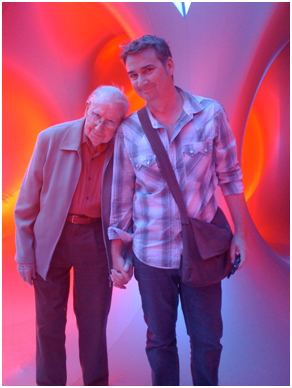
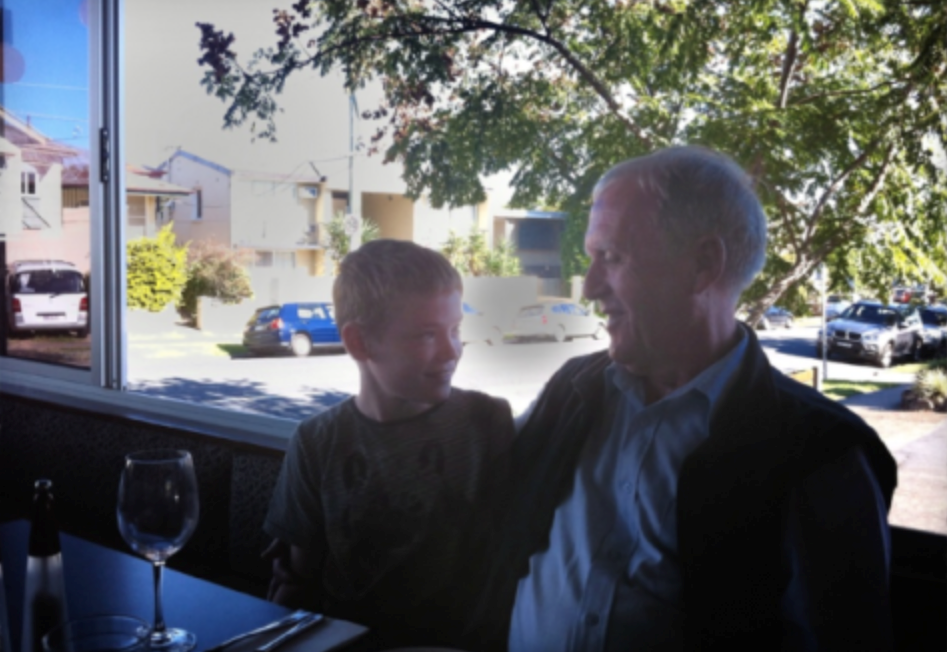
Read MoreJohn Birmingham with his father, also John.

Some of the most moving and brilliant speeches ever made occur at funerals. Please upload the eulogy for your loved one using the form below.
John Birmingham with his father, also John.
Our father was the sheltering sky, the wide vessel of our universe.
Read More28 July 2017, Elsternwick, Melbourne, Australia
My first glimpse of Shelli Whitehurst was through a crowd of freeloaders at a restaurant launch here in Melbourne. Shelli was holding court with a huddle of listeners.
Melbourne’s queen of social media was in the house.
I was with the old-school journos on the other side of the room. Back then, there was always a line in the sand… bloggers and journos never mixed.
But I was drawn to Shelli like a moth to a flame – like all of you.
There was this energy about her. It almost fizzed over. And if she allowed you into her orbit, you got a big fat dose of that energy, and then some.
Even on her darkest days, Shelli impacted the world. She was like a magic pill for any problem in her path.
Shelli’s amazing surgeon Chantel Thornton nailed it with this comment:
“Sometimes people enter our lives that will change the way we think. Michelle Whitehurst was one of those women – a woman of integrity, enormous courage and incredible tenacity for life. I have been privileged to be a part of your medical team.”
I have to agree. It really was a privilege to know Shelli… to be one of her people.
She loved introducing us to each other, and making magic happen.
Just ask Jenny and Chris… introduced by Shelli and now engaged to be married over in Shelli’s spiritual home, the U.S of A. Or Marty and Adam – not a romantic coupling, but brought together by Shelli to open the ridiculously successful South Press in Toorak Rd.
And let’s not forget Shelli’s other magic superpower - problem solving. I’ve lost count of the number of times Shelli pulled my head out of arse in times of strife and gave me a plan. And I know I’m not alone.
Shelli’s wonderful cousin Brendan and his partner Dean won’t mind me telling you that Shelli pushed and shoved them into following their hearts to start a new business (For My Petz in Yarraville… if you have fur babies, it’s fabbo).
Shelli had a gift for making lists and getting shit done. I’m sure many of you have been bossed around by Shelli. She’s given me so much hell for faffing about. There were never any excuses. World domination or don’t bother.
Ask Kimberlee Wells, a friend from Shelli’s advertising days. She said:
“We had big dreams of world domination. Kept the walls coloured with post-it notes. Had the private jet on order. Drank only in large format. And laughed and loved for more than 20 years. Shelli’s kindness and impact had no boundaries. And now, nor does her spirit.”
There were similar sentiments from Shelli’s biggest hero, New York advertising guru Cindy Gallup, who sent me a message saying Shelli would be kicking ass in heaven as much as she kicked ass here.
Shelli lived large and played hard, with a charisma that demanded attention.
Shelli was fierce, and nobody’s fool. And she knew how to enjoy life.
Like when she went for a foot massage with her mate Teela in Atlanta. Shelli enjoyed it so much that she ordered her masseur to start over again. And she wasn’t joking.
Others tell of Shelli’s antics in sparkly Minnie Mouse ears at SXSW, or hitting New York in her Tiffany & Co Nikes in the robin egg blue colour she loved so much.
Melissa remembers a 6pm dinner date with Shelli at Di Stasio, only drawing breath at midnight when the waiters turned the lights out. Those men in white jackets had been politely polishing glasses for at least an hour before hitting the lights.
That was how Shelli rolled. Deep communication was her jam.
When she was planning a visit to her dear friend Tom Miale in New York a few years ago, she got the ball rolling by demanding he cook a fancy meal. It became a running joke. She’d say stuff like… "Tom, I won't be happy unless there is a parade of shirtless men constantly pouring me bubbles.” When it came time to choose a meal, Shelli chose a much simpler affair - steak.
This is how Tom tells the story:
“Shelli arrived at home with bearing gifts for all - toys for my two children and about $200 worth of gourmet cheese for my wife and I. She said ‘I couldn't choose, so I bought all the cheese at the shop’. After a simple meal with some good wine, and loads of cheese, I asked her why she chose something as simple as steak for dinner. "She said, ‘I'm tired of the fancy stuff. Tonight, I need a meat-and-potato meal with a family’. To me, that interaction was who Shelli was. She appreciated the good stuff, she was always the life of the party, she loved to jet-set around the world, she never turned down an invitation to a fancy restaurant, but at her core she was most happy having simple, intimate interactions with friends and family. I can honestly say that I don't know anyone else that had as many close friends and family all over the world.”
If Shelli called you a friend, she’d give and give and give. Then she’d give some more. She even turned her cancer diagnosis into an act of giving, helping countless others with the extraordinary Kit for Cancer.
And she gives hope with her clever catch cries – like that amazing line broken crayons still colour. Shelli’s communication skills were legendary.
And she was always coming up with big ideas, more recently at 2 or 3 in the morning while talking to a dozen of her insomniac mates at once on Messenger.
Her notebooks bulged with them, and some were on the cheeky side, like the phone app called “Plus One” she plotted with a certain top restaurateur about town… a portal to hook up single professionals with hot and suitably sophisticated plus-ones so they never have to turn up anywhere alone (and no, it wasn’t an escort agency, but if things got saucy, the customers were all grown ups).
Shelli’s latest project, Because We Can, was all about generosity, sharing cool stuff and celebrating joyfulness with her connections around the world.
Wouldn’t it be a wonderful if Shelli’s global network continued disrupting shit on her behalf?
If you’re lucky enough to be one of Shelli’s people, it’s now your job to stay connected and dream big. And more importantly… don’t be scared to fail.
She gave this lesson to my teenage daughters Vivienne and Lauren, sneaking away for secret conversations on the importance of big dreams and open hearts. My girls loved her like an aunty, and have promised to make her proud.
On one of my many insomniac chats with Shelli on Messenger, she made me promise to make today’s send-off about her good bits – not dwelling on cancer.
Turns out, she asked the same of her friend Marty, who said:
“Shelli wanted me to make sure that we all didn’t remember her as a sick person, but as someone who was an entrepreneur, someone who was witty, someone who was successful and someone who was an incredible amount of fun. Shelli was every one of these before she was sick but more importantly she was all of these while she was sick.
"I don’t know of anyone else who would make their sickness into one of her projects, to ensure that no one would go through it like her.
"This in itself speaks of her courage and strength to always reach for the stars, knowing that when she got there it may benefit others more than her. This is why her legacy will live on.”
Beautiful words Marty.
Shelli will be all of those things and more, for those who knew her, and for a whole heap of people who didn’t.
To Betty and Don… I hope these words help you understand the sheer size of the huge tsunami of love out there for your beautiful daughter.
Finally, let me quote another one of Shelli’s US friends, Jeff Loya. I’ve followed Shelli’s wishes and avoided the dreaded C word for most of this eulogy, but I can’t resist this quote:
“She didn’t die from cancer. She bitch-slapped cancer so hard, it will think twice about entering another human”.
27 April 1994, Nixon Library, Washington DC, USA
President Nixon opened his memoirs with a simple sentence: "I was born in a house my father built." Today we can look back at this little house and still imagine a young boy sitting by the window of the attic he shared with his three brothers, looking out to a world he could then himself only imagine. From those humble roots, as from so many humble beginnings in this country, grew the force of a driving dream. A dream that led to the remarkable journey that ends here today, where it all began beside the same tiny home, mail-ordered from back East, near this towering pepper tree, which back then was a mere seedling.
President Nixon's journey across the American landscapes mirrored that of his entire nation in this remarkable century. His life was bound up with the striving of our whole people, with our crises and our triumphs.
When he became President, he took on challenges here at home on matters from cancer research to environmental protection, putting the power of the Federal Government where Republicans and Democrats had neglected to put it in the past, and in foreign policy. He came to the Presidency at a time in our history when Americans were tempted to say we had had enough of the world. Instead, he knew we had to reach out to old friends and old enemies alike. He would not allow America to quit the world.
Remarkably, he wrote nine of his ten books after he left the Presidency, working his way back into the arena he so loved by writing and thinking and engaging us in his dialogue. For the past year, even in the final weeks of his life, he gave me his wise counsel, especially with regard to Russia. One thing in particular left a profound impression on me. Though this man was in his ninth decade, he had an incredibly sharp and vigorous and rigorous mind. As a public man, he always seemed to believe the greatest sin was remaining passive in the face of challenges, and he never stopped living by that creed. He gave of himself with intelligence and energy and devotion to duty, and his entire country owes him a debt of gratitude for that service.
Oh, yes, he knew great controversy amid defeat as well as victory. He made mistakes, and they, like his accomplishments, are a part of his life and record. But the enduring lesson of Richard Nixon is that he never gave up being part of the action and passion of his times. He said many times that unless a person has a goal, a new mountain to climb, his spirit will die. Well, based on our last phone conversation and the letter he wrote me just a month ago, I can say that his spirit was very much alive to the very end.
That is a great tribute to him, to his wonderful wife, Pat, to his children and to his grandchildren, whose love he so depended on and whose love he returned in full measure. Today is a day for his family, his friends, and his nation to remember President Nixon's life in totality. To them, let us say: may the day of judging President Nixon on anything less than his entire life and career come to a close.
May we heed his call to maintain the will and the wisdom to build on America's greatest gift, its freedom, and to lead a world full of difficulty to the just and lasting peace he dreamed of.
As it is written in the words of a hymn I heard in my church last Sunday, "Grant that I may realize that the trifling of life creates differences, but that in the higher things we are all one." In the twilight of his life, President Nixon knew that lesson well. It is, I feel, certainly a fate he would want us all to keep.
And so, on behalf of all four former Presidents who are here - President Ford, President Carter, President Reagan, President Bush - and on behalf of a grateful nation, we bid farewell to Richard Milhous Nixon.
7 February 1952, London, United Kingdom
My friends
When the death of the King was announced to us yesterday morning there struck a deep and solemn note in our lives which, as it resounded far and wide, stilled the clatter and traffic of twentieth-century life in many lands, and made countless millions of human beings pause and look around them. A new sense of values took, for the time being, possession of human minds, and mortal existence presented itself to so many at the same moment in its serenity and in its sorrow, in its splendour and in its pain, in its fortitude and in its suffering.
The King was greatly loved by all his peoples. He was respected as a man and as a prince far beyond the many realms over which he reigned. The simple dignity of his life, his manly virtues, his sense of duty - alike as a ruler and a servant of the vast spheres and communities for which he bore responsibility - his gay charm and happy nature, his example as a husband and a father in his own family circle, his courage in peace or war - all these were aspects of his character which won the glint of admiration, now here, now there, from the innumerable eyes whose gaze falls upon the Throne.
We thought of him as a young naval lieutenant in the great Battle of Jutland. We thought of him when calmly, without ambition, or want of self-confidence, he assumed the heavy burden of the Crown and succeeded his brother whom he loved and to whom he had rendered perfect loyalty. We thought of him, so faithful in his study and discharge of State affairs; so strong in his devotion to the enduring honour of our country; so self-restrained in his judgments of men and affairs; so uplifted above the clash of party politics, yet so attentive to them; so wise and shrewd in judging between what matters and what does not.
All this we saw and admired. His conduct on the Throne may well be a model and a guide to constitutional sovereigns throughout the world today and also in future generations. The last few months of King George's life, with all the pain and physical stresses that he endured - his life hanging by a thread from day to day, and he all the time cheerful and undaunted, stricken in body but quite undisturbed and even unaffected in spirit - these have made a profound and an enduring impression and should be a help to all.
He was sustained not only by his natural buoyancy, but by the sincerity of his Christian faith. During these last months the King walked with death as if death were a companion, an acquaintance whom he recognized and did not fear. In the end death came as a friend, and after a happy day of sunshine and sport, and after "good night" to those who loved him best, he fell asleep as every man or woman who strives to fear God and nothing else in the world may hope to do.
The nearer one stood to him the more these facts were apparent. But the newspapers and photographs of modern times have made vast numbers of his subjects able to watch with emotion the last months of his pilgrimage. We all saw him approach his journey's end. In this period of mourning and meditation, amid our cares and toils, every home in all the realms joined together under the Crown may draw comfort for tonight and strength for the future from his bearing and his fortitude.
There was another tie between King George and his people. It was not only sorrow and affliction that they shared. Dear to the hearts and the homes of the people is the joy and pride of a united family. With this all the troubles of the world can be borne and all its ordeals at least confronted. No family in these tumultuous years was happier or loved one another more than the Royal Family around the King.
No Minister saw so much of the King during the war as I did. I made certain he was kept informed of every secret matter, and the care and thoroughness with which he mastered the immense daily flow of State papers made a deep mark on my mind.
Let me tell you another fact. On one of the days when Buckingham Palace was bombed the King had just returned from Windsor. One side of the courtyard was struck, and if the windows opposite out of which he and the Queen were looking had not been, by the mercy of God, open, they would both have been blinded by the broken glass instead of being only hurled back by the explosion. Amid all that was then going on, although I saw the King so often, I never heard of this episode till a long time after. Their Majesties never mentioned it or thought it of more significance than a soldier in their armies would of a shell bursting near him. This seems to me to be a revealing trait in the royal character.
There is no doubt that of all the institutions which have grown up among us over the centuries, or sprung into being in our lifetime, the constitutional monarchy is the most deeply founded and dearly cherished by the whole association of our peoples. In the present generation it has acquired a meaning incomparably more powerful than anyone had dreamed possible in former times. The Crown has become the mysterious link, indeed I may say the magic link, which unites our loosely bound, but strongly interwoven Commonwealth of nations, states, and races....
For fifteen years George VI was King. Never at any moment in all the perplexities at home and abroad, in public or in private, did he fail in his duties. Well does he deserve the farewell salute of all his governments and peoples.
It is at this time that our compassion and sympathy go out to his consort and widow. Their marriage was a love match with no idea of regal pomp or splendour. Indeed, there seemed to be before them only the arduous life of royal personages, denied so many of the activities of ordinary folk and having to give so much in ceremonial public service. May I say - speaking with all freedom - that our hearts go out tonight to that valiant woman, with famous blood of Scotland in her veins, who sustained King George through all his toils and problems, and brought up with their charm and beauty the two daughters who mourn their father today. May she be granted strength to bear her sorrow.
To Queen Mary, his mother, another of whose sons is dead - the Duke of Kent having been killed on active service - there belongs the consolation of seeing how well he did his duty and fulfilled her hopes, and of knowing how much he cared for her.
Now I must leave the treasures of the past and turn to the future. Famous have been the reigns of our queens. Some of the greatest periods in our history have unfolded under their sceptre. Now that we have the second Queen Elizabeth, also ascending the Throne in her twenty-sixth year, our thoughts are carried back nearly four hundred years to the magnificent figure who presided over and, in many ways, embodied and inspired the grandeur and genius of the Elizabethan age.
Queen Elizabeth II, like her predecessor, did not pass her childhood in any certain expectation of the Crown. But already we know her well, and we understand why her gifts, and those of her husband, the Duke of Edinburgh, have stirred the only part of the Commonwealth she has yet been able to visit. She has already been acclaimed as Queen of Canada.
We make our claim too, and others will come forward also, and tomorrow the proclamation of her sovereignty will command the loyalty of her native land and of all other parts of the British Commonwealth and Empire. I, whose youth was passed in the august, unchallenged and tranquil glories of the Victorian era, may well feel a thrill in invoking once more the prayer and the anthem, "God save the Queen!"
23 May 1994, St. Ignatius Loyola Roman Catholic Church, Washington DC, USA
Last summer, when we were on the upper deck on the boat at the Vineyard, waiting for President and Mrs. Clinton to arrive, Jackie turned to me and said: "Teddy, you go down and greet the President."
"But," I said, "Maurice is already there."
And Jackie answered: "Teddy, you do it. Maurice isn't running for re-election."
She was always there--for all our family--in her special way.
She was a blessing to us and to the nation-and a lesson to the world on how to do things right, how to be a mother, how to appreciate history, how to be courageous.
No one else looked like her, spoke like her, wrote like her, or was so original in the way she did things. No one we knew ever had a better sense of self.
Eight months before she married Jack, they went together to President Eisenhower's Inaugural Ball. Jackie said later that that's where they decided they liked Inaugurations.
No one ever gave more meaning to the title of First Lady. The nation's capital city looks as it does because of her. She saved Lafayette Square and Pennsylvania Avenue.
Jackie brought the greatest artists to the white House, and brought the Arts to the center of national attention. Today, in large part because of her inspiration and vision, the arts are an abiding part of national policy.
President Kennedy took such delight in her brilliance and her spirit. At a white House dinner, he once leaned over and told the wife of the French Ambassador, "Jackie speaks fluent French. But I only understand one out of every five words she says--and that word is DeGaulle."
And then, during those four endless days in 1963, she held us together as a family and a country. In large part because of her, we could grieve and then go on, She lifted us up, and in the doubt and darkness, she gave her fellow citizens back their pride as Americans. She was then 34 years old.
Afterward, as the eternal fame she lit flickered in the autumn of Arlington Cemetery, Jackie went on to do what she most wanted--to raise Caroline and John, and warm her family's life and that of all the Kennedys.
Robert Kennedy sustained her, and she helped make it possible for Bobby to continue. She kept Jack's memory alive, as he carried Jack's mission on. Her two children turned out to be extraordinary, honest, unspoiled, and with a character equal to hers. And she did it in the most trying of circumstances. They are her two miracles.
Her love for Caroline and John was deep and unqualified. She reveled in their accomplishments, she hurt with their sorrows, and she felt sheer joy and delight in spending time with them. At the mere mention of one of their names, Jackie's eyes would shine brighter and her smile would grow bigger.
She once said that if you "bungle raising your children nothing else much matters in life." She didn't bungle. Once again, she showed how to do the most important thing of all, and do it right.
When she went to work, Jackie became a respected professional in the world of publishing. And because of her, remarkable books came to life. She searched out new authors and ideas. She was interested in everything.
Her love of history became a devotion to historic preservation. You knew, when Jackie joined the cause to save a building in Manhattan, the bulldozers might as well turn around and go home.
She had a wonderful sense of humor--a way of focusing on someone with total attention--and a little girl delight in who they were and what they were saying. It was a gift of herself that she gave to others. And in spite of all her heartache and loss, she never faltered.
I often think of what she said about Jack in December after he died: "They made him a legend, when he would have preferred to be a man.' Jackie would have preferred to be just herself, but the world insisted that she be a legend, too.
She never wanted public notice, in part I think, because it brought back painful memories of an unbearable sorrow, endured in the glare of a million lights.
In all the years since then, her genuineness and depth of character continued to shine through the privacy to reach people everywhere. Jackie was too young to be a widow in 1963, and too young to die now.
Her grandchildren were bringing new joy to her life, a joy that illuminated her face whenever you saw them together. Whether it was taking Rose and Tatiana for an ice cream cone, or taking a walk in Central Park with little Jack as she did last Sunday, she relished being Grand Jackie and showering her grandchildren with love.
At the end, she worried more about us tan herself. She let her family and friends know she was thinking of them. How cherished were those wonderful notes in her distinctive hand on her powder blue stationery!
In truth, she did everything she could--and more--for each of us.
She made a rare and noble contribution to the American spirit. But for us, most of all she was a magnificent wife, mother, grandmother, sister, aunt, and friend.
She graced our history. And for those of us who knew and loved her--she graced our lives.
10 September 2012, Forest Lawn Memorial-Park and Mortuaries, Los Angeles, USA
Michael Clarke Duncan acted beside Hanks in the movie The Green Mile.
I pray this story is true, that he himself told me. Michael grew up in a part of Chicago that we three stooges are not really familiar with. There’s gangs in the neighborhood when he was growing up. And one of the gangs illuminated themselves their trademark was they had a little patch of red dyed into their afro, their hair.
Big Mike said, he told me, “I kind of like these guys, these guys were cool.” Big Mike decided to join this gang. And I said “How do you decide to join a gang?” He said “You walk up to them and say I’d like to be in your gang.” And then they beat the crap out of you for 20 minutes. And that’s how you get in the gang. So after being beat and having the crap kicked out of him for 20 minutes, Michael was a member of this gang and they took some red dye or whatever it is and gave him a little patch in his head and he goes home.
He said: “And my mama was in the kitchen, and she was cooking something at the stove and I sat down – I sat down in the chair, I kind of like cocked my head, so that she could see my new little red patch.” Now I just saw his mama and she is about as tall as this podium, I’m guessing she is as tall as the stove itself was. So this is how it went: “what’s that in your head, Mike?” “Oh! Yes, that’s my trademark ma, I am in a gang.” “Oh, really, you’re in a gang now.” That’s when I’m going to go aha.
She came down with this frying pan across his head and I’m guessing porkchop went flying all over the place. And he is on the other side of the kitchen now, crying, “oh oh mama” And mother says – as she is porking the pork, sticking the fork in the porkchop, putting it back in the pan. She said “you go get – you borrow some scissors from your sister, you cut that thing out of your hair.” She goes back. “Oh! I love those.”
So Michael went, got the (indecipherable) went to the mirror, “Oh, mummy,” cut it off. So now he has beautiful afro, naturally got this big dent in it, right where the big crater in it, where it used to be this red thing. And he goes back “Okay, mama, I cut it out my hair.” “Now you go tell your friends, you ain’t in that gang.”
I said, “So what did you do?” I went to the corner where the gang was, and I found them and I said, “My mama says I can’t be in your gang.” (laughing) I said “What do they do?” He said:
“They beat the crap out of me the second time.”
10 February 1948, Allahabad, India
If, as I believe, his spirit looks upon us and sees us, nothing would displease his soul so much as to see that we have indulged in any small behavior or any violence.
Friends and comrades, the light has gone out of our lives and there is darkness everywhere. I do not know what to tell you and how to say it. Our beloved leader, Bapu as we called him, the father of the nation, is no more. Perhaps I am wrong to say that. Nevertheless, we will not see him again as we have seen him for these many years. We will not run to him for advice and seek solace from hi, and that is a terrible blow, not to me only, but to millions and millions in this country, and it is a little difficult to soften the blow by any other advise that I or anyone else can give you.
The light has gone out, I said, and yet I was wrong. For the light that shone in this country was no ordinary light. The light that has illumined this country for these many years will illumine this country for many more years, and a thousand years later that light will still be seen in this country, and the world will see it and it will give solace to innumerable hearts. For that light represented the living truth … the eternal truths, reminding us of the right path, drawing us from error, taking this ancient country to freedom.
All this has happened when there was so much more for him to do. We could never think that he was unnecessary or that he had done his task. But now, particularly, when we are faced with so many difficulties, his not being with us is a blow most terrible to bear.
A madman has put an end to his life, for I can only call him mad who did it, and yet there has been enough of poison spread in this country during the past years and months, and this poison has effect on people’s minds. We must face this poison, we must root out this poison, and we must face all the perils that encompass and face them not madly or badly but rather in the way that our beloved teacher taught us to face them. The first thing to remember no wish that no one of us dare misbehave because we’re angry. We have to behave like strong and determined people, determined to face all the perils that surround us, determined to carry out the mandate that our great teacher and our great leader had given us, remembering always that if, as I believe, his spirit looks upon us and sees you, nothing would displease his soul so much as to see that we have indulged in any small behavior or any violence.
So we must not do that. But that does not mean that we should be weak, but rather that we should in strength and in unity face all the troubles and difficulties and conflicts must be ended in the face of this great disaster. A great disaster is a symbol to us to remember all the big things of life and forget the small things, of which we have thought too much
27 February 1965, Faith Temple Church of God, Harlem, NYC, New York, USA
Here - at this final hour, in this quiet place - Harlem has come to bid farewell to one of its brightest hopes -extinguished now, and gone from us forever. For Harlem is where he worked and where he struggled and fought - his home of homes, where his heart was, and where his people are - and it is, therefore, most fitting that we meet once again - in Harlem - to share these last moments with him. For Harlem has ever been gracious to those who have loved her, have fought her, and have defended her honor even to the death.
It is not in the memory of man that this beleaguered, unfortunate, but nonetheless proud community has found a braver, more gallant young champion than this Afro-American who lies before us - unconquered still. I say the word again, as he would want me to : Afro-American -
Afro-American Malcolm, who was a master, was most meticulous in his use of words. Nobody knew better than he the power words have over minds of men. Malcolm had stopped being a 'Negro' years ago. It had become too small, too puny, too weak a word for him. Malcolm was bigger than that. Malcolm had become an Afro-American and he wanted - so desperately - that we, that all his people, would become Afro-Americans too.
There are those who will consider it their duty, as friends of the Negro people, to tell us to revile him, to flee, even from the presence of his memory, to save ourselves by writing him out of the history of our turbulent times. Many will ask what Harlem finds to honor in this stormy, controversial and bold young captain - and we will smile. Many will say turn away - away from this man, for he is not a man but a demon, a monster, a subverter and an enemy of the black man - and we will smile. They will say that he is of hate - a fanatic, a racist - who can only bring evil to the cause for which you struggle! And we will answer and say to them : Did you ever talk to Brother Malcolm? Did you ever touch him, or have him smile at you? Did you ever really listen to him? Did he ever do a mean thing? Was he ever himself associated with violence or any public disturbance? For if you did you would know him. And if you knew him you would know why we must honor him.
Malcolm was our manhood, our living, black manhood! This was his meaning to his people. And, in honoring him, we honor the best in ourselves. Last year, from Africa, he wrote these words to a friend: 'My journey', he says, 'is almost ended, and I have a much broader scope than when I started out, which I believe will add new life and dimension to our struggle for freedom and honor and dignity in the States. I am writing these things so that you will know for a fact the tremendous sympathy and support we have among the African States for our Human Rights struggle. The main thing is that we keep a United Front wherein our most
valuable time and energy will not be wasted fighting each other.' However we may have differed with him - or with each other about him and his value as a man - let his going from us serve only to bring us together, now.
Consigning these mortal remains to earth, the common mother of all, secure in the knowledge that what we place in the ground is no more now a man - but a seed - which, after the winter of our discontent, will come forth again to meet us. And we will know him then for what he was and is - a Prince - our own black shining Prince! - who didn't hesitate to die, because he loved us so.
18 October 1967, Plaza de al Revolution, Havana, Cuba
Revolutionary comrades: It was a day in July or August of 1955 when we first met El Che. And in one night, as tell in his accounts, he became a future Granma expeditionary. But at that time that expedition had neither ships, weapons, nor troops. And this was the way El Che, together with Raul, joined the first two groups on the Granma list.
Since then, 12 years have gone by, 12 years fraught with struggles and obstructions. Through these years death reaped many valuable and irreparable lives, but at the same time, through these years, extraordinary people emerged in our revolution and were molded among men of the revolution. And ties of affection and friendship were made among these men and the people, ties which went further that it is possible to express.
Tonight we are gathered here, you and I, to try to express these sentiments in some way with regard to one who was one of the most familiar, one of the most admired, one of the most beloved, and, without any doubt, the most extraordinary of our comrades of revolution, to express these sentiment to him and to the heroes who have fought and have fallen beside him—his internationalist army which has been writing a glorious page of history.
Che was on of those persons whom everybody liked immediately because of his simplicity, because of his nature, because of his naturalness, because of his comradeship, because of his personality, because of his originality, even before his other singular virtues were revealed. During those first moments he was the doctor of our troop, and thus our bonds emerged and thus our feelings emerged. He was soon to be impregnated with a profound spirit of hatred and contempt for imperialism, not only because his political makeup was already considerably developed, but because only a short time before he had had the opportunity to witness in Guatemala the criminal imperialist intervention through the mercenary soldiers who overthrew the revolution in that country.
For a man such as he, many arguments were not necessary. It was enough for him to know that Cuba lived under a similar situation. It was enough for him that there were men determined to fight that situation with weapons in hand. It was enough for him to know that those men were inspired by genuinely revolutionary and patriotic sentiments. That was more than enough. In this manner, one day near the end of November 1955, he began the trip to Cuba with us. I recall that the crossing was very difficult for him because, in the circumstances under which it was necessary to organize the departure, he could not even obtain the medicines that he needed, and he suffered a sever attack of asthma during the entire crossing without any relief, but also without a single complain.
We arrived. We began the first marches. We suffered the first setback. And after a few weeks, we met again, as you know, that small group of those who were left of the Granma expedition. Che continued to be the doctor of our troop.
The first victorious battle was waged and Che then became a soldier of our troop; at the same time he was still the doctor.
The second victorious battle was waged and Che the soldier became the most distinguished of the soldiers in that battle, for the first time accomplishing one of those singular exploits which characterized him in all the actions.
Our force continued to develop and a battle of extraordinary importance at that time was waged. The situation was different. Reports were erroneous in many aspects. We were going to attack a strongly defended position in full daylight, in the morning, at the edge of the sea. It was well armed and we had enemy troops at our rear, very near. Under conditions of confusion which it was necessary to ask the men to make a supreme effort, after Comrade Juan Almaida had begun one of the most difficult missions, one of the flanks still did not have enough men. It lacked an attacking force, which could endanger the operation. At that moment, Che, who was still the doctor, asked for three or four men, among them a man with an automatic rifle. In a matter of seconds he quickly began to assume the mission of attack from that direction. On that occasion he was not only a distinguished fighter but he also was a distinguished doctor, giving assistance to the wounded comrades and at the same time caring for the wounded enemy soldiers. And when it was necessary to abandon that position, once all the weapons were captured, and begin a long march besieged by various enemy forces, it was necessary for somebody to stay with the wounded. El Che stayed with the wounded, helped by a small group of our soldiers. He cared for them. He saved their lives and joined them in the column later.
From that moment in which he was outstanding as a capable and brave commander. El Che, this type of man who when a different mission has to be done does not wait, does not wait to be asked – arrived and completed the mission. This he did during the battle of Uvero, and he did this, too, on an occasion, not mentioned in the early stages, when, because of a betrayal, our small force was attacked by surprise by many planes. As we were retreating under the bombing and had already walked some distance, we remembered some rifles of some peasant soldiers who had been with us during the first actions and who had later asked permission to visit their families – there was still not much discipline in our young army – and at the moment we considered the possibility that the rifles would be lost. No sooner was the problem brought up, under the bombing, when El Che volunteered and, and he did so, left rapidly to bring back the rifles.
That was one of his outstanding characteristics – immediate willingness, instantaneous readiness to volunteer for the most dangerous mission. Naturally this elicited admiration, double admiration for that comrade who fought beside us, who was not born in this land, who was a man of profound ideas, who was a man in whose mind surged dreams of struggle in other parts of the continent and yet, that altruism, that unselfishness, that willingness to do the most difficult always, to risk his life constantly. It was in this way that he won his rank of major and of commander of the second column that was organized in the Sierra Maestra. In this way his prestige grew. His fame began to grow as a magnificent fighter, which was to carry him to the highest ranks in the course of the war.
Che was an unbeatable soldier, commander. From a military standpoint Che was an extraordinary capable man, extraordinarily brave, extraordinarily aggressive. If he had and Achilles heel as a guerrilla, that Achilles heel was his excessive aggressiveness. It has his absolute scorn for danger. The enemies try to draw conclusion about his death. Che was a master of war.
Che was an artist in guerrilla warfare. He demonstrated this an infinite number of times, but above all in two extraordinary exploits. One of them was the invasion at the head of a column, a column which was pursued by thousands of soldiers through territory that was absolutely open and unknown. He accomplished with Camilo a formidable military feat.
But, in addition, he demonstrated it in his brilliant campaign in Las Villas, and he demonstrated it above all in his daring attack on the city of Santa Clara, entering a city defended by tanks, artillery, and several thousand infantry soldiers with a column of barely 300 men.
Those two exploits mark him as an extraordinarily able chief, a master, an artist of revolutionary warfare. Nevertheless, after his heroic and glorious death they attempt to deny the veracity or worth of his guerrilla concepts and ideas. The artist can die, particularly when he is an artist in such a dangerous art as the revolutionary struggle, but what cannot die under any circumstances is the art to which he dedicated his life and to which he dedicated his intelligence.
Why is it so strange that this artist should die in a battle? It is much more extraordinary that on the many occasions that he risked his life he was not killed during some battle. Many were the times in which it was necessary to take action to prevent him fro getting killed in actions of minor importance. And so in a battle, in one of the many battles that he waged, he lost his life. We do not have enough evidence to make a judgment as to all the circumstances preceding that battle, as to the degree in which he may have acted in an overly aggressive manner, but we repeat that if as a guerrilla he had an Achilles heel, that Achilles heel was his excessive aggressiveness, his absolute contempt for danger.
That was where it was difficult to agree with him, because we understand that his life, his experience, his ability as a veteran chief, his prestige, and everything that he signified in life, were much more, incomparable more, valuable that he perhaps realized himself. The idea that men have a relative value in history may have profoundly influenced his conduct; the idea that causes cannot be defeated when men fall and that the uncontainable march of history does not stop nor will it stop because the commanders fall. And this is certain, this cannot be doubted. This shows his faith in mankind, his faith in ideas, his faith in setting an example. Yet, as I said a few days ago, I would have wholeheartedly wished to have seen him as the molder of victories, molding under his leadership, molding under his direction, the victories, because men of his experience, of his caliber, of his singular ability are uncommon men. We are able to appreciate all the value of his example and we have the most absolute conviction that this example will serve as emulation and will serve to bring men similar to him from the bosom of the people.
It is not easy to find in one person all the virtues found in him. It is not easy for a person to be able spontaneously to develop a personality like his. I would say that he is the type of man who is difficult to equal and practically impossible to improve upon. But I would also say that men like him are able with their example to help the rise of other men like him.
We not only admire the warrior in El Che, the man capable of great feats, and what he did and what he was doing, that fact in itself of facing alone with a handful of men an entire oligarchic army trained by Yankee advisers, supplied by Yankee imperialism, supported by the oligarchies of all the neighboring nations, that fact in itself is an extraordinary feat. If one seeks in the pages of history one may not possibly find a single case in which somebody with such a small number of men had embarked on such a large-scale task, in which somebody with such a small number of men had embarked on a struggle against such considerable forces. It is proof of his self-confidence. It is proof of his confidence in the people. It is proof of his confidence in the capacity of men for combat. One may seek in the pages of history and nothing comparable will be found.
And he fell. The enemies believe that they have defeated his ideas, that they have defeated his guerrilla concepts, that they have defeated his viewpoints on the armed revolutionary struggle. What they gained with a lucky blow was to eliminate his physical life. What they did was to achieve the accidental advantages which an enemy may achieve in war. That lucky blow, that stroke of fortune, we do not know to what degree it was helped by that characteristic, to which we referred before, of excessive aggressiveness and absolute contempt for danger in a battle like so many battles. It also happened during our war of independence, in a battle at Dos Rios, where they killed the apostle of our independence. In a battle at Punta Brava they killed Antonio Maceo, veteran of hundred battles. In similar battles a number of chiefs were killed, a number of patriots of our independence wars. Nevertheless, that was not the defeat of the Cuban cause.
The death of Che, as we said a few days ago, is a hard blow, it is a tremendous blow to the revolutionary movement because, without any doubt, it deprives it of its most experienced and capable chief. But they who sing victory are mistaken. They are mistaken who believe that his death is the defeat of his ideas, the defeat of his tactics, the defeat of his guerrilla concepts, the defeat of his thesis, because that man who fell as a mortal man, as a man who many times exposed himself to bullets, as a military man, as a chief, he was a thousand time more capable than those who with one stroke of luck killed him.
However, how must revolutionaries face this adverse blow? How must they face this loss? What would be Che’s opinion if he had to make a judgment on this subject? He expressed that opinion very clearly when he wrote in his message to the Latin American solidarity Organization that if death surprised him at any place, it would be welcome, providing that his battle cry had reached a receptive ear and another hand was stretched out to grasp a weapon. And that was his battle cry. It will not reach one receptive ear, but millions of receptive ears, not one hand, but millions of hands outstretching to grasp weapons, inspired by his example. New commanders will arise. Men will need commanders who will rise from the rank and file of the people, just as commanders have arisen in all revolutions. Those hands will not be able to count on a commander of the extraordinary experience, of the enormous ability of El Che. Those commanders will be formed from among the millions who sooner or later will take up arms.
5 July 2017, Greensborough, Melbourne, Australia
Hello friends and family of Adrian. I’m Damian, Adrian’s youngest son & the member of the family least likely to require counselling after a public speaking engagement. I did contemplate turning up this morning and feigning laryngitis just to see their eyes widen … [feigning raspy voice] … ’Sorry, can’t do it guys … one of you will have to step up … Chris where are you going? … Michelle, Net … Paul? … Why are you lying down?
Anyway, one behalf of my Glossophobic siblings, I'd like to welcome you and thank you for coming to pay respects to the wonderful Adrian Paul Callinan.
I did say to dad, only one year ago, if he got to 93, he'd only have to make one more, and then it's just a six to bring up the ton.
[Roll Call & Thankyous]
As most of you would know Mum passed away in 2008 and to be honest dad, you haven't even come close to her numbers … so you need to have a good hard look at yourself … seriously … it was standing room at mums … we even had people dressing up as priests to try to score a seat on the altar.
I also did the eulogy at Mum’s funeral. Dad used to keep copies of it and proudly handed out. Mostly to people he knew, but not always. In fact I took him on tour with me 6 months after mum died & I think it may have led to me copping a fine from that cop who pulled us over just out of Ararat … ’I’ve got this dad … No, a copy of Mum's eulogy won’t help … alright …double demerits, your most kind officer.’
My friend, writer and Public speaker Tony Wilson used mum’s eulogy to launch his website ‘Speakola’ - a repository of public speeches of all ilks, from all comers … it’s a wonderful addition to the world.
Tony has been kind enough to share some of the stats with me. At 3512 views and 52 shares, Mum's is the second most read eulogy after Eric Idle’s Eulogy of George Harrison. Which means mum, while coming second to the Beatles is more popular than the Rolling Stones. According to Tone, mum’s speech has been more popular than the likes of Martin Luther King & Ted Whitten.
So the pressure is on Adey Babe. My view is why shy way from a winning formula, so I’ll be drawing influence from mum’s speech … here we go …
Adrian Callinan was the eldest daughter of Jack and May Purcell. He attended Santa Maria Ladies College in Northcote where he was captain of the school netball team and … hang on, I probably should have edited this a bit more … I might've have to go off notes
[Put notes aside]
Adrian went by many names … ‘Stringer’ … for which no satisfying explanation was ever been proferred. He was dubbed Adey Babe by dear family friend Jeanie P and he never lost that moniker, did you Adey Babe? He occasionally got Hadrian as in the wall; Hiraji as in 1948 Melbourne cup Winner … & Age, as in the declining Fairfax newspaper.
Mum had a few variations … ‘Oh Adriannn’ the most famous. Used at times of peak frustration, like when dad decided to go to the toilet just as they were about to go out. To understand the scale of her frustration, dad could be in there for considerable periods of time. In 1992 alone, he missed Annette’s birthday, the change of federal government and most of August. But mostly she said his name 3 times with increasing volume until he heard her … ‘Adrian! … Adrian!!! …. Adrian!!!!!!! … you're putting sugar on the salmon patties!’ Some times she truncated all 3 into one ‘Adri … Ade … Adrian!! … the toaster doesn't go in in the fridge!!’
Whatever you called him, you loved him. We often pump up the tyres of the recently deceased but much like mum, that isn’t necessary with dad. He was universally loved and admired. Our family have been inundated with messages this week from so many disparate sources commenting on how dad had touched their lives from our friends, ex-students, winemakers, teaching colleagues the managers at Bundoora Retirement Village, winemakers … actually mainly winemakers … Even the Ararat Police Station gave us a call.
Dad was multi layered as most quality people are. An Educator, son, thespian, husband, welfare volunteer, grand dad, wine connoisseur, great grand dad, confidant, brother, athlete, uncle, mentor, lover of literature & the arts, and of course a purveyor of fashion … which reached it’s high point in the 70’s
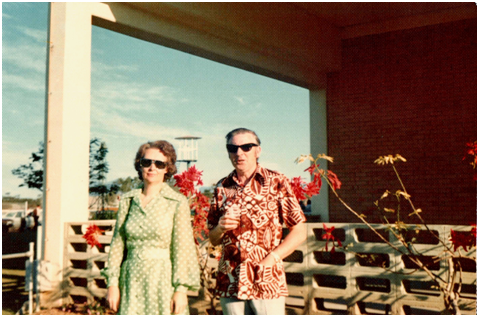
Here we see dad and mum at the Cluden Races in Townsville circa 1974. Look at him absolutely owning his batik over shirt with pockets. He also wore a Safari Suit better than Don Dunstan, made walk socks and walk short ensemble his signature look and as you’ll see in the later montage, he didn’t mind popping his leg up to show off his wares … ‘Hi, I’m Adey Babe … Cancer’
Today I’d like to shed light on the different versions of Adey Babe … He is looking a bit mobster up there and that’s not surprising because dad didn't mind getting involved in an under hand negotiations, of which mum may or may not have been aware. t’s become apparent over recent days that we have all been involved that dad was a deal broker.
Paul & Annette - were offered use of the family car of a Saturday in exchange for babysitting the brats … Michelle & I
Chris - in Year 7 Chris was offered financial incentives to read … a shilling a book I think, I’m not sure what currency you used back in your youth … it didn't work. It’s a credit to Chris that he has carved out a 40 year career in education without being able to read a single word … look at him sitting there holding onto the mass booklet… so cute … it’s upside down mate
I was the lucky one. We 5 are offspring of a mixed marriage. Mum, first cousin to the great Phonse Kyne, had no choice but to barrack for Collingwood. Dad, an early adapter to the use of untested, performance enhancing drugs was destined to barrack for Essendon.
Aged 8 and still trying to squeeze into the Collingwood jumper Nana Purcell had made me, dad took me aside and said ‘if you barrack for Essendon, I’ll take you to the footy every week’ … I didn't concede straight away but over a period of 18 months of watching the Dons get flogged at Windy Hill, I slowly shed by black & white striped skin and awoke black with a red sash. Immediately my teeth stopped aching, my vocab improved & I stopped spitting at strangers. With Chis already a Bomber, Paul was gutted. He was from that day condemned to a life time of going to the footy on his own. Lacking the vocabulary to articulate his pain, he just spits in our general direction from time to time.
Then there was dad the athlete.
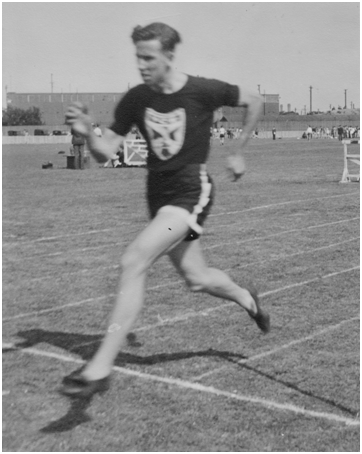
That, ladies & gentleman, is the ‘Brunswick Flash’
Dad excelled at sport at school and was a member of the 1st 18 Footy team, 1st 11 cricket team & Senior Athletics team at Parade Christian Brothers. As were Chris and I … Paul also … attended Parade. To be fair Paul was the Due of Latin … Speaking a dead language has been of great solace to him over the years.
Post school years, dad’s sports stories seemed to take on a more epic scale. One Saturday after one of his regular Friday pub sessions with his teaching cohorts, he claims he awoke with a prodigious hangover. Mum made him a bowl of porridge and sent to him off to the game where he proceeded to kick a bag of 8 goals for Bacchus Marsh. One of the goals, said to be roosted from the centre of the ground, was immortalised in the Bacchus Marsh local paper under the head line ‘The Goal That Callinan kicked.’ From then on mum superstitiously made him porridge every Saturday morning but he never got close to repeating his heroics that day at Maddingley Park.
However, his most told story was so full of inaccuracies, that we used to ask him to repeat it just to see how far he could bend reality. The story goes that whilst competing for Brunswick YCW Athletics team in the grand final, the scores were locked together and it was decided that the teams would select their best athlete to race off. The event chosen: the 300m … yeah, not one of the more well known events. Apparently the ‘Between the Legs Javelin’ & ‘Backwards Triple Jump’ were also considered.
Dad put his hand up, for as it transpired, the 300m was dad’s pet event. Despite almost never being added to the card at any meet ever, he had secretly trained for this eventuality. He settled into his blocks, the recently injected pig enzymes taking affect, the gun went off and Dad romped to victory. The winning margin longer with every telling. In the last rending he crossed the line 365 metres in front of his opponent.
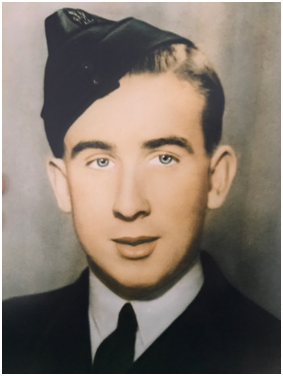
This is Airman Adey Babe
Leading Aircraft Man 116548 -
Enlisted - July 31st, 1942
Discharged - September 15th, 1945
This is the version of dad we knew the least. Like many of his generation he kept his war experience close to his chest.
In the footsteps of his brother Tony, already serving as navigator in the European theatre, dad joined the RAAF in the hope of becoming a pilot but due to an inner ear condition and testing positive to Peptides, he became a Radar Operator. He served in Darwin & the Atherton Tablelands. According to his service record we do know that a/ he was rated at of very good character b/ He was ranked as A Class in Trade proficiency 3/ he was wounded in action… though he fact that he could barely change a light blue in civilian life, the wonder was he wasn’t electrocuted more often … what, too soon?
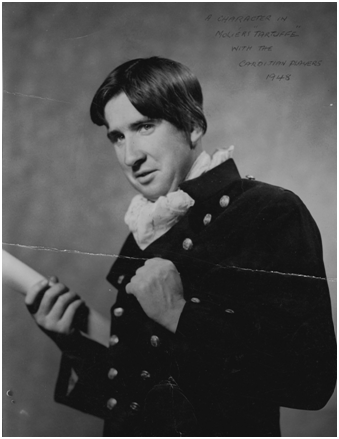
Meet Adrian the Thespian
… that’s dad in Moliere’s ‘Tartuffe’ in 1948
Dad took great delight in telling the story that he was introduced to mum by their mate Tom Duffy after he had played a game of footy for Brunswick YCW. Dad took an immediate shine to her and asked her on date. Unable to think where they should go, he suggested that she come & see him perform in a play the following week. The plays title - ‘He Was Born Gay’ by Auberon Waugh … If mum had seen that photo, it’s unlikely the date would ever have occurred.
Back in the 40’s Dad starred in Melbourne Uni Revues and formed a stage alliance with his good mate Jack Cooper. Together they co-founded the the Cardijnian Players with the likes of author Ron Conway and Tony Coburn who went on to fame as the director of Patrol Boat in the UK. Mum reckoned that when they moved the to the country dad would either join the local Rep group or start one if there wasn’t. Mum would take care of the costumes, host the wrap parties and set up the trundle bed so he wouldn't keep her awake form snoring.
His passion for theatre spilled over into his teaching and he would continue to direct school plays and musicals even after he had become the Principal. On retirement he picked up where he left off and joined the Heidelberg Theatre Company where, amongst other pieces, he starred in Rome & Juliet alongside Dame Judi Dench and Sir John Geilgud … just seeing if you are all still listening.
I never did get to perform with dad but he did do a rehearsed play reading with our nephew David Callinan … & pretty much blew him off the stage … sorry Dave
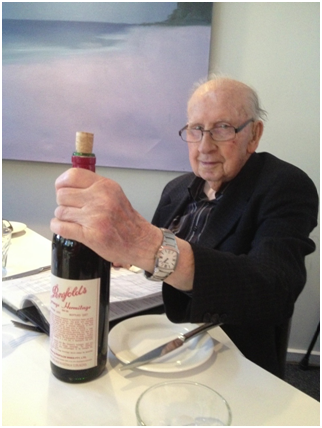
Meet Adrian the Self Styled Sommelier
He didn't let go of that bottle of Grange all night.
For a man who couldn't so much as prepare a single leaf salad without dressing, Adrian loved to host a dinner party. However mum’s culinary skills paired with his wine knowledge meant they rarely had a knock back. Mum would buzz around the kitchen whipping up a multi feast course feast while dad moved around behind her washing up and putting away everything she didn't want washed up and put away.
So mum would shuffle him off so she could prepare the ingredients for the Fondue or Beef Stroganoff, and dad would repair to the bottom of the linen closet and select the wines for the night. This process could last so long, you would have sworn he was in the toilet. He’d consult his wine magazines, scrapbook journals and then light his pinot infused candle at his James Halliday Altar before lining up the selection for the evening on the ‘buffet’ and begin to decant. The selection would then be logged in their dinner party journal along with mum’s menu and the list of guests, a virgin would be sacrificed, preferably from Bordeaux or Burgundy … and then they'd bring out the cheese board.
And then there is dad the teacher
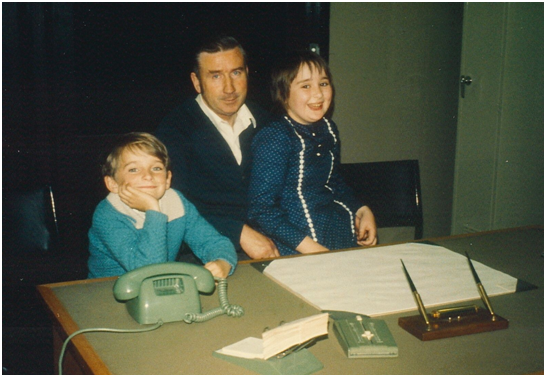
That’s my sister Michelle & I with dad at his new desk at Greenwood High School. His first gig as Principal
While he flirted with career on the stage, dad never missed a beat once he became a teacher. He was bloody good one too. Former students would regularly get in contact with dad years down the track to let him know that they has achieved their dream thanks to his support.
On Friday when we sat down down to arrange the funeral with Gabriel Walsh told us that only the week before, a local guy she had dealings with had told her that dad was the reason he was doing what he was doing today. Rod was student at Greenwood & a habitual truent. Dad went around to his house and told him to try to come to school a couple of days a week. He agreed but soon enough his attendance fell way so dad went back & dragged him to school and told him to build a shed. He did and it was a good shed. Rod is now a successful builder & developer.
Even as principal dad got his hands dirty, directing the school plays and taking remedial English classes for the senior students before hours.
He was loved and esteemed by his colleagues some of whom are with us today Ken Rigby, Glennys & Ian Collis, Geraldine Sullivan
But it wasn't just his students and peers who rated him. Have a listen to these Education Department Review Quotes …
His first school Bacchus Marsh HS 1951-55 — ‘A brisk and vigorous teacher: presents lessons clearly with good use of questioning & blackboard & performs numerous extra-curricular activities including bookstore accounts and dramatic work most efficiently
Then to Warragul HS 1956-59 - ‘A very sincere, thorough & capable teacher. Presents lessons on sound lines securing very good co-operation from his classes. A valuable member of staff.’
Let’s skip forward a few years passed Oak Park HS, Eltham HS & Strathmore HS to when he got his first Principal Job at Greenwood HS
Greenwood HS - ‘Adrian Callinan deserves a sainthood for lasting a single term let alone 5 years. When I walked into the school I had never seen such a feral bunch of long haired, unemployable layabouts and that was just the staffroom. Those teachers are so left wing they make Lenin look like a fascist. I’d burn the place down and start again but most likely one of them will fall asleep at their desk with a spliff in the hands and do it for us. Thankfully Adrian has been able to take refuge from the carnage in a rather good shed built at the rear of the school.
Then there is the husband and father.
If you thought he was good at the other stuff, in this department he was world class!
We all had close but very different relationships with dad and our first memories are telling. Annette recalled dad finding her knickers in his briefcase at a Bacchus Marsh High School Staff Meeting; Michelle getting trinkets from dad after he got home for teaching Night School; Chris hearing dad singing happy birthday through the radiogram; Paul recalls dad’s poor attempts at leg spin in the backyard … & I remember his face through the glass in the line up at the orphanage.
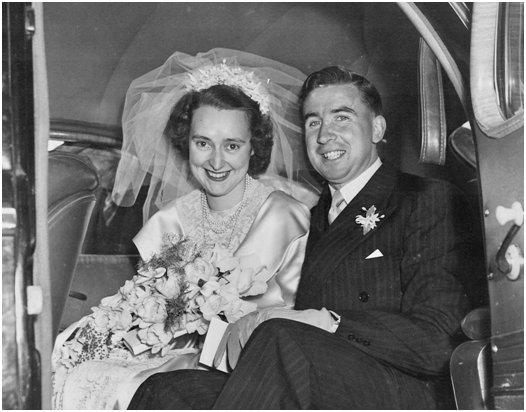
The love story of Adrian & Kathleen reads like an old school Hollywood romance … that keeps going well beyond the credits. Their post war courtship courtship was Gene Kelly & Kathryn Grayson in ‘Anchors Aweigh’… their country years were Eva Gabor and Eddie Albert in Green Acres … their burgeoning family was Clifton Webb & Jeanne Crane in ‘Cheaper By The Dozen’… their dotage ‘On Golden Pond’ with Henry Fonda & Katherine Hepburn
But no Hollywood screen writer would have come up with the the cruel plot twist at the end of their beautiful 61 year relationship.
The unfathomably sad circumstances that took mum away from dad could easily have broken a lesser man. He had every right to wallow in self pity but he actively chose to hold himself together so we wouldn't lose both parents to the same tragedy. Watching that beautiful man apologise to his wife as her live ebbed away is the most profoundly brave and loving act I’ve witnessed. Seemingly from that moment he lifted his head and walked forward to forge a new life without the woman he adored and who adored him.
[Gets out handkerchief from his pocket and finds instead a pair of female undies]
Annette!!!!!
When dad retired mum and he started a very happy phase of their lives together but the School Principal in him was slow to recede and from week one they would schedule weekly ‘Staff Meetings’ of a Monday morning. This sounds like I am making this up but I’m not. On the agenda would be items for discussion such as medical appointments, correspondence to be written, dinner parties to arrange, should we put a phone in the toilet …
Since mum passed away of course the meetings sadly stopped, but you will be pleased to know that as of this Monday passed, the meetings have reconvened and I just happen to have the Minutes from that very meeting … written by mum
Minutes - Kathleen & Adrian Callinan Monday Staff Meeting - July 3rd, 2017
Present - Kathleen & Adrian
Apologies - None
Schedules - 10am
Commenced - 10.38am [Adrian was in the toilet]
Order of Business
• Join Pearly Gates West Beef & Burgundy Club
• Locate nearest Dan Murphy
• Jack Cooper to take Adrian to join ‘Kingdom Come Amateur Theatre Company’
• Get hearing aid batteries
• Speak to Dr O’Shea about Adrian’s IBS [I’ve told him that this stuff doesn't matter any more but he won’t be dissuaded]
• Redo the now more extended Christmas card list
• Decide on menu for dinner party with the Duffys, Jack Cooper, Jack Leonard, Jesus and Jeanie P - thinking kai si ming and pavlova
• Adrian is keen to buy a new car … have managed to put this off for the time being
I wrote this reflection about dad the night after he passed away. It was raw and flowed out as if he were over my shoulder helping me find the words. I’ll read it now it sums up best what dad meant too me
The last drizzles of colour cascaded from mid air only to disappear in less impressive drifts of smoke. Horns from boats on the harbour and distant cheers replaced the cacophony of the pyrotechnics and we were able to resume our conversation. The sulphurous hangover lingered as I stood on the balcony and detailed the magic of my night thus far. He hung off my every word in much the way I had done when he read to me of a night in my childhood bed. I loved the longer narratives of Arthur Conan Doyle and the word plays of Bennet Cerf, but it was the magical worlds of faeries conjured by WB Yeats and the canny lasses of Robby Burns that made me sit up and clutch my spare pillow. The accents and oratorial poise he summoned, seemed to take me directly to fog shrouded isles and moonlit corn rows. I loved those nights. But on this night the roles were reversed. The noise & clatter of a Sydney New Years Eve faded in the background as I spoke to him on the balcony of the Opera House amidst the revellers whose post operatic party we had crashed. Still in the glow of a preview performance of ‘The Complete Works of Shakespeare' in the Playhouse, the English Lit teacher in him swooned at descriptions of analysing the Bard's text in rehearsal; The Actor in him delighted in hearing tales of my improvisations during the constructed mayhem of the piece and the Father in him swelled with pride. It remains one of the most profoundly happy conversations of my life. He gushed with envy and I told him how much of an impact his passion for literature and theatre had fundamentally shaped who I am. His last words on that night were … ’I am so proud of you.’ …. A couple of nights ago, in a lucid moment amidst fits of delirium, I held both of his hands and his eyes locked onto mine and he said it again. They were his last words to me … ‘Farewell Adrian, if we do meet again, why we shall smile: if not, then this parting was well made'
In the last year or so I occasionally returned the favour and read to dad. Often choosing every poems and prose he had read to me as a child. With his memories fraying at the edges he would pick up and join in with me on some poems. We both loved Robbie Burns and this was our favourite … so one more time with feeling Adey babe
Corn Rigs & Barley Rigs - Robbie Burns
It was upon a Lammas night,
When corn rigs are bonie,
Beneath the moon's unclouded light,
I held awa to Annie;
The time flew by, wi' tentless heed,
Till, 'tween the late and early,
Wi' sma' persuasion she agreed
To see me thro' the barley.
Corn rigs, an' barley rigs,
An' corn rigs are bonie:
I'll ne'er forget that happy night,
Amang the rigs wi' Annie.
The sky was blue, the wind was still,
The moon was shining clearly;
I set her down, wi' right good will,
Amang the rigs o' barley:
I ken't her heart was a' my ain;
I lov'd her most sincerely;
I kiss'd her owre and owre again,
Amang the rigs o' barley.
I lock'd her in my fond embrace;
Her heart was beating rarely:
My blessings on that happy place,
Amang the rigs o' barley!
But by the moon and stars so bright,
That shone that hour so clearly!
She aye shall bless that happy night
Amang the rigs o' barley.
Corn rigs, an' barley rigs,
An' corn rigs are bonie:
I'll ne'er forget that happy night,
Amang the rigs wi' Annie.
filmmaker Paul Cox died on 18 June 2016, Melbourne, Australia
There is no available audio or video of this speech
When Paul Cox was moved from hospital into palliative care, we prepared ourselves for tough news. Paul was getting smaller and weaker, his voice was in retreat and family and friends had attended his bedside to say their goodbyes.
His siblings flew out from Europe. I didn't expect to see him again. A week or so later, Paul decided he was going home and explained to the palliative care people that although he loved them dearly, he would not be dying just yet.
He travelled home in a Popemobile-shaped taxi and began blessing people as he passed them in the street. This cheered him up enormously and when we saw him a few days later he rose to meet us, offered us coffee and sat rather grandly in a chair, chatting for hours with a keen emphasis on the future.
His voice was stronger, his memory was wonderful, his manners were elegant, his talk was clever and in some cases what he said was astonishing.
At 7 o'clock each evening, for example, he went out on to his little balcony in Melbourne and raised both arms high in the air in order to receive healing waves being beamed to him by a woman in Uzbekistan.
Paul was very amusing about all this but as he said, 'at this stage I believe in nothing and everything'.
A few years earlier, the first time he was going to die, he received a liver transplant and, in a state of profound gratitude, he continued writing and making films.
Last year he made a movie in which David Wenham played a man who has a liver transplant and falls in love. Paul met his partner Rosie when they were both receiving liver transplants. He was in his late sixties at the time and she is a beautiful Balinese woman of somewhat more tender years.
"I know what you're thinking Johnny," Cox said to me when he introduced us. "Rosie is much younger than I am. But I want you to know Johnny, my liver is younger than Rosie's."
Half a lifetime ago Paul and I wrote some films together and we've always stayed in touch. I'd never written a movie before and I quickly learnt it was no use suggesting to Paul a thematically consistent sequence involving sport, for example. That wouldn't fit in a Cox film. Too healthy. And there wasn't much interest in men who fixed cars and called each other 'mate'.
Paul's films looked like Dutch interiors with dappled light playing through the window and they were full of urban characters who were ill at ease, often slightly wounded or suffering from incongruity of some kind.
As with many collaborations, we wrote by talking a lot together and then writing separately. Paul's house was always full of good conversation. At one stage Werner Herzog was living in a shed in the backyard with a dingo.
Peter Watkins also lived there at some point, while he and Paul were discussing a film project. Peter had made the brilliant 1964 docudrama 'Culloden' in which 1960s British journalists report live from a battle which occurred in 1745. This strategy of anachronism was new in 1964 and the effect in 'Culloden' was terrifying.
Paul's public presentation was that of a serious artist but he was nevertheless given to fits of amusement which produced a snuffling and rumbling sound such as might occur if a badger were attempting not to explode. When he regrouped, he expressed matters once more in his formal mode, which was not unlike an antiques catalogue.
A suggestion which would solve a problem was 'good,' a great idea for a scene was 'fine,' and if he completely approved of a whole section of plot and dialogue he would pronounce it 'very fine'; as in 'I read that section again last night Johnny. That really is very fine.'
When Lonely Hearts, the first film we wrote together, was about to be released 35 years ago, Paul wrote me a letter which I have always kept. In the last line of the letter he said he hoped that having worked on this film together and seeing it come to fruition, would 'strengthen our shy human friendship'. It did.
Having received blessings from Uzbekistan, Paul announced he was going to America. The only people who thought this wouldn't happen were those unfamiliar with Paul's willpower. The doctors wouldn't allow him to fly across the Pacific for 14 hours so he'd negotiated overnight stays in Bangkok, Dubai and Frankfurt and then a trip across the Atlantic to Chicago.
His film Force of Destiny was to play at the Ebert Film Festival and Paul had been invited to speak. Rosie would go with him and make sure he rested, ate the right food and took his tablets. The couple left on April Fool's Day and that night Rosie, whose canonisation is imminent, sent a message reporting that Paul had gone out to dinner in Bangkok. This was probably a PB for the palliative care unit at the Austin but Cox was just limbering up. After Dubai and Frankfurt the official party arrived in Chicago and Paul made a gracious, honest and very engaging speech to an audience who couldn't believe quite what they were watching.
Following the festival, Paul and Rosie made their way home and Paul was planning another movie. The fact that he died on Saturday will probably slow him down a bit although I expect he'll call sometime during the next week or so with a revised schedule. "I'm still going to do it," he'll say. "Why not? I have some good ideas. I want to talk about it. Come to dinner."
With Kate Fitzpatrick
15 May 2017, Malthouse Theatre, Southbank, Melbourne, Australia
Steve Bracks is a former Premier of the State of Victoria. Michael Gurr, was Bracks' speechwriter and a much loved Australian playwright. He died 2 May 2017. There is no available audio or vision of this speech.
Michael once wrote,
‘Political speechwriters dream the Gettysburg Address but wake up to the Cheltenham Chamber of Commerce.’
I suspect he was referring to state politics.
What that quote doesn’t tell you is how often Michael made those of us who had to speak to the Cheltenham Chamber of Commerce feel a little like Abraham Lincoln.
My point: politics mattered to Michael.
It mattered deeply.
It wasn’t a game.
It wasn’t beneath him.
It was worth the fight.
Politics was – and is – the stuff of life.
Yes, it’s messy.
Yes, it involves compromise.
But public life is a calling worthy of the efforts of our best and brightest – people like Michael.
That’s what Michael believed.
That’s why he dedicated his considerable talents to the collective effort for progress.
And I am here to tell you that Michael’s contribution to the fight for progress counted.
He made a difference.
I first met Michael in 1999.
I had just become Leader of the State Opposition.
Labor was – according to the experts – unelectable.
Michael didn’t agree.
Michael had volunteered his speechwriting services to my predecessor, John Brumby, in 1996.
He didn’t want anything in return for his efforts. He just wanted to get rid of Jeff Kennett.
Over the next three years, Michael was one of the true believers who – bit by bit – pulled Labor back from the abyss.
He was one of the reasons why we won in 1999.
Much has been written and said about the 1999 election.
Especially the one-word speech Michael wrote that was to be delivered if – against all the odds – we won.
That one word was ‘F.U.C.K.'
What hasn’t been widely acknowledged is how important Michael was to me at the time – not just as a speechwriter, but as a voice of reason and a friend who helped us find the words that led us to the light on the hill.
As I said, Michael made a difference.
That’s why, after we won, I asked Michael to come in from the cold – to work as my speechwriter in government.
He declined the offer.
I understood why Michael said no.
He wasn’t in politics for personal gain.
He just wanted to put his shoulder to the wheel.
He just wanted us to get to the top of that hill.
That was why – whenever the contest was fiercest – whenever the outcome was in question – I found Michael was standing beside me.
He worked for us in the 2002 election and the 2006 election:
Advising me,
Making me laugh,
Helping us find the words that led to the light on the hill.
All of which is why it’s hard to believe he’s gone.
I last saw Michael at St Vincent’s.
It was the day the Paul Keating was visiting Melbourne – and Keating had given a sparkling interview to Jon Faine on 774.
Michael and I spoke about Keating.
And we spoke about 1999.
And – at one point – Michael thanked me for letting him work on those elections.
And I had to respectfully disagree with my old friend.
He didn’t have to thank me – but I had to thank him for helping us find that light on the hill.
Thank you, Michael.
You were the light.
12 July 2016, Interfaith service, Dallas, Texas, USA
Thank you. Thank you very much. (APPLAUSE)
Mr. President and Mrs. Bush, my friend the vice president, and Dr. Biden, Mayor Rawlings, Chief Stiller (ph), clergy, members of Congress, Chief Brown. I'm so glad I met Michelle first, because she loves Stevie Wonder.
(LAUGHTER)
(APPLAUSE)
Thank you.
But most of all, the families and friends and colleagues and fellow officers.
Scripture tells us that in our sufferings, there is glory, because we know that suffering produces perseverance; perseverance, character; and character, hope. Sometimes the truths of these words are hard to see. Right now, those words test us because the people of Dallas, people across the country are suffering.
We're here to honor the memory and mourn the loss of five fellow Americans, to grieve with their loved ones, to support this community, and pray for the wounded, and to try and find some meaning amidst our sorrow.
For the men and women who protect and serve the people of Dallas, last Thursday began like any other day. Like most Americans, each day you get up, probably have too quick a breakfast, kiss your family goodbye, and you head to work.
But your work and the work of police officers across the country is like no other. For the moment you put on that uniform, you have answered a call that at any moment, even in the briefest interaction, may put your life in harm's way.
OBAMA: Lorne Ahrens, he answered that call. So did his wife, Katrina, not only because she was the spouse of a police officer, but because she's a detective on the force. They have two kids. Lorne took them fishing. And he used to proudly go to their school in uniform.
On the night before he died, he bought dinner for a homeless man. And the next night, Katrina had to tell their children that their dad was gone. "They don't get it yet," their grandma said. "They don't know what to do quite yet."
Michael Krol answered that call. His mother said, he knew the dangers of the job, but he never shied away from his duty. He came 1,000 miles from his home state of Michigan to be a cop in Dallas, telling his family, this is something I wanted to do.
And last year, he brought his girlfriend back to Detroit for Thanksgiving. And it was the last time he'd see his family.
Michael Smith answered that call. In the Army, and over almost 30 years working for the Dallas Police Association, which gave him the appropriately named Cop's Cop Award. A man of deep faith; when he was off duty, he could be found at church or playing softball with his two girls.
Today, his girls have lost their dad, for God has called Michael home.
Patrick Zamarippa, he answered that call. Just 32, a former altar boy who served in the Navy and dreamed of being a cop. He liked to post videos of himself and his kids on social media. On Thursday night, while Patrick went to work, his partner, Christy, posted a photo of her and their daughter at a Texas Rangers game, and tagged the department so that he could see it while on duty.
Brent Thompson answered that call. He served his country as a Marine. And years later, as a contractor, he spent time in some of the most dangerous parts of Iraq and Afghanistan. And then a few years ago, he settled down here in Dallas for a new life of service as a transit cop.
And just about two weeks ago, he married a fellow officer, their whole life together waiting before them.
Like police officers across the country, these men and their families shared a commitment to something larger than themselves. They weren't looking for their names to be up in lights. They'd tell you the pay was decent, but wouldn't make you rich. They could have told you about the stress and long shifts. And they'd probably agree with Chief Brown when he said that cops don't expect to hear the words "thank you" very often, especially from those who need them the most.
No. The reward comes in knowing that our entire way of life in America depends on the rule of law, that the maintenance of that law is a hard and daily labor, that in this country we don't have soldiers in the streets or militias setting the rules.
Instead, we have public servants, police officers, like the men who were taken away from us. And that's what these five were doing last Thursday when they were assigned to protect and keep orderly a peaceful protest in response to the killing of Alton Sterling of Baton Rouge and Philando Castile of Minnesota.
OBAMA: They were upholding the constitutional rights of this country.
For a while, the protests went on without incident. And despite the fact that police conduct was the subject of the protest, despite the fact that there must have been signs or slogans or chants with which they profoundly disagreed, these men and this department did their jobs like the professionals that they were.
In fact, the police had been part of the protest planning. Dallas P.D. even posted photos on their Twitter feeds of their own officers standing among the protesters. Two officer, black and white, smiled next to a man with a sign that read "no justice, no peace."
And then around nine o'clock, the gunfire came. Another community torn apart; more hearts broken; more questions about what caused and what might prevent another such tragedy.
I know that Americans are struggling right now with what we've witnessed over the past week. First, the shootings in Minnesota and Baton Rouge, the protests. Then the targeting of police by the shooter here, an act not just of demented violence, but of racial hatred.
All of it has left us wounded and angry and hurt. This is -- the deepest faultlines of our democracy have suddenly been exposed, perhaps even widened. And although we know that such divisions are not new, though they've surely been worse in even the recent past, that offers us little comfort.
Faced with this violence, we wonder if the divides of race in America can ever be bridged. We wonder if an African American community that feels unfairly targeted by police and police departments that feel unfairly maligned for doing their jobs, can ever understand each other's experience.
We turn on the TV or surf the internet, and we can watch positions harden and lines drawn and people retreat to their respective corners, and politicians calculate how to grab attention or avoid the fallout. We see all this, and it's hard not to think sometimes that the center won't hold and that things might get worse.
I understand. I understand how Americans are feeling. But Dallas, I'm here to say we must reject such despair. I'm here to insist that we are not as divided as we seem. And I know that because I know America. I know how far we've come against impossible odds. (APPLAUSE)
I know we'll make because of what I've experienced in my own life; what I've seen of this country and its people, their goodness and decency, as president of the United States. And I know it because of what we've seen here in Dallas, how all of you out of great suffering have shown us the meaning of perseverance and character and hope.
OBAMA: When the bullets started flying, the men and women of the Dallas police, they did not flinch and they did not react recklessly. They showed incredible restraint. Helped in some cases by protesters, they evacuated the injured, isolated the shooter, saved more lives than we will ever know.
(APPLAUSE)
We mourn fewer people today because of your brave actions.
(APPLAUSE)
"Everyone was helping each other," one witness said. And it wasn't about black or white. Everyone was picking each other up and moving them away.
See, that's the America I know. The police helped Shetamia Taylor as she was shot trying to shield her four sons. She said she wanted her boys to join her to protest the incidents of black men being killed.
She also said to the Dallas P.D., thank you for being heroes. And today, her 12-year-old son wants to be a cop when he grows up. That's the America I know.
(APPLAUSE)
In the aftermath of the shooting, we've seen Mayor Rawlings and Chief Brown, a white man and a black man with different backgrounds, working not just to restore order and support a shaken city, a shaken department, but working together to unify a city with strength and grace and wisdom.
(APPLAUSE)
And in the process, we've been reminded that the Dallas Police Department has been at the forefront of improving relations between police and the community.
(APPLAUSE)
The murder rate here has fallen. Complaints of excessive force have been cut by 64 percent. The Dallas Police Department has been doing it the right way.
(APPLAUSE) And so, Mayor Rawlings and Chief Brown, on behalf of the American people, thank you for your steady leadership. Thank you for your powerful example. We could not be prouder of you.
(APPLAUSE)
These men, this department, this is the America I know. And today in this audience, I see people who have protested on behalf of criminal justice reform grieving alongside police officers. I see people who mourn for the five officers we lost, but also weep for the families of Alton Sterling and Philando Castile. In this audience, I see what's possible.
(APPLAUSE)
I see what's possible when we recognize that we are one American family, all deserving of equal treatment. All deserving equal respect. All children of God. That's the America I know.
Now, I'm not naive. I have spoken at too many memorials during the course of this presidency. I've hugged too many families who have lost a loved one to senseless violence. And I've seen how a spirit of unity, born of tragedy, can gradually dissipate, overtaken by the return to business as usual, by inertia and old habits and expediency.
OBAMA: I see how easily we slip back into our old notions, because they're comfortable, we're used to them. I've seen how inadequate words can be in bringing about lasting change. I've seen how inadequate my own words have been. And so, I'm reminded of a passage in John's Gospel, "let us love, not with words or speech, but with actions and in truth."
If we're to sustain the unity, we need to get through these difficult times. If we are to honor these five outstanding officers who we lost, then we will need to act on the truths that we know. That's not easy. It makes us uncomfortable, but we're going to have to be honest with each other and ourselves.
We know that the overwhelming majority of police officers do an incredibly hard and dangerous job fairly and professional. They are deserving of our respect and not our scorn
(APPLAUSE)
When anyone, no matter how good their intentions may be, paints all police as biased, or bigoted, we undermine those officers that we depend on for our safety. And as for those who use rhetoric suggesting harm to police, even if they don't act on it themselves, well, they not only make the jobs of police officers even more dangerous, but they do a disservice to the very cause of justice that they claim to promote.
(APPLAUSE)
We also know that centuries of racial discrimination, of slavery, and subjugation, and Jim Crow; they didn't simply vanish with the law against segregation. They didn't necessarily stop when a Dr. King speech, or when the civil rights act or voting rights act were signed. Race relations have improved dramatically in my lifetime. Those who deny it are dishonoring the struggles that helped us achieve that progress. But we know...
(APPLAUSE)
But America, we know that bias remains. We know it, whether you are black, or white, or Hispanic, or Asian, or native American, or of Middle Eastern descent, we have all seen this bigotry in our own lives at some point. We've heard it at times in our own homes. If we're honest, perhaps we've heard prejudice in our own heads and felt it in our own hearts. We know that. And while some suffer far more under racism's burden, some feel to a far greater extent discrimination's stain. Although most of us do our best to guard against it and teach our children better, none of us is entirely innocent. No institution is entirely immune, and that includes our police departments. We know this.
OBAMA: And so when African-Americans from all walks of life, from different communities across the country, voice a growing despair over what they perceive to be unequal treatment, when study after study shows that whites and people of color experience the criminal justice system differently. So that if you're black, you're more likely to be pulled over or searched or arrested; more likely to get longer sentences; more likely to get the death penalty for the same crime. When mothers and fathers raised their kids right, and have the talk about how to respond if stopped by a police officer -- yes, sir; no, sir -- but still fear that something terrible may happen when their child walks out the door; still fear that kids being stupid and not quite doing things right might end in tragedy.
When all this takes place, more than 50 years after the passage of the Civil Rights Act, we cannot simply turn away and dismiss those in peaceful protest as troublemakers or paranoid.
(APPLAUSE)
We can't simply dismiss it as a symptom of political correctness or reverse racism. To have your experience denied like that, dismissed by those in authority, dismissed perhaps even by your white friends and coworkers and fellow church members, again and again and again, it hurts. Surely we can see that, all of us.
We also know what Chief Brown has said is true, that so much of the tensions between police departments and minority communities that they serve is because we ask the police to do too much and we ask too little of ourselves.
(APPLAUSE)
As a society, we choose to under-invest in decent schools. We allow poverty to fester so that entire neighborhoods offer no prospect for gainful employment. We refuse to fund drug treatment and mental health programs.
(APPLAUSE)
We flood communities with so many guns that it is easier for a teenager to buy a Glock than get his hands on a computer or even a book.
(APPLAUSE)
And then we tell the police, "You're a social worker; you're the parent; you're the teacher; you're the drug counselor." We tell them to keep those neighborhoods in check at all costs and do so without causing any political blowback or inconvenience; don't make a mistake that might disturb our own peace of mind. And then we feign surprise when periodically the tensions boil over.
We know those things to be true. They've been true for a long time. We know it. Police, you know it. Protesters, you know it. You know how dangerous some of the communities where these police officers serve are. And you pretend as if there's no context. These things we know to be true. And if we cannot even talk about these things, if we cannot talk honestly and openly, not just in the comfort of our own circles, but with those who look different than us or bring a different perspective, then we will never break this dangerous cycle.
OBAMA: In the end, it's not about finding policies that work. It's about forging consensus and fighting cynicism and finding the will to make change.
Can we do this? Can we find the character, as Americans, to open our hearts to each other? Can we see in each other a common humanity and a shared dignity, and recognize how our different experiences have shaped us? And it doesn't make anybody perfectly good or perfectly bad, it just makes us human.
I don't know. I confess that sometimes I, too, experience doubt. I've been to too many of these things. I've seen too many families go through this.
But then I am reminded of what the Lord tells Ezekiel. "I will give you a new heart," the Lord says, "and put a new spirit in you. I will remove from you your heart of stone, and give you a heart of flesh."
That's what we must pray for, each of us. A new heart. Not a heart of stone, but a heart open to the fears and hopes and challenges of our fellow citizens.
That's what we've seen in Dallas these past few days, and that's what we must sustain. Because with an open heart, we can learn to stand in each other's shoes and look at the world through each other's eyes. So that maybe the police officer sees his own son in that teenager with a hoodie, who's kind of goofing off but not dangerous.
(APPLAUSE)
And the teenager -- maybe the teenager will see in the police officer the same words, and values and authority of his parents.
(APPLAUSE)
With an open heart, we can abandon the overheated rhetoric and the oversimplification that reduces whole categories of our fellow Americans, not just opponents, but to enemies.
With an open heart, those protesting for change will guard against reckless language going forward. Look at the model set by the five officers we mourn today. Acknowledge the progress brought about by the sincere efforts of police departments like this one in Dallas. And embark on the hard, but necessary work of negotiation, the pursuit of reconciliation. With an open heart, police departments will acknowledge that just like the rest of us, they're not perfect. That insisting we do better to root out racial bias is not an attack on cops, but an effort to live up to our highest ideals.
(APPLAUSE)
And I understand these protests -- I see them. They can be messy. Sometimes they can be hijacked by an irresponsible few. Police can get hurt.
(APPLAUSE)
Protesters can get hurt. They can be frustrated. But even those who dislike the phrase "black lives matter," surely, we should be able to hear the pain of Alton Sterling's family.
(APPLAUSE)
We should -- when we hear a friend describe him by saying that, whatever he cooked, he cooked enough for everybody, that should sound familiar to us, that maybe he wasn't so different than us. So that we can, yes, insist that his life matters.
OBAMA: Just as we should hear the students and co-workers describe their affection for Philando Castile as a gentle soul. Mr. Rogers with deadlocks, they called him. And know that his life mattered to a whole lot of people of all races, of all ages, and that we have to do what we can without putting officers' lives at risk, but do better to prevent another life like his from being lost.
With an open heart, we can worry less about which side has been wronged, and worry more about joining sides to do right
(APPLAUSE)
Because the vicious killer of these police officers -- they won't be the last person who tries to make us turn on one another. The killer in Orlando wasn't nor was the killer in Charleston. We know there is evil in this world, that's why we need police department departments.
(APPLAUSE)
But as Americans, we can decide that people like this killer will ultimately fail. They will not drive us apart. We can decide to come together and make our country reflect the good inside us, the hopes and simple dreams we share.
We also glory in our suffers because we know that suffering produces perseverance, perseverance character, and character hope. For all of us, life presents challenges and suffering. Accidents, illnesses, the loss of loved ones; there are times when we are overwhelmed by sudden calamity, natural or man-made. All of us, we make mistakes, and at times we are lost.
And as we get older, we learn we don't always have control of things, not even a president does. But we do have control over how we respond to the world. We do have control or how we treat one another.
America does not ask us to be perfect, precisely because of our individual imperfections, our founders gave us institutions to guard against tyranny and ensure no one is above the law. A democracy that gives us the space to work through our differences and debate them peacefully, to make things better, even if it doesn't always happen as fast as we'd like. America gives us the capacity to change.
But as the men we mourn today, these five heroes knew better than most, we cannot take the blessings of this nation for granted. Only by working together can we preserve those institutions of family and community, rights and responsibilities, law and self-government that is the hallmark of this nation.
It turns out we do not persevere along. Our character is not found in isolation. Hope does not arise by putting our fellow man down, it is found by lifting others up.
(APPLAUSE)
And that's what I take away from the lives of these outstanding men. The pain we feel may not soon pass, but my faith tells me that they did not die in vain. I believe our sorrow can make us a better country. I believe our righteous anger can be transformed into more justice and more peace. Weeping may endure for a night but I'm convinced joy comes in the morning.
(APPLAUSE)
OBAMA: We cannot match the sacrifices made by Officers Zamarippa and Ahrens, Krol, Smith and Thompson, but surely we can try to match their sense of service. We cannot match their courage, but we can strive to match their devotion.
May God bless their memory. May God bless this country that we love.
24 May 2017, Manchester, UK
This was a vigil in honour of the victim of the Manchester terrorist attack on 23rd May 2017 at Manchester Stadium.
It falls to me to sum up what makes this city, its people, its communities, so great, with a poem. It's called 'This is the Place'.
This is the place
In the north-west of England. It’s ace, it’s the best
And the songs that we sing from the stands, from our bands
Set the whole planet shaking.
Our inventions are legends. There’s nowt we can’t make, and so we make brilliant music
We make brilliant bands
We make goals that make souls leap from seats in the stands
And we make things from steel
And we make things from cotton
And we make people laugh, take the mick summat rotten
And we make you at home
And we make you feel welcome and we make summat happen
And we can’t seem to help it
And if you’re looking from history, then yeah we’ve a wealth
But the Manchester way is to make it yourself.
And make us a record, a new number one
And make us a brew while you’re up, love, go on
And make us feel proud that you’re winning the league
And make us sing louder and make us believe that this is the place that has helped shape the world
And this is the place where a Manchester girl named Emmeline Pankhurst from the streets of Moss Side led a suffragette city with sisterhood pride
And this is the place with appliance of science, we’re on it, atomic, we struck with defiance, and in the face of a challenge, we always stand tall, Mancunians, in union, delivered it all
Such as housing and libraries and health, education and unions and co-ops and first railway stations
So we’re sorry, bear with us, we invented commuters. But we hope you forgive us, we invented computers.
And this is the place Henry Rice strolled with rolls, and we’ve rocked and we’ve rolled with our own northern soul
And so this is the place to do business then dance, where go-getters and goal-setters know they’ve a chance
And this is the place where we first played as kids. And me mum, lived and died here, she loved it, she did.
And this is the place where our folks came to work, where they struggled in puddles, they hurt in the dirt and they built us a city, they built us these towns and they coughed on the cobbles to the deafening sound to the steaming machines and the screaming of slaves, they were scheming for greatness, they dreamed to their graves.
And they left us a spirit. They left us a vibe. That Mancunian way to survive and to thrive and to work and to build, to connect, and create and Greater Manchester’s greatness is keeping it great.
And so this is the place now with kids of our own. Some are born here, some drawn here, but they all call it home.
And they’ve covered the cobbles, but they’ll never defeat, all the dreamers and schemers who still teem through these streets.
Because this is a place that has been through some hard times: oppressions, recessions, depressions, and dark times.
But we keep fighting back with Greater Manchester spirit. Northern grit, Northern wit, and Greater Manchester’s lyrics.
And these hard times again, in these streets of our city, but we won’t take defeat and we don’t want your pity.
Because this is a place where we stand strong together, with a smile on our face, greater Manchester forever.
And we’ve got this place where a team with a dream can get funding and something to help with a scheme.
Because this is a place that understands your grand plans. We don’t do “no can do” we just stress “yes we can”
Forever Manchester’s a charity for people round here, you can fundraise, donate, you can be a volunteer. You can live local, give local, we can honestly say, we do charity different, that Mancunian way.
And we fund local kids, and we fund local teams. We support local dreamers to work for their dreams. We support local groups and the great work they do. So can you help us. help local people like you?
Because this is the place in our hearts, in our homes, because this is the place that’s a part of our bones.
Because Greater Manchester gives us such strength from the fact that this is the place, we should give something back.
Always remember, never forget, forever Manchester.
To read more poetry from Longfella, visit his website.
18 May 2017, St Paul's Cathedral, Melbourne, Australia
Lou was right. He told me his farewell would be bigger than Texas. He also told me that I would have to speak at his funeral.
"All the other people I know are dead,” he said.
"You better start thinking about what you are going to say, because it will be a bloody big funeral. Harold Holt’s will have nothing on mine. I had a house down at Portsea near him, you know. He didn’t drown. He took off with a sheila.
"It will be a state funeral, just like his. So that’ll give Jack and Bobby Davis the shits.
"Don’t let them have it at Jeff’s Shed. That is a cold hole, like Jeff. It will be a telecast around Australia, it might even be around the world. So you better be ready to talk on national television, Ronnie, and don’t stuff it up. You’re bloody lucky to get this opportunity, you know. No one else would give it to you.
"Tell Nicole and Kim to make sure that they get a good quid for the television rights. If Seven are covering it, tell the girls to charge double. Casey paid me bugger-all for all the time I spent with him at 3DB and Channel 7. He was a good bloke, Case. Edna and I loved our time with Ron and Pauline, but he was tight, tight as a fish’s ...
“EJ’s was a state funeral too. I’m bigger than Ted ever was. I nicknamed him Mr Football and he believed it for the rest of his life.
“I called Barassi Mrs Football. Of all the blokes I have nicknamed over the years Barassi is about the only one that ever lived up to his moniker.
“And if that Mike Fitzpatrick’s at my funeral, you know the bloke who used to play for Carlton, the Rhodes Scholar — Rhodes Scholar, my bum — tell him he spent too much time at Oxford and Cambridge and can’t recognise a legend when he sees one.”
So Lou leaves us after 94 marvellous years. With memories that will last our lifetime. There would be few people in this church who wouldn’t have their own special story of Lou and his ability to warm up an event, a lunch or a dinner, with laughter and fun. You could almost say that Lou knew it was expected of him.
I remember as a young upstart at North in my early years having my first visit to Channel 7 and Ron Casey’s World of Sport. Uncle Doug Elliot was presenting an ad for Ballantyne’s chocolates, reading his lines off an idiot sheet, a piece of butcher paper held by two members of the Seven camera crew. Live on TV Uncle Doug was halfway through his ad, staring intensely, glasses over his nose, reading the idiot sheet when up came Lou and set the butcher paper alight. I couldn’t believe it.
Jack Dyer, Bob Davis, Neil Roberts, Skeeter Coghlan, Bill Collins and Bruce Andrew fell around laughing. It took a stern Ron Casey to get World of Sport back on track.
And who could ever forget the Phoenix Hotel? As legendary as the Flinders St Herald Sun building alongside. Sir Henry Winneke was Victorian governor in the ’70s and after a VFL dinner at the Southern Cross, Lou invited him back to his hotel for a drink. Sir Henry, the great man that he was, obliged. When I made it back to Lou’s pub at one in the morning there was the Rolls-Royce, numberplates VIC 1, double-parked in Flinders St outside the Phoenix. Upstairs, Sir Henry was the centre of attention. Lou came up and asked him if he would mind staying because Edna wouldn’t believe that royalty had visited his hotel and he wanted Edna to meet him. Lou was gone for five minutes and then reappeared.
“Governor,” he said, “Sir Henry, your Excellency, I never know what to call you, but Edna is in bed upstairs. She has rollers in her hair and she said is to tell you that she couldn’t care if you are the king of England, she’s not coming down to meet you.”
What a beautiful marriage Lou shared with Edna. They were inseparable. They shared a wonderful marriage and friendship. When Edna went into care, Lou didn’t leave her bedside. When Lou died last week he had endured 3350 days without her. It was only after Edna had gone that you could get Lou out for a coffee, a lunch, a footy match or a drive in the car. He could still laugh, there was some special events — his 90th birthday at Kim’s, the unveiling of Lou’s statue at Collingwood — but his darling Edna had left his life. You knew that deep down all Lou was ever thinking was, “Where’s Edna?”.
Having read, observed and listened to all the glowing tributes that have been printed and aired on the radio and TV since last week, it is easy to overlook the depth of the man himself. A character on the footy field, as a tough, take-no-prisoners captain, and a character off it as a person with a rare knockabout charm and sense of fun — as well as a generosity of spirit and a strong sense of doing the right thing.
The National Trust in 1982 went as far as classifying Lou as a national treasure. But Lou is much, much more than that.
First and foremost, he was a devoted husband, father and grandfather, brother to Ron and Glenys, and an uncle. And regardless of all the fame that came his way, Edna, Nicole, Kim, with the grandkids, were always his pride and priority.
How lucky were we at North. Shirley Trainor, the wife of our ’60s president Tony, was a close friend of Edna. They were best friends. Inevitably the Trainor family introduced Lou with Edna to a football club that wore blue and white, not black and white stripes.
After some hits and misses in the early ’70s, North started to get its show on the road. They were heady days. Fundraisers and functions that rolled from one week to the next, and Lou was always there. People attended just to be in the room with him. Six successive Grand Finals and in 1975 the inaugural premiership.
Then the famous draw and replay of 1977. The VFL competition was on its way to being a national competition. The Grand Final was televised live and in colour, and Ron Casey and Lou Richards led the way. For 40 years, Lou would be up on Grand Final day at 6am to host North’s Grand Final breakfast, that through his brilliance became its own institution.
Lou would then leave the Southern Cross to call the Grand Final with Mike Williamson or Peter Landy. Prime minister Hawke never missed one of those breakfasts and Lou never missed giving the PM his famous line, “Bob, the only thing you haven’t done for the workers is become one”. With Allen Aylett, Albert Mantello and Ron Barassi, it seemed that Lou was also a part of the executive team at North. Lou loved his involvement and North loved him back.
Out of all of this grew great friendships like Shirley’s and Edna’s that stood the test of time. It would be wrong to say that North was the only beneficiary of Lou’s generosity. Lou had friends at every club and he delighted in helping them all with his presence and star quality. Today we say farewell. Lou is a legend. Who else gets an eight-page wraparound in the Herald Sun that is as much a part of this city as Lou and the MCG.
So Lou Richards leaves us after 94 marvellous years, with memories that will last our lifetime.
Lou might not have kicked as many goals as Tony Lockett or Peter Hudson but he is a legend. Lou might not have won as many Brownlow Medals as Haydn Bunton, Bob Skilton, Dick Reynolds and Ian Stewart but he is a legend.
And if his game as a player was just a little short of the class of the great EJ or the dynamic Ron Barassi, Lou is still a legend. In fact, Lou is bigger than a legend. Decency, loyalty, gentleness, warmth, kindness, integrity, humility, cheek and fun all in equal parts gave us Lou Richards.
Our love and thoughts are with Kim and Nicole and their families. Their loss first of Edna and now Lou is immeasurable. I thank them for the honour of speaking here today, I thank them for sharing Lou with us and, on behalf of all of us and our marvellous sport, I thank Lou for all that he gave.
We remember Lou with affection, admiration, gratitude and delight
5 May 2015, Stanford University Memorial Auditorium, California, USA
This was written as a Facebook post by the Facebook COO, and posted on the day of her husband's funeral.
I want to thank all of our friends and family for the outpouring of love over the past few days. It has been extraordinary – and each story you have shared will help keep Dave alive in our hearts and memories.
I met Dave nearly 20 years ago when I first moved to LA. He became my best friend. He showed me the internet for the first time, planned fun outings, took me to temple for the Jewish holidays, introduced me to much cooler music than I had ever heard.
We had 11 truly joyful years of the deepest love, happiest marriage, and truest partnership that I could imagine ... He gave me the experience of being deeply understood, truly supported and completely and utterly loved – and I will carry that with me always. Most importantly, he gave me the two most amazing children in the world.
Dave was my rock. When I got upset, he stayed calm. When I was worried, he said it would be ok. When I wasn’t sure what to do, he figured it out. He was completely dedicated to his children in every way – and their strength these past few days is the best sign I could have that Dave is still here with us in spirit.
Dave and I did not get nearly enough time together. But as heartbroken as I am today, I am equally grateful. Even in these last few days of completely unexpected hell – the darkest and saddest moments of my life – I know how lucky I have been. If the day I walked down that aisle with Dave someone had told me that this would happen – that he would be taken from us all in just 11 years – I would still have walked down that aisle. Because 11 years of being Dave Goldberg’s wife, and 10 years of being a parent with him is perhaps more luck and more happiness than I could have ever imagined. I am grateful for every minute we had.
As we put the love of my life to rest today, we buried only his body. His spirit, his soul, his amazing ability to give is still with it. It lives on in the stories people are sharing of how he touched their lives, in the love that is visible in the eyes of our family and friends, in the spirit and resilience of our children. Things will never be the same – but the world is better for the years my beloved husband lived.
This later post from Sandberg was posted 4 June 2015
Today is the end of sheloshim for my beloved husband—the first thirty days. Judaism calls for a period of intense mourning known as shiva that lasts seven days after a loved one is buried. After shiva, most normal activities can be resumed, but it is the end of sheloshim that marks the completion of religious mourning for a spouse.
A childhood friend of mine who is now a rabbi recently told me that the most powerful one-line prayer he has ever read is: “Let me not die while I am still alive.” I would have never understood that prayer before losing Dave. Now I do.
I think when tragedy occurs, it presents a choice. You can give in to the void, the emptiness that fills your heart, your lungs, constricts your ability to think or even breathe. Or you can try to find meaning. These past thirty days, I have spent many of my moments lost in that void. And I know that many future moments will be consumed by the vast emptiness as well.
But when I can, I want to choose life and meaning.
And this is why I am writing: to mark the end of sheloshim and to give back some of what others have given to me. While the experience of grief is profoundly personal, the bravery of those who have shared their own experiences has helped pull me through. Some who opened their hearts were my closest friends. Others were total strangers who have shared wisdom and advice publicly. So I am sharing what I have learned in the hope that it helps someone else. In the hope that there can be some meaning from this tragedy.
I have lived thirty years in these thirty days. I am thirty years sadder. I feel like I am thirty years wiser.
I have gained a more profound understanding of what it is to be a mother, both through the depth of the agony I feel when my children scream and cry and from the connection my mother has to my pain. She has tried to fill the empty space in my bed, holding me each night until I cry myself to sleep. She has fought to hold back her own tears to make room for mine. She has explained to me that the anguish I am feeling is both my own and my children’s, and I understood that she was right as I saw the pain in her own eyes.
I have learned that I never really knew what to say to others in need. I think I got this all wrong before; I tried to assure people that it would be okay, thinking that hope was the most comforting thing I could offer. A friend of mine with late-stage cancer told me that the worst thing people could say to him was “It is going to be okay.” That voice in his head would scream, How do you know it is going to be okay? Do you not understand that I might die? I learned this past month what he was trying to teach me. Real empathy is sometimes not insisting that it will be okay but acknowledging that it is not. When people say to me, “You and your children will find happiness again,” my heart tells me, Yes, I believe that, but I know I will never feel pure joy again. Those who have said, “You will find a new normal, but it will never be as good” comfort me more because they know and speak the truth. Even a simple “How are you?”—almost always asked with the best of intentions—is better replaced with “How are you today?” When I am asked “How are you?” I stop myself from shouting, My husband died a month ago, how do you think I am? When I hear “How are you today?” I realize the person knows that the best I can do right now is to get through each day.
I have learned some practical stuff that matters. Although we now know that Dave died immediately, I didn’t know that in the ambulance. The trip to the hospital was unbearably slow. I still hate every car that did not move to the side, every person who cared more about arriving at their destination a few minutes earlier than making room for us to pass. I have noticed this while driving in many countries and cities. Let’s all move out of the way. Someone’s parent or partner or child might depend on it.
I have learned how ephemeral everything can feel—and maybe everything is. That whatever rug you are standing on can be pulled right out from under you with absolutely no warning. In the last thirty days, I have heard from too many women who lost a spouse and then had multiple rugs pulled out from under them. Some lack support networks and struggle alone as they face emotional distress and financial insecurity. It seems so wrong to me that we abandon these women and their families when they are in greatest need.
I have learned to ask for help—and I have learned how much help I need. Until now, I have been the older sister, the COO, the doer and the planner. I did not plan this, and when it happened, I was not capable of doing much of anything. Those closest to me took over. They planned. They arranged. They told me where to sit and reminded me to eat. They are still doing so much to support me and my children.
I have learned that resilience can be learned. Adam M. Grant taught me that three things are critical to resilience and that I can work on all three. Personalization—realizing it is not my fault. He told me to ban the word “sorry.” To tell myself over and over, This is not my fault. Permanence—remembering that I won’t feel like this forever. This will get better. Pervasiveness—this does not have to affect every area of my life; the ability to compartmentalize is healthy.
For me, starting the transition back to work has been a savior, a chance to feel useful and connected. But I quickly discovered that even those connections had changed. Many of my co-workers had a look of fear in their eyes as I approached. I knew why—they wanted to help but weren’t sure how. Should I mention it? Should I not mention it? If I mention it, what the hell do I say? I realized that to restore that closeness with my colleagues that has always been so important to me, I needed to let them in. And that meant being more open and vulnerable than I ever wanted to be. I told those I work with most closely that they could ask me their honest questions and I would answer. I also said it was okay for them to talk about how they felt. One colleague admitted she’d been driving by my house frequently, not sure if she should come in. Another said he was paralyzed when I was around, worried he might say the wrong thing. Speaking openly replaced the fear of doing and saying the wrong thing. One of my favorite cartoons of all time has an elephant in a room answering the phone, saying, “It’s the elephant.” Once I addressed the elephant, we were able to kick him out of the room.
At the same time, there are moments when I can’t let people in. I went to Portfolio Night at school where kids show their parents around the classroom to look at their work hung on the walls. So many of the parents—all of whom have been so kind—tried to make eye contact or say something they thought would be comforting. I looked down the entire time so no one could catch my eye for fear of breaking down. I hope they understood.
I have learned gratitude. Real gratitude for the things I took for granted before—like life. As heartbroken as I am, I look at my children each day and rejoice that they are alive. I appreciate every smile, every hug. I no longer take each day for granted. When a friend told me that he hates birthdays and so he was not celebrating his, I looked at him and said through tears, “Celebrate your birthday, goddammit. You are lucky to have each one.” My next birthday will be depressing as hell, but I am determined to celebrate it in my heart more than I have ever celebrated a birthday before.
I am truly grateful to the many who have offered their sympathy. A colleague told me that his wife, whom I have never met, decided to show her support by going back to school to get her degree—something she had been putting off for years. Yes! When the circumstances allow, I believe as much as ever in leaning in. And so many men—from those I know well to those I will likely never know—are honoring Dave’s life by spending more time with their families.
I can’t even express the gratitude I feel to my family and friends who have done so much and reassured me that they will continue to be there. In the brutal moments when I am overtaken by the void, when the months and years stretch out in front of me endless and empty, only their faces pull me out of the isolation and fear. My appreciation for them knows no bounds.
I was talking to one of these friends about a father-child activity that Dave is not here to do. We came up with a plan to fill in for Dave. I cried to him, “But I want Dave. I want option A.” He put his arm around me and said, “Option A is not available. So let’s just kick the shit out of option B.”
Dave, to honor your memory and raise your children as they deserve to be raised, I promise to do all I can to kick the shit out of option B. And even though sheloshim has ended, I still mourn for option A. I will always mourn for option A. As Bono sang, “There is no end to grief . . . and there is no end to love.” I love you, Dave.
Xavier, Thursday morning, as usual, I went to work and you were still asleep. We exchanged over the course of the day on our holiday project, in a country so far away that you had told me you were very impatient [because] you had never been this far. Visa details, our accommodations. These concerns invaded our messages with a frenzy all the more joyful as our airline tickets were booked since Tuesday.
You left for work at 2 o’clock in the orderly policeman’s outfit that you were so careful about because your presentation had to be irreproachable. Your comrades and you had the mission of joining the police station of the 8th arrondissement, where, as often, you had to ensure the safety of the public on this beautiful avenue, the Champs-Elysees. You had been designated a parking spot at 102 Avenue des Champs-Elysees, in front of the Cultural Institute of Turkey. This type of mission, I know, pleases you, because it was the Champs and the image of France, because it was also the culture you were protecting.
At that moment, the worst arrived for you and your comrades. One of those events that everyone dreads and hopes will never happen. You were swept away without knowing and for that I thank your good star. Your comrades were wounded, one of them seriously. They are recovering gradually and we are relieved. All were shocked.
I came home in the evening, without you, with extreme and profound grief, which may perhaps be calmed one day, I do not know. This pain made me feel closer than ever to your comrades who suffer, like you, silently; like me, silently.
And, as far as I am concerned, I suffer without hatred. I borrow this formula from Antoine Leiris [whose wife, Hélène Muyal-Leiris, was killed at the Bataclan on November 13, 2015] whose immense wisdom in the face of pain I have admired so much that I read and re-read his lines a few months ago. It is a lesson in life that has made me grow so much that it protects me today.
When the first messages were published informing Parisians that a serious event was taking place on the Champs-Elysees and a policeman had lost his life, a small voice told me that it was you, and I recalled this generous and healing formula: “You will not have my hatred.”
This hatred, Xavier, I do not have because it does not resemble you, because it does not correspond to anything that made your heat beat, or what made you a gendarme, then a guardian of peace. Because the general interest, the service of others and the protection of all were part of your education and your convictions, and that tolerance, dialogue and temperance were your best weapons. Because behind the policeman there was the man. You become a policeman or gendarme only by choice. The choice of helping others, protecting society, and fighting injustices. This noble mission, which the police and the gendarmerie ensure, and which are regularly undermined.
I, as a citizen, before I even knew you, I admired it already. This policing profession is the only one to which the Declaration of the Rights of Man and the Citizen refers. Article 12 states that “the guarantee of the rights of man and citizen requires a public force”, with useful precision in this politically important period: “This force is instituted for the benefit of all, And not for the particular utility of those to whom it is entrusted.” This was the vision we shared of this profession, but only one facet of the man you were.
The other facet of man was a world of culture and joy, where cinema and music played an important part. Five cinema sessions on a beautiful sunny August day did not scare you. And of course, the original versions were privileged for the purist you were and for that language, English, that you wanted to speak to perfection. You followed the concerts, sometimes following the artists on a complete tour. Céline Dion was your star, Zazie, Madonna or Britney Spears and so many others made our windows vibrate. The theater transported you and you lived it fully. No cultural experience made you back down. Even the worst of the films was seen the day of its release, to the end, whatever its quality. A life of joy and immense smiles in which love and tolerance reigned as undisputed masters. This life of stars, you leave it like a star.
I would like to tell all your comrades how close I am to them. I would like to tell your police hierarchy how much I have seen sincerity in your eyes and humanity in your gestures. …..
…I would like to say to all those who are struggling to prevent this from happening, that these events are happening, that I know their guilt and their sense of failure, and that they must continue to fight for peace. I would like to say to all those who have shown us their affection, to their parents and to me, that we have been deeply aware of it. I would like to tell your family that we are united. And to all those closest who have been so anxious about me, who have been so anxious about us, that they are magnificently worthy of you.
To you, I would like to tell you that you will stay in my heart forever. I love you. Let us all remain worthy and watch over the peace. And keep the peace.
transcript & video, full text
23 March 2017, St Columba's Church, Derry, Northern Ireland
Bernie, Grainne, Fionnuala, Fiachra, Emmett: members of the McGuinness family, honoured clergy, President Higgins, Taoiseach, Gerry, former Prime Minister Ahern, former President McAleese, First Minister Foster, thank you for being here, to John Hume, Peter Robinson, and all who were part of the amazing unfolding of Martin McGuinness's life.
I was thinking about it: after all the breath he expended cursing the British over the years, he worked with two Prime Ministers and shook hands with the Queen, four Taoiseachs, navigating the complex politics of the North.
As an American, I have to say a special word of appreciation to the sitting Taoiseach for what he said in the United States on St Patrick Day on behalf of the Irish immigrants.
As someone who spent sleepless nights in the beginning of the ceasefires and dealing with the aftermath of them and the Good Friday accord, I want to say a special word of appreciation to First Minister Foster for being here, because I know, and most people in this church know, that your life has been marked in painful ways by the Troubles. And I believe the only way a lasting peace can take hold and endure is if those who have legitimate griefs on both sides embrace the future together.
I learned this from Nelson Mandela who was a great friend of mine, who called me one day complaining as the president of South Africa that he was getting so much criticism. I said, "from the Afrikaners?". He said "no, from my people. They think I've sold them out." After all, he won 63% of the vote, it's inconceivable in a western democracy to do such a thing now. And I said, "what did you tell them?" and he said "I spent 27 years in jail, and they took all my best years away and i didn't see my children grow up and it ruined my marriage, and a lot of my friends were killed and if i can get over it, you can too. We've got to build a future."
Now, I want to say something about Martin McGuinness. I came to treasure every encounter. I liked him. They asked me to speak for three minutes, he could do this in 30 seconds. I can just hear him now: "Here's my eulogy: I fought, I made peace, I made politics, I had a fabulous family that somehow stayed with me and endured it all. I had friends (I was married to Gerry almost as long as I was married to Bernie). It turned out I was pretty good at all this and we got a lot done - but we didn't finish, and if you really want to honour my legacy, go make your own, and finish the work of peace so we can all have a future together."
He was only four years younger than me. He grew up at a time of rage and resentment; not only in Ireland, but across the world. And it was pronounced here: one of seven children in a Bogside family without an indoor toilet. (That's a great political story, I'm the last American president to ever live in a house without an indoor toilet and it's very much overrated except for its political value.) He was part of the rage of his time, he hated the discrimination and he decided to oppose it by whatever means available to the passionate young, including violence.
Somewhere along the way, for whatever reason, he decided to give peace a chance. Some of the reasons were principled, some were practical, but he decided. He was good about sticking at something he decided to do, and he succeeded because his word was good, his listening skills were good, he was not afraid to make a compromise, and he was strong enough to keep it if he made it.
And finally, he realised that he could have an Ireland that was free, independent and self governing, and still inclusive. That the dreams of little children were no more or less legitimate, just because of their faith background, or their families' history, or the sins of their parents. In American law, there is a phrase that comes from the 18th century, called "corruption of the blood", that the sins of the parents used to be visited on their children, and their grandchildren, and their great grandchildren, and we specifically prohibited that; easy to say, hard to do. He was trying to do it.
Most of the publicity Martin got as a politician was the very absurd notion that he actually got along with Ian Paisley. I thought it great that he got a word in edgeways, I never could! But the thing I think he was proudest of that I loved to listen to him talk about, and we talked about it again three years ago this month when we walked across the bridge here with John Hume, was when he became education minister in the transitional government. His first budget recommended a more than generous allocation in aid to the poorest schools in the protestant neighbourhoods, because he thought those children would be just as a crippled by ignorance as catholic children would, and that the only way out of poverty, and the only way to give people the emotional space to live together, work together, and share the future together, is if they could have the dignity of a decent job, and the empowerment of knowing they can take care of their families and give something more to their children. I could tell he was proud as punch with himself. Normally it's not a good thing to be proud of yourself but I think if there's a secret category of things you can be proud of, taking care of the children of people with whom you had been at odds is surely on that small list."
So that's what he did, he persevered, and he prevailed. He risked the rejection of his comrades and the wrath of his adversaries. He made honourable compromises and was strong enough to keep them, and came to be trusted because his word was good. And he never stopped being who he was; a good husband, a good father, a faithful follower of the faith of his father and mother, and a passionate believer in a free, secure, self-governing Ireland. The only thing that happened was: he expanded the definition of "us" and shrank the definition of "them".
The world in every period of insecurity faces a new wave of tribalism. If you really came here to celebrate his life, and to honour the contribution of the last chapter of it, you have to finish his work, a great son of Derry. Our friend Seamus Heaney in his Nobel prize speech, said that the secret of his success was "deciding to walk on air against your better judgement". Believe me; when the people who made this peace did it, every single one of them decided to take a flying leap into the unknown against their better judgement. It's about the only thing aside from your faith and your love which makes life worth living.
Our friend earned this vast crowd today. Even more; he earned the right to ask us to honour his legacy by our living. To finish the work that is there to be done.
God bless you.
27 January 2017, Melbourne, Australia
“Some people make things happen, some people watch things happen, and some people wonder what happened” to paraphrase Jim Lovell, Apollo 13 astronaut.
Judith Mary Martin – whose life we celebrate today – unquestionably falls into the category of people who made things happen. Mum may not have flown to the moon, but she most certainly reached for the stars.
Born in 1934 in country Victoria, Judy had an older sister Faye, and a twin sister Joy. When still a little girl, her parents separated, and she moved with her mum and two sisters to Melbourne. It was the middle of the depression era: they lived in abject poverty, surviving on bread & dripping at times, doing midnight runners to avoid paying rent, and going to the pawnbrokers to get items out of hock when her mum – a factory worker - got paid. As a young girl, mum had already decided she would never work in a factory; she would get educated, work hard, and make sure that her family would have a stable and loving home life. She achieved all that and much more, despite seemingly insurmountable obstacles.
Having to leave school at grade 8 – aged 14 - wasn’t a great start. Mum’s first job was at the Imperial War Graves Commission, but she really wasn't cut out for office work. She toyed with the idea of becoming a nun, but in the end chose nursing as her vocation. Once the decision was made, she then made it happen. Trouble was, nursing training couldn’t begin till she was 18, and mum was just 16. So she hounded the nursing director till she got a job as a probationer and then after significantly more hounding, she entered nursing training at the tender age of 17 years and 5 months. She was in her element, she loved the work, and she loved the girls she worked with. She said that those years were the best of her life, the most carefree, and loads of fun.
She worked hard, was determined to succeed, and eventually became Nurse Unit Manager (Charge Nurse) of the entire operating theatre department at a major Victorian Hospital. Although she left school at 14, she returned to study part-time aged 52, first to complete her VCE and then to graduate with a Bachelor of Nursing in 1992 aged 58; all the while working, and caring for her youngest children. She was still working two nights a week at the age of 72.
Life was anything but plain sailing. Two weeks after she started as a nursing probationer, her adored father died – he was 42 and she just 16; still a child.
Mum married twice, had 10 children and 8 grandchildren. For much of the early years, there was very little money, and life was a constant struggle. By mum’s account, her first marriage was very unhappy and didn't last long. In her second marriage, it was mum that mostly set the family goals, she who made things happen to achieve her aspirations. She orchestrated family moves upward, including from a “hovel” to a housing commission home (the “lap of luxury”) in country Victoria, by literally begging the local MP who she collared at a school function. She also triggered a later move by reporting the house we lived in to the local council, who swiftly condemned it as unfit to live in.
Meanwhile, there were personal misfortunes to contend with. As an infant, Geoff nearly died from an infection in the mid-60s. Later that same year, Dad was also in hospital for months after a terrible logging accident, leaving mum with a family of 6 kids and one on the way, with no income and no insurance. On Christmas Day 1979, a car ploughed through a red light into ours and mum and dad ended up in hospital for many weeks. Much, much worse though was the loss of two children: in 1973, mum’s 10th child Gerard died in childbirth. And in 1991, her 7th child Peter died aged 25, in a car accident. These tragic events nearly broke her heart. But as she said in her own words many years later:
“There are always things in life you wish you didn't have to go through, because they hurt so much. But you know what? That’s part of the journey too.”
“Pick yourself up, dust yourself off and move forward.”
Mum did what she could, with the few resources she had, to improve the family’s lot: buying Lan Choo tea because it came with coupons to claim gifts in the store in town; getting her driver’s licence, and then helping teach many of her kids to drive – even if that did include falling asleep in the passenger seat with Steven at the wheel. In the 1970s, mum’s name was picked out of the barrel to spin the wheel on the Ernie Sigley Show. She won a TV, we think - and a trip to Sydney after Ernie found out she had so many children. Asked what message she wanted to send her family on national telly, mum famously said:
“I just hope someone remembers to make the school lunches”.
Perhaps it was the Ernie Sigley trip that started the travel bug: she began taking road trips with youngest children Jan and Cally – to the Great Ocean Road, Adelaide, Sydney. She took her first overseas trip when she was 47, with Cathy to visit Tony and Olga and grandson Eann in Israel and then on to Italy and the UK. Because she was going to be away such a long time, she left us a long list of things to do. Including a fire drill every evening. Which we promptly ignored. Mum took to the jetset life with gusto, soaking up history and cultures, and traveling around the world into her 70s. On one notable occasion, and despite family misgivings, mum set off to Bangkok, by herself, just after 9/11 – aged 67. She was on her way to visit Ian and Cally in London, and nothing was going to stop her from doing that.
One of her greatest delights was creating things for others. After knitting her first jumper at age 11, the knitting needles hardly ever stopped. Look at any family photo from the 60s through to the 80s, and you’ll inevitably see kids sporting mum’s handmade knits. She was a prolific letter-writer too. Seeing her beautiful handwriting on a newly arrived envelope when you were far from home, was certain to lift the spirits - with family news, photos and mum’s life advice. In the 1990s, mum discovered patchwork quilting after a visit to an Amish Village in the USA. She created over 100 exquisite quilts, that are now our treasured heirlooms.
Mum didn’t just create tangible things like jumpers, letters and quilts, she also created intangibles - memories, moments, merriment – especially around celebrations of birthdays, Easter, and Christmas. She truly cared about people, and she enjoyed having a bit of fun too! She loved movies and music, and would sing or dance at the drop of a hat.
“Life is to be lived” she said, “to be enjoyed right to the end. Make the most of every moment.”
Coming from good Irish stock, Mum had a fine sense of the absurd. When Tony Abbott announced that he was bringing back Knights and Dames, mum’s planned morning tea morphed into a Royal Tea Party and she crowned herself Lady Muck of ...... Some years before, she came to my New York–themed fancy dress party in QLD when I was about to leave for America. There was King Kong, Crocodile Dundee, several movie stars, and as guest of honour I was Madonna. Much to my embarrassment, the guest-of-honour’s mother turned up as a New York bag lady. Oh how she laughed remembering that story recently! Going back even further, when we as kids would ask how old she would be on an upcoming birthday, it would always be 29. Or 28. Or 25.
When mum first let me know a few years ago that she wanted me to give the eulogy at her funeral, I wondered if there was anything particular she wanted me to say.
Mum simply said: “Don’t sugarcoat it; just tell it like it is”.
Me: “OK….. so you don’t want me to say you were perfect?”
Mum, after a moment’s pause: “Hmmm, well, let’s say 99% perfect”
I asked what she was most proud of achieving in her very full life. This time without hesitation, she said
“My family. I feel very, very fortunate with my children. I have a very blessed life. And I love my grandchildren to bits. There’s not a one of them – kids or grandkids - that you wouldn’t be really glad to know. So I am twice blessed.”
Always fiercely independent, after succumbing to side-effects of treatment for multiple myeloma, mum had to let go, to allow her children to arrange her affairs, chauffeur her, take her to appointments, feed and look after her, as she had done singlehandedly for all of us so many years ago. What she didn’t seem to understand was that far from being a burden, doing these things for her was a privilege and an honour. Looking after each other – well you taught us that mum, that is what families are for.
Despite being in constant pain, mum accepted her lot, remaining positive and curious about the world, right to the end. She was anxious about one thing though. Late last year, when Christmas was coming up, followed soon after by several family birthdays, she said:
“I’m looking forward to Christmas so much, seeing everyone together again. It’s extra special this year as I wasn’t meant to be here for this one. I just don’t want to die on anyone’s birthday.”
Well, mum, you successfully navigated that minefield. Your death was the way you wanted it, peaceful, quick and not coinciding with a family birthday. You were ready to go, even if we weren’t ready for you to leave. We will be reminded of you every day by the simple things you always loved: a Richmond scarf, a cake stall, a flower garden, an old movie, a cup of tea with sympathy.
Personally, I will treasure the times spent together recently, especially our last day – when you laughed over taking selfies. How many other 82 year olds have an iPhone, I ask you?
Mum, I will never forget that it was you who inspired me to reach for the stars, you who put that first precious sprinkle of stardust into each of your children’s hands, so that we too could aspire to be people who make things happen.
Judith Mary Martin, Judy, Mum, Granny;
What an extraordinary life you lived, a life that touched so many;
Now you are, without doubt, forever 29 years old, and 99% perfect.
11 January 2017, Temple Beth Israel, Melbourne, Australia
My husband had a magical cape.
He would wear it with arms outstretched as he walked around, and into it he would sweep anyone in his path – bewitching them with a kind of intoxicating power that would make us believe he was heroic, invincible and capable of anything.
We were bedazzled, and anything seemed possible.
My closest friends know that living with a larger-than-life wizard could be irritating. There was never a life lesson because the plane would always wait, the phone would always be returned, the keys would always be found and we would always forgive him.
I called it “the magic of Ben”, and went along for the ride.
I got used to him inviting random strangers he met in a queue to come for dinner… finding out the life story of his taxi drivers… I became close friends with his ex-girlfriends, and agreed to take the kids to places barely back on DFAT's list.
Some of you here made friends with people you didn’t previously know over one of his campfires. Others got horribly drunk (or worse) under his influence. You hiked with him, travelled with him, flew with him and spent time at his favourite place in the world – Timbara with him – and all the while you felt the magic. And you felt good about yourself.
You listened to his jokes – probably more than once. You learned to recite slabs of Monty Python, the Godfather, or Fawlty Towers. If you ever watched a movie with him that involved an actor from another country, you had to speak in that accent for the rest of the night.
We all knew him because he let everyone in.
I could go on and on – and over the coming weeks, months and years I will. Because we all want to tell our stories of Ben, and nobody wants that light to be put out.
So that brings me to the real reason i have chosen to speak today.
You have all reached out to me in sympathy… in shock, in confusion, in denial and grief and loss and pain. We all stand here together bound by this bottomless pit of hopelessness, and you all keep saying “let me know what I can do”.
So i will tell you. I am recruiting you all into Ben’s army.
And here are your instructions –
I need you to collect up all of your Ben Cowen stories. I need you to write them down so that when we’ve healed a bit we can meet to share them with each other – and our children.
I need Mitch to be supported for the rest of his years into adulthood by you strong male role models. And it will take a squadron of you to fill his father’s schedule of bike riding, kicking the footy, cricket on boxing day, footy on Anzac day – and any Carlton match. We also need volunteers for Sunday footy goal umpiring, continuing his musical education – only rockers need apply… and FIFA, cooking, camping, how to shave and a list of other activities these two best buddies shared.
But if all that activity isn’t your speed, you can volunteer for the Alex brigade. For her you need to be a good listener – willing to address complaints about her mother with kindness and love, a constant stream of compliments at the ready about her appearance and her brains, and a love of discussion on any topic from politics to ethics. Ben was also passing onto Alex his love and knowledge of photography. You will be challenged and exhausted – but please know that it will be worth the effort if you are adored even a tiny bit as much as Alex loves her father.
Or you could sign up to Charley’s platoon – but only apply if you are gentle and kind – because that is what Charley is used to from her father. You need to have a great imagination because this job requires taking over Ben’s duties relating to naming each of Charley’s 100-plus plush toys, and making up animated stories using said toys (which you must call friends) – and helping Charley take care of her new puppy Billie who will join our family on Saturday.
And for me? I need you include me in your adventures. I need your help unravelling the complicated financial structure that Ben executed so seamlessly behind the scenes. I need you to help me plan for the future of my children – and for myself to make sure I execute Ben’s legacy of ensuring i am never a burden on them. I need date night once a week and that’s where I need to hear how fabulous our children are.
I need you to encourage all of my dreams… tell me I'm the most beautiful woman in the world – and mean it. And above all – remind me constantly that everything will be ok.
Baby – i know you would have loved all of this drama. And I hope you can see the enormous impact you have had on the lives of all of those you loved, worked with, became friends with and collected up under your magical cape.
I cannot imagine how on earth we go on without your powerful life force. But even in the midst of this terrible pain i know that if i had my time again, I would do it all again exactly the same way with you.
Lahra Carey is a guest on episode 51 of the podcast.
A year after this amazing eulogy, Lahra spoke again at the graveside consecration of Ben's headstone.. "
"I don’t want to be here.
I had a sense that if I came, I would have to accept that this is all true- and that you are never coming back ..."