• Genre
  • About
  • Submissions
  • Donate
  • Search
Menu

Speakola

All Speeches Great and Small
  • Genre
  • About
  • Submissions
  • Donate
  • Search

Eulogies

Some of the most moving and brilliant speeches ever made occur at funerals. Please upload the eulogy for your loved one using the form below.

Matt and Alister.  Photo taken in the morning before we went out on the boat.

Matt and Alister. Photo taken in the morning before we went out on the boat.

For Neil Alister Turner: 'He always hated that name. Neil', by Matt Turner - 2018

May 8, 2020

10 September 2018, Perth, Western Australia

Speaker’s note: I am the eldest son of six siblings. My father had invited me to go on his annual fishing trip. He died of a heart attack on the small boat 30kms offshore. It was Fathers' day.

Neil Alister Turner,
He always hated that name. Neil.
Just last week at the Airport, when we were checking in the lady wanted to know who this Neil Turner was?
Dad had to bring out his drivers license and explain the whole story to prove who he was.
He turned to me and said “stupid name - every time I go to the Airport , this is always a fucked up show”

Alister Turner
That was the name of my Dad.
I was proud of my Dad.
Not because he was a brilliant surgeon who changed so many lives.
Not because he was a loving father who brought up a horde of kids in difficult circumstances.
… but because he was good man.

He wasn’t one to show too much emotion.
He hated big dramas and fuss.
He never got angry … well maybe a little bit when his racehorse ran badly.
But he was always there to help no matter what. He just wanted to fix things up and then get on with life.

Growing up he showed me what it was to work hard.
He would get up early, 6 days a week and work all day in a job that not many of us could do.
He never complained and always had time to help us with a costume or a some school project that was always due the next day.

My Dad loved books. He was always reading some crappy crime thriller. He always tried to palm them off to me; I must have 3 boxes of them in my shed.
He even wrote a few of books himself. I think one may be coming out pretty soon.
Seriously … Licorice Lunch. It is autobiographical.
Go out and buy it.
You are probably in it.

I reckon it will probably need one more last chapter added.

My Dad had a swagger about him, like he was almost arrogant.
He thought he was a great dancer. He was actually pretty good.
He thought all the women loved him. Maybe they did.
He said to me one day “I have been working out at the gym Matt. I am feeling really strong. But no matter how hard I train my muscles won’t get any bigger”
If you ever saw my Dad in shorts you would know he had legs like a crayfish.
He complained “My calf muscles just won’t grow”
I told him “ You are nearly 80 years old … what do want with huge calf muscles?”

I was lucky enough to get invited along on my Dad's annual fishing trip last couple of years.
The Happy Hookers.
These guys have been going up north for decades. During the day they go out on the boats fishing and at night the play cards and …. have a couple drinks.
Tits Turner, as they called him, was always amongst the winners of best fish at the end of the trip.
He seemed to be able to be pulling up Red Emperors when everyone else was getting catfish.

Recently he has not been as strong as he use to be and struggled to pull fish up from a great depth.
He would turn to me and say “Dan , here you better pull this one up”
As I hauled in a large Coral trout , I would be like ” Geez Dad my name is Matt, Dan is you other son ….the one who would be spewing over the side of the gunnel.”
Sorry Dan.

This year Dad was worried the fishing trip was going to be no good. That nobody would enjoy it.
He thought the accommodation would be crap. The boat would be too small. The weather would be bad and the fish wouldn't bite.
It didn't turn out like that.
The cabin was fantastic, the boat was best ever. The ocean glassed off at high tide each day and the fish were varied and abundant.
Pulling up fish and putting down cans of export with his mates out on the ocean.
I am only speaking for myself but I think that was a perfect way for my Dad to go out.
Dad if you listening “Your journey was a success, it was not a fucked up show…. you nailed it perfectly”

Enjoyed this speech? Speakola is a labour of love and I’d be very grateful if you would share, tweet or like it. Thank you.

Facebook Twitter Facebook
In SUBMITTED 4 Tags NEIL ALISTER TURNER, MATT TURNER, TRANSCRIPT, EULOGY, DAD, SON, FATHER, FISHING, FUNNY, FAMILY
Comment
Image of Royston Harold Taylor, several months before he died. Taken by N.A.J. Taylor c.2007.

Image of Royston Harold Taylor, several months before he died. Taken by N.A.J. Taylor c.2007.

For Roy Taylor: 'Despite his death we have not ‘lost’ Roy', by son Nico Taylor - 2007

May 4, 2020

28 December 2007, Bowral, NSW, 2007

So, this is Roy’s day. A day we’ll laugh. A day we’ll cry. A day we’ve come together to remember.

But we will not be alone in our thoughts.

Roy has bonds with people far beyond his family's reach. For instance, in the early 90s, Roy’s job meant he was responsible for the livelihoods of many thousands of men and women, and their families. I remember he would come home upset every day he had to let just one of them go. Despite his best efforts, obviously his sincerity did not go unnoticed. And so when he was terminated at the onset of his illness, his farewell party was strictly ‘standing room only’, and the chief of the workers’ union openly wept.

Yes, my father had a remarkable effect on people.

*

No one knows why, but Roy’s health noticeably declined in 1995. We learned much later that his brain was accommodating Dementia with Lewy Bodies—a neurodegenerative disease akin to suffering both Parkinson’s and Alzheimer’s at the same time. Simply put, his brain was patiently ‘shutting down’. Over thirteen years Roy progressively lost: his movement, his speech, his rationality, his intellect, and his memory.

But there are many more things Roy never lost.

Roy never lost his sense of humour. I remember countless times over a beer when Dad would turn to me and whisper something he thought funny. I’d look at him to try and catch it, but he’d already be cheekily grinning—so much so, that his eyes would near close. At times I wouldn’t know what he had said, and more often than not, when I asked nor did he. But it didn’t matter. We just sat there and laughed together anyway, albeit for entirely different reasons.

Roy never lost his dignity. I remember years after Dad’s health had declined, a good friend of mine found a children’s maths book on the kitchen counter. Assuming it was mine he said, “Gee Nico, you are not that bad at maths are you!” Unfazed, Dad confessed that the book was his and kindly explained how mental exercises helped preserve the functioning of his brain. Perhaps my mate had learned about Dad’s illness the hard way, but how Dad handled it with such tenderness has stuck with me.

Roy never lost his personality. I remember when Dad mistakenly took some tablets from the medicine cabinet as well as his own. He fell into unconsciousness and didn’t recognise anyone. When I arrived at the emergency ward later that evening he bucked up and quite calmly said, “Oh hi, Nico, it's good to see you!!”. Moments later he whispered to me, “Do look after your Ma and the girls,” as if they were making a fuss over nothing. Overhearing the doctor ask Ma if he should be taken into private health care, Dad leapt up and said, “Shit! And how much will that cost me?”

Roy never lost interest. Dad, Liverpool beat Derby County two-one away from home in their Boxing Day match.

Roy never lost his kind-heartedness. I find it hard to imagine playing a football match without Dad coming to watch. He was ever-present. In the end Dad would invariably travel two or three hours to see me play—on buses, on trains, and on foot. It meant so much to me then, but now those memories of Dad perched on the touchline are among all I have left.

And most importantly to Roy, he never lost the love of his family. We were all there for Dad: through the tumbles, through the trips to the emergency ward, through the stuttering, and through the blank stares—but none more so than his wife, Jan. Whilst I am lucky to have had such a lovely man as my father, it is, in no small part, due to him finding such a strong and caring woman. Much love, Ma. And on behalf of your ‘Roystie’ once more, thank you.

*

Despite his death we have not ‘lost’ Roy; I’m sure we all hold many more treasured and tortured memories of our own. May it be some time before they fade.

N.A.J. Taylor
Bowral, NSW, Australia

Enjoyed this speech? Speakola is a labour of love and I’d be very grateful if you would share, tweet or like it. Thank you.

Facebook Twitter Facebook
In SUBMITTED 4 Tags ROY TAYLOR, TRANSCRIPT, EULOGY, FATHER, SON, BOWRAL, DEMENTIA, FAMILY, ROYSTON TAYLOR
1 Comment
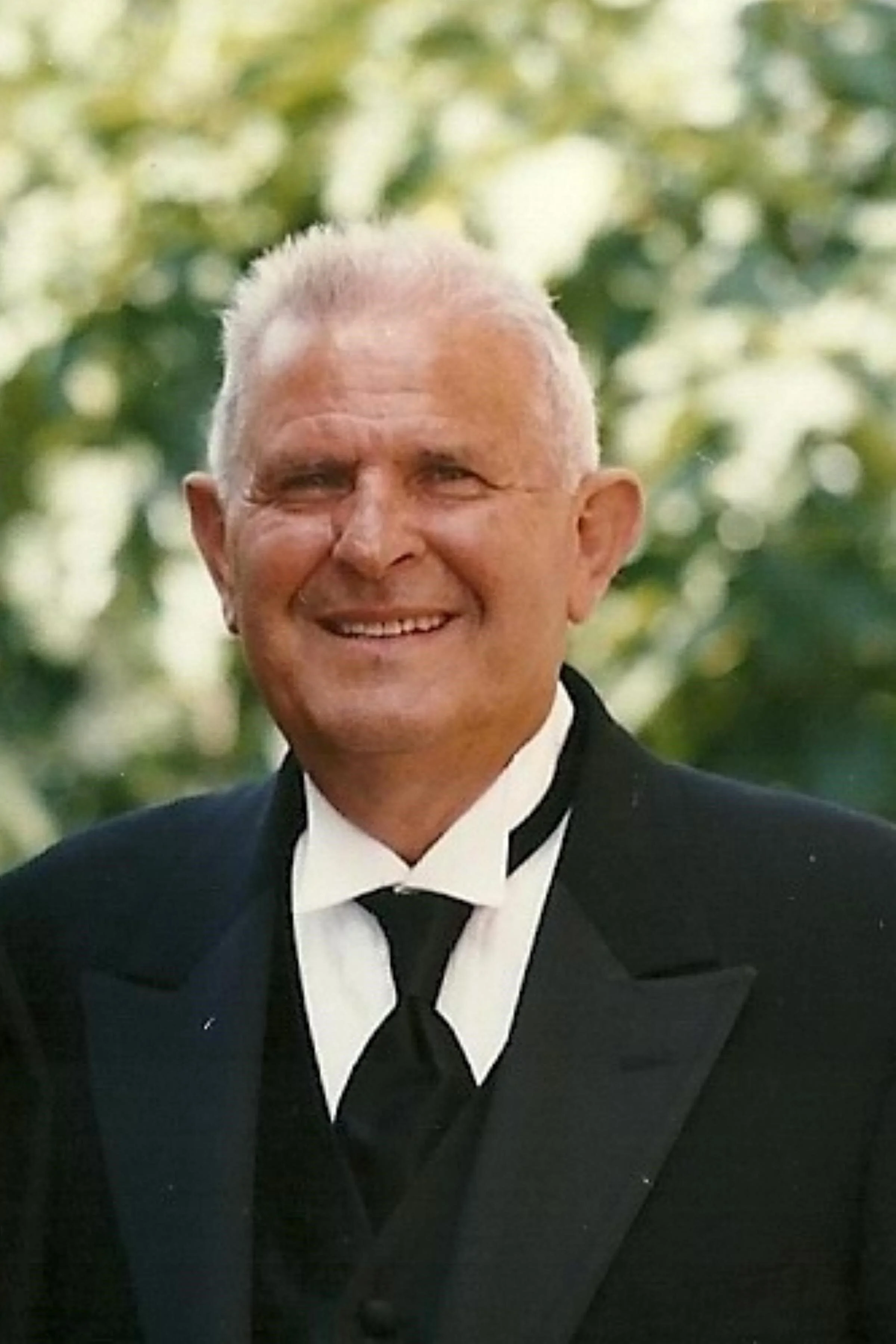
Pasquale Manna 2.jpg

For Pasquale Manna: ‘A fig tree needs love too’, by Santo Manna - 2012

April 27, 2020

10 April 2012, Montreal, Quebec, Canada

This eulogy was delivered in Italian, English and French. We will post full English translation version first, and then the original trilingual version underneath.

spoken in Italian

When my father greeted people, whether by telephone or in person, he would happily cry out: “HELLLOOOO!”

Even in the final months of his life, when the pain and suffering from his cancer was at its peak, his approach to greeting people remained as joyous as always.

Why?

Because he did not want people to suffer on his account, despite the dire circumstances – on the contrary, he wanted them to be happy. He thought of the happiness of others first and foremost. This was the essence of his character.

This is a very sad day for all of us friends and family gathered here today, and for those who knew my dad and appreciated the man he was.

Pasquale Manna 1.jpg


It’s difficult for me to control my emotions. At the same time, there is no difficulty in describing my dad’s character and the way he lived his life day-by-day; it is a simple task.

It’s an honor and a privilege for me to be here before you, on behalf of my family, and to have the opportunity to share with you the story of an exemplary husband and father, who lived such a beautiful and extraordinary life – just as it was an honor, and a privilege, to be his only son.

My father lived his life according to a personal code of conduct. Pasquale’s code was unwritten, and he never directly revealed it, but one could readily discern it by observing his humble and straight-forward way of life.

This was his code:
• Satisfy the needs of others before mine.
• Life is about giving, not receiving.
• Help others without expecting rewards.
• Always behave justly.
• Honor and respect those weaker than us.
• Make peace, not war.
And, finally:
* A fig tree needs love too.

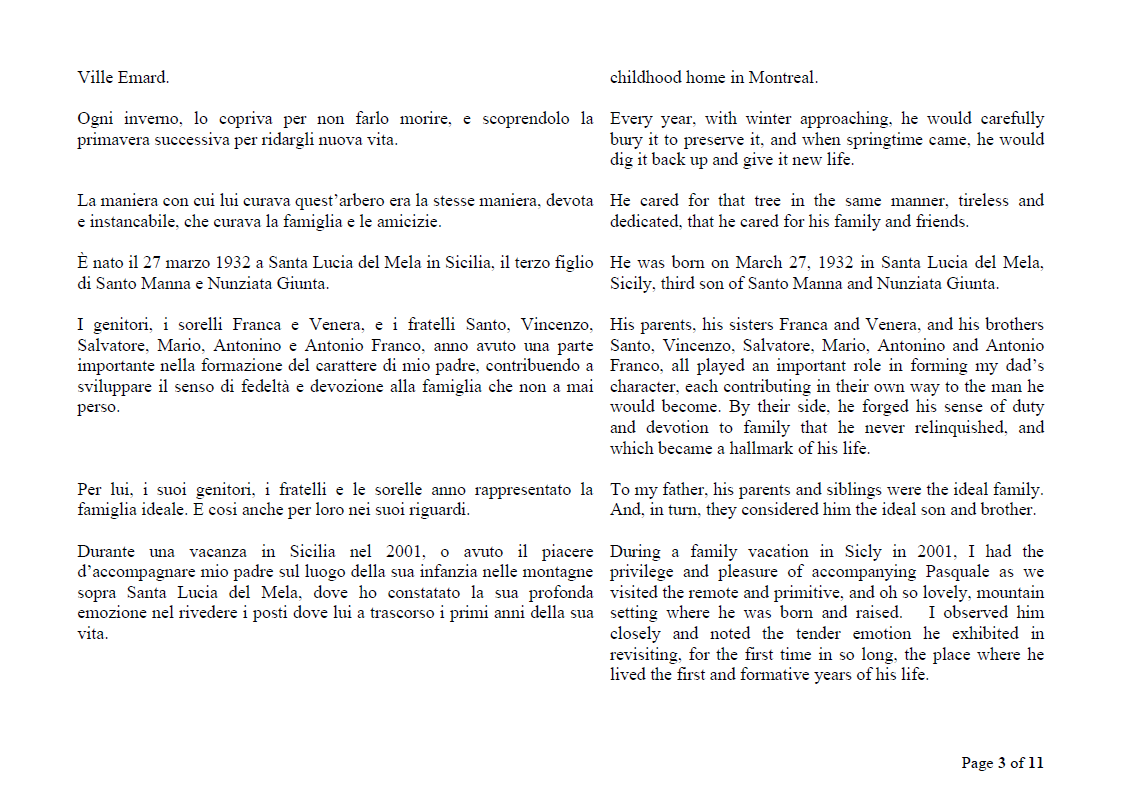
My father planted a fig tree in his garden, out behind our childhood home in Montreal.

Every year, with winter approaching, he would carefully bury it to preserve it, and when springtime came, he would dig it back up and give it new life.

He cared for that tree in the same manner, tireless and dedicated, that he cared for his family and friends.

He was born on March 27, 1932 in Santa Lucia del Mela, Sicily, third son of Santo Manna and Nunziata Giunta.

His parents, his sisters Franca and Venera, and his brothers Santo, Vincenzo, Salvatore, Mario, Antonino and Antonio Franco, all played an important role in forming my dad’s character, each contributing in their own way to the man he would become. By their side, he forged his sense of duty and devotion to family that he never relinquished, and which became a hallmark of his life.

To my father, his parents and siblings were the ideal family. And, in turn, they considered him the ideal son and brother.

pasquale manna young.jpg


During a family vacation in Sicly in 2001, I had the privilege and pleasure of accompanying Pasquale as we visited the remote and primitive, and oh so lovely, mountain setting where he was born and raised. I observed him closely and noted the tender emotion he exhibited in revisiting, for the first time in so long, the place where he lived the first and formative years of his life.

It was in those mountains that he worked as a shepherd from when he was a young boy.

It was there that he learned from a tender age how to tend the soil and keep a garden.

Those moments, seared in our memories, we relived together during his final week in the palliative care ward. I observed the same emotion in him as I recounted the experience – his reaction: “We were poor, but happy.”

It was in Sicily that he met his love Giovanna, who fell for his beautiful blue eyes and gentle bearing. We celebrated their 50th wedding anniversary together in 2009.

My mother, my sisters Nancy and Anna, and I were constantly by his side at the Montreal General in those final days – and though it was a painful period, one of suffering for all of us, we took the opportunity to talk about Dad and what he meant to us. My Mom, speaking of his peaceful and calm character, and beginning to feel how much she would miss having him beside her.

She told me a story – of how she was strolling with him one morning, and they came across a friend who he greeted in his usual friendly way. Later, they came across another person, and he did the same. She asked, “Do you know him?” Dad replied: “No, but I’ll greet him anyway. As Jesus would have greeted even his enemies.”

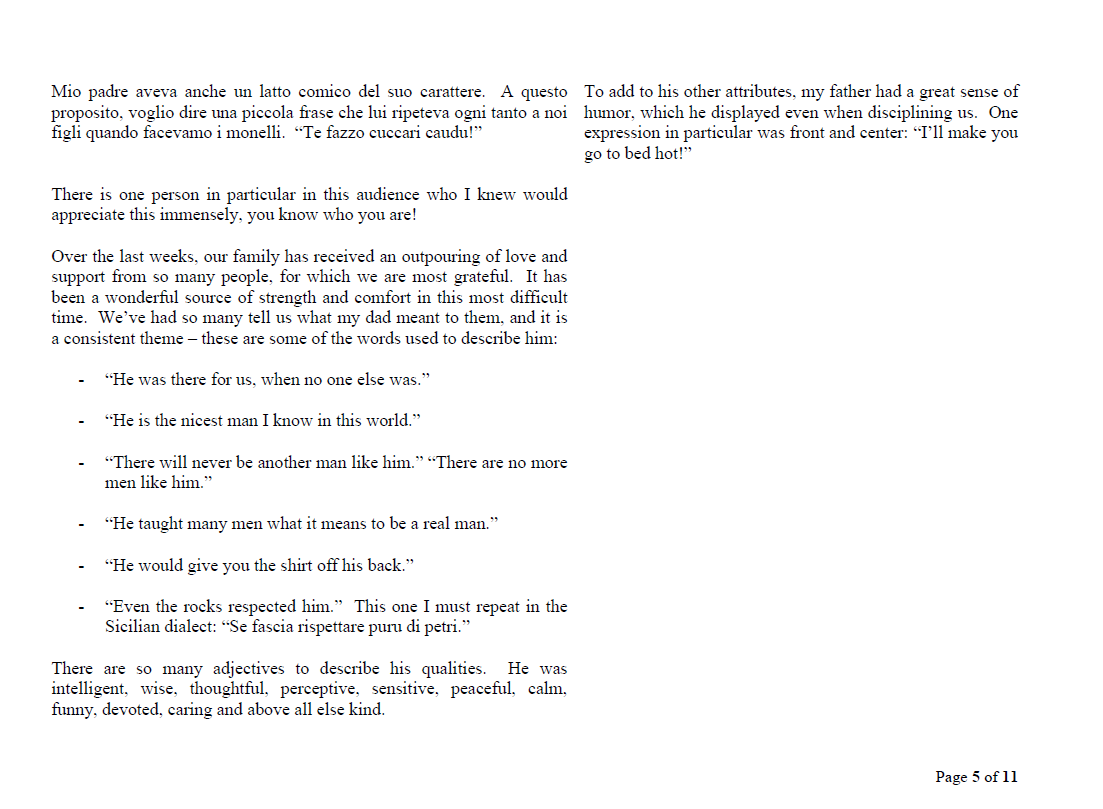
To add to his other attributes, my father had a great sense of humor, which he displayed even when disciplining us. One expression in particular was front and center: “I’ll make you go to bed hot!”

in English

There is one person in particular in this audience who I knew would appreciate this immensely, you know who you are!

Over the last weeks, our family has received an outpouring of love and support from so many people, for which we are most grateful. It has been a wonderful source of strength and comfort in this most difficult time. We’ve had so many tell us what my dad meant to them, and it is a consistent theme – these are some of the words used to describe him:

- “He was there for us, when no one else was.”
- “He is the nicest man I know in this world.”
- “There will never be another man like him.” “There are no more men like him.”

- “He taught many men what it means to be a real man.”
- “He would give you the shirt off his back.”
- “Even the rocks respected him.” This one I must repeat in the Sicilian dialect: “Se fascia rispettare puru di petri.”

There are so many adjectives to describe his qualities. He was intelligent, wise, thoughtful, perceptive, sensitive, peaceful, calm, funny, devoted, caring and above all else kind.

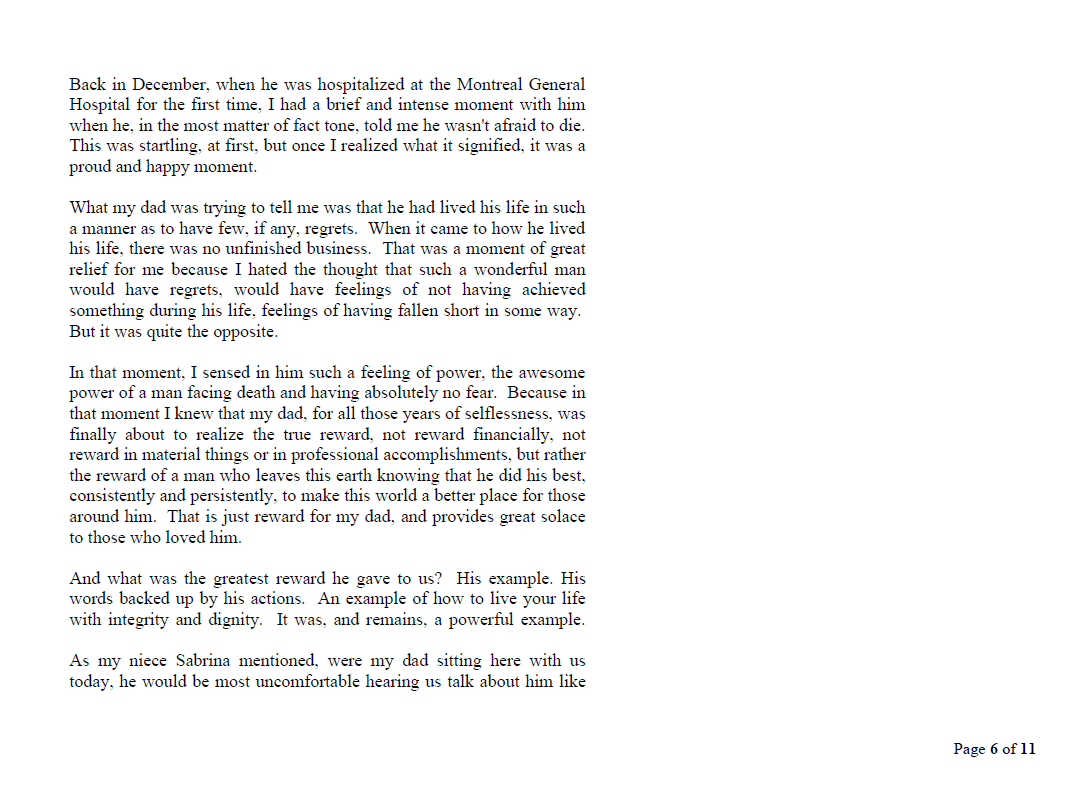
Back in December, when he was hospitalized at the Montreal General Hospital for the first time, I had a brief and intense moment with him when he, in the most matter of fact tone, told me he wasn't afraid to die. This was startling, at first, but once I realized what it signified, it was a proud and happy moment.

What my dad was trying to tell me was that he had lived his life in such a manner as to have few, if any, regrets. When it came to how he lived his life, there was no unfinished business. That was a moment of great relief for me because I hated the thought that such a wonderful man would have regrets, would have feelings of not having achieved something during his life, feelings of having fallen short in some way. But it was quite the opposite.

In that moment, I sensed in him such a feeling of power, the awesome power of a man facing death and having absolutely no fear. Because in that moment I knew that my dad, for all those years of selflessness, was finally about to realize the true reward, not reward financially, not reward in material things or in professional accomplishments, but rather the reward of a man who leaves this earth knowing that he did his best, consistently and persistently, to make this world a better place for those around him. That is just reward for my dad, and provides great solace to those who loved him.

And what was the greatest reward he gave to us? His example. His words backed up by his actions. An example of how to live your life with integrity and dignity. It was, and remains, a powerful example.

As my niece Sabrina mentioned, were my dad sitting here with us today, he would be most uncomfortable hearing us talk about him like this, it was not what he was about. He would prefer that I would talk about you, the people who so enriched his life and gave him the opportunity to spread his love and friendship, and the love and friendship you returned to him so many times. Those of you who gave so much to the Manna family, from the time we first set foot here in Montreal in 1967. He would have preferred that I use this opportunity to thank you and to tell you how much he appreciated the love you showed him, and that’s what I’ll do.

Looking out, I see so many that had such a positive impact on our family.

Thank you to the Salvadore, Lipari, Giannone, Andaloro and Borgia families, for the opportunities you gave to my dad to love and be loved. Thank you to Antonia and Anna D’Amico, who he cared for deeply, and to Madelena DiPietro, who has been an important presence in the lives of my parents.

Thank you to the family of Fortunato and Amelia Amico, who provided us with the opportunity to feel like we were part of a big and happy family, on so many holidays and special occasions and in general. This was so special to us as an ocean separated us from my father’s family in Sicily. Comare Amelia, thank you for continuing to be a great and loyal friend to my mom and dad. Compare Nato, you are sadly missed.

And finally, a most special thanks to the family of Biaggina and Giuseppe Sciotto. You took our family in when we were most in need, out of the immense goodness of your hearts. It was a huge sacrifice, which my father never forgot, and we will never forget. To my godmother Biaggina, her husband Giuseppe and daughter Franca, we miss you terribly.

Now my father is reunited with Biaggina, Giuseppe, Nato and other family and friends who he loved so much, and whose loss he felt so deeply. They are all no doubt smiling down at us right now, over a nice plate of pasta, some bread, and some home-made red wine.

My dad leaves behind eight beautiful grandchildren, who he loved and adored. Sabby, Maddy, Joey, Mike, Connor, Katie, Ross and Alayna, I know you will remember your grandfather, and the values he stood for, always. Your grandfather lived the credo that it’s not what happens to you that matters most, but rather how you react to what happens to you. You often don’t have a choice regarding the events that shape your life, but you always have the choice of how to react to those events, and it is your reaction that defines you.

And in such reactions, and in the decisions, large and small, that you’ll make throughout your lives, it will never hurt to ask yourself, what would nonno do? The world has become complicated in so many ways, but the lessons of his life, born in a much simpler time, endure.

in French

The French language and culture occupied a central role in my parents’ lives.

They lived in Vevey, in Switzerland, during the early years of their marriage, and my sisters Anna and Nancy were born there. In 1967, they migrated to Montreal and settled in the working-class enclave of Ville Emard, where my father quickly began to forge relationships with his French-Canadian neighbors and co-workers.

The communities of South West Montreal, of Ville Emard, St-Henri, Point St Charles and Ville Lasalle, had large French-Canadian / Quebecois communities. Many among its populace were also poor but happy, just like my Dad’s family, and he noticed those attributes in them.

I’d like to mention my Dad’s closest neighbors, who I know appreciated my father and the friendship he provided – Carole and Mario, Luvana and Joe, and Karim and Ibrahim and their families. I know that you admired the way my Dad lived his life, his gentle and sweet character, and we appreciate the friendship that you bestowed upon him.

We thank the doctors and nurses who attended to and supported my father – notably at the Montreal General Hospital. Thank you Doctors Tanguay, Betay and Kovacs.

Finally, we are so very grateful to the men and women of the Palliative Care Unit at the Montreal General. There are no words to express the depth of our appreciation for the kindness and compassion that you showed towards my father in his time of need. We were deeply touched and will never forget it. I call out in particular Drs. Lawlor and Chaput, and nurses Johanne, Andree, Josette, Mary Jane, Gladys, Thulane, Annie, Marie-Lin, Rosemary, Pasqua and Diane.

pasquale manna hospital.jpg


My father also greatly appreciated your efforts, even though in the end he was unable to express it. He nonetheless was able to do so, in one unforgettable moment, when he extended his hand to a nurse and whispered a thank you to her, despite his state of immense suffering and exhaustion.

Finally, our thoughts and prayers are with the families of my father’s fellow patients in the palliative ward, with whom we built a friendship upon the most difficult experience that we were sharing. We passed many nights together, and their friendship gave us courage in facing such hardship.

My dad always thought of others, and it’s now our turn to do the same. Our thoughts are with the families of Marisol Argueillo, age 39; Carolina Falcone, age 49; Michel Loiselle, age 51; Viviane Naud, age 61; and Mira Skrlj, age 66.

delivered in English

I am grateful for the Manna name that my father gave to me and my family, because it was his, and his father’s before him, and they carried it well. Because of them and others, the name symbolizes integrity, strength of character, and selflessness. These are the characteristics of my father, and by expressing them every day of his 80 years, he gave us all the privilege and honor of being associated with that name.

It’s time to say our last goodbye to my father, knowing that his memory will always be with us as we go about our lives.

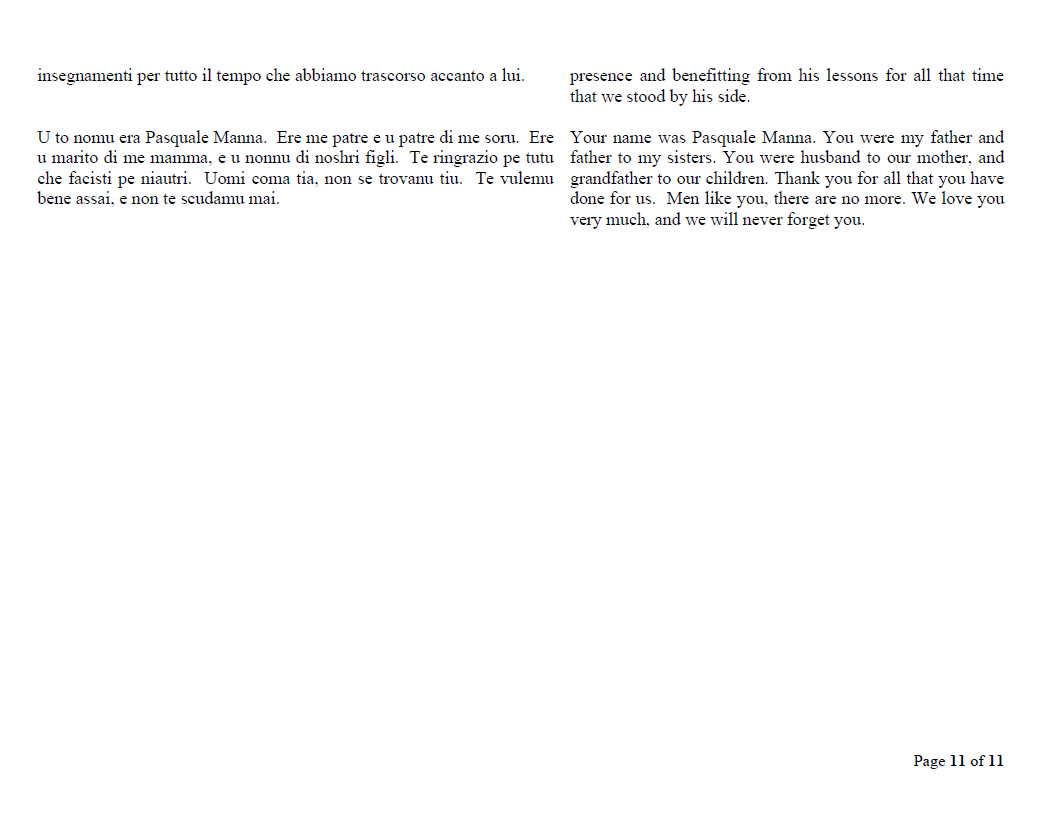
We remember always the goodwill he expressed to all he encountered during the course of his life, whether he was meeting them for the first time or had known them for many years, and how they benefited from his presence. And we, his family, who have had the privilege of basking in his presence and benefitting from his lessons for all that time that we stood by his side.

Italian

Your name was Pasquale Manna. You were my father and father to my sisters. You were husband to our mother, and grandfather to our children. Thank you for all that you have done for us. Men like you, there are no more. We love you very much, and we will never forget you.

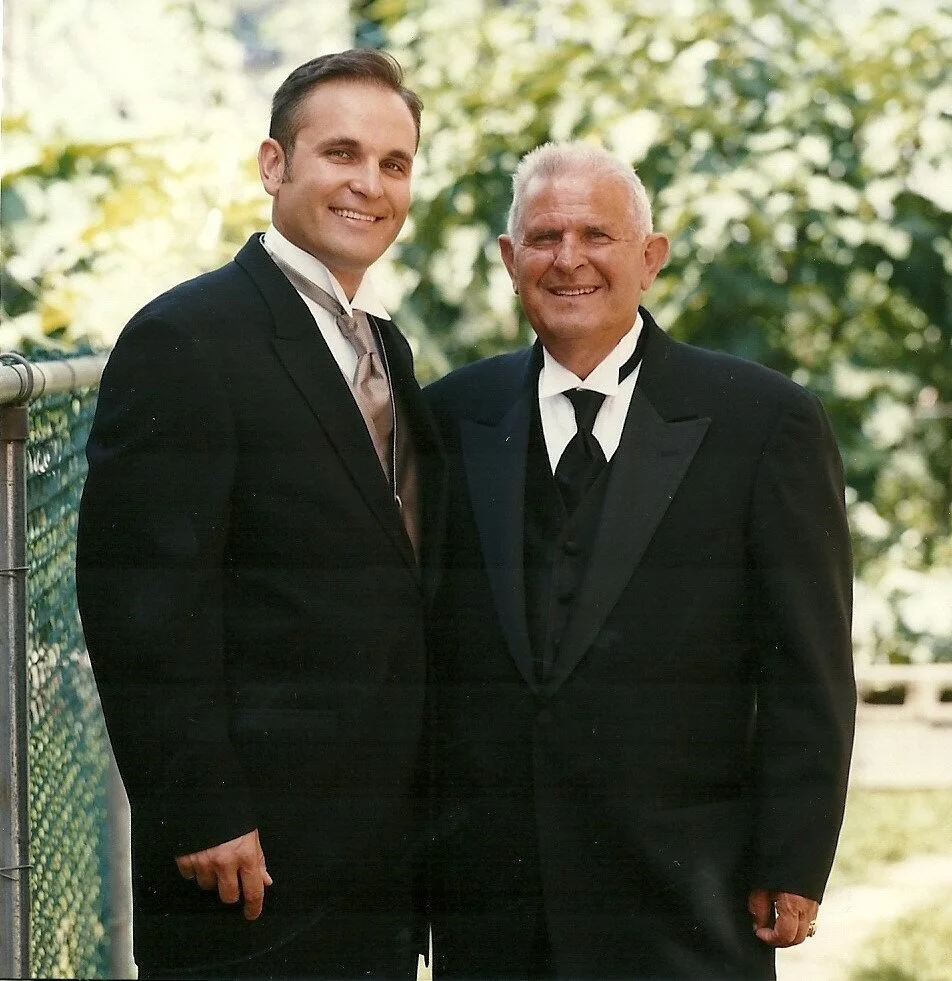
santo and pasquale.jpg
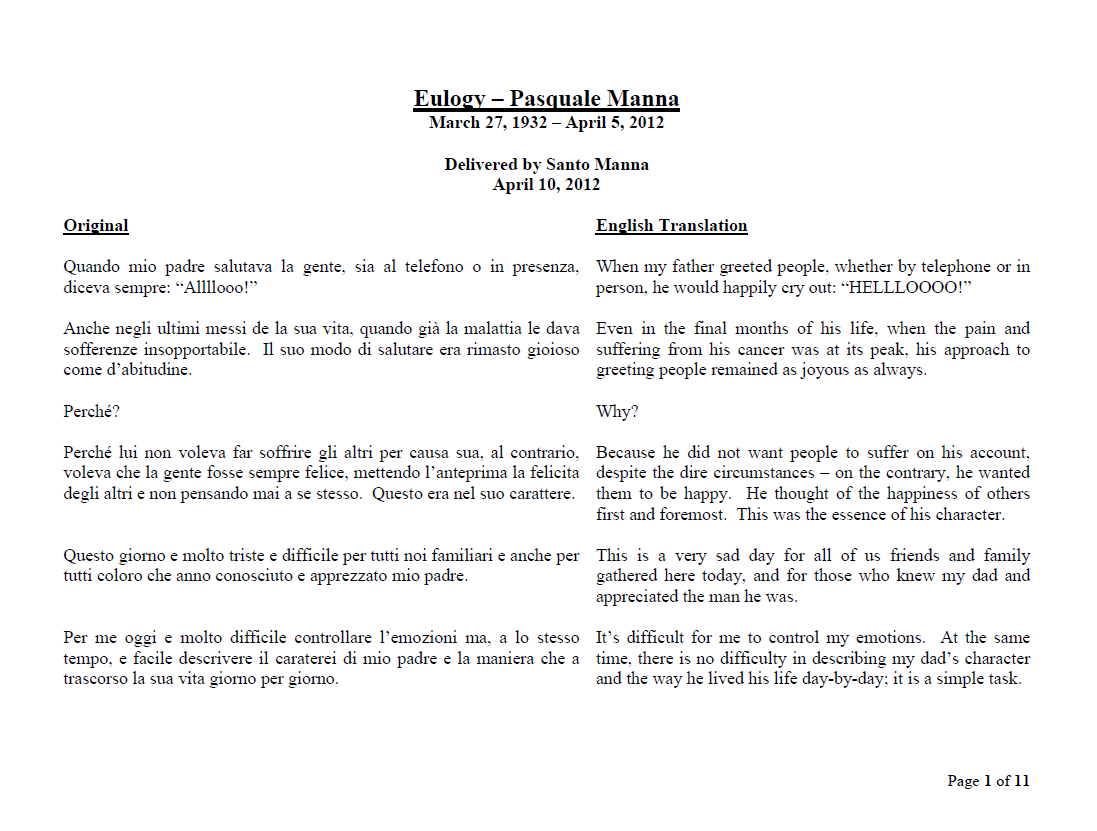
manna p1.png
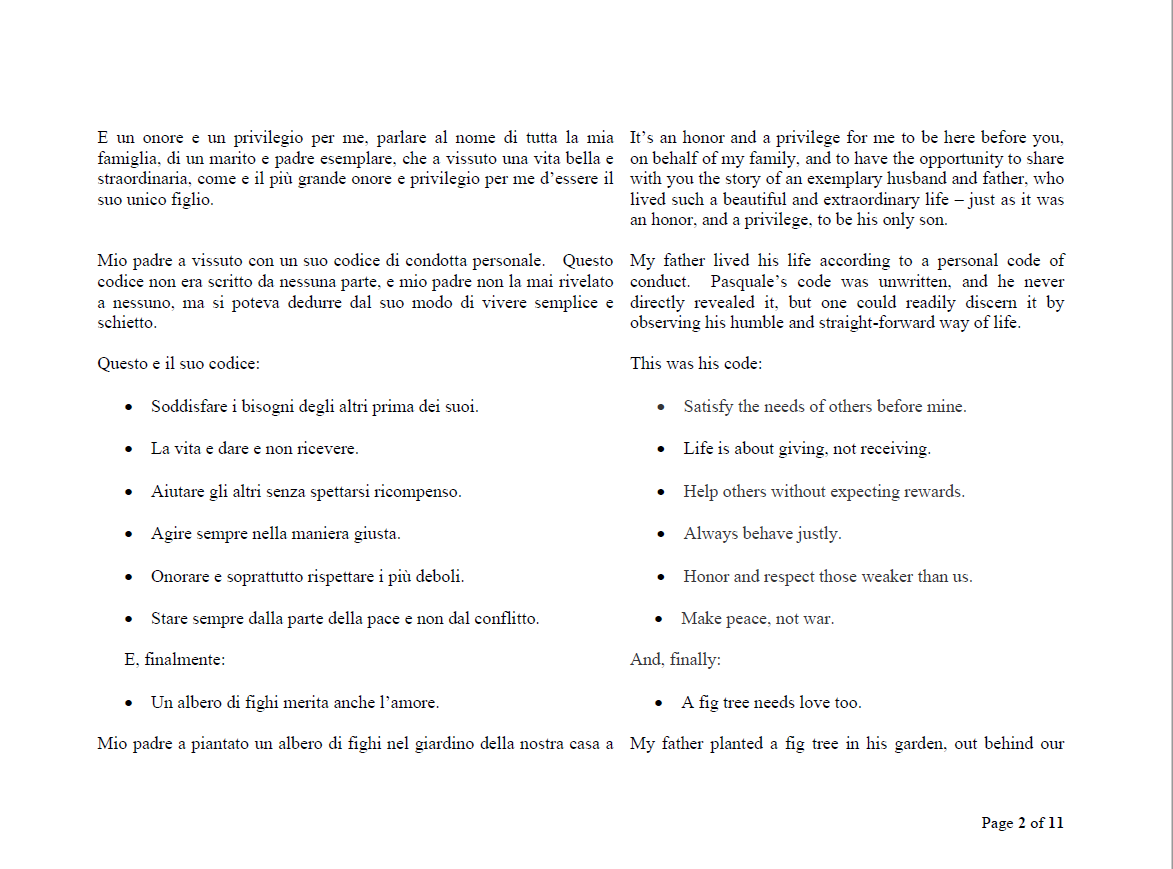
manna p2.png
manna p3.png
mann p4.png
manna p5.png
manna p6.png
manna p7.png
manna p8.png
manna p9.png
Manna p10.png
manna p11.png


Enjoyed this speech? Speakola is a labour of love and I’d be very grateful if you would share, tweet or like it. Thank you.

Facebook Twitter Facebook
In SUBMITTED 4 Tags FATHER, SON, PASQUALE MANNA, SANTO MANNA, TRILINGUAL;, MONTREAL, FRENCH, ENGLISH, ITALIAN, EULOGY
Comment

For Louis Waller: "A life devoted to justice, kindness, humility", Speech at Shloshim, by Ian Waller - 2019

April 19, 2020


7 November 2019, St Kilda Hebrew Congregation, Melbourne, Australia

Speaking at a dinner in honor of my father in 2000, Justice Michael Kirby then a High Court judge said:

In a life, such as Louis Waller has lived, it is not enough to begin with his academic laurels. To understand him, and the wellsprings of his humanity, it is essential to journey back to Siedlce in Poland.


My father, Peter Louis Waller,

הריני כפרת משכבו פנחס יהודה בן יעקב דב הכהן

was born Pinchas Leib Waligora in Siedlce Poland on 9th February 1935.

His birth was registered by his father the following day, so 10th February became his official birthday.

Like many other cities in Europe, Siedlce (which is situated about 100 km east of Warsaw) had a significant Jewish population. In 1935 Jews constituted some 40% of the city's population of 30,000.

Of course, all that changed forever during the Second World War. By the end of 1942, almost every member of its Jewish population had been murdered in Treblinka.

That was the fate that befell almost all of my father’s Siedlce family.

Somehow, sensing the impending doom, Dad’s parents managed to leave Poland with their 3 year old son in 1938 and made their way by sea to Melbourne.

Dad’s parents had both been raised in orthodox hassidic homes. Indeed, the sandek at Dad’s bris in 1935 (given the honor of holding Dad while he was circumcised) was the Biale Rebbe. There were also strong family connections on my grandmother’s side to the Alexander Rebbe.

Dad’s father had received a cheder and yeshiva education in Siedlce, but at the age of 18 he was conscripted into the Polish army for 4 years, and thereafter became a fervent supporter of the Linke Poale Zion, the left wing Socialist Zionist movement, and the life-style associated with it. So, by the time they arrived in Melbourne in 1938 with Dad then aged 3, my grandparents’ religious observance had diminished.

But my grandparents had decided that their son would have a Jewish education and a Jewish life. They understood that while in Siedlce, yiddishkeit was all-pervasive whatever one’s personal practice, in Melbourne they had to work at being Jewish especially if they wanted to ensure that Dad would remain so.

So, in 1940, aged 5, Dad became a pupil at the St Kilda Hebrew School. And from 1942 (while his father was conscripted, this time as a “friendly alien” in the Sixth Employment Company of the Australian Army) he began walking with his mother every Shabbat morning to St Kilda Synagogue from their rented cottage in Argyle Street. From the age of 9, Dad attended services every Friday evening as well.

After the Second World War my grandfather became a regular congregant here too, and he remained so until he died in 1981.

It is therefore particularly appropriate that this Shloshim service, marking 30 days since my father left this world, is being held here at St Kilda Synagogue.

waller funeral 1.png


* * *

Rabbi Jacob Danglow, who led this Synagogue for more than half a century between 1905 and 1957, had a powerful impact on my grandparents and on Dad.

In a speech he delivered in 1980 on the 100th anniversary of Rabbi Danglow’s birth, Dad said that when Rabbi Danglow stood in the pulpit – this pulpit – delivering his sermons he could, as a child, imagine no other occupant.

This is how Dad described Rabbi Danglow in that speech:

...pre-eminent always...- dark; a sun-tanned face, an iron-grey moustache, black canonicals, relieved a little by the bands of white at his throat, and draped in a silk tallit with blue stripes, a tiny replica of which I and every boy in the synagogue wore in those days...

Although he could imagine no one else occupying the pulpit, as an 8 year old attending Sunday school here, on one occasion Dad was directed to go into the shule ascend the pulpit and read from the Singers Prayer Book until he was told to stop. A microphone was being installed for some occasion and the electrician wanted to test its effectiveness. Dad said:

I mounted the steps with trepidation. The view I had was breathtaking, but I was also seized by a terrible fear. What if Rabbi Danglow should at that moment come through the door and see me? He would surely thunder “Get out!” and banish me forever from the shule.

Dad celebrated his barmitzvah in this shule on 21st February 1948 (parshat Tetzaveh). He remembers standing in the Warden’s box as Rabbi Danglow implored him to conduct himself so as to be a source of pride to his parents, his family and his school.

Exactly 3 months later, on 21st May 1948, David Ben Gurion proclaimed the declaration formally establishing the State of Israel.

Dad recalls attending a special thanksgiving service in this shule after the establishment of Medinat Yisrael.

He said:

Rabbi Danglow delivered a sermon which I do remember — it was on the theme that Israel should be a Jewish state. And when the choir, which throughout the war had sung the National Anthem to end the service, concluded instead with Hatikvah, I knew that the world had changed. Whatever happened, my life and the lives of my contemporaries would thereafter in large degree, be bound up with the life and future of Israel.


Of course, Dad’s words were prescient.

Because it would be in Israel where he would fall in love with Mum in the summer of 1957.

And it would be in Israel where my brother Anthony and sister Elly would make their homes, and together with Michal and Michael would raise their families.

And it would be in Israel where we would celebrate Mum and Dad’s 60th wedding anniversary - returning to the place where it all began, but this time surrounded by their 35 children, grandchildren and great grandchildren.

And it will be in Israel tomorrow that a Shloshim service will take place in Modi’in arranged by Anthony and Elly, at which a siyum mishnayot will be conducted marking the special learning that has been undertaken in Dad’s memory during the last 30 days.
* * *

Dad continued to attend this Synagogue regularly until he sailed to England to commence post graduate study at Oxford in 1956. And in later years Dad continued to attend here on those days when he could drive to shule.

So, he would return to the synagogue of his youth to celebrate the triumph of Purim and to commemorate the tragedy of Tisha B’Av and on other occasions as well.

As a boy, Dad also continued his formal Jewish education at its Hebrew school, attending classes on Shabbat mornings after shule, on Sunday mornings and on Monday, Tuesday and Thursday afternoons.

Dad’s life changed completely when, in March 1950, Reverend Bert Wreschner, then assistant minister of STKHC and Headmaster of the Hebrew School, appointed Dad, then aged 15, as a teacher in the Hebrew School responsible for a class of 10 and 11 year old boys and girls.

Dad said that that experience was “to light the fires of enthusiasm for Jewish learning and for teaching” in his impressionable mind.

In his matriculation exams in 1951 Dad received first class honours in Hebrew.

And in each year of his law degree, Dad continued his studies in Biblical Hebrew and Aramaic at Melbourne University in the Department of Semitic Studies under the renowned Professor Maurice David Goldman.

* * *

While Dad received his formal Jewish education at St Kilda Hebrew School, his informal Jewish education was probably more influential.

Of course, it came primarily from his home, from his mother and from his father who as a young boy had been a Talmudic prodigy and was well versed in Jewish law and practice.

Dad recalls being taught by his father to read Rashi script and, together with him, studying the biblical commentaries on the weekly Torah portion. His father also taught him how to read and write Yiddish which had been Dad’s mamaloshen (his mother tongue) from the time he could speak.

Dad’s informal Jewish education also came from 2 other principal sources.

From the age of 11 until he was 14, Dad attended an informal gathering called Oyneg Shabbos organised and led by a young man named Eli Loebenstein. Meetings were held on Shabbat afternoons in the homes of some of the participants where there were stories, games, songs – as well as cake and lemonade. Eli spoke to them about the forthcoming Jewish holidays, or about an episode in the Torah reading of the week, or about tallis and tefillin, or about all manner of matters Jewish and made sure that every person in the group was regarded as an important participant.

Dad later wrote:

I didn't see Eli often after the end of Oyneg Shabbos. I remember him today with undiminished fondness, and with deep respect. What he did for me, and my Oyneg Shabbos companions, he did because he wanted to ensure that we Melbourne Jewish kids understood how wonderful was our inheritance, and how precious was each Shabbos we enjoyed.

The second major informal influence on Dad was Bnei Akiva. Between the ages of 12 and 21, a large part of Dad’s life was lived in this Religious Zionist youth movement.

As a madrich or youth leader Dad welcomed the opportunities for autonomy and independence.

And his own madrichim left indelible impressions on him, particularly Arnold Bloch ע׳ה who showed Dad that Jewish learning and secular studies not only could, but should, merit equal attention and that the insights from one could illuminate the other.

The seeds of Jewish life and learning that were planted in Dad as a boy took root and flourished, imbuing his life with a spiritual dimension that permeated everything he did thereafter.

* * *

Dad returned to Melbourne in 1959 having obtained a BCL with first class honours from Oxford, but more importantly having met and married Mum.

Their first home was a flat in Glenhuntly Road Elwood. So from about June 1959 until October 1962 Dad davened at Elwood TTC. Dad especially enjoyed the davening of Chazan Adler who he described as “a superb ba'al tefila, and free of prima-donnaish characteristics”.

In 1962, Mum and Dad moved to Hartley Ave, Caulfield and Dad began a life-long association with another, very different, sort of synagogue.

In fact, in name not a synagogue or Bet Knesset, but a Bet Midrash (a house of learning) - the Caulfield Beth HaMedrash, colloquially known to many as Katanga.

Interestingly, Dad rarely if ever used that appellation, referring to it simply as “the Beis Medrash”.

It had no ornate sanctuary, no imposing dome, no Anglo-Jewish heritage, indeed no official rabbi.

Instead it comprised devout and learned Holocaust survivors whose mother tongue was Yiddish. Dad enjoyed its simplicity and authenticity and forged close personal relationships with generations of its mitpallelim.

For at least the last 20 years Dad would speak on Shabbat afternoons twice a year - on Parshat Mishpatim and Parshat Shoftim whose Torah readings dealt with legal matters.

Dad, the public teacher of law, enjoyed preparing and delivering these intimate lectures in which he would skilfully weave his own experiences, insights and reflections into the biblical text.

He delivered his last such talk just 2 months ago.

Dad’s final appearance at his beloved Beis Medrash was on Rosh Hashana the Jewish New Year - less than 6 weeks ago.

His last public pronouncement that day was his recitation of the Birkat Kohanim – the Priestly Blessing – which he always did with pride and more importantly be’ahava with love.

The memory of that day will stay with me forever.

Dad’s affiliation with, and attraction to, these very different places of worship – to St Kilda Hebrew Congregation and to the Caulfield Beth HaMedrash - speaks to his openness to different forms of Orthodox Jewish expression.

Dad understood the need for fidelity to tradition, to halacha, but accepted that there were “shivim panim letorah” many ways of expressing that connection.

That openness to different outlooks and approaches characterized Dad’s involvement with a vast range of Jewish organisations during his life - in education, in welfare, and in communal life.

With Bert Wreschner, Dad assisted the newly established Moriah College which we attended in the 1960’s. Later, when we moved to Mount Scopus College, Dad chaired its Education Committee.

He helped establish programs to enhance tertiary Jewish studies at both Monash University and the University of Melbourne.

Dad served as Chairman of the Advisory Committee of the Australian Centre for Jewish Civilisation at Monash University which is dedicated to teaching about the evolution of Jewish civilisation and its contribution to the world.
He also served on the Board of Governors of the Hebrew University of Jerusalem and of Tel Aviv University. And he was instrumental in the development of the Hillel Foundation in Victoria promoting Jewish life on university campuses and the establishment of Australian Academics for Peace in the Middle East.
Together with Mum he was actively involved with Bnai Brith for decades and more recently also with Courage to Care, the Makor Library and Jewish Care.

Throughout his life, Dad’s love of learning never ceased, his study overflowing with books, especially of Jewish law and lore (L.O.R.E. as Dad would say) spilling into bookshelves in every room of their home.
In recent years Dad rekindled his love of Yiddish, topping the State in VCE Yiddish and attending weekly conversation classes.
* * *
In a recently published book by Susan Bartie on Pioneering Australian Legal Scholars, she writes that as a law teacher, together with Peter Brett, Dad’s goal was not simply to produce competent legal practitioners, but to foster a sense of moral awareness in their students and to impress upon them the onerous moral responsibilities lawyers faced.

In teaching criminal law Dad would introduce his first lecture with Rv Dudley & Stevens the famous case involving human cannibalism on the high seas to illustrate the tension that exists between law and morality. That lesson and the issues it raised have remained with Dad’s students throughout their lives.

And as a pioneering law reformer, much of Dad’s work concerned the beginning and the end of life. Dad had to grapple with the most difficult legal, social and ethical dilemmas thrown up by scientific and medical advances in IVF and assisted reproduction technology.

A feature article in the Age in June 1982 stated:
The professor’s respect for human life is informed by his religious belief.
It quoted Dad as saying : “I am Jewish; it is part of the fabric of my life”.

And so it was.

In everything that he was, and in everything that he did.

* * *


In his study of Biblical Hebrew at University, and in the years since, Dad read the famous verse in the Book of Michah, where the Prophet says:

He has told you, O man, what is good, and what the Lord demands of you;
Only that you do justice,
love kindness,
and walk Humbly with your God.

הִגִּ֥יד לְךָ֛ אָדָ֖ם מַה־טּ֑וֹב וּמָה ה דּוֹרֵ֣שׁ מִמְּךָ֗ כִּ֣י אִם־עֲשׂ֚וֹת מִשְׁפָּט֙ וְאַ֣הֲבַת חֶ֔סֶד וְהַצְנֵ֥עַ לֶ֖כֶת עִם־אֱלֹקיךָ:

That simple yet profound verse encapsulates so beautifully Dad’s life.

A life devoted to justice – to teaching generations of lawyers, judges and legislators that the law must be an instrument of justice, to reforming the law so that it achieved that end, and to living a life of personal integrity

A life infused with kindness – in his lifelong relationships and in his daily interactions.

And – despite his enormous achievements - a life characterized by humility.

To have been so close to someone who embodied these qualities is a privilege that Adina and I and our children and our grandchildren will always cherish.

And a constant reminder to us of what we should strive to be.

Professor Waller.jpg


* * *

In the speech he gave about Rabbi Danglow, Dad recalls a final memory.

It is Yom Kippur. The day of Atonement.
The shule is full, and almost still, darkened by approaching night.
It is Neilah, the final service on this holiest of holy days.
On the bimah, enveloped in white kittel and woollen tallit stands the rabbi.

In Dad’s description:

The limpid words of the liturgical poem capture the scene and fix the atmosphere:

Hayom yifneh,
hashemesh yavo v’yifneh
Navo’ah sh’arecha

The day is passing,
The sun is low, the day is growing late.
O – let us come into Thy gates at last.

So let me conclude with my final memory of my father.

It is Yom Kippur. The Day of Atonement.
Night has fallen.
It is Kol Nidrei, the first service on this holiest of holy days.
But we are not in shule.
We are gathered around Dad’s hospital bed.
Enveloped in white kittel and woollen tallit, we sing the haunting melodies that have resonated with our people for centuries and which Dad loved.
Then, we begin to recite our silent devotion.
As we symbolically beat our chests in confession - we see that Dad’s chest is now still.

The day has now passed,
the sun has now set
And Dad’s soul is about to enter Thy gates at last.

Yehi zichro baruch

May his memory be a blessing

waller funeral2.png

Enjoyed this speech? Speakola is a labour of love and I’d be very grateful if you would share, tweet or like it. Thank you.

Facebook Twitter Facebook
In SUBMITTED 4 Tags LOUIS WALLER, PROFESSOR LOUIS WALLER, IAN WALLER, FATHER, SON, JEWISH, LAWYER, TEACHER, TRANSCRIPT, ST KILDA SYNAGOGUE, SHUL
Comment

For John F Kennedy Jr and Carolyn Bessette: 'There was in him a great promise of things to come', by Edward Kennedy - 1999

April 2, 2020

23 July 1999, Basilica of the National Shrine of the Immaculate Conception, Washington DC, USA

Thank you, President and Mrs. Clinton and Chelsea, for being here today. You’ve shown extraordinary kindness through the course of this week.

Once, when they asked John what he would do if he went into politics and was elected president, he said, “I guess the first thing is call up Uncle Teddy and gloat.” I loved that. It was so like his father.

From the first day of his life, John seemed to belong not only to our family, but to the American family. The whole world knew his name before he did. A famous photograph showed John racing across the lawn as his father landed in the White House helicopter and swept up John in his arms. When my brother saw that photo, he exclaimed, “Every mother in the United States is saying, ‘Isn’t it wonderful to see that love between a son and his father, the way that John races to be with his father.’ Little do they know, that son would have raced right by his father to get to that helicopter.”

But John was so much more than those long ago images emblazoned in our minds. He was a boy who grew into a man with a zest for life and a love of adventure. He was a pied piper who brought us all along. He was blessed with a father and mother who never thought anything mattered more than their children.

When they left the White House, Jackie’s soft and gentle voice and unbreakable strength of spirit guided him surely and securely to the future. He had a legacy, and he learned to treasure it. He was part of a legend, and he learned to live with it. Above all, Jackie gave him a place to be himself, to grow up, to laugh and cry, to dream and strive on his own.

John learned that lesson well. He had amazing grace. He accepted who he was, but he cared more about what he could and should become. He saw things that could be lost in the glare of the spotlight. And he could laugh at the absurdity of too much pomp and circumstance.

He loved to travel across the city by subway, bicycle and roller blade. He lived as if he were unrecognizable, although he was known by everyone he encountered. He always introduced himself, rather than take anything for granted. He drove his own car and flew his own plane, which is how he wanted it. He was the king of his domain.

He thought politics should be an integral part of our popular culture, and that popular culture should be an integral part of politics. He transformed that belief into the creation of “George.” John shaped and honed a fresh, often irreverent journal. His new political magazine attracted a new generation, many of whom had never read about politics before.

John also brought to “George” a wit that was quick and sure. The premier issue of “George” caused a stir with a cover photograph of Cindy Crawford dressed as George Washington with a bare belly button. The “Reliable Source” in The Washington Post printed a mock cover of “George” showing not Cindy Crawford, but me dressed as George Washington, with my belly button exposed. I suggested to John that perhaps I should have been the model for the first cover of his magazine. Without missing a beat, John told me that he stood by his original editorial decision.

John brought this same playful wit to other aspects of his life. He campaigned for me during my 1994 election and always caused a stir when he arrived in Massachusetts. Before one of his trips to Boston, John told the campaign he was bringing along a companion, but would need only one hotel room. Interested, but discreet, a senior campaign worker picked John up at the airport and prepared to handle any media barrage that might accompany John’s arrival with his mystery companion. John landed with the companion all right – an enormous German shepherd dog named Sam he had just rescued from the pound.

He loved to talk about the expression on the campaign worker’s face and the reaction of the clerk at the Charles Hotel when John and Sam checked in. I think now not only of these wonderful adventures, but of the kind of person John was. He was the son who quietly gave extraordinary time and ideas to the Institute of Politics at Harvard that bears his father’s name. He brought to the institute his distinctive insight that politics could have a broader appeal, that it was not just about elections, but about the larger forces that shape our whole society.

John was also the son who was once protected by his mother. He went on to become her pride – and then her protector in her final days. He was the Kennedy who loved us all, but who especially cherished his sister Caroline, celebrated her brilliance, and took strength and joy from their lifelong mutual admiration society.And for a thousand days, he was a husband who adored the wife who became his perfect soul mate. John’s father taught us all to reach for the moon and the stars. John did that in all he did – and he found his shining star when he married Carolyn Bessette.

How often our family will think of the two of them, cuddling affectionately on a boat, surrounded by family – aunts, uncles, Caroline and Ed and their children, Rose, Tatiana, and Jack, Kennedy cousins, Radziwill cousins, Shriver cousins, Smith cousins, Lawford cousins – as we sailed Nantucket Sound. Then we would come home, and before dinner, on the lawn where his father had played, John would lead a spirited game of touch football. And his beautiful young wife, the new pride of the Kennedys, would cheer for John’s team and delight her nieces and nephews with her somersaults.

We loved Carolyn. She and her sister Lauren were young extraordinary women of high accomplishment – and their own limitless possibilities. We mourn their loss and honor their lives. The Bessette and Freeman families will always be part of ours.

John was a serious man who brightened our lives with his smile and his grace. He was a son of privilege who founded a program called Reaching Up to train better caregivers for the mentally disabled. He joined Wall Street executives on the Robin Hood Foundation to help the city’s impoverished children. And he did it all so quietly, without ever calling attention to himself. John was one of Jackie’s two miracles. He was still becoming the person he would be, and doing it by the beat of his own drummer. He had only just begun. There was in him a great promise of things to come.

The Irish ambassador recited a poem to John’s father and mother soon after John was born. I can hear it again now, at this different and difficult moment:

“We wish to the new child,
A heart that can be beguiled,
By a flower,
That the wind lifts,
As it passes.
If the storms break for him,
May the trees shake for him,
Their blossoms down.
In the night that he is troubled,
May a friend wake for him,
So that his time be doubled,
And at the end of all loving and love
May the Man above,
Give him a crown.”

We thank the millions who have rained blossoms down on John’s memory. He and his bride have gone to be with his mother and father, where there will never be an end to love. He was lost on that troubled night, but we will always wake for him, so that his time, which was not doubled, but cut in half, will live forever in our memory, and in our beguiled and broken hearts. We dared to think, in that other Irish phrase, that this John Kennedy would live to comb gray hair, with his beloved Carolyn by his side. But like his father, he had every gift but length of years. We who have loved him from the day he was born, and watched the remarkable man he became, now bid him farewell.

God bless you, John and Carolyn. We love you and we always will.

Source: http://edition.cnn.com/US/9907/23/kennedy....

Enjoyed this speech? Speakola is a labour of love and I’d be very grateful if you would share, tweet or like it. Thank you.

Facebook Twitter Facebook
In PUBLIC FIGURE D Tags JOHN F KENNEDY JNR, CAROLYN BESSETTE, PLANE CRASH, MARY'S VINYARD, EDWARD KENNEDY, EULOGY, KENNEDY FAMILY
Comment

For Edward Kennedy: 'We weep because we loved this kind and tender hero', by Barack Obama - 2009

April 2, 2020

29 August 2009, Our Lady of Perpetual Help Basilica, Boston, Massachusetts, USA

Mrs. Kennedy, Kara, Edward, Patrick, Curran, Caroline, members of the Kennedy family, distinguished guests, and fellow citizens:

Today we say goodbye to the youngest child of Rose and Joseph Kennedy. The world will long remember their son Edward as the heir to a weighty legacy; a champion for those who had none; the soul of the Democratic Party; and the lion of the U.S. Senate – a man whose name graces nearly one thousand laws, and who penned more than three hundred himself.

But those of us who loved him, and ache with his passing, know Ted Kennedy by the other titles he held: Father. Brother. Husband. Uncle Teddy, or as he was often known to his younger nieces and nephews, “The Grand Fromage,” or “The Big Cheese.” I, like so many others in the city where he worked for nearly half a century, knew him as a colleague, a mentor, and above all, a friend.

Ted Kennedy was the baby of the family who became its patriarch; the restless dreamer who became its rock. He was the sunny, joyful child, who bore the brunt of his brothers’ teasing, but learned quickly how to brush it off. When they tossed him off a boat because he didn’t know what a jib was, six-year-old Teddy got back in and learned to sail. When a photographer asked the newly elected Bobby to step back at a press conference because he was casting a shadow on his younger brother, Teddy quipped, “It’ll be the same in Washington.”

This spirit of resilience and good humor would see Ted Kennedy through more pain and tragedy than most of us will ever know. He lost two siblings by the age of sixteen. He saw two more taken violently from the country that loved them. He said goodbye to his beloved sister, Eunice, in the final days of his own life. He narrowly survived a plane crash, watched two children struggle with cancer, buried three nephews, and experienced personal failings and setbacks in the most public way possible.

It is a string of events that would have broken a lesser man. And it would have been easy for Teddy to let himself become bitter and hardened; to surrender to self-pity and regret; to retreat from public life and live out his years in peaceful quiet. No one would have blamed him for that.

But that was not Ted Kennedy. As he told us, “(I)individual faults and frailties are no excuse to give in” and no exemption from the common obligation to give of ourselves.” Indeed, Ted was the “Happy Warrior” that the poet William Wordsworth spoke of when he wrote:

As tempted more; more able to endure,
As more exposed to suffering and distress;
Thence, also, more alive to tenderness.

Through his own suffering, Ted Kennedy became more alive to the plight and suffering of others; the sick child who could not see a doctor; the young soldier sent to battle without armor; the citizen denied her rights because of what she looks like or who she loves or where she comes from. The landmark laws that he championed – the Civil Rights Act, the Americans with Disabilities Act, immigration reform, children’s health care, the Family and Medical Leave Act all have a running thread.

Ted Kennedy’s life’s work was not to champion those with wealth or power or special connections. It was to give a voice to those who were not heard; to add a rung to the ladder of opportunity; to make real the dream of our founding. He was given the gift of time that his brothers were not, and he used that gift to touch as many lives and right as many wrongs as the years would allow.

We can still hear his voice bellowing through the Senate chamber, face reddened, fist pounding the podium, a veritable force of nature, in support of health care or workers’ rights or civil rights. And yet, while his causes became deeply personal, his disagreements never did.

While he was seen by his fiercest critics as a partisan lightning rod, that is not the prism through which Ted Kennedy saw the world, nor was it the prism through which his colleagues saw him. He was a product of an age when the joy and nobility of politics prevented differences of party and philosophy from becoming barriers to cooperation and mutual respect at a time when adversaries still saw each other as patriots.
And that’s how Ted Kennedy became the greatest legislator of our time. He did it by hewing to principle, but also by seeking compromise and common cause, not through deal-making and horse-trading alone, but through friendship, and kindness, and humor.

There was the time he courted Orrin Hatch’s support for the Children’s Health Insurance Program by having his chief of staff serenade the senator with a song Orrin had written himself; the time he delivered shamrock cookies on a china plate to sweeten up a crusty Republican colleague; and the famous story of how he won the support of a Texas committee chairman on an immigration bill.

Teddy walked into a meeting with a plain manila envelope, and showed only the chairman that it was filled with the Texan’s favorite cigars. When the negotiations were going well, he would inch the envelope closer to the chairman. When they weren’t, he would pull it back. Before long, the deal was done.

It was only a few years ago, on St. Patrick’s Day, when Teddy buttonholed me on the floor of the Senate for my support on a certain piece of legislation that was coming up for vote. I gave him my pledge, but expressed my skepticism that it would pass. But when the roll call was over, the bill garnered the votes it needed, and then some. I looked at Teddy with astonishment and asked how he had pulled it off. He just patted me on the back, and said “Luck of the Irish!”

Of course, luck had little to do with Ted Kennedy’s legislative success, and he knew that. A few years ago, his father-in-law told him that he and Daniel Webster just might be the two greatest senators of all time. Without missing a beat, Teddy replied, “What did Webster do?”

But though it is Ted Kennedy’s historic body of achievements we will remember, it is his giving heart that we will miss. It was the friend and colleague who was always the first to pick up the phone and say, “I’m sorry for your loss,” or “I hope you feel better,” or “What can I do to help?” It was the boss who was so adored by his staff that over five hundred spanning five decades showed up for his 75th birthday party. It was the man who sent birthday wishes and thank you notes and even his own paintings to so many who never imagined that a U.S. Senator would take the time to think about someone like them. I have one of those paintings in my private study – a Cape Cod seascape that was a gift to a freshman legislator who happened to admire it when Ted Kennedy welcomed him into his office the first week he arrived in Washington; by the way, that’s my second favorite gift from Teddy and Vicki after our dog Bo. And it seems like everyone has one of those stories – the ones that often start with “You wouldn’t believe who called me today.”

Ted Kennedy was the father who looked after not only his own three children, but John’s and Bobby’s as well. He took them camping and taught them to sail. He laughed and danced with them at birthdays and weddings; cried and mourned with them through hardship and tragedy; and passed on that same sense of service and selflessness that his parents had instilled in him. Shortly after Ted walked Caroline down the aisle and gave her away at the altar, he received a note from Jackie that read, “On you the carefree youngest brother fell a burden a hero would have begged to be spared. We are all going to make it because you were always there with your love.”

Not only did the Kennedy family make it because of Ted’s love – he made it because of theirs; and especially because of the love and the life he found in Vicki. After so much loss and so much sorrow, it could not have been easy for Ted Kennedy to risk his heart again. That he did is a testament to how deeply he loved this remarkable woman from Louisiana. And she didn’t just love him back. As Ted would often acknowledge, Vicki saved him. She gave him strength and purpose; joy and friendship; and stood by him always, especially in those last, hardest days.

We cannot know for certain how long we have here. We cannot foresee the trials or misfortunes that will test us along the way. We cannot know God’s plan for us.

What we can do is to live out our lives as best we can with purpose, and love, and joy. We can use each day to show those who are closest to us how much we care about them, and treat others with the kindness and respect that we wish for ourselves. We can learn from our mistakes and grow from our failures. And we can strive at all costs to make a better world, so that someday, if we are blessed with the chance to look back on our time here, we can know that we spent it well; that we made a difference; that our fleeting presence had a lasting impact on the lives of other human beings.

This is how Ted Kennedy lived. This is his legacy. He once said of his brother Bobby that he need not be idealized or enlarged in death beyond what he was in life, and I imagine he would say the same about himself. The greatest expectations were placed upon Ted Kennedy’s shoulders because of who he was, but he surpassed them all because of who he became. We do not weep for him today because of the prestige attached to his name or his office. We weep because we loved this kind and tender hero who persevered through pain and tragedy – not for the sake of ambition or vanity; not for wealth or power; but only for the people and the country he loved.

In the days after September 11th, Teddy made it a point to personally call each one of the 177 families of this state who lost a loved one in the attack. But he didn’t stop there. He kept calling and checking up on them. He fought through red tape to get them assistance and grief counseling. He invited them sailing, played with their children, and would write each family a letter whenever the anniversary of that terrible day came along. To one widow, he wrote the following:

“As you know so well, the passage of time never really heals the tragic memory of such a great loss, but we carry on, because we have to, because our loved one would want us to, and because there is still light to guide us in the world from the love they gave us.”

We carry on.

Ted Kennedy has gone home now, guided by his faith and by the light of those he has loved and lost. At last he is with them once more, leaving those of us who grieve his passing with the memories he gave, the good he did, the dream he kept alive, and a single, enduring image – the image of a man on a boat; white mane tousled; smiling broadly as he sails into the wind, ready for what storms may come, carrying on toward some new and wondrous place just beyond the horizon. May God Bless Ted Kennedy, and may he rest in eternal peace.

Source: https://www.funeralwise.com/plan/eulogy/ed...

Enjoyed this speech? Speakola is a labour of love and I’d be very grateful if you would share, tweet or like it. Thank you.

Facebook Twitter Facebook
In PUBLIC FIGURE D Tags EDWARD KENNEDY, BARACK OBAMA, EULOGY, DEMOCRATIC PARTY, TRANSCRIPT, SENATOR
Comment

For the Columbia astronauts: 'The final days of their own lives were spent looking down upon this Earth', by George W. Bush - 2003

April 2, 2020

4 February 2003, National Aeronautics and Space Administration’s (NASA) Lyndon B. Johnson Space Center in Houston, Texas, USA

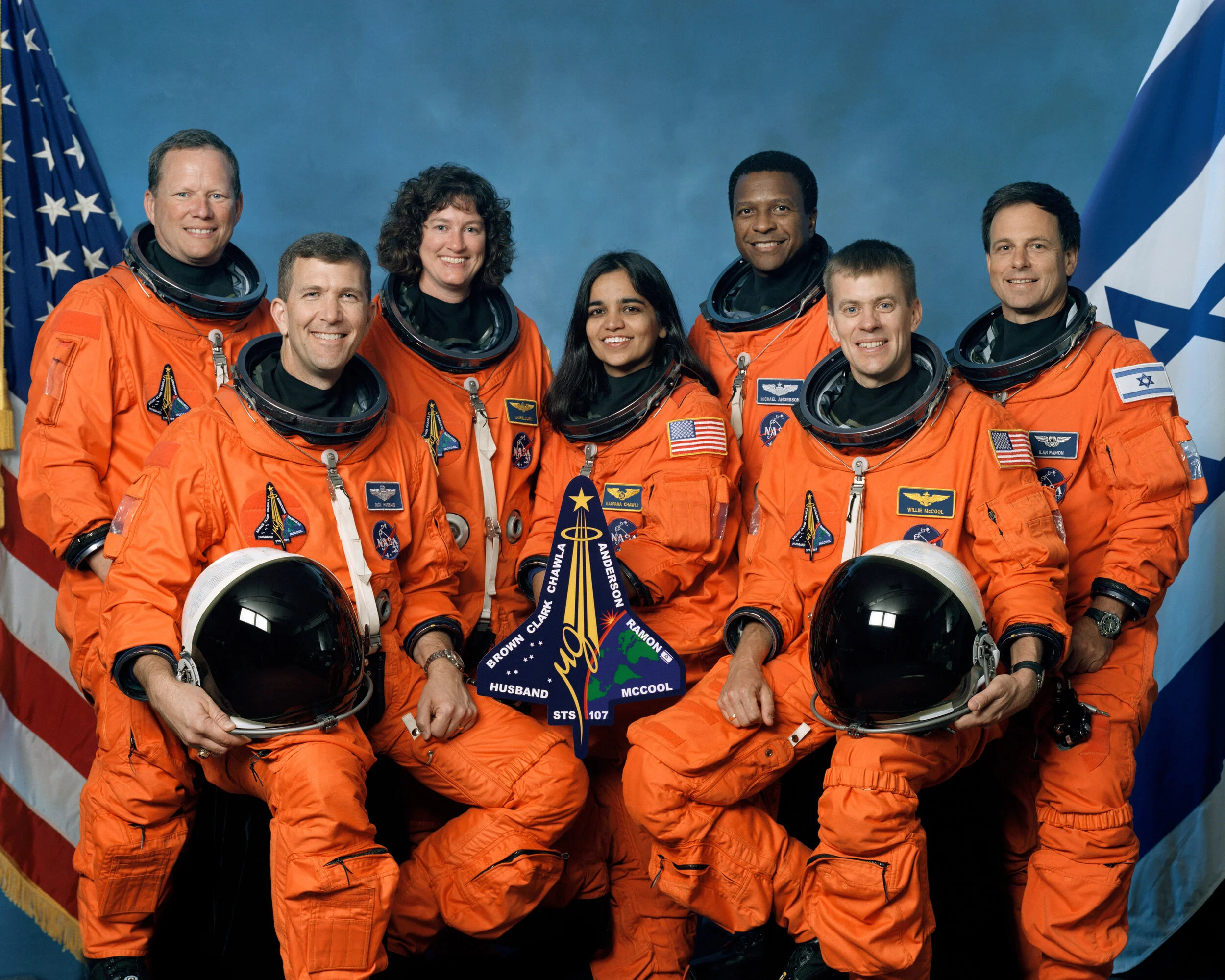
The crew that died in the STS-107 Space Shuttle Columbia were –David M. Brown, Rick D. Husband, Laurel B. Clark, Kalpana Chawla, Michael P. Anderson, William C. McCool and Ilan Ramon.

Their mission was almost complete, and we lost them so close to home. The men and women of the Columbia had journeyed more than 6 million miles and were minutes away from arrival and reunion. The loss was sudden and terrible, and for their families, the grief is heavy. Our nation shares in your sorrow and in your pride. And today we remember not only one moment of tragedy, but seven lives of great purpose and achievement.

To leave behind Earth and air and gravity is an ancient dream of humanity. For these seven, it was a dream fulfilled. Each of these astronauts had the daring and discipline required of their calling. Each of them knew that great endeavors are inseparable from great risks. And each of them accepted those risks willingly, even joyfully, in the cause of discovery.

Rick Husband was a boy of four when he first thought of being an astronaut. As a man, and having become an astronaut, he found it was even more important to love his family and serve his Lord. One of Rick’s favorite hymns was, “How Great Thou Art,” which offers these words of praise: “I see the stars. I hear the mighty thunder. Thy power throughout the universe displayed.”

David Brown was first drawn to the stars as a little boy with a telescope in his back yard. He admired astronauts, but, as he said, “I thought they were movie stars. I thought I was kind of a normal kid.” David grew up to be a physician, an aviator who could land on the deck of a carrier in the middle of the night, and a shuttle astronaut.

His brother asked him several weeks ago what would happen if something went wrong on their mission. David replied, “This program will go on.”

Michael Anderson always wanted to fly planes, and rose to the rank of Lt. Colonel in the Air Force. Along the way, he became a role model — especially for his two daughters and for the many children he spoke to in schools. He said to them, “Whatever you want to be in life, you’re training for it now.” He also told his minister, “If this thing doesn’t come out right, don’t worry about me, I’m just going on higher.”

Laurel Salton Clark was a physician and a flight surgeon who loved adventure, loved her work, loved her husband and her son. A friend who heard Laurel speaking to Mission Control said, “There was a smile in her voice.”

Laurel conducted some of the experiments as Columbia orbited the Earth, and described seeing new life emerge from a tiny cocoon. “Life,” she said, “continues in a lot of places, and life is a magical thing.”

None of our astronauts traveled a longer path to space than Kalpana Chawla. She left India as a student, but she would see the nation of her birth, all of it, from hundreds of miles above. When the sad news reached her home town, an administrator at her high school recalled, “She always said she wanted to reach the stars. She went there, and beyond.” Kalpana’s native country mourns her today, and so does her adopted land.

Ilan Ramon also flew above his home, the land of Israel. He said, “The quiet that envelopes space makes the beauty even more powerful. And I only hope that the quiet can one day spread to my country.” Ilan was a patriot; the devoted son of a holocaust survivor, served his country in two wars. “Ilan,” said his wife, Rona, “left us at his peak moment, in his favorite place, with people he loved.”

The Columbia’s pilot was Commander Willie McCool, whom friends knew as the most steady and dependable of men. In Lubbock today they’re thinking back to the Eagle Scout who became a distinguished Naval officer and a fearless test pilot. One friend remembers Willie this way: “He was blessed, and we were blessed to know him.”

Our whole nation was blessed to have such men and women serving in our space program. Their loss is deeply felt, especially in this place, where so many of you called them friends. The people of NASA are being tested once again. In your grief, you are responding as your friends would have wished — with focus, professionalism, and unbroken faith in the mission of this agency.

Captain Brown was correct: America’s space program will go on. This cause of exploration and discovery is not an option we choose; it is a desire written in the human heart. We are that part of creation which seeks to understand all creation. We find the best among us, send them forth into unmapped darkness, and pray they will return. They go in peace for all mankind, and all mankind is in their debt.

Yet, some explorers do not return. And the loss settles unfairly on a few. The families here today shared in the courage of those they loved. But now they must face life and grief without them. The sorrow is lonely; but you are not alone. In time, you will find comfort and the grace to see you through. And in God’s own time, we can pray that the day of your reunion will come.

And to the children who miss your Mom or Dad so much today, you need to know, they love you, and that love will always be with you. They were proud of you. And you can be proud of them for the rest of your life.

The final days of their own lives were spent looking down upon this Earth. And now, on every continent, in every land they could see, the names of these astronauts are known and remembered. They will always have an honored place in the memory of this country. And today I offer the respect and gratitude of the people of the United States.

May God bless you all.

From left to right: Brown, Husband, Clark, Chawla, Anderson, McCool, Ramon

From left to right: Brown, Husband, Clark, Chawla, Anderson, McCool, Ramon

Source: https://www.funeralwise.com/plan/eulogy/as...

Enjoyed this speech? Speakola is a labour of love and I’d be very grateful if you would share, tweet or like it. Thank you.

Facebook Twitter Facebook
In PUBLIC FIGURE D Tags GEORGE W. BUSH, COLUMBIA SHUTTLE DISASTER, COLUMBIA ASTRONAUTS, NASA, SPACE SHUTTLE, DISASTER, TRANSCRIPT
Comment
Queen mother portrait.jpg

Source: Wikipeida

For Queen's Mother, Elizabeth Bowes-Lyon: 'A woman of grace', by Geroge Carey - 2002

April 2, 2020

9 April 2002, Westminster Abbey, London, United Kingdom

We gather in this great Abbey to mourn and to give thanks. It is a fitting place to do so, a place where the story of our nation and the story of the woman we now commend to her Heavenly Father are intertwined.

It was here that Elizabeth Bowes-Lyon was married and became Duchess of York; it was here that she was crowned Queen; it was here that, as Queen Mother, she attended the coronation of her own daughter. It is fitting, then, that a place that stood at the centre of her life should now be the place where we honour her passing.

In the 10 days since she left us, there have been countless tributes and expressions of affection and respect — including those of the many people who have queued and filed patiently past her coffin lying-in-state.

How should we explain the numbers? Not just by the great length of a life, famously lived to the full. It has to do with her giving of herself so readily and openly.

There was about her, in George Eliot’s lovely phrase, “the sweet presence of a good diffused”.

Like the sun, she bathed us in her warm glow. Now that the sun has set and the cool of the evening has come, some of the warmth we absorbed is flowing back towards her.

If there is one verse of scripture which captures her best, it is perhaps the description of a gracious woman in the final chapter of the book of Proverbs. It says: “Strength and dignity are her clothing and she laughs at the time to come.”

Strength, dignity and laughter — three great gifts which we honour and celebrate today.

The Queen Mother’s strength as a person was expressed best through the remarkable quality of her dealings with people — her ability to make all human encounters, however fleeting, feel both special and personal.

As her eighth Archbishop of Canterbury, I can vouch for that strength.

Something of it is reflected in the fact that for half a century we knew her and understood her as the Queen Mother. It is a title whose resonance lies less in its official status than in expressing one of the most fundamental of all roles and relationships — that of simply being a mother, a mum, the Queen Mum.

For her family, that maternal strength — given across the generations to children, grandchildren, great-grandchildren — has been a precious gift and blessing.

Its loss is felt keenly today. And as they grieve, we say to the Queen and to Prince Philip; to Charles, Anne, Andrew, Edward, David and Sarah as grandchildren; and to all their children: you are in our thoughts and cradled in our prayers and those of countless millions round the world.

The very first letter Elizabeth wrote on becoming Queen in the traumatic and daunting circumstances of 1936 was to one of my predecessors as Archbishop of Canterbury. It gives a further insight into the source of her strength.

She wrote: “I can hardly believe that we have been called to this tremendous task… and the curious thing is we are not afraid.”

With her openness to people, indeed as part of it, came a quiet courage. A courage manifest in wartime and widowhood, a courage that endured to the end.

Strength, dignity and laughter.

There was certainly nothing remote or distant about her own sense of dignity. Her smile, her wave, the characteristic tilt of her head: all made the point immediately and beyond words. It was a dignity that rested not on the splendid trappings of royalty, but on a sense of the nobility of service.

On their wedding day here, the Archbishop of York spoke to the newly married couple of their life together: “We cannot resolve that it shall be happy,” he said, “but you can and will resolve that it shall be noble.”

And indeed it was. An unfailing sense of service and duty made it so. It was a commitment nourished by the Queen Mother’s Christian faith. A faith that told her, as it tells us all, that even the Son of God came into the world as a servant, not as a master.

Strength, dignity and, yes, laughter.

We come here to mourn but also to give thanks, to celebrate the person and her life — both filled with such a rich sense of fun and joy and the music of laughter.

With it went an immense vitality that did not fail her. Hers was a great old age, but not a cramped one. She remained young at heart, and the young themselves sensed that.

Of course, the laughter of the book of Proverbs goes deeper than a good joke or a witty reply. “She laughs at the time to come”: such laughter reflects an attitude of confident hope in the face of adversity and the unpredictable challenges of life.

Of this laughter too, the Queen Mother knew a great deal. It was rooted in the depth and simplicity of her abiding faith that this life is to be lived to the full as a preparation for the next.

Her passing was truly an Easter death — poised between Good Friday and Easter Day. In the light of the promise that Easter brings, we will lay her to rest knowing that the same hope belongs to all who trust in the One who is the resurrection and the life.

Strength, dignity, laughter — three special qualities, earthed in her Christian faith. Qualities that clothed her life so richly. Qualities that with her passing, we too — by the grace of God — may seek to put on afresh, in our own lives and the life of our nation and world. Let that be part of her legacy, part of our tribute.

And lastly this: for the book of Proverbs has more to say about a gracious woman; words we can summon now as we commend to her Heavenly Father his faithful servant Elizabeth — Queen, Queen Mother, Queen Mum — deeply loved and greatly missed.

It simply says of a woman of grace: “Many have done excellently, but you exceed them all

Source: https://www.funeralwise.com/plan/eulogy/qu...

Enjoyed this speech? Speakola is a labour of love and I’d be very grateful if you would share, tweet or like it. Thank you.

Facebook Twitter Facebook
In PUBLIC FIGURE D Tags QUEEN MOTHER, ROYAL FAMILY, EULOGY, ARCHBISHOP, GEORGE CAREY, WOMAN OF GRACE, QUEEN ELIZABETH II
Comment

for Ron Blainey: 'I’d like to think he’s gone where the Calathumpians go', by Trevor Blainey - 2020

April 2, 2020

31 January 2020, Tobin Brothers, Doncaster, Melbourne, Australia

Early Days

Dad was born on 26th October 1931 to Robert James Wesley Blainey and Ivy Isobel Blainey in a hospital in Moreland Road in the then Vaucluse Hospital, now Brunswick Private. A child during the war, too young to serve, but not too young to be affected by it. In his early days he lived in Brunswick and in due course he went to Brunswick South PS.

Later the family moved to West Preston and he started secondary school at Northcote High. There, dad is a capable student and good athlete excelling in maths, track and field and the weird version of mortal combat known as Lacrosse. A minor sport then and still that way now, it had its origins in Canada and North America developed by their indigenous peoples and was introduced into Australia by a Canadian in the late 19th Century. A sport of speed, agility and violence, Dad loved it. And excelled at it. He played from his pre-teens until his early 30’s. Again, he loved it.

Lacrosse


While at Northcote High Dad met friends that he’d have for life including in particular Reg Ratcliffe and Wes George. The school was one of a handful in the North and another few in the East that had Lacrosse teams and these mates took it up with gusto. They later played together for Coburg, a team that was affiliated with the Coburg Harriers, an athletics club and those clubs had playing fields and aths tracks that are still there and in use today. McDonald’s Reserve in Bell Street in the shadows of the infamous Blue Stone College aka Her Majesty’s Prison, Pentridge. The Coburg Lacrosse team was where he met David Jackson, Graeme Reid, Don Stapleton and Nobby O’Brien all lifelong mates. Dad ran for the Harriers in the summer and played Lacrosse in winter. His forte in aths was then called the Hop, Step and Jump and is now known as the Triple Jump. He was a State Junior champ at that but also competed at a high level in the hurdles and the sprints.

His Dad


Sadly an event that would have a profound effect on Dad then and for much of the remainder of his life happened soon after he started High School. When he was 12 his father, the archetypal soldier of fortune, left for Sydney to drive Taxis. US forces were stationed there while the War in the Pacific was in full swing. They had money to spend, economically times were tough in Melbourne and he took off never to return. In his late teens when dad was competing in a National Aths Championship in Sydney he looked him up but I can only assume that that proved to be a disappointing encounter. Dad never saw his father again after the age of 19. Much later in life for reasons that are reasonably easy to guess at Dad became interested in the family tree. He was delivered another shattering blow when in 1994 he discovered that his father had passed away in 1971.

Which leads me to what I regard as the central motif of my father’s life. His love of family and his resolve, never shaken, that, not on his watch, would such a thing happen to anyone in his care. This was the Signifying Event in dad’s life.

Family

A direct result of his dad’s departure was that my father was now the child of a single mum, the redoubtable Ivy (my Nana), who then went to work in retail at Coles. With a 12 YO boy to look after. As the proverb goes It Takes a Village. Nana’s family swung into action. Her brother Murray Exelby, a lifelong bachelor, moved into the family home in West Preston. Another income, a bit of rent. Her sister Grace’s family, the Wilsons, became a de facto surrogate family, minded him after school, fed him and looked out for him. And another brother Les offered Dad his first job. At the age of just 14, somewhat forced by circumstance dad left school and went to work for Uncle Les. Selling women’s lingerie. Not kidding. Heady days I daresay.

Work

But that wasn’t dad’s forte. At school it had been sport and maths and English and trade related subjects. He loved fixing things, seeing how they worked. So another family member, Les Chapple, offered dad a job at his small engineering factory in Preston. Chapple Brothers, a family business. Dad loved it, loved working with the uncles and their sons, his cousins. But he could see the value in getting a qualification, having missed out on proceeding to tertiary because of his early exit from school and, in those days, because working class boys didn’t go to Uni as readily as now. So he went to night school to RMIT to get a Boilermakers ticket which he duly completed. A Boilermaker. An old skill. It’s sheet metal work. Boilermakers assemble, maintain and repair large vessels and enclosed vats.

Mum

Now while all of this running and jumping and medieval violence involving sticks (Lacrosse) and learning and earning is going on I can hear you say “What of love Trev? When did he meet your mum?”. At age 17 Dad’s mate from NHS, Reg, invited Dad to a Mystery Picnic. Mum’s friend from up the street, Beverley invited mum to the same outing. Reg and Bev were boyfriend and girlfriend. Can you see where this is heading? A Mystery Picnic has a group gather at a location, get picked up by a furniture van fitted out for passengers (not very safely I wouldn’t have thought) and taken to a mystery picnic spot. In this case Canadian Bay, a small beach near Mount Eliza. Now at 17 Dad was shy, at least around girls. It was a hot day and his concession to the heat was a short sleeved shirt. But long pants and shoes. Wouldn’t doff his kit into his swimmers. Reckoned his legs were too skinny. But a walk along the beach seemed OK. And thus started a love that remained undiminished from that day until now. Pretty good by any measure.

On the 27th February 1954 Ron Blainey of West Preston and June Chadwick of West Heidelberg were married at St Patrick’s Cathedral in bright sunshine on a perfect day. Reg Ratcliffe was Dad’s groomsman, as Dad was his. A mixed marriage. Mum, a good catholic girl from Mercy College and dad? When I asked a few times what his tribe was he shrugged and said “A Calathumpian I guess.” It wasn’t clear. It didn’t matter.

IMG_2851.jpg


Children and Bulleen

Mum and dad spent the first three years of their married life living with Nana in West Preston while they saved for a house. In 1955 I was born. While his friends are in the marrying season and buying property in Coburg and Pascoe Vale and Glenroy Dad buys a block of land in …. Bulleen. No made roads, no sewerage, no telephone. Orchards, paddocks, a quarry where the Yarralean estate now sits. Ever seen a horse born? I have. In the paddock two doors away. Crikey. No supermarket, just a little strip of shops with a butcher, a greengrocer and a general store. What else would you need?

On the back of the Boilermakers ticket and his experience at Chapple Bros dad had gotten a job at a company called Pict. A frozen foods processing factory. In Notting Hill. Not the quaint London suburb. Near Clayton, near Monash Uni. No freeways. Driving from Bulleen each day. He’s a fitter and turner and he’s now really on the path in something that he’s well suited to.

In 1958 along came Gary and in 1960, Janine. That was our lot, our family. We were what many Australian families then looked like. Dad was our protector and provider. Mum looked after us. On top of the day job at Pict which involved long hours I remember him wrung out and stressed a lot of the time. He was however committed to the cause. He was determined to provide for us and also to look after his mother. Despite his somewhat irreligious outlook we were to go to the local Catholic schools. They cost more than the State schools.

Despite being in the wilds of the shire of Manningham Dad and Mum were keen to maintain contact with friends and family over in the North. So was born the notion of the monthly turn whereby once a month they’d all gather on a Saturday night at one house or another for a get together. Beer, shandy’s and Cinzano and lemonade, maybe some moselle and a barbecue. Cards, board games, knitting, music, maybe some dancing and talk. Lot’s of talking. Home by 11. Thus the boys of Northcote High and the girls they’d met and married stayed united and in touch. The monthly turns stopped eventually but those friendship bonds never did.

Work


Dad’s fortunes at Pict improved. The company was the subject of mergers and takeovers and eventually it had merged with an NZ company called Watties. Dad continued up the ladder, shift work and second jobs no longer necessary and he was promoted to the role of Plant Engineer. He supervised the entire processing plant and was responsible for keeping those wheels turning. He became known for his ability to problem solve the many widgets and wodgets that a food processing factory has and was often sent to other factories in the Wattie Pict empire to fix things. I can remember him being flown in light aircraft to the factory in Millicent in SA and also in bigger planes to the plant in Glenn Innes in Queensland when things went awry there. Later in life he had an aversion to flying and I wonder if a bumpy ride one day might not have put the kibosh on future air travel.

He is remembered fondly now by those work mates of his still alive. An aspect of his time at Wattie Pict is that he was a mentor and good boss to many young people who worked there. In their number was a good friend of mine Gerry Collins, now sadly deceased himself, who worked there for a few years after spending a year mucking around with me at Swinburne. Gerry went on to establish his own successful company in due course. His wife Lisa recently reflected kindly on Dad’s mentorship of Gerry at that time.

As time went by more takeovers, more mergers and the frozen food business suffered a downturn. Finally Streets the ice cream maker had taken over the factory and in the end dad had the melancholy duty of being the one to put the chain through the gate, put the padlock on it as they ceased to manufacture in Victoria. The journey through that industry had seen him become valued and expert in a business that like many others chose to develop new methods in new places that no longer had the need for many of its workers or much of its machinery. And therefore no need for Dad. It’s 1984 and for the first time since he was 14, my dad is out of work. He’s 53. I’ve never forgotten the look on his face when he came home that day.

Children Growing and Blainair

But otherwise we’d prospered. Janine and I had finished degrees and started our working lives, Gary had just started his company called Blainair installing ducted heating and airconditioning. Like our parents we were in the marrying and partnering season and we were on the way. Dad’s hard work had laid the foundations for all of that. Job done perhaps but not quite. In 1985 Dad and Gary agree that he will join Blainair. Gary is the tradesman who can do the work but needs help with managing and running a small business. The nature of the work is in dad’s experience anyway. He understands machinery, gadgets, how things work and they set out to see how they fit into the building industry. They learn together and the business grows. They start in the house in Bulleen, Dad and Gary, mum answering the phone. They get a shop in Camberwell, then a factory in Bulleen. I remember the milestones, the sales targets achieved, units sold. They grow slowly and steadily carving out a niche in the North East – father and son. They add employees a few of whom now have 20+ years service. Nick Cook starts as an 18 YO boy and is now a partner in the business. Has his own family. My daughter Claire had one of his kids at the kinder she taught at. I like that. Pete and Dave have worked there 20+ years.

By the time dad eases out at the age of 72 in 2004 the business is on a steady footing. Gary runs the business. His son Marcus works there too and has told his dad to move over. They now employ 14 people full time and use 6 regular subbies. Dad had a great influence on that success.

Anglesea


But along the way dad and mum have had their eyes on other prizes. They love the West Coast. Had their honeymoon in Lorne. Stayed at the Cumberland Hotel. Great friends of theirs in John and Joy Puxley have a big ramshackle place on the hill behind the shops at Anglesea. We had many holidays there, a tribe of kids, several adults, the monthly turn goes coastal. Dad gets a caravan and leaves it at the Narambi Caravan Park year around. We get the coastal holidays at our own place now. In 1989 they buy a block in a quiet court and put a 10 square fibro shack on it. 4 rooms, a postage stamp on a hanky but it’s theirs.

Still Dad looks ahead. We’ve started to marry and have our own children. Cassie and I marry in 1980, later Gary and Janine also marry. Matthew arrived in 1987, followed by Marcus, Alex, Claire, Ruby and Eliza, all Dad’s cherished and much loved grandchildren. Later in the piece Gary welcomes Jed and Lilly via his new partner Jane into the family and Dad and Mum are replete. The kids all love the beach. But the shack in Brierley Court is too small. One day Dad says “Let’s get in the car, we’re going for a drive.” We arrive at 25 Second Avenue in Anglesea. On the hill overlooking Point Roadknight. It’s an auction. He puts his hand up a few times and wins the day. The place at the coast now has a bit of heft to it. A swimming pool even. He loved that pool. And a pool table. Bigger than the tricky little one at Robert Street.

In 2000 before retirement officially but when things have slowed down they move down to Anglesea to start the Final Quarter. They settle into the town and it settles into them. They make friends, new friends, not the same as old mates with shared histories and weddings and babies, but great mates nonetheless. Many in their own twilights but all of whom love the winter quiet of a small town and the things on offer in the summer. A meeting place in what’s now called Bumblebeez Café becomes the hub for the local retirees. It’s now run by Ben and Bruno. But before that its John Danielle and then Furio and Allyson. All are kind to the older couple who come in each day to meet their new friends. John Birt, Elaine and Barry Browning, Margaret and John Cummings and Bill and Marlene Hughes. Brian and Jill Emerson and their son Jamie. Brian died a few years ago and the next time Jamie saw dad he wrapped him in a bear hug and cried. And thanked him. In the street. New friends, great mates.

I’ve left a couple of stories and some important relationships and connections until last.
First the stories which I think say something about my dad.

Anecdotes


In the Order of Service (put together by Eliza, thank you) that follows you’ll see a shot that shows just how close the Coburg playing fields were to the walls of Pentridge. One day while playing Lacrosse an errant pass saw the ball sail over that wall into the prison. It’s not now. It’s then. Post war, the effects of the Great Depression keenly felt. Back then noone goes to play cricket with 15 bats in their kit. I’m looking at you Steve Smith. Noone changes racquets every set if not more often. Noone has a pair of footy boots for every day of the week. Times are tough. Even Lacrosse balls aren’t cheap. So over he goes. Over the wall. Dad. Into the prison. To fetch the ball. Gives the guards a wave. They wave back. Jumps back over, game on. I’ve grilled mum about this and she swears it happened. I believe her. Dad had a cheeky side that we all loved. In his final days Cassie whispered into his ear “It’s me Cassie, I’m here with Trevor.” He blinked in recognition and said “Well I’ll be buggered. How about that.” With a smile. And went back to sleep.

He loved to ride his bike and had a great mate in his cousin Bill Parsons. They used to ride from Brunswick to Sylvan to pick strawberries at the Parsons Family Strawberry Farm. Put that into Google Maps and see how you go. No lycra, no gears, no helmets. Modern bikes could be hoisted overhead by a toddler. Back then? No titanium in those days. Steel frames, tyres from tractors. It would have been hard work. All in a days lark for dad.

Breaking The News


I had to break the news to some old people in the last couple of weeks. It’s sad for us all but very sad for them who’ve lost touch and still remember him fondly. I rang Madge Hartwig (formerly Exelby) a twin of Jean now deceased. Madge married Rex, a tennis Hall of Famer in doubles, Davis Cup, Wimbledon the lot. A brush with fame for the family. Her uncle Les paid for dad and Madge and Jean’s tennis lessons. The village again. She said, sadly, “He was my favorite cousin.” There’s been a lot of that.

Close Friends and the Bombers


I have to mention one of mum and dad’s Anglesea friends in John Birt. Partly because it allows me to talk about the Essendon footy club and dad’s odd relationship with it. John played for Essendon in the sixties and would have played in the premierships in 1962 and 1965. He later went over to the Dark Side and played for Collingwood. He’s otherwise a good fella. He’s been a very good friend to mum and dad in their Anglesea phase and particularly helpful and kind recently. Kept in touch with me and mum, ran errands for them, took the bins in at the house and so on. Knows clearly what being a mate is. Thanks to you John.
But back to the Bombers. You wouldn’t call Dad an Essendon supporter. He was really an Essendon critic. He reminded me of Waldorf and Statler from the Muppets. You’ll have to ask Mrs Google that too if you don’t know what I mean. The last time he took me to the footy was the Preliminary final in 1966. We got flogged in the wet by the Saints and mainly by Darrel Baldock. I don’t think he ever recovered. And this despite the fact that his Uncles Murray Exelby and Stan Wilson both played over 100 games for the Dons, took him to the footy VFL, VFA and the metropolitan clubs they later played and coached for. After I left home he’d ring me after every game. “Didja go?” “Yeah dad, they were pretty good to day.” He had an answer. “They can’t kick” or “they’re too slow” or “why do they handball all the time? And backwards.” It was a conversation I could never make headway in. A few years ago we’d added Adam Saad and Connor McKenna. The call came after a game we’d won and they’d been good in. “Did you see Saady and Connor dad? Jet propelled they were. I think we’ve fixed the speed problem.” He paused. “What’s the good of running like buggery down the ground if you don’t know what to do when you get there?” Checkmate.
He had a particular regard (or lack of it) for certain players. Had them in the gun. Most recently it was Joe Daniher. “He can’t kick straight. What are they paying him all that money for if he can’t kick straight?” Per custom I defended Joey. “He’s got OP Dad. A lot of the big fellas get it. Buddy has got it.” Pause. “He can’t kick …”. Ever hopeful late last year at the end of the trade period I spoke to Dad. “We’ve stuck to our guns Dad. We’ve hung onto Joey. He’ll play for us next year.” Pause. A long pause. “Oh. Shit.” He then went quiet.

Ron Blainey, with sons Gary and Trevor

Ron Blainey, with sons Gary and Trevor


Family

OK so it’s time on in the last quarter. Nearly there. Family. I’d be remiss not to mention the Wilson family again. Stan and Grace and their children Russell, Lance, Dianne and my great mate Glenda. Parents, brothers and sisters to my dad always. A great support to my Nana and for my dad. They moved into our street in Bulleen when we were in our teens. Dad and Stan and Russell and Lance raced greyhounds with a lot of success. Poor man’s racing but fun all the same. Stan and dad walked them. Stan, about whom I could speak forever (don’t worry I wont) was quite a fella. Backman’s knuckles, teetotaller, kind and gentle he called in every night about tea time. We looked forward to it. I know dad did. Uncle Stan was making sure we were OK. The village. Family. Bless ‘em all.

Not a footnote so much as a late note. My sister in law Jan, her husband Tim and their children Rick, Serena and Jamie are our family down the coast, the Torquay connection. Jan and Tim have been great recently with Jan in particular visiting mum and dad many times. Not to labour the point but it is the point. Dad’s point. Family. Thanks Jannie. We had a great Christmas at the Kaisers in Dad’s last proper outing. In the video presentation coming up (thanks to Ruby who prepared it with the help of Eliza, Claire and Alex) you’ll see him sitting there at the end smiling, happy as. Guarding his presents and his chocolates I should say. A really good day.

Dad didn’t like crowds. I think that’s why he gave the footy a wide berth. Never went to the cinema, the theatre, no galleries except little country ones, I doubt that he ever set foot in Fed Square. Or the city in the last half century for that matter. However I really mean he didn’t like big crowds. But there was a type of crowd he loved. The gatherings of family and friends at his home whether it was in the Bulleen house or the one at Anglesea. Usually on the feast days, Christmas, birthdays. He loved those occasions. Loved having all those familiar and loved nearby. That extended to my friends and I assume Gary’s and Janine’s. The house in Bulleen became a hub for our mates. Beer in the fridge, the pool table ready to use. A mate from school Des Maloney and his brother Bernie used to go to the bike races at Bathurst every year. Year after year they’d drop into Robert Street at sparrows fart on the day they left for cackleberries and toast and a cuppa and then get on their way. I don’t think Bulleen is on the way to Bathurst from their home in Burwood but there it is. It was that kind of place.

We had a lot of family days at Anglesea. He loved his grandkids. Made sure everything was ready for when they came. Cleaned the pool to laboratory cleanliness in the days leading up to a family do. Rang me and told me he was doing it. Not the most exciting of topics but it seemed important that I know. “what’ll we need? Two chops and a sausage each enough for everybody? Chicken kebabs? I’ve got a slab of heavy and a slab of light. Enough? Are you bringing the red? I’ve got one that one of the suppliers gave me last Christmas. Looks alright.” Just checking. Making sure. Providing. Family paramount. And he’d ring back two days later and run through the list again.

Legacy

When someone who has reached a good age passes away there is inevitably a reflection on their legacy. As I’ve said often throughout Dad loved family and was keen for all to prosper. Often asked how each was going, what they were up to. Just checking. He would be well pleased with what he left behind. Amongst his grandchildren there is a nurse working in aged care, a kinder teacher, a graphic design student, a filmmaker and radio presenter, a young manager in retail, the heir to the family business (look out Gaz) and a lawyer. Still others working in marketing and the building trade. All doing stuff. Interested in sports, fashion, the arts, the environment. Some interested in politics, some not. Good types all of them. Look you in the eye, shake your hand, smile a lot. You did well dad.

So I speak today on behalf of my brother, sister, their children and mine, Ian and Jane and my wife Cassie and of course my mum. We’ve all worked hard in recent times to shepherd my parents through this stage of their lives. Our hope is that we’ve made good on dad’s resolve all those years ago. That was always the aim.

Our dad, our grandpa and a much loved husband and friend to many has passed on. I have wondered where to if anywhere. I’d like to think he’s gone where the Calathumpians go. And that wherever that is they’re young again. Those Calathumpians. Fit and agile. Playing Lacrosse probably. Dad’s got Reg and Don and Wes playing with him. And Nobby O’Brien. Did I mention him? He also passed away this week. RIP Nobby. They’re being cheered on by Bev and Don’s beautiful Betty and Graeme’s lovely Gwen. Pucko might be there and Jack. And over the cheering can be heard the voice of Jacko’s mum, Coburg’s Number 1 supporter. “Give the ball to Ronnie. They can’t catch him. He’s too fast. Go Ronnie go.” And go he does. At a clip charging towards the net. Look out. And if the ball goes over the wall we know who’ll fetch it.

Job’s done dad.

The Pools clean, the water sparkling in the sun.
The dogs have been walked, the bins are out and there are plenty of soft drinks in the fridge in case the grandkids come over. And you’ve got an endless supply of chocolate ginger and licorice to enjoy.

Rest easy, old man. You’ve earnt it.

26 October 1931 – 20 January 2020

Source: https://www.youtube.com/watch?v=p4CUDxLL_m...

Enjoyed this speech? Speakola is a labour of love and I’d be very grateful if you would share, tweet or like it. Thank you.

Facebook Twitter Facebook
In SUBMITTED 4 Tags RONALD BLAINEY, TREVOR BLAINEY, TRANSCRIPT, EULOGY
Comment

For Yossl Baker: 'He lit up a room with his entire personality', by Mark Baker - 2020

March 1, 2020

26 February 2020, Melbourne Chevra Kadisha, St Kilda, Melbourne, Australia

Death is no stranger to my family; this is the third time in four years I’ve sat on that dreaded bench but today I’m alone with my mother and an empty space beside us. Back when the family plots were vacant, Johnny and I used to joke about who would be buried next to which parent. Which of us would get to listen to an eternal recitation of my mother’s poetic speeches about how being underground was not unlike her hiding spot in a black hole during the Holocaust, or who would be in direct earshot of my father’s jokes, his business commentary, and the TV tuned on full blast between ‘ or ‘Who Vonts to be a Millionaire?’ That was meant to be a long way off in the future. Today has put that discussion to rest; fate has determined it for us, with a twist no one could ever have predicted about the tragic order of things. Johnny and I also used to joke that we have great genes. Only last week one of my orphaned friends commented how unusual it is for our generation to have not one, but two living survivor parents. There’s also an irony in that, a painful one that has highlighted for our family the cruel randomness of life. Until Kerryn and then Johnny joined the inhabitants of this ghostly shtetl, my Dad came almost every Sunday for a consecration, before moving on to Chadstone to measure the condition of retail. While here, he would walk around the rows and aisles and point out the familiar graves, and with his Talmudic memory that could put a pin through the page of the life of any person, recite with precision an obscure or a hilarious story about Shloimeleh, or Moishe, or Meyer, or Freda, and the growing number of friends that were moving here until there was no one left back home to fill the four sides of a card table.

His memory and ability to connect the dots was one of his most remarkable features, and he carried it until his last day. You all know that look: his mind whirring like a poker machine until ding, he hits the jackpot and the details of your relatives pour out. ‘Ah. I knew your Zaida when he was a tailor in Flinders Street. I bought yarn off him for 2 pounds a yard in 1961.’ Or, ‘Ah, I remember your Buba danced with Chaim in Maison de Luxe on a Wednesday but he vos little and when his head bumped her tsiskes his vig fell off.’ And then his body would convulse with laughter until tears streamed out of his eyes, because he could actually see the scene unfolding before him in technicolour, every frame of it, going all the way back to Poland. No one has ever bumped into Yossl on the street without learning something they didn’t know about their ancestors. ‘Khai you,’ he would greet them, ‘Khu you,’ and then he’d tell you exactly Khu you were, rattling off stories like a Catskill comedian, a touch of the gossipy Yente in him, but never never was there a hint of malice and always always it was with loving humour. His humour. It was inbuilt in him and rippled through his whole body, his gesticulations, his passion, the way he lit up a room with his entire personality, and most of all with his eyes – sparkling, twinkling, blinking rapidly from over-excitement.

There’s the famous story from the Talmud of the House of Hillel and Shammai arguing through the night about whether God should create Adam and Eve. This argument was the one occasion the rival schools came to a unanimous agreement. No, they said, adding that now that the deed is done let’s deal with the consequences. In one sense they were right – my parents’ torments and suffering are testament to that, but on the other, if they could have gazed into the future and met my Dad, they would have reached a unanimous view the other way. Yossl wasn’t just larger than life; he created a parallel world of human possibility, of kindness, unconditional love, almost perfection. And like any world, his had its own language. Yosslisms, we called them. I’m sure you won’t hear a talk in the coming days that doesn’t refer to his unique vocabulary. The words weren’t random, they made grammatical sense. On their honeymoon when my mum was 19, they went to Sydney and she got appendicitis. Such a hard word for a migrant but he stripped away the medical pretensions and reduced it to its original source. A pain in the sitis. In his world, not everyone was Jewish, but as the title of the Yiddish album from the 1960s went, ‘When You’re in Love the Whole World Is Jewish’. ‘Is he or she Jewish?’ was always his first question, asked at the top of his voice, and it almost always pleased him to learn they were, except he feared, as he told me last week, an outbreak of antisemitism if either Sanders or Bloomingberg were elected. Otherwise, he would turn gentiles into Jews, such as Erin Brokovich, who he called Aron Berkovic, or the famous actor Maximilian Schell who somehow became his old friend, Muscatel.

And then there was his most famous line. ‘Genia’s in Surfers and I’m in Paradise.’ This week that joke was tragically fulfilled, but until then, it was nothing more than a gag. For the truth is that my father never left my mother’s side for a second, he was her protector, redeemer and carer from the day he courted her as a new immigrant to Australia. ‘He spoiled me rotten,’ Mum will say, though she rightly takes credit that she tamed and anchored this handsome muscly man whose postwar image is captured in a series of photos of him on a motorbike, or sitting on the bonnet of his Humber Hawk, a cigarette dangling from his mouth.

And so it seems fitting, hard as it was for us, that his sudden and unexpected death took place in Surfers Paradise, because our times there carry so many threads from his life, and also of his death. I think of the holidays Johnny and I had as children at the Chevron with so many family friends, all of them survivors who never spoke of their past, but laughed around the pool or baked on the beach shmeared with baby oil with silver foil fans to attract extra sun, how they played red aces, and the times during my strict kosher days that my Mum furtively cooked kosher schnitzel for me in a bathroom from the patelnia (pan), while my father fanned the smoke away; until the high-rise apartments shadowed the beachfront and they made their home away from home in Allungah at Paradise Centre.

How did they do it, these survivors? Did they cast their trauma behind them on their boat to Australia, deliberately choosing life over death, or more likely, did they bottle it up inside them, the past and present entangled, shaping their personalities. Like the time when I sat with my Dad in their apartment in Surfers and I asked him to tell me his story, the only family tree he never wanted to explore, and I asked him how far the train was from the gas chambers when he arrived at Birkenau, and he casually pointed through the windows and said, ‘Oh, about from here to Cavill Avenue.’ Still, Surfers, it seemed, was a sanctuary they could escape to, but in more recent years, it was a different experience they were trying to escape, but could never shake off; the loss of Kerryn and then my brother and their son Johnny. At home, they were in deep grief within the four walls of their apartment which they would never leave. After a three year break, we were relieved that they agreed to resume their visits to Surfers. While it was easier to keep a vigilant eye on them in Melbourne, they were more independent, an elevator ride from the arcade and the restaurants and the Pokies. I won’t say they were happy, that would be expecting too much, but the pain was more bearable away from Melbourne where they felt caged in a prison of memories, eased through the daily phone calls from me and Anita which always began with a kvetch from my Dad about how hard life is because their grief always pursued them, even with the background tv sound of a tennis game and the roar of the expansive ocean.

My mum said we’ve been coming to Surfers for 62 years but nothing’s the same. The times when they knew everyone in every apartment of Paradise Centre, a community of Holocaust survivors, are gone. The people around them are unfamiliar, yet everywhere they go, they are celebrities. When Michelle and I were there last month, followed by visits from some grandchildren and other relatives, we were stunned. At Charlies, home to the famous scene when Dad asked for a breakfast of ‘risin toast’, and was served a bowl of ‘rice and toast’, the waiters loved them, learned his language and so understood that when Dad asked for Brigetta, he meant a bruschetta, or that rumash meant mushroom. In the newsagent where he ordered his weekly ‘Jewish News’ and pile of magazines for Mum which I took to the hospital, the woman knew him so well, and when the kids went to tell her yesterday what had happened, she rubbed her arms with goosebumps and eyes watering with tears. At the Italian restaurant on Orchard Avenue, the young owners embraced them both, and my Dad reminisced about how they played tennis together on the Ballah court 40 years ago, the court I stared at yesterday from the balcony where my mother was smoking her umpteenth cigarette, the court empty but imagining him with his distinct serve. In the Chinese restaurant on the Highway the owner almost fed his favourite customer with a spoon, and when we went to the casino, a French croupier who hadn’t seen my parents for ages greeted them excitedly, especially my Mum, with a cry of Georgina. We saw it at Hurricanes, overflowing with summer diners. ‘I’m sorry,’ I was told, ‘there’s a 90 minute wait.’ I despaired and we left but my Dad had hobbled off with his stick and within 30 seconds a young manager chased me and said, ‘we have a table for you.’

How did you do it Dad, this magic with people?

But what my parents missed more than anything during their times in Surfers, was their eight grandchildren - Timnah, Nadav, Mayan, Gilad, Karni, Gabe, Sarah, and Rachel and their partners and especially their great-grandchildren. They were their lifeline, every single one of them, who my father adored unconditionally and they in turn worshipped him. The day Gil and Shani brought the twins, Ziggy and Aya from Byron to visit them in Surfers, they were exploding with excitement and joy. Who knew that these two broken grief-stricken people could find the space to be so inflated with boundless love and life. And so it came as no surprise that the trigger for their planned return came this week after a 3 month stay. ‘Book us a flight for Friday,’ my Dad said. ‘Mummy’s ready. We want to be back for our Rudilu’s birthday on Sunday and his little sister Addy.’ That booking was never made. On Friday morning I got a call that my Dad had fallen. Everything that happened from this point personifies him. They were on Cavill Avenue and an ambulance was called. My Mum went up to the apartment to get his tablets and pack some things for him. He was in the ambulance when she returned, and the drivers said she has to leave. ‘No,’ she said, climbing in. ‘He would never leave me. Never.’ ‘I’m sorry, they said, you can’t come into the ambulance.’ ‘No,’ she repeated, ‘and if you want me to leave you will have to carry me out.’ They let her stay, of course.

I got a call from the hospital at 8 the following morning, 7 Surfers time. Twenty minutes later I was on my way to the airport, and when I arrived at the hospital, there was a bed made up for my mother who had slept by his side in his room. She explained they’d been in the emergency department till 4 in the morning. ‘How did they get my number at the hospital?’ I asked. ‘Dad remembered,’ she said, though he was delirious from a cocktail of drugs and from the pain in his fractured hip. ‘And why didn’t you ring me when it happened in the middle of the night?’ I asked, having only spoken to him about two hours before the fall. ‘Because Dad didn’t want to wake you and he told the hospital not to ring before 7 in the morning.’

From then on it was a barrage of meetings with doctors and filling out forms. Every encounter exposed a different angle of his life but nowhere did the truth come out more than when a nurse told me that he’d said when he arrived that he had come to Surfers for the funeral of his son. How true and revealing. As hard as they might try to compartmentalise their lives, the grief bleeds through the cracks, and expresses itself openly when the unconscious is given permission to speak.

From that moment, I became the mediator, stunned nonetheless that the two of them alone had got to this point with my Mum hard of hearing. ‘How old was he?’ they asked, handing me a form. I looked at the document and saw before me all the other documents I had uncovered from his youth. His birth certificate, his school records, his Auschwitz and Buchenwald registration, and immigration papers to Australia. Each one of them showed a different birthdate. In that second when the nurse waited for my answer, I thought of the schoolboy born in Wierzbnik-Starachowice in Poland, who jumped through the windows of Cheder to escape his teacher, and surpassed the naughtiest schoolboy act I’ve ever heard of by pissing in the pocket of the melamed’s coat; I thought of the boy being marched up a hill before he was barmitzvah with his brother Boruch from where he spent the next five years in a series of slave labour camps, before being sent to Auschwitz and then Buchenwald, where his father Leib had been killed in 1940, severed from his mother Hinde and sisters Marta and Yente who met their murderous fate in Treblinka. I thought of all the times someone whispered to him, tell them you’re older so that they sent you to a better section of the camp, or tell them you’re younger so you’re spared a certain death, or so you’re eligible for a visa to Australia. Time for my Dad didn’t move chronologically but was measured by a split-second decision that granted the possibility of extending his life.

So what do I tell the nurse and write in the form? His official date that he has lived by in Australia, 1 June 1929. Or is it more important for the doctors to know that he was born two years earlier, making him 92? Perhaps I should trick them and say what he believed, that he was born on April 11 1945, the day of his liberation, an age that matched his boyish personality. Or show them the photograph of him as an older man, pointing at the teenager in that iconic photograph of him a month after his liberation in Buchenwald. The message. Give him another chance to live.

His name. What do I write? Josek? Joe, as he was known in business? Or Yossl. Perhaps I should sing the Connie Francis song to him, as it was sung to him on his sixtieth birthday in our house at Aroona Rd, and as Rachel played it through her phone in his dying moments. One of his theme songs. ‘Ay yay yay Yossl, Yossl, Yossl, Yossl.’ It’s so sad, the kids said when they listened to it. I never thought of it as sad, until then.

And what of his surname. Baker. Born Bekiermaszyn. I’ve learned to spell it with its crashing Polish consonants. BEKIERMASZYN. One thing, the Nazis didn’t know how to spell it. Nor did the Jewish Agency, who listed him as a survivor on their registry in 1946, along with his brother Boruch. Together they went to Geneva with that name and spent the next three years being rehabilitated. I caught a glimpse of that transitional time once on a family holiday to St Moritz, when my Dad put on a pair of ice-skates, and whizzed around the rink. Who would have thought that I’d find myself living in that same place for four months last year with Michelle. I went in search of some of the gaps from his past, as though I could rewrite a section of The Fiftieth Gate. I found his name in the Swiss archives, and the location of the ORT Jewish training centre where he was sent after recuperating in a hospice from TB. ‘Do you remember where you lived?’ I asked him. ‘Oh, it was an orphanage,’ and he mumbled a name that no one in the Jewish community there recognised. ‘Could you see the fountain from where you lived?’ ‘Yes, I remember the shpritz,’ and eventually I found the approximate location of the Jewish welfare home in Switzerland. But what surprised me more than anything was that he asked the officials if he could use his stipend to live in a private home because – get ready for this – it was too noisy for him. My father, who had spent the previous five years in a string of death camps, summoned at dawn to the Appelplatz where he shouted out his number, had finally found sanctuary but thought it was too noisy. Perhaps, this was the beginning of his transition from the adolescent who endured filth and bedbugs, torture actually, deciding that he had expended all his energy on surviving and would later run at the sight of a moth, or a Mouse as he cried, leaving my Mum to do the swatting.

The documents in Australia show confusion about his name. Johnny’s birth certificate shows Bekiermaszyn, and it was soon after that he officially changed the family name to Baker, but upon receiving it, still signed it Bekiermaszyn. The name even carries on to my birth, back and forth. Perhaps he didn’t want to let go of the machine, because machines became his work life, starting with a single sewing-machine from which he built a business that exists to this day with his late and beloved brother Boruch and now the next generation on both sides led by Yechiel, Johnny’s place represented by Nadav, called Swiss Models appropriately after their time in Switzerland, though not really appropriately because it sounds like an escort agency.

And then there is his number. Instinctively, it was the one part of his body, punctured in hospital with a mess of needles, beeping machines and tubes, that we allowed ourselves to photograph. The nurses all noticed it and asked. I couldn’t resist telling them his story because perhaps, I hoped that the number would save him from death, as it did by sparing him from the gas chambers to the munition factories of the satellite camp, Buna Monowitz.

Before going in for hip surgery, I was told about the risks and had to sign forms. He emerged from surgery with a positive tone from the doctor. Soon after, things began to go wrong. His blood levels were dropping and eventually the doctors discovered internal bleeding. He would need another anaesthetic that same day to allow for a gastroscopy to locate and stop the bleeding. He was still delirious when I went in with my mother from the previous operation, but he still managed to get a few words out. His last words to us: Genia, hot gegessen? Have you eaten yet? he asked, looking at me and Mum. That was him, again, always thinking about others.

His situation improved and then we were told that he was critical and would die by the following day. As we sat by his bedside and watched the numbers on the monitors dive, the kids played music in his ear from their phone. ‘Zaida,’they said. ‘Listen.’ The first song was – what else? – ‘Rock Around the Clock’. That song is a beat that runs through his life, first danced alone when he came to Australia, about which he cheekily said that he went dancing 8 times a week, ‘tvice on Sunday’. Soon after my mother arrived, she caught his eye, and from that moment, they have rocked around the clock together, stepping in perfect harmony, and knowing each other’s movements like the inner mechanics of a Swiss watch. They danced it at Station Pier where their ship had docked in Australia for the launch of my book about them 25 years ago; they’ve danced it at every simcha, and at every Buchenwald Ball. And then, when tragedy began to strike our family, they led the dance at Gabe and Gabi’s engagement and wedding after Kerryn died. When Johnny was dying, I thought they would never be able to stand on their feet again, but when Gil and Shani got married soon after his death, they somehow rose from the grave they longed to share with him, and lifted all of our spirits, and especially Anita’s, by dancing. That’s it, I thought, the last dance. But their clock miraculously wound up again when Michelle and I married, and they mounted the stage by leading our family in their rapturous dance.

I still wanted more; we all did, even though my Dad was now using a stick to walk, and my Mum’s feet hurt. But the hands of the clock were ticking as the numbers on the ICU monitors plummeted. It’s been too many times that I’ve had to watch my mother say her goodbyes to the people she loved. My Dad found it harder to confront the deaths in our family, and would stand by the doorway, quivering and weeping. But my Mum, who has always been traumatised by the death of her mother at the end of the war, insisted on facing the inevitable. On Kerryn’s last day, she held her and shouted what would become the refrain of these past years, ‘Take me, If there’s a God in heaven then take me.’ And none of us will forget how she held Johnny’s hand, stroked his piano fingers as she called them, and pleaded to exchange places. ‘Why,’ she still beats her chest, ‘didn’t they take me instead of Johnny?’

And so on Sunday, she had to do it again, this time with her partner, lover, and carer of 67 years. She brushed his hair, and then made poetry out of every part of his body that she caressed. ‘These hands,’ she said, holding them, ‘worked so hard for our family.’ And then touching his chest, she said, ‘this heart, had only love for us.’ And then she turned to the nurses and begged them to hook her to the machines and take her with him. ‘How can I live without my Yossl, I don’t want to live, how can I?’ When one of us tried to console her by saying that she would be reunited with Johnny, she said, ‘What do you think I am? Stupid?’ We had to drag her out and I sat with my father and watched as his rate suddenly flattened to zero.

We played the songs to him, as I’ve said, but now without our Yossl, the song we will have to play is the one also sung by Connie Francis. It’s her other song, ‘My Yiddishe Mameh’ - my Mum who has literally walked in fier and vasser, crossed fire and water, for her children, Johnny and me. And in the day after while we waited in Surfers for my Dad to be taken home to Melbourne, my Mum, who has been begging for the heavens to open for her, showed strength. Between her cries of agony, she also chatted to us. She is blessed with gorgeous grandchildren who love her as they loved their Zaida, with great-grandchildren who no matter what make her smile, with a sister Sylvia who saw Yossl as a father and her kids Gid and Shelly, and she has always been blessed with daughters-in-law who have cared for her, Anita who has suffered so much and has loved and supported my parents since Johnny’s schooldays, Kerryn who was like a daughter to her after her own parents died, and Michelle who yesterday my mother asked to share with me. She made her instructions very clear about what she wants. I never would have imagined it but my Mum is now the head, the matriarch of the family. I feel so relieved to know that she still has a reserve of strength, though I know she will be more broken than ever.
There has always been a song my father would sing first for his two sons, then for each of his grandchildren, and now for his great-grandchildren. Life has a strange way of bringing beginnings and ends together. It’s now for us to sing it to him, our baby, our redeemer, our hero.

Shlof shoyn mir my, Yosseleh, mayn sheynshik
Di eygelekh, di shvartsinke, makh tsu,
A yingele vos hot shoyn ale tseyndelekh (!)
Muz nokh di Tate zingen, Ay Li Lu.
Lu Lu.


Enjoyed this speech? Speakola is a labour of love and I’d be very grateful if you would share, tweet or like it. Thank you.

Facebook Twitter Facebook
In SUBMITTED 4 Tags MARK BAKER, YOSSL BAKER, FATHER, SON, HOLOCAUST, SURVIVOR, TRANSCRIPT, TALMUD, SURFERS PARADISE, HOLOCAUST TATTOO
Comment

For Kobe Bryant: 'Kobe, you’re heaven’s MVP', by Shaquille O'Neal - 2020

February 26, 2020

24 February 2020, Staples Center, Los Angeles, USA

Speaking to a group of people about Kobe Bryant- (silence).

…Forever. (Silence). Capri, and a loving son and brother. Kobe was a loyal friend and a true Renaissance man. As many of you know, Kobe and I had a very complex relationship throughout the years. But not unlike another leadership duo, John Lennon and Paul McCartney, whose creative rivalry led to some of the greatest music of all time. Kobe and I pushed one another to play some of the greatest basketball of all time and I am proud that no other team has accomplished what the three-peat Lakers have done since the Shaq and the Kobe Lakers did it.

And yeah, sometimes like immature kids we argued, we fought, we bantered or insulted each other with offhand remarks, our feuds. But make no mistake, even when folks thought we were on bad terms, when the cameras were turned off he and I would throw a wink at each other and say, “Let’s go whoop some ass.” He never took it seriously. In truth, Kobe and I always maintained a deep respect and a love for one another.


The day Kobe gained my respect was the guys were complaining. Said, “Shaq, Kobe’s not passing the ball.” I said, “I’ll talk to him.” I said, “Kobe, there’s no I in team.” And Kobe said, “I know, but there’s a ‘M-E’ in that motherfucker.” So I went back and told Rick and Big Shababasaid, “Just get the rebound, he’s not passing.”

Mamba, you were taken away from us way too soon. Your next chapter of life was just beginning. But now it’s time for us to continue your legacy. You said yourself that everything negative, pressure, challenges is all the opportunity for me to rise. So we now take that sage advice and now rise from anguish and begin with the healing. Just know that we’ve got your back, little brother. I’ll look after things down here. I’ll be sure to teach Natalia, Bianka, and baby Capri all your moves, and I promise I will not teach them my free throw techniques.

But for now, I take comfort in the fact as we speak, Kobe and Gigi are holding hands, walking to the nearest basketball court. Kobe will show her some new Mamba moves today and Gigi soon masters them. Kobe, you’re heaven’s MVP. I love you my man. Until we meet again. Rest in peace, brother.

Crowd:
Kobe! Kobe! Kobe!

Source: https://www.rev.com/blog/transcripts/kobe-...

Enjoyed this speech? Speakola is a labour of love and I’d be very grateful if you would share, tweet or like it. Thank you.

Facebook Twitter Facebook
In PUBLIC FIGURE D Tags SHAQUILLE O'NEAL, MEMORIAL SERVICE, KOBE BRYANT, TRANSCRIPT, BASKETBALL, NBA
Comment

For Kobe Bryant: 'In the game of life, Kobe left nothing in the tank', by Michael Jordan - 2020

February 26, 2020

24 February 2020, Staples Center, Los Angeles, USA

I would say, “Good morning,” but it’s afternoon. I’m grateful to Vanessa and the Bryant family for the opportunity to speak today. I’m grateful to be here to honor Gigi and celebrate the gift that Kobe gave us all. What he accomplished as a basketball player, as a businessman and a storyteller and as a father.

In the game of basketball, in life as a parent, Kobe left nothing in the tank. He left it all on the floor. Maybe it surprised people that Kobe and I were very close friends, but we were very close friends. Kobe was my dear friend. He was like a little brother.

Everyone always wanted to talk about the comparisons between he and I. I just wanted to talk about Kobe. All of us have brothers, sisters, little brothers, little sisters who, for whatever reason, always tend to get in your stuff. Your closet, your shoes, everything. It was a nuisance, if I can say that word. But that nuisance turned into love over a period of time just because the admiration that they had for you as big brothers or big sisters.

The questions, their wanting to know every little detail about life that they were about to embark on. He used to call me, text me 11:30, 2:30, 3:00 in the morning talking about post up moves, footwork, and sometimes the triangle. At first, it was an aggravation but then it turned into a certain passion.

This kid had passion like you would never know. It’s amazing thing about passion. If you love something, if you have a strong passion for something, you would go to the extreme to try to understand or try to get it. Either ice cream, Cokes, hamburgers, whatever you have a love for. If you have to walk, you would go get it. If you have to beg someone, you would go get it. What Kobe Bryant was to me was the inspiration that someone truly cared about the way either I played the game or the way that he wanted to play the game. He wanted to be the best basketball player that he could be.

And as I got to know him, I wanted to be the best big brother that I could be. To do that, you have to put up with the aggravation, the late night calls or the dumb questions. I took great pride as I got to know Kobe Bryant that he was just trying to be a better person, a better basketball player. We talked about business, we talked about family, we talked about everything. And he was just trying to be a better person.

Now he’s got me, I’ll have to look at another crying meme for the next… I told my wife I wasn’t going to do this because I didn’t want to see that for the next three or four years. That is what Kobe Bryant does to me. I’m pretty sure Vanessa and his friends all can say the same thing. He knows how to get to you in a way that affects you personally. Even if he’s being a pain in the ass, you always had a sense of love for him and the way that he can bring out the best in you. And he did that for me.

I remember maybe a couple of months ago, he sends me a text and he’s saying, “I’m trying to teach my daughter some moves and I don’t know what I was thinking or what I was working on. But what were you thinking about as you were growing up trying to work on your moves?” I said, “What age?” He says, “12.” I said, “12, I was trying to play baseball.” He sends me a text back saying, “Laughing my ass off.” And this was at 2:00 in the morning.

But the thing about him was we could talk about anything that related to basketball, but we can talk about anything that related to life. And we, as we grew up in life, rarely have friends that we can have conversations like that. Well, it’s even rarer when you can grow up against adversaries and have conversations like that.

I went and saw Phil Jackson in 1999 or maybe 2000, I don’t know. When Phil was here in LA and I walk in and Kobe’s sitting there. And I’m in a suit, the first thing Kobe said, “Did you bring your shoes?” No, I wasn’t thinking about playing. But his attitude to compete and play against someone he felt like he could enhance and improve his game with. Jimmy, that’s what I loved about the kid. Absolutely loved about the kid.

No matter where he saw me, it was a challenge and I admired him because his passion, you rarely see someone who’s looking and trying to improve each and every day. And not just in sports, but as a parent, as a husband, I am inspired by what he’s done and what he shared with Vanessa and what he’s shared with his kids.

I have a daughter who is 30, I just became a grandparent and I have two twins. I have twins at six. I can’t wait to get home to become a girl dad and to hug them and to see the love and the smiles that they bring to us as parents. He taught me that just by looking at this tonight, looking at how he responded and reacted with the people that he actually loved. These are the things that we will continue to learn from Kobe Bryant.

To Vanessa, Natalia, Bianka, Capri, my wife and I will keep you close in our hearts and our prayers. We will always be here for you, always. I also want to offer our condolences and support to all the families affected by this enormous tragedy.

Kobe gave every last ounce of himself to whatever he was doing after basketball, he showed a creative side to himself that I didn’t think any of us knew he had. In retirement, he seemed so happy. He found new passions and he continued to give back as a coach in his community.

More importantly, he was an amazing dad, amazing husband who dedicated himself to his family and who loved his daughters with all his heart. Kobe never left anything on the court and I think that’s what he would want for us to do.

No one knows how much time we have. That’s why we must live in the moment. We must enjoy the moment. We must reach and see and spend as much time as we can with our families and friends and the people that we absolutely love. To live in the moment means to enjoy each and every one that we come in contact with.

When Kobe Bryant died, a piece of me died. And as I look in this arena and across the globe, a piece of you died, or else you wouldn’t be here. Those are the memories that we have to live with and we learn from. I promise you, from this day forward, I will live with the memories of knowing [inaudible 02:15:01] little brother that I tried to help in every way I could. Please rest in peace, little brother.

Source: https://www.rev.com/blog/transcripts/kobe-...

Enjoyed this speech? Speakola is a labour of love and I’d be very grateful if you would share, tweet or like it. Thank you.

Facebook Twitter Facebook
In PUBLIC FIGURE D Tags MICHAEL JORDAN, TRANSCRIPT, KOBE BRYANT, MEMORIAL SERVICE
Comment

For Betty Curthbert: 'Today, we honour you with the same depth of emotion as we have loved you', by Alan Jones - 2017

February 25, 2020

21 August 2017, Sydney Cricket Ground, Sydney, Australia

There is a crushing reminder of our own mortality in being here today to honour and remember the unyieldingly great Betty Cuthbert, AM.MBE.

Four Olympic gold medals, one Commonwealth Games gold medal, two silver medals, 16 world records. The 1964 Helms World Trophy for Outstanding Athlete of the Year in all amateur sports in Australia. And it’s entirely appropriate that this formal and official farewell, sponsored by the State Government of New South Wales, should be taking place in this sporting theatre, which Betty adorned and indeed astonished in equal measure. It was here that in preparation for the Cardiff Empire Games in 1958 and the Rome Olympics in 1960, as the Games were being held in the Northern Hemisphere, out of season for Australian athletes, that winter competition was arranged to bring them to their peak. Races were put on here at the Sydney Cricket Ground at half time during a rugby league game. And it was in July 1978, as Betty was suffering significantly, but not publicly, from multiple sclerosis, that the government of New South Wales invited Betty Cuthbert to become the first woman member of the Sydney Cricket Ground Trust. Of course, in the years since that appointment, as Betty herself acknowledged, her road became often rocky and steep.

She once talked about the pitfalls, the craters and the hurdles.

But along the way, she found many revival points. She once said, just like the marathon runners who grab a drink to keep their energy from being depleted, the nourishment that she found always lay in the knowledge that she gained along the way which she was able to use at later points in her life. The cups holding that nourishment were many things –the support of caring people, the comfort of animals and the natural world, the inspiration of others running their own gruelling races and what she described as the love of a heavenly father. I suppose it is only in recent times that the wider public’s attention has been drawn to the fact that Betty is a twin, born 20 minutes before Marie arrived on the scene.20 April,1938.She was one and a half pounds smaller than Marie, describing herself as a skinny little thing with long arms and legs. The nurse who looked after the births of the two girls nicknamed Betty, ‘The Spider’. Of the third and fourth children in the Cuthbert family –John was four years older and Jean was six years older. Betty always saw herself simply as an ordinary girl from the suburbs, originally of Merrylands, rising to do extraordinary things.

Nothing ostentatious or pretentious about Betty. When she was young, Dad worked nearby in a factory and at home grew and sold cut flowers and a few vegetables to help with the income. They were hard times, ahead of the war, and every penny counted. But when Betty was five, the family shifted to Ermington and Betty’s father expanded his little nursery and finally left the factory and became a full time nurseryman. Betty was a gangling five year old and started at the Ermington Primary School with Marie. She always called Marie, ‘Midge’. The only running Betty had ever done was at picnic carnivals. It wasn’t until she was eight that she had her first proper race. It was at the school’s sports carnival. She wore an old-fashioned long tunic and ran in bare feet, like all the other girls, and she won the 50 and 75 yards races. She had a try at the high jump and she won that as well

Like all kids then, and even today, that resulted in her going to the district primary schools’ athletic meeting and she won the two sprint events and the high jump. She then went to the New South Wales Combined Primary School Championships and, as she said, in the high jump she was the first one eliminated. So she took the hint. But she made up for it later in the afternoon by winning the 50 and 75 yards finals and they were her first two State titles. She just loved running. She’d run to school in the morning. Tear around the playground during the morning and lunch breaks. Run home after school. And then run around the neighbourhood until tea. She played just about every sport there was at school –athletics, vigoro, basketball –but she liked running best of all. As she once said to me, Mum and Dad had never been good at sport, but John and Jean were school champions but never took any interest in it once they left school.

As she said ruefully, ‘Midge’ was good too, but always had to put up with me coming first. When Betty won her first trophy for being the champion girl athlete at the school, one of the neighbours said “That’s only the start of the collection. ”But never in Betty’s wildest dreams did she think she’d have the collection of trophies she eventually accumulated. Her father’s property covered four acres, including the house, and in those early days all the land around Ermington was open paddocks. Betty loved to get out there and run through the long grass. She felt as free as a bird. She hated being indoors. She was happy when she could fiddle in the garden. Her father gave her a few shillings a week for doing jobs like weeding and sweeping up. She would always say that while ‘Midge’, Marie, the twin, finished second to Betty most times in the races, it was ‘Midge’ who was boss. And ‘Midge’ looked after Betty.

Because then, and even through most of her life, Betty was quiet and often withdrawn. In those early years, she would close up like a clam whenever anybody spoke to her. She let ‘Midge’ do the talking. And Marie fought all her battles. When Betty left Ermington Primary School, just before she turned 13, she went with her twin, ‘Midge’, to Parramatta Home Science School. It was there that her life changed. She first met June Ferguson, the school’s physical education teacher and a former Olympian. June had competed in the relay and the long jump at the 1948 London Olympics and she was also the women’s coach of the Western Suburbs Athletics Club. Indeed, it was at her first athletics carnival at the Parramatta Home Science School that Betty won the 75 yards and 100 yards for 13 year olds that June Ferguson noticed her and asked Betty if she would like to join Wests, where June could coach her. Betty started straight away. It was only a short time after her joining Wests that that the Combined Home Science Schools Championships were held here at the Sydney Cricket Ground. And then the trials, Betty running in bare feet, to choose the New South Wales team to compete at the inaugural Australian School Boys’ and School Girls’ Athletics Championships in Tasmania.

In the trials, Betty equalled one record, she broke another, and her times were as good as those of the senior girls who were competing, even though some were three and four years older than she was. The trials were held on the lightening-fast grass track, adjacent to this sporting theatre, then called the Sydney Sports Ground. Betty’s world of track and field was beginning to take shape. She duly went to Hobart and won the Under 14 100 yards. June was boss. And, as Betty would say, her word was law. It was that same Wests Club that spawned two greats of Australian track and field, the remarkable Marlene Mathews and the hurdler Gloria Cooke. Gloria, a finalist in the Melbourne Olympics in 1956 in the hurdles, where we had three Australian girls in the final out of six.

Marlene and Betty were to become close friends, but deadly rivals. Season after season they fought it out and world record followed world record. June Ferguson pointed out to Betty early that while Betty knew nothing about the art of sprinting, she had one or two good points in her favour and one was the good high knee action and a long raking stride. And one other little thing –she always ran with her mouth wide open. This, of course, became a trademark. Many people, over the years, criticised Betty for this, saying it forced her to take in too much air and increased her wind resistance, but it didn’t seem to affect her performance too much. Betty was often asked if she ever caught flies in her mouth, but she once said that she trapped a few now and then, but a few flies and a handful of critics would not make her change what came naturally. She was 13 when she first started training seriously and worked out two nights a week for an hour and a half. It is extraordinary to note that when Betty came home from the Australian School Boys’ and School Girls’ Championships in Tasmania in 1951, she went straight into her first season of inter-club athletics and there started competing against Fleur Mellor, who, most sports writers thought, was going, eventually, to succeed Marjorie Jackson, ‘The Lithgow Flash’, as Australia’s champion woman sprinter.

Fleur was two years older than Betty, but they had some terrific battles. It was the 220 yards which Betty always favoured. And in that first inter-club season, Betty ran the 220 yards in 25.1 seconds, which was an Australian Junior record and the first time her name went into Australia’s record books. She left school relatively early and she and Marie went to work in a factory making baby clothes. They hated it. Marie, ‘Midge’, took a job as a dentist’s receptionist and stayed there until she was married. But Betty chose to work for her Dad, taking slips from shrubs and trees and sewing them into sand boxes. She also bred and sold budgerigars and she had a stack of goldfish. And she spent lots of free time at night making her own clothes.

Betty first, Christa Stubnick, a typist with the East German Police Force, was second and the great Marlene Mathews was third in both events. And then, of course, the controversy over the relay. The Australian team was Shirley Strickland, Norma Croker, Fleur Mellor and Betty. Marlene Mathews was omitted.44.9 seconds –gold and a world record. Oddly enough, just before the closing ceremony of the Melbourne Olympics, Betty flew home to Sydney to run in a match race between an American team and a composite team from the British Commonwealth countries and the Australian winning team from the Games. Strickland, Croker, Mellor and Cuthbert lowered the world 4x110 yards record to 45.6. And then Marlene replaced Shirley Strickland and they ran the 4x220 yards relay to set another world record. So when the New South Wales members of the team arrived at Kingston Smith Airport after the Olympics –the reception was astonishing. A few days later, the city of Parramatta gave Betty a reception, perched in a shining Rolls Royce, June Ferguson, the coach, sitting beside her and nearly 50,000 people were cheering.

Not long after the Games, Betty had a camellia named after her and she was depicted on a stamp in a commemorative series issued by, of all places, the Dominican Republic in the West Indies. One of eight showing winners of major events at the Games. Betty found all the attention very flattering, but she found it draining –she felt her identity was disappearing. She was no longer Betty Cuthbert the ordinary girl, but Betty Cuthbert the athlete. As she once said, many people would probably have wallowed in the limelight, but frankly, she loathed it. It is not that she did not appreciate what people did for her, she did. But she wished she could have been just one of the crowd, watching someone else up on that official platform. Betty was an Olympic champion before being a champion of her own state. But it was back to the inter-club championships of 1957 and 1958 and at the State titles in 1958, Betty equalled Marjorie Jackson’s world record for 100 yards of 10.4.A week later, she ran the 220 yards in 23.5, to lower her own world record.

She had now broken four world records in the space of four weeks and held every world sprint record in 1958, except the 100 metres .Yet such was the nature of the talent amongst Australian women that a couple of months later in the Australian Championships in March 1958, Marlene wiped out two of Betty’s world records in the space of 48 hours –10.3 and 23.4 –and Betty was a few feet behind. The 1958 Empire Games, as they were called, at Cardiff, were a disappointment for Betty. It was just after that when Herb Elliot, Betty Cuthbert and her coach June Ferguson made a trip through Europe. Betty ran in Oslo and won the 100 and the 200, but then went to Gutenberg in Germany, where she was persuaded to run in the 400 metres, because it was the only event on the program for women. It was the first time Betty had ever run the distance –she had not trained for it –and she ran 54.4 seconds, which was the fastest time in the world.1958. Rome in 1960 was something of a disaster. Betty missed a lot of competition with injury and in the quarter finals of the 100 metres, the hamstring played up again and Betty was eliminated.

Doctors wanted her to pull out of the 200 in Rome. She kept talking until they agreed she could warm up. But on the morning of the heats, she quickened up on a couple of run-throughs, the pain came back and the Rome Olympics were over for Betty Cuthbert. Scratched from the 200 metres and the relay. She wrote at that time, “I hated being a public figure to be looked at, talked about and pointed out every time I stepped outside my own front door. I have been secretly nursing that hatred for four long years, ever since my wins in the Melbourne Games. Few knew how I felt. I’d never whispered a word to anybody but my family and closest friends, but it finally became unbearable. There were few places I could go without people recognising me, wanting to touch me, shake my hand or get my autograph. It got to the point where I didn’t want to go out. I realised that being a successful athlete went hand-in-hand with being a public figure, but how I wished it hadn’t. I wanted to become just an ordinary girl like ‘Midge’.”

So Betty conferred with June Ferguson and told her that she was going to retire after Rome. One afternoon, about 14 months after she retired, Betty was working at her nursery when it suddenly occurred to her that she might need to take up athletics again. She could not get it out of her mind. She said there was a voice in her head that kept saying, over and over, run again, run again, run again. She fought the voice for two months and said “Eventually I could not sleep at night. I realised it was more than just an idea. Somehow I knew it was God speaking to me. One night in my bedroom, the voice said ‘run again’ and this time I surrendered. ‘Okay, you win’, I said, ‘I’ll run again.’” From that point until she retired in Tokyo in 1964, she was never happier in the sport. The long trek back began in 1962. And this is an aspect of Betty Cuthbert’s achievements that has never been alluded to.

Obviously, she had been out of competition for some time. Many people believed she could not come back. The Australian Championships had already been held. Marlene had retired after Rome, others had drifted out of the sport, there was a whole flock of new girls and Betty was trying to qualify for Perth in 1962 and on a very wet track. At the Commonwealth Games selection trials, Betty put paid to the notion that they never come back by winning the 100 and coming second in the 220 yards. And she left for Perth, hoping for her first Commonwealth Games success, following the disappointments of Cardiff. But she found Perth like an oven. She talked about winds like blast furnaces, blowing in off the Nullabor Plain. When the Duke of Edinburgh opened the Games on 22 November 1962, the thermometer was over 32 degrees in the shade, 39.8 at noon two days later. When Betty ran the heats and semi-finals of the 100, on the floor of the stadium it was 65 degrees. Betty failed.

In the semi-finals, she beat only one girl home in the 100, running no faster than she had run at school. She made it to the final of the 220 yards, but came fifth. All sorts of reasons were volunteered, but what is forgotten in all of this was the women’s 4x110 yards relay. Betty wanted to withdraw from the team, fearing she would let the girls down. The relay was on the last day of the Games –England was the team to beat. And by the time the second change was made, England were well clear. By the time the last English runner, Betty Moore, took the baton, England were five metres in front of Australia and Cuthbert set off. I remember, clearly, the call of Oliver Drake-Brockman. After all, Betty Cuthbert had failed in the sprints and it was a foregone conclusion that Betty Moore would run away with the gold medal. And suddenly Drake-Brockman called “Here comes Cuthbert...”.And with every stride, the old Cuthbert swung into action and she gathered Betty Moore up, metres away from the line, then shoulder to shoulder, then one last desperate kick by Cuthbert and Australia had won the gold. I rank it as one of the greatest relay legs ever run by an Australian athlete. Perth in 1962 and 40,000 at the stadium cheered and clapped for minutes after the race was over. In spite of the disappointments in the 100 and the 200, she had no intention of retiring. And then, in 1963, at a holiday resort near Newcastle, Lake Lodge, with June and Jack Ferguson, June, the coach, June bluntly said to Betty, you’re going to run the 440 yards when we go back. At that point, the event wasn’t even on the Olympic program. Betty went back to inter-club, adding the 440 yards to the 100 and 220 yards. So at the New South Wales Championships in 1963, Betty Cuthbert, won the 440 yards in 54.7 –a respectable time today. And then she won the 100 and 220 yards and I don’t think any woman or man has ever won the 100, 200 and 400 at the state titles. By that stage, the great Dixie Willis from Western Australia was the opposition and Judy Amoore, later to become Judy Pollock from Victoria.
Betty was invited to run in the Moomba Festival in Melbourne. The organisers wanted her to run in the 100 yards and the 440 yards. She wanted as many runs under her belt as she could get. It is 1963, the year before Tokyo. Judy and Dixie were in the 400 and all of them had times around about the 54 second mark. The world record was 53.7.Dixie was a magnificent 800 metres and 880 yards runner and the holder of both world records. Betty won the 100 in 10.7.The 440 yards was an hour later. The great Cuthbert put paid to both Dixie Willis and Judy Amoore and though her legs felt like jelly at the finish, she heard the announcement that she’d broken two world records –the 400 metres in 53.1 and then the 440 yards, which is a little bit longer, in 53.5.Two world records. And that took her off to the Australian Championships in 1963.

And in the 440 yards final, Dixie and Betty hit the line, as the commentators say, locked together.53.3 seconds –knocking two-tenths of a second off the world record Betty had set 11 days before. She had set three world records in two successive races. Of course, Tokyo in 1964 we know, but not the full story. Betty had an awful foot injury and she could not compete for months. Everything looked desperate, until she ran into a Bondi chiropodist, John Nolan. He diagnosed the pain that she’d endured for months and months and which responded to nobody, as a bone out of joint in her foot. Betty couldn’t believe it, but Nolan worked wonders. And in 1964, on 2 October, she was off to Tokyo. The first time ever the 400 metres for women had been included in the Olympics –and it was a red-hot field, dominated, so the critics said, by the British runner, Ann Packer and, of course, the Australian, Judy Amoore. Dixie was only contesting the 800 metres.

Ann Packer ran 52.7 in the semi-finals and the world believed they were watching the inaugural champion. But as Betty said, when the final came, it was the race in which she ran out of athletics and into history. Even though Betty had broken the world record 18 months before the Tokyo Olympics, her performances going in to Tokyo had not been startling. The newspaper critics hardly gave her a mention when discussing prospects for the gold medal. And Ann Packer, the British 400 and 800 metre runner was a red-hot favourite. Luckily, Betty had Judy Amoore, her teammate, on the outside. And in Lane 6, further out, Ann Packer. There was a wind down the back, which means there was a wind against them in the home straight. And Betty turned slightly in front of Ann Packer. She described the wind as “like an invisible hand pushing against me”. Her legs got heavier as the line edged closer. She felt Packer right on her heels, but knew she must have been just as tired as Betty was.

And Betty was not going to be the first to give in. Astride from the tape, Betty knew she’d won. The fastest time she’d ever run for the distance and only a tenth of a second outside the world record.52.1 seconds. Betty said, subsequently “That short space of time sealed my fate in athletics. After 13 years of running, it was all over. I’d made up my mind that if I won, I would never run again.” As she said, athletics had helped turn her from a shy, uncertain school girl into a confident, responsible woman. And through athletics, she’d learned to accept defeat as easily as victory and to face up to problems and challenges instead of turning from them. Betty tried many things after track and field, including fostering the belief that coaching young children and encouraging fitness amongst women were important goals. She started fitness classes for women at the Harbord Diggers Club, near Manly, and drove about 17 miles to attend the classes three times a week. The challenge of getting people into good health.

Betty tried coaching and, in fact, one of her athletes made the Commonwealth Games in Edinburgh in 1970, but I remember Betty telling me how disappointed she felt that the athlete did not share the same commitment as the coach. Betty said at the time that she couldn’t bring herself to coach anybody as wholeheartedly as she had coached this young girl. Basically, it was not for her. But it was in Edinburgh at those Games that she felt, in her words, that “something was not quite right with my health.” She felt tired, almost exhausted. She once said that multiple sclerosis is like a dark shadow that crosses your path on a warm sunny day and then moves away again. At first, you hardly notice it –it doesn’t cause immediate change in your life, but is far more subtle. it is almost impossible to say at exactly what moment it manifests itself in a person. She thought her tiredness at the beach was due to the heat –she said nothing. it was the first unexplained thing that had happened to her. Earlier, in 1969, she noticed a tingling in her hands –she was 31.

A pins and needles sensation if she walked any distance. Those sensations occurred in her legs and her feet. One day, after working in the nursery, she tried to clean her fingernails with a nail file –she got the pins and needles feeling. There was no explanation for unrelated feelings in her body. Then, before long, she was feeling tired all the time. And eventually the list of symptoms became too big to ignore. She wanted to deny the whole thing and believe it would go away of its own accord, but the warning signs were too insistent. She made the unpleasant trip to the doctor. The first doctor told her it was either glandular fever or rubella, German measles. With her long-standing interest in natural health methods, she thought she might be able to cure the symptoms herself. But they remained and became even more disturbing. She couldn’t catch or hold a medicine ball thrown at her during a fitness class. In one test, she was asked to bring her index fingers together in front of her body –she couldn’t.

Test followed test. Doctors prescribed Vitamin B12.She continued to work, was interested in the sporting world and sporting goods and got a job with Adidas. Indeed, she went to the Munich Olympics in 1972 as part of the company’s international promotions team. By 1973 she felt relatively free from the M.S. symptoms. And so the dilemma continued. It was a silent disease –very few spoke the truth to Betty and she told very few about how she really felt. She actually discovered that her GP, her neuro-physician, whom she saw in 1969 and the eye specialist, because she had trouble with her vision, suspected she had M.S. but no-one told her. There was a wall of silence from the medical profession. M.S. is a notoriously hard disease to diagnose and there are no easy answers for a physician when he or she must decide whether or not to tell the patient. Betty left Adidas and the great Ron Clarke offered her a job with Le Coq Sportif to open a branch office in New South Wales.

The tasks included taking orders for garments and setting up new outlets. But her back, and then her right leg, started playing up and she knew something serious was wrong, but she wouldn’t let on to anybody that she was ill. In 1978, the organisers of the annual Walk Against Want asked Betty to participate in their walkathon. She thought it was a great idea. But the day was hotter than usual. After three kilometres, her back started to ache and she felt uncomfortable but kept going. Then her right leg began to kick out and she had to quit. Multiple sclerosis is such, and Betty learnt this, that sufferers in remission must always do things in moderation. Betty had gone past her safety point. So at this time, May 1978, Betty was 40 and she knew that something seriously was wrong. She started attending Marrickville Hospital for acupuncture treatment twice a week –it did little to relieve the symptoms.

Then Betty was rung by the Reverend Graham Hardy of St Stephen’s Uniting Church in Macquarie Street, asking Betty if she would read the lesson at a lunchtime service. She was introduced to the congregation. She wondered whether he suspected her illness. But she read the bible’s words on the race of life from 1Corinthians 9:24-27-“Do you not know that in a race, all the runners compete, but only one receives the prize. So run that you may obtain it. Every athlete exercises self-control in all things. They do it to receive a perishable wreath. But we are imperishable. Well, I do not run aimlessly, I do not box as one beating the air, but I pummel my body and subdue it, lest after preaching to others I myself should be disqualified. ”Betty found that immensely relevant. She wasn’t running aimlessly, but she didn’t quite know when the race would end. The Reverend Hardy then preached a sermon on disappointment, which, as he told the congregation, could make you either bitter or better. And arguing that there are always reasons for disappointment in life. When it happens, he said, God opens the windows and presents solutions from a different viewpoint.

Betty felt the words had been chosen specifically for her. It was at this time that Betty received an invitation from the New South Wales government to become the first woman member of the Sydney Cricket Ground Trust, where she served from 1978 to 1980.She was struggling, albeit full of determination. The years became a continuing story of hope and frustration, of effort and sorrow. Of people coming into her life to help her and of the uncontrollable emotions that raged within her. Sometimes, her faith was stretched to the limit. When it finally became clear that she could no longer remain in the work force, she applied for a government invalid pension. At 41 years of age, she found it a bitter bill to swallow. But even more bitter was the discovery that applying for the pension involved an interview process that she considered invasive, humiliating and degrading. She would say that after trying to be a good ambassador for Australia for so many years, she felt as though she had been tossed on the scrap heap.

The Department of Social Security had investigated her and found that the interest from her bank savings was beyond what was permitted under their rules. Fortunately, public outrage rectified the situation, but no-one of her standing, or any standing, should have been treated in this way. Yet happiness and goodness followed. She found respite and relief when she moved to Lismore. She loved the animals, she loved the space, she loved the silence and she loved the privacy. She found being a public person very difficult. Of Lismore, she said she wasn’t devoid of friendship, she had neighbours across the road and down the road and they helped her with washing and ironing. The world knew she was suffering from multiple sclerosis and while she found public knowledge of that difficult, she was forever optimistic about the future. She was often asked what it was like to have M.S. and she had three pictures which captured the feeling, one of which was the rose. She said imagine a bright and healthy rose in your garden in the morning light, sparkling with fine, misty dew.

Pick that rose and carry it inside your house, put it in a vase without water and leave it to wilt. Sometimes M.S. is like that. Faith had always been an important part of Betty’s life, even though she wasn’t religious and even though she wasn’t a regular church-goer. But she said what she went through in those days leading up to Tokyo taught her a lesson that she never forgot. Each set-back had a specific meaning. She said it showed her that no matter how awful something is at the moment, good can come of it. And she determined after Tokyo she would never lose faith again. Through the dark and desperate days when multiple sclerosis was a sinister but unknown shadow across her life, she held on to God. It was partly, she said, because of the faith that life is good, however much adverse circumstances seemed to say the opposite. And if she hadn’t had that faith, she used to say, I don’t know what I would have slipped in to. “If I hadn’t had anything to believe in, I would have had nothing.”

Betty would say that she’d talk to God every day about so many things –He was there to thank and to believe in and to hope for and to ask things of. She said in one way, it was like having a mother you could always go and talk to. Of her Mum, she said “She’d never let me down. She’d gone through everything with me emotionally and provided me with the greatest possible support at all times.” Betty said “There was a deep, invisible bond between us, based on love and trust.” And God was the same. Betty once wrote “Having Him there to listen to me was more important than I could express.” On one day, Wednesday 1 May 1985, Betty changed direction. She had been nominated for an award as Single of the Year and she had won it. Reverend Gordon Moyes came to Lismore to speak at the Town Hall. Betty thought she would go along. At the end, he invited people who wanted to become Christians to go out the front and Betty thought I’m already a Christian...so that is not for me.

Reverend Moyes issued a second invitation and added “There are some private practicing Christians here” and the words had a remarkable effect on Betty. She started to tremble, she said her heart started to thump, she said she knew she had to go forward. And when she did, the Reverend Moyes prayed for her. She said she didn’t understand what it meant, but she realised that she had been “born again”. She had no idea, this was 1985, Betty was47, and she had no idea what the phrase meant. She thought it was a cliché in the wider world. A straight-forward description of something rather wonderful. But, as she said, the phrase came from the bible, where Jesus says “I tell you the truth, no-one can see the Kingdom of God unless he is born again.” She said in all her 47 years, she had never heard such a thing before. Pieces, for her, started to fall into place. She said it was better than winning four gold medals –“To be born again is the best medal anyone can ever get. And you don’t have to train for it.”

She often spoke of an old story to prove what she believed was God’s joy at saving people. The story went “What do you think, if a man has 100 sheep and one of them has gone astray, does he not leave the 99 on the hills and go in search of the one that went astray. And if he finds it, truly, I say to you, he rejoices over it more than the 99 that never went astray. So it is not the will of your Father who is in heaven that one of these little ones should perish. ”From Matthew 18, Verses 12-14. It was during this period in Lismore that, yet again, Betty felt that change was upon her. She had visited a small Pentecostal church in Lismore. One of her Sydney friends, Dixie Treharne, the wife of the yachtsman Hugh Treharne, asked Betty if she would accompany Dixie to Perth for the opening of a Pentecostal church over there called Rhema Family Church. Betty had the same kind of urge to go that she had when she moved from Sydney to Lismore. She met Margaret Court, one of the greatest tennis players the world has seen, who was involved with the Pentecostal church.

Betty came back home to Sydney and told her Mum and her family this was something she wanted to do, to go to W.A. The multiple sclerosis now had many manifestations. She had difficulty writing –the muscles in her right hand and fingers were no longer up to the task and it required an extreme effort to hold a pen and scratch a few barely-legible words onto the paper. In 1991, Margaret Court announced she was going to establish Margaret Court Ministries for the purpose of fulfilling what she believed was God’s call on her life to preach the gospel. And Margaret began holding meetings in halls, community centres and other public buildings around Perth. Sometimes, Betty went along and one night she was sitting by the book sales table when a woman about her age came up and introduced herself as Rhonda Gillam. Betty remembered the name, because a friend had told her some 12 months earlier that this was a person who would like to meet her. Rhonda and her husband Keith lived in Mandurah. Betty had bought a little place in Perth. Rhonda explained that Keith was away at a golf tournament and would Betty like to stay with her for the weekend.

Betty agreed. And so this remarkable friendship began. Betty said “When I found Rhonda, I found a special friend. One with all the same interests that I had. And I felt like her family was my family too.” So Betty moved to Mandurah in 1991, straight into a little unit which she bought with the proceeds from the sale of her place in Como, Perth, a minute and a half around the corner from where Rhonda and Keith lived. A new phase in her life was beginning on other fronts. She accepted an invitation to fly to Sydney to name a new three million dollar commuter catamaran “The Betty Cuthbert”, to sail up and down the Parramatta River every day, right past Betty’s old house in Drummoyne. It was the first time the public had seen Betty in a wheelchair and it was a shock. Daily life, by now, was absorbing most of her energy. She was grateful for the strength and dedication that Rhonda put into looking after her. Then a letter arrived, inviting Betty to Melbourne for the Australian Sports Hall of Fame Champions Dinner. She asked Rhonda to write back saying she couldn’t.

The invitation followed a dreadful mini-tornado in Mandurah, which smashed the block of units in which Betty was living. Her little unit was a tangled mess of bricks and wood and smashed furniture and glass, but amazingly, but not to Betty, none of the memorabilia was destroyed. None of her personal belongings, even though the little garden shed out the back was blown so far away it was never found. It was the same day that it was announced that Sydney had won the 2000 Olympic Games. Damage was assessed, insurance claims were made and Betty’s unit was redesigned and rebuilt with many improvements to help her with her new living, including passages wide enough for her scooter to go right through to the bedroom. So she was off to Melbourne. It was a gala night. Dawn Fraser was there, along with Judy Patching, Julius Patching, who was the starter for all of Betty’s races at the 1956 Olympics, and she discovered that the purpose of the night was to induct Betty as a Living Legend of the Hall of Fame. Betty had no inkling it was happening. As they were starting dessert, the MC uttered Betty’s name, a spotlight came upon her and 700 people burst into applause.

Someone grabbed the wheelchair and pushed Betty up onto the stage and for the next 30 minutes she sat there in tears as they said beautiful things about her. I remember in 1996, that remarkably generous man, John Singleton, joined with a few of us to raise money, a virtual testimonial lunch, for Betty and almost $300,000 was raised. Betty was immensely grateful and after consultation with many whom you should be able to trust, bought a block of land at Mandurah, with gum trees and a dam. She wanted to share with others what she was able to provide. Then, a “client” arrived on the scene, interested in looking at property. He was charming company, said he was a born-again Christian, told his story. He appeared sincere and enthusiastic and shared Betty’s dream of helping others. Betty had people check the bloke out, but it was all happening in a whirlwind. He proposed setting up a trust fund to raise money to finance her plans for the block of land. A Perth barrister was involved.

The bloke came every day to her home. Then he said he had come across a clothing business that had collapsed and had bought it for next to nothing, so they should invest in that. And so the story went on. And the bills started arriving. And the bloke disappeared. And Betty and Rhonda were left in very significant debt. Betty subsequently found that when this fellow was speaking to influential people on his mobile phone in her presence, he’d actually been speaking to no-one. Nonetheless, Betty often remembered the verse from Matthew in the bible “Everyone who has left houses or brothers or sisters or father or mother or children or lands for my name’s sake will receive a hundred fold and inherit eternal life.” Betty felt, in spite of multiple sclerosis, that is what happened to her. Then, Sydney won the Olympic Games and Rupert Murdoch’s NewsCorp invited Betty, Rhonda and Keith to attend the Games as their special guests. There was much speculation as to whether Betty would light the cauldron.

All sorts of names were volunteered – Murray Rose, Herb Elliot, Marjorie Jackson, Shirley Strickland, Dawn Fraser –but it is part of the Olympic tradition to keep people guessing. And so it was, on this occasion, in 2000, when the night arrived and the announcer said “Ladies and gentlemen, celebrating 100 years of women’s participation in the Olympic Games, the Olympic Flame, carried by Betty Cuthbert and Raelene Boyle” and the crowd erupted. Raelene started to push Betty around the running track, followed by the next runner, who was Dawn, then to Shirley Strickland, to Shane Gould, to Debbie Flintoff-King and then to the remarkable Catherine Freeman, waiting at the foot of the huge podium. When Betty returned to Mandurah to her home, fan mail increased. She lived one day at a time, under the extraordinary care of Rhonda. And here we are today with a crushing reminder of our own mortality, as we honour the great Betty Cuthbert. It is hard to believe and yet we are here to celebrate, not to grieve. The source of the celebration is simple. Betty would not want us celebrating the gold medals, she would want us to celebrate the journey in which she found, through adversity, a deep faith.

And she would want us to celebrate that in death, as in life, that faith will guide us to the appropriate destination. Betty would want her example not just to inspire those to be quick runners if they have a natural talent, but rather to inspire those who have a struggle in life to find the courage to keep going with what you have and to never give up hope. Betty read often the verse by Frances Ridley Havergal –a 19thcentury poet, who wrote:

“Take my life and let it be
Consecrated, Lord, to Thee.
Take my moments and my days,
Let them flow in ceaseless praise.
Take my hands, and let them move
At the impulse of Thy love;
Take my feet, and let them be
Swift and beautiful for Thee.
Take my silver and my gold,
Not a mite would I withhold;
Take my intellect, and use
Every pow’r as Thou shalt choose.”

Betty Cuthbert. Today, we honour you with the same depth of emotion as we have loved you.
And that will be forever.

Source: http://www.2gb.com/wp-content/uploads/site...

Enjoyed this speech? Speakola is a labour of love and I’d be very grateful if you would share, tweet or like it. Thank you.

Facebook Twitter Facebook
In PUBLIC FIGURE D Tags BETTY CUTHBERT, ALAN JONES, ATHLETICS, ATHLETE, TRANSCRIPT, SCG, MEMORIAL SERVICE, BORN AGAIN, CHRISTIANITY, TRAINING, OLYMPIC GAMES, GOLDEN GIRL, AUSTRALIA, AUSTRALIAN HERO
Comment

For Kobe & Gianna Bryant: 'Babe, you take care of our Gigi', by Vanessa Bryant - 2020

February 25, 2020

24 February 2020, Staples Center, Los Angeles, USA

Vanessa Bryant spoke movingly about her husband, Kobe, and daughter, Gianna, Monday at the Staples Center in Los Angeles.

Thank you. Thank you all so much for being here. It means so much to us. First, I’d like to thank everyone for coming today.

The outpouring of love and support that my family has felt from around the world has been so uplifting. Thank you so much for all your prayers.

I’d like to talk about both Kobe and Gigi but I’ll start with my baby girl first.

My baby girl — Gianna Bryant is an amazingly sweet and gentle soul. She was always thoughtful. She always would kissed me goodnight, kissed me good morning. There were a few occasions where I was absolutely tired from being up with Bianca and Capri and I thought she had left school without saying goodbye. I'd text and say 'no kiss?' And Giana would reply with 'Mama, I kissed you but you were asleep, and I didn’t want to wake you.'

She knew how much her morning and evening kisses meant to me, and she was so thoughtful to remember to kiss me every day.

She was daddy’s girl, but I know she loved her mama. And she would always tell me and show me how much she loved me. She was one of my very best friends. She loved to bake. She loved putting a smile on everyone’s face.

Last August, she made a beautiful birthday cake for her daddy. It had fondant and looked like it had blue agate crystals. Kobe’s birthday cake looked like it was professionally decorated. She made the best chocolate chip cookies. She loved watching cooking shows and "Cupcake Wars" with me, and she loved watching "Survivor" and NBA games on TV with her daddy. She also loved watching Disney movies with her sisters.

GiGi was very competitive, like her daddy. But Gianna had a sweet grace about her. Her smile was like sunshine. Her smile took up her entire face, like mine. Kobe always said she was me.

She had my fire, my personality and sarcasm. She was tender and loving on the inside. She had the best laugh, it was infectious. It was pure and genuine.

Kobe and Gianna naturally gravitated towards each other. She had Kobe’s ability to listen to a song and have all the lyrics memorized after listening to the song a couple of times; it was their secret talent.

She was an incredible athlete. She was great at gymnastics, soccer, softball, dance and basketball. She was incredible dancer too. She loved to swim, dance, do cartwheels and jumps into our swimming pool and GiGi loved her TikTok dances.

GiGi was confident, but not in an arrogant way. She loved helping and teaching other people things at school she offered the boys' basketball coaches to help give the boys' basketball team some pointers, like the triangle offense.

She was very much like her daddy, in that they both liked helping people learn new things and master them. They were great teachers. Gigi was very sweet. She always made sure everyone was okay. She was our shepherd. She always kept our family together. She loved family traditions; family movie night and game night on vacations were important to her.

Gigi always looked out for everyone. She was very much in tune with our feelings and wanted the best for us. Gianna was smart. She knew how to read, speak and write Mandarin. She knew Spanish. She had great grades and kept them up, all while becoming an incredible basketball player.

She was president of school spirit, on student council. She was directors assistant for her school play, just like her big sister. She was looking forward to graduating eighth grade and moving on to high school with her big sister Natalia. I’m so happy she was given the opportunity to know that she was accepted to the same high school, she was really happy.

Gianna made us all proud, and she still does.

Gianna never tried to conform. She was always herself. She was a nice person, a leader, a teacher, wearing a white T, black leggings, a denim jacket, white high-top Converse, and a flannel tied around her waist with straight hair was her go-to style.

She has so much swag and rhythm ever since she was a baby. She gave the best hugs and the best kisses. She had gorgeous soft lips like her daddy. She would hug me and hold me so tight.

I could feel her love me. I loved the way she looked up at me while hugging me. It was as if she was soaking me all in. We love each other so much. I miss her so much.

She was so energetic. I couldn't keep up with her energy. She lapped Natalia and I on a track once. She was about 6 years old. We let her have a head start. She still bested us.

I miss her sweet kisses, I miss her cleverness, I miss her sarcasm, her wit, and that adorable sly side smile followed with a grin and a burst of laughter. We shared the same cat-that-ate-the-canary grin.

Gigi was sunshine. She brightened up my day every day. I miss looking at her beautiful face. She was always so good, a rule follower. I knew I could always count on her to do the right thing.

She was the most loving daughter, thoughtful little sister, and silly big sister. She happily helped carry the little's diaper bag or played with them. She liked helping me with Bianca and Capri. Bianca loved going to the playground, swimming and jumping on the trampoline with Gigi.

I used to tell Gigi, CoCo considered her favorite sister. Capri would smile from ear to hear when Gigi walked into the room, and Capri reminds me a lot of Gianna; they look alike and just smile with their whole face, pure joy.

We will not be able to see Gigi go to high school with Natalia and ask her how her day went. We didn't get the chance to teach her how to drive a car. I won't be able to tell her how gorgeous she looks on her wedding day. I'll never get to see my baby girl walk down the aisle, have a father-daughter dance with her daddy, dance on the dance floor with me or have babies of her own.

Gianna would have been an amazing mommy. She was very maternal ever since she was really little.

Gigi would have most likely become the best player in the WNBA. She would have made a huge difference. She would have made a huge difference for women's basketball. Gigi was motivated to change the way everyone viewed women in sports.

She wrote papers in school defending women and wrote about how the unequal pay difference for the NBA and WNBA leagues wasn't fair. And I truly feel she made positive changes for the WNBA players now, since they knew Gigi's goal was to eventually play in the WNBA.

I'm still so proud of Gianna. She made a difference and was kind to everyone she met in the 13 years she was here on Earth. Her classmates shared many fond memories about Gianna with us and those stories reminded me that Gianna loved and showed everyone that no act of kindness is ever too small to make a difference in someone's life.

She was always, always, always, considerate of others and their feelings. She was a beautiful, kind, happy, silly, thoughtful and loving daughter and sister. She was so full of life and had so much more to offer this world. I cannot imagine life without her.

Mommy, Natalia, Bianca, Capri and daddy love you so much, Gigi. I will miss your sweet handmade cards, your sweet kisses, and your gorgeous smile. I miss you, all of you, every day. I love you.

Kobe was known as a fierce competitor on the basketball court. The greatest of all time, a writer, an Oscar winner, and the Black Mamba. But to me, he was Kobe-Kobe, my boo-boo, my bae-boo, my Papi Chulo. I was his Vivi, his principessa, his reina, his queen MambaI couldn't see him as a celebrity, nor just an incredible basketball player.

He was my sweet husband, and the beautiful father of our children. He was mine. He was my everything. Kobe and I have been together since I was 17 and a half years old. I was his first girlfriend, his first love, his wife, his best friend, his confidant and his protector.

He was the most amazing husband. Kobe loved me more than I could ever express or put into words. He was an early bird and I was a night owl. I was fire and he was ice and vice versa at times. We balanced each other out.

He would do anything for me. I have no idea how I deserved a man that loved and wanted me more than Kobe. He was charismatic, a gentleman, he was loving, adoring and romantic. He was truly the romantic one in our relationship and looked forward to Valentine's days and our anniversaries every year. He planned special anniversary trips and a special traditional gift for every year of our marriage. He even handmade my most treasured gifts.

He just thought outside the box and was so thoughtful, even while working hard to be the best athlete. He gifted me the actual notebook and the blue dress Rachel McAdams wore in "The Notebook" movie. When I asked him why he chose the blue dress, he said it was because it's a scene when Ally comes back to Noah.

We had hoped to grow old together like the movie. We really had an amazing love story. We loved each other with our whole beings — two perfectly imperfect people, making a beautiful family, and raising our sweet and amazing girls.

A couple weeks before they passed, Kobe sent me a sweet text and mentioned how he wanted to spend time together; just the two of us without our kids, because I'm his best friend first. We never got the chance to do it. We were busy taking care of our girls and just doing our regular, everyday responsibilities. But I'm thankful I have that recent text. It means so much to me.

Kobe wanted us to renew our vows. He wanted Natalia to take over his company, and he wanted to travel the world together. We had always talked about how we'd be the fun grandparents to our daughters' children. He would have been the coolest grandpa. Kobe was the MVP of girl dads, or MVD.

He never left the toilet seat up. He always told the girls how beautiful and smart they are. He taught them how to be brave and how to keep pushing forward when things get tough. And when Kobe retired from the NBA, he took over dropping off and picking up our girls from school, since I was at home pregnant with Bianca and just recently home nursing Capri.

When Kobe was still playing, I used to show up an hour early to be the first in line to pick up Natalia and Gianna from school, and I told him he couldn't drop the ball once he took over. He was late one time, and we most definitely let him know that I was never late. So we showed up 1 hour and 20 minutes early after that.

He always knew there was room for improvement and wanted to do better. He happily did carpool and enjoyed spending time in the car with our girls. He was a doting father, a father that was hands-on and present. He helped me bathe Bianca and Capri almost every night. He would sing them silly songs in the shower and continue making them laugh and smile as he lathered them in lotion and got them ready for bed.

He had magic arms and could put Capri to sleep in only a few minutes. He said he had it down to a science: eight times up and down our hallway. He loved taking Bianca to Fashion Island and watch her play in the Koi pond area and loved taking her to the park.

Their most recent visit to the Koi pond was the evening before he and GiGi passed. He shared a love of movies and the breakdown of films with Natalia. He enjoyed renting out theatres and taking Natalia to watch the newest "Star Wars" movie or "Harry Potter" films.

And they would have movie marathons and he enjoyed every second of it. He loved your typical tearjerkers, too. He liked watching "Step Mom," "Steel Magnolias," and "Little Women."

He had a tender heart. Kobe somehow knew where I was at all times. Specifically, when I was late to his games. He would worry about me if I wasn't in my seat at the start of each game and would ask security where I was at the first time-out of the first quarter.

And my smartass would tell him that he wasn't going to drop 81 points within the first 10 minutes of the game. I think anyone with kids understands that sometimes we can't make it out the door on time. And eventually, he was used to my tardiness and balled out.

The fact that he could play on an intense professional level and still be concerned by making sure we made it to the game safely was just another example of how family came first to him.

He loved being Gianna's basketball coach. He told me he wished he would have convinced Natalia to play basketball so they could have spent even more time together.

But he also wanted her to pursue her own passion. He watched Natalia play in a volleyball tournament on her birthday, on January 19th, and he noticed how she's a very intelligent player. He was convinced she would have made a great point guard, with her vision of the court.

And he told me that he wanted Bianca and Capri to take up basketball when they get older, so he could spend just as much time with them as he did with GiGi. And Kobe always told Bianca and Capri that they were going to grow up and play basketball and 'mix they ass up.'

Now they won't have their daddy and sister here to teach them, and that is truly a loss I do not understand. But I'm so thankful Kobe heard CoCo say 'Dada.' He isn't going to be here to drop Bianca and Capri off at Pre-K or kindergarten. He isn't going to be here to tell me to 'get a grip, V,' when we have to leave the kindergarten classroom or show up to our daughter's doctor's visits for my own moral support.

He isn't going to be able to walk our girls down the aisle or spin me around on the dance floor while singing "PYT" to me. But I want my daughters to know and remember the amazing person, husband and father he was.

The kind of man that wanted to teach the future generations to be better and keep them from making his own mistakes. He always liked working and doing projects to improve kids' lives. He taught us all valuable lessons about life and sports through his NBA career, his books, his showed detail, and his Punies podcast series, and we're so thankful he left those lessons and stories behind for us.

He was thoughtful and wrote the best love letters and cards. And GiGi had his wonderful ability to express her feelings and take paper and make you feel her love through her words. She was thoughtful like him. They were so easy to love.

Everyone naturally gravitated towards them. They were funny, happy, silly, and they loved life. They were so full of joy and adventure. God knew they couldn't be on this Earth without each other. He had to bring them home to have them together.

Babe, you take care of our Gigi. And I got Nani, Bibi and Coco. We're still the best team. We love and miss you, Boo-Boo and GiGi. May you both rest in peace and have fun in Heaven until we meet again one day. We love you both, and miss you, forever and always. Mommy.

Source: https://www.nbcnews.com/news/sports/kobe-b...

Enjoyed this speech? Speakola is a labour of love and I’d be very grateful if you would share, tweet or like it. Thank you.

Facebook Twitter Facebook
In PUBLIC FIGURE D Tags KOBE BRYANT, GIANNA BRYANT, TRANSCRIPT, VANESSA BRYANT, BASKETBALL, HUSBAND, DAUGHTER, WIFE, NBA, LAKERS, PUBLIC MEMORIAL, HELICOPTER TRAGEDY
Comment

for Pat Summitt: 'Who is this woman', by Michelle Marciniak - 2016

February 25, 2020

30 June 2016, Thompson-Boling Arena, Tennessee, USA

There are 161 of us, Pat's former players … and any one of us could be standing up here today. I feel a great deal of humility and responsibility to give you a real sense of who Pat was to us.

We are all hurting. The sadness we are feeling is unexplainable because it seems so unfair. I ask myself why? Why Pat, Lord? Why did you pick her to fight this awful disease? And why did you take one of the finest women to ever set foot on this earth in a short five years?

We looked up to her. She was our coach and our role model, our mentor and our friend. She was a superhero. I can't help but ask these questions.

Honestly, I'm angry. That's how I feel. This disease is awful. Pat would still be coaching on the sidelines today if it weren't for Alzheimer's. I want to find a cure because it killed my coach. It killed her. That's reality.

But I guess that's just it. We are not in control of our final destiny. And we know from Pat's passing that we are never promised tomorrow.

This is where faith comes in and Pat had a ton of it. I have to admit that my road with Pat was not a smooth one but because she had faith, and so did I, I knew that her heart was always in the right place. And for that reason alone, I respected and trusted her.

All of us former players are the lucky ones. We've been given a blessing to have been coached by Pat, to learn from her, to watch her, to go into battle with her, to experience her presence in person through the good times and bad.

We ask ourselves, what are we to learn from this?

You know, we watched film endlessly with Pat. She wanted us to analyze, listen and learn. She would monitor and then wanted us to self-monitor. She would teach us and coach us in those film sessions and wanted us to own our mistakes so that we wouldn't make the same mistakes again.

Because of that we owned our successes and failures. She knew something we didn't and she guided us toward what she knew but always made us finish the last lap.

I believe with my whole heart that Pat would want us to be strong for her during these difficult days that led into and will depart from her death. I know for me personally, she hated when I started to cry. She used to always say, "Quit your cryin' Marciniak." And she said many times after being diagnosed, don't throw a pity party for me. She meant it. There was no room for excuses, not even good ones.

When I first arrived on campus, seeing how visible the Lady Vol program was and how public Pat expected us to be, I felt the need to share with Pat that I grew up with a speech impediment. I stuttered. Therefore I had a great fear of speaking and told her that I would not be comfortable speaking in public and introducing myself. Pat looked at me with her steely stare responded simple, concise and direct and told me to get over it.

I was stunned and offended at her lack of empathy but I learned later that she saw it as an opportunity for me to grow. And she tested me time and time again because from that point on when we would be in any setting and Pat was always the grand marshal of every event or dinner. Pat would say, "Do any of our players have anything to say. Michelle?"

She put me on the spot. She made me speak. She made me face my fears. My biggest accomplishment playing for Pat was not winning a national championship, it was speaking.

Speaking at the Sears trophy presentation and on ESPN immediately following our championship game. Speaking at the White House. Speaking as an entrepreneur and then speaking for Pat whenever I could when she was diagnosed with Alzheimer's.

The confidence she instilled within me to stand up and speak out was life changing. Pat helped me discover a voice I didn't know I had. If she did this for me, imagine what she did for the 160 other players.

This was Pat at her core. From the compassion she had for Chamique (Holdsclaw) to walk her through her illness to the endless support Pat gave me in being an entrepreneur. Pat was all about her players and finding out ways to help us become better people, better professionals post-career.

Pat had a way at finding just the perfect time to enter and re-enter our lives and offer love and support.

I think Kara (Lawson) said it best when she said that Pat lives in each of us every day.

As I thought about what I wanted to say today, I thought about you, Hazel, a mother who just lost her daughter. I thought about you Tommy and Charles and Kenneth and Linda, siblings who just lost their sister. I thought about you, Tyler, a son who just lost his mother.

As most people know, Tyler was nearly born in my living room during Pat's recruiting visit so we have always shared a special bond.

Tyler, as you might remember, we were at the Sports Illustrated Sportsman of the Year awards in 2011 just after Pat's diagnosis. You and Pat were sitting in the front row that night. I had written a tribute for her that I delivered at the ceremony. As I thought about what to say today, I went back to that tribute because to me, it captured the essence of who Pat was at her core. So here we go:

"Who is this woman"

A bond of everlasting proportion in 1990

A truly unique moment that you and I shared together

His name is Tyler

The amazing blessing you brought into this world

Your son kicking inside of you as you sat in my living room

Toughing it out, as you do with every aspect of your life

I thought, "Who is this woman?"

In my home, 9 months pregnant

Fighting nature to sacrifice for ... for what?

The answer came clear to me as I learned about who you are at your core.

Your sacrifice to sign a recruit in your condition went beyond the norm; it was about 'them', not 'you' Them being the people you were sacrificing for at the University of Tennessee who believed in you, who gave you the opportunity of your lifetime

Fighting for those who entrusted in you to do anything and everything you could to not only win championships but most importantly to influence lives — young and old — family, players, fans, friends, administration, colleagues, former coaches and teammates.

The legacy you built from the ground up was coming into play in my own living room as you chose to grind through the pains of labor and make a trip against the doctor's better judgment.

I was beginning to embark upon a journey in which I would come under the incredible influence of a classy, strong-willed woman in my life.

I soon learned this when I stepped foot on campus, in your office, on your court, into your world.

"Who is this woman?" continually crossed my mind after spending more time with you.

This woman is a fighter.

She's a competitor.

She doesn't accept mediocrity.

She's never satisfied.

I've never met anyone like her.

In her eyes, there was always more.

More perfection.

I didn't think I could ever get it right.

You made every day the greatest challenge of my life.

You made me start over each day.

Perfecting yesterday.

Never looking for tomorrow.

Taking care of today.

Repeating patterns of near perfection.

Just when I thought I was close to receiving your compliment.

You said do it again.

This time do it better.

"Who is this woman?" I thought over and over again.

So surprising to me was what came next.

In so many frustrating tears and sanity checks.

As I was experiencing growing pains like never before.

Searching for my own connection to perfection.

Trying to please you and feeling as if I was failing miserably at every turn.

What I received time and time again when I was at my absolute breaking point.

Was not a compliment from you.

Rather, you hugged my neck.

You cared.

You spent endless hours with me, teaching me.

You showed me you loved me through the time you spent with me.

You said to me, "You'll understand why I am doing this one day."

There's a bigger picture.

Hang in there.

I am pushing you because you can take it.

Because I believe in you.

Because I know you have what it takes.

You said, "Trust me."

I will not allow you to fail under my watch.

You said, I need for you to be tougher.

In my weaker moments, I asked you to ease up on me.

You said, stop your crying.

I cried harder.

I said, I don't think I can do this anymore.

You said, Yes you can, we're getting there.

You said, "Trust me." There's a reason for this.

In my own kicking and fighting in trying to understand what you were attempting to get out of me.

I was always listening. You had my attention.

You kept saying it will be worth it. I need for you to get through this with me.

"Who is this woman?" How did she command such a presence in my soul from the very moment we met, a presence that only intensified over the following months and years?

All the while, teaching me the greatest lessons of my life:

It wasn't about me.

It was about my teammates.

It was about the Tennessee program.

It was about others.

It was about showing up and bringing your best every single day.

Learning more.

Here comes the full circle.

You come into the Tennessee program as a superstar

And you leave as a champion, not just on the basketball court but in life

What a powerful revelation and feeling to understand the tremendous difference between the two.

You didn't just make us better; you made us the best at who we were trying to become.

You were not only being tough; you were teaching toughness.

You never did anything for your own glory; you worked your magic through selfless acts of kindness.

You didn't raise your voice just for the sake of it; you increased your tone to demand excellence.

You didn't rush any process, you taught patience and urgency through a painstaking refining regimen.

Not only were you a perfectionist; you were a master at sculpting your masterpiece.

For a woman who has accomplished what you have in basketball, you had every right to display arrogance; instead you displayed the most precious humility.

Together, we won. And won it all. Accomplishments we've all celebrated through all the days of our lives.

What I learned, though, is the one thing I carry with me as I remember you telling me that "I will understand one day."

Here it is:

Life is not about accomplishments, wins or losses; it's about investing in people and relationships.

The greatest reward in life is a result of sacrificing yourself for another human being in order to help them become their best.

I now see the bigger picture

Pat, you've sacrificed for us all and now it's our turn to pay it forward.

You fought the battle that allowed the game of basketball to be what it is today.

You fought the battle to create opportunities for us and you taught us how to win.

And you courageously fought the battle of Alzheimer's and publicly put a face to this dreadful disease so that the world will join us in the fight to find a cure.

Pat, we are so much better because of you. We do see who you were and from this day forward we will band together and tuck you in and carry you with us in our souls, forever.

Source: https://www.tennessean.com/story/sports/co...

Enjoyed this speech? Speakola is a labour of love and I’d be very grateful if you would share, tweet or like it. Thank you.

Facebook Twitter Facebook
In PUBLIC FIGURE D Tags PAT SUMMITT, basketball coach, MICHELLE MARCINIAK, PLAYER, TENNESSEE, BASKETBALL, ESPN, ALZHEIMER
Comment
Hugh Weaver.JPG

For Hugh Weaver: 'The greensward field opens up before us and we have reached a special place', by Chris Weaver - 2020

February 20, 2020

6 January 2020, St John’s Anglican Church, Toorak, Melbourne, Australia

Unlike my father’s speeches, I’m not planning on speaking for two hours or using a slide presentation, but hopefully I do some justice to him all the same.

And I want to do justice to him because I owe him so much. He was a loving and extraordinarily generous man who gave me opportunities and possibilities unavailable to either him or his parents.

My father would never refer to himself as a self-made man, but in essence that is what he was. He was born into a family that valued education, intellect, hard work and generosity, but which was not wealthy by any stretch.

His father, Lloyd, worked in insurance while my father was growing up. It was a career, place and mindset a world away from his true love, which was farming at the Weaver home for the best part of a century, the Mallee town of Boort.

His mother, Olive, was a teacher whose intellect was keen and whose sense of practicality was finely honed. Dad was in many ways his mother’s child. At her funeral, my aunt stated that Olive “was a clever woman who admired people who did clever things”. It is a neat summation that remains an apt description of my father: a man who respected intellect and intellectual rigour very highly.

Dad often spoke about his childhood as being very happy. The family moved at intervals due to my grandfather’s commitments at Victoria Insurance – each move coinciding neatly with a chapter in my father’s life. He was born in Brighton; a pre-school boy in Woodend; a primary school pupil in Bendigo; and finally a high school student in Hamilton.

The Hamilton years were particularly profound. The Weavers moved to Hamilton when my father was 11 and the Western Districts town was to be the Elysian field to which his mind often returned. It was not, however, without its challenges and a watershed moment in Dad’s life occurred when he failed his matriculation at the first time of asking – a consequence of a bright boy being failed by an under-resourced system and his own immaturity. While he returned and passed at the second time of asking, the experience was profound: he became a tenacious student and, many years later, a committed and generous supporter of my own education. I don’t profess to have my father’s intellect, but I have benefitted enormously from his generosity and commitment to receiving a well-resourced education.

From school he transferred to Melbourne, where he was a resident at Queen’s College at the University of Melbourne. He originally embarked on a Science undergraduate degree, before transferring into Medicine. He graduated from Melbourne in 1970, worked as an intern at the Alfred Hospital and in late 1971 met Pamela Pettitt – his future wife.

It will never cease to amaze me that a man as profoundly unromantic as my father got lost in love’s mist so badly that he asked a woman to marry him after knowing her for just ten days. It amazed his own father even more when it turned out to be purely for love, and not because of any need for a shotgun wedding.

The next decade was a whirlwind of work, postdoctoral study and a long stint living in the United Kingdom. My parents lived overseas between early 1974 and January 1982, variously living in the Scottish town of Perth, the West Middlesex Hospital and a house they decided to buy on the spot in 1976 in the London suburb of Kew.

Dad’s diplomacy was generally positioned somewhere between Jeremy Clarkson and Sir Les Patterson. Channelling the wisdom of Australia’s famed cultural attaché, he once described the strike and inflation-riddled UK of the 1970s as being “almost a Third World Country – like Italy.” Yet they were emotionally (if not professionally) rewarding years, which my mother will talk about in greater detail and with great fondness.

Soon after returning to Melbourne, I was born: two days before the devastating Ash Wednesday bushfires, which had eerily similar consequences to current events. I am an only child, which in itself tells the tale of another long and at times deflating journey which my father undertook.

At this point, I believe I should state that my father’s persistence and resilience were remarkable characteristics, present at various stages in his life. They were the traits that ensured he made the most of his intellectual talents (in spite of resources) and which served him so well in two major illnesses: non-Hodgkin’s lymphoma in 2007 and the brain cancer which he fought stoutly for the best part of four years.

In the early 1990s, his resilience and adaptability enabled him to change careers, switching his practice from orthopaedic surgery to medico-legal assessments, principally diagnosis and assessment of workplace injuries. He worked assiduously, running a business in a field that frustrated him immensely, but which provided my mother and I with stability and security.

He was astonishingly generous, both in time and money. On the latter front, he spent several decades tutoring and assessing students in anatomy – a field in which he was passionate. His strong memory and keen eye for complexity suited him to this field and it was an ongoing source of frustration for him that Australian medical schools did not value anatomical teaching in the way that he expected it to be taught. He was a proud Fellow of two esteemed professional bodies – the Royal College of Surgeons, and its antipodean equivalent, the Royal Australasian College of Surgeons.

His lay interests were principally in biology, human history and natural history, with the latter field being crucial in his decision to undertake a Master of Philosophy after retirement. He was an unashamed Anglophile, whose life passion for Britain and its relationship with Australia informed many of his public talks and much of his private reading. In 1990, he spoke at Turkish universities about the Gallipoli landings and their significance to the First World War, while as recently as 2018 he spoke at the Medical History Society of Victoria. Dad had an eidetic memory for facts and a memory suited for lecturing. Less charitable observers might refer to it as pedantry, with a tendency to lecture.

This is the outline of the man whom many of you will know. The man I knew was not, in truth, much different. My father was not someone who adapted his persona greatly according to the audience. Instead, the changes in his behaviour were largely driven by subject matter. This meant that he could be passionate and pompous in his views, but never insipid or insincere.

Dad instilled in me the virtue of being present as a parent. For all the late nights and long shifts, he could still provide the best accounts and memories of my infancy, be the father who volunteered at junior sport and be the driver who ferried everyone else’s kids from one school or sporting commitment to another. He was generous to a fault with his time as I grew up, even when he had little of it to spare.

And he indulged my loves. Several people have mentioned to me his passion for the Melbourne Football Club, but in truth it was less his interest and more his commitment to build a relationship with his own father and his only son – two generations who have been far more stupidly invested that him in the fortunes of a mostly dreadful football team that occasionally hits purple patches of mediocrity.

Former St Kilda and North Melbourne coach Alan Killigrew said: “There are two great cons in life – communism and soccer.” My father would have agreed wholeheartedly with both elements of the statement, but it didn’t stop him from taking me to English lower division club Brentford (where the bathroom hand towels did not appear to have been changed since the Blitz), nor prevent him from encouraging me to keep touring European football grounds even once he’d been diagnosed with serious illness in 2007. He may not have understood the subject, but he always respected obsessions.

Occasionally our interests dovetailed, and we developed cherished memories of a trip to the UK in 1989, when a six-year-old boy became besotted with Westminster Abbey, the Natural History Museum and several other landmarks that represented the most keenly held of my father’s interests.

In recent years he came to know and love a daughter-in-law and three grandchildren, who formed a significant part in the final years of his life. My commitment to my children and my determination to build memories with them is driven by the realisation that it honours the same commitment that my father made to me.

I am grateful for all that my father provided me and very much intimidated by the scale on which it was offered. To be able to provide the same opportunities to my children is a major ambition, one which I know my father would rate highly.

No novel means more to me than ‘The Great Gatsby’ and no line resonates more than the final line: “So we beat on, boats against the current, borne back ceaselessly into the past.” Jay Gatsby believed in the green light at the end of the pier. I believe in the green field in my mind.

And in my mind, my father is leading me there. I am six years old, walking up a gravel slope clutching a copy of the Football Record and a homemade Demons streamer. Dad is holding my hand. The greensward field opens up before us and we have reached a special place. Thanks, Dad – I love you. And I always will.

Enjoyed this speech? Speakola is a labour of love and I’d be very grateful if you would share, tweet or like it. Thank you.

Facebook Twitter Facebook
In SUBMITTED 4 Tags HUGH WEAVER, CHRIS WEAVER, FATHER=, FATHER, SON, TRANSCRIPT, THE GREAT GATSBY, MELBOURNE FC, MEDICINE, BIOGRAPHY
Comment

For Gough Whitlam: 'He was an enhancer, an enlarger', by Malcolm Turnbull - 2014

February 10, 2020

21 October 2014, Canberra, Australia

I am very pleased and very honoured to associate myself with all of these fine speeches today remembering my good friend and constituent Gough Whitlam. Gough Whitlam was always at pains to remind me that he was my constituent, addressing me generally loudly and at a distance as 'My Member, My Member', just to make it quite clear that I had certain obligations to him.

We are here also to extend our condolences to Tony, Nick, Stephen and Catherine and their families. It is a time of great sadness for the Whitlam family and for Gough's friends but it should also be a time of joy. Gough lived to a great age and he had a great life. He was a big man with a big vision for a big country. He was an optimist. He was funny. He was witty. He always said, 'Don't say I'm funny; say I'm witty.' Well, he was witty and funny. In all of that we should celebrate his life.

We know Gough Whitlam's government was not unmarked by error. It was a controversial time and I will say a little bit about the influence of that on the Labor Party in a moment. We have to remember that the economic arguments of those days have largely receded into history. The truth is that nobody on our side or on the Labor side would agree with Gough's economic agenda. We would not agree with Billy McMahon's economic agenda. Life has moved on, but what is remembered is the myth of Gough or, as Gough would say, 'the mythos of Gough'. What is that thread, that narrative that emerges from history out of the humdrum daily grind of political argument? What is it? It is an enormous optimism and all of us admire that, whether we voted for him in the seventies or our parents voted for him, or whether we approved of what John Kerr did or not, all of that recedes. What people remember of Gough Whitlam is a bigness, generosity, an enormous optimism and ambition for Australia. That is something we can all subscribe to.

As many speakers have said, Gough was a great parliamentarian. He loved this place—not this chamber so much as the one he served in. He loved this parliament but he was also an active citizen. He did not just make his political contribution while he was a member of parliament; he continued to make a contribution to Australian politics and to public affairs and to cultural debate throughout his entire life. He left the office of Prime Minister nearly 40 years ago, yet he has been an active voice in the Australian public debate ever since. He was, as the member for Watson and the member for Sydney recalled, very active in the Republican Movement, in the campaign for Australia to have one of its own as its head of state. I remember recruiting Malcolm Fraser and Gough Whitlam to come onto the same platform and speak in favour of the yes vote in the referendum. I thought I would share with honourable members my recollection from my account of that time. I rang Gough on 8 July 1999 and I noted:

I spoke to Gough Whitlam today, or rather he spoke to me, for about 40 minutes. He is happy to speak for a yes vote and with Malcolm Fraser. Gough said, 'Malcolm, I'm tired of these professors, no, associate professors of Constitutional law theorising about constitutional crises. I know about constitutional crises.'

Interestingly one of the features of the republican model in that referendum campaign, as some members may recall, was that, while the President would be appointed by a joint sitting of both houses of parliament in a bipartisan vote, the President could be removed by the Prime Minister, but the President could not be replaced by the Prime Minister. The senior state Governor would fill that place and then there would have to be a bipartisan appointment of a new President. Both Whitlam and Fraser were of the view that, if that arrangement had been in place in 1975, Kerr would not have sacked Whitlam because both of them were of the view—Malcolm Fraser especially and perhaps with more insight—that the reason Kerr had sacked Whitlam was to pre-empt Whitlam sacking him—an interesting footnote to that history.

Gough was remarkably generous to everyone he dealt with. As the Prime Minister said, he was a very hard man to disagree with and an almost impossible man to dislike. He was full of arcane knowledge; the Prime Minister referred to his knowledge of ecclesiastical matters, and he had an extraordinary interest in genealogy—almost anybody's genealogy. If he learned one thing about your family—a third cousin or an aunt or a great-aunt—he would remember it and then remind you of it. He was very, very well informed about this. I saw this in action in 1986, when I called him as a witness in the Spycatcher trial to give evidence on behalf of my client, Peter Wright. I was hoping that Gough would be indignant about the evidence we had produced that the British security service, MI5, had been—without any legal authority at all—bugging all sorts of people in Britain, including Patricia Hewitt, who had been the secretary of the National Council for Civil Liberties and was at that time Neil Kinnock's private secretary. She went on, of course, to become a cabinet minister and so forth. I tendered some evidence about this, and Gough immediately lit on Patricia Hewitt's name. He said, 'I know this one—Mr Kinnock's private secretary. I've known her all her life. I went to school with her mother. I've known her mother since I went to school with her in 1930. I've known her father since they were married in 1941. I've known her and her sisters and her brother her whole life.' He went on, and so I said, 'Do you regard her as a person likely to be plotting the violent overthrow of the British government?' Gough said, 'No. I've never felt myself at risk in her company.'

There has been a lot of discussion about Gough's regard for the great beyond. Gough is resolving his relationship with God as we speak, no doubt, but he was always very entertaining about those issues of the divine. I remember 25 years ago, when I was in business with his son Nicholas. Nicholas and Judy brought Gough and Margaret up to visit us at the farm in the Hunter Valley that I had inherited from my father some years before. Unfortunately, a fog had descended on this particular part of the country and you could not see anything. It was just white everywhere you looked; it was like being in a white cloud. I said to Gough, 'I'm really sorry. It's a nice view here but you can't see any of it.' He said, 'Oh, don't be concerned. I'm at completely at home. It's just like Olympus.'

We recognise that all prime ministers capture the attention of the Australian people. Not all prime ministers capture their imagination, and even fewer capture their imagination and retain it for so long. Gough Whitlam was able to do that because of his presence and his eloquence but, above all, because of that generosity of vision I spoke about earlier. He was an enhancer, an enlarger. He was not a mean or negative politician in the way, for example, that another great Labor leader, who also lived to a similar age, Jack Lang, was. Jack Lang was a great hater. Gough Whitlam is a great example to us. He obviously never forgave John Kerr, but look at the way he was able to be reconciled with Malcolm Fraser. That is a great example to all of us. We can learn from Gough Whitlam about the importance of optimism and the importance of having a big vision for our country. I might add that it is important to execute that vision with competence; but, nonetheless, think about the way he did not allow hatred to eat away at him. The reality is that hatred, as we know, destroys and corrodes the hater much more than it hurts the hated, and so many people in our business, in politics, find themselves consumed by hatred and retire into a bitter anecdotage, gnawing away at all of the injustices and betrayals they have suffered through their life. Whitlam was able to rise above that, as we saw in his cooperation and work with Malcolm Fraser on many causes—not just the republic. I recall at one point I was on the opposite side when they were busily campaigning to stop a group I was part of to acquire Fairfax. They had many unity tickets on different matters. Nonetheless, it is a great example for all of us not to be consumed by hatred.

Gough will never be forgotten. He will be given credit, I imagine, for many things that were equally or perhaps even entirely the achievements of others. I heard earlier that Gough Whitlam had ended the White Australia policy. I could just hear Harold Holt turning in his watery grave to hear that! Nonetheless, he was there at a tipping point, a fulcrum point, in our history, and he was able to embody and personify a time of change. By capturing our imagination with such optimism, he will always be a symbol of the greatness, the importance, the value of public life—an example to all of us. We can leave the political agenda to one side, we can leave the debate about his measures to one side and just remember that big, generous, witty, warm man—that giant—and, above all, we must remember that nearly 70 years of marriage, that extraordinary love affair. If Gough is in Olympus, I have no doubt that he is there with Margaret. I think that, in some respects, one of the things we can be happiest about today is the fact that that old couple are no longer apart.

Source: https://www.aph.gov.au/Parliamentary_Busin...

Enjoyed this speech? Speakola is a labour of love and I’d be very grateful if you would share, tweet or like it. Thank you.

Facebook Twitter Facebook
In PUBLIC FIGURE D Tags MALCOLM TURNBULL, PARLIAMENTARY CONDOLENCES, GOUGH WHITLAM, PRIME MINISTER, TRANSCRIPT, COMMUNICATIONS MINISTER
Comment

For Rocky Johnson: 'I'll see you down the road, soul man.', by Dwayne 'The Rock' Johnson - 2020

February 8, 2020

21 January 2020, Los Angeles, California

I... God... man, I wish had... I wish I had one more shot. Yeah, I wish I had one more shot. Just to... say goodbye. Say I love you. Say thank you, respect you. But I have a feeling he's watching. He's listening. I know my dad would be saying, "Kay Fabe the tears."

Thank you guys. Thank you. Thank everyone for coming, and being so generous with your time, and being so caring, and kind with your condolences to me and my family. We thank you. Thank you to everyone who came up here and really gave beautiful tributes to my dad, to our dad.

You try and you think about, "Well, what am I going to write?" And this is, you don't know what to write for a eulogy, it's your dad. You don't expect it. As you guys know, he went very quick. I was on my way to work the other day on January 15th, and I was just pulling into work, and we were shooting that day, and it was the very first day of production. And then I get a call from my wife, Lauren, who said, "Hey, I just spoke to Cora, seems like something's going on with your dad." And Lauren was with our... she was with our babies, she was with my mom. And she said, "I really can't talk." She goes, "I think you should call Cora though." So of course I called Cora. Cora, she broke the news to me, and right when she broke the news, I just literally, just pulling in, I'm looking at, the whole crew, hundreds of guys and women milling around, and carrying equipment and waving at me in the truck, and waving back. And it all got really foggy. And it seemed like it was just a big dream.

You know how you have those moments and you try and shake yourself out of it. You're like, "No, it's not a dream. My dad's gone." And in that moment I just thought, "Well, what do I need to do? What's the next thing that I need to do?" And I heard a voice say, "Well, hey, the show must go on." And that was my dad. That was my old man who told me that.

Rocky Johnson, the tremendous athlete. Man, just in fantastic condition.

You know, the wrestling community is a very tight community. It's a global business, but it's a very, very tight community. And they believe in, "The show must go one." This idea about, "The show must go on", it just reminded me of what my dad was, and what he represented to our business, and to our wrestling business, and something that we're all very proud of, because many of us are in this wrestling business, and it is in your blood, and once it's in your blood, it never goes away.

The phrase of trailblazer is connected to my dad's name. It means when you do things that have never been done. Our uncles, who were so proud of Afa and Sika, you guys are trailblazers. Never been done. From the isle of Samoa, the Wild Samoans. Your grandfather Peter Maivia, trailblazer. Never been done. Hulk Hogan, trailblazer. Never been done.

My dad, Rocky Johnson, trailblazer, never been done. When you do things that have never been done, but impactful things, and things that actually move the needle in an industry, and he did that, this man did that. The other side to it that I wanted to point out, that I thought it was important to say is that when somebody's a trailblazer, that means that they've actually... they have the ability to change behaviour, an audience's behaviour, people's behaviour. And for my dad, when he broke into the business in the mid-60s, and throughout the late 60s, and into the 70s, in the United States where racial tension and divide was very strong, and in the 60s in the 70s, you have a black man coming in. It's an all white audience.

Now all these small little towns that eventually I would go on to wrestle in, but at that time, he changed the audience behaviour, and actually had them cheer for this black man.

And not when he was wrestling against other black men, because he was usually the only black guy in the territory. He was wrestling against other white wrestlers, and I thought that was really unique, and I thought that was really powerful, and I thought that it deserved to be said, and that's what this man did. We celebrated, and we gave honour to Dr. Martin Luther King yesterday, and I woke up this morning, and my heart of course is heavy, but there was a lightness to it that I thought, "Wow, it's very appropriate, because my dad fought for racial equality at a time where it was needed."

Dr. Martin Luther King would be very proud of my dad. When you think of my dad's name, you think hard work, you think barrier breaking. You think being the hardest worker in the room, always working out, taught me how to workout at a very young age. Hard work, discipline. Those are things, and tenants that are synonymous with my dad's name.

What's amazing to me now, after a day like today, after we come here and we give our respects and our love, he's galvanised. He's responsible for galvanising families now, and families coming together just a bit closer. Because through processes like this, and we all go through this, we all go through this. We've all lost loved ones, but guaranteed, when we walk out of these doors, we're going to hold each other a bit tighter. We're going to hug each other a bit harder, we're going to kiss each other. We're going to say, "I love you", and we're going to be a little bit more present. And I think that's the beautiful irony about my dad, and all the things that his name is synonymous with, all over the years.

Now, his name is synonymous with the power of love, and bringing people together. It's very appropriate for the soul man, I wish your soul at rest and at ease. There's no more pain. No more regret. I'm sorry, just give me a second. Thank you for bearing with me. Just give me a second. I'm so happy he had friends, a place like this that he could come to, and all of you who have been in his life, and all of you who have said really wonderful things. All the messages that you've sent me. He would be very happy at this. It would make his heart full. This isn't goodbye, this is just, I'll see you down the road. We'll see down the road. I thank you guys so much for your time, and your love. I love you all. I thank you. We love you all, my family. Thank you guys very much. And I'll see you down the road, soul man.

Source: https://www.instagram.com/p/B8SZSPGHgKx/?i...

Enjoyed this speech? Speakola is a labour of love and I’d be very grateful if you would share, tweet or like it. Thank you.

Facebook Twitter Facebook
In PUBLIC FIGURE D Tags ROCKY JOHNSON, THE ROCK, FATHER, SON, DWAYNE THE ROCK JOHNSON, TRANSCRIPT, EULOGY, SON FOR FATHER, PRO WRESTLER, WWE, WWF
Comment
Jon Hanna.jpg

For Jon Hanna: 'I found in Jon a fellow warrior', by Janet Ní Shuilleabháin - 2019

February 5, 2020

17 March 2019, Ireland

Hi Everyone

I have the unenviable task of delivering Jon’s eulogy. Joanna asked me, and it is an absolute honour. And a challenge.


How can I distill down into words who Jon was, and what he was, to so many people. And given Jon’s love of language, linguistics and etymology, it’s daunting to try to use my words to talk about him.

But Jon knew that words were about communication, and that that was more important than anything else. He also wasn’t a language snob. So I thought I’d start with a turn of phrase that Jon often used when someone would tell him something that was upsetting. But Jon would use the phrase after some silence - because he also knew the power of silence. Calming silence, companionable silence. To pause and think and feel.

And then he would say; well, fuck!

I am gonna do the very Irish thing and talk about… who are your people and where are they from? Jon was one of four children, and they are here today. Sean, Sarah and Emma. And Jon’s hometown was Kilkeel in Co Down, where he learned to be careful which side of the road he walked on, how he talked, how to talk to different people, and how to sleep through pipe bombs. That’s real!
Jon grew up in a time before the Good Friday agreement, he grew up during the Troubles. He saw communities torn apart, and knew what it was to live with injustice. Jon’s mother was a wonderful woman who had her own struggles. But she encouraged Jon always to read, and much like myself and many others, books were our form of escapism; kept us alive, kept us together.

And then, as his god mother put it - he ran away from home when he was 17, and got himself into college. Jon attended UCD; he was the outspoken and ‘out’, bisexual auditor of the Gay and Lesbian society (which I can gladly say has changed its name to be more inclusive). Jon also went on to be social welfare officer of UCD Students Union. There he worked on building communities of people who were like himself. People who needed to be stood up for, needed to be fought for, needed to be minded.

It was there he met Celine, the wonderful person who shared his sense of social justice, his spirituality, and with whom he had four wonderful children. Sadhbh, Jason, Ciel and Fiach.

By the way, Jon is one of those annoyingly successful people who never graduated and got their degree. Formal education was too slow, too annoying, and not interesting enough for Jon. But such was his skill, at what we called Hackcraft, being an ethical hacker and coder. That skill has been recognised, and he has received industry accolades from many groups, including Microsoft, for his contributions.

There are many people here today who said they first met Jon, or only met Jon, through the internet. It was through the internet and through words and text that I first met Jon. We spent a lot of time in similar online communities; be it the An Fáinne pagan mailing list, or Boards.ie. We were mods of the Pagan forum, and when people said a Sex & Sexuality forum wasn’t possible, Jon and I argued that it was. So we got landed with that too.

When I was due to meet Jon in person finally, on the way to a moot, he had posted ‘how to recognise Jon’ like a computer program. Is the Jon you see bald? No? Not Jon! Is the person you see bald and has glasses? No? Move on! Is the person bald, with glasses and wearing a long trench coat? If not, move on. Go to next person! That’s where we met in person, and we could communicate as much at ease face to face as we did in text.

If you are someone who is here today because Jon crossed your path online, at a protest or anywhere, and something about him resonated with you, and you feel his loss: I am glad you are here today. It was through the friendships that grew up around us in Boards.ie that Jon met Joanna.

I had the absolute honour of being the best man at their wedding. Their sons Oisín and Ruadhán are here with us today. Jon and Joanna’s love reach out beyond themselves. Their home was a welcoming place to so many. It always made me smile, to see the small loving interactions between the two of them. I am going to miss that. Even if it was them being in separate rooms rolling their eyes at each other, at the same time, which I have seen!

Jon was someone who I could talk to about all aspects of my life. We were in all of the not respectable, small, alt communities. Which meant our conversations could be wide ranging, and cover anything and everything. I found in Jon a fellow warrior. He would often say, there are wartime people, and peacetime people. We discussed at length what it is to be a warrior in society when there are no spears to be chucked.

What fighting modern battles looked like, what putting yourself and your body in harm’s way for the sake of others looked like. And so much of his part in the run up to the referendum was doing just that, with the Radical Queers Resist.

But being a warrior isn’t just about fighting. It’s about upholding and embodying the ideals of the community you defend. Which Jon did by being an outspoken, at times belligerent, pagan and a witch. And a bisexual. And if someone had an issue with that, Jon made it clear it was their issue. “This is who I am, deal with it!” And by doing that, he made other people feel like they could stand a little taller, they could be a little more who they are.

We have now gotten to the section of this eulogy where I need to give a content notice. Because speaking honestly about what Jon struggled with, was what he did. And what I am going to do. But we can do this in a way that is not cruel or unkind. So if anyone needs to step out, or find someone to hold a hand, or put in earphones please take a moment to do so now. Because self care - when we live in a society that insists you should not be you, and does not value you - is a radical act of resistance.

For as long as I have known Jon Hanna he suffered from, and struggled with, depression. Jon was also a rape survivor, and struggled with disordered eating. There were times when I would see him and he was getting too thin and we would be concerned, and we would try feed him up. The cost of his happiness and being who he was, loudly, was the impact that it had on his sense of self value.

When you are a warrior who fights, it is your deeds and what you do that have value. And when you are not ‘doing’ or serving your community, it can easily feel that you have little worth. I know this because I suffer from it too, and it was something that Jon and I would talk about.

So quiet times are hard for people like me and Jon. When there is a war on, there are things that need doing. When things are quiet, and you need to spend time doing self care and healing and resting - it is very hard to do.

It might sound silly, and I know that there might be people who might not get it, but that can be the biggest struggle. And that can often go unseen.

So I look around the room today, to see so many people in so many communities that Jon reached out and effected, especially Bi+ Ireland where Jon was a coordinator. These are supportive communities that Jon and I would have dearly loved and needed, when we were coming out ourselves.

Jon’s pro-choice activism goes right the way back to the X case referendum in 1992 and his work within Student Union activism… when it was still so taboo to be pro-choice in Ireland, he and I were stridently so. It was an absolute delight and joy for him to see the pro-choice movement in Ireland grow, when groups like Parents for Choice were formed. We could have conversations with more people than just us!

Jon also got involved with Mara Kleins Clark's wonderful organisation, the Abortion Support Network. For Jon was one who believed that unjust laws should be broken.

Jon’s coding work brought him international connections and the regard of his peers, and his passion and interest in witchcraft did the same. There are witches all over the globe who enjoyed his wit, wisdom and discussions. These are his brothers and sisters in the craft, including those here today who are facilitating his funeral rites.

He knew the reach of his words and his deeds, but he was very humble about it.

“No one is finally dead until the ripples they cause in the world die away. Until the clock he wound up winds down, until the wine she made has finish its ferment, until the crop they planted is harvested. The span of someone’s life… is only the core of their actual existence.” Terry Pratchett, Reaper Man.

The crop that Jon Hanna sowed in being uncompromisingly and unapologetically himself, is the effects you see in each other. Every time someone stands a bit straighter, feels they can put on a badge, or hug each other in support. That is the effect that Jon has had.

We’re all here today, from so many communities, brought together because of Jon. I will ask that you all look after each other and yourself, and if you can, carry forward and do the work that still needs to be done. And I am gonna end with another Terry Pratchett quote, and I ask that maybe you join me, and raise your fist in solidarity.

“A man is not dead while his name is still spoken.”

If you'd like to donate to the Abortion Support Network you can do so here.

Source: https://www.facebook.com/ReverendKaren/pos...

Enjoyed this speech? Speakola is a labour of love and I’d be very grateful if you would share, tweet or like it. Thank you.

Facebook Twitter Facebook
In SUBMITTED 3 Tags JON HANNA, Janet Ní Shuilleabháin, TRANSCRIPT, BI + IRELAND
Comment
Chris Lehman Sidney Lehman.jpg

For Sidney Lehmann: 'As much as anything else, I am angry that we were robbed of his third act', by Chris Lehmann - 2012

February 5, 2020

12 November 2012

Today was my father’s funeral. Over 600 people showed up to mourn my father’s passing and to celebrate his life. It was an incredible difficult, sad and yet powerful day. What follows is my eulogy, which a few folks asked me to post. It borrows, not surprisingly, from my post from the other day, but not completely. I have to say, it was probably the hardest speech I have ever had to give.]

I am not sure how I’m supposed to follow Elizabeth’s speech… I think she gave us all our call to arms… but I’m going to try anyway.

Thank you all for being here today. To see so many people who loved Dad and want to be here to say goodbye to him is just incredible.

In a moment of true, wonderful irony, though, Dad’s funeral is, of course, happening during an Eagles game. I’d like to think that if there is an afterlife, Dad is somehow flipping the afterlife remote control between being here with all of us and the game. And of course, he would be doing so for two reasons… first, let’s be clear, he’d want to know the score of the game, but second, Dad would be profoundly uncomfortable with all of us saying really wonderful things about him. So, as we say goodbye to my father and say all the things we love so much about him, I just want you to imagine that high laugh of his – and picture him changing the channel to the Eagles game, because he could have never sat through this.

And that’s as good a place to start as any – because my father was a great man who did not accept his own greatness. Even as he was fighting against cancer with more strength and courage and honesty than I can imagine, he complained about his procrastination. My father… who was expending such energy and will and strength to fight for more time… still talked about the things he didn’t do. He never quite accepted his own greatness, all he had done, all the lives he profoundly changed. I wish he could have been here today if only to see the incredible good he did in the world.

That’s not to say he wasn’t proud – he was. He wasn’t vain at all. He was the most down-to-earth person you could know. But he was proud in all the right ways. When I was in high school, I had to do a paper on a US Supreme Court case, and my father took some friends of mine and I to the Trenton Law Library, so we could do research. Dad stayed with us, and about a half an hour into the day, he called me over to one of the stacks. He had some of the books off of the shelves so he could show me where he had argued cases in front of the New Jersey Supreme Court. He told me about the cases, and there was such pride – justifiable, earned pride – that he could show his son those accomplishments.

That was one of those moments with my father that I cherish, because it was this window that let me know that as important as it was for me that he was proud of who I was, he wanted me to be proud of who he was as well. Needless to say, I was always incredibly proud to be Sid Lehmann’s son.

How could I not be?  My father was, simply put, my hero. He spent his life in service of working people. He could have used his considerable, powerful intellect chasing down wealth and power, and I have no doubt that he could have acquired both, but instead he chose to serve. My dad is one of the smartest people I’ve ever known, and he chose a life of service. And more than that, he had a fundamental and powerful respect for the people he served.

Because my father’s intellect was really only matched by his humility. It didn’t matter how smart he was, he respected the gifts and the intellect and the lives of the working people he served – and really of all the people he met. One of the many lessons I learned from him was that you should never use your own intellect to make others feel less smart than you, but as smart or smarter than you, and if you respected the ideas and perspectives of others, you could and would learn from anyone and everyone. My dad believed that whatever gifts one was given, they had to be spent lifting others up, not putting them down.

Dad believed also that kindness could be created writ large in the work you did in the world. You felt it from him, and his work as a labor lawyer came from a few deeply held beliefs. One was the idea that the purpose of life was that you should try to leave the world a little bit better off because you happened to live in it, and the other was that every person had a right to dignity and a fair shake at life.

He learned that idea first from his own mother –  it came from her belief that you should never intentionally try to hurt another person. He had a fundamental and abiding respect for all people –  or most anyway. He couldn’t believe or understand or forgive those who occupied a place of privilege–whether by birth or through their own success–and did not use their position to better the lives of others. It simply made no sense to him.

I remember when I was in college at U. Penn – and probably a little more (a lot more) full of myself than I should have been. I was questioning a lot of my beliefs about unions and working people and what people “deserved.”  At the time, the New York Daily News was on strike, and it was looking like the paper was going to go under. My dad and I got into a heated argument about it. I’d call it a discussion, but in my family, we argue. I was arguing that it made no sense for the unions not to give in and I said something about the paper not really “belonging” to them anyway. My dad replied by saying, “You know, maybe the union would be better off if they were run by a bunch of [expletive] Wharton MBAs, but that doesn’t mean that working people don’t have a right to a say in their own lives, and you should remember that of land, labor and capital, only one of the three is sentient.”

That was over twenty years ago, and I’ve used that argument ever since. No one has ever made a better one.

And so it was from my father that I learned that kindness has to be tempered by true steel in your spine – a lesson that has proven invaluable to me as a teacher and principal. But my father’s steel –  my father’s courage –  was incredible. Last year, after most people with a terminal cancer diagnosis would’ve long retired, my dad was still fighting. I remember him telling me about taking on Gov. Christie’s state appointed monitor in a case where my dad represented the custodians for the Trenton Public Schools. Gov. Christie’s unelected appointee wanted to privatize the custodial jobs, and my father would not let him. He rallied the Trenton Board of Ed to side with the union, imploring them not to lay off the parents of the very children they served, and in a letter to the state he wrote, “the state monitor should learn that urban communities and school districts exist for reasons other than transferring public monies to private corporations.” He did this while he was dying of cancer. We should all wish for one-tenth of the courage and the steel and the resolve that my father had.

That resolve that belief in standing up for what is right was not just in his public life but in his private life as well. That was who he was, that is what he passed on to me and to my sister who probably understood that lesson better than I did. There was no delineation between the morality of my father’s public life and morality of his private life. He was who he was in all aspects of his life, deeply committed to justice, deeply committed to fairness, deeply committed to kindness.

And he was so much more than political. He also loved the life of the mind, and there was nothing more fun than great passionate debate. I remember coming home from college shortly after having gone to a pro-choice rally in Washington, DC. Dad and I were driving somewhere and my Dad – who was deeply pro-choice – was arguing an anti-feminist, anti-choice line of reasoning, and I finally got so angry that I said, “You don’t even believe your own argument right now!” And he replied, “Yeah, but I just really love to debate with you.” And after I finished banging my head on the dashboard of the car, I realized even then what an incredible compliment that was. That love of the give and take of a debate — that willingness to learn from others while you were debating, even if it meant you didn’t “win,” I learned that from him. It was from my dad I learned how you can argue to learn, not just argue to win.

The list goes on and on… my dad was my baseball and soccer coach when I was a kid. He embraced Ultimate Frisbee when I fell in love with the sport, even learning to throw a forehand, just so we could have a catch. He was my moral compass. And as my life and my career has become what it has become, he was my best advisor and strategist. In one of the great joys of my life, over the past decade, I was able to be a strategist and sounding board for him as well. And he has been the most amazing grandfather to Jakob and Theo and my niece Amelia. He is one of the truly greatest men I have ever known – and likely ever will.

It’s funny, I say all of the time, “I am the son of a union lawyer and a teacher. I am the most derivative human being ever, none of my ideas my own.” Dad tried to argue that point with me–perhaps not surprisingly–but it really is true. My best ideas are merely an outgrowth–a logical extension–of all he and my mother taught me.

I haven’t quite come to terms with the fact that I will never have another conversation with my father again. I am sure I share that with many of you. And as much as anything else, I am angry that we were robbed of his third act. He and I talked about the things he knew he wasn’t going to have time for. There were still windmills to tilt at. There were still battles to fight. And in an era where it is so important to make sure that all people have a right to a say in their own lives – a right to self-determination and self-worth, we have lost one of our great champions in that fight.

So, Elizabeth has already given you her list – and it is an excellent one – but let me add one more thing. Let us all – to quote my Dad –  try to make the world a better place because we happened to have lived in it. The world is a better place because Sid Lehmann lived in it for sixty-seven years. It is because of the way he lived both his private and public lives. Now it is our turn. We have to ask ourselves – “What would Sid do?” And granted, the answer would usually involve profanity, but then there would be action. We should all work just a little harder to make the world a better place because we happened to have lived in it. To do that is to honor his life and honor his memory. And it has the added benefit of being the right thing to do, too.

Thank you, Dad, for being the most incredible father I could have ever wanted. Thank you for making me want to make the world a better place and for, along with Mom, showing me a path to do so. Thank you for making sure that I have known I was loved every day of my life.

I love you, Dad, and I’ll miss you more than I can say.

Thank you.

This eulogy originally appeared on Chris blog Practical Theory, A View from the Schoolhouse. Chris is the co-author of the book Building School 2.0. How to Create the Schools We Need.

Source: https://practicaltheory.org/blog/2012/11/1...

Enjoyed this speech? Speakola is a labour of love and I’d be very grateful if you would share, tweet or like it. Thank you.

Facebook Twitter Facebook
In SUBMITTED 4 Tags SON, EULOGY, FATHER, MORALS, CHRIS LEHMAN, SIDNEY LEHMAN
Comment
← Newer Posts Older Posts →

See my film!

Limited Australian Season

March 2025

Details and ticket bookings at

angeandtheboss.com

Support Speakola

Hi speech lovers,
With costs of hosting website and podcast, this labour of love has become a difficult financial proposition in recent times. If you can afford a donation, it will help Speakola survive and prosper.

Best wishes,
Tony Wilson.

Become a Patron!

Learn more about supporting Speakola.

Featured political

Featured
Jon Stewart: "They responded in five seconds", 9-11 first responders, Address to Congress - 2019
Jacinda Ardern: 'They were New Zealanders. They are us', Address to Parliament following Christchurch massacre - 2019
Dolores Ibárruri: "¡No Pasarán!, They shall not pass!', Defense of 2nd Spanish Republic - 1936
Jimmy Reid: 'A rat race is for rats. We're not rats', Rectorial address, Glasgow University - 1972

Featured eulogies

Featured
For Geoffrey Tozer: 'I have to say we all let him down', by Paul Keating - 2009
for James Baldwin: 'Jimmy. You crowned us', by Toni Morrison - 1988
for Michael Gordon: '13 days ago my Dad’s big, beautiful, generous heart suddenly stopped beating', by Scott and Sarah Gordon - 2018

Featured commencement

Featured
Tara Westover: 'Your avatar isn't real, it isn't terribly far from a lie', The Un-Instagrammable Self, Northeastern University - 2019
Tim Minchin: 'Being an artist requires massive reserves of self-belief', WAAPA - 2019
Atul Gawande: 'Curiosity and What Equality Really Means', UCLA Medical School - 2018
Abby Wambach: 'We are the wolves', Barnard College - 2018
Eric Idle: 'America is 300 million people all walking in the same direction, singing 'I Did It My Way'', Whitman College - 2013
Shirley Chisholm: ;America has gone to sleep', Greenfield High School - 1983

Featured sport

Featured
Joe Marler: 'Get back on the horse', Harlequins v Bath pre game interview - 2019
Ray Lewis : 'The greatest pain of my life is the reason I'm standing here today', 52 Cards -
Mel Jones: 'If she was Bradman on the field, she was definitely Keith Miller off the field', Betty Wilson's induction into Australian Cricket Hall of Fame - 2017
Jeff Thomson: 'It’s all those people that help you as kids', Hall of Fame - 2016

Fresh Tweets


Featured weddings

Featured
Dan Angelucci: 'The Best (Best Man) Speech of all time', for Don and Katherine - 2019
Hallerman Sisters: 'Oh sister now we have to let you gooooo!' for Caitlin & Johnny - 2015
Korey Soderman (via Kyle): 'All our lives I have used my voice to help Korey express his thoughts, so today, like always, I will be my brother’s voice' for Kyle and Jess - 2014

Featured Arts

Featured
Bruce Springsteen: 'They're keepers of some of the most beautiful sonic architecture in rock and roll', Induction U2 into Rock Hall of Fame - 2005
Olivia Colman: 'Done that bit. I think I have done that bit', BAFTA acceptance, Leading Actress - 2019
Axel Scheffler: 'The book wasn't called 'No Room on the Broom!', Illustrator of the Year, British Book Awards - 2018
Tina Fey: 'Only in comedy is an obedient white girl from the suburbs a diversity candidate', Kennedy Center Mark Twain Award -  2010
Tina Fey: 'Only in comedy is an obedient white girl from the suburbs a diversity candidate', Kennedy Center Mark Twain Award - 2010

Featured Debates

Featured
Sacha Baron Cohen: 'Just think what Goebbels might have done with Facebook', Anti Defamation League Leadership Award - 2019
Greta Thunberg: 'How dare you', UN Climate Action Summit - 2019
Charlie Munger: 'The Psychology of Human Misjudgment', Harvard University - 1995
Lawrence O'Donnell: 'The original sin of this country is that we invaders shot and murdered our way across the land killing every Native American that we could', The Last Word, 'Dakota' - 2016