• Genre
  • About
  • Submissions
  • Donate
  • Search
Menu

Speakola

All Speeches Great and Small
  • Genre
  • About
  • Submissions
  • Donate
  • Search

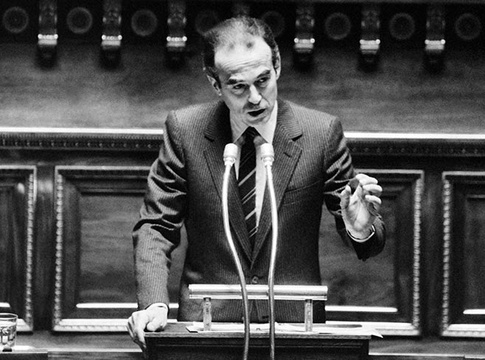
Robert Badinter: 'It is anti-justice ... it is passion and fear prevailing over reason and humanity'', Speech against the death penalty - 1981

February 9, 2016

28 September 1981, French National Assembly, Paris, France

The French transcript of Justice Minister Badinger's reasons for seeking abolition of the death penalty is here. This is an incomplete English transcript.

M. President: I give the floor to M. Guard of the Seals, Minister of
Justice.

M. Robert Badinter: M. President, ladies and gentlemen, I have the honour, on behalf of the Government of the Republic, to submit to the National Assembly the abolition of capital punishment in France.

In that moment, whose significance each of you can realise for our justice and for us, I want, first and foremost, to thank the Commission of Laws, because it understood the spirit of the bill submitted to it, and more particularly its recorder, M. Raymond Forni, not only because he is a man of heart and of talent, but also because he has been fighting, over the past
years, for abolition. Beyond himself, and like him, I’d like to thank all those, regardless of their political orientations, who, all along the past years, and especially inside the previous Commissions of Laws, have also been working so that abolition be decided, even before the major political shift we’ve just experienced.

This spiritual communion, this community of thought through political splits, do show that the debate opened today in front of you is first a debate of conscience and the choice that everyone of you will make shall bind him personally.

Raymond Forni rightly underlined that we’re about to finish a long way.

Nearly two centuries took place since, in the first parliamentary assembly in France, Le Pelletier de Saint-Fargeau called for the abolition of capital punishment. That was in 1791.
I’m looking at the way covered by France since then. France is a great country, not only by its power, but also, beyond its power, by the brilliance of the ideas, the causes, the generosity that prevailed during the important moments of her history.


France is a great country because she was the first, in Europe, to abolish torture in spite of cautious minds who, throughout the country, argued, at that time, that without torture, French justice would be helpless and that, without torture, good subjects would be handed over to the villains.

France was one of the first countries to abolish slavery, this crime that dishonours humanity.

That being said, and in spite of so many courageous attempts, France will have been one of the last countries, almost the last one – and I lower my voice to say that – in Western Europe, a continent where she has so often been a centre and a pole, to abolish capital punishment.


Why this delay? This is the first question that we must face.

It isn’t a problem of national genius. It’s from France, often from this forum, that the most famous voices, the ones that resonated to the highest and the furthest points in human conscience, arose to support, with utmost eloquence, the cause of abolition. M. Forni, you very appropriately recalled Hugo, I would recall as well, among other writers, Camus. And how not to think, in this very forum, about GambettaClemenceau and especially the great Jaurès?

They all stood up. They all supported the cause of abolition. So why did silence continue, why haven’t we abolished capital punishment?


I don’t either think it could be because of our national temperament. The French aren’t more repressive, less humane than other people. I know it by experience. French judges and juries can be as generous as other ones.

The answer thus doesn’t lie here. We have to seek it elsewhere.

For myself, I can see an explanation of political nature. Why? Abolition, as I said, has been regrouping men and women from every political class, and, beyond this, from all the layers of the nation. But if one considers the history of our country, one will notice that abolition, as such, has always been one of the great causes of the French left.

By left, understand me well, I mean forces of change, forces of progress, sometimes forces of revolution, those who, in any way, get history to progress. (Applause among the socialist representatives, many communists and from a few benches of the Union for the French Democracy)


Just look at this truth.

I recalled 1791, the first Constituent assembly. It’s true it didn’t abolish capital punishment, but it raised the issue, which was prodigiously audacious at that time. It reduced the application field of capital punishment more than anywhere else in Europe.

France’s first Republican Assembly, the Great Convention, proclaimed, on 4 Brumaire Year IV of the Republic, that capital punishment would be abolished in France once general peace would be re-established.

M. Albert Brochard: We know where this led to in Vendée!

Several socialist representatives: Silence Chouans !

M. Robert Badinter: Peace was eventually re-established, but with it Bonaparte arrived. And death penalty was written in the books of the Criminal Code that still is ours, not for long, though.

But let’s follow history.

The 1830 Revolution generated, in 1832, the concept of extenuating circumstances; the number of death sentences was immediately halved. The 1848 Revolution brought the abolition of capital punishment in political crimes, a progress that wouldn’t be put in question, in France, until 1939.

Not until the establishment of a left-wing majority in the core of French politics, in the years after 1900, shall again be submitted to the representatives of the people the question of the abolition of capital punishment. At that time, in this forum, Barrès and Jaurès confronted each other in a debate whose eloquence history still remembers. Jaurès – whose memory I honour on your behalf – has been, among all the left-wing orators, among all the socialists, the one who had the highest, the furthest and the most noble eloquence of heart and of reason, in order to serve, as a person, socialism, liberty and abolition. (Applause on the socialist benches, as well as on several communist benches.)

Jaurès... (Interruptions from the benches of the Union for the French Democracy and Movement for the Republic: Are there still names that disturb some of you? (Applause from the socialist and communist benches.)

M. Michel Noir: It’s deliberate provocation!

M. Jean Brocard: You’re not at court, but in front of the Assembly!

M. President: Sirs from the opposition, please. Jaurès belongs, together with other politicians, to the history of our country. (Applause from the same benches.)

M. Roger Corrèze: But not Badinter!

M. Robert Wagner: You don’t have your sleeves, M. Guard of the Seals!

M. President: Would you please carry on, M. Guard of the Seals.

M. Robert Badinter: Sirs, I recalled the memory of Barrès in spite of the distance between our opinions on this matter; I thus don’t need to insist. But I have to recall, since, obviously, his words aren’t extinct inside you, this sentence pronounced by Jaurès: “Capital punishment is contrary to what humanity, for two thousand years, has been thinking as highest and has been
dreaming as most noble. It is contrary to the spirit of Christianity as well as to the spirit of revolution.”


In 1908, Briand, in his turn, undertook submitting abolition to the Assembly. Curiously though, he didn’t attempt to use his eloquence. He strove to convince the Assembly by making it observe a very simple data, that recent experience – findings of the positivist school of thought – had just brought to light.


He actually observed that, due to different temperaments of the Presidents that succeeded one another during that period of great social and economic stability, the practice of capital punishment had notably changed for two decades: 1888-1897, Presidents let executions take place; 1898-1907, Presidents - Loubet, Fallières –abhorred capital punishment and consequently gave systematically pardon. The data were clear : during the former period
when executions were carried out : 3,066 homicides ; during the latter period, when human gentleness created reluctance on executions and capital punishment disappeared from repressive practice : 1,068 homicides, almost half of the former.


For this reason, Briand, irrespective of principles, invited the Assembly to abolish capital punishment that, as had been measured, was not dissuasive. It happened that a part of the press immediately undertook a very violent campaign against the abolitionists. It happened that a part of the Representatives didn’t have the courage to do what Briand suggested they
did. That’s how capital punishment stayed, in 1908, in our law and in our practice.


Since then – 75 years – never has a Parliamentary Assembly been submitted a bill to abolish capital punishment.


I am convinced – this will please you – that I have less eloquence than Briand, but I’m sure that you, you will have more courage, and that’s what matters.

M. Albert Brochard: Is that courage?

M. Robert Aumont: This interruption is inappropriate!

M. Roger Corrèze: There have also been left-wing governments during all
those years!

M. Robert Badinter: Time went by. One can wonder : why did nothing evolve in 1936? The reason is that the time of the left-wing was too short. The other reason, more simply, is that war was already looming in minds. And war periods aren’t favourable to tackle
the question of abolition of capital punishment. It is true that war and abolition can’t occur together.

Liberation. I’m convinced, on my part, that, if the government of Liberation didn’t raise the issue of abolition, it’s because troubled times, war crimes, the terrible ordeals of occupation caused the sensibility of public not to be ready for this. It was necessary to re-establish not only civil peace, but also peace among hearts.

This analysis is also valid for decolonisation periods. Only after those historical ordeals could really the question of abolition be submitted to your Assembly.

I shan’t elaborate more on this – M. Forni did that – but why, along the past mandate of this Assembly, didn’t governments want to raise, to your Assembly, the question of abolition, as so many of you, courageously, called for this debate? Some members of the government – and important ones – proclaimed themselves, personally, in favour of abolition, but one had the
feeling, hearing those whose responsibility was to propose abolition, that, on this issue, it was necessary to wait.


Wait, after 200 years!
Wait, as if capital punishment or guillotine were a fruit that one had to let mature before picking it!
Wait? We know, in reality, that the cause for this was the fear of the public opinion. Besides, some would tell you, ladies and sirs representatives, that, by voting for abolition, you would disregard the rules of democracy and ignore public opinion. This is wrong.

No one, at the time of the vote, will respect more than you the fundamental rule of democracy.
I refer myself not only to this conception, according to which the Parliament is, following the image of a famous Englishman, a lighthouse that opens the way from obscurity to our country, but also to the fundamental law of democracy that is the voice of universal vote and, for the ones who were elected, the respect of universal vote.


And, on two occasions, the question was directly – I emphasise this word – raised to the public opinion. The President made publicly know, not only his personal feeling, his loathing for capital punishment, but also expressed very clearly his will to ask the government to submit abolition to the Parliament if he was elected. The country answered: yes. Then there were the Parliament elections. During the electoral campaign, each one of the left-wing parties mentioned publicly in its programme…

M. Albert Brochard: What programme?

M. Robet Badinter: ... the abolition of capital punishment.

This country elected a left-wing majority; by so doing, with full knowledge, electors knew that they were approving a legislative programme in which the abolition of capital punishment stood at the first rank of its moral commitments. When you will vote for it, this solemn pact, the one that binds the representative to the country and that gives you as first duty the respect of the commitments you were elected for, respect for the universal vote of
the nation and for democracy, shall finally be yours.

Others will tell you that abolition, because it raises a problem to each and every human conscience, should only be decided by a referendum. If this choice existed, the question would probably have to be considered. But you know it as well as I do, and Raymond Forni recalled it, this possibility is constitutionally closed.

I recall the Assembly – but do I actually need to do it? – that General de Gaulle, founder of the Vth Republic, didn’t wish that matters of society, or, if you prefer, matters of morals, be decided through referendum. Neither do I need to recall you, ladies and gentlemen, that criminal penalties for abortion as well as for capital punishment stand in the books
of criminal laws that, according to the Constitution, come under your only
prerogatives.

Consequently, arguing that a referendum should take place, willing to solve the issue only by referendum, is deliberately ignoring the spirit as well as the letter of the Constitution. It is, by fake cleverness, refusing to take publicly a decision by fear of the public opinion. (Applause from socialist benches and from a few communist benches.)

Nothing has been made, through the past years, to enlighten the public opinion. On the contrary!

One refused the experience of abolitionist countries; one never wondered how the great Western democracies, our close partners, our sisters, our neighbours, could live without capital punishment.

One neglected studies made by all the greatest international organisations, such as the Council of Europe, the European Parliament, the United Nations themselves inside the Committee of Criminal Studies.

One concealed their constant conclusions. It has never been demonstrated that
there was any correlation between the existence or the non-existence of capital punishment in criminal legislation and the curve of lethal crime. On the contrary, instead of disclosing and underlining those obvious points, one kept anguish and fears alive, one favoured confusion.

One blocked the focus on the indisputable and worrisome increase of small and medium violent delinquency: we have, of course, to face this problem that is linked to economic and social conditions, and that, anyway, never came under capital punishment. But all honest people agree on the fact that, in France, lethal crime has never changed – and actually, taking the number of inhabitants into account, it rather tends to stagnate.

One kept silent.

In one word, regarding the public opinion, one stirred up collective fears and one refused it the defences of reason. (Applause from socialist benches and from a few communist benches.)


In reality, the question of capital punishment is easy for anyone who wants to analyse it with lucidity. It doesn’t come in terms of dissuasion or of repressive techniques, but in terms of political and moral choice. I have already said it, but I gladly repeat it, in regard of former silence: the only result reached by all the studies undertaken by specialists in criminology, is the conclusion of absence of relation between capital punishment and the evolution of lethal crime. I recall again, in this regard, the works of the Council of Europe in 1962; the British White Paper, a prudent research led throughout all the abolitionist countries before the
British decided to abolish capital punishment and refused since then, on two occasions, to restore it; the Canadian White Paper which processed according to the same method ; the studies led by the Committee for Crime Prevention of the United Nations, whose last texts were elaborated last year in Caracas; and finally the studies of the European Parliament, to which I associate our friend Mrs Roudy, that ended up to this essential vote by
which that Assembly, on behalf of Europe that it represents, of Western Europe of course, called, with an overwhelming majority, for the disappearance of capital punishment in Europe.

All, all of them concur on the conclusion I underlined.

Besides, for anyone who wants to consider faithfully the problem, it isn’t difficult to understand why, between capital punishment and the evolution of lethal crime, there is no such dissuasive link that one so often attempted to look for, without ever finding its source. I shall come back on this in a moment. If you simply look at this, the most horrendous crimes, those that shock the most the sensitiveness of the public – and one understands that -, those qualified as most atrocious crimes are most often committed by men driven by impulse of violence and death that go as far as suppressing the defences of reason. At that moment of madness, at that time of murderous impulse, the evocation of the penalty, whether it is capital punishment or
life without parole, is non existent in the mind of the murderer.

Don’t tell me that those mad ones aren’t sentenced to death. One could just refer to the annals of the past years to be convinced of the contrary. Olivier, executed, whose autopsy revealed his brains had frontal abnormalities. And Carrein, and Rousseau, and Garceau. As for the others, the so-called cold-blooded criminals, those who consider risks, those who think about the profits and the penalty, those ones, you shall never find them in situations where they risk their necks.


Reasonable gangsters, crime profiteers, organised criminals, procurers, traffickers, mafioso, never shall you find them in such situations. Never! (Applause from socialist benches and from a few communist benches.)

Those who look at the judicial annals, because those annals enclose the reality of capital punishment, know that, during the last 30 years, one cannot find the name of a “great” gangster, if one can use this adjective to qualify that kind of person. Not a single “public enemy” has never appeared there.

M. Jean Brocard: And Mesrine?

M. Hyacinthe Santoni: And Buffet? And Bontems?

M. Robert Badinter: It is the other ones, the former ones I evoked before, that appear in those annals. Actually, those who believe in the dissuasive value of capital punishment are unaware of human truth. Criminal passions cannot be held any more than other passions that, on the contrary, are noble. And if the fear of death could stop men, you would have no great soldiers,
no great sportsmen. We admire them, but they don’t hesitate in front of death. Others, driven by other passions, don’t hesitate either. Only to justify capital punishment did one invent the idea that the fear of death would stop men from their extreme passions.

This is not correct. And, since someone just pronounced the name of two death row inmates that were executed, I will explain to you why, more than anyone else, I can affirm that capital punishment has no dissuasive value: remember that, among the crowd that, around the Palace of Justice of Troyes, shouted “To death Buffet! To death Bontems” after the imposition of their death sentences, there was a young man whose name was Patrick Henry. Believe me, when I learnt that, to my amazement, I understood what the dissuasive value of capital punishment could mean ! (Applause from socialist benches and from a few communist benches.)

M. Pierre Micaux: Go to Troyes to explain it!

M. Robert Badinter: And you, who are statesmen, conscious of your responsibilities, do you believe that Statesmen, our friends who are responsible for leading the great Western democracies, as meaningful astheir respect for those moral values, that are characteristic for countries of freedom, can be, do you believe that those responsible men would have voted abolition or that they wouldn’t have restored capital punishment if they had thought it could have been of any use, thanks to its dissuasive value, against lethal crime? Thinking so would be an insult to them.

M. Albert Brochard: And in California? Reagan is probably a wag!

M. Robert Badinter: We shall forward him those remarks. I’m sure he’ll appreciate the qualifier!
It is anyway sufficient to question yourselves, in concrete terms, and realise what abolition would have exactly meant if it had been voted in France in 1974, when the previous President, though always privately, recognised his personal loathing for capital punishment.

What would have been the impact of abolition voted in 1974, for the 7-year-term that ended in 1981, on the safety and security of the French? Just this: three death row inmates that would add up to the 333 inmates presently in our jails. Three more.

Who? I will recall you.

Christian Ranucci: I shan’t insist here, there are too many interrogations and doubts about him, and those interrogations are sufficient, for any conscience longing for justice, to disapprove capital punishment.

Jérôme Carrein: feeble, drunkard, he committed an atrocious crime. But he was also seen by many in his village, giving his hand to the little girl he would kill a few moments later, and this shows that he didn’t realise the passion that would overwhelm him then. (Murmuring from many benches of the Movement for the Republic and Union
for the French Democracy.)
Finally Djandoubi, who was one-legged and who, whatever the horror of his crimes – and the term isn’t too strong -, showed obvious signs of unbalance and who was brought to the guillotine after having removed his prosthesis.


I certainly don’t want to call for any posthumous pity: it’s neither the place, nor the time for this, but just keep in mind that one still have questions about the guilt of the former, that the second one was a feeble and that the first one was one-legged.

Can one argue that, if those three men were in French jails, the safety of our citizens would in any way be endangered?

M. Albert Brochard: That’s incredible! We’re not at court!

M. Robert Badinter: That’s truth and the exact impact of capital punishment. It’s simply that. (Prolonged applause from socialist and communist benches.)

M. Jean Brocard: I’m leaving this meeting.

M. President: It’s your right!

M. Albert Brochard: You’re Guard of the Seals and not lawyer!

M. Robert Badinter: And this reality...

M. Roger Corrèze: Your reality !

M. Robert Badinter: ... seems to make people leave. As we all know, the question is not in terms of dissuasion or repressive technique, but in terms of political, and especially moral choice.
A single look at a world map can confirm that capital punishment has a political meaning. I regret one cannot submit such a map to this Assembly, as it was done at the European Parliament. One would see the abolitionist countries and the other ones, the countries of freedom and the other ones.

M. Charles Miossec: What a strange combination!

M. Robert Badinter: Facts are clear. In the overwhelming majority of Western democracies, especially in Europe, in all the countries where freedom stands in institutions and is respected in practice, capital punishment has disappeared.

M. Claude Marcus: Not in the United States.

M. Robert Badinter: I said in Western Europe, but it is significant that you mention the United States. The copy is almost complete: in countries of freedom, the common law is abolition, capital punishment is the exception.

M. Roger Corrèze: Not in socialist countries.

M. Robert Badinter: I’m not putting these words into your mouth. Everywhere in the world, and with no exception, where dictatorship and violations for human rights prevail, everywhere shall you find out that capital punishment stands, in red letters.
(Applause from socialist benches.)

M. Roger Corrèze: The communists took note of your words!

M. Gérard Chasseguet: The communists have appreciated.

M. Robert Badinter: Here’s the first obvious point: in countries of freedom, abolition is almost the rule; in dictatorships, capital punishment is everywhere in use. This division of the world doesn’t result from just a coincidence. It shows a correlation. The true political signification of capital punishment is that it results from the idea that State has the right to take advantage of the citizen, till the possibility to suppress the citizen’s life. This is the way capital punishment comes within the framework of totalitarian regimes.


Here you will find, in the judicial reality, as Raymond Forni evoked, the true signification of capital punishment. In the judicial reality, what is capital punishment? It is twelve men and women, two days of hearings, theimpossibility to get to the bottom of the facts and the terrible duty to decide, in a few quarters of an hour, sometimes even in a few minutes, on
the so difficult question of guilt and, beyond this, on the life or the death of another human being.

Twelve persons, in a democracy, that have the right to say: this one shall live, that one shall die! I affirm it: this conception of justice cannot be the one of countries of freedom, precisely
because of its totalitarian significance.

As regards right to pardon, we should, as Raymond Forni recalled it, question ourselves about it. When the king was representing God on the Earth, when he was anointed by God’s will, the right to pardon had a legitimate foundation. In a civilisation, in a society whose institutions
are imbued by religious faith, one can easily understand that God’s representative may have had this right of life and death. But in a republic, in a democracy, whatever his merits are, whatever his conscience is, no man, no power should have, at his disposal, any right on anyone in time of peace.

M. Jean Falala: Except the murderers!

M. Robert Badinter: I know that nowadays - and this is the main problem -, some of you consider capital punishment as a kind of ultimate resort, a kind of extreme defence of democracy against the serious threat represented by terrorism. Guillotine, they think, would possibly protect democracy instead of dishonouring it.

This argument reveals a complete ignorance of reality. Indeed, History shows that, if there is a category of crime that has never backed out in front of the threat of death, it is political crime. And, more specifically, if there is a kind of woman or man that the threat of death couldn’t make hesitate, it is the terrorist. First, because he faces death during his violent action; then, because deep down in his heart, he feels some dark fascination over violence and death, the one he gives, and also the one he receives.


Terrorism, which, for me, is a major crime against democracy, and that, should it take place in this country, would be repressed and prosecuted with all necessary steadiness, has, as a rallying cry, whatever the ideology that motivates it, the terrible cry of the fascists during the Spain War: "Viva la muerte!". So, believing that one could stop it with death is illusion.
Let’s go further. If, in the neighbouring democracies, yet confronted toterrorism, one refused to restore capital punishment, it is, of course, out of moral requirements, but also for political reasons. You know actually that, to the eyes of some, especially the youth, the execution of a
terrorist would transcend him, divert him from the criminal reality of his deeds, transform him into a kind of hero who has fought till the end of his life, who, having been involved in a cause, as obnoxious as this cause be, would have served it till his death. Then there is a considerable risk, that precisely the Statesmen of our neighbouring democracies considered, to see
the emergence, in the shadow, of twenty wandered youth for each terrorist killed. So, instead of fighting terrorism, capital punishment would feed terrorism. (Applause from socialist and communist benches.)


To this factual consideration, one should add a moral data: using capital punishment against terrorists is, for a democracy, adopting the values of the terrorists. When, after having arrested him, after having extorted from him terrible correspondences, terrorists, at the end of a degrading mockery of trial, execute the one they abducted, not only do they commit an
obnoxious crime, but they also set a most insidious trap for democracy, the trap of a murderous violence that, by compelling that democracy to resort to capital punishment, might enable them to give that democracy, as a result of an inversion of values, their own savage face.


We must refuse that temptation without ever, though, compromising with this ultimate form of violence, intolerable in a democracy, that terrorism represents. But after one has stripped the problem from its passionate aspect and one wants to reach to the bottom with lucidity, one notes that the choice between retention and abolition of capital punishment is, at the end of the day and for each of us, a moral choice.


I won’t use the argument of authority, because it would be inappropriate at the Parliament, and too easy in this forum. But one can’t miss noticing that, over the past years, the catholic church, the council of the reformed church and the representatives of the Jewish community all clearly took position against capital punishment. How not to recall that all the great
international organisations that campaign, throughout the world, for the defence of human rights – Amnesty International, the International Association for Human Rights, the Human Rights League – have all campaigned for the abolition of capital punishment.

M. Albert Brochard: Except the families of the victims (Prolonged murmuring from socialist benches.)

M. Robert Badinter: This conjunction of so many religious and secular beliefs, men of God as well as men of freedoms, at a period when one evokes so often a crisis of moral values, is significant.

M. Pierre-Charles Krieg: And 33% of the French!

M. Robert Badinter: For the advocates of capital punishment, whose choice the abolitionists, including myself, have always respected, while noting with regret that the opposite wasn’t always true, and that hatred often answered what was only the expression of a deep conviction, which I shall always respect in men of freedom – for the advocates of capital punishment, as I said, the death of the guilty is a requirement for justice. For them,
there are indeed crimes that are so atrocious that one couldn’t enable the criminals to expiate for them in another way than by paying their lives.

The death and sufferings of the victims, this terrible misfortune, would demand, as a necessary and imperative compensation, another death and other sufferings. Failing that, as a recent Minister of Justice has recently stated, anguish and passion aroused in society by crime would not be soothed. That is called, I believe, an expiatory sacrifice. And justice, for the advocates of capital punishment, would not be done if, to the death of the victim, the death of the guilty didn’t response, like an echo.

Lets’ be clear. This just means that the “an eye for an eye” principle would stay, throughout the millennia, the necessary, unique law of human justice. Talking about misfortune and sufferings of victims, I have, more often than those who mention them, measured, throughout my life, their extent. That crime is the meeting point of human misfortune, I know it better than
anyone. Misfortune for the victim herself and, beyond, misfortune for her parents and relatives. Misfortune for the parents of the criminal.

Finally, misfortune for the criminal himself. Yes, crime is misfortune and there is no man, no woman of heart, of reason, of responsibility, who wouldn’t want first to fight crime But feeling, deep inside oneself, the misfortune and the sorrow of victims, fighting by all means so that violence and crime regress in our society, this sensitivity and this fight cannot imply the necessary putting to death of the guilty. That parents of relatives of the victims want this death, by natural reaction of hurt human beings, I can conceive it, I can understand
it. But it is a human, natural reaction. And all the historical progress of justice has consisted into going beyond private revenge. And how to go beyond it except by first refusing the “an eye for an eye” principle?

The truth is that, in the deepest motivations of retention of capital punishment, one finds, most often hushed up, the temptation of elimination. What appears unbearable for many is less the life of the criminal in jail than the fear he might repeat offence some day. And they think that the only guarantee, to this regard, is that the criminal be put to death out of precaution.

So, according to this conception, justice would kill out of prudence rather than out of revenge. Beyond this expiation justice would thus appear elimination justice, guillotine behind balance. The criminal must die just because, this way, he won’t repeat offence. And everything seems so easy, and everything looks so right!


But when one accepts, or when one advocatesfor, elimination justice, in the name of justice, one must be fully aware of which logic one enters into. To be acceptable, even for its advocates, a justice that kills a criminal must kill with full knowledge of the facts. Our justice, and it’s its honour, does not kill lunatics. But it isn’t able to definitely identify them, and
for this, in the judicial reality, one leaves it up to psychiatric expertise, the most chancy, the most uncertain of all. If the psychiatric verdict is favourable to the criminal, he shall be spared.

Society will accept the risk he represents and no one would get indignant about it. But
if the psychiatric verdict is unfavourable to him, he shall be executed. When they accept elimination justice, political leaders must measure in which historical logic they enter.

I don’t talk about those societies that eliminate criminals as well as lunatics, political opponents and those they think could "pollute" the social body. No, I strictly refer to those countries that live in democracy. Secret racism is buried, crouched down at the very heart of elimination justice. If, in 1972, the Supreme Court of the United States favoured abolition, it was primarily because it had noticed that 60% of the death row inmates were Blacks, whereas they only represented 12% of the population.

What a dizzy for a man of justice!

I lower my voice and turn to you all to recall that, even in France, on 36 definitive death sentences pronounced since 1945, there are 9 foreigners, that is 25%, while they only account for 8% of the population; among them 5 North Africans, while they only account for 2% of the population.

Since 1965, among the 9 death row inmates who have been executed, there are 4 foreigners, including 3 North Africans. Were their crimes more heinous than others’, or did they seem more serious because their authors, at that time, were secretly horrifying society? It’s a question, just a question, but it is so insistent and so haunting that only abolition can put an end to such a question that hits us with such cruelty.


Abolition is eventually, indeed, a fundamental choice, a certain conception of humanity and of justice. Those who want a justice that kills, are motivated by a double conviction: that there are men who are totally guilty, that is to say men totally responsible for their acts, and that there can be a justice certain of its infallibility, to the point of saying that this one can live and that one shall die.

At this age of my life, both of those assertions seem equally erroneous to me. As terrible, as obnoxious as their acts can be, there are no men on this earth whose guilt would be total and about whom one should totally despair. As prudent as justice can be, as moderated and anguished as the women and men who judge can be, justice remains human, thus fallible.
And I don’t only talk about absolute miscarriage of justice, when, after an execution, it appears, as it can still happen, that the death row inmate was innocent and that a whole society – that is, all of us -, in the name of which the sentence was pronounced, thus becomes collectively guilty since its justice enables the supreme injustice.

I talk also about the incertitude and the contradiction between pronounced sentences, when the same convicts, sentenced to death a first time, whose sentences are cancelled for a legal
irregularity, are again judged and, though the facts remain the same, escape, this time, from death, as if the life of a man was determined by the fate of a court clerk’s pen mistake. Or about certain convicts who, for less serious crimes, will be executed, while others, more guilty, will manage to save their heads thanks to the passion of the hearings, the atmosphere or
the rage of someone or other.

This kind of judicial lottery, whatever the difficulty one would feel for this word when the life of a woman or of a man is at stake, is intolerable. The highest magistrate of France, M. Aydalot, at the end of a long career, totally dedicated to justice and, for most of his activity, to the public prosecutor’s department, said that, as it was randomly implemented, capital punishment had become, for him, as a magistrate, unbearable.

For those of us who believe in God, He alone has the power to choose the moment of our death. For all the abolitionists, it is impossible to recognise human justice with this power of death, because they know it is fallible.

The choice that is lying in front of your consciences is thus clear: either our society refuses a justice that kills and accepts, in the name of its fundamental values – those that made it great and respected among all -, to take on the lives of those, lunatics or criminals, or both together, that horrify it, and that is the choice of abolition; or this society believes, in spite of the experience of centuries, it can make crime disappear with the criminal, and that’s elimination.


This elimination justice, this justice of anguish and death, decided with its margin of hazard, we refuse it. We refuse it because it is, for us, anti-justice, because it is passion and fear prevailing over reason and humanity.  I have told the essentials about the spirit and the inspiration of this
important bill. Raymond Forni, a while ago, exposed its main guidelines.

They are easy and precise.

Because abolition is a moral choice, it is important to take a clear decision. The Government, thus, asks you vote the abolition of capital punishment without accompanying it by any restriction or reserve. There is no doubt that amendments will be submitted to restrain the scope of abolition and exclude therefrom diverse categories of crimes. I understand
the inspiration of those amendments but the Government will ask you reject them.

First, because the expression "abolish except for heinous crimes" only means, in reality, a statement in favour of capital punishment. In judicial reality, nobody incurs capital punishment except for heinous crimes. It is better, in such a case, to avoid style conveniences and declare oneself in favour of capital punishment. (Applause from socialist benches.)


As far as suggestions to shape the scope of abolition with regard to the quality of the victims, especially with regard to their particular weakness or the greatest risks they incur, the Government will also ask you reject them, in spite of the generosity that motivates them.

Those exclusions ignore an obvious fact: all the victims, and I stress the word “all”, are pitiable and deserve the same compassion. No doubt that, for each of us, the death of a child or of an elderly arouses more easily emotion than the death of a thirty-year-old woman or of a mature man with responsibilities, but, in human reality, both are equally painful and any discrimination to this regard would create injustice!


Regarding policemen or prison personals, whose representative organisations require the retention of capital punishment against those who would make an
attempt on the lives of their members


[transcript cuts out]
Source: https://groups.google.com/forum/m/#!topic/...

Enjoyed this speech? Speakola is a labour of love and I’d be very grateful if you would share, tweet or like it. Thank you.

Facebook Twitter Facebook
In LAWS AND JUSTICE Tags ROBERT BADINTER, FRANCE, DEATH PENALTY, ABOLITION, SOCIALISM, MITTERAND, EXECUTIONS
Comment

Bryan Stevenson: 'We need to talk about an injustice' TED Talk - 2012

February 3, 2016

1 March 2012, TED2012, Long Beach, California, USA

Well this is a really extraordinary honor for me. I spend most of my time in jails, in prisons, on death row. I spend most of my time in very low-income communities in the projects and places where there's a great deal of hopelessness. And being here at TED and seeing the stimulation, hearing it, has been very, very energizing to me. And one of the things that's emerged in my short time here is that TED has an identity. And you can actually say things here that have impacts around the world. And sometimes when it comes through TED, it has meaning and power that it doesn't have when it doesn't.

And I mention that because I think identity is really important. And we've had some fantastic presentations. And I think what we've learned is that, if you're a teacher your words can be meaningful, but if you're a compassionate teacher, they can be especially meaningful. If you're a doctor you can do some good things, but if you're a caring doctor you can do some other things. And so I want to talk about the power of identity. And I didn't learn about this actually practicing law and doing the work that I do. I actually learned about this from my grandmother.

I grew up in a house that was the traditional African-American home that was dominated by a matriarch, and that matriarch was my grandmother. She was tough, she was strong, she was powerful. She was the end of every argument in our family. She was the beginning of a lot of arguments in our family. She was the daughter of people who were actually enslaved. Her parents were born in slavery in Virginia in the 1840's. She was born in the 1880's and the experience of slavery very much shaped the way she saw the world.

And my grandmother was tough, but she was also loving. When I would see her as a little boy, she'd come up to me and she'd give me these hugs. And she'd squeeze me so tight I could barely breathe and then she'd let me go. And an hour or two later, if I saw her, she'd come over to me and she'd say, "Bryan, do you still feel me hugging you?" And if I said, "No," she'd assault me again, and if I said, "Yes," she'd leave me alone. And she just had this quality that you always wanted to be near her. And the only challenge was that she had 10 children. My mom was the youngest of her 10 kids. And sometimes when I would go and spend time with her, it would be difficult to get her time and attention. My cousins would be running around everywhere.

And I remember, when I was about eight or nine years old, waking up one morning, going into the living room, and all of my cousins were running around. And my grandmother was sitting across the room staring at me. And at first I thought we were playing a game. And I would look at her and I'd smile, but she was very serious. And after about 15 or 20 minutes of this, she got up and she came across the room and she took me by the hand and she said, "Come on, Bryan. You and I are going to have a talk." And I remember this just like it happened yesterday. I never will forget it.

She took me out back and she said, "Bryan, I'm going to tell you something, but you don't tell anybody what I tell you." I said, "Okay, Mama." She said, "Now you make sure you don't do that." I said, "Sure." Then she sat me down and she looked at me and she said, "I want you to know I've been watching you." And she said, "I think you're special." She said, "I think you can do anything you want to do." I will never forget it.

And then she said, "I just need you to promise me three things, Bryan." I said, "Okay, Mama." She said, "The first thing I want you to promise me is that you'll always love your mom." She said, "That's my baby girl, and you have to promise me now you'll always take care of her." Well I adored my mom, so I said, "Yes, Mama. I'll do that." Then she said, "The second thing I want you to promise me is that you'll always do the right thing even when the right thing is the hard thing." And I thought about it and I said, "Yes, Mama. I'll do that." Then finally she said, "The third thing I want you to promise me is that you'll never drink alcohol." (Laughter) Well I was nine years old, so I said, "Yes, Mama. I'll do that."

I grew up in the country in the rural South, and I have a brother a year older than me and a sister a year younger. When I was about 14 or 15, one day my brother came home and he had this six-pack of beer -- I don't know where he got it -- and he grabbed me and my sister and we went out in the woods. And we were kind of just out there doing the stuff we crazily did. And he had a sip of this beer and he gave some to my sister and she had some, and they offered it to me. I said, "No, no, no. That's okay. You all go ahead. I'm not going to have any beer." My brother said, "Come on. We're doing this today; you always do what we do. I had some, your sister had some. Have some beer." I said, "No, I don't feel right about that. Y'all go ahead. Y'all go ahead." And then my brother started staring at me. He said, "What's wrong with you? Have some beer." Then he looked at me real hard and he said, "Oh, I hope you're not still hung up on that conversation Mama had with you." (Laughter) I said, "Well, what are you talking about?" He said, "Oh, Mama tells all the grandkids that they're special." (Laughter) I was devastated.

(Laughter)

And I'm going to admit something to you. I'm going to tell you something I probably shouldn't. I know this might be broadcast broadly. But I'm 52 years old, and I'm going to admit to you that I've never had a drop of alcohol. (Applause) I don't say that because I think that's virtuous; I say that because there is power in identity. When we create the right kind of identity, we can say things to the world around us that they don't actually believe makes sense. We can get them to do things that they don't think they can do. When I thought about my grandmother, of course she would think all her grandkids were special. My grandfather was in prison during prohibition. My male uncles died of alcohol-related diseases. And these were the things she thought we needed to commit to.

Well I've been trying to say something about our criminal justice system. This country is very different today than it was 40 years ago. In 1972, there were 300,000 people in jails and prisons. Today, there are 2.3 million. The United States now has the highest rate of incarceration in the world. We have seven million people on probation and parole. And mass incarceration, in my judgment, has fundamentally changed our world. In poor communities, in communities of color there is this despair, there is this hopelessness, that is being shaped by these outcomes. One out of three black men between the ages of 18 and 30 is in jail, in prison, on probation or parole. In urban communities across this country -- Los Angeles, Philadelphia, Baltimore, Washington -- 50 to 60 percent of all young men of color are in jail or prison or on probation or parole.

Our system isn't just being shaped in these ways that seem to be distorting around race, they're also distorted by poverty. We have a system of justice in this country that treats you much better if you're rich and guilty than if you're poor and innocent. Wealth, not culpability, shapes outcomes. And yet, we seem to be very comfortable. The politics of fear and anger have made us believe that these are problems that are not our problems. We've been disconnected.

It's interesting to me. We're looking at some very interesting developments in our work. My state of Alabama, like a number of states, actually permanently disenfranchises you if you have a criminal conviction. Right now in Alabama 34 percent of the black male population has permanently lost the right to vote. We're actually projecting in another 10 years the level of disenfranchisement will be as high as it's been since prior to the passage of the Voting Rights Act. And there is this stunning silence.

I represent children. A lot of my clients are very young. The United States is the only country in the world where we sentence 13-year-old children to die in prison. We have life imprisonment without parole for kids in this country. And we're actually doing some litigation. The only country in the world.

I represent people on death row. It's interesting, this question of the death penalty. In many ways, we've been taught to think that the real question is, do people deserve to die for the crimes they've committed? And that's a very sensible question. But there's another way of thinking about where we are in our identity. The other way of thinking about it is not, do people deserve to die for the crimes they commit, but do we deserve to kill? I mean, it's fascinating.

Death penalty in America is defined by error. For every nine people who have been executed, we've actually identified one innocent person who's been exonerated and released from death row. A kind of astonishing error rate -- one out of nine people innocent. I mean, it's fascinating. In aviation, we would never let people fly on airplanes if for every nine planes that took off one would crash. But somehow we can insulate ourselves from this problem. It's not our problem. It's not our burden. It's not our struggle.

I talk a lot about these issues. I talk about race and this question of whether we deserve to kill. And it's interesting, when I teach my students about African-American history, I tell them about slavery. I tell them about terrorism, the era that began at the end of reconstruction that went on to World War II. We don't really know very much about it. But for African-Americans in this country, that was an era defined by terror. In many communities, people had to worry about being lynched. They had to worry about being bombed. It was the threat of terror that shaped their lives. And these older people come up to me now and they say, "Mr. Stevenson, you give talks, you make speeches, you tell people to stop saying we're dealing with terrorism for the first time in our nation's history after 9/11." They tell me to say, "No, tell them that we grew up with that." And that era of terrorism, of course, was followed by segregation and decades of racial subordination and apartheid.

And yet, we have in this country this dynamic where we really don't like to talk about our problems. We don't like to talk about our history. And because of that, we really haven't understood what it's meant to do the things we've done historically. We're constantly running into each other. We're constantly creating tensions and conflicts. We have a hard time talking about race, and I believe it's because we are unwilling to commit ourselves to a process of truth and reconciliation. In South Africa, people understood that we couldn't overcome apartheid without a commitment to truth and reconciliation. In Rwanda, even after the genocide, there was this commitment, but in this country we haven't done that.

I was giving some lectures in Germany about the death penalty. It was fascinating because one of the scholars stood up after the presentation and said, "Well you know it's deeply troubling to hear what you're talking about." He said, "We don't have the death penalty in Germany. And of course, we can never have the death penalty in Germany." And the room got very quiet, and this woman said, "There's no way, with our history, we could ever engage in the systematic killing of human beings. It would be unconscionable for us to, in an intentional and deliberate way, set about executing people." And I thought about that. What would it feel like to be living in a world where the nation state of Germany was executing people, especially if they were disproportionately Jewish? I couldn't bear it. It would be unconscionable.

And yet, in this country, in the states of the Old South, we execute people -- where you're 11 times more likely to get the death penalty if the victim is white than if the victim is black, 22 times more likely to get it if the defendant is black and the victim is white -- in the very states where there are buried in the ground the bodies of people who were lynched. And yet, there is this disconnect.

Well I believe that our identity is at risk. That when we actually don't care about these difficult things, the positive and wonderful things are nonetheless implicated. We love innovation. We love technology. We love creativity. We love entertainment. But ultimately, those realities are shadowed by suffering, abuse, degradation, marginalization. And for me, it becomes necessary to integrate the two. Because ultimately we are talking about a need to be more hopeful, more committed, more dedicated to the basic challenges of living in a complex world. And for me that means spending time thinking and talking about the poor, the disadvantaged, those who will never get to TED. But thinking about them in a way that is integrated in our own lives.

You know ultimately, we all have to believe things we haven't seen. We do. As rational as we are, as committed to intellect as we are. Innovation, creativity, development comes not from the ideas in our mind alone. They come from the ideas in our mind that are also fueled by some conviction in our heart. And it's that mind-heart connection that I believe compels us to not just be attentive to all the bright and dazzly things, but also the dark and difficult things. Vaclav Havel, the great Czech leader, talked about this. He said, "When we were in Eastern Europe and dealing with oppression, we wanted all kinds of things, but mostly what we needed was hope, an orientation of the spirit, a willingness to sometimes be in hopeless places and be a witness."

Well that orientation of the spirit is very much at the core of what I believe even TED communities have to be engaged in. There is no disconnect around technology and design that will allow us to be fully human until we pay attention to suffering, to poverty, to exclusion, to unfairness, to injustice. Now I will warn you that this kind of identity is a much more challenging identity than ones that don't pay attention to this. It will get to you.

I had the great privilege, when I was a young lawyer, of meeting Rosa Parks. And Ms. Parks used to come back to Montgomery every now and then, and she would get together with two of her dearest friends, these older women, Johnnie Carr who was the organizer of the Montgomery bus boycott -- amazing African-American woman -- and Virginia Durr, a white woman, whose husband, Clifford Durr, represented Dr. King. And these women would get together and just talk.

And every now and then Ms. Carr would call me, and she'd say, "Bryan, Ms. Parks is coming to town. We're going to get together and talk. Do you want to come over and listen?" And I'd say, "Yes, Ma'am, I do." And she'd say, "Well what are you going to do when you get here?" I said, "I'm going to listen." And I'd go over there and I would, I would just listen. It would be so energizing and so empowering.

And one time I was over there listening to these women talk, and after a couple of hours Ms. Parks turned to me and she said, "Now Bryan, tell me what the Equal Justice Initiative is. Tell me what you're trying to do." And I began giving her my rap. I said, "Well we're trying to challenge injustice. We're trying to help people who have been wrongly convicted. We're trying to confront bias and discrimination in the administration of criminal justice. We're trying to end life without parole sentences for children. We're trying to do something about the death penalty. We're trying to reduce the prison population. We're trying to end mass incarceration."

I gave her my whole rap, and when I finished she looked at me and she said, "Mmm mmm mmm." She said, "That's going to make you tired, tired, tired." (Laughter) And that's when Ms. Carr leaned forward, she put her finger in my face, she said, "That's why you've got to be brave, brave, brave."

And I actually believe that the TED community needs to be more courageous. We need to find ways to embrace these challenges, these problems, the suffering. Because ultimately, our humanity depends on everyone's humanity. I've learned very simple things doing the work that I do. It's just taught me very simple things. I've come to understand and to believe that each of us is more than the worst thing we've ever done. I believe that for every person on the planet. I think if somebody tells a lie, they're not just a liar. I think if somebody takes something that doesn't belong to them, they're not just a thief. I think even if you kill someone, you're not just a killer. And because of that there's this basic human dignity that must be respected by law. I also believe that in many parts of this country, and certainly in many parts of this globe, that the opposite of poverty is not wealth. I don't believe that. I actually think, in too many places, the opposite of poverty is justice.

And finally, I believe that, despite the fact that it is so dramatic and so beautiful and so inspiring and so stimulating, we will ultimately not be judged by our technology, we won't be judged by our design, we won't be judged by our intellect and reason. Ultimately, you judge the character of a society, not by how they treat their rich and the powerful and the privileged, but by how they treat the poor, the condemned, the incarcerated. Because it's in that nexus that we actually begin to understand truly profound things about who we are.

I sometimes get out of balance. I'll end with this story. I sometimes push too hard. I do get tired, as we all do. Sometimes those ideas get ahead of our thinking in ways that are important. And I've been representing these kids who have been sentenced to do these very harsh sentences. And I go to the jail and I see my client who's 13 and 14, and he's been certified to stand trial as an adult. I start thinking, well, how did that happen? How can a judge turn you into something that you're not? And the judge has certified him as an adult, but I see this kid.

And I was up too late one night and I starting thinking, well gosh, if the judge can turn you into something that you're not, the judge must have magic power. Yeah, Bryan, the judge has some magic power. You should ask for some of that. And because I was up too late, wasn't thinking real straight, I started working on a motion. And I had a client who was 14 years old, a young, poor black kid. And I started working on this motion, and the head of the motion was: "Motion to try my poor, 14-year-old black male client like a privileged, white 75-year-old corporate executive."

(Applause)

And I put in my motion that there was prosecutorial misconduct and police misconduct and judicial misconduct. There was a crazy line in there about how there's no conduct in this county, it's all misconduct. And the next morning, I woke up and I thought, now did I dream that crazy motion, or did I actually write it? And to my horror, not only had I written it, but I had sent it to court.

(Applause)

A couple months went by, and I had just forgotten all about it. And I finally decided, oh gosh, I've got to go to the court and do this crazy case. And I got into my car and I was feeling really overwhelmed -- overwhelmed. And I got in my car and I went to this courthouse. And I was thinking, this is going to be so difficult, so painful. And I finally got out of the car and I started walking up to the courthouse.

And as I was walking up the steps of this courthouse, there was an older black man who was the janitor in this courthouse. When this man saw me, he came over to me and he said, "Who are you?" I said, "I'm a lawyer." He said, "You're a lawyer?" I said, "Yes, sir." And this man came over to me and he hugged me. And he whispered in my ear. He said, "I'm so proud of you." And I have to tell you, it was energizing. It connected deeply with something in me about identity, about the capacity of every person to contribute to a community, to a perspective that is hopeful.

Well I went into the courtroom. And as soon as I walked inside, the judge saw me coming in. He said, "Mr. Stevenson, did you write this crazy motion?" I said, "Yes, sir. I did." And we started arguing. And people started coming in because they were just outraged. I had written these crazy things. And police officers were coming in and assistant prosecutors and clerk workers. And before I knew it, the courtroom was filled with people angry that we were talking about race, that we were talking about poverty, that we were talking about inequality.

And out of the corner of my eye, I could see this janitor pacing back and forth. And he kept looking through the window, and he could hear all of this holler. He kept pacing back and forth. And finally, this older black man with this very worried look on his face came into the courtroom and sat down behind me, almost at counsel table. About 10 minutes later the judge said we would take a break. And during the break there was a deputy sheriff who was offended that the janitor had come into court. And this deputy jumped up and he ran over to this older black man. He said, "Jimmy, what are you doing in this courtroom?" And this older black man stood up and he looked at that deputy and he looked at me and he said, "I came into this courtroom to tell this young man, keep your eyes on the prize, hold on."

I've come to TED because I believe that many of you understand that the moral arc of the universe is long, but it bends toward justice. That we cannot be full evolved human beings until we care about human rights and basic dignity. That all of our survival is tied to the survival of everyone. That our visions of technology and design and entertainment and creativity have to be married with visions of humanity, compassion and justice. And more than anything, for those of you who share that, I've simply come to tell you to keep your eyes on the prize, hold on.

Thank you very much.


C

Source: https://www.ted.com/talks/bryan_stevenson_...

Enjoyed this speech? Speakola is a labour of love and I’d be very grateful if you would share, tweet or like it. Thank you.

Facebook Twitter Facebook
In EQUALITY Tags BRYAN STEVENSON, HUMAN RIGHTS LAWYER, DEATH PENALTY, RACIAL EQUALITY, INJUSTICE, TEDTALK, TED2012
1 Comment
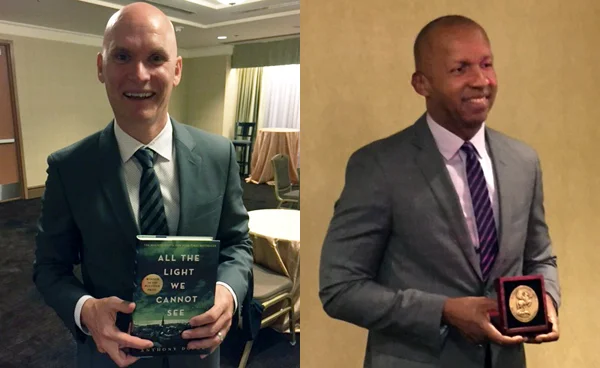
Bryan Stevenson (right) holding his Carnegie Medal for non fiction

Bryan Stevenson (right) holding his Carnegie Medal for non fiction

Bryan Stevenson: "We don't want anybody talking about race", Carnegie Medal acceptance - 2015

February 3, 2016

27 June 2015, American Library Association conference, San Francisco, USA

Thank you. I'm pretty overwhelmed by this...I really want to thank all of you for creating a space where something like this could happen to somebody like me. I'm really, really grateful to the selection committee, to all of you.

I had a very close relationship with my grandmother. My grandmother was the daughter of people who were enslaved. Her parents were born into slavery in Virginia in the 1840s. She was born in the 1880s, and the only thing that my grandmother insisted that I know about her enslaved father is that he learned to read before emancipation, and that reading is a pathway to survival and success. So I learned to read. I put books and words in my head and in my heart, so that I could get to the places that she needed me to go.

I'm thinking about my grandmother tonight, because she had these qualities about her. She was like lots of African American matriarchs. She was the real force in our family. She was the end of every argument. She was also the beginning of a lot of arguments! She was tough, and she was strong but she was also kind and loving. When I was a little boy, she'd give me these hugs, she'd squeeze me so tightly I could barely breathe. And then she'd see me an hour later and she'd say, "Bryan, do you still feel me hugging you?" And if I said no, she would assault me again!

She left Virginia at the turn of the century, like millions of African Americans who were fleeing terrorism and lynching and racial violence, and she moved to Philadelphia. Because I still lived in the country and grew up in the country, she worried about me when I would come and spend time with her, because there were so many people she didn't know. I would go outside and make new friends, and every now and then she'd be really critical about some of the people I was hanging out with. She'd say, "Now Bryan, be careful about the people you hang out with. Be careful of who you spend time with because people will judge you by the company you keep."

Being here, among these amazing writers, extraordinary writers, being here with my childhood idol, Kareem Abdul Jabbar, being here in a room full of librarians who do such great work, I hope my grandmother is watching. I can say to her, "Mama, please, I hope they judge me by the company that I keep."

I think there's a phenomenon that's really changed this country, such that I couldn't help but be compelled to write about it. It's been my life's work. The United States is a very different country today than it was 40 years ago. In 1972, we had 300,000 people in jails and prisons. Today we have 2.3 million. The U.S. now has the highest rate of incarceration in the world. There are six million people on probation and parole. There are 70 million people with criminal arrest records, which means when they apply for a job or try to get a loan, they're going to be disfavored.

The percentage of women going to prison has increased 640% in the last 20 years. 70% of these women are single parents with minor children. When they go to jails and prisons, their kids are scattered. And you are much more likely to go to prison if you're a child of an incarcerated parent.

And we've done some horrific things in poor and minority communities through a misguided war on drugs and our criminal justice policies. Today, the Bureau of Justice reports that 1 in 3 black male babies born in this country is expected to go to jail or prison. That was not true when we were born in the 20th Century. It was not true in the 19th century. It became true in the 21st Century. Children have been condemned to die in prison. There are15 states with no minimum age for trying children as adults. We’ve created a world where there is despair, where people are living on the margins of our society.

I wrote this book because I was persuaded that if people saw what I see, they would insist on something different. And that's what's powerful about books. That's what great about the library. Getting people closer to worlds and situations that they can't otherwise know and understand. I think there's real power in that. And that's what books can do.

I'm a product of the Civil Rights Movement. I grew up in a community where black children couldn't go to the public school system. I started my education in a colored school. And then lawyers came into our community and made them open up the public schools and because of that, I got to go to high school and I got to go to college. There were no high schools for black kids in my county when my dad was a teenager. So proximity means something to me. I want to get people closer to this world, where there is a lot of suffering. Where there's a lot of despair.

The other thing that books do is that they change the narrative. And for me that's what's great about writing, that I have an opportunity to change some of these narratives. I want to change the narrative in this country about mass incarceration as excessive punishment. I'm persuaded that a just society, a healthy society, a good society, can't be judged by how it treats the rich and the powerful and the privileged. I think we have to judge ourselves by how we treat the poor, the incarcerated. And I think literature has the ability to accomplish that narrative shift.

Our system has been corrupted by the politics of fear and anger. We've had politicians competing with each other over who can be toughest on the crime for 40 years and the consequences of that have been absolutely devastating.

I go into communities and talk with 13 and 14 year old kids who tell me that they don't believe that they're going to be free or alive by the time they're 29. And that's not because of something they've seen on TV, but because of what they see that happening every day in their lives and their families and their communities. That despair has to be changed.

We need to change the narrative in this country about race, and poverty. We're a country that has a difficult time dealing with our shame, our mistakes. We don't do shame very well in America, and because of that we allow a lot of horrific things to go unaddressed.

I don't think we actually understand what the legacy of slavery did to this country. The great evil of American slavery for me was not involuntary servitude. It was not forced labor. The great evil of American slavery was the narrative of racial difference we created to justify that institution—the ideology of white supremacy.

We made up these things about people of color, and we use them to legitimate an institution. The Emancipation Proclamation and the 13th Amendment did not deal with that narrative. And that's why slavery didn't end in 1865. It just evolved. It turned into decades where we had terrorism, and lynching, and that lynching and terrorism has had a huge impact on this country.

The demographic geography of America was shaped by lynching and terror. You've got African Americans in the Bay Area of Oakland and Los Angeles, and Cleveland, and Chicago, Detroit, Boston, New York, and they did not come to these communities as immigrants looking for new opportunities. They came to these communities as refugees and exiles from terror. If you know anything about the needs of refugees, you know there are issues you have to address if you're going to create opportunity, and hopefulness. And we're not doing that . Because the narrative hasn't evolved.

Even when we talk about Civil Rights—I'll be honest—I'm critical of the way we're dealing with it. We're celebrating the 50th Anniversary of the Civil Rights Movement. And we're too celebratory. I think we're too superficial. I hear people talking about the Civil Rights Movement, and it sounds like a three-day carnival. On Day one, Rosa Parks didn't give up her seat on the bus. On Day two, Dr. King led the march on Washington. And on Day three, we just changed all these laws.

If that were true, it would be a great story. But it's not true. The truth is, for decades we have humiliated people of color in this country. For decades we excluded people from voting. We denied people the opportunity to get an education. We belittled them. We burdened them. My parents were humiliated every single day of their lives. Every time they saw "colored" signs. And we have to talk about that. I don't think we'll get where we're trying to go until we change that narrative.

Truth, and reconciliation. If you go to South Africa, you can't go very far without hearing somebody talk about the process of truth and reconciliation. Go to Rwanda, and they will tell you that genocide will not be overcome without truth and reconciliation. Go to Germany, and in Berlin, you can't go 100 meters without seeing the stones that mark the places where Jewish families were abducted and taken to the concentration camps. They want you to reflect solely on the history of the Holocaust.

In this country, we want the opposite. We don't want anybody talking about race. We don't want anybody talking about inequality. We don't want anybody talking about poverty. And that legacy has created a world of mass incarceration and excessive punishment.

Another thing for me, is that the books I've written have made me be hopeful. They've made me believe things that I could not otherwise see. And that's the great gift that I think all of you give people by opening up libraries and spaces where children can dream. I'm absolutely persuaded that you have to believe in things that you can't see. I never met a lawyer until I got to law school. I never imagined I would be an author. But it's happened because there is something fundamentally compelling about believing in things that we know to be decent and true.

I believe in really simple things. I believe that each person is more than the worst thing that they've ever done. I think that for you. I think that for my clients. I think that for everybody. Even the people jailed and in prison. I think if you tell a lie, you're not just a liar. I think if you take something that doesn't belong to you, you're not just a thief. I think even if you kill somebody, you're not just a killer. And the other things you are have to be recognized, and addressed, and discussed.

I also don't believe that the opposite of poverty is wealth. I think we talk too much about money in America. I believe that the opposite of poverty is justice. And until we learn more about what justice requires, we won't actually do the things we need to do.

I'm excited and really gratified to accept this award. I'm humbled to be in this space. I'm actually encouraged that there's a metric system out there for people like me where somebody like me, who does what I do, can be encouraged and affirmed. It's been incredibly moving. I can't tell you what you've done for me tonight.

I'll end with this story. I actually have been thinking a lot about the metric systems we use to reward the things that we care most about. I was nurtured by a community of people who were activists, and who believed in things, even though they didn't have very much. And they taught me that if I stay true to that metric system, good things will happen. At times, I have doubted that. But tonight I feel it.

Someone who taught me this lesson more than anybody else was an older man at a church where I was giving this talk. He was in a wheelchair. And he came to the back of the church, and he was just staring at me while I spoke. I didn't know him. But he was staring at me with this very harsh look on his face. He just kept glaring at me. I couldn't figure out why he was looking at me so sternly.

I got through the talk and when I was finished, people were very nice, very polite. But that man kept staring at me. Finally, after everybody left, he got a little kid to wheel him up to me. And this older man, in his wheelchair, got right in my face and put his hand up and he said, "Do you know what you're doing?"

I didn't know how to respond. He asked me again. "Do you know what you're doing?" I stepped back and started mumbling something. One last time, he said: "Do you know what you're doing?" I just stood there. And then he said, "I'm going to tell you what you're doing. You're beating the drum for justice."

I was so moved. I was also really relieved!

And then he said: "You keep beating the drum for justice." And he grabbed me by the jacket and pulled me into his wheelchair. “I want to show you something," he said.

He turned his head. “You see this scar behind my right ear? I got that scar in Green County, Alabama, in 1963, trying to register people to vote."

He turned his head again. “You see this cut down here at the bottom of my neck? I got that in Philadelphia, Mississippi, 1964, trying to register people to vote."

He turned his head one more time. "You see this dark spot? That's my bruise. I got my bruise in Birmingham, Alabama, 1965, trying to register people to vote."

Then he looked at me and said, "Let me tell you something, young man. People look at me, they think I'm some old man sitting in a wheelchair covered with cuts and bruises and scars. I'm going to tell you something. These aren't my cuts. These aren't my bruises. These aren't my scars. These are my Medals of Honor."

I never, ever, ever imagined that going to Death Row, spending time with the condemned, representing children who had been crushed and broken by suffering and trauma, going into poor communities, day in, day out, that the cuts and scars and bruises that I was getting would turn into a medal of honor. But tonight you've made that real. And I'm very grateful. Thank you

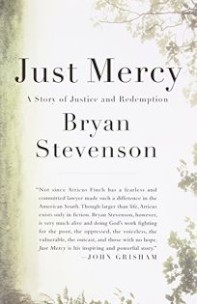
Buy Bryan Stevenson's amazing book here.

JUST MERCY.JPG


Source: http://www.publishersweekly.com/pw/by-topi...

Enjoyed this speech? Speakola is a labour of love and I’d be very grateful if you would share, tweet or like it. Thank you.

Facebook Twitter Facebook
In EQUALITY Tags BRYAN STEVESON, AMERICAN LIBRARY ASSOCIATION, CARNEGIE MEDAL, RACE, BOOK AWARD, SLAVERY, INCARCERATION, DEATH PENALTY
Comment

See my film!

Limited Australian Season

March 2025

Details and ticket bookings at

angeandtheboss.com

Support Speakola

Hi speech lovers,
With costs of hosting website and podcast, this labour of love has become a difficult financial proposition in recent times. If you can afford a donation, it will help Speakola survive and prosper.

Best wishes,
Tony Wilson.

Become a Patron!

Learn more about supporting Speakola.

Featured political

Featured
Jon Stewart: "They responded in five seconds", 9-11 first responders, Address to Congress - 2019
Jacinda Ardern: 'They were New Zealanders. They are us', Address to Parliament following Christchurch massacre - 2019
Dolores Ibárruri: "¡No Pasarán!, They shall not pass!', Defense of 2nd Spanish Republic - 1936
Jimmy Reid: 'A rat race is for rats. We're not rats', Rectorial address, Glasgow University - 1972

Featured eulogies

Featured
For Geoffrey Tozer: 'I have to say we all let him down', by Paul Keating - 2009
for James Baldwin: 'Jimmy. You crowned us', by Toni Morrison - 1988
for Michael Gordon: '13 days ago my Dad’s big, beautiful, generous heart suddenly stopped beating', by Scott and Sarah Gordon - 2018

Featured commencement

Featured
Tara Westover: 'Your avatar isn't real, it isn't terribly far from a lie', The Un-Instagrammable Self, Northeastern University - 2019
Tim Minchin: 'Being an artist requires massive reserves of self-belief', WAAPA - 2019
Atul Gawande: 'Curiosity and What Equality Really Means', UCLA Medical School - 2018
Abby Wambach: 'We are the wolves', Barnard College - 2018
Eric Idle: 'America is 300 million people all walking in the same direction, singing 'I Did It My Way'', Whitman College - 2013
Shirley Chisholm: ;America has gone to sleep', Greenfield High School - 1983

Featured sport

Featured
Joe Marler: 'Get back on the horse', Harlequins v Bath pre game interview - 2019
Ray Lewis : 'The greatest pain of my life is the reason I'm standing here today', 52 Cards -
Mel Jones: 'If she was Bradman on the field, she was definitely Keith Miller off the field', Betty Wilson's induction into Australian Cricket Hall of Fame - 2017
Jeff Thomson: 'It’s all those people that help you as kids', Hall of Fame - 2016

Fresh Tweets


Featured weddings

Featured
Dan Angelucci: 'The Best (Best Man) Speech of all time', for Don and Katherine - 2019
Hallerman Sisters: 'Oh sister now we have to let you gooooo!' for Caitlin & Johnny - 2015
Korey Soderman (via Kyle): 'All our lives I have used my voice to help Korey express his thoughts, so today, like always, I will be my brother’s voice' for Kyle and Jess - 2014

Featured Arts

Featured
Bruce Springsteen: 'They're keepers of some of the most beautiful sonic architecture in rock and roll', Induction U2 into Rock Hall of Fame - 2005
Olivia Colman: 'Done that bit. I think I have done that bit', BAFTA acceptance, Leading Actress - 2019
Axel Scheffler: 'The book wasn't called 'No Room on the Broom!', Illustrator of the Year, British Book Awards - 2018
Tina Fey: 'Only in comedy is an obedient white girl from the suburbs a diversity candidate', Kennedy Center Mark Twain Award -  2010
Tina Fey: 'Only in comedy is an obedient white girl from the suburbs a diversity candidate', Kennedy Center Mark Twain Award - 2010

Featured Debates

Featured
Sacha Baron Cohen: 'Just think what Goebbels might have done with Facebook', Anti Defamation League Leadership Award - 2019
Greta Thunberg: 'How dare you', UN Climate Action Summit - 2019
Charlie Munger: 'The Psychology of Human Misjudgment', Harvard University - 1995
Lawrence O'Donnell: 'The original sin of this country is that we invaders shot and murdered our way across the land killing every Native American that we could', The Last Word, 'Dakota' - 2016