• Genre
  • About
  • Submissions
  • Donate
  • Search
Menu

Speakola

All Speeches Great and Small
  • Genre
  • About
  • Submissions
  • Donate
  • Search

Jessica Lynch: 'The truth is always more heroic than the hype' Opening Statement Before House Oversight and Govt. Reform Committee- 2007

December 12, 2018

24 April 2007, Washingtoin DC, USA

I have been asked here today to address “misinformation from the battlefield.” Quite frankly, it is something that I have been doing since I returned home from Iraq. However, I want to note for the record that I am not politically motivated in my appearance here today.

I lived the war in Iraq. And today I still have family and friends fighting in Iraq. My support for our troops is unwavering. I believe this is not a time for finger pointing. It is the time for truth, the whole truth, versus hype and misinformation.

Because of the misinformation, people try to discount the realities of my story, including me as part of the hype. Nothing could be further from the truth. My experiences have caused a personal struggle of all sorts for me. I was given opportunities not extended to my fellow soldiers, and I embraced those opportunities to set the record straight. It is something I have been doing since 2003 and something that I imagine I will have to do for the rest of my life.

I've answered criticisms for being told -- being paid to tell my story. Quite frankly, the injuries I have will last a lifetime and I had a story tell, a story that needed to be told so people would know the truth. I want to take a minute to remind the committee of my true story. Now I was a soldier. In July of 2001, I enlisted in the Army with my brother, Greg. We had different reasons of why to join but we both knew that we wanted to serve our country. I loved my time in the Army and I'm grateful for the opportunity to have a -- to have served this country in a time of crisis.

In 2003, I received word that I would be deployed. I was part of a 100-mile long convoy going to Bagdad. I had driven 5-ton water buffalo truck. Our unit had some of the heaviest vehicles and the sand was so thick that our vehicles would just sink. It would take us hours to just travel the shortest distance. We decided to divide our convoy up so the lighter vehicles could reach our destination. But first came the city of An Nasiryah and a day that I will never forget.

The truck I was driving broke down. And I was picked up by my roommate and best friend, Lori Piestewa, who was driving our First Sergeant, Robert Dowdy. We also picked up two other soldiers from a different unit to get them out of harms way. As we drove through An Nasiryah, trying to get turned around to try to leave the city, the signs of hostility were increasing, where people with weapons were on roof tops and the street watching our entire move. The vehicle I was riding in was hit by a rocket propelled grenade and slammed into the back of another truck in our unit. Three people in the vehicle were killed upon impact. Lori and I were taken to a hospital where she later died and I was held for nine days. In all, eleven soldiers died that day, six from my unit, and two others were -- six others from my unit were taken prisoner, plus two others.

Following the ambush, my injuries were extensive. When I awoke in the Iraqi hospital, I was not able to move or feel anything below my waist. I suffered a six inch gash in my head. The -- My fourth and fifth lumbars were overlapping causing pressure on my spine. My right humerus was broken. My right foot was crushed. My left femur was shattered. The Iraqis in the hospital tried to help me by removing the bone and replacing it with a 1940s rod that was made for a man.

Following my rescue, the doctors at Landstuhl, Germany found in a physical exam that I had been sexually assaulted. Today, I still continue to deal with bowel, bladder, and kidney problems as a result from the injuries. My left leg still has no feeling from the knee down, and I am required to wear a brace just to stand and walk. When I awoke, I did not know where I was. I could not move. I could not call for help. I could not fight. The nurses at the hospital tried to soothe me, and they even tried unsuccessfully at one point to return me to Americans.

On April 1st, while various units created diversions around Nasiryah, a group -- a group came to the hospital to rescue me. I could hear them speaking in English but I was still very afraid. Then a soldier came into the room. He tore the American flag from his uniform and he handed it to me in my hand and he told me, “We’re American soldiers and we’re here to take you home.” And I looked at him and I said, "Yes, I am an American soldier too.”

When I remember those difficult days, I remember the fear. I remember the strength. I remember that hand of that fellow American soldier reassuring me that I was going to be okay. At the same time, tales of great heroism were being told. At my parent’s home in Wirt County, West Virginia, it was under siege by media all repeating the story of the little girl Rambo from the hills of West Virginia who went down fighting.

It was not true.

I have repeatedly said, when asked, that if the stories about me helped inspire our troops and rally a nation, then perhaps there was some good. However, I'm still confused as to why they chose to lie and tried to make me a legend when the real heroics of my fellow soldiers that day were legendary: people like Lori Piestewa and First Sergeant Dowdy who picked up fellow soldiers in harms way; or people like Patrick Miller or Sergeant Donald Walters who actually did fight until the very end.

The bottom line is the American people are capable of determining their hero -- ideals for heroes and they don’t need to be told elaborate lies. My hero is my brother Greg who continues to serve his country today. My hero is my friend Lori Piestewa, who died in Iraq but set an example for a generation of Hopi and Native American women and little girls everywhere about the contributions that just one soldier can make. My hero is every American who says, "My country needs me" -- and answers that call for -- to fight.

I had the good fortune and opportunity to come home and to tell the truth. Many soldiers, like Pat Tillman, they do not have that opportunity.

The truth of war is not always easy.

The truth is always more heroic than the hype.

Thank you.

Source: https://www.americanrhetoric.com/speeches/...

Enjoyed this speech? Speakola is a labour of love and I’d be very grateful if you would share, tweet or like it. Thank you.

Facebook Twitter Facebook
In WAR & CONFLICT Tags JESSICA LYNCH, IRAQ WAR, TESTIMONY, TRANSCRIPT, HEROISM, FAKE NEWS
Comment

David Speers: 'If a competitor’s legitimate story is labeled “fake” by a self-serving politician, call it out', Press Freedom Dinner - 2017

May 9, 2017

28 April 2017, Ivy Ballroom, Sydney, Australia

The Press Freedom Dinner is a joint initiative of the Walkley Foundation and the MEAA. This speech first appeared in the Walkley magazine.

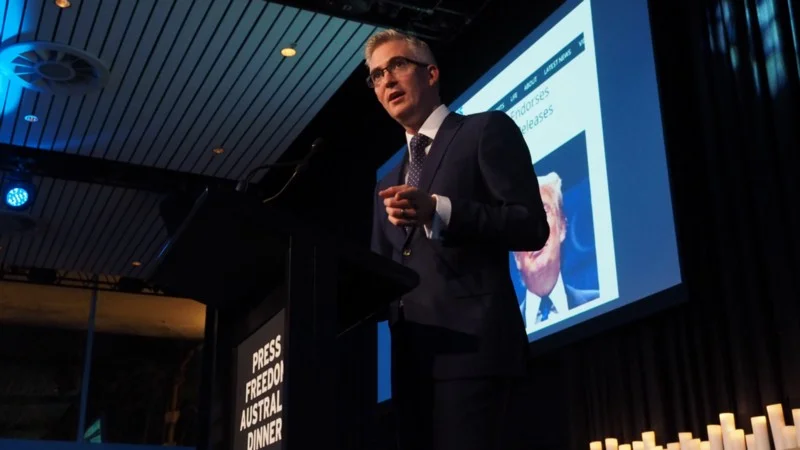
I was asked to speak tonight about political reporting in the era of “fake news”. It seems to be the issue dominating media industry discussion around the world over the past 12 months, but I’ve got a slightly different take in the Australian context as to what sort of threat it poses.

A good starting point is trying to work out what fake news actually is.

Everyone seems to have a THEORY.

So let’s begin with a bit of a pop quiz.

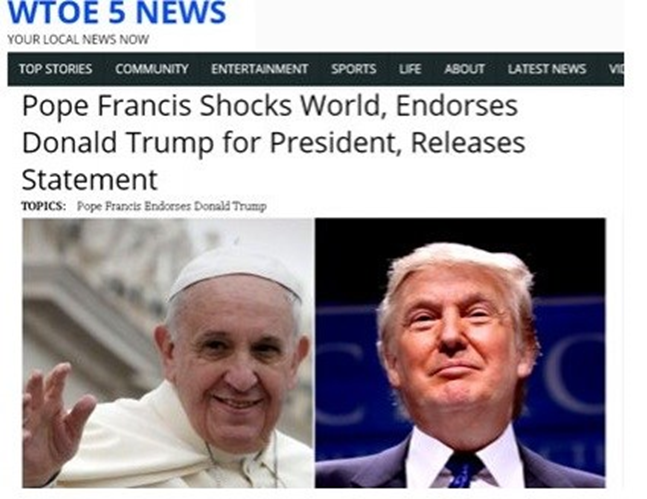
Is this fake news?

Well plainly yes it is fake news. There was a bunch of these stories that took off during last year’s Presidential election. It’s impossible to know how many of those who read them actually believed them or just read them for a bit of fun. But we do know the top 20 of these fake news stories generated nearly 9 million shares on Facebook. That’s more than the top 20 real news stories generated. So perhaps it tells us a bit about what Facebook users like. This one about the Pope endorsing Trump was the most shared. This is fake news.

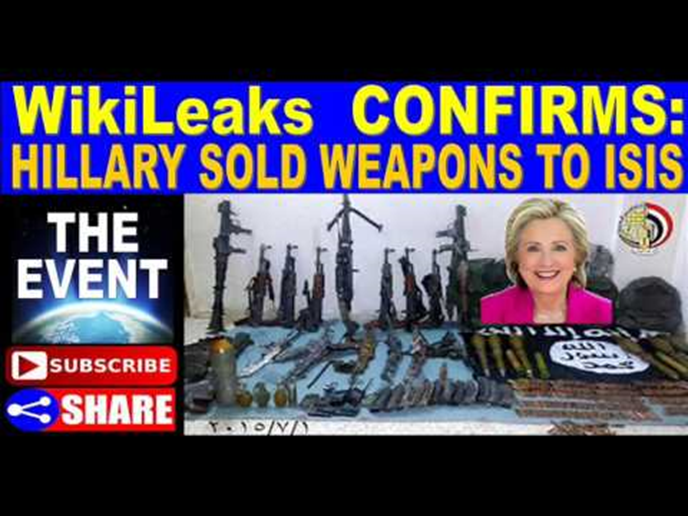
What about this one?

Well yes this is clearly fake news too. This was number two on the most shared list. You can understand why people click on it and share it; it’s a far sexier story than “Hillary confirms education policy” or “Hillary talks tax”.

We now know much of this stuff was created by fraudsters in Macedonia. Or “entrepreneurs”, depending on your point of view. Facebook and Google are now taking steps to tackle this stuff with greater fact-checking and weeding out of obviously fake material, as they should. But I don’t really want to spend tonight talking about what they should and shouldn’t be doing. I freely admit to not being much of an expert on how Facebook algorithms work. I do understand this can be a balancing act at times. No one wants to see some of the brilliant satirical pieces from the Betoota Advocate blocked for example. Well, perhaps some of those radio & TV producers who didn’t realise The Betoota stories were satirical do …

But coming back to the stuff that really is fake news, here’s the thing: I actually don’t believe it’s much of an issue in Australia. I don’t see this as a great threat to our industry. In fact I haven’t seen much evidence of fake news like this here in Australia. Maybe it’s because those Macedonian fraudsters haven’t really bothered with the Australian market. They haven’t bothered to generate fake news stories about Malcolm Turnbull and Tony Abbott. The two of them seem to be generating enough real news to keep up the clicks.

But that’s not to say I don’t think the term “fake news” is an issue. It is. And let me explain why, by returning to this question of what is fake news.

Is it “fake news” when a politician lies, misleads or simply gets something wrong?

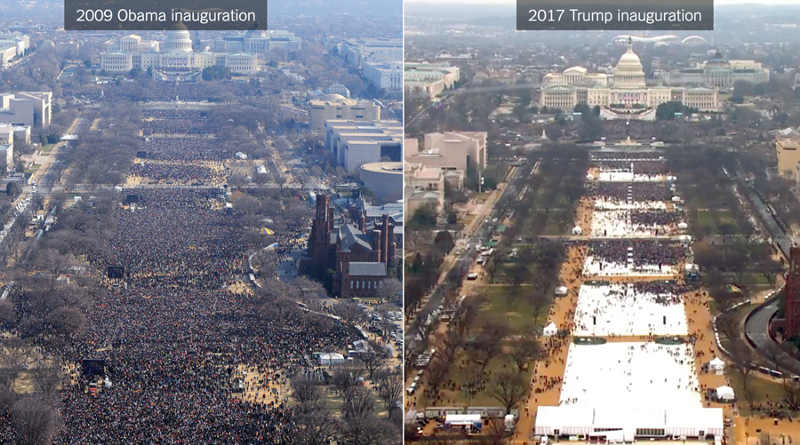
Donald Trump claimed to have the largest inauguration crowd in history until these pictures emerged …


Was the President himself guilty of “fake news”?

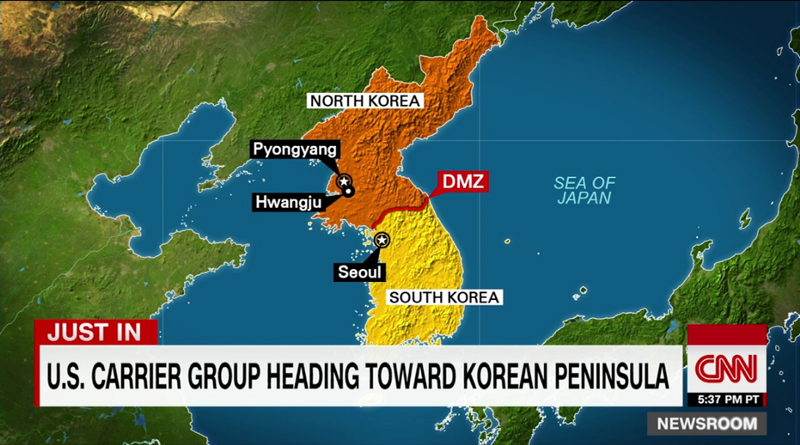
And what about this headline from just a couple of weeks ago:

That was according to what the US Defence Secretary and the White House spokesman were saying at the time. It wasn’t just CNN, we all reported that the carrier group was heading to the Korean peninsula. It is now, but at the time of those statements it was actually heading in the other direction.

Is this fake news? Well I would argue no. Governments good and bad get stuff wrong, either through cock-up or conspiracy, all the time. I wouldn’t put it in the category of fake news though. It’s just politicians lying or misleading or getting their facts wrong, as they’ve so often done.

What’s more of a problem to me, is how politicians themselves have latched onto the “fake news” label when trying to dismiss a story they don’t like. Donald Trump throws around the “fake news” line more than anyone when he doesn’t like a story or a journalist or a media outlet. But let’s leave him alone for a minute and look at this in the Australian context.

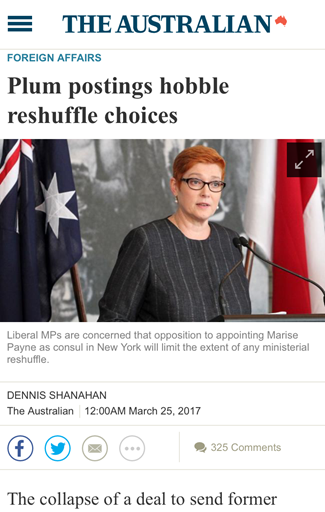
Is this fake news?

“Plum Postings Hobble Reshuffle Choices.”

A story from Dennis Shanahan about a possible reshuffle if George Brandis and Marise Payne are given diplomatic postings. Foreign Minister Julie Bishop labelled this story “fake news”.

Or this?

A story from the ABC’s Stephen Long about the Indian company Adani which is behind the proposed Carmichael Coal Mine, which is apparently facing multiple financial crime and corruption investigations. Resources Minister Matt Canavan labelled this story “fake news”.

And finally: “Govt MPs working to bring same sex marriage policy to a head over next fortnight”. A story from James Massola at the Sydney Morning Herald. Treasurer Scott Morrison labelled this one “fake news”.

Now I’m sure they all think they’re right in the zeitgeist using this “fake news” term. But here’s a tip for them: these stories aren’t fake news and it’s dangerous to suggest they are.

There is absolutely no justification to link entirely legitimate stories from reputable journalists to the crap from fraudsters in Macedonia and other peddlers of material designed to deliberately mislead and undermine how people are informed.

Now it’s true, the media is an easy target. Donald Trump knows it and so do politicians here. When it comes to trust, we’re regularly ranked down there with used car salesmen and even politicians themselves!

In fact we’re in even more trouble on this front than some realise. Some of you may have heard about the “Edelman Trust Barometer”, an annual global survey of trust in major institutions. Its results this year show trust in the media in Australia fell an alarming 10 points during 2016 from 42 per cent to just 32 per cent. That’s near the bottom of the pack internationally. Well below the level of trust in the media in the US, India, China and Indonesia. We scrape in just above Russia and Turkey.

Without trust we are vulnerable. Who are voters going to believe when a politician labels as “fake” a story they simply don’t like?

So what can we do about it? Well at least when it comes to politicians calling legitimate stories “fake news”, I reckon we should call it out. Even if it does mean defending one of our competitors, heaven forbid!

I’m not a supporter of media collectivism. I like the robust political media landscape in Australia, the wildly different voices and the healthy competition. I don’t think we need to start holding hands, but there is an argument for some solidarity when it comes to defending our craft right now.

If a competitor’s legitimate story is labeled “fake” by a self-serving politician, call it out. Don’t let trashing journalism become a go-to response for those politicians who can’t mount a better defence.

The bigger question is what can we do to restore trust in the media. Particularly in my context, trust in political journalism. Let me be clear, I don’t have a magic bullet answer to this. No one does.

But I do think it’s important to understand what’s driving audience cynicism.

Back to basics

As many have noted over the years, audiences are fragmenting and retreating into bubbles or echo chambers on the left and right. Once upon a time you had the choice of a few TV channels to watch, a few radio stations to listen to and a few newspapers to read.

Now you have infinite choices. You can listen to, watch and read an entirely right-wing perspective or left-wing perspective on the world. And many do.

They are attracted to stories and commentary they agree with.

Journalists need to be journalists, not players. Not Twitter warriors.

Facebook and Twitter help create these bubbles — by feeding them the news and opinion they want. The business model for most media outlets is also shifting to accommodate this trend. It’s not hard to understand why. Commercial media outlets live in a commercial world. People want informed opinion and they want commentary. There is no disputing that.

But there is also I believe, a vital role for journalists who try as hard as they damn well can to be straight down the middle and hold both sides to account. To ask tough questions of those in every political party, the big ones and the little ones, to uncover uncomfortable truths and yes, tell audiences what they might not like to hear or necessarily agree with.

Journalists need to be journalists, not players. Not Twitter warriors.

If you want to be trusted as a political journalist, play it straight. If your media organisation values trust, they will thank you for it. Don’t be swayed by the outrage industry on social media.

Admittedly this isn’t as easy as it sounds.

For what it’s worth — after 17 years in the Press Gallery — I reckon this is actually harder than ever right now but also more important than ever.

The advent of social media has delivered many wonderful things — but also a torrent of daily abuse aimed at journalists. Nearly every day my lovely Twitter followers call me either a “lying Labor dog” or a “right-wing Murdoch puppet”. Some of it can even get a lot more colourful than that.

My advice to those who are bothered by this stuff: either ignore it or wear it as a badge of pride.

In fact, I like to believe there’s a real opportunity for journalists right now to re-engage with cynical audiences. And largely by getting back to basics.

I know plenty of people have said this since the Trump victory and Brexit, but it’s true: get out and talk to a wider group of voters than those you usually mix with. Don’t just rely on polls and talkback radio to “get a feel” for the mood.

I’ve picked up more insight into what Australians really think over dinner in an RSL club or at a campground with the kids than I would in a week talking to the political spin doctors in Canberra. Now I appreciate there’s little time or money in most media jobs these days to wander around chatting with “real Australians”. The news cycle is relentless. But as individual journalists and as an industry, we need to maintain that connection with the communities we’re representing.

Transparency

The second serious challenge for political journalists I see is transparency. Or the lack of it. We’ve probably become too complacent about this.

The most glaring issue when it comes to transparency in government in Australia is the secrecy in Defence. There’s no other way I can put it.

8 years ago I was embedded with Australian troops in Afghanistan for a week. We travelled around forward operating bases in Oruzgan and I was able to talk to troops on the frontline openly.

The ABC and many others had similar opportunities. Important stories were told and history was recorded about what the men and women of the Australian Defence Force were doing in our name. These media visits weren’t as regular as some might have liked … and certainly a long way short of the media access the American military provided, but it was something.

In August 2014 Australian troops were sent back into Iraq to help in the fight against Islamic State. Apart from an initial flurry of coverage when they were first deployed, we now hear very little.

For nearly 12 months I’ve been requesting a visit to tell the story of what Australian troops are now doing. I’ve had no success. We get a briefing roughly every 6 months from an official in Canberra, and the Defence website pumps out press releases and lovely photos from its enormous media wing.

But when was the last time you saw our soldiers in the field telling their story? When was the last time you saw the Chief of Defence do an interview?

Early last week when Australian troops were caught up in a chemical weapons attack by Islamic State in Mosul. We found out initially through the American media! Fortunately no Australians were hurt. But why aren’t we told about this? There’s a hell of a fight going on in Mosul and we haven’t had one briefing about it.

Now it’s true, there aren’t as many specialist Defence reporters as there once were. There aren’t as many journalists devoted to finding out what’s going on in Defence and that means there isn’t as much pressure being applied.

But there’s also no doubt the Australian Defence Force has become media shy over the years. It’s a shame, because one day Australians will want to know what we did in Iraq. And they deserve to know.

Then there’s the immigration department and its offshore processing centres. They’ve been running for four years now with barely any media access.

Admittedly a few have been able to access the processing centre at Nauru. But not Manus Island. The Australian Government hides behind the excuse it’s up to Nauru and PNG to decide media access, as if the Australian government has no influence or responsibility to allow some transparency around what’s going on in these places.

Preventing media access of course means the plight of the asylum seekers and the impact these centres have on the local community is out of sight and out of mind for most Australians.

It also makes it extremely difficult to examine why certain incidents occur.

Take the incident two weeks ago — when PNG Defence personnel fired around 100 shots into the Manus Island centre. Last week the Immigration Minister Peter Dutton told me on my program that one of the reasons tensions were running high was because three asylum seekers were seen leading a 5-year-old local boy into the centre.

The local PNG Police commander seemed to disagree, saying the Defence personnel were drunk and that the shooting followed an altercation on a nearby soccer field. A boy aged 10 had come to the centre a week earlier looking for food. Peter Dutton is standing by his version of events, which he says is based on departmental advice and other contacts on the ground.

I’m not judging who’s right and wrong here. But there is a discrepancy and this isn’t a trivial matter.

Now if we did have more media access, I’m not suggesting we’d all have permanent correspondents based in Manus Island. But when a situation like this comes along, where asylum seekers claim there’s an unfair insinuation that paedophilia is going on and when there are fears about what this could do to an already volatile situation between some locals and the asylum seekers, surely allowing journalists in to talk to all sides and accurately report what’s gone on would only be a good thing.

As for transparency closer to home, consider this. We live in an information age. You can find out almost anything you want to know about everything with the device in your pocket. Except how the thousands and thousands of dollars in tax you’re paying each year are being spent.

Sure, we get the federal budget each year that tells us broadly where the money is going, but why not an online real-time portal that taxpayers and journalists can click on and find out where their money is going without having to lodge freedom of information requests?

A number of states in the US have done this, including Texas, which has a population greater than Australia’s. The Texas site is terrific by the way, you can drill right down and see how much is being spent by public servants for example on meals and lodging (roughly $5.5M a month in case you’re wondering). Each individual expense is recorded.

Don’t think for a minute this data isn’t being recorded here already every day. It is, but we just don’t get to see it.

As for transparency around what our politicians are up to, the Prime Minister’s recent reforms to MP expenses are a good step. Forcing them to report every month rather than every 6 months on what they’re spending is a good move. I just wish they’d get on with it.

But what about some transparency around political donations? Why can’t we get a report every month (or in fact in real time) when donations are made to political parties? The Queensland government is rolling out this reform this year. Why isn’t the federal government? Labor says it supports the move. Malcolm Turnbull says he has no in principle objections either. So why isn’t it happening?

And while we’re at it, why don’t we get a daily on-the-record briefing from the Prime Minister’s office? Everyone loves to make fun of Sean Spicer, but at least the Trump Administration is trying to uphold the fine tradition of the daily White House briefing.

Surely some eager junior minister, or Chief Press Secretary Mark Simpkin himself could stand up each morning and explain what our government is doing each day.

Even in the mother of Westminster traditions, Prime Minister’s Questions are followed by a thorough briefing, usually by the chiefs of staff to explain to the press the arguments each side was prosecuting.

Perhaps politicians would have less reason to attack the press and accuse us of writing “fake news” if they opened up and shared more information with us.

Transparency does matter. And even though Malcolm Turnbull likes to talk about being agile and innovative (or at least he used to), transparency in the Australian government is not keeping up with global trends.

To be honest — it would probably help the standing of politicians if they were more open and accountable. And it would probably help the standing of journalists if we fought harder for it.

So in conclusion …

My message tonight is don’t worry too much about the threat of fake news stories getting more Facebook shares than your own. But do worry about the standing of our profession. And do something about it.

Stand up for your colleagues when politicians are trying to rubbish their work. Always fight for greater transparency to shine a light on areas governments would rather hide. And be proud of straight news reporting. If we want to be trusted as journalists, we have to be journalists first and foremost. Not opinionated Twitter warriors.

I’ll leave you with a quote from a politician, but a good one. Abraham Lincoln: “I am a firm believer in the people. If given the truth, they can be depended upon to meet any national crisis. The great point is to bring them the real facts, and beer.”


Read Walkley Magazine content online here.

The Press Freedom Dinner raised funds for The Media Safety and Solidarity Fund.

This is the MEAA's Annual Report into Press Freedom in Australia

Source: https://medium.com/the-walkley-magazine/da...

Enjoyed this speech? Speakola is a labour of love and I’d be very grateful if you would share, tweet or like it. Thank you.

Facebook Twitter Facebook
In MEDIA Tags DAVID SPEERS, SKY NEWS, FAKE NEWS, DONALD TRUMP, MEDIA, JOURNALISM, WALKLEY AWARDS, TRANSCRIPT
Comment

Bret Stephens: 'My topic this evening is intellectual integrity in the age of Donald Trump', Daniel Pearl Memorial Lecture - 2017

April 6, 2017

16 February 2017, UCLA, Los Angeles, California, USA

I’m profoundly honored to have this opportunity to celebrate the legacy of Danny Pearl, my colleague at The Wall Street Journal.

My topic this evening is intellectual integrity in the age of Donald Trump. I suspect this is a theme that would have resonated with Danny.

When you work at The Wall Street Journal, the coins of the realm are truth and trust — the latter flowing exclusively from the former. When you read a story in the Journal, you do so with the assurance that immense reportorial and editorial effort has been expended to ensure that what you read is factual.

Not probably factual. Not partially factual. Not alternatively factual. I mean fundamentally, comprehensively and exclusively factual. And therefore trustworthy.

This is how we operate. This is how Danny operated. This is how he died, losing his life in an effort to nail down a story.

In the 15 years since Danny’s death, the list of murdered journalists has grown long.

Paul Klebnikov and Anna Politkovskaya in Russia.

Zahra Kazemi and Sattar Behesti in Iran.

Jim Foley and Steve Sotloff in Syria.

Five journalists in Turkey. Twenty-six in Mexico. More than 100 in Iraq.

When we honor Danny, we honor them, too.

We do more than that.

We honor the central idea of journalism — the conviction, as my old boss Peter Kann once said, “that facts are facts; that they are ascertainable through honest, open-minded and diligent reporting; that truth is attainable by laying fact upon fact, much like the construction of a cathedral; and that truth is not merely in the eye of the beholder.”

And we honor the responsibility to separate truth from falsehood, which is never more important than when powerful people insist that falsehoods are truths, or that there is no such thing as truth to begin with.

So that’s the business we’re in: the business of journalism. Or, as the 45th president of the United States likes to call us, the “disgusting and corrupt media.”

Some of you may have noticed that we’re living through a period in which the executive branch of government is engaged in a systematic effort to create a climate of opinion against the news business.

The President routinely describes reporting he dislikes as FAKE NEWS. The Administration calls the press “the opposition party,” ridicules news organizations it doesn’t like as business failures, and calls for journalists to be fired. Mr. Trump has called for rewriting libel laws in order to more easily sue the press.

This isn’t unprecedented in U.S. history, though you might have to go back to the Administration of John Adams to see something quite like it. And so far the rhetorical salvos haven’t been matched by legal or regulatory action. Maybe they never will be.

But the question of what Mr. Trump might yet do by political methods against the media matters a great deal less than what he is attempting to do by ideological and philosophical methods.

Ideologically, the president is trying to depose so-called mainstream media in favor of the media he likes — Breitbart News and the rest. Another way of making this point is to say that he’s trying to substitute propaganda for news, boosterism for information.

His objection to, say, the New York Times, isn’t that there’s a liberal bias in the paper that gets in the way of its objectivity, which I think would be a fair criticism. His objection is to objectivity itself. He’s perfectly happy for the media to be disgusting and corrupt — so long as it’s on his side.

But again, that’s not all the president is doing.

Consider this recent exchange he had with Bill O’Reilly. O’Reilly asks:

Is there any validity to the criticism of you that you say things that you can’t back up factually, and as the President you say there are three million illegal aliens who voted and you don’t have the data to back that up, some people are going to say that it’s irresponsible for the President to say that.

To which the president replies:

Many people have come out and said I’m right.

Now many people also say Jim Morrison faked his own death. Many people say Barack Obama was born in Kenya. “Many people say” is what’s known as an argumentum ad populum. If we were a nation of logicians, we would dismiss the argument as dumb.

We are not a nation of logicians.

I think it’s important not to dismiss the president’s reply simply as dumb. We ought to assume that it’s darkly brilliant — if not in intention then certainly in effect. The president is responding to a claim of fact not by denying the fact, but by denying the claim that facts are supposed to have on an argument.

He isn’t telling O’Reilly that he’s got his facts wrong. He’s saying that, as far as he is concerned, facts, as most people understand the term, don’t matter: That they are indistinguishable from, and interchangeable with, opinion; and that statements of fact needn’t have any purchase against a man who is either sufficiently powerful to ignore them or sufficiently shameless to deny them — or, in his case, both.

If some of you in this room are students of political philosophy, you know where this argument originates. This is a version of Thrasymachus’s argument in Plato’s Republic that justice is the advantage of the stronger and that injustice “if it is on a large enough scale, is stronger, freer, and more masterly than justice.”

Substitute the words “truth” and “falsehood” for “justice” and “injustice,” and there you have the Trumpian view of the world. If I had to sum it up in a single sentence, it would be this: Truth is what you can get away with.

If you can sell condos by claiming your building is 90% occupied when it’s only 20% occupied, well, then—it’s 90% occupied. If you can convince a sufficient number of people that you really did win the popular vote, or that your inauguration crowds were the biggest—well then, what do the statistical data and aerial photographs matter?

Now, we could have some interesting conversations about why this is happening—and why it seems to be happening all of a sudden.

Today we have “dis-intermediating” technologies such as Twitter, which have cut out the media as the middleman between politicians and the public. Today, just 17% of adults aged 18-24 read a newspaper daily, down from 42% at the turn of the century. Today there are fewer than 33,000 full-time newsroom employees, a drop from 55,000 just 20 years ago.

When Trump attacks the news media, he’s kicking a wounded animal.

But the most interesting conversation is not about why Donald Trump lies. Many public figures lie, and he’s only a severe example of a common type.

The interesting conversation concerns how we come to accept those lies.

Nearly 25 years ago, Daniel Patrick Moynihan, the great scholar and Democratic Senator from New York, coined the phrase, “defining deviancy down.” His topic at the time was crime, and how American society had come to accept ever-increasing rates of violent crime as normal.

“We have been re-defining deviancy so as to exempt much conduct previously stigmatized, and also quietly raising the ‘normal’ level in categories where behavior is now abnormal by any earlier standard,” Moynihan wrote.

You can point to all sorts of ways in which this redefinition of deviancy has also been the story of our politics over the past 30 years, a story with a fully bipartisan set of villains.

I personally think we crossed a rubicon in the Clinton years, when three things happened: we decided that some types of presidential lies didn’t matter; we concluded that “character” was an over-rated consideration when it came to judging a president; and we allowed the lines between political culture and celebrity culture to become hopelessly blurred.

But whatever else one might say about President Clinton, what we have now is the crack-cocaine version of that.

If a public figure tells a whopping lie once in his life, it’ll haunt him into his grave. If he lies morning, noon and night, it will become almost impossible to remember any one particular lie. Outrage will fall victim to its own ubiquity. It’s the same truth contained in Stalin’s famous remark that the death of one man is a tragedy but the death of a million is a statistic.

One of the most interesting phenomena during the presidential campaign was waiting for Trump to say that one thing that would surely break the back of his candidacy.


Would it be his slander against Mexican immigrants? Or his slur about John McCain’s record as a POW? Or his lie about New Jersey Muslims celebrating 9/11? Or his attacks on Megyn Kelly, on a disabled New York Times reporter, on a Mexican-American judge? Would it be him tweeting quotations from Benito Mussolini, or his sly overtures to David Duke and the alt-right? Would it be his unwavering praise of Vladimir Putin? Would it be his refusal to release his tax returns, or the sham that seems to been perpetrated on the saps who signed up for his Trump U courses? Would it be the tape of him with Billy Bush?

None of this made the slightest difference. On the contrary, it helped him. Some people became desensitized by the never-ending assaults on what was once quaintly known as “human decency.” Others seemed to positively admire the comments as refreshing examples of personal authenticity and political incorrectness.

Shameless rhetoric will always find a receptive audience with shameless people. Donald Trump’s was the greatest political strip-tease act in U.S. political history: the dirtier he got, the more skin he showed, the more his core supporters liked it.

Abraham Lincoln, in his first inaugural address, called on Americans to summon “the better angels of our nature.” Donald Trump’s candidacy, and so far his presidency, has been Lincoln’s exhortation in reverse.

Here’s a simple truth about a politics of dishonesty, insult and scandal: It’s entertaining. Politics as we’ve had it for most of my life has, with just a few exceptions, been distant and dull.

Now it’s all we can talk about. If you like Trump, his presence in the White House is a daily extravaganza of sticking it to pompous elites and querulous reporters. If you hate Trump, you wake up every day with some fresh outrage to turn over in your head and text your friends about.

Whichever way, it’s exhilarating. Haven’t all of us noticed that everything feels speeded up, more vivid, more intense and consequential? One of the benefits of an alternative-facts administration is that fiction can take you anywhere.

Earlier today, at his press conference, the president claimed his administration is running like a “fine-tuned machine.” In actual fact, he just lost his Labor Secretary nominee, his National Security Adviser was forced out in disgrace, and the Intelligence Community is refusing to fully brief the president for fear he might compromise sources and methods.

But who cares? Since when in Washington has there been a presidential press conference like that? Since when has the denial of reality been taken to such a bald-faced extreme?

At some point, it becomes increasingly easy for people to mistake the reality of the performance for reality itself. If Trump can get through a press conference like that without showing a hint of embarrassment, remorse or misgiving—well, then, that becomes a new basis on which the president can now be judged.

To tell a lie is wrong. But to tell a lie with brass takes skill. Ultimately, Trump’s press conference will be judged not on some kind of Olympic point system, but on whether he “won”—which is to say, whether he brazened his way through it. And the answer to that is almost certainly yes.

So far, I’ve offered you three ideas about how it is that we have come to accept the president’s behavior.

The first is that we normalize it, simply by becoming inured to constant repetition of the same bad behavior.

The second is that at some level it excites and entertains us. By putting aside our usual moral filters—the ones that tell us that truth matters, that upright conduct matters, that things ought to be done in a certain way—we have been given tickets to a spectacle, in which all you want to do is watch.

And the third is that we adopt new metrics of judgment, in which politics becomes more about perceptions than performance—of how a given action is perceived as being perceived. If a reporter for the New York Times says that Trump’s press conference probably plays well in Peoria, then that increases the chances that it will play well in Peoria.

Let me add a fourth point here: our tendency to rationalize.

One of the more fascinating aspects of last year’s presidential campaign was the rise of a class of pundits I call the “TrumpXplainers.” For instance, Trump would give a speech or offer an answer in a debate that amounted to little more than a word jumble.

But rather than quote Trump, or point out that what he had said was grammatically and logically nonsensical, the TrumpXplainers would tell us what he had allegedly meant to say. They became our political semioticians, ascribing pattern and meaning to the rune-stones of Trump’s mind.

If Trump said he’d get Mexico to pay for his wall, you could count on someone to provide a complex tariff scheme to make good on the promise. If Trump said that we should not have gone into Iraq but that, once there, we should have “taken the oil,” we’d have a similarly high-flown explanation as to how we could engineer this theft.

A year ago, when he was trying to explain his idea of a foreign policy to the New York Times’s David Sanger, the reporter asked him whether it didn’t amount to a kind of “America First policy”—a reference to the isolationist and anti-Semitic America First Committee that tried to prevent U.S. entry into World War II. Trump clearly had never heard of the group, but he liked the phrase and made it his own. And that’s how we got the return of America First.

More recently, I came across this headline in the conservative Washington Times: “How Trump’s ‘disarray’ may be merely a strategy,” by Wesley Pruden, the paper’s former editor-in-chief. In his view, the president’s first disastrous month in office is, in fact, evidence of a refreshing openness to dissent, reminiscent of Washington and Lincoln’s cabinet of rivals. Sure.

Overall, the process is one in which explanation becomes rationalization, which in turn becomes justification. Trump says X. What he really means is Y. And while you might not like it, he’s giving voice to the angers and anxieties of Z. Who, by the way, you’re not allowed to question or criticize, because anxiety and anger are their own justifications these days.

Watching this process unfold has been particularly painful for me as a conservative columnist. I find myself in the awkward position of having recently become popular among some of my liberal peers—precisely because I haven’t changed my opinions about anything.

By contrast, I’ve become suddenly unpopular among some of my former fans on the right—again, because I’ve stuck to my views. It is almost amusing to be accused of suffering from something called “Trump Derangement Syndrome” simply because I feel an obligation to raise my voice against, say, the president suggesting a moral equivalency between the U.S. and Vladimir Putin’s Russia.

The most painful aspect of this has been to watch people I previously considered thoughtful and principled conservatives give themselves over to a species of illiberal politics from which I once thought they were immune.

In his 1953 masterpiece, “The Captive Mind,” the Polish poet and dissident Czeslaw Milosz analyzed the psychological and intellectual pathways through which some of his former colleagues in Poland’s post-war Communist regime allowed themselves to be converted into ardent Stalinists. In none of the cases that Milosz analyzed was coercion the main reason for the conversion.

They wanted to believe. They were willing to adapt. They thought they could do more good from the inside. They convinced themselves that their former principles didn’t fit with the march of history, or that to hold fast to one’s beliefs was a sign of priggishness and pig-headedness. They felt that to reject the new order of things was to relegate themselves to irrelevance and oblivion. They mocked their former friends who refused to join the new order as morally vain reactionaries. They convinced themselves that, brutal and capricious as Stalinism might be, it couldn’t possibly be worse than the exploitative capitalism of the West.

I fear we are witnessing a similar process unfold among many conservative intellectuals on the right. It has been stunning to watch a movement that once believed in the benefits of free trade and free enterprise merrily give itself over to a champion of protectionism whose economic instincts recall the corporatism of 1930s Italy or 1950s Argentina. It is no less stunning to watch people who once mocked Obama for being too soft on Russia suddenly discover the virtues of Trump’s “pragmatism” on the subject.

And it is nothing short of amazing to watch the party of onetime moral majoritarians, who spent a decade fulminating about Bill Clinton’s sexual habits, suddenly find complete comfort with the idea that character and temperament are irrelevant qualifications for high office.

The mental pathways by which the new Trumpian conservatives have made their peace with their new political master aren’t so different from Milosz’s former colleagues.

There’s the same desperate desire for political influence; the same belief that Trump represents a historical force to which they ought to belong; the same willingness to bend or discard principles they once considered sacred; the same fear of seeming out-of-touch with the mood of the public; the same tendency to look the other way at comments or actions that they cannot possibly justify; the same belief that you do more good by joining than by opposing; the same Manichean belief that, if Hillary Clinton had been elected, the United States would have all-but ended as a country.

This is supposed to be the road of pragmatism, of turning lemons into lemonade. I would counter that it’s the road of ignominy, of hitching a ride with a drunk driver.

So, then, to the subject that brings me here today: Maintaining intellectual integrity in the age of Trump.

When Judea wrote me last summer to ask if I’d be this year’s speaker, I got my copy of Danny’s collected writings, “At Home in the World,” and began to read him all over again. It brought back to me the fact that, the reason we honor Danny’s memory isn’t that he’s a martyred journalist. It’s that he was a great journalist.

Let me show you what I mean. Here’s something Danny wrote in February 2001, almost exactly a year before his death, from the site of an earthquake disaster in the Indian town of Anjar.

What is India’s earthquake zone really like? It smells. It reeks. You can’t imagine the odor of several hundred bodies decaying for five days as search teams pick away at slabs of crumbled buildings in this town. Even if you’ve never smelled it before, the brain knows what it is, and orders you to get away. After a day, the nose gets stuffed up in self-defense. But the brain has registered the scent, and picks it up in innocent places: lip balm, sweet candy, stale breath, an airplane seat.

What stands out for me in this passage is that it shows that Danny was a writer who observed with all his senses. He saw. He listened. He smelled. He bore down. He reflected. He understood that what the reader had to know about Anjar wasn’t a collection of statistics; it was the visceral reality of a massive human tragedy. And he was able to express all this in language that was compact, unadorned, compelling and deeply true.

George Orwell wrote, “To see what is in front of one’s nose needs a constant struggle.” Danny saw what was in front of his nose.

We each have our obligations to see what’s in front of one’s nose, whether we’re reporters, columnists, or anything else. This is the essence of intellectual integrity.

Not to look around, or beyond, or away from the facts, but to look straight at them, to recognize and call them for what they are, nothing more or less. To see things as they are before we re-interpret them into what we’d like them to be. To believe in an epistemology that can distinguish between truth and falsity, facts and opinions, evidence and wishes. To defend habits of mind and institutions of society, above all a free press, which preserve that epistemology. To hold fast to a set of intellectual standards and moral convictions that won’t waver amid changes of political fashion or tides of unfavorable opinion. To speak the truth irrespective of what it means for our popularity or influence.

The legacy of Danny Pearl is that he died for this. We are being asked to do much less. We have no excuse not to do it.

Thank you.

Source: http://time.com/4675860/donald-trump-fake-...

Enjoyed this speech? Speakola is a labour of love and I’d be very grateful if you would share, tweet or like it. Thank you.

Facebook Twitter Facebook
In MEDIA Tags DANIEL PEARL FOUNDATION, JOURNALISM, FAKE NEWS, DONALD TRUMP, WALL STREET JOURNAL, TRANSCRIPT, INTEGRITY, INTELLECTUAL INTEGRITY, PRESS
Comment

See my film!

Limited Australian Season

March 2025

Details and ticket bookings at

angeandtheboss.com

Support Speakola

Hi speech lovers,
With costs of hosting website and podcast, this labour of love has become a difficult financial proposition in recent times. If you can afford a donation, it will help Speakola survive and prosper.

Best wishes,
Tony Wilson.

Become a Patron!

Learn more about supporting Speakola.

Featured political

Featured
Jon Stewart: "They responded in five seconds", 9-11 first responders, Address to Congress - 2019
Jacinda Ardern: 'They were New Zealanders. They are us', Address to Parliament following Christchurch massacre - 2019
Dolores Ibárruri: "¡No Pasarán!, They shall not pass!', Defense of 2nd Spanish Republic - 1936
Jimmy Reid: 'A rat race is for rats. We're not rats', Rectorial address, Glasgow University - 1972

Featured eulogies

Featured
For Geoffrey Tozer: 'I have to say we all let him down', by Paul Keating - 2009
for James Baldwin: 'Jimmy. You crowned us', by Toni Morrison - 1988
for Michael Gordon: '13 days ago my Dad’s big, beautiful, generous heart suddenly stopped beating', by Scott and Sarah Gordon - 2018

Featured commencement

Featured
Tara Westover: 'Your avatar isn't real, it isn't terribly far from a lie', The Un-Instagrammable Self, Northeastern University - 2019
Tim Minchin: 'Being an artist requires massive reserves of self-belief', WAAPA - 2019
Atul Gawande: 'Curiosity and What Equality Really Means', UCLA Medical School - 2018
Abby Wambach: 'We are the wolves', Barnard College - 2018
Eric Idle: 'America is 300 million people all walking in the same direction, singing 'I Did It My Way'', Whitman College - 2013
Shirley Chisholm: ;America has gone to sleep', Greenfield High School - 1983

Featured sport

Featured
Joe Marler: 'Get back on the horse', Harlequins v Bath pre game interview - 2019
Ray Lewis : 'The greatest pain of my life is the reason I'm standing here today', 52 Cards -
Mel Jones: 'If she was Bradman on the field, she was definitely Keith Miller off the field', Betty Wilson's induction into Australian Cricket Hall of Fame - 2017
Jeff Thomson: 'It’s all those people that help you as kids', Hall of Fame - 2016

Fresh Tweets


Featured weddings

Featured
Dan Angelucci: 'The Best (Best Man) Speech of all time', for Don and Katherine - 2019
Hallerman Sisters: 'Oh sister now we have to let you gooooo!' for Caitlin & Johnny - 2015
Korey Soderman (via Kyle): 'All our lives I have used my voice to help Korey express his thoughts, so today, like always, I will be my brother’s voice' for Kyle and Jess - 2014

Featured Arts

Featured
Bruce Springsteen: 'They're keepers of some of the most beautiful sonic architecture in rock and roll', Induction U2 into Rock Hall of Fame - 2005
Olivia Colman: 'Done that bit. I think I have done that bit', BAFTA acceptance, Leading Actress - 2019
Axel Scheffler: 'The book wasn't called 'No Room on the Broom!', Illustrator of the Year, British Book Awards - 2018
Tina Fey: 'Only in comedy is an obedient white girl from the suburbs a diversity candidate', Kennedy Center Mark Twain Award -  2010
Tina Fey: 'Only in comedy is an obedient white girl from the suburbs a diversity candidate', Kennedy Center Mark Twain Award - 2010

Featured Debates

Featured
Sacha Baron Cohen: 'Just think what Goebbels might have done with Facebook', Anti Defamation League Leadership Award - 2019
Greta Thunberg: 'How dare you', UN Climate Action Summit - 2019
Charlie Munger: 'The Psychology of Human Misjudgment', Harvard University - 1995
Lawrence O'Donnell: 'The original sin of this country is that we invaders shot and murdered our way across the land killing every Native American that we could', The Last Word, 'Dakota' - 2016