• Genre
  • About
  • Submissions
  • Donate
  • Search
Menu

Speakola

All Speeches Great and Small
  • Genre
  • About
  • Submissions
  • Donate
  • Search

Sacha Baron Cohen: 'Just think what Goebbels might have done with Facebook', Anti Defamation League Leadership Award - 2019

November 23, 2019

22 November 2019,

Thank you, ADL, for this recognition and your work in fighting racism, hate and bigotry. And to be clear, when I say “racism, hate and bigotry” I’m not referring to the names of Stephen Miller’s Labradoodles.

Now, I realize that some of you may be thinking, what the hell is a comedian doing speaking at a conference like this! I certainly am. I’ve spent most of the past two decades in character. In fact, this is the first time that I have ever stood up and given a speech as my least popular character, Sacha Baron Cohen. And I have to confess, it is terrifying.

I realize that my presence here may also be unexpected for another reason. At times, some critics have said my comedy risks reinforcing old stereotypes.

The truth is, I’ve been passionate about challenging bigotry and intolerance throughout my life. As a teenager in the UK, I marched against the fascist National Front and to abolish apartheid. As an undergraduate, I traveled around America and wrote my thesis about the civil rights movement, with the help of the archives of the ADL. And as a comedian, I’ve tried to use my characters to get people to let down their guard and reveal what they actually believe, including their own prejudice.

Now, I’m not going to claim that everything I’ve done has been for a higher purpose. Yes, some of my comedy, OK probably half my comedy, has been absolutely juvenile and the other half completely puerile. I admit, there was nothing particularly enlightening about me – as Borat from Kazakhstan, the first fake news journalist – running through a conference of mortgage brokers when I was completely naked.

But when Borat was able to get an entire bar in Arizona to sing “Throw the Jew down the well,” it did reveal people’s indifference to antisemitism. When – as Bruno, the gay fashion reporter from Austria – I started kissing a man in a cage fight in Arkansas, nearly starting a riot, it showed the violent potential of homophobia. And when – disguised as an ultra-woke developer – I proposed building a mosque in one rural community, prompting a resident to proudly admit, “I am racist, against Muslims” – it showed the acceptance of Islamophobia.

That’s why I appreciate the opportunity to be here with you. Today around the world, demagogues appeal to our worst instincts. Conspiracy theories once confined to the fringe are going mainstream. It’s as if the Age of Reason – the era of evidential argument – is ending, and now knowledge is delegitimized and scientific consensus is dismissed. Democracy, which depends on shared truths, is in retreat, and autocracy, which depends on shared lies, is on the march. Hate crimes are surging, as are murderous attacks on religious and ethnic minorities.

What do all these dangerous trends have in common? I’m just a comedian and an actor, not a scholar. But one thing is pretty clear to me. All this hate and violence is being facilitated by a handful of internet companies that amount to the greatest propaganda machine in history.

Think about it. Facebook, YouTube and Google, Twitter and others – they reach billions of people. The algorithms these platforms depend on deliberately amplify the type of content that keeps users engaged – stories that appeal to our baser instincts and that trigger outrage and fear. It’s why YouTube recommended videos by the conspiracist Alex Jones billions of times. It’s why fake news outperforms real news, because studies show that lies spread faster than truth. And it’s no surprise that the greatest propaganda machine in history has spread the oldest conspiracy theory in history – the lie that Jews are somehow dangerous. As one headline put it, “Just Think What Goebbels Could Have Done with Facebook.”

On the internet, everything can appear equally legitimate. Breitbart resembles the BBC. The fictitious Protocols of the Elders of Zion look as valid as an ADL report. And the rantings of a lunatic seem as credible as the findings of a Nobel prize winner. We have lost, it seems, a shared sense of the basic facts upon which democracy depends.

When I, as the wannabe gangsta Ali G, asked the astronaut Buzz Aldrin “what woz it like to walk on de sun?” the joke worked, because we, the audience, shared the same facts. If you believe the moon landing was a hoax, the joke was not funny.

When Borat got that bar in Arizona to agree that “Jews control everybody’s money and never give it back,” the joke worked because the audience shared the fact that the depiction of Jews as miserly is a conspiracy theory originating in the Middle Ages.

But when, thanks to social media, conspiracies take hold, it’s easier for hate groups to recruit, easier for foreign intelligence agencies to interfere in our elections, and easier for a country like Myanmar to commit genocide against the Rohingya.

It’s actually quite shocking how easy it is to turn conspiracy thinking into violence. In my last show Who is America?, I found an educated, normal guy who had held down a good job, but who, on social media, repeated many of the conspiracy theories that President Trump, using Twitter, has spread more than 1,700 times to his 67 million followers. The president even tweeted that he was considering designating Antifa – anti-fascists who march against the far right – as a terror organization.

So, disguised as an Israel anti-terrorism expert, Colonel Erran Morad, I told my interviewee that, at the Women’s March in San Francisco, Antifa were plotting to put hormones into babies’ diapers in order to “make them transgender”. And he believed it.

I instructed him to plant small devices on three innocent people at the march and explained that when he pushed a button, he’d trigger an explosion that would kill them all. They weren’t real explosives, of course, but he thought they were. I wanted to see – would he actually do it?

The answer was yes. He pushed the button and thought he had actually killed three human beings. Voltaire was right: “Those who can make you believe absurdities, can make you commit atrocities.” And social media lets authoritarians push absurdities to billions of people.

In their defense, these social media companies have taken some steps to reduce hate and conspiracies on their platforms, but these steps have been mostly superficial.

I’m speaking up today because I believe that our pluralistic democracies are on a precipice and that the next 12 months, and the role of social media, could be determinant. British voters will go to the polls while online conspiracists promote the despicable theory of “great replacement” that white Christians are being deliberately replaced by Muslim immigrants. Americans will vote for president while trolls and bots perpetuate the disgusting lie of a “Hispanic invasion”. And after years of YouTube videos calling climate change a “hoax”, the United States is on track, a year from now, to formally withdraw from the Paris accords. A sewer of bigotry and vile conspiracy theories that threatens democracy and our planet – this cannot possibly be what the creators of the internet had in mind.

I believe it’s time for a fundamental rethink of social media and how it spreads hate, conspiracies and lies. Last month, however, Mark Zuckerberg of Facebook delivered a major speech that, not surprisingly, warned against new laws and regulations on companies like his. Well, some of these arguments are simply absurd. Let’s count the ways.

First, Zuckerberg tried to portray this whole issue as “choices … around free expression”. That is ludicrous. This is not about limiting anyone’s free speech. This is about giving people, including some of the most reprehensible people on earth, the biggest platform in history to reach a third of the planet. Freedom of speech is not freedom of reach. Sadly, there will always be racists, misogynists, antisemites and child abusers. But I think we could all agree that we should not be giving bigots and pedophiles a free platform to amplify their views and target their victims.

Second, Zuckerberg claimed that new limits on what’s posted on social media would be to “pull back on free expression”. This is utter nonsense. The first amendment says that “Congress shall make no law” abridging freedom of speech, however, this does not apply to private businesses like Facebook. We’re not asking these companies to determine the boundaries of free speech across society. We just want them to be responsible on their platforms.

If a neo-Nazi comes goose-stepping into a restaurant and starts threatening other customers and saying he wants kill Jews, would the owner of the restaurant be required to serve him an elegant eight-course meal? Of course not! The restaurant owner has every legal right and a moral obligation to kick the Nazi out, and so do these internet companies.

Third, Zuckerberg seemed to equate regulation of companies like his to the actions of “the most repressive societies”. Incredible. This, from one of the six people who decide what information so much of the world sees. Zuckerberg at Facebook, Sundar Pichai at Google, at its parent company Alphabet, Larry Page and Sergey Brin, Brin’s ex-sister-in-law, Susan Wojcicki at YouTube and Jack Dorsey at Twitter.

The Silicon Six – all billionaires, all Americans – who care more about boosting their share price than about protecting democracy. This is ideological imperialism – six unelected individuals in Silicon Valley imposing their vision on the rest of the world, unaccountable to any government and acting like they’re above the reach of law. It’s like we’re living in the Roman Empire, and Mark Zuckerberg is Caesar. At least that would explain his haircut.

Here’s an idea. Instead of letting the Silicon Six decide the fate of the world, let our elected representatives, voted for by the people, of every democracy in the world, have at least some say.

Fourth, Zuckerberg speaks of welcoming a “diversity of ideas”, and last year he gave us an example. He said that he found posts denying the Holocaust “deeply offensive”, but he didn’t think Facebook should take them down “because I think there are things that different people get wrong”. At this very moment, there are still Holocaust deniers on Facebook, and Google still takes you to the most repulsive Holocaust denial sites with a simple click. One of the heads of Google once told me, incredibly, that these sites just show “both sides” of the issue. This is madness.

To quote Edward R Murrow, one “cannot accept that there are, on every story, two equal and logical sides to an argument”. We have millions of pieces of evidence for the Holocaust – it is an historical fact. And denying it is not some random opinion. Those who deny the Holocaust aim to encourage another one.

Still, Zuckerberg says that “people should decide what is credible, not tech companies.” But at a time when two-thirds of millennials say they haven’t even heard of Auschwitz, how are they supposed to know what’s “credible”? How are they supposed to know that the lie is a lie?

There is such a thing as objective truth. Facts do exist. And if these internet companies really want to make a difference, they should hire enough monitors to actually monitor, work closely with groups like the ADL, insist on facts and purge these lies and conspiracies from their platforms.

Fifth, when discussing the difficulty of removing content, Zuckerberg asked “where do you draw the line?” Yes, drawing the line can be difficult. But here’s what he’s really saying: removing more of these lies and conspiracies is just too expensive.

These are the richest companies in the world, and they have the best engineers in the world. They could fix these problems if they wanted to. Twitter could deploy an algorithm to remove more white supremacist hate speech, but they reportedly haven’t because it would eject some very prominent politicians from their platform. Maybe that’s not a bad thing! The truth is, these companies won’t fundamentally change because their entire business model relies on generating more engagement, and nothing generates more engagement than lies, fear and outrage.

It’s time to finally call these companies what they really are – the largest publishers in history. And here’s an idea for them: abide by basic standards and practices just like newspapers, magazines and TV news do every day. We have standards and practices in television and the movies; there are certain things we cannot say or do. In England, I was told that Ali G could not curse when he appeared before 9pm. Here in the US, the Motion Picture Association of America regulates and rates what we see. I’ve had scenes in my movies cut or reduced to abide by those standards. If there are standards and practices for what cinemas and television channels can show, then surely companies that publish material to billions of people should have to abide by basic standards and practices too.

Take the issue of political ads. Fortunately, Twitter finally banned them, and Google is making changes, too. But if you pay them, Facebook will run any “political” ad you want, even if it’s a lie. And they’ll even help you micro-target those lies to their users for maximum effect. Under this twisted logic, if Facebook were around in the 1930s, it would have allowed Hitler to post 30-second ads on his “solution” to the “Jewish problem”. So here’s a good standard and practice: Facebook, start factchecking political ads before you run them, stop micro-targeted lies immediately, and when the ads are false, give back the money and don’t publish them.

Here’s another good practice: slow down. Every single post doesn’t need to be published immediately. Oscar Wilde once said that “we live in an age when unnecessary things are our only necessities.” But is having every thought or video posted instantly online, even if it is racist or criminal or murderous, really a necessity? Of course not!

The shooter who massacred Muslims in New Zealand live-streamed his atrocity on Facebook where it then spread across the internet and was viewed likely millions of times. It was a snuff film, brought to you by social media. Why can’t we have more of a delay so this trauma-inducing filth can be caught and stopped before it’s posted in the first place?

Finally, Zuckerberg said that social media companies should “live up to their responsibilities”, but he’s totally silent about what should happen when they don’t. By now it’s pretty clear, they cannot be trusted to regulate themselves. As with the Industrial Revolution, it’s time for regulation and legislation to curb the greed of these hi-tech robber barons.

In every other industry, a company can be held liable when their product is defective. When engines explode or seatbelts malfunction, car companies recall tens of thousands of vehicles, at a cost of billions of dollars. It only seems fair to say to Facebook, YouTube and Twitter: your product is defective, you are obliged to fix it, no matter how much it costs and no matter how many moderators you need to employ.

In every other industry, you can be sued for the harm you cause. Publishers can be sued for libel, people can be sued for defamation. I’ve been sued many times! I’m being sued right now by someone whose name I won’t mention because he might sue me again! But social media companies are largely protected from liability for the content their users post – no matter how indecent it is – by Section 230 of, get ready for it, the Communications Decency Act. Absurd!

Fortunately, internet companies can now be held responsible for pedophiles who use their sites to target children. I say, let’s also hold these companies responsible for those who use their sites to advocate for the mass murder of children because of their race or religion. And maybe fines are not enough. Maybe it’s time to tell Mark Zuckerberg and the CEOs of these companies: you already allowed one foreign power to interfere in our elections, you already facilitated one genocide in Myanmar, do it again and you go to jail.

In the end, it all comes down to what kind of world we want. In his speech, Zuckerberg said that one of his main goals is to “uphold as wide a definition of freedom of expression as possible”. Yet our freedoms are not only an end in themselves, they’re also the means to another end – as you say here in the US, the right to life, liberty and the pursuit of happiness. But today these rights are threatened by hate, conspiracies and lies.

Allow me to leave you with a suggestion for a different aim for society. The ultimate aim of society should be to make sure that people are not targeted, not harassed and not murdered because of who they are, where they come from, who they love or how they pray.

If we make that our aim – if we prioritize truth over lies, tolerance over prejudice, empathy over indifference and experts over ignoramuses – then maybe, just maybe, we can stop the greatest propaganda machine in history, we can save democracy, we can still have a place for free speech and free expression, and, most importantly, my jokes will still work.

Thank you all very much.
Source: https://www.adl.org/news/article/sacha-bar...

Enjoyed this speech? Speakola is a labour of love and I’d be very grateful if you would share, tweet or like it. Thank you.

Facebook Twitter Facebook
In MEDIA Tags SACHA BARON COHEN, TRANSCRIPT, MEDIA, ANTI DEFAMATION LEAGUE, FACEBOOK, TGRUTH, NEWS, TWITTER, CONSPIRACY THEORIES
Comment

Dorothy Byrne: 'Too many programmes are saying small or medium-sized things about society', McTaggart Lecture, Edinburgh Television Festival - 2019

October 8, 2019

21 August, Edinburgh, Scotland

Thank you very much indeed for the great honour of being the first old lady to be invited to deliver the MacTaggart lecture.

I was telephoned late on a Friday night a few weeks ago while dancing at the Hebridean Celtic Festival in Stornoway. So I realised at once I was your first choice.

But we old ladies – or even wee old ladies – are not proud. Decades of cervical smears destroy all pride.

Of course the first thing I did was check out my illustrious predecessors. A younger woman might have been intimidated.

Yes. Kevin Spacey. He proved to be a good choice.

Shane Smith of Vice, an organisation well-named as it turned out.

And by an extraordinary coincidence three people with the same surname – Murdoch. What are the chances of that eh? I especially enjoyed James Murdoch from 2009. He told the audience that it was important to: ‘encourage a world of trust’ and that newspaper readers were: ‘treated with great seriousness and respect.’

Let’s delight ourselves by remembering how Ofcom described him just three years later, in his role at News Group Newspapers during the hacking scandal. He ‘repeatedly fell short of the conduct to be expected of him as a chief executive and chairman’.

So much for trust and respect.

I met James Murdoch once and he patronised and dismissed me. Hey James, now I patronise and dismiss YOU.

Elsewhere on the list, I spotted one name among my predecessors who has not yet had the comeuppance he deserves for his assaults on women.

That’s one of the things about being an old lady, you gather a lot of information over the years. To men who have behaved badly in the past, I say this: you know who you are. And so do I.

Tonight, there’ll be no shortage of sexist bastards, possibly among you in the audience. But I have positive messages too about how we must find courage in this time of crisis and most of all how we must unite to use the power of television to protect democracy because it is being seriously undermined.

I am the Methuselah of TV, I’ve been in the industry nearly 40 years and at Channel Four for 20.

In the course of my work, I’ve thought I’d die a few times, I’ve been temporarily kidnapped, condemned as a terrorist whore, told by my own colleagues I should imprisoned for several years and hardest of all been a single parent.

I’m just about the oldest female TV executive working for a broadcaster and for many reasons being a woman working in news and current affairs has been a struggle.

But I would recommend television journalism to any young woman today embarking on a career.

In what other line of work when some bastard annoys you or you hear of some absolute disgrace, can you say to yourself, ‘I’m going to make a programme exposing that and I’ll put a stop to it!.’ And sometimes you even do.

But I begin with early man in TV. Surprisingly perhaps, I think we have much to learn from him. There’s a reason he has no clothes on in this picture. That was the downside of early TV man; a tendency to remove his clothing.

A quick tip for men. Don’t take your trousers off unless specifically invited to do so.

I started out in television at Granada and from my very first day the overwhelmingly male management made me feel at home. Or to be more accurate, they tried to come home with me.

My colleagues took me to the bar and we were joined by a senior manager. As I was standing on the pavement afterwards, this top bloke suddenly appeared beside me and suggested we get in a taxi together.

How kind was that? Supposing I hadn’t known the way to Chorlton-cum-Hardy and the taxi driver had just arrived from Kabul, that could have been really helpful.

As it happened, my mother had taught me to always memorise the way home, so I was able to tell him his services wouldn’t be needed. Services of any sort.

Try to picture this happening now at Channel Four. Let’s pretend Channel Four employs lots of working-class people from the North of England and imagine a young bloke called Bert from Accrington on his first day.

His new young colleagues take him out to the pub and then I turn up and join them even, although I don’t work directly with any of them. Bert gets up to leave. I follow him out.

Bert stands on Victoria Street to hail a taxi and I sidle up next to him and say, ‘Great news Bert, I’m coming home with you. ‘

That first day at Granada, a female boss had also told me that a director would take me out to teach me the basics of filming and he would sexually assault me, but I wasn’t to take it personally because he sexually assaulted all women he worked with.

Sure enough he did assault me – one of the few examples in my career of the promise of a TV boss coming true. His assault was a criminal offence but who could I complain to? I learned early on that as a woman I was on my own.

Not all approaches were offensive. Some were merely ludicrous.

When I joined World in Action, I was at that point the only woman on the programme, but I needn’t have worried about feeling lonely. Again, there was a man with a kind offer.

Even although I hardly knew him, one of the journalists suggested we have sex. I realised I would need to use all my diplomatic skills in order not to hurt his feelings, so I said, ‘Don’t be ridiculous! Of course I won’t have sex with you. Do you just ask random women for sex?’

And guess what? He did. I asked him what his success rate was and he said, ‘One in a hundred which is pretty good for me.’ Looking at him, I thought it was surprisingly high.

Some, but by no means all, of those men then had terrible attitudes towards women. But, as a group, they also had great attributes which we have lost.

They believed that television was there to say and do big things. Many thought that it was their right and their role to change society. Those men at Granada were passionate believers in the power of television.

They were radical alternative thinkers who believed programmes could be used to make our country a better place. How many people in TV today would say out loud that they wanted to use TV to make Britain a better place?

Their achievements were immense – extraordinary investigations like The Birmingham Six, great documentaries like Seven Up and inside the Communist Party, landmark series and strands like Disappearing World or End of Empire, a new way of covering elections in the Granada 500 and the invention of new forms in television like the drama-doc.

And they challenged the authority not just of those who ran the institutions of the UK but also of their own TV bosses. Far too many people in TV now spend all day agreeing with their bosses. It’s simply ghastly to witness.

Our country is undergoing seismic changes. There is widespread disillusion and a loss of a sense of belonging as society fragments. Whatever happens about Brexit, we need big new ideas to take us forward. But I don’t see big ideas on TV now.

Too many programmes are saying small or medium-sized things about society. Where do we go for big ideas? Books, Tedtalks, podcasts, all really popular.

On the news, I’m hearing every day that the very fabric of our democratic system is being ripped to shreds.

But where is this crisis being analysed outside of the news. UK broadcasters still make some great investigations but where are the programmes which shake all our assumptions about society?

So often I’m told that documentary formats now deal with important subject matters but formats only describe society as it is, they don’t provide a vision for change.

If we are worried about becoming irrelevant, one of the best things we can do is to start making big controversial programmes about the UK which put us back at the heart of public debate as we used to be.

We are all desperate for young audiences. Millions of young people are now politically aware and active.

They’re prepared to spend hours listening to extraordinarily serious podcasts, often authored by some pretty heavy duty thinkers.

They’re searching for alternative ways of seeing the world and for answers to major issues like climate change and the viability of our current financial systems.

A great Ted Talk gets millions of views. We have to stop being afraid of serious analysis authored by big brainy people. We have the ability and we have the airtime. Let’s make some really clever and difficult programmes.

We are obsessed by the fall in audiences and forever looking over our shoulders at Netflix and other streaming services, hypnotised by their success.

But terrestrial TV still accounts for 69 per cent of all TV viewing, according to very recent Ofcom figures. That is three hours 12 minutes a day which is massive.

And we have something else too – very high levels of trust. The latest Ofcom figures show that 71 per cent of audiences think television news is accurate and trustworthy.

Take advice from an older woman – I’m about the same age as ITV – when you’re getting on a bit, reinvent yourself. I used to be a tall blonde woman.

And think what you have that makes you special. In the case of terrestrial TV – we are the only people who have any interest in saying big things about Britain. That’s not the role of Netflix or other streaming services, terrific as they are in many ways.

I counted 29 different programmes on Netflix about drugs. I wonder if there’s a drug cartel anywhere that’s not currently being followed by a streaming service.

There’s also a plethora of programmes about serial killers. Programmes about mass murdering drug lords will contribute nothing to the reinvention of the UK’s political landscape.

But when we do major investigations here in Britain, like Channel Four News’ investigation alongside that of Carol Cadwallader into Cambridge Analytica, they gain huge traction. The public appetite is there.

Now painful as it is to admit it, Rupert Murdoch made a very good point in his MacTaggart back in 1989, the very period when I was working on World in Action.

He said television was ‘controlled by like-minded people who knew what was good for us’ and criticised TV for reflecting the values of a ‘narrow elite’.

My vision of empowered and daring producers and commissioning editors who want to shape society for the better doesn’t work if all those empowered people are just a bunch of posh boys.

By what right do we showcase big ideas if we are such a small group? I looked at the two Directors UK reports which came out late last year.

OK the figures are not completely up-to-date but only 2.2 per cent of directors came from black and ethnic minority backgrounds and fewer than 25 per cent were women.

That matters because we can’t reflect society properly if we ourselves don’t reflect society.

When you change who is making TV, you change TV. I am proud that I was part of a group of women who changed current affairs by making regular programmes about issues affecting women.

The first programme I produced and directed for World in Action was about rape in marriage, then not a crime, and two very senior journalists told me it wasn’t a suitable subject for the programme and indeed not even a ‘story’.

They were right. It was more than a story. It was a scandal which besmirched our society. These women-focused programmes rated well but I could tell that quite a few of my colleagues didn’t rate them much.

My reputation was nearly destroyed when Mary Whitehouse rang up to say how good one of my films had been. By great good fortune, I took the call. I’m ashamed to say I told her Dorothy Byrne was out but I’d pass on the compliment. I never told me colleagues she’d rung.

The lack of people from ethnic minorities then was appalling. At Granada, I was the union equality officer when ACTT asked us to do a survey of the number of black people working there.

I didn’t need to do a survey, I personally knew all five black people– out of a workforce of around 1,600. When I reported this back to the joint union committee, one of the ‘brothers’ said, ‘That’s five too many.’

And another chipped in, a la Trump, that they should all go back home.

Of course, I pointed out this almost certainly WAS their home. While that would never happen now, the lack of progress in increasing ethnic diversity in television is the single most disappointing failure during my career.

I was asked quite recently by a Channel Four manager what I thought of our diversity initiative. I replied that I honestly couldn’t remember how it was any different to the last diversity initiative.

In fact, was he absolutely sure it WASN’T the last diversity initiative? Or maybe the one before? I have known so many in my time. Not so long ago I was sitting in a room of managers at Channel Four and one asked why we thought we were not achieving more on ethnic diversity.

Everyone looked puzzled and thoughtful – the way people in TV do when they’re pretending to be deep and meaningful – until I said, ‘I don’t know if any of you have noticed, but everyone in this room is white?

Could that be connected?’ So, Alex Mahon, Tony Hall, Caroline McCall and David Lynn, it’s time to achieve real change.

But we also need to resist the idea that we don’t need older white men anymore and that they should be crushed out of the way. I hate the term, ‘Pale, male and stale.’ As someone who sticks up for the rights of old ladies, I need to stick up for old gents too.

They are still overrepresented, but their voices are vital for our society.

Look at John Ware who just reported an excellent and important Panorama on anti-Semitism.

He is pale, he is male, but he is certainly not stale. Is he politically correct? Well fairly recently we were in an edit suite together and he called me ‘Sweetie.’ At once the room fell silent. Indeed, I would say time stood still.

And then in the low and vaguely threatening tone I have polished over years, I said, ‘I am not your sweetie.’ To which John replied, ‘Yes you are.’ Sisters, I regret, I just laughed.

The most important reason for us to get our houses in order on diversity is that our current failure undermines our role as the key mediators between politicians and the public.

How can we represent the people of the UK if we ourselves are unrepresentative of the population? Mind you, politicians are also unrepresentative.

Look at Dominic Cummings and Seumas Milne, the Svengalis of our two main parties. One went to Durham School and Exeter College, Oxford, the other to Winchester College and Balliol College, Oxford. That’s what counts as diversity in British politics.

We have shortcomings but we mustn’t underestimate our importance to democracy. The majority of people in the UK still rely on TV as their main source of news – 75 percent of the public.

We play a vital role in democratic debate in this country. Viewing figures for election debates and interviews are high, as they were for the recent Tory leadership debate. In the debates Boris Johnson deigned to join, around five million viewers watched.

That’s way more than can be reached by any newspaper and certainly for the Tories’ alternative to us – the Prime Minister’s Q&A sessions with the public on Facebook Live

Don’t believe politicians when they say that the public doesn’t trust the so-called mainstream media in the UK. They trust TV. Remember, terrestrial television has huge levels of trust: 71 percent.

It’s politicians who are not trusted – they have a trust rate of 19 per cent. And news on the internet – the medium politicians are increasingly using to bypass us – has, according recent Reuters Institute figures, a trust level of only 22 percent with a mere 10 percent for news on social.

Our investigations and those of other news organisations have also exposed the ways in which news on social platforms is used by those outside the UK to attempt to influence voting.

It has never been more essential that politicians should use the most trusted medium of. In the past, our politicians accepted that they had to be held accountable on television.

But in recent years, there has been a dramatic fall in politicians holding themselves up to proper scrutiny on TV and in recent months and even weeks, that decline has, in my view, become critical for our democracy.

We have a new Prime Minister who hasn’t held one major press conference or given one major television interview since he came to power.

That cannot be right. And we have a leader of the opposition who similarly fails to give significant interviews on terrestrial TV. We may be heading for an election very soon.

What are they going to do then? I genuinely fear that in the next election campaign there will be too little proper democratic debate and scrutiny to enable voters to make informed decisions.

Many of you will have seen the excellent recent BBC series on Margaret Thatcher. One striking feature was the number of lengthy television interviews Thatcher did.

Leaders of the past subjected themselves to half hour or forty-five minute interviews with the likes of Brian Walden and Robin Day and held regular press conferences.

During the 1987 election, Thatcher and Kinnock chaired daily press conferences and gave several full-length interviews. Even more recently, Miliband and Cameron also did extensive interviews in election campaigns.

However, Theresa May, when she was leader, and Corbyn, failed to hold themselves to account in the same way. In the 2017 election, May and Corbyn did only one or two events a day.

Outside of election periods, and setting aside some interviews with Andrew Marr, Theresa May’s PR people generally said she would do interviews of only four minutes, maybe six if you were lucky.

Throughout her time as PM, May’s longest interview with Channel Four News was seven minutes. How do you delve into the complex problems of our times in a few minutes. Jeremy Corbyn sometimes permits only one question, and then doesn’t answer it!

At the 2018 Conservative Party Conference, Mrs May made history by refusing to do interviews with Channel Four or Channel Five. Other broadcasters were so appalled that they signed a letter of protest to Downing Street for which I thank them.

When we were trying to get that interview, Robbie Gibb, May’s press supremo, said to us, ‘What’s in it for us?’ As if interviews were purely for the benefit of politicians and not the public.

It is notable that Theresa May told Laura Kuenssberg that the one thing she regretted was refusing to take part in TV debates. And no offence meant but she has lots of things she could regret.

During the entirety of the most recent European election, neither May nor Corbyn did a major interview with a broadcaster, not even on the night of the results.

But what is happening now is far more serious. For weeks and weeks of the Conservative leadership election, Boris Johnson was virtually invisible on television.

The public was able to view him mainly on hustings organised by his own party. Our experience at Channel Four was typical. He kept promising to come on Channel Four News. He never did. He didn’t do an interview with ITV News or Channel Five News either.

And he failed to turn up to our leaders debate. There’s his empty podium in the middle. Throughout that campaign, Boris Johnson was castigated widely for failing to be held accountable on television.

He did the minimum he could – just two leaders’ debates, one interview with Laura Kuenssberg and just one real grilling by Andrew Neil.

And what about this man? The leader of the opposition is rarely to be heard in any significant television interview. It’s not so much, ‘Oh Jeremy Corbyn’ as No Jeremy Corbyn.

The other day John McDonnell said he was going to put Jeremy Corbyn in a taxi and send him off to see the Queen. That befuddled me as I’ve been able to get in taxis by myself since I was about twelve.

I had the wild idea of sending the queen – a fellow old lady after all – a camera so that if she was lucky enough to meet Mr Corbyn she could ask him some questions on behalf of the British people. Because few of us get to do that.

Jeremy Corbyn gave the alternative MacTaggart last year and some of you may remember that he said, ‘At their best, journalists challenge accountable power.‘

Yes, Jeremy but we need the chance to question accountable power. He also said that, ‘fearless journalists and those who support them and their work are some of the heroes of our time.’

Go on Jeremy, be a hero, come on Channel Four News, go on the Today programme or Newsnight. You can do it. You can even get in a taxi by yourself and do it. It’s easy. You just hail them on the street and they stop. Although, maybe not if your Jeremy Corbyn. Could that have been the problem?

Corbyn did do an interview on Channel Four News at the Labour Party Conference in 2017 but then didn’t do another until the same time in 2018. And he hasn’t done one since. So annual appearances. What does he think he is? My birthday?

Ironically, both Johnson and Corbyn used to be journalists. Corbyn began his career as a reporter on the Newport and Market Drayton Advertiser and is even a member of the National Union of Journalists. And when they were outsiders in their parties they both spoke to TV regularly.

Of course, Dominic Cummings, allegedly the most important political figure in this country at present, has never done a television interview as far as I know.

And indeed has such respect for our democratic system that he was held to be in contempt of it when he refused to appear in front of the parliamentary committee investigating fake news

Boris Johnson has been proclaimed by Downing Street as the first social media PM.

On taking office, he recorded a jolly statement – so much more fun than being grilled by Emily Maitlis or Jon Snow. It reminded me of something and at first I couldn’t think what it was.

And then it came to me. This great flagbearer for democracy Vladimir Putin who also likes to talk directly to the nation.

We’ve also seen a stream of paid adverts on Facebook. He says he wants us to join him. Great, can we bring Matt Frei and a camera crew?

Meanwhile, he’s roaming round the country doing photo opportunities with Kinder eggs full of drugs. Shouldn’t he be busy doing something else?

As for his Facebook Live Q&As. We were told it was ‘unpasteurised and unmediated.’ Of course, it was also unregulated and therefore under no duty to be duly impartial. We did not show that propaganda exercise. And we should not show this propaganda as a matter of course.

The questions were easy and there were no follow-ups. Here’s one – ‘How would he protect mental health services?’ Break your heart Cathy Newman, could you have come up with that? Call yourself a journalist Andrew Neil, could you thought of this toughie? ‘What’s going to be done to tackle knife crime?

But the most challenging question of all came last: Who is your favourite politician? He said Pericles. Oh you man of the people! You couldn’t resist showing off your lovely classical education at Eton and Oxford.

What will it be next time? What’s your favourite colour? When will you bring world peace? Do you have any personal morality at all? Oops that last one is a real question. Couldn’t help myself.

What would Margaret Thatcher have thought of these two mighty leaders who avoid the regular grillings she accepted?

I would never have thought I would say these words: I believe that Mrs Thatcher would agree with me; Boris Johnson and Jeremy Corbyn are cowards. She had a word for men like them – ‘frit’.

If they really believe in the policies they promote, they should come onto television to explain them, to allow them to be scrutinised and to justify them.

And just this weekend we read that these cowardy-cats in the Tory party may stop junior ministers from going onto the Today programme. I have previously described listening to Today as like accidentally walking into a knitting shop in Bournemouth.

But even I accept that millions listen to it and they have a right to hear from their political leaders on it.

Let’s look at a Western democracy whose leader decided he didn’t need to be held up to scrutiny. Who could I be thinking of? Where did Boris Johnson get his great idea about not having to bother with people like us?

Yes, it’s Mr Chlorinated Chicken himself, Donald Trump. Trump has abandoned formal White House briefings. He, like our PM, prefers to take questions from journalists during photo opps, notably getting onto his helicopter. That’s what you need Mr Johnson!

A helicopter to drown out all intelligent questions! Journalists have to shout out and there is no opportunity for follow-ups. And as we all know, Trump’s on social media day and night.

Of course, if you asked HIM who his favourite politician was he’d say himself. That’s actually true. When asked who his favourite president was, he said Donald Trump.

More importantly, Trump has abandoned any belief in the primacy of truth. If the leader of a democracy no longer believes in the fundamental importance of truth, then that democracy is undermined. That is what has happened in the US and we must not allow it to happen here.

Trump lies as a matter of course now. The Washington Post listed ten thousand of his lies a while back but it’s gone up since then. He lies for convenience and on a whim.

Recently, he repeated a claim that his father was a German, born in a lovely little village. It’s an easy mistake to make isn’t it? I used to find myself saying to my own father of a morning, ‘Guten Morgen PAPI Wie geht’s DIE (dier).’ He’d look confused. He came from Craigellachie.

It’s unfortunate that Trump’s father ISN’T German because it means that if his great new idea of people being ‘sent back’ catches on, my country, Scotland, would get Donald Trump.

I’m not feeling Nicola Sturgeon would be pleased. Trump’s mother came from the Outer Hebrides. I’ve got bad news for you Donald, I asked around on your behalf during my recent Hebridean journey. I couldn’t find anybody who wanted you.

Time for a fish! In honour of Scotland, I’ve brought along a herring to rival the kipper Boris Johnson produced in the leadership election. He said that Brussels bureaucrats had demanded that each kipper had to be accompanied by a plastic ice pillow. That was simply untrue. Even Donald Trump’s never lied about a kipper.

Going back decades, Johnson has lied about the EU.

1991 – EU bureaucrats reject Italian demands for smaller condoms. Rubbish.

The EU set rules on the shape of bananas. Nonsense

More recently, he claimed he was resigning from Theresa May’s government partly because the EU had prevented the UK from passing a law to save the lives of female cyclists. What a feminist that man is! So many women say that to me.

Here is what we all need to decide: what do we do when a known liar becomes our Prime Minister?

I’ve talked to journalists from several television organisations about this issue. They said they would be loathe to use that word ‘liar’. Remember when Andrew Marr told Penny Mourdant her claim that the UK couldn’t stop Turkey from joining the EU was ‘ strange’.

It was strange but it was also untrue, a lie. Is it time for us to start using the L word? I believe that we need to start calling politicians out as liars when they lie. If we continue to be so polite, how will our viewers know that politicians ARE lying?

And several of us have excellent online factchecking services – we need to put more of that information into our broadcast programmes to help viewers spot the porky pies. .

Of course, politicians don’t hold back from criticising us rudely and saying WE lie. The Labour Party said the Panorama on anti-Semitism purveyed: ‘deliberate and malicious misrepresentation designed to mislead the public’.

I am chair of a small international charity the Ethical Journalism Network which helps journalists round the world uphold standards. I honestly never thought I would be campaigning here in the UK to establish the primacy of truth.

If we are going to be asked to cast our votes on the basis of lies, then democracy is in trouble. Hang on a minute, did that already happen?

At Channel Four I’ve commissioned many award-winning international films on Afghanistan, Sri Lanka, North Korea, Iraq, Syria. But the films which matter most are those, like MPs for Hire, which investigate our own country and its politicians.

Another ploy of both Trump and some of our own politicians is to accuse journalists of being negative and unpatriotic. Trump regularly attacks journalists for being ‘the enemy of the people’ and criticises his opponents as negative and lacking patriotism.

He even said that the congresswomen he’d wanted to be sent home should be ‘more positive’ and reminded them that they had an obligation to love their country.

Presumably before they got thrown out of it. Some of you will remember that Trump’s chum Nigel Farage accused Andrew Marr of being ‘an enemy’.

And you might remember the night that this woman, now Secretary of State for Business, Andrea Leadsom, told Emily Maitlis on Newsnight that broadcasters should be ‘a bit patriotic’ because ‘we all need to pull together’.

Boris Johnson’s equivalent of Trump’s attack on the negativity of journalists and opponents is to rail against ‘the doubters, the doomsters’ and ’the gloomsters’.

I don’t need any politician to tell me to be patriotic. And it’s not being a gloomster to question policies. It’s the role of the free press in a democracy.

But it’s not all bad news. There is a leading politician standing up for truth

Michael Gove! He has launched a rapid rebuttal unit to give instant responses to ‘media myths and half-truths’ to ensure that we the people ‘are not being alarmed by scare stories or falsehoods’.

Now I don’t like to be a snitch, but there’s someone Mr Gove should keep an eye on.

Yes, the UK’s most famous recipient of EU farming subsidies, Dominic Cummings. Let’s remind ourselves of just a few Vote Leave messages.

The EU will ban the British kettle. Really Dominic?

The EU prevents us from protecting polar bears. Honestly Dominic?

Turkey – population 76 million is joining the EU. Well we’re still waiting on that.

In the difficult period we are entering, we need the truth and we need proper scrutiny of all our major politicians. Television is a bulwark of our democracy, those who undermine its role are undermining democracy.

It’s time for the television industry to stand up for itself and speak out publicly against what is happening. Yes, we are rivals but we have to form a united front in opposing attempts to side line our central role in the political life of this country.

And forget the idea that the public can judge what is true. We showed 1,700 people six stories and asked them to judge which were true and which false.

Only 4% of people got all the answers right. And why should they? They are not in a position to research the truth of stories. That’s what journalists are there for.

With so much to be done to uphold the role of television in our democracy, where are the other old ladies to help me? All the women I started out with have gone.

What happened to them? I feel a bit like a character in an Agatha Christie story’ And Then There was One’. Were they all murdered? I’m the only one left, did I do it? I’m the obvious suspect. Meanwhile, the men went on and on, gathering their MBEs and OBEs and fresh young wives.

We need to do much better in keeping women in the workplace and ensuring careers are not blighted by having children. As the freelance editor of an ITV programme and a single parent, I had to go back to work after six weeks.

And the percentage of women working freelance has increased since then. For those who are staff, much more could be done to introduce flexible working. The problem barely discussed is the menopause.

A quarter of women suffer significant symptoms and a major survey found that a quarter of women considered giving up work these were so bad.

Often this problem coincides with parents falling sick and children taking major exams.

That happened to me and life was a real struggle. Major broadcasters and larger companies need to take the lead by offering flexible and reduced working to older women so they are not lost to the industry.

Even getting your boss to understand there IS such a thing as the menopause can be a problem. Kevin Lygo is an inspirational leader but his knowledge of middle-aged women’s medical matters is perhaps wanting.

When he was my boss, we were meeting one day when he suddenly remarked that I looked seriously unwell. I said I was not ill. ‘But you’ve gone all red and you seem to have a fever,’ he said. I repeated, ‘I am not ILL Kevin,’ in what I thought was a meaningful way. He repeated that I was and I should go home.

So I went back to my desk and announced I was leaving for the day. Everyone asked me why and I said, ‘Because my boss has never heard of the menopause.’

More recently Kevin has told me that this misunderstanding occurred because he assumed I was too young to being going through the change of life. What a charmer!

Now, some of you may be aware that very occasionally I have a poem published. So tonight, I bring you a first – a MacTaggart poem.

Think of me as your poet laureate. To avoid undermining my reputation as a serious journalist, I use various noms de plum. Tonight, my nom de plume will be ‘Sweetie’.

So here, to conclude, is my poem.

MY TV DREAM

I have a dream

Boris and Jeremy together on telly

Or is that a nightmare?

All BBC presenters massively overpaid equally

A programme about THIS island

Making more noise than Love Island.

And dirty bastards arrested before they die

Or they just die. Either option is good.

The menopause is not mistaken for malaria.

And I can at last come out

And admit I was twelve when the Sound of Music was released

Work that out!

And so I say to you all

So long, good night, auf wiedersehn goodbye

The sun has gone to bed and so must I.

Thank you very much.

Source: https://www.pressgazette.co.uk/channel-4-n...

Enjoyed this speech? Speakola is a labour of love and I’d be very grateful if you would share, tweet or like it. Thank you.

Facebook Twitter Facebook
In MEDIA Tags DOROTHY BYRNE, CHANNEL FOUR, EDINBURGH TELEVISION FESTIVAL, EDTVFEST, TRANSCRIPT, MCTAGGART LECTURE, COMMISSIONING, PRODUCER, SCOTLAND, UK, MEDIA
1 Comment
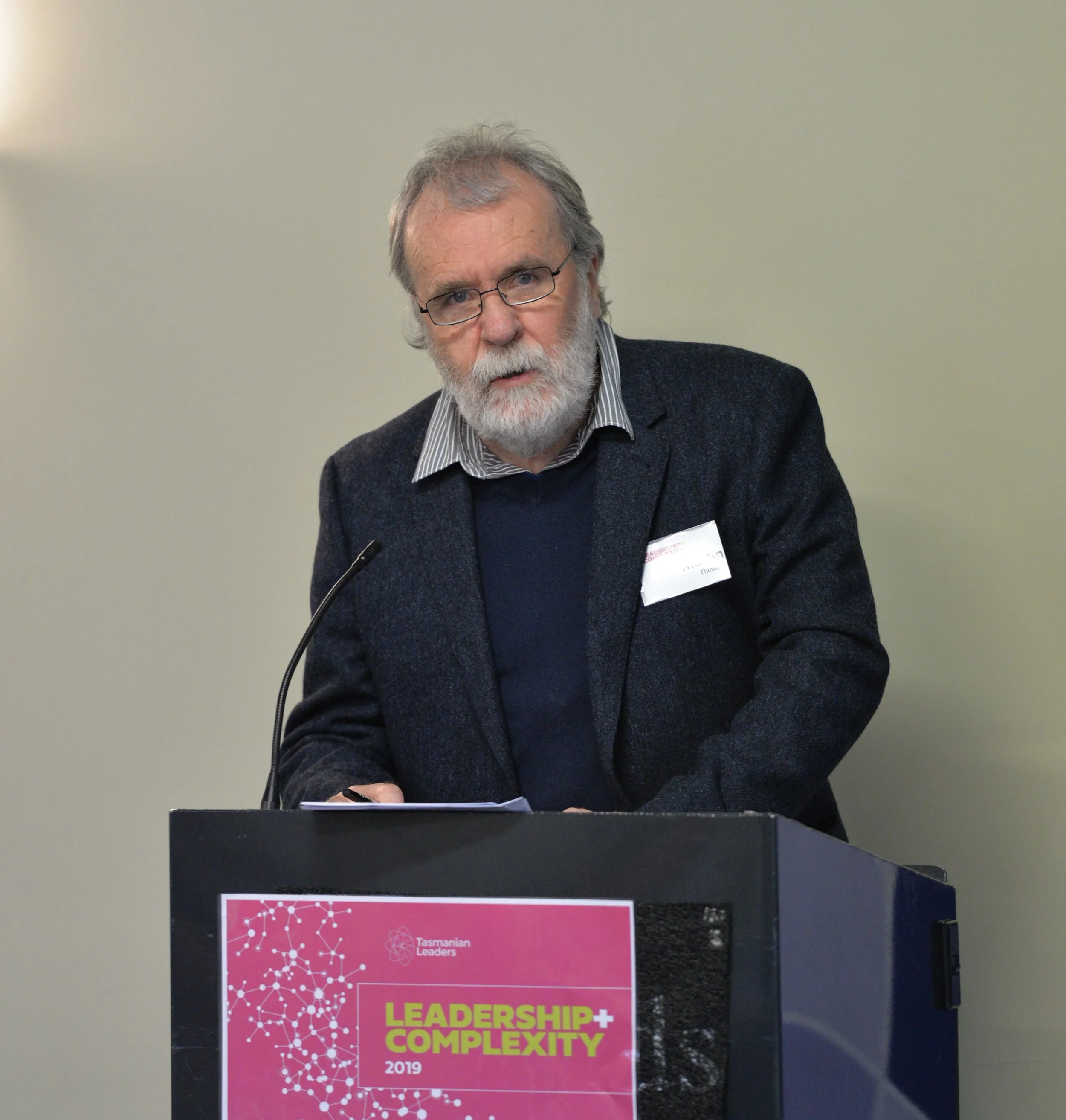
Martin Flanagan crop.jpg

Martin Flanagan: 'Staying Sane, keeping your balance, in the Post-truth era', Leadership + Complexity Conference - 2019

September 25, 2019

6 September 2019, Launceston, Tasmania, Australia

1.
I am a Tasmanian who has lived for the past 35 years in Victoria. What has become apparent to me over that time is this major difference between the two places: Tasmania, in its origins, is Georgian, and Victoria, in its origins, is Victorian.

The difference between the Georgian and Victorian eras is about vastly more than different tastes in architecture and furniture. The two historical eras had profoundly different ways of thinking about human society & what we owe our fellow human beings.

In 1803, when Tasmania was founded as Van Diemen’s Land, Britain was the biggest trafficker of human slaves in the world. The financial interests behind this horrific practice forged the most powerful political lobby group in the country - they owned a block of seats in the British parliament and had high-profile public champions like the future monarch William IV and the great military hero of the day, Horatio Nelson The slave trade had insinuated itself deeply into the British political system in the same way that, in our own time, the NRA has insinuated its way into the American political system, throttling gun law reform.

By the time Victoria was declared an independent colony in 1850, the slave trade had been outlawed by the British parliament. A huge battle had been fought, a huge victory won. For the first time in British political history, people had campaigned politically for the rights of people other than themselves. That’s a huge shift in public consciousness and one that confounded the conservatives of the day. Lord Abingdon, one of slavery’s defenders, had declared, “Feelings of humanity are a private matter and not the basis of public policy”. In the Victorian age, feelings of humanity did indeed become the basis of public policy. And that was another huge shift in the public consciousness.

During the Victorian Age, Britain saw reforms across a whole range of areas - prisons, education, child labour, extending the vote.... It was the Victorians who invented the idea of “progress”. In our own time, that idea has been diminished to mean only economic progress, but, originally, to the Victorians, it also meant social and moral progress. Hence we get the phrase “Victorian morality” which was, among other things, prudish about sex. No-one ever accused the Georgians of being prudish about sex.

So how does any of this impact on Tasmania and Victoria? Well, to begin with, there is a whole chapter of history that Tasmania possesses that Victoria does not. There are characters in Tasmanian history who have no equivalent in Victorian history like one of my journalistic heroes Henry Melville, who wrote “The History of Van Diemen’s Land 1816-36” from the condemned cell in Hobart prison where Governor Arthur had placed him.

But that first chapter in this island’s colonial history came at a price. In the words of historian Ros Haynes “The imagery associated with Van Diemen's Land was too deeply rooted in the history and the literary culture of the island. It lingered on as a malaise, as a sense of inferiority to 'the mainland' “. This was compounded by a corresponding sense of superiority among a certain sort of Victorians. Tasmania, I once wrote, was colonised twice, once by England and once by Victoria.

2.
My subject today is living with the complexity of our times, so why am I talking about history? Because we are all part of a continuum that started long before we were born and will continue long after we are dead. To put it another way: I best understand life through understanding, or seeking to understand, the bigger story that is history. A Jewish man I knew who sold shoes at South Melbourne market used to talk to me about history. I thought he had an opinion worth listening to, having survived the Nazi occupation of his home country, Hungary, during World War 2, and then escaped from the Communist regime which followed. The shoe-seller told me history is like a river. Sometimes it moves so slowly it feels like it’s not moving at all, then it speeds up and suddenly it’s rushing and you’re going over a waterfall. I think we are about to go over a waterfall – if, in fact, we have not already gone over it.

My fear is that we are entering, or have entered, a new technologically enhanced Dark Age, one that currently finds its lead actor in Donald Trump whose depth of character was best summed up, I think, in a story which appeared last Sunday week in the Washington Post about a reluctant visit Trump made in 2017 to the National Museum of African American History and Culture in Washington. Having paused at a display on the Dutch role in the global slave trade, Trump turned and, by way of a response, remarked to the museum’s founding director, “You know, they love me in the Netherlands.”

This is a man with more than 20 allegations of sexual abuse against him, including one by a woman saying she was procured for Trump by Jeffrey Epstein as a 13-year-old. It is a measure of the strangeness of our times that, not only do these allegations have about as much lasting consequence as sports scores, there are Christian evangelists in the United States who see Trump, literally, as an agent of God.

So what has this to do with Australia? Everything. Sky News in Australia has adopted the lead of Fox News in America where it has been described – fairly, in my opinion – as the propaganda wing of the Trump-era Republican Party. Both organizations are owned by Rupert Murdoch’s News Corp which also dominates the Australian newspaper market. When Pauline Hanson advised the voters of Western Australia prior to the last State election that Vladimir Putin was “a man of vision”, it was because she saw an idea that was working for Donald Trump and thought she’d try it here. More recently, during the George Pell trial, I was surprised to see one tweeter describe Pell as a Christian saint. I went to the tweeter’s home page. He is – or, at least, sees himself as - a highly devout English Catholic. In addition to Pell, the two other causes dear to his heart were Donald Trump and Brexit. What historical forces unite George Pell, Donald Trump and Brexit? I think I know what a feminist, particularly a feminist of colour, would say.


3.
How did we end up in this weird place? Clearly, technology has simultaneously both empowered and disempowered us. From my perspective as a journalist with an eye on the public realm, there are four obvious dynamics at work. One is the internet and social media – again, both carry and disperse a wealth of knowledge and a wealth of ignorance. Connected to this is a loss of faith in education, particularly public education. One hundred years ago, people working for a better world proceeded in the faith that government education would, as a matter of course, produce more enlightened societies. Now we are dropping back to the view that education is a means to the end of individual advancement and, following from this, something only the better-off can afford. The result? Greater public ignorance. A third factor is that we now have a whole new level of sophistication in political propaganda using – or, rather, manipulating - platforms like Facebook. Cambridge Analytica worked in this way with both the Trump election campaign in 2016 and the Brexit Leave campaign. I saw an interview with one of the Cambridge Analytica directors in which he said that politics is essentially a matter of feeling, not thought. That is, by appealing directly to feeling – and, in many cases, by feeling we actually mean prejudice and fear – a person or political organization can circumvent the need for thought, for reason and knowledge, for rational debate.

The fourth factor that I see at work is the 24-hour news cycle. In the 24-hour news cycle, a story is replaced as soon as its loses its value as a sensation, the sensation that makes you go, “I want to look at that”, like you do with an ad in a brochure. What this means that serious political stories never catch up with those who stand accused by them.. Someone like Trump is a master at playing the 24 hour news cycle, spinning it like a chocolate wheel. I want to buy Greenland, he declares - Greenland doesn’t want to be bought, Trump is insulted and says America’s been insulted. He’s led the news for three days with a complete non-story that serves as camouflage. Meanwhile, income inequality rates are surging both in the US and here back to levels not seen for 100 years or more.

Russian president Vladimir Putin has said recently that the era of what he called “western liberalism” is over. He may be right. That may be the best description of the historic change we’re seeing. The Russian media portray American democracy as “a circus”, thereby making Putin’s regime look to have the virtue of sober good order. How better to make that metaphor come true than by helping to install Donald Trump as the ringmaster. Recently, I saw a clip of Steve Bannon – a common link between Trump and Brexit and Cambridge Analytica – tell a crowd of French ultra-right followers of Marine Le Pen, “We are winning”. Bannon may be right. Last year, I did a public interview with Richard Branson at the National Gallery of Victoria. He said he believed democracy was under attack around the globe. So do I. Putin’s Russia is a fake democracy. Donald Trump has no problem with that. The Prime Ministers of Great Britain and Australia have expressed their eagerness to work with Trump.

The world is in a turmoil of change. Traditionally, Australia has been relatively protected from global forces. That may be about to change. Last year, as a shack owner at Dolphin Sands on the east coast of Tasmania, I was taken aback to learn that a giant megadevelopment at the Cambria Green estate on Dolphin Sands had been announced in the Chinese media as a fait accompli, before mention of it even being a possibility had appeared in the Tasmanian press. A number of the local councillors knew nothing of it until four days before the council meeting approved the 1st stage and what we still don’t is the relationship between the Chinese investors and the government of the People’s Republic of China. Investigating this matter, I learned many things. One was that 24 % of agricultural land in Tasmania is leased or owned by foreigners. Last week, a UN committee said food security and water security are going to be two of the major issues of the 21st century.

Most Australians seem not to give a thought to the fact that we are committed to supporting Japan and the United States against China militarily in the event of hostilities in the South China sea. That is, we will be at war with our major trading partner, a recipe, I would have thought, for chaos. This is one of the many things we really should be talking about. But are not. Instead, as I write, we’re talking about Boris Johnson, the comedy actor who could have stepped out of a Bertie Wooster novel and can tell as many lies as Donald Trump, only a lot more eloquently.

4.

So how do I steady myself? How do I respond to the dizzy complexity of our times? I reach for what’s timeless. I will seek to explain by telling a story. A football story. From the time I was 11 and found myself in a not very happy place, a Catholic boarding school on the north-west coast of Tasmania that has been much in the news of late, sport has been an escape for me, a beautiful distraction, one I happen to understand because my family’s been involved with it for generations.
Two years ago, I interviewed an AFL player, a fine young man called Jordan Roughead, for a book I wrote on the 2016 Bulldogs premiership. Jordan has a social conscience and is determined to stand up for the powerless but when I asked him about politics, he recoiled as if he’d seen a snake and said with passion, “I don’t have anything to do with politics!”. I immediately thought of something that was said 2500 years ago by a Greek statesman and soldier called Pericles: “Just because you don’t have an interest in politics doesn’t mean politics won’t have an interest in you”. If you asked anyone in Hong Kong right now what Pericles meant, I think they could tell you in a few short, sharp sentences.

It is said Trump has led us into the post-truth era. That’s a truly frightening idea – a world without any truth would be a very dark place where random attacks could happen at any moment and go unpunished. But I would argue the term “the post-truth era” is too absolute because there are truths that endure. There is a reason we are still repeating something Pericles said 500 years before the birth of Christ, and the reason is that when ideas are expressed accurately and with precision, they become like tools people carry through the generations proving their worth through use over and over and over again. To quote Pericles once more, “Time is the wisest counsellor”.

I never cease to be amazed by what people thought and said in other times, sometimes thousands of years ago. We think we’re “modern”, that we exist in a time apart. My book on the Western Bulldogs’ premiership naturally dealt with the philosophy of coach Luke Beveridge. What was remarkable to me about that premiership was that everyone at the club from the doormen to the women doing secretarial duties thought they played a part in winning it. The players thought that, too. They were a team that existed as a part of a mass movement and thought it odd when I asked questions which suggested otherwise. In the end, I remembered something Lao Tszu, the Chinese sage said, again around 2500 years ago. “When the best leader's work is done the people say, "We did it ourselves." “

The Romans had a quality they prized called “gravitas” from which the word gravity later came. A person with gravitas was someone whose views were given weight by his listeners. Aristotle said this respect was a function of the character of the speaker. The person with the greatest gravitas in Australian public life right now that I have encountered is Aboriginal leader and Labor Senator Patrick Dodson. An example of an Australian political utterance of recent times with gravitas is the Uluru statement. It was swept to one side at the last election but that doesn’t mean it’s gone away. It never will.

One of my favourite Tasmanian stories occurred in the early 1820s on the east coast. A major character in the history of this island called George Augustus Robinson met some members of the Great Oyster Bay tribe who told him their ancestors had come to the island we now call Tasmania via a land bridge across what we now call Bass Strait and that the sea had closed behind them, cutting them off. No-one believed them. We now know it’s true. That means they carried that story accurately within their culture for something like 8000 year or four times the length of the entire history of the Christian religion.

Earlier this year, I was invited to give a speech during Reconciliation Week at Melbourne Grammar which is on the traditional lands of the Bunurong people. I told the boys that the Bunurong people, to this day, carry a story about Port Phillip Bay when it was dry, when it was a grass plain with trees and a river running through it. The reason the Bunurong remember this story is because it was their land and they lost it through this prehistoric act of climate change.

The Aboriginal spirit who presides over Melbourne, together with Waa the crow, is Bunjil the eagle. The Bunurong story says that when the people asked Bunjil why they had lost their land, he gave them two reasons – one, they were getting involved in needless wars with their neighbours, two, because they were killing female fish before they spawned. That is, they were sinning against the future. The common factor in indigenous law-making around the globe has always involved asking the question: how will this effect the generations of our people still to come? I get that. I’m a grandfather. I look at extinction rates for animal and insect species over the past 40 years and wonder, yet again, what is going to be left for my grandchildren and their children. I also wonder how the collapse of various species is going to impact on the eco-systems they inhabit. This is where we encounter another complexity that is relative to our times. The complexity of nature.

It’s commonly said that those who don’t understand the mistakes of the past are condemned to repeat them. That’s true. But it’s also true that those who don’t learn about history are also denied the strength, the courage, the inspiration, to be had from the victories of the past. No tyrant, no despot, no monarch, ever wanted democracy. Somehow it was won. The British political system did not want to end the slave trade, being deeply implicated in its profits. Somehow that was won. There was entrenched opposition to extending the vote, initially to all men, and later to women. Somehow both causes were won....the only strength we have is the strength we have in coming together and it’s got to start generating from meetings like this.

Last year, I MCed a protest rally against the Cambria Green megadevelopment in the Hobart Town Hall which saw me labelled as a left-wing greenie but which I saw as an issue of democracy. Two weeks later, I MC’d a function titled Capitalism With A Conscience at the National Gallery of Victoria which was hosted by Melbourne entrepreneur Radek Sali for the benefit of an organization called Igniting Change which is run by a remarkable woman called Jane Tewson. Fifteen hundred people attended and, in the course of the night, I interviewed entrepreneur Richard Branson on stage.

Branson believes climate change represents the biggest threat to the world since World War 2, in which 60 million people died. That may sound outlandish but if climate change catastrophes start kicking in we could have hundreds of millions of people on the move around the globe. Branson believes if governments cannot, or will not, take action on climate change, business will have to. Not long after we spoke, Saudi Arabian journalist Jamal Kashogghi was brutally murdered and dismembered in a Saudi consulate in Turkey. Trump, who has business interests in Saudi Arabia, avoided comment. Richard Branson issued a statement saying that if the details of the murder were proved true, western businesses would have to reconsider doing business with Saudi Arabia. That’s leadership.

Do I agree with everything Richard Branson says and does? No. But I’m open to dialogue with him and people like him. As is evidenced by the Brexit crisis in Britain, which is going to split the Conservative Party and possibly lead to the disintegration of the United Kingdom, we are in a period when the political definitions which have sustained us for half a century are breaking apart and political forces are re-aligning. Would it bother me if women took the balance of leadership roles? No. I think we’ve got bigger problems than gender disputes. I want to hear from people with gravitas.


Martin Flanagan was speaking at a conference organised by
Tasmanian Leaders.


Enjoyed this speech? Speakola is a labour of love and I’d be very grateful if you would share, tweet or like it. Thank you.

Facebook Twitter Facebook
In SOCIETY Tags MARTIN FLANAGAN, TRANSCRIPT, MEDIA, TASMANIA, AGE OF TRUMP, DONALD TRUMP, TRUTH, HISTORY, DEM, DEMOCRACY, LEADERSHIP
2 Comments

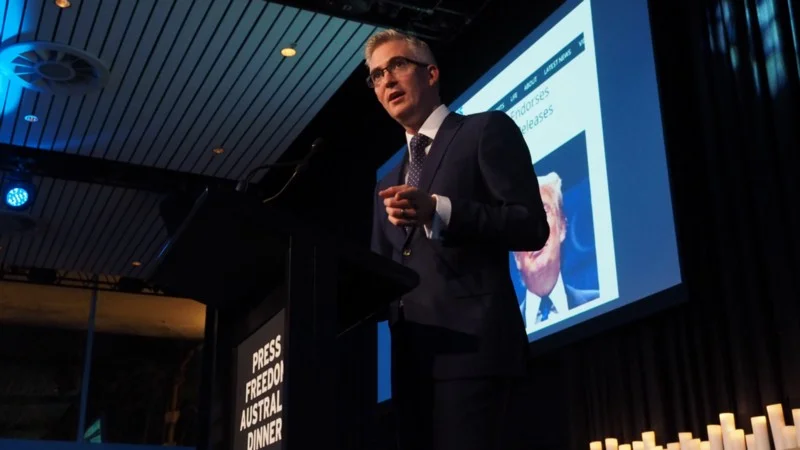
David Speers: 'If a competitor’s legitimate story is labeled “fake” by a self-serving politician, call it out', Press Freedom Dinner - 2017

May 9, 2017

28 April 2017, Ivy Ballroom, Sydney, Australia

The Press Freedom Dinner is a joint initiative of the Walkley Foundation and the MEAA. This speech first appeared in the Walkley magazine.

I was asked to speak tonight about political reporting in the era of “fake news”. It seems to be the issue dominating media industry discussion around the world over the past 12 months, but I’ve got a slightly different take in the Australian context as to what sort of threat it poses.

A good starting point is trying to work out what fake news actually is.

Everyone seems to have a THEORY.

So let’s begin with a bit of a pop quiz.

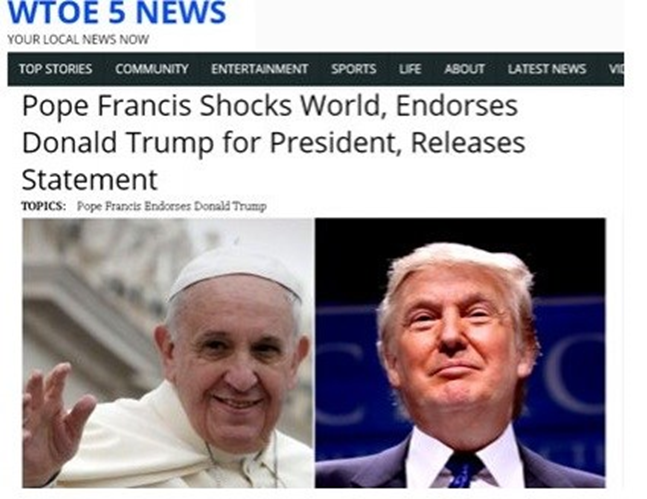
Is this fake news?

Well plainly yes it is fake news. There was a bunch of these stories that took off during last year’s Presidential election. It’s impossible to know how many of those who read them actually believed them or just read them for a bit of fun. But we do know the top 20 of these fake news stories generated nearly 9 million shares on Facebook. That’s more than the top 20 real news stories generated. So perhaps it tells us a bit about what Facebook users like. This one about the Pope endorsing Trump was the most shared. This is fake news.

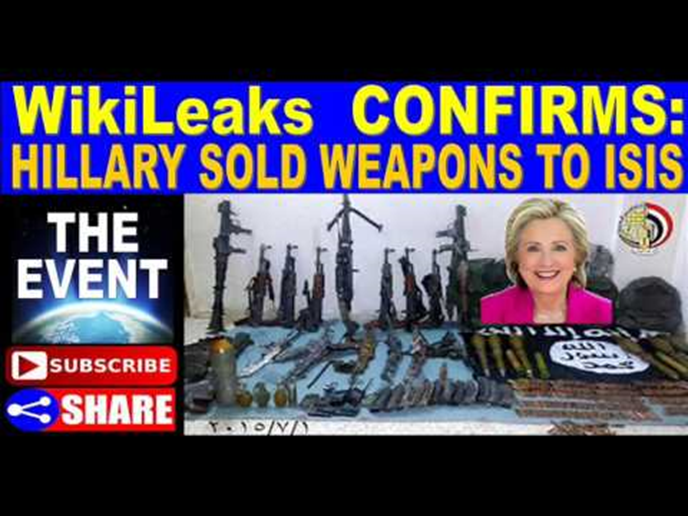
What about this one?

Well yes this is clearly fake news too. This was number two on the most shared list. You can understand why people click on it and share it; it’s a far sexier story than “Hillary confirms education policy” or “Hillary talks tax”.

We now know much of this stuff was created by fraudsters in Macedonia. Or “entrepreneurs”, depending on your point of view. Facebook and Google are now taking steps to tackle this stuff with greater fact-checking and weeding out of obviously fake material, as they should. But I don’t really want to spend tonight talking about what they should and shouldn’t be doing. I freely admit to not being much of an expert on how Facebook algorithms work. I do understand this can be a balancing act at times. No one wants to see some of the brilliant satirical pieces from the Betoota Advocate blocked for example. Well, perhaps some of those radio & TV producers who didn’t realise The Betoota stories were satirical do …

But coming back to the stuff that really is fake news, here’s the thing: I actually don’t believe it’s much of an issue in Australia. I don’t see this as a great threat to our industry. In fact I haven’t seen much evidence of fake news like this here in Australia. Maybe it’s because those Macedonian fraudsters haven’t really bothered with the Australian market. They haven’t bothered to generate fake news stories about Malcolm Turnbull and Tony Abbott. The two of them seem to be generating enough real news to keep up the clicks.

But that’s not to say I don’t think the term “fake news” is an issue. It is. And let me explain why, by returning to this question of what is fake news.

Is it “fake news” when a politician lies, misleads or simply gets something wrong?

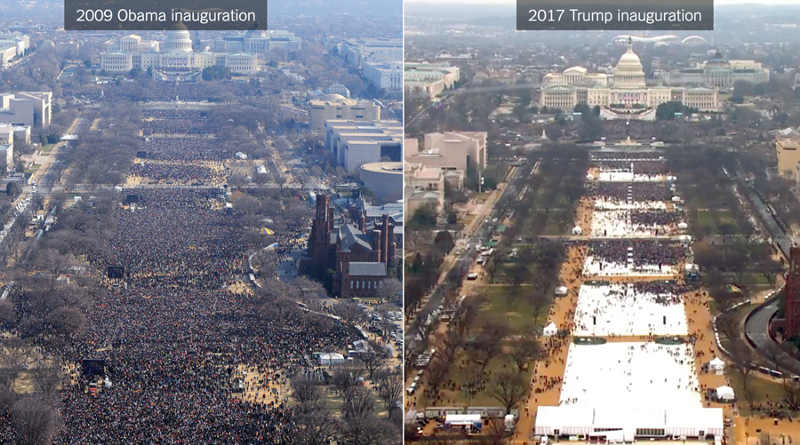
Donald Trump claimed to have the largest inauguration crowd in history until these pictures emerged …


Was the President himself guilty of “fake news”?

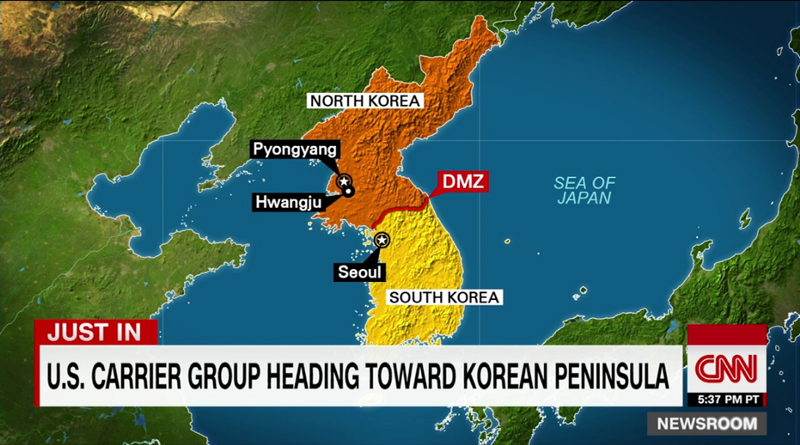
And what about this headline from just a couple of weeks ago:

That was according to what the US Defence Secretary and the White House spokesman were saying at the time. It wasn’t just CNN, we all reported that the carrier group was heading to the Korean peninsula. It is now, but at the time of those statements it was actually heading in the other direction.

Is this fake news? Well I would argue no. Governments good and bad get stuff wrong, either through cock-up or conspiracy, all the time. I wouldn’t put it in the category of fake news though. It’s just politicians lying or misleading or getting their facts wrong, as they’ve so often done.

What’s more of a problem to me, is how politicians themselves have latched onto the “fake news” label when trying to dismiss a story they don’t like. Donald Trump throws around the “fake news” line more than anyone when he doesn’t like a story or a journalist or a media outlet. But let’s leave him alone for a minute and look at this in the Australian context.

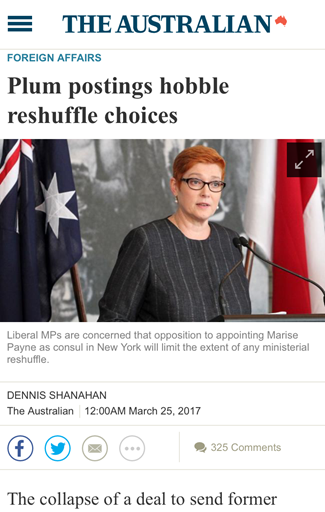
Is this fake news?

“Plum Postings Hobble Reshuffle Choices.”

A story from Dennis Shanahan about a possible reshuffle if George Brandis and Marise Payne are given diplomatic postings. Foreign Minister Julie Bishop labelled this story “fake news”.

Or this?

A story from the ABC’s Stephen Long about the Indian company Adani which is behind the proposed Carmichael Coal Mine, which is apparently facing multiple financial crime and corruption investigations. Resources Minister Matt Canavan labelled this story “fake news”.

And finally: “Govt MPs working to bring same sex marriage policy to a head over next fortnight”. A story from James Massola at the Sydney Morning Herald. Treasurer Scott Morrison labelled this one “fake news”.

Now I’m sure they all think they’re right in the zeitgeist using this “fake news” term. But here’s a tip for them: these stories aren’t fake news and it’s dangerous to suggest they are.

There is absolutely no justification to link entirely legitimate stories from reputable journalists to the crap from fraudsters in Macedonia and other peddlers of material designed to deliberately mislead and undermine how people are informed.

Now it’s true, the media is an easy target. Donald Trump knows it and so do politicians here. When it comes to trust, we’re regularly ranked down there with used car salesmen and even politicians themselves!

In fact we’re in even more trouble on this front than some realise. Some of you may have heard about the “Edelman Trust Barometer”, an annual global survey of trust in major institutions. Its results this year show trust in the media in Australia fell an alarming 10 points during 2016 from 42 per cent to just 32 per cent. That’s near the bottom of the pack internationally. Well below the level of trust in the media in the US, India, China and Indonesia. We scrape in just above Russia and Turkey.

Without trust we are vulnerable. Who are voters going to believe when a politician labels as “fake” a story they simply don’t like?

So what can we do about it? Well at least when it comes to politicians calling legitimate stories “fake news”, I reckon we should call it out. Even if it does mean defending one of our competitors, heaven forbid!

I’m not a supporter of media collectivism. I like the robust political media landscape in Australia, the wildly different voices and the healthy competition. I don’t think we need to start holding hands, but there is an argument for some solidarity when it comes to defending our craft right now.

If a competitor’s legitimate story is labeled “fake” by a self-serving politician, call it out. Don’t let trashing journalism become a go-to response for those politicians who can’t mount a better defence.

The bigger question is what can we do to restore trust in the media. Particularly in my context, trust in political journalism. Let me be clear, I don’t have a magic bullet answer to this. No one does.

But I do think it’s important to understand what’s driving audience cynicism.

Back to basics

As many have noted over the years, audiences are fragmenting and retreating into bubbles or echo chambers on the left and right. Once upon a time you had the choice of a few TV channels to watch, a few radio stations to listen to and a few newspapers to read.

Now you have infinite choices. You can listen to, watch and read an entirely right-wing perspective or left-wing perspective on the world. And many do.

They are attracted to stories and commentary they agree with.

Journalists need to be journalists, not players. Not Twitter warriors.

Facebook and Twitter help create these bubbles — by feeding them the news and opinion they want. The business model for most media outlets is also shifting to accommodate this trend. It’s not hard to understand why. Commercial media outlets live in a commercial world. People want informed opinion and they want commentary. There is no disputing that.

But there is also I believe, a vital role for journalists who try as hard as they damn well can to be straight down the middle and hold both sides to account. To ask tough questions of those in every political party, the big ones and the little ones, to uncover uncomfortable truths and yes, tell audiences what they might not like to hear or necessarily agree with.

Journalists need to be journalists, not players. Not Twitter warriors.

If you want to be trusted as a political journalist, play it straight. If your media organisation values trust, they will thank you for it. Don’t be swayed by the outrage industry on social media.

Admittedly this isn’t as easy as it sounds.

For what it’s worth — after 17 years in the Press Gallery — I reckon this is actually harder than ever right now but also more important than ever.

The advent of social media has delivered many wonderful things — but also a torrent of daily abuse aimed at journalists. Nearly every day my lovely Twitter followers call me either a “lying Labor dog” or a “right-wing Murdoch puppet”. Some of it can even get a lot more colourful than that.

My advice to those who are bothered by this stuff: either ignore it or wear it as a badge of pride.

In fact, I like to believe there’s a real opportunity for journalists right now to re-engage with cynical audiences. And largely by getting back to basics.

I know plenty of people have said this since the Trump victory and Brexit, but it’s true: get out and talk to a wider group of voters than those you usually mix with. Don’t just rely on polls and talkback radio to “get a feel” for the mood.

I’ve picked up more insight into what Australians really think over dinner in an RSL club or at a campground with the kids than I would in a week talking to the political spin doctors in Canberra. Now I appreciate there’s little time or money in most media jobs these days to wander around chatting with “real Australians”. The news cycle is relentless. But as individual journalists and as an industry, we need to maintain that connection with the communities we’re representing.

Transparency

The second serious challenge for political journalists I see is transparency. Or the lack of it. We’ve probably become too complacent about this.

The most glaring issue when it comes to transparency in government in Australia is the secrecy in Defence. There’s no other way I can put it.

8 years ago I was embedded with Australian troops in Afghanistan for a week. We travelled around forward operating bases in Oruzgan and I was able to talk to troops on the frontline openly.

The ABC and many others had similar opportunities. Important stories were told and history was recorded about what the men and women of the Australian Defence Force were doing in our name. These media visits weren’t as regular as some might have liked … and certainly a long way short of the media access the American military provided, but it was something.

In August 2014 Australian troops were sent back into Iraq to help in the fight against Islamic State. Apart from an initial flurry of coverage when they were first deployed, we now hear very little.

For nearly 12 months I’ve been requesting a visit to tell the story of what Australian troops are now doing. I’ve had no success. We get a briefing roughly every 6 months from an official in Canberra, and the Defence website pumps out press releases and lovely photos from its enormous media wing.

But when was the last time you saw our soldiers in the field telling their story? When was the last time you saw the Chief of Defence do an interview?

Early last week when Australian troops were caught up in a chemical weapons attack by Islamic State in Mosul. We found out initially through the American media! Fortunately no Australians were hurt. But why aren’t we told about this? There’s a hell of a fight going on in Mosul and we haven’t had one briefing about it.

Now it’s true, there aren’t as many specialist Defence reporters as there once were. There aren’t as many journalists devoted to finding out what’s going on in Defence and that means there isn’t as much pressure being applied.

But there’s also no doubt the Australian Defence Force has become media shy over the years. It’s a shame, because one day Australians will want to know what we did in Iraq. And they deserve to know.

Then there’s the immigration department and its offshore processing centres. They’ve been running for four years now with barely any media access.

Admittedly a few have been able to access the processing centre at Nauru. But not Manus Island. The Australian Government hides behind the excuse it’s up to Nauru and PNG to decide media access, as if the Australian government has no influence or responsibility to allow some transparency around what’s going on in these places.

Preventing media access of course means the plight of the asylum seekers and the impact these centres have on the local community is out of sight and out of mind for most Australians.

It also makes it extremely difficult to examine why certain incidents occur.

Take the incident two weeks ago — when PNG Defence personnel fired around 100 shots into the Manus Island centre. Last week the Immigration Minister Peter Dutton told me on my program that one of the reasons tensions were running high was because three asylum seekers were seen leading a 5-year-old local boy into the centre.

The local PNG Police commander seemed to disagree, saying the Defence personnel were drunk and that the shooting followed an altercation on a nearby soccer field. A boy aged 10 had come to the centre a week earlier looking for food. Peter Dutton is standing by his version of events, which he says is based on departmental advice and other contacts on the ground.

I’m not judging who’s right and wrong here. But there is a discrepancy and this isn’t a trivial matter.

Now if we did have more media access, I’m not suggesting we’d all have permanent correspondents based in Manus Island. But when a situation like this comes along, where asylum seekers claim there’s an unfair insinuation that paedophilia is going on and when there are fears about what this could do to an already volatile situation between some locals and the asylum seekers, surely allowing journalists in to talk to all sides and accurately report what’s gone on would only be a good thing.

As for transparency closer to home, consider this. We live in an information age. You can find out almost anything you want to know about everything with the device in your pocket. Except how the thousands and thousands of dollars in tax you’re paying each year are being spent.

Sure, we get the federal budget each year that tells us broadly where the money is going, but why not an online real-time portal that taxpayers and journalists can click on and find out where their money is going without having to lodge freedom of information requests?

A number of states in the US have done this, including Texas, which has a population greater than Australia’s. The Texas site is terrific by the way, you can drill right down and see how much is being spent by public servants for example on meals and lodging (roughly $5.5M a month in case you’re wondering). Each individual expense is recorded.

Don’t think for a minute this data isn’t being recorded here already every day. It is, but we just don’t get to see it.

As for transparency around what our politicians are up to, the Prime Minister’s recent reforms to MP expenses are a good step. Forcing them to report every month rather than every 6 months on what they’re spending is a good move. I just wish they’d get on with it.

But what about some transparency around political donations? Why can’t we get a report every month (or in fact in real time) when donations are made to political parties? The Queensland government is rolling out this reform this year. Why isn’t the federal government? Labor says it supports the move. Malcolm Turnbull says he has no in principle objections either. So why isn’t it happening?

And while we’re at it, why don’t we get a daily on-the-record briefing from the Prime Minister’s office? Everyone loves to make fun of Sean Spicer, but at least the Trump Administration is trying to uphold the fine tradition of the daily White House briefing.

Surely some eager junior minister, or Chief Press Secretary Mark Simpkin himself could stand up each morning and explain what our government is doing each day.

Even in the mother of Westminster traditions, Prime Minister’s Questions are followed by a thorough briefing, usually by the chiefs of staff to explain to the press the arguments each side was prosecuting.

Perhaps politicians would have less reason to attack the press and accuse us of writing “fake news” if they opened up and shared more information with us.

Transparency does matter. And even though Malcolm Turnbull likes to talk about being agile and innovative (or at least he used to), transparency in the Australian government is not keeping up with global trends.

To be honest — it would probably help the standing of politicians if they were more open and accountable. And it would probably help the standing of journalists if we fought harder for it.

So in conclusion …

My message tonight is don’t worry too much about the threat of fake news stories getting more Facebook shares than your own. But do worry about the standing of our profession. And do something about it.

Stand up for your colleagues when politicians are trying to rubbish their work. Always fight for greater transparency to shine a light on areas governments would rather hide. And be proud of straight news reporting. If we want to be trusted as journalists, we have to be journalists first and foremost. Not opinionated Twitter warriors.

I’ll leave you with a quote from a politician, but a good one. Abraham Lincoln: “I am a firm believer in the people. If given the truth, they can be depended upon to meet any national crisis. The great point is to bring them the real facts, and beer.”


Read Walkley Magazine content online here.

The Press Freedom Dinner raised funds for The Media Safety and Solidarity Fund.

This is the MEAA's Annual Report into Press Freedom in Australia

Source: https://medium.com/the-walkley-magazine/da...

Enjoyed this speech? Speakola is a labour of love and I’d be very grateful if you would share, tweet or like it. Thank you.

Facebook Twitter Facebook
In MEDIA Tags DAVID SPEERS, SKY NEWS, FAKE NEWS, DONALD TRUMP, MEDIA, JOURNALISM, WALKLEY AWARDS, TRANSCRIPT
Comment

See my film!

Limited Australian Season

March 2025

Details and ticket bookings at

angeandtheboss.com

Support Speakola

Hi speech lovers,
With costs of hosting website and podcast, this labour of love has become a difficult financial proposition in recent times. If you can afford a donation, it will help Speakola survive and prosper.

Best wishes,
Tony Wilson.

Become a Patron!

Learn more about supporting Speakola.

Featured political

Featured
Jon Stewart: "They responded in five seconds", 9-11 first responders, Address to Congress - 2019
Jacinda Ardern: 'They were New Zealanders. They are us', Address to Parliament following Christchurch massacre - 2019
Dolores Ibárruri: "¡No Pasarán!, They shall not pass!', Defense of 2nd Spanish Republic - 1936
Jimmy Reid: 'A rat race is for rats. We're not rats', Rectorial address, Glasgow University - 1972

Featured eulogies

Featured
For Geoffrey Tozer: 'I have to say we all let him down', by Paul Keating - 2009
for James Baldwin: 'Jimmy. You crowned us', by Toni Morrison - 1988
for Michael Gordon: '13 days ago my Dad’s big, beautiful, generous heart suddenly stopped beating', by Scott and Sarah Gordon - 2018

Featured commencement

Featured
Tara Westover: 'Your avatar isn't real, it isn't terribly far from a lie', The Un-Instagrammable Self, Northeastern University - 2019
Tim Minchin: 'Being an artist requires massive reserves of self-belief', WAAPA - 2019
Atul Gawande: 'Curiosity and What Equality Really Means', UCLA Medical School - 2018
Abby Wambach: 'We are the wolves', Barnard College - 2018
Eric Idle: 'America is 300 million people all walking in the same direction, singing 'I Did It My Way'', Whitman College - 2013
Shirley Chisholm: ;America has gone to sleep', Greenfield High School - 1983

Featured sport

Featured
Joe Marler: 'Get back on the horse', Harlequins v Bath pre game interview - 2019
Ray Lewis : 'The greatest pain of my life is the reason I'm standing here today', 52 Cards -
Mel Jones: 'If she was Bradman on the field, she was definitely Keith Miller off the field', Betty Wilson's induction into Australian Cricket Hall of Fame - 2017
Jeff Thomson: 'It’s all those people that help you as kids', Hall of Fame - 2016

Fresh Tweets


Featured weddings

Featured
Dan Angelucci: 'The Best (Best Man) Speech of all time', for Don and Katherine - 2019
Hallerman Sisters: 'Oh sister now we have to let you gooooo!' for Caitlin & Johnny - 2015
Korey Soderman (via Kyle): 'All our lives I have used my voice to help Korey express his thoughts, so today, like always, I will be my brother’s voice' for Kyle and Jess - 2014

Featured Arts

Featured
Bruce Springsteen: 'They're keepers of some of the most beautiful sonic architecture in rock and roll', Induction U2 into Rock Hall of Fame - 2005
Olivia Colman: 'Done that bit. I think I have done that bit', BAFTA acceptance, Leading Actress - 2019
Axel Scheffler: 'The book wasn't called 'No Room on the Broom!', Illustrator of the Year, British Book Awards - 2018
Tina Fey: 'Only in comedy is an obedient white girl from the suburbs a diversity candidate', Kennedy Center Mark Twain Award -  2010
Tina Fey: 'Only in comedy is an obedient white girl from the suburbs a diversity candidate', Kennedy Center Mark Twain Award - 2010

Featured Debates

Featured
Sacha Baron Cohen: 'Just think what Goebbels might have done with Facebook', Anti Defamation League Leadership Award - 2019
Greta Thunberg: 'How dare you', UN Climate Action Summit - 2019
Charlie Munger: 'The Psychology of Human Misjudgment', Harvard University - 1995
Lawrence O'Donnell: 'The original sin of this country is that we invaders shot and murdered our way across the land killing every Native American that we could', The Last Word, 'Dakota' - 2016