
• Genre
  • About
  • Submissions
  • Donate
  • Search
Menu

Speakola

All Speeches Great and Small
  • Genre
  • About
  • Submissions
  • Donate
  • Search
Share a political speech
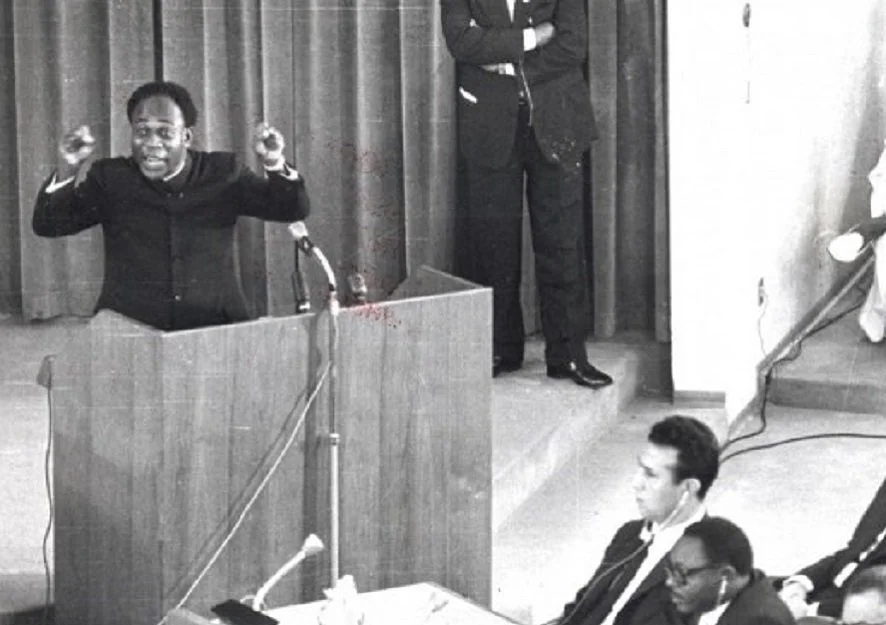
Kwame Nkrumah speaking on 24th May, 1963 in Addis Ababa

Kwame Nkrumah speaking on 24th May, 1963 in Addis Ababa

Kwame Nkrumah: 'Our capital flows out in streams to irrigate the whole system of Western economy', inaugural ceremony of the OAU Conference - 1953

March 21, 2021

24 May 1953, Addis Ababa, Ethiopia

At the first gathering of African Heads of State, to which I had the honour of playing host, there were representatives of eight independent States only. Today, five years later, we meet as the representatives of no less than thirty-two States, the guests of His Imperial Majesty, Haile Selassie, the First, and the Government and people of Ethiopia. To His Imperial Majesty, I wish to express, on behalf of the Government and people of Ghana my deep appreciation for a most cordial welcome and generous hospitality.

The increase in our number in this short space of time is open testimony to the indomitable and irresistible surge of our peoples for independence. It is also a token of the revolutionary speed of world events in the latter half of this century. In the task which is before us of unifying our continent we must fall in with that pace or be left behind. The task cannot be attached in the tempo of any other age than our own. To fall behind the unprecedented momentum of actions and events in our time will be to court failure and our own undoing.

A whole continent has imposed a mandate upon us to lay the foundation of our Union at this Conference. It is our responsibility to execute this mandate by creating here and now the formula upon which the requisite superstructure may be erected.

On this continent it has not taken us long to discover that the struggle against colonialism does not end with the attainment of national independence. Independence is only the prelude to a new and more involved struggle for the right to conduct our own economic and social affairs; to construct our society according to our aspirations, unhampered by crushing and humiliating neo-colonialist controls and interference.

From the start we have been threatened with frustration where rapid change is imperative and with instability where sustained effort and ordered rule are indispensable.

No sporadic act nor pious resolution can resolve our present problems. Nothing will be of avail, except the united act of a united Africa. We have already reached, the stage where we must unite or sink into that condition which has made Latin America the unwilling and distressed prey of imperialism after one and a half centuries of political independence.

As a continent we have emerged into independence in a different age, with imperialism grown stronger, more ruthless and experienced, and more dangerous in its international associations. Our economic advancement demands the end of colonialist and neo-colonialist domination in Africa.

But just as we understood that the shaping of our national destinies required of each of us our political independence and bent all our strength to this attainment, so we must recognise that our economic independence resides in our African union and requires the same concentration upon the political achievement.

The unity of our continent, no less than our separate independence, will be delayed if, indeed, we do not lose it, by hobnobbing with colonialism. African Unity is, above all, a political kingdom which can only be gained by political means. The social and economic development of Africa will come only within the political kingdom, not the other way around. The United States of America, the Union of Soviet Socialist Republics, were the political decisions of revolutionary peoples before they became mighty realities of social power and material wealth.

How, except by our united efforts, will the richest and still enslaved parts of our continent be freed from colonial occupation and become available to us for the total development of our continent? Every step in the decolonisation of our continent has brought greater resistance in those areas where colonial garrisons are available to colonialism.

This is the great design of the imperialist interests that buttress colonialism and neo-colonialism, and we would be deceiving ourselves in the most cruel way were we to regard their individual actions as separate and unrelated. When Portugal violates Senegal’s border, when Verwoed allocated one-seventh of South Africa’s budget to military and police, when France builds as part of her defence policy an interventionist force that can intervene, more especially in French-speaking Africa, when Welensky talks of Southern Rhodesia joining South Africa, it is all part of a carefully calculated pattern working towards a single end: the continued enslavement of our still dependent brothers and an onslaught upon the independence of our sovereign African States.

Do we have any other weapon against this design but our unity? Is not our unity essential to guard our own freedom as well as to win freedom for our oppressed brothers, the Freedom Fighters?

Is it not unity alone that can weld us into an effective force, capable of creating our own progress and making our valuable contribution to world peace? Which independent African State will claim that its financial structure and banking institutions are fully harnessed to its national development? Which will claim that its material resources and human energies are available for its own national aspirations? Which will disclaim a substantial measure of disappointment and disillusionment in its agricultural and urban
development?

In independent Africa we are already re-experiencing the instability and frustration which existed under colonial rule. We are fast learning that political independence is not enough to rid us of the consequences of colonial rule.

The movement of the masses of the people of Africa for freedom from that kind of rule was not only a revolt against the conditions which it imposed.

Our people supported us in our fight for independence because they believed that African Governments could cure the ills of the past in a way which could never be accomplished under colonial rule. If, therefore, now that we are independent we allow the same conditions to exist that existed in colonial days, all the resentment which overthrew colonialism will be mobilised against us.

The resources are there. It is for us to marshal them in the active service of our people. Unless we do this by our concerted efforts, within the framework of our combined planning, we shall not progress at the tempo demanded by today’s events and the mood of our people. The symptoms of our troubles will grow, and the troubles themselves become chronic. It will then be too late even for Pan-African Unity to secure for us stability and tranquillity in our labours for a continent of social justice and material well-being. Unless we establish African Unity now, we who are sitting here today shall tomorrow be the victims and martyrs of neo-colonialism.

There is evidence on every side that the imperialists have not withdrawn from our affairs. There are times, as in the Congo, when their interference is manifest. But generally it is covered up under the clothing of many agencies, which meddle in our domestic affairs, to foment dissension within our borders and to create an atmosphere of tension and political instability. As long as we do not do away with the root causes of discontent, we lend aid to these neo-colonialist forces, and shall become our own executioners. We cannot ignore the teachings of history.

Our continent is probably the richest in the world for minerals and industrial and agricultural primary materials. From the Congo alone, Western firms exported copper, rubber, cotton, and other goods to the value of 2, 773 billion dollars in the ten years between 1945 and 1955, and from South Africa, Western gold mining companies have drawn a profit, in the four years, between 1947 to 1951, of 814 billion dollars.

Our continent certainly exceeds all the others in potential hydroelectric power, which some experts assess as 42 percent of the world’s total. What need is there for us to remain hewers for the industrialised areas of the world?

It is said, of course, that we have no capital, no industrial skill, no communications and no internal markets, and that we cannot even agree among ourselves how best to utilise our resources.

Yet all the stock exchanges in the world are preoccupied with Africa’s gold, diamonds, uranium, platinum, copper and iron ores. Our capital flows out in streams to irrigate the whole system of Western economy. Fifty-two percent of the gold in Fort Knox at this moment, where the U. S. A. stores its bullion, is believed to have originated from our shores. Africa provides more than 60 percent of the world’s gold. A great deal of the uranium for nuclear power, of copper for electronics, of titanium for supersonic projectiles, of iron and steel for heavy industries, of other minerals and raw materials for lighter industries – the basic economic might of the foreign Powers – come from our continent. Experts have estimated that the Congo basin alone can produce enough food crops to satisfy the requirements of nearly half the population of the whole world.

For centuries Africa has been the milk cow of the Western world. It was our continent that helped the Western world to build up its accumulated wealth.

It is true that we are now throwing off the yoke of colonialism as
fast as we can, but our success in this direction is equally matched
by an intense effort on the part of imperialism to continue the
exploitation of our resources by creating divisions among us.

When the colonies of the American Continent sought to free themselves
from imperialism in the 18th century there was no threat of
neo-colonialism in the sense in which we know it today. The American
States were therefore free to form and fashion the unity which was
best suited to their needs and to frame a constitution to hold their
unity together without any form of interference from external sources.
We, however, are having to grapple with outside interventions. How
much more, then do we need to come together in the African unity that
alone can save us from the clutches of neo-colonialism.

We have the resources. It was colonialism in the first place that
prevented us from accumulating the effective capital; but we ourselves
have failed to make full use of our power in independence to mobilise
our resources for the most effective take-off into thorough going
economic and social development. We have been too busy nursing our
separate States to understand fully the basic need of our union,
rooted in common purpose, common planning and common endeavour. A
union that ignores these fundamental necessities will be but a shame.
It is only by uniting our productive capacity and the resultant
production that we can amass capital. And once we start, the momentum
will increase. With capital controlled by our own banks, harnessed to
our own true industrial and agricultural development, we shall make
our advance. We shall accumulate machinery and establish steel works,
iron foundries and factories; we shall link the various States of our
continent with communications; we shall astound the world with our
hydroelectric power; we shall drain marshes and swamps, clear infested
areas, feed the under-nourished, and rid our people of parasites and
disease. It is within the possibility of science and technology to
make even the Sahara bloom into a vast field with verdant vegetation
for agricultural and industrial developments. We shall harness the
radio, television, giant printing presses to lift our people from the
dark recesses of illiteracy.

A decade ago, these would have been visionary words, the fantasies of
an idle dreamer. But this is the age in which science has transcended
the limits of the material world, and technology has invaded the
silences of nature. Time and space have been reduced to unimportant
abstractions. Giant machines make roads, clear forests, dig dams,
layout aerodromes; monster trucks and planes distribute goods; huge
laboratories manufacture drugs; complicated geological surveys are
made; mighty power stations are built; colossal factories erected –
all at an incredible speed. The world is no longer moving through bush
paths or on camels and donkeys.

We cannot afford to pace our needs, our development, our security to
the gait of camels and donkeys. We cannot afford not to cut down the
overgrown bush of outmoded attitudes that obstruct our path to the
modern open road of the widest and earliest achievement of economic
independence and the raising up of the lives of our people to the
highest level.

Even for other continents lacking tile resources of Africa, this is
the age that sees the end of human want. For us it is a simple matter
of grasping with certainty our heritage by using the political might
of unity. All we need to do is to develop with our united strength the
enormous resources of our continent. A United Africa will provide a
stable field of foreign investment, which will encourage as long as it
does not behave inimically to our African interests. For such
investment would add by its enterprises to the development of the
national economy, employment and training of our people, and will be
welcome to Africa. In dealing with a united Africa, investors will no
longer have to weigh with concern the risks of negotiating with
governments in one period which may not exist in the very next period.
Instead of dealing or negotiating with so many separate States at a
time they will be dealing with one united government pursuing a
harmonized continental policy.

What is the alternative to this? If we falter at this stage, and let
time pass for neo-colonialism to consolidate its position on this
continent, what will be the fate of our people who have put their
trust in us? What will be the fate of our freedom fighters? What will
be the fate of other African Territories that are not yet free?

Unless we can establish great industrial complexes in Africa – which
we can only do in united Africa – we must have our peasantry to the
mercy of foreign cash crop markets, and face the same unrest which
overthrew the colonialists? What use to the farmer is education and
mechanisation, what use is even capital for development; unless we can
ensure for him and a fair price and ready market? What has the
peasant, worker and farmer gained from political independence, unless
we can ensure for him a fair return for his labour and a higher
standard of living?

Unless we can establish great industrial complexes in Africa, what
have the urban worker, and all those peasants on overcrowded land
gained from political independence? If they are to remain unemployed
or in unskilled occupation, what will avail them the better facilities
for education, technical training, energy and ambition which
independence enables us to provide?

There is hardly any African State without frontier problem with its
adjacent neighbours. It would be futile for me to enumerate them
because they are already familiar to us all. But let me suggest to
Your Excellences, that this fatal relic of colonialism will drive us
to war against one another as our unplanned and uncoordinated
industrial development expands, just as happened in Europe. Unless we
succeed in arresting the danger through mutual understanding on
fundamental issues and through African Unity, which will render
existing boundaries obsolete and superfluous, we shall have fought in
vain for independence. Only African Unity can heal this festering sore
of boundary disputes between our various States. Your Excellencies, the
remedy for these ills is ready to our hand. It stares us in the face
at every customs barrier, it shouts to us from every African heart. By
creating a true political union of all the independent States of
Africa, we can tackle hopefully every emergency, every enemy and every
complexity. This is not because we are a race of superman, but because
we have emerged in the age of science and technology in which poverty,
ignorance and disease are no longer the masters, but the retreating
foes of mankind. We have emerged in the age of socialized planning,
when production and distribution are not governed by chaos, greed and
self-interest, but by social needs. Together with the rest of mankind,
we have awakened from Utopian dreams to pursue practical blueprints
for progress and social justice.

Above all, we have emerged at a time when a continental land mass like
Africa with its population approaching three hundred million are
necessary to the economic capitalization and profitability of modern
productive methods and techniques. Not one of us working singly and
individually can successfully attain the fullest development.
Certainly, in the circumstances, it will not be possible to give
adequate assistance to sister States trying, against the most
difficult conditions, to improve their economic and social structures.
Only a united Africa functioning under a Union Government can
forcefully mobilize the material and moral resources of our separate
countries and apply them efficiently and energetically to bring a
rapid change in the conditions of our people.

If we do not approach the problems in Africa with a common front and a
common purpose, we shall be haggling and wrangling among ourselves
until we are colonized again and become the tolls of a far greater
colonialism than we suffered hitherto.

Unite we must. Without necessarily sacrificing our sovereignties, big
or small, we can, here and now, forge a political union based on
Defence, Foreign Affairs and Diplomacy, and a common Citizenship, an
African currency, an African Monetary Zone and an African Central
Bank. We must unite in order to achieve the full liberation of our
continent. We need a common Defence system with an African High
Command to ensure the stability and security of Africa.

We have been charged with this sacred task by our own people, and we
cannot betray their trust by failing them. We will be mocking the
hopes of our people if we show the slightest hesitation or delay by
tackling realistically this question of African Unity.

The supply of arms or other military aid to the colonial oppressors in
Africa must be regarded not only as aid in the vanquishment of the
freedom fighters battling for their African independence, but as an
act of aggression against the whole of Africa. How can we meet this
aggression except by the full weight of our united strength?

Many of us have made non-alignment an article of faith on this
continent. We have no wish, and no intention of being drawn into the
Cold War. But with the present weakness and insecurity of our States
in the context of world politics, the search for bases and spheres of
influence brings the Cold War into Africa with its danger of nuclear
warfare. Africa should be declared a nuclear-free zone and freed from
cold war exigencies. But we cannot make this demand mandatory unless
we support it from a position of strength to be found only in our
unity.

Instead, many Independent African States are involved by military
pacts with the former colonial powers. The stability and security
which such devices seek to establish are illusory, for the
metropolitan Powers seize the opportunity to support their
neo-colonialist controls by direct military involvement. We have seen
how the neo-colonialists use their bases to entrench themselves and
attack neighbouring independent States. Such bases are centers of
tension and potential danger spots of military conflict. They threaten
the security not only of the country in which they are situated but of
neighbouring countries as well. How can we hope to make Africa a
nuclear-free zone and independent of cold war pressure with such
military involvement on our continent? Only by counter-balancing a
common defence force with a common defence policy based upon our
desire for an Africa untrammelled by foreign dictation or military and
nuclear presence. This will require an all-embracing African High
Command, especially if the military pacts with the imperialists are to
be renounced. It is the only way we can break these direct links
between the colonialism of the past and the neo-colonialism which
disrupts us today.

We do not want nor do we visualize an African High Command in the
terms of the power politics that now rule a great part of the world,
but as an essential and indispensable instrument for ensuring
stability and security in Africa.

We need a unified economic planning for Africa. Until the economic
power of Africa is in our hands, the masses can have no real concern
and no real interest for safeguarding our security, for ensuring the
stability of our regimes, and for bending their strength to the
fulfilment of our ends. With our united resources, energies and
talents we have the means, as soon as we show the will, to transform
the economic structures of our individual States from poverty to that
of wealth, from, inequality to the satisfaction of popular needs. Only
on a continental basis shall we be able to plan the proper utilisation
of all our resources for the full development of our continent.

How else will we retain our own capital for our development? How else
will we establish an internal market for our own industries? By
belonging to different economic zones, how will we break down the
currency and trading barriers between African States, and how will the
economically stronger amongst us be able to assist the weaker and less
developed States?

It is important to remember that independent financing and independent
development cannot take place without an independent currency. A
currency system that is backed by the resources of a foreign State is
ipso facto subject to the trade and financial arrangements of that
foreign country.

Because we have so many customs and currency barriers as a result of
being subject to the different currency systems of foreign powers,
this has served to widen the gap between us in Africa. How, for
example, can related communities and families trade with, and support
one another successfully, if they find themselves divided by national
boundaries and currency restrictions? The only alternative open to
them in these circumstances, is to use smuggled currency and enrich
national and international racketeers and crooks who prey upon our
financial and economic difficulties.

No independent African State today by itself has a chance to follow an
independent course of economic development, and many of us who have
tried to do this have been almost ruined or have had to return to the
fold of the former colonial rulers. This position will not change
unless we have unified policy working at the continental level. The
first step towards our cohesive economy would be a unified monetary
zone, with, initially, an agreed common parity for our currencies. To
facilitate this arrangement, Ghana would change to a decimal system.
When we find that the arrangement of a fixed common parity is working
successfully, there would seem to be no reason for not instituting one
common currency and a single bank of issue. With a common currency
from one common bank of issue we should be able to stand erect on our
own feet because such an arrangement would be fully backed by the
combined national products of the States composing the union. After
all, the purchasing power of money depends on productivity and the
productive exploitation of the natural, human and physical resources
of the nation.

While we are assuring our stability by a common defence system, and
our economy is being orientated beyond foreign control by a Common
currency, Monetary Zone and Central Bank of Issue, we can investigate
the resources of our continent. We can begin to ascertain whether in
reality we are the richest, and not, as we have been taught to
believe, the poorest among the continents. We can determine whether we
possess the largest potential in hydroelectric power, and whether we
can harness it and other sources of energy to our own industries. We
can proceed to plan our industrialization on a continental scale, and
to build up a common market for nearly three hundred million people.

Common Continental Planning for the Industrial and Agricultural
development of Africa is a vital necessity.

So many blessings must flow from our unity; so many disasters must
follow on our continued disunity, that our failure to unite today will
not be attributed by posterity only to faulty reasoning and lack of
courage, but to our capitulation before the forces of imperialism.

The hour of history which has brought us to this assembly is a
revolutionary hour. It is the hour of decision. For the first time,
the economic imperialism which menaces us is itself challenged by the
irresistible will of our people.

The masses of the people of Africa are crying for unity. The people of
Africa call for a breaking down of boundaries that keep them apart.
They demand an end to the border disputes between sister African
States – disputes that arise out of the artificial barriers that
divided us. It was colonialism’s purpose that left us with our border
irredentism that rejected our ethnic and cultural fusion.

Our people call for unity so that they may not lose their patrimony in
the perpetual service of neo-colonialism. In their fervent push for
unity, they understand that only its realization will give full
meaning to their freedom and our African independence.

It is this popular determination that must move us on to a Union of
Independent African States. In delay lies danger to our well-being, to
tour very existence as free States. It has been suggested that our
approach of unity should be gradual, that it should go piece-meal.
This point of view conceives of Africa as a static entity with
“frozen” problems which can be eliminated one by one and when all have
been cleared then we can come together and say: “Now all is well. Let
us unite”. This view takes no account of the impact of external
pressures. Nor does it take cognizance of the danger that delay can
deepen our isolations and exclusiveness; that it can enlarge our
differences and set us drifting further and further apart into the net
of neo-colonialism, so that our union will become nothing but a fading
hope, and the great design of Africa’s full redemption will be lost,
perhaps, forever.

The view is also expressed that our difficulties could be resolved
simply by a greater collaboration through cooperative association in
our inter-territorial relationships. This way of looking at our
problems denies a proper conception of their inter-relationship and
mutuality. It denies faith in a future for African advancement, in
African independence. It betrays a sense of solution only in continued
reliance upon external sources through bilateral agreements for
economic and other forms of aid.

The fact is that although we have been cooperating and associating
with one another in various fields of common endeavour even before
colonial times, this has not given us the continental identity and the
political and economic force which would help us to deal effectively
with the complicated problems confronting us in Africa today. As far
as foreign aid is concerned, a United Africa would be in a more
favourable position to attract assistance from foreign sources. There
is the far more compelling advantage which this arrangement offers, in
that aid will come from anywhere to Africa because our bargaining
power would become infinitely greater. We shall no longer be dependent
upon aid from restricted sources. We shall have the world to choose
from.

What are we looking for in Africa? Are we looking for Charters,
conceived in the light of the United Nations example? A type of United
Nations organisation whose decisions are framed on the basis of
resolutions that in our experience have sometimes been ignored by
member States? Where groupings are formed and pressures develop in
accordance with the interest of the group concerned? Or is it intended
that Africa should be turned into a lose organization of States on the
model of the organization of the American States, in which the weaker
States within it can be at the mercy of the stronger or more powerful
ones politically or economically or at the mercy of some powerful
outside nations or group of nations? Is this the kind of association
we want for ourselves in the United Africa we all speak of with such
feeling and emotion?

Your Excellences, permit me to ask: is this the kind of framework we
desire for our United Africa? And arrangement which in future could
permit Ghana or Nigeria or the Sudan, or Liberia, or Egypt or Ethiopia
for example, to use pressure, which either superior economic or
political influence gives, to dictate the flow and the direction of
trade from, say, Burundi or Togo or Nyasaland to Mozambique?

We all want a United Africa, united not only in our concept of what
unity can connote, but united in our common desire to move forward
together and dealing with all the problems that can best be solved
only on a continental basis.

When the first Congress of the United States met many years ago at
Philadelphia, one of the delegates sounded the first chore of unity by
declaring that they had met in a “state of nature” in other words,
they were not at Philadelphia as Virginians, or Pennsylvanians, but
simply as Americans. This reference to themselves as Americans was in
those days a new and strange experience. May I dare to assert equally
on this occasion, Your Excellences that we meet here today not as
Ghanaians, Guineans, Egyptians, Algerians, Moroccans, Malians,
Liberians, Congolese or Nigerians but as Africans. Africans united in
our resolve to remain here until we have agreed on the basic
principles of a new compact of unity among ourselves which guarantees
for us and future a new arrangement of continental government.

If we succeed in establishing a new set of principles as the basis of
a new Charter or Statute for the establishment of a Continental Unity
of Africa and the creation of social and political progress for our
people then, in my view, this Conference should mark the end of our
various groupings and regional blocs. But if we fail and let this
grand and historic opportunity slip by then we should give way to
greater dissension and division among us for which the people of
Africa will never forgive us. And the popular and progressive forces
and movements within Africa will condemn us. I am sure therefore that
we should not fail them.

I have spoken at some length, Your Excellences, because it is
necessary for us all to explain not only to one another present here
but also to our people who have entrusted to us the fate and destiny
of Africa. We must therefore not leave this place until we have set up
effective machinery for achieving African Unity. To this end, I now
propose for your consideration the following:

As a first step, Your Excellences, a Declaration of Principles uniting
and binding us together and to which we must all faithful and loyally
adhere, and laying the foundations of unity should be set down. And
there should also be a formal declaration that all the Independent
African States here and now agree to the establishment of a Union of
African States.

As a second and urgent step for the realization of the unification of
Africa, an All-Africa Committee of Foreign Ministers be set up now,
and that before we rise from this Conference a day should be fixed for
them to meet.

This Committee should establish on behalf of the Heads of our
Governments, a permanent body of officials and experts to work out a
machinery for the Union Government of Africa. This body of officials
and experts should be made up of two of the brains from each
Independent African State. The various Charters of the existing
groupings and other relevant document could also be submitted to the
officials and experts. A praesidium consisting of the Head of the
Governments of the Independent African States should be called upon to
meet and adopt a Constitution and others recommendations that will
launch the Union Government of Africa.

We must also decide on allocation where this body of officials and
experts will work as the new Headquarters or Capital of our Union
Government. Some central place in Africa might be the fairest
suggestion either at Bangui in the Central African Republic or
Leopoldville in Congo. My colleagues may have other proposals. The
Committee of Foreign Ministers, officials and experts should be
empowered to establish:

1. A Commission to frame a Constitution for a Union Government of
African States;
2. A Commission to work out a continent-wide plan for a unified or
common economic and industrial programme for Africa; this plan should
include proposals for setting up:
• A Common Market for Africa
• An African currency
• African Monetary Zone
• African Central Bank, and
• Continental Communications System;
3. A Commission to draw up details for a Common Foreign Policy and Diplomacy;
4. A Commission to produce plans for a Common System of Defence;
5. A Commission to make proposals for Common African Citizenship.
These Commissions will report to the Committee of Foreign Ministers
who should, in turn, submit within six months of this Conference their
recommendations to the Praesidium. The Praesidium meeting in
Conference at the Union Headquarters will consider and approve the
recommendations of the Committee of Foreign Ministers.

In order to provide funds immediately for the work of the permanent
officials and experts of the Headquarters of the Union, I suggest that
a special Committed be set up now to work a budget for this.

Your Excellences, with these steps, I submit, we shall be irrevocably
committed to the road which will bring us to a Union Government of
Africa. Only a united Africa with central political direction can
successfully give effective material and moral support to our Freedom
Fighters in Southern Rhodesia, Angola, Mozambique, South-West Africa,
Bechuanaland, Swaziland, Basutoland, Portuguese Guinea, etc., and of
course South Africa.”

Source: https://face2faceafrica.com/article/read-k...

Enjoyed this speech? Speakola is a labour of love and I’d be very grateful if you would share, tweet or like it. Thank you.

Facebook Twitter Facebook
In 1940-59 C Tags KWAME NKRUMAH, GHANA, GHANAIAN INDEPENDENCE, AFRICAN HEADS OF STATE, OAU CONFERENCE, GREAT AFRICAN SPEECHES, PRESIDENT, AFRICA DAY, 1950S, PAN AFRICA, NEO COLONIALISM, COLONIALISM
Comment

Richard Nixon: 'Our little girl Tricia, the six year old, named it "Checkers"', televised address - 1952

August 6, 2015

23 September, 1952, televised address to the nation

My Fellow Americans,

I come before you tonight as a candidate for the Vice Presidency and as a man whose honesty and -- and integrity has been questioned.

Now, the usual political thing to do when charges are made against you is to either ignore them or to deny them without giving details. I believe we've had enough of that in the United States, particularly with the present Administration in Washington, D.C. To me the office of the Vice Presidency of the United States is a great office, and I feel that the people have got to have confidence in the integrity of the men who run for that office and who might obtain it.

I have a theory, too, that the best and only answer to a smear or to an honest misunderstanding of the facts is to tell the truth. And that's why I'm here tonight. I want to tell you my side of the case. I'm sure that you have read the charge, and you've heard it, that I, Senator Nixon, took 18,000 dollars from a group of my supporters.

Now, was that wrong? And let me say that it was wrong. I'm saying, incidentally, that it was wrong, not just illegal, because it isn't a question of whether it was legal or illegal, that isn't enough. The question is, was it morally wrong? I say that it was morally wrong -- if any of that 18,000 dollars went to Senator Nixon, for my personal use. I say that it was morally wrong if it was secretly given and secretly handled. And I say that it was morally wrong if any of the contributors got special favors for the contributions that they made.

And now to answer those questions let me say this: Not one cent of the 18,000 dollars or any other money of that type ever went to me for my personal use. Every penny of it was used to pay for political expenses that I did not think should be charged to the taxpayers of the United States.  It was not a secret fund. As a matter of  fact, when I was on "Meet the Press" -- some of you may have seen it last Sunday -- Peter Edson came up to me after the program, and he said, "Dick, what about this "fund" we hear about?" And I said, "Well, there's no secret about it. Go out and see Dana Smith who was the administrator of the fund." And I gave him [Edson] his [Smith's] address. And I said you will find that the purpose of the fund simply was to defray political expenses that I did not feel should be charged to the Government.

And third, let me point out -- and I want to make this particularly clear -- that no contributor to this fund, no contributor to any of my campaigns, has ever received any consideration that he would not have received as an ordinary constituent. I just don't believe in that, and I can say that never, while I have been in the Senate of the United States, as far as the people that contributed to this fund are concerned, have I made a telephone call for them to an agency, or have I gone down to an agency in their behalf. And the records will show that, the records which are in the hands of the administration.

Well, then, some of you will say, and rightly, "Well, what did you use the fund for, Senator?" "Why did you have to have it?" Let me tell you in just a word how a Senate office operates. First of all, a Senator gets 15,000 dollars a year in salary. He gets enough money to pay for one trip a year -- a round trip, that is -- for himself and his family between his home and Washington, D.C. And then he gets an allowance to handle the people that work in his office to handle his mail. And the allowance for my State of California is enough to hire 13 people. And let me say, incidentally, that that allowance is not paid to the Senator. It's paid directly to the individuals that the Senator puts on his pay roll. But all of these people and all of these allowances are for strictly official business; business, for example, when a constituent writes in and wants you to go down to the Veteran's Administration and get some information about his GI policy -- items of that type, for example. But there are other expenses which are not covered by the Government. And I think I can best discuss those expenses by asking you some questions.

Do you think that when I or any other Senator makes a political speech, has it printed, should charge the printing of that speech and the mailing of that speech to the taxpayers? Do you think, for example, when I or any other Senator makes a trip to his home State to make a purely political speech that the cost of that trip should be charged to the taxpayers? Do you think when a Senator makes political broadcasts or political television broadcasts, radio or television, that the expense of those broadcasts should be charged to the taxpayers? Well I know what your answer is. It's the same answer that audiences give me whenever I discuss this particular problem: The answer is no. The taxpayers shouldn't be required to finance items which are not official business but which are primarily political business.

Well, then the question arises, you say, "Well, how do you pay for these and how can you do it legally?" And there are several ways that it can be done, incidentally, and that it is done legally in the United States Senate and in the Congress. The first way is to be a rich man. I don't happen to be a rich man, so I couldn't use that one. Another way that is used is to put your wife on the pay roll. Let me say, incidentally, that my opponent, my opposite number for the Vice Presidency on the Democratic ticket, does have his wife on the pay roll and has had it -- her on his pay roll for the ten years -- for the past ten years. Now just let me say this: That's his business, and I'm not critical of him for doing that. You will have to pass judgment on that particular point.

But I have never done that for this reason: I have found that there are so many deserving stenographers and secretaries in Washington that needed the work that I just didn't feel it was right to put my wife on the pay roll.

My wife's sitting over here. She's a wonderful stenographer. She used to teach stenography and she used to teach shorthand in high school. That was when I met her. And I can tell you folks that she's worked many hours at night and many hours on Saturdays and Sundays in my office, and she's done a fine job, and I am proud to say tonight that in the six years I've been in the House and the Senate of the United States, Pat Nixon has never been on the Government pay roll.

What are other ways that these finances can be taken care of? Some who are lawyers, and I happen to be a lawyer, continue to practice law, but I haven't been able to do that. I'm so far away from California that I've been so busy with my senatorial work that I have not engaged in any legal practice. And, also, as far as law practice is concerned, it seemed to me that the relationship between an attorney and the client was so personal that you couldn't possibly represent a man as an attorney and then have an unbiased view when he presented his case to you in the event that he had one before Government.

And so I felt that the best way to handle these necessary political expenses of getting my message to the American people and the speeches I made -- the speeches that I had printed for the most part concerned this one message of exposing this Administration, the Communism in it, the corruption in it -- the only way that I could do that was to accept the aid which people in my home State of California, who contributed to my campaign and who continued to make these contributions after I was elected, were glad to make.

And let me say I'm proud of the fact that not one of them has ever asked me for a special favor. I'm proud of the fact that not one of them has ever asked me to vote on a bill other than of my own conscience would dictate. And I am proud of the fact that the taxpayers, by subterfuge or otherwise, have never paid one dime for expenses which I thought were political and shouldn't be charged to the taxpayers.

Let me say, incidentally, that some of you may say, "Well, that's all right, Senator, that's your explanation, but have you got any proof?" And I'd like to tell you this evening that just an hour ago we received an independent audit of this entire fund. I suggested to Governor Sherman Adams, who is the Chief of Staff of the Dwight Eisenhower campaign, that an independent audit and legal report be obtained, and I have that audit here in my hands. It's an audit made by the Price Waterhouse & Company firm, and the legal opinion by Gibson, Dunn, & Crutcher, lawyers in Los Angeles, the biggest law firm, and incidentally, one of the best ones in Los Angeles.

I am proud to be able to report to you tonight that this audit and this legal opinion is being forwarded to General Eisenhower. And I'd like to read to you the opinion that was prepared by Gibson, Dunn, & Crutcher, and based on all the pertinent laws and statutes, together with the audit report prepared by the certified public accountants. Quote:

It is our conclusion that Senator Nixon did not obtain any financial gain from the collection and disbursement of the fund by Dana Smith; that Senator Nixon did not violate any federal or state law by reason of the operation of the fund; and that neither the portion of the fund paid by Dana Smith directly to third persons, nor the portion paid to Senator Nixon, to reimburse him for designated office expenses, constituted income to the Senator which was either reportable or taxable as income under applicable tax laws.

          (signed)

          Gibson, Dunn, & Crutcher,

          by Elmo H. Conley

Now that, my friends, is not Nixon speaking, but that's an independent audit which was requested, because I want the American people to know all the facts, and I am not afraid of having independent people go in and check the facts, and that is exactly what they did. But then I realized that there are still some who may say, and rightfully so -- and let me say that I recognize that some will continue to smear regardless of what the truth may be -- but that there has been, understandably, some honest misunderstanding on this matter, and there are some that will say, "Well, maybe you were able, Senator, to fake this thing. How can we believe what you say? After all, is there a possibility that maybe you got some sums in cash? Is there a possibility that you may have feathered your own nest?" And so now, what I am going to do -- and incidentally this is unprecedented in the history of American politics -- I am going at this time to give to this television and radio audio -- audience, a complete financial history, everything I've earned, everything I've spent, everything I own. And I want you to know the facts.

I'll have to start early. I was born in 1913. Our family was one of modest circumstances, and most of my early life was spent in a store out in East Whittier. It was a grocery store, one of those family enterprises. The only reason we were able to make it go was because my mother and dad had five boys, and we all worked in the store. I worked my way through college, and, to a great extent, through law school. And then in 1940, probably the best thing that ever happened to me happened. I married Pat who's sitting over here. We had a rather difficult time after we were married, like so many of the young couples who may be listening to us. I practiced law. She continued to teach school.

Then, in 1942, I went into the service. Let me say that my service record was not a particularly unusual one. I went to the South Pacific. I guess I'm entitled to a couple of battle stars. I got a couple of letters of commendation. But I was just there when the bombs were falling. And then I returned -- returned to the United States, and in 1946, I ran for the Congress. When we came out of the war -- Pat and I -- Pat during the war had worked as a stenographer, and in a bank, and as an economist for a Government agency -- and when we came out, the total of our savings, from both my law practice, her teaching and all the time that I was in the war, the total for that entire period was just a little less than 10,000 dollars. Every cent of that, incidentally, was in Government bonds. Well that's where we start, when I go into politics.

Now, what have I earned since I went into politics? Well, here it is. I've jotted it down. Let me read the notes. First of all, I've had my salary as a Congressman and as a Senator. Second, I have received a total in this past six years of 1600 dollars from estates which were in my law firm at the time that I severed my connection with it. And, incidentally, as I said before, I have not engaged in any legal practice and have not accepted any fees from business that came into the firm after I went into politics. I have made an average of approximately 1500 dollars a year from nonpolitical speaking engagements and lectures.

And then, fortunately, we've inherited a little money. Pat sold her interest in her father's estate for 3,000 dollars, and I inherited 1500 dollars from my grandfather. We lived rather modestly. For four years we lived in an apartment in Parkfairfax, in Alexandria, Virginia. The rent was 80 dollars a month. And we saved for the time that we could buy a house. Now, that was what we took in. What did we do with this money? What do we have today to show for it? This will surprise you because it is so little, I suppose, as standards generally go of people in public life.

First of all, we've got a house in Washington, which cost 41,000 dollars and on which we owe 20,000 dollars. We have a house in Whittier, California which cost 13,000 dollars and on which we owe 3000 dollars. My folks are living there at the present time. I have just 4000 dollars in life insurance, plus my GI policy which I've never been able to convert, and which will run out in two years. I have no life insurance whatever on Pat. I have no life insurance on our two youngsters, Tricia and Julie. I own a 1950 Oldsmobile car. We have our furniture. We have no stocks and bonds of any type. We have no interest of any kind, direct or indirect, in any business. Now, that's what we have. What do we owe?

Well in addition to the mortgage, the 20,000 dollar mortgage on the house in Washington, the 10,000 dollar one on the house in Whittier, I owe 4500 dollars to the Riggs Bank in Washington, D.C., with interest 4 and 1/2 percent. I owe 3500 dollars to my parents, and the interest on that loan, which I pay regularly, because it's the part of the savings they made through the years they were working so hard -- I pay regularly 4 percent interest. And then I have a 500 dollar loan, which I have on my life insurance.

Well, that's about it. That's what we have. And that's what we owe. It isn't very much. But Pat and I have the satisfaction that every dime that we've got is honestly ours. I should say this, that Pat doesn't have a mink coat. But she does have a respectable Republican cloth coat, and I always tell her she'd look good in anything.

One other thing I probably should tell you, because if I don't they'll probably be saying this about me, too. We did get something, a gift, after the election. A man down in Texas heard Pat on the radio mention the fact that our two youngsters would like to have a dog. And believe it or not, the day before we left on this campaign trip we got a message from Union Station in Baltimore, saying they had a package for us. We went down to get it. You know what it was? It was a little cocker spaniel dog in a crate that he'd sent all the way from Texas, black and white, spotted. And our little girl Tricia, the six year old, named it "Checkers." And you know, the kids, like all kids, love the dog, and I just want to say this, right now, that regardless of what they say about it, we're gonna keep it.

It isn't easy to come before a nationwide audience and bare your life, as I've done. But I want to say some things before I conclude that I think most of you will agree on. Mr. Mitchell, the Chairman of the Democratic National Committee, made this statement -- that if a man couldn't afford to be in the United States Senate, he shouldn't run for the Senate. And I just want to make my position clear. I don't agree with Mr. Mitchell when he says that only a rich man should serve his Government in the United States Senate or in the Congress. I don't believe that represents the thinking of the Democratic Party, and I know that it doesn't represent the thinking of the Republican Party.

I believe that it's fine that a man like Governor Stevenson, who inherited a fortune from his father, can run for President. But I also feel that it's essential in this country of ours that a man of modest means can also run for President, because, you know, remember Abraham Lincoln, you remember what he said: "God must have loved the common people -- he made so many of them."

And now I'm going to suggest some courses of conduct. First of all, you have read in the papers about other funds, now. Mr. Stevenson apparently had a couple -- one of them in which a group of business people paid and helped to supplement the salaries of State employees. Here is where the money went directly into their pockets, and I think that what Mr. Stevenson should do should be to come before the American people, as I have, give the names of the people that contributed to that fund, give the names of the people who put this money into their pockets at the same time that they were receiving money from their State government and see what favors, if any, they gave out for that.

I don't condemn Mr. Stevenson for what he did, but until the facts are in there is a doubt that will be raised. And as far as Mr. Sparkman is concerned, I would suggest the same thing. He's had his wife on the payroll. I don't condemn him for that, but I think that he should come before the American people and indicate what outside sources of income he has had. I would suggest that under the circumstances both Mr. Sparkman and Mr. Stevenson should come before the American people, as I have, and make a complete financial statement as to their financial history, and if they don't it will be an admission that they have something to hide. And I think you will agree with me -- because, folks, remember, a man that's to be President of the United States, a man that's to be Vice President of the United States, must have the confidence of all the people. And that's why I'm doing what I'm doing. And that's why I suggest that Mr. Stevenson and Mr. Sparkman, since they are under attack, should do what they're doing.

Now let me say this: I know that this is not the last of the smears. In spite of my explanation tonight, other smears will be made. Others have been made in the past. And the purpose of the smears, I know, is this: to silence me; to make me let up. Well, they just don't know who they're dealing with. I'm going to tell you this: I remember in the dark days of the Hiss case some of the same columnists, some of the same radio commentators who are attacking me now and misrepresenting my position, were violently opposing me at the time I was after Alger Hiss. But I continued to fight because I knew I was right, and I can say to this great television and radio audience that I have no apologies to the American people for my part in putting Alger Hiss where he is today. And as far as this is concerned, I intend to continue to fight.

Why do I feel so deeply? Why do I feel that in spite of the smears, the misunderstanding, the necessity for a man to come up here and bare his soul as I have -- why is it necessary for me to continue this fight? And I want to tell you why. Because, you see, I love my country. And I think my country is in danger. And I think the only man that can save America at this time is the man that's running for President, on my ticket -- Dwight Eisenhower. You say, "Why do I think it is in danger?" And I say, look at the record. Seven years of the Truman-Acheson Administration, and what's happened? Six hundred million people lost to the Communists. And a war in Korea in which we have lost 117,000 American casualties, and I say to all of you that a policy that results in the loss of 600 million people to the Communists, and a war which cost us 117,000 American casualties isn't good enough for America. And I say that those in the State Department that made the mistakes which caused that war and which resulted in those losses should be kicked out of the State Department just as fast as we get them out of there.

And let me say that I know Mr. Stevenson won't do that because he defends the Truman policy, and I know that Dwight Eisenhower will do that, and that he will give America the leadership that it needs. Take the problem of corruption. You've read about the mess in Washington. Mr. Stevenson can't clean it up because he was picked by the man, Truman, under whose Administration the mess was made. You wouldn't trust the man who made the mess to clean it up. That's Truman. And by the same token you can't trust the man who was picked by the man that made the mess to clean it up -- and that's Stevenson.

And so I say, Eisenhower, who owed nothing to Truman, nothing to the big city bosses -- he is the man that can clean up the mess in Washington. Take Communism. I say that as far as that subject is concerned the danger is great to America. In the Hiss case they got the secrets which enabled them to break the American secret State Department code. They got secrets in the atomic bomb case which enabled them to get the secret of the atomic bomb five years before they would have gotten it by their own devices. And I say that any man who called the Alger Hiss case a red herring isn't fit to be President of the United States. I say that a man who, like Mr. Stevenson, has pooh-poohed and ridiculed the Communist threat in the United States -- he said that they are phantoms among ourselves. He has accused us that have attempted to expose the Communists, of looking for Communists in the Bureau of Fisheries and Wildlife. I say that a man who says that isn't qualified to be President of the United States. And I say that the only man who can lead us in this fight to rid the Government of both those who are Communists and those who have corrupted this Government is Eisenhower, because Eisenhower, you can be sure, recognizes the problem, and he knows how to deal with it.

Now let me that finally, this evening, I want to read to you, just briefly, excerpts from a letter which I received, a letter which after all this is over no one can take away from us. It reads as follows:

Dear Senator Nixon,

Since I am only 19 years of age, I can't vote in this presidential election, but believe me if I could you and General Eisenhower would certainly get my vote. My husband is in the Fleet Marines in Korea. He' a corpsman on the front lines and we have a two month old son he's never seen. And I feel confident that with great Americans like you and General Eisenhower in the White House, lonely Americans like myself will be united with their loved ones now in Korea. I only pray to God that you won't be too late. Enclosed is a small check to help you in your campaign. Living on $85 a month, it is all I can afford at present, but let me know what else I can do.

Folks, it's a check for 10 dollars, and it's one that I will never cash. And just let me say this: We hear a lot about prosperity these days, but I say why can't we have prosperity built on peace, rather than prosperity built on war? Why can't we have prosperity and an honest Government in Washington, D.C., at the same time? Believe me, we can. And Eisenhower is the man that can lead this crusade to bring us that kind of prosperity.

And now, finally, I know that you wonder whether or not I am going to stay on the Republican ticket or resign. Let me say this: I don't believe that I ought to quit, because I am not a quitter. And, incidentally, Pat's not a quitter. After all, her name was Patricia Ryan and she was born on St. Patrick's day, and you know the Irish never quit.

But the decision, my friends, is not mine. I would do nothing that would harm the possibilities of Dwight Eisenhower to become President of the United States. And for that reason I am submitting to the Republican National Committee tonight through this television broadcast the decision which it is theirs to make. Let them decide whether my position on the ticket will help or hurt. And I am going to ask you to help them decide. Wire and write the Republican National Committee whether you think I should stay on or whether I should get off. And whatever their decision is, I will abide by it.

But just let me say this last word: Regardless of what happens, I'm going to continue this fight. I'm going to campaign up and down in America until we drive the crooks and the Communists and those that defend them out of Washington. And remember folks, Eisenhower is a great man, believe me. He's a great man. And a vote for Eisenhower is a vote for what's good for America. And what's good for America....

Enjoyed this speech? Speakola is a labour of love and I’d be very grateful if you would share, tweet or like it. Thank you.

Facebook Twitter Facebook
In 1940-59 Tags RICHARD NIXON, PRESIDENTS, USA, SCANDAL, TELEVISED ADDRESS, 1950S, TRANSCRIPT
Comment

Nikita S. Khrushchev: 'Quite a lot has been said about the cult of the individual and about its harmful consequences', The Secret Speech - 1956

June 30, 2015

25 February 1956, Moscow, USSR

Secret Speech Delivered by First Party Secretary at the Twentieth Party Congress of the Communist Party of the Soviet Union, February 25, 1956

Comrades, in the report of the Central Committee of the party at the 20th Congress, in a number of speeches by delegates to the Congress, as also formerly during the plenary CC/CPSU sessions, quite a lot has been said about the cult of the individual and about its harmful consequences. . . .

Allow me first of all to remind you how severely the classics of Marxism-Leninism denounced every manifestation of the cult of the individual. In a letter to the German political worker, Wilhelm Bloss, Marx stated: "From my antipathy to any cult of the individual, I never made public during the existence of the International the numerous addresses from various countries which recognized my merits and which annoyed me. I did not even reply to them, except sometimes to rebuke their authors. Engels and I first joined the secret society of Communists on the condition that everything making for superstitious worship of authority would be deleted from its statute. . . .

The great modesty of the genius of the revolution, Vladimir Ilyich Lenin, is known. Lenin had always stressed the role of the people as the creator of history, the directing and organizational role of the party as a living and creative organism, and also the role of the central committee.

Marxism does not negate the role of the leaders of the workers' class in directing the revolutionary liberation movement.

While ascribing great importance to the role of the leaders and organizers of the masses, Lenin at the same time mercilessly stigmatized every manifestation of the cult of the individual, inexorably combated the foreign-to-Marxism views about a "hero" and a "crowd" and countered all efforts to oppose a "hero" to the masses and to the people.

Lenin taught that the party's strength depends on its indissoluble unity with the masses, on the fact that behind the party follow the people - workers, peasants and intelligentsia. "Only lie will win and retain the power," said Lenin, "who believes in the people, who submerges himself in the fountain of the living creativeness of the people.". . .

During Lenin's life the central committee of the party- was a real expression of collective leadership of the party and of the Nation. Being a militant Marxist-revolutionist, always unyielding in matters of principle, Lenin never imposed by force his views upon his coworkers. He tried to convince; he patiently explained his opinions to others. Lenin always diligently observed that the norms of party life were realized, that the party statute was enforced, that the party congresses and the plenary sessions of the central committee took place at the proper intervals.

In addition to the great accomplishments of V. I. Lenin for the victory of the working class and of the working peasants, for the victory of our party and for the application of the ideas of scientific communism to life, his acute mind expressed itself also in this that lie detected in Stalin in time those negative characteristics which resulted later in grave consequences. Fearing the future fate of the party and of the Soviet nation, V.I. Lenin made a completely correct characterization of Stalin, pointing out that it was necessary to consider the question of transferring Stalin from the position of Secretarv General because of the fact that Stalin is excessively rude, that he does not have a proper attitude toward his comrades, that lie is capricious, and abuses his power. . . .

Vladimir Ilyich said: "Stalin is excessively rude, and this defect, which can be freely tolerated in our midst and in contacts among us Communists, becomes a defect which cannot be tolerated in one holding the position of the Secretary General. Because of this, I propose that the comrades consider the method by which Stalin would be removed from this position and by which another man would be selected for it, a man, who above all , would differ from Stalin in only one quality, namely, greater tolerance, greater loyalty, greater kindness, and more considerate attitude toward the comrades, a less capricious temper, etc.".

As later events have proven, Lenin's anxiety was justified; in the first period after Lenin's death Stalin still paid attention to his (i.e., Lenin's) advice, but, later be began to disregard the serious admonitions of Vladimir Ilyich.

When we analyze the practice of Stalin in regard to the direction of the party and of the country, when we pause to consider everything which Stalin perpetrated, we must be convinced that Lenin's fears were justified. The negative characteristics of Stalin, which, in Lenin's time, were on1v incipient, transformed themselves during the last years into a grave abuse o f power by Stalin, which caused untold harm to our party. . . .

Stalin acted not through persuasion, explanation, and patient cooperation with people, but by imposing his concepts and demanding absolute submission to his opinion. Whoever opposed this concept or tried to prove his viewpoint, and the correctness of his position-was doomed to removal from the leading collective and to subsequent moral and physical annihilation. This was especially true during the period following the 17th party congress, when many prominent party leaders and rank-and-file party workers, honest and dedicated to the cause of communism, fell victim to Stalin's despotism. . . .

Stalin originated the concept enemy of the people. This term automatically rendered it unnecessary that the ideological errors of a man or men engaged in a controversy be proven; this term made possible the usage of the most cruel repression, violating all norms of revolutionary legality, against anyone who in any way disagreed with Stalin, against those who were only suspected of hostile intent, against those who had bad reputations. This concept, enemy of the people, actually eliminated the possibility of any kind of ideological fight or the making of one's views known on this or that issue, even those of a practical character. In the main, and in actuality, the only proof of guilt used, against all norms of current legal science, was the confession of the accused himself, and, as subsequent probing proved, confessions were acquired through physical pressures against the accused. . . .

Lenin used severe methods only in the most necessary cases, when the exploiting classes were still in existence and were vigorously opposing the revolution, when the struggle for survival was decidedly assuming the sharpest forms, even including a civil war.

Stalin, on the other hand, used extreme methods and mass repressions at a time when the revolution was already victorious, when the Soviet state was strengthened, when the exploiting classes were already liquidated, and Socialist relations were rooted solidly in all phases of national economy, when our party was politically consolidated and had strengthened itself both numerically and ideologically. It is clear that here Stalin showed in a whole series of cases his intolerance, his brutality, and his abuse of power. Instead of proving his political correctness and mobilizing the masses, he often chose the path of repression and physical annihilation, not only against actual enemies, but also against individuals who had not committed any crimes against the party and the Soviet Government. Here we see no wisdom but only a demonstration of the brutal force which had once so alarmed V.I Lenin. . . .

Considering the question of the cult of an individual we must first of all show everyone what harm this caused to the interests of our party. . . .

In practice Stalin ignored the norms of party life and trampled on the Leninist principle of collective party leadership.

Stalin's willfulness vis-a-vis the party and its central committee became fully evident after the 17th party congress, which took place in 1934. . . .

It was determined that of the 139 members and candidates of the party's Central Committee who were elected at the 17th congress, 98 persons, that is, 70 percent, were arrested and shot (mostly in 1937-38). [Indignation in the hall.] . . .

The same fate met not only the central committee members but also the majority of the delegates to the 17th party congress. Of 1,966 delegates with either voting or advisory rights, 1,108 persons were arrested on charges of anti-revolutionary crimes, i.e., decidedly more than a majority. This very fact shows how absurd, wild, and contrary to commonsense were the charges of counter-revolutionary crimes made out, as we now see, against a majority of participants at the 17th party congress. [Indignation in the hall.] . . .

What is the reason that mass repressions against activists increased more and more after the 17th party congress? It was because at that time Stalin had so elevated himself above the party and above the nation that he ceased to consider either the central committee or the party. While he still reckoned with the opinion of the collective before the 17th congress, after the complete political liquidation of the Trotskyites, Zinovievites and Bukharinites, when as a result of that fight and Socialist victories the party achieved unity, Stalin ceased to an ever greater degree to consider the members of the party's central committee and even the members of the Political Bureau. Stalin thought that now lie could decide all things alone and all he needed were statisticians; he treated all others in such a way that they could only listen to and praise him.

After the criminal murder of S. M. Kirov, mass repressions and brutal acts of violation of Socialist legality began. On the evening of December 1, 1934, on Stalin's initiative (without the approval of the Political Bureau - which was passed 2 days later, casually) the Secretary of the Presidium of the Central Executive Committee, Yenukidze, signed the following directive:

I. Investigative agencies are directed to speed up the cases of those accused of the preparation or execution of acts of terror.

II. Judicial organs are directed not to hold up the execution of death sentences pertaining to crimes of this category in order to consider the possibility of pardon, because the Presidium of the Central Executive Committee, U.S.S.R, does not consider as possible the receiving of petitions of this sort.

III. The organs of the Commissariat of Internal Affairs are directed to execute the death sentences against criminals of the above-mentioned category immediately after the passage of sentences.

This directive became the basis for mass acts of abuse against Socialist legality. During many of the fabricated court cases the accused were charged with "the preparation" of terroristic acts; this deprived them of any, possibility that their cases might be reexamined, even when they stated before the court that their confessions were secured by force, and when, in a convincing manner, they disproved the accusations against them. . . .

Mass repressions grew tremendously from the end of 1936 after a telegram from Stalin and Zhdanov, dated from Sochi on September 25, 1936, was addressed to Kaganovich, Molotov, and other members of the Political Bureau. The content of the telegram was as follows: "We deem it absolutely necessary and urgent that Comrade Yezhov be nominated to the post of People's Commissar for Internal Affairs. Yagoda has definitely proved himself to be incapable of unmasking the Trotskyite-Zinovievite bloc. The OGPU is 4 years behind in this matter. This is noted by all party workers and by the majority of the representatives of the NKVD." Strictly speaking we should stress that Stalin did not meet with and therefore could not know the opinion of party workers. . . .

The mass repressions at this time were made under the slogan of a fight against the Trotskyites. Did the Trotskyites at this time actually constitute such a danger to our party and to the Soviet state? We should recall that in 1927, on the eve of the 15th party congress, only some 4,000 votes were cast for the Trotskyite-Zinovievite opposition, while there were 724,000 for the party line. During the 10 years which passed between the 15th party congress and the February-March central committee plenum, Trotskyism was completely disarmed; many former Trotskyites had changed their former views and worked in the various sectors building socialism. It is clear that in the situation of Socialist victory there was no basis for mass terror in the country . . . .

The majority of the Central Committee members and candidates elected at the 17th congress and arrested in 1937-38 were expelled from the party illegally through the brutal abuse of the party statute, because the question of their expulsion was never studied at the Central Committee plenum.

Now when the cases of some of these so-called spies and saboteurs were examined it was found that all their cases were fabricated. Confessions of guilt of many- arrested and charged with enemy activity were gained with the help of cruel and inhuman tortures. . . .

An example of vile provocation of odious falsification and of criminal violation of revolutionary legality is the case of the former candidate for the central committee political bureau, one of the most eminent workers of the party and of the Soviet Government, Comrade Eikhe, who was a party member since 1905. [Commotion in the hall.]

Comrade Eikhe was arrested on April 29, 1938, on the basis of slanderous materials, without the sanction of the prosecutor of the USSR, which was finally received 15 months after the arrest.

Investigation of Eikhe's case was made in a manner which most brutally violated Soviet legality and was accompanied by willfulness and falsification.

Eikhe was forced under torture to sign ahead of time a protocol of his confession prepared by the investigative judges, in which he and several other eminent party workers were accused of anti-Soviet activity.

On October 1, 1939, Eikhe sent his declaration to Stalin in which be categorically denied his guilt and asked for an examination of his case. In the declaration he wrote:

"There is no more bitter misery than to sit In the jail of a government for which I have always fought.". . .

On February 2, 1940, Eikhe was brought before the court. Here he did not confess any guilt and said as follows:

"In all the so-called confessions of mine there is not one letter written by me with the exception of my signatures under the protocols which were forced from me. I have made my confession under pressure from the investigative judge who from the time of my arrest tormented me. After that I began to write all this nonsense. The most important thing for me is to tell the court, the party and Stalin that I am not guilty. I have never been guilty of any conspiracy. I will die believing in the truth of party policy as I have believed in it during my whole life."

On February 4 Eikhe was shot. [Indignation in the hall.] It has been definitely established now that Eikhe's case was fabricated; he has been posthumously rehabilitated. . . .

The way in which the former NKVD workers manufactured various fictitious "anti-Soviet centers" and "blocs" with the help of provocatory methods is seen from the confession of Comrade Rozenblum, party member since 1906, who was arrested in 1937 by the Leningrad NKVD.

During the examination in 1955 of the Kornarov case Rozenblum revealed the following fact: when Rozenblum was arrested in 1937 he was subjected to terrible torture during which be was ordered to confess false information concerning himself and other persons. Be was then brought to the office of Zakovsky, who offered him freedom on condition that be make before the court a false confession fabricated in 1937 by the NKVD concerning "sabotage, espionage and diversion in a terroristic center in Leningrad." [Movement in the hall.] . . .

"You, yourself," said Zakovskv, "will not need to invent anything. The NKVD will prepare for you a ready outline for every branch of the center; you will have to study it carefully and to remember well all questions and answers which the court might ask. Pus case will be ready in 4-5 months, or perhaps a half year. During all this time you will be preparing yourself so that you will not compromise the investigation and yourself. Your future will depend on how the trial goes and on its results. If you begin to lie and to testify falsely, blame yourself. If you manage to endure it, you will save your bead and we will feed and clothe you at the government's cost until your death."

This is the kind of vile things which were then practiced. [Movement in the hall.] . .

When we look at many of our novels, films, and historical scientific studies, the role of Stalin in the patriotic war appears to be entirely improbable. Stalin had foreseen everything. The Soviet Army, on the basis of a strategic plan prepared by Stalin long before, used the tactics of so-called active defense, i.e., tactics which, as we know, allowed the Germans to come up to Moscow and Stalingrad. Using such tactics, the Soviet Army, supposedly, thanks only to Stalin's genius, turned to the offensive and subdued the enemy. The epic victory gained through the armed might of the land of the Soviets, through our heroic people, is ascribed in this type of novel, film, and scientific study as being completely due to the strategic genius of Stalin.

We have to analyze this matter carefully because it has a tremendous significance, not only from the historical but especially from the political, educational, and practical point of view. . . .

During the war and after the war, Stalin put forward the thesis that the tragedy which our nation experienced in the first part of the war was the result of the unexpected attack of the Germans against the Soviet Union. But, comrades, this is completely untrue. As soon as Hitler came to power in Germany be assigned to himself the task of liquidating communism. The Fascists were saying this openly; they did not hide their plans. In order to attain this aggressive end, all sorts of pacts and blocs were created, such as the famous Berlin-Rome-Tokyo Axis. Many facts from the prewar period clearly showed that Hitler was going all out to begin a war against the Soviet state and that lie had concentrated large armed units, together with armored units, near the Soviet borders. . . .

We must assert that information of this sort concerning the threat of German armed invasion of Soviet territory was coming in also from our own military and diplomatic sources; however, because the leadership was conditioned against such information, such data was dispatched with fear and assessed with reservation. . . .

Despite these particularly grave warnings, the necessary steps were not taken to prepare the country properly for defense and to prevent it from being caught unaware.

Did we have time and the capabilities for such preparations? Yes; we had the time and capabilities. Our industry was already so developed that it was capable of supplying fully the Soviet Army with everything that it needed. . . .

Had our industry been mobilized properly and in time to supply the army with the necessary materiel, our wartime losses would have been decidedly smaller. Such mobilization had not been, however, started in time. And already in the first days of the war it became evident that our Army was badly armed, that we did not have enough artillery, tanks, and planes to throw the enemy back. . . .

Very grievous consequences, especially in reference to the beginning of the war, followed Stalin's annihilation of many military commanders and political workers during 1937-41 because of his suspiciousness and through slanderous accusations. During these years repressions were instituted against certain parts of military cadres beginning literally at the company and battalion commander level and extending to the higher military centers; during this time the cadre of leaders who had gained military experience in Spain and In the Far East was almost completely liquidated. . . .

After the conclusion of the patriotic war the Soviet nation stressed with pride the magnificent victories gained through great sacrifices and tremendous efforts. The country experienced a period of political enthusiasm. The party came out of the war even more united; in the fire of the war party cadres were tempered and hardened. Under such conditions nobody could have even thought of the possibility of some plot in the party.

And it was precisely at this time that the so-called Leningrad affair was born. As we have now proven, this case was fabricated. Those who innocently lost their lives included Comrades Voznesensky, Kuznetsov, Rodionov, Popkov, and others. . . .

Facts prove that the Leningrad affair is also the result of willfulness which Stalin exercised against party cadres. . . .

We must state that after the war the situation became even more complicated. Stalin became even more capricious, irritable, and brutal; in particular his suspicion grew. His persecution mania reached unbelievable dimensions. Many workers were becoming enemies before his very eyes. After the war Stalin separated himself from the collective even more. Everything was decided by him alone without any consideration for anyone or anything.

This unbelievable suspicion was cleverly taken advantage of by the abject provocateur and vile enemy, Beriya, who had murdered thousands of Communists and loyal Soviet people. The elevation of Voznesensky and Kuznetsov alarmed Beriya. As we have now proven, it had been precisely Beriya who had suggested to Stalin the fabrication by him and by his confidants of materials in the form of declarations and anonymous letters, and in the form of various rumors and talks. . . .

The question arises: Why is it that we see the truth of this affair only now, and why did we not do something earlier, during Stalin's life, in order to prevent the loss of innocent lives? It was because Stalin personally supervised the Leningrad affair, and the majority of the Political Bureau members did not, at that time, know all of the circumstances in these matters, and could not therefore intervene. . . .

The willfulness of Stalin showed itself not only in decisions concerning the internal life of the country but also in the international relations of the Soviet Union.

The July plenum of the Central Committee studied in detail the reasons for the development of conflict with Yugoslavia. It was a shameful role which Stalin played here. The "Yugoslav affair" contained no problems which could not have been solved through party discussions among comrades. There was no significant basis for the development of this "affair;" it was completely possible to have prevented the rupture of relations with that country.

I recall the first days when the conflict between the Soviet Union and Yugoslavia began artificially to be blown up. Once, when I carne from Kiev to Moscow, I was invited to visit Stalin who, pointing to the copy of a letter lately sent to Tito, asked me, "Have you read this?"

Not waiting for my reply be answered, "I will shake my little finger and there will be no more Tito. He will fall.". . .

But this did not happen to Tito. No matter how much or how little Stalin shook, not only his little finger but everything else that be could shake, Tito did not fall. Why? The reason was that, in this case of disagreement with the Yugoslav comrades, Tito had behind him a state and a people who had gone through a severe school of fighting for liberty and independence, a people which gave support to its leaders.

You see to what Stalin's mania for greatness led. He bad completely lost consciousness of reality; he demonstrated his suspicion and haughtiness not only in relation to individuals in the USSR, but in relation to whole parties and nations. . . .

Let us also recall the affair of the doctor plotters. [Animation in the ball.] Actually there was no affair outside of the declaration of the woman doctor Timasbuk, who was probably influenced or ordered by someone (after all, she was an unofficial collaborator of the organs of state security) to write Stalin a letter in which she declared that doctors were applying supposedly improper methods of medical treatment.

Such a letter was sufficient for Stalin to reach an immediate conclusion that there are doctor plotters in the Soviet Union. He issued orders to arrest a group of eminent Soviet medical specialists. He personally issued advice on the conduct of the investigation and the method of interrogation of the arrested persons. He said that the academician Vinogradov should be put in chains, another one should be beaten. Present at this Congress as a delegate is the former Minister of State Security Comrade Ignatiev. Stalin told him curtly, "If you do not obtain confessions from the doctors we will shorten you by a head." [Tumult in the hall.] . . .

In organizing the various dirty and shameful cases, a very base role was played by the rabid enemy of our party, an agent of a foreign intelligence service-Beriya, who had stolen into Stalin's confidence. In what way could this provocateur gain such a position in the part), and in the State, so as to become the First Deputy Chairman of the Council of Ministers of the Soviet Union and a member of the Central Committee Political Bureau? It has now been established that this villain bad climbed up the government ladder over an untold number of corpses.

Were there any signs that Beriya was an enemy of the party? Yes; there were. Already in 1937, at a Central Committee plenum, former People's Commissar of Health Protection Kaminsky said that Beriya worked for the Mussavat intelligence service. But the Central Committee plenum had barely concluded when Kaminsky was arrested and then shot. Had Stalin examined Kaminsky's statement? No; because Stalin believed in Beriya and that was enough for him. And when Stalin believed in anyone or anything, then no one could say anything which was contrary to his opinion; anyone who would dare to express opposition would have met the same fate as Kaminsky. . . .

Comrades, the cult of the individual acquired such monstrous size chiefly because Stalin himself, using all conceivable methods, supported the glorification of his own person. This is supported by numerous facts. One of the most characteristic examples of Stalin's self -glorification and of his lack of even elementary modesty is the edition of his Short Biography, which was published in 1948.

This book is an expression of the most dissolute flattery, an example of making a man into a godhead, of transforming him into an infallible sage, "the greatest leader," "sublime strategist of all times and nations." Finally no other words could be found with which to lift Stalin up to the heavens.

We need not give here examples of the loathsome adulation filling this book. All we need to add is that they all were approved and edited by Stalin personally and some of them were added in his own handwriting to the draft text of the book. . . .

Comrades, if we sharply criticize today the cult of the individual which was so widespread during Stalin's life and if we speak about the many negative phenomena generated by this cult which is so alien to the spirit of Marxism-Leninism, various persons may ask: How could it be? Stalin headed the party and the country for 30 years and many victories were gained during his lifetime. Can we deny this? In my opinion, the question can be asked in this manner only by those who are blinded and hopelessly hypnotized by the cult of the individual, only by those who do not understand the essence of the revolution and of the Soviet State, only by those who do not understand, in a Leninist manner, the role of the party and of the nation in the development of the Soviet society. . . .

Our historical victories were attained thanks to the organizational work of the party, to the many provincial organizations, and to the self-sacrificing work of our great nation. These victories are the result of the great drive and activity of the nation and of the party as a whole; they are not at all the fruit of the leadership of Stalin, as the situation was pictured during the period of the cult of the individual. . . .

Let us consider the first Central Committee plenum after the 19th party congress when Stalin, in his talk at the plenum, characterized Vyacheslav Mikhailovich Molotov and Anastas Ivanovich Mikoyan and suggested that these old workers of our party were guilty of some baseless charges. It is not excluded that had Stalin remained at the helm for another several months, Comrades Molotov and Mikoyan would probably have not delivered any speeches at this congress.

Stalin evidently had plans to finish off the old members of the political bureau. He often stated that political bureau members should be replaced by new ones. . . .

We can assume that this was also a design for the future annihilation of the old political bureau members and in this way a cover for all shameful acts of Stalin, acts which we are now considering.

Comrades, in order not to repeat errors of the past, the central committee has declared itself resolutely against the cult of the individual. We consider that Stalin was excessively extolled. However, in the past Stalin doubtless performed great services to the party, to the working class, and to the international workers' movement. . . .

We should in all seriousness consider the question of the cult of the individual. We cannot let this matter get out of the party, especially not to the press. It is for this reason that we are considering it here at a closed congress session. We should know the limits; we should not give ammunition to the enemy; we should not wash our dirty linen before their eves. I think that the delegates to the congress will understand and assess properly all these proposals. [Tumultuous applause.]

Comrades, we must abolish the cult of the individual decisively, once and for all; we must draw the proper conclusions concerning both ideological-theoretical and practical work.

It is necessary for this purpose:

First, in a Bolshevik manner to condemn and to eradicate the cult of the individual as alien to Marxism-Leninism and not consonant with the principles of party leadership and the norms of party life, and to fight inexorably all attempts at bringing back this practice in one form or another.

To return to and actually practice in all our ideological work, the most important theses of Marxist-Leninist science about the people as the creator of history and as the creator of all material and spiritual good of humanity, about the decisive role of the Marxist party in the revolutionary fight for the transformation of society-, about the victory of communism.

In this connection we will be forced to do much work in order to examine critically from the Marxist-Leninist viewpoint and to correct the widely spread erroneous views connected with the cult of the individual in the sphere of history, philosophy,, economy, and of other sciences, as well as in the literature and t be fine arts. It is especially necessary that in the immediate future we compile a serious textbook of the history of our party which will be edited in accordance with scientific Marxist objectivism, a textbook of the history of Soviet society, a book pertaining to the events of the civil war and the great patriotic war.

Secondly, to continue systematically and consistently the work done by the party's central committee during the last years, a work characterized by minute observation in all party- organizations, from the bottom to the top, of the Leninist principles of party- leadership, characterized, above all, by the main principle of collective leadership, characterized by the observation of the norms of party life described in the statutes of our party, and, finally, characterized by- the wide practice of criticism and self-criticism.

Thirdly, to restore completely the Leninist principles of Soviet Socialist democracy., expressed in the constitution of the Soviet Union, to fight willfulness of individuals abusing their power. The evil caused by acts violating revolutionary Socialist legality which have accumulated during a long time as a result of the negative influence of the cult of the individual has to be completely corrected.

Comrades, the 20tb Congress of the Communist Party of the Soviet Union has manifested with a new strength the unshakable unity- of our party, its cohesiveness around the central committee, its resolute will to accomplish the great task of building communism. [Tumultuous applause.] And the fact that we present in all the ramifications the basic problems of overcoming the cult of the individual which is alien to Marxism-Leninism, as well as the problem of liquidating its burdensome consequences, is an evidence of the great moral and political strength of our party'. [Prolonged applause.]

We are absolutely certain that our party, armed with the historical resolutions of the 20th Congress, will lead the Soviet people along the Leninist path to new, successes, to new victories. [Tumultuous, prolonged applause.]

Long live the victorious banner of our party-Leninism. [Tumultuous, prolonged applause ending in ovation. All rise.]

Source: http://legacy.fordham.edu/halsall/mod/1956...

Enjoyed this speech? Speakola is a labour of love and I’d be very grateful if you would share, tweet or like it. Thank you.

Facebook Twitter Facebook
In 1940-59 Tags USSR, KHRUSHCHEV, COLD WAR, RUSSIA, FIRST PARTY SECRETARY, 1950S, TRANSCRIPT, TRANSLATED, LENINISM, ANTI STALIN, BOLSHEVISM, CULT OF PERSONALITY, LONG SPEECHES, CRITICISM OF STALIN, SOVIET UNION, COLLECTIVISATION, SECRET SPEECH, THAW, GREATEST SPEECHES OF TH 1950S, 20TH CENTURY, THE COLD WAR
Comment

See my film!

Limited Australian Season

March 2025

Details and ticket bookings at

angeandtheboss.com

Support Speakola

Hi speech lovers,
With costs of hosting website and podcast, this labour of love has become a difficult financial proposition in recent times. If you can afford a donation, it will help Speakola survive and prosper.

Best wishes,
Tony Wilson.

Become a Patron!

Learn more about supporting Speakola.

Featured political

Featured
Jon Stewart: "They responded in five seconds", 9-11 first responders, Address to Congress - 2019
Jacinda Ardern: 'They were New Zealanders. They are us', Address to Parliament following Christchurch massacre - 2019
Dolores Ibárruri: "¡No Pasarán!, They shall not pass!', Defense of 2nd Spanish Republic - 1936
Jimmy Reid: 'A rat race is for rats. We're not rats', Rectorial address, Glasgow University - 1972

Featured eulogies

Featured
For Geoffrey Tozer: 'I have to say we all let him down', by Paul Keating - 2009
for James Baldwin: 'Jimmy. You crowned us', by Toni Morrison - 1988
for Michael Gordon: '13 days ago my Dad’s big, beautiful, generous heart suddenly stopped beating', by Scott and Sarah Gordon - 2018

Featured commencement

Featured
Tara Westover: 'Your avatar isn't real, it isn't terribly far from a lie', The Un-Instagrammable Self, Northeastern University - 2019
Tim Minchin: 'Being an artist requires massive reserves of self-belief', WAAPA - 2019
Atul Gawande: 'Curiosity and What Equality Really Means', UCLA Medical School - 2018
Abby Wambach: 'We are the wolves', Barnard College - 2018
Eric Idle: 'America is 300 million people all walking in the same direction, singing 'I Did It My Way'', Whitman College - 2013
Shirley Chisholm: ;America has gone to sleep', Greenfield High School - 1983

Featured sport

Featured
Joe Marler: 'Get back on the horse', Harlequins v Bath pre game interview - 2019
Ray Lewis : 'The greatest pain of my life is the reason I'm standing here today', 52 Cards -
Mel Jones: 'If she was Bradman on the field, she was definitely Keith Miller off the field', Betty Wilson's induction into Australian Cricket Hall of Fame - 2017
Jeff Thomson: 'It’s all those people that help you as kids', Hall of Fame - 2016

Fresh Tweets


Featured weddings

Featured
Dan Angelucci: 'The Best (Best Man) Speech of all time', for Don and Katherine - 2019
Hallerman Sisters: 'Oh sister now we have to let you gooooo!' for Caitlin & Johnny - 2015
Korey Soderman (via Kyle): 'All our lives I have used my voice to help Korey express his thoughts, so today, like always, I will be my brother’s voice' for Kyle and Jess - 2014

Featured Arts

Featured
Bruce Springsteen: 'They're keepers of some of the most beautiful sonic architecture in rock and roll', Induction U2 into Rock Hall of Fame - 2005
Olivia Colman: 'Done that bit. I think I have done that bit', BAFTA acceptance, Leading Actress - 2019
Axel Scheffler: 'The book wasn't called 'No Room on the Broom!', Illustrator of the Year, British Book Awards - 2018
Tina Fey: 'Only in comedy is an obedient white girl from the suburbs a diversity candidate', Kennedy Center Mark Twain Award -  2010
Tina Fey: 'Only in comedy is an obedient white girl from the suburbs a diversity candidate', Kennedy Center Mark Twain Award - 2010

Featured Debates

Featured
Sacha Baron Cohen: 'Just think what Goebbels might have done with Facebook', Anti Defamation League Leadership Award - 2019
Greta Thunberg: 'How dare you', UN Climate Action Summit - 2019
Charlie Munger: 'The Psychology of Human Misjudgment', Harvard University - 1995
Lawrence O'Donnell: 'The original sin of this country is that we invaders shot and murdered our way across the land killing every Native American that we could', The Last Word, 'Dakota' - 2016